The Secondary Development and Application of the Improved Nishihara Creep Model in Soft Rock Tunnels
Abstract
1. Introduction
2. Property Test of Thin-Layered Carbonaceous Phyllite
2.1. Longitudinal Wave Velocity Test
2.2. Uniaxial Compression Test
3. The Nonlinear Creep Equation of Thin-Layered Carbonaceous Phyllite
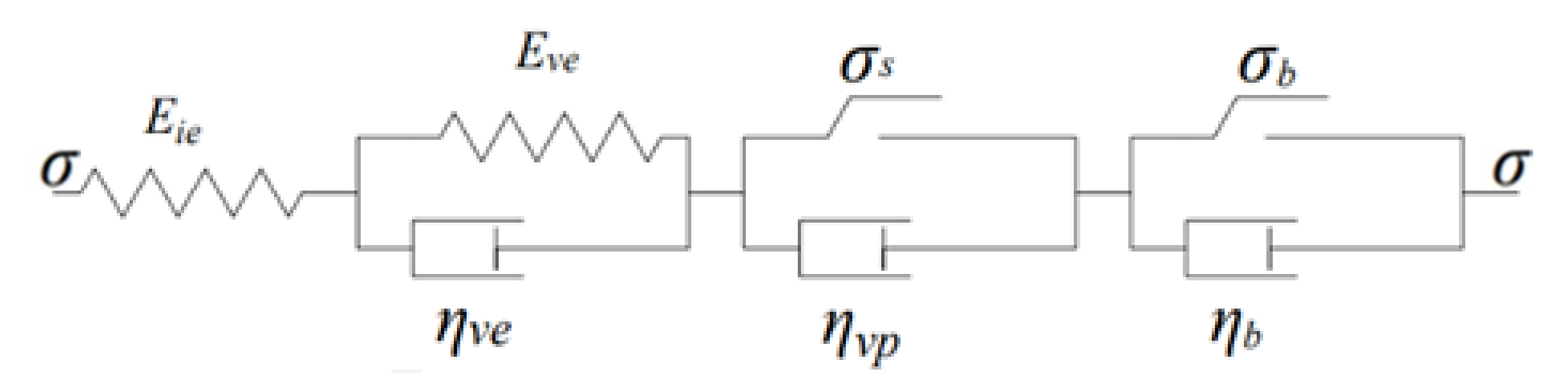
3.1. One-Dimensional Creep Constitutive Equation
- (1)
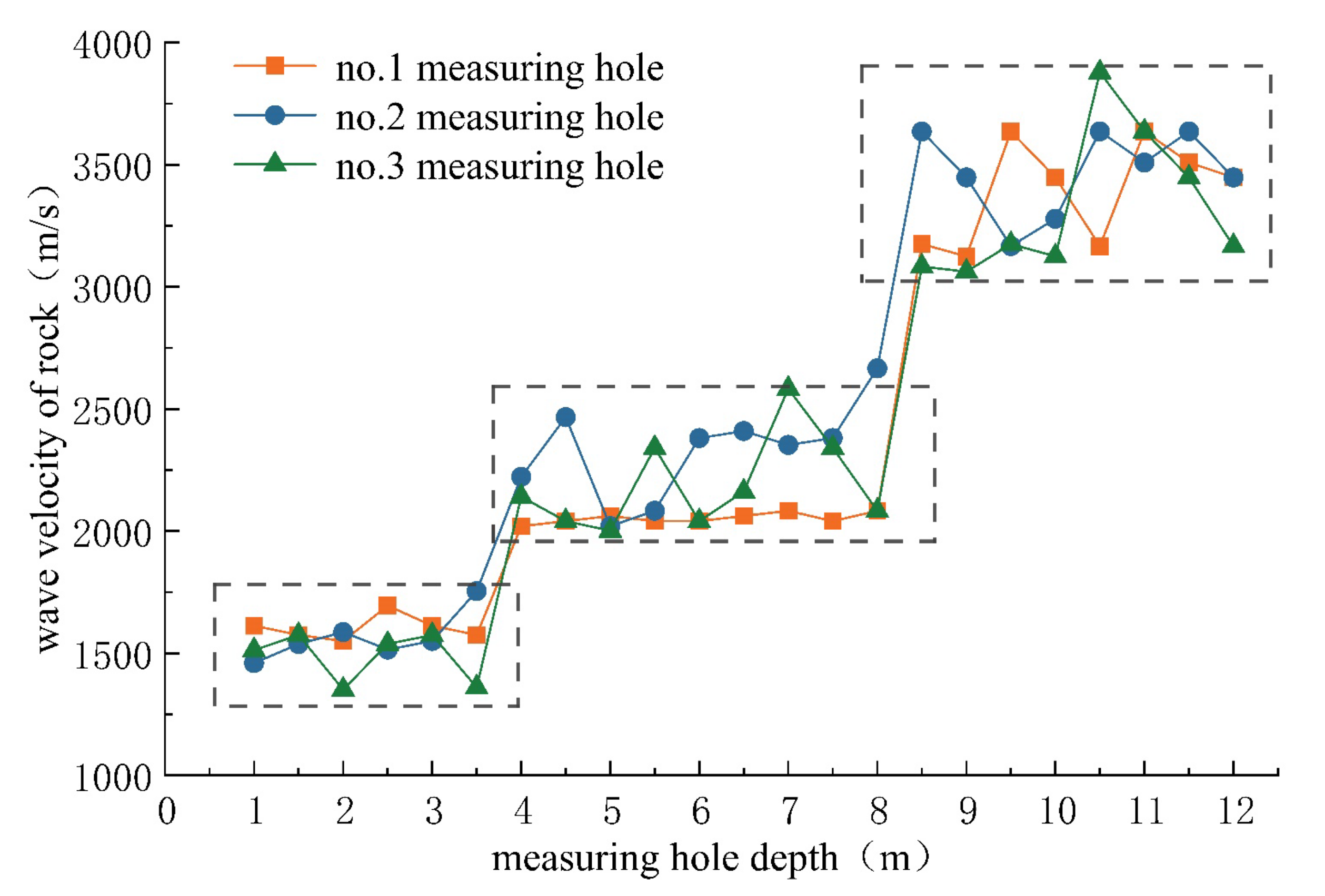
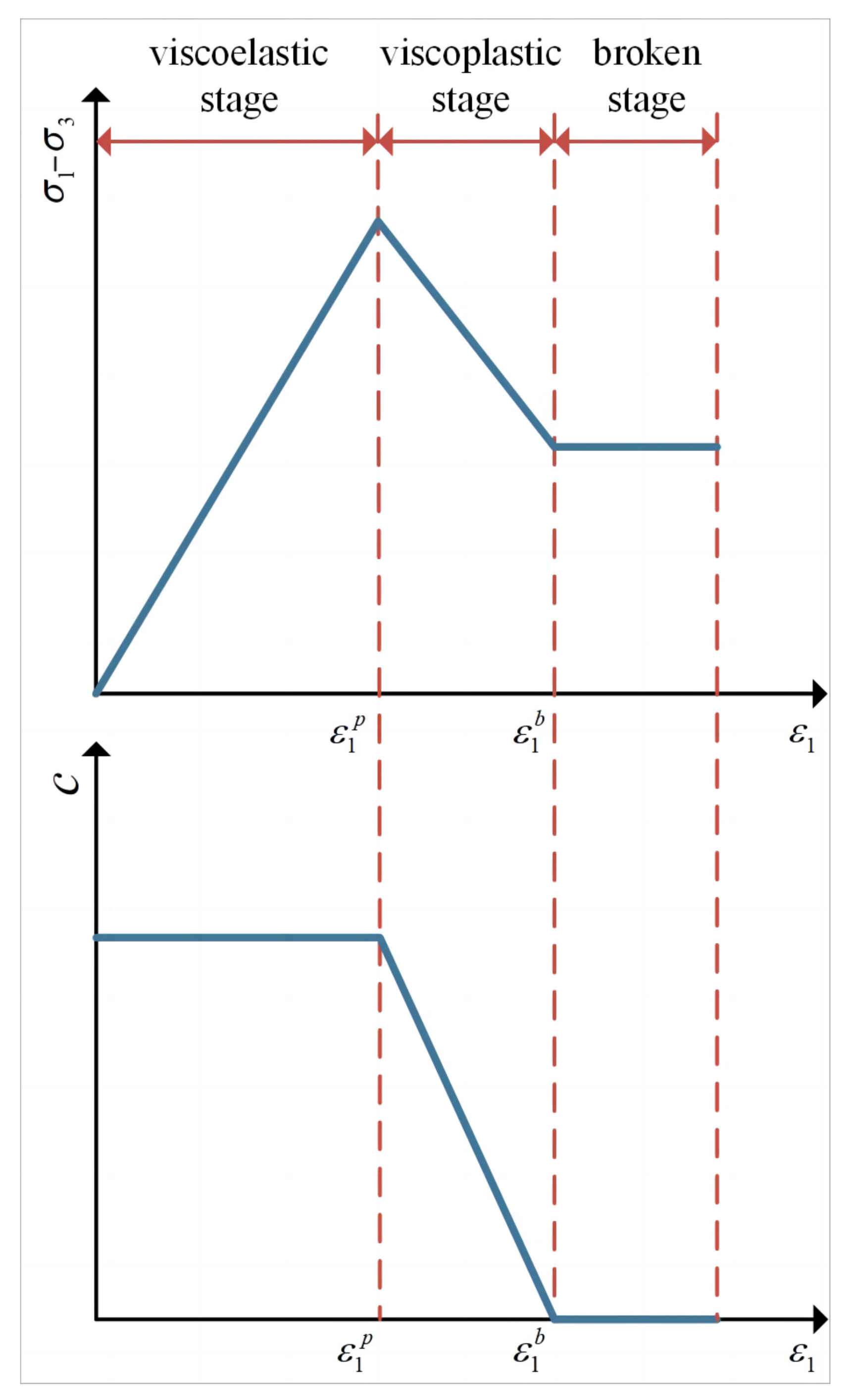
- Under construction disturbance, the thin-layered carbonaceous phyllite stratum is mainly in three damage states;
- (2)
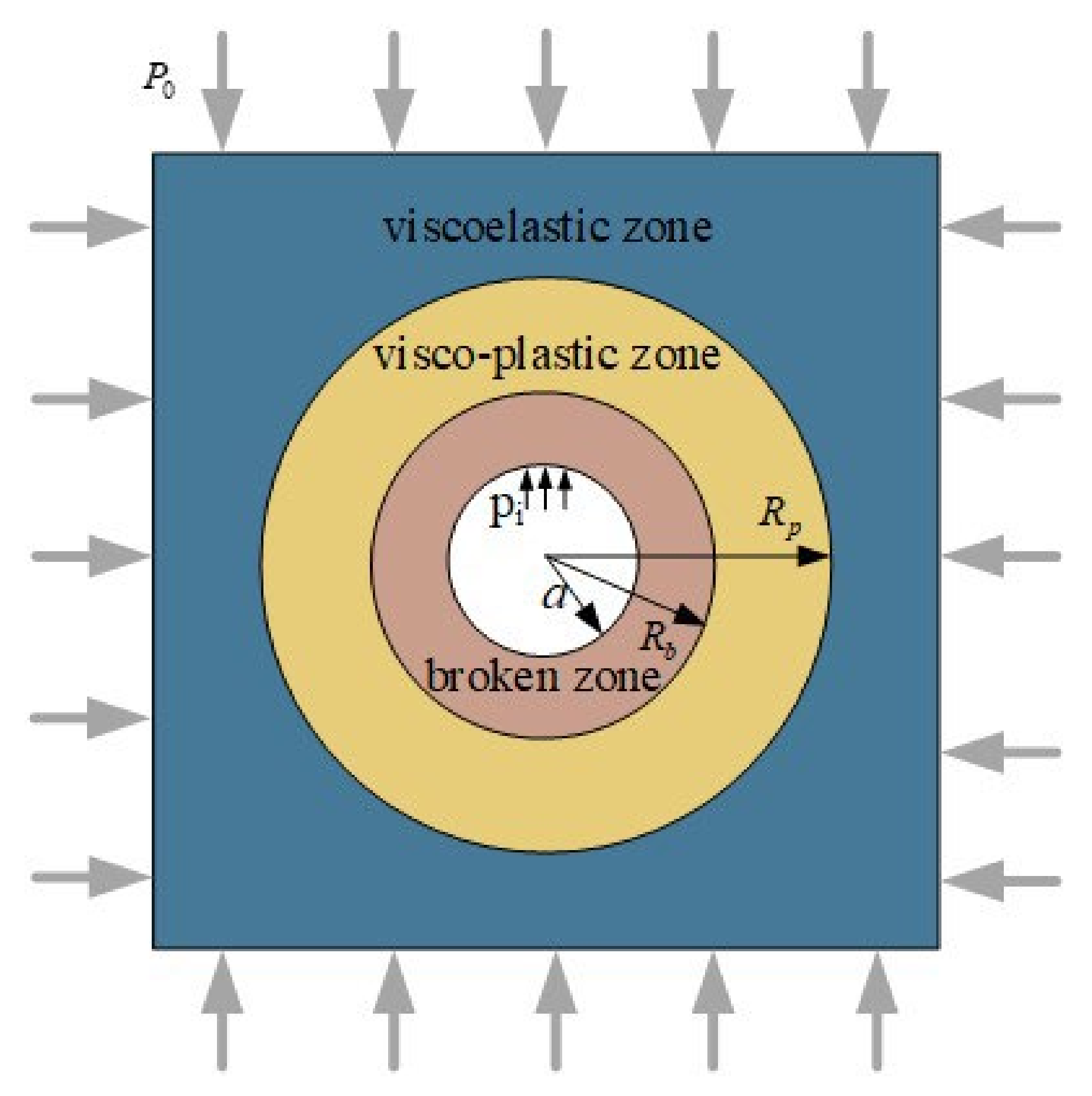
- Given the rock mass’s rheology, the partition mode of the surrounding rock is changed from the common ‘viscoelastic zone + viscoplastic zone ‘to‘ viscoelastic zone + viscoplastic zone + broken zone ‘, as shown in Figure 6. (At the same time, the analysis assumes the following: the tunnel’s excavation section is circular with an equivalent excavation radius of ‘a’; the surrounding rock is a homogeneous and isotropic viscoelastic–plastic body [29]; the tunnel is deeply buried in a hydrostatic stress field and the weight of the surrounding rock is neglected; and the initial support provides constant radial support resistance ‘pi’ and the support size remains constant.);
- (3)
- After tunnel excavation, the boundary stress of the viscoelastic zone and viscoplastic zone is the long-term strength of surrounding rock and the boundary stress of viscoplastic zone and broken zone is the temporary strength.
3.2. D-P Strength Criterion Considering Softening Effect
4. Implementing the Nonlinear Creep Model in FLAC3D Software
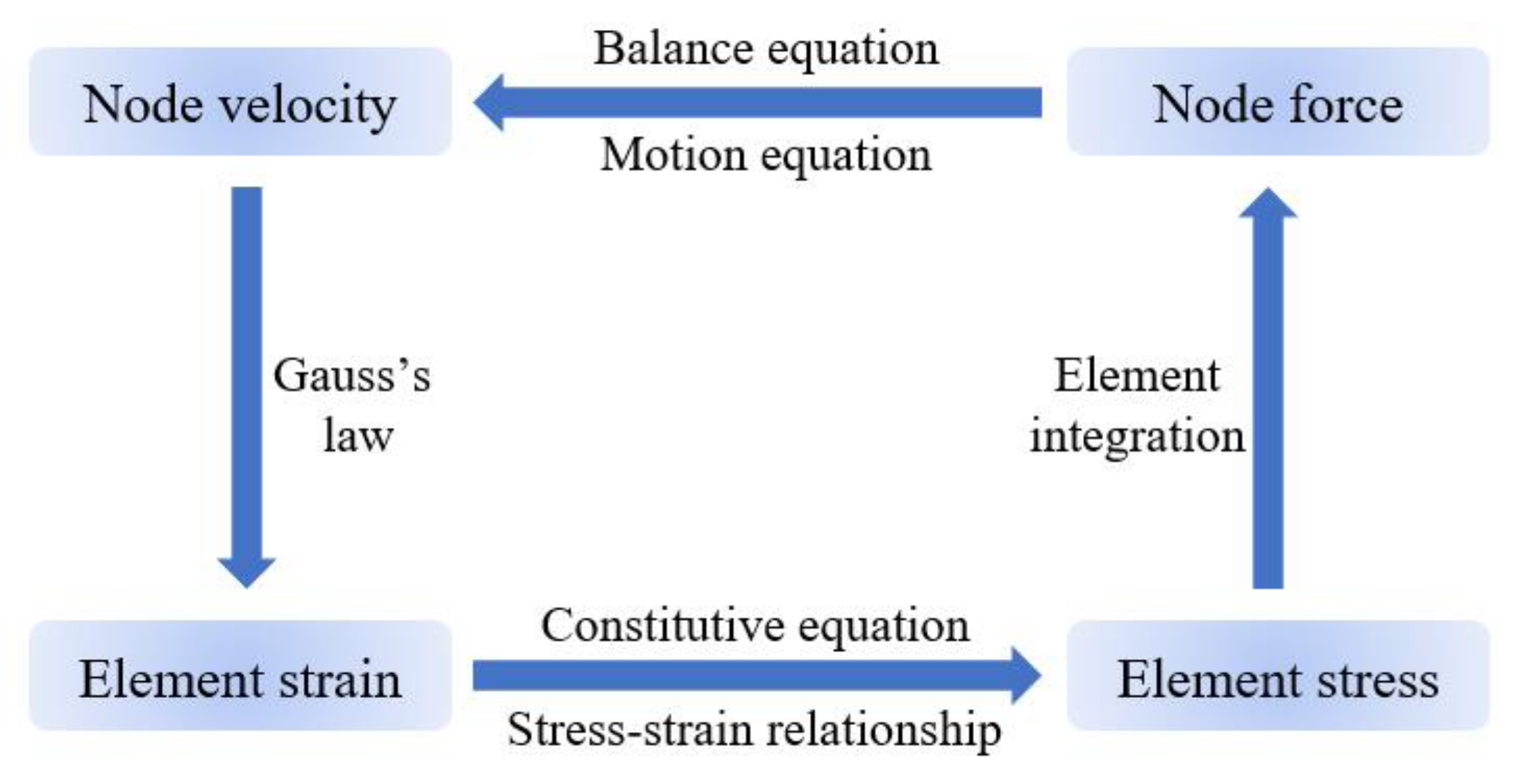
4.1. Operating Principles of the FLAC3D Constitutive Model
4.2. Finite Difference Form of the GNonlinear Creep Model
4.3. Program Verification
5. Engineering Verification
5.1. Engineering Overview
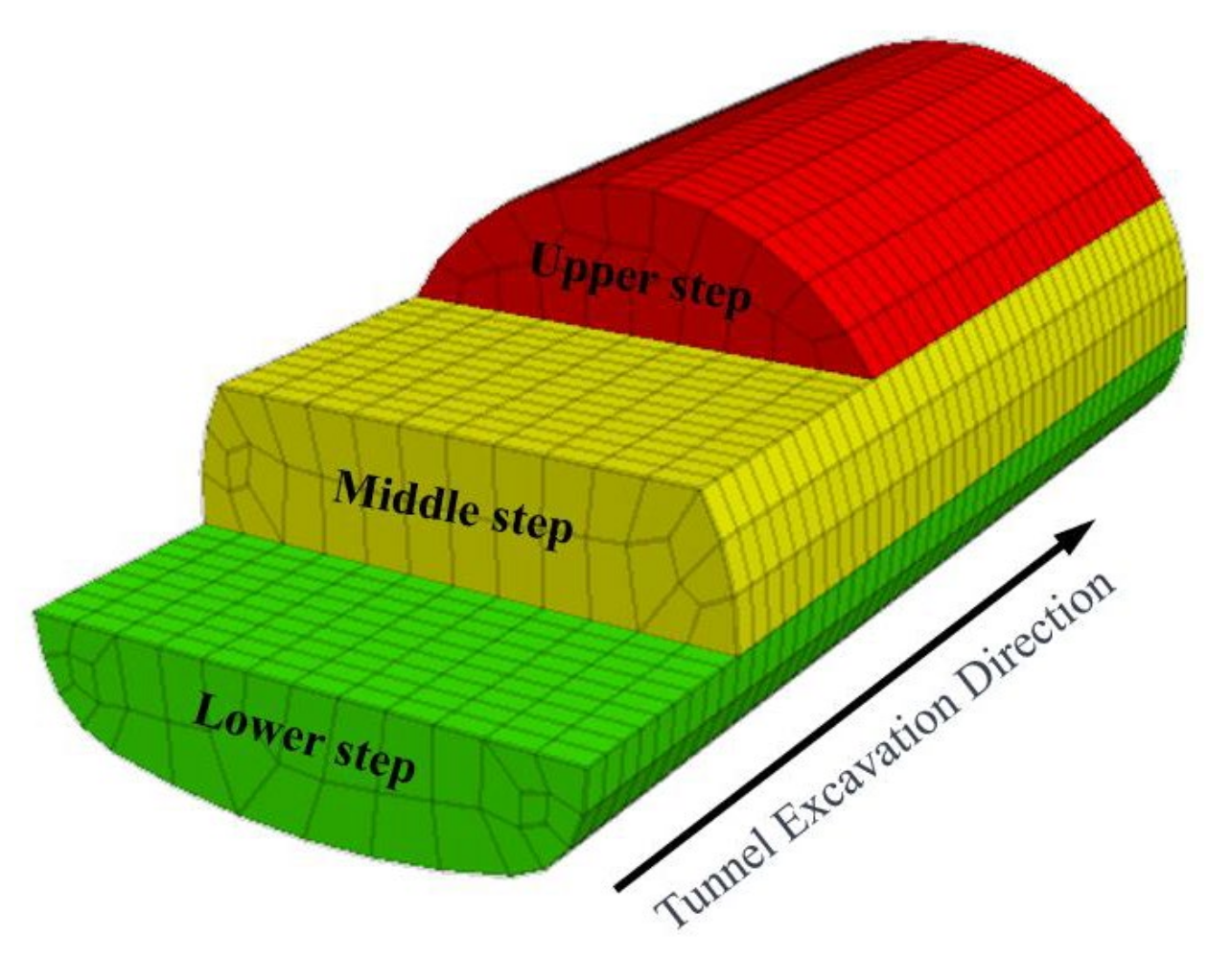
5.2. Construction and Calculation of the Model
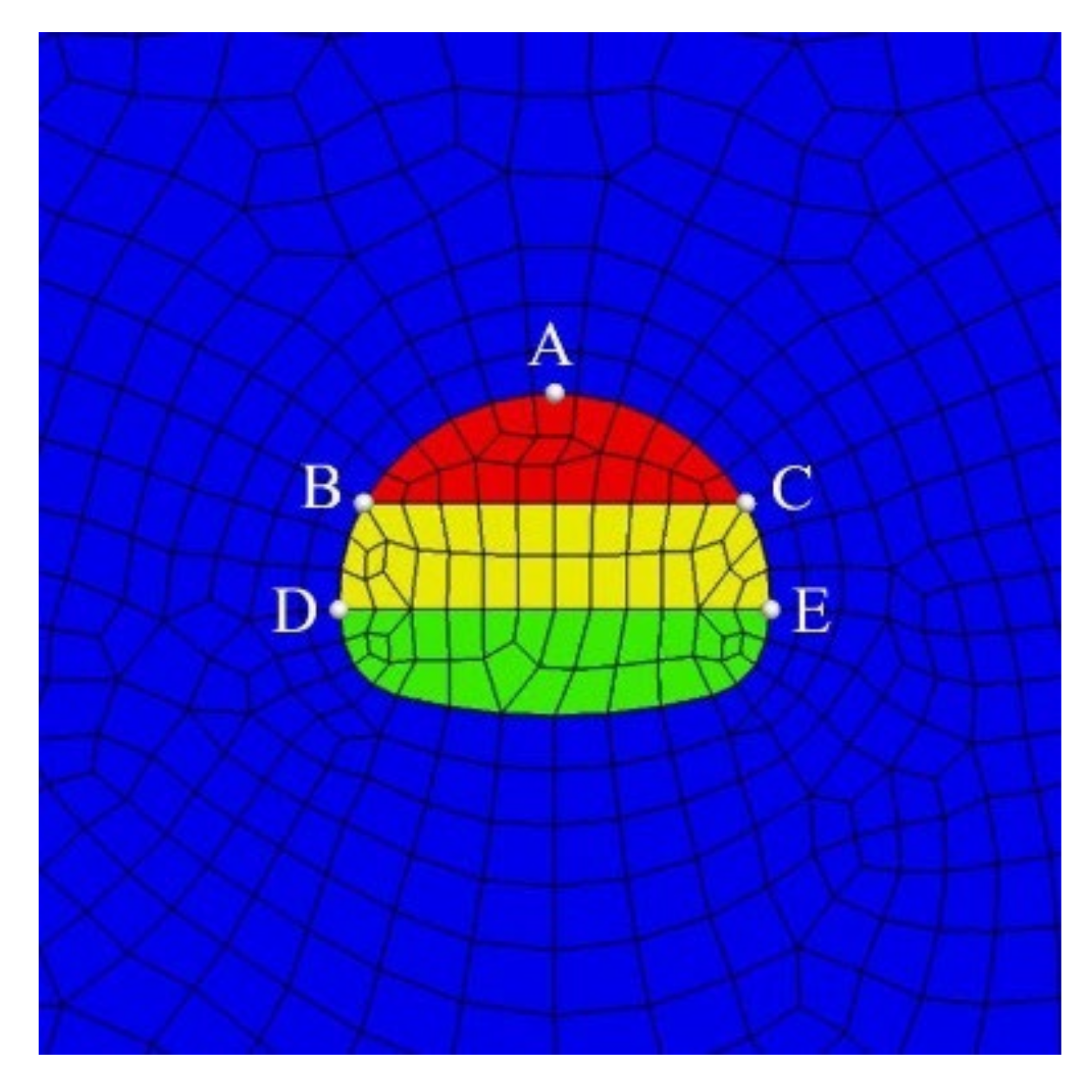
5.3. Comparative Analysis of Surrounding Rock Displacement
6. Discussion
7. Conclusions
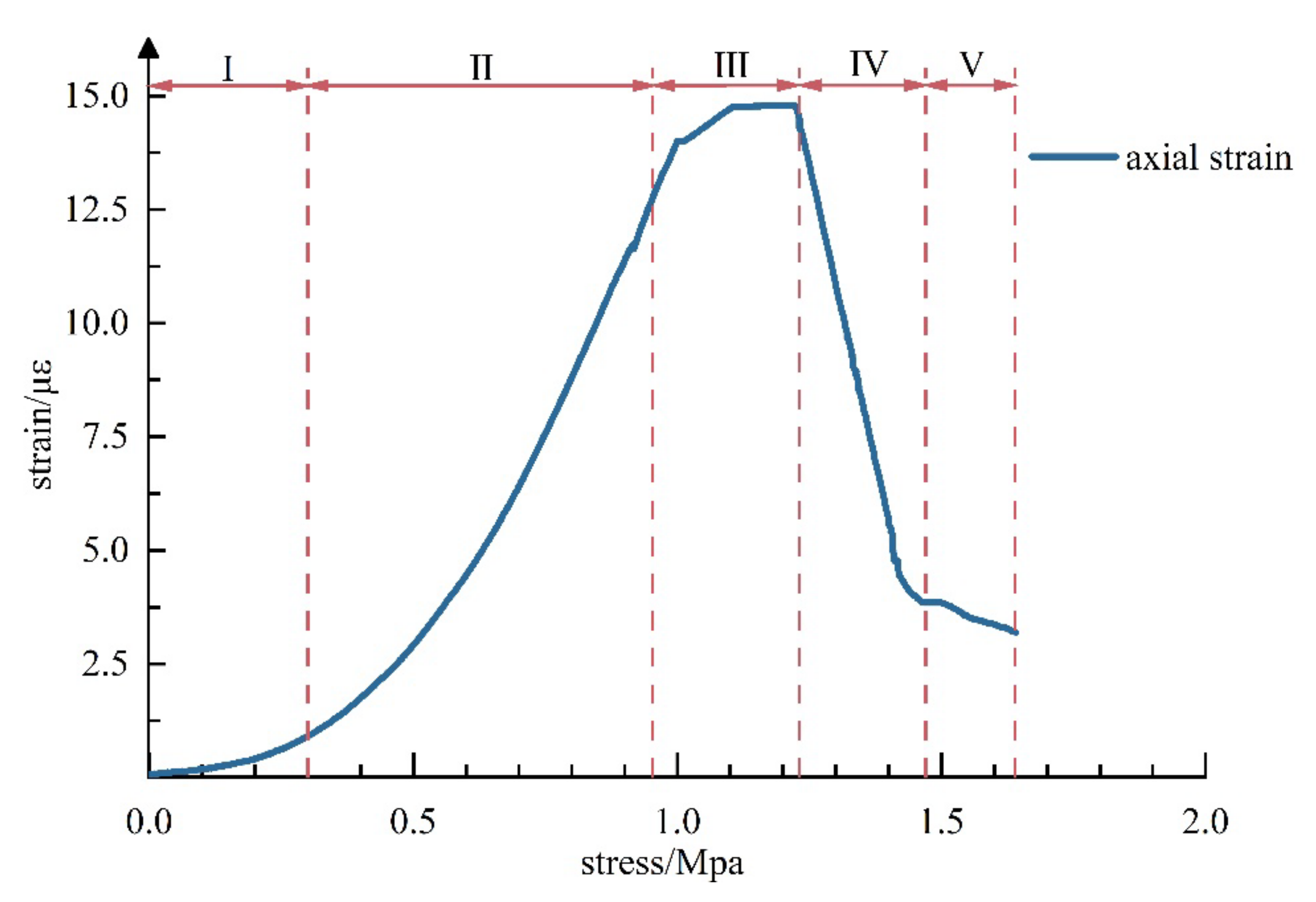
- Field test results indicate that the rock surrounding thin-layered carbonaceous phyllite can be divided into three damage states post-excavation. Uniaxial compression test results demonstrate that thin-layered carbonaceous phyllite softens significantly upon reaching yield strength yet maintains a certain load capacity;
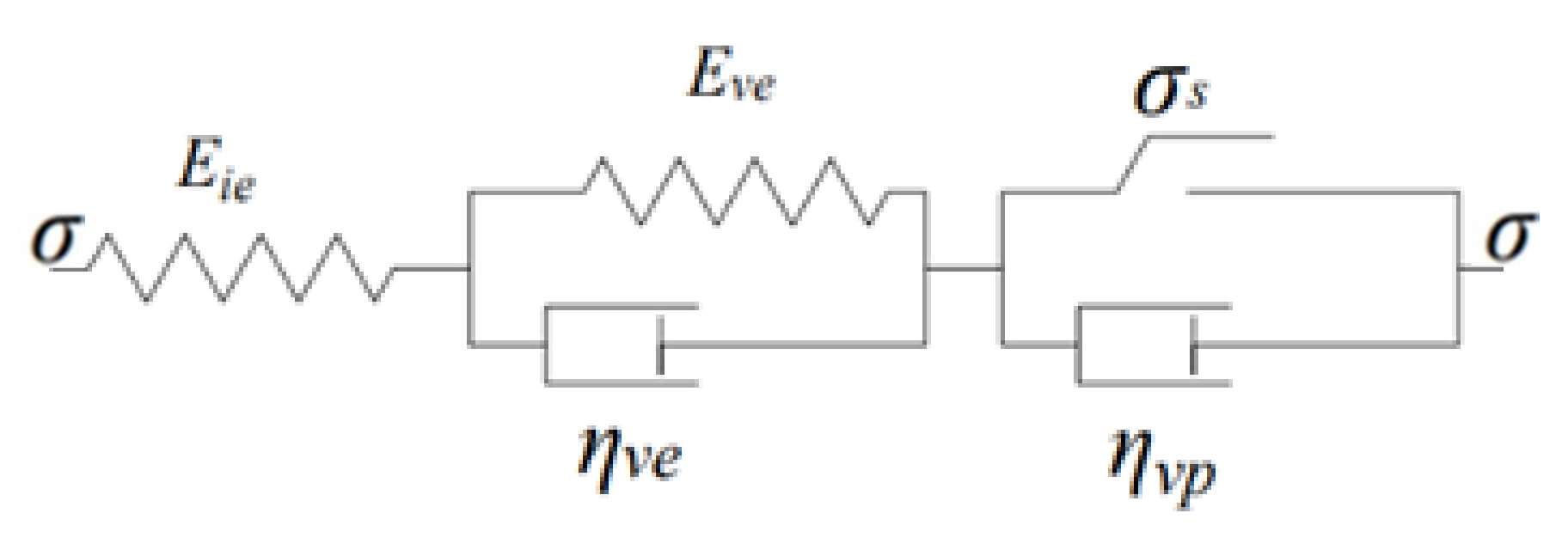
- Consideration of the physical and mechanical properties of thin-layered carbonaceous phyllite has led to improvements in the traditional Nishihara model. By introducing a softening factor, the D-P yield criterion is simplified and modified;
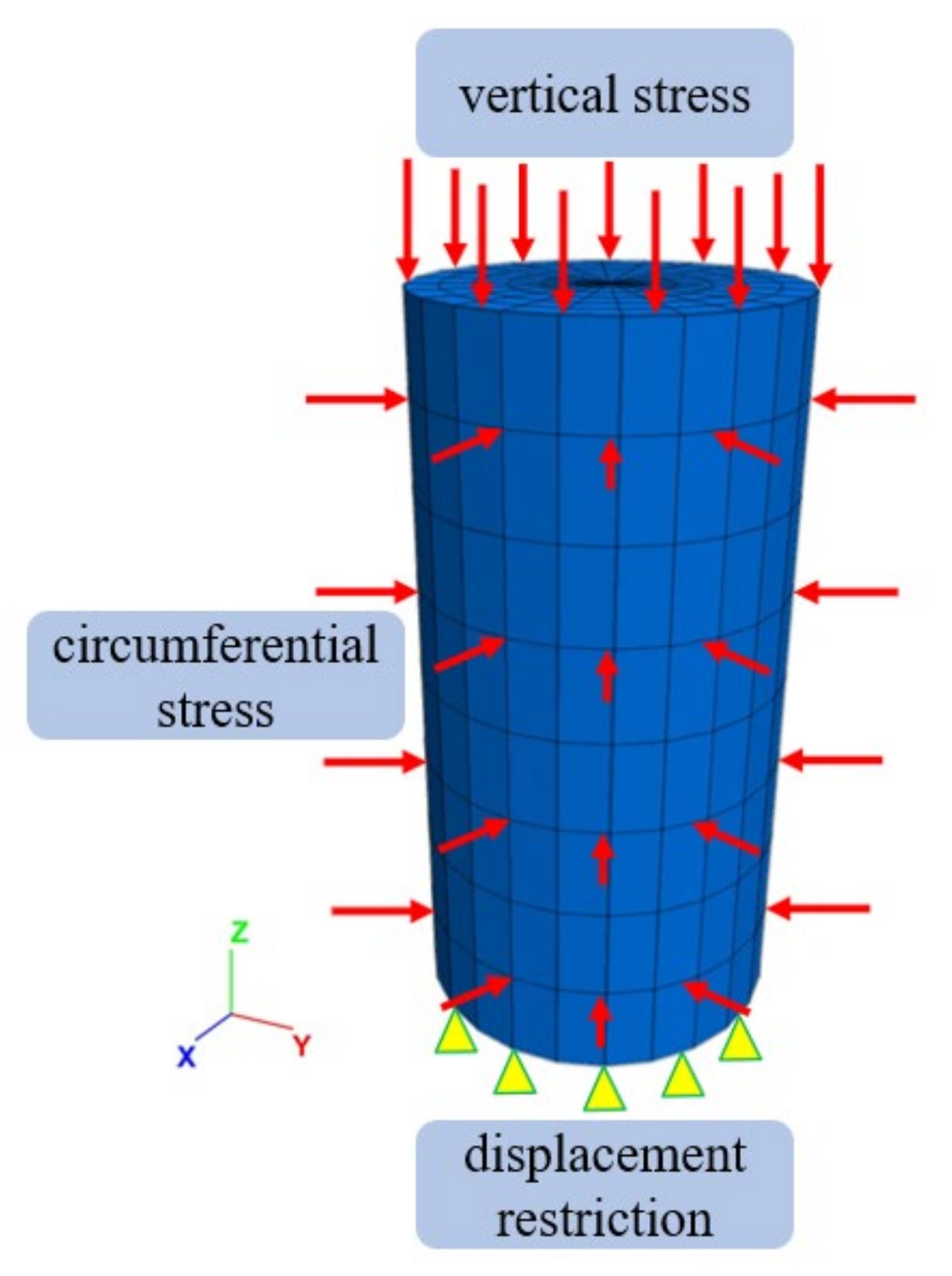
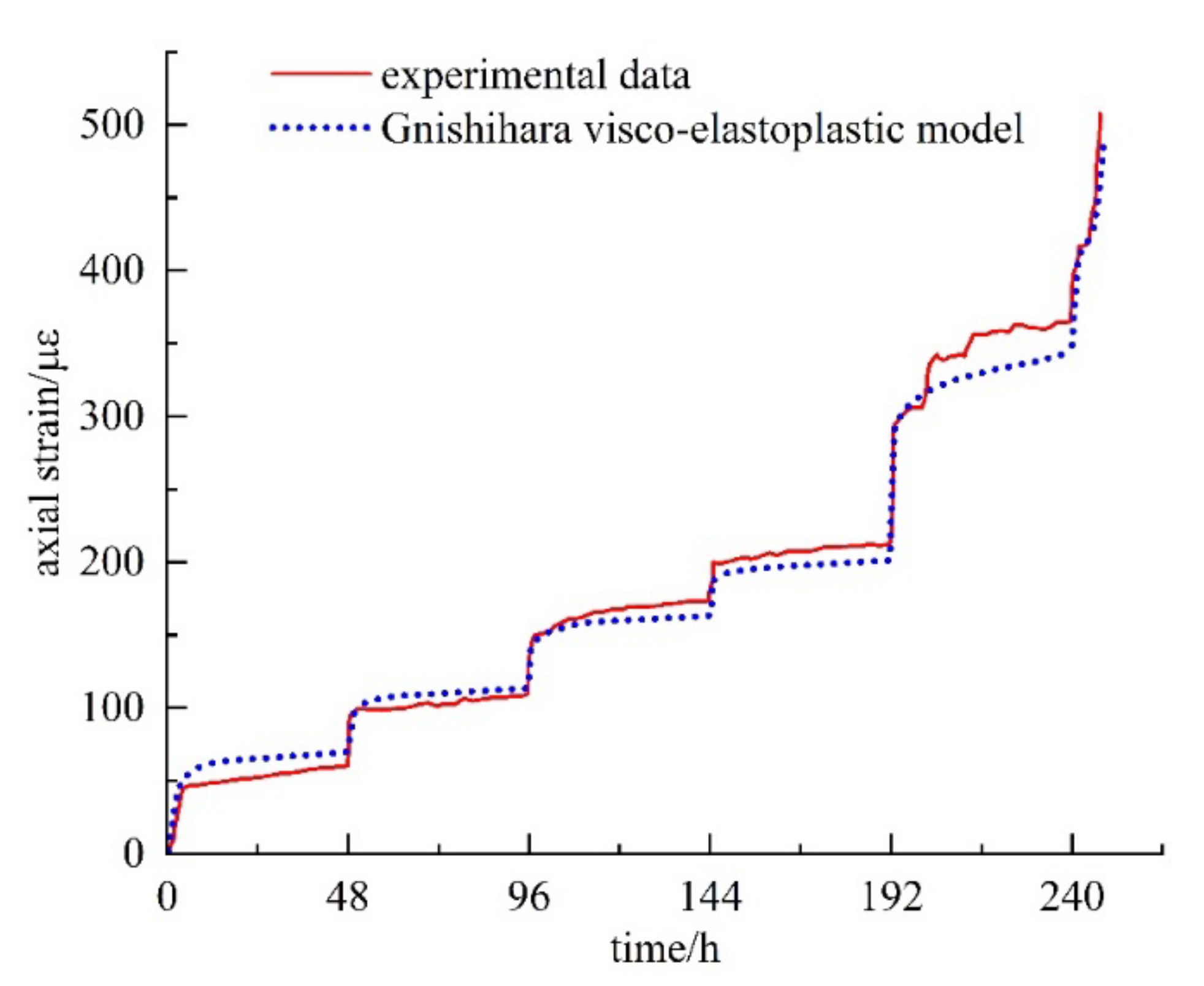
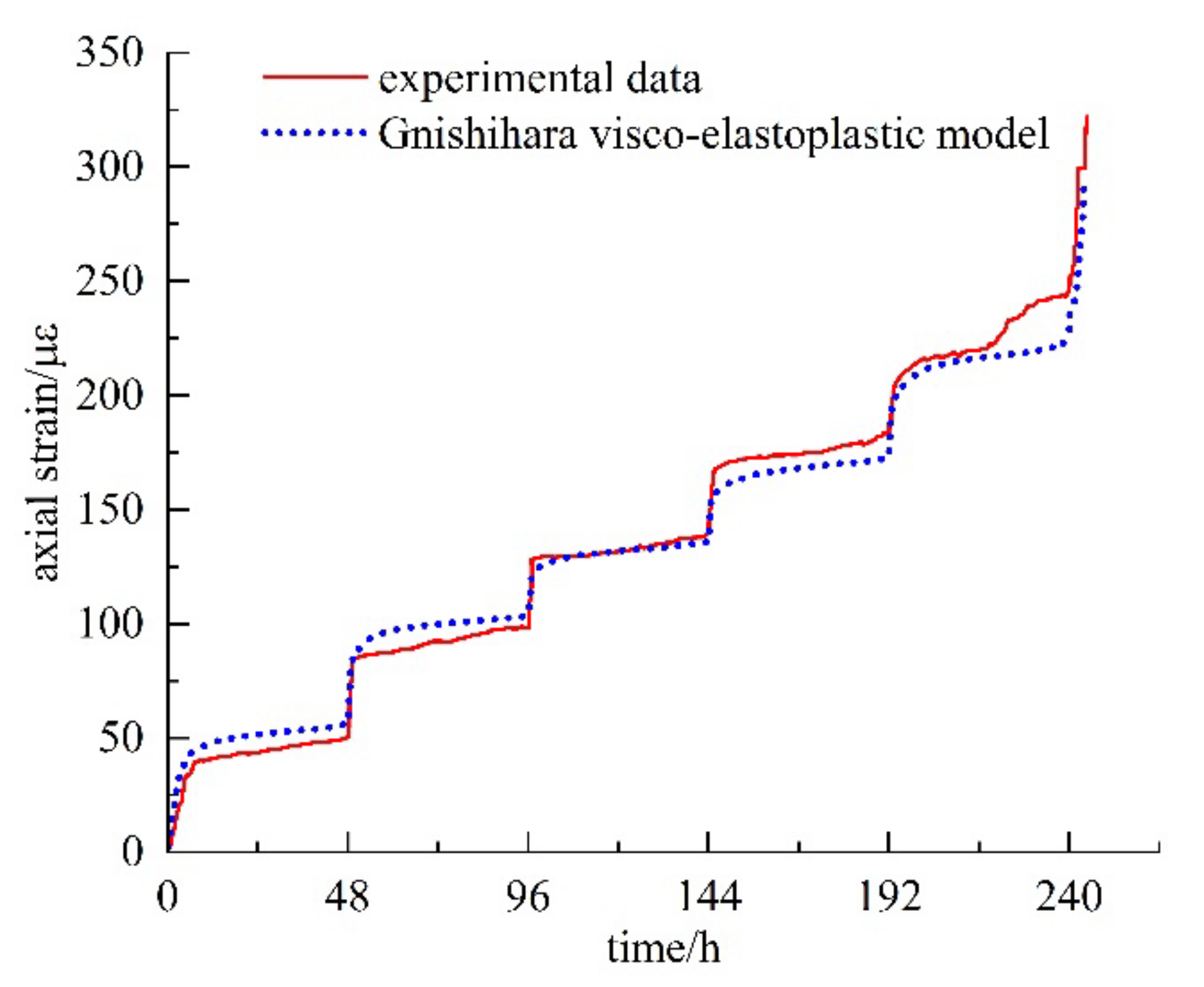
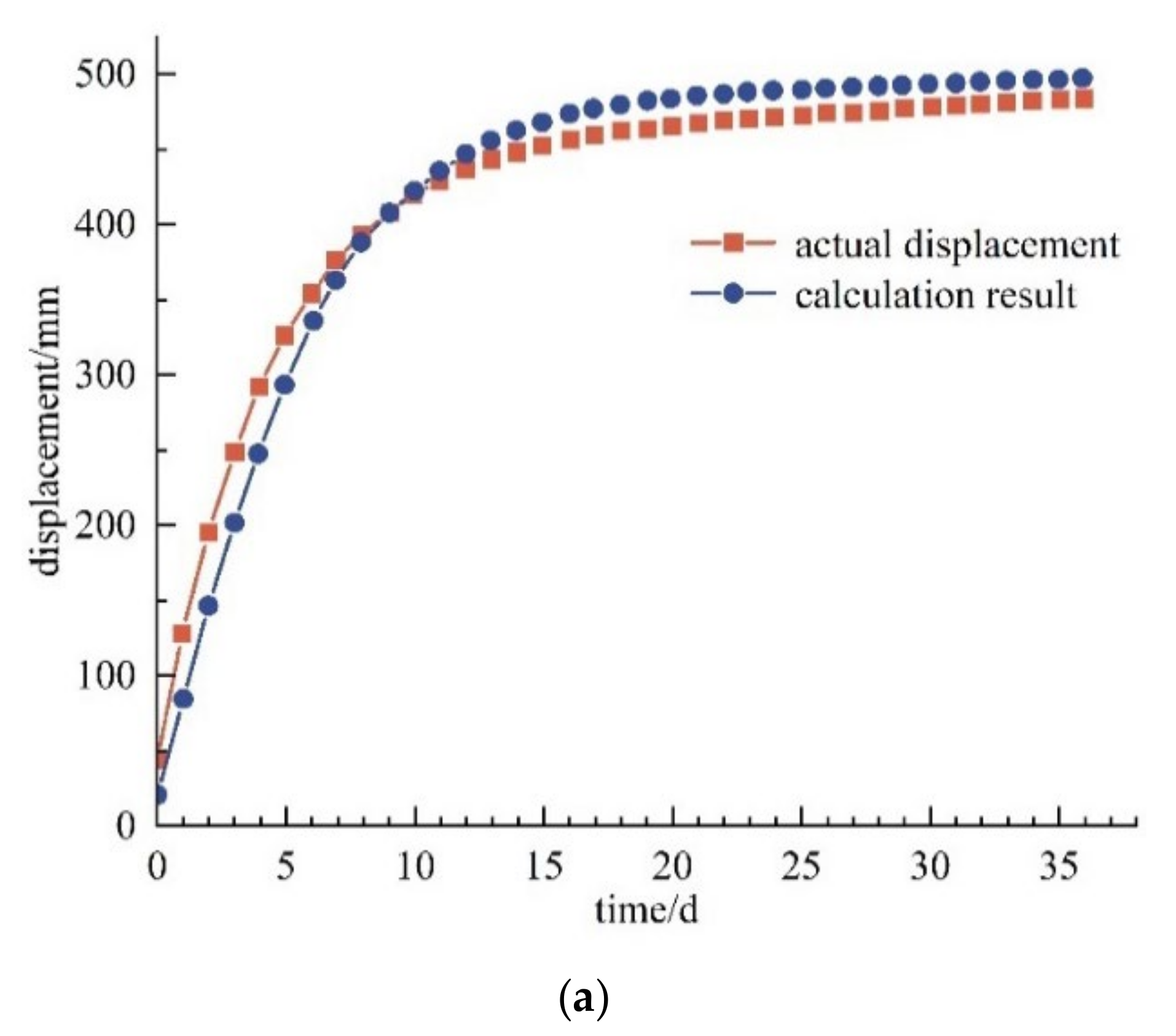
- A detailed three-dimensional finite difference expression of the constitutive model is derived based on the finite difference theory. Utilizing the FLAC3D software’s secondary development platform, the Nishihara constitutive model is further developed and then validated via the simulation of a triaxial compression creep test. Simulation results align with the actual creep test results, thus validating the logic and efficacy of the model’s further developed calculation program;
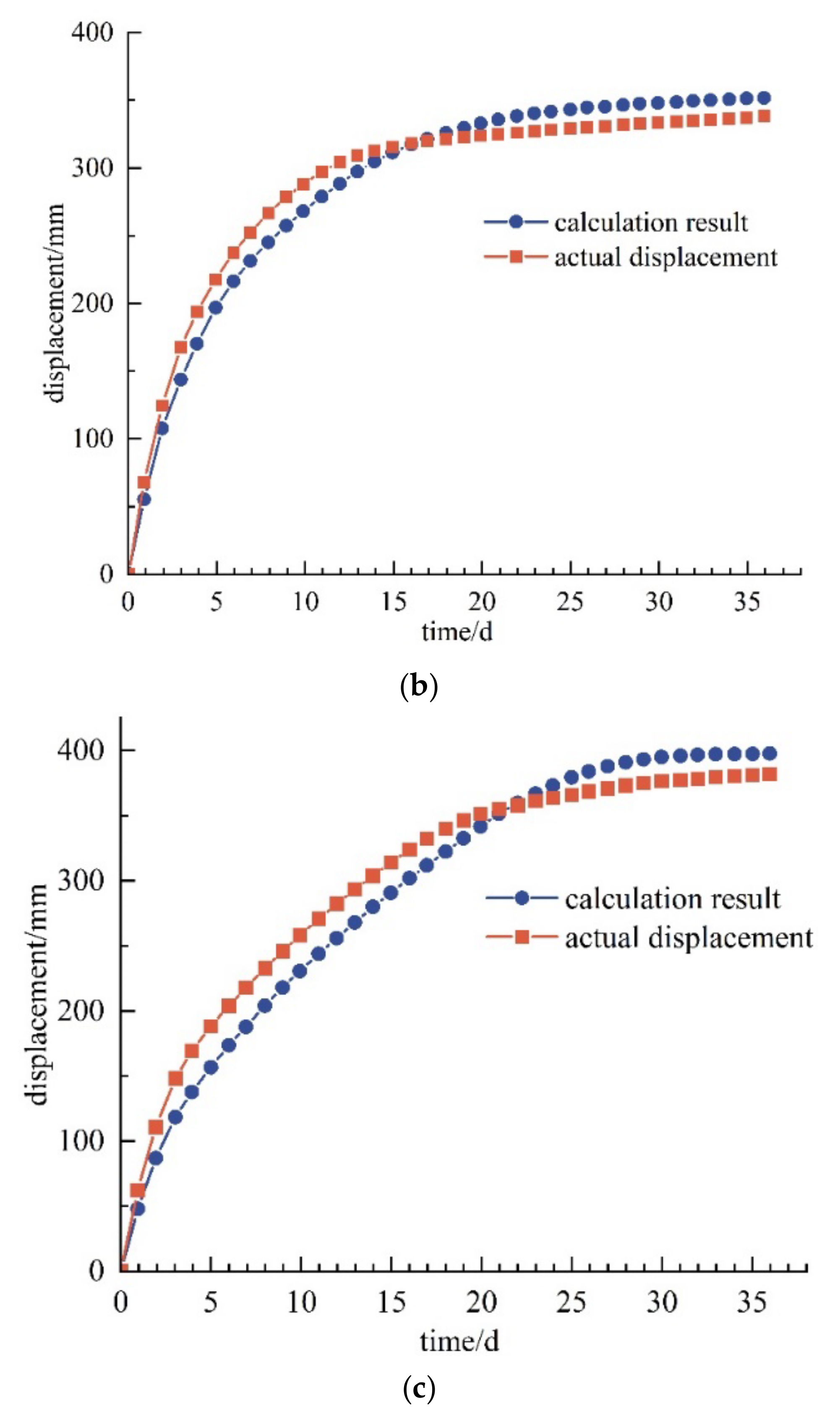
- Engineering examples simulated by the model in this study are compared with actual monitoring results. The results reveal that the displacement error at vault point A is 3.14% with convergence errors of 3.75% at spandrel BC and 4.02% at sidewall DE. Moreover, the trend of numerical simulation results aligns with the actual situation.
Author Contributions
Funding
Data Availability Statement
Conflicts of Interest
References
- Li, L.; Tan, Z.S.; Guo, X.L.; Luo, N. Large deformation of tunnels in steep dip strata of interbedding phyllite under high geostresses. Chin. J. China Civ. Eng. J. 2017, 36, 1611–1622. [Google Scholar]
- Augarde, C.E.; Lee, S.J.; Loukidis, D. Numerical modelling of large deformation problems in geotechnical engineering: A state-of-the-art review. Soils Found. 2021, 61, 1718–1735. [Google Scholar] [CrossRef] [Scilit]
- Deng, X.H.; Wang, Y.C.; Wang, R.; Cao, W.P. Analytical Model for Prediction of Tunnel Deformations in Soft Rocks Considering the Softening and Expansion Effects. Int. J. Civ. Eng. 2023, 21, 101–117. [Google Scholar] [CrossRef] [Scilit]
- Dong, Y.; Zhang, H.; Wang, M.N.; Yu, L.; Zhu, Y.Q. Variable model for mechanical parameters of soft rock and elastoplastic solutions for tunnels considering the influence of confining pressure. Front. Earth Sci. 2023, 11, 1143003. [Google Scholar] [CrossRef] [Scilit]
- Li, J.Q.; Wang, Z.F.; Wang, Y.Q.; Chang, H.T. Analysis and countermeasures of large deformation of deep-buried tunnel excavated in layered rock strata: A case study. Eng. Fail. Anal. 2023, 146, 107057. [Google Scholar] [CrossRef] [Scilit]
- Griggs, D.T. Creep of rocks. J. Geol. 1939, 47, 225–251. [Google Scholar] [CrossRef] [Scilit]
- Tan, T.K.; Kang, W.F. Locked in stresses, creep and dilatancy of rocks, and constitutive equations. Rock Mech. 1980, 13, 5–22. [Google Scholar] [CrossRef] [Scilit]
- Li, Y.; Xia, C. Time-dependenttests on intact rocks in uniaxial compression. Int. J. Rock Mech. Min. Sci. 2000, 37, 467–475. [Google Scholar] [CrossRef] [Scilit]
- Chu, Z.F.; Wu, Z.J.; Liu, B.G.; Liu, Q.S. Coupled analytical solutions for deep-buried circular lined tunnels considering tunnel face advancement and soft rock rheology effects. Tunn. Undergr. Space Technol. 2019, 94, 103111. [Google Scholar] [CrossRef] [Scilit]
- Liu, H.D.; Li, L.D.; Zhao, S.L.; Hu, S.H. Complete stress–strain constitutive model considering crack model of brittle rock. Environ. Earth Sci. 2019, 78, 1–18. [Google Scholar] [CrossRef] [Scilit]
- Zheng, H.; Feng, X.T.; Hao, X.T. A creep model for weakly consolidated porous sandstone including volumetric creep. Int. J. Rock Mech. Min. Sci. 2015, 78, 99–107. [Google Scholar] [CrossRef] [Scilit]
- Liu, H.Z.; Xie, H.Q.; He, J.D.; Xiao, M.L. Nonlinear creep damage constitutive model for soft rocks. Mech. Time Depend Mater. 2017, 21, 73–96. [Google Scholar] [CrossRef] [Scilit]
- Huang, S.J.; Meng, X.R.; Zhao, G.M.; Li, Y.M.; Liu, G.; Dong, C.L.; Cheng, X.; Xu, W.S.; Liu, C.Y.; Zhou, J. Creep Mechanics of the High-Stress Soft Rock under Grade Unloading. Adv. Civ. Eng. 2020, 2020, 8822265. [Google Scholar] [CrossRef] [Scilit]
- Chen, L.W.; Li, S.J.; Zhang, K.X.; Liu, Y.X. Secondary development and application of the NP-T creep model based on FLAC 3D. Arab. J. Geosci. 2017, 10, 508. [Google Scholar] [CrossRef] [Scilit]
- Wang, J.B.; Wang, T.; Song, Z.P.; Zhang, Y.W.; Zhang, Q. Improved Maxwell Model Describing the Whole Creep Process of Salt Rock and its Programming. Int. J. Appl. Mech. 2021, 13, 2150113. [Google Scholar] [CrossRef] [Scilit]
- Chu, W.J.; Xu, W.Y.; Yang, S.Q.; Zhou, W.Y. Secondary development of a viscoelasto-plastic rheological constitutive model of rock based on FLAC3D. Chin. J. Rock Soil Mech. 2006, 27, 2005–2010. [Google Scholar]
- Zou, J.C. Program Development and Engineering Application of Nishihara Model Based on FLAC3D; China University of Geosciences: Beijing, China, 2018. [Google Scholar]
- Liu, X.; Yang, X.; Wang, J. A nonlinear creep model of rock salt and its numerical implement in FLAC3D. Adv. Mater. Sci. Eng. 2015, 2015, 285158. [Google Scholar] [CrossRef] [Scilit]
- Yan, B.Q.; Guo, Q.F.; Ren, F.H.; Cai, M.F. Modified Nishihara model and experimental verification of deep rock mass under the water-rock interaction. Int. J. Rock Mech. Min. Sci. 2020, 128, 104250. [Google Scholar] [CrossRef] [Scilit]
- Qi, Y.J.; Jiang, Q.H.; Wang, Z.J.; Zhou, C. 3D creep constitutive equation of modified Nishihara model and its parameters identification. Chin. J. Rock Mech. Eng. 2012, 31, 347–355. [Google Scholar]
- Hou, R.B.; Zhang, K.; Tao, J.; Xue, X.R.; Chen, Y.L. A nonlinear creep damage coupled model for rock considering the effect of initial damage. Rock Mech. Rock Eng. 2019, 52, 1275–1285. [Google Scholar] [CrossRef] [Scilit]
- Yang, X.R.; Jiang, A.; Jiang, Z.B. Creep test and damage model of soft rock under water containing condition. Rock Soil Mech. 2018, 39, 167–174. [Google Scholar]
- Yu, X.F.; Zheng, Y.R.; Liu, H.H. Surrounding Rock Stability Analysis in Underground Engineering; China Coal Industry Publishing House: Beijing, China, 1983. [Google Scholar]
- Brady, B.H.G.; Brown, E.T. Rock Mechanics: For Underground Mining; Springer Science and Business Media: Berlin/Heidelberg, Germany, 2006. [Google Scholar]
- Huang, X.P.; Kong, X.Z.; Chen, Z.Y.; Fang, Q. A computational constitutive model for rock in hydrocode. Int. J. Impact Eng. 2020, 145, 103687. [Google Scholar] [CrossRef] [Scilit]
- Khaledi, K.; Mahmoudi, E.; Datcheva, M.; König, D.; Schanz, T. Sensitivity analysis and parameter identification of a time dependent constitutive model for rock salt. J. Comput. Appl. Math. 2016, 293, 128–138. [Google Scholar] [CrossRef] [Scilit]
- Li, H.Y.; Zhu, K.Z.; Chen, Y.L.; Chen, B.G.; Zeng, Z.Q. Formulation and implementation of elastoplastic constitutive model for carbonaceous slate. Bull. Eng. Geol. Environ. 2023, 82, 93. [Google Scholar] [CrossRef] [Scilit]
- Chen, Z.M. Analytical Methods in Analysis of Rock Mechanics; China Coal Industry Publishing House: Beijing, China, 1994. [Google Scholar]
- Wu, Y.S.; Tan, Z.S.; Yu, X.B.; Yu, Y.; Zhu, Y. Dilatancy behavior of phyllite in uniaxal compressive tests under different loading azimuths. Chin. J. Rock Soil Mech. 2018, 39, 2747–2754. [Google Scholar]
- Xu, F. Study on Rheological Mechanism of Carbonaceous Phyllite and Yield-Resisted Coupling Supporting Structure and Its Engineering Applications; Shandong University: Shandong, China, 2017. [Google Scholar]






/kPa | /° | /MPa | /GPa | /GPa·h−1 | /GPa·h−1 | ha | hb | /MPa | ||
|---|---|---|---|---|---|---|---|---|---|---|
| 69.4 | 8.274 | 841.8 | 1.085 | 1.531 | 3.790 | 4.469 | 1.26 | 1.51 | 0.688 | 7.765 |
| Support Structure | E/GPa | v | Cross-Sectional-Area/m2 | Density/Kg·m−3 | Thickness/m |
|---|---|---|---|---|---|
| Cable element | 210 | 0.3 | 6.22 × 10⁻³ | 7.6 | / |
| Liner enelemt | 28 | 0.17 | / | 2.45 | 0.3 |
Disclaimer/Publisher’s Note: The statements, opinions and data contained in all publications are solely those of the individual author(s) and contributor(s) and not of MDPI and/or the editor(s). MDPI and/or the editor(s) disclaim responsibility for any injury to people or property resulting from any ideas, methods, instructions or products referred to in the content. |
© 2023 by the authors. Licensee MDPI, Basel, Switzerland. This article is an open access article distributed under the terms and conditions of the Creative Commons Attribution (CC BY) license (https://creativecommons.org/licenses/by/4.0/).
Share and Cite
Deng, X.; Shi, J.; Li, X.; Wang, R.; Zhang, J.; Yang, X. The Secondary Development and Application of the Improved Nishihara Creep Model in Soft Rock Tunnels. Buildings 2023, 13, 2082. https://doi.org/10.3390/buildings13082082
Deng X, Shi J, Li X, Wang R, Zhang J, Yang X. The Secondary Development and Application of the Improved Nishihara Creep Model in Soft Rock Tunnels. Buildings. 2023; 13(8):2082. https://doi.org/10.3390/buildings13082082
Chicago/Turabian StyleDeng, Xianghui, Junxin Shi, Xiaolin Li, Rui Wang, Jinzeng Zhang, and Xin Yang. 2023. "The Secondary Development and Application of the Improved Nishihara Creep Model in Soft Rock Tunnels" Buildings 13, no. 8: 2082. https://doi.org/10.3390/buildings13082082
APA StyleDeng, X., Shi, J., Li, X., Wang, R., Zhang, J., & Yang, X. (2023). The Secondary Development and Application of the Improved Nishihara Creep Model in Soft Rock Tunnels. Buildings, 13(8), 2082. https://doi.org/10.3390/buildings13082082