Article

Morphological Evolution of Passive Soil Arch in Front of Horizontal Piles in Three Dimensions
1
School of Civil Engineering, Chang’an University, Xi’an 710061, China
2
Institute of Underground Structure and Engineering, Chang’an University, Xi’an 710061, China
*
Author to whom correspondence should be addressed.
Buildings 2022, 12(7), 1056; https://doi.org/10.3390/buildings12071056

Submission received: 26 May 2022 / Revised: 15 July 2022 / Accepted: 18 July 2022 / Published: 21 July 2022
(This article belongs to the Section Building Structures)

Abstract

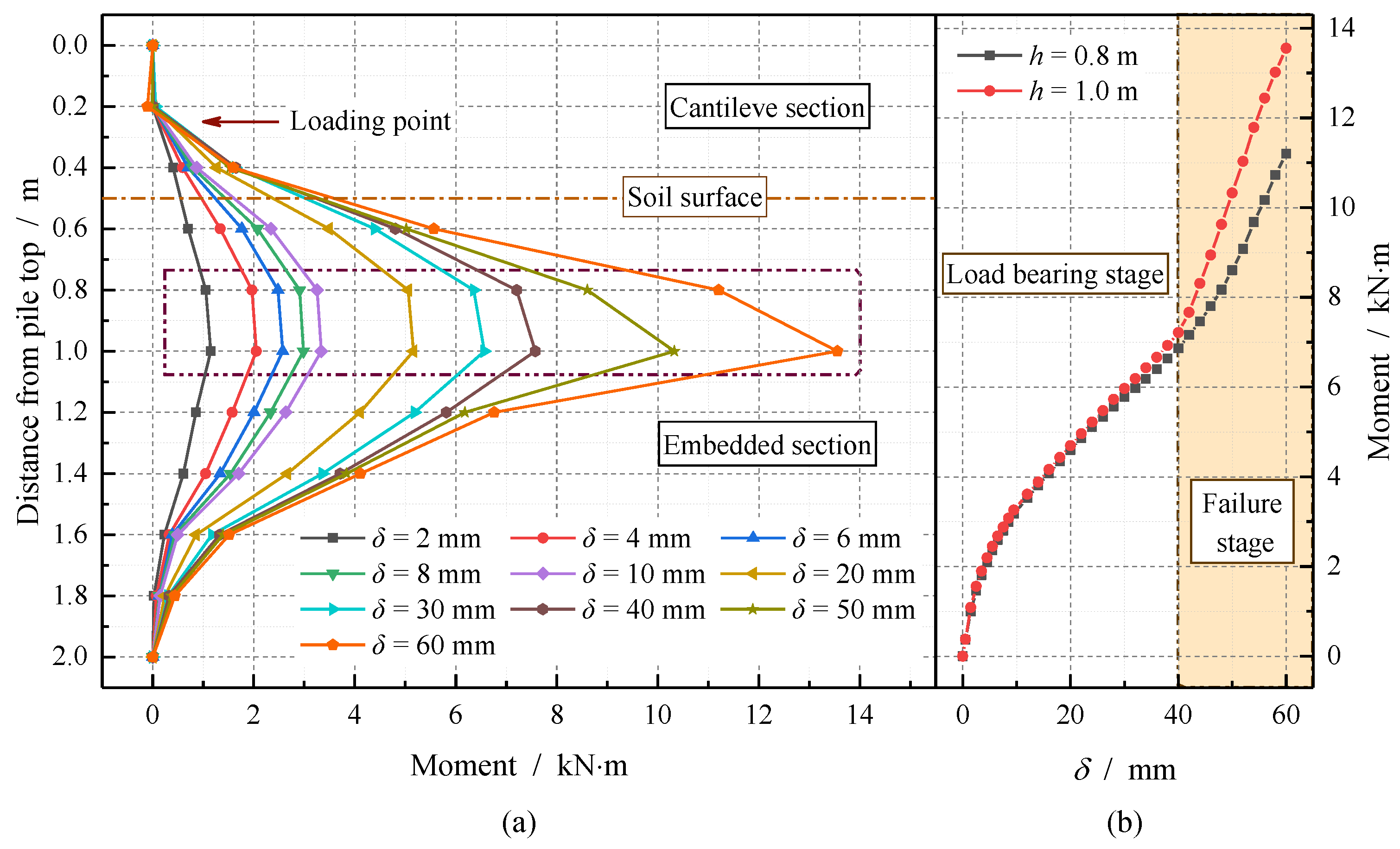
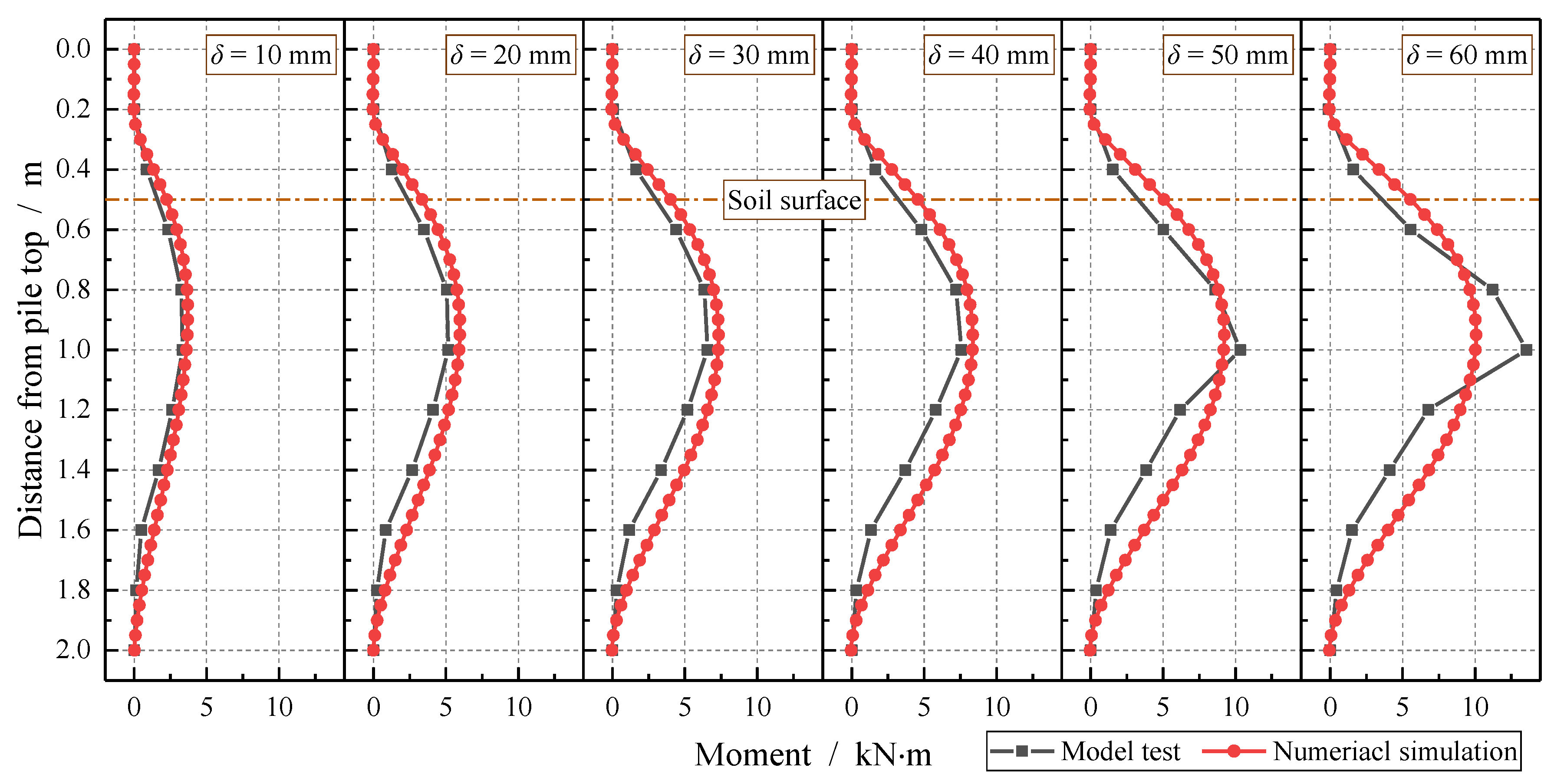
The anti-slide pile is a primary method of landslide control. The effect of the passive soil arch in front of the embedded section of piles has a significant effect on the anti-slide pile’s bearing capacity. The upgraded model test scheme was used to conduct model tests with a pile spacing four times the width of the pile and a geometric scale ratio of 1:15. The anti-slide pile stress, pile bending strain, and soil stress in front of the pile were all studied in relation to the loading amount. In addition to the model test, the numerical simulation method was utilized to investigate the three-dimensional morphological change of the passive soil arch in front of the pile. The results indicated that: clearly, the side piles can eliminate the border effect. The distribution of pile bending strain along the pile after loading is referred to as a parabola. Bending failure occurred at a depth of 40 mm, approximately 0.9 m from the pile top. Under the condition that the pile spacing is four times the pile width, a passive soil arch occurs in front of the anti-slide pile’s fixed part, and its development can be split into four stages: formation, development, completion, and destruction. The passive soil arches in front of the piles are generated and destroyed gradually along the buried depth, and the three-dimensional surface of the space drops gradually along the buried depth with the loading amount and advances toward the loading direction until the anti-slide pile system fails. The research findings and experiences can serve as a basis for future research.
Keywords: anti-slide pile; embedded section; passive earth arch; model test; spatial form anti-slide pile; embedded section; passive earth arch; model test; spatial form