Article

Research on the Indicators of Sustainable Campus Renewal and Reconstruction in Pursuit of Continuous Historical and Regional Context


1
School of Architecture, South China University of Technology, Guangzhou 510641, China
2
State Key Laboratory of Subtropical Building Science, South China University of Technology, Guangzhou 510641, China
3
Architectural Design & Research Institute Co., Ltd., South China University of Technology, Guangzhou 510641, China
4
Faculty of Architecture, The University of Hong Kong, Hong Kong, China
*
Author to whom correspondence should be addressed.
These authors contributed equally to this study and shared the first authorship.
Buildings 2022, 12(10), 1508; https://doi.org/10.3390/buildings12101508

Submission received: 16 August 2022 / Revised: 15 September 2022 / Accepted: 19 September 2022 / Published: 22 September 2022

Abstract

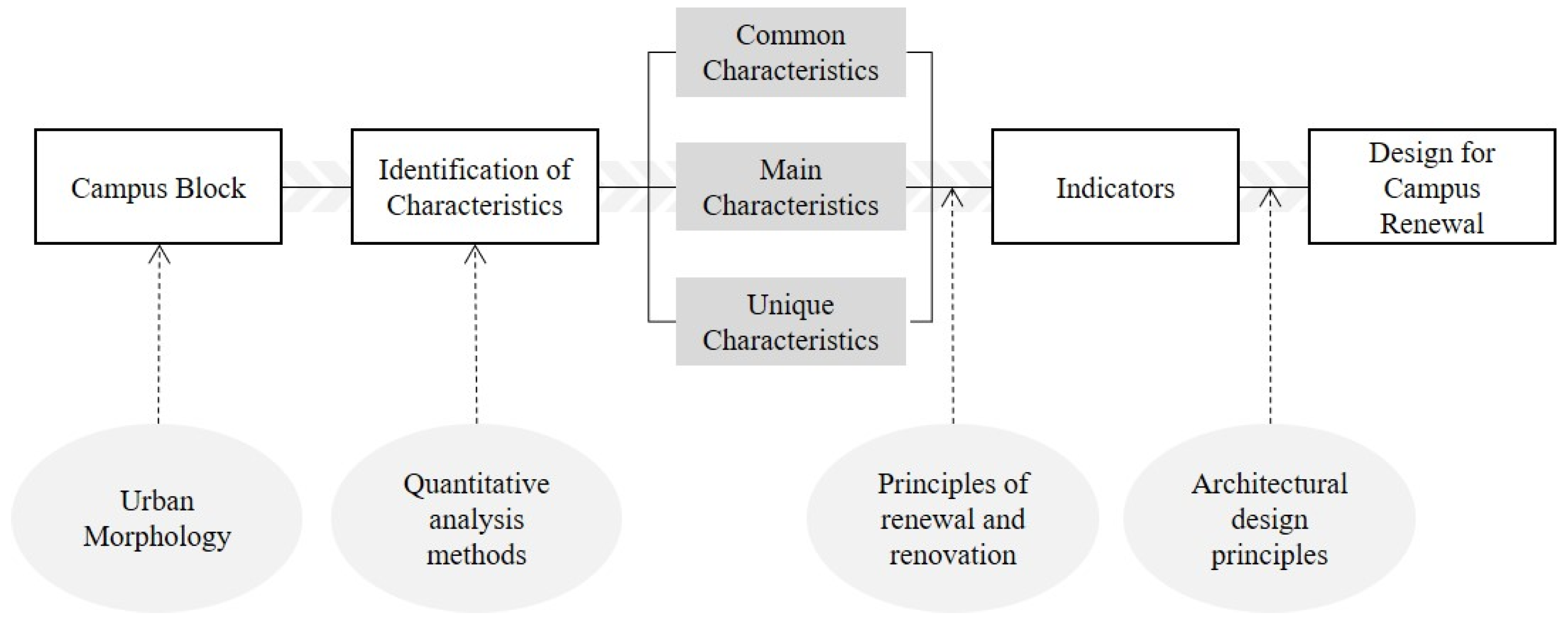
As cities transition from incremental development to stock development, university campuses in suburban areas are progressively becoming urban university campuses. The stability of the boundary between urban university campuses and the city, along with the fact that the campus’s overall spatial capacity is reaching its maximum, makes it impossible for urban university campuses to have future spatial expansions. This article focused on the stock development, renewal, and transformation of urban campuses. From the perspective of urban university campus block morphology hierarchy and using the Wushan Campus of South China University of Technology in Guangzhou as an example, this study utilized urban morphology theory, data mining technology, big data collection, and visualization techniques to measure campus block morphology. Then, K-means clustering was utilized to classify the block form, and historical background research was employed to study the many forms of typical block form. Finally, the campus renewal and transformation guiding principles were introduced, and the control index of block form renewal and transformation was formed, evolving into the university campus block form renewal and transformation design technique. This strategy was used to investigate the general revitalization of college campuses.
Keywords: block morphology; Chinese university campus; cluster analysis; urban university campus; planning and design; renewal and renovation; sustainable development; historical and regional context block morphology; Chinese university campus; cluster analysis; urban university campus; planning and design; renewal and renovation; sustainable development; historical and regional context