Electrochemical Investigation of Corrosion Behavior of CuFeP Alloy in Chloride Solution

 ,
,  , , ,
, , , 
Abstract
1. Introduction
2. Materials and Methods
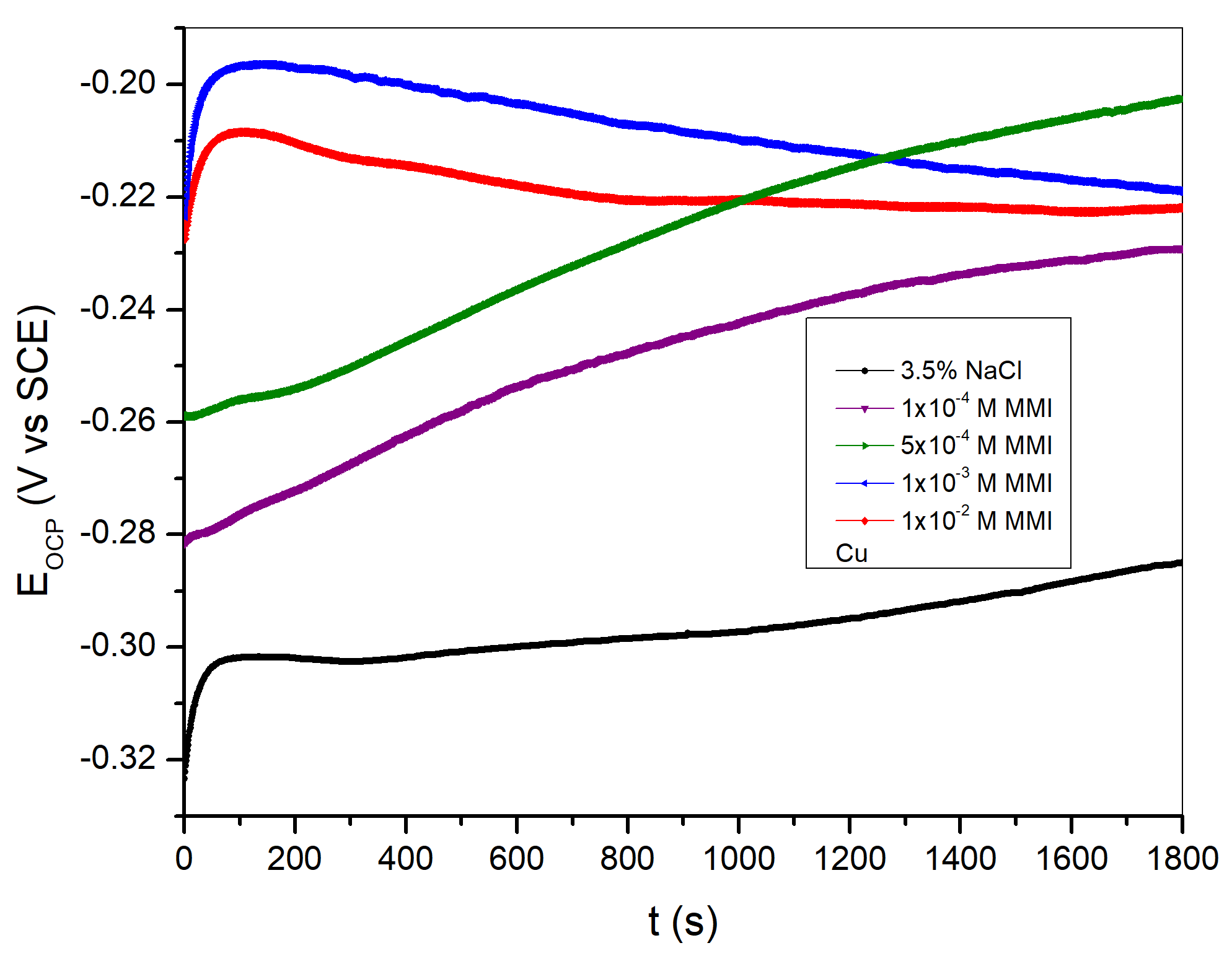
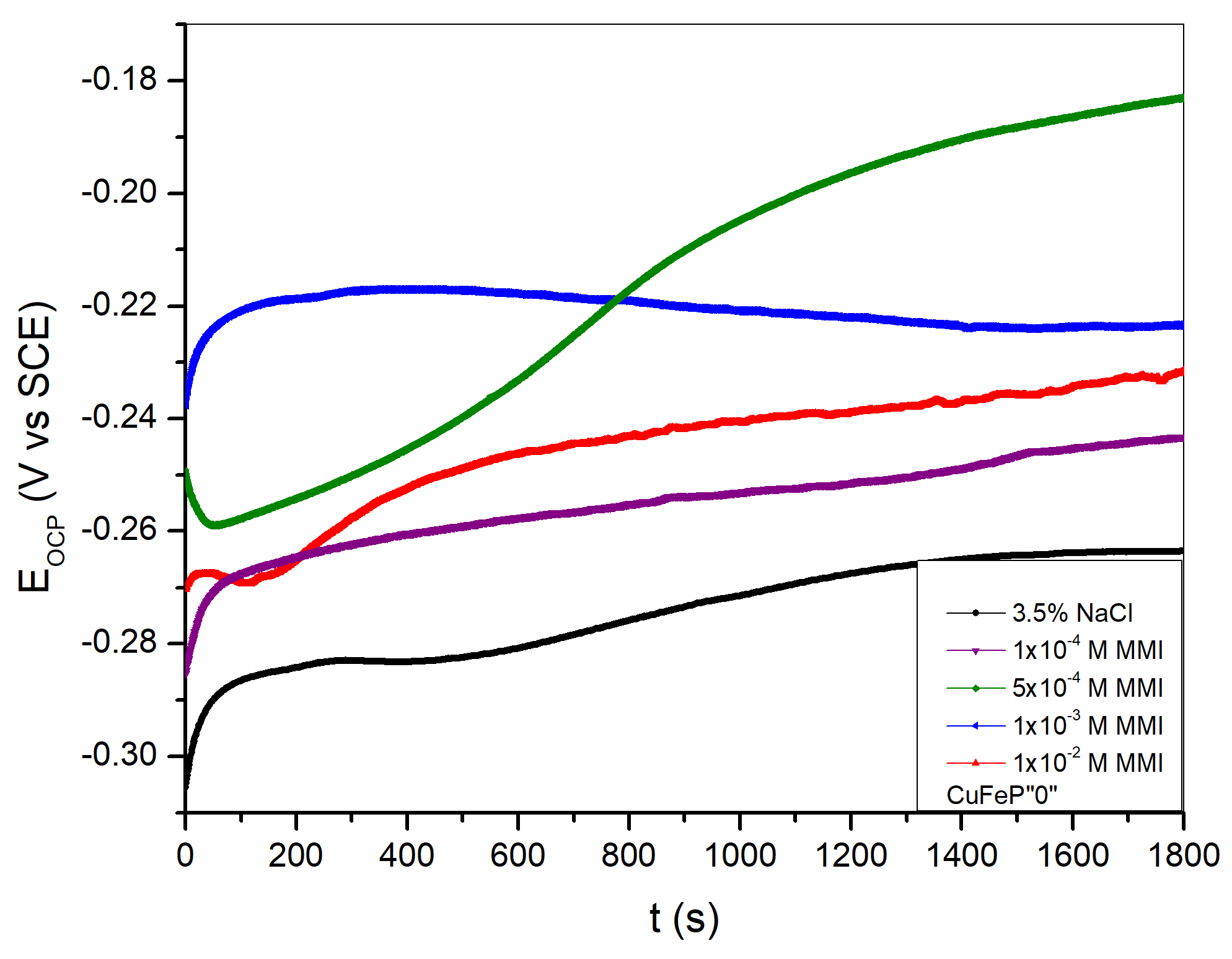
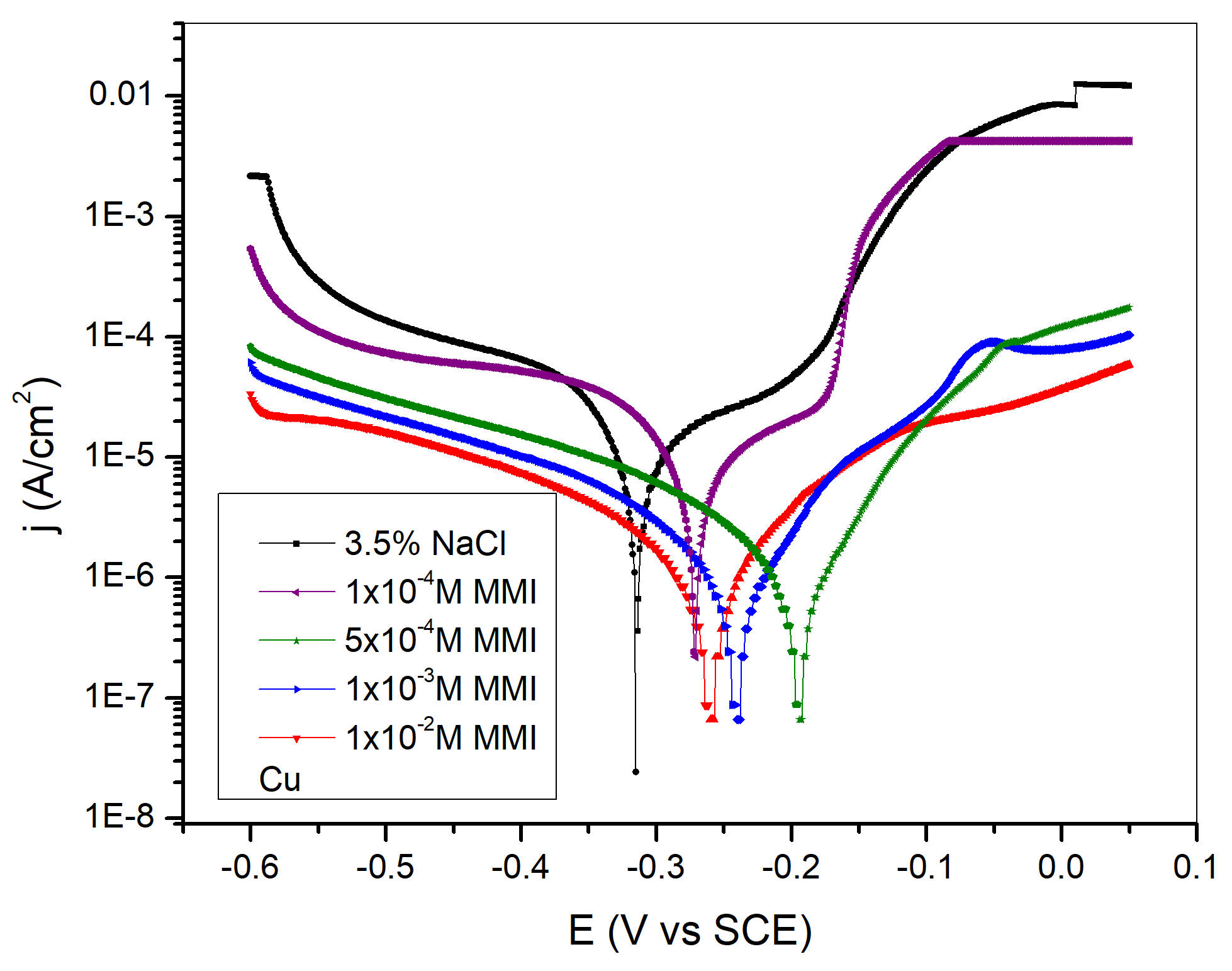
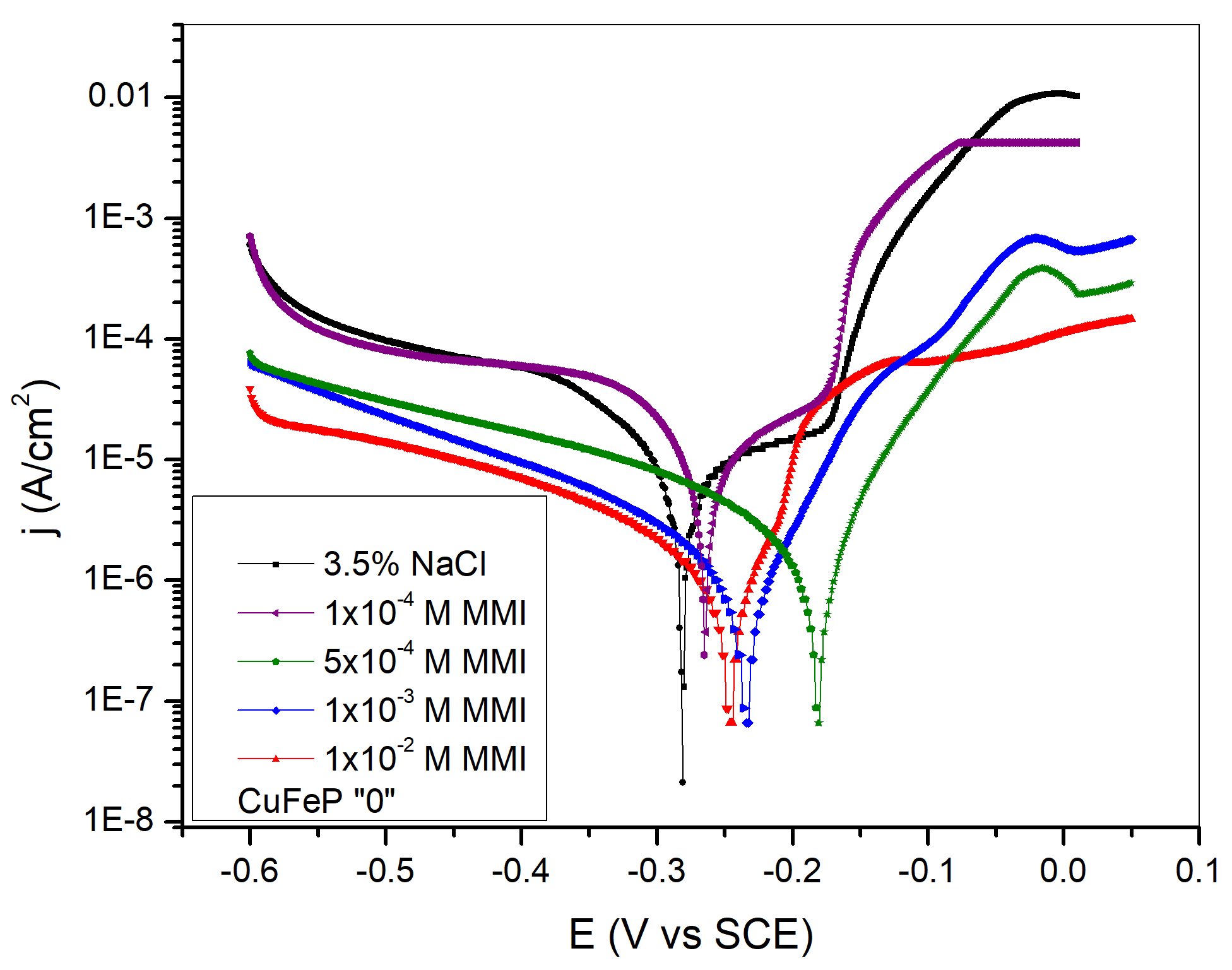
3. Open Circuit Potential and Potentiodynamic Polarization Measurements
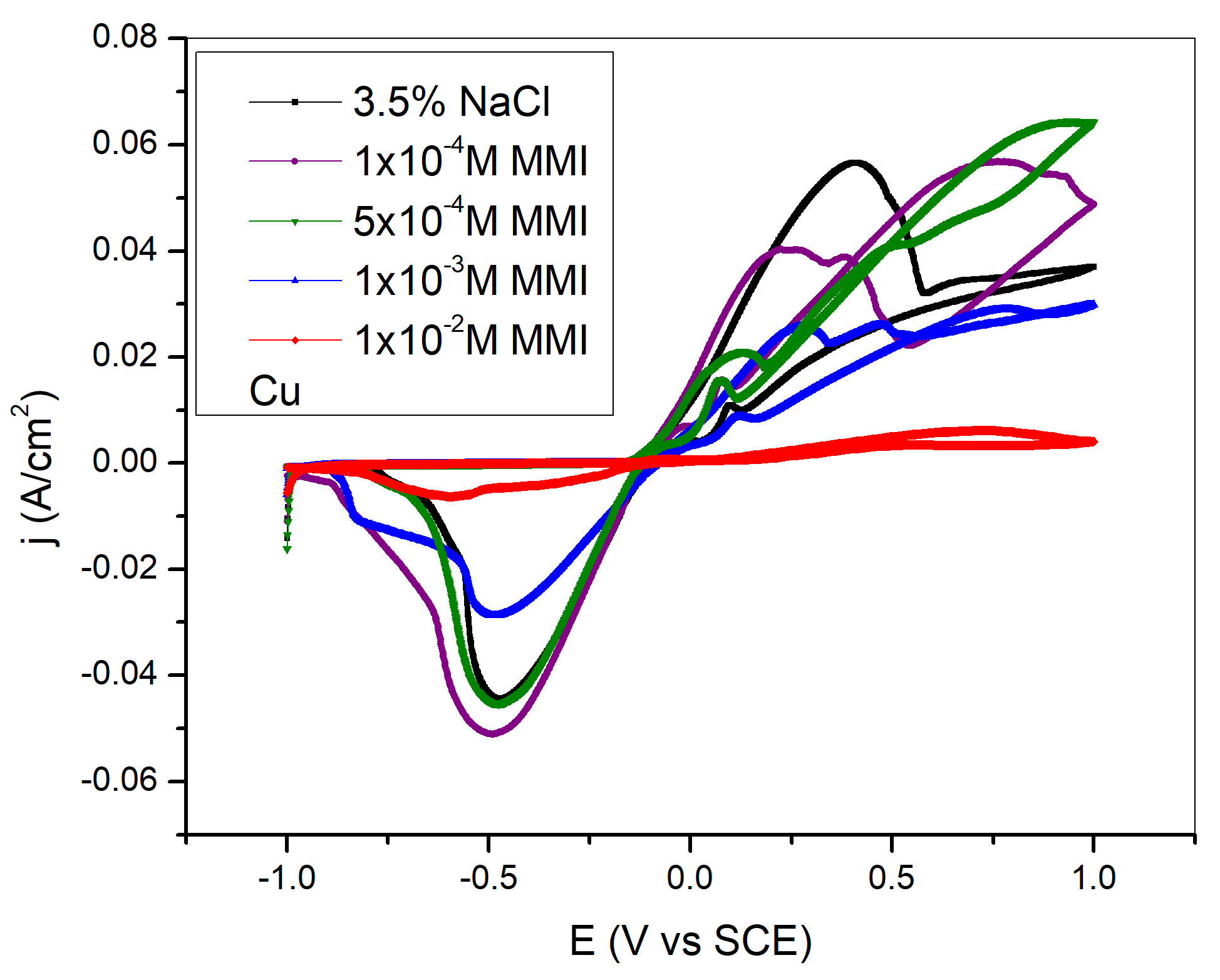
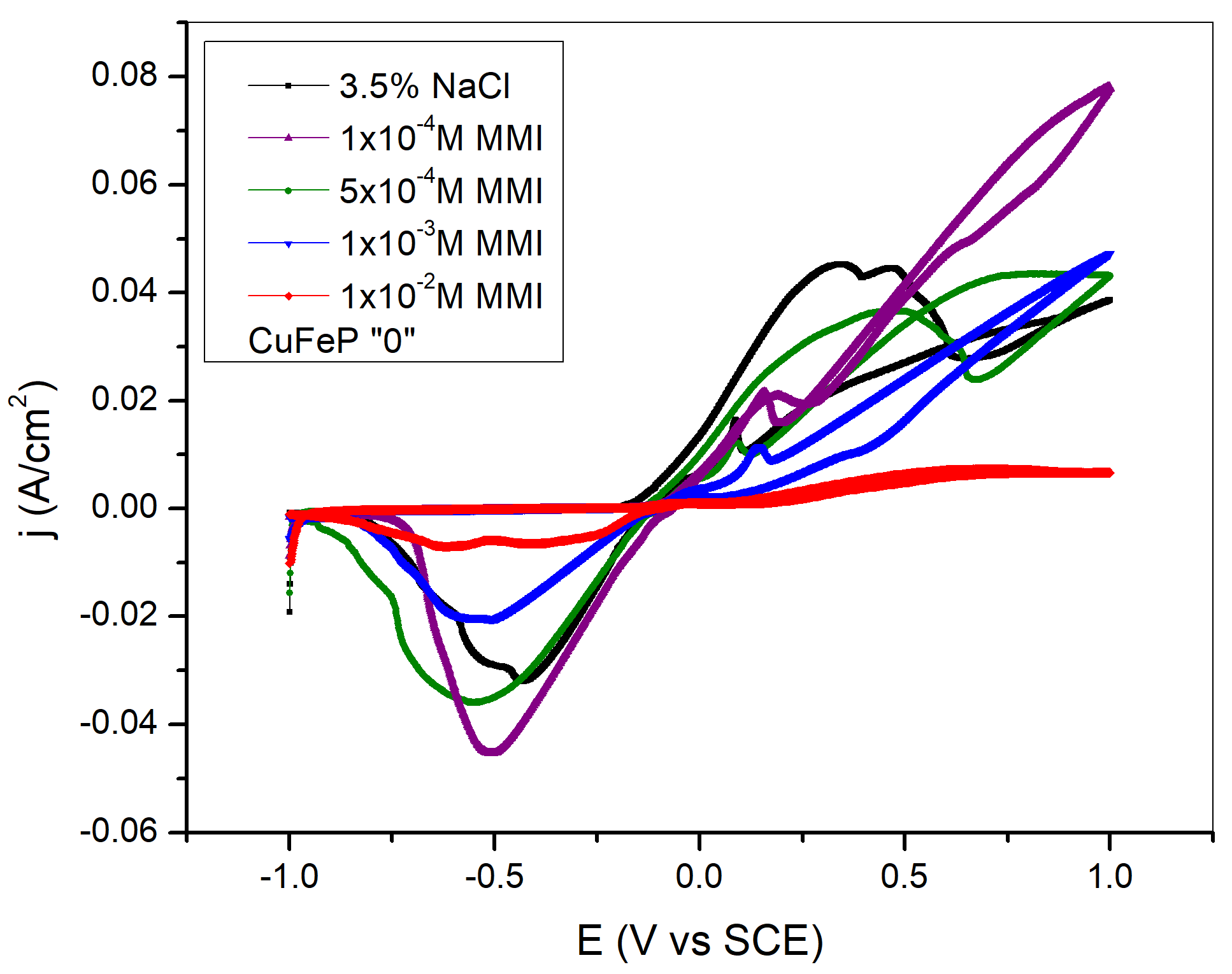
4. Cyclic Voltammetry Measurements
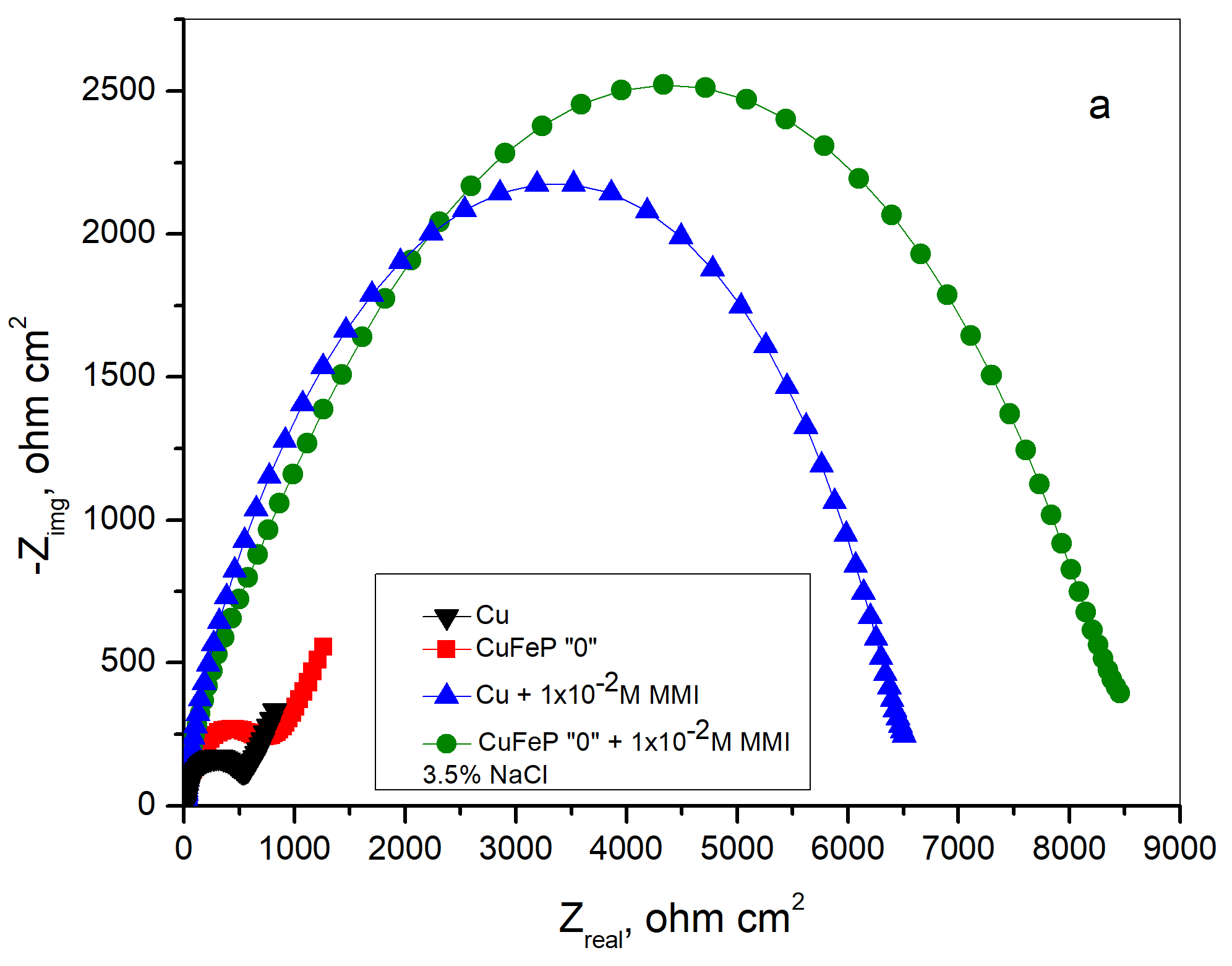
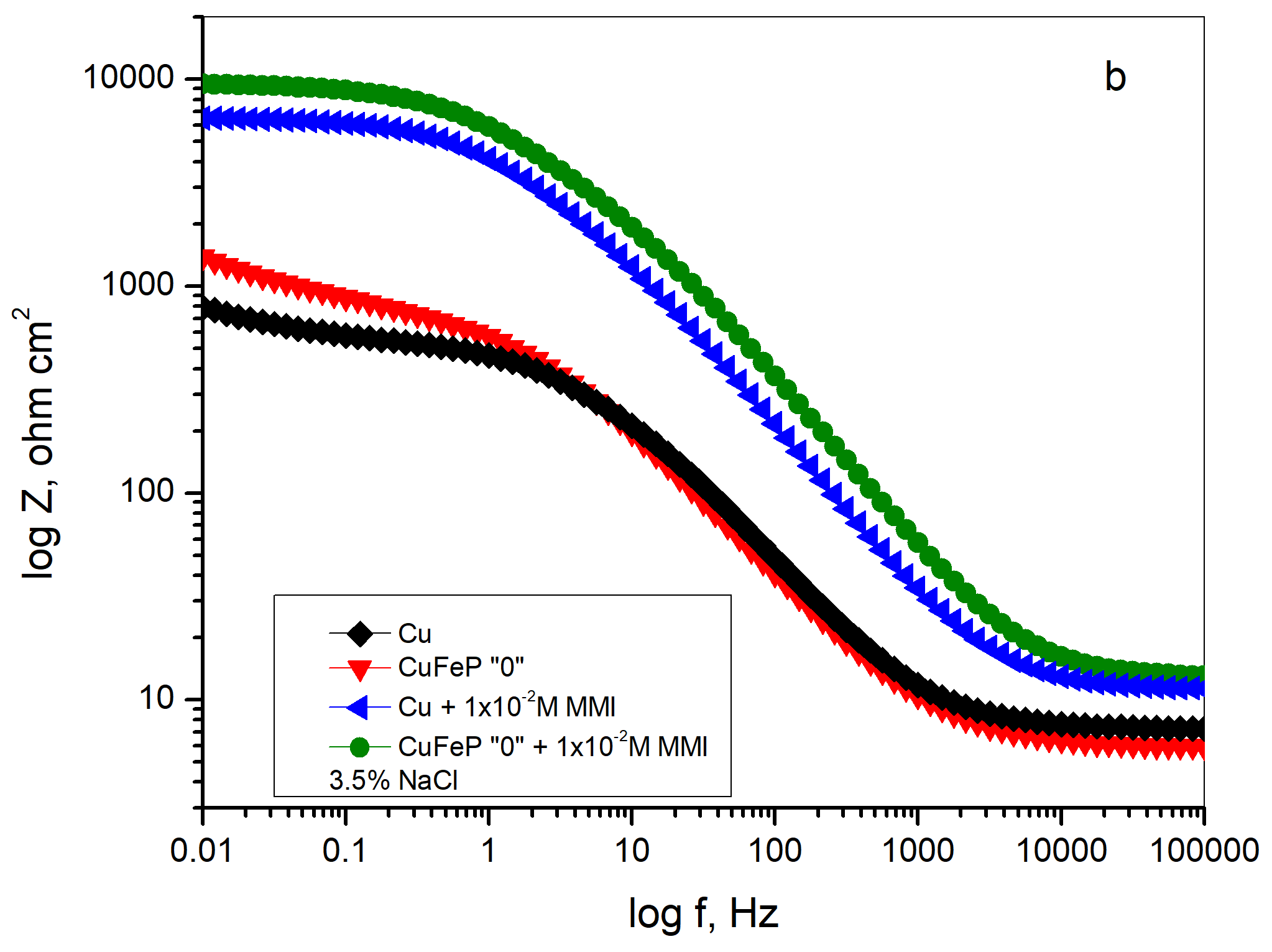
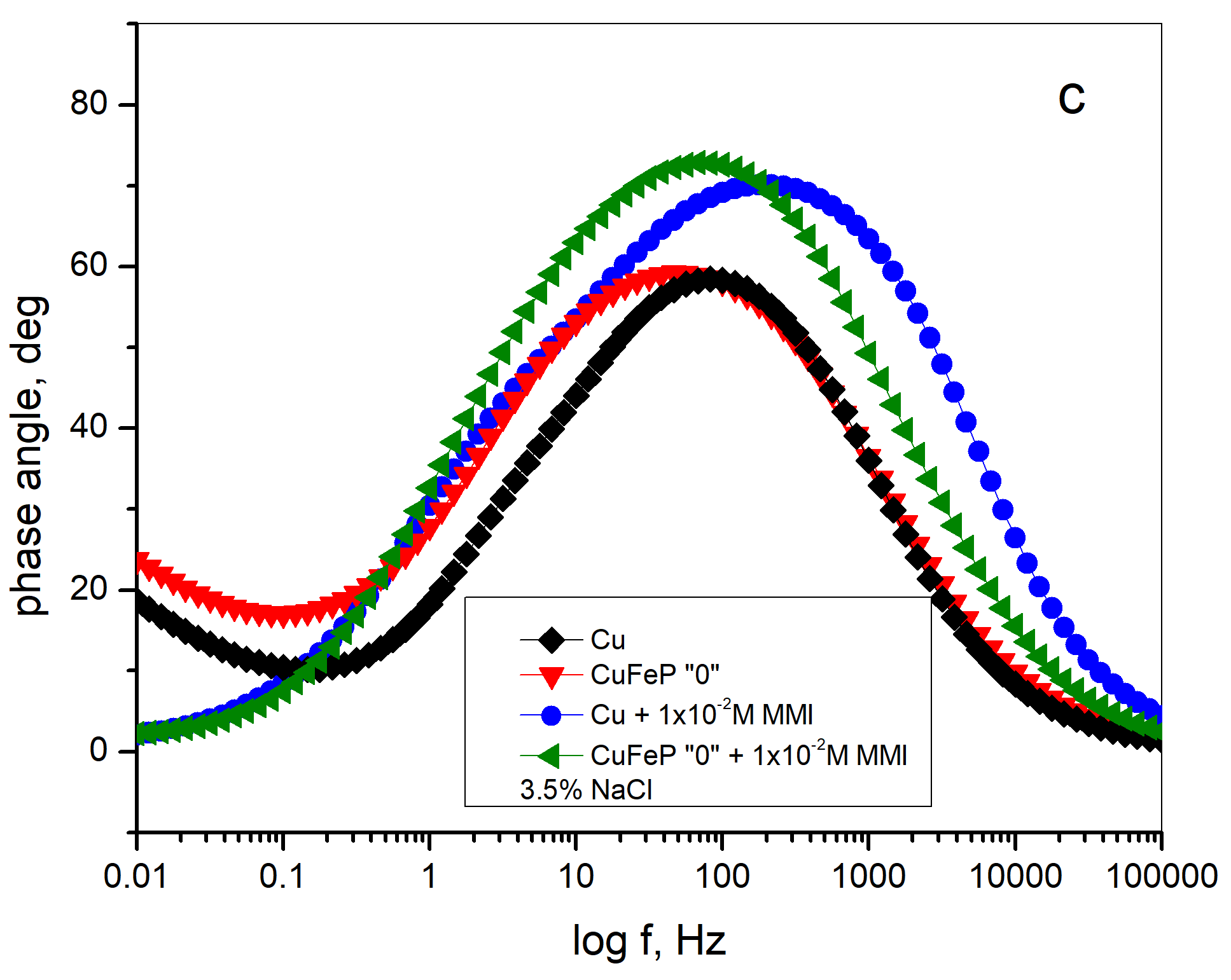
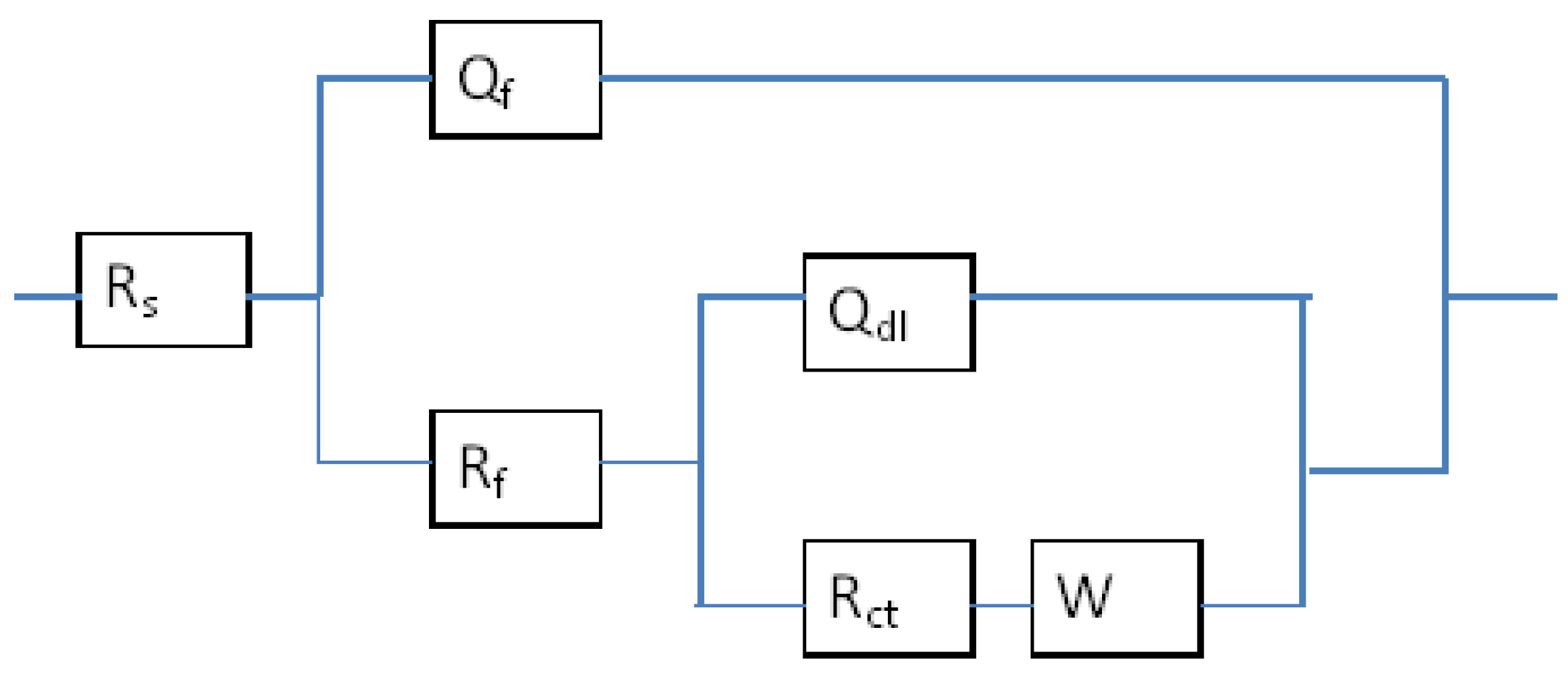
5. Electrochemical Impedance Spectroscopy—EIS
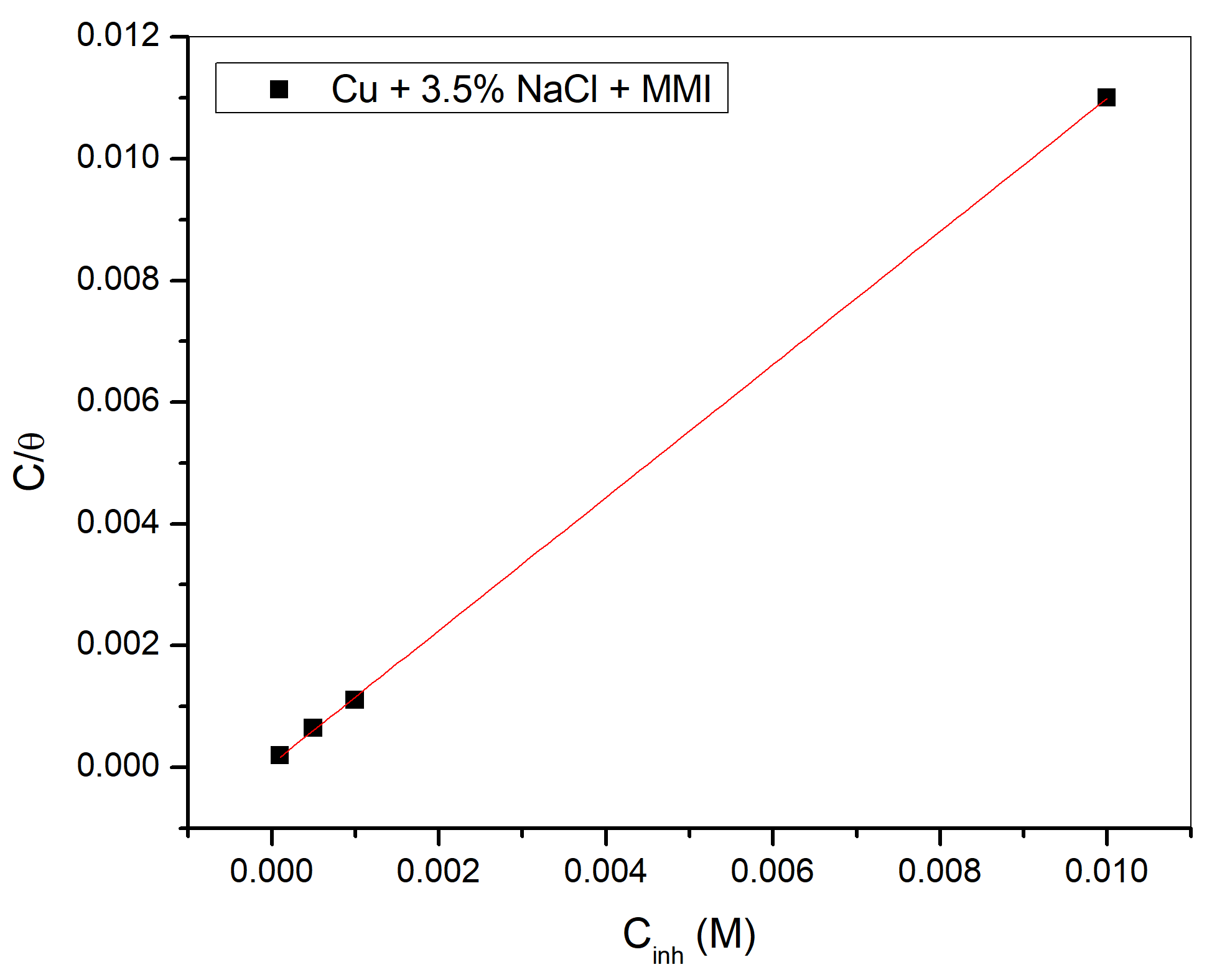
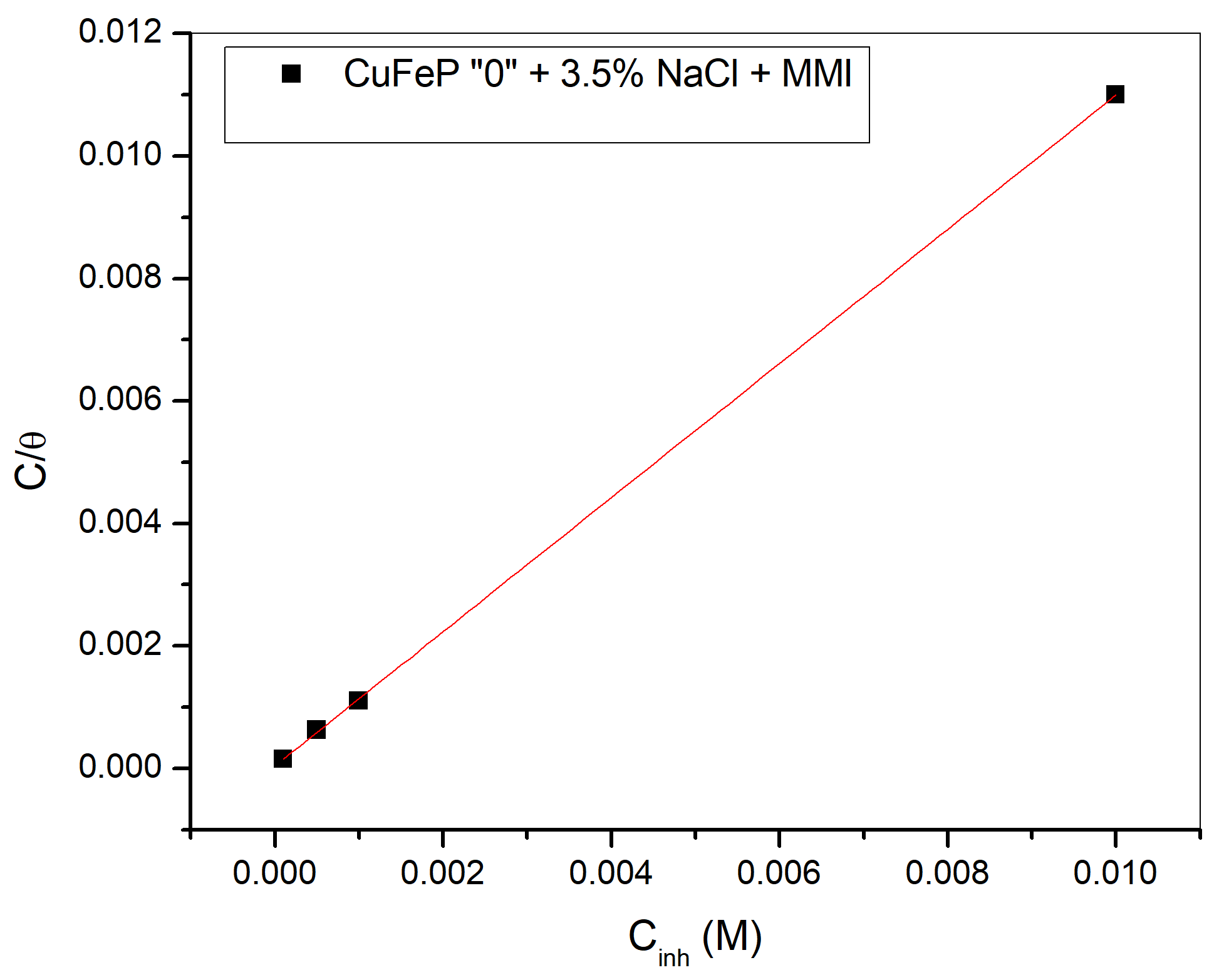
6. Adsorption Isotherm
7. Conclusions
Author Contributions
Funding
Data Availability Statement
Conflicts of Interest
References
- Tasić, Ž.Z.; Petrović Mihajlović, M.B.; Radovanović, M.B.; Simonović, A.T.; Antonijević, M.M. Experimental and theoretical studies of paracetamol as a copper corrosion inhibitor. J. Mol. Liq. 2021, 327, 114817. [Google Scholar] [CrossRef] [Scilit]
- Petrović Mihajlović, M.B.; Tasić, Ž.Z.; Radovanović, M.B.; Simonović, A.T.; Antonijević, M.M. Electrochemical Analysis of the Influence of Purines on Copper, Steel and Some Other Metals Corrosion. Metals 2022, 12, 1150. [Google Scholar] [CrossRef] [Scilit]
- Sherif, E.M.; Park, S.-M. 2-Amino-5-ethyl-1,3,4-thiadiazole as a corrosion inhibitor for copper in 3.0% NaCl solutions. Corros. Sci. 2006, 48, 4065–4079. [Google Scholar] [CrossRef] [Scilit]
- Tasić, Ž.Z.; Petrović Mihajlović, M.B.; Radovanović, M.B.; Antonijević, M.M. Electrochemical investigations of copper corrosion inhibition by azithromycin in 0.9% NaCl. J. Mol. Liq. 2018, 265, 687–692. [Google Scholar] [CrossRef] [Scilit]
- Zhang, C.; Xiao, X.; Yang, W.; Gao, W.; Li, Q.; He, J. Microstructural evolution and properties of a Cu-Fe-P alloy with high strength and high conductivity. Mater. Today Commun. 2024, 39, 108611. [Google Scholar] [CrossRef] [Scilit]
- Yang, J.; Bu, K.; Zhou, Y.; Song, K.; Huang, T.; Peng, X.; Liu, H.; Du, Y. Microstructure, residual stress, and mechanical properties evolution of a Cu-Fe-P alloy under different conditions. J. Mater. Res. Technol. 2023, 24, 7896–7909. [Google Scholar] [CrossRef] [Scilit]
- Zou, J.; Lu, L.; Lu, D.-P.; Liu, K.-M.; Chen, Z.-B.; Zhai, Q.-J. Effect of Boron and Cerium on Corrosion Resistance of Cu-Fe-P Alloy. J. Mater. Eng. Perform. 2016, 25, 1062–1067. [Google Scholar] [CrossRef] [Scilit]
- Xu, L.; Zou, J.; Zeng, S.-Q.; Liu, J.-W.; Liu, K.-M.; Hu, Q.; Huang, G.-J. Corrosion resistance of Cu-Fe deformation processed in situ alloy in chloride ion environment. Electrochem. Commun. 2024, 163, 107734. [Google Scholar] [CrossRef] [Scilit]
- Xu, J.; Guan, B.; Fu, R.; Huang, J.; Liu, W.; Hu, Q.; Hu, Z.; Yan, C. The effect of multi-directional compression on mechanical properties and corrosion properties of Cu–Fe composite. J. Mater. Res. Technol. 2024, 28, 1497–1503. [Google Scholar] [CrossRef] [Scilit]
- Wang, W.H.; Zheng, Z.G.; Huang, B.; Lai, J.W.; Zhou, Q.; Lei, L.; Zeng, D.C. Magnetocaloric effect, corrosion and mechanical properties of Mn1.05Fe0.9P0.5Si0.5Cux alloys. Intermetallics 2019, 113, 106539. [Google Scholar] [CrossRef] [Scilit]
- Petrović Mihajlović, M.B.; Radovanović, M.B.; Tasić, Ž.Z.; Antonijević, M.M. Imidazole based compounds as copper corrosion inhibitors in seawater. J. Mol. Liq. 2017, 225, 127–136. [Google Scholar] [CrossRef] [Scilit]
- Kumar, D.; Jain, V.; Rai, B. Imidazole derivatives as corrosion inhibitors for copper: A DFT and reactive force field study. Corros. Sci. 2020, 171, 108724. [Google Scholar] [CrossRef] [Scilit]
- Kadhim, M.M.; Alabboodi, K.O.; Hachim, S.K.; Abdullaha, S.A.; Taban, T.Y.; Rheima, A.M. Analysis of the protection of copper corrosion by using amino acid inhibitors. J. Mol. Model 2023, 29, 27. [Google Scholar] [CrossRef] [Scilit]
- Sedik, A.; Athmani, S.; Saoudi, A.; Ferkous, H.; Ribouh, N.; Lerari, D.J.; Bachari, K.; Djellali, S.; Berredjem, M.; Solmaz, R.; et al. Experimental and theoretical insights into copper corrosion inhibition by protonated amino-acids. RSC Adv. 2022, 12, 23718–23735. [Google Scholar] [CrossRef] [Scilit]
- Ragab, M.A.; Abdelwahab, O.; Amin, N.K.; Fouad, Y.O.; El-Ashtoukhy, E.-S.Z.; Abdel-Aziz, M.H. Fig and olive leaf extracts as eco-friendly corrosion inhibitors for copper in hydrochloric acid solutions. Sci. Rep. 2025, 15, 33749. [Google Scholar] [CrossRef] [Scilit] [PubMed]
- Tan, B.; Ren, H.; Yin, C.; Li, X.; Li, X.; Wang, R.; Guo, L.; Zhang, Y.; Al-Sadoon, M.K. Nepeta cataria L. leaf extracts as eco-conscious corrosion inhibitor for copper in H2SO4 medium. Colloid Surf. A 2025, 711, 136399. [Google Scholar] [CrossRef] [Scilit]
- Tasić, Ž.Z.; Petrović Mihajlović, M.B.; Radovanović, M.B.; Simonović, A.T.; Antonijević, M.M. Cephradine as corrosion inhibitor for copper in 0.9% NaCl solution. J. Mol. Struct. 2018, 1159, 46–54. [Google Scholar] [CrossRef] [Scilit]
- Tasić, Ž.Z.; Petrović Mihajlović, M.B.; Simonović, A.T.; Radovanović, M.B.; Antonijević, M.M. Ibuprofen as a corrosion inhibitor for copper in synthetic acid rain solution. Sci. Rep. 2019, 9, 14710. [Google Scholar] [CrossRef] [Scilit]
- Kozlica, D.K.; Milosev, I. Corrosion inhibition of copper and aluminium by 2-mercaptobenzimidazole and octylphosphonic acid—Surface pre-treatment and method of film preparation. Electrochim. Acta 2022, 431, 141154. [Google Scholar] [CrossRef] [Scilit]
- El-Sayed, M.S.; Erasmus, R.M.; Comins, J.D. In situ Raman spectroscopy and electrochemical techniques for studying corrosion and corrosion inhibition of iron in sodium chloride solutions. Electrochim. Acta 2010, 55, 3657–3663. [Google Scholar]
- Khaled, K.F.; Hamed, M.N.H.; Abdel-Azim, K.M.; Abdelshafi, N.S. Inhibition of copper corrosion in 3.5% NaCl solutions by a new pyrimidine derivative: Electrochemical and computer simulation techniques. J. Solid State Electrochem. 2011, 15, 663–673. [Google Scholar] [CrossRef] [Scilit]
- Simonović, A.; Petrović Mihajlović, M.; Radovanović, M.; Tasić, Ž.; Antonijević, M. Inhibition of Copper Corrosion in Acid Rain Solution Using the Imidazole Derivatives. Russ. J. Electrochem. 2021, 57, 544–553. [Google Scholar] [CrossRef] [Scilit]
- Oguzie, E.E.; Li, Y.; Wang, F.H. Effect of 2-amino-3-mercaptopropanoic acid (cysteine) on the corrosion behaviour of low carbon steel in sulphuric acid. Electrochim. Acta 2007, 53, 909–914. [Google Scholar] [CrossRef] [Scilit]
- El-Sayed, M.S. Effects of 2-amino-5-(ethylthio)-1,3,4-thiadiazole on copper corrosion as a corrosion inhibitor in 3% NaCl solutions. Appl. Surf. Sci. 2006, 252, 8615–8623. [Google Scholar]
- Tshikhudo, F.; Mugwena, D.S.; Mnyakeni-Moleele, S.S.; Kabanda, M.M.; Fernandez, C.; Murulana, L.C. Synthesis of substituted triazines and evaluation of their corrosion inhibition performance on Fe(100) in 1 M HCl: A combined experimental and DFT study. Int. J. Electrochem. Sci. 2025, 20, 101153. [Google Scholar] [CrossRef] [Scilit]
- Giuliani, L.; Tamba, A.; Modena, C. Electrochemical characterization of some Cu alloys in NaCl solutions. Corros. Sci. 1971, 11, 485–498. [Google Scholar] [CrossRef] [Scilit]
- Boyapati, V.A.R.; Kanukula, C.K. Corrosion inhibition of Cu-Ni (90/10) alloy in seawater and sulphide-polluted seawater environments by 1,2,3-benzotriazole. Int. Sch. Res. Not. 2013, 2013, 703929. [Google Scholar] [CrossRef] [Scilit]
- Milošev, I.; Taheri, P.; Kapun, B.; Kozlica, D.K.; Mol, A.; Kokalj, A. The effect of molecular structure of imidazole-based compounds on corrosion inhibition of Cu, Zn, and Cu-Zn alloys. Corros. Sci. 2024, 240, 112328. [Google Scholar] [CrossRef] [Scilit]
- Čakara, D.; Peter, R.; Finšgar, M. Optical properties and formation kinetics of corrosion inhibitor films at the Cu/Cu2O/H2O interface. Surf. Interfaces 2022, 32, 102108. [Google Scholar] [CrossRef] [Scilit]
- Garg, V.; Zanna, S.; Seyeux, A.; Wiame, F.; Maurice, V.; Marcus, P. Inhibition of the initial stages of corrosion by 2-mercaptobenzothiazole adsorption and the effects of interfacial oxides on copper in neutral chloride conditions. Corros. Sci. 2023, 225, 111596. [Google Scholar] [CrossRef] [Scilit]
- Otmačić, H.; Telegdi, J.; Papp, K.; Stupnišek-Lisac, E. Protective properties of an inhibitor layer formed on copper in neutral chloride solution. J. Appl. Electrochem. 2004, 34, 545–550. [Google Scholar] [CrossRef] [Scilit]
- Zhang, Y.N.; Zi, J.L.; Zheng, M.S.; Zhu, J.W. Corrosion behavior of copper with minor alloying addition in chloride solution. J. Alloys Compd. 2008, 462, 240–243. [Google Scholar] [CrossRef] [Scilit]
- Radovanovic, M.B.; Antonijevic, M.M. Inhibition of Brass Corrosion by 2-Mercapto-1-methylimidazole in Weakly Alkaline Solution. J. Mat. Eng. Perform. 2016, 25, 921–937. [Google Scholar] [CrossRef] [Scilit]
- Radovanović, M.B.; Tasić, Ž.Z.; Petrović Mihajlović, M.B.; Simonović, A.T.; Antonijević, M.M. Electrochemical and DFT studies of brass corrosion inhibition in 3% NaCl in the presence of environmentally friendly compounds. Sci. Rep. 2019, 9, 16081. [Google Scholar] [CrossRef] [Scilit]
- Amin, M.A.; Khaled, K.F. Copper corrosion inhibition in O2-saturated H2SO4 solutions. Corros. Sci. 2010, 52, 1194–1204. [Google Scholar] [CrossRef] [Scilit]
- Vrsalović, L.; Gudić, S.; Gracić, D.; Smoljko, I.; Ivanić, I.; Kliškić, M.; Oguzie, E.E. Corrosion Protection of Copper in Sodium Chloride Solution using Propolis. Int. J. Electrochem. Sci. 2018, 13, 2102–2117. [Google Scholar] [CrossRef] [Scilit]
- Huang, H.; Wang, Z.; Gong, Y.; Gao, F.; Luo, Z.; Zhang, S.; Li, H. Water soluble corrosion inhibitors for copper in 3.5 wt% sodium chloride solution. Corros. Sci. 2017, 123, 339–350. [Google Scholar] [CrossRef] [Scilit]
- Khaled, K.F. Studies of the corrosion inhibition of copper in sodium chloride solutions using chemical and electrochemical measurements. Mater. Chem. Phys. 2011, 125, 427–433. [Google Scholar] [CrossRef] [Scilit]
- Wang, Y.; Wu, H.; Su, L.; Wang, M.; Jiang, Y.; Gong, S.; Xiao, Z.; Li, Z. The electrochemical corrosion behavior and antibacterial properties of Cu-xFe alloy. J. Mater. Res. Tech. 2024, 33, 698–713. [Google Scholar] [CrossRef] [Scilit]
- Finšgar, M. 2-Mercaptobenzimidazole as a copper corrosion inhibitor: Part I. Long-term immersion, 3D-profilometry, and electrochemistry. Corros. Sci. 2013, 72, 82–89. [Google Scholar] [CrossRef] [Scilit]
- Qiang, Y.; Zhang, S.; Xu, S.; Li, W. Experimental and theoretical studies on the corrosion inhibition of copper by two indazole derivatives in 3.0% NaCl solution. J. Colloid Interf. Sce. 2016, 472, 52–59. [Google Scholar] [CrossRef] [Scilit] [PubMed]
- Wei, N.; Jiang, Y.; Liu, Z.; Ying, Y.; Guo, X.; Wu, Y.; Wen, Y.; Yang, H. 4-Phenylpyrimidine monolayer protection of a copper surface from salt corrosion. RSC Adv. 2018, 8, 7340–7349. [Google Scholar] [CrossRef] [Scilit]
- Mahdavi, M.; Bozorg, M. The impact of microstructural constituents on the corrosion performance of an Al-Zn-Mg-Cu aluminum alloy. J. Alloys Compd. 2025, 1042, 184019. [Google Scholar] [CrossRef] [Scilit]
- Qiang, Y.; Zhang, S.; Yan, S.; Zou, X.; Chen, S. Three indazole derivatives as corrosion inhibitors of copper in a neutral chloride solution. Corros. Sci. 2017, 126, 295–304. [Google Scholar] [CrossRef] [Scilit]
- Gholizadeh, M.R.; Ghaffarinejad, A.; Alemnezhad, M.M. Plant derived corrosion inhibitor for copper: Integrated electrochemical and molecular insights into Ailanthus altissima seed extract performance in saline media. Next Mater. 2026, 11, 101621. [Google Scholar] [CrossRef] [Scilit]
- Arshad, N.; Akram, A.R.; Akram, M.; Rasheed, I. Triazolothiadiazine derivatives as corrosion inhibitors for copper, mild steel and aluminum surfaces: Electrochemical and quantum investigations. Prot. Met. Phys. Chem. Surfaces 2017, 53, 343–358. [Google Scholar] [CrossRef] [Scilit]
- Qiang, Y.; Zhang, S.; Guo, L.; Zheng, X.; Xiang, B.; Chen, S. Experimental and theoretical studies of four allyl imidazolium-based ionic liquids as green inhibitors for copper corrosion in sulfuric acid. Corros. Sci. 2017, 119, 68–78. [Google Scholar] [CrossRef] [Scilit]
- Li, C.C.; Guo, X.Y.; Shen, S.; Song, P.; Xu, T.; Wen, Y.; Yang, H.F. Adsorption and corrosion inhibition of phytic acid calcium on the copper surface in 3wt% NaCl solution. Corros. Sci. 2014, 83, 147–154. [Google Scholar] [CrossRef] [Scilit]
- Hong, S.; Chen, W.; Luo, H.Q.; Li, N.B. Inhibition effect of 4-amino-antipyrine on the corrosion of copper in 3wt.% NaCl solution. Corros. Sci. 2012, 57, 270–278. [Google Scholar] [CrossRef] [Scilit]
- Yu, H.; Li, C.; Yuan, B.; Li, L.; Wang, C. The inhibitive effects of AC-treated mixed self-assembled monolayers on copper corrosion. Corros. Sci. 2017, 120, 231–238. [Google Scholar] [CrossRef] [Scilit]
- Liao, C.; Chen, Y.; Luo, C.; Guan, B.; Hu, Q.; Guan, H.; Luc, C.; Hu, Z. In situ observation and SKPFM analysis to study the adsorption behavior and corrosion inhibition mechanism of 2-aminobenzimidazole inhibitor on Cu − 5 wt% Fe alloys. Appl. Surf. Sci. 2025, 687, 162232. [Google Scholar] [CrossRef] [Scilit]
- Ma, X.-Z.; Cai, G.-Y.; Cao, X.-K.; Zhang, X.-X.; Meng, L.-D.; Dong, Z.-H. Synergistic inhibition of azoles compounds on chloride-induced atmospheric corrosion of copper: Experimental and theoretical characterization. Corros. Sci. 2023, 218, 111161. [Google Scholar] [CrossRef] [Scilit]
- Finšgar, M. The Interface Characterization of 2-Mercapto-1-methylimidazole Corrosion Inhibitor on Brass. Coatings 2021, 11, 295. [Google Scholar] [CrossRef] [Scilit]
- Finšgar, M.; Xhanari, K. Electrochemical and Surface Analysis of 2-Phenylimidazole Adsorbed on Copper from Chloride Solution. Coatings 2018, 8, 234. [Google Scholar] [CrossRef] [Scilit]
- Ting, Y.; Shengtao, Z.; Li, F.; Yujie, Q.; Lansi, L.; Denglin, F.; Yanan, W.; Jida, C.; Wenpo, L.; Bochuan, T. Investigation of imidazole derivatives as corrosion inhibitors of copper in sulfuric acid: Combination of experimental and theoretical researches. J. Taiwan Inst. Chem. Eng. 2020, 106, 118–129. [Google Scholar] [CrossRef] [Scilit]
- Zhu, Z.; Zhang, X. Controlled Delivery of 2-Mercapto 1-Methyl Imidazole by Metal–Organic Framework for Efficient Inhibition of Copper Corrosion in NaCl Solution. Materials 2023, 16, 6712. [Google Scholar] [CrossRef] [Scilit]
- Larabi, L.; Benali, O.; Mekelleche, S.M.; Harek, Y. 2-Mercapto-1-methylimidazole as corrosion inhibitor for copper in hydrochloric acid. Appl. Surf. Sci. 2006, 253, 1371–1378. [Google Scholar] [CrossRef] [Scilit]



| Alloy | Inhibitor Concentration, M | Ecorr, V vs. SCE ± SD | icorr, A/cm2 ± SD | ba, V/dec ± SD | bc, V/dec ± SD | fa | fb | IE, % |
|---|---|---|---|---|---|---|---|---|
| Cu | −0.296 ± 0.013 | 9.75 × 10⁻⁶ ± 1.28 × 10⁻⁷ | 0.108 ± 0.028 | −0.102 ± 0.016 | / | / | / | |
| 1 × 10⁻⁴ | −0.271 ± 0.011 | 4.60 × 10⁻⁶ ± 2.45 × 10⁻⁷ | 0.070 ± 3.05 × 10⁻³ | −0.050 ± 0.024 | 0.258 | 0.224 | 52.8 | |
| 5 × 10⁻⁴ | −0.195 ± 5.42 × 10⁻³ | 2.13 × 10⁻⁶ ± 1.77 × 10⁻⁷ | 0.074 ± 7.64 × 10⁻³ | −0.123 ± 7.62 × 10⁻³ | 0.030 | 0.051 | 78.1 | |
| 1 × 10⁻³ | −0.235 ± 6.78 × 10⁻³ | 1.05 × 10⁻⁶ ± 6.31 × 10⁻⁷ | 0.064 ± 1.30 × 10⁻³ | −0.122 ± 5.73 × 10⁻³ | 0.038 | 0.059 | 89.2 | |
| 1 × 10⁻² | −0.245 ± 2.47 × 10⁻³ | 8.22 × 10⁻⁷ ± 7.55 × 10⁻⁸ | 0.054 ± 1.05 × 10⁻³ | −0.112 ± 3.07 × 10⁻³ | 0.028 | 0.046 | 91.5 | |
| CuFeP“0” | −0.279 ± 0.019 | 6.87 × 10⁻⁶ ± 3.32 × 10⁻⁷ | 0.102 ± 4.18 × 10⁻³ | −0.067 ± 0.011 | / | / | / | |
| 1 × 10⁻⁴ | −0.259 ± 3.97 × 10⁻³ | 2.45 × 10⁻⁶ ± 5.78 × 10⁻⁷ | 0.054 ± 6.78 × 10⁻³ | −0.044 ± 8.04 × 10⁻³ | 0.277 | 0.255 | 64.3 | |
| 5 × 10⁻⁴ | −0.182 ± 4.26 × 10⁻³ | 1.38 × 10⁻⁶ ± 8.61 × 10⁻⁸ | 0.056 ± 2.58 × 10⁻³ | −0.139 ± 2.68 × 10⁻³ | 0.040 | 0.113 | 79.9 | |
| 1 × 10⁻³ | −0.241 ± 1.51 × 10⁻³ | 7.28 × 10⁻⁷ ± 9.02 × 10⁻⁸ | 0.077 ± 2.36 × 10⁻³ | −0.103 ± 8.46 × 10⁻³ | 0.078 | 0.088 | 89.4 | |
| 1 × 10⁻² | −0.261 ± 6.34 × 10⁻³ | 5.60 × 10⁻⁷ ± 4.56 × 10⁻⁸ | 0.075 ± 3.93 × 10⁻³ | −0.084 ± 9.55 × 10⁻⁴ | 0.072 | 0.074 | 91.8 |
| 3.5% NaCl Solution | Rs, Ω cm2 | Rf, Ω cm2 | Rct, Ω cm2 | Cf, μF cm−2 | n1 | Cdl, μF cm−2 | n2 | W, Ω−1 cm−2 s0.5 | IE, % |
|---|---|---|---|---|---|---|---|---|---|
| Cu | 7.181 | 391.3 | 109.2 | 3.84 | 0.803 | 279 | 0.725 | 130.0 | / |
| CuFeP“0” | 6.013 | 391.8 | 342.2 | 4.72 | 0.807 | 31.3 | 0.801 | 114.4 | / |
| Cu + 1 × 10⁻² M MMI | 9.558 | 2457 | 962.6 | 19.7 | 0.900 | 20.7 | 0.800 | 25.1 | 85.4 |
| CuFeP“0” + 1 × 10⁻² M MMI | 7.102 | 2862 | 5425 | 0.286 | 0.835 | 0.987 | 0.810 | 23.5 | 91.1 |
| Electrode | Slope | R2 | ΔG, kJ/mol |
|---|---|---|---|
| Cu | 1.08 | 0.9999 | −34.0 |
| CuFeP “0” | 1.07 | 0.9999 | −35.0 |
Disclaimer/Publisher’s Note: The statements, opinions and data contained in all publications are solely those of the individual author(s) and contributor(s) and not of MDPI and/or the editor(s). MDPI and/or the editor(s) disclaim responsibility for any injury to people or property resulting from any ideas, methods, instructions or products referred to in the content. |
© 2026 by the authors. Licensee MDPI, Basel, Switzerland. This article is an open access article distributed under the terms and conditions of the Creative Commons Attribution (CC BY) license.
Share and Cite
Tasić, Ž.; Petrović Mihajlović, M.; Simonović, A.; Radovanović, M.; Antonijević, M.; Trumić, B.; Krstić, V. Electrochemical Investigation of Corrosion Behavior of CuFeP Alloy in Chloride Solution. Metals 2026, 16, 622. https://doi.org/10.3390/met16060622
Tasić Ž, Petrović Mihajlović M, Simonović A, Radovanović M, Antonijević M, Trumić B, Krstić V. Electrochemical Investigation of Corrosion Behavior of CuFeP Alloy in Chloride Solution. Metals. 2026; 16(6):622. https://doi.org/10.3390/met16060622
Chicago/Turabian StyleTasić, Žaklina, Marija Petrović Mihajlović, Ana Simonović, Milan Radovanović, Milan Antonijević, Biserka Trumić, and Vesna Krstić. 2026. "Electrochemical Investigation of Corrosion Behavior of CuFeP Alloy in Chloride Solution" Metals 16, no. 6: 622. https://doi.org/10.3390/met16060622
APA StyleTasić, Ž., Petrović Mihajlović, M., Simonović, A., Radovanović, M., Antonijević, M., Trumić, B., & Krstić, V. (2026). Electrochemical Investigation of Corrosion Behavior of CuFeP Alloy in Chloride Solution. Metals, 16(6), 622. https://doi.org/10.3390/met16060622