


Abstract
Hydrogen-based reduction of manganese ores has attracted increasing attention as a promising route for low-carbon manganese production. In this study, the reduction behavior, microstructural evolution, and kinetics of a high-barium-rich manganese ore were investigated in both dried and calcined states under isothermal hydrogen atmospheres at 600–800 °C. The ore was characterized using XRF, XRD, optical microscopy, SEM-EDS, and porosity measurements to evaluate mineralogical and structural changes during calcination and reduction. Calcination at 900 °C transformed MnO2 into Mn2O3/Mn3O4, removed volatile components, and generated micro-porosity that improved gas accessibility. Isothermal reduction experiments revealed a rapid initial reduction stage followed by a slower reaction regime, with increasing temperature significantly accelerating the reduction rate. Despite isothermal furnace conditions, a temporary rise in sample temperature was observed due to the exothermic nature of manganese oxide reduction by hydrogen. XRD analysis confirmed that manganese oxides were predominantly reduced to MnO, while iron oxides were converted to metallic Fe. Porosity measurements showed significant pore development during reduction at moderate temperatures due to oxygen removal and gas evolution; however, at higher temperatures, partial sintering led to pore coalescence and densification, reducing the overall porosity. Kinetic analysis showed that the Johnson–Mehl–Avrami–Kolmogorov (JMAK) model effectively describes the reduction behavior. The apparent activation energies were 21.92 kJ.mol−1 for dried ore and 17.40 kJ.mol−1 for calcined ore, indicating diffusion-influenced kinetics. The results demonstrate that calcination enhances hydrogen reducibility by improving gas accessibility and reducing kinetic resistance, highlighting its importance for hydrogen-based manganese pre-reduction processes.
1. Introduction
Manganese is an essential alloying element in steelmaking, where it controls microstructure, phase stability, and mechanical properties. It plays a key role in advanced high-strength steels by stabilizing austenite and enhancing strength–ductility balance, while high-manganese steels remain important for wear-resistant applications [1,2,3]. In addition, manganese is increasingly important for energy storage technologies such as lithium-ion batteries, driving the need for more sustainable production routes [4].
Currently, manganese ferroalloys such as high-carbon ferromanganese (HCFeMn) and silicomanganese (SiMn) are mainly produced via carbothermic reduction in submerged arc furnaces, which are energy-intensive and generate significant CO2 emissions (2–6 t CO2/t alloy) [5,6,7]. To meet global decarbonization targets, alternative low-carbon processes are being actively explored [8,9].
Hydrogen-based reduction for manganese and manganese alloy production has emerged as a promising approach to reduce emissions by replacing CO/CO2 with H2/H2O systems [10]. Thermodynamically, hydrogen can reduce higher manganese oxides (MnO2, Mn2O3, Mn3O4) to MnO, but not to metallic Mn under moderate conditions. Therefore, hydrogen is particularly suitable for pre-reduction processes, where ores are converted to MnO prior to final smelting or metallothermic reduction [11]. The recently proposed HAlMan process [12] integrates hydrogen-based pre-reduction with aluminothermic reduction of MnO, offering a low-carbon alternative for manganese production [10,12]. Process efficiency strongly depends on minimizing hydrogen consumption and energy demand. A comprehensive thermodynamic and energy balance assessment of hydrogen-based pre-reduction has recently been reported by Safarian [13], demonstrating that coupling the reduction reactor with a calcination unit significantly decreases hydrogen consumption and external energy demand. According to the mass and energy balance results, the use of calcined ore, particularly when hot-charged into the reduction reactor can reduce hydrogen consumption by up to ~60% compared with untreated ore. Furthermore, integration of hydrogen looping and heat recovery enables operation close to the theoretical stoichiometric hydrogen requirement. These findings highlight the critical importance of ore pretreatment and process integration for hydrogen-efficient manganese production.
Hydrogen reduction of manganese ores involves complex gas–solid interactions governed by mineralogy, porosity, and reaction conditions. Previous studies have demonstrated that reduction proceeds sequentially to MnO, with kinetics influenced by temperature, gas composition, and structural evolution [14,15,16,17,18,19,20,21,22,23]. The process typically exhibits multi-stage behavior, transitioning from surface reaction control to diffusion-controlled mechanisms as reduction progresses. Experimental studies on various manganese ores confirm that higher temperatures enhance reduction rates, while microstructural changes such as cracking and pore formation improve gas diffusion [11,22,23,24,25,26]. Reactor configuration and hydrodynamics also play an important role, as demonstrated in fluidized bed systems [27]. Our previous studies further showed that hydrogen reduction provides faster kinetics and improved efficiency compared to CO-based systems [11,24,25,28].
Mineralogical characteristics play a critical role in determining hydrogen reducibility. Commercial manganese ores typically contain braunite (Mn2O3·SiO2), manganite (MnO(OH)), hematite (Fe2O3), and carbonate phases such as calcite and dolomite [11,24,25,28]. During calcination, hydroxides and carbonates decompose, altering pore structure and phase composition. Safarian [13] demonstrated that carbonate decomposition represents a major energy sink during direct reduction in raw ore, and that prior calcination shifts the process thermodynamics and reduces hydrogen demand. Therefore, understanding the interplay between calcination, mineral transformation, and hydrogen reduction kinetics is essential for optimizing process design.
Recent investigations on high-carbonate manganese ore by Sarkar et al. [28] further show that calcination at elevated temperatures substantially enhances porosity and hydrogen reactivity, leading to higher reduction rates and improved conversion in the range of 700–900 °C. Kinetic analysis indicates a transition from surface-controlled behavior in raw ore to diffusion-controlled reduction in calcined ore, accompanied by a marked decrease in apparent activation energy. These findings underscore the strong interdependence between calcination, mineral transformation, and hydrogen reduction kinetics, highlighting the importance of optimized pretreatment strategies for efficient and low-carbon manganese processing.
Accordingly, the present study investigates the hydrogen reduction behavior and kinetics of a high-barium manganese ore in both dried and calcined states. By combining experimental analysis with kinetic modeling, this work aims to clarify the role of calcination in improving reducibility and to contribute to the development of efficient and low-carbon manganese production processes.
2. Materials and Methods
This section presents the materials, characterization methods, and hydrogen-based reduction procedures used for the Zambian manganese lumpy ore.
2.1. Methodology
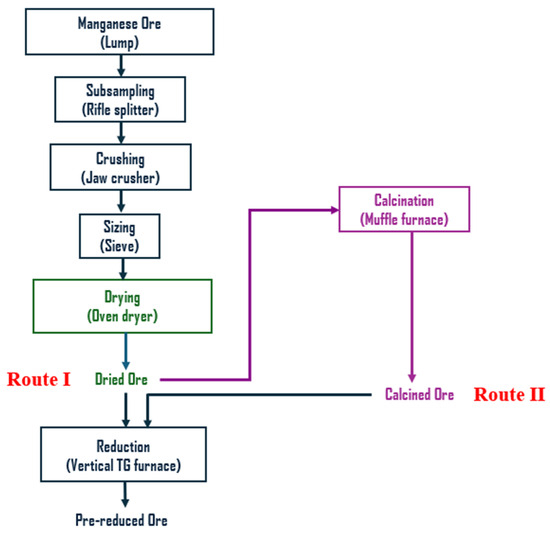
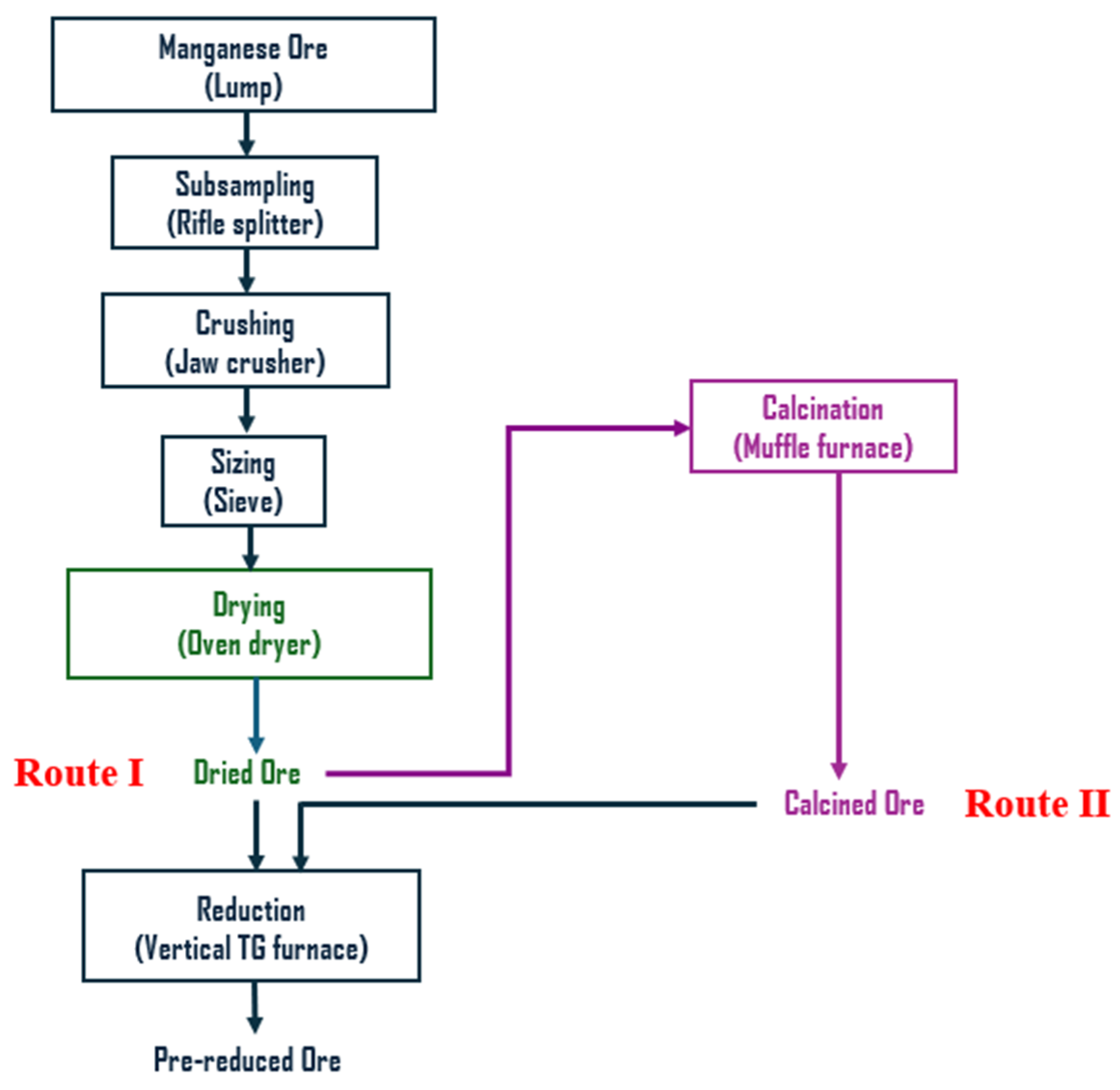
A schematic overview of the methodology is presented in Figure 1.
Figure 1.
The flowchart outlines the sequential steps involved in the material processing pathway.
2.2. Raw Material and Preparation Methods
The manganese ore used in this investigation was sourced from Zambia. The lumpy ore was sampled using a riffle splitter to ensure representative sampling, followed by crushing in a Retsch BB300 jaw crusher (Haan, Germany) and sieving to obtain a particle size fraction of 4–10 mm. This size range was selected to promote effective gas–solid interaction during hydrogen reduction, while minimizing size-related heterogeneity and complying with the sample capacity limitations of the thermogravimetric (TG) furnace. The selected fraction was dried at 110 °C for 24 h to remove surface moisture prior to further processing.
In Route I, 150 g of the dried ore was reduced in a vertical tube thermogravimetric furnace under a 100% H2 atmosphere at 600 °C, 700 °C, and 800 °C for 120 min. These temperatures were selected to ensure progressive reduction of manganese and iron oxides and to evaluate temperature-dependent kinetic behavior [11,24,25,28].
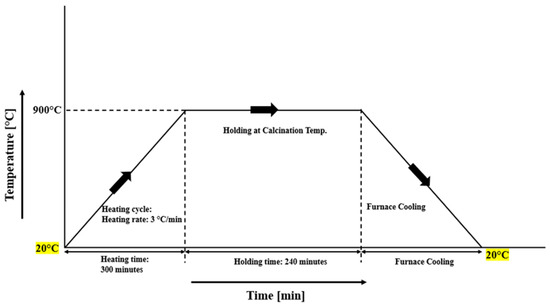
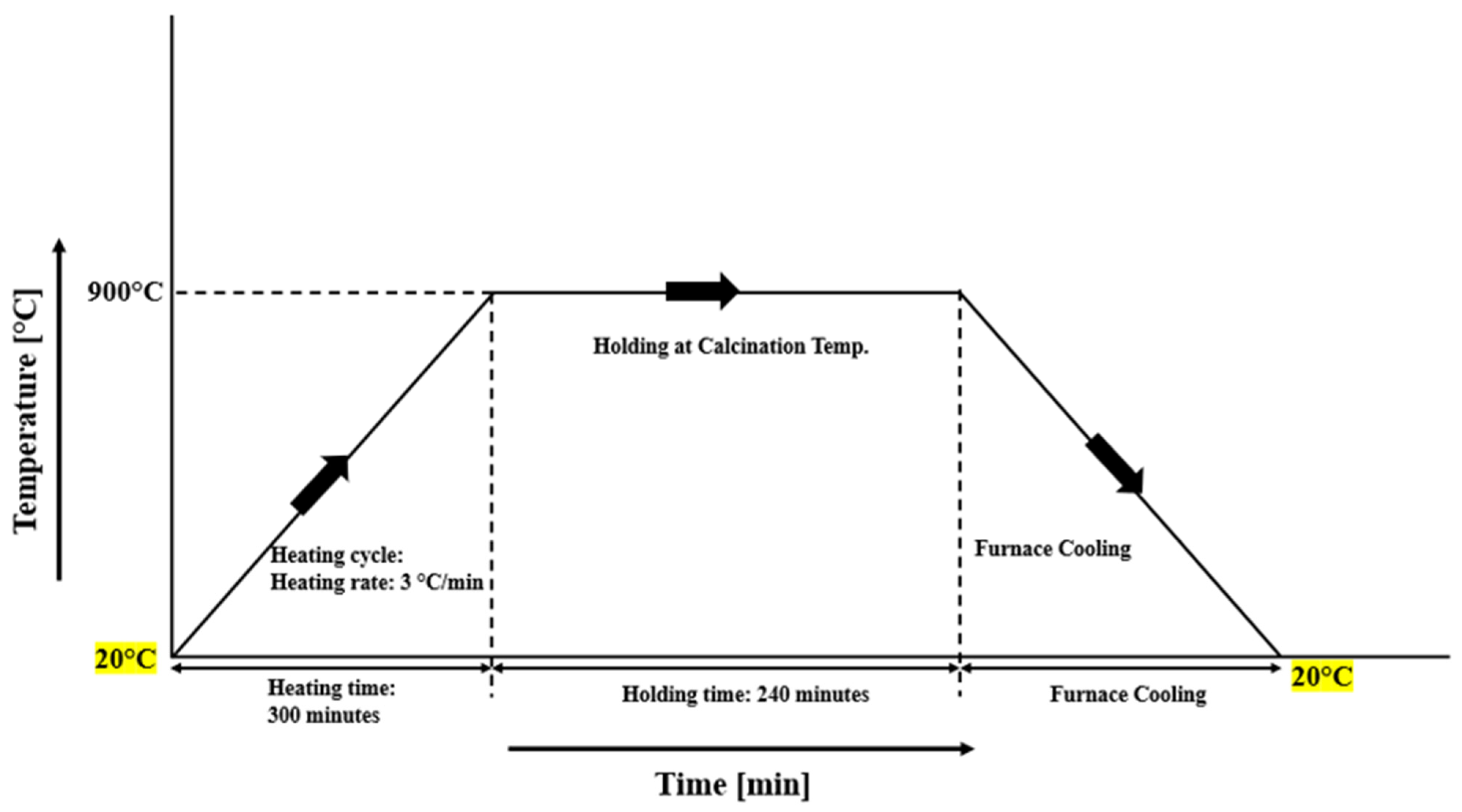
In Route II, the dried ore was first subjected to calcination in air at 900 °C for 4 h in a closed muffle furnace to decompose carbonate and hydroxide phases and modify the mineral structure. The calcined samples were subsequently reduced under identical hydrogen conditions as in Route I (600–800 °C for 120 min in the TG furnace using 150 g samples), as illustrated in Figure 1.
2.3. Calcination Cycle
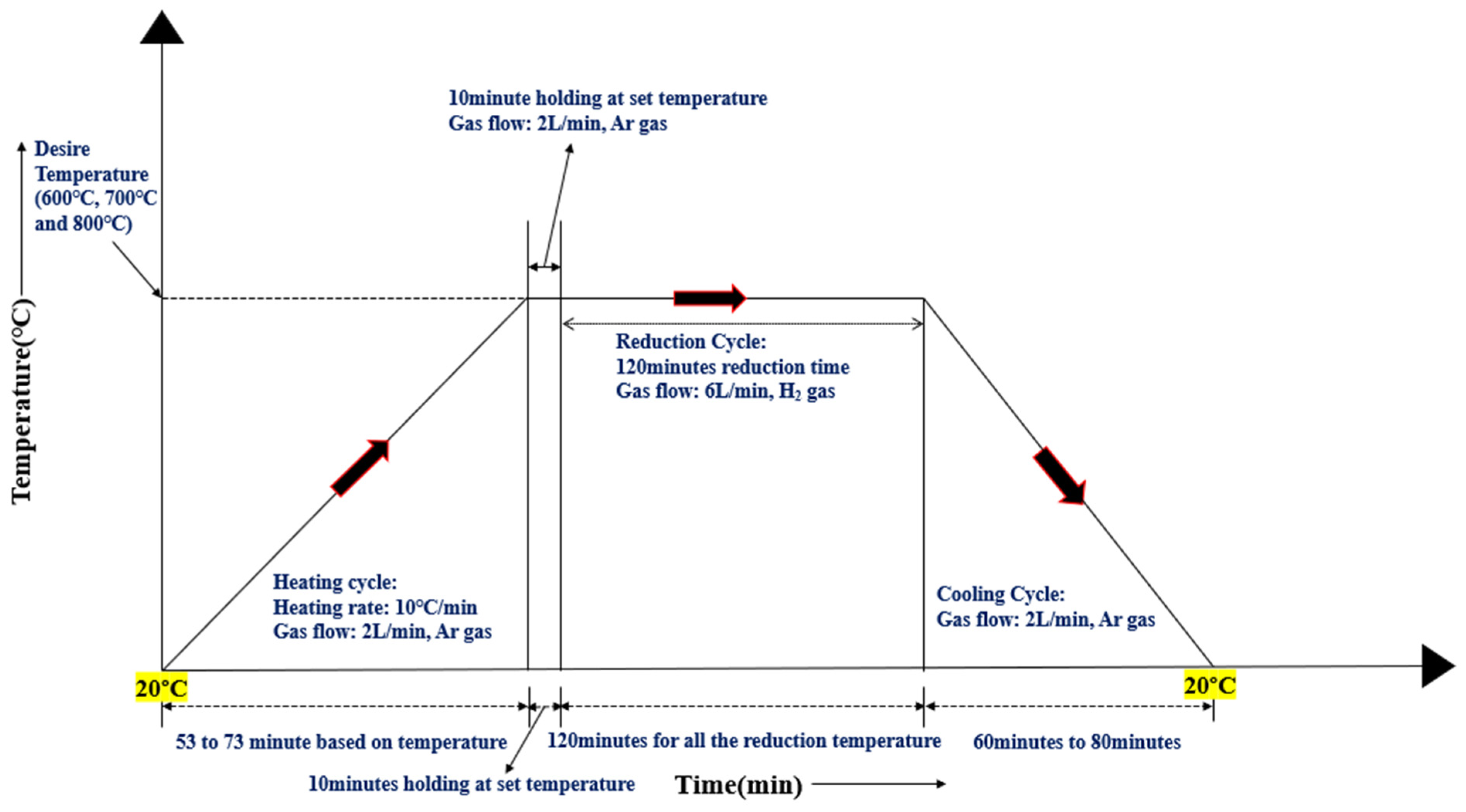
The calcination cycle is presented in Figure 2. Route II was conducted in parallel with Route I to pre-treat the ore prior to hydrogen reduction, allowing assessment of the influence of hydroxide and carbonate removal on the reduction rate and reaction mechanism, and thereby enhancing the reliability of the kinetic evaluation.
Figure 2.
Thermal profile illustrating the temperature–time schedule applied during the calcination of manganese ore.
2.4. Isothermal Reduction Thermogravimetric (TG) Furnace Setup
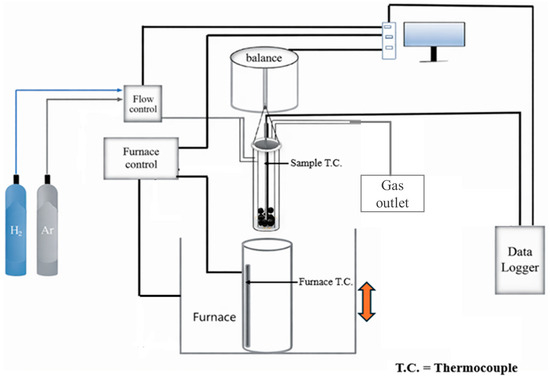
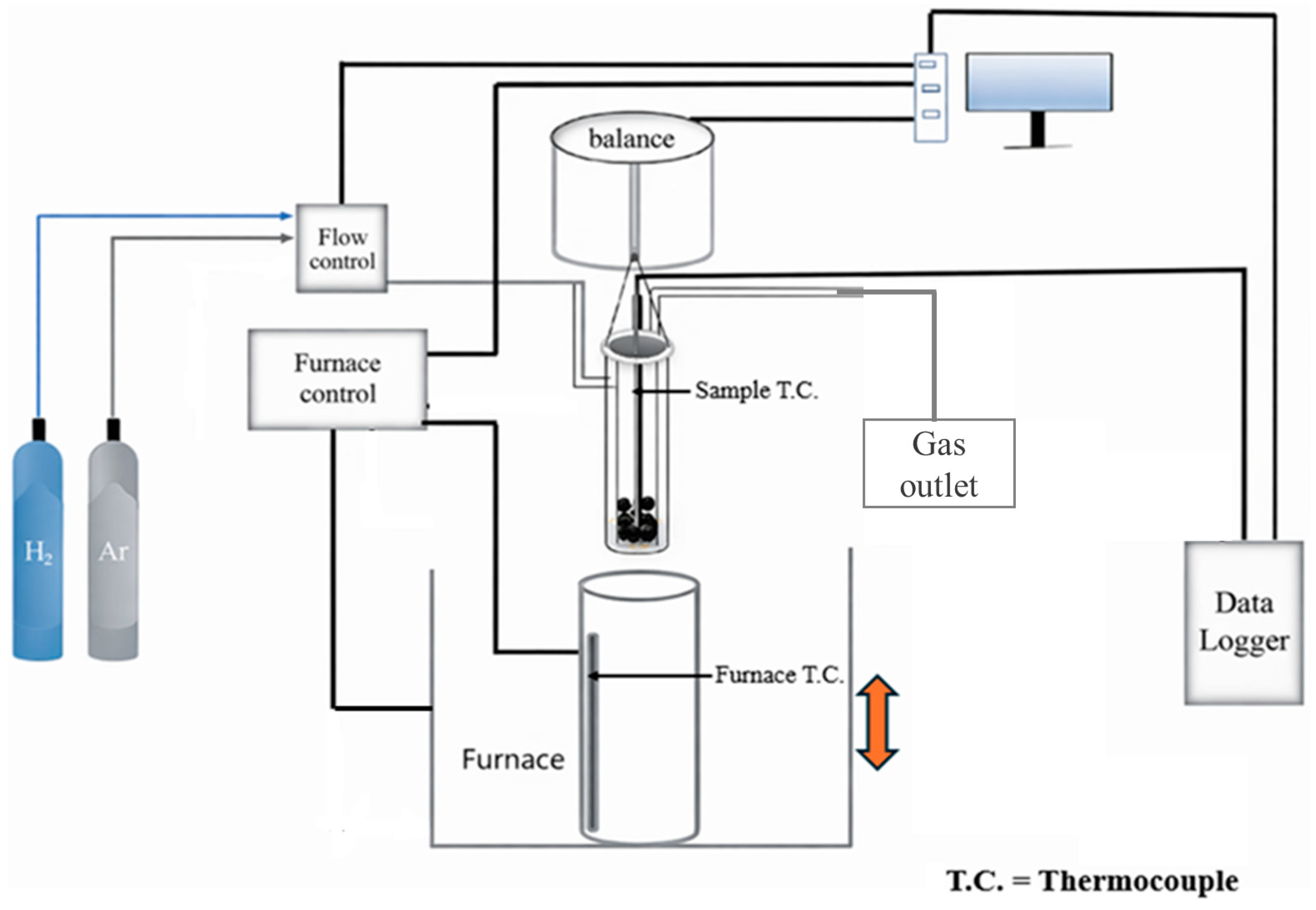
Isothermal reduction experiments were performed in a vertical thermogravimetric (TG) furnace (Entech VTF 80/15, Kista, Sweden), as shown in Figure 3, under a 100% H2 atmosphere (≥99.999 vol.% purity). The sample was placed in a stainless-steel crucible suspended from a Mettler Toledo PR2003DR balance (Greifensee, Switzerland) to enable continuous mass monitoring during reduction. Gas flow rates were regulated using Bronkhorst F-201C mass flow controllers (Ruurlo, The Netherlands). The off-gas temperature was maintained above 150 °C, which is higher than the dew point of water under the experimental conditions, thereby preventing steam condensation and ensuring accurate mass loss measurements. Real-time data acquisition included sample temperature, mass change, and gas composition. An additional Ohaus Pioneer PA4202 balance was employed for independent mass verification (Parsippany, NJ, USA).
Figure 3.
Schematic representation of the vertical TG furnace system.
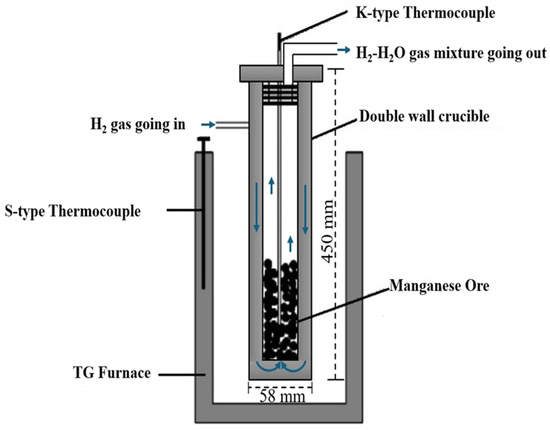
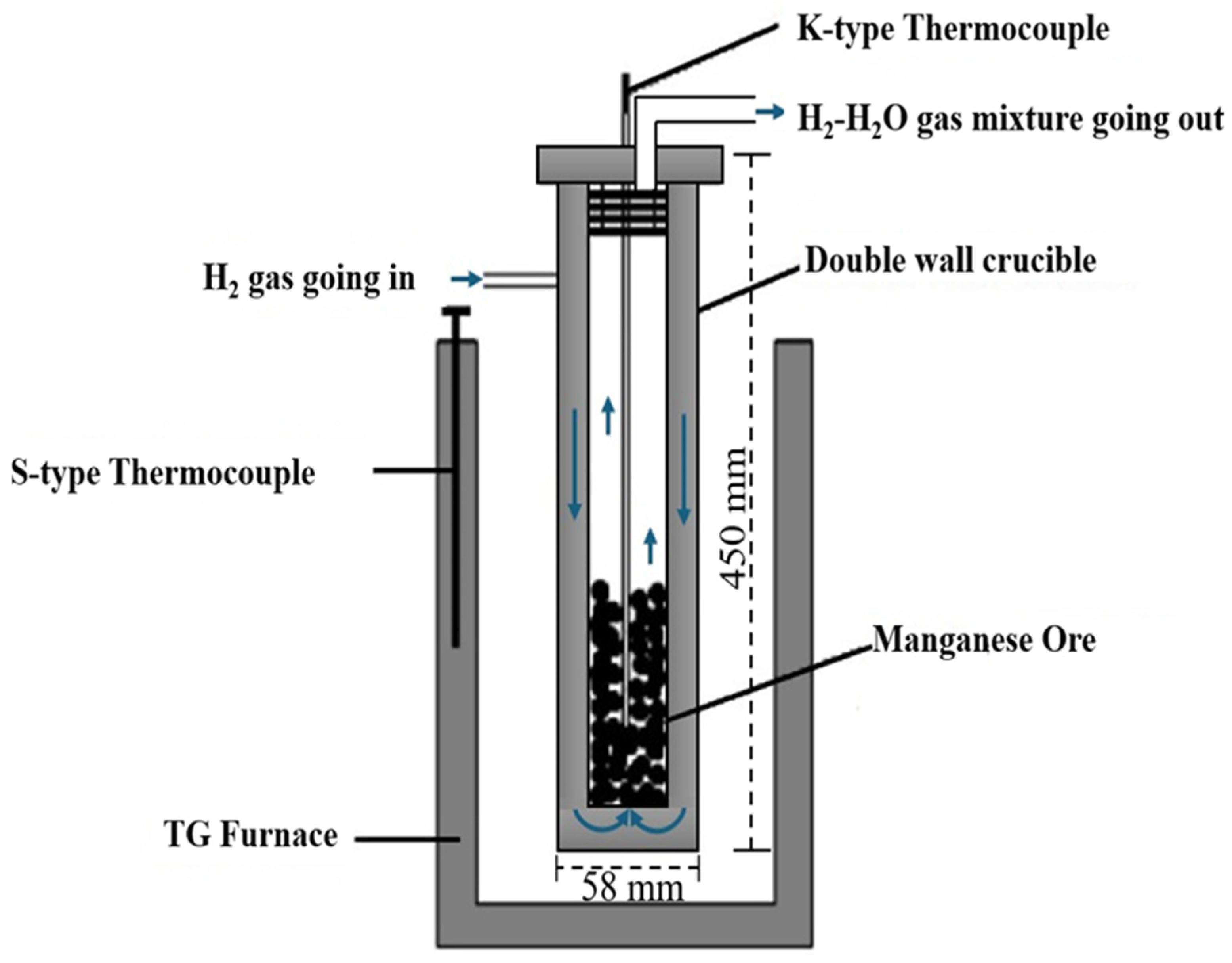
The sample temperature was measured using a K-type thermocouple positioned adjacent to the crucible, and synchronized data logging ensured accurate correlation between weight loss, gas flow, and gas composition. The system design provided uniform gas distribution and precise control of experimental conditions. The process gas was introduced from the top of the sample holder, preheated while descending along the crucible wall, then passed upward through the sample bed before exiting through the off-gas outlet. Figure 4 illustrates the double-wall-type crucible design employed for the isothermal thermogravimetric experiments.
Figure 4.
Schematic representation of the double-wall-type crucible design.
2.5. Reduction Cycle
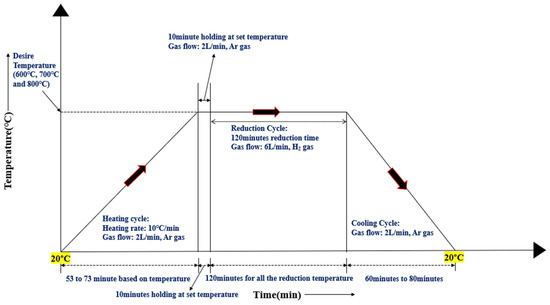
The temperature profile applied during the direct reduction experiments is presented in Figure 5. Isothermal reduction tests were conducted at 600 °C, 700 °C, and 800 °C using 150 g samples of both dried and calcined Zambian manganese ore. Each sample was initially heated under an argon atmosphere (2 L/min) at a rate of 10 °C/min to the target temperature and held for 10 min to ensure uniform thermal equilibration throughout the sample bed. Reduction was subsequently performed under a continuous hydrogen flow (6 L/min) for 120 min. After completion of the reduction stage, the samples were cooled under argon (2 L/min) to prevent reoxidation of the reduced products.
Figure 5.
Schematic of the isothermal reduction cycle under a 100% H2 atmosphere.
2.6. Materials Characterization Methods
Elemental Analysis
The chemical compositions of the raw, calcined, and reduced Zambian manganese ore samples were determined by X-ray fluorescence (XRF) using a Thermo Fisher instrument at Nemko Norlab, Norway. Samples were prepared using the flux fusion technique to ensure homogeneity and high analytical accuracy.
Phase Analysis
Phase identification of the raw, calcined, and pre-reduced samples was carried out by X-ray diffraction (XRD) using a Bruker D8 A25 DaVinci™ diffractometer (Billerica, MA, USA) equipped with CuKα radiation (λ = 1.54 Å). Diffraction patterns were collected over a 2θ range of 10–80°. Crystalline phases were identified using DIFFRAC.EVA V6.0 software in combination with the ICDD PDF-5+ (2023) and COD databases.
Microstructural Analysis
Microstructural features of the raw and calcined ore samples were initially examined using optical microscopy (Zeiss Axio Vert.A1, Oberkochen, Germany) in reflected light mode. Detailed microstructural characterization was subsequently performed using a Zeiss Ultra field-emission scanning electron microscope (FESEM) (Oberkochen, Germany) equipped with a Bruker XFlash® 4010 energy-dispersive spectroscopy (EDS) detector (Billerica, MA, USA). Backscattered electron (BSE) imaging was used to evaluate phase distribution and surface morphology. For analysis, the ore particles were mounted in epoxy, polished using a Struers Tegramin 20 system (Ballerup, Denmark), and coated with a thin carbon layer to ensure electrical conductivity during FESEM examination.
Porosity Analysis
The porosity of the raw and reduced manganese ore samples was evaluated using helium pycnometry. Absolute density was measured with an AccuPyc 1330 (Micromeritics, Norcross, GA, USA), while apparent density was determined using a GeoPyc 1360 (Micromeritics, USA). Open porosity was calculated from the difference between absolute and apparent densities, providing quantitative insight into pore development during hydrogen reduction.
3. Results and Discussion
3.1. Material Characterization
3.1.1. Chemical Composition Analysis
Table 1 presents the XRF analysis of Zambian ore in raw and calcined states.
Table 1.
XRF analysis report of raw and calcined Zambian manganese ore (wt.%).
Table 1 presents the chemical composition of the raw and calcined manganese ore determined by XRF analysis. The raw ore contains a very high manganese content, with MnO2 reaching 76.72 wt.%, indicating that the material can be classified as a high-grade manganese ore. Such a high Mn concentration is advantageous for manganese ferroalloy production, as it can lead to higher metal yield and reduced gangue input during smelting. In addition, the ore contains very low iron content, with Fe2O3 only 0.86 wt.% in the raw ore and 1.12 wt.% after calcination, which is beneficial for processes where low iron levels in the feed material are desired.
After calcination, MnO2 is no longer detected, which will be discussed in later sections, and is largely converted into Mn2O3 (73.54 wt.%), reflecting the thermal decomposition of MnO2 during the calcination process [29]. A relative increase in gangue oxides such as SiO2 (from 2.75 to 7.94 wt.%) and Al2O3 (from 1.38 to 1.85 wt.%) is also observed, which is mainly attributed to the removal of volatile components and structural water during heating. The ore is also characterized by very low levels of CaO and MgO, with CaO increasing slightly from 0.07 wt.% in the raw ore to 0.43 wt.% after calcination, while MgO remains extremely low at 0.03 wt.% in both samples. The K2O content is relatively low (0.59 wt.% in the raw ore and 0.43 wt.% in the calcined ore); however, the presence of potassium suggests that it may occur within potassium-bearing manganese minerals such as cryptomelane, which is commonly found in manganese oxide deposits. This will be further discussed in Section 3.1.2.
Despite the very high manganese content, the ore also contains relatively high levels of barium and phosphorus impurities. The BaO content increases from 9.32 wt.% in the raw ore to 11.58 wt.% in the calcined sample. Due to the significant BaO content, the ore can be considered highly basic, since barium oxide behaves as a strong basic oxide and contributes to the overall basicity of the ore. While the phosphorus content (reported as P2O5) is high and increases slightly from 0.17 wt.% to 0.22 wt.%, it is important to consider during manganese processing, as elevated phosphorus can negatively affect ferroalloy quality. In addition, high barium content may influence slag formation and process behavior .
A significant decrease in loss on ignition (LOI) is observed after calcination, decreasing from 7.94 wt.% in the raw ore to 2.68 wt.% in the calcined ore. This reduction reflects the removal of moisture, chemically bound water, and decomposition of volatile phases during calcination. Consistently, the raw ore contains measurable moisture (H2O = 0.65 wt.%), whereas no water is detected in the calcined sample. Overall, calcination results in manganese oxide phase transformation and removal of volatile components, producing a more stable oxide composition suitable for subsequent reduction studies.
Table 2 presents the chemical composition of the reduced manganese ore samples obtained after hydrogen reduction at 600, 700, and 800 °C following two different processing routes: Route I (dried ore) and Route II (calcined ore). The results show that manganese is the dominant component in all reduced samples, with MnO contents ranging from approximately 74.40 to 82.04 wt.%, confirming that the reduction process largely converts higher manganese oxides into MnO.
Table 2.
XRF analysis of Zambian manganese ore reduced via routes I and II (wt.%).
The iron content remains very low in all reduced samples, ranging from 0.28 to 1.07 wt.%, which further confirms that the studied ore is naturally low in iron. Slightly higher Fe contents are observed in the calcined samples compared to the dried samples, possibly due to the relative enrichment of minor oxides during thermal treatment.
The silica (SiO2) and alumina (Al2O3) contents show moderate variation with temperature and processing route. SiO2 ranges from 2.57 to 6.58 wt.%, while Al2O3 varies between 0.65 and 3.21 wt.%. The highest SiO2 content is observed in the calcined sample reduced at 800 °C (6.58 wt.%), whereas Al2O3 reaches its maximum in the calcined sample at 700 °C (3.21 wt.%). These variations likely reflect the relative concentration of gangue minerals during reduction as oxygen is removed from manganese oxides.
The ore continues to exhibit very low concentrations of CaO and MgO across all samples. CaO ranges between 0.11 and 0.22 wt.%, while MgO remains extremely low at 0.01–0.03 wt.%, indicating that the ore contains minimal carbonate minerals and CaO and MgO are associated with other oxides.
A notable characteristic of the ore is the consistently high BaO content, ranging from 11.30 to 14.34 wt.% in all reduced samples. This confirms that the ore remains highly basic due to its significant barium content, which can influence slag chemistry and reduction behavior during processing. The K2O content varies between 0.50 and 1.40 wt.%, suggesting the presence of potassium-bearing manganese minerals, likely cryptomelane, as discussed in Section 3.1.2.
The phosphorus content (P2O5) remains relatively high but varies between 0.160 and 0.350 wt.% depending on temperature and route. Phosphorus is an important impurity in manganese ores, as it can transfer to ferroalloys and adversely affect product quality. In contrast, SO3 levels are very low in all samples (0.011–0.034 wt.%), indicating minimal sulfur-bearing phases in the ore.
Overall, the results confirm that the reduced products are dominated by MnO with low iron and minimal CaO-MgO gangue, while maintaining relatively high BaO and phosphorus content and moderate levels of K2O. These compositional characteristics are consistent with the mineralogical features of the Zambian manganese ore and its behavior during hydrogen reduction.
3.1.2. Mineralogical Characterization
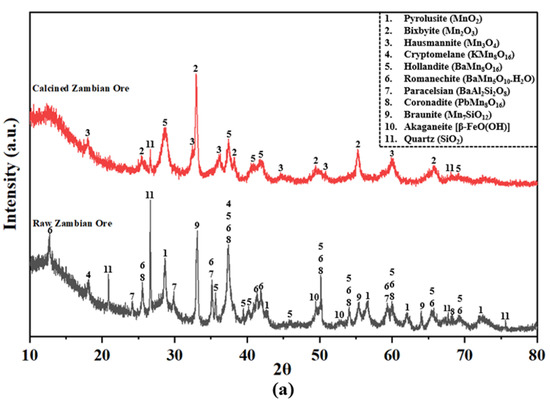
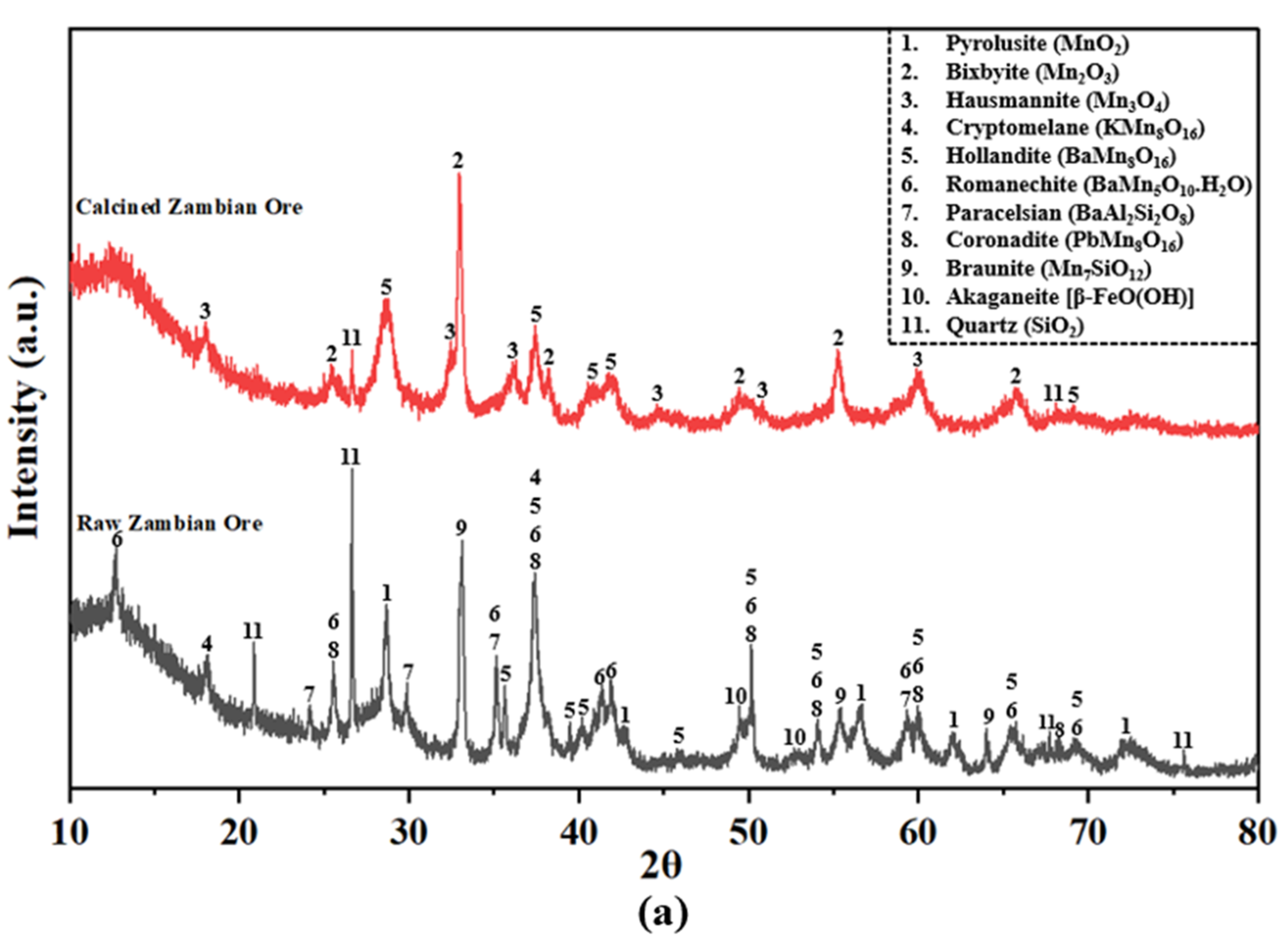
Figure 6a shows the XRD patterns of the raw and calcined Zambian manganese ore, revealing a complex mineralogical composition dominated by manganese oxide minerals. The raw ore is primarily composed of pyrolusite (MnO2), together with several tunnel-structured manganese oxides belonging to the hollandite group. These include cryptomelane [K(Mn8O16)], hollandite (BaMn8O16), romanechite (Ba(Mn5O10)·H2O), and coronadite (PbMn8O16). These minerals are characterized by MnO6 octahedral frameworks containing large tunnel sites that accommodate cations such as K+, Ba2+, and Pb2+. The presence of these tunnel manganese oxides is typical of barium-rich manganese deposits and explains the significant Ba content observed in the chemical composition of the ore.
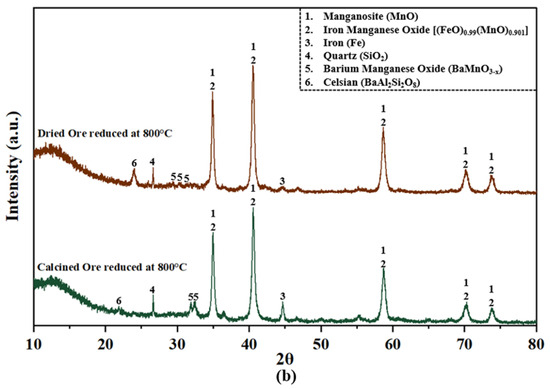
Figure 6.
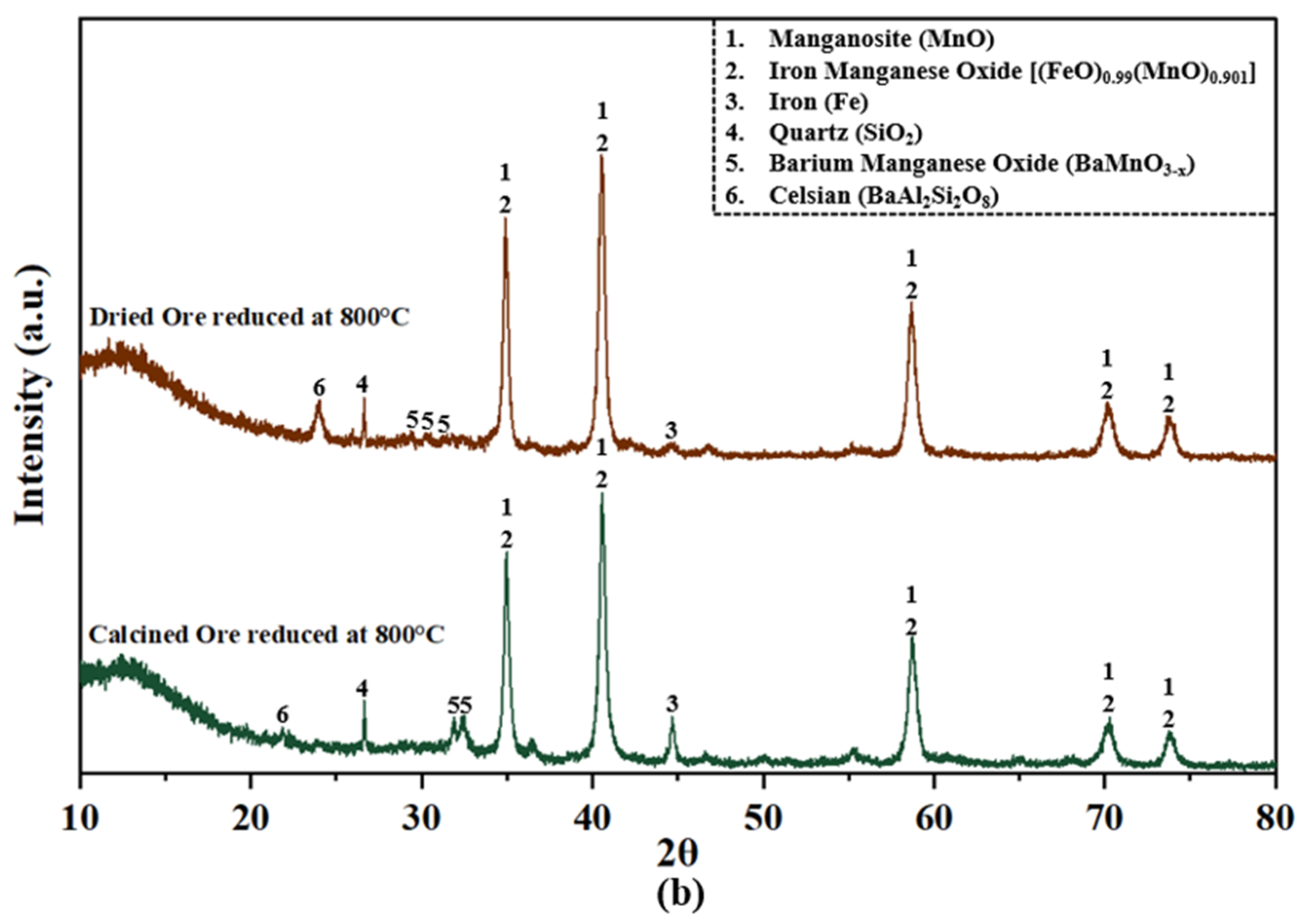
XRD patterns of raw and calcined Zambian manganese ore (a) and their hydrogen-reduced products at 800 °C (b).
In addition to these manganese oxides, the raw ore also contains braunite (Mn7SiO12), which is a manganese silicate mineral contributing directly to the manganese content of the ore. Minor accessory phases include quartz (SiO2) and small amounts of akaganeite [β-FeO(OH)], indicating the presence of silicate gangue and minor iron-bearing phases.
Following calcination, noticeable changes in the mineralogical composition are observed. The diffraction peaks corresponding to pyrolusite decrease significantly, while new reflections associated with Mn2O3 and Mn3O4 appear, indicating thermal decomposition of higher manganese oxides. However, several tunnel-structured manganese oxides containing Ba and other large cations remain detectable, suggesting that these phases exhibit relatively higher thermal stability due to the structural stabilization provided by large interstitial cations. The decomposition behavior of manganese-bearing minerals during calcination has been described in detail in our previous study [28].
Figure 6b presents the XRD patterns of the dried and calcined ores after hydrogen reduction at 800 °C. In both samples, the diffraction patterns are dominated by strong peaks corresponding to manganosite (MnO), indicating that manganese oxides have been extensively reduced to MnO under the hydrogen atmosphere. In addition to MnO, metallic iron (Fe) is detected, demonstrating that iron-bearing phases present in the original ore undergo reduction to elemental iron during the hydrogen treatment. A minor Fe-Mn monoxide solid solution [(Fe,Mn)O] is also identified [24,25,28], which is consistent with the mutual solubility of FeO and MnO at elevated temperatures.
Quartz remains present in the reduced samples due to its high thermodynamic stability under reducing conditions. Furthermore, residual barium manganese oxide phases are detected, suggesting that Ba-containing manganese oxides may undergo structural rearrangement during reduction rather than complete decomposition. The formation of barium aluminosilicate phases such as celsian (BaAl2Si2O8) is also observed, which likely results from the interaction between Ba-containing oxides and aluminosilicate gangue minerals at elevated temperatures.
Overall, the XRD results indicate that hydrogen reduction at 800 °C leads to the almost complete transformation of manganese oxides into MnO, while iron-bearing phases are reduced to metallic iron. The reduction reactions of manganese and iron oxides with hydrogen, as well as the detailed reduction mechanism, have been discussed comprehensively in our previous work [28].
3.2. Microstructural Analysis
3.2.1. Optical Microscopy of Raw and Calcined Ore
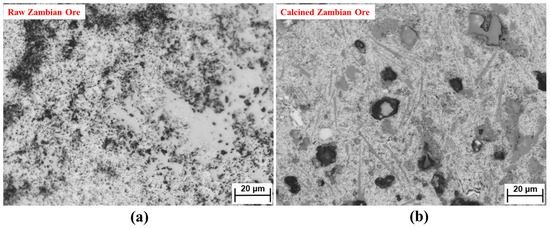
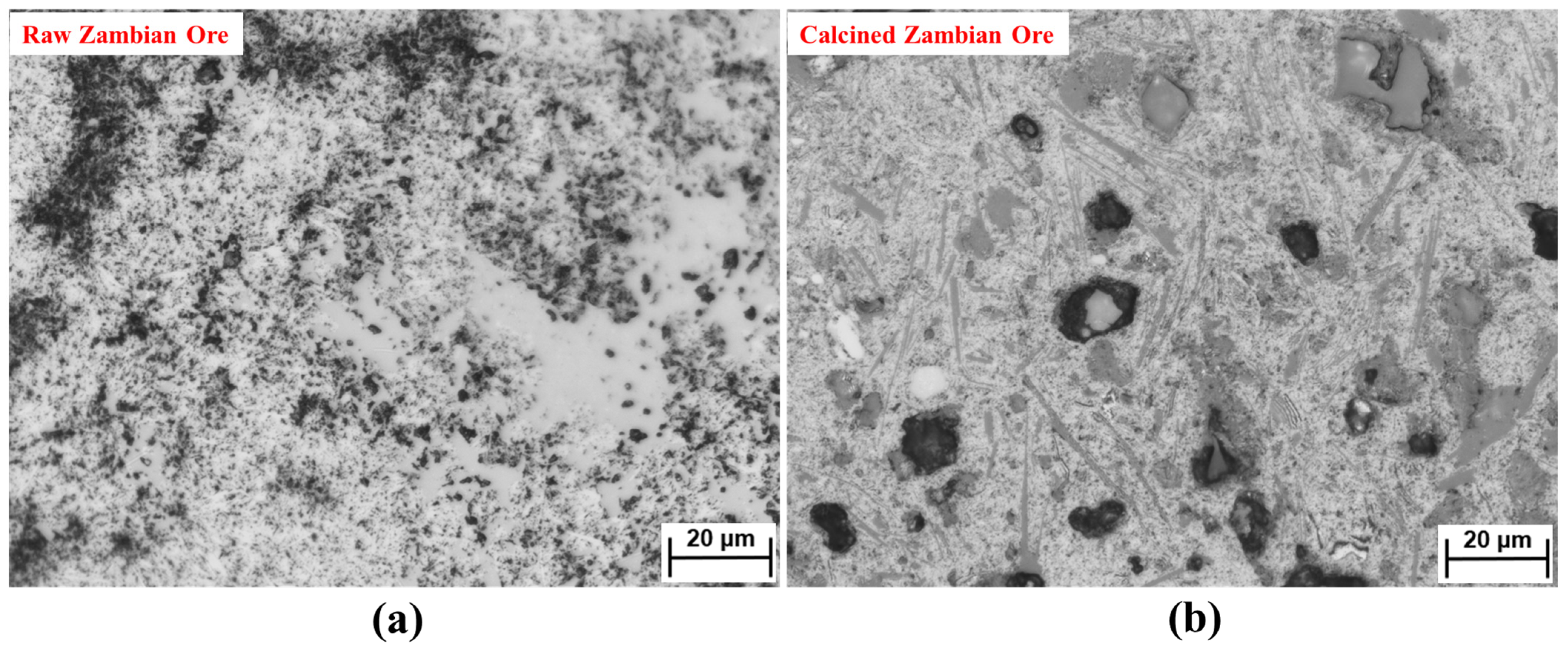
The optical micrograph of the raw ore (Figure 7a) reveals a relatively heterogeneous microstructure consisting of fine-grained manganese oxide phases distributed within a lighter mineral matrix. The darker regions correspond primarily to manganese oxide minerals, which are finely disseminated throughout the sample. The lighter areas represent silicate or aluminosilicate gangue phases such as quartz and other non-manganese minerals. The overall texture of the raw ore is relatively compact, with manganese-bearing phases occurring as small, dispersed particles embedded in the gangue matrix. The absence of well-defined grain boundaries suggests that the manganese oxides are finely intergrown with the surrounding mineral phases.
Figure 7.
Optical Micrographs of (a) Raw Zambian Ore and (b) Calcined Zambian Ore.
The optical micrograph of the calcined ore (Figure 7b) shows noticeable changes in the microstructure compared with the raw ore. After calcination, the ore exhibits a more developed and heterogeneous texture with clearer phase boundaries and the appearance of elongated or needle-like features. These morphological changes are attributed to the thermal decomposition of manganese oxide minerals and the associated structural rearrangement occurring during calcination. The calcined sample also displays the presence of pores and microcracks, which are likely formed due to the release of gaseous species and phase conversions during the thermal decomposition of higher manganese oxides. In addition, the manganese-bearing phases appear more segregated and better defined compared with the raw ore, suggesting partial liberation of Mn minerals from the surrounding gangue matrix. The development of these pores and microstructural changes during calcination can enhance gas accessibility and facilitate subsequent hydrogen reduction reactions. The increased porosity and improved phase separation observed in the calcined ore are therefore expected to promote faster reduction kinetics compared with the raw ore.
3.2.2. SEM Analysis of Raw and Calcined Ore
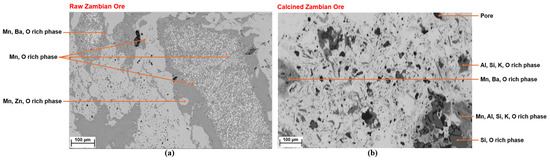
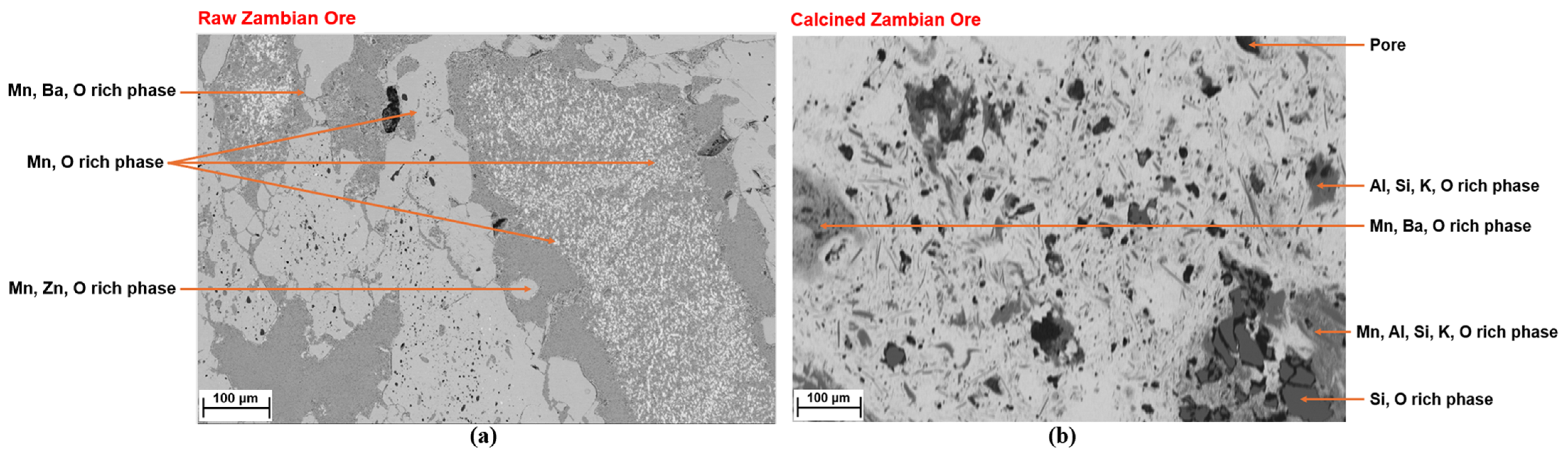
The SEM micrograph of the raw Zambian manganese ore (Figure 8a) reveals a heterogeneous microstructure composed of several mineral phases with distinct compositional characteristics. The dominant phase observed in the raw ore corresponds to Mn-O-rich regions, which represent manganese oxide minerals distributed throughout the matrix. These Mn-rich phases appear as relatively dense and compact domains, indicating a tightly intergrown microstructure. In addition to the Mn-O-rich phases, localized regions enriched in Mn, O, and Ba are also identified. These areas likely correspond to Ba-bearing manganese oxide phases, which are consistent with the presence of tunnel-structured manganese oxides identified in the XRD analysis. Furthermore, minor domains enriched in Mn, O, and Zn are observed, suggesting the presence of Zn-bearing manganese oxides or trace Zn substitution within the Mn oxide lattice. The raw ore exhibits a relatively dense and compact structure with limited visible porosity. The manganese-bearing minerals appear closely associated with the surrounding gangue phases, indicating a high degree of mineral intergrowth.
Figure 8.
SEM micrographs of (a) raw and (b) calcined Zambian ore.
The SEM micrograph of the calcined ore (Figure 8b) exhibits a more porous and heterogeneous structure characterized by the presence of numerous pores and micro voids, which are distributed throughout the matrix. These pores are likely generated during calcination as a result of the decomposition of higher manganese oxides and the release of gaseous species. Several compositional domains are also identified in the calcined sample. Regions enriched in Al, Si, K, and O are observed, indicating the presence of aluminosilicate gangue phases. Additionally, Mn-bearing regions containing Mn, O, and Ba remain present after calcination, suggesting that Ba-bearing manganese oxides exhibit relatively high thermal stability. Some areas also show enrichment in Mn, O, Al, Si, and K, which may indicate partial interaction between manganese oxides and aluminosilicate gangue minerals during high-temperature treatment. Furthermore, Si-O-rich phases corresponding to quartz or silicate minerals are also detected in the calcined ore.
Compared with the raw ore, the calcined sample displays increased porosity and clearer phase separation, indicating that thermal treatment promotes structural modification and partial liberation of manganese-bearing minerals from the surrounding gangue matrix.
3.2.3. SEM Analysis of the Reduced Ore
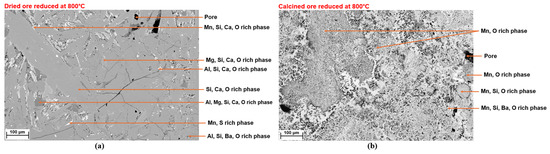
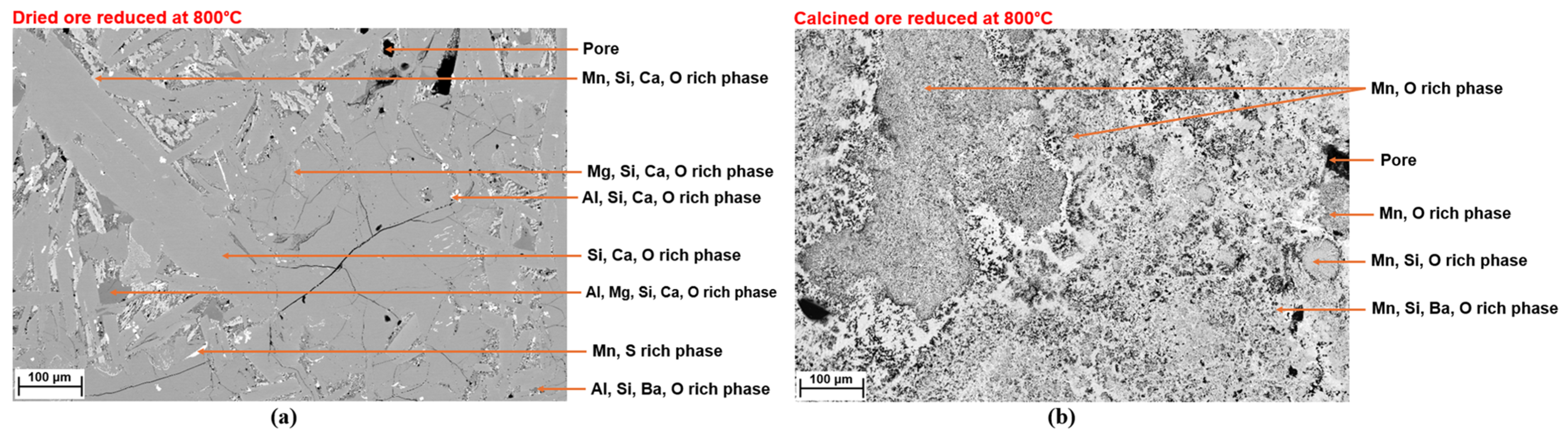
Figure 9 shows the SEM micrographs of the dried and calcined Zambian manganese ores after hydrogen reduction at 800 °C. The microstructures reveal significant changes compared with the raw and calcined samples, reflecting the extensive reduction of manganese and iron oxides, as well as the redistribution of gangue phases during the reduction process.
Figure 9.
SEM Micrographs and the identified phases of the (a) Dried and (b) Calcined Zambian Manganese Ore samples reduced at 800 °C in 100% H2 atmosphere.
The SEM micrograph of the dried ore reduced at 800 °C (Figure 9a) exhibits a relatively dense microstructure with several compositional domains identified through EDS analysis. Regions enriched in Mn, Si, O, and Ca are observed, indicating the presence of manganese-bearing silicate phases. Additional domains containing Mg, Si, O, and Ca, as well as Al, O, Si, and Ca, suggest the presence of complex aluminosilicate and silicate gangue minerals distributed throughout the matrix. Areas enriched in Si and O correspond to silicate phases, likely associated with quartz or other silicate minerals present in the original ore. Furthermore, regions containing Al, Mg, Si, O, and Ca indicate the presence of mixed aluminosilicate phases formed through interactions among gangue components during high-temperature treatment. Minor domains enriched in Mn and S are also detected, suggesting the possible presence of sulfur-bearing manganese phases or trace sulfide inclusions. In addition, localized regions containing Al, O, Si, and Ba are identified, which may correspond to Ba-bearing aluminosilicate phases formed through the interaction of barium with silicate gangue minerals during the reduction process. A small number of pores are also visible, indicating partial structural modification of the ore during reduction.
The SEM micrograph of the calcined ore reduced at 800 °C (Figure 9b) shows a significantly different microstructure compared with the reduced dried ore. The sample exhibits a more porous and heterogeneous structure, with numerous fine pores distributed throughout the matrix. The development of these pores is attributed to the thermal decomposition of manganese oxides during calcination, followed by reduction in hydrogen. The dominant phases identified in this sample are Mn-O-rich regions, which correspond to the reduced manganese oxide phase MnO, consistent with the XRD results. Areas containing Mn-rich phases are also observed, indicating localized enrichment of manganese within the matrix. Additionally, domains enriched in Mn, Si, and O are present, suggesting the coexistence of manganese oxides with silicate gangue minerals. Regions containing Mn, Si, O, and Ba are also detected, indicating the persistence of Ba-bearing manganese oxide phases after reduction. These Ba-containing phases are consistent with the high Ba content of the ore and the known stability of Ba-bearing manganese oxides under reducing conditions.
Compared with the reduced dried ore, the calcined ore reduced at 800 °C exhibits significantly higher porosity and better phase separation, indicating that calcination promotes structural modification and improves gas accessibility during the reduction process.
3.3. H2 Reduction Behavior
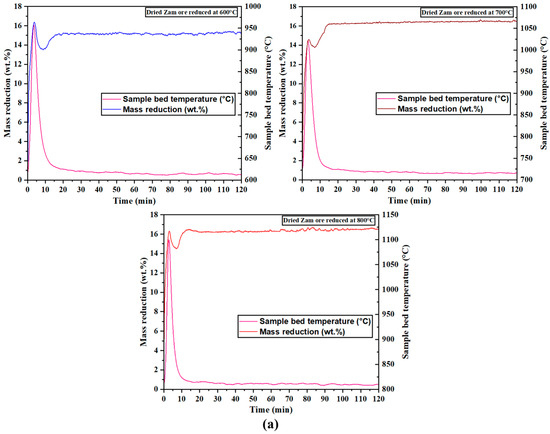
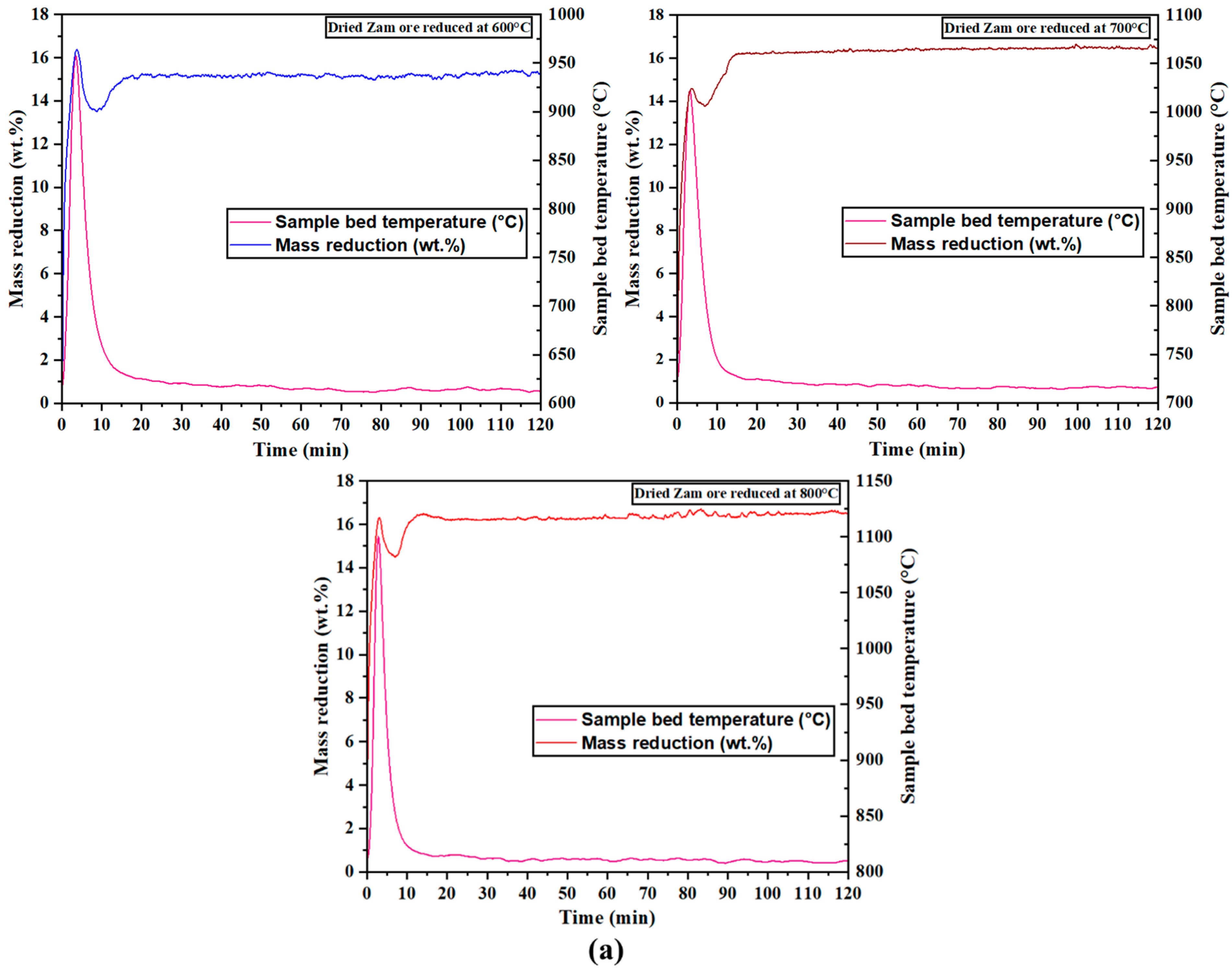
The isothermal hydrogen reduction behavior of the dried ore at 600 °C, 700 °C, and 800 °C is presented in Figure 10a. The plots show the variation in mass reduction (wt.%) with time, together with the corresponding sample bed temperature profiles.
Figure 10.
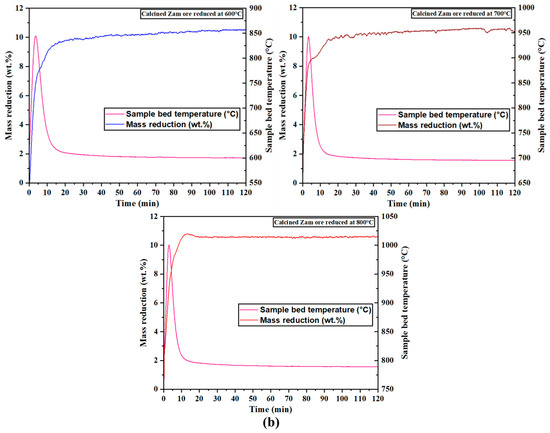
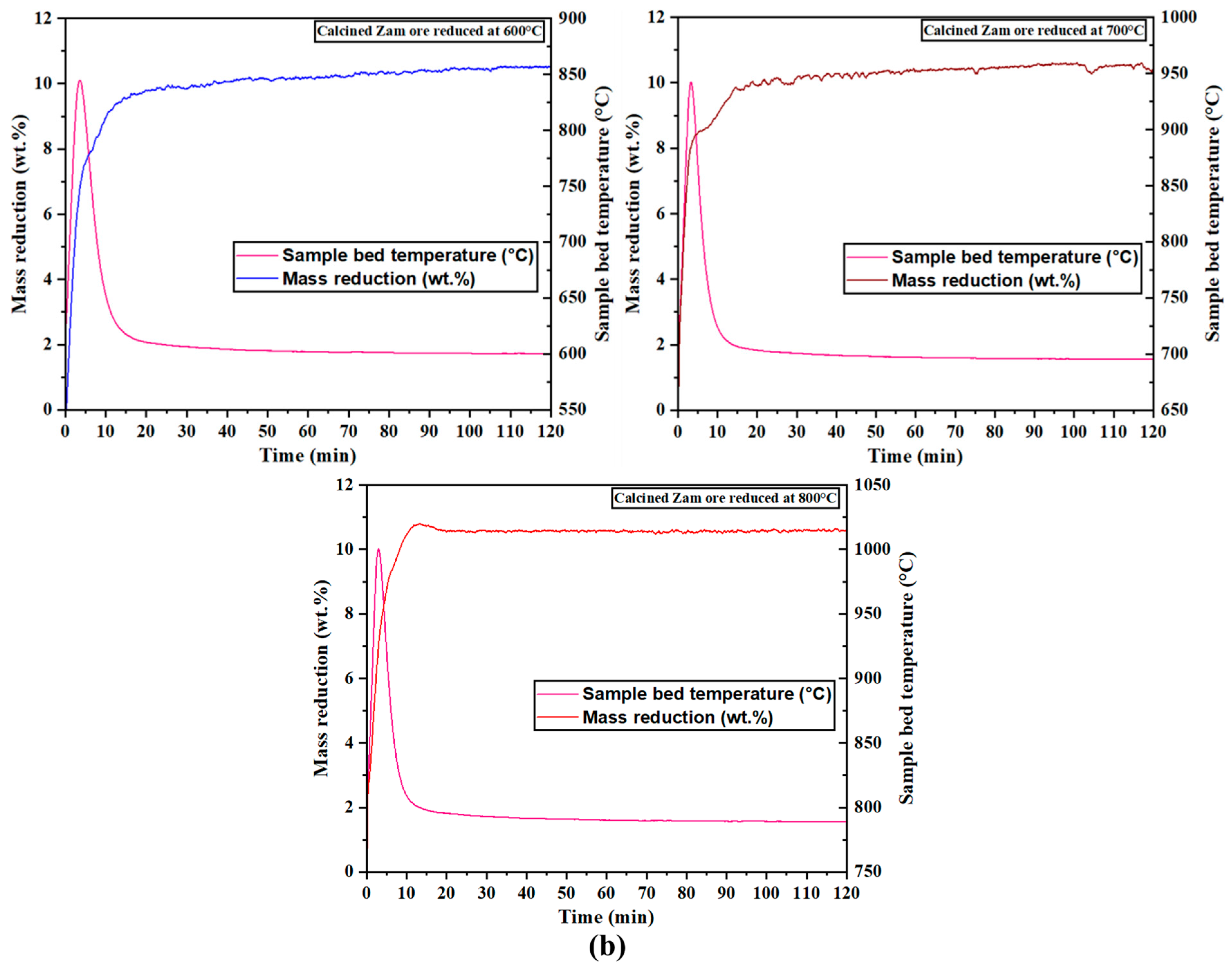
Reduction Behavior of (a) Dried and (b) Calcined Zambian Manganese Ore: Mass Reduction (wt.%) and Temperature (°C) Profiles under H2 Atmosphere at 600–800 °C.
At 600 °C, the reduction exhibits a rapid initial stage during the first few minutes, where the mass reduction quickly increases to approximately 15–16 wt.%, indicating fast oxygen removal from higher manganese oxides. After this stage, the curve gradually approaches a plateau, suggesting that the reaction rate decreases as the reduction progresses. The temperature profile shows an initial rise due to the exothermic nature of the reduction reactions before stabilizing near the set temperature. At 700 °C, the reduction proceeds more rapidly, reaching a similar mass reduction level in a shorter time compared to 600 °C. The temperature profile also shows an initial peak followed by stabilization, reflecting intensified reaction kinetics at the higher temperature. At 800 °C, the reduction is further accelerated, with the rapid mass loss occurring almost immediately after hydrogen introduction. Although the final mass reduction remains close to ~16 wt.%, the time required to reach this value is shorter than at the lower temperatures. Despite the experiments being conducted under isothermal furnace conditions, the sample bed temperature initially increases during the early stage of reduction. This behavior is attributed to the exothermic nature of hydrogen reduction of manganese oxides, where heat is released during the stepwise transformation of higher oxides to lower oxidation states [28]. The temperature profile shows an initial rise due to the exothermic nature of the reduction reactions before stabilizing near the set temperature, a phenomenon also reported in our previous work [24,25]. After the initial exothermic peak, the temperature stabilizes as the reaction rate decreases and the system approaches steady-state conditions.
Overall, increasing the temperature from 600 °C to 800 °C enhances the reduction rate and shortens the reaction time, while the overall extent of reduction remains relatively similar. The reduction behavior is characterized by a fast initial reaction stage followed by a slower stage, which is typical for gas–solid reduction processes.
The isothermal hydrogen reduction behavior of the calcined ore at 600 °C, 700 °C, and 800 °C is presented in Figure 10b. The plots show the variation in mass reduction (wt.%) with time, together with the corresponding sample bed temperature profiles during the reduction process.
At 600 °C, the reduction proceeds rapidly during the initial stage, with the mass reduction increasing sharply and reaching approximately 9–10 wt.% within the first 10–15 min. After this rapid stage, the curve gradually approaches a plateau, indicating a slower reaction rate as the reduction progresses toward equilibrium. At 700 °C, the reduction rate increases compared to 600 °C, and the mass reduction reaches approximately ~10 wt.% within a shorter time. The faster approach to the plateau indicates enhanced reaction kinetics at a higher temperature. At 800 °C, the reduction occurs even more rapidly, with most of the mass loss taking place within the first few minutes of hydrogen exposure. The final mass reduction remains close to ~10–10.5 wt.%, but the time required to reach this level is significantly shorter, demonstrating the strong influence of temperature on the reduction kinetics. Similar to the dried ore reduction, an initial rise in the sample bed temperature is also observed despite the experiments being conducted under isothermal furnace conditions. This temperature increase is attributed to the exothermic nature of hydrogen reduction of manganese oxides [28], where heat is released during the stepwise transformation of higher oxides to lower oxidation states. The temperature profile shows an initial rise due to the exothermic nature of the reduction reactions before stabilizing near the set temperature, which is consistent with observations reported in our previous work [24,25].
Overall, the reduction behavior of the calcined ore follows a rapid initial reaction stage followed by a slower stage, and the reaction rate increases significantly with increasing temperature. Compared with the dried ore, the calcined sample exhibits a lower overall mass reduction, which can be attributed to the prior removal of volatile components and partial phase transformation due to thermal decomposition during calcination.
Table 3 summarizes the initial and final weights (g), mass loss (g), and weight reduction (%) of the dried and calcined ore after reduction at 600 °C, 700 °C, and 800 °C, highlighting the effect of temperature on the overall weight change.
Table 3.
Summary of initial and final weights (g), mass loss (g), and mass reduction (wt.%) of dried and calcined ore after reduction at 600 °C, 700 °C and 800 °C.
3.3.1. Fractional Conversion
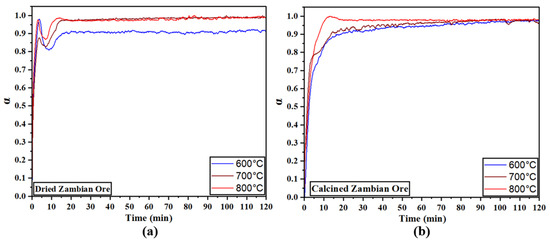
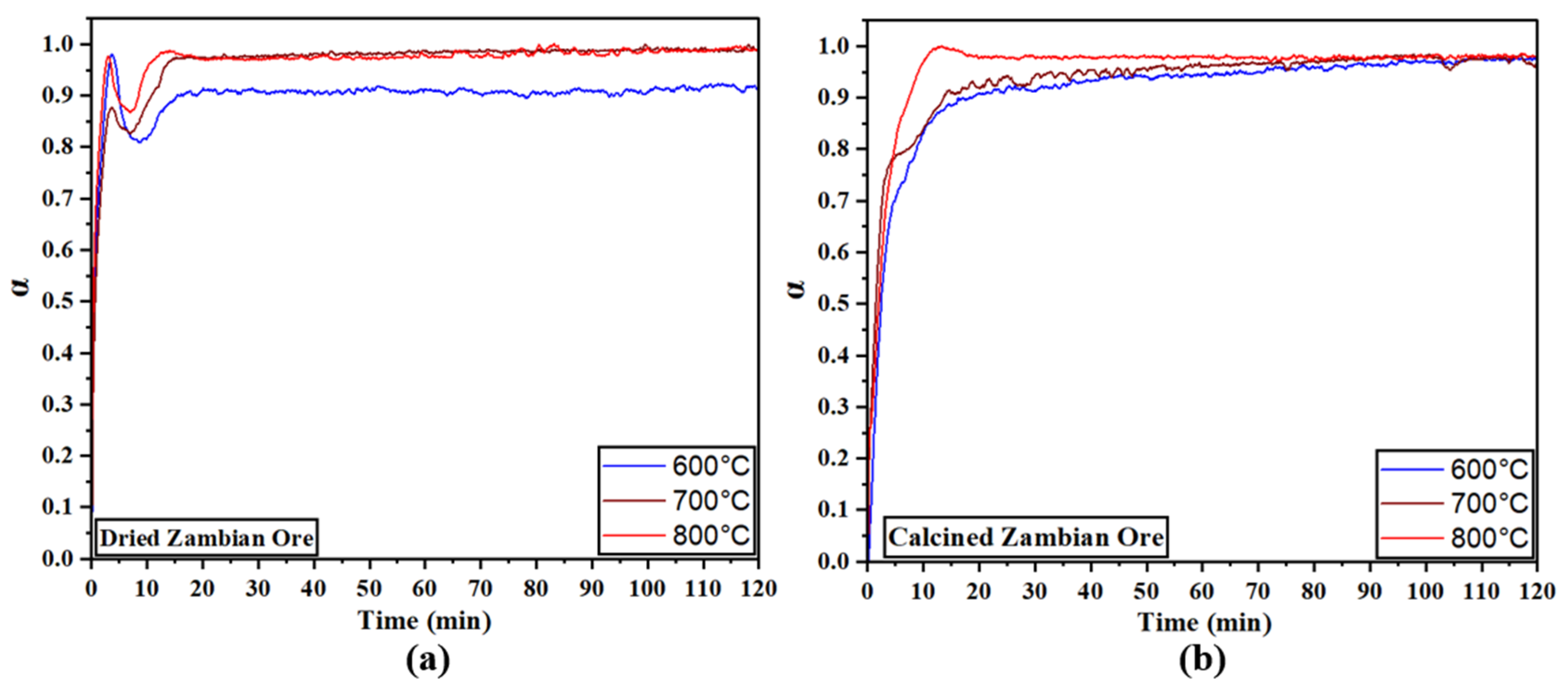
The fractional conversion degree (α) for both dried and calcined ore at different temperatures is presented in Figure 11. The conversion fraction was determined after correcting the measured mass loss by excluding contributions from volatile removal and possible thermal decomposition reactions, thereby ensuring that α represents only the reduction of manganese and iron oxides.
Figure 11.
Fractional conversion (α) as a function of time for (a) Dried and (b) Calcined Zambian manganese ore reduced under 100% H2 atmosphere at 600 °C, 700 °C, and 800 °C.
The conversion degree was calculated using the following relation:
where m0 is the initial mass of the sample, mt is the mass at time t, and mh is the final mass corresponding to the maximum achievable reduction under hydrogen. When α = 0, no reduction has occurred, while α = 1 represents the maximum extent of reduction of manganese and iron oxides to their lower oxidation states. This approach allows a direct comparison of the reduction kinetics of dried and calcined ores.
The evolution of the conversion fraction for the dried Zambian ore is shown in Figure 11a. The conversion increases rapidly during the initial few minutes of reduction at all temperatures, indicating fast reduction in higher manganese oxides. Increasing the temperature from 600 °C to 800 °C significantly accelerates the reaction rate, enabling the system to approach near-complete conversion more quickly. After the rapid initial stage, the curves gradually approach a plateau, reflecting a decrease in the reaction rate as the reduction progresses. The corresponding conversion profiles for the calcined ore are shown in Figure 11b. Similar to the dried ore, the conversion increases sharply during the early stage of reduction and then gradually stabilizes. However, the calcined sample shows a more uniform and smoother conversion trend, which can be attributed to the prior removal of volatile components and partial phase transformation during calcination. This pre-treatment improves the accessibility of reducible oxides and promotes faster reaction kinetics during the initial stage of reduction.
Overall, the results demonstrate that temperature influences the reduction kinetics, with higher temperatures resulting in higher conversions achieved. The comparison between the dried and calcined ores also highlights the influence of pre-treatment and mineralogical changes on the reduction behavior.
3.3.2. Kinetic Modeling
Understanding the kinetics of manganese oxide reduction is essential for describing the reaction mechanism and for optimizing hydrogen-based metallurgical processes. Several kinetic models have been proposed to interpret gas–solid reduction reactions. Early studies by Barner and Mantell [14] and De Bruijn et al. [15] established important kinetic frameworks for describing phase transformations during oxide reduction in hydrogen atmospheres. These classical approaches have been further refined by more recent studies to better represent the complex mechanisms involved in hydrogen reduction in metal oxides [16,17,18]. Therefore, accurate kinetic modeling is important for identifying rate-controlling steps and predicting reduction behavior.
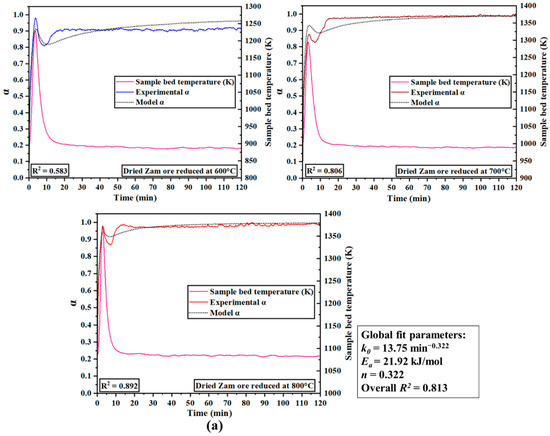
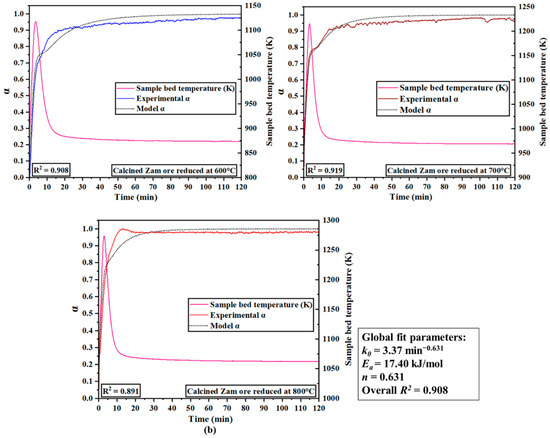
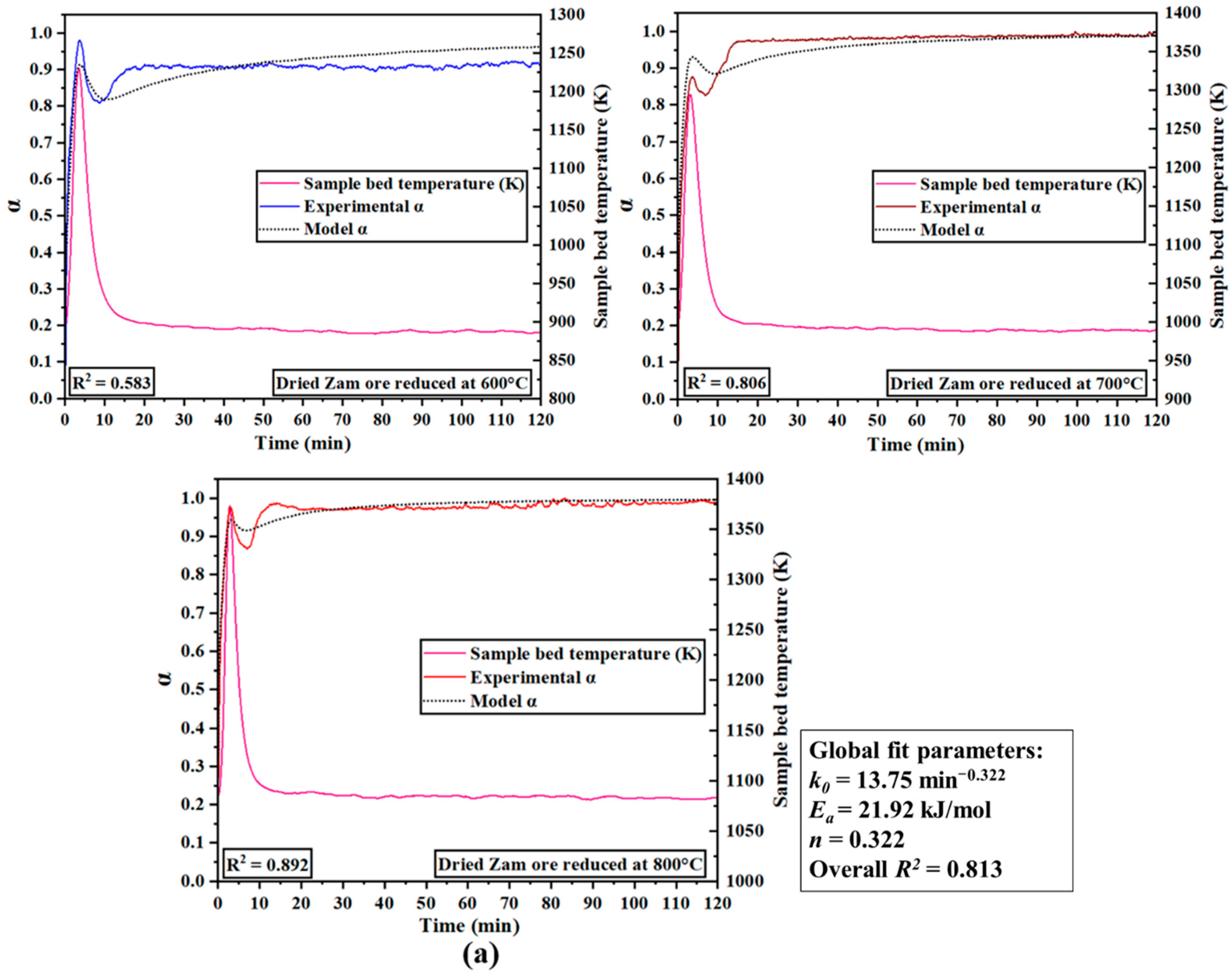
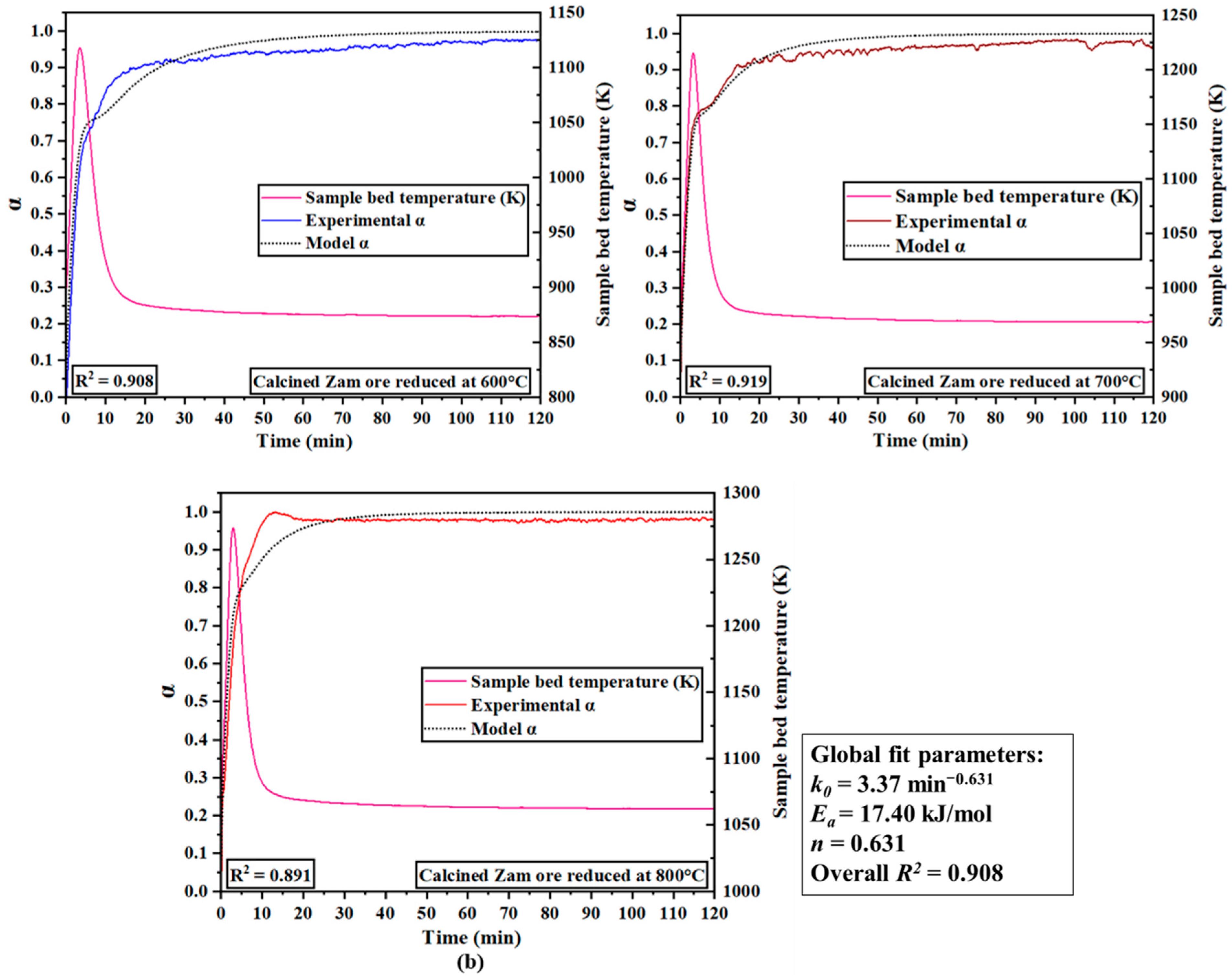
Different kinetic models were examined to interpret the experimental reduction data. Several models were tested to describe the reduction behavior; however, the Johnson–Mehl–Avrami–Kolmogorov (JMAK) model provided the best fit to the experimental results. Models based on the Avrami–Erofeev equation are widely used to describe solid-state reactions and phase transformations involving manganese oxides [30,31,32,33], making the JMAK approach suitable for analyzing the hydrogen reduction kinetics of the ore in the present study. Based on this model, the kinetic parameters (k0), (Ea), and (n) were determined from the experimental reduction data using nonlinear regression for both dried and calcined samples. The corresponding model fitting results are presented in Figure 12, where Figure 12a shows the results for the dried Zambian ore and Figure 12b for the calcined Zambian ore, based on isothermal reduction data obtained at 600 °C, 700 °C, and 800 °C.
Figure 12.
Comparison of the experimental and model Fractional Conversion (α) over time (min) plot at different reduction temperatures of 600 °C, 700 °C and 800 °C for the (a) Dried and (b) Calcined ore.
The Avrami model, originally developed for crystallization kinetics, has been successfully applied to isothermal gas–solid reactions such as oxide reduction. In this framework, the hydrogen reduction of manganese oxides can be described by the JMAK equation:
where α is the fractional conversion, k is the temperature-dependent rate constant, t is the reaction time, and n is the Avrami exponent, which reflects the nucleation and growth characteristics of the reaction. The model captures the complexity of gas–solid reduction reactions, including steps such as hydrogen adsorption, interfacial chemical reaction, and water vapor desorption. The Avrami exponent generally varies between 0 and 4, depending on whether the reaction is controlled by nucleation, interface reaction, or diffusion.
The rate constant k follows an Arrhenius-type temperature dependence:
where k is the rate constant, k0 is the apparent pre-exponential factor (min−n), Ea is the apparent activation energy (kJ·mol−1), R is the universal gas constant (8.314 J·mol−1·K−1), and T is the reaction temperature in Kelvin.
By combining Equations (2) and (3), the experimental reduction data were fitted using the following expression:
where α is the fractional conversion of the solid, t is the reaction time (min), T is the reaction temperature (K), k0 is the pre-exponential factor (min−n), Ea is the apparent activation energy (kJ·mol−1), R is the gas constant (8.314 J·mol−1·K−1), and n is the Avrami exponent.
In this study, the suitability of the JMAK model was evaluated by comparing the experimental conversion data with model predictions. The kinetic parameters k0, Ea, and n were determined through nonlinear regression analysis using the isothermal reduction data obtained at 600 °C, 700 °C, and 800 °C for both dried and calcined samples. The fitting quality was assessed using the coefficient of determination (R2), yielding values of 0.813 for the dried ore and 0.908 for the calcined ore, demonstrating good agreement between experimental data and model predictions. The quality of the model fit and the derived kinetic parameters provide important insight into the temperature dependence and mechanistic characteristics of the hydrogen reduction process. The fitted kinetic parameters are summarized as follows in Table 4:
Table 4.
Summary of the Apparent kinetic parameters (k0, n, and Ea) obtained from JMAK model fitting for hydrogen reduction.
The fitted JMAK parameters suggest that the hydrogen reduction in both dried and calcined ore is governed primarily by a diffusion-related mechanism, as indicated by the relatively low Avrami exponent values. For the dried ore, the very low n value (n = 0.322) points to stronger diffusion limitations, likely associated with gas diffusion through the product layer and restricted reaction-front advancement. The calcined ore exhibits a higher Avrami exponent (n = 0.631) and a lower activation energy (17.40 kJ·mol−1), indicating reduced diffusional resistance and a greater contribution of interfacial chemical reactions. However, the relatively low activation energy suggests that the overall reduction process is still influenced by diffusion-related mechanisms. Thus, calcination appears to improve the reducibility of the ore by facilitating gas access and lowering the overall kinetic barrier.
Recent process-scale studies have demonstrated that coupling calcination with hydrogen-based pre-reduction, together with heat recovery and hydrogen looping strategies, can significantly reduce hydrogen consumption and improve overall energy efficiency, thereby supporting the industrial feasibility and scalability of integrated reactor systems for manganese production [14].
3.4. Physical Characterization
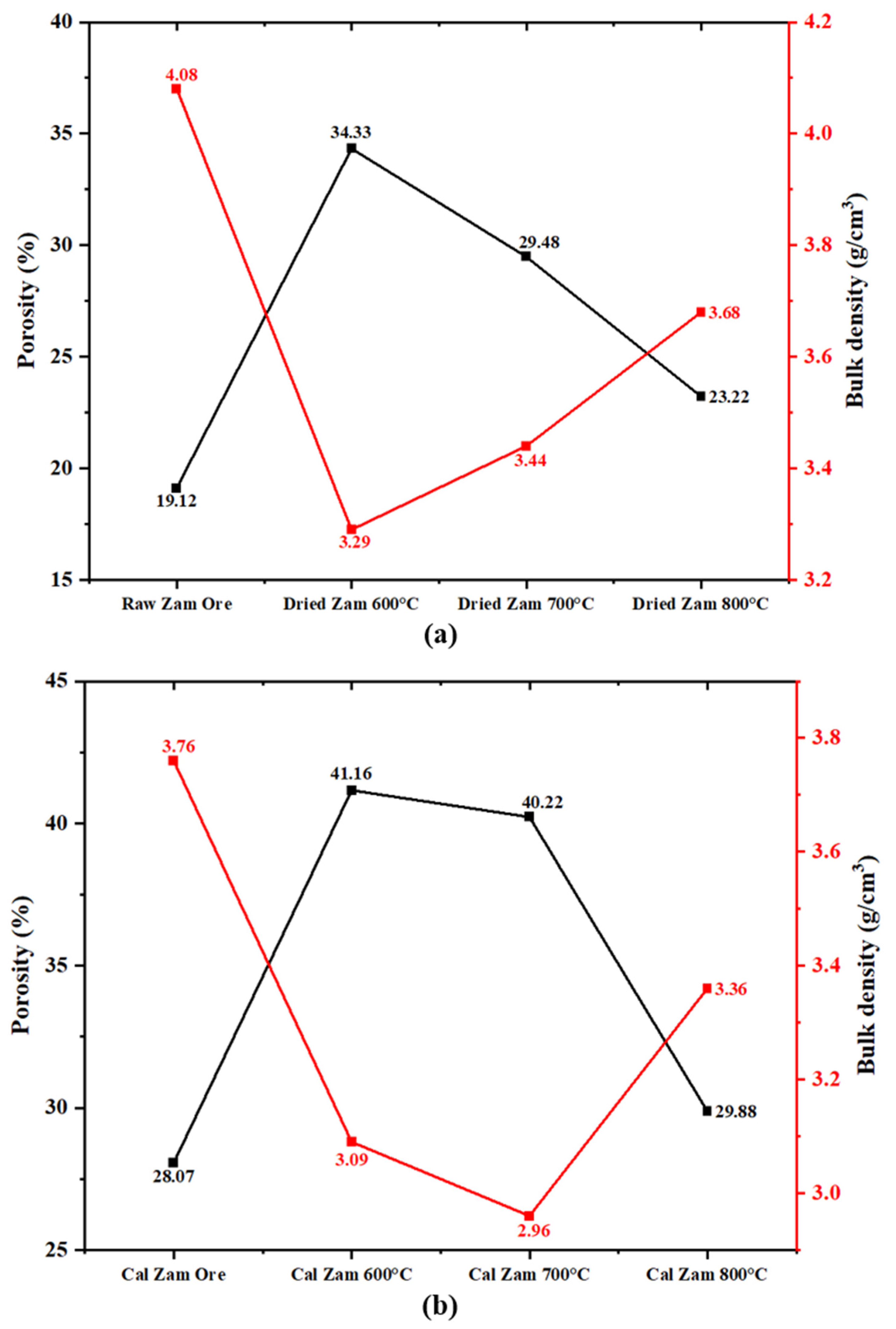
The variation in porosity (%) and bulk density (g·cm−3) of the ore before and after hydrogen reduction at different temperatures is presented in Figure 13a for the dried ore and Figure 13b for the calcined ore.
Figure 13.
Comparison of Physical Characteristics of raw ore and reduced dried ore (a), calcined ore and reduced calcined ore (b) at elevated temperatures.
As shown in Figure 13a, the raw Zambian ore exhibits a relatively moderate porosity of 19.12% and a high bulk density of 4.08 g·cm−3. After reduction at 600 °C, the porosity increases significantly to 34.33%, accompanied by a decrease in bulk density to 3.29 g·cm−3. This increase in porosity can be attributed to the removal of oxygen from manganese oxides and the formation of microcracks due to phase changes during reduction, which generates additional pore spaces within the ore particles. When the reduction temperature increases to 700 °C, the porosity slightly decreases to 29.48%, while the bulk density increases to 3.44 g·cm−3. A further increase in temperature to 800 °C leads to a more pronounced decrease in porosity to 23.22%, along with an increase in bulk density to 3.68 g·cm−3. This behavior suggests that pore coalescence and partial sintering at higher temperatures may reduce the overall pore volume and increase the compactness of the reduced product.
A similar trend is observed for the calcined ore, as shown in Figure 13b. The initial calcined ore exhibits a porosity of 28.07% with a bulk density of 3.76 g·cm−3, which is already higher in porosity and lower in density compared with the raw ore due to the decomposition of volatile phases during calcination. After reduction at 600 °C, the porosity increases substantially to 41.16%, while the bulk density decreases to 3.09 g·cm−3, indicating the formation of a highly porous structure. At 700 °C, the porosity remains relatively high (40.22%), and the bulk density further decreases to 2.96 g·cm−3, reflecting enhanced pore development during reduction. However, when the reduction temperature increases to 800 °C, the porosity decreases to 29.88%, accompanied by an increase in bulk density to 3.36 g·cm−3. This reduction in porosity at higher temperature can be attributed to sintering effects and structural densification of the reduced phases.
Overall, the results indicate that both dried and calcined ores experience significant pore formation during hydrogen reduction at moderate temperatures, while higher reduction temperatures promote sintering and densification, leading to reduced porosity and increased bulk density. Moreover, the calcined ore consistently exhibits higher porosity and lower bulk density than the dried ore, suggesting improved gas accessibility and enhanced reducibility due to the structural modifications introduced during the calcination process.
4. Conclusions
The hydrogen reduction behavior, microstructural evolution, and reaction kinetics of a high-barium manganese ore were systematically investigated in dried and calcined states under isothermal conditions between 600 °C and 800 °C. The main conclusions are summarized as follows:
- ❖
- Calcination-induced mineralogical transformation significantly altered the ore structure. Pyrolusite (MnO2) in the raw ore decomposed to Mn2O3 and Mn3O4, accompanied by the removal of volatile components and a substantial decrease in loss on ignition. This thermal treatment also generated pores and microcracks, improving structural accessibility for subsequent reduction.
- ❖
- Hydrogen reduction experiments revealed a characteristic two-stage reduction behavior, consisting of a rapid initial reduction followed by a slower stage. Increasing the reduction temperature from 600 °C to 800 °C accelerated the reaction kinetics, although the overall extent of reduction remained relatively similar.
- ❖
- Phase and microstructural analyses confirmed that hydrogen reduction led primarily to the formation of manganosite (MnO) and metallic Fe, while silicate gangue and Ba-containing phases remained largely stable under the applied reducing conditions.
- ❖
- Porosity and density measurements demonstrated that reduction initially increases pore volume due to oxygen removal and structural changes. However, at 800 °C, reduction, partial sintering and structural densification reduce porosity and increase bulk density. Calcined ore consistently exhibited higher porosity and lower bulk density, indicating improved gas permeability.
- ❖
- Kinetic modeling showed that the Johnson–Mehl–Avrami–Kolmogorov (JMAK) model accurately describes the reduction behavior. The apparent activation energies were 21.92 kJ.mol−1 for dried ore and 17.40 kJ.mol−1 for calcined ore, indicating that the overall reduction process is diffusion-influenced.
- ❖
- The kinetic parameters indicate that calcination improves the reduction behavior. The higher Avrami exponent (n) and lower apparent activation energy (17.40 kJ.mol−1) suggest reduced diffusional resistance and a greater contribution from interfacial reactions.
Author Contributions
A.S.: Methodology, Conceptualization, Visualization, Investigation, Validation, Data collection, Writing and original draft preparation, Revision. E.T.D.: Investigation, Validation, Data curation, Writing and original draft preparation. J.S.: Methodology, Conceptualization, Supervision, Revision of the manuscript, Funding acquisition. All authors have read and agreed to the published version of the manuscript.
Funding
This research was funded by the European Commission through the HAlMan project in Horizon Europe program, grant number “101091936”.
Data Availability Statement
The original contributions presented in this study are included in the article. Further inquiries can be directed to the corresponding author.
Acknowledgments
The authors thank the industrial partner, Transalloys Pty. Ltd. (South Africa), for supplying the manganese ore.
Conflicts of Interest
Author Elias Trondsen Dahl was employed by the company Norsk Hydro. The remaining authors declare that the research was conducted in the absence of any commercial or financial relationships that could be construed as a potential conflict of interest.
References
- Pantilimon, M.C.; Berbecaru, A.C.; Gherghescu, I.A.; Coman, G.; Ciucă, S.; Grecu, A.; Sohaciu, M.G.; Dumitrescu, R.E.; Predescu, C. Comparative Evaluation of the TRIP Effect in Steels with Different Contents of Mn and Al. Metals 2022, 12, 443. [Google Scholar] [CrossRef] [Scilit]
- Sabzi, M.; Farzam, M. Hadfield Manganese Austenitic Steel: A Review of Manufacturing Processes and Properties. Mater. Res. Express 2019, 6, 1065c2. [Google Scholar] [CrossRef] [Scilit]
- Elliott, R.; Coley, K.; Mostaghel, S.; Barati, M. Review of Manganese Processing for Production of TRIP/TWIP Steels, Part 2: Reduction Studies. JOM 2018, 70, 691–699. [Google Scholar] [CrossRef] [Scilit]
- International Manganese Institute (IMnI). Manganese Market Outlook—2024; International Manganese Institute (IMnI): Paris, France, 2024. [Google Scholar]
- Olsen, S.E.; Tangstad, M.; Lindstad, T. Production of Manganese Ferroalloys; Tapir Academic Press: Trondheim, Norway, 2007; ISBN 978-82-519-2191-6. [Google Scholar]
- Lindstad, T. CO2-Emissions and the Ferroalloys Industry. In Proceedings of the INFACON 8, Beijing, China, 7–10 June 1998; pp. 87–92. [Google Scholar]
- Haque, N.; Norgate, T. Estimation of Greenhouse Gas Emissions from Ferroalloy Production Using Life Cycle Assessment with Particular Reference to Australia. J. Clean. Prod. 2013, 39, 220–230. [Google Scholar] [CrossRef] [Scilit]
- United Nations. Paris Agreement; United Nations Framework Convention on Climate Change (UNFCCC); United Nations: New York, NY, USA, 2015. [Google Scholar]
- Norsk Industri. The Norwegian Process Industries’ Roadmap—Combining Growth and Zero Emissions by 2050; Norsk Industri: Oslo, Norway, 2016. [Google Scholar]
- Safarian, J. A Sustainable Process to Produce Manganese and Its Alloys through Hydrogen and Aluminothermic Reduction. Processes 2021, 10, 27. [Google Scholar] [CrossRef] [Scilit]
- Sarkar, A.; Schanche, T.L.; Safarian, J. Isothermal Pre-Reduction Behavior of Nchwaning Manganese Ore in H2 Atmosphere. Mater. Proc. 2023, 15, 58. [Google Scholar]
- Horizon Europe Project HAlMan. Available online: https://halman-project.eu/ (accessed on 5 March 2026).
- Safarian, J. Effect of Calcination of Manganese Ore on Reducing Hydrogen and Energy Consumptions in Hydrogen-Based Direct Reduction Process. Metals 2026, 16, 117. [Google Scholar] [CrossRef] [Scilit]
- Barner, H.E.; Mantell, C.L. Kinetics of Hydrogen Reduction of Manganese Dioxide. Ind. Eng. Chem. Proc. Des. Dev. 1968, 7, 285–294. [Google Scholar] [CrossRef] [Scilit]
- de Bruijn, T.J.W.; Soerawidjaja, T.H.; de Jong, W.A.; van der Berg, P.J. Modelling of the Reduction of Manganese Oxides with Hydrogen. Chem. Eng. Sci. 1980, 35, 1591–1600. [Google Scholar] [CrossRef] [Scilit]
- El-Gawad, H.H.A.; Ahmed, M.M.; El-Hussiny, N.A.; Shalabi, M.E.H. Reduction of Low Grade Egyptian Manganese Ore via Hydrogen at 800 °C–950 °C. Open Access Libr. J. 2014, 1, e427. [Google Scholar] [CrossRef]
- Wang, R.; Yuan, S.; Li, Y.; Gao, P.; Li, R. Hydrogen-Based Mineral Phase Transformation Mechanism Investigation of Pyrolusite Ore. Int. J. Miner Metall. Mater. 2024, 31, 2445–2457. [Google Scholar] [CrossRef] [Scilit]
- El-Hussiny, N.; El-Gawad, H.H.A.; Mohamed, F.; Shalabi, M. Pelletization and Reduction of Egyptian Low Grade Manganese Ore Pellets via Hydrogen at 750–950 °C. Int. J. Sci. Eng. Res. 2015, 6, 339–346. [Google Scholar]
- El-Geassy, A.A.; Nasr, M.I.; Omar, A.A.; Mousa, E.A. Isothermal Reduction Behaviour of MnO2 Doped Fe2 O3 Compacts with H2 at 1073–1373 K. Ironmak. Steelmak. Process. Prod. Appl. 2008, 35, 531–538. [Google Scholar] [CrossRef] [Scilit]
- Tangstad, M.; Schanche, T.; de Preez, F. Use of H2 in Mn-Ferroalloy Production. In Proceedings of the Advances in Pyrometallurgy; Fleuriault, C., Steenkamp, J.D., Gregurek, D., White, J.F., Reynolds, Q.G., Mackey, P.J., Hockaday, S.A.C., Eds.; Springer Nature: Cham, Switzerland, 2023; pp. 35–53. [Google Scholar]
- Schanche, T.L.; Tangstad, M. Prereduction of Nchwaning Ore in CO/CO2/H2 Gas Mixtures. Minerals 2021, 11, 1097. [Google Scholar] [CrossRef] [Scilit]
- Ernst, M.S.; Tangstad, M.; Du Preez, S.P. Pre-Reduction of Nchwaning Manganese Ore in CO/CO2, H2/H2O, and H2 Atmospheres. Miner. Eng. 2024, 216, 108854. [Google Scholar] [CrossRef] [Scilit]
- Ngoy, D.; Sukhomlinov, D.; Tangstad, M. Pre-Reduction Behaviour of Manganese Ores in H2 and CO Containing Gases. ISIJ Int. 2020, 60, 2325–2331. [Google Scholar] [CrossRef] [Scilit]
- Sarkar, A.; Schanche, T.L.; Wallin, M.; Safarian, J. Evaluating the Reaction Kinetics on the H2 Reduction of a Manganese Ore at Elevated Temperatures. J. Sustain. Metall. 2024, 10, 2085–2103. [Google Scholar] [CrossRef] [Scilit]
- Sarkar, A.; Lindahl Schanche, T.; Wallin, M.; Safarian, J. Kinetics Study on the H2 Reduction of Nchwaning Manganese Ore at Elevated Temperatures. Int. J. Miner. Metall. Mater. 2025, 32, 1091–1102. [Google Scholar] [CrossRef] [Scilit]
- Davies, J.; Tangstad, M.; Schanche, T.L.; Du Preez, S.P. Pre-Reduction of United Manganese of Kalahari Ore in CO/CO2, H2/H2O, and H2 Atmospheres. Metall. Mater. Trans. B 2023, 54, 515–535. [Google Scholar] [CrossRef] [Scilit]
- Mchabe, D.; Tsebe, S.; Matinde, E. Evaluation of the Effects of Fluidization Conditions on Hydrogen Reduction in Manganese Ore Fines. Minerals 2025, 15, 368. [Google Scholar] [CrossRef] [Scilit]
- Sarkar, A.; Tang, K.; Safarian, J. Hydrogen Reduction Kinetics of a High-Carbonate Manganese Ore in Raw and Calcined Forms under Isothermal Conditions. Int. J. Hydrogen Energy 2026, 200, 152919. [Google Scholar] [CrossRef] [Scilit]
- Cheraghi, A.; Yoozbashizadeh, H.; Safarian, J. Gaseous Reduction of Manganese Ores: A Review and Theoretical Insight. Miner. Process. Extr. Metall. Rev. 2020, 41, 198–215. [Google Scholar] [CrossRef] [Scilit]
- Avrami, M. Kinetics of Phase Change. I General Theory. J. Chem. Phys. 1939, 7, 1103–1112. [Google Scholar] [CrossRef] [Scilit]
- Erofeev, B. Generalized Equation of Chemical Kinetic and Its Application to Reactions with Hard Substances Participation. Dokl. Akad. Nauk. SSSR 1946, 52, 515–518. [Google Scholar]
- Johnson, W.A. Reaction Kinetics in Process of Nucleation and Growth. Trans. Trans. Am. Inst. Min. Metall. Eng. 1939, 135, 416–458. [Google Scholar]
- De Bruijn, T.J.W.; De Jong, W.A.; Van Den Berg, P.J. Kinetic Parameters in Avrami—Erofeev Type Reactions from Isothermal and Non-Isothermal Experiments. Thermochim. Acta 1981, 45, 315–325. [Google Scholar] [CrossRef] [Scilit]

Disclaimer/Publisher’s Note: The statements, opinions and data contained in all publications are solely those of the individual author(s) and contributor(s) and not of MDPI and/or the editor(s). MDPI and/or the editor(s) disclaim responsibility for any injury to people or property resulting from any ideas, methods, instructions or products referred to in the content. |
© 2026 by the authors. Licensee MDPI, Basel, Switzerland. This article is an open access article distributed under the terms and conditions of the Creative Commons Attribution (CC BY) license.