Skip to Content
MetalsMetals
  • Article
  • Open Access

8 March 2026

Tuning Eutectic High Entropy Alloy Microstructures: The Role of Consolidation and Particle Size Distribution in EHEA AlCoCrFeNi2.1


,
,
,
,
,
,
and
1
Departamento de Ciencia e Ingeniería de Materiales e Ingeniería Química, IAAB, Universidad Carlos III de Madrid, Avda. Universidad 30, 28911 Madrid, Spain
2
Imdea Materials Institute, Calle Eric Kandel 2, 28906 Getafe, Spain
3
AMES PM Tech Centre, Camí de Can Ubach 8, 08620 Barcelona, Spain
4
Nanomaterials and Nanotechnology Research Center (CINN-CSIC), Universidad de Oviedo (UO), Avda. de la Vega 4–6, 33940 El Entrego, Spain

Abstract

Eutectic alloys stand out for their ability to combine high strength and good ductility; a behaviour rooted in their characteristic two-phase microstructure—lamellar or globular—formed at a constant solidification temperature that minimizes segregation and suppresses brittle phases. Their low interfacial energy limits microcrack propagation, while interfacial sliding and dislocation blocking at phase boundaries enhance both strength and toughness. In this work, we investigate how controlled microstructural modifications influence the behaviour of the eutectic high-entropy alloy AlCoCrFeNi2.1, composed of B2 (Ni–Al-rich) and L12 (Co–Fe–Ni-rich) phases. Because these phases exhibit distinct mechanical responses, microconstituent morphology becomes a design parameter. Powder metallurgy is the only processing route capable of providing the level of microstructural control required in this study. It preserves the rapidly solidified eutectic architecture of gas-atomised powders while allowing its intentional transformation during consolidation. Two strategies were implemented: (i) tuning the thermal–electrical input in Spark Plasma Sintering (SPS) and Electrical Resistance Sintering (ERS), and (ii) engineering the particle size distribution, including a bimodal design that enhances surface-energy-driven morphological transitions. SPS enables a gradual lamellar-to-globular evolution, whereas ERS induces ultrafast transformations governed by current intensity. The bimodal PSD significantly accelerates globularisation at lower energy input. EBSD-KAM (Electron Backscatter Diffraction—Kernel Average Misorientation) mapping identifies the lamellar B2 phase as metastable and highly strained, while globular B2 domains show reduced dislocation density. Nanoindentation confirms that intrinsic phase properties remain unchanged, whereas microhardness scales with morphology and lamellar spacing. These results demonstrate that the macroscopic mechanical response is governed by microstructure, establishing powder metallurgy as a uniquely powerful pathway for microstructure-driven design in eutectic HEAs.

1. Introduction

Eutectic alloys are well known for their ability to simultaneously offer high strength and good ductility, an unusual combination in structural materials [1,2,3]. Typically, efforts to increase strength result in a trade-off with ductility; however, eutectic alloys circumvent this limitation through their finely tuned microstructure [4,5]. Upon solidification, they form two interpenetrating phases, often in lamellar or globular morphologies. This phase arrangement leads to grain refinement, which enhances mechanical resistance in accordance with the Hall–Petch relationship [6]. Moreover, the coexistence of a ductile phase with a stronger counterpart facilitates an effective balance between toughness and rigidity.
An additional advantage of eutectic alloys lies in their solidification behaviour such as NiAl-Mo8,7Cr8,7V8,7, NiAl–Mo14,5Cr14,5Fe14,5, NiAl–Mo10Cr10V10Fe10, Fe28Ni18Mn33Al21, CoCrFeNiNbx, [7,8,9]. Unlike conventional multiphase alloys, eutectics solidify at a constant temperature, minimizing chemical segregation and the formation of brittle intermetallic phases [1]. Their low interfacial energy further contributes to improved toughness by impeding microcrack propagation [10]. From a mechanical standpoint, two key mechanisms underpin the superior performance of eutectic systems: interfacial sliding, which dissipates plastic energy and delays fracture initiation, and dislocation blocking at phase interfaces, which strengthens the material without severely compromising ductility [11].
These favourable properties have led to the development of commercial eutectic alloys in various technological sectors. In recent years, the concept has been extended to high-entropy alloys (HEAs), first reported in 2004 by Cantor et al. [12] and Yeh et al. [13], giving rise to EHEAs. These alloys combine the stability and compositional complexity of HEAs with the structural advantages of eutectic microstructures. Among them, AlCoCrFeNi2.1, reported for the first time by Lu Y. et al. in 2014 [5], has attracted considerable interest due to its promising mechanical performance and microstructural stability.
A crucial aspect in tailoring the performance of eutectic alloys lies in the control of their microstructural morphology. Since the constituent phases exhibit different mechanical properties, the spatial distribution and morphology of these phases directly influence the alloy’s macroscopic behaviour. Lamellar microstructures, formed through eutectic solidification, consist of alternating thin layers of the two phases and generally provide an excellent balance between strength and toughness [14,15,16]. However, they may exhibit increased brittleness under certain conditions. In contrast, globular morphologies (composed of rounded grains dispersed in a continuous matrix) typically enhance ductility and damage tolerance, especially in cyclic loading scenarios [17,18]. These structures are often produced through thermomechanical processing, such as heat treatments or deformation [19].
Because lamellar and globular arrangements lead to markedly different properties, the ability to intentionally tune the morphology of the microconstituents is central to optimizing the mechanical performance of eutectic alloys for specific applications.
Achieving this level of control is only possible through powder metallurgy demonstrated by Spark Plasma Sintering (SPS) [20,21], Electrical Resistance Sintering (ERS) [22,23] and Laser Powder Bed fusion (LPBF) [24,25]. Melting-based routes (casting, directional solidification, arc melting, induction melting) cannot preserve the ultrafine eutectic architecture that forms during rapid solidification, nor can they selectively transform it without inducing uncontrolled coarsening. In contrast, powder metallurgy—in particular, using field-assisted sintering techniques (SPS and ERS)—is the only processing route capable of preserving the rapidly solidified microstructure of gas-atomised powders while simultaneously enabling its controlled modification during consolidation. This dual capability makes PM uniquely suited for systematic studies on microstructure–property relationships in complex eutectic HEAs.
In this work, we employ powder technology to explore two complementary strategies for tailoring the microstructure of the AlCoCrFeNi2.1 EHEA. Our objective is not merely to fabricate dense components but to intentionally modulate the morphology—from fine lamellar architectures to more equiaxed/globular configurations—in order to understand how these changes dictate the macroscopic mechanical response.
The first strategy focuses on adjusting the consolidation parameters during sintering using SPS and ERS. Both techniques can consolidate gas-atomized powders, which solidify at extremely high cooling rates and preserve the fine lamellar microstructure inherent to rapid solidification. SPS is a field-assisted sintering technique that applies simultaneous pressure and pulsed electric current, enabling rapid heating (100–1000 K/min) and fast densification at lower temperatures than conventional sintering. These conditions promote limited grain growth and help retain the original microstructure [26]. ERS, an ultrafast sintering method based on extremely high current densities (>5 kA/cm2) applied for only a few seconds, offers a more cost-effective alternative that does not require a controlled atmosphere [27]. Despite limited temperature control, ERS also limits grain coarsening and may yield unique microstructural features, particularly in multiphase systems. By varying consolidation parameters in these two processes, it is possible to transition from fine lamellar arrangements to more globular morphologies, thereby adjusting mechanical performance.
Numerous studies have demonstrated that the morphology and distribution of phases in metallic alloys (particularly in high-entropy systems) can be significantly influenced by processing conditions such as consolidation route, cooling rate, and post-sintering heat treatments [5,26,27,28,29,30,31,32,33,34]. These parameters affect the microstructure evolution and, consequently, the mechanical properties. For instance, in HEAs, where diffusion is typically slower due to their high compositional complexity, thermal treatments still have a marked effect on phase stability and morphology. In the FeCoCrNiNbx system (x = 0, 0.15, 0.33, 0.5), increasing the Nb content promotes the formation of low-melting intermetallics due to the intrinsic HCP structure of Nb. However, homogenization heat treatments at 1200 °C for 4 h have been shown to reduce the volume fraction of these undesired low-entropy phases, confirming the capacity of thermal treatments to tailor microstructural homogeneity even in sluggish-diffusion systems [35].
Similarly, in the eutectic alloy Nb19Ti40Ni41, initially presenting a lamellar structure composed of B2-(TiNi) and BCC-(Nb, Ti) phases, prolonged annealing at 1000 °C for 170 h induces a morphological transformation toward a duplex structure with BCC nodules embedded in the matrix [36]. This clearly demonstrates the sensitivity of eutectic microstructures to thermal history.
Moreover, the HEA AlCrFeNiTi0.5, which consists of FCC, BCC, and B2 phases, exhibits strong microstructural modulation upon annealing at various temperatures. At 650 °C, the volume fraction of B2 and disordered BCC phases increases; at 850 °C, FCC becomes dominant, enhancing ductility; and at 1200 °C, the microstructure evolves toward a balanced state with improved mechanical performance [37].
These findings underscore the importance of thermal and processing conditions in microstructure control and directly motivate the strategy pursued in this study. Rather than relying solely on post-processing treatments, here we explore how microstructural modulation in the AlCoCrFeNi2.11 EHEA can be achieved by controlling the consolidation route (through SPS and ERS) and tuning the particle size distribution during sintering. Based on the analysis of previous works on HEA and eutectic systems [38,39,40], we aim to provide a more systematic and versatile approach to tailoring the transition from lamellar to globular morphologies in dual-phase materials.
The second strategy involves tailoring the particle size distribution of the starting powder. Thermodynamically, sintering is driven by the reduction in surface energy, which is more significant in particles with high curvature and small radii [41,42]. Fine particles, having higher surface area-to-volume ratios, sinter more readily, while coarse particles contribute to packing stability and reduce porosity [43,44,45,46]. A bimodal distribution—combining fine and coarse particles—can optimize both packing density and sintering kinetics, which is reflected in the behaviour of the microstructure and densification of the material. During sintering, atomic transport mechanisms such as surface diffusion and grain boundary diffusion are activated, leading to the progressive formation of necks, pore rounding and, ultimately, densification greater than 92% [47]. The interaction between particles in a bimodal distribution is driven by their curvature, modifying the diffusion rate of atoms. This, combined with the activation temperature during sintering, leads to a microstructural modification. Taking advantage of these phenomena, it is interesting to design a controlled transition of microstructural changes, based on the relationship between particle size and consolidation conditions in high-entropy alloys, especially in complex alloys such as eutectic alloys.
The present study investigates how these two strategies (consolidation pathway and particle size distribution) can be used to tune the eutectic microstructure and ultimately tailor the mechanical behaviour of AlCoCrFeNi2.1 for advanced applications.
The objective of this study is to evaluate the effect of these two strategies (variation in consolidation parameters and particle size distribution) on the microstructure of the AlCoCrFeNi2.1 alloy, a high-efficiency EHEA characterized by a dual-phase structure composed of a ductile FCC phase and a hard, ordered B2 phase. These two phases, arranged in alternating lamellae or globular formations, are central to tuning the balance between strength and ductility in the alloy.
A key novelty of this work lies in the systematic modulation of the microstructure by controlling the transition from fine lamellar structures to more equiaxed or globular morphologies. This is achieved by manipulating both the consolidation route (using SPS and ERS) and the powder particle size distribution [48]. Beyond processing, the present study introduces a methodological innovation by employing advanced image analysis and statistical tools to rigorously evaluate the evolution of microstructure. Through high-resolution microscopy, quantitative phase analysis, and morphometric techniques, we establish a robust framework for characterizing and understanding microstructural transitions across different length scales. This approach not only provides insights into the processing–structure–property relationship but also offers a powerful tool for the design and optimization of advanced eutectic alloys for structural applications.

2. Experimental Methods

The alloy selected for this study was the high-entropy eutectic composition AlCoCrFeNi2.1 (Table 1); the powder was produced by technic VIGA (Vacuum Inert Gas Atomization) at CEIT-BRTA research centre (Gipuzkoa, Spain). The extremely high solidification rates during atomization enables the retention of a fine microstructure.
Table 1. Chemical composition of the eutectic high-entropy alloy.
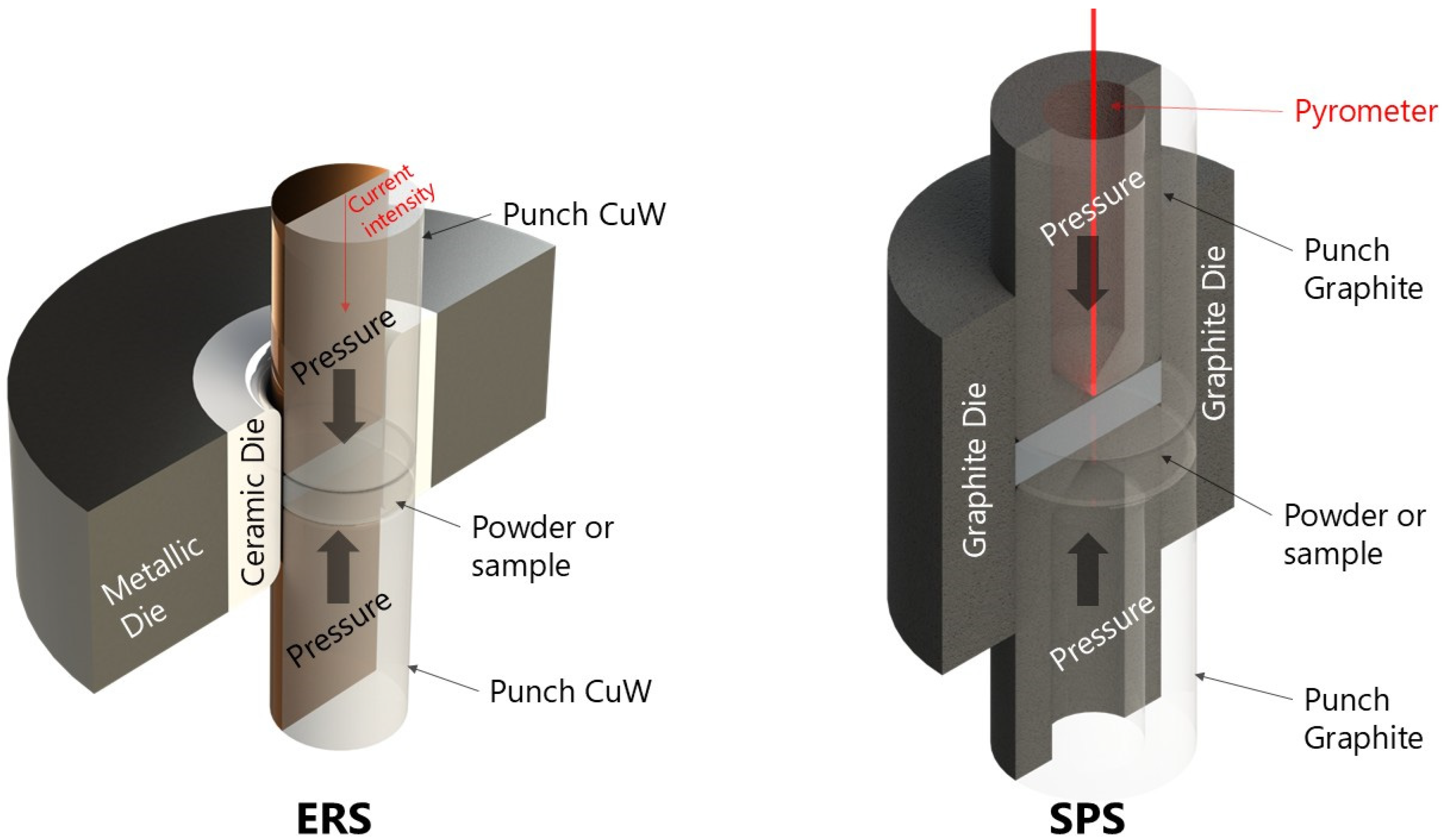
The resulting powders were consolidated using two distinct techniques, Spark Plasma Sintering (SPS) and Electrical Resistance Sintering (ERS), depending on the selected particle size distribution (PSD). Both techniques belong to the Field-Assisted Sintering Technology (FAST) family, as illustrated in Figure 1, and are based on the Joule effect to enable consolidation. In ERS, a high-density direct current is discharged through a punch directly into the powder bed, generating heat in the powder through resistance. In contrast, SPS uses a pulsed direct current applied directly to a graphite die and the powder, which is heated through the Joule effect, facilitating consolidation; the temperature is controlled by a pyrometer directed at the inside of the upper punch.
Figure 1. ERS and SPS technical schematic.
Following consolidation, the microstructure of both the powders and the sintered samples was characterized using a field emission scanning electron microscope (FE-SEM, FEI-TENEO, Eindhoven, The Netherlands). Electron Backscatter Diffraction (EBSD, Velocity Pro, Gatan, Mahwah, NJ, USA) analyses were also performed on all consolidated samples. Sample preparation included grinding with silicon carbide abrasive paper, polishing with diamond paste, and final polishing using colloidal silica in a VibroMet2 vibratory polisher (Buehler, Lake Bluff, IL, USA) at 60% amplitude for 6 h with two applied weights. Oxygen and carbon contents were measured with LECOS TC500 and CS200 analysers (LECO Corporation, St. Joseph, MI, USA), respectively. Image analysis was carried out with IQMaterials® software version 2.1.0.2255. Thermodynamic calculations were performed using Thermo-Calc®. Particle size distribution was evaluated using laser diffraction Mastersizer 2000 (Malvern Instrument Ltda. Worcestershire, United Kingdom), and the crystalline phases were identified by X-ray diffraction (XRD) using an X’Pert diffractometer (Philips, Amsterdam, The Netherlands) with Cu Kα radiation over a 2θ range of 30° to 90° at a scan rate of 0.5°/min.
The initial approach sought microstructural modification through optimization of the consolidation parameters using the full PSD of the atomised powder. On samples consolidated via SPS, the consolidation temperature was varied while maintaining a constant heating rate and uniaxial pressure. In the case of ERS, the applied current intensity was modulated, with the pressure held constant throughout the process; on the other hand, the holding time was kept constant for the different parameters of each technique. The specific processing parameters for both techniques are detailed in Table 2.
Table 2. Parameter’s consolidation for SPS and ERS of “original” PSD of powdered alloys.
To develop the second microstructural modification strategy, two powder fractions were sieved from as-received gas-atomised powders: the PSD-Lower (PSDL) below 20 µm and the PSD-Upper (PSDU) between 63 and 100 µm. The proportion of each fraction was optimized to achieve the best packing, and mixtures were mixed in a 3D motion mixer—Turbula®. From that point on, the optimal mixture was referred to as the bimodal mixture. The samples produced with the bimodal mixture by SPS were made by varying the heating rate and increasing the consolidation temperature with respect to the first strategy while maintaining constant pressure. Finally, the parts consolidated by ERS using the bimodal mixture were consolidated by varying the current intensity and pressure. The processing parameters are shown in Table 3.
Table 3. Parameter’s consolidation for bimodal mixtures.
The mechanical properties were measured using microindentation and nanoindentation techniques. For microindentation, ZHWμ equipment from ZwickRoell® (Ulm, Germany) was used, with a load of 300 gf and 10 s of sustained load. Nanoindentation was performed using Hysitron® TI950 (Eden Prairie, MN, USA) triboindenter equipment with a Berkovich tip with face angles α and β of 120.00° and 65.27°, respectively. A 20 × 20 matrix with a separation of 0.6 μm was used, with a load of 1 mN and a maximum penetration of approximately 60 nm. The reported modulus of elasticity corresponds to the reduced modulus, and the Oliver W. and Pharr G method [49] was used for the calculations.

3. Results and Discussion

3.1. Powder Characteristics

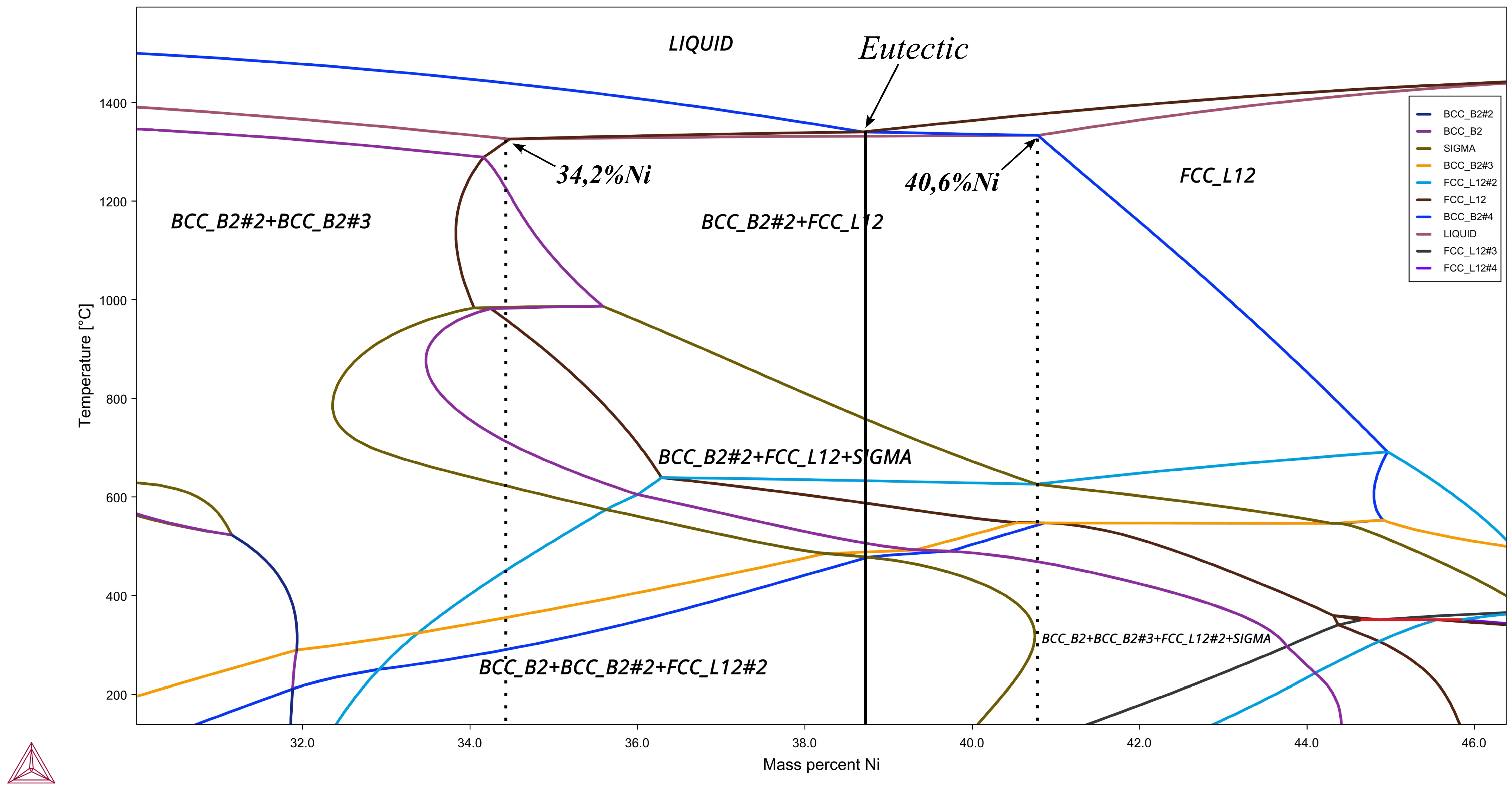
The EHEA initially reported by Lu Y. et al. [5] indicates that the organization of its crystalline structure in the microstructure is lamellar, with the B2 phase acting as the lamella and the FCC-L12 phase acting as the matrix. This feeds into the strength–ductility relationship given by the specific properties of its separate phases. The phase diagram of the EHEA selected for this study is shown in Figure 2; the thermodynamic simulation performed in Thermo-Calc® using the TCHEA7 database shows a distribution of B2-type BCC and L12-type FCC phases. The black line marks the chemical composition of the material used for this study, obtained by EDX.
Figure 2. Phases diagram AlCoCrFeNi2.1, Thermo-Calc®, Data base: TCHEA7.
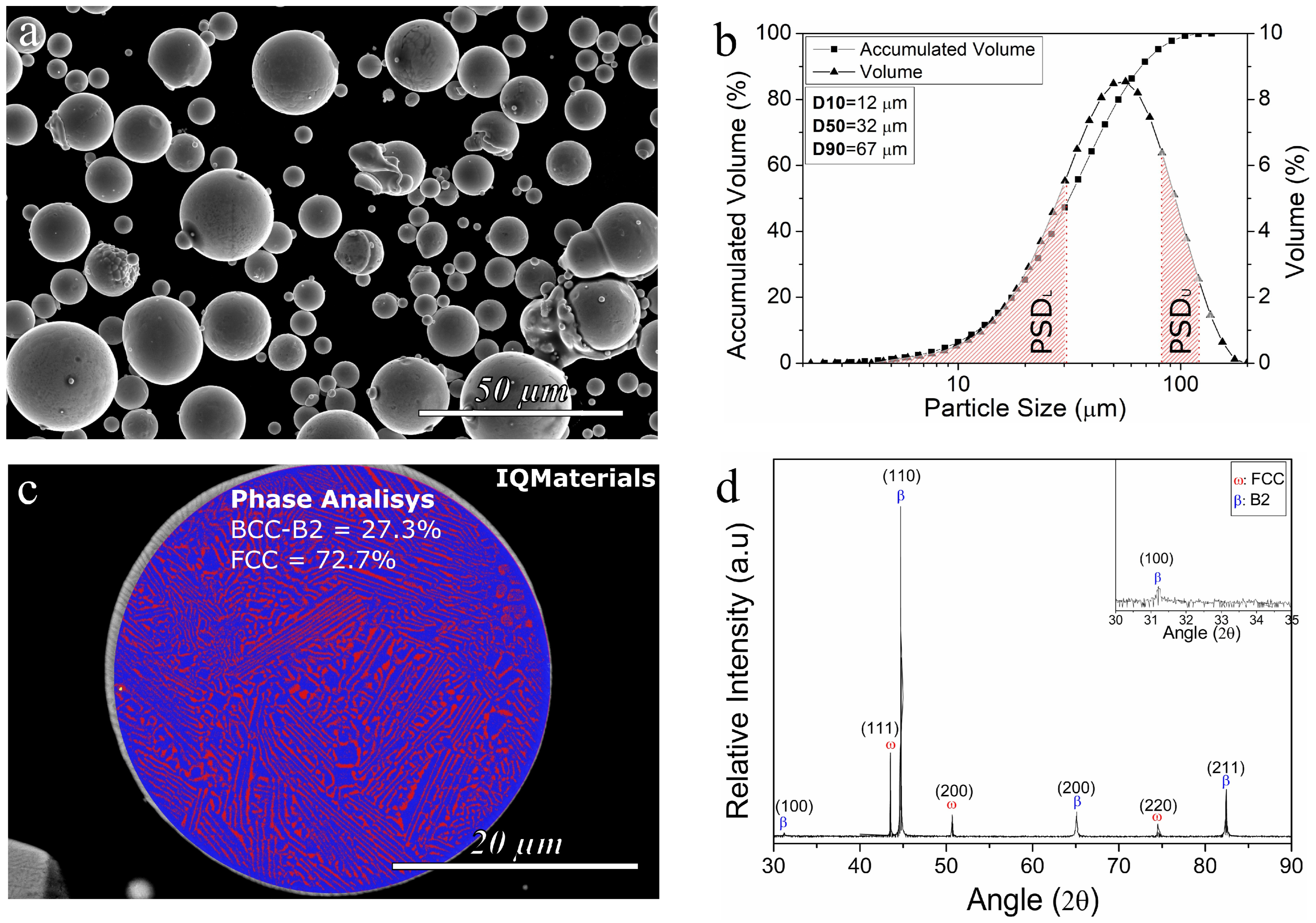
Figure 3 shows the gas-atomised prealloyed powder from the EHEA, which has a spherical morphology typical of gas atomisation. The spherical particles are surrounded by small satellites of more elongated powder or collide with other particles. It can also be seen that they have a smooth surface with small protuberances that are the result of collisions during atomisation. In Figure 3b, the original PSD obtained directly from powder atomization shows a broad distribution with a D10 = 12 µm to D90 = 67 µm, as well as a D50 = 32 µm. The intervals corresponding to the powder distribution that were mixed to obtain a bimodal PSD are shaded in red in the figure, and the results will be presented later. The microstructure is shown in Figure 3c, which is characterized by its biphasic nature and tendency towards lamellar organization (in this case, the cooling rate can be found to be approximately between 3·105 K/s and 5·105 K/s [50,51]). To determine the phase distribution, the microstructure is analyzed with IQMaterials® software; the FCC content measured in the cross section of the powder particle—blue hue—corresponds to 72.7%, indicating that it is the predominant phase in our alloy, and hence the BCC—red hue—is the 27.3%. The values measured on the microstructure are close to the distribution obtained with the lever rule from the phase diagram in Figure 2 (FCC = 70.3% and BCC = 29.7%). As can be seen in Figure 3d, B2-type (reflected by the peak at 2θ ≈ 31.22°) and FCC phases are detected by XRD. Although the diffraction pattern does not directly confirm an L12-type ordering for the FCC phase, Wani et al. [2] reported, by TEM, that such ordering emerges when the microstructure displays a lamellar arrangement. Based on this evidence, the FCC phase will be reported here as L12.
Figure 3. Powder EHEA AlCoCrFeNi2.1. (a) Powder morphology—SEM-SE. (b) Particle size distribution of gas-atomised powder. The shaded area corresponds to the fractions for bimodal mixtures. (c) Particle microstructure—SEM-BSE, analysis phase composition with IQMaterials®. (d) XRD powder.

3.2. Microstructure Design by Sintering Performance

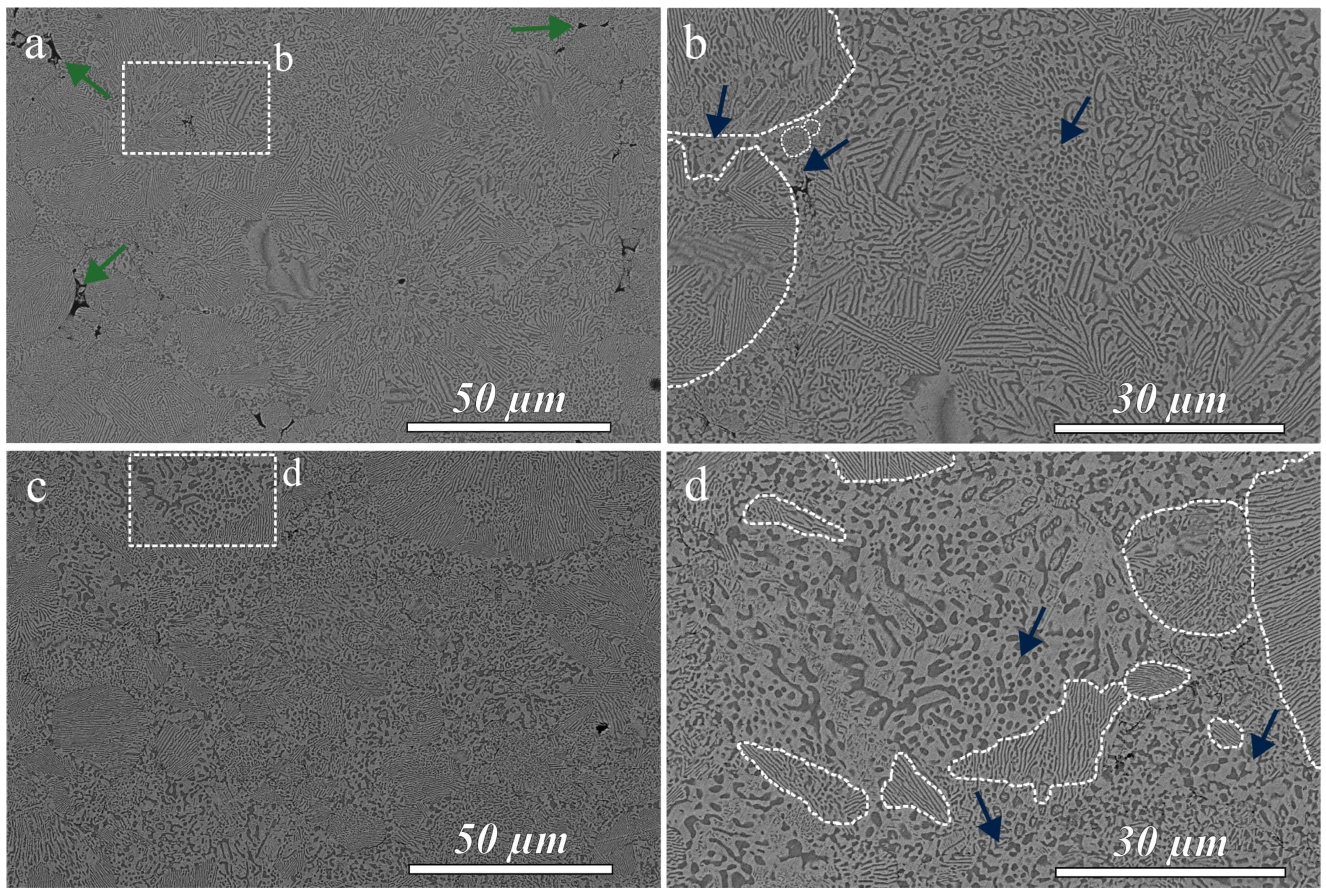
The lamellar eutectic structure of the starting powder is thermodynamically metastable due to its high interfacial area and associated energy. When exposed to sustained thermal energy (either by SPS or ERS), it tends to evolve into a more stable morphology, typically globular or globular, through diffusion-driven coarsening processes that reduce the system’s total interfacial energy. The samples consolidated by SPS using the original PSD are shown in Figure 4. The SPS-O1 sample, consolidated at a temperature of 1000 °C, does not achieve a complete densification, as observed in Figure 4a, where pores can be seen. These particles still retain their original lamellar microstructure. However, Figure 4b shows that the eutectic B2 phase begins to evolve into a globular morphology specifically at the interparticle contact zones. This transformation is attributed to the localized Joule heating inherent to the SPS process, which results in higher temperatures at the particle surfaces, precisely where electrical current is more concentrated. As the sintering temperature increases, this effect becomes more pronounced. In the SPS-O2 sample sintered at 1050 °C, Figure 4c,d reveal the progressive disappearance of distinct particle boundaries, indicating enhanced consolidation. In Figure 4d, blue arrows indicate regions where the B2 phase has adopted a globular morphology, particularly at former particle–particle interfaces, while dotted lines mark areas where the original lamellar structure of the atomized powder remains. The greater extent of globular regions in SPS-O2 confirms that the morphological evolution of the eutectic structure advances from the contact surfaces inward, driven by localized thermal gradients.
Figure 4. EHEA with PSD-O consolidation by SPS. (a) SPS-O1. (b) Zoom SPS-O1. (c) SPS-O2. (d) Zoom SPS-O2.
During SPS, local temperature and pressure conditions at particle interfaces can trigger a morphological shift from the lamellar eutectic structure toward a more globular or globular configuration. This phenomenon resembles the transformation observed in the Nb-TiNi alloy, where the BCC lamellar phase (Nb, Ti) transforms into a granular phase [36]. Given its high interfacial energy, the lamellar eutectic structure is thermodynamically metastable and thus tends to evolve into a lower-energy, more stable morphology when subjected to sustained heat.
These morphological changes can be interpreted through the thermodynamic and kinetic principles of sintering. Sintering is fundamentally driven by the reduction in surface energy, which is higher in smaller particles due to their pronounced curvature. Consequently, smaller particles sinter more rapidly than larger ones. Elevated temperatures between 1000 °C and 1050 °C enhance this process by increasing atomic mobility, promoting diffusion mechanisms such as surface and grain boundary diffusion.
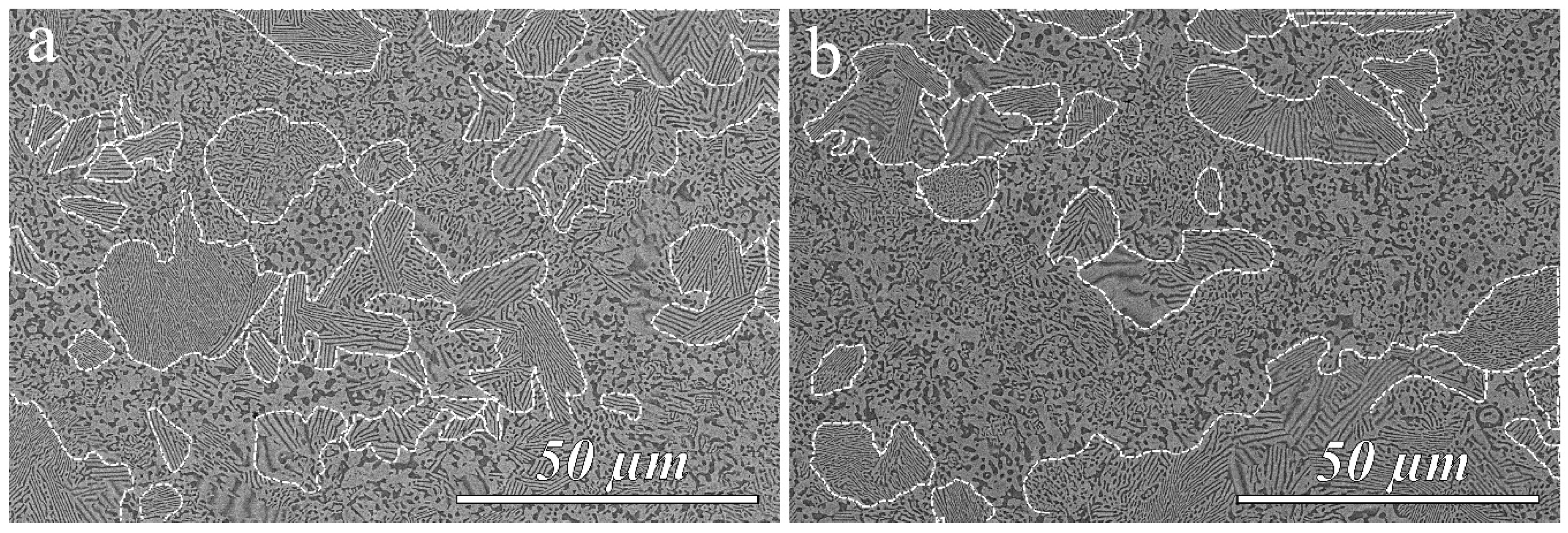
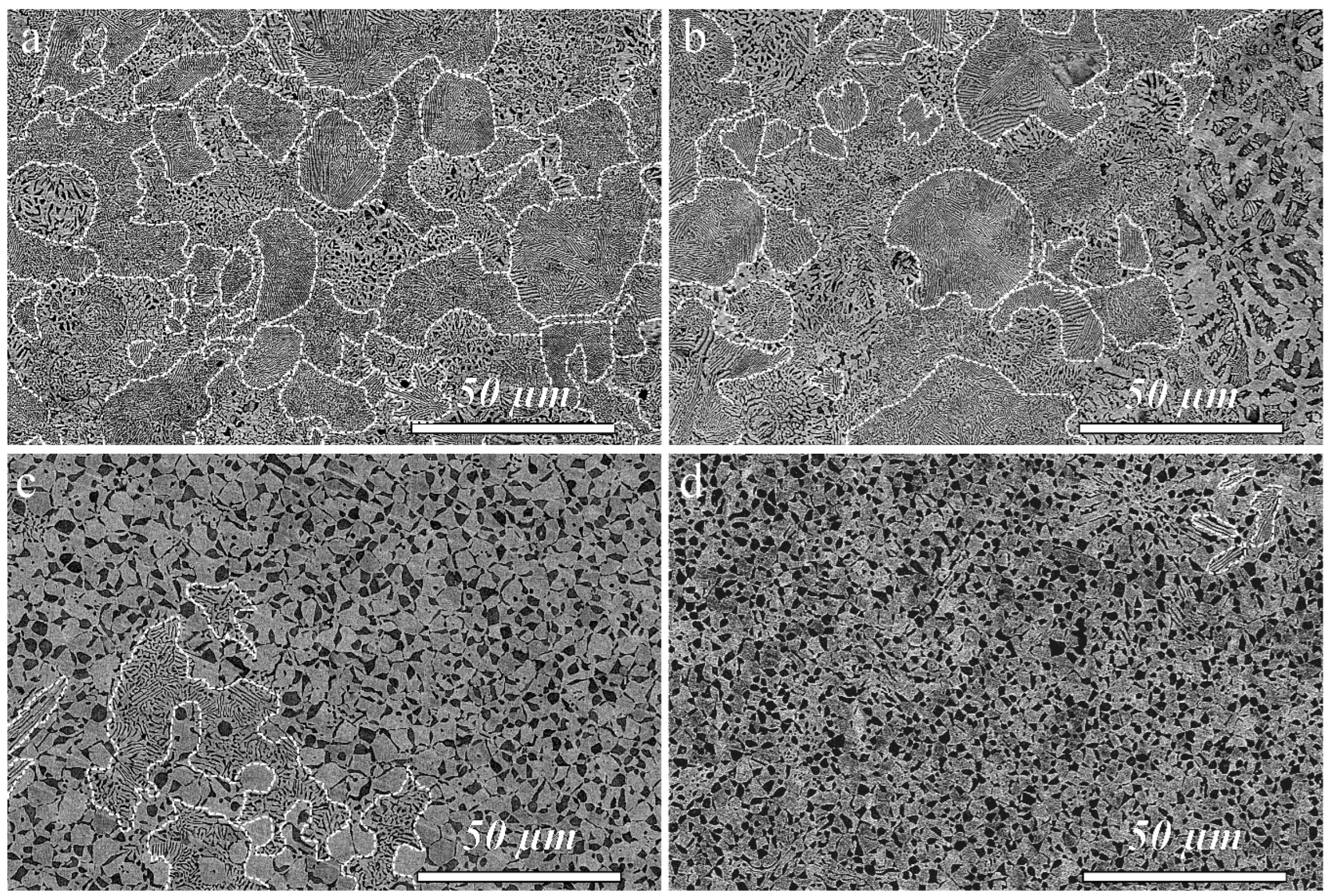
If the microstructural modification from a lamellar to a globular morphology is driven by localized temperature increases between powder particles during sintering, this effect should become particularly evident in the ERS technique, where current intensity directly influences the thermal input. Indeed, the results of the ERS consolidations using the original powder (Figure 5a–d) clearly support this hypothesis.
Figure 5. EHEA with PSD-O consolidation by ERS. (a) ERS-O1 (14 kA). (b) ERS-O2 (16 kA). (c) ERS-O3 (18 kA). (d) ERS-O4 (20 kA).
Figure 5a shows the sample consolidated at 14 kA, where remnants of the original powder particles with lamellar microstructure are still visible, outlined by white dotted lines. These regions are surrounded by areas in which the B2 phase has begun to transition to a globular morphology. As the current increases to 16 kA (Figure 5b), the globular regions expand slightly while traces of the original lamellar particles remain discernible. This progressive morphological change becomes more pronounced at 18 kA (Figure 5c), where the extent of the globular transformation increases significantly and the original lamellar contours begin to disappear. Finally, at the maximum applied current of 20 kA (Figure 5d), the microstructure at the core of the sample exhibits an almost entirely globular morphology, with only isolated remnants of lamellae still observable.
This gradual transition in morphology, correlated with increasing current intensity, reinforces the interpretation that local thermal energy—whether induced by external heating (as in SPS) or internal Joule heating (as in ERS)—plays a central role in destabilizing the metastable lamellar eutectic structure. The behaviour observed in ERS thus provides compelling evidence for the temperature-driven transformation mechanism described earlier, demonstrating that even brief exposures to high current densities can induce morphological reorganization, especially in high-energy lamellar phases such as B2.
ERS has been used in this work as a tool to modify the eutectic morphology of the AlCoCrFeNi2.1 EHEA by progressively increasing the current intensity under constant pressure. However, beyond the morphological evolution, it is essential to assess whether such changes also affect the chemical distribution of the constituent elements. A shift in morphology may have implications on elemental partitioning, segregation, or phase stability in the consolidated material.
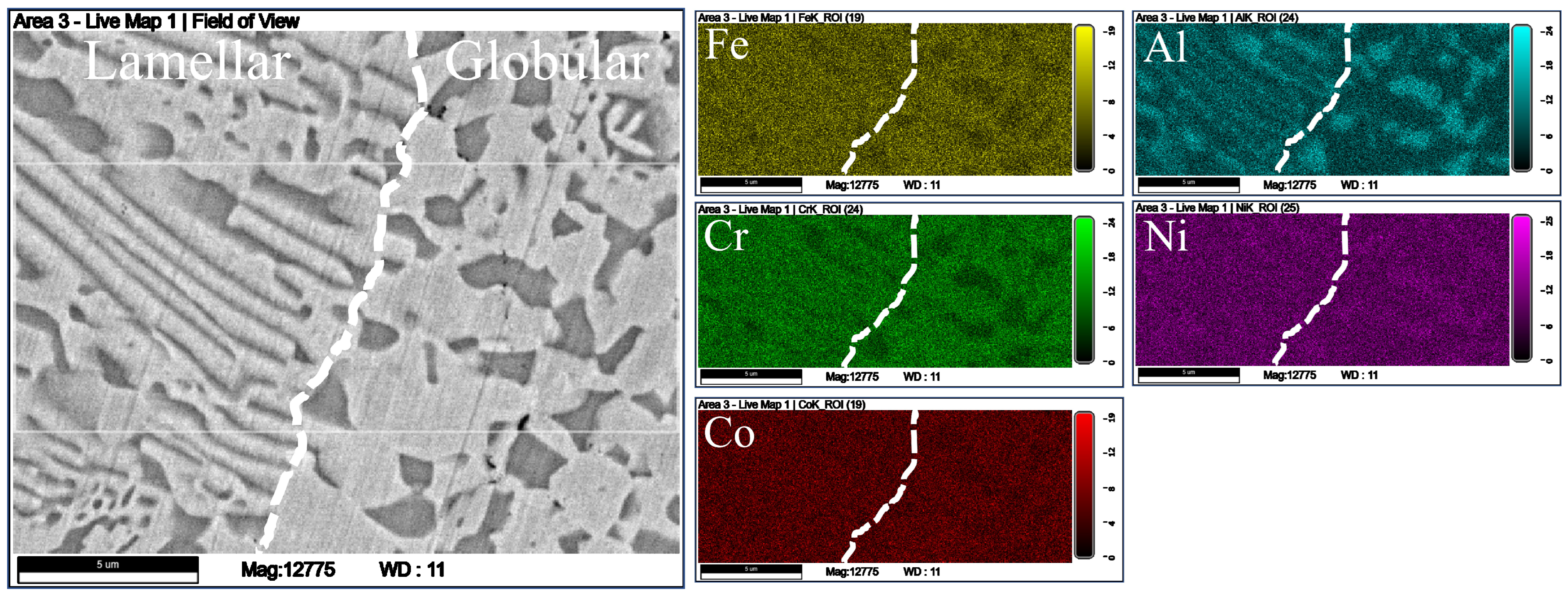
To address this, compositional mapping was performed using energy-dispersive X-ray spectroscopy (EDS), complemented by XRD analysis, which will be discussed in a subsequent section. Figure 6 shows the EDS mapping of a region where both lamellar and globular morphologies coexist. The elemental maps reveal a consistent preferential distribution of elements between the two phases: Al and Ni are enriched in the B2 phase (brighter contrast), while Fe, Cr, and Co are preferentially distributed in the L12 phase (darker contrast). This element–phase association is consistent with previous reports for this alloy, even when fabricated by casting [32].
Figure 6. EDS-MAP of mix microstructure, lamellar and globular morphology.
Notably, the transition from lamellar to globular morphology does not appear to disturb the elemental partitioning between phases. The EDS maps show no signs of chemical segregation at phase boundaries or grain interfaces, indicating that despite the microstructural reorganization, the chemical ordering and stability of the two-phase system remain intact.
If the composition remains similar, the changes in the phase percentage are primarily driven by the different consolidation rates. However, some differences in lattice parameters are observed for each phase (Table 4 and Table 5). These variations can be attributed to minor compositional differences between samples, which induce slight modifications in the d-spacing of the crystallographic planes within an already distorted structure [52].
Table 4. Analysis with IQMaterials® and XRD, for sample consolidated with SPS.
Table 5. Analysis with IQMaterials® and XRD, for sample consolidated with ERS.

3.3. Microstructure Design by Tailoring Particle Size Distribution

In powder technology, it is important to consider that the sintering energy during the production of parts is mainly divided into two parts: the thermal energy provided during the consolidation process and the free energy associated with the effect of the surface area of the particles. The former represents the largest energy contribution and activates the sintering process [53], while the latter has a free energy contribution that originates from the curved surface of the particles. Given that the driving force behind sintering is the reduction in the total interfacial energy of the system [41]; it can be interpreted that if the surface area and curvature of the particles are increased, the free energy contributed to the system increases, and therefore sintering is enhanced.
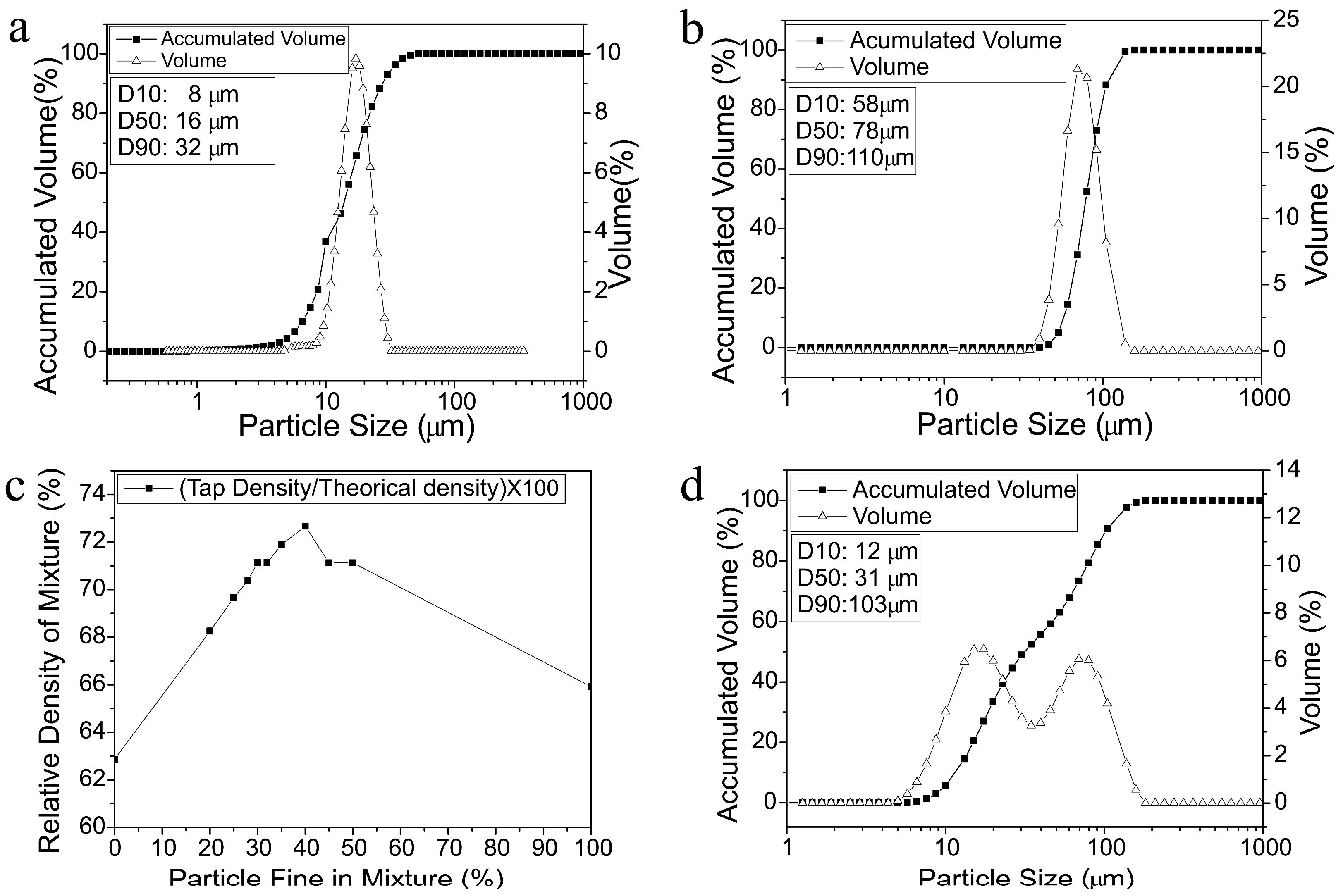
To modulate the eutectic morphology by enhancing the surface area, the as-atomised powder was sieved into two fractions, identified as fine powder and coarse powder, with their PSDs shown in Figure 7a,b, respectively. To optimize the mixing, the study by MC Geary [43] was used in order to obtain the maximum possible packing of the particles so that the fine particles increase the surface energy around the larger diameter particles. Dividing the D50 of the coarse powder by the D50 of the fine powder, an approximate ratio of 1:5 is obtained, which is close to the ratio of 60% coarse powder required to achieve maximum particle packing [43].
Figure 7. (a) PSDL-Fine powder, (b) PSDU-Coarse powder, (c) relative density in function of mixture powders, (d) PSD-M.
To confirm this analysis with the studied PSD, powder mixtures were made, and the different densities were obtained using tap density (ISO 3953:2011 standard [54]), as shown in Figure 7c, which confirms that the maximum packing density is found in the composition of 60% coarse powder and 40% fine powder. The powder mixture obtained is referred to as PSD-M, and its bimodal PSD is shown in Figure 7d.
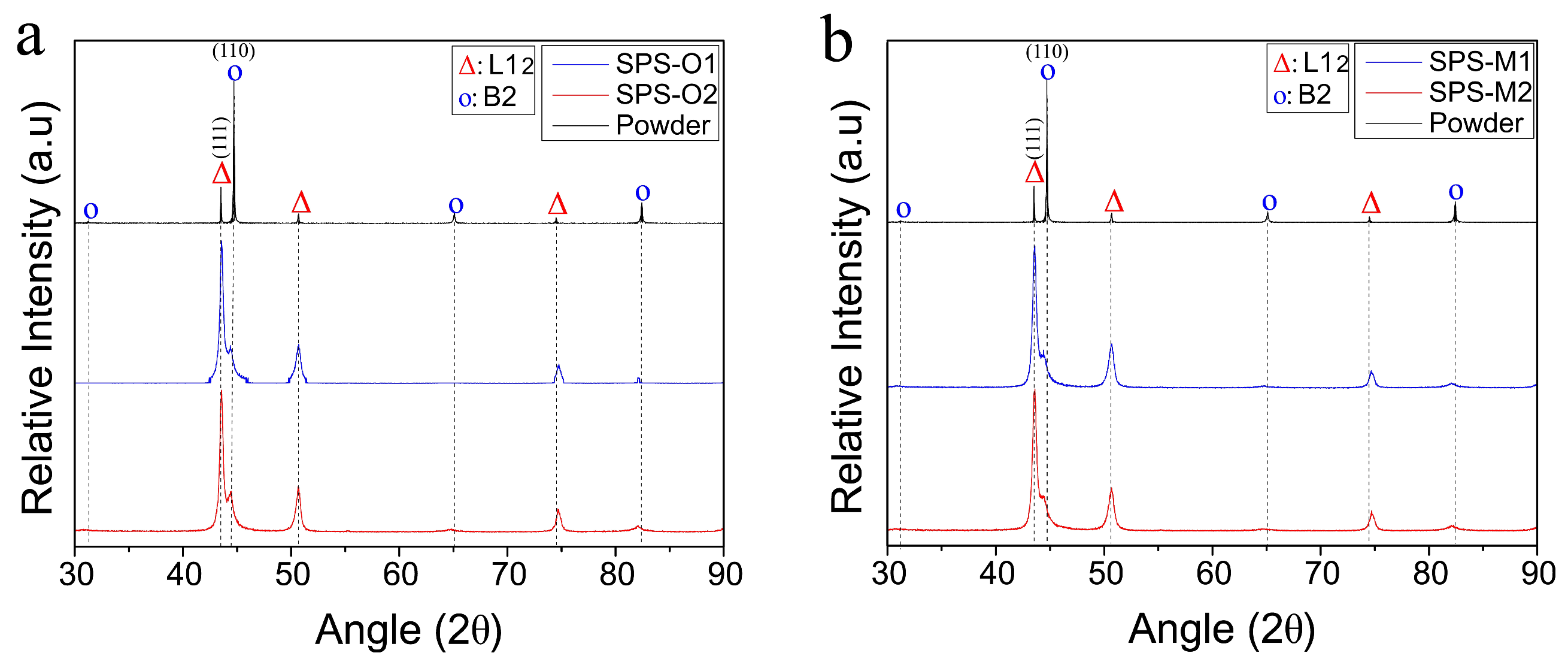
Table 4 presents the quantitative analysis obtained from the XRD patterns in Figure 8 and the microstructural evaluation with IQMaterials® based on SEM images in Figure 9. The results confirm that the microstructure of the SPS-consolidated samples using PSD-M (bimodal) is predominantly composed of FCC-L12 and BCC-B2 phases, with phase fractions of approximately 60% and 40%, respectively. This distribution differs from that of the initial powder.
Figure 8. XRD of SPS consolidation: (a) Original powder (PSD-O), (b) Mixing powder (PSD-M).
Figure 9. EHEA with PSD-M consolidation by SPS: (a) SPS-M1, (b) SPS-M2.
A closer examination of the XRD diffractograms in Figure 8 reveals a change in the relative intensity of the main diffraction peaks, while in the powder, the most intense peak corresponds to the (110) plane of the B2 phase; after SPS, the most intense reflection becomes that of the (111) plane of the L12 phase. In addition, the peak corresponding to the (111) plane in the SPS-consolidated samples exhibits a slight shift toward higher 2θ angle for all consolidation conditions, indicating that the process may reduce the lattice distortion of the FCC-L12 phase. In contrast, the peak associated with the (110) plane shifts toward lower 2θ angles, suggesting an increase in lattice distortion.
According to studies conducted by Munitz, A. et al. [55], the more intense peak shifts of the phases are attributed to the release of aluminum atoms from the FCC-L12 phase and enrichment of the BCC-B2 phase by these released atoms, which explains the variation in the phase proportions observed in the results.
Figure 9 displays the SPS-consolidated samples obtained using the bimodal powder mixture (PSD-M). Samples SPS-M1 (Figure 9a) and SPS-M2 (Figure 9b) exhibit both lamellar and globular morphologies, similar to the samples consolidated from the original powder (PSD-O). However, quantitative analysis of these morphologies, presented in Table 5, indicates that most samples, regardless of the particle size distribution used, contain approximately 50% lamellar and 50% globular structures. The only exception is sample SPS-O1, which shows a distribution of 24.5% globular and 75.5% lamellar morphology. As described above, the energy provided by temperature (1000 °C) during the consolidation of this sample (SPS-O1) was not sufficient to achieve proper sintering activation, so its morphology and microstructural distribution largely reflect that of the starting powder.
Additionally, sample SPS-M1 preserves a distribution of 72.3% L12–27.7% B2, similar to that of the initial powder. This behaviour is attributed to the higher heating rate applied during its consolidation (400 °C/min, twice that of the other samples). The shorter exposure time to thermal energy reduces atomic diffusion, preventing significant changes in the original phase distribution.
Table 4 shows the report on lamellar size ( λ B 2 ) and interlamellar space ( λ L 1 2 ). The values described highlight that the use of powder with PSD-M improves the preservation of lamellar sizes around the sizes reported in the powder. In other words, the bimodal distribution (PSD-M) generates an increase in free energy due to the increase in surface area, and this energy is reduced with the morphological transformation from a lamellar to a globular distribution. Conversely, when powder with PSD-O is used, the values of λ B 2 and λ L 1 2 tend to increase to a greater extent. By decreasing the surface area and, consequently, the free energy, the sintering process reduces the energy in other ways, which favours the increase of λ B 2 and λ L 1 2 .
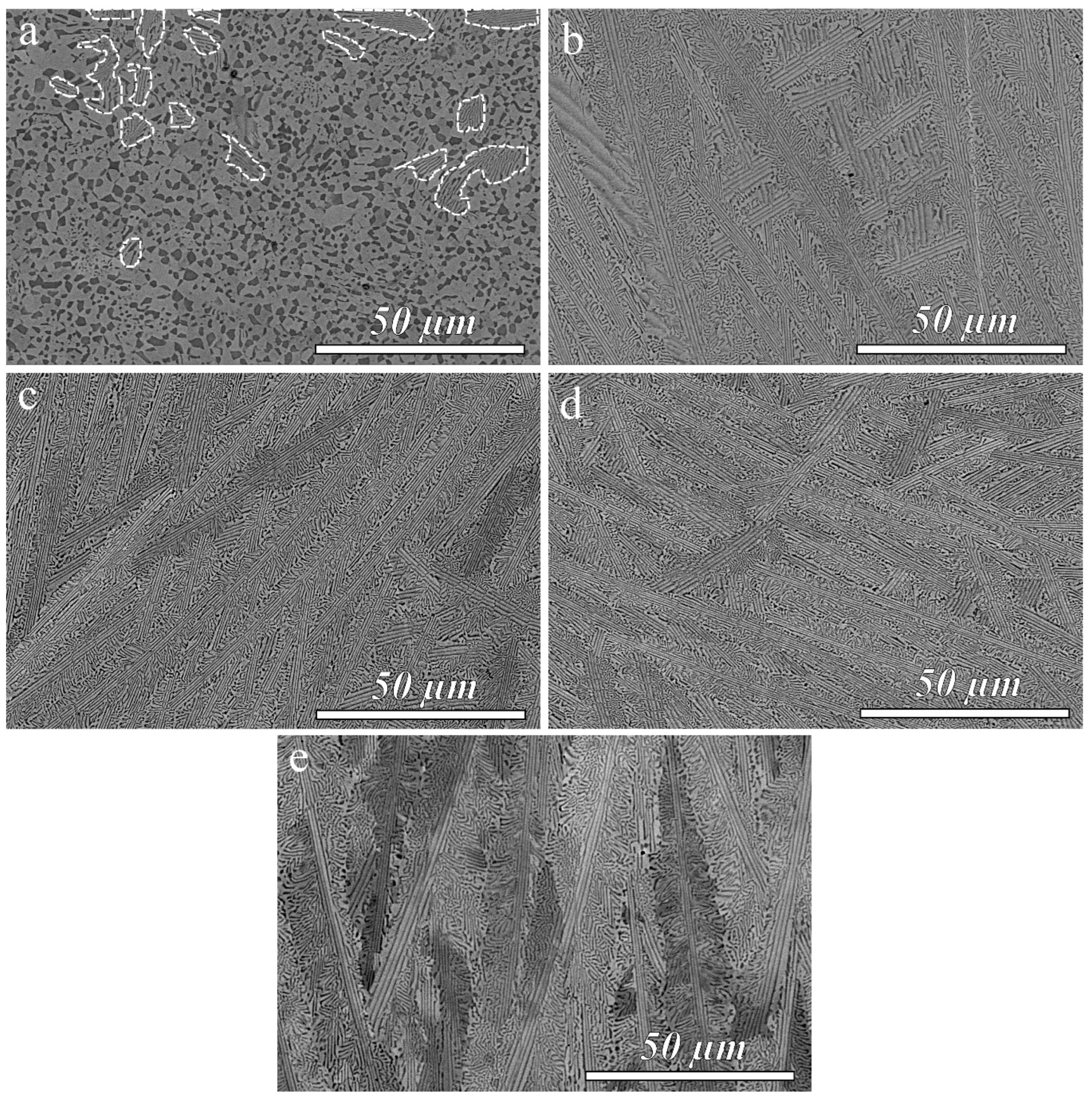
Figure 10 shows the microstructures of the samples consolidated by ERS using the bimodal powder mixture (PSD-M). The ERS-M1 sample, shown in Figure 10a, was consolidated using the same processing parameters as the ERS-O1 sample (see Table 3), thus enabling a direct comparison to evaluate the effect of modifying the particle size distribution on the eutectic morphology. The microstructure reveals that the bimodal mixture significantly promotes the morphological transformation of the B2 phase, despite the lower total thermal input.
Figure 10. EHEA with PSD-M consolidation by ERS: (a) ERS-M1, (b) ERS-M2, (c) ERS-M3, (d) ERS-M4, (e) ERS-M5.
This phenomenon can be understood from a thermodynamic and microstructural standpoint. The introduction of finer particles increases the overall surface area and, therefore, the total surface energy of the system. During sintering, surface energy lowers the activation temperature of sintering. Therefore, the higher the surface energy, the lower the temperature required to obtain consolidated parts, [56,57,58]. In powder compacts with a high surface-to-volume ratio, such as those with a bimodal PSD, the energy required for morphological reorganization to occur, from metastable to more stable morphologies, is intensified. As a result, the transformation from lamellar to globular morphology occurs at lower current intensities than required when using the original PSD. This confirms that the increase in interfacial free energy due to finer particles with D50 16 µm (Figure 7a) and lamellar morphology is sufficient to trigger phase reorganization even under milder thermal conditions.
Note that the morphological change is localized exclusively in the B2 phase, which is initially configured in a lamellar arrangement. This selectivity is related not only to the energy minimization processes associated with sintering but also to the metastable nature of the lamellar structure. As previously suggested [2], the lamellar arrangement, although energetically favourable during rapid solidification, is thermodynamically unstable at elevated temperatures and tends to evolve toward a more spheroidal or globular configuration when subjected to thermal activation.
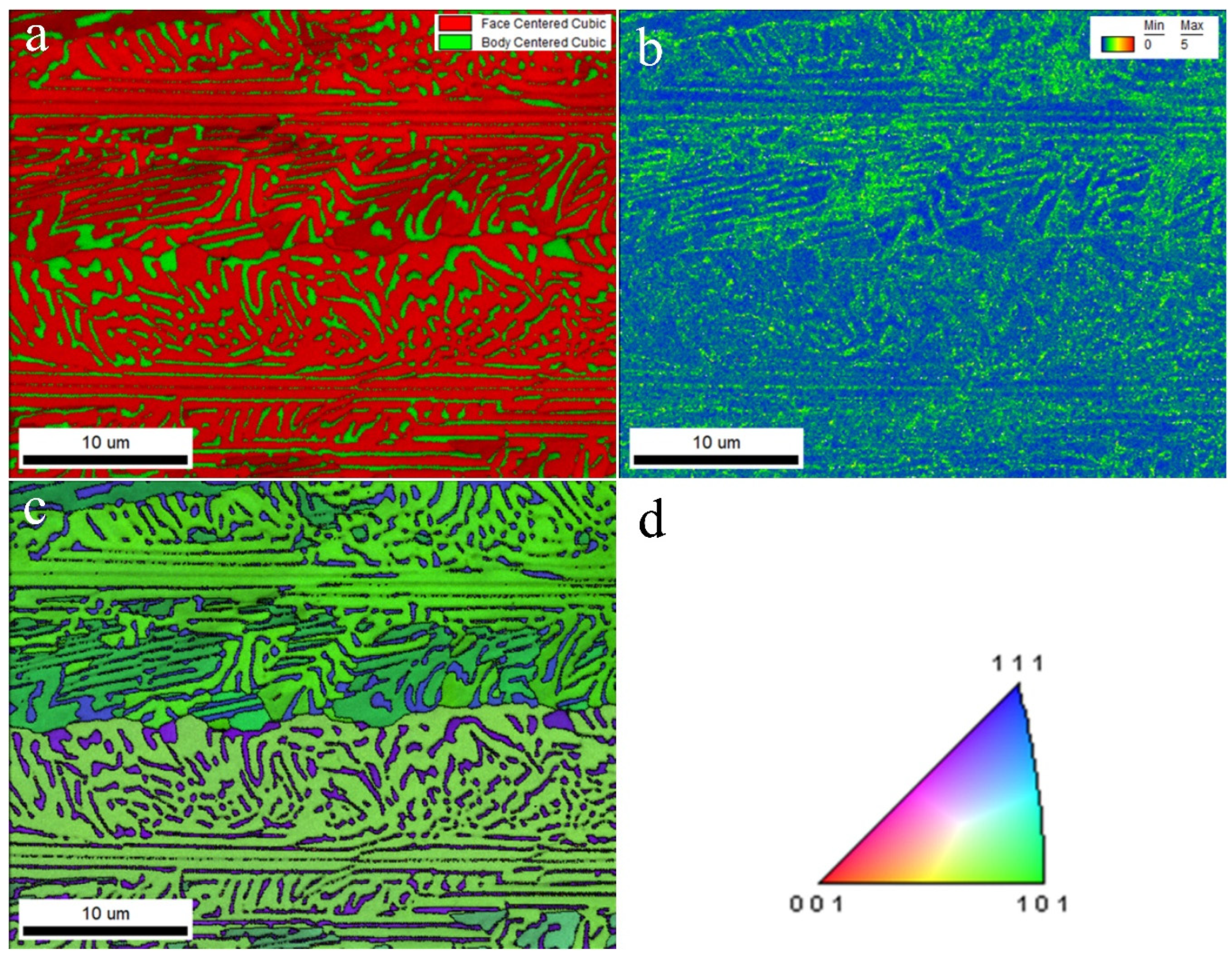
To further elucidate the origin of this selective transformation, EBSD analyses were performed. Figure 11a shows the phase distribution map, while Figure 11b presents the corresponding Kernel Average Misorientation (KAM) map. Regions with higher KAM values (represented in lighter shades) correspond to areas with elevated dislocation densities.
Figure 11. EBSD analysis of lamellar eutectic microstructure on sample ERS-M5. (a) Phase distribution map overlaid with Image Quality (IQ, grayscale) map, (b) Kernel Average Misorientation Map (KAM-Map), (c) Inverse Pole Figure (IPF) map with Grain Boundaries (GB, black lines) and IQ map, (d) Inverse Pole Figure triangle, Crystal direction.
The EBSD–KAM analysis provides further insight into the internal strain state associated with the different eutectic morphologies. Higher KAM values are observed in the lamellar B2 regions, indicating larger local misorientations that are commonly associated with higher densities of geometrically necessary dislocations (GNDs) [59,60]. This behaviour suggests that the lamellar configuration of the B2 phase retains a higher level of internal strain, consistent with its metastable nature after rapid solidification.
In contrast, the B2 domains that have evolved toward a globular morphology exhibit significantly lower KAM values. This reduction in local misorientation indicates partial strain relaxation during the morphological transition. Such behaviour supports the interpretation that the lamellar B2 structure is thermodynamically metastable and tends to reorganize toward a lower-energy configuration when sufficient thermal activation is provided during sintering.
The analysis reveals that the B2 phase in the lamellar arrangement accumulates a higher density of dislocations compared to the surrounding L12 phase. This high internal strain makes the lamellar B2 energetically unstable, thus increasing their susceptibility to reconfiguration under thermal or mechanical stimulation. The dislocation content acts as an additional driving force for the morphological transition, facilitating atomic rearrangements that lead to the formation of more stable globular domains. The behaviour of B2 is consistent with the results presented in previous studies [60].
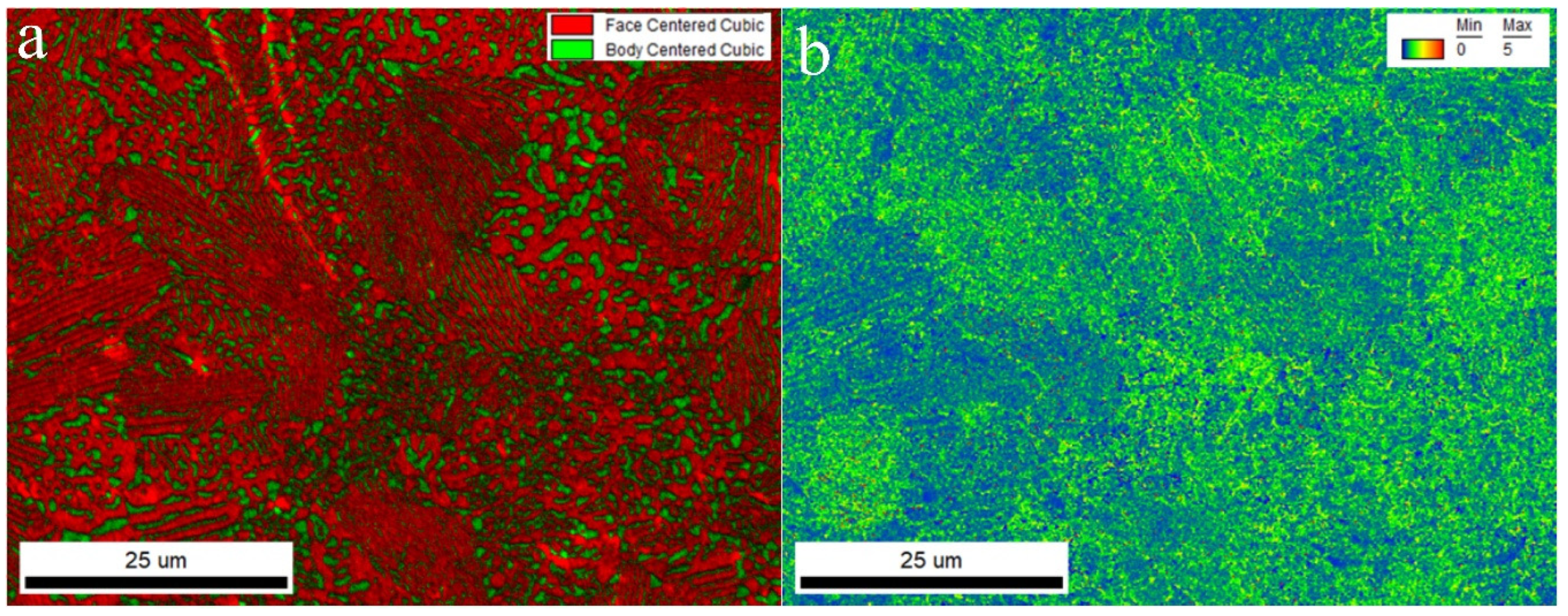
Further evidence of this stabilization is provided by the EBSD maps in Figure 12. The phase map in Figure 12a confirms the presence of B2 domains with globular morphology, while the KAM-Map in Figure 12b shows significantly reduced misorientation within these regions. This reduction in KAM values suggests that the dislocations initially present in the lamellar structure have been partially annihilated or reorganized during the transformation into a globular morphology, resulting in energetically more stable microstructure.
Figure 12. EBSD analysis of hybrid eutectic morphology on sample ERS-M1. (a) Phase distribution map overlaid with Image Quality (IQ, grayscale) map, (b) Kernel Average Misorientation Map (KAM-Map).
The use of bimodal PSD in ERS facilitates the lamellar-to-globular transformation of the B2 phase. This is driven by the combined effects of surface energy reduction, metastability of the lamellar phase, and dislocation-assisted reorganization under thermal activation.
Table 5 and Figure 10 illustrate the effect of increasing pressure during ERS consolidation on the resulting eutectic morphology when using a bimodal powder mixture (PSD-M). The ERS-M1 sample, consolidated at lower pressure, exhibits a lamellar morphology in 54.2% of the microstructure (Figure 10a). As pressure increases, this fraction progressively rises—reaching 76.8% in ERS-M2 (Figure 10b)—and eventually stabilizes at nearly 100% lamellar morphology in samples ERS-M3, M4, and M5 (Figure 10c–e). This trend indicates that the application of higher pressure enhances particle bonding and densification without triggering the transformation of the metastable B2 lamellae into a globular morphology.
This behaviour can be explained thermodynamically and kinetically. During ERS, Joule heating is responsible for local temperature rises, but the total thermal exposure is extremely short, limited to 0.5 s of current application and less than 5 s for complete consolidation. Under these ultrafast conditions, increasing the pressure reduces the need for additional thermal input by improving particle contact and enhancing sinter bonding at lower temperatures. As a result, the energy threshold required to destabilize the lamellar morphology is not reached. Furthermore, the short time at maximum temperature combined with the cooling rate makes it impossible for the phase interface to be minimal, leading to the microstructure remaining practically unchanged.
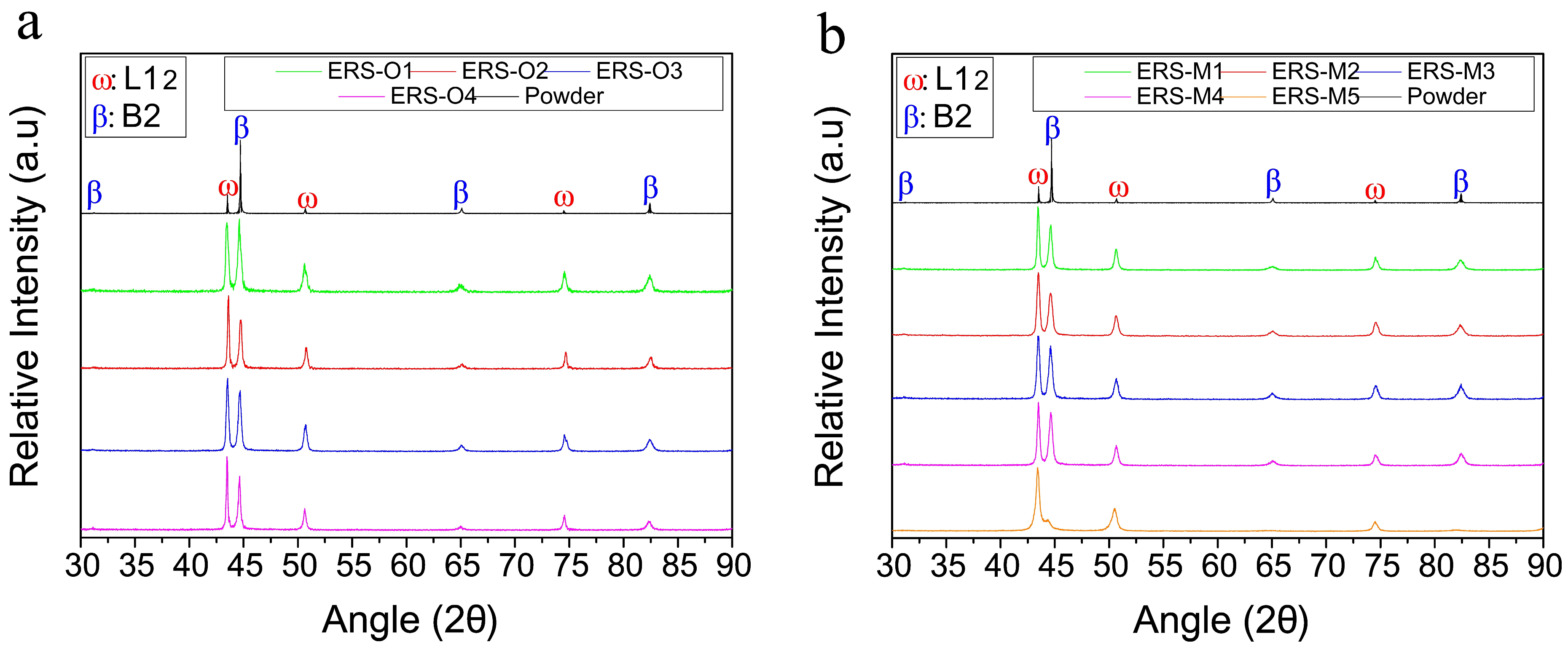
To evaluate whether this morphological stabilization also affects the chemical and structural characteristics of the alloy, XRD analysis was performed on the ERS-sintered samples (Figure 13). As observed for the SPS sintered samples, there is a change in the intensity relation of the main diffraction peaks between the powder and the consolidated samples; this difference increases with the increase in the current intensity, reaching in the sample ERS-M5 a similar peak shape and intensity relation to that in the diffraction pattern of the SPS sintered samples (Figure 8). However, the patterns do not show a significant shift in peak positions or intensities in most of the ERS conditions, indicating that the phase composition remains unchanged. According to Table 5, the phase distribution is consistently around 30% B2 and 70% L12, regardless of processing conditions. This stability can be attributed to the extremely limited atomic mobility during ERS: the rapid thermal cycle is insufficient for substantial diffusion processes such as aluminum migration from L12 to B2, which is often observed under longer heat treatments [55]. Consequently, unlike SPS samples where extended exposure can lead to changes in phase fraction, ERS preserves the original phase balance of the atomized powder.
Figure 13. XRD of ERS consolidation: (a) Original powder (PSD-O), (b) Mixing powder (PSD-M).
The pressure in ERS enables the consolidation of lamellar microstructures while avoiding microstructural or compositional transformations. The ultrafast sintering nature of ERS limits diffusion-driven phenomena, allowing control over morphology without compromising phase stability.
The increase in current intensity during consolidation increases the lamellar size of phase B2. Table 5 shows this increase in the lamellar size λ B 2 . When bimodal powder is used, there is a slight increase that remains constant for all consolidations, compared to those obtained with the original powder, which increase gradually but remain below the pieces with PSD-M.
The ERS-O4 sample consolidated with an intensity of 20 kA has a λ B 2 below that of the others obtained with a lower current intensity. This is attributed to the fact that the energy of the system has been reduced with the metastable transformation of phase B2 to a more stable globular morphology, as the proportion of lamellar morphology for this sample is 3.6%. However, the λ B 2 value for the samples obtained with bimodal powder remains around 80 nm, in contrast to the ERS-M1, which has a λ B 2 = 40   nm . This sample has the highest globular morphological proportion (45.8%) of all those consolidated with PSD-M. In other words, when the globular morphology is reduced by increasing the pressure, the value of λ B 2 increases. This is attributed to the reduction in the volumetric expansion of the material in the system [41], which restricts the morphological transformation. Therefore, the energy contributed to it is reduced by phase B2, promoting an increase in the value of λ B 2 .
The use of high pressures during consolidation not only affects the final densification of the sample [61] but also affects the organization of the biphasic morphology. As previously observed, the use of high-pressure limits volumetric expansion during consolidation [41] and also reduces grain size [61], indicating that the phases concentrate high dislocation densities that enhance grain recrystallisation. Because there are more slip planes in the BCC phase than in the FCC phase [47], the dislocation density tends to accumulate in the B2 phase, as shown in the KAM-Map in Figure 11b. Consequently, as evidenced in the Inverse Pole Figure in Figure 11c,d, the recrystallisation of B2 forms lamellae with a preferential orientation to the direction of highest packing <111> [62].

3.4. Mechanical Properties: Micro and Nanoindentation

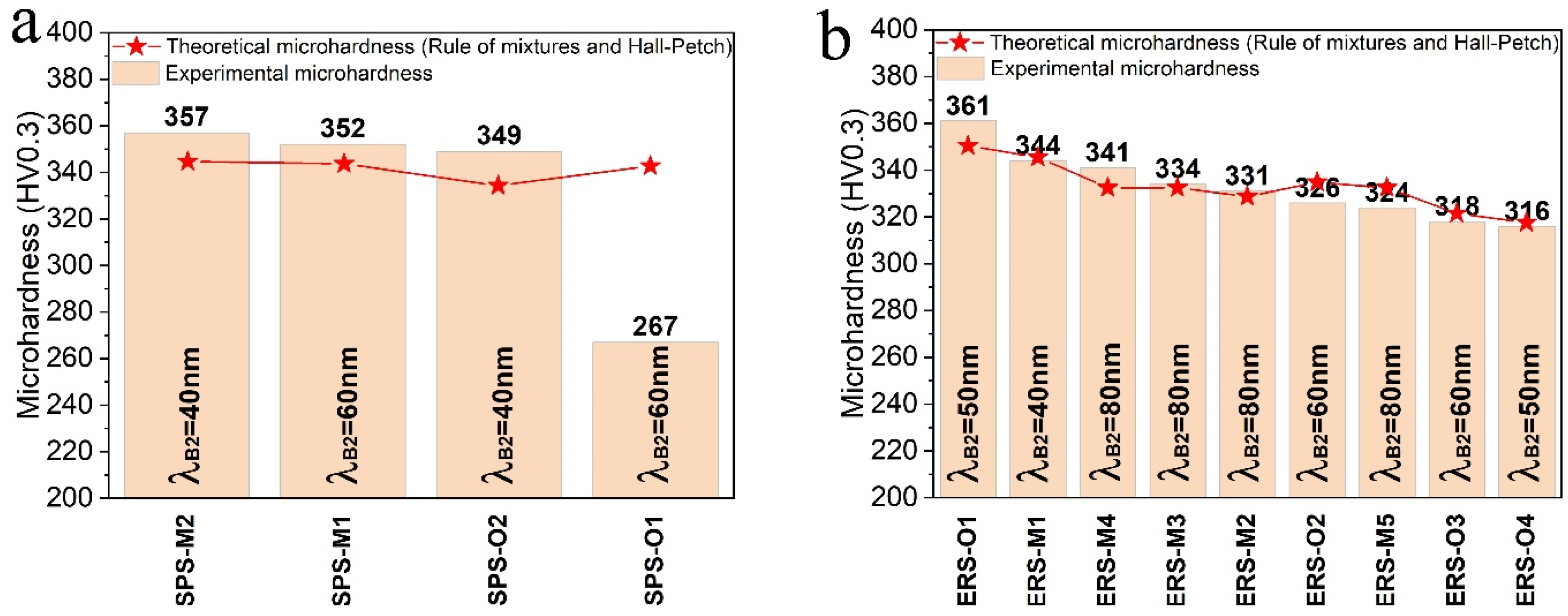
The mechanical properties on the surface of the consolidated samples were evaluated using microindentation and nanoindentation. Figure 14 shows the hardness values obtained by microindentation for all ERS and SPS samples. The indenter used in this technique has a surface area that allows the effect of morphological distribution and lamellar size on hardness to be recorded.
Figure 14. Microhardness (a) SPS all samples, (b) ERS all samples.
Furthermore, this study includes a theoretical approach presented in Equation (1), reconstructed from the mixing rule equation and the Hall–Petch equation, which incorporates the morphological contribution (globular or lamellar) and the lamellar size of phase B2. The values in the expression have been obtained from the results of this study, and the theoretical hardness approximates the experimental data.
H = f g l × H g l + f l m × C 1 m 1 λ B 2 n
where H : material hardness (HV), f g l : globular fraction of the sample (%), f l m : lamellar fraction of the sample (%), H g l : hardness of the globular morphology (316 HV0.3 for globular morphologies—data obtained from a globular surface of the ERS-O4 piece with 96.4% globular fraction), λ B 2 : lamellar size of phase B2 (nm), and n is an empirical exponent that describes how resistance material changes as a function of the lamellar size of phase B2. In this case, it has a value of (−1), which is obtained from experimental results where the morphology is approximately 100% lamellar, and C 1   a n d   m 1 : constants calculated from experimental microindentation where the lamellar fraction contribution is around 100% ( C 1 = 408.5   HV ,   m 1 = 0.95   HV/nm ).
Figure 14a shows the hardness of the SPS samples, where it can be observed that the poor densification of sample SPS-O1 results in lower experimental hardness than when compared to the theoretical hardness obtained by Equation (1), with an approximate loss of 22%. On the contrary, in samples where good consolidation is achieved, there are no significant variations in experimental hardness. This is attributed to the relationship between globular morphology and laminar morphology, which remains around 50–50% for all consolidation conditions. Additionally, the experimentally recorded values are consistent with the theoretical hardness values, with an approximation of more than 95%.
Figure 14b shows the microhardness values of the ERS-consolidated samples, highlighting the synergistic effect of combining the lowest proportion of globular morphology with the smallest lamellar size. The ERS-O1 sample, with an approximate ratio of 70% lamellar to 30% globular morphology and a lamellar spacing of λ B 2 = 50   nm , exhibits the highest hardness value. In contrast, the other ERS-sintered samples (ERS-O2, ERS-M1, ERS-M2, ERS-M3, ERS-M4, and ERS-M5) show a mixture of an increase in the globular morphology fraction and in λ B 2 , both of which contribute to a reduction in hardness. The combination of the lamellar and globular percentage of the morphology with the lamellar size has been combined in Equation (1) to predict the overall behaviour of the material in terms of hardness. These theoretical results show a fit of more than 95% compared to the experimental records taken in this study.
Finally, ERS-O3 and ERS-O4 present the lowest hardness among the ERS samples. This behaviour is associated with the predominance of the globular morphology in their microstructure, where the L12 phase forms a continuous matrix surrounding the globular formations of the B2 phase. Such a configuration offers less resistance to dislocation movement compared with the lamellar morphology, where alternating L12/B2 layers increase the interfacial areas and, therefore, impose greater barriers to dislocation movement.
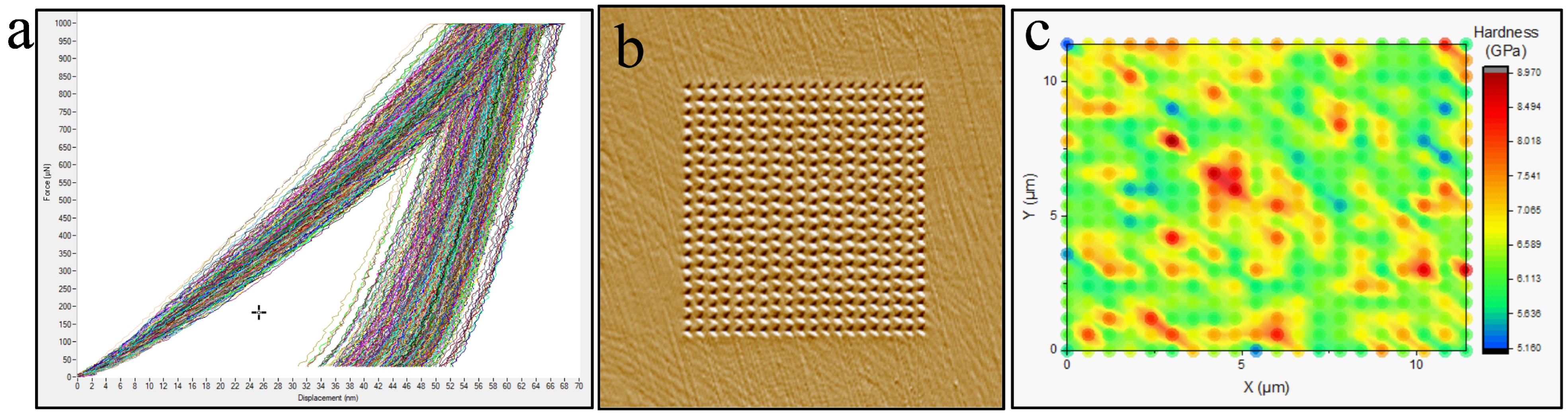
For the nanoindentation tests, the applied load was sufficient to resolve the mechanical properties of both phases individually. As shown in Figure 15a, the indentation penetration depths range between 40 nm and 70 nm, providing adequate spatial resolution consistent with the values of λ B 2 and λ L 1 2 (Table 4 and Table 5). The data matrix obtained (Figure 15b) allowed sufficient values to obtain a hardness distribution map (Figure 15c), illustrating the spatial density of the properties and confirming the differential hardness value associated with each phase.
Figure 15. Nanoindentation EHEA, (a) curve force vs. depth, (b) matrix of indentation in surface material, (c) Colour-MAP of hardness distribution.
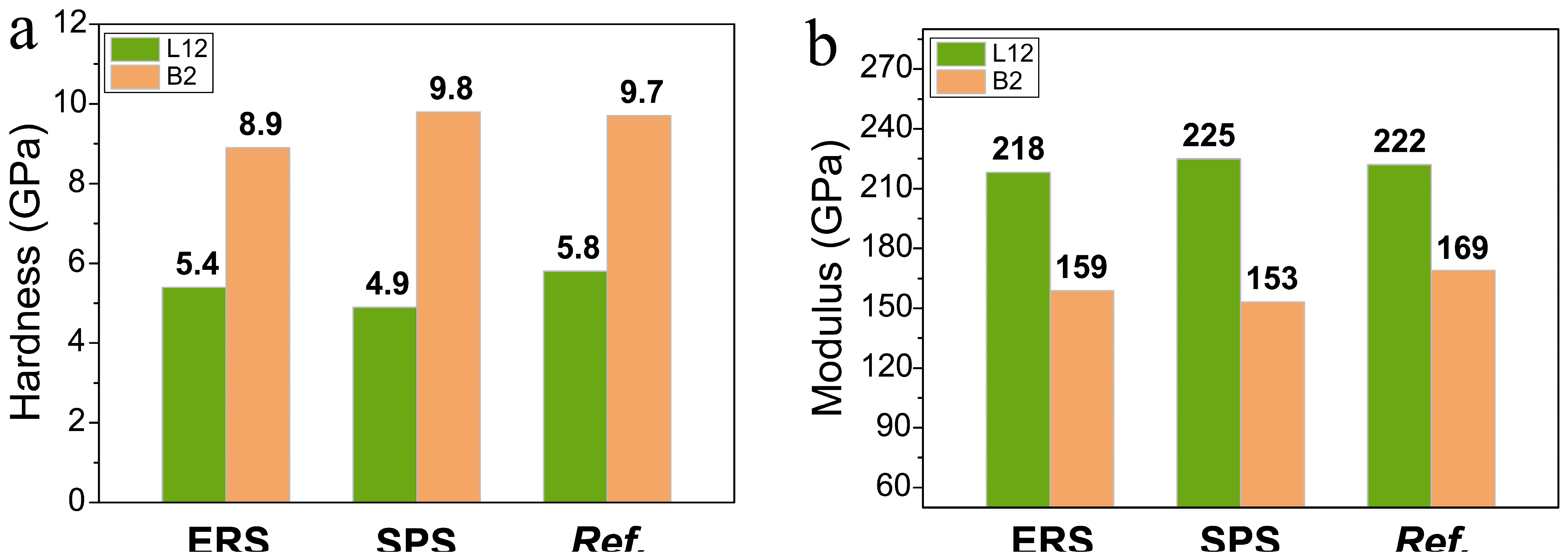
Figure 16 presents the mechanical properties obtained by nanoindentation. The hardness of each phase is shown in Figure 16a, which compares the values measured in the ERS and SPS samples with the reference data reported by Bhattacharjee et al. [63]. The hardness values obtained for each phase in this research are in good agreement with those from the literature, as is also the case for the reduced elastic modulus shown in Figure 16b. The mechanical properties measured in both consolidation methods are very similar to the reference values reported by Cheng Q. et al. [64] for each phase. These results indicate that the modification of the eutectic morphology (lamellar or globular), as well as the variation in lamellar thickness and interlamellar spacing of the EHEA, do not significantly affect the intrinsic mechanical properties of the individual phases.
Figure 16. Nanoindentation EHEA, (a) hardness, (b) reduced elastic modulus.

4. Conclusions

This study demonstrates the potential of combining advanced powder metallurgy techniques such as SPS and ERS with tailored microstructural control strategies to modulate the morphology of the eutectic high-entropy alloy AlCoCrFeNi2.1. By using SPS and ERS, along with the adjustment of PSD, it was possible to systematically influence the transformation of the microstructure from a lamellar to a more stable globular morphology.
It was found that microstructural evolution is highly sensitive to both the consolidation temperature (in SPS) and the current intensity (in ERS), as well as to the pressure applied and the PSD used. The B2 phase was identified as metastable in the lamellar configuration and showed a clear tendency to transform into a globular structure with increasing thermal or electrical energy input. EBSD-KAM analysis further revealed that the globular morphology is associated with reduced internal dislocation density, while high-pressure conditions promote recrystallization with preferential orientation along the <111> direction.
Moreover, the PSD modification proved critical in facilitating the transformation of lamellar morphology at lower energy inputs, confirming the strong effect of surface energy and curvature gradients during sintering. A key outcome was the observation that high-pressure conditions not only improved consolidation but also influenced the organization of biphasic domains, increasing the lamellar fraction and inhibiting the transformation to globular structures.
From a mechanical standpoint, nanoindentation tests revealed that the intrinsic mechanical properties (hardness and reduced elastic modulus) of the B2 and L12 phases remain consistent across all processing conditions and are in agreement with literature values. This indicates that changes in microstructure do not affect the intrinsic properties of each phase individually.
However, microindentation results clearly demonstrated that the global mechanical response of the material is influenced by the phase morphology and lamellar dimensions. Samples with a high proportion of fine lamellar structures (such as the ERS-O1 sample) exhibited the highest hardness values. In contrast, samples with predominately globular morphologies and larger interlamellar spacings showed reduced hardness. This highlights the role of interfacial area in impeding dislocation motion, with lamellar arrangements offering greater resistance than globular counterparts.
In summary, this work establishes a robust framework for tailoring EHEA microstructures via sintering route selection and PSD control. The findings confirm that microstructural morphology, and not only phase composition, plays a dominant role in determining the mechanical performance at the macroscale. These insights open up new pathways for the design of high-performance structural materials based on metastable eutectic systems.

Author Contributions

Conceptualization, P.A.; Methodology, D.G.; Validation, D.G.; Formal analysis, D.G.; Investigation, D.G.; Resources, M.A.M., J.A.C., L.A.D., M.Á.L., M.C. and P.A.; Data curation, D.G.; Writing—original draft preparation, D.G.; Writing—review and editing, R.C., M.A.M., J.A.C., L.A.D., M.Á.L., M.C. and P.A.; Visualization, D.G. and R.C.; Supervision, M.C. and P.A.; Project administration, M.C. and P.A.; Funding acquisition, M.C. and P.A. All authors have read and agreed to the published version of the manuscript.

Funding

This research was funded by Agencia Estatal de Investigación Española (AEI) grant number TED2021-130255B-C31.

Data Availability Statement

The original contributions presented in this study are included in the article material. Further inquiries can be directed to the corresponding author.

Conflicts of Interest

Author José Antonio Calero was employed by the AMES PM Tech Centre. The remaining authors declare that the research was conducted in the absence of any commercial or financial relationships that could be construed as a potential conflict of interest..

References

  1. Porter, D.A.; Easterling, K.E. Phase Transformations in Metals and Alloys; Chapman & Hall: London, UK, 1993; 514p. [Google Scholar]
  2. Wani, I.S.; Bhattacharjee, T.; Sheikh, S.; Bhattacharjee, P.P.; Guo, S.; Tsuji, N. Tailoring nanostructures and mechanical properties of AlCoCrFeNi2.1 eutectic high entropy alloy using thermo-mechanical processing. Mater. Sci. Eng. A 2016, 675, 99–109. [Google Scholar] [CrossRef]
  3. Peng, C.; Yuan, Y.; Pei, Q.; Xu, S.; Xu, Y.; Zhou, Q.; Ma, G.; Huang, P.; Liu, X. Dual-phase lamellar structure achieving high strength and large ductility in a novel Co-free eutectic high-entropy alloy. Intermetallics 2025, 179, 108669. [Google Scholar] [CrossRef]
  4. Chen, Z.; Zhang, Y.; Wang, S.; Zhang, J.Y.; Tao, Q.; Zhang, P. Microstructure and mechanical properties of undercooled Fe80C5Si10B5 eutectic alloy. J. Alloys Compd. 2018, 747, 846–853. [Google Scholar] [CrossRef]
  5. Lu, Y.; Dong, Y.; Guo, S.; Jiang, L.; Kang, H.; Wang, T.; Wen, B.; Wang, Z.; Jie, J.; Cao, Z.; et al. A promising new class of high-temperature alloys: Eutectic high-entropy alloys. Sci. Rep. 2014, 4, 6200. [Google Scholar] [CrossRef] [PubMed]
  6. Ghassemali, E.; Riestra, M.; Bogdanoff, T.; Kumar, B.S.; Seifeddine, S. Hall-Petch equation in a hypoeutectic Al-Si cast alloy: Grain size vs. secondary dendrite arm spacing. Procedia Eng. 2017, 207, 19–24. [Google Scholar] [CrossRef]
  7. He, F.; Wang, Z.; Shang, X.; Leng, C.; Li, J.; Wang, J. Stability of lamellar structures in CoCrFeNiNbx eutectic high entropy alloys at elevated temperatures. Mater. Des. 2016, 104, 259–264. [Google Scholar] [CrossRef]
  8. Baker, I.; Meng, F. Lamellar coarsening in Fe28Ni18Mn33Al21 and its influence on room temperature tensile behavior. Acta Mater. 2015, 95, 124–131. [Google Scholar] [CrossRef]
  9. Wang, L.; Yao, C.; Shen, J.; Zhang, Y.; Liu, G.; Wu, X.; Zhang, G. A new method to design eutectic high-entropy alloys by determining the formation of single-phase solid solution and calculating solidification paths. Mater. Sci. Eng. A 2022, 830, 142325. [Google Scholar] [CrossRef]
  10. Xiong, T.; Yang, W.; Zheng, S.; Liu, Z.; Lu, Y.; Zhang, R.; Zhou, Y.; Shao, X.; Zhang, B.; Wang, J.; et al. Faceted Kurdjumov-Sachs interface-induced slip continuity in the eutectic high-entropy alloy, AlCoCrFeNi2.1. J. Mater. Sci. Technol. 2021, 65, 216–227. [Google Scholar] [CrossRef]
  11. Chen, X.F.; Johnson, D.R.; Noebe, R.D.; Oliver, B.F. Deformation and fracture of a directionally solidified NiAl–28Cr–6Mo eutectic alloy. J. Mater. Res. 1995, 10, 1159–1170. [Google Scholar] [CrossRef]
  12. Cantor, B.; Chang, I.T.H.; Knight, P.; Vincent, A.J.B. Microstructural development in equiatomic multicomponent alloys. Mater. Sci. Eng. A 2004, 375–377, 213–218. [Google Scholar] [CrossRef]
  13. Yeh, J.W.; Chen, S.K.; Lin, S.J.; Gan, J.Y.; Chin, T.S.; Shun, T.T.; Tsau, C.H.; Chang, S.Y. Nanostructured high-entropy alloys with multiple principal elements: Novel alloy design concepts and outcomes. Adv. Eng. Mater. 2004, 6, 299–303. [Google Scholar] [CrossRef]
  14. Zhao, S.P.; Feng, Z.D.; Li, L.X.; Zhao, X.J.; Lu, L.; Chen, S.; Zhang, N.; Cai, Y.; Luo, S. Dynamic mechanical properties, deformation and damage mechanisms of eutectic high-entropy alloy AlCoCrFeNi21 under plate impact. J. Mater. Sci. Technol. 2023, 134, 178–188. [Google Scholar] [CrossRef]
  15. Jin, X.; Bi, J.; Zhang, L.; Zhou, Y.; Du, X.; Liang, Y.; Li, B. A new CrFeNi2Al eutectic high entropy alloy system with excellent mechanical properties. J. Alloys Compd. 2019, 770, 655–661. [Google Scholar] [CrossRef]
  16. Huo, W.; Zhou, H.; Fang, F.; Xie, Z.; Jiang, J. Microstructure and mechanical properties of CoCrFeNiZrx eutectic high-entropy alloys. Mater. Des. 2017, 134, 226–233. [Google Scholar] [CrossRef]
  17. Campo, K.N.; de Freitas, C.C.; Fanton, L.; Caram, R. Melting behavior and globular microstructure formation in semi-solid CoCrCu FeNi high-entropy alloys. J. Mater. Sci. Technol. 2020, 52, 207–217. [Google Scholar] [CrossRef]
  18. Rogal, Ł.; Morgiel, J.; Świątek, Z.; Czerwiński, F. Microstructure and mechanical properties of the new Nb25Sc25Ti25Zr25 eutectic high entropy alloy. Mater. Sci. Eng. A 2016, 651, 590–597. [Google Scholar] [CrossRef]
  19. Ahmed, M.Z.; Chadha, K.; Reddy, S.R.; Shahriari, D.; Bhattacharjee, P.P.; Jahazi, M. Influence of Process Parameters on Microstructure Evolution During Hot Deformation of a Eutectic High-Entropy Alloy (EHEA). Metall. Mater. Trans. A 2020, 51, 6406–6420. [Google Scholar] [CrossRef]
  20. Niu, H.Z.; Chen, Y.F.; Zhang, D.L.; Zhang, Y.S.; Lu, J.W.; Zhang, W.; Zhang, P. Fabrication of a powder metallurgy Ti2AlNb-based alloy by spark plasma sintering and associated microstructure optimization. Mater. Des. 2016, 89, 823–829. [Google Scholar] [CrossRef]
  21. Monchoux, J.P.; Couret, A.; Durand, L.; Voisin, T.; Trzaska, Z.; Thomas, M. Elaboration of Metallic Materials by SPS: Processing, Microstructures, Properties, and Shaping. Metals 2021, 11, 322. [Google Scholar] [CrossRef]
  22. Lagos, M.A.; Agote, I.; Schubert, T.; Weissgaerber, T.; Gallardo, J.M.; Montes, J.M.; Prakash, L.; Andreouli, C.; Oikonomou, V.; Lopez, D.; et al. Development of electric resistance sintering process for the fabrication of hard metals: Processing, microstructure and mechanical properties. Int. J. Refract. Met. Hard Mater. 2017, 66, 88–94. [Google Scholar] [CrossRef]
  23. Caballero, E.S.; Ternero, F.; Astacio, R.; Cuevas, F.G.; Montes, J.M.; Cintas, J. Consolidation by MF-ERS of mechanically alloyed Al powder. J. Alloys Compd. 2019, 792, 529–535. [Google Scholar] [CrossRef]
  24. Jang, J.E.; Kim, W.; Sung, J.H.; Kim, Y.J.; Park, S.H.; Kim, D.H. Microstructural Control Strategy Based on Optimizing Laser Powder Bed Fusion for Different Hastelloy X Powder Size. Materials 2022, 15, 6191. [Google Scholar] [CrossRef] [PubMed]
  25. Li, Q.; Li, X.R.; Dong, B.X.; Zhang, X.L.; Shu, S.L.; Qiu, F.; Zhang, L.C.; Zhang, Z.H. Metallurgy and Solidification Microstructure Control of Fusion-Based Additive Manufacturing Fabricated Metallic Alloys: A Review. Acta Metall. Sin. (Engl. Lett.) 2024, 37, 29–53. [Google Scholar] [CrossRef]
  26. Alvaredo-Olmos, P.; Molina-Aldareguía, J.; Vaz-Romero, A.; Prieto, E.; González-Julián, J.; Monclús, M.A. Understanding the links between the composition-processing-properties in new formulations of heas sintered by sps. Metals 2021, 11, 888. [Google Scholar] [CrossRef]
  27. Reverte, E.; Cornide, J.; Lagos, M.A.; Campos, M.; Alvaredo, P. Microstructure evolution in a fast and ultrafast sintered non-equiatomic al/cu hea. Metals 2021, 11, 848. [Google Scholar] [CrossRef]
  28. Wang, L.; Qiao, J.W.; Ma, S.G.; Jiao, Z.M.; Zhang, T.W.; Chen, G.; Zhao, D.; Zhang, Y.; Wang, Z. Mechanical response and deformation behavior of Al0.6CoCrFeNi high-entropy alloys upon dynamic loading. Mater. Sci. Eng. A 2018, 727, 208–213. [Google Scholar] [CrossRef]
  29. Qiu, S.; Zhang, X.C.; Zhou, J.; Cao, S.; Yu, H.; Hu, Q.M.; Sun, Z. Influence of lattice distortion on stacking fault energies of CoCrFeNi and Al-CoCrFeNi high entropy alloys. J. Alloys Compd. 2020, 846, 156321. [Google Scholar] [CrossRef]
  30. Zaddach, A.J.; Niu, C.; Koch, C.C.; Irving, D.L. Mechanical properties and stacking fault energies of NiFeCrCoMn high-entropy alloy. JOM 2013, 65, 1780–1789. [Google Scholar] [CrossRef]
  31. Beyramali Kivy, M.; Asle Zaeem, M. Generalized stacking fault energies, ductilities, and twinnabilities of CoCrFeNi-based face-centered cubic high entropy alloys. Scr. Mater. 2017, 139, 83–86. [Google Scholar] [CrossRef]
  32. Carbajales, R.; Sobrino, C.; Alvaredo, P. Multi-principal element alloys for concentrating solar power based on molten salt. Sol. Energy Mater. Sol. Cells 2024, 271, 112861. [Google Scholar] [CrossRef]
  33. Torralba, J.M.; Alvaredo, P.; García-Junceda, A. High-entropy alloys fabricated via powder metallurgy. A critical review. Powder Metall. 2019, 62, 84–114. [Google Scholar] [CrossRef]
  34. Huang, G.; Li, B.; He, H.; Xuan, F. Multi-material laser powder bed fusion additive manufacturing of architecturally designed dual-phase heterostructures using heterogeneous high-entropy alloys. J. Mater. Process Technol. 2025, 336, 118708. [Google Scholar] [CrossRef]
  35. Liu, C.; Kong, D.; Tan, Q.; He, J.; Wang, R.; Zhu, G.; Sun, B.; Zou, Y. Simplifying the microstructure and improving the corrosion resistance of the FeCoCrNiNbx high-entropy alloys via homogenizing annealing heat treatment. J. Alloys Compd. 2025, 1013, 178565. [Google Scholar] [CrossRef]
  36. Wang, W.; Ishikawa, K.; Aoki, K. Microstructural change-induced lowering of hydrogen permeability in eutectic Nb-TiNi alloy. J. Memb. Sci. 2010, 351, 65–68. [Google Scholar] [CrossRef]
  37. Munitz, A.; Salhov, S.; Guttmann, G.; Derimow, N.; Nahmany, M. Heat treatment influence on the microstructure and mechanical properties of AlCrFeNiTi0.5 high entropy alloys. Mater. Sci. Eng. A 2019, 742, 1–14. [Google Scholar] [CrossRef]
  38. Wang, X.; Zhai, W.; Li, H.; Wang, J.Y.; Wei, B. Ultrasounds induced eutectic structure transition and associated mechanical property enhancement of FeCoCrNi2.1Al high entropy alloy. Acta Mater. 2023, 252, 118900. [Google Scholar] [CrossRef]
  39. Jin, X.; Zhou, Y.; Zhang, L.; Du, X.; Li, B. A novel Fe20Co20Ni41Al19 eutectic high entropy alloy with excellent tensile properties. Mater. Lett. 2018, 216, 144–146. [Google Scholar] [CrossRef]
  40. Wu, Q.; Wang, Z.; Zheng, T.; Chen, D.; Yang, Z.; Li, J.; Kai, J.; Wang, J. A casting eutectic high entropy alloy with superior strength-ductility combination. Mater. Lett. 2019, 253, 268–271. [Google Scholar] [CrossRef]
  41. Kang, S.J.L. Sintering: Densification, Grain Growth and Microstructure; Elsevier: Amsterdam, The Netherlands, 2005. [Google Scholar]
  42. German, R.M.; Messing, G.L.; Cornwall, R.G. Sintering Technology; CRC Press: Boca Raton, FL, USA, 2020; Available online: https://www.taylorfrancis.com/books/9781000105391 (accessed on 21 October 2025). [CrossRef]
  43. McGeary, R.K. Mechanical Packing of Spherical Particles. J. Am. Ceram. Soc. 1961, 44, 513–522. [Google Scholar] [CrossRef]
  44. Flipon, B.; Keller, C.; de la Cruz, L.G.; Hug, E.; Barbe, F. Tensile properties of spark plasma sintered AISI 316L stainless steel with unimodal and bimodal grain size distributions. Mater. Sci. Eng. A 2018, 729, 249–256. [Google Scholar] [CrossRef]
  45. Zhang, Z.; Ma, P.; Fang, Y.; Yang, Z.; Zhang, N.; Prashanth, K.G.; Jia, Y. Effect of NiCoFeAlTi high entropy intermetallic reinforcement particle size on the microstructure and mechanical properties of CoCrFeMnNi high-entropy alloy composites fabricated by selective laser melting. J. Alloys Compd. 2023, 947, 169417. [Google Scholar] [CrossRef]
  46. Diouf, S.; Menapace, C.; Molinari, A. Study of effect of particle size on densification of copper during spark plasma sintering. Powder Metall. 2012, 55, 228–234. [Google Scholar] [CrossRef]
  47. Zhang, Z.H.; Wang, F.C.; Wang, L.; Li, S.K.; Shen, M.W.; Osamu, S. Microstructural characteristics of large-scale ultrafine-grained copper. Mater. Charact. 2008, 59, 329–333. [Google Scholar] [CrossRef]
  48. Lagos, M.A.; Agote, I.; Leizaola, I.; Lopez, D.; Calero, J.A. Fabrication of chromium carbide cermets by electric resistance sintering process: Processing, microstructure and mechanical properties. Int. J. Refract. Met. Hard Mater. 2021, 95, 105417. [Google Scholar] [CrossRef]
  49. Oliver, W.C.; Pharr, G.M. An improved technique for determining hardness and elastic modulus using load and displacement sensing indentation experiments. J. Mater. Res. 1992, 7, 1564–1583. [Google Scholar] [CrossRef]
  50. Pengjun, F.; Yi, X.; Xinggang, L.; Ya, C. Influence of Atomizing Gas and Cooling Rate on Solidification Characterization of Nickel-based Superalloy Powders. Rare Met. Mater. Eng. 2018, 47, 423–430. [Google Scholar] [CrossRef]
  51. Ciftci, N.; Ellendt, N.; Coulthard, G.; Soares Barreto, E.; Mädler, L.; Uhlenwinkel, V. Novel Cooling Rate Correlations in Molten Metal Gas Atomization. Metall. Mater. Trans. B 2019, 50, 666–677. [Google Scholar] [CrossRef]
  52. Carbajales, R.; Sobrino, C.; Monclús, M.A.; Alvaredo, P. The role of aging in the microstructure and mechanical properties of two multi-principal element alloys. Mater. Sci. Eng. A 2025, 928, 148080. [Google Scholar] [CrossRef]
  53. Avner, S.H. Introducción a la Metalurgia Física, 2nd ed.; McGraw-Hill/Interamericana: Ciudad de México, México, 1988. [Google Scholar]
  54. ISO 3953:2011; Statistical Interpretation of Data—Comparison of Two Means in Paired Experiments. ISO: Geneva, Switzerland, 2011.
  55. Munitz, A.; Salhov, S.; Hayun, S.; Frage, N. Heat treatment impacts the micro-structure and mechanical properties of AlCoCrFeNi high entropy alloy. J. Alloys Compd. 2016, 683, 221–230. [Google Scholar] [CrossRef]
  56. Oh, J.W.; Ryu, S.K.; Lee, W.S.; Park, S.J. Analysis of compaction and sintering behavior of 316L stainless steel nano/micro bimodal powder. Powder Technol. 2017, 322, 1–8. [Google Scholar] [CrossRef]
  57. Rajabi, J.; Muhamad, N.; Sulong, A.B. Effect of nano-sized powders on powder injection molding: A review. Microsyst. Technol. 2012, 18, 1941–1961. [Google Scholar] [CrossRef]
  58. Oh, J.W.; Bollina, R.; Lee, W.S.; Park, S.J. Effect of nanopowder ratio in bimodal powder mixture on powder injection molding. Powder Technol. 2016, 302, 168–176. [Google Scholar] [CrossRef]
  59. Rui, S.S.; Han, Q.N.; Wang, X.; Li, S.; Ma, X.; Su, Y.; Cai, Z.; Du, D.; Shi, H.J. Correlations between two EBSD-based metrics Kernel Average Misorientation and Image Quality on indicating dislocations of near-failure low alloy steels induced by tensile and cyclic deformations. Mater. Today Commun. 2021, 27, 102445. [Google Scholar] [CrossRef]
  60. Carbajales, R.; Sobrino, C.; Alvaredo, P. Influence of the microstructure on the short-term oxidation behavior of the AlCrCoFeNi 2.1 eutectic multi-principal element alloy. Powder Metall 2025, 1–18. [Google Scholar] [CrossRef]
  61. Briones, F.; Seriacopi, V.; Martínez, C.; Valin, J.L.; Centeno, D.; Machado, I.F. The effects of pressure and pressure routes on the microstructural evolution and mechanical properties of sintered copper via SPS. J. Mater. Res. Technol. 2023, 25, 2455–2470. [Google Scholar] [CrossRef]
  62. Dieter, G.E. Mechanical Metallurgy, 3rd ed.; McGraw-Hill: New York, NY, USA, 1986. [Google Scholar]
  63. Bhattacharjee, T.; Zheng, R.; Chong, Y.; Sheikh, S.; Guo, S.; Clark, I.T.; Okawa, T.; Wani, I.S.; Bhattacharjee, P.P.; Shibata, A.; et al. Effect of low temperature on tensile properties of AlCoCrFeNi2.1 eutectic high entropy alloy. Mater. Chem. Phys. 2018, 210, 207–212. [Google Scholar] [CrossRef]
  64. Cheng, Q.; Zhang, Y.; Xu, X.D.; Wu, D.; Guo, S.; Nieh, T.G.; Chen, J. Mechanistic origin of abnormal annealing-induced hardening in an AlCoCrFeNi2.1 eutectic multi-principal-element alloy. Acta Mater. 2023, 252, 118905. [Google Scholar] [CrossRef]
Disclaimer/Publisher’s Note: The statements, opinions and data contained in all publications are solely those of the individual author(s) and contributor(s) and not of MDPI and/or the editor(s). MDPI and/or the editor(s) disclaim responsibility for any injury to people or property resulting from any ideas, methods, instructions or products referred to in the content.

Article Metrics

Citations

Article Access Statistics

Multiple requests from the same IP address are counted as one view.