Article

Development and Characterization of the Performance of a Novel Machinability-Enhancing Additive for Powder Metallurgy Steels

Department Mining Metallurgical & Materials Engineering, Univesité Laval, 1065 Av. de la Médecine, Quebec, QC G1V 0A6, Canada
*
Author to whom correspondence should be addressed.
Current address: Rio Tinto Iron and Titanium Technology Center, 1625 Route Marie-Victorin, Sorel-Tracy, QC J3R 1M7, Canada.
Metals 2026, 16(3), 245; https://doi.org/10.3390/met16030245
Submission received: 27 January 2026 / Revised: 12 February 2026 / Accepted: 16 February 2026 / Published: 25 February 2026
(This article belongs to the Section Powder Metallurgy)

Abstract

Although powder metallurgy (PM) is known as a near-net-shape fabrication process, a large number of PM parts need to be machined for dimensional conformance or to produce complex geometrical features that cannot be achieved through compaction. However, due mainly to the presence of porosity, the machinability of PM steels is difficult compared to that of wrought steels and can add 20% or more to the overall fabrication cost of PM parts. Among the various measures known to improve the machinability of PM steels, the addition of machining aids, either as admixed or pre-alloyed constituents, is the most popular. Manganese sulfide (MnS) is by far the most common machinability-enhancing additive used in the PM steel industry. Although it is extremely efficient in improving the machining response of PM steels, MnS is known to have detrimental effects on mechanical properties and corrosion resistance. Thus, the use of MnS involves a compromise between obtaining good machinability at the expense of lower mechanical properties and corrosion resistance. In this study, free graphite particles are introduced as a new additive that not only noticeably improves the machinability of PM steel components but also does not affect their mechanical properties or corrosion resistance. It was found that it is possible to obtain free graphite particles in press-and-sintered PM steel components by coating graphite particles with a metallic layer. This coating prevents graphite from diffusing into the iron matrix while creating metallurgical bonds with the surrounding steel matrix during sintering. In this research, graphite particles were coated with nickel and copper through a cementation process. A heat treatment was then performed on this newly developed material to obtain a more uniform single-layer coating and achieve dimensional changes during sintering that are similar to those measured when MnS is used as a machinability enhancer. The results showed that the tensile properties as well as the fatigue resistance of components made of FC-0208-type PM steel containing admixed copper/nickel-coated graphite particles are not affected by the presence of the latter. Moreover, the corrosion resistance of the samples containing copper/nickel-coated graphite was found to be the same as that of samples without the additive, which is a significant improvement on the case where MnS is used. The performance of the newly developed additive in terms of machinability was also characterized in drilling. It was found that this new additive has an identical machinability-enhancing performance to admixed MnS.

1. Introduction

Although the PM industry prides itself on using near-net-shape processes, Benner and Beiss [1] report that approximately 40% of the parts produced by the press-and-sinter method are submitted to at least one of various machining operations. The fact that certain geometrical features cannot be fabricated by the compaction process is the main reason for the necessity of secondary operations on PM parts. Additionally, the stringent dimensional tolerances required for PM components in high-performance applications (such as gear, bearing caps, etc.) make machining unavoidable. On the other hand, due to the presence of residual porosity in typical PM steel components, their machinability is noticeably lower compared to that of their wrought counterparts. Thus, in the case of parts that have a relatively complex shape, it is estimated that the cost of machining PM steel components can represent up to 20% of the total production cost [1].
Various strategies have been considered to find a solution to improve the machining response of PM steel parts. The vast majority of these rely on the addition of a chemical compound, called a machining aid, to a given powder premix. This machining aid enhances machinability by reducing the cutting forces required to remove material with a cutting tool. Tens of different compounds have been used and have been shown to significantly improve machining; among the most popular ones, we find admixed MnS [2], pre-alloyed MnS [3], hexagonal boron nitride (BN-h) [4], magnesium silicate (MgSiO3) [5], etc. However, this improvement is generally obtained at the expense of lower static and dynamic mechanical properties. Moreover, some of these machining enhancers, especially MnS, are hygroscopic. This means that MnS is prone to react with adsorbed water vapor, particularly during sintering, to form MnO and H2S [6]. The formation of H2S, which is a highly corrosive product, promotes pitting corrosion of the steel matrix as well as the formation of iron oxides and hydroxide (rust) [7]. The latter oxides act as abrasive particles during machining, thus negating the beneficial effect of MnS on machinability [8,9]. In addition, it was demonstrated that H2S present at elevated temperatures in a surrounding (sintering) atmosphere as a result of MnS degradation can react with stainless steel, which is typically the material used to fabricate the conveyor belts of continuous sintering furnaces, thereby significantly reducing their corrosion resistance as well as their life in service [10]. Thus, the problem to be solved is to find an additive that can improve machinability at least as efficiently as unoxidized MnS without deteriorating the mechanical properties and corrosion resistance of PM steel components.
In this study, graphite was introduced as a machining aid for PM steels. As is already known, gray cast iron presents excellent machining behavior due to the presence of free graphite in its microstructure. Graphite is a well-known lubricant that can reduce cutting forces by reducing the friction coefficient of sliding surfaces in machining processes and also by accelerating fracture during chip formation. Moreover, it is the most widely used alloying element in steels. However, graphite in its native form cannot be used directly in ferrous PM parts since it easily diffuses within the iron matrix of the base powder during sintering to form Fe3C and possibly other metallic carbides. Consequently, in order to have free graphite in a sintered PM steel component, it is necessary to prevent its diffusion into the iron matrix. The hypothesis of this research was that it is possible to have free graphite in a PM steel by coating graphite particles with nickel and copper to form a barrier that prevents the graphite from diffusing within the iron matrix. This new additive would allow us to solve two problems. Firstly, it relies on a chemical constituent, i.e., graphite, which is well known to significantly improve the machinability of ferrous cast alloys; secondly, due to the presence of a metallic coating on the surface of graphite particles, the overall strength of a PM steel component should be significantly improved by the formation of metallurgical bonds between the additive and the surrounding steel matrix, thus increasing the static and dynamic mechanical properties compared to parts relying on other machinability enhancers.
The rationale for using a two-layer coating is based on the fact that one of the secondary objectives is to achieve dimensional changes after sintering that would be within the range of those typically measured for components fabricated with FC-0208 premixes (MPIF designation [11]) containing an equivalent volume fraction of MnS. In this context, nickel could not be utilized alone since it would induce densification rather than the typical swelling measured for Cu PM steels. Copper alone used as a coating would obviously melt during the sintering of PM steel parts, which would not prove useful in this context. As for other suitable metals, either their reactivity with oxygen/nitrogen is too high or their compatibility with utilization in PM steels is inadequate.

2. Materials and Methods

In this study, graphite particles were coated with nickel and copper through a cementation process. This was followed by a heat treatment performed on the copper/nickel-coated graphite (CNCG) particles, and both non-heat-treated and heat-treated CNCG particles were characterized. In the second phase of this study, CNCGs were admixed with FC-0208 copper/steel premixes. The tensile properties as well as the fatigue and corrosion resistance of the sintered samples containing CNCGs were measured and compared with those of samples without additives or which contained an equivalent volume fraction of MnS. Finally, in the third phase of the study, the effect of CNCGs on the machinability of PM steels was studied and compared to that of MnS.

2.1. Electroless Nickel Plating

Initially, graphite particles with a D50 of 90 μm were subjected to surface pretreatment. The pretreatment aimed at increasing the catalytic activity of the particles. Graphite particles were immersed in an aqueous solution of 15 mL/L of sulfuric acid (H2SO4) for 20 min at room temperature under constant stirring. Next, the particles were rinsed three times with deionized water. Then, the pretreated particles were introduced into an electroless nickel plating bath. The bath consisted of 79.2 g/L of nickel sulfate (NiSO4), 88 g/L of sodium hypophosphite (NaPO2H2) (reducing agent), 166 g/L of sodium citrate (Na3C6H5O7) (complexing agent) and 112.2 g/L of boric acid (H3BO3) as a stabilizing agent. All the chemicals were of analytical reagent grade and obtained from the Sigma-Aldrich Company (St-Louis, MO, USA).

2.2. Electroless Copper Plating

In order to coat copper on the surface of nickel-coated graphite, copper (II) sulfate pentahydrate (CuSO4·5H2O) supplied by Alfa Aesar (Road Ward Hill, MA, USA) was dissolved in distilled water. A weight ratio of copper sulfate to nickel-coated graphite of 2.6 proved to be the ideal bath composition to obtain a continuous coating while minimizing the precipitation of pure copper, i.e., copper that does not participate in the formation of the coating. Glacial acetic acid (CH3COOH) (Sigma-Aldrich, St-Louis, MO, USA) was added to increase the wettability of suspended particles by the aqueous solution. The nickel-coated graphite particles were then added to the solution under constant stirring. Finally, zinc pellets were gradually added to the solution in short intervals to reduce the copper ions. The reduced copper deposited on the surface of the nickel-coated graphite particles. Finally, deionized water was used to flush the sulfate and zinc ions. The copper-coated particles were dried in an oven at 90 °C. In order to separate the free copper precipitates from the copper-coated particles, a magnetic separator was used. Since nickel is ferromagnetic, the coated particles were attracted to the magnet and free copper particles were left behind and recycled.

2.3. Preparation of Premixes

All the premixes were prepared in a 2-Liter double-cone blender. (Orbis Machinery, Waukesha, WI, USA). The base iron powder used to make these premixes was Atomet 1001 obtained from Rio Tinto Metal Powders (Sorel-Tracy, QC, Canada). The admixed graphite and copper powders were Asbury natural graphite grade 1651 and SCM Metal Products grade 150RXM, respectively. It should be noted that in all the premixes, the copper content was 2.0 wt% and the concentration of graphite was adjusted to yield a combined carbon content of 0.80 wt% after sintering. Lubrication during compaction was provided by admixing 0.75 wt% of ethylene bis stearamide (EBS) (Blachford, Mississauga, ON, Canada).

2.4. Fabrication of Test Specimens

Powder mixtures were compacted to different shapes, including Transverse Rupture Strength (TRS) bars, dog-bone tensile specimens and cylinders. The TRS bars were prepared according to MPIF standard 41 [12] to be used in TRS tests, three-point bending fatigue tests, corrosion resistance measurements and microstructural characterization. To study the tensile properties, powder mixtures were compacted in the shape of dog bones according to MPIF standard 10 [13]. Finally, cylinders with a height of 5.08 cm (2 in) and a diameter of 3.81 cm (1.5 in) were prepared for machinability characterization. It should be noted that all the samples were compacted to a green density of 6.8 g/cm3.
The TRS and dog-bone specimens were all sintered at 1120 °C for 30 min under an atmosphere of 90% vol% N2–10% vol% H2 in a conveyor-belt sintering furnace (Abbott Furnace Co. St-Mary’s, PA, USA) located in the Powder Metallurgy Laboratory of Univerité Laval. The cooling rate between 650 °C and 300 °C was approximately 0.75 °C/s. The samples for machinability characterization, i.e., cylinders, were compacted and sintered at Powder-Tech Associates Inc. (North Andover, MA, USA) using the same sintering parameters, with the exception that the sintering atmosphere was dissociated ammonia, i.e., 25 vol% N2–75% vol% H2.

2.5. Density Measurements

The density of the CNCG powders was measured before and after heat treatment using a gas pycnometer (HumiPyc, Boca Raton, FL, USA). The density measurements were performed twice for each sample. Green and sintered densities of TRS bars and cylindrical specimens used to characterize machinability were calculated by dividing the weight of each specimen by its volume, measured with a hand-held caliper (Mitutoyo, Mississauga, ON, Canada). The density of sintered dog-bone specimens used to characterize tensile properties was measured following the requirements of MPIF standard 42 [14], which is based on Archimedes’ principle.

2.6. Tensile Properties and Transverse Rupture Strength

TRS tests were performed according to MPIF standard 41 [12]. Tensile properties were measured according to MPIF standard 10 [13]. The tensile and TRS values reported for each composition correspond to the average of at least 5 measurements.

2.7. Fatigue

Three-point bending fatigue tests were used to characterize the fatigue resistance of different series of FC-0208 specimens containing machinability-enhancing additives or not. The endurance limit calculation was performed based on the staircase method according to MPIF standard 56 [15]. In total, 2 million cycles was chosen as the survival criterion in this research. The step size chosen in this test was 10 MPa, which, according to MPIF 56, is proper for sintered steel with a tensile strength of less than 690 MPa. The mean endurance limit and the 10% and 90% survival stresses were calculated using the applied stresses, the number of failures and the survivals at each stress level.

2.8. Humidity Adsorption

In order to compare the humidity adsorption of CNCG particles with that of a MnS-containing powder, identical volumes of CNCG and MnS particles were placed on a glass plate within a sealed container in which the relative humidity was kept constant at 70%. To keep the humidity constant, the reservoir at the bottom of the desiccator was filled with a saturated sodium chloride solution. After two weeks, the amount of humidity adsorbed by the powders was measured by thermogravimetric analysis (TGA) (Netzsch STA 449 F3, Selb, Germany). For this, 100 mg of powder was placed in a small alumina crucible and heated up to 200 °C at a heating rate of 5 °C/min. The samples were kept at 200 °C for 60 min. During the heating process, argon was used as a protective atmosphere. Variation in the weight of the powder as a function of temperature was measured.

2.9. Corrosion Resistance

The corrosion resistance of the series of FC-0208 specimens containing no additive and containing identical volume fractions of CNCG and MnS particles was characterized with an approach based on ASTM standard B 895 [16]. This test method is generally used for the evaluation of the corrosion resistance of PM specimens made of stainless steel. In this test, each TRS bar for each series of specimens was immersed for 6 days in a solution of deionized water containing 5.0 wt% of NaCl. Meanwhile, at various time intervals, photographs of each immersed sample were acquired. The fraction of the surface covered by stains, i.e., the corrosion products, was measured at each time interval and compared with a reference photograph of corroded specimens available in the ASTM B-895 standard [16]. The samples were ranked based on the degree of staining according to the information provided in Table 1. It is important to be reminded that this method is qualitative and does not reveal any information on the type or other characteristics of corrosion.

2.10. Characterization of Machinability

Drilling trials were carried out using a computer numerically controlled (CNC) machining center (HAAS TM-3, Oxnard, CA, USA). The cutting tools used were multilayer TiAlN-PVD-coated solid carbide drills with a top layer of TiN as a wear indicator (Kennametal, Latrobe, PA, USA). The spindle speed and the cutting speed were 4600 rpm and 91 surface meter/min, respectively. The diameter of the drill bit was 6.3 mm. According to the diameter of the cylinders, 12 holes with a depth of 20 mm were programmed to be drilled on each side of the cylinders for a total of 24 holes per sample. For each series of specimens chosen for machinability characterization, 15 cylindrical samples were prepared. For each test, holes were drilled until the average flank wear of the cutting tool reached 0.380 mm or all the samples of that composition were spent.
In order to characterize the efficiency of the drilling process, the diameters of selected holes were measured using a coordinate measurement machine (CMM) (Mitutoyo Crystal PM443, Mississauga, ON, Canada). For these measurements, the tungsten carbide stylus probed a horizontal plane in six different locations. The hole diameter was then calculated based on the probed points using the standard built-in software package of the CMM. In addition, the circularity of the holes was also calculated using the built-in software. The measurements were performed on 50% of the holes drilled. The latter were randomly selected on each side of the cylinders.

2.11. Microstructural Characterization

Optical microscopy (LECO-300, St-Joseph, MI, USA), as well as scanning electron microscopy (SEM) (JEOL JSM-840A, Tokyo, Japan), was used to characterize the CNCG particles (the characterization of the coating layer before and after heat treatment), the microstructure of the sintered samples, and the microstructure and morphology of the chips. Moreover, concentration profiles and X-ray mappings of copper, nickel and iron in the coating layer were acquired using an electron microprobe (CAMECA SX-100, Gennevilliers, France).

3. Results

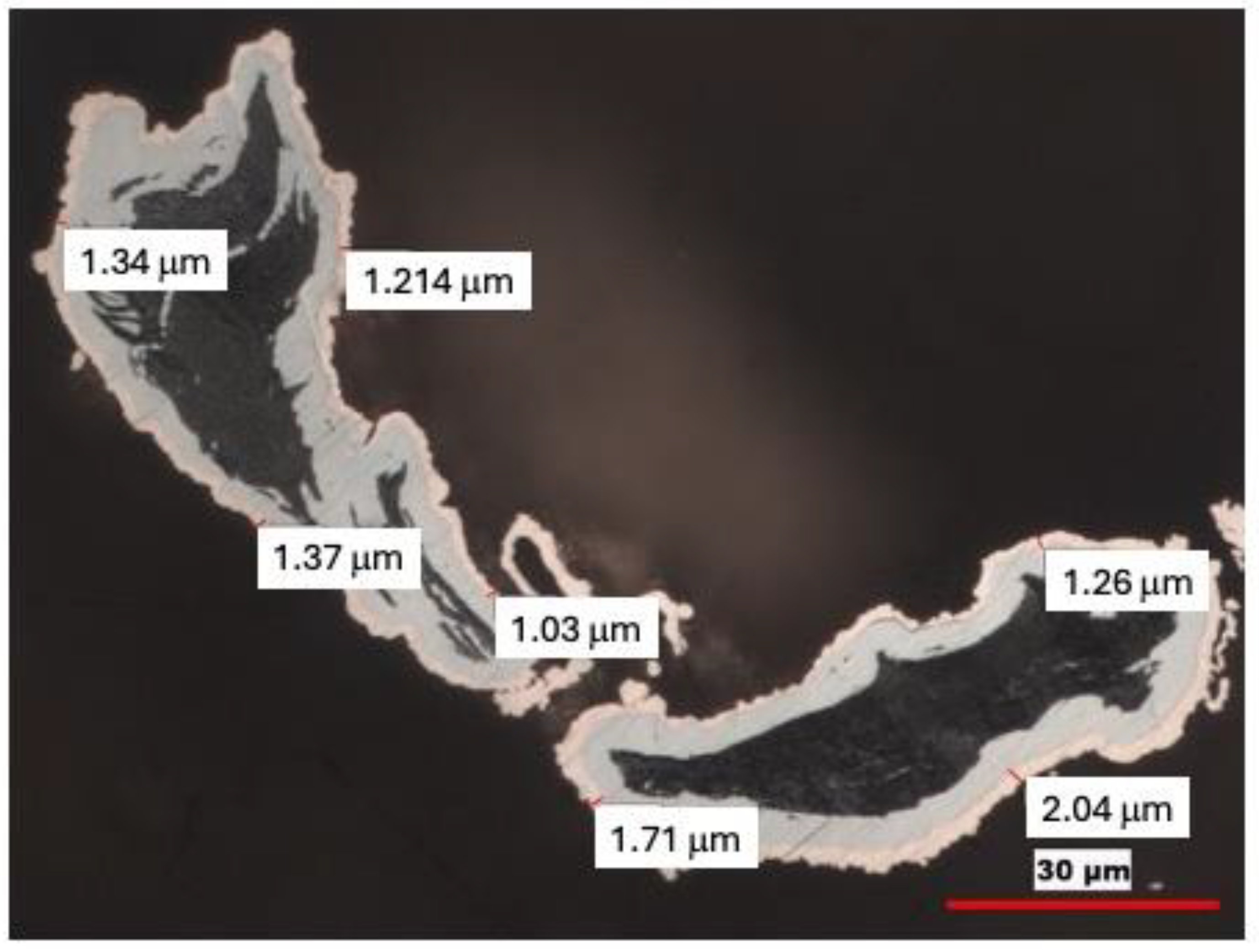
Figure 1 presents a typical micrograph of the cross section of graphite particles coated with nickel (inner layer) and copper (outer layer). The two coatings are clearly visible based on their color difference. Since the thickness of the two-layer coating is not exactly the same for all CNCGs, the thicknesses of the copper and nickel layers were measured at 100 different locations on more than 30 different CNCG particles. The results show that the average thickness of the nickel coating (2.21 ± 0.8 μm) was larger than that of the copper coating (1.09 ± 0.4 μm).
Carbon has a high propensity to diffuse into iron at elevated temperatures, meaning that sintering a powder mixture containing iron and graphite powder will result in the formation of different carbon-bearing microstructures depending on the amount of carbon and the cooling rate. Thus, unless large concentrations of elements that significantly increase the chemical activity of carbon in iron (e.g., silicon) are pre-alloyed in the iron powder, it is not possible to obtain a carbon-free microstructure surrounding free graphite particles by sintering an iron/carbon powder mixture. In this study, the goal of coating graphite particles with a metallic layer was to prevent the diffusion of carbon into the iron matrix in order to improve the machinability of PM steel components. As was shown above, the quality of the coating process in forming a continuous two-layer coating was examined, and it was concluded that the coating materials and process developed can yield a satisfying product. In order to determine the copper, nickel and especially the carbon content of the CNCG particles, it was necessary to measure their density. The density of the CNCG particles was measured by pycnometry and was found to be 6.18 g/cm3. Knowing the apparent density of the coated graphite particles, it was possible to estimate the graphite content of each CNCG particle and thus the graphite content of the powder mixture brought about by the addition of CNCG particles. For this purpose, two assumptions were made. First, it was assumed that the volume of a CNCG particle is equal to the summation of individual volume fractions of graphite, nickel and copper. Second, in order to simplify the equation, the densities of copper and nickel, which are 8.96 g/cm3 and 8.90 gr/cm3 respectively, were assumed to be the same and equal to 8.93 g/cm3. The density of graphite was taken as 2.2 g/cm3. In the following calculations, V G r   i n   C N C G ,   V N i   i n   C N C G ,   V C u   i n   C N C G are volume fractions and X G r   i n   C N C G ,   X N i   i n   C N C G ,   X C u   i n   C N C G are weight fractions of graphite, nickel and copper in a CNCG particle.
V G r   i n   C N C G + V N i   i n   C N C G + V C u   i n   C N C G = V C N C G  
X G r   i n   C N C G ρ G r + X C u   i n   C N C G ρ C u + X N i   i n   C N C G ρ N i = 1 ρ C N C G  
X G r   i n   C N C G ρ G r + X C u   i n   C N C G + X N i   i n   C N C G ρ ¯ C u N i 1 ρ C N C G
X G r   i n   C N C G ρ G r + 1 X G r   i n   C N C G ρ ¯ C u N i 1 ρ C N C G     X G r   i n   C N C G 0.16
According to these calculations, approximately 16% of the weight of a CNCG particle corresponds to its graphite core and the rest, 84%, corresponds to the nickel and copper layers. Thus, it can be concluded that the addition of 1.75 wt% of CNCG particles to the iron powder resulted in a powder mixture containing 0.28 wt% of graphite, which is equivalent in terms of volume fraction to 0.5 wt% of MnS, which is an unofficial standard in the PM industry.
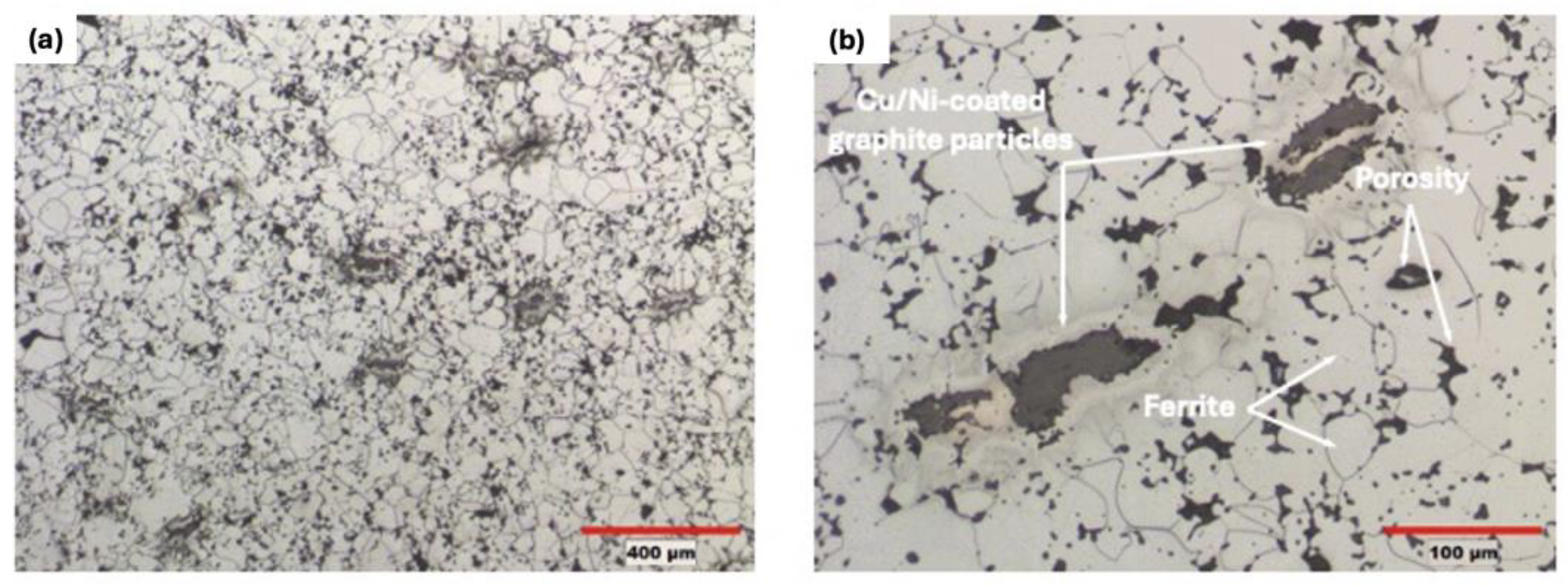
A preliminary test was carried out to determine the efficiency of the coating in preventing carbon diffusion during sintering. Thus, TRS bars made from a premix containing pure iron and 1.75 wt% of Cu-Ni-coated graphite particles were compacted and sintered using conventional sintering conditions, i.e., 1120 °C for 30 min. Figure 2 shows optical micrographs of the sintered samples. As can be seen, a carbon-free microstructure surrounds the CNCG particles, which means that the coating layer worked as expected. In the other words, if the coating layer had not prevented graphite from diffusing into the iron matrix, a microstructure containing pearlite would have been formed in the iron matrix. According to the iron/carbon phase diagram and the lever rule, for a carbon content of 0.28 wt%, the microstructure should have contained almost 67 wt% ferrite and 33 wt% pearlite. However, as shown in Figure 2, no pearlite is visible in the microstructure of the sintered part containing CNCG particles, and consequently these particles are contained within a matrix made only of ferrite. The higher-magnification micrograph (Figure 2b) shows the graphite particle perfectly encapsulated in the coating layer. Figure 2b also shows that metallurgical bonds were formed between CNCG particles and the iron matrix during sintering.
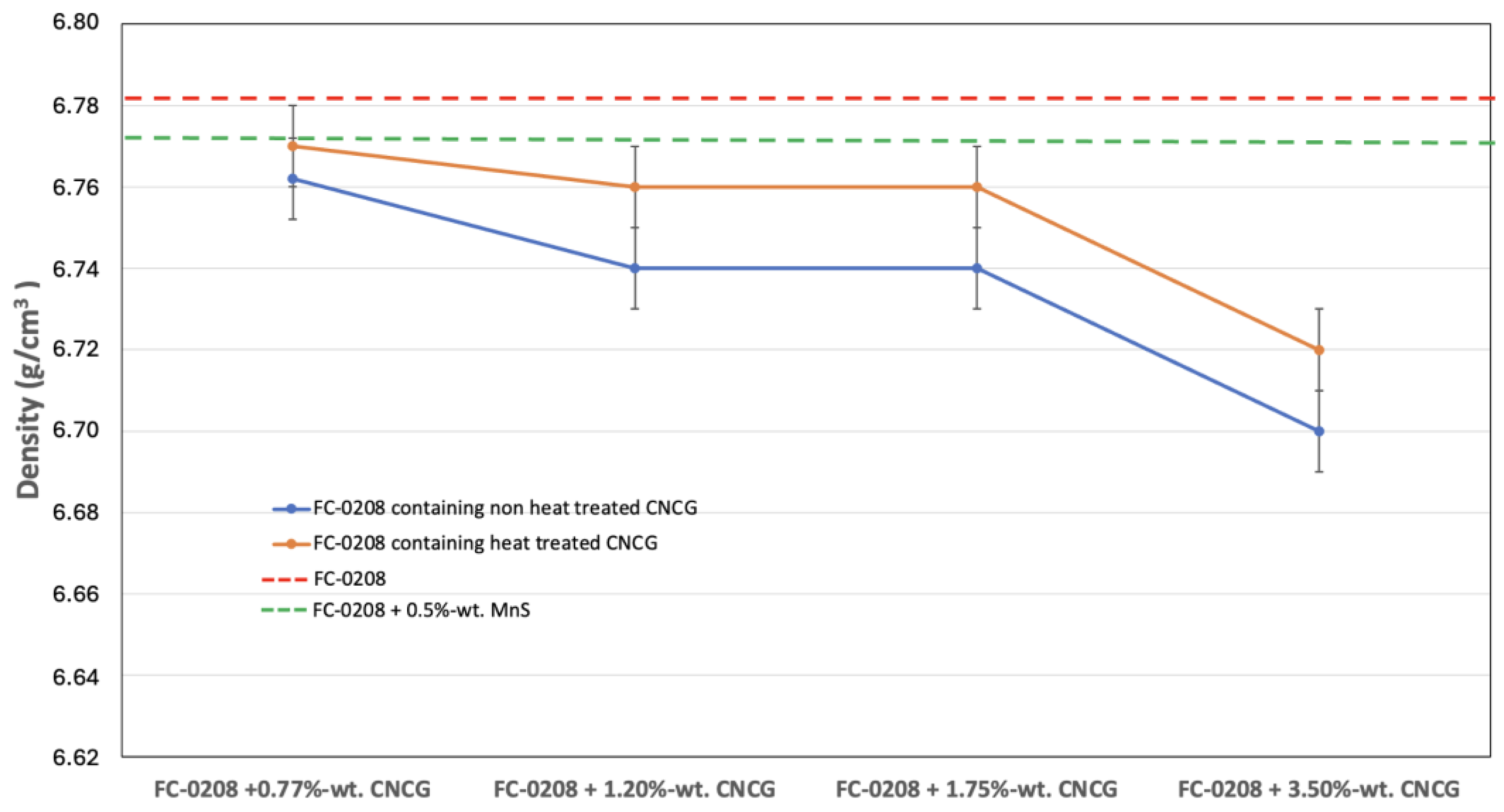
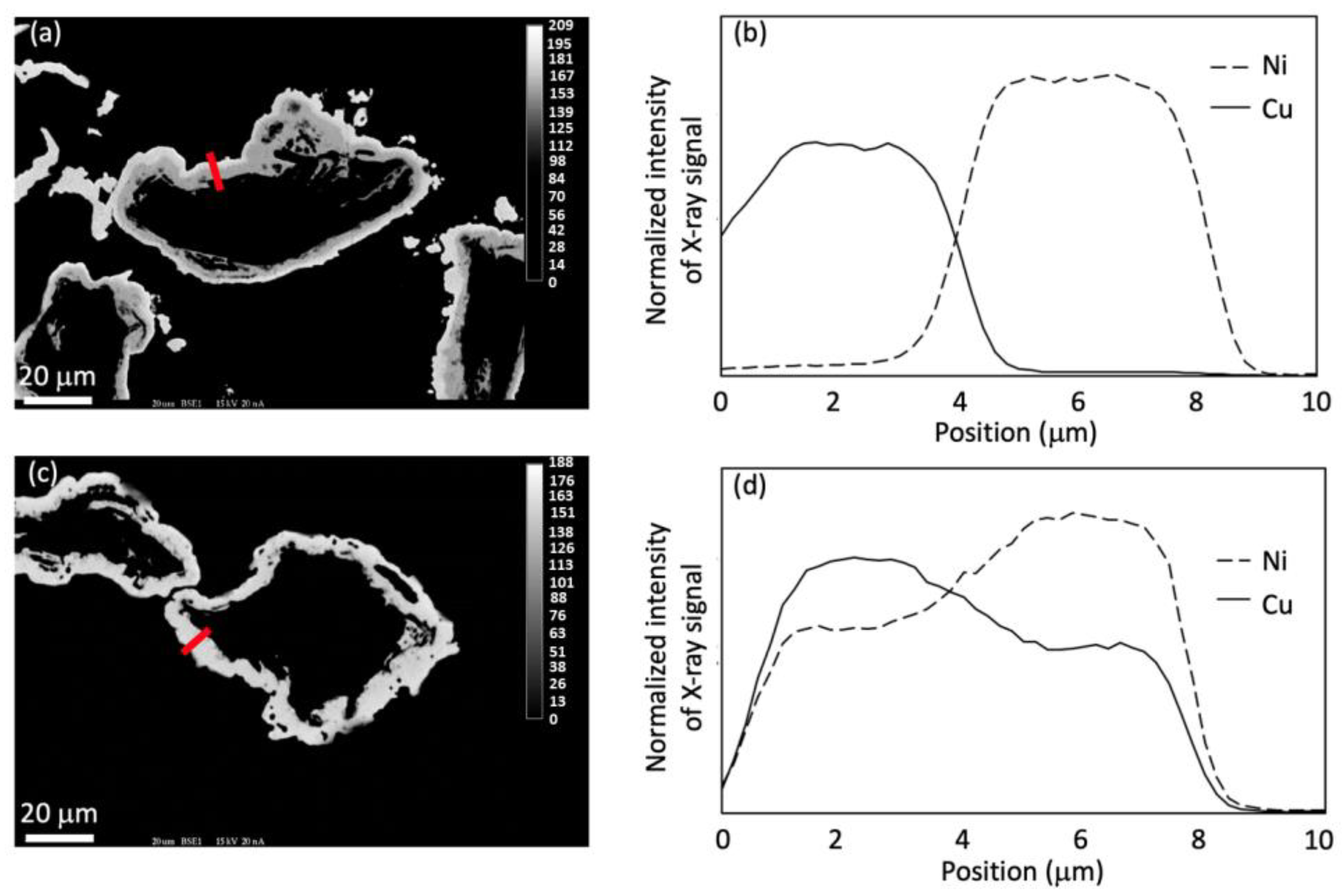
The measurement results for the sintered density of specimens prepared with FC-0208 premixes containing varying weight fractions of CNCG particles are presented in Figure 3. It can be seen that the swelling of the specimens, or the reduction in density, is significantly more important than what is typically observed for parts made from an FC-0208 premix or even parts made from an FC-0208 premix containing 0.5 wt% of MnS. In order to decrease swelling during sintering of the FC-0208 parts containing CNCG particles, it was decided to heat-treat the CNCG particles at 700 °C for 1 h in an atmosphere of argon followed by slow cooling in the furnace. The idea was to homogenize the spatial distribution of Ni and Cu in the coatings instead of having two distinct layers. Figure 4 presents cross sections of CNCG particles before (non-heat-treated or NHT) and after heat treatment (HT). As can be seen in the micrographs and the accompanying chemical composition profiles, the heat treatment performed on the CNCG particles helped homogenize the chemical composition of the coatings, since no distinct interface is visible after HT (compare Figure 4a and Figure 4c). The effect of HT on dimensional change is visible in Figure 3, where it can be seen that the homogenization of the chemistry of the metallic coating deposited at the surface of the graphite particles reduced swelling during sintering, bringing dimensional change to values similar to those measured when 0.5 wt% of MnS was admixed with FC-0208 premixes. Obviously, more work is required to determine the effect of varying the thickness of nickel and copper layers on the dimensional change in FC-0208 PM steels. Nevertheless, it can be anticipated that these parameters could be modeled in terms of sintering temperature, residual oxygen content in powder, targeted combined carbon, cooling rate, etc. and tailored to reach specific dimensional changes after sintering.
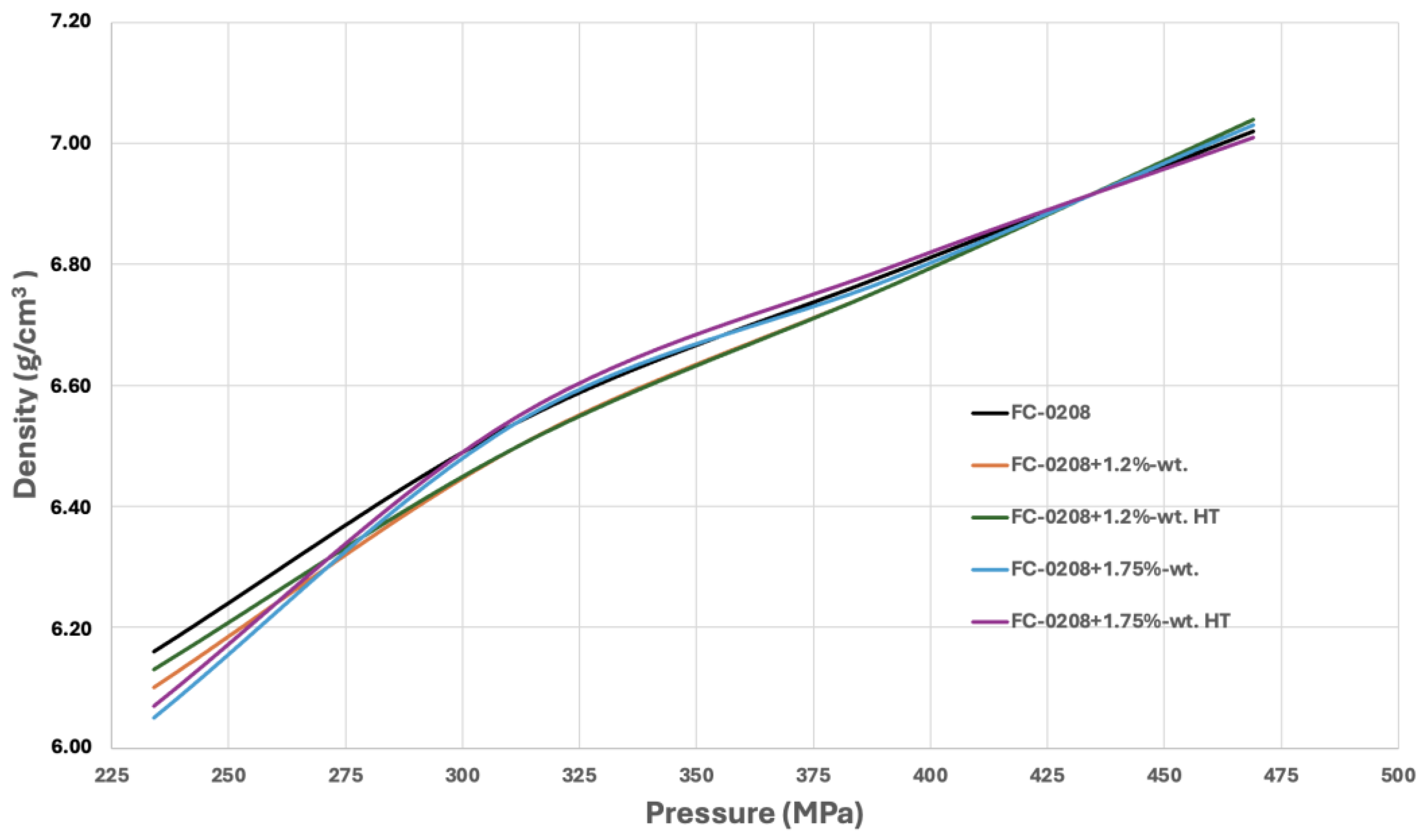
In order to study the effect of CNCG particles on the compressibility of the powder mixture containing different volume fractions of additives, compressibility tests were performed according to MPIF standard 45 [17]. Figure 5 shows the compressibility curve for the parts made from FC-0208 premixes without additives and containing different weight fractions of heat-treated and non-heat-treated CNCG particles. As can be observed, at low compaction pressures, increasing the number of CNCG particles leads to a slight reduction in green density, which can be explained by the lower density of the CNCG particles compared to the apparent density of the base powder. However, it can be said that the powder mixtures containing different amounts of CNCGs show similar compressibility, and the required pressure to reach a green density of 6.8 g/cm3 is within 2.5% of that of the powder mixture without additives.

3.1. Characterization of Quasi-Static Mechanical Properties

In order to study the effect of CNCG particles on the quasi-static mechanical properties of copper PM steels, TRS measurements and tensile tests were performed on samples containing different weight fractions of CNCG particles in both the NHT and HT conditions. Moreover, specimens made from FC-0208 without additives as well as FC-0208 specimens containing 0.5 wt% of admixed MnS were characterized to provide a reference with which to compare our results.

3.1.1. Transverse Rupture Strength (TRS)

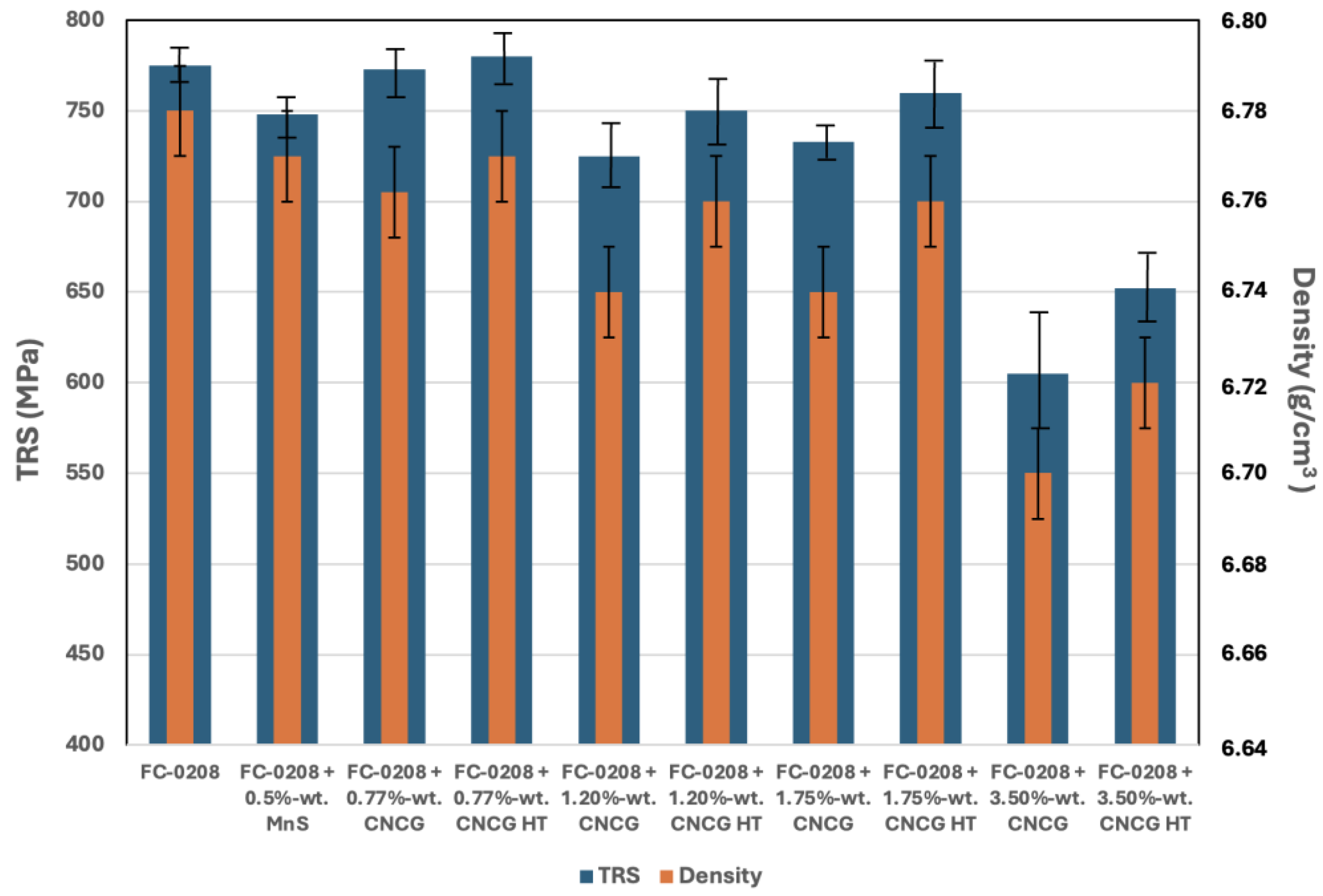
Figure 6 shows the TRS values as well as the sintered density obtained for the ten different FC-0208 premixes initially considered in this study. The abbreviations NHT and HT stand for non-heat-treated and heat-treated CNCG particles, respectively. As can be seen, the TRS values of the samples containing up to 1.75 wt% of either non-heat-treated or heat-treated CNCGs are very similar to those of samples without additives, i.e., FC-0208, in that their maximum difference is only 6% (for specimens containing 1.2 wt% non-heat-treated CNCGs). A Welch’s t-test showed that the population means are not significantly different at the 5% significance level. The difference in sintered densities between samples containing CNCGs and samples without additives is most likely the main reason for the difference observed in their TRS values, especially when the additives are non-heat-treated and/or in concentrations larger than 1.75%-wt. Indeed, Danninger et al. [18] clearly demonstrated that a reduction in sintered density results in a lower effective load-bearing cross section and thus lower mechanical properties. In other words, TRS values are in direct relationship with the sintered density of the specimens. This relationship can also be seen by comparing the TRS values of samples containing the same volume fractions of heat-treated and non-heat-treated CNCG additives. As previously explained, non-heat-treated particles cause a more significant decrease in the sintered density, which consequently resulted in lower TRS values compared to the samples with heat-treated additives. It can also be seen that in some cases, such as the samples containing 1.75 wt% of heat-treated CNCG particles, the sintered density is lower than that of samples without additives. Nevertheless, the lower density did not result in lower TRS values. Similarly, comparison of the TRS values of specimens containing 0.5 wt% MnS with those of specimens containing CNCG particles at the same sintered density, i.e., FC-0208+0.77 wt% HT CNCGs, shows that the latter series is significantly superior. Therefore, it can be concluded that for a given density, the CNCG additive, either in the heat-treated or non-heat-treated condition, does not deteriorate the mechanical properties of PM steel components but rather improves them. This situation is most likely due to the strengthening effect of nickel and copper from the additive, which partially diffuse in the surrounding steel matrix, increasing its strength, while at the same time promoting the formation of metallurgical bonds at the interface between the steel matrix and the CNCG additive. Finally, Figure 6 shows that increasing the amount of non-heat-treated or heat-treated CNCG particles to 3.5 wt% significantly reduces the sintered density and thus reduces TRS values by 20%. For this reason, this premix will not be considered in the remainder of this manuscript.

3.1.2. Tensile Properties

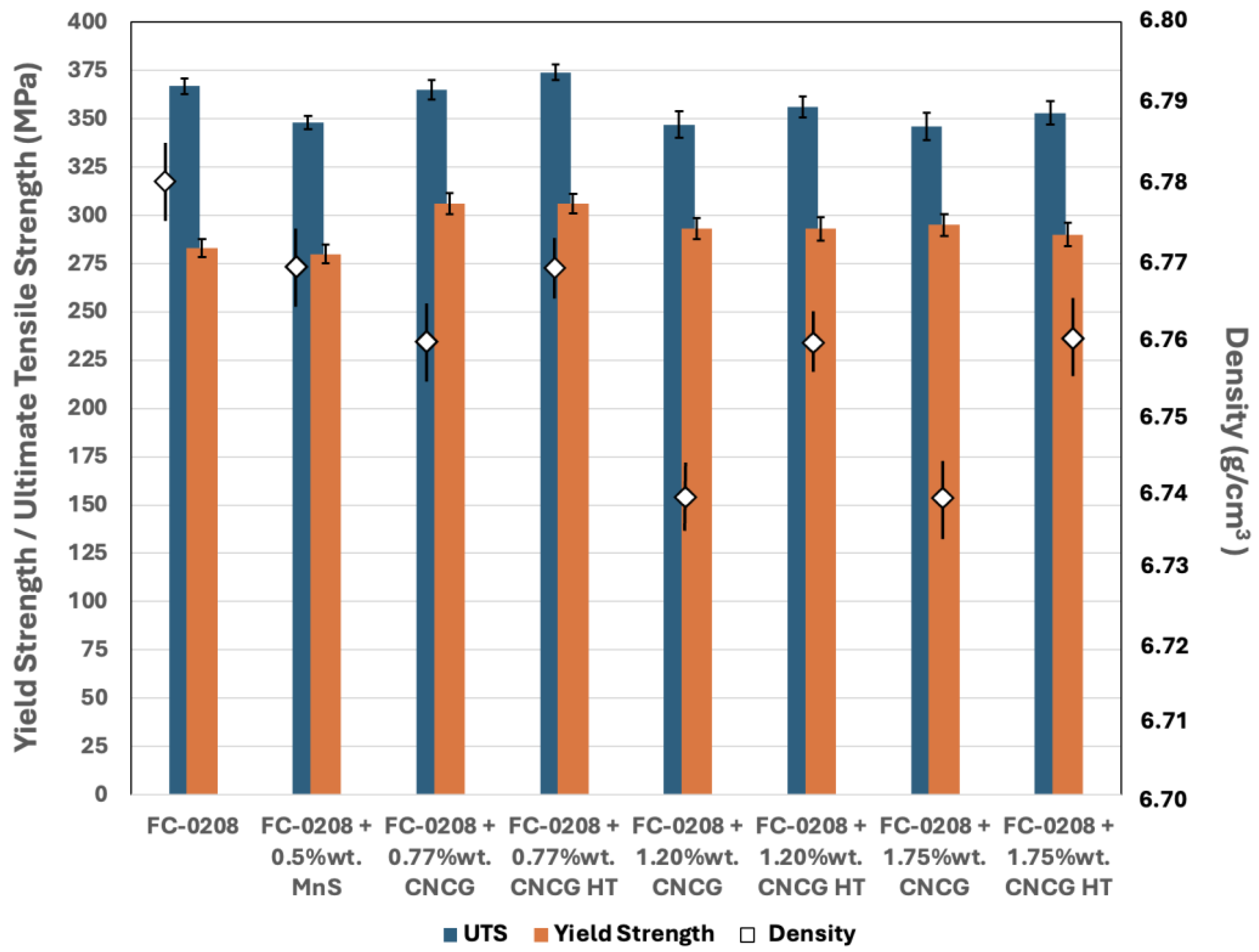
The ultimate tensile strength (UTS) values of samples containing different weight fractions of non-heat-treated or heat-treated CNCG particles, as well as samples without additives and with 0.5 wt% MnS, are presented in Figure 7. The trend of variation in UTS closely follows that observed for TRS (Figure 6). For the premix containing 0.77 wt% CNCG particles, the tensile properties are improved compared to specimens made from FC-0208 without additives or with 0.5 wt% MnS, with the improvement being more pronounced when the CNCG particles are heat-treated. Increasing the CNCG content above 0.77 wt%, regardless of heat treatment, results in a slight reduction in tensile strength. Nevertheless, the yield strength values remain higher than those of the reference materials (FC-0208 without additives and FC-0208+0.5 wt% MnS).
For the series containing 0.77 wt% CNCGs, a two-sample Welch’s t-test confirmed that the UTS values are not statistically different from those of the reference material, indicating that the observed improvements are statistically consistent. Similarly, although the maximum UTS values were obtained with specimens containing 0.77 wt% CNCGs, the UTS remains statistically comparable to that of the reference material when considering the limits of experimental uncertainty. This observation is particularly significant when considering specimen density. As widely reported in the literature, the tensile properties of PM steels generally decrease with decreasing density due to reductions in load-bearing cross sections and increases in stress concentration sites [19,20].
However, the results presented in Figure 7 demonstrate that parts made from premixes containing various weight fractions of CNCG particles exhibit tensile properties equal to or, in several cases, better than those of FC-0208 or FC-0208+0.5 wt% MnS, despite their significantly lower density, as confirmed by the two-sample Welch’s t-test. This behavior is attributed to the formation of strong metallurgical bonds between CNCG particles and the steel matrix during sintering (Figure 2), which compensate for the reduced density and result in enhanced tensile performance. Such bonding is absent, or at best marginal, when MnS is added to a PM steel premix to improve machinability. In the case of specimens from the FC-0208+1.75% CNCG HT series, Welch’s t-test indicates that there are no statistical differences between their tensile properties and those of FC-0209+0.5 MnS.
As shown in Figure 7, the addition of 0.5 wt% MnS slightly reduces tensile strength, which is attributed to the weak interface between MnS as a non-metallic inclusion and the metallic matrix. The effect of MnS on mechanical properties has been studied extensively and the literature on the subject is significant. Nevertheless, no unique conclusion has been reached as to its quantitative effect on the mechanical properties of PM steels. As a rule of thumb, it can be said that addition of MnS up to 0.5 wt% does not reduce the mechanical properties too severely, i.e., it results in a decrease of approximately 10%, which is in agreement with the results shown in Figure 7.

3.2. Fatigue Resistance

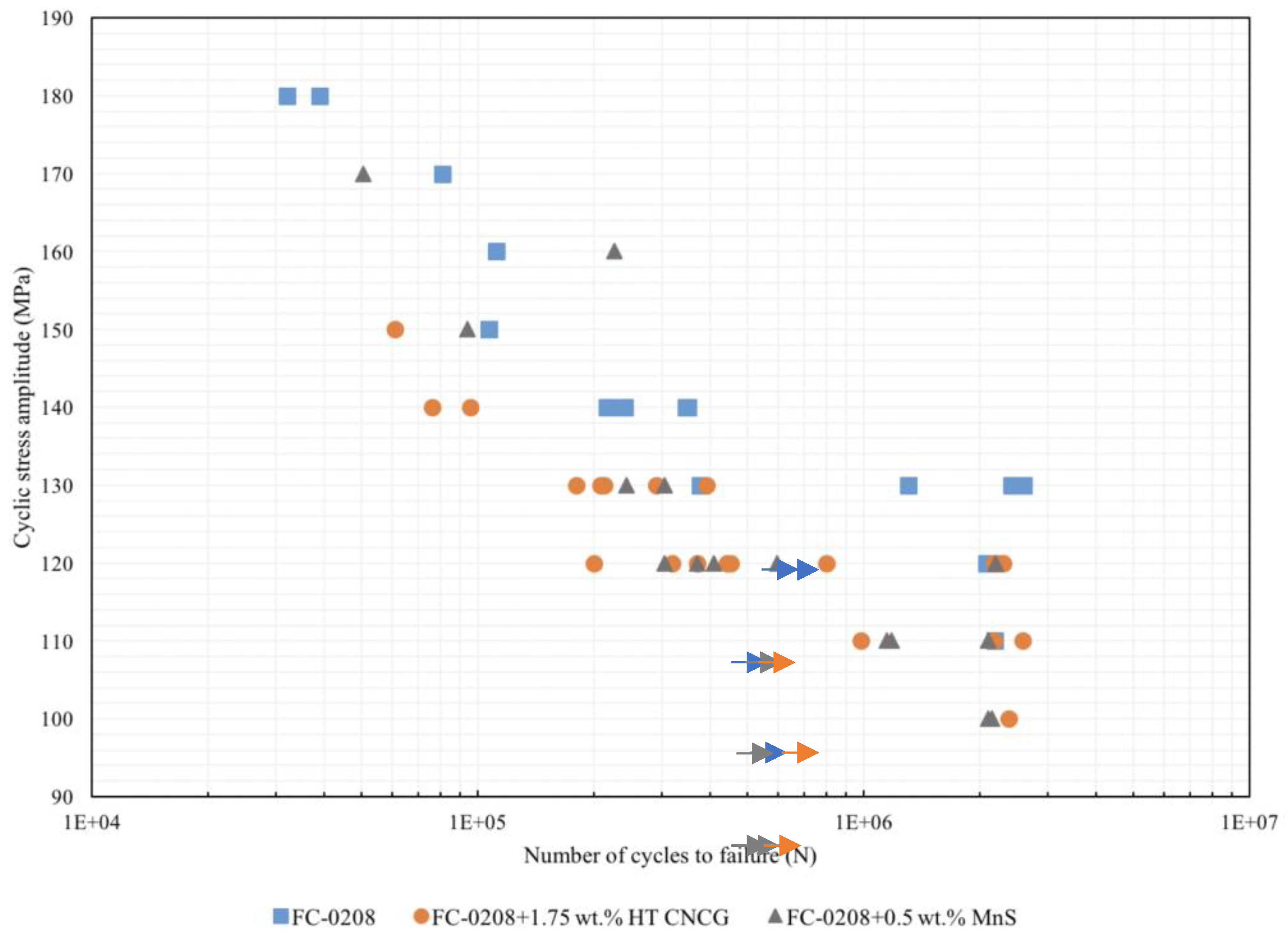
Figure 8 shows the S-N curves of the FC-0208 specimens without additives, those containing 1.75 wt% of heat-treated (HT) CNCG particles and those containing 0.5 wt% MnS. It is important to note that the weight fraction of machinability-enhancing additives added to each premix was selected in order to obtain an identical volume fraction of particles in the sintered microstructures. In this study, samples that survived 2,000,000 cycles were considered to have infinite fatigue endurance. The endurance limits of each series of specimens are presented in Table 2. As shown, an addition of 1.75 wt% CNCG particles slightly decreases the endurance limits at 50% and 10% survivals compared to the samples without additives, while the 90% survival endurance limit is almost the same. Since the endurance limits of samples containing CNCGs at 50% and 90% survival levels fall within the range of experimental errors for the samples without additives, it can be said that the fatigue resistance is not affected significantly by the addition of CNCG particles. According to Table 2, the reduction in the endurance limit caused by the addition of MnS particles is slightly greater than that of CNCGs. Nevertheless, the standard deviation of the latter series of specimens overlaps sufficiently with those of the other series of samples, such that a quantitative conclusion as to the existence of significant differences cannot be reached.
It is shown in Figure 3 that the addition of CNCG particles causes a reduction in the sintered density. Based on the fact that density is the most critical parameter influencing the fatigue resistance of PM parts, the most probable reason for the apparent lower endurance limit of the samples containing CNCGs compared to samples devoid of additives is most certainly related to their lower density. Although each series of specimens was pressed to the same green density, i.e., 6.8 g/cm3, the swelling caused by the CNCG particles resulted in an almost 0.4% lower sintered density compared to the samples without additives. A decrease in density, i.e., an increase in the volume fraction of porosity, lowers the endurance limit of a PM component [21]. According to MPIF standard 35 [11], a decrease in the density of an FC-0208 sample from 7.2 g/cm3 to 6.7 g/cm3 reduces the fatigue limit at 90% survival by almost 40%. Assuming a linear relationship between density and fatigue limit, it can be said that the 0.4% reduction in the density of the samples containing heat-treated CNCGs reduces the endurance limit by 4%, which is in the same range of values as the 7% reduction in the endurance limit shown in Table 2.

3.3. Humidity Adsorption Measurement of CNCG Powder

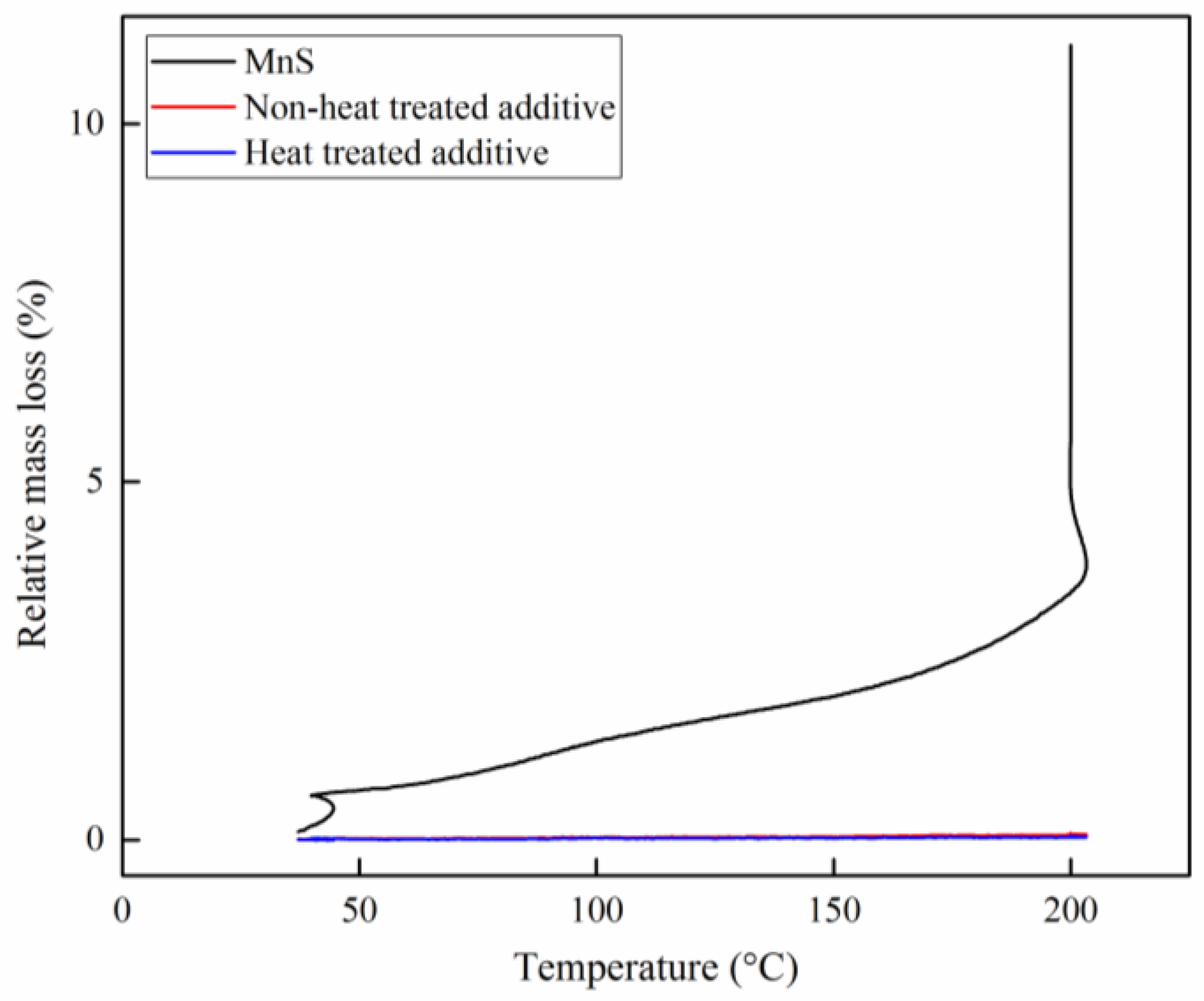
The chemical stability of a machinability-enhancing additive with respect to its environment or the constituents of a sintering atmosphere is an important concern for PM part manufacturers. Any reaction between the additive and its surroundings during the manufacturing process or storage can be detrimental due to a change in the physical state and/or chemical composition of the additive. It is well documented that one of the main disadvantages of MnS as a machining aid is its strong propensity to adsorb moisture present in air [6]. In order to compare the propensity of humidity adsorption between CNCGs and MnS powders, thermal gravimetric analysis (TGA) was performed on the powders that had been stored in a closed vessel, where a relative humidity of 70% was kept constant for 14 days. The outcome of a TGA is the relative variation in the weight of a sample of particles as its temperature increases. Figure 9 shows the relative mass loss of the three samples studied, i.e., non-heat-treated CNCGs, heat-treated CNCGs and MnS powders, as a function of increasing temperature.
As shown in Figure 9, the mass loss results for the CNCG particles, whether heat-treated or not, are quite different from those for the MnS powder. While MnS shows almost 12% relative mass loss during the heating process, the weight variation of CNCG particles is approximately null. According to the fact that, unlike other sulfides such as MoS2, MnS is chemically stable in a dry atmosphere, even at high sintering temperatures, the weight loss at relatively low temperatures shown in the TGA plot can only be related to the desorption of the moisture that was adsorbed during the two-week dwelling period in a high-humidity environment. The adsorption of a similar moisture content by MnS due to its hygroscopic characteristics was also reported by Salak et al. [22]. On the other hand, CNCG particles do not show any sign of moisture adsorption when placed in moist air for an extended period of time. The physical state of the CNCG particles after the two-week storage time was also unchanged and their appearance was the same as that before storage, whereas the MnS particles that were loose and powdery before the storage period turned to agglomerated lumps that could no longer be considered to prepare a premix. This latter characteristic of the MnS powder relates to a bigger problem, namely, that even heating moisturized MnS powder cannot restore it to its original state [23].

3.4. Corrosion Test

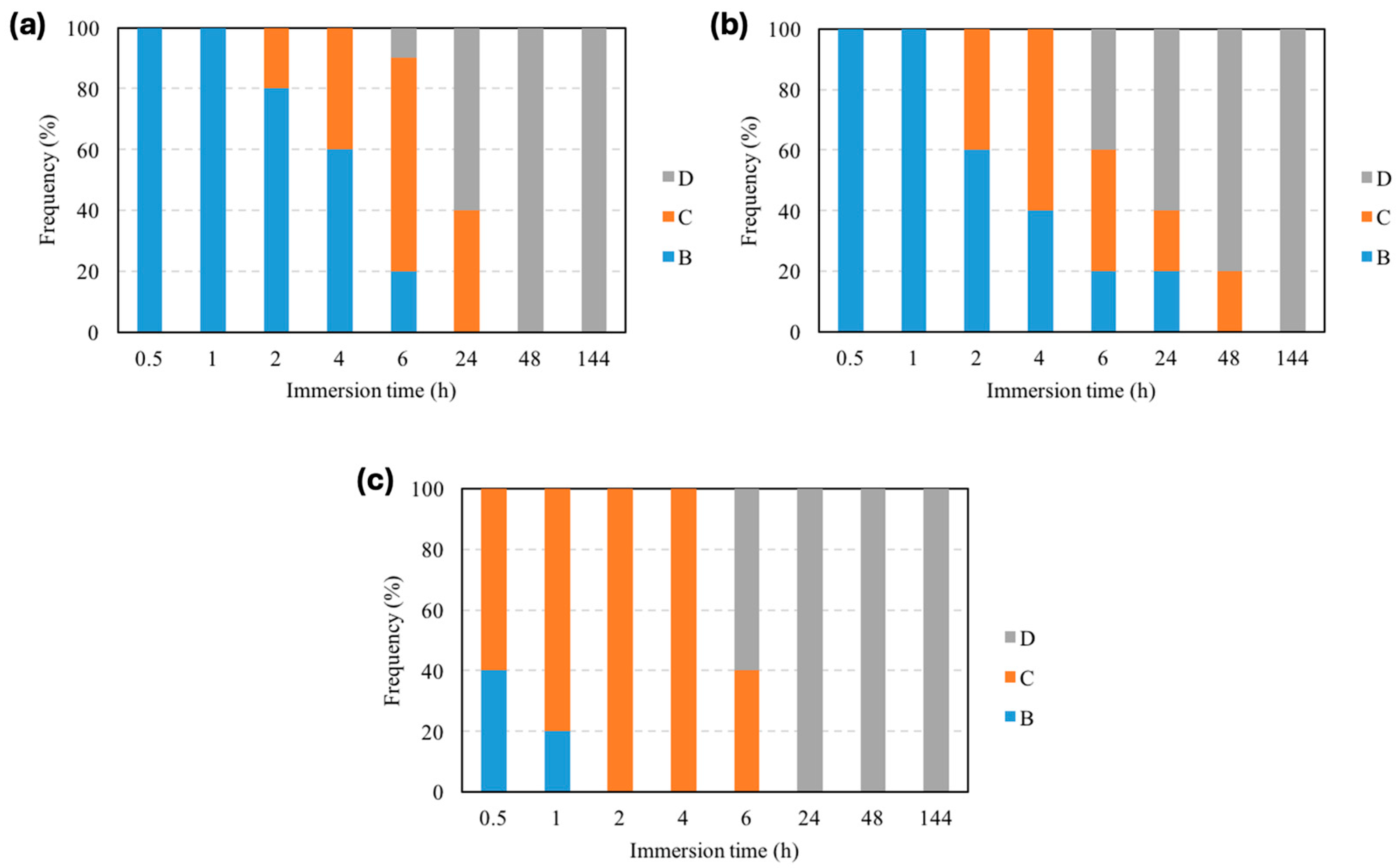
As discussed in the previous section, CNCG particles do not have a hygroscopic character. Thus, better corrosion resistance was expected for samples containing CNCG powders compared to those containing MnS. In order to compare the response of green and sintered specimens containing CNCG amd MnS particles, their corrosion resistance was evaluated based on the ASTM B-895 standard [16]. Figure 10 shows the level of corrosion of specimens from each series, i.e., those without additives, those containing 1.75 wt% heat-treated CNCG particles and those containing 0.5 wt% MnS particles, at different time intervals.
For all the specimens, and independently of their composition, corrosion started after 30 min of immersion and thus no sample can be ranked as exhibiting zero percent corrosion, i.e., level “A”. This is related to the fact that this test was originally designed to evaluate the corrosion resistance of PM stainless steel specimens. It can be said that the immersion medium, which was 5.0 wt% NaCl solution, is highly corrosive for PM copper steel, and thus the corrosion process started at the first moment of immersion. Nevertheless, a significant difference was observed between the samples containing MnS and those without additives or containing CNCG particles. While the FC-0208 samples without additives and those containing 1.75 wt% of CNCGs showed less than 1% of staining after 1 h of immersion, more than half of the MnS-containing samples presented noticeable surface fractions of stains, i.e., they were ranked “C” after the first 30 min of corrosion. In addition, all 10 specimens containing MnS had sufficient stains to be ranked “C” after 2 h of immersion. Moreover, after 24 h, 20% of the specimens containing CNCGs showed less than 1% of stains, whereas more than 25% of the surfaces of all the specimens containing MnS were stained. This difference in the response of the FC-0208 samples containing CNCG particles and those containing MnS can be explained by the difference in the tendency of these two additives to oxidize in the presence of water/water vapor. As was shown in the previous section, CNCG particles are not hygroscopic and thus they did not react with moisture either before addition to the powder mixture, i.e., in the storage stage, or as the additive in a sintered part. Contrary to CNCG particles, MnS is very sensitive to the presence of humidity (water vapor) in the environment and gets oxidized, transforming into manganese oxide or complex oxysulfides [4].

3.5. Characterization of Machinability in Drilling

3.5.1. Tool Wear Measurement

Based on the fact that there is no universally adopted criterion for characterizing the machinability of a given material, tool wear in drilling was used to evaluate the performance of the newly developed additive in increasing the machinability of FC-0208 PM steel components. Improved machinability leads to lower cutting forces, lower tool/chip temperature and thus lower tool wear. The two most significant types of wear manifestations on a cutting tool are flank and crater wear. Nevertheless, the only acceptable type of wear is the former because it can be easily related to the dimensional accuracy of the workpiece and it is also predictable [24]. In this study, the flank wear of the drill bits was measured via optical microscopy at different time intervals during machining. In order to have a sufficient level of tool wear to make significant comparisons, relatively severe drilling parameters were selected, as presented in Table 3.
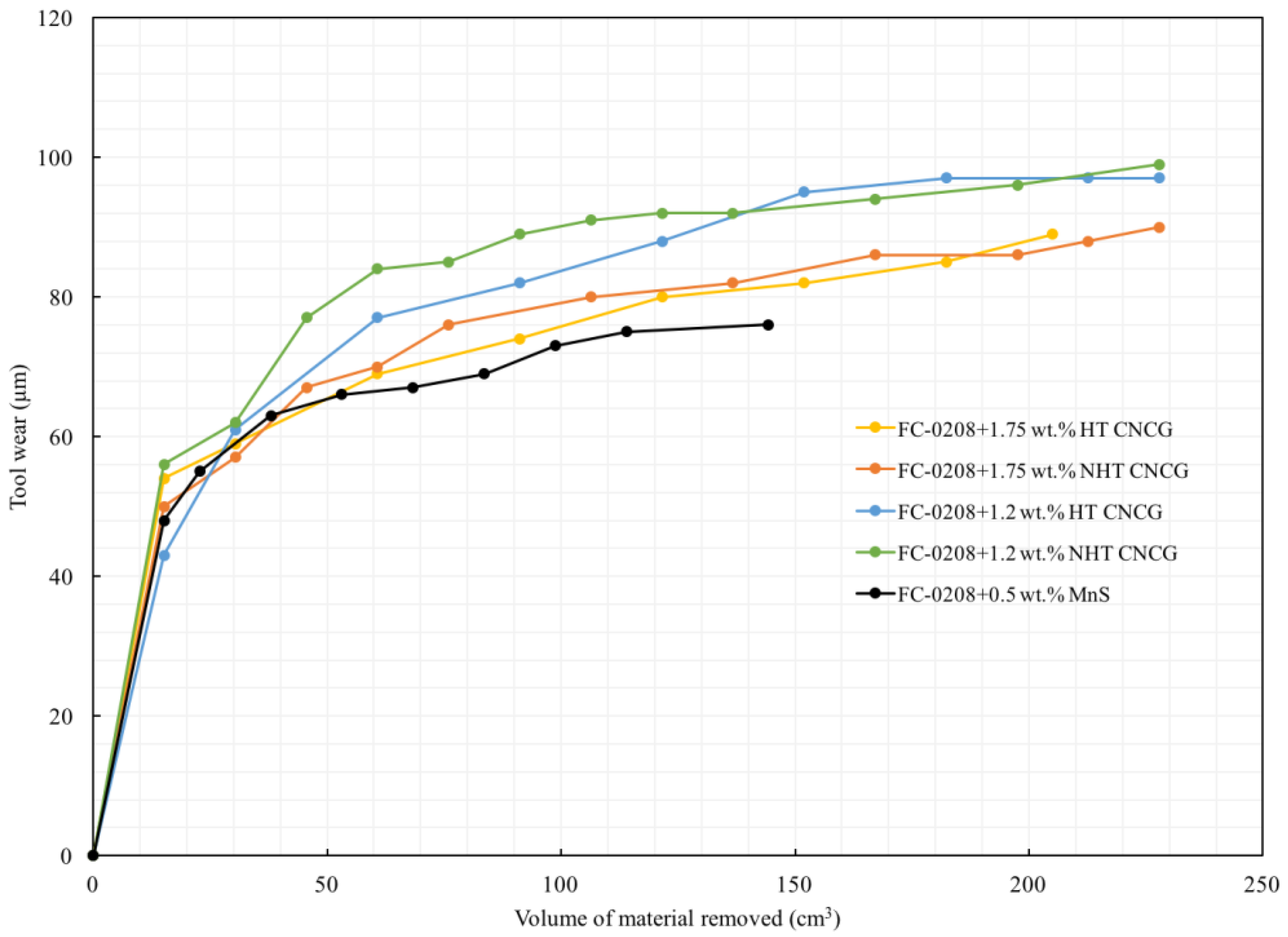
Figure 11 shows the evolution of flank wear as a function of the volume of material removed for five different series of specimens, i.e., specimens containing 0.5 wt% (0.85 vol%) MnS, specimens with 1.2 wt% (0.57 vol%) non-heat-treated and heat-treated CNCGs, and specimens with 1.75 wt% (0.85 vol%) non-heat-treated and heat-treated CNCGs.
Figure 11 shows that the rate of flank wear was similar for all series of specimens studied. As mentioned above, drilling tests were performed until either tool wear reached a critical length of 380 microns (0.015 in) or no machinability test specimens remained. According to Figure 11, none of the five compositions reached the critical value established for flank wear.
As was explained before, in order to compare the effect of different types of additives on machinability, the volume fraction of additives should be the same. Since the volume fraction of graphite in 1.75 wt% CNCGs is equal to the volume fraction of 0.5 wt% MnS, the effect of CNCG and MnS particles on machinability can be directly compared. As presented in Figure 11, the wear of the tool used to cut the specimens containing 1.75 wt% of CNCG particles is very similar to that of the drill used to machine those containing 0.5 wt% of MnS. In other words, the same volume fraction of MnS and CNCGs in the copper PM steel specimens causes approximately the same level of tool wear, and the additive developed in this study, i.e., CNCGs, performs as well as MnS. Another interesting point that can be taken from Figure 11 is that heat treatment of the CNCG particles does not affect their efficiency with respect to improving machinability. Nevertheless, as was shown in Figure 6 and Figure 7, the heat treatment of the CNCG particles improved the mechanical properties of the specimens. The effect of the weight fraction of CNCGs on tool wear can also be seen in Figure 11. Increasing the volume fraction of CNCGs either in the form of non-heat-treated or heat-treated particles reduces tool wear, which is also another proof of the positive effect of CNCG particles on machinability.

3.5.2. Chip Morphology

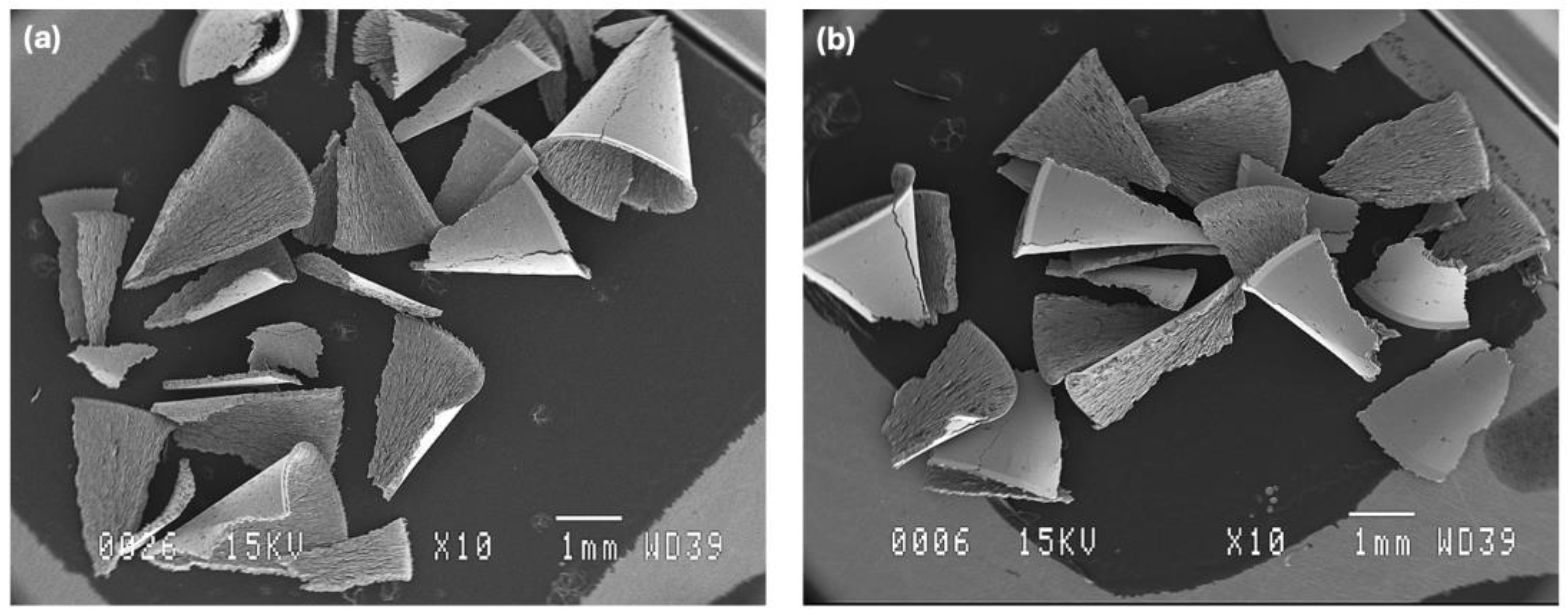
The size and shape of chips are generally affected by the characteristics of the workpiece material as well as machining conditions. Thus, under the same machining conditions, any difference in the shape and size of chips is most probably related to the material characteristics. Figure 12 presents SEM micrographs of chips collected after drilling 48 holes in samples containing 1.75 wt% heat-treated CNCGs and 0.5 wt% MnS. There are no noticeable differences in chip morphology between the two series of specimens. This observation indicates that both additives have the same effect on chip formation.

3.5.3. Analysis of Hole Diameter and Circularity Variation

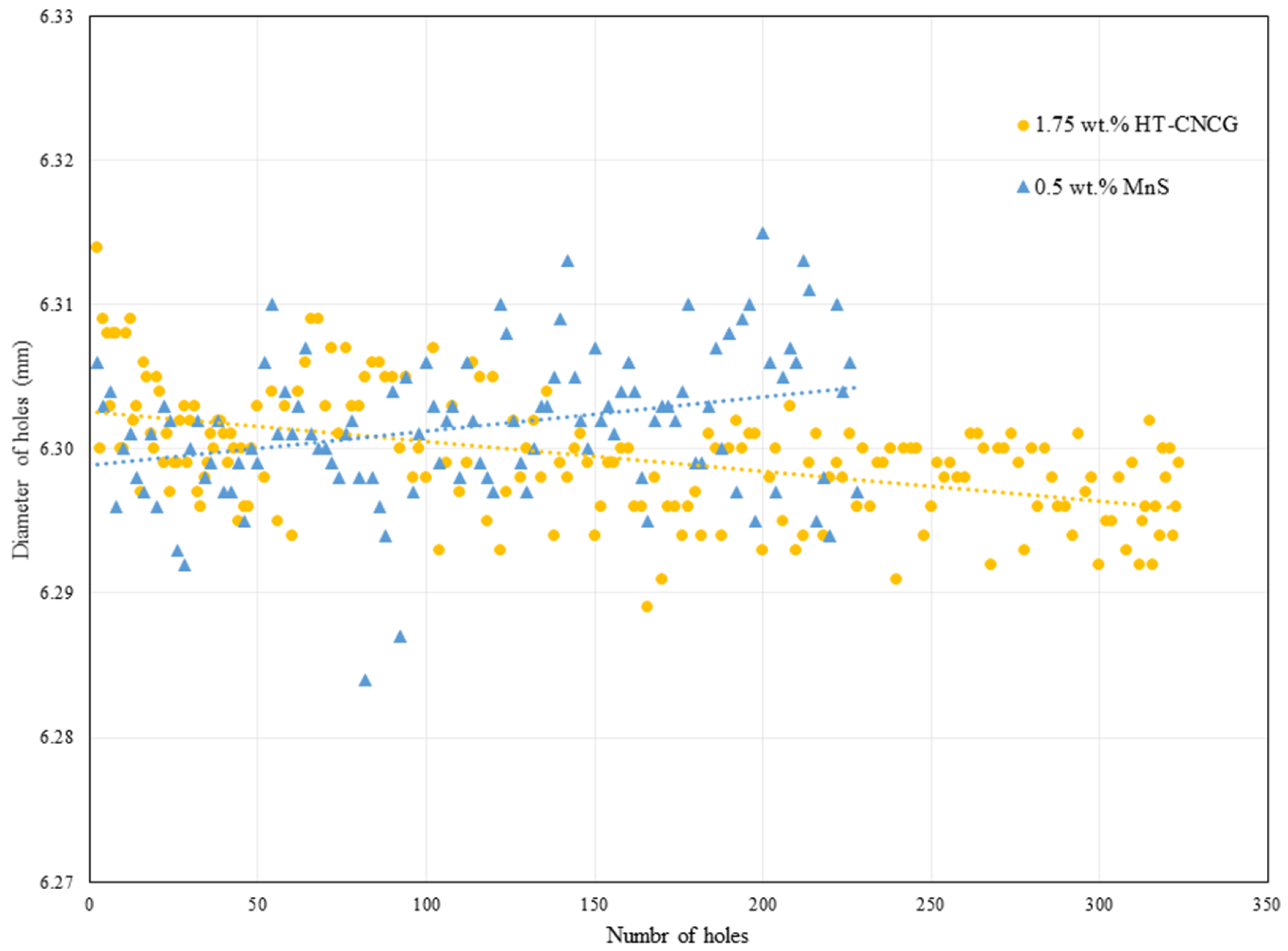
In addition to increased tool life, a tight and predictable dimensional conformance is another essential requirement in machining operations. Thus, assessing dimensional stability is of high importance. In this study, a Coordinate Measuring Machine (CMM) was utilized to measure the variation in hole diameter for 50% of all the holes drilled in each series of specimens. The trend of variation in hole diameter can be related to wear mechanisms, whereas variation in hole diameter is more closely related to dimensional stability. For instance, a well-defined decreasing trend indicates uniform tool wear, while an increasing trend coincides with adhesive wear, i.e., welding of the materials to the surface of the tool, which was also reported by Borgonovo & Lindsley [25]. Figure 13 shows the variation in the difference between the measured diameter and the diameter of a new drill, which is known as the diameter error. In order to compare the trend of variations, a line was fitted for each set of data points. As can be seen in Figure 13, in the case of samples containing heat-treated CNCG particles, the overall trend is decreasing, coinciding with the evolution of tool wear. In the case of samples containing MnS, the trend is quite different. By increasing the number of holes, the diameter error increases, which is not in accordance with the trend of tool wear. An increasing trend of diameter error variation is usually related to the adhesion of materials of the workpiece to the tool face due to the formation of a build-up edge. This phenomenon is common in the machining of resulfurized steels and will be discussed further in the next section. Thus, as the number of holes drilled increases, the thickness of the MnS layer most likely increases, leading to a continuous enlargement of the holes drilled.
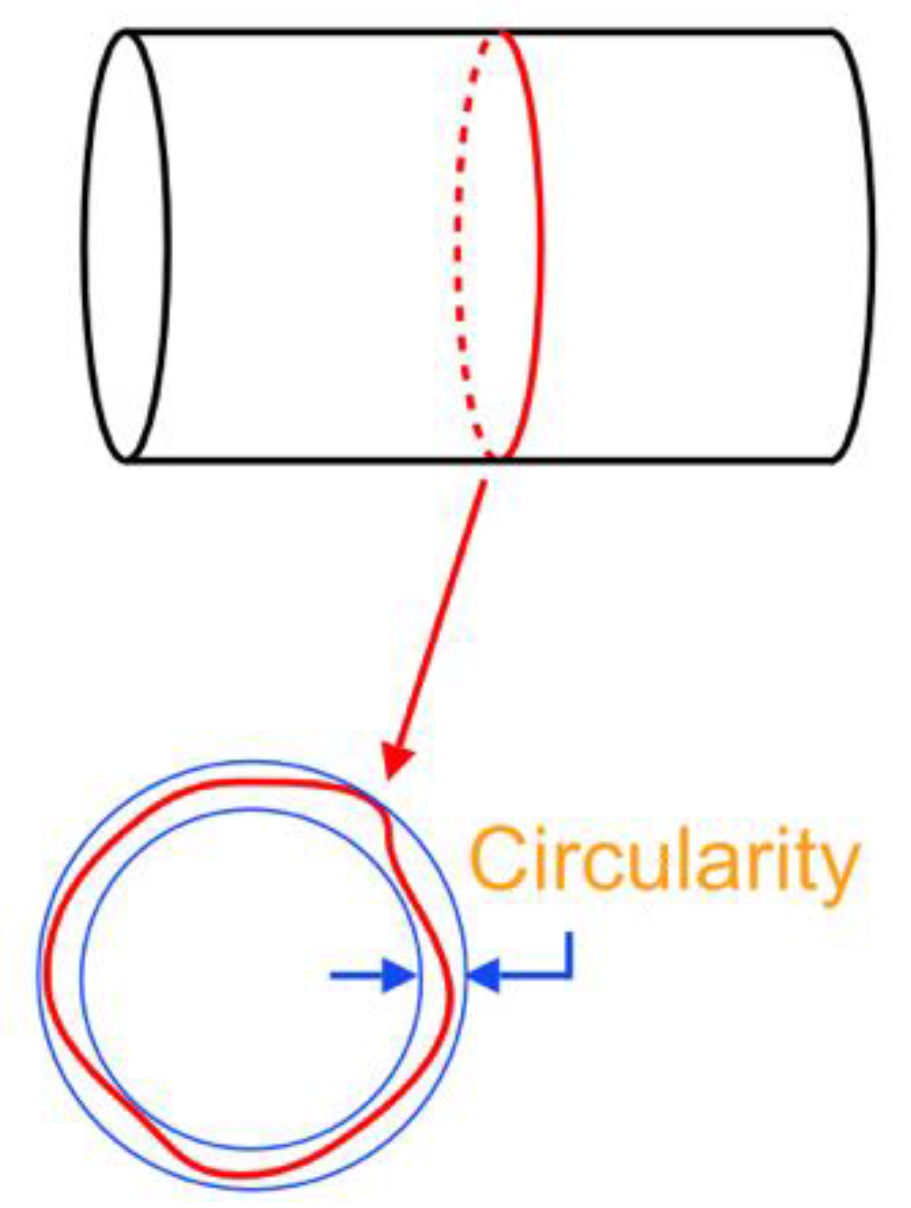
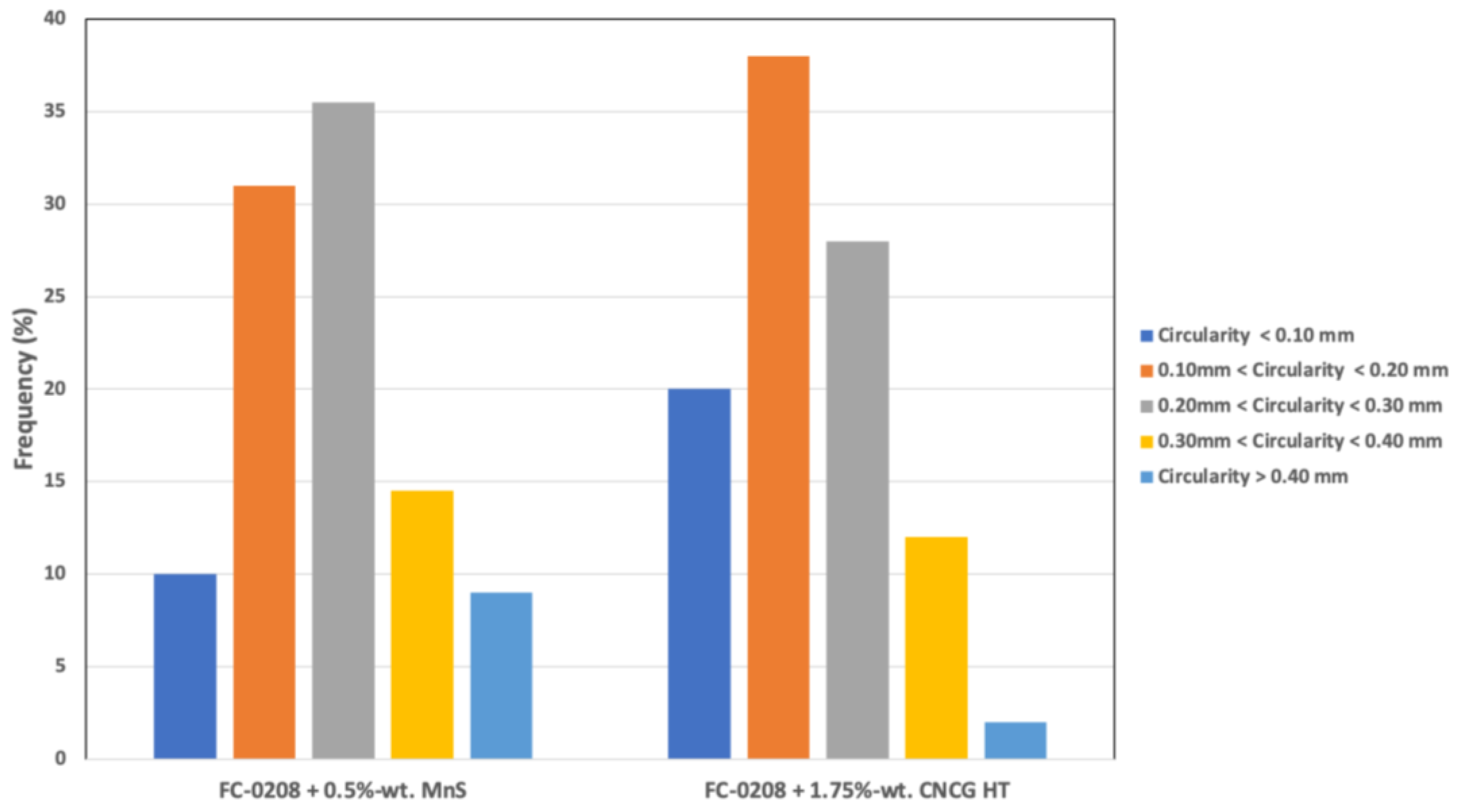
The circularity or roundness of holes is another important characteristic of the machining process. Circularity is a shape metric that can be used to verify whether all the elements of the cross section of a hole or a cylinder fall within two concentric circles, as shown schematically in Figure 14. Circularity describes how close the cross section of a hole is to a true circle [26]. The value representing the circularity of a hole is the difference between the radii of two concentric circles fitted to the cross section of the hole. Thus, the lower the circularity value, the closer the cross section of the hole to a perfect circle. Measurements required to characterize circularity were performed concomitantly with the measurements of diameter variation in 50% of the total number of holes drilled. Figure 15 shows the results of the circularity measurements for the machined samples containing 1.75 wt% heat-treated CNCG particles as well as samples containing MnS.
As can be seen in Figure 15 for samples containing the CNCG additive, the maximum frequency is for the range of circularity values between 0.004 and 0.008, whereas this maximum is shifted to larger circularity values (0.008–0.012) in the case of samples containing MnS. Moreover, the frequency for the lowest circularity range is also larger for the samples containing CNCG particles compared to the ones with MnS. This indicates the larger shape variation when MnS is used as a machining aid, which is most likely related to the adhesion of workpiece material to the tool face causing changes in the geometry of the cutting tool.

4. Discussion

It is well established in the wrought steel industry that MnS is one of the most effective additives for improving the machinability of ferrous alloys. However, its performance is significantly reduced when used to enhance the machinability of PM steels. This has prompted the development of alternative machinability-enhancing additives designed to address specific challenges encountered in the PM industry:
  • Oxidation Sensitivity: MnS is highly susceptible to oxidation when exposed to moisture, which negatively impacts the machining performance of PM steels. Although proper storage of MnS powder can prevent degradation when kept as loose powder, oxidation becomes problematic when green parts are stored on the plant floor before sintering or when sintered parts are stored for extended periods before machining. To be effective, PM steel parts containing MnS must be pressed, sintered, and machined within a narrow time frame to prevent the reaction of MnS with humidity. This limits the predictability and reliability of MnS in improving machinability.
  • Corrosion Issues: MnS particles in PM steels accelerate the corrosion rate of finished parts. Even when the time for compaction, sintering, and machining is minimized, the parts remain prone to accelerated corrosion, which is unacceptable to end-users.
  • Decreased Mechanical Properties: The addition of MnS particles in PM steels negatively affects tensile properties. To be competitive with wrought steels, PM components must maintain excellent mechanical properties. If PM parts are not only difficult to machine but also have inferior mechanical properties, the attractiveness of PM compared to conventional shaping methods diminishes.

4.1. Addressing Oxidation and Corrosion Issues

These two issues are closely linked, as the increased corrosion sensitivity of MnS-containing PM steels results directly from the reaction between MnS and humid air. As previously noted, in green PM steel components, the admixed MnS particles are located in the interstitial spaces between larger iron particles and often at the surface of the interconnected pores within PM specimens. When exposed to humid air, MnS reacts with water vapor to form MnO and sulfuric acid [8]. The formation of the harder and brittle MnO phase is detrimental, as it promotes abrasive wear at the tool/chip interface during machining. Moreover, the production of sulfuric acid accelerates the rusting of PM steel parts, as shown in Figure 10.
In contrast, CNCGs are inert in humid air and do not adsorb moisture, as shown in Figure 9. CNCG particles eliminate the corrosion issue, as both graphite and the Ni/Cu alloy are more noble than low-alloyed steels in the electro-potential series. Since the anodic material (steel) has a much larger surface area than the cathodic Ni/Cu-coated graphite particles, galvanic corrosion between the new additive and the steel matrix is negligible. Furthermore, the coating on CNCG particles is more resistant to oxidizing environments than pure copper, as its nickel content exceeds 25 wt%, enhancing the corrosion resistance of the composite [27]. Therefore, when CNCG particles are used to improve machinability in PM steels, no corrosion products accumulate in sufficient volumes to offset the benefits of the additive, unlike when MnS is used.
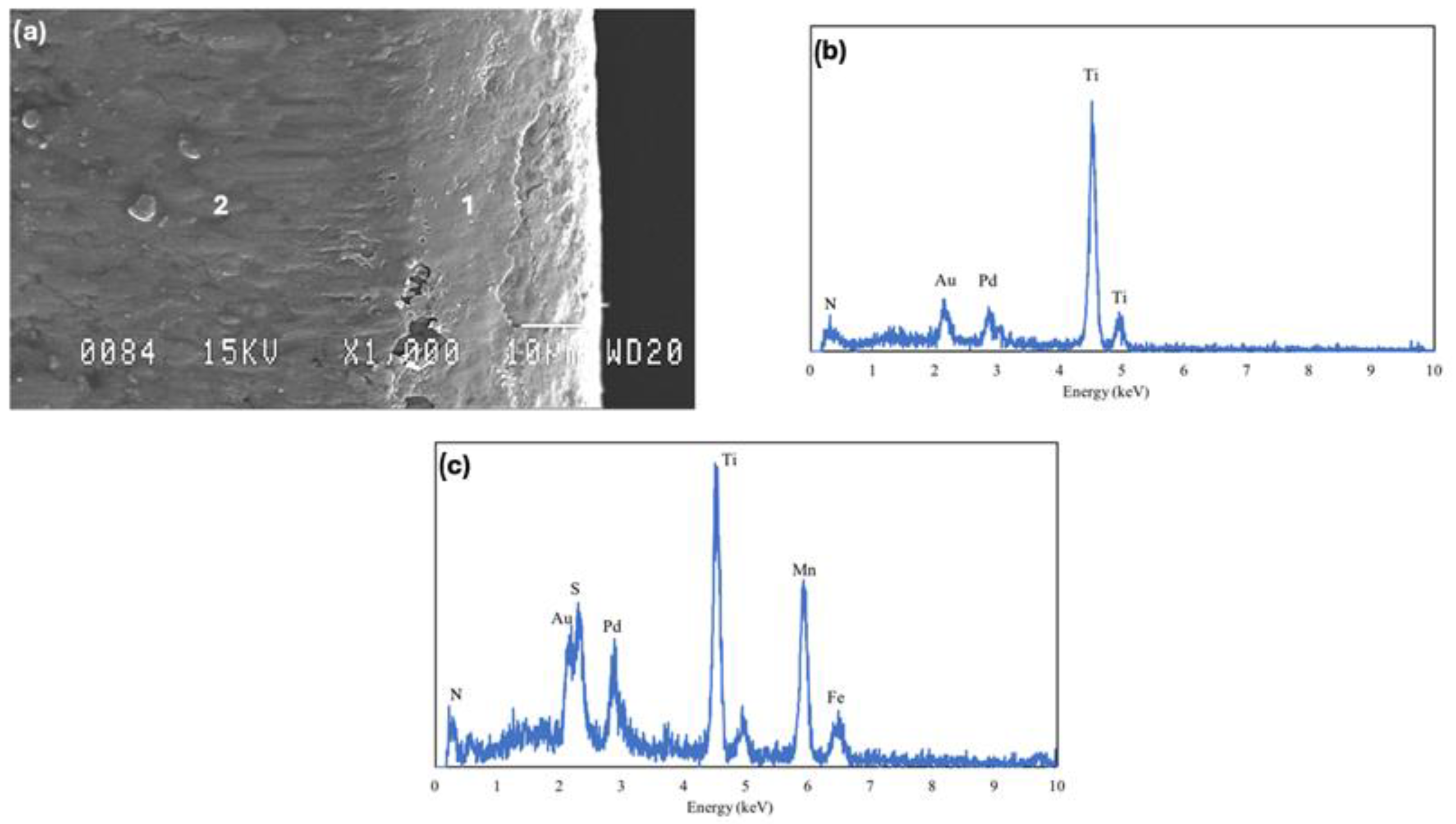
An additional advantage of the CNCG additive over MnS is its ability to minimize build-up edge formation during machining, as can be seen in Figure 16 and Figure 17. These SEM micrographs show the flank surfaces of cutting tools used for drilling specimens containing 1.75 wt% heat-treated CNCG particles compared with those containing MnS. The micrographs were obtained after drilling all holes in each series of specimens, and it was noted that the number of holes drilled differed between the two series (Figure 13).
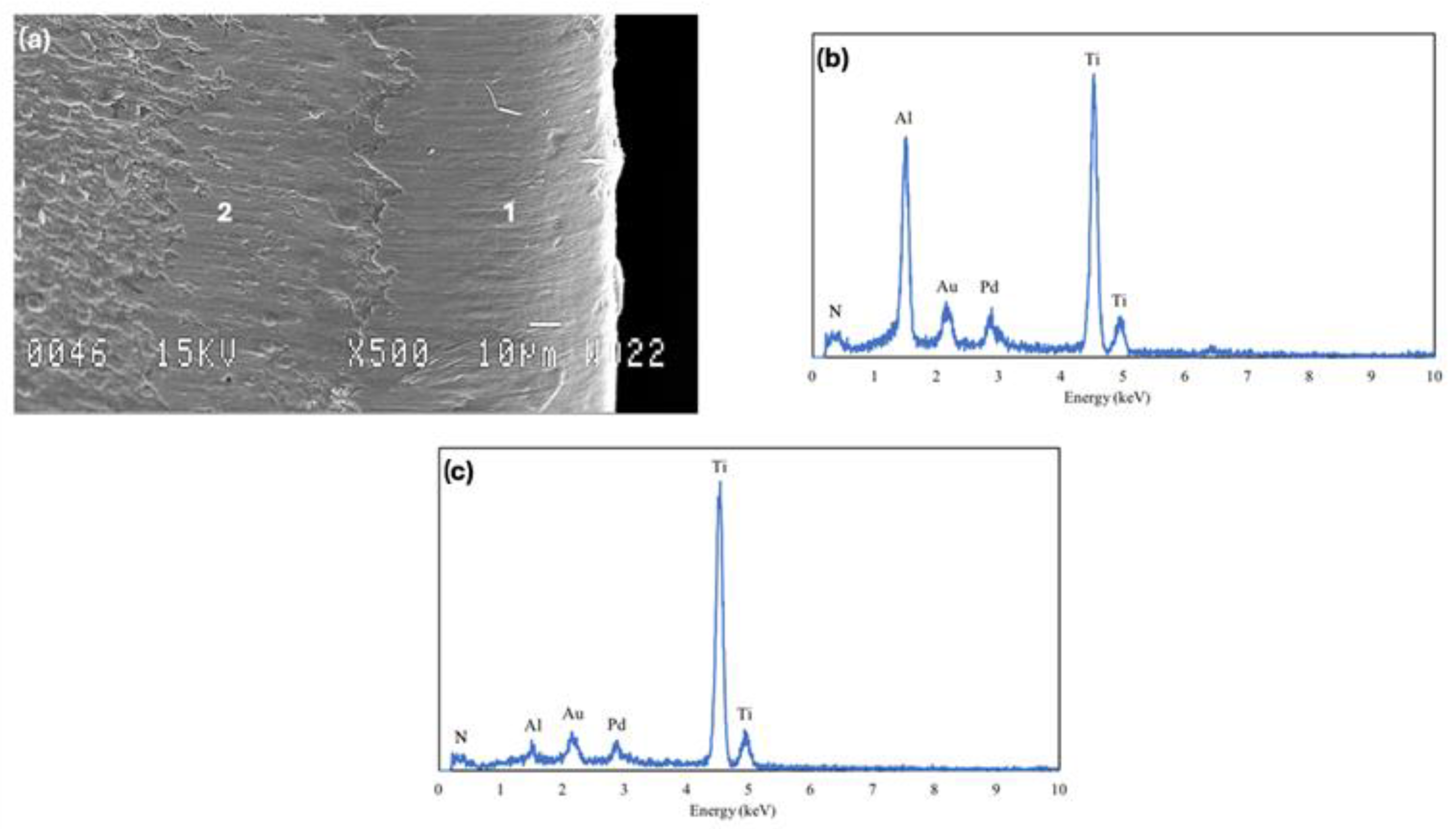
In Figure 16, region “1” corresponds to the cutting edge, along with a narrow band (approximately 50 µm) from right to left. The EDS spectrum of this region, shown in Figure 16b, indicates the presence of only Ti and Al, as expected from the TiAlN-coated carbide drills. The TiN top layer of the drill was worn during machining, revealing the underlying TiAlN substrate. The X-ray spectrum from Figure 16c was acquired from region “2” of the flank surface, indicating a strong Ti peak and a weaker Al peak, confirming that this area represents the original tool surface, which is not completely worn. Nitrogen, due to its low molecular weight and low Auger yield, is difficult to detect by EDS, but a faint nitrogen peak is visible in the spectra of Figure 16 and Figure 17.
For specimens containing MnS, similar regions were observed, but the EDS spectrum from region “1” (Figure 17) showed no aluminum, indicating that the TiN top layer remained intact. This is consistent with the fact that the volume of material removed in MnS-containing specimens was 40% lower than that in CNCG-containing samples, leading to less tool wear. Additionally, MnS was found to adhere to the surface of the cutting tool in region “2,” as evidenced by strong Mn and S peaks in the X-ray spectrum (Figure 17c). This MnS build-up on the tool surface, common in machining resulfurized steels, is the primary cause of build-up edge formation [28]. Adhesion of MnS alters the geometry of the cutting edge by locally changing its cutting angle. As heat increases during the cutting process, the build-up edge becomes unstable, detaches from the tool, and sticks to the workpiece, which negatively impacts surface finish quality [28].
It is well established in the literature that machining aids improve the machinability of PM steel components by reducing the cutting forces required to generate chips. This is achieved through two primary mechanisms: (1) promotion of chip fracture in the primary shear zone ahead of the cutting tool [29] and (2) lubrication in the secondary shear zone (chip/tool interface) [30].
One of the key functions of machining aids is the promotion of microcracking and fracture in the primary shear zone ahead of the cutting tool. By reducing the plowing effect caused by the cutting tool, these particles help prevent densification of the material in the shear zone, which in turn mitigates geometric strain-hardening. Geometric strain-hardening, combined with metallurgical strain-hardening [31], increases the force required to move the tool through the material, and this force is higher for porous materials than for fully dense ones. The addition of machinability-enhancing particles mitigates the impact of geometric strain-hardening by partially preventing the collapse of pores in the material. This opposition to densification in the shear zone reduces the strain-hardening effect.
Additionally, machining aids act as stress concentrators, initiating and propagating microcracks that facilitate chip fracture. Shorter chips, which can be more easily removed from the cutting zone, lead to lower cutting forces. At this stage in the explanation, any secondary solid phase or inclusion could, in theory, function as a machinability enhancer because they all act as stress-raisers in the primary shear zone. However, another critical role of these additives is to provide “lubrication” in the secondary shear zone, or the chip/tool interface. While the term lubrication might not be the most accurate, as machining aids primarily minimize abrasive wear, it underscores that not every secondary phase is suitable for enhancing machinability.
Substances like MnS, lead (Pb), hexagonal boron nitride (h-BN), and molybdenum disulfide (MoS2) are well-known for their lubricating properties in the context of machining. Similarly, graphite is an effective solid lubricant due to its layered crystal structure. When embedded in a matrix, plastic deformation around the graphite particles causes the layers to shear and slide, reducing friction between the surfaces. Ghasemi & Elmquist [32] demonstrated that these sliding graphite layers reduce the friction coefficient between the sliding surfaces. The same mechanism applies to CNCG particles during machining.
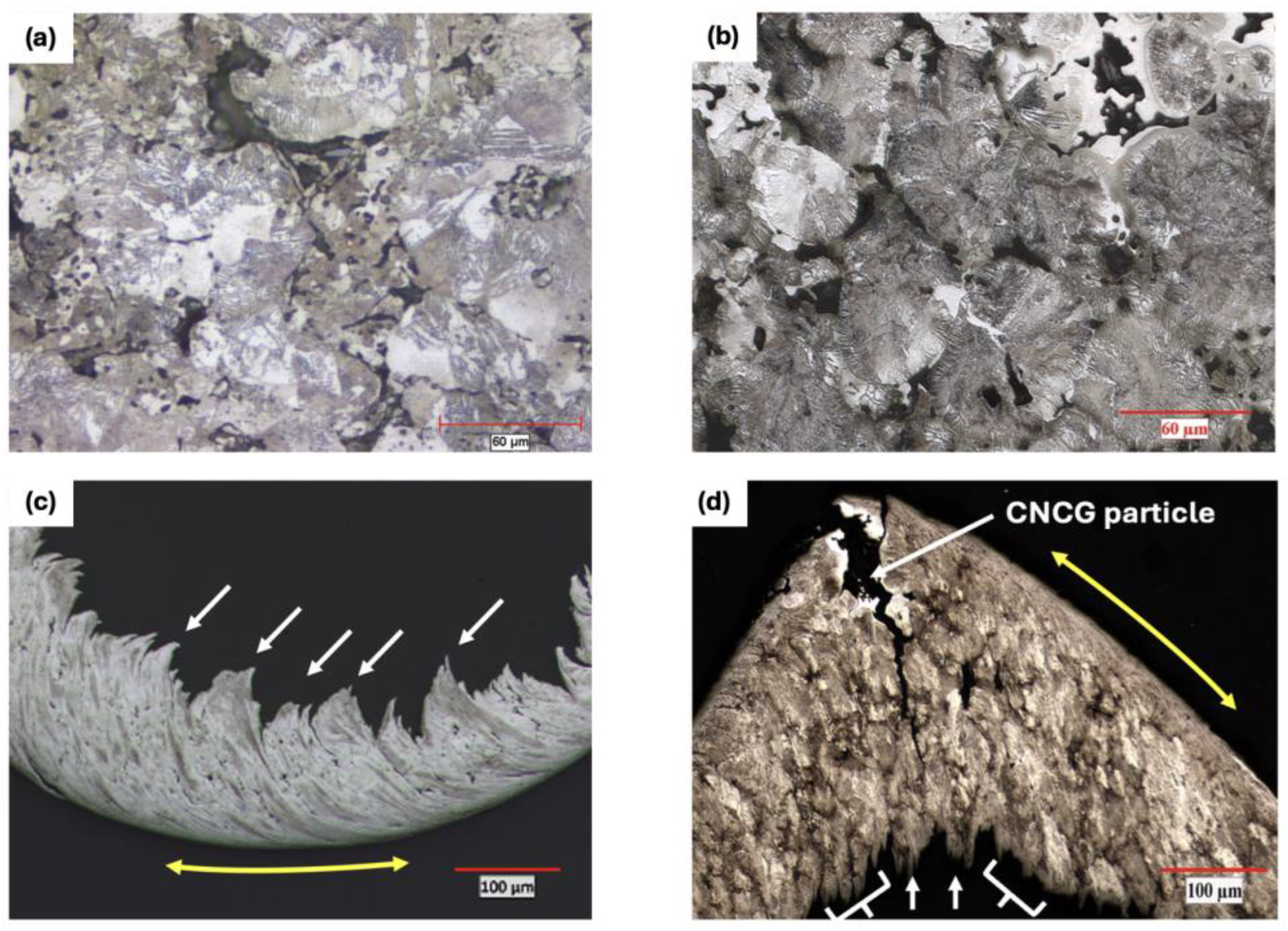
Figure 18 compares the microstructure of two FC-0208 specimens: one without any machinability-enhancing additive (Figure 18a) and another containing 1.75 wt% heat-treated CNCG particles (Figure 18b). Figure 18c,d show cross sections of typical chips collected after drilling an equal number of holes. In Figure 18c, the chip clearly shows densification during chip formation, as only a few pores are visible in the cross section, despite the original specimen having 12 vol% porosity. Furthermore, the chip in Figure 18c is made up of distinct segments (indicated by white arrows), suggesting that deformation localized in distinct shear bands spaced 50 to 100 μm apart.
On the other hand, Figure 18d clearly demonstrates the effect of machinability-enhancing particles in promoting crack formation within the primary shear zone. It also reveals that the spacing between the shear bands, which extend across the thickness of the chips (indicated by the white arrows and brackets), is significantly smaller than that observed in Figure 18c. Additionally, Figure 18d shows that the volume of sheared material in contact with the top surface of the cutting tool (secondary shear zone), highlighted by the yellow double-pointed arrow, is much smaller compared to the case without additives (Figure 18c).

4.2. Effect of Machinability-Enhancing Additives on Mechanical Properties

As previously noted, the use of machinability-enhancing additives, particularly MnS, often compromises tensile properties. In contrast, the results presented in this study clearly indicate that the newly developed machinability-enhancing additive has minimal impact on mechanical properties and outperforms MnS under optimal conditions, i.e., when it is at its freshest.
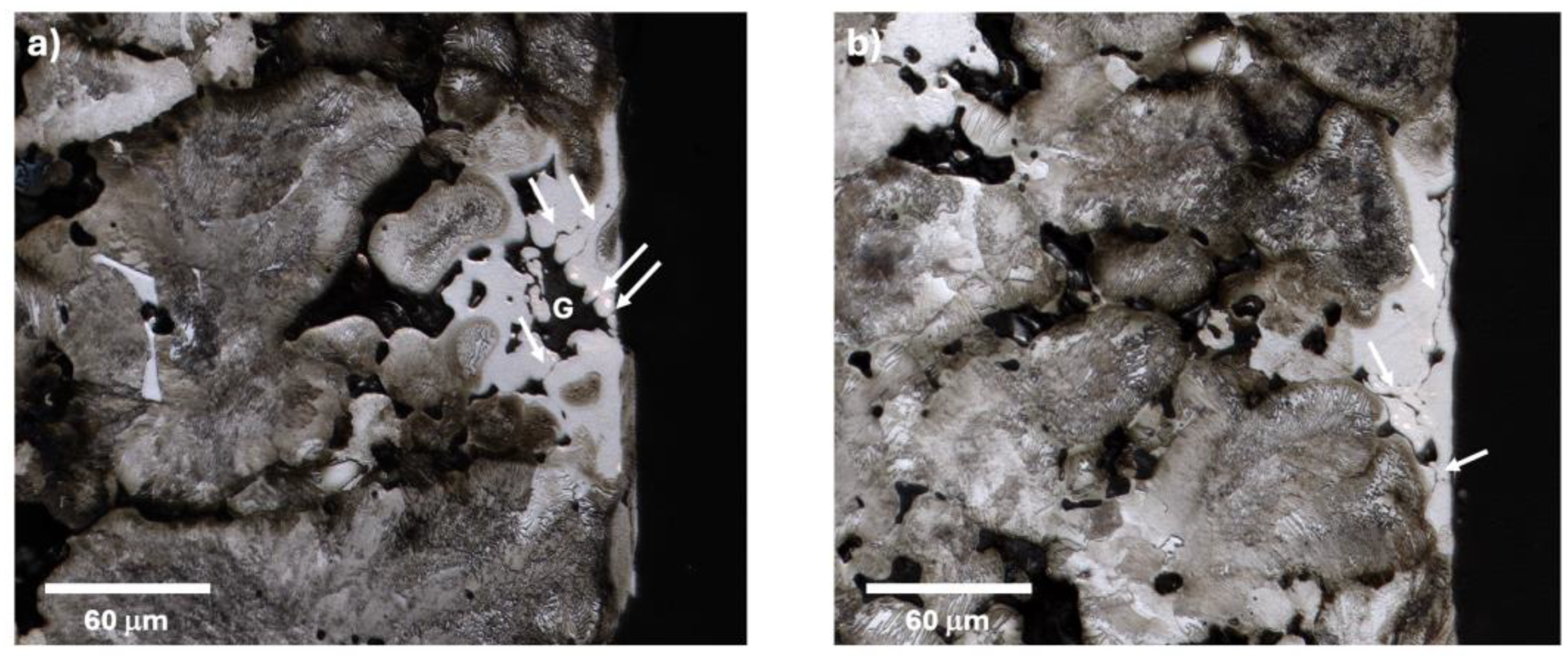
Figure 19 offers a clear explanation as to why CNCGs do not negatively affect mechanical properties. As mentioned earlier, the graphite particles are coated with Cu and Ni to promote the formation of metallurgical bonds between the additive and the steel matrix. The micrograph in Figure 19a shows a cross section of a hole drilled into a specimen made from an FC-0208 premix containing 1.75 wt% CNCG particles. A graphite particle, labeled “G,” is clearly visible. As the drill passed near the CNCG particle, cracks were generated, as indicated by the arrows in Figure 19a. These cracks resulted from the stress-raising effect induced by the CNCG particle. Importantly, the machinability-enhancing particle did not detach from the surface of the drilled hole, highlighting the strength of the bonds formed between the additive and the steel matrix during sintering. Similarly, Figure 19b shows another area of the drilled hole surface where a CNCG particle was removed during drilling, resulting in chip formation. Despite this removal, the coating remained securely adhered to the steel matrix. These observations explain why the new additive has minimal effect on the tensile properties of the material. The metallurgical bonds formed during sintering are strong enough to prevent the additive from being dislodged during plastic deformation, whether this occurs during tensile testing or drilling.
Regarding fatigue resistance, the results presented above show that the addition of machinability enhancers, whether MnS or CNCGs, has no significant impact on fatigue performance. In conventional materials, crack nucleation typically occurs at stress concentrator sites such as slip bands, inclusions, precipitates, and notches. However, in PM steels, porosity introduces an additional source of defects, altering the stress distribution and creating further stress concentration sites. Holmes and Queeney demonstrated that high stress concentrations at pores, particularly surface pores, lead to localized slipping, which can initiate crack nucleation. Furthermore, they showed that the number of cycles to crack initiation decreases as the volume fraction of porosity increases. They identified three contributing factors: the stress concentration around pores, the reduction in the effective load-bearing cross section, and the pore structure itself acting as a precursor to crack formation [33].
The apparent lack of influence of the machinability enhancers on fatigue resistance is, in fact, overshadowed by the presence of porosity, which varied between 13% and 15% by volume, depending on the sample series. Therefore, for the sintered densities and microstructures of the tested specimens, porosity played a far more significant role in reducing fatigue resistance than the presence of the machinability aids.
The principal advantage of the newly developed additive lies in its ability to deliver machinability improvements comparable to those achieved with MnS. Manganese sulfide is widely recognized for its strong contribution to machinability enhancement, especially in wrought steels. In contrast to MnS, however, the new additive does not compromise mechanical performance or corrosion resistance. Moreover, its effectiveness remains stable over time, irrespective of whether the particles are stored in bulk, blended into premixes, or incorporated into green or sintered components.
Finally, the proposed additive is readily scalable for commercial production, as the electroless coating of graphite particles with Ni and Cu can be carried out in high-volume, agitated tank systems commonly used in industrial practice. With respect to powder handling and compatibility with existing PM processing routes, the additive behaves in a manner comparable to conventional PM additives (e.g., Cu in FC premixes and Ni in FN premixes) and does not require modifications to established processing procedures. Regarding cost considerations, current geopolitical and economic uncertainties make it difficult to provide precise production estimates for CNCG particles. However, given the relatively small quantities required for effective powder coating and the anticipated improvements in machining productivity, it is reasonable to expect that the overall benefits would outweigh the associated costs.

5. Conclusions

The objective of this research was to develop a novel additive that enhances the machinability of steel parts produced through the powder metallurgy (PM) process as effectively as manganese sulfide (MnS) but without the drawbacks associated with reduced mechanical properties and corrosion resistance that MnS entails. The findings of this study demonstrate that graphite particles coated with nickel and copper can be incorporated into PM steel components to improve machinability. CNCG particles are as effective as MnS in enhancing the machinability of FC-0208 PM steel, while having no adverse impact on tensile properties—unlike MnS, which does affect them when used at equivalent volume fractions. Furthermore, within the range of part densities considered in this study, fatigue resistance was not significantly influenced by the presence of CNCG or MnS particles. Additionally, CNCG particles do not impair the corrosion resistance of copper PM steels, offering a distinct advantage over MnS. MnS is known for its reactivity with water vapor, which leads to the formation of MnO and significant rusting in PM steel parts. In contrast, CNCG particles provide an efficient machinability-enhancing additive with no such drawback. This additive could be used in any ferrous PM premix and is likely to perform similarly in other PM alloys, such as copper-based alloys and stainless steels. While this study centered on drilling-based tool wear analysis, the underlying mechanisms of improved performance reduced adhesion, resulted in better chip formation, and increased tool life, suggesting potential benefits across various machining operations. Expanding the investigation to these processes will help confirm and extend the applicability of our findings.

Author Contributions

Conceptualization, A.M.K. and C.B.; methodology, A.M.K.; validation, A.M.K.; formal analysis, A.M.K.; investigation, A.M.K.; resources, C.B.; data curation, A.M.K. and C.B.; writing—original draft preparation, A.M.K.; writing—review and editing, A.M.K. and C.B.; supervision, C.B.; project administration, C.B.; funding acquisition, C.B. All authors have read and agreed to the published version of the manuscript.

Funding

The authors would like to acknowledge the Natural Sciences and Engineering Research Council of Canada (NSERC) and Rio Tinto Metal Powders for providing the financial support to carry out this research (grant #CRDPJ 514582-17).

Data Availability Statement

The raw data supporting the conclusions of this article will be made available by the authors on request.

Acknowledgments

Amin Molavi Kakhki, Development of a new additive for improving machinability of PM steels, Univesité Laval, Quebec, QC, Canada, and April 2017.

Conflicts of Interest

Author Amin Molavi Kakhki was employed by the Rio Tinto Iron after his thesis defense. The remaining authors declare that the research was conducted in the absence of any commercial or financial relationships that could be construed as a potential conflict of interest; The authors declare that this study received funding from Rio Tinto Metal Powders. The funder was not involved in the study design, collection, analysis, interpretation of data, the writing of this article or the decision to submit it for publication.

References

  1. Benner, A.; Beiss, P. Wear Aspects During Green Machining of Warm Compacted PM Steels. Mater. Und Werkst. 2004, 35, 663–669. [Google Scholar] [CrossRef]
  2. Kulkarni, H.; Dabhade, V.V. Influence of MnS in Processing and Applications of Sintered Fe Cu-C Alloys: An Overview. Mater. Today Proc. 2018, 5, 17277–17283. [Google Scholar] [CrossRef]
  3. Boilard, P.; L’Espérance, G.; Blais, C. Effect of prealloyed MnS content and sintered density on machinability and mechanical properties. Int. J. Powder Metall. 2008, 44, 33–40. [Google Scholar]
  4. Liersch, A.; Danninger, H.; Ratzi, R. The Role of Admixed Hexagonal Boron Nitride in Sintered Steels Effect on Sliding Wear and Machinability. Powder Metall. Prog. 2007, 7, 66. [Google Scholar]
  5. Lindsley, B. Investigation into Machinability Improvements For FC-0208. In Advances in Powder Metallurgy & Particulate Materials; Metal Powder Industries Federation: Princeton, NJ, USA, 2013; Volume 6, pp. 71–80. [Google Scholar]
  6. Wranglen, G. Pitting and sulphide inclusions in steel. Corros. Sci. 1974, 14, 331–349. [Google Scholar] [CrossRef]
  7. Rieders, N.; Nandasiri, M.; Mogk, D.; Avci, R. New Insights into Sulfide Inclusions in 1018 Carbon Steels. Metals 2021, 11, 428. [Google Scholar] [CrossRef]
  8. Lindsley, B. Machining of pm steels: Effect of additives and sinter hardening. Int. J. Powder Metall. 2008, 44, 21–31. [Google Scholar]
  9. Claeys, S.F.; Chopra, K.S. Enhanced machinability and oxidation resistance with MnS containing additions of iron. In Advances in Powder Metallurgy & Particulate Materials; Metal Powder Industries Federation: Princeton, NJ, USA, 1997; Volume 2, pp. 15–27. [Google Scholar]
  10. Zhang, L.; Tang, X.; Wang, Z.; Li, T.; Zhang, Z.; Lu, M. The Corrosion Behavior of 316L Stainless Steel in H2S environment at high temperatures. Int. J. Electrochem. Sci. 2017, 12, 8806–8819. [Google Scholar] [CrossRef]
  11. Metal Powders Industry Federation. MPIF Standard 35-Materials Standards for Structural Parts; Metal Powders Industry Federation: Princeton, NJ, USA, 2020. [Google Scholar]
  12. Metal Powder Industries Federation. Standard 41—Determination of Transverse Rupture Strength of Powder Metallurgy Materials. In Standard Test Methods for Metal Powders and Powder Metallurgy Products-2022 Ed; Metal Powder Industries Federation: Princeton, NJ, USA, 2022. [Google Scholar]
  13. Metal Powder Industries Federation. Standard 10—Determination of Transverse the Tensile Properties of Powder Metallurgy Materials. In Standard Test Methods for Metal Powders and Powder Metallurgy Products-2022 Ed; Metal Powder Industries Federation: Princeton, NJ, USA, 2022. [Google Scholar]
  14. Metal Powder Industries Federation. Standard 42—Determination of Density of Compacted or Sintered Powder Metallurgy Products. In Standard Test Methods for Metal Powders and Powder Metallurgy Products-2022 Ed; Metal Powder Industries Federation: Princeton, NJ, USA, 2022. [Google Scholar]
  15. Metal Powder Industries Federation. Standard 56—Determination of Rotating Beam Fatigue Endurance Limit in Powder Metallurgy Materials. In Standard Test Methods for Metal Powders and Powder Metallurgy Products-2022 Ed; Metal Powder Industries Federation: Princeton, NJ, USA, 2022. [Google Scholar]
  16. ASTM B895-16; Standard Test Methods for Evaluating the Corrosion Resistance of Stainless Steel Powder Metallurgy (PM) Parts/Specimens by Immersion in a Sodium Chloride Solution. ASTM International: West Conshohocken, PA, USA, 2024.
  17. Metal Powder Industries Federation. MPIF Standard 45—Determination of Compressibility of Metal Powders. In Standard Test Methods for Metal Powders and Powder Metallurgy Products-2022 Ed; Metal Powder Industries Federation: Princeton, NJ, USA, 2022. [Google Scholar]
  18. Danninger, H.; Spoljaric, D.; Weiss, B. Microstructural features limiting the performance of P/M steels. Int. J. Powder Metall. 1997, 33, 43–53. [Google Scholar]
  19. Fleck, N.; Smith, R. Effect of density on tensile strength, fracture toughness, and fatigue crack propagation behavior of sintered steel. Powder Met. 1981, 24, 121–125. [Google Scholar] [CrossRef]
  20. Chawla, N.; Deng, X.; Marrucci, M.; Narasimhan, K. Effect of Density on the Microstructure and Mechanical Behavior of Powder Metallurgy Fe-Mo-Ni Steels. In Advances in Powder Metallurgy & Particulate Materials; Metal Powder Industries Federation: Princeton, NJ, USA, 2003; Volume 7, pp. 257–269. [Google Scholar]
  21. Mousavinasab, S.; Blais, C. Study of the effect of microstructure heterogeneity on fatigue crack propagation of low-alloyed PM steels. Mater. Sci. Eng. A 2016, 667, 444–453. [Google Scholar] [CrossRef]
  22. Šalak, A.; Selecka, S.M.; Danninger, H. Machinability of Powder Metallurgy Steels; Cambridge Int Science Publishing: Cambridge, UK, 2005. [Google Scholar]
  23. Madan, D.S.; Fitzgibbon, A. Shelf life of MnS powder and MnS containing mixes. In Advances in Powder Metallurgy & Particulate Materials; Metal Powder Industries Federation: Princeton, NJ, USA, 1995; Volume 2, pp. 8–18. [Google Scholar]
  24. Astakhov, V.; Davim, J. Tools (Geometry and Material) and Tool Wear. In Machining: Fundamentals and Recent Advances; Paul Davim, J., Ed.; Springer: London, UK, 2008; pp. 29–57. [Google Scholar]
  25. Borgonovo, C.; Lindsley, B. Improving Machinability of PM Components via a New Additive Compound. Int. J. Powder Metall. 2016, 52, 37–48. [Google Scholar]
  26. Sultan, A.; Sharif, S.; Kurniawan, D. Effect of Machining Parameters on Tool Wear and Hole Quality of AISI 316L Stainless Steel in Conventional Drilling. Procedia Manuf. 2015, 2, 202–207. [Google Scholar] [CrossRef]
  27. Pilling, N.B.; Bedworth, R.E. Oxidation of Copper-NickelAlloys at High Temperatures. Ind. Eng. Chem. 1925, 17, 372–376. [Google Scholar]
  28. Yaguchi, H. Effect of MnS inclusion size on machinabilty of low-carbon, leaded, resulfurized free-machining steel. J. Appl. Metalwork. 1986, 4, 214–225. [Google Scholar] [CrossRef]
  29. Blais, C.; L’Espérance, G. Characterisation of machinability of sintered steels during drilling operations. Powder Metall. 2001, 44, 67–76. [Google Scholar] [CrossRef]
  30. Blais, C.; L’Espérance, G. Turning and drilling of parts made from sinter hardenable steel powders. Powder Metall. 2002, 45, 39–47. [Google Scholar] [CrossRef]
  31. Kuhn, H.A.; Ferguson, B.L. Powder Forging; Metal Powder Industries Federation: Princeton, NJ, USA, 1990. [Google Scholar]
  32. Ghasemi, R.; Elmquist, L. Cast iron and the self-lubricating behavior of graphite under abrasive wear conditions. In Proceedings of the Tenth International Symposium on the Science and Processing of Cast Iron (SPCI 10), Mar del Plata, Argentina, 10–13 November 2014. [Google Scholar]
  33. Holmes, J.; Queeney, R.A. Fatigue crack initiation in a porous steel. Powder Metall. 1985, 28, 231–235. [Google Scholar] [CrossRef]
Figure 1. Optical micrograph of a cross section of nickel-coated graphite particles coated with copper. Local measurements of the thickness of the copper coating are also presented. (No etchant).
Metals 16 00245 g001
Figure 2. Optical micrographs of a sintered TRS bar made from a premix containing a high-purity commercial iron powder with an addition of 1.75 wt% of CNCG particles: (a) lower magnification and (b) higher magnification highlighting that no graphite diffused inside the iron matrix and that metallurgical bonds were formed between the additive particles and the surrounding iron matrix (etchant: Nital 2.0 vol%).
Metals 16 00245 g002
Figure 3. Dimensional change of FC-0208 premixes as a function of the weight fraction of CNCG particles added. The red dotted line corresponds to the sintered density of FC-0208 with no additives, while the green dotted line corresponds to the sintered density of an FC-0208 premix containing 0.5 wt% of MnS.
Metals 16 00245 g003
Figure 4. (a) Cross section of a CNCG particle as fabricated, i.e., without heat treatment (NHT), as seen in the electron microprobe using the backscattered electron detector; (b) X-ray signal of Cu and Ni measured by performing a chemical profile along the red line in (a); (c) cross section of a CNCG particle having undergone heat treatment (HT); (d) X-ray signal of Cu and Ni as measured by performing a composition profile along the red line in (c).
Metals 16 00245 g004
Figure 5. Compressibility curves of the powder mixtures without additives and with different weight fractions of CNCGs.
Metals 16 00245 g005
Figure 6. TRS values and density of FC-0208 sintered samples without additives; samples with 0.5 wt% MnS; and samples containing 0.77, 1.2, 1.75 and 3.5 wt% of non-heat-treated and heat-treated CNCG particles.
Metals 16 00245 g006
Figure 7. Tensile strength and yield stress values for FC-0208 sintered samples without additives; those containing 0.5 wt% MnS; and those containing 0.77, 1.2 and 1.75 wt% of non-heat-treated and heat-treated CNCG particles.
Metals 16 00245 g007
Figure 8. S-N curves of the samples without additives, those containing 1.75 wt% heat-treated CNCGs and those containing 0.5 wt% MnS.
Metals 16 00245 g008
Figure 9. Relative mass loss of non-heat treated and heat-treated CNCGs and MnS powders with increasing temperature.
Metals 16 00245 g009
Figure 10. Percentage of the samples that were corroded at different levels, at different intervals, (a) FC-0208, (b) FC-0208+1.75 wt% HT-CNCG and (c) FC-0208+0.5 wt% MnS.
Metals 16 00245 g010
Figure 11. Machinability of samples containing non-heat-treated and heat-treated CNCG particles and samples containing MnS shown in terms of variation in flank wear as a function of volume of material removed.
Metals 16 00245 g011
Figure 12. SEM micrographs of chips collected after drilling 48 holes in samples containing (a) 1.75 wt% heat-treated CNCGs and (b) 0.5 wt% MnS.
Metals 16 00245 g012
Figure 13. Variation in the diameter error as a function of the number of holes drilled in samples containing 1.75 wt% HT CNCGs and 0.5 wt% MnS.
Metals 16 00245 g013
Figure 14. Schematic presentation of the circularity. Red line represents the shape of an hypothetic hole at a given depth i.e., cross section, the blue circles are concentric circles fitted to the cross section of the hole.
Metals 16 00245 g014
Figure 15. Frequency of holes with circularity values in each of the defined ranges.
Metals 16 00245 g015
Figure 16. (a) SEM micrograph of the flank surface of the tool used for cutting all the samples containing 1.75 wt% CNCGs. (b,c) EDS X-ray spectra acquired in regions 1 and 2 respectively.
Metals 16 00245 g016
Figure 17. (a) SEM micrograph of the flank surface of the tool used for cutting all the samples containing 0.5 wt% MnS. (b,c) EDS X-ray spectra acquired in regions 1 and 2 respectively.
Metals 16 00245 g017
Figure 18. Optical micrographs of the typical microstructure of (a) an FC-0208 specimen and (b) an FC-0208 specimen containing 1.75 wt% heat-treated CNCGs; (c) the cross section of a chip generated during drilling of an FC-0208 specimen; (d) the cross section of a chip generated during drilling of an FC-0208 specimen containing 1.75 wt% heat-treated CNCGs (etchant: Nital 2.0 vol%). White arrows/brackets highlight chip segments, yellow arrows indicate the location of the secondary shear zone i.e., chip/tool interface.
Metals 16 00245 g018
Figure 19. (a) Cross section of a hole drilled into a specimen made from an FC-0208 premix containing 1.75 wt% CNCG particles. A graphite particle, labelled “G,” is visible along with cracks generated in its vicinity (arrowed). (b) Another area of the same specimen where a CNCG particle was removed during drilling; cracks are also visible near the location where a graphite particle was originally present (arrowed).
Metals 16 00245 g019
Table 1. Degree of staining related to each rank [16].
RankABCD
Surface fraction of stains (%)0Up to 1%Between 1% and 25%More than 25%
Table 2. Endurance limits of the FC-0208 samples without additives, those containing 1.75 wt% of heat-treated CNCG particles and those containing 0.5 wt% MnS.
Additive Content10% Survival, (MPa)50% Survival, (MPa)90% Survival, (MPa)Standard Deviation
No additive1441281139.5
1.75 wt% HT-CNCG1311211098.5
0.5 wt% MnS1291171098
Table 3. Drilling parameters used in this study.
Spindle speed4600 rpm
Cutting speed91 surface, m/min
Cutting feed0.127 mm/rev
Feed rate0.58 m/min
Disclaimer/Publisher’s Note: The statements, opinions and data contained in all publications are solely those of the individual author(s) and contributor(s) and not of MDPI and/or the editor(s). MDPI and/or the editor(s) disclaim responsibility for any injury to people or property resulting from any ideas, methods, instructions or products referred to in the content.