The Relationship Between Hardness and Microstructure in Zn/Mg Ratio-Controlled Al–Zn–Mg Alloys Aged at 120 °C

 ,
,
Abstract
1. Introduction
2. Materials and Methods
3. Results and Discussion
3.1. Vickers Microhardness
3.2. TEM Observation
4. Conclusions
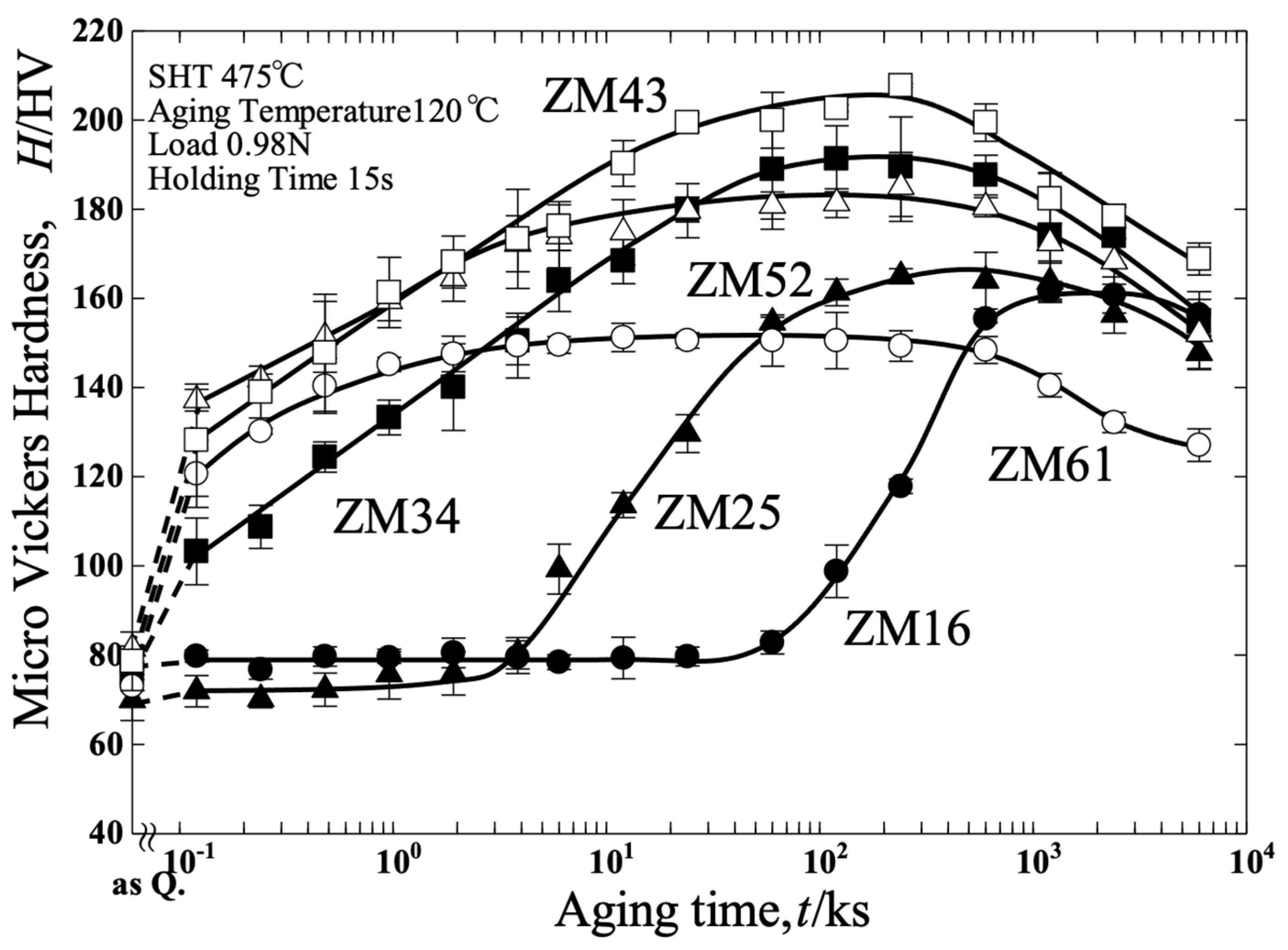
- Vickers microhardness measurements show that the Zn/Mg ratio strongly governs the aging response and age-hardening ability of Al–Zn–Mg alloys. Higher Zn/Mg ratios (ZM43, ZM52, ZM61) result in faster initial hardening; however, the maximum peak hardness is achieved at an intermediate Zn/Mg ratio (ZM43, Zn/Mg = 1.3). At higher Zn/Mg ratios, the age-hardening ability decreases, particularly in ZM61, indicating the existence of an optimal Zn/Mg ratio for strengthening. Thus, although high Zn/Mg ratios accelerate early-stage hardening, excessive Zn/Mg leads to reduced peak hardness due to changes in precipitation behavior.
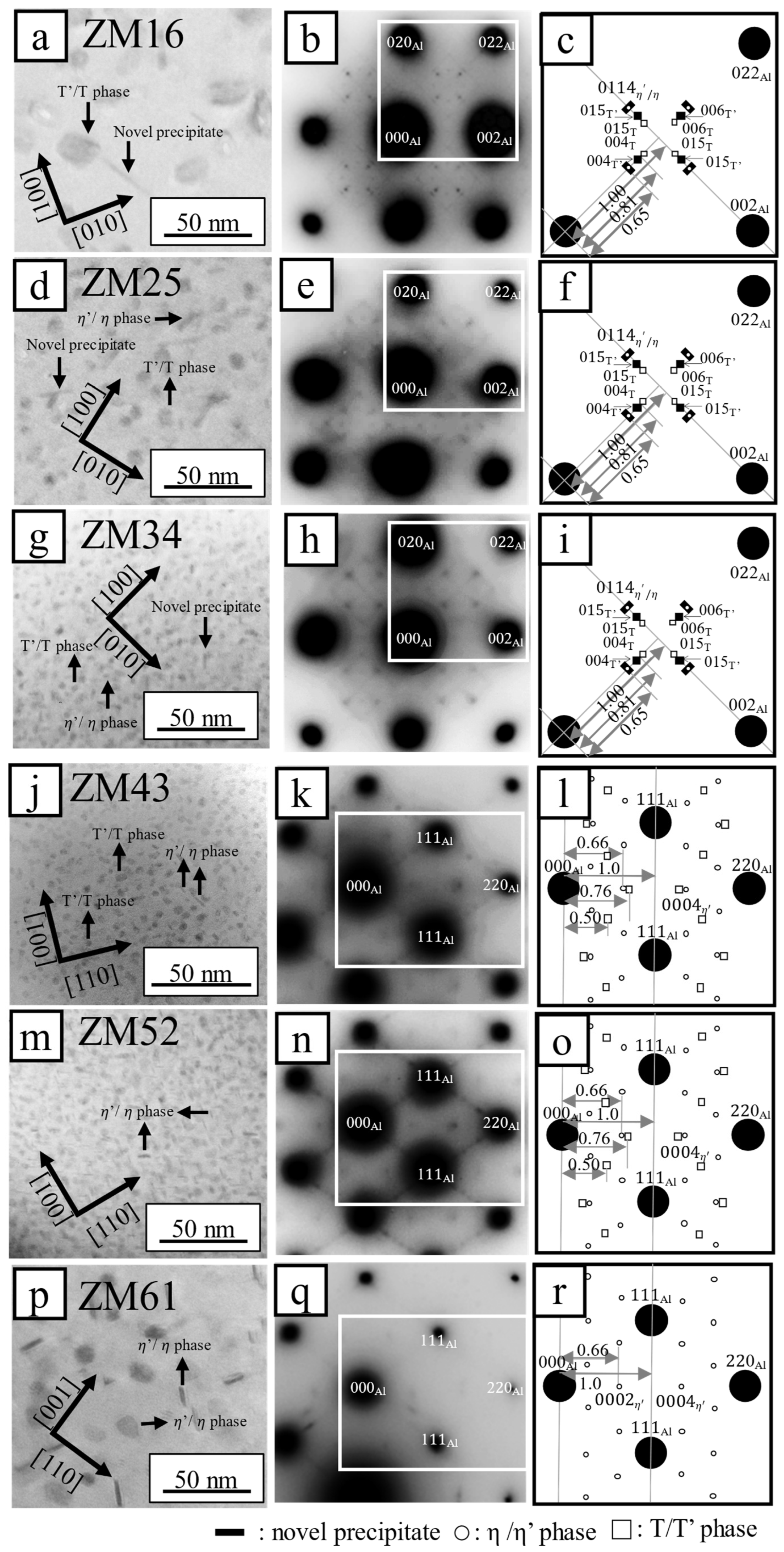
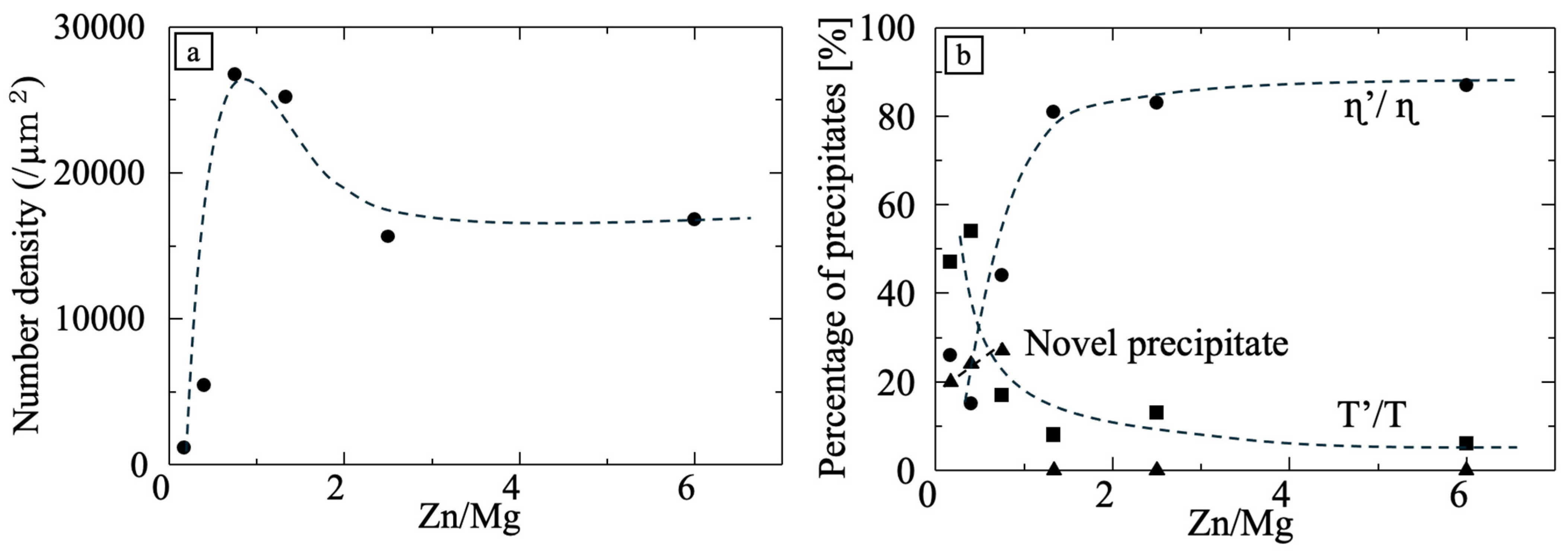
- TEM observations at peak-aging conditions reveal that the precipitate number density is low at low Zn/Mg ratios, increases to a maximum around Zn/Mg ≈ 1.0, and then remains nearly unchanged at higher Zn/Mg ratios (≥2.5). Two distinct precipitate size regimes were identified: relatively coarse precipitates in ZM16 (~16 nm) and ZM25 (~6 nm), and finer precipitates in ZM34, ZM43, and ZM52 (~3 nm). With increasing Zn/Mg ratio, the fraction of η′/η phases increases up to Zn/Mg ≈ 1.3 and subsequently saturates, whereas the fraction of T′/T phases decreases correspondingly and remains nearly constant at higher Zn/Mg ratios.
- The age-hardening response increases with increasing precipitate number density up to a Zn/Mg ratio of approximately 1.3 (ZM16, ZM25, ZM34, and ZM43), indicating a strong correlation between precipitate density and age-hardening ability. In addition, the finer precipitates observed in ZM34, ZM43, and ZM52 further contribute to enhanced hardening. The most pronounced age-hardening response is associated with the co-precipitation of η′/η and T′/T phases.
- The novel precipitate aligned along [110]Al and [110]Al was observed only in alloys with Zn/Mg < 1.0. Their fraction increases as Zn/Mg increases from 0.16 to 0.73 (ZM16, ZM25, and ZM34). Their length increases with decreasing Zn/Mg ratio. These precipitates account for ~20% of the total precipitate population. Their contribution to overall hardness remains unclear and requires further investigation.
Author Contributions
Funding
Data Availability Statement
Acknowledgments
Conflicts of Interest
References
- Yang, M.; Liu, S.; Zhang, Y.; Tang, J.; Zhang, M. Mechanism for enhanced precipitation strengthening due to the addition of copper to Al–Zn–Mg alloys with high Zn/Mg ratio. Mater. Des. 2023, 234, 112295. [Google Scholar] [CrossRef]
- Jensrud, O. High-strength aluminium alloys extrusions—A review of the thermo-mechanical process in high performance profile manufacturing. Key Eng. Mater. 2012, 491, 11–18. [Google Scholar] [CrossRef]
- Lervik, A.; Thronsen, E.; Friis, J.; Marioara, C.D.; Wenner, S.; Bendo, A.; Matsuda, K.; Holmestad, R.; Andersen, S.J. Atomic structure of solute clusters in Al–Zn–Mg alloys. Acta Mater. 2021, 205, 116574. [Google Scholar] [CrossRef]
- Davis, J.R. (Ed.) Aluminum and Aluminum Alloys; ASM International: Materials Park, OH, USA, 1993. [Google Scholar]
- Matsuda, K.; Yasumoto, T.; Bendo, A.; Tsuchiya, T.; Lee, S.; Nishimura, K.; Nunomura, N.; Marioara, C.D.; Levik, A.; Holmestad, R.; et al. Effect of copper addition on precipitation behavior near grain boundary in Al–Zn–Mg alloy. Mater. Trans. 2019, 60, 1688–1696. [Google Scholar] [CrossRef]
- Sanphiboon, W.; Lee, S.; Tsuchiya, T.; Ahmed, A.; Ikeno, S.; Yoshida, T.; Matsuda, K. The microstructural observation in precipitations of peak-aged Al–Zn–Mg alloys with various Zn/Mg ratios. Metals 2025, 15, 1260. [Google Scholar] [CrossRef]
- Shen, G.; Xiang, Z.; Ma, X.; Huang, J.; Zhao, Y.; Li, J.; Wang, Z.; Shi, G.; Chen, Z. Investigation of microstructures and mechanical properties of ultra-high-strength Al–Zn–Mg–Cu alloy prepared by rapid solidification and hot extrusion. Metals 2023, 13, 293. [Google Scholar] [CrossRef]
- Zhao, Y.; Tian, T.; Jia, H.; Ma, P.; Yang, Z.; Xu, J.; Zha, M.; Wang, H. Effects of Mg/Zn ratio and pre-aging on microstructure and mechanical properties of Al–Mg–Zn–Cu alloys. J. Mater. Res. Technol. 2023, 27, 1874–1885. [Google Scholar] [CrossRef]
- Zou, Y.; Wu, X.; Tang, S.; Zhu, Q.; Song, H.; Guo, M.; Cao, L. Investigation on microstructure and mechanical properties of Al–Zn–Mg–Cu alloys with various Zn/Mg ratios. J. Mater. Sci. Technol. 2021, 85, 106–117. [Google Scholar] [CrossRef]
- Lee, S.; Watanabe, K.; Matsuda, K.; Nishimura, K.; Numomura, N.; Toda, H.; Hirayama, K.; Shimizu, K.; Gao, H.; Yamaguchi, M.; et al. Precipitation structure and mechanical properties on peak-aged Al–Zn–Mg alloys with different Zn/Mg ratios. J. Jpn. Inst. Light Met. 2017, 67, 162–167. [Google Scholar] [CrossRef]
- Thronsen, E.; Shah, S.; Hatzoglou, C.; Marioara, C.D.; Wenner, S.; Andersen, S.J.; Holmedal, B.; Holmestad, R. The evolution of precipitates in an Al–Zn–Mg alloy. J. Mater. Res. Technol. 2023, 23, 5666–5680. [Google Scholar] [CrossRef]
- Muraki, H.; Yoshinaga, H.; Koda, S. Mechanical properties of age-hardened Al–Zn–Mg alloys. J. Jpn. Inst. Light Met. 1969, 19, 344–351. [Google Scholar] [CrossRef] [PubMed]
- Zou, Y.; Wu, X.; Tang, S.; Zhu, Q.; Song, H.; Cao, L. Co-precipitation of T′ and η′ phase in Al–Zn–Mg–Cu alloys. Mater. Charact. 2020, 169, 110610. [Google Scholar] [CrossRef]
- Österreicher, J.A.; Grabner, F.; Tunes, M.A.; Coradini, D.S.R.; Pogatscher, S.; Schlögl, C.M. Two-step ageing of 7xxx series alloys with an intermediate warm-forming step. J. Mater. Res. Technol. 2021, 12, 1508–1515. [Google Scholar] [CrossRef]
- Hsiao, T.J.; Chiu, P.H.; Tai, C.L.; Tsao, T.C.; Tseng, C.Y.; Lin, Y.X.; Chen, H.R.; Chung, T.F.; Chen, C.Y.; Wang, S.H.; et al. Effect of Cu additions on the evolution of η′ precipitates in aged AA7075 Al–Zn–Mg–Cu alloys. Metals 2022, 12, 2120. [Google Scholar] [CrossRef]
- Österreicher, J.A.; Tunes, M.A.; Grabner, F.; Arnoldt, A.; Kremmer, T.; Pogatscher, S.; Schlögl, C.M. Warm-forming of pre-aged Al–Zn–Mg–Cu alloy sheet. Mater. Des. 2020, 193, 108837. [Google Scholar] [CrossRef]
- Sha, G.; Cerezo, A. Early-stage precipitation in Al–Zn–Mg–Cu alloy (7050). Acta Mater. 2004, 52, 4503–4516. [Google Scholar] [CrossRef]
- Yin, H.; Wen, K.; Li, Z.; Li, X.; Li, Y.; Yan, L.; Yan, H.; Yu, M.; Zhang, Y.; Xiong, B. Investigation on precipitate behavior and mechanical properties of Al–Zn–Mg–Cu alloys with various Zn/Mg ratios. J. Mater. Res. Technol. 2024, 33, 5769–5783. [Google Scholar] [CrossRef]
- Shea, M.M.; Rao, B.V.N. Enhanced age hardening of 7075 aluminum alloy after ultrasonic vibration. Mater. Sci. Eng. 1983, 61, 67–77. [Google Scholar] [CrossRef]
- Zhang, M.; Li, C.; Zhang, Y.; Liu, S.; Jiang, J.; Tang, J.; Ye, L.; Zhang, X. Effect of hot deformation on microstructure and quenching-induced precipitation behavior of Al–Zn–Mg–Cu alloy. Mater. Charact. 2021, 172, 110861. [Google Scholar] [CrossRef]
- Zou, Y.; Wu, X.; Tang, S.; Wang, Y.; Zhao, K.; Cao, L. The effect of pre-ageing/stretching on the ageing-hardening behavior of Al–Zn–Mg–Cu alloys correlated with Zn/Mg ratio. Mater. Sci. Eng. A 2022, 830, 142331. [Google Scholar] [CrossRef]
- Bendo, A.; Matsuda, K.; Lervik, A.; Tsuru, T.; Nishimura, K.; Nunomura, N.; Holmestad, R.; Marioara, C.D.; Shimizu, K.; Toda, H.; et al. An unreported precipitate orientation relationship in Al–Zn–Mg based alloys. Mater. Charact. 2019, 158, 109958. [Google Scholar] [CrossRef]
- Maloney, S.K.; Hono, K.; Polmear, I.J.; Ringer, S.P. The effects of a trace addition of silverupon elevated temperature ageing of an Al–Zn–Mg alloy. Micron 2001, 32, 741–747. [Google Scholar] [CrossRef]
- Chen, J.; Zhen, L.; Yang, S.; Shao, W.; Dai, S. Investigation of precipitation behavior and related hardening in AA7055 aluminum alloy. Mater. Sci. Eng. A 2009, 500, 34–42. [Google Scholar] [CrossRef]
- Zhao, P.; Wu, X.; Gao, K.; Wen, S.; Rong, L.; Huang, H.; Wei, W.; Nie, Z. Effect of Zn/Mg ratio on microstructure and mechanical properties of Al–Zn–Mg alloys. Mater. Lett. 2022, 312, 131676. [Google Scholar] [CrossRef]
- Embury, J.D.; Nicholson, R.B. The nucleation of precipitates: The system Al–Zn–Mg. Acta Metall. 1965, 13, 403–417. [Google Scholar] [CrossRef]
- Yang, X.B.; Chen, J.H.; Liu, J.Z.; Qin, F.; Xie, J.; Wu, C.L. A high-strength Al–Zn–Mg alloy hardened by the T-phase precipitates. J. Alloys Compd. 2014, 610, 69–73. [Google Scholar] [CrossRef]
- Stemper, L.; Tunes, M.A.; Oberhauser, P.; Uggowitzer, P.J.; Pogatscher, S. Age-hardening response of Al–Mg–Zn alloys with Cu and Ag additions. Acta Mater. 2020, 195, 541–554. [Google Scholar] [CrossRef]
- Sanphiboon, W.; Yagi, T.; Ahmed, A.; Hai, V.N.; Tsuchiya, T.; Lee, S.; Nunomura, N.; Murakami, S.; Ikeno, S.; Shibata, K.; et al. Study on the precipitation sequence in Al–Zn–Mg with low Zn/Mg aged at 200 °C. Arch. Metall. Mater. 2025, 70, 1425–1430. [Google Scholar]
- Hall, E.O. The deformation and ageing of mild steel: III. Discussion of results. Proc. Phys. Soc. B 1951, 64, 747–753. [Google Scholar] [CrossRef]
- Petch, N.J. The cleavage strength of polycrystals. J. Iron Steel Inst. 1953, 174, 25–28. [Google Scholar]
- Hatch, J.E. (Ed.) Aluminum: Properties and Physical Metallurgy; ASM International: Materials Park, OH, USA, 1984. [Google Scholar]
- Sato, K.; Matsumoto, K.; Okuda, H. Mechanical properties and nanostructure of multi-layered Al–Zn–Mg alloy with compositional gradient. Mater. Trans. 2019, 60, 254–262. [Google Scholar] [CrossRef]



| Alloy | mol% | wt% | Al | ||||||
|---|---|---|---|---|---|---|---|---|---|
| Zn | Mg | Zn/Mg | Zn + Mg | Zn | Mg | Zn/Mg | Zn + Mg | ||
| ZM16 | 1.49 | 5.82 | 0.26 | 7.31 | 3.46 | 5.11 | 0.67 | 8.58 | Bal. |
| ZM25 | 2.09 | 5.24 | 0.40 | 7.33 | 4.90 | 4.59 | 1.07 | 9.49 | Bal. |
| ZM34 | 2.97 | 4.09 | 0.73 | 7.06 | 6.91 | 3.52 | 1.96 | 10.4 | Bal. |
| ZM43 | 4.17 | 3.29 | 1.27 | 7.46 | 9.64 | 2.80 | 3.45 | 12.4 | Bal. |
| ZM52 | 4.78 | 1.89 | 2.53 | 6.67 | 11.0 | 1.63 | 6.74 | 12.6 | Bal. |
| ZM61 | 5.99 | 1.01 | 5.93 | 7.00 | 13.4 | 0.83 | 16.1 | 14.2 | Bal. |
Disclaimer/Publisher’s Note: The statements, opinions and data contained in all publications are solely those of the individual author(s) and contributor(s) and not of MDPI and/or the editor(s). MDPI and/or the editor(s) disclaim responsibility for any injury to people or property resulting from any ideas, methods, instructions or products referred to in the content. |
© 2026 by the authors. Licensee MDPI, Basel, Switzerland. This article is an open access article distributed under the terms and conditions of the Creative Commons Attribution (CC BY) license.
Share and Cite
Sanphiboon, W.; Lee, S.; Tsuchiya, T.; Ahmed, A.; Ikeno, S.; Yoshida, T.; Matsuda, K. The Relationship Between Hardness and Microstructure in Zn/Mg Ratio-Controlled Al–Zn–Mg Alloys Aged at 120 °C. Metals 2026, 16, 246. https://doi.org/10.3390/met16030246
Sanphiboon W, Lee S, Tsuchiya T, Ahmed A, Ikeno S, Yoshida T, Matsuda K. The Relationship Between Hardness and Microstructure in Zn/Mg Ratio-Controlled Al–Zn–Mg Alloys Aged at 120 °C. Metals. 2026; 16(3):246. https://doi.org/10.3390/met16030246
Chicago/Turabian StyleSanphiboon, Wanlalak, Seungwon Lee, Taiki Tsuchiya, Abrar Ahmed, Susumu Ikeno, Tomoo Yoshida, and Kenji Matsuda. 2026. "The Relationship Between Hardness and Microstructure in Zn/Mg Ratio-Controlled Al–Zn–Mg Alloys Aged at 120 °C" Metals 16, no. 3: 246. https://doi.org/10.3390/met16030246
APA StyleSanphiboon, W., Lee, S., Tsuchiya, T., Ahmed, A., Ikeno, S., Yoshida, T., & Matsuda, K. (2026). The Relationship Between Hardness and Microstructure in Zn/Mg Ratio-Controlled Al–Zn–Mg Alloys Aged at 120 °C. Metals, 16(3), 246. https://doi.org/10.3390/met16030246