Article

Microstructure and Mechanical Properties of Ultrafine-Grained CrMnFeCoNi High-Entropy Alloy Prepared via Powder Metallurgy

1
Division of Advanced Materials Engineering, Jeonbuk National University, Jeonju 51508, Republic of Korea
2
Research Center for Advanced Materials Development, Jeonbuk National University, Jeonju 54896, Republic of Korea
*
Author to whom correspondence should be addressed.
Metals 2026, 16(2), 170; https://doi.org/10.3390/met16020170
Submission received: 26 December 2025 / Revised: 19 January 2026 / Accepted: 21 January 2026 / Published: 1 February 2026
(This article belongs to the Special Issue Feature Papers in Entropic Alloys and Meta-Metals)

Abstract

We studied the microstructural evolution and mechanical properties of ultrafine-grained CrMnFeCoNi high-entropy alloys fabricated by mechanical alloying of various additives and spark plasma sintering. The additives were 1 wt.% process control agent (stearic acid) + 1 wt.% graphene nanofiber (GNF) (PG) or 1 wt.% Y2O3 + 1 wt.% GNF (YG) to modify the constituting phase of the sintered alloy. The PG and YG powders exhibited a single FCC phase. The YG powders had a larger powder size and a smaller crystallite size than the PG powders. Ultrafine-grained FCC matrices with average particle sizes of 0.57 μm and 0.71 μm, respectively, were formed through the SPS process of PG and YG powders. The absence of PCA in YG alloys resulted in a bimodal distribution of fine and coarse grains (due to incomplete mechanical alloying) and formation of a lesser and finer Cr7C3 phase (due to reduced C content). The sintered PG alloy contained coarse (~60 nm) spinel Mn3O4 oxides along grain boundaries, whereas the YG alloy exhibited coarse Mn3O4 and fine (~17 nm) Y2O3 oxide particles along grain boundaries. Additionally, the YG alloy contained tiny (~5 nm) Y2O3 oxide particles with a cube-on-cube orientation relationship within the FCC matrix. YG alloy exhibited higher hardness and compressive yield strength than PG alloy, mainly due to the oxide dispersion strengthening of finely dispersed Y2O3 particles. The addition of Y2O3 reinforcing particles had a minimal effect on the ultimate compressive strength and fracture strain of the sintered alloy.

1. Introduction

Over time, alloy development has progressed from relatively simple elemental combinations toward more complex alloy systems through the addition and integration of multiple elements in order to enhance mechanical performance or achieve targeted properties [1]. Within this evolutionary framework, high-entropy alloys (HEAs), which are composed of five or more principal elements in equiatomic or near-equiatomic ratios, have been developed as an alternative alloy design concept based on compositional complexity [2,3,4,5]. Owing to their diverse chemical compositions, HEAs often form simple solid-solution phases, predominantly with FCC or BCC crystal structures, and have been reported to exhibit a favorable combination of high hardness, good ductility, and thermal stability [3,4,5,6]. Among various HEAs, the equiatomic CrMnFeCoNi alloy, commonly referred to as the Cantor alloy, forms a stable FCC structure [7] and exhibits excellent toughness and fracture resistance, particularly at cryogenic temperatures [7,8]. Accordingly, various processing routes and alloying or reinforcing elements have been employed to improve the mechanical performance of the Cantor alloy. For example, a previous study [9] reported that the addition of C and Ti to cast CrMnFeCoNi alloy followed by heat treatment led to the precipitation of plate-shaped TiC, resulting in an increase in yield strength of approximately 60 MPa.
Mechanical alloying (MA) or milling is a solid-state powder processing technique in which repeated fracture and cold welding of powder particles induce severe plastic deformation and effective elemental mixing [10]. This process enables significant grain refinement, extended solid solubility, and the formation of non-equilibrium microstructures without complete melting. For multi-principal element alloys, mechanical alloying provides a viable route to achieve compositional homogeneity while avoiding segregation commonly associated with melting-based processes [11]. Spark plasma sintering (SPS) enables rapid heating and short dwell times, allowing effective densification while suppressing excessive grain growth. Based on the beneficial effects, SPS processing has been applied to various metallic alloys, such as steels [12], Ni-based superalloys [13], and HEAs [14,15]. For AlSi4340 steel, high-energy ball milling followed by spark plasma sintering resulted in a refined microstructure with an average particle size of approximately 2.4 μm. The processed material exhibited excellent mechanical properties, including a hardness of 711 MPa and a yield strength of 1953 MPa [12]. Similar powder metallurgy approaches based on mechanical alloying have also been extended to high-entropy alloys, where phase evolution during milling and subsequent consolidation has been systematically investigated [14]. For the CrMnFeCoNi alloy, mechanical milling was reported to increase the compressive yield strength of the sintered alloy from 307 MPa to 886 MPa due to grain refinement and the formation of reinforcing carbides and oxides [15].
During mechanical alloying, the use of a process control agent (PCA) can lead to the introduction of carbon and oxygen into the powder system, which may result in the formation of carbides and oxides during subsequent sintering [16]. In Cr-containing alloys, carbon introduced by PCA can promote the formation of chromium carbides, while oxygen may contribute to the formation of Cr- and Mn-based oxides [15]. These secondary phases can influence the microstructure and mechanical properties of the sintered alloys.
To further enhance mechanical performance, ceramic particles such as Y2O3 can be introduced during milling to induce oxide dispersion strengthening [13,17]. For Ni–20Cr–1.2Y2O3 alloys processed by high-energy ball milling followed by spark plasma sintering, finely dispersed Y2O3 particles within the Ni grains were reported to promote significant grain refinement. In addition to grain refinement, oxide dispersion strengthening by Y2O3 resulted in a high yield strength exceeding 1.5 GPa [13]. In addition, Tan et al. [17] reported that the addition of 0.5 at.% Y2O3 to CrMnFeCoNi high-entropy alloy powders, followed by mechanical milling and plasma arc additive manufacturing, resulted in ~60 MPa increase in ultimate tensile strength due to synergistic effects of grain refinement and dislocation strengthening, and oxide-dispersion strengthening.
Recent studies have reported that the mechanical properties of HEAs can be enhanced through the incorporation of carbon nanotubes (CNTs) or graphene-based reinforcements [18]. Bahrami et al. [19] reported that the addition of 1 wt.% CNT increases the hardness of AlCoFeMnNi HEA due to solid-solution strengthening of C (partial diffusion of CNT-derived carbon) and dispersion strengthening of CNTs [19]. However, the studies on the effect of graphene nanofiber (GNF) on the HEAs remain limited.
Therefore, in this study, ultrafine-grained CrMnFeCoNi alloys with additions of PCA/GNF and Y2O3/GNF were manufactured by MA and SPS processes. The evolution of microstructures, including grains, secondary phases, and oxides, and their impacts on the mechanical properties of sintered alloys were systematically investigated.

2. Experimental Procedure

Gas-atomized CrMnFeCoNi powder (MK Ltd., Changwon, Republic of Korea) was used as the base material. GNF (Carbon Nano-material Technology Co., Pohang, Republic of Korea, diameter: 50–200 nm, length: 10–30 μm, purity: >95 wt.%), Y2O3 (Aladdin, Shanghai, China, powder size: ≤40 nm, purity: 99.5%), and stearic acid (Thermo Fisher Scientific, Waltham, MA, USA, flakes or powder, purity: 98%) as a PCA of mechanical milling were used as additives. The CrMnFeCoNi powders with 1 wt.% PCA + 1 wt.% GNF and 1 wt.% Y2O3 + 1 wt.% GNF were referred to as PG and YG, respectively.
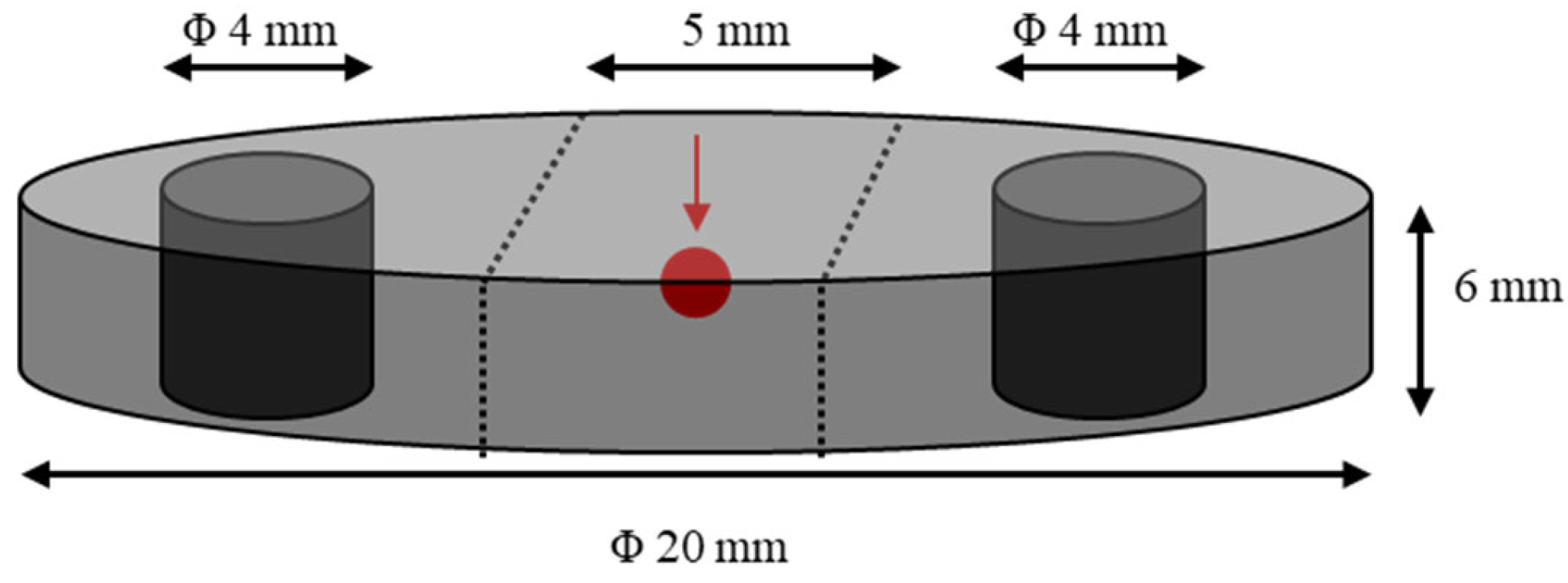
Mechanical milling of PG and YG powders (20 g) was conducted using a planetary-type high-energy ball milling apparatus (Fritsch, Idar-Oberstein, Germany, Pulverisette-6) under an Ar atmosphere. A 250 mL SKD11 steel container and Fe–Cr balls (Φ10 mm diameter) at a ball-to-powder weight ratio of 30:1 were used in mechanical milling. Mechanical milling was conducted at a rotation speed of 250 rpm in a cyclic mode consisting of 60 min of milling followed by 30 min of rest, with a total processing duration of 24 h. Milled PG and YG powders (16 g) were placed in a cylindrical graphite mold (inner: Φ20 mm diameter, 40 mm height) and consolidated SPS (ELTEK Korea Co., Yongin, Republic of Korea) under a vacuum atmosphere (<150 mTorr) and an applied uniaxial pressure of 50 MPa. During SPS, the powder compacts were heated to 1000 °C at a heating rate of 1000 °C/min, held for 1 min, and subsequently cooled to room temperature at a rate of ~150 °C/min. The mechanical milling and SPS process parameters used in this study were optimal conditions for achieving pore reduction and enhanced oxide dispersion [15,20]. Cross-section specimens for microstructure analysis and cylindrical specimens for compression tests were prepared from the sintered alloy (Figure 1).
X-ray diffraction (XRD, Shimadzu, Kyoto, Japan, XRD-6100) with a Cu Kα target (λ = 1.5406 Å) was used to examine the microstructure of milled powders and sintered alloys. The 2θ range of 20–100° was scanned at a scanning rate of 2°/min, step size of 0.02°, accelerating voltage of 40 kV, and a current of 30 mA. The phase analysis was performed using CrystalDiffract software (CrystalMaker Software Ltd., Oxford, UK, CrystalDiffract version 6.9.4) [21] and the corresponding phase reference CIF file. The crystallite size of the milled powder was analyzed by applying the Williamson-Hall relationship to four FCC reflections (111, 200, 220, and 311) [22]. The sintered alloys were examined by optical microscopy (OM; Nikon EPIPHOT 200, Tokyo, Japan) at a magnification of ×200 to evaluate the densification behavior after sintering. The bulk densities were measured seven times using the Archimedes method. The relative densities (R.D.) were calculated by normalizing the measured bulk densities with the corresponding theoretical densities, which were estimated using the rule of mixtures based on the final sintered composition of each alloy (PG: 7.998 g/cm3 and YG: 8.004 g/cm3). The microstructures of the powders and sintered alloys were observed using a scanning electron microscope (SEM, HITACHI SU3900 and HITACHI SU-70, Tokyo, Japan). The powder size of milled powders was measured on SEM images captured at ×300 using the ImageJ software (National Institutes of Health, Bethesda, MD, USA, ImageJ 1.54g) [23]. Electron backscatter diffraction (EBSD, HITACHI, Tokyo, Japan, SU-70) was employed to analyze the FCC matrix and secondary phases. The EBSD analysis was performed on SEM images taken at ×20,000 with a step size of 10 nm, and the obtained data were analyzed using TSL OIM Analysis 9 software. The crystal structure and size distribution of carbides, oxides, and the FCC matrix were characterized by transmission electron microscope (TEM, FEI Talos F200X G2, Thermo Fisher Scientific, Waltham, MA, USA) and energy dispersive X-ray spectroscopy (EDS) operated at 200 kV. TEM specimens were prepared by a focused ion beam (FIB) technique in an SEM (Thermo Fisher Scientific, Waltham, MA, USA, Helios G5).
For mechanical properties, Vickers hardness was measured at the center of the cross-section of sintered alloys using a TIME TH-715 (Beijing, China) under a load of 1 kgf with a dwell time of 15 s. Compression tests were conducted in accordance with ASTM E9/E9M [24] using cylindrical specimens with a diameter of 4 mm and a height of 6 mm on an Instron 5569 testing machine (Norwood, MA, USA) at a nominal strain rate of 1 × 10⁻³ s−1. Each alloy condition was tested twice to ensure reproducibility. The compressive yield strength was determined from the stress–strain curves using the 0.2% offset method.

3. Results and Discussion

3.1. Powder Evolution

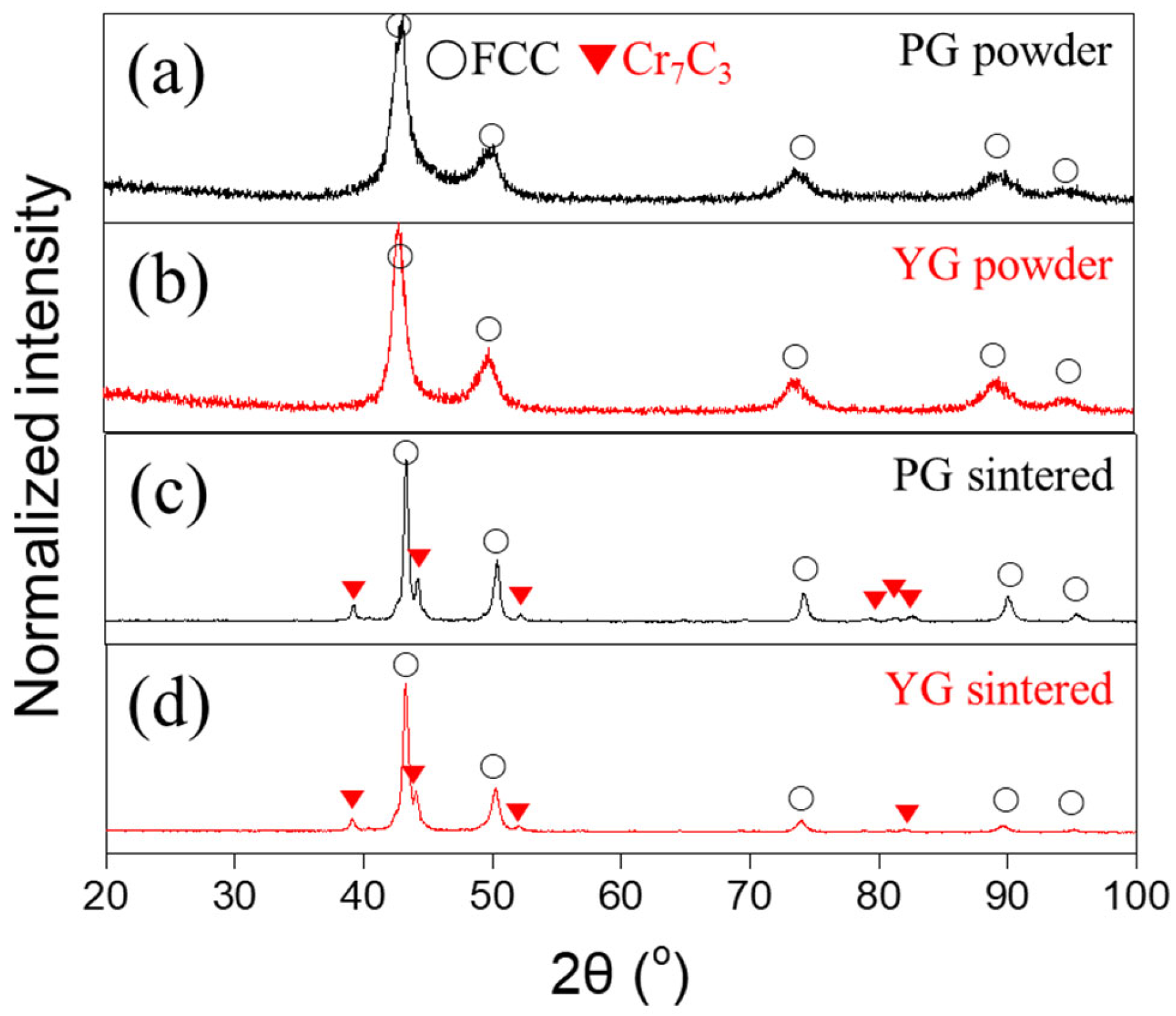
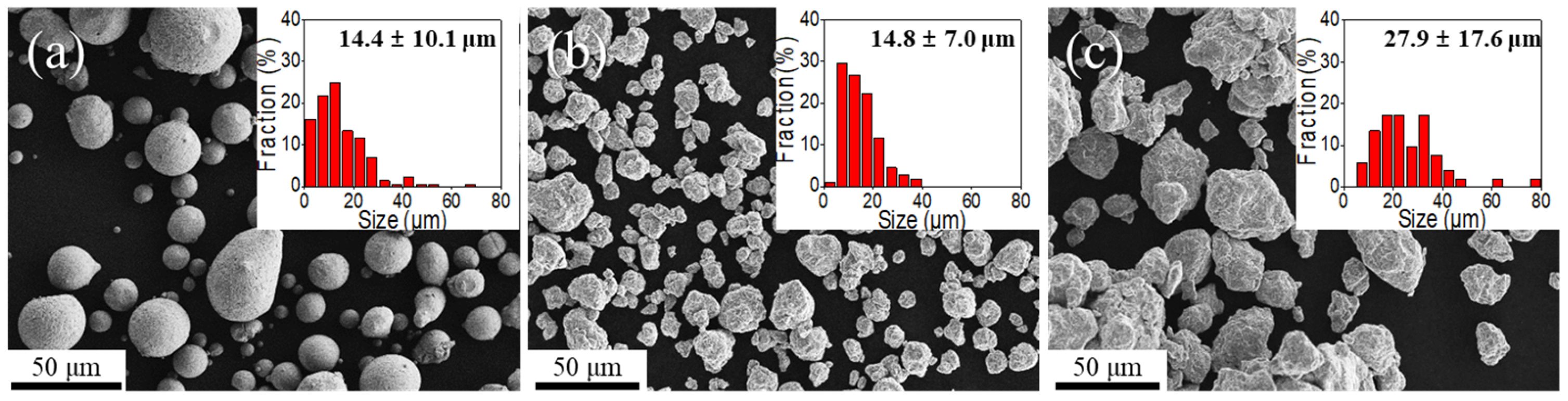
Figure 2a–c show SEM images of the unmilled CrMnFeCoNi alloy powder used as a base material and milled PG and YG powders. The base powder exhibited a spherical morphology with an average powder size of 14.4 ± 10.1 μm (Figure 2a). The milled PG (Figure 2b) and YG (Figure 2c) powders displayed irregular morphologies, which are associated with the repeated fragmentation and cold welding occurring during the mechanical milling process. The size of the milled PG and YG powders was measured to be 14.8 ± 7.0 and 27.9 ± 17.6 μm. The addition of Y2O3 nanoparticles is reported to have a refining effect on the milled powders by mechanically embedding into the welded powder interface and thus promoting particle refinement [25,26]. However, in the present study, the milled YG powders exhibited an increased powder size with a broader size distribution. This can be attributed to enhanced particle agglomeration during mechanical milling due to the absence of an effective PCA, which offsets the powder refinement effect of the Y2O3 nanoparticles. Figure 3a,b show XRD pattern of milled PG and YG powders, exhibiting a single FCC phase with a lattice constant of 0.3625 and 0.3639 nm. The crystallite sizes of milled powders can be estimated using Williamson–Hall method [22]:
β cos θ =   C ε sin θ + K λ D
where β denotes the full width at half maximum (FWHM) of the XRD peak, θ is the Bragg angle of the diffraction peak expressed in radians, ε represents the microstrain, C is the strain coefficient fixed at 4, K is the shape factor taken as 0.9, λ is the X-ray wavelength (1.5406 Å), and D corresponds to the crystallite size. It should be noted that the crystallite size obtained from XRD represents the coherent diffraction domain size and does not directly correspond to the powder or agglomerate size observed in SEM [27]. The crystallite sizes of the milled PG and YG powders were estimated to be 14.2 and 6.8 nm, respectively, which is much smaller than that of the unmilled CrMnFeCoNi alloy powder (89.0 nm [15]).

3.2. Microstructure of Sintered Alloy

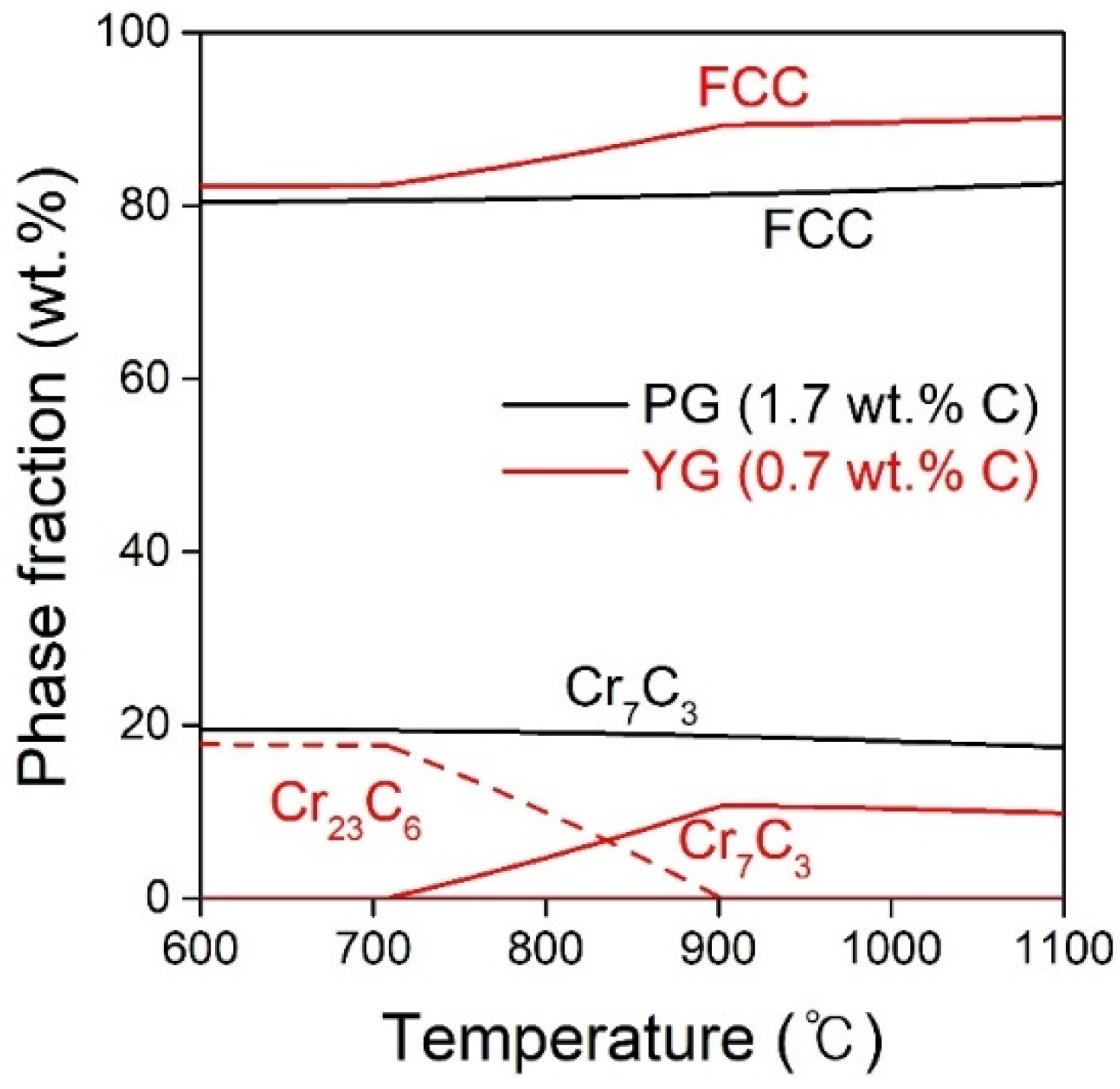
Figure 3c,d show XRD patterns of the sintered PG and YG alloys, having an FCC matrix with a lattice constant of 0.3611 and 0.3620 nm, respectively, which are lower than those of the milled powders. Additional XRD peaks of the Cr7C3 phase (mp-19855, Pnma, space group No. 62; a = 0.453 nm, b = 0.697 nm, c = 1.221 nm [28]) were observed in both alloys, with the PG alloy exhibiting higher intensity. Figure 4 shows the equilibrium fraction of Cr carbide and FCC matrix of PG and YG alloys in the temperature range of 600–1100 °C calculated using FactSage 8.3 software and FSstel database [29]. Previous studies [20] confirmed that the addition of 1 wt.% stearic acid (i.e., PCA) can increase the C content of sintered alloy to ~0.7%, which corresponds to the theoretical value. The GNF, which consists only of carbon, increases the C content of the sintered alloy, whereas Y2O3 has no effect on the C content. Thus, the C contents of the sintered PG and YG alloys were estimated to be 1.7 and 0.7 wt.%, respectively. Thermodynamic calculations reveal that the Cr7C3 phase is stable at the sintering temperature of 1000 °C in both PG and YG alloys. The equilibrium fraction of the Cr7C3 phase of the PG alloy (18.2%) is higher than that of the YG alloy (10.3%), which is consistent with the XRD results.
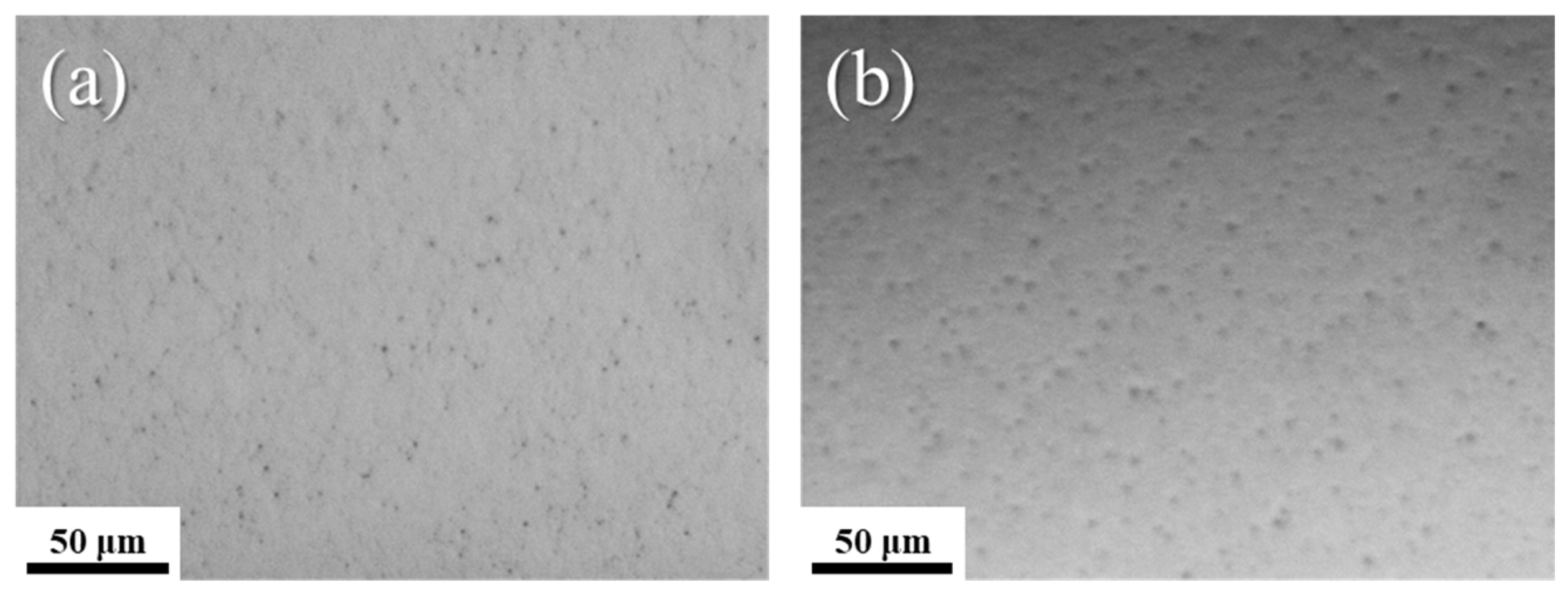
Figure 5 shows OM images of sintered PG and YG alloys. This indicates that both alloys exhibit dense and homogeneous microstructures without observable residual porosity, indicating that near-full densification was achieved during spark plasma sintering. This observation is consistent with the high relative densities (>99%) of the PG and YG alloys.
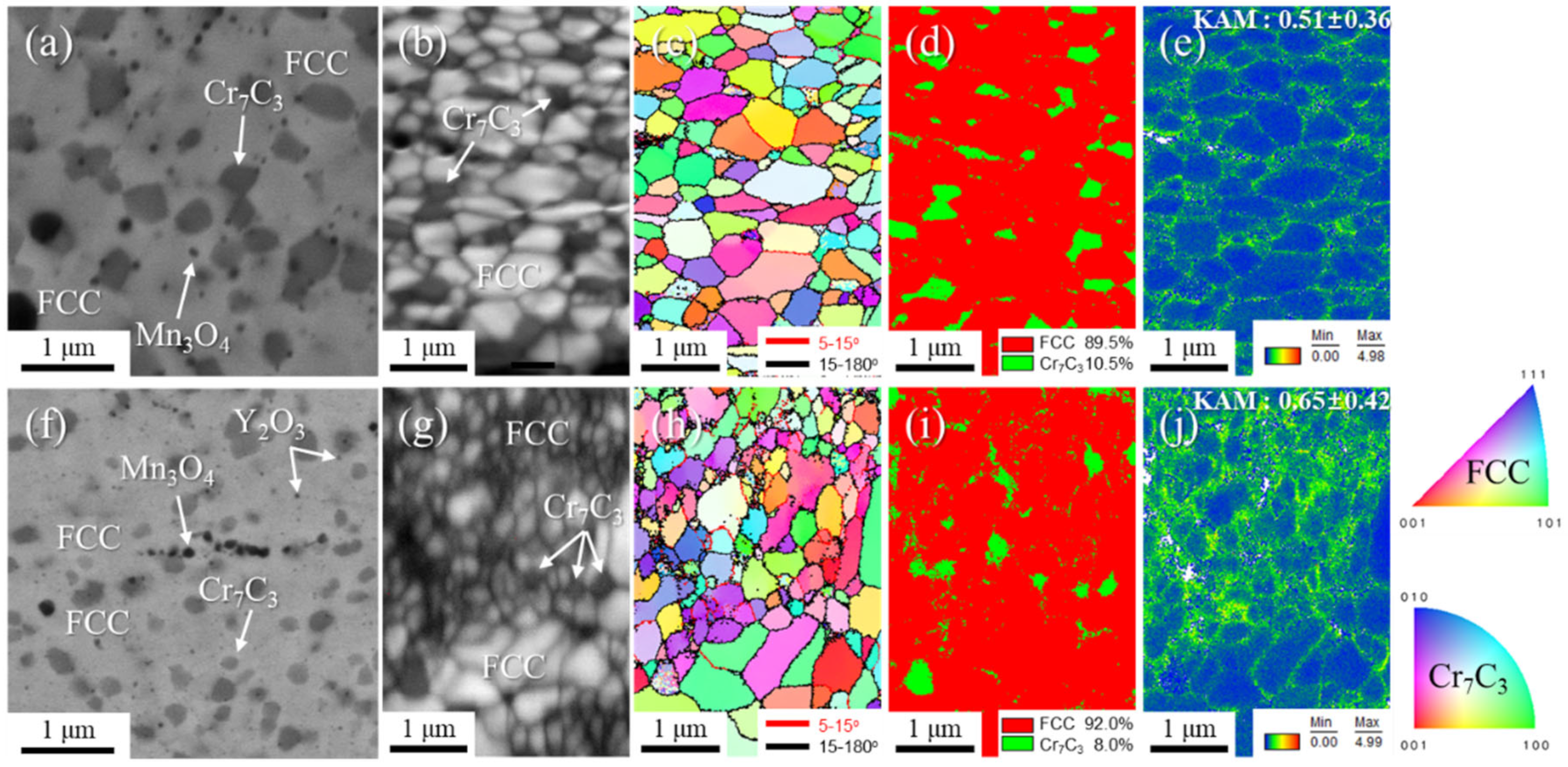
Figure 6a shows an SEM BSE image of the sintered PG alloy. There are dark particles, Cr-rich carbide phases with sizes of ~0.4 μm and Mn-rich oxide phases with sizes of ~50 nm. EBSD image quality (IQ), inverse pole figure (IPF), phase, and kernel average misorientation (KAM) maps (Figure 6b–e) indicate that the submicron-sized (0.4 ± 0.1 μm) Cr-rich phase corresponds to the Cr7C3 phase with an area fraction of ~10.5%. The FCC matrix is composed mainly of high-angle grain boundaries (HAGBs) with a grain size of 0.57 ± 0.31 μm. This indicates that ultrafine-grained HEA was obtained through MA and SPS processes. Fine Mn-rich oxide particles were not analyzed in EBSD measurements. Figure 6f–j shows SEM and EBSD results of the sintered YG alloy. The sintered YG alloy contained the smaller (0.2 ± 0.1 μm) (Figure 6f) and lesser (8.0%) Cr7C3 phase (Figure 6i), compared to the PG alloy, which is attributed to the lower C content of the YG alloy. The FCC matrix consists of fine-grained (~0.2 μm) regions and coarse-grained (~1.0 μm) regions (Figure 6h), with an average grain size of 0.71 ± 0.33 μm. The fine-grained regions contained more low-angle grain boundaries (LAGB) with orientations less than 15° (Figure 6g,h). The presence of bimodal grain size distribution and aligned Mn-rich oxide particles in the YG alloy indicates that mechanical milling was incomplete due to the absence of PCA. Additional mechanical milling is required to homogenize the microstructure of the YG alloy. The YG alloy contained numerous Y-rich oxide particles, as shown in Figure 6f. The KAM values of PG and YG alloys were 0.51 ± 0.36° and 0.65 ± 0.42°, respectively, indicating a higher KAM value in the YG alloy containing a finer LAGB region. The dislocation densities of PG and YG alloys were obtained to be 6.69 × 10¹⁴ m−2 and 6.82 × 10¹⁴ m−2, respectively.
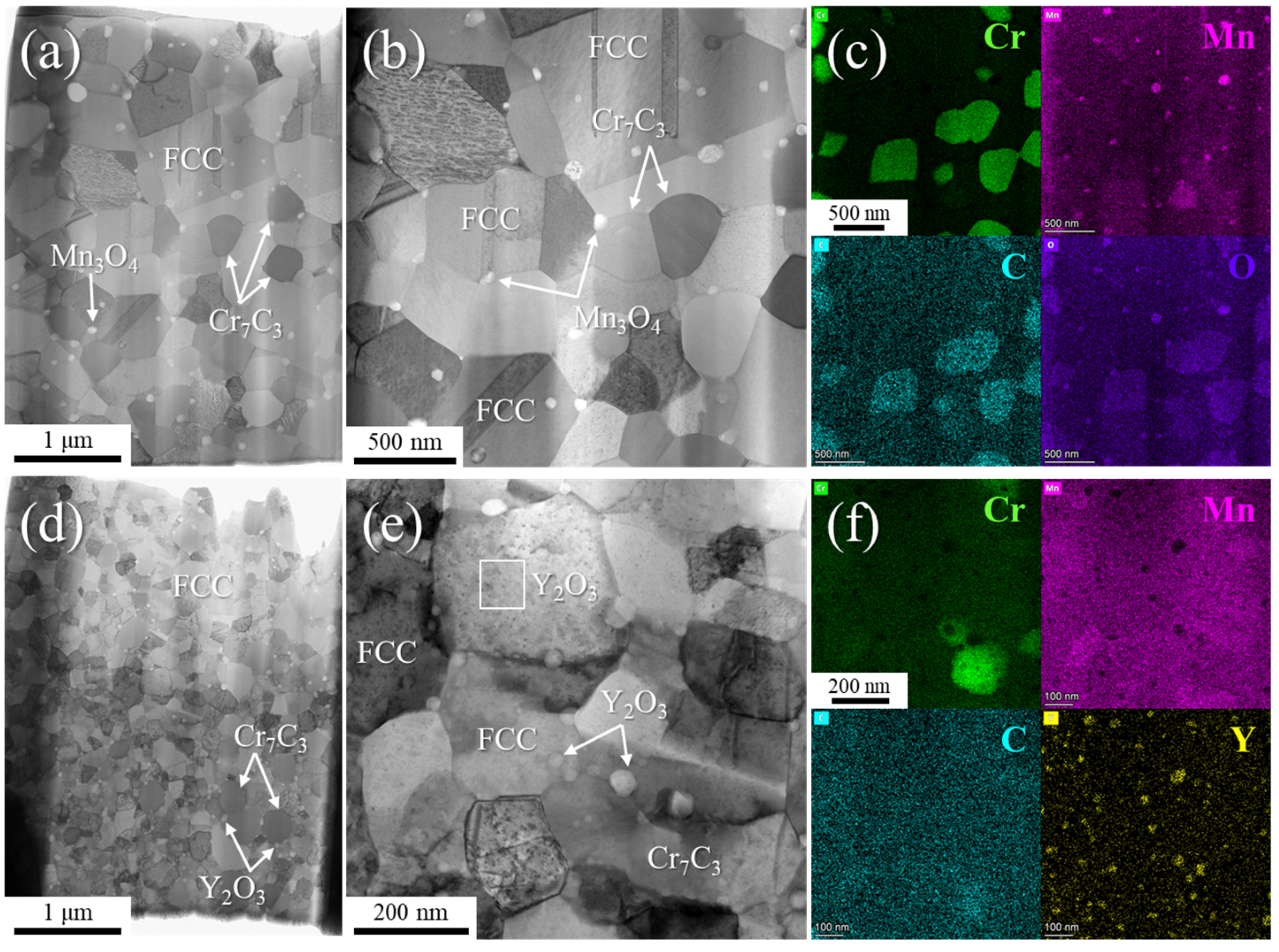
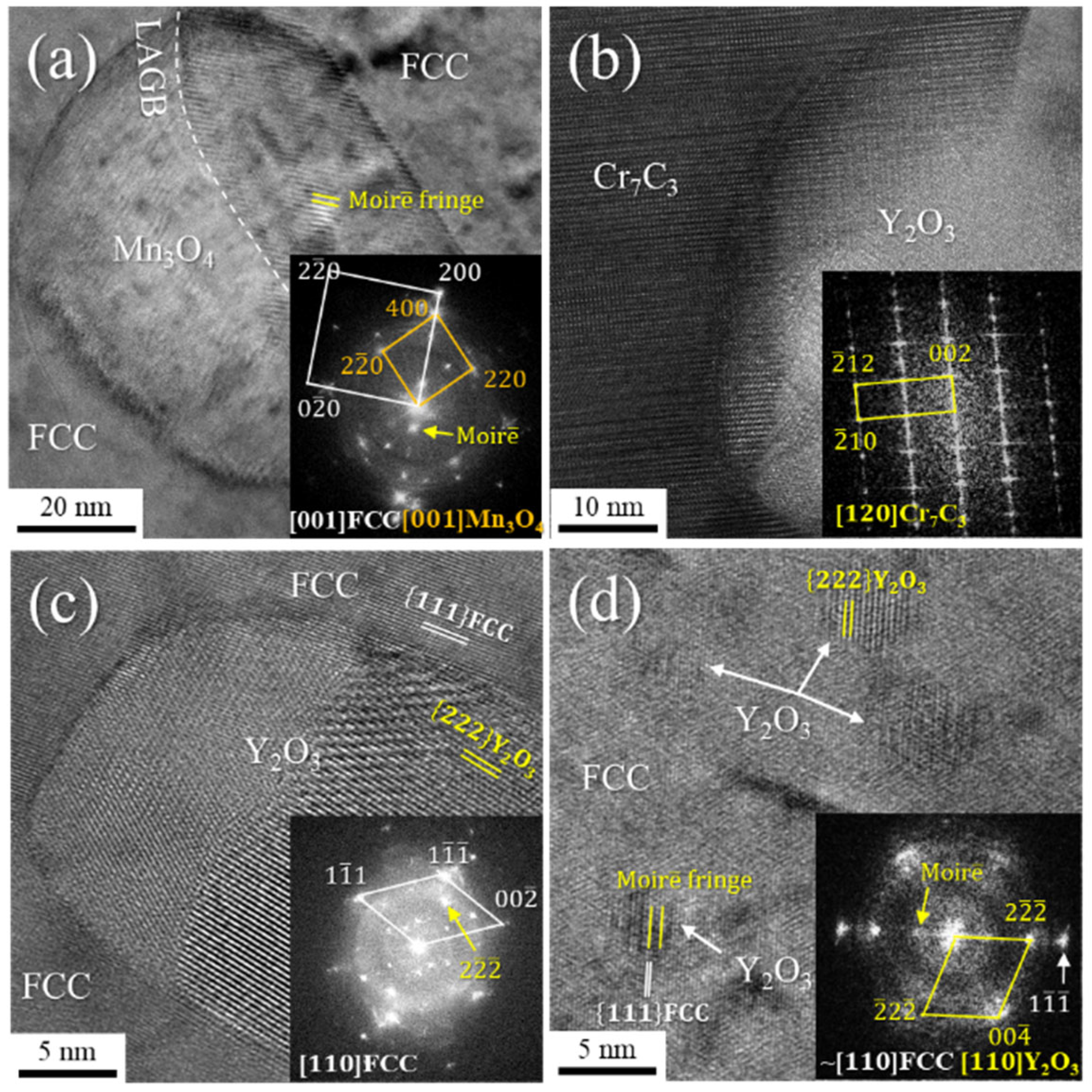
Figure 7a–c show bright-field scanning TEM (BFSTEM) images and EDS elemental mapping of the sintered PG alloy, which consists of submicron-sized FCC matrix and Cr7C3 phases and Mn-oxide phases along grain boundaries. The grain size of the FCC matrix was measured to be 485 ± 286 nm, consistent with the EBSD result. The diameter of the Mn-oxide phases was measured to be 62 ± 23 nm. High-resolution TEM (HRTEM) and fast Fourier transform (FFT) analyses of the Mn-rich oxide phase present along the LAGB are shown in Figure 8a. The Mn-rich oxide phase was identified as spinel-structured Mn3O4 (mp-28226, F d 3 ¯ m , space group No. 227; a = 0.845 nm for MnCr2O4 [30]) with a cube-on-cube orientation relationship (OR) (i.e., [001]FCC//[001]oxide, (200)FCC//(400)oxide). The Moiré fringes with spacings of ~0.9 nm were formed by the superposition of the (200)FCC (~0.18 nm) and (400)oxide (~0.22 nm) planes.
Figure 7d–f show STEM and EDS mapping results of the fine-grained region for the sintered YG alloy. The sizes of the FCC matrix and Cr7C3 phase for the fine-grained region were measured to be 151 ± 69 nm and 210 ± 68 nm, which is in good agreement with EBSD data (Figure 6g–j). Y-rich oxide particles measuring 17 ± 9 nm in diameter were present along the grain boundaries of the FCC matrix and Cr7C3 phases. Additionally, numerous fine (~5 nm) Y-rich oxide particles were observed within the FCC matrix. The GNF phase was not observed in both PG and YG alloys, which means that all GNF phases react with solute Cr to form the Cr7C3 phase during the sintering process. The absence of GNF-related features in the sintered compacts is attributed to the aggressive milling and sintering conditions employed in this study. Under high-energy ball milling (250 rpm, 30:1, 24 h), carbon reinforcements are expected to undergo severe fragmentation and structural degradation, and subsequent high-temperature sintering further promotes carbon consumption via interfacial reactions. In contrast, CNT-reinforced metal matrix composites processed under milder milling and lower sintering temperatures reported the preservation of CNT morphology [19,31,32], suggesting that the present conditions are unfavorable for maintaining the structural integrity of carbon-based reinforcements.
The carbide and oxide phases in the YG alloy were further characterized by HRTEM analysis. Figure 8b shows HRTEM and FFT results revealing the orthorhombic-structured Cr7C3 phase in the YG alloy. The Y-rich oxide particles were present along the grain boundaries of the Cr7C3 phase (Figure 8b) and the FCC matrix (Figure 8c), and also within the FCC matrix (Figure 8d). The fine (~5 nm) Y-rich oxide particles within the FCC matrix were identified as a cubic Y2O3 phase (mp-2652, I a 3 ¯ , space group No. 206; a = 1.061 nm [33]) with a cube-on-cube OR with respect to the FCC matrix. This cube-on-cube OR between the Y2O3 and FCC matrix arises from the lattice match between the cubic-structured phases (e.g., similar 2d{222}oxide (~0.613 nm) and 3d{111}FCC (~0.624 nm) values). The Moiré fringes with spacings of ~0.6 nm (extra diffraction spot at the 1/3{111}FCC positions) arising from {222}oxide and {111}FCC planes are also visible. This indicates that fine coherent Y2O3 phases were formed within the FCC matrix of the YG alloy during the sintering process of mechanically alloyed powders. The coarse Y2O3 phases along the grain boundaries appear to be less coherent to the FCC matrix, exhibiting a lattice deviation of ~10° from the cube-on-cube OR (Figure 8c), implying that the growth of the Y2O3 phase resulted in a loss of coherency to the FCC matrix.
Both the Mn3O4 and Y2O3 oxide phases in the PG and YG alloys act as obstacles that impede the movement of grain boundaries, thus achieving an ultrafine-grained microstructure. The Y2O3 phase of the YG alloy is smaller and denser than the Mn3O4 phase of the PG alloy. Additionally, the YG alloy contains fine (~5 nm) Y2O3 particles within the FCC matrix. This means a greater pinning effect of the Y2O3 phase, which contributes to the formation of a finer FCC matrix and Cr7C3 carbide in the YG alloy. However, this enhanced grain boundary pinning effect of Y2O3 particles was limited to the fine-grained region with a larger amount of oxide particles.

3.3. Mechanical Properties

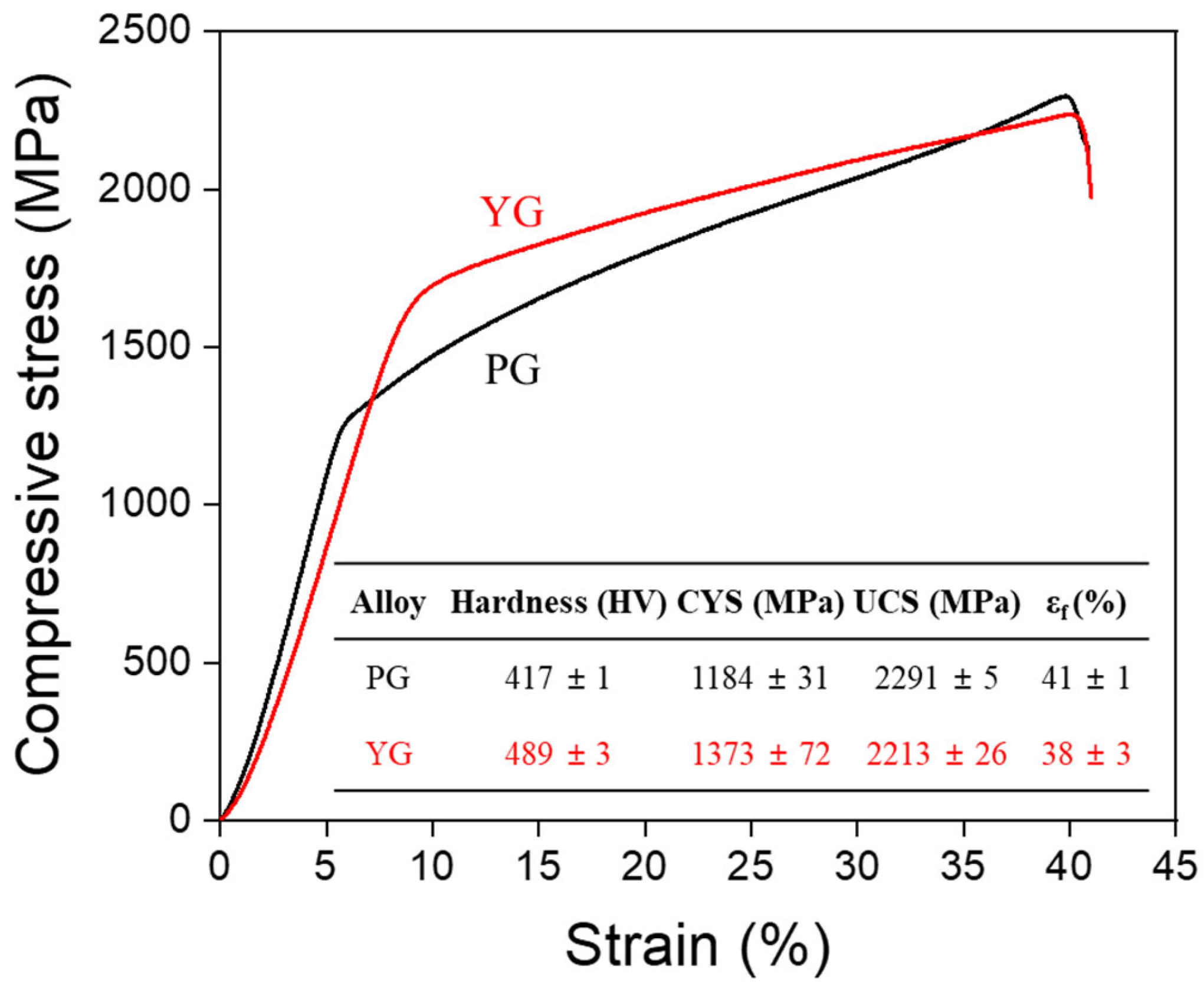
Figure 9 shows the compressive stress–strain curves of the sintered PG and YG alloys, along with their compressive yield strength (CYS), ultimate compressive strength (UCS), fracture strain (εf), and Vickers hardness data. The Vickers hardness of the sintered PG and YG alloys was 417 ± 1 and 489 ± 3 HV, respectively. Similarly, the CYS of the YG alloy (1373 ± 72 MPa) was higher than that of the PG alloy (1184 ± 31 MPa).
The total yield strength ( σ T o t a l ) of the alloy can be estimated by the sum of strengthening components, including grain boundary strengthening ( σ G B ), dislocation strengthening ( σ d i s l . ), and oxide dispersion strengthening ( σ O i x d e ) as follows [34]:
σ T o t a l =   σ 0 +   σ G B + σ d i s l . +   σ O x i d e
where σ 0 is the lattice friction stress of CrMnFeCoNi alloy (125 MPa [35]), inherently accounting for the solid-solution strengthening contribution [36]. The σ G B can be described using the Hall-Petch relationship [37,38]:
σ G B =   k d 1 / 2
where d is the measured FCC grain size and k is the slope (494 MPa/μm1/2 [35]) for Cantor alloy. Based on the average FCC matrix grain size of PG (0.57 μm) and YG (0.71 μm) alloys measured by EBSD data, the grain boundary strengthening of the PG and YG alloys was calculated to be 654 MPa and 586 MPa, respectively. The σ d i s l . can be calculated using the Bailey-Hirsch equation [39]:
σ d i s l . =   M α G b ρ 1 / 2
where M is the mean orientation factor (3.06 for FCC metals), α is a constant (0.2 for FCC metals), G is the shear modulus (81 GPa [40]), b is the Burgers vector (0.254 nm), and ρ is the dislocation density. Based on the dislocation density of PG (6.69 × 10¹⁴ m−2) and YG (6.82 × 10¹⁴ m−2) alloys measured by EBSD, the dislocation strengthening of the PG and YG alloys was calculated to be 325 MPa and 328 MPa, respectively. The contribution of the Cr7C3 carbide phase with an area fraction of ~10% was excluded from the strength calculations because its strengthening effect was limited by its very large size (~400 nm).
Oxide dispersion strengthening ( σ O x i d e ) can be estimated using the Orowan equation [40]:
σ O r o w a n =   M   ×   0.4   × G   × b π   × ( 1 v )   ×   ln ( 2 r ¯ b ) λ
λ = 2 r ¯ × ( ( π 4 f ) 1   )
r ¯ = r × 2 3
where v is Poisson’s ratio (0.265 [40]), λ is the average interprecipitate distance, and f and r are the volume fraction and radius of the oxide particles. The sintered PG alloy contained Mn3O4 particles with a radius of 31 nm (Figure 7b). Previous study [15] has shown that Cantor powder milled with 1 wt.% PCA contains 0.12 wt.%O, which results in the formation of 2.16 vol.% of spinel oxide particles. Using the measured radius (31 nm) and expected volume fraction (2.16%) of Mn3O4 oxide particles, the σ O x i d e of the PG alloy can be estimated as 194 MPa. Meanwhile, sintered YG alloy contains both Mn3O4 and Y2O3 oxide particles. Mn3O4 oxide particles exhibit similar sizes in the PG and YG alloys; however, due to the absence of 1 wt.% PCA with a theoretical O content of 0.12 wt.%, the YG alloy is expected to contain fewer Mn3O4 particles (~1.57%), thus resulting in the σ O x i d e of 161 MPa. The sintered YG alloy contained coarse (~8.5 nm in radius) Y2O3 particles along the grain boundaries and fine (~2.5 nm in radius) Y2O3 particles within the FCC matrix. From the addition amount (1 wt.%), the total volume fraction of Y2O3 particles can be calculated as 1.59%. Assuming that 90% of the Y2O3 particles were formed along the grain boundaries, the σ O x i d e of the Y2O3 (GB) and Y2O3 (matrix) can be calculated to be 420 MPa and 300 MPa, respectively. Using the Pythagorean sum, the σ O x i d e of the three components is obtained as 541 MPa.
According to theoretical strength calculations, the σ T o t a l values of the sintered PG and YG alloys were calculated to be 1298 MPa and 1580 MPa, respectively, which are similar to the measured CYS values of the PG (1184 MPa) and YG (1373 MPa) alloys within a ~15% error range. The main strengthening factor in PG and YG alloys is grain boundary strengthening, which accounts for 50% (645 MPa) and 45% (586 MPa) of the calculated yield strength, respectively. Dislocation strengthening (25%, 325 MPa) and oxide dispersion strengthening (15%, 194 MPa) are the secondary strengthening factors of PG alloy. The YG alloy exhibits a similar dislocation strengthening effect (25%, 328 MPa). However, the YG alloy exhibits a significantly greater oxide dispersion strengthening effect (42%, 541 MPa) due to the added Y2O3 nanoparticles. Therefore, the finely dispersed Y2O3 particles distributed along grain boundaries and within the FCC matrix are the main cause of the increase in CYS (~200 MPa). The UCS and fracture strain of sintered YG alloy were measured to be 2213 ± 5 MPa and 38 ± 1%, which are similar to the values (2291 ± 26 MPa, 41 ± 3%) of the PG alloy when considering the standard deviation. This indicates that adding Y2O3 nanoparticles is a beneficial strategy for increasing yield strength while maintaining compressive strength and ductility. It is well known that coarse-grained regions preferentially accommodate plastic strain during deformation, while ultrafine-grained regions contribute to strain hardening, thereby suppressing strain localization and enhancing deformation compatibility. Thus, maintenance of the compressive strength and ductility of the YG alloy can also be attributed to their bimodal grain structure [41].

4. Conclusions

In this study, the microstructure and mechanical properties of ultrafine-grained CrMnFeCoNi alloys fabricated via MA of PCA + GNF or Y2O3 + GNF and subsequent SPS were investigated using thermodynamic calculations, XRD, SEM, EBSD, TEM, hardness, and compression tests. The main conclusions are summarized as follows.
(1)
After MA of additives, the PG and YG powders showed irregular and agglomerated morphologies, with average powder sizes of 14.8 μm and 27.9 μm, respectively. The PG and YG powders exhibited a single FCC phase with crystallite sizes of 10.2 and 6.8 nm, respectively.
(2)
The PG and YG sintered alloys consisted of an FCC matrix, Cr7C3 carbide, and oxide phases. The PG alloy exhibited uniformly distributed FCC grains with an average grain size of 0.57 μm, whereas the YG alloy showed a bimodal distribution of fine and coarse grains, with an average grain size of 0.71 μm. The PG alloy, with its higher C content, contained a more abundant coarse Cr7C3 phase (376 nm, 10.5%) than the YG alloy (210 nm, 8.0%).
(3)
The PG and YG sintered alloys contained coarse (~62 nm) Mn3O4 oxide particles mainly along grain boundaries. The spinel Mn3O4 particles exhibited cube-on-cube ORs with respect to the FCC matrix. The YG alloy contained additional Y2O3 particles distributed along grain boundaries as well as within the FCC matrix. The fine Y2O3 particles (~5 nm) formed in the FCC matrix had cube-on-cube ORs to the FCC matrix. A slightly deviated (~10°) cube-on-cube ORs were observed in the coarse (~17 nm) Y2O3 particles formed along the grain boundaries.
(4)
The YG alloy exhibited higher hardness (489 HV) and CYS (1373 MPa) compared to the PG alloy (417 HV and 1184 MPa). Yield strength modeling revealed that grain boundary strengthening is the dominant strengthening mechanism in both PG and YG alloys. Dislocation strengthening and oxide dispersion strengthening are the secondary strengthening factors of the PG and YG alloys. The YG alloy had greater oxide dispersion strengthening arising from finely dispersed Y2O3 particles along the grain boundaries and within the FCC matrix, which led to an increase in CYS of ~200 MPa. The UCS and fracture elongation were similar in the PG (2291 MPa and 41%) and YG (2213 MPa and 38%) alloys.

Author Contributions

Conceptualization, J.-G.J.; investigation, S.J., S.P. and J.-G.J.; formal analysis, S.P. and S.J.; validation, S.P.; writing—original draft preparation, S.J.; writing—review and editing, J.-G.J.; supervision, J.-G.J.; funding acquisition, J.-G.J. All authors have read and agreed to the published version of the manuscript.

Funding

This work was supported by the National Research Foundation of Korea (NRF) grant funded by the Korea government (MSIT) (No. RS-2025-16070970). We thank the Center for University-Wide Research Facilities (CURF) at Jeonbuk National University for assisting with the experiments.

Data Availability Statement

The original contributions presented in this study are included in the article. Further inquiries can be directed to the corresponding author.

Conflicts of Interest

The authors declare no conflict of interest.

References

  1. He, Q.F.; Ding, Z.Y.; Ye, Y.F.; Yang, Y. Design of high-entropy alloys: A perspective from nonideal mixing. JOM 2017, 69, 2092–2098. [Google Scholar] [CrossRef]
  2. Tong, C.J.; Chen, Y.L.; Yeh, J.W.; Lin, S.J.; Chen, S.K.; Shun, T.T.; Tsau, C.H.; Chang, S.Y. Microstructure characterization of AlxCoCrCuFeNi high-entropy alloy system with multiprincipal elements. Metall. Mater. Trans. A 2005, 36, 881–893. [Google Scholar] [CrossRef]
  3. Zhang, Y.; Zuo, T.T.; Tang, Z.; Gao, M.C.; Dahmen, K.A.; Liaw, P.K.; Lu, Z.P. Microstructures and properties of high-entropy alloys. Prog. Mater. Sci. 2014, 61, 1–93. [Google Scholar] [CrossRef]
  4. Yeh, J.W.; Chen, S.K.; Lin, S.J.; Gan, J.Y.; Chin, T.S.; Shun, T.T.; Tsau, C.H.; Chang, S.Y. Nanostructured high-entropy alloys with multiple principal elements: Novel alloy design concepts and outcomes. Adv. Eng. Mater. 2004, 6, 299–303. [Google Scholar] [CrossRef]
  5. Tsai, M.H.; Yeh, J.W. High-entropy alloys: A critical review. Mater. Res. Lett. 2014, 2, 107–123. [Google Scholar] [CrossRef]
  6. Miracle, D.B.; Senkov, O.N. A critical review of high entropy alloys and related concepts. Acta Mater. 2017, 122, 448–511. [Google Scholar] [CrossRef]
  7. Cantor, B.; Chang, I.T.H.; Knight, P.; Vincent, A.J.B. Microstructural development in equiatomic multicomponent alloys. Mater. Sci. Eng. A 2004, 375–377, 213–218. [Google Scholar] [CrossRef]
  8. Wu, Z.; Bei, H.; Pharr, G.M.; George, E.P. Temperature dependence of the mechanical properties of equiatomic solid solution alloys with face-centered cubic crystal structures. Acta Mater. 2014, 81, 428–441. [Google Scholar] [CrossRef]
  9. Jang, S.; Lee, S.H.; Park, S.; Jung, J.G. Effect of C and Ti additions on microstructure and mechanical properties of CrMnFeCoNi high-entropy alloy. Met. Mater. Int. 2026, in press. [Google Scholar]
  10. Suryanarayana, C. Mechanical alloying and milling. Prog. Mater. Sci. 2001, 46, 1–184. [Google Scholar] [CrossRef]
  11. Vaidya, M.; Muralikrishna, G.M.; Murty, B.S. High-entropy alloys by mechanical alloying: A review. J. Mater. Res. 2019, 34, 664–686. [Google Scholar] [CrossRef]
  12. Park, J.; Jeon, J.; Seo, N.; Kang, S.; Son, S.B.; Lee, S.J.; Jung, J.G. Microstructure and mechanical behavior of AISI 4340 steel fabricated via spark plasma sintering and post-heat treatment. Mater. Sci. Eng. A 2023, 862, 144433. [Google Scholar] [CrossRef]
  13. Jung, G.W.; Shin, W.; Lee, J.; Jung, J.G.; Lee, S.J.; Park, J. Microstructure evolution and mechanical properties of oxide dispersion strengthened Ni–Cr–Y2O3 alloys with novel powder production routes. Mater. Charact. 2023, 199, 112824. [Google Scholar] [CrossRef]
  14. Kumar, A.; Singh, A.; Suhane, A. Mechanically alloyed high entropy alloys: Existing challenges and opportunities. J. Mater. Res. Technol. 2022, 17, 2431–2456. [Google Scholar] [CrossRef]
  15. Park, S.; Lee, S.H.; Shin, E.; Lee, S.J.; Jung, J.G. Effects of mechanical milling on microstructure and mechanical properties of CrMnFeCoNi high-entropy alloy fabricated via spark plasma sintering. J. Mater. Res. Technol. 2025, 39, 4854–4865. [Google Scholar] [CrossRef]
  16. Kleiner, S.; Bertocco, F.; Khalid, F.A.; Beffort, O. Decomposition of process control agent during mechanical milling and its influence on displacement reactions in the Al–TiO2 system. Mater. Chem. Phys. 2005, 89, 362–366. [Google Scholar] [CrossRef]
  17. Tan, J.; Chen, X.; Peng, K.; Zhang, H.; Chen, Z.; Geng, Y. Effect of Y2O3 nanoparticles on powder plasma arc additive manufacturing of CoCrFeNiMn high-entropy alloys: Microstructure evolution and mechanical properties. J. Alloys Compd. 2024, 997, 174933. [Google Scholar] [CrossRef]
  18. Ujah, C.O.; Kallon, D.V.V.; Aigbodion, V.S. Study on properties of high entropy alloys reinforced with carbon nanotubes/graphene—A review. J. Alloys Metall. Syst. 2024, 8, 100117. [Google Scholar] [CrossRef]
  19. Bahrami, A.; Mohammadnejad, A.; Sajadi, M. Microstructure and mechanical properties of spark plasma sintered AlCoFeMnNi high entropy alloy (HEA)–carbon nanotube (CNT) nanocomposite. J. Alloys Compd. 2021, 862, 158577. [Google Scholar] [CrossRef]
  20. Lee, S.H.; Park, S.H.; Lim, K.R.; Lee, S.J.; Jung, J.G. Microstructure and mechanical properties of oxide-dispersion-strengthened CrMnFeCoNiC0.2O0.2 high-entropy alloy fabricated by mechanical alloying and spark plasma sintering. Mater. Sci. Eng. A 2025, 947, 149284. [Google Scholar] [CrossRef]
  21. Palmer, D.C. Visualization and analysis of crystal structures using CrystalMaker software. Z. Kristallogr. Cryst. Mater. 2015, 230, 559–572. [Google Scholar] [CrossRef]
  22. Williamson, G.K.; Hall, W.H. X-ray line broadening from filed aluminium and wolfram. Acta Metall. 1953, 1, 22–31. [Google Scholar] [CrossRef]
  23. Schneider, C.A.; Rasband, W.S.; Eliceiri, K.W. NIH Image to ImageJ: 25 years of image analysis. Nat. Methods 2012, 9, 671–675. [Google Scholar] [CrossRef]
  24. ASTM E9/E9M; Standard Test Methods of Compression Testing of Metallic Materials at Room Temperature. ASTM International: West Conshohocken, PA, USA, 2019.
  25. Penther, D.; Fleck, C.; Ghasemi, A.; Riedel, R.; Kamrani, S. Development and characterization of Mg–SiC nanocomposite powders synthesized by mechanical milling. Key Eng. Mater. 2017, 742, 165–172. [Google Scholar] [CrossRef]
  26. Ponhan, K.; Tassenberg, K.; Weston, D.; Nicholls, K.G.M.; Thornton, R. Effect of SiC nanoparticle content and milling time on the microstructural characteristics and properties of Mg–SiC nanocomposites synthesized with powder metallurgy incorporating high-energy ball milling. Ceram. Int. 2020, 46, 26956–26969. [Google Scholar] [CrossRef]
  27. Ramakanth, K. Basics of X-Ray Diffraction and Its Application; IK International Publishing House: New Delhi, India, 2007. [Google Scholar]
  28. Lv, Z.Q.; Dong, F.; Zhou, Z.A.; Jin, G.F.; Sun, S.H.; Fu, W.T. Structural properties, phase stability and theoretical hardness of Cr23−xMxC6 (M = Mo, W; x = 0–3). J. Alloys Compd. 2014, 607, 207–214. [Google Scholar] [CrossRef]
  29. Bale, C.W.; Bélisle, E.; Chartrand, P.; Decterov, S.A.; Eriksson, G.; Gheribi, A.E.; Hack, K.; Jung, I.H.; Kang, Y.B.; Melançon, J.; et al. Reprint of: FactSage thermochemical software and databases, 2010–2016. Calphad 2016, 55, 1–19. [Google Scholar] [CrossRef]
  30. Jirák, Z.; Vratislav, S.; Novák, P. Study of cubic and tetragonal structures in the system MnxCr3−xO4. Phys. Status Solidi A 1978, 50, K21–K24. [Google Scholar] [CrossRef]
  31. Singh, S.; Shaikh, S.M.; Kumar, P.; Murty, B.S.; Srivastava, C. Microstructural homogenization and substantial improvement in corrosion resistance of mechanically alloyed FeCoCrNiCu high entropy alloys by incorporation of carbon nanotubes. Materialia 2020, 14, 100917. [Google Scholar] [CrossRef]
  32. Pourghaz, A.; Rajabi, M.; Torabi, M.; Amirnejad, M. The impressive improvement of CoCrFeMnNi high entropy alloy mechanical properties and pitting corrosion resistance by incorporation of carbon nanotube reinforcement. Intermetallics 2023, 163, 108073. [Google Scholar] [CrossRef]
  33. Baldinozzi, G.; Calvarin, G.; Berar, J.-F. Rietveld refinement of two-phase Zr-doped Y2O3. Mater. Sci. Forum 1998, 278–281, 680–685. [Google Scholar]
  34. Yim, D.; Sathiyamoorthi, P.; Hong, S.J.; Kim, H.S. Fabrication and mechanical properties of TiC reinforced CoCrFeMnNi high-entropy alloy composite by water atomization and spark plasma sintering. J. Alloys Compd. 2019, 781, 389–396. [Google Scholar] [CrossRef]
  35. Otto, F.; Dlouhý, A.; Somsen, C.; Bei, H.; Eggeler, G.; George, E.P. The influences of temperature and microstructure on the tensile properties of a CoCrFeMnNi high-entropy alloy. Acta Mater. 2013, 61, 5743–5755. [Google Scholar] [CrossRef]
  36. Guo, L.; Ou, X.; Ni, S.; Liu, Y.; Song, M. Effects of carbon on the microstructures and mechanical properties of FeCoCrNiMn high entropy alloys. Mater. Sci. Eng. A 2019, 746, 356–362. [Google Scholar] [CrossRef]
  37. Hall, E.O. The deformation and ageing of mild steel: III Discussion of results. Proc. Phys. Soc. B 1951, 64, 747. [Google Scholar] [CrossRef]
  38. Petch, N.J. The cleavage strength of polycrystals. J. Iron Steel Inst. 1953, 174, 25–28. [Google Scholar]
  39. Bailey, J.E.; Hirsch, P.B. The dislocation distribution, flow stress, and stored energy in cold-worked polycrystalline silver. Philos. Mag. 1960, 5, 485–497. [Google Scholar] [CrossRef]
  40. Ardell, A.J. Precipitation hardening. Metall. Trans. A 1985, 16, 2131–2165. [Google Scholar] [CrossRef]
  41. Shokry, A.; Ahadi, A.; Ståhle, P.; Orlov, D. Improvement of structural efficiency in metals by the control of topological arrangements in ultrafine and coarse grains. Sci. Rep. 2021, 11, 17445. [Google Scholar] [CrossRef]
Figure 1. Schematic illustration showing the location of the specimens for microstructural analysis and compressive testing of the sintered alloy. The red dots indicate the locations where the measurements were performed.
Metals 16 00170 g001
Figure 2. SEM image and powder size distribution for (a) unmilled CrMnFeCoNi alloy powder and milled (b) PG and (c) YG powders.
Metals 16 00170 g002
Figure 3. XRD pattern of (a,b) milled powders and (c,d) sintered specimens for (a,c) PG and (b,d) YG alloys.
Metals 16 00170 g003
Figure 4. Change in the equilibrium fraction of Cr carbide and FCC matrix of PG and YG alloys in the temperature range of 600–1100 °C.
Metals 16 00170 g004
Figure 5. OM images of (a) PG and (b) YG sintered alloys.
Metals 16 00170 g005
Figure 6. SEM BSE image, EBSD IQ, IPF, phase, and KAM maps of (ae) PG and (fj) YG alloys.
Metals 16 00170 g006
Figure 7. BFSTEM image and EDS element mapping of (ac) PG and (df) YG alloys.
Metals 16 00170 g007
Figure 8. HRTEM and FFT results of (a) Mn3O4 particle in the PG alloy and (b) Cr7C3 and (c,d) Y2O3 particles in the YG alloy.
Metals 16 00170 g008
Figure 9. Compressive stress–strain curve of sintered PG and YG alloys.
Metals 16 00170 g009
Disclaimer/Publisher’s Note: The statements, opinions and data contained in all publications are solely those of the individual author(s) and contributor(s) and not of MDPI and/or the editor(s). MDPI and/or the editor(s) disclaim responsibility for any injury to people or property resulting from any ideas, methods, instructions or products referred to in the content.