Review

Physics-Informed Decision Framework for Reuse of Reclaimed Steel Members Under Uncertainty

by
Sina Sarfarazi
1,*,
Marcello Fulgione
1 and
Francesco Fabbrocino
2
1
Department of Structural Engineering, University of Naples “Federico II”, 80125 Naples, Italy
2
Department of Engineering, Pegaso University, 80143 Naples, Italy
*
Author to whom correspondence should be addressed.
Metals 2026, 16(2), 171; https://doi.org/10.3390/met16020171 (registering DOI)
Submission received: 31 December 2025 / Revised: 19 January 2026 / Accepted: 22 January 2026 / Published: 1 February 2026
(This article belongs to the Special Issue Novel Insights and Advances in Steels and Cast Irons (2nd Edition))

Abstract

Structural steel reuse can gain large embodied-carbon savings, yet it is still not widely adopted since approval depends on the quality of the evidence, how uncertainty is handled, and if the design requirements are followed, not just on resistance. Reclaimed members frequently lack dependable documentation regarding material grade, loading history, boundary conditions, connection status, and degradation. For reuse decisions, conservative default assumptions protect safety but frequently eliminate qualified reuse options. This research examines data-driven and physics-informed computational methods from a decision-making standpoint, contending that their significance resides in facilitating an auditable approval process, not in supplanting deterministic verification. We differentiate feasibility, acceptability, and approval as distinct engineering phases. Data-driven models are thought of as tools for quickly screening candidates, surrogate evaluation, inverse reasoning, and stock-to-demand matching. Their goal is to reduce the list of candidates and prioritize evidence collection. Physics-informed approaches are examined as admissibility filters that impose restrictions of equilibrium, compatibility, stability, and plausible boundary-condition envelopes; therefore, minimizing mechanically invalid predictions under partial information. Next, we consider uncertainty quantification and explainability to be essential for reuse decisions. We suggest practical outputs for approval packages, such as resistance bounds within specified assumption envelopes, sensitivity rankings of decision-critical unknowns, low-support flags, and evidence actions for conditional acceptance. This document is organized into a process from audit to approval. It also states the open issues in reuse-specific datasets, standardized evidence capturing, decision-relevant validation under degradation, and regulatory acceptance. The resulting framework clarifies how advanced computational tools can enable adaptable, conservative, and transparent steel reuse in practice.

1. Introduction

Reusing structural steel elements is one of the most effective strategies for reducing embodied carbon in construction. Studies show that reusing steel can save up to 95–97% of the embodied carbon compared to producing new steel and is about ten times less carbon-intensive than recycling, which needs remelting and reprocessing [1]. From a structural point of view, the potential for reuse is well-recognized: steel members are often removed from service because buildings are decommissioned for functional or economic reasons, not because of structural failure. In fact, many buildings are demolished long before the end of their technical lifespan, for reasons such as owner preference or obsolescence, not inadequate structural capacity [2,3]. This means that many reclaimed members still have a large part of their structural capacity. In practice, reuse is rarely blocked by resistance alone. It is blocked by the lack of reasonable evidence to assign that resistance to a new role.
Structural steel reuse is still uncommon in current practice. In the UK, only around 7% of steel from end-of-life buildings is reused, while most is recycled as scrap [4]. The key issue is not technical feasibility. Steel sections are often reusable in principle. The barrier is decision reliability under incomplete information. Reclaimed members commonly arrive with weak documentation. Material grade may be unknown. Prior loading and exposure are often unclear. Damage and corrosion can be local and hard to quantify quickly. This is mainly epistemic uncertainty. It does not disappear with a visual inspection, and it is only partially reduced by limited testing. In this context, engineers tend to default to conservative assumptions because they still need to meet the same reliability targets. Typical examples are assuming the lowest plausible steel grade or treating section loss with crude reductions to stay on the safe side [5]. This approach protects safety, but it can also reject members that would pass if the critical unknowns were measured and reported properly. That is why reuse remains difficult to scale as a circular strategy, even when capacity is available [4]. In practice, the important unknowns are not only yield strength and section size. They also include connection details, local imperfections, residual stresses from fabrication and previous service, fatigue accumulation, and the real boundary conditions created by new connections. For slender members, small uncertainty in imperfections or end restraints can dominate the buckling check. For corroded members, uncertainty in local thickness loss can dominate class and capacity. For reused connections, uncertainty in slip, prying, and bolt condition can govern serviceability and robustness. Figure 1 summarizes the main evidence gaps that control governing checks in reused steel members.
Data-driven and physics-informed methods are attractive in steel reuse because they address a practical major barrier: engineers need to control many uncertain candidates fast, then focus detailed checks on the few that are worth approving. Data-driven models can combine heterogeneous inputs from inspections, tests, and simulations, and they can evaluate large option spaces at low marginal cost [6]. Once trained, they allow fast what-if exploration that would be slow with repeated full analyses. This is useful in reuse because the decision is rarely about one member in isolation. It is about many members, many possible roles and constraints. For reuse, the most useful output is often not a single predicted capacity. It is a decision aid. Physics-informed machine learning (PIML) focuses on a different weakness. PIML reduces this risk by integrating physical structure into the learning process, so the model is guided toward mechanically admissible solutions [7]. In practice, “physics-informed” in steel reuse should not be framed only as enforcing differential equations. It should be framed in structural terms. The model should respect equilibrium and compatibility, but also the failure modes and constraints that govern steel checks in real work: stability sensitivity, section and member limits, and connection behaviour assumptions. This matters because reuse cases are rarely clean. Boundary circumstances are not clear, degradation can happen in a specific area, and the member may not be in the training set. In that light, physics guiding is a technique to keep predictions based on engineering reality and limit extrapolation.
This paper contends that the absent element in contemporary practice is a decision-oriented framework that integrates audit data and evidence collection, data-driven feasibility assessment and stock-to-demand alignment, physics-informed admissibility evaluations that uphold mechanical realism, and uncertainty-aware approval logic synchronized with code intent. The contribution is to define how these components should interact, what each component can and cannot claim, and how they can jointly support safe reuse decisions with transparent documentation. By focusing on the full decision chain, the paper positions PIML and data-driven methods as enablers of circular structural steel, while keeping engineering accountability and conservative verification at the centre.
The literature on machine learning (ML) and data-driven methods in structural engineering is extensive and expanding fast, including material characterization, structural response prediction, optimization, and digital design workflows. However, only a limited subset of these works directly addresses structural steel reuse as an approval problem under epistemic uncertainty. Much of the existing literature assumes well-defined inputs and focuses on forward prediction accuracy, whereas reuse decisions are constrained by incomplete evidence, uncertain boundary conditions, degradation, and regulatory justification. This paper, therefore, does not aim to provide an exhaustive survey of all data-driven methods applied to steel structures. Instead, it focuses selectively on concepts and approaches that are relevant for decision-making, admissibility, and approval in reuse contexts.

2. Sustainable Steel Design and Reuse as a Decision Problem

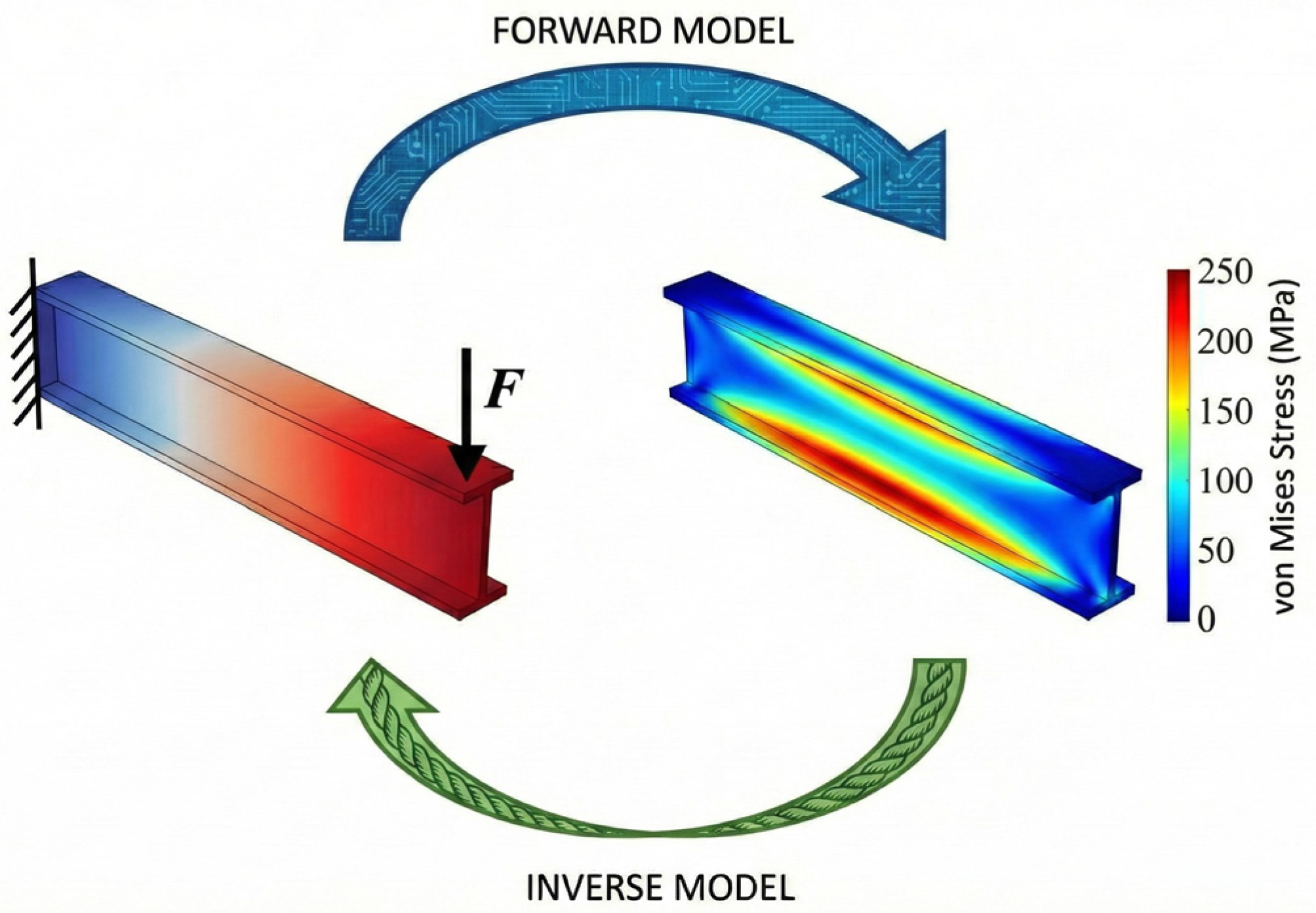
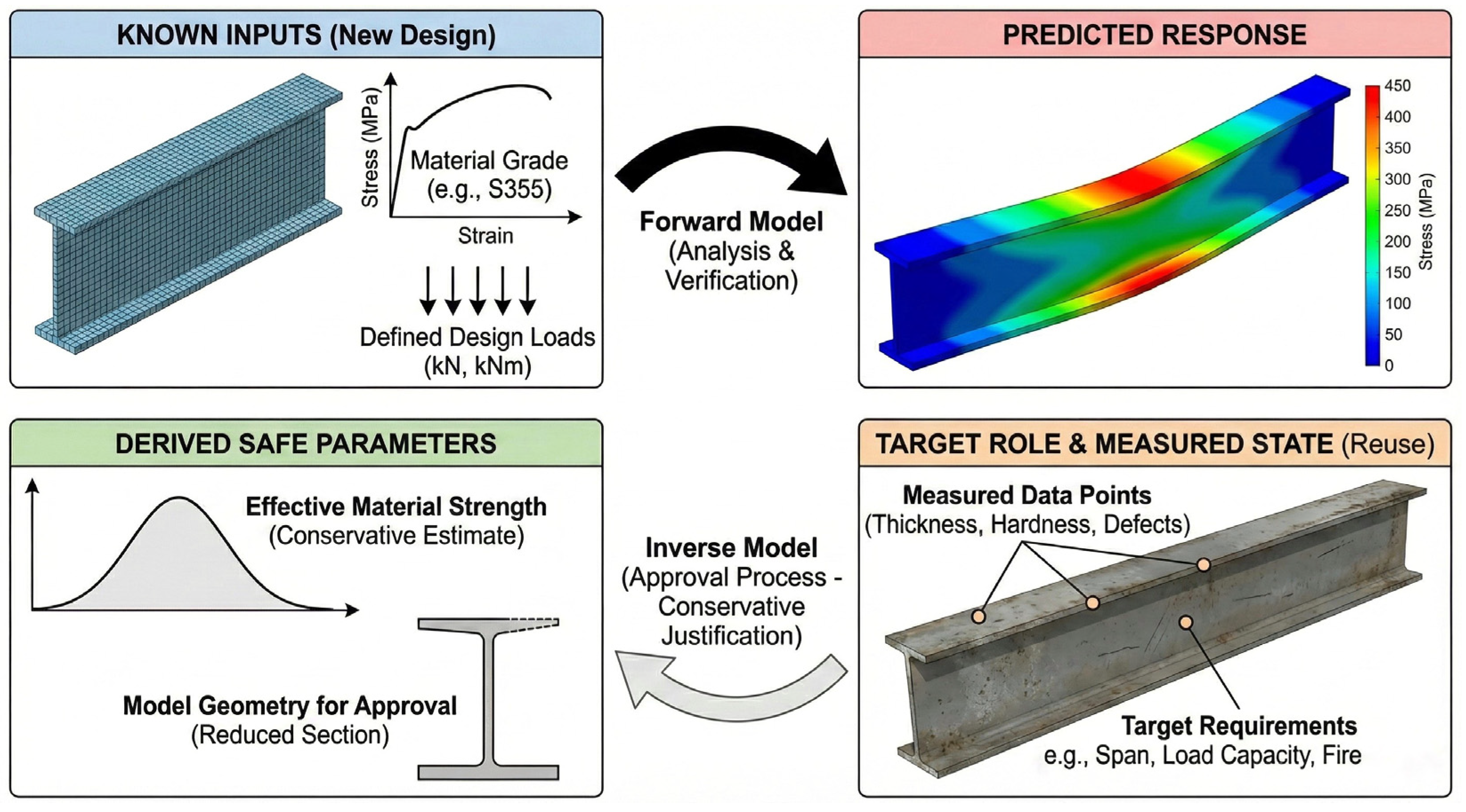
Structural engineering practice is, in general, organized around forward problems (see Figure 2). Given geometry, material properties, loads, and boundary conditions, the task is to evaluate structural response and verify compliance with design criteria. This logic implies the use of both analytical methodologies and numerical instruments, and it is well-suited for the design of new steel structures, where inputs are predominantly known and regulated. Steel reuse does not follow this approach (see Figure 3). In the new design, uncertainty is mostly handled by calibrated partial factors applied to well-defined variables. In reuse, the main uncertainty is often about the variables themselves.
In reuse cases, the primary question is not how a structure will respond under a prescribed set of assumptions, but whether an existing element can be accepted for a new structural role. The engineer must judge suitability under uncertainty, often balancing incomplete information against safety requirements, practical constraints, and sustainability objectives. The inverse nature is practical: the engineer starts from a target role (span, load, fire requirement, connection layout) and asks what evidence is sufficient to justify using a specific reclaimed member.
A key distinction must therefore be made between analysis, optimization, and approval. Structural analysis focuses on predicting the response given inputs [8]. Optimization seeks to identify configurations that satisfy performance objectives, often under multiple constraints. Approval, which is central to reuse, involves determining whether a specific element or solution can be responsibly adopted in practice [9]. Approval requires conservative reasoning, traceability, and justification, especially when deviations from standard assumptions are present. The approval decision must be auditable, showing what was measured, what was assumed, and how safety margins were chosen.
Table 1 summarizes this distinction and shows why reuse often fails at the approval step. Analysis and optimization can generate feasible solutions, but approval requires traceability, conservative justification, and defensible uncertainty treatment.
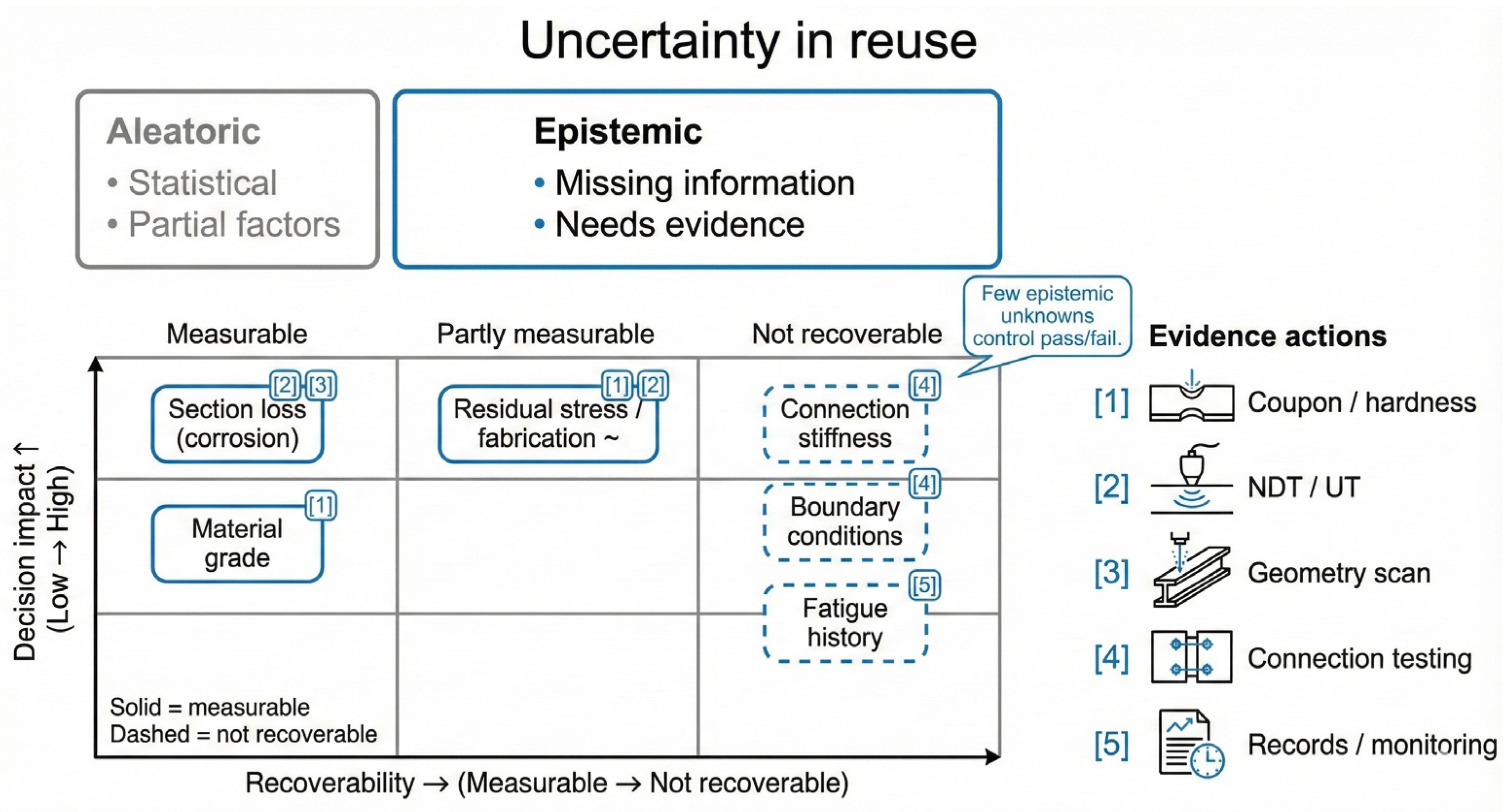
Uncertainty strongly affects this process. For reused steel members, uncertainty is often epistemic in nature [10], arising from unknown material grades, undocumented fabrication processes, previous loading histories, and degradation mechanisms such as corrosion or fatigue (see Figure 4). In contrast to aleatoric variability, which can be treated statistically with established partial safety factors, epistemic uncertainty is difficult to quantify and cannot be reduced simply by applying standard code provisions. As a result, conventional safety formats may become excessively conservative or internally inconsistent when applied to reuse decisions. A useful way to see this is to separate unknown but measurable from unknown and not practically recoverable. Material grade can often be reduced through coupon tests or hardness correlations. Boundary conditions and connection stiffness are harder to recover because they depend on the new design choices as well as the old element. Fatigue history is often only partially recoverable, unless service records exist.
Not all uncertainty matters equally. In reuse, a small set of decision-critical uncertainties can control the pass/fail outcome. Table 2 lists the main uncertainty sources, explains why they matter mechanically, and links each source to typical evidence-based actions that reduce decision risk. This mapping is important because it turns uncertainty from a vague concern into a concrete inspection and verification plan.
This context exposes a limitation of deterministic and purely rule-based approaches. Design rules are calibrated for well-defined conditions and rely on implicit assumptions about data quality and model validity. When these assumptions are not met, engineers either apply blanket conservatism or disengage from reuse altogether. Neither outcome is satisfactory from a sustainability perspective. What is needed instead is a structured way to reason with partial information, explicitly acknowledge uncertainty, and support decisions that remain aligned with engineering responsibility. In practical terms, the logic must answer what we know, what we do not know, and what we do about what we do not know.
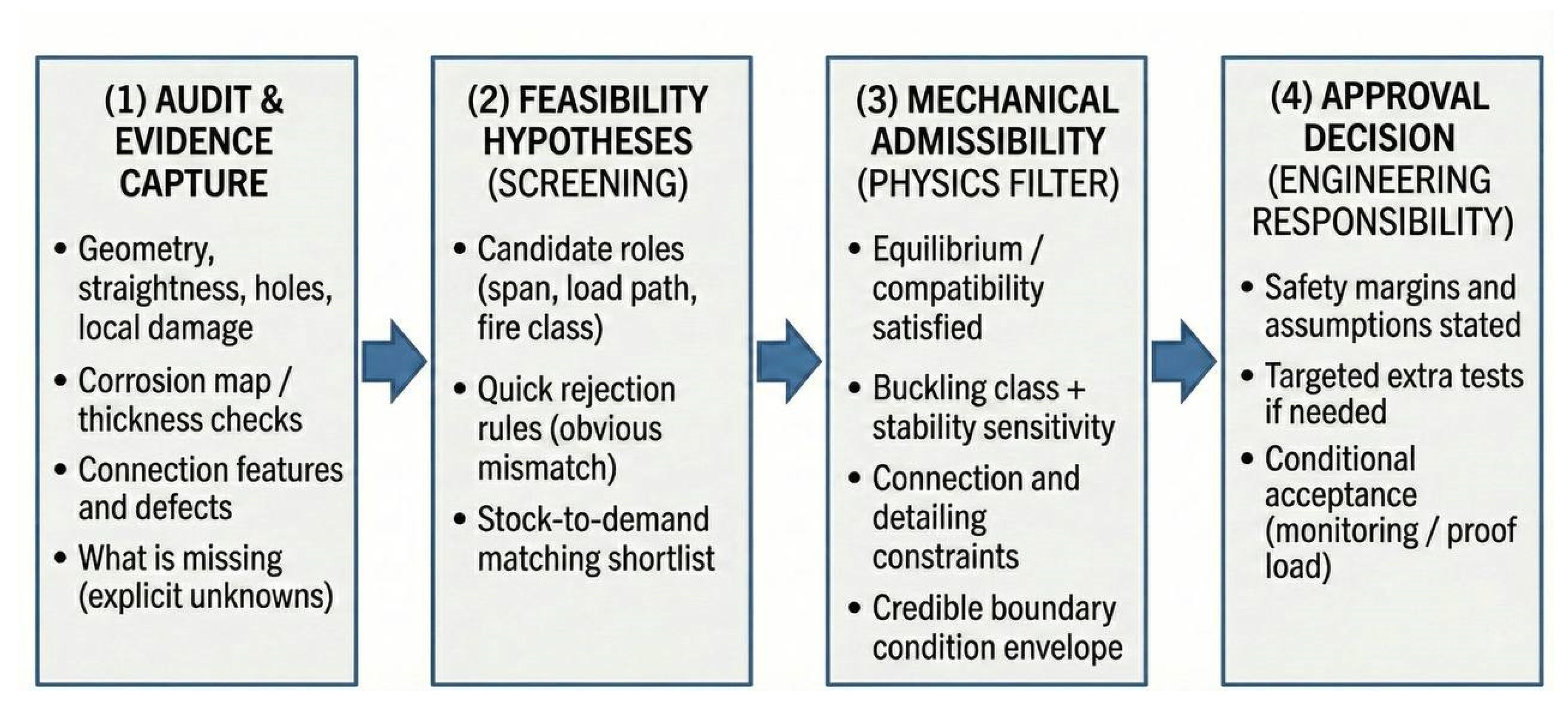
This motivates a decision workflow that is closer to reliability thinking than to single-run deterministic checking, but still compatible with code practice. A practical decision workflow for reuse usually has four linked steps:
  • Evidence collection (audit): Measure geometry, corrosion, straightness, holes, local damage, and connection features; document missing items explicitly;
  • Hypothesis generation (feasibility): Identify plausible new roles for the member and screen out incompatible options quickly;
  • Mechanical filtering (admissibility): Check that candidates satisfy equilibrium, stability, and detailing constraints under credible boundary conditions;
  • Decision and documentation (approval): Select safety margins and any additional tests, proof loads, strengthening, or monitoring required to justify acceptance.
Figure 5 summarizes this reuse logic as a decision pipeline from evidence capture to approval, separating feasibility, mechanical admissibility, and approval, and clarifying where engineering judgement remains essential.

3. Data-Driven and Physics-Informed Methods for Structural Admissibility in Steel Reuse

Physics-informed and hybrid learning approaches have been proposed in many forms across structural mechanics and engineering applications. In the context of this paper, the discussion is intentionally limited to those formulations that influence admissibility, uncertainty control, and decision robustness in steel reuse, rather than to physics-informed learning in its most general form.
Before introducing physics-informed formulations, it is useful to clarify what this paper means by “ML methods” in the specific context of reclaimed steel reuse. In reuse, the model family matters mainly through the decision product it provides, property inference from evidence, feasibility ranking, surrogate evaluation under an assumption envelope, mechanics-regularized prediction, or stock-to-demand matching. Table 3 summarizes the main method families that are practically relevant to reuse decisions, the inputs they typically consume (audit, NDT, geometry, connection descriptors), the outputs that are valid in an approval workflow, and the main failure modes that must be controlled.
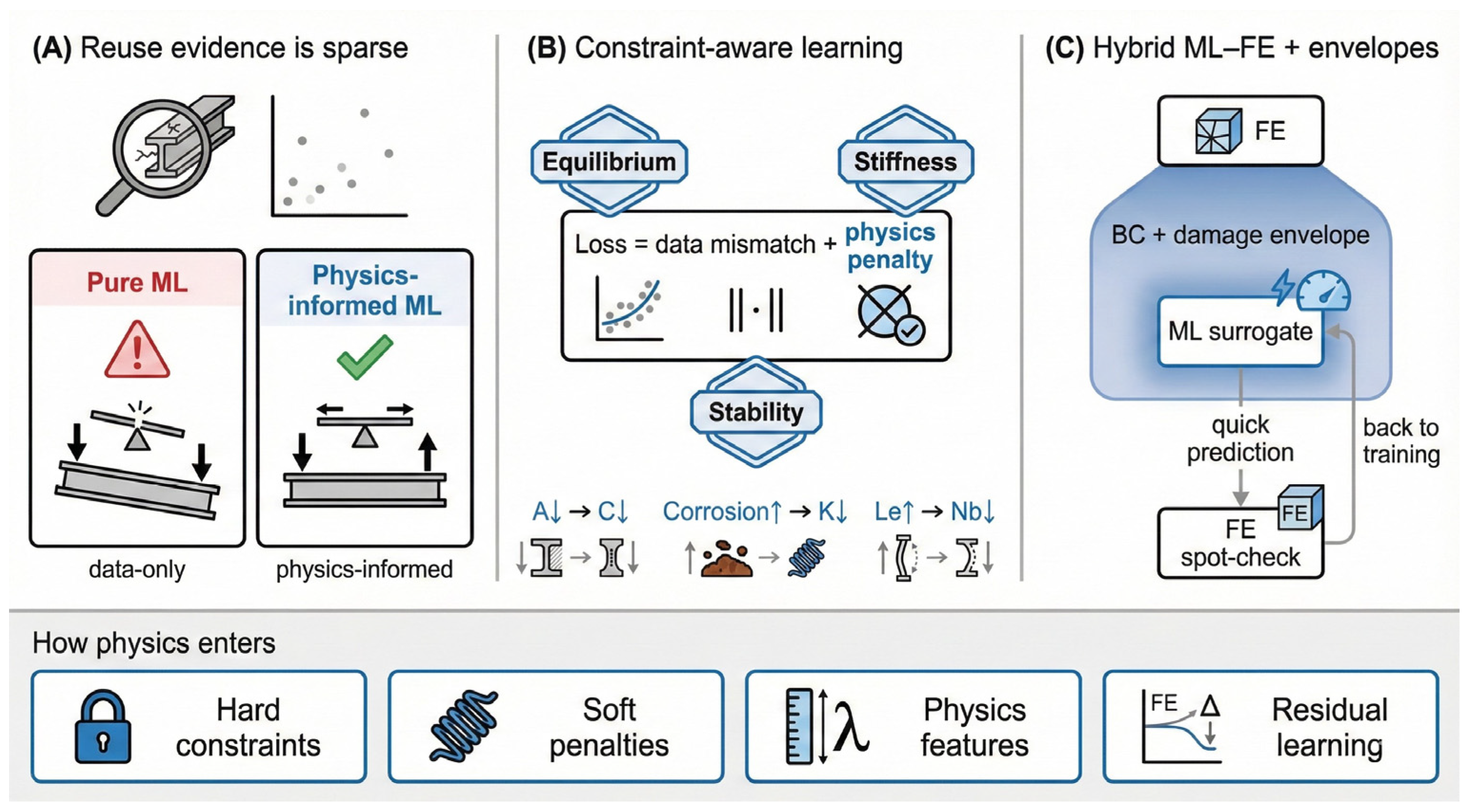
Physics-informed Machine learning (PIML) encompasses a family of approaches that integrate mechanical principles into data-driven models [11,12,13,14,15] (see Figure 6). A common strategy is to enforce equilibrium, kinematic relations, and, where appropriate, constitutive laws within the learning framework so that predicted responses remain compatible with structural mechanics, even when observational data are sparse or noisy. In structural reuse, the most relevant physics are often low-order but decision-critical: force balance, stiffness compatibility, and stability sensitivity. These are exactly the parts that pure data fitting may violate when the data do not cover the full range of boundary conditions and degradation states.
Another key concept is the use of constraint-aware loss functions [16,17]. Instead of minimizing only data mismatch, physics-informed models penalize violations of mechanical constraints. For reuse settings, constraint-aware training can also encode monotonic and sign constraints that engineers already expect. For example, capacity should not increase when net section decreases; stiffness should not increase when corrosion loss increases; and buckling resistance should reduce when effective length increases. These constraints do not replace code checks, but they prevent obvious inconsistencies that damage trust and can misrank candidates near pass/fail boundaries.
Hybrid ML–FE workflows provide a pragmatic implementation of physics-informed principles. Finite element models can generate training data, define constraint envelopes, or validate model outputs, while machine learning components provide acceleration or surrogate capability [18]. For steel reuse, hybrid workflows are attractive because FE models can represent envelopes of plausible boundary conditions and damage states. The model can then be trained to remain consistent across these envelopes, rather than tuned to one assumed support condition that may be wrong.
It is also useful to distinguish physics-informed approaches by how they inject mechanics into the workflow:
  • Hard constraints: The model structure enforces equilibrium or admissibility by construction.
  • Soft constraints: Penalties discourage violations, allowing trade-offs when data are noisy.
  • Physics-guided features: The model learns from quantities that encode mechanics (slenderness, section class, effective length factors, connection stiffness indicators).
  • Residual learning: A mechanics model provides a baseline, and ML learns corrections due to effects that are hard to model directly (damage patterns, uncertain restraint, residual stress proxies).
These options are design choices that should be matched to available evidence and the risk of extrapolation.

3.1. Benefits for Steel Reuse Problems

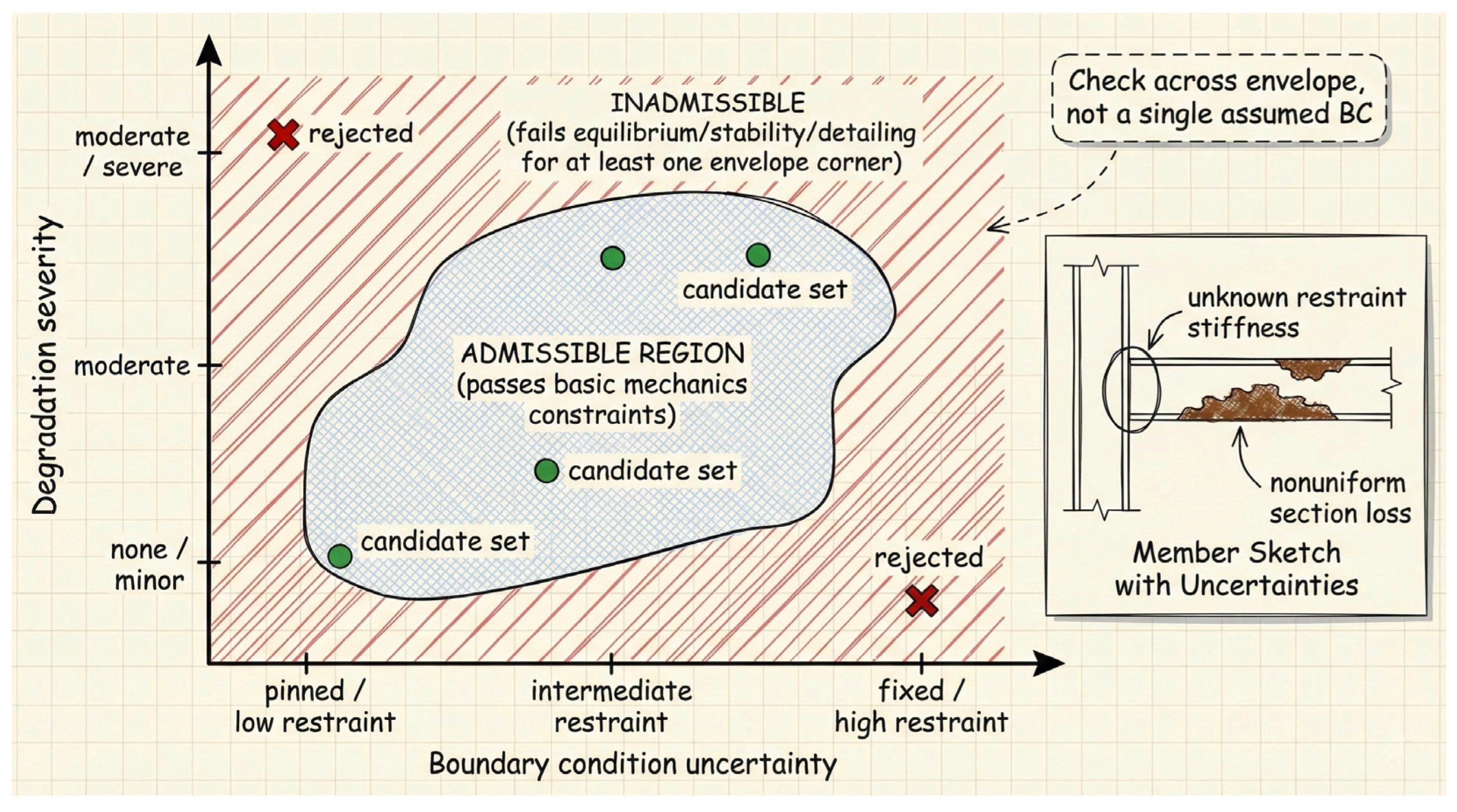
Figure 7 illustrates the admissibility envelope idea: reused members should be checked over a plausible range of boundary conditions and degradation states, and only candidates that remain admissible across this envelope should proceed to approval logic.
Physics-informed methods offer several advantages that are directly relevant to steel reuse. One is reduced data demand. By incorporating known mechanical relationships, these models can operate with fewer empirical samples, which is valuable when high-quality data on reclaimed elements are scarce and costly to obtain. The available data are also uneven. Geometry may be well documented, while prior loads, fatigue exposure, and restraint conditions are not. Physics-informed constraints help prevent learning spurious correlations from whatever is easiest to measure.
A second benefit is improved behaviour under extrapolation. Reuse projects frequently involve geometries, loading scenarios, or degradation states that differ from available datasets. Physics constraints restrict predictions to mechanically plausible regions, which is most important when the governing mechanism changes. In reuse, members may move between regimes: from compact to slender sections due to local corrosion; from restrained to unrestrained due to new connection layouts; or from low-cycle to high-cycle fatigue exposure depending on the new use. A physics-informed model can be structured to respect these regime boundaries and reduce unsafe interpolation.
A further benefit is alignment with structural mechanics and verification reasoning. Engineers can interpret model behaviour in terms of force balance, stiffness, and deformation modes. In reuse, this interpretability is part of the approval package. Decisions must be explained in engineering terms, including the governing check, sensitivity drivers, and the effect of conservative assumptions. Physics-informed models can support this by producing outputs that connect naturally to verification language, such as stability-consistent resistance bounds or stiffness-consistent deflection trends.
A reuse-specific advantage is consistency across evidence sources. Reuse assessments often combine partial measurements with assumed ranges for unknowns. Physics-informed models can propagate these ranges through mechanically admissible relationships, supporting conditional decisions, such as acceptable if the thickness loss is below X mm in a critical zone, or acceptable if the end restraint falls within a defined envelope.

3.2. Practical Challenges

Despite their advantages, physics-informed methods are not without limitations. One persistent challenge is boundary conditions. In reuse design, support conditions, load paths, and connection behaviour are often uncertain or only partially known. Inaccurate or oversimplified boundary assumptions can undermine physics-informed constraints. This is critical because boundary assumptions often control stability checks. Small changes in effective length or restraint stiffness can dominate admissibility for columns and for beams in lateral-torsional buckling. A practical physics-informed reuse model should, therefore, treat boundary conditions as uncertain inputs and evaluate admissibility over a plausible boundary envelope.
Material nonlinearity and degradation present additional difficulties. Steel reuse often involves residual stresses, plastic deformation, corrosion, or fatigue damage, which are challenging to represent accurately. Embedding such behaviour into learning frameworks increases model complexity and may reintroduce high data requirements or numerical instability. Degradation is also spatially nonuniform. Corrosion loss and pitting are local phenomena, but capacity checks often depend on global response and stability. Bridging local evidence to global admissibility is not trivial and can lead to false confidence if the model averages out local critical damage. For fatigue, the challenge is sharper because damage is history-dependent and often undocumented.
Computational cost is another concern. While physics-informed models can reduce repeated high-fidelity simulations in iterative tasks, training can be computationally demanding, especially for large-scale or three-dimensional problems. A realistic route for practice is to apply physics-informed methods at the component level (member, joint, subassembly) where admissibility decisions are made, using reduced-order representations rather than full 3D continuum formulations. This aligns modelling effort with the level of evidence typically available in reuse.
Validation is still a major problem. Demonstrating reliability across reuse applications requires systematic validation against experiments or well-documented case studies, which are currently limited. Validation must also be decision-relevant. It is not enough to show a low average error. The key question is whether the model preserves conservative classification near pass/fail boundaries and whether it flags low-support cases reliably. This implies metrics focused on classification errors, sensitivity to uncertainty, and performance under boundary-condition mismatch.
Finally, a practical concern is data demand. Many ML approaches require large labelled datasets, which is not realistic for reclaimed steel because evidence is sparse, inconsistent, and costly to obtain. The proposed framework reduces data demand by treating learning as a constrained, decision-focused task rather than a general predictive task. First, mechanical constraints are used to restrict the hypothesis space. In practice, this means enforcing equilibrium and compatibility and using stability- and detailing-consistent bounds so the model cannot “invent” capacity trends that contradict governing checks. Second, unknown inputs that dominate reuse decisions (notably boundary conditions, restraint stiffness, imperfection amplitude, and local section loss) are handled through bounded envelopes rather than point assumptions. The model is evaluated across these envelopes, and the decision output is a conservative resistance bound, not a single estimate. Third, evidence collection is prioritized by pass–fail sensitivity. Instead of adding generic data, the workflow identifies which missing variable can flip the governing check (e.g., thickness loss in a critical zone for class/net-section, or restraint level for LTB) and recommends a targeted measurement or test only when it reduces decision uncertainty in a material way. This approach shifts the practical goal from building large datasets to producing repeatable, conservative decisions with minimal but decision-critical evidence.

3.3. Applied Studies and Partial Implementations Relevant to Reuse Decisions

Direct utilization of data-driven or physics-informed learning for the formal approval of reclaimed structural steel members is still insufficient. This demonstrates the present evolution of reuse procedures and not an absence of methodological foundations. Nonetheless, an increasing collection of applied studies indicates that the fundamental components of the suggested framework, such as mechanically limited modelling, evidence-based assessment, and structured decision support, are now utilized in adjacent fields.
On the computational side, physics-informed ML strategies have been systematically developed and applied in structural failure analysis. These methods indicate that adding physical constraints makes the models more robust and easier to understand, especially when there is not much data or when extrapolation is needed [19]. These works are not particular to reuse; rather, they tackle the same important issue of admissibility, guaranteeing that predictions based on learning continue to be mechanically meaningful when applied beyond dense experimental datasets. Simultaneously, data-driven ensemble learning has been utilized to deduce material attributes pertinent to reusability, such as yield and tensile strength, directly from non-destructive testing data [20].
This is a clear example of how data-driven models can help reduce epistemic uncertainty in resistance characteristics when material certificates are missing. This happens quite often when steel is reused. ML-based modelling has been extensively evaluated in structural engineering applications, encompassing system identification, stress analysis, failure prediction, and optimization [21]. This suggests that the computational tools necessary for reuse-oriented decision support are already well established. Conceptual frameworks facilitating the reuse of structural steel in modular and offsite construction exemplify a transition towards structured, performance-oriented reuse paradigms, notwithstanding the absence of explicit integration of physics-informed learning [22]. Recent evaluations of physics-informed neural networks in structural engineering reinforce the theoretical framework for integrating mechanics into learning-based models employed in safety-critical environments [23].
Several applied studies indicate partial implementations of reuse-oriented strategies in practice. Material passports and component-level identities have made digital traceability possible, allowing for the documenting of origin and reuse possibilities in real projects. Reviews of material passport implementations underscore both their viability and their constraints, especially with data quality and interoperability across project phases [24]. Project-based studies further illustrate the application of QR-code-enabled passports to aid component reuse decisions throughout various life-cycle stages, exemplifying how digital identifiers can promote reuse within practical construction limitations [25]. Complementary methodologies that combine BIM with blockchain infrastructures have been evaluated to improve trust, traceability, and data integrity in circular building supply chains [26].
In the UK, structural steel reuse has been used through defined testing, inspection, and certification routes. Practitioner-oriented studies and SCI recommendations elucidate the assessment, certification, and effective reutilization of reclaimed steel members in load-bearing applications through tensile testing, inspection protocols, and conservative verification methods [4,27]. These instances demonstrate that reuse is technically viable when substantiated by robust evidence, while also highlighting the administrative challenges and decision-making complexities arising from human evaluations and disjointed data management [28]. Quantitative assessments of reuse strategies have been documented in particular structural and modular case studies, employing optimization and life-cycle assessment methodologies to quantify environmental advantages [29], while modular construction initiatives have recorded quantifiable carbon reductions attributable to reuse and recycling practices [30,31]. But these applications are still mostly project-specific and depend on pre-made models or expert opinion, which makes them hard to scale up when there is uncertainty or a lack of data.
Finally, several applied studies have addressed individual aspects of reuse admissibility directly. Non-destructive testing has been utilized to assess the mechanical qualities of existing steel components and to ensure adherence to design specifications, thereby diminishing dependence on presumed material grades [32]. Other studies have found that the ability to reuse something is often based more on its past loading history, how it interacts with other systems, and its boundary conditions than on its nominal member capacity alone [33]. Practical guidance documents stress inspection strategy, documentation gaps, and conservative acceptance criteria instead of material optimization [27]. Recent reviews show that the dominant barriers to reuse remain uncertainty management, regulatory constraints, and verification effort rather than structural infeasibility [1].

3.4. Complete Case Study Examples and Comparison with Standard Reuse Workflows

In the open literature, there are still not many examples of fully documented end-to-end steel reuse operations that go from audit to approval. However, several applied sources report complete segments of the chain with enough detail to reconstruct a reproducible decision pathway. Here, two examples are used to demonstrate how the proposed steps can be executed and documented, and how this differs from a conventional approach.

3.4.1. UK-Style Reuse Pathway with Evidence-Based Certification and Traceability

A feasible end-to-end pathway can be constructed around known UK reuse guidance that formalizes how reclaimed members are verified and certified, including routes for steel coming from different manufacturing eras and documentation quality levels [34]. The workflow begins with an audit before demolition that finds out what kinds of members there are, what kinds of connections are possible, and what kinds of extractions are possible. It then notes gaps as decision-critical unknowns [35]. Then, matching is performed by integrating procurement limitations and availability with geometric constraints such as lengths, section families, and hole patterns. Digital supply chain systems and marketplaces are becoming more popular because they make it easier to find and reserve large amounts of reclaimed stock [36]. Some programmes even provide infrastructure for recovered materials on a regional level [37].
Mechanical verification uses a standard code format, but it chooses parameters based on evidence. The main distinction is that the audit and certification process reduces uncertainty in grade and critical features before verification, instead of making broad, safe assumptions.
Finally, structured digital records help keep track of approvals, which makes them stronger. Material-passport thinking has been reported as a practical route to store provenance, condition descriptors, and reuse status [38]. “Phygital” tagging methods, such as QR/RFID, let a physical member keep its identification linked to its evidentiary record across handling, production, and installation [39]. The value in this example is not automation. It is the capacity to explain why the chosen margins are reasonable for approval and justify what was measured and what was anticipated.

3.4.2. NDT-Supported Property Recovery Feeding Code Verification

A second end-to-end example is a reuse pathway where uncertainty in resistance is reduced through non-destructive evidence, not conservative grade assignment. In this type of workflow, NDT is used to infer tensile properties when certificates are missing, then the inferred property bounds are carried into member and connection verification. This logic is aligned with the broader concept of evidence-based certification and testing routes, where property establishment is treated as a formal step before structural checking [34]. In practical terms, this vignette illustrates how a data-driven component can be used responsibly; it does not “approve” reuse. It reduces one decision-critical unknown (material properties) and makes the remaining checks more defensible because verification inputs become evidence-supported rather than assumed.
To make the framework reproducible and comparable to current practice, Table 4 benchmarks a conventional reuse assessment workflow against the proposed end-to-end decision pipeline, using two literature-grounded case-study vignettes as reference points.

4. Uncertainty and Explainability as Enablers of Reuse Decisions

Uncertainty in steel reuse arises from multiple sources and should be distinguished. Aleatoric uncertainty reflects inherent variability, such as scatter in material properties within a known grade. This is generally addressed through partial safety factors and probabilistic calibration. In contrast, epistemic uncertainty stems from a lack of knowledge. Missing certificates, unknown fabrication tolerances, undocumented modifications, and uncertain degradation histories contribute to epistemic uncertainty in reused members [40,41,42,43]. In reuse, epistemic uncertainty is often dominant because the data collection process itself is uncertain. Measurements may be sparse, condition ratings may be subjective, and variables governing stability and connection behaviour are not always directly observable.
This changes how safety formats behave. Standard partial factors are calibrated assuming that key variables are known within defined bounds. When this assumption is violated, applying partial factors alone can either become overly conservative, eliminating reuse opportunities, or mask unknown risks by creating a false sense of security. Reuse, therefore, requires explicit handling of uncertainty [44,45]. The practical question is not only what the capacity is, but what capacity can be justified with the current evidence, and what additional evidence would change the decision [46]. This supports iterative assessment, where uncertainty is reduced only when it is decision-critical.
Overconfident models can cause a particular danger in this context. Data-driven or physics-informed predictions that report single values without associated uncertainty can appear precise while being poorly supported by evidence.
Uncertainty also enters through modelling choices. Even with good measurements, the decision can be sensitive to assumed boundary conditions, connection stiffness, effective length, and imperfection amplitude.
A practical reuse assessment should report uncertainty in a way that engineers can use. Key outputs are not only mean estimates. They include bounds, sensitivity drivers, and decision flags. A minimal set of reuse-oriented uncertainty outputs is:
  • A conservative resistance bound under a defined envelope of assumptions (not a single scenario);
  • A sensitivity ranking showing which unknowns control the decision;
  • A low-support indicator when inputs fall outside the model’s reliable domain;
  • A recommended evidence action when the decision is borderline (measure/test/assume/reinforce).
Table 5 summarizes a practical set of uncertainty and explainability outputs that can be included in a reuse approval package and reviewed, such as conventional engineering evidence.

4.1. Deployable Uncertainty Quantification and Evidence-Driven Updating for Reuse Approval

In steel reuse, uncertainty handling must remain compatible with code-based verification. Full probabilistic reliability analysis is rarely practical at the project level, and many key variables are not identifiable from available evidence. A deployable approach is therefore to separate measurable properties from modelling assumptions and treat them differently.
For measurable properties (e.g., yield strength, tensile strength, thickness at critical zones), uncertainty can be reduced by evidence and updated explicitly. A practical route is Bayesian updating, where prior conservative assumptions are refined once test or inspection data are obtained. The output used in verification is not a mean value, but a conservative lower-bound characteristic estimate consistent with the reliability intent of code checks. This keeps the workflow auditable; the prior assumption, the new evidence, and the updated bounds are documented.
For modelling assumptions that are difficult to observe directly (e.g., boundary condition stiffness, effective length, connection slip, imperfection amplitude), the most practical treatment is a robust assumption envelope. Instead of assigning a precise distribution, the verification is repeated across a bounded range of credible scenarios. The member is considered admissible only if it remains acceptable over the defined envelope, or it is moved to conditional acceptance with additional evidence requirements.
Sensitivity analysis then links UQ to action. The purpose is not academic sensitivity metrics, but a decision tool to identify which uncertain inputs can flip pass/fail and prioritize evidence collection accordingly. Where the decision is borderline, the workflow should propose additional measurement or testing only if it materially reduces uncertainty in the governing check.

4.2. Explainability for Engineering Trust

Explainability is tied to professional responsibility in structural engineering. Engineers must understand, communicate, and defend the basis of their decisions, particularly when deviating from standard practice [47].
Interpretable models and explanations support engineering trust by allowing engineers to assess whether behaviour is consistent with mechanics, identify dominant decision drivers, and detect implausible dependencies [48]. For reuse, the most useful explanations are aligned with structural checks and failure modes, for example, a decision governed by lateral-torsional buckling under low restraint; a decision governed by net section at the connection due to hole pattern; or a decision governed by thickness loss near a support. These statements can be linked to measurements and code-based checks.
Explanation alone is not sufficient. A model may give a clear rationale while still being unreliable due to limited data or unrecognized uncertainty. Explanations can then create unjustified confidence. For reuse decisions, explainability must, therefore, be accompanied by explicit uncertainty and a scope statement of what the model considered, what it ignored, and what assumptions were fixed.
In practice, explainability for reuse can be structured as a fixed “engineering narrative” template to support repeatable approval packages:
(i)
governing failure mode and check type;
(ii)
key evidence used (measurements/tests);
(iii)
main assumptions and their ranges (boundary conditions, degradation);
(iv)
sensitivity drivers and conservative choices;
(v)
decision outcome (accept/conditional accept/reject) and required follow-up actions.
This reduces selective reporting and aligns model-supported decisions with accountability.
Beyond explanation, reuse decisions require guidance on how a negative or borderline outcome could be changed responsibly. In this framework, explainable outputs are, therefore, extended to include decision-oriented follow-up actions ranked by effort and effectiveness. These actions are not generic recommendations, but targeted options linked to the governing mechanism and sensitivity ranking. Typical examples include localized thickness measurement where corrosion governs; limited coupon or hardness testing where material grade controls capacity; conservative role downgrading where boundary conditions cannot be verified; or local strengthening where connection behaviour governs. By explicitly linking each action to the uncertainty it reduces and the checks it influences, the approval process shifts from binary rejection toward controlled, evidence-based decision improvement. This makes explainability operational, not descriptive.

4.3. Design Codes, Standards, and Regulatory Constraints for Steel Reuse

At the EU level, there is still no single Eurocode document that provides a complete design route for reclaimed steel members. Instead, reuse is handled by combining existing rules that were written for (i) new structural design, (ii) assessment of existing structures, (iii) execution and fabrication control, (iv) material testing and certification, and (v) product regulation.
For structural verification, the core references remain EN 1990 [49] (basis of design and reliability format) together with EN 1993-1-1 [50] for member and connection checks, including ductility requirements (Clause 5.2.2). Where reuse resembles assessment more than new design, the closest formal logic is provided by CEN/TS 17440:2020 [51] for existing structures, and the ongoing second-generation work under EN 1990-2 [52] (assessment of existing structures), which is relevant because it formalizes how inspection and testing update assumptions and safety arguments.
Execution and workshop control are governed by EN 1090-2:2018 [53]. This document regulates how steelwork is fabricated and accepted, and it includes provisions that allow the use of constituent products outside harmonized product standards, provided their properties are properly specified. When properties cannot be taken from certificates, they are established through recognized testing and documentation routes, commonly including tensile testing to ISO 6892-1:2019 [54], hardness conversion guidance in ISO 18265:2013 [55] (when hardness is used as a proxy), and inspection documentation via EN 10204:2004 [56] (e.g., 3.1 type certification). Where chemical or material identification is needed, supporting standards such as CEN/TR 10261:2023 [57] can also enter the evidence chain.
Finally, the conformity and market side is framed by the Construction Products Regulation (CPR), which matters when reclaimed members are treated within product declaration and performance documentation routes. Alongside the formal standards, reuse-specific European guidance is emerging through technical reports such as the JRC Technical Report (JRC144410, 2025) [58], which targets the design of new structures using reclaimed steel components in alignment with Eurocode 3, and reflects the direction of current standardization efforts.

Code-Compliance Mapping for Audit-Ready Approval Packages

To support auditability, the approval package should be readable as a code-aligned argument, where each compliance topic is linked to evidence, explicit assumptions, and a decision outcome. This mapping is interpreted together with the approval-package items in Table 5, and it follows the verification logic described in EN 1990 and EN 1993-1-1 [49,50].
(a)
Material traceability and grade:
The approval package should state whether properties are supported by certificates (e.g., EN 10204 routes [56]) or by testing, and it should document the conservative characteristic values used in verification. If the grade is unknown and it controls the decision, acceptance should be conditional on targeted tests or on restricting the role to cases where a conservative grade bound does not change the outcome [49,50,56].
(b)
Defect tolerance and section loss:
Local defects (corrosion loss, pitting, holes, damage from extraction) should be tied to the governing check and the critical zone. If defect uncertainty can flip pass/fail, the package should specify the measurement needed (what, where, and resolution) and provide a resistance bound under the stated defect envelope. If defect geometry cannot be recovered with reasonable evidence, the decision should remain conservative and explicit (conditional or reject), rather than relying on implicit reductions [49,50].
(c)
Connections, restraint, and boundary conditions
Because restraint and connection stiffness often govern stability checks, the package should either justify the adopted boundary conditions from connection detailing or treat boundary conditions as uncertain inputs and report resistance bounds over a credible restraint envelope. When the governing mechanism is buckling or lateral-torsional buckling, reporting a single effective length without an evidence basis is not sufficient for approval [49,50].
(d)
Fatigue and repeated loading.
The package should state whether fatigue is relevant for the new role and whether service history is known. If history is unknown and fatigue could govern, acceptance should be conditional on conservative detailing assumptions, targeted inspection/NDT of critical details, or a restricted-use decision. The key is to make the fatigue assumption explicit and traceable to the governing verification statement [49,50].
(e)
Fire resistance and protection condition.
Where fire performance is required, the approval package should document the protection state and the assumptions used. If protection is missing or uncertain, acceptance should be conditional on re-protection or restricted to roles where fire resistance is not a requirement. This avoids silent assumptions that are not supported by evidence [49,50].

5. Open Challenges and Research Directions

Despite growing interest in data-driven and physics-informed methods for sustainable steel design and reuse, several challenges limit their effective adoption in engineering practice. These challenges are not primarily theoretical. They are rooted in data availability, standardization, validation, and regulatory acceptance. Addressing them is essential if advanced computational tools are to move beyond research demonstrations and support routine reuse decisions. A useful way to structure these challenges is to separate evidence gaps, modelling gaps, and acceptance gaps. Evidence gaps limit what can be learned and justified. Modelling gaps limit robustness under partial information. Acceptance gaps limit whether results can be used in approval practice.
One of the most critical limitations is the lack of reuse-specific datasets. Most data used to train and validate learning-based models originates from new construction, controlled laboratory tests, or idealized numerical simulations. Reused steel elements, however, exhibit characteristics that are rarely captured in existing datasets, including undocumented fabrication details, nonuniform corrosion, residual stresses, and damage accumulation from previous service life. Without representative data, model predictions remain weakly supported and difficult to justify in safety-critical decisions. The key issue is not only the dataset size. It is the dataset’s relevance and coverage of governing mechanisms. Reuse datasets must represent stability-driven members, connection conditions, hole patterns, corrosion localization, and typical uncertainty patterns. A high-volume dataset of “clean” beams with known grades may still be weak for reuse decisions because it misses the decision-critical uncertainty structure.
A practical research direction is to define a minimum reuse dataset schema rather than aiming for ideal completeness. Such a schema should include geometry and member type, condition and degradation descriptors with measurement resolution, connection and hole information, provenance tags when available, and an explicit unknowns register. Even if some fields are missing, the schema forces consistent recording and supports uncertainty-aware modelling. This is more realistic than waiting for perfect datasets.
Closely related is the issue of standardization and data quality. Information collected during audits and inspections varies widely in format, resolution, and reliability. Inconsistent measurement protocols and subjective condition assessments introduce additional uncertainty that is rarely accounted for explicitly. For data-driven and physics-informed methods to be used responsibly, minimum data standards and structured representations of uncertainty must be established. This does not imply exhaustive data collection, but rather transparent documentation of what is known, what is assumed, and what remains uncertain. Standardization should focus on decision-critical quantities, not on collecting everything. For example, for buckling-governed members, straightness and restraint descriptors may matter more than the fine detail of surface condition. For net-section checks, hole geometry and edge distances matter more than global corrosion rating. A helpful direction is “measurement-to-decision mapping”, which defines which measurements reduce uncertainty for which checks and specifies minimum protocols accordingly.
A further challenge concerns the code acceptance of ML-supported decisions. Current structural design codes are built around deterministic verification formats and implicitly assume conventional analysis tools. While advanced computational methods can support engineering judgement, their role in formal approval processes remains unclear. Engineers must still demonstrate compliance with code intent, even when explicit provisions for reuse or learning-based models are absent. Developing guidance on how uncertainty-aware and physics-informed assessments can complement existing code checks is, therefore, a key research and practice-oriented task. The core acceptance problem is not whether ML can predict capacity. It is whether the use of ML can be audited, repeated, and linked to a conservative safety argument. A realistic pathway is not “ML replaces code.” It is “ML supports evidence prioritization and conservative parameter selection,” while final verification remains in code format. This suggests a research need for “approval templates” that show how model outputs translate into code inputs, bounds, and conditions for acceptance.
Validation under degradation and repeated reuse represents another major gap. Many studies validate models against pristine or lightly damaged elements, yet reuse often involves members that have experienced significant service exposure. Corrosion, fatigue, and cumulative damage evolve over time and may interact in complex ways. Without systematic validation under such conditions, confidence in model predictions remains limited. Longitudinal studies and carefully documented reuse case histories are needed to establish credible performance bounds. Validation should also be decision-focused. Average prediction error is not the right metric when the real outcome is accept/reject near a boundary. Validation must test conservatism under uncertainty, mode identification (buckling vs. yielding vs. connection failure), and robustness to boundary-condition mismatch. A strong direction is to benchmark models on “stress tests” designed around reuse failure modes: degraded sections, uncertain restraints, hole patterns, and mixed evidence quality.
Finally, effective integration with BIM and digital workflows remains an open challenge. While digital tools are increasingly used in design and construction, reuse workflows often remain fragmented. Data-driven and physics-informed assessments must interface with existing information models, inspection databases, and design environments to be practically useful. Integration should focus on traceability and decision transparency rather than automation alone, ensuring that computational outputs can be reviewed, interpreted, and audited by engineers. In practice, integration should ensure that each member has a persistent ID, a linked evidence record, and a versioned decision history. Without this, reuse decisions cannot be updated when new measurements arrive, and the same member may be assessed inconsistently across teams. A further challenge is that BIM models are typically geometry-rich but evidence-poor. Reuse needs the opposite: geometry, plus condition, uncertainty tags, and approval status.
Beyond these core themes, there are additional technical directions that are specific to the PIML + circularity combination:
  • Boundary-condition uncertainty as a first-class variable: methods that propagate restraint uncertainty through stability checks and produce admissibility envelopes, not point answers;
  • Decision-aware learning objectives: train models to be conservative near acceptance boundaries and to flag low-support cases, rather than optimizing average error;
  • Value-of-information planning: methods that recommend the next inspection or test based on pass/fail sensitivity and consequence class;
  • Connection-centric reuse modelling: more work is needed on bolts, holes, slip, weld removal, and re-detailing constraints, because connections often control reuse practicality;
  • Tracking repeated reuse cycles: methods to update member records after each reuse, including damage accumulation and modifications, to avoid “resetting uncertainty” each time.
These challenges highlight that the path toward sustainable steel reuse is not driven by algorithmic innovation alone. Progress depends on aligning data practices, validation strategies, and regulatory frameworks with the capabilities and limitations of advanced computational methods. Addressing these issues will enable data-driven and physics-informed approaches to contribute meaningfully to responsible and scalable steel reuse. The practical goal is a system where reuse decisions become repeatable, evidence is structured, admissibility is mechanically filtered, uncertainty is explicit, and approval is documented in a form that stakeholders can trust.

6. Conclusions

Steel reuse will not scale by improving prediction accuracy alone. The contribution of this work is not a comprehensive review of ML techniques, nor the proposal of new predictive models, but the formulation of a decision-oriented framework that clarifies how data-driven and physics-informed methods can be used responsibly within existing structural engineering practice. The limiting step is governance, how evidence is captured, how assumptions are recorded, and how conservative choices are justified when information is incomplete. Seen this way, the most valuable outcome of advanced computational methods is not a faster number, but a more disciplined process. Methods should be judged by whether they reduce decision risk per unit of inspection effort, and whether they leave a clear trail that another engineer can audit and reproduce.
A practical implication is that reuse needs standardized interfaces between engineering checks and evidence, not new model families. Member records must be structured, versioned, and traceable across organizations. Outputs must be expressed in the language of verification, the governing mechanism, the assumption envelope, and the conditions for acceptance. Where uncertainty is reducible, the workflow should convert it into targeted measurements and tests. Where it is not reducible, it should convert it into explicit margins, redesign actions, or controlled operational measures. This is where conditional acceptance becomes a rational engineering tool rather than an informal compromise.
Finally, the path to regulatory acceptance is likely incremental. Early deployment should focus on bounded roles where models are least likely to be misused, prioritizing inspection, proposing conservative candidate sets, and identifying when cases are low-support and should not proceed. If the community can agree on repeatable evidence protocols and decision-relevant validation benchmarks, reuse decisions can become consistent across projects. That consistency, more than any specific algorithm, is what will make structural steel reuse routine.

Author Contributions

S.S.: Conceptualization, Methodology, Writing—original draft, Writing—review and editing, Visualization, M.F.: Conceptualization, Writing—review and editing, Supervision. F.F.: Conceptualization, Supervision. All authors have read and agreed to the published version of the manuscript.

Funding

This research received no external funding.

Data Availability Statement

No new data were created or analyzed in this study. Data sharing is not applicable to this article.

Conflicts of Interest

The authors declare no conflicts of interest.

References

  1. Kanyilmaz, A.; Birhane, M.; Fishwick, R.; Del Castillo, C. Reuse of steel in the construction industry: Challenges and opportunities. Int. J. Steel Struct. 2023, 23, 1399–1416. [Google Scholar] [CrossRef]
  2. Berglund-Brown, J.; Ochsendorf, J. Reusing heavy-section steel in buildings: Carbon reduction potential and material availability. J. Archit. Eng. 2025, 31, 04025020. [Google Scholar] [CrossRef]
  3. Umaraj, R.R.; Selvaraj, S.K.; Chan, T.M.; Elghazouli, A.Y. Construction sustainability through reusability: Establishing reuse design rules for CFS channel columns subjected to local buckling. Thin-Walled Struct. 2026, 218, 113892. [Google Scholar] [CrossRef]
  4. Dunant, C.F.; Drewniok, M.P.; Sansom, M.; Corbey, S.; Allwood, J.M.; Cullen, J.M. Real and perceived barriers to steel reuse across the UK construction value chain. Resour. Conserv. Recycl. 2017, 126, 118–131. [Google Scholar] [CrossRef]
  5. Bartsch, H. Reuse of reclaimed steel components in construction: A systematic review of potential, challenges and future directions. Structures 2025, 80, 110057. [Google Scholar] [CrossRef]
  6. Sarfarazi, S.; Mascolo, I.; Modano, M.; Guarracino, F. Application of artificial intelligence to support design and analysis of steel structures. Metals 2025, 15, 408. [Google Scholar] [CrossRef]
  7. Sarfarazi, S.; Modano, M.; Fulgione, M. Artificial intelligence for dynamic characterization of composite panel structures: A structured review. Mech. Res. Commun. 2025, 151, 104607. [Google Scholar] [CrossRef]
  8. Sarfarazi, S.; Shamass, R.; Rabi, M.; Abarkan, I.; Ferreira, F.P.V.; Tsavdaridis, K.D. Inverse machine learning for the design of perforated beams: Parent section and material prediction. Eng. Appl. Artif. Intell. 2026, 164, 113275. [Google Scholar] [CrossRef]
  9. De Wolf, C.; Byers, B.S.; Raghu, D.; Gordon, M.; Schwarzkopf, V.; Triantafyllidis, E. D5 digital circular workflow: Five digital steps towards matchmaking for material reuse in construction. npj Mater. Sustain. 2024, 2, 36. [Google Scholar] [CrossRef]
  10. Selvaraj, S.; Chan, T.M. Recommendations for implementing circular economy in construction: Direct reuse of steel structures. J. Constr. Steel Res. 2024, 214, 108439. [Google Scholar] [CrossRef]
  11. Xu, X.; Liu, C. Physics-guided deep learning for damage detection in CFRP composite structures. Compos. Struct. 2024, 331, 117889. [Google Scholar] [CrossRef]
  12. Guo, J.; Baharvand, A.; Tazeddinova, D.; Habibi, M.; Safarpour, H.; Roco-Videla, A.; Selmi, A. An intelligent computer method for vibration responses of the spinning multi-layer symmetric nanosystem using multi-physics modeling. Eng. Comput. 2022, 38, 4217–4238. [Google Scholar] [CrossRef]
  13. Apalak, M.K.; Karaboga, D.; Akay, B. The artificial bee colony algorithm in layer optimization for the maximum fundamental frequency of symmetrical laminated composite plates. Eng. Optim. 2014, 46, 420–437. [Google Scholar] [CrossRef]
  14. Thai, C.H.; Tran, T.D.; Phung-Van, P. A size-dependent moving Kriging meshfree model for deformation and free vibration analysis of functionally graded carbon nanotube-reinforced composite nanoplates. Eng. Anal. Bound. Elem. 2020, 115, 52–63. [Google Scholar] [CrossRef]
  15. Vadyala, S.R.; Betgeri, S.N.; Matthews, J.C.; Matthews, E. A review of physics-based machine learning in civil engineering. Results Eng. 2022, 13, 100316. [Google Scholar] [CrossRef]
  16. Choudhary, P.K. Optimal design of variable angle tow laminated composite plate for maximum fundamental frequency using genetic algorithm. Mech. Based Des. Struct. Mach. 2025, 53, 7050–7067. [Google Scholar] [CrossRef]
  17. Li, A.; Ding, Z.; Dieng, A.B.; Beeson, R. Constraint-aware diffusion models for trajectory optimization. In Dynamic Data Driven Applications Systems; International Conference on Dynamic Data Driven Applications Systems; Springer Nature: Cham, Switzerland, 2024; pp. 308–316. [Google Scholar]
  18. Faruque, M.O.; Hossain, M.A.; Alam, S.M.; Khalid, M. Constraint-aware wind power forecasting with an optimized hybrid machine learning model. Energy Convers. Manag. X 2025, 27, 101026. [Google Scholar] [CrossRef]
  19. Wang, B.; Zhang, P.; Xiang, Y.; Wang, D.; Wu, B.; Wang, X.; Chen, A. Advancing structural failure analysis with physics-informed machine learning in engineering applications. Engineering 2025, in press. [Google Scholar] [CrossRef]
  20. Vlasenko, T.; Hutsol, T.; Vlasovets, V.; Glowacki, S.; Nurek, T.; Horetska, I.; Bilovod, O. Ensemble learning-based sustainable approach to rebuilding metal structures prediction. Sci. Rep. 2025, 15, 1210. [Google Scholar] [CrossRef]
  21. Etim, B.; Al-Ghosoun, A.; Renno, J.; Seaid, M.; Mohamed, M.S. Machine learning-based modeling for structural engineering: A comprehensive survey and applications overview. Buildings 2024, 14, 3515. [Google Scholar] [CrossRef]
  22. Gharib, S.; Moselhi, O. A conceptual framework for enabling structural steel reuse utilizing circular economy in modular construction. Sustainability 2025, 17, 8945. [Google Scholar] [CrossRef]
  23. Baniya, S.; Maity, D. A comprehensive review of theoretical concepts and advancements in physics-informed neural networks with applications in structural engineering. Artif. Intell. Rev. 2025, 59, 49. [Google Scholar] [CrossRef]
  24. Munaro, M.R.; Tavares, S.F. Materials passport review: Challenges and opportunities toward a circular economy building sector. Built Environ. Proj. Asset Manag. 2021, 11, 767–782. [Google Scholar] [CrossRef]
  25. Byers, B.; De Wolf, C. QR code-based material passports for component reuse across life cycle stages in small-scale construction. Circ. Econ. 2023, 1. [Google Scholar] [CrossRef]
  26. Elghaish, F.; Hosseini, M.R.; Kocaturk, T.; Arashpour, M.; Ledari, M.B. Digitalised circular construction supply chain: An integrated BIM–blockchain solution. Autom. Constr. 2023, 148, 104746. [Google Scholar] [CrossRef]
  27. Brown, D.; Pimentel, R.J.; Sansom, M.R. Structural steel reuse: Assessment, testing and design principles. Steel Constr. Inst. 2019, 72. Available online: https://steel-sci.com/assets/downloads/steel-reuse-event-8th-october-2019/SCI_P427.pdf (accessed on 18 January 2026).
  28. Bartsch, H.; Eyben, F.; Voelkel, J.; Feldmann, M. On the development of regulations for the increased reuse of steel structures. In Life-Cycle of Structures and Infrastructure Systems; CRC Press: Boca Raton, FL, USA, 2023; pp. 1287–1294. [Google Scholar]
  29. Brütting, J.; Vandervaeren, C.; Senatore, G.; De Temmerman, N.; Fivet, C. Environmental impact minimization of reticular structures made of reused and new elements through life cycle assessment and mixed-integer linear programming. Energy Build. 2020, 215, 109827. [Google Scholar] [CrossRef]
  30. Minunno, R.; O’Grady, T.; Morrison, G.M.; Gruner, R.L. Exploring environmental benefits of reuse and recycle practices: A circular economy case study of a modular building. Resour. Conserv. Recycl. 2020, 160, 104855. [Google Scholar] [CrossRef]
  31. Zhuang, G.L.; Shih, S.G.; Wagiri, F. Circular economy and sustainable development goals: Exploring the potentials of reusable modular components in circular economy business model. J. Clean. Prod. 2023, 414, 137503. [Google Scholar] [CrossRef]
  32. Fujita, M.; Masuda, T. Application of various NDT methods for the evaluation of building steel structures for reuse. Materials 2014, 7, 7130–7144. [Google Scholar] [CrossRef]
  33. Chen, H.M.; Wang, Y.; Zhou, K.; Lam, D.; Guo, W.; Li, L.; Hopkinson, P. Reclaiming structural steels from end-of-service-life composite structures for reuse: An assessment of the viability of different methods. Dev. Built Environ. 2022, 10, 100077. [Google Scholar] [CrossRef]
  34. Abbas, M.; Shafiee, M. Structural health monitoring (SHM) and determination of surface defects in large metallic structures using ultrasonic guided waves. Sensors 2018, 18, 3958. [Google Scholar] [CrossRef]
  35. González, A.; Sendra, C.; Herena, A.; Rosquillas, M.; Vaz, D. Methodology to assess the circularity in building construction and refurbishment activities. Resour. Conserv. Recycl. Adv. 2021, 12, 200051. [Google Scholar] [CrossRef]
  36. Gordon, M.; Batallé, A.; De Wolf, C.; Sollazzo, A.; Dubor, A.; Wang, T. Automating building element detection for deconstruction planning and material reuse: A case study. Autom. Constr. 2023, 146, 104697. [Google Scholar] [CrossRef]
  37. City of Amsterdam. Policy: Circular Economy; City of Amsterdam: Amsterdam, The Netherlands, 2022; Available online: https://www.amsterdam.nl/en/policy/sustainability/circular-economy/ (accessed on 18 January 2026).
  38. Çetin, S.; Raghu, D.; Honic, M.; Straub, A.; Gruis, V. Data requirements and availabilities for material passports: A digitally enabled framework for improving the circularity of existing buildings. Sustain. Prod. Consum. 2023, 40, 422–437. [Google Scholar] [CrossRef]
  39. Byers, B.; Emmenegger, P.; Hunhevicz, J.; Schumm, D.; Heisel, F.; Hall, D.; De Wolf, C. Decentralized phygital identifiers for circular construction. SSRN Electron. J. 2024, 4946912. [Google Scholar] [CrossRef]
  40. Rabi, M.; Abarkan, I.; Sarfarazi, S.; Ferreira, F.P.V.; Alkherret, A.J. Automated design and optimization of concrete beams reinforced with stainless steel. Struct. Concr. 2025. early view. [Google Scholar] [CrossRef]
  41. Despotovic, M.; Glatschke, M. Challenges and opportunities of artificial intelligence and machine learning in circular economy. SocArXiv 2024, 6qmhf_v1. [Google Scholar] [CrossRef]
  42. Noman, A.A.; Akter, U.H.; Pranto, T.H.; Haque, A.K.M. Machine learning and artificial intelligence in circular economy: A bibliometric analysis and systematic literature review. Ann. Emerg. Technol. Comput. 2022, 6, 13–40. [Google Scholar] [CrossRef]
  43. Cohen, J.; Huan, X. Uncertainty-aware explainable AI as a foundational paradigm for digital twins. Front. Mech. Eng. 2024, 9, 1329146. [Google Scholar] [CrossRef]
  44. De Lima, F.A.; Seuring, S.; Genovese, A. How to enhance circular supply chains? Aligning R-imperatives, uncertainty management and sustainability. Int. J. Oper. Prod. Manag. 2024, 44, 836–858. [Google Scholar] [CrossRef]
  45. Kalakoski, I.K.; Sirén, R.M. Designing with uncertainty—Built heritage in circular economy. In Proceedings of the International Conference CITAA Cities Identity Through Architecture and Arts, Pisa, Italy, 5–7 December 2022; Springer Nature: Cham, Switzerland, 2022; pp. 303–312. [Google Scholar]
  46. Psarommatis, F.; May, G.; Azamfirei, V. Product reuse and repurpose in circular manufacturing: A critical review of key challenges, shortcomings and future directions. J. Remanufact. 2025, 15, 273–310. [Google Scholar] [CrossRef]
  47. Fulgione, M.; Palladino, S.; Esposito, L.; Sarfarazi, S.; Modano, M. A multi-stage framework combining experimental testing, numerical calibration, and AI surrogates for composite panel characterization. Buildings 2025, 15, 3900. [Google Scholar] [CrossRef]
  48. Mascolo, I.; Sarfarazi, S.; Modano, M. Feasible and robust optimisation of cable forces in suspended bridges: A two-stage metaheuristic approach. Mech. Res. Commun. 2025, 150, 104554. [Google Scholar] [CrossRef]
  49. EN 1990:2023; Eurocode 0: Basis of Structural and Geotechnical Design. European Committee for Standardization (CEN): Brussels, Belgium, 2023.
  50. EN 1993-1-1:2022; Eurocode 3: Design of Steel Structures—Part 1-1: General Rules and Rules for Buildings. European Committee for Standardization (CEN): Brussels, Belgium, 2022.
  51. CEN/TS 17440:2020; Assessment and Retrofitting of Existing Structures. European Committee for Standardization (CEN): Brussels, Belgium, 2020.
  52. EN 1990-2:2026; Eurocode: Basis of Structural and Geotechnical Design—Part 2: Assessment of Existing Structures. European Committee for Standardization (CEN): Brussels, Belgium, 2026.
  53. EN 1090-2:2018+A1:2024; Execution of Steel Structures and Aluminium Structures—Part 2: Technical Requirements for Steel Structures. European Committee for Standardization (CEN): Brussels, Belgium, 2018 + Amendment 2024.
  54. ISO 6892-1:2019; Metallic Materials—Tensile Testing—Part 1: Method of Test at Room Temperature. International Organization for Standardization (ISO): Geneva, Switzerland, 2019.
  55. ISO 18265:2013; Metallic Materials—Conversion of Hardness Values. International Organization for Standardization (ISO): Geneva, Switzerland, 2013.
  56. EN 10204:2004; Metallic Products—Types of Inspection Documents. European Committee for Standardization (CEN): Brussels, Belgium, 2004.
  57. CEN/TR 10261:2023; Iron and Steel—European Standards for the Determination of Chemical Composition (Technical Report prepared by ECISS/TC 102). European Committee for Standardization (CEN): Brussels, Belgium, 2023.
  58. Bartsch, H.; Eyben, F.; Voelkel, J.; Knobloch, M.; Feldmann, M.; Stroetmann, R.; Charlier, M.; Husson, W.; Beyer, A.; Braendstrup, C.; et al. Guidance on establishing European rules for the design of reclaimed steel components for reuse. In JRC Technical Report JRC144410; Publications Office of the European Union: Luxembourg, 2025. [Google Scholar]
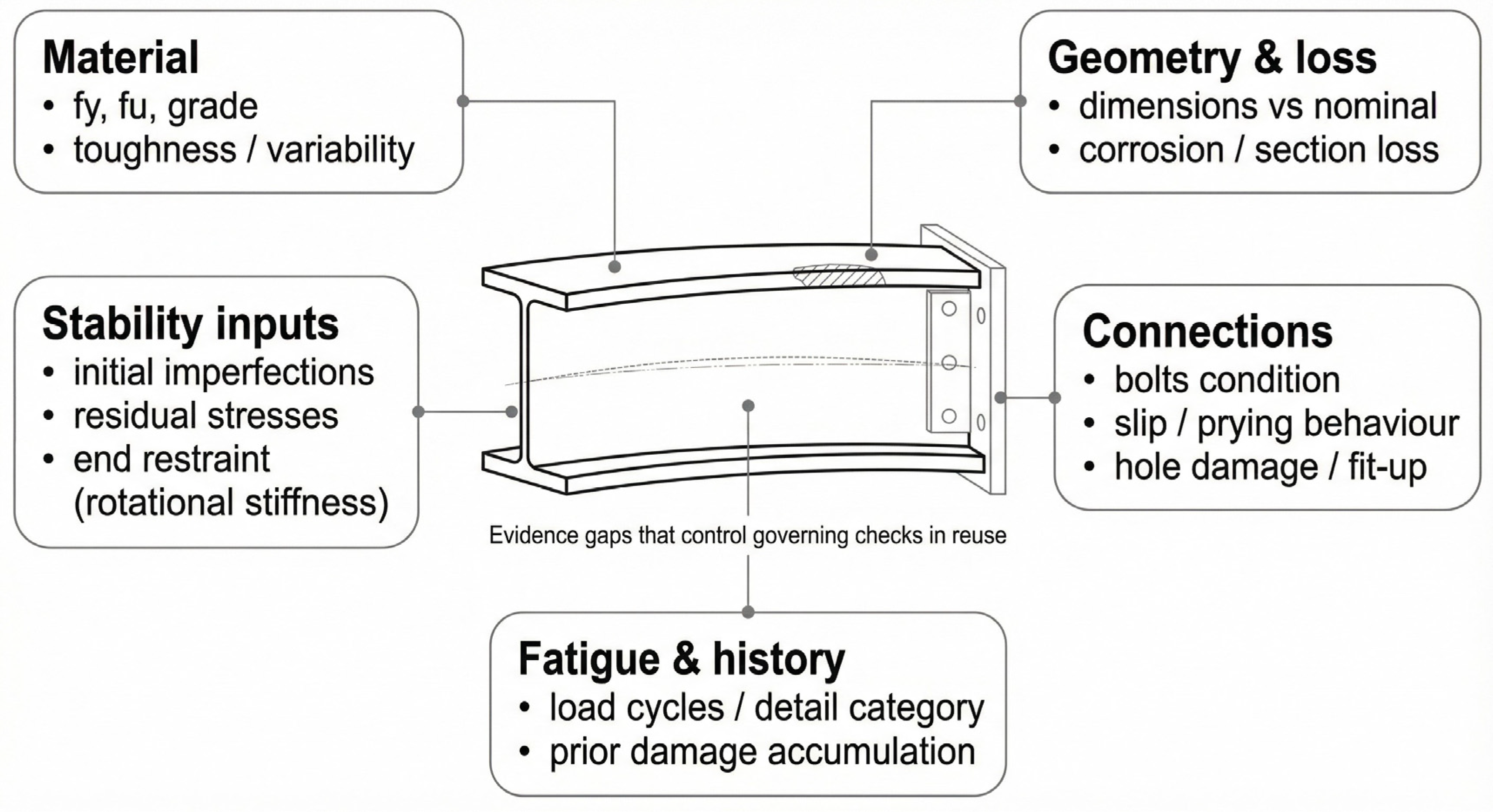
Figure 1. Evidence gaps governing structural steel reuse decisions.
Metals 16 00171 g001
Figure 2. Forward analysis vs. inverse structural design.
Metals 16 00171 g002
Figure 3. Schematic representation of new vs. reuse design approaches.
Metals 16 00171 g003
Figure 4. Uncertainty in reuse.
Metals 16 00171 g004
Figure 5. Decision-oriented reuse logic (from evidence to approval).
Metals 16 00171 g005
Figure 6. Schematic illustration of physics-informed learning for steel reuse decisions. Arrows indicate conceptual relationships and information dependencies between data, mechanical principles, and reuse decisions, showing how physics constrains learning.
Metals 16 00171 g006
Figure 7. Admissibility envelope for reused steel members under partial information.
Metals 16 00171 g007
Table 1. What changes when the objective is reusing approval (not design).
StageCore QuestionTypical OutputsMain Failure Mode in Reuse
AnalysisGiven inputs, what is the response?Demand/capacity ratios, stresses, deflectionsInputs not reliable (grade, BCs, damage)
OptimizationWhat configuration meets targets best?Best layout/assignment under constraintsSearch proposes options that are hard to justify
ApprovalCan this element be responsibly accepted?Decision, justification, evidence trailCannot defend assumptions and margins
Table 2. Reuse uncertainty is not uniform: focus on uncertainties that can flip pass/fail.
Uncertainty SourceWhy It Matters MechanicallyMost Sensitive ChecksEvidence Actions (Typical)
Section loss/pittingChanges area and class locallyBuckling, local capacity, connection regionThickness mapping, local measurements
Imperfections + residual stressControls stability reserveColumn buckling, LTB of beamsStraightness survey, conservative imperfection bounds
Unknown steel gradeShifts yield and toughnessPlastic capacity, fracture-sensitive detailsCoupons/hardness proxy/conservative grade class
Connection conditionBC stiffness and failure modes changeEnd restraint, slip, prying, bolt shearBolt inspection, hole checks, detailing limits
Fatigue historyDamage accumulation is path-dependentDetail categories, welded jointsService record, conservative fatigue class, NDT
Fire protection stateThermal resistance may be lostFire design checksInspection, re-protection assumptions
Table 3. Decision-oriented view of ML method families relevant to reclaimed steel reuse (inputs, outputs, and typical controls).
ML Method Family (Typical Form)Typical Reuse Inputs (Examples)Decision Output That Is Valid in ReuseTypical Failure Mode in ReusePractical Control (How to Use Safely)
Evidence-to-property inference (supervised regression; often ensembles)NDT signals (magnetic, hardness), coupons when available, section IDUpdated resistance-related properties (e.g., yield/tensile proxies) with uncertainty rangesFalse confidence when the NDT regime differs from the trainingUse as certificate replacement support; require uncertainty bands and “low-support” flag
Feasibility ranking/triage (classification or scoring models)Geometry, damage descriptors, basic loading class, connection tagsranking of candidates (prioritize inspection/verification effort)Over-rejection due to biased labels, or unsafe ranking near boundariesTrain/validate on decision labels; report sensitivity drivers, not only score
Surrogate response models (regression surrogates; reduced-order ML)parametric FE data, geometry, restraint envelope assumptionsfast demand/capacity estimates for exploring many assignmentsExtrapolation under wrong restraint/degradation assumptionsRestrict to bounded envelopes; use to prune options, then verify with code checks
Mechanics-regularized learning (physics-informed/constraint-aware)same as surrogates, plus explicit constraints and regime boundariesmechanically admissible trends; conservative resistance bounds under envelopesWrong constraints due to incorrect BC or degradation modelTreat BC and degradation as uncertain variables; check admissibility across the envelope
Stock-to-demand matching/allocation (combinatorial search; optimization-driven ML)inventory database, demand set, fabrication constraints (cutting, holes, welding limits)assignment proposals that minimize waste, modifications, and embodied impactSolutions that are “optimal” but not approvable due to detailing/BC issuesCouple matching with admissibility filters; reject options that fail governing checks
Anomaly/out-of-pattern detection (unsupervised or one-class models)audit data distributions; NDT feature vectors; geometry familiesflag cases that are not comparable to known evidenceFalse alarms when audit quality variesUse only as a “caution trigger”; prompts targeted inspection, not rejection
Table 4. Benchmark: conventional reuse assessment vs. decision-oriented end-to-end workflow (audit; matching; verification; approval).
StepConventional Workflow (Typical)Decision-Oriented Workflow (This Paper)Reproducibility Artifact (What Gets Stored)
AuditVisual inspection and limited notes; unknowns often implicitStructured audit with explicit unknowns register; focus on decision-critical measurementsAudit sheet, unknowns register, and evidence log
MatchingManual search; often limited to what is available locallyConstraint-based matching supported by structured records and marketplace/platform logicCandidate list, constraint reasons, and versioned selections
Mechanical verificationCode checks with conservative default assumptionsCode checks over an assumption envelope where needed; parameters tightened by evidence and certification routesVerification report, assumption envelope statement
Approval documentationCapacity value and short justificationApproval package with governing mechanism, evidence inventory, sensitivity drivers, and conditions for acceptance; linked to component identityApproval template, traceable component record
Table 5. Minimum uncertainty and explainability outputs for an approval-ready reuse decision.
Approval Package ItemWhat It Should Contain (Practical Definition)Why Is It Required in ReuseTypical “Red Flag” If Missing
Decision categoryClear label: Accept/Conditional accept/RejectForces a decision framing and prevents “informal optimism”Only a capacity number is reported, with no decision statement
Governing mechanism and check typeNamed failure mode and verification family (e.g., member buckling, LTB, net section at connection, fatigue detail, serviceability)Makes the decision auditable in engineering language and links it to code intentGeneric statements such as “model predicts safe” without stating which check governs
Resistance bound under an assumption envelopeA conservative interval or lower bound for resistance under a defined range of boundary conditions and degradation statesReuse is sensitive to modelling assumptions, especially restraint and stabilitySingle-value capacity with no statement of boundary condition assumptions
Evidence inventoryList of evidence used: measurements, tests, inspection notes, photos, drawings; include dates and responsible partyReuse decisions depend on evidence quality and traceabilityInputs are treated as “known” but source is unclear or mixed across documents
Unknowns register (explicit missing data)What is unknown: grade, thickness map, straightness, connection condition, fatigue history, fire protection state, etc.Prevents silent assumptions and hidden uncertaintyAssumptions are implicit and only appear indirectly in the result
Sensitivity ranking (decision-critical unknowns)Top variables that can flip pass/fail, with direction of influenceFocuses inspection/testing where it reduces decision risk mostExtra tests are proposed without showing that they affect the decision
Model support/applicability flagIndication of whether the case is inside the model’s reliable domain (and why), or “low-support”Reuse often contains out-of-distribution cases; the model must admit limitsThe model appears confident even when inputs are missing or atypical
Recommended action and rationaleIf conditional, what measurement/test/strengthening/monitoring is needed, and how it reduces uncertainty or increases marginTurns prediction into a controlled engineering planConditional acceptance is stated without specifying the condition in measurable terms
Conservatism statementWhere conservatism was introduced (assumption envelope, safety margin, reduction factors) and whyShows targeted conservatism instead of blanket reductionsExcessively conservative reductions applied with no link to uncertainty drivers
Traceability and reproducibilityVersion of data/model, key parameters, and a simple record of runs or scenarios consideredRequired for review, disputes, and future reuse cyclesResults cannot be reproduced or updated when new evidence arrives
Disclaimer/Publisher’s Note: The statements, opinions and data contained in all publications are solely those of the individual author(s) and contributor(s) and not of MDPI and/or the editor(s). MDPI and/or the editor(s) disclaim responsibility for any injury to people or property resulting from any ideas, methods, instructions or products referred to in the content.