Hierarchical and Robust Intelligent Design System for Aircraft Skin Die Face of Stretch Forming
Abstract
1. Introduction
- Section 1 presents the die face design methods for aircraft skin components and analyses the key factors affecting the robustness and quality of the automated die face design for aircraft skin components.
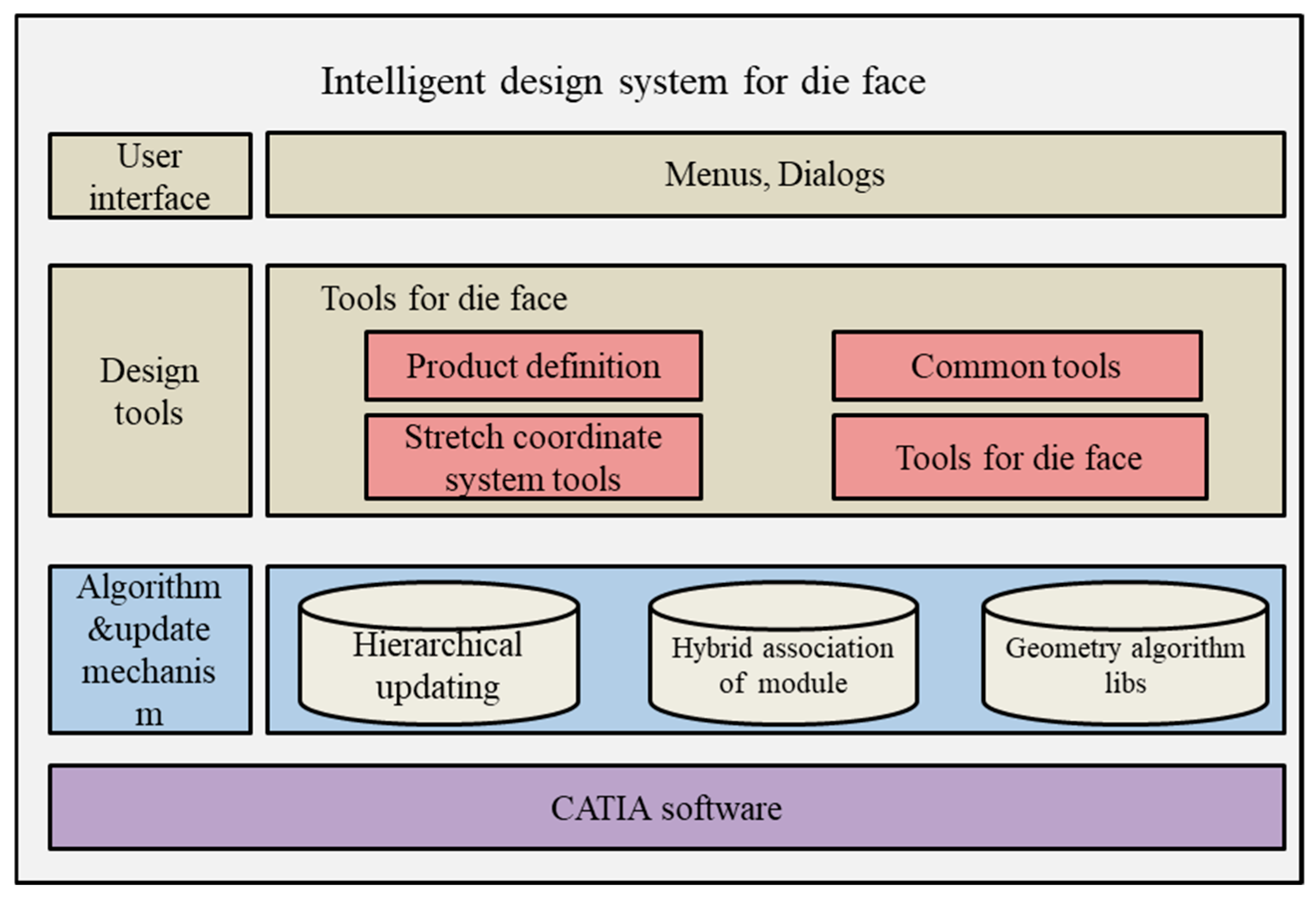
- Section 2 elaborates the proposed Hierarchical Hybrid Association Method (HHAM) for automatic die face design for aircraft skin components, and elaborates in detail on the hybrid association method for inter-module or inter-feature relationships.
- Section 3 elaborates the key geometry algorithms for the HHAM-based intelligent system, including wireframe modeling for die face design.
- Section 4 presents the practical application of the intelligent die face design system developed on the CATIA platform in two aircraft manufacturing enterprises.
- Section 5 summarizes conclusion of the HHAM-based intelligent die face design system for aircraft skin components and outlines potential future research directions.
2. Methodology of Intelligent Design for Die Face Design
2.1. Structure of Die Face for Aircraft Skin Components
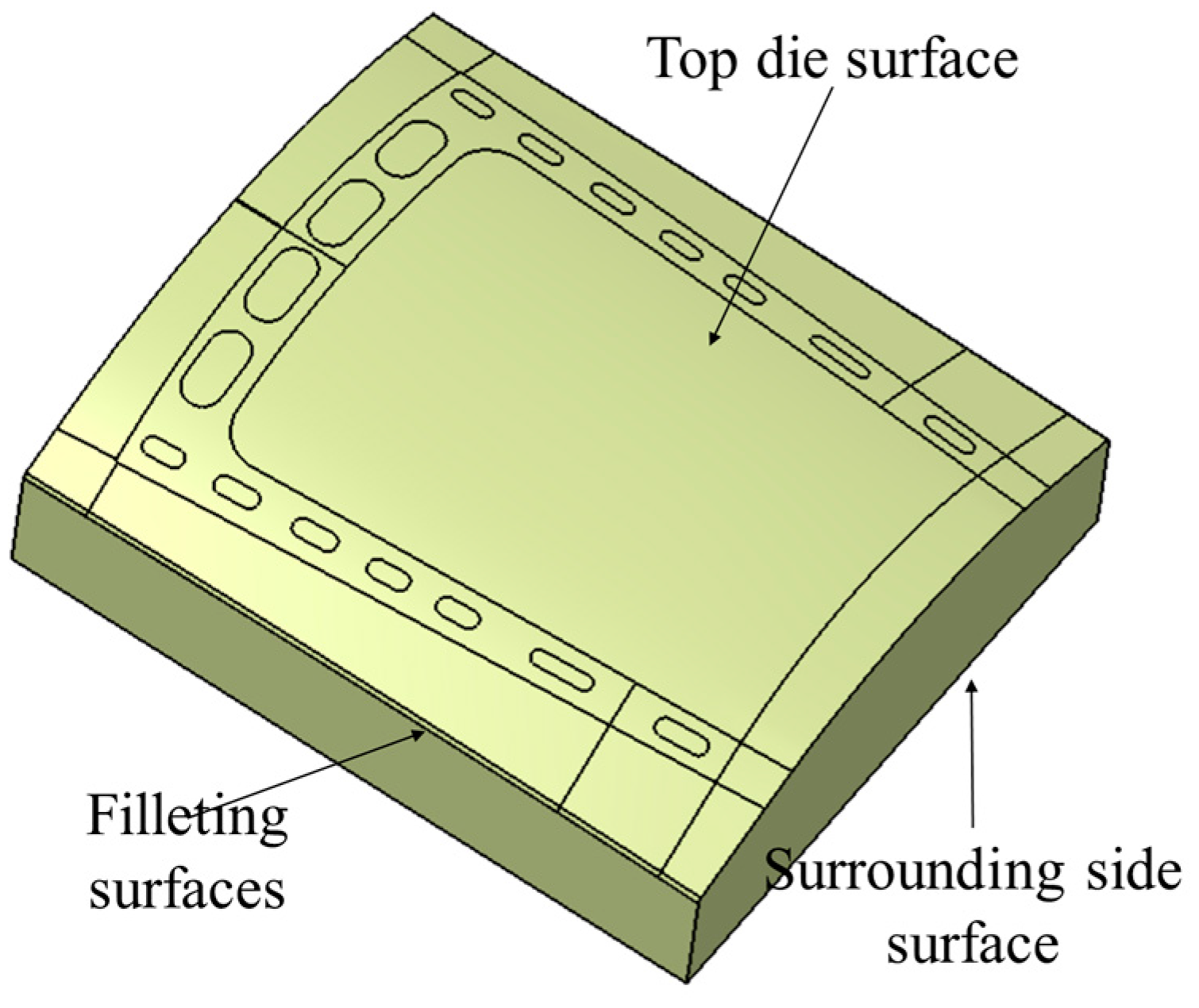
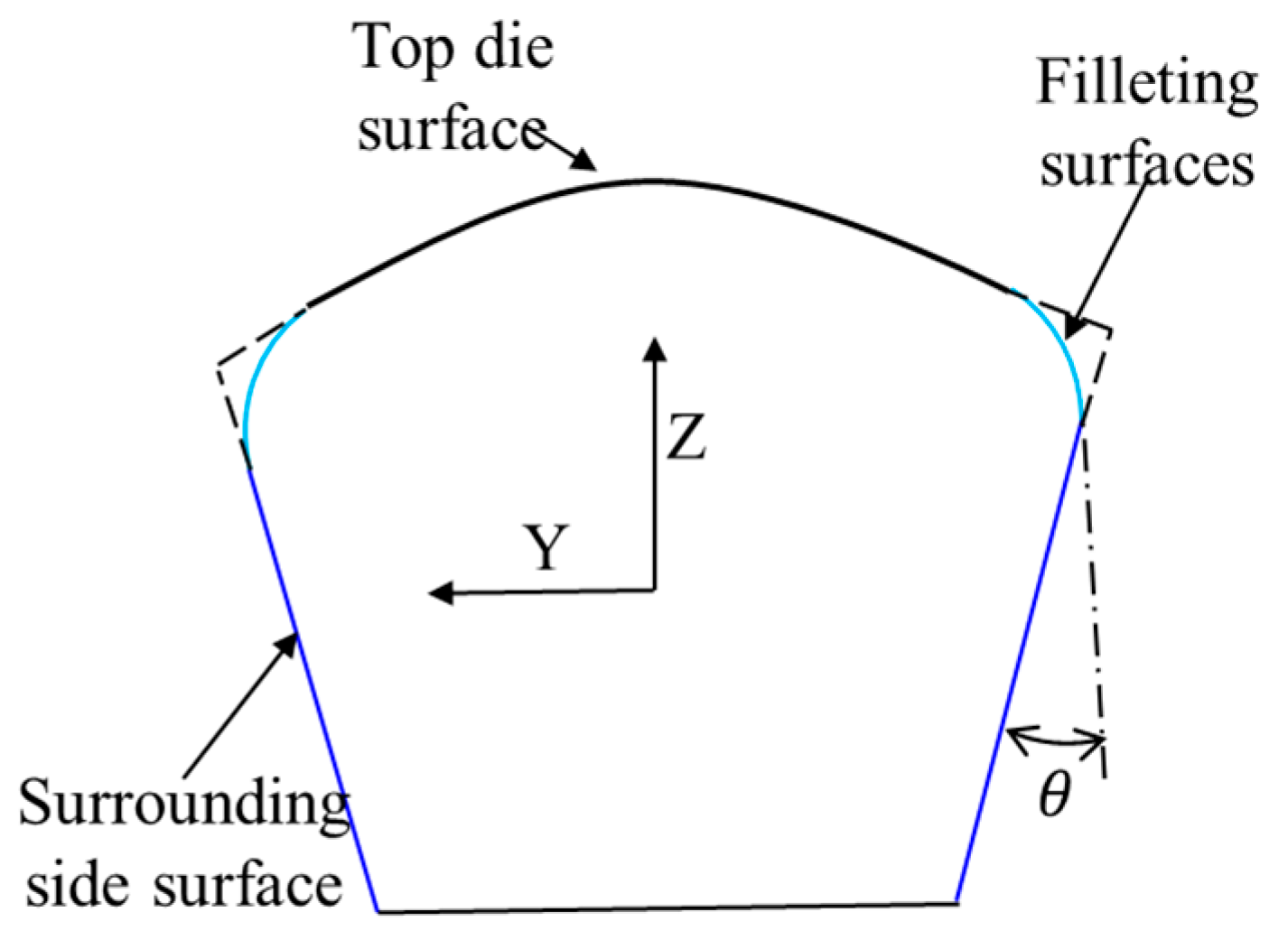
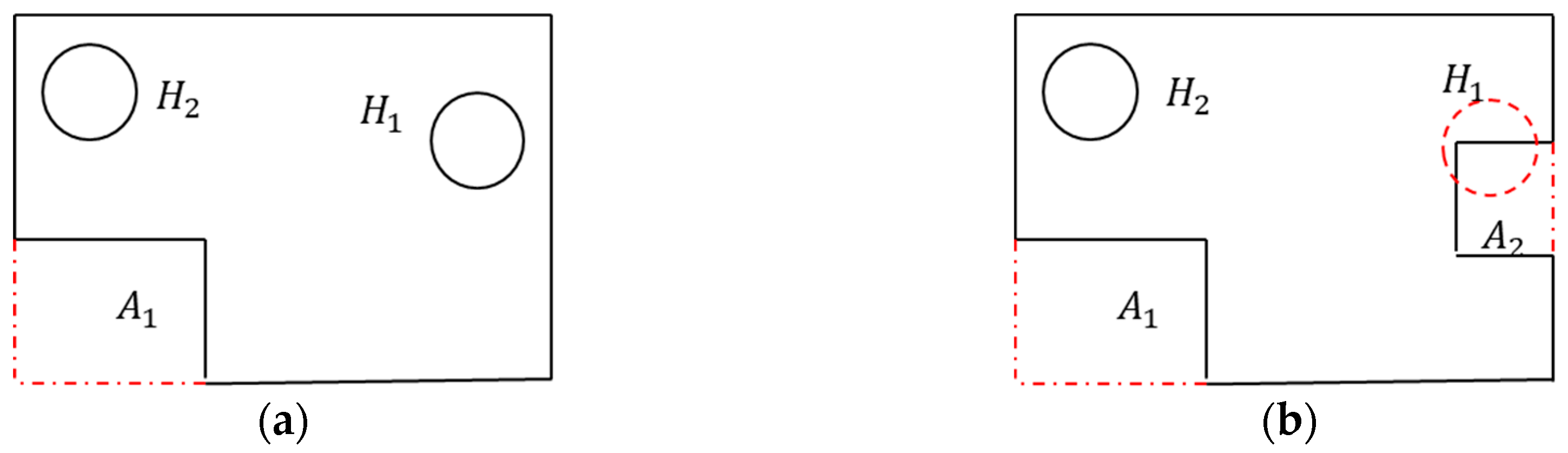
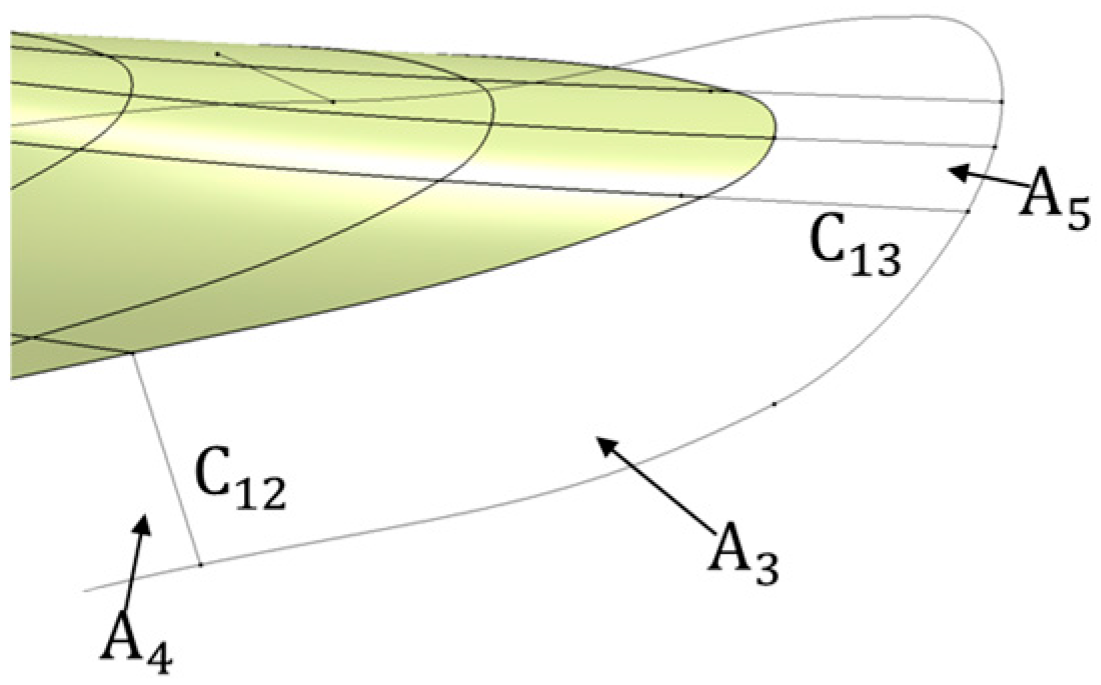
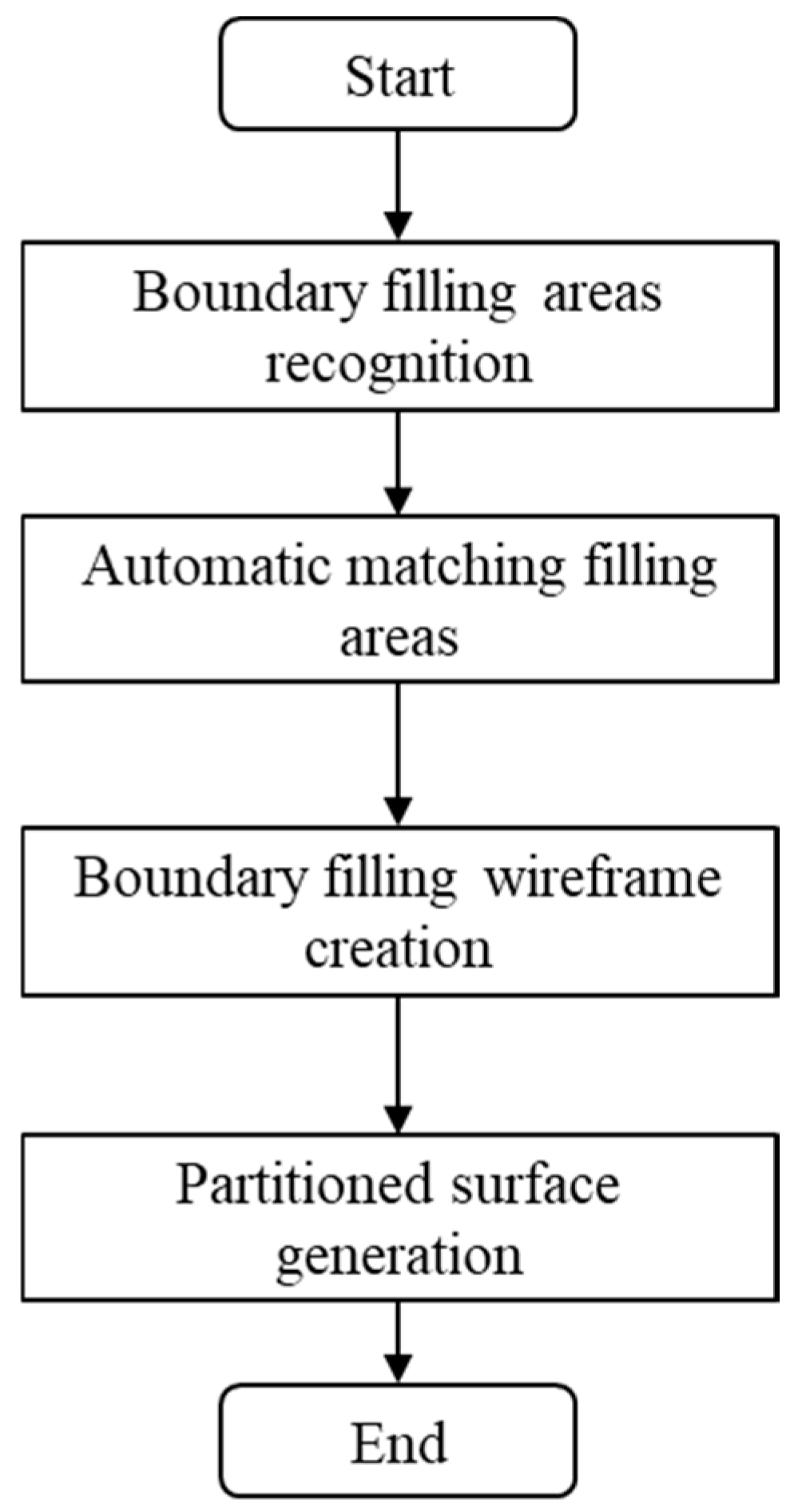
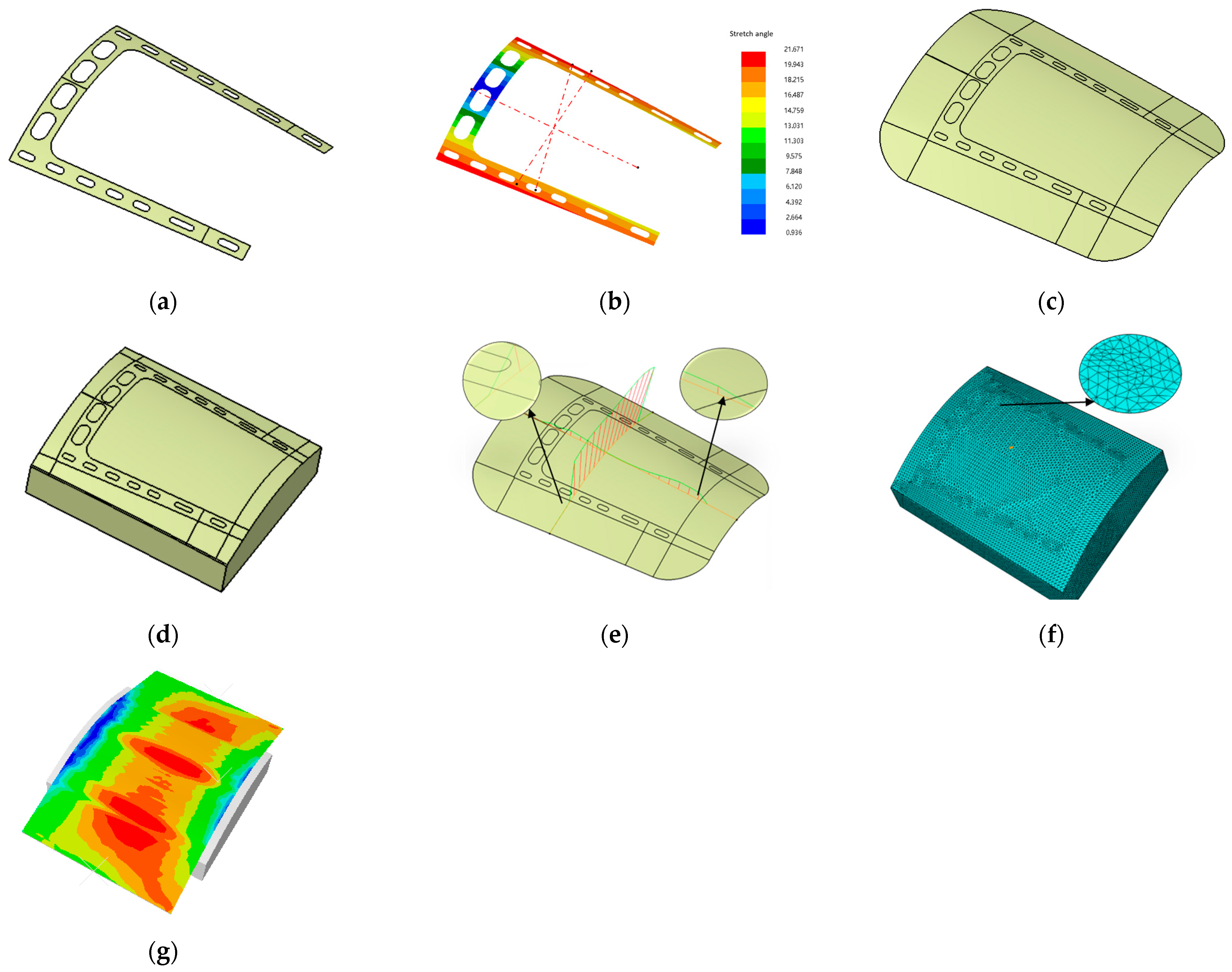
- Top die surface: As the core reference surface for stretch forming of the aircraft skin components, the top die surface is a precision-machined surface that provides precise shape support, ensuring the aerodynamic contour accuracy and surface finish quality. The basic shape of the top die surface is generated by different geometric operations, including hole filling, boundary filling, and boundary extension.
- Surrounding side surface: These inclined surfaces (the surrounding surfaces) play a crucial role in providing motion space for the side clamps during stretch forming of aircraft skin components and enabling sufficient plastic deformation of the aircraft skin workpiece. The inclination angle typically ranges from 3° to 15°, which is adjustable in accordance with the material ductility and structural complexity of aircraft skin components. Furthermore, the inclined structure helps mitigate friction, surface scratching, and springback during the forming process.
- Filleting surface: The fillet surfaces consist of fillets at the junctions between the top die surface and the surrounding side surfaces and fillets at the outer edge corners of the surrounding side surfaces. These fillets, with a fixed radius, eliminate the sharp edges of the aircraft skin die face. Such filleted surfaces not only mitigate surface stress concentration but also inhibit crack initiation and surface scratching of stretch forming, thereby ensuring the safety and stability of the forming process.
Design Flow of Aircraft Die Face
- (1)
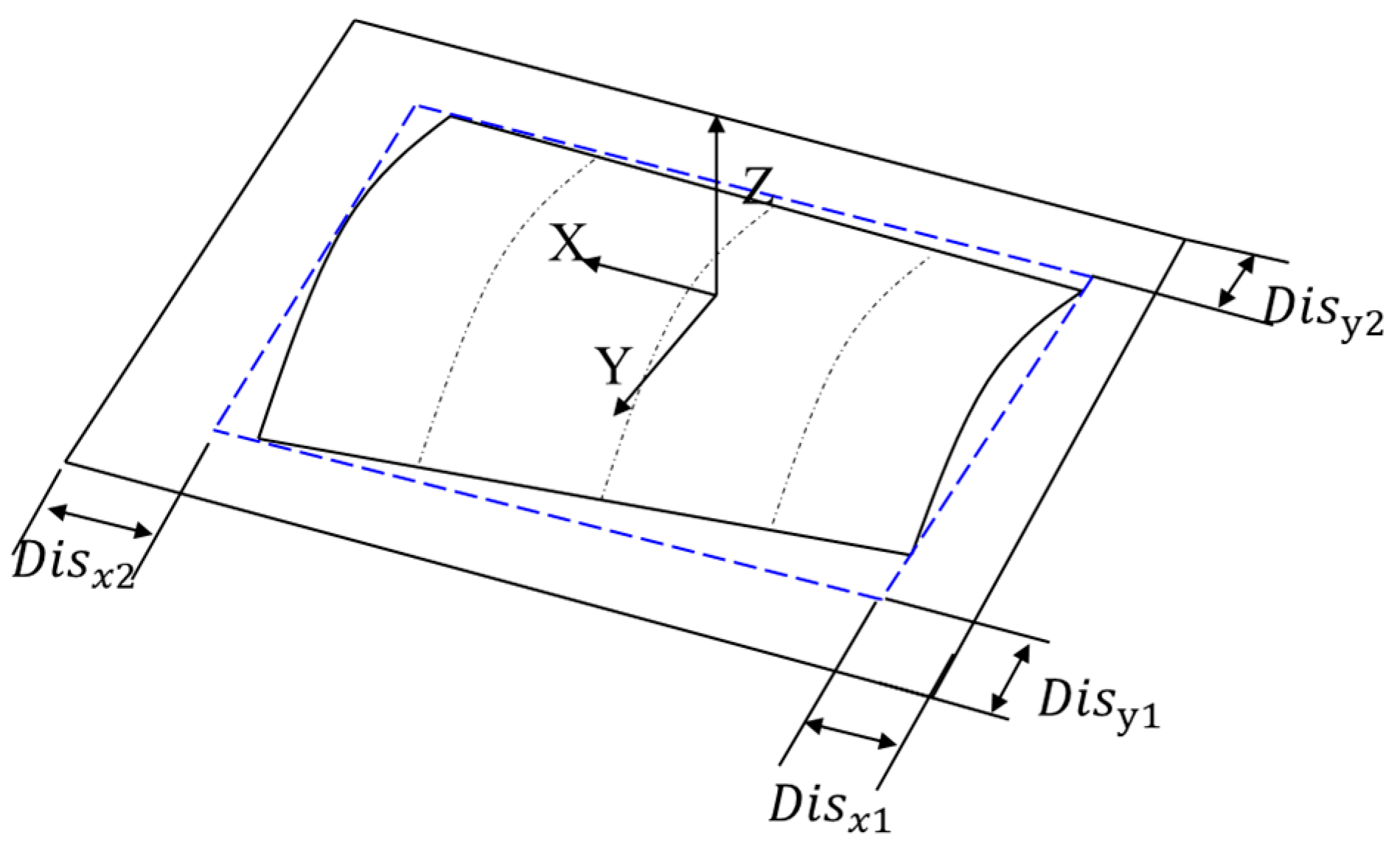
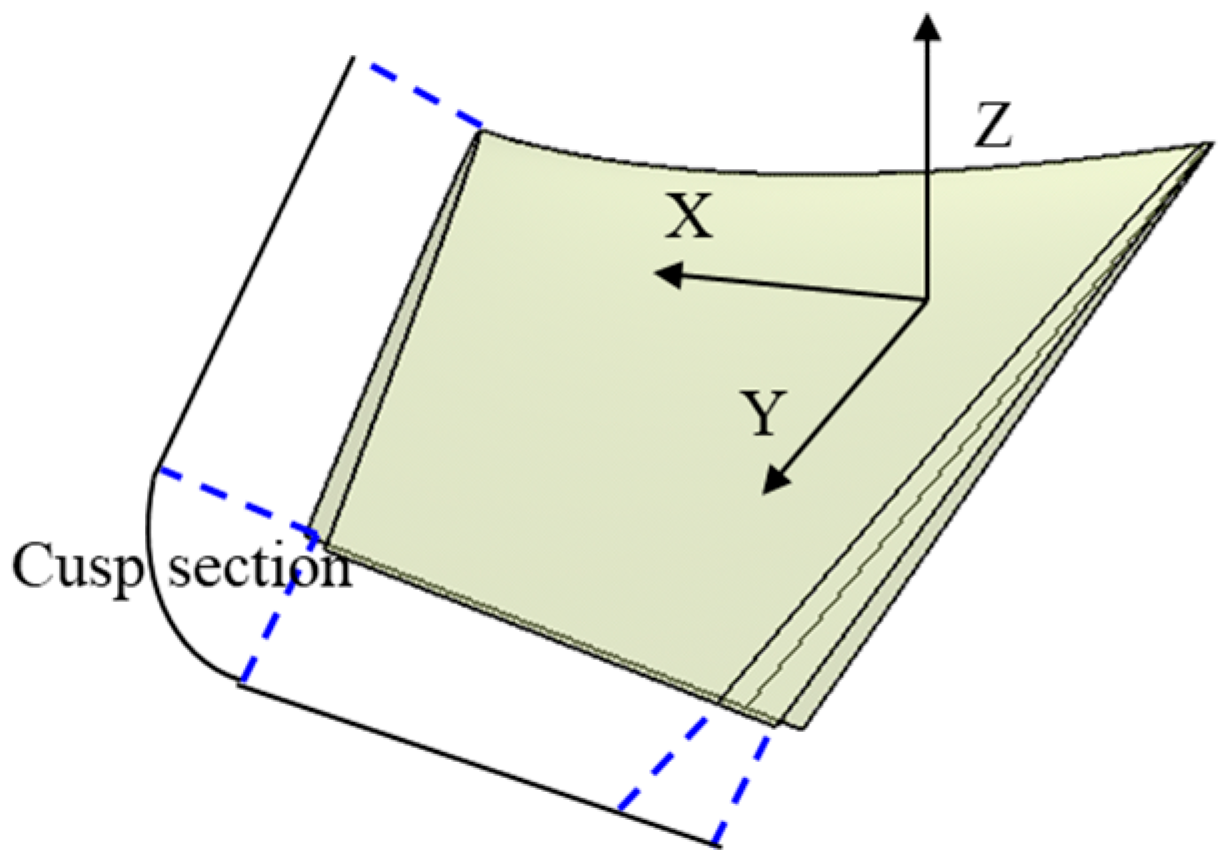
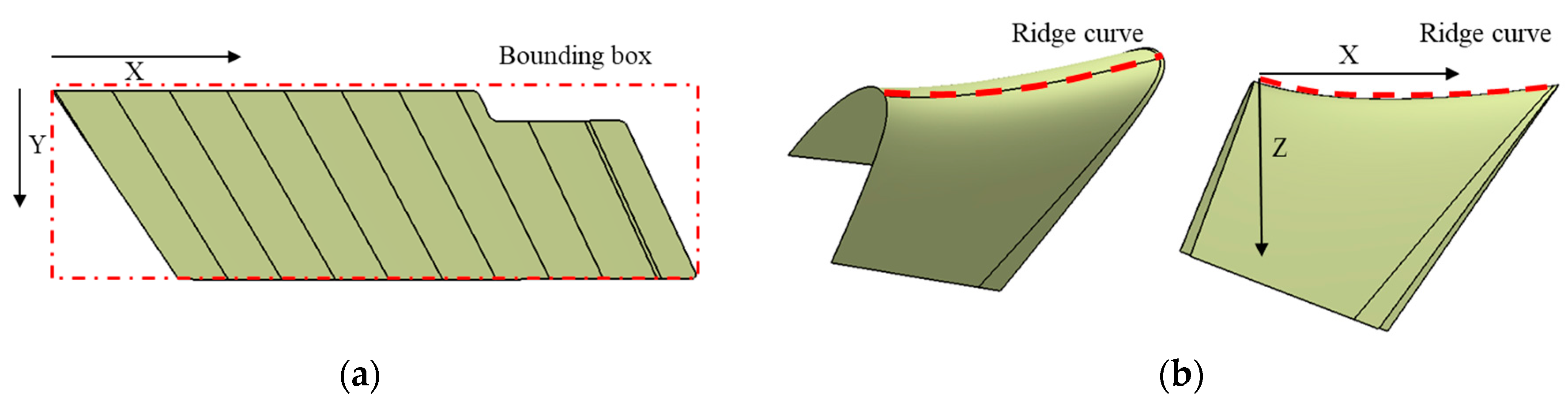
- Figure 5a shows the first type of method, which is applicable to aircraft skin components with small height. For such components, the stretching coordinate system is established based on their minimum bounding box. The X-axis is aligned along the long edge of the bounding box, the Y-axis along the width edge, and the Z-axis is determined by the cross product of the X-axis and Y-axis (i.e., Z = X × Y).
- (2)
- Figure 5b shows the second type of method, applicable to aircraft skin components with large heights. For such components, the stretch coordinate system is established based on the ridge curve. The X-axis is oriented along the direction from the start point to the end point of ridge curve, the Z-axis is perpendicular to the X-axis on the plane of the ridge curve, and the Y-axis is determined by the cross product of Z-axis and X-axis (i.e., Y = Z × X).
2.2. Robust and Hierarchical Updating Methodology for the Intelligent System
2.2.1. Structure and Updating Methodology of Module Design
2.2.2. Robust Error Process of the Intelligent System
3. Robust Geometry Algorithm of Surface Generation
3.1. Adaptive Wireframe Modeling for Surface Generation
3.2. Automatic Boundary Filling by Rolling Collision
3.3. Design Method of Boundary Extending
4. Discussion
5. Conclusions
Author Contributions
Funding
Data Availability Statement
Conflicts of Interest
References
- Brabie, G.; Lupu, R.; Rizea, A.D.; CărăuȘu, C.; Chicea, A.L.; Maier, C. Review of recent stretch forming development. Proc. Manuf. Syst. 2018, 13, 147–152. [Google Scholar]
- Noevere, A.; Wilhite, A. Methodology for lightweight design of stiffened skin in advanced aerospace structures. In Proceedings of the 73rd Annual International Conference on Mass Properties Engineering, Long Beach, CA, USA, 17–22 May 2014. [Google Scholar]
- Wang, Z.; Sun, X.; Yang, Y.; Ge, W.; Li, D.; Bao, P.; Da Ronch, A. Design optimization and testing of a morphing leading-edge with a variable-thickness compliant skin and a closed-chain mechanism. Chin. J. Aeronaut. 2024, 37, 285–300. [Google Scholar] [CrossRef] [Scilit]
- Ji, L.; Fan, J.; Wan, J.; Yu, G.; Han, W. A hierarchical search-based method for extracting boundary feature lines of aircraft skin. Trans. Can. Soc. Mech. Eng. 2025, 49, 391–405. [Google Scholar] [CrossRef] [Scilit]
- Du, J.; Wang, L.; Li, J.; Cui, L.; Jiang, X. The influence of pre-strain levels on the microstructure and performance of aircraft 7b04 aluminium alloy skin. J. Phys. Conf. Ser. 2024, 2691, 012059. [Google Scholar] [CrossRef] [Scilit]
- Qi, Z.; Liu, L.; Tian, W.; Wang, P.; Zhang, Z. Prediction of aircraft panel assembly deformation using a combined prediction model. J. Intell. Manuf. 2025, 36, 3761–3781. [Google Scholar] [CrossRef] [Scilit]
- Cheng, Y.; Xing, J.; Zhang, B. Research on Stretch Forming Process of the Discrete Clamp for Complex Curved Parts. Mechanika 2022, 28, 5–11. [Google Scholar] [CrossRef] [Scilit]
- Jia, B.-B.; Shen, Y.; Gu, Y. Influence of the deformation sequence on the shape accuracy of multi-point forming. Int. J. Mater. Form. Off. J. Eur. Sci. Assoc. Mater. Form.—ESAFORM 2023, 16, 66. [Google Scholar] [CrossRef] [Scilit]
- Zhu, J.H.; Gu, X.J.; Zhang, W.H.; Beckers, P. Structural design of aircraft skin stretch-forming die using topology optimization. J. Comput. Appl. Math. 2013, 246, 278–288. [Google Scholar] [CrossRef] [Scilit]
- He, D.-h.; Li, D.-s.; Li, X.-q.; Jin, C.h. Optimization on springback reduction in cold stretch forming of titanium-alloy aircraft skin. Trans. Nonferrous Met. Soc. China 2010, 20, 2350–2357. [Google Scholar] [CrossRef] [Scilit]
- Michaud, F.; Dalir, H.; Joncas, S. Structural Design and Optimization of an Aircraft Morphing Wing: Composite Skin. J. Aircr. 2018, 55, 195–211. [Google Scholar] [CrossRef] [Scilit]
- Song, R.; Chen, Z.; Mayer, R. Blank design for the stretch forming of aircraft skin. In Proceedings of the International Conference on Innovative Design & Manufacturing, Montreal, QC, Canada, 13–15 August 2014; IEEE: New York, NY, USA, 2014. [Google Scholar] [CrossRef] [Scilit]
- Wisselink, H.H. Finite Element Simulation of the Stretch-Forming of Aircraft Skins. Am. Inst. Phys. 2005, 778, 60–65. [Google Scholar] [CrossRef] [Scilit]
- Sasaki, S.; Kono, A.; Takahashi, S. Improvement in Prediction Accuracy by Finite Element Methods of Stretch-formed Aluminum Alloy Sheets with a Large Aspect Ratio. Procedia Eng. 2014, 81, 927–932. [Google Scholar] [CrossRef] [Scilit]
- Zhang, S.; Blala, H.; Su, H.; Cheng, P.; Fu, L. Experimental and numerical investigation of stretch forming process parameters in manufacturing intricate aircraft panels. Int. J. Adv. Manuf. Technol. 2025, 139, 5969–5990. [Google Scholar] [CrossRef] [Scilit]
- Laganà, F. Hybrid FEM-AI Approach for Thermographic Monitoring of Biomedical Electronic Devices. Computers 2025, 14, 344. [Google Scholar] [CrossRef] [Scilit]
- Liepa, P. Filling Holes in Meshes. In Proceedings of the Eurographics Association, Aachen, Germany, 23–25 June 2003; SGP: New York, NY, USA, 2003. [Google Scholar] [CrossRef]
- Shi, K.L.; Yong, J.H.; Sun, J.G.; Paul, J.C.; Gu, H.J. Filling n-sided regions with G1 triangular Coons B-spline patches. Vis. Comput. 2010, 26, 791–800. [Google Scholar] [CrossRef] [Scilit]
- Liu, X. Filling n-sided holes with trimmed B-spline surfaces based on energy-minimization method. J. Comput. Inf. Sci. Eng. 2015, 15, 011001. [Google Scholar] [CrossRef] [Scilit]
- Shetty, S.; White, P.R. Curvature-continuous extensions for rational B-spline curves and surfaces. Comput.-Aided Des. 1991, 23, 484–491. [Google Scholar] [CrossRef] [Scilit]
- Marcheix, D.; Pierra, G. A survey of the persistent naming problem. In Proceedings of the Seventh ACM Symposium on Solid Modeling and Applications, Saarbrücken, Germany, 17–21 June 2002; ACM: New York, NY, USA, 2002. [Google Scholar] [CrossRef] [Scilit]
- Ledermann, C.; Hanske, C.; Wenzel, J.; Ermanni, P.; Kelm, R. Associative parametric CAE methods in the aircraft pre-design. Aerospaceence Technol. 2005, 9, 641–651. [Google Scholar] [CrossRef] [Scilit]
- Sandberg, M.; Tyapin, I.; Kokkolaras, M.; Lundbladh, A.; Isaksson, O. A knowledge-based master model approach exemplified with jet engine structural design. Comput. Ind. 2017, 85, 31–38. [Google Scholar] [CrossRef] [Scilit]
- Dixon, J.R. Knowledge-based systems for design. J. Mech. Des. 1995, 117, 11–16. [Google Scholar] [CrossRef] [Scilit]
- Gembarski, P.C. Three ways of integrating computer-aided design and knowledge-based engineering. In Proceedings of the Design Society: DESIGN Conference; Cambridge University Press: Cambridge, UK, 2020; Volume 1, pp. 1255–1264. [Google Scholar] [CrossRef] [Scilit]
- Kugler, P.; Dworschak, F.; Schleich, B.; Wartzack, S. The evolution of knowledge-based engineering from a design research perspective: Literature review 2012–2021. Adv. Eng. Inform. 2023, 55, 101892. [Google Scholar] [CrossRef] [Scilit]
- Hansen, A.; Arbab, F. An algorithm for generating NC tool paths for arbitrarily shaped pockets with islands. ACM Trans. Graph. 1992, 11, 152–182. [Google Scholar] [CrossRef] [Scilit]
- Rohmfeld, R.F. IGB-offset for plane curves-loop removal by scanning of interval sequences. Comput.-Aided Geom. Des. 1998, 15, 339–375. [Google Scholar] [CrossRef] [Scilit]
- Maekawa, T. An overview of offset curves and surfaces. Comput.-Aided Des. 1999, 31, 165–173. [Google Scholar] [CrossRef] [Scilit]
- Pham, B. Offset curves and surfaces: A brief survey. Comput.-Aided Des. 1992, 24, 223–229. [Google Scholar] [CrossRef] [Scilit]
- Tiller, W.; Hanson, E. Offsets of two-dimensional profiles. Comput. Graph. Appl. 1984, 4, 36–46. [Google Scholar] [CrossRef] [Scilit]
- Saeed, S.E.O.; Pennington, A.; Dodsworth, J.R. Offsetting in geometric modelling. Comput. Aided Des. 1998, 20, 67–74. [Google Scholar] [CrossRef] [Scilit]











| Evaluation Data | Average Value of Manual Design by CATIA | Max/Min Value of Manual Design by CATIA | Average Value of Automatic Design Using the Intelligent System | Max/Min Value of Automatic Design Using the Intelligent System | Efficiency Improvement (%) |
|---|---|---|---|---|---|
| Time consumption (hours) | 1.8 | 3.1/1.2 | 0.49 | 2.1/0.3 | 72.7% |
| Model updating success rate (%) | 13.0% (3/23) | / | 52.1% (12/23) | / | 300% |
| Manual intervention times during updating | 7.4 | 13/2 | 2.2 | 6/0 | 70.27% |
| continuity qualified rate (%) | 87.0% (20/23) | / | 91.3% (21/23) | / | 4.7% |
| FEM qualified rate (%) | 100% | / | 100% | / | 0% |
Disclaimer/Publisher’s Note: The statements, opinions and data contained in all publications are solely those of the individual author(s) and contributor(s) and not of MDPI and/or the editor(s). MDPI and/or the editor(s) disclaim responsibility for any injury to people or property resulting from any ideas, methods, instructions or products referred to in the content. |
© 2026 by the authors. Licensee MDPI, Basel, Switzerland. This article is an open access article distributed under the terms and conditions of the Creative Commons Attribution (CC BY) license.
Share and Cite
Zhang, X.; Kong, H.; Wang, Z.; Wei, Y.; Liu, Y.; Zhang, Z. Hierarchical and Robust Intelligent Design System for Aircraft Skin Die Face of Stretch Forming. Metals 2026, 16, 94. https://doi.org/10.3390/met16010094
Zhang X, Kong H, Wang Z, Wei Y, Liu Y, Zhang Z. Hierarchical and Robust Intelligent Design System for Aircraft Skin Die Face of Stretch Forming. Metals. 2026; 16(1):94. https://doi.org/10.3390/met16010094
Chicago/Turabian StyleZhang, Xilei, Haijiao Kong, Zhen Wang, Yang Wei, Yuqi Liu, and Zhibing Zhang. 2026. "Hierarchical and Robust Intelligent Design System for Aircraft Skin Die Face of Stretch Forming" Metals 16, no. 1: 94. https://doi.org/10.3390/met16010094
APA StyleZhang, X., Kong, H., Wang, Z., Wei, Y., Liu, Y., & Zhang, Z. (2026). Hierarchical and Robust Intelligent Design System for Aircraft Skin Die Face of Stretch Forming. Metals, 16(1), 94. https://doi.org/10.3390/met16010094