Recovery of Scratch Grooves in Ti-6Al-4V Alloy Caused by Reversible Phase Transformations




Abstract
1. Introduction
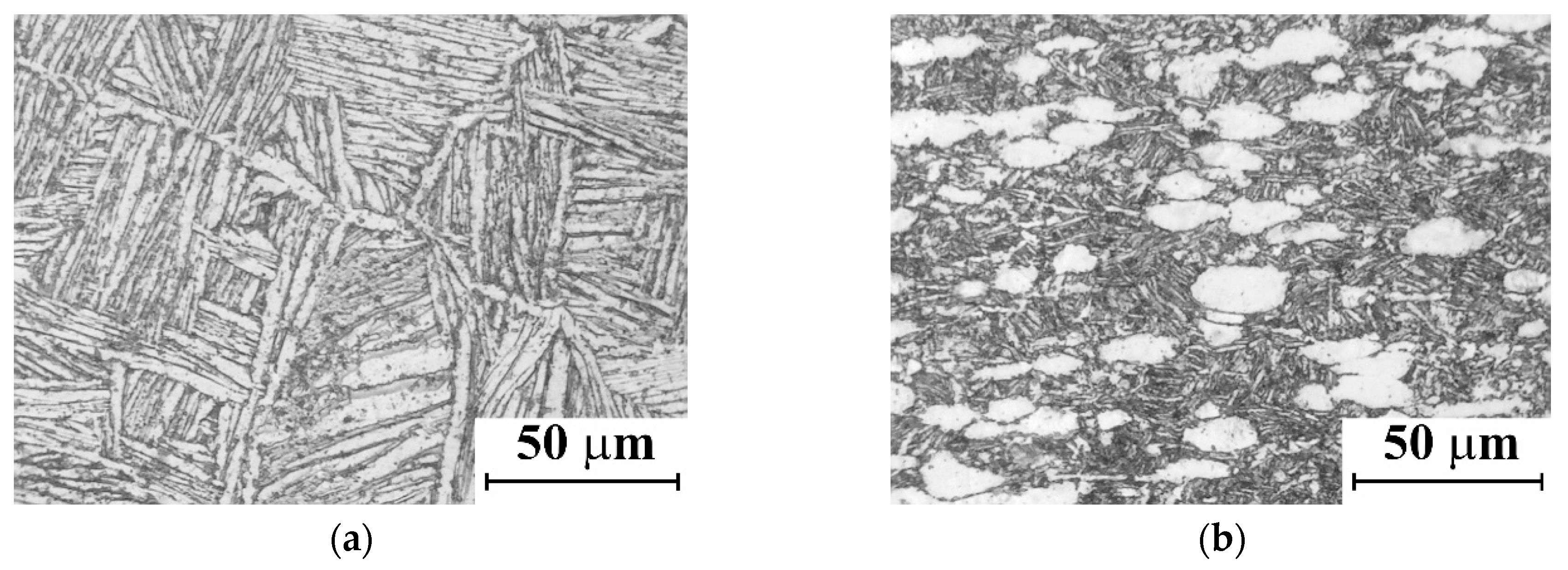
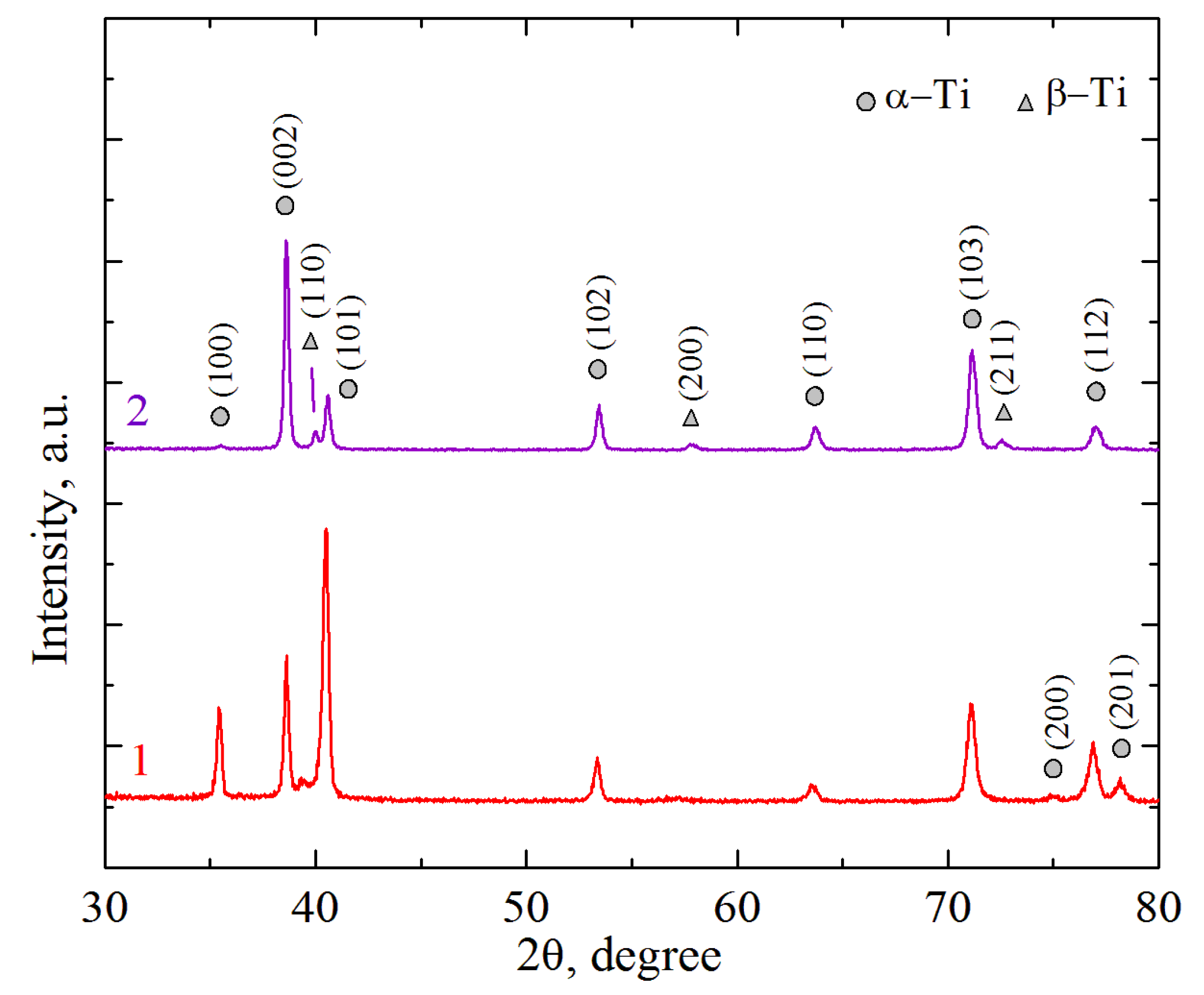
2. Experimental Details
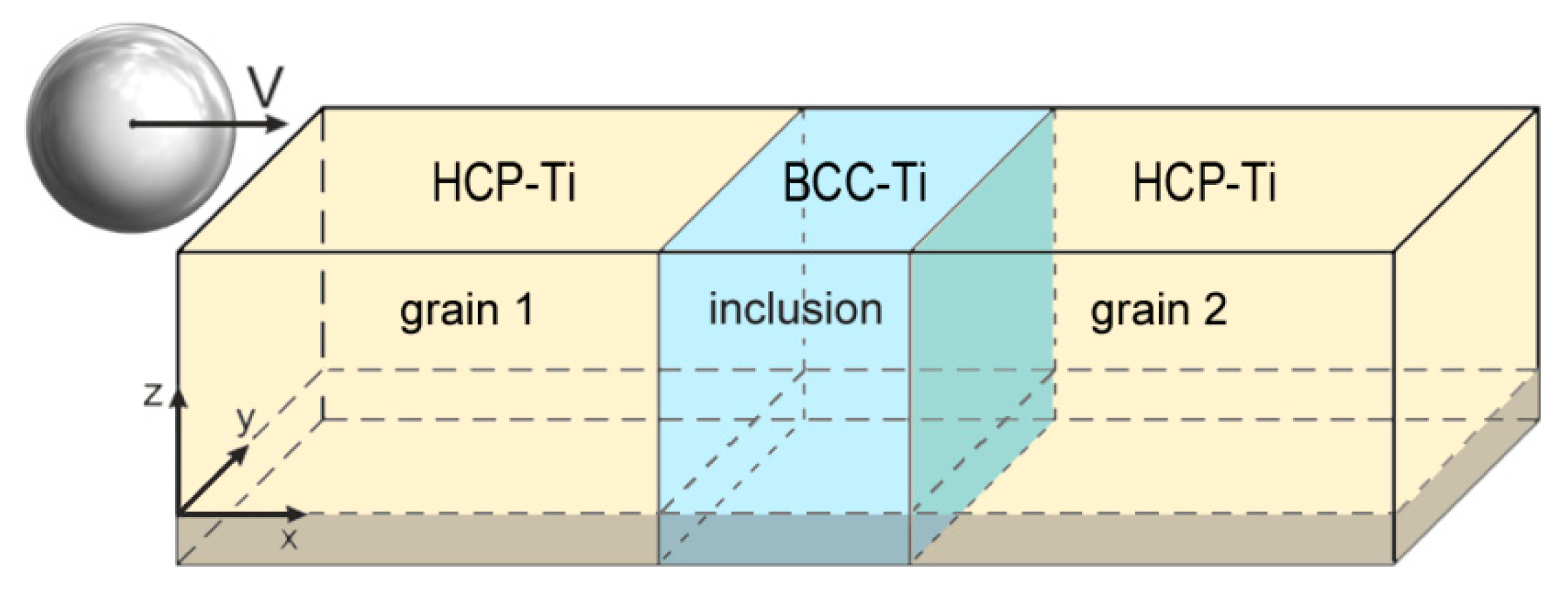
3. Model Description
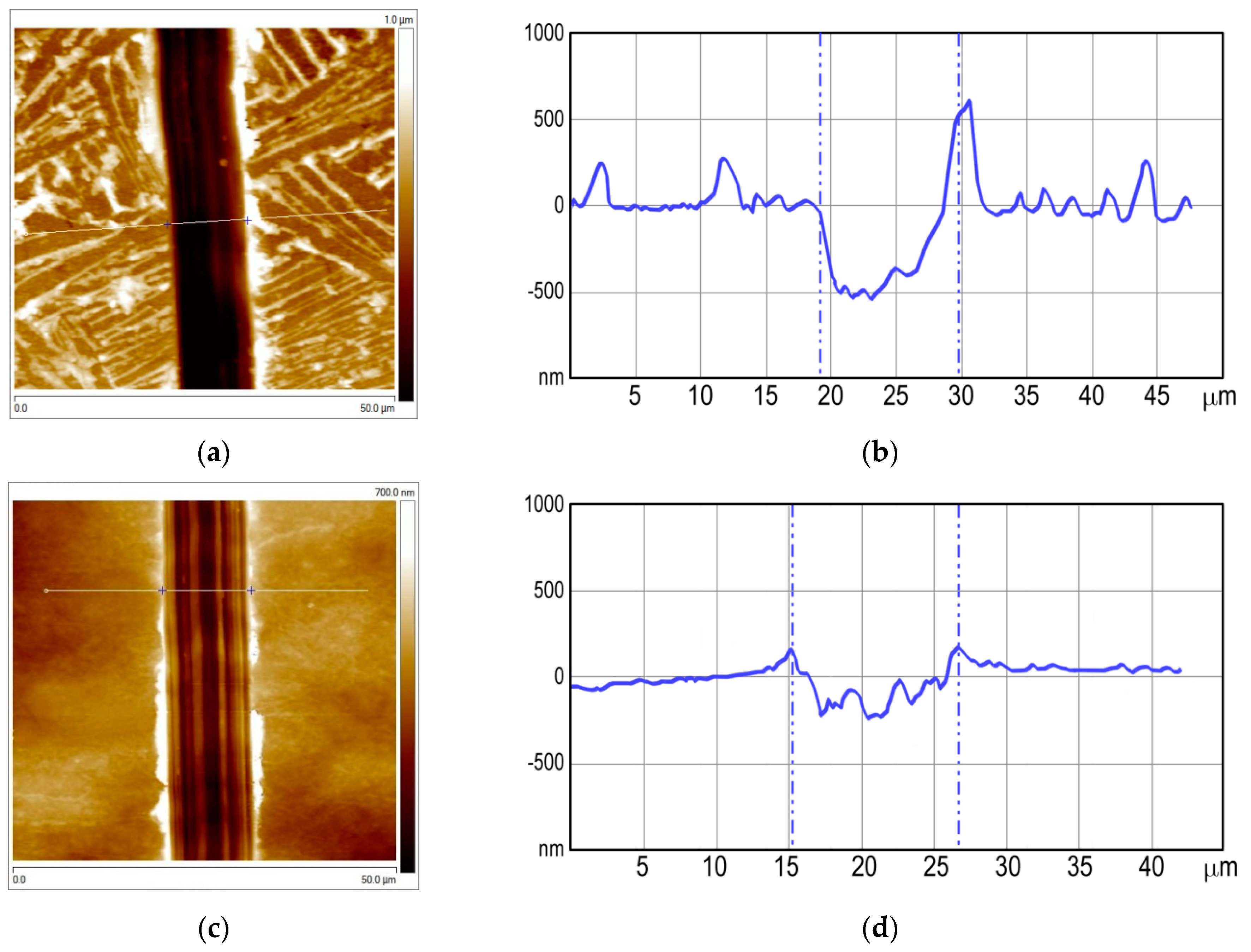
4. Experimental Results
5. Simulation Results
6. Discussion
7. Conclusions
Author Contributions
Funding
Acknowledgments
Conflicts of Interest
References
- Froes, F.H. Titanium: Physical Metallurgy, Processing and Application; ASM International: Materials Park, OH, USA, 2015. [Google Scholar]
- Budinski, K.G. Tribological properties of titanium alloys. Wear 1991, 151, 203–217. [Google Scholar] [CrossRef]
- Revankar, G.D.; Shetty, R.; Rao, S.S.; Gaitonde, V.N. Wear resistance enhancement of titanium alloy (Ti–6Al–4V) by ball burnishing process. J. Mater. Res. Technol. 2017, 6, 13–32. [Google Scholar] [CrossRef]
- Rabinowicz, E. Friction and Wear of Materials; Wiley-Interscience: New York, NY, USA, 1965. [Google Scholar]
- Archard, J.F. Contact and rubbing of flat surfaces. J. Appl. Phys. 1953, 24, 981–988. [Google Scholar] [CrossRef]
- Oberle, T.L. Properties influencing wear of metals. J. Metals. 1951, 3, 438–439. [Google Scholar] [CrossRef]
- Leyland, A.; Matthews, A. On the significance of the H/E ratio in wear control: A nanocomposite coating approach to optimised tribological behavior. Wear 2000, 246, 1–11. [Google Scholar] [CrossRef]
- Attar, H.; Bermingham, M.J.; Ehtemam-Haghighi, S.; Dehghan-Manshadi, A.; Kent, D.; Dargusch, M.S. Evaluation of the mechanical and wear properties of titanium produced by three different additive manufacturing methods for biomedical application. Mater. Sci. Eng. A 2019, 760, 339–345. [Google Scholar] [CrossRef]
- Lutjering, G. Influence of processing on microstructure and mechanical properties of (α+β) titanium alloys. Mater. Sci. Eng. A 1998, 243, 32–45. [Google Scholar] [CrossRef]
- Mironov, S.; Sato, Y.S.; Kokawa, H.; Hirano, S.; Pilchak, A.L.; Semiatin, S.L. Microstructural characterization of friction-stir processed Ti-6Al-4V. Metals 2020, 10, 976. [Google Scholar] [CrossRef]
- Schibicheski Kurelo, B.C.E.; de Oliveira, W.R.; Serbena, F.C.; de Souza, G.B. Surface mechanics and wear resistance of supermartensitic stainless steel nitrided by plasma immersion ion implantation. Surf. Coat. Technol. 2018, 353, 199–209. [Google Scholar] [CrossRef]
- Tsybenko, H.; Xia, W.; Dehm, G.; Brinckmann, S. On the commensuration of plastic plowing at the microscale. Tribol. Int. 2020, 151, 106477. [Google Scholar] [CrossRef]
- Shugurov, A.R.; Panin, A.V.; Dmitriev, A.I.; Nikonov, A.Y. The effect of the crystallographic grain orientation of polycrystalline Ti on plastic ploughing under scratch testing. Wear 2018, 408–409, 214–221. [Google Scholar] [CrossRef]
- Kimm, J.; Sander, M.; Pöhl, F.; Theisen, W. Micromechanical characterization of hard phases by means of instrumented indentation and scratch testing. Mater. Sci. Eng. A 2019, 768, 138480. [Google Scholar] [CrossRef]
- Machado, P.C.; Pereira, J.I.; Penagos, J.J.; Yonamine, T.; Sinatora, A. The effect of in-service work hardening and crystallographic orientation on the micro-scratch wear of Hadfield steel. Wear 2017, 376, 1064–1073. [Google Scholar] [CrossRef]
- Dmitriev, A.I.; Nikonov, A.Y.; Shugurov, A.R.; Panin, A.V. The role of grain boundaries in rotational deformation in polycrystalline titanium under scratch testing. Phys. Mesomech. 2019, 22, 365–374. [Google Scholar] [CrossRef]
- Liu, J.; Zeng, Q.; Xu, S. The state-of-art in characterizing the micro/nano-structure and mechanical properties of cement-based materials via scratch test. Constr. Build. Mater. 2020, 254, 119255. [Google Scholar] [CrossRef]
- Chavoshi, S.Z.; Gallo, S.C.; Dong, H.; Luo, X. High temperature nanoscratching of single crystal silicon under reduced oxygen condition. Mater. Sci. Eng. A 2017, 684, 385–393. [Google Scholar] [CrossRef]
- Wang, B.; Melkote, S.N.; Saraogi, S.; Wang, P. Effect of scratching speed on phase transformations in high-speed scratching of monocrystalline silicon. Mater. Sci. Eng. A 2020, 772, 138836. [Google Scholar] [CrossRef]
- Zhang, P.; Zhao, H.; Shi, C.; Zhang, L.; Huang, H.; Ren, L. Influence of double-tip scratch and single-tip scratch on nano-scratching process via molecular dynamics simulation. Appl. Surf. Sci. 2013, 280, 751–756. [Google Scholar] [CrossRef]
- Zhu, P.; Hu, Y.; Fang, F.; Wang, H. Multiscale simulations of nanoindentation and nanoscratch of single crystal copper. Appl. Surf. Sci. 2012, 258, 4624–4631. [Google Scholar] [CrossRef]
- Ren, J.; Hao, M.; Lv, M.; Wang, S.; Zhu, B. Molecular dynamics research on ultra-high-speed grinding mechanism of monocrystalline nickel. Appl. Surf. Sci. 2018, 455, 629–634. [Google Scholar] [CrossRef]
- Gao, Y.; Ruestes, C.J.; Urbassek, H.M. Nanoindentation and nanoscratching of iron: Atomistic simulation of dislocation generation and reactions. Comput. Mater. Sci. 2014, 90, 232–240. [Google Scholar] [CrossRef]
- Wu, C.-D.; Fang, T.-H.; Lin, J.-F. Atomic-scale simulations of material behaviors and tribology properties for FCC and BCC metal films. Mater. Lett. 2012, 80, 59–62. [Google Scholar] [CrossRef]
- Alabd Alhafez, I.; Urbassek, H.M. Scratching of hcp metals: A molecular-dynamics study. Comput. Mater. Sci. 2016, 113, 187–197. [Google Scholar] [CrossRef]
- Dmitriev, A.I.; Nikonov, A.Y.; Shugurov, A.R.; Panin, A.V. Numerical study of atomic scale deformation mechanisms of Ti grains with different crystallographic orientation subjected to scratch testing. Appl. Surf. Sci. 2019, 471, 318–327. [Google Scholar] [CrossRef]
- Liu, Y.; Li, B.; Kong, L. A molecular dynamics investigation into nanoscale scratching mechanism of polycrystalline silicon carbide. Comput. Mater. Sci. 2018, 148, 76–86. [Google Scholar] [CrossRef]
- Gao, Y.; Urbassek, H.M. Scratching of nanocrystalline metals: A molecular dynamics study of Fe. Appl. Surf. Sci. 2016, 389, 688–695. [Google Scholar] [CrossRef]
- Guo, X.; Zhai, C.; Kang, R.; Jin, Z. The mechanical properties of the scratched surface for silica glass by molecular dynamics simulation. J. Non-Cryst. Solids. 2015, 420, 1–6. [Google Scholar] [CrossRef]
- Yang, W.; Ayoub, G.; Salehinia, I.; Mansoor, B.; Zbib, H. Multiaxial tension/compression asymmetry of Ti/TiN nano laminates: MD investigation. Acta Mater. 2017, 135, 348–360. [Google Scholar] [CrossRef]
- Fan, X.; Li, C.; Sun, L.; Sun, H.; Jiang, Z. Hardness and friction coefficient of fused silica under scratching considering elastic recovery. Ceram. Int. 2020, 46, 8200–8208. [Google Scholar] [CrossRef]
- Panin, V.E.; Panin, A.V.; Pochivalov, Y.I.; Elsukova, T.F.; Shugurov, A.R. Scale invariance of structural transformations in plastically deformed nanostructured solids. Phys. Mesomech. 2017, 20, 55–68. [Google Scholar] [CrossRef]
- Sinyakova, E.A.; Panin, A.V.; Perevalova, O.B.; Shugurov, A.R.; Kalashnikov, M.P.; Teresov, A.D. The effect of phase transformations on the recovery of pulsed electron beam irradiated Ti-6Al-4V titanium alloy during scratching. J. Alloys Compd. 2019, 795, 275–283. [Google Scholar] [CrossRef]
- Mendelev, M.I.; Underwood, T.L.; Ackland, G.J. Development of an interatomic potential for the simulation of defects, plasticity, and phase transformations in titanium. J. Chem. Phys. 2016, 145, 154102. [Google Scholar] [CrossRef] [PubMed]
- Maisel, S.B.; Ko, W.-S.; Zhang, J.-L.; Grabowski, B.; Neugebauer, J. Thermomechanical response of NiTi shape-memory nanoprecipitates in TiV alloys. Phys. Rev. Mater. 2017, 1, 033610. [Google Scholar] [CrossRef]
- Plimpton, S. Fast Parallel Algorithms for Short-Range Molecular Dynamics. J. Comput. Phys. 1995, 117, 1–19. [Google Scholar] [CrossRef]
- Stukowski, A.; Bulatov, V.V.; Arsenlis, A. Automated identification and indexing of dislocations in crystal interfaces. Model. Simul. Mater. Sci. Eng. 2012, 20, 085007. [Google Scholar] [CrossRef]
- Elmer, J.W.; Palmer, T.A.; Babu, S.S.; Specht, E.D. In situ observations of lattice expansion and transformation rates of α and β phases in Ti–6Al–4V. Mater. Sci. Eng. A 2005, 391, 104–113. [Google Scholar] [CrossRef]
- Bridier, F.; Villechaise, P.; Mendez, J. Slip and fatigue crack formation processes in an α/β titanium alloy in relation to crystallographic texture on different scales. Acta Mater. 2008, 56, 3951–3962. [Google Scholar] [CrossRef]
- Chong, Y.; Bhattacharjee, T.; Park, M.-H.; Shibata, A.; Tsuji, N. Factors determining room temperature mechanical properties of bimodal microstructures in Ti-6Al-4V alloy. Mater. Sci. Eng. A 2018, 730, 217–222. [Google Scholar] [CrossRef]
- Holmberg, K.; Laukkanen, A.; Ronkainen, H.; Wallin, K.; Varjus, S.; Koskinen, J. Tribological contact analysis of a rigid ball sliding on a hard coated surface Part I: Modelling stresses and strains. Surf. Coat. Technol. 2006, 200, 3793–3809. [Google Scholar] [CrossRef]
- Lee, Y.T.; Welsch, G. Young’s modulus and damping of Ti6Al4V alloy as a function of heat treatment and oxygen concentration. Mater. Sci. Eng. A 1990, 128, 77–89. [Google Scholar] [CrossRef]



| Sample | Volume Fraction of β-phase, % | H, GPa | E, GPa | H/E | Er, % |
|---|---|---|---|---|---|
| 1 | 7.9 | 3.85 ± 0.42 | 154 ± 17 | 0.025 | 9 |
| 2 | 4.7 | 4.51 ± 0.44 | 146 ± 14 | 0.031 | 11 |
© 2020 by the authors. Licensee MDPI, Basel, Switzerland. This article is an open access article distributed under the terms and conditions of the Creative Commons Attribution (CC BY) license (http://creativecommons.org/licenses/by/4.0/).
Share and Cite
Shugurov, A.R.; Panin, A.V.; Dmitriev, A.I.; Nikonov, A.Y. Recovery of Scratch Grooves in Ti-6Al-4V Alloy Caused by Reversible Phase Transformations. Metals 2020, 10, 1332. https://doi.org/10.3390/met10101332
Shugurov AR, Panin AV, Dmitriev AI, Nikonov AY. Recovery of Scratch Grooves in Ti-6Al-4V Alloy Caused by Reversible Phase Transformations. Metals. 2020; 10(10):1332. https://doi.org/10.3390/met10101332
Chicago/Turabian StyleShugurov, Artur R., Alexey V. Panin, Andrey I. Dmitriev, and Anton Yu. Nikonov. 2020. "Recovery of Scratch Grooves in Ti-6Al-4V Alloy Caused by Reversible Phase Transformations" Metals 10, no. 10: 1332. https://doi.org/10.3390/met10101332
APA StyleShugurov, A. R., Panin, A. V., Dmitriev, A. I., & Nikonov, A. Y. (2020). Recovery of Scratch Grooves in Ti-6Al-4V Alloy Caused by Reversible Phase Transformations. Metals, 10(10), 1332. https://doi.org/10.3390/met10101332