
Dual Functionality of miRNAs During HIV Infection: From Viral Genome Suppression to Immune Response Modulation




Abstract
1. Introduction
2. Results
2.1. Toll-like Receptors
2.2. Intracellular TLR Signaling Pathways
2.3. NF-κB Pathway
2.4. JAK, STAT and the JAK-STAT Pathway
2.5. Regulation of the STAT Pathway
2.6. Eomes and T-bet
3. Discussion
3.1. Functional Dualism of miRNAs in HIV-1 Infection: Direct and Indirect Mechanisms
3.2. Translational Perspectives: miRNA-Directed Therapeutic Strategies and Clinical Obstacles
3.3. MiRNAs as Diagnostic Tools in HIV Infection
3.4. Limitations
- o
- Absence of protocol pre-registration. In contrast to systematic reviews, this study was not registered in PROSPERO or any comparable database. As a result, both the eligibility criteria and the analytic approach were refined during the course of the literature synthesis.
- o
- Publication bias. The set of 15 miRNAs reported to interact with the HIV-1 genome was curated from published experimental evidence. Given that studies reporting positive findings (i.e., confirmed interactions) are substantially more likely to be published than those with null or negative outcomes, the true repertoire of miRNAs capable of engaging the HIV-1 genome may be underrepresented in the current literature.
- o
- Database-associated bias. Target gene identification relied on miRTarBase, TarBase, and TargetScan. Interactions were classified according to the miRTarBase evidence hierarchy: Functional MTI (Strong), Functional MTI (Weak), and predicted (in silico). A substantial proportion of the miRNA–target gene pairs rely exclusively on computational predictions from TargetScan 8.0 and have not been confirmed by direct functional assays such as luciferase reporter experiments, Western blotting, or qRT-PCR with target expression quantification. Accordingly, the biological significance of these predicted interactions should be interpreted with caution. But the absence of experimental confirmation does not constitute evidence against an interaction. It remains possible that a subset of these predicted interactions may eventually receive experimental confirmation. Moreover, the depth of database coverage is highly skewed: extensively characterized miRNAs such as miR-155 and miR-21 are vastly overrepresented relative to understudied species, potentially conveying a misleading impression of their relative biological importance.
- o
- Language bias. The literature search was restricted to English-language publications. As a consequence, relevant studies reported in other languages were excluded, potentially resulting in an incomplete capture of the existing evidence base.
- o
- Absence of formal study quality assessment and risk-of-bias evaluation. No formal assessment of study quality or risk of bias was performed for the primary studies included in this review. The quality of experimental evidence varies considerably across the cited publications, ranging from single-experiment observations in immortalized cell lines to multi-method validations in primary human cells and clinical samples. This heterogeneity in evidence quality was not formally weighted during synthesis. As a consequence, findings supported by a single in vitro experiment are presented alongside those confirmed by multiple independent approaches, without explicit differentiation of their relative evidentiary strength. Readers should interpret conclusions accordingly, with particular caution applied to interactions supported by limited or indirect evidence.
- o
- Subjectivity in manual curation. The assignment of miRNA target genes to specific immune signaling pathways was performed by manual curation. Although this process was conducted independently by two researchers with discrepancies resolved by a third, manual curation remains inherently subjective. Decisions regarding pathway assignment depended on the researchers’ interpretation of the available literature and their judgement regarding the functional relevance of individual gene–pathway relationships. This subjectivity limits the reproducibility of the pathway mapping and may have introduced systematic biases in the selection or exclusion of specific miRNA-target-pathway associations.
- o
- Limitations of causal inference. The regulatory relationships described in this review are based on correlational and experimental evidence from individual studies conducted predominantly in vitro or ex vivo. The review does not establish causal directionality for the described interactions in the context of HIV infection in vivo, and the identified miRNA–target–pathway associations should not be interpreted as proven causal mechanisms in human disease.
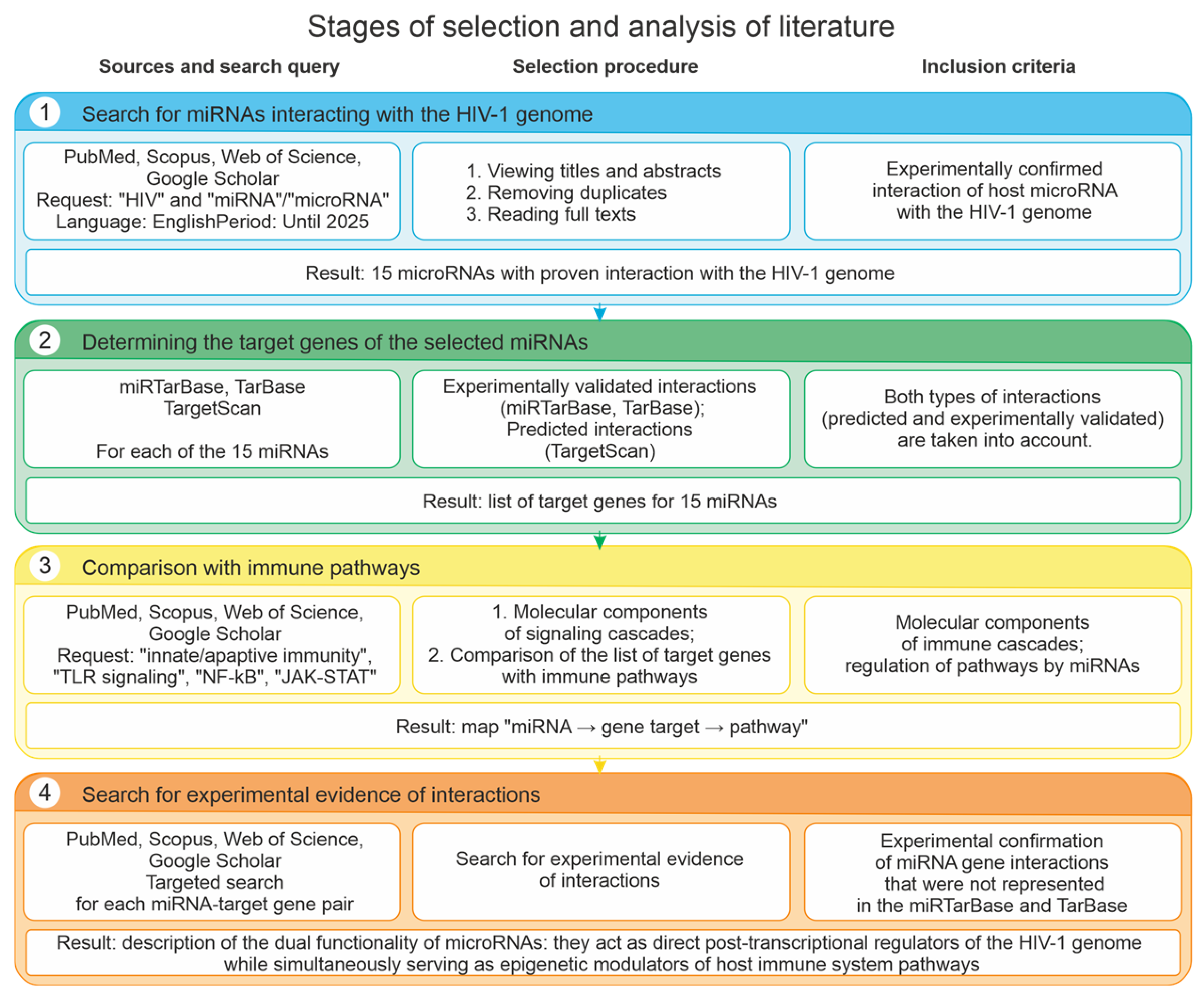
4. Methods
- o
- Described molecular components of immune signaling cascades (receptors, adaptor proteins, transcription factors, negative regulators), their interactions, and physiological outcomes.
- o
- Investigated miRNA-mediated regulation of these pathways, either in the context of HIV infection or in other biological settings.
5. Conclusions
- Suppress TLR-mediated recognition (TLR3, TLR7, TLR8, adapters MyD88, TRAF3/6, IRAK1/4);
- Reduce NF-κB activity (REL, RELA, NFKB1), which promotes viral transition to latency;
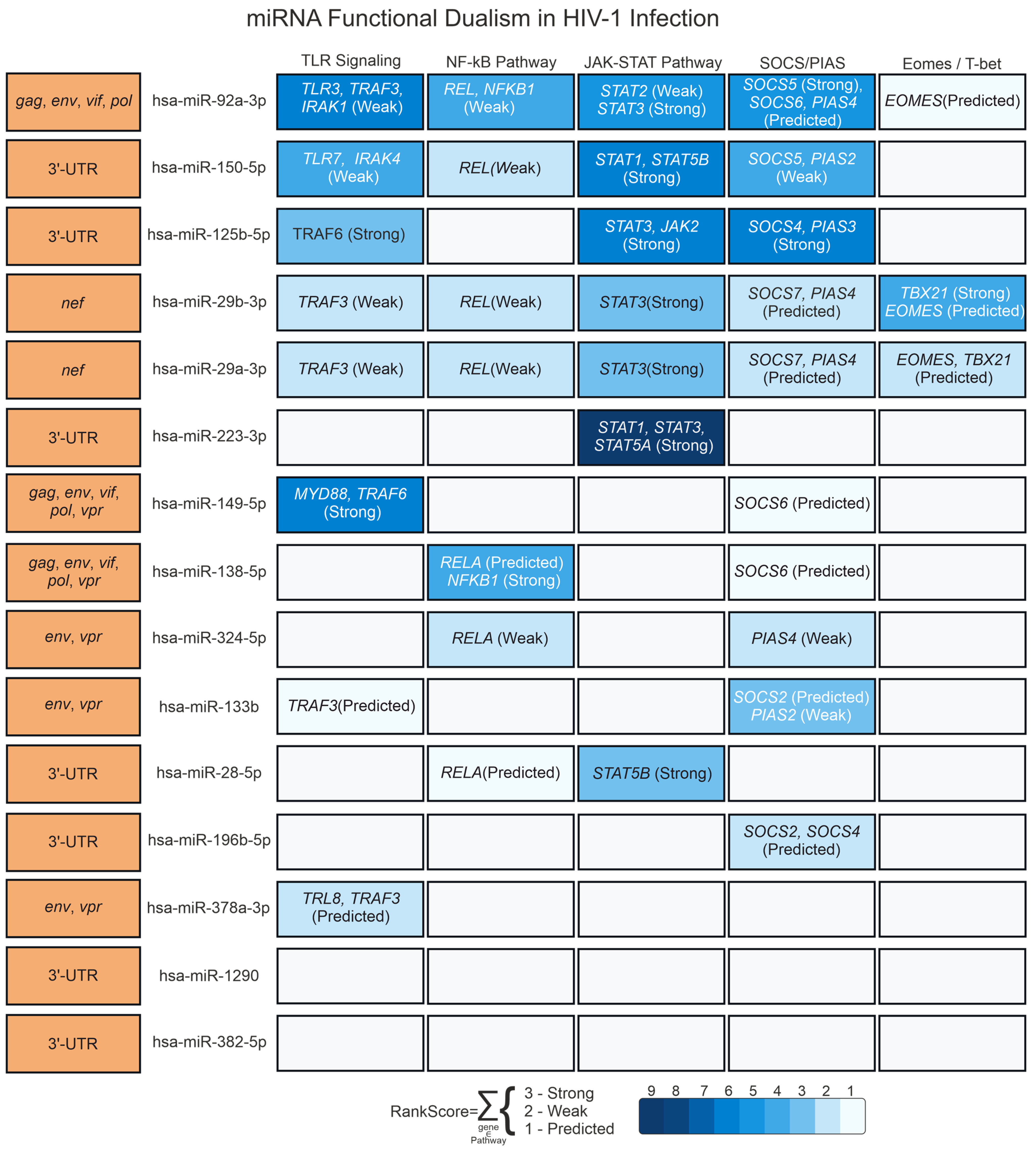
- Modulate the JAK/STAT signaling axis (STAT1–3, STAT5A/B, and JAK2), thereby perturbing cytokine-driven signaling;
- Target negative feedback regulators of STAT signaling, including members of the SOCS and PIAS protein families;
- Suppress the transcription factors T-bet and Eomes, leading to exhaustion of cytotoxic T lymphocytes and weakened immune surveillance over the reservoir.
- “Shock and kill”: the use of antagomirs to neutralize miRNAs that enforce latency, thereby promoting proviral reactivation and subsequent eradication of infected cells;
- “Block and lock”: administration of miRNA mimics targeting NF-κB or JAK/STAT pathways to deepen and stabilize the latent state, thus shielding the reservoir from reactivation stimuli.
Author Contributions
Funding
Institutional Review Board Statement
Informed Consent Statement
Data Availability Statement
Conflicts of Interest
Abbreviations
| 3′-UTR | 3′-untranslated region |
| AP-1 | Activator protein-1 |
| JNK | C-Jun N-terminal kinase |
| CLASH | Cross-linking, ligation, and sequencing of hybrids |
| CTLs | Cytotoxic T lymphocytes |
| dsRNA | Double-stranded RNA |
| ERK | Extracellular signal-regulated kinase |
| HITS-CLIP | High-throughput sequencing of RNA isolated by crosslinking immunoprecipitation |
| ISGs | IFN-stimulated genes |
| IRAK | Interleukin-1 receptor-associated kinase |
| IRF | Interferon regulatory factor |
| JAK | Janus kinase |
| LTR | Long terminal repeat |
| MAPK | Mitogen-activated protein kinase |
| MHC | Major histocompatibility complex |
| MAP3K7 | Mitogen-activated protein kinase kinase kinase 7 |
| NF-κB | Nuclear factor κB |
| PAR-CLIP | Photoactivatable ribonucleoside-enhanced crosslinking and immunoprecipitation |
| PAMP | Pathogen-associated molecular pattern |
| PRR | Pattern recognition receptor |
| PIAS | Protein inhibitors of activated STAT |
| PTP | Protein tyrosine phosphatase |
| ssRNA | Single-stranded RNA |
| STAT | Signal transducer and activator of transcription |
| SOCS | Suppressor of cytokine signaling |
| TAK1 | TGF-β-activated kinase 1 |
| TLR | Toll-like receptor |
| TRAF6 | TNF receptor-associated factor 6 |
References
- Lee, R.C.; Feinbaum, R.L.; Ambros, V. The C. elegans Heterochronic Gene Lin-4 Encodes Small RNAs with Antisense Complementarity to Lin-14. Cell 1993, 75, 843–854. [Google Scholar] [CrossRef] [PubMed]
- Hammond, S.M. An Overview of MicroRNAs. Adv. Drug Deliv. Rev. 2015, 87, 3–14. [Google Scholar] [CrossRef]
- Di Leva, G.; Garofalo, M.; Croce, C.M. MicroRNAs in Cancer. Annu. Rev. Pathol. Mech. Dis. 2014, 9, 287–314. [Google Scholar] [CrossRef]
- Nelson, P.T.; Wang, W.; Rajeev, B.W. MicroRNAs (MiRNAs) in Neurodegenerative Diseases. Brain Pathol. 2008, 18, 130–138. [Google Scholar] [CrossRef]
- Correia, C.N.; Nalpas, N.C.; McLoughlin, K.E.; Browne, J.A.; Gordon, S.V.; MacHugh, D.E.; Shaughnessy, R.G. Circulating MicroRNAs as Potential Biomarkers of Infectious Disease. Front. Immunol. 2017, 8, 118. [Google Scholar] [CrossRef]
- Timofeeva, A.M.; Nikitin, A.O.; Nevinsky, G.A. Circulating MiRNAs in the Plasma of Post-COVID-19 Patients with Typical Recovery and Those with Long-COVID Symptoms: Regulation of Immune Response-Associated Pathways. Non-Coding RNA 2024, 10, 48. [Google Scholar] [CrossRef] [PubMed]
- Mikheeva, E.V.; Aulova, K.S.; Nevinsky, G.A.; Timofeeva, A.M. In Silico Analysis of MiRNA Regulatory Networks to Identify Potential Biomarkers for the Clinical Course of Viral Infections. Int. J. Mol. Sci. 2025, 26, 10100. [Google Scholar] [CrossRef] [PubMed]
- Lewis, B.P.; Burge, C.B.; Bartel, D.P. Conserved Seed Pairing, Often Flanked by Adenosines, Indicates That Thousands of Human Genes Are MicroRNA Targets. Cell 2005, 120, 15–20. [Google Scholar] [CrossRef]
- Global Issues: AIDS. Available online: https://www.un.org/en/global-issues/aids (accessed on 22 August 2025).
- Woottum, M.; Yan, S.; Sayettat, S.; Grinberg, S.; Cathelin, D.; Bekaddour, N.; Herbeuval, J.-P.; Benichou, S. Macrophages: Key Cellular Players in HIV Infection and Pathogenesis. Viruses 2024, 16, 288. [Google Scholar] [CrossRef]
- Balter, M. HIV’s Other Immune-System Targets: Macrophages. Science 1996, 274, 1464–1465. [Google Scholar] [CrossRef]
- van Heuvel, Y.; Schatz, S.; Rosengarten, J.F.; Stitz, J. Infectious RNA: Human Immunodeficiency Virus (HIV) Biology, Therapeutic Intervention, and the Quest for a Vaccine. Toxins 2022, 14, 138. [Google Scholar] [CrossRef]
- Timofeeva, A.; Sedykh, S.; Nevinsky, G. Post-Immune Antibodies in HIV-1 Infection in the Context of Vaccine Development: A Variety of Biological Functions and Catalytic Activities. Vaccines 2022, 10, 384. [Google Scholar] [CrossRef]
- Richman, D.D.; Margolis, D.M.; Delaney, M.; Greene, W.C.; Hazuda, D.; Pomerantz, R.J. The Challenge of Finding a Cure for HIV Infection. Science 2009, 323, 1304–1307. [Google Scholar] [CrossRef]
- Eisele, E.; Siliciano, R.F. Redefining the Viral Reservoirs That Prevent HIV-1 Eradication. Immunity 2012, 37, 377–388. [Google Scholar] [CrossRef]
- Sun, B.; Yang, R.; Mallardo, M. Roles of MicroRNAs in HIV-1 Replication and Latency. MicroRNA 2016, 5, 120–123. [Google Scholar] [CrossRef]
- Wang, P.; Qu, X.; Zhou, X.; Shen, Y.; Ji, H.; Fu, Z.; Deng, J.; Lu, P.; Yu, W.; Lu, H.; et al. Two Cellular MicroRNAs, MiR-196b and MiR-1290, Contribute to HIV-1 Latency. Virology 2015, 486, 228–238. [Google Scholar] [CrossRef] [PubMed]
- Balasubramaniam, M.; Pandhare, J.; Dash, C. Are MicroRNAs Important Players in HIV-1 Infection? An Update. Viruses 2018, 10, 110. [Google Scholar] [CrossRef] [PubMed]
- Su, B.; Fu, Y.; Liu, Y.; Wu, H.; Ma, P.; Zeng, W.; Zhang, T.; Lian, S.; Wu, H. Potential Application of MicroRNA Profiling to the Diagnosis and Prognosis of HIV-1 Infection. Front. Microbiol. 2018, 9, 3185. [Google Scholar] [CrossRef] [PubMed]
- Mbonye, U.; Karn, J. Transcriptional Control of HIV Latency: Cellular Signaling Pathways, Epigenetics, Happenstance and the Hope for a Cure. Virology 2014, 454–455, 328–339. [Google Scholar] [CrossRef]
- Wang, F.S.; Zhang, L.; Douek, D.; McMichael, A.; Xu, X.-N.; Lewin, S.R. Strategies for an HIV Cure: Progress and Challenges. Nat. Immunol. 2018, 19, 1155–1158. [Google Scholar] [CrossRef]
- Rashid, F.; Zaongo, S.D.; Song, F.; Chen, Y. The Diverse Roles of MiRNAs in HIV Pathogenesis: Current Understanding and Future Perspectives. Front. Immunol. 2023, 13, 1091543. [Google Scholar] [CrossRef]
- Santiago, M.J.; Chinnapaiyan, S.; Panda, K.; Rahman, M.S.; Ghorai, S.; Rahman, I.; Black, S.M.; Liu, Y.; Unwalla, H.J. Altered Host MicroRNAomics in HIV Infections: Therapeutic Potentials and Limitations. Int. J. Mol. Sci. 2024, 25, 8809. [Google Scholar] [CrossRef] [PubMed]
- Mansour, R.M.; El-Sayyad, G.S.; Rizk, N.I.; Mageed, S.S.A.; Basiouny, M.S.; El-Sayed, S.A.; Fayez, S.Z.; Abdelaziz, M.M.; Abuelhaded, K.; Fahmy, H.A.; et al. MicroRNAs in HIV Infection: Dual Regulators of Viral Replication and Host Immunity. Naunyn-Schmiedeberg’s Arch. Pharmacol. 2025, 398, 9405–9423. [Google Scholar] [CrossRef] [PubMed]
- Cassan, E.; Arigon-Chifolleau, A.-M.; Mesnard, J.-M.; Gross, A.; Gascuel, O. Concomitant Emergence of the Antisense Protein Gene of HIV-1 and of the Pandemic. Proc. Natl. Acad. Sci. USA 2016, 113, 11537–11542. [Google Scholar] [CrossRef] [PubMed]
- Sertznig, H.; Hillebrand, F.; Erkelenz, S.; Schaal, H.; Widera, M. Behind the Scenes of HIV-1 Replication: Alternative Splicing as the Dependency Factor on the Quiet. Virology 2018, 516, 176–188. [Google Scholar] [CrossRef]
- Li, L.; Li, H.S.; Pauza, C.D.; Bukrinsky, M.; Zhao, R.Y. Roles of HIV-1 Auxiliary Proteins in Viral Pathogenesis and Host-Pathogen Interactions. Cell Res. 2005, 15, 923–934. [Google Scholar] [CrossRef]
- Das, A.T.; Harwig, A.; Vrolijk, M.M.; Berkhout, B. The TAR Hairpin of Human Immunodeficiency Virus Type 1 Can Be Deleted When Not Required for Tat-Mediated Activation of Transcription. J. Virol. 2007, 81, 7742–7748. [Google Scholar] [CrossRef]
- German Advisory Committee Blood (Arbeitskreis Blut); Subgroup ‘Assessment of Pathogens Transmissible by Blood’. Human Immunodeficiency Virus (HIV). Transfus. Med. Hemotherapy 2016, 43, 203–222. [Google Scholar] [CrossRef]
- Agarwal, M.; Lai, K.K.; Wilt, I.; Majdoul, S.; Jolley, A.A.; Lewinski, M.; Compton, A.A. Restriction of HIV-1 Infectivity by Interferon and IFITM3 Is Counteracted by Nef. Sci. Adv. 2025, 11, eadz7083. [Google Scholar] [CrossRef]
- Kirchhoff, F. Immune Evasion and Counteraction of Restriction Factors by HIV-1 and Other Primate Lentiviruses. Cell Host Microbe 2010, 8, 55–67. [Google Scholar] [CrossRef]
- Foster, J.L.; Garcia, J.V. HIV-1 Nef: At the Crossroads. Retrovirology 2008, 5, 84. [Google Scholar] [CrossRef] [PubMed]
- Ahluwalia, J.K.; Khan, S.Z.; Soni, K.; Rawat, P.; Gupta, A.; Hariharan, M.; Scaria, V.; Lalwani, M.; Pillai, B.; Mitra, D.; et al. Human Cellular MicroRNA Hsa-MiR-29a Interferes with Viral Nef Protein Expression and HIV-1 Replication. Retrovirology 2008, 5, 117. [Google Scholar] [CrossRef]
- Hariharan, M.; Scaria, V.; Pillai, B.; Brahmachari, S.K. Targets for Human Encoded MicroRNAs in HIV Genes. Biochem. Biophys. Res. Commun. 2005, 337, 1214–1218. [Google Scholar] [CrossRef]
- Houzet, L.; Klase, Z.; Yeung, M.L.; Wu, A.; Le, S.-Y.; Quiñones, M.; Jeang, K.-T. The Extent of Sequence Complementarity Correlates with the Potency of Cellular MiRNA-Mediated Restriction of HIV-1. Nucleic Acids Res. 2012, 40, 11684–11696. [Google Scholar] [CrossRef]
- Zhang, J.; Crumpacker, C. HIV UTR, LTR, and Epigenetic Immunity. Viruses 2022, 14, 1084. [Google Scholar] [CrossRef] [PubMed]
- Huang, J.; Wang, F.; Argyris, E.; Chen, K.; Liang, Z.; Tian, H.; Huang, W.; Squires, K.; Verlinghieri, G.; Zhang, H. Cellular MicroRNAs Contribute to HIV-1 Latency in Resting Primary CD4+ T Lymphocytes. Nat. Med. 2007, 13, 1241–1247. [Google Scholar] [CrossRef]
- Huang, H.-Y.; Lin, Y.-C.-D.; Cui, S.; Huang, Y.; Tang, Y.; Xu, J.; Bao, J.; Li, Y.; Wen, J.; Zuo, H.; et al. MiRTarBase Update 2022: An Informative Resource for Experimentally Validated MiRNA–Target Interactions. Nucleic Acids Res. 2022, 50, D222–D230. [Google Scholar] [CrossRef]
- Skoufos, G.; Kakoulidis, P.; Tastsoglou, S.; Zacharopoulou, E.; Kotsira, V.; Miliotis, M.; Mavromati, G.; Grigoriadis, D.; Zioga, M.; Velli, A.; et al. TarBase-v9.0 Extends Experimentally Supported MiRNA–Gene Interactions to Cell-Types and Virally Encoded MiRNAs. Nucleic Acids Res. 2024, 52, D304–D310. [Google Scholar] [CrossRef]
- McGeary, S.E.; Lin, K.S.; Shi, C.Y.; Pham, T.M.; Bisaria, N.; Kelley, G.M.; Bartel, D.P. The Biochemical Basis of MicroRNA Targeting Efficacy. Science 2019, 366, eaav1741. [Google Scholar] [CrossRef]
- Agarwal, V.; Bell, G.W.; Nam, J.-W.; Bartel, D.P. Predicting Effective MicroRNA Target Sites in Mammalian MRNAs. eLife 2015, 4, e05005. [Google Scholar] [CrossRef] [PubMed]
- Medzhitov, R. Recognition of Microorganisms and Activation of the Immune Response. Nature 2007, 449, 819–826. [Google Scholar] [CrossRef]
- Kumar, H.; Kawai, T.; Akira, S. Pathogen Recognition by the Innate Immune System. Int. Rev. Immunol. 2011, 30, 16–34. [Google Scholar] [CrossRef]
- Kawai, T.; Akira, S. The Role of Pattern-Recognition Receptors in Innate Immunity: Update on Toll-like Receptors. Nat. Immunol. 2010, 11, 373–384. [Google Scholar] [CrossRef]
- Tartey, S.; Takeuchi, O. Pathogen Recognition and Toll-like Receptor Targeted Therapeutics in Innate Immune Cells. Int. Rev. Immunol. 2017, 36, 57–73. [Google Scholar] [CrossRef] [PubMed]
- Iwasaki, A.; Medzhitov, R. Toll-like Receptor Control of the Adaptive Immune Responses. Nat. Immunol. 2004, 5, 987–995. [Google Scholar] [CrossRef] [PubMed]
- Altfeld, M.; Gale, M., Jr. Innate Immunity against HIV-1 Infection. Nat. Immunol. 2015, 16, 554–562. [Google Scholar] [CrossRef] [PubMed]
- Thompson, M.R.; Kaminski, J.J.; Kurt-Jones, E.A.; Fitzgerald, K.A. Pattern Recognition Receptors and the Innate Immune Response to Viral Infection. Viruses 2011, 3, 920–940. [Google Scholar] [CrossRef]
- Tatematsu, M.; Seya, T.; Matsumoto, M. Beyond DsRNA: Toll-like Receptor 3 Signalling in RNA-Induced Immune Responses. Biochem. J. 2014, 458, 195–201. [Google Scholar] [CrossRef]
- Zhou, Y.; Guo, M.; Wang, X.; Li, J.; Wang, Y.; Ye, L.; Dai, M.; Zhou, L.; Persidsky, Y.; Ho, W. TLR3 Activation Efficiency by High or Low Molecular Mass Poly I:C. Innate Immun. 2013, 19, 184–192. [Google Scholar] [CrossRef]
- Zhou, Y.; Wang, X.; Liu, M.; Hu, Q.; Song, L.; Ye, L.; Zhou, D.; Ho, W. A Critical Function of Toll-like Receptor-3 in the Induction of Anti-human Immunodeficiency Virus Activities in Macrophages. Immunology 2010, 131, 40–49. [Google Scholar] [CrossRef]
- Dai, M.; Wang, X.; Li, J.; Zhou, Y.; Sang, M.; Liu, J.; Wu, J.; Ho, W. Activation of TLR3/Interferon Signaling Pathway by Bluetongue Virus Results in HIV Inhibition in Macrophages. FASEB J. 2015, 29, 4978–4988. [Google Scholar] [CrossRef]
- Xue, Y.; Ouyang, K.; Huang, J.; Zhou, Y.; Ouyang, H.; Li, H.; Wang, G.; Wu, Q.; Wei, C.; Bi, Y.; et al. Direct Conversion of Fibroblasts to Neurons by Reprogramming PTB-Regulated MicroRNA Circuits. Cell 2013, 152, 82–96. [Google Scholar] [CrossRef] [PubMed]
- Hafner, M.; Landthaler, M.; Burger, L.; Khorshid, M.; Hausser, J.; Berninger, P.; Rothballer, A.; Ascano, M.; Jungkamp, A.-C.; Munschauer, M.; et al. Transcriptome-Wide Identification of RNA-Binding Protein and MicroRNA Target Sites by PAR-CLIP. Cell 2010, 141, 129–141. [Google Scholar] [CrossRef] [PubMed]
- Gottwein, E.; Corcoran, D.L.; Mukherjee, N.; Skalsky, R.L.; Hafner, M.; Nusbaum, J.D.; Shamulailatpam, P.; Love, C.L.; Dave, S.S.; Tuschl, T.; et al. Viral MicroRNA Targetome of KSHV-Infected Primary Effusion Lymphoma Cell Lines. Cell Host Microbe 2011, 10, 515–526. [Google Scholar] [CrossRef]
- Skalsky, R.L.; Corcoran, D.L.; Gottwein, E.; Frank, C.L.; Kang, D.; Hafner, M.; Nusbaum, J.D.; Feederle, R.; Delecluse, H.-J.; Luftig, M.A.; et al. The Viral and Cellular MicroRNA Targetome in Lymphoblastoid Cell Lines. PLoS Pathog. 2012, 8, e1002484. [Google Scholar] [CrossRef]
- Chen, X.; Liang, H.; Zhang, J.; Zen, K.; Zhang, C.-Y. MicroRNAs Are Ligands of Toll-like Receptors. RNA 2013, 19, 737–739. [Google Scholar] [CrossRef]
- Fabbri, M. TLRs as MiRNA Receptors. Cancer Res. 2012, 72, 6333–6337. [Google Scholar] [CrossRef]
- Cao, Z.; Henzel, W.J.; Gao, X. IRAK: A Kinase Associated with the Interleukin-1 Receptor. Science 1996, 271, 1128–1131. [Google Scholar] [CrossRef] [PubMed]
- Qian, Y.; Commane, M.; Ninomiya-Tsuji, J.; Matsumoto, K.; Li, X. IRAK-Mediated Translocation of TRAF6 and TAB2 in the Interleukin-1-Induced Activation of NFκB. J. Biol. Chem. 2001, 276, 41661–41667. [Google Scholar] [CrossRef]
- Akira, S.; Uematsu, S.; Takeuchi, O. Pathogen Recognition and Innate Immunity. Cell 2006, 124, 783–801. [Google Scholar] [CrossRef]
- Kawasaki, T.; Kawai, T. Toll-Like Receptor Signaling Pathways. Front. Immunol. 2014, 5, 461. [Google Scholar] [CrossRef]
- Ning, S.; Pagano, J.S.; Barber, G.N. IRF7: Activation, Regulation, Modification and Function. Genes Immun. 2011, 12, 399–414. [Google Scholar] [CrossRef]
- Xu, G.; Zhang, Z.; Xing, Y.; Wei, J.; Ge, Z.; Liu, X.; Zhang, Y.; Huang, X. MicroRNA-149 Negatively Regulates TLR-Triggered Inflammatory Response in Macrophages by Targeting MyD88. J. Cell. Biochem. 2014, 115, 919–927. [Google Scholar] [CrossRef]
- Shen, X.; Zhu, W.; Zhang, P.; Fu, Y.; Cheng, J.; Liu, L.; Xu, R.; Jiang, H. Macrophage MiR-149-5p Induction Is a Key Driver and Therapeutic Target for BRONJ. JCI Insight 2022, 7, e159865. [Google Scholar] [CrossRef]
- Qiu, J.; Zhu, J.; Zhang, R.; Liang, W.; Ma, W.; Zhang, Q.; Huang, Z.; Ding, F.; Sun, H. MiR-125b-5p Targeting TRAF6 Relieves Skeletal Muscle Atrophy Induced by Fasting or Denervation. Ann. Transl. Med. 2019, 7, 456. [Google Scholar] [CrossRef]
- Gao, X.; Zhu, Y.; Lv, T.; Luo, M.; Jiang, Y.; Sun, L.; Zheng, S.; Jiang, D.; Ruan, S. Resveratrol Restrains Colorectal Cancer Metastasis by Regulating MiR-125b-5p/TRAF6 Signaling Axis. Am. J. Cancer Res. 2024, 14, 2390–2407. [Google Scholar] [CrossRef]
- Rasheed, Z.; Rasheed, N.; Al Abdulmonem, W.; Khan, M.I. MicroRNA-125b-5p Regulates IL-1β Induced Inflammatory Genes via Targeting TRAF6-Mediated MAPKs and NF-ΚB Signaling in Human Osteoarthritic Chondrocytes. Sci. Rep. 2019, 9, 6882. [Google Scholar] [CrossRef]
- Helwak, A.; Kudla, G.; Dudnakova, T.; Tollervey, D. Mapping the Human MiRNA Interactome by CLASH Reveals Frequent Noncanonical Binding. Cell 2013, 153, 654–665. [Google Scholar] [CrossRef]
- Yu, F.; Bracken, C.P.; Pillman, K.A.; Lawrence, D.M.; Goodall, G.J.; Callen, D.F.; Neilsen, P.M. P53 Represses the Oncogenic Sno-MiR-28 Derived from a SnoRNA. PLoS ONE 2015, 10, e0129190. [Google Scholar] [CrossRef]
- Balakrishnan, I.; Yang, X.; Brown, J.; Ramakrishnan, A.; Torok-Storb, B.; Kabos, P.; Hesselberth, J.R.; Pillai, M.M. Genome-Wide Analysis of MiRNA-MRNA Interactions in Marrow Stromal Cells. Stem Cells 2014, 32, 662–673. [Google Scholar] [CrossRef]
- Pillai, M.M.; Gillen, A.E.; Yamamoto, T.M.; Kline, E.; Brown, J.; Flory, K.; Hesselberth, J.R.; Kabos, P. HITS-CLIP Reveals Key Regulators of Nuclear Receptor Signaling in Breast Cancer. Breast Cancer Res. Treat. 2014, 146, 85–97. [Google Scholar] [CrossRef]
- Haecker, I.; Gay, L.A.; Yang, Y.; Hu, J.; Morse, A.M.; McIntyre, L.M.; Renne, R. Ago HITS-CLIP Expands Understanding of Kaposi’s Sarcoma-Associated Herpesvirus MiRNA Function in Primary Effusion Lymphomas. PLoS Pathog. 2012, 8, e1002884. [Google Scholar] [CrossRef] [PubMed]
- Zhang, B.; Shetti, D.; Fan, C.; Wei, K. MiR-29b-3p Promotes Progression of MDA-MB-231 Triple-Negative Breast Cancer Cells through Downregulating TRAF3. Biol. Res. 2019, 52, 38. [Google Scholar] [CrossRef]
- Wang, Y.; Ke, W.; Gan, J.; Zhu, H.; Xie, X.; He, G.; Liu, S.; Huang, Y.; Tang, H. MicroRNA-29b-3p Promotes Intestinal Permeability in IBS-D via Targeting TRAF3 to Regulate the NF-ΚB-MLCK Signaling Pathway. PLoS ONE 2023, 18, e0287597. [Google Scholar] [CrossRef] [PubMed]
- Dai, Y.; Mao, Z.; Han, X.; Xu, Y.; Xu, L.; Yin, L.; Qi, Y.; Peng, J. MicroRNA-29b-3p Reduces Intestinal Ischaemia/Reperfusion Injury via Targeting of TNF Receptor-associated Factor 3. Br. J. Pharmacol. 2019, 176, 3264–3278. [Google Scholar] [CrossRef]
- Dai, Q.; Ma, Y.; Xu, Z.; Zhang, L.; Yang, H.; Liu, Q.; Wang, J. Downregulation of Circular RNA HECTD1 Induces Neuroprotection against Ischemic Stroke through the MicroRNA-133b/TRAF3 Pathway. Life Sci. 2021, 264, 118626. [Google Scholar] [CrossRef]
- Liu, T.; Zhang, L.; Joo, D.; Sun, S.-C. NF-κB Signaling in Inflammation. Signal Transduct. Target. Ther. 2017, 2, 17023. [Google Scholar] [CrossRef] [PubMed]
- Beg, A.A.; Ruben, S.M.; Scheinman, R.I.; Haskill, S.; Rosen, C.A.; Baldwin, A.S. I Kappa B Interacts with the Nuclear Localization Sequences of the Subunits of NF-Kappa B: A Mechanism for Cytoplasmic Retention. Genes Dev. 1992, 6, 1899–1913. [Google Scholar] [CrossRef]
- Chandrasekar, A.P.; Cummins, N.W.; Badley, A.D. The Role of the BCL-2 Family of Proteins in HIV-1 Pathogenesis and Persistence. Clin. Microbiol. Rev. 2019, 33, 10.1128. [Google Scholar] [CrossRef]
- Chan, J.K.; Greene, W.C. NF-ΚB/Rel: Agonist and Antagonist Roles in HIV-1 Latency. Curr. Opin. HIV AIDS 2011, 6, 12–18. [Google Scholar] [CrossRef]
- Heusinger, E.; Kirchhoff, F. Primate Lentiviruses Modulate NF-ΚB Activity by Multiple Mechanisms to Fine-Tune Viral and Cellular Gene Expression. Front. Microbiol. 2017, 8, 198. [Google Scholar] [CrossRef]
- Liu, R.; Lin, Y.; Jia, R.; Geng, Y.; Liang, C.; Tan, J.; Qiao, W. HIV-1 Vpr Stimulates NF-ΚB and AP-1 Signaling by Activating TAK1. Retrovirology 2014, 11, 45. [Google Scholar] [CrossRef] [PubMed]
- Sauter, D.; Hotter, D.; Van Driessche, B.; Stürzel, C.M.; Kluge, S.F.; Wildum, S.; Yu, H.; Baumann, B.; Wirth, T.; Plantier, J.-C.; et al. Differential Regulation of NF-ΚB-Mediated Proviral and Antiviral Host Gene Expression by Primate Lentiviral Nef and Vpu Proteins. Cell Rep. 2015, 10, 586–599. [Google Scholar] [CrossRef]
- Kishore, S.; Jaskiewicz, L.; Burger, L.; Hausser, J.; Khorshid, M.; Zavolan, M. A Quantitative Analysis of CLIP Methods for Identifying Binding Sites of RNA-Binding Proteins. Nat. Methods 2011, 8, 559–564. [Google Scholar] [CrossRef]
- Whisnant, A.W.; Bogerd, H.P.; Flores, O.; Ho, P.; Powers, J.G.; Sharova, N.; Stevenson, M.; Chen, C.-H.; Cullen, B.R. In-Depth Analysis of the Interaction of HIV-1 with Cellular MicroRNA Biogenesis and Effector Mechanisms. mBio 2013, 4, e000193. [Google Scholar] [CrossRef]
- Karginov, F.V.; Hannon, G.J. Remodeling of Ago2–MRNA Interactions upon Cellular Stress Reflects MiRNA Complementarity and Correlates with Altered Translation Rates. Genes Dev. 2013, 27, 1624–1632. [Google Scholar] [CrossRef] [PubMed]
- Yu, D.; An, F.; He, X.; Cao, X. Curcumin Inhibits the Proliferation and Invasion of Human Osteosarcoma Cell Line MG-63 by Regulating MiR-138. Int. J. Clin. Exp. Pathol. 2015, 8, 14946–14952. [Google Scholar]
- Hu, Q.; Bian, Q.; Rong, D.; Wang, L.; Song, J.; Huang, H.-S.; Zeng, J.; Mei, J.; Wang, P.-Y. JAK/STAT Pathway: Extracellular Signals, Diseases, Immunity, and Therapeutic Regimens. Front. Bioeng. Biotechnol. 2023, 11, 1110765. [Google Scholar] [CrossRef] [PubMed]
- Villarino, A.V.; Kanno, Y.; O’Shea, J.J. Mechanisms and Consequences of Jak–STAT Signaling in the Immune System. Nat. Immunol. 2017, 18, 374–384. [Google Scholar] [CrossRef]
- Waldmann, T.A.; Chen, J. Disorders of the JAK/STAT Pathway in T Cell Lymphoma Pathogenesis: Implications for Immunotherapy. Annu. Rev. Immunol. 2017, 35, 533–550. [Google Scholar] [CrossRef]
- O’Shea, J.J.; Schwartz, D.M.; Villarino, A.V.; Gadina, M.; McInnes, I.B.; Laurence, A. The JAK-STAT Pathway: Impact on Human Disease and Therapeutic Intervention. Annu. Rev. Med. 2015, 66, 311–328. [Google Scholar] [CrossRef]
- Nguyen, N.V.; Tran, J.T.; Sanchez, D.J. HIV Blocks Type I IFN Signaling through Disruption of STAT1 Phosphorylation. Innate Immun. 2018, 24, 490–500. [Google Scholar] [CrossRef]
- Wang, Y.; Qian, G.; Zhu, L.; Zhao, Z.; Liu, Y.; Han, W.; Zhang, X.; Zhang, Y.; Xiong, T.; Zeng, H.; et al. HIV-1 Vif Suppresses Antiviral Immunity by Targeting STING. Cell. Mol. Immunol. 2022, 19, 108–121. [Google Scholar] [CrossRef]
- Gargan, S.; Ahmed, S.; Mahony, R.; Bannan, C.; Napoletano, S.; O’Farrelly, C.; Borrow, P.; Bergin, C.; Stevenson, N.J. HIV-1 Promotes the Degradation of Components of the Type 1 IFN JAK/STAT Pathway and Blocks Anti-Viral ISG Induction. eBioMedicine 2018, 30, 203–216. [Google Scholar] [CrossRef] [PubMed]
- Scagnolari, C.; Antonelli, G. Type I Interferon and HIV: Subtle Balance between Antiviral Activity, Immunopathogenesis and the Microbiome. Cytokine Growth Factor Rev. 2018, 40, 19–31. [Google Scholar] [CrossRef]
- Masenga, S.K.; Mweene, B.C.; Luwaya, E.; Muchaili, L.; Chona, M.; Kirabo, A. HIV–Host Cell Interactions. Cells 2023, 12, 1351. [Google Scholar] [CrossRef]
- Tolomeo, M.; Cascio, A. The STAT Signaling Pathway in HIV-1 Infection: Roles and Dysregulation. Int. J. Mol. Sci. 2025, 26, 9123. [Google Scholar] [CrossRef]
- Bian, Y.; Cai, W.; Lu, H.; Tang, S.; Yang, K.; Tan, Y. MiR-150-5p Affects AS Plaque with ASMC Proliferation and Migration by STAT1. Open Med. 2021, 16, 1642–1652. [Google Scholar] [CrossRef]
- Moles, R.; Bellon, M.; Nicot, C. STAT1: A Novel Target of MiR-150 and MiR-223 Is Involved in the Proliferation of HTLV-I–Transformed and ATL Cells. Neoplasia 2015, 17, 449–462. [Google Scholar] [CrossRef] [PubMed]
- Wang, F.; Ren, X.; Zhang, X. Role of MicroRNA-150 in Solid Tumors. Oncol. Lett. 2015, 10, 11–16. [Google Scholar] [CrossRef] [PubMed]
- He, Y.; Jiang, X.; Chen, J. The Role of MiR-150 in Normal and Malignant Hematopoiesis. Oncogene 2014, 33, 3887–3893. [Google Scholar] [CrossRef] [PubMed]
- Ferdowsi, S.; Atarodi, K.; Amirizadeh, N.; Toogeh, G.; Azarkeivan, A.; Shirkoohi, R.; Faranoush, M.; Vaezi, M.; Alimoghaddam, K.; Ghavamzadeh, A.; et al. Expression Analysis of MicroRNA-125 in Patients with Polycythemia Vera and Essential Thrombocythemia and Correlation with JAK2 Allele Burden and Laboratory Findings. Int. J. Lab. Hematol. 2015, 37, 661–667. [Google Scholar] [CrossRef]
- Hamilton, M.P.; Rajapakshe, K.I.; Bader, D.A.; Cerne, J.Z.; Smith, E.A.; Coarfa, C.; Hartig, S.M.; McGuire, S.E. The Landscape of MicroRNA Targeting in Prostate Cancer Defined by AGO-PAR-CLIP. Neoplasia 2016, 18, 356–370. [Google Scholar] [CrossRef] [PubMed]
- Pei, G.; Lan, Y.; Chen, D.; Ji, L.; Hua, Z.-C. FAK Regulates E-Cadherin Expression via p-SrcY416/p-ERK1/2/p-Stat3Y705 and PPARγ/MiR-125b/Stat3 Signaling Pathway in B16F10 Melanoma Cells. Oncotarget 2017, 8, 13898–13908. [Google Scholar] [CrossRef]
- Bao, X.; Ren, T.; Huang, Y.; Wang, S.; Zhang, F.; Liu, K.; Zheng, B.; Guo, W. Induction of the Mesenchymal to Epithelial Transition by Demethylation-Activated MicroRNA-125b Is Involved in the Anti-Migration/Invasion Effects of Arsenic Trioxide on Human Chondrosarcoma. J. Exp. Clin. Cancer Res. 2016, 35, 129. [Google Scholar] [CrossRef]
- Ozen, M.; Creighton, C.J.; Ozdemir, M.; Ittmann, M. Widespread Deregulation of MicroRNA Expression in Human Prostate Cancer. Oncogene 2008, 27, 1788–1793. [Google Scholar] [CrossRef]
- Tao, Y.; Xu, X.; Yang, B.; Zhao, H.; Li, Y. Mitigation of Sepsis-Induced Acute Lung Injury by BMSC-Derived Exosomal MiR-125b-5p Through STAT3-Mediated Suppression of Macrophage Pyroptosis. Int. J. Nanomed. 2023, 18, 7095–7113. [Google Scholar] [CrossRef]
- Zhang, C.; Wan, X.; Tang, S.; Li, K.; Wang, Y.; Liu, Y.; Sha, Q.; Zha, X.; Liu, Y. MiR-125b-5p/STAT3 Pathway Regulated by MTORC1 Plays a Critical Role in Promoting Cell Proliferation and Tumor Growth. J. Cancer 2020, 11, 919–931. [Google Scholar] [CrossRef]
- Wang, X.; Gu, H.; Qin, D.; Yang, L.; Huang, W.; Essandoh, K.; Wang, Y.; Caldwell, C.C.; Peng, T.; Zingarelli, B.; et al. Exosomal MiR-223 Contributes to Mesenchymal Stem Cell-Elicited Cardioprotection in Polymicrobial Sepsis. Sci. Rep. 2015, 5, 13721. [Google Scholar] [CrossRef] [PubMed]
- Song, X.; Wang, C.T.; Geng, X.H. MicroRNA-29a Promotes Apoptosis of Monocytes by Targeting STAT3 during Sepsis. Genet. Mol. Res. 2015, 14, 13746–13753. [Google Scholar] [CrossRef]
- Han, P.; Liu, R.; Guan, X. LncRNA PVT1 Promotes the Progress of Hypertrophic Scar via Regulating the Proliferation and Migration of Myofibroblasts Through Targeting MiR-29a-3p/STAT3. Clin. Cosmet. Investig. Dermatol. 2025, 18, 907–917. [Google Scholar] [CrossRef] [PubMed]
- Li, Y.; Zhang, Z.; Xiao, Z.; Lin, Y.; Luo, T.; Zhou, Q.; Zhang, X. Chemotherapy-Mediated MiR-29b Expression Inhibits the Invasion and Angiogenesis of Cervical Cancer. Oncotarget 2017, 8, 14655–14665. [Google Scholar] [CrossRef]
- Qin, L.; Li, R.; Zhang, J.; Li, A.; Luo, R. Special Suppressive Role of MiR-29b in HER2-Positive Breast Cancer Cells by Targeting Stat3. Am. J. Transl. Res. 2015, 7, 878. [Google Scholar] [PubMed]
- Lin, H.-Y.; Chiang, C.-H.; Hung, W.-C. STAT3 Upregulates MiR-92a to Inhibit RECK Expression and to Promote Invasiveness of Lung Cancer Cells. Br. J. Cancer 2013, 109, 731–738. [Google Scholar] [CrossRef]
- Pinatel, E.M.; Orso, F.; Penna, E.; Cimino, D.; Elia, A.R.; Circosta, P.; Dentelli, P.; Brizzi, M.F.; Provero, P.; Taverna, D. MiR-223 Is a Coordinator of Breast Cancer Progression as Revealed by Bioinformatics Predictions. PLoS ONE 2014, 9, e84859. [Google Scholar] [CrossRef]
- Leoncini, P.P.; Bertaina, A.; Papaioannou, D.; Flotho, C.; Masetti, R.; Bresolin, S.; Menna, G.; Santoro, N.; Zecca, M.; Basso, G.; et al. MicroRNA Fingerprints in Juvenile Myelomonocytic Leukemia (JMML) Identified MiR-150-5p as a Tumor Suppressor and Potential Target for Treatment. Oncotarget 2016, 7, 55395–55408. [Google Scholar] [CrossRef]
- Girardot, M.; Pecquet, C.; Chachoua, I.; Van Hees, J.; Guibert, S.; Ferrant, A.; Knoops, L.; Baxter, E.J.; Beer, P.A.; Giraudier, S.; et al. Persistent STAT5 Activation in Myeloid Neoplasms Recruits P53 into Gene Regulation. Oncogene 2015, 34, 1323–1332. [Google Scholar] [CrossRef] [PubMed]
- Dey, R.; Soni, K.; Saravanan, S.; Balakrishnan, P.; Kumar, V.; Boobalan, J.; Solomon, S.S.; Scaria, V.; Solomon, S.; Brahmachari, S.K.; et al. Anti-HIV MicroRNA Expression in a Novel Indian Cohort. Sci. Rep. 2016, 6, 28279. [Google Scholar] [CrossRef]
- Darnell, J.E., Jr.; Kerr, L.M.; Stark, G.R. Jak-STAT Pathways and Transcriptional Activation in Response to IFNs and Other Extracellular Signaling Proteins. Science 1994, 264, 1415–1421. [Google Scholar] [CrossRef]
- Hillmer, E.J.; Zhang, H.; Li, H.S.; Watowich, S.S. STAT3 Signaling in Immunity. Cytokine Growth Factor Rev. 2016, 31, 1–15. [Google Scholar] [CrossRef]
- Tian, X.; Zuo, X.; Hou, M.; Li, C.; Teng, Y. LncRNA-H19 Regulates Chemoresistance to Carboplatin in Epithelial Ovarian Cancer through MicroRNA-29b-3p and STAT3. J. Cancer 2021, 12, 5712–5722. [Google Scholar] [CrossRef]
- Liu, L.; Liu, L.; Lu, S. LncRNA H19 Promotes Viability and Epithelial-Mesenchymal Transition of Lung Adenocarcinoma Cells by Targeting MiR-29b-3p and Modifying STAT3. Int. J. Oncol. 2019, 54, 929–941. [Google Scholar] [CrossRef]
- Tang, P.; Xu, Y.; Zhang, J.; Nan, J.; Zhong, R.; Luo, J.; Xu, D.; Shi, S.; Zhang, L. MiR-223-3p Mediates the Diabetic Kidney Disease Progression by Targeting IL6ST/STAT3 Pathway. Biochem. Biophys. Res. Commun. 2023, 648, 50–58. [Google Scholar] [CrossRef]
- Carreras-Badosa, G.; Maslovskaja, J.; Vaher, H.; Pajusaar, L.; Annilo, T.; Lättekivi, F.; Hübenthal, M.; Rodriguez, E.; Weidinger, S.; Kingo, K.; et al. MiRNA Expression Profiles of the Perilesional Skin of Atopic Dermatitis and Psoriasis Patients Are Highly Similar. Sci. Rep. 2022, 12, 22645. [Google Scholar] [CrossRef]
- Majri, S.S.; Fritz, J.M.; Villarino, A.V.; Zheng, L.; Kanellopoulou, C.; Chaigne-Delalande, B.; Grönholm, J.; Niemela, J.E.; Afzali, B.; Biancalana, M.; et al. STAT5B: A Differential Regulator of the Life and Death of CD4+ Effector Memory T Cells. J. Immunol. 2018, 200, 110–118. [Google Scholar] [CrossRef]
- Cohen, A.C.; Nadeau, K.C.; Tu, W.; Hwa, V.; Dionis, K.; Bezrodnik, L.; Teper, A.; Gaillard, M.; Heinrich, J.; Krensky, A.M.; et al. Cutting Edge: Decreased Accumulation and Regulatory Function of CD4+CD25(high) T Cells in Human STAT5b Deficiency. J. Immunol. 2006, 177, 2770–2774. [Google Scholar] [CrossRef]
- Ando, T.; Xiao, W.; Gao, P.; Namiranian, S.; Matsumoto, K.; Tomimori, Y.; Hong, H.; Yamashita, H.; Kimura, M.; Kashiwakura, J.; et al. Critical Role for Mast Cell Stat5 Activity in Skin Inflammation. Cell Rep. 2014, 6, 366–376. [Google Scholar] [CrossRef]
- Pastorio, C.; Richard, K.; Usmani, S.; Kissmann, A.-K.; Bolotnikov, G.; Gosálbez, G.; Hayn, M.; Koepke, L.; Sauertnik, A.; Preising, A.; et al. Retinol Binding Protein 4 Reactivates Latent HIV-1 by Triggering Canonical NF-ΚB, JAK/STAT5 and JNK Signalling. Signal Transduct. Target. Ther. 2025, 10, 326. [Google Scholar] [CrossRef]
- Shuai, K.; Liu, B. Regulation of JAK–STAT Signalling in the Immune System. Nat. Rev. Immunol. 2003, 3, 900–911. [Google Scholar] [CrossRef]
- Ivashkiv, L.B.; Donlin, L.T. Regulation of Type I Interferon Responses. Nat. Rev. Immunol. 2014, 14, 36–49. [Google Scholar] [CrossRef]
- Yoshimura, A.; Naka, T.; Kubo, M. SOCS Proteins, Cytokine Signalling and Immune Regulation. Nat. Rev. Immunol. 2007, 7, 454–465. [Google Scholar] [CrossRef]
- Miller, R.C.; Schlaepfer, E.; Baenziger, S.; Crameri, R.; Zeller, S.; Byland, R.; Audigé, A.; Nadal, D.; Speck, R.F. HIV Interferes with SOCS-1 and -3 Expression Levels Driving Immune Activation. Eur. J. Immunol. 2011, 41, 1058–1069. [Google Scholar] [CrossRef]
- Chen, X.; Zhou, J.; Li, X.; Wang, X.; Lin, Y.; Wang, X. Exosomes Derived from Hypoxic Epithelial Ovarian Cancer Cells Deliver MicroRNAs to Macrophages and Elicit a Tumor-Promoted Phenotype. Cancer Lett. 2018, 435, 80–91. [Google Scholar] [CrossRef]
- Shi, L.; Wan, Y.; Sun, G.; Zhang, S.; Wang, Z.; Zeng, Y. MiR-125b Inhibitor May Enhance the Invasion-Prevention Activity of Temozolomide in Glioblastoma Stem Cells by Targeting PIAS3. BioDrugs 2014, 28, 41–54. [Google Scholar] [CrossRef]
- Loyer, X.; Potteaux, S.; Vion, A.-C.; Guérin, C.L.; Boulkroun, S.; Rautou, P.-E.; Ramkhelawon, B.; Esposito, B.; Dalloz, M.; Paul, J.-L.; et al. Inhibition of MicroRNA-92a Prevents Endothelial Dysfunction and Atherosclerosis in Mice. Circ. Res. 2014, 114, 434–443. [Google Scholar] [CrossRef]
- Memczak, S.; Jens, M.; Elefsinioti, A.; Torti, F.; Krueger, J.; Rybak, A.; Maier, L.; Mackowiak, S.D.; Gregersen, L.H.; Munschauer, M.; et al. Circular RNAs Are a Large Class of Animal RNAs with Regulatory Potency. Nature 2013, 495, 333–338. [Google Scholar] [CrossRef]
- Chi, S.W.; Zang, J.B.; Mele, A.; Darnell, R.B. Argonaute HITS-CLIP Decodes MicroRNA–MRNA Interaction Maps. Nature 2009, 460, 479–486. [Google Scholar] [CrossRef]
- Spengler, R.M.; Zhang, X.; Cheng, C.; McLendon, J.M.; Skeie, J.M.; Johnson, F.L.; Davidson, B.L.; Boudreau, R.L. Elucidation of Transcriptome-Wide MicroRNA Binding Sites in Human Cardiac Tissues by Ago2 HITS-CLIP. Nucleic Acids Res. 2016, 44, gkw640. [Google Scholar] [CrossRef]
- Reece, M.D.; Song, C.; Hancock, S.C.; Pereira Ribeiro, S.; Kulpa, D.A.; Gavegnano, C. Repurposing BCL-2 and Jak 1/2 Inhibitors: Cure and Treatment of HIV-1 and Other Viral Infections. Front. Immunol. 2022, 13, 1033672. [Google Scholar] [CrossRef]
- Gavegnano, C.; Brehm, J.H.; Dupuy, F.P.; Talla, A.; Ribeiro, S.P.; Kulpa, D.A.; Cameron, C.; Santos, S.; Hurwitz, S.J.; Marconi, V.C.; et al. Novel Mechanisms to Inhibit HIV Reservoir Seeding Using Jak Inhibitors. PLoS Pathog. 2017, 13, e1006740. [Google Scholar] [CrossRef]
- Kiekens, L.; Van Loocke, W.; Taveirne, S.; Wahlen, S.; Persyn, E.; Van Ammel, E.; De Vos, Z.; Matthys, P.; Van Nieuwerburgh, F.; Taghon, T.; et al. T-BET and EOMES Accelerate and Enhance Functional Differentiation of Human Natural Killer Cells. Front. Immunol. 2021, 12, 732511. [Google Scholar] [CrossRef]
- Knox, J.J.; Cosma, G.L.; Betts, M.R.; McLane, L.M. Characterization of T-Bet and Eomes in Peripheral Human Immune Cells. Front. Immunol. 2014, 5, 217. [Google Scholar] [CrossRef]
- Simonetta, F.; Pradier, A.; Roosnek, E. T-Bet and Eomesodermin in NK Cell Development, Maturation, and Function. Front. Immunol. 2016, 7, 241. [Google Scholar] [CrossRef] [PubMed]
- Banerjee, A.; Gordon, S.M.; Intlekofer, A.M.; Paley, M.A.; Mooney, E.C.; Lindsten, T.; Wherry, E.J.; Reiner, S.L. Cutting Edge: The Transcription Factor Eomesodermin Enables CD8+ T Cells To Compete for the Memory Cell Niche. J. Immunol. 2010, 185, 4988–4992. [Google Scholar] [CrossRef]
- Intlekofer, A.M.; Takemoto, N.; Kao, C.; Banerjee, A.; Schambach, F.; Northrop, J.K.; Shen, H.; Wherry, E.J.; Reiner, S.L. Requirement for T-Bet in the Aberrant Differentiation of Unhelped Memory CD8+ T Cells. J. Exp. Med. 2007, 204, 2015–2021. [Google Scholar] [CrossRef]
- Doering, T.A.; Crawford, A.; Angelosanto, J.M.; Paley, M.A.; Ziegler, C.G.; Wherry, E.J. Network Analysis Reveals Centrally Connected Genes and Pathways Involved in CD8+ T Cell Exhaustion versus Memory. Immunity 2012, 37, 1130–1144. [Google Scholar] [CrossRef]
- Hasley, R.B.; Hong, C.; Li, W.; Friesen, T.; Nakamura, Y.; Kim, G.Y.; Park, J.-H.; Hixon, J.A.; Durum, S.; Hu, Z.; et al. HIV Immune Activation Drives Increased Eomes Expression in Memory CD8 T Cells in Association with Transcriptional Downregulation of CD127. AIDS 2013, 27, 1867–1877. [Google Scholar] [CrossRef]
- Buggert, M.; Tauriainen, J.; Yamamoto, T.; Frederiksen, J.; Ivarsson, M.A.; Michaëlsson, J.; Lund, O.; Hejdeman, B.; Jansson, M.; Sönnerborg, A.; et al. T-Bet and Eomes Are Differentially Linked to the Exhausted Phenotype of CD8+ T Cells in HIV Infection. PLoS Pathog. 2014, 10, e1004251. [Google Scholar] [CrossRef]
- Austin, J.W.; Buckner, C.M.; Kardava, L.; Wang, W.; Zhang, X.; Melson, V.A.; Swanson, R.G.; Martins, A.J.; Zhou, J.Q.; Hoehn, K.B.; et al. Overexpression of T-Bet in HIV Infection Is Associated with Accumulation of B Cells Outside Germinal Centers and Poor Affinity Maturation. Sci. Transl. Med. 2019, 11, eaax0904. [Google Scholar] [CrossRef]
- Smith, K.M.; Guerau-de-Arellano, M.; Costinean, S.; Williams, J.L.; Bottoni, A.; Mavrikis Cox, G.; Satoskar, A.R.; Croce, C.M.; Racke, M.K.; Lovett-Racke, A.E.; et al. MiR-29ab1 Deficiency Identifies a Negative Feedback Loop Controlling Th1 Bias That Is Dysregulated in Multiple Sclerosis. J. Immunol. 2012, 189, 1567–1576. [Google Scholar] [CrossRef]
- Gillen, A.E.; Yamamoto, T.M.; Kline, E.; Hesselberth, J.R.; Kabos, P. Improvements to the HITS-CLIP Protocol Eliminate Widespread Mispriming Artifacts. BMC Genom. 2016, 17, 338. [Google Scholar] [CrossRef]
- Dufour, C.; Gantner, P.; Fromentin, R.; Chomont, N. The Multifaceted Nature of HIV Latency. J. Clin. Investig. 2020, 130, 3381–3390. [Google Scholar] [CrossRef]
- Mbonye, U.; Karn, J. The Molecular Basis for Human Immunodeficiency Virus Latency. Annu. Rev. Virol. 2017, 4, 261–285. [Google Scholar] [CrossRef]
- Ortiz, A.E.; Modica, A.; Fromentin, R.; Chomont, N. Immunological Mechanisms Involved in the Persistence of HIV Reservoirs. Virologie 2022, 26, 4–16. [Google Scholar] [CrossRef] [PubMed]
- Wang, X.; Ye, L.; Hou, W.; Zhou, Y.; Wang, Y.-J.; Metzger, D.S.; Ho, W.-Z. Cellular MicroRNA Expression Correlates with Susceptibility of Monocytes/Macrophages to HIV-1 Infection. Blood 2009, 113, 671–674. [Google Scholar] [CrossRef]
- Chiang, K.; Sung, T.-L.; Rice, A.P. Regulation of Cyclin T1 and HIV-1 Replication by MicroRNAs in Resting CD4+ T Lymphocytes. J. Virol. 2012, 86, 3244–3252. [Google Scholar] [CrossRef] [PubMed]
- Colin, L.; Van Lint, C. Molecular Control of HIV-1 Postintegration Latency: Implications for the Development of New Therapeutic Strategies. Retrovirology 2009, 6, 111. [Google Scholar] [CrossRef]
- Williams, S.A.; Chen, L.-F.; Kwon, H.; Fenard, D.; Bisgrove, D.; Verdin, E.; Greene, W.C. Prostratin Antagonizes HIV Latency by Activating NF-ΚB. J. Biol. Chem. 2004, 279, 42008–42017. [Google Scholar] [CrossRef]
- Quan, Y.; Xu, H.; Han, Y.; Mesplède, T.; Wainberg, M.A. JAK-STAT Signaling Pathways and Inhibitors Affect Reversion of Envelope-Mutated HIV-1. J. Virol. 2017, 91, 10.1128. [Google Scholar] [CrossRef]
- Ezeonwumelu, I.J.; García-Vidal, E.; Felip, E.; Puertas, M.C.; Oriol-Tordera, B.; Gutiérrez-Chamorro, L.; Gohr, A.; Ruiz-Riol, M.; Massanella, M.; Clotet, B.; et al. IRF7 Expression Correlates with HIV Latency Reversal upon Specific Blockade of Immune Activation. Front. Immunol. 2022, 13, 1001068. [Google Scholar] [CrossRef] [PubMed]
- Margolis, D.M.; Garcia, J.V.; Hazuda, D.J.; Haynes, B.F. Latency Reversal and Viral Clearance to Cure HIV-1. Science 2016, 353, aaf6517. [Google Scholar] [CrossRef]
- Vansant, G.; Bruggemans, A.; Janssens, J.; Debyser, Z. Block-And-Lock Strategies to Cure HIV Infection. Viruses 2020, 12, 84. [Google Scholar] [CrossRef]
- Thapa, D.R.; Hussain, S.K.; Tran, W.-C.; D’souza, G.; Bream, J.H.; Achenback, C.J.; Ayyavoo, V.; Detels, R.; Martínez-Maza, O. Serum MicroRNAs in HIV-Infected Individuals as Pre-Diagnosis Biomarkers for AIDS-NHL. JAIDS J. Acquir. Immune Defic. Syndr. 2014, 66, 229–237. [Google Scholar] [CrossRef] [PubMed]
- Narla, V.; Bhakta, N.; Freedman, J.E.; Tanriverdi, K.; Maka, K.; Deeks, S.G.; Ganz, P.; Hsue, P. Unique Circulating MicroRNA Profiles in HIV Infection. JAIDS J. Acquir. Immune Defic. Syndr. 2018, 79, 644–650. [Google Scholar] [CrossRef] [PubMed]
- Huang, J.; Lai, J.; Liang, B.; Jiang, J.; Ning, C.; Liao, Y.; Zang, N.; Wang, M.; Qin, F.; Yu, J.; et al. MircoRNA-3162-3p Is a Potential Biomarker to Identify New Infections in HIV-1-Infected Patients. Gene 2018, 662, 21–27. [Google Scholar] [CrossRef]
- Biswas, S.; Haleyurgirisetty, M.; Lee, S.; Hewlett, I.; Devadas, K. Development and Validation of Plasma MiRNA Biomarker Signature Panel for the Detection of Early HIV-1 Infection. EBioMedicine 2019, 43, 307–316. [Google Scholar] [CrossRef]
- Moghoofei, M.; Bokharaei-Salim, F.; Esghaei, M.; Keyvani, H.; Honardoost, M.; Mostafaei, S.; Ghasemi, A.; Tavakoli, A.; Javanmard, D.; Babaei, F.; et al. MicroRNAs 29, 150, 155, 223 Level and Their Relation to Viral and Immunological Markers in HIV-1 Infected Naive Patients. Future Virol. 2018, 13, 637–645. [Google Scholar] [CrossRef]
- Swaminathan, S.; Murray, D.D.; Kelleher, A.D. MiRNAs and HIV: Unforeseen Determinants of Host-pathogen Interaction. Immunol. Rev. 2013, 254, 265–280. [Google Scholar] [CrossRef]
- Morando, N.; Rosenzvit, M.C.; Pando, M.A.; Allmer, J. The Role of MicroRNAs in HIV Infection. Genes 2024, 15, 574. [Google Scholar] [CrossRef] [PubMed]



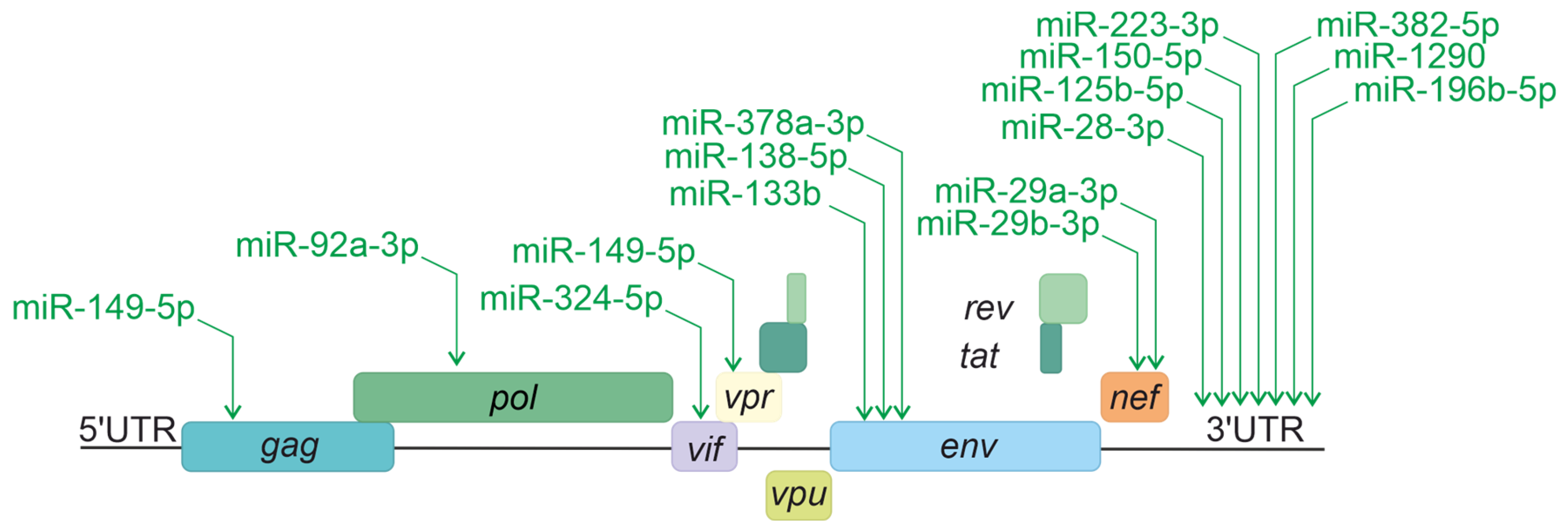
| HIV-1 Target Region | miRNAs Identified | Experimental Method | Evidence Level * | Study (Reference) |
|---|---|---|---|---|
| nef | hsa-miR-29a-3p, hsa-miR-29b-3p | Luciferase assay, qRT-PCR | Functional MTI (strong) | [33] |
| vpr , env | hsa-miR-149-5p, hsa-miR-133b, hsa-miR-138-5p, hsa-miR-378a-3p | Bioinformatics + molecular biology | Functional MTI (strong) | [34] |
| gag , env , vif , pol | hsa-miR-149-5p, hsa-miR-133b, hsa-miR-138-5p, hsa-miR-378a-3p, hsa-miR-324-5p, hsa-miR-92a-3p | Bioinformatics + molecular biology | Functional MTI (strong) | [35] |
| 3′-UTR | hsa-miR-28-3p, hsa-miR-125b-5p, hsa-miR-150-5p, hsa-miR-223-3p, hsa-miR-382-5p | Dual-luciferase reporter assay | Functional MTI (strong) | [37] |
| 3′-UTR | hsa-miR-196b-5p, hsa-miR-1290 | Dual-luciferase reporter assay | Functional MTI (strong) | [17] |
| miRNA | Target Gene | Experimental Method | Evidence Level * | Study (Reference) |
|---|---|---|---|---|
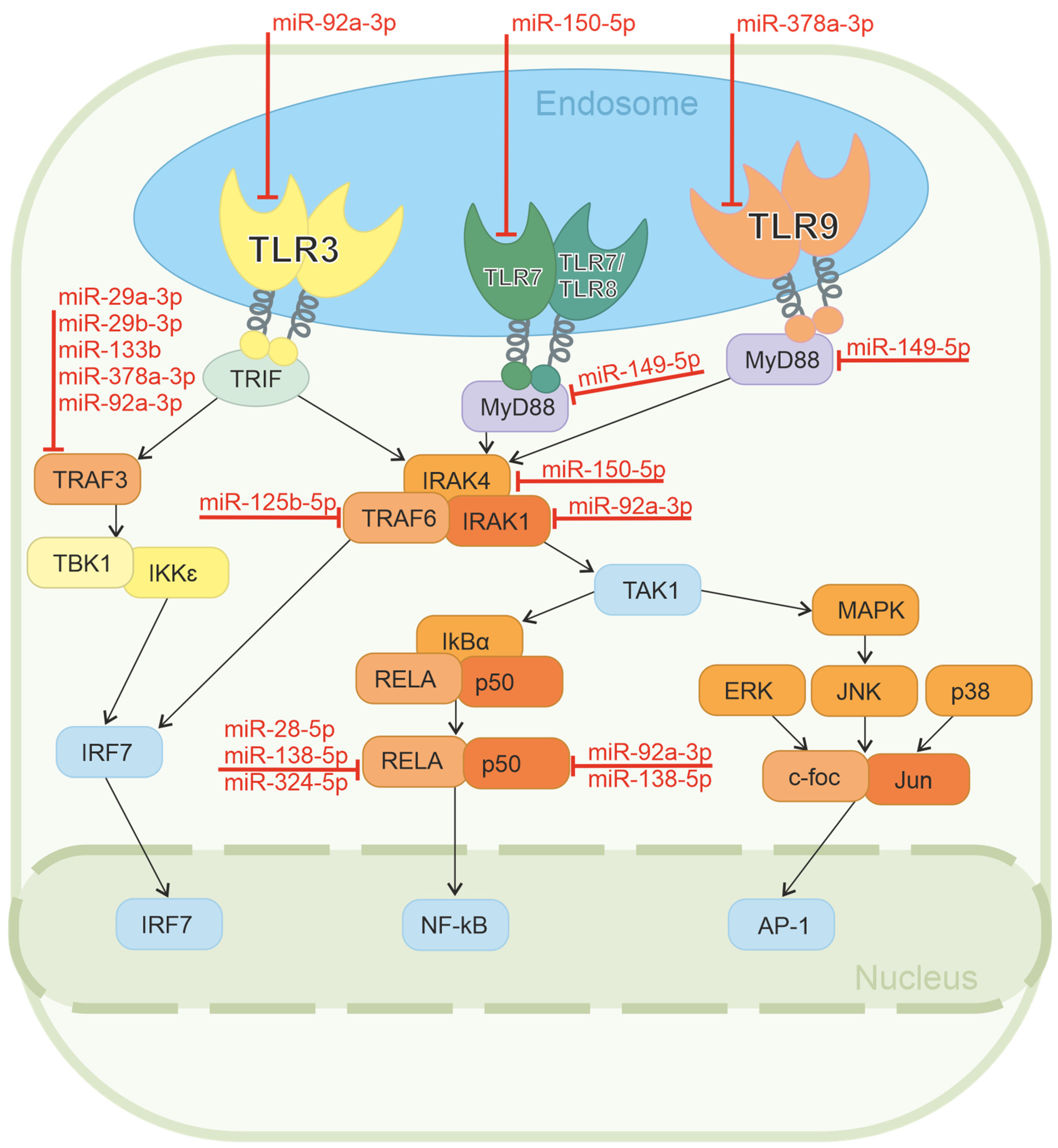
| hsa-miR-150-5p | TLR7 | HITS-CLIP//NGS | Functional MTI (Weak) | [53] |
| hsa-miR-378-3p | TLR8 | — | Predicted only (TargetScan) | |
| hsa-miR-92a-3p | TLR3 | PAR-CLIP//NGS | Functional MTI (Weak) | [54] |
| miRNA | Target Gene | Experimental Method | Evidence Level * | Study (Reference) |
|---|---|---|---|---|
| hsa-miR-149-5p | MYD88 | ELISA//qRT-PCR//Western blot | Functional MTI (strong) | [64] |
| hsa-miR-125b-5p | TRAF6 | qRT-PCR | Functional MTI (strong) | [66,68] |
| hsa-miR-149-5p | TRAF6 | Luciferase reporter assay//qRT-PCR//Western blot | Functional MTI (strong) | [65] |
| hsa-miR-133b | TRAF3 | — | Predicted only (TargetScan) | — |
| hsa-miR-29a-3p | TRAF3 | HITS-CLIP | Functional MTI (Weak) | [70,71,72] |
| hsa-miR-29b-3p | TRAF3 | HITS-CLIP | Functional MTI (Weak) | [70,71,72] |
| hsa-miR-92a-3p | TRAF3 | PAR-CLIP//HITS-CLIP | Functional MTI (Weak) | [73] |
| hsa-miR-378-3p | TRAF3 | — | — | |
| hsa-miR-92a-3p | IRAK1 | CLASH | Functional MTI (Weak) | [69] |
| hsa-miR-150-5p | IRAK4 | HITS-CLIP | Functional MTI (Weak) | [53] |
| miRNA | Target Gene | Experimental Method | Evidence Level * | Study (Reference) |
|---|---|---|---|---|
| hsa-miR-150-5p | REL | HITS-CLIP | Functional MTI (Weak) | [87] |
| hsa-miR-29a-3p | REL | PAR-CLIP | Functional MTI (Weak) | [86] |
| hsa-miR-29b-3p | REL | PAR-CLIP | Functional MTI (Weak) | [86] |
| hsa-miR-92a-3p | REL | PAR-CLIP | Functional MTI (Weak) | [85] |
| hsa-miR-138-5p | RELA | — | Predicted only (TargetScan) | — |
| hsa-miR-28-5p | RELA | — | Predicted only (TargetScan) | — |
| hsa-miR-324-5p | RELA | CLASH | Functional MTI (Weak) | [69] |
| hsa-miR-138-5p | NFKB1 | Western blot | Functional MTI (Strong) | [88] |
| hsa-miR-92a-3p | NFKB1 | CLASH | Functional MTI (Weak) | [69] |
| miRNA | Target Gene | Experimental Method | Evidence Level * | Study (Reference) |
|---|---|---|---|---|
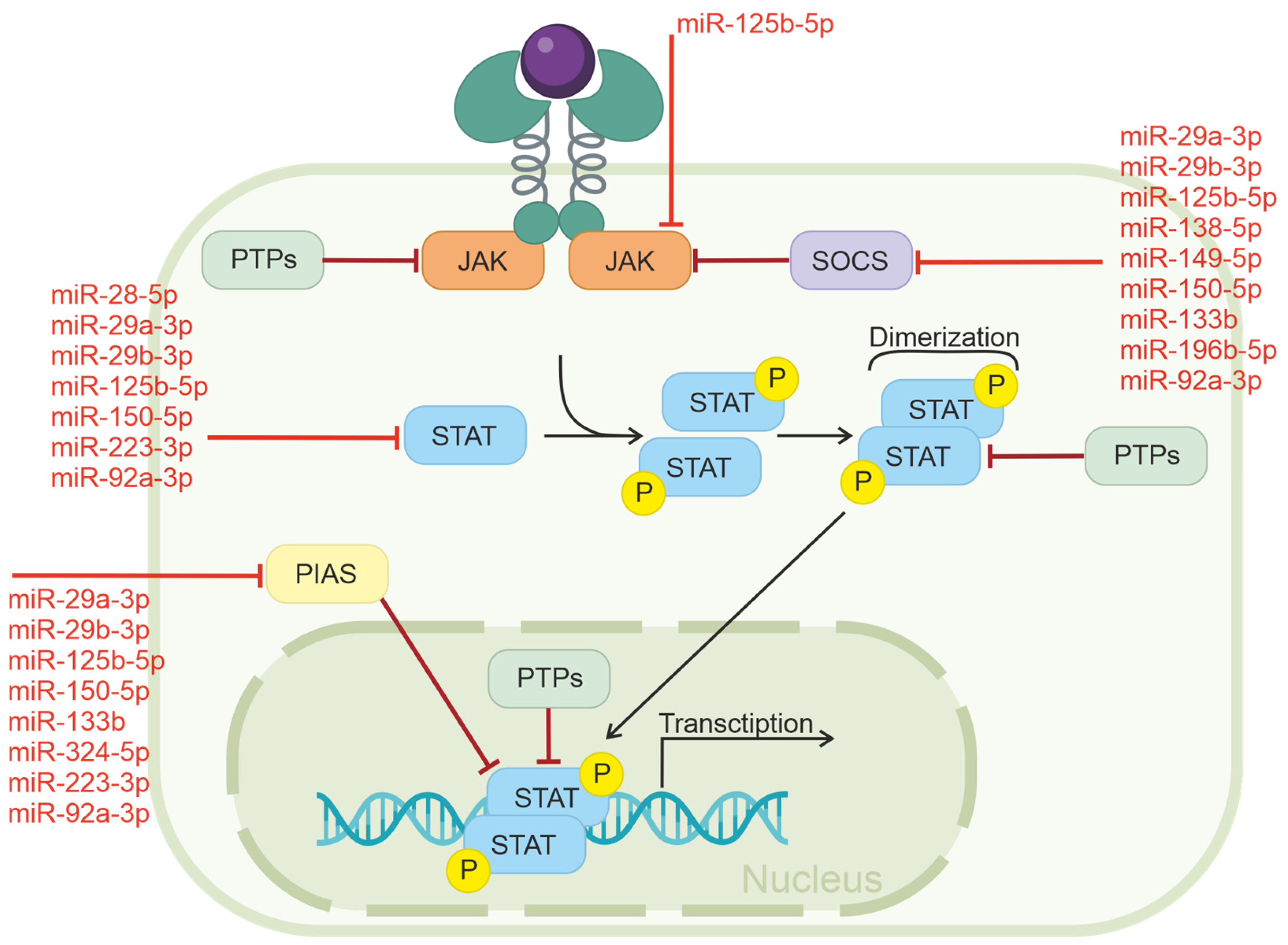
| hsa-miR-125b-5p | JAK2 | Functional MTI (strong) | qRT-PCR//Western blot | [103] |
| hsa-miR-150-5p | STAT1 | Functional MTI (strong) | Luciferase reporter assay//qRT-PCR//Western blot | [99,100] |
| hsa-miR-223-3p | STAT1 | Functional MTI (strong) | Luciferase reporter assay//qRT-PCR//Western blot | [100] |
| hsa-miR-92a-3p | STAT2 | Functional MTI (Weak) | PAR-CLIP//CLASH | [69,104] |
| hsa-miR-125b-5p | STAT3 | Functional MTI (strong) | Western blot//Luciferase reporter assay//Western blot//Microarray | [105,106,107,108,109] |
| hsa-miR-223-3p | STAT3 | Functional MTI (strong) | qRT-PCR//Western blot | [110] |
| hsa-miR-29a-3p | STAT3 | Functional MTI (strong) | Luciferase reporter assay//qRT-PCR//Western blot | [111,112] |
| hsa-miR-29b-3p | STAT3 | Functional MTI (strong) | Immunofluorescence//Luciferase reporter assay//qRT-PCR//Western blot | Luciferase reporter assay//qRT-PCR//Western blot//Immunohistochemistry | [113,114] |
| hsa-miR-92a-3p | STAT3 | Functional MTI (strong) | Luciferase reporter assay//qRT-PCR//Western blot//CLASH | [69,115] |
| hsa-miR-223-3p | STAT5A | Luciferase reporter assay//qRT-PCR | [116] | |
| hsa-miR-150-5p | STAT5B | Functional MTI (strong) | Luciferase reporter assay//qRT-PCR//Western blot | [117] |
| hsa-miR-28-5p | STAT5B | Functional MTI (strong) | Luciferase reporter assay | [118] |
| miRNA | Target Gene | Experimental Method | Evidence Level * | Study (Reference) |
|---|---|---|---|---|
| hsa-miR-133b | SOCS2 | — | Predicted only (TargetScan) | |
| hsa-miR-196b-5p | SOCS2 | — | Predicted only (TargetScan) | |
| hsa-miR-125b-5p | SOCS4 | Luciferase reporter assay | Functional MTI (strong) | [134] |
| hsa-miR-196b-5p | SOCS4 | — | Predicted only (TargetScan) | |
| hsa-miR-150-5p | SOCS5 | PAR-CLIP | Functional MTI (Weak) | [137] |
| hsa-miR-92a-3p | SOCS5 | Luciferase reporter assay//qRT-PCR//Western blot | Functional MTI (strong) | [136] |
| hsa-miR-138-5p | SOCS6 | — | Predicted only (TargetScan) | |
| hsa-miR-149-5p | SOCS6 | — | Predicted only (TargetScan) | |
| hsa-miR-92a-3p | SOCS6 | — | Predicted only (TargetScan) | |
| hsa-miR-29a-3p | SOCS7 | — | Predicted only (TargetScan) | |
| hsa-miR-29b-3p | SOCS7 | — | Predicted only (TargetScan) | |
| hsa-miR-133b | PIAS2 | HITS-CLIP | Functional MTI (Weak) | [139] |
| hsa-miR-150-5p | PIAS2 | HITS-CLIP | Functional MTI (Weak) | [138] |
| hsa-miR-125b-5p | PIAS3 | Luciferase reporter assay//Western blot | Functional MTI (strong) | [135] |
| hsa-miR-29a-3p | PIAS4 | — | Predicted only (TargetScan) | |
| hsa-miR-29b-3p | PIAS4 | — | Predicted only (TargetScan) | |
| hsa-miR-324-5p | PIAS4 | CLASH | Functional MTI (Weak) | [69] |
| hsa-miR-92a-3p | PIAS4 | — | Predicted only (TargetScan) |
| miRNA | Target Gene | Experimental Method | Evidence Level * | Study (Reference) |
|---|---|---|---|---|
| hsa-miR-29a-3p | EOMES | — | Predicted only (TargetScan) | — |
| hsa-miR-29b-3p | EOMES | — | Predicted only (TargetScan) | — |
| hsa-miR-92a-3p | EOMES | HITS-CLIP | Functional MTI (Weak) | [152] |
| hsa-miR-29a-3p | TBX21 | — | Predicted only (TargetScan) | — |
| hsa-miR-29b-3p | TBX21 | Luciferase reporter assay | Functional MTI (strong) | [151] |
| miRNA | Preferred Strategy | Rationale | Proposed Direction of Action |
|---|---|---|---|
| miR-92a-3p | Block and Lock | Suppression of TLR3 reduces innate recognition of HIV RNA. Suppression of REL and NFKB1 attenuates NF-κB activity, reducing LTR-directed transcription and promoting latency. Suppression of STAT2/STAT3 dampens cytokine-driven reactivation signals. Suppression of SOCS5 may enhance JAK/STAT signaling. Direct suppression of gag, env, vif, and pol provides additional antiviral activity. | Upregulation (miRNA mimic).
Delivery of a miR-92a-3p mimic will attenuate TLR3-mediated innate recognition of HIV RNA, reduce NF-κB-driven LTR transcription, dampen cytokine-mediated reactivation signals, and directly restrict translation of gag, env, vif, and pol, thereby reinforcing and maintaining HIV latency. |
| miR-150-5p | Block and Lock | Suppression of TLR7 and IRAK4 blocks two nodes of the MyD88-dependent cascade, reducing innate immune activation. Suppression of REL promotes proviral silencing. Suppression of STAT1 reduces interferon-stimulated antiviral responses. Suppression of STAT5B potentially reduces viral reservoir size. Suppression of SOCS5 and PIAS2 may cause compensatory JAK/STAT hyperactivation. Direct suppression of the 3′-UTR restricts viral translation in resting CD4+ T cells. | Upregulation (miRNA mimic).
Delivery of a miR-150-5p mimic will block two nodes of the MyD88-dependent innate immune cascade, reduce proviral reactivation signals, and directly restrict viral translation in resting CD4+ T cells, consolidating latency and potentially reducing the size of the viral reservoir. |
| miR-125b-5p | Block and Lock | Suppression of TRAF6 blocks a central node of the MyD88-dependent cascade, reducing NF-κB activation. Suppression of JAK2 limits cytokine-driven STAT activation. Suppression of STAT3 reduces survival signals in infected cells and dampens cytokine-mediated immune activation. Suppression of SOCS4 and PIAS3 disrupts negative feedback on JAK/STAT. Direct suppression of the 3′-UTR restricts viral translation in resting CD4+ T cells. | Upregulation (miRNA mimic).
Delivery of a miR-125b-5p mimic will attenuate NF-κB activation, limit cytokine-driven STAT signaling, reduce survival signals in infected cells, and directly restrict viral translation in resting CD4+ T cells, promoting and sustaining HIV latency. |
| miR-29b-3p | Shock and Kill | De-repression of TRAF3 restores TRIF-dependent IRF3 activation and IFN-β production. De-repression of REL activates NF-κB and stimulates proviral reactivation. De-repression of STAT3 enhances cytokine-driven T-cell activation. De-repression of TBX21 restores T-bet expression, enhancing Th1/Tc1 differentiation and cytotoxic CD8+ T-cell function. Restored T-bet improves immune clearance of reactivated infected cells. Direct de-repression of nef accelerates replication of reactivated virus. This strategy requires concomitant ART. | Downregulation (antagomir/inhibitor).
Administration of a miR-29b-3p antagomir will restore TRIF-dependent IFN-β production, reactivate NF-κB-driven proviral transcription, enhance cytokine-mediated T-cell activation, restore cytotoxic CD8+ T-cell function via T-bet, and accelerate replication of reactivated virus, enabling immune-mediated clearance of infected cells. Concomitant ART is required. |
| miR-29a-3p | Shock and Kill | De-repression of TRAF3 restores TRIF-dependent IRF3 activation and IFN-β production. De-repression of REL activates NF-κB and stimulates proviral reactivation. De-repression of STAT3 enhances cytokine-driven T-cell activation. Unlike miR-29b-3p, for which no experimentally confirmed interaction with TBX21 has been identified, restoration of cytotoxic CD8+ T-cell function is less predictable. Direct de-repression of nef accelerates replication of reactivated virus. This strategy requires concomitant ART. | Downregulation (antagomir/inhibitor). Administration of a miR-29a-3p antagomir will restore TRIF-dependent IFN-β production, reactivate NF-κB-driven proviral transcription, enhance cytokine-mediated T-cell activation, and accelerate replication of reactivated virus, facilitating immune-mediated clearance of infected cells. Concomitant ART is required. |
| miR-223-3p | Block and Lock | Suppression of STAT1 reduces interferon-stimulated antiviral responses. Suppression of STAT3 dampens reactivation signals. Suppression of STAT5A disrupts IL-2-dependent maintenance of CD4+ T-cell memory, potentially reducing viral reservoir size. Direct suppression of the 3′-UTR restricts viral translation in resting CD4+ T cells. Plasma levels of miR-223-3p correlate with viral load and CD4+ T-cell counts, enabling use as a monitoring biomarker during therapy. | Upregulation (miRNA mimic). Delivery of a miR-223-3p mimic will reduce interferon-stimulated antiviral signaling, dampen cytokine-driven reactivation, disrupt IL-2-dependent maintenance of the CD4+ T-cell memory compartment, and directly restrict viral translation in resting CD4+ T cells, supporting latency maintenance. |
| miR-149-5p | Block and Lock | Suppression of MyD88 and TRAF6 blocks two key nodes of the MyD88-dependent cascade, attenuating innate immune activation. Direct suppression of five viral genes provides the broad direct antiviral coverage. | Upregulation (miRNA mimic). Delivery of a miR-149-5p mimic will block two key nodes of the MyD88-dependent innate immune cascade and directly restrict translation of five viral genes, providing broad attenuation of immune activation and antiviral coverage to promote latency. |
| miR-138-5p | Block and Lock | Suppression of NFKB1 promotes proviral silencing. Direct suppression of five viral genes provides broad direct antiviral coverage. | Upregulation (miRNA mimic). Delivery of a miR-138-5p mimic will promote proviral silencing by attenuating NF-κB activity and directly restricting translation of five viral genes, providing broad antiviral coverage to consolidate latency. |
| miR-324-5p | Block and Lock | Suppression of RELA promotes proviral silencing. Suppression of PIAS4 disrupts the inactivation of STAT factors, which may cause compensatory JAK/STAT hyperactivation. Direct suppression of env and vpr limits the synthesis of the envelope protein and Vpr functions. | Upregulation (miRNA mimic). Delivery of a miR-324-5p mimic will promote proviral silencing by attenuating NF-κB/RELA-driven transcription and directly restricting synthesis of Env and Vpr, limiting viral replication capacity and supporting latency maintenance. |
| miR-133b | Block and Lock | Suppression of PIAS2 disrupts the inactivation of STAT1/STAT4, which may enhance JAK/STAT signaling and interferon responses. Direct suppression of env and vpr limits the synthesis of the envelope protein and Vpr functions. | Upregulation (miRNA mimic). Delivery of a miR-133b mimic will enhance JAK/STAT signaling and interferon responses by disrupting negative feedback on STAT1/STAT4, and directly restrict synthesis of Env and Vpr, limiting viral replication capacity and supporting latency maintenance. |
| miR-28-5p | Block and Lock | Suppression of STAT5B disrupts the maintenance of memory CD4+ T cells and regulatory T cells, reducing survival signals that sustain the reservoir. Direct suppression of the 3′-UTR restricts viral translation in resting CD4+ T cells. | Upregulation (miRNA mimic). Delivery of a miR-28-5p mimic will reduce survival signals sustaining memory CD4+ T cells and regulatory T cells within the viral reservoir and directly restrict viral translation in resting CD4+ T cells, thereby reducing reservoir size and promoting durable latency. |
Disclaimer/Publisher’s Note: The statements, opinions and data contained in all publications are solely those of the individual author(s) and contributor(s) and not of MDPI and/or the editor(s). MDPI and/or the editor(s) disclaim responsibility for any injury to people or property resulting from any ideas, methods, instructions or products referred to in the content. |
© 2026 by the authors. Licensee MDPI, Basel, Switzerland. This article is an open access article distributed under the terms and conditions of the Creative Commons Attribution (CC BY) license.
Share and Cite
Timofeeva, A.M.; Aulova, K.S.; Nevinsky, G.A. Dual Functionality of miRNAs During HIV Infection: From Viral Genome Suppression to Immune Response Modulation. Epigenomes 2026, 10, 39. https://doi.org/10.3390/epigenomes10020039
Timofeeva AM, Aulova KS, Nevinsky GA. Dual Functionality of miRNAs During HIV Infection: From Viral Genome Suppression to Immune Response Modulation. Epigenomes. 2026; 10(2):39. https://doi.org/10.3390/epigenomes10020039
Chicago/Turabian StyleTimofeeva, Anna M., Kseniya S. Aulova, and Georgy A. Nevinsky. 2026. "Dual Functionality of miRNAs During HIV Infection: From Viral Genome Suppression to Immune Response Modulation" Epigenomes 10, no. 2: 39. https://doi.org/10.3390/epigenomes10020039
APA StyleTimofeeva, A. M., Aulova, K. S., & Nevinsky, G. A. (2026). Dual Functionality of miRNAs During HIV Infection: From Viral Genome Suppression to Immune Response Modulation. Epigenomes, 10(2), 39. https://doi.org/10.3390/epigenomes10020039