Article

Multiscale and Multiphysics Topographical Analysis of Brake Friction Material Related to Friction Performance


by
Robin Guibert
1,2,*,
Maël Thévenot
3,
Julie Lemesle
4,
Laurent Coustenoble
3,
Jean-François Brunel
3,
Philippe Dufrénoy
3 and
Maxence Bigerelle
1,5
1
Univ. Polytechnique Hauts-de-France, CNRS, UMR 8201—LAMIH—Laboratoire d’Automatique de Mécanique et d’Informatique Industrielles et Humaines, F-59313 Valenciennes, France
2
Anscale, 76600 Le Havre, France
3
Univ. Lille, CNRS, Centrale Lille, UMR 9013—LaMcube—Laboratoire de Mécanique, Multiphysique, Multiéchelle, F-59000 Lille, France
4
Valutec, Univ. Polytechnique Hauts-de-France, CEDEX 9, 59314 Valenciennes, France
5
INSA Hauts-de-France, F-59313 Valenciennes, France
*
Author to whom correspondence should be addressed.
Lubricants 2026, 14(3), 139; https://doi.org/10.3390/lubricants14030139
Submission received: 31 January 2026 / Revised: 9 March 2026 / Accepted: 17 March 2026 / Published: 23 March 2026
(This article belongs to the Special Issue Tribology of Friction Brakes)

Abstract

Friction braking is the most spread braking system in vehicles, where the morphologies of the disc and the braking pads are essential to ensure that friction reduces rotation speed efficiently. However, modern braking systems are submitted to a complex balance between functionalities: braking ability, resistance to wear, and limited noise emission, i.e., squealing. This article studies the evolution of the morphology of a braking pad in a pin-on-disc configuration to further understand its influence over surface functionalities. Data collected from a pin-on-disc tribometer, and topographies are coupled to perform a multiscale and multiphysics analysis of the braking pad surface. Relevancy of roughness parameters regarding braking ability, surface wear, pad temperature and noise emission is evaluated with a bootstrap-based relevancy analysis. Relevant scales of the pad morphological structures are identified for surface wear (446 µm), braking ability (19.5 µm), pad temperature (2717 and 446 µm) and squealing frequency (1720 and 15.7 µm). Correlations between test bench data and roughness parameters highlighted the role of wear plateaus on the braking pad surface. These plateaus are formed by the damaged surface peaks during braking or by compaction of the third body trapped across the braking pad surface.

1. Introduction

Braking is a core functionality of vehicles. In particular, friction braking is the most spread type of braking system, although types can be used individually, or complementarily, such as in magnetic braking. Many studies were performed on friction braking as it is both reliable and efficient, which is suitable for emergencies. A common configuration of the friction braking system involves a braking pad that can be placed into contact with a braking disc to reduce speed or even stop the movement of the vehicle. However, such a complex system is difficult to fully understand, and many challenges remain, such as thermal fatigue (Mackin et al. [1]), noise emission (e.g., squealing, Massi et al. [2], Akay et al. [3]), particle emission, friction instabilities, and wear (Österle et al. [4]). Squealing combines high frequency noise with high intensity (over 70 db), making squealing a significant health issue. Yet, squealing is an expensive problem (Kinkaid et al. [5]) and its mitigation has gathered numerous studies (Akay [6]). Due to unstable dynamic behavior such as mode coupling (Hoffmann et al. [7]) during sliding contact, including friction, self-excited vibration can occur in the braking system, resulting in squealing. In sliding contact tests, squealing appearance was shown to be linked to macroscopic aspects (Duboc et al. [8]) and imposed conditions (Eriksson and Jacobson [9], James et al. [10]), including surface morphology, tribolayer at the interface, rotation speed, and friction material. Lower rotation speed brought stronger vibration response, resulting in high sound pressure level as described by Xiang et al. [11], higher roughness on the pad surface, and severe localized wear. Hetzler and Willner [12] reported a correlation between squealing appearance and wear in braking systems. Also, a succession of contacts between frictional parts, as consequence of the contact behavior, and a higher friction coefficient was found until a plateau was reached at a critical threshold (Bergman et al. [13]). Yet, the friction coefficient is not enough to fully explain the occurrence of squealing but rather can be considered as a tribological system response. Squealing propensity is also linked to dynamic modes and system parameters as explained by Sinou and Jézéquel [14], with the help of Finite Element Analysis (FEA) and Complex Eigenvalues Analysis (CEA). AbuBakar and Ouyang [15] and Belhocine and Ghazaly [16] indicated that dynamic response of the braking systems is linked to friction material and thermomechanics. Evolution of friction material due to mechanical, thermal, and tribological loading was studied by Hentati et al. [17]. The third body model introduced by Godet [18] and Taylor et al. [19] might bring further explanations on the influence of the contact geometry at the mesoscopic scale and the particle flow at microscopic scales, highlighting the role of flows and compaction of worn particles on the creation of tribological surface layers (Denape [20]). Squealing seems to occur only with the presence of a third body, and a tribological system with no change in the interface stays silent. Particles size and nature in the contact is deeply linked to the squealing occurrence (Kchaou et al. [21]), alongside other contact conditions such as dissipated energy and friction coefficient. The dependence of squealing on surface evolution and the material transformation beneath the surface of friction material was shown in numerical works (Tison et al. [22]). Inspection of the worn surface after contact is now generally included in squealing experimental studies (Kasem et al. [23]); however, a huge part of the information is lost after contact opening. Contact plateaus and their distribution over the friction surfaces in the tribolayer are shown to influence squealing events (Lee and Jang [24]). Modifications in the localization of contact at mesoscopic and macroscopic scales impact the squealing frequencies in a pin-on-disc system (Lai et al. [25]).
Analysis of the pad in braking conditions is challenging, as several physical phenomena occur and interact at the same time. To facilitate the study of the physical phenomena involved in braking, roughness multiscale analysis can be used such that physical phenomena are separated by their scale of applications. Scale can be defined as a range of spatial wavelengths (Brown et al. [26]). Various roughness multiscale decompositions exist for surface topography. Gaussian filtering modifies the kernel size of the filter to adapt scales. The patchwork method is a tiling technique where the scale is defined by the area of the elementary triangle, or alternatively defined as the length of a side of the tiling triangle (Brown et al. [27]). Wavelet transform can also be used for multiscale decomposition, as explained by Chen et al. [28]. Zahouani et al. [29] determined the multiscale transfer function of abrasive finishing with 2D continuous wavelet decomposition. Mezghani et al. [30] found how each layer of paint on a steel sheet influences the sheet surface topography at its relevant scale using 2D continuous wavelet decomposition. Also, Bartkowiak et al. [31] proposed the calculation of surface curvature tensors at several sampling intervals to perform a multiscale curvature analysis.
Each multiscale decomposition has its own advantages and drawbacks, and the selection of a suitable method depends on the surface morphology, such as homogeneity (or heterogeneity), presence of sharp edges, and ability to detect specific surface structures such as defects. Using multiscale roughness analysis provides a more detailed observation of physical phenomena as their scales of application can be different, allowing a separated study of each phenomenon. Multiscale analysis has been successfully applied in tribology. Guibert et al. [32] detected four wear mechanisms in polymer abrasion using the patchwork method, the box method, and the motif method. Demirci et al. [33] found that the friction coefficient in lubricated rough contact first increases when roughness scale decreases, before decreasing to an improved friction level, i.e., a lower friction coefficient, using ridgelet transform multiscale decomposition. Zahouani and El Mansori [34] obtained a high volume of oil retention by studying a surface finished with honing with the help of a hybrid multiscale approach, combining 2D continuous wavelet decomposition and identification of scratch patterns on the manufactured surfaces. The helix angle of the cutting tool during the milling of bidirectional flax fibers reinforced polypropylene composites has been studied by Chegdani et al. [35] with multiscale 2D continuous wavelet transform, highlighting an influence on tribological performances affecting the tribo-contact. Strong correlations between surface curvature statistical parameters and the friction coefficient in the case of machined surfaces were identified by Bartkowiak et al. [36] based on multiscale curvature analysis.
This works aims at further understanding the role of surface morphology in friction braking and its link to physical phenomena such as wear, braking ability, temperature, and noise emission. As the braking process is complex, multiscale roughness analysis is used to separate each phenomenon by their scale of application. Relevant roughness parameters regarding surface functionalities at a given scale are challenging to determine (Brown et al. [37]). However, by using the bootstrap-based relevancy detection technique introduced by Deltombe et al. [38], such relevant parameters can be identified for each involved phenomenon.

2. Materials and Methods

2.1. Data Collection

The pin-on-disc tribometer used in this study was originally designed for another study (Duboc et al. [8]) and was updated for the braking configuration of this study. A disc made of steel and a commercial low-met friction pad material, designed for railway applications, are used. This article is also a continuation of the study from Thévenot et al. [39], highlighting a link between temperature, squealing, and evolution of the surface morphology of the braking pad. This analysis was extended by Caradec et al. [40], focusing on squealing occurrence, which was found to be significantly linked to thermomechanical processes. A scale dependency was found, and this paper aims to further explore physical phenomena expressions at their scale of application. The exact formulation of the pad is unknown as the recipe is a trade secret. The friction pad is cut into a 20 mm × 20 mm square pad that is used as a pin in a pin-on-disc test bench configuration.
The test campaign is divided in series of approximately 20 successive friction tests with fixed conditions, including contact and non-contact conditions. Friction tests are performed with a constant disc rotation speed and an imposed displacement to obtain the desired normal load at the start of the test. The rigid frame position is then kept constant during all the test series, leading to a variation in the normal load due to thermomechanical solicitations (thermal dilatation and wear). Different tests configurations can be achieved by modifying the desired normal load (100 N, 150 N, 200 N, 300 N), the disc rotation (200 rpm, 600 rpm, 700 rpm), the contact duration (10 s, 30 s) or the non-contact duration between successive brakings (5 s, 10 s, 30 s). All the details are explained in Thévenot et al. [39] and are synthetized in Table 1, in terms of the following operation parameters: disc rotation speed, normal load, contact duration and duration between successive brakings. Each series begins at room temperature around 20 °C. At the end of each series, a pin observation is performed. Several data are captured during each braking test, such as contact data, thermal data, and noise emission data.
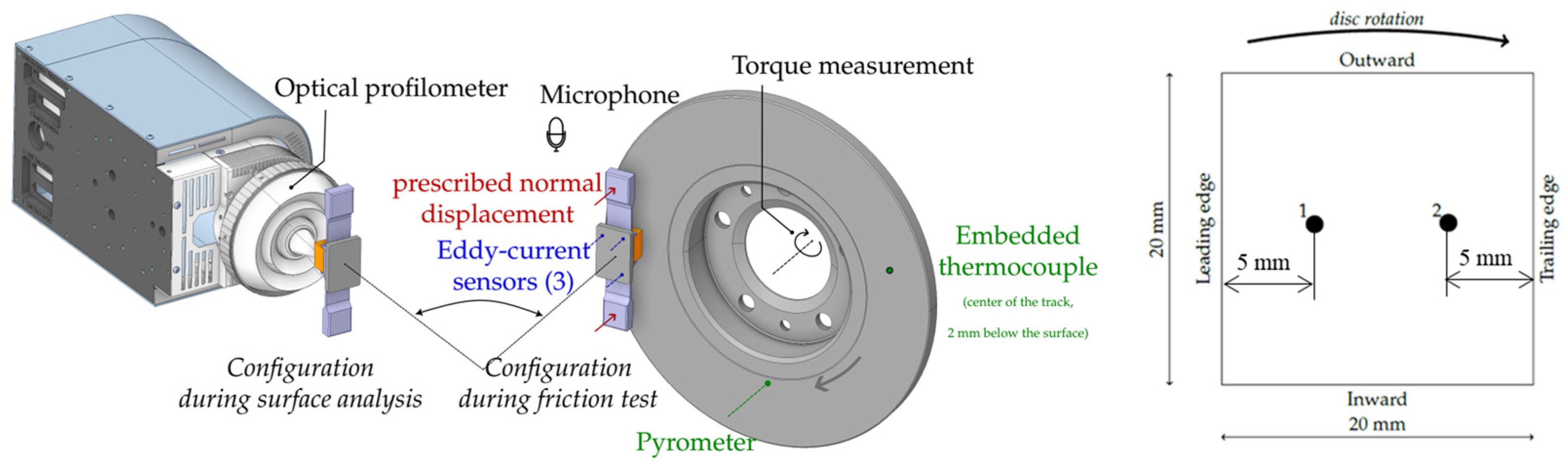
Three Foucault displacement sensors are placed on a rigid frame holding the pin, which allows them to capture the normal load on the rigid frame, knowing the aluminum frame’s stiffness. Two Type K thermocouples are also placed 2 mm underneath the pin on the same radial position regarding the disc, with one thermocouple located toward the pin leading edge (TC1) and the other located on the pin trailing edge (TC2). Thermal data are acquired at a sampling rate of 90 Hz. Noise emissions are captured using a microphone at 1 m from the disc, at an acquisition sampling rate of 50 kHz. All of these data are continuous. The configuration of tribometer is presented in Figure 1.
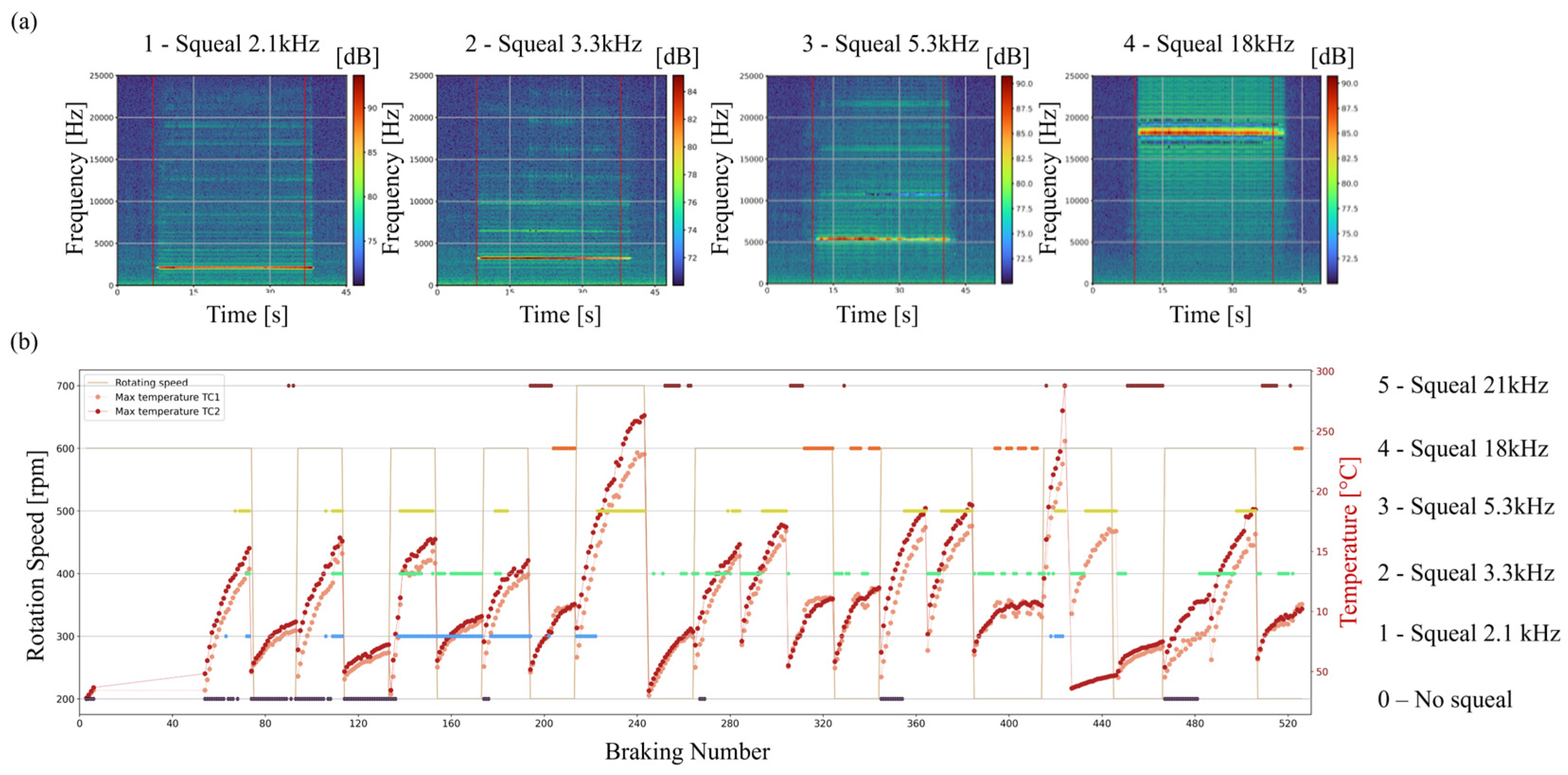
Noise emissions are considered as a squeal when the threshold of 70 dB is reached for any frequency. The frequency range of concern spans from 1000 Hz to 20 kHz. Figure 2a provides some acoustic spectrograms, obtained by Short-Time Fourier Transform. Five classes of squeal are identified and are plotted in Figure 2b against the test procedure. The maximum temperature recorded during each braking test is also plotted for both thermocouples.
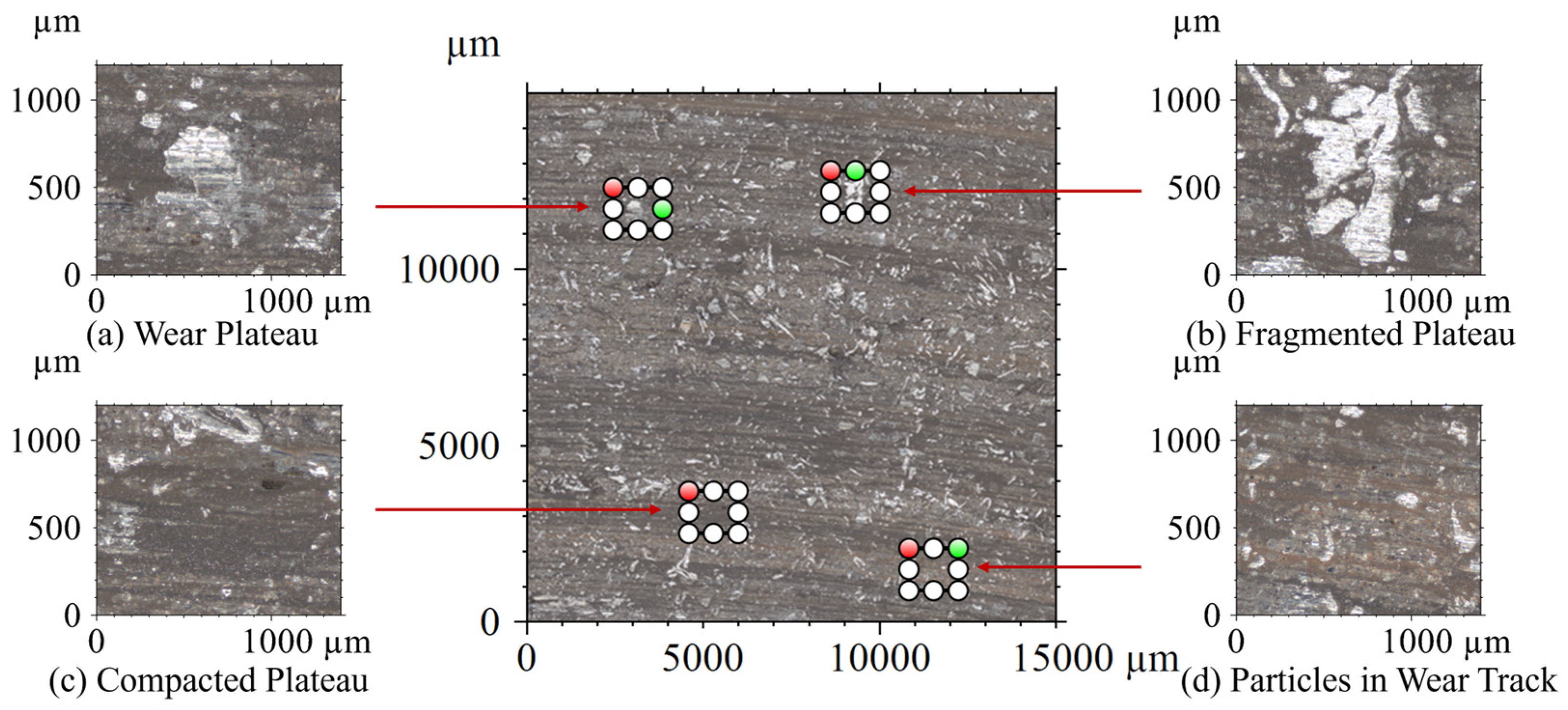
Also, surface topography of the pin is measured between two series of braking tests using focus variation microscopy (PortableRL, Bruker Alicona, Raaba, Austria). As focus variation microscopes use focus stacking techniques to compute height values from a stack of images captured at different focal distances, both topographies and bright-field images are measured, which are perfectly aligned. Also, all pixels in these maps are focused. This profilometer is mounted on the test bench so that the pin is not removed from its frame for topography measurement. The rigid frame is rotated to face the profilometer’s objective lens, located at 45 degrees from the contact position with the disc. A 4× objective is mounted on the profilometer with a lateral sampling interval of 2.45 µm. The whole surface of the pin is measured by stitching 5 × 5 elementary topographies on a 20 mm × 20 mm surface. Stitching is a map assembling technique for elementary maps to obtain a high resolution over a large field-of-measurement stitched map (Guibert et al. [41]). The observable scale range is then wider than the one of an elementary map, which allows one to explore more scales during roughness multiscale analysis. High resolution bright-field images of the braking pad surface are presented in Figure 3. After a series of braking tests, the braking pad shows an orientation due to wear tracks, following the curved direction of the disc. Three kinds of plateaus can be observed. First, wear plateaus, due to chopped-off morphological structures, are present. A second form of such wear plateaus appears as a fragmented plateau, a combination of a chopped-off morphological structure with detached debris and braking particles, i.e., third body, that are stuck inside the previous locations of the detached debris. Plateaus generated by the compaction of particles stuck inside the wear tracks can also be observed. Finally, braking particles, not yet compacted nor evacuated from the braking pad surface, are scattered across the braking pad surfaces, especially in wear tracks working as retention areas.
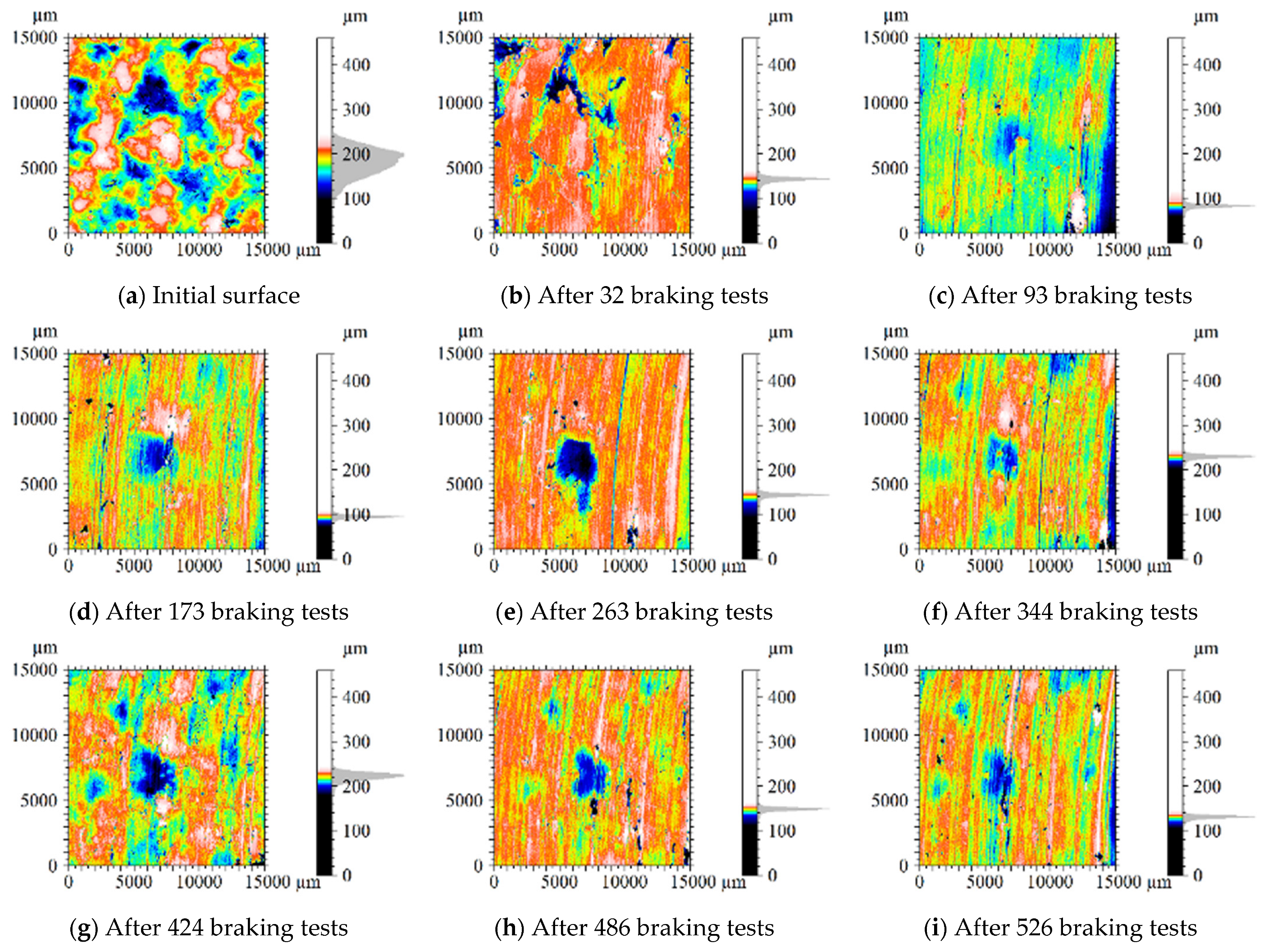
To avoid border effects due to the pin wear, a 15 mm × 15 mm region is extracted from the center of each measured topography. Each topography is processed using MountainsMap® 8.0 (Digital Surf, Besançon, France). First, a third-order polynomial form removal is performed, outlier points are removed, and non-measured points are filled. A second third-order polynomial form removal is done to obtain a reference surface state. As only one topography of the whole is measured between each test series, 50 sub-regions (5 mm × 5 mm area) are randomly extracted to later perform statistical analysis, and reference height is once again obtained using a third-order polynomial form removal. Figure 4 shows the evolution of the morphology of the braking pad surface as more braking tests occurred.
Multiscale decomposition of each topography map is performed using robust gaussian filtering. Low-pass, high-pass, and band-pass filtered surfaces are obtained at various scales. The scales used for multiscale decomposition are contained between the value of the lateral resolution (2.45 µm) and the value of the measurement length (15,000 µm) of topographies, with a logarithmic distribution. Roughness parameters from the ISO 25 178-2 standard [42] are then computed on each filtered topography using MountainsMap® 8.0 (Digital Surf, Besançon, France).

2.2. Determination of Relevant Roughness Parameters

The bootstrap method (Efron [43]) is applied on roughness parameters computed on the multiscale decomposition according to the method described in Deltombe et al. [38]. For each bootstrap simulation, 50 values are picked with replacement for each parameter, for each filter type (low-pass, high-pass, band-pass), and for each scale. Mean is used on the 50 picked values to calculate the bootstrapped value. This simulation is repeated 1 × 10⁴ times per ensemble {roughness parameter, filter type, scale}. The bootstrapped dataset of roughness parameters is then merged with braking test data using a join procedure based on the braking test number. A relevant roughness parameter can be defined as a parameter that detects differences if differences exist and does not detect differences otherwise. For this purpose, analysis of variance (ANOVA) is performed for each class representing one physics of the braking pad (see Table 2). More specifically, ANOVA is used if the class is a discrete value while analysis of covariance (ANCOVA) is preferred if the class is a continuous value. A relevant parameter for a given ensemble {roughness parameter, filter type, scale} is identified by ranking the resulting F-value from ANOVA (respectively ANCOVA) according to its highest value.

3. Results

3.1. Surface Wear Analysis

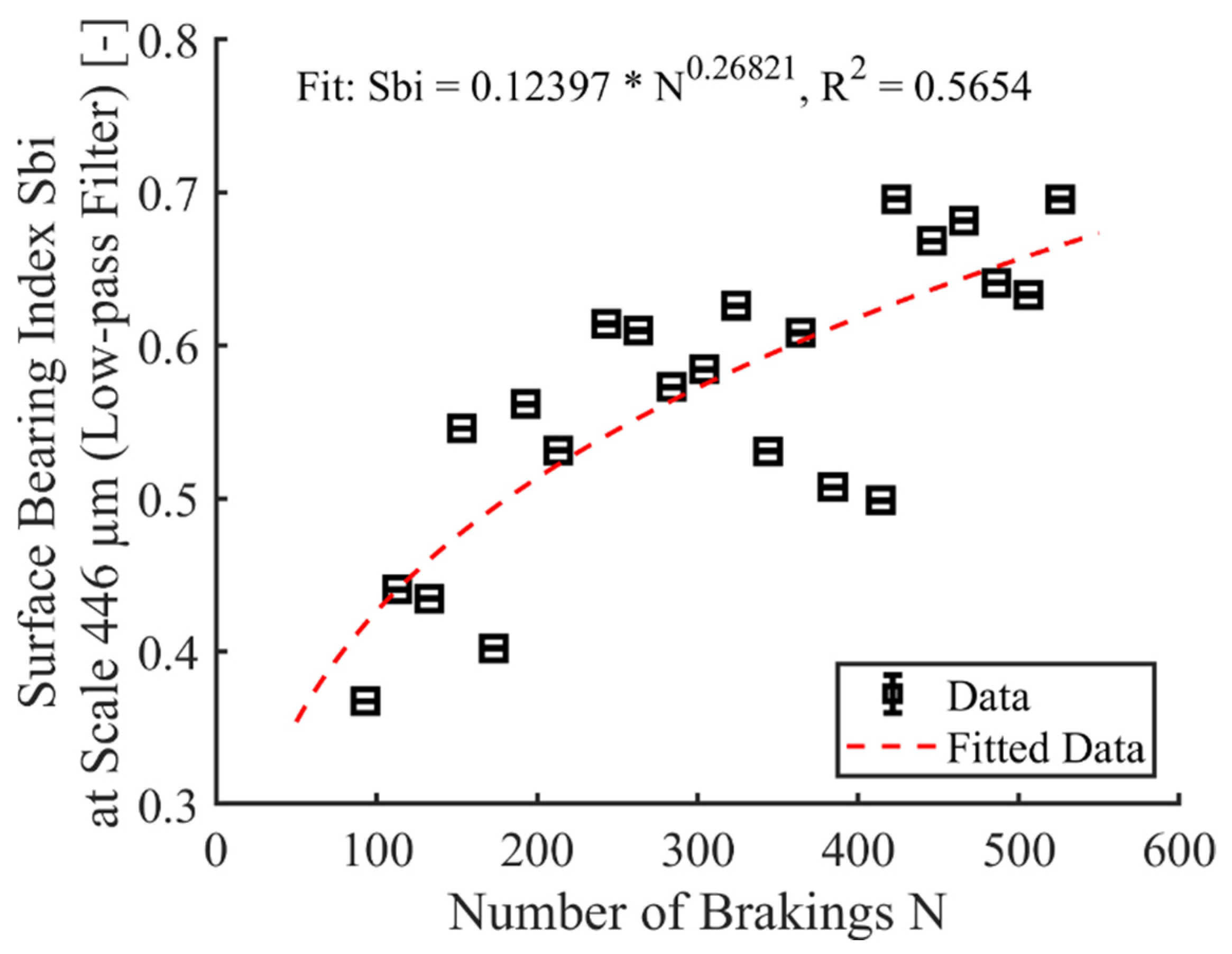
During each braking test, the surface morphology of the pin is modified both by the friction disc, but also by the third body generated by the wear of pin and disc. Also, the height of the pin is decreasing as more matter is expulsed from the braking system. This means that wear can be decomposed in surface wear and volume wear. Surface wear reflects the surface morphology evolution and might influence thermal and noise emission values. The relevancy analysis determined that the surface bearing index Sbi, with a low-pass robust gaussian filter at a scale of 446 µm, is relevant regarding surface wear evolution linked to the number of braking tests (Figure 5). The ANOVA returns an F-value of 247,992 and a p-value of 0. A reported p-value of 0 is in fact a p-value so small that it is below numerical precision. In the case of ANOVA, a small p-value is evidence against the null hypothesis. Sbi indicates the portion of wear plateaus over a surface, and a higher Sbi reflects that more wear plateaus exist over the surface.
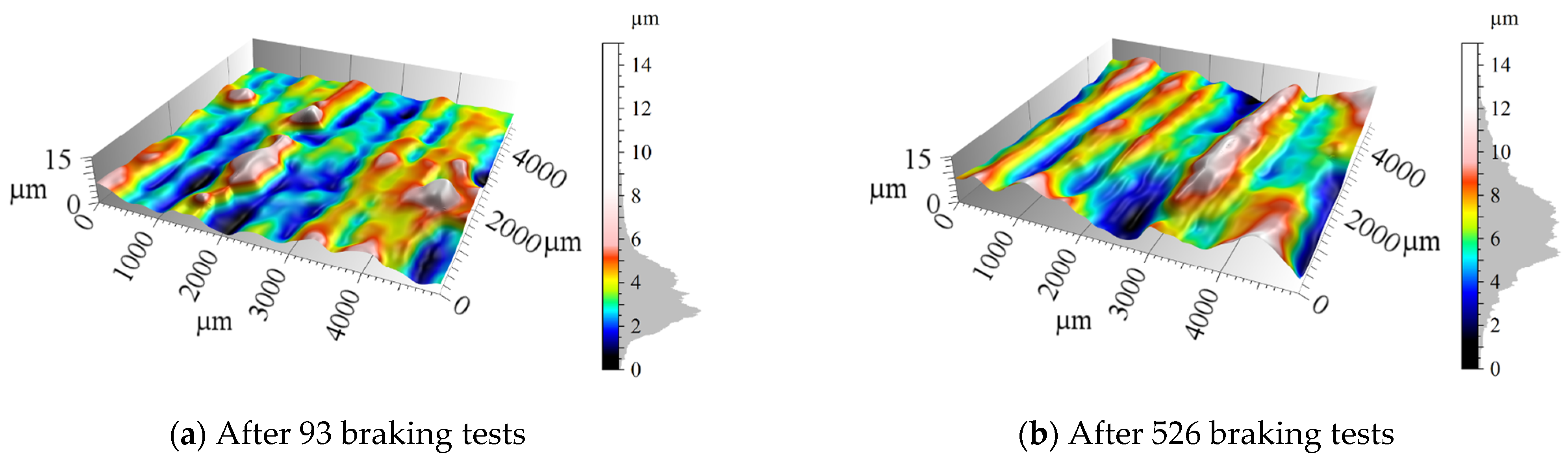
Sbi follows a power law with an exponent smaller than 1. When the contact is well established between the friction pad and disc, more plateaus are generated and grow with each new braking test. This can be explained by two components. First, friction is attacking the uppermost part of the surface peaks, creating a first type of plateau. Secondly, the third body generated by the attacked peaks can also move across the surface and accumulates in third body traps. Compaction of such a third body also creates wear plateaus (second type). Growth of both plateau types increases the surface bearing index Sbi. The scale of relevance (low-pass filter at 446 µm) indicates that the generated plateaus are at the mesoscopic scale. Filtered topographies for this relevant scale with a robust low-pass gaussian filter are presented in Figure 6.

3.2. Braking Ability Analysis

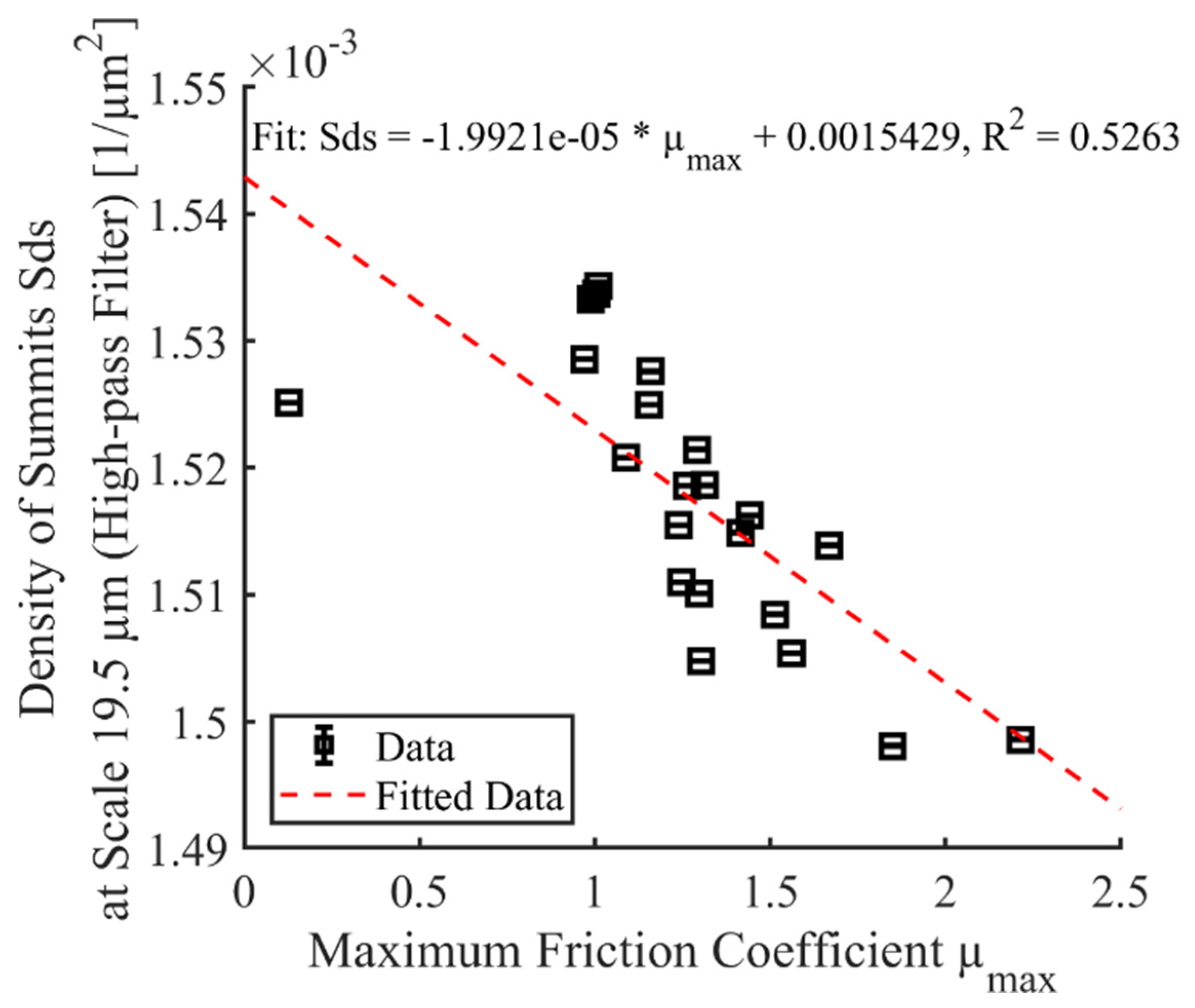
In the test bench configuration, a high torque is imposed during braking tests, such that the braking disc barely slows down during the braking test and the disc never stops completely. The braking ability of the braking system can then be linked to the maximum friction coefficient μ m a x observed during the braking test. ANCOVA successfully identified the density of summit Sds at a scale of 19.5 µm with a high-pass filter as a relevant ensemble {roughness parameter, filter type, scale}. ANCOVA indicates an F-value of 244,386 and a p-value of 0. Figure 7 shows the evolution of Sds at a scale of 19.5 µm with a high-pass filter, according to the maximum of friction coefficient μ m a x .
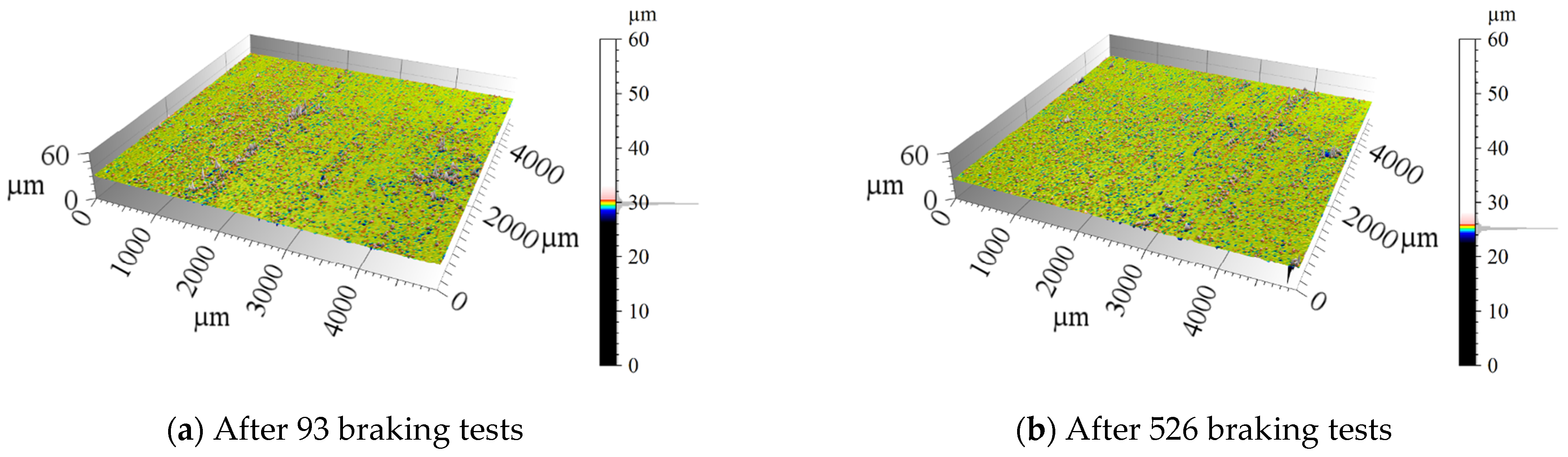
A higher value of Sds is linked to a smaller maximum of friction coefficient μ m a x . The number of summits at a small scale indicates that larger summits bearing the contact are to be looked for if a higher friction coefficient is desired, so that the braking ability is improved. Figure 8 provides a comparative view of the braking pad surface between braking tests 93 and 526, filtered at 19.5 µm with a robust high-pass filter. The density of summits Sds of the filtered topography for test 526 is smaller, as well as the mean height value.

3.3. Thermal Analysis

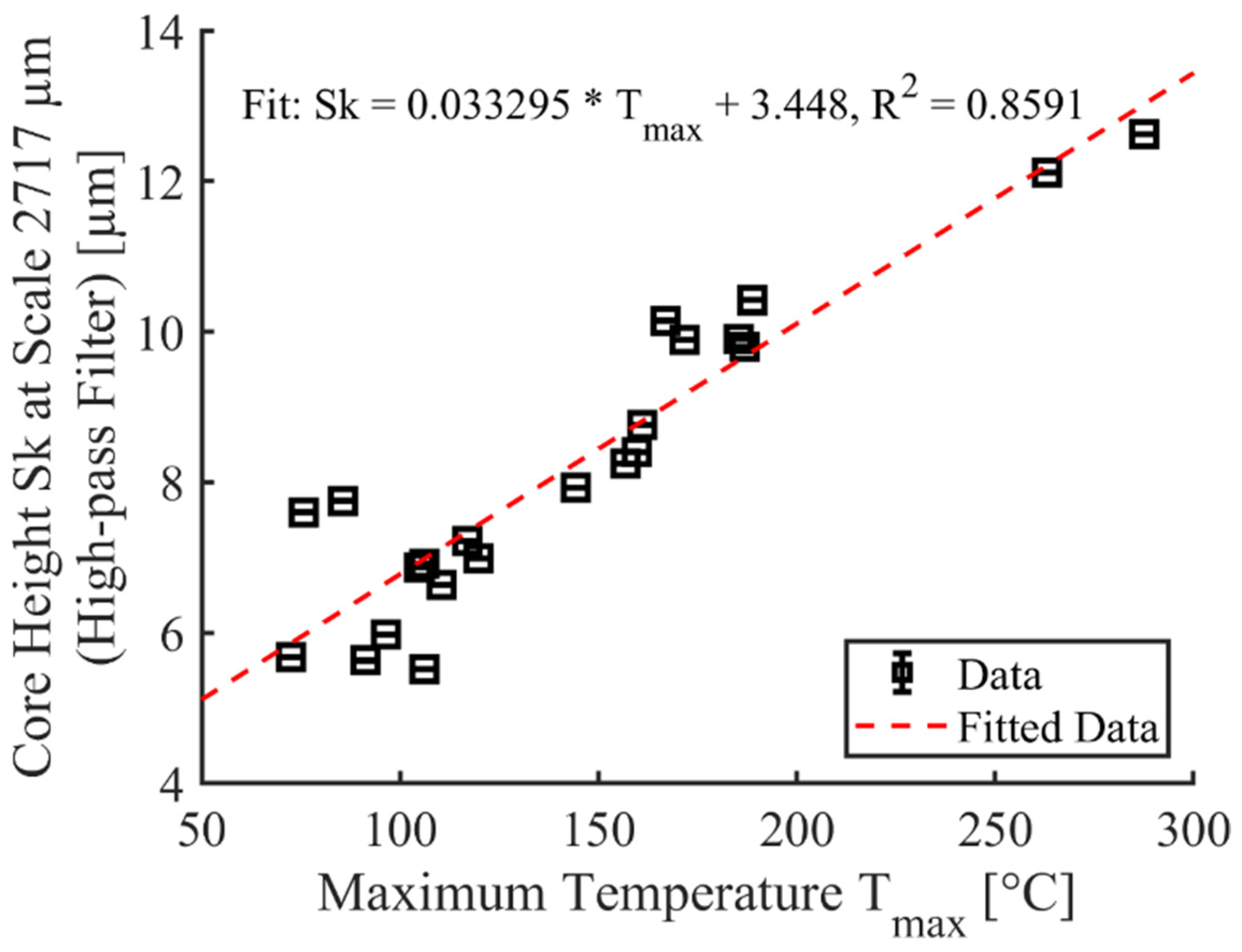
Temperature of the braking pad is measured using type K thermocouples and the maximum temperature T m a x is used as a class for ANCOVA. Core height Sk is detected as a relevant parameter at a scale of 2717 µm with a high-pass filter (F-value from ANCOVA of 1,340,829 and p-value of 0). Evolution of Sk at this scale for the high-pass robust gaussian filter is plotted in Figure 9.
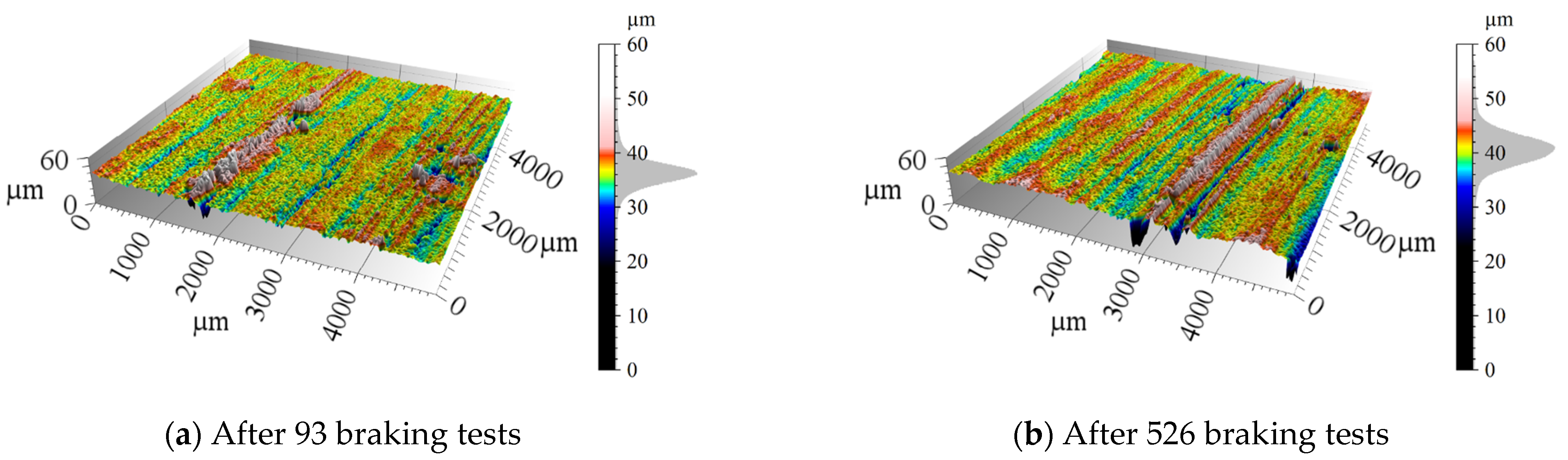
The higher the maximum temperature T m a x of the braking pad, the higher the Sk value with a high-pass filter with a cut-off of 2717 µm. The rougher the surface-at-large scale, the higher the braking pad temperature is. Therefore, limiting temperature elevation can be done by reducing the roughening of the pad. The material of the low-met friction pad used in this study has the advantage of being more sensitive to variations in testing conditions. This facilitates the understanding of the mechanisms involved during the braking test through more observable surface morphologies. However, sturdier materials should be used to avoid the roughening of the braking pad surface and temperature elevation. Also, avoiding temperature elevation would limit the occurrence of structure of the material which brings modification of the materials’ properties. Robust gaussian high-pass filtered topographies of the braking pad at scale 2717 µm, after braking tests 93 and 526, reveal higher mean height value on the histogram with a slightly higher height value dispersion (Figure 10).
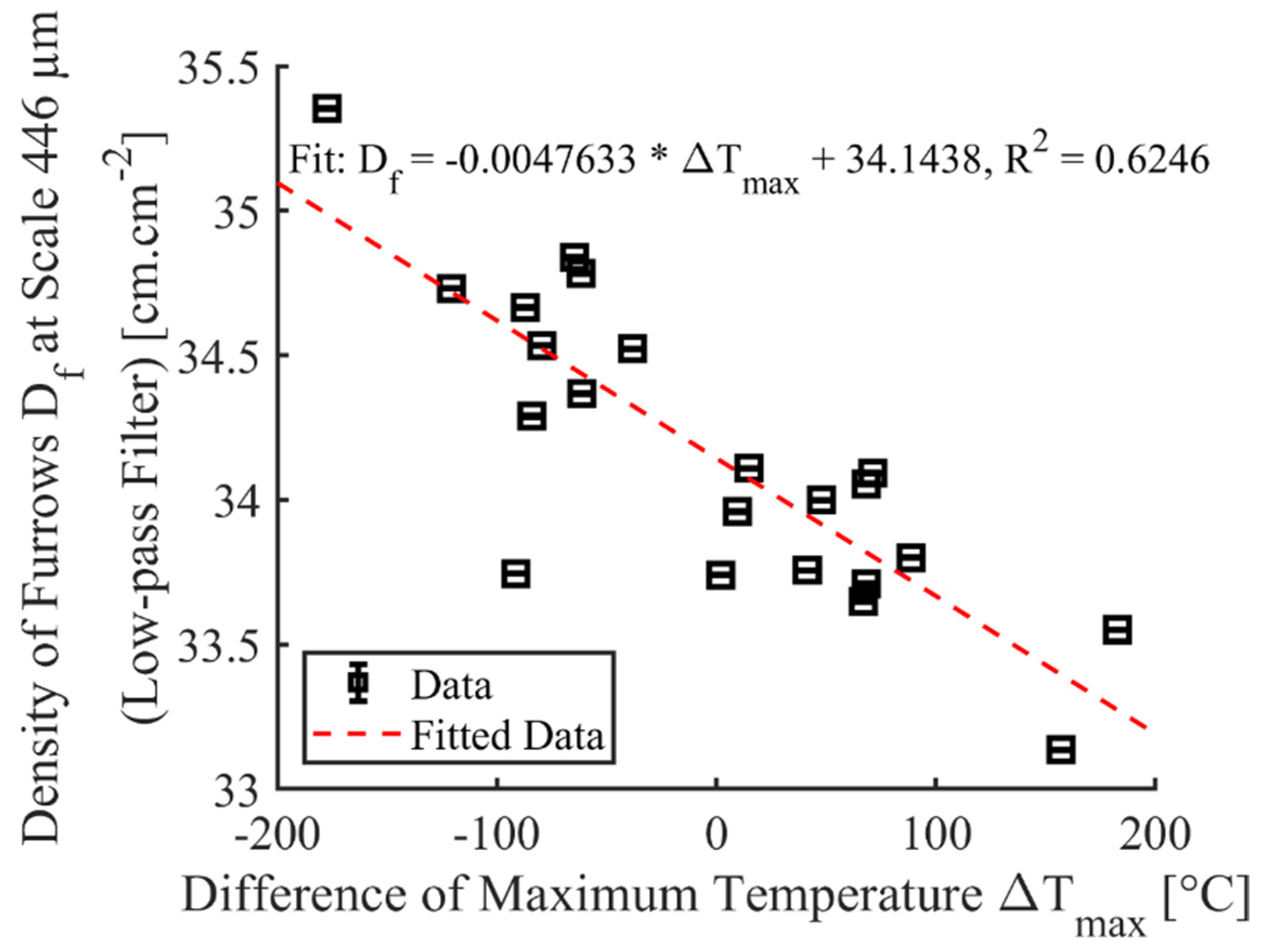
Also, the density of furrows D f of the braking pad is influenced by the difference in maximum temperature T m a x between two braking tests, as shown in Figure 11. This difference is negative when a test reaches a lower temperature than the previous one. If the difference in maximum temperature is negative, density of furrows increases at a scale of 446 µm for a low-pass robust gaussian filter, and vice versa. ANCOVA presents an F-value of 366,029 and a p-value of 0. This behavior highlights the dependency of surface morphology of a given braking test on the previous braking test. Also, furrows can be potential sources of third body traps.
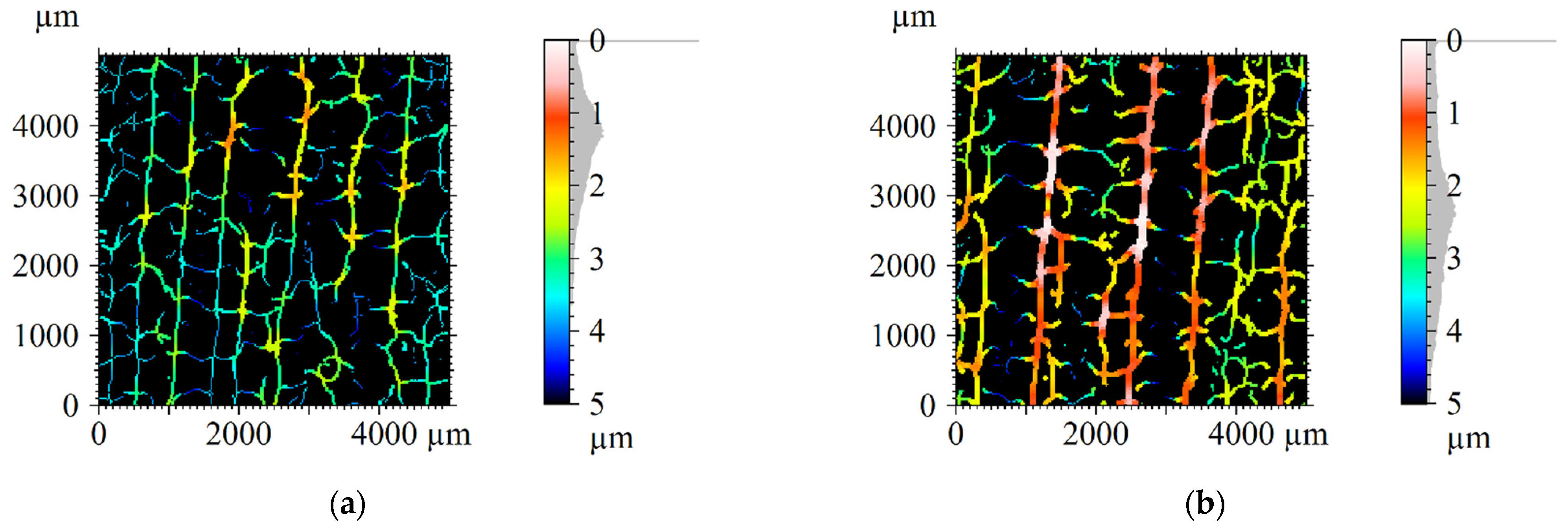
Furrows maps of the braking pad surface filtered with a robust gaussian low-pass filter at a scale of 446 µm, after braking tests 93 and 526, are presented in Figure 12. While the density of furrows D f is smaller for test 526, the mean depth of furrows increases by 60%.

3.4. Noise Emission Analysis

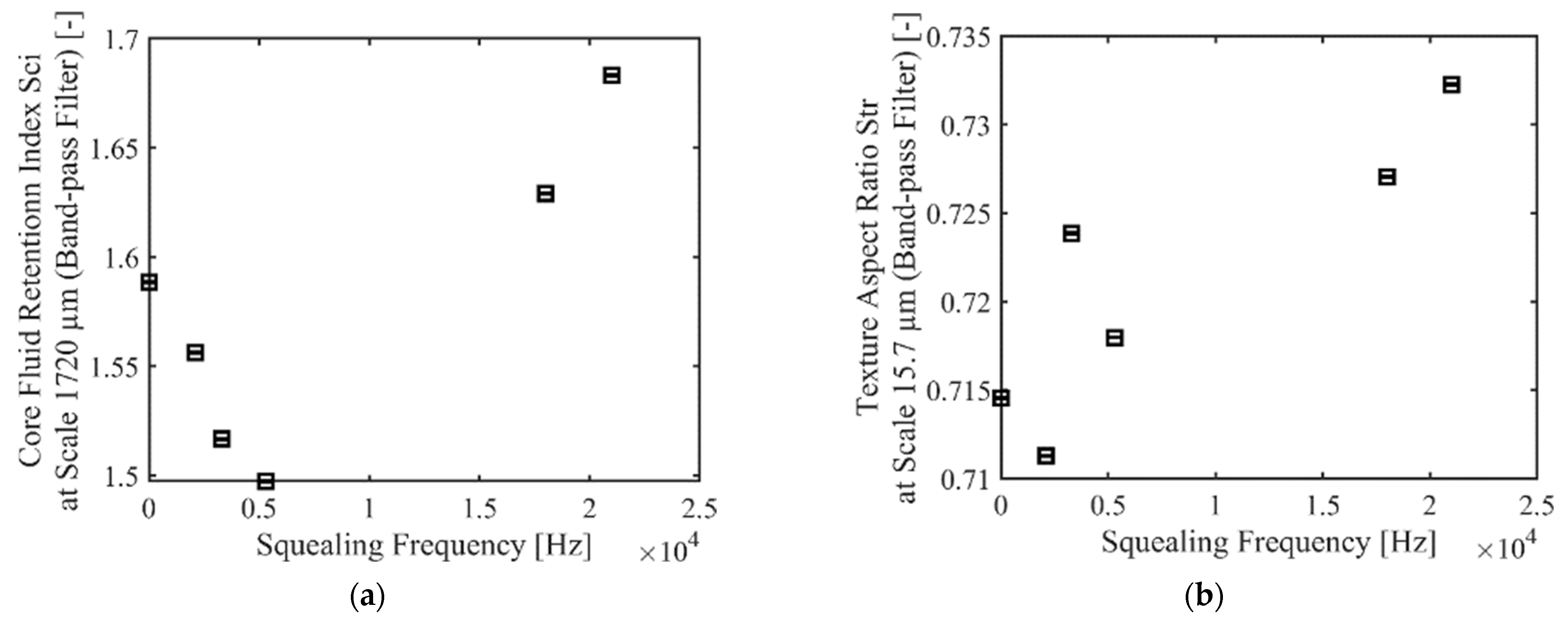
Noise emission can be tricky to evaluate, especially in the case of squealing. This study focuses on squealing frequency if the squealing occurred during a braking test. In the configuration of the braking test bench, squealing is detected if the noise intensity is higher than 70 dB. Five squealing frequencies are detected: 2100 Hz, 3300 Hz, 5300 Hz, 18,000 Hz, and 21,000 Hz.
Figure 13 shows the evolution of roughness parameters at a given scale as a function of squealing frequency. Roughness parameters have been identified by the bootstrap-based parameter relevancy identification process, as previously described. The core fluid retention index Sci, at a scale of 1720 µm of a band-pass filter, is relevant regarding squealing frequency (F-value of 87,597 and p-value of 0 returned by ANCOVA). Therefore, squealing frequency depends on the larger scales of the surface morphology. The retention morphological structures are then essential elements of squealing in pin-on-disc braking tests.
Also, the texture aspect ratio Str at a scale of 15.7 µm for a band-pass filter influences the squealing frequency (F-value of 90,279 and p-value of 0 for ANCOVA). Str indicates how the morphology is oriented, with a value of 1 indicating a non-oriented surface and a value closer to 0 indicating a highly oriented surface. Orientation of the braking pad surface is linked to the wear track generated by the friction between the disc in a circular motion and the braking pad. The evolution of Str at a scale of 15.7 µm highlights a slight modification of the orientation, with major modification of the squealing frequency. This is due to the modification of distribution of local contacts between the disc and the braking pad.

4. Discussion

The morphology of the pin surface plays a major role regarding friction in the braking system. Interestingly, the scales of application of the studied physics, i.e., surface wear, braking ability, pin temperature, and noise emission are distributed across all scales from 15.7 µm to 2717 µm. This highlights the importance of roughness multiscale analyses in tribological systems. However, the values of the coefficient of determination R2 linking surface morphology and studied physics are not high, except for the maximum temperature Tmax. The values of the coefficient of determination nonetheless indicate a relationship between morphology and physics during braking tests, but this relation is not completely described. First, in this study, only the pin surface is measured after a braking test series and the morphology of the friction disc is not available. However, the braking system involved both pin and friction disc, alongside the third body generated during the braking test. This results in a lower value of the coefficients of determination R2 when only the surface pin is considered. Secondly, topographic data in this study belongs to a single specimen of the braking pad of the tested material. While the variability of testing conditions is good during the braking tests, more braking pads and friction discs should be tested to improve statistical representativity and the coefficients of determination R2.
Yet, a few observations can be extracted from this study. The ratio of plateaus and their features are core components of the pin surface morphology, as linked roughness parameters from the ISO 25 178-2 standard have been detected as relevant, such as the surface bearing index Sbi, the core fluid retention index Sci, the density of summit Sds, and the density of furrows D f . The influence of plateaus during braking tests was also highlighted by Eriksson and Jacobson [44]. The braking ability of the braking system, evaluated by the maximum friction coefficient during each braking test, is influenced by the density of summit Sds at smaller scales. Also, the pin morphology and the pin temperature are coupled, as a more damaged pin surface (evaluated by the core height Sk at larger scales) is accompanied by a higher pin temperature, which was also tested by Guha and Roy Chowdhuri [45]. Temperature evolution is mostly influenced by morphological structures at medium and larger scales. Noise emissions, represented by squealing frequency, are linked to specific scales at smaller scales (15.7 µm) or at larger scales (1720 µm). Medium scales are less relevant for noise emission. The change in squealing frequency might be resulting from a displacement of local contacts between the braking pad surface and the disc surface, which is coherent with Lai et al. [25], as each braking test changes the pad surface morphology. Also, the contact angle might be modified. This corroborates the observations from Lee and Jang [24] and Giannini and Massi [46]. Also, this latter reference suggests that the pad wear influences the pad dynamics consistently. Hammerström and Jacobson [47] explained that the tendency to squeal can be reduced by constantly changing the local contact positions in the braking pad-disc interface with the creation of a spiral pattern on the braking disc thanks to grit blasting, disturbing the disc self-vibration. The plateau size also seems to be important, as explained by Eriksson et al. [48] who found that a greater tendency toward squealing is linked to numerous smaller plateaus in contact rather than fewer large plateaus. Massi et al. [2] explained that braking pads after squealing show fatigue features, especially nucleated cracks and third body exfoliation on the braking pad surface. These fatigue signs seem to not appear when the braking system has not squealed. Globally, cited researchers link squealing occurrence and frequency to the surface morphology of friction elements in the braking system.

5. Conclusions

This article proposes the study of a braking test bench, based on a pin-on-disc configuration. A braking pad, cut into a 20 mm × 20 mm square shape, is used as a pin, while a friction disc used in car braking systems plays the role of the disc. The test bench is equipped with sensors capturing displacement data, force data, thermal data, and noise emission data that can be used to compute values such as the friction coefficient, maximum temperature, and squealing frequency during tests. Also, topographies of the braking pad are measured using a focus variation microscope between two series of braking tests. Stitching is used to measure a high resolution over a large field-of-measurement, i.e., the whole braking pad surface. This facilitates the roughness multiscale analysis of the braking pad morphology, allowing the exploration of a larger scale range. The selected roughness multiscale method is robust gaussian filtering, followed by the computation of roughness parameters from the ISO 25 178-2 standard. The multiphysics and multiscale study in this paper aims at finding the most relevant ensemble {roughness parameter, filter type, scale} regarding braking pad surface wear, braking ability, pad temperature, and noise emission. The bootstrap technique is performed to determine the relevancy of such ensembles. The following conclusions about the braking system can be deducted:
  • Braking pad surface wear: the surface bearing index Sbi at a scale of 446 µm with a low-pass filter quantifies the braking pad surface wear, which increases as more braking tests are performed. This highlights the creation of wear plateaus, represented by higher values of the surface bearing index Sbi, during braking tests, according to two mechanisms. First, surface peaks are attacked during contact between the braking pad and the friction disc. Secondly, the third body can be entrapped, and compaction of the third body can also create wear plateaus.
  • Braking ability: density of summits Sds at a scale of 19.5 with a high-pass filter is the most relevant ensemble linked to the maximum friction coefficient μ m a x . Lower Sds values at such scales is an indicator of a higher maximum friction coefficient during a braking test. Improving the braking ability, i.e., increasing the maximum friction coefficient, can be done by looking for larger summits on the braking pad surface.
  • Pad temperature: core height Sk at a scale of 2717 µm with a high-pass filter is linked to the pad maximum temperature T m a x . Higher pad maximum temperatures are observable with high core height Sk values, meaning that the pad temperature increases with a rougher pad surface. Limiting the elevation of pad temperature can be done by avoiding the roughening of the pad surface, such as by using a sturdier material for the braking pad. Also, the difference in maximum temperature T m a x between braking tests can be linked to the density of furrows D f on the braking pad surface at a scale of 446 µm with a low-pass filter. The difference in maximum temperatures between braking tests increases with a lower density of furrows D f .
  • Noise emission: the squealing frequency involved two types of morphological features. The first type of features are larger-scale third body trap regions in the core surface, represented by the core fluid retention index Sci at a scale of 1720 µm with a band-pass filter. Directionality of the braking pad morphology at smaller scales is the second type of feature, as the texture aspect ratio Str at a scale of 15.7 µm with a band-pass filter is found to be relevant by the bootstrap technique.
It would be interesting in the future to add more tests to confirm the relevance of such topography analyses and to extend them to braking pairs in real situations. Such indicators could be embedded in a prediction methodology of surface evolution, which is well known as important to be considered. It would also be appropriate to extend such surface parameters to particle emission analysis and prediction.

Author Contributions

Conceptualization, J.-F.B., P.D. and M.B.; methodology, J.-F.B., P.D. and M.B.; software, R.G., J.L. and M.B.; validation, R.G., J.L., J.-F.B., P.D. and M.B.; formal analysis, R.G., M.T. and J.L.; investigation, R.G., M.T., J.L. and L.C.; resources, J.-F.B., P.D. and M.B.; data curation, M.T., L.C., J.-F.B. and P.D.; writing—original draft preparation, R.G., M.T., J.L. and M.B.; writing—review and editing, R.G., M.T., J.L., J.-F.B., P.D. and M.B.; visualization, R.G., M.T. and J.L.; supervision, J.-F.B., P.D. and M.B.; project administration, J.-F.B., P.D. and M.B.; funding acquisition, J.-F.B., P.D. and M.B. All authors have read and agreed to the published version of the manuscript.

Funding

This research was funded by the Agence Nationale de la Recherche (ANR), grant number ANR-22-CE51-0031.

Data Availability Statement

The data presented in this study are available on request from the corresponding author. The data are not publicly available due to their size.

Conflicts of Interest

Author Robin Guibert was employed by the company Anscale. Author Julie Lemesle was employed by the company Valutec. The remaining authors declare that the research was conducted in the absence of any commercial or financial relationships that could be construed as a potential conflict of interest.

Abbreviations

The following abbreviations are used in this manuscript:
FEAFinite Element Analysis
CEAComplex Eigenvalues Analysis
ANOVAAnalysis of Variance
ANCOVAAnalysis of Covariance

References

  1. Mackin, T.J.; Noe, S.C.; Ball, K.J.; Bedell, B.C.; Bim-Merle, D.P.; Bingaman, M.C.; Bomleny, D.M.; Chemlir, G.J.; Clayton, D.B.; Evans, H.A.; et al. Thermal Cracking in Disc Brakes. Eng. Fail. Anal. 2002, 9, 63–76. [Google Scholar] [CrossRef]
  2. Massi, F.; Berthier, Y.; Baillet, L. Contact Surface Topography and System Dynamics of Brake Squeal. Wear 2008, 265, 1784–1792. [Google Scholar] [CrossRef]
  3. Akay, A.; Giannini, O.; Massi, F.; Sestieri, A. Disc Brake Squeal Characterization through Simplified Test Rigs. Mech. Syst. Signal Process. 2009, 23, 2590–2607. [Google Scholar] [CrossRef]
  4. Österle, W.; Dörfel, I.; Prietzel, C.; Rooch, H.; Cristol-Bulthé, A.-L.; Degallaix, G.; Desplanques, Y. A Comprehensive Microscopic Study of Third Body Formation at the Interface Between a Brake Pad and Brake Disc During the Final Stage of a Pin-on-Disc Test. Wear 2009, 267, 781–788. [Google Scholar] [CrossRef]
  5. Kinkaid, N.M.; O’Reilly, O.M.; Papadopoulos, P. Automotive Disc Brake Squeal. J. Sound Vib. 2003, 267, 105–166. [Google Scholar] [CrossRef]
  6. Akay, A. Acoustics of Friction. J. Acoust. Soc. Am. 2002, 111, 1525–1548. [Google Scholar] [CrossRef]
  7. Hoffmann, N.; Fischer, M.; Allgaier, R.; Gaul, L. A Minimal Model for Studying Properties of the Mode-Coupling Type Instability in Friction Induced Oscillations. Mech. Res. Commun. 2002, 29, 197–205. [Google Scholar] [CrossRef]
  8. Duboc, M.; Magnier, V.; Brunel, J.-F.; Dufrénoy, P. Experimental Set-up and the Associated Model for Squeal Analysis. Mech. Ind. 2020, 21, 204. [Google Scholar] [CrossRef]
  9. Eriksson, M.; Jacobson, S. Friction Behaviour and Squeal Generation of Disc Brakes at Low Speeds. Proc. Inst. Mech. Eng. Part D J. Automob. Eng. 2001, 215, 1245–1256. [Google Scholar] [CrossRef]
  10. James, S.; Ouyang, H.J.; Brookfield, D.J.; Mottershead, J.E. Disc Brake Squeal—An Experimental Approach. Mater. Sci. Forum 2003, 440–441, 237–244. [Google Scholar] [CrossRef]
  11. Xiang, Z.Y.; Mo, J.L.; Ouyang, H.; Massi, F.; Tang, B.; Zhou, Z.R. Contact Behaviour and Vibrational Response of a High-Speed Train Brake Friction Block. Tribol. Int. 2020, 152, 106540. [Google Scholar] [CrossRef]
  12. Hetzler, H.; Willner, K. On the Influence of Contact Tribology on Brake Squeal. Tribol. Int. 2012, 46, 237–246. [Google Scholar] [CrossRef]
  13. Bergman, F.; Eriksson, M.; Jacobson, S. Influence of Disc Topography on Generation of Brake Squeal. Wear 1999, 225–229, 621–628. [Google Scholar] [CrossRef]
  14. Sinou, J.-J.; Jézéquel, L. Mode Coupling Instability in Friction-Induced Vibrations and Its Dependency on System Parameters Including Damping. Eur. J. Mech.-A/Solids 2007, 26, 106–122. [Google Scholar] [CrossRef]
  15. AbuBakar, A.R.; Ouyang, H. Wear Prediction of Friction Material and Brake Squeal Using the Finite Element Method. Wear 2008, 264, 1069–1076. [Google Scholar] [CrossRef]
  16. Belhocine, A.; Ghazaly, N.M. Effects of Material Properties on Generation of Brake Squeal Noise Using Finite Element Method. Lat. Am. J. Solids Struct. 2015, 12, 1432–1447. [Google Scholar] [CrossRef]
  17. Hentati, N.; Kchaou, M.; Cristol, A.-L.; Najjar, D.; Elleuch, R. Impact of Post-Curing Duration on Mechanical, Thermal and Tribological Behavior of an Organic Friction Material. Mater. Des. 2014, 63, 699–709. [Google Scholar] [CrossRef]
  18. Godet, M. The Third-Body Approach: A Mechanical View of Wear. Wear 1984, 100, 437–452. [Google Scholar] [CrossRef]
  19. Taylor, C.M.; Childs, P.R.N.; Berthier, Y.; Flamand, L.; Dalmaz, G.; Dowson, D.; Lubrecht, A.A.; Georges, J.M. The Third Body Concept: Interpretation of Tribological Phenomena; Elsevier: Amsterdam, The Netherlands, 1996; ISBN 978-0-08-087595-8. [Google Scholar]
  20. Denape, J. Third Body Concept and Wear Particle Behavior in Dry Friction Sliding Conditions. Key Eng. Mater. 2015, 640, 1–12. [Google Scholar] [CrossRef]
  21. Kchaou, M.; Mat Lazim, A.R.; Abdul Hamid, M.K.; Abu Bakar, A.R. Experimental Studies of Friction-Induced Brake Squeal: Influence of Environmental Sand Particles in the Interface Brake Pad-Disc. Tribol. Int. 2017, 110, 307–317. [Google Scholar] [CrossRef]
  22. Tison, T.; Heussaff, A.; Massa, F.; Turpin, I.; Nunes, R.F. Improvement in the Predictivity of Squeal Simulations: Uncertainty and Robustness. J. Sound Vib. 2014, 333, 3394–3412. [Google Scholar] [CrossRef]
  23. Kasem, H.; Bonnamy, S.; Berthier, Y.; Jacquemard, P. Characterization of Surface Grooves and Scratches Induced by Friction of C/C Composites at Low and High Temperatures. Tribol. Int. 2010, 43, 1951–1959. [Google Scholar] [CrossRef]
  24. Lee, S.; Jang, H. Effect of Plateau Distribution on Friction Instability of Brake Friction Materials. Wear 2018, 400–401, 1–9. [Google Scholar] [CrossRef]
  25. Lai, V.-V.; Paszkiewicz, I.; Brunel, J.-F.; Dufrénoy, P. Multi-Scale Contact Localization and Dynamic Instability Related to Brake Squeal. Lubricants 2020, 8, 43. [Google Scholar] [CrossRef]
  26. Brown, C.A.; Hansen, H.N.; Jiang, X.J.; Blateyron, F.; Berglund, J.; Senin, N.; Bartkowiak, T.; Dixon, B.; Le Goïc, G.; Quinsat, Y.; et al. Multiscale Analyses and Characterizations of Surface Topographies. CIRP Ann. 2018, 67, 839–862. [Google Scholar] [CrossRef]
  27. Brown, C.A.; Charles, P.D.; Johnsen, W.A.; Chesters, S. Fractal Analysis of Topographic Data by the Patchwork Method. Wear 1993, 161, 61–67. [Google Scholar] [CrossRef]
  28. Chen, X.; Raja, J.; Simanapalli, S. Multi-Scale Analysis of Engineering Surfaces. Int. J. Mach. Tools Manuf. 1995, 35, 231–238. [Google Scholar] [CrossRef]
  29. Zahouani, H.; Mezghani, S.; Vargiolu, R.; Dursapt, M. Identification of Manufacturing Signature by 2D Wavelet Decomposition. Wear 2008, 264, 480–485. [Google Scholar] [CrossRef]
  30. Mezghani, S.; Zahouani, H.; Piezanowski, J.-J. Multiscale Characterizations of Painted Surface Appearance by Continuous Wavelet Transform. J. Mater. Process. Technol. 2011, 211, 205–211. [Google Scholar] [CrossRef]
  31. Bartkowiak, T.; Berglund, J.; Brown, C.A. Multiscale Characterizations of Surface Anisotropies. Materials 2020, 13, 3028. [Google Scholar] [CrossRef]
  32. Guibert, R.; Lemesle, J.; Robache, F.; Bigerelle, M. Roughness Multiscale Analysis of Wear Mechanisms in Polymer Abrasion. Tribol. Int. 2026, 214, 111253. [Google Scholar] [CrossRef]
  33. Demirci, I.; Mezghani, S.; Yousfi, M.; El Mansori, M. Multiscale Analysis of the Roughness Effect on Lubricated Rough Contact. J. Tribol. 2014, 136, 011501. [Google Scholar] [CrossRef]
  34. Zahouani, H.; EL Mansori, M. Multi-Scale and Multi-Fractal Analysis of Abrasive Wear Signature of Honing Process. Wear 2017, 376–377, 178–187. [Google Scholar] [CrossRef]
  35. Chegdani, F.; Mezghani, S.; El Mansori, M. On the Multiscale Tribological Signatures of the Tool Helix Angle in Profile Milling of Woven Flax Fiber Composites. Tribol. Int. 2016, 100, 132–140. [Google Scholar] [CrossRef][Green Version]
  36. Bartkowiak, T.; Berglund, J.; Brown, C.A. Establishing Functional Correlations between Multiscale Areal Curvatures and Coefficients of Friction for Machined Surfaces. Surf. Topogr. Metrol. Prop. 2018, 6, 034002. [Google Scholar] [CrossRef]
  37. Brown, C.A.; Blateyron, F.; Berglund, J.; Murrison, A.J.; Jeswiet, J.J. Spatial Frequency Decomposition with Bandpass Filters for Multiscale Analyses and Functional Correlations. Surf. Topogr. Metrol. Prop. 2024, 12, 035031. [Google Scholar] [CrossRef]
  38. Deltombe, R.; Kubiak, K.J.; Bigerelle, M. How to Select the Most Relevant 3D Roughness Parameters of a Surface: Relevance of 3D Roughness Parameters. Scanning 2014, 36, 150–160. [Google Scholar] [CrossRef] [PubMed]
  39. Thévenot, M.; Brunel, J.-F.; Brunel, F.; Bigerelle, M.; Stender, M.; Hoffmann, N.; Dufrénoy, P. In Situ Operando Indicator of Dry Friction Squeal. Lubricants 2024, 12, 435. [Google Scholar] [CrossRef]
  40. Caradec, Q.; Durain, S.; Thévenot, M.; Briatte, M.; Stender, M.; Brunel, J.-F.; Dufrénoy, P. Pin-on-Disc Experimental Study of Thermomechanical Processes Related to Squeal Occurrence. Lubricants 2025, 13, 186. [Google Scholar] [CrossRef]
  41. Guibert, R.; Robache, F.; Lemesle, J.; Hanafi, S.; Brown, C.A.; Bigerelle, M. Review of 3D Topography Stitching and Registration Algorithms: Procedure, Error Evaluation and Mathematical Modelling. Surf. Topogr. Metrol. Prop. 2025, 13, 013001. [Google Scholar] [CrossRef]
  42. ISO 25178-2; Geometrical Product Specifications (GPS)—Surface Texture: Areal—Part 2: Terms, Definitions and Surface Texture Parameters. International Organisation for Standardization: Geneva, Switzerland, 2021.
  43. Efron, B. Bootstrap Methods: Another Look at the Jackknife. Ann. Stat. 1979, 7, 1–26. [Google Scholar] [CrossRef]
  44. Eriksson, M.; Jacobson, S. Tribological Surfaces of Organic Brake Pads. Tribol. Int. 2000, 33, 817–827. [Google Scholar] [CrossRef]
  45. Guha, D.; Roy Chowdhuri, S.K. The Effect of Surface Roughness on the Temperature at the Contact between Sliding Bodies. Wear 1996, 197, 63–73. [Google Scholar] [CrossRef]
  46. Giannini, O.; Massi, F. Characterization of the High-Frequency Squeal on a Laboratory Brake Setup. J. Sound Vib. 2008, 310, 394–408. [Google Scholar] [CrossRef]
  47. Hammerström, L.; Jacobson, S. Surface Modification of Brake Discs to Reduce Squeal Problems. Wear 2006, 261, 53–57. [Google Scholar] [CrossRef]
  48. Eriksson, M.; Bergman, F.; Jacobson, S. Surface Characterisation of Brake Pads after Running under Silent and Squealing Conditions. Wear 1999, 232, 163–167. [Google Scholar] [CrossRef]
Figure 1. Configuration of the pin-on-disc test with profilometry analysis between tests and thermocouples positioning, extracted from Caradec et al. [40]. The braking pad comes into contact with the disc-in-rotation during braking tests. A pivot system allows the measurement of the braking pad surface with a focus variation microscope without removing the pad from its frame, reducing specimen repositioning errors.
Lubricants 14 00139 g001
Figure 2. (a) Time-frequency of the acoustic emission for the main squeal frequencies and (b) classification of the squealing classes along the test procedure. The experimental conditions of each braking test series are gathered in this plot. Variations in experimental conditions generate changes in the braking pad surface and squealing frequency. Dots represent the occurences of squeal frequencies during braking tests: no squeal (purple), 2.1 kHz (blue), 3.3 kHz (green), 5.3 kHz (yellow), 18 kHz (orange) and 21 kHz (dark red).
Lubricants 14 00139 g002
Figure 3. Bright-field images with plateaus and particles stored in wear tracks after braking test 324. Friction between pad and disc during braking test generates morphological structures, such as wear plateaus (a), sometimes fragmented (b). Also, third body particles can either be trapped and create compacted plateaus (c), or spread across wear tracks (d).
Lubricants 14 00139 g003
Figure 4. Topographies of the braking pad surface after various numbers of braking tests. Contact between the braking pad and the disc is established before braking test 93 (ac). Then, the pad surface morphology changes between two damage levels: low (tests 263 (e) and 486 (h)) and severe (tests 344 (f) and 526 (i)). Transition state between damage levels can also be observed (tests 173 (d) and 424 (g)). The shaded areas are the height histograms of each surface topography.
Lubricants 14 00139 g004
Figure 5. Evolution of the surface bearing index Sbi as a function of number of braking tests for topographies filtered with a robust gaussian low-pass filter at scale 446 µm.
Lubricants 14 00139 g005
Figure 6. Filtered topographies with a robust gaussian low-pass filter at scale 446 µm. The shaded areas are the height histograms of each surface topography.
Lubricants 14 00139 g006
Figure 7. Evolution of the density of summits Sds as a function of maximum friction coefficient µmax for topographies filtered with a robust gaussian high-pass filter at scale 19.5 µm.
Lubricants 14 00139 g007
Figure 8. Filtered topographies with a robust gaussian high-pass filter at scale 19.5 µm. The shaded areas are the height histograms of each surface topography.
Lubricants 14 00139 g008
Figure 9. Evolution of the core height Sk as a function of the maximum temperature Tmax for topographies filtered with a robust gaussian high-pass filter at scale 2717 µm.
Lubricants 14 00139 g009
Figure 10. Filtered topographies with a robust gaussian high-pass filter at scale 2717 µm. The shaded areas are the height histograms of each surface topography.
Lubricants 14 00139 g010
Figure 11. Evolution of the density of furrows Df as a function of the difference in maximum temperature ΔTmax.
Lubricants 14 00139 g011
Figure 12. Furrows maps of filtered topographies with a robust gaussian low-pass filter at scale 446 µm. (a) After 93 braking tests, density of furrows: 35.1 cm.cm-2 and mean depth of furrows: 1.71 µm. (b) After 526 braking tests, density of furrows: 32.6 cm.cm-2 and mean depth of furrows: 2.77 µm. The shaded areas are the depth of furrows histograms of each furrows map.
Lubricants 14 00139 g012
Figure 13. Evolution of relevant roughness parameters regarding noise emission through squealing frequency: (a) the core fluid retention index Sci for topographies filtered with a robust gaussian band-pass filter at scale 1720 µm and (b) the texture aspect ratio Str for topographies filtered with a robust gaussian band-pass filter at scale 15.7 µm.
Lubricants 14 00139 g013
Table 1. Test conditions in terms of rotation speed of the disc, desired normal load, durations of test and between each test.
Braking NumberRotation SpeedDesired Normal LoadDuration Between
Successive Brakings
Contact Duration
[rpm][N][s][s]
1–106001501010
11–326001501030
32–536001501030
54–736001001030
74–932001001030
94–1136001001030
114–1332001001030
134–1536002001030
154–1732002001030
174–1936002001030
194–2132002001030
214–243700200530
244–2632003001030
264–2846003001030
285–304600300530
305–324600300530
325–344200300530
345–364600300530
365–3846003001030
385–4142003001030
415–424600300530
425–4446003001030
445–4662003001010
467–4866003001010
487–5066003001030
507–5262003001030
Table 2. Statistical tests used with the bootstrap technique.
AnalysisBraking Test Variable (Class)Statistical Test
Surface wearBraking test number NANOVA
Braking abilityMaximum friction coefficient µmaxANCOVA
Thermal analysisMaximum temperature TmaxANCOVA
Noise emissionSquealing frequency FsquealANCOVA
Disclaimer/Publisher’s Note: The statements, opinions and data contained in all publications are solely those of the individual author(s) and contributor(s) and not of MDPI and/or the editor(s). MDPI and/or the editor(s) disclaim responsibility for any injury to people or property resulting from any ideas, methods, instructions or products referred to in the content.