Article

A Study on the Influence of Bush Surface Waviness and Wear on the Tribo-Dynamic Behavior During the Start-Up Process of Water-Lubricated Bearings


1
College of Mechanical Engineering, Xihua University, Chengdu 610039, China
2
School of Mechanical and Electrical Engineering, University of Electronic Science and Technology of China, Chengdu 611731, China
*
Authors to whom correspondence should be addressed.
Lubricants 2026, 14(4), 140; https://doi.org/10.3390/lubricants14040140
Submission received: 25 January 2026 / Revised: 15 March 2026 / Accepted: 21 March 2026 / Published: 25 March 2026
(This article belongs to the Special Issue Friction–Vibration Interactions, 2nd Edition)

Abstract

The start-up process of water-lubricated bearings (WLBs) exhibits strong nonlinearity and is highly sensitive to the surface topography of both the bush and the journal. However, due to machining errors and operational wear in practical manufacturing and service, the bush inevitably develops surface waviness and wear, which significantly influence its start-up behavior. This issue is particularly critical in high-speed underwater unmanned vehicles, where lightweight design precludes the use of oil lubrication systems, making WLBs a more economically favorable and reliable alternative. To address this, the present study establishes a start-up tribo-dynamic model that comprehensively incorporates both bush surface waviness and wear to systematically investigate their coupled effects on the tribo-dynamic behavior during WLB start-up. The research findings indicate that axial surface waviness reduces the hydrodynamic effect during the start-up phase. Consequently, a higher rotational speed is needed to generate the necessary hydrodynamic pressure for the WLB to start up successfully. The significance of the influence exerted by circumferential surface waviness on start-up behavior is determined by its frequency number, m. A larger m leads to greater fluctuations in both hydrodynamic pressure and contact pressure. Furthermore, when wear occurs, the amplitude of bush surface waviness mediates the influence of wear depth on start-up performance, thereby modifying the optimal wear depth previously established for smooth bearings. These findings highlight the importance of controlling circumferential waviness frequency during machining and manufacturing processes to optimize WLB start-up reliability and service life.

1. Introduction

Water-lubricated bearings (WLBs), which use water as the lubricating medium, offer environmental and economic advantages over oil-lubricated bearings and have become key components in marine stern shaft transmission systems [1]. Furthermore, in high-speed underwater unmanned vehicles, WLBs are an essential requirement due to lightweight design constraints that preclude the installation of complex oil lubrication systems [2]. However, water’s low viscosity results in lower hydrodynamic pressure compared to oil-lubricated bearings, leading to more pronounced wear—especially during start-up and shut-down phases, whereas steady-state wear remains relatively minor [3,4,5,6]. Moreover, the highly nonlinear start-up process makes WLBs extremely sensitive to the surface topography of both the bush and the journal [7]. During manufacturing, machining errors on the bush surface are unavoidable, leading to the formation of surface waviness. The amplitude of such surface waviness is often on the same order of magnitude as the thickness of the water film [8]. Consequently, this can significantly affect the entire start-up behavior of WLBs. However, this aspect has not yet been thoroughly investigated by researchers. Therefore, to address this research gap and enhance the in-service performance and lifespan of WLBs, it is imperative to study the start-up behavior of WLBs in the presence of bush surface waviness.
The influence of machining-induced surface defects or waviness on bearing components has long been a research focus due to its significant effects on lubrication performance and dynamic behavior [9,10,11,12,13,14,15,16,17,18,19,20,21,22]. Early work by Rasheed [8] established the governing equations for bush waviness and examined its impact on sliding bearing lubrication. Subsequently, Yang et al. [10] systematically investigated the effects of both journal and bush waviness on the static performance of journal bearings, revealing that the phase angle of bush waviness critically determines its influence on static characteristics. Hargreaves et al. [11] demonstrated that surface waviness on the stationary surface of rectangular slider bearings can enhance load-carrying capacity, with the degree of enhancement depending on the specific waviness pattern. Bangotra et al. [12,13] extended this line of inquiry to dynamic behavior, showing that under journal misalignment and both full and partial waviness conditions, surface waviness improves bearing stability parameters, fluid film stiffness, and dynamic coefficients. Shi et al. [14,15] and Zhuang et al. [16] explored similar effects in aerodynamic journal and thrust bearings, respectively, confirming that specific waviness parameters—whether sinusoidal or triangular—can enhance bearing performance. More recently, Zhang et al. [17] subsequently examined bush surface waviness effects in a novel coupled journal-thrust WLB under steady-state conditions. Collectively, these studies confirm that bush surface waviness significantly influences both static and dynamic bearing characteristics. In addition to surface waviness, bush wear represents another critical form of surface defect that inevitably arises during operation. Dufrane et al. [18] proposed a seminal wear profile model for journal bearings, subsequently validated experimentally by Hashimoto et al. [19] and Xie et al. [20]—the latter employing water-lubricated bearings consistent with the present study. Nicodemus et al. [21] analyzed the influence of wear depth on hydrostatic journal bearing performance, finding that lubricant type does not alter the impact of wear depth on bearing stiffness and damping. Cai et al. [22] specifically investigated wear in water-lubricated bearings, revealing that under different operating conditions, an optimal wear depth exists that maximizes bearing performance. Despite these advances, existing research predominantly focuses on steady-state behavior or isolated waviness effects. Studies on the start-up process have primarily considered journal waviness, leaving the synergistic influence of bush waviness and wear depth on transient start-up behavior largely unexplored. The present study addresses this gap by systematically investigating how bush surface waviness interacts with wear depth to govern the start-up behavior of water-lubricated bearings.
With regard to research on bearing start-up, pioneering experimental investigations were conducted by Mokhtar et al. [23,24] in 1997, who first observed significant sliding between the journal and bearing bush during initial rotation, leading to pronounced adhesive wear. This finding catalyzed subsequent theoretical developments. Chun et al. [25] developed a transient wear simulation program, confirming that the majority of wear occurs within a short period after rotation begins—consistent with Mokhtar’s observations. Cui et al. [26] advanced the field by incorporating the Greenwood–Williamson contact model [27] into a mixed lubrication framework for bearing start-up, validating their model against Mokhtar’s experimental data. More recent studies have explored increasingly complex scenarios. Yang et al. [28] developed a five-degree-of-freedom start-up model for coupled journal-thrust water-lubricated bearings, revealing distinct elastic-plastic contact evolution compared to conventional bearings. Chen et al. [29] investigated thermal tribo-dynamic behavior in WLBs with journal surface defects, finding that higher start-up speeds accelerate temperature rise in the presence of surface errors. Li et al. [30] examined transient mixed elastohydrodynamic performance in planet gear journal bearings, demonstrating that an intermediate oil return groove mitigates misalignment and enhances film pressure. Recently, Zou et al. [31] investigated the start-up characteristics of worn WLBs under varying wear depths and identified an optimal wear depth that maximizes the hydrodynamic effect, thereby facilitating faster start-up completion. However, as demonstrated by Chen et al. [6,29], surface waviness exerts a significant influence on the transient characteristics of WLB start-up. Zou et al. [31] did not consider the influence of bush surface waviness or the coupled effects of surface waviness and wear on WLB start-up behavior. Therefore, it is necessary to comprehensively investigate the combined effects of bush surface waviness and wear on WLB behavior.
Therefore, based on the mixed lubrication model established by Cui et al. [26] and incorporating the factor of bearing bush surface waviness and wear depth, this study develops a start-up tribo-dynamic model for WLBs. The validity of the proposed model was subsequently verified through comparisons with experimental data and simulation results. The transient start-up behavior of bearings in the presence of bush surface waviness is investigated to evaluate their impact on WLB performance. The findings demonstrate that axial surface waviness attenuates the hydrodynamic effect during the start-up process and increases the dependency of bearings on start-up parameters. However, when the wear depth is of a comparable magnitude to the surface waviness amplitude, the hydrodynamic effect during bearing start-up is enhanced. In summary, the findings of this study provide some theoretical guidance for the structural design, machining and manufacturing processes, and long-term operational reliability of bearings in practical engineering applications.

2. Mathematical Model

2.1. Transient Lubrication Equation

Given the pronounced nonlinearity of the start-up process in WLBs, this study establishes a mathematical model to investigate the influence of bush surface waviness on start-up characteristics. The mathematical model is formulated based on the following assumptions: the lubricant flow is laminar, and the fluid is isothermal and incompressible throughout the start-up phase. During this transient process, the increase in rotational speed leads to the generation and growth of hydrodynamic pressure, which in turn expands the lubrication clearance. Therefore, a transient lubrication equation that accounts for the time-varying rotational speed is established. Furthermore, to consider the effect of surface roughness on the start-up performance of the WLB, the average Reynolds equation proposed by Patir et al. [32], which incorporates different factors (flow factors ϕ θ and ϕ z , shear factor ϕ s , and contact factor ϕ c ), is adopted. Based on the coordinate system shown in Figure 1, the governing equation for the transient hydrodynamic pressure during bearing start-up is derived as follows [1,26]
R B θ ϕ θ h 3 12 η p h R B θ + z ϕ z h 3 12 η p h z = ω 2 ϕ c h θ + σ ϕ s θ + h t
where RB and ω are the radius of the bush and the rotational speed of the journal rotor, respectively; ph and h are the hydrodynamic pressure and the lubrication gap, respectively; η is the viscosity of the water; σ is the composite surface roughness; The subscripts θ and z represent the circumferential and axial directions of the bearing, respectively.
Given the rapid nature of the bearing start-up process, it is assumed that the rotational speed increases linearly with time throughout the start-up phase until reaching the required operational speed within a specified duration. Accordingly, the surface velocity of the journal can be determined by the following formula.
ω t = ω s t t s        0 t t s
where ωs and ts represent the operating speed and start-up time of the bearing upon completion of the start-up process, respectively.

2.2. Transient Lubrication Gap

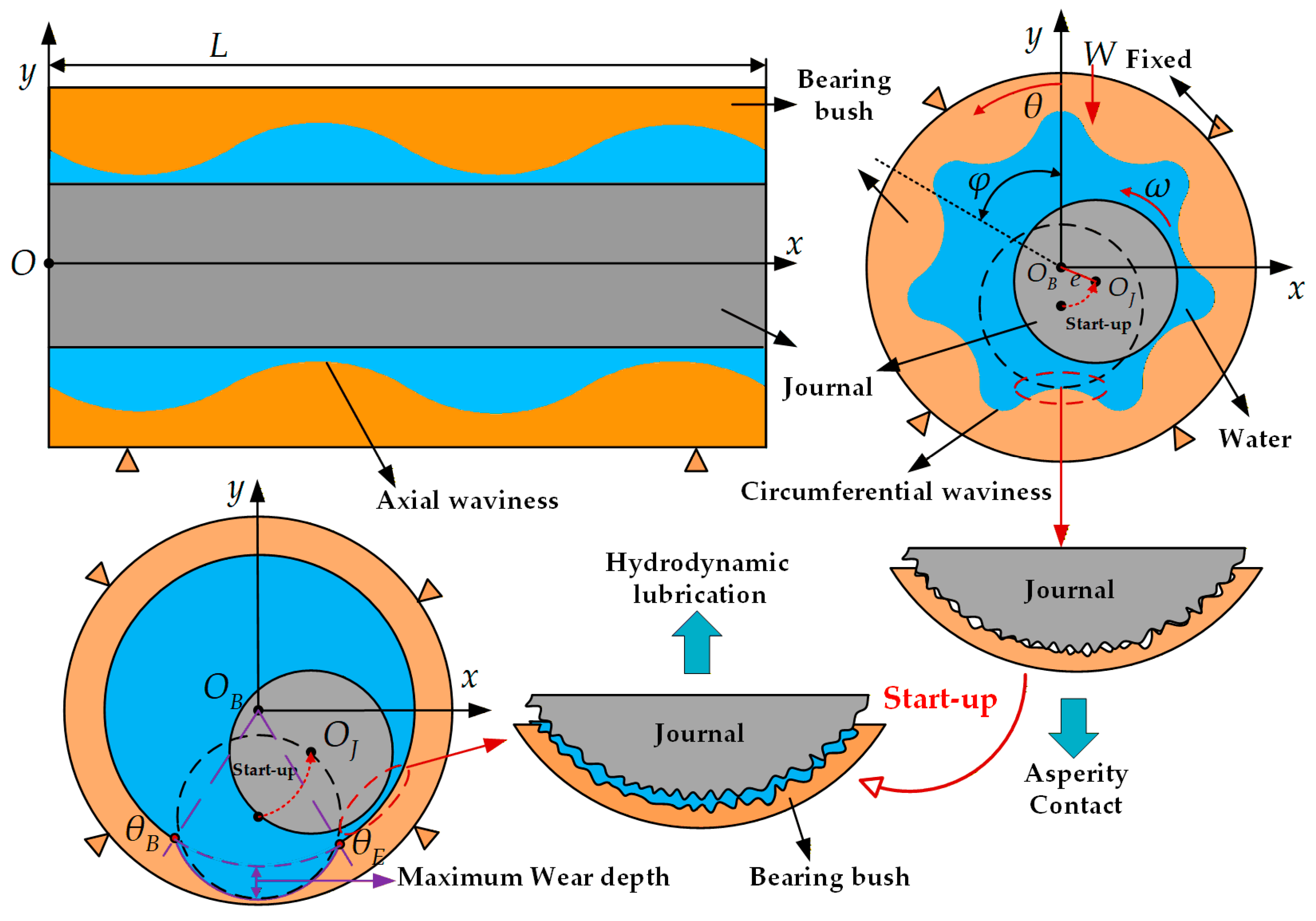
As illustrated in Figure 1, under the assumption that the journal is rigid, the transient lubrication gap during the start-up process consists of the bearing geometric clearance, the surface waviness δwave, deformation δD and wear depth δwear of the bush. Thus, the governing equation for the transient lubrication gap can be expressed as
h θ , z , t = C 1 + ε t cos θ t φ t + δ w a v e θ , z + δ w o r n + δ D θ , z , t
where C is the radius clearance of WLBs; ε and φ are the eccentricity ratio and attitude angle, respectively; δD arises from the combined action of hydrodynamic pressure and asperity contact pressure, which can be governed by [33]
δ D ( ξ , ζ , t ) = 2 π E * Ω p h ( θ , z , t ) + p c ( θ , z , t ) ( ξ R B θ ) 2 + ( ζ z ) 2 R B d θ d z
where E * is the composite elastic modulus, with E * = 2 1 υ B 2 / E B + 1 υ J 2 / E J 1 , and E and ν represent the elastic modulus and Poisson’s ratio, respectively; the subscripts B and J denote the bearing and journal, respectively; p h and p c are the transient hydrodynamic and contact pressure, which are calculated by Equation (1) and Equation (6), respectively.
As shown in Figure 1, the wear profile of the bearing bush is characterized using the model proposed by Dufrane et al., which can be described as [18,31]
δ w o r n = δ max C 1 + cos θ for   θ B θ θ E 0 for   θ < θ B ,   o r   θ > θ E
where δ max is the maximum wear depth; θ B and θ E denote the starting and ending angles of the wear zone, which may be calculated from the maximum wear depth using the following formula.
θ B = a r c cos δ max C 1 θ E = 2 π a r c cos δ max C 1
For δwave, its value in the circumferential and axial directions exhibits a sinusoidal waveform, which can be expressed as [9]
δ w a v e = δ s w 2 i cos m θ + j cos 2 π n z / L
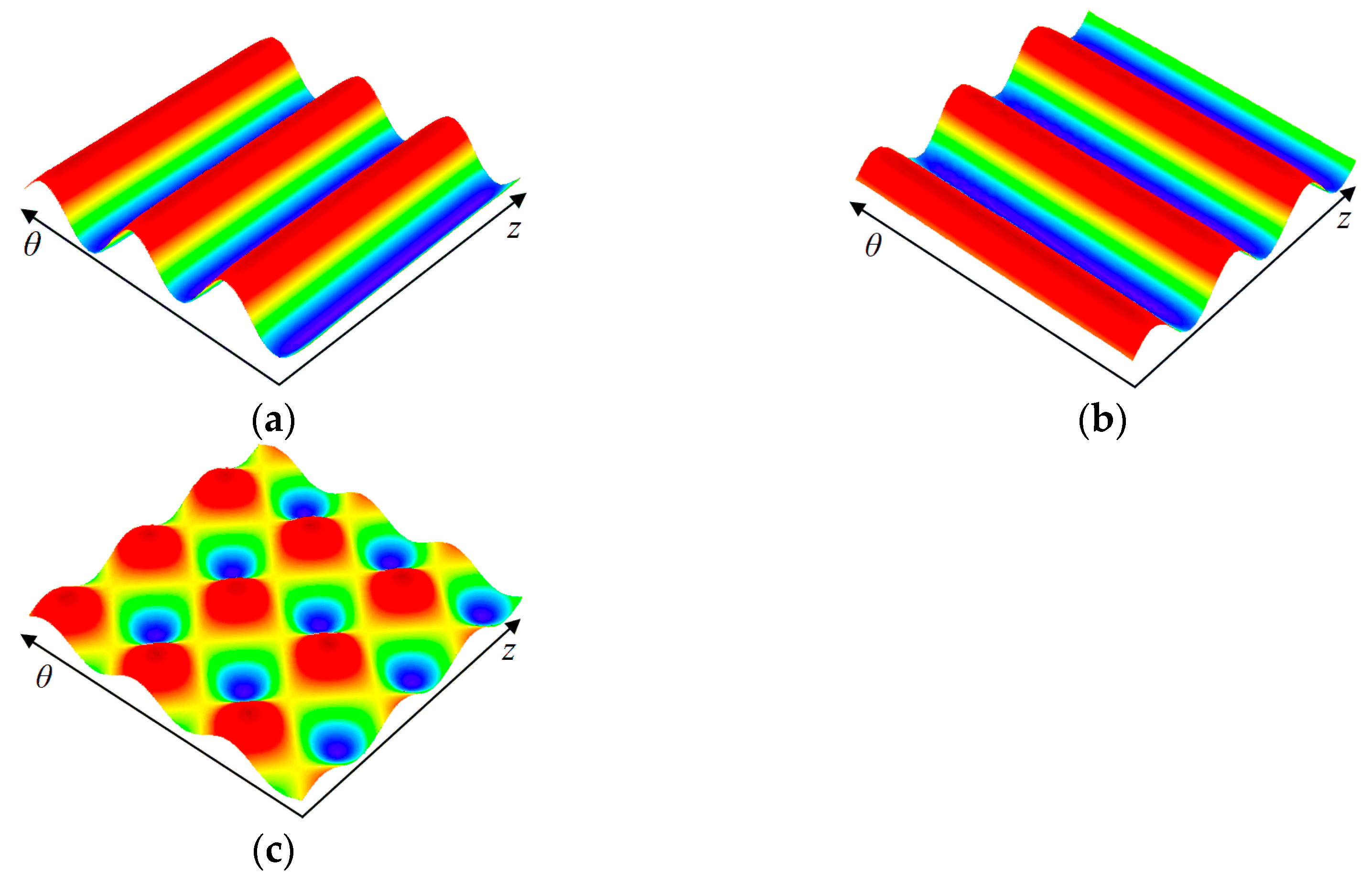
with i = 2, j = 0 for circumferential surface waviness only; i = 0, j = 2 for axial surface waviness only; i = 1, j = 1 for combined circumferential and axial surface waviness. In Equation (7), L denotes the length of the bearing.
The value of δwave is governed by the surface waviness amplitude δ s w and the waviness frequencies n and m. These parameters define the different types of surface waviness patterns on the bush, as shown in Figure 2.

2.3. Transient Contact Model

During the start-up process of the bearing, it is inevitable that the contact pressure generated by asperity contact, together with the hydrodynamic pressure, balances the external load. Therefore, the asperity contact model proposed by Greenwood and Tripp [27] is adopted to simulate the contact pressure, which can be expressed as
p c θ , z , t = 16 2 π 15 σ β D 2 σ β E * F H dim t
where β and D are the radius and density of asperity, respectively; according to the literature [5,25], the values of σβD and σ/β were set to be 0.05 and 0.01. F(Hdim(t)) is a time-dependent function, which can be described as [34]
F H dim t = 4.4086 × 10 5 4 H dim 6.804 if   H dim < 4 0 if   H dim 4

2.4. Dynamic Equation

As shown in Figure 1, the bearing functions with a static force in the Y direction exclusively. Therefore, the dynamic control equation of the journal rotor can be described as
m J y = W F h , y t F c , y t + F f , y t m J x = F h , x t + F c , x t + F f , x t
where mJ is the mass of the journal of WLBs; W and F are the static load and transient force. The subscripts x and y identify the horizontal and vertical directions; the subscripts h, c and f identify hydrodynamic, contact and friction, respectively. The transient forces in the dynamic equation are calculated using the following formula.
The transient hydrodynamic forces in Equation (11) can be obtained by integrating the transient results of the lubrication equations (Equation (1)).
F h , x t = 0 L 0 2 π p h θ , z , t R B sin θ d θ d z F h , y t = 0 L 0 2 π p h θ , z , t R B cos θ d θ d z
After solving Equation (8) to determine the transient contact pressure during the WLB start-up process, the transient contact force can be calculated using the following equation.
F c , x t = 0 L 0 2 π p c θ , z , t R B sin θ d θ d z F c , y t = 0 L 0 2 π p c θ , z , t R B cos θ d θ d z
The transient friction force can be determined by
F f , y t = 0 L 0 2 π η ω s t R B t s h t + h t 2 R B p h θ , z , t θ + μ c p c θ , z , t cos θ R B d θ d z F f , x t = 0 L 0 2 π η ω s t R B t s h t + h t 2 R B p h θ , z , t θ + μ c p c θ , z , t sin θ R B d θ d z
where μc is the boundary friction coefficient.

2.5. Boundary Condition

Then, Reynolds boundary conditions [29] are employed as the boundary conditions of the mathematical model to consider the cavitation, which can be described as
p h θ , 0 = 0 p h θ , L = 0 p h θ r , z r = 0 p h θ r , z r θ = 0
where θr and zr represent the water-film rupture position in the circumferential and axial direction, respectively.

3. Simulation Procedure and Verification

3.1. Simulation Procedure

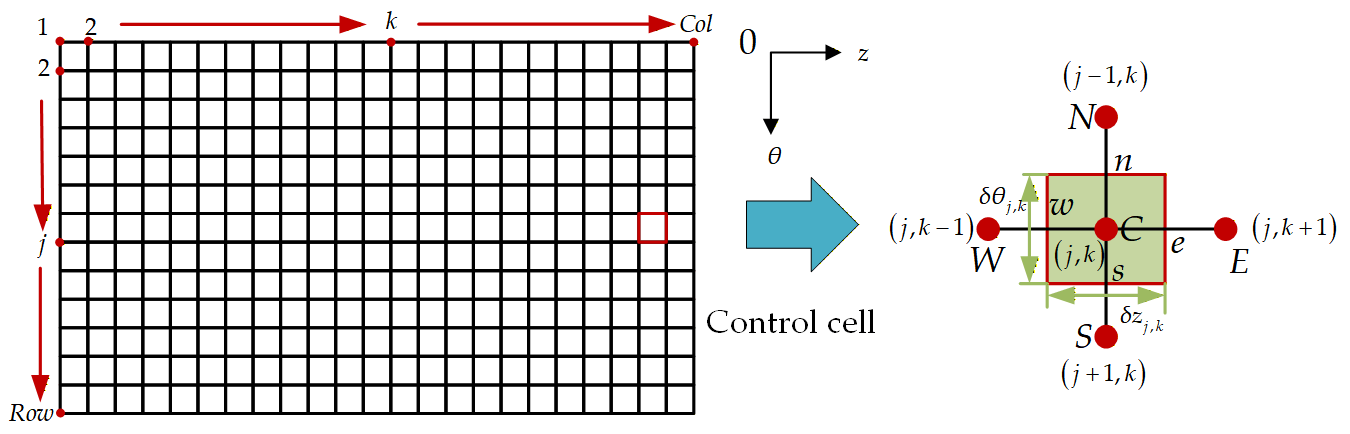
In this study, the transient lubrication equation is discretized using the control volume method. The computational domain mesh partitioning and control cells for the WLB are shown in Figure 3. The discrete form of Equation (1) can be expressed as
ϕ θ h 3 12 R B 2 η p h θ e ϕ θ h 3 12 R B 2 η p h θ w δ z j , k + ϕ z h 3 12 η p h z s ϕ z h 3 12 η p h z n δ θ j , k = ω ϕ c 2 h e h w δ z j , k + ω σ 2 ϕ s n ϕ s s δ z j , k + h t δ θ j , k δ z j , k
where δ θ j , k and δ z j , k denote the dimensions of the control unit at point (j, k) in the θ and z directions, respectively. We define the wall coefficients Kw, Ke, Kn, and Ks on the control body w, e, n, and s walls, as follows.
K w = h 3 12 η w , K e = h 3 12 η e , K n = h 3 12 η n K s = h 3 12 η s
Substituting Equation (16) into Equation (17) and subsequently discretizing the equation yields
ϕ θ R B 2 K e p h , E p h , C Δ θ e K w p h , C p h , W Δ θ w δ z j , k + ϕ z K n p h , S p h , C Δ z s K s p h , C p h , N Δ z n δ θ j , k = ω ϕ c 2 h e h w δ z j , k + ω σ 2 ϕ s n ϕ s s δ z j , k + h t δ θ j , k δ z j , k
Arranging Equation (17) yields
A E p h , E + A W p h , W + A S p h , S + A N p h , N A C p h , C = B p
where A E , A W , A S , A N , A C , B p were expressed as
A E = ϕ θ K e δ z j , k R B 2 Δ θ , A W = ϕ θ K w δ z j , k R B 2 Δ θ , A S = ϕ z K s δ θ j , k Δ z , A W = ϕ z K w δ θ j , k Δ z A C = ϕ θ K e δ z j , k R B 2 Δ θ + ϕ θ K w δ z j , k R B 2 Δ θ + ϕ z K s δ θ j , k Δ z + ϕ z K w δ θ j , k Δ z B p = ω ϕ c 2 h e h w δ z j , k + ω σ 2 ϕ s n ϕ s s δ z j , k + h n e w h o l d Δ t δ θ j , k δ z j , k
The transient dynamic pressure at node (j, k) can be calculated using the following formula:
p h , C = A E p h , E + A W p h , W + A S p h , S + A N p h , N B p / A C
In this study, the successive over-relaxation method was employed to solve Equation (20), with the over-relaxation factor set at 1.2. In addition, the number of nodes in the computational domain Col × Row is 21 × 160, assuming the mesh is orthogonal.
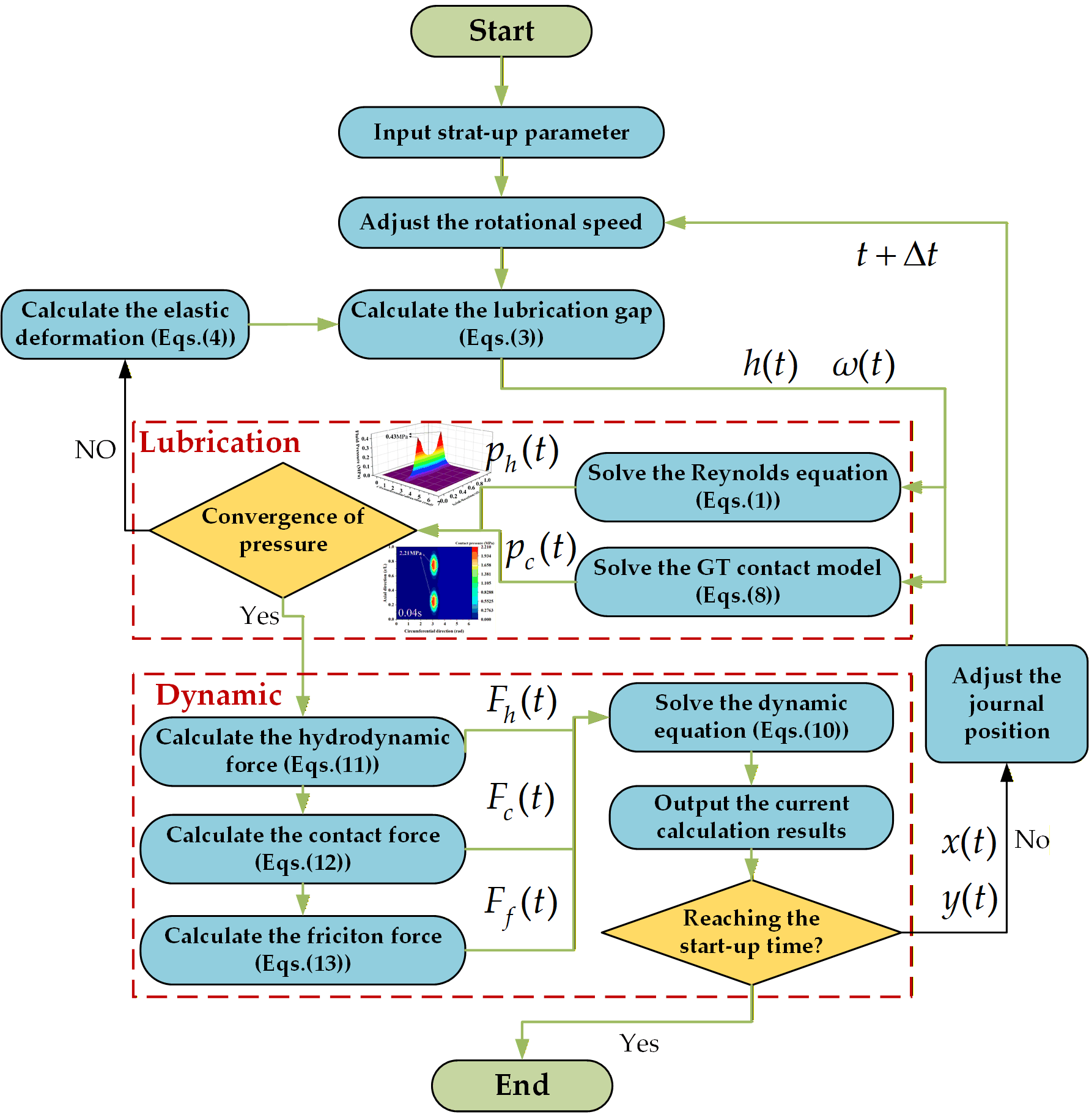
The dynamic equations of the WLB system are solved numerically by the fourth-order Runge–Kutta method (the detailed numerical scheme is presented in Ref. [3]). Within the numerical algorithm, the successive over-relaxation iteration method is employed to compute the transient hydrodynamic pressure at each time step, thereby determining key start-up characteristics such as the transient contact pressure and the minimum film thickness. Figure 4 illustrates the iterative flowchart of the simulation procedure implemented in the present model.
As shown in Figure 4, the transient hydrodynamic pressure and contact pressure are obtained from the lubrication equation (Equation (1)) and the contact model (Equation (8)), respectively. The transient deformation of the bearing bush is subsequently calculated using Equation (4), and the lubrication clearance is updated accordingly. This iterative process continues until the computed hydrodynamic pressure satisfies the prescribed convergence criterion. Thereafter, the dynamic equations are solved to obtain the start-up dynamic response of the journal-rotor system for the current time step. Based on this solution, the transient position of the journal is updated. The overall iterative computation terminates once the simulated time reaches the prescribed start-up duration. In this model, the iteration time step is set to Δ t = 5.0 × 10 7 s. The convergence criterion for the transient lubrication equation is given below.
j = 1 m k = 1 n p j , k n e w p j , k o l d j = 1 m k = 1 n p j , k o l d 1 × 10 5

3.2. Verification of the Model

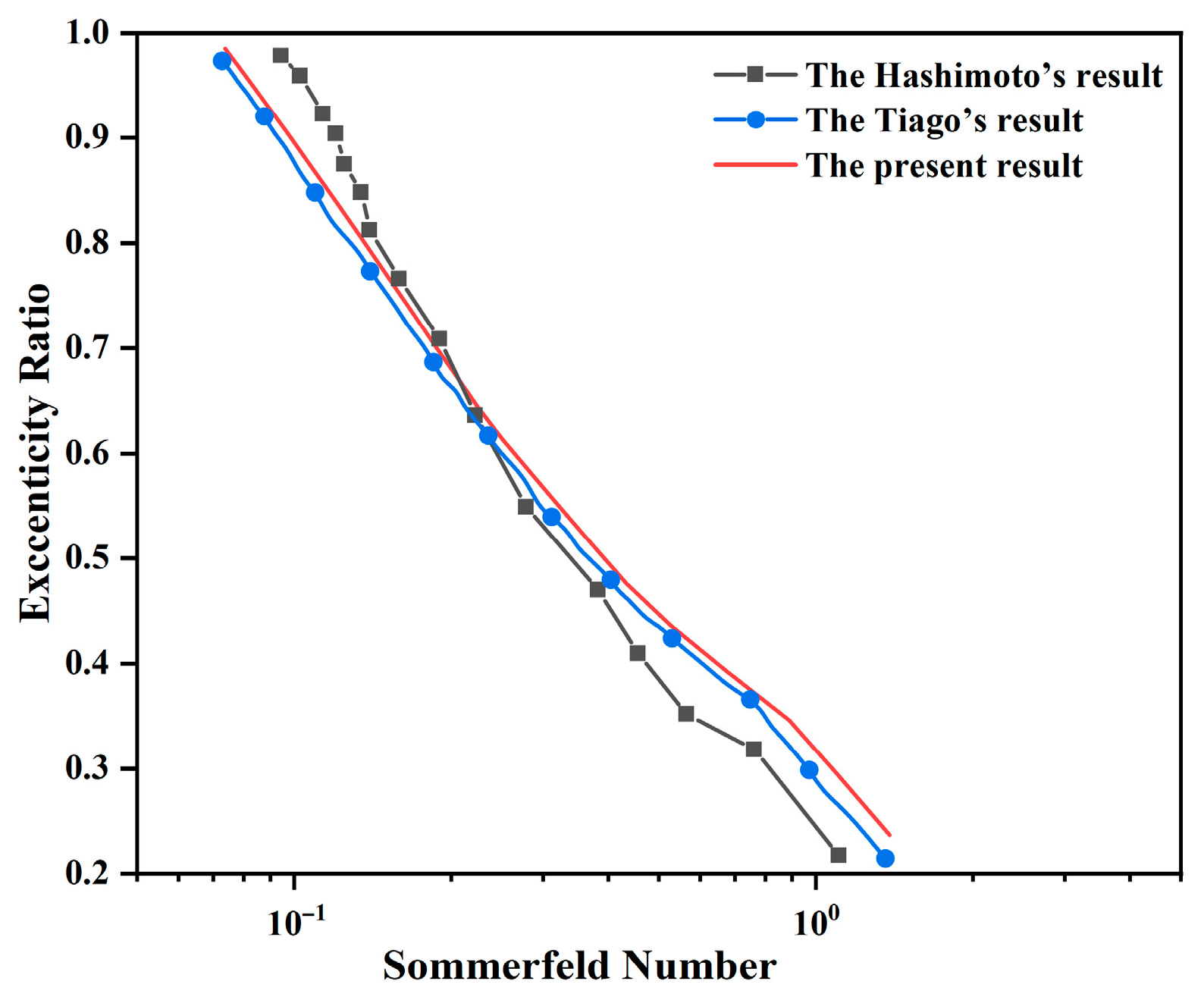
Since no direct experimental data are available for the proposed model in this work, validation was performed by decomposing the model into a wear model and a start-up model for separate verification. For the wear model, comparisons were made with simulation and experimental results on oil-lubricated bearings reported by Tiago et al. [35] and Hashimoto et al. [19]. As shown in Figure 5, the eccentricity ratios of the journal bearing under different Sommerfeld numbers are compared. The results indicate that the numerical predictions from the present model are in close agreement with both the experimental and simulated data from the Refs. [19,35]. The experimental and simulation parameters used in Hashimoto’s study are summarized in Table 1.
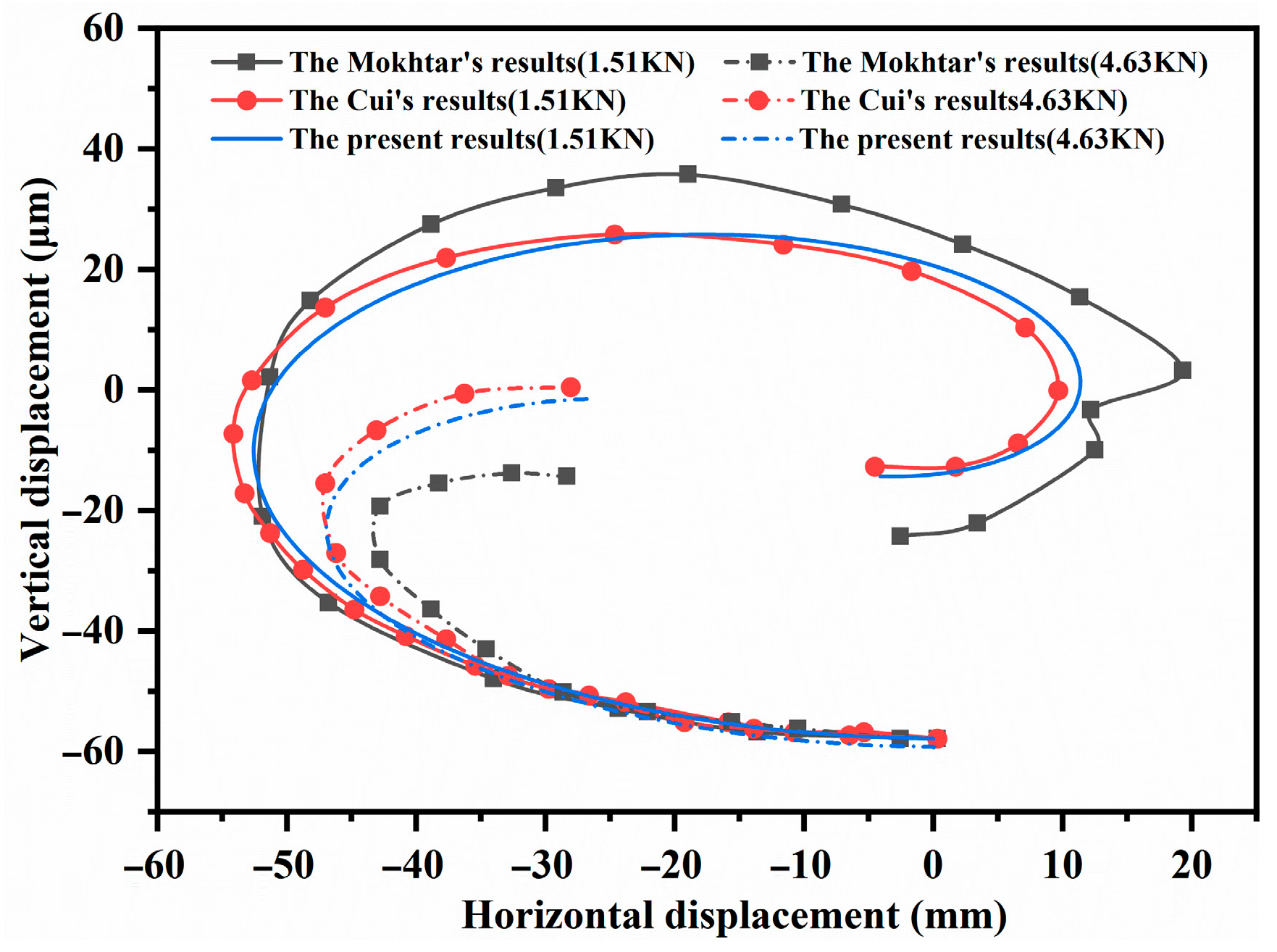
The validity of the bearing start-up model was verified through a comparison of the journal trajectory calculated using the model developed herein with the experimental results of Mokhtar et al. [23] and the simulation results of Cui et al. [26]. It is noteworthy that in their study, both the bearing shell and journal materials were lead–bronze alloy, i.e., treated as rigid bodies. As demonstrated in Figure 6, the simulated journal trajectory closely aligns with the experimental data, thereby validating the efficacy of the proposed bearing start-up model. The parameters employed in the start-up model validation are detailed in Table 2.

4. Results and Discussion

In the following Section 4.1, Section 4.2, Section 4.3 and Section 4.4, the geometric and material parameters, as well as the start-up conditions used in the numerical calculations, are provided in Table 3. Notably, the acceleration during the linear start-up process is set to 4.71 m/s2, which corresponds to the typical capability of a standard motor [23]. The effects of bush surface waviness on the start-up characteristics of WLBs are presented and discussed in the subsequent sections.

4.1. Influence of the Axial Surface Waviness on Tribo-Dynamic Characteristic of WLBs

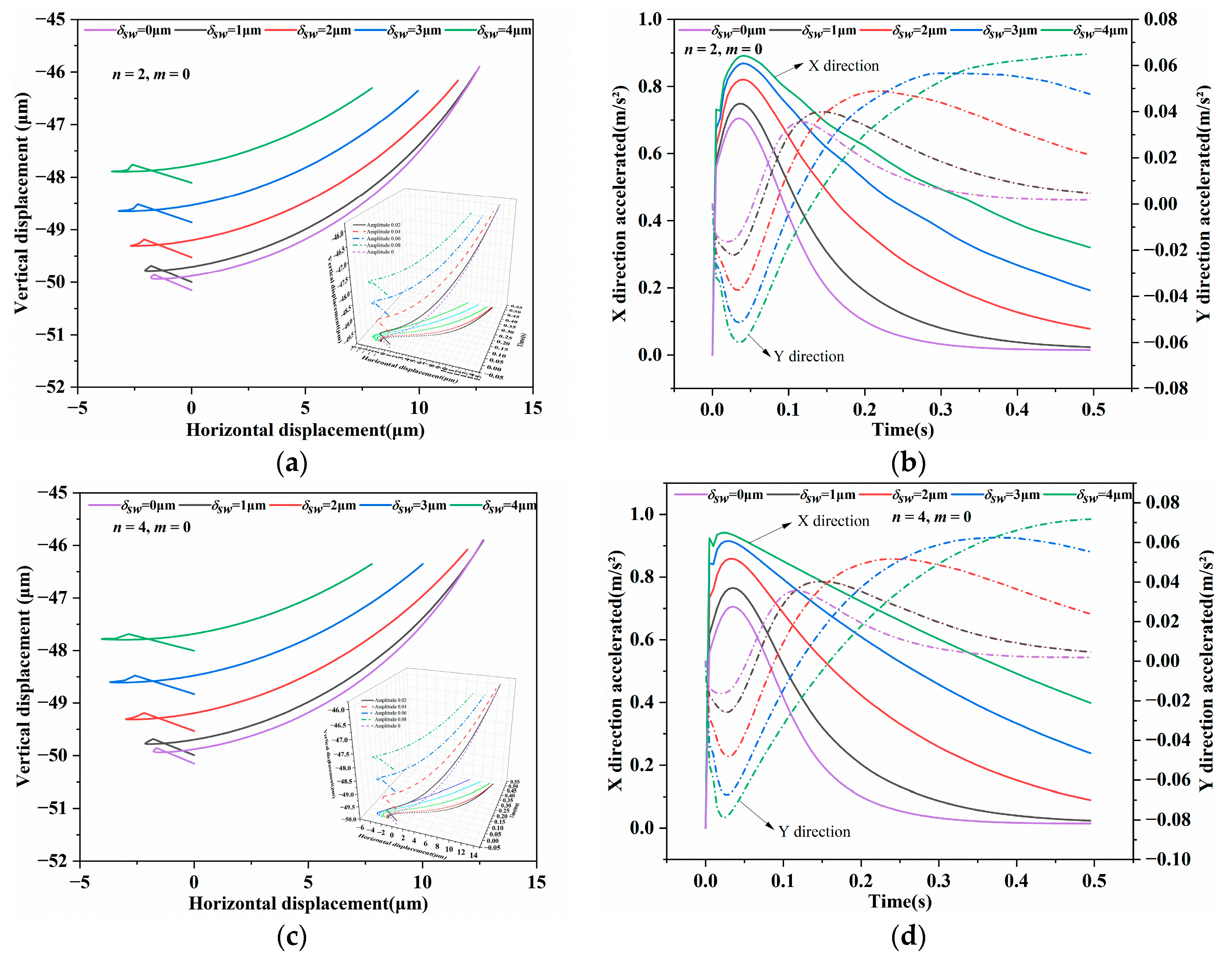
This section examines the influence of axial surface waviness on the start-up characteristics of WLBs, considering waviness amplitudes ranging from 0 to 4 μm and a wear depth of 0 μm. As shown in Figure 7a,c, increasing the amplitude raises the journal position and expands its trajectory range. In addition, the initial dragging effect becomes more noticeable, while the overall extent of the journal trajectory is reduced. The acceleration curves in the X and Y directions (Figure 7b,d) show that, under a start-up time of 0.5 s and a final speed of 104.67 rad/s, acceleration approaches zero when the waviness amplitude is below 1 μm. This indicates that the WLB has completed start-up and the journal is in stable operating conditions. As the amplitude increases further, however, the journal acceleration remains non-zero at 0.5 s, meaning the journal has not yet reached steady state and the start-up process is incomplete. This also explains why the journal trajectory under larger waviness amplitudes is confined to a smaller range compared to the smooth-surface case.
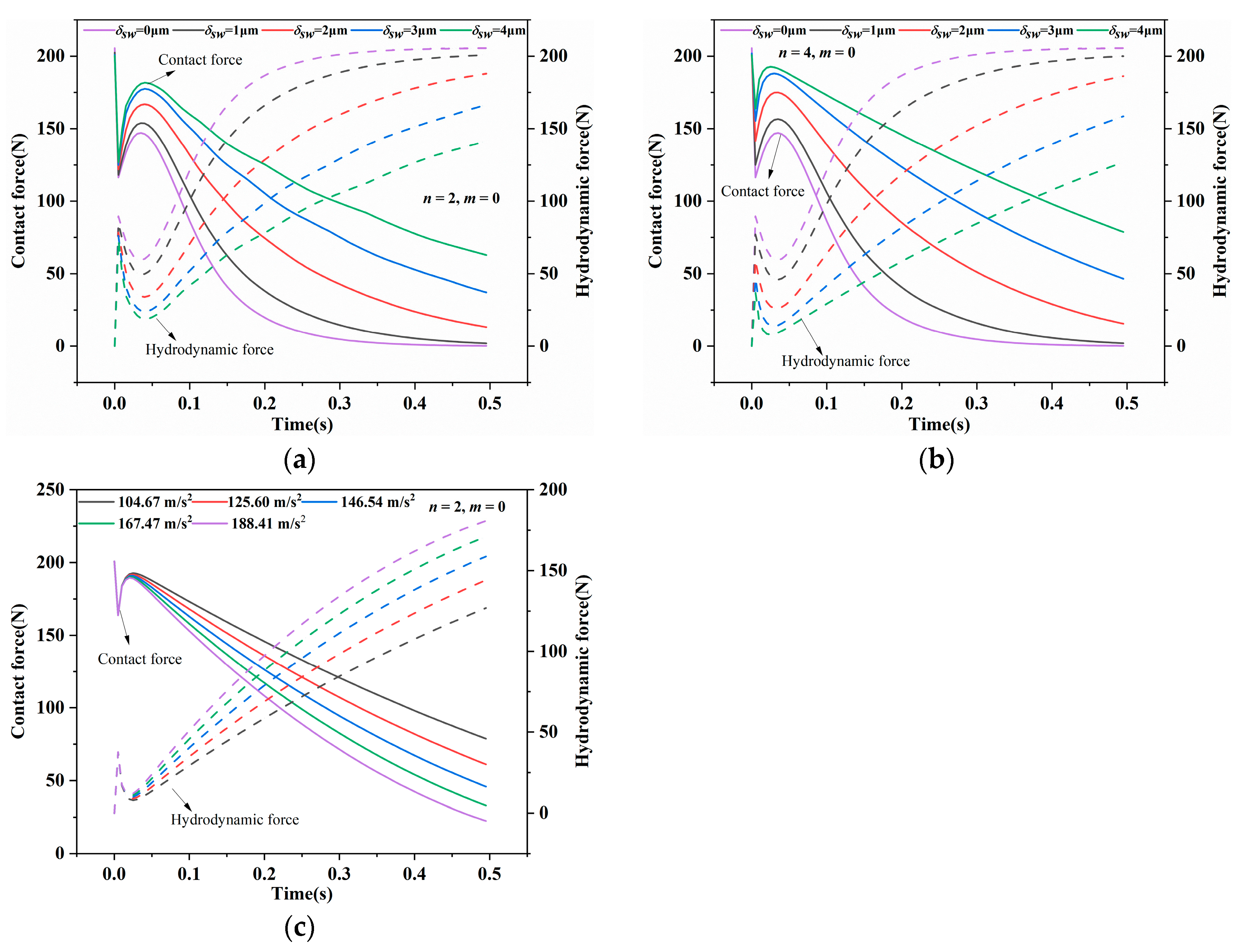
This phenomenon is further corroborated by the transient variations in contact and hydrodynamic forces, shown in Figure 8a,b. Specifically, at t = 0.5 s, the hydrodynamic force is 200.79 N for a waviness amplitude of 1 μm, but decreases to 141.39 N for an amplitude of 4 μm. Furthermore, as seen in Figure 8c for an amplitude of 3 μm, the transient contact force gradually decreases as the rotational speed increases from 104.67 to 188.41 rad/s during the start-up phase. This trend indicates that a larger axial surface waviness amplitude raises the required start-up parameters, meaning a higher rotational speed is needed for the journal to reach equilibrium or complete the start-up process.
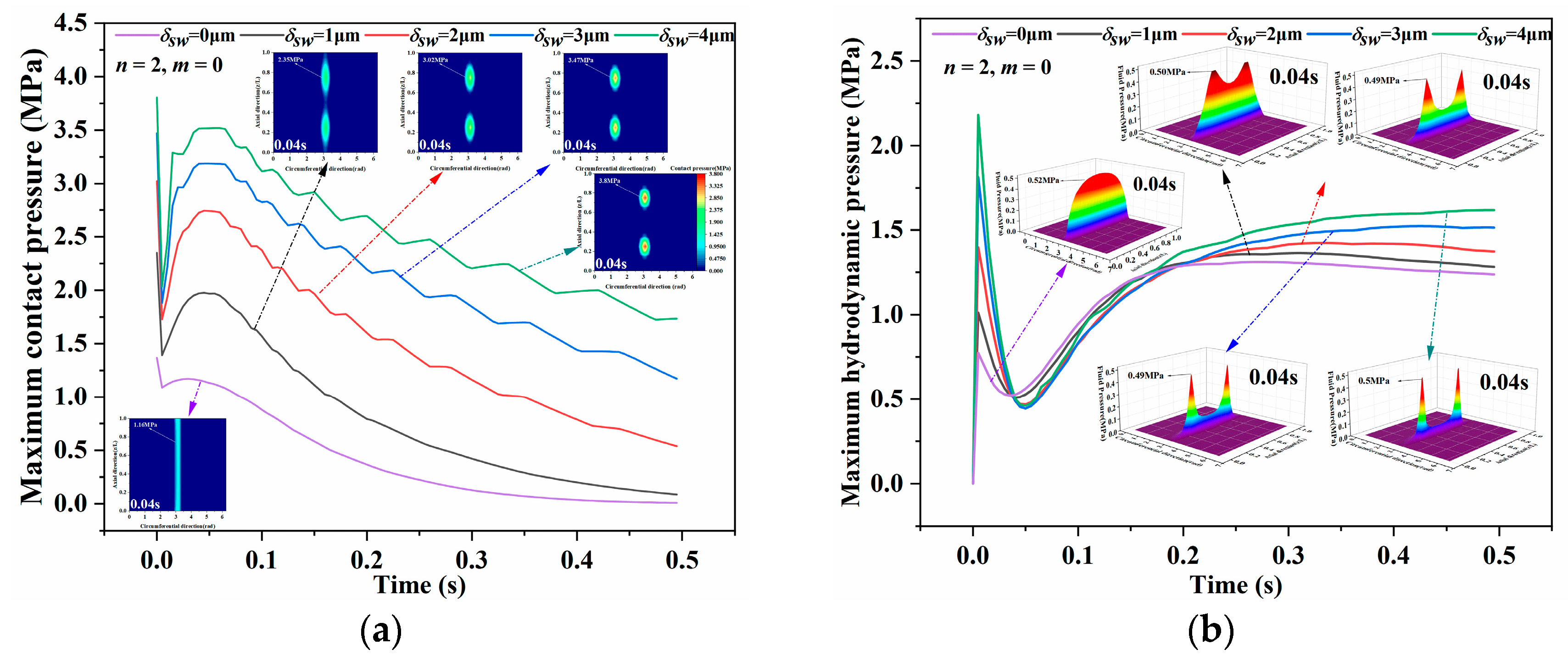
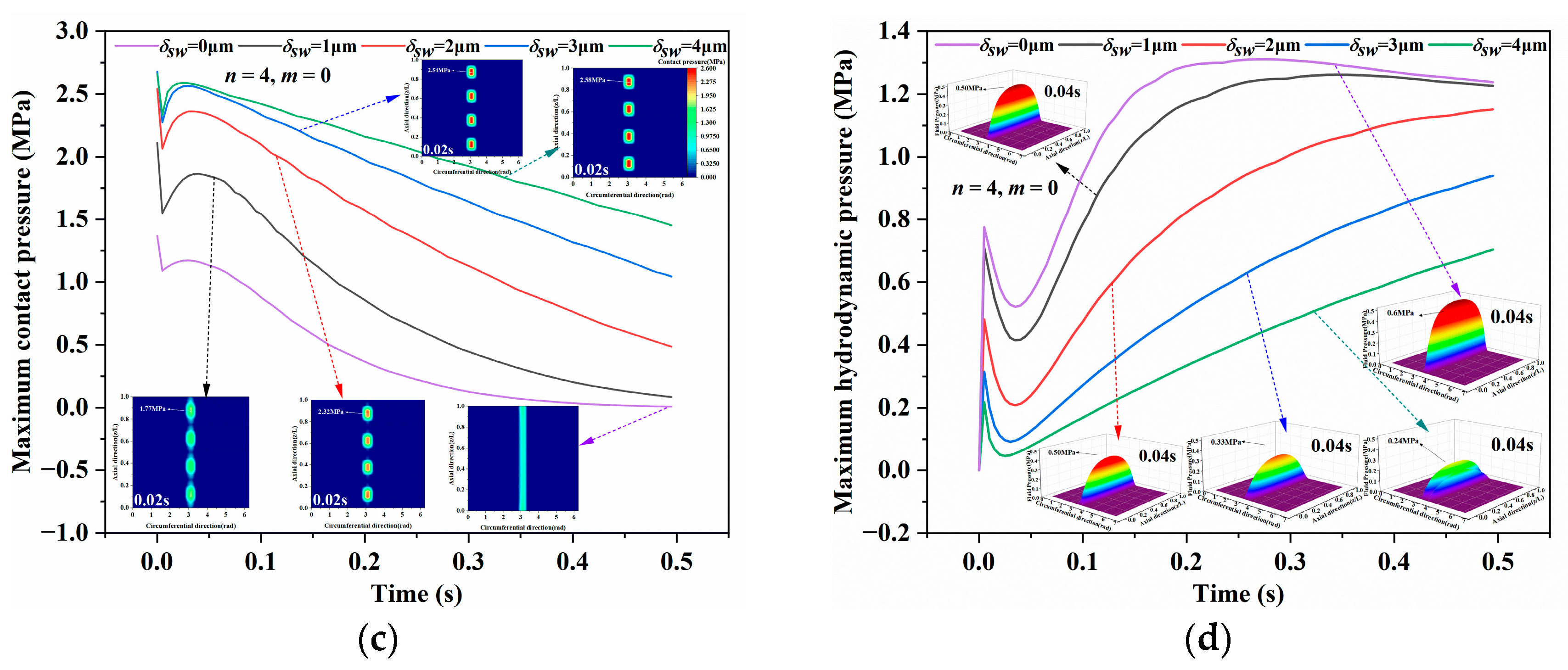
As shown in Figure 9, when the waviness frequency number n = 2, both transient contact pressure and hydrodynamic pressure are relatively high. This is attributed to the presence of only two contact zones on the bush surface contributing to load support, where the wedge effect generates peak hydrodynamic pressure near these localized regions. As n increases to 4, the greater number of contact zones reduces both pressure components—for instance, the maximum contact pressure decreases from 3.52 MPa (n = 2) to 2.56 MPa (n = 4). The magnitude of pressure fluctuations also attenuates with increasing n. Notably, results from Figure 7, Figure 8 and Figure 9 indicate that raising the axial waviness frequency number has only a limited effect on the overall start-up behavior of the WLB, primarily influencing transient peak values of hydrodynamic and contact pressure. It can therefore be inferred that as n increases further, the influence of axial surface waviness gradually diminishes, and the resulting hydrodynamic pressure approaches that of a smooth bush surface.
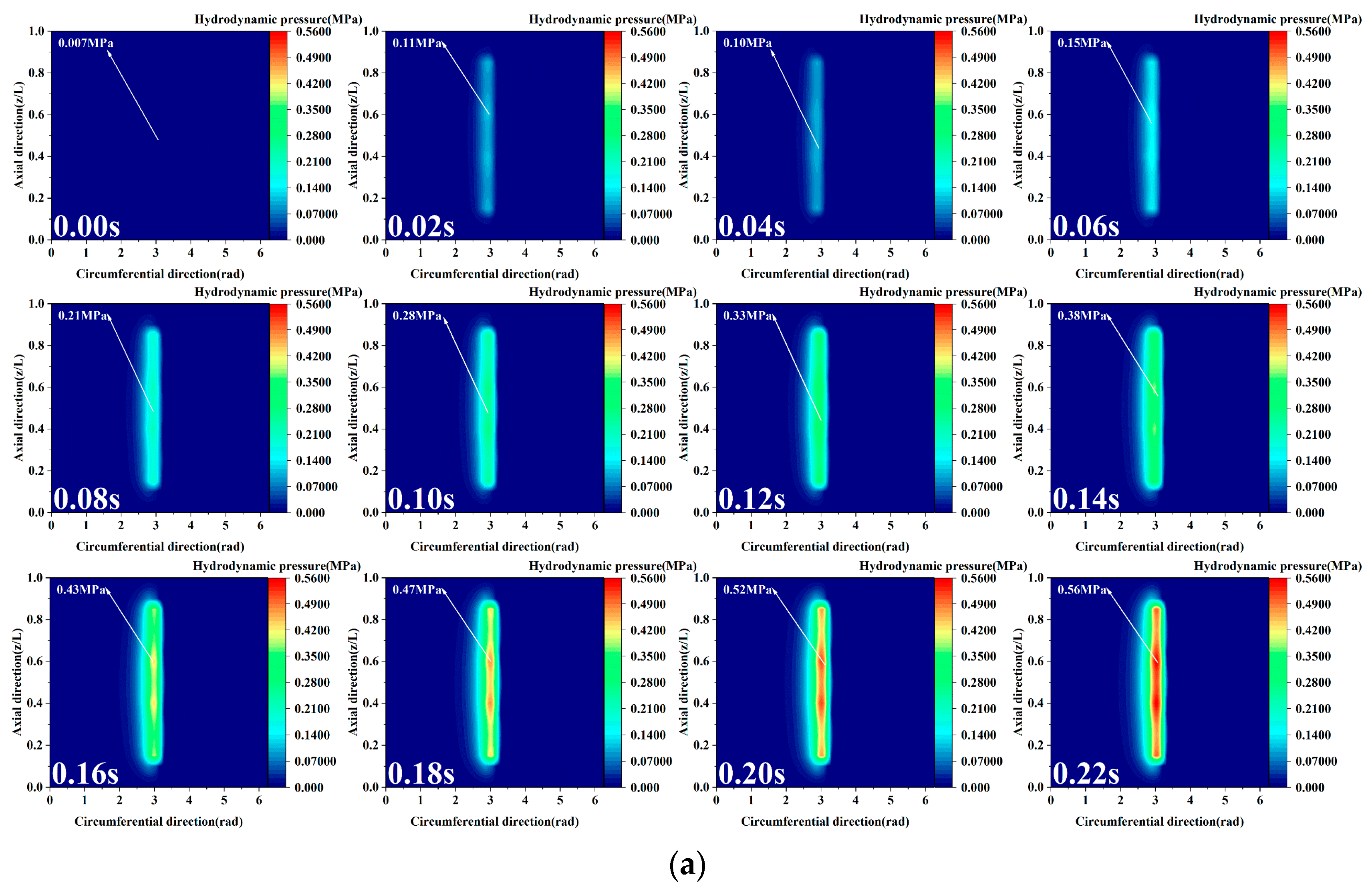
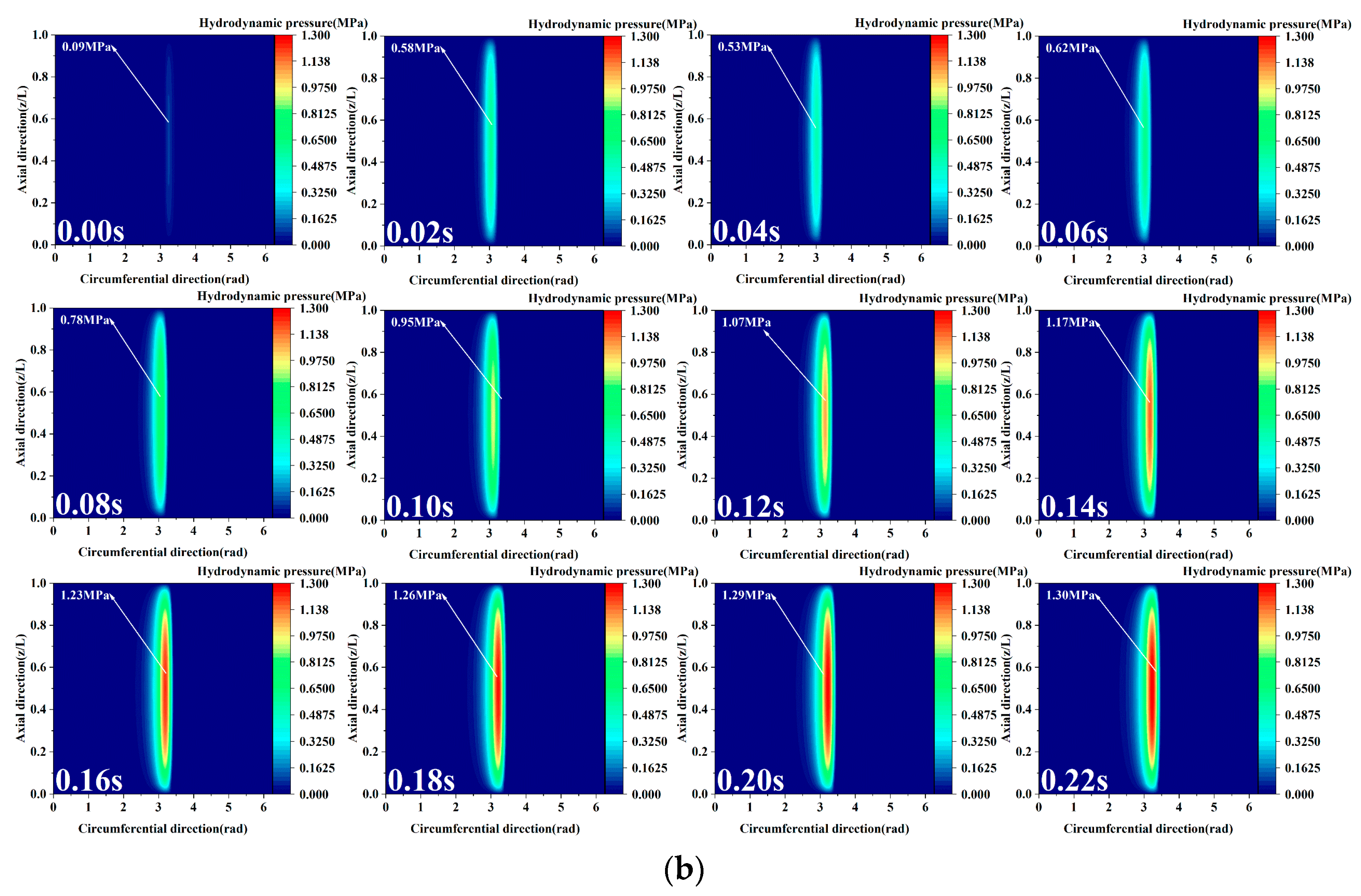
To further analyze the tribo-dynamic behavior during the start-up of WLBs, Figure 10 shows the hydrodynamic pressure distributions at different times for n = 4 and a waviness amplitude of 3 μm. As seen in Figure 10a, hydrodynamic pressure gradually rises while contact pressure decreases during the start-up process. Notably, the location of the peak hydrodynamic pressure remains nearly unchanged over time, consistently occurring near the leading edge of the contact zones. This behavior differs markedly from the case without bush surface waviness, shown in Figure 10b. For example, at t = 0.22 s, the pressure peak in Figure 10a is located at θ = 3.02 rad, whereas in Figure 10b it appears at θ = 3.22 rad. This distinct concentration of pressure may help explain why, in practical engineering applications, wear in WLBs with axial waviness often initiates at the bottom region of the bush [18].

4.2. Influence of the Circumferential Surface Waviness on Tribo-Dynamic Characteristic of WLBs

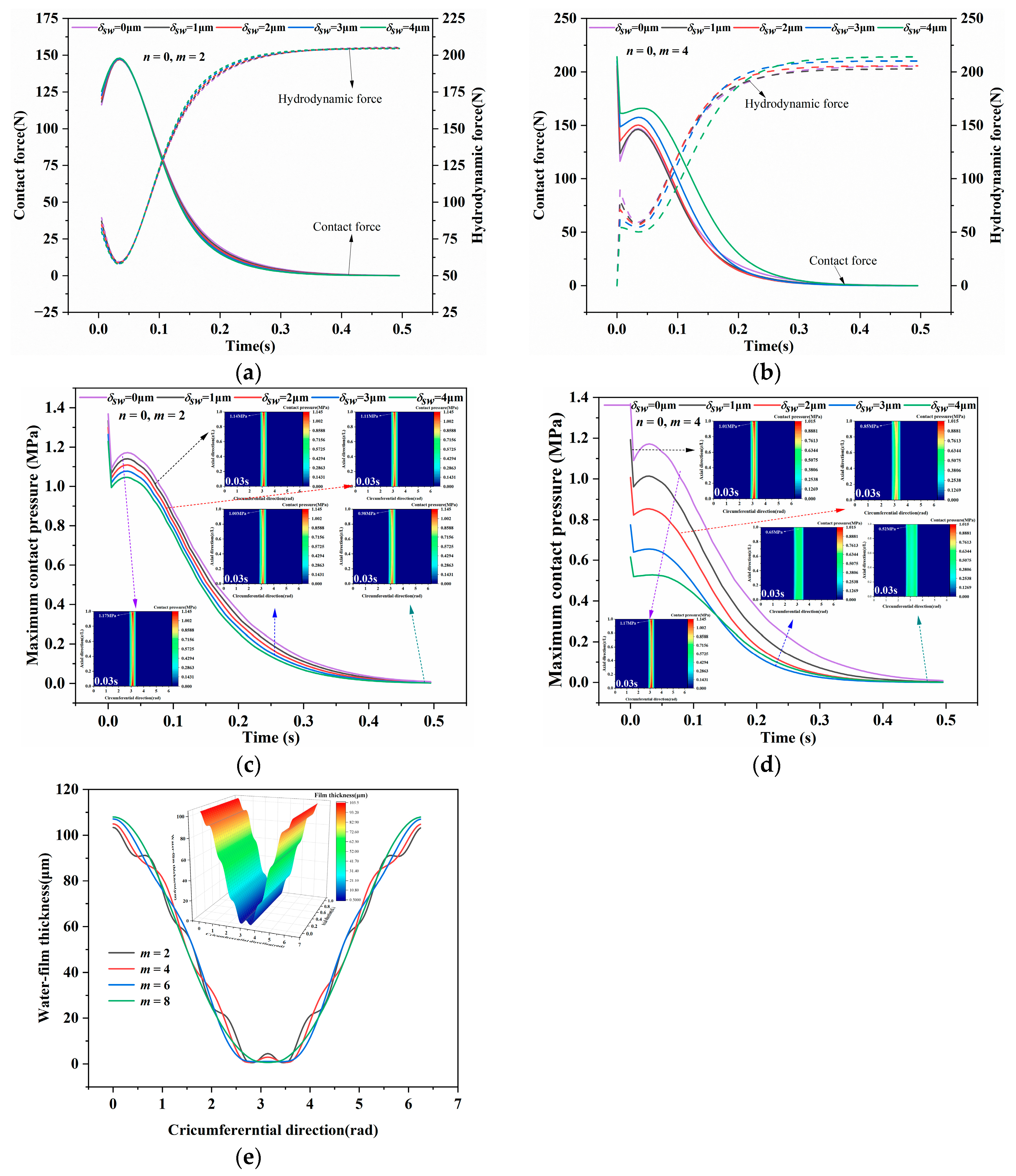
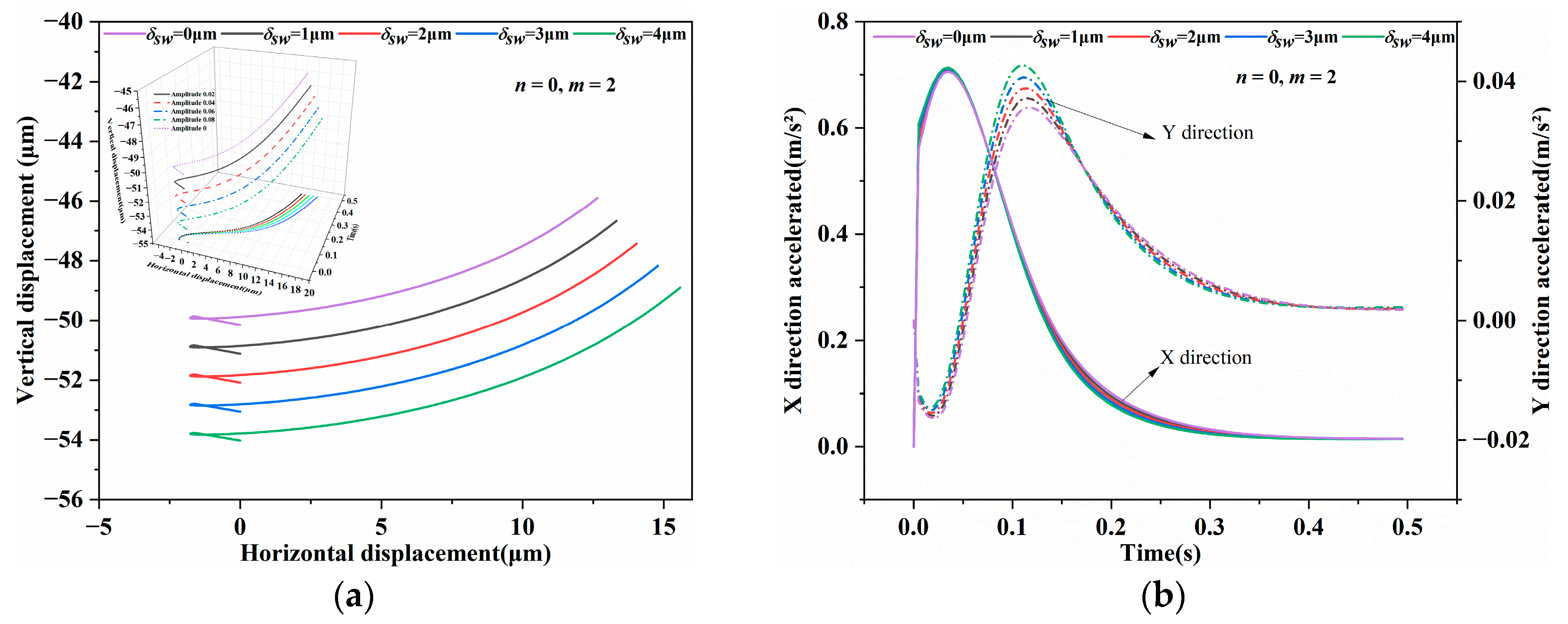
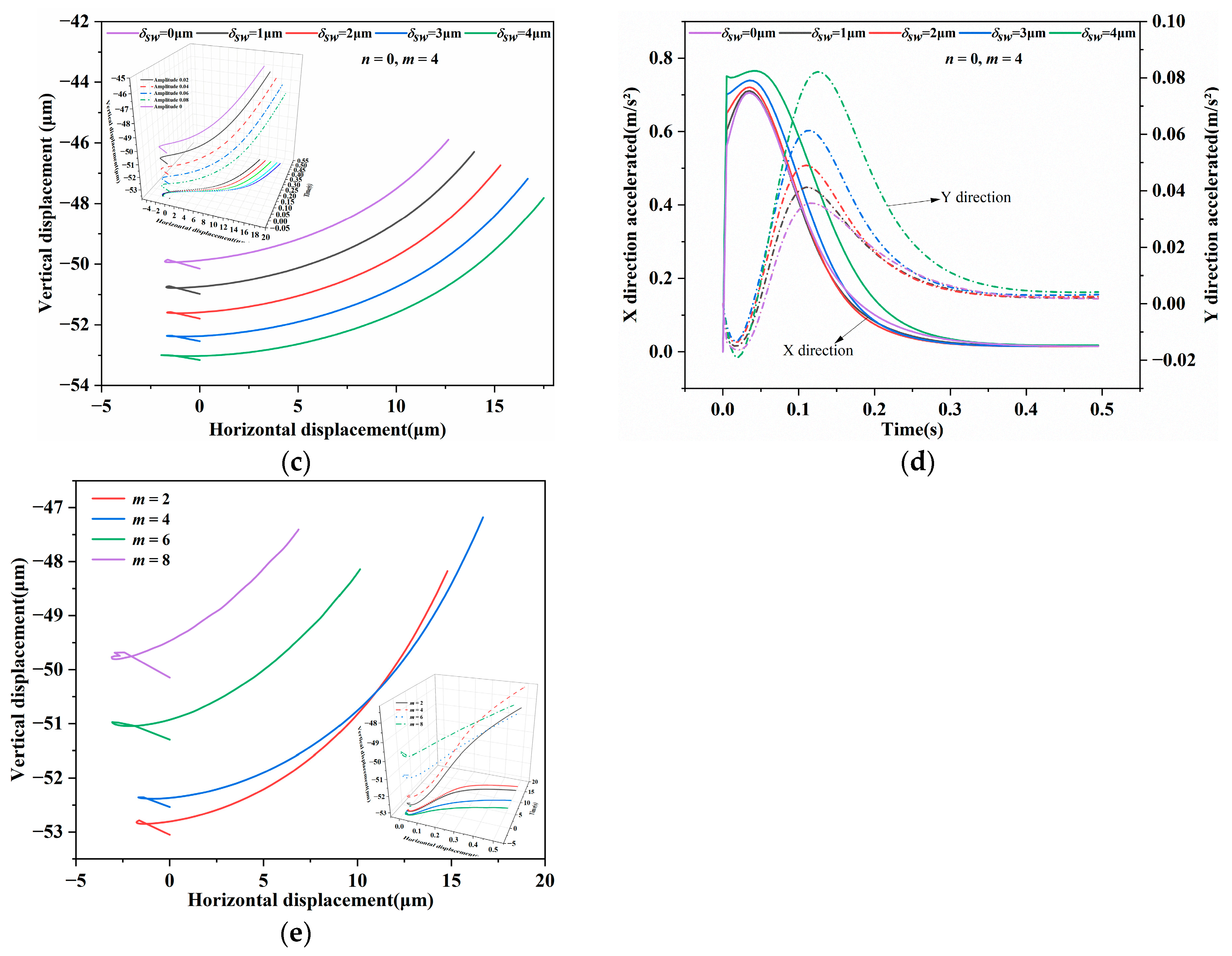
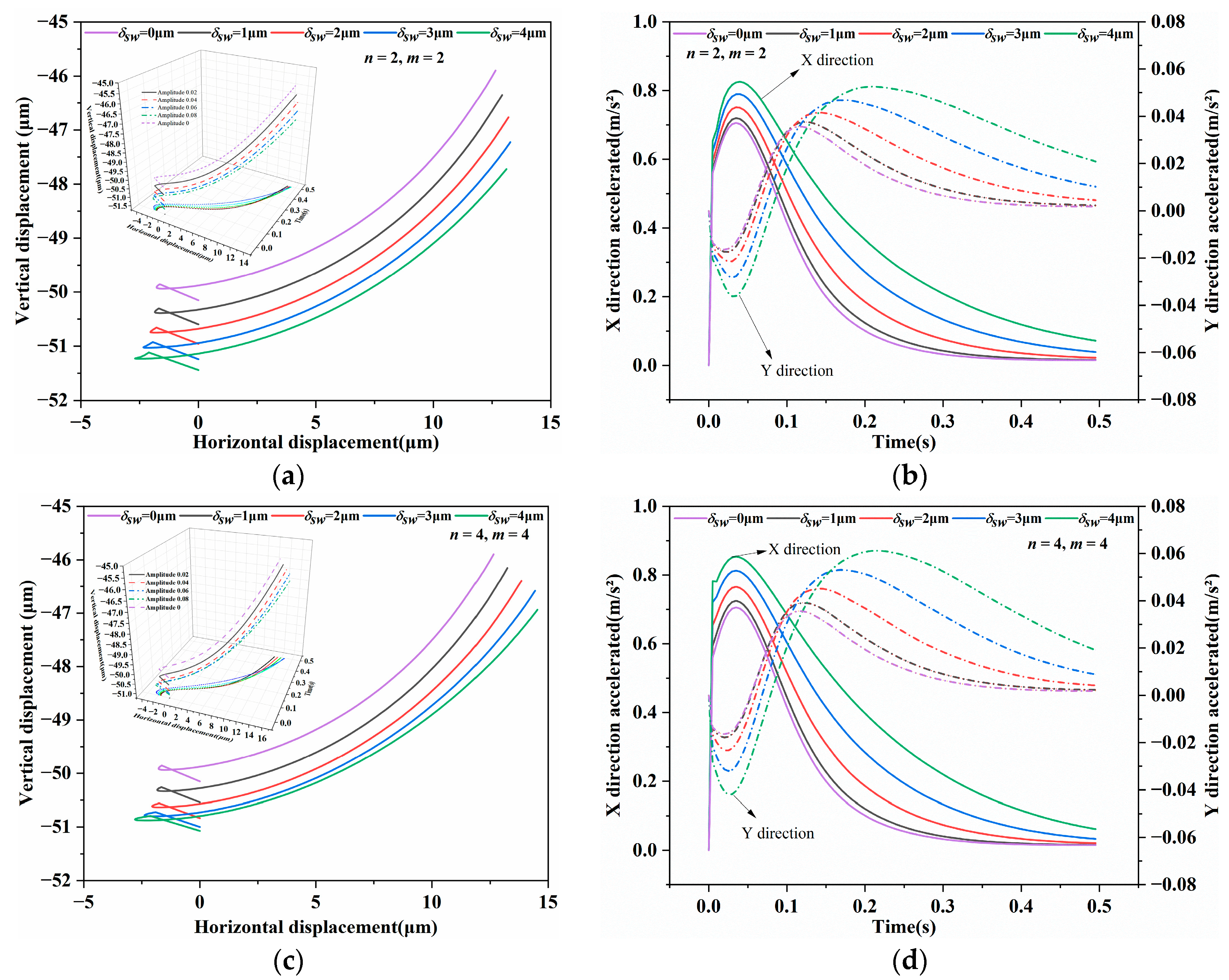
This section investigates the influence of circumferential surface waviness on the start-up characteristics of WLBs, considering waviness amplitudes of 0–4 μm and a wear depth of 0 μm. Figure 11 presents the dynamic behavior of the journal rotor during the start-up process under different surface waviness amplitudes. As shown in Figure 11a,c, increasing the amplitude shifts the journal trajectory downward, while the extent of the initial dragging region remains largely unchanged. However, as the circumferential waviness frequency number m increases, the journal trajectory shifts upward (Figure 11e). The acceleration curves in the X and Y directions (Figure 11b,d) show that the overall trend remains consistent with increasing amplitude; only local fluctuations appear as m increases. Notably, acceleration values still approach zero before the specified start-up time of 0.5 s, indicating that, unlike axial waviness, circumferential surface waviness does not elevate the bearing’s start-up parameter requirements.
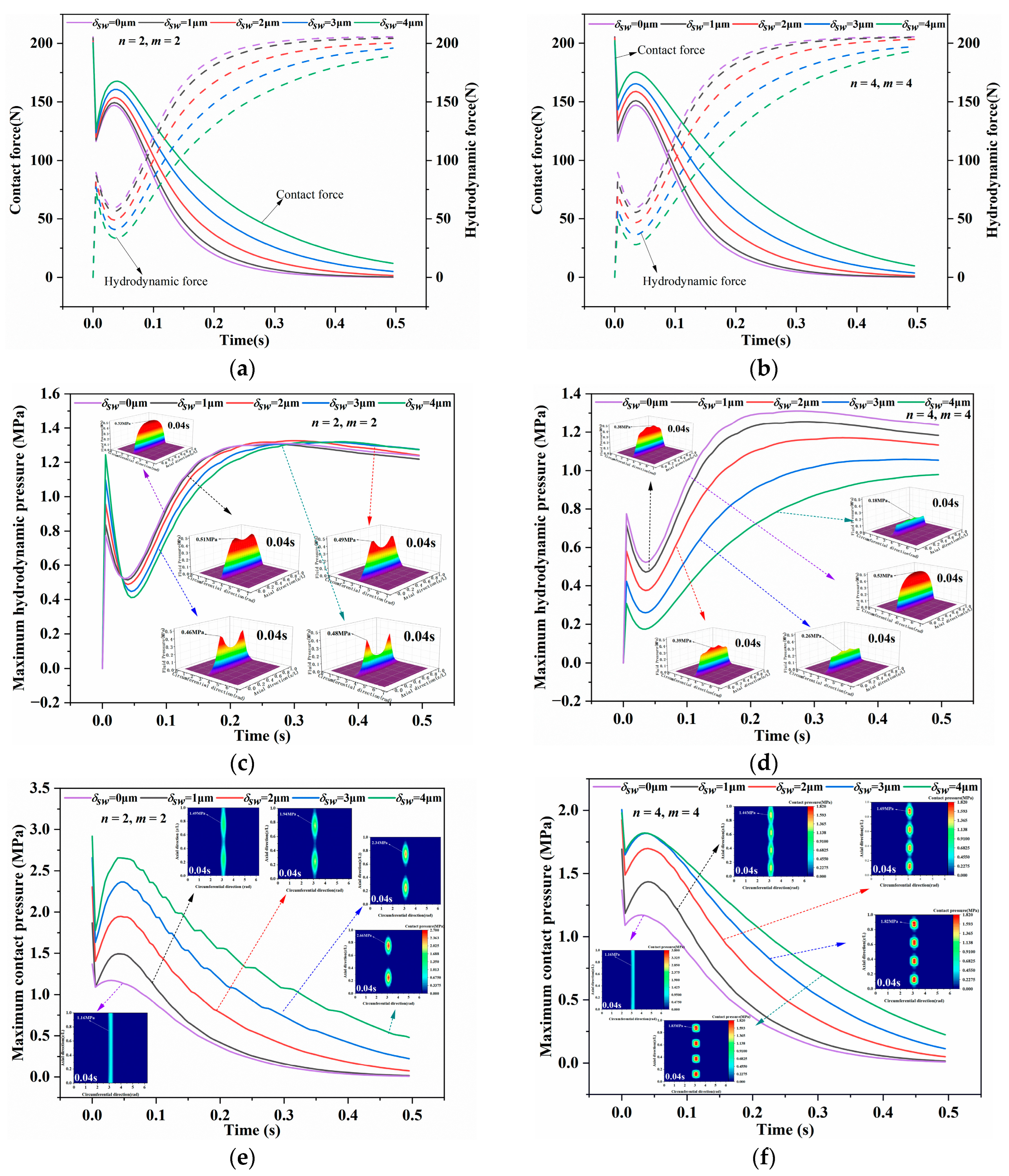
Figure 12 illustrates the influence of circumferential waviness amplitude on the tribological characteristics of the WLB during start-up process. As shown in Figure 12a, increasing the amplitude has a negligible effect on the overall contact force and hydrodynamic force. Figure 12c,d show that the transient maximum contact pressure gradually decreases throughout start-up and stabilizes between 0.45 s and 0.5 s, indicating successful transition to steady-state operation. However, this influence becomes increasingly pronounced as the frequency number m increases (Figure 12b,d). Higher m values produce more complex waviness profiles on the bush surface, as evident from the lubricant film thickness distributions in Figure 12e, leading to more pronounced fluctuations in both contact and hydrodynamic forces during start-up. Consequently, the effect of circumferential surface waviness on WLB start-up characteristics is strongly dependent on the frequency number m, with larger m values exerting more significant influence on lubrication behavior and dynamic response.
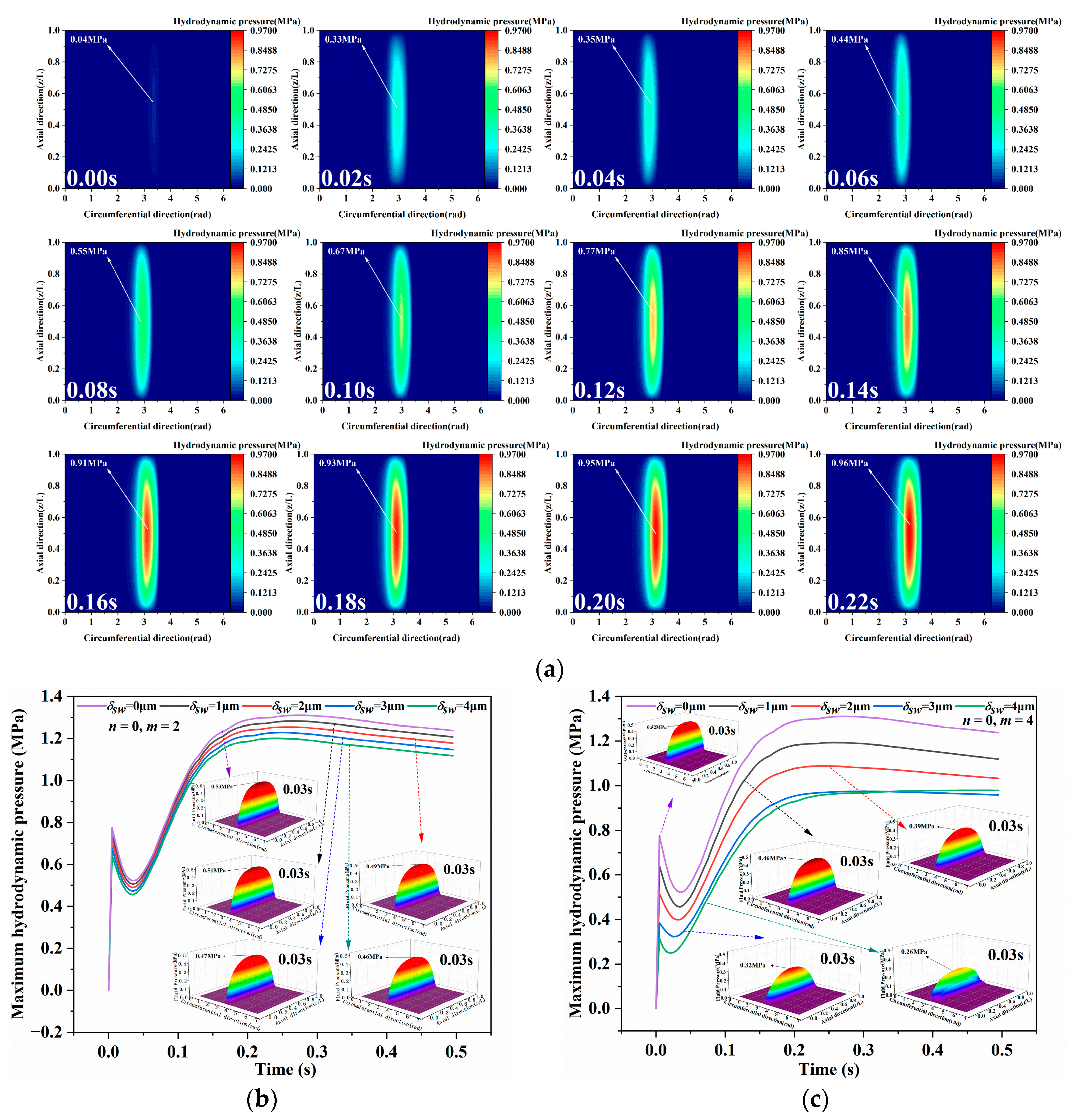
Compared with Figure 10b, Figure 13 shows that circumferential surface waviness has a limited influence on the transient hydrodynamic pressure distribution during the start-up process. Unlike axial surface waviness, the location of the peak hydrodynamic pressure shifts as start-up progresses. As seen in Figure 13b,c, when the frequency number m = 4, circumferential surface waviness reduces the transient peak hydrodynamic pressure. A larger waviness amplitude further decreases the maximum hydrodynamic pressure, with reductions of up to 0.35 MPa. This occurs because at m = 4, the relatively wide bottom region of the bush (Figure 12e) increases the contact area between the bush and journal, thereby expanding the zone over which hydrodynamic pressure can develop and lowering its peak value. In contrast, for other values of m, the bottom region of the bush becomes narrower (Figure 12e), which would alter the contact and pressure distribution accordingly.

4.3. Influence of Composite Surface Waviness on Tribo-Dynamic Characteristic of WLBs

This section examines the combined influence of composite surface waviness on the start-up characteristics of WLBs, considering waviness amplitudes ranging from 0 to 4 μm and a wear depth of 0 μm. As shown in Figure 14a,c, increasing the composite waviness amplitude shifts the journal trajectory downward and enlarges the initial dragging region, while the overall extent of the journal trajectory remains largely unchanged. The acceleration curves in the X and Y directions (Figure 14b,d) exhibit progressively larger fluctuations as the waviness amplitude increases. Furthermore, similar to the case with axial waviness alone, increasing the amplitude slightly elevates the start-up parameter requirements for WLBs. However, a comparison of acceleration values at t = 0.5 s under identical start-up conditions in Figure 14 and Figure 7 reveals significantly lower values in Figure 14. This indicates that circumferential surface waviness can partially offset the increased start-up demands induced by axial surface waviness, enabling the WLB to achieve successful start-up at a lower rotational speed than would be required with axial waviness alone.
As shown in Figure 15a,b, when both circumferential and axial surface waviness are present, the frequency numbers n and m exert minimal influence on the contact and hydrodynamic forces during the start-up process. In contrast, increasing the waviness amplitude significantly affects the rate of hydrodynamic pressure generation. Specifically, Figure 15c,d reveal that the growth rate of the maximum hydrodynamic pressure progressively decreases as the waviness amplitude increases. This phenomenon is likely attributable to the presence of local recesses within the undulating waviness profile. When such a recess aligns with the nominal contact interface between the journal and bush, it increases the local clearance, thereby weakening the wedge effect and reducing the resulting hydrodynamic pressure. Consequently, the rate at which the maximum contact pressure decreases during WLB start-up is also slowed with increasing amplitude. As illustrated in Figure 15e,f, this effect becomes increasingly pronounced at larger amplitudes.

4.4. Influence of Different Wear Depths on Tribo-Dynamic Characteristic of WLBs with Bush Surface Waviness

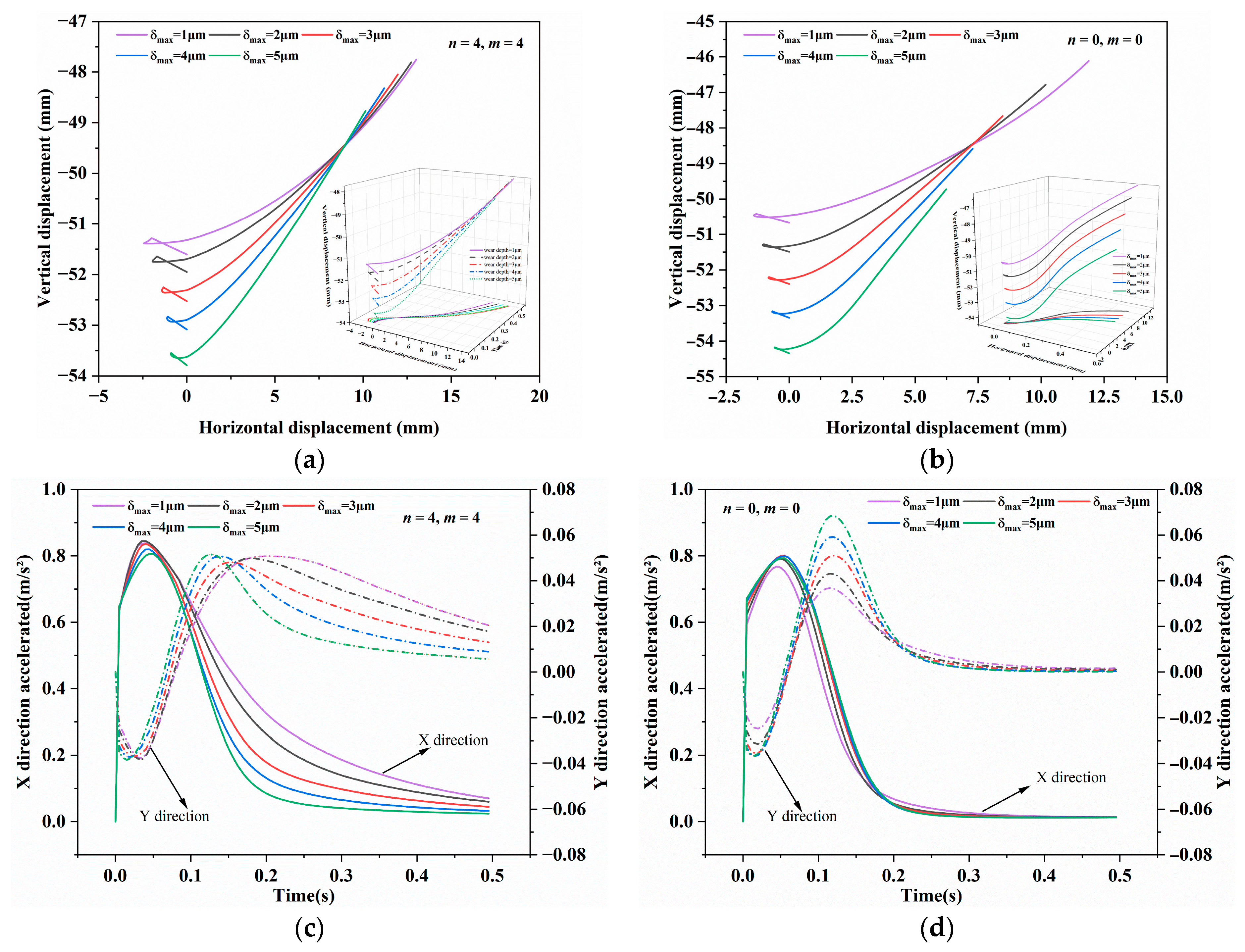
This subsection examines the tribodynamic behavior of water-lubricated bearings with bush surface waviness under varying wear depths during the start-up process. The circumferential and axial waviness frequency numbers are set to n = 4 and m = 4, with a constant surface waviness amplitude of 3 μm. As shown in Figure 16a,b, the presence of surface waviness intensifies the dragging effect during start-up, leading to an expansion of the journal trajectory range. Moreover, this expansion becomes increasingly pronounced as wear depth increases. The acceleration profiles in Figure 16c indicate that at shallow wear depths (e.g., 1–2 μm), bearings with surface waviness exhibit gradual acceleration changes and require a longer time to reach steady-state operation. However, as wear depth increases, the accelerations in both the X and Y directions approach zero more rapidly, suggesting that increased wear depth mitigates the elevated start-up demands induced by surface waviness (as previously illustrated in Figure 7 and Figure 14). In other words, the bearing achieves start-up more quickly. A comparison between Figure 16b,c further reveals that at greater wear depths, surface waviness reduces the peak acceleration in the Y direction during start-up. For instance, at a wear depth of 5 μm, the peak acceleration increases from 0.052 m/s2 to 0.069 m/s2.
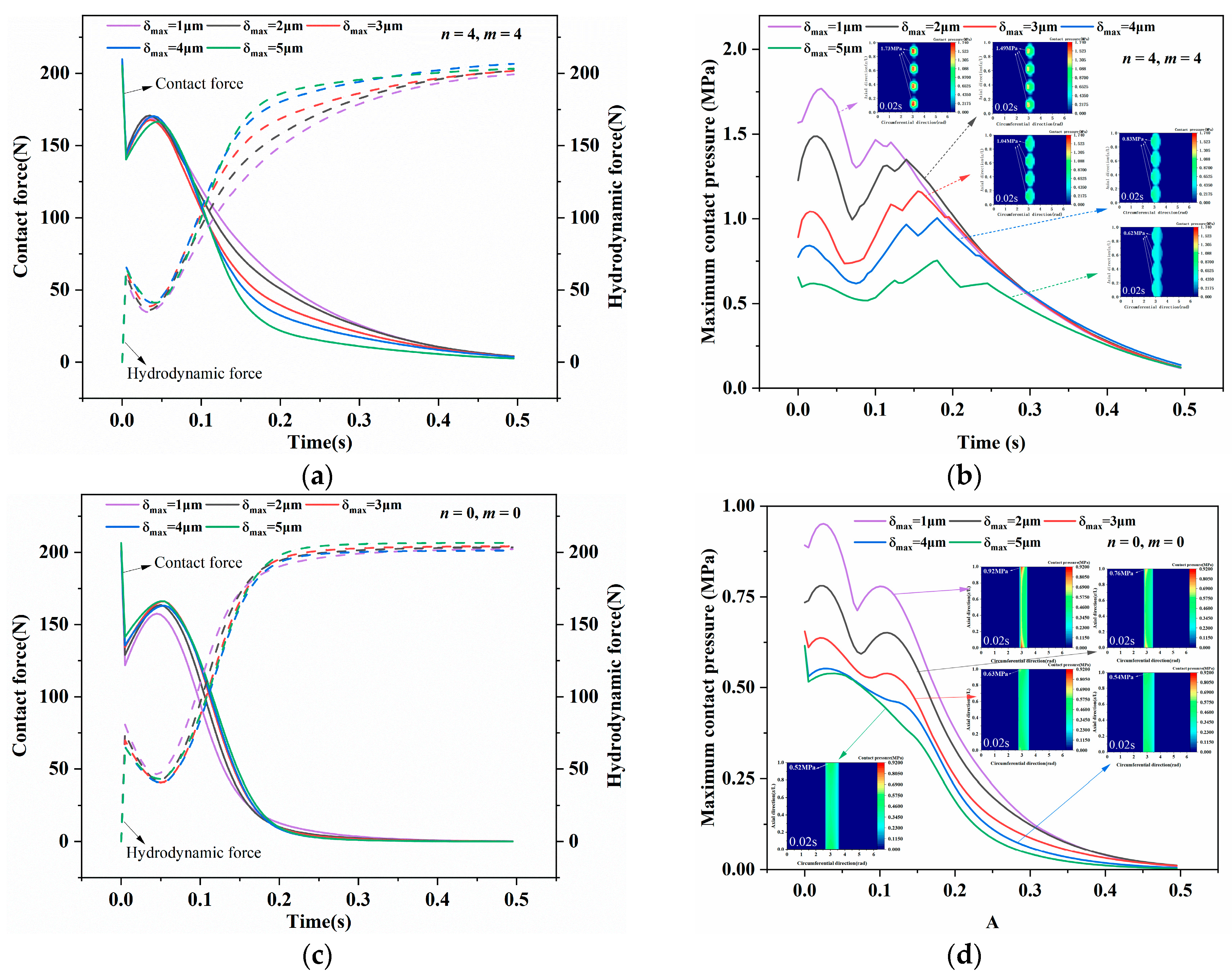
The variations in contact and hydrodynamic forces during the start-up process, as presented in Figure 17a,c, further demonstrate that increasing wear depth enables bearings to attain a higher hydrodynamic force more rapidly, thereby accelerating start-up completion. This phenomenon can be attributed to the mitigation of the reduction in contact area between the journal and bush caused by bush surface waviness as wear depth increases. As clearly observed in Figure 17b, with progressive wear depth, the contact interface during start-up evolves from discrete contact peaks to broader rectangular regions. This transition occurs at wear depths of approximately 4 to 5 μm, a range intrinsically dependent on the surface waviness amplitude. Consequently, the expansion of the contact area enlarges the hydrodynamic pressure generation zone, thereby enhancing the hydrodynamic effect.
As documented in Refs. [22,31], for bearings without bush surface waviness, a specific wear depth exists that optimizes lubrication performance during both start-up and steady-state operation. However, the foregoing analysis demonstrates that the presence of bush surface waviness, by diminishing both the hydrodynamic effect and the extent of the hydrodynamic pressure region, subsequently modifies this optimal wear depth. Furthermore, a comparative analysis of Figure 17b,d reveals that as wear depth increases, the extent of the contact area on the bush during start-up increasingly approximates that observed in bearings without bush surface waviness. In contrast, when the bush is devoid of surface waviness, increasing wear depth does not significantly reduce start-up time.

5. Conclusions

This study investigated water-lubricated bearings by considering the combined presence of axial and circumferential surface waviness and wear on the bush. A start-up tribo-dynamic model was established to examine the influence of different bush waviness profiles on the start-up behavior of WLBs. Prior to parametric investigation, the numerical model was validated by comparing its computational results with existing experimental and simulation data from the literature. The key findings are summarized as follows:
(1)
Axial surface waviness degrades WLB start-up performance. Larger amplitudes delay start-up completion and increase the required rotational speed. Although higher-frequency numbers (n) reduce peak pressures, they do not alter the overall start-up behavior. Therefore, during bearing manufacturing, the amplitude of axial surface waviness should be tightly controlled (below 1 μm in this study); if larger amplitudes are unavoidable, the start-up speed should be increased by 15–20%.
(2)
Circumferential surface waviness provides compensatory benefits. It reduces peak hydrodynamic pressure by expanding the contact area and, during the start-up phase, counteracts the start-up demands induced by axial waviness, enabling successful start-up at lower rotational speeds. However, higher-frequency numbers (m) values increase pressure fluctuations. Therefore, circumferential waviness can be intentionally introduced during manufacturing to mitigate axial-induced degradation, but the frequency number must be monitored to control fluctuations.
(3)
Wear depth fundamentally modifies the effects of surface waviness. At wear depths of 4–5 μm, comparable to the surface waviness amplitude, discrete contact peaks transform into broader regions, expanding the hydrodynamic pressure zone and enhancing performance. This alters the optimal wear depth previously established for smooth bearings. Consequently, waviness effects should be considered when predicting optimal wear depths for bearings.
(4)
A limitation of the present model is that the elastic modulus and strength of the WLB bush are lower than those of the journal (typically treated as a rigid body). Consequently, bush surface waviness is more susceptible to wear, whereas journal surface waviness is more durable, making its influence more persistent. Additionally, the current model neglects thermal effects during start-up. Therefore, future research will comprehensively investigate the coupled effects of both journal and bush surface waviness on the tribo-dynamic behavior of WLBs during start-up.

Author Contributions

Conceptualization, J.C., Z.G. and R.Z.; methodology, J.C.; software, R.Z.; validation, J.C., Z.L. (Zhongjie Lu) and R.Z.; formal analysis, Z.L. (Zaixin Liu) and H.L.; investigation, Z.L. (Zaixin Liu), H.L. and W.Y.; resources, H.L. and W.Y.; writing—original draft preparation, Z.L. (Zhongjie Lu), H.L. and W.Y.; writing—review and editing, J.C. and R.Z.; supervision, J.C. and R.Z.; project administration, J.C. and Z.G.; funding acquisition, J.C. and Z.G. All authors have read and agreed to the published version of the manuscript.

Funding

This research was funded by National Natural Science Foundation of China, grant number 52405254; Sichuan Science and Technology Program, grant number 2024NSFSC0902; Xihua University Talent Introduction Program, grant number Z241019.

Data Availability Statement

The data that support the findings of this study are available from the corresponding author upon reasonable request.

Conflicts of Interest

The authors declare no conflicts of interest.

Nomenclature

The following nomenclature are used in this manuscript:
CRadius clearance, mm
D, βDensity and radius of asperity
EBBush elastic modulus, GPa
EJJournal elastic modulus, GPa
E*Composite elastic modulus, GPa
Fh, Fc, FfHydrodynamic, contact and friction forces, N
hWater film thickness, μm
LBearing length, mm
mJMass of the journal, kg
m, nWaviness frequencies
ph, pcHydrodynamic and contact pressure, MPa
RBRadius of the bush, mm
tsStart-up time, s
WStatic load, N
x, yX, Y direction
θ, z, rCircumference, axial, radius direction
θB, θEStarting and ending angles of the wear zone, rad
ωRotational speed of the journal rotor, rad/s
ωsOperating speed, rad/s
ηViscosity, Pa·s
σComposite surface roughness, μm
εEccentricity
φAttitude angle, rad
μcBoundary friction coefficient
tTime, s
ϕ θ , ϕ z Flow factor
ϕ s , ϕ c Shear/contact factor
δwaveSurface waviness, μm
δDBush deformation, μm
δwearWear depth, μm
δmaxMaximum wear depth, μm
δswSurface waviness amplitude, μm
vBBush Poisson’s ratio
vJJournal Poisson’s ratio
w, e, n, sWest, east, north and south walls
W, E, N, S, CWest, east, north, south and central control cells

References

  1. Ohdar, S.K.; Behera, S.K. A comprehensive review on advancements in water-lubricated bearings: Surface texture, tribological performance, and thermal effects. Proc. Inst. Mech. Eng. Part J-J. Eng. Tribol. 2025, 239, 955–984. [Google Scholar] [CrossRef]
  2. Liu, Q.L.; Ouyang, W.; Li, R.Q.; Jin, Y.; He, T. Experimental research on lubrication and vibration characteristics of water-lubricated stern bearing for underwater vehicles under extreme working conditions. Wear 2023, 523, 204778. [Google Scholar] [CrossRef]
  3. Xiang, G.; Han, Y.F.; He, T. Transient tribo-dynamic model for journal bearings during start-up. Tribol. Int. 2020, 144, 106123. [Google Scholar] [CrossRef]
  4. Albers, A.; Reichert, S. On the influence of surface roughness on the wear behavior in the running-in phase in mixed-lubricated contacts with the finite element method. Wear 2017, 376–377, 1185–1193. [Google Scholar]
  5. Xiang, G.; Han, Y.F. Study on the tribo-dynamic performances of water-lubricated microgroove bearings during start-up. Tribol. Int. 2020, 151, 106395. [Google Scholar]
  6. Chen, S.A.; Cai, J.L.; Xiang, G.; Zhang, J.F.; Liu, Z.X.; Fillon, M. Tribo-Dynamic-Wear coupling analysis for Water-lubricated Bearings with journal surface imperfection under repeated start-stop cycles. Tribol. Int. 2024, 200, 110093. [Google Scholar]
  7. Sun, F.X.; Zhang, X.B.; Wang, X.; Su, Z.Z.; Wang, D. Effects of shaft shape errors on the dynamic characteristics of a rotor-bearing system. J. Tribol. 2019, 141, 101701. [Google Scholar] [CrossRef]
  8. Zhang, P.; Chen, Y.; Liu, X. Relationship Between Shape Errors of Shaft and Radial Error Motions of Hydrostatic Journal Bearings Under Quasi-Static Condition. Precis. Eng. 2018, 51, 564–576. [Google Scholar] [CrossRef]
  9. Rasheed, H.E. Effect of surface waviness on the hydrodynamic lubrication of a plain cylindrical sliding element bearing. Wear 1998, 223, 1–6. [Google Scholar] [CrossRef]
  10. Yang, M.; Lu, H.; Zhang, X.; Duan, M.; Bao, L.; Wang, B.; Wu, W. Influence of Surface Waviness of Journal and Bearing Bush on the Static Characteristics of Hydrodynamic Bearing. Processes 2021, 9, 110. [Google Scholar] [CrossRef]
  11. Hargreaver, D. Surface Waviness Effects on the Load Carrying Capacityof Rectangular Slide Bearings. Wear 1991, 145, 137–151. [Google Scholar] [CrossRef]
  12. Bangotra, A.; Sharma, S.; Taufique, R.; Byotra, D. Performance analysis of journal bearing having surface waviness operating under misaligned condition. Proc. Inst. Mech. Eng. Part J-J. Eng. Tribol. 2023, 237, 1657–1669. [Google Scholar]
  13. Bangotra, A.; Sharma, S. Effect of partial surface waviness on the dynamic and stability performance of journal bearing. Lubr. Sci. 2024, 36, 197–215. [Google Scholar] [CrossRef]
  14. Shi, J.H.; Feng, X.; Cao, H.G. Effect of various surface waviness and rotor tilt motion on the performance of air radial bearing. Nonlinear Dyn. 2025, 113, 17791–17820. [Google Scholar] [CrossRef]
  15. Shi, J.H.; Feng, X.; Cao, H.G. Influence of angular misalignment and triangular surface waviness on the performance of hybrid air journal bearings. Ind. Lubr. Tribol. 2025, 77, 845–858. [Google Scholar] [CrossRef]
  16. Zhuang, H.; Ding, J.; Chen, P.; Chang, Y.; Zeng, X.Y.; Yang, H.; Liu, X.B.; Wei, W. Effect of Surface Waviness on the Performances of an Aerostatic Thrust Bearing with Orifice-Type Restrictor. Int. J. Precis. Eng. Manuf. 2021, 22, 1735–1759. [Google Scholar] [CrossRef]
  17. Zhang, H.G.; Cai, J.L.; Yang, T.Y.; Chen, S.A.; Tang, D.X.; Wang, J.X. Influence of bearing waviness on the lubrication performances of coupled journal-thrust water-lubricated bearings. Surf. Topogr. Metrol. Prop. 2023, 11, 025025. [Google Scholar]
  18. Dufrane, K.; Kannel, J.; McCloskey, T. Wear of steam turbine journal bearings at low operating speeds. J. Lubr. Tech. 1983, 105, 313–317. [Google Scholar]
  19. Hashimoto, H.; Wada, S.; Nojima, K. Performance characteristics of worn journal bearings in both laminar and turbulent regimes. Part I Steady-State Charact. ASLE Trans. 1986, 29, 565–571. [Google Scholar]
  20. Xie, Z.; Liu, H. Experimental research on the interface lubrication regimes transition of water lubricated bearing. Mech. Syst. Signal Process. 2020, 136, 106522. [Google Scholar] [CrossRef]
  21. Nicodemus, E.R.; Sharma, S. Influence of wear on the performance of multirecess hydrostatic journal bearing operating with micropolar lubricant. J. Tribol. 2010, 132, 021703. [Google Scholar] [CrossRef]
  22. Cai, J.L.; Han, Y.F.; Xiang, G.; Wang, J.X.; Wang, L.W. Effects of wear and shaft-shape error defects on the tribo-dynamic response of water-lubricated bearings under propeller disturbance. Phys. Fluids 2022, 34, 077118. [Google Scholar] [CrossRef]
  23. Mokhtar, M.; Howarth, R.; Davies, P. The behavior of plain hydrodynamic journal bearings during starting and stopping. ASLE Trans. 1977, 30, 183–190. [Google Scholar] [CrossRef]
  24. Mokhtar, M.; Howarth, R.; Davies, P. Wear characteristics of plain hydrodynamic journal bearings during repeated starting and stopping. ASLE Trans. 1977, 20, 191–194. [Google Scholar] [CrossRef]
  25. Chun, S.; Khonsari, M.M. Wear simulation for the journal bearings operating under aligned shaft and steady load during start-up and coast-down conditions. Tribol. Int. 2016, 97, 440–466. [Google Scholar] [CrossRef]
  26. Cui, S.; Gu, L.; Wang, L. Numerical analysis on the dynamic contact behavior of hydrodynamic journal bearings during start-up. Tribol. Int. 2018, 121, 260–268. [Google Scholar] [CrossRef]
  27. Greenwood, J.; Tripp, J. The contact of two nominally flat rough surfaces. Proc. Inst. Mech. Eng. 1970, 185, 625–633. [Google Scholar] [CrossRef]
  28. Yang, T.Y.; Xiang, G.; Cai, J.L.; Wang, L.W.; Lin, X.; Wang, J.X.; Zhou, G.W. Five-DOF nonlinear tribo-dynamic analysis for coupled bearings during start-up. Int. J. Mecha. Sci. 2024, 296, 109068. [Google Scholar] [CrossRef]
  29. Chen, S.A.; Cai, J.L.; Zhang, J.F.; Liu, Z.X. Thermal Tribo-Dynamic Behaviors of Water-Lubricated Bearings during Start-Up with Journal Shape Error. Lubricants 2024, 12, 106. [Google Scholar] [CrossRef]
  30. Li, H.; Zhu, C.C.; Tan, J.J.; Fei, W.J.; Sun, Z.D.; Ye, W. Transient mixed elastohydrodynamic performance of journal bearings in wind turbine gearbox during start-up considering multi-component elastic deformations. Mech. Syst. Sig. Process. 2025, 236, 112975. [Google Scholar] [CrossRef]
  31. Zou, X.M.; Shi, S.J.; Hu, F. A study of the tribo-dynamic behavior of worn water-lubricated bearings during the start-up process. Phys. Scr. 2025, 100, 055205. [Google Scholar]
  32. Patir, N.; Cheng, H.S. An average flow model for determining effects of three- dimensional roughness on partial hydrodynamic lubrication. J. Tribol. 1978, 100, 12–17. [Google Scholar]
  33. Krupka, I.; Hartl, M.; Matsuda, K.; Nishikawa, H.; Wang, J.; Guo, F.; Yang, P.; Kaneta, M. Deformation of Rough Surfaces in Point EHL Contacts. Tribol. Lett. 2019, 67, 33. [Google Scholar] [CrossRef]
  34. Yang, T.Y.; Han, Y.F.; Wang, Y.J.; Xiang, G. Numerical Analysis of the Transient Wear and Lubrication Behaviors of Misaligned JournalBearings Caused by Linear Shaft Misalignment. J. Tribol. 2022, 144, 051801. [Google Scholar] [CrossRef]
  35. Tiago, H.M.; Katia, L.C. Modeling of hydrodynamic bearing wear in rotor-bearing systems. Mech. Res. Commun. 2015, 69, 15–23. [Google Scholar] [CrossRef]
Figure 1. Schematic diagram of Water-lubricated bearings (WLBs) structure and mathematical model coordinate system.
Lubricants 14 00140 g001
Figure 2. The surface waviness of the bearing bush under different parameters: (a) the circumferential surface waviness with i = 2, j = 0; (b) the axial surface waviness with i = 0, j = 2; (c) the composite surface waviness with i = 1, j = 1.
Lubricants 14 00140 g002
Figure 3. Schematic diagram of mesh division and control cell.
Lubricants 14 00140 g003
Figure 4. Flowchart for numerical computation of the model.
Lubricants 14 00140 g004
Figure 5. Comparative validation of wear model calculation results.
Lubricants 14 00140 g005
Figure 6. Comparative validation of start-up model calculation results.
Lubricants 14 00140 g006
Figure 7. Trajectory of the journal rotor and acceleration in various directions under different surface waviness amplitudes: (a,c) journal trajectory; (b,d) acceleration.
Lubricants 14 00140 g007
Figure 8. Contact and hydrodynamic forces under different surface waviness amplitudes and operating conditions: (a,b) w s = 104.67   m / s 2 ; (c) δ s w = 4 .
Lubricants 14 00140 g008
Figure 9. Tribology characteristics during WLB start-up at different surface waviness amplitudes: (a,c) maximum contact pressure; (b,d) maximum hydrodynamic pressure.
Lubricants 14 00140 g009aLubricants 14 00140 g009b
Figure 10. Evolution of hydrodynamic pressure during WLB start-up process: (a) hydrodynamic pressure with n = 4 and δ s w = 3 ; (b) hydrodynamic pressure with n = 0 and δ s w = 0 .
Lubricants 14 00140 g010aLubricants 14 00140 g010b
Figure 11. Trajectory of the journal rotor and acceleration in various directions under different surface waviness amplitudes: (a,c) journal trajectory; (b,d) acceleration; (e) journal trajectory with δ s w = 3 .
Lubricants 14 00140 g011aLubricants 14 00140 g011b
Figure 12. Tribology characteristics during WLB start-up at different surface waviness amplitudes: (a,b) contact and hydrodynamic forces; (c,d) maximum contact pressure; (e) water-film thickness with δ s w = 4 .
Lubricants 14 00140 g012
Figure 13. Evolution of hydrodynamic pressure during start-up: (a) hydrodynamic pressure at with n = 4 and δ s w = 3 ; (b,c) maximum hydrodynamic pressure.
Lubricants 14 00140 g013
Figure 14. Trajectory of the journal-rotor centerline and acceleration in various directions under different surface waviness amplitudes: (a,c) journal trajectory; (b,d) acceleration.
Lubricants 14 00140 g014
Figure 15. Tribology characteristics during WLBs start-up at different surface waviness amplitudes: (a,b) contact and hydrodynamic forces; (c,d) maximum contact pressure; (e,f) maximum hydrodynamic pressure.
Lubricants 14 00140 g015
Figure 16. Trajectory of the journal rotor and acceleration in various directions under different wear depth: (a,b) journal trajectory; (c,d) acceleration; (b,d) without bush surface waviness.
Lubricants 14 00140 g016
Figure 17. Tribology characteristics during WLB start-up at different wear depth: (a,c) contact force and hydrodynamic force (b,d) maximum contact pressure; (c,d) without bush surface waviness.
Lubricants 14 00140 g017
Table 1. Geometric and operational data of the bearing used by Hashimoto et al. [19].
ParameterValueParameterValue
Journal bearing radius, RB35 mmOil viscosity, η0.014 Pa·s
Bearing width, L70 mmBearing clearance, C0.287 mm
Angular velocity, ω615 rpmDeviation angle0 rad
Table 2. Experimental/simulation parameters employed in Refs. [23,26].
ParameterValueParameterValue
Mean bearing diameter74.653 mmDiametral clearance0.121 mm
Bearing length76.20 mmJournal roughness0.12 μm
Oil viscosity0.074 Pa·sBearing roughness1.47 μm
Start-up speed850 rpmBearing materialLead–bronze alloy
Start-up time0.3 s  
Table 3. The parameters for the simulation.
ParameterValueParameterValue
Bearing radius, RB22.5 mmBearing length, L20 mm
Radius clearance, C0.05 mmStatic load, W200 N
Bearing Poisson ratio, υB0.327Operating speed, ωs104.67 rad/s
Bearing elastic modulus, EB3.32 GPaStart-up time, ts0.5 s
Rotor Poisson ratio, υJ0.3Water viscosity, η 8.94 × 10 4 Pa·s
Composite surface roughness, σ1.0 μmBoundary friction coefficient, μc0.1
Rotor elastic modulus, EB210 GPa  
Disclaimer/Publisher’s Note: The statements, opinions and data contained in all publications are solely those of the individual author(s) and contributor(s) and not of MDPI and/or the editor(s). MDPI and/or the editor(s) disclaim responsibility for any injury to people or property resulting from any ideas, methods, instructions or products referred to in the content.