Article

Comparative Wear and Friction Assessment of Nano-Additive Lubricants on Diesel Motors

by
Recep Çağrı Orman
Department of Machine and Metal, Vocational School of Technical Sciences, Gazi University, 06374 Ankara, Türkiye
Lubricants 2026, 14(2), 94; https://doi.org/10.3390/lubricants14020094
Submission received: 24 January 2026 / Revised: 13 February 2026 / Accepted: 16 February 2026 / Published: 19 February 2026

Abstract

In this study, boron carbide (B4C), hexagonal boron nitride (hBN), holy super graphene (HSG), and hybrid (B4C+hBN+HSG) nano-additives were added to SAE 15W-40 diesel engine oil at a range of 0.03–0.24 g per 30 mL of oil, and reciprocating tribological tests were conducted on a GG25 (EN-GJL-250) gray cast iron-based diesel piston surface in contact with an Al2O3 ball (Ø6 mm) at a load of 20 N, a sliding distance of 500 m, and a temperature of 75 °C. XRD analysis showed that the dominant phase on the piston surface was the α-Fe matrix and that no significant new phase had formed. The results obtained revealed that the nano-additive effect is strongly dependent on both the additive type and the additive level. At a low level (0.03 g/30 mL) of B4C additive, the average COF decreased by approximately 19%, while at a low level (0.03 g/30 mL) of hBN additive, this decrease amounted to approximately 54%. In the HSG additive, at the highest level (0.24 g/30 mL), the coefficient of friction (COF) decreased to ≈0.032, achieving a friction reduction of approximately 75% compared to the base oil. In the hybrid oil series, COF values remained in the range of approximately 0.082–0.087 at all additive levels and were generally 25–28% lower than those of the base oil. SEM/EDS examinations showed that a tribofilm with high carbon content formed in the HSG-additive oils, while a tribofilm layer containing C, B, and N elements together formed in the hybrid-additive oils. Overall, it was concluded that selecting the appropriate additive type and level can reduce friction and wear losses at the piston interface, thereby contributing to engine efficiency by extending the life of engine components and limiting friction-induced energy losses.

1. Introduction

Friction and wear-related losses are considered not only a damage mechanism that shortens component life in internal combustion engines, but also a fundamental issue affecting fuel consumption, emission levels, and overall energy efficiency. Friction-related losses account for a substantial share of fuel energy in passenger cars (reported direct frictional losses ~28% excluding braking), and total engine friction alone can consume ~8% of the fuel energy; therefore, reducing friction and wear at critical engine contacts can contribute to improved efficiency and reduced emissions [1,2]. In this context, Holmberg and Erdemir reported that a substantial fraction of global energy use is associated with tribological contacts (friction and wear), highlighting the large potential of tribology-driven improvements for energy savings and emission reduction. At the global scale, ~23% of total energy consumption is attributed to tribological contacts, including ~3% associated with wear-related failures and remanufacturing [3]. In addition, the literature emphasizes that advances in tribological technologies offer high savings potential in reducing these energy losses. In this context, tribology-based solutions both increase engine efficiency and make important contributions to reducing CO2 emissions [4]. When evaluating engine characteristics, a significant part of friction losses is concentrated around the piston assembly. Due to the continuous and rapid change in parameters such as speed, load, and temperature throughout the cycle, lubrication conditions constantly change on the contact surfaces between the piston-cylinder and, in particular, between the piston ring and the cylinder liner [5,6]. This variability causes the hydrodynamic film thickness to decrease below critical threshold values, making the formation of boundary lubrication zones inevitable. It is stated that piston–ring contact contributes significantly to total friction losses and that tribological behavior has a decisive effect on engine efficiency [7,8]. Nano-lubricants, obtained by adding nano-sized additives to the lubricant environment, have become a notable area of research due to their ability to reduce direct metal contact under boundary and mixed lubrication conditions and to form a stable tribological layer at the interface [9,10]. The literature has shown that the tribological effect of nano-additives is not limited to chemical composition alone; it varies depending on parameters such as particle size and shape, surface properties, particle distribution stability, and additive concentration. In particular, if the additive amount exceeds the optimum level, an agglomeration tendency may increase, resulting in third-body wear effects, which can cause friction and wear rates to rise again [9,10].
Among nano-additives, two-dimensional (2D) materials represent a unique area of research. Structures belonging to the graphene family have been extensively studied in previous work for friction control and surface protection due to their layered morphology and low shear resistance at the interface [11]. Larson et al. and Gupta et al. examined the friction- and wear-reducing function of these materials in lubricating environments and generally explained the mechanism by the formation of an interface film with low shear resistance [12,13,14,15]. In the context of diesel engine oils, the studies by Kuang et al. and Koszalka et al. on graphene derivatives are particularly important for evaluating these materials under contact conditions. Expectations have increased regarding graphene and its derivatives enhancing the engine behavior of oils, especially in studies aimed at improving performance and emission characteristics [16,17]. Marlinda et al. conducted studies on the tribological properties of engine oils using graphene together with different ceramic reinforcements [18]. One of the most notable of these ceramics, hexagonal boron nitride (hBN), stands out as a friction-reducing additive in solid and liquid lubricant systems due to its layered crystal structure and low-friction sliding behavior [19,20]. Waqas et al. and Abdullah et al., in studies conducted on SAE 15W-40 diesel engine oil, showed that the optimized hBN additive significantly reduced the coefficients of friction, increased wear resistance, and contributed to the formation of a tribofilm containing boron and oxygen on the surface. This additive not only provides low shear resistance but also supports the continuity of the protective film at the interface [21,22]. Zhang et al. reported that the nano-additive lubricant is boron carbide (B4C). Due to its high hardness and chemical stability, it is considered a notable additive for wear control, particularly under mixed lubrication conditions. The literature shows that B4C can reduce direct metal-to-metal contact by acting as a third-body phase in the contact area within engine oil. It has been noted that under appropriate conditions, it can reduce both the coefficient of friction and the severity of wear by decreasing surface roughness at the micro scale [23]. However, it is also noted that when hard ceramic nanoparticles such as B4C are used at high concentrations, the tendency for particles to agglomerate increases, the third-body wear effect at the contact surface can be enhanced, and therefore friction and wear performance may not always improve in direct proportion to the additive concentration [24,25]. Luo et al. have shown that hybrid nano-additive oils, beyond single-additive nanoparticles, can provide superior tribological results due to more stable tribofilm formation and good dispersion properties [26]. Nagarajan et al. found that MoS2–hBN hybrid additives in diesel-based engine oil significantly reduce the coefficient of friction and wear scar diameter at appropriate concentrations, but that these gains are weakened due to agglomeration when the additive amount exceeds the optimum level [27,28,29]. Nagarajan et al. and Gou et al. indicated that MoS2–graphene hybrid systems reduce wear scar by forming a protective tribofilm in the diesel engine oil environment [30,31,32]. Although graphene-based and hybrid nano-additive systems (e.g., rGO/metal-oxide combinations such as rGO/ZnO) have been widely reported, the novelty of the present study lies in its additive design and application-focused evaluation. Unlike rGO/oxide hybrids that mainly rely on oxide-assisted tribo-oxide products [33], we propose and benchmark a multi-component hybrid consisting of B4C (load-bearing and anti-abrasive phase), hBN (lamellar low-shear solid lubricant), and holey super graphene (HSG; porous graphene-derived structure with high surface area that can promote tribofilm formation). Furthermore, the lubricants are evaluated on a diesel piston surface under reciprocating contact at elevated temperature using the same base oil, identical dispersion protocol, and a consistent concentration framework, enabling a direct one-to-one comparison between single additives and the hybrid formulation. Finally, the tribological trends are supported by coupled surface analyses (SEM/EDS and 3D profilometry), allowing the hybrid effect to be discussed in terms of tribofilm characteristics as well as wear scar geometry [34].
The aim of this study is to improve the tribological properties of nano-additive engine lubricants. It is believed that improving the wear behavior of engine oils in terms of efficiency, reducing energy losses, and increasing useful life can be achieved by adding nano-additive particles to engine oil, and it is anticipated that this will make significant contributions to engine performance and system reliability. In this context, different series of nano-additives were added to SAE 15W-40 diesel engine oil at specific ratios, and the coefficient of friction and wear behavior were examined together under wear conditions on the piston surface. The resulting surface damage and possible tribofilm or transfer layer formations were analyzed using SEM and 3D optical profilometer methods. The results obtained enable the relationship between nano-additive type, additive concentration, and surface damage to be evaluated from a more applicable engineering perspective for diesel piston applications.

2. Materials and Methods

2.1. Sample Preparation

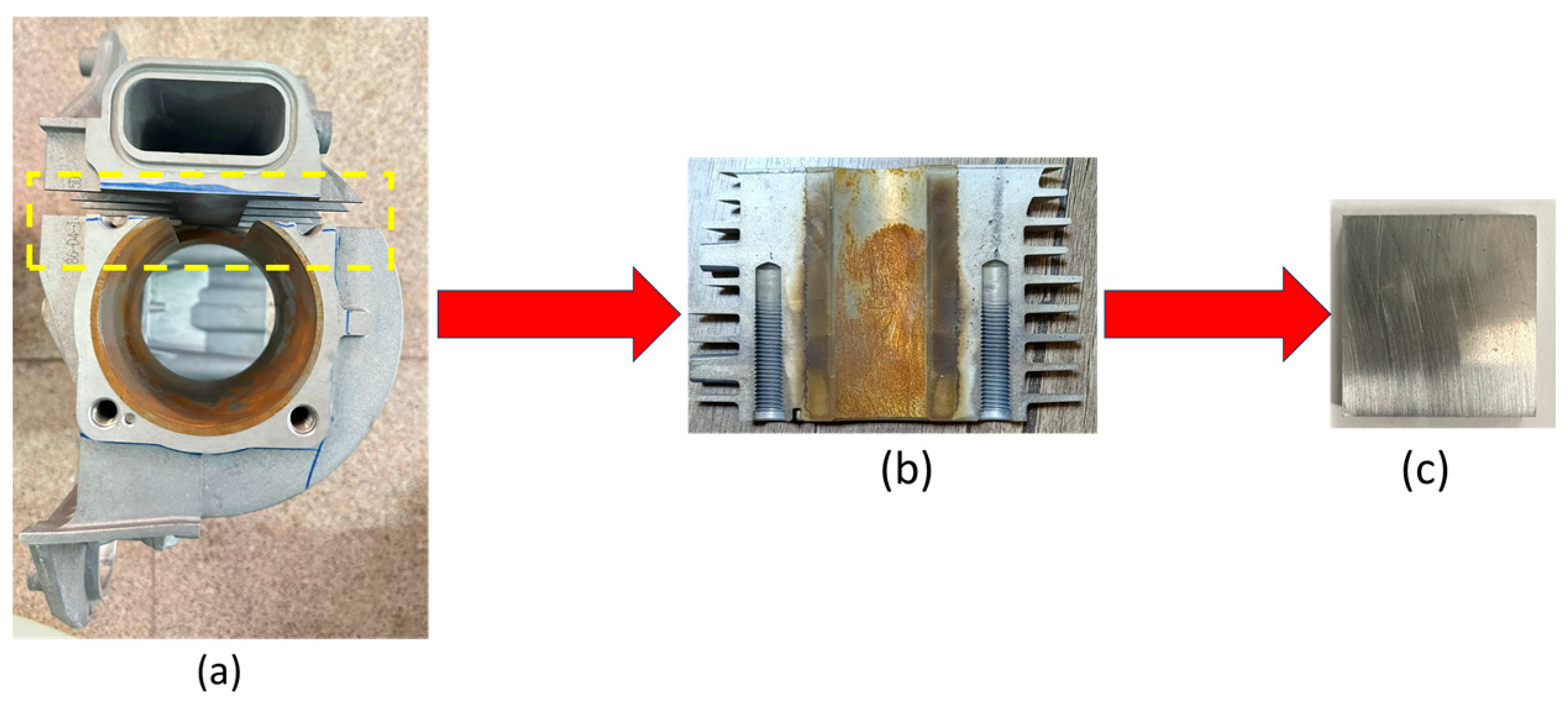
In this study, a single-cylinder diesel engine was used for the experiments. The main material of this engine is gray cast iron GG25, compliant with the EN-GJL-250 standard. Samples measuring 25 × 25 × 5 were cut from this engine. The surfaces of the samples were then progressively sanded with SiC sandpaper of increasing grit sizes from 240 to 1500. After sanding, the surfaces were cleaned with alcohol to remove any possible debris and particles, and then dried with compressed air. This sequence of operations was applied uniformly to all samples to minimize surface differences between samples prior to testing and thereby increase the reliability of the tribological results.
Figure 1 shows the engine block, the cut engine block, and the prepared samples.

2.2. Preparation of Nano-Additive Oils

Petrol Ofisi Maximus SAE 15W-40 engine oil was preferred as the base oil, and its properties are given in Table 1.
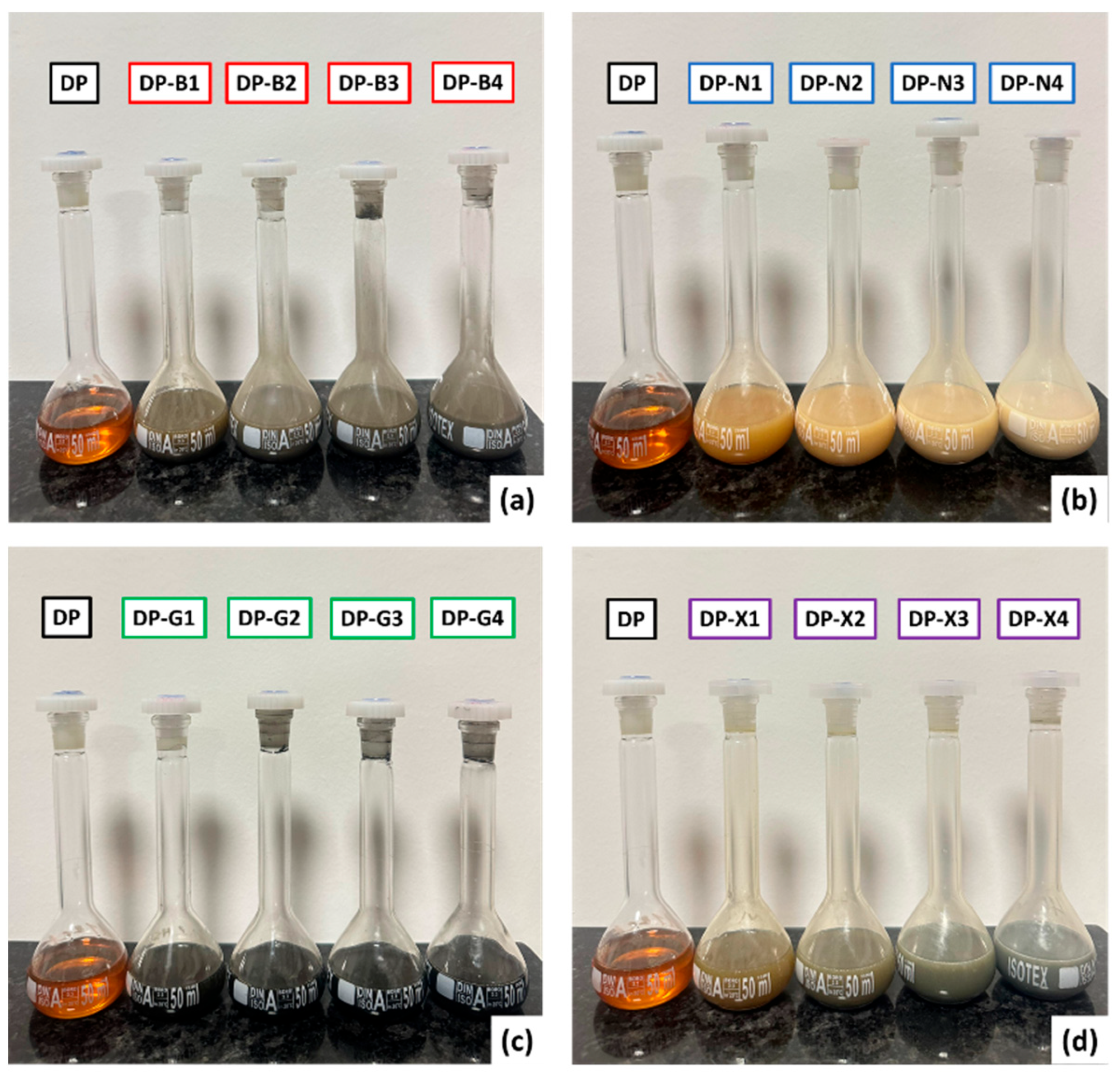
The total nano-additive concentrations of the B4C, hBN, HSG, and hybrid oil series used in the experiments are given in Table 2, and the images after the nano-additives were added to the oils are given in Figure 2. All experimental mixtures were prepared based on a 30 mL oil volume and were identified using the diesel piston (DP) coding system to reflect the type and concentration level of the nano-additive. B4C, hBN, HSG, and hybrid (B4C+hBN+HSG) additives were used as nano-additives. Concentration levels were determined in the range of 0.03–0.06–0.12–0.24 g. During the preparation stage of nano-additive oils, the amount of nano-additive corresponding to each concentration was weighed using a precision scale and added to 30 mL of Petrol Ofisi Maximus 15W-40 oil. To ensure homogeneous dispersion of the nanoparticles in the oil and reduce the tendency for agglomeration, the mixtures were first subjected to preliminary dispersion by mechanical mixing, followed by a 4 h ultrasonic dispersion process. Dispersion stability was qualitatively assessed by checking the formulations for visible sedimentation after standing under identical conditions prior to testing; the same short re-homogenization procedure was applied when needed to ensure consistent test conditions. The prepared oils were allowed to stand for a short time before testing to check for visible sedimentation. In the hybrid series (DP-X), the concentrations represent the total additive concentration, and the hybrid mixture components were prepared by distributing them in equal mass ratios (B4C:hBN:HSG = 1:1:1).

2.3. Microstructure Characterization

An X-ray diffractometer was used to determine the material type on the piston surface. Measurements were performed using a Bruker (Karlsruhe, Germany) D8 Advance XRD device available in the laboratory infrastructure, with Cu Kα radiation (λ ≈ 1.5406 Å). The diffractograms were recorded at room temperature in the 2θ = 20–80° range and scanned in step-scan mode with a “1 step” setting.
The wear tracks and damage morphology formed on the piston surface after tribological tests were evaluated using a multi-scale approach in terms of microstructure and topography. The morphology of the wear tracks was examined using a TESCAN (Brno, Czech Republic) MAIA3 scanning electron microscope (SEM). EDS analyses were performed on selected areas to reveal deposits in the wear marks and possible tribochemical formations. The surface topography and three-dimensional geometry of the wear trace were analyzed using a FILMETRICS (Milpitas, CA, USA) Profilm 3D optical profilometer. Within this scope, 3D surface maps and trace geometry obtained from the wear trace were quantitatively compared.

2.4. Wear Tests

Wear and friction tests were conducted using the Anton Paar (Graz, Austria) HTH device at 75 °C and in reciprocating mode to comparatively evaluate the tribological behavior of piston surface samples under different nano-additive oils. Al2O3 balls (diameter: 6 mm) were used as the counter-body to ensure a chemically inert and wear-resistant contact, improving repeatability and isolating the effect of the nano-additive oils on the piston surface. The frequency was 5.0 Hz, the full amplitude was 10 mm, the maximum linear slip velocity was 15.71 cm/s (0.157 m/s), and the normal load was 20 N. The experiments were terminated when the total slip distance reached 500 m. Each tribological test was repeated three times for every lubricant formulation (n = 3). The reported COF values correspond to the steady-state average COF and are presented as mean ± standard deviation (SD) calculated from the three independent repeats.

3. Results and Discussion

3.1. Characterization of Powder Materials

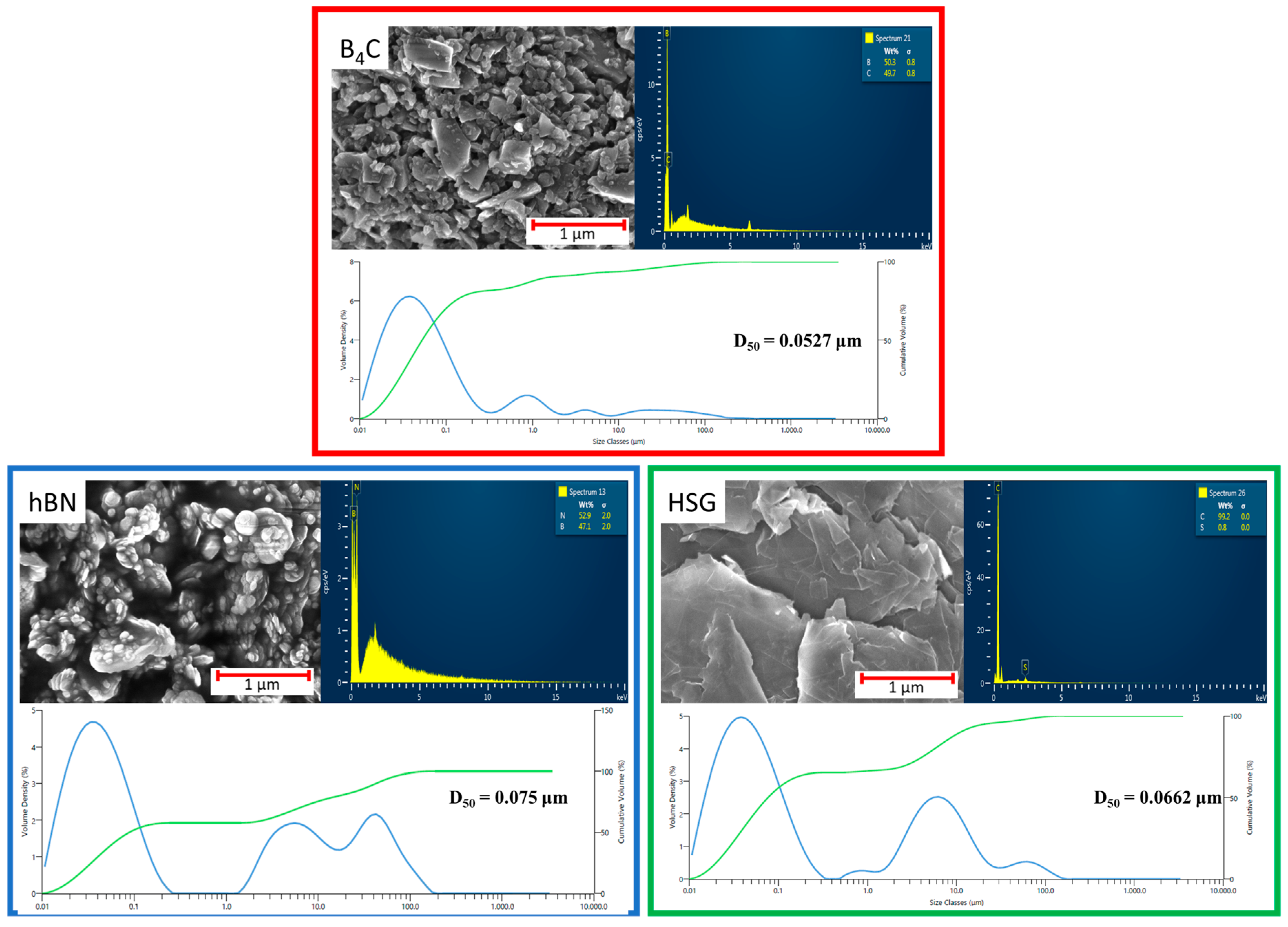
The morphological properties of the nano-additives used are critical in terms of tribological performance. Therefore, the surface morphologies of B4C, hBN, and HSG nanoparticles in powder form were examined and compared using SEM, and their chemical composition was verified using EDS/EDX analysis, as shown in Figure 3.
It was observed that B4C particles exhibited an irregular, polygonal morphology with sharp edges. This structure is consistent with hard ceramic properties. The particles have formed larger clusters as agglomerates in places. This geometry can increase the load-carrying capacity on the surface and contribute to balancing the contact pressure with the rotational movement of the particles. However, when sufficient dispersion is not achieved, such particles can increase the risk of third-body wear [35]. The EDS spectrum showed that the main elements were B and C, and the quantification results were approximately B: 50.3 wt.% and C: 49.7 wt.% (considering the limitations of EDS quantification for light elements, these results were evaluated for composition verification). Additionally, in particle size distribution measurements, the median particle size of B4C was determined to be D50 = 0.0527 µm (≈52.7 nm) [36]. In Figure 3, for the hBN nanoparticle, it can be seen that thin lamellae overlap to form dense agglomerate structures, consistent with the hBN structure. The ease with which these layers can shift along their slip planes supports their low-friction behavior under lubrication conditions. It can also contribute to the formation of a film-like layer on the surface. EDS results confirmed the boron nitride composition with N ≈ 52.9 wt.% and B ≈ 47.1 wt.%. In the size distribution analysis, D50 = 0.075 µm was found for hBN; this value reflects the “equivalent” size of layered particles in the measurement and the possible stacking effect [37]. HSG has a layered, convoluted, and sheet-like morphology. This structure increases surface interaction due to its large surface area and provides a suitable environment for the formation of carbon-based tribofilms. At appropriate additive levels, these properties can increase the stability of the friction interface. The EDS/EDX spectrum showed that the composition was almost entirely carbon-based; the C content was ≈99.2 wt.%, and a trace level S signal of ≈0.8 wt.% was recorded. In particle size distribution measurements, the median size of HSG was determined to be D50 = 0.0662 µm, and this result indicated the effective size of the leafy layers in the measurement environment [11,14].

3.2. XRD Analysis

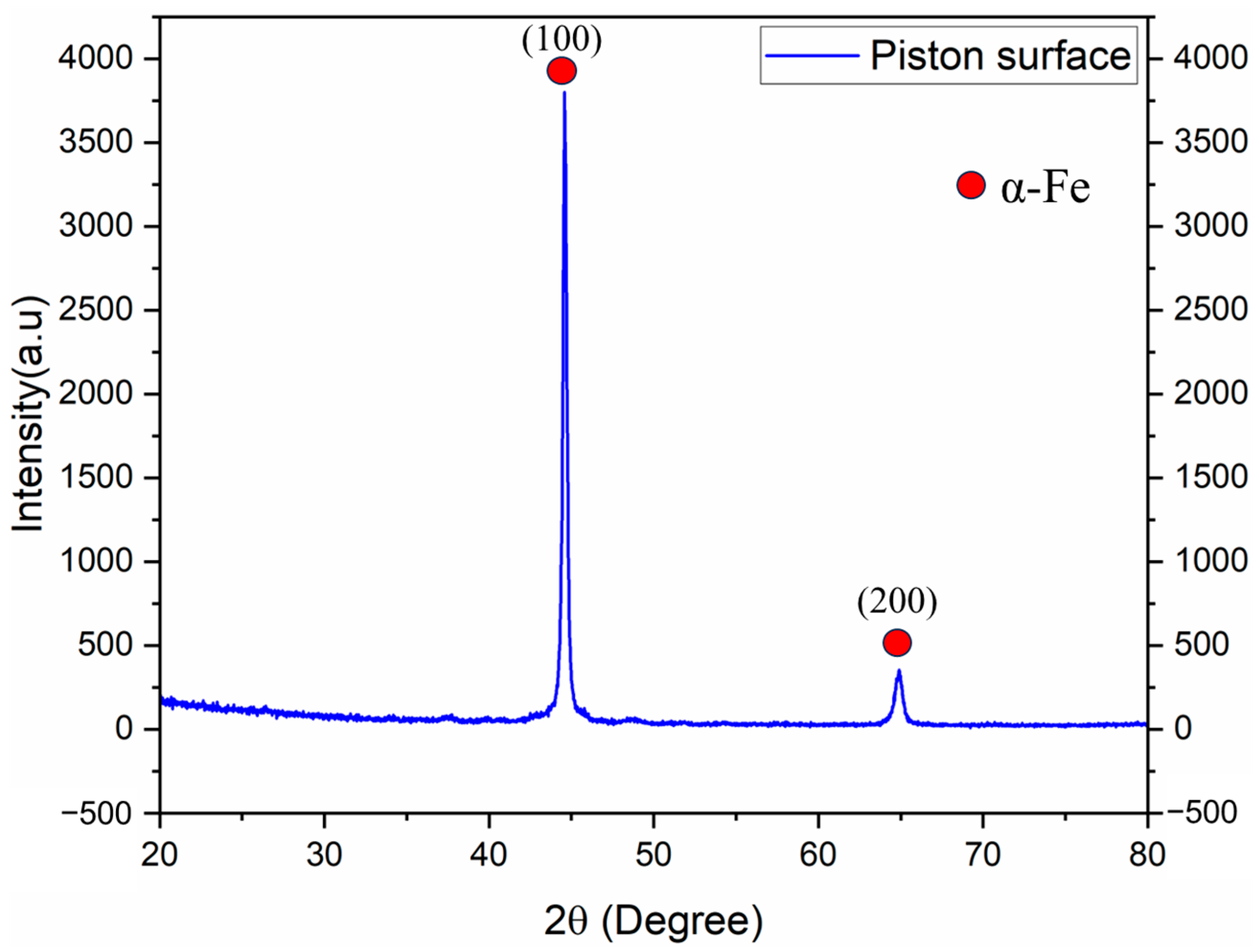
The base material of the piston surface of the single-cylinder diesel engine is gray cast iron (GG25) in accordance with the EN-GJL-250 grade. XRD analysis was performed to verify the crystal phase composition and dominant matrix of the surface. The peaks obtained from the analysis enable phase identification through characteristic reflections within the measurement range. The XRD peaks of the piston surface are shown in Figure 4.
Figure 4 shows the XRD peaks obtained from the diesel piston surface (2θ = 20–80°). Upon examination of Figure 4, it was observed that the peaks form a dominant main peak around ~44.7° and a second peak around ~65.0°. These two reflections are consistent with the characteristic peaks corresponding to the (110) and (200) planes of the bcc crystal structure α-Fe phase [38,39]. The absence of additional peak points indicating an additional phase in the peaks indicates that the main crystal phase character of the surface is preserved within the measurement accuracy range and that the dominant structure is Fe [40].

3.3. Friction and Wear Analysis

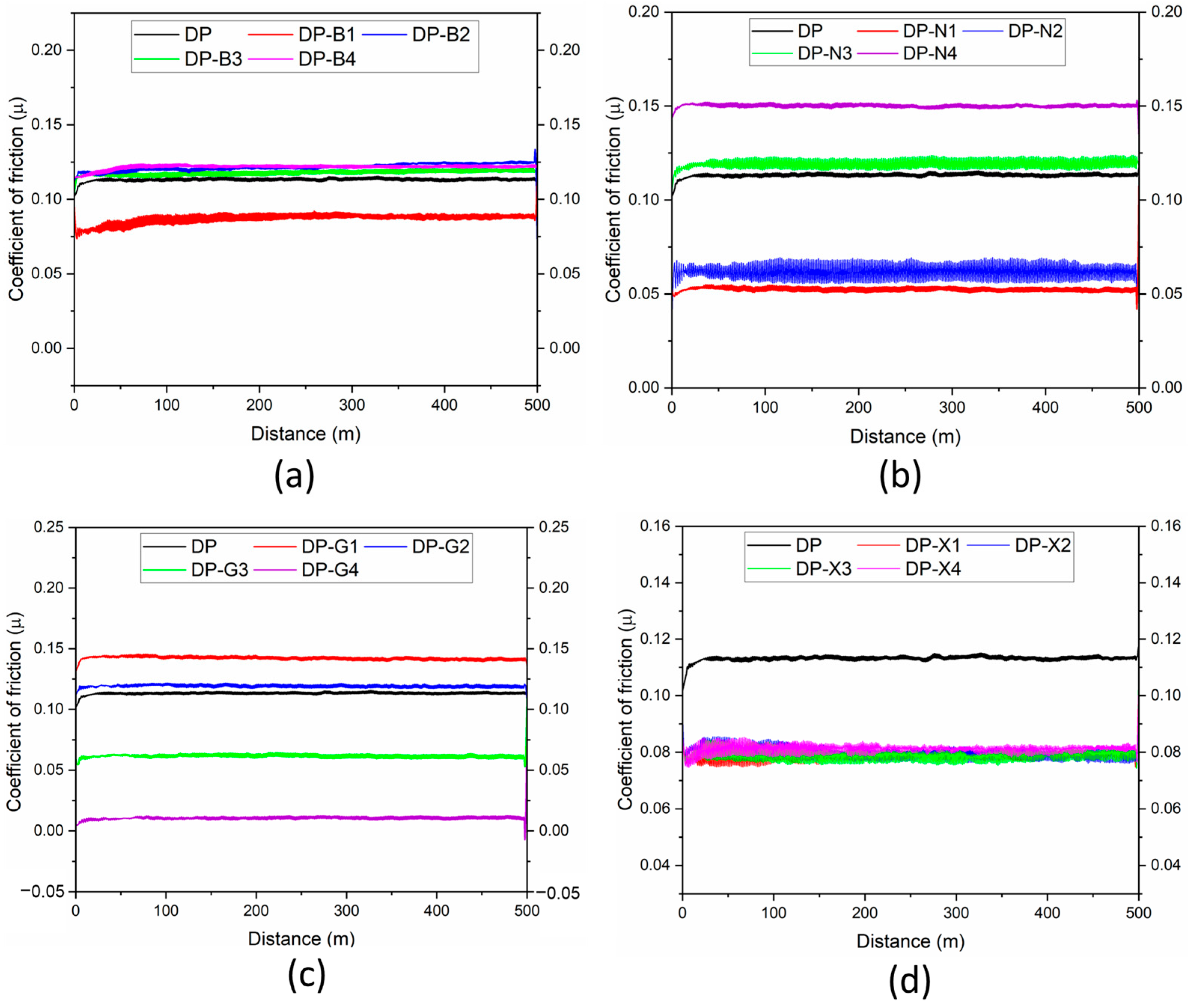
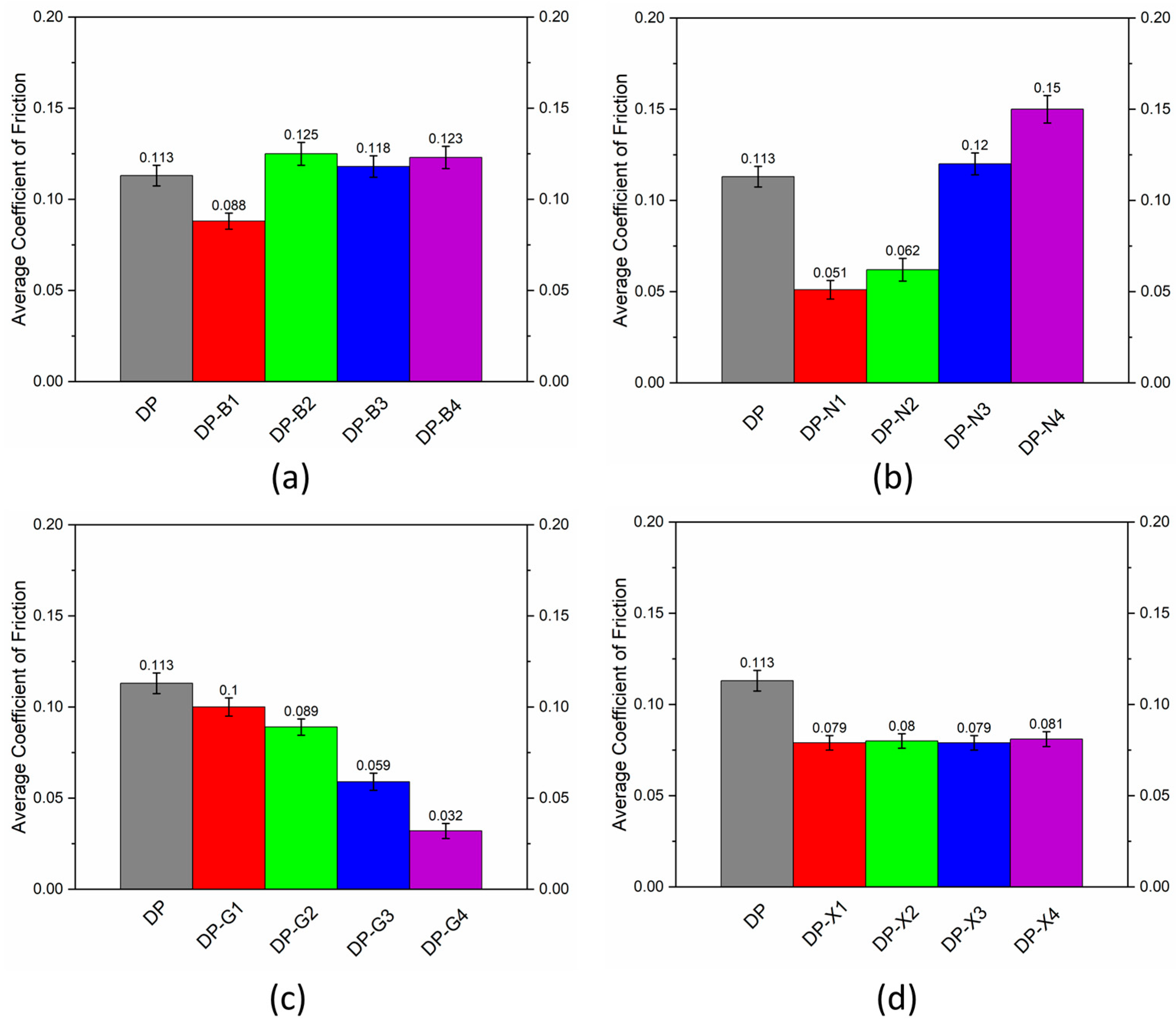
The coefficient of friction (COF) graphs measured on the diesel piston surface under a 20 N load and a 500 m sliding distance are shown in Figure 5. The values shown after each sample label in Figure 6 indicate the average COF (dimensionless) of the corresponding test.
In all additive oil series, the COF rises after a short distance at the beginning of the test and then remains at a generally stable level up to 500 m. In the B4C-additive series (Figure 5a), the DP-B1 sample with a low additive ratio (0.03 g/30 mL) showed a significantly lower and more stable COF value compared to the base oil (DP). In addition, as the additive ratio increased (DP-B2–DP-B4, 0.06–0.24 g/30 mL), the COF values were observed to approach the level of the base oil. The fundamental reason for this is thought to be that it reduces friction at low additive levels, while friction rises again when the additive ratio increases due to agglomeration and third-body interactions [25,41]. In the hBN-additive oil series (Figure 5b), the COF was found to decrease significantly at additive ratios of 0.03 wt% (DP-N1) and 0.06 wt% (DP-N2) compared to the base oil (DP). The lowest friction was obtained in the DP-N1 sample. Although the average COF value remained low in the DP-N2 sample, more pronounced waves were observed on the graph, indicating that stability was weaker compared to DP-N1. The COF graph of the DP-N3 sample exhibits behavior similar to, and in some areas even higher values than, the base oil. The COF curve of the DP-N3 sample exhibits behavior similar to, and in some areas even higher values than, the base oil (DP). In the DP-N4 sample, which has the highest additive ratio (0.24 g/30 mL), the COF has increased significantly, and the friction behavior has changed unfavorably [42]. These results show that hBN additive can effectively reduce friction at low concentrations due to the layered sliding mechanism, but at high concentrations, friction behavior can change significantly due to effects such as particle accumulation and film integrity damage [21,43]. In HSG-additive oils (Figure 5c), the COF decreases regularly as the additive ratio increases. While the average COF is ≈0.113 in the base oil case, it is measured as ≈0.100 in DP-G1, ≈0.089 in DP-G2, and ≈0.059 in DP-G3 samples. At the highest HSG additive ratio (0.24 g/30 mL), the COF value of the DP-G4 sample decreased to ≈0.032. This behavior is thought to be due to the increasing amount of HSG forming a more continuous and effective carbon-based tribofilm at the contact interface, thereby significantly reducing friction [44,45]. Finally, in the hybrid oil series (Figure 5d), the COF values at all additive levels between 0.03 and 0.24 (DP-X1–DP-X4) are lower than the base oil (DP) sample. This demonstrates that the hybrid additive consistently and reproducibly reduces friction. The narrow range of changes in COF indicates that various mechanisms, such as layered sliding and carbon-based film formation, can stabilize the contact surface [20,30].
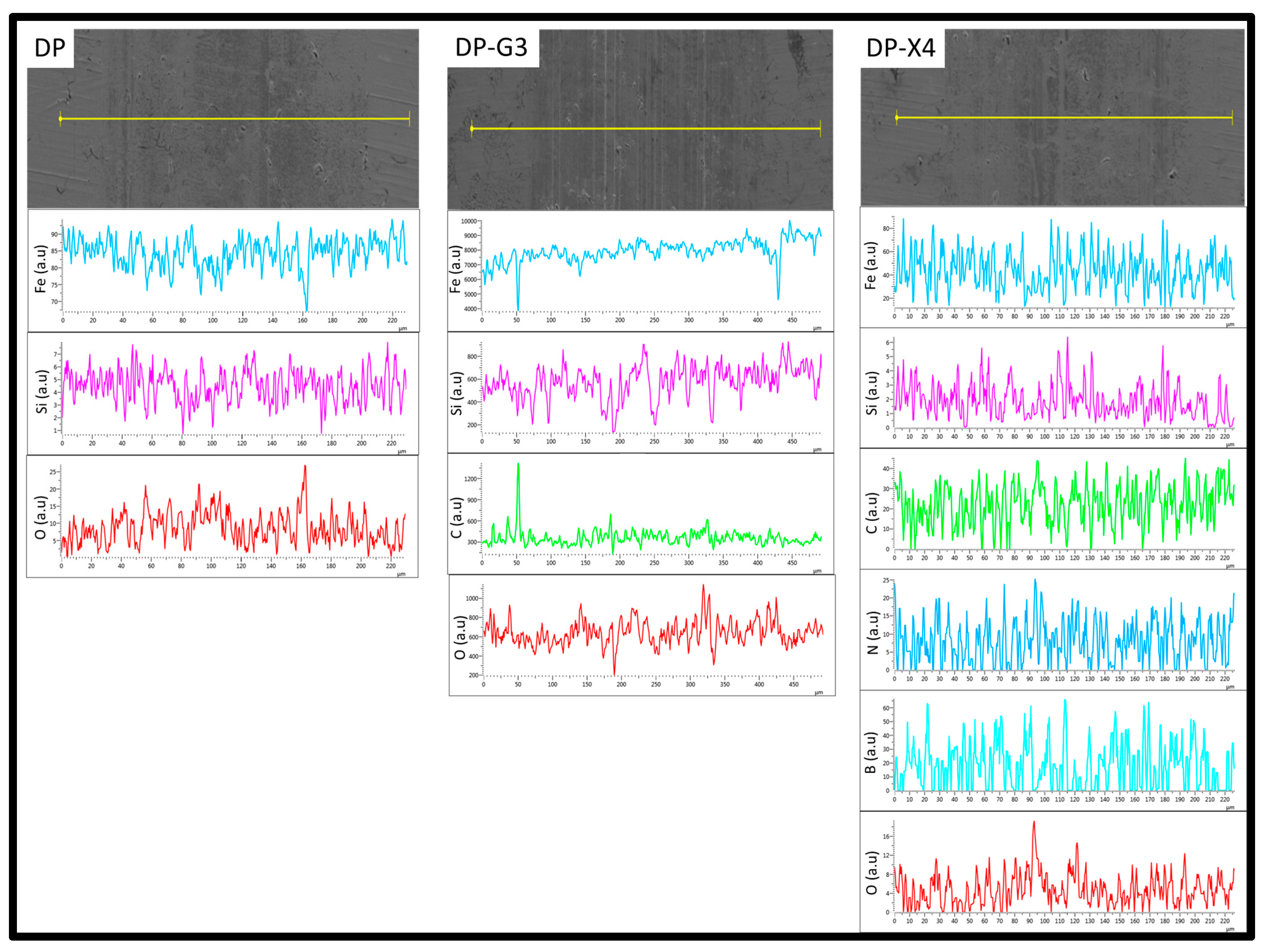
The results of the EDS line-scan element analysis taken along the wear scar after tribological tests performed on the diesel piston surface are shown in Figure 7.
In the DP oil sample, Fe and Si signals were dominant along the wear scar, while the O signal was observed to increase and decrease alternately. This indicates that the chemical composition of the substrate primarily determines the contact surface of the base oil. Local increases in the oxygen signal indicate the formation of tribo-oxidation zones during sliding [46,47]. In the DP-G3 sample, the enhancement of the C signal along the wear scar and its continuity along the wear scar are consistent with the formation of a carbon-based tribofilm derived from HSG. The presence of this film structure, along with the attenuation of the Fe signal in some areas, can be associated with the partial coverage of the surface with this film [48,49]. Furthermore, the more irregular distribution of the O signal and its variation with the presence of the tribofilm suggests that oxidative processes are limited by this film [46]. In the hybrid DP-X4 sample, the detection of C, N, and B signals along the wear scar indicates the formation of a multi-component tribofilm layer within the scar. The presence of N and B in the same areas suggests that hBN (N source) and B4C (B source) in the oils are incorporated into the film layer formed at the interface. The presence of the C signal also indicates that HSG forms a carbon-based film layer. This multi-component chemical structure suggests that hybrid additives can act together at the contact interface to improve the stability and functionality of the tribofilm and reduce direct contact between metal surfaces to some extent [20]. The increase or decrease in the O signal along the wear scar indicates that oxidative processes do not completely disappear during sliding, but their distribution on the surface changes due to the presence of the tribofilm [46].
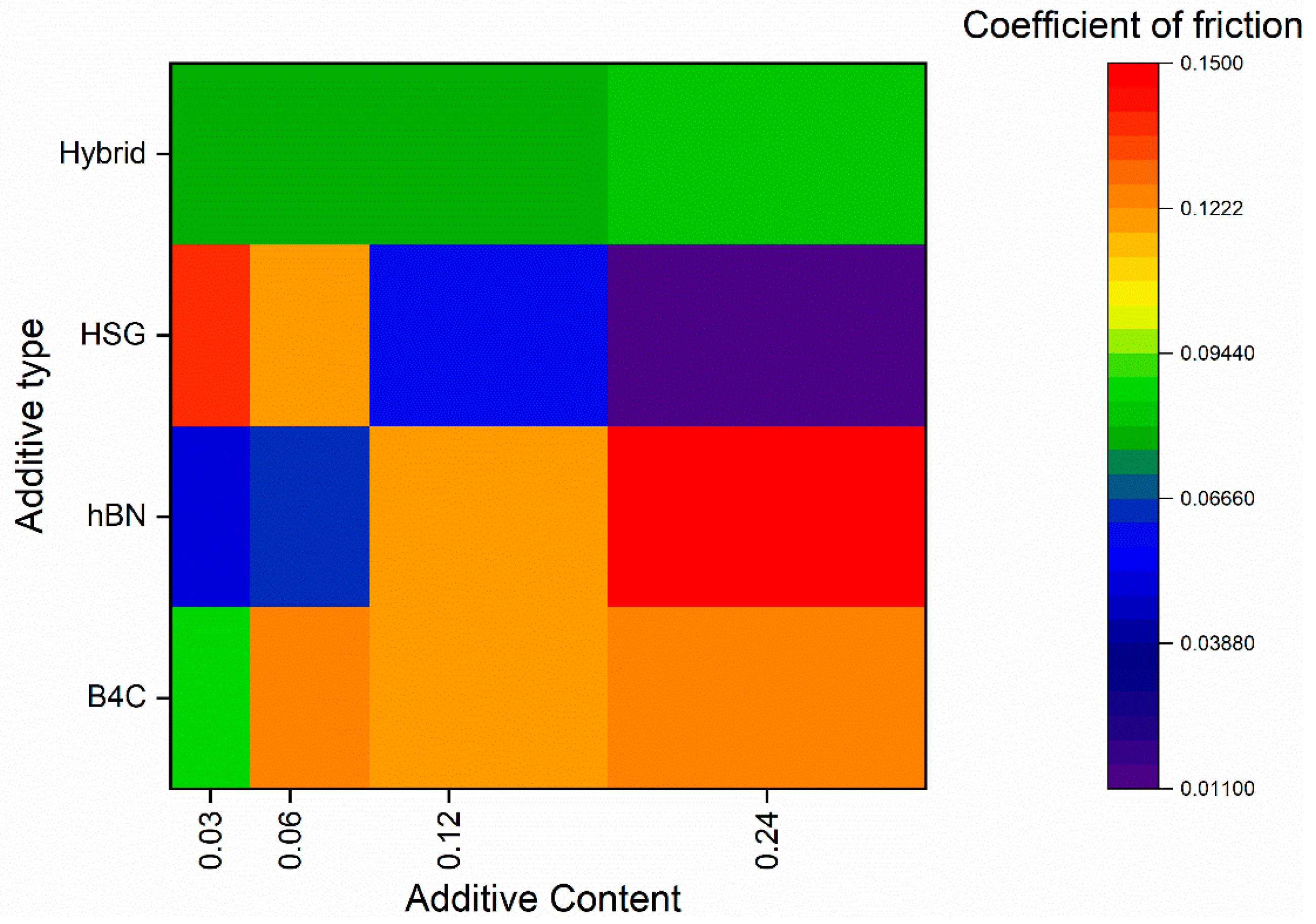
The heatmap results summarizing the average COF variation on the diesel piston surface depending on different types of nano-additives and additive amounts are shown in Figure 8.
The heatmap shows that the concentrations of the different additive types exhibit distinctly different patterns. In the HSG oil series, the COF decreases significantly as the additive amount increases, reaching the lowest COF zone at the 0.12 and 0.24 levels (coldest colors). In contrast, the hBN series exhibits low COF at low additive levels (0.03–0.06), while as the additive amount increases (0.12–0.24), friction increases significantly and transitions to a high COF zone (shift to warm colors). In the B4C oil series, the lowest COF was obtained at a concentration of 0.03, while at higher concentrations, the COF was generally observed at a higher level. In the hybrid oil series, the COF remains in a similar, medium-low range across all concentrations, indicating more balanced and stable friction. This comparison shows that the “optimal” additive level differs for each additive type.
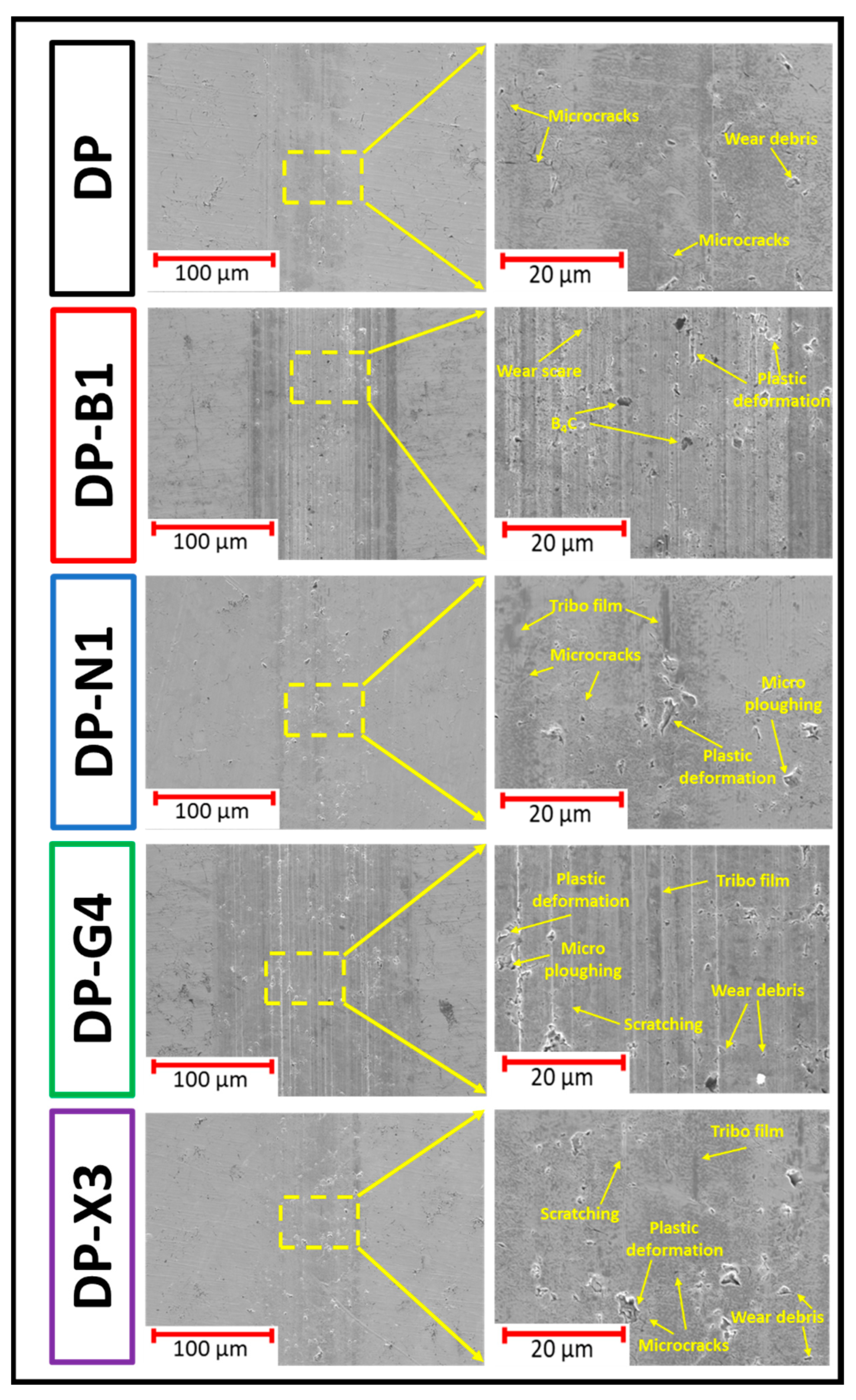
SEM examinations were conducted to determine the morphology of the wear scar formed on the diesel piston surface after tribological tests. Low magnification reveals the general wear scar, while high magnification reveals damage details (cracks, scratches, deformation, and debris). SEM images of the wear scars are presented in Figure 9.
The overview in Figure 9 confirms the presence of parallel lines extending along the wear direction in all samples, but shows that the type and severity of damage varies significantly depending on the oil formulation. In the DP oil sample, microcracks and wear debris are clearly visible along the wear line on the sample surface. This indicates that the surface is prone to fatigue-induced cracks and wear particle formation under repeated wear conditions in the applied oil environment and lubrication conditions [50]. In B4C-additive oils, the wear scar is generally more regular at low additive levels (e.g., 0.03 g/30 mL). However, plastic deformation traces and B4C particles are visible in some areas. This appearance indicates that at low concentrations, B4C can partially balance the friction conditions by acting as a third-body in the contact area. However, local particle accumulation is understood to be associated with plastic deformation traces on the surface. Tribofilm areas are observed in the DP-N1 (0.03 hBN-doped nanoparticle) sample. However, microcracks and micro-ploughing are also present in these areas. This situation shows that hBN can support film formation due to its layered structure [37,51], but that abrasive wear can continue when this film cannot provide complete continuity at every point on the surface. In DP-G4 oil (with 0.24% HSG additive), plastic deformation, scratches, and micro-ploughing are observed on the sample surface, along with more pronounced tribofilm areas. This finding indicates that a strongly carbon-based tribofilm forms at high HSG levels, but that abrasive effects do not completely disappear in the contact area under forward-backward wear conditions. The hybrid DP-X3 (oil containing 0.06% B4C+hBN+HSG) shows a clear tribofilm formation on the sample surface. However, despite this, limited scratching, plastic deformation, microcracks, and wear debris are still present on the surface. This suggests that the multi-component additive combination can stabilize the contact interface but cannot completely eliminate mechanical damage in local areas.
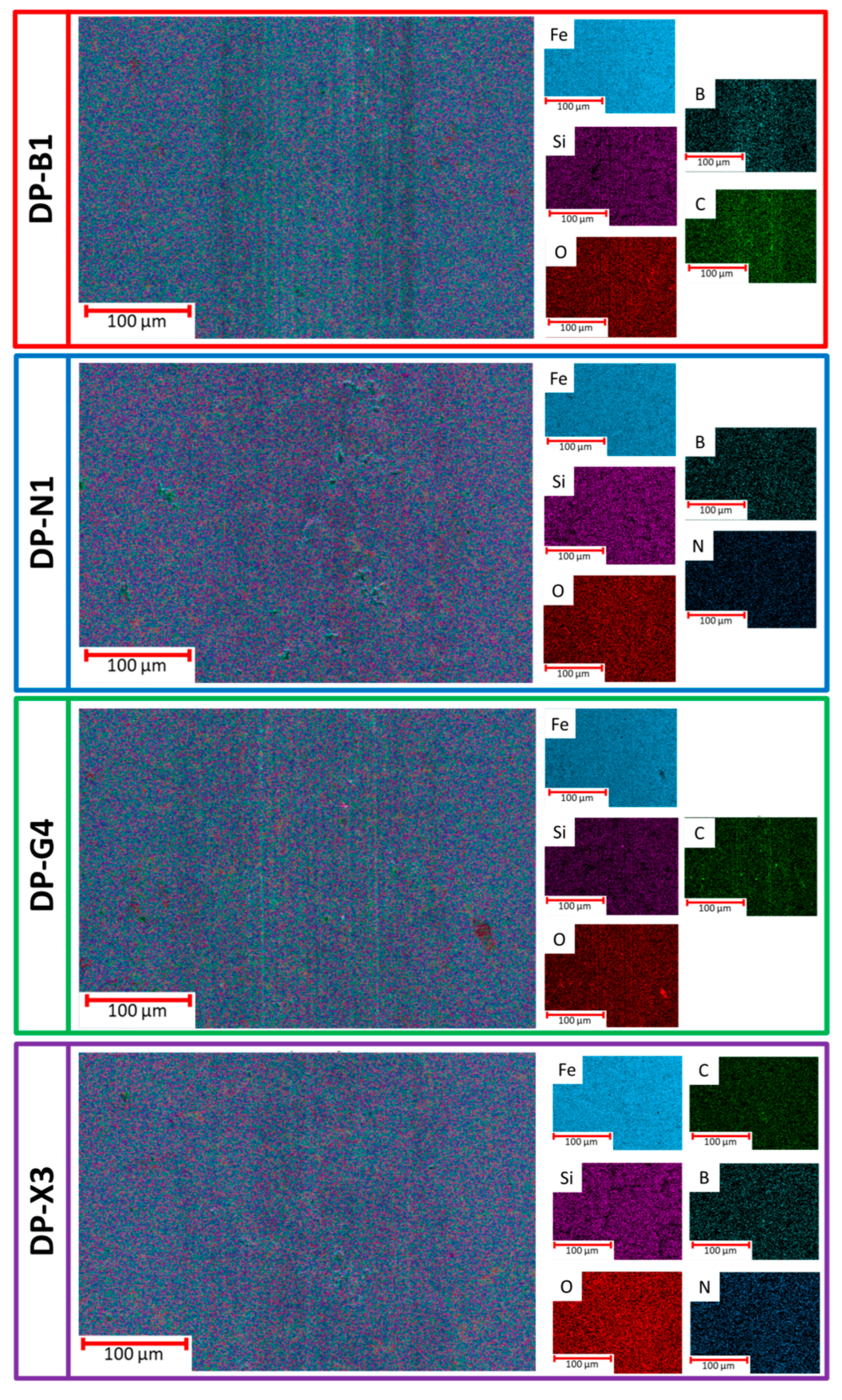
EDS element mapping analyses were performed to evaluate the chemical composition of the wear trace formed on the diesel piston surface after tribological tests. These analyses reveal the distribution of elements (Fe, Si, O) and nano-additive-derived elements (C, B, N) in the wear zone. The maps obtained allow the comparison of the interface chemistry of different oil formulations in terms of tribofilm formation. The EDS mapping images are presented in Figure 10.
Figure 10 shows that the Fe and Si maps exhibit large-scale continuity in all samples, indicating that the substrate composition is the dominant element in the wear scar area. The fact that the B element map observed on the surface of the DP-B1 (0.24% B4C added) sample in oil only becomes apparent in some local areas of the surface suggests that B4C particles are transported to the contact area and can form partial accumulations. In contrast, the continuity of the Fe and Si elements across the surface indicates that these accumulations have not formed a layer covering the entire surface, but rather appear as local-scale transfer or particle deposition on the substrate surface [52,53]. For DP-G4 (0.24 g/30 mL HSG-additive oil), the more distinct and widespread distribution seen in the map related to the C element indicates that a carbon-based tribofilm derived from HSG has formed distinctly after examination of the sample surface. The decrease in Fe concentration in the same areas leads to the conclusion that the surface is partially covered by this film [54]. In the hybrid DP-X3 oil, mapping analysis of the sample surface revealed the simultaneous detection of C, B, and N elements within the same wear areas, indicating the formation of a multi-component tribofilm structure and that hBN (N source) and B4C (B source) contribute to the chemical composition of the contact interface together with C from HSG. In contrast, the fact that the O element does not disappear completely indicates that oxidative interactions have not completely disappeared despite film formation [53,55], but that the distribution pattern of these processes on the surface can change with the presence of the tribofilm.
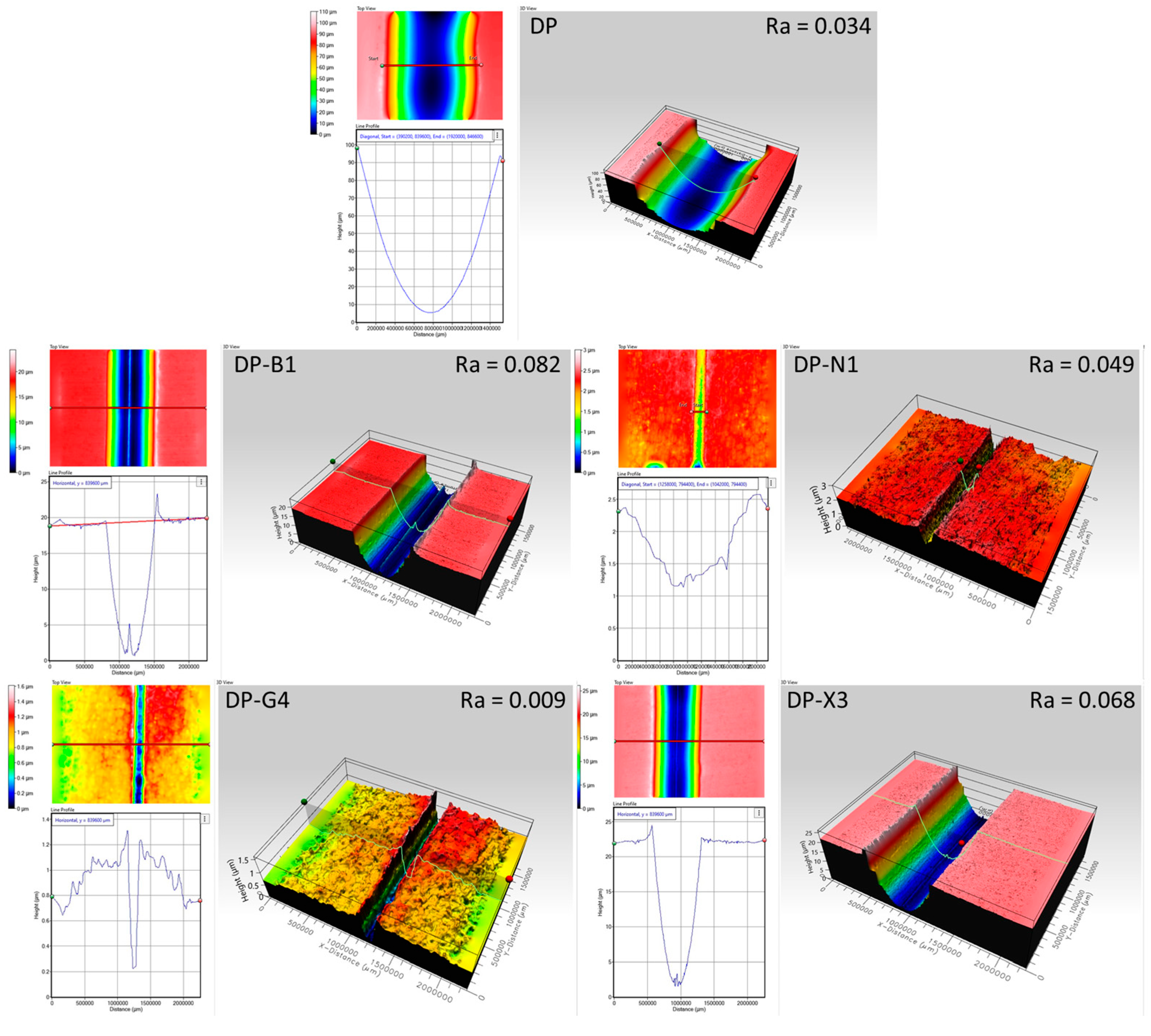
The 3D topography of wear scars and the roughness behavior within the scars were examined using a 3D optical profilometer. The average roughness (Ra) values were compared for the DP, DP-B1, DP-N1, DP-G4, and DP-X3 samples along with the wear scar geometry. The 3D profilometer surface scanning results are shown in Figure 11.
3D optical profilometer scans reveal both the wear scar geometry (scar width/depth) and the surface roughness (Ra) within the scar. In the DP sample, the wear scar is more “U-shaped” and exhibits a relatively homogeneous base profile, with Ra measured at 0.034 µm. In the DP-B1 sample, noticeable particle accumulation at the scar edges and a more irregular scar base are observed, with the highest roughness of Ra = 0.082 µm (consistent with the increase in micro-grooving due to hard ceramic particle residues). In the DP-N1 sample, the scar base appears more regular and Ra decreased to 0.049 µm, leading to the conclusion that hBN partially stabilizes the surface with a film-like effect at the interface. The most significant improvement was observed in the DP-G4 (HSG—0.24 g/30 mL) sample, where the wear trace was represented by a more “smooth” and continuous topography, achieving a very low value of Ra = 0.009 µm. This shows that HSG can strongly reduce the formation of micro-scratches and roughness by forming a carbon-based transfer layer. The DP-X3 sample, on the other hand, exhibited hybrid behavior with Ra = 0.068 µm, suggesting that although the tribofilm stabilizes friction in the hybrid system, the contribution of roughness caused by accumulation in the multi-component structure cannot be completely eliminated. While the Ra values provide information on the post-wear surface texture, the anti-wear performance is more directly reflected by the wear scar geometry. Therefore, the 3D profilometry data were further evaluated in terms of wear-track width (W) and maximum depth (Dmax) obtained from cross-sectional profiles. Compared with the base oil (DP), which exhibited a relatively wider and deeper wear track (W = 1362 µm, Dmax = 62.7 µm), the additive-containing oils generally reduced the scar dimensions to different extents. Among the investigated formulations, DP-G4 showed the narrowest and/or shallowest track (W = 173 µm, Dmax = 0.96 µm), indicating improved load-bearing protection and reduced ploughing and abrasive damage.
The post-test 3D profilometry results and the corresponding specific wear rates are summarized in Table 3. In particular, the average surface roughness of the wear track (Ra) and the wear rate values are reported for the base oil and all nano-additive formulations to enable a direct comparison of anti-wear performance as a function of additive type and concentration.
Table 3 summarizes the post-test surface roughness (Ra) and the specific wear rate of the GG25 piston surface lubricated with the base oil (DP) and the nano-additive oils. The base oil exhibits Ra = 0.034 μm and a wear rate of 2.73 × 10⁻² mm3/(N·m), serving as the reference level. Overall, the results demonstrate a strong additive-type- and concentration-dependent response, where optimized formulations reduce wear substantially, while excessive loading can lead to deterioration, likely associated with agglomeration and third-body interactions. Among all formulations, the most pronounced anti-wear improvement is achieved by HSG at the highest concentration (DP-G4), where Ra decreases to 0.009 μm and the wear rate reaches 6.69 × 10⁻³ mm3/(N·m), corresponding to an approximate 75% reduction compared with DP. This exceptionally low wear rate, together with the markedly smoother wear track, is consistent with an enhanced ability of HSG to form and sustain a protective interfacial layer. The porous graphene-derived structure can provide a high density of active sites and a large effective surface area, which favors tribofilm build-up and reduces severe ploughing by stabilizing the boundary layer. In this sense, the Ra reduction for DP-G4 can be interpreted as a topographical signature of limited groove formation and reduced material removal, in line with the low wear rate. For hBN, low to intermediate concentrations show a clear and relatively stable benefit: DP-N1 and DP-N2 yield wear rates of 1.19 × 10⁻² and 1.42 × 10⁻² mm3/(N·m), i.e., roughly 56% and 48% lower than DP, respectively. This behavior agrees with the lamellar crystallography of hBN, which promotes low interfacial shear and facilitates the formation of a more stable boundary film. However, the trend reverses at higher dosages (DP-N3 and particularly DP-N4), where the wear rate increases to 7.09 × 10⁻² and 2.82 × 10⁻¹ mm3/(N·m). Such deterioration at high loading is indicative of particle agglomeration and the emergence of an abrasive third-body contribution or an unstable tribolayer, which can locally intensify micro-cutting and accelerate material loss despite the intrinsic lubricity of hBN. The B4C series exhibits an even more dose-sensitive response. At low concentration (DP-B1), the wear rate decreases to 1.81 × 10⁻² mm3/(N·m) (≈34% improvement vs. DP), suggesting that limited amounts of hard particles can contribute to load carrying and mitigate adhesive damage. In contrast, at higher concentrations (DP-B2 and DP-B4) the wear rate increases dramatically to 2.65 × 10⁻¹ and 1.75 × 10⁻¹ mm3/(N·m). This trend implies that, beyond an optimum level, the presence of excessive hard particles may promote micro-ploughing and abrasive wear, especially if agglomerates form and act as rigid third bodies. Therefore, the B4C results highlight the critical role of concentration control: the same high hardness that can support load at low dosage may become detrimental at high dosage due to particle-induced abrasion and debris-assisted wear. The hybrid system (B4C + hBN + HSG) does not always deliver the absolute minimum wear value; however, it provides a robust and balanced performance across the investigated concentration range. Specifically, DP-X1 to DP-X4 remain within a narrow band of (1.48–1.79) × 10−2 mm3/(N·m), corresponding to an approximate 34–46% reduction relative to DP. Such consistency suggests that the hybrid approach can combine complementary mechanisms—load support (B4C), low-shear lamellar sliding (hBN), and tribofilm promotion (HSG)—while limiting the negative impact that may arise when one component dominates at higher concentrations. From an application standpoint, this “performance stability” over multiple dosages can be advantageous for formulation tolerance and repeatability. Finally, while a general consistency between Ra and wear rate is observed (e.g., DP-G4 shows both the lowest Ra and the lowest wear rate), a strict one-to-one correlation is not expected. Ra reflects the final topography of the wear track, whereas the wear rate integrates total material loss and is strongly influenced by dynamic factors such as debris circulation, film stability, and local transitions between boundary and mixed lubrication. Consequently, Ra should be interpreted as a supporting topographical indicator that complements the quantitative wear rate and the mechanistic evidence derived from SEM/EDS, rather than as a standalone predictor of friction or wear.

4. Conclusions

In this study, B4C, hBN, HSG, and a three-component hybrid (B4C+hBN+HSG; B4C:hBN:HSG = 1:1:1 by mass in the hybrid series) were dispersed in SAE 15W-40 diesel engine oil (0.03–0.24 g per 30 mL) and evaluated on a GG25 (EN-GJL-250) diesel piston surface using reciprocating ball-on-flat tests (Al2O3 ball, 20 N, 75 °C, 500 m, 5 Hz, 10 mm stroke). XRD confirmed that the dominant surface phase remained α-Fe, indicating that the additives primarily modified the tribological response through interfacial mechanisms rather than bulk phase transformation. The tribological outcomes were strongly concentration-dependent for the single additives: low-dose B4C (DP-B1) reduced the steady-state mean COF from ~0.113 to ~0.090 (~19%), whereas higher B4C levels approached or exceeded the base oil due to third-body effects; similarly, hBN provided the largest friction reduction at low dose (DP-N1, mean COF ~0.052; ~54%) but lost effectiveness at higher loadings. In contrast, HSG exhibited a monotonic improvement with concentration, reaching the lowest friction at DP-G4 (mean COF ~0.032; ~75%) together with the smallest wear-track geometry (W ~173 µm and Dmax ~0.96 µm vs. base oil W ~1362 µm and Dmax ~62.7 µm), consistent with the formation of a more continuous carbon-rich tribofilm. Importantly, the hybrid system delivered a stable and practical performance window across all investigated concentrations, maintaining mean COF values of ~0.082–0.087 (typically ~25–28% lower than the base oil) and exhibiting a multi-component tribofilm signature (co-localized C, B, and N from HSG, B4C, and hBN) that can stabilize the contact interface under reciprocating motion. Overall, these findings demonstrate that each additive has an optimum loading, and the hybrid formulation offers more robust friction reduction when concentration control or long-term stability is a concern. DP (base oil) produced Ra = 0.034 µm and a wear rate of 2.73 × 10⁻² mm3/(N·m), whereas the nano-additives reduced wear in a concentration-dependent manner. The best anti-wear performance was achieved by HSG at the highest dose (DP-G4), yielding Ra = 0.009 µm and a minimum wear rate of 6.69 × 10⁻³ mm3/(N·m) (≈75% lower than DP), while the hybrid system provided a robust and consistently low wear-rate range of (1.48–1.79) × 10−2 mm3/(N·m) across all tested concentrations.

Funding

This research received no external funding.

Data Availability Statement

The data presented in this study are available from the corresponding author upon reasonable request.

Conflicts of Interest

The author declares no conflicts of interest.

References

  1. Holmberg, K.; Andersson, P.; Erdemir, A. Global Energy Consumption due to Friction in Passenger Cars. Tribol. Int. 2012, 47, 221–234. [Google Scholar] [CrossRef]
  2. Wróblewski, P.; Kachel, S. Novel Approach to Analyzing Friction Losses by Modeling the Microflow of Lubricating Oil between the Piston Rings and Cylinder in Internal Combustion Engines. Energies 2024, 17, 3697. [Google Scholar] [CrossRef]
  3. Holmberg, K.; Erdemir, A. Influence of Tribology on Global Energy Consumption, Costs and Emissions. Friction 2017, 5, 263–284. [Google Scholar] [CrossRef]
  4. Holmberg, K.; Erdemir, A. The Impact of Tribology on Energy Use and CO2 Emission Globally and in Combustion Engine and Electric Cars. Tribol. Int. 2019, 135, 389–396. [Google Scholar] [CrossRef]
  5. Delprete, C.; Razavykia, A. Piston Ring–Liner Lubrication and Tribological Performance Evaluation: A Review. Proc. Inst. Mech. Eng. Part J J. Eng. Tribol. 2018, 232, 193–209. [Google Scholar] [CrossRef]
  6. Li, T.; Zhu, X.; Tang, H.; Zhang, B.; Wang, L.; Yu, Y.; Qiao, Z.; Ma, X. A New Method for Determining Lubrication Regimes of Piston Ring-Cylinder Liner Tribosystem. Tribol. Int. 2023, 179, 108162. [Google Scholar] [CrossRef]
  7. Morris, N.; Rahmani, R.; Rahnejat, H.; King, P.D.; Fitzsimons, B. Tribology of Piston Compression Ring Conjunction under Transient Thermal Mixed Regime of Lubrication. Tribol. Int. 2013, 59, 248–258. [Google Scholar] [CrossRef]
  8. Bedajangam, S.K.; Jadhav, N.P. Friction Losses between Piston Ring-Liner Assembly of Internal Combustion Engine: A Review. Int. J. Sci. Res. Publ. 2013, 3, 1–3. [Google Scholar]
  9. Jason, Y.J.J.; How, H.G.; Teoh, Y.H.; Chuah, H.G. A Study on the Tribological Performance of Nanolubricants. Processes 2020, 8, 1372. [Google Scholar] [CrossRef]
  10. Lijesh, K.P.; Muzakkir, S.M.; Hirani, H. Experimental Tribological Performance Evaluation of Nano Lubricant Using Multi-Walled Carbon Nano-Tubes (MWCNT). Int. J. Appl. Eng. Res. 2015, 10, 14543–14550. [Google Scholar]
  11. Berman, D.; Erdemir, A.; Sumant, A. V Graphene: A New Emerging Lubricant. Mater. Today 2014, 17, 31–42. [Google Scholar] [CrossRef]
  12. Larsson, E.; Westbroek, R.; Leckner, J.; Jacobson, S.; Rudolphi, Å.K. Grease-Lubricated Tribological Contacts–Influence of Graphite, Graphene Oxide and Reduced Graphene Oxide as Lubricating Additives in Lithium Complex (LiX)-and Polypropylene (PP)-Thickened Greases. Wear 2021, 486, 204107. [Google Scholar] [CrossRef]
  13. Yu, B.; Wang, K.; Pang, X.; Wu, G.; Pu, J.; Zhao, H. Tribological Properties of Alkylated Reduced Graphene Oxide as Lubricant Additive. Tribol. Int. 2022, 165, 107273. [Google Scholar] [CrossRef]
  14. Liu, Y.; Wang, X.; Pan, G.; Luo, J. A Comparative Study between Graphene Oxide and Diamond Nanoparticles as Water-Based Lubricating Additives. Sci. China Technol. Sci. 2013, 56, 152–157. [Google Scholar] [CrossRef]
  15. Gupta, B.; Kumar, N.; Panda, K.; Dash, S.; Tyagi, A.K. Energy Efficient Reduced Graphene Oxide Additives: Mechanism of Effective Lubrication and Antiwear Properties. Sci. Rep. 2016, 6, 18372. [Google Scholar] [CrossRef]
  16. Kuang, X.; Yang, X.; Bian, H.; Kuang, R.; Hu, N.; Li, S. Performance Evaluation of Nano-Graphene Lubricating Oil with High Dispersion and Low Viscosity Used in Diesel Engines. PLoS ONE 2024, 19, e0307394. [Google Scholar] [CrossRef]
  17. Koszalka, G.; Tomanik, E.; Maria, T.M.; Christinelli, W.; Grabon, W. Effect of Graphene as a Lubricant Additive for Diesel Engines. Energies 2025, 18, 257. [Google Scholar] [CrossRef]
  18. Marlinda, A.R.; Thien, G.S.H.; Shahid, M.; Ling, T.Y.; Hashem, A.; Chan, K.-Y.; Johan, M.R. Graphene as a Lubricant Additive for Reducing Friction and Wear in Its Liquid-Based Form. Lubricants 2023, 11, 29. [Google Scholar] [CrossRef]
  19. Kimura, Y.; Wakabayashi, T.; Okada, K.; Wada, T.; Nishikawa, H. Boron Nitride as a Lubricant Additive. Wear 1999, 232, 199–206. [Google Scholar] [CrossRef]
  20. Gürgenç, T. Hybrid H-BN/ZnO Nanolubricant Additives in 5W-30 Engine Oil for Enhanced Tribological Performance of Magnesium Alloys. Lubricants 2025, 13, 443. [Google Scholar] [CrossRef]
  21. Waqas, M.; Zahid, R.; Bhutta, M.U.; Khan, Z.A.; Saeed, A. A Review of Friction Performance of Lubricants with Nano Additives. Materials 2021, 14, 6310. [Google Scholar] [CrossRef] [PubMed]
  22. Abdullah, M.I.H.C.; Bin Abdollah, M.F.; Amiruddin, H.; Tamaldin, N.; Nuri, N.R.M. The Potential of HBN Nanoparticles as Friction Modifier and Antiwear Additive in Engine Oil. Mech. Ind. 2016, 17, 104. [Google Scholar] [CrossRef]
  23. Zhang, W. A Review of Tribological Properties for Boron Carbide Ceramics. Prog. Mater. Sci. 2021, 116, 100718. [Google Scholar] [CrossRef]
  24. Çelebi, M.; Karabacak, A.H.; Özkaya, S.; Çelik, E.; Sekban, D.M.; Çanakçı, A.; Yanar, H. Effect of B4C Amount on Microstructural and Mechanical Properties of Cu/h-BN/B4C Metal Matrix Composites Fabricated via Spark Plasma Sintering. Metals 2025, 15, 1283. [Google Scholar] [CrossRef]
  25. Liu, W.; Qiao, X.; Liu, S.; Chen, P. A Review of Nanomaterials with Different Dimensions as Lubricant Additives. Nanomaterials 2022, 12, 3780. [Google Scholar] [CrossRef]
  26. Luo, T.; Wei, X.; Zhao, H.; Cai, G.; Zheng, X. Tribology Properties of Al2O3/TiO2 Nanocomposites as Lubricant Additives. Ceram. Int. 2014, 40, 10103–10109. [Google Scholar] [CrossRef]
  27. Nagarajan, T.; Sridewi, N.; Abdullah, N.; Walvekar, R.; Shahabuddin, S.; Khalid, M. Investigating the Age-Dependent Behavior of MoS2-HBN Nanohybrid Additives on the Rheological Properties of Diesel Engine Oil. J. Mol. Liq. 2024, 401, 124626. [Google Scholar] [CrossRef]
  28. Aliwi, S.Y.; Ali, M.; Majeed, M.H. Effect of Nano-Additives on Friction and Wear Characteristics of Blended Lubricants Containing “Palm Oil and Al-Rashid Engine Oil SAE 15W_40”. J. Achiev. Mater. Manuf. Eng. 2024, 125, 5–15. [Google Scholar] [CrossRef]
  29. Nagarajan, T.; Sridewi, N.; Wong, W.P.; Walvekar, R.; Khanna, V.; Khalid, M. Synergistic Performance Evaluation of MoS2–HBN Hybrid Nanoparticles as a Tribological Additive in Diesel-Based Engine Oil. Sci. Rep. 2023, 13, 12559. [Google Scholar] [CrossRef] [PubMed]
  30. Nagarajan, T.; Sridewi, N.; Wong, W.P.; Walvekar, R.; Khalid, M. Enhanced Tribological Properties of Diesel-Based Engine Oil through Synergistic MoS2-Graphene Nanohybrid Additive. Sci. Rep. 2023, 13, 17424. [Google Scholar] [CrossRef] [PubMed]
  31. Acar, Ç.G.; Žunda, A. Tribological Aspects of Graphene and Its Derivatives. Lubricants 2025, 13, 232. [Google Scholar] [CrossRef]
  32. Gou, R.; Chen, J. Tribological Properties of Graphene/MoS2 Combinations as Lubricant Additives for Polycrystalline Diamond Compact. Ceram. Int. 2024, 50, 12713–12723. [Google Scholar] [CrossRef]
  33. Nassef, M.G.A.; Nassef, B.G.; Hassan, H.S.; Nassef, G.A.; Elkady, M.; Pape, F. Tribological and Chemical–Physical Behavior of a Novel Palm Grease Blended with Zinc Oxide and Reduced Graphene Oxide Nano-Additives. Lubricants 2024, 12, 191. [Google Scholar] [CrossRef]
  34. Jiang, Z.; Sun, Y.; Liu, B.; Yu, L.; Tong, Y.; Yan, M.; Yang, Z.; Hao, Y.; Shangguan, L.; Zhang, S. Research Progresses of Nanomaterials as Lubricant Additives. Friction 2024, 12, 1347–1391. [Google Scholar] [CrossRef]
  35. Nair, F.; Hamamcı, M. Effect of In-Situ Synthesized Boride Phases on the Impact Behavior of Iron-Based Composites Reinforced by B4C Particles. Metals 2020, 10, 554. [Google Scholar] [CrossRef]
  36. Akao, T.; Tonoko, K.; Onda, T.; Chen, Z.-C. In-Situ Synthesis of Al-Based Composites Reinforced with TiB2-TiC-Al2O3 Ceramic Particulates. J. Sustain. Res. Eng. 2015, 2, 45–52. [Google Scholar]
  37. Urbaniak, W.; Majewski, T.; Powązka, I.; Śmigielski, G.; Petelska, A.D. Study of Nano H-BN Impact on Lubricating Properties of Selected Oil Mixtures. Materials 2022, 15, 2052. [Google Scholar] [CrossRef] [PubMed]
  38. Silva Junior, E.L.d.; Mariani, F.E.; Vurobi Junior, S.; Konno, C.Y.N.; Corrêa Batista, A.; Santos, T.M.d.O.; Barbosa, M.B.; Zilnyk, K.D. Effect of Quenching and Partitioning on Microstructure, Impact Toughness and Wear Resistance of a Gray Cast Iron. Metals 2025, 15, 1361. [Google Scholar] [CrossRef]
  39. Cieślak, R.; Figiel, P.; Kwiatkowski, K.; Dobrowolski, D.; Urbaniak, M.; Biedunkiewicz, A. Epoxy Composites with Post-Production Gray Cast-Iron Powders. Materials 2024, 17, 4333. [Google Scholar] [CrossRef]
  40. Zhai, S.; Li, X.; Zheng, C.; Wang, Q. Controlled Synthesis, Microstructure Evolution, and Soft Magnetic Properties of Flaky Iron Nitride. Magnetochemistry 2025, 12, 3. [Google Scholar] [CrossRef]
  41. Li, N.; Wang, M.; Wu, Z. Mass-Produced Cu Nanoparticles as Lubricant Additives to Enhance the Tribological Properties of DLC Coatings. Metals 2022, 12, 1350. [Google Scholar] [CrossRef]
  42. Ghandvar, H.; Jabbar, M.A.; Koloor, S.S.R.; Petrů, M.; Bahador, A.; Bakar, T.A.A.; Kondoh, K. Role B4C Addition on Microstructure, Mechanical, and Wear Characteristics of Al-20% Mg2Si Hybrid Metal Matrix Composite. Appl. Sci. 2021, 11, 3047. [Google Scholar] [CrossRef]
  43. Senyk, S.; Gocman, K.; Wachowski, M.; Kałdoński, T. Role of Base Grease Type on the Lubrication Performance of Hexagonal Boron Nitride Nanoparticles and Microparticles. Materials 2025, 18, 2196. [Google Scholar] [CrossRef]
  44. Fuadi, Z.; Rahmadiawan, D.; Kurniawan, R.; Mulana, F.; Abral, H.; Nasruddin, N.; Khalid, M. Effect of Graphene Nanoplatelets on Tribological Properties of Bacterial Cellulose/Polyolester Oil Bio-Lubricant. Front. Mech. Eng. 2022, 8, 810847. [Google Scholar] [CrossRef]
  45. Jason, Y.J.J.; How, H.G.; Teoh, Y.H.; Sher, F.; Chuah, H.G.; Teh, J.S. Tribological Behaviour of Graphene Nanoplatelets as Additive in Pongamia Oil. Coatings 2021, 11, 732. [Google Scholar] [CrossRef]
  46. Kim, H.-J.; Emge, A.; Karthikeyan, S.; Rigney, D.A. Effects of Tribooxidation on Sliding Behavior of Aluminum. Wear 2005, 259, 501–505. [Google Scholar] [CrossRef]
  47. Al-Shan, M.; Bailey, R.; Sun, Y. Effect of Treatment Time on the Tribological Behavior of Thermally Oxidized Ti-6Al-4V Under Dry and Oil-Lubricated Conditions. Lubricants 2025, 13, 528. [Google Scholar] [CrossRef]
  48. Bhowmick, S.; Yang, Z.; Alpas, A.T. Tribochemical Stability and Friction Mechanisms of Graphene Nanoplatelets in Engine Oil at Elevated Temperatures. Diam. Relat. Mater. 2025, 159, 112838. [Google Scholar] [CrossRef]
  49. Wang, D.; Zeng, X.; Nan, F. Tribological Behaviors of an Attapulgite–Graphene Nanocomposite as an Additive for Mineral Lubricating Oil. RSC Adv. 2024, 14, 16411–16420. [Google Scholar] [CrossRef]
  50. Maich, A.A.; Gronsky, R.; Komvopoulos, K. Microstructure Evolution and Fretting Wear Mechanisms of Steels Undergoing Oscillatory Sliding Contact in Dry Atmosphere. Materials 2024, 17, 1737. [Google Scholar] [CrossRef]
  51. Morshed, A.; Wu, H.; Ren, M.; Xing, Z.; Jiao, S.; Jiang, Z. A Study of Water-Based Nanolubricants Using Hexagonal Boron Nitride (HBN)-Based Nanocomposites as Lubricant Additives. Lubricants 2024, 12, 123. [Google Scholar] [CrossRef]
  52. Tavsanoglu, T.; Jeandin, M.; Addemir, O.; Agirseven, O.; Yucel, O. An Imaging SIMS Study on the Tribological Properties of Boron Carbide Thin Films. Surf. Interface Anal. 2013, 45, 587–591. [Google Scholar] [CrossRef]
  53. Zhou, Y.; Leonard, D.N.; Guo, W.; Qu, J. Understanding Tribofilm Formation Mechanisms in Ionic Liquid Lubrication. Sci. Rep. 2017, 7, 8426. [Google Scholar] [CrossRef] [PubMed]
  54. Huynh, K.K.; Tieu, K.A.; Pham, S.T. Synergistic and Competitive Effects between Zinc Dialkyldithiophosphates and Modern Generation of Additives in Engine Oil. Lubricants 2021, 9, 35. [Google Scholar] [CrossRef]
  55. Tsai, A.E.; Komvopoulos, K. Wear Mechanisms, Composition and Thickness of Antiwear Tribofilms Formed from Multi-Component Lubricants. Materials 2024, 17, 2324. [Google Scholar] [CrossRef]
Figure 1. (a) Engine block, (b) cut engine block, (c) prepared sample.
Lubricants 14 00094 g001
Figure 2. Photographs of base oil and nano-additive oils after dispersion; sample codes indicate the nano-additive group and concentration level (a) 0.03 g/30 mL (DP-B1–DP-B4), (b) 0.06 g/30 mL (DP-N1–DP-N4), (c) 0.12 g/30 mL (DP-G1–DP-G4), (d) 0.24 g/30 mL (DP-X1–DP-X4).
Lubricants 14 00094 g002
Figure 3. SEM/EDS and particle size distribution of nano-additives: B4C, hBN and HSG (scale bar: 1 µm).
Lubricants 14 00094 g003
Figure 4. XRD peaks of the diesel piston surface.
Lubricants 14 00094 g004
Figure 5. COF graphs obtained with different nano-additive oils on the diesel piston surface: (a) B4C oil series (DP-B1–DP-B4), (b) hBN series (DP-N1–DP-N4), (c) HSG series (DP-G1–DP-G4), (d) Hybrid series (DP-X1–DP-X4); DP is the base oil.
Lubricants 14 00094 g005
Figure 6. Average COF graphs obtained with different nano-additive oils on the diesel piston surface: (a) B4C oil series (DP-B1–DP-B4), (b) hBN series (DP-N1–DP-N4), (c) HSG series (DP-G1–DP-G4), (d) Hybrid series (DP-X1–DP-X4); DP is the base oil.
Lubricants 14 00094 g006
Figure 7. EDS line-scan element distributions along the wear scar: DP (base oil), DP-G3 (HSG additive, 0.12 g/30 mL), and DP-X4 (hybrid: B4C+hBN+HSG, 0.24 g/30 mL).
Lubricants 14 00094 g007
Figure 8. COF heat map depending on the type of nano-additive (B4C, hBN, HSG, and hybrid) and the amount of additive (0.03–0.24).
Lubricants 14 00094 g008
Figure 9. The corresponding SEM images acquired from the wear scar regions of the representative samples DP-B1, DP-N1, DP-G4, and DP-X3 after the reciprocating tribological tests.
Lubricants 14 00094 g009
Figure 10. The corresponding EDS elemental maps acquired from the wear-track regions of the representative samples DP-B1, DP-N1, DP-G4, and DP-X3 after the reciprocating tribological tests.
Lubricants 14 00094 g010
Figure 11. Three-dimensional optical profilometer topographies and line profiles of wear scars on diesel piston surfaces after reciprocating testing: DP, DP-B1 (B4C—0.03 g/30 mL), DP-N1 (hBN—0.03 g/30 mL), DP-G4 (HSG—0.24 g/30 mL), and DP-X3 (hybrid—0.12 g/30 mL); the average roughness (Ra) values within the scars for each sample are provided on the related images.
Lubricants 14 00094 g011
Table 1. Chemical properties of 15W-40 engine oil.
Flash point>220 °C OC (Open cup).
Density~0.87 g/mL @ 15 °C
Viscosity12.5–16.3 cSt @ 100 °C
Table 2. Nano-additive concentrations and sample coding of the 15W-40 oil formulations (30 mL basis).
SampleNano-AdditiveTotal Conc. (g/mL)
DP----0.00
DP-B1B4C0.03
DP-B2B4C0.06
DP-B3B4C0.12
DP-B4B4C0.24
DP-N1hBN0.03
DP-N2hBN0.06
DP-N3hBN0.12
DP-N4hBN0.24
DP-G1HSG0.03
DP-G2HSG0.06
DP-G3HSG0.12
DP-G4HSG0.24
DP-X1Hibrit0.03
DP-X2Hibrit0.06
DP-X3Hibrit0.12
DP-X4Hibrit0.24
Table 3. Wear-track surface roughness (Ra) obtained from 3D profilometry and specific wear rate of the GG25 piston surface lubricated with the base oil (DP) and nano-additive oils (B4C, hBN, HSG, and hybrid formulations).
SampleNano-AdditiveRa (μm)Wear Rate (mm3/(N⋅m))
DP----0.0342.73 × 10−2
DP-B1B4C0.0821.81 × 10−2
DP-B2B4C0.22.65 × 10−1
DP-B3B4C0.1453.41 × 10−2
DP-B4B4C0.1111.75 × 10−1
DP-N1hBN0.0491.19 × 10−2
DP-N2hBN0.0391.42 × 10−2
DP-N3hBN0.0567.09 × 10−2
DP-N4hBN0.0472.82 × 10−1
DP-G1HSG0.1182.02 × 10−2
DP-G2HSG0.1121.94 × 10−2
DP-G3HSG0.0861.36 × 10−2
DP-G4HSG0.0096.69 × 10−3
DP-X1Hibrit0.0381.48 × 10−2
DP-X2Hibrit0.0861.65 × 10−2
DP-X3Hibrit0.0681.54 × 10−2
DP-X4Hibrit0.0581.79 × 10−2
Disclaimer/Publisher’s Note: The statements, opinions and data contained in all publications are solely those of the individual author(s) and contributor(s) and not of MDPI and/or the editor(s). MDPI and/or the editor(s) disclaim responsibility for any injury to people or property resulting from any ideas, methods, instructions or products referred to in the content.