Intolerance of Uncertainty Mediates the Relationship Between Social Anxiety and Problematic Smartphone Use Severity in College Students


Abstract
1. Introduction
Theory
2. Method
2.1. Sample and Procedures
2.2. Measures
2.2.1. Social Phobia Inventory (SPIN)
2.2.2. Intolerance of Uncertainty Scale-Short Version (IUS-12)
2.2.3. Smartphone Addiction Scale-Short Version (SAS-SV)
2.3. Statistical Procedure
3. Results
3.1. Preliminary Analyses
3.2. Individual CFA Results
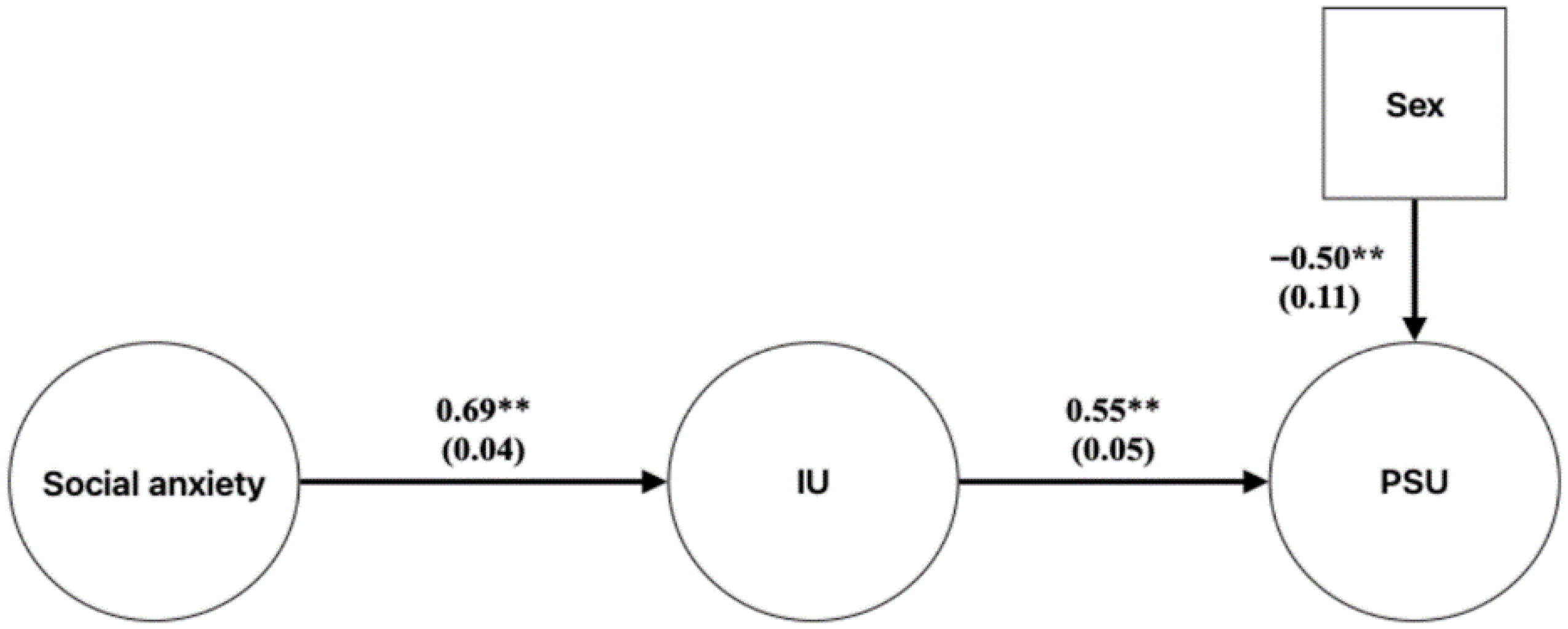
3.3. SEM Results
3.4. Mediation Analysis
3.5. Model Comparison
4. Discussion
4.1. Overall Discussion
4.2. Limitations
4.3. Conclusions
Author Contributions
Funding
Institutional Review Board Statement
Informed Consent Statement
Data Availability Statement
Acknowledgments
Conflicts of Interest
Appendix A

| SAS-SV Item | Estimate | S.E. | Est./S.E. | Two-Tailed p-Value |
|---|---|---|---|---|
| 1 | 0.56 | 0.04 | 13.10 | <0.001 |
| 2 | 0.65 | 0.04 | 18.31 | <0.001 |
| 3 | 0.59 | 0.04 | 14.72 | <0.001 |
| 4 | 0.66 | 0.03 | 20.83 | <0.001 |
| 5 | 0.84 | 0.02 | 37.51 | <0.001 |
| 6 | 0.86 | 0.02 | 46.02 | <0.001 |
| 7 | 0.74 | 0.03 | 26.40 | <0.001 |
| 8 | 0.74 | 0.03 | 25.20 | <0.001 |
| 9 | 0.64 | 0.03 | 19.25 | <0.001 |
| 10 | 0.64 | 0.04 | 17.57 | <0.001 |
| Estimate | S.E. | Est./S.E. | Two-Tailed p-Value | |
| Item 1 with 2 | 0.27 | 0.06 | 4.71 | <0.001 |
| Item 4 with 5 | 0.21 | 0.06 | 3.69 | <0.001 |
Appendix B
| SPIN Item | Estimate | S.E. | Est./S.E. | Two-Tailed p-Value |
|---|---|---|---|---|
| 1 | 0.58 | 0.04 | 13.57 | <0.001 |
| 2 | 0.63 | 0.04 | 16.51 | <0.001 |
| 3 | 0.79 | 0.03 | 30.51 | <0.001 |
| 4 | 0.74 | 0.03 | 25.55 | <0.001 |
| 5 | 0.74 | 0.03 | 26.82 | <0.001 |
| 6 | 0.84 | 0.02 | 40.48 | <0.001 |
| 7 | 0.72 | 0.03 | 23.48 | <0.001 |
| 8 | 0.64 | 0.04 | 17.57 | <0.001 |
| 9 | 0.76 | 0.03 | 28.79 | <0.001 |
| 10 | 0.79 | 0.02 | 33.49 | <0.001 |
| 11 | 0.69 | 0.03 | 20.99 | <0.001 |
| 12 | 0.73 | 0.03 | 23.74 | <0.001 |
| 13 | 0.73 | 0.04 | 21.11 | <0.001 |
| 14 | 0.87 | 0.02 | 52.19 | <0.001 |
| 15 | 0.82 | 0.02 | 42.36 | <0.001 |
| 16 | 0.72 | 0.04 | 20.03 | <0.001 |
| 17 | 0.77 | 0.03 | 26.11 | <0.001 |
| Estimate | S.E. | Est./S.E. | Two-Tailed p-Value | |
| Item 1 with 16 | 0.49 | 0.05 | 9.31 | <0.001 |
| Item 5 with 12 | 0.41 | 0.05 | 9.15 | <0.001 |
| Item 3 with 8 | 0.45 | 0.05 | 8.37 | <0.001 |
| Item 4 with 10 | 0.35 | 0.05 | 6.87 | <0.001 |
Appendix C
| IUS Item | Estimate | S.E. | Est./S.E. | Two-Tailed p-Value |
|---|---|---|---|---|
| 1 | 0.72 | 0.03 | 24.43 | <0.001 |
| 2 | 0.66 | 0.03 | 19.93 | <0.001 |
| 3 | 0.78 | 0.03 | 31.72 | <0.001 |
| 4 | 0.69 | 0.03 | 24.01 | <0.001 |
| 5 | 0.78 | 0.02 | 33.01 | <0.001 |
| 6 | 0.82 | 0.02 | 35.20 | <0.001 |
| 7 | 0.82 | 0.02 | 39.13 | <0.001 |
| 8 | 0.64 | 0.04 | 18.24 | <0.001 |
| 9 | 0.73 | 0.03 | 23.45 | <0.001 |
| 10 | 0.72 | 0.03 | 24.03 | <0.001 |
| 11 | 0.63 | 0.03 | 18.74 | <0.001 |
| 12 | 0.75 | 0.03 | 28.29 | <0.001 |
References
- Shen, X.; Wang, J.-L. Loneliness and excessive smartphone use among Chinese college students: Moderated mediation effect of perceived stressed and motivation. Comput. Hum. Behav. 2019, 95, 31–36. [Google Scholar] [CrossRef]
- Albursan, I.S.; Al. Qudah, M.F.; Al-Barashdi, H.S.; Bakhiet, S.F.; Darandari, E.; Al-Asqah, S.S.; Hammad, H.I.; Al-Khadher, M.M.; Qara, S.; Al-Mutairy, S.H.; et al. Smartphone addiction among university students in light of the COVID-19 pandemic: Prevalence, relationship to academic procrastination, quality of life, gender and educational stage. Int. J. Environ. Res. Public Health 2022, 19, 10439. [Google Scholar] [CrossRef] [PubMed]
- Duan, L.; He, J.; Li, M.; Dai, J.; Zhou, Y.; Lai, F.; Zhu, G. Based on a decision tree model for exploring the risk factors of smartphone addiction among children and adolescents in China during the COVID-19 pandemic. Front. Psychiatry 2021, 12, 652356. [Google Scholar] [CrossRef]
- Rasouli, A.; Nejad-Ebrahim Soumee, Z.; Tirgari Seraji, H.; Ramzi, F.; Saed, O. The self-control bridge: Connecting social media use to academic procrastination. Psychol. Rep. 2025, 00332941251330538. [Google Scholar] [CrossRef] [PubMed]
- Sanchez-Fernandez, M.; Borda-Mas, M. Problematic smartphone use and specific problematic Internet uses among university students and associated predictive factors: A systematic review. Educ. Inf. Technol. 2023, 28, 7111–7204. [Google Scholar] [CrossRef] [PubMed]
- Vitta, A.S.L.; Oliveira, W.A.d.; Oliveira, L.G.d.; Silva, L.S.d.; Freires, É.M.; Semolini, F.F.; Baptista, M.N.; Romualdo, C.; Kim, H.S.; de Micheli, D.; et al. Examining the link between problematic smartphone use and substance use disorders among college students: Association patterns using network analysis. Int. J. Environ. Res. Public Health 2025, 22, 973. [Google Scholar] [CrossRef]
- Al-Ajlouny, S.A.; Alzboon, K.K. Effects of mobile phone using on driving behavior and risk of traffic accidents. J. Radiat. Res. Appl. Sci. 2023, 16, 100662. [Google Scholar] [CrossRef]
- Isrofin, B.; Munawaroh, E. The effect of smartphone addiction and self-control on phubbing behavior. J. Kaji. Bimbing. Dan Konseling 2024, 6, 13. [Google Scholar] [CrossRef]
- Elhai, J.D.; Yang, H.; Fang, J.; Bai, X.; Hall, B.J. Depression and anxiety symptoms are related to problematic smartphone use severity in Chinese young adults: Fear of missing out as a mediator. Addict. Behav. 2020, 101, 105962. [Google Scholar] [CrossRef]
- Wang, C.; Hu, J.; Zhou, Y.; Jiang, L.; Chen, J.; Xi, J.; Fang, J.; Zhang, S. Problematic smartphone usage and inadequate mental health literacy potentially increase the risks of depression, anxiety, and their comorbidity in Chinese college students: A longitudinal study. J. Affect. Disord. Rep. 2025, 20, 100907. [Google Scholar] [CrossRef]
- Zhou, X.; Feng, B. Social anxiety and smartphone addiction among college students: The mediating role of loneliness. Front. Psychiatry 2025, 16, 1621900. [Google Scholar] [CrossRef] [PubMed]
- Alavinikoo, S.; Elhai, J.D.; Hutcheson, E.F.; Montag, C. Underlying dimensions of depression and negative affect are equally related to problematic smartphone and social media use severity. Psychiatry Res. 2025, 353, 116769. [Google Scholar] [CrossRef] [PubMed]
- Servidio, R.; Koronczai, B.; Griffiths, M.D.; Demetrovics, Z. Problematic smartphone use and problematic social media use: The predictive role of self-construal and the mediating effect of fear missing out. Front. Public Health 2022, 10, 814468. [Google Scholar] [CrossRef] [PubMed]
- Ting, C.H.; Chen, Y.Y. Smartphone addiction. In Adolescent Addiction; Essau, C.A., Delfabbro, P.H., Eds.; Elsevier: Amsterdam, The Netherlands, 2020; pp. 215–240. [Google Scholar]
- Augner, C.; Vlasak, T.; Aichhorn, W.; Barth, A. The association between problematic smartphone use and symptoms of anxiety and depression—A meta-analysis. J. Public Health 2023, 45, 193–201. [Google Scholar] [CrossRef]
- Ding, H.; Cao, B.; Sun, Q. The association between problematic internet use and social anxiety within adolescents and young adults: A systematic review and meta-analysis. Front. Public Health 2023, 11, 1275723. [Google Scholar] [CrossRef]
- Morrison, A.S.; Heimberg, R.G. Social anxiety and social anxiety disorder. Annu. Rev. Clin. Psychol. 2013, 9, 249–274. [Google Scholar] [CrossRef]
- Leary, M.R.; Kowalski, R.M. Social Anxiety; Guilford Press: New York, NY, USA, 1997. [Google Scholar]
- Brown, G.; Medcalf-Bell, R. Phoning it in: Social anxiety, intolerance of uncertainty, and anxiety reduction motivations predict phone use in social situations. Hum. Behav. Emerg. Technol. 2022, 2022, 6153053. [Google Scholar] [CrossRef]
- Zhou, X.; Shen, X. Unveiling the relationship between social anxiety, loneliness, motivations, and problematic smartphone use: A network approach. Compr. Psychiatry 2024, 130, 152451. [Google Scholar] [CrossRef]
- Shahidin, S.H.; Midin, M.; Sidi, H.; Choy, C.L.; Nik Jaafar, N.R.; Mohd Salleh Sahimi, H.; Che Roos, N.A. The relationship between emotion regulation (ER) and problematic smartphone use (PSU): A system-atic review and meta-analyses. Int. J. Environ. Res. Public Health 2022, 19, 15848. [Google Scholar] [CrossRef]
- Billieux, J.; Maurage, P.; Lopez-Fernandez, O.; Kuss, D.J.; Griffiths, M.D. Can disordered mobile phone use be considered a behavioral addiction? An update on current evidence and a comprehensive model for future research. Curr. Addict. Rep. 2015, 2, 156–162. [Google Scholar] [CrossRef]
- Enez Darcin, A.; Kose, S.; Noyan, C.O.; Nurmedov, S.; Yılmaz, O.; Dilbaz, N. Smartphone addiction and its relationship with social anxiety and loneliness. Behav. Inf. Technol. 2016, 35, 520–525. [Google Scholar] [CrossRef]
- Dou, G.; Feng, B. Social anxiety and smartphone addiction among college students: The mediating role of depressive symptoms. Curr. Psychol. 2025, 44, 882–893. [Google Scholar] [CrossRef]
- Xing, W.; Wang, X.; Feng, T.; Xie, J.; Liu, C.; Wang, X.; Wang, H.; Ren, L.; Liu, X. Network analysis of the association between social anxiety and problematic smartphone use in college students. Front. Psychiatry 2025, 16, 1508756. [Google Scholar] [CrossRef] [PubMed]
- Elhai, J.D.; Gallinari, E.F.; Rozgonjuk, D.; Yang, H. Depression, anxiety and fear of missing out as correlates of social, non-social and problematic smartphone use. Addict. Behav. 2020, 105, 106335. [Google Scholar] [CrossRef] [PubMed]
- Ladouceur, R.; Gosselin, P.; Dugas, M.J. Experimental manipulation of intolerance of uncertainty: A study of a theoretical model of worry. Behav. Res. Ther. 2000, 38, 933–941. [Google Scholar] [CrossRef]
- Carleton, R.N.; Mulvogue, M.K.; Thibodeau, M.A.; McCabe, R.E.; Antony, M.M.; Asmundson, G.J. Increasingly certain about uncertainty: Intolerance of uncertainty across anxiety and depression. J. Anxiety Disord. 2012, 26, 468–479. [Google Scholar] [CrossRef]
- Counsell, A.; Furtado, M.; Iorio, C.; Anand, L.; Canzonieri, A.; Fine, A.; Fotinos, K.; Epstein, I.; Katzman, M.A. Intolerance of uncertainty, social anxiety, and generalized anxiety: Differences by diagnosis and symptoms. Psychiatry Res. 2017, 252, 63–69. [Google Scholar] [CrossRef]
- Darcy, K.; Davila, J.; Beck, J.G. Is social anxiety associated with both interpersonal avoidance and interpersonal dependence? Cogn. Ther. Res. 2005, 29, 171–186. [Google Scholar] [CrossRef]
- Catalino, L.I.; Furr, R.M.; Bellis, F.A. A multilevel analysis of the self-presentation theory of social anxiety: Contextualized, dispositional, and interactive perspectives. J. Res. Personal. 2012, 46, 361–373. [Google Scholar] [CrossRef]
- Van den Berg, P.; Wenseleers, T. Uncertainty about social interactions leads to the evolution of social heuristics. Nat. Commun. 2018, 9, 2151. [Google Scholar] [CrossRef]
- Uzun, K.; Ünlü, S.; Arslan, G. Does intolerance of uncertainty influence social anxiety through rumination? A mediation model in emerging adults. Behav. Sci. 2025, 15, 687. [Google Scholar] [CrossRef]
- Liu, C.; Ren, L.; Li, K.; Yang, W.; Li, Y.; Rotaru, K.; Wei, X.; Yücel, M.; Albertella, L. Understanding the association between intolerance of uncertainty and problematic smartphone use: A network analysis. Front. Psychiatry 2022, 13, 917833. [Google Scholar] [CrossRef]
- Zhang, S.; Yong, S.; Tang, Y.; Feng, H.; Chen, L.; Zhang, L.; Deng, Y.; Chen, J. Intolerance of uncertainty fuels preservice teachers’ smartphone dependence through rumination and anxiety during the COVID-19 pandemic: A cross-sectional study. Heliyon 2023, 9, e17798. [Google Scholar] [CrossRef]
- Qiu, H.; Lu, H.; Wang, X.; Guo, Z.; Xing, C.; Zhang, Y. A moderated chain mediation model examining the relation between smartphone addiction and intolerance of uncertainty among master’s and PhD students. Heliyon 2024, 10, e30994. [Google Scholar] [CrossRef]
- Boelen, P.A.; Reijntjes, A. Intolerance of uncertainty and social anxiety. J. Anxiety Disord. 2009, 23, 130–135. [Google Scholar] [CrossRef] [PubMed]
- McEvoy, P.M.; Mahoney, A.E. To be sure, to be sure: Intolerance of uncertainty mediates symptoms of various anxiety disorders and depression. Behav. Ther. 2012, 43, 533–545. [Google Scholar] [CrossRef] [PubMed]
- Byrne, B.M. Structural Equation Modeling with Mplus: Basic Concepts, Applications, and Programming; Routledge: Oxfordshire, UK, 2013. [Google Scholar]
- Kline, R.B. Principles and Practice of Structural Equation Modeling; Guilford Publications: New York, NY, USA, 2023. [Google Scholar]
- Brand, M.; Young, K.S.; Laier, C.; Wölfling, K.; Potenza, M.N. Integrating psychological and neurobiological considerations regarding the development and maintenance of specific internet-use disorders: An interaction of person-affect-cognition-execution (I-PACE) model. Neurosci. Biobehav. Rev. 2016, 71, 252–266. [Google Scholar] [CrossRef]
- Brand, M.; Wegmann, E.; Stark, R.; Müller, A.; Wölfling, K.; Robbins, T.W.; Potenza, M.N. The interaction of person-affect-cognition-execution (I-PACE) model for addictive behaviors: Update, generalization to addictive behaviors beyond internet-use disorders, and specification of the process character of addictive behaviors. Neurosci. Biobehav. Rev. 2019, 104, 1–10. [Google Scholar] [CrossRef]
- Heimberg, R.G.; Brozovich, F.A.; Rapee, R.M. A cognitive behavioral model of social anxiety disorder: Update and extension. In Social Anxiety; Hofmann, S.G., Dibartolo, P.M., Eds.; Elsevier: Amsterdam, The Netherlands, 2010; pp. 395–422. [Google Scholar]
- Karvay, Y.; Imbriano, G.; Jin, J.; Mohanty, A.; Jarcho, J.M. They’re watching you: The impact of social evaluation and anxiety on threat-related perceptual decision-making. Psychol. Res. 2022, 86, 1174–1183. [Google Scholar] [CrossRef]
- Nishikawa, Y.; Fracalanza, K.; Rector, N.A.; Laposa, J.M. Social anxiety and negative interpretations of positive social events: What role does intolerance of uncertainty play? J. Clin. Psychol. 2022, 78, 2513–2524. [Google Scholar] [CrossRef]
- Rozgonjuk, D.; Elhai, J.D.; Täht, K.; Vassil, K.; Levine, J.C.; Asmundson, G.J. Non-social smartphone use mediates the relationship between intolerance of uncertainty and problematic smartphone use: Evidence from a repeated-measures study. Comput. Hum. Behav. 2019, 96, 56–62. [Google Scholar] [CrossRef]
- R Developement Core Team. R: A Language and Environment for Statistical Computing; R Developement Core Team: Vienna, Austria, 2010. [Google Scholar]
- Elhai, J.D.; Levine, J.C.; Hall, B.J. The relationship between anxiety symptom severity and problematic smartphone use: A review of the literature and conceptual frameworks. J. Anxiety Disord. 2019, 62, 45–52. [Google Scholar] [CrossRef]
- Connor, K.M.; Davidson, J.R.; Churchill, L.E.; Sherwood, A.; Weisler, R.H.; Foa, E. Psychometric properties of the social phobia inventory (SPIN): New self-rating scale. Br. J. Psychiatry 2000, 176, 379–386. [Google Scholar] [CrossRef] [PubMed]
- Antony, M.M.; Rowa, K.; Liss, A.; Swallow, S.R.; Swinson, R.P. Social comparison processes in social phobia. Behav. Ther. 2005, 36, 65–75. [Google Scholar] [CrossRef]
- Carleton, R.N.; Norton, M.P.J.; Asmundson, G.J. Fearing the unknown: A short version of the intolerance of uncertainty scale. J. Anxiety Disord. 2007, 21, 105–117. [Google Scholar] [CrossRef] [PubMed]
- Freeston, M.H.; Rhéaume, J.; Letarte, H.; Dugas, M.J.; Ladouceur, R. Why do people worry? Personal. Individ. Differ. 1994, 17, 791–802. [Google Scholar] [CrossRef]
- Renjan, V.; McEvoy, P.M.; Handley, A.K.; Fursland, A. Stomaching uncertainty: Relationships among intolerance of uncertainty, eating disorder pathology, and comorbid emotional symptoms. J. Anxiety Disord. 2016, 41, 88–95. [Google Scholar] [CrossRef]
- Kwon, M.; Kim, D.-J.; Cho, H.; Yang, S. The smartphone addiction scale: Development and validation of a short version for adolescents. PLoS ONE 2013, 8, e83558. [Google Scholar] [CrossRef]
- Duke, É.; Montag, C. Smartphone addiction, daily interruptions and self-reported productivity. Addict. Behav. Rep. 2017, 6, 90–95. [Google Scholar] [CrossRef]
- Harris, B.; McCredie, M.; Fields, S. Examining the psychometric properties of the smartphone addiction scale and its short version for use with emerging adults in the US. Comput. Hum. Behav. Rep. 2020, 1, 100011. [Google Scholar] [CrossRef]
- Muthén, L.K.; Muthén, B. Mplus User’s Guide: Statistical Analysis with Latent Variables, User’s Guide; Muthén & Muthén: Los Angeles, CA, USA, 2017. [Google Scholar]
- Verhulst, B.; Neale, M.C. Best practices for binary and ordinal data analyses. Behav. Genet. 2021, 51, 204–214. [Google Scholar] [CrossRef]
- Xia, Y.; Yang, Y. RMSEA, CFI, and TLI in structural equation modeling with ordered categorical data: The story they tell depends on the estimation methods. Behav. Res. Methods 2019, 51, 409–428. [Google Scholar] [CrossRef]
- Shi, D.; Maydeu-Olivares, A.; Rosseel, Y. Assessing fit in ordinal factor analysis models: SRMR vs. RMSEA. Struct. Equ. Model. A Multidiscip. J. 2020, 27, 1–15. [Google Scholar] [CrossRef]
- Olson, J.A.; Sandra, D.A.; Veissière, S.P.; Langer, E.J. Sex, age, and smartphone addiction across 41 countries. Int. J. Ment. Health Addict. 2025, 23, 937–945. [Google Scholar] [CrossRef]
- Cheung, G.W.; Rensvold, R.B. Evaluating goodness-of-fit indexes for testing measurement invariance. Struct. Equ. Model. A Multidiscip. J. 2002, 9, 233–255. [Google Scholar] [CrossRef]
- Xiao, Z.; Huang, J. The relation between college students’ social anxiety and mobile phone addiction: The mediating role of regulatory emotional self-efficacy and subjective well-being. Front. Psychol. 2022, 13, 861527. [Google Scholar] [CrossRef]
- Carleton, R.N. Into the unknown: A review and synthesis of contemporary models involving uncertainty. J. Anxiety Disord. 2016, 39, 30–43. [Google Scholar] [CrossRef]
- Elhai, J.D.; Levine, J.C.; Dvorak, R.D.; Hall, B.J. Fear of missing out, need for touch, anxiety and depression are related to problematic smartphone use. Comput. Hum. Behav. 2016, 63, 509–516. [Google Scholar] [CrossRef]
- Wegmann, E.; Brand, M. Internet-communication disorder: It’s a matter of social aspects, coping, and internet-use expectancies. Front. Psychol. 2016, 7, 1747. [Google Scholar] [CrossRef]
- Saraff, P.; Shikatani, B.; Rogic, A.M.; Dodig, E.F.; Talluri, S.; Murray-Latin, H. Intolerance of uncertainty and social anxiety: An experimental investigation. Behav. Change 2023, 40, 314–327. [Google Scholar] [CrossRef]
- Miller, M.L.; McGuire, J.F. Targeting intolerance of uncertainty in treatment: A meta-analysis of therapeutic effects, treatment moderators, and underlying mechanisms. J. Affect. Disord. 2023, 341, 283–295. [Google Scholar] [CrossRef] [PubMed]
- Billieux, J.; Philippot, P.; Schmid, C.; Maurage, P.; De Mol, J.; Van der Linden, M. Is dysfunctional use of the mobile phone a behavioural addiction? Confronting symptom-based versus process-based approaches. Clin. Psychol. Psychother. 2015, 22, 460–468. [Google Scholar] [CrossRef] [PubMed]
- Sun, C.; Li, Y.; Kwok, S.Y.; Mu, W. The relationship between intolerance of uncertainty and problematic social media use during the COVID-19 pandemic: A serial mediation model. Int. J. Environ. Res. Public Health 2022, 19, 14924. [Google Scholar] [CrossRef] [PubMed]
- Insel, T.R. The NIMH research domain criteria (RDoC) project: Precision medicine for psychiatry. Am. J. Psychiatry 2014, 171, 395–397. [Google Scholar] [CrossRef]
- Maxwell, S.E.; Cole, D.A. Bias in cross-sectional analyses of longitudinal mediation. Psychol. Methods 2007, 12, 23. [Google Scholar] [CrossRef]
- Elhai, J.D.; Sapci, O.; Yang, H.; Amialchuk, A.; Rozgonjuk, D.; Montag, C. Objectively-measured and self-reported smartphone use in relation to surface learning, procrastination, academic productivity, and psychopathology symptoms in college students. Hum. Behav. Emerg. Technol. 2021, 3, 912–921. [Google Scholar] [CrossRef]
- Elhai, J.D.; Yang, H.; McKay, D.; Asmundson, G.J. COVID-19 anxiety symptoms associated with problematic smartphone use severity in Chinese adults. J. Affect. Disord. 2020, 274, 576–582. [Google Scholar] [CrossRef]
- Wolniewicz, C.A.; Tiamiyu, M.F.; Weeks, J.W.; Elhai, J.D. Problematic smartphone use and relations with negative affect, fear of missing out, and fear of negative and positive evaluation. Psychiatry Res. 2018, 262, 618–623. [Google Scholar] [CrossRef]
- Alavinikoo, S.; Pirmoradi, M.; Zahedi Tajrishi, K.; Arezoomandan, R. Structural equation modeling of problematic internet use based on executive function, interpersonal needs, fear of missing out and depression. J. Clin. Exp. Neuropsychol. 2025, 47, 185–204. [Google Scholar] [CrossRef]
- Liu, C.H.; Stevens, C.; Wong, S.H.; Yasui, M.; Chen, J.A. The prevalence and predictors of mental health diagnoses and suicide among US college students: Implications for addressing disparities in service use. Depress. Anxiety 2019, 36, 8–17. [Google Scholar] [CrossRef]
- Kim, J.; Kim, H.-R. Values, intercultural sensitivity, and uncertainty management: A cross-cultural investigation of motivational profiles. Front. Psychol. 2025, 16, 1623929. [Google Scholar] [CrossRef]

| Variable | 1 | 2 | 3 |
|---|---|---|---|
| 1. Age | |||
| 2. PSU | −0.12 * | ||
| 3. IU | 0.03 | 0.43 ** | |
| 4. Social Anxiety | −0.08 | 0.44 ** | 0.58 ** |
| Variable | Women M | Women SD | Men M | Men SD | F(1325) | p | η2p |
|---|---|---|---|---|---|---|---|
| IU | 31.57 | 10.26 | 28.44 | 9.15 | 7.44 | <0.01 | 0.02 |
| PSU | 28.05 | 10.29 | 23.50 | 8.06 | 16.79 | <0.001 | 0.05 |
| Social Anxiety | 22.86 | 15.22 | 15.94 | 10.76 | 18.59 | <0.001 | 0.05 |
| Measure | Chi-Square Test | CFI | TLI | RMSEA (90% CI) | SRMR |
|---|---|---|---|---|---|
| PSU | χ2(33) = 222.84, p < 0.001 | 0.94 | 0.92 | 0.13 (0.12–0.15) | 0.05 |
| Social Anxiety | χ2(115) = 422.81, p < 0.001 | 0.96 | 0.95 | 0.09 (0.08–0.10) | 0.05 |
| IU | χ2(54) = 260.05, p < 0.001 | 0.95 | 0.94 | 0.11 (0.10–0.12) | 0.04 |
| Estimate | S.E. | Est./S.E. | Two-Tailed p | |
|---|---|---|---|---|
| Indirect Effect of IU (mediator) from social anxiety (predictor) to PSU (dependent variable) | 0.38 | 0.05 | 8.10 | <0.001 |
Disclaimer/Publisher’s Note: The statements, opinions and data contained in all publications are solely those of the individual author(s) and contributor(s) and not of MDPI and/or the editor(s). MDPI and/or the editor(s) disclaim responsibility for any injury to people or property resulting from any ideas, methods, instructions or products referred to in the content. |
© 2025 by the authors. Licensee MDPI, Basel, Switzerland. This article is an open access article distributed under the terms and conditions of the Creative Commons Attribution (CC BY) license (https://creativecommons.org/licenses/by/4.0/).
Share and Cite
Alavinikoo, S.; Hutcheson, E.F.; Elhai, J.D. Intolerance of Uncertainty Mediates the Relationship Between Social Anxiety and Problematic Smartphone Use Severity in College Students. J. Pers. Med. 2025, 15, 599. https://doi.org/10.3390/jpm15120599
Alavinikoo S, Hutcheson EF, Elhai JD. Intolerance of Uncertainty Mediates the Relationship Between Social Anxiety and Problematic Smartphone Use Severity in College Students. Journal of Personalized Medicine. 2025; 15(12):599. https://doi.org/10.3390/jpm15120599
Chicago/Turabian StyleAlavinikoo, Sana, Elyse F. Hutcheson, and Jon D. Elhai. 2025. "Intolerance of Uncertainty Mediates the Relationship Between Social Anxiety and Problematic Smartphone Use Severity in College Students" Journal of Personalized Medicine 15, no. 12: 599. https://doi.org/10.3390/jpm15120599
APA StyleAlavinikoo, S., Hutcheson, E. F., & Elhai, J. D. (2025). Intolerance of Uncertainty Mediates the Relationship Between Social Anxiety and Problematic Smartphone Use Severity in College Students. Journal of Personalized Medicine, 15(12), 599. https://doi.org/10.3390/jpm15120599