When the All-Purpose Tool Fails: Manufacturer-Specific Time Dependency of Magnet Mode in Cardiac Implantable Electronic Devices

 , , ,
, , ,  , and
, and
Abstract
1. Introduction
2. Methods
3. Results
3.1. Magnet Mode in ICD
3.2. Magnet Mode in Pacemakers
4. Discussion
- (1)
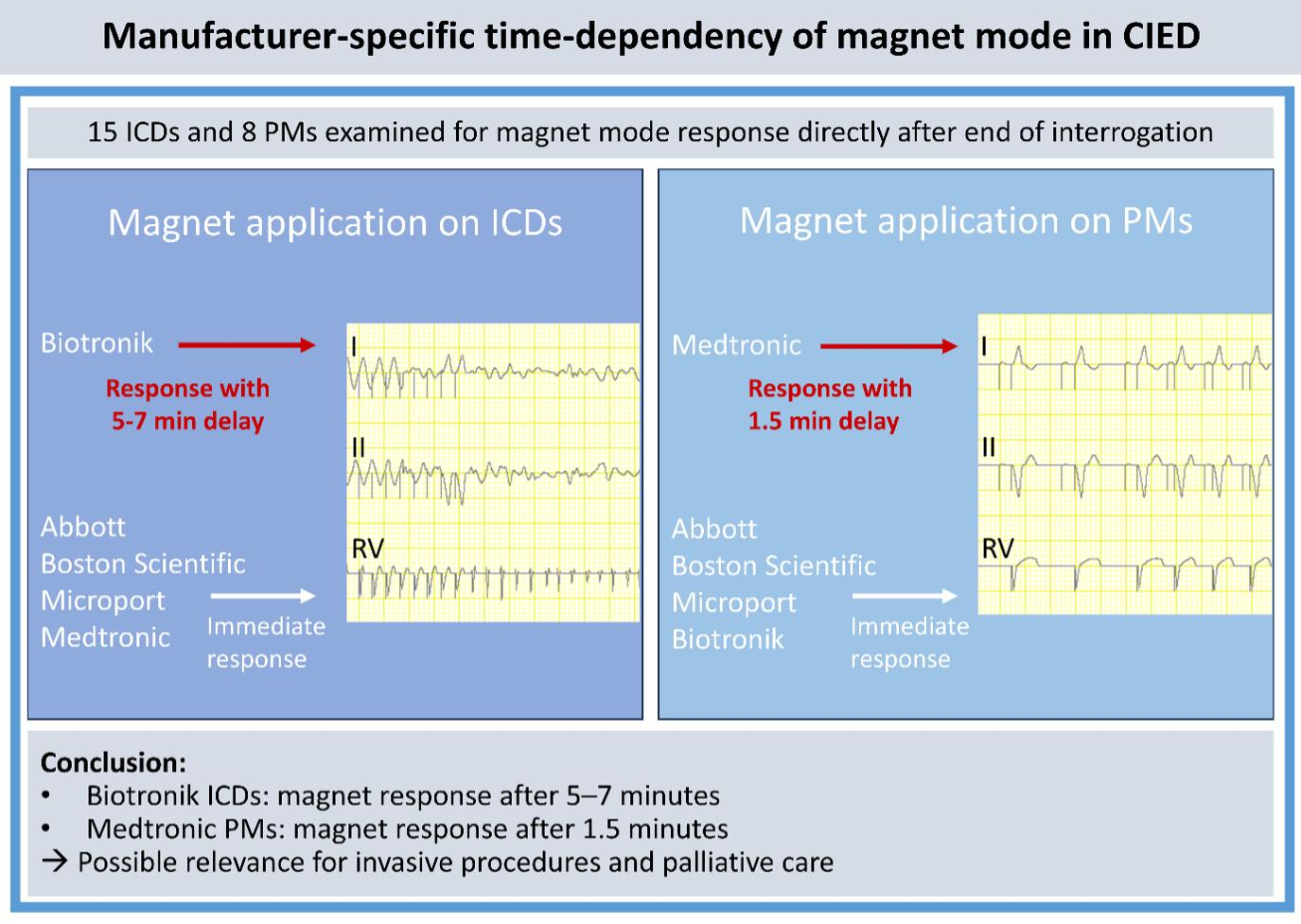
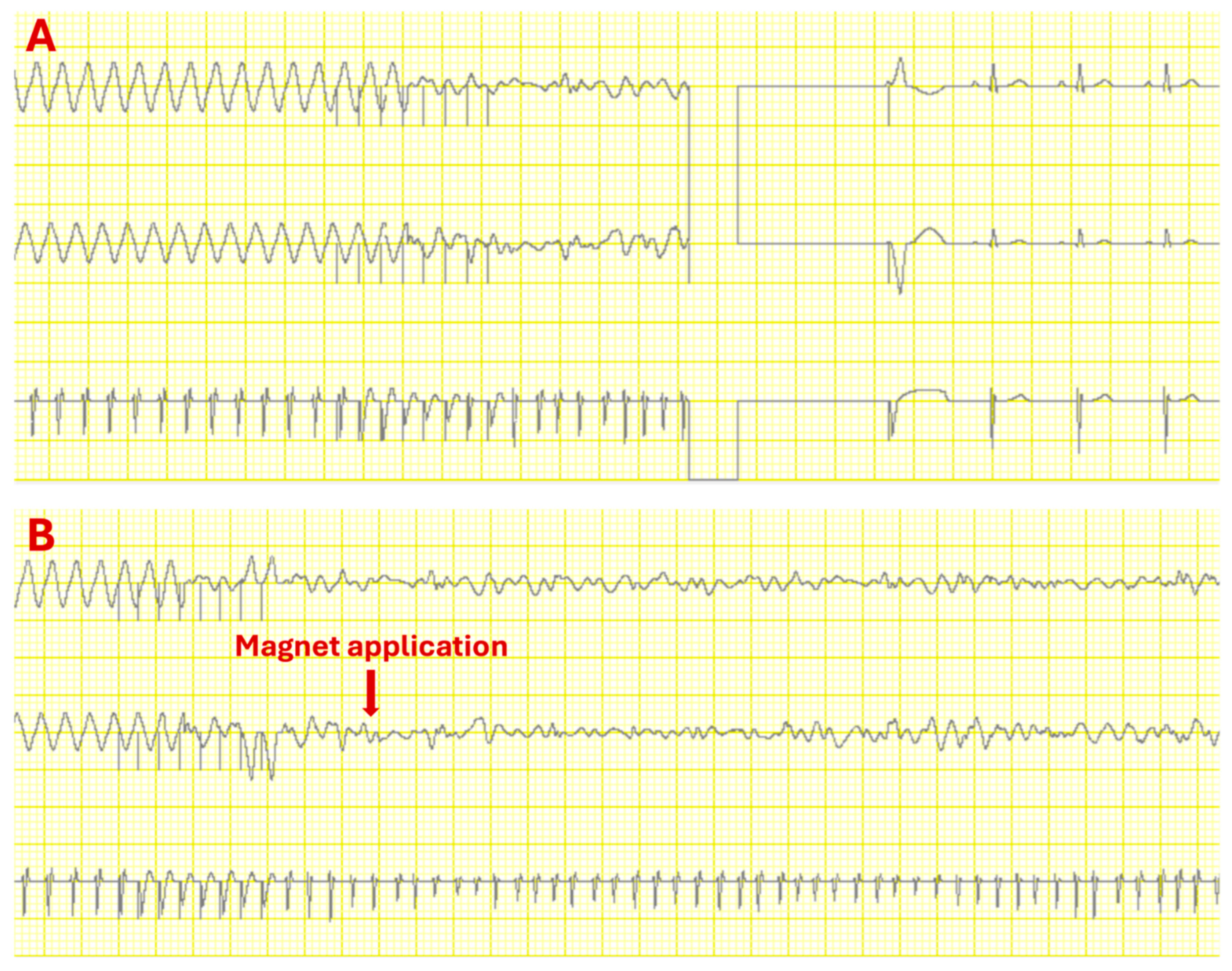
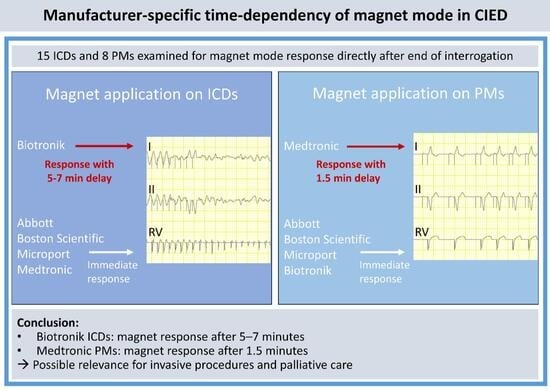
- The ICDs from Abbott, Boston Scientific, Medtronic, and Microport immediately inhibited their antitachycardia function after the application of the magnet, while the ICDs from Biotronik showed a delayed response, with the magnet mode being triggered 5 to 7 min after the end of device interrogation.
- (2)
- After eight hours of magnet application, all Biotronik ICDs automatically reactivated the antitachycardia function, while ICDs from other manufacturers remained inactive.
- (3)
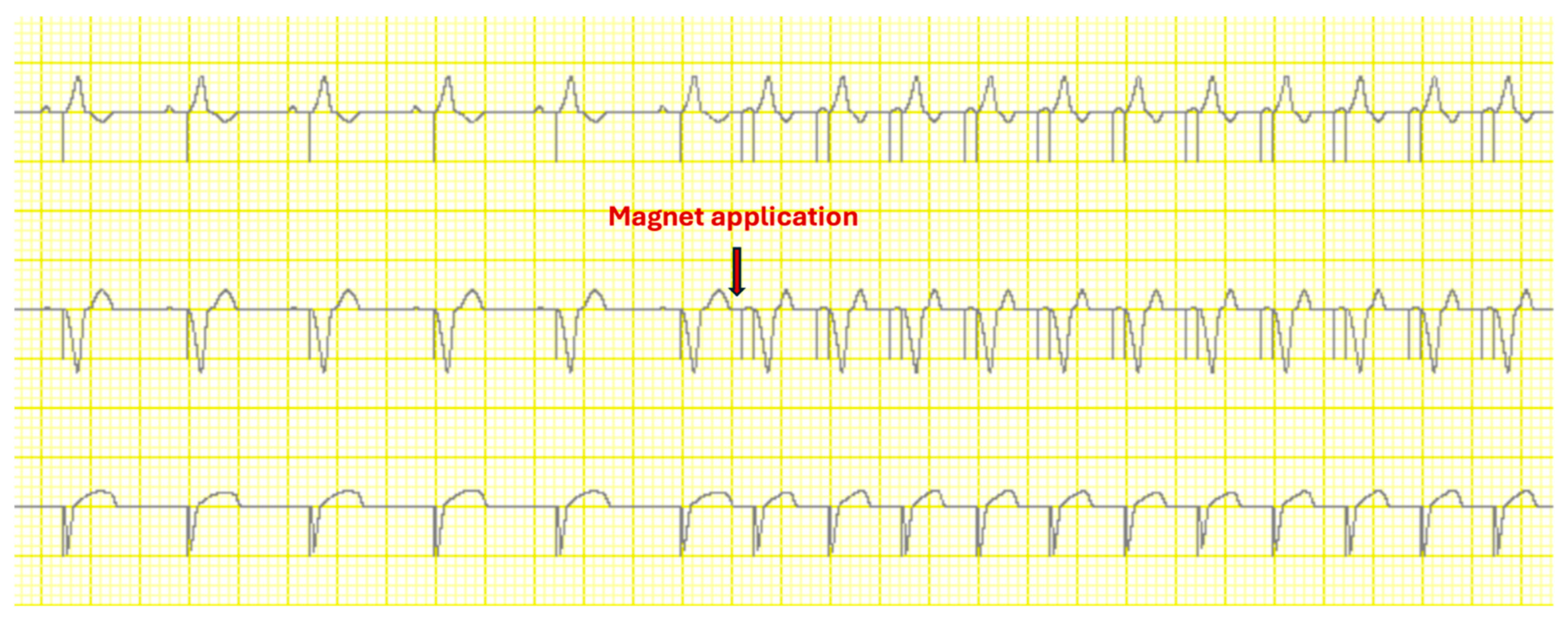
- Biotronik, Abbott, Boston Scientific, and Microport pacemakers responded to a magnet immediately after interrogation, while the Medtronic pacemakers showed a delay of 1.5 min.
4.1. Delayed Response of Biotronik ICDs
4.2. Reactivation of the Antitachycardia Function in Biotronik ICDs
4.3. Responses for Pacemakers
4.4. Clinical Relevance of the Findings
5. Limitations
6. Conclusions
Supplementary Materials
Author Contributions
Funding
Institutional Review Board Statement
Informed Consent Statement
Data Availability Statement
Conflicts of Interest
References
- Özkartal, T.; Demarchi, A.; Caputo, M.L.; Baldi, E.; Conte, G.; Auricchio, A. Perioperative Management of Patients with Cardiac Implantable Electronic Devices and Utility of Magnet Application. J. Clin. Med. 2022, 11, 691. [Google Scholar] [CrossRef] [PubMed]
- Jacob, S.; Panaich, S.S.; Maheshwari, R.; Haddad, J.W.; Padanilam, B.J.; John, S.K. Clinical applications of magnets on cardiac rhythm management devices. Europace 2011, 13, 1222–1230. [Google Scholar] [CrossRef] [PubMed]
- Thompson, A.; Fleischmann, K.E.; Smilowitz, N.R.; de Las Fuentes, L.; Mukherjee, D.; Aggarwal, N.R.; Ahmad, F.S.; Allen, R.B.; Altin, S.E.; Auerbach, A.; et al. 2024 AHA/ACC/ACS/ASNC/HRS/SCA/SCCT/SCMR/SVM Guideline for Perioperative Cardiovascular Management for Noncardiac Surgery: A Report of the American College of Cardiology/American Heart Association Joint Committee on Clinical Practice Guidelines. J. Am. Coll. Cardiol. 2024, 84, 1869–1969. [Google Scholar] [CrossRef] [PubMed]
- Stühlinger, M.; Burri, H.; Vernooy, K.; Garcia, R.; Lenarczyk, R.; Sultan, A.; Brunner, M.; Sabbag, A.; Özcan, E.E.; Ramos, J.T.; et al. EHRA consensus on prevention and management of interference due to medical procedures in patients with cardiac implantable electronic devices. Europace 2022, 24, 1512–1537. [Google Scholar] [CrossRef]
- Wegner, F.K.; Breuer, L.; Wolfes, J.; Korthals, D.; Ellermann, C.; Martinovic, M.; Kittl, C.; Reinke, F.; Frommeyer, G.; Eckardt, L. Effects of handheld electro-shockers on cardiac implantable electronic devices. Heart Rhythm 2025, 22, 1337–1344. [Google Scholar] [CrossRef] [PubMed]
- Wegner, F.K.; Korthals, D.; Kreimer, F.; Wolfes, J.; Ellermann, C.; Doldi, F.; Martinovic, M.; Kittl, C.; Frommeyer, G.; Eckardt, L. Preventing smartphone induction of ICD and pacemaker magnet mode. In Proceedings of the 91st Annual Meeting of the German Cardiac Society Clin Res Cardiol, Online, 27 April 2025; Volume 114. [Google Scholar]
- Stiles, M.K.; Fauchier, L.; Morillo, C.A.; Wilkoff, B.L. 2019 HRS/EHRA/APHRS/LAHRS focused update to 2015 expert consensus statement on optimal implantable cardioverter-defibrillator programming and testing. Heart Rhythm 2020, 17, e220–e228. [Google Scholar] [CrossRef]
- Schulman, P.M.; Rozner, M.A. Case report: Use caution when applying magnets to pacemakers or defibrillators for surgery. Anesth. Analg. 2013, 117, 422–427. [Google Scholar] [CrossRef]
- Cronin, B.; Dalia, A.; Sandoval, K.; Birgersdotter-Green, U.; Sherer, E.; Essandoh, M.K. Perioperative Interrogation of Biotronik Cardiovascular Implantable Electronic Devices: A Guide for Anesthesiologists. J. Cardiothorac. Vasc. Anesth. 2019, 33, 3427–3436. [Google Scholar] [CrossRef] [PubMed]
- Allison, M.G.; Mallemat, H.A. Emergency Care of Patients with Pacemakers and Defibrillators. Emerg. Med. Clin. N. Am. 2015, 33, 653–667. [Google Scholar] [CrossRef] [PubMed]
- Arcinas, L.A.; Sheldon, R.S. Complications related to pacemakers and other cardiac implantable electronic devices: Essentials for internists and emergency physicians. Intern. Emerg. Med. 2023, 18, 851–862. [Google Scholar] [CrossRef] [PubMed]
- Ghosh, A.; Sriram, C.S.; Pandurangi, U.M. Unusual response to magnet application: What is the Mechanism? HeartRhythm Case Rep. 2023, 9, 768–772. [Google Scholar] [CrossRef] [PubMed]
- Gifford, J.; Larimer, K.; Thomas, C.; May, P. ICD-ON Registry for Perioperative Management of CIEDs: Most Require No Change. Pacing Clin. Electrophysiol. 2017, 40, 128–134. [Google Scholar] [CrossRef] [PubMed]
- Neubauer, H.; Wellmann, M.; Herzog-Niescery, J.; Wutzler, A.; Weber, T.P.; Mügge, A.; Vogelsang, H. Comparison of perioperative strategies in ICD patients: The perioperative ICD management study (PIM study). Pacing Clin. Electrophysiol. 2018, 41, 1536–1542. [Google Scholar] [CrossRef] [PubMed]
- von Olshausen, G.; Rondak, I.C.; Lennerz, C.; Semmler, V.; Grebmer, C.; Reents, T.; Ammar-Busch, S.; Buiatti, A.; Bourier, F.; Deisenhofer, I.; et al. Correction to: Electromagnetic interference in implantable cardioverter defibrillators: Present but rare. Clin. Res. Cardiol. 2020, 109, 652. [Google Scholar] [CrossRef] [PubMed]
- Gifford, J.; Larimer, K.; Thomas, C.; May, P.; Stanhope, S.; Gami, A. Randomized controlled trial of perioperative ICD management: Magnet application versus reprogramming. Pacing Clin. Electrophysiol. 2014, 37, 1219–1224. [Google Scholar] [CrossRef] [PubMed]
- Lampert, R.; Hayes, D.L.; Annas, G.J.; Farley, M.A.; Goldstein, N.E.; Hamilton, R.M.; Kay, G.N.; Kramer, D.B.; Mueller, P.S.; Padeletti, L.; et al. HRS Expert Consensus Statement on the Management of Cardiovascular Implantable Electronic Devices (CIEDs) in patients nearing end of life or requesting withdrawal of therapy. Heart Rhythm 2010, 7, 1008–1026. [Google Scholar] [CrossRef]



| Time After the End of Device Query Long Time | |||||||||||||||||
|---|---|---|---|---|---|---|---|---|---|---|---|---|---|---|---|---|---|
| CIED Name & Type | 0.5 min | 1 min | 1.5 min | 2 min | 2.5 min | 3 min | 3.5 min | 4 min | 4.5 min | 5 min | 5.5 min | 6 min | 6.5 min | 7 min | 7 h | 8 h | |
| Med-tronic | Mirro VR (VVI-ICD) | ||||||||||||||||
| Compia Quad (CRT-D) | |||||||||||||||||
| Abbott | Ellipse VR (VVI-ICD) | ||||||||||||||||
| Unify Assura (CRT-D) | |||||||||||||||||
| Biotronik | Rivacor 5 VR (VVI-ICD) | ||||||||||||||||
| Rivacor 3 VR (VVI-ICD) | |||||||||||||||||
| Iforia 3 HF (CRT-D) | |||||||||||||||||
| Iforia 3 DR (DDD-ICD) | |||||||||||||||||
| Iforia 5 VR (VVI-ICD) | |||||||||||||||||
| Inlexa 3 VR (VVI-ICD) | |||||||||||||||||
| Itrevia 5 HF (CRT-D) | |||||||||||||||||
| Micro-port | Paradym VR (VVI-ICD) | ||||||||||||||||
| Paradym 2 DR (DDD-ICD) | |||||||||||||||||
| Boston Sci. | Origen Mini (VVI-ICD) | ||||||||||||||||
| Teligen 100 (DDD-ICD) | |||||||||||||||||
| Time After the End of Device Query | |||||||||||
|---|---|---|---|---|---|---|---|---|---|---|---|
| CIED Name & Type | 0.5 min | 1 min | 1.5 min | 2 min | 2.5 min | 3 min | 3.5 min | 4 min | 4.5 min | 5 min | |
| Medtronic | Sensia DR (DDD-PM) | ||||||||||
| Relia SR (single chamber) | |||||||||||
| Abbott | Endurity Core (DDD-PM) | ||||||||||
| Endurity (single chamber) | |||||||||||
| Biotronik | Ecuro DR (DDD-PM) | ||||||||||
| Amvia Edge DR (DDD-PM) | |||||||||||
| Micro-port | Reply DR (DDD-PM) | ||||||||||
| Boston Sci. | Visionist (CRT-P) | ||||||||||
Disclaimer/Publisher’s Note: The statements, opinions and data contained in all publications are solely those of the individual author(s) and contributor(s) and not of MDPI and/or the editor(s). MDPI and/or the editor(s) disclaim responsibility for any injury to people or property resulting from any ideas, methods, instructions or products referred to in the content. |
© 2025 by the authors. Licensee MDPI, Basel, Switzerland. This article is an open access article distributed under the terms and conditions of the Creative Commons Attribution (CC BY) license (https://creativecommons.org/licenses/by/4.0/).
Share and Cite
Kreimer, F.; Korthals, D.; Wolfes, J.; Ellermann, C.; Doldi, F.; Frommeyer, G.; Reinke, F.; Eckardt, L.; Wegner, F.K. When the All-Purpose Tool Fails: Manufacturer-Specific Time Dependency of Magnet Mode in Cardiac Implantable Electronic Devices. Diagnostics 2025, 15, 3056. https://doi.org/10.3390/diagnostics15233056
Kreimer F, Korthals D, Wolfes J, Ellermann C, Doldi F, Frommeyer G, Reinke F, Eckardt L, Wegner FK. When the All-Purpose Tool Fails: Manufacturer-Specific Time Dependency of Magnet Mode in Cardiac Implantable Electronic Devices. Diagnostics. 2025; 15(23):3056. https://doi.org/10.3390/diagnostics15233056
Chicago/Turabian StyleKreimer, Fabienne, Dennis Korthals, Julian Wolfes, Christian Ellermann, Florian Doldi, Gerrit Frommeyer, Florian Reinke, Lars Eckardt, and Felix K. Wegner. 2025. "When the All-Purpose Tool Fails: Manufacturer-Specific Time Dependency of Magnet Mode in Cardiac Implantable Electronic Devices" Diagnostics 15, no. 23: 3056. https://doi.org/10.3390/diagnostics15233056
APA StyleKreimer, F., Korthals, D., Wolfes, J., Ellermann, C., Doldi, F., Frommeyer, G., Reinke, F., Eckardt, L., & Wegner, F. K. (2025). When the All-Purpose Tool Fails: Manufacturer-Specific Time Dependency of Magnet Mode in Cardiac Implantable Electronic Devices. Diagnostics, 15(23), 3056. https://doi.org/10.3390/diagnostics15233056