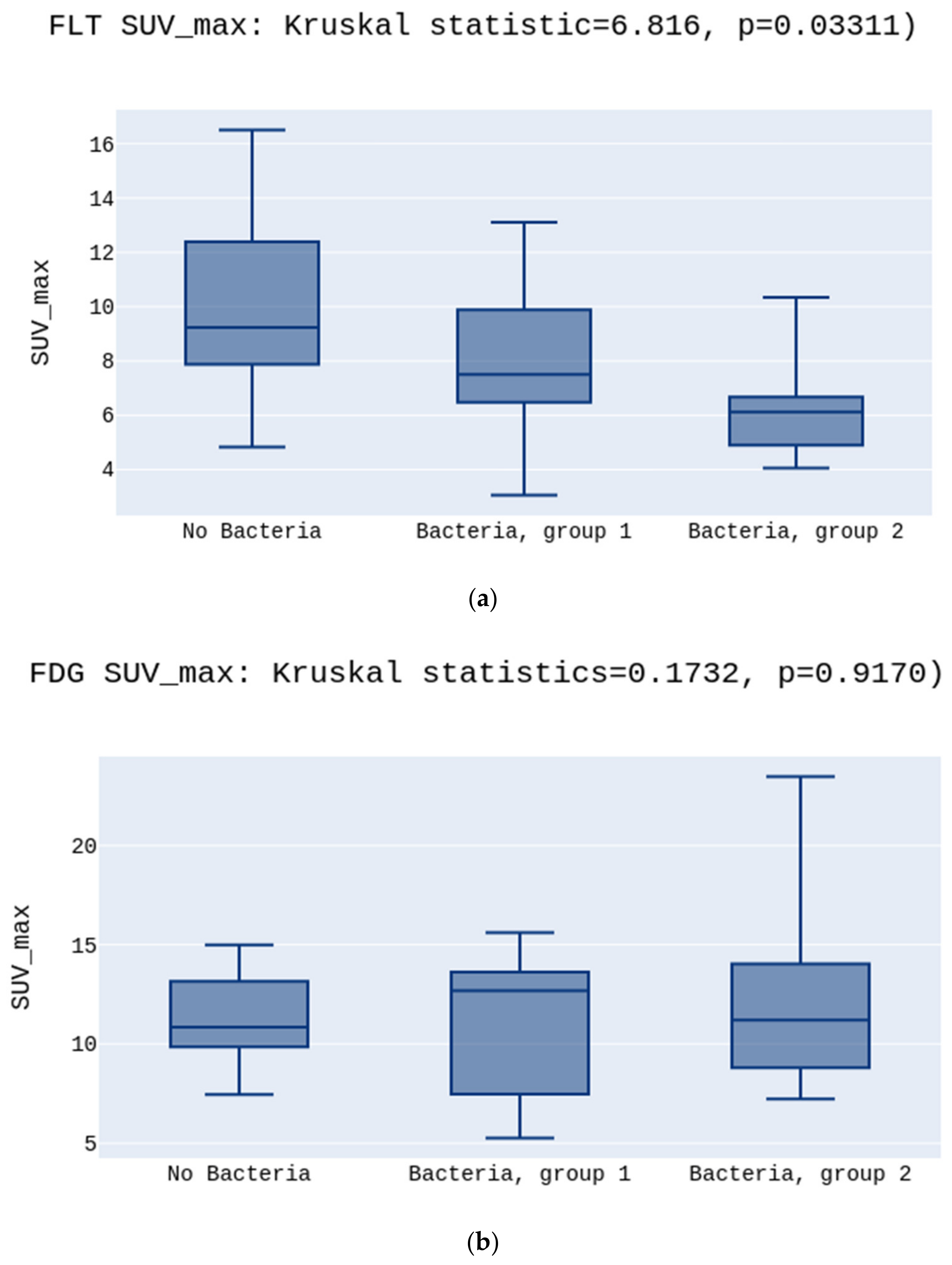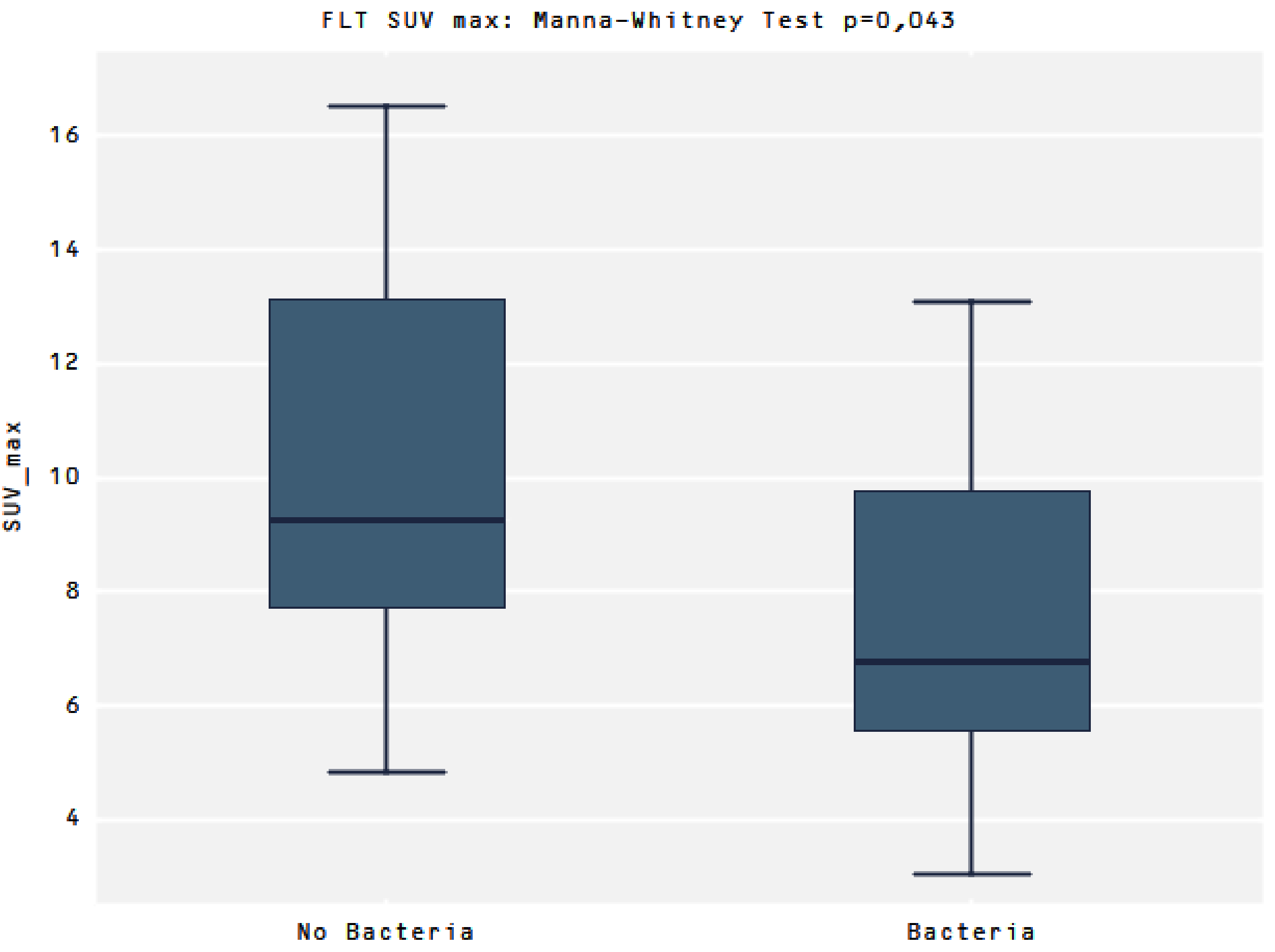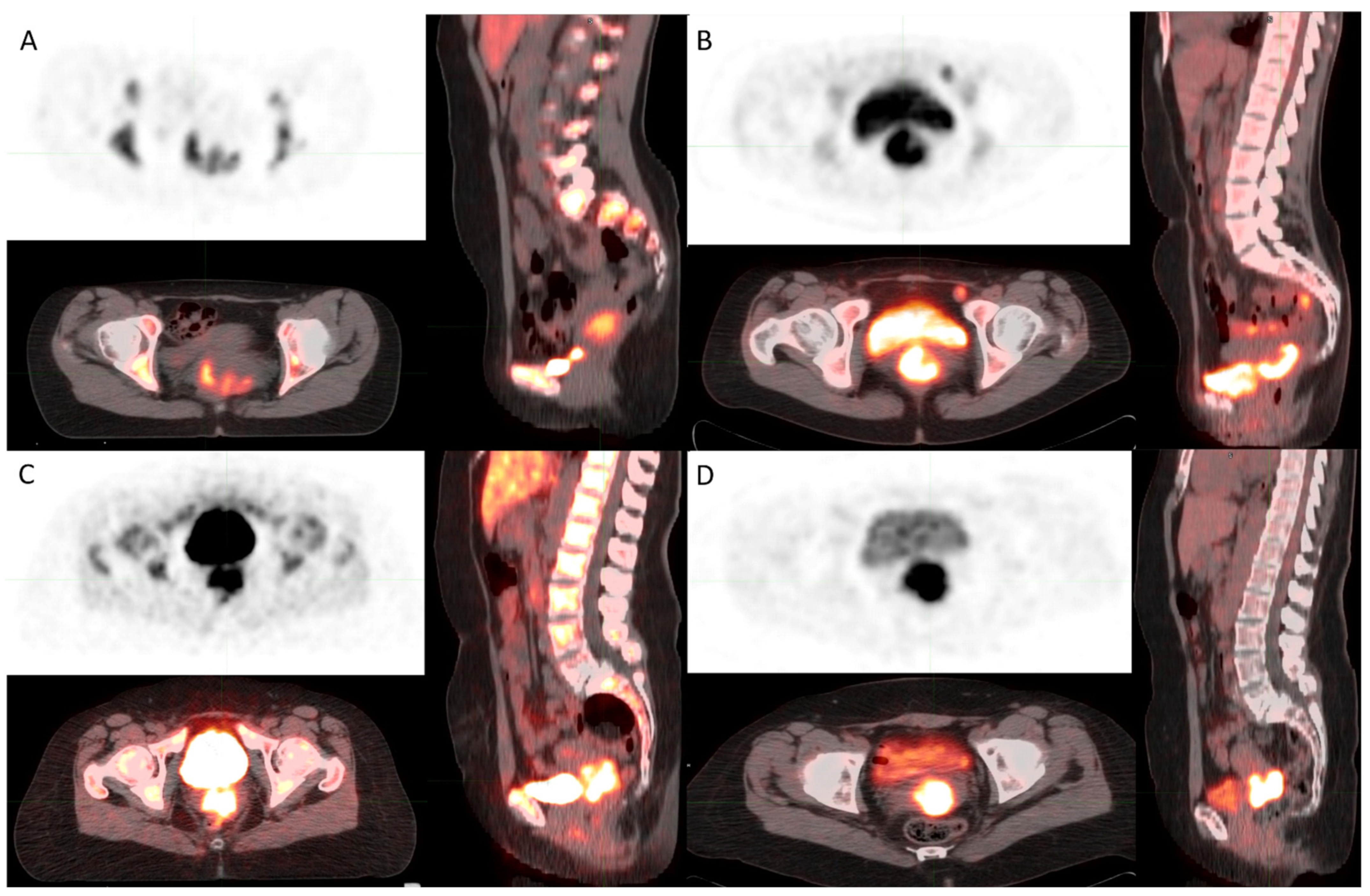
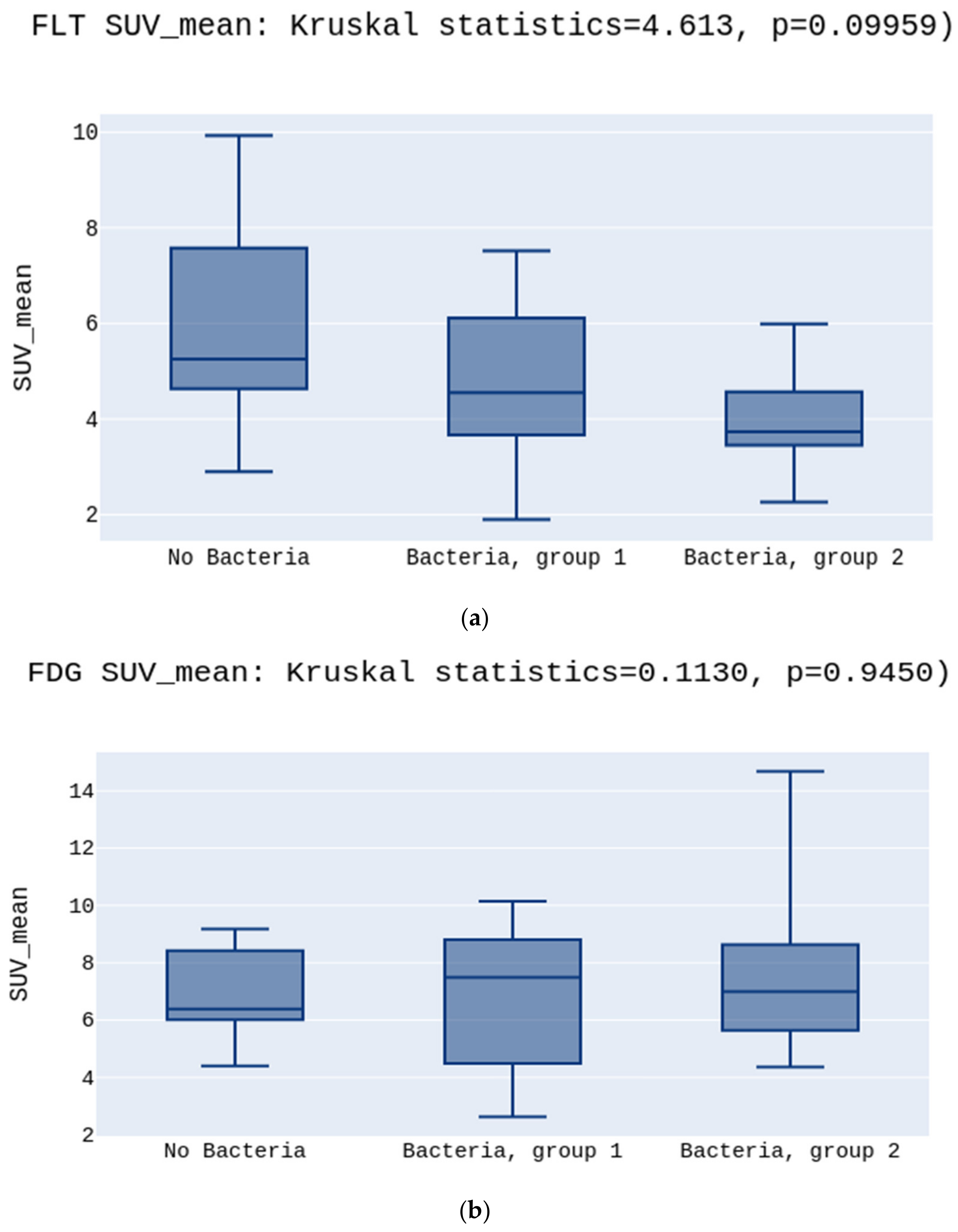
Differences between [18F]FLT and [18F]FDG Uptake in PET/CT Imaging in CC Depend on Vaginal Bacteriology
 , , , , and
Abstract
1. Introduction
2. Materials and Methods
3. Results
Group Analysis
4. Discussion
5. Conclusions
Author Contributions
Funding
Institutional Review Board Statement
Informed Consent Statement
Data Availability Statement
Conflicts of Interest
References
- Sung, H.; Ferlay, J.; Siegel, R.L.; Laversanne, M.; Soerjomataram, I.; Jemal, A.; Bray, F. Global Cancer Statistics 2020: GLOBOCAN Estimates of Incidence and Mortality Worldwide for 36 Cancers in 185 Countries|Enhanced Reader. CA Cancer J. Clin. 2021, 71, 209–249. [Google Scholar] [CrossRef] [Scilit] [PubMed]
- Ravel, J.; Gajer, P.; Abdo, Z.; Schneider, G.M.; Koenig, S.S.K.; McCulle, S.L.; Karlebach, S.; Gorle, R.; Russell, J.; Tacket, C.O.; et al. Vaginal microbiome of reproductive-age women. Proc. Natl. Acad. Sci. USA 2011, 108 (Suppl. 1), 4680–4687. [Google Scholar] [CrossRef] [Scilit] [PubMed]
- Mitra, A.; MacIntyre, D.A.; Lee, Y.S.; Smith, A.; Marchesi, J.R.; Lehne, B.; Bhatia, R.; Lyons, D.; Paraskevaidis, E.; Li, J.V.; et al. Cervical intraepithelial neoplasia disease progression is associated with increased vaginal microbiome diversity. Sci. Rep. 2015, 5, 1–11. [Google Scholar] [CrossRef] [Scilit] [PubMed]
- Liang, Y.; Chen, M.; Qin, L.; Wan, B.; Wang, H. A meta-analysis of the relationship between vaginal microecology, human papillomavirus infection and cervical intraepithelial neoplasia. Infect. Agents Cancer 2019, 29, 14. [Google Scholar]
- Tsai, C.S.; Chang, T.C.; Lai, C.H.; Tsai, C.C.; Ng, K.K.; Hsueh, S.; Yen, T.-C.; Hong, J.-H. Preliminary report of using FDG-PET to detect extrapelvic lesions in cervical cancer patients with enlarged pelvic lymph nodes on MRI/CT. Int. J. Radiat. Oncol. Biol. Phys. 2004, 58, 1506–1512. [Google Scholar] [CrossRef] [PubMed]
- Lazzari, R.; Cecconi, A.; Jereczek-Fossa, B.A.; Travaini, L.L.; Dell’Acqua, V.; Cattani, F.; Rizzo, S.; Fodor, C.; Landoni, F.; Orecchia, R. The role of [18F]FDG-PET/CT in staging and treatment planning for volumetric modulated Rapidarc radiotherapy in cervical cancer: Experience of the European Institute of Oncology, Milan, Italy. Ecancermedicalscience 2014, 8, 409. [Google Scholar]
- Barwick, T.; Bencherif, B.; Mountz, J.M.; Avril, N. Molecular PET and PET/CT imaging of tumour cell proliferation using F-18 fluoro-L-thymidine: A comprehensive evaluation. Nucl. Med. Commun. 2009, 30, 908–917. [Google Scholar] [CrossRef] [Scilit] [PubMed]
- Been, L.B.; Suurmeijer, A.; Cobben, D.C.P.; Jager, P.L.; Hoekstra, H.J.; Elsinga, P.H. [18F]FLT-PET in oncology: Current status and opportunities. Eur. J. Nucl. Med. Mol. Imaging 2004, 31, 1659–1672. [Google Scholar] [CrossRef] [Scilit] [PubMed]
- Bussink, J.; Kaanders, J.H.A.M.; van der Graaf, W.T.A.; Oyen, W.J.G. PET–CT for radiotherapy treatment planning and response monitoring in solid tumors. Nat. Rev. Clin. Oncol. 2011, 8, 233–242. [Google Scholar] [CrossRef] [Scilit] [PubMed]
- Mirpour, S.; Mhlanga, J.C.; Logeswaran, P.; Russo, G.; Mercier, G.; Subramaniam, R.M. The Role of PET/CT in the Management of Cervical Cancer. Am. J. Roentgenol. 2013, 201, W192–W205. [Google Scholar] [CrossRef] [Scilit] [PubMed]
- Cybulski, Z.; Urbański, B.; Grabiec, A.; Talaga, Z.; Pawlak, M.; Wareńczak-Florczak, Ż.; Roszak, A. The incidence of inflammation among patients suffering from cervix cancer with positive beta haemolytic streptococci cultures from genital tract. Rep. Pract. Oncol. Radiother. 2019, 24, 428–431. [Google Scholar] [CrossRef] [Scilit] [PubMed]
- Norenhag, J.; Du, J.; Olovsson, M.; Verstraelen, H.; Engstrand, L.; Brusselaers, N. The vaginal microbiota, human papillomavirus and cervical dysplasia: A systematic review and network meta-analysis. BJOG Int. J. Obstet. Gynaecol. 2020, 127, 171–180. [Google Scholar] [CrossRef] [Scilit] [PubMed]
- Gillet, E.; Meys, J.F.; Verstraelen, H.; Bosire, C.; De Sutter, P.; Temmerman, M.; Broeck, D.V. Bacterial vaginosis is associated with uterine cervical human papillomavirus infection: A meta-analysis. BMC Infect. Dis. 2011, 11, 10. [Google Scholar] [CrossRef] [Scilit] [PubMed]
- Laniewski, P.; Barnes, D.; Goulder, A.; Cui, H.; Roe, D.J.; Chase, D.M.; Herbst-Kralovetz, M.M. Linking cervicovaginal immune signatures, HPV and microbiota composition in cervical carcinogenesis in non-Hispanic and Hispanic women. Sci. Rep. 2018, 8, 7593. [Google Scholar] [CrossRef] [Scilit] [PubMed]
- Shields, A.F.; Lim, K.; Grierson, J.; Link, J.; Krohn, K.A. Utilization of labeled thymidine in DNA synthesis: Studies for PET. J. Nucl. Med. 1990, 31, 337–342. [Google Scholar] [PubMed]
- Shields, A.F.; Grierson, J.R.; Koxawa, S.M.; Zheng, M. Development of Labeled Thymidine Analogs for Imaging Tumor Pr&liferation. Nucl. Med. Biol. 1996, 23, 17–22. [Google Scholar] [PubMed]
- Krhili, S.; Muratet, J.-P.; Roche, S.; Pointreau, Y.; Yossi, S.; Septans, A.-L.; Denis, F. Use of Metabolic Parameters as Prognostic Factors During Concomitant Chemoradiotherapy for Locally Advanced Cervical Cancer. Am. J. Clin. Oncol. 2017, 40, 250–255. [Google Scholar] [CrossRef] [Scilit] [PubMed]
- Lawal, I.; Lengana, T.; Van Rensburg, C.J.; Reyneke, F.; Popoola, G.O.; Ankrah, A.; Sathekge, M.M. Fluorodeoxyglucose Positron Emission Tomography integrated with computed tomography in carcinoma of the cervix: Its impact on accurate staging and the predictive role of its metabolic parameters. PLoS ONE 2019, 14, e0215412. [Google Scholar] [CrossRef] [Scilit] [PubMed]
- Heuker, M.; Sijbesma, J.W.A.; Suárez, R.A.; de Jong, J.R.; Boersma, H.H.; Luurtsema, G.; Elsinga, P.H.; Glaudemans, A.W.J.M.; van Dam, G.M.; van Dijl, J.M.; et al. In Vitro imaging of bacteria using 18F-fluorodeoxyglucose micro positron emission tomography. Sci. Rep. 2017, 7, 4973. [Google Scholar] [CrossRef] [Scilit] [PubMed]




| n | % | Average | Median | Min. | Max. | SD | |
|---|---|---|---|---|---|---|---|
| Age (years) | 34 | 100% | 57.2 | 59 | 30 | 84 | 12.3 |
| BMI | 34 | 100% | 26.4 | 24.9 | 18.4 | 43.9 | 5.8 |
| FIGO Stage | |||||||
| IIB | 12 | 35.3% | |||||
| IIIB | 20 | 58.8% | |||||
| IV | 2 | 5.9% | |||||
| Histopathology | |||||||
| SCC | 32 | 91.2% | |||||
| AC | 1 | 2.9% | |||||
| UD | 1 | 2.9% | |||||
| Hgb mmol/L | 34 | 100% | 7.38 | 7.9 | 4.6 | 9.6 | 1.1 |
| Leu G/L | 34 | 100% | 9.2 | 8.9 | 3.8 | 21.4 | 3.2 |
| Neu G/L | 34 | 100% | 6.3 | 5.7 | 2.3 | 16.6 | 2.8 |
| Bacteriology | n | % | Group |
|---|---|---|---|
| Enterobacter cloacae | 1 | 2.9% | 2 |
| Escherichia coli | 10 | 29.4% | 2 |
| Staphylococcus aureus | 3 | 8.9% | n.a. |
| Staphylococcus lugdunensis | 1 | 2.9% | n.a. |
| Streptococcus agalactiae | 9 | 26.3% | 1 |
| Streptococcus beta haemolyticus gr C | 2 | 2.9% | 1 |
| No bacteria | 7 | 20.6% | 0 |
| n | Average | Median | Min. | Max. | SD | |
|---|---|---|---|---|---|---|
| Activity of FDG (mCi) | 34 | 9.7 | 9.7 | 5.9 | 13.4 | 1.9 |
| SUV max FDG | 34 | 11.7 | 11.8 | 5.3 | 24.7 | 4.2 |
| SUV mean FDG | 34 | 6.9 | 7.3 | 2.6 | 14.7 | 2.6 |
| SUVmin FDG | 34 | 5.1 | 5.1 | 2.3 | 10.6 | 1.8 |
| AUC-CSH FDG | 34 | 0.6 | 0.6 | 0.5 | 0.7 | 0.0 |
| SUV max FLT | 34 | 7.7 | 7.46 | 3.1 | 16.5 | 10.7 |
| SUV mean FLT | 34 | 4.8 | 4.4 | 1.9 | 9.9 | 6.8 |
| SUVmin FLT | 34 | 3.2 | 3.5 | 1.3 | 8.9 | 4.6 |
| AUC-CSH FLT | 34 | 0.6 | 0.6 | 0.5 | 0.7 | 0.0 |
Publisher’s Note: MDPI stays neutral with regard to jurisdictional claims in published maps and institutional affiliations. |
© 2021 by the authors. Licensee MDPI, Basel, Switzerland. This article is an open access article distributed under the terms and conditions of the Creative Commons Attribution (CC BY) license (https://creativecommons.org/licenses/by/4.0/).
Share and Cite
Burchardt, E.; Warenczak-Florczak, Z.; Cegła, P.; Piotrowski, A.; Cybulski, Z.; Burchardt, W.; Roszak, A.; Cholewiński, W. Differences between [18F]FLT and [18F]FDG Uptake in PET/CT Imaging in CC Depend on Vaginal Bacteriology. Diagnostics 2022, 12, 70. https://doi.org/10.3390/diagnostics12010070
Burchardt E, Warenczak-Florczak Z, Cegła P, Piotrowski A, Cybulski Z, Burchardt W, Roszak A, Cholewiński W. Differences between [18F]FLT and [18F]FDG Uptake in PET/CT Imaging in CC Depend on Vaginal Bacteriology. Diagnostics. 2022; 12(1):70. https://doi.org/10.3390/diagnostics12010070
Chicago/Turabian StyleBurchardt, Ewa, Zaneta Warenczak-Florczak, Paulina Cegła, Adam Piotrowski, Zefiryn Cybulski, Wojciech Burchardt, Andrzej Roszak, and Witold Cholewiński. 2022. "Differences between [18F]FLT and [18F]FDG Uptake in PET/CT Imaging in CC Depend on Vaginal Bacteriology" Diagnostics 12, no. 1: 70. https://doi.org/10.3390/diagnostics12010070
APA StyleBurchardt, E., Warenczak-Florczak, Z., Cegła, P., Piotrowski, A., Cybulski, Z., Burchardt, W., Roszak, A., & Cholewiński, W. (2022). Differences between [18F]FLT and [18F]FDG Uptake in PET/CT Imaging in CC Depend on Vaginal Bacteriology. Diagnostics, 12(1), 70. https://doi.org/10.3390/diagnostics12010070