Review

Trans-Olecranon Fracture-Dislocations of the Elbow: A Systematic Review

Department of Orthopedic Surgery, Keimyung University Dongsan Hospital, Keimyung University School of Medicine, 1035, Dalgubeol-daero, Dalseo-gu, Daegu 42601, Korea
*
Author to whom correspondence should be addressed.
Diagnostics 2020, 10(12), 1058; https://doi.org/10.3390/diagnostics10121058

Submission received: 5 November 2020 / Revised: 3 December 2020 / Accepted: 4 December 2020 / Published: 6 December 2020
(This article belongs to the Special Issue Diagnosis and Treatment of Shoulder and Elbow Disease and Trauma)

Abstract

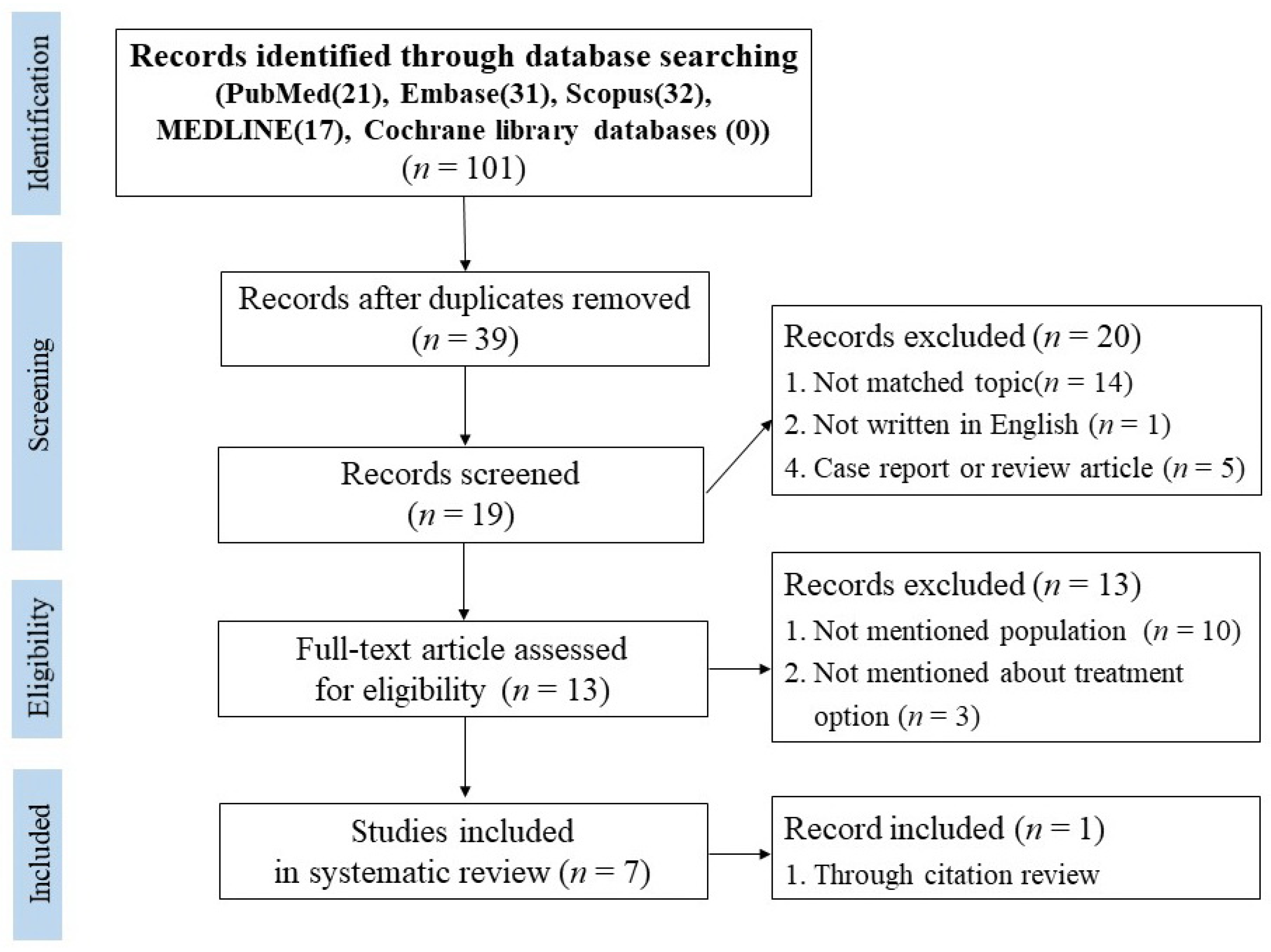
The purpose of this study is to provide a systematic review of the definition, ideal surgical method, complications, and prognosis of trans-olecranon fracture dislocations. An electronic search was performed in the PubMed, EMBASE, Scopus, and MEDLINE databases. The eligibility criteria included retrospective clinical study and review article in subjects older than 18 years with trans-olecranon fracture dislocations. Trans-olecranon fracture dislocations are defined as fractures in which the stability of the ulnohumeral joint is lost due to the intra-articular fracture of the olecranon without disruption of the proximal radioulnar joint. The seven papers were included that met the eligibility criteria for the quantitative synthesis. Findings indicate that a pre-contoured plate was used in 88.3% of cases (68 of 77 reports), with no reports of complications, suggesting that the pre-contoured 3.5 mm plate is the first choice of treatment. Postoperative mean elbow range of motion for the flexion–extension arc was 121.1° and 146.5° for the pronation-supination arc. Methods for postoperative clinical scores included the Broberg/Morrey rating with a result of excellent or good in 82.9% of cases, the ASES score with a mean of 88.7, and the DASH score with a mean of 11.75. Complications included heterotopic ossification in 21.9% (23/105) of cases, arthrosis in 25.7% (27/105) of cases, nerve damage in 18.1% (19/105) of cases, and osteoarthritis in 14.3% (15/105). With better understanding of the mechanism of injury and proper diagnosis and treatment, findings of the current review suggest a positive outcome. PROSPERO registration No.: CRD42019126568.
Keywords: elbow; transolecranon fracture dislocations; olecranon fracture elbow; transolecranon fracture dislocations; olecranon fracture