Effects of Supervised Physiotherapy-Based Exercise on Ovarian Reserve and Spontaneous Pregnancy in Women with Diminished Ovarian Reserve: A Controlled Pilot Study
 , , and
Abstract
1. Introduction
2. Materials and Methods
2.1. Study Design
2.2. Recruitment Process
2.3. Participants and Eligibility Criteria
2.3.1. Inclusion Criteria
2.3.2. Exclusion Criteria
2.4. Implementation
2.5. Randomization
2.6. Intervention
2.7. Outcome Measures
2.7.1. Primary Outcomes
2.7.2. Secondary Outcomes
2.8. Baseline and Follow-Up Assessments
2.9. Efficacy Assessments
2.10. Statistical Analysis
2.11. Ethics Approval
3. Results
4. Discussion
4.1. Strengths
4.2. Limitations
4.3. Clinical and Practical Significance
4.4. Future Research Directions
5. Conclusions
Author Contributions
Funding
Institutional Review Board Statement
Informed Consent Statement
Data Availability Statement
Acknowledgments
Conflicts of Interest
Abbreviations
| AFC | antral follicle count |
| AMH | anti-Müllerian hormone |
| ANCOVA | analysis of covariance |
| ART | assisted reproductive technology |
| BMI | body mass index |
| CI | confidence interval |
| DB | diaphragmatic breathing |
| DOR | diminished ovarian reserve |
| E2 | estradiol |
| FSH | follicle-stimulating hormone |
| IVF | in vitro fertilization |
| LH | luteinizing hormone |
| PRL | prolactin |
| TSH | thyroid-stimulating hormone |
| TVA | transversus abdominis |
References
- World Health Organization. Infertility Prevalence Estimates, 1990–2021; World Health Organization: Geneva, Switzerland, 2023. [Google Scholar]
- Huang, J.; Liao, Y.; Yu, M.; Zhu, J.; Yang, Z.; Wu, H.; Zhao, Y. Global, regional, and national burden of infertility, 1990–2021: Systematic analysis of the Global Burden of Disease Study 2021. J. Assist. Reprod. Genet. 2025, 42, 1025–1028. [Google Scholar] [CrossRef]
- Choi, R.; Park, W.; Chun, G.; Lee, S.G.; Lee, E.H. Investigation of the Prevalence of Diminished Ovarian Reserve in Korean Women of Reproductive Age. J. Clin. Med. 2023, 12, 5099. [Google Scholar] [CrossRef]
- Zhang, H.; Hua, L.; Liu, D.; Su, X.; Chen, J.; Chen, J. Effects of physical activity on infertility in reproductive females. Reprod. Biol. Endocrinol. 2024, 22, 62. [Google Scholar] [CrossRef]
- Eurostat. Fertility Statistics. Available online: https://ec.europa.eu/eurostat/statistics-explained/index.php?title=Fertility_statistics (accessed on 24 July 2025).
- Driscoll, A.K.; Hamilton, B.E. Effects of Age-specific Fertility Trends on Overall Fertility Trends: United States, 1990–2023. Natl. Vital Stat. Rep. 2025, 74, 1. [Google Scholar] [CrossRef]
- Delbaere, I.; Verbiest, S.; Tyden, T. Knowledge about the impact of age on fertility: A brief review. Ups. J. Med. Sci. 2020, 125, 167–174. [Google Scholar] [CrossRef]
- Beaujouan, E. Latest-Late Fertility? Decline and Resurgence of Late Parenthood Across the Low-Fertility Countries. Popul. Dev. Rev. 2020, 46, 219–247. [Google Scholar] [CrossRef] [PubMed]
- Han, S.; Zhai, Y.; Guo, Q.; Qin, Y.; Liu, P. Maternal and Neonatal Complications in Patients With Diminished Ovarian Reserve in In-Vitro Fertilization/Intracytoplasmic Sperm Injection Cycles. Front. Endocrinol. 2021, 12, 648287. [Google Scholar] [CrossRef] [PubMed]
- Monostori Judit, Ő.P.S.Z. Demográfiai Portré 2021; Központi Statisztikai Hivatal Népességtudományi Kutatóintézet: Budapest, Hungary, 2021. [Google Scholar]
- Liang, Y.; Huang, J.; Zhao, Q.; Mo, H.; Su, Z.; Feng, S.; Li, S.; Ruan, X. Global, regional, and national prevalence and trends of infertility among individuals of reproductive age (15–49 years) from 1990 to 2021, with projections to 2040. Hum. Reprod. 2025, 40, 529–544. [Google Scholar] [CrossRef]
- Li, H.; Nawsherwan; Fan, C.; Mubarik, S.; Nabi, G.; Ping, Y.X. The trend in delayed childbearing and its potential consequences on pregnancy outcomes: A single center 9-years retrospective cohort study in Hubei, China. BMC Pregnancy Childbirth 2022, 22, 514. [Google Scholar] [CrossRef]
- Spéder, Z.; Bálint, L. Realization of Short-Term Fertility Intentions in a Comparative Perspective: Which Macro-Level Conditions Matter? Popul. Res. Policy Rev. 2024, 43, 72. [Google Scholar] [CrossRef]
- Broekmans, F.J.; Soules, M.R.; Fauser, B.C. Ovarian aging: Mechanisms and clinical consequences. Endocr. Rev. 2009, 30, 465–493. [Google Scholar] [CrossRef] [PubMed]
- Li, S.; Hu, L.; Zhang, C. Effect of chronological age of patients with diminished ovarian reserve on in vitro fertilization outcome. J. Obstet. Gynaecol. 2022, 42, 654–657. [Google Scholar] [CrossRef]
- La Marca, A.; Sighinolfi, G.; Radi, D.; Argento, C.; Baraldi, E.; Artenisio, A.C.; Stabile, G.; Volpe, A. Anti-Mullerian hormone (AMH) as a predictive marker in assisted reproductive technology (ART). Hum. Reprod. Update 2010, 16, 113–130. [Google Scholar] [CrossRef] [PubMed]
- Parry, J.P.; Koch, C.A. Ovarian Reserve Testing. 2020. Available online: https://www.ncbi.nlm.nih.gov/books/NBK279058/ (accessed on 13 August 2025).
- Practice Committee of the American Society for Reproductive Medicine. Testing and interpreting measures of ovarian reserve: A committee opinion. Fertil. Steril. 2020, 114, 1151–1157. [Google Scholar] [CrossRef]
- Technology SFAR. Preliminary National Summary Report for 2022; Technology SFAR: Singapore, 2022. [Google Scholar]
- Human Fertilisation and Embryology Authority. Fertility Treatment 2021: Preliminary Trends and Figures. Available online: https://www.hfea.gov.uk/about-us/publications/research-and-data/fertility-treatment-2021-preliminary-trends-and-figures/#section-2 (accessed on 21 December 2023).
- Smeenk, J.; Wyns, C.; De Geyter, C.; Kupka, M.; Bergh, C.; Cuevas Saiz, I.; De Neubourg, D.; Rezabek, K.; Tandler-Schneider, A.; Rugescu, I.; et al. ART in Europe, 2019: Results generated from European registries by ESHRE†. Hum. Reprod. 2023, 38, 2321–2338. [Google Scholar] [CrossRef]
- Tal, R.; Seifer, D.B. Ovarian reserve testing: A user’s guide. Am. J. Obstet. Gynecol. 2017, 217, 129–140. [Google Scholar] [CrossRef]
- Reiter, R.J.; Sharma, R.; Romero, A.; Manucha, W.; Tan, D.X.; Zuccari, D.; Chuffa, L.G.A. Aging-Related Ovarian Failure and Infertility: Melatonin to the Rescue. Antioxidants 2023, 12, 695. [Google Scholar] [CrossRef]
- Tamura, H.; Jozaki, M.; Tanabe, M.; Shirafuta, Y.; Mihara, Y.; Shinagawa, M.; Tamura, I.; Maekawa, R.; Sato, S.; Taketani, T.; et al. Importance of Melatonin in Assisted Reproductive Technology and Ovarian Aging. Int. J. Mol. Sci. 2020, 21, 1135. [Google Scholar] [CrossRef]
- Fraidakis, M.; Giannakakis, G.; Anifantaki, A.; Skouradaki, M.; Tsakoumi, P.; Bitzopoulou, P.; Kourpa, S.; Zervakis, A.; Kakouri, P. Intraovarian Platelet-Rich Plasma Injections: Safety and Thoughts on Efficacy Based on a Single Centre Experience With 469 Women. Cureus 2023, 15, e38674. [Google Scholar] [CrossRef] [PubMed]
- Sadeghi, M.R. Ovarian Rejuvenation: Turning Dreams into Reality. J. Reprod. Infertil. 2024, 25, 1–2. [Google Scholar] [CrossRef]
- Agarwal, A.; Aponte-Mellado, A.; Premkumar, B.J.; Shaman, A.; Gupta, S. The effects of oxidative stress on female reproduction: A review. Reprod. Biol. Endocrinol. 2012, 10, 49. [Google Scholar] [CrossRef]
- Yan, F.; Zhao, Q.; Li, Y.; Zheng, Z.; Kong, X.; Shu, C.; Liu, Y.; Shi, Y. The role of oxidative stress in ovarian aging: A review. J. Ovarian Res. 2022, 15, 100. [Google Scholar] [CrossRef]
- Kozakiewicz, M.; Rowinski, R.; Kornatowski, M.; Dabrowski, A.; Kedziora-Kornatowska, K.; Strachecka, A. Relation of Moderate Physical Activity to Blood Markers of Oxidative Stress and Antioxidant Defense in the Elderly. Oxidative Med. Cell. Longev. 2019, 2019, 5123628. [Google Scholar] [CrossRef] [PubMed]
- Diaz-Munoz, M.; de la Rosa Santander, P.; Juarez-Espinosa, A.B.; Arellano, R.O.; Morales-Tlalpan, V. Granulosa cells express three inositol 1,4,5-trisphosphate receptor isoforms: Cytoplasmic and nuclear Ca2+ mobilization. Reprod. Biol. Endocrinol. 2008, 6, 60. [Google Scholar] [CrossRef] [PubMed]
- Gullo, G.; Carlomagno, G.; Unfer, V.; D’Anna, R. Myo-inositol: From induction of ovulation to menopausal disorder management. Minerva Ginecol 2015, 67, 485–486. [Google Scholar]
- Cueto, H.T.; Jacobsen, B.H.; Laursen, A.S.D.; Riis, A.H.; Hatch, E.E.; Wise, L.A.; Trolle, E.; Sorensen, H.T.; Rothman, K.J.; Wesselink, A.K.; et al. Dietary folate intake and fecundability in two preconception cohorts. Hum. Reprod. 2022, 37, 828–837. [Google Scholar] [CrossRef]
- Espino, J.; Macedo, M.; Lozano, G.; Ortiz, A.; Rodriguez, C.; Rodriguez, A.B.; Bejarano, I. Impact of Melatonin Supplementation in Women with Unexplained Infertility Undergoing Fertility Treatment. Antioxidants 2019, 8, 338. [Google Scholar] [CrossRef]
- Tamura, H.; Takasaki, A.; Taketani, T.; Tanabe, M.; Kizuka, F.; Lee, L.; Tamura, I.; Maekawa, R.; Aasada, H.; Yamagata, Y.; et al. The role of melatonin as an antioxidant in the follicle. J. Ovarian Res. 2012, 5, 5. [Google Scholar] [CrossRef]
- Tamura, H.; Takasaki, A.; Taketani, T.; Tanabe, M.; Kizuka, F.; Lee, L.; Tamura, I.; Maekawa, R.; Asada, H.; Yamagata, Y.; et al. Melatonin as a free radical scavenger in the ovarian follicle. Endocr. J. 2013, 60, 1–13. [Google Scholar] [CrossRef]
- Rizzo, P.; Raffone, E.; Benedetto, V. Effect of the treatment with myo-inositol plus folic acid plus melatonin in comparison with a treatment with myo-inositol plus folic acid on oocyte quality and pregnancy outcome in IVF cycles. A prospective, clinical trial. Eur. Rev. Med. Pharmacol. Sci. 2010, 14, 555–561. [Google Scholar] [PubMed]
- Maldonado-Carceles, A.B.; Souter, I.; Li, M.C.; Mitsunami, M.; Dimitriadis, I.; Ford, J.B.; Minguez-Alarcon, L.; Chavarro, J.E.; Team, E.S. Antioxidant Intake and Ovarian Reserve in Women Attending a Fertility Center. Nutrients 2025, 17, 554. [Google Scholar] [CrossRef]
- Safiyeh, F.D.; Mojgan, M.; Parviz, S.; Sakineh, M.A.; Behnaz, S.O. The effect of selenium and vitamin E supplementation on anti-Mullerian hormone and antral follicle count in infertile women with occult premature ovarian insufficiency: A randomized controlled clinical trial. Complement. Ther. Med. 2021, 56, 102533. [Google Scholar] [CrossRef] [PubMed]
- Iervolino, M.; Lepore, E.; Forte, G.; Lagana, A.S.; Buzzaccarini, G.; Unfer, V. Natural Molecules in the Management of Polycystic Ovary Syndrome (PCOS): An Analytical Review. Nutrients 2021, 13, 1677. [Google Scholar] [CrossRef]
- Bacanakgil, B.H.; Ilhan, G.; Ohanoglu, K. Effects of vitamin D supplementation on ovarian reserve markers in infertile women with diminished ovarian reserve. Medicine 2022, 101, e28796. [Google Scholar] [CrossRef]
- Lin, G.; Li, X.; Yie, S.L.J.; Xu, L. Clinical evidence of coenzyme Q10 pretreatment for women with diminished ovarian reserve undergoing IVF/ICSI: A systematic review and meta-analysis. Ann. Med. 2024, 56, 2389469. [Google Scholar] [CrossRef] [PubMed]
- Tremblay, M.S.; Aubert, S.; Barnes, J.D.; Saunders, T.J.; Carson, V.; Latimer-Cheung, A.E.; Chastin, S.F.M.; Altenburg, T.M.; Chinapaw, M.J.M.; SBRN Terminology Consensus Project Participants. Sedentary Behavior Research Network (SBRN)—Terminology Consensus Project process and outcome. Int. J. Behav. Nutr. Phys. Act. 2017, 14, 75. [Google Scholar] [CrossRef]
- Bull, F.C.; Al-Ansari, S.S.; Biddle, S.; Borodulin, K.; Buman, M.P.; Cardon, G.; Carty, C.; Chaput, J.P.; Chastin, S.; Chou, R.; et al. World Health Organization 2020 guidelines on physical activity and sedentary behaviour. Br. J. Sports Med. 2020, 54, 1451–1462. [Google Scholar] [CrossRef]
- Matusiak-Wieczorek, E.; Lipert, A.; Kochan, E.; Jegier, A. The time spent sitting does not always mean a low level of physical activity. BMC Public Health 2020, 20, 317. [Google Scholar] [CrossRef] [PubMed]
- Stockwell, S.; Trott, M.; Tully, M.; Shin, J.; Barnett, Y.; Butler, L.; McDermott, D.; Schuch, F.; Smith, L. Changes in physical activity and sedentary behaviours from before to during the COVID-19 pandemic lockdown: A systematic review. BMJ Open Sport Exerc. Med. 2021, 7, e000960. [Google Scholar] [CrossRef]
- Wilke, H.J.; Wolf, S.; Claes, L.E.; Arand, M.; Wiesend, A. Stability increase of the lumbar spine with different muscle groups. A biomechanical in vitro study. Spine 1995, 20, 192–198. [Google Scholar] [CrossRef]
- Cheval, B.; Sieber, S.; Maltagliati, S.; Millet, G.P.; Formánek, T.; Chalabaev, A.; Cullati, S.; Boisgontier, M.P. Muscle strength is associated with COVID-19 hospitalization in adults 50 years of age or older. J. Cachexia Sarcopenia Muscle 2021, 12, 1136–1143. [Google Scholar] [CrossRef]
- Strain, T.; Flaxman, S.; Guthold, R.; Semenova, E.; Cowan, M.; Riley, L.M.; Bull, F.C.; Stevens, G.A.; Abdul Raheem, R.; Agoudavi, K.; et al. National, regional, and global trends in insufficient physical activity among adults from 2000 to 2022: A pooled analysis of 507 population-based surveys with 5·7 million participants. Lancet Glob. Health 2024, 12, e1232–e1243. [Google Scholar] [CrossRef]
- Foucaut, A.M.; Faure, C.; Julia, C.; Czernichow, S.; Levy, R.; Dupont, C.; ALIFERT Collaborative Group. Sedentary behavior, physical inactivity and body composition in relation to idiopathic infertility among men and women. PLoS ONE 2019, 14, e0210770. [Google Scholar] [CrossRef]
- Boukabache, A.; Preece, S.J.; Brookes, N. Prolonged sitting and physical inactivity are associated with limited hip extension: A cross-sectional study. Musculoskelet. Sci. Pract. 2021, 51, 102282. [Google Scholar] [CrossRef]
- Hides, J.A.; Belavý, D.L.; Stanton, W.; Wilson, S.J.; Rittweger, J.; Felsenberg, D.; Richardson, C.A. Magnetic resonance imaging assessment of trunk muscles during prolonged bed rest. Spine 2007, 32, 1687–1692. [Google Scholar] [CrossRef] [PubMed]
- Richardson, C.A.; Hodges, P.; Hides, J.A. Therapeutic Exercise for Lumbopelvic Stabilization: A Motor Control Approach for the Treatment and Prevention of Low Back Pain; Churchill Livingstone: London, UK, 2004. [Google Scholar]
- Hodges, P.W.; Sapsford, R.; Pengel, L.H. Postural and respiratory functions of the pelvic floor muscles. Neurourol. Urodyn. 2007, 26, 362–371. [Google Scholar] [CrossRef]
- Sapsford, R.R.; Hodges, P.W.; Richardson, C.A.; Cooper, D.H.; Markwell, S.J.; Jull, G.A. Co-activation of the abdominal and pelvic floor muscles during voluntary exercises. Neurourol. Urodyn. 2001, 20, 31–42. [Google Scholar] [CrossRef]
- Bontrup, C.; Taylor, W.R.; Fliesser, M.; Visscher, R.; Green, T.; Wippert, P.M.; Zemp, R. Low back pain and its relationship with sitting behaviour among sedentary office workers. Appl. Erg. 2019, 81, 102894. [Google Scholar] [CrossRef]
- Hodges, P.W.; Richardson, C.A. Inefficient muscular stabilization of the lumbar spine associated with low back pain. A motor control evaluation of transversus abdominis. Spine 1996, 21, 2640–2650. [Google Scholar] [CrossRef] [PubMed]
- Hides, J.A.; Stokes, M.J.; Saide, M.; Jull, G.A.; Cooper, D.H. Evidence of lumbar multifidus muscle wasting ipsilateral to symptoms in patients with acute/subacute low back pain. Spine 1994, 19, 165–172. [Google Scholar] [CrossRef] [PubMed]
- Kiani, Z.; Simbar, M.; Hajian, S.; Zayeri, F. The prevalence of depression symptoms among infertile women: A systematic review and meta-analysis. Fertil. Res. Pract. 2021, 7, 6. [Google Scholar] [CrossRef]
- Kiani, Z.; Simbar, M.; Hajian, S.; Zayeri, F.; Shahidi, M.; Saei Ghare Naz, M.; Ghasemi, V. The prevalence of anxiety symptoms in infertile women: A systematic review and meta-analysis. Fertil. Res. Pract. 2020, 6, 7. [Google Scholar] [CrossRef]
- Santana, E.E.S.; Neves, L.M.; Souza, K.C.; Mendes, T.B.; Rossi, F.E.; Silva, A.A.D.; Oliveira, R.; Perilhao, M.S.; Roschel, H.; Gil, S. Physically Inactive Undergraduate Students Exhibit More Symptoms of Anxiety, Depression, and Poor Quality of Life than Physically Active Students. Int. J. Environ. Res. Public Health 2023, 20, 4494. [Google Scholar] [CrossRef]
- Brinson, A.K.; da Silva, S.G.; Hesketh, K.R.; Evenson, K.R. Impact of Physical Activity and Sedentary Behavior on Spontaneous Female and Male Fertility: A Systematic Review. J. Phys. Act. Health 2023, 20, 600–615. [Google Scholar] [CrossRef]
- Läänelaid, S.; Ortega, F.B.; Kunovac Kallak, T.; Joelsson, L.; Ruiz, J.R.; Hreinsson, J.; Wånggren, K.; Stavreus-Evers, A.; Kalda, R.; Salumets, A.; et al. Physical and Sedentary Activities in Association with Reproductive Outcomes among Couples Seeking Infertility Treatment: A Prospective Cohort Study. Int. J. Environ. Res. Public Health 2021, 18, 2718. [Google Scholar] [CrossRef]
- Soritsa, D.; Maestu, E.; Nuut, M.; Maestu, J.; Migueles, J.H.; Laanelaid, S.; Ehrenberg, A.; Sekavin, A.; Soritsa, A.; Salumets, A.; et al. Maternal physical activity and sedentary behaviour before and during in vitro fertilization treatment: A longitudinal study exploring the associations with controlled ovarian stimulation and pregnancy outcomes. J. Assist. Reprod. Genet. 2020, 37, 1869–1881. [Google Scholar] [CrossRef] [PubMed]
- Palomba, S.; Falbo, A.; Valli, B.; Morini, D.; Villani, M.T.; Nicoli, A.; La Sala, G.B. Physical activity before IVF and ICSI cycles in infertile obese women: An observational cohort study. Reprod. Biomed. Online 2014, 29, 72–79. [Google Scholar] [CrossRef] [PubMed]
- Morris, S.N.; Missmer, S.A.; Cramer, D.W.; Powers, R.D.; McShane, P.M.; Hornstein, M.D. Effects of lifetime exercise on the outcome of in vitro fertilization. Obstet. Gynecol. 2006, 108, 938–945. [Google Scholar] [CrossRef]
- Kiranmayee, D.; Praveena, T.; Himabindu, Y.; Sriharibabu, M.; Kavya, K.; Mahalakshmi, M. The Effect of Moderate Physical Activity on Ovarian Reserve Markers in Reproductive Age Women Below and Above 30 Years. J. Hum. Reprod. Sci. 2017, 10, 44–48. [Google Scholar] [CrossRef] [PubMed]
- Mussawar, M.; Balsom, A.A.; Totosy de Zepetnek, J.O.; Gordon, J.L. The effect of physical activity on fertility: A mini-review. F S Rep. 2023, 4, 150–158. [Google Scholar] [CrossRef]
- Cong, J.; Li, P.; Zheng, L.; Tan, J. Prevalence and Risk Factors of Infertility at a Rural Site of Northern China. PLoS ONE 2016, 11, e0155563. [Google Scholar] [CrossRef]
- McKinnon, C.J.; Hatch, E.E.; Rothman, K.J.; Mikkelsen, E.M.; Wesselink, A.K.; Hahn, K.A.; Wise, L.A. Body mass index, physical activity and fecundability in a North American preconception cohort study. Fertil. Steril. 2016, 106, 451–459. [Google Scholar] [CrossRef]
- ACOG. Committee Opinion No. 762: Prepregnancy Counseling. Obstet. Gynecol. 2019, 133, e78–e89. [Google Scholar] [CrossRef] [PubMed]
- Kovács, B.P.; Balog, J.; Sebők, B.; Keszthelyi, M.; Várbíró, S. Unlocking Female Fertility with a Specific Reproductive Exercise Program: Protocol of a Randomized Controlled Clinical Trail. Life 2024, 15, 18. [Google Scholar] [CrossRef]
- Harrison, C.L.; Lombard, C.B.; Moran, L.J.; Teede, H.J. Exercise therapy in polycystic ovary syndrome: A systematic review. Hum. Reprod. Update 2011, 17, 171–183. [Google Scholar] [CrossRef] [PubMed]
- Patten, R.K.; McIlvenna, L.C.; Levinger, I.; Garnham, A.P.; Shorakae, S.; Parker, A.G.; McAinch, A.J.; Rodgers, R.J.; Hiam, D.; Moreno-Asso, A.; et al. High-intensity training elicits greater improvements in cardio-metabolic and reproductive outcomes than moderate-intensity training in women with polycystic ovary syndrome: A randomized clinical trial. Hum. Reprod. 2022, 37, 1018–1029. [Google Scholar] [CrossRef] [PubMed]
- Ruiz-González, D.; Cavero-Redondo, I.; Hernández-Martínez, A.; Baena-Raya, A.; Martínez-Forte, S.; Altmäe, S.; Fernández-Alonso, A.M.; Soriano-Maldonado, A. Comparative efficacy of exercise, diet and/or pharmacological interventions on BMI, ovulation, and hormonal profile in reproductive-aged women with overweight or obesity: A systematic review and network meta-analysis. Hum. Reprod. Update 2024, 30, 472–487. [Google Scholar] [CrossRef]
- Colombo, G.E.; Dafauce Bouzo, X.; Patten, R.K.; Mousa, A.; Tay, C.T.; Pattuwage, L.; Teede, H.J.; Redman, L.M.; Hirschberg, A.L.; Sabag, A. Comparison of selected exercise training modalities in the management of PCOS: A systematic review and meta-analysis to inform evidence-based guidelines. JSAMS Plus 2023, 2, 100024. [Google Scholar] [CrossRef]
- De Souza, M.J.; Koltun, K.J.; Williams, N.I. The Role of Energy Availability in Reproductive Function in the Female Athlete Triad and Extension of its Effects to Men: An Initial Working Model of a Similar Syndrome in Male Athletes. Sports Med. 2019, 49, 125–137. [Google Scholar] [CrossRef]
- Li, Y.L.; Yan, E.Q.; Zhao, G.N.; Jin, L.; Ma, B.X. Effect of body mass index on ovarian reserve and ART outcomes in infertile women: A large retrospective study. J. Ovarian Res. 2024, 17, 195. [Google Scholar] [CrossRef]
- Vilarino, F.L.; Christofolini, D.M.; Rodrigues, D.; de Souza, A.M.; Christofolini, J.; Bianco, B.; Barbosa, C.P. Body mass index and fertility: Is there a correlation with human reproduction outcomes? Gynecol. Endocrinol. 2011, 27, 232–236. [Google Scholar] [CrossRef]
- Chua, S.J.; Danhof, N.A.; Mochtar, M.H.; van Wely, M.; McLernon, D.J.; Custers, I.; Lee, E.; Dreyer, K.; Cahill, D.J.; Gillett, W.R.; et al. Age-related natural fertility outcomes in women over 35 years: A systematic review and individual participant data meta-analysis. Hum. Reprod. 2020, 35, 1808–1820. [Google Scholar] [CrossRef]
- Rakhshani, A.; Nagarathna, R.; Mhaskar, R.; Mhaskar, A.; Thomas, A.; Gunasheela, S. Effects of yoga on utero-fetal-placental circulation in high-risk pregnancy: A randomized controlled trial. Adv. Prev. Med. 2015, 2015, 373041. [Google Scholar] [CrossRef] [PubMed]
- Pellizzari, P.; Esposito, C.; Siliotti, F.; Marchiori, S.; Gangemi, M. Colour Doppler analysis of ovarian and uterine arteries in women with hypoestrogenic amenorrhoea. Hum. Reprod. 2002, 17, 3208–3212. [Google Scholar] [CrossRef] [PubMed]
- Premusz, V.; Makai, A.; Perjes, B.; Mate, O.; Hock, M.; Acs, P.; Koppan, M.; Bodis, J.; Varnagy, A.; Lampek, K. Multicausal analysis on psychosocial and lifestyle factors among patients undergoing assisted reproductive therapy—With special regard to self-reported and objective measures of pre-treatment habitual physical activity. BMC Public Health 2021, 21, 1480. [Google Scholar] [CrossRef]
- Thabet, A.A.; Alshehri, M.A. Efficacy of deep core stability exercise program in postpartum women with diastasis recti abdominis: A randomised controlled trial. J. Musculoskelet. Neuronal Interact. 2019, 19, 62–68. [Google Scholar]
- Espino-Albela, A.; Castano-Garcia, C.; Diaz-Mohedo, E.; Ibanez-Vera, A.J. Effects of Pelvic-Floor Muscle Training in Patients with Pelvic Organ Prolapse Approached with Surgery vs. Conservative Treatment: A Systematic Review. J. Pers. Med. 2022, 12, 806. [Google Scholar] [CrossRef]
- Tim, S.; Mazur-Bialy, A.I. The Most Common Functional Disorders and Factors Affecting Female Pelvic Floor. Life 2021, 11, 1397. [Google Scholar] [CrossRef] [PubMed]
- Aljuraifani, R.; Stafford, R.E.; Hall, L.M.; van den Hoorn, W.; Hodges, P.W. Task-specific differences in respiration-related activation of deep and superficial pelvic floor muscles. J. Appl. Physiol. 2019, 126, 1343–1351. [Google Scholar] [CrossRef] [PubMed]
- Amiri, B.; Zemková, E. Trunk stability and breathing exercises superior to foam rolling for restoring postural stability after core muscle fatigue in sedentary employees. Sci. Rep. 2025, 15, 13909. [Google Scholar] [CrossRef]
- Simionescu, G.; Doroftei, B.; Maftei, R.; Obreja, B.E.; Anton, E.; Grab, D.; Ilea, C.; Anton, C. The complex relationship between infertility and psychological distress (Review). Exp. Ther. Med. 2021, 21, 306. [Google Scholar] [CrossRef] [PubMed]
- Tavoian, D.; Craighead, D.H. Deep breathing exercise at work: Potential applications and impact. Front. Physiol. 2023, 14, 1040091. [Google Scholar] [CrossRef] [PubMed]
- Domar, A.D.; Rooney, K.L.; Wiegand, B.; Orav, E.J.; Alper, M.M.; Berger, B.M.; Nikolovski, J. Impact of a group mind/body intervention on pregnancy rates in IVF patients. Fertil. Steril. 2011, 95, 2269–2273. [Google Scholar] [CrossRef]
- Szigeti, F.J.; Kazinczi, C.; Szabó, G.; Sipos, M.; Ujma, P.P.; Purebl, G. The clinical effectiveness of the Mind/Body Program for Infertility on wellbeing and assisted reproduction outcomes: A randomized controlled trial in search for active ingredients. Hum. Reprod. 2024, 39, 1735–1751. [Google Scholar] [CrossRef]
- Tolahunase, M.; Sagar, R.; Dada, R. Impact of Yoga and Meditation on Cellular Aging in Apparently Healthy Individuals: A Prospective, Open-Label Single-Arm Exploratory Study. Oxidative Med. Cell. Longev. 2017, 2017, 7928981. [Google Scholar] [CrossRef] [PubMed]



| Assay | Kit/Catalog # | Platform | Sensitivity/Measuring Interval | Intra-Assay CV (%) |
|---|---|---|---|---|
| Access AMH Advanced | C62997 | Beckman Coulter Access/DxI | 0.08–24 ng/mL (≈0.57–171 pmol/L) | 1.5–10 |
| Atellica IM TSH3-UL | 10995704 | Siemens Healthineers Atellica IM | 0.008–150 μIU/mL | 2–16 |
| Atellica IM FSH | 10995580 | Siemens Healthineers Atellica IM | 0.30–200 mIU/mL | 2–10 |
| Atellica IM LH | 10995635 | Siemens Healthineers Atellica IM | 0.07–200 mIU/mL | 2–10 |
| Atellica IM Prolactin (PRL) | 10995656 | Siemens Healthineers Atellica IM | 0.47–200 ng/mL (latest IFU rev 06, 2024-06) | 2–12 |
| Atellica IM Enhanced Estradiol (eE2) | 10995561 | Siemens Healthineers Atellica IM | 11.80–3000 pg/mL | 2–20 |
| LIAISON® 25-OH Vitamin D TOTAL | 310600 | DiaSorin LIAISON | 4–150 ng/mL | Serum: 2.9–5.5; Plasma: 3.2–8.1 |
| Screening | Baseline (Cycle Days 2–4) | Post-Treatment (3 Cycles; Cycle Days 2–4) | Follow-Up (Up to 6 Months) | |
|---|---|---|---|---|
| Investigator meeting | ✓ | |||
| Informed consent | ✓ | |||
| Demographics, medical, and family history | ✓ | |||
| Anthropometric data (weight, height, BMI) | ✓ | |||
| Menstrual cycle | ✓ | |||
| Hormone levels (AMH, FSH, LH, E2, PRL, TSH, 25-OH-D3 vitamin) | ✓ | ✓ | ||
| AFC | ✓ | |||
| Spontaneous pregnancy | ✓ | ✓ | ||
| IVF outcome | ✓ |
| Control Group | Treatment Group | p-Value | |
|---|---|---|---|
| Age | 38.00 ± 0.60 | 35.25 ± 1.47 | 0.104 |
| BMI | 25.64 ± 0.96 | 21.49 ± 0.61 | 0.0014 |
| AMH | 0.50 ± 0.07 | 0.54 ± 0.08 | 0.695 |
| FSH | 10.83 ± 0.74 | 12.16 ± 1.36 | 0.397 |
| LH | 4.83 ± 0.69 | 5.82 ± 0.57 | 0.281 |
| E2 | 42.25 (38.00–62.20) | 40.01 (25.30–63.70) | 0.370 |
| prolactin | 11.51 (8.45–33.62) | 11.29 (7.24–15.30) | 0.525 |
| TSH | 2.06 ± 0.29 | 1.83 ± 0.20 | 0.515 |
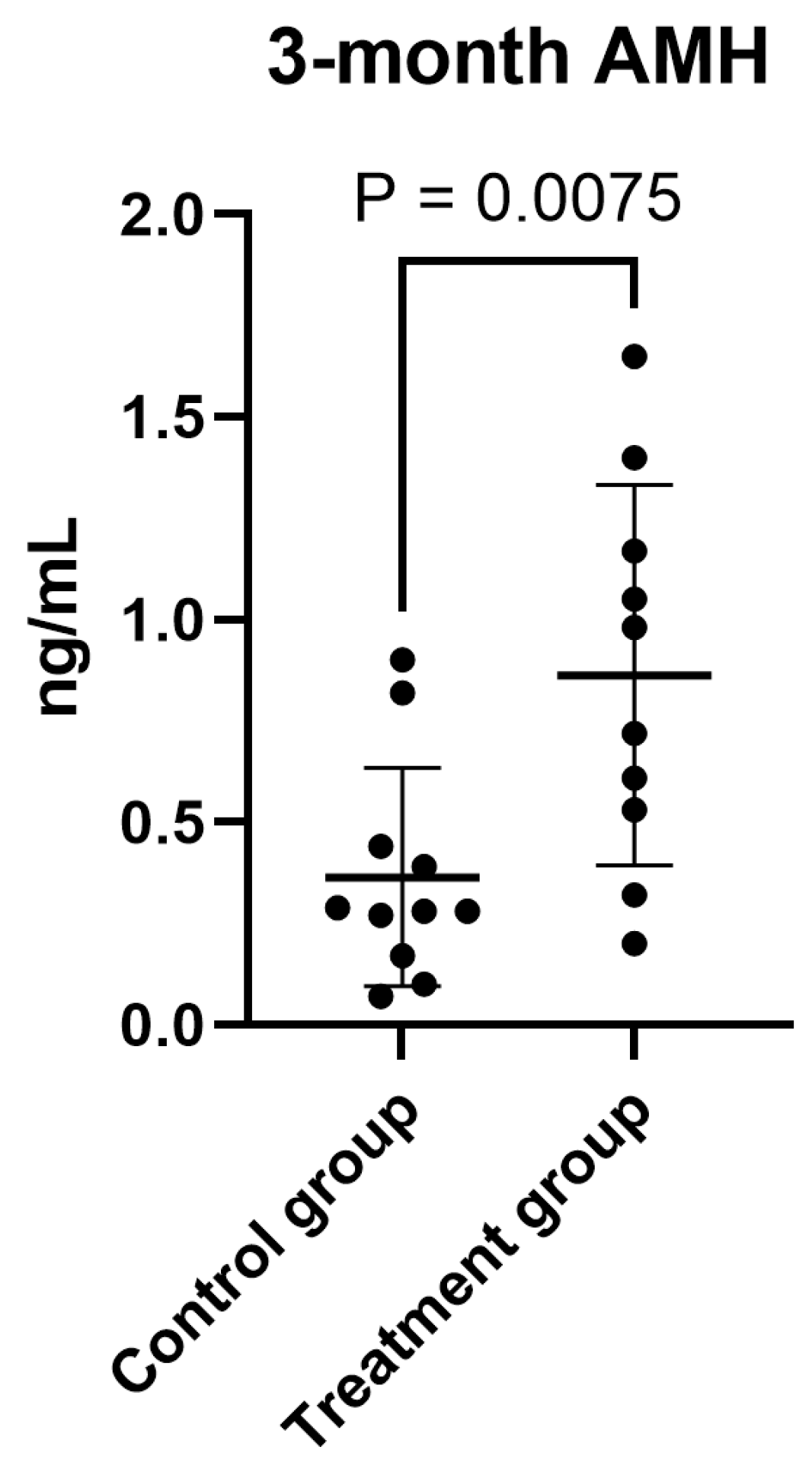
| 3-month AMH | 0.28 (0.10–0.82) | 0.85 (0.32–1.40) | 0.0075 |
| 3-month FSH | 13.07 ± 2.04 | 9.39 ± 0.90 | 0.122 |
| 3-month LH | 4.30 (2.82–10.40) | 4.55 (3.50–7.00) | 0.877 |
| 3-month E2 | 47.60 (34.10–95.70) | 43.45 (33.70–80.95) | 0.349 |
| 3-month prolactin | 10.85 ± 1.143 | 9.90 ± 1.82 | 0.659 |
| 3-month TSH | 1.47 (0.21–3.86) | 1.48 (1.08–3.54) | >0.999 |
Disclaimer/Publisher’s Note: The statements, opinions and data contained in all publications are solely those of the individual author(s) and contributor(s) and not of MDPI and/or the editor(s). MDPI and/or the editor(s) disclaim responsibility for any injury to people or property resulting from any ideas, methods, instructions or products referred to in the content. |
© 2026 by the authors. Licensee MDPI, Basel, Switzerland. This article is an open access article distributed under the terms and conditions of the Creative Commons Attribution (CC BY) license.
Share and Cite
Kovács, B.P.; Balog, J.; Szigeti, J.F.; Sebők, B.; Török, M.; Várbíró, S. Effects of Supervised Physiotherapy-Based Exercise on Ovarian Reserve and Spontaneous Pregnancy in Women with Diminished Ovarian Reserve: A Controlled Pilot Study. Life 2026, 16, 120. https://doi.org/10.3390/life16010120
Kovács BP, Balog J, Szigeti JF, Sebők B, Török M, Várbíró S. Effects of Supervised Physiotherapy-Based Exercise on Ovarian Reserve and Spontaneous Pregnancy in Women with Diminished Ovarian Reserve: A Controlled Pilot Study. Life. 2026; 16(1):120. https://doi.org/10.3390/life16010120
Chicago/Turabian StyleKovács, Barbara Petra, Júlia Balog, Judit F. Szigeti, Barbara Sebők, Marianna Török, and Szabolcs Várbíró. 2026. "Effects of Supervised Physiotherapy-Based Exercise on Ovarian Reserve and Spontaneous Pregnancy in Women with Diminished Ovarian Reserve: A Controlled Pilot Study" Life 16, no. 1: 120. https://doi.org/10.3390/life16010120
APA StyleKovács, B. P., Balog, J., Szigeti, J. F., Sebők, B., Török, M., & Várbíró, S. (2026). Effects of Supervised Physiotherapy-Based Exercise on Ovarian Reserve and Spontaneous Pregnancy in Women with Diminished Ovarian Reserve: A Controlled Pilot Study. Life, 16(1), 120. https://doi.org/10.3390/life16010120