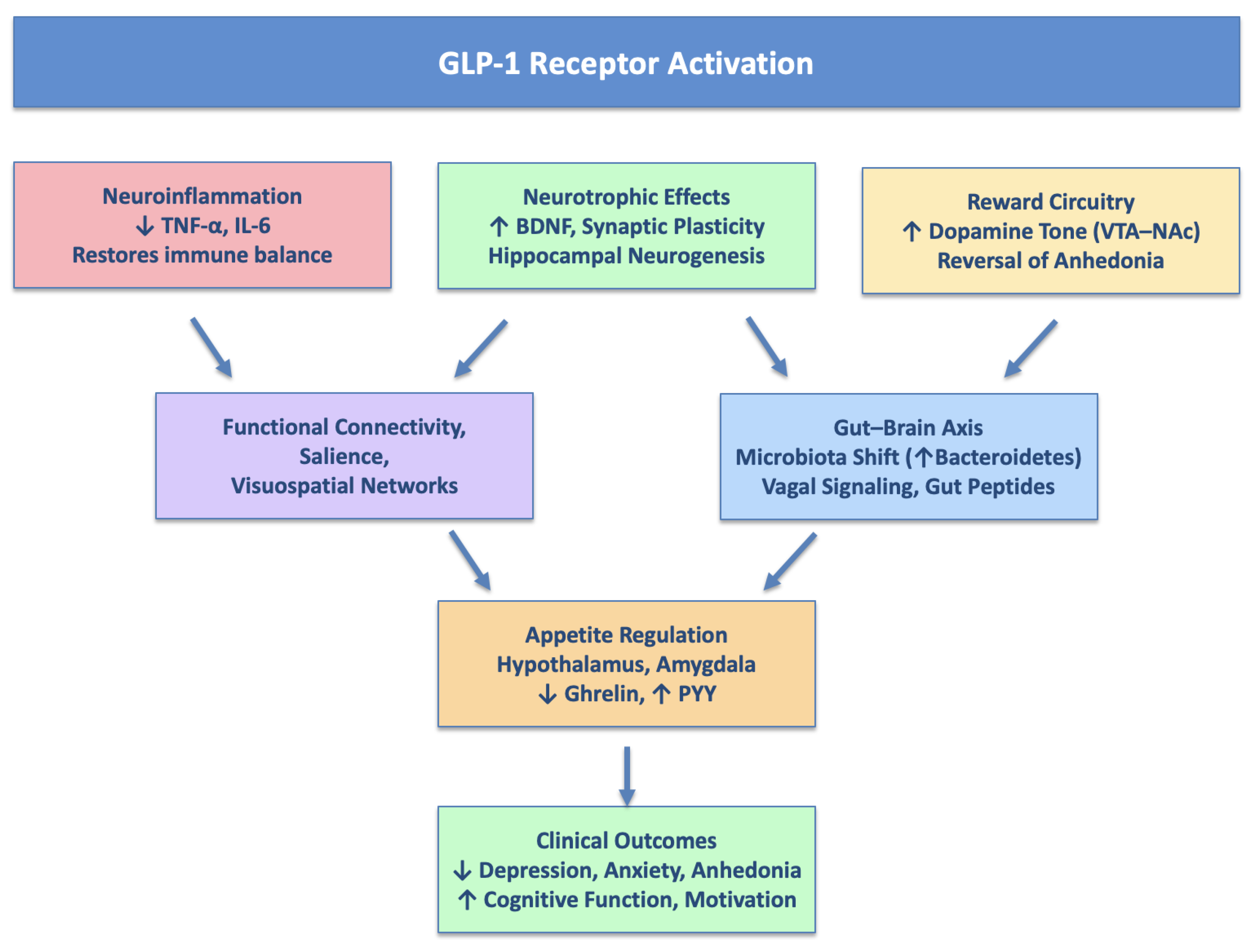
GLP-1 Receptor Agonists in Mood Disorders: A Psychiatric Perspective

Abstract
1. Introduction
2. Materials and Methods
3. Psychiatric Relevance of GLP-1 Signaling
4. Mood Disorders and Metabolic Comorbidity: The Bidirectional Interface
5. Psychotropic Medications and Metabolic Dysregulation
6. Clinical Studies in Psychiatric Populations

| Study (Author/Year and Ref) | Study Design and Population | Intervention | Key Outcomes on Mood and Cognition | Notes |
|---|---|---|---|---|
| Mansur et al., 2017 [74] | A 4-week, open-label pilot; n = 19 adults with MDD or BD and executive dysfunction | Liraglutide 1.8 mg/day adjunctive | Improved executive function (Trail Making Test-B; composite cognition z-score). No significant change in mood scales | First proof-of-concept in a mood-disorder cohort; cognitive benefits independent of glycemic changes; small sample |
| Bezin et al., 2025 [73] | Nationwide case-time-control (France); n = 1102 suicide/attempt cases, with psychiatric subgroups | GLP-1 RAs (various) | No increased risk of suicide/attempt (OR 0.62); consistent across psychiatric-history subgroups | Strong real-world evidence of psychiatric safety, including high-risk populations |
| Ueda et al., 2024 [75] | Active-comparator cohort (Sweden and Denmark); n = 298,553 T2D patients | GLP-1 RAs vs. SGLT2i | No excess risk of suicide, self-harm, incident depression or anxiety | Large-scale pharmacoepidemiology confirming reassuring safety |
| Farr et al., 2016 [76] | Randomized, placebo-controlled crossover; n = 18 T2D | Liraglutide up to 1.8 mg/day | Reduced brain activation to palatable food cues (parietal cortex, insula, putamen) | Demonstrates central GLP-1R activity; relevant to reward and anhedonia pathways |
| van Bloemendaal et al., 2014 [77] | Randomized crossover with GLP-1R blockade; n = 48 obese ± T2D | Exenatide ± GLP-1R antagonist | Decreased food-cue responses (insula, amygdala, OFC); reduced caloric intake | Confirms central GLP-1R mediation of reward-circuit responses |
| Coveleskie et al., 2017 [78] | Double-blind crossover fMRI; n = 19 women (obese vs. lean) | Exenatide 5 μg SC | In obese women: increased connectivity (NTS–thalamus/hypothalamus); reduced hunger ratings | Suggests obesity moderates central GLP-1 signaling; implications for satiety/reward |
| Fanelli et al., 2025 [9] | UK Biobank; n = 30,919 with MDD | Insulin resistance (HOMA-IR, proxies) | IR+ patients had greater antidepressant resistance, longer treatment duration, and more severe profiles | Supports targeting metabolic dysfunction in depression |
| Li et al., 2024 [12] | Cross-sectional; n = 125 drug-naïve BD vs. 85 controls | Assessment of insulin resistance | BD patients had 2–3× higher prevalence of IR; IR linked to hypersomnia | Confirms IR as a core metabolic abnormality in BD |
| Watson et al., 2021 [5] | NESDA longitudinal cohort; n = 601, 9-year follow-up | Baseline IR markers (TG/HDL, glucose, waist) | IR predicted incident MDD (HR 1.3–1.9); prediabetes doubled risk | Strong prospective evidence linking IR and depression onset |
| Shomaker et al., 2010 [11] | Cross-sectional; n = 136 adolescents | Psychological symptoms + insulin sensitivity | Depressive symptoms were inversely correlated with insulin sensitivity | Provides early-life evidence of mood–metabolic coupling |
| Weiss et al., 2024 [38] | Retrospective chart review; elderly MDD/BD (n≈100) | Naturalistic follow-up with/without T2D | T2D associated with greater manic morbidity in BD and cognitive decline | Highlights adverse psychiatric impact of metabolic comorbidity |
7. Mechanistic Hypotheses for Psychotropic Action
8. Clinical Challenges and Research Priorities
9. Conclusions
Author Contributions
Funding
Conflicts of Interest
References
- The Lancet Psychiatry. Global Burden of Disease 2021: Mental health messages. Lancet Psychiatry 2024, 11, 573. [Google Scholar] [CrossRef] [Scilit]
- Krupa, A.J.; Dudek, D.; Siwek, M. Consolidating evidence on the role of insulin resistance in major depressive disorder. Curr. Opin. Psychiatry 2024, 37, 23. [Google Scholar] [CrossRef] [Scilit]
- McIntyre, R.S.; Alsuwaidan, M.; Baune, B.T.; Berk, M.; Demyttenaere, K.; Goldberg, J.F.; Gorwood, P.; Ho, R.; Kasper, S.; Kennedy, S.H.; et al. Treatment-resistant depression: Definition, prevalence, detection, management, and investigational interventions. World Psychiatry Off. J. World Psychiatr. Assoc. WPA 2023, 22, 394–412. [Google Scholar] [CrossRef] [Scilit]
- Calkin, C.; McClelland, C.; Cairns, K.; Kamintsky, L.; Friedman, A. Insulin Resistance and Blood-Brain Barrier Dysfunction Underlie Neuroprogression in Bipolar Disorder. Front. Psychiatry 2021, 12, 636174. [Google Scholar] [CrossRef] [Scilit]
- Watson, K.T.; Simard, J.F.; Henderson, V.W.; Nutkiewicz, L.; Lamers, F.; Nasca, C.; Rasgon, N.; Penninx, B.W.J.H. Incident Major Depressive Disorder Predicted by Three Measures of Insulin Resistance: A Dutch Cohort Study. Am. J. Psychiatry 2021, 178, 914–920. [Google Scholar] [CrossRef] [Scilit]
- Erichsen, J.M.; Fadel, J.R.; Reagan, L.P. Peripheral versus central insulin and leptin resistance: Role in metabolic disorders, cognition, and neuropsychiatric diseases. Neuropharmacology 2022, 203, 108877. [Google Scholar] [CrossRef] [Scilit]
- Sălcudean, A.; Bodo, C.-R.; Popovici, R.-A.; Cozma, M.-M.; Păcurar, M.; Crăciun, R.-E.; Crisan, A.-I.; Enatescu, V.-R.; Marinescu, I.; Cimpian, D.-M.; et al. Neuroinflammation—A Crucial Factor in the Pathophysiology of Depression—A Comprehensive Review. Biomolecules 2025, 15, 502. [Google Scholar] [CrossRef] [Scilit]
- Kim, Y.-K.; Kim, O.Y.; Song, J. Alleviation of Depression by Glucagon-Like Peptide 1 Through the Regulation of Neuroinflammation, Neurotransmitters, Neurogenesis, and Synaptic Function. Front. Pharmacol. 2020, 11, 1270. [Google Scholar] [CrossRef] [Scilit]
- Fanelli, G.; Bralten, J.; Franke, B.; Roth Mota, N.; Atti, A.R.; De Ronchi, D.; Monteleone, A.M.; Grassi, L.; Serretti, A.; Fabbri, C.; et al. Insulin resistance and poorer treatment outcomes in depression: Evidence from UK Biobank primary care data. Br. J. Psychiatry J. Ment. Sci. 2025, 1–10. [Google Scholar] [CrossRef] [Scilit]
- Diz-Chaves, Y.; Herrera-Pérez, S.; González-Matías, L.C.; Lamas, J.A.; Mallo, F. Glucagon-Like Peptide-1 (GLP-1) in the Integration of Neural and Endocrine Responses to Stress. Nutrients 2020, 12, 3304. [Google Scholar] [CrossRef] [Scilit]
- Shomaker, L.B.; Tanofsky-Kraff, M.; Young-Hyman, D.; Han, J.C.; Yanoff, L.B.; Brady, S.M.; Yanovski, S.Z.; Yanovski, J.A. Psychological symptoms and insulin sensitivity in adolescents. Pediatr. Diabetes 2010, 11, 417–423. [Google Scholar] [CrossRef] [Scilit]
- Li, K.; Li, T.; Yang, T.; Lin, Y.; Liao, Y.; Gan, Z. Prevalence of insulin resistance and its associated factors in drug-naïve patients with bipolar disorder among Han Chinese population. BMC Psychiatry 2024, 24, 388. [Google Scholar] [CrossRef] [Scilit]
- Sepúlveda-Lizcano, L.; Arenas-Villamizar, V.V.; Jaimes-Duarte, E.B.; García-Pacheco, H.; Paredes, C.S.; Bermúdez, V.; Rivera-Porras, D. Metabolic Adverse Effects of Psychotropic Drug Therapy: A Systematic Review. Eur. J. Investig. Health Psychol. Educ. 2023, 13, 1505–1520. [Google Scholar] [CrossRef] [Scilit]
- Khan, M.M.; Khan, Z.A.; Khan, M.A. Metabolic complications of psychotropic medications in psychiatric disorders: Emerging role of de novo lipogenesis and therapeutic consideration. World J. Psychiatry 2024, 14, 767. [Google Scholar] [CrossRef] [Scilit]
- Meshkat, S.; Luciano, C.; Swiderski, A.; Li, G.; Aguilar, R.; Dunkley, B.; Reichelt, A.; Zhang, Y.; Greenshaw, A.; Vermetten, E.; et al. Efficacy and Safety of Glucagon-Like Peptide-1 Agonists for Psychiatric Symptoms: A Systematic Review. Brain Behav. 2025, 15, e70661. [Google Scholar] [CrossRef] [Scilit]
- Zhao, X.; Wang, M.; Wen, Z.; Lu, Z.; Cui, L.; Fu, C.; Xue, H.; Liu, Y.; Zhang, Y. GLP-1 Receptor Agonists: Beyond Their Pancreatic Effects. Front. Endocrinol. 2021, 12, 721135. [Google Scholar] [CrossRef] [Scilit] [PubMed]
- Zheng, Z.; Zong, Y.; Ma, Y.; Tian, Y.; Pang, Y.; Zhang, C.; Gao, J. Glucagon-like peptide-1 receptor: Mechanisms and advances in therapy. Signal Transduct. Target. Ther. 2024, 9, 234. [Google Scholar] [CrossRef] [Scilit] [PubMed]
- Breit, S.; Hubl, D. The effect of GLP-1RAs on mental health and psychotropics-induced metabolic disorders: A systematic review. Psychoneuroendocrinology 2025, 176, 107415. [Google Scholar] [CrossRef] [Scilit] [PubMed]
- Tempia Valenta, S.; Nicastri, A.; Perazza, F.; Marcolini, F.; Beghelli, V.; Atti, A.; Petroni, M. The Impact of GLP-1 Receptor Agonists (GLP-1 RAs) on Mental Health: A Systematic Review. Curr. Treat. Options Psychiatry 2024, 11, 310–357. [Google Scholar] [CrossRef] [Scilit]
- Gammoh, O.; Qnais, E.; Aljabali, A.A.A.; Hataet, T.; Alqudah, A. Metabolic resilience: Liraglutide’s potential in alleviating depressive symptoms. Mol. Biol. Rep. 2025, 52, 550. [Google Scholar] [CrossRef] [Scilit] [PubMed]
- Moulton, C.D.; Pickup, J.C.; Ismail, K. The link between depression and diabetes: The search for shared mechanisms. Lancet Diabetes Endocrinol. 2015, 3, 461–471. [Google Scholar] [CrossRef] [Scilit] [PubMed]
- Fernandes, B.S.; Salagre, E.; Enduru, N.; Grande, I.; Vieta, E.; Zhao, Z. Insulin resistance in depression: A large meta-analysis of metabolic parameters and variation. Neurosci. Biobehav. Rev. 2022, 139, 104758. [Google Scholar] [CrossRef] [Scilit]
- Trammell, T.S.; Henderson, N.L.; Madkour, H.S.; Stanwood, G.D.; Graham, D.L. GLP-1R activation alters performance in cognitive tasks in a sex-dependent manner. Neurol. Sci. Off. J. Ital. Neurol. Soc. Ital. Soc. Clin. Neurophysiol. 2021, 42, 2911–2919. [Google Scholar] [CrossRef] [Scilit]
- Anderberg, R.; Richard, J.; Eerola, K.; Ferreras, L.; Nordbeck, E.; Hansson, C.; Nissbrandt, H.; Bergquist, F.; Gribble, F.; Reimann, F.; et al. Glucagon-Like Peptide 1 and Its Analogs Act in the Dorsal Raphe and Modulate Central Serotonin to Reduce Appetite and Body Weight. Diabetes 2017, 66, 1062–1073. [Google Scholar] [CrossRef] [Scilit]
- Hamer, J.A.; Testani, D.; Mansur, R.B.; Lee, Y.; Subramaniapillai, M.; McIntyre, R.S. Brain insulin resistance: A treatment target for cognitive impairment and anhedonia in depression. Exp. Neurol. 2019, 315, 1–8. [Google Scholar] [CrossRef] [Scilit]
- Zhang, X.; Du, P.; Bai, B.; Feng, P.; Lian, X.; Hölscher, C.; Wang, Y.; Xue, G. The GLP-1 receptor agonist liraglutide inhibits necroptosis and neuroinflammation in a mouse model of Parkinson’s disease with diabetes co-morbidity. Front. Neurosci. 2025, 19, 1596506. [Google Scholar] [CrossRef] [Scilit]
- Smith, J.A.; Das, A.; Ray, S.K.; Banik, N.L. Role of pro-inflammatory cytokines released from microglia in neurodegenerative diseases. Brain Res. Bull. 2012, 87, 10–20. [Google Scholar] [CrossRef] [Scilit] [PubMed]
- Al-Roub, A.; Al Madhoun, A.; Akhter, N.; Thomas, R.; Miranda, L.; Jacob, T.; Al-Ozairi, E.; Al-Mulla, F.; Sindhu, S.; Ahmad, R. IL-1β and TNFα Cooperativity in Regulating IL-6 Expression in Adipocytes Depends on CREB Binding and H3K14 Acetylation. Cells 2021, 10, 3228. [Google Scholar] [CrossRef] [Scilit] [PubMed]
- Moiz, A.; Filion, K.B.; Tsoukas, M.A.; Yu, O.H.; Peters, T.M.; Eisenberg, M.J. Mechanisms of GLP-1 Receptor Agonist-Induced Weight Loss: A Review of Central and Peripheral Pathways in Appetite and Energy Regulation. Am. J. Med. 2025, 138, 934–940. [Google Scholar] [CrossRef] [Scilit]
- Liu, Q.K. Mechanisms of action and therapeutic applications of GLP-1 and dual GIP/GLP-1 receptor agonists. Front. Endocrinol. 2024, 15, 1431292. [Google Scholar] [CrossRef] [Scilit]
- Mosili, P.; Mkhize, B.C.; Sibiya, N.H.; Ngubane, P.S.; Khathi, A. Review of the direct and indirect effects of hyperglycemia on the HPA axis in T2DM and the co-occurrence of depression. BMJ Open Diabetes Res. Care 2024, 12, e003218. [Google Scholar] [CrossRef] [Scilit]
- Sarwar, H.; Rafiqi, S.I.; Ahmad, S.; Jinna, S.; Khan, S.A.; Karim, T.; Qureshi, O.; Zahid, Z.A.; Elhai, J.D.; Levine, J.C.; et al. Hyperinsulinemia Associated Depression. Clin. Med. Insights Endocrinol. Diabetes 2022, 15, 11795514221090244. [Google Scholar] [CrossRef] [Scilit]
- Milaneschi, Y.; Simmons, W.K.; van Rossum, E.F.C.; Penninx, B.W. Depression and obesity: Evidence of shared biological mechanisms. Mol. Psychiatry 2019, 24, 18–33. [Google Scholar] [CrossRef] [Scilit]
- SayuriYamagata, A.; Brietzke, E.; Rosenblat, J.D.; Kakar, R.; McIntyre, R.S. Medical comorbidity in bipolar disorder: The link with metabolic-inflammatory systems. J. Affect. Disord. 2017, 211, 99–106. [Google Scholar] [CrossRef] [Scilit]
- Salviati, M.; Valeriani, G.; Terlizzi, S.; Maurizi, A.; Melcore, C.; Romano, G.F.; Panico, R.; Biondi, M. The bidirectional relationship between insulin resistance and psychiatric disorders: Considerations for using HOMA-IR index. Clin. Ter. 2013, 164, e549–e561. [Google Scholar] [CrossRef] [Scilit] [PubMed]
- Starostina, E. Comorbidity Between Severe Mental Disorders and Metabolic Disease. In Comorbidity Between Mental and Physical Disorders; Springer: Cham, Switzerland, 2025; pp. 181–202. ISBN 978-3-031-81801-1. [Google Scholar]
- Regan, A.S.; Valcourt, S.C. Metabolic Syndrome in Bipolar Disorder: Review and Management. Psychiatr. Ann. 2020, 50, 334–339. [Google Scholar] [CrossRef] [Scilit]
- Weiss, F.; Brancati, G.E.; Elefante, C.; Petrucci, A.; Gemmellaro, T.; Lattanzi, L.; Perugi, G. Type 2 diabetes mellitus is associated with manic morbidity in elderly patients with mood disorders. Int. Clin. Psychopharmacol. 2024, 39, 294–304. [Google Scholar] [CrossRef] [Scilit] [PubMed]
- Maksyutynska, K.; Stogios, N.; Prasad, F.; Gill, J.; Hamza, Z.; De, R.; Smith, E.; Horta, A.; Goldstein, B.I.; Korczak, D.; et al. Neurocognitive correlates of metabolic dysregulation in individuals with mood disorders: A systematic review and meta-analysis. Psychol. Med. 2024, 54, 1245–1271. [Google Scholar] [CrossRef] [Scilit]
- Kullmann, S.; Heni, M.; Veit, R.; Ketterer, C.; Schick, F.; Häring, H.-U.; Fritsche, A.; Preissl, H. The obese brain: Association of body mass index and insulin sensitivity with resting state network functional connectivity. Hum. Brain Mapp. 2011, 33, 1052. [Google Scholar] [CrossRef] [Scilit]
- Colomer, L.; Anmella, G.; Vieta, E.; Grande, I. Physical health in affective disorders: A narrative review of the literature. Rev. Bras. Psiquiatr. 2021, 43, 621–630. [Google Scholar] [CrossRef] [Scilit]
- Jones, B.D.M.; Farooqui, S.; Kloiber, S.; Husain, M.O.; Mulsant, B.H.; Husain, M.I. Targeting Metabolic Dysfunction for the Treatment of Mood Disorders: Review of the Evidence. Life 2021, 11, 819. [Google Scholar] [CrossRef] [Scilit]
- Pan, A.; Hu, F.B. Response to Comment on: Pan et al. Bidirectional Association Between Depression and Metabolic Syndrome: A Systematic Review and Meta-analysis of Epidemiological Studies. Diabetes Care 2012;35:1171–1180. Diabetes Care 2013, 36, e28. [Google Scholar] [CrossRef] [Scilit]
- McElroy, S.L.; Keck, P.E. Metabolic syndrome in bipolar disorder: A review with a focus on bipolar depression. J. Clin. Psychiatry 2014, 75, 46–61. [Google Scholar] [CrossRef] [Scilit]
- Vancampfort, D.; Correll, C.U.; Galling, B.; Probst, M.; De Hert, M.; Ward, P.B.; Rosenbaum, S.; Gaughran, F.; Lally, J.; Stubbs, B. Diabetes mellitus in people with schizophrenia, bipolar disorder and major depressive disorder: A systematic review and large scale meta-analysis. World Psychiatry Off. J. World Psychiatr. Assoc. WPA 2016, 15, 166–174. [Google Scholar] [CrossRef] [Scilit] [PubMed]
- Taylor, V.; MacQueen, G. Associations between bipolar disorder and metabolic syndrome: A review. J. Clin. Psychiatry 2006, 67, 1034–1041. [Google Scholar] [CrossRef] [Scilit] [PubMed]
- Teixeira, A.L.; Martins, L.B.; Berk, M.; Bauer, M.E. Severe psychiatric disorders and general medical comorbidities: Inflammation-related mechanisms and therapeutic opportunities. Clin. Sci. 2022, 136, 1257–1280. [Google Scholar] [CrossRef] [Scilit] [PubMed]
- Qiu, W.; Cai, X.; Zheng, C.; Qiu, S.; Ke, H.; Huang, Y. Update on the Relationship Between Depression and Neuroendocrine Metabolism. Front. Neurosci. 2021, 15, 728810. [Google Scholar] [CrossRef] [Scilit]
- Nguyen, T.T.L.; Chan, L.C.; Borreginne, K.; Kale, R.P.; Hu, C.; Tye, S.J. A review of brain insulin signaling in mood disorders: From biomarker to clinical target. Neurosci. Biobehav. Rev. 2018, 92, 7–15. [Google Scholar] [CrossRef] [Scilit]
- Correll, C.U.; Lencz, T.; Malhotra, A.K. Antipsychotic drugs and obesity. Trends Mol. Med. 2011, 17, 97–107. [Google Scholar] [CrossRef] [Scilit]
- Scheen, A.J. Metabolic disorders induced by psychotropic drugs. Ann. Endocrinol. 2023, 84, 357–363. [Google Scholar] [CrossRef] [Scilit]
- Gp, R.; Sl, K. Metabolic side effects of antipsychotic drug treatment--pharmacological mechanisms. Pharmacol. Ther. 2010, 125, 169–179. [Google Scholar] [CrossRef] [Scilit]
- Kong, L.; Wang, H.; Yan, N.; Xu, C.; Chen, Y.; Zeng, Y.; Guo, X.; Lu, J.; Hu, S. Effect of antipsychotics and mood stabilisers on metabolism in bipolar disorder: A network meta-analysis of randomised-controlled trials. eClinicalMedicine 2024, 71, 102581. [Google Scholar] [CrossRef] [Scilit] [PubMed]
- Cermolacce, M.; Belzeaux, R.; Adida, M.; Azorin, J.-M. Affective disorders: Endocrine and metabolic comorbidities. L’Encephale 2014, 40 (Suppl. 3), S33–S39. [Google Scholar] [CrossRef] [Scilit] [PubMed]
- Mazereel, V.; Detraux, J.; Vancampfort, D.; Van Winkel, R.; De Hert, M. Impact of Psychotropic Medication Effects on Obesity and the Metabolic Syndrome in People With Serious Mental Illness. Front. Endocrinol. 2020, 11, 573479. [Google Scholar] [CrossRef] [Scilit]
- Filaković, P.; Erić, A.P.; Radanović-Grgurić, L. Metabolic syndrome and psychotropic medications. Med. Glas. Off. Publ. Med. Assoc. Zenica-Doboj Cant. Bosnia Herzeg. 2012, 9, 180–188. Available online: https://pubmed.ncbi.nlm.nih.gov/22926348/ (accessed on 1 August 2025).
- De Hert, M.; Detraux, J.; van Winkel, R.; Yu, W.; Correll, C.U. Metabolic and cardiovascular adverse effects associated with antipsychotic drugs. Nat. Rev. Endocrinol. 2011, 8, 114–126. [Google Scholar] [CrossRef] [Scilit]
- Yuen, J.W.Y.; Kim, D.D.; Procyshyn, R.M.; Panenka, W.J.; Honer, W.G.; Barr, A.M. A Focused Review of the Metabolic Side-Effects of Clozapine. Front. Endocrinol. 2021, 12, 609240. [Google Scholar] [CrossRef] [Scilit]
- Gahr, M. Metabolic adverse drug reactions related to psychotropic drugs. Fortschr. Neurol. Psychiatr. 2025, 93, 95–103. [Google Scholar] [CrossRef] [Scilit]
- Serretti, A.; Mandelli, L. Antidepressants and body weight: A comprehensive review and meta-analysis. J. Clin. Psychiatry 2010, 71, 979. [Google Scholar] [CrossRef] [Scilit]
- Mukherjee, S.; Im, S.-S. Decoding Health: Exploring Essential Biomarkers Linked to Metabolic Dysfunction-Associated Steatohepatitis and Type 2 Diabetes Mellitus. Biomedicines 2025, 13, 359. [Google Scholar] [CrossRef] [Scilit]
- Qassab, M.A.; Mneimneh, M.; Jradi, A.; Derbas, B.; Dabboussi, D.; Baini, J.K.; Katrib, N.; Chaarani, N.; Attieh, P.; Kanaan, A.; et al. The Expanding Role of GLP-1 Receptor Agonists: Advancing Clinical Outcomes in Metabolic and Mental Health. Curr. Issues Mol. Biol. 2025, 47, 285. [Google Scholar] [CrossRef] [Scilit] [PubMed]
- Sun, J.; Fu, X.; Liu, Y.; Wang, T.; Zhao, X.; Cui, R.; Yang, W. Exploring the Effect and Mechanism of Liraglutide in Treating Depression Based on Network Pharmacology and Experimental Analysis. J. Cell Mol. Med. 2025, 29, e70630. [Google Scholar] [CrossRef] [Scilit] [PubMed]
- Chen, X.; Zhao, P.; Wang, W.; Guo, L.; Pan, Q. The Antidepressant Effects of GLP-1 Receptor Agonists: A Systematic Review and Meta-Analysis. Am. J. Geriatr. Psychiatry Off. J. Am. Assoc. Geriatr. Psychiatry 2024, 32, 117–127. [Google Scholar] [CrossRef] [Scilit]
- Monney, M.; Jornayvaz, F.; Gariani, K. GLP-1 receptor agonists effect on cognitive function in patients with and without type 2 diabetes. Diabetes Metab. 2023, 49, 101470. [Google Scholar] [CrossRef] [Scilit] [PubMed]
- Kabahizi, A.; Wallace, B.; Lieu, L.; Chau, D.; Dong, Y.; Hwang, E.; Williams, K.W. Glucagon-like peptide-1 (GLP-1) signalling in the brain: From neural circuits and metabolism to therapeutics. Br. J. Pharmacol. 2022, 179, 600–624. [Google Scholar] [CrossRef] [Scilit]
- Ress, C.; Tschoner, A.; Kaser, S.; Ebenbichler, C.F. Psychotropic drugs and diabetes. Wien. Med. Wochenschr. 2011, 161, 531–542. [Google Scholar] [CrossRef] [Scilit]
- Bolger, A.; Verdolini, N.; Agius, M. Can metabolic side effects of antipsychotics be reversed by lifestyle changes? Psychiatr. Danub. 2014, 26 (Suppl. 1), 330–335. [Google Scholar]
- Kopp, K.O.; Glotfelty, E.J.; Li, Y.; Greig, N.H. Glucagon-like peptide-1 (GLP-1) receptor agonists and neuroinflammation: Implications for neurodegenerative disease treatment. Pharmacol. Res. 2022, 186, 106550. [Google Scholar] [CrossRef] [Scilit]
- Nousen, E.K.; Franco, J.G.; Sullivan, E.L. Unraveling the mechanisms responsible for the comorbidity between metabolic syndrome and mental health disorders. Neuroendocrinology 2013, 98, 254–266. [Google Scholar] [CrossRef] [Scilit]
- Baggio, L.L.; Drucker, D.J. Glucagon-like peptide-1 receptors in the brain: Controlling food intake and body weight. J. Clin. Investig. 2014, 124, 4223–4226. [Google Scholar] [CrossRef] [Scilit]
- Drucker, D.J. Mechanisms of Action and Therapeutic Application of Glucagon-like Peptide-1. Cell Metab. 2018, 27, 740–756. [Google Scholar] [CrossRef] [Scilit]
- Bezin, J.; Bénard-Laribière, A.; Hucteau, E.; Tournier, M.; Montastruc, F.; Pariente, A.; Faillie, J.-L. Suicide and suicide attempt in users of GLP-1 receptor agonists: A nationwide case-time-control study. eClinicalMedicine 2025, 80, 103029. [Google Scholar] [CrossRef] [Scilit]
- Mansur, R.B.; Ahmed, J.; Cha, D.S.; Woldeyohannes, H.O.; Subramaniapillai, M.; Lovshin, J.; Lee, J.G.; Lee, J.-H.; Brietzke, E.; Reininghaus, E.Z.; et al. Liraglutide promotes improvements in objective measures of cognitive dysfunction in individuals with mood disorders: A pilot, open-label study. J. Affect. Disord. 2017, 207, 114–120. [Google Scholar] [CrossRef] [Scilit] [PubMed]
- Ueda, P.; Söderling, J.; Wintzell, V.; Svanström, H.; Pazzagli, L.; Eliasson, B.; Melbye, M.; Hviid, A.; Pasternak, B. GLP-1 Receptor Agonist Use and Risk of Suicide Death. JAMA Intern. Med. 2024, 184, 1301–1312. [Google Scholar] [CrossRef] [Scilit] [PubMed]
- Farr, O.M.; Sofopoulos, M.; Tsoukas, M.A.; Dincer, F.; Thakkar, B.; Sahin-Efe, A.; Filippaios, A.; Bowers, J.; Srnka, A.; Gavrieli, A.; et al. GLP-1 receptors exist in the parietal cortex, hypothalamus and medulla of human brains and the GLP-1 analogue liraglutide alters brain activity related to highly desirable food cues in individuals with diabetes: A crossover, randomised, placebo-controlled trial. Diabetologia 2016, 59, 954–965. [Google Scholar] [CrossRef] [Scilit] [PubMed]
- van Bloemendaal, L.; IJzerman, R.G.; ten Kulve, J.S.; Barkhof, F.; Konrad, R.J.; Drent, M.L.; Veltman, D.J.; Diamant, M. GLP-1 Receptor Activation Modulates Appetite- and Reward-Related Brain Areas in Humans. Diabetes 2014, 63, 4186–4196. [Google Scholar] [CrossRef] [Scilit]
- Coveleskie, K.; Kilpatrick, L.A.; Gupta, A.; Stains, J.; Connolly, L.; Labus, J.S.; Sanmiguel, C.; Mayer, E.A. The effect of the GLP-1 analogue Exenatide on functional connectivity within an NTS-based network in women with and without obesity. Obes. Sci. Pract. 2017, 3, 434–445. [Google Scholar] [CrossRef] [Scilit]
- Zhang, L.; Zhang, L.; Li, L.; Hölscher, C. Neuroprotective effects of the novel GLP-1 long acting analogue semaglutide in the MPTP Parkinson’s disease mouse model. Neuropeptides 2018, 71, 70–80. [Google Scholar] [CrossRef] [Scilit]
- Anderberg, R.H.; Richard, J.E.; Hansson, C.; Nissbrandt, H.; Bergquist, F.; Skibicka, K.P. GLP-1 is both anxiogenic and antidepressant; divergent effects of acute and chronic GLP-1 on emotionality. Psychoneuroendocrinology 2016, 65, 54–66. [Google Scholar] [CrossRef] [Scilit]
- Dickson, S.L.; Shirazi, R.H.; Hansson, C.; Bergquist, F.; Nissbrandt, H.; Skibicka, K.P. The Glucagon-Like Peptide 1 (GLP-1) Analogue, Exendin-4, Decreases the Rewarding Value of Food: A New Role for Mesolimbic GLP-1 Receptors. J. Neurosci. 2012, 32, 4812–4820. [Google Scholar] [CrossRef] [Scilit]
- Wang, R.-F.; Xue, G.-F.; Hölscher, C.; Tian, M.-J.; Feng, P.; Zheng, J.-Y.; Li, D.-F. Post-treatment with the GLP-1 analogue liraglutide alleviate chronic inflammation and mitochondrial stress induced by Status epilepticus. Epilepsy Res. 2018, 142, 45–52. [Google Scholar] [CrossRef] [Scilit]
- Gruber, J.; Hanssen, R.; Qubad, M.; Bouzouina, A.; Schack, V.; Sochor, H.; Schiweck, C.; Aichholzer, M.; Matura, S.; Slattery, D.A.; et al. Impact of insulin and insulin resistance on brain dopamine signalling and reward processing—An underexplored mechanism in the pathophysiology of depression? Neurosci. Biobehav. Rev. 2023, 149, 105179. [Google Scholar] [CrossRef] [Scilit]
- Ma, Q.; Wang, L.; Liu, X.-X.; An, Z.-G.; Luo, X.; Zhang, L.-L.; Yan, P.; Jin, L.; Cai, R.; Yi, Q.-Z. GLP-1 plays a protective role in hippocampal neuronal cells by activating cAMP-CREB-BDNF signaling pathway against CORT+HG-induced toxicity. Heliyon 2023, 9, e18491. [Google Scholar] [CrossRef] [Scilit]
- Chen, X.; Huang, Q.; Feng, J.; Xiao, Z.; Zhang, X.; Zhao, L. GLP-1 alleviates NLRP3 inflammasome-dependent inflammation in perivascular adipose tissue by inhibiting the NF-κB signalling pathway. J. Int. Med. Res. 2021, 49, 0300060521992981. [Google Scholar] [CrossRef] [Scilit]
- Zitman-Gal, T.; Einbinder, Y.; Ohana, M.; Katzav, A.; Kartawy, A.; Benchetrit, S. Effect of liraglutide on the Janus kinase/signal transducer and transcription activator (JAK/STAT) pathway in diabetic kidney disease in db/db mice and in cultured endothelial cells. J. Diabetes 2019, 11, 656–664. [Google Scholar] [CrossRef] [Scilit] [PubMed]
- Li, Q.; Lin, Y.; Wang, S.; Zhang, L.; Guo, L. GLP-1 Inhibits High-Glucose-Induced Oxidative Injury of Vascular Endothelial Cells. Sci. Rep. 2017, 7, 8008. [Google Scholar] [CrossRef] [Scilit] [PubMed]
- Zhou, Y.; Li, Z.; Cao, X.; Ma, H.; White, P.F.; Xu, X.; Jiang, Y.; Sun, X.; Cui, Y. Exendin-4 improves behaviorial deficits via GLP-1/GLP-1R signaling following partial hepatectomy. Brain Res. 2019, 1706, 116–124. [Google Scholar] [CrossRef] [Scilit] [PubMed]
- Sağlam, C.; Turan, İ.; Özaçmak, H.S. The effect of glucagon like peptide-1 receptor agonist on behavioral despair and anxiety-like behavior in ovariectomized rats: Modulation of BDNF/CREB, Nrf2 and lipocalin 2. Behav. Brain Res. 2022, 435, 114053. [Google Scholar] [CrossRef] [Scilit]
- de Paiva, I.H.R.; da Silva, R.S.; Mendonça, I.P.; de Souza, J.R.B.; Peixoto, C.A. Semaglutide Attenuates Anxious and Depressive-Like Behaviors and Reverses the Cognitive Impairment in a Type 2 Diabetes Mellitus Mouse Model Via the Microbiota-Gut-Brain Axis. J. Neuroimmune Pharmacol. Off. J. Soc. NeuroImmune Pharmacol. 2024, 19, 36. [Google Scholar] [CrossRef] [Scilit]
- Pozzi, M.; Mazhar, F.; Peeters, G.G.A.M.; Vantaggiato, C.; Nobile, M.; Clementi, E.; Radice, S.; Carnovale, C. A systematic review of the antidepressant effects of glucagon-like peptide 1 (GLP-1) functional agonists: Further link between metabolism and psychopathology: Special Section on “Translational and Neuroscience Studies in Affective Disorders”. Section Editor, Maria Nobile MD, PhD. This Section of JAD focuses on the relevance of translational and neuroscience studies in providing a better understanding of the neural basis of affective disorders. The main aim is to briefly summaries relevant research findings in clinical neuroscience with particular regards to specific innovative topics in mood and anxiety disorders. J. Affect. Disord. 2019, 257, 774–778. [Google Scholar] [CrossRef] [Scilit]
- Wakabayashi, K.T.; Baindur, A.N.; Feja, M.; Suarez, M.; Chen, K.; Bernosky-Smith, K.; Bass, C.E. Synthetic exendin-4 disrupts responding to reward predictive incentive cues in male rats. Front. Behav. Neurosci. 2024, 18, 1363497. [Google Scholar] [CrossRef] [Scilit] [PubMed]
- Deden, L.N.; Booij, J.; Grandjean, J.; Homberg, J.R.; Hazebroek, E.J.; Gotthardt, M.; Boss, M. Brain Imaging of the GLP-1 Receptor in Obesity Using 68Ga-NODAGA-Exendin-4 PET. Brain Sci. 2021, 11, 1647. [Google Scholar] [CrossRef] [Scilit]
- Tsai, C.-Y.; Lu, H.-C.; Chou, Y.-H.; Liu, P.-Y.; Chen, H.-Y.; Huang, M.-C.; Lin, C.-H.; Tsai, C.-N. Gut Microbial Signatures for Glycemic Responses of GLP-1 Receptor Agonists in Type 2 Diabetic Patients: A Pilot Study. Front. Endocrinol. 2022, 12, 814770. [Google Scholar] [CrossRef] [Scilit]
- Feng, J.; Teng, Z.; Yang, Y.; Liu, J.; Chen, S. Effects of semaglutide on gut microbiota, cognitive function and inflammation in obese mice. PeerJ 2024, 12, e17891. [Google Scholar] [CrossRef] [Scilit]
- Hoffman, S.; Alvares, D.; Adeli, K. GLP-1 attenuates intestinal fat absorption and chylomicron production via vagal afferent nerves originating in the portal vein. Mol. Metab. 2022, 65, 101590. [Google Scholar] [CrossRef] [Scilit]
- Iwasaki, Y.; Sendo, M.; Dezaki, K.; Hira, T.; Sato, T.; Nakata, M.; Goswami, C.; Aoki, R.; Arai, T.; Kumari, P.; et al. GLP-1 release and vagal afferent activation mediate the beneficial metabolic and chronotherapeutic effects of D-allulose. Nat. Commun. 2018, 9, 113. [Google Scholar] [CrossRef] [Scilit]
- Lindqvist, A.; Shcherbina, L.; Fischer, A.-H.T.; Wierup, N. Ghrelin Is a Regulator of Glucagon-Like Peptide 1 Secretion and Transcription in Mice. Front. Endocrinol. 2017, 8, 135. [Google Scholar] [CrossRef] [Scilit]
- Shang, J.; Liu, F.; Zhang, B.; Dong, K.; Lu, M.; Jiang, R.; Xu, Y.; Diao, L.; Zhao, J.; Tang, H. Liraglutide-induced structural modulation of the gut microbiota in patients with type 2 diabetes mellitus. PeerJ 2021, 9, e11128. [Google Scholar] [CrossRef] [Scilit] [PubMed]
- Zeng, N.; Cutts, E.J.; Lopez, C.B.; Kaur, S.; Duran, M.; Virkus, S.A.; Hardaway, J.A. Anatomical and Functional Characterization of Central Amygdala Glucagon-Like Peptide 1 Receptor Expressing Neurons. Front. Behav. Neurosci. 2021, 15, 724030. [Google Scholar] [CrossRef] [Scilit] [PubMed]
- Almeida, O.P. Risk of depression and dementia among individuals treated with sodium-glucose cotransporter 2 inhibitors and glucagon-like peptide-1 receptor agonists. Curr. Opin. Psychiatry 2025, 38, 368–375. [Google Scholar] [CrossRef] [Scilit]
- Gill, H.; Lieberman, J.; DiVincenzo, J.; Rodrigues, N.; Mansur, R.; McKenzie, A.; Phan, L.; Rosenblat, J.; McIntyre, R. Evaluating the Use of Glucagon-Like Peptide 1 for the Treatment of Cognitive Dysfunction in Individuals with Mood Disorders. Curr. Treat. Options Psychiatry 2022, 9, 331–345. [Google Scholar] [CrossRef] [Scilit]
- Ali, M.; Ahmed, A.; Khan, B.A.; Shah, S.T.; Naveed, S.; Ashraf, N. Efficacy of GLP-1 Agonists in Psychiatric Illnesses: A Scoping Review. Prim. Care Companion CNS Disord. 2025, 27, 24nr03828. [Google Scholar] [CrossRef] [Scilit] [PubMed]
- VI, N.B.; Tressler, E.H.; Vendruscolo, L.F.; Leggio, L.; Farokhnia, M. IUPHAR review—Glucagon-like peptide-1 (GLP-1) and substance use disorders: An emerging pharmacotherapeutic target. Pharmacol. Res. 2024, 207, 107312. [Google Scholar] [CrossRef] [Scilit]
- Xiang, L.; Peng, Y. Impact of Glucagon-like Peptide-1 Receptor Agonists on Mental Illness: Evidence from a Mendelian Randomization Study. Int. J. Mol. Sci. 2025, 26, 2741. [Google Scholar] [CrossRef] [Scilit]
- Tobaiqy, M.; Elkout, H. Psychiatric adverse events associated with semaglutide, liraglutide and tirzepatide: A pharmacovigilance analysis of individual case safety reports submitted to the EudraVigilance database. Int. J. Clin. Pharm. 2024, 46, 488–495. [Google Scholar] [CrossRef] [Scilit]
- Kim, J.A.; Yoo, H.J. Exploring the Side Effects of GLP-1 Receptor Agonist: To Ensure Its Optimal Positioning. Diabetes Metab. J. 2025, 49, 525–541. [Google Scholar] [CrossRef] [Scilit]
- Reilly-Harrington, N.A.; Himes, S.M.; Lauretti-Robbins, J.; Sogg, S. One Size Does Not Fit All: Special Considerations for Behavioral Health Providers Treating Patients Using GLP-1RA Medications for Obesity. Cogn. Behav. Pract. 2025, in press. [CrossRef] [Scilit]

| Class/Drug | Primary Receptor Action (Agonist/Antagonist) | Mood-Related Effects | Metabolic Effects/Liability |
|---|---|---|---|
| Second-generation antipsychotics (SGAs) | 5-HT2A/2C, H1, M3 receptor antagonists, D2 antagonism/D2 partial agonism | Improve psychotic and mood symptoms; augmentation in depression and bipolar disorder | High risk: weight gain, dyslipidemia, insulin resistance |
| Olanzapine, Clozapine | Potent H1, 5-HT2A/2C, M3 antagonism | Strong antipsychotic and mood-stabilizing efficacy | Very high metabolic burden (adiposity, glucose dysregulation) |
| Risperidone, Quetiapine | 5-HT2A/2C and D2 antagonism | Effective in bipolar depression and mania | Moderate-to-high risk of weight gain and insulin resistance |
| Mood stabilizers (Lithium, Valproate) | Multiple targets (e.g., GSK-3 inhibition for lithium; GABAergic facilitation for valproate) | Stabilization of mood swings, relapse prevention | Moderate risk: weight gain, impaired glucose tolerance with long-term use |
| Antidepressants—TCAs | NE/5-HT reuptake inhibition + H1 and M1 antagonism | Antidepressant effects, anxiolytic properties | Moderate metabolic risk: weight gain, reduced insulin sensitivity |
| SSRIs (e.g., Paroxetine) | 5-HT reuptake inhibition; mild anticholinergic action | Antidepressant efficacy, but higher risk of sedation and fatigue | Mild-to-moderate weight gain, potential reduction in insulin sensitivity |
| Other SSRIs (e.g., Fluoxetine, Sertraline) | 5-HT reuptake inhibition | Antidepressant efficacy, activating profile (esp. fluoxetine) | Neutral or minimal metabolic impact |
| Adjunctive metabolic agents (Metformin, GLP-1 receptor agonists) | Insulin-sensitizing (Metformin); GLP-1 receptor agonism | Emerging evidence for improved mood, cognition, and treatment response in IR patients | Reduce weight, improve insulin sensitivity, potentially protective |
Disclaimer/Publisher’s Note: The statements, opinions and data contained in all publications are solely those of the individual author(s) and contributor(s) and not of MDPI and/or the editor(s). MDPI and/or the editor(s) disclaim responsibility for any injury to people or property resulting from any ideas, methods, instructions or products referred to in the content. |
© 2025 by the authors. Licensee MDPI, Basel, Switzerland. This article is an open access article distributed under the terms and conditions of the Creative Commons Attribution (CC BY) license (https://creativecommons.org/licenses/by/4.0/).
Share and Cite
Carmellini, P.; Cuomo, A.; Rescalli, M.B.; Fagiolini, A. GLP-1 Receptor Agonists in Mood Disorders: A Psychiatric Perspective. Life 2025, 15, 1422. https://doi.org/10.3390/life15091422
Carmellini P, Cuomo A, Rescalli MB, Fagiolini A. GLP-1 Receptor Agonists in Mood Disorders: A Psychiatric Perspective. Life. 2025; 15(9):1422. https://doi.org/10.3390/life15091422
Chicago/Turabian StyleCarmellini, Pietro, Alessandro Cuomo, Maria Beatrice Rescalli, and Andrea Fagiolini. 2025. "GLP-1 Receptor Agonists in Mood Disorders: A Psychiatric Perspective" Life 15, no. 9: 1422. https://doi.org/10.3390/life15091422
APA StyleCarmellini, P., Cuomo, A., Rescalli, M. B., & Fagiolini, A. (2025). GLP-1 Receptor Agonists in Mood Disorders: A Psychiatric Perspective. Life, 15(9), 1422. https://doi.org/10.3390/life15091422