Article

Correlating Various Clinical Outcomes and Associated Dispositions in Patients with Severe Traumatic Brain Injury (TBI)


1
Department of Surgery, NYC Health and Hospitals—Elmhurst, New York, NY 11373, USA
2
Department of Surgery, Icahn School of Medicine at Mount Sinai, New York, NY 10029, USA
3
Department of Surgery, East Tennessee State University, Johnson City, TN 37614, USA
*
Author to whom correspondence should be addressed.
Life 2025, 15(8), 1262; https://doi.org/10.3390/life15081262
Submission received: 28 June 2025 / Revised: 6 August 2025 / Accepted: 7 August 2025 / Published: 8 August 2025

Abstract

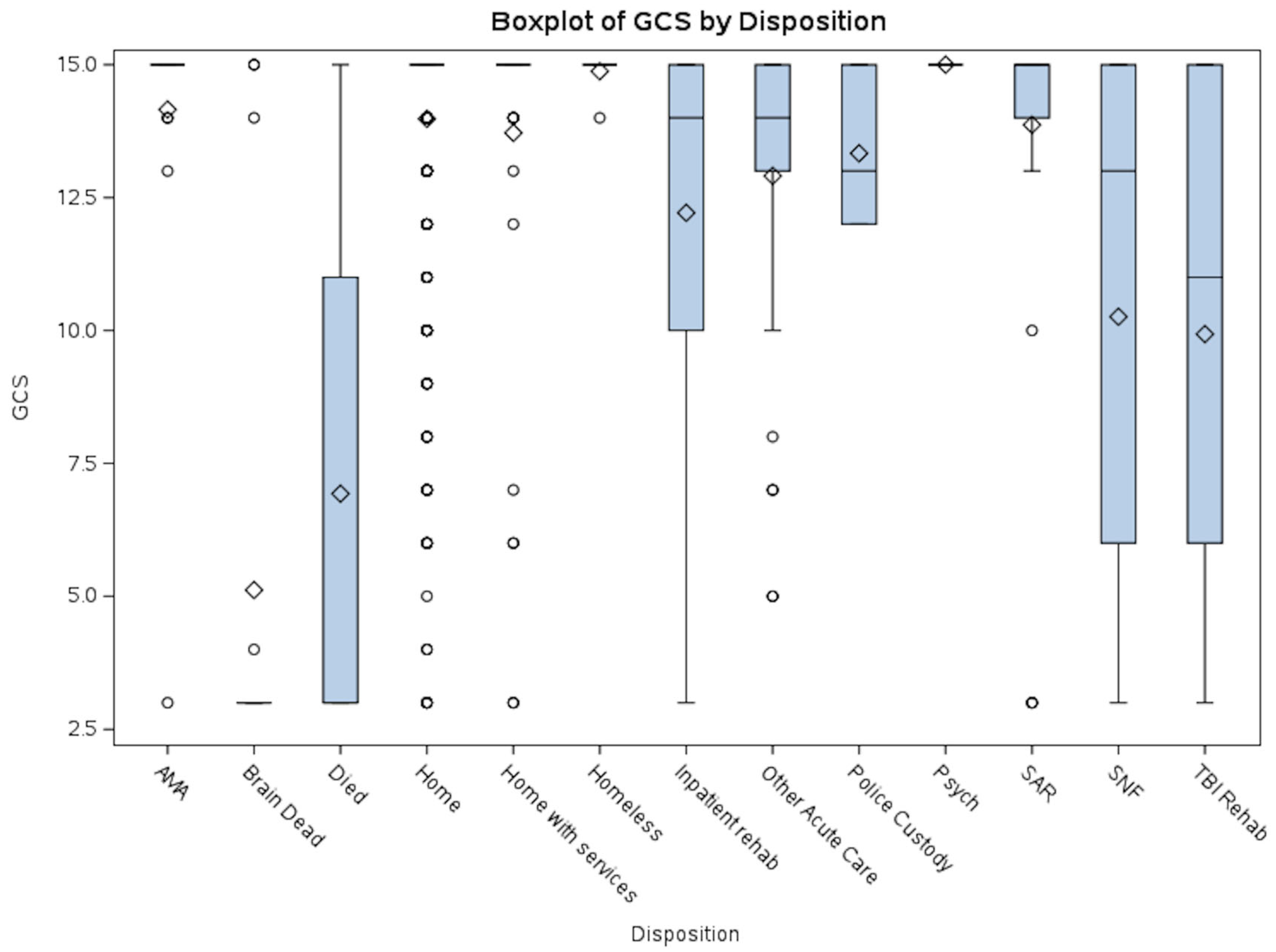
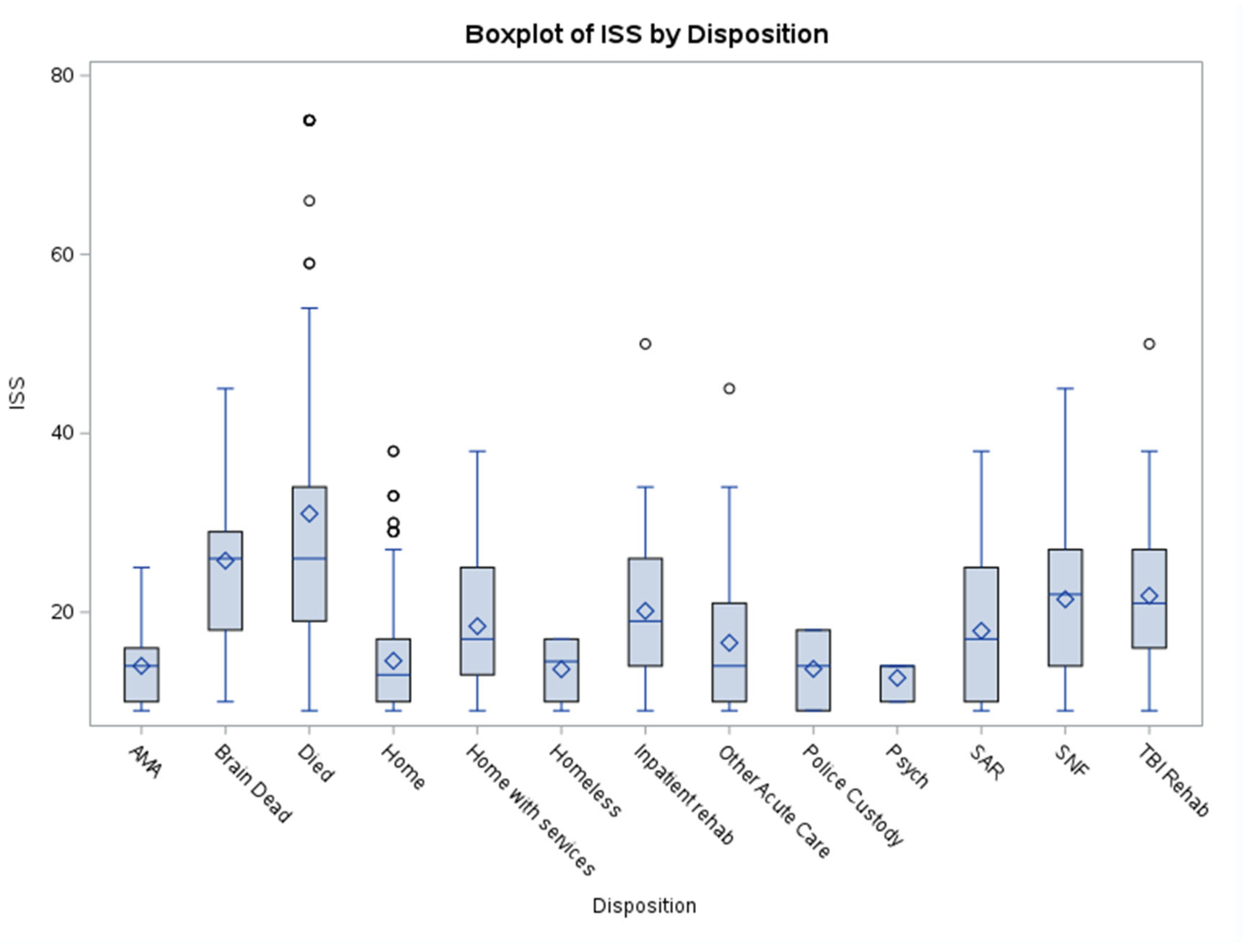
Background: Traumatic brain injury (TBI) is a major cause of death and disability worldwide. Patient disposition following TBI has been shown to interact with factors such as age, sex, and injury severity to impact clinical outcomes. Discharge home is associated with better functional outcomes and lower mortality, while discharge to rehabilitation or long-term care facilities is linked to greater injury severity, older age, and higher comorbidity burden. The aim of this study was to further correlate clinical outcomes with discharge dispositions in patients with severe TBI. Methods: This is a retrospective study (2020–2023) of dispositions in patients with severe TBI with AIS (head) ≥ 3. We investigated the relationship between patient disposition and a range of clinical variables, using both parametric (ANOVA) and non-parametric (Kruskal–Wallis, Wilcoxon, Van der Waerden, Savage, Kolmogorov–Smirnov, and Cramer–von Mises) statistical tests. Variables significant in univariate analysis were entered into a multinomial logistic regression model, with discharge home as the reference group. Results: In a cohort of 824 patients, 25.1% were female (n = 207) and 74.9% were male (n = 617). The mean age was 64.1 years for females and 48.9 years for males. Those admitted for severe TBI were included in our analysis. Most patients were discharged home (52.8%), followed by death (12.4%), inpatient rehab (5.1%), and home with services (5.6%). Significant associations were found between disposition and sex, with both males and females most likely to be discharged home (p = 0.0174), as well as between disposition and injury type (p = 0.0186). Disposition was significantly associated with most major clinical variables: hospital length of stay (HLOS), vent days, Glasgow Coma Scale (GCS), and Injury Severity Score (ISS), with p-values < 0.0001 for ANOVA and non-parametric tests. Longer HLOS and ICULOS were associated with discharge to skilled nursing facilities (SNF) most frequently. Days on mechanical ventilation correlated most strongly with discharge to SNF. Lower GCS scores and higher AIS and ISS scores were linked to death or brain death. Prolonged EDLOS was predominantly associated with psychiatric admissions. Higher levels of ETOH were associated with discharge to police custody, followed by homelessness. Conclusions: Our study supports existing evidence that discharge disposition following severe TBI is influenced by several factors, such as injury severity, age, sex, and clinical variables, such as length of stay and ventilator days.
Keywords: discharge disposition; traumatic brain injury; mechanism of injury; length of stay; injury severity discharge disposition; traumatic brain injury; mechanism of injury; length of stay; injury severity