1. Introduction
1.1. Background and Motivation
The rapid electrification of transportation is fundamentally reshaping modern energy systems. Large-scale deployment of electric vehicles (EVs) is widely regarded as a critical pathway toward decarbonizing the transportation sector and reducing dependence on fossil fuels [
1]. At the same time, the increasing penetration of renewable energy sources introduces significant variability and uncertainty into power system operation. These parallel trends pose new challenges for grid stability, energy balancing, and infrastructure utilization, calling for flexible and adaptive solutions that can bridge the transportation and power sectors [
2]. Vehicle-to-grid (V2G) technology has emerged as a promising paradigm to address these challenges by enabling bidirectional power and information exchange between EVs and the grid [
3,
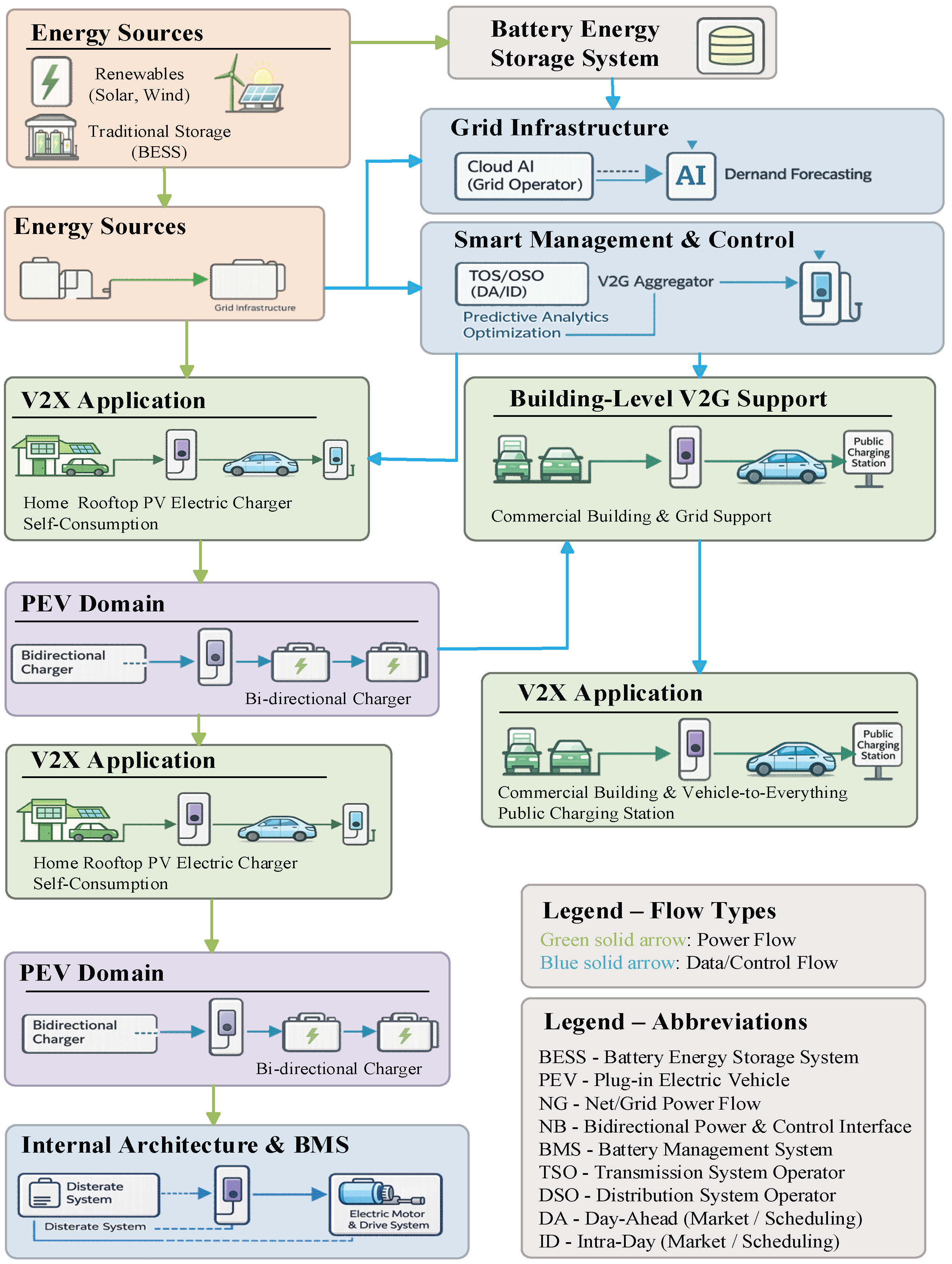
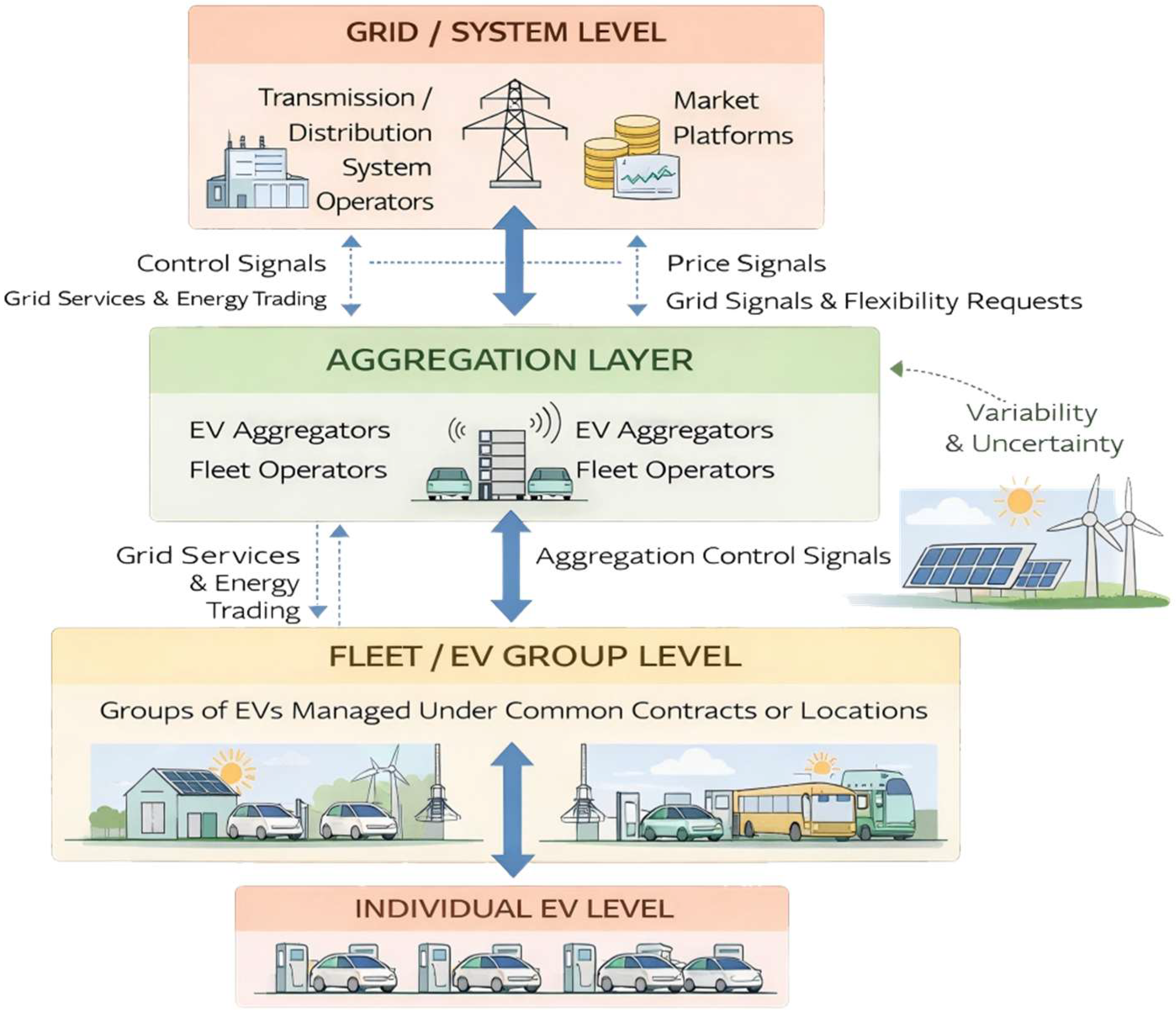
4]. As shown in
Figure 1, through coordinated charging and discharging, EVs can act as distributed energy resources, providing services such as peak shaving, frequency regulation, and renewable energy smoothing. Moreover, the framework integrates localized vehicle-to-everything (V2X) applications, specifically vehicle-to-home (V2H) and vehicle-to-building (V2B) configurations, to democratize energy distribution and bolster local grid resilience. Unlike conventional demand-side management strategies, V2G introduces a new class of mobile, user-owned energy assets whose operation is closely coupled with both grid dynamics and human behavior. This dual nature distinguishes V2G from traditional grid resources and elevates its importance within smart energy systems [
5].
Over the past decade, extensive research efforts have focused on the technical foundations of V2G, including bidirectional chargers, power electronic interfaces, communication protocols, and control algorithms [
6,
7,
8]. While these studies have significantly advanced the feasibility of V2G at the component and device levels, practical deployment has revealed that technical readiness alone is insufficient. The performance and value of V2G depend not only on individual technologies but also on how they are integrated into broader system architectures involving aggregators, grid operators, energy markets, and end users. As a result, V2G should be understood not merely as a collection of technologies, but as a system-level integration problem.
From a system perspective, V2G operation requires coordinated decision-making across multiple layers, including grid constraints, market mechanisms, fleet aggregation strategies, and user participation [
9,
10,
11]. The temporal mismatch between vehicle availability, mobility demand, and grid needs further complicates this coordination [
12,
13,
14]. In addition, issues such as battery degradation, communication latency, cybersecurity risks, and regulatory uncertainty directly influence user trust and economic viability [
15]. These interdependent factors highlight the necessity of analyzing V2G through a holistic lens that captures both technical interactions and socio-economic considerations.
Existing review articles on V2G have provided valuable summaries of technological developments and application scenarios [
6,
7,
8,
9,
10,
11,
12,
13,
14,
15,
16,
17,
18]. However, many of them primarily organize the literature according to specific technologies or application domains, offering limited discussion on how V2G functions as an integrated component of smart energy systems. The interactions among stakeholders, the system-level impacts on grid operation and market behavior, and the coupling between technical performance and user acceptance are often treated in isolation [
19,
20,
21,
22,
23,
24]. Consequently, there remains a need for a structured review that explicitly emphasizes system integration and cross-layer interactions [
25].
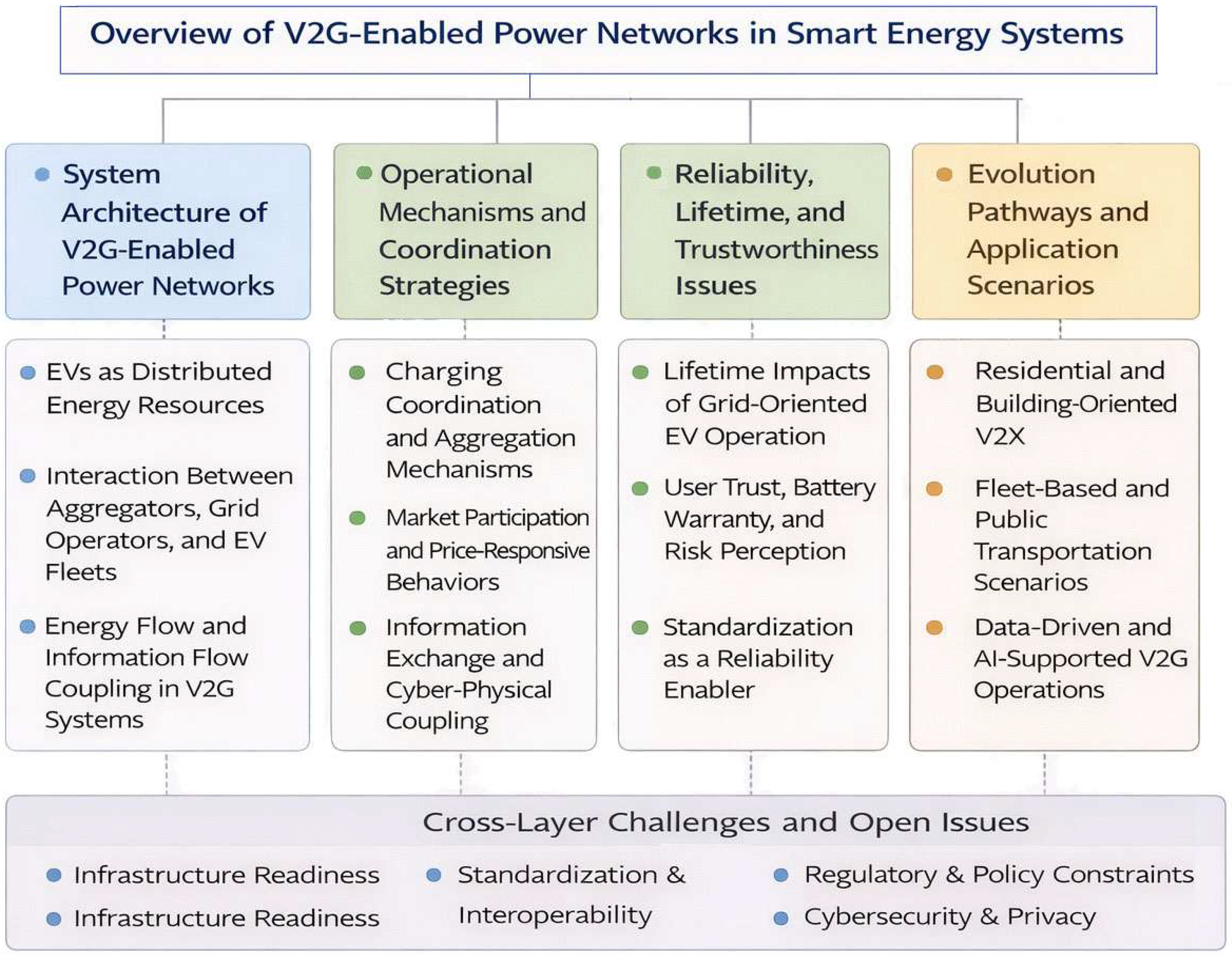
This paper aims to present a comprehensive review of V2G integration in smart energy systems from a system-level perspective. The review examines how enabling technologies, such as bidirectional charging, aggregation mechanisms, communication frameworks, and data-driven control, support coordinated operation across different system layers. Rather than focusing solely on technical advancements, the discussion highlights the roles of various stakeholders and analyzes the impacts of V2G on grid operation, energy management, and market participation. In addition to summarizing existing knowledge, this review identifies critical open issues that hinder large-scale V2G deployment, including infrastructure readiness, standardization, battery lifetime concerns, economic incentives, and cybersecurity. Emerging application scenarios, such as building-integrated V2G, fleet-based services, and AI-supported coordination strategies, are discussed to illustrate potential evolution pathways. By synthesizing technological foundations with system-level impacts and unresolved challenges, this paper aims to provide insights that support future research, system planning, and policy development for the integration of V2G into smart energy systems. As shown in
Figure 2, the main contributions and significance of the paper can be summarized as:
- (1)
This paper reframes V2G from a collection of enabling technologies into an integrated component of smart energy systems. It systematically analyzes how EVs, aggregators, grid operators, energy markets, and end users interact across multiple layers, highlighting coordination mechanisms that are often overlooked in technology-centric reviews.
- (2)
Rather than reviewing technologies in isolation, the paper explicitly connects bidirectional charging, aggregation strategies, communication frameworks, and data-driven control methods to their impacts on grid operation, energy management, reliability, and market participation, providing a clearer understanding of how technical choices influence system-level performance.
- (3)
The review synthesizes technical, economic, and regulatory constraints that jointly limit large-scale V2G deployment. Key issues such as battery lifetime degradation, infrastructure readiness, standardization gaps, user trust, and cybersecurity are examined as interdependent factors, offering a more realistic assessment of V2G feasibility in practical settings.
- (4)
The paper discusses emerging V2G application pathways, including building-integrated V2G, fleet-based services, and AI-supported coordination strategies. By situating these developments within the broader smart energy system context, the review clarifies how V2G may evolve from pilot projects toward scalable and sustainable deployment.
The rest of the paper is arranged as follows.
Section 2 examines the system architecture of V2G-enabled power networks, emphasizing the structural roles of electric vehicles, aggregators, and grid operators, as well as the coupling between energy flow and information flow within V2G systems.
Section 3 focuses on operational mechanisms and coordination strategies, including charging coordination, aggregation-based control, market participation, and cyber–physical information exchange that enable large-scale V2G operation.
Section 4 discusses reliability, lifetime, and trustworthiness issues associated with grid-oriented EV operation, addressing battery lifetime impacts, user trust and risk perception, and the role of standardization in enhancing system reliability.
Section 5 explores evolution pathways and representative application scenarios of V2G, covering residential and building-oriented V2X, fleet-based and public transportation applications, and data-driven, AI-supported V2G operations. In
Section 6, an overall discussion about V2G technologies is presented.
Section 7 is the conclusion part.
Given the broad and interdisciplinary nature of V2G research, it is also important to clarify how the relevant literature was identified, screened, and organized in this review.
1.2. Review Methodology
Relevant studies were identified through targeted searches in major academic databases, including Web of Science, Scopus, and IEEE Xplore, and were further complemented by backward and forward reference tracking of representative V2G review and research articles. To improve the transparency of this review, the relevant literature was collected and organized through a structured review process. The literature search focused on publications closely related to vehicle-to-grid integration in smart energy systems, including studies on bidirectional charging, aggregation mechanisms, communication and control frameworks, battery degradation, market participation, user interaction, and system-level deployment issues. Representative search terms included combinations of “vehicle-to-grid” OR “V2G” with keywords such as “bidirectional charging”, “aggregator”, “charging coordination”, “battery degradation”, “market participation”, “user acceptance”, “standardization”, and “smart energy systems”. Because the objective of this paper is to provide a system-level synthesis rather than a narrowly scoped technology survey, the literature selection emphasized studies that contributed to understanding V2G as an integrated cyber–physical–economic system.
The reviewed literature was screened according to its relevance to the main themes of the manuscript, technical depth, and contribution to system-level analysis. The screening process involved an initial review of titles, abstracts, and keywords, followed by a full-text assessment of studies with clear relevance to the scope of this review. Publications that were only marginally related to V2G integration, lacked substantive analytical content, or substantially overlapped with more representative studies were not prioritized. In addition to recent journal articles, several earlier foundational studies were retained where necessary to support the historical development and conceptual basis of V2G research. The final reference base of this review contains 218 sources, with particular emphasis on studies published between 2018 and 2025, while several earlier foundational works were retained where necessary.
To support a coherent synthesis of the selected literature, the reviewed studies were organized into four major dimensions: system architecture, operational coordination, reliability and trustworthiness, and evolution pathways. This classification was adopted to reflect the cross-layer nature of V2G integration and to connect enabling technologies with broader system-level impacts, deployment constraints, and future development directions.
To further clarify the novelty of the present review,
Table 1 compares representative existing V2G review articles with this manuscript in terms of thematic scope, main limitations, and distinct contribution.
2. System Architecture of V2G-Enabled Power Networks
V2G integration fundamentally reshapes the architecture of conventional power networks by introducing electric vehicles (EVs) as mobile, user-owned energy resources. Unlike traditional generation units or stationary storage systems, EVs are characterized by high spatial mobility, stochastic availability, and strong coupling with user behavior. As a result, V2G-enabled power networks exhibit a layered and distributed architecture in which physical power infrastructure, information and communication systems, and market coordination mechanisms are tightly interconnected. Understanding the structural roles of different entities within this architecture is essential for analyzing V2G operation at the system level.
2.1. EVs as Distributed and Mobile Energy Resources
In V2G-enabled power networks, electric vehicles (EVs) fundamentally alter the conventional definition of distributed energy resources (DERs), as shown in
Table 2. Unlike traditional DERs—such as photovoltaic systems, stationary batteries, or small-scale generators—that are fixed in location and primarily designed for grid support, EVs are intrinsically mobile, user-oriented, and energy-constrained by transportation demand [
31]. This combination of electrical functionality and mobility introduces a new class of distributed resources whose availability, capacity, and controllability vary dynamically over time.
From a system architecture perspective, EVs can be regarded as distributed energy storage units with stochastic connectivity. Their participation in grid operation depends on multiple factors, including charging location, plug-in duration, state of charge (SoC), and user-defined constraints related to mobility needs [
32]. As a result, the effective energy and power capacity accessible to the grid is time-varying and uncertain, even when large numbers of EVs are deployed. This characteristic distinguishes EV-based resources from conventional stationary storage and necessitates architectural designs that explicitly account for temporal and behavioral uncertainty [
33]. The mobility of EVs further introduces spatial variability into V2G-enabled power networks [
34]. EVs connect to different points of the distribution network over time, leading to continuously changing patterns of power injection and consumption [
35]. This spatial redistribution of energy resources affects local network conditions, such as feeder loading, voltage profiles, and transformer utilization. Consequently, EVs cannot be modeled solely as aggregate system-level resources [
36]. Their localized impacts must also be considered within the system architecture, particularly in distribution networks with high EV penetration.
In addition to physical mobility, EVs are inherently user-coupled resources. Their primary function is transportation, and grid services are secondary and conditional [
37]. User behavior, including departure time, driving distance, charging preferences, and risk tolerance, directly constrains the operational flexibility available for V2G [
38]. From an architectural standpoint, this implies that EVs cannot be dispatched in the same manner as conventional generation units. Instead, their participation must be bounded by user-defined constraints and mediated through coordination mechanisms that preserve mobility satisfaction [
39]. This human-in-the-loop characteristic is a defining feature of EV-based energy resources and has significant implications for system design.
Another distinguishing attribute of EVs is their energy-limited nature. While EV batteries may offer substantial aggregate capacity at the fleet level, individual vehicles have finite energy margins constrained by mobility requirements and battery health considerations. Frequent or deep discharging for grid services can accelerate battery degradation, reducing long-term availability and user acceptance [
40]. Therefore, in the context of system architecture, EVs should be treated as flexible but constrained resources, whose utilization must balance short-term grid benefits against long-term sustainability and user trust.
From the perspective of smart energy systems, EVs also represent a bridge between multiple domains, including electricity, transportation, and digital infrastructure [
41]. Their integration into power networks requires not only electrical interconnection but also information exchange related to availability, pricing, and control signals. As such, EVs occupy a unique architectural position at the intersection of physical energy systems and cyber-enabled coordination platforms [
42]. This dual role reinforces the need to conceptualize EVs as system-level resources rather than isolated technical components.
In summary, EVs in V2G-enabled power networks function as distributed, mobile, user-coupled, and energy-limited resources. These characteristics collectively differentiate EVs from traditional DERs and fundamentally influence the architecture of V2G systems. Recognizing EVs in this role provides the foundation for understanding the necessity of aggregation layers, hierarchical coordination, and cross-domain integration, which are examined in the subsequent subsections.
2.2. Aggregation Layer and Hierarchical Control Structure
The integration of large-scale electric vehicles into power networks necessitates an aggregation layer that bridges the gap between highly distributed, user-coupled EV resources and system-level operational requirements. Unlike conventional generators or stationary storage, individual EVs are neither directly observable nor controllable at the grid level in a scalable manner. The aggregation layer therefore emerges as a structural necessity (see
Figure 3), enabling EV fleets to participate in power system operation as coherent and manageable entities [
43].
From an architectural perspective, aggregation serves as an abstraction mechanism. It consolidates heterogeneous EV resources, characterized by diverse battery capacities, charging power limits, mobility patterns, and user constraints, into virtualized resources with aggregated power and energy envelopes [
44]. This abstraction allows grid operators and energy markets to interact with EV fleets using interfaces similar to those applied to conventional flexible resources, without being exposed to vehicle-level complexity [
45]. As a result, aggregation fundamentally reshapes the control boundary of V2G-enabled power networks. The importance of aggregation becomes more pronounced in power systems with high penetration of renewable energy sources. Renewable generation, particularly wind and solar power, introduces variability and forecast uncertainty across multiple time scales [
46]. While EVs offer substantial flexibility potential to mitigate these fluctuations, their effective utilization requires coordination at a scale comparable to renewable variability. Aggregators enable this coordination by aligning the collective charging and discharging behavior of EV fleets with renewable generation profiles, thereby facilitating load shifting, surplus absorption, and variability smoothing at the system level.
Hierarchical control naturally arises from the presence of the aggregation layer. In a typical V2G-enabled architecture, control responsibilities are distributed across multiple levels [
47]. At the top level, grid operators or market platforms specify system-level objectives, such as power balancing requirements, reserve provision, or price-based incentives, often driven by renewable generation conditions. At the intermediate level, aggregators interpret these signals and translate them into fleet-level control targets while accounting for contractual obligations, battery health considerations, and user-defined constraints [
48]. At the lowest level, individual EVs execute charging or discharging actions within locally imposed limits.
This hierarchical structure offers several architectural advantages under large-scale and heterogeneous V2G conditions [
49,
50]. First, it enhances scalability by preventing direct communication and control between grid operators and millions of EVs. Second, it supports decoupling between system-level objectives and vehicle-level constraints, allowing each layer to operate with appropriate temporal and spatial resolution. Third, it provides a natural framework for integrating uncertainty, as aggregators can absorb short-term variability in renewable generation and EV availability before exposing aggregated behavior to the grid. The aggregation layer also plays a critical role in coordinating EV participation across different network locations [
51]. Because EVs connect to various points in the distribution network over time, uncoordinated V2G operation may exacerbate local congestion or voltage violations, particularly in regions with high renewable penetration. Aggregators can incorporate location-dependent constraints and network feedback into their control logic, thereby helping mediate between renewable generation patterns and distribution network limitations [
52]. This spatial coordination capability further distinguishes aggregated V2G resources from conventional centralized assets.
In summary, the aggregation layer and its associated hierarchical control structure form the backbone of V2G-enabled power networks. By abstracting heterogeneous and mobile EV resources, aligning their operation with renewable energy dynamics, and enabling scalable multi-level coordination, aggregation transforms EV fleets into system-compatible resources. This architectural foundation enables the operational mechanisms and coordination strategies discussed in the subsequent section.
2.3. Energy Flow Architecture in V2G-Enabled Power Networks
The energy flow architecture of V2G-enabled power networks differs from that of conventional power systems due to the bidirectional and spatially distributed nature of electric vehicles [
53]. In traditional grids, energy flow is largely unidirectional, from centralized generation units through transmission and distribution networks to end users. With V2G integration, EVs introduce numerous bidirectional injection and absorption points at the distribution level, transforming the energy flow topology into a highly decentralized and dynamic structure, as shown in
Table 3.
From an architectural perspective, energy flow in V2G systems spans multiple voltage levels and spatial scales. Individual EVs typically connect at the low-voltage distribution level, while aggregated charging and discharging behaviors can influence medium-voltage feeders and, in large-scale deployments, even system-level power balance [
54]. As a result, energy flow in V2G-enabled networks cannot be characterized solely by net load profiles. Instead, it must account for time-varying power injections and withdrawals distributed across the network.
A key feature of V2G energy flow architecture is its locality. Although aggregated EV fleets may provide system-level services, the physical exchange of energy always occurs at specific network nodes [
55,
56]. Uncoordinated charging or discharging may therefore lead to localized issues such as feeder congestion, transformer overloading, or voltage deviations, even when overall system balance is maintained. This highlights the importance of incorporating distribution network constraints into the architectural design of V2G energy flows, particularly in regions with high EV penetration or high shares of distributed renewable generation. The interaction between V2G energy flows and renewable energy sources further shapes the architectural characteristics of the system [
57,
58]. Distributed renewable generation, such as rooftop photovoltaics or local wind power, introduces spatially correlated power injections that vary over time. EVs can act as flexible sinks or sources to absorb surplus renewable energy or compensate for generation deficits. Architecturally, this creates localized energy circulation patterns in which renewable generation, EV charging infrastructure, and nearby loads form tightly coupled subsystems within the broader grid.
Another important aspect of V2G energy flow architecture is its temporal coupling. Energy exchanged with EV batteries at one point in time affects the availability of flexibility at future times due to state-of-charge dynamics and mobility requirements [
59]. Unlike conventional generators, EVs cannot provide sustained power output without prior energy accumulation [
60]. Therefore, energy flow decisions in V2G systems must be understood as intertemporal processes, where short-term grid support is balanced against future availability and user needs.
Overall, the energy flow architecture of V2G-enabled power networks is characterized by decentralized bidirectional exchanges, strong locality effects, interaction with distributed renewable generation, and intertemporal coupling driven by battery dynamics. Recognizing these architectural features is essential for designing coordination mechanisms that respect physical network constraints while unlocking the flexibility potential of EV fleets. This understanding also provides the foundation for analyzing information flow and cyber–physical interactions, which are discussed in the following subsection.
2.4. Information and Communication Architecture
In V2G-enabled power networks, information and communication architecture forms the backbone that enables coordination among distributed and mobile energy resources [
61,
62,
63]. Unlike conventional power systems, where information exchange primarily supports monitoring and supervisory control, V2G operation relies on continuous, bidirectional information flow to coordinate charging, discharging, and aggregation across multiple system layers. As a result, information architecture is not an auxiliary component but a core structural element of V2G-enabled systems [
64].
From an architectural perspective, information flow in V2G systems spans multiple layers, including grid operators, aggregators, fleet-level entities, and individual EVs [
65]. Their characteristics are shown in
Table 4. Different types of information are exchanged across these layers, such as system-level signals (e.g., flexibility requests or price signals), aggregation-level coordination commands, and vehicle-level status information (e.g., state of charge, availability, and user constraints) [
66]. This layered organization mirrors the hierarchical control structure and allows each layer to operate with an appropriate level of abstraction. A defining characteristic of V2G information architecture is its asymmetry and heterogeneity [
67,
68]. System-level entities typically issue high-level signals with relatively low temporal resolution, while vehicle-level data are highly granular and time-varying [
69]. Aggregation layers play a crucial role in reconciling this mismatch by filtering, compressing, and translating information between scales [
70]. This architectural function reduces communication burden and enables scalable coordination without exposing vehicle-level details to system operators.
Latency and reliability are critical considerations in V2G information architecture [
71,
72,
73,
74]. Delays or losses in communication can directly affect physical energy flows, particularly during coordinated charging or discharging events [
75]. However, unlike traditional protection or real-time control systems, many V2G services tolerate limited latency, allowing information exchange to be structured around periodic updates rather than continuous real-time streams [
76,
77,
78]. This flexibility influences architectural design choices and distinguishes V2G communication requirements from those of fast-acting grid control systems.
Information architecture in V2G systems is also closely coupled with user participation and privacy considerations [
79]. Vehicle availability, mobility schedules, and charging preferences are inherently sensitive information [
80]. Consequently, architectural designs often restrict direct access to raw vehicle-level data, relying instead on aggregated or anonymized representations [
81,
82]. This separation of information visibility across layers reinforces the role of aggregators as trusted intermediaries and shapes how information flows are structured within the system.
Overall, the information and communication architecture of V2G-enabled power networks is characterized by hierarchical layering, heterogeneous data flows, and strong coupling with physical energy exchange. Its primary architectural function is to enable scalable coordination while preserving system observability, user privacy, and operational robustness. Together with the energy flow architecture discussed in the previous subsection, it establishes the cyber–physical foundation upon which V2G operational mechanisms are built.
In addition to latency, reliability, and privacy, cybersecurity constitutes a critical requirement for V2G information architecture. Because V2G systems rely on bidirectional communication among EVs, charging infrastructure, aggregators, and grid operators, they are exposed to multiple cyber attack surfaces. Common attack vectors include false data injection, communication spoofing, denial-of-service attacks, man-in-the-middle interception, malware compromise of charging or aggregation platforms, and privacy inference from user-level mobility and charging data. These attacks may affect not only data confidentiality but also operational correctness, service availability, and user trust. To clarify these issues,
Table 5 summarizes representative cyber attack vectors in V2G systems together with their potential consequences and mitigation strategies.
As shown in
Table 5, cybersecurity in V2G systems should be addressed as a cross-layer issue involving communication security, platform resilience, data integrity, and privacy protection rather than as an isolated software concern.
3. Operational Mechanisms and Coordination Strategies
While the system architecture of V2G-enabled power networks defines who participates and how components are organized, the practical value of V2G ultimately depends on how these components are coordinated during operation. At scale, V2G is not a point-to-point interaction between individual EVs and the grid, but a multi-layer, multi-timescale coordination problem involving charging decisions, aggregation logic, market participation, and cyber–physical interaction [
83,
84,
85]. This section examines the key operational mechanisms that enable large-scale and reliable V2G operation from a system perspective.
3.1. Charging Coordination and Aggregation Mechanisms
The large-scale integration of electric vehicles into power networks fundamentally alters the operational nature of demand and flexibility. Unlike conventional loads, electric vehicles exhibit strong temporal variability, user-dependent availability, and dual functionality as both energy consumers and potential suppliers [
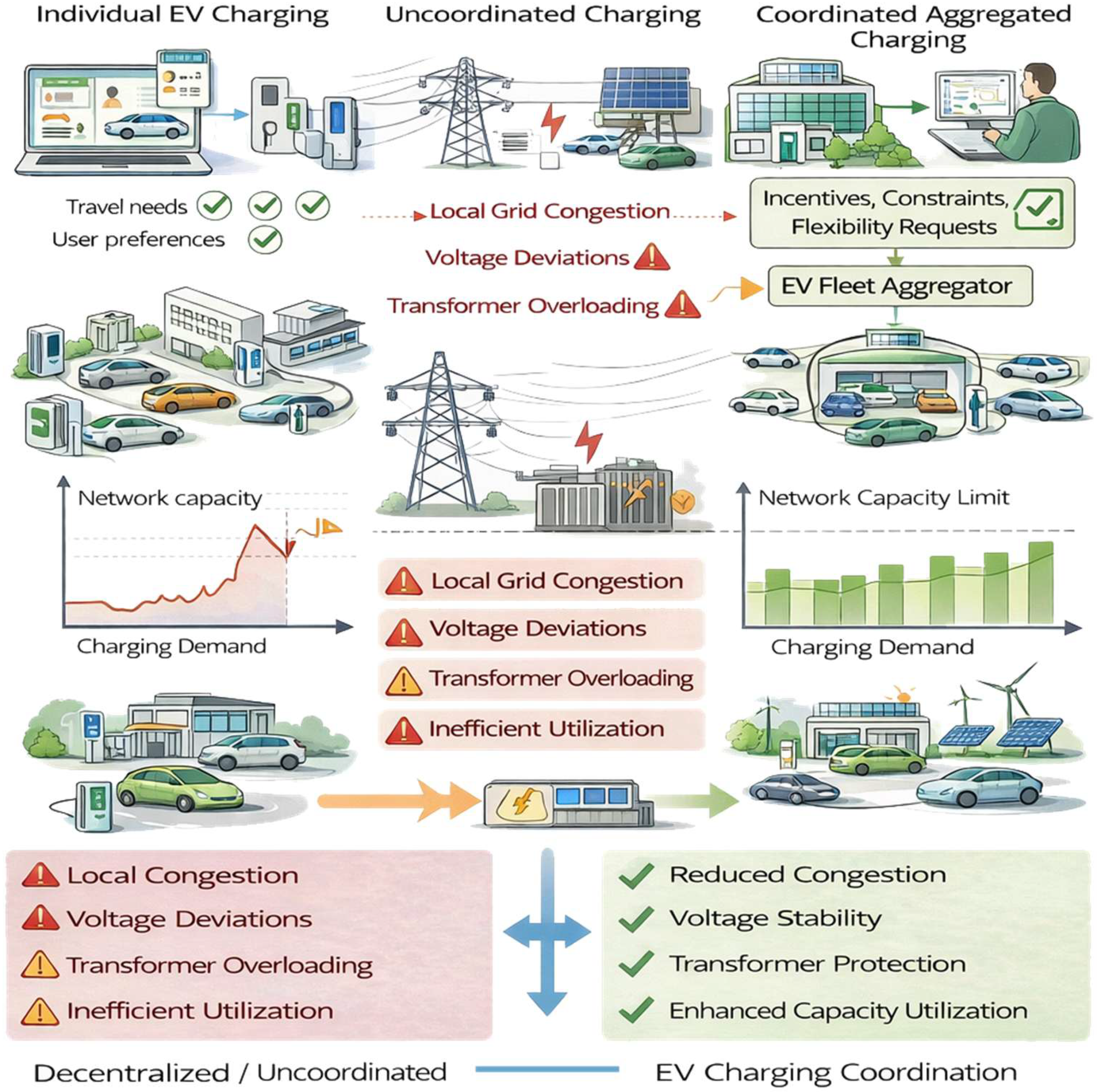
86]. In the absence of coordination, simultaneous charging or discharging actions across a large population of EVs may introduce severe operational risks, including local congestion, voltage deviations, transformer overloading, and inefficient utilization of network capacity, as shown in
Figure 4. Consequently, charging coordination and aggregation mechanisms are indispensable for enabling V2G operation at scale.
3.1.1. From Individual Charging to Coordinated System Behavior
At the individual level, electric vehicle charging decisions are primarily governed by mobility demand, user preferences, and charging convenience [
87]. Such decisions are inherently decentralized and heterogeneous, reflecting diverse travel patterns, battery capacities, and access to charging infrastructure [
88]. However, when considered collectively, the charging behavior of a large EV population exerts a substantial influence on power system operation [
89]. Without coordination, synchronized charging, particularly during peak demand periods, can lead to load amplification, local congestion, and inefficient utilization of network resources.
Charging coordination aims to transform this unstructured collective behavior into a system-compatible response [
90]. Rather than optimizing individual charging actions in isolation, coordination mechanisms shape aggregate charging and discharging profiles to align with system-level objectives, such as peak load mitigation, renewable energy accommodation, and operational security. Importantly, coordination does not necessarily imply direct control over individual vehicles [
91]. In [
92,
93,
94,
95], it is achieved through indirect mechanisms, including incentives, scheduling constraints, or flexibility envelopes, that influence charging behavior while preserving user autonomy, respectively. From a system perspective, coordinated charging represents a shift from passive demand to actively managed flexibility. This transition is essential for ensuring that the growing penetration of EVs enhances, rather than degrades, overall system performance.
3.1.2. Role and Rationale of Aggregation
Although charging coordination could, in principle, be implemented at the level of individual vehicles, such an approach is neither scalable nor operationally efficient. The sheer number of EVs, combined with their dynamic availability and user-coupled constraints, makes direct interaction between system operators and individual vehicles impractical. This challenge motivates the introduction of aggregation as a fundamental operational mechanism in V2G-enabled power networks [
96].
Aggregation groups large numbers of heterogeneous EVs into unified entities, commonly referred to as fleets or portfolios, that can be managed and dispatched as coherent resources. By abstracting individual vehicle characteristics into aggregated power and energy capabilities, aggregation significantly reduces system complexity [
97,
98]. Grid operators and market platforms interact with aggregated EV resources using standardized interfaces, without requiring visibility into vehicle-level details [
99]. In addition to improving scalability, aggregation enhances predictability. While individual EV behavior is stochastic, aggregated fleets exhibit smoother and more reliable response characteristics due to statistical averaging [
100]. This predictability is critical for integrating EV-based flexibility into system operation and market processes, where reliability and performance guarantees are required.
3.1.3. Hierarchical Control Structures in Charging Coordination
Charging coordination in V2G systems is naturally organized within a hierarchical control structure. At the upper level, system operators define operational objectives and constraints, such as congestion limits, balancing requirements, or flexibility requests. These signals are communicated to aggregators, which operate at an intermediate level and are responsible for translating system-level requirements into fleet-level control actions [
101].
At the lower level, individual EVs execute charging or discharging actions within locally defined bounds that reflect both user preferences and system-imposed constraints [
102]. This hierarchical arrangement decouples system operation from individual vehicle behavior, enabling scalable coordination without centralized micromanagement. Hierarchical control structures also support multi-objective decision-making [
103]. Aggregators must reconcile system needs with user requirements and battery health considerations, often operating within predefined flexibility envelopes rather than issuing rigid commands [
104]. This approach preserves local autonomy while ensuring global consistency, and it provides inherent robustness against communication failures or modeling inaccuracies.
3.1.4. Temporal Dimensions of Charging Coordination
Charging coordination in V2G-enabled power networks unfolds across multiple temporal scales, each associated with distinct operational objectives [
105]. At longer timescales, such as day-ahead or intraday horizons, coordination focuses on scheduling charging demand in alignment with anticipated system conditions, renewable generation availability, and mobility patterns. These schedules establish baseline charging plans that balance efficiency and user convenience.
At shorter timescales, real-time coordination adjusts charging or discharging power in response to unforeseen events, including renewable fluctuations, demand variability, or operational contingencies [
106,
107]. In this context, EVs act as fast-responsive flexibility resources, capable of modulating power exchange to support system stability [
108]. Effective coordination requires consistency across these timescales. Decisions made at slower layers constrain the flexibility available for real-time actions, while frequent short-term interventions can affect long-term objectives such as battery longevity and guaranteed vehicle readiness [
109,
110]. Aggregation-based coordination addresses this challenge by allocating flexibility margins during scheduling stages, ensuring that short-term responses remain compatible with long-term plans.
3.2. Market Participation and Price-Responsive Behaviors
Beyond physical coordination, the operation of V2G-enabled power networks is strongly shaped by market mechanisms that translate system needs into economic signals. Market participation provides the primary channel through which electric vehicles and aggregators are incentivized to offer flexibility, and it plays a critical role in aligning individual charging behavior with broader system objectives [
111]. From an operational perspective, V2G is therefore not only a cyber–physical system, but also an economic coordination framework, as shown in
Table 6.
3.2.1. Role of Markets in V2G Operation
In conventional power systems, markets primarily coordinate generation resources and large-scale demand response [
112]. With the introduction of V2G, EVs, through aggregators, emerge as a new class of market participants capable of providing energy and flexibility services. These services may include load shifting, peak reduction, balancing support, or reserve provision, depending on market design and regulatory context [
113,
114,
115]. In addition to economic incentives, aggregator participation in V2G markets is also shaped by regulatory and institutional conditions. In many electricity markets, aggregated EV resources cannot always participate on equal terms with conventional generators or large storage assets, because market-entry rules were originally designed for centralized resources. Common barriers include minimum bid-size requirements, prequalification procedures for ancillary service provision, communication and telemetry compliance obligations, and limitations on power export at the distribution-network level. Moreover, grid codes and market-access rules differ across regions, resulting in uneven opportunities for large-scale aggregator-based V2G deployment. Therefore, effective market integration depends not only on price design, but also on the alignment of technical standards, regulatory frameworks, and grid-operation requirements [
116,
117]. Direct market participation by individual EVs is generally infeasible due to minimum bid sizes, transaction costs, and uncertainty in availability. Aggregators therefore act as market-facing entities that consolidate EV flexibility into tradable products [
118]. From the system perspective, this aggregation enables EV fleets to be treated as market-compatible resources, comparable to conventional generators or storage systems, while shielding the market from vehicle-level variability.
3.2.2. Price Signals as Coordination Instruments
Price signals constitute the dominant mechanism through which markets influence EV charging and discharging behavior [
119]. Time-varying electricity prices, dynamic tariffs, and flexibility payments encode system conditions, such as supply–demand balance or congestion, into economic incentives [
120]. When appropriately designed, these signals guide charging decisions toward system-beneficial outcomes without requiring direct command-and-control.
Price-responsive behavior operates at multiple levels [
121]. At the aggregator level, price signals inform decisions regarding when and how much aggregated flexibility to offer into markets. At the EV or user level, prices influence charging preferences, willingness to provide discharge services, and participation duration [
122]. Importantly, the effectiveness of price-based coordination depends on the responsiveness and predictability of aggregated EV behavior, which is closely linked to aggregation strategies discussed in
Section 3.1. From an operational standpoint, price responsiveness enables soft coordination: rather than enforcing rigid schedules, the system leverages economic incentives to shape behavior. This approach enhances scalability and user acceptance, particularly in contexts where strict control may conflict with mobility needs.
In addition to general price signals, current V2G-related studies commonly discuss several representative tariff models that shape charging and discharging behavior. These include time-of-use tariffs, real-time or dynamic pricing, critical peak or peak-oriented pricing, ancillary-service-based compensation, and bidirectional export or settlement schemes. Time-of-use and dynamic pricing models mainly influence the temporal allocation of charging and discharging, whereas ancillary-service remuneration and export settlement mechanisms provide more direct incentives for bidirectional participation in grid support services. However, the practical value of these tariff models depends strongly on regional regulation, metering arrangements, market qualification requirements, and the extent to which battery degradation and user participation costs are reflected in compensation design [
123,
124].
To clarify the economic dimension of V2G deployment,
Table 7 summarizes representative tariff models that are commonly discussed in current V2G and EV flexibility studies.
As shown in
Table 7, the economic attractiveness of V2G depends not only on the presence of incentives, but also on how tariff structures translate flexibility into predictable and realizable value.
Different market-oriented V2G services should also be distinguished more explicitly in terms of both operational logic and economic feasibility. Ancillary services, such as frequency regulation and reserve support, usually require fast response and high availability, and may provide relatively attractive revenue under suitable market-access conditions. In contrast, energy arbitrage mainly relies on buying electricity at low-price periods and discharging during high-price periods, so its profitability is often more sensitive to tariff differentials, battery degradation cost, and round-trip efficiency. Peak-shaving services are typically associated with local or system-level load reduction during high-demand periods, but their economic value depends strongly on tariff structure, dispatch frequency, and whether peak reduction is rewarded through market or network mechanisms. More broadly, flexibility services may include congestion relief, renewable balancing, or demand response support, whose value is often context-dependent and shaped by local grid needs and institutional arrangements. Distribution-level applications are particularly important because V2G may provide localized support to distribution networks through congestion management, transformer loading relief, or coordinated charging control; however, their economic feasibility is often less standardized than that of wholesale-market services and may depend on pilot programs, local incentives, or utility-specific arrangements. Therefore, different V2G services should not be evaluated under a single economic framework, because their technical requirements, dispatch characteristics, and value realization mechanisms differ substantially.
3.2.3. Interaction Between Market Objectives and Physical Constraints
While market mechanisms provide powerful coordination signals, price-responsive behavior is inherently constrained by physical and technical limits [
125]. Battery state-of-charge, charging power ratings, network constraints, and user-defined mobility requirements all bound the feasible response of EV fleets. Consequently, market participation cannot be decoupled from physical coordination mechanisms. Aggregators play a central role in mediating this interaction [
126]. They evaluate market opportunities against the available physical flexibility of their EV portfolios, ensuring that market commitments remain feasible under uncertainty [
127]. This mediation transforms market signals into physically realizable charging and discharging actions, preventing overcommitment and reducing the risk of non-delivery.
The coupling between markets and physical operation also introduces trade-offs. Aggressive pursuit of short-term market revenues may lead to excessive battery cycling or reduced availability for future services [
128]. Conversely, overly conservative strategies may underutilize available flexibility. Effective V2G operation therefore requires market participation strategies that balance economic performance with long-term reliability and sustainability [
129].
3.2.4. Aggregation Effects on Market Reliability
One of the key advantages of aggregation in market participation is the reduction of uncertainty through statistical smoothing. Individual EV availability is highly uncertain due to stochastic mobility patterns, but aggregated fleets exhibit more stable and predictable behavior [
130,
131]. This reliability enhancement is essential for market acceptance, particularly in services that require firm capacity or performance guarantees.
From a system perspective, aggregated EV participation improves market efficiency by increasing the pool of flexible resources and enhancing competition [
132]. However, it also raises new considerations related to market design, such as how aggregated flexibility should be measured, verified, and compensated [
133]. These considerations influence operational strategies and shape the evolution of V2G-enabled markets.
3.3. Information Exchange and Cyber–Physical Coupling
The operation of V2G-enabled power networks relies on information exchange that links distributed physical energy assets with digital coordination and decision-making layers [
134]. Unlike conventional power systems, where information flows mainly support monitoring and supervisory control, V2G operation requires continuous interaction between cyber and physical domains to coordinate charging actions, market participation, and system-level responses, as shown in
Table 8.
3.3.1. Hierarchical Information Exchange Across System Layers
Information exchange in V2G-enabled power networks is inherently hierarchical, reflecting the layered organization of system operators, aggregators, fleet-level entities, and individual EVs [
135]. Different system layers require different levels of information abstraction. System operators and market platforms primarily rely on high-level indicators, such as aggregated flexibility, congestion signals, or price information, while detailed vehicle-level data, such as state-of-charge, availability, and user constraints, remain localized [
136]. This hierarchical information structure can support scalable coordination by reducing excessive data transmission and limiting the exposure of vehicle-level variability [
137]. Aggregators play a central role in this process by collecting, filtering, and abstracting information from individual EVs, and by communicating aggregated representations upward [
138]. As a result, system-level decision-making can often be performed without direct access to fine-grained vehicle data, which helps preserve both scalability and privacy.
3.3.2. Cyber–Physical Coupling and Operational Robustness
In V2G systems, information exchange is tightly coupled with physical energy flows, forming a cyber–physical operational loop [
139]. Control signals, price information, and coordination instructions transmitted through communication networks directly influence charging and discharging behavior, while physical system states feed back into digital decision processes [
140]. This bidirectional coupling differentiates V2G operation from conventional grid monitoring and introduces new dependencies between cyber and physical domains [
141]. Operational robustness requires that V2G coordination mechanisms tolerate imperfect information, including communication delays, data uncertainty, and partial observability. Rather than relying on continuous real-time control, many V2G services operate within predefined flexibility margins and tolerate limited latency [
142]. This design approach reduces vulnerability to communication disruptions and supports stable operation under realistic cyber conditions, especially at large scale.
3.3.3. Information Abstraction, Privacy, and Trust
Because EVs are user-owned and mobility-driven assets, information exchange in V2G systems inevitably involves sensitive data related to driving behavior and availability. Excessive disclosure of such information can undermine user trust and hinder participation [
143,
144,
145]. Consequently, privacy considerations are a fundamental aspect of V2G information architecture and operational design.
Information abstraction through aggregation provides an effective means of balancing observability and privacy. By limiting upward information flow to aggregated or anonymized indicators, the system maintains sufficient visibility for coordination while protecting individual user data [
146]. This separation of information access across layers reinforces trust between users, aggregators, and system operators, and supports sustained participation in V2G programs.
4. Reliability, Lifetime, and Trustworthiness Issues
While V2G-enabled power networks offer substantial operational flexibility and economic potential, their large-scale deployment is ultimately constrained by issues of reliability, lifetime, and trustworthiness. Unlike conventional grid assets, electric vehicles are user-owned, mobility-driven, and energy-limited, which fundamentally changes how reliability and longevity should be interpreted. In this context, V2G is not only a technical integration problem, but also a long-term sustainability and trust management challenge involving physical assets, users, and institutions.
4.1. Lifetime Impacts of Grid-Oriented EV Operation
Battery lifetime is widely regarded as a central constraint in the large-scale deployment of V2G systems. Unlike stationary energy storage assets that are explicitly designed and depreciated for grid services, electric vehicle batteries are primarily optimized for mobility [
147]. When EVs participate in grid-oriented charging and discharging, additional operational stress is introduced beyond that required for transportation. As a result, battery lifetime impacts become an important factor influencing not only individual asset degradation, but also the long-term reliability and availability of V2G flexibility at the system level [
148]. From a physical standpoint, battery degradation is driven by a combination of cycling-related and calendar-related mechanisms. Grid-oriented operation increases cycling frequency and may alter depth-of-discharge patterns, power rates, and thermal conditions, all of which affect degradation trajectories. While a single grid event may impose limited incremental wear, the cumulative effect of repeated V2G participation over time can become non-negligible [
149]. Importantly, these effects appear to depend more strongly on the operational profile of V2G services than on the mere presence of bidirectional capability.
Different categories of grid services impose distinct lifetime stresses. Short-duration, high-frequency services, such as balancing or fast regulation, tend to increase the number of shallow cycles, whereas energy-shifting or peak-shaving applications may involve deeper and longer charge–discharge cycles [
150]. To clarify these service-dependent aging effects,
Table 9 compares fast-regulation and peak-shaving from a battery lifetime perspective.
Table 9 shows that different V2G services are associated with different battery stress patterns. Therefore, lifetime assessment should be service-specific rather than based on a single generalized degradation assumption. However, the literature does not provide a fully consistent conclusion on the lifetime impact of V2G participation, because the reported results vary with battery chemistry, cycling depth, temperature conditions, control strategy, and service profile. These heterogeneous stress patterns imply that battery lifetime impacts cannot be evaluated using a single degradation metric. From a system perspective, this diversity complicates the prediction of long-term flexibility availability and necessitates lifetime-aware characterization of V2G service portfolios.
To further synthesize the literature from a battery lifetime perspective,
Table 10 summarizes representative V2G discharge strategies and their typical modeled impact on battery cycle life.
As shown in
Table 10, the impact of V2G operation on battery lifetime depends not only on whether discharging occurs, but also on how frequently it is activated, how deeply the battery is cycled, and how the service is scheduled.
A further challenge arises from the heterogeneity of EV fleets. Battery chemistries, thermal management systems, usage intensity, and environmental conditions vary widely across vehicles [
151]. For example, different battery chemistries may exhibit different sensitivities to cycling depth, temperature rise, and repeated bidirectional operation, which further complicates generalized lifetime assessment. Consequently, identical grid-oriented control actions may result in markedly different degradation outcomes for different EVs [
152,
153]. At the fleet level, this heterogeneity introduces dispersion in degradation rates, which, if unmanaged, may lead to uneven lifetime reduction and selective withdrawal of certain vehicles from V2G participation. Such effects can gradually erode the effective capacity of aggregated resources and reduce system reliability.
Aggregation plays a mitigating role in this context, but it does not eliminate lifetime concerns. By distributing grid services across large EV populations, aggregation reduces the relative stress imposed on individual vehicles and enables statistical smoothing of degradation impacts [
154]. However, aggregation also obscures vehicle-level lifetime dynamics from system operators. If lifetime effects are not explicitly accounted for within aggregation strategies, degradation may accumulate silently until participation declines or failures emerge [
155]. Therefore, from a system design perspective, battery lifetime should be treated as a latent constraint that evolves over time rather than as a static technical parameter.
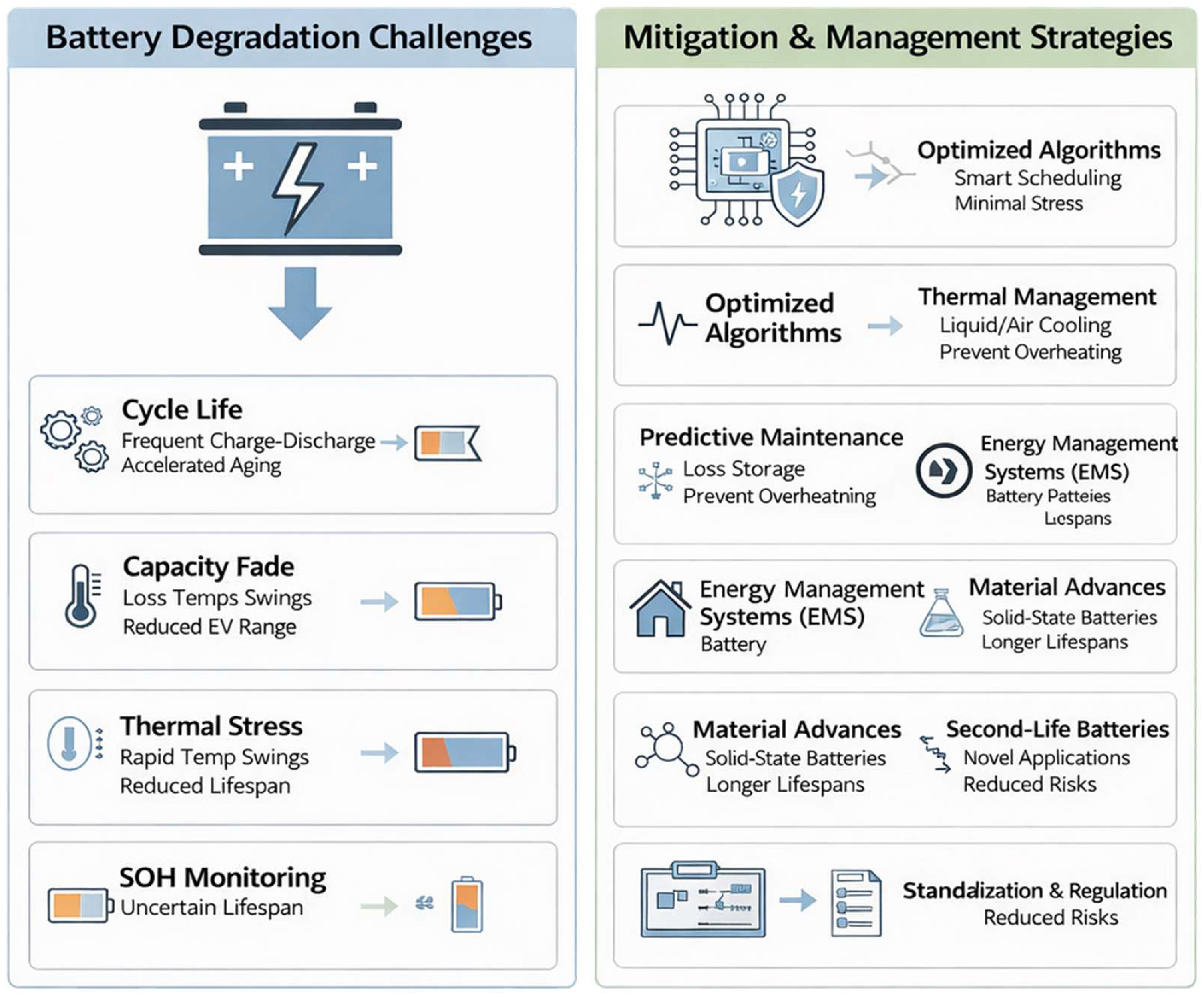
Battery lifetime impacts also influence user behavior and participation willingness. As shown in
Figure 5, battery degradation involves capacity fade, aging-related stress, and thermally coupled deterioration mechanisms. Although battery management systems can mitigate these effects to some extent, they cannot eliminate them entirely [
156]. From the user’s perspective, this represents a tangible cost that may not be fully compensated by market revenues or incentives. Even when degradation is modest in absolute terms, perceived risk can significantly deter participation [
157]. At the system level, widespread risk-averse behavior reduces the effective size of the V2G resource pool and increases uncertainty in service delivery. Thus, lifetime impacts affect V2G reliability both physically and behaviorally.
From a system-level reliability perspective, ignoring battery lifetime can lead to overestimation of available flexibility and underestimation of future constraints [
158]. Incorporating lifetime impacts into planning and operation improves the credibility of V2G resources and supports more resilient system design [
159]. This does not require detailed electrochemical modeling at the system level, but it does require acknowledgment that battery lifetime is an endogenous outcome of operational decisions, not an exogenous constant.
4.2. User Trust, Risk Perception, and Participation Willingness
User participation is a fundamental prerequisite for the reliable operation of V2G-enabled power networks. Unlike conventional grid assets that are centrally owned and fully controllable by system operators, V2G relies on privately owned electric vehicles whose availability is contingent upon user consent and sustained engagement [
160]. As a result, user trust and risk perception emerge as critical determinants of participation willingness, directly shaping the effective scale, stability, and predictability of V2G resources.
Trust in V2G systems is multidimensional and extends beyond technical functionality. From the user perspective, participation involves delegating partial control over a valuable personal asset, the vehicle battery, to external entities such as aggregators or grid operators [
161]. This delegation raises concerns related to battery degradation, mobility availability, data privacy, and fairness of compensation. Even when technical safeguards are in place, a lack of transparency or insufficient understanding of system behavior can undermine trust, leading users to limit or withdraw participation. Trust formation therefore depends not only on technical protection itself, but also on whether users can clearly understand how charging decisions are made, what constraints are enforced to protect mobility, and how potential benefits and risks are allocated.
Risk perception plays a central role in shaping these trust dynamics [
162]. Importantly, perceived risk does not always align with objectively quantified risk. For example, empirical studies indicate that users may overestimate battery degradation associated with grid-oriented operation, particularly when degradation mechanisms are complex or poorly communicated. Similarly, concerns regarding unexpected vehicle unavailability, such as insufficient state of charge for unplanned trips, can persist even when operational constraints explicitly protect mobility requirements [
163]. These perception gaps highlight that technical assurances alone are insufficient to guarantee participation.
Participation willingness is therefore influenced not only by physical impacts, but also by how risks are communicated, managed, and distributed. Users are more likely to engage with V2G programs when they perceive clear boundaries on system control, explicit prioritization of personal mobility needs, and transparent mechanisms for opting in or out [
164]. Conversely, opaque control strategies or rigid participation rules amplify perceived risk and erode confidence, reducing the reliability of aggregated resources at the system level. Economic incentives interact strongly with trust and risk perception, but they do not fully compensate for uncertainty. While price-based rewards and market revenues can motivate participation, they are effective only when users believe that compensation adequately reflects potential costs and risks [
165,
166,
167]. If degradation impacts, data usage, or operational constraints are perceived as unfairly allocated, even generous financial incentives may fail to sustain long-term engagement. This underscores the importance of aligning economic mechanisms with user expectations and perceived value.
From a system perspective, heterogeneous participation behavior introduces uncertainty into V2G operation. Participation willingness may vary across users, time periods, and contexts, influenced by personal driving patterns, risk tolerance, and trust in service providers [
168]. This variability complicates forecasting and reduces the predictability of available flexibility. Consequently, user trust becomes a reliability variable, not merely a social consideration. Systems that neglect behavioral dimensions may overestimate available resources and underestimate operational risk. This also indicates that technical feasibility alone does not guarantee real-world adoption, because sustained V2G participation depends on whether users perceive the system as understandable, fair, and compatible with their mobility needs. Accordingly, compensation schemes should be designed not only to provide economic incentives, but also to support long-term trust by transparently balancing user benefits, degradation-related concerns, and operational constraints.
4.3. Standardization as a Reliability Enabler
4.3.1. Importance of Standardization and Typical Standardization
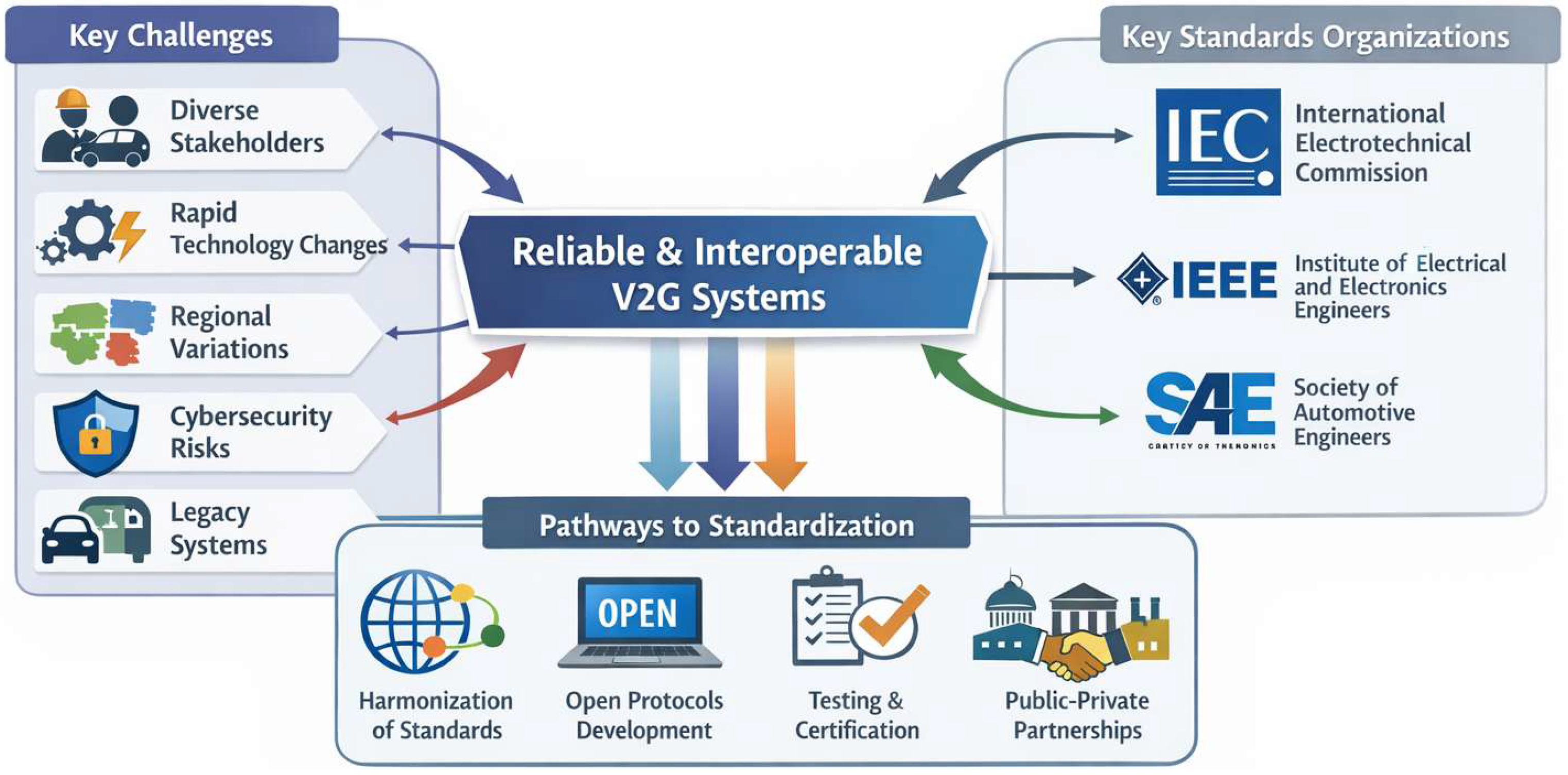
Standardization plays a foundational role in enabling reliable and scalable V2G operation, as shown in
Figure 6. Unlike isolated pilot deployments, large-scale V2G systems involve heterogeneous electric vehicles, charging infrastructure, aggregators, and grid operators operating across multiple administrative and technical domains. In such an environment, reliability cannot be achieved solely through advanced control algorithms or local optimization. It fundamentally depends on the existence of shared technical and institutional standards that ensure consistent behavior, predictable interactions, and mutual trust among stakeholders [
169]. From a system perspective, standardization reduces structural uncertainty [
170]. Common communication protocols, interface specifications, and operational definitions establish a shared operational language across cyber and physical layers. This shared language enables grid operators and aggregators to interact with diverse EV fleets without requiring vehicle-specific customization, thereby improving interoperability and reducing the likelihood of miscoordination [
171]. In the absence of standardization, system reliability becomes fragile, as integration errors, incompatible implementations, and ambiguous control responsibilities accumulate with system scale [
172].
Now, several international standards organizations play a pivotal role in shaping the technical and regulatory foundations of V2G systems. Among the most influential are the International Electrotechnical Commission (IEC), the Institute of Electrical and Electronics Engineers (IEEE), and the Society of Automotive Engineers (SAE) [
173,
174,
175,
176]. Each organization contributes to V2G standardization from a distinct yet complementary perspective. The IEC concentrates on globally applicable standards for electrical and electronic systems, playing a central role in establishing V2G frameworks that emphasize safety, reliability, and cross-regional compatibility. The IEEE, with its strong presence in power and energy systems, focuses primarily on communication architectures, interoperability, and grid integration requirements relevant to V2G operation. In contrast, the SAE is deeply rooted in the automotive sector and has defined widely adopted EV interface standards, such as the J1772 AC charging connector. Beyond charging interfaces, SAE also contributes to V2G-related specifications to ensure seamless interaction between electric vehicles and charging infrastructure. Together, these organizations provide the institutional and technical backbone for V2G standardization, enabling coordinated development across automotive, power system, and communication domains.
To improve the clarity of the standardization discussion,
Table 11 summarizes several representative standards and indicates which parts of the V2G ecosystem they mainly cover.
As shown in
Table 11, V2G standardization spans multiple layers, including charging hardware, communication protocols, infrastructure management, and utility information exchange, which further highlights the need for cross-domain interoperability. This also indicates that interoperability in V2G is not limited to charger compatibility, but depends on coordinated alignment across physical interfaces, communication layers, and grid-side information systems.
4.3.2. Challenges in Standardization
Although the importance of standardization in V2G systems is widely recognized, its advancement is hindered by several persistent challenges [
177,
178,
179,
180]. First, V2G ecosystems involve a wide range of stakeholders, including vehicle manufacturers, grid operators, charging infrastructure providers, and regulatory authorities. Aligning the objectives and technical requirements of these heterogeneous actors remains nontrivial. Second, the rapid evolution of V2G-related technologies complicates standard development, as protocols must simultaneously support emerging functionalities and ensure backward compatibility. Third, regional disparities in regulatory policies and grid architectures result in fragmented standards, making cross-region harmonization essential yet difficult. Fourth, cybersecurity poses a critical challenge, as V2G systems rely on extensive data exchange and bidirectional communication that must be protected against cyber threats. Finally, a large installed base of legacy EVs and charging infrastructure does not conform to emerging V2G standards, and upgrading these systems often entails significant cost and deployment effort.
To address these challenges, coordinated standardization efforts are actively underway:
- ➢
Harmonization initiatives led by international organizations, such as the IEC, aim to establish globally consistent frameworks for V2G deployment [
181].
- ➢
In parallel, the development of open protocols and open-source V2G software is gaining momentum, fostering interoperability while reducing reliance on proprietary solutions [
182].
- ➢
Furthermore, the establishment of testing and certification mechanisms enables systematic verification of compliance, safety, and interoperability, thereby enhancing confidence among grid operators and end users.
- ➢
Public–private collaboration, involving governments, industry, and academia, also plays a pivotal role in accelerating standard adoption and aligning technical and regulatory objectives [
183].
In summary, standardization and interoperability constitute foundational enablers for scalable and reliable V2G implementation. Addressing challenges related to stakeholder diversity, technological evolution, regional fragmentation, cybersecurity, and legacy infrastructure will require sustained international coordination, continuous innovation, and a strong commitment to open and extensible standards.
5. Evolution Pathways and Application Scenarios
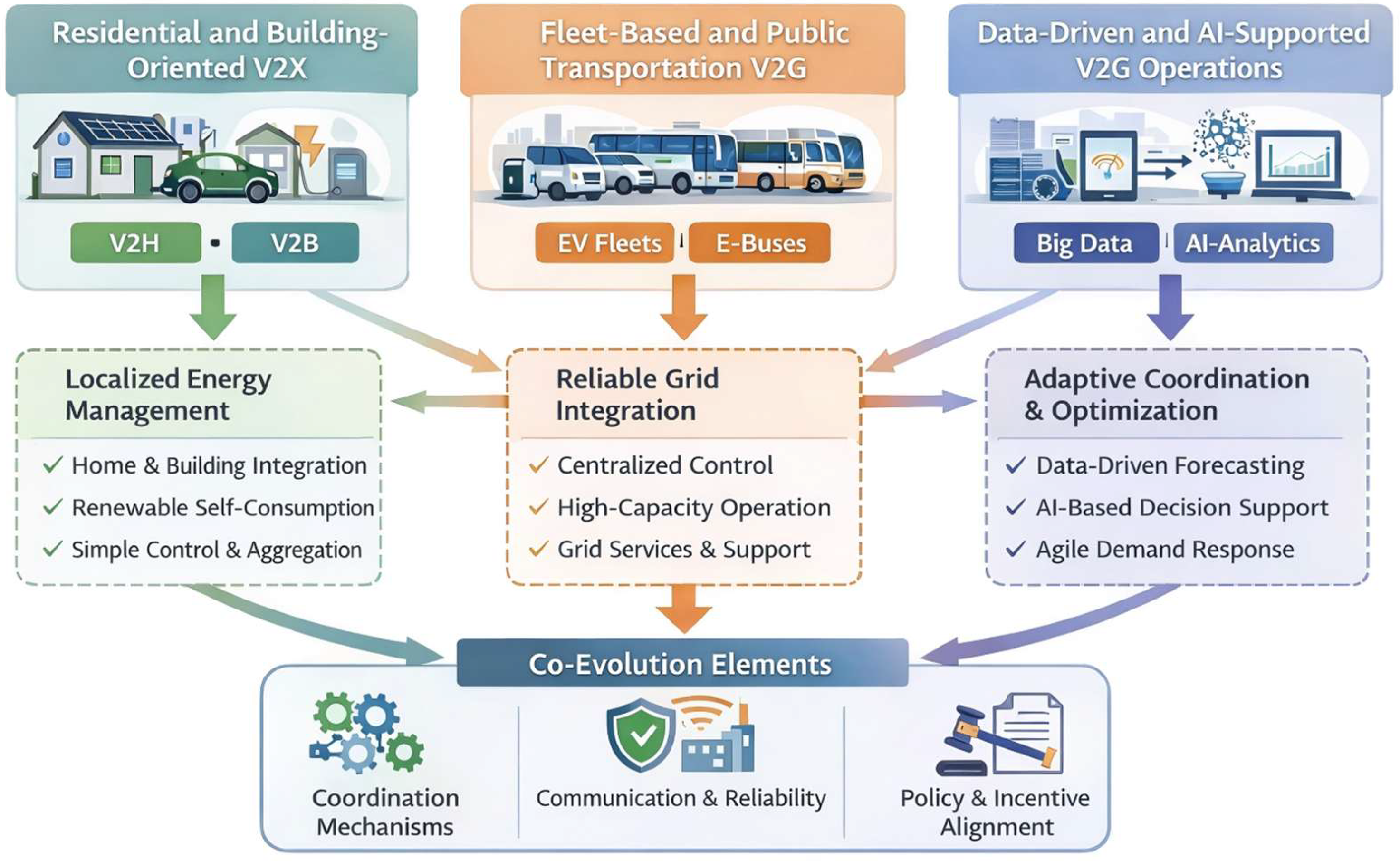
The evolution of V2G technologies is not governed solely by technological progress, but by the interaction between application demands, system constraints, and institutional readiness (see
Figure 7). Rather than following a linear trajectory from basic charging to advanced intelligence, V2G development proceeds along multiple pathways shaped by specific application scenarios [
184]. These pathways reflect how V2G functionality is progressively integrated into different layers of the energy system, from localized residential contexts to large-scale fleet and infrastructure-oriented deployments. Moreover, application scenarios act as drivers of architectural and operational evolution [
185]. Each scenario imposes distinct requirements on coordination mechanisms, reliability guarantees, information exchange, and user participation. Consequently, V2G evolution should be understood as a process of contextual adaptation, where system structures and control strategies co-evolve with usage patterns and policy environments.
5.1. Residential and Building-Oriented V2X Pathways
Residential and building-oriented V2X applications constitute one of the most natural and foundational evolution pathways for V2G-enabled power networks. In this context, V2X primarily manifests as V2H and V2B, where electric vehicles interact directly with local energy systems rather than participating in large-scale wholesale electricity markets [
186]. This pathway reflects an evolution driven by localized energy needs, user-centric considerations, and incremental system integration, making it a critical stepping stone toward broader V2G deployment.
From a system architecture perspective, residential and building-oriented V2X emphasizes proximity, controllability, and alignment between mobility and energy consumption. Energy exchange occurs within a confined spatial and institutional boundary, such as a household, office building, or campus, where operational objectives are clearly defined and often directly linked to user benefits [
187,
188]. Typical objectives include reducing electricity costs through peak shaving, increasing self-consumption of on-site renewable generation, and enhancing energy resilience during grid disturbances. These objectives differ fundamentally from those of grid-level V2G services, which prioritize system balancing and market efficiency. The predictability of energy usage patterns plays a central role in enabling this pathway [
189]. Residential charging behavior often follows regular daily routines, while commercial buildings exhibit relatively stable load profiles during working hours. This temporal regularity simplifies coordination and reduces uncertainty in energy exchange decisions [
190]. As a result, V2H and V2B applications can be implemented with comparatively simple control strategies, relying on local energy management systems rather than complex, market-driven optimization frameworks.
Residential V2X pathways are closely coupled with the increasing penetration of distributed energy resources, particularly rooftop photovoltaics and building-level energy storage [
191]. In such settings, EVs act as flexible, mobile storage assets that complement stationary resources. During periods of excess local generation, EVs can absorb surplus energy, while during peak demand or outages, stored energy can be supplied back to the home or building. This tight coupling between EVs and local energy systems enhances the overall efficiency and resilience of distributed energy ecosystems [
192]. An important characteristic of residential and building-oriented V2X is the direct visibility of benefits to users. Unlike grid-oriented V2G services, where benefits may be abstract or delayed, V2H and V2B often yield immediate and tangible outcomes, such as lower electricity bills, improved power reliability, or enhanced utilization of renewable energy [
193]. This transparency significantly reduces perceived risk and strengthens user trust, making participation more attractive. Consequently, this pathway plays a critical role in shaping user attitudes toward bidirectional charging and broader V2G participation.
Residential and building-oriented V2X also serves as a testing ground for control strategies, communication architectures, and reliability safeguards. Operating within a constrained environment allows system designers to evaluate bidirectional charging impacts, refine protection mechanisms, and assess user acceptance under realistic conditions [
194]. Lessons learned from these deployments inform the design of more complex V2G systems by revealing practical limitations and behavioral responses that may not be apparent in purely theoretical studies.
5.2. Fleet-Based and Public Transportation Scenarios
Fleet-based and public transportation applications represent a pivotal evolution pathway for V2G integration, characterized by centralized ownership, structured operation, and high-capacity energy assets [
195]. Unlike residential and building-oriented V2X, which emphasizes localized energy management and user-centric benefits, fleet-based scenarios are inherently system-facing and well-aligned with large-scale grid support objectives. This pathway therefore plays a critical role in transitioning V2G from small-scale demonstrations to operationally meaningful infrastructure [
196].
From an organizational perspective, fleet-based EVs, such as logistics vehicles, shared mobility fleets, and electric buses, operate under centralized management with predefined schedules and operational constraints. This structure significantly reduces behavioral uncertainty, a key limitation in privately owned vehicle participation [
197]. Fleet operators can coordinate charging and discharging strategies based on known duty cycles, enabling predictable availability of flexibility and facilitating contractual engagement with grid operators or market platforms [
198]. As a result, fleet-based V2G resources exhibit higher reliability and controllability than distributed residential participants. Public transportation electrification further strengthens this pathway. Electric buses and transit vehicles typically possess large battery capacities and spend substantial periods idle at depots, particularly during off-peak hours or overnight. These idle windows create natural opportunities for grid interaction without compromising mobility services [
199]. From a system viewpoint, depots function as concentrated energy nodes where aggregated V2G capacity can be accessed with relatively low communication and infrastructure complexity.
The scale of energy exchange achievable in fleet-based scenarios distinguishes this pathway from residential applications [
200,
201,
202]. Individual fleet assets often match or exceed the capacity of stationary storage units, while aggregated fleets can deliver significant power and energy volumes suitable for grid services such as peak load management, renewable integration, and reserve provision. This scalability enables fleet-based V2G to contribute meaningfully to system-level objectives, making it attractive to grid operators seeking dependable flexibility resources.
Operationally, fleet-based V2G facilitates tight coupling between mobility planning and energy management. Charging strategies can be co-optimized with route planning, vehicle rotation, and maintenance schedules to ensure that grid services do not interfere with transportation performance [
203]. This co-optimization capability allows fleet operators to balance economic incentives from energy markets with service reliability, thereby integrating V2G as a complementary function rather than a competing demand.
From a control architecture standpoint, fleet-based scenarios naturally support hierarchical and aggregation-based coordination. A single fleet management system can act as an intermediary between vehicles and external energy systems, simplifying communication and enabling fast response to grid signals [
204]. This hierarchy reduces the complexity of real-time control and enhances cybersecurity by limiting exposure points. Consequently, fleet-based V2G offers a practical testbed for advanced coordination strategies under realistic operating conditions.
5.3. Data-Driven and AI-Supported V2G Operations
As V2G-enabled power networks expand in scale and complexity, data-driven and artificial intelligence (AI)-supported operation is increasingly regarded as an important evolution pathway that can enhance coordination efficiency, adaptability, and robustness [
205,
206,
207]. Unlike residential or fleet-based pathways, which are primarily defined by ownership structure or application context, data-driven V2G represents a cross-cutting operational paradigm that augments all forms of V2G by improving decision-making under uncertainty [
208]. At the core of data-driven V2G operation lies the growing availability of heterogeneous data streams, including real-time measurements from charging infrastructure, vehicle status information, historical mobility patterns, renewable generation forecasts, and market signals. These data sources provide a rich foundation for understanding system dynamics that are otherwise difficult to model using purely physics-based or rule-based approaches. AI techniques can support the extraction of patterns and correlations from heterogeneous V2G-related data, thereby improving forecasting, scheduling, and battery-aware operational decision-making [
209].
One of the primary contributions of AI-supported V2G operation is improved forecasting capability. Accurate prediction of vehicle connection times, state-of-charge evolution, and user behavior is essential for reliable coordination and market participation [
210]. Data-driven models can adapt to changing usage patterns and contextual factors, reducing uncertainty and enabling aggregators to commit flexibility with greater confidence. From a system perspective, this predictive capability can improve the reliability of EV-based resources by reducing uncertainty in coordination and dispatch.
AI also facilitates multi-timescale coordination by integrating long-term planning with short-term operational control [
211]. Learning-based approaches can reconcile competing objectives across timescales, such as preserving battery lifetime while responding to real-time grid needs. This capability is particularly valuable in environments characterized by high renewable penetration and volatile system conditions, where static control strategies may be less effective. Another key role of AI in V2G operation lies in managing heterogeneity [
212]. EV fleets differ widely in battery characteristics, mobility patterns, and user preferences. Data-driven methods can identify and exploit this heterogeneity, enabling differentiated control strategies that allocate grid services across vehicles in a manner that balances performance and lifetime impacts. Such adaptive allocation can improve overall system efficiency and may reduce the risk of uneven degradation or participation withdrawal.
AI-supported V2G operation can be further understood from several methodological directions. First, data-driven forecasting methods are widely used to estimate EV availability, charging demand, renewable generation, and market conditions, thereby improving the observability of flexible resources under uncertainty. Second, reinforcement learning (RL) offers a promising framework for sequential decision-making in V2G systems, where charging and discharging actions must be continuously adjusted over time while balancing electricity cost, grid-service revenue, battery degradation, and user mobility constraints [
213]. Compared with static optimization, RL is particularly suitable for dynamic and uncertain operating environments because it can learn adaptive control policies through repeated interaction with the system. Third, hybrid AI approaches that combine learning-based models with optimization routines or engineering constraints are increasingly important for improving practical reliability and deployment feasibility.
Despite these opportunities, several open issues remain. The effectiveness of AI-supported V2G methods still depends strongly on data quality, cross-scenario generalization, and robustness under heterogeneous real-world operating conditions. In addition, many advanced AI models lack sufficient interpretability, making it difficult for aggregators and system operators to verify whether learned control actions remain consistent with physical constraints and operational requirements. RL-based approaches also raise concerns related to training stability, safe exploration, and performance under rare but critical events. Therefore, future research should place greater emphasis on explainable AI, constraint-aware learning, and trustworthy human-supervised deployment frameworks for practical V2G systems.
In this sense, AI methods in V2G can be broadly interpreted as forecasting-oriented, decision-oriented, and hybrid supervisory approaches. From a deployment perspective, many V2G applications should also be understood as human-in-the-loop systems rather than fully autonomous control environments. In practice, AI-based charging and discharging decisions remain affected by user preferences, mobility uncertainty, override behavior, aggregator intervention, and operator supervision. This creates additional challenges beyond predictive accuracy, including the need to maintain user trust, ensure transparency of automated decisions, and preserve acceptable system performance when human actions deviate from model assumptions. Therefore, the practical deployment of AI-supported V2G systems requires not only algorithmic intelligence but also effective coordination between automated control, user participation, and supervisory decision-making.
Future research should therefore pay greater attention to human-centered AI design, including interpretable decision support, override-aware control strategies, and mechanisms for aligning automated scheduling with real user behavior and operational supervision.
6. Discussion and Future Directions
This paper has reviewed V2G integration from a system-oriented perspective, focusing on how electric vehicles are embedded into power networks through coordinated architecture, operational mechanisms, and reliability considerations. Rather than treating V2G as a collection of isolated technologies, the review emphasizes its role as a cyber–physical–economic integration framework involving electric vehicles, aggregators, grid operators, and end users. By reorganizing existing research around system structure, coordination mechanisms, and application-driven evolution pathways, several overarching conclusions can be drawn.
Although the literature has demonstrated broad potential for V2G integration, several unresolved contradictions remain across different research streams. For example, many studies report that coordinated EV charging and discharging can improve grid flexibility, renewable energy accommodation, and economic efficiency, yet these benefits often depend on idealized assumptions regarding user participation, communication reliability, market access, and battery usage patterns. Similarly, while some studies emphasize the profitability of V2G services, others indicate that the economic value may be substantially reduced when battery degradation, user inconvenience, limited dispatch availability, and regulatory constraints are taken into account. In the same way, AI-supported and optimization-based approaches are often shown to enhance control performance in simulation environments, but their practical robustness, interpretability, and deployment readiness remain less certain under heterogeneous real-world conditions. These differences suggest that the current V2G literature should be interpreted not only in terms of demonstrated opportunities, but also in terms of trade-offs, context dependence, and methodological limitations. Therefore, a more critical system-level understanding is needed to distinguish between theoretical potential and practically scalable deployment. In particular, important knowledge gaps remain in cross-scenario validation, service-specific lifetime assessment, user-centered participation modeling, and the integration of technical coordination with market and regulatory conditions.
Based on the above review, the following conclusions can be summarized:
- ➢
The reviewed literature suggests that V2G should be understood as a system-level integration problem rather than merely a single technological solution. The effectiveness of V2G depends on the coordinated design of system architecture, aggregation layers, and hierarchical control structures. Isolated advances in charging hardware or communication protocols are insufficient to ensure scalable and reliable operation without coherent system integration.
- ➢
Aggregation and coordination mechanisms are widely regarded as essential for translating individual EV behavior into system-relevant flexibility. Due to the heterogeneity and mobility-driven nature of EVs, aggregation serves as the key enabler that bridges vehicle-level uncertainty and system-level reliability. Hierarchical coordination and multi-timescale control are necessary to manage large EV populations in a scalable manner.
- ➢
Market participation and information exchange jointly shape V2G operation. Price signals and market mechanisms provide economic incentives, while cyber–physical information exchange enables their physical realization. Reliable V2G operation generally requires consistent coupling between market signals, information flow, and physical energy exchange, rather than treating these layers independently.
- ➢
Reliability constraints, including battery lifetime and user participation stability, are among the major factors limiting V2G scalability. Battery degradation and user risk perception directly affect long-term availability of EV-based flexibility. These factors should be regarded as system-level reliability constraints, not peripheral technical or behavioral issues.
- ➢
Different application scenarios drive distinct V2G evolution pathways. Residential and building-oriented V2X, fleet-based and public transportation scenarios, and data-driven operation each impose different requirements on coordination, reliability, and governance. The reviewed literature indicates that V2G evolution is more likely to follow application-driven pathways than a uniform development trajectory.
To improve cross-sectional synthesis and reduce sequential description,
Table 12 summarizes the main relationships among stakeholders, representative V2G services, enabling technologies, opportunities, barriers, and priority research directions.
As shown in
Table 12, V2G development depends on the interaction of technical, operational, economic, regulatory, and user-centered factors, which should be considered jointly rather than as isolated topics.
Based on these bottlenecks and knowledge gaps, several priority future directions can be identified. First, V2G research is likely to increasingly shift toward holistic system design, integrating energy flow, information architecture, and market mechanisms within unified frameworks. Future studies are expected to move beyond component-level optimization toward cross-layer co-design. Second, lifetime-aware and trust-aware operation will become central to sustainable V2G deployment. Incorporating battery degradation, user preferences, and participation stability into coordination and market strategies will be essential for maintaining long-term reliability. Third, data-driven and AI-supported coordination will play an expanding role in managing uncertainty, heterogeneity, and multi-timescale operation. However, future development must emphasize explainability, robustness, and alignment with physical constraints to ensure trustworthy deployment. Fourth, standardization and institutional alignment will continue to evolve as key enablers. Harmonizing technical standards with regulatory and market frameworks will be critical for large-scale, cross-regional V2G integration. Finally, application-driven deployment is likely to remain a dominant pattern in practical V2G evolution. Early-stage V2X applications in residential and building contexts will support trust formation and technical validation, while fleet-based and public transportation scenarios are expected to anchor large-scale, system-facing V2G services.
Overall, these trends indicate that the future of V2G lies not in isolated technological breakthroughs, but in the coordinated evolution of system architecture, operational mechanisms, and institutional frameworks, enabling electric vehicles to function as reliable and sustainable components of future smart energy systems.
7. Conclusions
For clarity,
Table 13 provides a concise summary of the major themes, system-level functions, and unresolved issues identified in this review.
This paper gives a comprehensive review of V2G integration within smart energy systems from a system-level perspective. Motivated by the increasing penetration of electric vehicles and the growing demand for flexible, low-carbon power system operation, the review reframes V2G not merely as a bidirectional charging technology, but as a cyber–physical–economic integration paradigm that couples electric vehicles, power networks, information infrastructure, and market mechanisms. By reorganizing existing research around system architecture, operational mechanisms, reliability constraints, and application-driven evolution pathways, this review highlights several key insights. First, the effectiveness of V2G depends fundamentally on aggregation and hierarchical coordination, which enable heterogeneous and mobile EV resources to be transformed into system-relevant flexibility. Second, market participation and information exchange jointly shape V2G operation, requiring consistent coupling between economic signals, cyber-layer coordination, and physical energy flows. Third, reliability-related factors emerge as central constraints that govern the long-term viability of V2G-enabled power networks.
The review further emphasizes that V2G evolution is driven by application scenarios rather than a single uniform trajectory. Residential and building-oriented V2X applications provide an important foundation for user acceptance and local energy management, fleet-based and public transportation scenarios enable scalable and reliable system-facing services, and data-driven, AI-supported operation enhances adaptability under uncertainty. Together, these pathways illustrate how V2G functionality can progressively transition from localized deployments to a core component of future power system operation.
Overall, this review underscores that the successful deployment of V2G requires coordinated advances across technical design, operational strategy, and institutional governance. Rather than focusing solely on individual technologies or services, future efforts should prioritize system-level integration, reliability-aware operation, and trust-building mechanisms. By doing so, V2G-enabled power networks can evolve from experimental implementations into reliable, scalable, and sustainable elements of next-generation smart energy systems.