Article

Event-Triggered Torque Ripple Attenuation for Robotic Permanent Magnet Synchronous Motors with Immunity to Load Transients


1
College of Transportation, Tongji University, Shanghai 200092, China
2
Xianyang Chuanqing Xinyuan Engineering Technology Co., Ltd., Xianyang 712000, China
3
Energy Design Division, Shanghai Newfree Energy Technology Co., Ltd., Shanghai 201800, China
4
School of Electrical Engineering, Shanghai Dianji University, Shanghai 200240, China
*
Author to whom correspondence should be addressed.
Machines 2026, 14(5), 478; https://doi.org/10.3390/machines14050478
Submission received: 27 February 2026 / Revised: 3 April 2026 / Accepted: 16 April 2026 / Published: 24 April 2026

Abstract

The torque ripples of robotic permanent magnet synchronous motors (PMSMs) degrade motion smoothness and positioning accuracy of the system, while inevitable load transients in robotic tasks further complicate torque ripple attenuation. To address this issue, this paper develops an event-triggered torque ripple attenuation method that explicitly distinguishes torque ripple from dynamic load transients. First, a sliding-mode torque observer is constructed to obtain real-time torque information, whose stability is rigorously analyzed using a Lyapunov function. Second, frequency-selective torque ripple extraction schemes are proposed to accurately isolate steady-state high-frequency torque ripple from the estimated torque signal. In particular, two specially designed filtering structures are developed and compared, one of which is selected to preserve ripple-related frequency content during test, ensuring robust and accurate ripple identification under varying operating conditions in robotics. Third, a torque-ripple-regulation-based compensation strategy is used within a vector-controlled PMSM drive, in which the extracted torque ripple is processed by a dedicated ripple regulator to generate voltage compensation signals. This strategy achieves effective steady-state torque ripple attenuation with low implementation complexity, while avoiding performance degradation during dynamic load transients. Finally, experimental results are provided to validate the effectiveness of the proposed methods.

1. Introduction

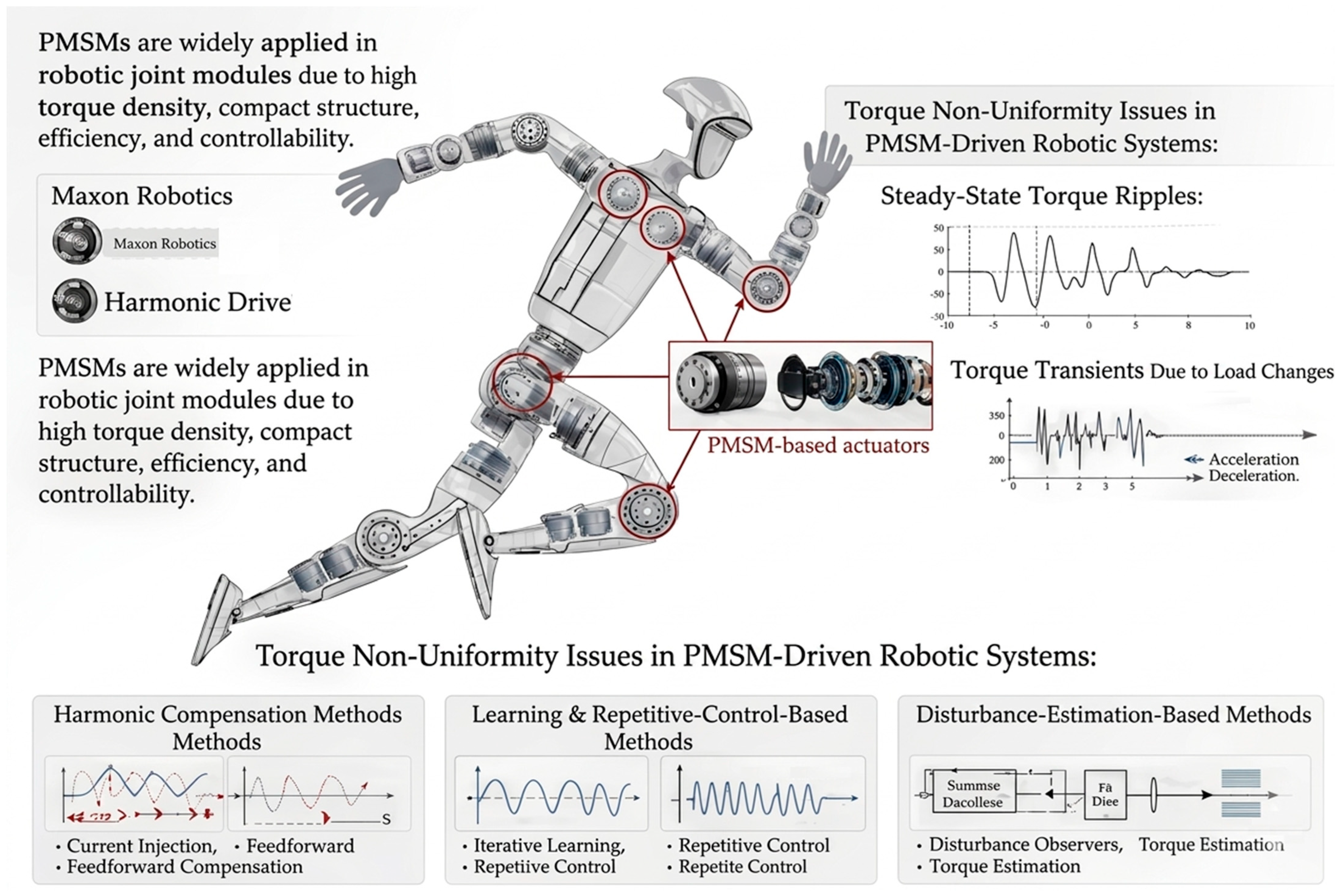
Due to the advantages of high torque density, compact structure, high efficiency, and excellent controllability, permanent magnet synchronous motors (PMSMs) have been widely adopted in industrial robots, collaborative robots, and service robots, as exemplified by commercial robotic drive solutions from companies such as Maxon and Harmonic Drive, as depicted in Figure 1 [1,2,3]. However, PMSMs operating in robotic systems often suffer from non-smooth torque generation, which degrades motion quality and limits positioning performance [4]. From a load perspective, the sources of torque non-uniformity can be categorized into two types: (i) steady-state torque ripples, which persist during constant-speed or quasi-static operation, and (ii) torque transients induced by dynamic load variations, such as rapid acceleration, deceleration, or external interaction forces. Among these, torque transients are inherently unavoidable and represent normal operating conditions required by robotic tasks. In contrast, steady-state torque ripples are not dictated by task requirements and instead constitute detrimental disturbances, leading to undesirable speed oscillations, reduced motion smoothness, and degraded positioning accuracy of robotics [5]. Consequently, effective attenuation of steady-state torque ripples in PMSM-driven robotic systems is of great importance.
Existing torque-ripple attenuation methods for PMSM drives can be grouped into three categories: harmonic shaping and feedforward compensation methods, learning and repetitive-control-based methods, and disturbance-estimation-based compensation methods [6,7]. These approaches have achieved varying degrees of success in reducing torque ripple under specific operating conditions.
Harmonic shaping and feedforward compensation methods suppress torque ripple by explicitly counteracting periodic torque components through current or voltage injection. Zhu et al. [8] proposed a torque predictive control scheme in which dominant torque harmonics are directly minimized in the control objective, achieving effective ripple reduction under steady operating conditions. To avoid predictive control complexity, several studies adopted harmonic current injection strategies, where specific harmonic components are superimposed on the fundamental current reference to cancel back-EMF or cogging-induced torque harmonics [9,10]. Although these approaches are intuitive and effective when dominant harmonics are known, their performance strongly depends on accurate harmonic identification and tends to degrade when operating conditions vary. To further improve low-speed smoothness, position-dependent feedforward or lookup-table-based anticogging methods were proposed [11,12], where cogging torque is identified offline or through slow online learning and compensated as a function of rotor position. While these methods can significantly reduce low-speed torque ripple, they require extensive calibration and show limited robustness against temperature variation, mechanical wear, and transmission compliance, which are common in robotics.
Learning and repetitive-control-based methods exploit the periodic nature of torque ripple to achieve asymptotic disturbance rejection. Iterative learning control (ILC) has been applied to PMSM drives to progressively compensate periodic torque disturbances over repeated motion cycles [13,14]. Similarly, repetitive control embeds an internal model of periodic disturbances into the controller, enabling zero steady-state error at specific harmonic frequencies [15,16,17]. These methods demonstrate excellent ripple suppression for strictly periodic motions, such as constant-speed operation or repeated trajectories. However, their effectiveness relies on motion repetitiveness and sufficient learning iterations, making them less suitable for robotic applications involving frequent speed changes, non-repetitive trajectories, or interaction with uncertain environments. Moreover, stability and bandwidth tuning of learning or repetitive controllers increase control complexity and implementation effort.
Disturbance-estimation-based methods estimate lumped disturbances, including torque, friction, and parameter uncertainties, and compensate them through feedback or feedforward action. Disturbance observer (DOB)-based torque ripple compensation schemes have been reported in [18,19,20], where estimated disturbance torque is directly canceled to improve torque smoothness. Sliding-mode observers and extended state observers have also been employed to enhance robustness against modeling uncertainties while suppressing torque ripple. These approaches are attractive due to their physical interpretability and online adaptability [21,22,23]. Nevertheless, in most existing works, the estimated torque disturbance is treated uniformly as an undesirable component to be compensated, without distinguishing steady-state torque ripple from task-induced load transients [24]. As a result, normal load transients caused by acceleration, deceleration, or external interaction forces may be mistakenly compensated, potentially degrading dynamic response and motion stability. In addition, observer bandwidth limitations and noise sensitivity make accurate extraction of high-frequency torque ripple under transient conditions challenging.
Overall, although the above methods have achieved notable success in torque ripple reduction, they generally suffer from one or more of the following limitations: reliance on accurate harmonic models or extensive calibration, dependence on repetitive motion, increased control complexity, and the inability to explicitly distinguish steady-state torque ripple from inevitable load transients. This limitation is particularly critical for robotic joint modules, where dynamic load variations are intrinsic to normal operation. Therefore, a torque ripple attenuation strategy that effectively suppresses steady-state ripple while remaining insensitive to normal load transients, with low implementation and tuning complexity, is still lacking.
This paper develops an event-triggered torque ripple attenuation method for robotic PMSMs that explicitly distinguishes steady-state torque ripple from inevitable load transients. Unlike conventional torque ripple suppression methods that compensate all torque variations, the proposed approach attenuates only steady-state torque ripple while remaining insensitive to normal load transients, thereby preserving the dynamic performance required in robotic tasks. The main contributions and novelties of this work can be summarized as follows:
(1)
A sliding-mode torque observer is developed to reconstruct real-time torque in robotic PMSM drives, with rigorous Lyapunov-based stability analysis. In order to suppress the influence of chattering effects, a new hyperbolic function-based switching law is developed. Unlike conventional disturbance observers used solely for compensation, the estimated torque here serves as an information carrier that enables explicit discrimination between steady-state torque ripple and task-induced load transients based on their temporal characteristics.
(2)
Two frequency-selective schemes are proposed to extract steady-state high-frequency torque ripple from the estimated torque, and their performance is compared theoretically in terms of phase delay and error propagation using Bode analysis. This analysis identifies the scheme that is more suitable for torque-ripple extraction.
(3)
An event-triggered torque ripple attenuation strategy is further developed by integrating a dedicated torque ripple regulator into a vector-controlled PMSM drive. The proposed strategy selectively compensates only the extracted ripple component while remaining insensitive to task-driven load transients, thereby achieving effective steady-state ripple suppression without compromising dynamic performance or increasing control complexity.
The rest of the paper is organized as follows. Section 2 presents the proposed torque observer based on sliding mode theory. Section 3 introduces the proposed torque ripple attenuation strategy, including torque ripple extraction using specially designed filtering schemes and a ripple regulation mechanism for voltage compensation within a vector-controlled PMSM drive. Section 4 provides comparative experimental results under steady-state and dynamic loading conditions to validate the effectiveness and robustness of the proposed method. Section 5 is the conclusion part.

2. Torque Observer Based on Sliding Mode Theory

This section first establishes the PMSM model and then introduces the structure of the proposed torque observer. Then, its stability is analyzed based on Lyapunov function, by which the observer gain is obtained.

2.1. Modeling of PMSMs

In order to construct a torque observer, it is essential to first analyze how torque-related information is embedded in the motor dynamics. Hence, both the electrical and mechanical models of the PMSMs are established, providing the foundation for subsequent torque estimation. Under the rotor-oriented dq reference frame, the electrical dynamics of an interior PMSM can be expressed as [25]:
d i q d t = L d L q p ω m i d R s L q i q + u q L q ψ f L q p ω m
d i d d t = R s L d i d + L q L d p ω m i q + u d L d
d ω m d t = 1 J [ 1.5 p ( ψ f i q + ( L d L q ) i d i q ) T l B ω m ]
where ωm is the mechanical angular speed, Tl is the load torque. J is the rotor moment of inertia. B is the damping coefficient, capturing the dominant linear friction effect in the mechanical dynamics. This simplification is adopted to focus on demonstrating the effectiveness of the proposed torque ripple attenuation strategy, since the high-frequency torque ripple dynamics are largely independent of higher-order friction nonlinearities. The model provides sufficient accuracy for observer design and experimental validation under typical robotic PMSM operating conditions. id and iq are the d-axis and q-axis currents, while ud and uq are the d-axis and q-axis voltages, respectively. Rs and p represent the stator winding resistance and the number of pole pairs, respectively. Ld and Lq are the d-axis and q-axis inductance. ψf is the flux linkage of permanent magnet.
From the mechanical model, it can be observed that the torque explicitly appears as an additive disturbance term opposing the electromagnetic torque, while the d,q-axis currents are used to construct the model depicting mechanical properties. Consequently, variations in torque are directly reflected in the motor speed dynamics, making the mechanical equation the primary information channel for torque observation. By combining the electromagnetic torque obtained from electrical measurements with the measured or estimated speed, the torque can be inferred through appropriate observer design. This modeling framework thus provides a clear physical basis for constructing a torque observer and for further distinguishing steady-state torque ripple from dynamic load transients.

2.2. Structure of Proposed Torque Observer

Sliding mode control belongs to the class of variable structure control methods, in which the system dynamics are intentionally driven onto a predefined sliding surface and maintained there despite uncertainties and disturbances [26]. A distinctive advantage of sliding mode techniques lies in their strong robustness against parameter variations, external disturbances, and modeling uncertainties, which makes them particularly suitable for nonlinear and uncertain systems. Owing to these properties, sliding mode control and observation have been extensively applied in electric drive systems for state estimation and disturbance reconstruction. In the PMSM drives, torque acts as an unknown external disturbance that directly influences the mechanical dynamics and is often difficult to measure using physical sensors, especially in compact robotic joint modules. Moreover, the torque may vary significantly with operating conditions, external interactions, and task requirements, which places stringent demands on the robustness and responsiveness of the estimation method. Sliding mode observers (SMOs) are well suited to this problem, as they can provide accurate disturbance estimation while maintaining stability in the presence of parameter uncertainties and measurement noise.
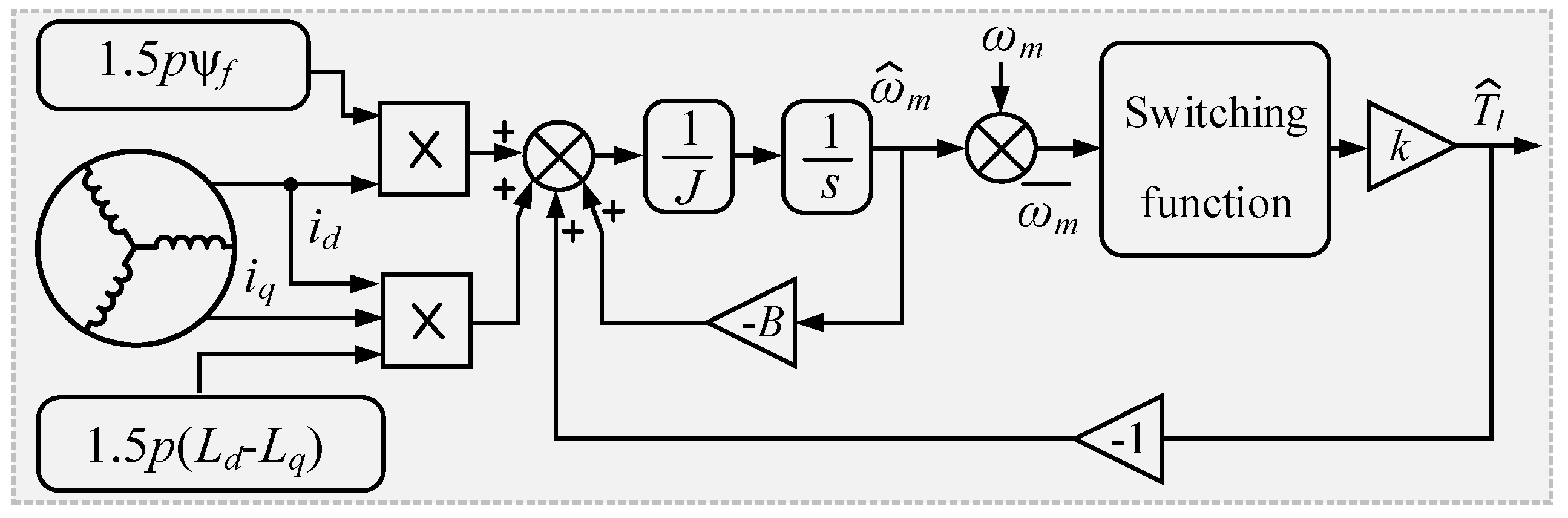
Based on (3) and in accordance with the principles of sliding-mode variable-structure theory, the torque observer can be constructed as:
d ω ^ m d t = 1 J ( 1.5 p ( ψ f i q + ( L d L q ) i d i q ) B ω ^ m k F ( ω m ¯ ) ) T ^ l = k F ( ω m ¯ )
where k is the gain coefficient. It should be noted that the convergence of the observer and the accuracy of torque estimation depend on proper selection of the gain k, which must be sufficiently large to overcome modeling uncertainties and external disturbances. The stability and convergence properties of the proposed SMO are analyzed in the following subsection using Lyapunov theory. T ^ l is the estimated torque. ω ^ m is speed calculated by the SMO. ω m ¯ is the error between the calculated speed ω ^ m and the real speed.
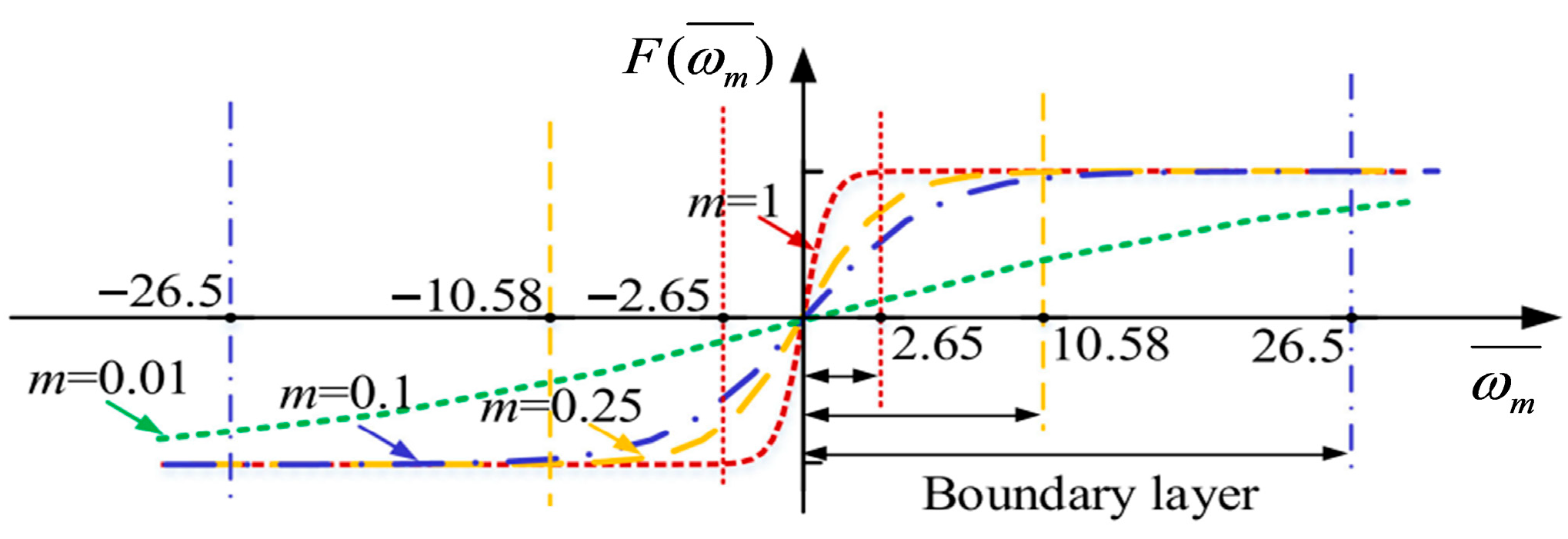
In (4), F( ω m ¯ ) denotes the switching function. Conventionally, it is implemented as a signum function. However, the discontinuous nature of the signum function inevitably introduces severe chattering effects. Such high-frequency oscillations inject parasitic disturbances into the estimated torque, making it difficult to distinguish whether the observed fluctuations originate from actual load ripples or from chattering-induced artifacts. This ambiguity directly degrades ripple extraction accuracy. To mitigate the adverse impact of chattering, a hyperbolic-function-based switching law is adopted in this study. Following the design philosophy in [27], the objective is to smooth the control discontinuity and eliminate the step variation within a boundary layer (BL) around the sliding surface (SS), thereby suppressing chattering while preserving robustness. For improved performance, the redesigned switching function must satisfy the following requirements with reference to Figure 2:
(1) Continuity over the entire domain;
(2) Saturation limits of +1 and −1, similar to the conventional saturation function;
(3) A nonlinear slope within the boundary layer;
(4) Absence of time-delay characteristics.
The hyperbolic function defined in (5) satisfies all these criteria and is therefore employed in the proposed SMO framework:
F ( ω m ¯ ) = e m ω m ¯ e m ω m ¯ e m ω m ¯ + e m ω m ¯
where m is a positive constant that regulates the width of the boundary layer. It is defined as the magnitude of the independent variable when F = 0.99. When the observer reaches the stable state, the equivalent control principle can be applied. Under this condition, as shown in Figure 3, the estimated torque T ^ l converges to:
T ^ l = k ( e m ω m ¯ e m ω m ¯ e m ω m ¯ + e m ω m ¯ )
Unlike conventional saturation functions, the hyperbolic function ensures continuous, smooth, and nonlinear slope characteristics within the boundary layer without introducing time-delay effects, while still enforcing the saturation limits. This design reduces chattering more effectively and preserves the high-frequency torque information critical for accurate ripple extraction. Moreover, it allows for explicit control of the boundary layer width via the parameter m, providing a tunable trade-off between estimation smoothness and responsiveness.

2.3. Stability Analysis of Torque Observer

In order to guarantee the stability of the designed observer, first, a speed-based sliding surface S should be defined:
S = ω m ¯
Then, let the Lyapunov candidate function V be constructed as:
V = 1 2 S 2 = 1 2 ω m ¯ 2
It is obvious that V is a positive definite function with respect to the sliding surface S. On this basis, to satisfy the Lyapunov stability requirement, the time derivative of V along the observer dynamics must be negative, that is,
d V d t = d S d t S = d ω m ¯ d t ω m ¯ < 0
According to the definition of the sliding surface in (7), the derivative in (9) can be obtained by subtracting the mechanical model (3) from the observer dynamics (4), that is:
d ω m ¯ d t = 1 J ( B ω m ¯ k F ( ω m ¯ ) + T l )
Substituting (10) into (9), the derivative of the Lyapunov function can be written as:
d V d t = B ω m ¯ 2 J + ω m ¯ ( k F ( ω m ¯ ) + T l ) J
In (11), the first term is strictly less than zero. To guarantee the stability of the SMO and ensure the convergence of the observation error dynamics, the second term should be negative, that is,
ω m ¯ ( k F ( ω m ¯ ) + T l ) < 0
Considering the sign of ω m ¯ , (12) can be further derived as:
k F ( ω m ¯ ) + T l < 0 ,   ω m ¯ > 0 k F ( ω m ¯ ) + T l > 0 ,   ω m ¯ < 0 k > T l F ( ω m ¯ ) ,   ω m ¯ > 0 k > T l F ( ω m ¯ ) ,   ω m ¯ < 0 k > | T l F ( ω m ¯ ) |
Clearly, the derived stability criterion differs from the conventional signum-based SMO condition, since the value of the switching function is less than 1 within the BL. As a consequence, the observer gain must be selected larger than that in the ideal discontinuous case to compensate for the attenuation introduced by the smooth switching function. In practice, according to sliding-mode theory, once the SS is reached, the errors between the estimated speed and the real speed fluctuate in a small neighborhood around zero within a bounded tolerance region. Let the lower bound of this tolerance be defined as τ:
τ = | min ( ω m ¯ ) |
Accordingly, the minimum value of the switching function within the BL can be expressed as:
| min ( F ) | = e m τ e m τ e m τ + e m τ
Therefore, the observer gain can be selected as:
k > T l | min ( F ) |
In practice, the tolerance bound τ can be deliberately specified according to the desired estimation accuracy. A smaller τ corresponds to a higher estimation precision and a tighter error band around the sliding surface. Accordingly, for any prescribed tolerance level τ, there always exists a sufficiently large observer gain k such that the reachability condition is satisfied. Under this gain selection, the observer trajectories converge to and remain within the predefined finite error neighborhood, thereby ensuring bounded convergence and stable operation of the observer. In this paper, τ is manually set as 0.1. It should be noted that the sliding-mode observer inherently possesses robustness to bounded parameter variations, because the convergence conditions are based on the sliding-mode principle and the observer gain k can be selected sufficiently large to compensate for moderate deviations in parameters such as rotor inertia J or damping B. Therefore, although a formal parametric sensitivity analysis was not performed, the observer is expected to maintain bounded convergence and stable operation under realistic parameter uncertainties.

3. Proposed Event-Triggered Torque Ripple Attenuation Strategy

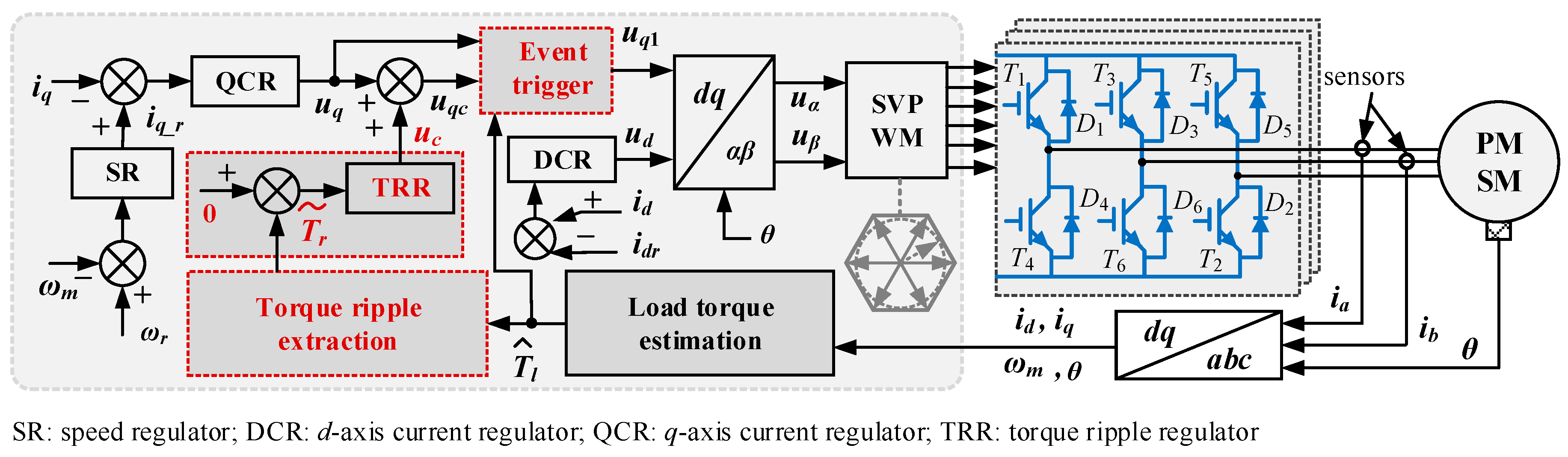
As shown in Figure 4, in contrast to the conventional vector control scheme in [27], the proposed event-triggered torque ripple attenuation strategy, which utilizes the estimated torque, consists of three key components: torque ripple extraction, torque ripple regulation, and an event-triggered mechanism. Specifically, the torque is first estimated and decomposed to extract the torque ripple component, which is then regulated through a dedicated torque ripple regulator (TRR). To avoid unnecessary control actions during dynamic operating conditions, an event-trigger mechanism is introduced to activate the torque ripple regulation only when the torque is judged to remain free of abrupt variations. The detailed implementation of each part is described as follows.

3.1. Frequency-Selective Torque Ripple Extraction

Torque ripple in robotic PMSM joint modules is mainly manifested as a high-frequency torque fluctuation superimposed on the average torque required by the task. In contrast, the task-driven load variations (e.g., acceleration/deceleration and external interaction forces) appear as load transients that are unavoidable and should not be treated as ripple to be compensated [28]. Therefore, the torque ripple extraction module aims to isolate the steady-state high-frequency ripple component while suppressing low-frequency load components and avoiding transient-induced contamination. Torque ripples primarily originate from electromagnetic harmonics, inverter nonidealities, cogging torque, and transmission-related periodic disturbances. These mechanisms produce persistent oscillatory torque components, which can be effectively modeled as a finite sum of harmonic terms and are predominantly distributed in the high-frequency range [29]. In contrast, load transients are induced by task-driven events such as acceleration, deceleration, or external interaction forces. In the time domain, they manifest as step-like or ramp-like variations in torque, while in the frequency domain, such signals are dominated by low-frequency components accompanied by broadband spectral leakage during transient intervals [30]. This distinct separation in dominant frequency characteristics provides a solid theoretical basis for employing frequency-selective filtering to isolate torque ripple components.
Intuitively, torque ripple extraction methods can be broadly classified into two categories according to their filtering philosophy. (1) The first category is based on high-pass filtering, where the DC component and the variations induced by load transients are suppressed, leaving only the high-frequency torque ripple components. (2) The second category relies on low-pass filtering, in which high-frequency components are removed to retain the DC and low-frequency components associated with load transients. The torque ripple is then obtained by subtracting this low-frequency component from the total estimated torque. Although both approaches aim to extract high-frequency torque ripple, their design principles and signal-processing mechanisms are fundamentally different. The high-pass-filter-based method directly isolates ripple components through frequency rejection, whereas the low-pass-subtraction-based method indirectly reconstructs ripple by estimating and removing the low-frequency torque content. To identify the most suitable approach for robotic PMSM applications, both torque ripple extraction methods are designed and analyzed in this paper, followed by a comparative evaluation to determine the method that offers superior robustness and performance under varying operating conditions.
(a)
Torque ripple extraction based on high-pass filtering
The estimated torque T ^ l from the SMO contains multiple components with distinct physical origins and spectral characteristics. It can be decomposed as:
T ^ l = T l ¯ + T t r + T r ˜ + T d
where T l ¯ denotes the DC component of the torque. Ttr represents task-induced load transients associated with acceleration, deceleration, or external interaction forces. T r ˜ denotes the steady-state torque ripple component. Td accounts for measurement and observer noise. In robotic PMSM applications, torque ripple is typically manifested as persistent oscillatory components concentrated in a relatively high-frequency range, whereas load transients are dominated by low-frequency content with broadband spectral leakage during transient intervals. This separation in dominant frequency characteristics provides the theoretical basis for torque ripple extraction using high-pass filtering.
Based on this observation, a high-pass filter is employed to attenuate the average and low-frequency transient components while preserving the high-frequency torque ripple. In this paper, a second-order high-pass filter is developed to achieve superior frequency suppression, and its transfer function H(s) is:
H ( s ) = s 2 s 2 + 2 ζ ω c s + ω c 2
where ζ is the damping ratio. ωc is the cut-off frequency. Compared with the first-order filter, this structure provides a steeper low-frequency attenuation, enabling more effective rejection of load transients while maintaining adequate passband characteristics for torque ripple components. The extracted torque ripple is then obtained as:
T r ˜ = T l * H ( s )
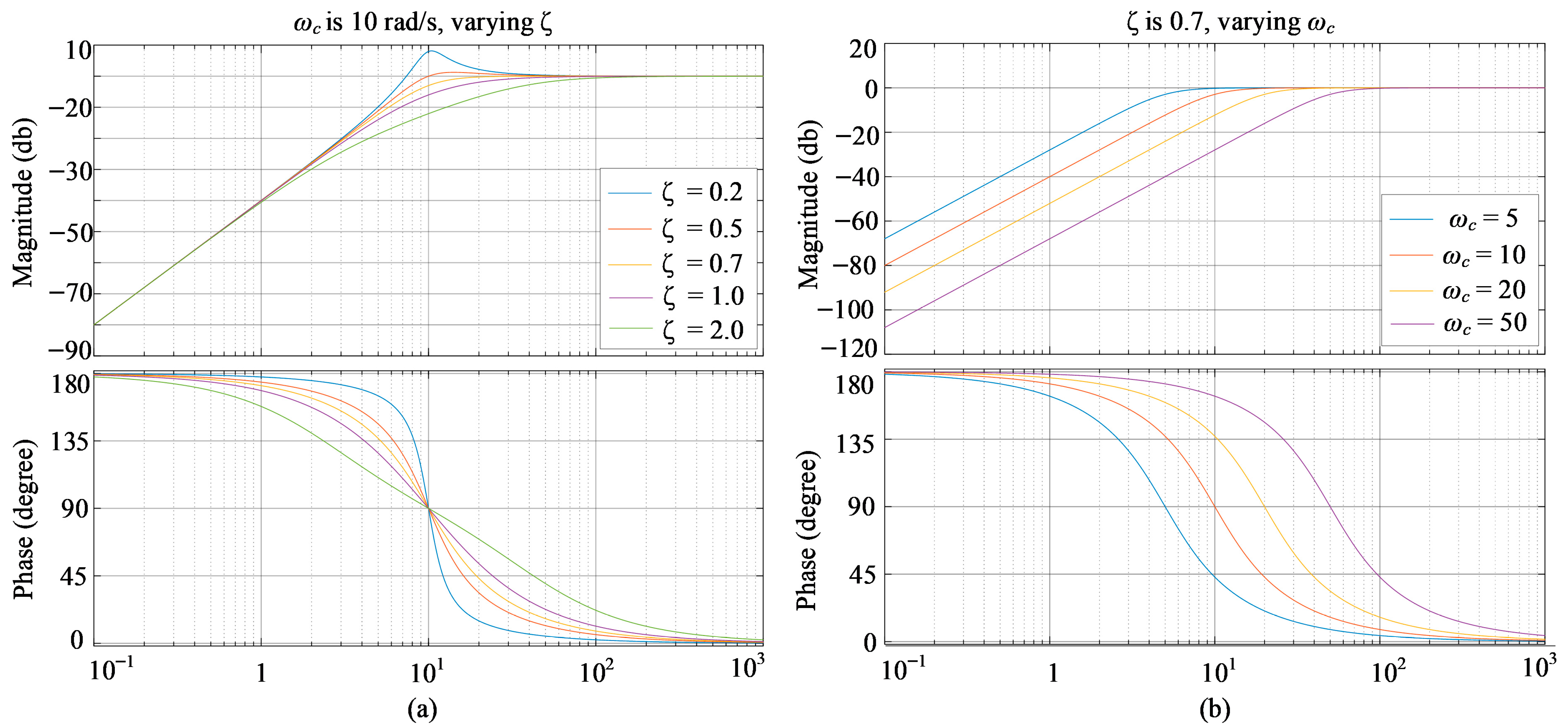
The cutoff frequency ωc plays a critical role in balancing ripple preservation and transient rejection. If ωc is chosen too low, low-frequency transient components may leak into the extracted signal. Conversely, an excessively high ωc will attenuate useful ripple components and introduce additional phase distortion. Therefore, it should be selected to lie between the dominant frequency range of load transients and the lowest significant torque ripple frequency. In practice, ωc is chosen such that sufficient attenuation is achieved at the upper bound of the transient frequency range, while the magnitude loss within the ripple frequency band remains limited. The damping ratio ζ mainly affects the transition behavior around the cutoff frequency. A small ζ leads to a sharper transition but may introduce magnitude peaking near ωc, which can distort ripple estimation. A larger ζ yields smoother frequency response and improved robustness at the expense of a wider transition band. In this study, ζ is selected to ensure a monotonic magnitude response and stable ripple extraction across varying operating conditions.
Bode plot analysis is employed to evaluate the influence of ωc and ζ on the filter bandwidth and attenuation characteristics, as shown in Figure 5. As shown in the above part of Figure 5, with ζ fixed, increasing ωc shifts the transition region toward higher frequencies, thereby enhancing attenuation in the low-frequency transient-dominated region while potentially reducing magnitude preservation near the lower boundary of the ripple band. This indicates that ωc primarily determines the effective bandwidth and the separation boundary between transient components and torque ripple. In contrast, Figure 5 shows that with ωc fixed, varying ζ mainly affects the transition behavior around the cutoff frequency: smaller ζ values produce sharper transitions but introduce magnitude peaking, which may distort ripple estimation, whereas larger ζ values yield a smoother, monotonic response at the expense of a wider transition band. Therefore, the coordinated selection of ωc and ζ is essential to ensure strong low-frequency attenuation while maintaining minimal amplitude distortion in the ripple-dominant frequency range. Practically, the design objective is to guarantee strong attenuation of low-frequency torque transients while maintaining minimal amplitude and phase distortion in the frequency range where torque ripple is dominant, which requires to refine ωc and ζ.
(b)
Torque ripple extraction based on low-pass filtering
Based on this frequency-domain separation, an alternative ripple extraction strategy is to first estimate the low-frequency torque component and then reconstruct the high-frequency ripple through subtraction. Specifically, a low-pass filter is employed to preserve the DC and transient components while attenuating high-frequency ripple and noise. In this study, a second-order low-pass filter is adopted to achieve improved attenuation of high-frequency components, whose transfer function H1(s) is given by:
H 1 ( s ) = ω c 1 2 s 2 + 2 ζ 1 ω c 1 s + ω c 1 2
where ζ1 is the damping ratio. ωc1 is the cut-off frequency. Then, the low-frequency torque component Tll is obtained as:
T l l = T l * H 1 ( s )
Further, the torque ripple can be reconstructed by subtracting the low-frequency component from the total torque:
T r ˜ = T l * T l l = T l * s 2 + 2 ζ 1 ω c 1 s s 2 + 2 ζ 1 ω c 1 s + ω c 1 2
In this framework, the cut-off frequency ωc1 plays a critical role in determining the separation boundary between low-frequency torque components and high-frequency ripple. If ωc1 is selected too high, a portion of the ripple component may leak into the low-frequency estimate, resulting in underestimation of the extracted ripple. Conversely, if ωc1 is too low, parts of the transient dynamics may be removed, leading to distortion in the reconstructed ripple signal. Therefore, ωc1 should be selected to lie between the dominant frequency range of load transients and the lower bound of the ripple frequency band, ensuring that low-frequency torque components are retained while high-frequency ripple is sufficiently attenuated in the low-pass branch. The damping ratio ζ1 mainly influences the smoothness and transient response of the low-pass filter. A smaller ζ1 leads to a sharper frequency transition but may introduce overshoot and oscillatory behavior in the time domain, which can propagate into the reconstructed ripple signal after subtraction. In contrast, a larger ζ1 yields a smoother and more monotonic response, improving robustness but at the cost of a wider transition band and reduced frequency selectivity. In this study, ζ1 is selected to ensure a stable and monotonic response, avoiding amplification of estimation errors during transient conditions.
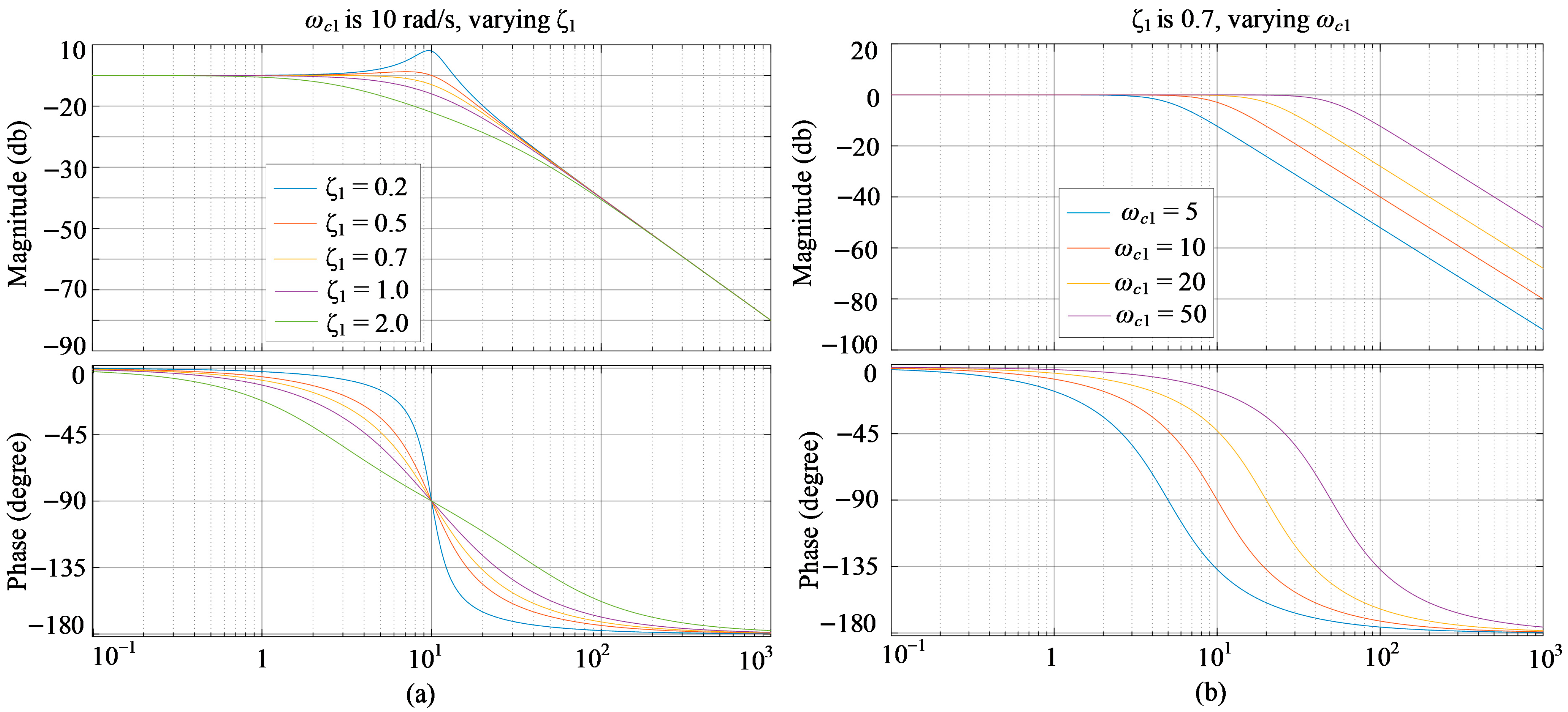
As for the system described in (22), with ζ1 fixed, increasing ωc1 expands the passband of the low-pass filter, allowing more high-frequency content to pass through, which reduces the separation capability between low-frequency components and torque ripple. This indicates that ωc1 directly determines the effectiveness of ripple rejection in the low-pass branch. With ωc1 fixed, varying ζ1 mainly affects the transition behavior around the cut-off frequency: smaller ζ1 results in a sharper roll-off but introduces gain peaking, whereas larger ζ1 ensures a smoother response with improved robustness. Figure 6 illustrates the influence of the cutoff frequency ωc1 and damping ratio ζ1 on the bandwidth and attenuation characteristics of the second-order low-pass filter. As shown in Figure 6, with ζ1 fixed, increasing ωc1 shifts the transition region toward higher frequencies, thereby expanding the passband and allowing more high-frequency components to pass through, while reducing attenuation in the ripple-dominant region. Conversely, a smaller ωc1 enhances high-frequency attenuation but may introduce distortion in transient reconstruction due to excessive bandwidth limitation. This indicates that ωc1 primarily determines the effective bandwidth and the separation boundary between low-frequency torque components and high-frequency ripple. As shown in Figure 6, with ωc1 fixed, the damping ratio ζ1 mainly affects the transition characteristics around the cutoff frequency: a smaller ζ1 results in a sharper roll-off accompanied by noticeable magnitude peaking near ωc1, which may amplify undesired components, whereas a larger ζ1 produces a smoother and more monotonic response at the cost of a wider transition band. Therefore, proper coordination of ωc1 and ζ1 is required to ensure sufficient attenuation of high-frequency torque ripple while preserving the integrity of low-frequency torque components for accurate estimation.
(c)
Comparison of two torque ripple extraction methods
While Bode-based frequency-response analysis is standard, in this work Figure 5 and Figure 6 are used to justify critical design choices for the torque ripple extraction filters under dynamic load conditions. The manuscript has been revised to emphasize that these analyses directly support the novel ripple extraction strategy rather than serving as general textbook examples. The two torque ripple extraction methods (high-pass filtering and low-pass-based reconstruction) are mathematically equivalent in terms of steady-state frequency selection, yet they exhibit fundamentally different behaviors in terms of phase delay and error propagation, which directly influence torque ripple compensation performance in closed-loop robotic PMSM systems.
In terms of the delay effect, for the high-pass filter, the phase response approaches zero in the high-frequency region, implying that the extracted torque ripple component experiences negligible phase delay within the ripple-dominant frequency band. In contrast, the low-pass-based reconstruction method introduces delay through the low-pass filter applied to estimate the low-frequency component. Since the low-pass filter exhibits significant phase lag near and above the cutoff frequency, the reconstructed ripple inherently suffers from additional delay. This delay becomes more pronounced when the cutoff frequency is selected close to the ripple frequency band. Consequently, in closed-loop torque compensation, the high-pass filtering method provides superior temporal alignment, while the low-pass-based reconstruction may degrade compensation performance due to phase mismatch.
As for the error propagation, in the high-pass filtering approach, the extracted ripple is obtained directly through frequency-selective attenuation, such that the output error is primarily shaped by the high-frequency gain of the filter. Although measurement noise may be amplified due to the high-pass characteristic, the error remains confined within the filtering operation. In contrast, the low-pass-based reconstruction method involves a subtraction operation between the original torque estimate and the filtered low-frequency component, as given in (22). Let the torque estimation error be e, the filtering error of the low-pass component be ef, and the reconstructed ripple error be er = eef. When these two error sources are not perfectly correlated, the subtraction process may amplify residual errors, especially in transient conditions or under modeling mismatch. Moreover, any bias or delay in the low-pass estimation directly propagates into the ripple reconstruction. Therefore, compared to the high-pass filtering method, the low-pass-based reconstruction is more sensitive to estimation inaccuracies and may exhibit larger error variance, particularly in dynamic operating scenarios.
From the above analysis, although the two methods are mathematically equivalent in terms of steady-state frequency decomposition, they differ fundamentally in dynamic behavior. The high-pass filtering method exhibits near-zero phase delay in the ripple frequency range and a single-path error shaping mechanism, whereas the low-pass-based reconstruction introduces additional group delay and multi-source error coupling due to the intermediate estimation process. As a result, the high-pass-filter method provides superior temporal alignment and robustness, while the low-pass-filter-based approach is more susceptible to delay-induced mismatch and error amplification, particularly under dynamic operating conditions.

3.2. Generation of Torque-Ripple-Regulation-Based Compensation

(a) Generation of compensation values
After the torque ripple component T r ˜ is extracted, a torque ripple regulator (TRR) is introduced to generate a compensation signal for mitigating the ripple effect. The control objective of the TRR is to drive the torque ripple to zero, i.e., to enforce:
T r ˜ 0
To achieve this, the torque ripple is directly used as the feedback signal, and the regulation error etr is defined as:
e t r = 0 T r ˜ = T r ˜
A proportional–integral (PI) controller is employed as the TRR to ensure zero steady-state error in ripple compensation while maintaining a simple and robust structure. The TRR can be expressed as:
G t r = k p + k i s
where kp and ki denote the proportional and integral gains, respectively. Accordingly, the output of the TRR uc is given by:
u c = G t r e t r = ( k p + k i s ) e t r
In the proposed control framework, the compensation signal uc is injected into the q-axis current control loop as an auxiliary voltage term. Specifically, the modified q-axis voltage command is formulated as:
u q c = u c + u q
where uq is the nominal output of the conventional q-axis current regulator. Through this structure, the TRR acts in parallel with the current loop, directly shaping the electromagnetic torque by modulating the q-axis voltage.
From a control perspective, the TRR forms a secondary regulation loop dedicated to ripple attenuation. The proportional term provides fast response to ripple variations, while the integral term eliminates residual steady-state ripple components. Compared with harmonic injection or model-based compensation methods, this approach does not require explicit knowledge of harmonic frequencies or offline identification, resulting in lower implementation complexity and improved adaptability to varying operating conditions.
(b) Tuning of TRR parameters
Considering that the TRR acts through the q-axis voltage channel and the inner current loop is sufficiently fast, the plant from the compensation voltage to the torque ripple Gi can be approximated as a first-order system:
G i = K t τ i s + 1
where τi is the time coefficient and Kt is the torque coefficient. Thus, the closed-loop transfer function of the torque ripple regulation loop Gc can be written as:
G c = G i G t r 1 + G i G t r = K t k p s + K t k i τ i s 2 + ( 1 + K t k p ) s + K t k i
Then, the characteristic function D of (29) can be described as:
D = τ i s 2 + ( 1 + K t k p ) s + K t k i
Based on the Routh-Hurwitz stability criterion, for the above second-order system, the necessary and sufficient conditions for stability are:
τ i > 0 ,   1 + K t k p > 0 ,   K t k i > 0
Since τi > 0 and Kt > 0, which are physically guaranteed, the stability conditions reduce to:
k p > 1 K t ,   k i > 0
In practice, to ensure sufficient damping and robustness, both kp and ki are selected as positive values.

3.3. Event-Triggered Torque Ripple Attenuation

To distinguish steady-state torque ripple from task-induced load variations, an event-trigger mechanism is introduced to identify whether the system is undergoing a load transient. The key idea is to activate torque ripple compensation only under quasi-steady operating conditions, while suspending it during dynamic load changes to avoid undesired interference with task execution.
In the proposed method, the event-trigger signal is generated based on the estimated torque T ^ l obtained from the sliding-mode observer. Specifically, the temporal variation in the estimated torque is evaluated to detect load changes. The discrete-time variation rate of the torque Δ T ^ l is defined as:
T ^ l = | T ^ l ( k ) T ^ l ( k 4 ) |
where T ^ l (k) is the estimated torque in the current control period while T ^ l (k − 4) is the estimated torque four control periods earlier. The magnitude of Δ T ^ l is used as an indicator of load dynamics. A threshold-based decision rule is adopted:
μ = 0 ,   T ^ l > δ load   change   ( event ) μ = 1 ,   T ^ l δ steady   state   condition
where δ is a predefined threshold reflecting the maximum allowable torque variation under steady operation. μ is an indicator. Further, based on (34), the event-trigger mechanism can be formulated. That is, the final control voltage uq1 that can be used for torque ripple compensation in Figure 4 is:
u q 1 = μ u c + u q

4. Verification Results

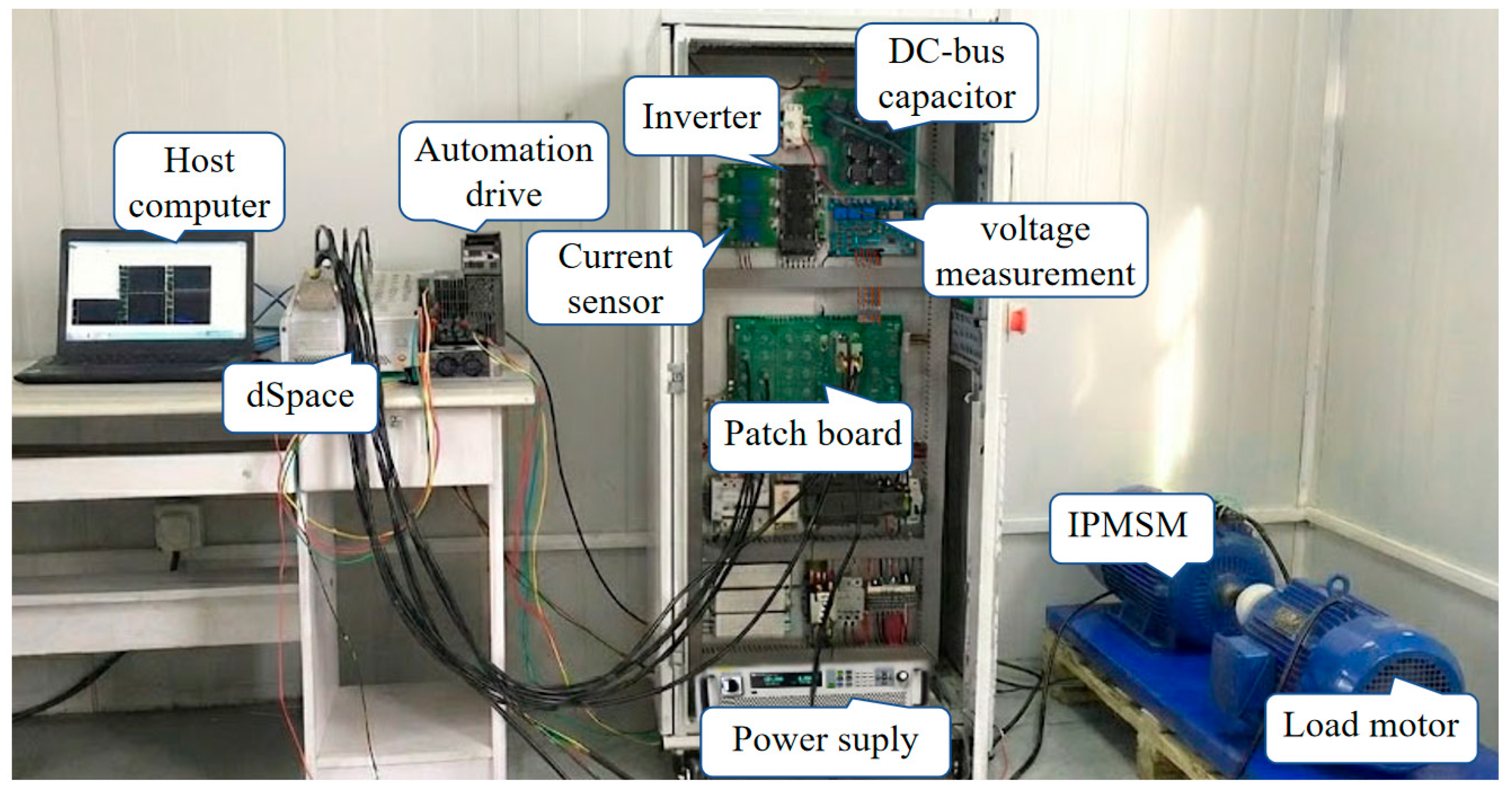
To validate the effectiveness of the proposed event-triggered torque ripple attenuation strategy, experimental investigations were conducted on a three-phase PMSM, with its key parameters summarized in Table 1. Under the assumption that nonlinear effects such as magnetic saturation and temperature-dependent variations are negligible, the parameters obtained via standardized offline identification procedures are treated as nominally accurate. The overall experimental platform is illustrated in Figure 7. The power converter consists of an insulated gate bipolar transistor (IGBT) module (FS100R12PT4) and a corresponding driver module (PSPC-420E-EP4F), operating at a switching frequency of 10 kHz (control period Ts = 0.1 ms) with a DC-link voltage of 150 V. Rotor position and speed are measured using a 1024-line incremental encoder. Phase currents and DC-link voltage are sensed via Hall-effect transducers (LA25-NP and LV25-P, respectively). To emulate controllable load conditions, an induction machine driven by an Automation Drive PM240-2 inverter (with CU250S-2 controller) operates in torque control mode and is mechanically coupled to the PMSM under test. The proposed control algorithms are deployed on a dSPACE real-time control platform, while data acquisition and monitoring are performed on the dSPACE ControlDesk interface. Measured current and voltage signals are routed through a patch panel to a host computer for real-time logging and subsequent post-processing analysis. It should be noted that the experimental motor used in this work serves as a practical PMSM platform for method verification. Although its size and rating may differ from some compact robotic joint motors, the key control problem considered in this paper, namely, torque ripple attenuation with immunity to load transients, is still relevant to robotic PMSM drives. Therefore, the experimental results mainly verify the feasibility of the proposed method.
The experimental validation is organized into three parts. First, the effectiveness of the proposed sliding-mode torque observer is verified by assessing its capability to accurately estimate the motor torque. Second, the two torque ripple extraction schemes are comparatively evaluated to determine which method provides superior performance. Third, the proposed event-triggered torque ripple attenuation strategy is validated to demonstrate that it can effectively suppress steady-state torque ripples while remaining insensitive to task-induced load transients, thereby avoiding performance degradation during transient load processes.
In order to ensure a fair experimental comparison, the filter parameters used in the high-pass-based method and the low-pass-reconstruction-based method are explicitly given in this work. For the high-pass filter, the cutoff frequency and damping ratio are set as ωc = ωc1 = 157.1 rad/s and ζ = ζ1 = 0.707, respectively. The parameter selection is based on the frequency-domain separation principle between the low-frequency load transient components and the high-frequency torque ripple components under the tested operating conditions. Specifically, the cutoff frequency is selected to lie between the dominant transient frequency range and the main torque ripple frequency range, while the damping ratio is chosen to ensure a stable and monotonic filter response without obvious gain peaking. In this way, the two methods are compared on a fair and consistent basis.

4.1. Effectiveness of Proposed Sliding-Mode Torque Observer

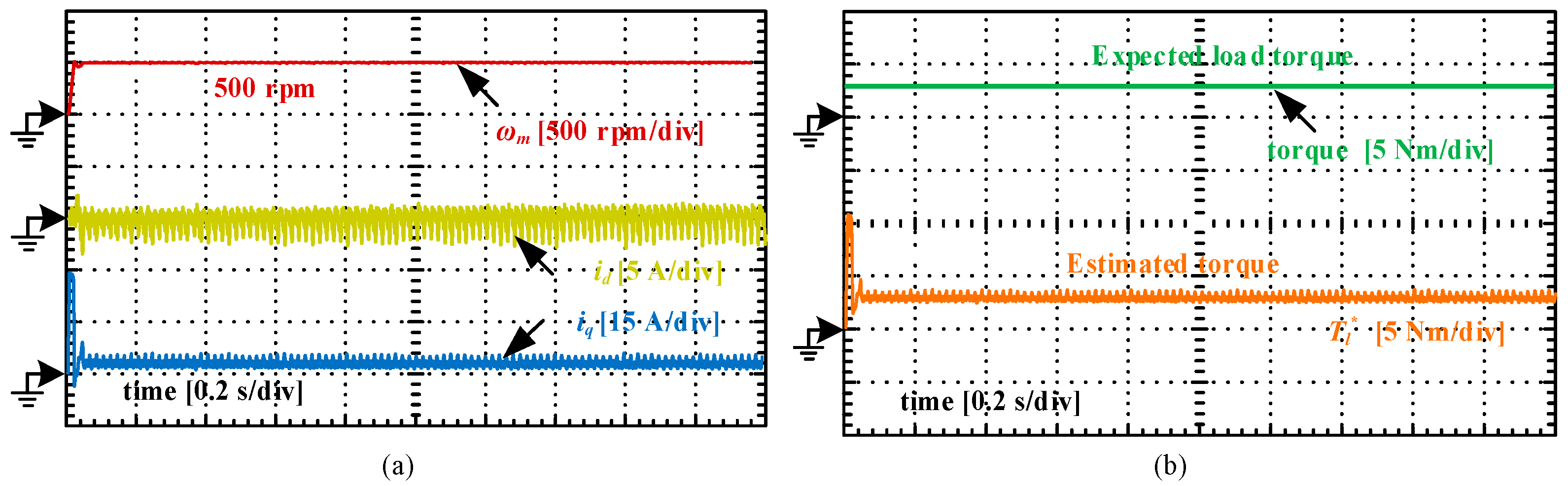
Figure 8 shows the experimental results for the sliding-mode torque observer when the load is kept constant at 3 Nm. The motor speeds up from standstill to 500 rpm. The gain coefficient of the observer is set as 20. As shown in Figure 8a, the motor speed increases smoothly, and the phase currents remain stable during the acceleration process. In Figure 8b, the estimated load torque closely tracks the expected torque with negligible steady-state error and minimal fluctuation. The estimation exhibits fast convergence without noticeable oscillations, indicating that the proposed observer can accurately reconstruct the load torque under steady operating conditions.
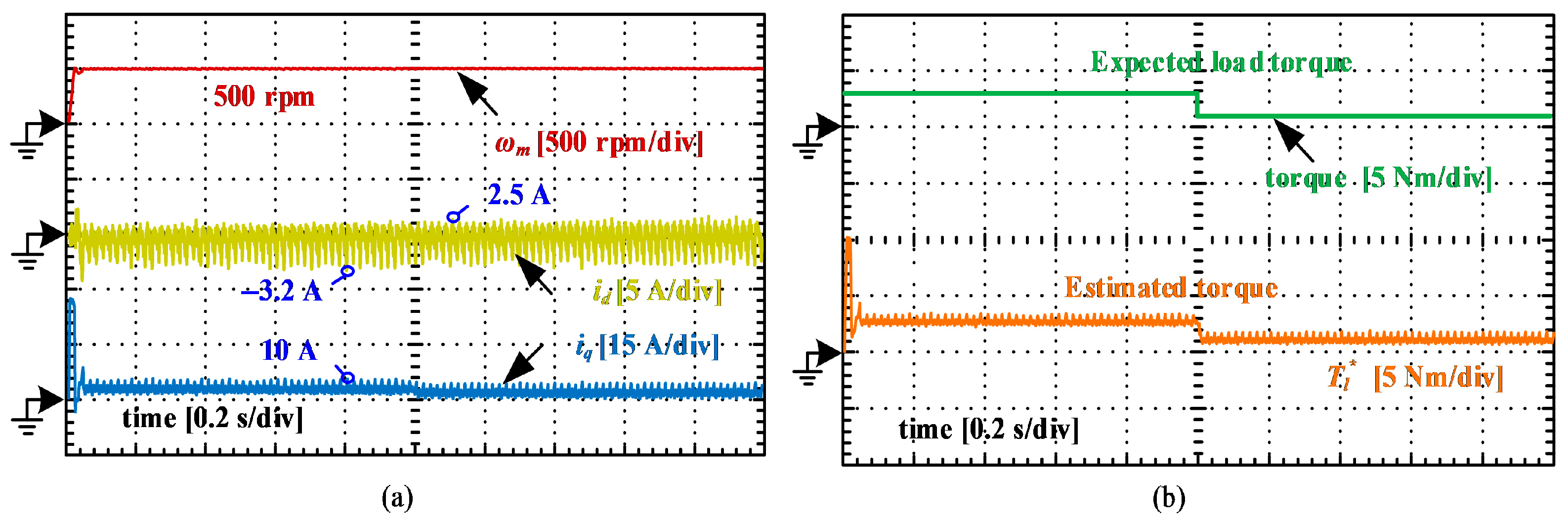
Figure 9 shows the experimental results of sliding mode torque observer when the load changes. The motor speeds up from standstill to 500 rpm. Before 1.0 s, the load is set as 3 Nm. After that, the load is 1 Nm. The gain coefficient of the observer is set as 20 as well. As observed in Figure 9b, the estimated torque rapidly follows the step variation in the actual load torque with a short transient response and without significant overshoot. Meanwhile, the speed and current responses shown in Figure 9a remain stable, demonstrating that the observer does not introduce additional disturbances into the system.
From the above results, it can be concluded that the proposed sliding-mode torque observer achieves accurate and fast load torque estimation under both steady-state and dynamic conditions. Moreover, the adoption of the hyperbolic switching function effectively suppresses chattering, resulting in smooth estimation signals. These characteristics provide a reliable foundation for subsequent torque ripple extraction and event-triggered compensation.

4.2. Comparative Results of Torque Ripple Extraction Methods

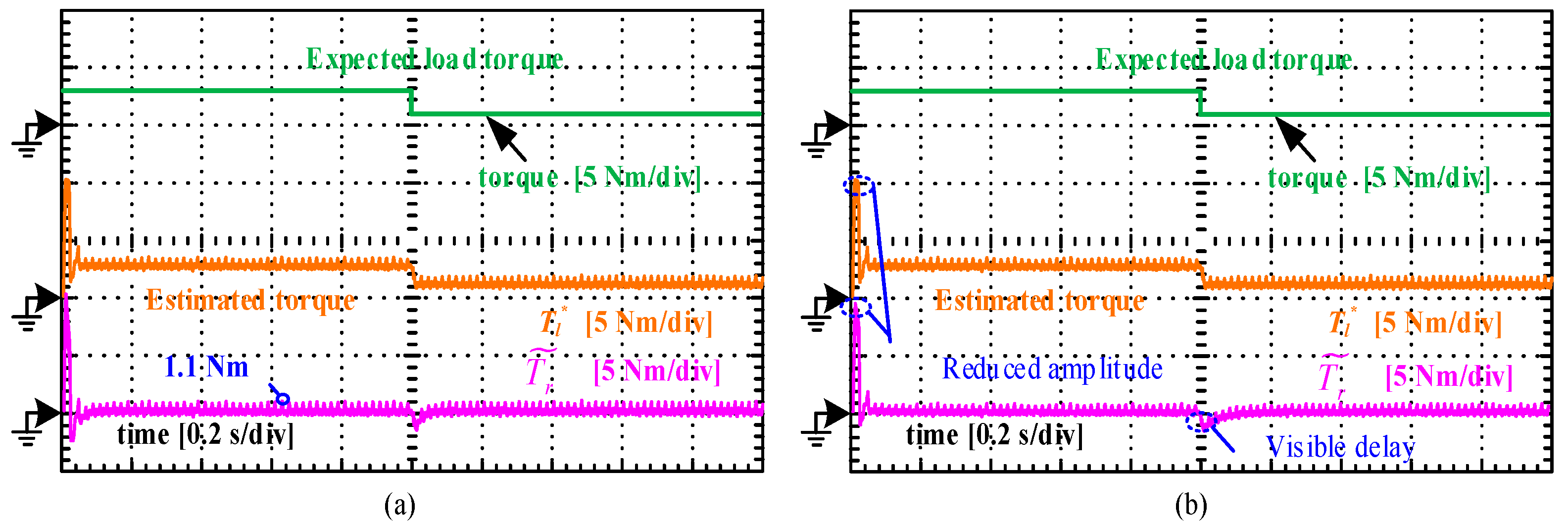
Figure 10 presents the comparative experimental results of the two torque ripple extraction methods under load-varying conditions. The operating scenario is consistent with that in Figure 9, where the load torque changes during operation. As shown in Figure 10a, the high-pass-filter-based method effectively extracts the high-frequency torque ripple component while suppressing low-frequency load variations. The extracted ripple signal exhibits stable amplitude and clear oscillatory characteristics, indicating that the method can accurately preserve the ripple information without being affected by load transients. Notably, during the load change interval, the extracted signal remains well aligned with the actual ripple, with no visible distortion or delay. In contrast, the low-pass-based reconstruction method shown in Figure 10b demonstrates noticeable performance degradation under dynamic conditions. Specifically, the extracted ripple exhibits reduced amplitude and a clear phase delay relative to the actual torque variation. This can be attributed to the inherent lag introduced by the low-pass filtering process, as well as the error accumulation caused by the subtraction operation. During the load transient, these effects become more pronounced, leading to distorted ripple estimation and degraded temporal alignment.
From the above comparison, it is evident that the high-pass-filter-based method provides superior performance in both steady-state and dynamic conditions. In particular, its near-zero phase delay in the ripple-dominant frequency range ensures accurate temporal alignment, while its direct filtering structure avoids error amplification associated with reconstruction. These advantages make the high-pass approach more suitable for real-time torque ripple extraction in robotic PMSM applications, especially under rapidly changing load conditions.

4.3. Results of Event-Triggered Torque Ripple Attenuation

Figure 11 and Figure 12 present the experimental results of the proposed event-triggered torque ripple attenuation strategy using different ripple extraction methods, that is, the high-pass-filter-based extraction and low-pass-based reconstruction, respectively.
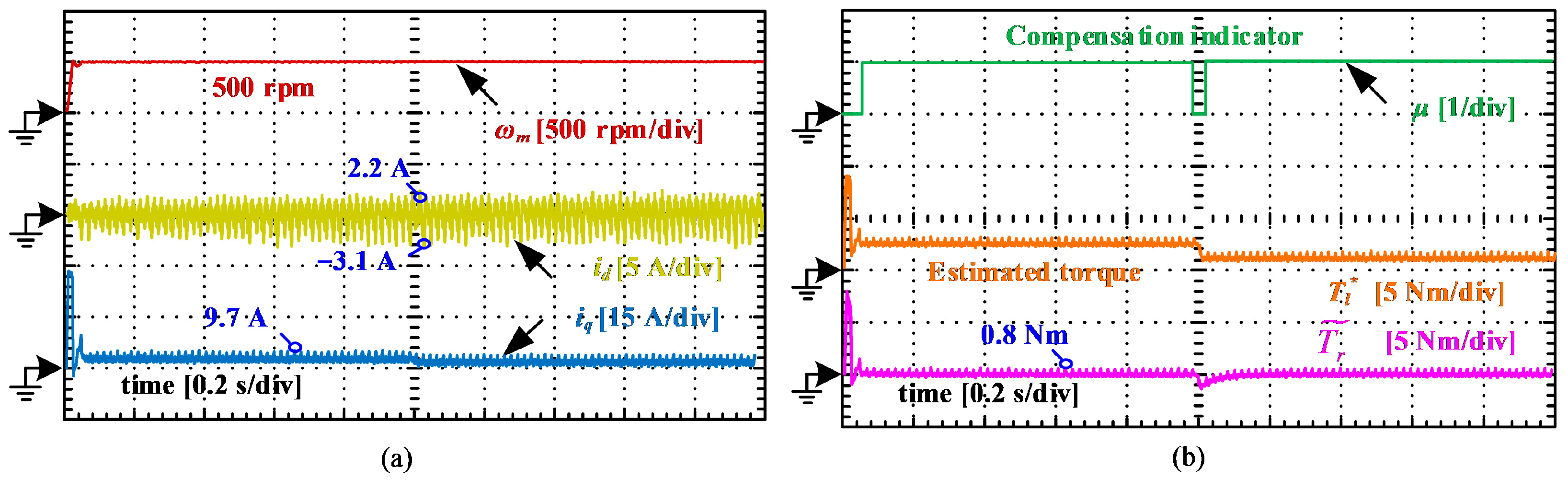
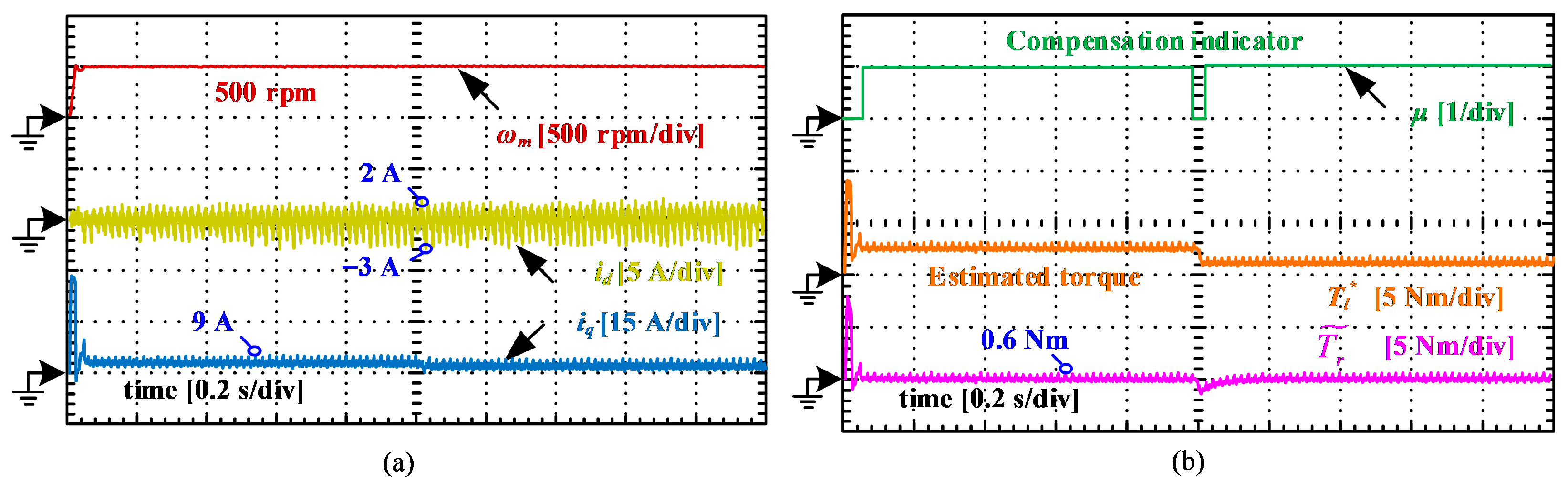
As shown in Figure 11, when the high-pass-filter-based method is employed, the torque ripple is significantly reduced after compensation compared with the results shown in Figure 9 and Figure 10a. Specifically, the q-axis current becomes smoother with reduced oscillation amplitude, while the d-axis current remains stable. In Figure 11b, the estimated torque ripple amplitude is reduced to approximately 0.6 Nm, indicating effective suppression of high-frequency torque oscillations. Moreover, the compensation indicator signal shows that the controller is properly activated under steady conditions and remains inactive during transient intervals, demonstrating the correct operation of the event-trigger mechanism.
Figure 12 shows the results using the low-pass-based reconstruction method. Although torque ripple attenuation is still achieved, the reduction effect is less pronounced compared to the high-pass-based method. The residual ripple amplitude remains around 0.8 Nm, and slight distortion can be observed in the compensated torque signal. This degradation is mainly attributed to the phase delay and amplitude attenuation introduced by the low-pass filtering and reconstruction process, which limits the accuracy of ripple extraction and consequently affects compensation performance.
The comparison shows that the high-pass-filter-based approach achieves better torque ripple attenuation. Its direct extraction structure improves temporal alignment and avoids error accumulation, leading to more effective ripple suppression. Combined with the event-triggered mechanism, the proposed strategy can achieve selective attenuation of steady-state torque ripple while maintaining robustness against load transients, making it more suitable for robotic PMSM applications.
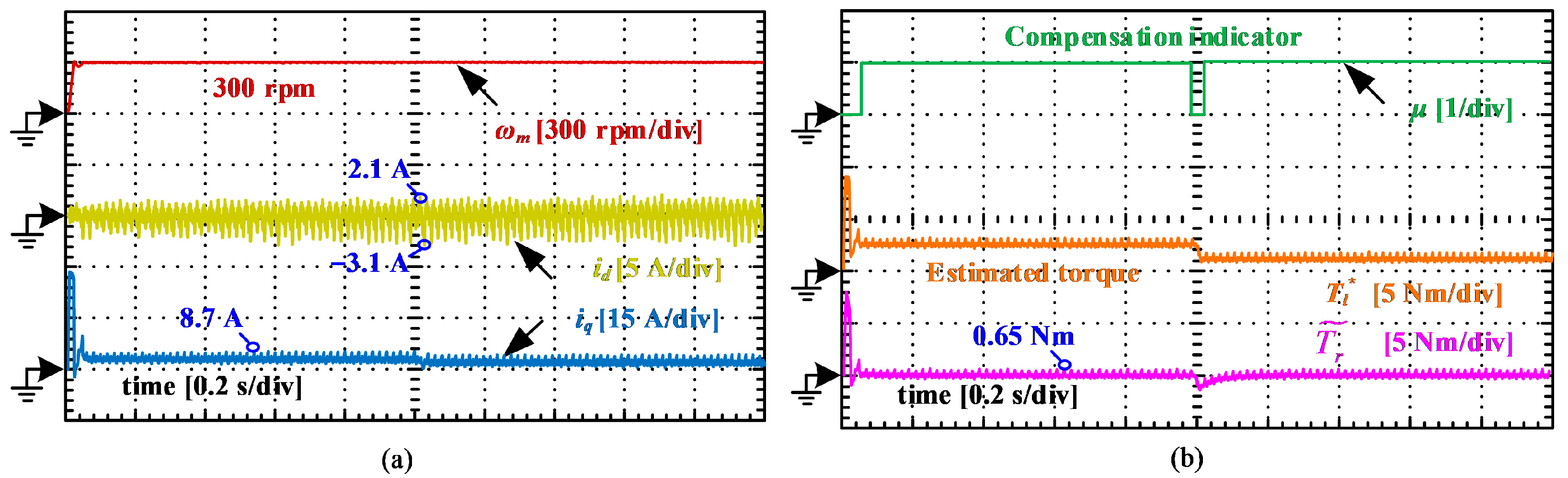
In order to further verify that the high-pass-filter-based approach provides superior torque ripple attenuation performance and when parameters are not consistent with the measured ones, additional experimental results at 300 rpm are presented in Figure 13. Meanwhile, the both the d-axis and q-axis inductance used for constructing the observer is twofold. It can be seen that the motor speed remains stable around the reference value, while the phase currents are well regulated. Meanwhile, the compensation indicator μ stays active under the considered operating condition, indicating that the proposed event-triggered mechanism allows the torque-ripple compensation to work normally in the quasi-steady state. Moreover, the estimated torque closely follows the actual torque with only small fluctuation, which further confirms that the high-pass-filter-based method can effectively extract and attenuate the torque ripple without introducing obvious disturbance into the drive system.

5. Conclusions

This paper develops an event-triggered torque ripple attenuation framework for robotic PMSM drives, which explicitly distinguishes steady-state torque ripple from task-induced load transients and achieves selective compensation without degrading transient performance. A sliding-mode torque observer with a hyperbolic switching law is established to reconstruct real-time torque information with improved smoothness and robustness. Based on the estimated torque, two frequency-selective ripple extraction schemes are designed and comparatively analyzed, and a TRR-based compensation strategy with an event-trigger mechanism is integrated into a vector-controlled PMSM drive to realize practical ripple suppression with low implementation complexity. Although the proposed strategy is more complex than a basic ripple compensation loop, the additional complexity mainly comes from software-level observer, filtering, and logic processing, without requiring major hardware modification. Therefore, the method is meaningful in applications where both torque ripple attenuation and immunity to load transients are required. The main conclusions can be drawn as follows:
(1)
The proposed sliding-mode torque observer provides accurate and fast torque estimation under both steady-state and load-varying conditions, and the hyperbolic switching function effectively mitigates chattering, enabling cleaner torque signals for subsequent ripple extraction.
(2)
Although the high-pass-filter-based extraction and low-pass-based reconstruction are equivalent in steady-state frequency partitioning, they exhibit fundamentally different dynamic properties. The high-pass approach achieves superior temporal alignment with smaller effective phase delay and avoids multi-source error coupling, making it more reliable for ripple identification under load transients.
(3)
By combining ripple extraction, a dedicated ripple regulator, and an event-trigger mechanism, the proposed strategy selectively attenuates detrimental steady-state torque ripple while remaining insensitive to normal load transients. Experiments verify that ripple amplitude is significantly reduced and that compensation is properly suspended during transient intervals, thereby preserving dynamic behavior required by robotic tasks.
There are several aspects that need to be addressed in future studies. First, several parameters in the proposed method are selected experimentally in this work. Although this is sufficient for validating the effectiveness of the proposed strategy, the lack of general tuning guidelines may limit its universality. Therefore, developing systematic parameter tuning rules or adaptive parameter design methods will be an important topic for future research. In addition, the event-triggered mechanism in this work is based on a fixed threshold, which may limit its robustness and adaptability under different speed and load conditions. Therefore, adaptive threshold design and anti-interference triggering mechanisms will be considered. Finally, comparisons with other representative torque ripple suppression methods have not been fully carried out in this work. Although related studies have been surveyed, few reported methods can be directly implemented on the current experimental platform under the same conditions, and some approaches require hardware-level modifications. Therefore, more comprehensive comparative verification will be considered.

Author Contributions

Y.H.—Conceptualization, Methodology; S.C.—Original draft; X.Q. and Z.H.—review and editing; Y.L. and B.Y.—Formal analysis. All authors have read and agreed to the published version of the manuscript.

Funding

This research is supported by National Natural Science Foundation of China (No. 52377067).

Institutional Review Board Statement

Not applicable.

Informed Consent Statement

Not applicable.

Data Availability Statement

The original contributions presented in this study are included in the article. Further inquiries can be directed to the corresponding author.

Conflicts of Interest

Authors Xiaodong Qiao and Zhiyong Huang were employed by the company Xianyang Chuanqing Xinyuan Engineering Technology Co., Ltd. Author Yawei Li was employed by the company Shanghai Newfree Energy Technology Co., Ltd. The remaining authors declare that the research was conducted in the absence of any commercial or financial relationships that could be construed as a potential conflict of interest.

References

  1. Xiong, F.; Yan, R.; Xie, Y.; Yang, K. Design and Optimization of an Interior Permanent-Magnet Synchronous Motor for Aircraft Drive Application. Appl. Sci. 2024, 14, 309. [Google Scholar] [CrossRef] [Scilit]
  2. Gao, J.; Luo, J.; Yin, S.; Gong, C.; Wang, S.; Zhang, G. Adaptive Digital Twin Framework for PMSM Thermal Safety Monitoring: Integrating Bayesian Self-Calibration with Hierarchical Physics-Aware Network. Machines 2026, 14, 138. [Google Scholar] [CrossRef] [Scilit]
  3. Abouseda, A.I.; Doruk, R.O.; Amini, A. Parameter Identification and Speed Control of a Small-Scale BLDC Motor: Experimental Validation and Real-Time PI Control with Low-Pass Filtering. Machines 2025, 13, 656. [Google Scholar] [CrossRef] [Scilit]
  4. Lang, W.; Hu, Y.; Gong, C.; Zhang, X.; Xu, H.; Deng, J. Artificial Intelligence-Based Technique for Fault Detection and Diagnosis of EV Motors: A Review. IEEE Trans. Transp. Electrif. 2022, 8, 384–406. [Google Scholar] [CrossRef] [Scilit]
  5. Gong, C.; Li, Y.R.; Zargari, N.R. An Overview of Advancements in Multimotor Drives: Structural Diversity, Advanced Control, Specific Technical Challenges, and Solutions. Proc. IEEE 2024, 112, 184–209. [Google Scholar] [CrossRef] [Scilit]
  6. Wu, K.; Zhang, Y.; Lu, W.; Qi, Y.; Shi, W. Harmonic Suppression in Permanent Magnet Synchronous Motor Currents Based on Quasi-Proportional-Resonant Sliding Mode Control. Appl. Sci. 2024, 14, 7206. [Google Scholar] [CrossRef] [Scilit]
  7. Huang, M.; Deng, Y.; Li, H.; Wang, J. Torque Ripple Attenuation of PMSM Using Improved Robust Two-Degree-of-Freedom Controller Via Extended Sliding Mode Parameter Observer. ISA Trans. 2022, 129, 558–571. [Google Scholar] [CrossRef] [Scilit]
  8. Zhu, H.; Xiao, X.; Li, Y. Torque Ripple Reduction of the Torque Predictive Control Scheme for Permanent-Magnet Synchronous Motors. IEEE Trans. Ind. Electron. 2012, 59, 871–877. [Google Scholar] [CrossRef] [Scilit]
  9. Gu, X.; Zhang, B.; Wang, Z.; Jin, X.; Zhang, G.; Lin, Z. Torque Ripple Suppression Strategy Based on Online Identification of Flux Linkage Harmonics. Electronics 2025, 14, 2174. [Google Scholar] [CrossRef] [Scilit]
  10. Zhang, W.; Yu, Q.; Li, C.; Gao, J.; Liu, K. Torque Ripple Suppression Method of High Saturation Permanent Magnet Synchronous Motor Based on Current Injection Method. IET Power Electron. 2024, 17, 2026–2038. [Google Scholar] [CrossRef] [Scilit]
  11. Huang, M.; Li, Z.; Hu, M.; Du, C.; Deng, Y.; Peng, Q.; Liu, X.; Liu, L.; Wang, Z. Harmonics and Disturbance Rejection in Optoelectronic Tracking and Measuring Systems Using Trigger Resonant and Robust Current Controller with Cascaded Two-Degrees-of-Freedom Structure. IEEE Trans. Instrum. Meas. 2025, 74, 1–18. [Google Scholar] [CrossRef] [Scilit]
  12. Safargholi, F.; Malekian, K.; Schufft, W. On the Dominant Harmonic Source Identification-Part I: Review of Methods. IEEE Trans. Power Deliv. 2018, 33, 1268–1277. [Google Scholar] [CrossRef] [Scilit]
  13. Han, Y.; Chen, S.; Gong, C.; Zhao, X.; Zhang, F.; Li, Y. Accurate SM Disturbance Observer-Based Demagnetization Fault Diagnosis with Parameter Mismatch Impacts Eliminated for IPM Motors. IEEE Trans. Power Electron. 2023, 38, 5706–5710. [Google Scholar] [CrossRef] [Scilit]
  14. Li, H.; Guo, Y.; Xu, Q. PMSM Torque Ripple Suppression Method Based on SMA-Optimized ILC. Sensors 2023, 23, 9317. [Google Scholar] [CrossRef] [Scilit] [PubMed]
  15. Guo, H.; Zhang, F.; Zhang, Q.; Liu, Y.; Xiang, T.; Xing, J. A Combined Fractional Order Repetitive Controller and Dynamic Gain Regulator for Speed Ripple Suppression in PMSM Drives. Actuators 2024, 13, 73. [Google Scholar] [CrossRef] [Scilit]
  16. Antunes, H.M.A.; Piero, R.R.D.; Silva, S.M. Application of Repetitive Control to Grid-Forming Converters in Centralized AC Microgrids. Energies 2025, 18, 3427. [Google Scholar] [CrossRef] [Scilit]
  17. Liu, T.; Mubarok, M.; Suwarno, D. Speed-Loop Frequency-Adaptive and Current-Loop Optimal Harmonic Periodic Controllers for Fault-Tolerant SPMSM Drive Systems. IET Power Electron. 2021, 15, 629–642. [Google Scholar] [CrossRef] [Scilit]
  18. Kim, Y.; Ye, H.; Lim, S.; Kim, S.-K. Observer-Based Nonlinear Proportional–Integral–Integral Speed Control for Servo Drive Applications via Order Reduction Technique. Actuators 2024, 13, 2. [Google Scholar] [CrossRef] [Scilit]
  19. Hong, J.; Lin, X.; Zhang, J.; Huang, W.; Yan, B.; Li, X. A Composite Sliding Mode Control with the First-Order Differentiator And Sliding Mode Observer for Permanent Magnet Synchronous Machine. ISA Trans. 2024, 147, 489–500. [Google Scholar] [CrossRef] [Scilit] [PubMed]
  20. Li, R.; Zhu, Q.; Yang, J.; Narayan, P.; Yue, X. Disturbance-Observer-Based U-Control (DOBUC) for Nonlinear Dynamic Systems. Entropy 2021, 23, 1625. [Google Scholar] [CrossRef] [Scilit]
  21. Gherghina, I.-S.; Bizon, N.; Iana, G.-V.; Vasilică, B.-V. Recent Advances in Fault Detection and Analysis of Synchronous Motors: A Review. Machines 2025, 13, 815. [Google Scholar] [CrossRef] [Scilit]
  22. Tao, Y.; Wang, X.; Zhang, L.; Bao, X.; Xue, H.; Yue, H.; Feng, H.; Yang, D. Fault Diagnosis of In-Wheel Motors Used in Electric Vehicles: State of the Art, Challenges, and Future Directions. Machines 2025, 13, 711. [Google Scholar] [CrossRef] [Scilit]
  23. Kong, L.; Zhang, H.; Zhang, T.; Wang, J.; Yang, C.; Zhang, Z. Adaptive Control Parameter Optimization of Permanent Magnet Synchronous Motors Based on Super-Helical Sliding Mode Control. Appl. Sci. 2024, 14, 10967. [Google Scholar] [CrossRef] [Scilit]
  24. Yepes, A.G.; Lopez, O.; Gonzalez-Prieto, I.; Duran, M.J.; Doval-Gandoy, J. A Comprehensive Survey on Fault Tolerance in Multiphase AC Drives, Part 1: General Overview Considering Multiple Fault Types. Machines 2022, 10, 208. [Google Scholar] [CrossRef] [Scilit]
  25. Molina-Santana, E.; Iturralde Carrera, L.A.; Álvarez-Alvarado, J.M.; Aviles, M.; Rodríguez-Resendiz, J. Modeling and Control of a Permanent Magnet DC Motor: A Case Study for a Bidirectional Conveyor Belt’s Application. Eng 2025, 6, 42. [Google Scholar] [CrossRef] [Scilit]
  26. Gong, C.; Hu, Y.; Gao, J.; Wang, Y.; Yan, L. An Improved Delay-Suppressed Sliding-Mode Observer for Sensorless Vector-Controlled PMSM. IEEE Trans. Ind. Electron. 2020, 67, 5913–5923. [Google Scholar] [CrossRef] [Scilit]
  27. Nguyen, D.G.; Tran, D.T.; Ahn, K.K. Disturbance Observer-Based Chattering-Attenuated Terminal Sliding Mode Control for Nonlinear Systems Subject to Matched and Mismatched Disturbances. Appl. Sci. 2021, 11, 8158. [Google Scholar] [CrossRef] [Scilit]
  28. Jędryczka, C.; Danielczyk, D.; Szeląg, W. Torque Ripple Minimization of the Permanent Magnet Synchronous Machine by Modulation of the Phase Currents. Sensors 2020, 20, 2406. [Google Scholar] [CrossRef] [Scilit]
  29. Yi, P.; Zheng, W.; Li, X. Overview of Torque Ripple Minimization Methods for Permanent Magnet Synchronous Motors Based on Harmonic Injection. Chin. J. Electr. Eng. 2024, 10, 16–29. [Google Scholar] [CrossRef] [Scilit]
  30. Qu, J.; Jatskevich, J.; Zhang, C.; Zhang, S. Torque Ripple Reduction Method for Permanent Magnet Synchronous Machine Drives with Novel Harmonic Current Control. IEEE Trans. Energy Convers. 2021, 36, 2502–2513. [Google Scholar] [CrossRef] [Scilit]
Figure 1. Applications of PMSMs in robotics.
Machines 14 00478 g001
Figure 2. Characteristics of hyperbolic function.
Machines 14 00478 g002
Figure 3. Block diagram of sliding mode observer used for torque estimation.
Machines 14 00478 g003
Figure 4. Block diagram of proposed event-triggered torque ripple attenuation strategy.
Machines 14 00478 g004
Figure 5. Influence of ωc and ζ on the filter bandwidth and attenuation characteristics. (a) Fixed ωc, varying ζ; (b) fixed ζ, varying ωc.
Machines 14 00478 g005
Figure 6. Influence of ωc1 and ζ1 on the filter bandwidth and attenuation characteristics.
Machines 14 00478 g006
Figure 7. Experimental test bench.
Machines 14 00478 g007
Figure 8. Experimental results of sliding mode torque observer with constant load.
Machines 14 00478 g008
Figure 9. Experimental results of sliding mode torque observer with load changes.
Machines 14 00478 g009
Figure 10. Experimental results of torque ripple extraction methods. (a) High-pass filtering. (b) Low-pass filtering.
Machines 14 00478 g010
Figure 11. Experimental results of event-triggered torque ripple attenuation method based on ripple extraction using high-pass filtering.
Machines 14 00478 g011
Figure 12. Experimental results of event-triggered torque ripple attenuation method based on ripple extraction using low-pass filtering.
Machines 14 00478 g012
Figure 13. Experimental results of event-triggered torque ripple attenuation method based on ripple extraction using high-pass filtering when the speed is 300 rpm.
Machines 14 00478 g013
Table 1. Parameters of PMSM used for verification.
ParameterValueUnit
winding resistance Rs0.605Ω
d-axis inductance Ld12.650mH
q-axis inductance Lq13.500mH
the number of pole pairs p2-
rated speed ωmrated560rpm
rotor moment of inertia J0.013kg·m2
damping coefficient B0.035-
flux linkage ψf0.687Wb
Disclaimer/Publisher’s Note: The statements, opinions and data contained in all publications are solely those of the individual author(s) and contributor(s) and not of MDPI and/or the editor(s). MDPI and/or the editor(s) disclaim responsibility for any injury to people or property resulting from any ideas, methods, instructions or products referred to in the content.