Article

Rapid Noise Prediction of a Three-Stage Helical Gear Reducer Using a BOA-ISSA-BPNN Surrogate Model

School of Mechatronics Engineering, Harbin Institute of Technology, Harbin 150001, China
*
Author to whom correspondence should be addressed.
Machines 2026, 14(4), 365; https://doi.org/10.3390/machines14040365
Submission received: 3 March 2026 / Revised: 19 March 2026 / Accepted: 24 March 2026 / Published: 26 March 2026

Abstract

To reduce the time and computational cost of vibro-acoustic simulations in gear reducer noise evaluation, this study develops a simulation-driven surrogate modeling framework for a three-stage helical gear reducer. A high-fidelity “vibration–acoustic radiation” simulation chain is established, where the housing vibration responses computed in Romax Designer are mapped into ACTRAN to obtain the radiated noise. Using Optimal Latin Hypercube Sampling, 300 designs are generated by varying the first-stage pinion micro-modification parameters (tooth drum, tooth slope, and tooth profile), and the average RMS sound pressure level over six field points is adopted as the noise metric. A BP neural network (BPNN) surrogate is then constructed, in which Bayesian Optimization (BOA) is used to tune hidden layer nodes and learning rate, and an improved Sparrow Search Algorithm (ISSA) is employed to optimize the initial weights and biases, forming the proposed BOA-ISSA-BPNN model. On the test set, the proposed model achieves R2 = 0.97499, RMSE = 0.91385, and MAE = 0.6547, with an average prediction time of 32.35s. Meanwhile, comparisons with SVM, BPNN, BOA-BPNN, SSA-BPNN, and ISSA-BPNN demonstrate superior prediction accuracy; moreover, relative to the hour-level computational cost of high-fidelity simulations, the proposed surrogate enables rapid noise evaluation on the order of tens of seconds, enabling fast micro-modification design iteration and practical engineering decision-making.

1. Introduction

Gear reducers are key components in modern transmission systems and are widely used in advanced manufacturing equipment, such as industrial robots. The vibro-acoustic performance of a reducer is largely governed by noise radiated from the gear reducer housing, which affects operational reliability and acoustic comfort and may be critical in noise-sensitive applications. In practice, early-stage faults in reducers often manifest as abnormal vibration and radiated noise; therefore, accurate noise prediction provides valuable information for condition monitoring and early fault diagnosis. From an engineering-design and manufacturing-systems perspective, fast and reliable noise prediction enables rapid design iteration, supports virtual prototyping, and facilitates decision-making throughout the development workflow. Consequently, developing an accurate yet computationally efficient surrogate model for gear reducer noise is of significant practical importance for noise-source identification, design improvement, and noise control in product development and manufacturing applications.
In current research, the noise prediction methods for reducer systems mainly rely on Finite Element Analysis (FEA), Boundary Element Method (BEM), and the construction of surrogate models [1,2,3,4,5,6,7,8]. Tang et al. [9] employed the acoustic boundary element method to address the radiated noise of EMU gears. Liu et al. [10] developed a combined finite element/boundary element model using the modal acoustic transfer vector (MATV) method to predict gearbox radiated noise. However, due to the highly detailed description of the studied systems in these simulations, their computational cost is typically very high [11]. Various surrogate models have been developed in recent years, with the latest advancements including the use of Artificial Intelligence (AI) techniques, such as Artificial Neural Networks (ANNs) [12,13,14,15,16,17,18]. Tang et al. [19] employed an RBF neural network to develop a predictive model for the radiated noise of EMU gear transmissions. Xu et al. [20] conducted vibration response analysis of the helicopter main gearbox based on surrogate models and global sensitivity analysis. Tang et al. [21] performed noise simulation and optimization of the train gearbox system based on Generalized Regression Neural Networks. Koutsoupakis et al. [22] used recurrent neural networks to develop a surrogate model for predicting the vibration response of the gear transmission system. BPNN is also used to construct surrogate models for reducers, aimed at predicting the vibration and noise of the reducer [23]. Zhang et al. [24] developed a Bayesian-BPNN model for system identification of the temperature field in the preheating section of a chain grate machine. These surrogate model construction methods are highly sensitive to initial structures and parameters in gearbox noise prediction, making them prone to local optima, which remains an unresolved issue. Some scholars have studied the use of intelligent optimization algorithms, such as genetic algorithms [25], biogeography-based optimization algorithms [26], and particle swarm algorithms [27,28,29], combined with machine learning to improve the accuracy and efficiency of machine learning, which provides reusable methodological guidance and decision support for evaluating mechanical transmission systems (e.g., gear reducers) in manufacturing engineering.
In brief, previous studies on reducers mostly used simulation models and surrogate models constructed with single algorithms for noise prediction. The gear reducer noise response is significantly influenced by the gear micro-parameters, and accurate noise prediction requires considering these parameters [30,31,32]. This study uses BPNN [33] to predict the noise of the reducer under different gear micro-parameters. In addition, single BPNN models are prone to falling into local optima. This study uses Bayesian Optimization Algorithm (BOA) and the Sparrow Search Algorithm (SSA) [34] to optimize BPNN. Previous studies in various engineering fields have demonstrated that Bayesian Optimization Algorithm is highly effective in optimizing BPNN, while SSA, compared to traditional optimization algorithms such as genetic algorithms and particle swarm algorithms, has stronger search optimization performance [35,36,37,38]. Furthermore, we improved SSA using three methods, and ultimately built a new BOA-ISSA-BPNN surrogate model for predicting the noise of the gear reducer.
The main contributions can be summarized as follows:
(1) Simulation-driven data generation pipeline.
A “vibration–acoustic radiation” simulation chain was established (Romax Designer 2024 for vibration simulation and ACTRAN 2020 for acoustic radiation). Gear micro-modification parameters were parameterized and the vibration response was simulated using Romax Designer 2024. ACTRAN 2020 was used for noise simulation, where the vibration response was applied as the boundary condition and mapped onto the acoustic mesh for solution. Training samples were generated using Optimal Latin Hypercube Sampling.
(2) Proposed BOA-ISSA-BPNN surrogate modeling framework.
BOA was used to optimize key BPNN hyperparameters (number of hidden-layer nodes and learning rate), while the improved SSA (ISSA) was applied to optimize the initial weights and biases, improving convergence stability and reducing the risk of being trapped in local optima.
(3) High-accuracy and low-cost rapid noise evaluation.
Using the mean RMS sound pressure level across six field points as the noise metric, the model achieves better RMSE/MAE/R2 than SVM, BPNN, and several improved surrogate baselines, while significantly reducing computational cost compared with hour-level high-fidelity simulations, enabling iterative gear micro-modification design and engineering applications.

2. Problem Description and Research Framework

2.1. Problem Description

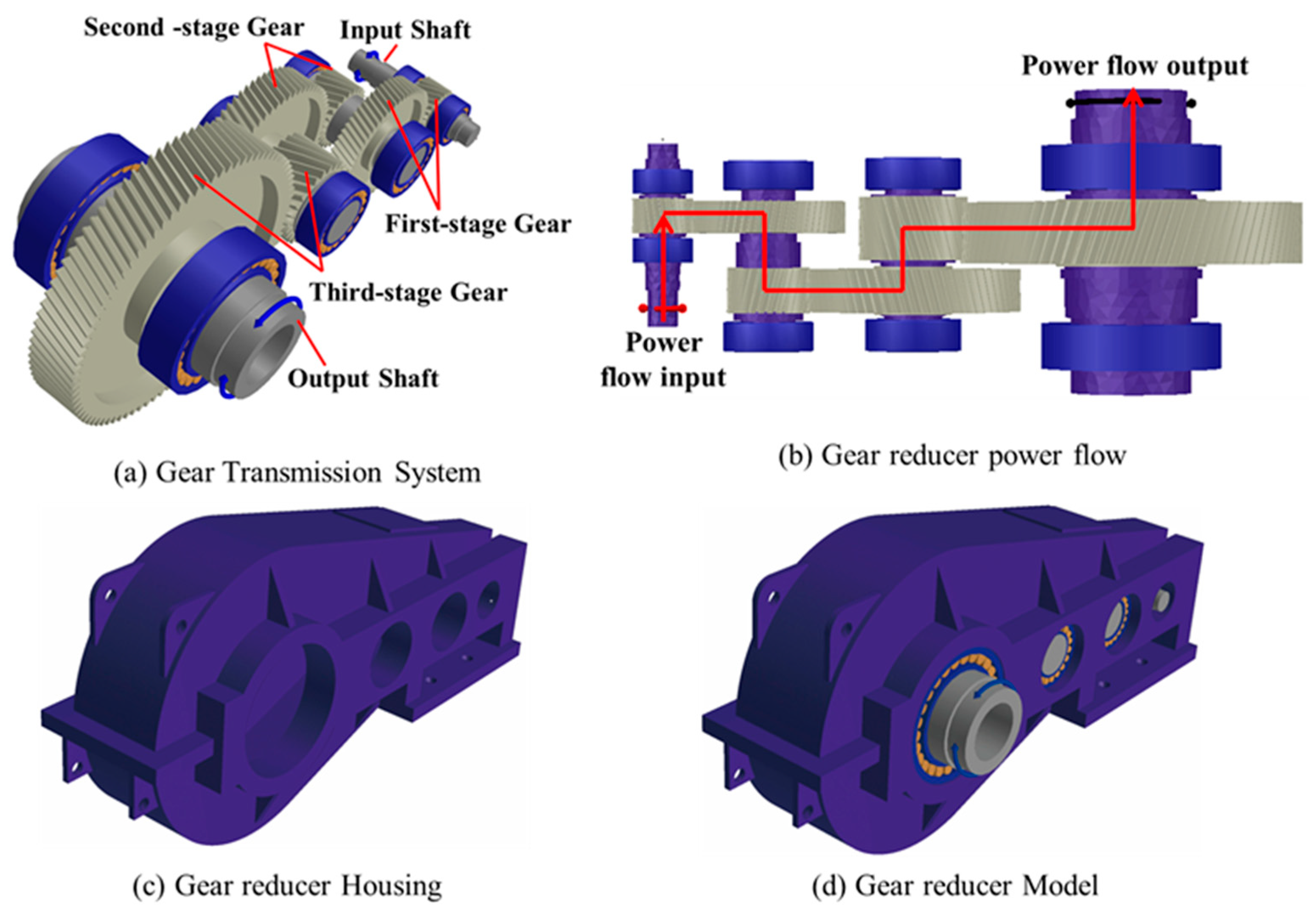
This study focuses on the analysis of a three-stage helical gear reducer, as shown in Figure 1 with the basic gear parameters summarized in Table 1. The gear material selection, surface roughness, and contact geometry parameters are shown in Table 2, Table 3 and Table 4. The elastic modulus of all three gear pairs is 2.07 × 10⁵ MPa, with a density of 7800 kg/m3, a Poisson’s ratio of 0.3, and a thermal expansion coefficient of 12 (µm/m°C). The gear reducer has an overall transmission ratio of 26.623:1, with a rated input speed of 1800 r/min and a rated input power of 388 kW. The output torque is 54,800.89 Nm. The transient dynamics of the reducer are analyzed using Romax Designer 2024, specifically the process of the input shaft speed increasing from 0 r/min to the rated speed.
In this study, ISO VG 150 [39] viscosity grade PAG synthetic gear oil is selected as the lubricant for the gearbox. This oil has excellent extreme pressure and anti-wear performance (FZG load stage > 12), a high viscosity index (>190), and good thermal stability, meeting the lubrication requirements of the ship’s gearbox under heavy load and impact conditions. The lubrication method adopts pressure spray lubrication, where the oil is directly injected onto the gear meshing surface through injectors arranged above the meshing area, forming a continuous and stable hydrodynamic oil film.
Table 1. Basic parameters of gear.
Basic ParametersNumber of Teeth ZModules mn/(mm)Tooth Face Width B/(mm)Rotation DirectionPressure Angle α/(°)Helix Angle β/(°)Precision Grades [40]
Pinion 1228115Left2010ISO 5
Wheel 1618105Right2010ISO 6
Pinion 22310150Right2015ISO 6
Wheel 26610140Left2015ISO 7
Pinion 32612210Left2018ISO 7
Wheel 38712200Right2018ISO 7
Table 2. Gear material selection.
Basic
Parameters
Material NameMaterial TypeSurface TreatmentCore HardnessSurface
Hardness
Pinion 1Steel, case hardened, AGMA grade 2Surface carburized steelSurface Carburizing35.0 HRC60.0 HRC
Wheel 1Steel, case hardened, AGMA grade 2Surface carburized steelSurface Carburizing35.0 HRC60.0 HRC
Pinion 2Steel, case hardened, AGMA grade 2Surface carburized steelSurface Carburizing35.0 HRC60.0 HRC
Wheel 2Steel, case hardened, AGMA grade 2Surface carburized steelSurface Carburizing35.0 HRC60.0 HRC
Pinion 3Steel, case hardened, AGMA grade 2Surface carburized steelSurface Carburizing35.0 HRC60.0 HRC
Wheel 3Steel through hardened, 280 BHN, AGMA grade 2Hardened alloy steelHardening Treatment262.0 HB280.0 HB
Table 3. Gear surface roughness.
Basic ParametersSurface Roughness (Ra) (µm)Surface Roughness (Rq) (µm)Surface Roughness (Rz) (µm)Root Filet Roughness (Ra) (µm)Root Filet Roughness (Rz) (µm)
Pinion 1≤0.3≤0.375≤1.8≤1.6≤10.0
Wheel 1≤0.4≤0.5≤2.4≤1.6≤10.0
Pinion 2≤0.4≤0.5≤2.4≤1.6≤10.0
Wheel 2≤0.5≤0.625≤3.0≤1.6≤10.0
Pinion 3≤0.5≤0.625≤3.0≤1.6≤10.0
Wheel 3≤0.6≤0.75≤3.6≤1.6≤10.0
Table 4. Gear contact geometric parameters.
Basic ParametersFace Contact OverlapAxial Contact OverlapTotal Contact OverlapContact Length (mm)Line of Action Length (mm)
Second-stage Gear Pair0.383430.725471.1099.178158.690
First-stage Gear Pair0.95811.1532.11129.160200.863
Third-stage Gear Pair1.4451.5573.00253.480279.274
During gear meshing, vibrations are generated, which are transmitted to the gear reducer housing through the shaft, bearings, and bearing seats, causing vibrations in the housing that radiate noise. Gear micro-modification parameters, such as tooth drum modification, tooth slope and tooth profile modification directly affect the vibration response during the meshing process and the intensity and, therefore, govern the gearbox noise response [41,42,43,44,45]. Therefore, this study aims to develop an efficient surrogate model for gear reducer noise to rapidly and accurately predict the gear reducer noise response under different gear micro-modification parameters.

2.2. Research Framework

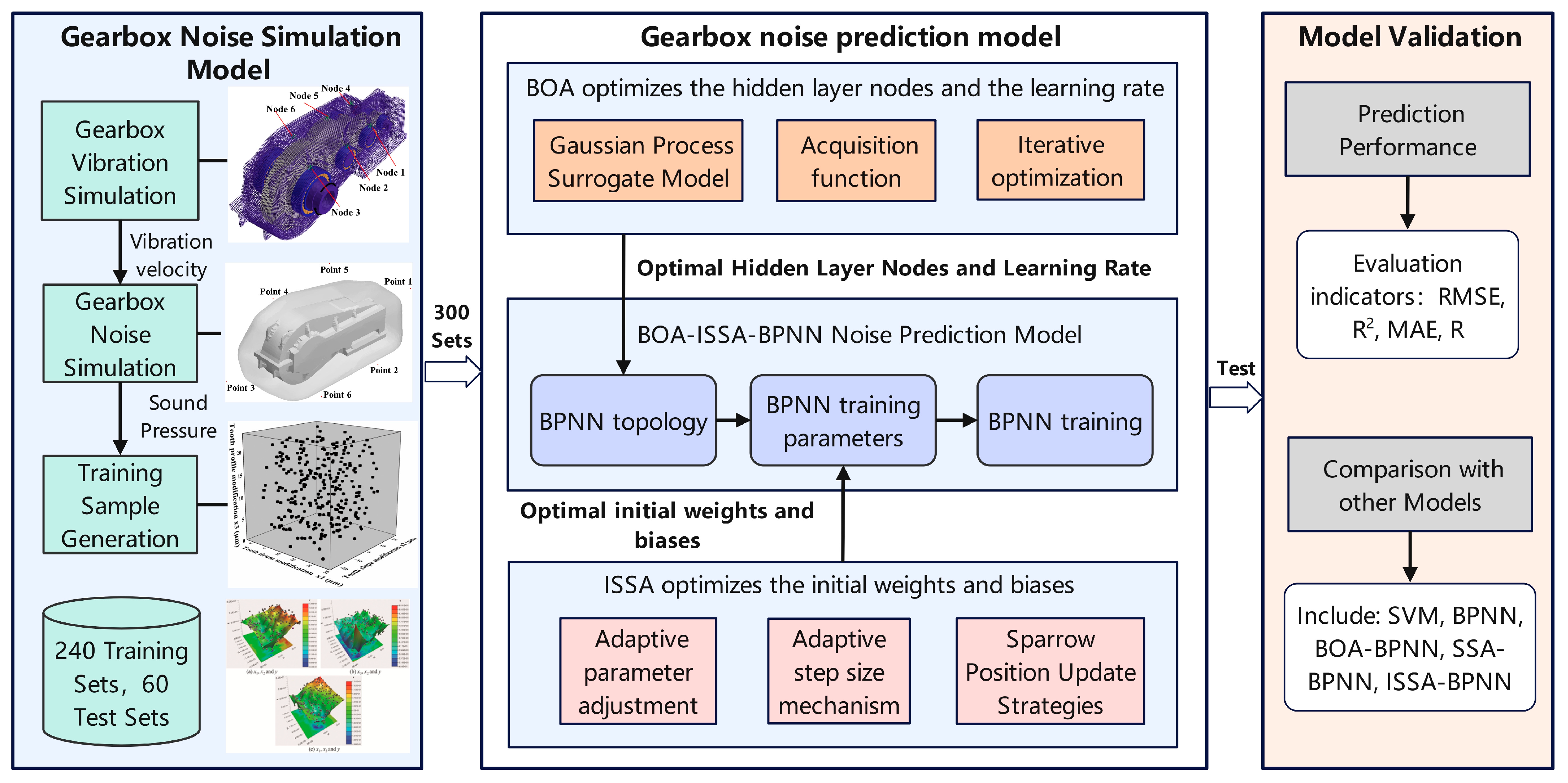
The framework for gear reducer noise prediction in this study is shown in Figure 2.
In Section 3, the gear reducer noise simulation model is constructed. Section 3.1 simulates the vibration response of the gear reducer; Section 3.2 simulates the noise response of the gear reducer; and Section 3.3 uses the optimal Latin Hypercube Sampling method to generate training samples. Through these steps, 300 sets of samples are provided for the training of the surrogate model in Section 4.
In Section 4, a gear reducer noise surrogate model is constructed based on BOA-ISSA-BPNN. In Section 4.1, BOA is used to optimize the number of hidden layer nodes and learning rate of the BPNN model; in Section 4.2, SSA is improved, and the improved SSA (ISSA) is used to optimize the initial weights and biases of the BPNN. The BPNN model is constructed and trained using the optimal hyperparameters to achieve accurate and rapid prediction of gear reducer noise.
In Section 5, the performance of the BOA-ISSA-BPNN model is validated. In Section 5.1, the performance of the BOA-ISSA-BPNN surrogate model is evaluated using four metrics: RMSE, R2, MAE, and R. In Section 5.2, the performance of BOA-ISSA-BPNN is compared with other models, verifying the efficiency of the proposed model.

3. Gear Reducer Noise Simulation Model

This section develops the training-data generation workflow for surrogate modeling by establishing a high-fidelity “vibration–acoustic radiation” simulation chain for the gear reducer. Section 3.1 builds the dynamic model and computes the housing vibration response under gear-meshing excitation as the structural input for acoustics; Section 3.2 constructs the acoustic radiation model in an acoustic solver (ACTRAN 2020) and obtains RMS sound pressure level (SPL) responses at six evaluation points, with their average taken as the output metric; Section 3.3 applies Optimal Latin Hypercube Sampling (OLHS) to select 300 sets of gear micro-modification parameters and generates the corresponding noise dataset via simulation for subsequent surrogate-model training.

3.1. Gear Reducer Vibration Response Simulation

3.1.1. Gearbox Casing Modal Analysis

Before performing the casing vibration response analysis, a modal analysis of the casing is first conducted to evaluate its natural frequencies and vibration modes. This provides important foundational data for subsequent dynamic analysis. Simcenter 3D 2412 is an integrated simulation software that uses the Nastran solver, providing powerful modeling, simulation, and optimization tools specifically designed for gearbox dynamics analysis. The finite element model of the casing is established using Simcenter 3D 2412 software, with mesh division performed as follows: first, the mesh is divided into 2D elements, with the element type as CTRIAR and a 2D element size of 10mm; then, 3D solid elements are generated from the 2D shell elements, with the element type as CTETRA(10).
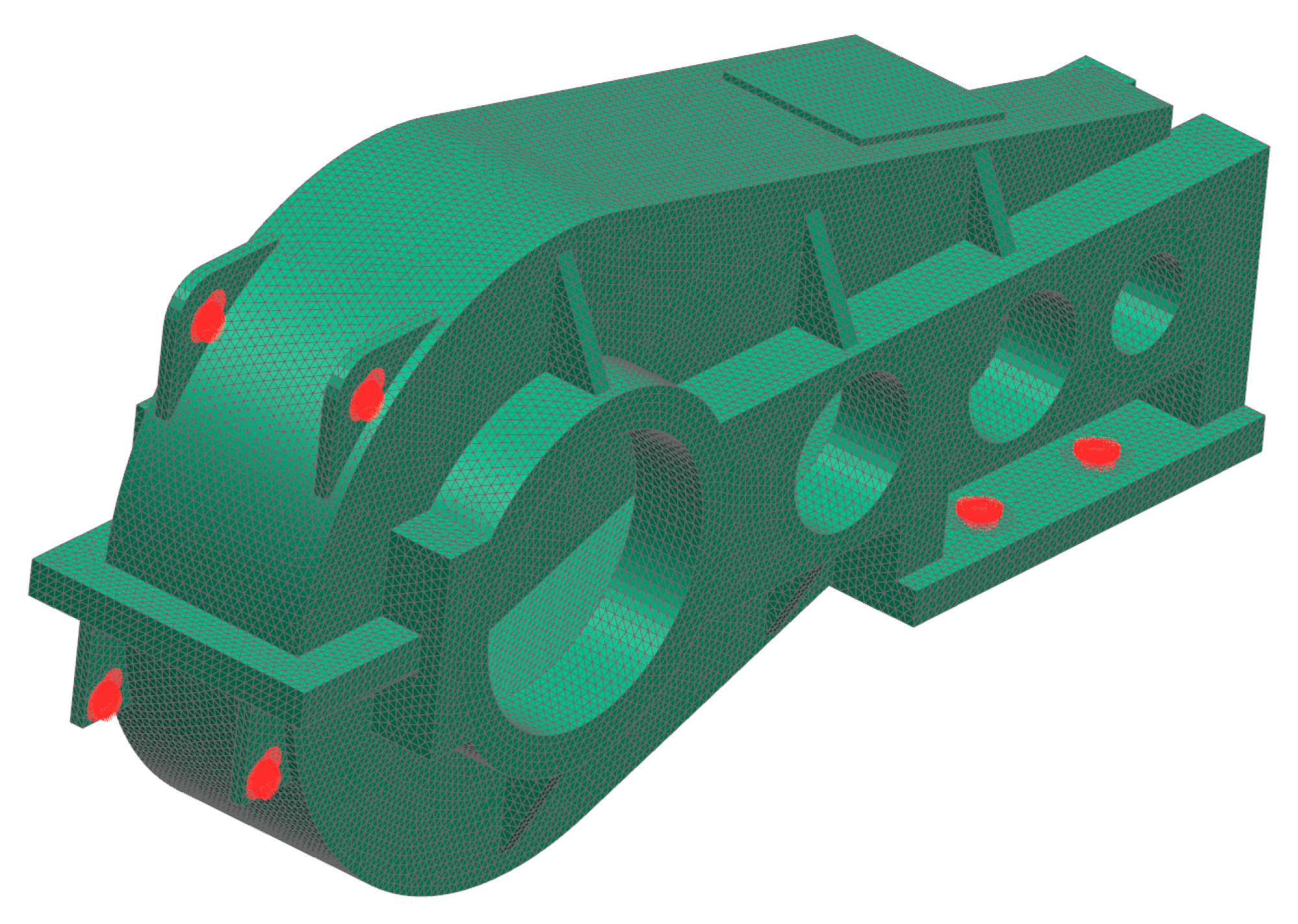
In this study, the material properties of the casing are set as MAT1, with a Young’s modulus of 2.0 × 10⁵ MPa, a Poisson’s ratio of 0.3, a density of 7200 kg/m3, and a thermal expansion coefficient of 12 μm/m°C. For the damping setting, based on typical values for welded steel structures and cast iron gearboxes, a constant damping ratio of 2% (ζ = 0.02) is applied to all major modes below 2000 Hz. This damping ratio is used to characterize the hysteresis effects of the material and energy dissipation caused by connection friction, simulating the vibration energy loss due to internal material friction and friction between connected components during the gearbox operation. This setting provides a good representation of the dynamic characteristics of the casing under actual operating conditions. To simulate the real working conditions, fixed constraints are applied at the bolt hole locations of the casing to solve for the constrained modes of the casing. This approach more accurately reflects the dynamic behavior of the casing under actual working conditions. The finite element model of the casing is shown in Figure 3, where the red parts represent the locations where the casing is fixed with constraints.
This approach more accurately reflects the dynamic characteristics of the casing under actual working conditions. The finite element model of the casing is shown in Figure 3. In Figure 3, the red parts represent the locations where the casing is fixed with constraints.
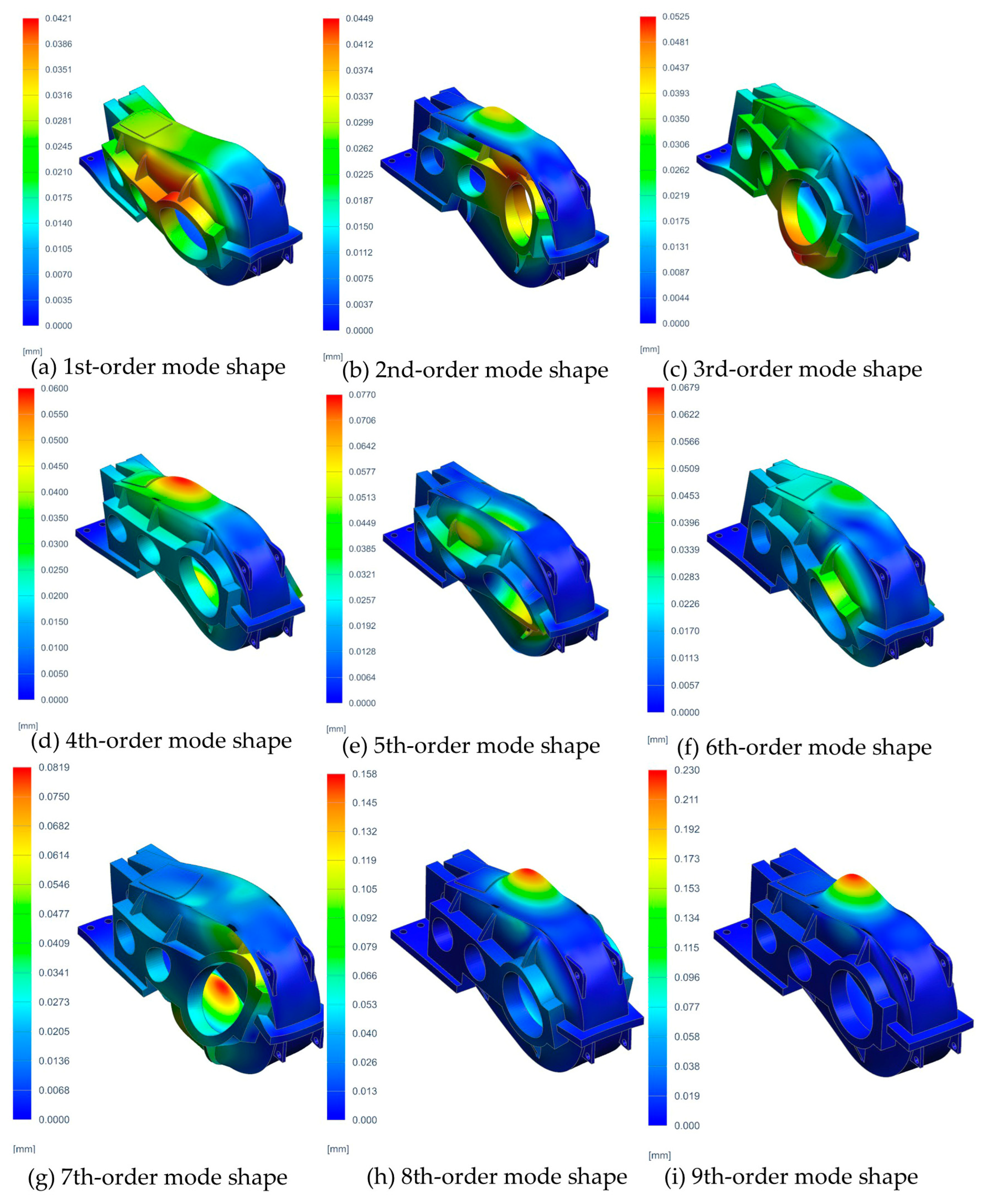
Modal analysis was conducted using Simcenter 3D 2412 software, with the analysis type set to structural and the solution method as SOL 103 eigenvalue analysis, using the Block Lanczos method for eigenvalue extraction. In the gearbox system, the first six modes typically contain the primary vibration modes of the system, so this study solves for the first nine modes of the casing. The natural frequencies and mode shapes of the casing are described in Table 5, and the modal vibration patterns are shown in Figure 4.
The frequencies of the remaining modes of the casing are 458.64 Hz, 491.78 Hz, 517.98 Hz, ..., 552.40 Hz, and 566.92 Hz. The energy corresponding to these modes is very small, indicating that they have minimal impact on the overall dynamic behavior of the casing. Therefore, these modes are less likely to contribute to resonance within the system. The gear mesh frequencies (GMF) for the three-stage gearbox are calculated separately using the following formula:
G M F = n z 60
where GMF is the gear mesh frequency (Hz), z is the number of teeth, and n is the rotational speed (r/min).
After calculation, the mesh frequencies for the three stages of the gearbox are as follows: the first stage gear mesh frequency is 660 Hz; the second stage gear mesh frequency is 248 Hz; and the third stage gear mesh frequency is 98 Hz. By comparison, the casing modal frequencies are significantly different from the gear mesh frequencies. Therefore, the possibility of resonance between the casing and the transmission system is unlikely.

3.1.2. Gearbox Casing Harmonic Response Simulation

Vibration response simulation is the first step of the proposed vibration–acoustic radiation workflow, providing the structural vibration inputs and boundary conditions for subsequent noise radiation analysis.
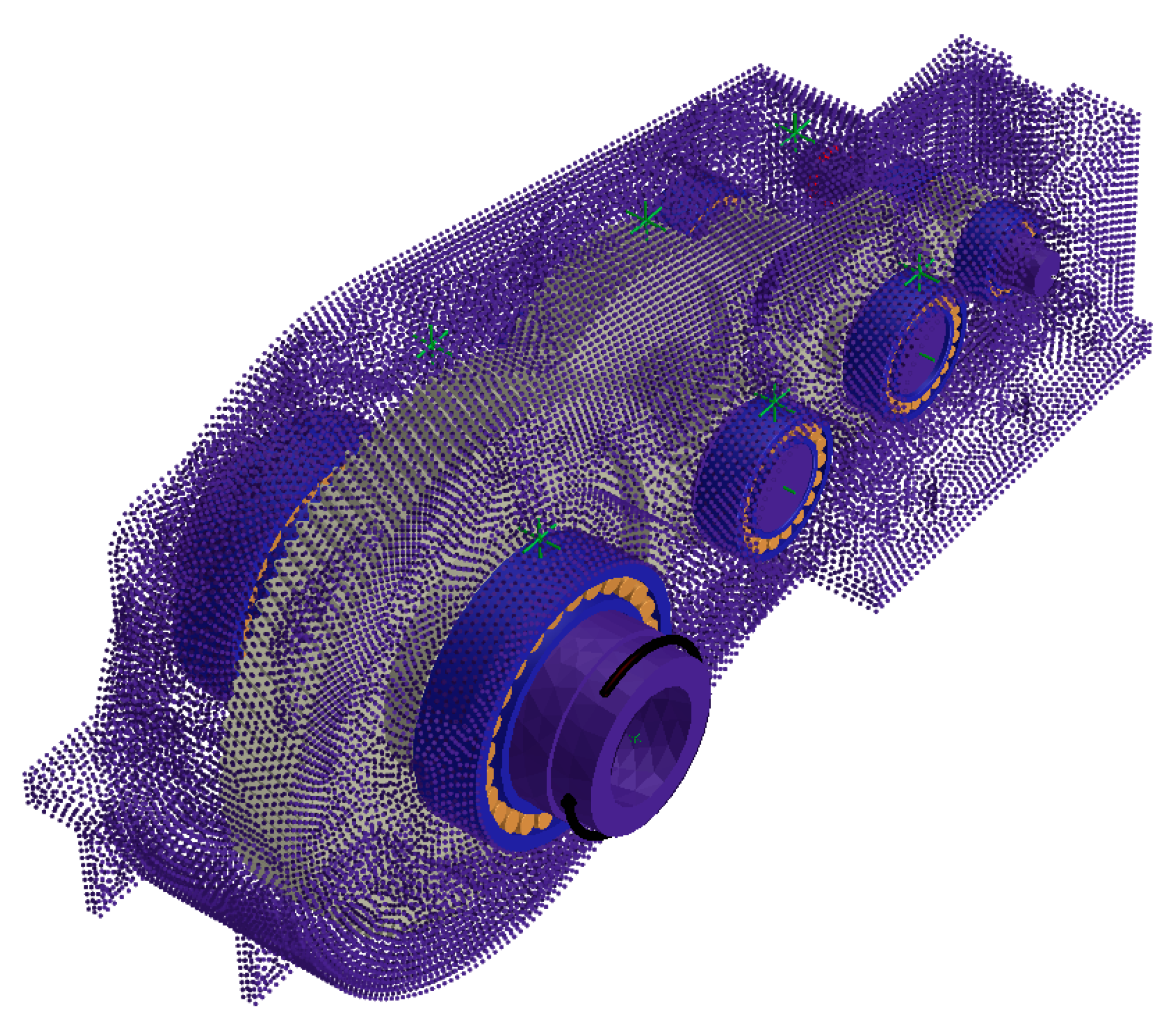
The gear reducer dynamic model is established in Romax Designer 2024 [46]. The finite element model of the casing, established in Simcenter 3D 2412, is imported into Romax Designer 2012 software and condensed to retain the main dynamic features. The gear transmission system is parameterized and modeled using Romax Designer 2024, integrating key design parameters such as gear material properties, surface roughness, precision grade, and contact geometry, as defined in Section 2.1. This approach enables high-fidelity system modeling, ensuring that the simulation results align closely with engineering designs. To accurately reflect the impact of shaft deformation on system vibration and improve simulation accuracy, the shafts are meshed in Romax Designer 2024 to create a shaft finite element model, which is then condensed to incorporate the shaft’s flexibility into the analysis. Subsequently, the condensed casing model is assembled with the transmission system model, including the shafts and gears to construct the complete gearbox dynamic model, as shown in Figure 5.
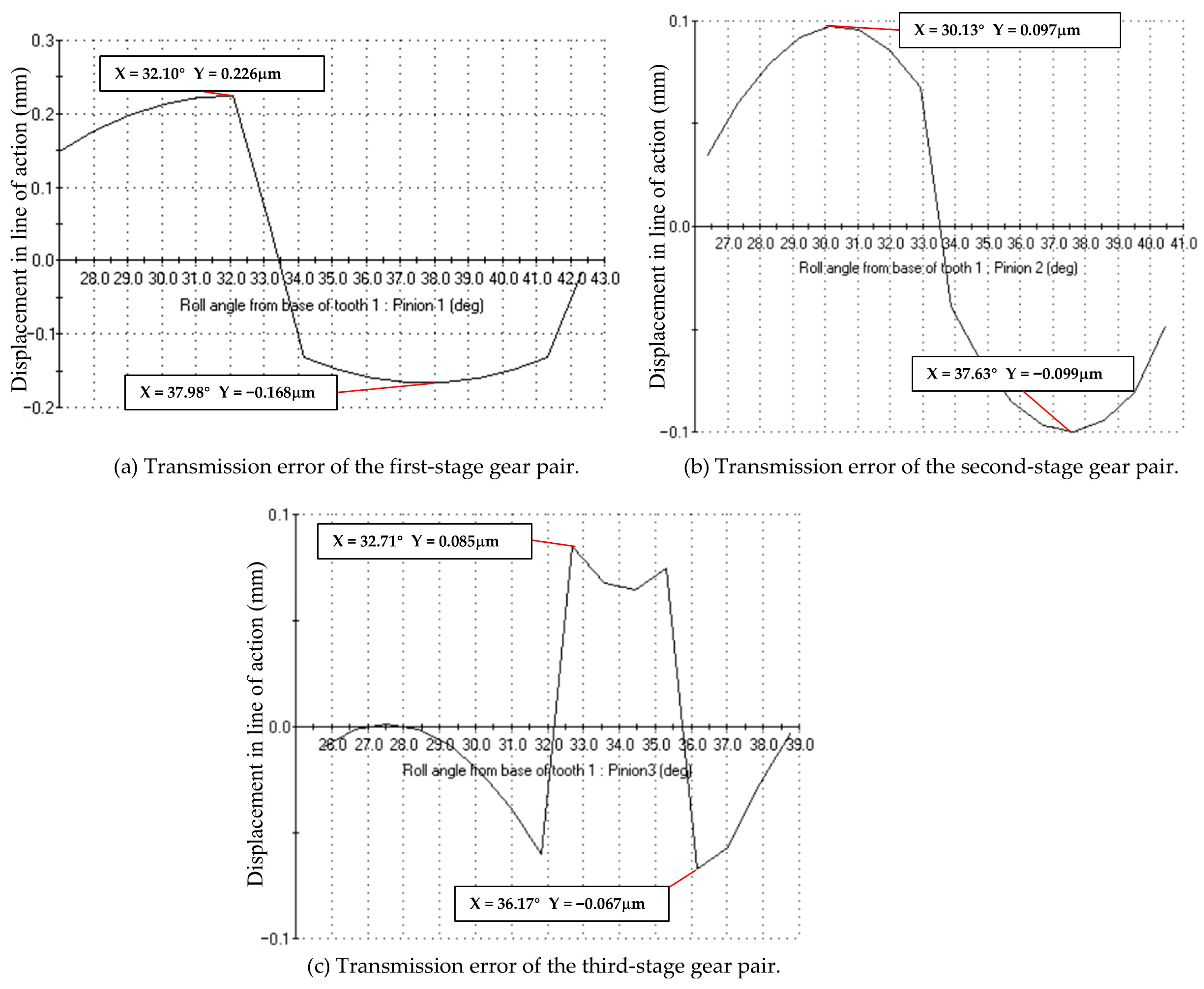
The dynamic excitation inside the gearbox is primarily characterized by gear transmission error. Based on the established dynamic model, the GBTE (Gear Box Transmission Error) analysis method in Romax Designer is used to calculate the dynamic excitation of the entire gear system under operating conditions, obtaining the fluctuation of transmission errors and the variation in meshing stiffness. The GBTE method comprehensively considers the combined effects of gear surface roughness, manufacturing precision, time-varying meshing stiffness, tooth surface errors, shaft flexibility deformation, and casing coupling stiffness on the transmission error, effectively reproducing the generation mechanism of internal dynamic excitation and providing accurate excitation input for subsequent vibration response simulations. The transmission error of the gear system in the gearbox is shown in Figure 6.
As shown in Figure 6, the transmission error of the first-stage gear pair is the largest, with a transmission error of 0.394 μm during the meshing process of a pair of teeth. The dynamic excitation of each gear pair is the result of the combined effects of the entire gear system and the casing, comprehensively reflecting the coupling effects of gear meshing, shaft system deformation, and casing flexibility. This can provide accurate excitation input for the gearbox vibration response simulation. The dynamic excitation of the three-stage gear pair (including transmission errors) calculated above is used as the excitation source, applied to the gearbox system’s dynamic model, and vibration response simulations of the casing are conducted. Based on the gear meshing dynamic excitation, harmonic response simulations are conducted on the gearbox to obtain the gearbox vibration acceleration and vibration velocity.
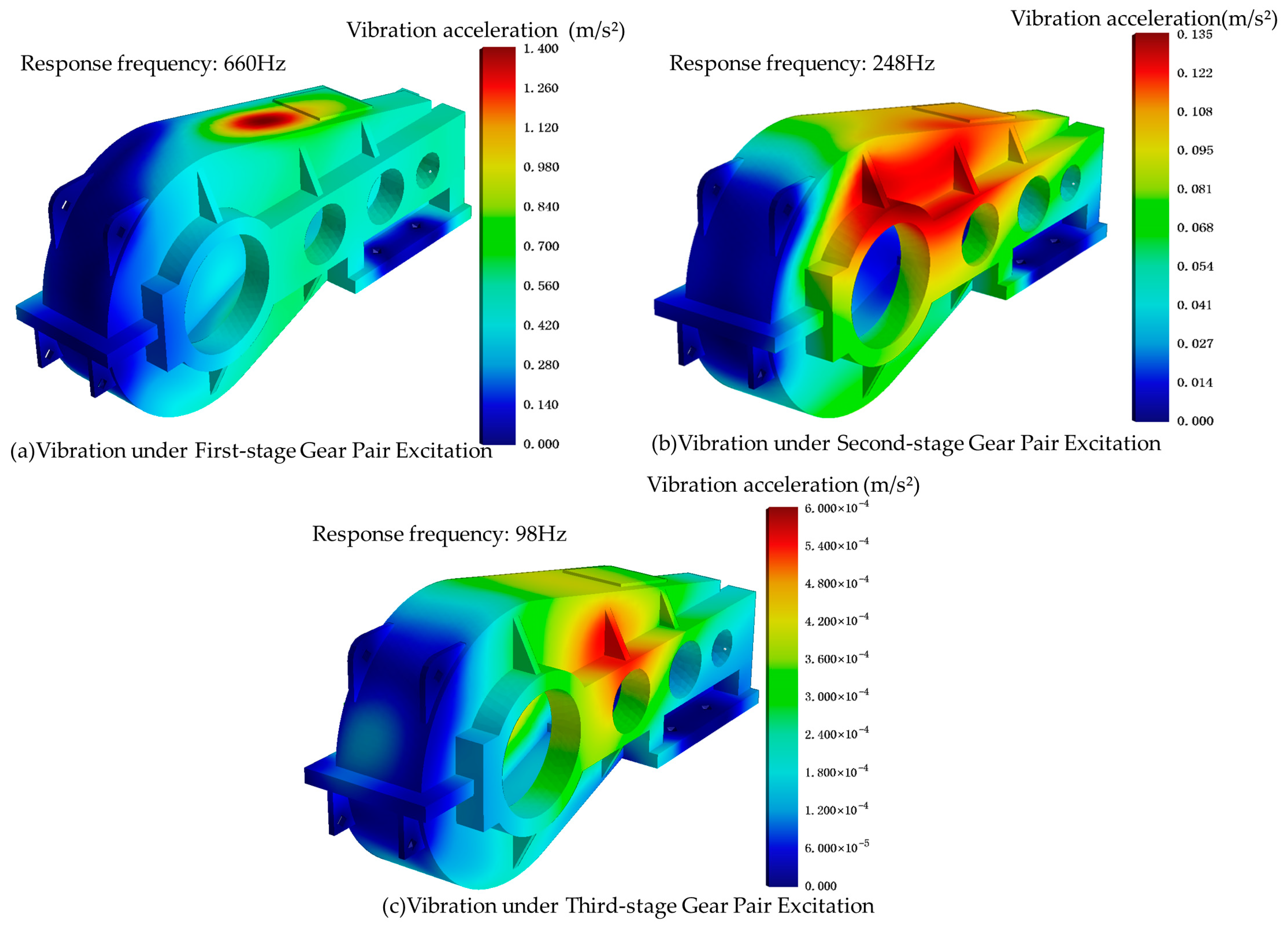
Since the meshing frequency of the first-stage gear is 660 Hz, the second-stage gear meshing frequency is 248 Hz, and the third-stage gear meshing frequency is 98 Hz, vibration acceleration contour plots are analyzed at 660 Hz under the excitation of the first-stage gear pair, at 248 Hz under the excitation of the second-stage gear pair, and at 98 Hz under the excitation of the third-stage gear pair. The vibration acceleration contour map of the casing is shown in Figure 7.
As shown in Figure 7a, under the excitation of the first-stage gear pair, the vibration acceleration in the top area of the gearbox casing is the largest, approximately 1.4 m/s2. As shown in Figure 7b, under the excitation of the second-stage gear pair, the vibration acceleration in the bearing housing area of the gearbox output shaft is relatively large, about 0.135 m/s2. As shown in Figure 7c, under the excitation of the third-stage gear pair, the vibration acceleration in the bearing housing area of the gearbox casing is the smallest, about 6.0 × 10⁻⁴ m/s2. A comparison reveals that the vibration response caused by the first-stage gear pair excitation is far greater than that caused by the second-stage and third-stage gear pairs.
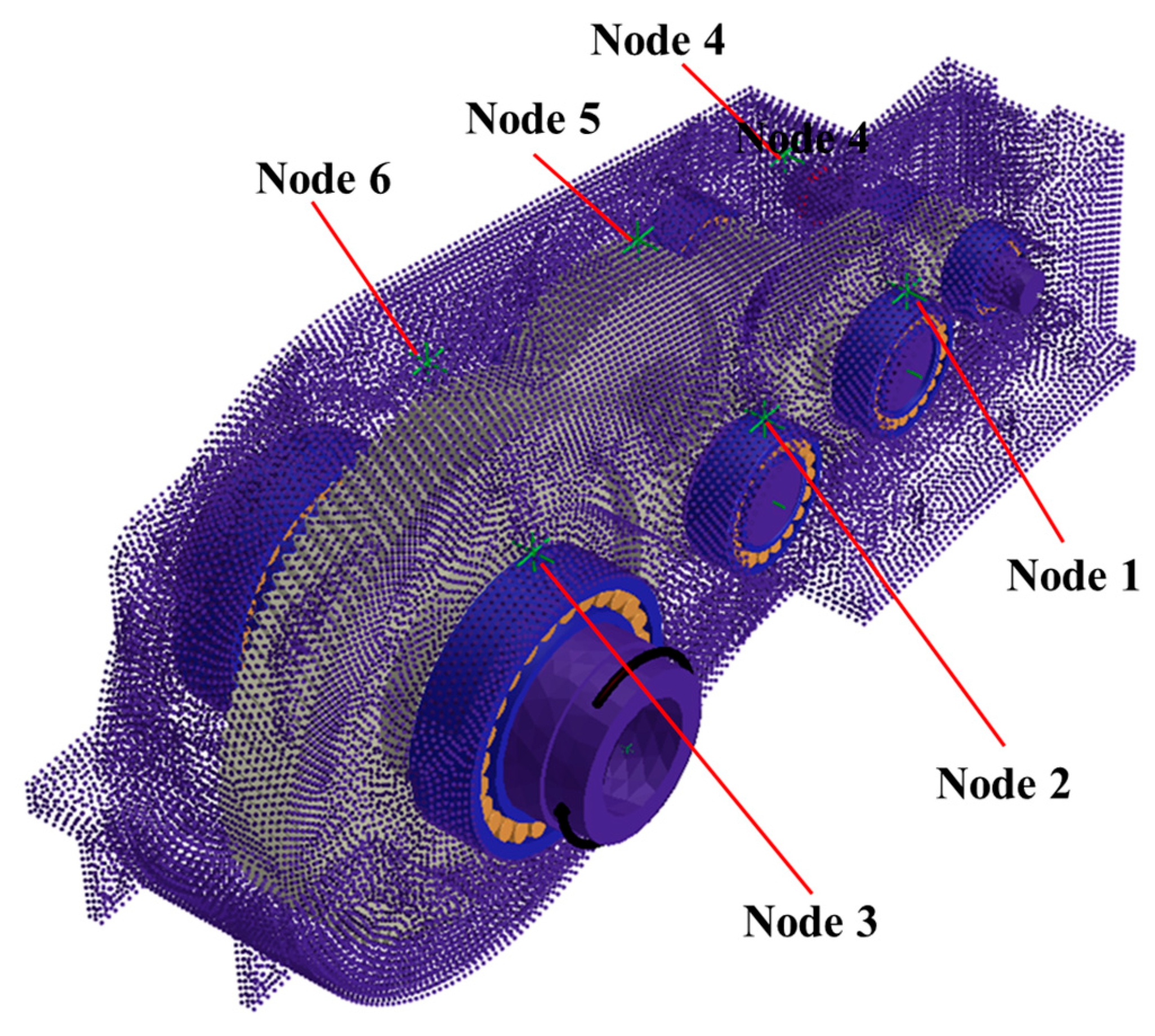
To further analyze the gearbox casing vibration response, six response nodes are set at locations with larger vibration acceleration values on the top of the casing and the bearing housing, allowing the vibration acceleration values to be obtained across the entire frequency response range. The locations of the response nodes are shown in Figure 8.
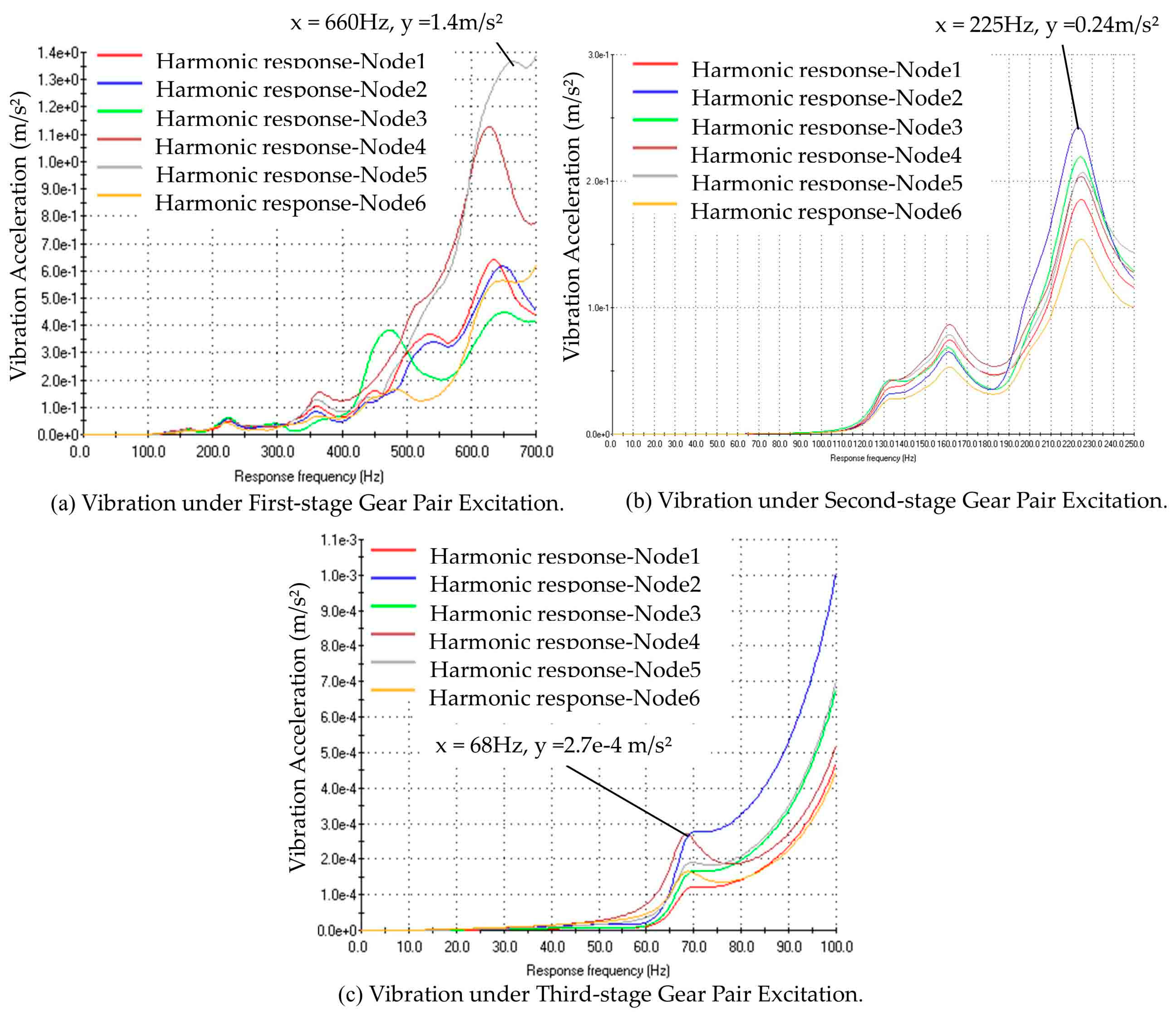
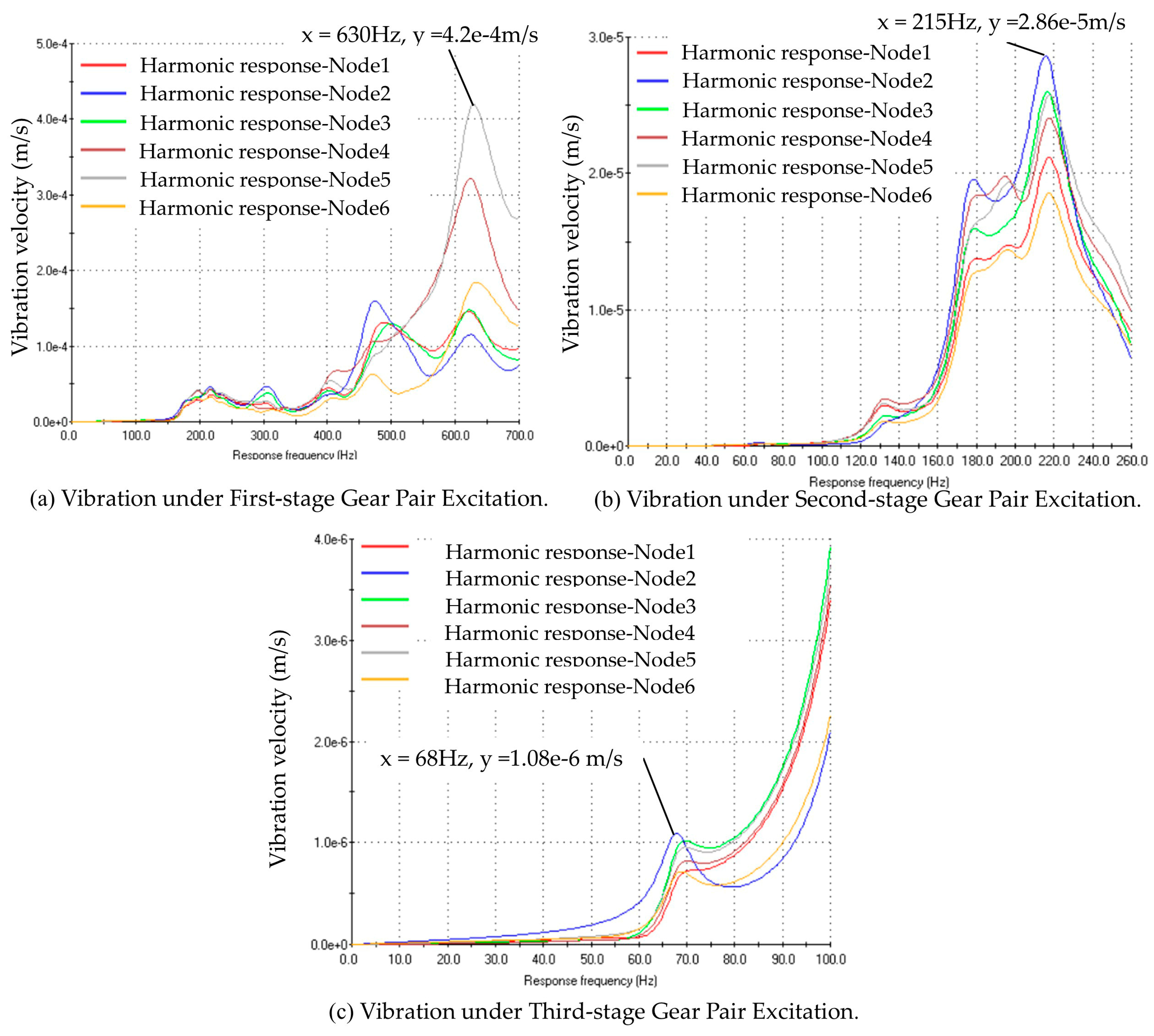
Radiated gear reducer noise is primarily driven by housing vibration excited by gear meshing forces. Therefore, Romax Designer 2024 is used to compute the meshing excitations of the three gear pairs, and the corresponding housing acceleration and vibration velocity are analyzed to quantify the stage-wise contributions to the overall vibration—and consequently to the radiated noise—as shown in Figure 9 and Figure 10.
The results in Figure 9 show that under the excitation of the first-stage gear pair, the peak frequency of the housing vibration acceleration is 660 Hz, with a peak value of 1.4 m/s2; under the excitation of the second-stage gear pair, the peak frequency is 225 Hz, with a peak value of 0.24 m/s2; and under the excitation of the third-stage gear pair, the peak frequency is 68 Hz, with a peak value of 2.7 × 10⁻⁴ m/s2.
The results in Figure 10 show that under the excitation of the first-stage gear pair, the peak frequency of the housing vibration velocity is 630 Hz, with a peak value of 4.2 × 10⁻⁴ m/s; under the excitation of the second-stage gear pair, the peak frequency is 215 Hz, with a peak value of 2.86 × 10⁻⁵ m/s; and under the excitation of the third-stage gear pair, the peak frequency is 68 Hz, with a peak value of 1.08 × 10⁻⁶ m/s.
The vibration response of the casing under the first-stage gear pair excitation is dominant, significantly higher than that of the second and third stages. This indicates that the overall casing vibration—and thus the radiated gearbox noise—is primarily driven by the first-stage meshing excitation. This trend is consistent with the fact that the first-stage pinion operates at the highest rotational speed, leading to stronger meshing excitation. Therefore, subsequent noise analysis and surrogate model dataset generation will focus on the first-stage gear pair.

3.2. Gear Reducer Noise Response Simulation

Gearbox radiated noise is excited by the vibration of the housing surface. This vibration originates from the meshing-induced dynamic excitation and is transmitted to the housing through the shaft–bearing–bearing-seat path. Based on the stage-wise vibration analysis, the housing vibration acceleration responses associated with the first-stage gear pair are taken as the dominant structural input and mapped onto the vibro–acoustic coupling boundary (i.e., the outer surface of the housing). The mapped vibration data are then used in ACTRAN 2020 to perform acoustic radiation analysis, and sound pressure levels (SPLs) at six evaluation points are obtained to characterize the gearbox noise radiation.
The modeling and solution procedure is summarized as follows.
(1) First, the BDF format structural mesh model generated by Romax Designer 2024 was imported into ACTRAN 2020 software. The “Fill Holes” function was used to seal the bearing and bolt holes of the gearbox housing, ensuring geometric continuity.
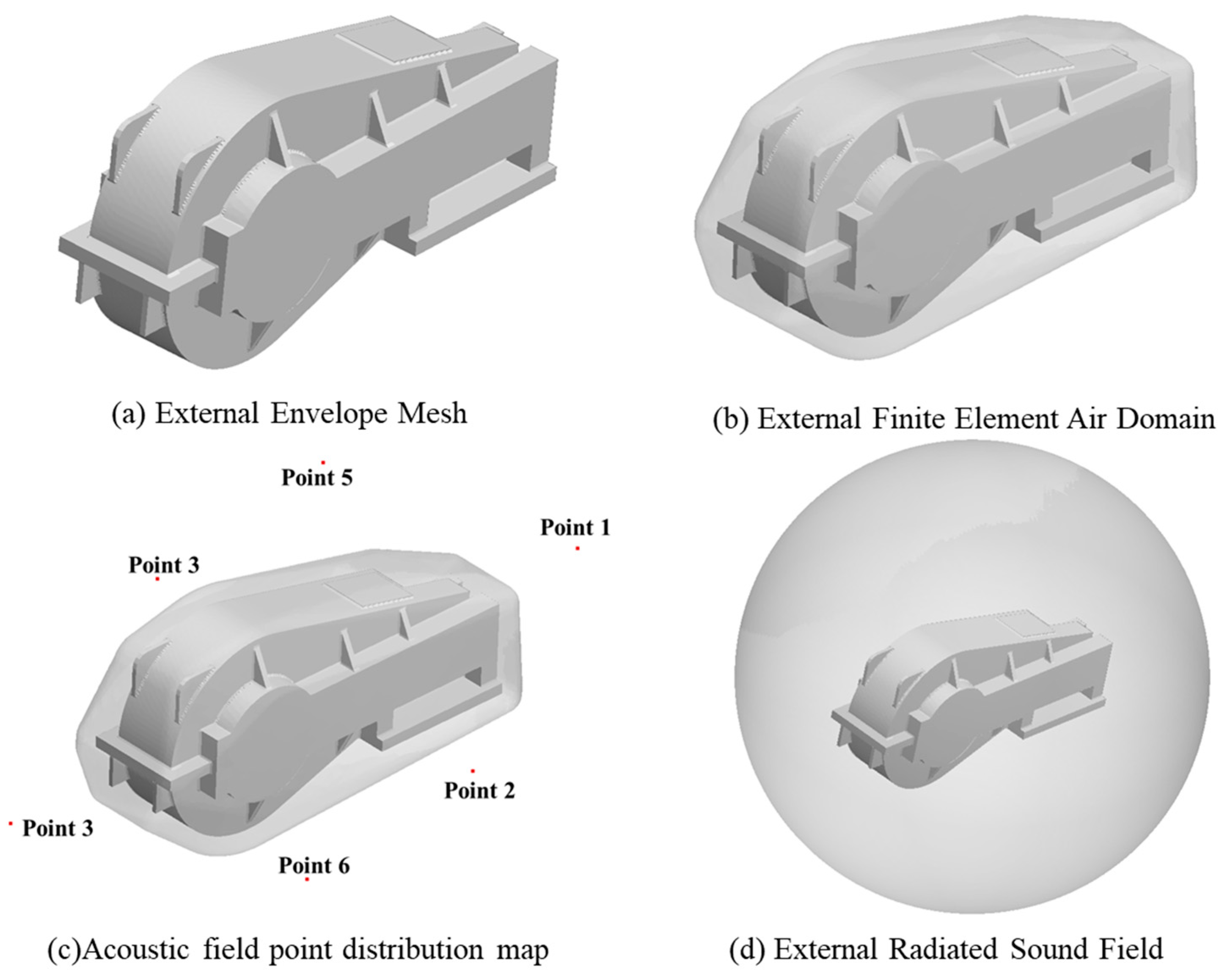
(2) Subsequently, the “Exterior Shrinkwrap” function was applied to generate the external envelope mesh of the housing, coupling it with the structural mesh. Considering the large size of the housing and the need to ensure mesh quality in the 90° corner regions for improved computational accuracy, the basic element size of the envelope acoustic mesh was set to 10 mm, as shown in Figure 11a.
(3) Based on this external envelope mesh, the Acoustic Envelope technique was used to generate the external finite element air domain for the housing. To improve simulation accuracy, the acoustic mesh size for the air domain was set to 20 mm and the volume thickness was defined as 140 mm to better capture the near-field effects, as shown in Figure 11b.
(4) To evaluate the radiated noise from the housing, six microphone monitoring points were placed 1 m away from the gearbox surface to extract the radiated sound pressure responses and calculate the Sound Pressure Level (SPL) metrics, as shown in Figure 11c.
(5) Additionally, to visually display the spatial distribution of the radiated sound field outside the housing, a spherical 2D radiation field was established, as shown in Figure 11d.
In the solution setup, a direct frequency response analysis was conducted. The vibration excitation boundary conditions were provided by the OP2 format results file generated by Romax Designer 2024, which contains the vibration response data from the housing surface. The external radiation medium of the gearbox is air. The frequency analysis range was from 0 to 700 Hz, with a solution step size of 10 Hz.
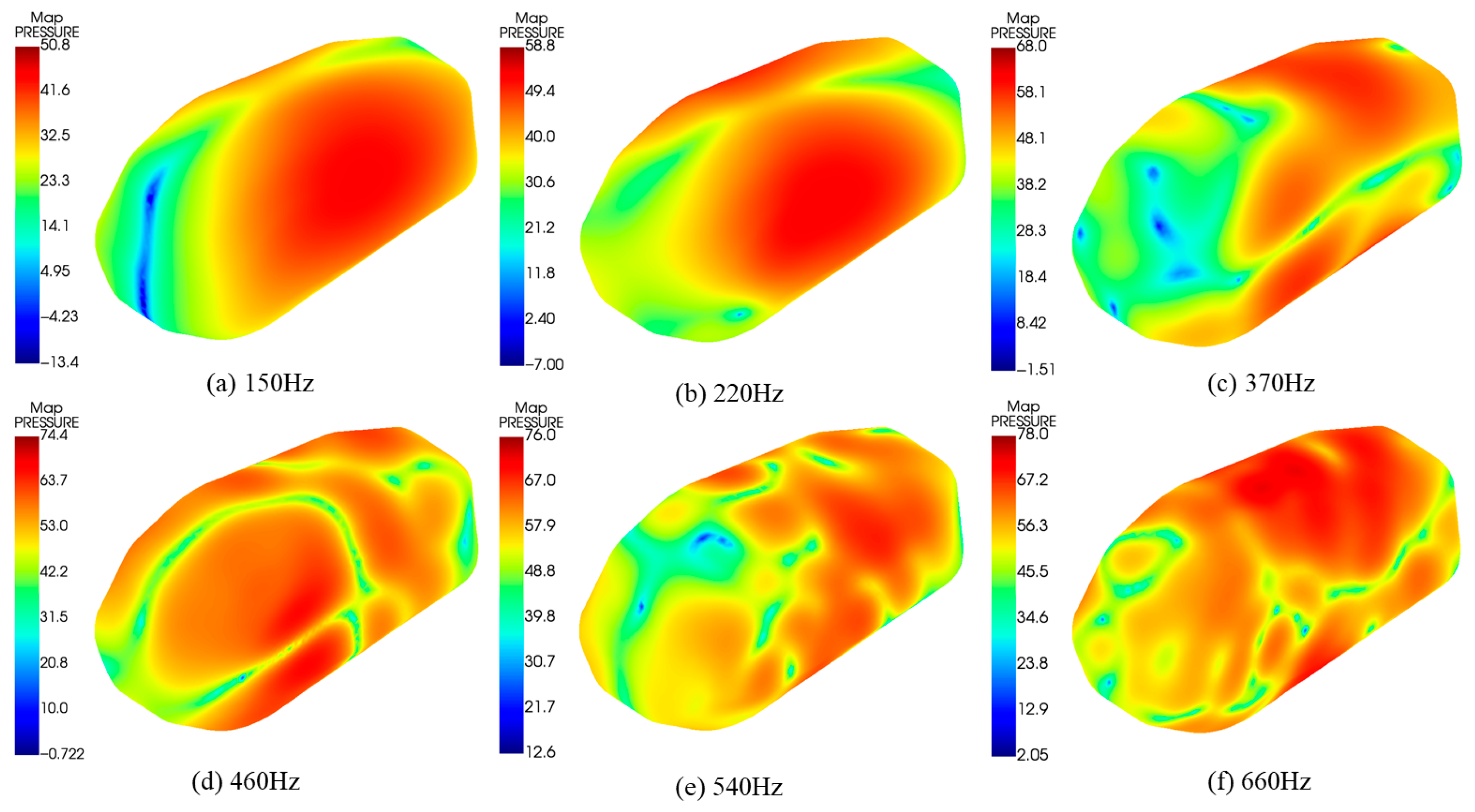
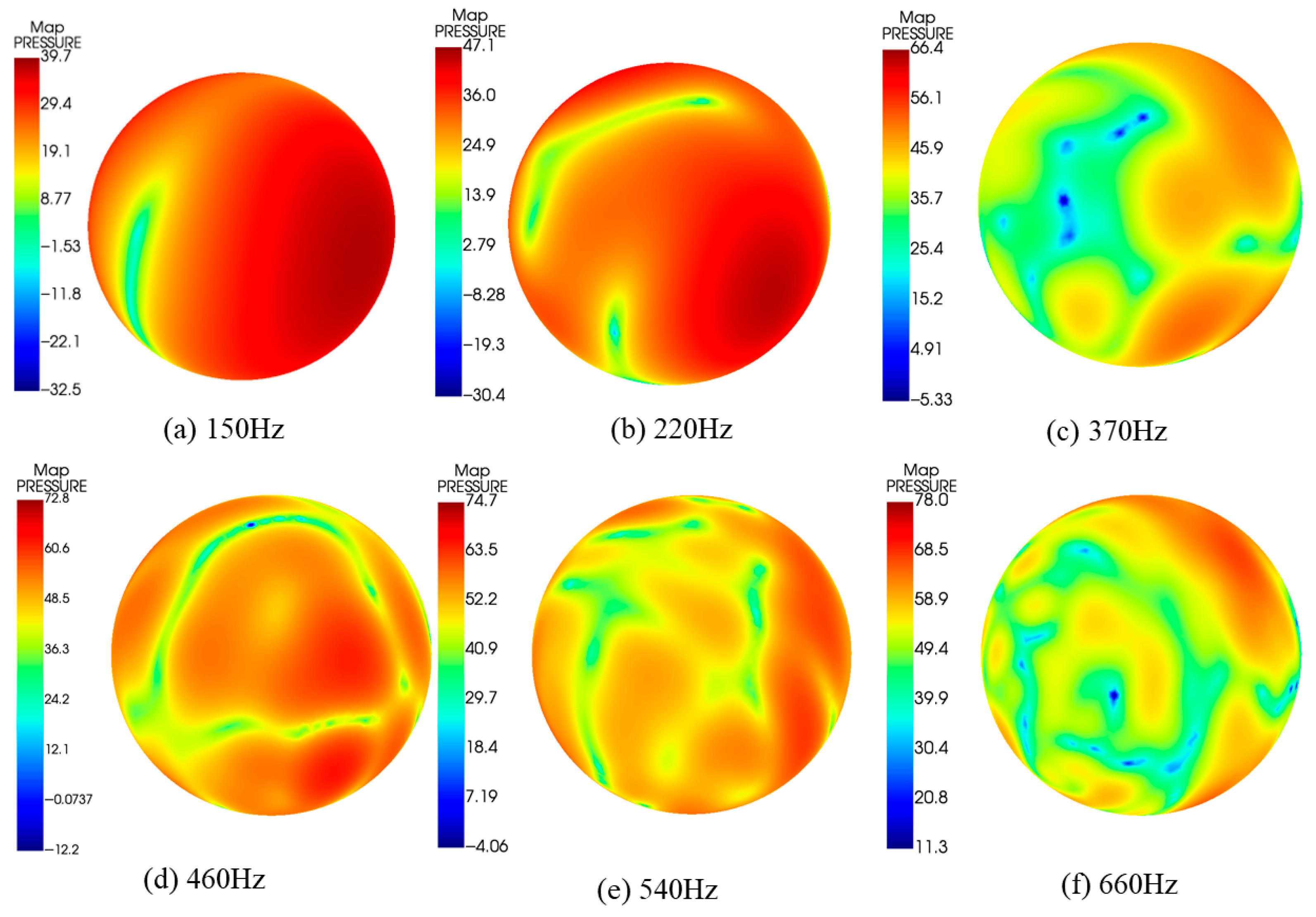
From the vibration response curve under the excitation of the first-stage gear pair in Figure 10a, it can be seen that peaks occur near the frequencies of 150 Hz, 220 Hz, 370 Hz, 460 Hz, 540 Hz, and 660 Hz. Therefore, sound field maps at these six characteristic frequencies were extracted from the acoustic simulation results. The sound pressure distribution in the external air domain, obtained using the finite element method, is shown in Figure 12, while the far-field radiated sound pressure distribution, obtained using the boundary element method (via extrapolation of the field point mesh), is shown in Figure 13. In the sound field map, the unit of the values is dB, with the sound pressure level in decibels referenced to 20 μPa.
As shown in Figure 12 and Figure 13, at 150 Hz and 220 Hz, the gearbox radiated noise is mainly concentrated on both sides of the bearing seat. At 370 Hz, the radiated noise is primarily concentrated on the top and bottom sides of the gearbox. At 460 Hz and 540 Hz, the radiated noise is more evenly distributed. At 660 Hz, the gearbox noise is at its highest, with the radiated noise concentrated on the top side, which corresponds to the vibration acceleration of the housing being concentrated at the top, as shown in Figure 7a.
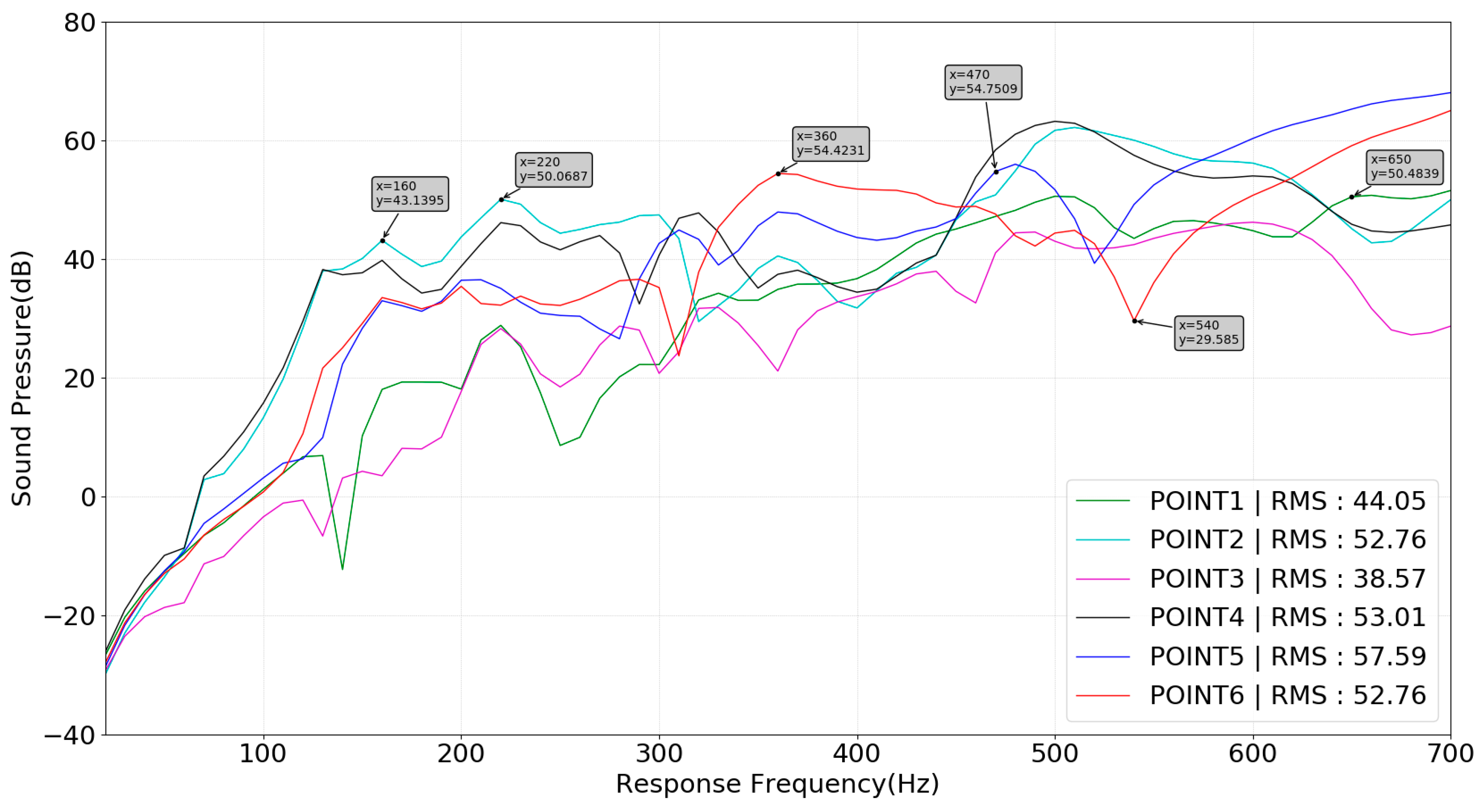
To analyze the radiated noise sound pressure values of the gearbox in different directions more specifically, the radiated noise response function curves at the six field points in Figure 10c were calculated, and the results are shown in Figure 14. The horizontal axis represents frequency in Hz and the vertical axis represents the linear value in dB, with the sound pressure level in decibels referenced to 20 μPa. Sound magnitude can be characterized using sound pressure and sound pressure level (SPL) metrics, among which RMS SPL provides a robust measure of overall noise energy with good stability, making it suitable for engineering evaluation. Therefore, in this study, the RMS SPL at the six evaluation points is adopted as the noise indicator, and the corresponding acoustic simulation results are presented in Figure 14.
As shown in Figure 14, the noise is primarily broadband, with its magnitude distributed relatively evenly across the frequency range. The broadband noise radiated by the gearbox housing is mainly caused by dynamic excitation during the gear meshing process. Key factors include time-varying meshing stiffness, tooth surface errors, and surface roughness. Microscopic protrusions and depressions on the gear surface cause random impacts and friction during meshing, leading to the generation of transmission errors, which in turn produce broadband excitation forces with a continuous spectrum, subsequently exciting the housing structure to generate broadband noise. Since the gear micro-geometry parameters directly influence these key factors, the next step will be to establish a surrogate model for the micro-geometry parameters of the first-stage pinion to predict the gearbox noise under different micro-geometry conditions.

3.3. Training Samples Generation

To develop a simulation-driven gear reducer noise surrogate model for fast and accurate evaluation under different gear micro-modification settings, a representative and well-distributed training dataset is required. Since the first-stage gear pair dominates the housing vibration and radiated noise, the sampling is focused on the micro-modification parameters of Pinion 1. The feasible ranges of tooth drum, tooth slope, and tooth profile modifications are determined using empirical design formulas.
(1) Maximum tooth profile modification
According to the tooth profile modification calculation method in ISO 6336-1 [47] standard, the method uses Formulas (2) and (3). The modification formula is derived by merging reference empirical data.
C a = 0.25 B × 10 3 + 0.5 f g
f g = A ( 0.1 B + 10 )
where C a is the tooth profile modification (µm); B represents the tooth width (mm); f g indicates the tooth profile error determined by precision (µm); A represents the coefficient determined by the precision grade, with a value of 1.8 at grade 5.
Based on the calculation, the maximum tooth drum modification for the first-stage pinion is 21.5 µm.
The tooth profile modification is influenced by the elastic deformation of the gears during operation, as well as the base pitch deviations caused by installation and manufacturing, and the temperature difference between meshing gear pairs. The maximum modification is given by:
Δ max = δ + δ θ + δ m
where δ is the elastic deformation of the gear under load, δ θ is the deformation caused by the temperature difference during gear transmission, δ m is the base pitch deviation caused by installation and manufacturing.
According to GB/Z6413.1-2003 [48], the elastic deformation of the gear under load is:
δ = K A K m p F t b cos α t C γ
where K A is the load coefficient, K m p is the load distribution unevenness coefficient, F t is the tangential force (N), b is the tooth width (mm), α t is the end face pressure angle, C γ is the meshing stiffness, and both K A and K m p are taken as 1.
The tangential force in gear transmission is:
F t = 2000 T d
where d is the pitch circle diameter of the gear (mm) and T is the rated torque (N·m).
The deformation caused by temperature differences during gear transmission is:
δ θ = π m n cos α t Δ θ γ × 10 3
where Δ θ is the temperature difference between meshing gear pairs, taken as 10 °C and γ is the linear expansion coefficient, taken as 12 × 10 6   1 / ° C .
The actual data found in Romax Designer 2024 software shows that the torque for the first-stage pinion during operation is 2058.4 Nm, the pitch circle diameter is 187.3 mm, the meshing stiffness is 54.03 N/(mm·µm), and the base pitch deviation caused by installation and manufacturing is 15.85 µm. After calculation, the maximum tooth profile modification for the first-stage pinion is 22.95 µm.
In summary, the maximum modification values for the tooth drum modification, tooth profile modification, and tooth profile modification of the pinion are shown in Table 6.
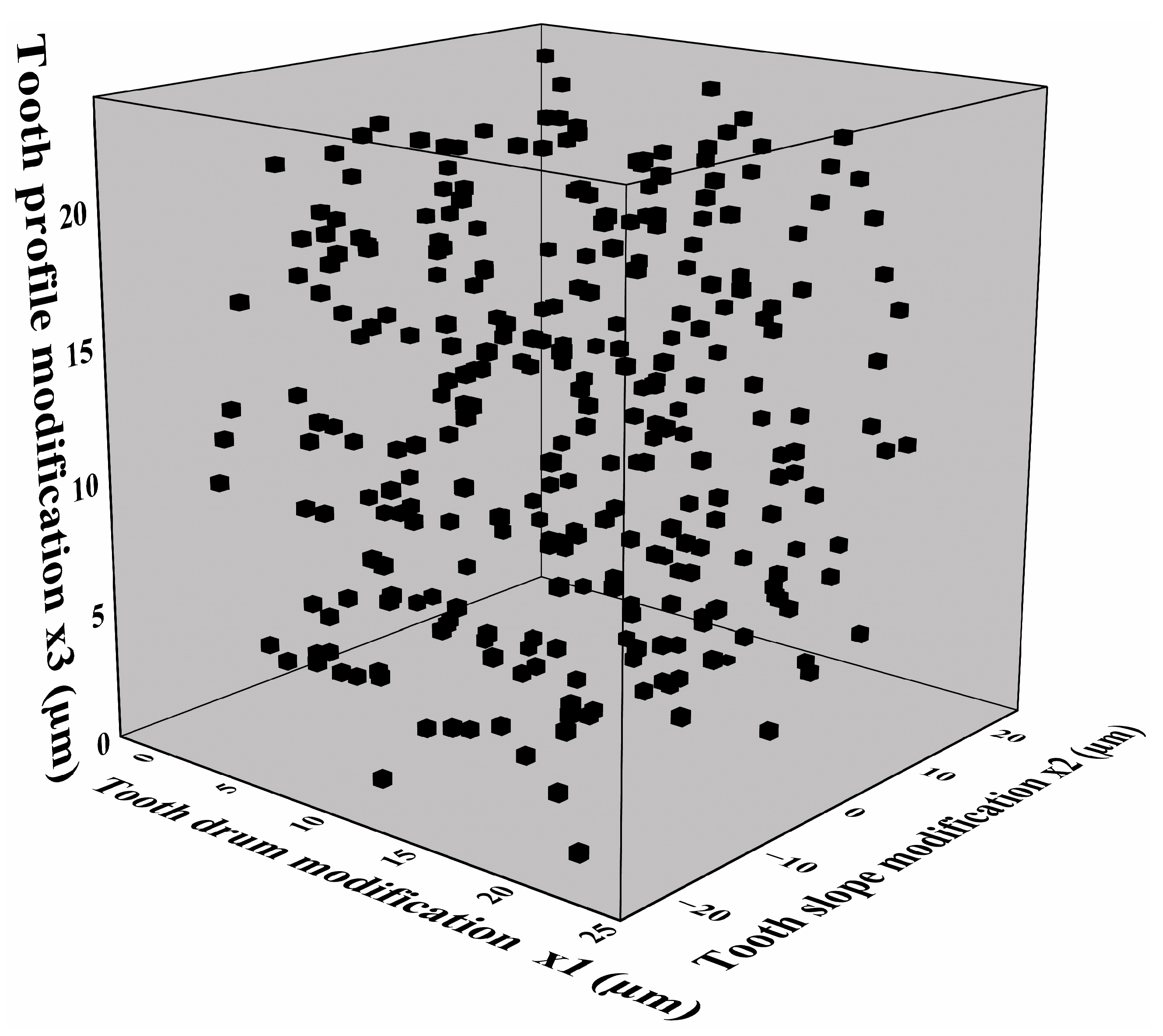
Optimal Latin Hypercube Sampling (OLHS) is employed to generate 300 training designs by sampling the three micro-modification parameters of the first-stage pinion (Pinion1). As illustrated in Figure 14, the samples are uniformly spread across the three-dimensional parameter space—tooth drum modification (x1), tooth slope modification (x2), and tooth profile modification (x3)—ensuring good space-filling coverage for surrogate-model training.
The 300 gear modification samples generated in Figure 15 are used as input parameters for the noise surrogate model. First, the micro-geometry module in Romax Designer 2024 is utilized to perform micro-modification on the first-stage pinion (Pinion 1) and obtain the corresponding gear dynamic excitation for each set of modification parameters. Then, this dynamic excitation is applied to the gearbox dynamic model, and harmonic response simulations are conducted to obtain the vibration response data on the casing surface. Finally, the vibration response data is imported into ACTRAN 2020 software for acoustic simulation, where the RMS values of the sound pressure at six field points in the acoustic model (see Figure 11c) are extracted, and their average value is used as the output of the noise surrogate model. Through the above simulation process, a total of 300 sample data sets were obtained, forming the training set as shown in Table 7.
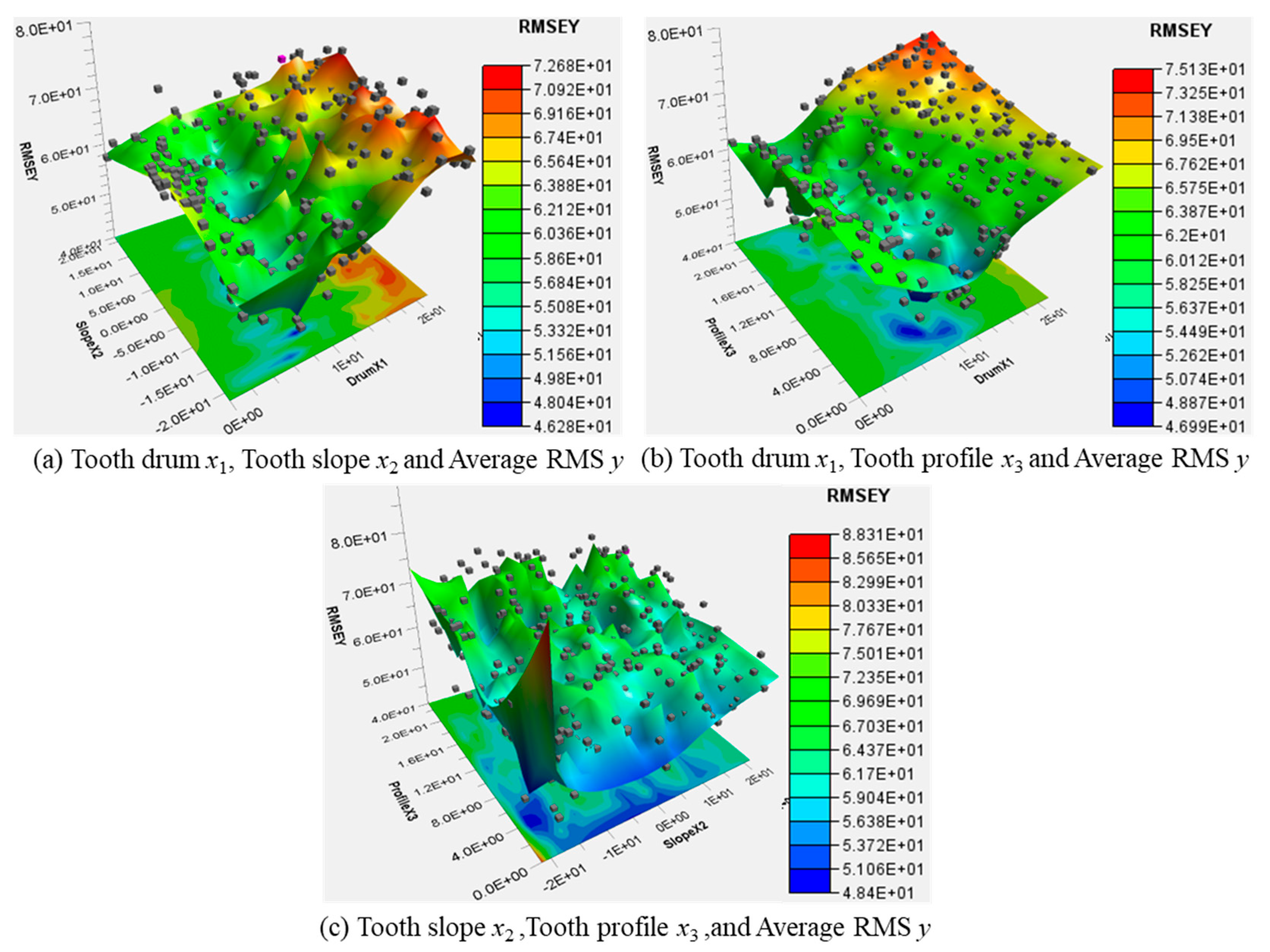
A sensitivity analysis is performed to quantify the influence of the three gear micro-modification inputs (x1: tooth drum, x2: tooth slope, and x3: tooth profile) on the model output, defined as the average RMS sound pressure level across six evaluation points (y). The resulting sensitivity/response surfaces are shown in Figure 16.
The response surfaces in Figure 16 suggest higher noise levels near (x1, x2, x3) ≈ (18, 18, 20) μm, while lower noise levels occur near (x1, x2, x3) ≈ (8, −9, 2) μm. These observations further support using the first-stage pinion micro-modification parameters as the core inputs for surrogate-model training in this study, thereby enabling parameter evaluation and design decision-making within the product development workflow.

4. Gear Reducer Noise Surrogate Model

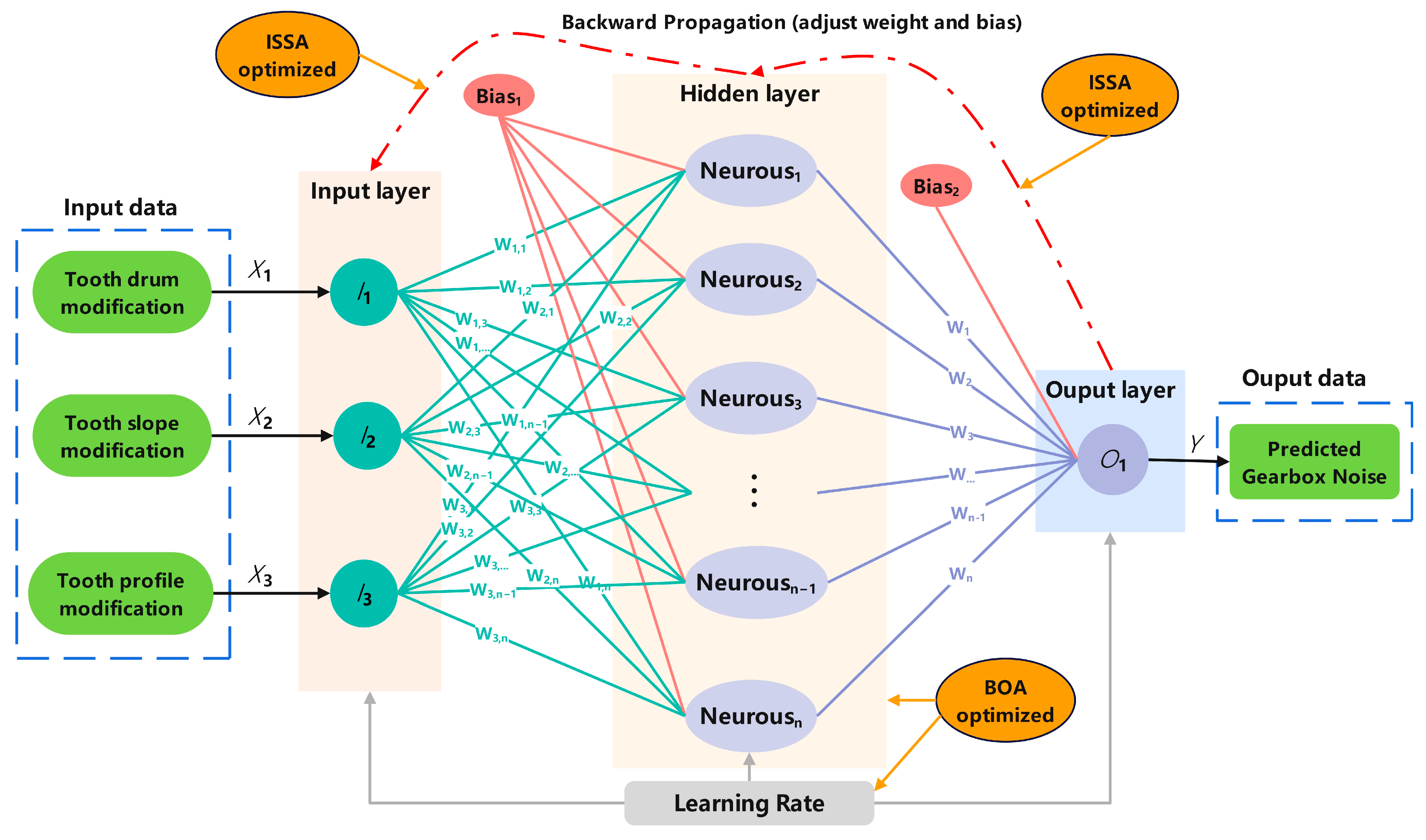
This section develops the proposed BOA-ISSA-BPNN noise surrogate model (Figure 17) to enable fast noise evaluation within the simulation-driven workflow. The model takes the first-stage pinion (Pinion 1) micro-modification variables as inputs—x1 (tooth drum), x2 (tooth slope), and x3 (tooth profile)—which govern meshing excitation and the resulting housing vibration and radiated noise. The output y is defined as the gear reducer noise metric, i.e., the average RMS sound pressure level across six evaluation points.
In Section 4.1, BOA is used to optimize the number of hidden layer nodes and learning rate of the BPNN, determining the BPNN topology. In Section 4.2, the SSA algorithm is improved to optimize the initial weights and biases of the BPNN. In Section 4.3, the BPNN is constructed using the hyperparameters optimized by BOA and ISSA, resulting in an efficient surrogate model for gearbox noise prediction.

4.1. BOA Optimizes the Hidden Layer Nodes and the Learning Rate

To improve the prediction accuracy and training robustness of the noise surrogate model while maintaining efficient convergence for engineering use, Bayesian Optimization (BOA) is employed to adaptively tune key BPNN hyperparameters, including the number of hidden-layer nodes and the learning rate. In this section, the range of the number of hidden layer nodes is [5, 25] and the range of the learning rate is [1 × 10⁻⁵, 1 × 10⁻²]. BOA models the objective function with a Gaussian Process (GP) surrogate and iteratively selects new candidates via an acquisition function that balances exploration and exploitation, yielding an optimized network configuration for subsequent surrogate-model training.

4.1.1. Gaussian Process Modeling of the Objective Function

To guide BOA in searching for an effective BPNN configuration, the test-set RMSE of the noise surrogate model is adopted as the optimization objective.
R M S E = 1 N i = 1 N ( y i y ^ i ) 2
min h , η   L val ( h , η )
where h and η are the hidden layer node count and learning rate to be optimized, yi is the actual value, ŷi is the predicted value by the BPNN, and N is the number of samples in the test set. The target error threshold set to 1 × 10⁻⁶. Through the Bayesian optimization algorithm, the hidden layer node count (h) and learning rate (η) of the BPNN are optimized to minimize RMSE.
In Bayesian optimization, a Gaussian Process (GP) is adopted as a probabilistic surrogate model to approximate the objective function at unexplored points. By encoding prior assumptions about the function and updating them with observed evaluations, the GP provides predictive mean and uncertainty estimates over the search space, thereby guiding subsequent sampling. The GP can be expressed as:
f ( h , η ) G P μ ( h , η ) , σ 2 ( h , η )
where f represents the Gaussian process model, μ represents the GP predicted mean, and σ represents the GP predicted standard deviation. The GP surrogate places a prior over the objective function and updates it to a posterior using the observed ( h , η ) RMSE evaluations, thereby providing predictive mean and uncertainty estimates for untested candidates and enabling efficient BOA-guided exploration.

4.1.2. Acquisition Function

In BOA, the next hyperparameter candidate is selected by maximizing an acquisition function. The acquisition function quantifies the expected gain over the current best solution and balances exploitation (high predicted performance) and exploration (high uncertainty) based on the GP predictive mean and variance, thereby guiding the selection of the next sampling point as follows:
E I ( h , η ) = E [ max ( f * f ( h , η ) , 0 ) ]
where f * is the currently known optimal objective function value and f ( h , η ) is the objective function value at the current parameter point h , η . E I ( h , η ) represents the expected improvement.
In Bayesian optimization, the Gaussian Process is used as the predictive model to estimate the behavior of the objective function. For the Gaussian Process model, the objective function f ( θ ) is assumed to follow a multidimensional Gaussian distribution, with a mean of μ ( θ ) and variance of σ 2 ( θ ) , satisfying the Gaussian distribution. The formula for calculating the expected improvement (EI) is as follows:
EI ( h , η ) = ( f μ ( h , η ) ) Φ ( Z ) + σ ( h , η ) ϕ ( Z )
Z = f μ ( h , η ) σ ( h , η )
where σ ( h , η ) represents the Gaussian Process surrogate-model-predicted standard deviation, Φ ( Z ) is the cumulative distribution function of the standard normal distribution, ϕ ( Z ) is the probability density function of the standard normal distribution, f is the current optimal objective function value, and Z is the difference between the predicted value at the sampling point and the current optimal value.
By calculating the expected improvement, Bayesian optimization can select the candidate points that are most likely to result in significant improvements, guiding the search process.

4.1.3. Iterative Optimization

The maximum number of BOA iterations is set to 50, and the improvement threshold for the best validation error is set to ε = 1 × 10 6 . Bayesian optimization selects the next evaluation point based on the output of the acquisition function and uses the objective function to assess the performance of that point. After the new sampling point is evaluated, the new validation error is obtained through training. The new sample point and its objective function value are added to the training dataset, and the Gaussian Process surrogate model is iteratively updated:
D t + 1 = D t { ( ( h t + 1 , η t + 1 ) , f ( ( h t + 1 , η t + 1 ) ) ) }
where D t represents the sample set at the t iteration.
As the iterations proceed, Bayesian optimization gradually updates the Gaussian surrogate model and selects new evaluation points. The iterative process continues until the stopping criteria are met. Finally, Bayesian optimization outputs the hidden layer node count and learning rate that minimize the validation error:
( h , η ) = arg min h , η L val ( h , η )
where h , η represent the final selected optimal hidden layer node count and learning rate, respectively. After optimization, the optimal BPNN configuration is obtained with 18 hidden-layer nodes and a learning rate of 0.00297.

4.2. ISSA Optimizes the Initial Weights and Biases

Although SSA performs well in many optimization problems, it still has some drawbacks, such as a low-quality initial population, a fixed ratio of discoverers to followers, and a lack of effective mechanisms to escape local optima. These issues lead to slow convergence and an increased likelihood of getting trapped in local optima. In this section, three methods are proposed to improve SSA and address its shortcomings.
According to Section 4.1, the total number of weights and bias nodes in the BPNN topology is determined to be 91. In this section, the sparrow population size is set to 50, the position of each sparrow represents a set of initial weights and biases. The discoverer ratio (PD) is 0.4, the scout ratio (SD) is set to 0.2, the maximum number of iterations is 100, and the threshold for fitness change is set to 1 × 10⁻⁶. The position matrix of the sparrows can be represented by the following equation.
X = x 1 , 1 x 1 , 2 x 1 , 91 x 2 , 1 x 2 , 2 x 2 , 91 x 50 , 1 x 50 , 2 x 50 , 91

4.2.1. Adaptive Parameter Adjustment

In the SSA, the alert value (ST), the discoverer ratio (PD), and the proportion of sparrows aware of danger (SD) are statically set, making it difficult for the algorithm to adapt its search strategy to changing requirements at different stages. ISSA introduces an adaptive parameter adjustment strategy, allowing these parameters to dynamically adjust based on the current search progress and objectives, thereby optimizing the balance between exploration and exploitation at different stages.
Dynamic Adjustment of the Alert Value (ST):
S T i = S T 0 ( 1 i i t e r max )
where S T i   W i represents the alert value at the i iteration, and S T 0 represents the initial alert value. As the iteration count i increases, S T gradually decreases, thereby reducing the randomness in the search process and enabling the algorithm to progressively focus on a smaller solution space for more refined searching.
Dynamic Adjustment of the Discoverer Ratio (PD):
P D i = P D 0 ( 1 i i t e r max / 2 )
where P D i represents the discoverer ratio at the i iteration, and P D 0 represents the initial discoverer ratio. In the early stages, a smaller discoverer ratio allows the sparrow population to conduct more exploration. As the number of iterations increases, the ratio P D increases, allowing more sparrows to take on the role of discoverers, thereby enhancing the local search capability.
Dynamic Adjustment of the Proportion of Sparrows Aware of Danger (SD):
S D i = S D 0 ( 1 i i t e r max / 2 )
where S D i represents the proportion of sparrows aware of danger at the i iteration, and S D 0 represents the initial proportion of sparrows aware of danger. As the number of iterations increases, S D gradually increases, meaning that more and more sparrows become aware of potential danger and move closer to the optimal solution, thereby accelerating the convergence process.

4.2.2. Adaptive Step Size Mechanism

In the SSA, the step size is fixed, which may cause instability when the step size is too large at certain stages of the search, or slow convergence when the step size is too small. ISSA improves upon this by introducing an adaptive step size mechanism that dynamically adjusts the step size based on the difference between the current global optimal fitness and the worst fitness. This enhances the precision of local search and helps avoid premature convergence.
The formula for calculating the adaptive step size is as follows:
L i = α ( 1 G F b e s t i F w o r s t i F b e s t i F w o r s t i + 10 8 )
where L i represents the adaptive step size at the i iteration, α is the step size adjustment coefficient which controls the flexibility of step size variation, G F b e s t i is the global optimal fitness at the i iteration, F w o r s t i is the worst fitness at the i iteration, and F b e s t i is the current optimal fitness at the i iteration. As the search approaches the optimal solution, the step size will automatically decrease, ensuring a finer search process and avoiding instability caused by too large a step size.

4.2.3. Sparrow Position Update Strategies

ISSA combines three optimization strategies to update the position of the sparrows, enhancing both global exploration and local search capabilities.
Exponential Decay for Long-distance Exploration: For discoverer sparrows, ISSA introduces an exponential decay strategy for extensive global exploration.
X n e w j = X j exp ( j rand ( 1 ) i t e r max )
where X n e w j represents the updated position of the j discoverer sparrow. This strategy performs long-distance exploration with a larger step size, thereby avoiding early convergence to local optima.
Differential Evolution Strategy: To enhance local search capability, ISSA applies a differential evolution strategy to some joiner sparrows, simulating the relative differences used in particle swarm optimization. This strategy updates the sparrows by calculating the relative positions between solutions, thereby accelerating the search for local optima.
X n e w j = X j + step i randn ( ) ( X e n d X j )
where X n e w j represents the updated position of the j joiner sparrow, and X e n d represents the position of the worst solution.
Simulated Annealing Strategy: To avoid premature convergence, ISSA introduces a simulated annealing strategy, where the temperature gradually decreases with each iteration. This ensures that the algorithm can initially explore broadly and then gradually focus on local optimization.
X n e w j = X b e s t + T i randn ( ) ( X j X b e s t )
where X b e s t represents the position of the global optimal solution, and T i is the temperature coefficient, which gradually decreases as the number of iterations increases. After ISSA optimization, the optimal initial weights and biases of the BPNN are obtained.

4.3. BOA-ISSA-BPNN Noise Surrogate Model

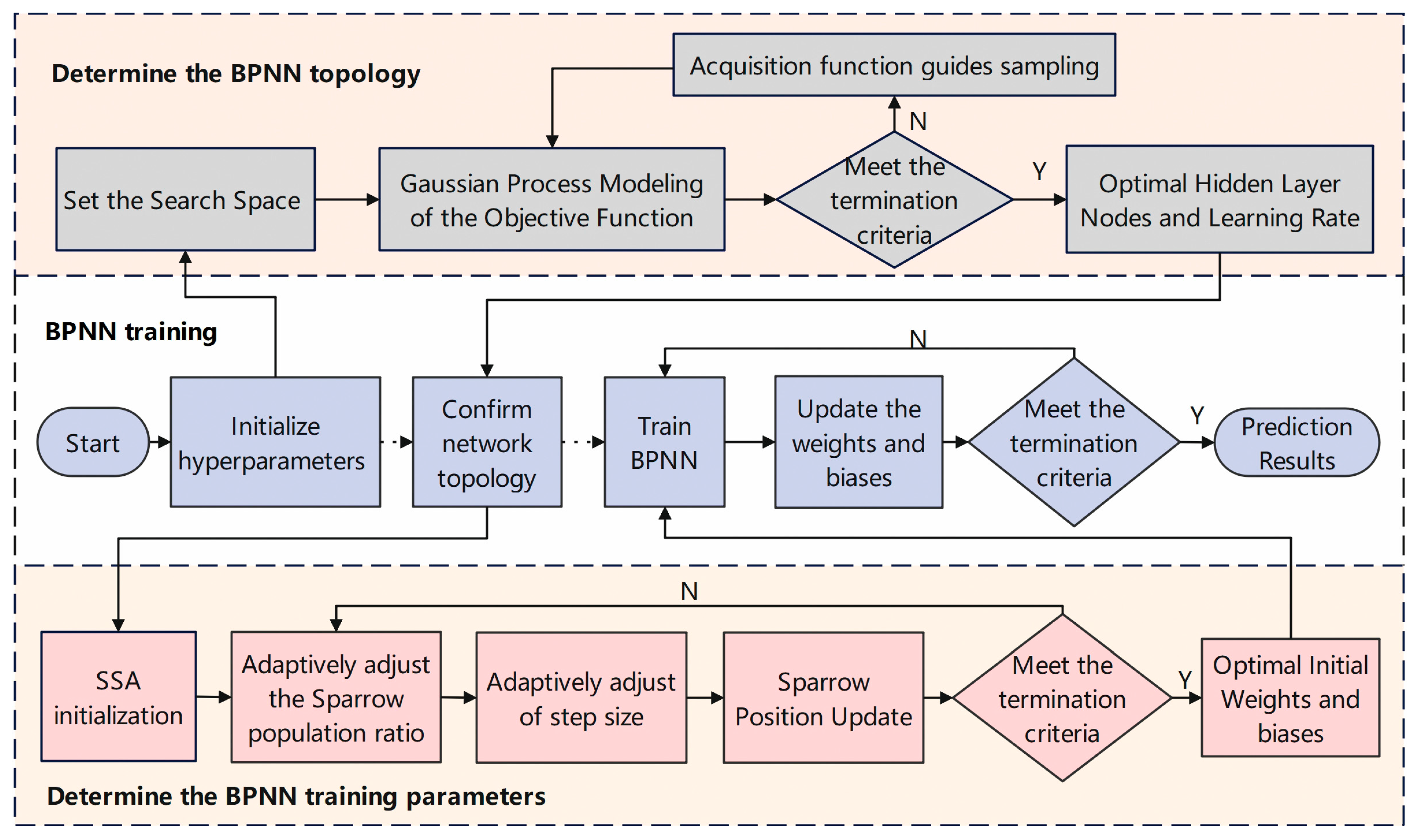
The overall workflow of the proposed BOA-ISSA-BPNN surrogate model is illustrated in Figure 18.
(1) Determine the BPNN topology. Normalize the data and initialize the hyperparameters. Subsequently, GP surrogate model is constructed to predict the objective function’s value at untested points. The acquisition function is then used to evaluate the expected improvement of the current candidate points relative to the current optimal solution, balancing the mean and variance of the predictive distribution to guide the next sampling. Finally, through iterative optimization, the optimal hidden layer nodes and learning rate are determined, thereby finalizing the BPNN topology.
(2) Determine the BPNN training parameters. ISSA is used to optimize the initial weights and biases of the BPNN. First, the sparrow population is initialized, with each sparrow position representing a set of initial weights and biases. In each iteration, ISSA dynamically adjusts several parameters, including the warning value (ST), discoverer ratio (PD), and scout ratio (SD), while also dynamically adjusting the sparrow search step size. Based on the sparrow behavior strategy, ISSA updates the position of the sparrow.
(3) BPNN training. First, construct the BPNN using the optimized number of hidden layer nodes and learning rate. Based on this, train the BPNN using the optimized initial weights and biases, and continuously update the weights and biases by minimizing the loss function, thereby improving the prediction accuracy.

5. Model Validation

5.1. Prediction Performance of the BOA-ISSA-BPNN Noise Surrogate Model

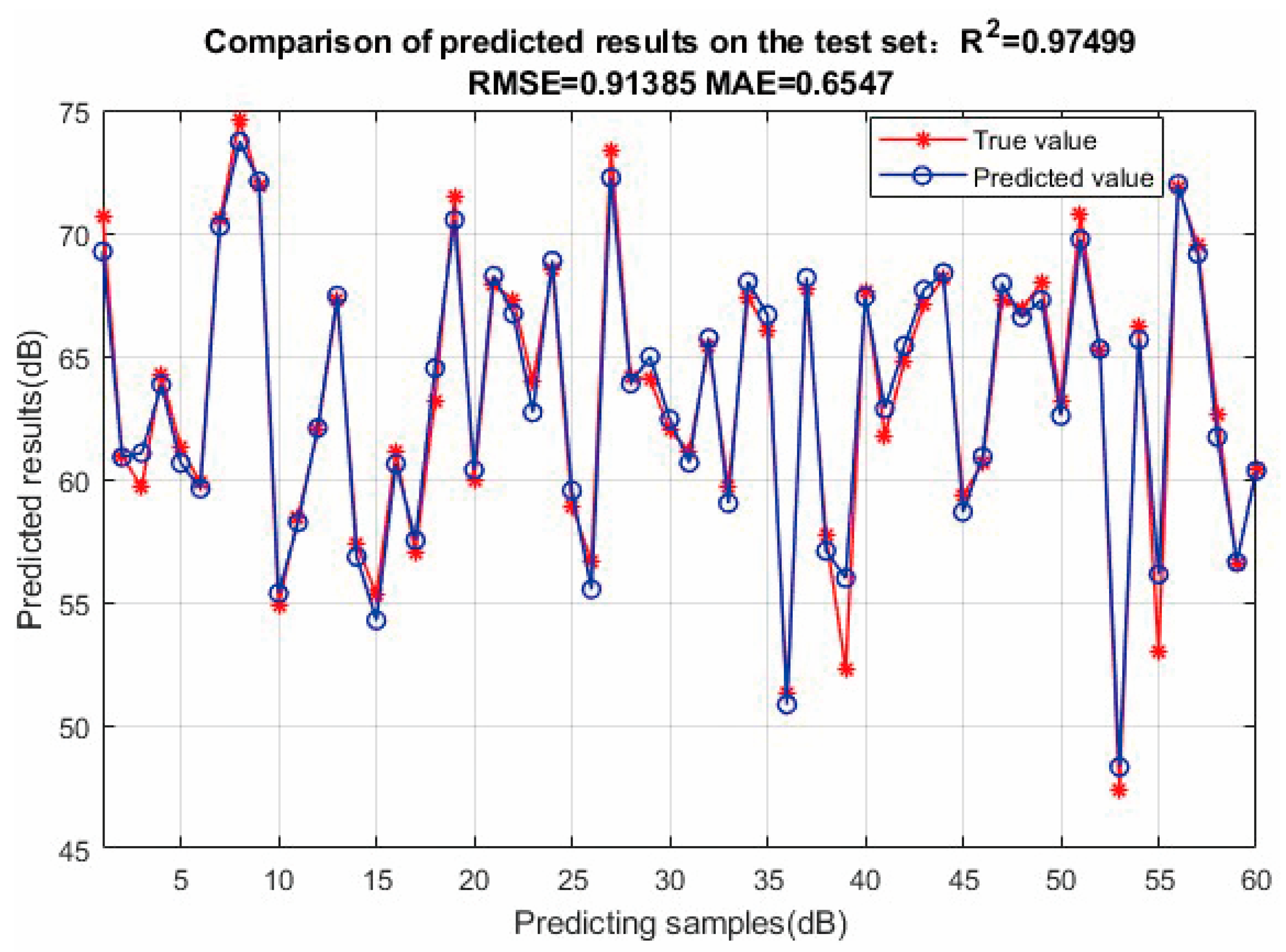
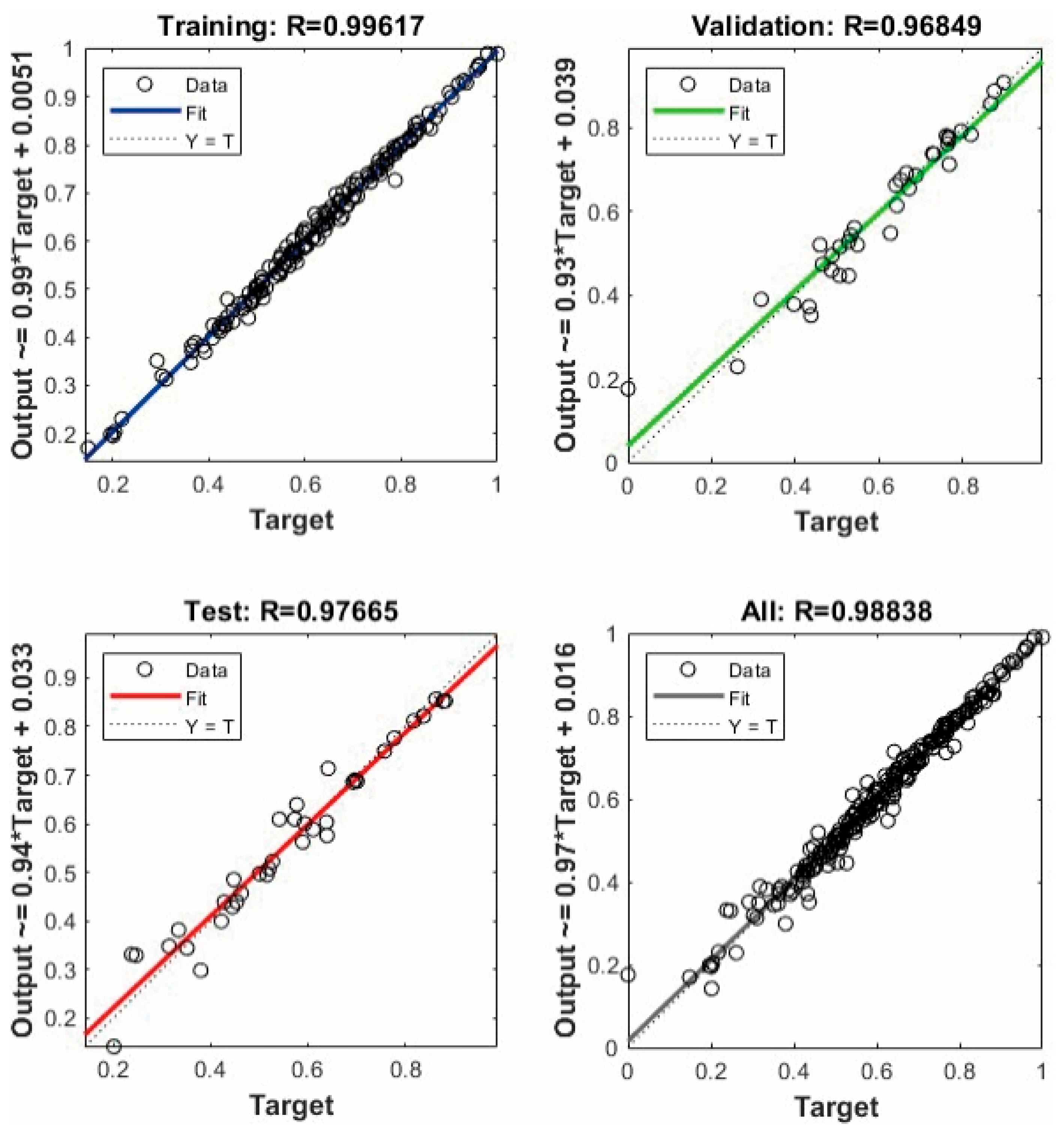
The proposed BOA-ISSA-BPNN surrogate model is implemented following the methodology described in Section 4. All computations are performed on a PC equipped with an Intel 12th Gen Intel(R) Core (TM) i7-12700H (2.30 GHz) processor and 16 GB of memory. The experimental sample consists of 300 groups, randomly divided into 240 training samples and 60 test samples. The fitted effect and linear correlation of the BOA-ISSA-BPNN on the test set are shown in Figure 19 and Figure 20.
The results in Figure 19 and Figure 20 show that the RMSE, R2, MAE and correlation coefficient of the model test set are 0.97499, 0.91385, 0.6547 and 0.97665, respectively. The correlation coefficients of the BOA-ISSA-BPNN model for the training set and the entire dataset are 0.99617 and 0.98838, respectively, indicating that the model not only has good fitting ability but also excellent generalization ability.

5.2. Comparison with Other Surrogate Models

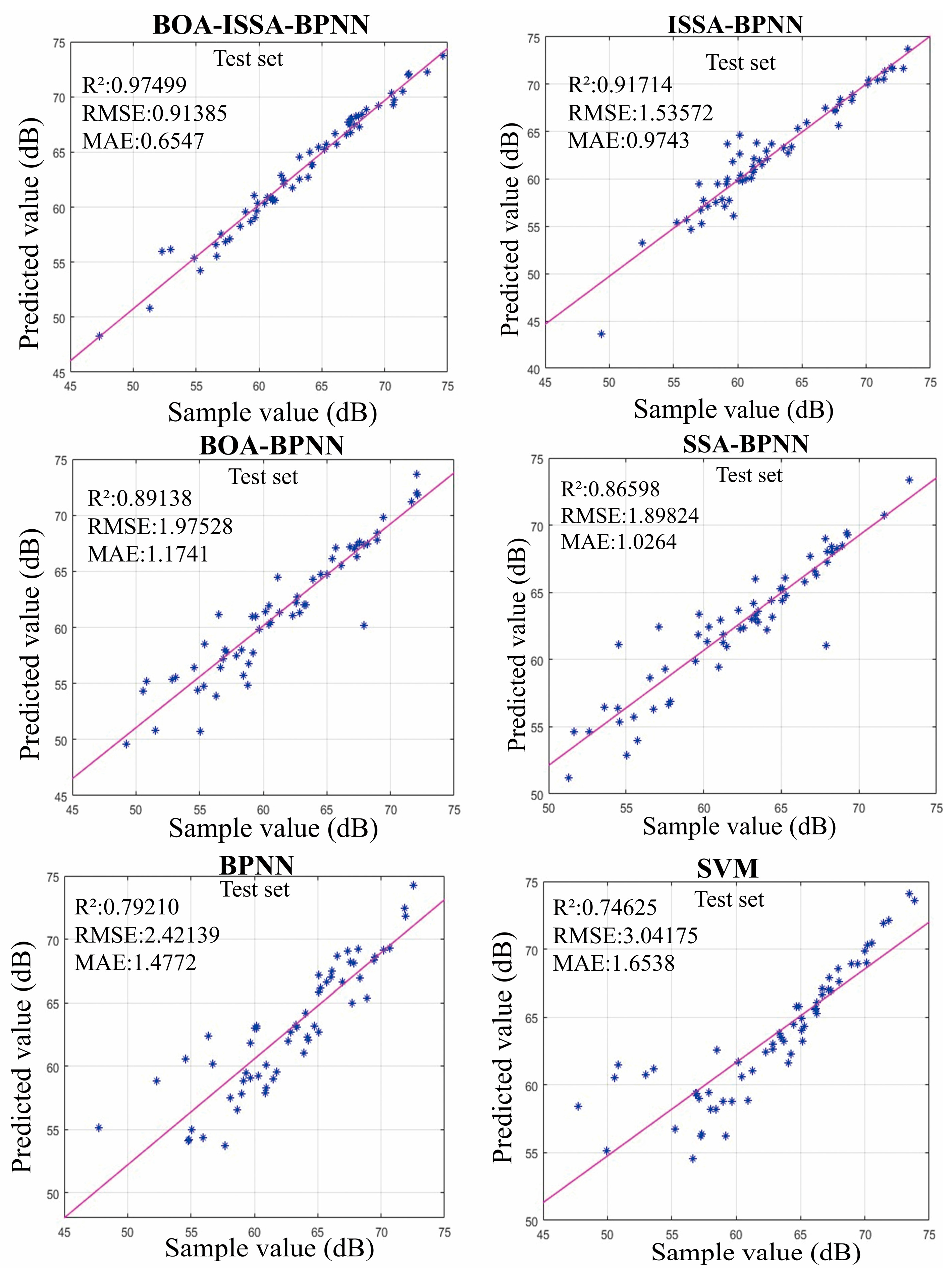
To further verify the performance of the BOA-ISSA-BPNN model, the noise prediction results of the BOA-ISSA-BPNN model are compared with those of SVM, BPNN, BOA-BPNN, SSA-BPNN, and ISSA-BPNN models. SVM model is a supervised learning model that aims to construct an optimal decision boundary to separate data points of different classes, widely used for prediction tasks. The Fitted plots of predicted and actual values for different models are shown in Figure 21 and the prediction results of each model are shown in Table 8.
The R2 values of the six models are in descending order of BOA-ISSA-BPNN > ISSA-BPNN > BOA-BPNN > SSA-BPNN > BPNN > SVM. The BOA-ISSA-BPNN model obtained the best result. The running time of the BOA-ISSA-BPNN is 32.35 s, which is lower than that of ISSA-BPNN, SSA-BPNN, and BOA-BPNN. In Section 3, a single noise evaluation based on the high-fidelity vibro-acoustic simulation chain requires more than 2 h of computation; in contrast, the proposed BOA-ISSA-BPNN surrogate completes a prediction within tens of seconds, demonstrating a clear advantage in computational efficiency. Figure 20 illustrates the fitted effect between the predicted and sample values for each model in the test set. It can be clearly observed that the BOA-ISSA-BPNN model outperforms the other models in terms of fitting accuracy, and the sample points are more concentrated around the baseline. This indicates that the optimization of hidden layer nodes and learning rates through BOA, along with the optimization of initial weights and biases via ISSA, significantly improved the prediction accuracy and stability of the BPNN model.

6. Conclusions

To enable fast and reliable gearbox-noise evaluation in gear-reducer engineering workflows, this study proposes a BOA-ISSA-BPNN noise surrogate modeling framework for a three-stage helical gear reducer. A high-fidelity vibro-acoustic simulation chain is established, where housing vibration responses computed in Romax Designer are transferred to ACTRAN to obtain radiated noise. A simulation-driven dataset (300 OLHS samples) is constructed, and the mean RMS SPL across six field points is used as the noise metric.
A BPNN surrogate is then developed and enhanced through a two-level optimization strategy. BOA is applied to tune the hidden-layer size and learning rate, while the improved SSA (ISSA) optimizes the initial weights and biases, improving convergence stability and reducing the risk of being trapped in local optima.
On the test set, the proposed BOA-ISSA-BPNN achieve R2 = 0.97499, RMSE = 0.91385, MAE = 0.6547, and R = 0.97655, yielding the best overall accuracy among SVM, BPNN, BOA-BPNN, SSA-BPNN, and ISSA-BPNN. Relative to BPNN/BOA-BPNN/ISSA-BPNN, RMSE is reduced by 62.26%/53.73%/44.49%, MAE by 55.68%/44.24%/32.80%, and R2 increases by 23.09%/9.38%/4.5%, respectively. In terms of efficiency, a single high-fidelity noise evaluation takes more than 2 h, whereas the surrogate delivers a prediction in 32.35 s on average, substantially reducing computational cost.
Overall, the proposed BOA-ISSA-BPNN surrogate offers an accurate and computationally efficient alternative to conventional high-fidelity vibro-acoustic simulations, reducing the per-case evaluation time from more than 2 h to tens of seconds. It therefore supports rapid gear micro-modification assessment, design iteration, and NVH-oriented decision-making in gear-reducer development. Future work will generalize the model to multiple operating conditions and a broader set of design variables (e.g., multi-stage micro-modifications and structural parameters) and will incorporate uncertainty quantification to further improve robustness for engineering applications.

Author Contributions

Z.G.: Conceptualization, Data curation, Formal analysis, Methodology, Writing—original draft; X.Z.: Funding acquisition, Methodology, Project administration, Writing—review and editing; T.J.: Funding acquisition, Methodology, Writing—review and editing; H.F.: Resources; Validation; Visualization; X.L.: Resources; Validation; Visualization. All authors have read and agreed to the published version of the manuscript.

Funding

This work was supported by the National Key R&D Program of China (Communication and Intelligent Operation and Maintenance of Robotic Welding Assembly Systems): 2023YFB4707100.

Data Availability Statement

The data used in this study are available from the corresponding author upon request.

Conflicts of Interest

We declare that we do not have any commercial or associative interests that represent a conflict of interest in connection with the work submitted.

References

  1. Tong, S.; Yan, X.; Yang, L.; Yang, X. A novel multi-objective dynamic reliability optimization approach for a planetary gear transmission mechanism. Axioms 2024, 13, 560. [Google Scholar] [CrossRef]
  2. Liguori, A.; Armentani, E.; Bertocco, A.; Formato, A.; Pellegrino, A.; Villecco, F. Noise reduction in spur gear systems. Entropy 2020, 22, 1306. [Google Scholar] [CrossRef] [PubMed]
  3. Tian, H.; Huang, W.; Liu, Z.; Ma, H. Analysis of dynamic mesh stiffness and dynamic response of helical gear based on sparse polynomial chaos expansion. Machines 2023, 11, 736. [Google Scholar] [CrossRef]
  4. Ma, X.T.; Liu, M.K. Based on the gear reducer gear meshing characteristic of modification simulation research. IOP Conf. Ser: Mater. Sci. Eng. 2018, 382, 42009. [Google Scholar] [CrossRef]
  5. Li, Z.; Deng, S.; Gao, J.; Wang, S. The influence of 3D modification on dynamic load sharing performance of power six-branch herringbone gear transmission system. Iran. J. Sci. Technol. Trans. Mech. Eng. 2025, 49, 2287–2322. [Google Scholar] [CrossRef]
  6. Karthick, M.; Ramakrishna, C.S.; Pugazhenthi, R.; Gudadhe, N.; Baskar, S.; Renu; Kumar, R. Contact stress analysis of xylon coated spur gear using ANSYS workbench. Mater Today Proc. 2023. [Google Scholar] [CrossRef]
  7. Lv, J. Analysis of dynamic response characteristics of vehicle-mounted tank based on the finite element method. J. Vibroeng. 2025, 28, 25307. [Google Scholar] [CrossRef]
  8. Fu, X.; Zhou, Z.; Teng, Q.; Li, S. Design and simulation verification of differential spiral bevel gear transmission based on baja off-road vehicle. J. Vibroeng. 2025, 27, 25098. [Google Scholar] [CrossRef]
  9. Tang, Z.; Chen, Z.; Sun, J.; Hu, Y.; Zhao, M. Noise Prediction of Traction Gear in High-Speed Electric Multiple Unit. Int. J. Simul. Model. 2019, 18, 720–731. [Google Scholar] [CrossRef]
  10. Liu, L.; Kang, K.; Xi, Y.; Hu, Z.; Gong, J.; Liu, G. Optimal design and experimental verification of low radiation noise of gearbox. Chin. J. Mech. Eng. 2022, 35, 130. [Google Scholar] [CrossRef]
  11. Kudela, J.; Matousek, R. Recent advances and applications of surrogate models for finite element method computations: A review. Soft Comput. 2022, 26, 13709–13733. [Google Scholar] [CrossRef]
  12. Ye, Y.; Huang, P.; Sun, Y.; Shi, D. MBSNet: A deep learning model for multibody dynamics simulation and its application to a vehicle-track system. Mech. Syst. Signal Process 2021, 157, 107716. [Google Scholar] [CrossRef]
  13. Han, S.; Choi, H.-S.; Choi, J.; Kim, J.-G. A DNN-based data-driven modeling employing coarse sample data for real-time flexible multibody dynamics simulations. Comput. Methods Appl. Mech. Eng. 2021, 373, 113480. [Google Scholar] [CrossRef]
  14. Hegedüs, F.; Gáspár, P.; Bécsi, T. Fast motion model of road vehicles with artificial neural networks. Electronics 2021, 10, 928. [Google Scholar] [CrossRef]
  15. Choi, H.-S.; An, J.; Han, S.; Kim, J.-G.; Jung, J.-Y.; Choi, J.; Orzechowski, G.; Mikkola, A.; Choi, J.H. Data-driven simulation for general-purpose multibody dynamics using deep neural networks. Multibody Sys. Dyn. 2021, 51, 419–454. [Google Scholar] [CrossRef]
  16. Jiang, J.; Chen, Z.; Zhai, W.; Zhang, T.; Li, Y. Vibration characteristics of railway locomotive induced by gear tooth root crack fault under transient conditions. Eng. Fail. Anal. 2020, 108, 104285. [Google Scholar] [CrossRef]
  17. Patil, C.K.; Husain, M.; Halegowda, N.V. Study of quality function deployment model based on artificial neural network with optimization techniques. J. Adv. Manuf. Syst. 2018, 17, 119–136. [Google Scholar] [CrossRef]
  18. Harrison, H.; Mamat, M.; Wong, F.; Yew, H.T.; Lim, R.; Wan Zaki, W.M.D. A vision-based deep learning approach for non-contact vibration measurement using (2 + 1)D CNN and optical flow. J. Vibroeng. 2025, 27, 1174–1193. [Google Scholar] [CrossRef]
  19. Tang, Z.; Wang, M.; Hu, Y.; Mei, Z.; Sun, J.; Yan, L. Optimal design of traction gear modification of high-speed EMU based on radial basis function neural network. IEEE Access 2020, 8, 134619–134629. [Google Scholar] [CrossRef]
  20. Xu, H.; Zhu, H.; Han, Z.; Wang, Y.; Qin, D. Vibration reduction optimization for helicopter’s main gearbox based on surrogate model and sensitivity analysis. J. Aerosp. Power 2024, 39, 402–411. [Google Scholar] [CrossRef]
  21. Tang, Z.; Wang, M.; Zhao, M.; Sun, J. Modification and noise reduction design of gear transmission system of EMU based on generalized regression neural network. Machines 2022, 10, 157. [Google Scholar] [CrossRef]
  22. Koutsoupakis, J.; Giagopoulos, D. Drivetrain response prediction using AI-based surrogate and multibody dynamics model. Machines 2023, 11, 514. [Google Scholar] [CrossRef]
  23. Tang, Z.; Wang, M.; Chen, Z.; Sun, J.; Wang, M.; Zhao, M. Design of multi-stage gear modification for new energy vehicle based on optimized BP neural network. IEEE Access 2020, 8, 199034–199050. [Google Scholar] [CrossRef]
  24. Zhang, M.; Xiu, X.; Zhou, F.; Li, B. Identification on Bayes-BP neural network system for temperature field model of preheating section of chain grate. Sinter. Pelletizing 2020, 45, 44–48. [Google Scholar]
  25. Ping, X.; Yang, F.; Zhang, H.; Zhang, J.; Zhang, W.; Song, G. Introducing machine learning and hybrid algorithm for prediction and optimization of multistage centrifugal pump in an ORC system. Energy 2021, 222, 120007. [Google Scholar] [CrossRef]
  26. Xu, Y.; Li, F.; Asgari, A. Prediction and optimization of heating and cooling loads in a residential building based on multi-layer perceptron neural network and different optimization algorithms. Energy 2022, 240, 122692. [Google Scholar] [CrossRef]
  27. Gopan, V.; Wins, K.L.D.; Evangeline, G.; Surendran, A. Experimental investigation for the multi-objective optimization of machining parameters on AISI D2 steel using particle swarm optimization coupled with artificial neural network. J. Adv. Manuf. Syst. 2020, 19, 589–606. [Google Scholar] [CrossRef]
  28. Tafarroj, M.M.; Moghaddam, M.A.; Dalir, H.; Kolahan, F. Using hybrid artificial neural network and particle swarm optimization algorithm for modeling and optimization of welding process. J. Adv. Manuf. Syst. 2021, 20, 783–799. [Google Scholar] [CrossRef]
  29. Luo, H.; Zhou, P.; Shu, L.; Mou, J.; Zheng, H.; Jiang, C.; Wang, Y. Energy performance curves prediction of centrifugal pumps based on constrained PSO-SVR model. Energies 2022, 15, 3309. [Google Scholar] [CrossRef]
  30. Gu, X.; Xu, B.; Wang, X.; Jiang, Y. Gear modification optimization design and simulation research of hybrid powertrain transmission system. Int. J. Interact. Des. Manuf. (IJIDeM) 2025, 19, 6283–6300. [Google Scholar] [CrossRef]
  31. Li, Z.; Wang, S. Study on the influence of 3D modification on dynamic characteristics of a herringbone gear transmission system. Trans. Can. Soc. Mech. Eng. 2023, 47, 366–387. [Google Scholar] [CrossRef]
  32. Li, Z.; Zheng, J.; Li, B.; Liu, L.; Wang, S. Research and experimental verification on transmission performance of 3D modification herringbone gear. Nonlinear Dyn. 2025, 113, 20793–20823. [Google Scholar] [CrossRef]
  33. Jiang, X.; Zhou, L.; Li, P. Maximum thinning rate prediction of friction heat single-point incremental forming for AZ31B magnesium alloy based on BP neural network. J. Adv. Manuf. Syst. 2024, 23, 461–477. [Google Scholar] [CrossRef]
  34. Xue, J.; Shen, B. A novel swarm intelligence optimization approach: Sparrow search algorithm. Syst. Sci. Control Eng. 2020, 8, 22–34. [Google Scholar] [CrossRef]
  35. Xu, X.; Peng, L.; Ji, Z.; Zheng, S.; Tian, Z.; Geng, S. Research on substation project cost prediction based on sparrow search algorithm optimized BP neural network. Sustainability 2021, 13, 13746. [Google Scholar] [CrossRef]
  36. Yan, P.; Shang, S.; Zhang, C.; Yin, N.; Zhang, X.; Yang, G.; Zhang, Z.; Sun, Q. Research on the processing of coal mine water source data by optimizing BP neural network algorithm with sparrow search algorithm. IEEE Access 2021, 9, 108718–108730. [Google Scholar] [CrossRef]
  37. Xin, J.; Chen, J.; Li, C.; Lu, R.; Li, X.; Wang, C.; Zhu, H.; He, R. Deformation characterization of oil and gas pipeline by ACM technique based on SSA-BP neural network model. Measurement 2022, 189, 110654. [Google Scholar] [CrossRef]
  38. Zhang, Y.; Li, J.; Fei, L.; Feng, Z.; Gao, J.; Yan, W.; Zhao, S. Operational performance estimation of vehicle electric coolant pump based on the ISSA-BP neural network. Energy 2023, 268, 126701. [Google Scholar] [CrossRef]
  39. ISO 3448; Industrial Liquid Lubricants—ISO Viscosity Classification. International Organization for Standardization: Geneva, Switzerland, 1992.
  40. ISO B; Cylindrical Gears—Iso System of Flank Tolerance Classification. Part 1: Definitions and Allowable Values of Deviations Relevant to Flanks of Gear Teeth. British Standards Institution: London, UK, 2013. Available online: https://www.chinesestandard.net/PDF-EN/GBT10095.1-2022EN-P07P-H5544H-623134.pdf (accessed on 20 March 2026).
  41. Wang, C. Three-dimensional modification for vibration reduction and uniform load distribution focused on unique transmission characteristics of herringbone gear pairs. Mech. Syst. Signal Process. 2024, 210, 111153. [Google Scholar] [CrossRef]
  42. Zhou, Y.; Tang, Z.; Lu, B.; Tang, J.; Wei, S. Multi-objective optimization method for comprehensive modification of high-contact-ratio asymmetrical planetary gear based on hybrid surrogate model. Machines 2025, 13, 757. [Google Scholar] [CrossRef]
  43. Rajesh, S.; Marimuthu, P.; Dinesh Babu, P. Optimization of contact stress for the high contact ratio spur gears achieved through novel hob cutter. Forsch. Ingenieurwesen 2022, 86, 123–131. [Google Scholar] [CrossRef]
  44. Nestorovski, B.; Simonovski, P. Analytical and numerical contact stress analysis of spur gears. Sci. Eng. Technol. 2023, 3, 44–49. [Google Scholar] [CrossRef]
  45. Cui, D.; Wang, G.; Lu, Y.; Sun, K. Reliability design and optimization of the planetary gear by a GA based on the DEM and kriging model. Reliab. Eng. Syst. Saf. 2020, 203, 107074. [Google Scholar] [CrossRef]
  46. Wang, S.; Zhu, C.; Song, C.; Liu, H.; Tan, J.; Bai, H. Effects of gear modifications on the dynamic characteristics of wind turbine gearbox considering elastic support of the gearbox. J. Mech. Sci. Technol. 2017, 31, 1079–1088. [Google Scholar] [CrossRef]
  47. ISO 6336-1: 2019; Calculation of Load Capacity of Spur and Helical Gears, Part 1: Basic Principles, Introduction and General Influence Factors. International Organization for Standardization: Geneva, Switzerland, 2019.
  48. GB/Z 6413.1-2003; Calculation of Scuffing Load Capacity of Cylindrical, Bevel and Hypoid Gears—Part 1: Flash Temperature Method. General Administration of Quality Supervision, Inspection and Quarantine of the People’s Republic of China: Beijing, China, 2003.
Figure 1. Three-stage helical gear reducer.
Machines 14 00365 g001
Figure 2. Construction process of the BOA-ISSA-BPNN noise surrogate model.
Machines 14 00365 g002
Figure 3. Finite element model of gearbox casing for modal analysis.
Machines 14 00365 g003
Figure 4. First to ninth mode shapes of the casing.
Machines 14 00365 g004
Figure 5. The gearbox dynamic Model.
Machines 14 00365 g005
Figure 6. Gear transmission error of the gearbox.
Machines 14 00365 g006
Figure 7. The vibration acceleration contour plot of the gearbox casing.
Machines 14 00365 g007
Figure 8. The locations of the response nodes.
Machines 14 00365 g008
Figure 9. Vibration acceleration results of the gear reducer.
Machines 14 00365 g009
Figure 10. Vibration velocity results of the gear reducer.
Machines 14 00365 g010
Figure 11. Gearbox acoustic model.
Machines 14 00365 g011
Figure 12. Finite element sound field map.
Machines 14 00365 g012
Figure 13. Boundary element sound field map.
Machines 14 00365 g013
Figure 14. Radiated sound pressure level (RMS SPL) responses at six evaluation points.
Machines 14 00365 g014
Figure 15. Schematic diagram of OLHS sampling data distribution.
Machines 14 00365 g015
Figure 16. The sensitivity analysis of the tooth drum modification x1, tooth slope modification x2, and tooth profile modification x3 with respect to average RMS sound pressure y.
Machines 14 00365 g016
Figure 17. Structure of the BOA-ISSA-BPNN noise surrogate model.
Machines 14 00365 g017
Figure 18. The workflow chart of the BOA-ISSA-BPNN noise surrogate model.
Machines 14 00365 g018
Figure 19. Comparison of noise prediction results of the BOA-ISSA-BPNN model on the test.
Machines 14 00365 g019
Figure 20. Regression results of the BOA-ISSA-BPNN model prediction noise.
Machines 14 00365 g020
Figure 21. Fitted plots of predicted and actual values for different models on the test set.
Machines 14 00365 g021
Table 5. The first six modal frequencies and mode shapes of the casing.
Mode NumberModal Frequency (Hz)Vibration Description
1st Mode145.83Casing vertical Z axis displacement.
2nd Mode173.38Casing left-right axial contraction, casing top expansion.
3rd Mode307.82Casing vertical Z axis displacement.
4th Mode321.04Casing horizontal X axis displacement.
5th Mode344.28Casing top expansion, casing bottom contraction.
6th Mode364.25Casing vertical Y axis displacement.
7th Mode390.09Casing right end displacement.
8th Mode410.72Casing end expansion.
9th Mode433.74Casing top expansion.
Table 6. Ranges of micro-modification parameters for the first-stage pinion (Pinion 1).
Modification Parameter NameValue Range (μm)
The amount of tooth drum modification x10–21.5
The amount of tooth slope modification x2−21.5–21.5
The amount of tooth profile modification x30–22.95
Table 7. Correspondence table of pinion 1 modification parameters and noise (partial).
NoThe Amount of Tooth Drum Modification x1The Amount of Tooth Slope Modification x2The Amount of Tooth Profile Modification x3Average RMS Sound Pressure y (dB)
19.4−8.979.9455.55
216.64−8.7520.5772.12
35.62−3.573.2756.32
417.39−0.1112.9767.37
517.511.1310.465.20
68.1−15.883.3943.04
72.92−13.5111.159.92
810.480.970.4749.23
99.62−18.690.2349.41
1018.58−17.3917.1874.46
30016.6418.0320.6870.47
Table 8. Comparison of Prediction Performance of Different Models.
Estimation ModelsTest Set R2Test Set RMSETest Set MAEAverage Time (s)
SVM0.746253.041761.653828.86
BPNN0.792102.421391.477227.41
BOA-BPNN0.891381.975211.174138.16
SSA-BPNN0.865981.898211.026442.83
ISSA-BPNN0.917141.535720.974335.76
BOA-ISSA-BPNN0.974990.913850.654732.35
Disclaimer/Publisher’s Note: The statements, opinions and data contained in all publications are solely those of the individual author(s) and contributor(s) and not of MDPI and/or the editor(s). MDPI and/or the editor(s) disclaim responsibility for any injury to people or property resulting from any ideas, methods, instructions or products referred to in the content.