1. Introduction
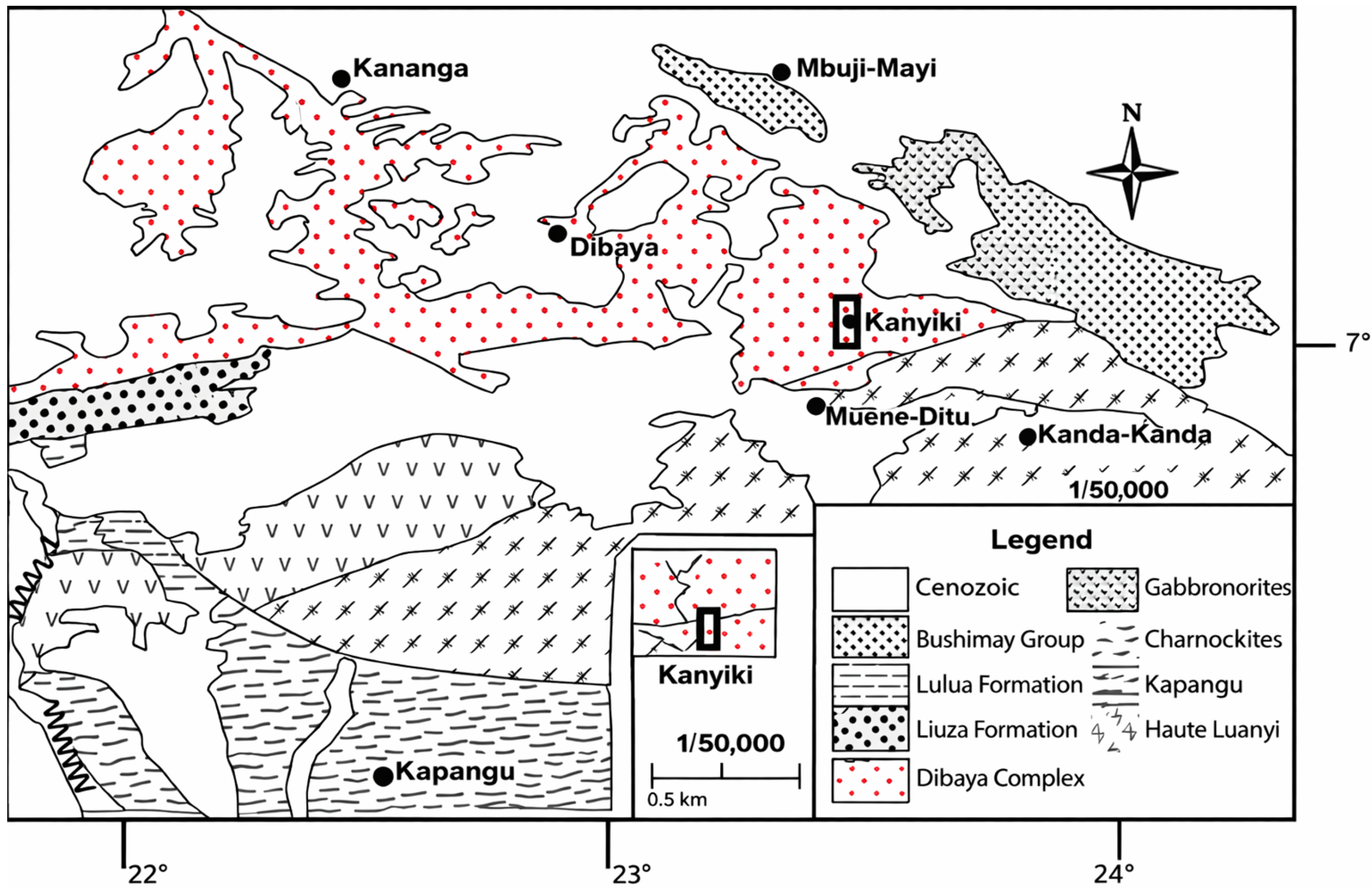
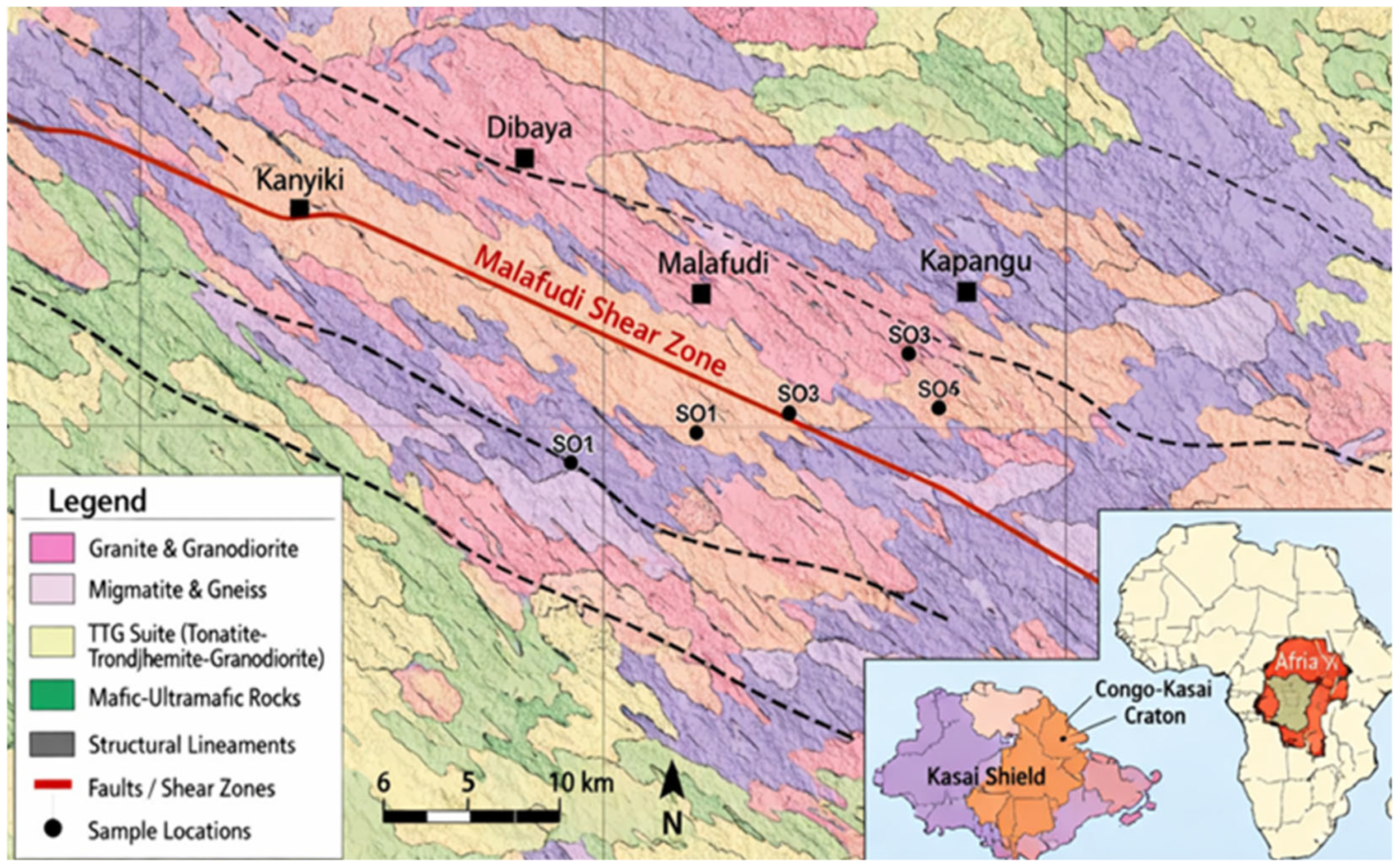
The Archean Eon represents a fundamental stage in Earth’s history during which the earliest continental crust was generated, stabilized, and progressively reworked through complex magmatic, metamorphic, and tectonic processes. Understanding the origin, nature, and evolution of Archean crust is therefore essential for reconstructing early geodynamic regimes and the mechanisms that governed continental growth and stabilization. Archean terranes worldwide preserve evidence of high heat flow, intense deformation, and widespread partial melting, reflecting the unique thermal and mechanical conditions of the early Earth. These characteristics distinguish Archean crustal evolution from younger geological periods and continue to stimulate debate regarding the nature of early plate tectonics, crustal recycling, and intracrustal processes. In Africa, one of the largest and least disrupted remnants of Archean lithosphere is preserved within the Congo–Kasaï Craton, which constitutes a major Precambrian nucleus in Central Africa [
1,
2]. This craton forms part of the broader Congo Craton and hosts extensive granito-gneissic and migmatitic terrains that record multiple episodes of crust formation, reworking, and stabilization during the Archean [
3,
4]. Within this framework, the Kasaï Shield represents a particularly well-preserved Archean domain characterized by high-grade metamorphism, widespread migmatization, and late Archean granitoid magmatism [
5,
6]. These characteristics make the Kasaï Shield a key region for investigating Archean crustal evolution in Central Africa and for testing global models of early continental development. The Dibaya granitic and migmatitic complex, located in the Kanyiki–Kapangu region of central Kasaï in the Democratic Republic of the Congo (DRC), forms part of this Archean basement and represents a critical natural laboratory for investigating the interplay between magmatism, metamorphism, deformation, and crustal reworking. The region is dominated by heterogeneous assemblages of gneisses, migmatites, and granitoids, locally affected by ductile deformation and structural discontinuities such as the Malafudi structural corridor [
7]. These lithological and structural features indicate a prolonged tectono-thermal evolution characteristic of deep continental crust subjected to high heat flow during the late Archean. The Dibaya complex thus provides valuable insights into the processes that shaped early continental crust within the Congo–Kasaï Craton.
Early geological investigations in the Dibaya area were primarily descriptive and cartographic, focusing on lithological associations and regional structural relationships [
8]. These pioneering studies established the dominance of migmatitic gneisses intruded by granitoid bodies and recognized the importance of deformation and partial melting in shaping the present-day architecture of the basement. With the development of isotopic geochronology, more precise temporal constraints on the evolution of the Dibaya complex became available. The landmark study by Legrand, and Delhal [
2,
4] applied Rb–Sr whole-rock dating and U–Pb zircon methods, revealing Archean ages clustering around 2.7 Ga, with migmatitization occurring at approximately 2720 Ma and emplacement of granitic bodies slightly later, around 2650 Ma. These results firmly established Dibaya as part of the Neoarchean crustal evolution of the Kasaï Shield and provided the first robust chronological framework for interpreting its tectono-thermal history. From a broader perspective, Archean granito-migmatitic complexes such as Dibaya are commonly interpreted within the framework of Tonalite–Trondhjemite–Granodiorite (TTG) magmatism, which is widely regarded as the dominant mechanism of early continental crust formation [
9,
10,
11]. TTG suites are thought to originate from partial melting of hydrated basaltic crust under high-pressure conditions, producing silica-rich magmas that subsequently differentiate and stabilize as continental nuclei [
12]. The formation of TTG crust marks a crucial stage in the development of stable continental lithosphere and represents one of the defining characteristics of Archean crustal evolution [
13]. In many cratons worldwide, TTG crust was later reworked by high-temperature metamorphism and partial melting, generating migmatites and more potassic granitoids during the late Archean [
14,
15,
16]. This transition from TTG-dominated crust to potassic granitoid magmatism reflects progressive crustal differentiation and maturation.
In the Congo–Kasaï Craton, recent geochronological and isotopic studies from regions such as Luebo and adjacent domains have highlighted the importance of crustal recycling processes, whereby older TTG crust was partially remelted to produce late Archean high-K granitoids without significant juvenile mantle input [
17,
18,
19]. These findings suggest that by ca. 2.7–2.6 Ga, the craton had already developed a thickened, thermally mature crust capable of undergoing widespread anatexis and intracrustal differentiation [
20]. The migmatitic nature of the Dibaya complex therefore fits well within this regional model of Neoarchean crustal stabilization and differentiation, in which internal reworking of pre-existing continental crust played a dominant role in late Archean magmatism. Metamorphism plays a central role in deciphering the geodynamic significance of such complexes. Migmatites record the transition between solid-state deformation and partial melting, preserving valuable information on pressure–temperature conditions at depth and on the temporal relationships between deformation, metamorphism, and melt generation [
21,
22]. Migmatitic textures such as leucosome–melanosome segregation, stromatic layering, and nebulitic structures provide direct evidence for crustal anatexis and melt segregation in high-grade metamorphic environments [
23]. Although detailed thermobarometric data for the Dibaya complex remain scarce in the published literature, the abundance of migmatitic textures implies metamorphic conditions at least within the upper amphibolite to granulite facies, consistent with high geothermal gradients typical of the Archean [
24,
25]. The association of migmatites with granitic intrusions further suggests that melt extraction and magma ascent were integral components of the tectono-thermal evolution of the region, reflecting a dynamic interaction between deformation and magmatism within a hot and mechanically weak crust. Beyond local observations, the Dibaya complex must be considered within the broader framework of Archean geodynamics. Two end-member models are commonly invoked to explain Archean crustal evolution: (i) subduction-related accretion involving juvenile mantle-derived magmatism, and (ii) intracrustal reworking within a hot, weak lithosphere dominated by vertical tectonics and crustal recycling [
26,
27,
28]. The geological characteristics of the Dibaya complex particularly the dominance of migmatites, the scarcity of evidence for high-pressure metamorphism, and the close temporal relationship between metamorphism and granitoid emplacement are more consistent with the latter model [
29]. This interpretation aligns with global perspectives that emphasize the role of intracrustal processes in late Archean crustal evolution and the progressive stabilization of continental lithosphere [
30].
Despite its geological importance, the Dibaya complex has not yet benefited from a comprehensive synthesis integrating petrology, geochemistry, geochronology, and geodynamic interpretation within a unified analytical framework. Existing studies are scattered across historical publications, regional syntheses, and isolated geochronological contributions, often using different methodologies and interpretative approaches [
31,
32]. Moreover, modern analytical techniques such as LA-ICP-MS U–Pb zircon dating, Lu–Hf isotopic systematics, and whole-rock trace-element geochemistry have rarely been applied directly to Dibaya, limiting the resolution of current geodynamic models and hindering detailed comparison with other Archean terranes worldwide [
33,
34]. As a result, the geological evolution of the Dibaya complex remains less well-constrained than that of many other Archean domains.
In this context, a comprehensive synthesis of the magmatic and metamorphic evolution of the Dibaya granitic and migmatitic complex is both timely and necessary. By integrating available petrographic, structural, geochronological, and geochemical data and situating them within the broader framework of Archean crustal evolution in the Congo–Kasaï Craton [
35,
36], such a synthesis can clarify the timing, sources, and processes responsible for crust formation and reworking in central Africa. Furthermore, it provides a critical foundation for future field-based and analytical studies aimed at refining geodynamic models of Archean terrains and improving understanding of early continental evolution in poorly documented cratonic regions [
37].
Accordingly, the objectives of this study are to: (i) compile and critically assess existing petrographic, geochemical, and geochronological data on the Dibaya complex; (ii) evaluate the nature and conditions of Archean magmatism and metamorphism recorded in the region; and (iii) propose an integrated geodynamic interpretation consistent with both local observations and regional cratonic evolution. By synthesizing site-specific studies with regional isotopic constraints and global Archean analogues, this contribution aims to formalize a coherent geological model for Neoarchean intracrustal reworking and craton stabilization in the central Congo–Kasaï Craton. It is important to emphasize that the present study does not introduce new field observations or analytical datasets. Instead, it constitutes a structured synthesis and reinterpretation of previously published geological, petrographic, structural, geochemical, and geochronological data. The novelty of this contribution lies not in the generation of new analytical data, but in the systematic compilation, critical reassessment, and integrative reinterpretation of previously published datasets within a unified tectono-thermal framework. By compiling dispersed information into an integrated analytical framework, this contribution aims to clarify the evidentiary basis for Neoarchean crustal evolution in the Dibaya region and to provide a foundation for future modern analytical investigations.





 ,
,