2. Materials and Methods
2.1. Study Design and Materials
The material basis of this study included natural and technogenic gold-bearing materials differing in genesis, lithological composition, degree of technogenic transformation, and expected modes of Au occurrence. The investigated materials included ores, weathering crusts, placer sands and gravels, black-shale materials, gravity tailings, ash-slag waste, thermally treated products, and carbonaceous sorbents.
The selection of these objects was determined by the different analytical behavior of fine-dispersed gold in contrasting matrices. Potential host minerals and matrix components include quartz, sulfides, Fe-Mn oxides and hydroxides, clay minerals, carbonate coatings, organic carbon, technogenic glassy microspheres, and porous aggregates (
Table 3).
Table 3 summarizes the geological and lithological groups of the studied materials and shows that the methodology was considered for both natural and technogenic objects with different matrices and different analytical accessibility of Au.
2.2. Operational Definition of Fine-Dispersed Gold
In this study, fine-dispersed gold is defined as an operational analytical–mineralogical category. It includes Au forms represented by micron- and submicron-sized particles, films, inclusions, sorbed species, and matrix-bound forms that are poorly recovered by conventional gravity separation and require additional physicochemical preparation, chemical determination, and mineralogical verification.
This definition is based not only on particle size but also on the analytical behavior of Au in the studied matrix. Coarse and liberated gold can be separated during gravity concentration, whereas fine-dispersed, sorbed, film-like, sulfide-bound, carbonaceous, clay-iron-associated, or silicate-encapsulated Au may remain in tailings, slimes, thermally treated products, or sorbents.
Within the proposed methodology, Au is classified as fine-dispersed when it is poorly recovered during the first gravity stage and requires subsequent analysis of second-stage products. Therefore, gravity tailings, slime fractions, UAGD products, thermally treated samples, and carbonaceous sorbents are treated as target analytical products for hidden Au assessment.
For materials with available particle-size data, fine-dispersed gold is considered within the working range of 10–0.1 µm. This range is not used as a universal mineralogical boundary but as an operational interval confirmed for the studied analytical series. In other cases, the term refers to Au that is not fully accounted for by direct analysis of the initial sample or by conventional gravity separation (
Table 4).
As shown in
Table 4, fine-dispersed gold is not used here as a general synonym for fine gold. It is linked to a specific analytical sequence: gravity-recoverable Au is first separated, and the remaining tailings and fine products are then analyzed as potential carriers of hidden Au. This approach reduces the risk of underestimating non-gravity-recoverable, sorbed, film-like, and matrix-bound Au forms.
SEM-EDS data are interpreted within the same operational framework. SEM-EDS is used for mineralogical targeting and textural verification, not for total Au quantification. The absence of a reliable Au signal in a selected EDS point does not prove the absence of Au in the whole sample, because micron- and submicron-scale particles may be affected by detection limits, electron-beam interaction volume, and matrix effects.
Thus, the adopted definition separates free gravity-recoverable Au from hidden fine-dispersed forms and provides the methodological basis for the two-stage workflow, including gravity separation, UAGD pretreatment, thermal activation, acid digestion, instrumental Au determination, and SEM-EDS verification.
2.3. Description of the Two-Stage Methodology
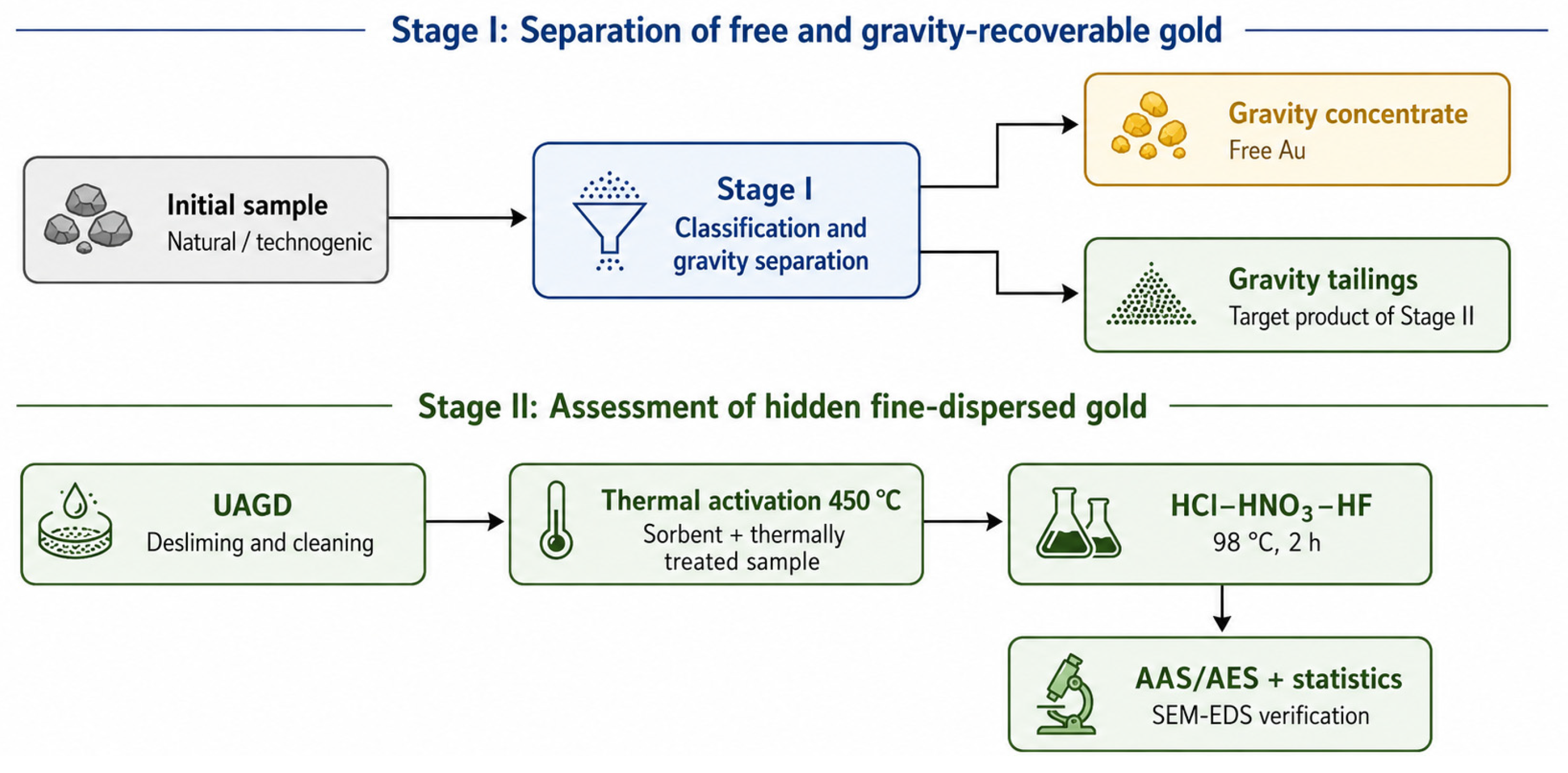
The proposed methodology is a sequential two-stage analytical workflow designed to distinguish gravity-recoverable Au from hidden fine-dispersed forms. The initial sample is first classified and subjected to gravity separation. The resulting gravity concentrate and tailings are then treated as separate analytical products rather than as a single bulk material.
At the first stage, free and partially liberated Au is separated into the gravity concentrate. At the second stage, gravity tailings, slimes, fine fractions, thermally treated products, and sorbents are analyzed as potential carriers of non-gravity-recoverable, film-like, sorbed, and matrix-bound Au. This structure reduces the risk of underestimating Au forms that are not recovered during conventional gravity preparation. The principal sequence of the two-stage methodology is shown in
Figure 1.
As shown in
Figure 1, gravity separation is used only as the first analytical separation step. The tailings are retained in the workflow and become the main target product of the second stage, where hidden Au forms may be concentrated. The analytical structure of the two-stage methodology is presented in
Table 5.
Table 5 shows that each stage has a specific analytical role. Gravity separation distinguishes free Au from products requiring further analysis. UAGD prepares fine and slime fractions. Thermal activation at 450 °C is interpreted as matrix preparation and sorption control, not as metallic Au evaporation. Acid digestion transfers analytically accessible Au into solution, while SEM-EDS provides mineralogical targeting and verification rather than total Au quantification.
Thus, the methodology integrates physical separation, matrix preparation, chemical determination, statistical interpretation, and mineralogical verification. Its key feature is that tailings, slimes, thermally treated products, and sorbents remain within the analytical chain as potential carriers of hidden Au.
2.4. Gravity Separation and Tailing Preparation
Gravity separation was used as the first stage of the workflow to separate free and partially liberated Au from the bulk material. The gravity separation tests were conducted using laboratory gravity-concentration equipment at “RITZ NTK” LLP (Stepnogorsk, Kazakhstan). The purpose of this stage was not to achieve complete Au recovery but to analytically separate the initial sample into two products: a gravity concentrate and gravity tailings.
The gravity concentrate represents Au forms that are sufficiently liberated for physical separation. Gravity tailings, in contrast, are treated as a target second-stage product because they may contain non-gravity-recoverable Au, including micron- and submicron-sized inclusions, film-like and sorbed forms, and intergrowths with sulfides, quartz, clay minerals, Fe-bearing phases, carbonaceous matter, and technogenic particles.
This approach is important because single-step analysis of the initial sample, or analysis limited only to the gravity concentrate, may underestimate hidden Au forms. Therefore, tailings are retained in the analytical workflow and subjected to UAGD desliming, thermal activation, acid digestion, instrumental Au determination, and SEM-EDS verification.
For interpretation, the mass of each product, Au content, and Au distribution between concentrate and tailings are considered together. Gravity separation is therefore used not as a final recovery indicator but as a stage that separates gravity-recoverable Au from products requiring further physicochemical and mineralogical analysis.
Thus, gravity separation performs a dual analytical function: it isolates free and partially liberated Au and generates tailings as the main material for evaluating fine-dispersed, film-like, sorbed, and matrix-bound Au. Quantitative gravity-balance results are presented in
Section 3.3.
2.5. Ultrasonic Aerohydraulic Desliming
Ultrasonic aerohydraulic desliming (UAGD) was performed using a custom-built ultrasonic aerohydraulic desliming unit developed at the Satbayev Universuty, 22 Satbayev St., Almaty 050043, Kazakhstan. Because the unit was a non-commercial research prototype, no commercial model number was applicable. UAGD was used as a controlled sample-preparation stage for tailings, fine fractions, and slimes. In this study, UAGD was not considered an independent industrial beneficiation process but rather an analytical pretreatment step aimed at separating particles according to their size, density, and hydraulic behavior.
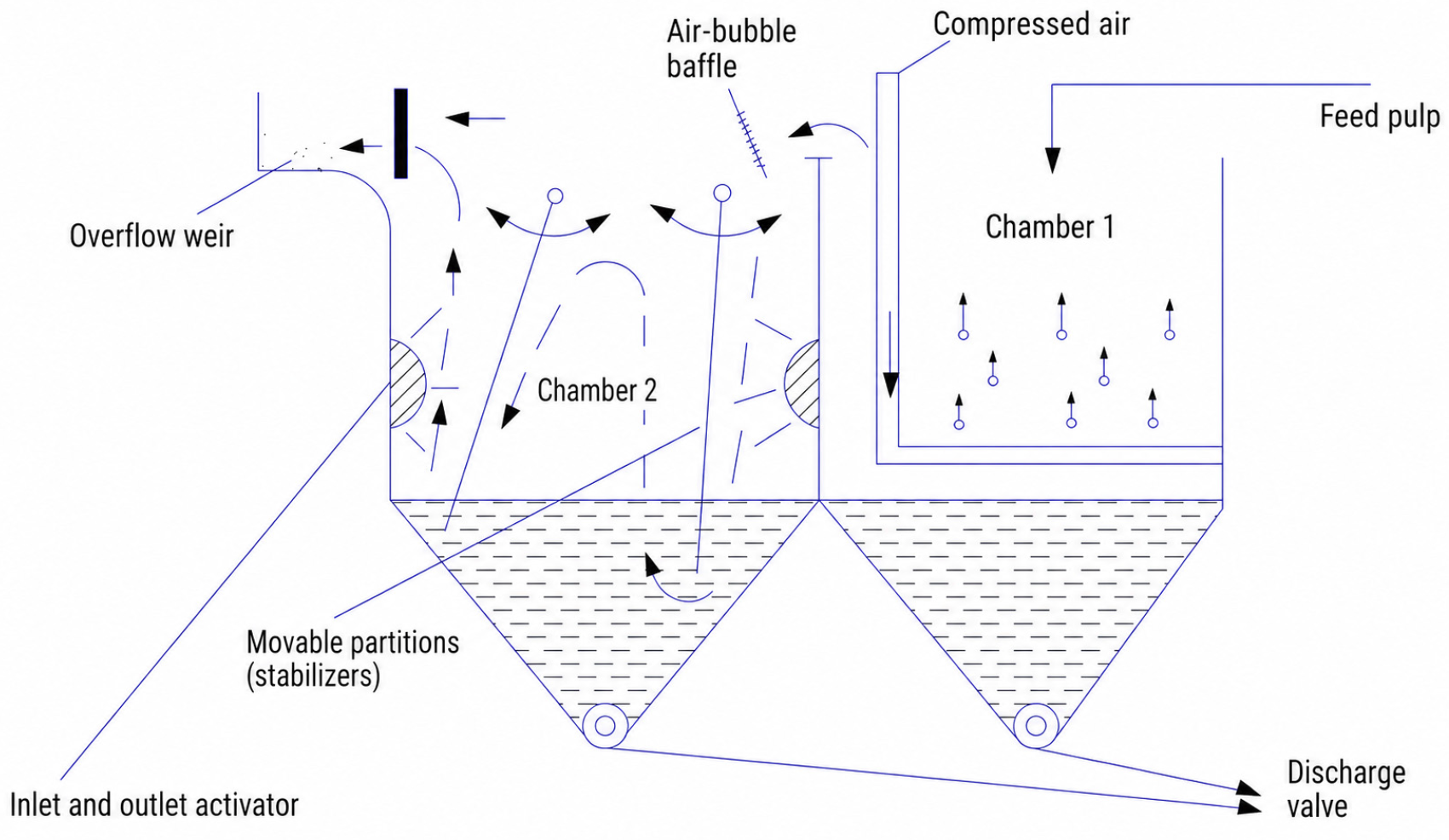
The UAGD unit combines aerohydraulic classification with ultrasound-assisted disintegration of fine aggregates. Coarser and denser particles report mainly to the chamber product, whereas fine and slime particles are transferred to the overflow. Since fine-dispersed Au may be associated with slimes, clay coatings, Fe-Mn hydroxides, sulfide microintergrowths, and carbonaceous matter, the overflow is not discarded but retained as a separate analytical product.
To explain the operating principle of UAGD within the two-stage methodology, the scheme of pulp movement and product separation is shown in
Figure 2.
The arrows indicate the directions of feed-pulp supply, compressed-air injection, pulp circulation and transfer between the chambers, overflow discharge, and final product removal through the discharge valve. The main confirmed UAGD parameters are summarized in
Table 6.
UAGD efficiency should be assessed through product mass, particle size distribution, and Au content in each product. In the Atansor weathering-crust example, 94.45% of the slime fraction was removed to the overflow, while chamber products contained only 2.19%–2.44% slimes. This result is interpreted only as granulometric efficiency, not as Au recovery or Au balance.
Thus, UAGD improves sample homogeneity and separates slime fractions as independent analytical products. This reduces the risk of uncontrolled loss of fine-dispersed Au with the overflow and supports separate analysis of chamber product and overflow.
2.6. Controlled Thermal Activation and Sorption Capture
Controlled thermal activation was applied after gravity separation and UAGD pretreatment as a physicochemical matrix-preparation stage at the Satbayev University, 22 Satbayev St., Almaty 050043, Kazakhstan. The 450 °C regime is not interpreted as metallic Au evaporation. Its role is to modify the mineral and carbonaceous matrix, weaken organomineral associations, develop sorbent porosity, and improve the analytical accessibility of some bound Au forms before acid digestion.
A carbonaceous sorbent was prepared from wheat flour carbonized under limited air access. The working regime was 450 °C, with additional tests at 250, 450, 800, and 1050 °C and holding times of 15, 30, 45, 60, and 120 min. At 450 °C, the volatile-component yield was 69.20%, while the sorbent yield stabilized near 30% after 60–120 min.
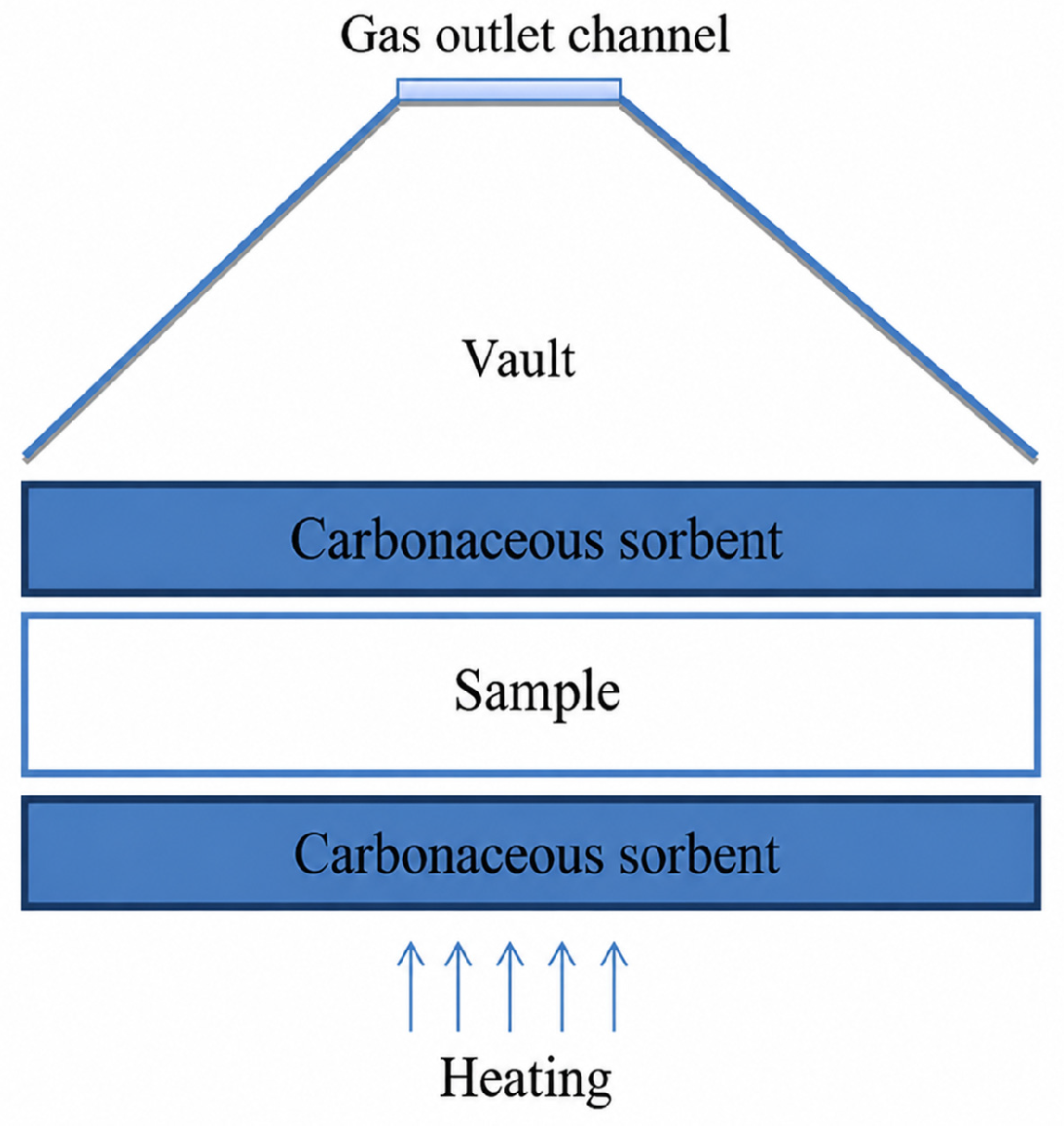
During thermal activation, the sample was placed between upper and lower sorbent layers. After heating, the thermally treated sample, upper sorbent, and lower sorbent were analyzed separately. This design allows the Au distribution between thermal treatment products to be evaluated without assuming any specific mechanism of Au transfer.
As shown in
Figure 3, the sample is placed between two layers of carbonaceous sorbent, while heating is supplied from below. After thermal activation, the products are not mixed or combined into a single analytical material. The thermally treated sample, upper sorbent, and lower sorbent are analyzed separately, allowing more accurate control of the Au distribution between thermal treatment products.
The main confirmed parameters of thermal activation and carbonaceous sorbent preparation are presented in
Table 7.
In
Figure 3, the blue-filled rectangles represent the upper and lower carbonaceous sorbent layers, whereas the white central rectangle represents the studied sample. The blue outline indicates the vault and gas outlet channel, while the upward arrows show the direction of heat supply. The colors are used only to distinguish the structural elements of the experimental setup and do not represent differences in temperature or material properties.
Table 7 is used to justify the thermal activation regime and characterize the carbonaceous sorbent. The listed parameters are not interpreted as evidence of complete Au recovery or as an indicator of overall recovery for the entire two-stage methodology. To assess the gold distribution after thermal activation, separate chemical determination of Au in the thermally treated sample, upper sorbent, and lower sorbent is required.
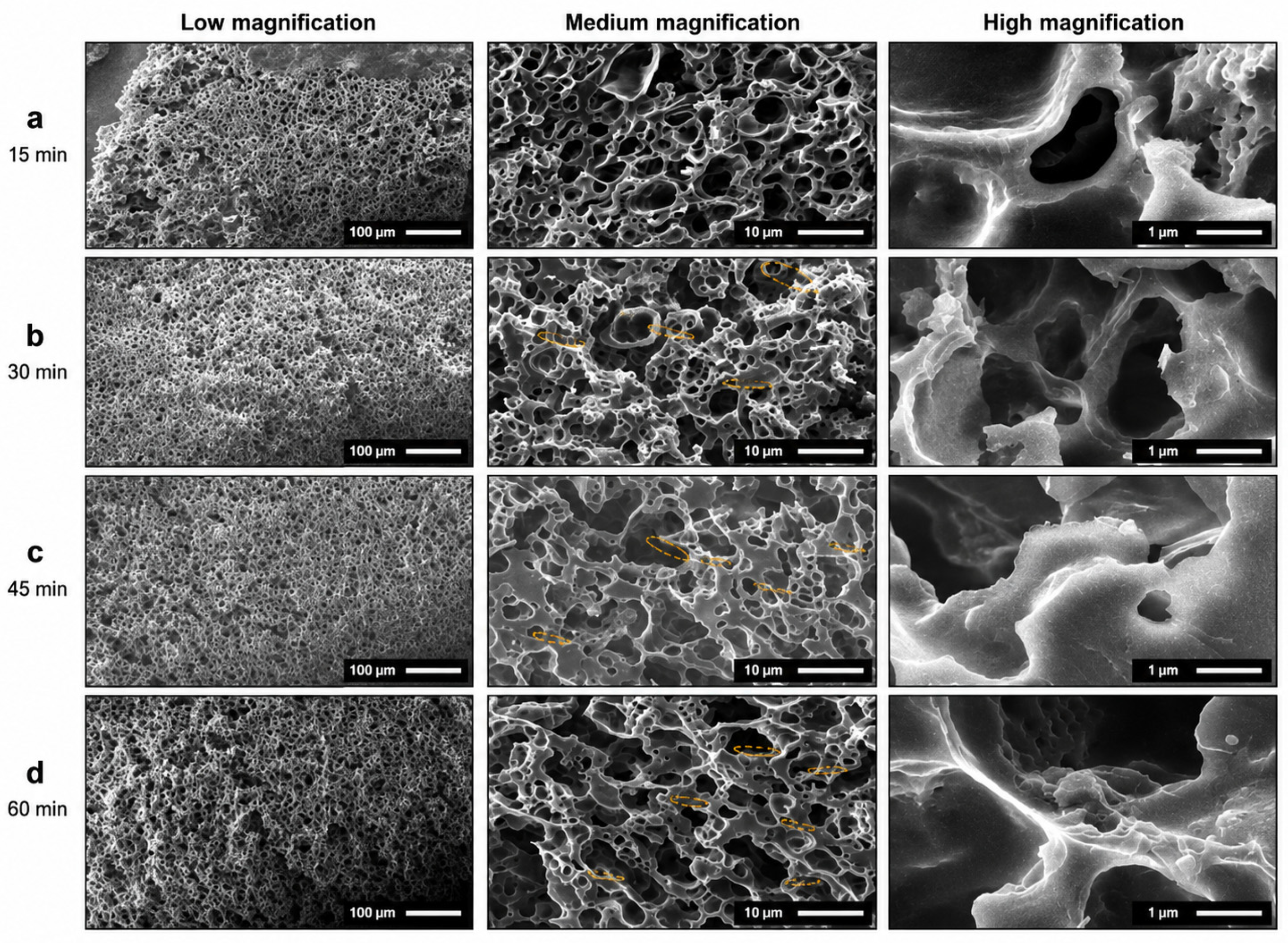
Morphological control of the carbonaceous sorbent was performed using SEM images of the material surface after different holding times at 450 °C (
Figure 4).
The orange dashed circles indicate representative pores and localized surface cavities formed in the carbonaceous sorbent during thermal activation. These markings are included only to guide visual interpretation and do not represent quantitative measurement boundaries.
SEM images of the sorbent are interpreted as morphological evidence of surface modification and pore development in the carbonaceous material. They are not direct quantitative evidence of Au transfer. The quantitative content of gold in the sorbent and thermally treated products must be determined by chemical methods after appropriate sample preparation.
Thus, thermal activation in the present methodology serves as a controlled stage of matrix opening and sorption control. The use of upper and lower sorption layers allows thermal treatment products to be retained within the analytical scheme and treated as independent fractions for subsequent Au determination. In this study, the 450 °C regime is interpreted as a condition for matrix transformation and formation of a porous sorbent, not as a temperature of metallic gold evaporation.
2.7. Low-Temperature Acid Digestion and Instrumental Determination of Au
Low-temperature acid digestion was applied to prepared second-stage products, including gravity tailings, thermally treated samples, upper and lower sorbents, and other products obtained after physicochemical preparation. The purpose of this stage was to transfer analytically accessible Au forms into solution before instrumental determination.
The digestion experiments were conducted at the Satbayev University” 22 Satbayev St., Almaty 050043, Kazakhstan. Digestion was performed in a custom-built acid-resistant laboratory autoclave system developed at Satbayev University (Almaty, Kazakhstan). As this was a non-commercial laboratory system, no commercial model number was applicable. Mechanical stirring was integrated into the experimental setup.
Digestion was performed in autoclaves using an HCl-HNO3-HF mixture at 98 °C with mechanical stirring for 2 h. HCl provided a chloride medium, HNO3 acted as an oxidizing component, and HF affected silicate and quartz matrix components. In this study, this stage is interpreted as targeted chemical preparation after gravity separation, UAGD pretreatment, and thermal activation, not as proof of complete digestion of all mineral phases.
After digestion, Au was determined by AAS and/or AES. The results were interpreted together with gravity balance data, thermal treatment products, statistical analysis, and SEM-EDS verification (
Table 8).
Table 8 includes only confirmed parameters of acid digestion and instrumental Au determination. It does not include unconfirmed values for sample mass, acid volumes, final solution volume, blanks, LOD/LOQ, CRM recovery, or replicate number, because these parameters should be reported only when actual laboratory data are available. This approach avoids the use of conditional values and preserves the scientific correctness of the methodological description.
Thus, HCl-HNO3-HF digestion is used as the final chemical preparation stage for second-stage products. It increases the analytical accessibility of Au but is not interpreted as complete recovery of all gold form.
2.8. SEM-EDS Analysis and Limitations of Mineralogical Verification
SEM-EDS was used for mineralogical, morphological, and textural verification of the products of the two-stage methodology. Its role was to identify microheterogeneity, porous aggregates, microspheres, dense inclusions, elemental associations, and candidate host phases. SEM-EDS was not used as a primary method for total Au determination.
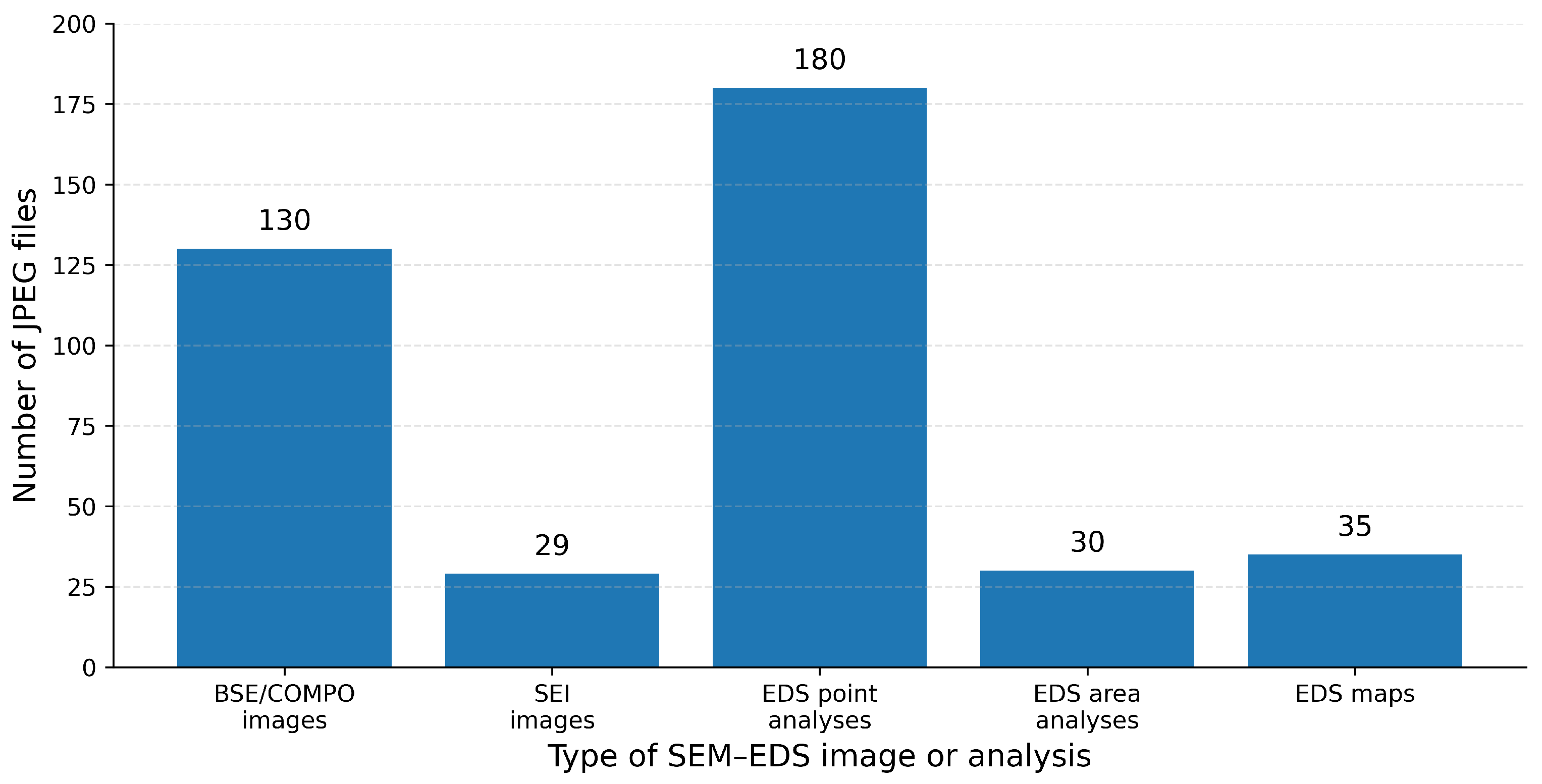
The processed SEM-EDS archive included 13 sample groups: PER01-PER12 and PER03_spheres. In total, 404 JPEG images were systematized, including COMPO/BSE images, SEI images, point analyses, area analyses, and elemental maps. The analyses were performed using a JEOL JXA-8230/JEOL EDS System (Tokyo, Japan) at 20 kV, beam current up to 5 nA, dead time up to 23%, acquisition time of approximately 60 s, and magnifications from ×40 to ×7500 (
Table 9).
Table 9 shows that the SEM-EDS archive is sufficiently extensive for mineralogical and textural characterization of the studied products. These data make it possible to identify microphase heterogeneity, dense inclusions, porous aggregates, and elemental associations; however, they do not replace chemical quantitative determination of Au.
For visual representation of the processed SEM-EDS archive structure, the data were grouped by image type and analytical operation.
Figure 5 shows that the main part of the dataset consists of COMPO/BSE images and point EDS analyses. COMPO/BSE images were used to search for contrast and dense microphases, SEI images were used to assess surface morphology, point and area EDS analyses were used for local elemental characterization, and EDS maps were used to evaluate spatial relationships between elements.
Direct Au detection in the reviewed JPEG-EDS tables was not confirmed. This does not indicate the absence of Au in the sample, because Au may occur as rare, submicron, matrix-bound, or below-detection-limit forms. At 20 kV, the interaction volume may also exceed the size of 0.1–10 µm particles, producing mixed signals from the particle and matrix.
The main identified associations included Fe-O, Fe-Ni-Cr, Cu-Zn, Ba-S-O, Sb-As-Cu-Zn-Se/Pb, C-O-Na-Cl, and aluminosilicate microspheres. These associations are interpreted as candidate mineralogical indicators, not as direct evidence of Au-bearing phases. Confirmation of Au in specific microphases requires WDS, EPMA, LA-ICP-MS, or chemical analysis of separated fractions.
2.9. Statistical Processing
Statistical processing was used to describe Au-content heterogeneity, data variability, and repeatability of selected experiments. For each analytical series, the number of determinations, minimum, maximum, mean, median, standard deviation, and coefficient of variation were calculated.
The arithmetic mean was calculated as
where
is the mean value, n is the number of determinations, and
is an individual analytical value.
The standard deviation was calculated as
The coefficient of variation was calculated as
where CV characterizes the relative variability of the results and was used to evaluate the degree of Au distribution heterogeneity in the analyzed series.
To assess the reproducibility of repeated analytical and technological experiments, the relative standard deviation was additionally calculated as
For paired duplicate experiments, particularly when comparing two parallel leaching results, the relative percent difference was calculated as
where RPD is the relative percent difference, %, and
are the results of two parallel determinations. This parameter is especially useful when the number of replicates is limited, as it provides a quantitative measure of agreement between duplicate experiments.
These parameters were used to characterize material heterogeneity and repeatability of individual tests. They were not interpreted as complete metrological validation of the entire methodology. High CV values were considered in relation to the nugget effect, micron-scale Au heterogeneity, and uneven distribution of Au among fractions and preparation products.
2.10. Validation Logic of the Methodology Within the Limits of Confirmed Data
The validation logic was based only on experimentally confirmed control elements: statistical processing of two analytical series, gravity-balance interpretation, separate accounting of thermal treatment products, repeatability of selected leaching tests, and SEM-EDS mineralogical verification.
This approach is not presented as a complete accredited validation of the method. Parameters such as CRM recovery, matrix-spike recovery, blank correction, LOD/LOQ, interlaboratory comparison, and full workflow recovery are not introduced without confirmed experimental data.
The confirmed quality control elements and their role in the interpretation of the two-stage methodology are presented in
Table 10.
Table 10 shows that the validation logic of the methodology is based on a combination of statistical, balance, technological, and mineralogical control elements. Each element has its own significance; however, none of them should be regarded as universal evidence of complete recovery or complete accounting of all gold forms.
Thus, the methodology is supported by statistical, balance, technological, and mineralogical control elements. These elements provide a scientifically correct interpretation of the available data and prevent unsupported claims of complete Au recovery, complete liberation of all Au forms, or direct SEM-EDS proof of gold-bearing phases. Full metrological standardization requires further testing using certified reference materials, matrix spikes, blanks, LOD/LOQ calculation, inter-method comparison, and balance closure for all workflow products.
3. Results
3.1. Statistical Characteristics of Au Content in Analytical Series
Two analytical series, each including 50 Au determinations, were processed statistically. The EcoLux-As LLP series represents Au determination after low-temperature HCl-HNO3-HF digestion at 98 °C for 2 h. The Center-Consulting LLP series was used as a comparative dataset for evaluating Au variability in technological samples. This comparison is not considered interlaboratory or CRM-based validation; it is used to characterize heterogeneity and analytical variability.
The main statistical parameters of the two analytical series are presented in
Table 11.
As shown in
Table 11, both series show high Au variability. The CV values of 74.81% and 285.32% indicate strong heterogeneity, discrete Au distribution, and a possible nugget effect. Therefore, single-point determination is insufficient for reliable assessment of fine-dispersed Au in heterogeneous natural and technogenic materials.
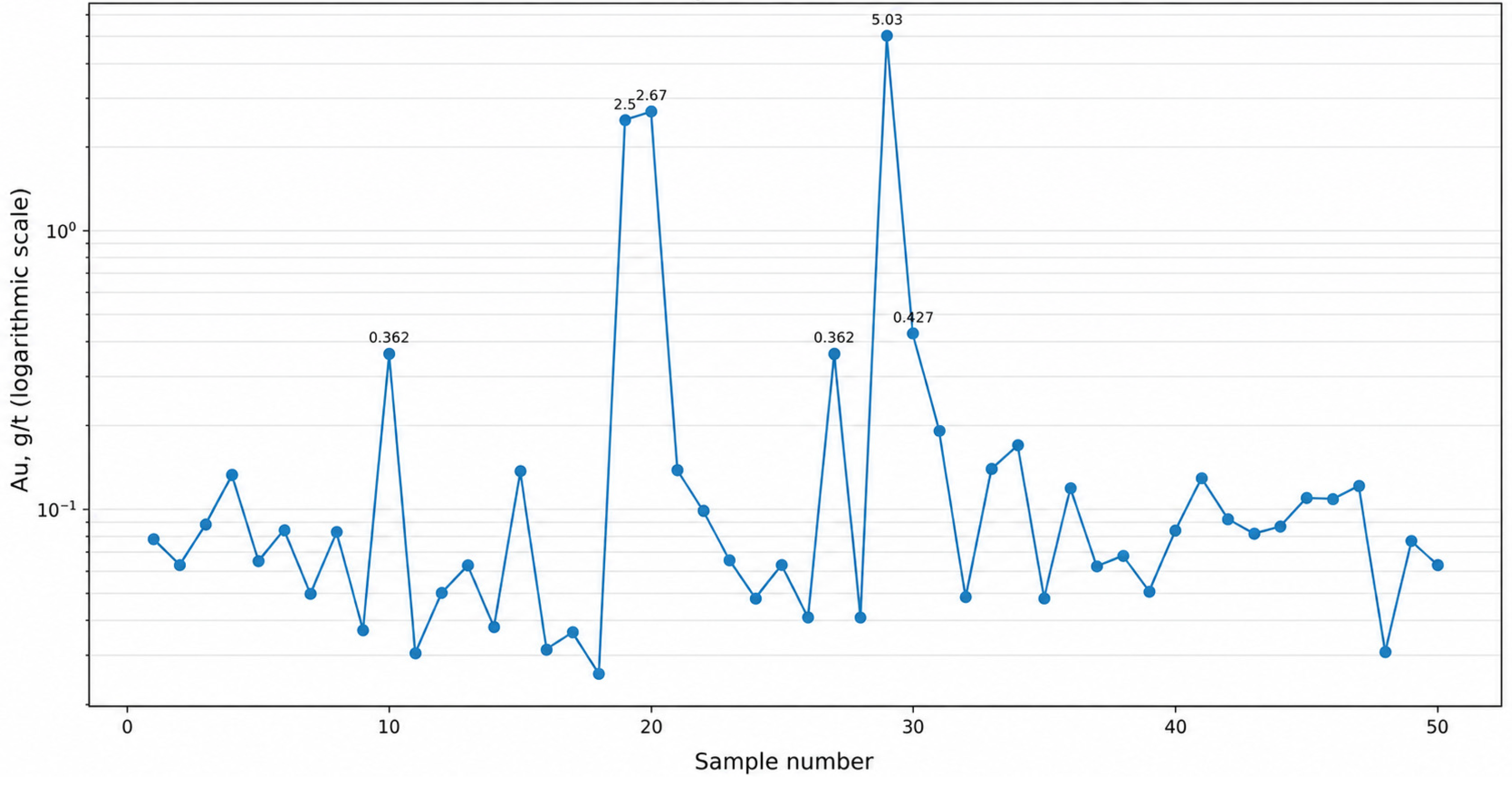
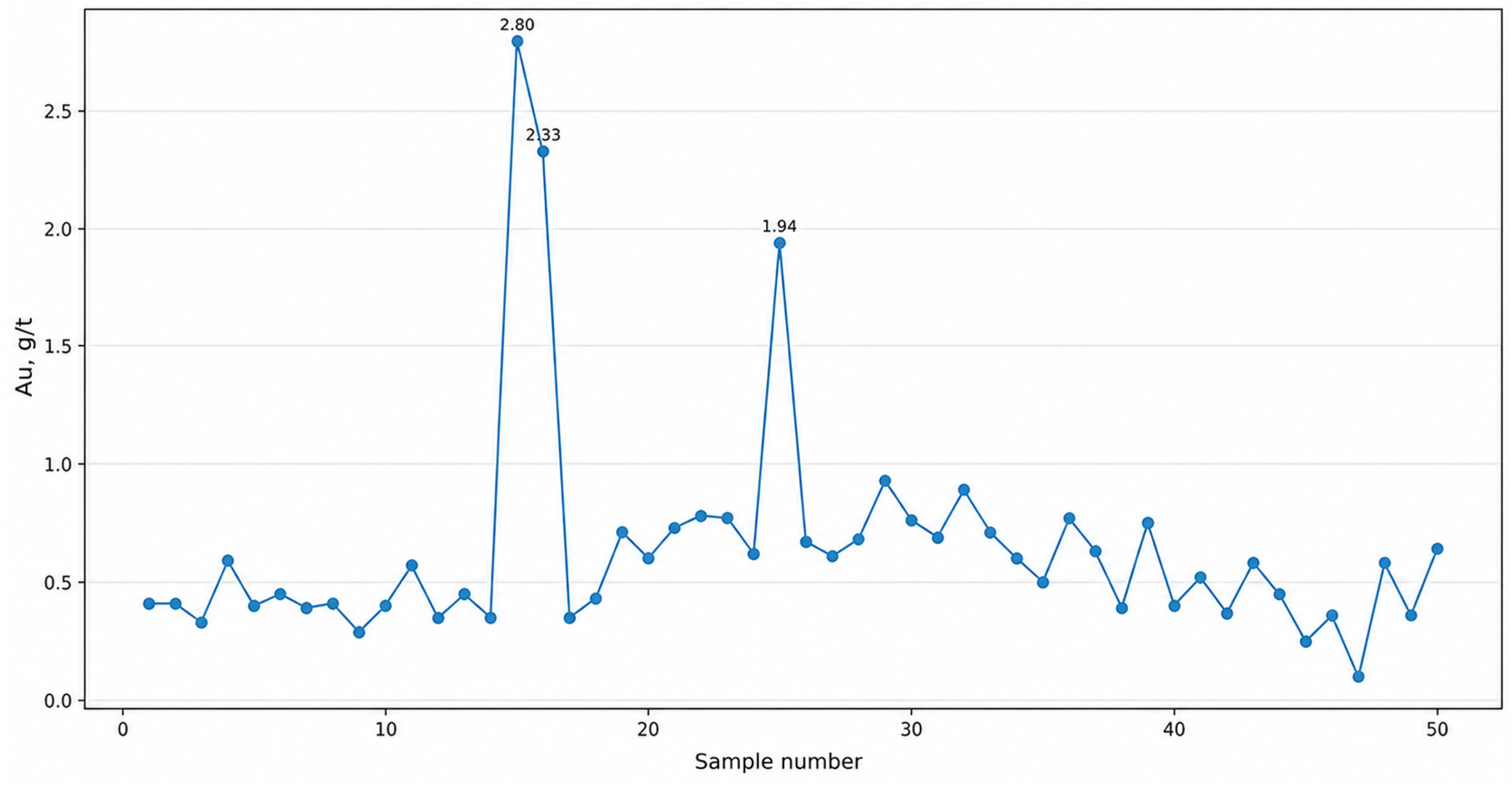
For visual assessment of the discrete Au distribution, the results of the Center-Consulting LLP series are shown in
Figure 6.
Figure 6 shows that most samples are characterized by low Au contents, whereas individual samples show sharply elevated values. This confirms the high heterogeneity of the material and the need for statistical interpretation of the results.
The results of the EcoLux-As LLP series are shown in
Figure 7.
Figure 7 also confirms the uneven Au distribution; however, the variability of this series is lower than that of the Center-Consulting LLP series. This may be related to differences in sample preparation, matrix composition, analytical sample mass, and the nature of the studied products.
Thus, statistical processing of the two series demonstrates a high degree of microheterogeneity in Au distribution. These results justify the need for a two-stage scheme that includes gravity separation, tailings analysis, UAGD pretreatment, thermal activation, acid digestion, and mineralogical verification.
3.2. Granulometric Characteristics and Gold Balance of Ash-Slag Waste
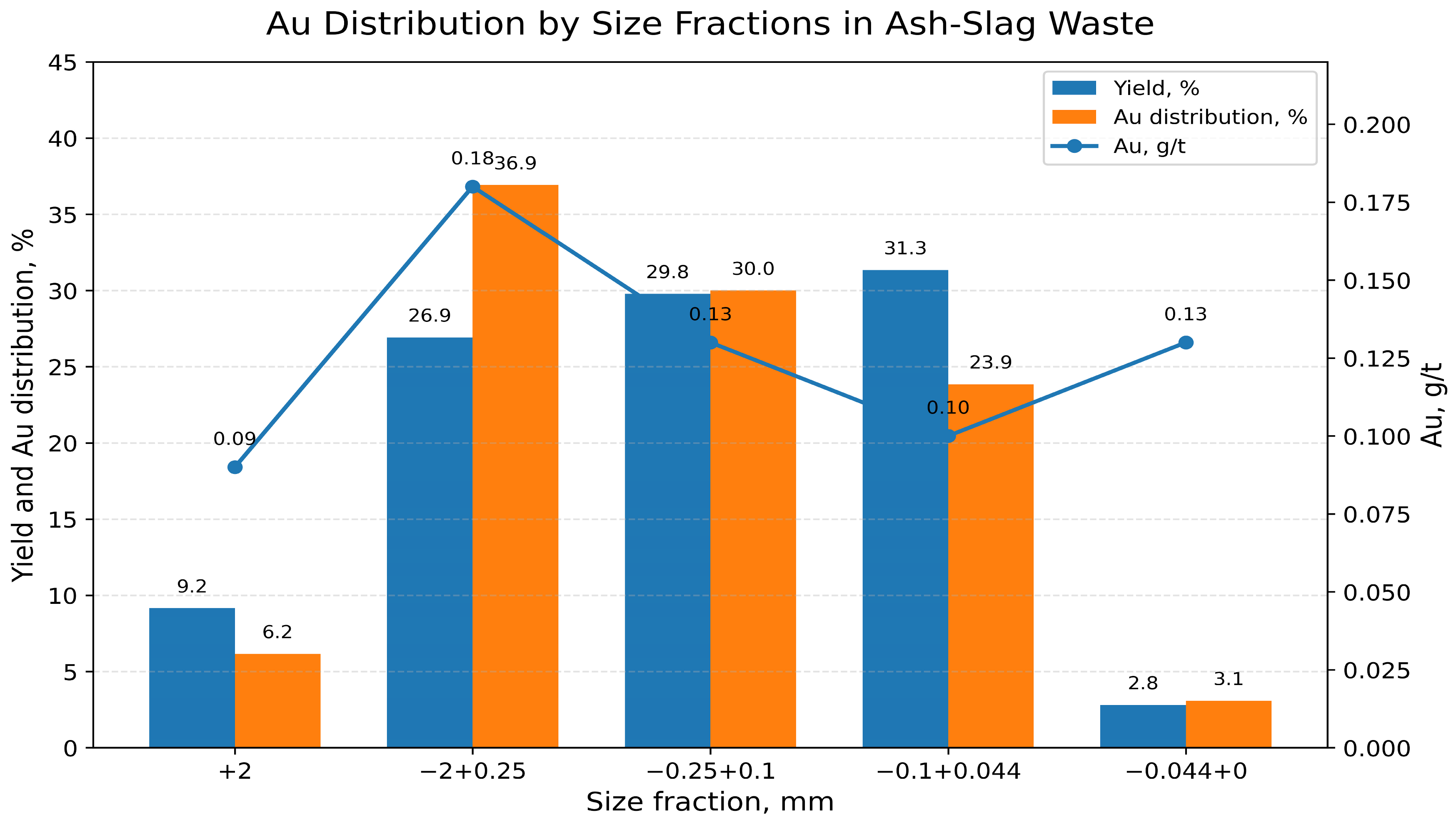
For the technogenic matrix of ash-slag waste, the distribution of Au by granulometric classes is an important result. These data make it possible to identify the fractions in which the main proportion of gold is concentrated and to justify the need for separate analysis of medium, fine, and slime products.
An example of Au distribution by ash-slag waste fractions is presented in
Table 12.
As shown in
Table 12, gold is unevenly distributed among the granulometric classes. The largest proportion of Au occurs in the −2 + 0.25 mm fraction, where the Au distribution is 36.92% at a content of 0.18 g/t. Significant Au proportions are also recorded in the −0.25 + 0.1 mm and −0.1 + 0.044 mm fractions, where the Au distributions are 30.00% and 23.85%, respectively.
Together, the −2 + 0.25 mm, −0.25 + 0.1 mm, and −0.1 + 0.044 mm fractions accumulate 90.77% of the gold. This indicates that the main contribution to the Au balance is provided not only by the coarsest or finest particles but also by intermediate and fine size classes. Therefore, evaluation of ash-slag waste based only on an averaged bulk sample may be insufficiently informative.
Figure 8 shows the difference between mass yield, Au content, and Au distribution across size fractions. The highest contribution to the total Au balance is provided by the −2 + 0.25 mm fraction, despite its lower mass yield compared with the −0.25 + 0.1 mm and −0.1 + 0.044 mm fractions. This is related to the higher Au content in this fraction.
The obtained data confirm the need for fractional analysis of technogenic materials. For ash-slag waste, separate examination of granulometric classes makes it possible to identify the fractions that make the greatest contribution to the gold balance and justifies the use of a two-stage scheme involving gravity separation, tailings analysis, preparation of fine products, and subsequent chemical determination of Au.
3.3. Gravity Stage and the Role of Tailings as a Target Analytical Product
Gravity separation was used to distinguish gravity-recoverable Au from Au remaining in tailings. In this methodology, tailings are treated as a target analytical product because they may contain non-gravity-recoverable, film-like, sorbed, encapsulated, and matrix-bound Au.
The material balance of Au in gravity separation products is presented in
Table 13.
As shown in
Table 13, the −2 + 0 mm tailings contain 84.161 mg Au, corresponding to 76.11% of total Au in the initial sample. Therefore, analysis limited only to the gravity concentrate would underestimate the major part of Au. This result supports the need for a second stage focused on tailings and fine products.
3.4. Phase Characteristics of Au in the −2 mm Fraction
Phase analysis of the −2 mm fraction was used to assess the technological accessibility of gold after preliminary material preparation. In this case, Au forms differed not only in particle size but also in their ability to transfer into solution during cyanidation. This is important for interpreting fine-dispersed gold, because part of Au may be analytically accessible, whereas another part may remain in the mineral matrix.
The results of Au phase analysis in the −2 mm fraction are presented in
Table 14.
As shown in
Table 14, fine-dispersed native cyanidable Au dominates in the −2 mm fraction, accounting for 1.09 g/t or 93.17% of total Au. The remaining 0.08 g/t, or 6.83%, is bound in the mineral lattice and was not cyanidable under the applied conditions.
These results indicate that Au in the −2 mm fraction occurs in forms with different technological accessibility. The predominance of cyanidable fine-dispersed Au confirms that a major part of gold can become analytically accessible after appropriate preparation, whereas the non-cyanidable fraction requires separate consideration as matrix-bound Au.
Thus, phase analysis supports the two-stage methodology: gravity-recoverable Au is first separated, while tailings and fine products are then analyzed to assess fine-dispersed and matrix-bound forms. These results are used as technological and mineralogical justification, not as full metrological validation of the method.
3.5. UAGD Desliming and Preparation of Fine Products
Ultrasonic aerohydraulic desliming was used to prepare fine and slime products before thermal activation, acid digestion, and instrumental Au determination. This stage reduces the influence of clay coatings, fine aggregates, and Fe-Mn hydroxide phases that may affect the analytical assessment of fine-dispersed Au.
The granulometric efficiency of UAGD was evaluated using data from iron-bearing clay weathering crusts of the Atansor deposit. In combination with spiral separation, UAGD removed 94.45% of the slime fraction to the overflow in a single stage, while the chamber products contained only 2.19%–2.44% slimes (
Table 15).
The results confirm the high granulometric efficiency of UAGD in separating slime and granular products and improving material homogeneity before subsequent analytical stages. This is important because slimes, clay particles, fine aggregates, and Fe-Mn hydroxides may increase matrix effects during thermal activation and acid digestion.
However, UAGD results should be interpreted only as granulometric efficiency, not as Au balance or Au recovery. The overflow must not be discarded without analysis, because fine-dispersed Au may be associated with slimes, clay coatings, Fe-Mn hydroxides, carbonaceous matter, or sulfide microintergrowths.
Thus, UAGD prepares more homogeneous material and separates the slime fraction as an independent analytical product. This reduces the risk of losing fine-dispersed Au with the overflow and supports separate analysis of the chamber product and overflow.
3.6. Thermal Activation at 450 °C and Sorption Capture
Thermal activation at 450 °C was considered as a stage of controlled matrix preparation and sorption control. This regime is not interpreted as evaporation of metallic gold. Its purpose is related to transformation of the organomineral and carbonaceous matrix, development of the porous structure of the sorbent, and increased analytical accessibility of some bound Au forms for subsequent acid digestion.
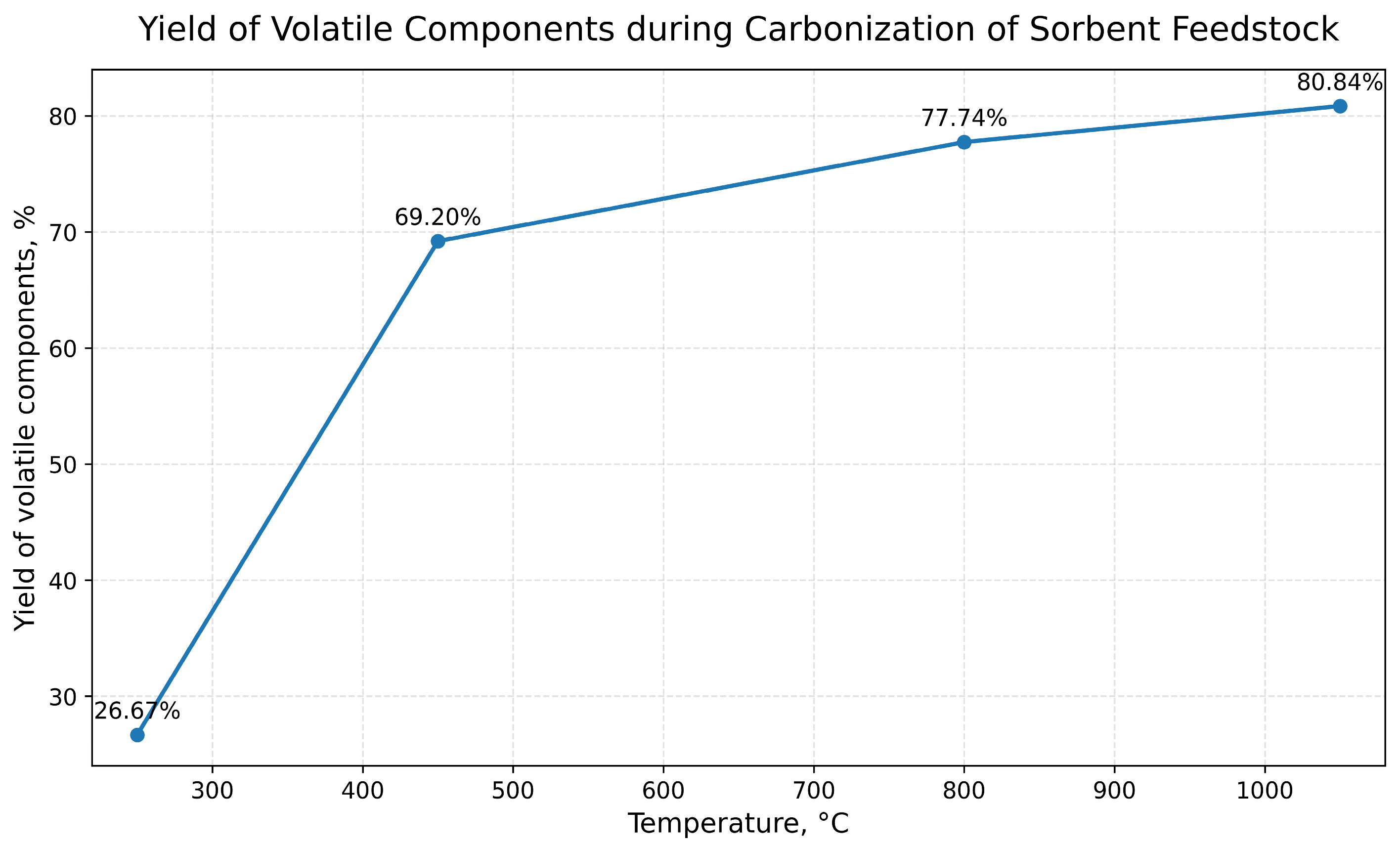
To justify the regime for forming the carbonaceous sorbent, the yield of volatile components was evaluated at different temperatures.
Figure 9 shows that pronounced carbonization of the initial raw material occurs at 450 °C. The yield of volatile components at this temperature was 69.20%. This result is used to justify the sorbent formation regime but is not evidence of metallic Au volatility.
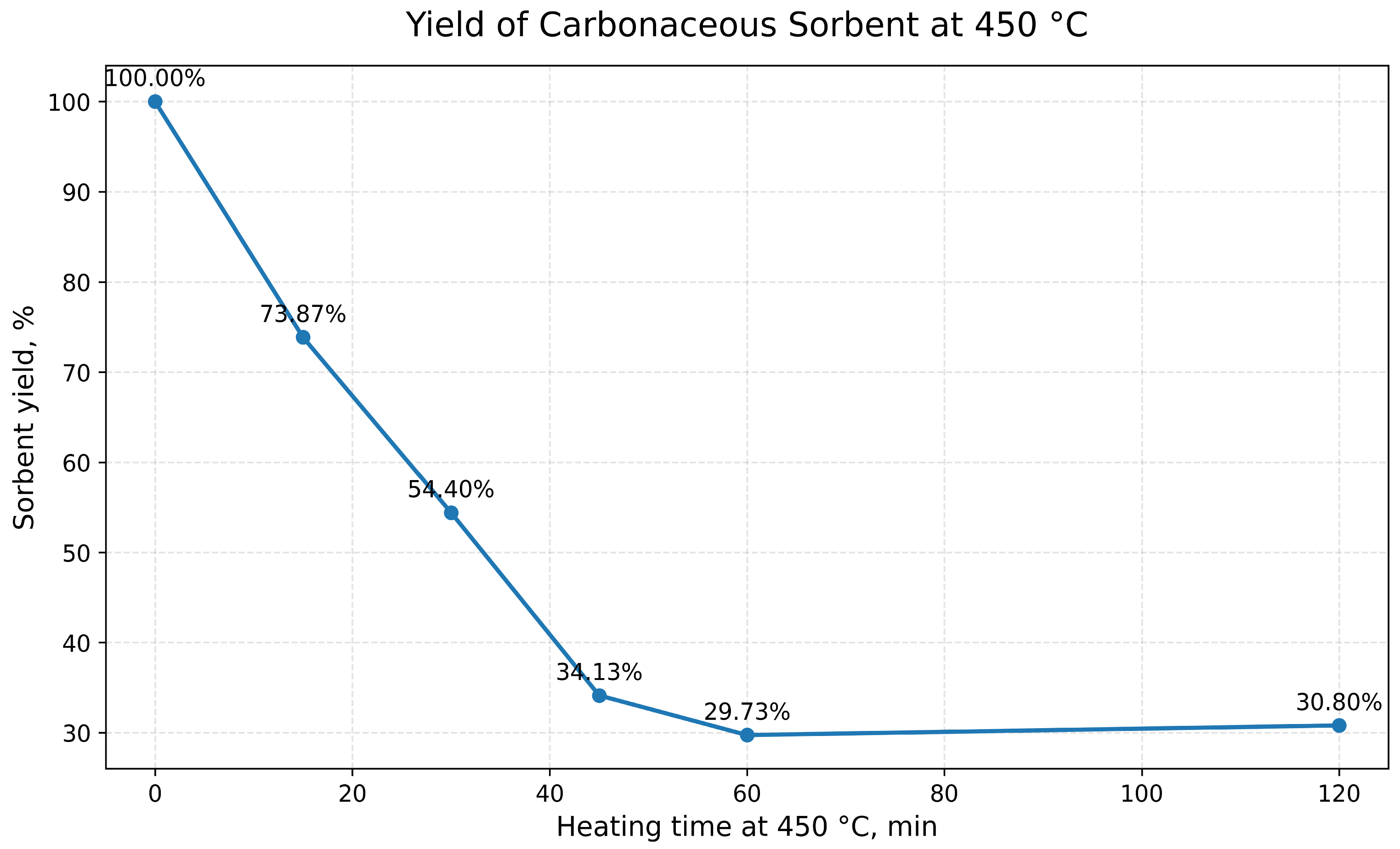
The dynamics of carbonaceous sorbent yield at 450 °C are shown in
Figure 10.
As shown in
Figure 10, the sorbent yield decreases with an increasing heating time and stabilizes after 60 min. At a holding time of 60 min, the sorbent yield was 29.73%, and at 120 min, it was 30.80%. This confirms the formation of a stable carbonaceous product under the selected temperature regime.
Morphological changes on the sorbent surface after holding times of 15, 30, 45, and 60 min at 450 °C are shown in
Figure 5.
The SEM images show surface modification and pore development in the carbonaceous material. These data confirm the structural evolution of the sorbent; however, they are not used as direct evidence of Au transfer. Quantitative assessment of gold in the sorbent and thermally treated products must be based on chemical analysis.
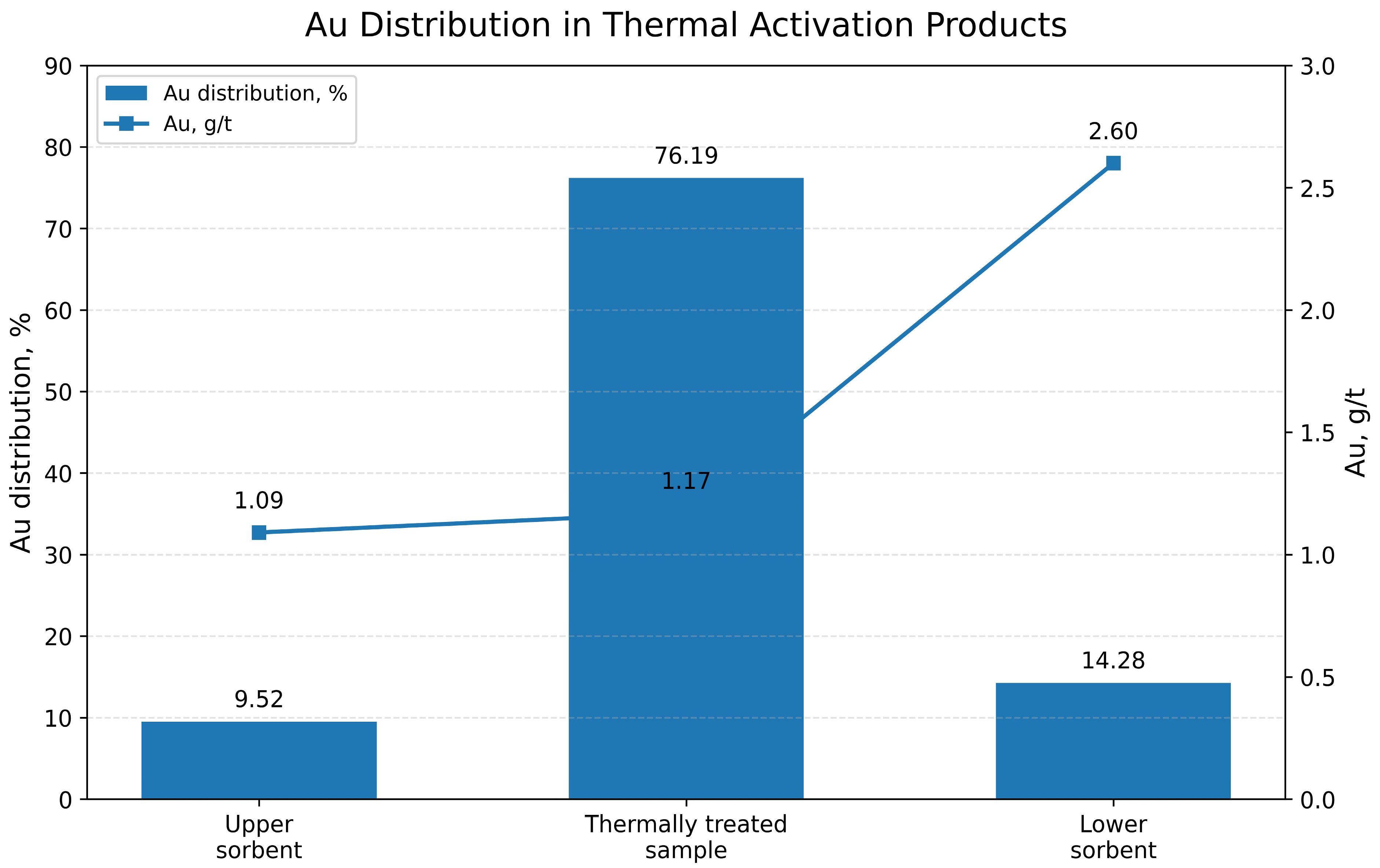
The distribution of Au between thermal activation products is presented in
Table 16.
Table 16 shows that Au is distributed between the thermally treated sample and two sorption layers. The main proportion of Au remains in the thermally treated sample, accounting for 76.19%, whereas the upper and lower sorbents contain 9.52% and 14.28% of Au, respectively. The highest Au content was recorded in the lower sorbent, at 2.60 g/t.
For visual comparison of Au content and distribution between the thermal activation products, the data from
Table 16 are presented in
Figure 11.
Figure 11 confirms that thermal activation products should be analyzed separately. Combining the thermally treated sample, upper sorbent, and lower sorbent into one analytical product may lead to a loss of information on Au redistribution during thermal preparation.
Thus, the thermal activation results confirm the need for separate accounting of the sorption layers and the thermally treated sample. The 450 °C regime is justified as a regime for forming a carbonaceous sorbent and activating the matrix, not as a regime for evaporation of metallic gold. Separate analysis of thermal products improves the transparency of the Au balance and reduces the risk of incorrect interpretation of thermal treatment results.
3.7. SEM-EDS Mineralogical Verification
SEM-EDS was used for mineralogical and textural verification of products obtained within the two-stage methodology. The method was applied to identify microheterogeneity, particle morphology, porous aggregates, microspheres, BSE-contrast inclusions, ore-related associations, and candidate host phases. SEM-EDS was not used as a quantitative method for bulk Au determination.
The processed SEM-EDS archive included 404 images from 13 sample groups: PER01-PER12 and PER03_spheres. The dataset contained COMPO/BSE images, SEI images, point and area EDS analyses, and elemental maps. The main identified associations included Fe-bearing phases, Fe-Ni-Cr inclusions, Cu-Zn microphases, Ba-S-O phases, aluminosilicate microspheres, and polymetallic Sb-As-Cu-Zn-Se/Pb areas.
Direct Au detection in the reviewed JPEG-EDS tables was not confirmed. Therefore, the identified phases are interpreted as mineralogical indicators and candidate phases, not as proven Au-bearing phases. The absence of an Au signal in selected EDS points does not exclude Au in other areas, submicron inclusions, films, sorbed forms, or concentrations below the EDS detection limit.
For 0.1–10 µm particles, SEM-EDS interpretation is limited by the electron-beam interaction volume at 20 kV, which may produce mixed particle-matrix signals. Therefore, SEM-EDS was used as a mineralogical targeting tool for selecting priority objects for further verification by WDS, EPMA, LA-ICP-MS, or chemical analysis of separated fractions.
Priority SEM-EDS groups for subsequent Au verification are presented in
Table 17.
As shown in
Table 17, PER10 and PER01 were assigned the highest priority for further verification. PER10 contains the most pronounced polymetallic Sb-As-Cu-Zn-Se/Pb associations, whereas PER01 includes Cu-Zn, Fe-Ni, Ba-S-O, and C-O-Na-Cl phases. These groups are considered priority targets for confirmatory local analysis, but not direct evidence of Au-bearing phases.
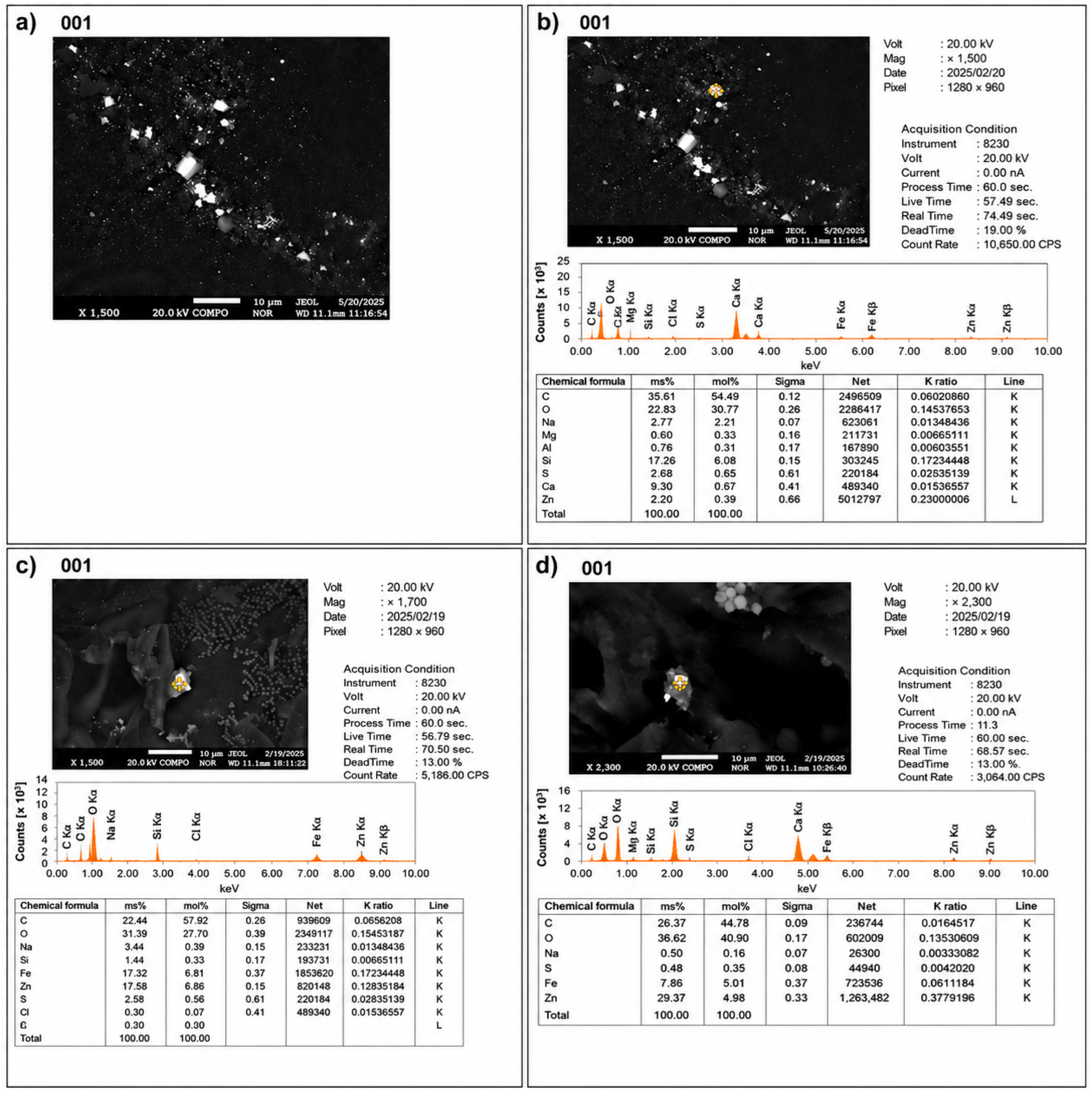
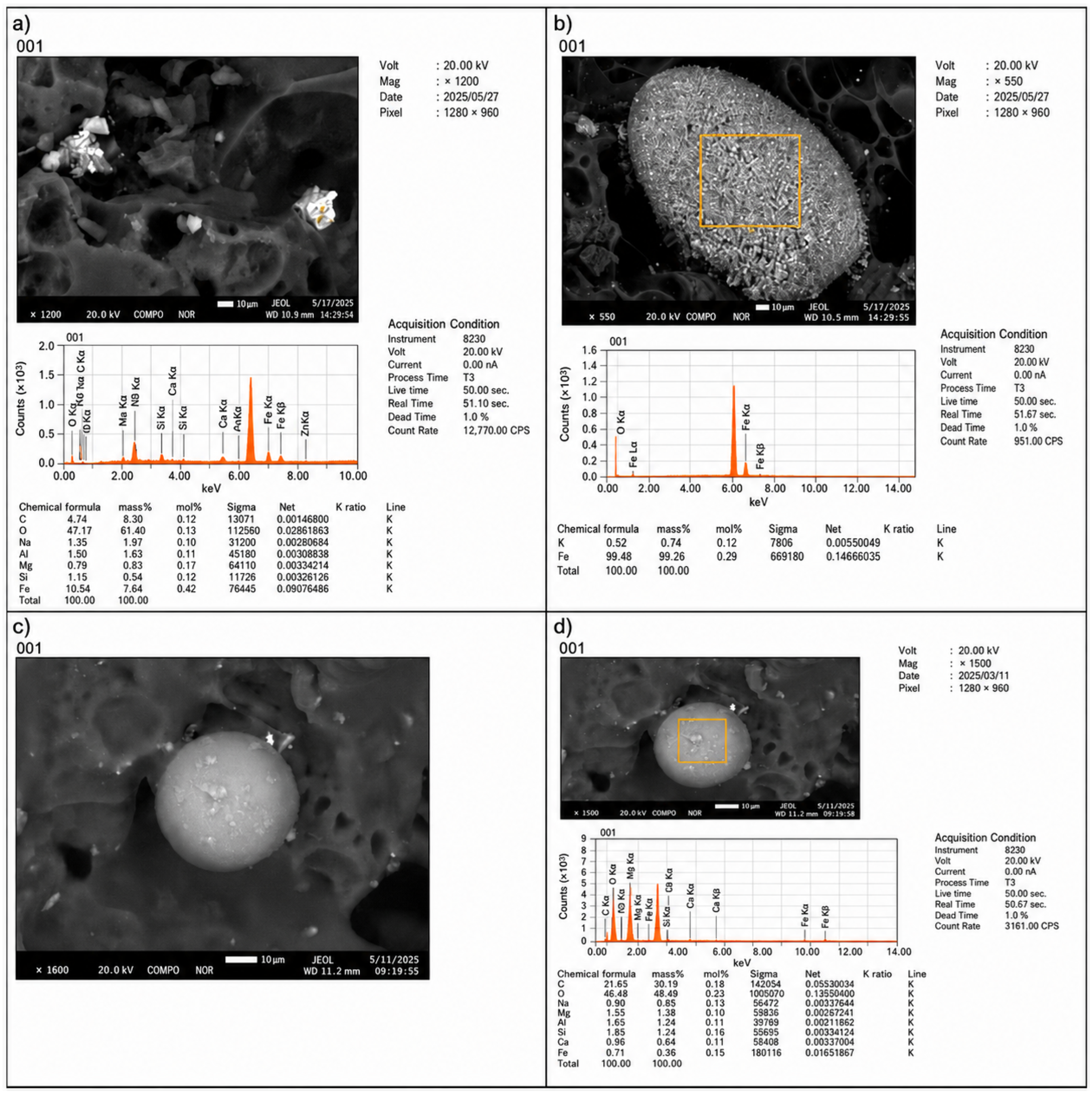
For the main manuscript, it is advisable to present the SEM-EDS results as two compact multi-panel figures (
Figure 12 and
Figure 13).
Figure 12 demonstrates the most informative microphases for subsequent Au verification. These objects are considered mineralogical guides rather than direct evidence of gold-bearing phases.
Figure 13 confirms the presence of a complex microheterogeneous matrix that may affect the local EDS signal and mask weak signals from submicron inclusions. These data are important for mineralogical targeting but do not replace chemical quantitative determination of Au.
Thus, SEM-EDS analysis confirmed the high microheterogeneity of the studied products and allowed candidate phases to be identified for subsequent targeted analysis. However, direct Au detection in the reviewed EDS tables was not recorded; therefore, the SEM-EDS results are interpreted only as mineralogical verification and as a tool for selecting priority areas for WDS, EPMA, LA-ICP-MS, or chemical analysis of the corresponding fractions.
3.8. Repeatability of Individual Leaching Experiments
Repeatability was assessed using available duplicate leaching experiments. For each pair, the mean value, standard deviation, relative standard deviation (RSD), and relative percent difference (RPD) were calculated. These indicators characterize only the repeatability of individual tests and are not extended to the entire two-stage methodology.
As shown in
Table 18, RSD values range from 2.13 to 4.88%, and RPD values from 3.01% to 6.89%. The best agreement was obtained for cyanide leaching with 1 g/L NaCN. The thiosulfate systems showed slightly higher variability but remained within an acceptable range for duplicate technological tests.
These results confirm the repeatability of selected leaching regimes. However, they do not represent full validation of the complete two-stage workflow, which also includes gravity separation, UAGD desliming, thermal activation, acid digestion, and instrumental Au determination. Full metrological validation requires expanded replicate testing, blanks, CRM or matrix spike tests, LOD/LOQ assessment, and Au-balance closure for all products.
4. Discussion
4.1. Methodological Significance of the Two-Stage Approach
The main methodological significance of this study is the treatment of gravity tailings as an independent analytical product rather than as barren residue. The results show that fine-dispersed, sorbed, film-like, and matrix-bound Au forms may remain in tailings, slimes, thermally treated products, and sorbents.
The statistical data, granulometric distribution, gravity balance, and phase analysis indicate that Au assessment in complex natural and technogenic materials cannot be reduced to a single analysis of the initial sample. The two-stage workflow improves analytical informativeness by separating gravity-recoverable Au at the first stage and targeting hidden Au forms at the second stage.
4.2. Comparison with Conventional Analytical Approaches
The proposed workflow does not replace a fire assay, aqua regia digestion, HF-based digestion, AAS/AES/ICP, or SEM-EDS. Instead, it integrates these approaches into a sequential analytical scheme.
A fire assay can estimate total Au but does not show the Au distribution among occurrence forms. Acid digestion determines acid-accessible Au but depends on matrix opening and sample preparation. SEM-EDS provides local mineralogical information but is not suitable for bulk Au quantification. The added value of the proposed workflow is the separate analysis of gravity concentrate, tailings, slimes, thermal products, sorbents, and acid solutions.
4.3. Interpretation of Thermal Activation at 450 °C
Thermal activation at 450 °C is interpreted as a controlled matrix-preparation and sorption-control stage. It is related to carbonaceous sorbent formation, pore development, and modification of organomineral associations.
This temperature is not interpreted as a condition for metallic Au evaporation. Separate analysis of the thermally treated sample, upper sorbent, and lower sorbent allows Au distribution between thermal treatment products to be controlled without overinterpreting the mechanism of Au transfer.
4.4. Role and Limitations of SEM-EDS
SEM-EDS supported the mineralogical interpretation by identifying porous aggregates, microspheres, BSE-contrast inclusions, Fe-bearing phases, and polymetallic associations. These features are useful for selecting candidate phases for further verification.
However, direct Au detection in the reviewed JPEG-EDS tables was not confirmed. Therefore, SEM-EDS results are interpreted as mineralogical targeting, not as evidence of the presence or absence of Au. At 20 kV, the interaction volume may exceed the size of 0.1–10 µm particles, which can produce mixed particle-matrix signals.
4.5. Novelty and Methodological Contribution
The novelty of this study lies in considering fine-dispersed gold as an independent object of quantitative assessment rather than only as a mineralogical feature or a target for subsequent extraction. The proposed scheme integrates gravity separation of free gold, analysis of tailings as a target product, UAGD pretreatment of fine fractions, thermal activation, sorption control, low-temperature acid digestion, instrumental Au determination, statistical processing, and SEM-EDS verification.
This approach allows forms of gold that may be underestimated during single-step analysis of the initial sample to be considered more informatively. At the same time, the methodology does not claim complete determination of all possible Au forms and does not replace accredited standard protocols.
4.6. Integrated Significance of the Results
The evidential basis of the methodology is formed by several independent blocks: statistical analysis, granulometric distribution, gravity balance, phase analysis, UAGD desliming, thermal activation, SEM-EDS verification, and repeatability assessment of selected leaching tests.
Together, these results show that the two-stage approach is more informative for heterogeneous natural and technogenic materials than direct bulk analysis. Its key advantage is that tailings, slimes, thermally treated products, and sorbents remain within the analytical chain as potential carriers of hidden Au.
4.7. Scope, Limitations, and Laboratory Applicability of the Methodology
The proposed methodology should be considered a research analytical–mineralogical workflow for complex natural and technogenic materials. It is applicable to materials in which fine-dispersed, sorbed, film-like, or matrix-bound Au may be underestimated by direct analysis.
The reproducibly described elements of the workflow include gravity separation, granulometric fractionation, UAGD desliming, thermal activation with separate analysis of sorbents, low-temperature HCl-HNO3-HF digestion at 98 °C for 2 h, AAS/AES determination, and SEM-EDS verification.
The current dataset does not yet include a full metrological validation package, including CRM recovery, matrix spikes, blank control, LOD/LOQ, inter-method comparison, and complete Au balance for all products. Therefore, the results demonstrate methodological applicability but should not be presented as a finalized accredited method.
The key parameters required for further metrological standardization are summarized in
Table 19.
Thus, the proposed workflow can be adapted as an extended laboratory protocol after additional metrological standardization. In its current form, it provides a scientifically grounded research scheme for assessing the distribution of free, fine-dispersed, sorbed, film-like, and matrix-bound forms of gold in complex natural and technogenic materials.
5. Conclusions
A two-stage analytical workflow for assessing fine-dispersed gold in natural and technogenic materials was substantiated. The first stage separates free and gravity-recoverable Au, whereas the second stage focuses on tailings, slimes, thermally treated samples, and sorbents as independent analytical products that may contain hidden Au forms.
Fine-dispersed gold was defined operationally as Au forms that are poorly recovered by conventional gravity separation and require additional physicochemical preparation, chemical determination, statistical processing, and mineralogical verification. This definition links fine-dispersed Au not only to particle size but also to its analytical behavior in complex matrices.
Statistical processing of two analytical series, each including 50 Au determinations, confirmed strong heterogeneity of the studied materials. The Au content ranged from 0.10 to 2.80 g/t in the EcoLux-As LLP series, with CV = 74.81%, and from 0.0259 to 5.0330 g/t in the Center-Consulting LLP series, with CV = 285.32%. These results confirm the need for statistical control and separate analysis of preparation products.
Granulometric analysis of ash-slag waste showed that the Au distribution is uneven among size fractions. The −2 + 0.25 mm, −0.25 + 0.1 mm, and −0.1 + 0.044 mm fractions together accounted for 90.77% of Au, demonstrating the importance of fractional analysis for technogenic materials.
The gravity balance showed that a major proportion of Au may remain in tailings. In the studied example, the −2 + 0 mm tailings contained 84.161 mg Au, corresponding to 76.11% of total Au in the initial sample. This supports the methodological decision to treat tailings as a target product for second-stage analysis.
Phase analysis of the −2 mm fraction showed different technological accessibility of Au. Fine-dispersed native cyanidable Au accounted for 93.17%, whereas 6.83% was bound in the mineral lattice and was not cyanidable under the applied conditions. This confirms the need to distinguish analytically accessible and matrix-bound Au forms.
UAGD demonstrated high granulometric efficiency in preparing fine and slime products. In the Atansor weathering-crust example, 94.45% of the slime fraction was removed to the overflow. However, this result should be interpreted only as granulometric efficiency, not as Au recovery or Au balance.
Thermal activation at 450 °C was interpreted as a matrix-preparation and sorption-control stage. It supports carbonaceous sorbent formation, pore development, and separate accounting of thermal treatment products. The study does not interpret this regime as metallic Au evaporation or gas-phase transfer.
SEM-EDS confirmed high microheterogeneity of the studied products and identified candidate associations, including C-O-Na-Cl, Fe-O, Fe-Ni-Cr, Cu-Zn, Ba-S-O, and Sb-As-Cu-Zn-Se/Pb. Direct Au detection in the reviewed JPEG-EDS tables was not confirmed. Therefore, SEM-EDS was used only for mineralogical targeting and textural verification, not for quantitative determination of total Au.
Duplicate leaching experiments showed good to acceptable repeatability for individual tests, with RSD values of 2.13%–4.88% and RPD values of 3.01%–6.89%. These results characterize selected leaching experiments only and should not be interpreted as full validation of the complete workflow.
Overall, the proposed workflow provides a scientifically grounded scheme for assessing gravity-recoverable and hidden Au forms in refractory ores, beneficiation tailings, ash-slag waste, carbonaceous materials, and other complex matrices. Further implementation as a reproducible laboratory protocol requires metrological standardization, including CRM recovery, matrix-spike tests, blank control, LOD/LOQ assessment, Au-balance closure, and inter-method comparison with a fire assay, aqua regia digestion, and HF-based digestion.





 and
and