Review

Metallogenic Model of Sedimentary Bauxite in Western Guangxi, China: Insights from Ore Genesis, Material Sources, and Depositional Environments


1
College of Earth Sciences, Guilin University of Technology, Guilin 541006, China
2
Guangdong Province Dabaoshan Mining Co., Ltd., Shaoguan 512127, China
3
Guangxi Zhuang Autonomous Region 274 Geological Team, Beihai 536005, China
4
Institute of Mineral Resources, Chinese Academy of Geological Sciences, Beijing 100037, China
5
School of Resources and Environmental Engineering, Hefei University of Technology, Hefei 230009, China
6
China Rare Earth Group (Liangshan) Co., Ltd., Liangshan 615600, China
*
Authors to whom correspondence should be addressed.
Minerals 2026, 16(7), 668; https://doi.org/10.3390/min16070668
Submission received: 9 May 2026 / Revised: 17 June 2026 / Accepted: 19 June 2026 / Published: 24 June 2026
(This article belongs to the Section Mineral Deposits)

Abstract

Western Guangxi is one of the principal bauxite-producing regions in China; however, its metallogenic model remains unclear. Building on previous studies, this paper systematically examines the ore-forming materials, sedimentary setting, ore genesis, mineral assemblages, diaspore formation, and pisoid (ooid) development of sedimentary bauxite deposits in western Guangxi. Based on this synthesis, a comprehensive metallogenic model is proposed to clarify the formation processes of these deposits. Metallogenic evolution is interpreted to involve five successive stages: weathering, leaching and alteration, deposition, post-depositional modification, and capping–sealing. Ore-forming materials are derived from volcanic ash supplied by the Emeishan Large Igneous Province and the Permian magmatic arc of the Paleo-Tethys. These materials are transported to isolated carbonate platforms and subsequently subjected to intense chemical weathering. During the early stages of ore formation, bauxite undergoes leaching and alteration, and variations in leaching intensity lead to the development of distinct ore types. Future work should focus on the genesis of diaspores, the formation of pisoids (ooids), and ore-forming mechanisms, while also addressing the coupling relationships among deep-time paleoclimate, major geological events, and sedimentary bauxite formation. Such efforts are essential for advancing a comprehensive metallogenic framework for sedimentary bauxites.

1. Introduction

Aluminum is the most abundant light metal in the Earth’s crust and is extensively used in industrial production. Bauxite, which contains relatively high aluminum concentrations, is the primary raw material used for aluminum production, with more than 90% of global bauxite consumption directed toward metallic aluminum production [1,2,3,4,5]. China is one of the world’s major bauxite-producing countries, and western Guangxi is a strategically important bauxite-producing region. Two principal deposit types occur in this area: sedimentary-type bauxite and accumulation-type bauxite [6,7,8]. For several decades, mining in western Guangxi has focused mainly on accumulation-type bauxite, causing a marked decline in reserves and increasing resource depletion associated with continued aluminum consumption [6,7]. Sedimentary bauxite in western Guangxi forms the source bed of accumulation-type bauxite and is characterized by large reserves, wide distribution, and enrichment in trace elements, such as lithium, gallium, and rare earth elements. These characteristics make it an important substitute resource [9,10,11]. In addition, it preserves information on stratigraphic deposition and hiatus development and provides valuable constraints on sedimentary processes, paleoclimate, and related geological evolution [5,12,13,14,15,16,17]. Therefore, a systematic review of sedimentary bauxite in western Guangxi is important for resource development and theoretical research.
Sedimentary bauxite in western Guangxi was first identified in 1958, and exploration has continued since then, leading to the recognition of substantial reserves. Recent studies have documented its distribution, principal types, and exploration and development statuses [7,18,19]. They have also improved our understanding of material sources, sedimentary environments, metallogenic regularity, enrichment mechanisms of associated elements, and mineralization processes [9,20,21,22,23,24,25,26,27,28,29,30]. Bauxite typically forms in warm, humid tropical to subtropical regions and is commonly enriched in aluminum-, silicon-, iron-, and titanium-bearing oxides and hydroxides. It is generally regarded as the product of intense weathering of parent rocks under supergene conditions [5,9,13,31,32,33,34,35]. Many studies have linked sedimentary bauxite formation to deep-time paleoclimate and explored the controls exerted by major geological events on its development [14,16,36,37,38]. On a global scale, the metallogenic evolution of most sedimentary bauxite deposits can be generalized into three stages [39,40]: (1) weathering of parent rocks, accompanied by depletion of alkali and alkaline-earth elements and in situ enrichment of aluminum-rich residues; (2) transport and deposition of these residual materials into karst depressions by seasonal mudflows or turbidity currents; and (3) conversion of aluminum-rich deposits on karst surfaces into claystone through further lateritization and diagenesis, followed by desilication of clay minerals and eventual transformation into bauxite. Sedimentary bauxite in western Guangxi occurs at the base of the Upper Permian Heshan Formation (P3h). Its development is constrained by isolated carbonate platforms, and the ore-bearing succession is limited to a single horizon bounded above and below by carbonate rocks. This setting fundamentally differs from that of sedimentary bauxite in other metallogenic regions of China. Therefore, metallogenic models established elsewhere may not be directly applicable to western Guangxi [11,24,25,29,41]. Although previous studies have examined the metallogenic evolution of sedimentary bauxite in western Guangxi and proposed corresponding models, no consensus has been reached on the specific evolutionary pathway from parent rock weathering to bauxite formation [11,24,25,29,41,42].
To strengthen the theoretical framework of sedimentary bauxite metallogeny, this paper reviews the research progress on sedimentary bauxite in western Guangxi, China, and re-examines its formation processes. The aim is to advance understanding of its metallogenic evolution and provide a clearer theoretical basis for bauxite exploration.

2. Geological Setting

2.1. Regional Geology

The Guangxi bauxite metallogenic province is located in the Guangxi Zhuang Autonomous Region of southern China (Figure 1a). It is located within the Youjiang Basin along the southwestern margin of the Yangtze Block. The Emeishan Large Igneous Province (ELIP) lies to the northwest, whereas the Simao Block and the Indochina Block define the western and southwestern tectonic boundaries, respectively (Figure 1b).
The stratigraphic framework of the region is composed mainly of the Cambrian, Devonian to Triassic, Paleogene, and Quaternary. In contrast, the Ordovician, Silurian, Jurassic, Cretaceous, and Neogene are absent. The Cambrian is distributed mainly in the southern and eastern parts of western Guangxi, whereas the other units are widely distributed across the region [11,28,41,43]. Continental deposits dominate the Cretaceous, Paleogene, and Quaternary sequences, whereas older deposits are represented by terrigenous clastic rocks and marine carbonates. Western Guangxi is also characterized by well-developed fold belts trending NW and nearly EW, along with fault systems dominated by NW- and NE-oriented structures. These faults commonly offset and segment bauxite orebodies, thereby exerting a first-order control on orebody geometry and structural configuration. Igneous rocks are sparse in the region and are locally represented by granite, diabase, and tuff [43]. Granite outcrops mainly occur in clusters in the Jingxi and Napo areas. Diabase is principally exposed in Longlin, Bama, and Baise, whereas tuff is limited in areal extent and occurs mainly in Pingguo and Napo. Sedimentary bauxite deposits in western Guangxi are concentrated predominantly in three principal metallogenic districts: Donglan-Bama-Fengshan, Jingxi, and Pingguo. Only minor occurrences are distributed elsewhere (Figure 1c) [43]. More specifically, the Donglan-Bama-Fengshan district includes Lingyun, Fengshan, Donglan, and Bama; the Jingxi district comprises Napo, Jingxi, Debao, Tiandong, and Tianyang; and the Pingguo district includes Taiping, Nadou, and Jiaomei.

2.2. Geological Features of Ore-Bearing Rock Series

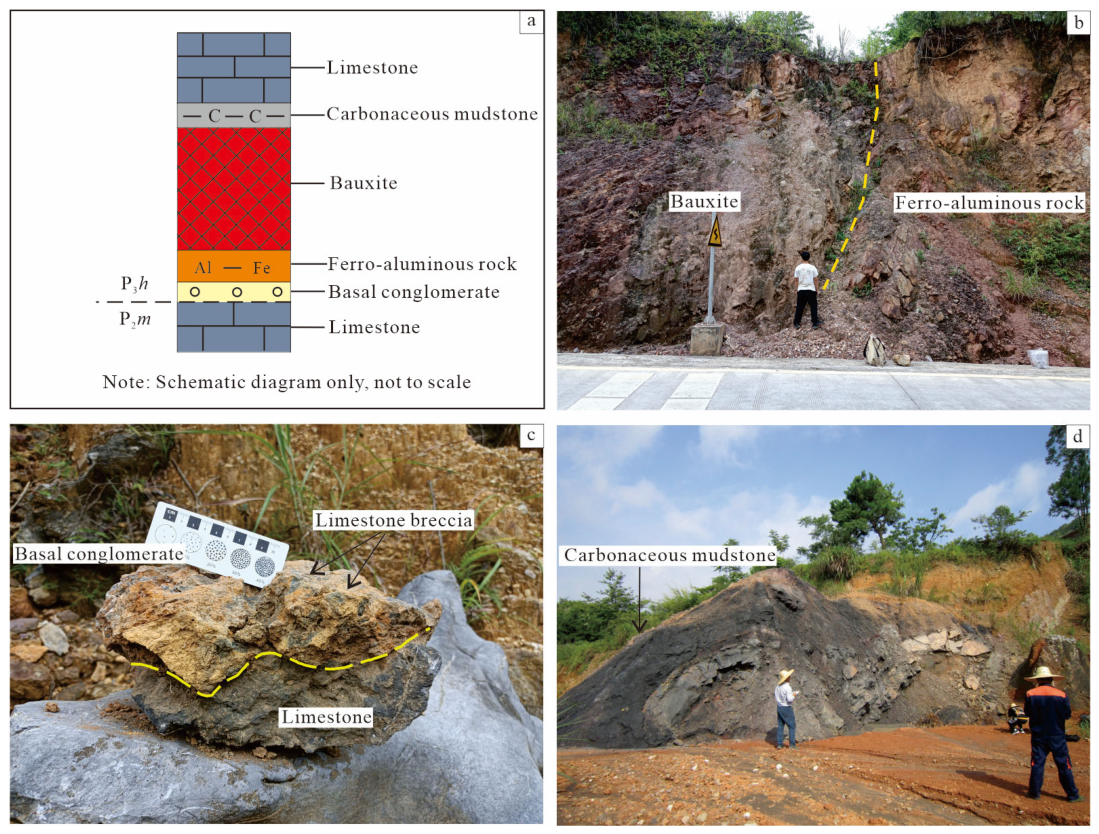
In western Guangxi, the ore-bearing rock series of sedimentary bauxite occurs mainly as stratified or quasi-stratified layers, whereas lenticular bodies are less common. Thickness is relatively stable and generally ranges from 0.5 to 20 m. Vertically, the succession is consistently divided into three lithological units: a basal ferruginous layer, a middle bauxite layer, and an upper argillaceous layer (Figure 2a) [11,28,41,43]. The basal ferruginous unit is composed mainly of ferro-aluminous rocks (Figure 2b), in which pyrite and clay minerals are the dominant constituents, whereas diaspore occurs only in minor amounts. In some sections, a basal conglomerate is developed beneath the ferruginous layer (Figure 2a,c). The overlying bauxite unit consists of bauxite (Al2O3 > 40%) or bauxitic rock (Al2O3 25–40%) (Figure 2b). Its mineral assemblage broadly resembles that of the ferro-aluminous unit and is dominated by diaspore, clay minerals, and minor pyrite. However, it contains a markedly higher proportion of diaspores. The upper argillaceous unit mainly consists of carbonaceous mudstone and, less commonly, coal (Figure 2d) [11,28,41,43]. Carbonaceous mudstone is widespread, whereas coal is only locally developed and rarely exposed [43]. A thin carbonaceous mudstone layer commonly occurs above the bauxite horizon in the Pingguo and Jingxi metallogenic districts, whereas it is generally absent in the Donglan-Bama-Fengshan district.
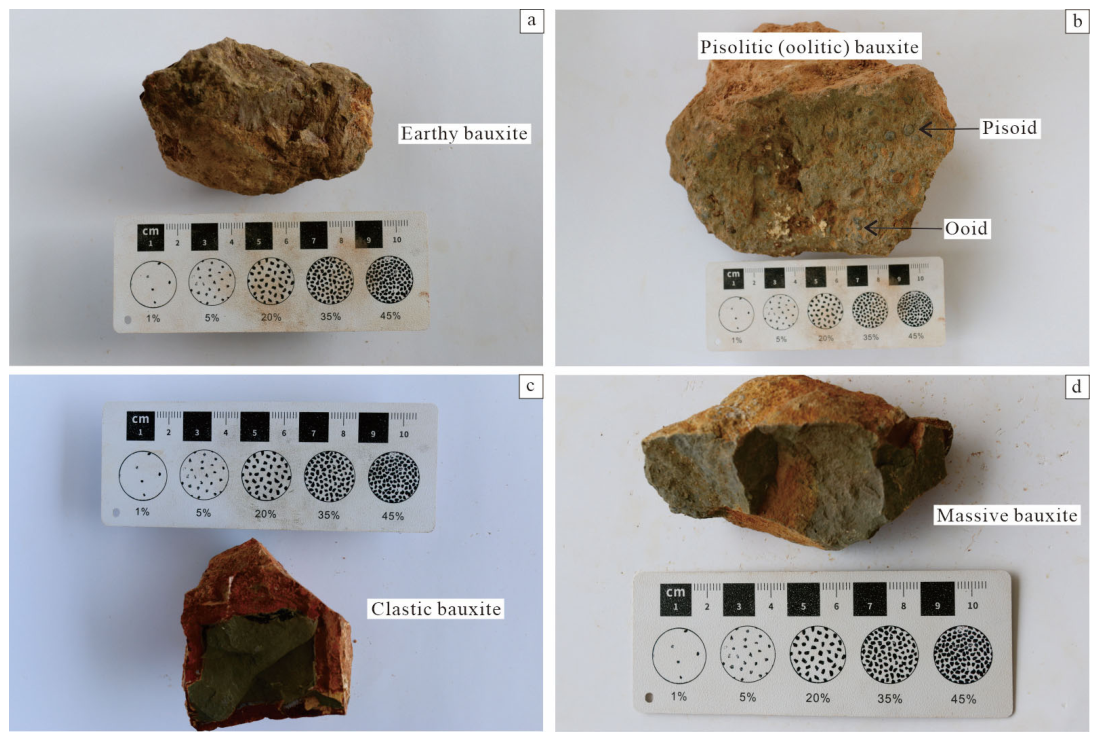
Based on ore structure, bauxite and bauxitic rocks in western Guangxi can be classified into four principal types: earthy (Figure 3a), pisolitic (oolitic) (Figure 3b), clastic (Figure 3c), and massive (Figure 3d) [43]. Earthy bauxite is characterized by earthy, semi-earthy, and porous fabrics, a relatively coarse texture, and abundant pore spaces. Highly weathered varieties are loose and readily disintegrate under hand pressure. Pisolitic (oolitic) bauxite exhibits well-developed pisolitic and oolitic fabrics, with pisoids generally 1–3 mm in diameter and ooids 0.5–1 mm across. The combined proportion of pisoids and ooids typically ranges from 5% to 25%. Clastic bauxite displays conspicuous clastic textures, with fragments that are primarily angular to subangular and composed mainly of sandy clasts. Massive bauxite is compact and structureless with a hard and smooth appearance. Its surface contains substantially less clay than the other three types, reflecting relatively weak weathering alteration.

3. Genesis and Mineralogy of Bauxite

3.1. Genesis of Bauxite Ore

Sedimentary bauxite occurs in several textural varieties, including semi-earthy, earthy, pisolitic (oolitic), clastic, and massive types, which are generally considered to reflect distinct genetic pathways [35,43,44,45,46,47]. Previous studies have grouped the formation environments of these ores into two end-member settings: the “oxidizing vadose type” and the “reducing phreatic type”. Within this framework, earthy bauxite can form mainly in the vadose zone, whereas massive bauxite is interpreted as a product of the phreatic zone. The remaining textural types are commonly assigned to transitional settings between these two hydrological regimes [12,18,43].
Leaching is regarded as a fundamental process in sedimentary bauxite formation [44,45,46,47,48]. Under sufficiently intense leaching, claystone may be transformed into bauxite [43,44]. Based on sequence stratigraphy, ore geological features, and geochemical evidence, researchers have reported that all sedimentary bauxite types, except massive bauxite, originate from strong leaching. In this model, earthy bauxite represents the terminal product of the leaching process and may evolve from earlier pisolitic or clastic ores [43,44,45]. In contrast, elemental mass balance studies have suggested a different mechanism. These studies propose that massive bauxite forms through colloidal chemical precipitation, whereas earthy bauxite is produced by the multistage transgressive-regressive reworking of pisolitic (oolitic) or clastic bauxite [47]. Studies specifically addressing the genesis of sedimentary bauxite in western Guangxi are limited [43,44,45]. However, researchers who have combined petrographic observations with geochemical indicators of leaching intensity in different ore types have concluded that leaching can play a dominant role in ore formation in this region [43]. According to their findings, massive bauxite records weak or negligible leaching, pisolitic (oolitic) and clastic bauxite reflect stronger leaching, and earthy bauxite represents the most strongly leached end-member. This pattern further implies that paleotopography controls leaching intensity and, in turn, ore-type differentiation [43].
Ore genesis remains one of the least resolved aspects of sedimentary bauxite research in western Guangxi. Lateral and vertical differences have been identified in the distribution of earthy, pisolitic (oolitic), clastic, and massive ores in various metallogenic districts. Similar variations are evident in the stratigraphic succession and thickness of the ore-bearing rock series [43]. These spatial contrasts are likely to reflect the combined influence of depositional setting, paleotopography, paleoclimate, weathering intensity, and material supply. However, the mechanisms by which these factors interact to control mineralization have not yet been adequately resolved [29,38,43,44,49,50,51,52,53,54]. Another challenge is that the depositional environment of sedimentary bauxite in western Guangxi remains highly disputed, which directly limits the genetic interpretation of different ore types. A more detailed analysis of depositional environments is required to establish laterally and vertically dynamic sedimentary facies models. Such models can help define the relationships between depositional environments and ore formation and clarify the mechanisms responsible for regional differences in stratigraphic architecture among various bauxite types.

3.2. Genesis of Pisoids (Ooids)

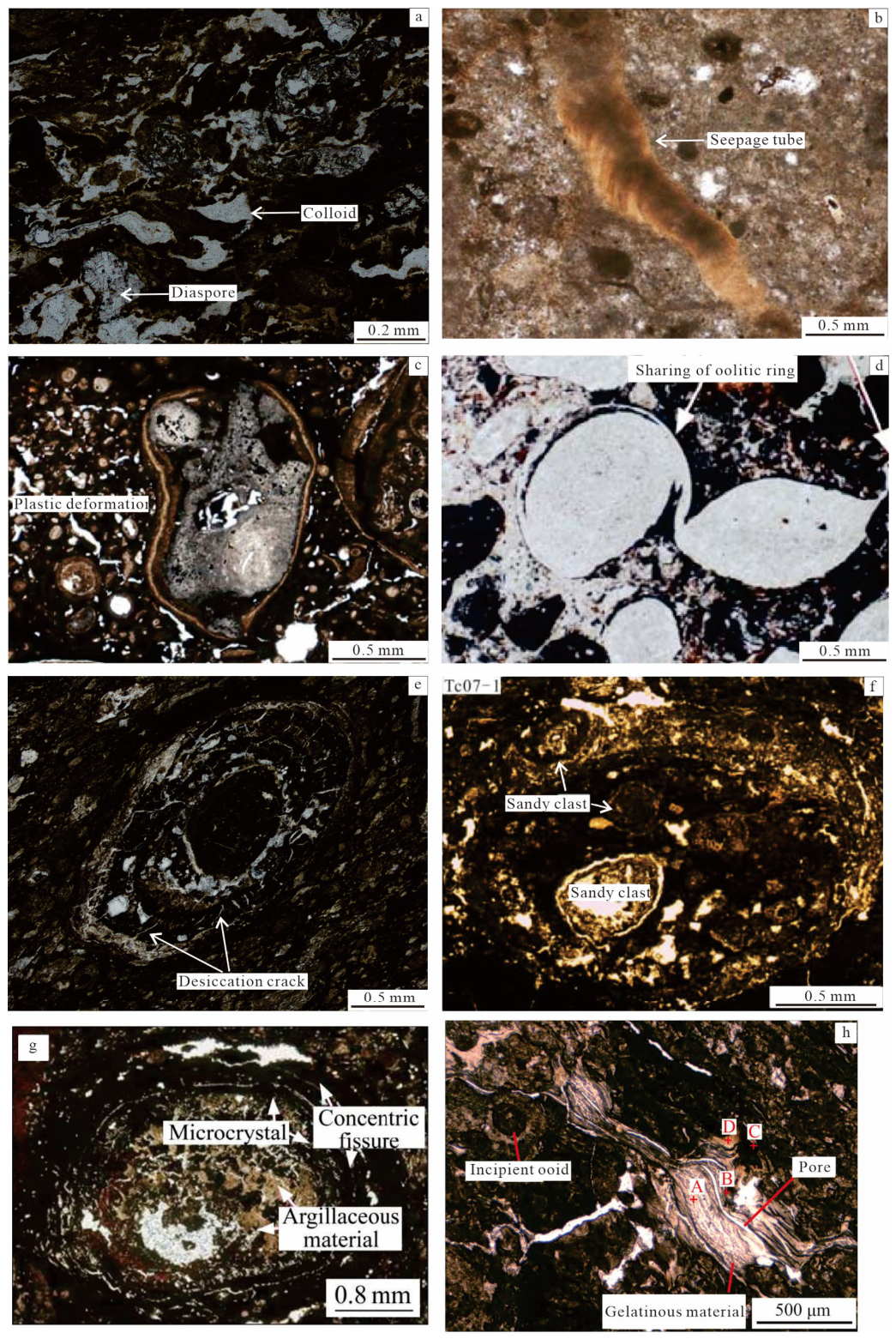
Sedimentary bauxite contains a wide variety of pisolitic and oolitic structures. Based on morphology, these structures can be grouped into normal, eccentric, superficial, and compound ooids [5,12,55,56,57,58]. They typically display a well-defined core-rim architecture, in which the cores are composed of one or more aluminum-bearing minerals, predominantly diaspore, along with varying proportions of clay minerals and/or iron-bearing minerals [58]. Although the genesis of pisoids (ooids) in sedimentary bauxite has been investigated for decades, their origins remain unresolved. Current interpretations can be grouped into three end-member models. The first is weathering origin, in which pisoids form through in situ chemical weathering of precursor materials [55]. The second proposes a colloidal chemical origin, whereby pisoids precipitate from colloidal solutions under suitable geochemical conditions [58,59]. The third attributes their formation to mechanical transport, emphasizing aggregation, abrasion, and rounding of clastic particles during sediment transport [57]. In addition to these end-member interpretations, some studies have suggested that pisoid formation involves both colloidal deposition and mechanical reworking, implying a composite genetic mechanism [56,60]. To further examine the formation mechanisms of pisoids (ooids), this paper compiles petrographic photographs from previous studies (Figure 4) [50,57,58,59,60].
In the weathering-origin model, pisoids (ooids) are interpreted as products of the spheroidal weathering of parent materials, progressing inward from the exterior. In such cases, the outer layers are expected to be more strongly weathered than the cores, and the cores should contain lower concentrations of economic minerals such as diaspore and higher proportions of clay minerals [55]. In contrast, the colloidal chemical model is supported by a series of petrographic features widely reported from bauxite, including colloidal textures (Figure 4a), seepage tube structures (Figure 4b), plastic deformation of pisoids (ooids) (Figure 4c), intergrown ooids (Figure 4d), and desiccation cracks (Figure 4e) [58,59,60]. These features are regarded as strong evidence of a colloidal origin. Advocates of the mechanical transport model emphasize the occurrence of abundant irregular clasts and poorly sorted pisoids containing sandy and argillaceous fragments within their internal structures (Figure 4f). In this interpretation, pisoids are regarded as products of physical reworking and redeposition rather than direct colloidal precipitation [57].
Research on the genesis of pisoids (ooids) in the sedimentary bauxite of western Guangxi remains limited, and published interpretations differ significantly. Early studies favored a colloidal origin, mainly because pisoids display uniformly developed concentric rims around their cores. Both the cores and rims are composed of fine-grained mineral particles. On this basis, the concentric layers were interpreted as products of colloidal chemical deposition followed by dehydration, with later transport accounting for their allochthonous accumulation [56]. Subsequent studies have documented abundant clastic material within pisoids from this region, including irregular sandy and argillaceous fragments enclosed within concentric layers. These observations indicate substantial mechanical transport during pisoid formation. Accordingly, some researchers have suggested that pisoid development in western Guangxi is controlled by paleo-laterite transport, weathering intensity, mechanical reworking, and paleotopography. Therefore, they have rejected a purely colloidal deposition model [57]. Later studies reintroduced support for a colloidal interpretation by showing that pisoid cores may contain higher aluminum content than the surrounding ore matrix. They also documented colloidal textures and desiccation cracks, both of which are difficult to reconcile with a purely transport-related origin. These studies have proposed that pisoid (ooid) nucleation results from gel syneresis, whereas the growth of concentric layers occurs through repeated cycles of gelation and gel aging. Paleoclimate, paleotopography, leaching intensity, and colloidal abundance are important controls [59]. In the sedimentary bauxite of western Guangxi, iron-rich colloidal ooids occur with colloids distributed in the ooid cores, indicating a close relationship between ooid genesis and colloidal processes (Figure 4g) [50]. Incipient ooids truncating oriented structures and gelatinous material are also observed in the bauxite ores (Figure 4h). This suggests that ooid formation and colloidal activity were not synchronous. Ooids formed by early colloid coagulation may truncate later-formed colloids [59]. More recent petrographic and geochemical studies have shown that the composition of diaspore varies systematically from pisoid cores to the surrounding matrix. Some cores contain better-crystallized and more aluminum-rich diaspore, a feature inconsistent with a simple weathering origin model [60]. Moreover, these studies have documented colloidal textures, plastic deformation, desiccation cracks, abundant irregular clasts, fine ooids enclosed within larger pisoids, and directional alignment of broken pisoids and clasts. Combined with evidence supporting a simple crystallization origin for diaspore, namely direct precipitation of Al3+ ions from aqueous solutions, these observations suggest that pisoids (ooids) in western Guangxi initially form through colloidal processes but can be subsequently modified by mechanical reworking. In this model, pisoids bearing desiccation cracks are interpreted as products of arid paleoclimatic conditions. They are considered to form during the post-diagenetic stage through the coagulation and precipitation of colloidal solutions [60].
Overall, pisoids (ooids) from western Guangxi preserve evidence of both colloidal formation and mechanical transport, indicating that their development is governed by multiple interacting factors, including paleoclimate, leaching intensity, paleotopography, and colloidal abundance. This mixed signature suggests that pisoid genesis in the region cannot be explained by a single process model. Currently, the available evidence tends to favor a predominantly colloidal origin. The internal mineral assemblages of these pisoids are highly heterogeneous and include aluminum-bearing, clay, iron, and titanium minerals [59,60]. However, it remains uncertain whether these minerals form directly during colloidal processes or are incorporated into colloidal aggregates after mechanical reworking. Mineralogical differentiation between pisoid cores and rims may also be strongly influenced by depositional conditions. Variations in these conditions may drive the contrasting mineral compositions observed between the inner and outer parts of pisoids. However, the depositional dynamics operating during pisoid (ooid) formation remain poorly constrained, and the processes responsible for mineralogical contrasts between cores and rims require further investigation.
Diaspore is the dominant ore mineral in the sedimentary bauxite of western Guangxi and is widely distributed in both pisoids (ooids) and ore matrices. As one of the principal ore structures in bauxite, pisoids (ooids) have a complex origin. However, previous studies have not fully investigated their formation processes. Therefore, their genesis remains difficult to resolve. No consensus has yet been reached regarding the genesis of pisoids (ooids) in western Guangxi. Recent studies have increasingly indicated that diaspore tends to form in supergene environments [24,26,29]. However, the specific formation process requires systematic investigation. The morphology and distribution of diaspore control the characteristics of pisoids (ooids), and the genesis of diaspore is closely linked to that of pisoids (ooids). Therefore, a detailed investigation of diaspore formation may help clarify the origin of pisoids (ooids). Further research is required to better understand the genesis of pisoids (ooids). An integrated analysis of ore genesis, mineral paragenetic assemblages, and mineral formation processes may provide an effective approach for resolving this issue.

3.3. Mineralogical Composition

Characterization of ore mineral assemblages generally relies on integrated mineralogical analyses using multiple analytical techniques, including petrographic and mineragraphic observations, X-ray diffraction, scanning electron microscopy coupled with energy-dispersive spectroscopy, electron probe microanalysis, differential thermal and thermogravimetric analysis, Fourier-transform infrared spectroscopy, and heavy-mineral separation [18]. Available studies indicate that the ore-bearing rock series of sedimentary bauxite in western Guangxi principally consists of diaspore, boehmite, chlorite, illite, kaolinite, pyrophyllite, dickite, anatase, hematite, goethite, pyrite, rutile, quartz, zircon, ilmenite, magnetite, apatite, leucoxene, galena, limonite, chalcopyrite, muscovite, and calcite [8,11,18,28,29,49,61,62].
The mineral assemblages of Chinese sedimentary bauxite can be grouped into five broad categories: aluminum-bearing, clay, iron, titanium, and minor accessory minerals. In western Guangxi, this general compositional framework is similar to that reported for other major bauxite metallogenic regions of China, such as western Henan and central Guizhou, although clear regional differences are evident [8,11,18,26,28,29,33,34,42,49,53,57,61,62,63,64,65,66,67,68,69,70,71,72]. The mineral assemblage in western Guangxi is dominated by aluminum-bearing minerals, chiefly diaspore, and clay minerals. These two groups commonly account for more than 80% of the ore in most deposits. Compared with other bauxite provinces in China, western Guangxi is distinguished by the predominance of diaspore among aluminum-bearing minerals and the abundance of kaolinite, chlorite, and pyrophyllite as the principal clay minerals. Iron minerals are mainly represented by pyrite, goethite, and hematite, whereas anatase and rutile are the dominant titanium-bearing phases. Among the remaining minerals, zircon, calcite, galena, and quartz are the most commonly reported constituents of mineral assemblages.
The mineral composition of sedimentary bauxite is widely regarded as a sensitive indicator of both metallogenic environment and genetic processes [5,10,23,24,62,73]. Correspondingly, regional differences in mineral composition may record variations in the environmental conditions and formation mechanisms of bauxite mineralization [5,10,12,18,23,24,62,63,74,75]. For instance, pyrite commonly reflects reducing conditions, whereas hematite is more typical of oxidizing environments. The coexistence of abundant diaspore and anatase may indicate formation under alkaline and reducing conditions. The association of diaspore with pyrite, siderite, chamosite, and anatase suggests that diaspore develops in a supergene setting [21,24,25,26,63,76]. The mineral composition of western Guangxi differs in several respects from that reported in other bauxite metallogenic regions of China. This implies that the metallogenic environment of this region may be distinctive. Therefore, a detailed analysis of the mineralogical characteristics in different parts of western Guangxi and a comparison of the spatial distribution of major mineral phases are essential for clarifying the genesis of the dominant minerals.

3.4. Genesis of Diaspore

Diaspore is the principal aluminum-bearing mineral in the sedimentary bauxite of western Guangxi, and its abundance is one of the main factors controlling ore quality [24,28,29,77]. Previous studies have proposed three principal genetic models for its formation: weathering origin, metamorphic origin, and simple crystallization origin [5,24,26,29,63,75,78,79].
The weathering origin of diaspore has rarely been proposed in bauxite studies. When this model is invoked, the prevailing view is that diaspore forms naturally from gibbsite through an exothermic transformation [63]. The metamorphic-origin model proposes a progressive transformation sequence from clay minerals to gibbsite, then to boehmite, and finally to diaspore. In this interpretation, clay minerals generated by the weathering and decomposition of feldspar and other parent rock minerals undergo further alteration to produce gibbsite. During burial diagenesis, gibbsite is dehydrated by compaction and transformed into boehmite, which is subsequently converted to diaspore under increasing temperatures and pressures [5,63,75]. This process is commonly considered to involve low-grade metamorphism and is accompanied by alterations in the surrounding rocks. For example, the transformation of carbonate rocks in the bauxite footwall into marble is regarded as an important indicator of metamorphic activity [63,75]. In contrast, the simple crystallization model attributes diaspore formation to the decomposition of aluminosilicate materials, particularly clay minerals, which release abundant Al3+. These ions crystallize directly as diaspore in surficial weathering systems without passing through intermediate phases, such as gibbsite or boehmite [24,29,63,64,80]. This process is generally considered to occur under alkaline (pH > 7) and reducing (Eh < 0) conditions [23,81].
In western Guangxi, diaspore genesis has mainly been discussed in the context of metamorphic and simple crystallization models. Proponents of the metamorphic interpretation suggest that diaspore preserves inherited features from gibbsite, as reflected by the widespread occurrence of recrystallization textures. They also emphasize the presence of pyrophyllite as a major mineral component of bauxite. Because pyrophyllite is traditionally regarded as a metamorphic mineral, it is considered evidence of metamorphic processes during bauxite formation [79]. However, earlier studies infer diaspore genesis largely from mineral morphology and assemblage relationships rather than from direct genetic evidence. More recent work has shown that pyrophyllite may also form under epigenetic and supergene conditions [11,82,83,84]. Therefore, the use of pyrophyllite as definitive evidence of metamorphism in the sedimentary bauxite of western Guangxi remains uncertain.
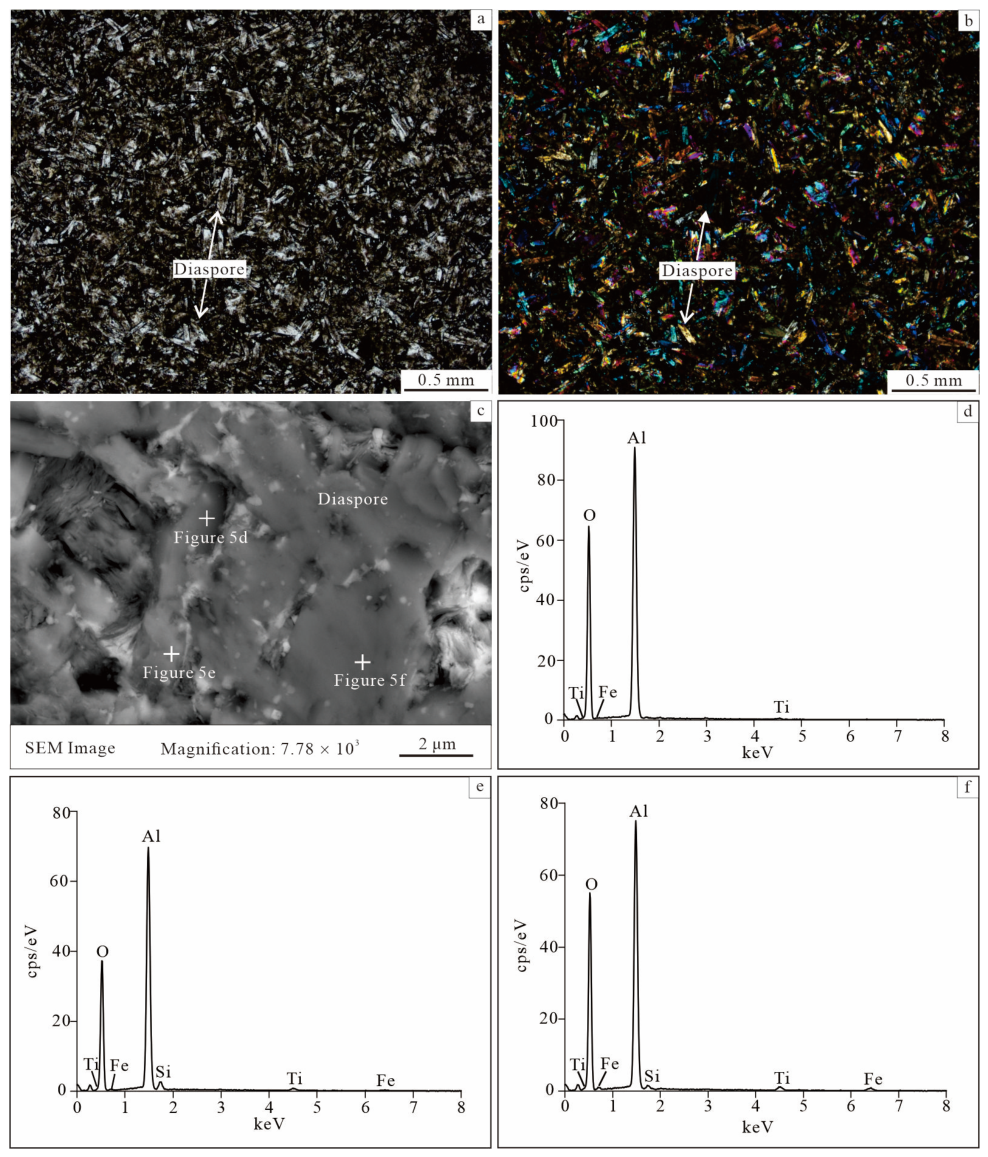
To further examine the genesis of diaspore, this paper compiles petrographic photographs and SEM-EDS images from previous studies on the simple crystallization origin of diaspore in western Guangxi (Figure 5) [85]. The support for a simple crystallization origin is based on several lines of evidence. These include the morphological characteristics of diaspore, particularly the occurrence of well-developed euhedral crystals and the absence of compressional deformation (Figure 5a,b); the distribution of impurity elements within the crystals, including common inclusions of silicon (Si), titanium (Ti), and iron (Fe) (Figure 5c–f); the close association between diaspore and anatase; and field observations indicating no obvious metamorphic overprint in the roof and floor beds of the ore-bearing rock series. Overall, these observations have been used to support the interpretation that diaspore in the sedimentary bauxite of western Guangxi forms through simple crystallization [24,29,64,85,86]. However, some researchers have suggested a more complex scenario. Based on the morphology and occurrence of diaspore and clay minerals, they identified multiple generations of diaspore with different genetic attributes and proposed that both metamorphic and simple crystallization origins were present in western Guangxi [87]. In this interpretation, one generation of diaspore displays colloidal textures and pseudomorphic features resembling precipitation from aluminum-rich solutions. Because such solutions normally precipitate gibbsite, these researchers inferred that this diaspore might form through the burial metamorphism of gibbsite. A second generation is characterized by well-crystallized, chemically pure grains associated with late-generation kaolinite and is interpreted as evidence of direct crystallization.
Diaspore of simple crystallization origin forms through crystallization in epigenetic and supergene weathering systems. During the crystallization of Al3+ into diaspore, elements such as silicon (Si), titanium (Ti), and iron (Fe) may be incorporated into the crystal lattice, producing diaspore with complex elemental compositions [29,63,64,85,88]. This raises the question of whether chemically pure diaspore can be confidently assigned to simple crystallization alone. Diaspore may be generated through simple crystallization and subsequently modified by metamorphic recrystallization. However, the absence of clear metamorphic signatures in the roof and floor beds of the western Guangxi ore-bearing succession, along with the uncertain significance of pyrophyllite as a metamorphic indicator, suggests that the criteria currently used to distinguish diaspore genesis are inadequate. Additional evidence is required to refine the genetic classification of diaspores in this region. Currently, the simple crystallization model of diaspore in western Guangxi lacks direct microscopic and geochemical evidence. Meanwhile, the metamorphic origin of diaspore is based largely on theoretical interpretations and lacks substantial supporting evidence. Therefore, the discussion of diaspore genesis in this review focuses on comparing previous studies and examining the characteristics of diaspore in bauxite to further evaluate its possible origins.
Bauxite can be classified into diaspore, gibbsite, and boehmite types, with diaspore-type bauxite accounting for approximately 50% [86]. Sedimentary bauxite in China is mainly of the diaspore type; however, specific examples supporting a weathering origin are still lacking. Early studies have primarily focused on bauxite from the Mediterranean coastal regions. In these studies, diaspore is generally considered to form from gibbsite by dehydration during later compaction and metamorphism [5,75]. With the development of micro-Raman spectroscopy, mineral morphology has been used to infer mineral genesis. Studies have shown that under certain folding and pressure conditions, diaspore can be transformed into boehmite [2]. These results indicate that gibbsite, diaspore, and boehmite can transform into one another under suitable environmental conditions.
Previous petrographic observations have identified large, well-crystallized diaspore grains in bauxite from western Guangxi. This suggests good crystallization and sufficient growth time. In addition, diaspore lacks metamorphic or deformational features and commonly occurs with supergene minerals. These observations indicate a simple crystallization origin for diaspore. Recent studies have shown that under the influence of microbial activity, diaspore can overcome the kinetic barriers associated with pressure–temperature conditions in supergene environments [24,26,29]. Under these conditions, it can crystallize directly from aluminum ions on the Earth surface. The bauxite-bearing rock series in western Guangxi contains abundant organic matter, suggesting that microbial activity may influence diaspore formation. Framboidal pyrite coexisting with diaspore in both the Pingguo bauxite deposit of western Guangxi and the bauxite deposits of western Henan Province in North China has negative δ34S values. Such pyrite is widely considered to form with the involvement of microorganisms or organic matter [24,26,29]. Western Guangxi is a karst region, and the floor of the bauxite deposits consists of carbonate rocks. These rocks can provide an alkaline environment and sufficient space for aluminum-ion crystallization. Therefore, they may promote surface crystallization of diaspore to some extent. In summary, western Guangxi appears to have favorable conditions for aluminum ions to crystallize into diaspore on the surface. However, whether microbial activity promotes surface crystallization requires further investigation. To date, no laboratory synthesis of diaspore at ambient temperature and pressure has been reported. The genetic conditions for diaspore crystallization from aluminum ions in supergene environments require further investigation.

4. Provenance

The complex formation of sedimentary bauxite makes the source of ore-forming materials a major issue in metallogenic research. Numerous studies have investigated bauxite provenance using mineralogical, petrological, geochemical, and geochronological approaches, providing important insights [11,27,37,38,39,41,89,90,91,92,93,94,95,96]. Currently, four main hypotheses have been proposed regarding the source of ore-forming materials in the sedimentary bauxite of western Guangxi: Maokou Formation limestone, ancient continental blocks, basaltic and acidic rocks related to the ELIP, and acidic magmatic rocks associated with the Permian magmatic arc. In addition, many researchers have argued that the source is not derived from a single contributor but involves multiple sources [23,24,27,38,97].
The earliest explanation is the “basal weathering hypothesis”, which is based on the observation that sedimentary bauxite in western Guangxi consistently overlies the Maokou Formation limestone. Proponents of this hypothesis argue that bauxite and the underlying limestone share similar rare earth element distribution patterns and differ mainly in cerium anomalies and total rare earth element content. Accordingly, the Maokou Formation limestone is regarded as the principal source of ore-forming materials [6,95]. However, carbonate rocks generally contain little aluminum. In western Guangxi, the Al2O3 content of the Maokou Formation limestone is <0.1% [11]. Assuming an average Al2O3 content of 0.1%, the formation of a 1 m-thick bauxite layer containing >50% Al2O3 may require the weathering and erosion of 500–700 m of limestone. However, the maximum thickness of the Maokou Formation limestone in this region is only 600 m, and approximately 300 m of limestone commonly remains beneath bauxite layers that exceed 1 m in thickness. These constraints indicate that the Maokou Formation limestone is unlikely to be the principal source of sedimentary bauxite. Instead, it serves as the host horizon rather than a dominant source [11,98,99].
The paleoland-source hypothesis was first proposed around 1981 [100,101]. Proponents of this hypothesis argue that the sedimentary bauxite deposits in western Guangxi are distributed around the Damingshan Paleoland, where igneous and sandy–muddy rocks are enriched with aluminum and can supply sufficient materials for bauxite mineralization. Moreover, the weathered elemental signatures of these rocks resemble those of bauxites. In addition, the occurrence of coal seams and rounded detrital minerals, such as zircon, within the bauxite is regarded as further evidence for this interpretation. Based on this evidence, the sedimentary bauxite in western Guangxi is considered to be derived from the nearby Damingshan Paleoland, consistent with the “terrigenous clastic theory”.
Another hypothesis, proposed as early as the late twentieth century, attributes the source of sedimentary bauxite in western Guangxi to the basalt from the ELIP. This interpretation emphasizes the wide eruptive distribution of the Emeishan basalts, their relatively high aluminum content, and the close temporal correspondence between volcanism and bauxite formation in the region [98]. With the development of detrital-zircon provenance tracing, recent studies combining geochemical data with detrital-zircon geochronology have shown that the zircon U-Pb ages in the bauxite cluster are approximately 260 Ma [42,97,102]. This age range aligns with the main eruptive interval of the ELIP at 257–261 Ma. These results support the view that bauxite materials are derived from acidic volcanic rocks related to the ELIP [102]. However, other researchers challenge this interpretation. They find that detrital zircons in the bauxite display arc-related magmatic trace element signatures and that their εHf(t) values differ markedly from those of the ELIP volcanic system. On this basis, they propose that the source of the bauxite is acidic magmatic rocks of the Paleo-Tethyan Permian magmatic arc rather than the ELIP [42,87]. Studies on geochemistry, zircon U-Pb ages, and Hf isotopic compositions of contemporaneous heteropic tuffs around the Pingguo carbonate platform further support this view. They report that ore-forming materials can be derived from arc volcanism in the Paleo-Tethys Ocean. Volcanic ash from the Paleo-Tethyan arc blankets the carbonate platform and ultimately contributes to the formation of bauxite deposits [103].
Proponents of the polygenetic mixing hypothesis argue that the ore-forming materials of the sedimentary bauxite ore-bearing rock series in western Guangxi are derived from more than one source. Some researchers propose joint contributions from the Paleoland and the Maokou Formation limestone [95], whereas others suggest a combination of basalt from the ELIP and the Maokou Formation limestone [23,24]. Volcanic ash from both the ELIP and the Permian magmatic arc of the Paleo-Tethys is considered a potential source of material for bauxite formation, although the relative contributions of these two sources may differ [11,38,41,97].
With advances in research on bauxite genesis in recent years, a single source of ore-forming materials can no longer explain the highly variable provenance. In western Guangxi, the total thickness of the Maokou Formation limestone is limited, and the thickness of weathered and denuded intervals is insufficient to provide the material required for bauxite formation. However, limestone dissolution products are present. Weathering materials derived from ancient landmasses also lack the necessary pathways for the large-scale transport of ore-forming substances. Western Guangxi preserves numerous lithological traces of volcanic eruptions, suggesting that multiple volcanic events may have occurred during the interval between bauxite deposition and mineralization in the Permian. Volcanism is considered one of the triggers for bauxite formation. Major geological events also play a significant role in large-scale weathering and sedimentary mineralization. Therefore, the large material supply for sedimentary bauxite in western Guangxi may be closely related to major geological events [16,25,27,30,37,38,86,102]. Zircon U-Pb ages in the sedimentary bauxite of western Guangxi cluster around 260 Ma, close to the timing of the mass extinction event. Volcanic products from the contemporaneous Emeishan Large Igneous Province may have provided important material sources for bauxite [42,97,102]. The zircon U-Pb ages are also close to the timing of volcanic-arc subduction between the South China Block and the Indochina Block. Volcanic products from this period may have contributed to the material sources of bauxite formation [42,97,102]. Detrital zircons in the bauxite exhibit trace element signatures of arc magmatism, indicating a felsic igneous provenance. Therefore, the ore-forming material sources of bauxite in western Guangxi are not singular. In summary, we propose that volcanic ash from the northern margin of the Tethys Ocean and the ELIP serves as the primary material source for the bauxite deposits in western Guangxi. The Maokou Formation limestone represents a secondary source, whereas the ancient landmass may only make a minor contribution.
Therefore, the provenance of sedimentary bauxite in western Guangxi remains unresolved, and different analytical approaches have led to contrasting interpretations. Existing provenance models do not fully account for the geological and geochemical characteristics of these deposits and therefore require further evaluation. The tuffites of the Upper Permian Linghao Formation and the sedimentary bauxite of western Guangxi represent contemporaneous but distinct facies. The Linghao Formation consists mainly of tuff, tuffaceous mudstone, and minor siliceous rocks. These lithologies indicate frequent volcanic activity from the Late Middle Permian to the Late Permian and suggest that volcanic ash may have supplied material to the region during this interval [104,105,106]. The Upper Permian Linghao Formation is in conformable contact with the underlying Middle Permian Sidazhai Formation and shows no evidence of weathering or erosion. This relationship indicates that while the isolated carbonate platforms in western Guangxi undergo subaerial weathering and denudation, areas outside the platforms continue to accumulate strata under uninterrupted subaqueous conditions. Therefore, the Linghao Formation may preserve important information on source materials available during bauxite mineralization [103]. It is generally accepted that bauxite forms as a product of intense weathering and therefore cannot develop in the Linghao Formation, which was deposited in a deep-water basin and did not experience such strong weathering. However, contemporaneous heteropic tuffites are widely distributed around the carbonate platforms in western Guangxi. If the Linghao Formation tuffites share the same provenance as the bauxite, they may exhibit similar geochemical characteristics. In addition, zircons in the tuffites are likely better preserved than those in the bauxite, and the lithological features of the Linghao Formation tuffites may also record provenance information from the same period [103]. Future studies should focus on comparing the spatiotemporal relationships between lithological assemblages of the Upper Permian Linghao Formation and the Heshan Formation. Such analyses may help clarify the source of ore-forming materials in sedimentary bauxite and improve our understanding of its metallogenic evolution.
Large-scale bauxite mineralization in China during the Late Paleozoic is likely spatiotemporally associated with major geological events. These events include the evolution of the Paleo-Tethys Ocean, the Late Paleozoic Ice Age, and the activity of the Emeishan Large Igneous Province. Large-scale enrichment of sedimentary bauxite is often associated with major geological processes, including warm and humid climatic conditions, plate subduction, crustal uplift, Tethyan evolution, and magmatic activity [16,25,27,30,37,38,86,102]. These events may have constrained and influenced the entire bauxite mineralization process in western Guangxi. However, current research on the coupling mechanisms among deep-time paleoclimate, major geological events, and large-scale bauxite mineralization remains relatively limited and is still in the exploratory stage. Therefore, further investigation of the coupled interactions between deep-time paleoclimate evolution and major geological events is needed to better understand their roles in the genesis of sedimentary bauxite.

5. Sedimentary Environment

Previous studies have shown that most bauxite ore-bearing rock series worldwide form in depositional settings, such as lacustrine, swamp, deltaic, estuarine, and littoral environments [5]. Analyses of bauxite depositional environments commonly rely on integrated approaches that combine sedimentology, mineralogy and petrology, petrography, and geochemistry. However, the widespread absence of diagnostic sedimentary structures and biological fossils in bauxite limits the extent to which depositional environments can be effectively constrained [107,108,109]. Although large fossils and traditional sedimentary structures are rarely observed in bauxites, these deposits remain valuable archives for geological reconstruction [110]. Sedimentary bauxite preserves important information on depositional and hiatus processes and provides key constraints for paleoclimatic and paleogeographic studies [5,12,13,14,15,16,17]. Therefore, even bauxite deposits with apparently homogeneous compositions and incomplete sedimentary records can provide important evidence for reconstructing paleoclimate, paleogeography, and tectonic settings [110]. Although sedimentary bauxite serves as a reliable archive for paleoclimatic, paleogeographic, and tectonic reconstruction, no single research approach is sufficient to fully resolve depositional environments. Consequently, a multidisciplinary approach integrating mineralogy, geochemistry, isotope geochemistry, and stratigraphy provides a more robust framework for paleoenvironmental reconstruction using bauxite [5,12,13,14,15,16,17,110].
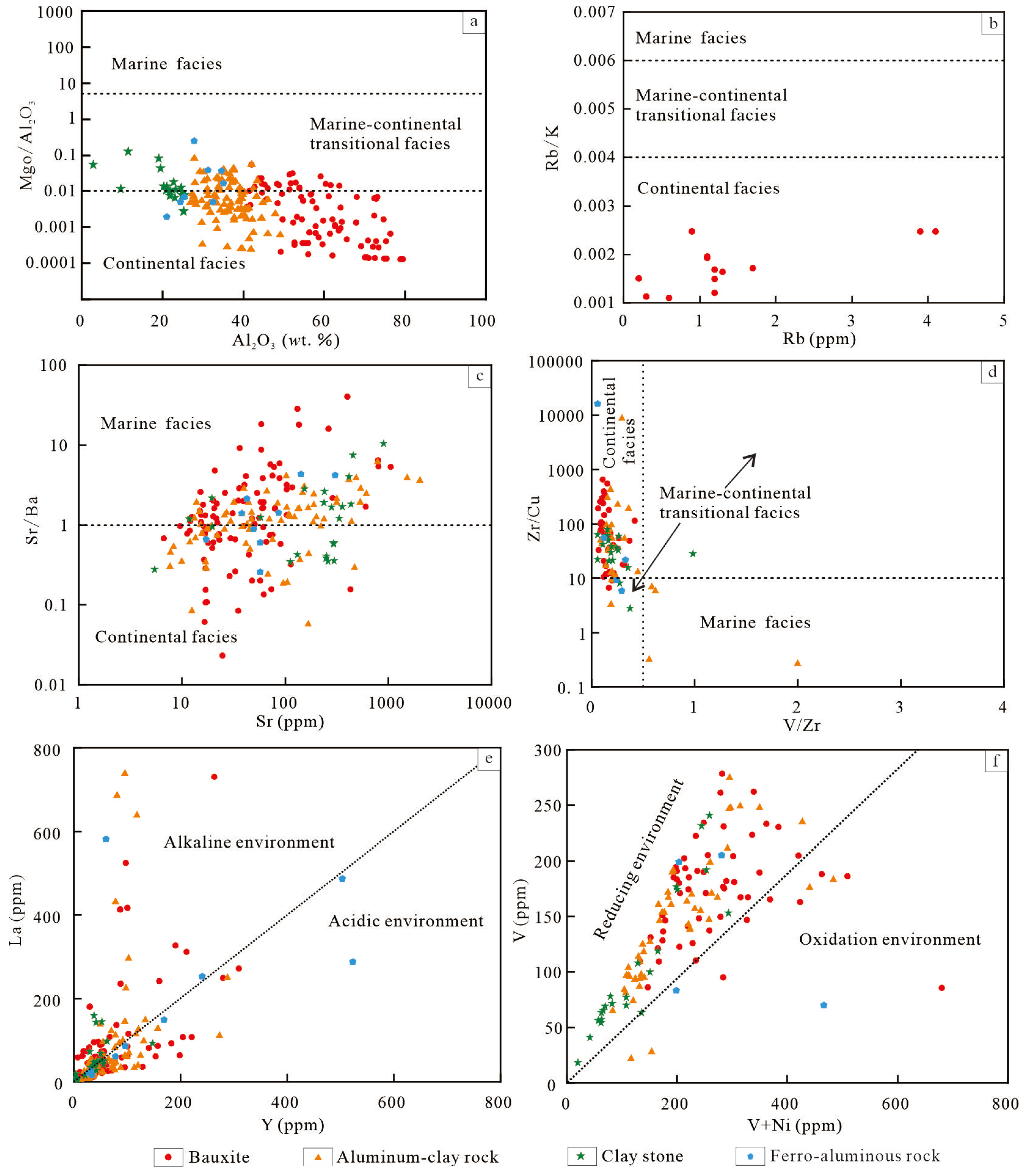
The depositional environment of sedimentary bauxite remains controversial, and no consensus has been reached. Current interpretations of bauxite in western Guangxi mainly fall into three categories: marine, continental, and transitional marine-continental settings [50,108]. The marine deposition model holds that based on microstructural characteristics and geochemical evidence, bauxite forms in a marine environment, with ore-forming materials transported by rivers and deposited in bays [95,101]. The continental deposition hypothesis is based on the occurrence patterns of bauxite layers, associated plant fossils, and geochemical characteristics interpreted as products of a continental setting [108]. The transitional marine-continental hypothesis is derived from combined evidence from elemental geochemistry and field observations of the spatial distribution and morphology of bauxite in western Guangxi [50]. In general, previous studies on the depositional environment of sedimentary bauxite have relied heavily on geochemical analysis. Therefore, this paper compiles published geochemical data for sedimentary bauxite from western Guangxi [11,49,50,64,107,108,111,112,113,114,115,116]. However, depositional environment discrimination diagrams indicate that the ore-bearing rock series of western Guangxi can form within marine, continental, and transitional marine–continental fields (Figure 6a–d). Mineralization is further inferred to occur under both acidic and alkaline conditions (Figure 6e) and under both oxidizing and reducing conditions (Figure 6f). These results suggest that sedimentary bauxite may form under a broad range of depositional conditions and that environmental controls are not unique. They also highlight the ambiguity of geochemical evidence, indicating that geochemical data alone may be insufficient to constrain depositional settings. Therefore, reliable discrimination requires an integrated approach based on multiple analytical methods [33,53,111,112,113,114,115,116,117,118,119,120,121].
Sedimentary bauxite is a product of intense chemical weathering, and ore-bearing studies suggest that its formation also involves intensive leaching [44,46,47,122]. It is important to distinguish the depositional environment of the ore-bearing rock series from the metallogenic environment of bauxite itself [122]. During bauxite formation, the migration of certain elements under leaching conditions may distort geochemical discrimination indices; therefore, geochemical interpretations based on these indices require caution [122]. Bauxite deposits in different parts of western Guangxi may form under different conditions, resulting in variations in paleoclimate, paleosalinity, and related environmental factors. A generalized depositional environment model may be insufficient to explain regional differences in orebody scale, thickness, grade, ore type, and mineral assemblage. Although studies in this region have focused mainly on bauxite genesis, investigations of depositional environments and sedimentary facies remain limited. The roles of paleotopography, sedimentary facies, and depositional conditions in bauxite formation and their influence on ore-layer development require further investigation [44,50,123].

6. Discussion of Ore-Forming Process

Western Guangxi is located within the Youjiang Basin along the southwestern margin of the Yangtze Block. The paleogeographic evolution of its Permian lithofacies is closely linked to the development of the Paleo-Tethys Ocean [11,41,124,125]. After the Caledonian Orogeny, South China entered a comparatively stable tectonic stage, during which a shallow marine platform developed, and thick carbonate strata were deposited [62,125]. With the continued Paleo-Tethyan evolution from the Devonian to the Middle Triassic, western Guangxi successively experienced the tectonic stages of a continental-margin rift basin, a back-arc basin, and a retro-arc foreland basin [11,41,42]. It eventually evolved into a rejuvenated rift basin superimposed on an Early Paleozoic folded basement. From the Devonian to the Permian, the region was characterized by an alternating platform-basin paleogeographic pattern, within which isolated carbonate platforms were widely developed [42]. At the end of the Middle Permian, the Dongwu Movement uplifted the isolated carbonate platforms. They were subsequently resubmerged in seawater during the middle to Late Permian. This tectonic event produced a paraconformable contact between the Middle Permian Maokou Formation and the Upper Permian Heshan Formation, and sedimentary bauxite deposits in western Guangxi formed on this paraconformity surface [23,62,102].
The formation of sedimentary bauxite in western Guangxi requires three basic conditions: adequate source materials, suitable host space, and favorable physical and chemical environments. As discussed above, the potential material sources include Maokou Formation limestone, paleoland-derived materials, Emeishan basalt, and acidic magmatic rocks. Nevertheless, recent studies increasingly favor volcanic ash derived from the ELIP and the Permian magmatic arc of the Paleo-Tethys as the principal contributors, suggesting that repeated ash input provides sufficient material for bauxite mineralization in western Guangxi [11,29,38,42,97,102]. Carbonate platforms hosting sedimentary bauxite have experienced repeated uplift and subsidence under tectonic influence. Once exposed above sea level, they undergo weathering and denudation, developing an undulatory karst weathering crust. Within this crust, solution cavities, sinkholes, and depressions provide the principal accommodation space for the accumulation and preservation of ore-forming materials [87]. Sedimentary bauxite occurs mainly in equatorial and tropical regions [126] and generally forms under conditions of an annual mean temperature above 22 °C and annual precipitation above 1200 mm [127]. Because it is a product of the intense weathering of parent materials, its development is widely regarded as being controlled by leaching [44,45,46,47,48]. In western Guangxi, the Upper Permian Linghao Formation tuff and sedimentary bauxite are contemporaneous but belong to different facies. The former was deposited in a deep-water basin without weathering or leaching and could not evolve into sedimentary bauxite [103,104,105,106,114].
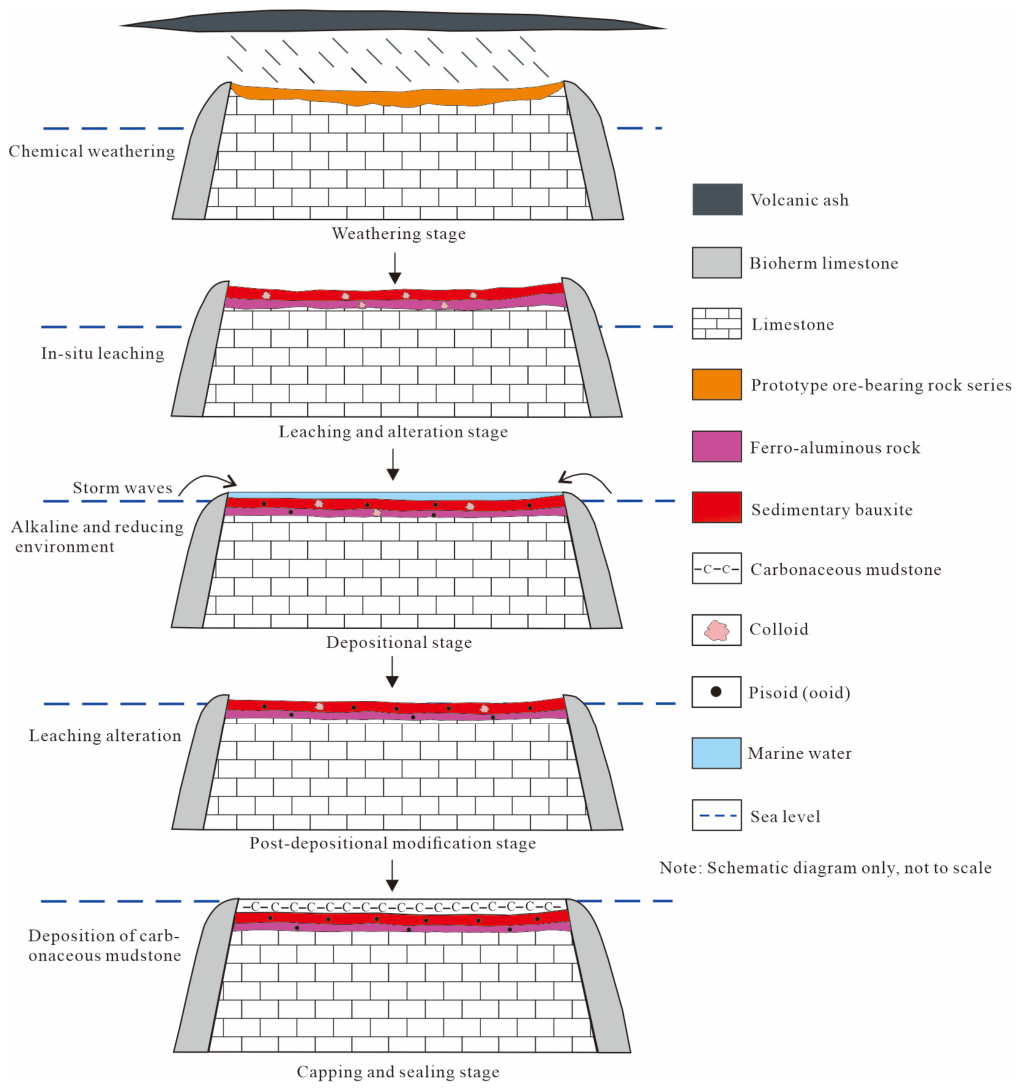
Based on previous studies, the metallogenic evolution of sedimentary bauxite in western Guangxi can be divided into five stages: weathering, leaching and alteration, deposition, post-depositional modification, and capping–sealing (Figure 7). This model represents a working hypothesis synthesized from previously published data. Although it provides a reasonable explanation for the observed features, several key issues remain unresolved.
During the Late Middle Permian, uplift associated with the Dongwu Movement exposed isolated carbonate platforms to subaerial weathering and denudation. In addition, volcanic ash derived from both the northern margin of the Paleo-Tethys and the ELIP was deposited on the platform surface, providing the principal material source for subsequent bauxite formation [11,29,38,42,97,102]. Western Guangxi is situated near the equator and experiences a hot, humid climate with abundant rainfall, conditions that strongly favor leaching [108,128,129].
The weathering stage developed on exposed and isolated carbonate platforms. Externally supplied volcanic ash underwent chemical weathering, during which potassium (K), calcium (Ca), sodium (Na), and magnesium (Mg) were progressively removed, whereas aluminum (Al) and silicon (Si) became relatively enriched. The resulting weathered residues were then transported by rainfall and surface runoff to topographically lower sites, where they provided the material basis for bauxite formation [29,41,66]. During transport and accumulation, part of this weathered material was altered into clay minerals through continued weathering and leaching. Volcanic ash deposited during the early part of this stage experienced strong chemical weathering and generated abundant clay minerals. Continued weathering and leaching caused the desilication of these clay minerals and promoted the formation of diaspore [5,75,92,130,131]. Under the most favorable leaching conditions at the peak of weathering, some volcanic ash materials, including feldspar and other aluminosilicate substances, bypassed the intermediate clay-mineral stage and were transformed directly into diaspore [5]. At this stage, the volcanic ash materials were thoroughly weathered and converted primarily into clay minerals. This process initiated the development of a proto-ore-bearing rock series enriched in aluminum-bearing dissolution products within the platforms.
The leaching and alteration stages involved the continued modification of the proto-ore-bearing rock series under persistent leaching. In western Guangxi, a well-developed karst drainage system provides favorable conditions for in situ leaching and desilication. Under strong leaching, claystone is desilicated and transformed into bauxite [36,43,44,45,132,133]. Meanwhile, weathering and intense leaching of claystone release large amounts of aluminum (Al3+), silicon (Si4+), and iron (Fe3+) ions, along with colloidal substances [24,29,59]. Because the early ore-bearing rock series contained abundant organic matter, acidic and reducing conditions developed, under which ferric iron (Fe3+) was reduced to the more mobile ferrous iron (Fe2+). Fe2+ migrated downward toward the carbonate-rock basement of the ore-bearing succession, accumulated above it, and ultimately formed ferro-aluminous rocks. This process leads to iron–aluminum differentiation within the sedimentary bauxite ore-bearing rock series [36,132].
The depositional stage corresponds to the development of restricted surface water bodies. During this stage, the proto-ore-bearing rock series produced during leaching, and alteration became submerged beneath freshwater and entered a stagnant reducing environment [87]. As the sea level rose, seawater was introduced into the platform interior by storm wave activity [96]. Under the combined influence of the alkaline geochemical barrier provided by the underlying carbonate rocks and the rise in groundwater level, the water body evolved under alkaline conditions [21,29]. In this environment, the trivalent aluminum ions (Al3+) released during the leaching stage rapidly crystallized and produced abundant diaspore [23,29,81]. Meanwhile, colloidal solutions enriched with aluminum, silicon, and iron coagulated and precipitated, resulting in the formation of pisoids (ooids) [58,59,60].
During the post-depositional modification stage, evaporation caused water bodies to disappear. This re-exposed the proto-ore-bearing rock series at the surface and subjected it to renewed leaching. Under continued strong leaching, aluminum (Al3+), silicon (Si4+), and iron (Fe3+) ions were released from clay minerals. Rainfall and surface runoff further promoted the development of abundant colloidal solutions. Dehydration of these colloids during evaporation produced pisoids (ooids) with desiccation cracks [58,59,60]. According to the groundwater level, the system can be divided into a vadose zone and a phreatic zone [12,23]. Bauxite in the vadose zone underwent strong leaching, whereas ore in the phreatic zone underwent weaker alteration. Variations in leaching intensity consequently generated four ore types: earthy, pisolitic (oolitic), clastic, and massive bauxite [43,44,45]. Because the vadose and phreatic zones were not fixed but fluctuated with the groundwater level [12,18], the vertical arrangement of these four bauxite types across different parts of western Guangxi [43] records dynamic changes in groundwater conditions during ore formation. This suggests a persistent tectonic influence on metallogenic processes. After the formation of bauxite layers, they likely underwent different degrees of leaching modification. With increasing leaching intensity, the ore types evolved from massive to pisolitic (oolitic) or clastic and finally to earthy bauxite [43]. Earthy bauxite, as the product of the strongest leaching, may develop through the alteration of other ore types [43,44,45].
The capping and sealing stages correspond to the formation of a carbonaceous mudstone layer. Under tectonic control, the rising sea level gradually shifted the depositional setting from continental to transitional marine–continental conditions, during which carbonaceous mudstone layers within the sedimentary bauxite ore-bearing rock series of western Guangxi were deposited [50,111]. At this stage, weathered sediments from the continent were transported by rivers and accumulated above the bauxite layers in the low-lying areas. Under the influence of organic matter, argillaceous sediments and aluminum-rich dissolution products began to form carbonaceous mudstone or coal. The development of a sufficiently thick carbonaceous mudstone layer is necessary for the completion of this process. If marine transgression advanced too rapidly, the carbonaceous mudstone layer could not accumulate adequately and was absent from the ore-bearing succession. In such cases, the bauxite layer came into direct contact with the Heshan Formation limestone. Once the carbonaceous mudstone layer was formed, continued seawater inundation submerged the isolated carbonate platforms, tectonic activity gradually weakened, and marine carbonate rocks were deposited above the ore-bearing rock series, thereby sealing and preserving the sedimentary bauxite deposits. After the formation of the ore-bearing rock series, later tectonic uplift may expose bauxite at the surface, where subsequent leaching can further improve the ore grade [36,44,51,59].

7. Conclusions and Prospect

(1)
Based on previous research, this paper reconstructs the formation process of sedimentary bauxite in western Guangxi. Metallogenic evolution is interpreted as occurring in five successive stages: weathering, leaching and alteration, deposition, post-depositional modification, and capping–sealing. Bauxite in this region is generated from volcanic ash delivered from the Emeishan Large Igneous Province and the Permian magmatic arc of Paleo-Tethys onto isolated carbonate platforms, where it is subjected to intense chemical weathering. During the early stage of ore formation, bauxite undergoes different degrees of leaching modification, and variations in leaching intensity ultimately produce different ore types.
(2)
The influence of deep-time paleoclimate and major geological events on bauxite mineralization has become an important research topic. Future research should focus on ore genesis, the origin of pisoids (ooids), and diaspore genesis. It should also examine the coupled roles of deep-time paleoclimate and major geological events in sedimentary bauxite formation to systematically establish a metallogenic theoretical framework for sedimentary bauxite.

Author Contributions

Conceptualization, J.L.; methodology, J.L. and H.X.; software, J.L. and J.X.; validation, B.P.; investigation, J.L. and J.X.; resources, J.L. and J.X.; data curation, J.L. and J.X.; writing—original draft preparation, J.L. and H.X.; writing—review and editing, J.X., S.X., G.L., and S.Y.; visualization, J.L. and H.X.; supervision, B.P. All authors have read and agreed to the published version of the manuscript.

Funding

This research was supported by the National Natural Science Foundation of China (grant number: 41362006).

Data Availability Statement

All data used in this paper are from previously published studies, and all references are cited in the text.

Acknowledgments

We are grateful to all the reviewers who participated in the review and MJEditor for its linguistic assistance during the preparation of this manuscript.

Conflicts of Interest

J.L. is an employee of Guangdong Province Dabaoshan Mining Co., Ltd. S.X. is an employee of China Rare Earth Group (Liangshan) Co., Ltd. The paper reflects the views of the scientists and not the company. The authors declare no conflicts of interest.

Abbreviation

The following abbreviation is used in this manuscript:
ELIPEmeishan Large Igneous Province

References

  1. Wang, W.X.; Sun, X.F.; Liu, L.; Zhao, L.H.; Liang, R.R.; Zhang, T.Y.; Liu, X.F. Metallogenic process of forming the large Xiangcaowa karstic bauxite deposit from the southern margin of the North China Craton. Minerals 2025, 15, 310. [Google Scholar] [CrossRef]
  2. Zhang, L.; Park, C.Y.; Wang, G.H.; Wu, C.J.; Santosh, M.; Chung, D.H.; Song, Y.G. Phase transformation processes in karst-type bauxite deposit from Yunnan area, China. Ore Geol. Rev. 2017, 89, 407–420. [Google Scholar] [CrossRef]
  3. Buccione, R.; Mongelli, G. Matese Mts. and caserta district karst bauxites (Campania region, southern Italy): Insights on geochemistry, paleoclimate, paleoenvironment, and parental affinity. Minerals 2024, 14, 1253. [Google Scholar] [CrossRef]
  4. Bolonin, A.V. High-grade iron ores in the laterite weathering Crust after banded iron formation in the Simandou mountain region, Republic of Guinea. Geol. Ore Depos. 2025, 66, 843–858. [Google Scholar]
  5. Bárdossy, G. Karst bauxites: Bauxite deposits on carbonate rock. Dev. Econ. Geol. 1982, 14, 1–441. [Google Scholar]
  6. Wei, X.; Ji, H.B.; Li, D.J.; Zhang, F.L.; Wang, S.J. Material source analysis and element geochemical research about two types of representative bauxite deposits and terra rossa in western Guangxi, southern China. J. Geochem. Explor. 2013, 133, 68–87. [Google Scholar] [CrossRef]
  7. Sun, L.; Zhang, S.; Zhang, S.H.; Liu, J.N.; Xiao, K.Y. Geologic characteristics and potential of bauxite in China. Ore Geol. Rev. 2020, 120, 103278. [Google Scholar] [CrossRef]
  8. Liu, X.F.; Wang, Q.F.; Zhang, Q.Z.; Zhang, Y.; Li, Y. Genesis of REE minerals in the karstic bauxite in western Guangxi, China, and its constraints on the deposit formation conditions. Ore Geol. Rev. 2016, 75, 100–115. [Google Scholar] [CrossRef]
  9. Wu, Z.X. Advance review on occurrence state and leaching of lithium in sedimentary bauxite (aluminum) deposits, China. Ore Geol. Rev. 2024, 164, 105851. [Google Scholar] [CrossRef]
  10. Liu, X.F.; Wang, Q.F.; Zhang, Q.Z.; Feng, Y.W.; Cai, S.H. Mineralogical characteristics of the superlarge Quaternary bauxite deposits in Jingxi and Debao counties, western Guangxi, China. J. Asian Earth Sci. 2012, 52, 53–62. [Google Scholar] [CrossRef]
  11. Ling, K.Y.; Wen, H.J.; Zhang, Q.Z.; Luo, C.G.; Gu, H.N.; Du, S.J.; Yu, W.X. Super-enrichment of lithium and niobium in the upper Permian Heshan Formation in Pingguo, Guangxi, China. Sci. China Earth Sci. 2021, 64, 753–772. [Google Scholar] [CrossRef]
  12. D’Argenio, B.; Mindszenty, A. Bauxites and related paleokarst: Tectonic and climatic event markers at regional unconformities. Eclogae Geol. Helv. 1995, 88, 453–499. [Google Scholar]
  13. Bogatyrev, B.; Zhukov, V.; Tsekhovsky, Y. Formation conditions and regularities of the distribution of large and superlarge bauxite deposits. Lithol. Miner. Resour. 2009, 44, 135–151. [Google Scholar] [CrossRef]
  14. Weng, S.F.; Yu, W.C.; Algeo, T.J.; Du, Y.S.; Li, P.G.; Lei, Z.Y.; Zhao, S. Giant bauxite deposits of South China: Multistage formation linked to Late Paleozoic Ice Age (LPIA) eustatic fluctuations. Ore Geol. Rev. 2018, 104, 1–13. [Google Scholar]
  15. Mondillo, N.; Chelle-Michou, C.; Putzolu, F.; Balassone, G.; Mormone, A.; Santoro, L.; Cretella, S.; Scognamiglio, G.; Tarallo, M.; Tavani, S. The mid-Cretaceous bauxites of SE France: Geochemistry, U-Pb zircon dating and their implications for the paleogeography at the junction between Alpine Tethys and Pyrenean Rift. Gondwana Res. 2025, 137, 145–170. [Google Scholar]
  16. Yu, W.C.; Algeo, T.J.; Yan, J.X.; Yang, J.H.; Du, Y.S.; Huang, X.; Weng, S.F. Climatic and hydrologic controls on upper Paleozoic bauxite deposits in South China. Earth-Sci. Rev. 2019, 189, 159–176. [Google Scholar] [CrossRef]
  17. Zhou, J.T.; Yu, W.C.; Du, Y.S.; Liu, X.; Wang, Y.H.; Xiong, G.L.; Zhao, Z.Y.; Pang, D.W.; Shen, D.X.; Weng, S.F.; et al. Provenance change and continental weathering of Late Permian bauxitic claystone in Guizhou Province, Southwest China. J. Geochem. Explor. 2022, 236, 106962. [Google Scholar] [CrossRef]
  18. Wang, Q.F.; Deng, J.; Liu, X.F.; Zhang, Q.Z.; Li, Z.M.; Kang, W.; Cai, S.H.; Li, N. Review on research of bauxite geology and genesis in China. Geol. Explor. 2012, 48, 430–448, (In Chinese with English Abstract). [Google Scholar]
  19. Gao, L.; Li, J.H.; Wang, D.H.; Xiong, X.Y.; Yi, C.W.; Han, M.Z. Outline of metallogenic regularity of bauxite deposits in China. Acta Geol. Sin. (Engl. Ed.) 2015, 89, 2072–2084. [Google Scholar] [CrossRef]
  20. Ling, K.Y.; Wen, H.J.; Fan, H.F.; Zhu, X.K.; Li, Z.H.; Zhang, Z.W.; Grasby, S.E. Iron loss during continental weathering in the Early Carboniferous period recorded by karst bauxites. J. Geophys. Res. Earth Surf. 2023, 128, e2022JF006906. [Google Scholar] [CrossRef]
  21. Zhao, L.H.; Liu, X.F.; Yang, S.J.; Ma, X.L.; Liu, L.; Sun, X.F. Regional multi-sources of Carboniferous karstic bauxite deposits in North China Craton: Insights from multi-proxy provenance systems. Sediment. Geol. 2021, 421, 105958. [Google Scholar]
  22. Xiao, J.F.; Li, Y.T.; Yang, H.Y.; Xu, J.B.; Huang, M.L. Geochemistry of the Yudong bauxite deposit, south-eastern Guizhou, China: Implications for conditions of formation and parental affinity. J. Geochem. Explor. 2021, 220, 106676. [Google Scholar] [CrossRef]
  23. Liu, X.F.; Wang, Q.F.; Deng, J.; Zhang, Q.Z.; Sun, S.L.; Meng, J.Y. Mineralogical and geochemical investigations of the Dajia Salento-type bauxite deposits, western Guangxi, China. J. Geochem. Explor. 2010, 105, 137–152. [Google Scholar] [CrossRef]
  24. Liu, X.F.; Wang, Q.F.; Zhang, Q.Z.; Yang, S.J.; Liang, Y.Y.; Zhang, Y.; Li, Y.; Guan, T. Genesis of the Permian karstic Pingguo bauxite deposit, western Guangxi, China. Miner. Depos. 2017, 52, 1031–1048. [Google Scholar] [CrossRef]
  25. Wang, Q.F.; Lin, Y.; Xu, X.J.; Santosh, M.; Wang, Y.N.; Wang, T.Y.; Chen, F.G.; Wang, R.X.; Gao, L.; Liu, X.F.; et al. Multi-stage tectonics and metallogeny associated with Phanerozoic evolution of the South China Block: A holistic perspective from the Youjiang Basin. Earth-Sci. Rev. 2020, 211, 103405. [Google Scholar] [CrossRef]
  26. Liu, X.F.; Wang, Q.F.; Zhao, L.H.; Peng, Y.B.; Ma, Y.; Zhou, Z.H. Metallogeny of the large-scale Carboniferous karstic bauxite in the Sanmenxia area, southern part of the North China Craton, China. Chem. Geol. 2020, 556, 119851. [Google Scholar] [CrossRef]
  27. Liu, X.F.; Zhao, L.H.; Wang, Q.F.; Sun, X.F.; Liu, L.; Yang, S.J.; Deng, J. Provenance and genesis of karstic bauxite deposits in China: Implications for the formation of super-large karstic bauxite deposits. Earth-Sci. Rev. 2024, 257, 104882. [Google Scholar] [CrossRef]
  28. Zhang, P.; Zuo, L.; Wang, Y.Q.; Sun, X.F.; Liu, R.; Liu, L.; Ma, Y.F. Nanogeochemistry of karst-type bauxite from Jingxi, Guangxi, China: Revealing a new occurrence of Al, Si, Ti, Fe, and C by nanoparticles in karst-type bauxite deposit. Ore Geol. Rev. 2023, 157, 105449. [Google Scholar]
  29. Sun, X.F.; Yang, S.J.; Liu, X.F.; Zhao, L.H.; Liu, L.; Zhang, Q.Z.; Feng, Y.C.; Wang, W.X. Metallogenic process of Permian Taiping karstic bauxite deposit in Youjiang Basin, China. Ore Geol. Rev. 2023, 152, 105258. [Google Scholar]
  30. Yu, W.C.; Shen, T.Y.; Wei, W.; Guo, S.Y.; Zhou, J.T.; Chen, L.; Zhen, X.; Mo, H.C.; Li, Y.H.; Li, X.N.; et al. Revisiting the provenance and formation environments of Quaternary bauxite in South China and significance for ancient karstic bauxite deposits. Earth-Sci. Rev. 2026, 272, 105345. [Google Scholar]
  31. Retallack, G.J. Lateritization and bauxitization events. Econ. Geol. 2010, 105, 655–667. [Google Scholar] [CrossRef]
  32. Stefanelli, G.A.; Ferreira, F.M.P.; Almeida, P.A.; Carlos, K.J. Gibbsite crystallinity and morphology in ferralsols and bauxites. Minerals 2022, 12, 1441. [Google Scholar] [CrossRef]
  33. Luo, C.K.; Yang, R.D.; Gao, J.B.; Chen, J.; Mo, H.C. Metallogenic model of the carboniferous karst bauxites in central Guizhou Province, Southwest China. J. Geochem. Explor. 2025, 268, 107607. [Google Scholar]
  34. Yang, J.H.; Wen, H.J.; Luo, C.G.; Zhang, Y.X.; Yu, W.X.; Zhu, C.W. Sedimentary conditions of Jiujialu Formation in central Guizhou, South China, and implications for the transformation of lithium-rich claystones into karst bauxites. Ore Geol. Rev. 2024, 175, 106383. [Google Scholar]
  35. Liu, L.; Liu, X.F.; Yang, S.J.; Zhao, L.H.; Sun, X.F.; Zhang, J.Y. Mineralogical and geochemical investigations on the Early Permian Yuxi karstic bauxite deposit, Central Yunnan, China. Ore Geol. Rev. 2023, 153, 105296. [Google Scholar] [CrossRef]
  36. Ling, K.Y.; Zhu, X.Q.; Tang, H.S.; Li, S.X. Importance of hydrogeological conditions during formation of the karstic bauxite deposits, Central Guizhou Province, Southwest China: A case study at Lindai deposit. Ore Geol. Rev. 2017, 82, 198–216. [Google Scholar] [CrossRef]
  37. Ling, K.Y.; Wen, H.J.; Grasby, S.E.; Zhao, H.N.; Deng, C.Z.; Yin, R.S. The Emeishan large igneous province eruption triggered coastal perturbations and the Capitanian mass extinction: Insights from mercury in Permian bauxite beds. Chem. Geol. 2023, 617, 121243. [Google Scholar]
  38. Yang, S.J.; Wang, Q.F.; Lai, X.L.; Qiao, L.; Wang, R.X.; Huang, Y.X.; Wang, Y.Z. Genesis of end-Guadalupian bauxite and pyrite deposits in the Youjiang Basin (South China): Insights into the causative link between magmatic events and mass extinction. J. Asian Earth Sci. 2021, 215, 104801. [Google Scholar] [CrossRef]
  39. Öztürk, H.; Hanilçi, N.; Hein, J.R. Genesis of the Doğankuzu and Mortaş Bauxite Deposits, Taurides, Turkey: Separation of Al, Fe, and Mn and Implications for Passive Margin Metallogeny. Econ. Geol. 2002, 97, 1063–1077. [Google Scholar]
  40. Karadağ, M.M.; Küpeli, Ş.; Arýk, F.; Ayhan, A.; Zedef, V.; Döyen, A. Rare earth element (REE) geochemistry and genetic implications of the Mortaş bauxite deposit (Seydişehir/Konya—Southern Turkey). Geochemistry 2009, 69, 143–159. [Google Scholar]
  41. Zhao, H.N.; Ling, K.Y.; Du, S.J.; Wen, H.J. Provenance of the Nb-rich bauxite and Li-rich claystone at the base of the Heshan Formation in Pingguo, Guangxi, SW China: Constrained by U–Pb ages and trace element contents of detrital zircon. Ore Geol. Rev. 2023, 161, 105633. [Google Scholar]
  42. Hou, Y.L.; Zhong, Y.T.; Xu, Y.G.; He, B. The provenance of late Permian karstic bauxite deposits in SW China, constrained by the geochemistry of interbedded clastic rocks, and U–Pb–Hf–O isotopes of detrital zircons. Lithos 2017, 278–281, 240–254. [Google Scholar] [CrossRef]
  43. Luo, J.W.; Pang, B.C.; Xu, J.Q.; Chen, T.; Xiang, S.L.; Liu, W.; Lu, G.H.; Xu, H.P.; Yao, S.Q. Structural characteristics and geological significance of sedimentary bauxite ore in western Guangxi. Geol. Explor. 2025, 61, 24–39, (In Chinese with English Abstract). [Google Scholar]
  44. Li, P.G.; Yu, W.C.; Du, Y.S.; Lai, X.L.; Weng, S.F.; Pang, D.W.; Xiong, G.L.; Lei, Z.Y.; Zhao, S.; Yang, S.Q. Influence of geomorphology and leaching on the formation of Permian bauxite in northern Guizhou Province, South China. J. Geochem. Explor. 2020, 210, 106446. [Google Scholar] [CrossRef]
  45. Du, Y.S.; Yu, W.C.; Weng, S.F.; Lei, Z.Y.; Li, P.G.; Qin, Y.; Deng, K.Y.; Lu, S.F.; Luo, X.J.; Fu, H.B.; et al. Lithologic(ore) types, formation sequence and metallogenic mechanism of bauxite and associated critical metal deposit. J. Palaeogeogr. 2024, 26, 1152–1166, (In Chinese with English Abstract). [Google Scholar]
  46. Li, H.L.; Fan, H.P.; Zhang, J.; Huang, Z.L.; Jiang, C.; Ye, L.; Wu, L. Distribution and enrichment mechanism of critical metals in the Danping bauxite deposit, northern Guizhou (SW China). Ore Geol. Rev. 2023, 161, 105670. [Google Scholar] [CrossRef]
  47. Lei, Z.Y.; Ling, W.L.; Wu, H.; Zhang, Y.H.; Zhang, Y.N. Geochemistry and mineralization of the Permian bauxites with Contrast Bedrocks in Northern Guizhou, South China. J. Earth Sci. 2023, 34, 487–503. [Google Scholar] [CrossRef]
  48. Zhang, Z.W.; Zhou, L.J.; Li, Y.J.; Wu, C.Q.; Zheng, C.F. The “coal–bauxite–iron” structure in the ore-bearing rock series as a prospecting indicator for southeastern Guizhou bauxite mines. Ore Geol. Rev. 2013, 53, 145–158. [Google Scholar]
  49. Chen, T. Research on the Geological and Geochemical Characteristics and Ore-forming Paleoclimate of Sedimentary Bauxite in Western Guangxi. Master’s Thesis, Guilin University of Technology, Guilin, China, 2023; pp. 1–73, (In Chinese with English Abstract). [Google Scholar]
  50. Li, X.F.; Li, H.; Wu, Q.H.; Zhu, R.Q.; Xi, X.S. Geological and geochemical characteristics of primary sedimentary bauxite in Pingguo, Guangxi and its metallogenic environment. Chin. J. Nonferrous Met. 2022, 32, 3183–3205, (In Chinese with English Abstract). [Google Scholar]
  51. Pang, D.W.; Yu, W.C.; Chen, Q.; Du, Y.S.; Dai, X.Y.; Xiong, G.L.; Deng, K.Y.; Wu, B.; Deng, X.S.; Zhou, J.T. Continental weathering led to the accumulation of Early Carboniferous bauxite deposits in the SW South China Craton. J. Asian Earth Sci. 2023, 256, 105801. [Google Scholar] [CrossRef]
  52. Yang, Z.F.; Zhao, J.J. Geological features and ore formation pattern of Jinzhong bauxite mine, Shanxi Province, China. Sci. Soc. Res. 2024, 6, 82–89. [Google Scholar] [CrossRef]
  53. Mo, H.C.; Yang, R.D.; Luo, C.K.; Li, X.Z.; Ji, Y.B.; Yang, G.Y.; Zhou, X.M.; Gao, C.Q.; Hu, X.; Zeng, Z.M. Effect of karst geomorphology on the sedimentary mineralization and geochemical distribution of bauxite: An example from the Xiaoyuan area in Qingzhen, Guizhou Province. Minerals 2023, 13, 1013. [Google Scholar] [CrossRef]
  54. Wang, R.X.; Wang, Q.F.; Huang, Y.X.; Yang, S.J.; Liu, X.F.; Zhou, Q. Combined tectonic and paleogeographic controls on the genesis of bauxite in the Early Carboniferous to Permian Central Yangtze island. Ore Geol. Rev. 2018, 101, 468–480. [Google Scholar] [CrossRef]
  55. Liao, S.F.; Liang, T.R. Bauxite Geology of China; Science and Technology Publishing House of Guizhou: Guiyang, China, 1991; pp. 1–277, (In Chinese with English Abstract). [Google Scholar]
  56. Hu, X.; Yi, H.S.; Wang, G.; Ou, L.H. Texture characteristics and genesis of bean-pebble of sedimentary bauxite deposits. J. Chongqing Univ. Sci. Technol. Nat. Sci. Ed. 2013, 15, 5–9, (In Chinese with English Abstract). [Google Scholar]
  57. Cheng, S.B.; Liu, A.S.; Li, R.Z.; Wei, Y.S.; Liu, J.H.; Xu, M. Characteristics and Genesis of pisolites and ooids in Permian karst bauxite, western Guangxi. South China Geol. 2020, 36, 232–239, (In Chinese with English Abstract). [Google Scholar]
  58. Cui, T.; Yan, J.; Zhang, M. Origin of oolites of sedimentary bauxite in northern Guizhou, China. Chin. J. Nonferrous Met. 2022, 32, 586–602, (In Chinese with English Abstract). [Google Scholar]
  59. Zhang, Q.L.; Wei, F.; Deng, J.; Li, H.S.; Chen, W.L.; Gong, Y.; Qin, H.F.; Xin, X.W.; Huang, S.H.; Wang, X.H.; et al. Study of the genetic mechanism of ooids in Permian bauxite ore from western Guangxi. Acta Petrol. Mineral. 2024, 43, 21–36, (In Chinese with English Abstract). [Google Scholar]
  60. Luo, J.W.; Xu, H.P.; Pang, B.C.; Xu, J.Q.; Xiang, S.L.; Lu, G.H.; Yao, S.Q. Genesis and indication of mineralization of pisolites (ooids) in sedimentary bauxite deposits from western Guangxi. Geol. Rev. 2025, 71, 1629–1652, (In Chinese with English Abstract). [Google Scholar]
  61. Yao, L.; Fu, Y.; Pan, Z.F.; Tang, B.; Luo, M.H.; Luo, P.Q.; Liu, G.D.; Yang, Q.M.; Liu, B.; Duan, M.F. Mineral association characteristics and indicative significance of bauxite deposits in South China. Geol. Rev. 2023, 69, 2161–2178, (In Chinese with English Abstract). [Google Scholar]
  62. Wang, Q.F.; Deng, J.; Liu, X.F.; Zhang, Q.Z.; Sun, S.L.; Jiang, C.Z.; Zhou, F. Discovery of the REE minerals and its geological significance in the Quyang bauxite deposit, West Guangxi, China. J. Asian Earth Sci. 2010, 39, 701–712. [Google Scholar] [CrossRef]
  63. Liu, X.F.; Wang, Q.F.; Li, Z.M.; Feng, Y.W.; Cai, S.H.; Kang, W.; Wang, J.Q.; Jiang, L.L. Mineral genesis and evolutionary sequence of the bauxite deposits in Henan Province. Geol. Explor. 2012, 48, 449–459, (In Chinese with English Abstract). [Google Scholar]
  64. Wang, R.X. Mineral Compositions and Metallogenic Mechanism of Important Bauxite Concentration Areas in China. Ph.D. Thesis, China University of Geosciences, Beijing, China, 2019; pp. 1–153, (In Chinese with English Abstract). [Google Scholar]
  65. Luo, C.K.; Liang, P.; Yang, R.D.; Gao, J.B.; Chen, Q.; Mo, H.C. Mineralogical and geochemical constraints on the occurrence forms of REEs in Carboniferous karst bauxite, central Guizhou Province, Southwest China: A case study of Lindai bauxite. Minerals 2023, 13, 320. [Google Scholar] [CrossRef]
  66. Yu, W.C.; Wang, R.H.; Zhang, Q.L.; Du, Y.S.; Chen, Y.; Liang, Y.P. Mineralogical and geochemical evolution of the Fusui bauxite deposit in Guangxi, South China: From the original Permian orebody to a Quarternary Salento-type deposit. J. Geochem. Explor. 2014, 146, 75–88. [Google Scholar] [CrossRef]
  67. Ling, K.Y.; Tang, H.S.; Zhang, Z.W.; Wen, H.J. Host minerals of Li–Ga–V–rare earth elements in Carboniferous karstic bauxites in southwest China. Ore Geol. Rev. 2020, 119, 103325. [Google Scholar]
  68. Wang, Z.S.; Li, Y.; Algeo, T.J.; Yu, W.C.; He, X.F. Critical metal enrichment in Upper Carboniferous karst bauxite of North China Craton. Miner. Depos. 2024, 59, 237–254. [Google Scholar]
  69. Luo, C.K.; Yang, R.D.; Chen, J.; Gao, L.; Xu, H.; Ni, X.R. Genesis of the Carboniferous karstic bauxites in Qingzhen region, central Guizhou, southwest China. J. Geochem. Explor. 2022, 235, 106955. [Google Scholar] [CrossRef]
  70. Zhu, K.Y.; Su, H.M.; Jiang, S.Y. Mineralogical control and characteristics of rare earth elements occurrence in Carboniferous bauxites from western Henan Province, north China: A XRD, SEM-EDS and LA-ICP-MS analysis. Ore Geol. Rev. 2019, 114, 103144. [Google Scholar]
  71. Zhao, L.H.; Liu, X.F. Metallogenic and tectonic implications of detrital zircon U–Pb, Hf isotopes, and detrital rutile geochemistry of late carboniferous karstic bauxite on the southern margin of the North China Craton. Lithos 2019, 350–351, 105222. [Google Scholar]
  72. Yang, S.J.; Huang, Y.X.; Wang, Q.F.; Deng, J.; Liu, X.F.; Wang, J.Q. Mineralogical and geochemical features of karst bauxites from Poci (western Henan, China), implications for parental affinity and bauxitization. Ore Geol. Rev. 2018, 105, 295–309. [Google Scholar]
  73. Liu, X.F.; Wang, Q.F.; Zhang, Q.Z.; Yang, S.J.; Zhang, Y.; Liang, Y.Y.; Qing, C. Transformation from Permian to Quaternary bauxite in southwestern South China Block driven by superimposed orogeny: A case study from Sanhe ore deposit. Ore Geol. Rev. 2017, 90, 998–1017. [Google Scholar] [CrossRef]
  74. Hanilci, N. Geological and geochemical evolution of the Bolkardaği bauxite deposits, Karaman, Turkey: Transformation from shale to bauxite. J. Geochem. Explor. 2013, 133, 118–137. [Google Scholar] [CrossRef]
  75. Temur, S.; Kansun, G. Geology and petrography of the Masatdagi diasporic bauxites, Alanya, Antalya, Turkey. J. Asian Earth Sci. 2006, 27, 512–522. [Google Scholar] [CrossRef]
  76. Liu, X.F.; Wang, Q.F.; Feng, Y.W.; Li, Z.M.; Cai, S.H. Genesis of the Guangou karstic bauxite deposit in western Henan, China. Ore Geol. Rev. 2013, 55, 162–175. [Google Scholar] [CrossRef]
  77. Wang, Y.; Xing, S.W.; Zhang, Y.; Li, Z.W.; Ma, Y.B.; Zhang, Z.J. Mineralogical and hermal characteristics of low-grade Jinlong bauxite sourced from Guangxi Province, China. J. Therm. Anal. Calorim. 2015, 122, 917–927. [Google Scholar]
  78. Ervin, G., Jr.; Osborn, E.F. The system Al2O3-H2O. J. Geol. 1951, 59, 381–394. [Google Scholar]
  79. Li, J.L.; Dai, T.G.; Yang, L.; Du, G.F. Mineralogical characteristics of kastic bauxite in Fushi, Guangxi Province and its origin significance. Miner. Petrol. 2015, 35, 101–109, (In Chinese with English Abstract). [Google Scholar]
  80. Zhao, L.H.; Liu, X.F.; Wang, Q.F.; Ma, X.L.; Liu, L.; Sun, X.F.; Deng, J. Genetic mechanism of super-large karst bauxite in the northern North China Craton: Constrained by diaspore in-situ compositional analysis and pyrite sulfur isotopic compositions. Chem. Geol. 2023, 622, 121388. [Google Scholar]
  81. Özlü, N. New facts on diaspore genesis in the Akseki-Seydisehir bauxite deposit (Western Taures, Turkey). Trav. ICSOBA 1985, 14, 53–62. [Google Scholar]
  82. Lanson, B.; Beaufort, D.; Berger, G.; Bauer, A.; Cassagnabère, A.; Meunier, A. Authigenic kaolin and illitic minerals during burial diagenesis of sandstones: A review. Clay Miner. 2002, 37, 1–22. [Google Scholar] [CrossRef]
  83. McAulay, G.E.; Burley, S.D.; Johnes, L.H. Silicate mineral authigenesis in the Hutton and NW Hutton fields: Implications for sub-surface porosity development. Geol. Soc. Lond. Pet. Geol. Conf. Ser. 1993, 4, 1377–1394. [Google Scholar] [CrossRef]
  84. Ehrenberg, S.N.; Aagaard, P.; Wilson, M.J.; Fraser, A.R.; Duthie, D.M.L. Depth-dependent Transformation of kaolinite to dickite in sandstones of the Norwegian continental shelf. Clay Miner. 1993, 28, 325–352. [Google Scholar] [CrossRef]
  85. Luo, J.W. Study on Fabric Characteristics and Formation Mechanism of Ore from Sedimentary Bauxite in Western Guangxi, China. Master’s Thesis, Guilin University of Technology, Guilin, China, 2025; pp. 1–72, (In Chinese with English Abstract). [Google Scholar]
  86. Lu, Y.G.; Zhang, Q.Z.; Zeng, W.; Li, Z.D.; Chen, Y.; Zhang, F.; Liu, X.J.; Lu, G.H.; Xu, H.P.; Pang, C.J.; et al. Advances in research and exploration of bauxite in China. Acta Geol. Sin. 2026, 100, 584–597, (In Chinese with English Abstract). [Google Scholar]
  87. Cheng, S.B.; Liu, A.S.; Cui, S.; Wei, R.Z.; Wei, Y.S. Mineralization process of Permian karst bauxite in western Guangxi. Earth Sci. 2021, 46, 2697–2710, (In Chinese with English Abstract). [Google Scholar]
  88. Lin, J.W.; Zhang, S.Q.; Liu, D.N.; Zhao, F.H.; Zhang, X.G.; Wang, Y.D.; Dai, G.B.; Li, L.; Li, X. Genesis of Carboniferous aluminous-bearing strata in the northern part of the North China Craton: A case study of the Xingxian bauxite deposit. Ore Geol. Rev. 2024, 170, 106125. [Google Scholar] [CrossRef]
  89. Mordberg, L.E.; Stanley, C.J.; Germann, K. Mineralogy and geochemistry of trace elements in bauxites: The Devonian Schugorsk deposit, Russia. Mineral. Mag. 2001, 65, 81–101. [Google Scholar] [CrossRef]
  90. Laskou, M.; Margomenou-Leonidopoulou, G.; Balek, V. Thermal characterization of bauxite samples. J. Therm. Anal. Calorim. 2006, 84, 141–146. [Google Scholar] [CrossRef]
  91. Mameli, P.; Mongelli, G.; Oggiano, G.; Dinelli, E. Geological, geochemical and mineralogical features of some bauxite deposits from Nurra (Western Sardinia, Italy): Insights on conditions of formation and parental affinity. Int. J. Earth Sci. 2007, 96, 887–902. [Google Scholar]
  92. Maclean, W.; Bonavia, F.; Sanna, G. Argillite debris converted to bauxite during karst weathering: Evidence from immobile element geochemistry at the Olmedo Deposit, Sardinia. Miner. Depos. 1997, 32, 607–616. [Google Scholar] [CrossRef]
  93. Zarasvandi, A.; Charchi, A.; Carranza, E.J.M.; Alizadeh, B. Karst bauxite deposits in the Zagros Mountain Belt, Iran. Ore Geol. Rev. 2008, 34, 521–532. [Google Scholar] [CrossRef]
  94. Esmaeily, D.; Rahimpour-Bonab, H.; Esna-Ashari, A.; Kananian, A. Petrography and Geochemistry of the Jajarm Karst Bauxite Ore Deposit, NE Iran: Implications for Source Rock Material and Ore Genesis. Turk. J. Earth Sci. 2010, 19, 267–284. [Google Scholar] [CrossRef]
  95. Wang, L.; Long, Y.Z.; Peng, S.L. Geologic and geochemical study on material derivation of bauxite deposits in western Guangxi. J. Guilin Inst. Technol. 2004, 24, 1–6, (In Chinese with English Abstract). [Google Scholar]
  96. Luo, Q. Relationship between sedimentary facies and genesis of the bauxite deposits in Pingguo, Guangxi. Sediment. Facies Palaeogeogr. 1989, 40, 11–18, (In Chinese with English Abstract). [Google Scholar]
  97. Yu, W.C.; Algeo, T.J.; Du, Y.S.; Zhang, Q.L.; Liang, Y.P. Mixed volcanogenic–lithogenic sources for Permian bauxite deposits in southwestern Youjiang Basin, South China, and their metallogenic significance. Sediment. Geol. 2016, 341, 276–288. [Google Scholar] [CrossRef]
  98. Chen, Q.Y.; Lan, W.B. A study on the genesis of the Permian bauxite deposit at Pingguo, Guangxi. Geol. Guangxi 1991, 4, 43–49, (In Chinese with English Abstract). [Google Scholar]
  99. He, B.; Xu, Y.G.; Guan, J.P.; Zhong, Y.T. Paleokarst on the top of the Maokou Formation: Further evidence for domal crustal uplift prior to the Emeishan flood volcanism. Lithos 2010, 119, 1–9. [Google Scholar] [CrossRef]
  100. Wan, B.; Zhou, W.X.; Yang, C.K. Discussion on the material sources of bauxite in Guangxi. Geol. Explor. 1981, 1, 25–32. (In Chinese) [Google Scholar]
  101. Li, Q.J.; Hou, Z.H.; Wu, C.L. Discussion on the genesis of primary bauxite deposits in Guangxi. Light Met. 1981, 1–3+6. (In Chinese) [Google Scholar]
  102. Deng, J.; Wang, Q.F.; Yang, S.J.; Liu, X.F.; Zhang, Q.Z.; Yang, L.Q.; Yang, Y.H. Genetic relationship between the Emeishan plume and the bauxite deposits in Western Guangxi, China: Constraints from U-Pb and Lu-Hf isotopes of the detrital zircons in bauxite ores. J. Asian Earth Sci. 2010, 37, 412–424. [Google Scholar] [CrossRef]
  103. Xu, J.Q.; Pang, B.C.; Lu, G.H.; Pang, C.J.; Yang, J.W.; Yang, D.S.; Yao, S.Q.; Xu, H.P. Provenance of Permian Li-rich Karst bauxite in western Guangxi, China: Evidence from geochemistry, zircon U-Pb and Hf isotopic compositions of contemporaneous-heterophase tuffaceous rock. Ore Geol. Rev. 2026, 189, 107134. [Google Scholar]
  104. Yang, J.H.; Cawood, P.A.; Du, Y.S.; Huang, H.; Huang, H.W.; Tao, P. Large Igneous Province and magmatic arc sourced Permian-Triassic volcanogenic sediments in China. Sediment. Geol. 2012, 261–262, 120–131. [Google Scholar]
  105. Yang, J.H.; Cawood, P.A.; Du, Y.S. Voluminous silicic eruptions during late Permian Emeishan igneous province and link to climate cooling. Earth Planet. Sci. Lett. 2015, 432, 166–175. [Google Scholar] [CrossRef]
  106. Huang, H.; Du, Y.S.; Yang, J.H.; Zhou, L.; Hu, L.S.; Huang, H.W.; Huang, Z.Q. Origin of Permian basalts and clastic rocks in Napo, Southwest China: Implications for the erosion and eruption of the Emeishan large igneous province. Lithos 2014, 208–209, 324–338. [Google Scholar] [CrossRef]
  107. Yu, W.C. Sedimentological and Metallogenic Study of Bauxite Deposits in Guizhou and Guangxi Provinces, South China. Ph.D. Thesis, China University of Geosciences, Wuhan, China, 2017; pp. 1–158, (In Chinese with English Abstract). [Google Scholar]
  108. Zhang, Q.L.; Liang, Y.P.; Yu, W.C.; Du, Y.S. Sedimentary environment of allites in the Permian Heshan Formation in western Guangxi. J. Palaeogeogr. 2016, 18, 595–604, (In Chinese with English Abstract). [Google Scholar]
  109. Wang, A.H.; Wang, Z.H.; Liu, J.K.; Xu, N.C.; Li, H.L. The Sr/Ba ratio response to salinity in clastic sediments of the Yangtze River Delta. Chem. Geol. 2021, 559, 119923. [Google Scholar] [CrossRef]
  110. Laita, E.; Lorenzo, A.; De La Horra, R.; Muñoz-García, M.B.; Yuste, A.; Bauluz, B.; Fregenal-Martínez, M. Multi-episodic bauxitization in a karstic and rifted setting (Early Cretaceous, South-western Iberian Basin, Spain): An interdisciplinary approach. Sediment. Geol. 2025, 489, 106981. [Google Scholar]
  111. Zhang, Q.L.; Huang, G.Q.; Wei, F.; Huang, W.F.; Deng, J.; Li, H.S.; Wei, L.X.; Meng, J.F.; Qin, L.C.; Yang, H.; et al. Characteristics and evolution of sedimentary facies of bauxite-bearing rocks series of Permian bauxite deposits in western Guangxi. Geol. Bull. China 2024, 43, 1734–1755, (In Chinese with English Abstract). [Google Scholar]
  112. Lin, Y.; Lv, Y.; Shan, K.Q. REE geochemical characteristics and material source of the Nianyin bauxite deposit in Jinxi County, western Guangxi Province. Geol. Explor. 2014, 50, 58–66, (In Chinese with English Abstract). [Google Scholar]
  113. Wang, X.T.; Chen, Y.R.; Huang, Z.N.; Jiang, J.W.; Yang, J. Material source constraints of Sanhe sedimentary bauxite deposit in Jingxi, Guangxi based on geochemistry. Miner. Resour. Geol. 2022, 36, 949–961, (In Chinese with English Abstract). [Google Scholar]
  114. Xu, J.Q. Supernormal Enrichment Mechanism of Lithium in Bauxite Series in Permian, Western Guangxi. Master’s Thesis, Guilin University of Technology, Guilin, China, 2021; pp. 1–52, (In Chinese with English Abstract). [Google Scholar]
  115. Zhang, J.L.; Zhang, Q.W.; Yang, C.L.; Gao, P.; Miao, B.K.; Pi, Q.H.; Li, S.H. Geochemical characteristics of the rare metal and rare-scattered elements of bauxite in western Guangxi. J. Guilin Univ. Technol. 2016, 36, 153–159, (In Chinese with English Abstract). [Google Scholar]
  116. Hou, Y.L. Tracing Source Rocks of the Late Permian Karstic Bauxite in the Western Guangxi by Geochemistry of the Sedimentary Rocks from the Heshan Formation. Ph.D. Thesis, Guangzhou Institute of Geochemistry, Chinese Academy of Sciences, Guangzhou, China, 2017; pp. 1–153, (In Chinese with English Abstract). [Google Scholar]
  117. Yuan, Y.; Fu, H.J.; Yan, D.T.; Wang, X.M. The constraints of sedimentary environment on the evolution of bauxite reservoir characteristics within the benxi formation in the Linxing area, Ordos Basin, China. Energy Sci. Eng. 2024, 12, 5520–5541. [Google Scholar] [CrossRef]
  118. Maslov, A.V.; Krupenin, M.T.; Kiseleva, D.V. Lithogeochemistry of the fine-grained siliciclastic rocks of the Vendian Serebryanka Group of the Central Urals. Geochem. Int. 2011, 49, 974–1001. [Google Scholar] [CrossRef]
  119. Maksimović, Z.; Pantó, G. Contribution to the geochemistry of the rare earth elements in the karst-bauxite deposits of Yugoslavia and Greece. Geoderma 1991, 51, 93–109. [Google Scholar] [CrossRef]
  120. Hatch, J.R.; Leventhal, J.S. Relationship between inferred redox potential of the depositional environment and geochemistry of the Upper Pennsylvanian (Missourian) Stark Shale Member of the Dennis Limestone, Wabaunsee County, Kansas, U.S.A. Chem. Geol. 1992, 99, 65–82. [Google Scholar] [CrossRef]
  121. Jones, B.; Manning, D.A.C. Comparison of geochemical indices used for the interpretation of palaeoredox conditions in ancient mudstones. Chem. Geol. 1994, 111, 111–129. [Google Scholar] [CrossRef]
  122. Du, Y.S.; Yu, W.C. Subaerial leaching process of sedimentary bauxite and the discussion on classifications of bauxite deposits. J. Palaeogeogr. 2020, 22, 812–826, (In Chinese with English Abstract). [Google Scholar]
  123. Yang, L.; Wang, Q.F.; Zhang, Q.Z.; Carranza, E.J.M.; Liu, H.; Liu, X.F.; Deng, J. Interaction between karst terrain and bauxites: Evidence from Quaternary orebody distribution in Guangxi, SW China. Sci. Rep. 2017, 7, 11842. [Google Scholar] [CrossRef] [PubMed]
  124. Zhao, G.C.; Cawood, P.A. Precambrian geology of China. Precambrian Res. 2012, 222–223, 13–54. [Google Scholar] [CrossRef]
  125. Huang, H.; Du, Y.S.; Yang, J.H.; Huang, H.W.; Tao, P.; Huang, Z.Q.; Yu, W.C.; Guo, H. Geochemistry of the Late Paleozoic cherts in the Youjiang Basin: Implications for the basin evolution. J. Palaeogeogr. 2013, 2, 402–421. [Google Scholar]
  126. Schwarz, T. Lateritic bauxite in central Germany and implications for Miocene palaeoclimate. Palaeogeogr. Palaeoclimatol. Palaeoecol. 1997, 129, 37–50. [Google Scholar] [CrossRef]
  127. Price, G.D.; Valdes, P.J.; Sellwood, B.W. Prediction of modern bauxite occurrence: Implications for climate reconstruction. Palaeogeogr. Palaeoclimatol. Palaeoecol. 1997, 131, 1–13. [Google Scholar] [CrossRef]
  128. Chen, B.; Joachimski, M.M.; Shen, S.Z.; Lambert, L.L.; Lai, X.D.; Wang, X.D.; Chen, J.; Yuan, D.X. Permian ice volume and palaeoclimate history: Oxygen isotope proxies revisited. Gondwana Res. 2013, 24, 77–89. [Google Scholar] [CrossRef]
  129. Retallack, G.J. Permian and Triassic greenhouse crises. Gondwana Res. 2013, 24, 90–103. [Google Scholar] [CrossRef]
  130. Dangić, A. Kaolinization of bauxite: A study of the Vlasenica bauxite area, Yugoslavia; II. Alteration of oolites. Clays Clay Miner. 1988, 36, 439–447. [Google Scholar] [CrossRef]
  131. Dangić, A. Kaolinization of bauxite: A study in the Vlasenica bauxite area, Yugoslavia. I. Alteration of matrix. Clays Clay Miner. 1985, 33, 517–524. [Google Scholar] [CrossRef]
  132. Ling, K.Y.; Zhu, X.Q.; Wang, Z.G.; Han, T.; Tang, H.S.; Chen, W.Y. Metallogenic model of Bauxite in Central Guizhou Province: An Example of Lindai Deposit. Acta Geol. Sin. (Engl. Ed.) 2013, 87, 1630–1642. [Google Scholar] [CrossRef]
  133. Yuste, A.; Bauluz, B.; Mayayo, M.J. Genesis and mineral transformations in Lower Cretaceous karst bauxites (NE Spain): Climatic influence and superimposed processes. Geol. J. 2015, 50, 839–857. [Google Scholar]
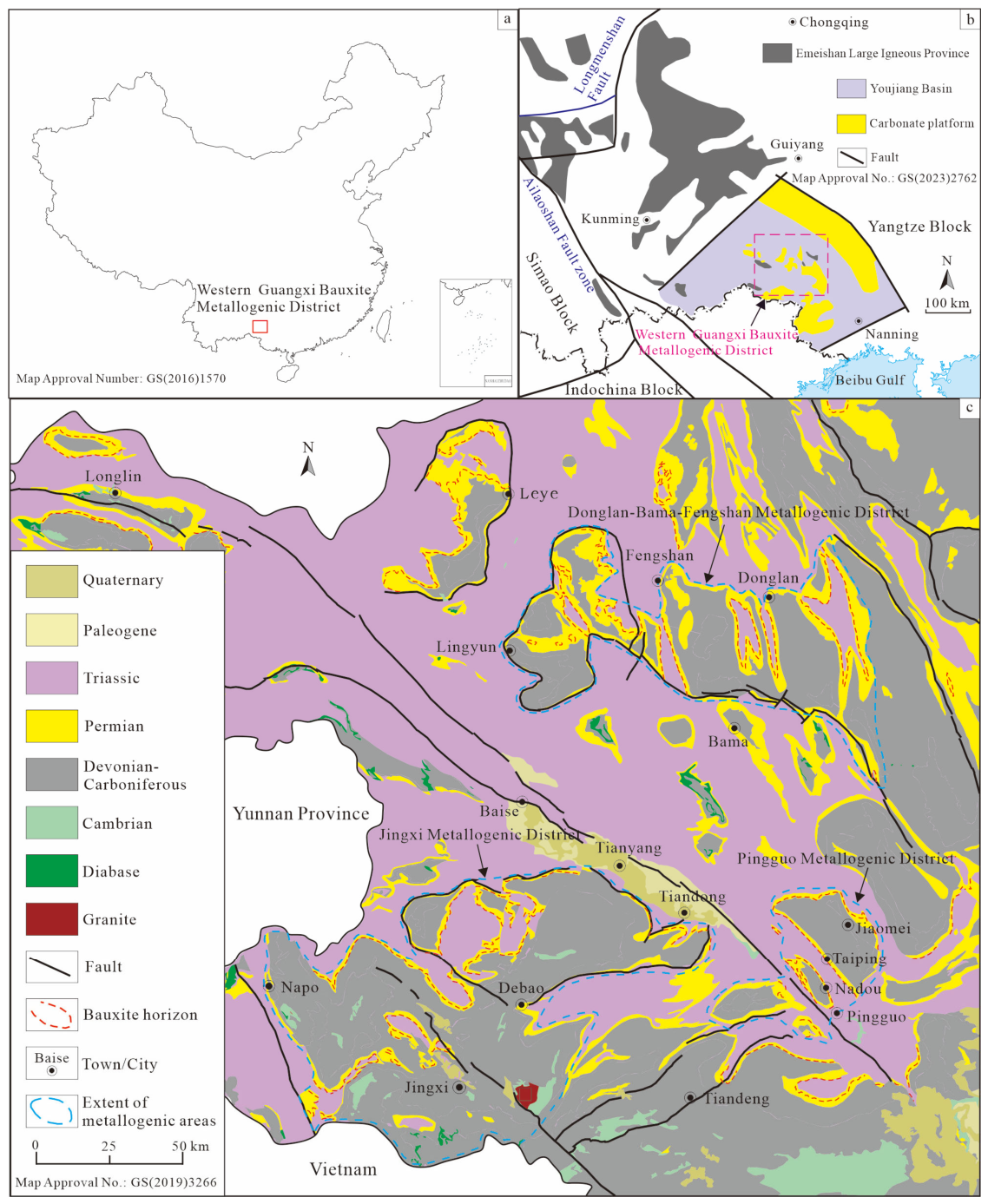
Figure 1. (a) Geographic location of the metallogenic area in western Guangxi; (b) geotectonic setting of western Guangxi [43]; and (c) simplified geological map of western Guangxi [43].
Minerals 16 00668 g001
Figure 2. Geological characteristics of the sedimentary bauxite ore-bearing succession in western Guangxi [43]. (a) Schematic stratigraphic section of the ore-bearing succession. (bd) Representative field photographs of the horizons shown in panel (a). (b) boundary between bauxite and ferro-aluminous rock, (c) basal conglomerate, and (d) carbonaceous mudstone.
Minerals 16 00668 g002
Figure 3. Representative types of bauxite in western Guangxi [43]: (a) earthy bauxite, (b) pisolitic (oolitic) bauxite, (c) clastic bauxite, and (d) massive bauxite.
Minerals 16 00668 g003
Figure 4. Microscopic features of sedimentary bauxite ores: (a) colloidal texture [60]; (b) seepage tube structure [58]; (c) plastic deformation of ooids [58]; (d) intergrown ooids [58]; (e) desiccation cracks in a pisoid [60]; (f) sandy clasts within pisoids [57]; (g) iron-rich colloidal ooid [50]; and (h) incipient ooids truncating oriented structures and gelatinous material [59]. Points A–D in (h) are electron microprobe analysis spots from previous studies, and the analytical results indicate that the major elements at these spots are all Al, Si, O, etc. [59].
Minerals 16 00668 g004
Figure 5. Characteristics of diaspore interpreted to have formed through simple crystallization [85]: (a,b) euhedral diaspore; (c) locations of EDS analysis points on diaspore; (df) EDS spectra corresponding to the analysis points shown in panel (c).
Minerals 16 00668 g005
Figure 6. Discrimination diagrams for sedimentary environments: (ad) marine versus continental facies, (e) acidic versus alkaline environments, and (f) oxidizing versus reducing conditions. Note: Geochemical data for the bauxite-bearing rock series in western Guangxi were compiled from references [11,49,50,64,107,108,111,112,113,114,115,116]. The MgO/Al2O3, Rb/K, Sr/Ba, V/Zr, Zr/Cu, La/Y, and V/(V+Ni) indices were sourced from references [114], [108], [117], [108,118], [108,118], [117,119], and [114,120,121], respectively.
Minerals 16 00668 g006
Figure 7. Proposed metallogenic model for the sedimentary bauxite formation in western Guangxi.
Minerals 16 00668 g007
Disclaimer/Publisher’s Note: The statements, opinions and data contained in all publications are solely those of the individual author(s) and contributor(s) and not of MDPI and/or the editor(s). MDPI and/or the editor(s) disclaim responsibility for any injury to people or property resulting from any ideas, methods, instructions or products referred to in the content.