Spatially Constrained Machine Learning for PRISMA-Based Lithological Mapping of Phosphate Mine Waste Rocks

 ,
,  , ,
, ,  and
and
Abstract
1. Introduction
2. Materials and Methods
2.1. Study Area and Geological Setting
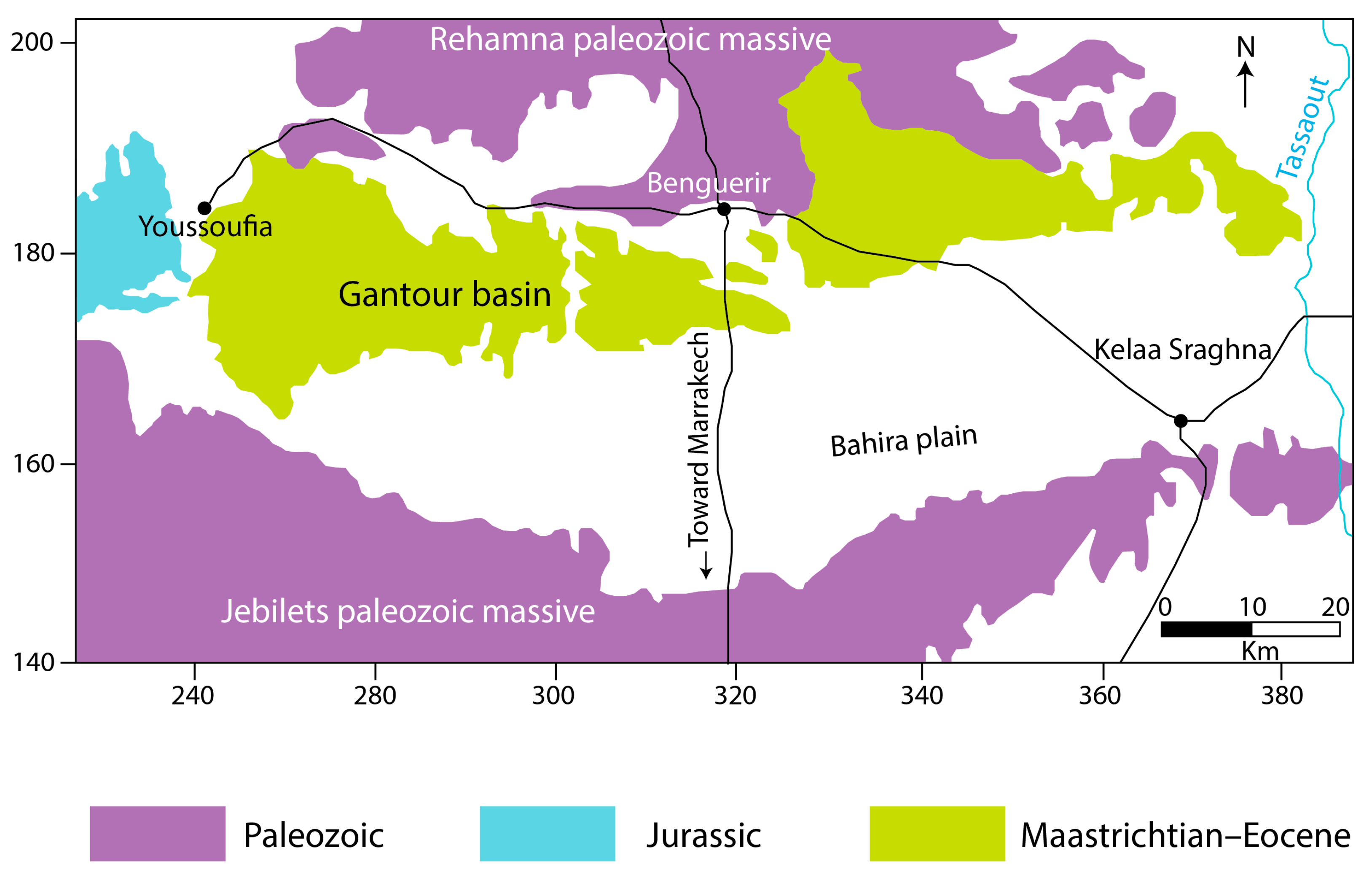
2.2. Field Sampling Strategy, Limitations, and Accessibility Challenges
2.3. Mineralogical and Chemical Analysis
2.3.1. Chemical Characterization by XRF
2.3.2. Mineralogical Characterization by XRD
2.3.3. Petrographic Analysis of Phosphate Waste Rock Piles
2.4. PRISMA Hyperspectral Dataset
2.4.1. PRISMA Hyperspectral Data Acquisition and Processing
2.4.2. Data Correction, Spectral Signal Optimization, and Feature Selection
- (1)
- Spatial alignment and geometric correction: image registration was performed using the THOR Change Detection tool in ENVI 5.5.2 (L3Harris Technologies, Melbourne, FL, USA) to correct a slight spatial misalignment between the geocoded PRISMA L2D product and the vectorized field boundaries. A nearest-neighbor resampling algorithm was applied to preserve spectral integrity of the pixels.
- (2)
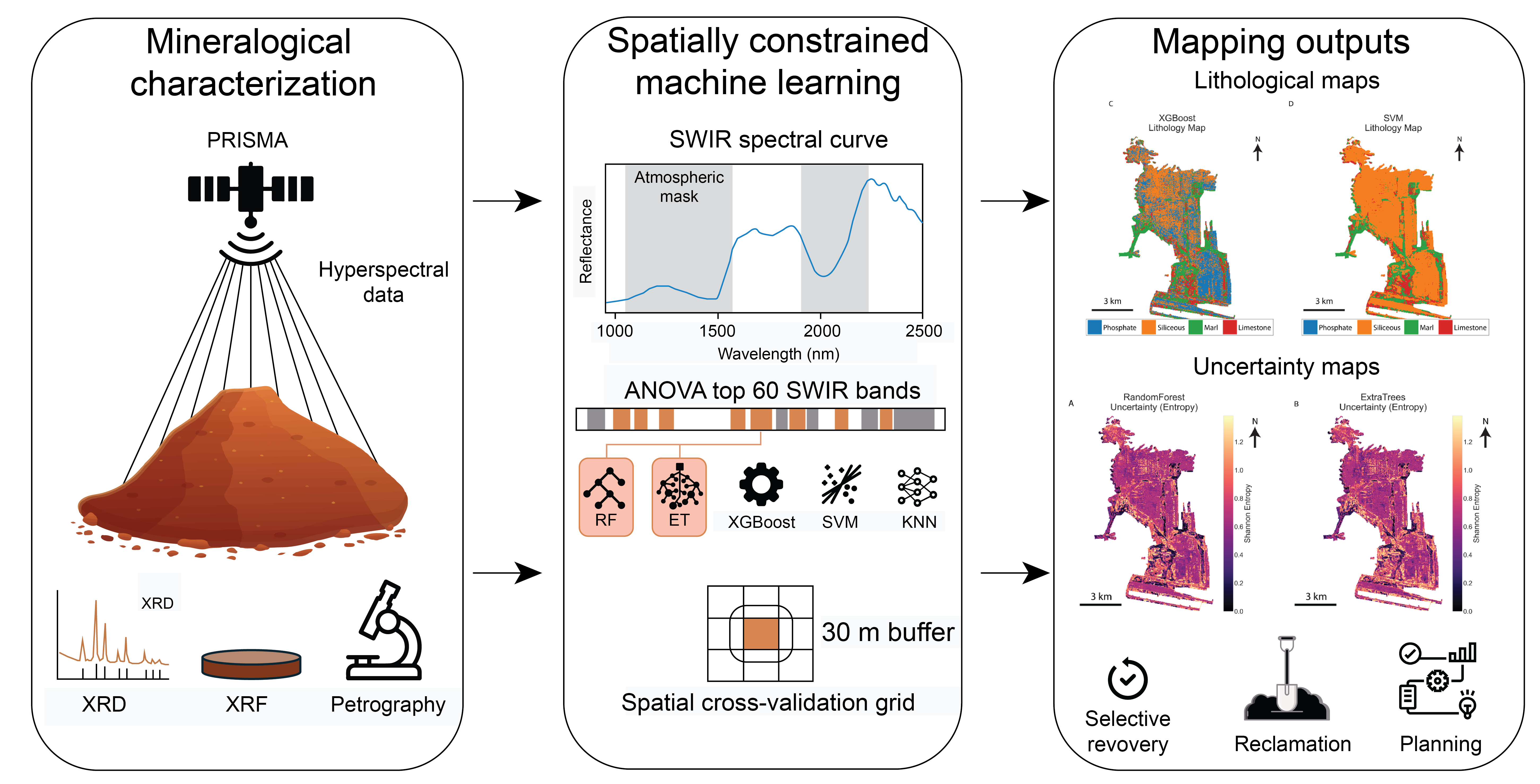
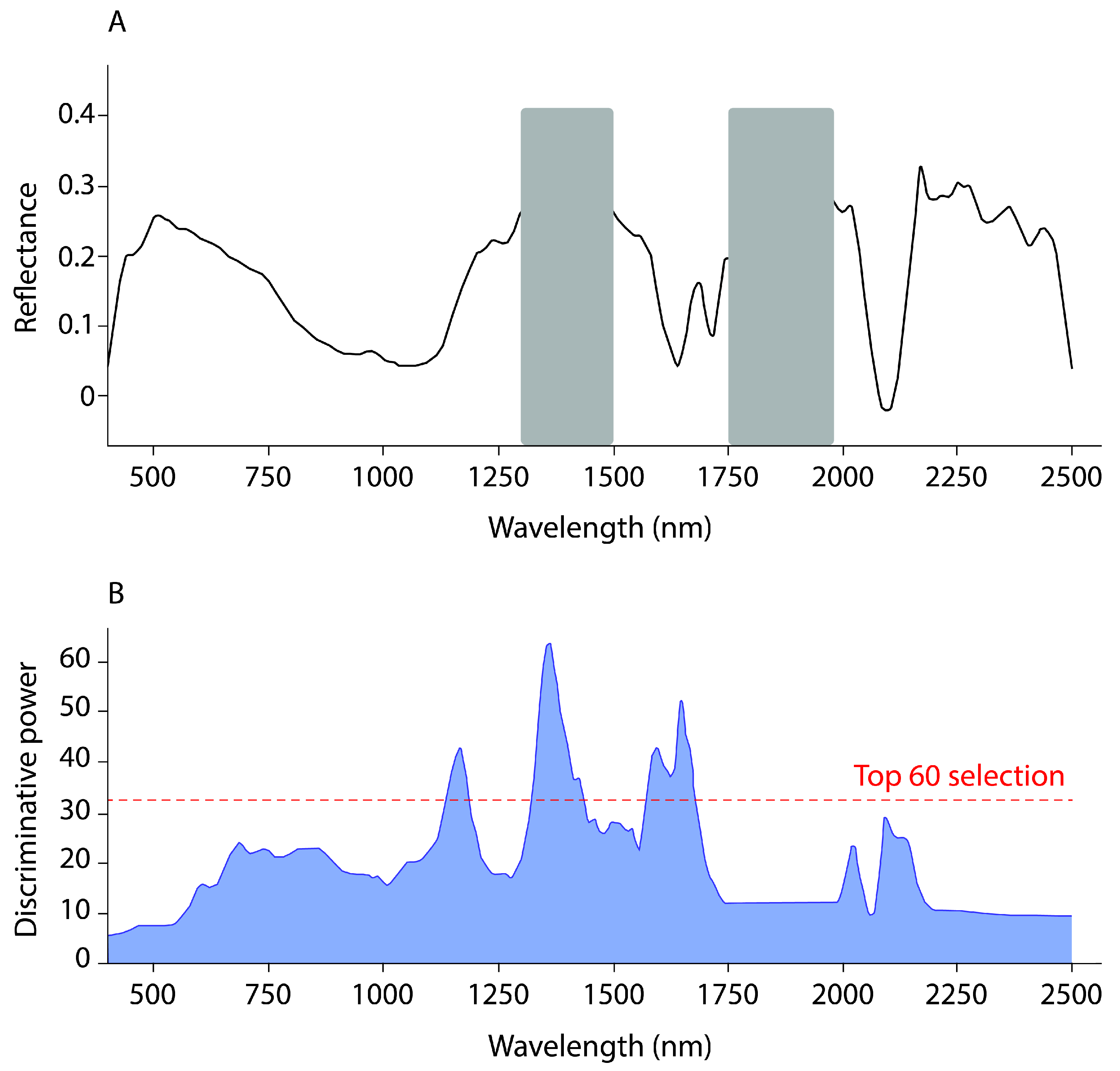
- Signal integrity, atmospheric masking and smoothing: spectral regions with low SNR (atmospheric water-vapor absorption windows at 1300–1500 nm and 1750–1980 nm) were masked [24,25]. The remaining signal was smoothed using a Savitzky–Golay filter (polynomial order = 2, window size = 7), which preserves the precise geometry of diagnostic absorption features, particularly the clay and carbonate doublets critical for characterizing phosphate mine waste [26,27].
- (3)
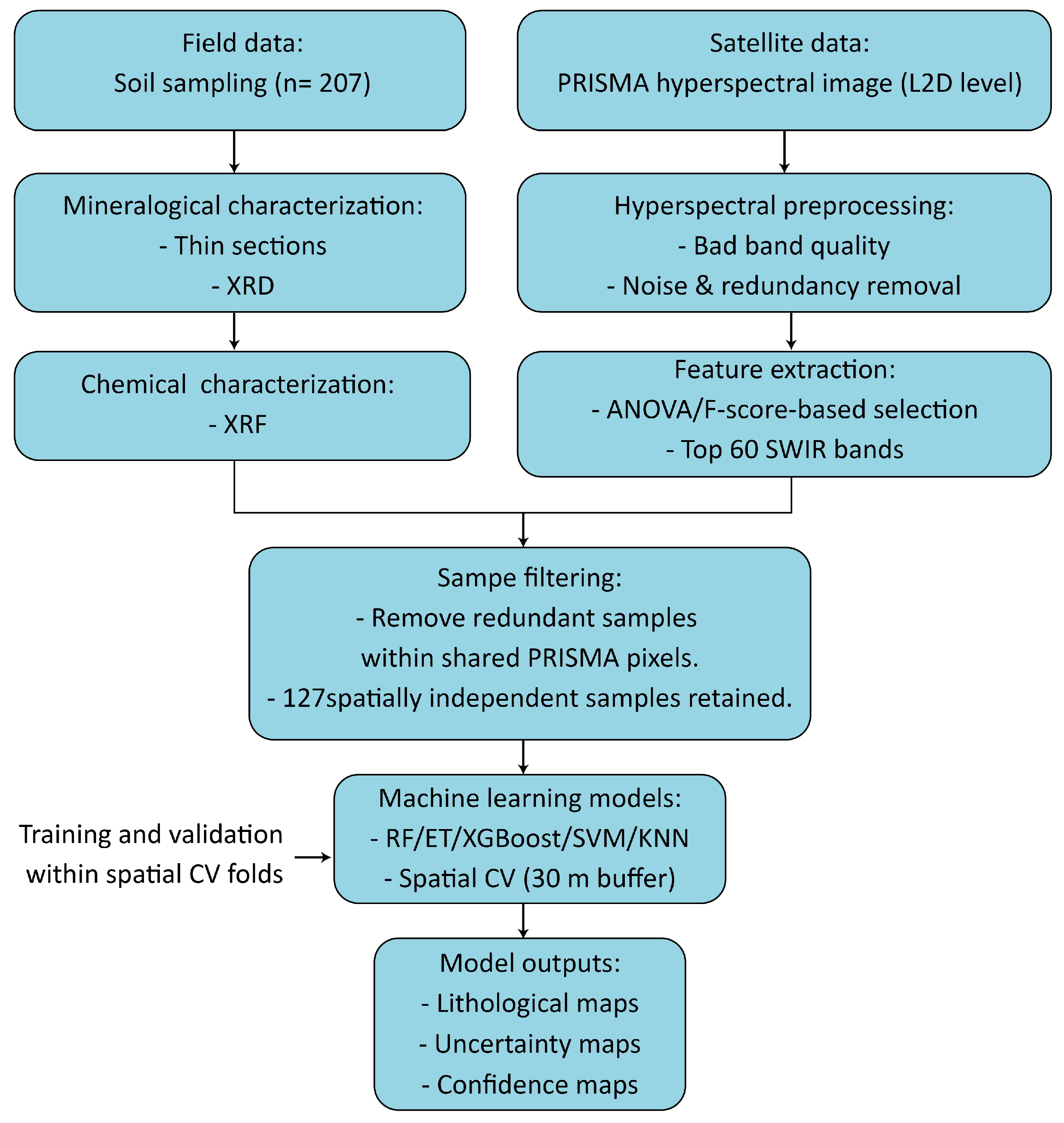
- Dimensionality reduction ANOVA-based feature selection: wavelength ranking was performed using an Analysis of Variance (ANOVA) F-test embedded within each spatial cross-validation fold (Figure 4B). For each training split, F-statistics were computed exclusively on the training subset, and the top 60 highest-scoring bands were selected prior to model fitting. The mean F-score across folds is reported to assess feature-selection stability. This nested implementation prevents information leakage, ensures strict independence between training and validation data, and focuses the models on the SWIR region (1000–2500 nm), which carries the highest discriminative power for lithological differentiation [28].
2.5. Lithological Mapping and Spatial Validation Strategy
3. Results
3.1. Petrographic, Mineralogical, and Chemical Characterization
3.2. Machine Learning Modelling Approach
3.2.1. Learning Curve Analysis and Generalization Behavior
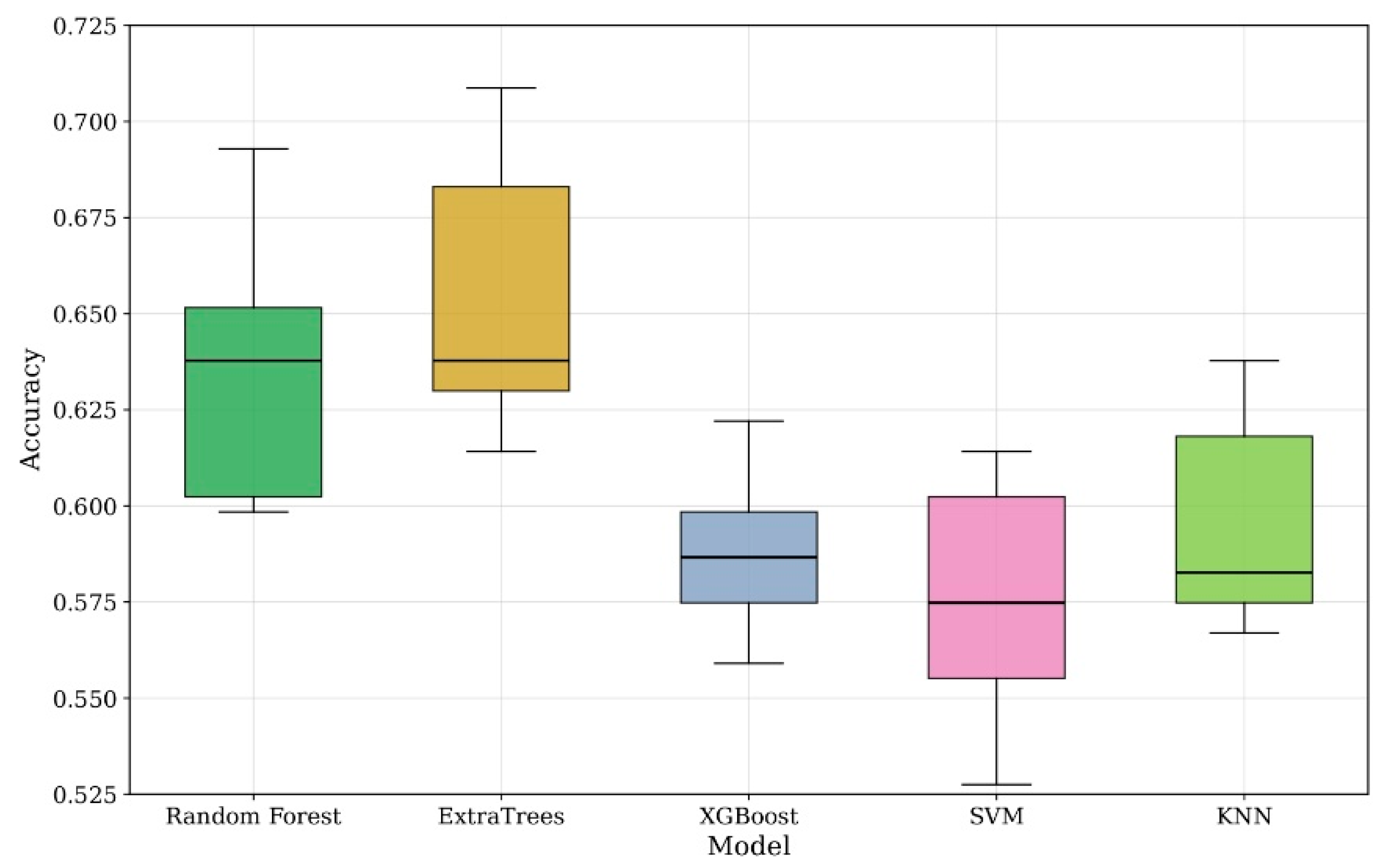
3.2.2. Overall Classification Performance and ROC Analysis
3.2.3. Confusion Patterns and Class-Specific Performance
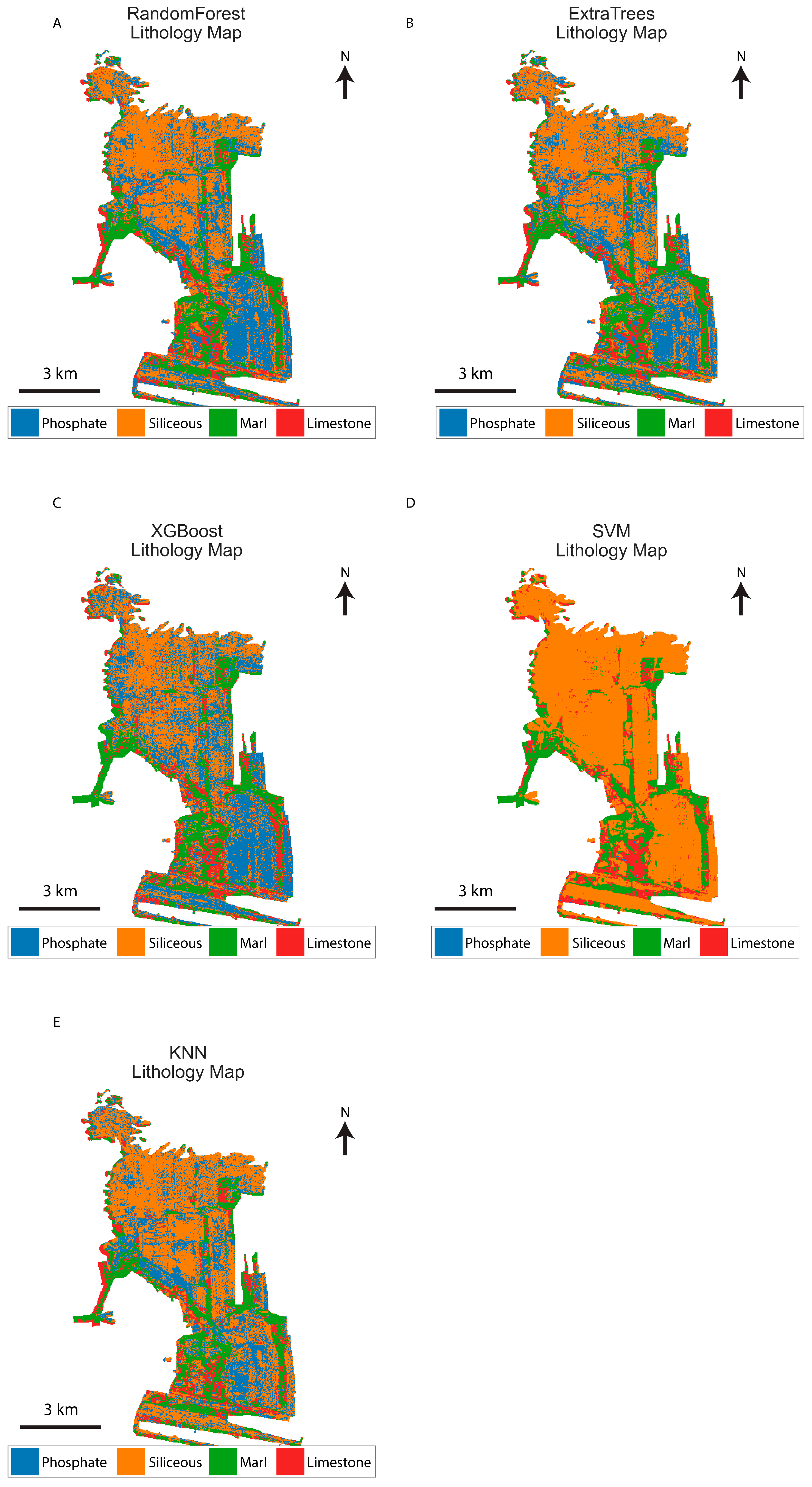
3.2.4. Spatial Distribution of Lithological Classes
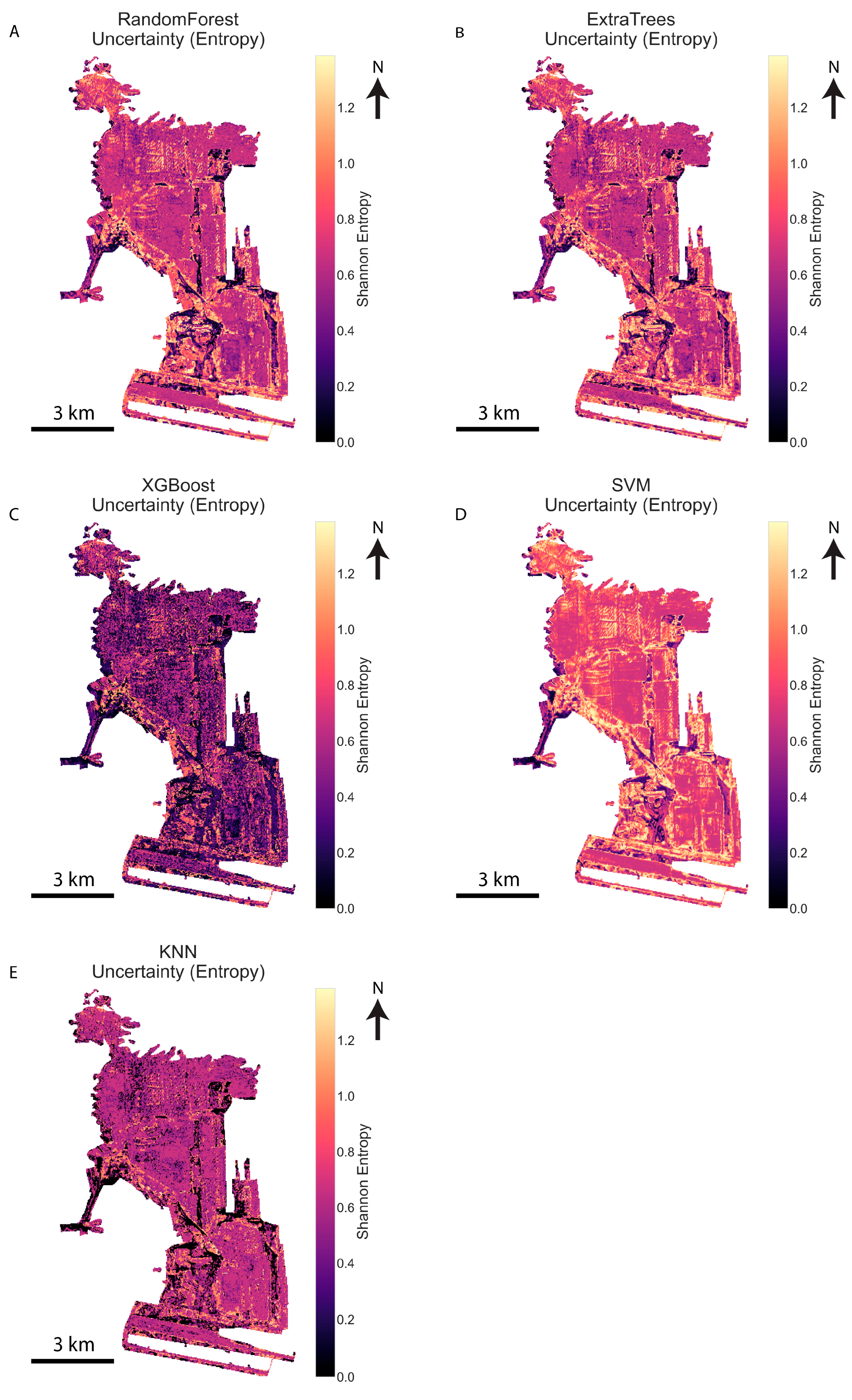
3.2.5. Prediction Reliability: Uncertainty, Posterior Probability, and Model Stability
3.2.6. Summary of Machine Learning Performance
4. Discussion
4.1. Mineralogical Constraints on Hyperspectral Discrimination of Phosphate Waste Rocks
4.2. Machine Learning Performance Under Realistic Spatial Validation
4.3. Algorithmic Behavior and Ensemble Robustness
4.4. Spatial Coherence, Uncertainty, and Geological Meaning
4.5. Implications for Phosphate Waste Management and Future Perspectives
5. Conclusions
Supplementary Materials
Author Contributions
Funding
Data Availability Statement
Acknowledgments
Conflicts of Interest
Abbreviations
| ANOVA | Analysis of Variance |
| AUC | Area Under the Curve |
| ET | Extra Trees |
| GPS | Global Positioning System |
| KNN | K-Nearest Neighbors |
| L2C | Level-2C |
| L2D | Level-2D |
| OvR | One-vs-Rest |
| PAN | Panchromatic |
| PRISMA | PRecursore IperSpettrale della Missione Applicativa |
| PWRPs | Phosphate Waste Rock Piles |
| RF | Random Forest |
| ROC | Receiver Operating Characteristic |
| SNR | Signal-to-Noise Ratio |
| SSI | Spectral Sampling Interval |
| SVM | Support Vector Machine |
| SWIR | Short-Wave Infrared |
| VNIR | Visible and Near-Infrared |
| XRD | X-ray Diffraction |
| XRF | X-ray Fluorescence |
References
- Jiang, L.; Xue, Q.; Liu, L. Evaluation of the Potential Release of Phosphorus from Phosphate Waste Rock Piles in Different Environmental Scenarios. Environ. Earth Sci. 2015, 74, 597–607. [Google Scholar] [CrossRef]
- Yang, Y.-Y.; Wu, H.-N.; Shen, S.-L.; Horpibulsuk, S.; Xu, Y.-S.; Zhou, Q.-H. Environmental Impacts Caused by Phosphate Mining and Ecological Restoration: A Case History in Kunming, China. Nat. Hazards 2014, 74, 755–770. [Google Scholar] [CrossRef]
- Elmeknassi, M.; Elghali, A.; Laamrani, A.; Benzaazoua, M. Circular Economy Strategies in Sedimentary Phosphate Mine Reclamation: Development of Technosol from Phosphate Waste Rock. J. Environ. Manag. 2024, 370, 122674. [Google Scholar] [CrossRef]
- Idrissi, H.; Taha, Y.; Elghali, A.; El Khessaimi, Y.; Aboulayt, A.; Amalik, J.; Hakkou, R.; Benzaazoua, M. Sustainable Use of Phosphate Waste Rocks: From Characterization to Potential Applications. Mater. Chem. Phys. 2021, 260, 124119. [Google Scholar] [CrossRef]
- Chlahbi, S.; Belem, T.; Elghali, A.; Rochdane, S.; Zerouali, E.; Inabi, O.; Benzaazoua, M. Geological and Geomechanical Characterization of Phosphate Mine Waste Rock in View of Their Potential Civil Applications: A Case Study of the Benguerir Mine Site, Morocco. Minerals 2023, 13, 1291. [Google Scholar] [CrossRef]
- Mansour, A.E.; Najih, A.; Ouzemou, J.-E.; Laamrani, A.; Elghali, A.; Hakkou, R.; Benzaazoua, M. Integrating VNIR–SWIR Spectroscopy and Handheld XRF for Enhanced Mineralogical Characterization of Phosphate Mine Waste Rocks in Benguerir, Morocco: Implications for Sustainable Mine Reclamation. Sensors 2025, 26, 2. [Google Scholar] [CrossRef]
- Van Der Meer, F.D.; Van Der Werff, H.M.A.; Van Ruitenbeek, F.J.A.; Hecker, C.A.; Bakker, W.H.; Noomen, M.F.; Van Der Meijde, M.; Carranza, E.J.M.; Smeth, J.B.D.; Woldai, T. Multi- and Hyperspectral Geologic Remote Sensing: A Review. Int. J. Appl. Earth Obs. Geoinf. 2012, 14, 112–128. [Google Scholar] [CrossRef]
- Loizzo, R.; Daraio, M.; Guarini, R.; Longo, F.; Lorusso, R.; Dini, L.; Lopinto, E. Prisma Mission Status and Perspective. In Proceedings of the IGARSS 2019—2019 IEEE International Geoscience and Remote Sensing Symposium, Yokohama, Japan, July 2019; IEEE: Piscataway, NJ, USA, 2019; pp. 4503–4506. [Google Scholar]
- Genesio, L.; Braga, F.; Bresciani, M.; Boschetti, M.; Carotenuto, F.; Cogliati, S.; Colella, S.; Colombo, R.; Giardino, C.; Gioli, B.; et al. Updates On PRISMA: Scientific Calibration/Validation Activities and Supporting Studies. In Proceedings of the IGARSS 2022—2022 IEEE International Geoscience and Remote Sensing Symposium, Kuala Lumpur, Malaysia, 17–22 July 2022; IEEE: Piscataway, NJ, USA, 2022; pp. 4585–4586. [Google Scholar]
- Pignatti, S.; Amodeo, A.; Mona, L.; Palombo, A.; Pascucci, S.; Rosoldi, M.; Santini, F.; Casa, R.; Laneve, G. Evaluation of the PRISMA Hyperspectral Radiance Data: The PRISCAV Project Activities in the Basilicata Region (Southern Italy). In Proceedings of the 2021 IEEE International Geoscience and Remote Sensing Symposium IGARSS, Brussels, Belgium, 11–16 July 2021; IEEE: Piscataway, NJ, USA, 2021; pp. 1390–1393. [Google Scholar]
- Agrawal, N.; Govil, H.; Mishra, G.; Gupta, M.; Srivastava, P.K. Evaluating the Performance of PRISMA Shortwave Infrared Imaging Sensor for Mapping Hydrothermally Altered and Weathered Minerals Using the Machine Learning Paradigm. Remote Sens. 2023, 15, 3133. [Google Scholar] [CrossRef]
- Sudharsan, S.; Hemalatha, R.; Tejas, N.V.; Sivakumar, K.A. Machine Learning-Driven Mineral Identification Using PRISMA Hyperspectral Data along the Coastal Regions of Southeast Tamil Nadu. Earth Sci. Inf. 2025, 18, 327. [Google Scholar] [CrossRef]
- Ibrahim, A.M.; Bennett, B. The Assessment of Machine Learning Model Performance for Predicting Alluvial Deposits Distribution. Procedia Comput. Sci. 2014, 36, 637–642. [Google Scholar] [CrossRef]
- Charbaoui, A.; Kchikach, A.; Jaffal, M.; Khadiri, O.Y.; Guernouche, M.; Amar, M.; Bikarnaf, A.; Jourani, E.-S.; Khelifi, N. New Insights from Geophysical, Hydrogeological and Borehole Data into the Deep Structure of the Louta Phosphatic Deposit (Gantour Basin, Morocco): Mining Implications. Geosciences 2023, 13, 357. [Google Scholar] [CrossRef]
- El Bamiki, R.; Raji, O.; Ouabid, M.; Elghali, A.; Khadiri Yazami, O.; Bodinier, J.-L. Phosphate Rocks: A Review of Sedimentary and Igneous Occurrences in Morocco. Minerals 2021, 11, 1137. [Google Scholar] [CrossRef]
- Zouhri, S.; Kchikach, A.; Saddiqi, O.; Haïmer, F.Z.E.; Baidder, L.; Michard, A. The Cretaceous-Tertiary Plateaus. In Continental Evolution: The Geology of Morocco: Structure, Stratigraphy, and Tectonics of the Africa-Atlantic-Mediterranean Triple Junction; Michard, A., Saddiqi, O., Chalouan, A., de Lamotte, D.F., Eds.; Springer: Berlin/Heidelberg, Germany, 2008; pp. 331–358. [Google Scholar]
- OCP Sustainability Integrated Report. 2021, p. 132. Available online: https://www.ocpgroup.ma/en/node/896 (accessed on 2 June 2026).
- Ihbach, F.-Z.; Kchikach, A.; Jaffal, M.; El Azzab, D.; Khadiri Yazami, O.; Jourani, E.-S.; Peña Ruano, J.A.; Olaiz, O.A.; Dávila, L.V. Geophysical Prospecting for Groundwater Resources in Phosphate Deposits (Morocco). Minerals 2020, 10, 842. [Google Scholar] [CrossRef]
- Amar, H.; Benzaazoua, M.; Elghali, A.; Taha, Y.; El Ghorfi, M.; Krause, A.; Hakkou, R. Mine Waste Rock Reprocessing Using Sensor-Based Sorting (SBS): Novel Approach toward Circular Economy in Phosphate Mining. Miner. Eng. 2023, 204, 108415. [Google Scholar] [CrossRef]
- Safhi, A.E.M.; Amar, H.; El Berdai, Y.; El Ghorfi, M.; Taha, Y.; Hakkou, R.; Al-Dahhan, M.; Benzaazoua, M. Characterizations and Potential Recovery Pathways of Phosphate Mines Waste Rocks. J. Clean. Prod. 2022, 374, 134034. [Google Scholar] [CrossRef]
- Cogliati, S.; Sarti, F.; Chiarantini, L.; Cosi, M.; Lorusso, R.; Lopinto, E.; Miglietta, F.; Genesio, L.; Guanter, L.; Damm, A.; et al. The PRISMA Imaging Spectroscopy Mission: Overview and First Performance Analysis. Remote Sens. Environ. 2021, 262, 112499. [Google Scholar] [CrossRef]
- Giardino, C.; Bresciani, M.; Fabbretto, A.; Ghirardi, N.; Mangano, S.; Pellegrino, A.; Vaiciute, D.; Braga, F.; Brando, V.E.; Laanen, M.; et al. Hyperspectral Prisma Products of Aquatic Systems. In Proceedings of the 2021 IEEE International Geoscience and Remote Sensing Symposium IGARSS, Brussels, Belgium, 11–16 July 2021; IEEE: Piscataway, NJ, USA, 2021; pp. 1229–1232. [Google Scholar]
- Vangi, E.; D’Amico, G.; Francini, S.; Giannetti, F.; Lasserre, B.; Marchetti, M.; Chirici, G. The New Hyperspectral Satellite PRISMA: Imagery for Forest Types Discrimination. Sensors 2021, 21, 1182. [Google Scholar] [CrossRef]
- Acito, N.; Diani, M.; Procissi, G.; Corsini, G. Atmospheric Compensation of PRISMA Data by Means of a Learning Based Approach. Remote Sens. 2021, 13, 2967. [Google Scholar] [CrossRef]
- Guanter, L.; Richter, R.; Moreno, J. Spectral Calibration of Hyperspectral Imagery Using Atmospheric Absorption Features. Appl. Opt. 2006, 45, 2360. [Google Scholar] [CrossRef]
- Ruffin, C.; King, R.L.; Younan, N.H. A Combined Derivative Spectroscopy and Savitzky-Golay Filtering Method for the Analysis of Hyperspectral Data. GISci. Remote Sens. 2008, 45, 1–15. [Google Scholar] [CrossRef]
- Savitzky, A.; Golay, M.J.E. Smoothing and Differentiation of Data by Simplified Least Squares Procedures. Anal. Chem. 1964, 36, 1627–1639. [Google Scholar] [CrossRef]
- Rasti, B.; Scheunders, P.; Ghamisi, P.; Licciardi, G.; Chanussot, J. Noise Reduction in Hyperspectral Imagery: Overview and Application. Remote Sens. 2018, 10, 482. [Google Scholar] [CrossRef]
- Breiman, L. Random Forests. Mach. Learn. 2001, 45, 5–32. [Google Scholar] [CrossRef]
- Chen, T.; Guestrin, C. XGBoost: A Scalable Tree Boosting System. In Proceedings of the 22nd ACM SIGKDD International Conference on Knowledge Discovery and Data Mining, San Francisco, CA, USA, 13–17 August 2016; ACM: New York, NY, USA, 2016; pp. 785–794. [Google Scholar]
- Cortes, C.; Vapnik, V. Support-Vector Networks. Mach. Learn. 1995, 20, 273–297. [Google Scholar] [CrossRef]
- Geurts, P.; Ernst, D.; Wehenkel, L. Extremely Randomized Trees. Mach. Learn. 2006, 63, 3–42. [Google Scholar] [CrossRef]
- Karasiak, N.; Dejoux, J.-F.; Monteil, C.; Sheeren, D. Spatial Dependence between Training and Test Sets: Another Pitfall of Classification Accuracy Assessment in Remote Sensing. Mach. Learn. 2022, 111, 2715–2740. [Google Scholar] [CrossRef]
- Roberts, D.R.; Bahn, V.; Ciuti, S.; Boyce, M.S.; Elith, J.; Guillera-Arroita, G.; Hauenstein, S.; Lahoz-Monfort, J.J.; Schröder, B.; Thuiller, W.; et al. Cross-validation Strategies for Data with Temporal, Spatial, Hierarchical, or Phylogenetic Structure. Ecography 2017, 40, 913–929. [Google Scholar] [CrossRef]
- Shadman Roodposhti, M.; Aryal, J.; Lucieer, A.; Bryan, B.A. Uncertainty Assessment of Hyperspectral Image Classification: Deep Learning vs. Random Forest. Entropy 2019, 21, 78. [Google Scholar] [CrossRef]
- Zaini, N.; Van Der Meer, F.; Van Der Werff, H. Determination of Carbonate Rock Chemistry Using Laboratory-Based Hyperspectral Imagery. Remote Sens. 2014, 6, 4149–4172. [Google Scholar] [CrossRef]
- Zhang, G.; Wasyliuk, K.; Pan, Y. The characterization and quantitative analysis of clay minerals in the Athabasca basin, Saskatchewan: Application of shortwave infrared reflectance spectroscopy. Can. Min. 2001, 39, 1347–1363. [Google Scholar] [CrossRef]
- Desikan, R.; Rajendran, K. Exploring Rock Phosphates Using Hyperspectral Remote Sensing & Field Spectroscopy. In Proceedings of the 2018 9th Workshop on Hyperspectral Image and Signal Processing: Evolution in Remote Sensing (WHISPERS), 23 September 2018; IEEE: Piscataway, NJ, USA, 2018; pp. 1–5. [Google Scholar]
- Chen, X.; Warner, T.A.; Campagna, D.J. Integrating Visible, near-Infrared and Short-Wave Infrared Hyperspectral and Multispectral Thermal Imagery for Geological Mapping at Cuprite, Nevada: A Rule-Based System. Int. J. Remote Sens. 2010, 31, 1733–1752. [Google Scholar] [CrossRef]
- Mulder, V.L.; Plötze, M.; De Bruin, S.; Schaepman, M.E.; Mavris, C.; Kokaly, R.F.; Egli, M. Quantifying Mineral Abundances of Complex Mixtures by Coupling Spectral Deconvolution of SWIR Spectra (2.1–2.4 Μm) and Regression Tree Analysis. Geoderma 2013, 207–208, 279–290. [Google Scholar] [CrossRef]
- Cover, T.; Hart, P. Nearest Neighbor Pattern Classification. IEEE Trans. Inf. Theory 1967, 13, 21–27. [Google Scholar] [CrossRef]
- Hunt, G.R. Visible and Near-Infrared Spectra of Minerals and Rocks: I Silicate Minerals. Mod. Geol. 1970, 1, 283–300. [Google Scholar]
- Francos, N.; Notesco, G.; Ben-Dor, E. Estimation of the Relative Abundance of Quartz to Clay Minerals Using the Visible–Near-Infrared–Shortwave-Infrared Spectral Region. Appl. Spectrosc. 2021, 75, 882–892. [Google Scholar] [CrossRef] [PubMed]
- Peyghambari, S.; Zhang, Y. Hyperspectral Remote Sensing in Lithological Mapping, Mineral Exploration, and Environmental Geology: An Updated Review. J. Appl. Remote Sens. 2021, 15, 031501. [Google Scholar] [CrossRef]
- Ploton, P.; Mortier, F.; Réjou-Méchain, M.; Barbier, N.; Picard, N.; Rossi, V.; Dormann, C.; Cornu, G.; Viennois, G.; Bayol, N.; et al. Spatial Validation Reveals Poor Predictive Performance of Large-Scale Ecological Mapping Models. Nat. Commun. 2020, 11, 4540. [Google Scholar] [CrossRef]
- Kattenborn, T.; Schiefer, F.; Frey, J.; Feilhauer, H.; Mahecha, M.D.; Dormann, C.F. Spatially Autocorrelated Training and Validation Samples Inflate Performance Assessment of Convolutional Neural Networks. ISPRS Open J. Photogramm. Remote Sens. 2022, 5, 100018. [Google Scholar] [CrossRef]
- Melgani, F.; Bruzzone, L. Support Vector Machines for Classification of Hyperspectral Remote-Sensing Images. In Proceedings of the IEEE International Geoscience and Remote Sensing Symposium, Toronto, ON, Canada, 2002; IEEE: Piscataway, NJ, USA, 2002; Volume 1, pp. 506–508. [Google Scholar]
- Wang, Z.; Zuo, R.; Kreuzer, O.P. Uncertainty Quantification of Deep Learning Algorithms for Lithological Mapping. Math. Geosci. 2025, 58, 503–531. [Google Scholar] [CrossRef]




| Orbit altitude reference | 615 km |
| Swath/Field of view | 30 km/2.77° |
| Ground Sample Distance | Hyperspectral: 30 m PAN: 5 m |
| Spatial pixels | Hyperspectral: 1000 PAN: 6000 |
| Pixel size | Hyperspectral: 30 × 30 m PAN: 5 × 5 m |
| Spectral range | VNIR: 400–1010 nm (66 bands) SWIR: 920–2500 nm (173 bands) PAN: 400–700 nm |
| Spectral sampling interval (SSI) | <12 nm |
| Spectral width | <12 nm |
| Spectral calibration accuracy | ±0.1 nm |
| Radiometric quantization | 12 bit |
| VNIR Signal to noise ratio (SNR) | >200:1 |
| SWIR SNR | >100:1 |
| PAN SNR | >240:1 |
| Absolute radiometric accuracy | Better than 5% |
| OA | BA | κ | F1 | MCC | AUC | |
|---|---|---|---|---|---|---|
| Extra Trees | 0.653 ± 0.033 | 0.693 ± 0.032 | 0.510 ± 0.046 | 0.649 ± 0.032 | 0.513 ± 0.047 | 0.863 ± 0.012 |
| Random Forest | 0.633 ± 0.031 | 0.666 ± 0.032 | 0.480 ± 0.045 | 0.628 ± 0.032 | 0.484 ± 0.045 | 0.858 ± 0.012 |
| XGBoost | 0.587 ± 0.020 | 0.637 ± 0.019 | 0.421 ± 0.029 | 0.584 ± 0.023 | 0.422 ± 0.029 | 0.827 ± 0.011 |
| KNN | 0.593 ± 0.028 | 0.615 ± 0.034 | 0.423 ± 0.040 | 0.590 ± 0.028 | 0.427 ± 0.041 | 0.837 ± 0.014 |
| SVM | 0.576 ± 0.030 | 0.561 ± 0.029 | 0.385 ± 0.042 | 0.517 ± 0.035 | 0.421 ± 0.051 | 0.832 ± 0.011 |
| LightGBM | 0.569 ± 0.040 | 0.626 ± 0.041 | 0.399 ± 0.055 | 0.569 ± 0.042 | 0.400 ± 0.055 | 0.823 ± 0.018 |
| SAM | 0.541 ± 0.032 | 0.536 ± 0.036 | 0.361 ± 0.044 | 0.543 ± 0.032 | 0.362 ± 0.044 | 0.828 ± 0.007 |
Disclaimer/Publisher’s Note: The statements, opinions and data contained in all publications are solely those of the individual author(s) and contributor(s) and not of MDPI and/or the editor(s). MDPI and/or the editor(s) disclaim responsibility for any injury to people or property resulting from any ideas, methods, instructions or products referred to in the content. |
© 2026 by the authors. Licensee MDPI, Basel, Switzerland. This article is an open access article distributed under the terms and conditions of the Creative Commons Attribution (CC BY) license.
Share and Cite
El Mansour, A.; Ouzemou, J.-E.; Elghali, A.; Elmeknassi, M.; Hakkou, R.; Benzaazoua, M.; Laamrani, A. Spatially Constrained Machine Learning for PRISMA-Based Lithological Mapping of Phosphate Mine Waste Rocks. Minerals 2026, 16, 619. https://doi.org/10.3390/min16060619
El Mansour A, Ouzemou J-E, Elghali A, Elmeknassi M, Hakkou R, Benzaazoua M, Laamrani A. Spatially Constrained Machine Learning for PRISMA-Based Lithological Mapping of Phosphate Mine Waste Rocks. Minerals. 2026; 16(6):619. https://doi.org/10.3390/min16060619
Chicago/Turabian StyleEl Mansour, Abdelhak, Jamal-Eddine Ouzemou, Abdellatif Elghali, Malak Elmeknassi, Rachid Hakkou, Mostafa Benzaazoua, and Ahmed Laamrani. 2026. "Spatially Constrained Machine Learning for PRISMA-Based Lithological Mapping of Phosphate Mine Waste Rocks" Minerals 16, no. 6: 619. https://doi.org/10.3390/min16060619
APA StyleEl Mansour, A., Ouzemou, J.-E., Elghali, A., Elmeknassi, M., Hakkou, R., Benzaazoua, M., & Laamrani, A. (2026). Spatially Constrained Machine Learning for PRISMA-Based Lithological Mapping of Phosphate Mine Waste Rocks. Minerals, 16(6), 619. https://doi.org/10.3390/min16060619