
Article

SEM-Based Automated Mineralogy and X-Ray Mapping (GXMAP) for Characterization of Early Pleistocene Pyroclastic Deposits from Kurtan, Armenia

1
Institut für Geologie, Technische Universität Bergakademie Freiberg, Bernhard-von-Cotta-Straße 2, 09599 Freiberg, Germany
2
Institute of Geological Sciences, National Academy of Sciences of the Republic of Armenia, 24a Marshal Baghramyan Ave, Yerevan 0019, Armenia
3
Institut für Mineralogie, Technische Universität Bergakademie Freiberg, Brennhausgasse 14, 09599 Freiberg, Germany
4
School of Earth and Environment, Institute of Geophysics and Tectonics, University of Leeds, Leeds LS2 9JP, UK
5
Institute of Geosciences and Geography, Martin-Luther-University Halle-Wittenberg, Von-Seckendorff-Platz 3, 06120 Halle, Germany
6
IBES Baugrundinstitut Freiberg GmbH, Ingenieure und Geologen für Bauwesen, Waisenhausstraße 10, 09599 Freiberg, Germany
7
Earth & Environmental Sciences, Lehigh University, Bethlehem, PA 18015, USA
*
Author to whom correspondence should be addressed.
Minerals 2026, 16(6), 620; https://doi.org/10.3390/min16060620 (registering DOI)
Submission received: 18 March 2026 / Revised: 26 May 2026 / Accepted: 2 June 2026 / Published: 9 June 2026

Abstract

Volcanic ash preserves critical information on eruption dynamics, magma evolution, and fragmentation processes, yet its small size and fragile structure pose challenges for conventional analytical methods. Advances in SEM-based automated mineralogy combined with X-ray mapping (GXMAP) provide high-resolution characterization of ash textures, particle morphology, and mineral assemblages, offering a more robust basis for interpreting pyroclastic deposits. This study applies an integrated GXMAP workflow alongside sieve-based granulometry to the Early Pleistocene trachyandesite to rhyolitic pyroclastic sequences at the Kurtan quarry (Kechut Volcanic Province, Armenia), a key regional stratigraphic marker associated with early human occupation. GXMAP-based granulometry minimizes preparation-induced fragmentation and yields more consistent and reliable grain-size and morphological data for fine ash deposits than dry sieving. The three stratigraphic units at Kurtan display distinct combinations of grain size, mineral assemblages, and particle morphologies, reflecting contrasting magma evolution, fragmentation conditions, and depositional regimes. Shape-parameter fields derived from BSE images reveal clear differences between the highly irregular, concave compound fragments dominating TP-13-1 and the smoother, more compact particles characteristic of TP-13-2 and TP-13-3. Most particles fall within the ductile domain of established shape-morphology diagrams, indicating that ductile deformation of bubble walls was a major component of fragmentation, accompanied by heterogeneous brittle breakage. These results demonstrate the effectiveness of the combined SEM-based automated mineralogy and GXMAP approach for resolving primary fragmentation, sorting characteristics, and depositional processes in fragile pyroclastic deposits. The Kurtan sequence provides new constraints on explosive volcanism in the Lesser Caucasus Mts. region. At the same time, the methodological framework offers broad applicability to tephra studies worldwide and underscores the potential of imaging-based techniques in volcanology.

1. Introduction

Volcanic ash particles encode key aspects of eruption dynamics, from conduit fragmentation [1,2,3] to transport and comminution [1,4,5,6,7], while also constituting one of the most pervasive volcanic hazards with potentially severe impacts on infrastructure and populations [8,9,10]. Juvenile ash particle shapes reflect fragmentation mechanisms influenced by magma viscosity, strain rate, and the effects of internal bubble expansion or external volatile interactions [3,11,12,13,14]. Textural features, including shape and size of vesicles and microphenocryst morphology and chemical makeup, further constrain magma evolution: vesicles preserve records of the nature, speed of degassing and magma ascent rate [15,16,17], while crystals provide estimates of nucleation density, growth rates, and magma storage [2,18]. However, progress in micro-analysis has been constrained mainly by limited representation, as traditional techniques are time-consuming and typically applied to only a small subset of particles. The SEM-based automated mineralogy approaches coupled with GXMAP improve spatial coverage and enable the analysis of large, representative particle populations.
Understanding the mineralogical composition and morphology of volcanic ash is fundamental for interpreting the conditions and magmatic processes of the specific eruption or eruptive phase in which the particles were generated, e.g., [16]. Rock texture, defined by the size, shape, orientation, and spatial relationships of crystals, grains, glass, and pores, offers essential insights into petrogenetic processes and underpins predictive physical models; however, it requires high-resolution approaches to capture its complexity [19,20]. The small size and fragility of ash particles present a significant analytical challenge, particularly when traditional whole-rock and optical methods cannot address the deposit heterogeneity with enough spatial resolution and compositional detail [21,22].
Recent advances in scanning electron microscopy (SEM)-based automated mineralogy, notably Mineral Liberation Analysis (MLA), have transformed mineralogical characterization by enabling rapid, representative, and high-resolution analyses [7,20,23]. Initially developed for mining applications [24,25,26,27,28,29], MLA is now increasingly applied in volcanology to decipher complex mineral assemblages and textures [18,30,31,32,33]. When used in different MLA measurement modes, including X-ray mapping (GXMAP), these approaches enable detailed visualization of mineral and particle distributions, facilitating more accurate interpretations of formation and evolution [29]. This study employs a combined SEM–GXMAP-based approach and traditional granulometry to evaluate the effectiveness and usefulness of the GXMAP-based granulometry and to refine the understanding of the Kurtan pyroclastic fall deposit, for which the eruptive source and temporal relationships between layers remain enigmatic. Volcanism in Armenia, driven by the Arabia–Eurasia continental collision, produced widespread Neogene–Quaternary magmatism and numerous Pleistocene–Holocene volcanic centers—from stratovolcanoes to monogenetic fields and lava plateaus erupting basaltic to rhyolitic magmas, e.g., [27,28,29,30,31]—within which the Kurtan site stands out as one of the best-preserved pyroclastic deposits of northern Armenia. SEM-GXMAP studies provide quantitative data that enable mineral classification and detailed micro-textural characterization. Because the material consists mainly of ash particles (≤1 mm), thin-section preparation is impractical, making polished grain mounts—analyzed with SEM-MLA or conventional electron microscopy—the preferred approach. SEM-based automated mineralogy further allows the identification of mineral associations and ash-particle morphologies that are essential for interpreting fragmentation processes as well as the formation, evolution, and depositional history of the tephra.
The results demonstrate the capacity of integrated SEM-based mineralogical methods to determine the compositional and morphological spectrum of fine-ash-bearing pyroclastic deposits, establishing a robust analytical framework transferable to volcanic systems worldwide.

2. Geological Setting

The present tectonic configuration of the Arabian–Eurasian collision zone, shaped by a long and complex geodynamic evolution from the Late Paleozoic through the Cenozoic, provides the broader framework for the collision-related magmatic activity that characterizes volcanism in Armenia, e.g., [28,32,33]. This tectonic interaction has produced extensive volcanic provinces across Armenia and neighboring Georgia, where numerous Pleistocene and Holocene volcanic centers are documented, e.g., [28,29,34,35,36,37,38,39,40,41]. These centers include large stratovolcanoes, monogenetic fields, and widespread lava plateaus that have erupted basaltic to rhyolitic magmas, reflecting complex mantle–crust interactions and variable magma storage conditions [34].
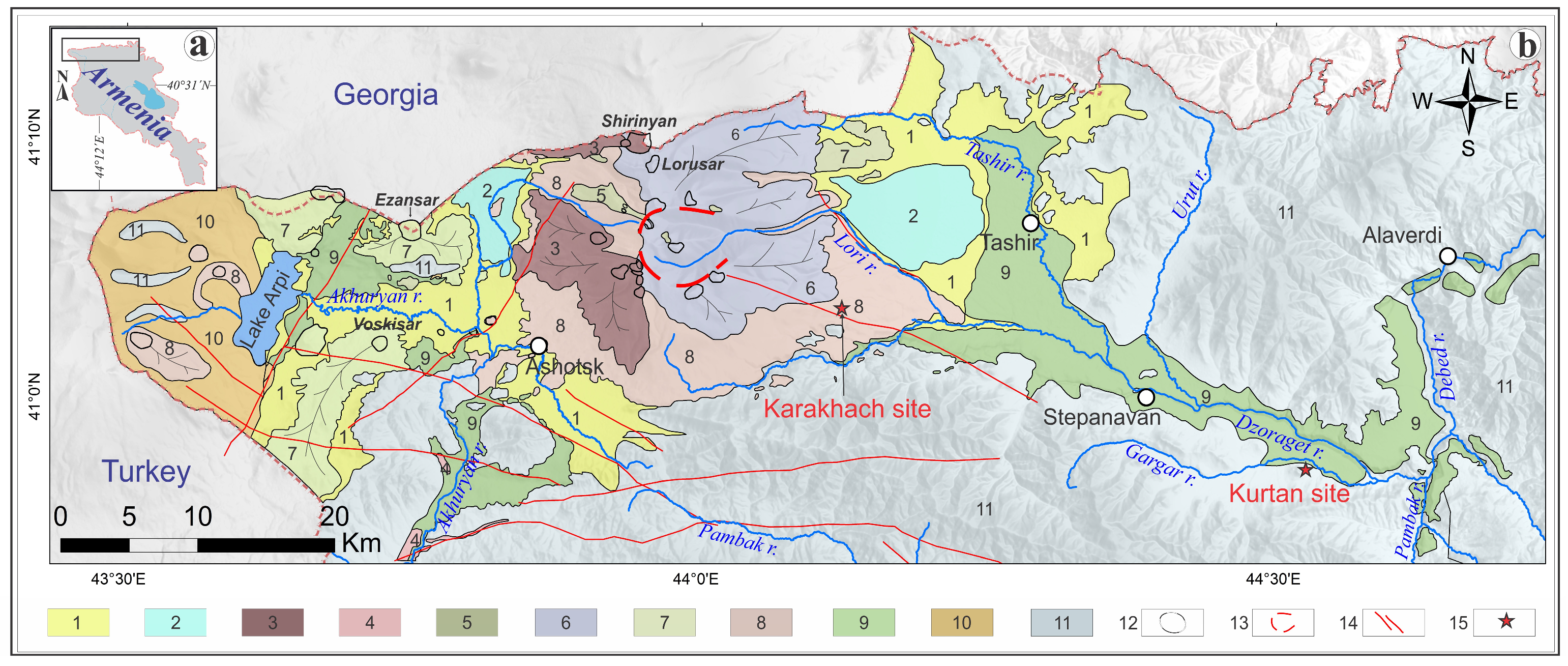
The Kurtan quarry, located within the Kechut Volcanic Province, has long been recognized as a key locality for reconstructing the explosive volcanic activity of the region [36,42,43,44,45]. Together with the Egnakhakh Ridges, the Ashotsk and Lori Plateaus, the headwaters of the Akhuryan, Dzoraget, and Debed rivers, and the southern sector of the Javakheti volcanic highland, the Kechut province covers more than 1000 km2 in northwestern Armenia (Figure 1).
Geologically, the Kechut volcanic province is characterized by Neogene–Quaternary volcanic sequences that record the evolution of the Armenian Highland. Volcanic structures across the region include the large polygenetic Kechut caldera and 28 distinct smaller eruptive centers [36]. Pyroclastic formations in the Karakhach and Kurtan quarries, interpreted as products of Plinian-type eruptions, provide robust evidence for caldera formation and highlight the role of large-volume explosive volcanism in shaping the post Pliocene landscape [36].
Regionally, northern Armenia and southern Georgia are well known for abundant evidence from numerous sites recording early human occupation and migration, including Kurtan and Karakhach [39,40,41]. These sites document repeated phases of hominin presence in a volcanic landscape rich in raw materials for the lithic industry, spanning from the Early to the Late Paleolithic. In this context, tephra studies—particularly of Kurtan tephra deposits—play a crucial role in refining the chronological framework of Paleolithic human occupation in the southern Caucasus. As such, the integration of tephra stratigraphy with archeological records significantly enhances our understanding of early hominin dispersal and adaptation strategies during the Paleolithic [38,46,47,48,49,50].
The upper ash layer at the Kurtan site has been dated at 1.432 ± 0.028 Ma using U–Pb in zircon [45], and a basal pumiceous sand 1 m below it yields an 40Ar/39Ar age of 1.49 ± 0.01 Ma. While archeological finds, including possible Acheulian artifacts, situate Kurtan within the broader framework of early hominin dispersal in the Caucasus, the site’s primary geological significance lies in its role as a stratigraphic marker and geochronological reference point. Together with nearby localities such as Karakhach, Kurtan provides a consistent record of volcanic ash deposition and regional magmatic evolution, reinforcing its importance as a depositional center of volcanic/pyroclastic products throughout the Neogene and Quaternary [36,45,51,52,53]. Notably, the eruptive sources of these pyroclastic deposits remain unidentified.

3. Materials and Methods

3.1. Sampling, SEM-MLA Analytical Approach, and BSE-Based Shape Analysis

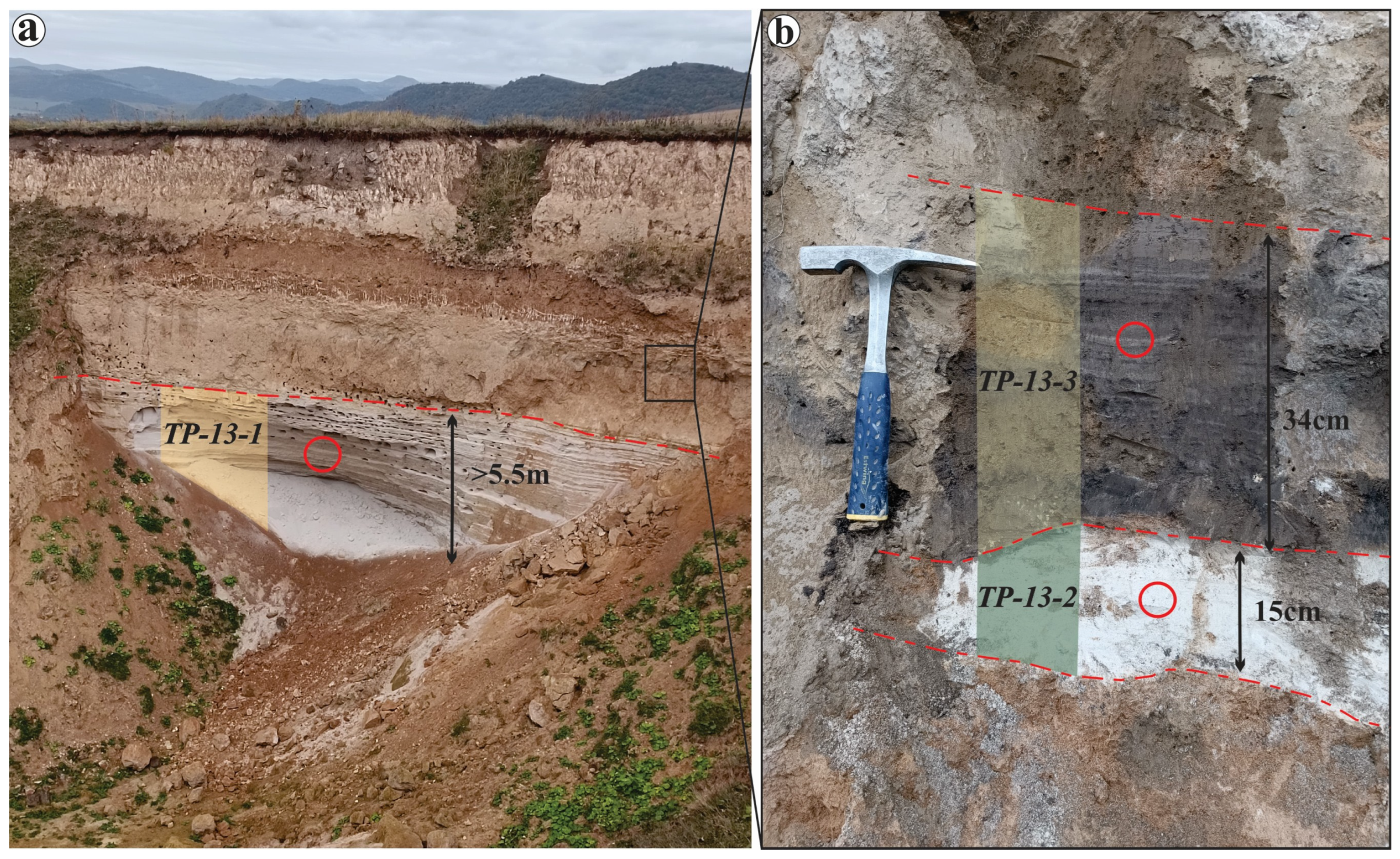
The Kurtan site (40.967132° N, 44.526058° E) is in northern Armenia, at the eastern margin of Vardablur village (1325 m above sea level), on the right bank of the Gargar River—a tributary of the Dzoraget River—within a small pumice quarry (Figure 1). Observations were conducted along the southern quarry wall, where three distinct stratigraphic units are exposed (Figure 2). Sampling proceeded systematically from the lowest to the highest level, and bulk, unsorted material—including ash, lapilli, and fine pumice fragments—was collected from three well-defined layers (TP-13-1: pumice-lapilli ash layer; TP-13-2: ash layer; TP-13-3: thinly bedded fine ash layer; Figure 2).
The tephra samples were embedded in epoxy mounts of 30 mm in diameter, carbon-coated with a 12 nm conductive layer, and analyzed using the Mineral Liberation Analyzer (MLA) suite 3.1 from Thermo Fisher Scientific (formerly FEI Company, Hillsboro, OR, USA), along with GXMAP (grain X-ray mapping), to obtain detailed morphological and compositional information.
Before mounting, the sample material was split and gently deagglomerated twice, mixed with graphite, and embedded in EpoTec 301 epoxy (Logitech Ltd., Glasgow, UK) under vacuum (IU 30) to stabilize fine and fragile particles. After labeling and casting, the mounts were ground with diamond disks (grit 80, 220, 1200), with a coarse 80-grit step applied only briefly to level the surface, and polished using 1 µm and 0.25 µm Struers suspensions to produce a stable, flat surface suitable for SEM-MLA. All analytical work was performed at the Geometallurgical Laboratory of the Institute of Mineralogy, TU Bergakademie Freiberg, using a QUANTA 600F scanning electron microscope (SEM) from Thermo Fisher Scientific (formerly FEI Company, Hillsboro, OR, USA) equipped with two Bruker X-Flash 6I30 EDS detectors (Bruker, Karlsruhe, Germany). Mineralogical mapping was conducted using SEM backscattered electron (BSE) imaging in combination with energy-dispersive X-ray spectroscopy (EDS). For SEM data acquisition, a 15 kV acceleration voltage, a 10 nA emission current, and a spot size of 5.84 at a working distance of 12 mm were applied. X-ray mapping was conducted using a frame resolution of 1000 pixels and a horizontal field width (HFW) of 1000 µm. The MLA records BSE data as a 256-level gray-scale image (0 = black, epoxy resin, 255 = white). In this work, the background level was set to 30 BSE, and GXMAP triggering was configured to record signals within the 31–255 BSE range. All frames were acquired under these conditions to ensure consistent particle recognition and mapping. To obtain representative area coverage, two to four mapped areas of ~95 mm2 were acquired for each sample (total mapped area of ~190–380 mm2). The measurement time was 4 h per ~95 mm2 mapped area, each containing several tens of thousands of particles and yielding total particle counts of 1.0 × 10³–1.5 × 10⁵ per sample. To generate false-color mineral maps, the acquired EDS spectra were matched to a Mineral Reference List, which contained all expected mineral species along with their corresponding EDS spectra (only spectra with ≥80% matches were considered). These maps were post-processed to correct misclassifications caused by microfractures, vesicles and holes, or inclusions smaller than the electron beam interaction volume, using customized touch-up scripts. This process enabled the generation of both modal mineralogy and approximate mineral chemistry data. Detailed descriptions of the methodology are available in [23,28,54,55,56].
In addition, the Mineral Reference List used in this study was built exclusively from spectra measured on the sample material, and mineral solid-solution series were not grouped in order to preserve potential zoning. Unknown minerals were minimized by iteratively adding new spectra, and the remaining <1% were assigned to the closest compositional match using the touch-up procedure. Pixels with insufficient X-ray counts were classified as “Low Counts” or “No X-Rays”, excluded from modal calculations, and assigned to the background. The different volcanic glasses were discriminated based on their clearly distinct EDX spectra, reflected in systematic variations in elements such as Fe, Si, Al, K, and Na. The spatial resolution of the GXMAPs is defined by the 10 µm grid spacing; nanoscale heterogeneities in glass cannot be resolved at this scale but do not affect the aims of this study. Mixed-mineral and boundary pixels were corrected using the same touch-up procedure to ensure consistent classification. All touch-up routines were cross-checked against the corresponding BSE images and measured spectra, and because these routines must be tailored to the specific material of each sample, they were created anew for every dataset. Particle sizing based on the equivalent-circle (EC) diameter was applied across all grain-size fractions. Although the EC-diameter metric provides a reasonable approximation of particle size in 2-D petrographic imagery, discrepancies arise when compared with mechanical sieving, particularly for particles exhibiting complex morphologies such as rounded, equant, tabular, elongate, acicular, or fibrous shapes [26].
2-D ash–pumice shape analysis was carried out using BSE images and ImageJ image analysis software (version 1.54g; https://imagej.net/ij/ (accessed on 13 May 2026)) following the procedure of [57], using a minimum pixel density of ≥750 px/particle. From each segmented grain, primary geometric measurements—including particle area (Ap), perimeter (Pp), maximum and minimum Feret diameters (DmaxFeret and DminFeret), major and minor of best-fit ellipse (A and B), convex hull area and perimeter (Ach and Pch), and the length and width of bounding rectangle (l and w)—were extracted. These values were then used to calculate the 2-D shape descriptors following [57]: the Aspect Ratio (AR = DminFeret/DmaxFeret) as a measure of Elongation, the Axial Ratio (A/B) derived from the best-fit ellipse, the Form Factor (FF = 4πAp/Pp2) as an indicator of particle roundness, and the Solidity (SLD = Ap/Ach) as a measure of area-based concavity. In addition, the Convexity (CVX = Pch/Pp) was calculated to quantify perimeter-based roughness, and the Concavity Index ( C I = 1 S L D 2 + 1 C V X 2 ) was used to quantify the combined effect of area- and perimeter-derived concavity. The Rectangularity (RT = Pp/(2l + 2w)), the Compactness (CP = Ap/(lw)), the Circularity ( C i r c = P P 2 π A p ), and the Elongation (El = DMaxFeret2/Ap) were calculated also following ([57] and references therein) to characterize particle-shape variability and to evaluate fragmentation processes recorded in the volcanic ash. In total, 212 particles from TP-13-1, 9882 from TP-13-2, and 9764 from TP-13-3 were analyzed; summary statistics are provided in Table S1.
The processed SEM-GXMAP data were transferred into a database, which enabled the extraction of particle and grain properties, including size, shape, mineral chemistry (chemical assays and modal mineralogy), and mineral associations, defined here as minerals that occur in direct contact and share the same boundary. This workflow provided a robust framework for the quantitative characterization of ash and tephra particles [11].

3.2. Granulometry and Fine-Fraction Analysis of Tephra

Granulometric analysis of all studied tephra samples was conducted in the Sedimentological Laboratory at the Institute of Geology (TU Bergakademie Freiberg) using standard dry-sieving procedures. Samples were first oven-dried at 50 °C using a Memmert Digital Laboratory Oven (UNE600) to ensure complete removal of residual moisture. Dried material was gently disaggregated by hand using a soft brush to avoid breaking individual grains. The samples were then sieved using a nested stack of stainless-steel sieves (DIN-ISO 3310-1) [58] with approximately 1-phi spacing, c.f. [59] from 4 mm (–2 Phi) to 0.063 mm (4 Phi), supplemented by a coarser 6 mm sieve, and operated on a Retsch VE1 Vibrotronic mechanical sieve shaker. Each sample was sieved for 20 min at constant amplitude to ensure reproducible separation of grain-size fractions. Following sieving, each size class was weighed using a high-precision analytical balance (±0.03 g), and the mass percentages were used to calculate grain-size distributions.
To obtain complete grain-size curves, the fine fraction (≤0.125 mm) was analyzed using the Boyoucos–Casagrande hydrometer method. The fine material was transferred into a dispersing solution of sodium pyrophosphate decahydrate (Na2P2O7·10H2O) and left to stand for 24 h to ensure complete deflocculation. During this period, the suspension was intermittently agitated, and after 24 h, the material was wet-sieved through a 0.125 mm sieve to remove any remaining coarse particles, using distilled water to ensure complete transfer of the fine fraction. Following dispersion, the suspension was transferred to a 1-L sedimentation cylinder, brought to volume with distilled water, and homogenized by vigorous shaking. Hydrometer readings were taken at standard time intervals, with temperature recorded at each measurement in accordance with DIN EN ISO 17892-4 [60]. Meniscus, temperature, and blank corrections were applied following the same standard, and particle diameters and percent-finer values were calculated from settling velocities. According to Stokes’ law, particle size and weight percentage were derived from settling time and suspension density, and the resulting values were plotted as a grain-size distribution curve.

3.3. Geochemical Analysis

Our whole rock analytical procedure involved careful sample selection and washing of the tephra shards/ash before producing the powders, which we then acid leached to ensure maximum removal of any surface alterations, fine clays/zeolites, and organic matter. Briefly, we performed repeated washes in an ultrasonic bath (3 × 20 min) of ~20 g of tephra material. We then selected ~5 g of an appropriately washed and visually (under a binocular microscope) unaltered tephra shards for powdering. The powdering was completed at Univ. of Leeds by using agate vials that were pre-cleaned (18.2 MΩ distilled water and ethanol) and pre-contaminated with the same clean sample. About 0.5 g of the powders were subjected to carefully selected leaching protocols, following the modified for organic-poor samples “Method 2” procedure described in [61]. Accordingly, and before the digestions, we have chosen a leaching procedure that involved subjecting the powdered samples to speedy (30 min) immersion in 50 mL of hot (155 °C) 98% UpA grade sulfuric acid (H2SO4), followed by cooling and addition of 10 mL of 68%–72% UpA grade HNO3 acid. After removing the supernatant, we washed the powders with 18.2 MΩ distilled water and dried them in an oven at 55 °C. Once dried, a 250 mg mass of each powder was subjected to multi-stage HF–HNO3-HCl-HNO3 digestion steps (all UpA grade) and repeated dry-downs on a hot plate and using 15 mL Teflon® jars. This dissolution process was undertaken at the University of Leeds clean lab (TIMS) facility. The SEM investigation of tephra and pumices, as well as crushed small obsidian glass shards treated with the same technique, reveals that the leaching procedure impacts no more than ~1 µm within the glass surfaces and has no impact on the crystal populations commonly present in rhyolites (plagioclase, K-feldspars, quartz, pyroxene, etc.). For details, please see the images presented in [61]. Analysis solutions were made up to 1000-fold dilutions of the original powder weight in a 2% HNO3 solution, including method and acid blanks. Whole rock analysis was performed at the School of Environment, Earth and Ecosystem Sciences, The Open University, U.K. For the trace elements, we used an Agilent 8800 Triple Quadrupole inductively coupled plasma mass spectrometer (QQQ ICP-MS/MS; Agilent Technologies, Santa Clara, CA, USA), and for the major (except SiO2), we used an inductively coupled plasma optical emission spectrometer (ICP-OES). Total procedural blanks were negligible for all major and trace elements. Repeated analyses of USGS standard BHVO-2 and sample 1-10-15 yielded relative standard deviations of 0.3% for major elements and 1%–3% for trace elements. For additional information and the dataset, see Table S2.

4. Results

To investigate the mineralogical composition and textural characteristics of the Kurtan pyroclastic fall deposits, BSE imaging and GXMAP mineral mapping were applied to polished grain mounts prepared from the three stratigraphic units—TP-13-1: pumice-lapilli ash layer; TP-13-2: ash layer; TP-13-3: thinly bedded fine ash layer—along with field, geochemical, and granulometric studies (Figure 2). The following results provide an integrated comparison of these units, highlighting high-resolution imaging, modal mineralogy, cumulative passing curves, and complementary geochemical and bulk granulometric information used to verify and contextualize SEM-MLA mapping.

4.1. Lithology

The lowermost unit (TP-13-1) consists of more than 5.5 m of fine-grained white/gray pumice-lapilli-bearing ash deposits, with dominant grain sizes between 0.4 and 2 mm and occasional larger clasts reaching up to 1.5 cm (Figure 2a). At the base of the section, basalt lava from the central part of the Javakheti volcanic plateau was sampled and delivered K–Ar ages in the range of 2.65–1.95 Ma [42]. Although the lowermost unit is relatively thick, it is laterally well confined by the same relatively flat-lying basalts, which outcrop on both the western and eastern sides of the quarry and extend toward the Gargar River (Figure 1). These stratigraphic and geomorphological relationships suggest that the pumice accumulated within a paleo-valley of a former tributary of the Gargar River.
The TP-13-1 unit is covered by a 6–7 m thick volcano-sedimentary succession composed of clay, sandy clay, paleosol horizons, and a modern soil layer at the top (Figure 2a). Approximately 1.7 m above the pumice, within the paleosol, two additional tephra horizons occur in close succession (Figure 2). The lower of these consists of a ~15 cm thick fine light gray ash layer (TP-13-2), overlain by a ~34 cm thick brownish-gray thinly bedded fine ash layer (TP-13-3; Figure 2b).

4.2. Granulometry

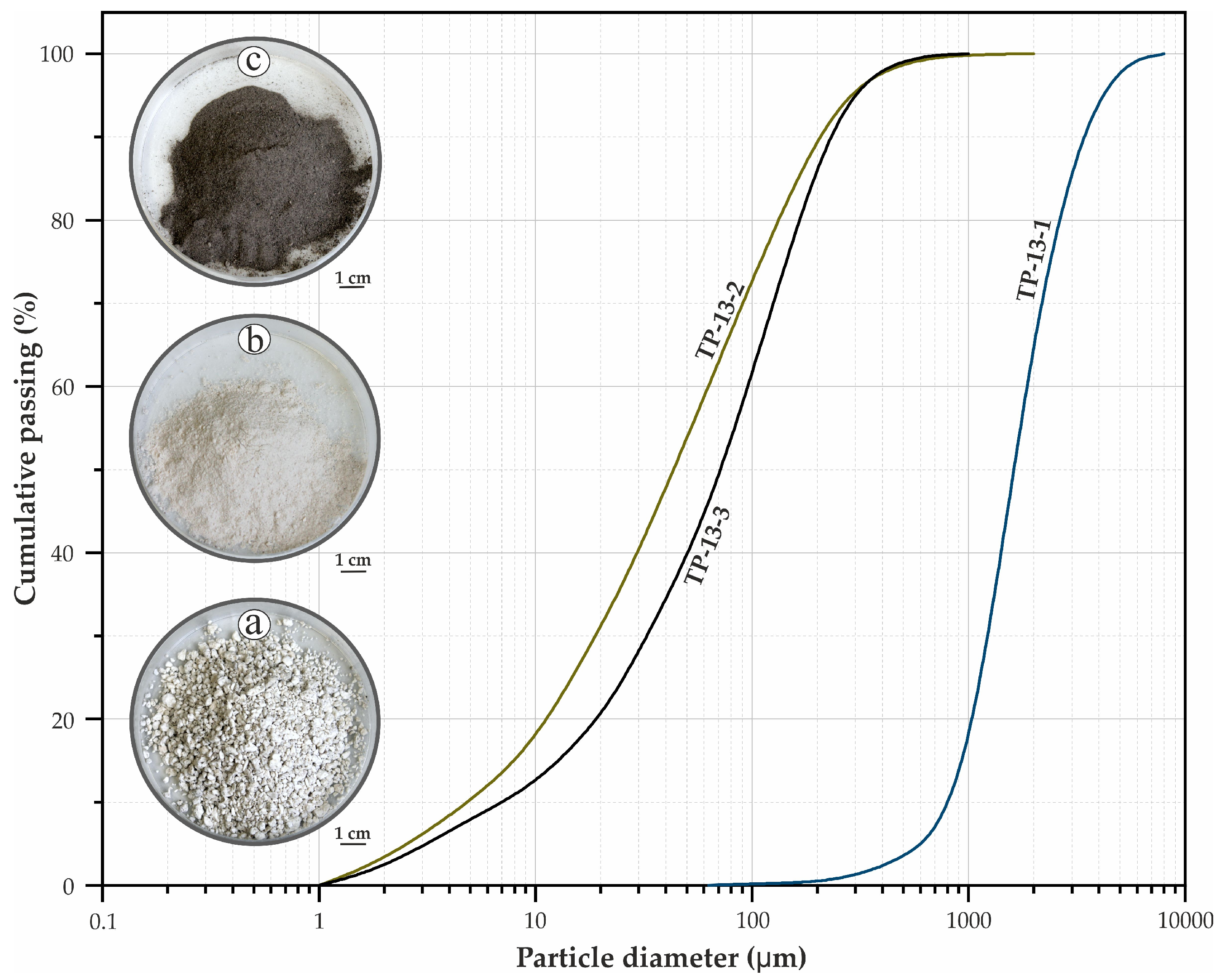
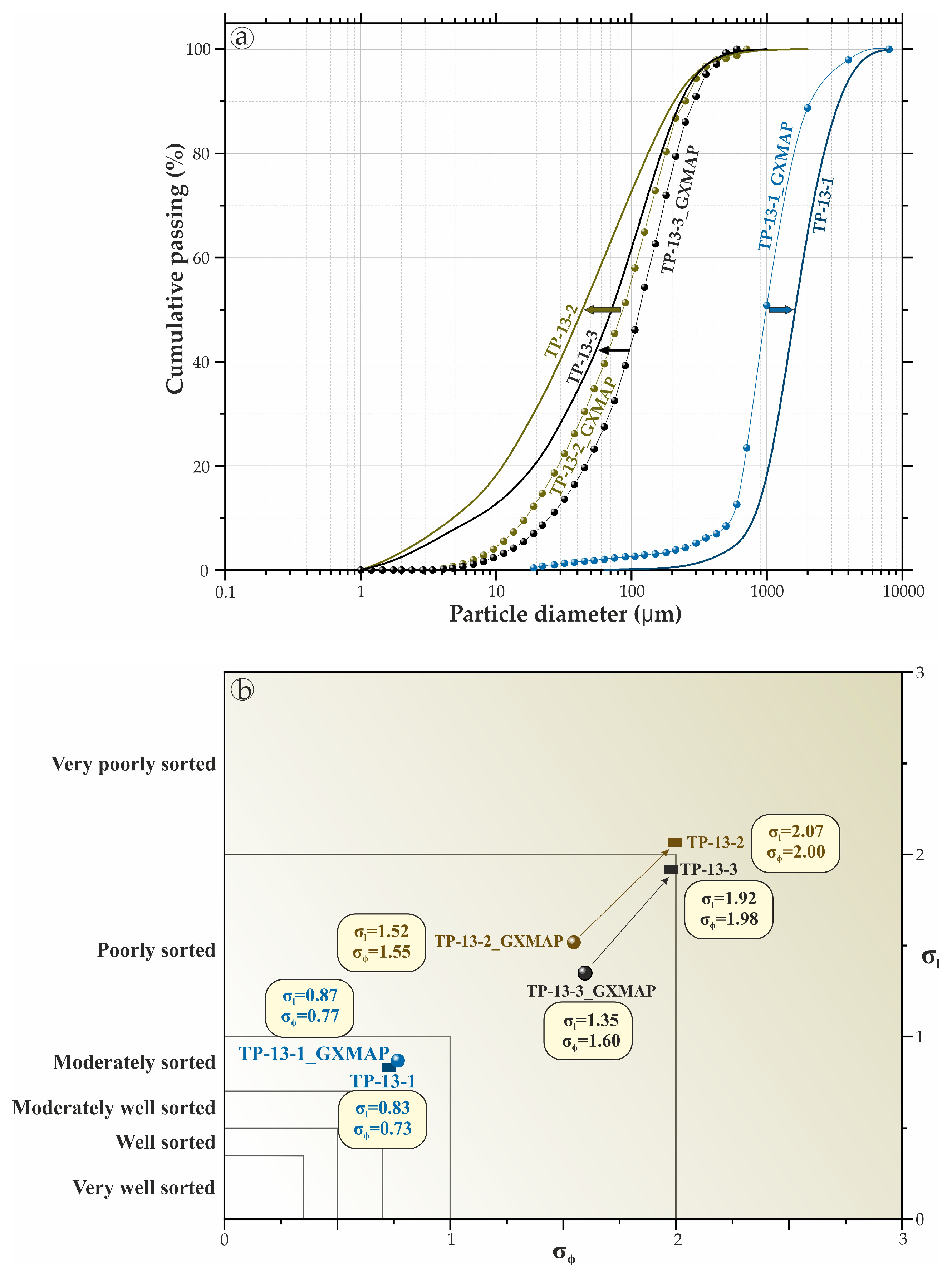
Grain size analysis of the studied tephra samples reveals marked contrasts in clast populations, consistent with the stratigraphic relationships and textural variations already observed during fieldwork. TP-13-1, forming the lower layer, was processed from an initial mass of 500 g (499.53 g recovered) and is dominated by coarse lapilli-sized pyroclastic particles. More than 90% of the deposit lies within the 1000–4000 µm interval (Figure 3). Finer fractions contribute only negligible proportions. The cumulative curve exhibits a steep decline toward the finer tail, with only less than 1% finer than 0.25 mm, yielding percentile diameters of D5 ≈ 600 µm (ϕ5 ≈ 0.74), D16 ≈ 950 µm (ϕ16 ≈ 0.07), D84 ≈ 3000 µm (ϕ84 ≈ −1.58), and D95 ≈ 4050 µm (ϕ95 ≈ −2.02), with a sorting coefficient of σl ≈ 0.83 (after [62]) and a standard deviation by the logarithmic method of moments of σϕ ≈ 0.73 (after [63])—both classify the sample as moderately sorted. Sample TP-13-2 was analyzed from 100 g of material (99.92 g recovered) and is characterized by a strongly fine-ash-dominated grain size distribution. The <63 µm fraction accounts for 63.78% of the total mass, with an additional 17.43% and 13.97% in the 63–125 µm and 125–250 µm ranges, respectively. Coarser fractions are absent. The cumulative curve is smooth and sigmoidal, reflecting a continuous progression toward the fine tail (Figure 3). Derived percentile diameters are D5 ≈ 2.5 µm (ϕ5 ≈ 8.6), D16 ≈ 9 µm (ϕ16 ≈ 6.79), D84 ≈ 165 µm (ϕ84 ≈ 2.60), and D95 ≈ 280 µm (ϕ95 ≈ 1.84), with a sorting coefficient of σl ≈ 2.07 (after [62]) and standard deviation by the logarithmic method of moments of σϕ ≈ 2.0 (after [63])—both classify the sample as very poorly sorted.
Sample TP-13-3 was also processed from 100 g (99.07 g recovered) and displays an intermediate grain size distribution. The <63 µm fraction comprises 47.19% of the total mass, while 25.43% and 21.63% fall within the 63–125 µm and 125–250 µm fractions, respectively (Figure 3). The cumulative curve indicates 95.22% finer than 250 µm, with corresponding percentile diameters D5 ≈ 3.2 µm (ϕ5 ≈ 8.29), D16 ≈ 15 µm (ϕ16 ≈ 6.06), D84 ≈ 195 µm (ϕ84 ≈ 2.36), and D95 ≈ 300 µm (ϕ95 ≈ 1.7), with a sorting coefficient of σl ≈ 1.92 (after [62]) and a standard deviation by the logarithmic method of moments of σϕ ≈ 1.98 (after [63])—both classify the sample as poorly sorted.

4.3. Geochemistry

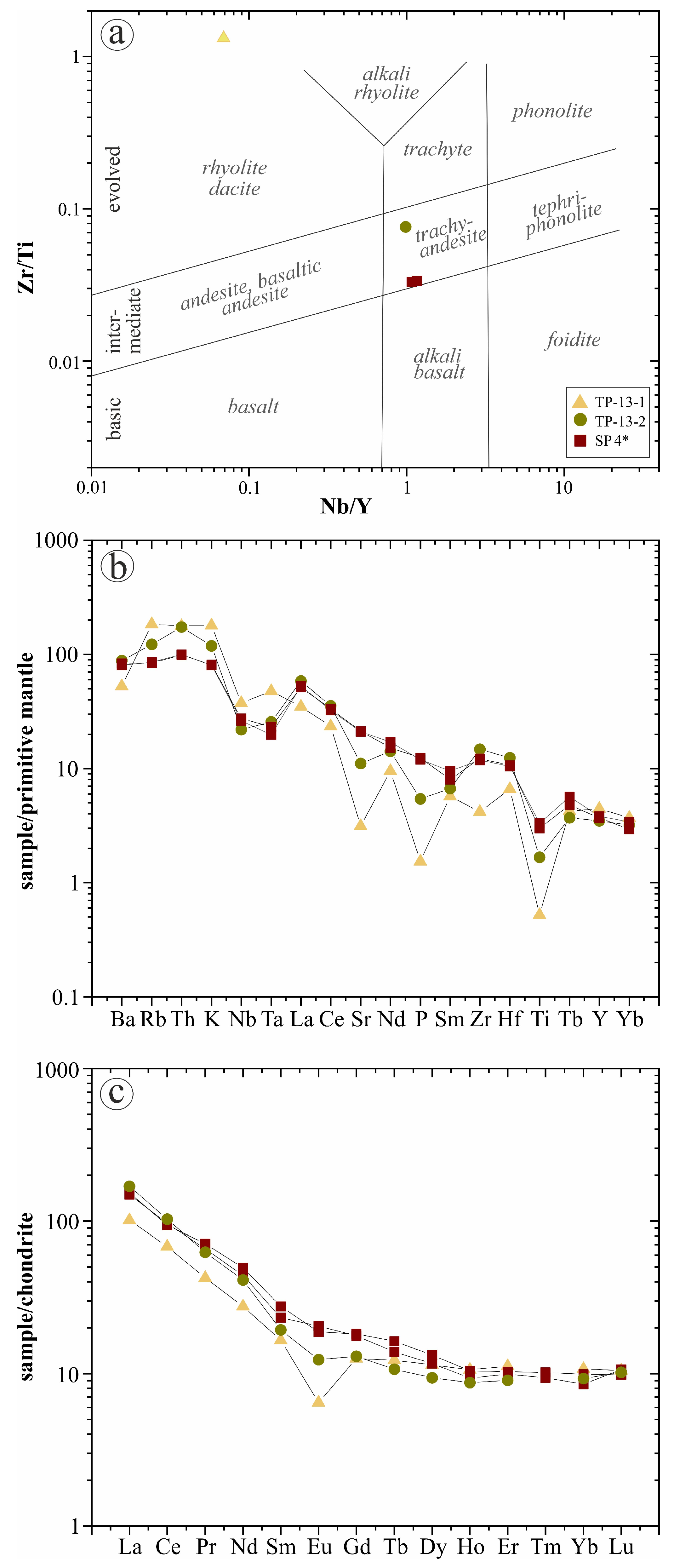
Major-element data from the lowest and middle Kurtan ash layers (TP-13-1, TP-13-2) indicate consistently rhyolitic compositions (Table S2). In contrast, the comparative ash samples SP4-A and SP4-B from [45], which correspond to TP-13-3, exhibit an andesitic composition, i.e., are less evolved compared with TP-13-1 and TP-13-2. Due to the susceptibility of volcanic ash to alteration and mobilization of alkaline elements—particularly Na and K [46]—an additional classification based on fluid-immobile element ratios such as Zr/Ti and Nb/Y was applied, providing a more stable basis for determining primary magma composition in the partly altered tephra. Using these ratios, sample TP-13-1 plots within the rhyolite field, whereas the other two ash layers are trachyandesites (Figure 4a). Because immobile elements are less sensitive to alteration, we consider this classification more reliable and use it as the basis for subsequent interpretations.
TP-13-1 and TP-13-2 show enriched incompatible-element signatures typical of evolved felsic magmas (Figure 4; Table S2). TP-13-1 is marked by elevated Rb (117 ppm), Ba (367 ppm), Th (15 ppm), and Nb (27 ppm), together with low Sr (66 ppm) and a strongly depleted Eu abundance (0.4 ppm). TP-13-2 contains higher Sr (234 ppm) and Ba (615 ppm), moderately elevated Rb (78 ppm), and Eu at 0.7 ppm. Rare earth element (REE) patterns for both samples exhibit pronounced negative Eu anomalies, calculated using CI-normalized values as Eu/Eu* = EuN/(SmN·GdN)0.5 following the geometric mean method of [67,68]. Eu/Eu* values are 0.45 for TP-13-1 and 0.78 for TP-13-2, consistent with varying degrees of plagioclase fractionation. Heavy rare earth elements (HREEs) show a relatively flat chondrite-normalized pattern. TP-13-1 shows higher Rb/Sr (1.76) and Ba/Sr (5.55) than TP-13-2 (0.33 and 2.63, respectively), reflecting stronger feldspar fractionation. It is also worth noting that tephras in the region typically display well-developed negative HFSE anomalies (Nb, Ta, Zr) on normalized multi-element plots. Consistent with this, their high-field-strength element ratios differ markedly: TP-13-1 has a Nb/Zr ratio of 0.57, compared to 0.09 in TP-13-2, indicating stronger incompatible-element enrichment in the former. While TP-13-3 (SP4*) is represented by published data [45] rather than our own analyses, its trace-element pattern exhibits overall characteristics similar to those observed in TP-13-1 and TP-13-2. In particular, TP-13-3 closely mirrors the pattern of TP-13-2 in the trace-element plot, supporting the interpretation that these units probably—though necessarily tentatively—share a similar magmatic affinity.

4.4. BSE-SEM Imaging and GXMAP

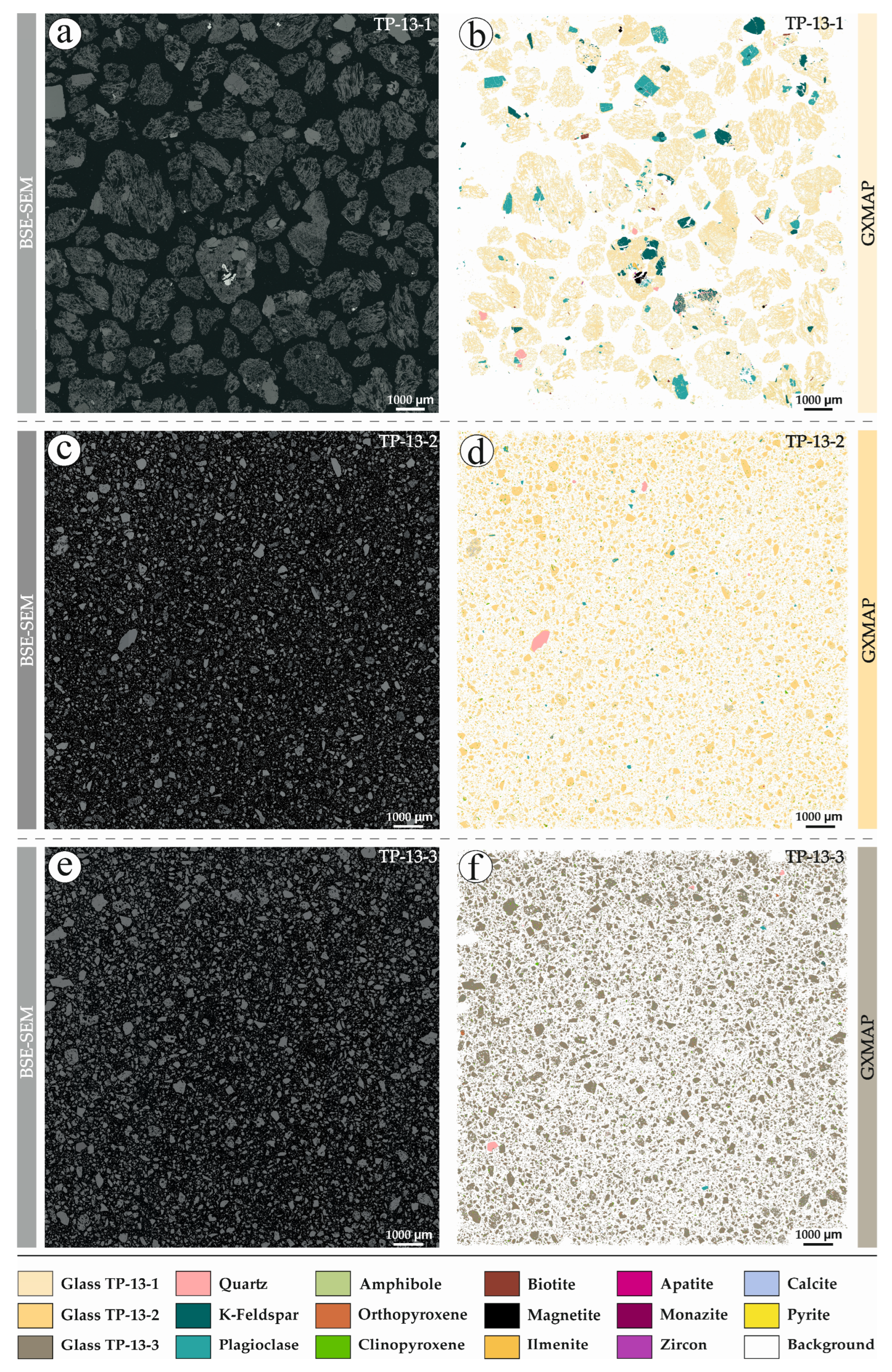
BSE-SEM imaging combined with GXMAP mineral mapping reveals systematic textural and mineralogical contrasts among the three pyroclastic units of the Kurtan sequence (Figure 5 and Figure 6). These complementary techniques provide both high-contrast visualization of mineral phases and quantitative mapping of compositional variability, enabling robust characterization of ash and pumice fragments.
Representative BSE-SEM images (Figure 5a,c,e) resolve major and accessory minerals, vesicular domains, and glassy textures. Mineral phases are distinguished by their characteristic greyscale values, although resolution decreases within the finest ash fractions, where microphenocryst assemblages are more difficult to identify. This limitation is consistent with observations in other tephra studies, e.g., [18], where fine ash often requires additional mapping methods to fully resolve phase assemblages.
Textural contrasts among the Kurtan pyroclastic fall units are pronounced: (i) the lowermost pumice-ash fall unit (TP-13-1) reveals a coarse pumiceous fabric with large vesicles, abundant glassy domains, and relatively large crystals; (ii) the fine-ash layer (TP-13-2) is less vesicular, with a higher abundance of small minerals; and (iii) the fine-grained ash unit (TP-13-3) contains weakly vesicular fragments with notable concentration of microphenocrysts.
In contrast, the false-colored BSE-GXMAP images (Figure 5b,d,f) provide a high-resolution, comprehensive visualization of matrix glass and mineral distributions across the entire epoxy mount. The GXMAP enhances the contrast between mineral phases by employing X-ray mapping, enabling precise identification of specific minerals or matrix glass and their spatial relationships (Figure 5b,d,f and Figure 6a–c). The GXMAP image allows for a clear delineation of major mineral sets (e.g., feldspars, quartz, biotite, amphibole, and pyroxenes), as well as accessory and opaque minerals, matrix, and vesicular texture, along with ash and pumice fragment morphology. The false-color representation enables easy differentiation of these phases and highlights important geological features that would be difficult to resolve using conventional imaging methods.
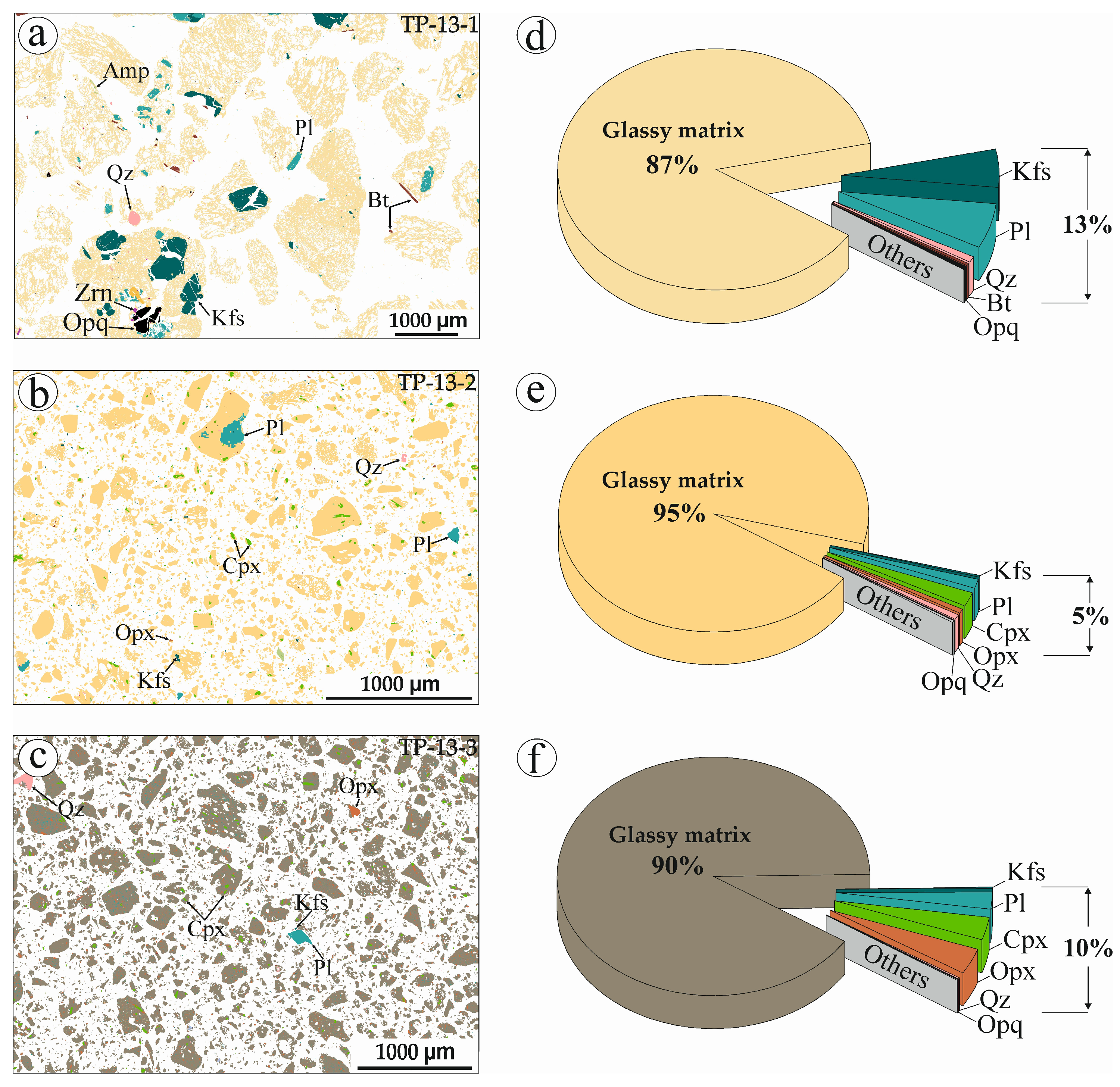
The GXMAP mineral maps further emphasize compositional contrasts between the units. In TP-13-1, quartz, K-feldspar, plagioclase, amphibole, and biotite dominate, with accessory phases such as zircon, apatite, and opaque minerals (e.g., magnetite) embedded in a glassy, vesicular matrix (Figure 5b). The presence of hydrous minerals (biotite and amphibole) and the absence of pyroxenes is noteworthy. TP-13-2 and TP-13-3 exhibit a more diverse assemblage, including feldspars, clinopyroxene, orthopyroxene, and opaque minerals packed within a predominantly glassy, locally vesicular ash matrix (Figure 5d and Figure 5f, respectively). In both ash layers, hydrous mafic phases are absent. These maps enable direct comparison of mineral assemblages and proportions, as well as fragment morphology across the stratigraphy, reinforcing the textural contrasts observed in BSE-SEM imaging.

4.5. Modal Mineralogy and Cumulative Passing

The combined application of SEM-EDS and GXMAP is particularly valuable in this study, as it enables the resolution of complex textures and compounds, while providing rapid and quantitative analysis of modal mineralogy (Figure 5). This contrasts with more time-consuming and labor-intensive methods, such as point-counting in epoxy mounts. For example, the SEM-EDS system allows for the rapid classification of mineral phases, the identification of mineral associations, and the quantification of phase abundances with significantly reduced processing times compared to traditional petrographic analysis, which typically requires extensive point-counting across multiple thin sections/epoxy mounts (representative area ≥ 1000 points).
Modal mineralogy of both major and minor components was quantified using Dataview software version 3.1 applied to SEM-MLA (Figure 5 and Figure 6). The results demonstrate clear differences among the three units in terms of mineral assemblages and glass compositions (Figure 5 and Figure 6). Minerals make up only ~13% of the bulk material in TP-13-1, ~10% in TP-13-3, and ~5% in TP-13-2; the rest is represented by volcanic glass (Figure 6d–f). TP-13-1 is dominated by K-feldspar and plagioclase (~11%), with minor contributions from quartz, biotite, amphibole, and other phases (up to 2%; Figure 6d). In contrast, TP-13-2 shows a more mafic assemblage, with orthopyroxene (~1%), clinopyroxene (~2%), and plagioclase (~1%) as the principal phases, accompanied by quartz, K-feldspar, and accessory, opaque, and other minerals (Figure 6e). TP-13-3 is characterized by higher concentrations of microphenocrysts and phenocrysts of clinopyroxene (~3%) and orthopyroxene (~4%), followed by plagioclase (~2%), with minor amounts of K-feldspar, quartz, and trace accessory, opaque, and other mineral phases (<1%; Figure 6f).
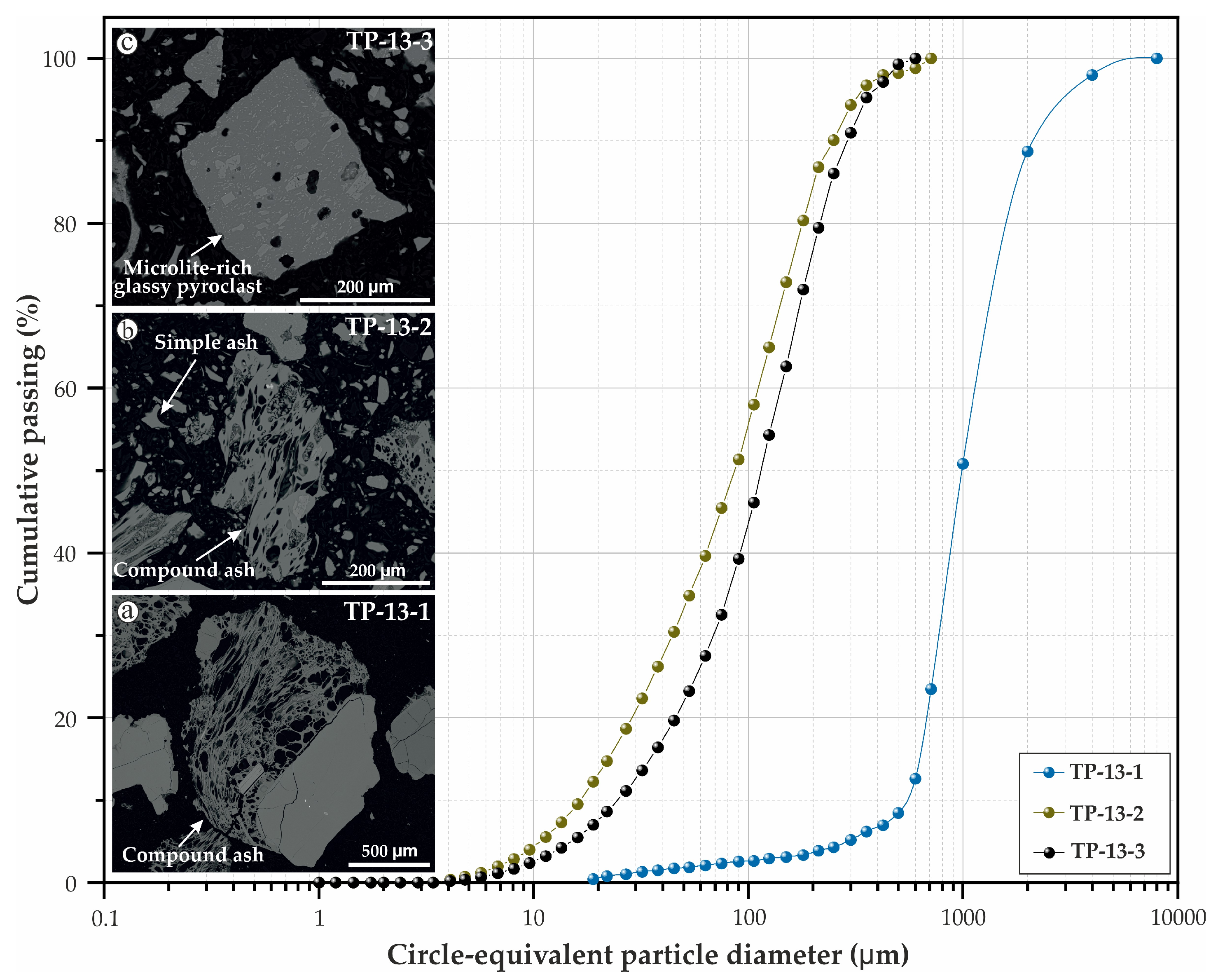
GXMAPs were also used to get the particle size curves, which reveal systematic differences in granulometry across the units (Figure 7). TP-13-1 displays a broader grain size spectrum with a coarser size distribution tail, indicating the presence of larger pumice and ash fragments. In contrast, TP-13-2 exhibits a steeper size distribution slope, reflecting a finer and more uniform particle population dominated by ash-sized material. TP-13-3 is represented with intermediate grain sizes and a moderately steep size distribution curve, consistent with a mix of fine ash and fragmented juvenile clasts (Figure 7). The pumice shards mostly from TP-13-1 and occasionally in TP-13-2 display streaky pumice textures, most likely reflecting deep conduit erosion during a large-volume caldera-forming eruption, exposing deeper parts of the feeder system, as also discussed by [69].
The cumulative curve exhibits a steep decline toward the finer tail, yielding percentile diameters of D5 ≈ 300 µm (ϕ5 ≈ 1.74), D16 ≈ 650 µm (ϕ16 ≈ 0.62), D84 ≈ 1800 µm (ϕ84 ≈ −0.85), and D95 ≈ 3000 µm (ϕ95 ≈ −1.59), and a sorting coefficient of σl ≈ 0.87 (after [62]) and a standard deviation by the logarithmic method of moments of σϕ ≈ 0.77 (after [63]) both classify the sample as moderately sorted.
Sample TP-13-2 is characterized by a strongly fine-ash-dominated grain size distribution. The cumulative curve is smooth and sigmoidal, reflecting a continuous progression toward the fine tail (Figure 7). Derived percentile diameters are D5 ≈ 11 µm (ϕ5 ≈ 6.51), D16 ≈ 23 µm (ϕ16 ≈ 5.44), D84 ≈ 200 µm (ϕ84 ≈ 2.32), and D95 ≈ 320 µm (ϕ95 ≈ 1.64), with a sorting coefficient of σl ≈ 1.52 (after [62]) and a standard deviation by the logarithmic method of moments of σϕ ≈ 1.55 (after [63])—both classify the sample as poorly sorted.
Sample TP-13-3 displays an intermediate grain-size distribution. The cumulative curve indicates percentile diameters of D5 ≈ 16 µm (ϕ5 ≈ 5.96), D16 ≈ 37 µm (ϕ16 ≈ 4.75), D84 ≈ 240 µm (ϕ84 ≈ 2.06), and D95 ≈ 355 µm (ϕ95 ≈ 1.49), with a sorting coefficient of σl ≈ 1.35 (after [62]) and a standard deviation by the logarithmic method of moments of σϕ ≈ 1.60 (after [63]), which both classify the sample as poorly sorted.
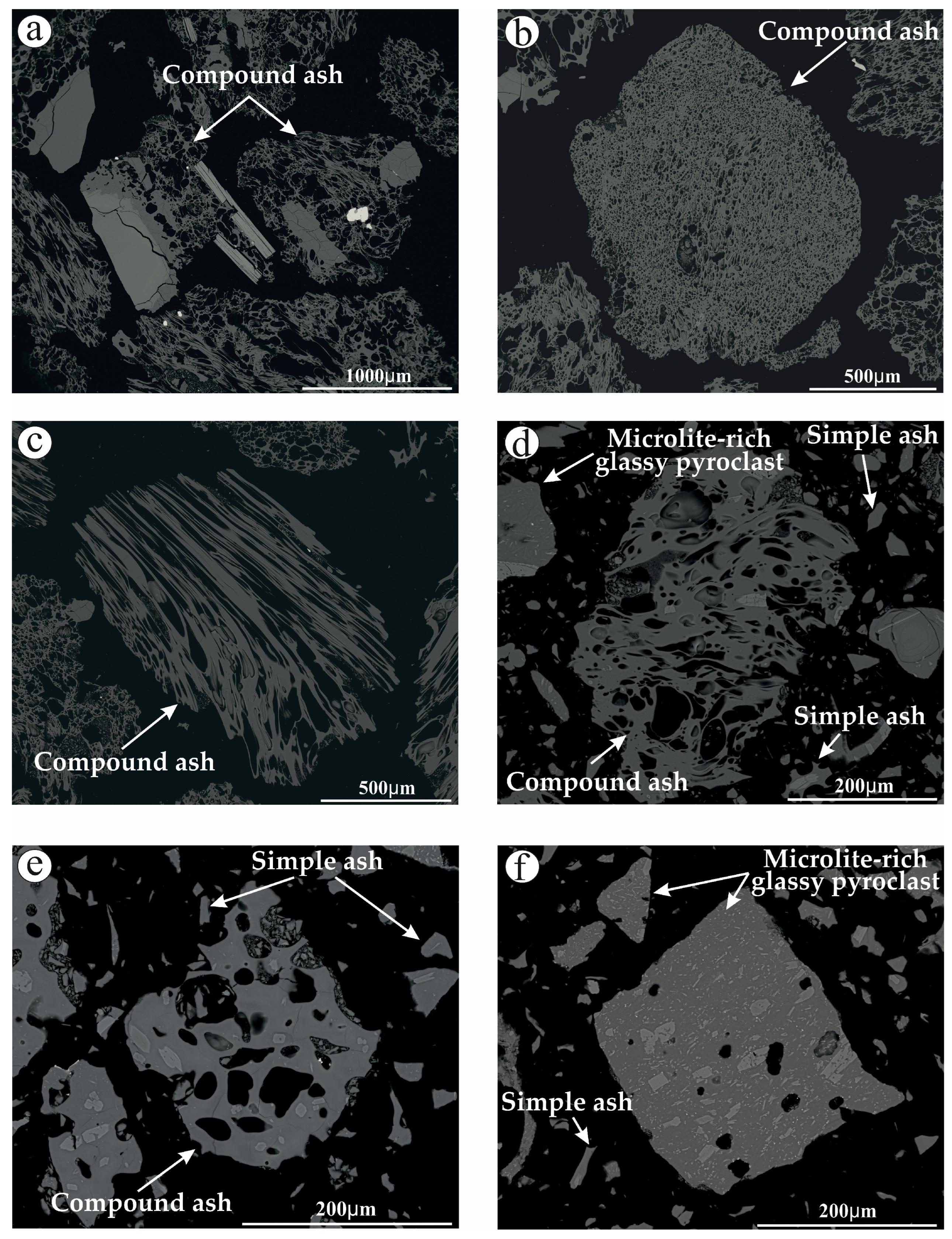
Analysis of ash particle vesicularity indicates marked differences among samples: TP-13-1 contains abundant compound ash particles (Figure 7a), and TP-13-2 contains a mixture of compound and simple ash particles (Figure 7b), whereas TP-13-3 is characterized mainly by simple ash and microlite-rich, glassy pyroclasts (Figure 7c). Here, simple ash particles refer to glassy fragments lacking internal vesicles, while compound ash particles contain multiple internal vesicles and exhibit a more pumice-like internal structure.

4.6. Particle Shape Morphology

We quantified particle outlines using a set of conventional 2-D shape descriptors commonly applied in quantitative ash-morphology studies, e.g., [57,70,71]. Form Factor, Circularity, and Compactness describe the smoothness and overall compactness of particle outlines, whereas Convexity, Solidity, and the Concavity Index quantify the presence and depth of concave margins. Aspect Ratio and Elongation characterize particle elongation, while Rectangularity provides an additional measure of outline straightness and blockiness. Together, these parameters capture the morphological variability of the analyzed ash particles.
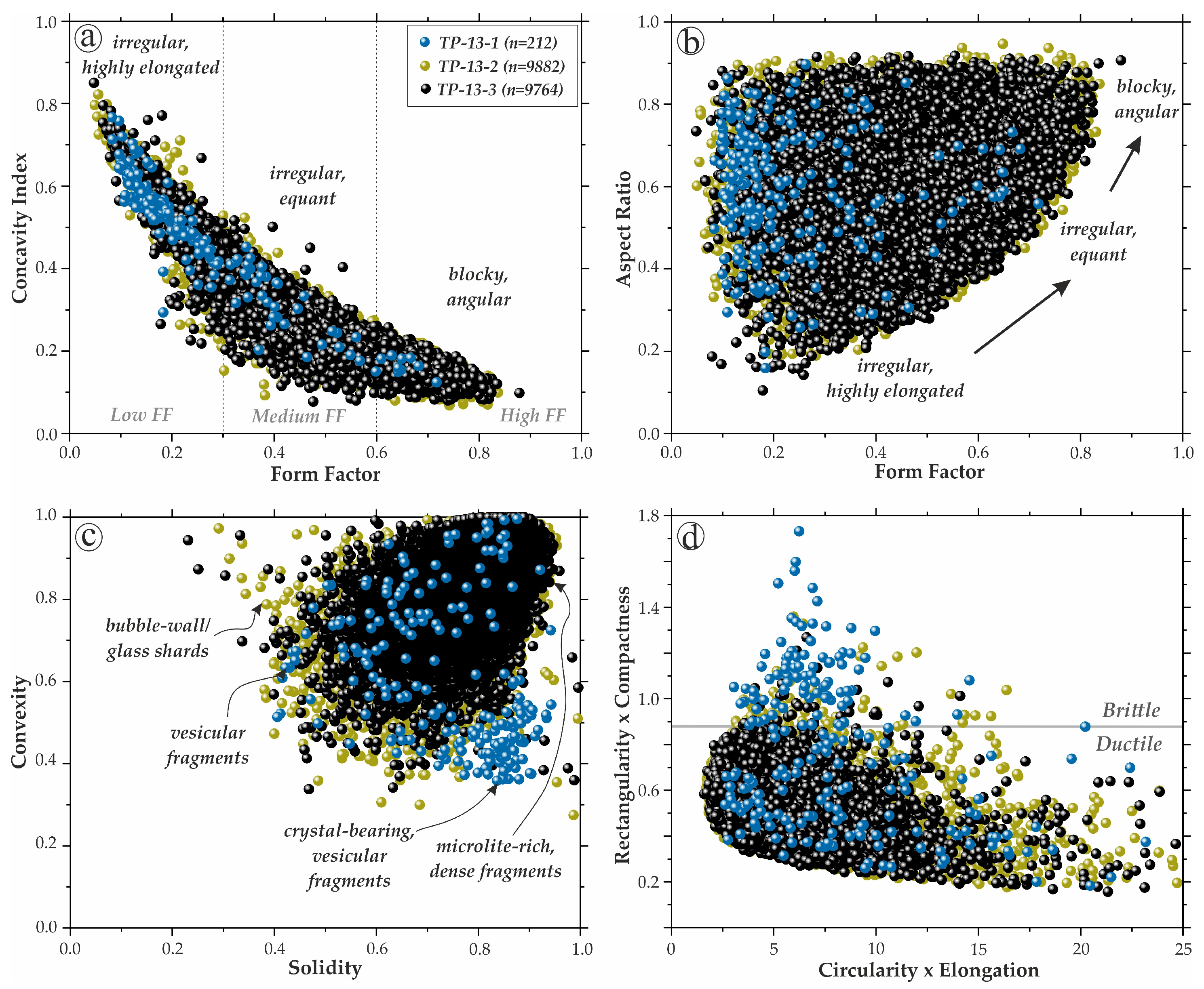
Particle-shape measurements derived from 2-D BSE images (Figure 5a,c,e) reveal substantial morphological variability across TP-13-1, TP-13-2, and TP-13-3 (Figure 8). TP-13-1 contains the most irregular population, with low median convexity (0.55), high concavity index (CI = 0.54), low Form Factor (0.17), and a broad aspect ratio range (0.16–0.90; median 0.60). These characteristics reflect the abundance of compound ash fragments with deeply indented outlines.
TP-13-2 and TP-13-3, both poorly sorted fine ash units, are characterized by a lower abundance of compound fragments and a dominance of microlite-rich dense particles and glass/bubble shards, which produce smoother and straighter outlines. Their higher convexity (0.84–0.87), higher Form Factor (0.43–0.46), and lower concavity indices (0.27–0.30) reflect this shift toward more compact particle shapes. Median aspect ratios (0.61–0.62) indicate predominantly elongated but largely non-compound fragments. Together, the three units define a morphological continuum from highly irregular, compound ash (TP-13-1) to smoother, denser, and more glass-rich fragment populations (TP-13-2 and TP-13-3).
These differences are clearly expressed in the Form Factor versus Concavity Index diagram (Figure 8a), which shows a negative correlation between the two parameters. TP-13-1 forms a broad cluster toward low Form Factor and high concavity index, whereas TP-13-2 and TP-13-3 plot toward higher Form Factor and lower concavity index, consistent with their smoother, less indented outlines. A similar pattern appears in the Form Factor versus Aspect Ratio diagram (Figure 8b): TP-13-2 and TP-13-3 cluster toward higher Form Factor and higher aspect ratio, while TP-13-1 extends toward low Form Factor and a wide range of aspect ratios, reflecting its dominance of irregular, compound fragments.
In the Convexity versus Solidity plot (Figure 8c), TP-13-1 occupies a broad field toward lower convexity and lower solidity, whereas TP-13-2 and TP-13-3 cluster at higher values of both parameters, consistent with their smoother and more compact particle outlines. The Circularity × Elongation versus Rectangularity × Compactness plot (Figure 8d) shows that particles from all three units cluster predominantly within the ductile fragmentation field.

5. Discussion

The following discussion evaluates the analytical approaches applied in this study and their implications for interpreting fragmentation processes, particle morphologies, and granulometric patterns on the example of Kurtan pyroclastic deposits. Particular emphasis is placed on the contrast between traditional sieve-based methods and image-based GXMAP granulometry, as well as the advantages of SEM–EDS for phase identification and textural characterization. The integration of GXMAP X-ray mapping further enhances phase discrimination, enabling more nuanced interpretation of complex volcanic rocks and mineral associations [72]. At the same time, it is essential to acknowledge that SEM–MLA may encounter challenges in distinguishing mineral phases with overlapping compositions or when analyzing highly altered matrices, underscoring the importance of complementary techniques such as electron–microprobe spot analysis or Raman spectroscopy, e.g., [27]. The subsequent sections show how methodological choices influence the accuracy, resolution, and geological interpretation of the datasets.

5.1. Evaluation of Sieve-Based vs. GXMAP-Based Granulometry

The comparison between sieve-based and GXMAP-based granulometry, shown in Figure 9, highlights both the strengths and limitations of each approach. In TP-13-2 and TP-13-3, the sieve-based grain-size distributions are distinctly shifted toward finer sizes relative to the GXMAP-derived curves (Figure 9a). This leftward shift is accompanied by markedly poor to very poor sorting in the sieve data (σ1 ≈ 2.07 for TP-13-2 and σ1 ≈ 1.92 for TP-13-3), whereas GXMAP-based granulometry yields lower σ1 values (σ1 ≈ 1.52 for TP-13-2 and σ1 ≈ 1.35 for TP-13-3; Figure 9b). The cumulative curves in Figure 8a illustrate this contrast clearly: sieve curves for TP-13-2 and TP-13-3 show enhanced fine fractions, consistent with secondary breakage of fragile clasts during sieving, while GXMAP preserves coarser tails and produces more coherent sorting. These differences indicate that mechanical agitation during sieving artificially increases the fine fraction and broadens the distributions, a well-known issue for brittle ash and lapilli. Beyond the effects of mechanical breakage, part of the divergence between the two methods also reflects their respective lower size-resolution limits. GXMAP-based granulometry cannot reliably detect particles approaching the pixel-scale threshold (~10 µm), which leads to a slight under-representation of the finest classes. For comparison, dry sieving becomes unreliable at and below the 0.063 mm cutoff due to clogging, partial grain passage, and fragmentation. These effects mainly influence the finest classes but do not change the overall contrast between the two approaches.
In contrast, TP-13-1 exhibits the opposite behavior: the sieve-based curve is shifted toward coarser grain sizes relative to the GXMAP-based distribution (Figure 9a). This rightward shift suggests that secondary fragmentation during sieving is not the dominant factor for this unit. Instead, the discrepancy is more plausibly explained by sampling bias in the GXMAP mounts because coarse clasts are more difficult to embed in epoxy and therefore tend to be underrepresented. This interpretation is consistent with the note in Figure 8a that the epoxy mounts represent only a small portion of the bulk lapilli-ash samples. As a result, the GXMAP-derived distribution for TP-13-1 appears slightly finer (σi ≈ 0.87) than the sieve-based dataset (σl ≈ 0.83); however, this minor difference does not influence the overall interpretation, as both methods consistently classify the unit as moderately sorted (Figure 9). A slight stereological bias is expected because 2-D sectioning systematically underestimates the true size of larger clasts, as demonstrated by [73,74]. Although the epoxy mounts were ground and polished deeply enough to intersect the 1–4 mm lapilli, their measured cross-sections still may represent reduced slices, affecting absolute grain sizes but not the resulting sorting classification. Given that TP-13-1 contains >90% material in the 1–4 mm range and rare clasts up to ~1.5 cm, the 30 mm epoxy mounts and 2-D sections inevitably capture only a limited portion of the coarse fraction; therefore, studies of coarse ash–pumice deposits should be complemented with conventional bulk granulometry. While this limitation affects the absolute representation of the coarse tail, the GXMAP workflow remains highly reliable for fine, fragile ash, where delicate particles are fully preserved and reliably quantified. Despite the above-mentioned differences, both methods yield cumulative curves with similar overall shapes for each unit—TP-13-1 retains a broad distribution with a coarse tail, TP-13-2 is dominated by fine ash, and TP-13-3 occupies an intermediate position—indicating that both approaches capture the same underlying granulometric structure while GXMAP refines the resolution of the grain-size signal.
The contrasting shifts between units also reflect differences in fragmentation efficiency and particle fragility. The pronounced leftward shift in TP-13-2 and TP-13-3 is consistent with highly brittle ash and lapilli that readily break during sieving (Figure 9a). Textural observations support this interpretation: TP-13-2 is dominated by simple ash particles indicative of efficient fragmentation of magmatic foam [16,17], whereas TP-13-1 contains abundant compound ash particles reflecting lower fragmentation efficiency [16,17], potentially reflecting a broader bubble size distribution [75]. Streaky pumice textures in TP-13-1 and TP-13-2 further point to syn-fragmentation stretching and deep conduit erosion, consistent with previous descriptions of pumice deformation during ascent [22,69].
These observations align with well-documented limitations of mechanical sieving for fragile pyroclasts. Numerous studies have shown that volcanic ash, lapilli, and pumice are highly susceptible to breakage during handling, artificially increasing the fine fraction and biasing sorting estimates [76,77,78]. Recent methodological frameworks reinforce this issue: Ross et al. [22] emphasize that juvenile pyroclasts—particularly in the ash-size range—are prone to breakage, and that traditional granulometry often fails to preserve the original particle population. Their standardized workflow highlights the importance of minimizing mechanical disturbance and using embedded particle mounts to prevent post-collection fragmentation.
GXMAP analysis directly addresses these limitations by embedding particles in epoxy mounts, thereby minimizing mechanical stress and preserving original morphology. Similar SEM-based approaches have been shown to produce more accurate grain-size distributions for fragile pyroclasts, particularly in studies of co-ignimbrite ash, pumice fallout, and phreatomagmatic deposits [1,4,57,79,80]. In our dataset, the more coherent sorting patterns and coarser tails in GXMAP-derived curves for TP-13-2 and TP-13-3 reflect this methodological advantage. The comparison of sorting coefficients in Figure 8b further demonstrates that GXMAP-based values fall within a narrower and more internally consistent range than sieve-based values, underscoring the reduced influence of secondary fragmentation. Moreover, BSE-GXMAP enables particle-level characterization—vesicularity, microlite content, Elongation, and surface textures—that is essential for interpreting fragmentation processes. The distinctions between compound and simple ash particles in TP-13-1 and TP-13-2 align with the textural categories defined by [22] and support interpretations of variable fragmentation efficiency.
Although vesicularity, microlite content, and surface textures were not quantified separately, the particle-shape metrics derived from BSE-GXMAP images capture these attributes indirectly. As shown by [57], parameters such as solidity, convexity, and form factor are sensitive to perimeter complexity and bubble-wall geometry, and therefore serves as a robust proxy for vesicle-controlled fragmentation and textural roughness. The wide ranges in these metrics across TP-13-1, TP-13-2, and TP-13-3 indicate substantial variability in vesicle abundance, microlite clustering, and particle-scale indentation. Likewise, aspect-ratio distributions reflect differences in Elongation and bubble-wall stretching, consistent with the “form” dimension of ash morphology described by [57].
In addition to these trends, Figure 8c shows that TP-13-1 occupies a broad low-convexity, low-solidity domain, whereas TP-13-2 and TP-13-3 cluster at higher values of both parameters, reflecting the contrast between compound vesicular fragments and smoother, denser particles, cf., [70]. The combined Circularity × Elongation versus Rectangularity × Compactness space further demonstrates that most particles from all three units fall within the region defined as ductile in this parameter space (Figure 8d), consistent with the ductile–brittle discrimination fields described for experimentally and naturally fragmented ash [70,71,80].
Together, these shape-parameter patterns provide particle-level evidence for contrasting fragmentation pathways in TP-13-2 and TP-13-3, highlighting that both units contain highly variable particle morphologies and exhibit higher-median aspect-ratio values indicative of abundant elongated bubble-wall shards. This combination of wide shape variability and the coexistence of both elongated bubble-wall shards and compact dense fragments suggests heterogeneous mechanical behavior during fragmentation, with portions of the magma undergoing efficient ductile stretching of vesicle walls while other domains fragmented more brittlely, generating angular particles.
The morphology of ash particles provides important insights into the magmatic processes operating during fragmentation in explosive eruptions. Ash particles have been characterized as simple or compound (complex) based on their internal structure [15,16,17]. A simple ash particle is the remains of a single bubble wall or plateau border in a fragmenting magmatic foam. It is glassy and contains no complete internal vesicles (Figure 10d–f). A compound ash particle, in contrast, contains multiple internal vesicles (like a tiny pumice fragment, Figure 10a–e) and results from the bursting of several bubbles surrounding a small region of foam in which the bubbles did not burst. Compound ash particles have been used to indicate that the fragmenting foam behaved as an elastic solid (rather than a viscous fluid) because no bulges were observed at the bottoms of external bubble imprints [17]. Simple particles are generally smaller than compound particles derived from the same magma. Moreover, in TP-13-3 (Figure 10e), the combination of speckled nanotexture and faint arcuate lines may point to localized fragmentation and later rewelding, in agreement with similar deformation structures reported previously [81]. From a wider analytical perspective, integrating GXMAP-based granulometry with recent standardized analytical frameworks, e.g., [3,22,80], provides a robust and minimally biased approach for quantifying grain-size distributions, sorting patterns, and particle morphologies in brittle pumice–lapilli–ash deposits. While sieve-based granulometry captures the broad structure of the distributions, BSE-GXMAP analysis, along with particle shape analyses, offers a more accurate representation of the primary particle population and fragmentation processes, particularly for fragile clasts. For coarser-grained pyroclastic deposits, however, GXMAP approaches its practical limit, and incorporating coarse-fraction granulometry alongside GXMAP offers a more representative assessment while also defining a pragmatic upper size threshold for the method.

5.2. Stratigraphic Transitions, Eruption Dynamics, and Deposition

The granulometric, mineralogical, and textural characteristics of the Kurtan tephra sequence demonstrate that each stratigraphic layer records a distinct combination of magma properties, fragmentation conditions, and transport regimes. Because the available outcrops and field-scale topographic correlations are limited, the interpretations presented in this subsection should be regarded as preliminary. In general, the variations observed in the SEM–GXMAP datasets and granulometric measurements correspond to the visible textural boundaries and contrasting clast populations observed in the field, which already indicate shifts in fragmentation behavior and in the efficiency and style of particle transport through the eruptive column and across the region of deposition. Because the stratigraphy alone does not establish whether the layers represent temporally separated pulses from a single source or multiple sources, here we interpret each unit independently. This approach is further supported by the age constraints, which suggest that some layers (eruptions) may be separated by a considerable quiet period [38]. The internal coherence of the granulometric and SEM-GXMAP-based petrographic signatures within each layer allows robust reconstruction of its eruptive and depositional conditions without requiring genetic linkage (between them). In addition, the SEM–GXMAP analyses contribute information that cannot be resolved from field observations alone. The particle-scale data—quantifying shape variability, vesicle-wall geometry, microlite clustering, and the proportions of simple versus compound ash—provide direct evidence for differences in fragmentation efficiency and mechanical behavior between the units (Figure 5, Figure 6, Figure 7, Figure 8, Figure 9 and Figure 10).
The basal rhyolitic biotite-bearing layer is dominated by coarse ash and lapilli-sized clasts, with more than 90% of the material between 1 and 4 mm, despite a composition that typically favors efficient brittle fragmentation and abundant fine ash [12,13,16,17,82]. BSE images show abundant compound ash particles and vesicle-rich juvenile fragments, indicating fragmentation within a dense, particle-rich region of the conduit where collisions and adhesion occur before quenching. These textures imply transport through a high-concentration, proximal region of the plume, where turbulent shear was insufficient to fully separate clasts. The scarcity of fine ash suggests either limited production of fine particles or, more plausibly, efficient removal of fine particles into the upper convective or umbrella regions of the plume, transporting them beyond the Kurtan site [83,84,85]. The mineral assemblage—biotite, amphibole, plagioclase, K-feldspar, and quartz—supports derivation from a volatile-rich felsic reservoir [37,38,86,87]. Comparable amphibole-bearing felsic deposits at Colima and Mount St. Helens demonstrate how hydrous magma inputs can drive explosive behavior [86,88]. The cumulative grain-size curve shows a smooth, gradually increasing slope, reflecting explosive fragmentation, moderate sorting, and deposition typical of coarse-dominated fallout from a strong plume where coarse particles dominate proximal deposition [75,89,90,91].
The overlying trachyandesitic ash layer (TP-13-2) displays a markedly different granulometric and textural signature. Nearly two-thirds of the material is finer than 0.063 mm (>4 Phi), and BSE images reveal predominantly simple, angular ash particles and microlite-rich glassy pyroclasts (Figure 10b,c). These features indicate rapid ascent and sudden decompression with limited particle–particle interaction before quenching. The mineral assemblage, dominated by clinopyroxene and plagioclase, is characteristic of hotter, drier magma systems where reduced volatile content promotes shallower fragmentation [92,93]. The smooth sigmoidal cumulative curve and the poor (σ1 ≈ 1.52, GXMAP-based) to very poor (σ1 ≈ 2.07, sieve-based) sorting are consistent with well-developed fine-ash fallout from a sustained, buoyant plume capable of long-distance transport [85,94,95]. The abundance of fine ash suggests that aggregation processes may have influenced settling behavior, as fine ash rarely deposits efficiently without some degree of clustering [96]. The presence of microlite-rich glassy fragments reflects shallow pre-eruptive storage and ascent-related undercooling, as ash-sized particles quench within seconds after emission. Such microlite textures are consistent with rapid ascent from a shallow reservoir, where high undercooling promotes syn-ascent crystallization prior to fragmentation (see [81] and references therein).
The uppermost trachyandesitic layer (TP-13-3) shares several characteristics with TP-13-2 but also exhibits features that distinguish its fragmentation and transport history. It is dominated by fine ash fragments and is poorly sorted, with σl values of ca. 1.35–1.92 for GXMAP- and sieve-based data, respectively. BSE images again show that simple ash particles have less compound textures characteristic of the basal layer. These observations are consistent with more open-system degassing and limited particle–particle interaction during transport [4,97,98]. The mineralogy—pyroxene and plagioclase microlites and microphenocrysts—indicates rapid crystallization and efficient fragmentation, similar to deposits from the Taupo volcano [99]. Although microlites are common in intermediate magmas, the abundance and fine grain size in TP-13-2 indicate high undercooling during the final stages of ascent, when decompression outpaces diffusive equilibration. Such textures are widely associated with rapid ascent from shallow reservoirs [99]. The fine-dominated, moderately sorted distribution is compatible with fallout from a low or unstable plume, where fluctuating column height and intermittent collapse can produce thin, fine-grained layers. Alternatively, the steep cumulative curve and absence of coarse lapilli can also be consistent with deposition from pyroclastic surges, which transport fine ash in a turbulent boundary layer capable of generating poorly sorted, fine ash deposits [4,100,101]. Both interpretations imply deposition dominated by low momentum that is rich in fine ash currents or weak fallout rather than strong proximal plumes.
Taken together, the TP-13 sequence records differences in grain-size distributions, mineral assemblages, particle textures, fragmentation and sorting, accompanied by a range of depositional styles, from coarse-dominated proximal fallout to fine ash layers, with more distally transported or surge-related deposition. The Kurtan deposits, therefore, illustrate how integrated granulometric, mineralogical, textural, and shape morphology analyses can be used to reconstruct eruptive evolution and situate local stratigraphy within a broader tephrostratigraphic framework. Further geochronological work and in situ mineral chemistry (EPMA) will enable refinement of regional correlations and better constrain magma sources and eruption timing. Importantly, this study presents the first documentation of a biotite-rich rhyolitic tephra in Armenia, the source of which remains unknown. This finding highlights the need for systematic field surveys to locate additional outcrops, identify the eruptive center, and evaluate the magnitude and potential cataclysmic nature of the associated eruption.

6. Concluding Remarks

The Kurtan tephra sequence demonstrates how integrating GXMAP-based granulometry with mineralogical, textural, and particle-shape analyses provides a robust, minimally biased framework for reconstructing eruptive behavior in fragile pyroclastic deposits. While sieve-based granulometry captures broad grain-size patterns, its susceptibility to secondary fragmentation limits its reliability for brittle fine ash. GXMAP analysis preserves particle integrity, refines sorting estimates, and enables simultaneous evaluation of vesicularity, microlite textures, and particle morphology—key parameters for interpreting fragmentation processes/behavior.
Applied to the TP-13 stratigraphy, these methods reveal that each layer records a distinct combination of grain-size characteristics, mineral assemblages, and particle morphologies, reflecting contrasting magma properties, fragmentation conditions, and depositional regimes rather than a single genetic sequence. The basal rhyolitic unit TP-13-1 is dominated by coarse compound ash and lapilli, whereas the overlying trachyandesitic layers (TP-13-2 and TP-13-3) contain finer, more compact particles consistent with more efficient fragmentation and more distal or lower-energy deposition.
The morphology of ash particles provides additional insight into the mechanics of fragmentation. Simple ash particles—glassy fragments representing single bubble-wall breakage—contrast with compound particles that retain multiple internal vesicles and reflect the disruption of partially intact foam regions. The abundance of compound, highly irregular, concave fragments in TP-13-1 compared with the smoother, denser, glass- and bubble-shard-rich particles in TP-13-2 and TP-13-3 indicates contrasting fragmentation styles across the sequence. Localized speckled nanotextures and faint arcuate lines in TP-13-3 further suggest limited post-fragmentation modification, including possible rewelding, consistent with similar deformation structures described in previous studies. These particle-scale observations align with established frameworks for ash classification and fragmentation analysis and highlight the value of combining GXMAP-based granulometry with standardized morphological approaches.
This study shows that modern image-based granulometry significantly enhances the resolution of tephrostratigraphic interpretations and strengthens reconstructions of magma evolution, eruption dynamics, and depositional pathways. However, GXMAP should not be interpreted as universally more reliable than conventional granulometry across all grain-size classes. Its strengths are most pronounced for fine, fragile ash, where particle integrity is preserved and high-fidelity quantitative textural and granulometric information can be obtained. In contrast, coarse lapilli-bearing samples—such as TP-13-1—require integration with conventional bulk granulometry and careful assessment of mount representativeness to ensure accurate characterization of the coarse fraction. By minimizing preparation-induced bias and enabling detailed particle-scale characterization, GXMAP-based techniques advance our understanding of volcanic processes and underscore the value of imaging approaches in volcanology.

Supplementary Materials

The following supporting information can be downloaded at: https://www.mdpi.com/article/10.3390/min16060620/s1. Table S1: Summary table of the particle-shape parameters of the Kurtan deposits, based on 2-D shape analysis performed in ImageJ. Table S2: Whole-rock major oxides, trace elements, and REE compositions of samples TP-13-1 and TP-13-2 from the Kurtan site. Table S3: Comparison of percentile grain-size parameters (D5, D16, D84, D95) obtained from the sieve-based and GXMAP-based granulometric methods.

Author Contributions

Conceptualization, H.G. and R.H.; methodology, H.G., S.G., I.P.S. and A.I.; software, validation, and formal analysis, H.G., S.G., E.G., I.P.S. and A.I.; ash vesicularity analysis: D.S.; investigation, H.G.; resources, H.G., E.G., K.B.M. and I.P.S.; data curation, H.G. and E.G.; writing—original draft preparation, H.G.; writing—review and editing, all authors; visualization, H.G., S.G., E.G. and G.K.N.; project administration, H.G. and E.G. All authors have read and agreed to the published version of the manuscript.

Funding

Fieldwork and sampling of the pyroclastic fall deposits at the Kurtan site were carried out in 2024, and together with the whole rock, major and trace element data were funded by the Higher Education and Science Committee of the RA MESCS (Research project N 23RL-1E042; PI-I. Savov). The SEM-MLA and granulometric analyses were supported by TU Bergakademie Freiberg, Germany.

Data Availability Statement

The original contributions presented in this study are included in the article/Supplementary Material. Further inquiries can be directed to the corresponding authors.

Acknowledgments

The authors gratefully acknowledge the Department of Analytics, Sample Preparation, at the Helmholtz Institute Freiberg for Resource Technology for preparing the epoxy grain mount blocks from ash–pumice particles. Gitta Schneider is thanked for providing access to the sedimentology laboratory for granulometric analyses at the Institute for Geology, TU Bergakademie Freiberg, Germany. Sam Hammond is thanked for assistance with sample digestions and ICP analysis at the Open University, UK. We sincerely thank the editors and the two anonymous reviewers for their constructive comments and valuable suggestions which helped to improve this manuscript.

Conflicts of Interest

Author Arsen Israyelyan was employed by the company IBES Baugrundinstitut Freiberg GmbH, Ingenieure und Geologen für Bauwesen. The remaining authors declare that the research was conducted in the absence of any commercial or financial relationships that could be construed as a potential conflict of interest.

References

  1. Dellino, P.; Volpe, L.L. Fragmentation versus Transportation Mechanisms in the Pyroclastic Sequence of Monte Pilato-Rocche Rosse (Lipari, Italy). J. Volcanol. Geotherm. Res. 1995, 64, 211–231. [Google Scholar] [CrossRef]
  2. Heiken, G. Morphology and Petrography of Volcanic Ashes. Geol. Soc. Am. Bull. 1972, 83, 1961. [Google Scholar] [CrossRef]
  3. Hornby, A.J.; Lavallée, Y.; Kendrick, J.E.; Rollinson, G.; Butcher, A.R.; Clesham, S.; Kueppers, U.; Cimarelli, C.; Chigna, G. Phase Partitioning during Fragmentation Revealed by QEMSCAN Particle Mineralogical Analysis of Volcanic Ash. Sci. Rep. 2019, 9, 126. [Google Scholar] [CrossRef] [PubMed]
  4. Dellino, P.; La Volpe, L. Image Processing Analysis in Reconstructing Fragmentation and Transportation Mechanisms of Pyroclastic Deposits. The Case of Monte Pilato-Rocche Rosse Eruptions, Lipari (Aeolian Islands, Italy). J. Volcanol. Geotherm. Res. 1996, 71, 13–29. [Google Scholar] [CrossRef]
  5. Evans, J.R.; Huntoon, J.E.; Rose, W.I.; Varley, N.R.; Stevenson, J.A. Particle Sizes of Andesitic Ash Fallout from Vertical Eruptions and Co-Pyroclastic Flow Clouds, Volcán de Colima, Mexico. Geology 2009, 37, 935–938. [Google Scholar] [CrossRef]
  6. Manga, M.; Patel, A.; Dufek, J. Rounding of Pumice Clasts during Transport: Field Measurements and Laboratory Studies. Bull. Volcanol. 2011, 73, 321–333. [Google Scholar] [CrossRef]
  7. Vonlanthen, P.; Rausch, J.; Ketcham, R.A.; Putlitz, B.; Baumgartner, L.P.; Grobéty, B. High-Resolution 3D Analyses of the Shape and Internal Constituents of Small Volcanic Ash Particles: The Contribution of SEM Micro-Computed Tomography (SEM Micro-CT). J. Volcanol. Geotherm. Res. 2015, 293, 1–12. [Google Scholar] [CrossRef]
  8. Wilson, T.M.; Stewart, C.; Sword-Daniels, V.; Leonard, G.S.; Johnston, D.M.; Cole, J.W.; Wardman, J.; Wilson, G.; Barnard, S.T. Volcanic Ash Impacts on Critical Infrastructure. Phys. Chem. Earth Parts A/B/C 2012, 45–46, 5–23. [Google Scholar] [CrossRef]
  9. Craig, H.; Wilson, T.; Stewart, C.; Outes, V.; Villarosa, G.; Baxter, P. Impacts to Agriculture and Critical Infrastructure in Argentina after Ashfall from the 2011 Eruption of the Cordón Caulle Volcanic Complex: An Assessment of Published Damage and Function Thresholds. J. Appl. Volcanol. 2016, 5, 7. [Google Scholar] [CrossRef]
  10. Cascante, M.; Giachetti, T.; Wright, H.M.N.; Van Eaton, A.R.; Avard, G. Characteristics of Volcanic Ash Reveal Changes in Fragmentation and Eruption Dynamics at Poás Volcano, Costa Rica, 2016–2019. Bull. Volcanol. 2025, 87, 36. [Google Scholar] [CrossRef]
  11. Hamzah, W.N.; Ohba, T.; Gurusinga, M.A.; Moktikanana, M.L.A.; Indriyanto, J.N.; Hoshide, T.; Abdurrahman, M.; Kurniawan, I.A. Fadlin Transition from Magmatic to Phreatomagmatic Eruptions in Young Ciremai Volcano, Indonesia: Insights from Stratigraphy, Componentry, and Textural Analysis of Tephra Deposits. Earth Planets Space 2025, 77, 16. [Google Scholar] [CrossRef]
  12. Spieler, O.; Kennedy, B.; Kueppers, U.; Dingwell, D.B.; Scheu, B.; Taddeucci, J. The Fragmentation Threshold of Pyroclastic Rocks. Earth Planet. Sci. Lett. 2004, 226, 139–148. [Google Scholar] [CrossRef]
  13. Kueppers, U.; Scheu, B.; Spieler, O.; Dingwell, D.B. Fragmentation Efficiency of Explosive Volcanic Eruptions: A Study of Experimentally Generated Pyroclasts. J. Volcanol. Geotherm. Res. 2006, 153, 125–135. [Google Scholar] [CrossRef]
  14. Zimanowski, B.; Fröhlich, G.; Lorenz, V. Quantitative Experiments on Phreatomagmatic Explosions. J. Volcanol. Geotherm. Res. 1991, 48, 341–358. [Google Scholar] [CrossRef]
  15. Proussevitch, A.A.; Mulukutla, G.K.; Sahagian, D.L. A New 3D Method of Measuring Bubble Size Distributions from Vesicle Fragments Preserved on Surfaces of Volcanic Ash Particles. Geosphere 2011, 7, 62–69. [Google Scholar] [CrossRef]
  16. Genareau, K.; Proussevitch, A.A.; Durant, A.J.; Mulukutla, G.; Sahagian, D.L. Sizing up the Bubbles That Produce Very Fine Ash during Explosive Volcanic Eruptions. Geophys. Res. Lett. 2012, 39, 2012GL052471. [Google Scholar] [CrossRef]
  17. Genareau, K.; Mulukutla, G.K.; Proussevitch, A.A.; Durant, A.J.; Rose, W.I.; Sahagian, D.L. The Size Range of Bubbles That Produce Ash during Explosive Volcanic Eruptions. J. Appl. Volcanol. 2013, 2, 4. [Google Scholar] [CrossRef]
  18. Hornby, A.J.; Ayris, P.M.; Damby, D.E.; Diplas, S.; Eychenne, J.; Kendrick, J.E.; Cimarelli, C.; Kueppers, U.; Scheu, B.; Utley, J.E.P.; et al. Nanoscale Silicate Melt Textures Determine Volcanic Ash Surface Chemistry. Nat. Commun. 2024, 15, 531. [Google Scholar] [CrossRef]
  19. Wallace, K.L.; Bursik, M.I.; Kuehn, S.; Kurbatov, A.V.; Abbott, P.; Bonadonna, C.; Cashman, K.; Davies, S.M.; Jensen, B.; Lane, C.; et al. Community Established Best Practice Recommendations for Tephra Studies—From Collection through Analysis. Sci. Data 2022, 9, 447. [Google Scholar] [CrossRef] [PubMed]
  20. Higgins, M.D. Quantitative Textural Measurements in Igneous and Metamorphic Petrology, 1st ed.; Cambridge University Press: Cambridge, UK, 2006. [Google Scholar]
  21. Kiely, C.; Sahagian, D.; Claves, S.; Misiolek, W.; Kiely, C. X-Ray Ultramicroscopy Within an XL30 Environmental SEM. Microsc. Microanal. 2007, 13, 1576–1577. [Google Scholar] [CrossRef]
  22. Ross, P.-S.; Dürig, T.; Comida, P.P.; Lefebvre, N.; White, J.D.L.; Andronico, D.; Thivet, S.; Eychenne, J.; Gurioli, L. Standardized Analysis of Juvenile Pyroclasts in Comparative Studies of Primary Magma Fragmentation; 1. Overview and Workflow. Bull. Volcanol. 2022, 84, 13. [Google Scholar] [CrossRef]
  23. Fandrich, R.; Gu, Y.; Burrows, D.; Moeller, K. Modern SEM-Based Mineral Liberation Analysis. Int. J. Miner. Process. 2007, 84, 310–320. [Google Scholar] [CrossRef]
  24. Miller, P.R.; Reid, A.F.; Zuiderwyk, M.A. QEM-SEM Image Analysis in the Determination of Modal Assays, Mineral Associations and Mineral Liberation; Monash University: Toronto, ON, Canada, 1982; pp. VIII-3–1–VIII-3–20. [Google Scholar]
  25. Petruk, W. Automatic Image Analysis for Mineral Beneficiation. JOM 1988, 40, 29–31. [Google Scholar] [CrossRef]
  26. Petruk, W. Applied Mineralogy in the Mining Industry; Elsevier: Amsterdam, The Netherlands, 2000. [Google Scholar]
  27. Krolop, P.; Jantschke, A.; Gilbricht, S.; Niiranen, K.; Seifert, T. Mineralogical Imaging for Characterization of the Per Geijer Apatite Iron Ores in the Kiruna District, Northern Sweden: A Comparative Study of Mineral Liberation Analysis and Raman Imaging. Minerals 2019, 9, 544. [Google Scholar] [CrossRef]
  28. Schulz, B.; Merker, G.; Gutzmer, J. Automated SEM Mineral Liberation Analysis (MLA) with Generically Labelled EDX Spectra in the Mineral Processing of Rare Earth Element Ores. Minerals 2019, 9, 527. [Google Scholar] [CrossRef]
  29. Schulz, B.; Sandmann, D.; Gilbricht, S. SEM-Based Automated Mineralogy and Its Application in Geo- and Material Sciences. Minerals 2020, 10, 1004. [Google Scholar] [CrossRef]
  30. Martin, R.S.; Mather, T.A.; Pyle, D.M.; Power, M.; Tsanev, V.I.; Oppenheimer, C.; Allen, A.G.; Horwell, C.J.; Ward, E.P.W. Size Distributions of Fine Silicate and Other Particles in Masaya’s Volcanic Plume. J. Geophys. Res. 2009, 114, 2008JD011211. [Google Scholar] [CrossRef]
  31. Wallace, P.A.; De Angelis, S.H.; Hornby, A.J.; Kendrick, J.E.; Clesham, S.; von Aulock, F.W.; Hughes, A.; Utley, J.E.P.; Hirose, T.; Dingwell, D.B.; et al. Frictional Melt Homogenisation during Fault Slip: Geochemical, Textural and Rheological Fingerprints. Geochim. Cosmochim. Acta 2019, 255, 265–288. [Google Scholar] [CrossRef]
  32. Chamberlain, K.J.; Pankhurst, M.; Neave, D.; Morgan, D.; Barbee, O.; Scarrow, J.; Hickey, J.; Broom-Fendley, S.; Gardner, J.; Rollinson, G.; et al. Crystal Cargo Perspectives on Magma Assembly and Dynamics during the 2021 Tajogaite Eruption, La Palma, Canary Islands. Volcanica 2025, 8, 399–425. [Google Scholar] [CrossRef]
  33. Toth, N.; Shi, S.; Maclennan, J.; Tung, P. EDS Analysis for Petrology: A Probabilistic Framework with GPyEDS. J. Geophys. Res. Mach. Learn. Comput. 2025, 2, e2025JH000751. [Google Scholar] [CrossRef]
  34. Halama, R.; Meliksetian, K.; Savov, I.P.; Sugden, P.J.; Sokół, K. Pinched between the Plates: Armenia’s Voluminous Record of Volcanic Activity. Geol. Today 2020, 36, 101–108. [Google Scholar] [CrossRef]
  35. Nikogosian, I.K.; Bracco Gartner, A.J.J.; Mason, P.R.D.; van Hinsbergen, D.J.J.; Kuiper, K.F.; Kirscher, U.; Matveev, S.; Grigoryan, A.; Grigoryan, E.; Israyelyan, A.; et al. The South Armenian Block: Gondwanan Origin and Tethyan Evolution in Space and Time. Gondwana Res. 2023, 121, 168–195. [Google Scholar] [CrossRef]
  36. Jrbashyan, R.; Meliksetian, K.; Navasardyan, G.; Grigoryan, E.; Gevorgyan, H.; Ghukasyan, Y. Catalogue of Quaternary Volcanoes of Armenia; Gitutyun: Yerevan, Armenia, 2024. [Google Scholar]
  37. Gevorgyan, H.; Repstock, A.; Schulz, B.; Meliksetian, K.; Breitkreuz, C.; Israyelyan, A. Decoding a Post-Collisional Multistage Magma System: The Quaternary Ignimbrites of Aragats Stratovolcano, Western Armenia. Lithos 2018, 318–319, 267–282. [Google Scholar] [CrossRef]
  38. Gevorgyan, H.; Breitkreuz, C.; Meliksetian, K.; Israyelyan, A.; Ghukasyan, Y.; Pfänder, J.A.; Sperner, B.; Miggins, D.P.; Koppers, A. Quaternary Ring Plain- and Valley-Confined Pyroclastic Deposits of Aragats Stratovolcano (Lesser Caucasus): Lithofacies, Geochronology and Eruption History. J. Volcanol. Geotherm. Res. 2020, 401, 106928. [Google Scholar] [CrossRef]
  39. Allen, M.B.; Armstrong, H.A. Arabia–Eurasia Collision and the Forcing of Mid-Cenozoic Global Cooling. Palaeogeogr. Palaeoclimatol. Palaeoecol. 2008, 265, 52–58. [Google Scholar] [CrossRef]
  40. Sosson, M.; Rolland, Y.; Müller, C.; Danelian, T.; Melkonyan, R.; Kekelia, S.; Adamia, S.; Babazadeh, V.; Kangarli, T.; Avagyan, A.; et al. Subductions, Obduction and Collision in the Lesser Caucasus (Armenia, Azerbaijan, Georgia), New Insights. Geol. Soc. Lond. Spec. Publ. 2010, 340, 329–352. [Google Scholar] [CrossRef]
  41. Karakhanian, A.; Djrbashian, R.; Trifonov, V.; Philip, H.; Arakelian, S.; Avagian, A. Holocene-Historical Volcanism and Active Faults as Natural Risk Factors for Armenia and Adjacent Countries. J. Volcanol. Geotherm. Res. 2002, 113, 319–344. [Google Scholar] [CrossRef]
  42. Lebedev, V.A.; Bubnov, S.N.; Dudauri, O.Z.; Vashakidze, G.T. Geochronology of Pliocene Volcanism in the Dzhavakheti Highland (the Lesser Caucasus). Part 2: Eastern Part of the Dzhavakheti Highland. Regional Geological Correlation. Stratigr. Geol. Correl. 2008, 16, 553–574. [Google Scholar] [CrossRef]
  43. Ghukasyan, Y.; Karapetyan, K.I.; Karapetyan, S.G.; Nagapetyan, A.B.; Kharazyan, E.K.; Shirinyan, K.G. Catalog of the Upper Pliocene—Quaternary Volcanoes of the Armenian SSR; AN Arm. SSR: Yerevan, Armenia, 1978; Volume 1. [Google Scholar]
  44. Kharazyan, E.K. Geology and Quaternary Volcanism of Armenia; Geoid Publishing: Yerevan, Armenia, 2012. [Google Scholar]
  45. Presnyakov, S.L.; Belyaeva, E.V.; Lyubin, V.P.; Rodionov, N.V.; Antonov, A.V.; Saltykova, A.K.; Berezhnaya, N.G.; Sergeev, S.A. Age of the Earliest Paleolithic Sites in the Northern Part of the Armenian Highland by SHRIMP-II U–Pb Geochronology of Zircons from Volcanic Ashes. Gondwana Res. 2012, 21, 928–938. [Google Scholar] [CrossRef]
  46. Trifonov, V.G.; Lyubin, V.P.; Belyaeva, E.V.; Lebedev, V.A.; Trikhunkov, Y.I.; Tesakov, A.S.; Simakova, A.N.; Veselovsky, R.V.; Latyshev, A.V.; Presnyakov, S.L.; et al. Stratigraphic and Tectonic Settings of Early Paleolithic of North-West Armenia. Quat. Int. 2016, 420, 178–198. [Google Scholar] [CrossRef]
  47. Cullen, V.L.; Smith, V.C.; Tushabramishvili, N.; Mallol, C.; Dee, M.; Wilkinson, K.N.; Adler, D.S. A Revised AMS and Tephra Chronology for the Late Middle to Early Upper Paleolithic Occupations of Ortvale Klde, Republic of Georgia. J. Hum. Evol. 2021, 151, 102908. [Google Scholar] [CrossRef]
  48. Malinsky-Buller, A.; Glauberman, P.; Ollivier, V.; Lauer, T.; Timms, R.; Frahm, E.; Brittingham, A.; Triller, B.; Kindler, L.; Knul, M.V.; et al. Short-Term Occupations at High Elevation during the Middle Paleolithic at Kalavan 2 (Republic of Armenia). PLoS ONE 2021, 16, e0245700. [Google Scholar] [CrossRef]
  49. Kandel, A.W.; Gasparyan, B.; Allué, E.; Bigga, G.; Bruch, A.A.; Cullen, V.L.; Frahm, E.; Ghukasyan, R.; Gruwier, B.; Jabbour, F.; et al. The Earliest Evidence for Upper Paleolithic Occupation in the Armenian Highlands at Aghitu-3 Cave. J. Hum. Evol. 2017, 110, 37–68. [Google Scholar] [CrossRef] [PubMed]
  50. Adler, D.S.; Cullen, V.L.; Wilkinson, K.N.; Gasparyan, B.; Tushabramishvili, N.; Griffith, P.; Mallol, C.; Gill, J.P.; Kovach, T.Z.; Blockley, S.; et al. Not by Chemistry Alone: Tephrostratigraphy, Correlation, and Context at Two Palaeolithic Sites in the Southern Caucasus and Armenian Highlands. Quat. Sci. Rev. 2025, 356, 109292. [Google Scholar] [CrossRef]
  51. Gabunia, L.; Antón, S.C.; Lordkipanidze, D.; Vekua, A.; Justus, A.; Swisher, C.C. Dmanisi and Dispersal. Evol. Anthropol. 2001, 10, 158–170. [Google Scholar] [CrossRef]
  52. de Lumley, H.; Lordkipanidze, D.; Féraud, G.; Garcia, T.; Perrenoud, C.; Falguères, C.; Gagnepain, J.; Saos, T.; Voinchet, P. Datation par la méthode 40Ar/39Ar de la couche de cendres volcaniques (couche VI) de Dmanissi (Géorgie) qui a livré des restes d’hominidés fossiles de 1,81 Ma. Comptes Rendus Palevol 2002, 1, 181–189. [Google Scholar] [CrossRef]
  53. Kolpakov, E.M. The Late Acheulian Site of Dashtadem-3 in Armenia. PaleoAnthropology 2009, 2009, 3–31. [Google Scholar]
  54. Ueda, T.; Oki, T.; Koyanaka, S. Experimental Analysis of Mineral Liberation and Stereological Bias Based on X-Ray Computed Tomography and Artificial Binary Particles. Adv. Powder Technol. 2018, 29, 462–470. [Google Scholar] [CrossRef]
  55. Kostryzhev, A.; Murphy, T. Phase Characterisation in Minerals and Metals Using an SEM-EDS Based Automated Mineralogy System. Methods Microsc. 2025, 1, 163–175. [Google Scholar] [CrossRef]
  56. Zhang, Y.; Wu, X.; You, J. A Benchmark Dataset and Baseline Methods for Rock Microstructure Interpretation in SEM Images. Sci. Data 2025, 12, 1671. [Google Scholar] [CrossRef] [PubMed]
  57. Liu, E.J.; Cashman, K.V.; Rust, A.C. Optimising Shape Analysis to Quantify Volcanic Ash Morphology. GeoResJ 2015, 8, 14–30. [Google Scholar] [CrossRef]
  58. DIN ISO 3310-1:2016; Test Sieves—Technical Requirements and Testing—Part 1: Test Sieves of Metal Wire Cloth. DIN Deutsches Institut für Normung: Berlin, Germany, 2016. [CrossRef]
  59. Krumbein, W.C. Size Frequency Distributions of Sediments and the Normal Phi Curve. J. Sediment. Res. 1938, 8, 84–90. [Google Scholar] [CrossRef]
  60. DIN EN ISO 17892-4:2016; Geotechnical Investigation and Testing—Laboratory Testing of Soil—Part 4: Determination of Particle Size Distribution. DIN Deutsches Institut für Normung: Berlin, Germany, 2016. [CrossRef]
  61. Cooper, C.L.; Savov, I.P.; Swindles, G.T. Standard Chemical-based Tephra Extraction Methods Significantly Alter the Geochemistry of Volcanic Glass Shards. J. Quat. Sci. 2019, 34, 697–707. [Google Scholar] [CrossRef]
  62. Folk, R.L.; Ward, W.C. Brazos River Bar [Texas]; a Study in the Significance of Grain Size Parameters. J. Sediment. Res. 1957, 27, 3–26. [Google Scholar] [CrossRef]
  63. Blott, S.J.; Pye, K. GRADISTAT: A Grain Size Distribution and Statistics Package for the Analysis of Unconsolidated Sediments. Earth Surf. Process. Landf. 2001, 26, 1237–1248. [Google Scholar] [CrossRef]
  64. Pearce, J.A. A User’s Guide to Basalt Discrimination Diagrams. In Trace Element Geochemistry of Volcanic Rocks: Applications for Massive Sulphide Exploration; The Geological Association of Canada: St. John’s, NL, Canada, 1996; Volume 12, pp. 79–113. [Google Scholar]
  65. McDonough, W.F.; Sun, S.-S. The Composition of the Earth. Chem. Geol. 1995, 120, 223–253. [Google Scholar] [CrossRef]
  66. Sun, S.-S.; McDonough, W.F. Chemical and Isotopic Systematics of Oceanic Basalts: Implications for Mantle Composition and Processes. Geol. Soc. Lond. Spec. Publ. 1989, 42, 313–345. [Google Scholar] [CrossRef]
  67. Taylor, S.R.; McLennan, S.M. The Continental Crust: Its Composition and Evolution: An Examination of the Geochem. In Record Preserved in Sedimentary Rocks; Geoscience Texts; Blackwell: Oxford, UK, 1985. [Google Scholar]
  68. Rollinson, H.R. Using Geochemical Data: Evaluation, Presentation, Interpretation; Geochemistry Series; Longman Scientific & Technical: Essex, UK; Wiley & Sons: New York, NY, USA, 1993. [Google Scholar]
  69. Klug, C.; Cashman, K.V. Permeability Development in Vesiculating Magmas: Implications for Fragmentation. Bull. Volcanol. 1996, 58, 87–100. [Google Scholar] [CrossRef]
  70. Büttner, R.; Dellino, P.; La Volpe, L.; Lorenz, V.; Zimanowski, B. Thermohydraulic Explosions in Phreatomagmatic Eruptions as Evidenced by the Comparison between Pyroclasts and Products from Molten Fuel Coolant Interaction Experiments. J. Geophys. Res. 2002, 107, ECV-5. [Google Scholar] [CrossRef]
  71. Maria, A.; Carey, S. Quantitative Discrimination of Magma Fragmentation and Pyroclastic Transport Processes Using the Fractal Spectrum Technique. J. Volcanol. Geotherm. Res. 2007, 161, 234–246. [Google Scholar] [CrossRef]
  72. Sylvester, P. (Ed.) Quantitative Mineralogy and Microanalysis of Sediments and Sedimentary Rocks; Short Course Series; Mineralogical Association of Canada: Quebec City, QC, Canada, 2012. [Google Scholar]
  73. Ueda, T.; Oki, T.; Koyanaka, S. A General Quantification Method for Addressing Stereological Bias in Mineral Liberation Assessment in Terms of Volume Fraction and Size of Mineral Phase. Miner. Eng. 2018, 119, 156–165. [Google Scholar] [CrossRef]
  74. Jutzeler, M.; Proussevitch, A.A.; Allen, S.R. Grain-Size Distribution of Volcaniclastic Rocks 1: A New Technique Based on Functional Stereology. J. Volcanol. Geotherm. Res. 2012, 239–240, 1–11. [Google Scholar] [CrossRef]
  75. Gardner, J.E.; Wadsworth, F.B.; Carley, T.L.; Llewellin, E.W.; Kusumaatmaja, H.; Sahagian, D. Bubble Formation in Magma. Annu. Rev. Earth Planet. Sci. 2023, 51, 131–154. [Google Scholar] [CrossRef]
  76. Carey, S.N.; Sigurdsson, H. Influence of Particle Aggregation on Deposition of Distal Tephra from the MAy 18, 1980, Eruption of Mount St. Helens Volcano. J. Geophys. Res. 1982, 87, 7061–7072. [Google Scholar] [CrossRef]
  77. Bonadonna, C.; Houghton, B.F. Total Grain-Size Distribution and Volume of Tephra-Fall Deposits. Bull. Volcanol. 2005, 67, 441–456. [Google Scholar] [CrossRef]
  78. Eychenne, J.; Le Pennec, J.-L. Sigmoidal Particle Density Distribution in a Subplinian Scoria Fall Deposit. Bull. Volcanol. 2012, 74, 2243–2249. [Google Scholar] [CrossRef]
  79. Maria, A.; Carey, S. Using Fractal Analysis to Quantitatively Characterize the Shapes of Volcanic Particles. J. Geophys. Res. 2002, 107, ECV-7. [Google Scholar] [CrossRef]
  80. Nurfiani, D.; Bouvet de Maisonneuve, C. Furthering the Investigation of Eruption Styles through Quantitative Shape Analyses of Volcanic Ash Particles. J. Volcanol. Geotherm. Res. 2018, 354, 102–114. [Google Scholar] [CrossRef]
  81. Taddeucci, J.; Cimarelli, C.; Alatorre-Ibargüengoitia, M.A.; Delgado-Granados, H.; Andronico, D.; Del Bello, E.; Scarlato, P.; Di Stefano, F. Fracturing and Healing of Basaltic Magmas during Explosive Volcanic Eruptions. Nat. Geosci. 2021, 14, 248–254. [Google Scholar] [CrossRef]
  82. Cashman, K.V.; Sparks, R.S.J. How Volcanoes Work: A 25 Year Perspective. Geol. Soc. Am. Bull. 2013, 125, 664–690. [Google Scholar] [CrossRef]
  83. Sparks, R.S.J. (Ed.) Volcanic Plumes; Wiley: New York, NY, USA, 1997. [Google Scholar]
  84. Mastin, L.G.; Guffanti, M.; Servranckx, R.; Webley, P.; Barsotti, S.; Dean, K.; Durant, A.; Ewert, J.W.; Neri, A.; Rose, W.I.; et al. A Multidisciplinary Effort to Assign Realistic Source Parameters to Models of Volcanic Ash-Cloud Transport and Dispersion during Eruptions. J. Volcanol. Geotherm. Res. 2009, 186, 10–21. [Google Scholar] [CrossRef]
  85. Pardini, F.; Barsotti, S.; Bonadonna, C.; de’ Michieli Vitturi, M.; Folch, A.; Mastin, L.; Osores, S.; Prata, A.T. Dynamics, Monitoring, and Forecasting of Tephra in the Atmosphere. Rev. Geophys. 2024, 62, e2023RG000808. [Google Scholar] [CrossRef]
  86. Keller, F.; Wanke, M.; Kueter, N.; Guillong, M.; Bachmann, O. An Amphibole Perspective on the Recent Magmatic Evolution of Mount St. Helens. J. Petrol. 2024, 65, egad093. [Google Scholar] [CrossRef]
  87. Gion, A.M.; Piccoli, P.M.; Candela, P.A. Characterization of Biotite and Amphibole Compositions in Granites. Contrib. Miner. Pet. 2022, 177, 43. [Google Scholar] [CrossRef]
  88. Crummy, J.M.; Savov, I.P.; Loughlin, S.C.; Connor, C.B.; Connor, L.; Navarro-Ochoa, C. Challenges of Determining Frequency and Magnitudes of Explosive Eruptions Even with an Unprecedented Stratigraphy. J. Appl. Volcanol. 2019, 8, 3. [Google Scholar] [CrossRef]
  89. Carey, S.; Sparks, R.S.J. Quantitative Models of the Fallout and Dispersal of Tephra from Volcanic Eruption Columns. Bull. Volcanol. 1986, 48, 109–125. [Google Scholar] [CrossRef]
  90. Costa, A.; Pioli, L.; Bonadonna, C. Assessing Tephra Total Grain-Size Distribution: Insights from Field Data Analysis. Earth Planet. Sci. Lett. 2016, 443, 90–107. [Google Scholar] [CrossRef]
  91. Eychenne, J.; Engwell, S.L. The Grainsize of Volcanic Fall Deposits: Spatial Trends and Physical Controls. GSA Bull. 2022, 135, 1844–1858. [Google Scholar] [CrossRef]
  92. Zellmer, G.F.; Iizuka, Y.; Lormand, C.; Moebis, A. Beyond Crystal Mushes: Evidence for Uptake of High-T Pyroxene Antecrysts from Mid- to Upper Crustal Andesites into Tephras from the Central Plateau, New Zealand. N. Z. J. Geol. Geophys. 2021, 64, 443–455. [Google Scholar] [CrossRef]
  93. Mangler, M.F.; Petrone, C.M.; Hill, S.; Delgado-Granados, H.; Prytulak, J. A Pyroxenic View on Magma Hybridization and Crystallization at Popocatépetl Volcano, Mexico. Front. Earth Sci. 2020, 8, 362. [Google Scholar] [CrossRef]
  94. Bonadonna, C.; Cioni, R.; Pistolesi, M.; Elissondo, M.; Baumann, V. Sedimentation of Long-Lasting Wind-Affected Volcanic Plumes: The Example of the 2011 Rhyolitic Cordón Caulle Eruption, Chile. Bull. Volcanol. 2015, 77, 13. [Google Scholar] [CrossRef]
  95. Durant, A.J.; Rose, W.I.; Sarna-Wojcicki, A.M.; Carey, S.; Volentik, A.C.M. Hydrometeor-enhanced Tephra Sedimentation: Constraints from the 18 May 1980 Eruption of Mount St. Helens. J. Geophys. Res. 2009, 114, 2008JB005756. [Google Scholar] [CrossRef]
  96. Brown, R.J.; Bonadonna, C.; Durant, A.J. A Review of Volcanic Ash Aggregation. Phys. Chem. Earth Parts A/B/C 2012, 45–46, 65–78. [Google Scholar] [CrossRef]
  97. Heiken, G.; Wohletz, K. Volcanic Ash; Los Alamos Series in Basic and Applied Sciences; University of California Press: Berkeley, CA, USA, 1985. [Google Scholar]
  98. Wohletz, K.H.; Sheridan, M.F.; Brown, W.K. Particle Size Distributions and the Sequential Fragmentation/Transport Theory Applied to Volcanic Ash. J. Geophys. Res. 1989, 94, 15703–15721. [Google Scholar] [CrossRef]
  99. Lormand, C.; Zellmer, G.F.; Sakamoto, N.; Ubide, T.; Kilgour, G.; Yurimoto, H.; Palmer, A.; Németh, K.; Iizuka, Y.; Moebis, A. Shallow Magmatic Processes Revealed by Cryptic Microantecrysts: A Case Study from the Taupo Volcanic Zone. Contrib. Miner. Pet. 2021, 176, 97. [Google Scholar] [CrossRef]
  100. Valentine, G.A. Stratified Flow in Pyroclastic Surges. Bull. Volcanol. 1987, 49, 616–630. [Google Scholar] [CrossRef]
  101. Sulpizio, R.; Dellino, P.; Doronzo, D.M.; Sarocchi, D. Pyroclastic Density Currents: State of the Art and Perspectives. J. Volcanol. Geotherm. Res. 2014, 283, 36–65. [Google Scholar] [CrossRef]
Figure 1. (a) Map of Armenia highlighting the location of the Kechut volcanic province. (b) Geological sketch map of the Kechut volcanic area (modified after [36,44]). Stratigraphic units include Upper Pleistocene–Holocene alluvial, deluvial, and eluvial deposits (1); Upper Pleistocene glacial and fluvioglacial deposits (2); Middle Pleistocene basalts, trachybasalts, and basaltic trachyandesites (3); Lower–Middle Pleistocene AVP ignimbrite “Gyumri type” (4); extrusive vitric dacite (hyalodacites) (5); amphibole-bearing andesites and dacites (6); quartz-bearing andesites (7); two-pyroxene basaltic-trachyandesites (8); Lower Pleistocene doleritic basalts of the Lori–Akhuryan complex (9); Pliocene basaltic trachyandesites, dacites, rhyolites (10), pre-Pliocene volcanic basement rocks (11) with associated andesitic to basalt–andesite scoria/cinder cones (12); approximate location of the Kechut caldera (13); active faults (14); Karakhach and Kurtan archeological sites are indicated (15).
Minerals 16 00620 g001
Figure 2. Tephra-fall sequence at the Kurtan site, comprising (a) a medium- to fine-grained pumice-lapilli ash layer exceeding 5.5 m in thickness (TP-13-1) and (b) a fine ash layer (~15 cm, TP-13-2) overlain by a thinly bedded fine ash layer (~34 cm, TP-13-3). The upper reddish layer visible in the left photo was cleaned before sampling to expose the stratigraphic contacts; as a result, the individual layers visible in (b) are not apparent in (a). Red unfilled circles mark the sampling spots.
Minerals 16 00620 g002
Figure 3. Cumulative particle size distribution of three major pyroclastic deposits from Kurtan. TP-13-1 (a), TP-13-2 (b), and TP-13-3 (c).
Minerals 16 00620 g003
Figure 4. Chemical composition of pyroclastics from the Kurtan site: (a) Zr/Ti vs. Nb/Y immobile-element TAS proxy diagram, modified after [64]; (b) chondrite (CI)-normalized multi-element patterns showing a pronounced Eu anomaly for TP-13-1; and (c) primitive-mantle-normalized patterns. Normalization values follow [65,66]. Comparative datasets: ash fall units SP4-A and -B, named here as SP4* [45].
Minerals 16 00620 g004
Figure 5. Textural and compositional characterization of pyroclastic deposits from the Kurtan site. The left column shows BSE images acquired using SEM Automated Mineralogy, illustrating high-magnification matrix textures and mineral assemblages (a,c,e). The right column presents EDS spectral maps (GXMAPs) with precise color coding of all identified phases (b,d,f). The GXMAP images clearly illustrate the distribution of mineral sets, ash particles, lithic fragments, and differences in matrix glass composition across the entire section surface, demonstrating its importance as a tool for analyzing complex pyroclastic deposits.
Minerals 16 00620 g005
Figure 6. Close-up GXMAP views of the studied epoxy mounts, illustrating particle distributions, macro-textures, and mineral phases (ac); mineral color coding follows that used in Figure 5. Modal mineralogy of the investigated grain mounts, quantified from the full GXMAPs illustrated in Figure 5 using virtual sieving based on the EC-diameter filter routine, is presented (df) in the corresponding pipe diagrams. Abbreviations: Amp—amphibole; Bt—biotite; Cpx—clinopyroxene; Kfs—K-feldspar; Opq—opaque minerals; Opx—orthopyroxene; Pl—plagioclase; Qz—quartz; Zrn —zircon. “Others” comprises accessory phases together with minerals occurring in very low concentrations, secondary minerals, and microcrystals with low X-ray counts.
Minerals 16 00620 g006
Figure 7. Cumulative particle size distribution based on GXMAP of three major pyroclastic deposits from Kurtan. Backscattered electron (BSE) images show ash particles from TP-13-1 (a), TP-13-2 (b), and TP-13-3 (c).
Minerals 16 00620 g007
Figure 8. Conventional shape-descriptor plots based on the 2-D ash–pumice shape analysis carried out using ImageJ, showing particle–shape relationships for TP-13-1, TP-13-2, and TP-13-3. (a) Form Factor versus Concavity Index; (b) Form Factor versus Aspect Ratio; (c) Convexity versus Solidity, illustrating morphological and textural shape–parameter correlations; (d) Circularity × Elongation versus Rectangularity × Compactness, used to discriminate between brittle and ductile fragmentation following [70]. TP-13-2 and TP-13-3 exhibit up to ~90% overlap in their data distributions, resulting in both units plotting almost exactly within the same fields. Abbreviation: FF—Form Factor.
Minerals 16 00620 g008
Figure 9. (a) Cumulative particle size distribution for TP-13-1, TP-13-2, and TP-13-3 derived from traditional sieve- and GXMAP-based image analysis. Sieve curves for TP-13-2 and TP-13-3 show enhanced fine fractions due to secondary breakage of fragile clasts, whereas GXMAP preserves original particle sizes and yields more coherent sorting. It is important to note that the epoxy mounts represent only a small portion of the studied samples from the lapilli-ash layers. (b) Comparison of sorting calculated using the logarithmic method of moments (σϕ) and the graphical method (σl), modified after [63]. For the comparison of D5, D16, D84, and D95 values from both granulometric methods, see Table S3.
Minerals 16 00620 g009
Figure 10. BSE images showing the range of textural features in pyroclastic fragments from TP-13-1, TP-13-2, and TP-13-3. (ac) Compound ash particles from TP-13-1; (d) representative compound and simple ash particles, along with microlite-rich, glassy pyroclasts from TP-13-2; (e,f) compound ash with a speckled nanotexture, simple, and microlite-rich ash particles from TP-13-3.
Minerals 16 00620 g010
Disclaimer/Publisher’s Note: The statements, opinions and data contained in all publications are solely those of the individual author(s) and contributor(s) and not of MDPI and/or the editor(s). MDPI and/or the editor(s) disclaim responsibility for any injury to people or property resulting from any ideas, methods, instructions or products referred to in the content.