Article

Block Sequencing Using Geometallurgical Parameters in Stochastic Short-Term Models
by
Augusto Andres Torres Toledo
1,2,
Fernanda Gontijo Fernandes Niquini
1,*,
João Felipe Coimbra Leite Costa
1 and
Diego Machado Marques
3
1
Departamento de Engenharia de Minas, Universidade Federal do Rio Grande do Sul, Porto Alegre 91501-970, RS, Brazil
2
Datamine Softwares, Belo Horizonte 30494-275, MG, Brazil
3
Departamento de Geologia, Universidade Federal do Rio Grande do Sul, Porto Alegre 91501-970, RS, Brazil
*
Author to whom correspondence should be addressed.
Minerals 2026, 16(6), 618; https://doi.org/10.3390/min16060618 (registering DOI)
Submission received: 6 March 2026 / Revised: 25 May 2026 / Accepted: 3 June 2026 / Published: 9 June 2026
(This article belongs to the Special Issue Geometallurgy Applied to Mine Planning)

Abstract

One of the primary inputs to short-term mine planning is the block model, which includes estimated or simulated run-of-mine grades calculated using geostatistical techniques. The ore label is usually assigned to the blocks by analyzing cut-off grades, determined from the grades of the most important variable related to the mineral processed in the plant and sold as concentrate. Zones below the cut-off grade usually indicate low-recovery areas, but in some situations, the yield obtained has quantity and quality to be further used, paying its costs in the plant with a profit. Zones with values above the cut-off do not consistently guarantee mineral recovery, as even high-grade zones may prove non-recoverable due to contaminants that can affect the beneficiation process. These factors increase the complexity of mining planning, requiring consideration of geometallurgical properties in the selection and sequencing of blocks sent to the processing plant. This study presents a sequence of selected mineable blocks, with the yield estimated using neural networks applied to each simulated block containing the run-of-mine grades. This approach minimizes the metallurgical risk over short-term planning periods. New paradigms are proposed for short-term planning optimization, not relying solely on chemical variables but also incorporating geometallurgical variables.

1. Introduction

Geometallurgy is the discipline dedicated to understanding the relationship between the geological characteristics of the ore and its performance when processed in the beneficiation plant. The geological characteristics evaluated may include mineralogical composition, chemical grades in the run-of-mine (ROM), weathering and lithological descriptions, and density, among others. Ore performance can be quantified through several geometallurgical variables, including metallurgical recovery, flotation concentrate yield, ore hardness, throughput, tailings yield, water and energy consumption, and other variables which directly affect the economic and environmental performance of a mining operation.
Integrating geometallurgical properties into short-term mine planning significantly improves operational decision-making, resource efficiency, and financial performance. However, because geometallurgical properties are often non-additive, traditional predictive methods such as kriging are not ideal for accurately representing them [1,2]. Alternative approaches, such as sequential Gaussian simulation, better capture the inherent variability and spatial uncertainty of non-additive properties, making them suitable for geometallurgical modeling [3,4,5].
For response variables in deterministic models, Carrasco et al. [6] and Cornah [7] modeled the mass and metallurgical recovery for geometallurgical applications. These studies emphasized the importance of specialized modeling techniques for handling nonlinear, non-additive behaviors. For example, Carrasco et al. [6] modeled metallurgical recovery as a function of metal content in the concentrate relative to total metal in the ore, while Cornah [7] explored the need for advanced modeling techniques to capture properties such as metallurgical recovery.
Several researchers, including [8,9,10], have successfully applied geometallurgical properties in stochastic models to improve short-term production scheduling. By incorporating factors such as ore hardness and throughput prediction, these models aligned production schedules more closely with plant processing capabilities, providing a more stable and efficient operational framework through optimized material blending and mill throughput stabilization. Nonetheless, a notable research gap is the active incorporation of yield into short-term mine planning. In some operations, such as the phosphate mine examined in this study, the production is strongly influenced by this geometallurgical variable, which represents the quantity of run-of-mine material that can be converted into saleable concentrate, thereby generating profit. It is well established that, in phosphate deposits, blocks with high P2O5 grades may exhibit low yield due to the presence of contaminants that impair flotation performance. Conversely, blocks with lower P2O5 grades may perform more efficiently in the processing plant, due to the lack of minerals that negatively affect concentration. Therefore, in phosphate mining, yield is often one of the most critical variables to be modeled within a geometallurgical framework and treated carefully in the short-term mine planning, in contrast to hardness and throughput (commonly emphasized in copper operations), or metallurgical recovery (typically prioritized in niobium, iron, and gold operations).
The role of geometallurgical models in mitigating risks arising from variability is well documented [11]. Geometallurgical variables, such as yield and metallurgical recovery, are critical because they directly influence the economic viability and efficiency of mineral processing operations [12]. Often, geometallurgical considerations are introduced late in the planning process, limiting their impact on achieving optimal recovery rates. Early integration, particularly at the block model level, could significantly enhance recovery outcomes, as this paper demonstrates.
It is well known that processing plants perform more efficiently when fed with ore presenting similar chemical and metallurgical characteristics, that is, ore with low variability. Frequent changes in ore characteristics may destabilize the plant, requiring continuous adjustments in reagent dosage, pH control, frother addition, and other operational parameters to restore process stability. This is one of the main reasons why several mining operations use homogenization stockpiles before plant feeding, aiming to provide ore with similar characteristics over periods of several days or weeks. When homogenization stockpiles cannot be used, short-term mine planning must absorb the role of reducing feed variability. In this context, a valid approach is to design dig lines with similar characteristics over consecutive mining periods, as proposed by Toledo et al. [13]. This study follows this direction by proposing the use of geometallurgical response variables, such as flotation concentrate yield, within a stochastic model to produce a 3D block model that represents the variabilities in the process variables. Continuous subset blocks are sequenced to stabilize dig lines and minimize metallurgical uncertainty through a sequence planner applied to stochastic models. Although stochastic models have been applied in mine planning since the works of [14,15,16], the explicit use of stochastic measures of plant yield during mine planning is still recent, and this constitutes the main novelty of this paper. To the best of the authors’ knowledge, studies specifically focused on stabilizing geometallurgical response variables within dig lines have not yet been reported in the literature.
Moreover, excluding geometallurgical variables from stochastic block models may overlook critical areas, affecting yield and tonnage schedules, reagents, water, and energy consumption and the quality of the concentrate generated. As Koch and Rosenkranz [17] asserted, managing uncertainties in geometallurgical and mining processes is essential to optimizing decision-making and enhancing mining efficiency. Their work highlighted that sequential decisions should maximize a transfer function integrating economic, production, and environmental goals.
This paper aims to (i) develop a stochastic model for yield recovery using neural networks; (ii) define, for each simulation, a set of blocks whose mean yield is similar to that observed in the reference model; (iii) compute the probability of each block selected in the previous step being chosen across the L scenarios (a block selected in all L simulations has a probability equal to one, whereas a block selected in only one of the L simulations has a probability of 1/L); (iv) perform the final sequencing of the dig line by selecting the B blocks with the highest occurrence probability within the stochastic framework, where B is the number of blocks required to meet the weekly production target. A comprehensive discussion of the advantages and limitations of each process is included throughout the text.

Proposed Workflow

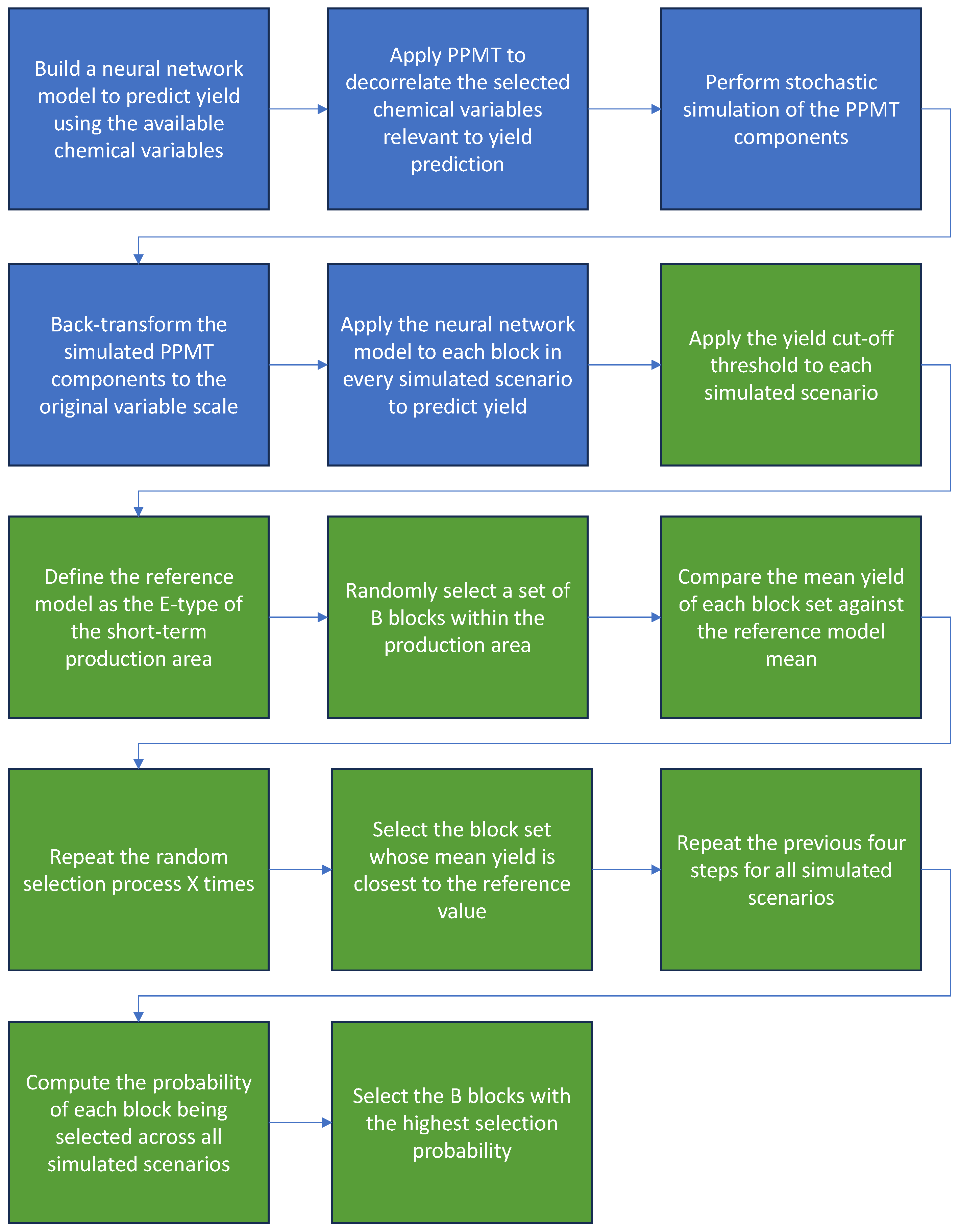
To better illustrate the workflow adopted in this study, Figure 1 was created. Each major step of the methodology is summarized in a separate box, with further details provided in Section 2.

2. Methodology

The workflow adopted to generate the simulations consisted of three major steps: the first one was the PPMT application to decorrelate the ROM variables that will be used as inputs in the neural network built to forecast the yield in each block; the second step was the simulation of each PPMT component using Turning Bands algorithm to create, for each block in the model, a stochastic measure of the inputs; finally, the PPMT components simulated were back-transformed to the original grade scale, allowing the neural network application. Each step will be detailed in the following sections.

2.1. Projection Pursuit Multivariate Transform

The Projection Pursuit Multivariate Transform (PPMT), proposed by Barnett et al. [18], was employed to handle complex multivariate correlations for any arbitrary number of variables. This technique extends the earlier Projection Pursuit Density Estimation (PPDE) introduced by Friedman & Tukey [19] to address multidimensional geological problems with intricate correlations. Although conceptually similar, the PPMT incorporates several improvements, including the following:
(i)
Transformation to Gaussian space: An additional preprocessing step transforms the data into Gaussian space, minimizing the influence of outliers.
(ii)
Data orthogonalization (data sphering): The data is analyzed using a method similar to Principal Component Analysis (PCA). This involves rotations and scaling to remove correlations and standardize variance to unity, optimizing the data for multivariate transformations.
(iii)
Projection Pursuit: This process identifies projections that deviate most from normality. Iteratively, these projections are normalized, converting the original data into a multivariate Gaussian distribution. The optimization algorithm guiding this process maximizes projection indices.
(iv)
Stopping Criterion: The algorithm stops when the projection index falls below a predefined threshold, indicating that no significant deviations from multivariate normality remain.
(v)
Back Transformation: After the transformed data is independently modeled, back transformation restores it to its original space, preserving initial correlations and spatial relationships.

2.2. Turning Bands Simulation

Initially conceptualized by Matheron [20] and later expanded by Journel [15], the Turning Bands Simulation (TBS) involves performing unconditional simulations by using randomly oriented lines within a two- or three-dimensional domain. The approach simplifies the process by executing multiple independent one-dimensional simulations along lines that can be rotated in ℝ2 or ℝ3. This results in unconditional realizations in the target spatial domain [21]. To obtain conditional realizations, a simple kriging of the residuals between the unconditional simulation and the observed data at the sampling locations is added to the unconditional realization, generating the final result. The TBS technique was applied in this case study to accurately capture the spatial variability and continuity of the PPMT components.

2.3. Geometallurgical Model Using Neural Networks

Neural network application to forecast geometallurgical variables showed accurate results in several situations [9,12,22,23,24,25,26,27,28], proving itself as a valuable technique for this purpose. The main idea is to follow the transfer function approach [2]: the geometallurgical variable is predicted by a mathematical function that correlates the output variable of interest with input variables that are more densely sampled in the deposit, such as ROM grades, lithology descriptions, mineralogy, and others.
The neural network idea behind complex mathematics is the creation of a machine that can reproduce the human way of learning, mimicking human neurons artificially. This idea was first proposed in [29] and has been evolving ever since. Despite significant challenges, such as limited computational power in the 1980s and 1990s, the field gained force in the 2000s, leading to the rapid advancements we see today.
To understand neural networks, the first step is to become familiar with their terminology. Readers who are new to this field may consult [30,31] for a more detailed introduction. After understanding the terminology, the next step is to understand the neural networks’ logic. The idea is to create a model that uses widely available information (input variables) to explain the behavior of another variable (output variables), which are more difficult to obtain (due to high cost, long time spent to complete the test, or difficulties encountered during sampling). To build this model, the first step is to choose the predictor variables to be used in the input nodes, among all the variables available in the database. This choice should be made with an expert’s knowledge, and supported by feature selection methods, such as the mean absolute SHAP values [32] or specific techniques such as Recursive Feature Elimination [33]. For this case study, five oxides were selected, as detailed in the results section. The output nodes will be the geometallurgical variables that impact mining profit or the environment. In this study, the chosen variable was the flotation concentrate yield, which directly affects the operation cash flow.
After choosing the inputs and outputs, the next step is to select the neural network architecture: the number of hidden layers and the number of hidden nodes in each layer. This design is determined by looking for a structure able to provide accurate results when the model is applied in the mining routine. Many hidden layers and nodes can lead to overfitting, while overly simple networks may be unable to capture complex relationships in the data. Other decisions to be include the choice of optimization algorithm used, the number of epochs, the activation functions, and the learning rate, all hyperparameters that will influence the network weights. To determine each hyperparameter mentioned above, the user should take advantage of cross-validation: the hyperparameters that presented the lowest errors in the test set should be selected. A grid search strategy [34] is usually adopted in this context.
After understanding the neural network’s logic, the next step is to understand how the geometallurgical forecasts are calculated using it. Equation (1) [12], adapted from [35], shows the formula for the case where one hidden layer is used, which will be explained below:
y ^ i , k = g k j = 0 t α k j f j m = 0 r β j m x i , m
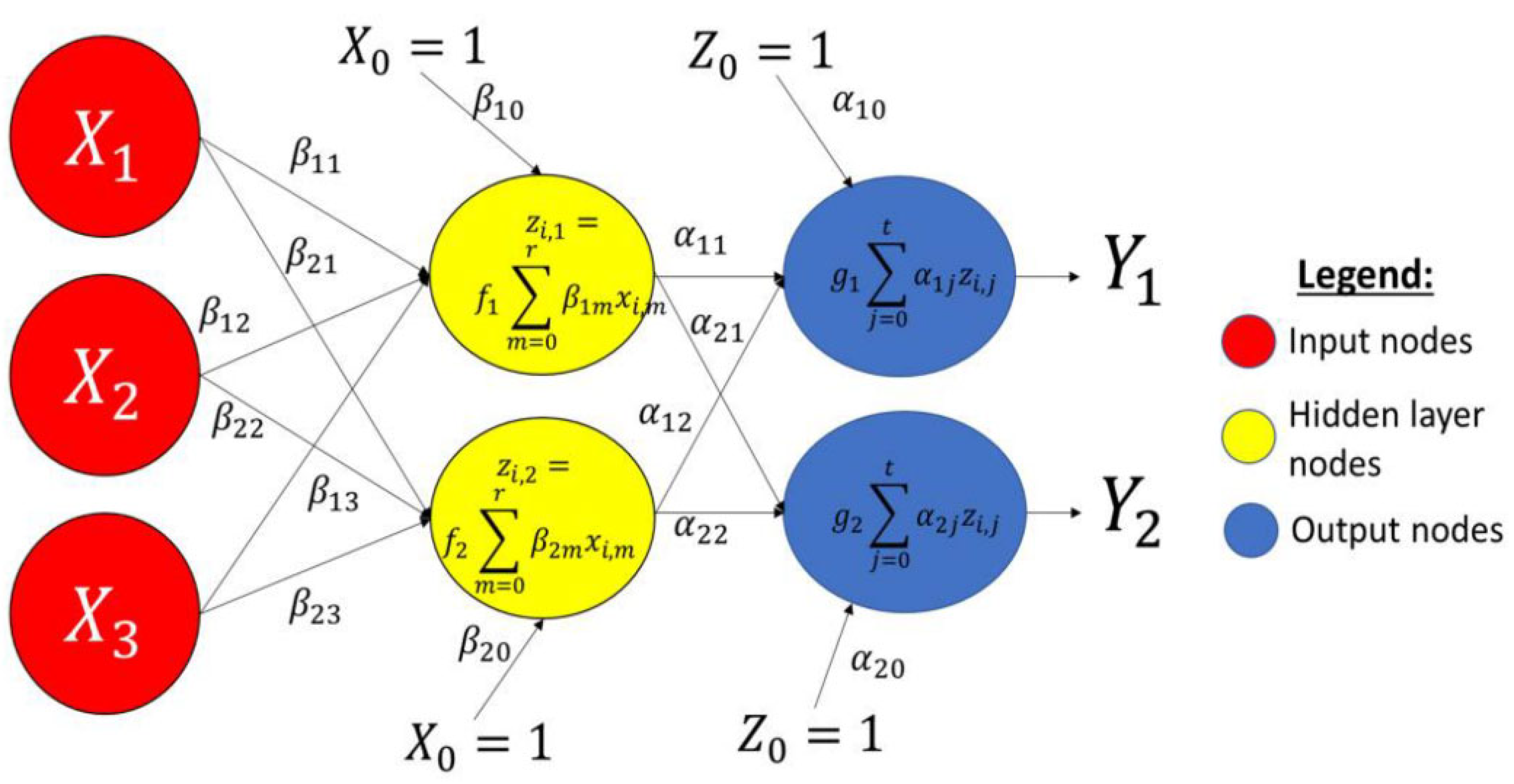
The weights are represented by the Greek letters α and β , with the first associated with the connections between the hidden and output nodes, and the second with those between the input and hidden nodes. The letter x denotes the input nodes, while y represents the output node. The index i corresponds to the sample number, ranging from 1 to n, where n is the total number of samples used to build the neural network model. The index k denotes the output variable to be predicted (ranging from 1 to s, where s is the number of output nodes). At the same time, j is the index that represents the hidden node (varying from 0 to t, where t is the number of hidden nodes), and m is the index that represents the input nodes (ranging from 0 to r, being r the total number of input nodes). The letters g and f represent the activation functions applied in the output and hidden layers, respectively.
To make it easier to visualize each component herein explained, Figure 2 (reproduced from [12]) illustrates a small neural network, with the input nodes represented in red, the hidden nodes in yellow, and the output nodes in blue.

2.4. Short-Term Planning Implementation

This methodology uses a stochastic yield model to identify the optimal blocks for each period, based on parameters such as the cut-off value, production volume per period, location, and the number of initial seed points equivalent to the shovel’s locations. Additionally, it considers the available production area that needs to be mined, which is typically defined by the long-term plan and follows the same flow as proposed in [13].
To account for uncertainty in defining the stochastic model [36], the deposit area A is divided into D locations, represented by z l u δ , where each location u δ belongs to A . The model includes L simulated, equally probable scenarios, with each scenario labeled as l .
The process involves selecting smaller sub-areas, V , which represent planned production areas. These areas are then processed using a transfer function that applies a yield value, z c . If the simulated value at a location, z l u δ , meets or exceeds the cut-off z c , it is classified as ore. The selected ore blocks, P ( l ) , are a subset of the production area V and the overall deposit A , aiming to achieve the desired average yield.
The reference model used in this workflow is the E-type model within the production area. The use of the E-type model is justified because its behavior is comparable to that of a kriged model, as it represents the expected mean outcome of the simulated realizations. Since the main objective of the optimization process was to stabilize and compare average yield performance, the E-type model provided a consistent, representative basis for the analysis. Therefore, the E-type model was not considered a true representation of the deposit, but rather a consistent reference baseline for comparing sequencing strategies and their uncertainty responses. It is acknowledged that mean-based criteria may not fully capture local extreme scenarios; however, the main purpose of this work was to prioritize operational stability and expected global production performance.
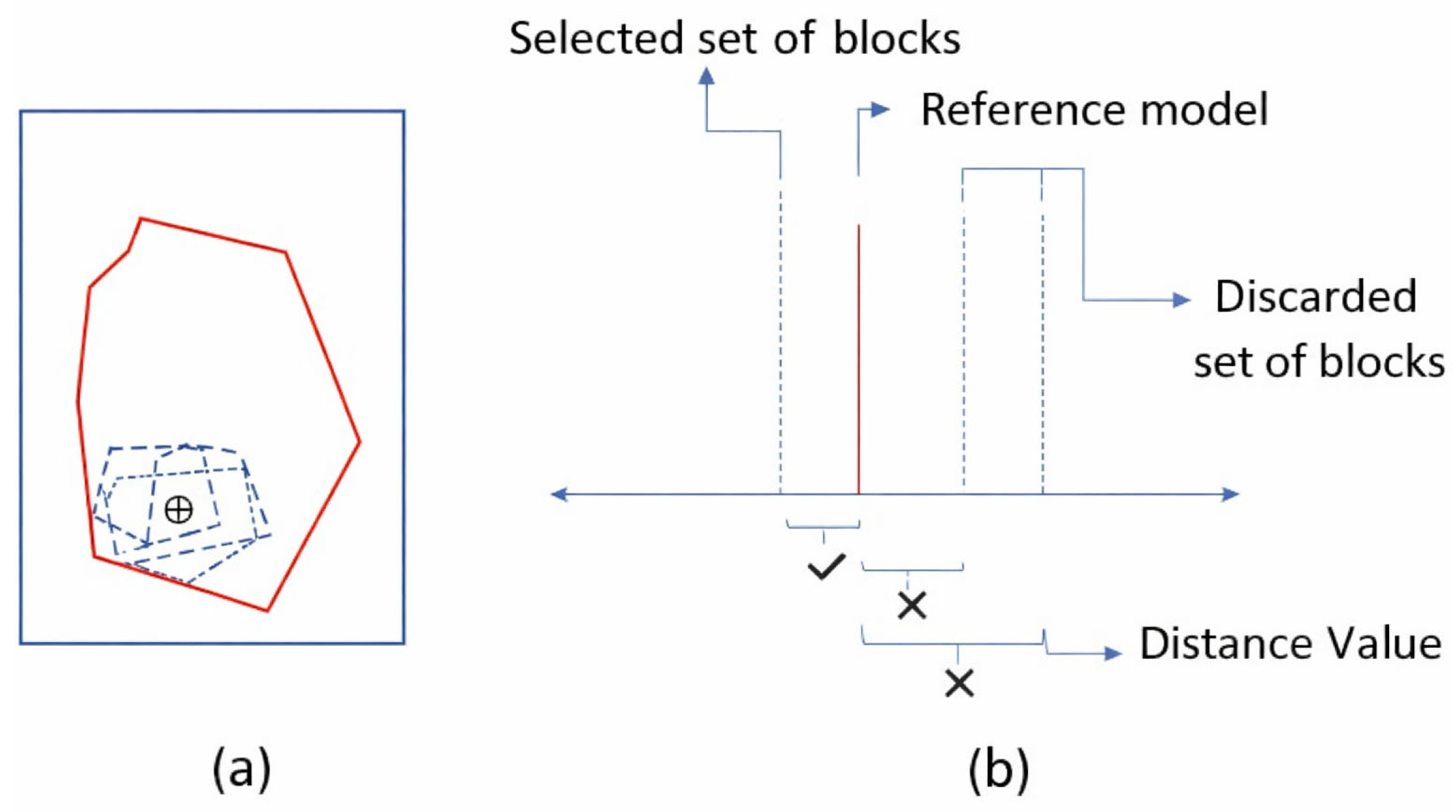
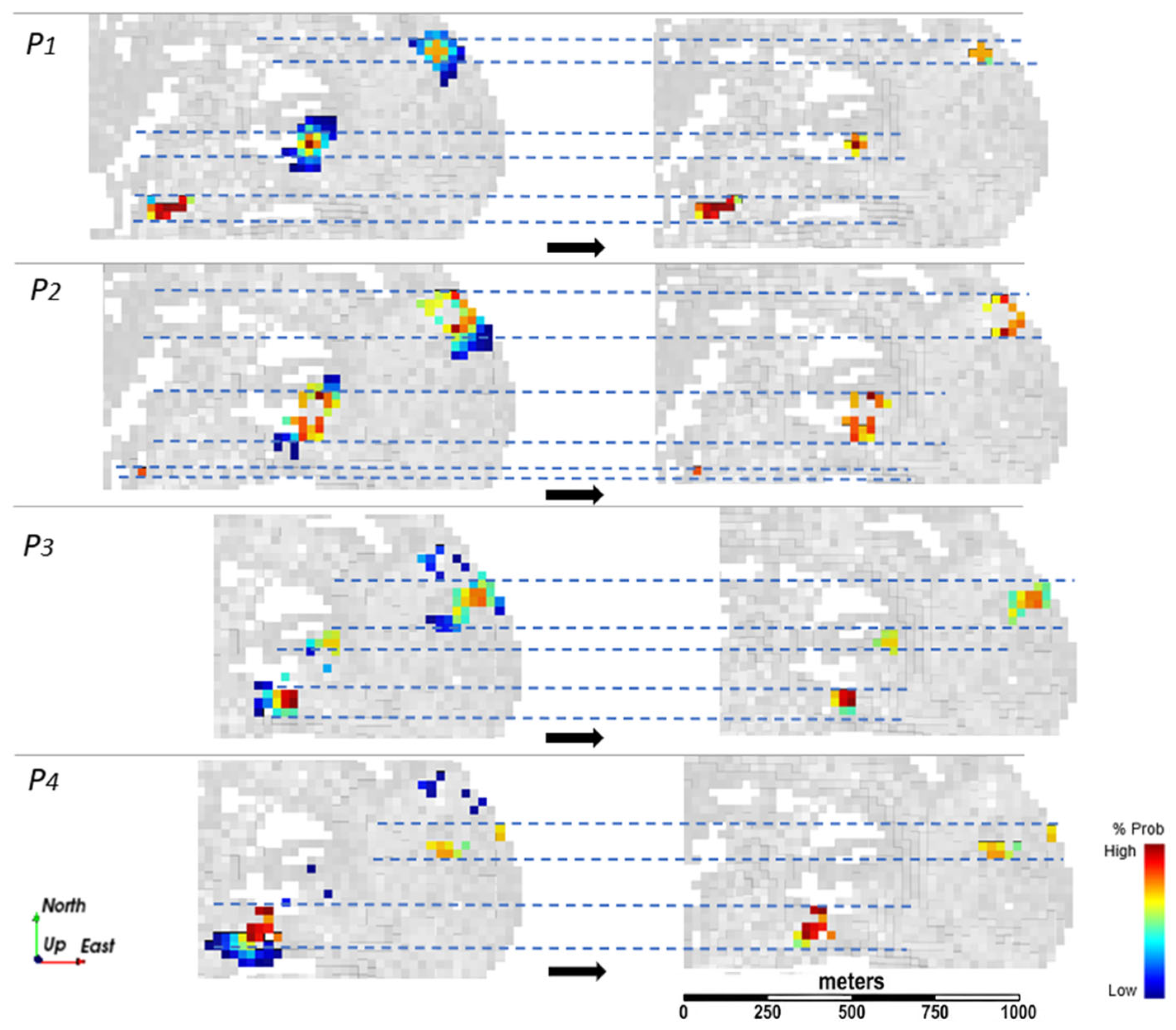
After defining the reference model, the next step consists of randomly selecting B blocks from the first simulated scenario, where B represents the number of blocks required to meet the weekly production target. Although the selection at this stage is random, it still respects mine planning constrains, such as shovel locations, lateral continuity among the selected blocks, and other operational requirements. This random selection process is repeated φ times. Subsequently, the mean yield of each set of B blocks is compared with the average yield of the reference model using the objective function presented in Equation (2). Consequently, the set of B blocks that most closely approximates the mean of the reference model, either by excess or deficiency, is selected for the first simulated scenario. Figure 3 illustrates the selection process for these sets of blocks.
S e l e c t e d   s e t = a r g m i n b R M y ¯ b ,
where
RM: reference model (E-type) of flotation concentrate yield.
y ¯ b : mean yield of the bth set of B blocks.
Therefore, all the steps mentioned above are repeated for each simulated scenario. Subsequently, there will be as many sets of equiprobable blocks as there are realizations of the stochastic model.
Stochastic mine planning can be addressed by leveraging all realizations ( l ) of the stochastic model to generate a single optimized model. A function is applied to each block within every equiprobable period, as defined in each simulation. This function calculates the frequency with which a block at a location ( u δ ) is incorporated into the period across all ( l ) simulations. As a result, a block that appears in all ( l ) simulations will have a 100% occurrence, rendering it the highest priority for selection in the set of blocks to be mined.
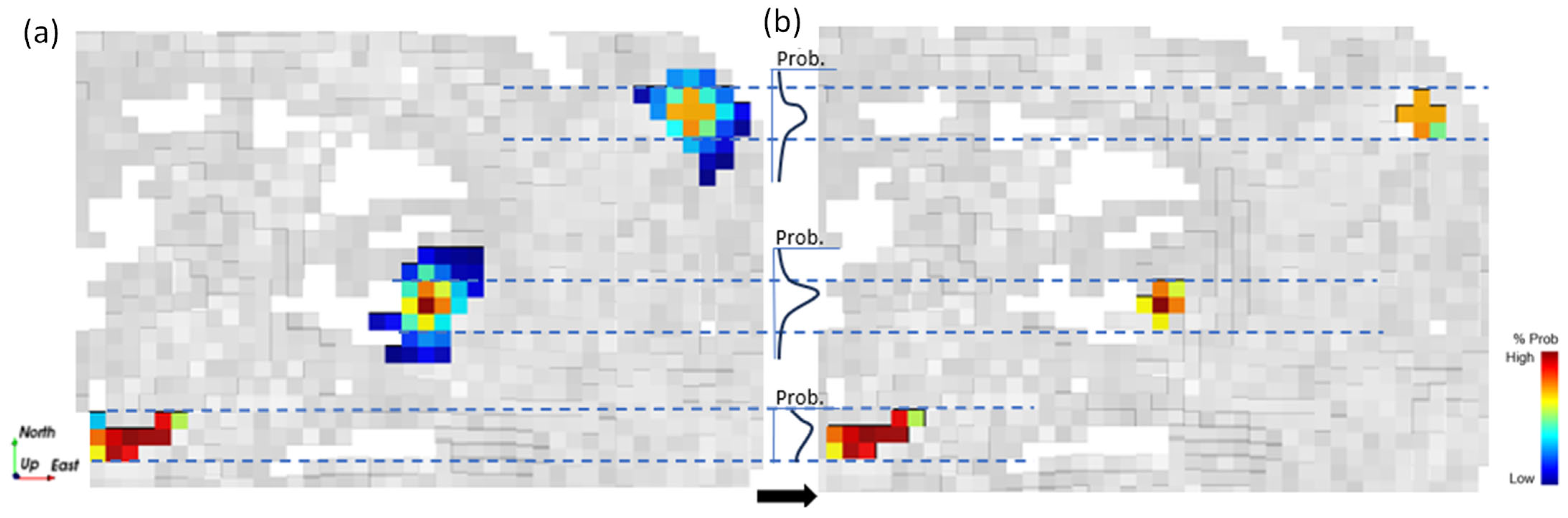
For the selection of the best blocks for each period, the frequency of inclusion for each block in each period across all ( l ) equiprobable iterations are counted and evaluated. The B blocks with maximum probability of occurrence are selected (Figure 4 illustrates this step), where B is the number of blocks needed to meet the production requirements for each period. This selection criterion follows the maximum probability rule [37], as expressed in Equations (3a) and (3b).
Equation (3a) defines the probability of selecting a block u δ in period θ .
P θ u δ = 1 L l = 1 L I θ ( l ) u δ
Equation (3b) defines the selection of the maximum probability rule, selecting exactly B blocks in period θ .
u θ * = arg max u θ U u θ = B u δ u θ P θ u δ
where
  • l = 1 , , L : Index of simulation realization.
  • L : Total number of simulation realizations.
  • θ = 1 , , θ N : Index of period.
  • θ N : Total number of periods.
  • u δ : Blocks δ or the location/identifier of block δ.
  • U : Set of all candidate blocks.
  • u θ : Set of blocks selected in period θ .
  • B : Required number of blocks to be selected in each period.
  • I θ ( l ) u δ 0,1 : Indicator variable equal to 1 if block u δ is selected in the period θ under simulation l , and 0 otherwise,
  • P θ u δ : Probability or relative frequency of a block u δ is selected in the period θ .

3. Results

3.1. PPMT

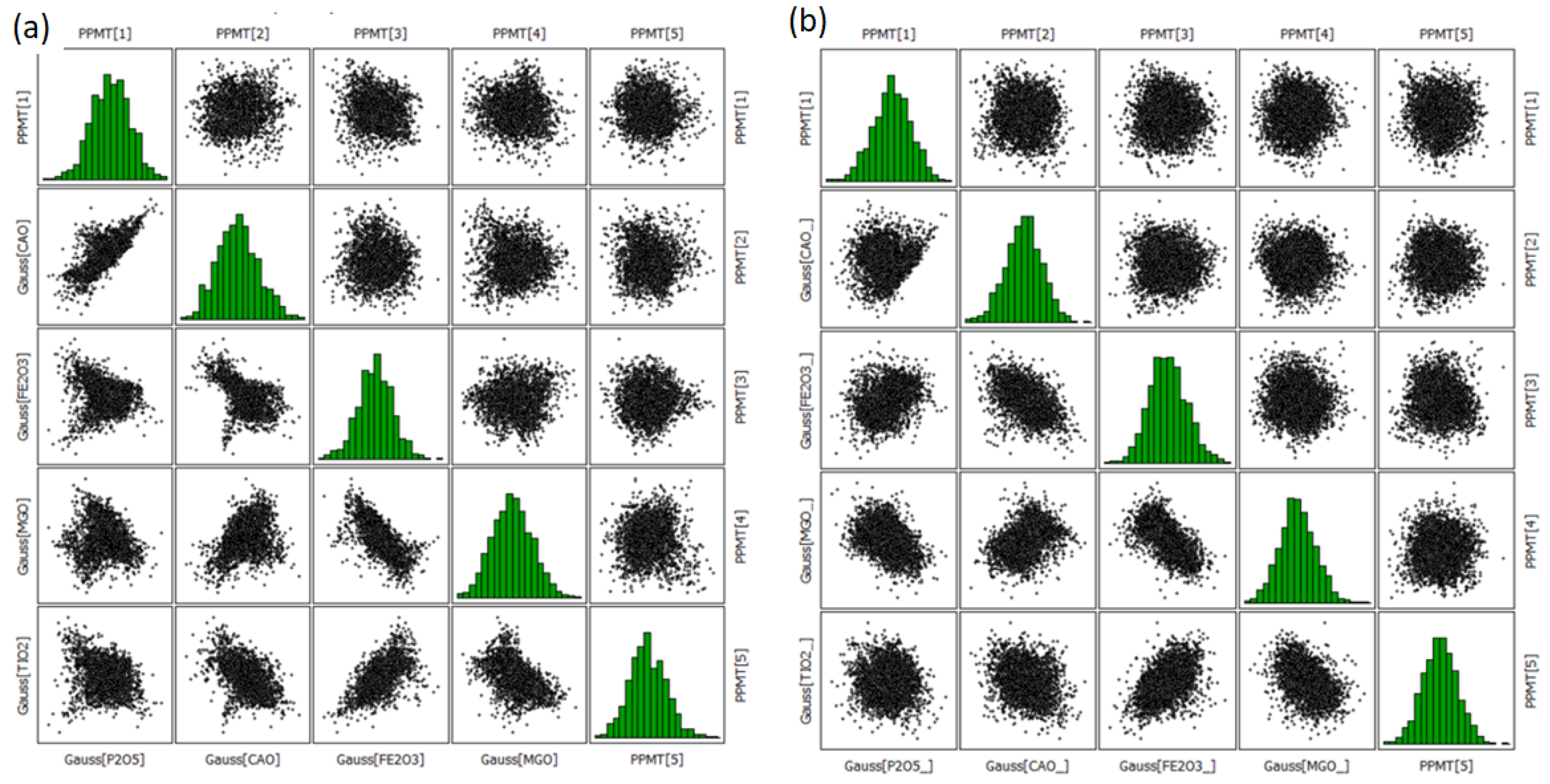
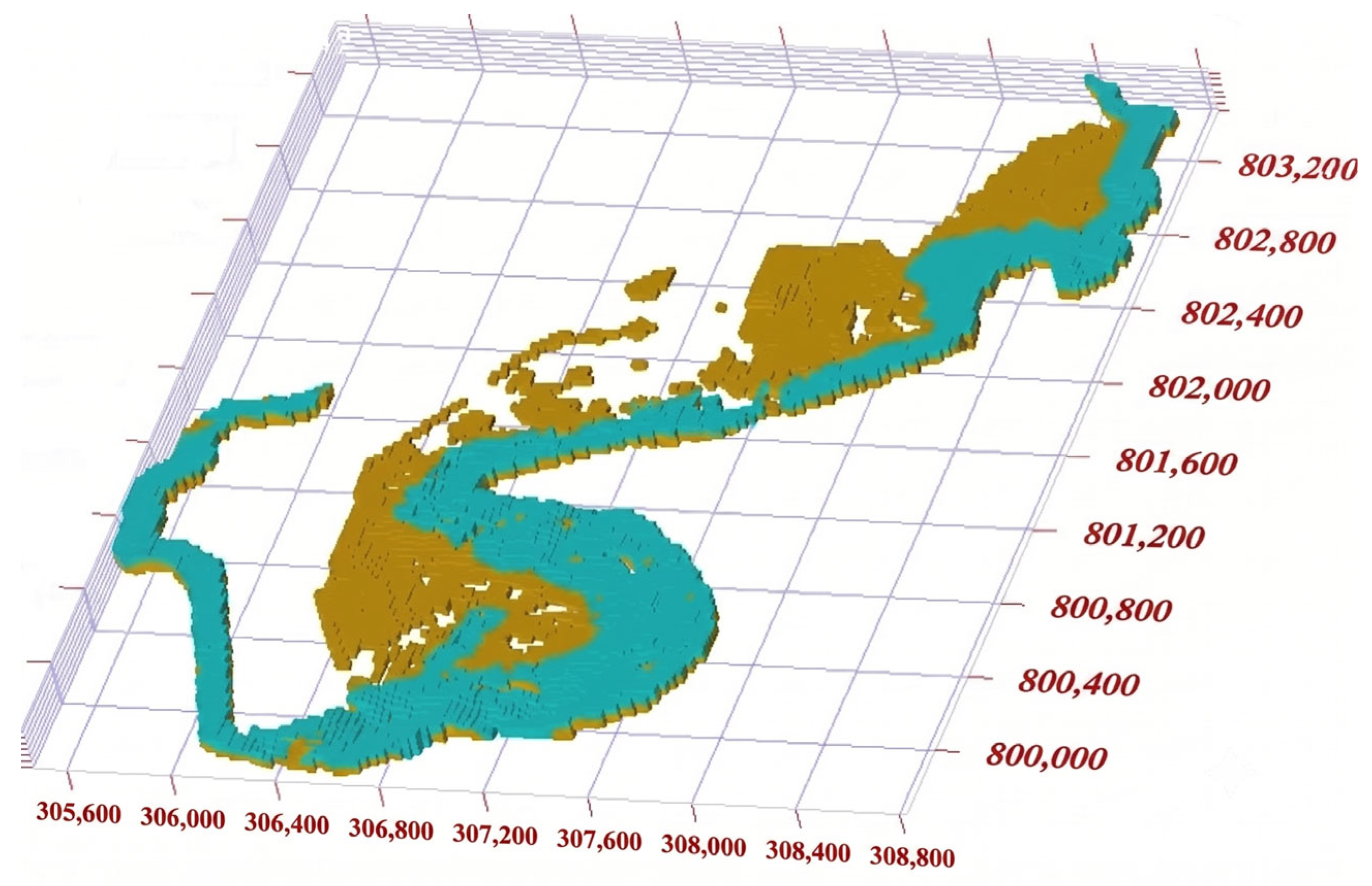
The original samples of each variable were declustered and transformed using a normal score transformation. Then, PPMT was applied to remove the dependency between variables. Figure 5 illustrates the two geological domains that exist in the deposit. It is essential to highlight that the PPMT and the simulations were made considering the different domains.
Figure 6, in the bottom corner, illustrates the scatterplots between the Gaussian variables. The diagonal shows the histograms of each sphering factor. The top corner shows the scatterplots between the PPMT factors, illustrating the lack of complex patterns among the components.
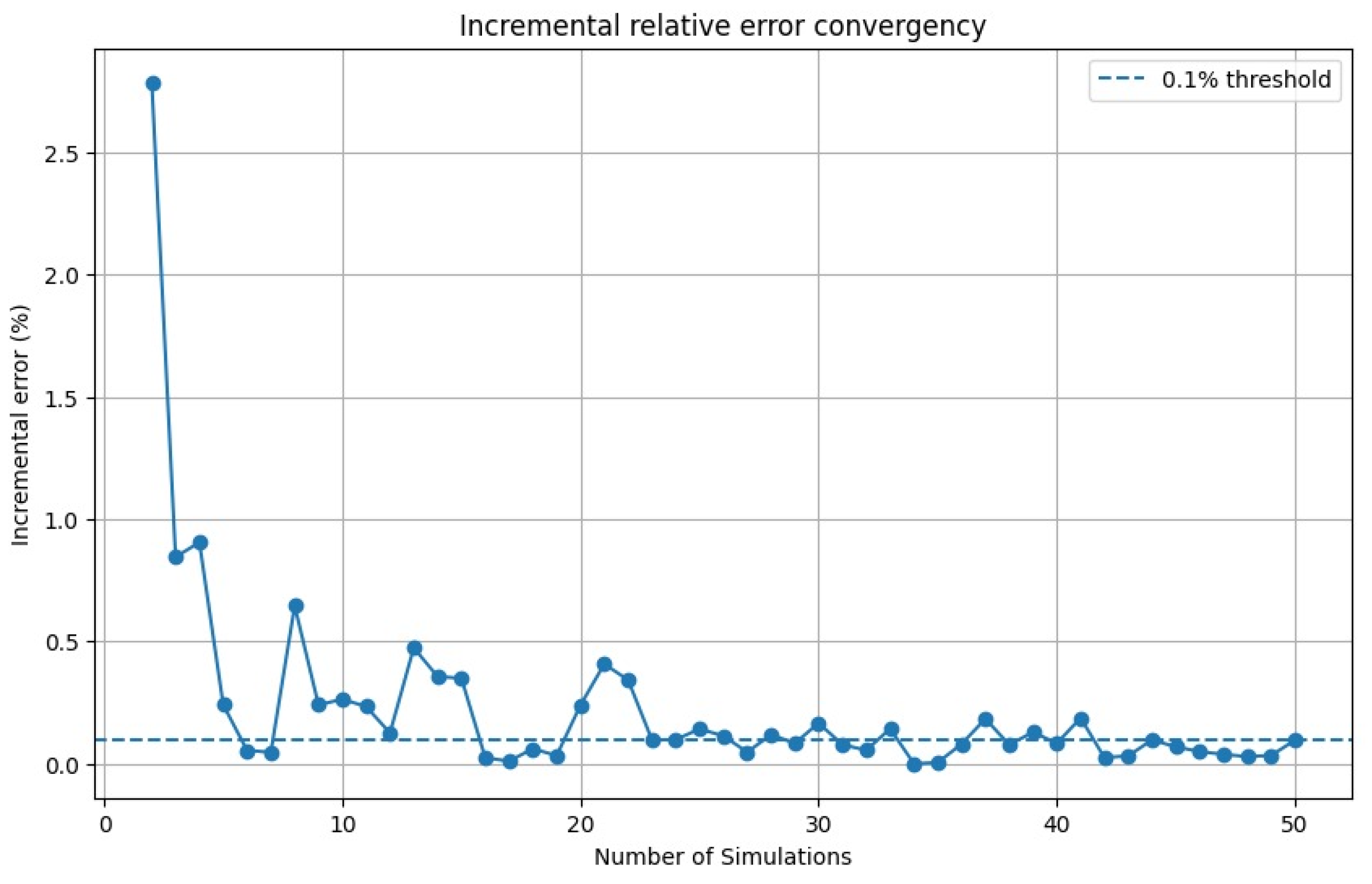
A total of 50 scenarios were created using Turning Bands Simulation (TBS) with 1000 bands was applied for each PPMT factor, using simple kriging as a stationary option, eight angular sectors, and a maximum number of samples per sector equal to four. The optimal number of realizations corresponds to the point at which the model statistics begin to stabilize, particularly the mean and the standard deviation, indicating convergence of the simulations. To assess whether convergence was achieved, the plot presented in Figure 7 was generated. This plot presents the number of simulations on the x-axis and the relative difference between the cumulative mean up to simulation l and that up to simulation l-1, normalized by the cumulative mean at simulation l-1. As observed, the relative difference in the mean P2O5 grade stabilizes at approximately 25 simulations. For the other input variables, the same analysis was made, yielding similar results, and indicating that 50 simulations are more than sufficient to adequately represent the uncertainty space for all simulated variables in all domains.
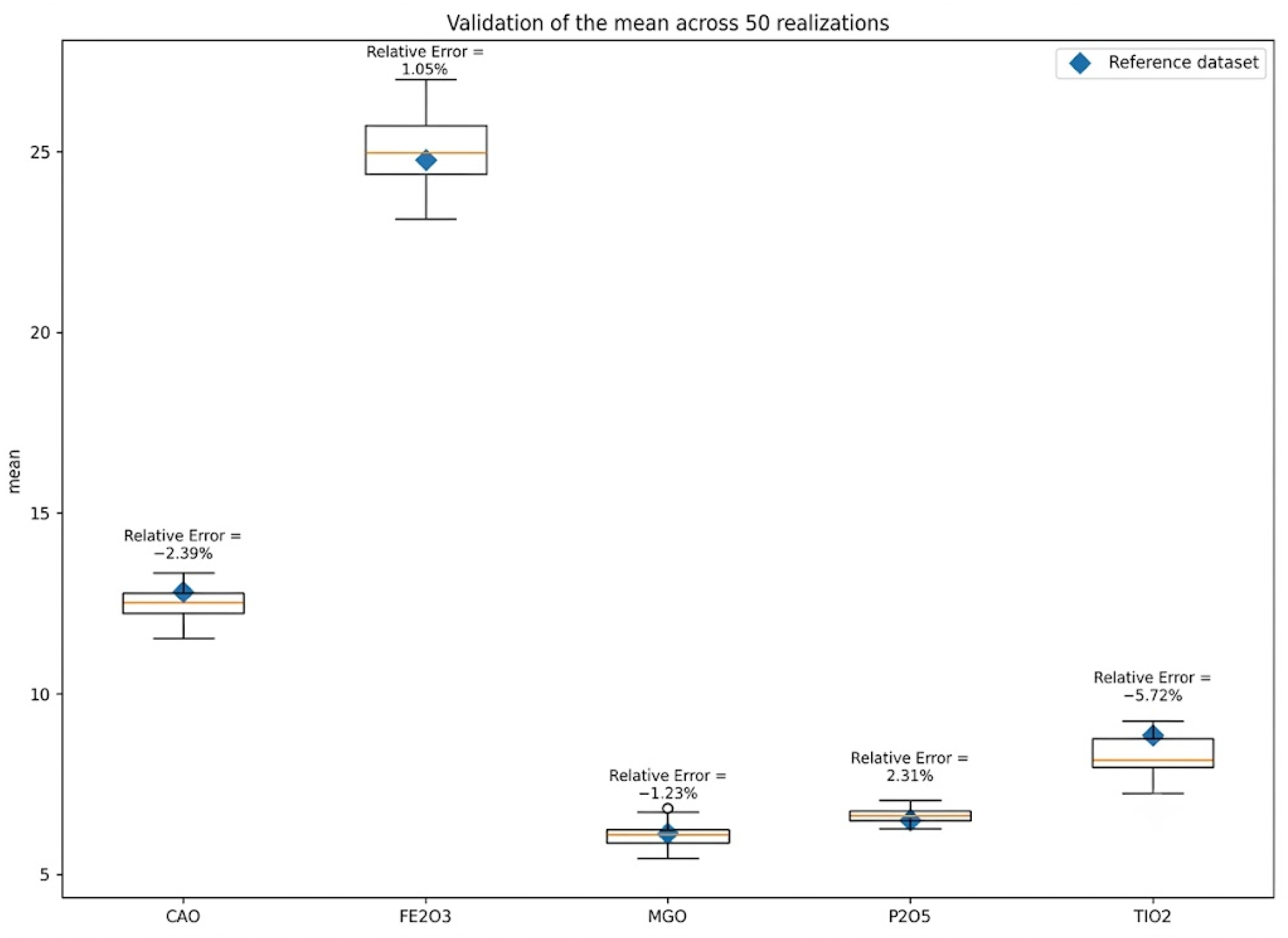
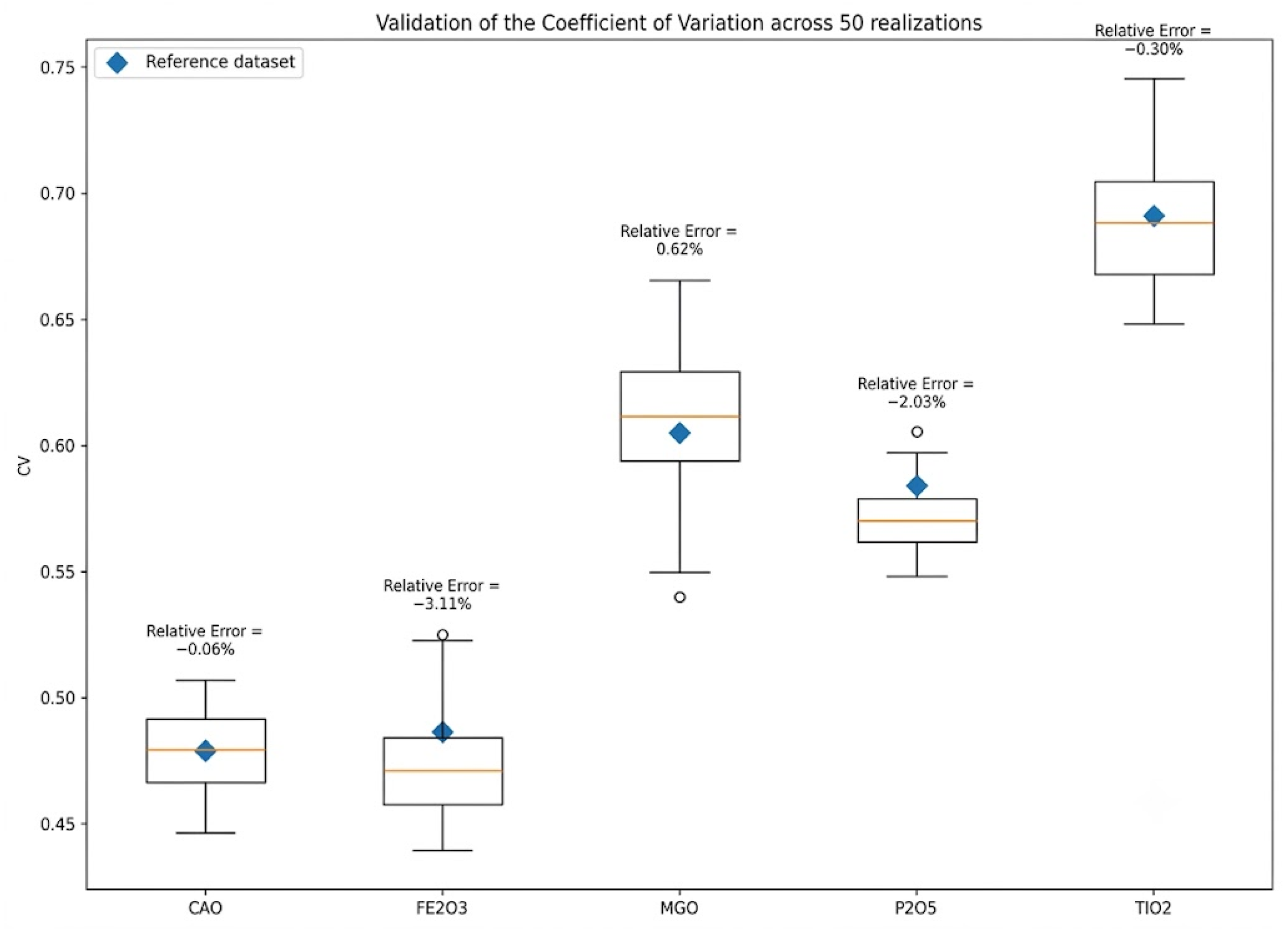
After the simulation, the inverse PPMT was applied to restore the original scale and cross correlations of the variables under study. Figure 8 illustrates the methodology used to quantitatively validate the PPMT and the generated simulations. The distributions of the mean values across all 50 realizations (represented as boxplots for each variable) were compared against the mean values of the reference dataset (blue markers). In addition, the relative error between the average of all realizations and the average of the reference dataset was calculated and is also displayed in the image. Figure 9 presents the same analysis for the coefficient of variation, comparing the distributions across all realizations against the value observed in the dataset. Note that the relative errors obtained for both statistical measures are low, indicating that the simulations and the PPMT transformation adequately reproduce the statistical behavior of the original dataset.
Figure 10 illustrates the correlation matrix for the first domain, showing on the left the original sample data, in the center the back-transformed results obtained for simulation 11 and on the right, the back-transformed results for simulation 45. Figure 11 illustrates the same matrices for the second domain. It is possible to conclude that, for both domains, the correlations observed in the samples were well reproduced in the simulations.

3.2. Geometallurgical Model Creation

The database used to create the geometalurgical model contained 3057 drill hole samples submitted for chemical analysis to determine ROM grades and for batch tests to obtain geometallurgical variables at each data location. The input variables available were the Al2O3, P2O5, CaO, Fe2O3, MgO, Nb2O5, SiO2 and TiO2 grades in the ROM, while the output variable was the yield in flotation concentrate. The yield observed in the samples has a mean value of 13.74, with P10 and P90 values of 5.36 and 22.79, respectively. The median is 13.13, while 25% of the samples present yield values below 8.47 (Q1) and 25% have yield values above 18.09 (Q3).
The first step adopted in building the forecast model was the separation of 20% of the data, randomly selected, to be used as a holdout set to validate the model constructed and check the accuracy of the predictions in data not used to build it. The remaining 80% of data was used in a k-fold cross validation with five folds, used in hyperparameter calibration and technique selection.

3.2.1. Variable Selection

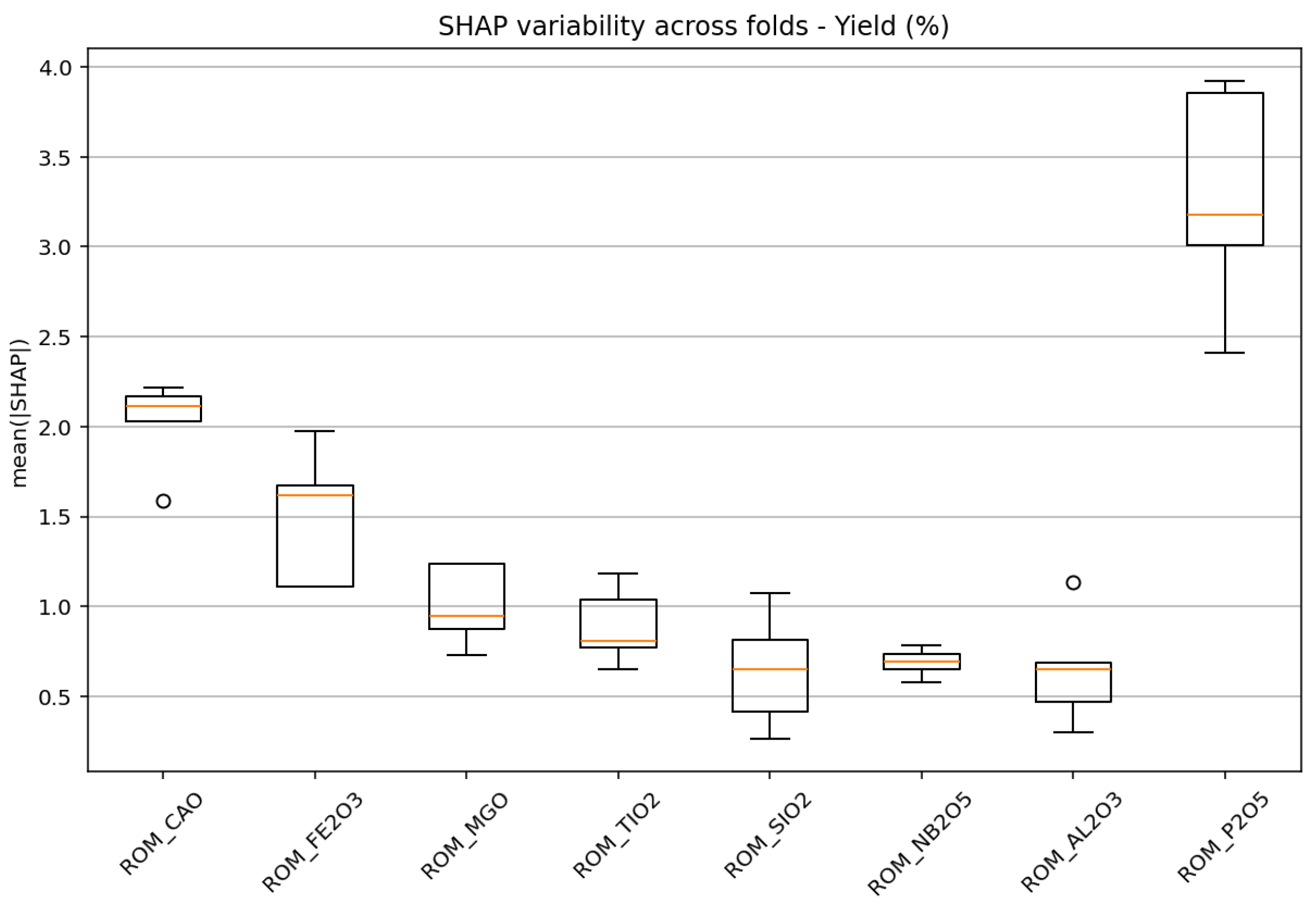
To help in the definition of which variables should be used as inputs in the model, the SHAP plot was used. For each fold, the mean absolute SHAP value was calculated for the test set samples, indicating which variables presented the highest importance to predict the yield. If all five folds show convergence in choosing the same variables, it is a good reason to maintain it as input in the model. Then, the selected option needs to have geological significance and be validated by the geologists. Figure 12 illustrates the plot under discussion, created using the neural network technique and all available variables.
The SHAP plot shows that the P2O5 influence is remarkably strong, followed by the CaO grades, which reflect the presence of apatite crystals, the mineral of economic interest. The Fe2O3 grade is identified as the third most important variable, followed by MgO and TiO2, all of which are recognized as weathering markers within the deposit. Higher TiO2 and Fe2O3 grades indicate ore located closer to the surface, whereas higher MgO grades indicate that the ore has been more affected by weathering. The remaining variables (Nb2O5, Al2O3, and SiO2) did not present significant mathematical importance and did not present a clear correlation with geological parameters, being removed from the final model.

3.2.2. Forecast Technique Evaluation

Before selecting neural networks as the forecasting technique used to estimate yield in the block model, other machine learning techniques were also evaluated, namely Random Forest and Decision Tree. The performance of all algorithms was assessed based on error metrics obtained from the test sets generated during the k-fold cross validation procedure.
The Random Forest model yielded a correlation coefficient of 0.76 and an MdAPE of 18.98, whereas the Decision Tree model yielded a correlation coefficient of 0.63 and an MdAPE of 22.40. The neural network achieved a correlation coefficient of 0.76 and an MdAPE of 17.18.
In addition to modeling yield using neural networks and other machine learning techniques, a geostatistical workflow was also tested, including variogram analysis and kriging of yield sample values, resulting in a 3D block model containing the forecasts. During the cross-validation stage, a correlation coefficient of 0.54 and an MdAPE of 26.04 were noted, indicating that the geostatistical approach produced higher errors than the machine learning techniques.
By comparing the results presented above, the neural network demonstrated the best predictive performance and was therefore selected as the technique used to build the geometallurgical model under study.

3.2.3. Neural Network

The first step in calibrating the neural network was to scale the variables using a standard scaler to address differences in magnitude. Then, hyperparameter tuning began using a grid-search approach.
Initially, the learning rates tested were 0.0001, 0.0005, 0.001, 0.005, and 0.01. The activation functions tested in both hidden layers included softplus, tanh, linear, sigmoid, and ReLU. The number of nodes in the hidden layers varied from 2 to 10, and batch sizes of 5, 10, and 15 were also evaluated. After the initial screening, the combination of a learning rate of 0.0005, a softplus activation function in both hidden layers, seven and two hidden nodes in the first and second layers, respectively, and a batch size of 10 yielded the best performance. Based on these results, the learning rate was further refined by testing values from 0.0001 to 0.0009, using increments of 0.0001.
The epoch choice was based on the loss curves, which in all folds showed stabilization beginning at approximately 300–400 epochs. To ensure convergence, the training was extended until 1000 epochs.
No regularization techniques were applied in the neural network. Overfitting was assessed by comparing the training and validation loss curves across the five folds, which presented no relevant divergence between the datasets, indicating stable generalization performance.
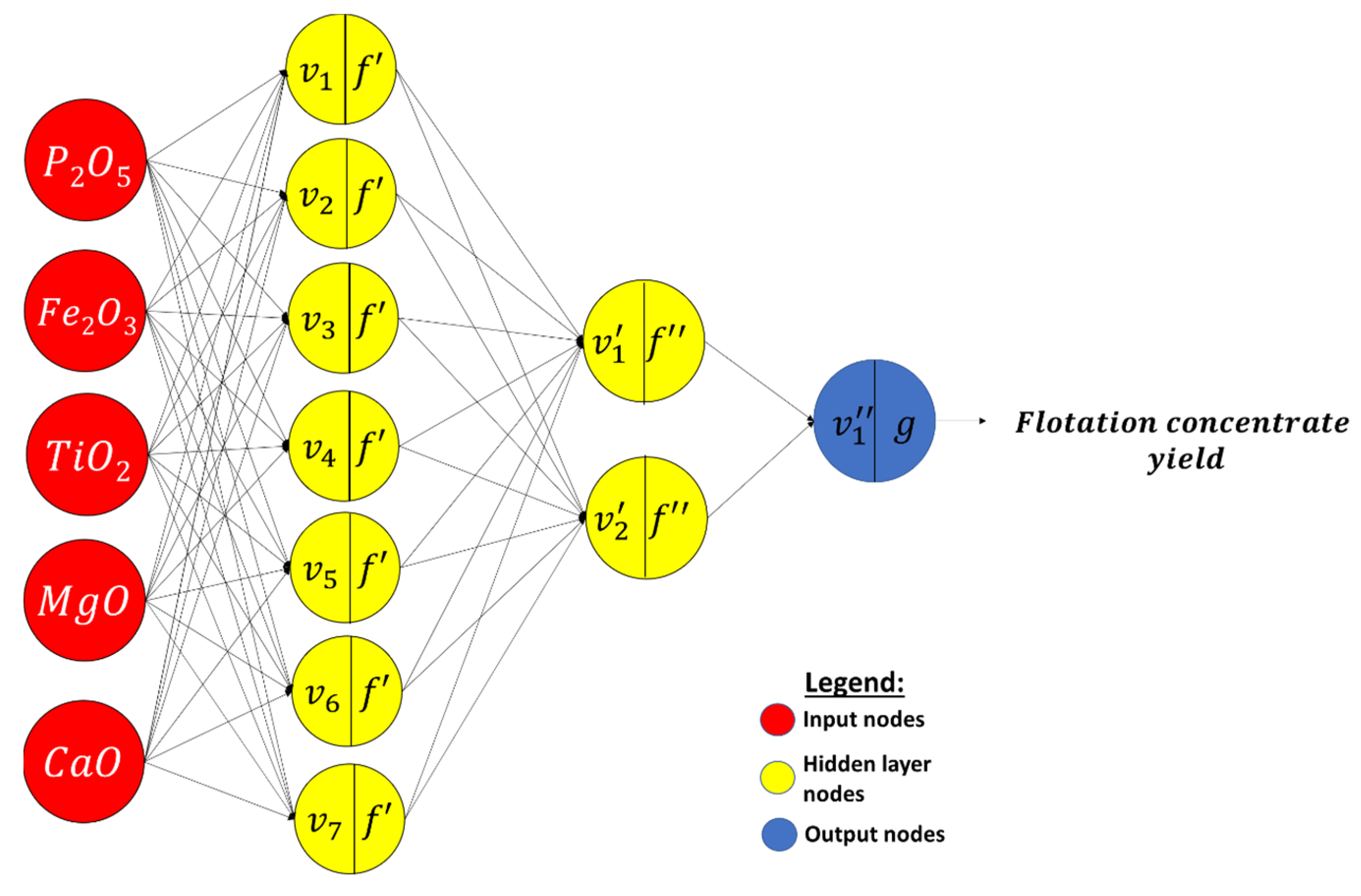
After several tests, the network architecture which presented the best results was the one using two hidden layers, with seven nodes in the first and two in the second one, both with softplus activation function, 1000 epochs, learning rate equal to 0.0009, linear activation function in the output layer, and Stochastic Gradient Descent as the optimization algorithm. All steps, from data splitting to final neural network evaluation, were performed in Python 3.10. Figure 13 illustrates the neural network constructed, and Table 1 shows the metrics obtained when the model was used on the training, test, and holdout sets.
The results presented in Table 1 show a correlation coefficient of 0.78 between the predicted and real yields, with an MAE of 3.35, an RMSE of 4.58, and an MdAPE of 18.10 on the holdout set. While an MdAPE of 18.10% may initially appear high for mine planning applications, it is important to interpret this result within the context of the proposed workflow. The methodology adopts a stochastic approach, treating yield predictions as stochastic rather than deterministic. Instead, multiple realizations are generated to represent the range of possible outcomes for each block. Decision-making is therefore based on the distribution of yield values (e.g., P10, P50, and P90) rather than a single point estimate. In this framework, the goal is to reproduce the spatial variability and uncertainty associated with yield. As a result, prediction error at the block scale is propagated through the generation of multiple scenarios, allowing their impact to be quantified and incorporated into the planning process.
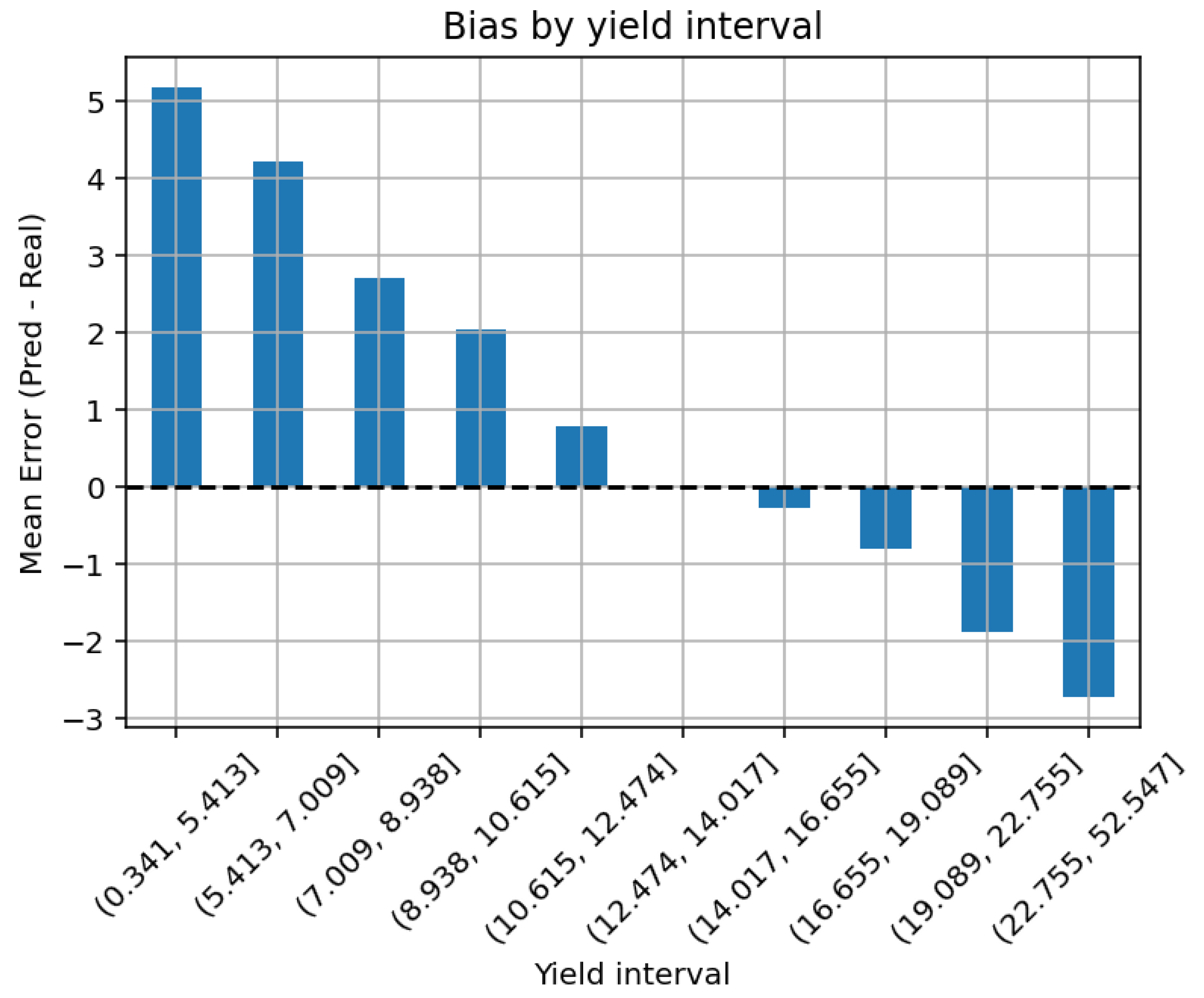
Another important aspect of model performance is the evaluation of errors across critical value ranges. In this case study, the mean prediction error around the cut-off (yield equal to 10.66) was specifically analyzed. Figure 14 presents the mean error (y-axis) across ten yield intervals (x-axis). Note that, near the cut-off, the mean error is close to zero, whereas low yield values tend to be overestimated and higher yield values tend to be underestimated. This behavior is widely observed in statistical models, which typically exhibit lower errors in regions close to the mean of the distribution. Therefore, in the decision region used to classify blocks as ore (above the cut-off) or waste, the prediction errors are minimal, supporting the reliability of the model for operational decision-making.
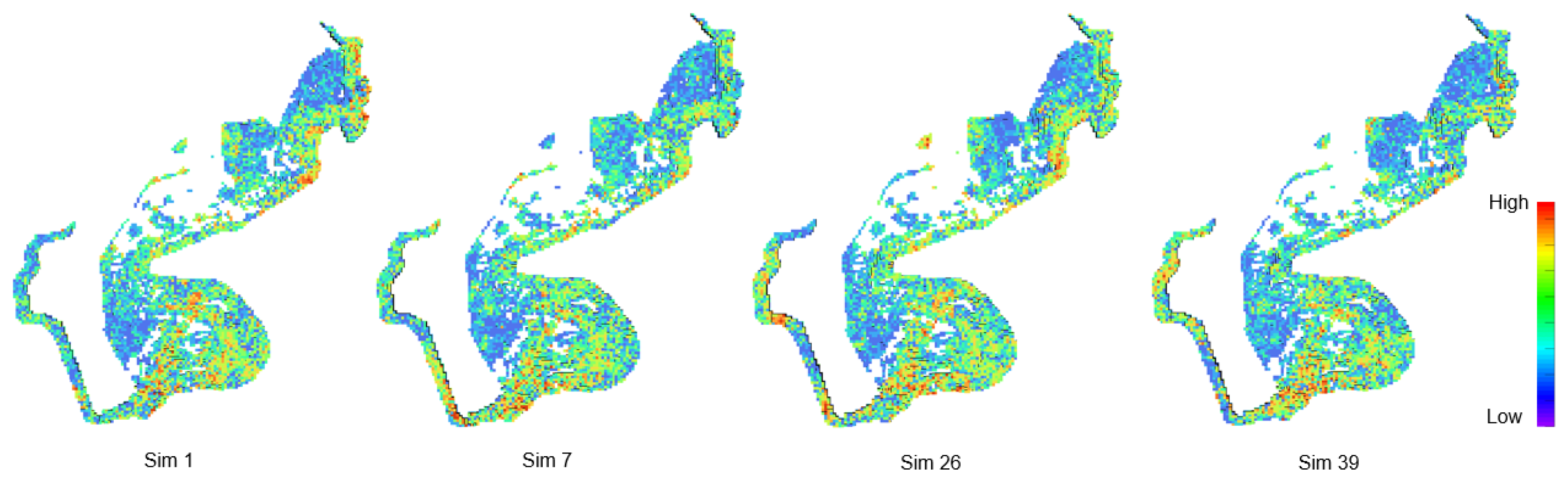
After creating the network, the next step was to apply the model in each block. Once the PPMT and the Turning Bands simulations were run, the neural network was applied by passing the PyTorch and .sav files (the first one containing the neural network’s weights and architecture discussed above, and the second with the standard scaler parameters applied to transform the data). Figure 15 shows examples of four simulations with the yield values calculated block by block.

3.3. Short-Term Mine Planning

For this study, four weeks was considered (P1 = first week, P2 = second week, P3 = third week, P4 = fourth week), aiming to achieve a production target of 50 blocks per week. Furthermore, six seed points, representing potential excavator locations, were incorporated.
After the previous processes (PPMT, Turning Bands, and neural network application in each scenario), the yield model was considered stochastic, with 50 equiprobable realizations, illustrated in the image below.
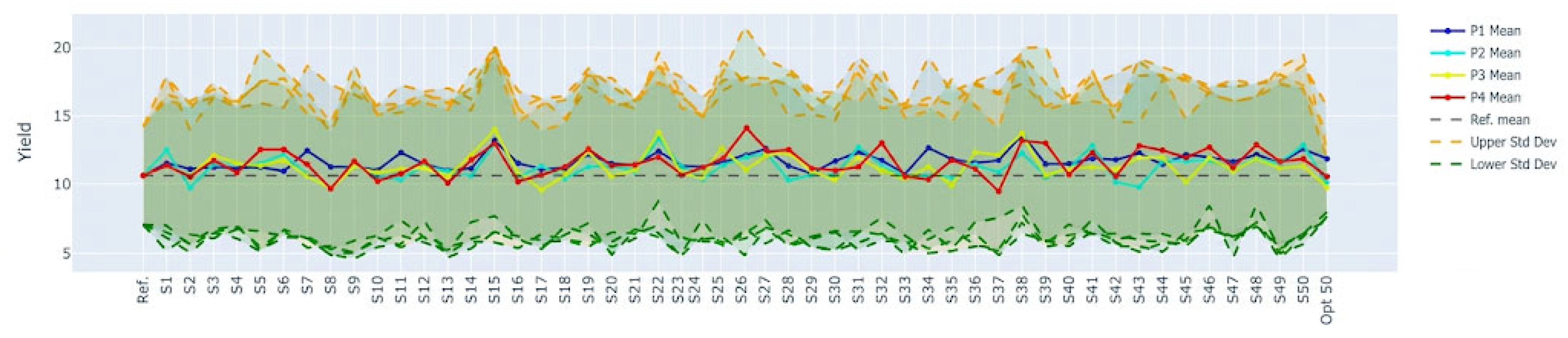
Figure 16 shows the expected variations on the mean grade for each of the four periods (P1 through P4) along 50 simulated scenarios (each one with its optimized dig line). The yield results for each production period are represented as follows: P1 in blue, P2 in light blue, P3 in yellow, and P4 in red. The black line represents the reference model mean, while the orange dashed lines indicate the upper standard deviation (+Std Dev) and the green dashed lines represent the lower standard deviation (−Std Dev). Finally, the optimized model for each period is shown at the right extreme of the plot, labeled Opt 50. Note that, if each set of simulated dig lines were considered individually, the yield for each period would fluctuate strongly around the reference value, whereas the optimized scenario, using information from all 50 simulations, adheres more closely to the reference mean, demonstrating the value of the proposed approach.
Then, the reference model area is projected onto the E-type model, where the mean generated over this area is assumed to represent the expected yield for the area available for exploitation in the short term. The reference model mean is equal to 10.66, with a standard deviation of 3.55.
The next step was to analyze the 50 scenarios individually, using the same production parameters, including excavator location, topography, and the required material quantity and quality. The algorithm, represented by Equation (2), compares the randomly generated excavation models with the reference model and selects the excavation model whose mean and variance are closest to those of the reference model. This process results in an excavation model for each geometallurgical realization.
Subsequently, the equally probable dig line models are compared for each period. There will be an optimized equiprobable model per realization. Then, the models for the first period were analyzed, where the probability for each block is quantified. Blocks with higher probabilities were selected and included in period 1. This process is repeated for the following periods, using the algorithm represented in Equations (3a) and (3b).
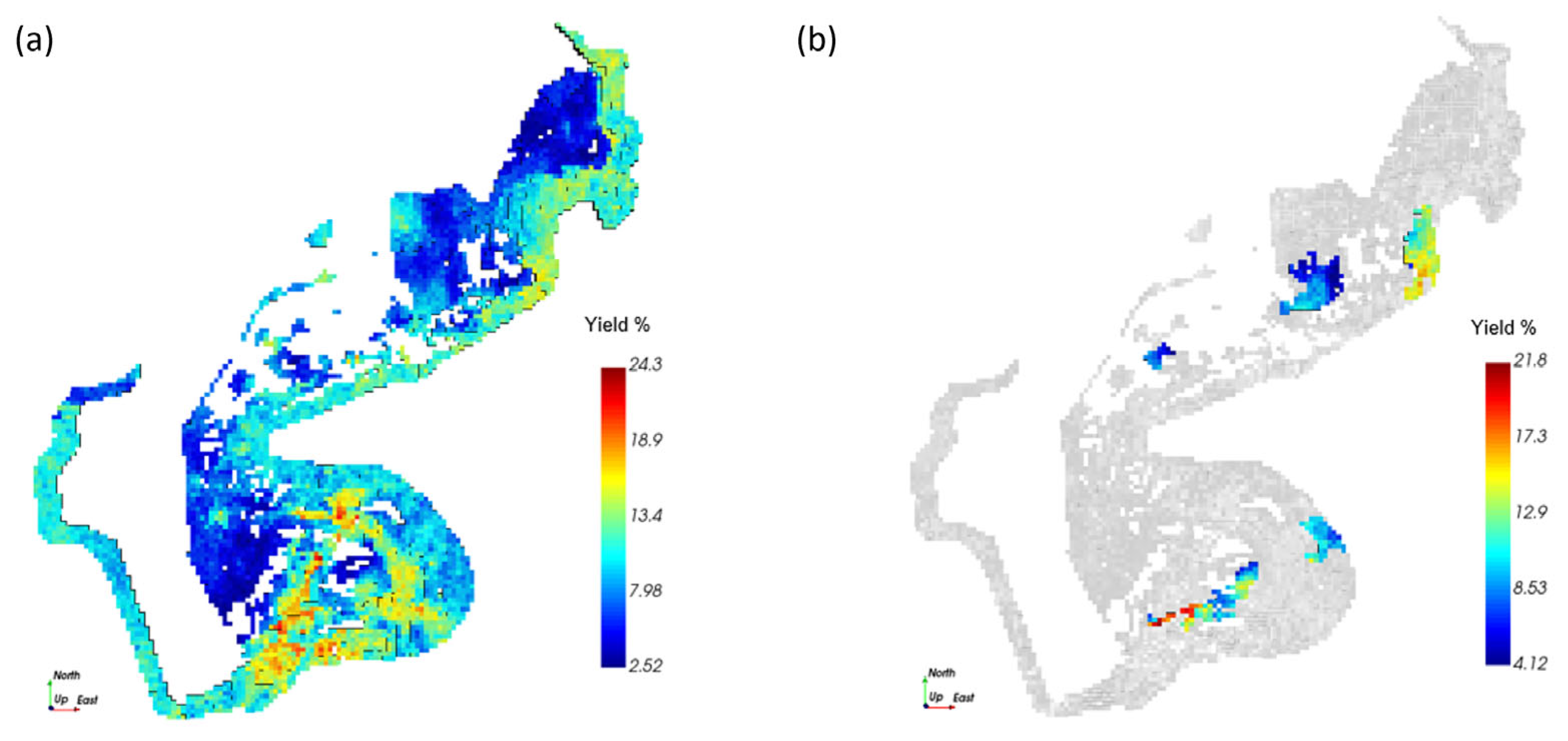
Figure 17 illustrates, on the left, the yield E-type model for the whole area and, on the right side, the area of the reference model.
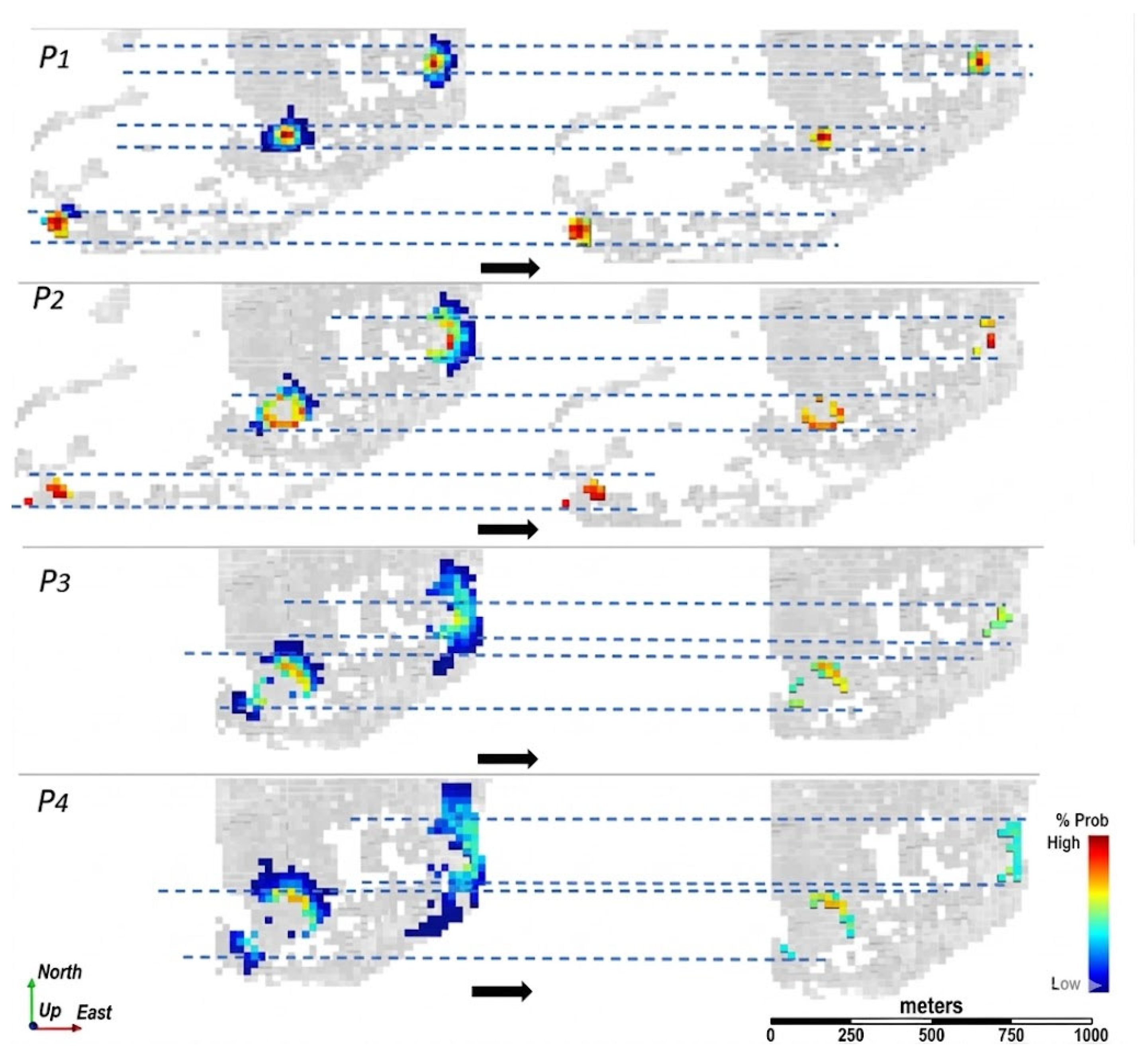
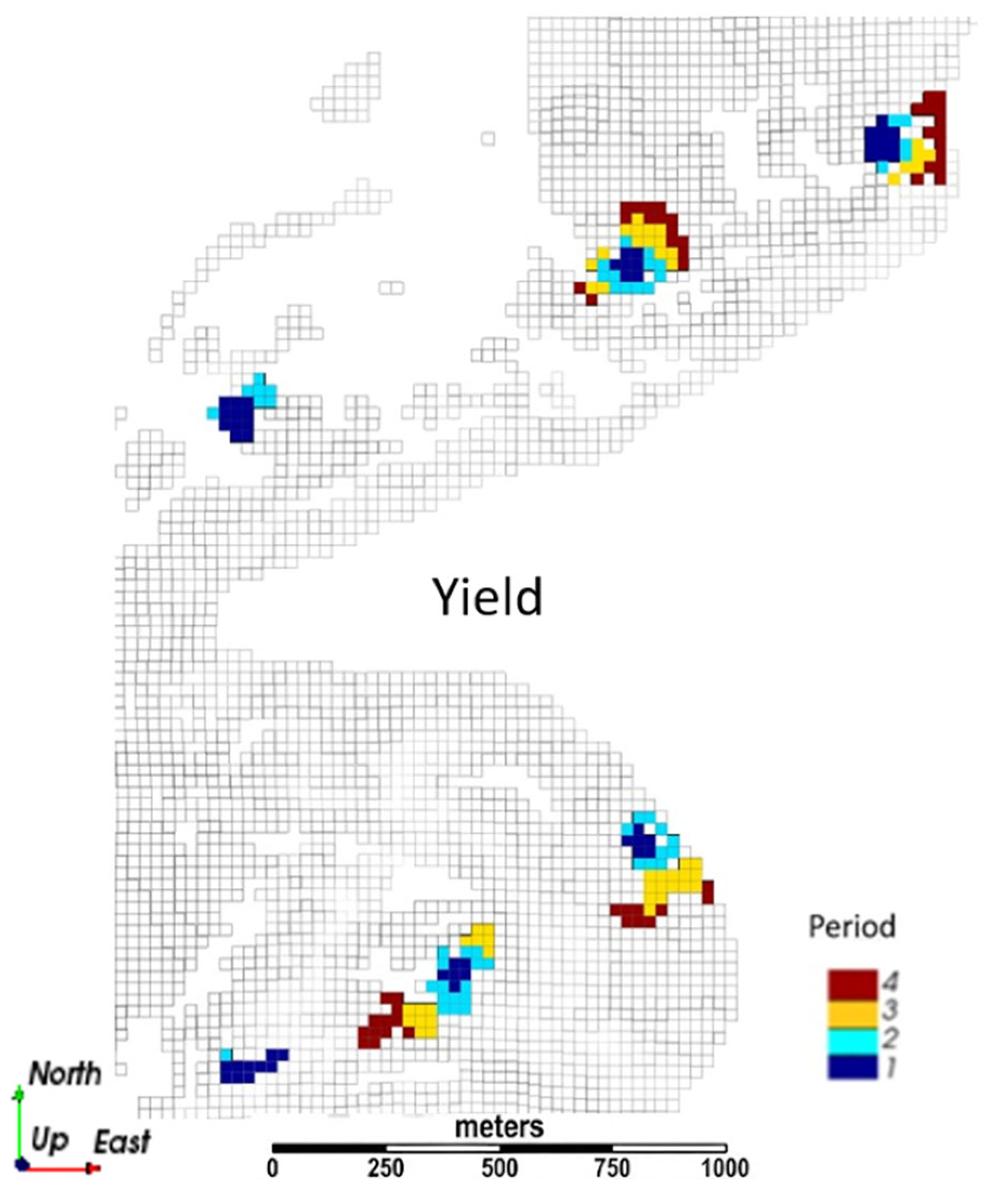
The map was subdivided into two sections, upper and lower, corresponding to seeds located in the upper and lower zones, respectively. This subdivision improves the visualization of the temporal sequence.
Figure 18 illustrates the probability maps with the blocks selected in periods P1, P2, P3, and P4. The left images show all blocks selected by period, and the right side presents the chosen blocks with the highest probability.
Figure 19 illustrates the probability upper maps with the blocks selected in periods P1, P2, P3, and P4. The left images show all blocks selected by period, and the right side presents the chosen blocks with the highest probability.
Figure 20 displays the optimized dig line models for sequential periods: blue represents the first period, sky-blue the second, yellow the third, and red the fourth. Each period contains the model with the 50 blocks with the highest probability.
Table 2 presents statistics for the E-type models, grouped into sequential periods generated by the short-term algorithms described in Section 2.4.
The results show that the generated models are close to the reference model, indicating stable means across periods and consistent results.
To demonstrate that the proposed methodology generates an economic benefit, the sequencing algorithm was applied to an E-Type P2O5 model. In both cases, excavation lines were generated using the same input parameters, including seed points and optimization parameters, thus ensuring a consistent comparison between methodologies.
The comparison between the two cases was performed by isolating the impact of yield (mass recovery) on economic value, assuming identical tonnage, cost, and pricing conditions. Thus, the delta in revenue, related only to the yield gain, was calculated.
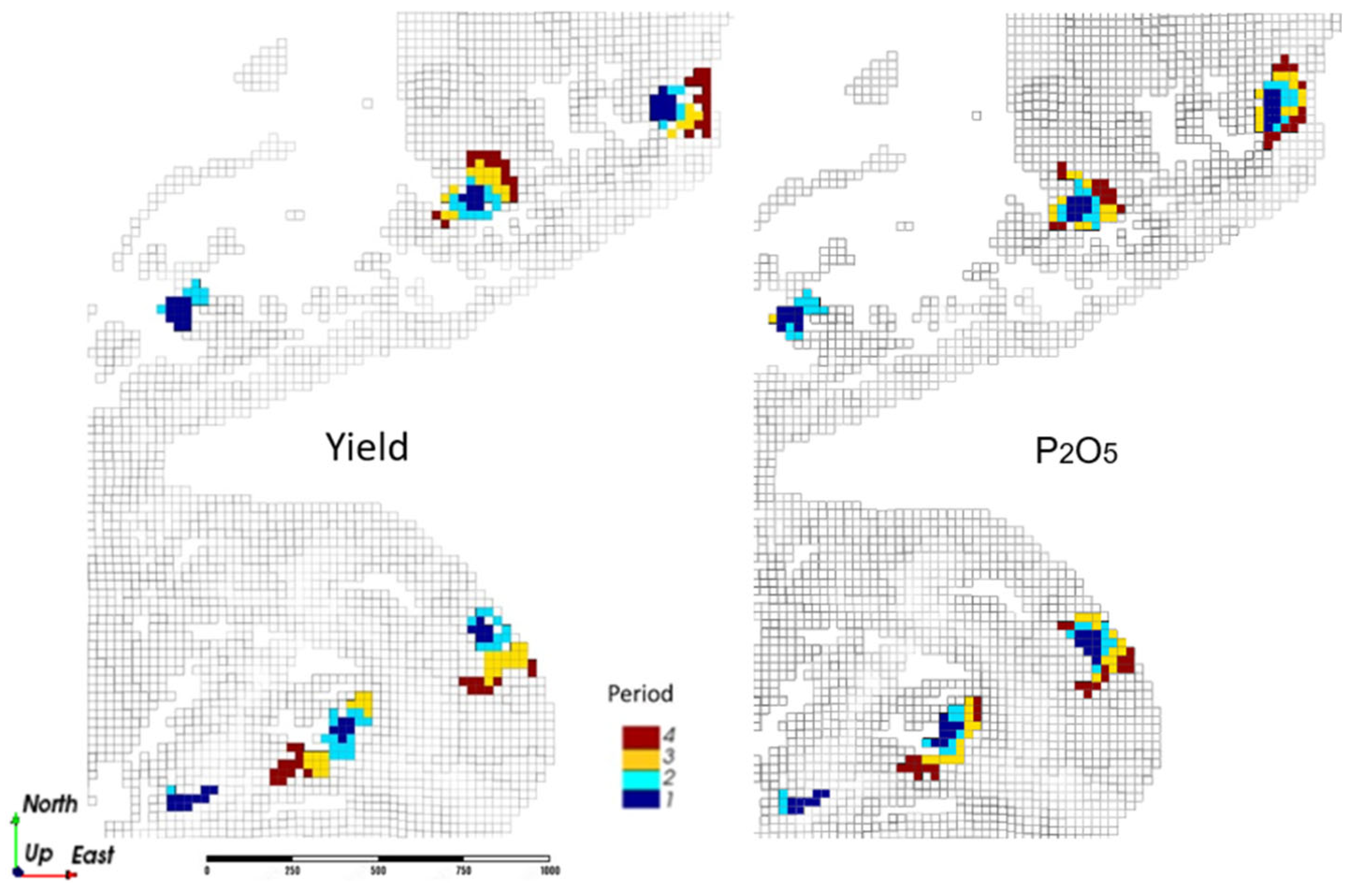
The methodology based solely on the P2O5 variable presents a yield of 10.46%, whereas the proposed methodology increases this value to 10.58%, as illustrated in Table 3. Although the difference is only 0.12 percentage points, it translates into an additional recovery of approximately 3458 tonnes of concentrate over a total of 2.75 million tonnes of ROM. The differences in the dig lines are illustrated in Figure 21.
Considering an average concentrate price of approximately US$103 per tonne, this increase represents an additional value of approximately US$356,000. Since costs are applied per tonne of ROM and remain constant between both scenarios, this increase is directly translated into an economic value gain. This result highlights the high sensitivity of project economics to yield, where even small improvements generate measurable financial benefits. Details of the economic parameters used are presented in Table 4, while the calculations are shown in Equations (4)–(6).
Δ Y i e l d = 0.0012575
Δ C o n c e n t r a t e = T o t a l   t o n n a g e Δ Y i e l d = 2,750,000 0.0012575 3458   t
Δ R e v e n u e = Δ C o n c e n t r a t e C o n c e n t r a t e   p r i c e = 3458 102.86 U S $ 356,000
It should be noted that the present evaluation only considers the direct economic impact associated with increased concentrate production. Potential secondary benefits related to improved feed consistency, such as lower energy consumption, reduced reagent demand, improved process stability, and lower operational variability, were not included in the calculation. Consequently, the reported economic benefit likely represents a conservative estimate of the total value generated by the proposed methodology.
Another important point is that, in phosphate operations, yield is strongly related to P2O5 grade, although contaminants and other variables may negatively affect this parameter. In mining operations where the grade variables used to define cut-off grades are less correlated with yield and recovery, the potential improvement may be even greater than that illustrated in this case study.

4. Conclusions

This case study shows how geometallurgical models can be incorporated into block sequencing, minimizing the risk of feeding the plant with blocks that cannot meet the minimum yield quantities, which would compromise cash flow. The proposed methodology begins by developing a neural network model to predict yield using the most relevant chemical variables as inputs. These input variables are then simulated in the block model. However, due to their complex interrelationships, a PPMT transformation was applied to render the variables independent before simulation. Each PPMT component was simulated using the Turning Bands method, and the results were subsequently back-transformed to the original variable scale. The trained neural network was then applied to the block model to generate yield predictions for each block. A yield cut-off criterion was applied to each simulated scenario, selecting the blocks with the highest potential to feed the processing plant. Finally, stochastic mine planning was performed to prioritize the extraction of blocks with a higher probability of achieving the target yield.
The results demonstrated that defining dig lines using a stochastic workflow aimed at stabilizing yield improves mining profitability compared with a stochastic dig line strategy focused solely on stabilizing P2O5 grades. For the evaluated month, the proposed approach resulted in an estimated economic benefit of approximately US$356,000, representing a significant operational gain.
The following steps of this study include extending the analysis to longer production periods (from six months to one year) and comparing the current geometallurgical base case with scenarios that incorporate other geometallurgical variables, such as contaminant grades and grinding indices, to reduce the risk of mining blocks with undesirable plant performance.

Author Contributions

Conceptualization, A.A.T.T.; Methodology, A.A.T.T. and F.G.F.N.; Validation, J.F.C.L.C.; Formal analysis, F.G.F.N.; Investigation, A.A.T.T., F.G.F.N. and D.M.M.; Resources, J.F.C.L.C.; Data curation, F.G.F.N.; Writing—original draft, A.A.T.T.; Writing—review and editing, J.F.C.L.C., F.G.F.N. and D.M.M.; Visualization, D.M.M.; Supervision, J.F.C.L.C. and F.G.F.N.; Project administration, J.F.C.L.C. and F.G.F.N.; Funding acquisition, J.F.C.L.C. All authors have read and agreed to the published version of the manuscript.

Funding

This research was funded by Fundação Luiz Englert grant number 10163938652.

Data Availability Statement

The data are not publicly available due to confidentiality restrictions.

Acknowledgments

The authors acknowledge Datamine Software for providing access to Isatis.neo 2025.3 version, which was used for the development and generation of the multivariate geostatistical simulation models employed in this study.

Conflicts of Interest

Author A.A.T.T. was employed by Datamine Software. The remaining authors declare that the research was conducted in the absence of any commercial or financial relationships that could be construed as a potential conflict of interest.

References

  1. Coward, S.; Vann, J.; Dunham, S.; Stewart, M. The primary-response framework for geometallurgical variables. In Seventh International Mining Geology Conference, 2009, Proceedings; Australasian Institute of Mining and Metallurgy: Melbourne, Australia, 2009; pp. 109–114. [Google Scholar]
  2. Deutsch, C.V. Geostatistical modelling of geometallurgical variables—Problems and solutions. In The Second AusIMM International Geometallurgy Conference, 2013, Proceedings; Australasian Institute of Mining and Metallurgy: Melbourne, Australia, 2013; pp. 7–16. [Google Scholar]
  3. Newton, M.J.; Graham, J.M. Spatial modelling and optimisation of geometallurgical indices. In The First AusIMM International Geometallurgy Conference, 2011, Proceedings; Australasian Institute of Mining and Metallurgy: Brisbane, Australia, 2011; pp. 247–261. [Google Scholar]
  4. Boisvert, J.B.; Rossi, M.E.; Ehrig, K.; Deutsch, C.V. Geometallurgical modeling at Olympic Dam mine, South Australia. Math. Geosci. 2013, 45, 901–925. [Google Scholar] [CrossRef]
  5. Deutsch, J.L.; Palmer, K.; Deutsch, C.V.; Szymanski, J. Spatial modeling of geometallurgical properties: Techniques and a case study. Nat. Resour. Res. 2016, 25, 161–181. [Google Scholar] [CrossRef]
  6. Carrasco, P.; Chilès, J.P.; Séguret, S. Additivity, metallurgical recovery, and grade. In VIII International Geostatistics Congress, Geostats 2008, Proceedings; Gecamin: Santiago, Chile, 2008; pp. 237–246. [Google Scholar]
  7. Cornah, A.J. Assessments of the impact of non-additivity in the estimation of iron ore attributes. In Iron Ore Conference, 2013, Proceedings; Australasian Institute of Mining and Metallurgy: Melbourne, Australia, 2013; pp. 129–136. [Google Scholar]
  8. Montiel, L.; Dimitrakopoulos, R. Simultaneous stochastic. Min. Eng. 2018, 70, 48–56. [Google Scholar] [CrossRef]
  9. Both, C.; Dimitrakopoulos, R. Applied machine learning for geometallurgical throughput prediction—A case study using production data at the Tropicana Gold Mining Complex. Minerals 2021, 11, 1257. [Google Scholar] [CrossRef]
  10. Kumar, A.; Dimitrakopoulos, R. Application of simultaneous stochastic optimization with geometallurgical decisions at a copper–gold mining complex. Min. Technol. 2019, 128, 88–105. [Google Scholar] [CrossRef]
  11. Dominy, S.C.; O’Connor, L.; Parbhakar-Fox, A.; Glass, H.J.; Purevgerel, S. Geometallurgy—A route to more resilient mine operations. Minerals 2018, 8, 560. [Google Scholar] [CrossRef]
  12. Niquini, F.G.F.; Branches, A.M.B.; Costa, J.F.C.L.; Moreira, G.D.C.; Schneider, C.L.; Araújo, F.C.D.; Capponi, L.N. Recursive feature elimination and neural networks applied to the forecast of mass and metallurgical recoveries in a Brazilian phosphate mine. Minerals 2023, 13, 748. [Google Scholar] [CrossRef]
  13. Toledo, A.A.T.; Marques, D.M.; Costa, J.F.C.L.; Capponi, L.N. Short-term mine scheduling targeting stationary grades. REM-Int. Eng. J. 2022, 75, 73–82. [Google Scholar] [CrossRef]
  14. David, M. Tools for planning: Variances and conditional simulations. In Proceedings of the 11th International Symposium on Computer Applications in the Mineral Industries; University of Arizona: Tucson, AZ, USA, 1973; pp. D10–D23. [Google Scholar]
  15. Journel, A.G. Geostatistics for conditional simulation of ore bodies. Econ. Geol. 1974, 69, 673–687. [Google Scholar] [CrossRef]
  16. Matheron, G. Forecasting block grade distributions: The transfer functions. In Advanced Geostatistics in the Mining Industry; Springer: Dordrecht, The Netherlands, 1976; pp. 237–251. [Google Scholar] [CrossRef]
  17. Koch, P.-H.; Rosenkranz, J. Sequential decision-making in mining and processing based on geometallurgical inputs. Miner. Eng. 2020, 149, 106262. [Google Scholar] [CrossRef]
  18. Barnett, R.M.; Manchuk, J.G.; Deutsch, C.V. Projection pursuit multivariate transform. Math. Geosci. 2014, 46, 337–359. [Google Scholar] [CrossRef]
  19. Friedman, J.H.; Tukey, J.W. A projection pursuit algorithm for exploratory data analysis. IEEE Trans. Comput. 1974, 100, 881–890. [Google Scholar] [CrossRef]
  20. Matheron, G. The intrinsic random functions and their applications. Adv. Appl. Probab. 1973, 5, 439–468. [Google Scholar] [CrossRef]
  21. Rossi, M.E.; Deutsch, C.V. Mineral Resource Estimation; Springer Science & Business Media: Dordrecht, The Netherlands, 2013. [Google Scholar] [CrossRef]
  22. Niquini, F.G.F.; Costa, J.F.C.L. Mass and metallurgical balance forecast for a zinc processing plant using artificial neural networks. Nat. Resour. Res. 2020, 29, 3569–3580. [Google Scholar] [CrossRef]
  23. Niquini, F.G.F.; Costa, J.F.C.L. Forecasting mass and metallurgical balance at a gold processing plant using modern multivariate statistics. REM-Int. Eng. J. 2020, 73, 571–578. [Google Scholar] [CrossRef]
  24. Gholami, A.; Asgari, K.; Khoshdast, H.; Hassanzadeh, A. A hybrid geometallurgical study using coupled Historical Data (HD) and Deep Learning (DL) techniques on a copper ore mine. Physicochem. Probl. Miner. Process. 2022, 58, 147841. [Google Scholar] [CrossRef]
  25. Jorjani, E.; Bagherieh, A.H.; Mesroghli, S.; Chehreh Chelgani, S.; Jorjani, H. Prediction of yttrium, lanthanum, cerium, and neodymium leaching recovery from apatite concentrate using artificial neural networks. In Proceedings of the MetPlant 2008, Perth, Australia, 18–19 August 2008; pp. 433–446. [Google Scholar]
  26. Nakhaei, F.; Mosavi, M.R.; Sam, A.; Vaghei, Y. Recovery and grade accurate prediction of pilot plant flotation column concentrate: Neural network and statistical techniques. Int. J. Miner. Process. 2012, 110–111, 140–154. [Google Scholar] [CrossRef]
  27. Srivastava, V.; Bandopadhyay, S.; Akdogan, G.; Ghosh, T. Dynamic neural network-based model for SAG mill power prediction. In Proceedings of the 38th International Symposium on the Application of Computers and Operations Research in the Mineral Industry, Golden, CO, USA, 2017, Proceedings; Colorado School of Mines: Golden, CO, USA, 2017; Volume 38, pp. 227–233. [Google Scholar]
  28. Panda, L.; Tripathy, S.K. Performance prediction of gravity concentrator by using artificial neural network—A case study. Int. J. Min. Sci. Technol. 2014, 24, 461–465. [Google Scholar] [CrossRef]
  29. McCulloch, W.S.; Pitts, W. A logical calculus of the ideas immanent in nervous activity. Bull. Math. Biophys. 1943, 5, 115–133. [Google Scholar] [CrossRef]
  30. Bishop, C.M. Neural Networks for Pattern Recognition; Clarendon Press: Oxford, UK, 1995. [Google Scholar]
  31. Haykin, S. Neural Networks: A Comprehensive Foundation, 2nd ed.; Prentice Hall: Upper Saddle River, NJ, USA, 1999. [Google Scholar]
  32. Lundberg, S.M.; Lee, S.-I. A unified approach to interpreting model predictions. arXiv 2017, arXiv:1705.07874. [Google Scholar] [CrossRef]
  33. Guyon, I.; Weston, J.; Barnhill, S.; Vapnik, V. Gene Selection for Cancer Classification using Support Vector Machines. Mach. Learn. 2002, 46, 389–422. [Google Scholar] [CrossRef]
  34. Hastie, T.; Tibshirani, R.; Friedman, J. The Elements of Statistical Learning, 2nd ed.; Springer: New York, NY, USA, 2009. [Google Scholar]
  35. Izenman, A.J. Modern Multivariate Statistical Techniques: Regression, Classification, and Manifold Learning; Springer: New York, NY, USA, 2008. [Google Scholar] [CrossRef]
  36. Journel, A.G.; Kyriakidis, P.C. Evaluation of Mineral Reserves: A Simulation Approach; Oxford University Press: New York, NY, USA, 2004. [Google Scholar]
  37. Toledo, A.A.T.; Costa, J.F.C.L.; Capponi, L.N.; Marques, D.M. Stochastic short-term mine scheduling targeting stationary grades. REM-Int. Eng. J. 2025, 78, e240011. [Google Scholar] [CrossRef]
Figure 1. Proposed workflow.
Minerals 16 00618 g001
Figure 2. Small neural network (reproduced from Niquini et al., 2023) [12].
Minerals 16 00618 g002
Figure 3. Scheme for selecting the dig line with a mean value closest to the reference model. (a) The reference model is depicted in red, along with the set of blocks generated using the same seed point. (b) Comparison between the reference and generated dig line models.
Minerals 16 00618 g003
Figure 4. Representation of the stochastic flow of process information, including (a) maps showing percentage occurrence, and (b) blocks with a higher probability of occurrence.
Minerals 16 00618 g004
Figure 5. Location of the two geological domains in the deposit.
Minerals 16 00618 g005
Figure 6. Bottom corner: Scatterplots of Gaussian variables. Diagonal: Histograms of sphering factors. Top corner: Scatterplots of PPMT components. (a) Domain 1, and (b) Domain 2.
Minerals 16 00618 g006
Figure 7. Incremental relative error convergence for P2O5 grades simulated with Turning Bands.
Minerals 16 00618 g007
Figure 8. Boxplots of the mean values observed across the 50 realizations and the dataset mean value—Domain 1. The orange line represents the median value.
Minerals 16 00618 g008
Figure 9. Boxplots of the coefficient of variation values observed across the 50 realizations and the dataset coefficient of variation value—Domain 1. The orange line represents the median value.
Minerals 16 00618 g009
Figure 10. Comparison of correlation matrices of Domain 1: (a) Original samples, (b) back-transformed results for simulation 11, and (c) back-transformed results for simulation 45.
Minerals 16 00618 g010
Figure 11. Comparison of correlation matrices of Domain 2: (a) Original samples, (b) back-transformed results for simulation 11, and (c) back-transformed results for simulation 45.
Minerals 16 00618 g011
Figure 12. SHAP plot made using all available variables in the neural network model. The orange line represents the median value.
Minerals 16 00618 g012
Figure 13. Neural network built to forecast flotation concentrate yield.
Minerals 16 00618 g013
Figure 14. Mean error by yield interval.
Minerals 16 00618 g014
Figure 15. Yield predicted in four different scenarios.
Minerals 16 00618 g015
Figure 16. Yield scenarios generated by the proposed stochastic workflow.
Minerals 16 00618 g016
Figure 17. Yield E-type of the deposit (a) and on the area of the reference model (b).
Minerals 16 00618 g017
Figure 18. Probability upper maps across all 50 dig lines per period (P1—First period, P2—Second period, P3—Third period, and P4—Fourth period). The left side has all blocks, and the right side has the 50 blocks with the highest probability.
Minerals 16 00618 g018
Figure 19. Probability maps for the lower zone across all 50 dig lines for each period (P1—First period, P2—Second period, P3—Third period, and P4—Fourth period). The left panels include all blocks, whereas the right panels show the blocks with the highest probability.
Minerals 16 00618 g019
Figure 20. Sequential optimized dig lines by weekly periods in the yield model.
Minerals 16 00618 g020
Figure 21. Dig lines by weekly periods in the yield model against the dig lines generated looking at P2O5 grade.
Minerals 16 00618 g021
Table 1. Forecast metrics in training, test, and future sets.
MetricSetMean Value
CorrelationTraining0.77
Test0.76
Holdout0.78
MAETraining3.25
Test3.33
Holdout3.35
RMSETraining4.47
Test4.57
Holdout4.58
MdAPETraining16.98
Test17.18
Holdout18.10
Table 2. Mean and Std of yield over the optimized periods’ models in the E-type map.
MeanStd
Period 111.873.86
Period 210.072.55
Period 39.802.13
Period 410.593.19
Mean10.582.94
Reference Model10.653.55
Table 3. Comparison of yield metrics obtained from dig lines generated based on geometallurgical behavior and those generated using P2O5 grade as the criterion for defining the dig lines.
Yield
YieldP2O5
Mean StdMeanStd
Period 111.873.8711.223.72
Period 210.072.559.892.61
Period 39.82.1310.452.57
Period 410.593.1910.272.68
Mean10.582.9410.462.90
Table 4. Economic parameters.
ParameterValue
N° of blocks200
Block size25 × 25 × 10 m
Density2.2 t/m3
Total tonnage2,750,000 t
Concentrate priceUS$102.86/t
Disclaimer/Publisher’s Note: The statements, opinions and data contained in all publications are solely those of the individual author(s) and contributor(s) and not of MDPI and/or the editor(s). MDPI and/or the editor(s) disclaim responsibility for any injury to people or property resulting from any ideas, methods, instructions or products referred to in the content.