


Abstract
This study investigates the comminution behavior and beneficiation potential of lithium-bearing ores, zinnwaldite from Cínovec (Czech-Germany border) and lepidolite from Villasrubias (Spain) by integrating mineralogical analysis and mechanical characterization. The research is driven by Europe’s need for secure lithium supply chains. In particular, it focuses on the challenges associated with low-grade, fine-grained lithium micas found in hard-rock ores, which offer significant potential to supply in Europe but also pose substantial processing challenges. QMA (Quantitative Microstructural Analysis) revealed distinct differences in the textural and structural characteristics of the studied ores. Zinnwaldite-bearing rocks are coarser-grained with high interlocking and roughness, while lepidolite-bearing samples showed finer grains, lower roughness, and more disseminated mica distribution, indicated by their low clustering degree. In terms of mechanical characterization, zinnwaldite-rich ores have the lowest compressive strength, while lepidolite-rich samples showed the highest values, attributed to their finer grain size and more cohesive structure. This suggests that lepidolite may require higher energy input and finer crushing stages to achieve the target liberation size. These features influenced the breakage behavior observed during mechanical testing and comminution and are essential for enabling selective comminution, separating mica from gangue material. This study contributes to analyzing the potential of European hard-rock lithium resources from the perspective of upstream comminution, which is an essential step influencing downstream energy consumption, reagent use, and overall recovery efficiency. The results of this research emphasize that selective comminution should not rely solely on mineral hardness contrasts but must incorporate microstructural parameters such as clustering, grain size distribution, and orientation.
1. Introduction
The accelerating global transition toward low-carbon energy systems has sharply increased the demand for electrification and battery technologies, positioning lithium as a critical raw material for producing lithium-ion batteries (LiBs). By 2030, global demand for lithium carbonate (Li2CO3) is projected to reach 4 million tons, representing a 700% increase relative to 2021 levels [1]. Over the same period, LiB demand is expected to grow from 2.5 GWh in 2018 to 24.8 GWh, with lithium consumption alone rising by a factor of 9.3 due to its central role in all major battery chemistries [2].
Europe remains highly dependent on lithium imports from South American brines (Argentina, Bolivia, Chile) and hard-rock deposits in Australia and China. Accordingly, the European Critical Raw Materials Act designates lithium as both a strategic and critical raw material, reflecting its economic importance and high supply risk. To reduce this vulnerability, the EU has set ambitious 2030 targets: to domestically extract at least 10% of its annual lithium demand, refine or process 40% within the EU, and recover 25% through recycling [3,4].
Although Europe is not yet a significant lithium producer, it hosts substantial hard-rock lithium resources. Unlike South American brine-type deposits, European lithium occurrences are predominantly associated with hard-rock pegmatites and greisen systems. Several countries—including Portugal, Germany, the Czech Republic, Finland, Spain, Austria, and Serbia—are actively assessing their lithium potential [5]. The largest known European hard-rock resource is the Cinovec–Zinnwald deposit in the Erzgebirge region (Germany–Czech Republic border), where recent drilling by Geomet/European Metals and Zinnwald Lithium has yielded an updated total resource exceeding 1.9 Mt of lithium. This includes approximately 708.2 Mt of ore, averaging 0.2% Li, 0.05% Sn, and 0.02% W at the Czech Cinovec deposit, and 226.8 Mt at 0.22% Li at the German Zinnwald deposit [6]. Another prospective region is the Central Iberian Zone (CIZ) in western Spain, hosting multiple lithium-bearing pegmatite types enriched in spodumene, petalite, lepidolite, Li-muscovite, and zinnwaldite [7].
The main lithium minerals in European hard-rock deposits include spodumene (LiAlSi2O6), lepidolite (K(Li,Al)3(Si,Al)4O10(F,OH)2), petalite (LiAlSi4O10), and zinnwaldite (KLiFeAl(AlSi3)O10(F,OH)2) [5]. Spodumene, the primary lithium mineral in Australian operations, contains the highest Li2O grades (6.80–7.20%) and therefore remains the most commercially attractive option [8,9,10]. Lepidolite, extensively mined in China, typically contains 3.27–3.94% Li2O and elevated K2O and SiO2 contents [11,12]. Zinnwaldite, characteristic of the Cinovec–Zinnwald district, exhibits 2.50–3.49% Li2O, elevated Fe2O3 (up to 11.50%), and intermediate SiO2 and Al2O3 contents [13,14,15]. It represents a group of trioctahedral Li-bearing micas within the siderophyllite polylithionite solid-solution series [16]. Lithium-bearing muscovite, formed via hydrothermal or greisen-type alteration, incorporates Li mainly through substitution of Al3+ by Li+ and Fe2+ in octahedral sites [17].
Despite its abundance, zinnwaldite is less attractive than spodumene or lepidolite due to its lower theoretical Li2O content and high iron concentration. Elevated Fe2O3 complicates acidic digestion by forming iron–aluminum oxide hydrates that hinder solid–liquid separation and reduce lithium recovery [13]. Nevertheless, the same iron content provides a technological advantage in pre-concentration, as zinnwaldite responds strongly to magnetic separation [18,19]. Both zinnwaldite and lepidolite require high-temperature calcination (zinnwaldite: 950–1050 °C; lepidolite: 850–950 °C) to destabilize their crystalline structures [20]. Their fluorine contents pose additional processing challenges due to release of hazardous HF or SiF4 during acid leaching [13]. Lepidolite processing is further complicated by fine intergrowths with quartz and albite, as well as surface properties similar to other silicates, which together hinder selective flotation [20].
While much research has focused on optimizing lithium extraction from these minerals, considerably less attention has been paid to upstream comminution, an essential step influencing downstream energy consumption, reagent use, and overall recovery efficiency. Layered Li-bearing micas such as zinnwaldite and lepidolite exhibit complex textures and anisotropic cleavage, necessitating tailored breakage strategies to achieve optimal liberation while avoiding excessive fines generation. However, systematic studies linking mineral microstructure (grain size, texture, cleavage, intergrowths) to comminution machine selection remain limited, constraining Europe’s ability to process these resources cost-effectively. This research, therefore, aims to strengthen Europe’s lithium raw-material production potential by conducting a detailed quantitative mineralogical analysis (QMA) of two key hard-rock ore types—zinnwaldite- and lepidolite-bearing ores—and by using these insights to optimize the technological processing flowsheet, with particular emphasis on improving the comminution stage.
1.1. Brief Geological Overview
1.1.1. The Cínovec–Zinnwald Deposit
The Cínovec–Zinnwald deposit is located in the Erzgebirge region on the border between the Czech Republic and Germany and is situated in a geologically favorable area known for historic mining of tin and tungsten and other metals [5].
The Cínovec–Zinnwald deposit is hosted within a small, ovoid-shaped albite granite stock that intruded the overlying Teplice Rhyolite and has undergone extensive greisenization, particularly in its apical and marginal zones. This rock comprises fine- to medium-grained albite, quartz, and zinnwaldite, with accessory topaz, fluorite, and alteration minerals such as sericite, illite, and kaolinite [21,22]. Based on a recent study by [6], distinctions exist between the Zinnwald and Cínovec deposits despite their geological continuity within the same mineralized zone. These differences primarily arise from the more pervasive and voluminous greisen alteration observed at Cínovec, where the alteration forms dome- and lens-shaped bodies commonly associated with extensive stockwork veining [6]. The principal ore body of the Cínovec deposit is located at depths exceeding 100 m below the surface and is overlain by a sequence of rhyolitic volcanic rocks. Owing to the concealed nature of the mineralization, direct surface observation of the deposit is limited. Therefore, sampling activities were conducted within the former underground mining and processing areas at Cínovec, including adjacent brownfield sites.
The sampling campaign in 2024, as part of the joint Li4Life Project, focused on material derived from historical mining operations, particularly from dumps containing lithological fragments representative of the deposit. Collected material comprised granite, rhyolite boulders, greisenized granite, and fully developed greisen. These lithologies reflect the magmatic–hydrothermal evolution of the deposit and are genetically associated with lithium mineralization.
The sampling program was carried out in collaboration with Czech colleagues from MUNI (Masaryk University Faculty of Science) and Geomet LLC (Limited Liability Company), who were responsible for coordinating and supervising the sampling area. In total, approximately 2.1 tonnes of material were collected during the campaign to ensure representative bulk samples suitable for subsequent mineralogical, geochemical, and comminution analyses. This systematic sampling approach enabled the acquisition of statistically meaningful material from various alteration stages and lithological types associated with the Cínovec lithium deposit.
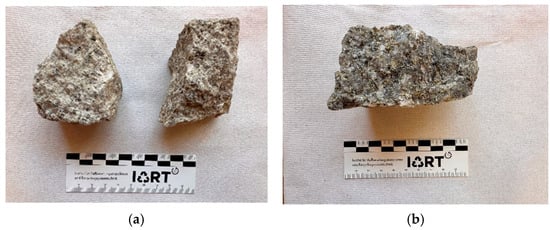
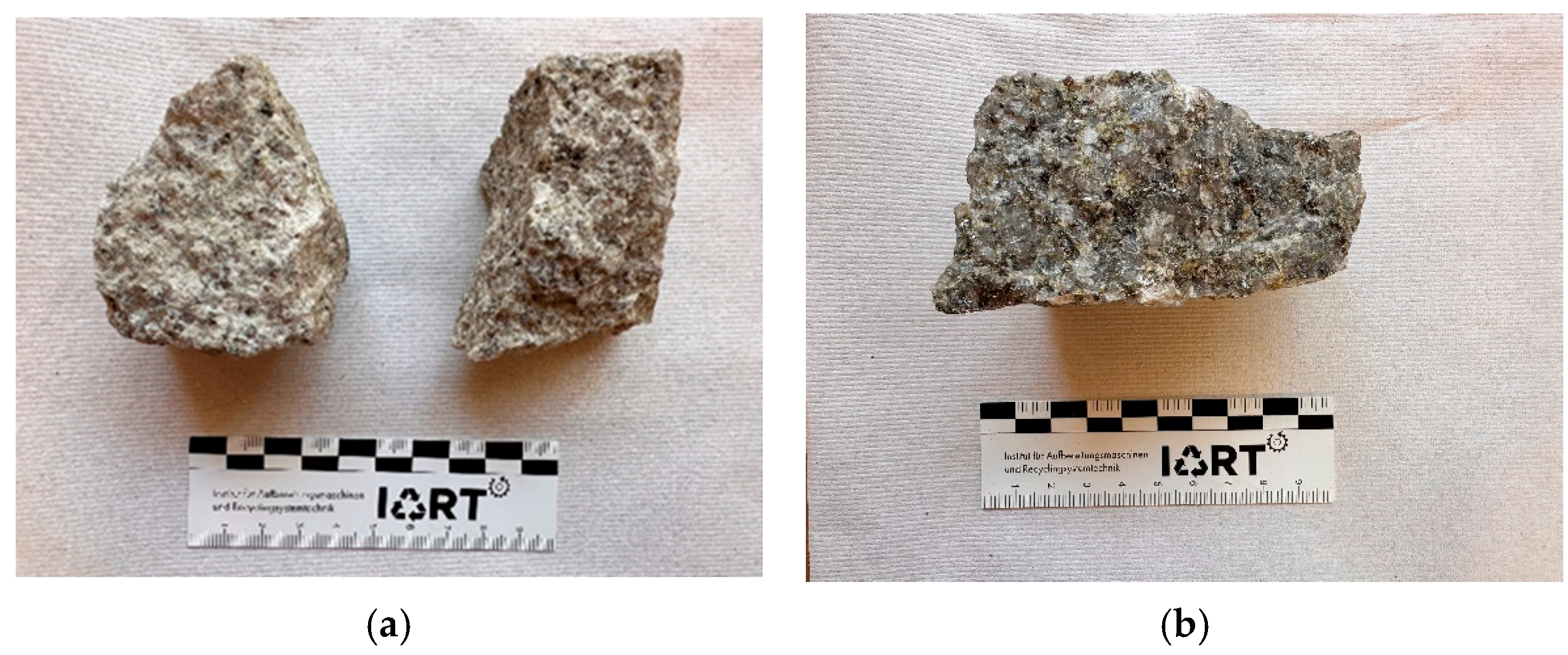
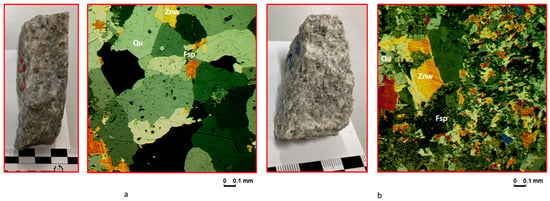
Based on the results of preliminary mineralogical analysis, two varieties were selected for further research: a sample of greisenized granite with a lower content of zinwaldite (GCW-1) and a sample of greisen with a higher content of zinwaldite (GCG-1) (Figure 1).
Figure 1.
(a) Greisenized granite (zinnwaldite mica-poor GCW-1; (b) greisen (zinnwaldite mica-rich GCG-1).
1.1.2. The Villasrubias Lithium Deposit
The Villasrubias Lithium deposit is an early-stage exploration project located in the southwest of the Salamanca province, Castilla y León, Spain, near the Portuguese border and just 33 km from Ciudad Rodrigo [7]. It lies within the Central Iberian Zone (CIZ) of the Iberian Massif, one of the most geologically significant regions for lithium exploration in Europe, and hosts several other lithium- and tin-bearing deposits in Spain and Portugal. This project is associated with lepidolite-subtype granitic pegmatites of the lithium–cesium–tantalum (LCT) family. These pegmatites are genetically linked to the highly evolved, S-type Cadalso–Casillas de Flores granitic batholith and were emplaced into metamorphic rocks of the Schist–Greywacke Complex (CEG) [23]. Preliminary exploration conducted by SIEMCALSA, a government-backed entity in Castilla y León between 2017 and 2020, identified lithium-bearing minerals including lepidolite and lithium-muscovite, as well as cassiterite, tantalum, and niobium, with petrographic and geochemical analyses returning Li2CO3 grades of up to 0.88% and an average of 0.52% in lepidolite-rich apo-pegmatites [24]. The pegmatite group is also known under the name “La Canalita pegmatites” [23].
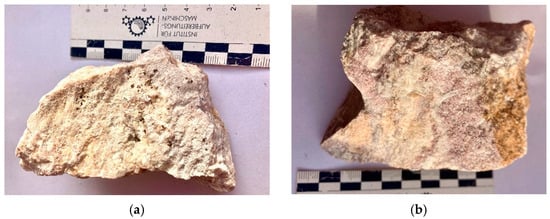
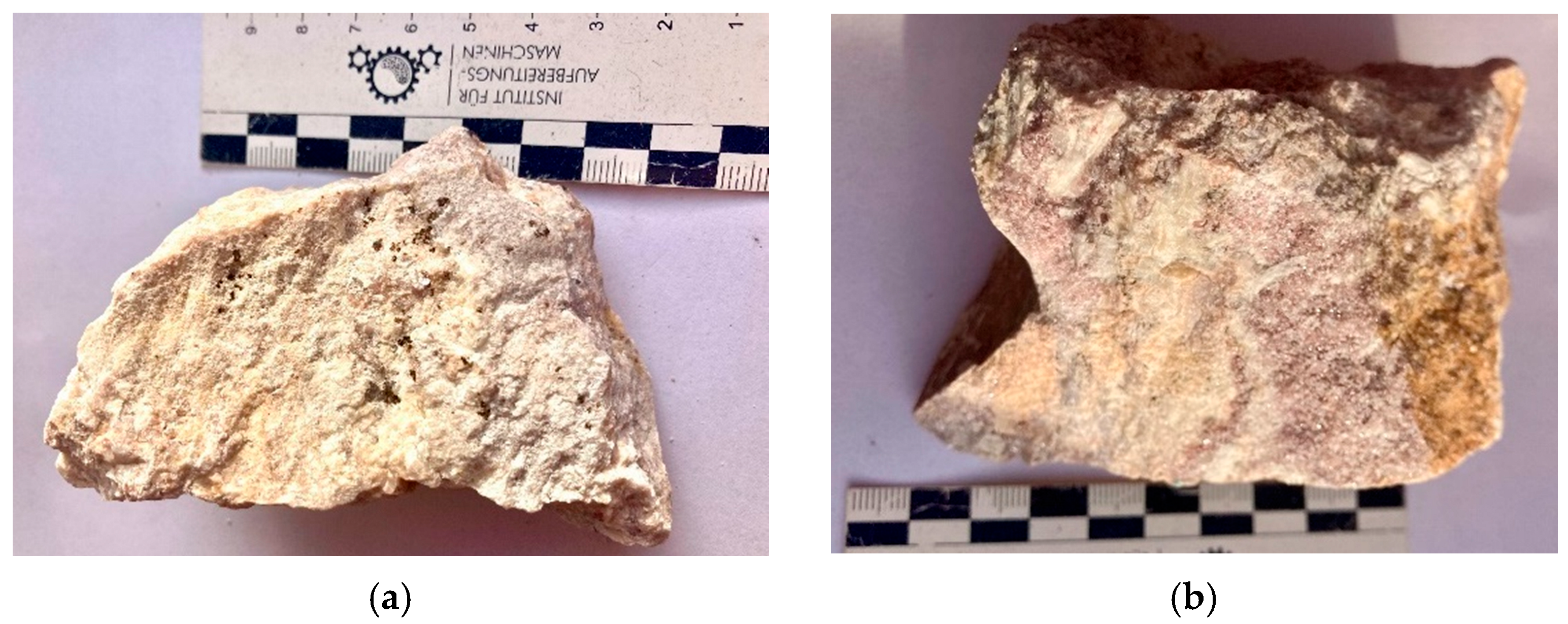
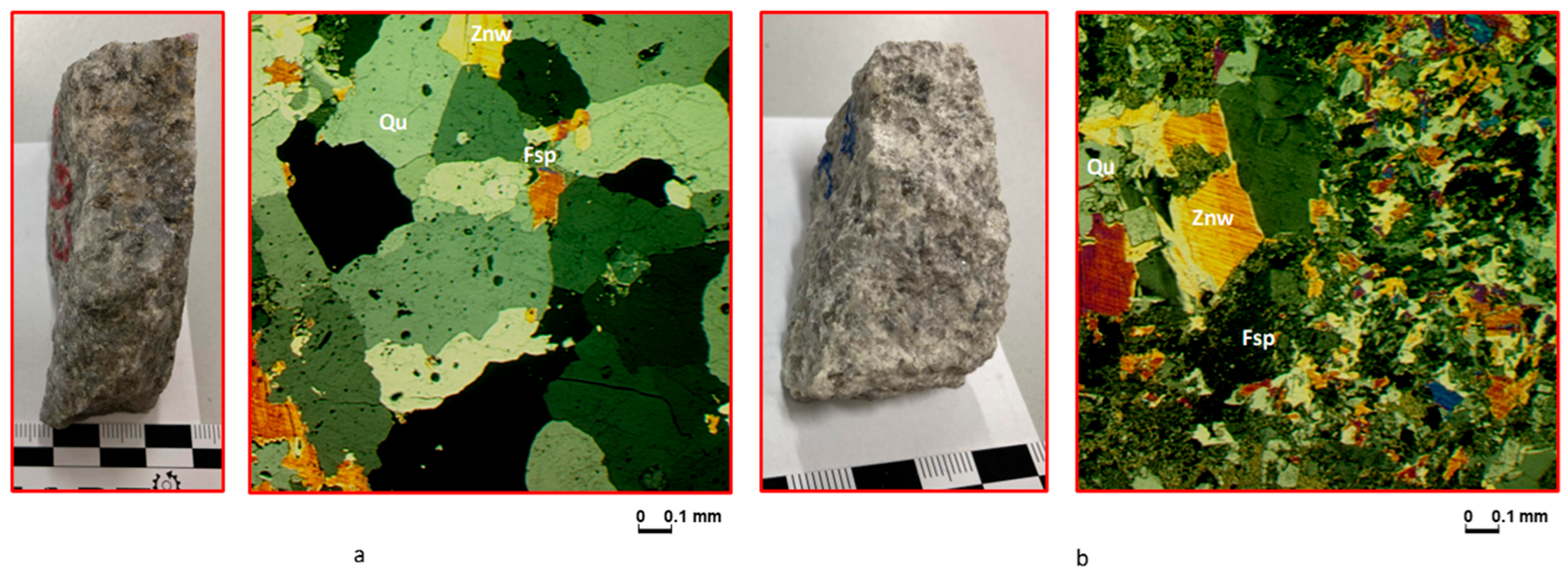
TME (Technology Metals Europe), a partner in the Li4Life project, provided approximately 5 tons of bulk material from promising areas of granite and granite pegmatite in Spain. After preliminary mineralogical analysis, two varieties were selected for further research and physical–mechanical tests: a sample of lepidolite-bearing aplite containing a small amount of lepidolite (LSA-1) and a sample of layered feldspar-lepidolite pegmatite as a sample of rich lepidolite ore (LSR-1) (Figure 2).
Figure 2.
Lepidolite-bearing aplite (LSA-1, (a)) and feldspar-lepidolite pegmatite (LSR-1, (b)).
2. Materials and Methods
To evaluate the 3D-stereological properties of the ore, QMA is used. A correlation between microstructural characteristics, strength, and breakage behavior of the rocks has been established for a long time [25]. Hence, the parameters of microstructure, strength and mineral hardness of the sample are to be established. The microstructural insights obtained form the basis for a targeted comminution strategy, tailored to selectively liberate lithium-bearing minerals. Both QMA and physical–mechanical tests were conducted as part of the EU Li4Life project and are being implemented at the Institute of Processing Machines and Systems Technology (IART) at the Technical University of Bergakademie Freiberg.
2.1. Quantitative Microstructural Analysis (QMA)
Rock names are not suitable as synonyms for rock properties in petrophysical modeling, as the petrographic description of a rock is based primarily on its genetic, mineralogical and chemical classification criteria, whereas aspects related to the rock fabric are only considered as a secondary factor. The influence of rock and ore properties on processing behavior is well established [26,27,28], making a detailed understanding of mineral behavior across all comminution stages essential, from selective coarse comminution to fine grinding. Such knowledge at the microscopic scale is critical for energy-efficient comminution and is highlighted by initiatives such as the Coalition for Energy Efficient Comminution (CEEC) [29,30]. It is also a prerequisite for reliable numerical modeling and simulation of comminution processes, including Discrete Element Method (DEM) approaches [31], where predictive calibration remains challenging without quantitative descriptors of ore fabric and structure [32].
In response, increasing attention has been directed toward quantitative microstructural analysis of ores. Advanced analytical techniques such as SEM-based Mineral Liberation Analysis (MLA) and QEMSCAN [33], as well as Computer Tomography (CT) [34], have significantly improved the quantitative characterization of mineral structure and texture. The application of QMA for structural and textural analysis represents a rapidly growing field, underlining the central role of QMA as a foundation for linking ore microstructure to comminution behavior and process modeling.
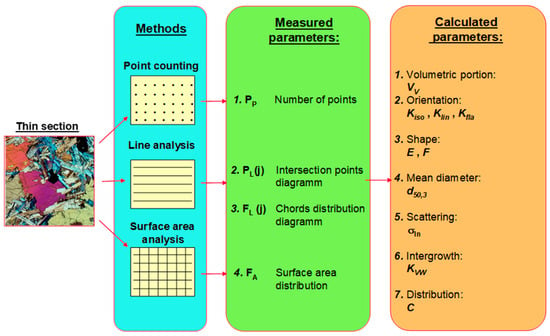
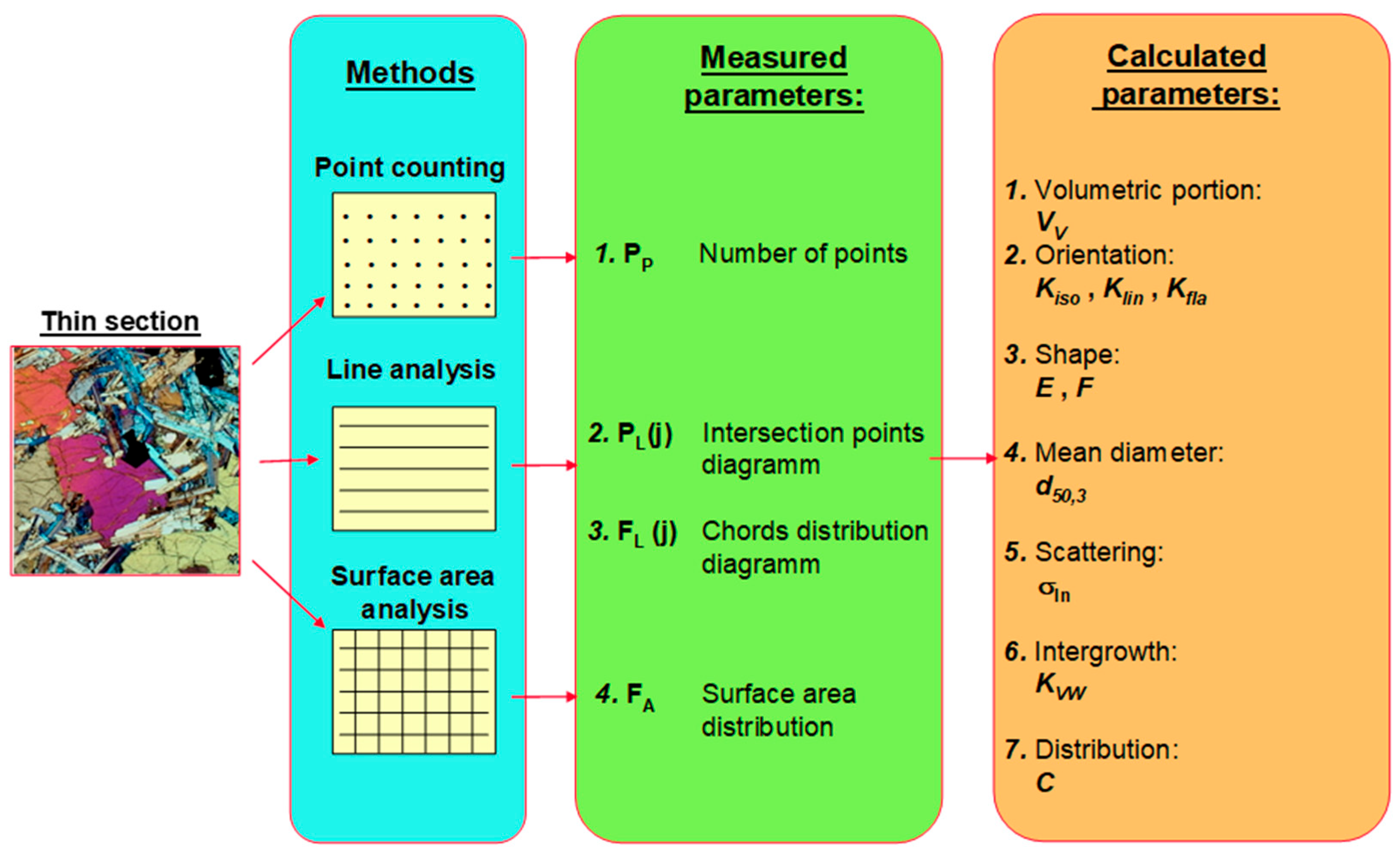
Based on the application of stereological methods, the rock is quantitatively described by means of its mode (content of the individual mineral phases in the rock fabric), characteristic values for the texture (e.g., grain size and shape, intergrowth) and characteristic values for the structure (e.g., direction, distribution and relative density), described in detail by [26,27,28]. After proper recovery of a defined number of rock samples from the deposit, three ground thin sections perpendicular to each other should be prepared from each rock specimen (Figure 3).
Figure 3.
Process flow for QMA rock analysis.
2.2. Chemical Analyses
The lithium content in the studied samples was determined by ICP-OES (inductively coupled plasma optical emission spectroscopy) at the Institut für Technische Chemie, TUBAF, using the reference samples (lepidolite-ref OREAS 750b with a Li content of 2265.8 ppm). The samples were dissolved using microwave pressure digestion. The detection limit for lithium is 0.004 mg/L. For each measurement, 2–3 g per sample was required; all the samples must be representative and homogeneous. Each measurement was individually calibrated.
2.3. Determination of Point Load Strength Index of Rocks
The Point Load Test (PLT) is a simple, quick, and practical field method used to estimate the strength of rock materials. Testing was carried out using the portable point load tester from WILLE Geotechnik. A measurement range of 0 to 250 bar was used. The testing apparatus consists of a rigid steel frame, a manual hydraulic loading system, and a pressure gauge to record the peak load at failure. During testing, irregular rock samples are positioned between two conical steel plates, and the load is gradually applied using a hand-operated pump until the sample fractures. After failure, the dimensions of the fractured plane are determined. These measurements, together with the recorded failure load, are used to calculate the Point Load Strength Index Is(50) acc. [35,36]. For standardization to a reference diameter of 50 mm, a size correction factor was applied:
where:
Is(50) is Point Load Strength Index (MPa or MN/m2)
P is failure load in Newton (N)
De is equivalent diameter (mm)
f is particle size correction factor
m is the slope constant of the regression curve
Since an empirical relationship exists between the corrected point load index Is(50) and the uniaxial compressive strength σD, the compressive strength can be approximated by multiplying Is(50) by a conversion factor c. According to ISRM guidelines [36,37], the typical range for the ratio σD/Is(50) lies between 20 and 25.
The index Is(50) is used to classify rock strength and to estimate the Uniaxial Compressive Strength (UCS, σD) through empirical correlations. Both these mechanical strength values (σD and Is(50)) provide insight into the breakage behavior and comminution response of different lithium ore types. For statistical reliability, 20 to 30 measurements were performed for each lithological category.
2.4. Determination of Vickers Microhardness of Minerals
The test was performed using a Shimadzu HMV-G21DT Micro Vickers Hardness Tester, equipped with a diamond Vickers pyramid indenter (a four-sided pyramid with a dihedral angle of 136°).
It is pressed into the material’s surface under a small load to create a microscopic indent [38]. The Vickers Hardness Number (HV) is calculated in Equation (3). The instrument includes an integrated optical system, along with a specimen base to secure the prepared sample.
where:
F is the applied load in N
d is the average diagonal length in millimeters
In addition to hardness, the Vickers indentation can also be used to determine microfracture toughness (Kic), defined as the critical value of the stress intensity factor at which a crack starts to grow rapidly and uncontrollably. As load is applied to a material with an existing crack, the stress at the crack tip increases. Once this stress reaches a critical threshold, the crack extends suddenly, leading to failure [39]. The relationship between the applied load and the resulting crack geometry forms the basis for estimating fracture toughness of mineral grains [28].
where:
c is the crack length measured from the center of the indentation to the crack tip (in m)
α is the half-angle of the Vickers pyramid, equal to 68°
Prior to testing, the specimen surfaces were required to be flat, polished, and free from surface irregularities. A controlled load, typically ranging from 0.098 to 1.961 N depending on the mineral tested, was applied to the indenter and held for 15 s. After unloading, the indentation was examined and measured under the microscope. In addition, crack patterns surrounding the indentation, particularly the crack lengths (c), were measured using the optical system to determine the microfracture toughness, particularly for brittle materials, since ductile minerals do not show such cracks in analysis. For statistical reliability, 15 to 20 measurements were collected for each mineral.
3. Results and Discussion
3.1. Quantitative Microstructural Analysis
3.1.1. The Cínovec–Zinnwald Deposit
Greisenized granite, GCW-1 (zinnwaldite ore)
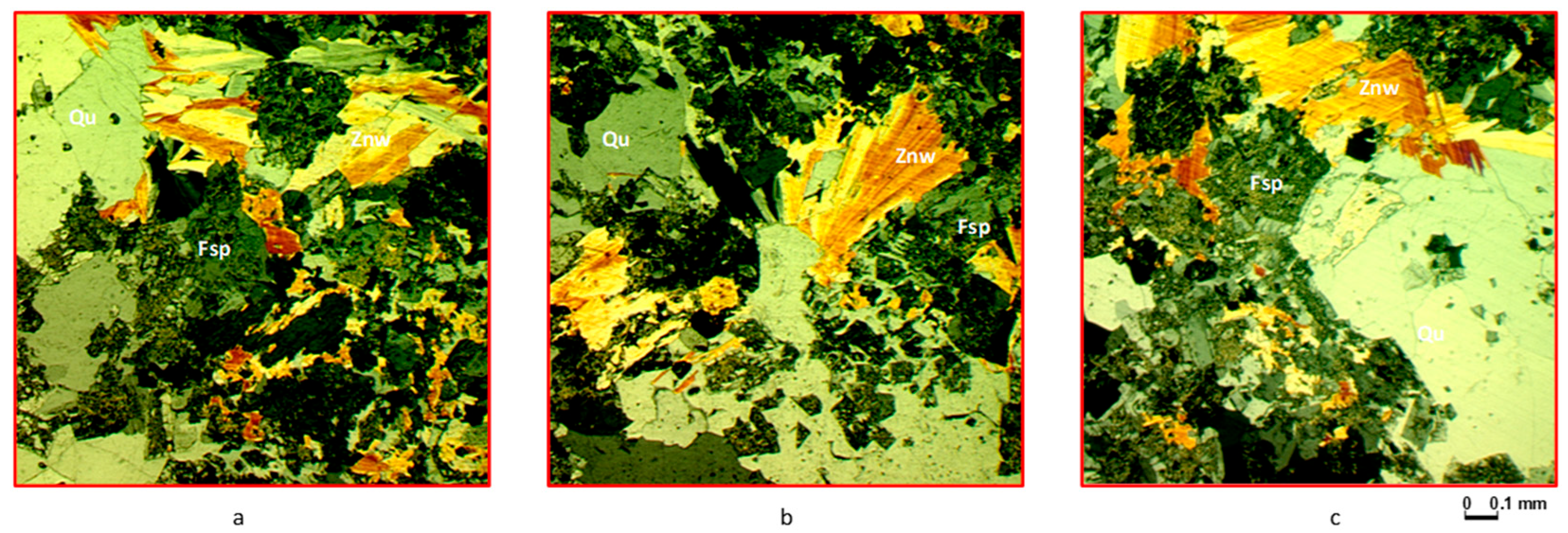
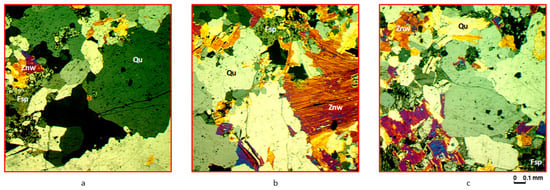
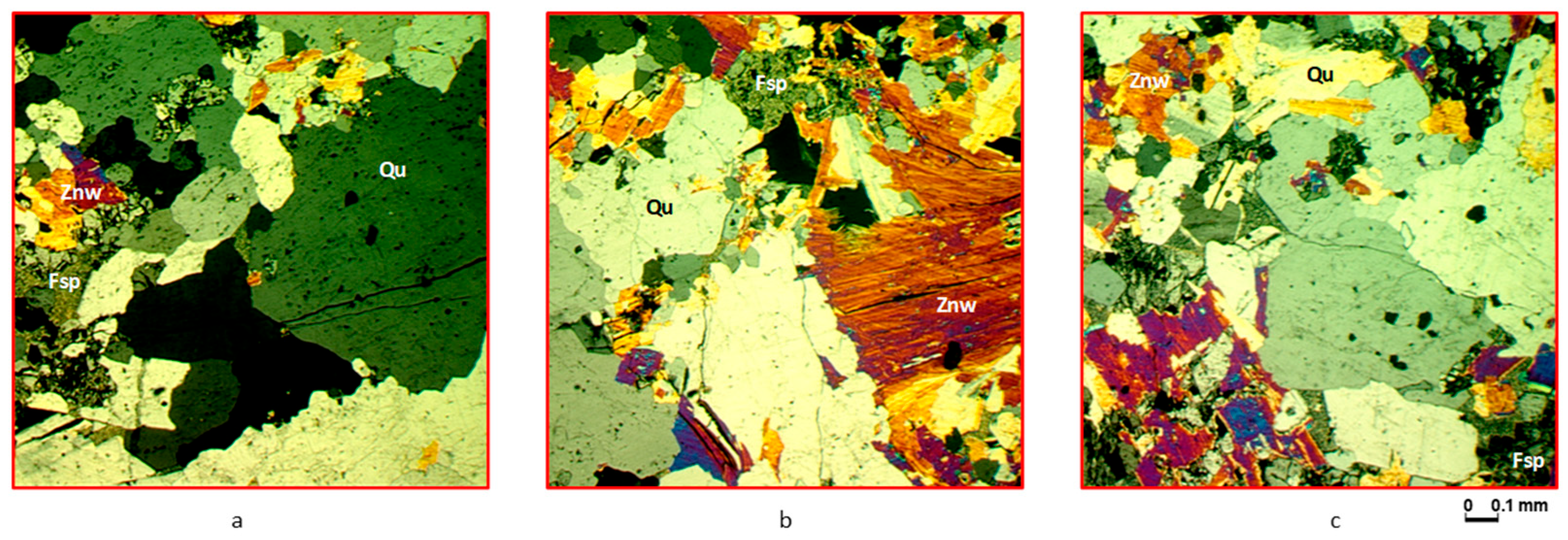
The mineralogical composition of GCW-1 was dominated by quartz and feldspar, followed by a smaller proportion of mica, which was interpreted as lithium-bearing mica (zinnwaldite). The volumetric proportion of mica was determined to be approximately 10%. Feldspar showed advanced alteration, being partially replaced by clay minerals and carbonates (Figure 4). These alterations were considered to be a contributing factor to the overall reduced strength of the rock. “Non-differentiated (NDP)” (not analyzed by QMA) phases, such as topaz, fluorite, clay minerals, and carbonates, were also present in amounts up to 11%.
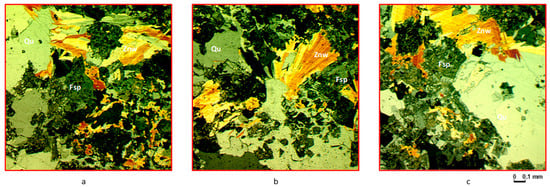
Figure 4.
Selected digitized images of greisenized granite from Cínovec (Czech Republic); 16-x magnified, crossed polars. Thin sections (a–c): (GCW-1a-c).
In terms of texture, the rock exhibited a disseminated crystalline fabric with a median grain size (d50,3) of approximately 3.44 mm (Table 1). The median grain sizes of the main minerals varied notably: quartz grains reached about 2.3 mm, feldspar grains were ca. 4.7 mm, and mica grains were approximately 1.3 mm. The grain size distribution of quartz and mica (zinnwaldite) is relatively moderate, with a logarithmic standard deviation (σln) of about 0.5, indicating relatively moderate variation in grain dimensions. In contrast, feldspar exhibited a broader size distribution, reflecting significant heterogeneity in grain sizes within these phases.
Table 1.
Rock characteristics. Greisenized granite from Cínovec (Czech Republic). Samples GCW-1a-c.
The shape of the mineral grains is described by their habit and expressed through elongation (E) and flatness (F) ratios. Feldspar grains show a distinct platy habit (E = 1.11, F = 1.33), while mica displays a mixed platy-needle morphology (E = 1.24, F = 1.31), reflecting the layered nature of phyllosilicates. Quartz appears nearly equant and slightly elongated (E = 1.25, F = 1.10). These shape parameters with elongated and platy grains are more likely to fracture along specific structural directions, which may influence breakage patterns during comminution.
A notable result of the stereological analysis was the high degree of mineral roughness within the sample. The overall roughness value (KR) was approximately 60%, with mica reaching as high as 71%. This indicated a strong interlocking between mica and other mineral phases, particularly quartz and feldspar. This tight bonding makes it harder to separate mica along phase boundaries during crushing or grinding. In addition, the specific surface area (SV) of the mineral phases was calculated to be around 6.7 mm2/mm3. Mica exhibited the highest specific surface among all phases, with a value of approximately 13 mm2/mm3, further underscoring its complex geometry and relevance for liberation efficiency. During grinding, once mica is partially liberated, its thin shape causes it to break further (overgrinding) and faster than more compact minerals.
Structurally, the rock structure was predominantly isotropic, with 88% of the mineral boundaries showing random orientation (Kis) and only 1% of the mineral boundaries exhibiting linear orientation (Klin). This suggests a non-preferential internal grain arrangement, which could lead to unpredictable fracture behavior under mechanical stress. Furthermore, the clustering degree of quartz and feldspar is relatively low (both 21%), indicating that these grains are generally disseminated and not in direct contact with many grains of the same type. Mica shows the lowest clustering value (16%), meaning it is even more isolated in the rock. This dispersed distribution is beneficial for comminution, as it allows individual grains to break away more easily and may improve mineral liberation.
Greisen, GCG-1 (Zinnwaldite Ore)
The GCG-1 sample primarily consisted of quartz and mica (zinnwaldite), with a significantly reduced amount of feldspar compared to the greisenized granite (GCW-1). The zinnwaldite content was determined to be approximately 16%, and feldspar was reduced to 4%, indicating an increase in mica content as a result of progressive greisenization (Figure 5). Feldspar, in contrast, appeared in minor and less altered forms. Non-differentiated accessory minerals such as topaz, fluorite, carbonates, and clay minerals were present in minor quantities, not exceeding 10% of the total volume. The higher quartz content in GCG-1 contributed to the overall strength and resistance of the rock.
Figure 5.
Selected digitized images of greisen from Cínovec (Czech Republic); 16-x magnified, crossed polars. Thin sections: 3196, 3197, 3198 (a–c) (GCG-1a-c).
Texturally, GCG-1 exhibited a coarsely crystalline structure with a median grain size (d50,3) of approximately 2.23 mm, which was slightly finer than the grain size observed in the greisenized granite (Table 2). Quartz grains maintained porphyroblastic dimensions of around 2.6 mm, while feldspar grains were significantly finer, measuring approximately 1.0 mm. The grain size of zinnwaldite (mica) was approximately 0.7 mm, indicating a significant reduction in grain size compared to GCW-1. Compared to GCW-1, mica in GCG-1 showed a notable reduction in grain size. In terms of grain size distribution, quartz exhibited a relatively broad distribution, with a σln of 0.640. Mica showed moderate variability σln = 0.574, while feldspar, with a σln of 0.348, displayed the most uniform grain size among the primary phases. These textural characteristics suggest that GCG-1 underwent more advanced alteration and mineral replacement processes, typical features of progressive greisenization. The finer and more uniform mica in GCG-1 may enhance liberation but could also increase the risk of overgrinding.
Table 2.
Rock characteristics. Greisen from Cínovec (Czech Republic). Samples GCG-1a-c.
The habit of the mineral grains, approximated by ellipsoidal models, reflected the geometric diversity of the constituent phases. Quartz grains in GCG-1 show a slightly elongated form (E = 1.34, F = 1.06), implying strong, compact grains that are more resistant to fracture. Feldspar, due to its limited presence, did not exhibit a dominant geometric trend, while zinnwaldite, with its distinctly elongated geometry (E = 1.63, F = 1.00), is prone to preferential breakage along its length due to its sheet-like crystal structure, potentially leading to thin flakes or fines and overgrinding risk.
The degree of roughness (KR) between mineral grains is lower in GCG-1 than in the greisenized granite. Overall, the roughness reached approximately 45%, and for mica grains in particular, the value is lower than the 71% recorded in GCW-1. This reduction in interlocking among grains, particularly between mica and quartz, indicated potentially easier liberation of zinnwaldite during mechanical fragmentation. The specific surface area (SV) of the mineral particles was measured at approximately 6.2 mm2/mm3, slightly lower than that of GCW-1. Among all mineral phases, mica again exhibited the highest specific surface area at approximately 11 mm2/mm3, which remained an important parameter for its behavior during comminution.
Structurally, GCG-1 displayed predominantly isotropic mineral orientation, like GCW-1. Approximately 86% of the mineral boundaries exhibited isotropic orientation (Kis), while about 9% showed linear orientation (Klin). The increased proportion of linearly oriented structures compared to GCW-1 (1%) indicated some degree of preferential alignment, although the rock remained largely random in texture.
A significant feature of GCG-1 was the high degree of cluster formation, particularly among quartz grains. Approximately 62% of quartz grains in the sample formed clusters, meaning they shared boundary surfaces with grains of the same mineral phase. This contrasted sharply with GCW-1, where only 21% of quartz grains exhibited clustering. The high clustering coefficient in GCG-1 suggested stronger mutual bonding and interlocking among quartz grains, which contributed to the higher mechanical integrity and higher comminution energy.
3.1.2. The Villasrubias Lithium Deposit
Lepidolite-bearing aplite, LSA-1 (Lepidolite Ore)
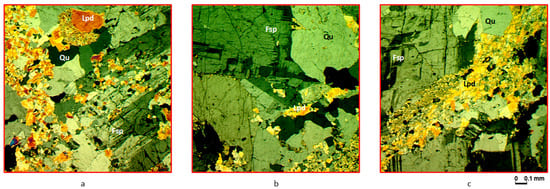
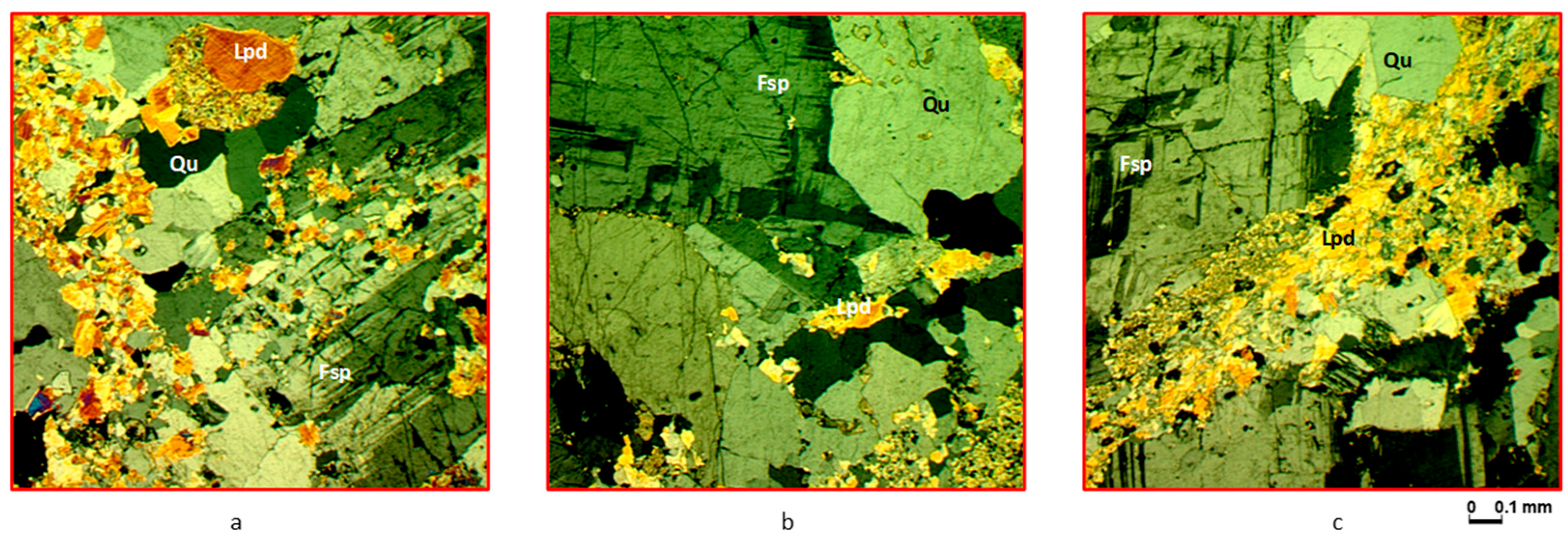
The LSA-1 sample, interpreted as a lepidolite-bearing aplite, is composed primarily of quartz (45%), followed by feldspar (31%) and mica (20%), with a minor portion (4%) consisting of non-differentiated phases such as topaz and fluorite (Figure 6).
Figure 6.
Selected digitized optical microscopy images of lepidolite-bearing aplite from the Villasrubias deposit (Spain). 16-x magnified, crossed polars (a–c). Samples LSA-1a-c.
The phase distribution reflects a moderately heterogeneous mineralogical fabric, with quartz as the dominant component and feldspar and mica in subordinate but significant proportions.
LSA-1 exhibits a fine-grained structure, with an overall median particle diameter (d50.3) of 0.32 mm (Table 3). Among the major phases, feldspar has the largest grain size (0.50 mm), followed by quartz (0.29 mm), while mica (lepidolite) is the finest-grained phase, averaging only 0.10 mm. This large grain size contrast suggests that mica occurs as fine inclusions or small interstitial flakes within the coarser quartz and feldspar matrix. The particle size distribution, expressed by logarithmic standard deviation (σ), also highlights textural variability. Mica has the narrowest distribution (σ = 0.30), indicating a relatively uniform grain size. Quartz shows a broader spread (σ = 0.41), and feldspar displays the widest distribution (σ = 0.45), reflecting the greatest internal heterogeneity among the three phases.
Table 3.
Rock characteristics. Lepidolite-bearing aplite from Villasrubias (Spanien). Samples LSA-1a-c.
Grain shape analysis of the LSA-1 indicates that quartz shows a needle-like structure (E = 4.01, F = 1.68) and Feldspar also displays an elongated habit (E = 2.42, F = 1.24), though to a lesser extent. The needle-like and platy habit of quartz observed in LSA-1 is quite unusual for quartz; this morphology likely developed through post-magmatic processes such as hydrothermal alteration. Mica shows a more needle-shaped, slightly equant geometry, with an elongation of 1.51 and flatness of 1.05. The overall elongation value of 2.98 for the bulk sample indicates a general tendency toward elongated grain shapes.
The specific surface area of the particles varied significantly across the phases. Mica (lepidolite) exhibited the highest specific surface area at 27.29 mm2/mm3, followed by quartz (19.95 mm2/mm3) and feldspar (9.02 mm2/mm3). The overall specific surface area of the rock was estimated at 17.91 mm2/mm3. The high surface area of mica underscored its high liberation potential but also an increased risk of overgrinding during comminution [25,26,27]. The degree of roughness reflected how tightly mineral phases were bonded. Quartz showed a relatively high degree of roughness at 44%, feldspar at 24%, and mica (lepidolite) at 10%, resulting in an average degree of roughness of 30%. The low roughness degree of mica suggests it is weakly bonded to adjacent minerals, making it more favorable for mechanical separation with less energy input.
Structurally, the LSA-1 sample exhibits a quite moderate anisotropic orientation, with a total degree of isotropic orientation of 31%, with strong linear orientation in quartz (Klin = 50%) and feldspar (46%). Mica shows a lower linear alignment (28%) and high isotropy (Kis = 69%), indicating a more random distribution. The areal orientation (Kfl) is moderate for quartz at 29% but low for feldspar at 12% and mica (3%), confirming that mica grains are not directionally aligned. These patterns suggest that fracture propagation may be partially guided by mineral alignment in quartz and feldspar, whereas mica likely fractures independently of fabric orientation.
Clustering analysis reveals that quartz has the highest aggregation tendency (C = 45%), forming phase-bound domains that may resist early disintegration. Feldspar and mica show lower clustering values (20% and 18%, respectively), with mica being the most spatially dispersed. This dispersed distribution supports easier mechanical liberation of mica and means it is less locked in with other minerals, although it may also make it more vulnerable to overgrinding, which could also be of interest for selective comminution.
Lepidolite-feldspar pegmatite, LSR-1 (Lepidolite Ore)
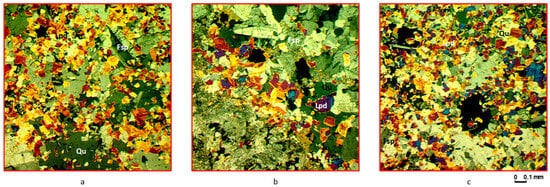
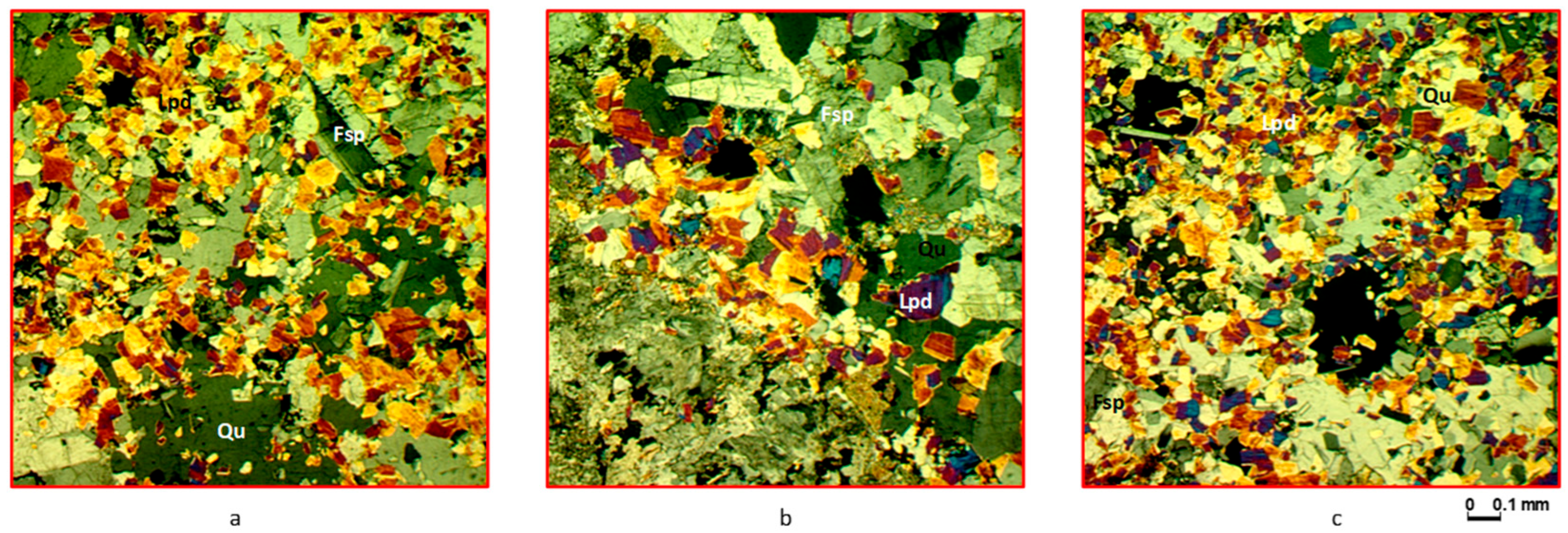
The modal composition of the sample and its mineralogical composition, considering the geological position, is consistent with layered lepidolite-feldspar pegmatite (apical parts of pegmatite veins). Modal analysis reveals a dominance of quartz (38%) and lithium-rich mica, likely lepidolite (34%), accompanied by subordinate feldspar (15%) and accessory phases such as topaz and fluorite within the undifferentiated mineral portion (13%). The textural analysis shows a fine- to medium-grained structure, with median grain sizes of 0.26 mm for quartz, 0.27 mm for feldspar, and 0.22 mm for mica, indicating a non-pegmatitic character (Table 4). The reduced feldspar content and enrichment in lithium mica and accessory minerals reflect intense hydrothermal alteration (Figure 7).
Table 4.
Rock characteristics. Feldspar-lepidolite pegmatite from Villasrubias deposit. Thin section (LSR-1a-c).
Figure 7.
Selected digitized optical microscopy images of lepidolite-feldspar pegmatite from the Villasrubias (Spain). 16-x magnified, crossed polars (a–c). Samples LSR-1a-c.
The overall average grain shape (E = 1.30, F = 1.10) reflects a near-equant grain distribution with no extreme geometries. Mica (lepidolite) shows the highest elongation (E = 1.35) but a flatness of 1.00, suggesting a slightly elongated but compact form. Quartz and feldspar are similarly shaped, with elongation values of 1.28 and 1.21 and flatness values of 1.18 and 1.14, respectively. These moderate shape parameters imply that particle breakage during comminution is expected to be relatively uniform, though mica remains more susceptible to early fragmentation due to its structural cleavage.
The specific surface area (SV) of LSR-1 varies notably among mineral phases. Mica (lepidolite) displays the highest SV at 24.63 mm2/mm3, followed by quartz (18.73 mm2/mm3) and feldspar (16.49 mm2/mm3). The overall SV of the sample is 20.68 mm2/mm3, indicating a high degree of surface interlocking. The elevated SV of mica reflects its fine, platy morphology and suggests a high potential for liberation during grinding but also highlights its susceptibility to overgrinding due to increased exposure and structural weakness. The degree of roughness (KR) further supports these observations. Quartz shows the highest interlocking at 31%, while feldspar and mica exhibit lower roughness values of 16% and 14%, respectively. The overall roughness degree is 22%, indicating moderate interparticle bonding. The relatively low roughness of mica suggests it is weakly interlocked in the matrix, offering favorable conditions for its selective liberation during mechanical fragmentation.
The clustering coefficient (C) in LSR-1 indicates that quartz grains have the highest tendency to form aggregates (27%), followed by mica (23%) and feldspar (17%), with an overall clustering degree of 24%. These values reflect a moderate level of mineral clustering, where individual phases are partially associated but not extensively interlocked. Structurally, the rock shows a highly isotropic orientation structure (Kis = 80%), with low values for linear and areal orientation across all phases. This combination of moderate clustering and isotropic alignment suggests a texture favorable for disintegration during comminution, where grains are more likely to separate independently rather than breaking through strongly bonded aggregates.
QMA confirms that all samples represent quartz-dominant granitoid lithologies, with variable mica contents. The Cínovec samples (GCW-1 and GCG-1) show a coarser-grained texture of mica (0.75–1.3 mm) compared to the Villasrubias samples (LSA-1 and LSR-1), which are significantly finer grained (~0.25 mm).
The degree of roughness (KR) of mica was higher in GCW-1 (71%) than in GCG-1 (50%). These tightly intergrown textures of GCW and GCG require higher breakage energy, careful control of grinding conditions, and may limit early-stage liberation. In contrast, lepidolite in the Villasrubias samples exhibits a much lower roughness (10–14%), suggesting weaker bonding to adjacent phases and easier detachment during mechanical comminution.
Although lepidolite-bearing ores show lower interlocking/degree of roughness, their finer grain size may also present higher comminution resistance. This is attributed to their compact and cohesive mineral textures, which enhance the mechanical integrity of the rock and hinder effective liberation of lithium mica during grinding. Structurally, both zinnwaldite and lepidolite samples exhibit a high degree of isotropy (Kis = 80–88), except in samples of lepidolite with low mica content. This predominantly random internal grain orientation supports more uniform stress distribution during breakage, potentially leading to more predictable fracture behavior under mechanical loading.
3.2. Chemical Analyses
As can be seen from Table 5, the division of rocks by ore-mineral content is obviously comparable with the lithium content. Thus, the minimum lithium content characterizes zinnwaldite-poor ores (1518.0 ppm), and the maximum lithium content is in lepidolite-rich ores (4462.8 ppm).
Table 5.
Lithium content in the studied rocks according to ICP-OES results.
Thus, it can be said that the studied zinnwaldite and lepidolite ores (GCG-1 and LSR-1 samples) correspond to the minimum lithium content prospects of the European Commission for rare and strategic metals [40].
3.3. Determination of Point Load Strength Index of Rocks
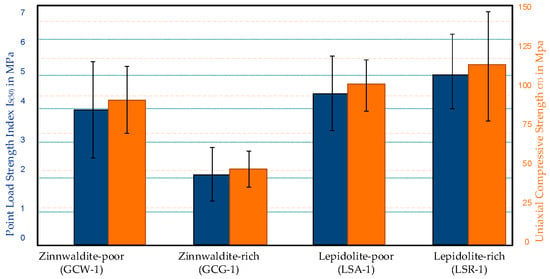
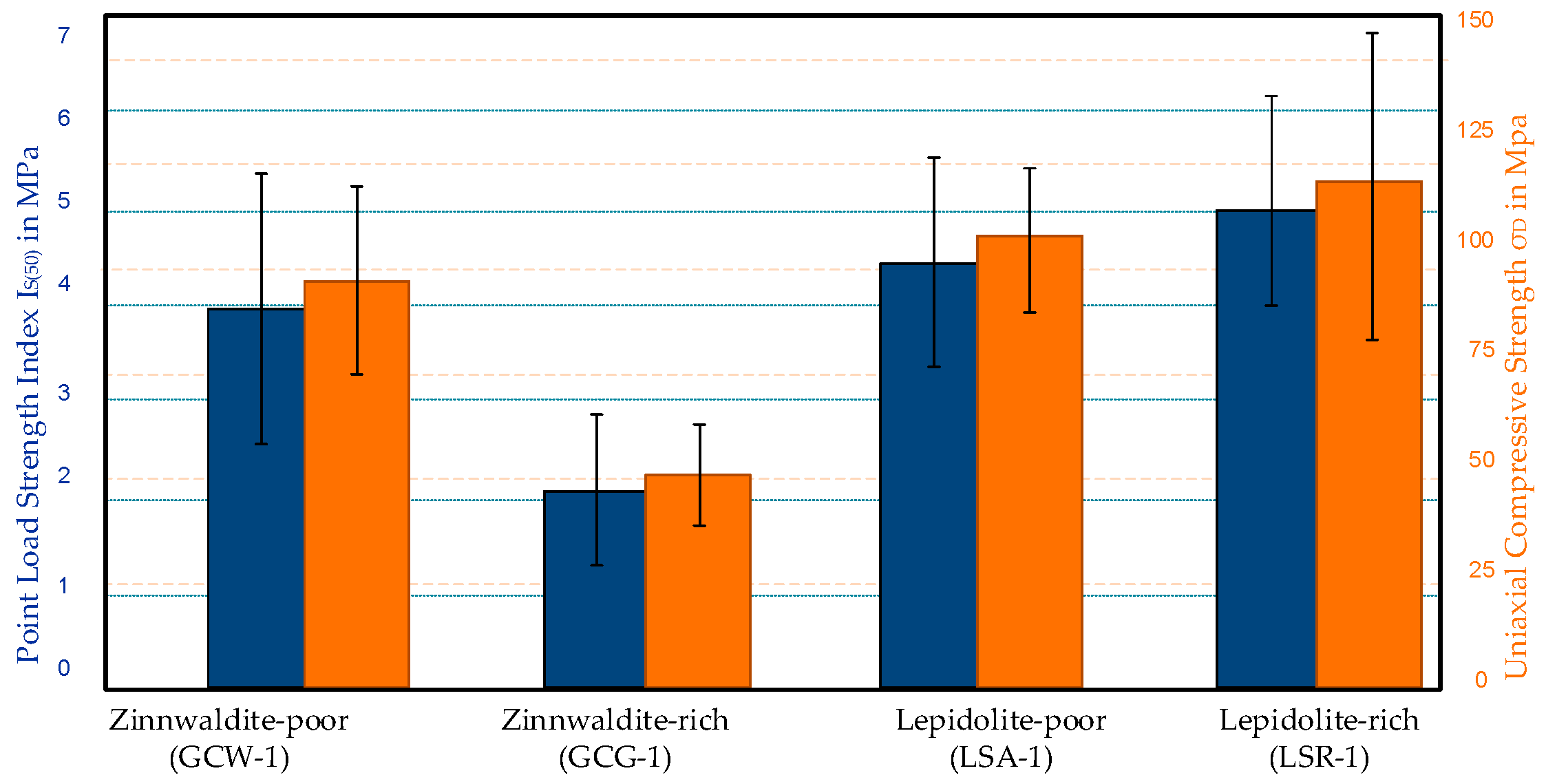
The zinnwaldite-rich greisen (GCG-1) exhibited the lowest strength, with an average PLT Strength Index IS(50) of about 2 MPa and a uniaxial compressive strength (UCS) value of 53.8 MPa (Table 6, Figure 8). The zinnwaldite-poor (GCW-1) samples followed with IS(50) values of 4.10 MPa and UCS values of 102.5 MPa, respectively (Figure 8, Table 6). According to the International Society for Rock Mechanics and Rock Engineering (ISRM) classification [41], GCG falls within the “moderate strength” range, while the GCW-1 sample is classified as “high strength” rock.
Table 6.
PLT results for zinnwaldite and lepidolite ores, with conversion factor c = 25.
Figure 8.
Point load test and uniaxial compressive strength results for zinnwaldite and lepidolite ores.
In contrast, both lepidolite ores showed consistently higher mechanical strength. The lepidolite-rich pegmatite (LSR-1 sample) recorded the highest UCS at 128.2 MPa, with an IS(50) of 5.13 MPa, followed closely by lepidolite-poor ore (LSA-1 sample), which showed UCS values of 114.7 MPa and IS(50) values of 4.59 MPa, respectively. The low variation (16.1%) in lepidolite-rich ore reflects a more homogeneous structure, suggesting consistent grain bonding. Both rocks are all classified as “high strength” by ISRM and “very strong” by the Geological Society classification [41].
The zinnwaldite-rich greisen (GCG-1 sample) showed a significantly lower Point Load Strength Index compared to the zinnwaldite-poor greisenized granite (GCW-1 sample), even though the quartz content in the GCG sample is nearly twice as high (Table 1 and Table 2). This counterintuitive result can be attributed to differences in microstructural features, particularly surface roughness and textural bonding, as identified through QMA analysis. The overall degree of roughness in the zinnwaldite-rich ore was measured at approximately 45%, whereas the zinnwaldite-poor sample exhibited a higher roughness value of around 60%, indicating stronger interlocking between mineral phases. The low strength of zinnwaldite-rich greisen indicates that it is more susceptible to early breakage under mechanical stress.
Specifically, quartz crystals in the zinnwaldite-poor ore displayed a roughness of up to 63%, compared to 45% in the zinnwaldite-rich sample. As shown in Figure 9, the zinnwaldite-poor sample is characterized by abundant microcrystalline quartz, which likely formed through recrystallization during greisenization or hydrothermal alteration. This recrystallization enhanced the bonding between microcrystalline quartz and surrounding minerals, contributing to greater internal cohesion and mechanical strength. In contrast, the GCG sample is dominated by larger quartz crystals embedded in a relatively less altered matrix, resulting in reduced intergrowth and lower textural resistance to fracturing under point loading (Figure 9a).
Figure 9.
(a) Zinnwaldite-rich (GCG-1) sample shows larger quartz crystal and less altered matrix. (b) Zinnwaldite-poor (GCW) sample shows microcrystalline quartz as predominant mineral in the altered matrix. Thin section images with 16x-magnification, crossed polars.
The comparative results indicate that zinnwaldite ores, particularly zinnwaldite-rich greisens, are mechanically weaker and more susceptible to breakage, making them more favorable for coarse mineral liberation during comminution compared to lepidolite ores. However, their high quartz content also contributes to higher abrasivity [42,43], which can lead to increased equipment wear. In contrast, lepidolite ores are more competent, requiring higher comminution energy to achieve sufficient size reduction and liberation [44]. This increased resistance poses a higher risk of overgrinding, particularly given their finer grain size and more cohesive mineral textures, as observed in prior QMA analysis.
3.4. Determination of Vickers Microhardness of Minerals
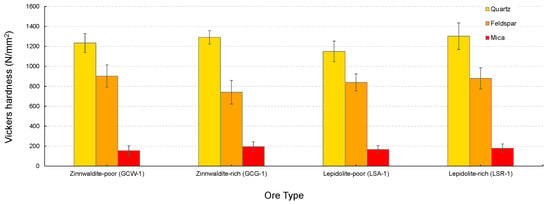
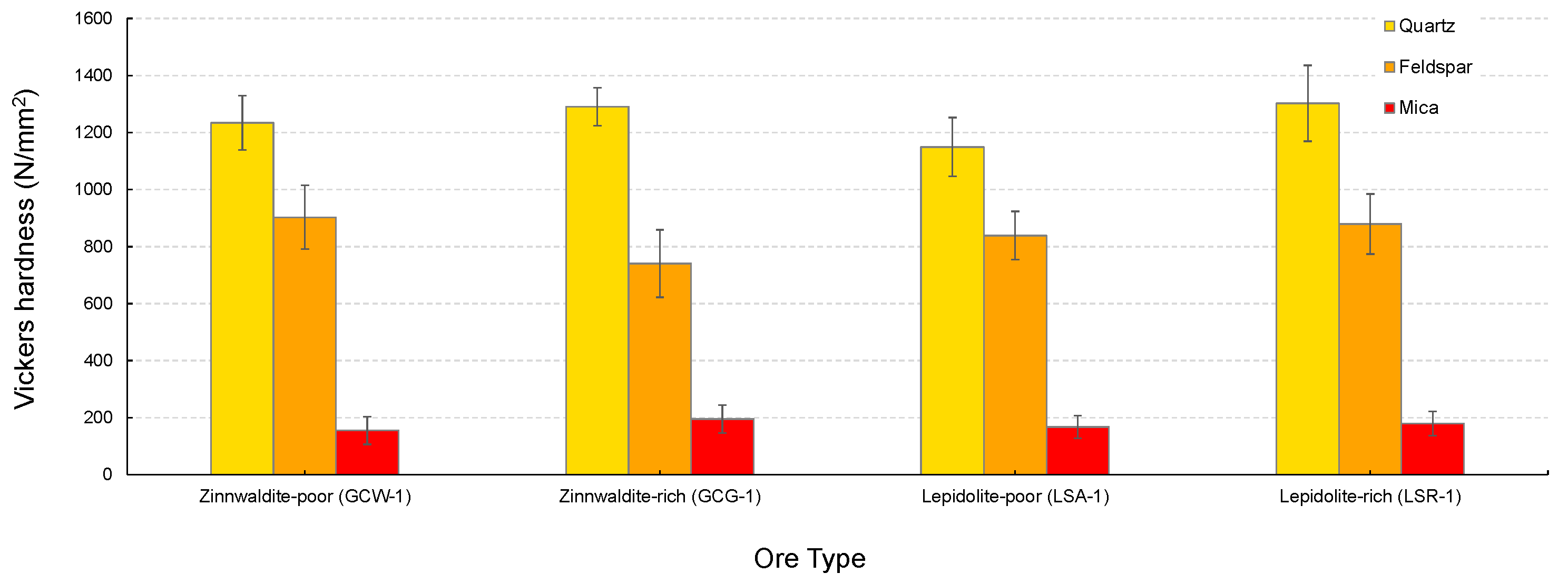
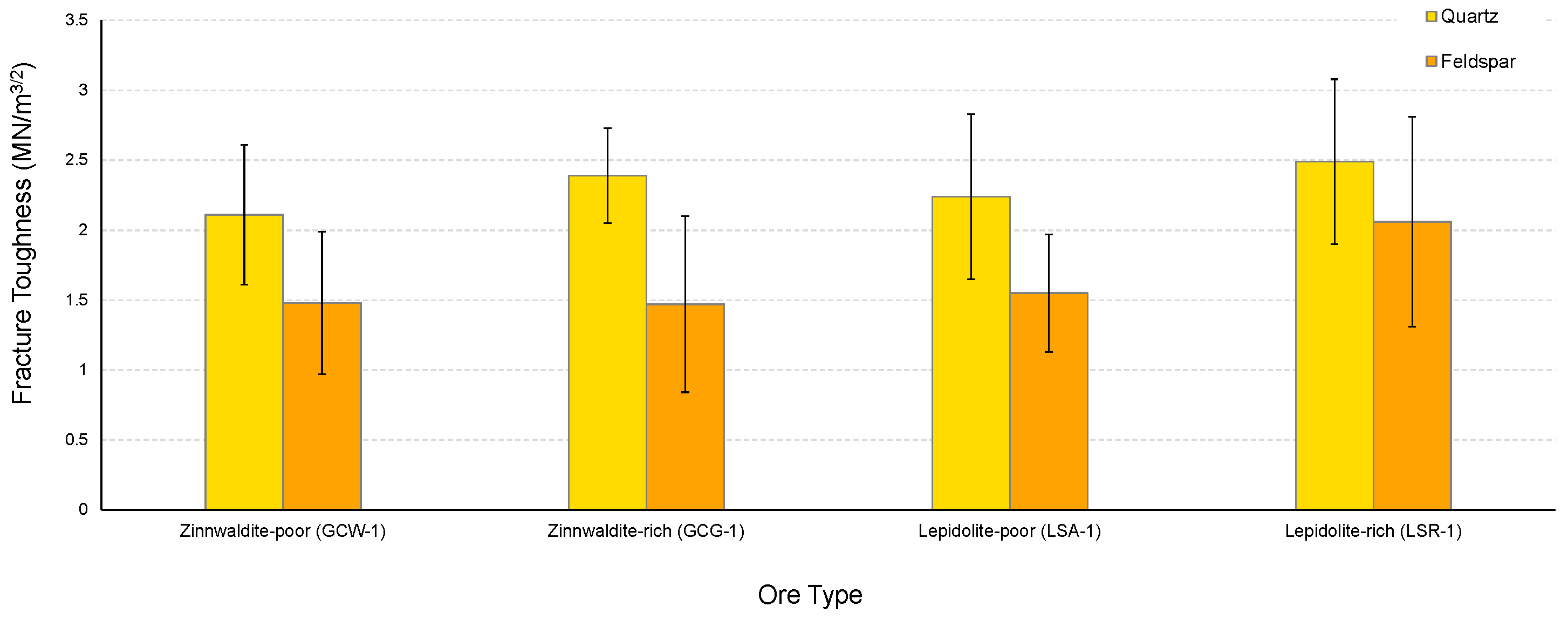
In the Vickers microhardness tests, mica consistently shows the lowest hardness (154–195 N/mm2), compared to quartz and feldspar, which present significantly higher values. Quartz shows the highest Vickers hardness (1234–1302 N/mm2) and fracture toughness (2.11–2.49 MN·m−3/2), indicating strong resistance to deformation and crack propagation [45,46] and causing the high abrasivity of the material [42,43] (Table 7, Figure 10 and Figure 11).
Table 7.
Vickers microhardness and fracture toughness for zinnwaldite and lepidolite ores.
Figure 10.
Vickers hardness of minerals across different types of lithium ores.
Figure 11.
Fracture toughness of mineral across different types of lithium ores.
Feldspar, while slightly softer (740–903 N/mm2) and less tough (1.47–2.06 MN·m−3/2), still exhibits high values relative to mica, which corresponds with reference data [47,48].
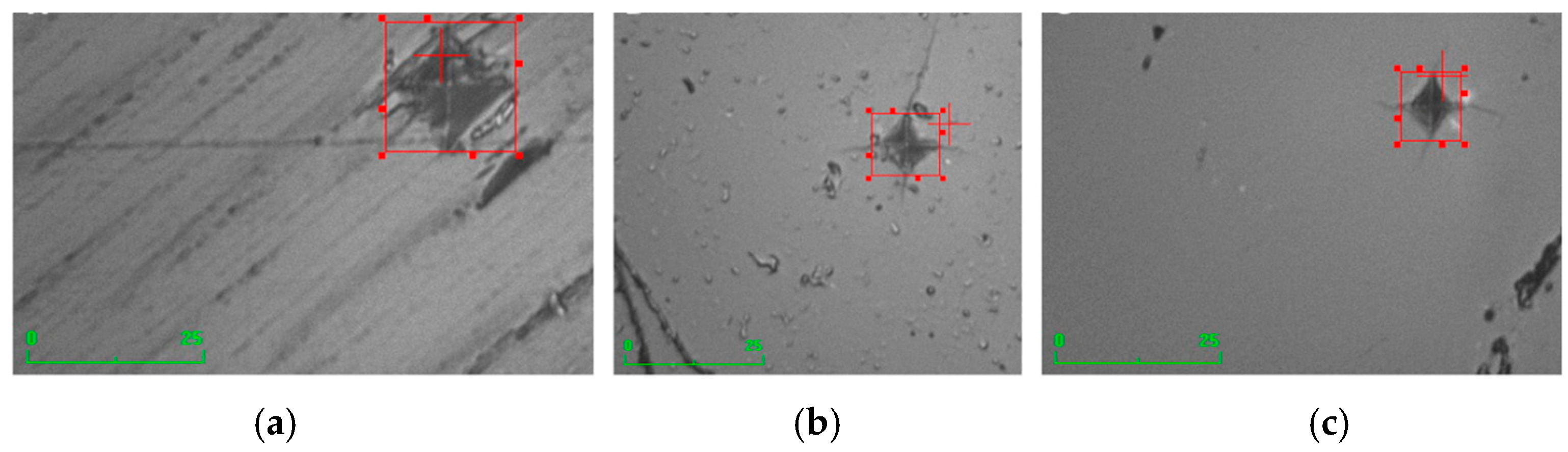
Mica is a soft and flexible mineral with perfect cleavage, meaning it easily splits along certain planes. Because of its crystal structure, mica can deform plastically, changing shape without forming cracks (see Figure 12a). During testing, it was not possible to apply enough force to create measurable cracks without completely breaking the grain. As a result, its fracture toughness could not be determined.
Figure 12.
Vickers Hardness microindentation investigation. (a) Mica showed perfect cleavage. (b) Primary radial crack on quartz. (c) Primary radial crack on feldspar.
These findings indicate that both lithium-bearing ores show a pronounced mechanical contrast between the lithium micas and their associated gangue minerals [49]. A similar observation was made by [50]. It was noted that minerals with significantly lower hardness are often indicative of favorable conditions for selective mineral liberation. In the case of zinnwaldite, its relatively high grain boundary roughness, based on QMA, suggests that breakage can be more likely to occur preferentially across the mineral rather than along the grain boundaries. Conversely, for lepidolite, the relatively low roughness contrast between lepidolite and its surrounding gangue minerals, as identified through QMA, may facilitate grain boundary breakage and thus promote more efficient mineral liberation.
This noticeable difference establishes mica as the mechanically weakest phase in the mineralogical assemblage, making it highly susceptible to preferential fragmentation under moderate energy input. Such characteristics are advantageous for selective comminution strategies, where energy can be optimized to preferentially fracture the softer lithium-bearing phases while minimizing breakage of the harder gangue components.
4. Discussion
The present study integrates quantitative microstructural analysis (QMA), chemical characterization, and mechanical testing to analyze the comminution behavior of European lithium-bearing hard-rock ores. By comparing zinnwaldite-bearing ores from Cínovec and lepidolite-bearing ores from Villasrubias, a clear link emerges between mineralogical fabric, mechanical competence, and selective breakage potential.
The QMA results demonstrate that textural parameters, particularly grain size, roughness (KR), clustering (C), and specific surface area (SV), play a decisive role in controlling mechanical strength and breakage response.
The zinnwaldite-rich greisen (GCG-1) exhibits lower roughness and higher quartz clustering compared to the zinnwaldite-poor greisenized granite. Despite its higher quartz content (70%), GCG-1 shows the lowest compressive strength. This result highlights that bulk strength is not solely controlled by modal mineral content but rather by the quality of grain boundary interlocking and microstructural bonding. In GCW-1, microcrystalline quartz recrystallization appears to enhance internal cohesion, resulting in significantly higher UCS values.
In contrast, the lepidolite-bearing ores from Villasrubias (LSA-1 and LSR-1) are markedly finer-grained and exhibit lower mica roughness. Although the lower interlocking of mica suggests easier detachment along grain boundaries, both lepidolite ores display high compressive strength. This indicates that fine-grained, compact fabrics enhance bulk mechanical competence, increasing resistance to initial breakage. Thus, two different strength-controlling mechanisms can be distinguished in Cínovec ores, where strength is primarily governed by intergranular bonding and recrystallized quartz networks, and in Villasrubias ores, where strength is controlled by fine grain size and compact, cohesive textures.
These findings confirm that microstructural descriptors obtained by QMA can provide a more reliable predictor of comminution behavior than modal composition alone.
A pronounced mechanical contrast exists between lithium-bearing micas and their associated gangue minerals. Vickers microhardness results show quartz and feldspar to be significantly harder and tougher than mica. This mechanical contrast is favorable for selective comminution strategies. However, the liberation mechanism differs between the two ore types:
Zinnwaldite ores (Cínovec):
Coarser mica grains (0.7–1.3 mm) combined with high roughness (up to 71%) suggest that breakage may occur transgranularly through mica rather than cleanly along grain boundaries. Although zinnwaldite-rich greisen is mechanically weaker overall, strong quartz intergrowth and high abrasivity may increase energy consumption and equipment wear during grinding, which should be the target of future research.
Lepidolite ores (Villasrubias):
Finer mica grains (0.1–0.2 mm) and low roughness (10–14%) favor intergranular breakage and grain-boundary liberation. However, their high compressive strength and compact structure require higher energy input to initiate fracture. Once breakage begins, the low mica hardness may increase the risk of overgrinding and excessive fines generation.
Consequently, according to investigations conducted, process design must be deposit-specific: Zinnwaldite ores may benefit from controlled coarse comminution stages to exploit their lower UCS while minimizing quartz overgrinding. Lepidolite ores may require staged or energy-efficient fine grinding approaches to achieve liberation without excessive mica degradation.
5. Conclusions
This study examined the breakage behavior and beneficiation potential of lithium-bearing mica ores through an integrated mineralogical and mechanical approach, motivated by Europe’s strategic need to strengthen domestic lithium supply chains. The results demonstrate that significant variations in grain size, mica distribution, interlocking, and surface roughness may strongly influence the mechanical response of the ores and their comminution behavior.
The study reveals an important theoretical trade-off between mechanical strength and interlocking: Zinnwaldite-rich greisen is weaker and therefore can be easier to fragment, but its higher quartz content and interlocking can increase abrasivity and potential wear, which could be the target of future studies within the current project. Lepidolite ores are mechanically stronger and more energy-intensive to crush, yet their lower mica roughness may enable more efficient liberation once the appropriate particle size is reached.
The findings, therefore, emphasize that selective comminution should not rely solely on mineral hardness contrasts but must incorporate microstructural parameters such as clustering, grain size distribution, and orientation. Otherwise, further study is needed to understand mineral liberation during grinding and the structural effect on the downstream processing to extract lithium from the samples, including studies of abrasiveness and material wear, evaluation of the energy efficiency of the milling process, and the yield of the useful component.
Author Contributions
Conceptualization, A.D. and M.M.; methodology, A.D.; software, E.K.F.; validation, A.D., P.E. and M.M.; formal analysis, E.K.F.; investigation, E.K.F. and A.D.; resources, M.M.; data curation, A.D. and E.K.F.; writing—original draft preparation, A.D. and E.K.F.; writing—review and editing, P.E. and M.M.; visualization, A.D.; supervision, H.L.; project administration, M.M.; funding acquisition, H.L. All authors have read and agreed to the published version of the manuscript.
Funding
This paper has been developed under the framework of the Li4Life project (Grant Agreement n° 101137932), and all results can be found on its official website [51] and social channels [52]. Views and opinions expressed are, however, those of the author(s) only and do not necessarily reflect those of the European Union or the European Climate, Infrastructure and Environment Executive Agency (CINEA). Neither the European Union nor CINEA can be held responsible for them.

Data Availability Statement
Data are contained within the article.
Acknowledgments
We thank our Czech colleagues ( Jan Cempírek; Vojtech Wertich, Martin Kubes) for the joint sampling in the area of Cínovec under the guidance of Geomet s.r.o Lithium, as well as Spain colleagues (Jorge Gil, TME Technology Metals Europe, S.L.) for the sampling in the Villasrubias area. We thank Oleg Popov from the IART, TUBAF for discussions in the QMA analysis.
Conflicts of Interest
The authors declare no conflicts of interest.
Abbreviations
The following abbreviations are used in this manuscript:
| LiB | lithium-ion batteries |
| QMA | quantitative mineralogical analysis |
| SIZ | Central Iberian Zone |
| LCT | lithium–cesium–tantalum |
| CEG | Schist–Greywacke Complex |
| GTMZ | Galicia-Trás-Os Montes Zone |
| IART | Institute of Processing Machines and Systems Technology |
| CEEC | Coalition for Energy Efficient Comminution |
| CT | Computer Tomography |
| TUBAF | Technical University Bergacademie Freiberg |
| PLT | Point Load Test |
| HV | Vickers Hardness Number |
| NDP | Non-differentiated phases |
| UCS | Uniaxial Compressive Strength |
| ISRM | International Society for Rock Mechanics and Rock Engineering |
| CINEA | European Climate, Infrastructure and Environment Executive Agency |
References
- Azevedo, M.; Baczynska, M.; Hoffman, K.; Krauze, A. Lithium Mining: How New Production Technologies Could Fuel the Global EV Revolution; McKinsey & Company: New York, NY, USA, 2022. [Google Scholar]
- Sakunai, T.; Ito, L.; Tokai, A. Environmental impact assessment on production and material supply stages of lithium-ion batteries with increasing demands for electric vehicles. J. Mater. Cycles Waste Manag. 2021, 23, 470–479. [Google Scholar] [CrossRef] [Scilit]
- The European Parliament and the Council of the European Union, Regulation (EU) 2024/1252 of the European Parliament and of the Council of 11 April 2024 Establishing a Framework for Ensuring a Secure and Sustainable Supply of Critical Raw Materials and Amending Regulations (EU) No 168/2013, (EU) 2018/858, (EU) 2018/1724 and (EU) 2019/1020Text with EEA Relevance. 2024. Available online: http://data.europa.eu/eli/reg/2024/1252/oj (accessed on 8 April 2026).
- Top, S.; Kursunoglu, S.; Altiner, M. A comprehensive review on the extraction and recovery of lithium from primary and secondary sources: Advances toward battery-grade materials. Can. J. Chem. Eng. 2026, 104, 2573–2596. [Google Scholar] [CrossRef] [Scilit]
- Gourcerol, B.; Gloaguen, E.; Melleton, J.; Tuduri, J.; Galiegue, X. Re-Assessing the European Lithium Resource Potential—A Review of Hard-Rock Resources and Metallogeny; Elsevier: Amsterdam, The Netherlands, 2019. [Google Scholar] [CrossRef] [Scilit]
- Burisch, M.; Leopardi, D.; Guilcher, M.; Šešulka, V.; Dittrich, T.; Lehmann, B. Greisen-Hosted Lithium Resources of the Erzgebirge/Krušné Hory Province (Germany and Czech Republic). Econ. Geol. 2025, 120, 627–647. [Google Scholar] [CrossRef] [Scilit]
- Roda-Robles, E.; Pesquera, A.; Gil-Crespo, P.P.; Vieira, R.; Lima, A.; Garate-Olave, I.; Martins, T.; Torres-Ruiz, J. Geology and mineralogy of Li mineralization in the Central Iberian Zone (Spain and Portugal). Mineral. Mag. 2016, 80, 103–126. [Google Scholar] [CrossRef] [Scilit]
- Barbosa, L.I.; Valente, G.; Orosco, R.P.; González, J.A. Lithium extraction from β-spodumene through chlorination with chlorine gas. Miner. Eng. 2014, 56, 29–34. [Google Scholar] [CrossRef] [Scilit]
- Morozova, L.N. Lithium Kolmozero deposit of rare metal pegmatites: New data on rare element composition (Kola Peninsula). Lithosphere 2018, 18, 82–98. [Google Scholar] [CrossRef] [Scilit]
- Rosales, G.D.; Ruiz, M.d.C.; Rodriguez, M.H. Novel process for the extraction of lithium from ß-spodumene by leaching with HF. Hydrometallurgy 2014, 147–148, 1–6. [Google Scholar] [CrossRef] [Scilit]
- Guo, H.; Kuang, G.; Wan, H.; Yang, Y.; Yu, H.; Wang, H. Enhanced acid treatment to extract lithium from lepidolite with a fluorine-based chemical method. Hydrometallurgy 2019, 183, 9–19. [Google Scholar] [CrossRef] [Scilit]
- Luong, V.T.; Kang, D.J.; An, J.W.; Dao, D.A.; Kim, M.J.; Tran, T. Iron sulphate roasting for extraction of lithium from lepidolite. Hydrometallurgy 2014, 141, 8–16. [Google Scholar] [CrossRef] [Scilit]
- Martin, G.; Schneider, A.; Voigt, W.; Bertau, M. Lithium extraction from the mineral zinnwaldite: Part II: Lithium carbonate recovery by direct carbonation of sintered zinnwaldite concentrate. Miner. Eng. 2017, 110, 75–81. [Google Scholar] [CrossRef] [Scilit]
- Schneider, A. Lithium extraction from the mineral zinnwaldite: Part I: Effect of thermal treatment on properties and structure of zinnwaldite. Miner. Eng. 2017, 111, 55–67. [Google Scholar] [CrossRef] [Scilit]
- Su, H.; Zhu, Z.; Wang, L.; Qi, T. Research progress in extraction and recovery of lithium from hard-rock ores. CIESC J. 2019, 70, 10–23. [Google Scholar]
- Rieder, M. Nomenclature of the Micas. Clays Clay Miner. 1998, 46, 586–595. [Google Scholar] [CrossRef] [Scilit]
- Brigatti, M.F.; Kile, D.E.; Poppi, M. Crystal structure and crystal chemistry of lithium-bearing muscovite-2M1. Can. Mineral. 2001, 39, 1171–1180. [Google Scholar] [CrossRef] [Scilit]
- Siame, E. Recovery of Lithium from China Clay Waste Using a Combination of Froth Flotation, Magnetic Separation, Roasting and Leaching. Ph.D. Thesis, University of Exeter, Exeter, UK, 2011. [Google Scholar]
- Chehreh Chelgani, S.; Leißner, T.; Rudolph, M.; Peuker, U.A. Study of the relationship between zinnwaldite chemical composition and magnetic susceptibility. Miner. Eng. 2015, 72, 27–30. [Google Scholar] [CrossRef] [Scilit]
- Filippov, L.O. Separation of lepidolite from hard-rock pegmatite ore via dry processing and flotation. Miner. Eng. 2022, 187, 107768. [Google Scholar] [CrossRef] [Scilit]
- Seifert, T.; Neßler, J.; Gutzmer, J. Mineral Resources in a Sustainable World Strategic Metal: Their Sources, and Ore-Forming Processes New Sn-W Potential at the Zinnwald/Cínovec Deposit, Eastern Erzgebirge, Germany. Nancy. August 2015. Available online: https://www.researchgate.net/publication/305280042 (accessed on 2 February 2026).
- Johan, Z.; Johan, V. Accessory minerals of the Cínovec (Zinnwald) granite cupola, Czech Republic: Indicators of petrogenetic evolution. Mineral. Petrol. 2005, 83, 113–150. [Google Scholar] [CrossRef] [Scilit]
- Llorens, T.; Moro, M.C. Microlite and Tantalite in The LCT Granitic Pegmatites of La Canalita, Navasfrias Sn-W District, Salamanca, Spain. Can. Mineral. 2010, 48, 375–390. [Google Scholar] [CrossRef] [Scilit]
- Guijarro, R.L. Agreement to Acquire an Interest in a Lithium Project; Greenland Mineral Ltd.: Perth, Australia, 2022. [Google Scholar]
- Lieberwirth, H.; Duriagina, A.; Klichowicz, M. Quantifying the impact of mineral microstructure on the comminution of ores and rocks—A review. Miner. Eng. 2025, 234, 109672. [Google Scholar] [CrossRef] [Scilit]
- Popov, O. Beitrag zur Mathematisch-Petrographischen Gefügecharakterisierung für die Beurteilung der Festgesteine Hinsichtlich Ihrer Aufbereitung und Ihrer Produkteigenschaften; TU Bergakademie Freiberg: Freiberg, Germany, 2007. (In German) [Google Scholar]
- Popov, O.; Lieberwirth, H.; Folgner, T. Teil 1: Anwendung der quantitativen Gefügeanalyse. AT Miner. Process. 2014, 07–08, 76–88. [Google Scholar]
- Popov, O.; Lieberwirth, H.; Folgner, T. Quantitative Charakterisierung der Festgesteine zur Prognostizierung des Gesteinseinflusses auf relevante Produkteigenschaften und Systemkenngrößen. Teil 2: Ausgewählte Beispiele. AT Miner. Process. 2014, 10, 54–63. [Google Scholar]
- Schreiber, S. Beitrag zur Quantitativen Gesteinscharakterisierung zur Beurteilung von Gesteinen Hinsichtlich Ihrer Festigkeiten; TU Bergakademie Freiberg: Freiberg, Germany, 2018. (In German) [Google Scholar]
- Hilden, M.M.; Powell, M.S. A geometrical texture model for multi-mineral liberation prediction. Miner. Eng. 2017, 111, 25–35. [Google Scholar] [CrossRef] [Scilit]
- Tavares, L.M.; das Neves, P.B. Microstructure of quarry rocks and relationships to particle breakage and crushing. Int. J. Miner. Process. 2008, 87, 28–41. [Google Scholar] [CrossRef] [Scilit]
- Klichowicz, M.; Frühwirt, T.; Lieberwirth, H. New experimental setup for the validation of DEM simulation of brittle crack propagation at grain size level. Miner. Eng. 2018, 128, 312–323. [Google Scholar] [CrossRef] [Scilit]
- Leißner, T.; Hoang, D.H.; Rudolph, M.; Heinig, T.; Bachmann, K.; Gutzmer, J.; Schubert, H.; Peuker, U.A. A mineral liberation study of grain boundary fracture based on measurements of the surface exposure after milling. Int. J. Miner. Process. 2016, 156, 3–13. [Google Scholar] [CrossRef] [Scilit]
- Popov, O.; Talovina, I.; Lieberwirth, H.; Duriagina, A. Quantitative Microstructural Analysis and X-ray Computed Tomography of Ores and Rocks—Comparison of Results. Minerals 2020, 10, 129. [Google Scholar] [CrossRef] [Scilit]
- Broch, E.; Franklin, J.A. The Point Load Test; Pergamon Press: Oxford, UK, 1972. [Google Scholar] [CrossRef] [Scilit]
- Franklin, J.A. Suggested method for determining point load strength. Int. J. Rock Mech. Min. Sci. Geomech. Abstr. 1985, 22, 51–60. [Google Scholar] [CrossRef] [Scilit]
- Brook, N. The equivalent core diameter method of size and shape correction in point load testing. Int. J. Rock Mech. Min. Sci. Geomech. Abstr. 1985, 22, 61–70. [Google Scholar] [CrossRef] [Scilit]
- Kuangdi, X. The ECPH Encyclopedia of Mining and Metallurgy; Springer Nature: Singapore, 2024. [Google Scholar] [CrossRef] [Scilit]
- Quinn, G.D.; Bradt, R.C. On the Vickers Indentation Fracture Toughness Test. J. Am. Ceram. Soc. 2007, 90, 673–680. [Google Scholar] [CrossRef] [Scilit]
- European Commission. Proposal for a Regulation of the European Parliament and of the Council Establishing a Framework for Ensuring a Secure and Sustainable Supply of Critical Raw Materials and Amending Regulations (EU) 168/2013, (EU) 2018/858, 2018/1724 and (EU) 2019/1020, COM/2023/160 Final. 2023. Available online: https://eur-lex.europa.eu/legal-content/EN/TXT/?uri=CELEX:52023PC0160 (accessed on 12 February 2026).
- ISRM. Commission on the Classification of Rocks and Rock Masses. Basic geotechnical description of rock masses. Int. J. Rock Mech. Min. Sci. Geomech. Abstr. 1981, 18, 85–110. [Google Scholar]
- Büchi, E.; Mathier, J.-F.; Wyss, C. Gesteinsabrasivität—Ein bedeutender Kostenfaktor beim mechanischen Abbau von Fest- und Lockergestein. Tunnel 1995, 5, 38–44. (In German) [Google Scholar]
- Thuro, K.; Singer, J.; Kaesling, H.; Bauer, M. Determining Abrasivity with the LCPC Test, Rock Mechanics: Meeting Society’s Challenges and Demands; Taylor & Francis: Oxford, UK, 2007; pp. 827–834. [Google Scholar] [CrossRef] [Scilit]
- Geological Society Group Working Party Engineering. The description of rock masses for engineering purposes. Q. J. Eng. Geol. 1977, 10, 355–388. [Google Scholar] [CrossRef] [Scilit]
- Hunger, A.; Gunther, C.; Gebhardt, A.; Rüssel, C. Young’s moduli and microhardness of glass–ceramics in the system MgO/Al2O3/TiO2/ZrO2/SiO2 containing quartz nanocrystals. Mater. Chem. Phys. 2010, 122, 502–506. [Google Scholar] [CrossRef] [Scilit]
- Gurland, J. A study of contact and contiguity of dispersion in opaque samples. Trans. Met. Soc. AIME 1966, 236, 642–646. [Google Scholar]
- Moradkhani, A.; Panahizadeh, V.; Hoseinpour, M. Indentation fracture resistance of brittle materials using irregular cracks: A review. Heliyon 2023, 9, e19361. [Google Scholar] [CrossRef] [Scilit] [PubMed]
- Anstis, G.R.; Chantikul, P.; Lawn, B.R.; Marshall, D.B. A Critical Evaluation of Indentation Techniques for Measuring Fracture Toughness: I, Direct Crack Measurements. J. Am. Ceram. Soc. 1981, 64, 533–538. [Google Scholar] [CrossRef] [Scilit]
- Fransiskus, E.K. Investigation of Comminution Processing Efficiency Through the Study of Mineralogical and Mechanical Properties of European Lithium Ore. Master’s Thesis, TU Bergakademie Freiberg, Freiberg, Germany, 2025. [Google Scholar]
- Hesse, M.; Popov, O.; Lieberwirth, H. Increasing efficiency by selective comminution. Miner. Eng. 2017, 103–104, 112–126. [Google Scholar] [CrossRef] [Scilit]
- Li4LIFE, an Innovative for Domestic Lithium Raw Materials. Available online: https://li4life.eu/ (accessed on 1 April 2026).
- LinkedIn. Available online: https://www.linkedin.com/company/li4life-eu-project. (accessed on 1 April 2026).

Disclaimer/Publisher’s Note: The statements, opinions and data contained in all publications are solely those of the individual author(s) and contributor(s) and not of MDPI and/or the editor(s). MDPI and/or the editor(s) disclaim responsibility for any injury to people or property resulting from any ideas, methods, instructions or products referred to in the content. |
© 2026 by the authors. Licensee MDPI, Basel, Switzerland. This article is an open access article distributed under the terms and conditions of the Creative Commons Attribution (CC BY) license.