Article

How Faults Shape Uranium and Polymetallic Mineralization: Evidence from the Paleozoic Succession of Southwestern Sinai, Egypt


1
Geosciences Department, College of Science, United Arab Emirates University, Al Ain 15551, United Arab Emirates
2
Nuclear Materials Authority (NMA), El-Maadi, Cairo 11381, Egypt
3
Geology Department, Faculty of Science, Al Azhar University, Cairo 11884, Egypt
4
Geology Department, Faculty of Science, Ain Shams University, Cairo 11566, Egypt
*
Authors to whom correspondence should be addressed.
Minerals 2026, 16(4), 396; https://doi.org/10.3390/min16040396
Submission received: 14 March 2026 / Revised: 5 April 2026 / Accepted: 11 April 2026 / Published: 13 April 2026
(This article belongs to the Special Issue Genesis of Uranium Deposit: Geology, Geochemistry, and Geochronology)

Abstract

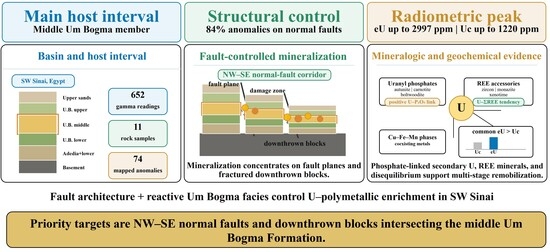
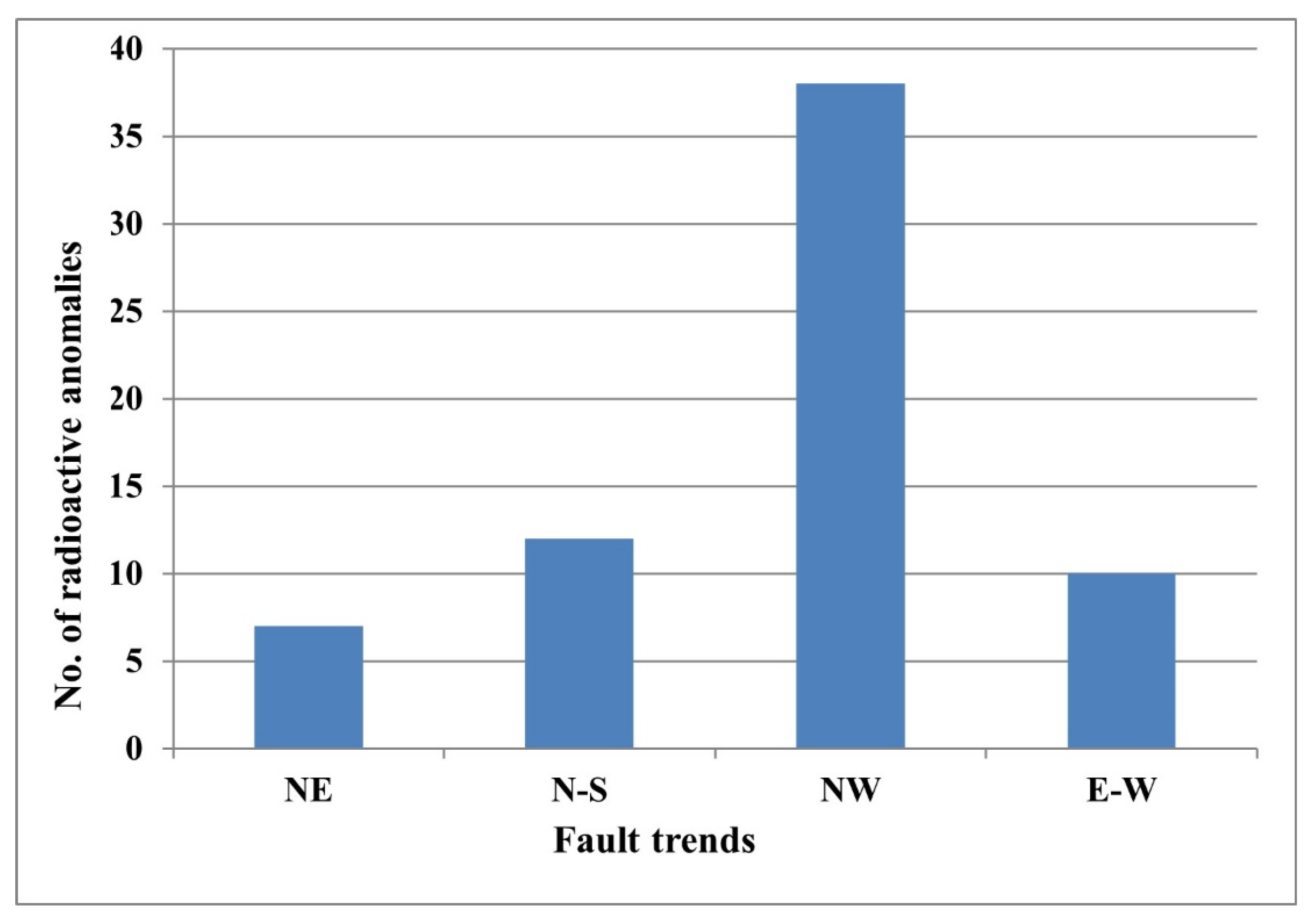
A structurally complex Paleozoic succession in southwestern Sinai hosts uranium and associated metals, and brittle deformation controls fluid flow and ore localization. The study integrates structural mapping with mineralogical, geochemical, and radiometric data to evaluate how fault architecture controls uranium and polymetallic mineral occurrences in the east Abu Zeneima area. Eleven representative samples were collected from major fault zones and host lithofacies, and 652 ground gamma-ray spectrometric measurements were acquired across mineralized localities and Paleozoic stratigraphic units. Heavy mineral separation, SEM–BSE/EDX, X-ray diffraction, and whole-rock geochemistry were used to identify ore and accessory phases and quantify their elemental composition. The middle carbonate member of the Um Bogma Formation is the primary host lithology and contains primary U dispersed within carbonaceous sandy dolostone and locally abundant secondary U phases coexisting with Cu–Fe–Mn phases and REE-bearing silicates and phosphates. Uranium enrichment (locally >2900 ppm eU) in the targeted anomalous samples shows a positive association with P2O5 and a weaker positive association with ΣREEs. Together with SEM–BSE/EDX and XRD identification of uranyl phosphates and REE-bearing accessory minerals, these observations suggest that phosphate-bearing secondary phases and REE-rich accessories locally contributed to uranium hosting. Seventy-four radioactive anomalies are predominantly associated with normal faults and are concentrated along fault cores and highly fractured downthrown blocks, especially along a NW–SE trend that forms the main mineralized corridor. The study findings emphasize the importance of fault zone architecture for targeting new uranium resources in Paleozoic basins.

Graphical Abstract

1. Introduction

Uranium is a strategic metal for low-carbon power generation, and its resources are hosted in a wide range of igneous, hydrothermal, and sedimentary systems worldwide [1,2,3]. Major production comes from sandstone-hosted, unconformity-related, vein, and volcanic-related deposits, each with distinct geological, geochemical, and structural characteristics. Sandstone and carbonate-hosted deposits have a global distribution, and their genesis is related to the interplay between basin evolution, sedimentary facies, tectonic events, and evolving fluid–rock interactions, rather than a single ore-forming stage [4,5,6,7]. Recent overviews highlight that sandstone-related uranium systems include many subtypes (tabular, roll-front, paleo-valley, tectono-lithologic, and humate types, among others) and their genetic models need to integrate sedimentological and structural controls to provide meaningful exploration targets [7,8,9,10]. Associated elements such as vanadium, copper, selenium, molybdenum, and rare earth elements are frequently present and can be economically significant in some cases [11,12]. In such settings, key controlling factors are the uranium source, reservoir geometry, redox interfaces, distribution of reducing media, and regional tectonic setting [8,13].
Faults and fracture networks are now known to be essential ore-controlling elements in many uranium districts [14]. For example, in the Beaverlodge district in Canada, a well-known uranium province, most uranium deposits are the product of hydrothermal fluids flowing through faults and fractures, with mineralization hosted in veins and breccias formed in and around major deformation zones [15,16]. In unconformity-related deposits of the Athabasca Basin, northern Saskatchewan and Alberta, Canada, reactive-flow modelling and downhole imaging demonstrate that the geometry and vertical extent of fault zones relative to the basin–basement unconformity exerts first-order control on fluid circulation, heat transport, and uranium precipitation [17,18]. Volcanic-related and intrusive-related uranium deposits also concentrate ore in brittle structures that control hydrothermal alteration and generate systematic mineralogical and geochemical zoning away from mineralized centers [19].
Extensional tectonics further controls this architecture. Recent global synthesis on sandstone-type uranium provinces has shown that multi-phase extension reactivates pre-existing rift structures, develops high-relief transition zones, and generates permeable fault corridors that funnel oxidizing and reducing fluids, locally concentrating uranium enrichment [13,20,21]. Numerical and conceptual models show that the intensity and style of brittle fault networks can control fluid focusing, overpressure, and the final size of uranium orebodies [13,17,22]. These studies suggest that insights into fault zone architecture (core, damage zone, relay structures, and stepovers) are essential for predicting uranium grade and continuity.
In Egypt, the Lower Carboniferous Um Bogma Formation in southwestern Sinai has long been known as a major uranium- and polymetallic-bearing succession [23,24,25]. Stratigraphic and mineralogical investigations document three members composed of variably siliceous, argillaceous, and carbonate rocks with interbedded Fe-Mn ore and show that uranium, rare earth elements (REEs), and base metals are concentrated in specific facies such as carbonaceous dolostones, ferruginous siltstones, gibbsite-rich horizons, and Fe–Mn lenses [24,25,26]. Recent studies from the Um Bogma area emphasize that uranium-bearing lithofacies within a major graben are particularly enriched, underscoring the importance of extensional structures and downthrown blocks as repositories for weathering products and diagenetic fluids [27,28]. Alteration studies similarly point to supergene and hydrothermal processes along fracture systems as key agents redistributing uranium and associated metals [29,30].
Despite this increasing body of work, various details of the structural control on uranium and polymetallic mineralization in the Paleozoic succession of southwestern Sinai are still not well constrained. Most of the regional studies either describe structural control in qualitative terms or are constrained to a few ore lenses. Systematic and area-wide integration of detailed structural mapping, mineralogical and geochemical characteristics, and ground gamma-ray spectrometry is limited. In particular, the relative roles of different fault types and trends, the difference between fault cores and damage zones, and the relative roles of upthrown and downthrown blocks on uranium and associated metal enrichment are not quantified.
This work was carried out to fill this gap by integrating (i) detailed structural mapping of brittle faults and associated deformation zones; (ii) petrographic and microanalytical characterization of ore and accessory minerals; (iii) whole-rock geochemistry of major, trace, and REEs; and (iv) 652 ground gamma-ray spectrometric measurements and chemical uranium determinations from representative mineralized localities. The main objective of this study is to better constrain the influence of fault architecture and kinematics on the distribution of uranium and polymetallic mineralization in this Paleozoic succession and define structural parameters that could be transferable to exploration targeting in similar basins.

2. Materials and Methods

2.1. Study Area

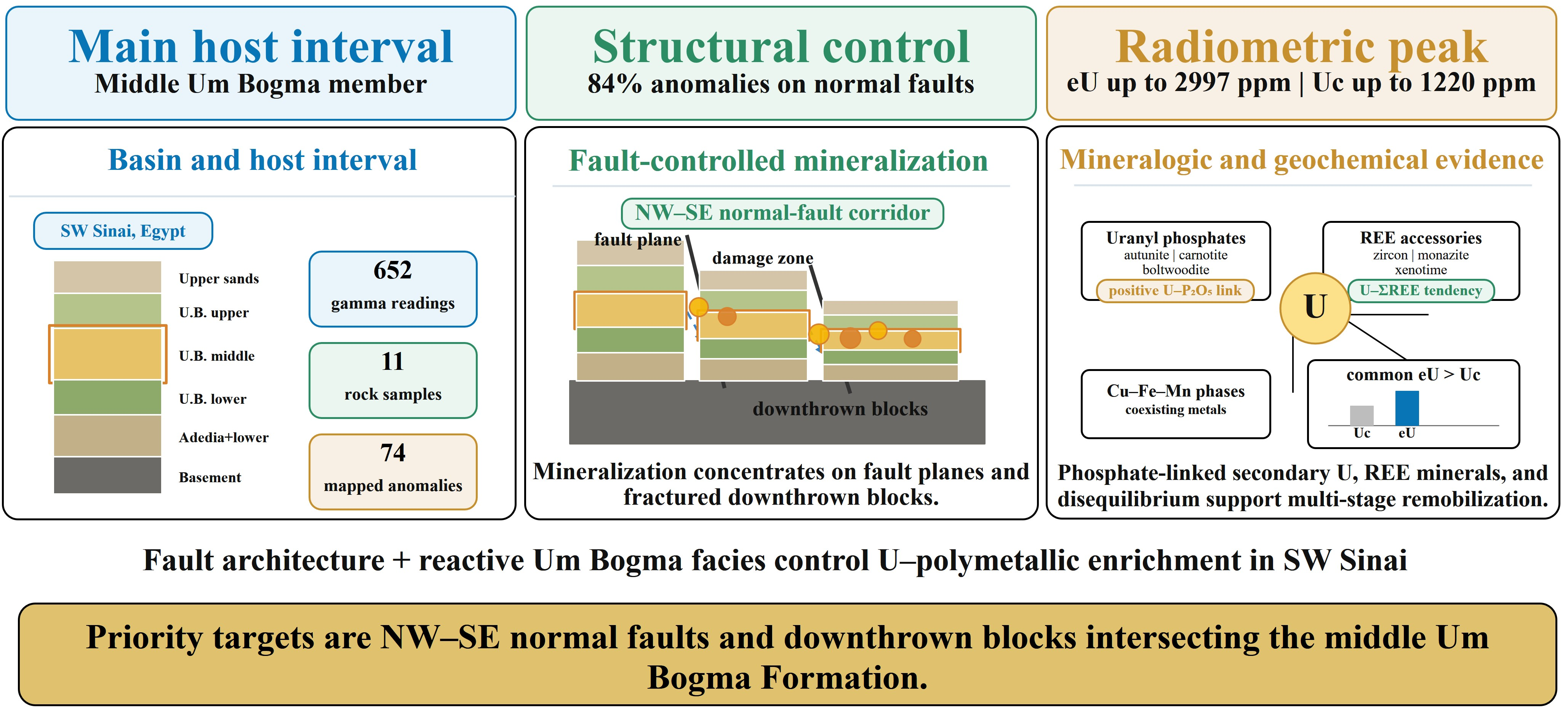
The study area is located in southwestern Sinai, about 40 km east of Abu Zeneima (33°10′–33°25′ E and 28°50′–29°05′ N) (Figure 1), and comprises a structurally controlled terrain of sedimentary and basement rocks.
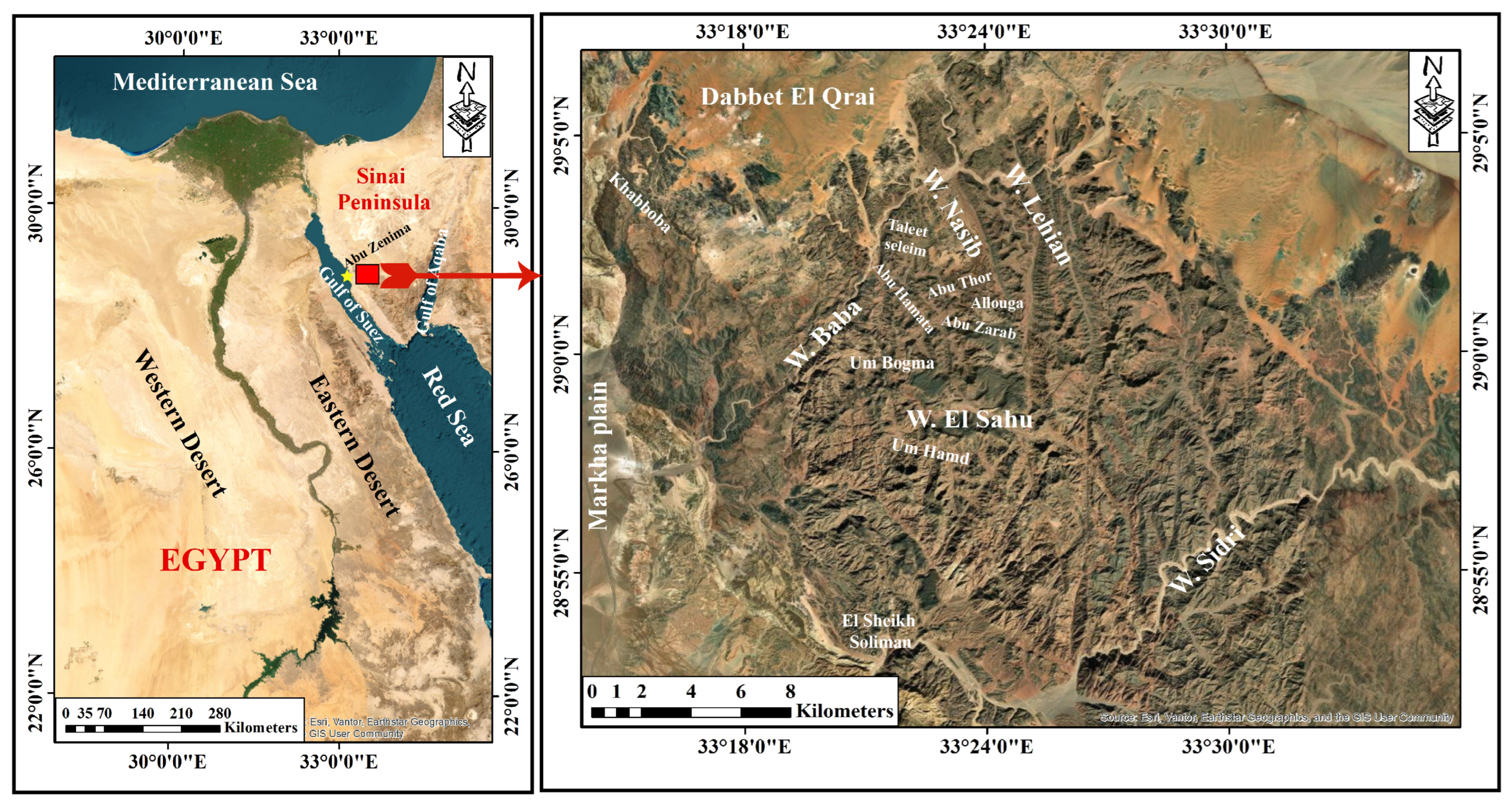
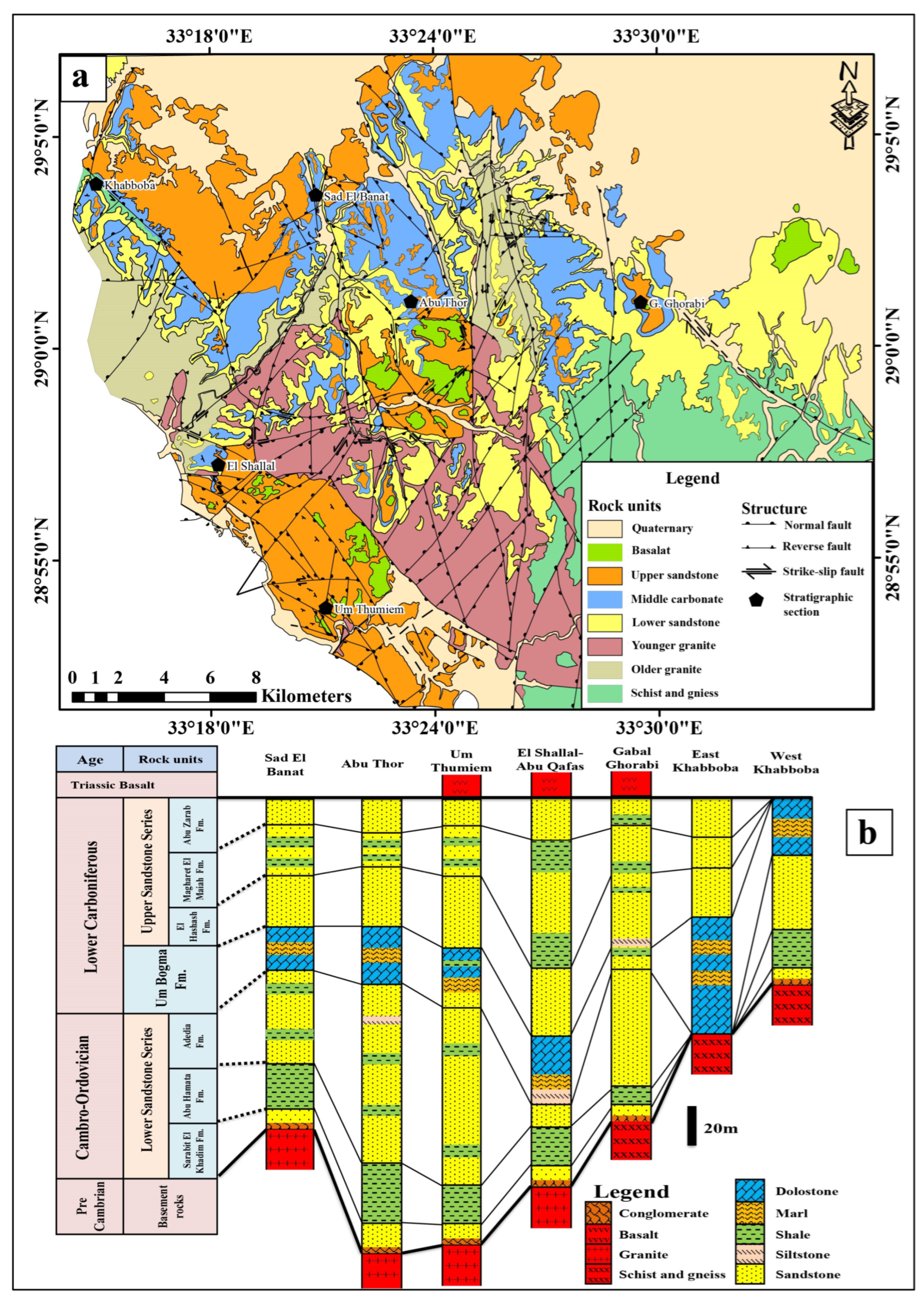
The study area exposes Precambrian basement rocks of the northern Arabian–Nubian Shield, overlain nonconformably by a Paleozoic sedimentary succession [31]. In the east Abu Zeneima area, this succession is typically 260–320 m thick and displays a tripartite stratigraphic architecture consisting of a lower sandstone series, a middle carbonate unit (Um Bogma Formation), and an upper sandstone series [25] (Figure 2; Table 1).
The lower sandstone series comprises the Sarabit El Khadim, Abu Hamata, and Adedia formations. These units rest nonconformably on the basement and are dominated by continental to shallow-marine siliciclastic deposits. Sarabit El Khadim consists mainly of coarse- to medium-grained sandstone with local conglomeratic bases. Abu Hamata is characterized by fine-grained sandstone and siltstone with local Cu–Mn–Fe mineralization, whereas the Adedia Formation comprises mature, cross-bedded sandstone with interbedded siltstone and shale. These units collectively represent the initial siliciclastic infill of the basin prior to carbonate deposition [25,32,33].
The Um Bogma Formation forms the middle carbonate unit and represents the most significant stratigraphic interval in the study area. It is Early Carboniferous in age and typically reaches ~40–60 m in thickness, although lateral variations occur due to structural control. The formation unconformably overlies the Adedia Formation and is unconformably overlain by the El Hashash Formation [25]. It is subdivided into three members: a lower dolostone-rich member, a middle marl–mudstone–dolostone member, and an upper dolostone to sandy unit. The middle member is of particular importance, as it hosts the main uranium and polymetallic mineralization, especially within carbonaceous dolostones, ferruginous siltstones, claystones, and Fe–Mn-rich horizons. These lithologies commonly exhibit enhanced porosity, dissolution features, and structural permeability, making them favorable sites for fluid flow and metal accumulation [25,28,31,34].
The upper sandstone series includes the El Hashash, Magharet El Maiah, and Abu Zarab formations [31]. These units are dominated by sandstone, siltstone, shale, and locally carbonaceous or kaolinitic clay horizons. Thickness varies laterally in response to basin architecture. In the study area, the Abu Zarab Formation is typically 15–25 m thick, although greater thicknesses are reported regionally. Compared with the Um Bogma Formation, these units are less significant hosts for uranium mineralization but reflect continued siliciclastic sedimentation under evolving basin conditions [23,25,31,35].
Structurally, the Paleozoic succession is preserved within a fault-bounded basin developed on inherited Arabian–Nubian Shield basement. The area is dissected by multiple fault sets trending NW–SE, NE–SW, N–S, and E–W. Among these, NW–SE normal faults, related to Gulf of Suez rifting, are dominant and exert first-order control on basin geometry, stratigraphic thickness variations, and fluid migration pathways. These structures represent reactivation of older basement fabrics and played a key role in focusing mineralizing fluids within the Paleozoic succession. In particular, the intersection of these fault systems with the permeable lithologies of the middle member of the Um Bogma Formation provided optimal conditions for uranium and polymetallic mineralization [36,37,38,39,40,41].

2.2. Fieldwork and Data Collection

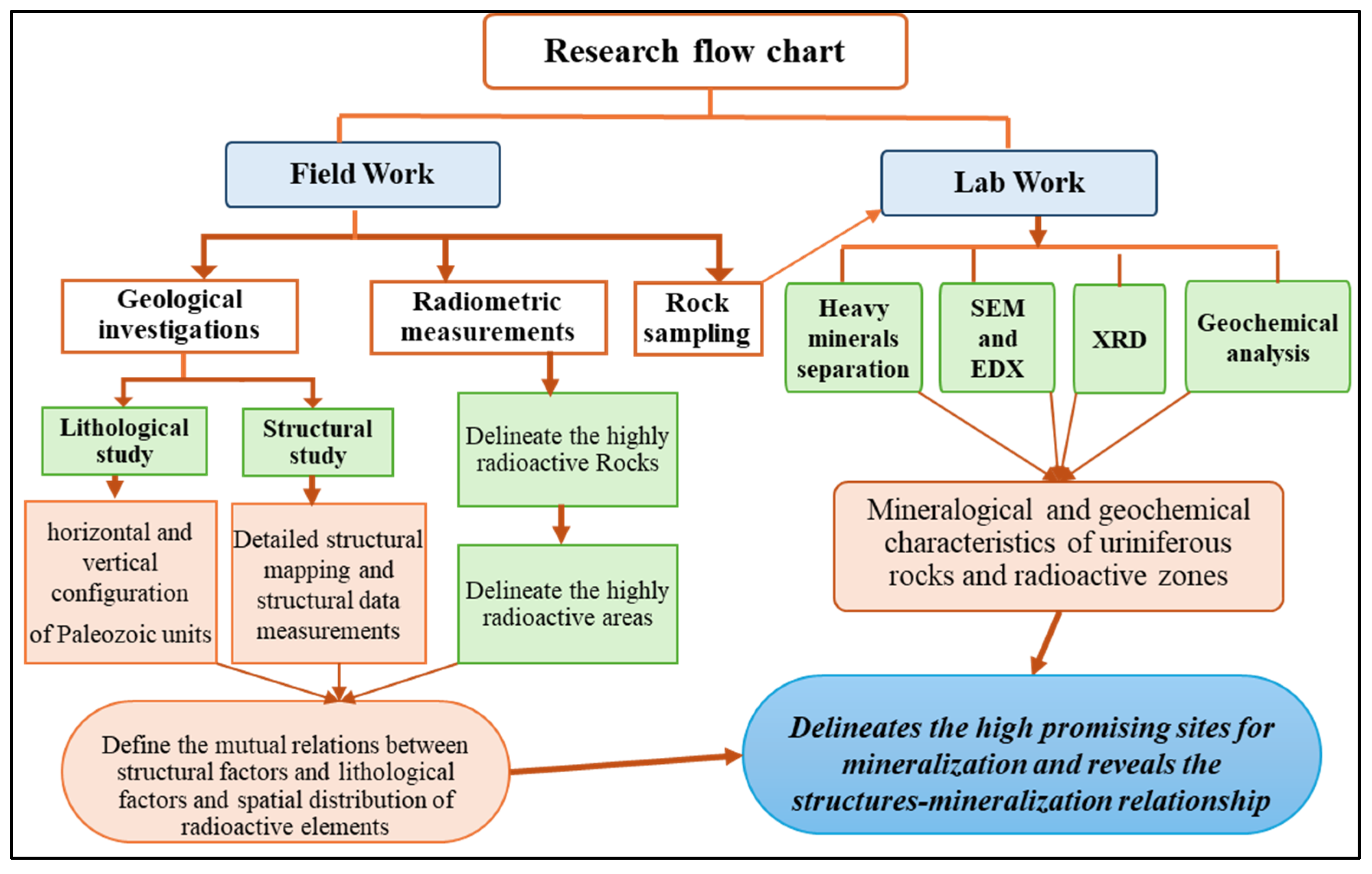
This study integrated field measurements with laboratory analyses. Field data include detailed lithostratigraphic investigations for vertical and horizontal configuration of the Paleozoic units in the study area, a detailed structural study and structural setting reconstruction, and an intensive field radiometric survey that covers most accessible parts of the study area. The flowchart in Figure 3 illustrates the workflow of the current study.
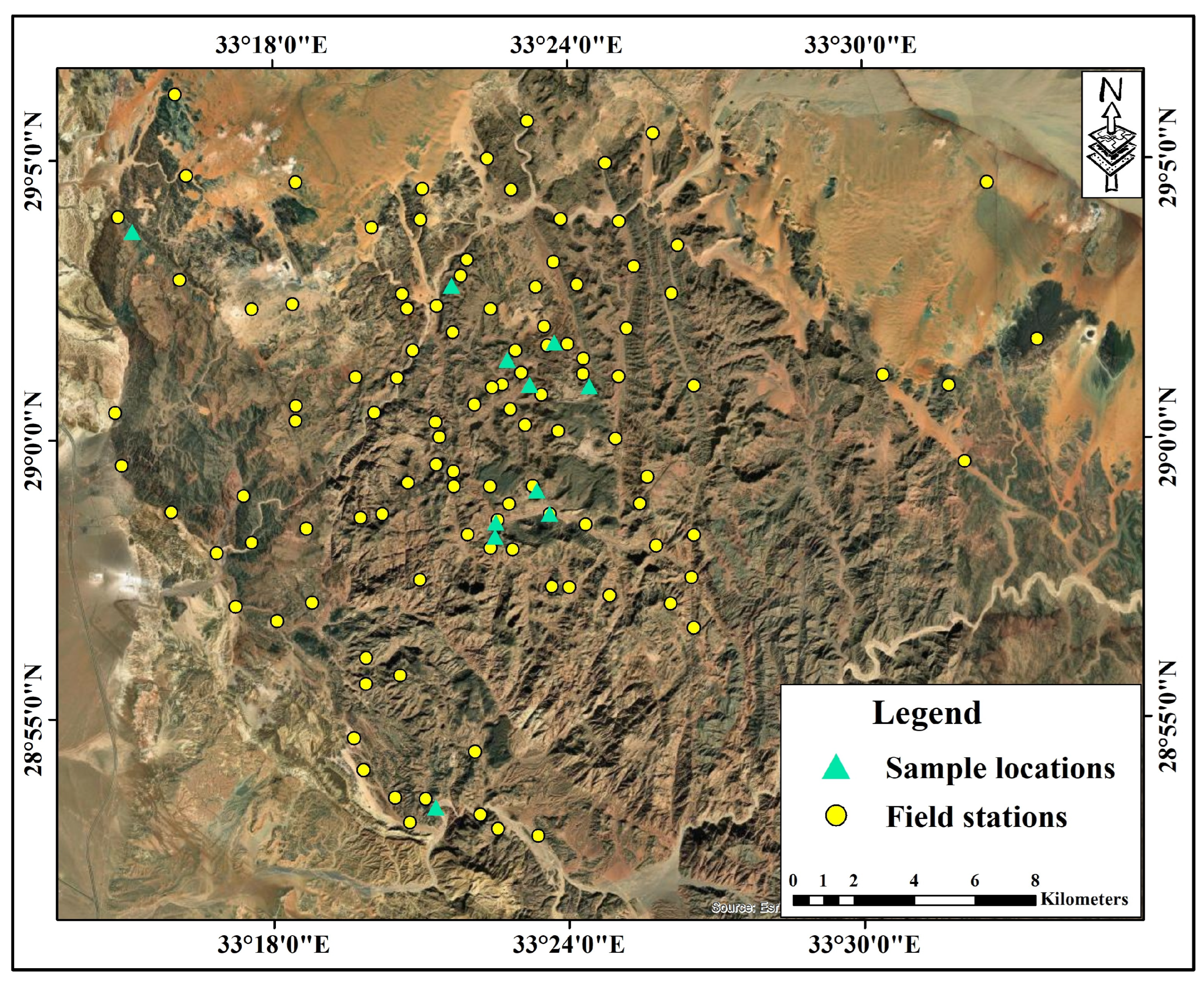
Detailed structural and lithological mapping of the area was performed based on direct field observations, measurements, and geometrical analysis of structural data. Geologic maps of the Egyptian Geological Survey and Mining Authority (EGSMA) [42,43] and the high-resolution satellite images were used as base maps during the field work to verify the lithostratigraphic units, identify the major structures in the study area, and determine their spatial relationships. More than 100 field stations (Figure 4) cover almost the entire study area. Accessible sites were chosen to measure structural data, rock relationships, brittle deformations, fault slip data, structural features, cross-cutting relationships, sense of shearing, and fault geometry. These results illustrate the main structural domains and structural elements and reveal the structural relations between different rocks. Seventy-four radioactive anomalies were identified and spatially correlated with mapped structural elements. Seven lithostratigraphic sections were measured to document lithofacies variations, thickness changes, vertical and horizontal configuration of the Paleozoic units, and their structural relations.
In total, 652 field measurements of equivalent uranium (eU), equivalent thorium (eTh), and potassium (K%) were recorded in the field. Measurements were conducted using an RS 230 multi-channel γ-ray (RS-230 Gamma Spectrometer. Radiation Solution Inc (RSI), Mississauga, Ontario, Canada), covering almost all rocks at the accessible sites all over the area, focusing on the highly radioactive units and high-potential zones. The field radiometric survey revealed a strong relationship between the spatial distribution of the radioelements and lithologically and structurally controlled mineralization. It helps in delineating the promising zones that are being sampled for further laboratory investigations.
Rock sampling was targeted rather than grid-based. The 11 samples (Figure 4) were collected during follow-up of radiometric anomalies and structural mapping, mainly from the upper Adedia and the middle member of the Um Bogma formations (Figure 2), to cover the principal mineralized lithologies and structural settings recognized in the field. These samples span six mineralized localities and include ferruginous sandstone, sandstone, shale/claystone, ferruginous siltstone, dolostone, gibbsite, marl/claystone, and claystone. The purpose of this subset was to characterize representative anomalous lithofacies and structural positions, not define regional geochemical background or basin-wide covariance.

2.3. Analytical Techniques

The collected 11 rock samples were ground and then sieved to obtain the sand-sized fraction, which was used for heavy-mineral separation. The heavy-mineral separation was carried out at the Nuclear Materials Authority (NMA) of Egypt using the heavy liquid separation method described by Carver [44] with bromoform (CHBr3; 2.85 g/cm3). These fractions were mixed and shaken in a sufficient quantity of bromoform using a separating funnel and left for about 15 min until complete separation. The separated heavy minerals of each sample were collected on filter papers, washed with ethyl alcohol, and dried.
To identify the mineralogical composition of heavy minerals, a thin spray of heavy mineral grains was spread on a glass slide and microscopically examined using the binocular microscope. The unidentified minerals were then examined by using the Scanning Electron Microscope (SEM), Energy Dispersive X-Ray (EDX), and X-Ray Diffraction (XRD) techniques. The study was performed to identify the most characteristic features and the type of inclusions in the studied grains.
The analyses were performed under a low vacuum, with magnification ranging from 100× to 1000×. The operating conditions were 3.5 nm resolution at 30 Kv, 1 nm at 25 Kv, backscattered electron (BSE) mode equal to 10.0, 1–2 mm beam diameter, and 60–120 s counting times. Minimum detectable weight concentration ranges from 0.1 to 1 wt%, precision is below 1%. The relative accuracy of the quantitative result is 2%–10% for elements with Z ≥ 9 and 10%–20% for light elements (B, C, N, O, F). These analyses were performed at the Environmental Scanning Electron Microscope (ESEM) Laboratory, Nuclear Materials Authority, Egypt (SEM/EDX, XL 30 ESEM, Philips Co., Amsterdam, The Netherlands).
The mineralogical composition of the heavy fraction was identified using the X-ray diffraction technique. Instrument settings were adjusted at 40 Kv and 40 mA potential, with a scanning speed of 0.02°/s, and the 2θ ranged from 2° to 60°. X-ray diffraction analysis was conducted using a Philips PW 3710 of the Nuclear Materials Authority of Egypt (Philips PW 3710/31, Philips Co., Almelo, The Netherlands).
Major element oxides were analyzed in the collected 11 rock samples as reported by Shapiro and Brannock [45] for a rapid silicate analytical procedure. Trace elements were analyzed by the X-Ray Fluorescence technique (XRF), using the Philips X-Ray spectrometry (Philips PW 1410, Philips Co., Eindhoven, The Netherlands) at the Central Metallurgical Research and Development Institute, Egypt. Organic matter contents were measured by loss on ignition following the procedure adopted by Van Reeuwijk [46].
The chemical concentration of uranium (Uc) was determined by oxidimetric titration using ammonium metavanadate [47] for the collected samples. Total rare earth elements (ΣREEs) were quantified using UV–VIS spectrophotometry (Shimadzu UV-160, Shimadzu Co., Kyoto, Japan) with 0.015% Arsenazo III at 654 nm [48].

2.4. Statistical and Geospatial Analysis

To handle the large number of field measurements and laboratory results, different software programs were used, including ArcGIS (ESRI, version 10.8, 2018), which served as the primary platform for mapping and geospatial analysis of the field geological, structural, and radiometric data. Adobe Illustrator (version 2022) was used for drawing the lithostratigraphic sections. CorelDRAW (version 2018) software was used to draw sketches and edit figures. The analytical approach integrates different data sets, such as lithological data, structural data, radiometric data, and geochemical data, to achieve the main aims of this research. Statistical analysis was applied at two different scales. The radiometric dataset (652 field measurements) was used for descriptive and geospatial comparison among lithologies, localities, and structural settings. In contrast, the whole-rock geochemical correlation matrix is based on only 11 targeted anomalous samples spanning multiple lithologies and is therefore treated as exploratory. Correlations are reported to identify possible associations for further testing; they are not used as standalone evidence for regional geochemical relationships.

3. Results

3.1. Mineralogy of Structurally Controlled Lithofacies

Heavy minerals separated from the eleven structurally controlled samples reveal variable assemblages of non-radioactive accessory and ore phases. These minerals occur as both detrital and authigenic components and are locally concentrated within dolostones, ferruginous siltstones, and sandstones. Several phases fill pores and microfractures, indicating post-depositional fluid circulation [49]. Overall, the non-radioactive assemblage reflects interaction between oxidizing, metal-bearing fluids and reactive Fe-rich and carbonate lithofacies within structurally damaged zones [50].
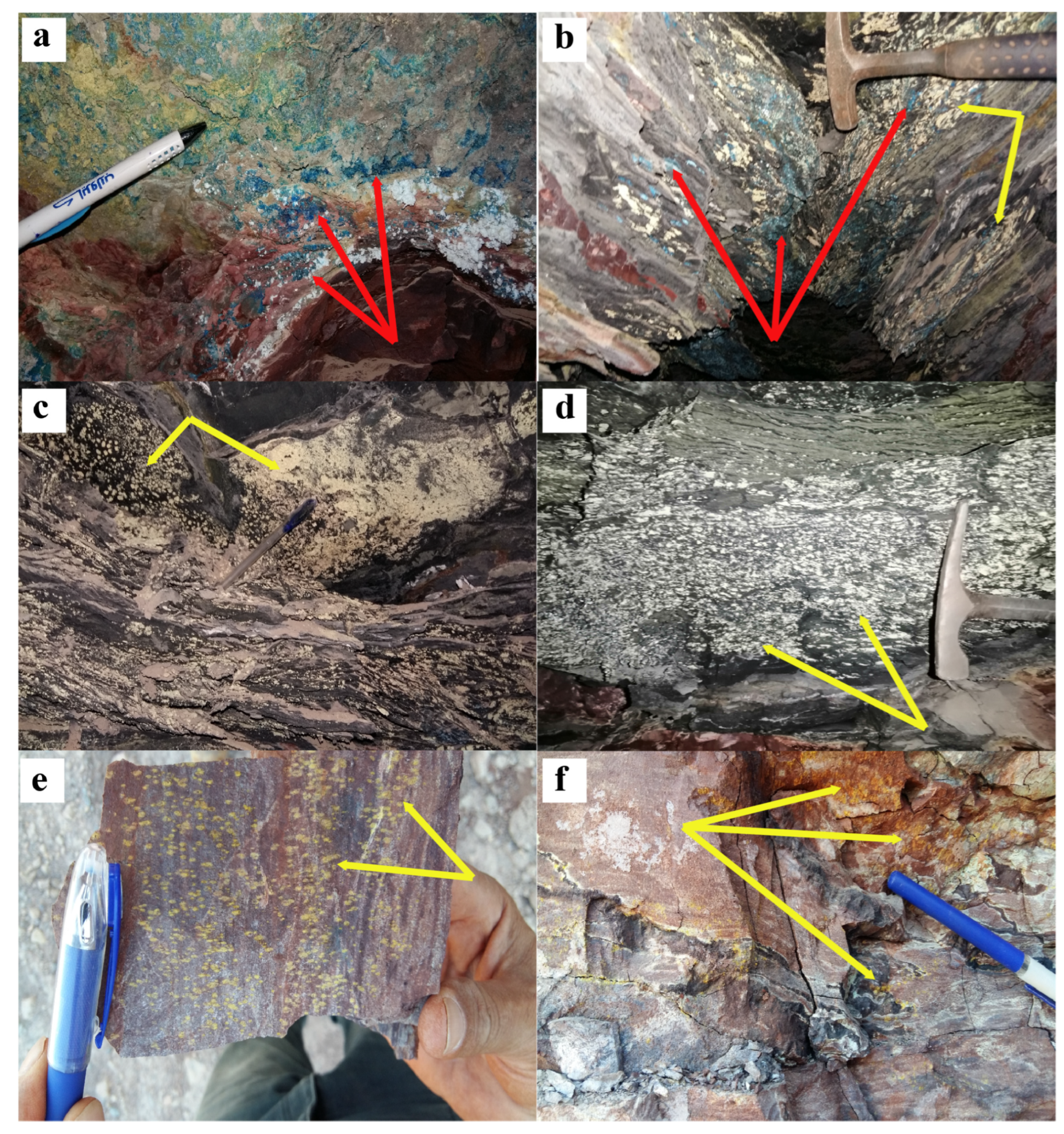
An assemblage of secondary U minerals was identified by SEM–BSE/EDX and XRD, including phosphowalpurgite, autunite, carnotite, boltwoodite, sklodowskite, and iriginite, together with REE-bearing accessory phases (e.g., allanite) (Figures S1 and S2). These minerals occur mainly in ferruginous sandstones of the upper Adedia Formation and in dolostones, marl, and claystones of the Um Bogma Formation at Allouga, Um Hamd, and Wadi El Sahu (Figure 5). Uranium phases fill fractures, coat grain boundaries, and line karst cavities within dolomitized and ferruginous horizons, commonly in association with Fe–Mn oxides, barite, and Cu minerals.
Detrital and accessory U–REE–bearing minerals are abundant. Zircon occurs as both prismatic and granular grains, with many showing evidence of metamictization [49] (Figure S1). Monazite, allanite, and xenotime appear as inclusions within silicate grains and rock fragments, forming a compositional continuum from unaltered monazite to allanite via REE-depleted, Fe-Si-rich altered monazite [49] (Figures S1 and S2). These phases constitute important hosts for REEs and minor U and Th.

3.2. Geochemistry

3.2.1. Major Oxide Characteristics

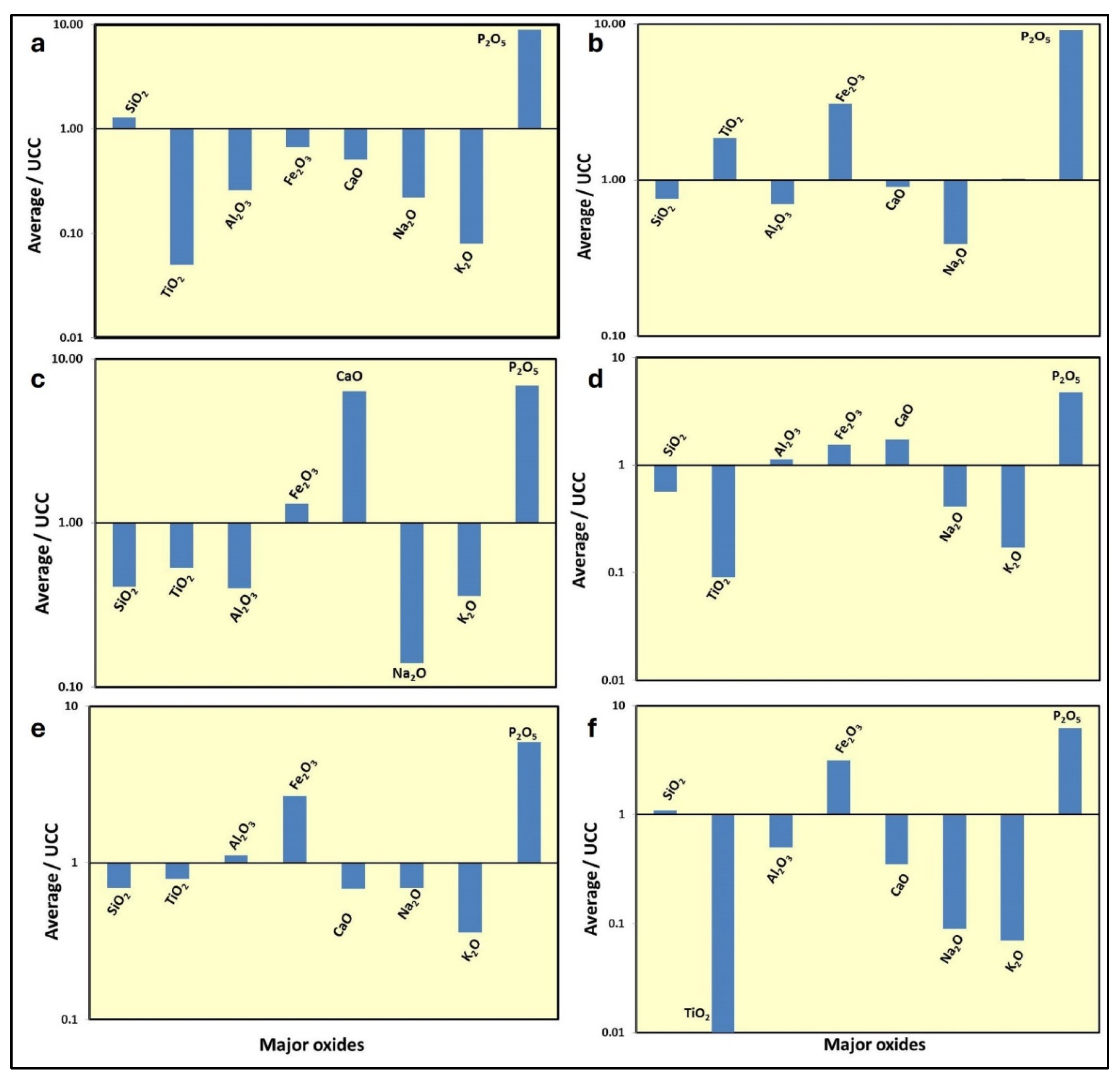
Major oxide analyses of eleven representative samples (Table S1) are compared directly with Upper Continental Crust (UCC) values [51]. Figure 6 shows the normalized patterns to highlight relative enrichments and depletions. When normalized to UCC, SiO2 is generally depleted in anomalous lithofacies, except in ferruginous sandstones at Wadi El Sahu and El Sheikh Soliman. Al2O3 is depleted in most units but relatively enriched in gibbsite-rich horizons at Abu Thor and marl–claystone alternations at Taleet Seleim. Fe2O3 is enriched in nearly all samples, reflecting the abundance of Fe oxyhydroxides and ferruginous matrices. CaO shows strong enrichment in dolostones at Allouga and gibbsite-bearing rocks at Abu Thor but is depleted in most other lithofacies. Na2O and K2O are consistently depleted, whereas P2O5 is enriched across all radioactive lithofacies.

3.2.2. Trace Elements and ΣREEs

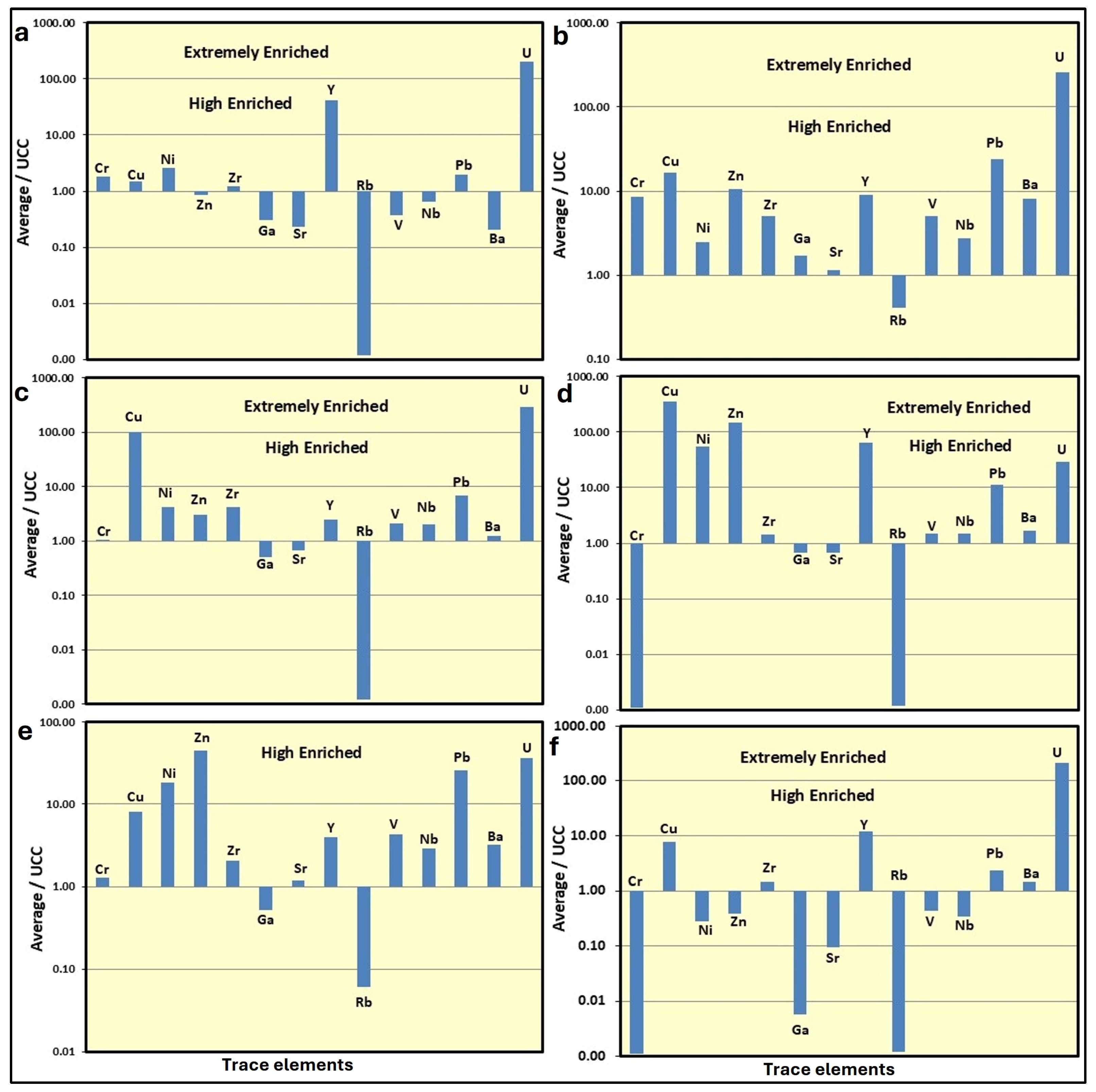
Trace element concentrations (Table S2) are generally elevated relative to UCC [51] (Figure 7). The UCC-normalized patterns shown in Figure 7 provide a clear representation of trace element enrichment and depletion trends. Uranium is extremely enriched in all analyzed lithofacies, with values of up to 1220 ppm Uc and 2977 ppm eU in individual samples. Chromium is enriched in most units except at Abu Thor and El Sheikh Soliman. Cu, Zr, Y, and Pb are systematically enriched, whereas Rb is depleted in all samples. Sr and Ga are generally depleted but show notable enrichment in Um Hamd lithofacies; Sr is also elevated at Taleet Seleim. Ni, Zn, V, and Nb are enriched in most samples, with lower values in some ferruginous sandstones at Wadi El Sahu and El Sheikh Soliman.
Total REE contents (ΣREEs) span more than an order of magnitude, with the highest values recorded in ferruginous sandstones as well as in U-rich dolostones and claystones (Tables S1 and S2), where accessory monazite–allanite–xenotime assemblages are abundant.

3.2.3. Element Correlations

Correlation analysis of the 11 targeted anomalous samples identifies several exploratory associations (Table S3), of which only a limited number are statistically meaningful; all other relations are discussed as tendencies that require confirmation in a larger, background-controlled dataset. CaO is positively correlated with loss on ignition (LOI; r = 0.79), which may reflect the association of carbonate and organic matter in dolostones and related facies. LOI also shows a positive relationship with Cu, Ni, Zn, Sr, and Nb, indicating that organic-rich horizons preferentially accumulate certain trace metals. Uranium shows a positive association with P2O5 (r = 0.72), whereas its relationships with ΣREEs (r = 0.59) and CaO (r = 0.46) are better treated as positive tendencies within this limited, lithologically mixed subset. The U–P2O5 association is consistent with the identified uranyl phosphate minerals, while the positive U–ΣREE tendency is compatible with the coexistence of REE-bearing accessory phases; neither relation should be taken on its own as proof of a regional basin-scale control.
ΣREEs are positively correlated with P2O5 and SiO2, in line with their dominant occurrence in phosphates and silicates. Cu shows a positive tendency with SiO2 and P2O5 and a negative tendency with CaO within the targeted anomalous samples. These relations are compatible with local concentration of Cu mineralization in ferruginous/silicified horizons and dissolution-related porosity [52]. Negative correlation between SiO2 and LOI (r = −0.96) and positive correlation between Al2O3 and Fe2O3 (r = 0.50) point to lateritic weathering and pedogenic processes that enriched Fe–Al phases at the expense of silicates in some horizons [53]. TiO2 correlates positively with K2O and Al2O3, suggesting adsorption of Ti on clay minerals. Several high-field-strength and large-ion lithophile elements (Zr, Sr, Rb, V, Nb, Pb, Ba) display positive mutual correlations, while Cu, Ni, and Zn form another coherent group, indicating shared geochemical behavior within the mineralized system. Overall, the correlation matrix should be regarded as a qualitative tool to support mineralogical and geochemical interpretations rather than a statistically rigorous dataset, given the limited number of samples (n = 11) and the wide range of lithological compositions represented.

3.3. Radiometric Characteristics

3.3.1. Radioelement Content of the Main Rock Units

Ground gamma-ray spectrometry (652 measurements) documents substantial variations in eU and eTh among the main rock units (Table 2). Average eU values range from 2.56 ppm in the Abu Zarab Formation to 68.31 ppm in the Um Bogma Formation, whereas average eTh values range from 5.44 to 18.79 ppm. The middle carbonate member of the Um Bogma Formation represents the most radioactive Paleozoic unit, with eU values locally reaching 2997 ppm. Younger granites also show elevated eU and particularly high eTh compared with older granites and typical sedimentary rocks, suggesting that they may represent an important source of U, Th, and associated metals within the regional system.

3.3.2. Radioelement Distribution in Key Localities

When grouped by locality, Um Hamd, Seih-Sidri, Allouga, Abu Zarab, Taleet Seleim, and Wadi El Sahu emerge as the most uranium-enriched zones (Table 2). Average eU values are 412 ppm at Allouga, 705 ppm at Um Hamd, 245 ppm at Wadi El Sahu, and 560 ppm at Seih-Sidri. In contrast, Wadi Khabboba is characterized by relatively low eU (8.8 ppm) but very high eTh (640 ppm), indicating a thorium-dominated anomaly likely related to Th-bearing heavy minerals in basal conglomerates.

3.3.3. Radiometric vs. Chemical Uranium

For the eleven detailed samples, concentrations of Uc, eU, eTh, and K are reported in Table 3. Uc ranges from 78 to 1220 ppm (average 496.7 ppm), while eU ranges from 46 to 2977 ppm (average 987.3 ppm); eTh varies between 6.8 and 94.3 ppm (average 38.5 ppm), and K between 1.6 and 12.5 wt% (average 5.61 wt%). The comparison plot shows that in most samples, eU exceeds Uc, indicating significant U-series disequilibrium and implying recent or ongoing uranium remobilization. The exception is Wadi El Sahu, where Uc surpasses eU, suggesting a predominance of non-equilibrium U phases or partial loss of radiogenic daughters [54].

3.4. Structural Control on Mineralization and Radioactivity

3.4.1. Spatial Distribution of Anomalies Relative to Fault Types

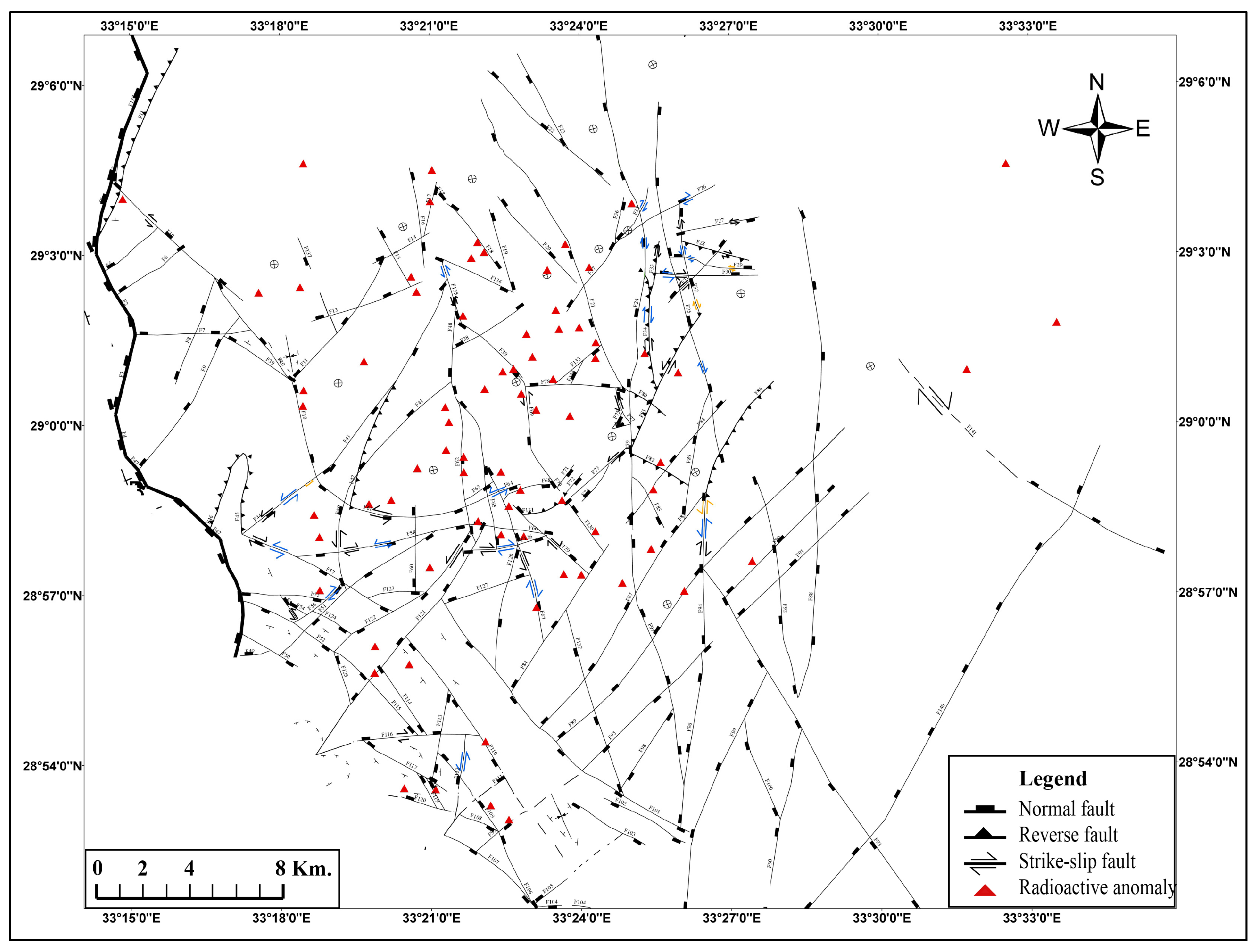
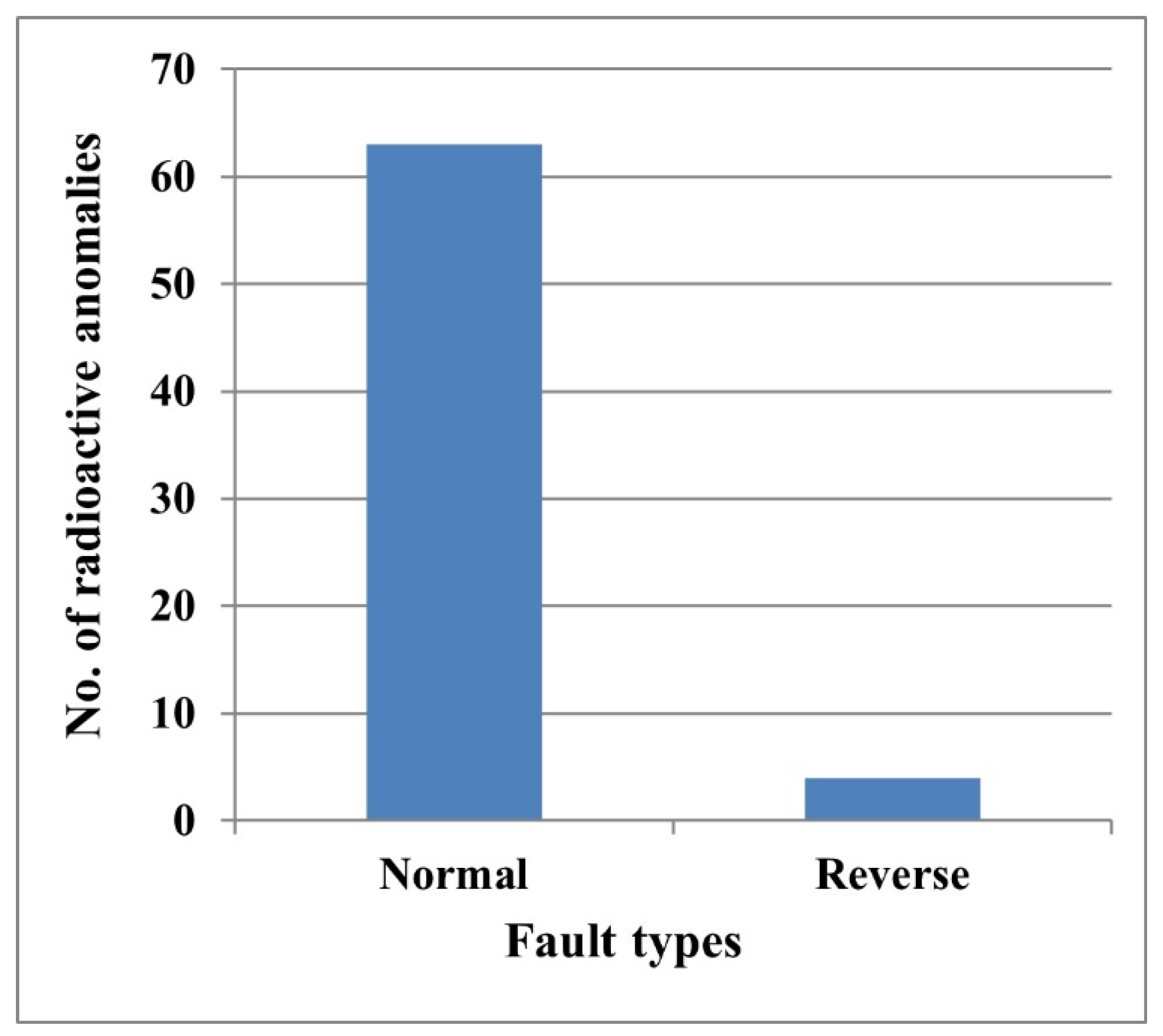
Seventy-four radiometric anomalies were delineated within the Paleozoic succession, mainly within the middle member of the Um Bogma Formation and locally in the upper Adedia Formation, and are spatially associated with mapped fault zones (Figure 8). Statistical treatment of these anomalies shows that the majority (62 anomalies) are directly associated with normal faults, whereas only four are related to reverse faults; the remainder are linked to other structural elements such as fault intersections and shear zones (Figure 9). Normal fault-related anomalies occur both in basement and sedimentary rocks, with eU values ranging from about 50 to 2975 ppm and eTh from about 10 to 650 ppm. Most are hosted by the middle carbonate member of the Um Bogma Formation.

3.4.2. Fault Components, Structural Styles, and Lithologic Hosts

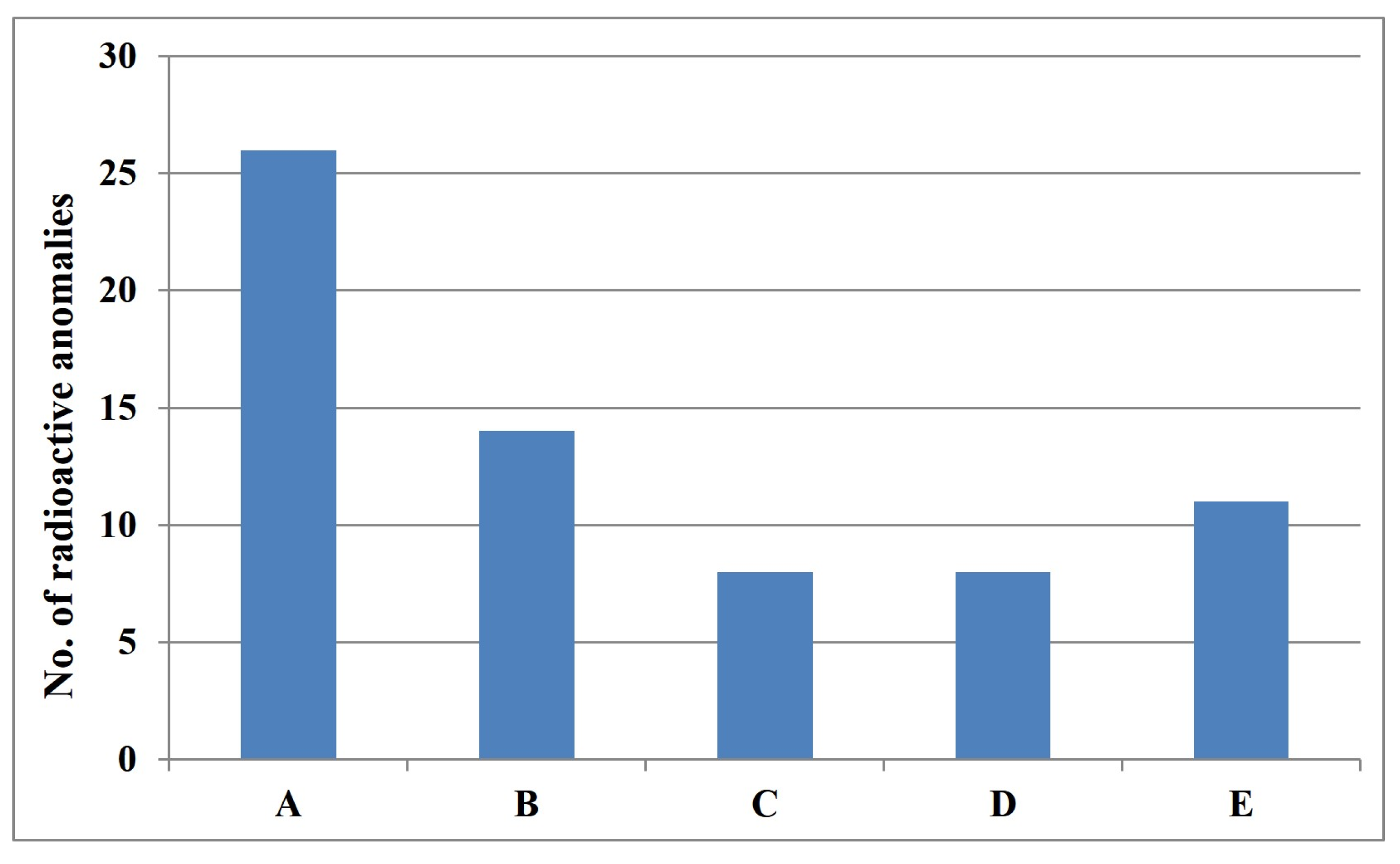
Analysis of anomaly positions relative to fault components shows that most anomalies lie directly on fault planes, followed by anomalies in downthrown blocks, with fewer in upthrown blocks, grabens, and horsts (Figure 10). Downthrown blocks are typically more intensely fractured and host more porous lithofacies (sandy dolostones and sandy dolomitic limestones), providing favorable pathways and traps for mineralized fluids. Dolostones consistently show higher uranium contents than associated limestones, reflecting their higher permeability and tendency to develop dissolution porosity.
Normal-fault systems form grabens, horsts, step faults, and tilted blocks that segment the Paleozoic succession. The most strongly mineralized horizons are located where these structural styles intersect favorable lithologies in the Um Bogma Formation and adjacent units, as indicated on the anomaly–structure map (Figure 8).

3.4.3. Fault Trends and Mineralized Structural Corridors

Radioactive anomalies display a clear dependence on fault orientation. The distribution of anomalies among the four main fault trends is shown in Figure 11, emphasizing a dominant NW–SE striking set of normal faults that hosts the highest concentration of uranium and polymetallic mineralization. Along this trend, Taleet Seleim shows eU values up to 400 ppm, Abu Hamata up to 650 ppm (with associated Mn mineralization), Um Hamd up to 1300 ppm, and Seih-Sidri up to 950 ppm. At Wadi Khabboba, the same NW–SE trend controls a major thorium anomaly in basal conglomerates (eTh up to 650 ppm). Other fault sets (NE–SW, N–S, and E–W) also localize anomalies but with lower frequency and generally lower intensity (Figure 11).

4. Discussion

4.1. Interplay Between Structure, Lithology, and Uranium Enrichment

The east Abu Zeneima data show that uranium and associated metals are not simply stratabound but are strongly focused by brittle structures. The clear dominance of the normal fault-related anomalies (62 of 74; Figure 9) and the concentration of high eU values on fault planes and downthrown blocks (Figure 10) demonstrate that faulting exerts first-order control on mineralization. This pattern fits global observations from sandstone-type uranium districts, where permeable fault zones and associated damage networks are the main conduits for oxidized U-bearing fluids in extensional basins [13].
Lithology modulates this structural control. High-grade mineralization is concentrated where faults intersect the middle carbonate member of the Um Bogma Formation, porous dolostones, carbonaceous sandy dolostones, marls, and ferruginous siltstones (Table 2 and Table 3).
Independent studies on the Um Bogma Formation at Allouga, Taleet Seleim, Abu Thor, and Um Hamd demonstrate that argillaceous and carbonate facies of the middle member host diverse mineralization, including U, REE, base metals, Fe–Mn ores, and locally native Au and Ag [26,27,29,55].
This combined structural–lithologic focusing is characteristic of the “tectono-lithologic” subclass of sandstone-related uranium deposits, in which ore is localized at the intersection of reactive host facies and fault-controlled fluid pathways rather than along simple regional redox fronts [10]. The preferential localization of anomalies in downthrown blocks (Figure 10) likely reflects both higher fracture intensity and the capacity of structurally low areas to trap mineralized fluids and weathering products, as recognized in other extensional uranium basins and structurally controlled sandstone-type deposits used for in situ leaching [13,56,57].
The tendency for anomalies to cluster on fault planes and immediately within the associated damage zones (Figure 10) is consistent with work from Athabasca Basin uranium systems, which shows that high-grade mineralization is localized in reactivated structural corridors and their fracture networks at the basin–basement interface [58]. Together, these comparisons underline that detailed characterization of fault cores, damage zones, and stepovers is essential for predicting grade continuity and ore shoot geometry in structurally complex uranium systems.

4.2. Sources, Pathways, and Timing of Uranium and Polymetallic Fluids

Mineralogical and geochemical features in east Abu Zeneima indicate a mixed hydrothermal–supergene origin [59]. The presence of Mo-bearing iriginite, abundant REE-rich phases (monazite, allanite, xenotime, zircon), high ΣREEs, and the association with Fe–Mn ores point to a significant contribution from felsic basement, younger granites, and Fe–Mn systems, rather than a purely detrital source. In particular, the relatively high eTh values recorded in the younger granites (average 42.10 ppm; Table 2) indicate enrichment in Th and other incompatible elements, suggesting that these granitic bodies could have acted as a primary source of U, Th, REEs, and associated metals. Mobilization of these elements likely occurred during hydrothermal circulation along reactivated fault systems, with subsequent transport and precipitation within the reactive host facies of the Um Bogma Formation under favorable tectono-lithologic conditions. Regional studies of Um Bogma Fe–Mn ores show strong enrichment in Cu and U and argue for combined sedimentary, hydrothermal, and lateritic processes, with metasomatic influx of metal-rich fluids during post-depositional tectonism [27,29,60].
The structural pattern, characterized by multi-phase normal faulting that formed grabens, horsts, and tilted blocks, and the alignment of the highest-grade anomalies along NW–SE normal faults (Figure 11) are compatible with models in which sandstone-type uranium mineralization is coupled to extensional tectonics and, in many basins, contemporaneous magmatism [13]. At the district scale, younger intrusions and Tertiary volcanism in southwestern Sinai have been proposed as heat and metal sources for hydrothermal circulation, followed by infiltration of meteoric waters along rejuvenated faults [27,29]. This scenario agrees with the strong structural focusing documented here and the widespread supergene mineral assemblage (carnotite, autunite, boltwoodite, sklodowskite, phosphowalpurgite) observed in our samples.
Taken together, our data are consistent with a multi-stage evolution: (i) Initial accumulation of U, REEs, Cu and Fe–Mn in particular facies (carbonaceous shales, ferruginous siltstones, gibbsite-bearing units) during Lower Carboniferous sedimentation and early diagenesis [26], (ii) hydrothermal introduction and upgrading along normal and reverse faults during and after extensional deformation, tapping magmatic and deep basinal sources and precipitating U–Mo–REE phases in structurally enhanced porosity, and (iii) supergene remobilization and concentration under oxidizing meteoric conditions, generating uranyl silicates and phosphates, karst-related bauxites and laterites and enhancing U and REE contents in Fe–Al-rich horizons [61]. This staged model matches recent work on karst-type bauxites and supergene REE–uranyl mineralization in the Um Bogma terrain, which emphasizes repeated weathering–alteration cycles overprinting earlier hydrothermal and diagenetic mineralization [60,62].

4.3. Geochemical Behavior of Uranium-Bearing Fluids

The positive U–P2O5 association, together with the identification of uranyl phosphate minerals, suggests that phosphate-bearing secondary phases are important local U hosts. The U–ΣREE relationship is better treated as a positive tendency within the targeted anomalous subset; however, the coexistence of monazite, allanite, xenotime, zircon, and Fe–Mn oxyhydroxides supports a local spatial association between uranium and REE-bearing phases [61]. Similar U–REE–P coupling has been documented in Um Bogma marls, shales, and carbonates at Allouga, Taleet Seleim, and Abu Thor areas, and interpreted as coprecipitation or coadsorption onto apatite, monazite, allanite, xenotime, and Fe–Mn oxyhydroxides [26,55].
The positive relationship between CaO and LOI, depletion of Na2O and K2O, and the negative relationship of CaO with SiO2 and Al2O3 (Table S3) indicate extensive carbonate dissolution, decarbonation, and clay formation, typical of karstification and lateritic weathering of carbonate platforms [60,62,63]. Regional studies report both blanket and karst laterites developed within Um Bogma, with gibbsite-, kaolinite-, goethite-, and hematite-rich profiles overprinting marly carbonates, and show that these horizons are important sites of REE–U enrichment [57]. Globally, lateritic weathering is known to produce residual accumulations of HFSEs and REEs in Fe–Al-rich horizons, with groundwater redox conditions playing a key role in uranium precipitation, mechanisms that are fully compatible with the east Abu Zeneima dataset [62,63].
Copper shows a positive tendency with SiO2 and a negative tendency with CaO in the targeted anomalous samples, but these relations alone do not demonstrate silica-rich fluid pathways. A more conservative interpretation is that Cu mineralization was locally concentrated in ferruginous and silicified horizons and dissolution- and fracture-related porosity within the faulted Paleozoic succession. This interpretation is supported by field evidence of Cu mineralization in ferruginous siltstones and shales, fracture- and cavity-related mineralization textures, and regional studies documenting supergene Cu mineralization in the southwestern Sinai Paleozoic section [28,31,49]. The grouping of Cu, Ni and Zn in the correlation matrix (Table S3) supports the idea that these metals were jointly mobilized, likely as chloride or sulphate complexes in the same hydrothermal–meteoric system that transported uranium, a scenario also inferred for Cu–U–REE bearing Fe–Mn ores and marls in other parts of Um Bogma [27,64].

4.4. Uranium-Series Disequilibrium and Inferred Recent Remobilization

In most of the investigated samples, eU substantially exceeds chemically measured Uc (Table 3), indicating uranium-series disequilibrium and implying that a significant fraction of the uranium occurs in secondary phases or that radiogenic daughters have been selectively lost. The magnitude and direction of the disequilibrium vary among localities: Allouga and Um Hamd show pronounced eU > Uc, whereas at Wadi El Sahu, Uc > eU.
U-series disequilibria are widely used to infer the timing of uranium mobilization because different daughters respond differently to weathering, adsorption, and fluid flow [54,59,65]. The pattern observed here is typical of deposits where primary or early epigenetic mineralization has been overprinted by supergene processes; however, this interpretation is based on uranium-series disequilibrium relationships rather than direct geochronological constraints. Comparable disequilibria have been reported for other Um Bogma localities and interpreted as evidence of ongoing U redistribution under present-day weathering conditions [26].
At Wadi El Sahu, the reverse pattern (Uc > eU) could reflect a dominance of very young, weakly radiogenic U phases, partial loss of daughter nuclides from the system, or mixed populations of equilibrium and disequilibrium minerals. The combination of U-rich fault cores, pervasive lateritization, and active meteoric circulation within the sinistral simple shear zone in Wadi El Sahu supports the interpretation that uranium is still being cycled through the system, with implications for both resource potential and environmental mobility [66].

4.5. Regional Context and Implications for Exploration

The structural pattern in east Abu Zeneima, superposed sets of normal faults, step faults, and rejuvenated structures dissecting the Paleozoic cover and basement, is broadly similar to other Um Bogma uranium districts in southwestern Sinai [26,38]. The integrated structural, mineralogical, geochemical, and radiometric dataset also quantifies the relative importance of specific factors: (i) Fault type: normal faults host approximately 84% of the anomalies and most high-grade mineralization, whereas reverse faults are less common but can form local high-grade shoots within their cores (e.g., Wadi El Sahu). (ii) Fault orientation: NW–SE normal faults define the principal mineralized corridor [67], controlling the highest eU values at Taleet Seleim, Abu Hamata, Um Hamd, Seih-Sidri and Wadi Khabboba (Figure 11). (iii) Fault component: radioactive anomalies occur most frequently on fault planes and in downthrown blocks, especially where these intersect middle-member Um Bogma dolostones and ferruginous sandstones (Figure 10).
These findings align with international experience in sandstone-hosted uranium exploration: the most prospective targets commonly combine permeable, chemically reactive host facies with structurally enhanced pathways in normal fault damage zones and stepovers and show evidence for multiple fluid events and U-series disequilibrium [13,56,57,68].

4.6. Limitations

Several limitations of the dataset and approach should be considered when interpreting the results and applying them to exploration. Only eleven targeted anomalous samples were analyzed geochemically, and they span multiple lithologies and structural positions. Accordingly, the whole-rock correlation matrix should be regarded as exploratory and not as a regional descriptor of element covariance. No whole-rock background suite from weakly mineralized or structurally unmineralized equivalents was available for direct comparison, so future work should test these preliminary associations using lithology-specific and background-controlled sampling. The heavy mineral study was restricted to sand-sized fractions, so uranium and REE phases hosted in clays, very fine detrital grains, or amorphous coatings are likely underestimated. Although 652 ground gamma-ray measurements provide broad coverage, station distribution is irregular because of rugged topography and access constraints; profiles could not be laid out on a systematic grid. This limits spatial interpolation of eU and eTh, prevents robust geostatistical treatment, and may lead to undersampling or oversampling of structural domains. In addition, the RS 230 spectrometer samples only the upper decimeters of rock, so buried mineralization or mineralized zones masked by scree or soil cannot be evaluated. Structural interpretations are based entirely on surface mapping and the spatial association of 74 anomalies with mapped faults and fault components. No subsurface data (drill cores, seismic profiles, or detailed geophysical imaging) are available to constrain the three-dimensional geometry, depth extent, or connectivity of fault zones. Consequently, some anomalies assigned to specific fault sets could in reality reflect deeper intersecting structures or slides that cannot be mapped at the surface. Quantitative measures of fracture density, aperture, and permeability were not obtained, so the inferred relationships between damage zone intensity and mineralization remain qualitative. Finally, the study was designed to understand structural controls, not to estimate resources. The limited sample density, near-surface nature of radiometric data, lack of drilling, and qualitative treatment of structural permeability mean that tonnage and grade continuity cannot be evaluated. The structural criteria derived here should therefore be viewed as a conceptual and targeting framework rather than as a basis for resource classification or reserve estimation.

5. Conclusions

The integrated structural, mineralogical, geochemical, and radiometric study of the Paleozoic succession in the east Abu Zeneima area allows the following main conclusions to be drawn:
  • Uranium and polymetallic mineralization in the Paleozoic succession of east Abu Z neima is strongly controlled by brittle deformation; about 84% of the 74 anomalies are related to normal faults, with minor but locally high-grade concentrations along reverse faults.
  • The middle carbonate member of the Um Bogma Formation is the principal host, recording the highest average eU and the most intense anomalies. Porous dolostones, carbonaceous sandy dolostones, ferruginous siltstones, and Fe–Mn/gibbsite-bearing horizons are the key mineralized lithofacies.
  • Ore assemblages consist of secondary U minerals (e.g., phosphowalpurgite, autunite, carnotite, boltwoodite, sklodowskite, iriginite) with Cu, Fe–Mn, and REE-bearing accessories (zircon, monazite–allanite, xenotime). Bulk geochemistry of the targeted anomalous samples shows a positive U–P2O5 association and a positive U–ΣREE tendency. Together with the identified uranyl phosphates, REE-bearing accessory minerals, and evidence of lateritic/karst overprinting, these observations suggest that phosphate-bearing secondary phases, REE-rich accessories, and weathering-related redistribution locally contributed to metal enrichment.
  • Widespread U-series disequilibrium (eU ≠ Uc) indicates significant remobilization, as inferred from radioactive disequilibrium patterns. Combined with the structural and lithologic patterns, this supports a multi-stage model involving primary enrichment, hydrothermal upgrading along faults, and supergene redistribution under karst and lateritic conditions. The most prospective targets are NW–SE normal faults and their downthrown blocks, where they intersect favorable Um Bogma facies. In particular, intersections of NW–SE trending normal faults with the middle member of the Um Bogma Formation represent priority targets for future uranium exploration.

Supplementary Materials

The following supporting information can be downloaded at https://www.mdpi.com/article/10.3390/min16040396/s1: Figure S1: XRD patterns of representative minerals: (a) phosphowalpurgite (Wadi El Sahu locality); (b) iriginite (Um Hamd locality); (c) sklodowskite (Allouga locality); (d) monazite (Wadi El Sahu locality). Figure S2: BSE images of representative minerals: (a) carnotite (Allouga locality); (b) boltwoodite (Wadi El Sahu locality); (c) zircon (El Sahu locality); (d) monazite (Taleet Seleim); (e) autunite (Allouga locality); (f) allanite (Wadi El Sahu locality). Table S1: Chemical composition of major oxides (%) of eleven representative samples from structurally controlled horizons in the study area. Table S2: Trace-element and REE concentrations (ppm) of eleven representative samples from structurally controlled horizons in the study area. Table S3: Correlation matrices of major oxides, trace elements, U and REEs.

Author Contributions

Conceptualization, S.M.B., A.E.S., A.M.E.M., A.M.A.-A., A.S.A., H.A., O.A., A.A. and A.G.; methodology, S.M.B., A.E.S., A.M.A.-A. and A.S.A.; software, S.M.B. and A.A.; validation, S.M.B., A.E.S., A.M.E.M., A.M.A.-A., A.S.A., A.A. and A.G.; formal analysis, S.M.B., A.E.S. and A.S.A.; investigation, S.M.B., A.E.S., A.M.E.M., A.M.A.-A. and A.S.A.; resources, S.M.B., A.E.S., A.S.A., H.A. and O.A.; data curation, S.M.B., A.E.S., A.M.A.-A., A.S.A., A.A. and A.G.; writing—original draft preparation, S.M.B. and A.G.; writing—review and editing, S.M.B., A.E.S., A.M.E.M., A.M.A.-A., A.S.A., H.A., O.A. and A.A.; visualization, S.M.B., A.A. and A.G.; supervision, A.E.S., A.M.E.M., A.M.A.-A. and A.S.A.; Funding acquisition, O.A. All authors have read and agreed to the published version of the manuscript.

Funding

This research was funded by the United Arab Emirates University (UAEU), Research Affairs, which financially supported this research under the titles of UPAR (No. 12S289), UAEU-AUA (Asian Universities Alliance) Joint Research Program (No. 12S222), and UPAR (No. 12S280).

Data Availability Statement

Data is contained within the article or Supplementary Materials.

Acknowledgments

The authors are grateful to the Nuclear Materials Authority, Egypt, for providing logistical support. The authors express special thanks to the United Arab Emirates University (UAEU), Research Affairs, for financially supporting this research under the titles of UPAR (No. 12S289), UAEU-AUA (Asian Universities Alliance) Joint Research Program (No. 12S222), and UPAR (No. 12S280).

Conflicts of Interest

The authors declare no conflicts of interest.

References

  1. Hou, B.; Keeling, J.; Li, Z. Paleovalley-related uranium deposits in Australia and China: A review of geological and exploration models and methods. Ore Geol. Rev. 2017, 88, 201–232. [Google Scholar] [CrossRef]
  2. Pang, Q.; Song, H.; Xu, Z.; Xu, S.; Hu, G.; Liu, Y.; Zhang, J. Uranium mobility and enrichment during hydrocarbon generation and accumulation processes: A review. Ore Energy Resour. Geol. 2024, 17, 100063. [Google Scholar] [CrossRef]
  3. Castillo-Oliver, M.; Melgarejo, J.C.; Torró, L.; Villanova-de-Benavent, C.; Campeny, M.; Díaz-Acha, Y.; Amores-Casals, S.; Xu, J.; Proenza, J.; Tauler, E. Sandstone-Hosted Uranium Deposits as a Possible Source for Critical Elements: The Eureka Mine Case, Castell-Estaó, Catalonia. Minerals 2020, 10, 34. [Google Scholar] [CrossRef]
  4. Akhtar, S.; Yang, X.; Pirajno, F. Sandstone-type uranium deposits in the Ordos Basin, Northwest China: A case study and an overview. J. Asian Earth Sci. 2017, 146, 367–382. [Google Scholar] [CrossRef]
  5. Jin, R.S.; Teng, X.M.; Li, X.G.; Si, Q.H.; Wang, W. Genesis of sandstone-type uranium deposits along the northern margin of the Ordos Basin, China. Geosci. Front. 2020, 11, 215–227. [Google Scholar] [CrossRef]
  6. Cheng, Y.H.; Wang, S.Y.; Zhang, T.F.; Teng, X.M.; Ao, C.; Jin, R.S.; Li, H.L. Regional sandstone-type uranium mineralization rooted in Oligo–Miocene tectonic inversion in the Songliao Basin, NE China. Gondwana Res. 2020, 88, 88–105. [Google Scholar] [CrossRef]
  7. Liu, W.H.; Guo, C.Q.; Rong, H.; Liu, Y.; Wang, Q.W.; Chang, K.Y. Relationship between architecture of uranium reservoirs and mineralization: A case study from the northern Songliao Basin, China. Geoenergy Sci. Eng. 2025, 253, 214006. [Google Scholar] [CrossRef]
  8. Liu, Y.; Peng, H.; Luo, N.; Yu, X.; Li, M.; Ji, B. The Key Controlling Factors and Mechanisms for the Formation of Sandstone-Type Uranium Deposits in the Central Part of the Ulanqab Depression, Erlian Basin. Minerals 2025, 15, 688. [Google Scholar] [CrossRef]
  9. Grozeva, N.G.; Radwan, J.; Beaucaire, C.; Descostes, M. Reactive transport modeling of U and Ra mobility in roll-front uranium deposits: Parameters influencing 226Ra/238U disequilibria. J. Geochem. Explor. 2022, 236, 106961. [Google Scholar] [CrossRef]
  10. Cuney, M.; Mercadier, J.; Bonnetti, C. Classification of Sandstone-Related Uranium Deposits. J. Earth Sci. 2022, 33, 236–256. [Google Scholar] [CrossRef]
  11. Bohari, A.D.; Harouna, M.; Mosaad, A.; Qian, W.; Laouali, I.S. Petrographic and geochemical implications for ore genesis and mineralogical composition studies of the Tarat formation hosted sandstone uranium deposit in the Tamari Prospect from Arlit, Niger. J. Afr. Earth Sci. 2022, 185, 104395. [Google Scholar] [CrossRef]
  12. Mikysek, P.; Zikmund, T.; Dosbaba, M.; Brinek, A.; Slobodnik, M.; Adamovic, J.; Meszarosova, N.; Trojek, T.; Kaiser, J. Multi-scale visualization of uranium-rich domains dispersed in U-Zr mineralization of sandstone-type (Břevniště, Czech Republic). Ore Geol. Rev. 2021, 138, 104358. [Google Scholar] [CrossRef]
  13. Zhang, B.; Feng, Z.; Nie, F.; Wang, C.; Xia, F.; Jiang, L.; Ren, T.; Wang, J. Sandstone-type uranium mineralization coupled with extensional tectonics. Nucl. Eng. Technol. 2026, 58, 104075. [Google Scholar] [CrossRef]
  14. Surour, A.A.; El-Tohamy, A.M.; Saleh, G.M. Chemistry of Hydrothermally Destabilized Rare-Metal and Radioactive Minerals in Deformed A-Type Granite in the Vicinity of Nugrus Shear Zone, South Eastern Desert, Egypt. Resources 2025, 14, 4. [Google Scholar] [CrossRef]
  15. Chi, G.; Ashton, K.; Deng, T.; Xu, D.; Li, Z.; Song, H.; Liang, R.; Kennicott, J. Comparison of granite-related uranium deposits in the Beaverlodge district (Canada) and South China—A common control of mineralization by coupled shallow and deep-seated geologic processes in an extensional setting. Ore Geol. Rev. 2020, 117, 103319. [Google Scholar] [CrossRef]
  16. Bahr, S.M.; Omar, A.E.-S.; Said, S.M.; Osman, A.F.; Kamar, M.S.; Abd-Allah, A.M.A.-A. Implementation of multi-optical data, artificial intelligence, and field investigation for geological mapping of Nugrus–Abu Rusheid region, Southeastern Desert, Egypt. Euro-Mediterr. J. Environ. Integr. 2025, 10, 2819–2836. [Google Scholar] [CrossRef]
  17. Lin, H.; Xu, X.; Yang, J. Effect of Fault Extension Relevant to Unconformity on Hydrothermal Fluid Flow, Mass Transport, and Uranium Deposition. Water 2022, 14, 1097. [Google Scholar] [CrossRef]
  18. Milesi, G.; Fischer, E.; Obin, T.; Serdoun, M.; Bulliard, M.; Boulogne, Q.; Gerbeaud, O.; Rousset, V.; Anderson, M.; Harvey, S.; et al. Structural network at the basement/cover interface reveals fluid overpressure associated with uranium mineralization in the Eastern Athabasca Basin (Saskatchewan, Canada). Miner. Deposita 2026, 61, 667–697. [Google Scholar] [CrossRef]
  19. Zhang, W.; Wang, B.; Tang, Y.; Li, W.; Wang, X.; Xu, Z.; Liu, X.; Chen, Z. Hydrothermal Alteration and Element Migration Patterns in the Zhangjiawu Uranium Deposit, Northern Zhejiang Province, China. Minerals 2023, 13, 335. [Google Scholar] [CrossRef]
  20. Chen, Y.; Miao, P.; Li, J.; Jin, R.; Zhao, H.; Chen, L.; Wang, C.; Yu, H.; Zhang, X. Association of Sandstone-Type Uranium Mineralization in the Northern China with Tectonic Movements and Hydrocarbons. J. Earth Sci. 2022, 33, 289–307. [Google Scholar] [CrossRef]
  21. Yan, J.; Wang, Q.; Xia, F.; Pan, J.; Zhong, F.; Zeng, R.; Chen, Z.; Hu, C.; Leng, C.; Ling, M. Genetic types, mineralization styles, and geodynamic drive of uranium deposits in the South China Block. Geosci. Front. 2026, 17, 102241. [Google Scholar] [CrossRef]
  22. Eldursi, K.; Chi, G.; Bethune, K.; Li, Z.; Ledru, P.; Quirt, D. Effects of Fault Geometry and Attributes on Fluid Flow and Genesis of Unconformity-Related Mineralization with Particular Application to Uranium Deposits in the Athabasca Basin, Canada. Nat. Resour. Res. 2026, 35, 71–109. [Google Scholar] [CrossRef]
  23. Kora, M.; El Shahat, A.; Abu Shabana, M. Lithostratigraphy of the manganese-bearing Urn Bogma Formation, west-central Sinai, Egypt. J. Afr. Earth Sci. 1994, 18, 151–162. [Google Scholar] [CrossRef]
  24. Gabr, M.; Awad, M.; Shahat, E.; Abdel-Halim, O.; Abaza, K.M. Geochemistry of paleokarst-hosted uranium anomalies at Abu Zarab area, Southwestern Sinai, Egypt. J. Afr. Earth Sci. 2021, 181, 104259. [Google Scholar] [CrossRef]
  25. Abdel-Azeem, M.M.; Harpy, N.M.; Alshami, A.S.; El Maadawy, W. Mineralogical and radiological studies on some Paleozoic yellow ochre deposits in Southwestern Sinai, Egypt. Sci. Rep. 2024, 14, 22902. [Google Scholar] [CrossRef]
  26. Alshami, A.S. U-Minerals and Ree Distribution, Paragenesis and Provenance, Um Bogma Formation, Southwestern Sinai, Egypt. Nucl. Sci. Sci. J. 2018, 7, 31–55. [Google Scholar] [CrossRef]
  27. Farouk, S.; Baioumy, H.; Barry, J.; Fayez, A.; El-Kahtany, K. Rare Earth elements and origin of Fe-Mn ores from the Lower Carboniferous Um Bogma formation, Southwest Sinai, Egypt: A mixed source of metals and multiple formation processes. Sediment. Geol. 2022, 438, 106196. [Google Scholar] [CrossRef]
  28. Shata, A.E.; Mostafa, A.; Nasr, M.M.; Ismail, A.M.; Serag El Din, H.S. Geochemistry of the U-bearing lithofacies within the major graben in Um Bogma area, Sinai, Egypt: Implications for mineralization genesis and controlling factors. Carbonates Evaporites 2025, 40, 75. [Google Scholar] [CrossRef]
  29. Abdel-Maksoud, Y.; Abu-Zeid, M.; El Aassy, I.E.; Baghdady, A.; Ahmed, A. Mineralogy and Geochemistry of Um Bogma Formation in Talet Seleim area, southwestern Sinai, Egypt. Carbonates Evaporites 2026, 41, 6. [Google Scholar] [CrossRef]
  30. Ahmed, A.R.; Abu-zeid, M.M.; El Aassy, I.E.; Dawood, Y.H.; Baghdady, A.R.; Aly, G.M.; Shalaby, Z.M. Geochemistry of the trace and rare earth elements mineralisations in the lower member of Um Bogma Formation in the area east of Wadi Baba, southwestern Sinai, Egypt. Int. J. Environ. Anal. Chem. 2023, 103, 8324–8354. [Google Scholar] [CrossRef]
  31. Ramadan, F.; Aita, S.K.; Sayed, A.E.; Hassan, A.G.; Amuda, A.K.; Faisal, M. Geological characteristics and economic potential of paleozoic formations in the Um Bogma Area, Southwestern Sinai, Egypt. Euro-Mediterr. J. Environ. Integr. 2026, 11, 85. [Google Scholar] [CrossRef]
  32. Kassab, M.A.; Hassanain, I.M.; Salem, A.M. Petrography, diagenesis and reservoir characteristics of the Pre-Cenomanian sandstone, Sheikh Attia area, East Central Sinai, Egypt. J. Afr. Earth Sci. 2014, 96, 122–138. [Google Scholar] [CrossRef]
  33. Knox, R.; Soliman, M.F.; Essa, M.A. Heavy mineral stratigraphy of Palaeozoic and Mesozoic sandstones of southwestern Sinai, Egypt: A reassessment. GeoArabia 2011, 16, 31–64. [Google Scholar] [CrossRef]
  34. Abdel-Maksoud, Y.G.; Abu-Zeid, M.M.; El Aassy, I.E.; Baghddady, A.R. Lithostratigraphy, Petrography and Diagenesis of Um Bogma Formation in Talet Seleim Area, Southwestern Sinai, Egypt. Egypt. J. Geol. 2018, 62, 233–246. [Google Scholar] [CrossRef]
  35. Abou El-Anwar, E.; Salman, S.; Mousa, D.; Aita, S. Geochemical and Mineralogical Evaluation of Black Shale and its Hydrocarbon Potentiality, Southwest Sinai. Egypt. J. Chem. 2020, 63, 5055–5070. [Google Scholar] [CrossRef]
  36. Hamimi, Z.; Hagag, W.; Fritz, H.; Baggazi, H.; Kamh, S. The Tectonic Map and Structural Provinces of the Late Neoproterozoic Egyptian Nubian Shield: Implications for Crustal Growth of the Arabian–Nubian Shield (East African Orogen). Front. Earth Sci. 2022, 10, 2022. [Google Scholar] [CrossRef]
  37. Mansour, S.; Hasebe, N.; Abdelrahman, K.; Fnais, M.S.; Tamura, A. Reconstructing the Tectonic History of the Arabian–Nubian Shield in Sinai: Low-Temperature Thermochronology Implications on Wadi Agar Area. Minerals 2023, 13, 574. [Google Scholar] [CrossRef]
  38. Sallam, O.R.; Abdrabboh, A.M.; Abbas, A.E.A.; Ali, H.H.; Alshami, A.S. The Alloga quarry, Southwestern Sinai, Egypt: Geological studies, radioactivity and mineralogical investigations. Egypt. J. Basic Appl. Sci. 2020, 7, 159–179. [Google Scholar] [CrossRef]
  39. Sallam, O.R. Factors controlling in the concentration of gold and uranium in the Lower Carboniferous marl at Wadi El Kharig area, Southwestern Sinai, Egypt. Arab. J. Geosci. 2020, 13, 885. [Google Scholar] [CrossRef]
  40. Nasr, M.M. El Ramsa area, Southwestern Sinai, Egypt: Radioactivity, mineralogy, and geochemistry studies. Arab. J. Geosci. 2021, 14, 892. [Google Scholar] [CrossRef]
  41. Moustafa, A.R.; Khalil, S.M. Structural Setting and Tectonic Evolution of the Gulf of Suez, NW Red Sea and Gulf of Aqaba Rift Systems. In The Geology of Egypt; Regional Geology Reviews; Hamimi, Z., El-Barkooky, A., Martínez Frías, J., Fritz, H., Abd El-Rahman, Y., Eds.; Springer: Cham, Switzerland, 2020. [Google Scholar] [CrossRef]
  42. EGSMA (Egyptian Geological Survey and Mining Authority). Geological Map of Abu Zenima Area (Gulf of Suez Quadrangle), Scale 1:250,000, Cairo; EGSMA: Cairo, Egypt, 2019. [Google Scholar]
  43. EGSMA (Egyptian Geological Survey and Mining Authority). Geological Map of Um Bogma Sheet, Sinai Peninsula, Egypt, Scale 1:50,000, Cairo; EGSMA: Cairo, Egypt, 1970. [Google Scholar]
  44. Carver, R.E. Procedures in Sedimentary Petrology; Wiley and Sons: New York, NY, USA, 1971. [Google Scholar]
  45. Shapiro, L.; Brannock, W.W. Rapid Analysis of Silicates, Carbonates and Phosphate Rocks, Revised ed.; U.S. Geological Survey Bulletin; U.S. Government Printing Office: Washington, DC, USA, 1962; Series 1144, Chapter A. [CrossRef]
  46. Van Reeuwijk, L.P. Procedures for Soil Analysis, 6th ed.; International Soil Reference and Information Centre: Wageningen, The Netherlands, 2002. [Google Scholar]
  47. Bickel, M. The Davies-Gray titration for the assay of uranium in nuclear materials: A performance study. J. Nucl. Mater. 1997, 246, 30–36. [Google Scholar] [CrossRef]
  48. Marczenko, Z.; Balcerzak, M. Separation, Preconcentration and Spectrophotometry in Inorganic Analysis; Elsevier Science: Amsterdam, The Netherlands, 2000. [Google Scholar]
  49. El Mezayn, A.M.; Shata, A.E.; Alshami, A.S.; Bahr, S.M. lithostratigraphy, mineralogy and radioactivity of the Paleozoic sedimentary rocks, east Abu Zenima, southwestern Sinai, Egypt. Annals Geol. Surv. Egypt 2019, 34, 127–147. [Google Scholar]
  50. Afify, A.M.; Osman, R.A.; Wanas, H.A.; Khater, T.M. Mineralogical and Geochemical Studies of Copper Mineralization in the Paleozoic Sedimentary Section in Southwestern Sinai, Egypt. Ore Geol. Rev. 2022, 147, 104994. [Google Scholar] [CrossRef]
  51. Rudnick, R.L.; Gao, S. The composition of the continental crust. In Treatise on Geochemistry; Volume 3: The Crust; Rudnick, R.L., Ed.; Elsevier: Pergamon, Turkey, 2003; pp. 1–64. [Google Scholar] [CrossRef]
  52. Shata, A.E. REE and uranium mobilization in the karst bauxites of Um Bogma area, Southwest Sinai, Egypt. Sedimentol. Egypt 2013, 20, 7–29. [Google Scholar]
  53. El Sharkawi, M.A.; El Aref, M.M.; Abdel Motelib, A. Manganese deposits in a Carboniferous paleokarst profile, Um Bogma region, West-Central Sinai, Egypt. Miner. Depos. 1990, 25, 34–43. [Google Scholar] [CrossRef]
  54. Mauz, B.; Abdelgadir, A.; Dewald, A.; Eichner, R. Technical note: Quantifying uranium-series disequilibrium in natural samples for dosimetric dating—Part 1: Gamma spectrometry. Geochronology 2022, 4, 213–225. [Google Scholar] [CrossRef]
  55. Abu-zeid, M.M.; El Aassy, I.E.; Aly, G.A.; Abu Zeid, E.K.; Baghdady, A.R.; Ahmed, A.R. Geology, Petrography and Mineralogy of the Uraniferous Um Bogma Formation in Gabal Um Hamd, Southwestern Sinai, Egypt. Egypt. J. Geol. 2018, 62, 191–215. [Google Scholar] [CrossRef]
  56. Dentith, M.; Randell, M. Sandstone-Type Uranium Deposits in South Australia and North America: A Comparison of Their Geophysical Characteristics; ASEG Extended Abstracts; Australian Society of Exploration Geophysicists: New South Wales, Australia, 2003; pp. 223–248. [Google Scholar] [CrossRef]
  57. He, K.; Yuan, Y.; Sheng, Y.; Li, H. Integrated Geophysical Hydrogeological Characterization of Fault Systems in Sandstone-Hosted Uranium In Situ Leaching: A Case Study of the K1b2 Ore Horizon, Bayin Gobi Basin. Processes 2025, 13, 3313. [Google Scholar] [CrossRef]
  58. Benedicto, A.; Abdelrazek, M.; Ledru, P.; MacKay, C.; Kinar, D. Structural Controls of Uranium Mineralization in the Basement of the Athabasca Basin, Saskatchewan, Canada. Geofluids 2021, 30, 3853468. [Google Scholar] [CrossRef]
  59. Cumberland, S.A.; Douglas, G.; Grice, K.; Moreau, J.W. Uranium mobility in organic matter–rich sediments: A review of geological and geochemical processes. Earth-Sci. Rev. 2016, 159, 160–185. [Google Scholar] [CrossRef]
  60. Shata, A. The geochemical constraints on the supergene REE-fluorocarbonate and uranyl mineralization in the karst bauxites: Insights from Um Bogma area, Sinai, Egypt. Carbonates Evaporites 2025, 40, 125. [Google Scholar] [CrossRef]
  61. Long, Y.; Chi, G.; Liu, J.; Jin, Z.; Dai, T. Uranium enrichment in a paleo-karstic bauxite deposit, Yunfeng, SW China: Mineralogy, geochemistry, transport–deposition mechanisms and significance for uranium exploration. J. Geochem. Explor. 2018, 190, 424–435. [Google Scholar] [CrossRef]
  62. Siegfried, P.R.; Wall, F.; Verplanck, P.L. Carbonatite Hosted Residual REE Deposits. In Geology, Geochemistry and Formation of Supergene Mineral Deposits in Deeply Weathered Terrain; Mineral Resource Reviews; Bowell, R.J., Butt, C.R.M., Eds.; Springer: Cham, Switzerland, 2025. [Google Scholar] [CrossRef]
  63. Sukadana, I.G.; Sulaeman; Syaeful, H.; Indrastomo, F.D.; Adimedha, T.B.; Ciputra, R.C.; Pratiwi, F.; Mustika, D.; Sumaryanto, A.; Burhannudinnur, M.; et al. High Field Strength Element (HFSE) and Rare Earth Element (REE) Enrichment in Laterite Deposit of High Background Natural Radiation Area (HBNRA) of Mamuju, West Sulawesi, Indonesia. Resources 2025, 14, 84. [Google Scholar] [CrossRef]
  64. Ramadan, R.S.; Dawood, Y.H.; Yehia, M.M.; Gad, A. Environmental and health impact of current uranium mining activities in southwestern Sinai, Egypt. Environ. Earth Sci. 2022, 81, 213. [Google Scholar] [CrossRef]
  65. Condomines, M. Uranium series disequilibria. In Geochemistry; Encyclopedia of Earth Science; Springer: Dordrecht, The Netherlands, 1998. [Google Scholar] [CrossRef]
  66. Sallam, O.R.; Mira, H.I.; Tohamy, A.M.E.; Abbas, A.E.A. Mineralogy and Geochemistry of Uraniferous Sandstones in Fault Zone, Wadi El Sahu Area, Southwestern Sinai, Egypt: Implications for Provenance, Weathering and Tectonic Setting. Acta Geol. Sin.-Engl. Ed. 2021, 95, 830–845. [Google Scholar] [CrossRef]
  67. Al Deep, M.; Ibrahim, A.S.; Saleh, A. Geophysical Assessment of Structurally Controlled Mineral Resources at Wadi El-Nakheel, Eastern Desert, Egypt. Resources 2024, 13, 83. [Google Scholar] [CrossRef]
  68. Faulkner, D.R.; Jackson, C.A.L.; Lunn, R.J.; Schlische, R.W.; Shipton, Z.K.; Wibberley, C.A.J.; Withjack, M.O. A review of recent developments concerning the structure, mechanics and fluid flow properties of fault zones. J. Struct. Geol. 2010, 32, 1557–1575. [Google Scholar] [CrossRef]
Figure 1. Location of the study area.
Minerals 16 00396 g001
Figure 2. (a) Geologic map of the study area; (b) correlation between the Paleozoic rock units at different localities in the study area.
Minerals 16 00396 g002
Figure 3. Diagram summarizing the steps used in this study for geological mapping and lithological and structural investigations.
Minerals 16 00396 g003
Figure 4. Field stations and sampling locations in the study area.
Minerals 16 00396 g004
Figure 5. Field photographs show: (a) copper mineralization (red) hosted in ferruginous siltstone at Allouga locality; (b) copper (red) and secondary uranium mineralization (yellow) hosted in black to gray shale at Allouga locality; (c,d) surficial secondary uranium mineralization (yellow) hosted in black shale at Abu Thor locality; (e) uranium mineralization (yellow) occurs as surficial and/or disseminated mineralization hosted in ferruginous siltstone at Wadi El Sahu locality; (f) fissure-filling and fracture-associated uranium mineralization (yellow) hosted in ferruginous siltstone at Um Hamd locality.
Minerals 16 00396 g005
Figure 6. Average concentrations of major oxides of the studied localities (based on 11 samples from highly anomalous sites) normalized to those of UCC as given by Rudnick and Gao [51]: (a) Wadi El Sahu; (b) Um Hamd; (c) Allouga; (d) Abu Thor; (e) Taleet Seleim; (f) Sheikh Soliman areas. UCC = Upper Continental Crust.
Minerals 16 00396 g006
Figure 7. Average concentrations of trace elements of the studied localities (based on 11 samples from highly anomalous sites) normalized to those of UCC as given by Rudnick and Gao [51]: (a) Wadi El Sahu; (b) Um Hamd; (c) Allouga; (d) Abu Thor; (e) Taleet Seleim; (f) Sheikh Soliman areas. UCC = Upper Continental Crust.
Minerals 16 00396 g007
Figure 8. Distribution map of radioactive anomalies in relation to the fault network, illustrating the structural control on mineralization within the Paleozoic succession.
Minerals 16 00396 g008
Figure 9. Bar diagram showing the comparison between the number of normal and reverse fault-controlled anomalies at the different localities of the study area.
Minerals 16 00396 g009
Figure 10. Bar diagram showing the radioactive anomalies related to the fault components: (A) radioactive anomalies hosted in the fault planes, (B) radioactive anomalies hosted in the downthrown side of the fault, (C) radioactive anomalies hosted in the upthrown side of the fault, (D) radioactive anomalies hosted in the grabens, and (E) radioactive anomalies hosted in the horsts.
Minerals 16 00396 g010
Figure 11. Bar diagram showing the number of radioactive anomalies related to the four main fault trends in the study area.
Minerals 16 00396 g011
Table 1. Summary of the Paleozoic stratigraphic units in the study area.
Unit/FmLithologyThickness (Approx.)ContactsMineralization Significance
Abu ZarabFine- to very fine-grained sandstone with siltstone/shale laminae15–25 m (locally thicker regionally)Conformable on Magharet El MaiahLow
Magharet El MaiahSandstone, siltstone, kaolinitic clay, carbonaceous shaleVariableConformable on El HashashMinor, locally enriched
El HashashBrown to pale sandstone, locally cross-laminatedVariableUnconformable on Um BogmaMinor
Um Bogma (Upper Member)Dolostone to sandy dolostone/sandstonePart of ~40–60 m totalInternalModerate
Um Bogma (Middle Member)Marl, mudstone, dolostone, ferruginous siltstone, Fe–Mn horizonsPart of ~40–60 m totalInternalMain U–polymetallic mineralization
Um Bogma (Lower Member)Dolostone-rich, locally karstifiedPart of ~40–60 m totalUnconformable on AdediaModerate (Mn–Fe, porosity development)
AdediaSandstone with siltstone and shale interbedsVariableConformable on Abu HamataLocally radioactive (upper part)
Abu HamataFine sandstone and siltstone, locally mineralizedVariableConformable on Sarabit El KhadimLocal Cu–Mn–Fe mineralization
Sarabit El KhadimSandstone with conglomeratic basesVariableNonconformable on basementLow
Table 2. Average equivalent uranium (eU) and equivalent thorium (eTh) concentrations (ppm) for the main rock units and key localities (n = number of measurements).
Rock UnitseU (ppm)eTh (ppm)
Min.Max.Ave.Min.Max.Ave.
Older granites (n = 10)0.503.001.900.302.801.85
Younger granites (n = 17)4.0022.0019.456.0048.4042.10
Serabit El Khadim Fm (n = 9)0.206.403.383.9031.0010.71
Abu Hamata Fm (n = 10)2.705.804.187.2031.0017.03
Adedia Fm (n = 14)0.909.605.293.9018.1013.05
Um Bogma Fm (n = 207)12.002997.0068.312.1040.6018.79
El Hashash Fm (n = 22)1.5044.0011.722.6010.507.06
Magharet El Maiah Fm (n = 12)1.5021.1010.521.9021.9016.83
Abu Zarab Fm (n = 16)2.003.502.561.407.905.44
LocalityeU (ppm)eTh (ppm)
Min.Max.Ave.Min.Max.Ave.
Allouga (n = 115)118.002997.00412.0012.746.5034.50
Um Hamd (n = 37)340.001235.00705.0034.00104.0084.00
Abu Hamata (n = 22)68.00283.00200.0017.0062.0039.00
Wadi El Sahu (n = 35)89.00780.00245.0014.527.0017.00
Seih-Sidri (n = 29)279.00670.00560.0032.450.6047.00
Taleet Seleim (n = 12)211.00345.00254.0029.0040.8030.50
Abu Zarab (n = 25)167.00402.00285.0011.3018.6012.00
Abu Thor (n = 47)34.50285.00154.009.0033.7018.00
Wadi Khabboba (n = 13)2.8010.908.80187.00740.00640.00
Table 3. Concentrations of radioelements in the studied rock samples at different localities.
No.LithologyLocalityUc (ppm)eU (ppm)eTh (ppm)eU/eThK (%)
1Ferruginous SandstoneWadi El Sahu1220.00738.0042.517.362.50
2Ferruginous SandstoneWadi El Sahu315.00180.006.826.471.60
3SandstoneWadi El Sahu118.0046.0010.64.343.70
4Shale with claystoneUm Hamd660.001232.0094.313.0610.70
5Ferruginous siltstone with shale intercalationUm Hamd750.00970.0020.746.864.30
6Shale with claystoneAllouga450.002977.0047.562.679.20
7DolostoneAllouga1110.002546.0057.644.2012.50
8GibbsiteAbu Thor78.00689.0037.218.523.40
9Marl with claystone intercalationTaleet Seleim105.00238.0031.87.483.90
10ClaystoneTaleet Seleim90.00295.0027.710.653.60
11Ferruginous siltstoneEl Sheikh Soliman568.00950.0047.220.136.30
Ave.--496.70987.3038.54-5.61
Uc = Chemically measured uranium.
Disclaimer/Publisher’s Note: The statements, opinions and data contained in all publications are solely those of the individual author(s) and contributor(s) and not of MDPI and/or the editor(s). MDPI and/or the editor(s) disclaim responsibility for any injury to people or property resulting from any ideas, methods, instructions or products referred to in the content.