


Abstract
Tamusu, the only identified super-large sandstone-hosted uranium deposit in the Bayingobi Basin, provides an important natural laboratory for evaluating ore-controlling factors and genetic models of sandstone-type uranium mineralization. Based on core descriptions from more than 200 boreholes, log facies analysis and geochemical environmental proxies, this study constrains the sedimentary–mineralization architecture and key controlling factors of the deposit. Uranium orebodies are mainly hosted in the upper member of the Lower Cretaceous Bayingobi Formation (Sq2) within a gravity flow-dominated fan-delta–lacustrine system. Braided distributary channel sands on the fan-delta plain and subaqueous distributary channel sands on the delta front constitute the principal uranium reservoirs, controlling both the migration pathways and storage space for U-bearing fluids. Mineralization is jointly governed by fan-delta architecture, interlayer oxidation zonation and reducing agents. The interlayer oxidation zone displays a north-thick–south-thin geometry, and uranium orebodies are concentrated at redox transition positions, with grades of 0.01–0.33 wt%. The metallogenic evolution can be summarized in three stages: syndepositional uranium pre-enrichment, interlayer oxidation mineralization, and a late hydrothermal/diagenetic overprint that mainly modified reservoir properties, favored ore preservation, and did not contribute to the primary uranium budget. Accordingly, a genetic model of “fan-delta architecture + interlayer oxidation control + late overprint and preservation” is proposed to guide exploration in the Bayingobi Basin and analogous sandstone-type uranium systems.
1. Introduction
Sandstone-hosted uranium deposits occur within sedimentary basins and are products of water–rock interaction [1,2,3]. Their genesis and evolution are governed primarily by uranium source/provenance, reservoir sand bodies and redox conditions [3,4,5,6,7,8,9,10,11,12,13]. Drawing on more than 360 representative deposits across China, Chinese researchers have established metallogenic models for over 100 typical deposits [14,15,16]. These models emphasize different ore-controlling factors—structure, sedimentation, and fluid regimes—resulting in a diverse and complex suite of genetic types [17,18,19,20,21,22,23]. Although numerous factors influence uranium mineralization, reservoir sand bodies are a necessary precondition for sandstone-type uranium formation: they provide migration pathways for mineralizing fluids and constitute the storage space for ore accumulation [1,24,25]. Changes in the valence state of uranium are a fundamental principle universally observed during mineralization and are controlled predominantly by oxidation–reduction reactions [26,27,28,29,30,31,32,33,34,35].
Since the 1990s, multiple uranium deposits and occurrences have been identified in the Lower Cretaceous Bayingobi Formation of the Bayingobi (Bayingebi) Basin, among which the super-large Tamusu (with uranium resource reserves exceeding 50,000 tons) is the most representative sandstone-hosted uranium deposit [36,37,38,39,40,41,42]. It also provides the prime natural laboratory for investigating the metallogenic conditions and genetic models of sandstone-type uranium mineralization in the basin. Although substantial progress has been made on the Tamusu deposit, it comprises more than 50 discrete orebodies of several types, including sandstone-hosted, syndepositional mudstone-hosted, sand–mud mixed (heterolithic), and epigenetic mudstone-hosted, rendering its metallogenic conditions and genetic interpretation complex. Current debates focus on two key scientific questions: the depositional system architecture and its control of uranium reservoirs, and the influence of hydrothermal fluids on uranium mineralization [37,41,43,44]. Depositional interpretations diverge between a braided-river delta and a fan-delta system. The involvement of hydrothermal fluids is likewise contentious: some studies [45,46], based on mineral assemblages such as fluorite and ankerite (ferroan dolomite) within the deposit, propose participation of deep-seated hydrothermal fluids in uranium enrichment [37]; whereas others contend that hydrothermal fluids do not further concentrate uranium and are manifested only as diagenetic strengthening of the mineralized strata [41,42].
In view of this, the present study focuses on the super-large Tamusu uranium deposit. Based on core logging of more than 200 boreholes together with log facies analysis, we delineate depositional system types, spatial architecture, and favorable criteria of the ore-bearing intervals and uranium reservoir sand bodies. We further characterize the zonation of the interlayer oxidation zone and the mechanisms of uranium precipitation. By systematically integrating coupling among tectonics, sedimentation, fluids, and uranium mineralization, we propose a genetic model that enriches the metallogenic framework for sandstone-type uranium deposits in strike-slip pull-apart basins and provide a scientific basis for exploration targeting in the Bayingobi Basin and for analogous deposits across the Central Asian metallogenic domain.
2. Geological Background and Deposit Geology
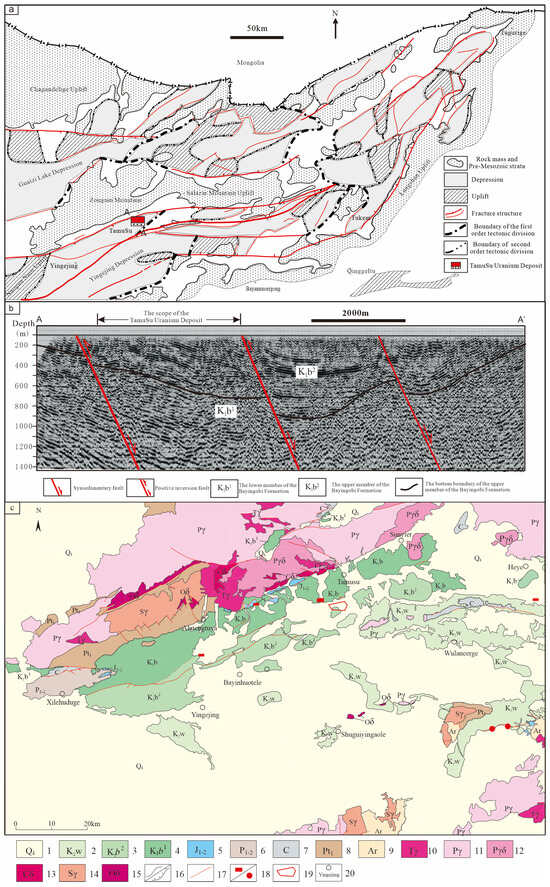
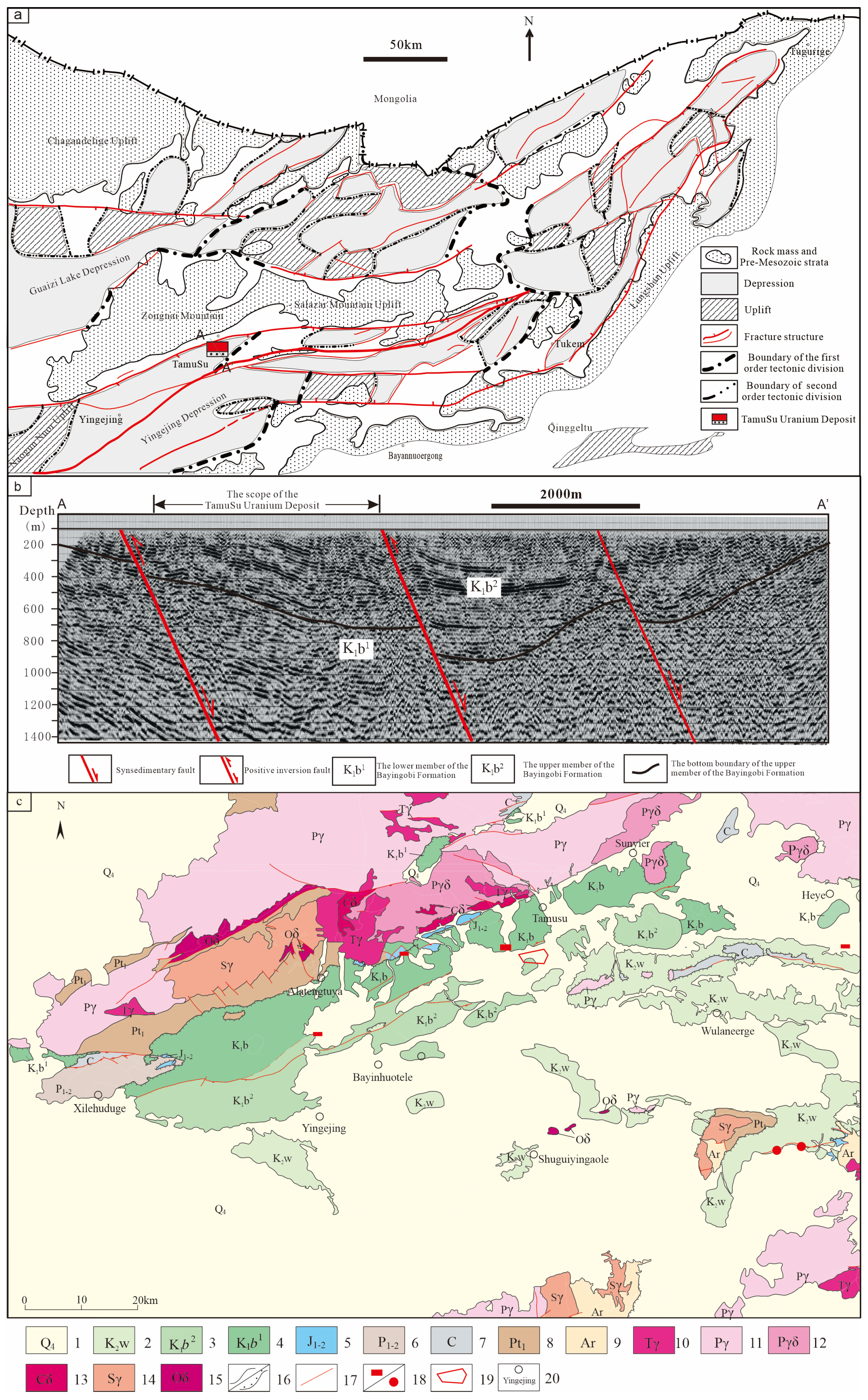
The Bayingobi Basin developed in a strike-slip pull-apart tectonic setting and contains single-fault and double-fault sags, with pronounced Early Cretaceous magmatism [8,47]. The sedimentary cover comprises Jurassic, Cretaceous, and Quaternary strata [48,49,50]. Jurassic strata are limited in distribution and are mainly of Lower to Middle Jurassic age. The Cretaceous succession forms the principal basin fill, but it is locally incomplete owing to uplift and erosion: within the Lower Cretaceous, the Bayingobi Formation (K1b) is preserved, whereas the Suhongtu (K1s) and Yinggen (K1y) formations are either absent or have been eroded. The basin experienced an evolution characterized by two episodes of compressional uplift and denudation, two episodes of extensional rifting, and a subsequent phase of thermal subsidence sagging [47]. The Tamusu uranium deposit is situated along the Zongnaishan slope belt on the northern margin of the Yinggejing Depression (Figure 1a). In the southern Bayingobi Basin, structural inversion-related fold assemblages are common, and the Tamusu deposit occurs between two major fault zones [37,41]. The basin-bounding fault on the northern margin belongs to the southern segment of the Zongnaishan–Shalazhashan fault system and was reactivated with reverse (inversion) motion during the Paleogene–Neogene (Figure 1b). Uplift and denudation along this inversion fault have exposed the upper member of the Bayingobi Formation at the surface to the northwest of the deposit, a condition favorable for the development of interlayer oxidation zones (Figure 1b). In the Tamusu area, the traditional stratigraphic scheme subdivides the Lower Cretaceous Bayingobi Formation into a lower member (K1b1) and an upper member (K1b2). The lower member is dominated by lacustrine deposits, whereas uranium mineralization is mainly hosted in the upper member.
Figure 1.
Tectonic background (a), seismic profile (b) and geological (c) maps of the Tamusu deposit. 1—Quaternary; 2—Upper Cretaceous Ulan Su Hai Formation; 3—Upper Bayingolin Formation (Lower Cretaceous); 4—Lower Bayingolin Formation (Lower Cretaceous); 5—Middle-Lower Jurassic; 6—Middle-Lower Permian; 7—Carboniferous; 8—Paleoproterozoic; 9—Archean; 10—Triassic granite; 11—Permian granite; 12—Permian granodiorite; 13—Carboniferous diorite; 14—Silurian granite; 15—Ordovician diorite; 16—geological boundary/angle unconformity boundary; 17—fault structure; 18—surface uranium mineralization points and numbering/airborne anomaly points and numbering; 19—Tamuz uranium deposit area; 20—place names.
3. Sampling and Analytical Methods
Samples for sandstone petrography and for characterizing the occurrence modes of uranium minerals were collected from the Bayingobi Formation of the Tamusu uranium deposit. The collected rocks primarily consist of gray and yellow sandstones from the boreholes. Twenty sandstone samples were examined by polarizing optical microscopy and scanning electron microscopy (SEM). The polarizing optical microscopy was conducted using a Leica DM4 P microscope (Leica Microsystems, Wetzlar, Germany) at the National Key Laboratory of Multi-Resource Collaborative Green Exploitation for Continental Shale Oil, Northeast Petroleum University. The SEM and Energy Dispersive Spectroscopy (EDS) were carried out at the Key Laboratory of Tectonics and Petroleum, China University of Geosciences (Wuhan), using a Carl Zeiss EVO LS 15 SEM equipped with an AZtec X-Max 20 energy-dispersive X-ray spectrometer (Carl Zeiss, Oberkochen, Germany). Operating conditions were as follows: accelerating voltage 5–25 kV, filament current 2.4–2.8 A, probe (beam) current 100–500 µA, and working distance 8–9 mm.
Sandstone samples for geochemical environmental proxies were collected from Bayingobi Formation sandstones representing different geochemical types within the Tamusu deposit. A total of 269 samples were analyzed, including 195 gray sandstones, 44 yellow sandstones, and 30 red sandstones. Analyses were performed at the Analytical Testing Center of Nuclear Industry Geological Brigade No. 208, using an HCS-140 high-frequency infrared carbon–sulfur analyzer (Dekai Instrument Co. Ltd., Shanghai, China)and a VIS-723N visible spectrophotometer (Beifen-Ruili Analytical Instrument Co. Ltd., Beijing, China); Fe3+/Fe2+, S2−, and ΔEh were determined by titrimetric (volumetric) methods following standard laboratory protocols.
4. Results
4.1. Petrological Characteristics
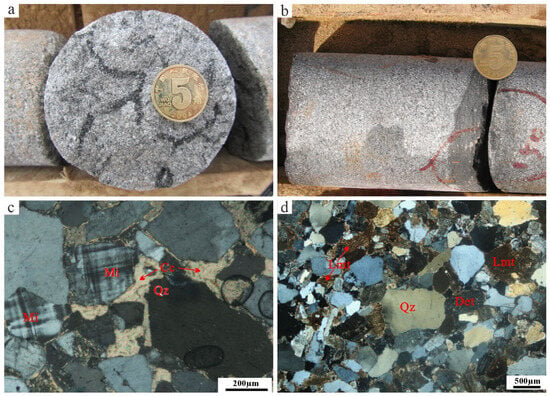
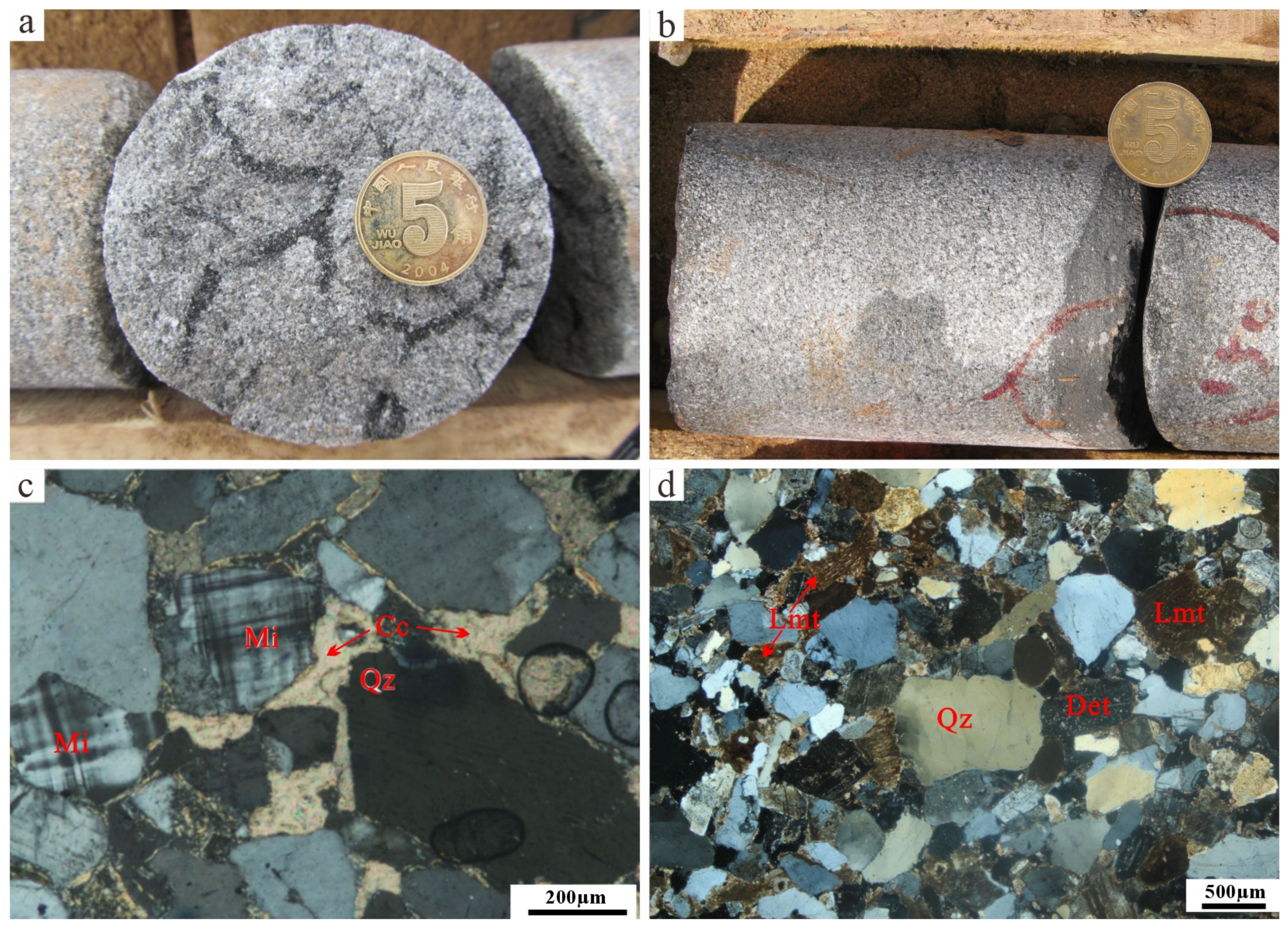
In the upper member of the Bayingobi Formation, sandstone types are dominated by arkosic sandstone (Figure 2a), accounting for 86.4%; lithic arkose (Figure 2b) makes up 10.7%; and feldspathic quartz sandstone (subarkose) constitutes only 2.9%. Detrital framework grains are chiefly quartz and feldspar, with lithic fragments being subordinate (Figure 2c,d). Lithic fragments are mainly granitic, with minor volcanic and metamorphic lithics; accessory constituents include mica and heavy-mineral grains. The sandstones comprise framework grains and interstitial material. Framework content is 72%–93% (avg. 86.3%), whereas interstitial material is 7%–28% (avg. 13.7%) and consists of matrix and cement. Matrix occurs only in a few matrix-supported specimens and is dominated by illite (up to 25%), followed by kaolinite and sericite (hydromica). Abundant calcite cement is present (Figure 2c), and limonite and related Fe-oxyhydroxides are disseminated within the matrix (Figure 2d).
Figure 2.
Petrological characteristics of the upper member of the Bayingobi Formation (K1b2). (a) Core photograph of feldspathic sandstone; (b) core photograph of lithic feldspathic sandstone; (c) cross-polarized photomicrograph of grayish-white medium-grained sandstone showing feldspar dissolution and calcite cement; (d) yellow sandstone with pervasive limonitization infilling interstices. Abbreviations: Mi, microcline; Qz, quartz; Det, detritus; Lmt, limonitization; Cc, calcite.
The braided distributary channel sands on the delta plain and the subaqueous distributary channel sands on the delta front constitute the principal uranium-bearing reservoirs, dominated by sandstone and pebbly sandstone with relatively good sorting and roundness (Figure 2).
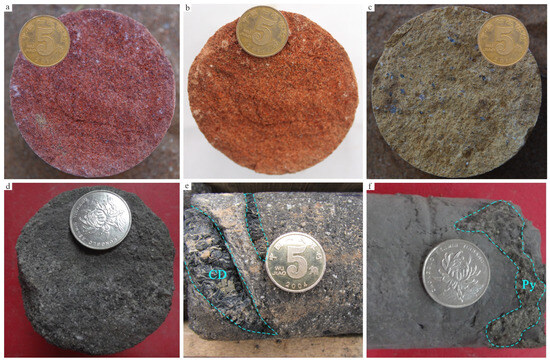
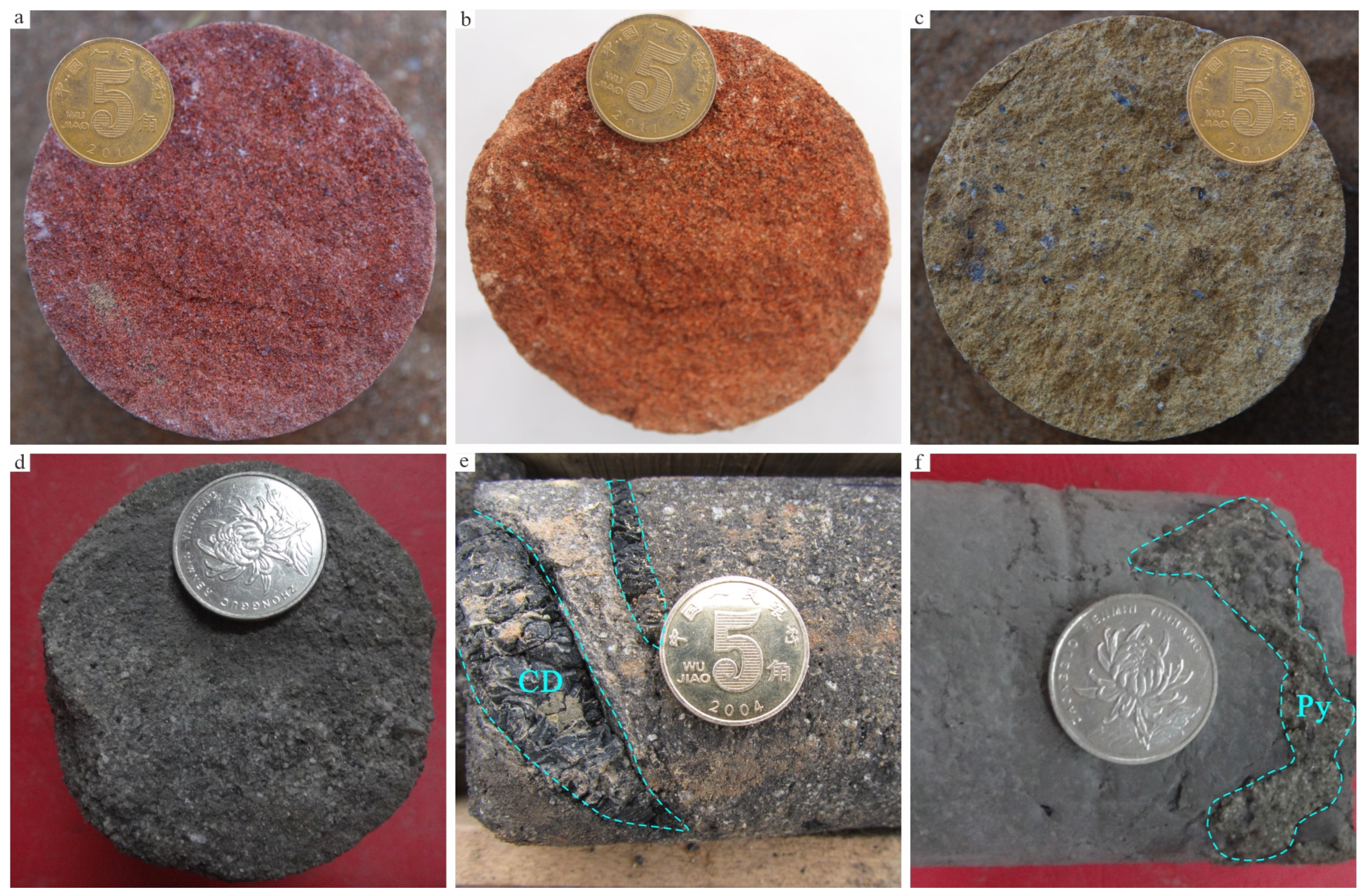
Oxidized sandstones can be subdivided into red-oxidized and yellow-oxidized varieties. They commonly occur in coarser-grained rocks—principally sandy conglomerates and sandstones across a range of grain sizes—with low matrix contents, poor to moderate sorting, and slightly higher textural and compositional maturity. Their colors are chiefly purplish-red (Figure 3a), reddish-brown (Figure 3b), and yellow (Figure 3c). Mineralogically, cements are pervasively hematitized and limonitized; in incompletely oxidized sandstones, relict primary gray patches may still be observed.
Figure 3.
Representative sandstone samples of different geochemical types. (a) Purplish-red sandstone; (b) reddish-brown sandstone; (c) yellow sandstone; (d) grayish-black sandstone; (e) carbonaceous clastic sandstone with carbonized plant detritus; (f) pyrite-bearing sandstone. CD, carbonized plant detritus; Py, pyrite.
Reduced sandstones are dominated by (pebble-bearing) coarse sandstone, medium- and fine-grained sandstone, and conglomerate. They contain slightly less cement and are poorly to moderately sorted. Colors are mainly gray, dark gray, and pale grayish-green (Figure 3d). Diagnostic mineralogical features include carbonized plant debris (Figure 3e) and cubic pyrite (Figure 3f).
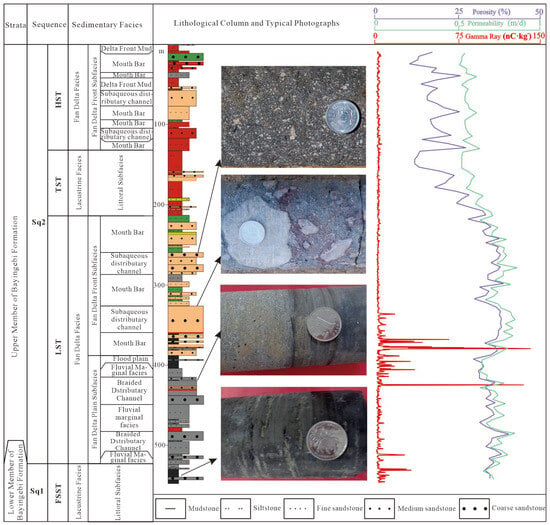
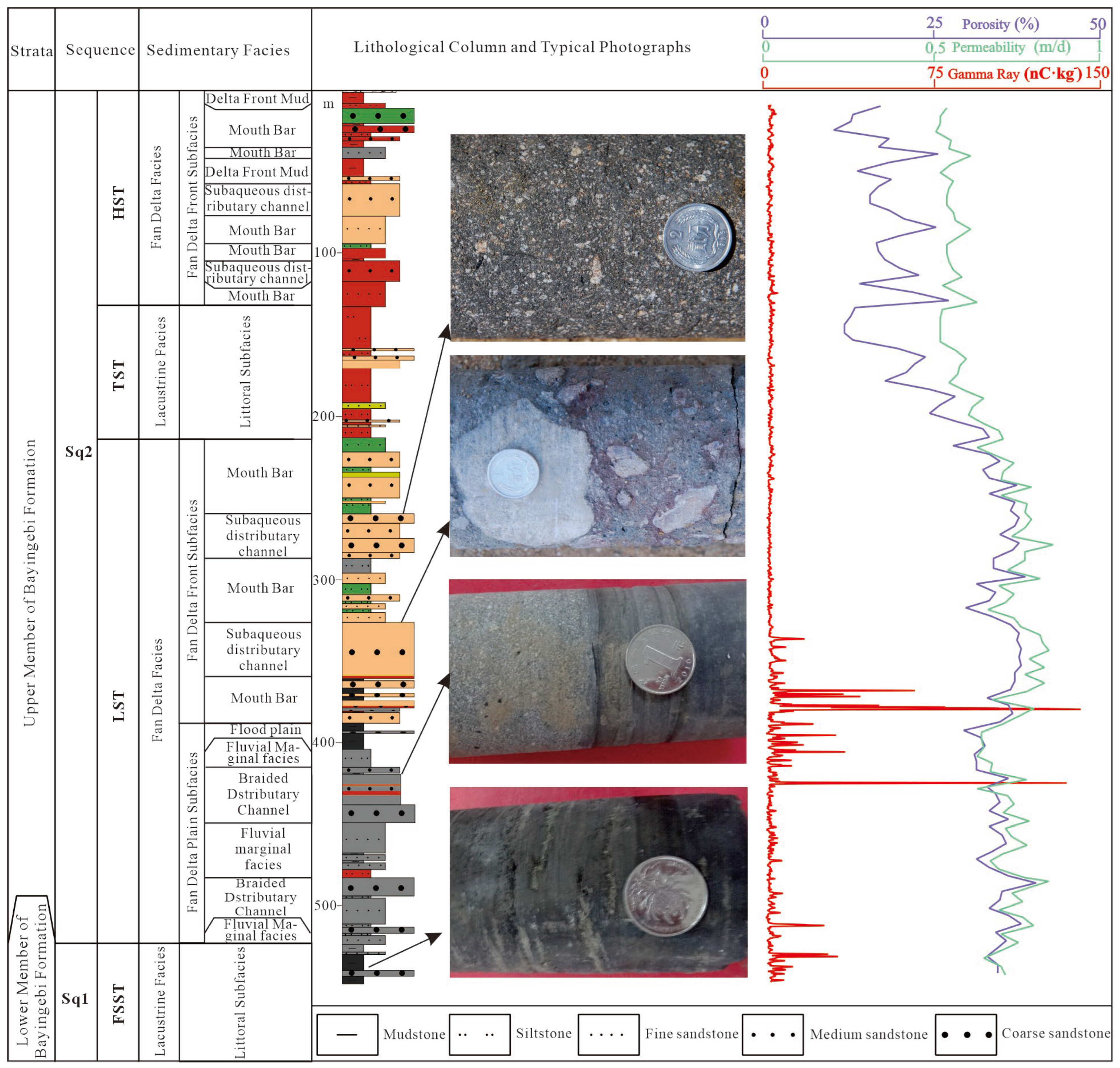
Reservoir quality parameters (e.g., sand body thickness, net-to-gross, porosity and permeability) were compiled from integrated core descriptions, routine core-plug measurements and calibrated well-log interpretation. These parameters are summarized in Figure 4 and subsequent stratigraphic panels.
Figure 4.
Porosity and permeability histogram for the Bayingobi Formation sand bodies, Tamusu uranium deposit. The colors in the lithology column chart represent those of sandstone. Reprinted with permission from [51] published by China University of Geosciences Press.
4.2. Geochemical Characteristics of Rocks
A total of 269 samples were analyzed (gray sandstone group, n = 195; yellow sandstone group, n = 44; red sandstone group, n = 30). Because some parameters were not measured for all samples and an outlier screening step was applied, the effective sample count for each proxy is reported in Table 1.
Table 1.
Statistical results of geochemical environmental proxies for different sandstones.
Redox-environmental proxies for oxidized sandstones show that red oxidized samples contain up to Fe3+ = 3.84% and Fe2+ = 2.47%, whereas yellow oxidized samples contain up to Fe3+ = 5.99% and Fe2+ = 1.71%. Here, Fe3+ and Fe2+ denote the contents of Fe in different valence states (reported as wt% Fe, rather than oxide wt%). In addition, red oxidized sandstones have mean organic carbon of 0.97%, mean S2− of 0.17%, mean CO2 of 3.51%, and mean ΔEh of 30.83; the corresponding mean values for yellow oxidized sandstones are 1.38%, 0.30%, 5.12%, and 42, respectively (Table 1). CO2 represents carbonate-derived CO2 measured as a bulk proxy, and ΔEh is a composite redox index derived from the measured Fe and sulfur species.
Reduced sandstones are characterized by Fe3+ contents up to 2.91% (mean 0.99%) and Fe2+ contents up to 2.73% (mean 0.92%), both far lower than in red and yellow oxidized sandstones. In addition, organic carbon reaches 6.32% (mean 0.57%); total sulfur reaches 4.98% (mean 1.24%); sulfide sulfur (S2−) reaches 2.16% (mean 0.56%); CO2 reaches 19.09% (mean 4.13%); and ΔEh reaches 90 (mean 41.11) (Table 1). These signatures are closely linked to the abundance of reducing phases—notably carbonized plant debris and pyrite—within the reduced sandstones.
4.3. Occurrence Characteristics of Uranium Minerals
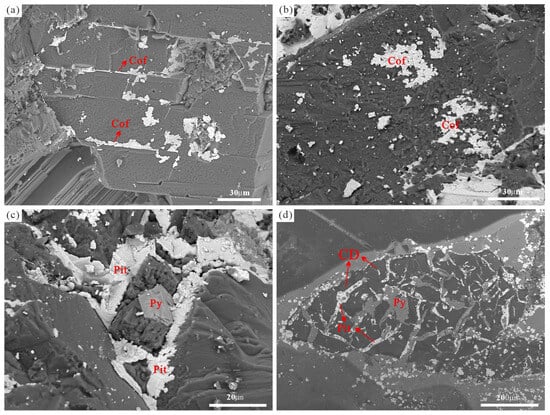
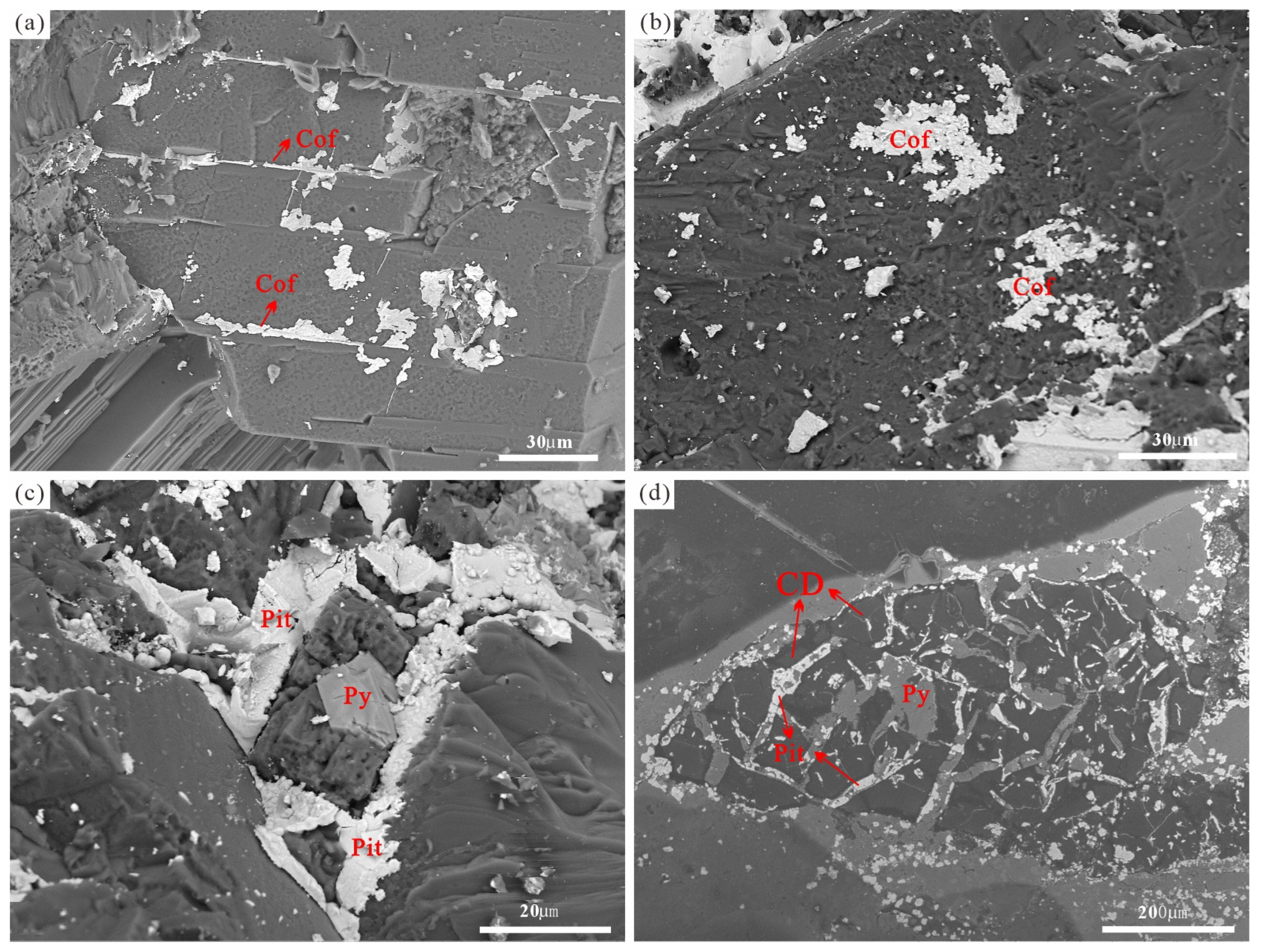
SEM observations indicate that uranium minerals occur mainly within detrital feldspar grains (especially plagioclase) and along feldspar grain margins. The dominant uranium minerals are pitchblende and uraninite (Figure 5). These minerals appear as dot- to line-like precipitates along cleavage traces at grain edges, as film-like coatings carpeting entire cleavage planes (Figure 5a), and as infills of dissolution/etch pits on feldspar surfaces (Figure 5b).
Figure 5.
Occurrence characteristics of uranium minerals. (a,b) Coffinite occurs along cleavage, fractures (a) and dissolution pores (b) in detrital plagioclase; (c) pitchblende in pores and microfractures of cements; (d) pitchblende filling fractures in carbonized plant detritus, with associated pyrite. CD, carbonized plant detritus; Cof, coffinite; Pit, pitchblende; Py, pyrite.
A portion of the uranium minerals resides within intergranular pores, commonly in association with cement. Where pore sizes are relatively uniform, U minerals are uniformly disseminated as fine to very fine grains within the cement; where pores are larger, U minerals occur primarily as pore-filling aggregates (Figure 5c).
Uranium minerals also occur within plant detritus. After gel-like (colloform) pyrite replacement of plant cell walls, the original cellular fabric is preserved, and uranium precipitates are observed around the margins of the colloform pyrite or within the plant cell lumina (Figure 5d).
5. Discussion
5.1. Mineralization-Controlling Mechanism of the Sedimentary System
- (1)
- Types of sedimentary systems
Based on core logging and log facies analysis from 248 boreholes in the Tamusu deposit, the upper member of the Lower Cretaceous Bayingobi Formation (K1b2) in the Bayingobi Basin is interpreted as a fan-delta–lacustrine system, rather than the traditionally inferred braided-river delta system. This conclusion is supported by core-observed sedimentary characteristics, petrological features, and established sedimentological principles [52,53,54,55,56].
The study interval formed in a fault-controlled lacustrine basin, a setting typical of fan-deltas, characterized by steep slopes and proximal sediment sources [52,53]. In contrast, braided-river deltas generally develop in tectonically stable settings with gentle slopes and distant sediment sources [52,53]. Consistent with this, the depositional system is divided into fan-delta plain and fan-delta front subfacies, with prodelta that is only locally developed. The fan-delta plain is dominated by coarse clastics such as conglomerate and pebbly sandstone, and exhibits prominent exposure indicators, including calcareous concretions, root traces (rhizoliths), and invertebrate fossils [57], attesting to episodic subaerial exposure [52]. These features, together with gypsum cementation, are all diagnostic of proximal fan-delta environments [52]. Petrologically, K1b2 sandstones are dominated by arkosic sandstone (86.4%) with granite-dominated lithic fragments (Figure 2), indicating a short transport distance and proximal sediment source [52], consistent with fan-delta characteristics. Braided-river deltas rarely exhibit widespread gypsum cementation and typically have higher sandstone maturity due to their distal setting [53]. Additionally, abundant calcite cement and pervasive limonitization in the sandstones further reflect the arid sedimentary environment of the fan delta [52].
Widespread sandy–gravelly gravity flow beds, synsedimentary slump structures, and inverse grading (observed in both fan-delta plain and front) further confirm a fan-delta, as these are typical of high-energy, proximal fault-controlled systems [53,54]. The principal uranium-bearing reservoirs (braided distributary channel and subaqueous distributary channel sands) are dominated by sandstone and pebbly sandstone with relatively good sorting and roundness, while oxidized and reduced sandstones are mainly coarse-grained with poor to moderate sorting—consistent with rapid proximal accumulation of fan-deltas [52]. In contrast, braided-river deltas are dominated by traction currents, where gravity flow deposits and slumps are rare, and their sandstones generally have more stable sorting due to longer transport [54]. Additionally, fan-delta sand bodies are enclosed by lacustrine mudstones, showing a sharp terrestrial–lacustrine transition consistent with fan-delta geometry, unlike the gradual transition of braided-river deltas [53].
In summary, the fault-controlled setting, fan-delta subfacies division, proximal coarse lithofacies, petrological characteristics (arkosic sandstone dominance, calcite cement, limonitization), and widespread gravity flow features confirm a fan-delta–lacustrine system. This revises traditional understanding and provides a sedimentological basis for subsequent reservoir and ore distribution analysis.
- (2)
- Favorable zone for uranium reservoirs
As described above, these lacustrine deposits form overlying and underlying aquitards to the fan-delta sand bodies, establishing a favorable “mud–sand–mud” reservoir–seal assemblage. This architecture is highly conducive to uranium mineralization, as it facilitates the focused migration of mineralizing fluids and promotes uranium accumulation [3,24,58].
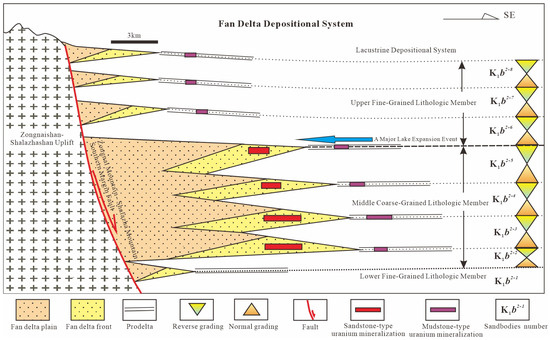
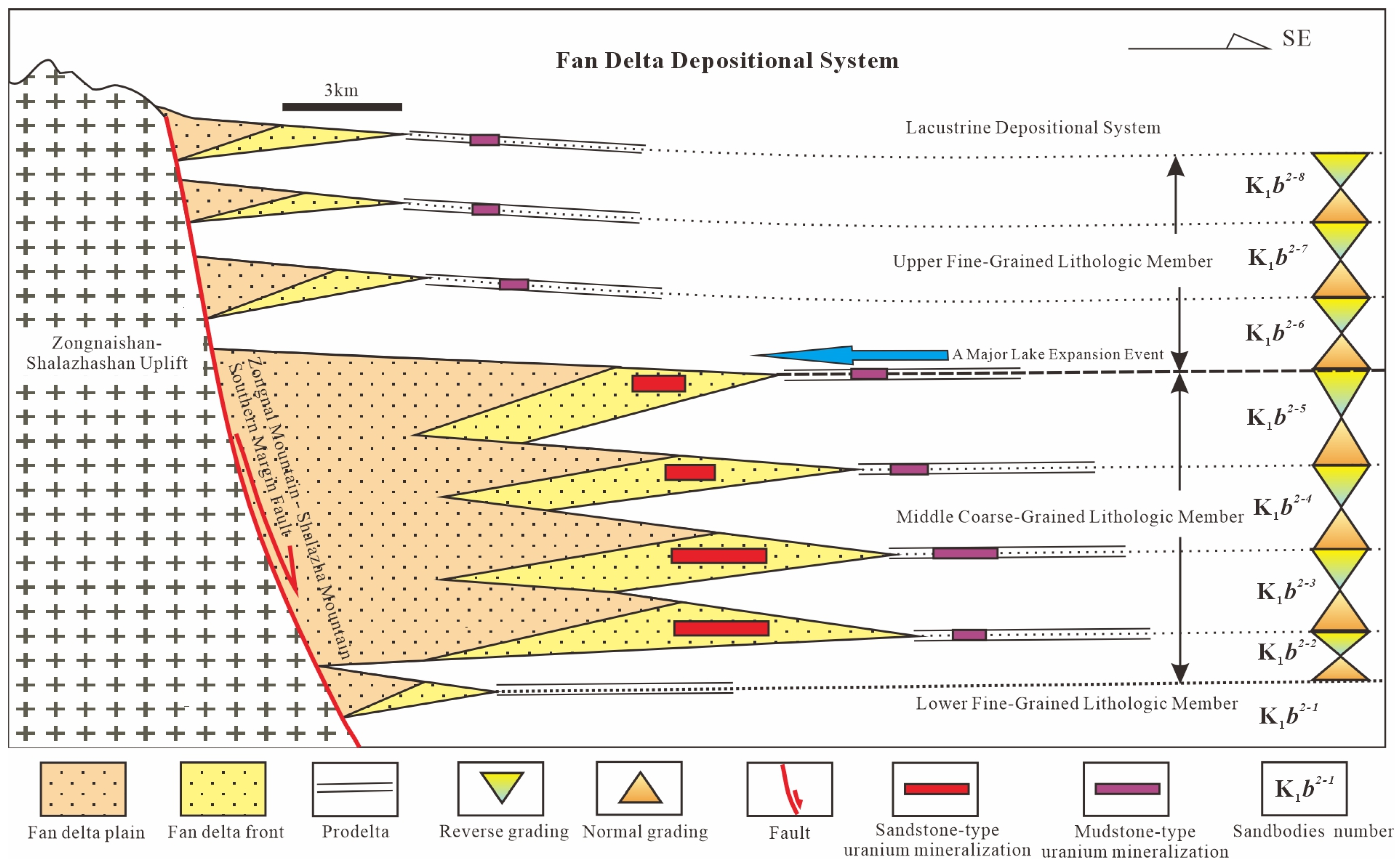
On the basis of a regional marker bed between K1b2-1 and K1b2-2 and six lacustrine flooding surfaces, the upper member of the Bayingobi Formation is subdivided into eight parasequence sets: K1b2-1, K1b2-2, K1b2-3, K1b2-4, K1b2-5, K1b2-6, K1b2-7, and K1b2-8 (Figure 6). Considering the stratigraphic positions of uranium orebodies, four principal ore-bearing horizons are identified (K1b2-2, K1b2-3, K1b2-4, and K1b2-5), with marked vertical differences in metallogenic potential (Figure 6).
Figure 6.
Stratigraphic framework, sedimentary systems and distribution of orebodies in the Tamusu uranium deposit.
In the Tamusu area, sand body thickness, conglomerate thickness and sand content (net-to-gross) within the upper Bayingobi Formation parasequence sets K1b2-2, K1b2-3, K1b2-4 and K1b2-5 exhibit a consistent NW–SE trend (Figure 6). Sandstone-type uranium orebodies are concentrated near the distal termini of sand body highs, particularly where sand body thickness decreases abruptly (pinch-out positions), suggesting stabilization of redox fronts at permeability contrasts. The scale of mineralization is closely coupled to reservoir development: K1b2-2 and K1b2-3 host the most extensive and laterally connected sand body systems and correspondingly the largest mineralization footprints; up-section, sand body scale decreases and mineralization becomes weaker and more discontinuous. Overall, mineralization is chiefly hosted in K1b2-2 to K1b2-5, with K1b2-2 and K1b2-3 being more intensely mineralized, with broader ore distribution and more tabular industrial orebodies, whereas K1b2-4 and K1b2-5 contain smaller and more scattered economic orebodies. Stratigraphically, repeated mud–sand–mud stacking associated with base-level cycles provides alternating conduits and aquitards, favoring both focused flow and preservation of the interlayer oxidation zonation.
- (3)
- Mineralization-controlling mechanism of the fan-delta
The development of sandstone-type uranium mineralization in the Tamusu deposit is controlled by the fan-delta depositional system: the vast majority of orebodies occur within the fan-delta front, with fewer number of small-scale orebodies in the delta plain, and minor syndepositional mudstone-hosted uranium orebodies in the lakeshore to shallow lacustrine facies (Figure 4).
Within the upper Bayingobi Formation, uranium mineralization is restricted to the middle lithologic interval where the fan-delta depositional system is relatively well developed, reflecting the presence of large-scale reservoir sand bodies. The lower and upper lithologic intervals are barren, attributable to a greater lacustrine extent, smaller fan-delta scale, and consequently limited reservoir development (Figure 6 and Figure 7). In parasequence sets K1b2-2 and K1b2-3, braided distributary channel sands on the fan-delta plain and subaqueous distributary channel sands on the delta front are prominently vertically stacked; sand body thickness is 150–260 m, net-to-gross is 0.55–0.65, porosity is 15%–22%, and permeability is 10–50 mD. These constitute the most favorable uranium reservoirs; tabular industrial orebodies account for ~78% of all economic orebodies in the deposit. In contrast, in K1b2-4 and K1b2-5, the fan-delta contracts, sand body thickness decreases to 80–150 m, net-to-gross declines to 0.45–0.55, petrophysical quality deteriorates (permeability 5–15 mD), and industrial orebodies are sparse, with the overall mineralization scale being only about one-third of that in K1b2-2 to K1b2-3. Thickness and net-to-gross values are derived from integrated well-log interpretation and stratigraphic correlation, whereas porosity and permeability are compiled from routine core-plug measurements (summarized in Figure 4).
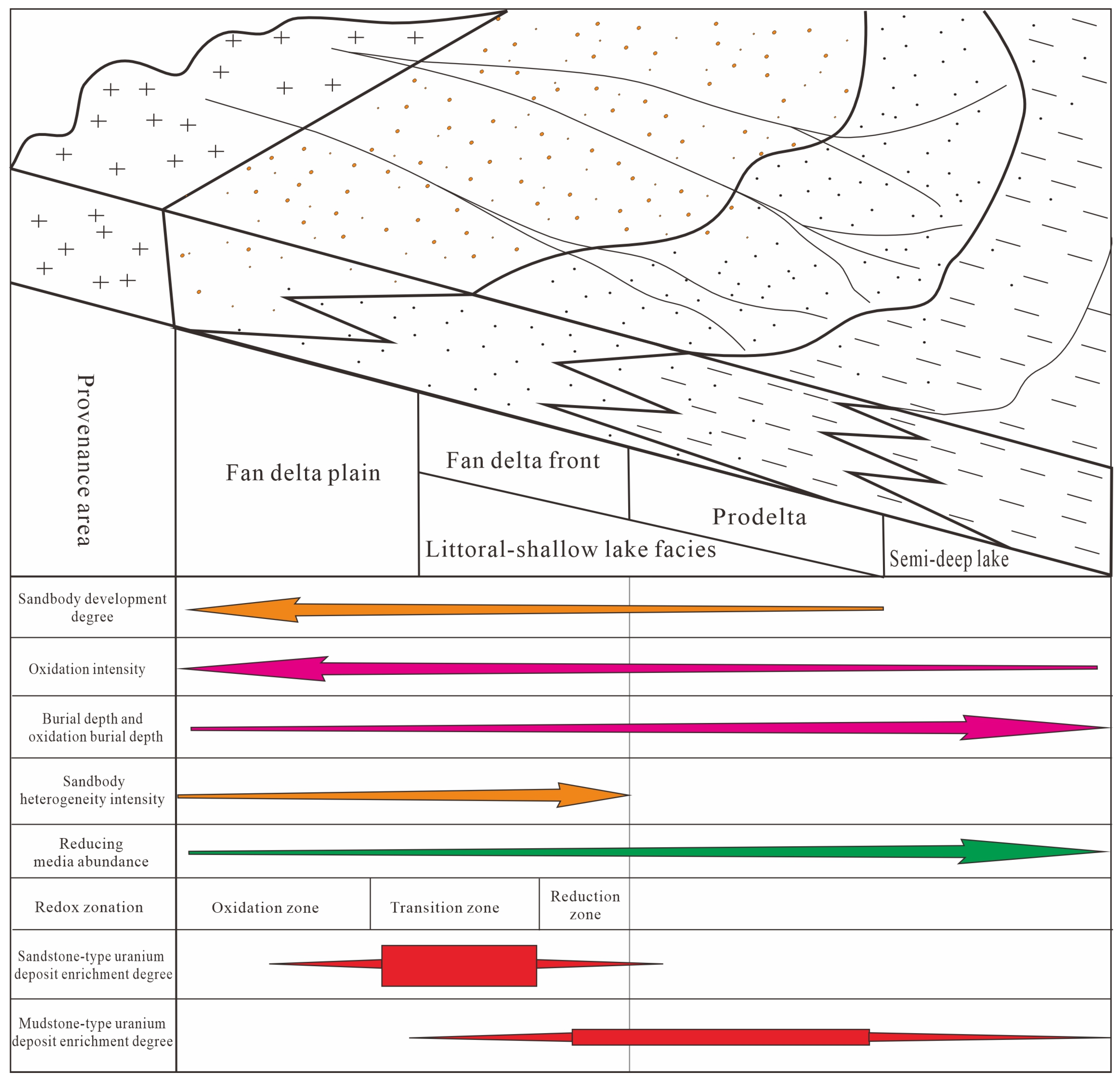
Figure 7.
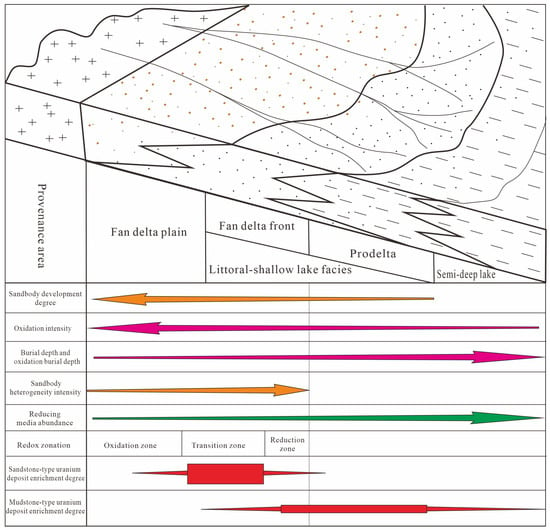
Uranium mineralization controlled by genetic facies within the fan-delta system of the Tamusu fault depression basin.
From the standpoint of fan-delta spatial architecture, sedimentation also governs the morphology of interlayer oxidation, and the fan-delta sand bodies and uranium orebodies exhibit a clear spatial coupling. From the delta plain through the delta front to the prodelta and lacustrine settings, the degree of sand body development and the intensity of oxidation decrease successively; burial depth and oxidation penetration depth increase; heterogeneity strengthens; and the abundance of reducing media progressively increases. The redox zonation is systematic: the oxidized zone is developed mainly on the delta plain, the redox transition zone (front) is concentrated in the distal delta plain and proximal delta front, and the reduced zone predominates in the distal delta front. Sandstone-hosted uranium is chiefly enriched in the transitional belt between the fan-delta plain and fan-delta front, reflecting the control of distributary bifurcation on the routing of mineralizing fluids, whereas mudstone-hosted uranium occurs mainly within the fine-grained distal-delta deposits (Figure 7).
In addition, the proposed “dual-source supply” of uranium is closely linked to fan-delta sedimentation. During the syndepositional stage, weathering products of uranium-bearing granitic rocks from the Zongnaishan uplift were transported basinward by the fan-delta system, producing mildly pre-enriched U-bearing sandstones in the upper Bayingobi Formation (mean U ≈ 5.30 μg/g [59]). This background enrichment provides a necessary uranium inventory for subsequent mobilization and redistribution in sandstone-type systems [6,10,11,60]. In the later ore-forming stage, oxygenated U-bearing fluids introduced through erosional windows migrated along permeable fan-delta sand bodies and precipitated at redox transition zones through interaction with reducing media.
5.2. Interlayer and Uranium Mineralization
At the Tamusu deposit, the spatial distribution of the interlayer oxidation zone exhibits pronounced vertical differentiation and systematic plan-view patterns. Its morphology, thickness, and internal zonation are closely tied to the distribution and permeability of fan-delta sand bodies. Uranium mineralization is concentrated in the redox transition zone, reflecting that sand bodies control the oxidation zone, and the transition zone controls the ore.
- (1)
- Distribution characteristics of the interlayer oxidation zone
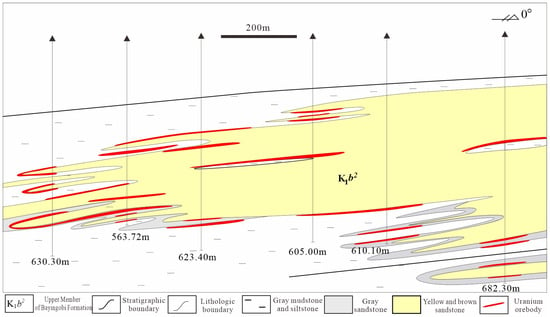
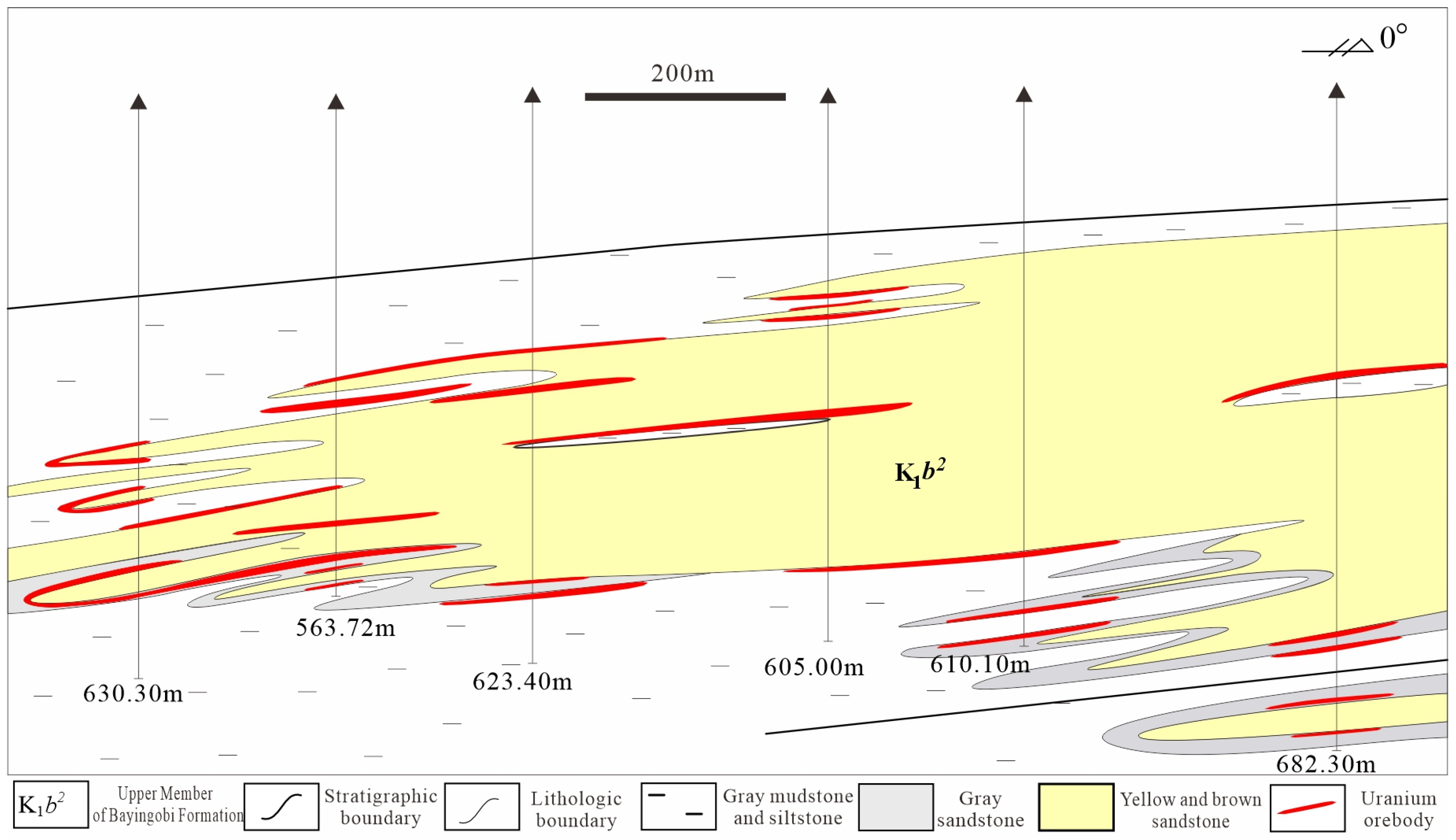
Vertically, the geometry of the interlayer oxidation zone evolves gradationally with changes in fan-delta subfacies and overall displays a trend of thickening northward and thinning southward (Figure 8). Morphologies commonly transition from banded to fingered and sinuous forms (Figure 8). The interlayer oxidation zone extends from north to south, with its degree of development governed by sand body thickness and rock permeability. Lithologies are dominated by brownish-yellow to reddish-brown coarse, medium, and fine grains, characterized by speckled limonitization and locally microcrystalline calcite infill.
Figure 8.
Geological cross-section along exploration lines in the Tamusu uranium deposit. The arrow in the picture represents the borehole.
In the northern part of the deposit, epigenetically oxidized sandstones occur chiefly within fan-delta plain distributary channel sand bodies that stack vertically, reaching thicknesses of up to 220 m; here, the interlayer oxidation zone is thick and tabular. Toward the central area, the interlayer oxidation zone is developed mainly within fan-delta front subaqueous distributary channels and mouth-bar sand bodies, forming sand–mud interbeds vertically; oxidized sandstone thickness generally ranges 50–180 m. The interlayer oxidation zone remains layered overall, but branches along its upper and lower flanks, and reduced sandstone lenses may occur within it, producing variable geometries and an overall thinning trend (Figure 8). In the south-central sector, the interlayer oxidation zone is principally hosted by mouth-bar and sheet-sand microfacies of the fan-delta front, or by thin sand bodies of the prodelta subfacies; vertically, thick mudstone interbedded with thin sandstone predominates. Here, oxidized sandstone is typically several to tens of meters thick, and the interlayer oxidation zone commonly transitions abruptly to fingered or sinuous forms or pinches out against gray to dark-gray mudstone (Figure 8).
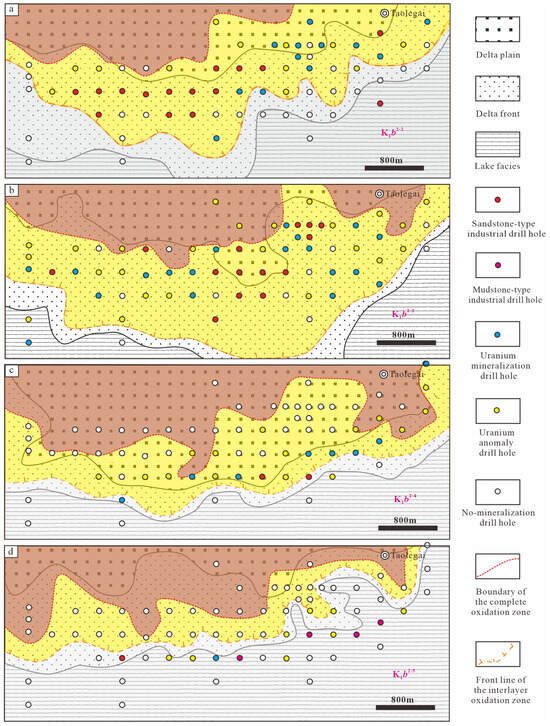
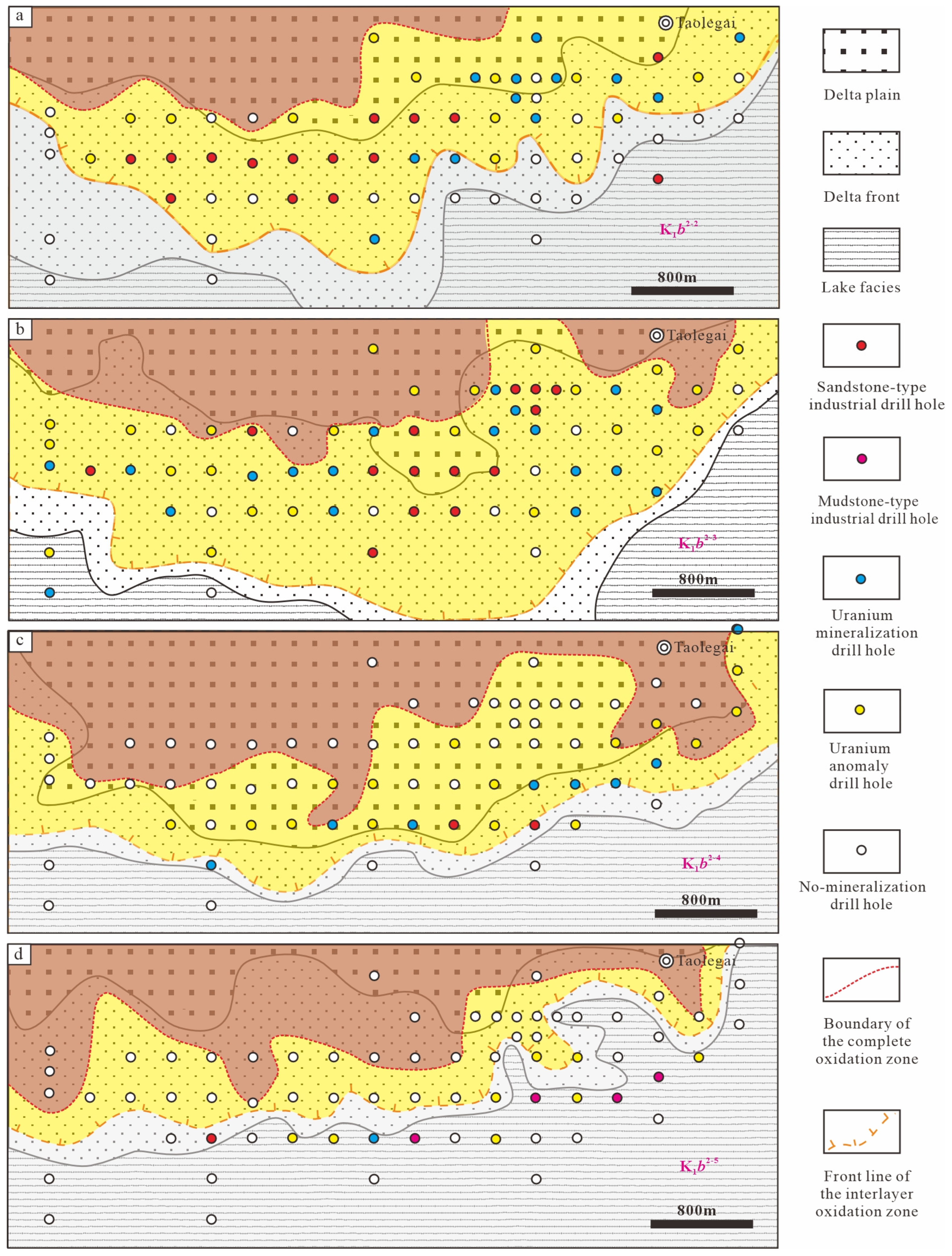
In plan-view, the interlayer oxidation zone follows the fan-delta trend (NW–SE) and exhibits a belt-like concentric zonation from the oxidized zone though the transition zone to the reduced zone, with uranium mineralization strictly confined to the redox transition zone. The oxidized zone is concentrated along the frontal part of the Zongnaishan slope belt in the northwest of the deposit, corresponding to braided distributary channel sands of the fan-delta plain. Oxidation is thorough, sandstone uranium contents are below background (<2 × 10⁻⁶ by mass), and mineralization is absent. The oxidized zone is ~1.5–2.0 km wide; the oxidation front trends are approximately E–W, locally showing irregular sinuous traces influenced by distributary bifurcation. The redox transition zone, the core mineralized belt, occupies the central part of the deposit and corresponds to sand bodies from the distal fan-delta plain to the proximal fan-delta front, exhibiting highly variable widths. In the north, the transition zone exceeds 2.0 km in width, and its front trace extends more than 7.0 km; in the south, the contraction of sand body scale narrows the belt to ~800 m, forming a NW-bulging, dumbbell-like geometry (Figure 9). Sandstones within the transition zone exhibit mixed oxidized–reduced features, with hematitization coexisting with pyrite; uranium grades reach 0.01–0.33 wt%, with an industrial cutoff of 0.01 wt%. The reduced zone lies in the southeast of the deposit, corresponding to the distal fan-delta front to prodelta mudstones. Sandstones in this zone are unoxidized, gray to dark-gray, and rich in organic matter and pyrite.
Figure 9.
Relationships among sedimentary systems, oxidation zones and uranium mineralization in different parasequence sets of the Tamusu uranium deposit. (a–d) parasequence sets: (a)K1b2-2, (b)K1b2-3, (c)K1b2-4, (d)K1b2-5.
- (2)
- Constraints of the interlayer oxidation zone on uranium mineralization
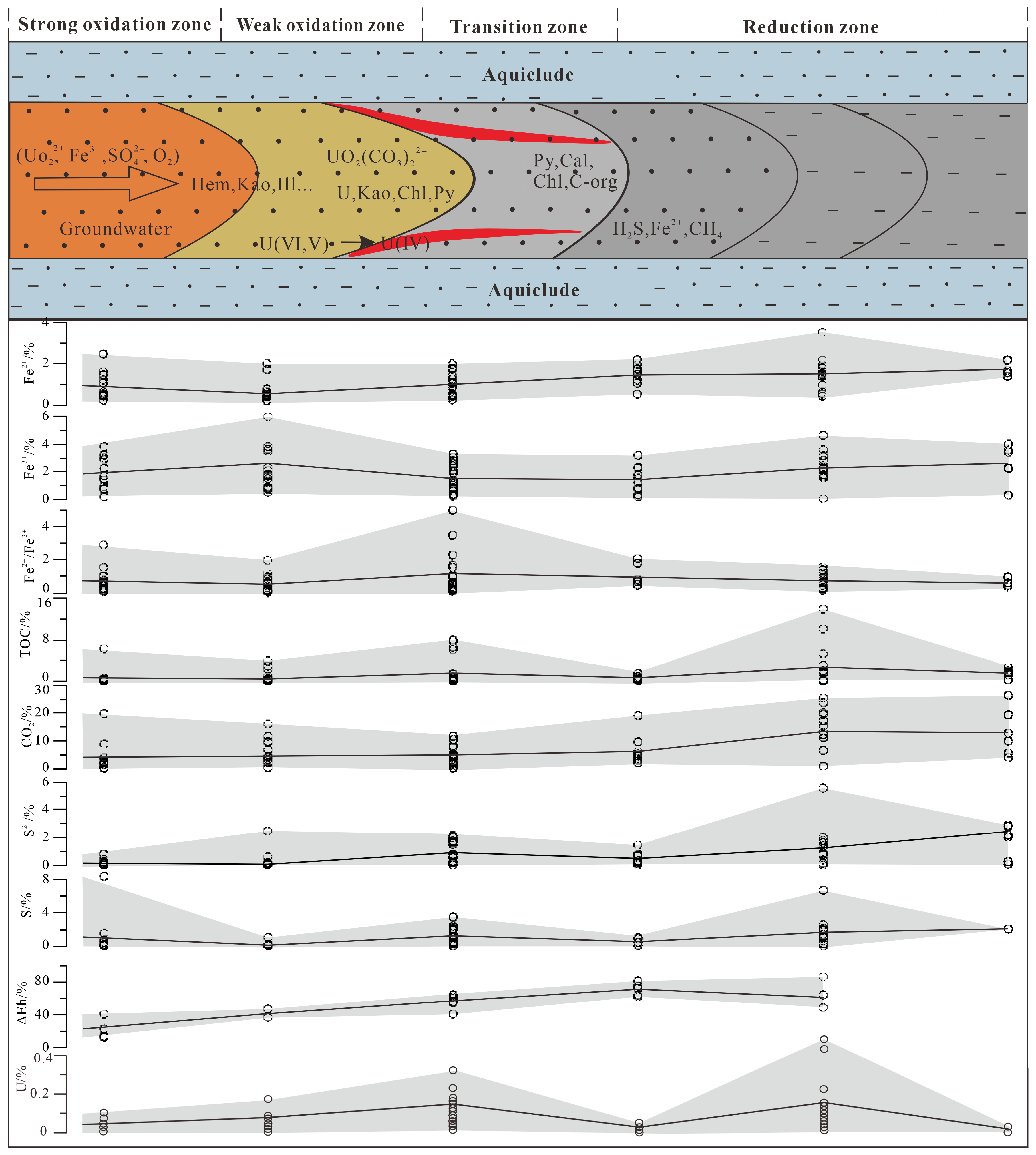
Within the gray lithologies of the upper Bayingobi Formation, two epigenetic oxidation types are recognized—red oxidation and yellow oxidation—and hematitization, limonitization, goethite, and jarositization (K-jarosite) are common; these are characteristic indicators of interlayer oxidation [6,25,61,62,63]. Within K1b2-2, K1b2-3, K1b2-4, and K1b2-5 of the upper Bayingobi Formation, the interlayer oxidation zones exhibit pronounced internal zonation, allowing clear differentiation of oxidized, transition, and reduced zones; uranium orebodies are controlled by the transition zone and the position/trace of the oxidation front (Figure 8, Figure 9 and Figure 10). Uranium enrichment in the Tamusu deposit is closely associated with organic matter and pyrite. In fine-grained sandstones, pyrite and plant detritus (organic matter) exert a strong influence on uranium precipitation, consistent with an interlayer oxidation-controlled redox mineralization model [5,21,64,65,66,67,68,69].
Figure 10.
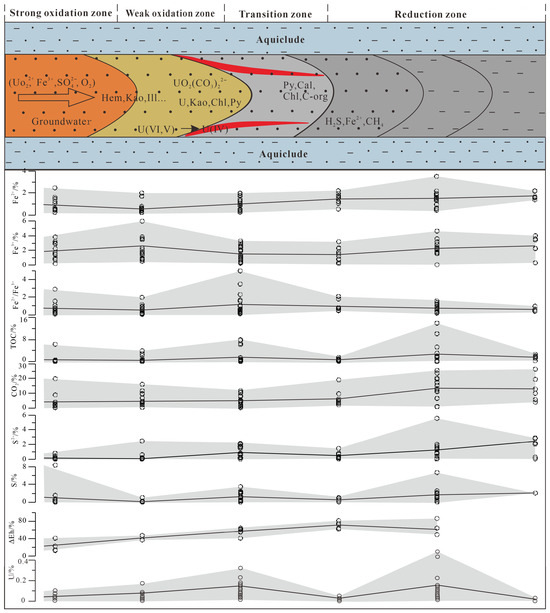
Oxidation–reduction zonation and environmental geochemical characteristics of sandstones in the Tamusu uranium deposit. Py, pyrite; Cal, calcite; Chl, chlorite; C-org, organic carbon; Hem, hematite; Kao, kaolinite; Ill, illite. Reprinted with permission from [51] published by China University of Geosciences Press.
In the upper Bayingobi Formation at Tamusu, three lithologic intervals stack vertically to form a stable mud–sand–mud architecture. The interlayer oxidation zone is developed chiefly within the second interval, and its extent is controlled primarily by the permeability of the sand bodies in that interval. Subaqueous distributary channel sandstones of the fan-delta front exhibit relatively high porosity and permeability; as oxygenated, U-bearing waters flow through these permeable horizons, dissolved O2 is progressively consumed, establishing an interlayer redox transition zone. The interlayer oxidation zone propagates from north to south, with decreasing thickness and progressively shallower burial. In the northern part of the deposit, the oxidized sandstone thickness is broadly coextensive with the aquifer thickness; southward, the oxidized sand bodies thin, become thinner than the aquifer interval, and ultimately pinch out.
Within fluvial channel belts, the oxidized zone develops as multilayered, belt-like bodies, composed mainly of brownish-yellow to reddish-brown coarse-, medium-, and fine-grained sandstones that show disseminated limonitization or limonitic speckling; sandstones in the redox transition zone display variable degrees of epigenetic alteration. Comparative analyses of Fe3+, Fe2+, organic carbon (TOC), CO2, sulfide sulfur (S2−), total sulfur (S_total), ΔEh, and ore U grade among strongly red oxidized sandstones, yellow oxidized sandstones, mineralized sandstones in the transition zone, reduced sandstones, mineralized mudstones, and barren mudstones indicate that the oxidized zone is characterized by elevated Fe3+ and CO2 (Figure 10). Yellow oxidized sandstones exhibit slightly higher Fe3+, S2−, and U than red oxidized sandstones, implying that during groundwater infiltration and basinward migration from the basin margin, pyrite in gray sandstones is oxidized, Fe2+ in the sand bodies is progressively converted to Fe3+ (rock colors redden to red/reddish-brown), and partial Fe loss occurs—supplying iron to deeper basin sand bodies, where pyrite forms within the redox transition zone and sandstone-type uranium deposits precipitate (Figure 8). Sulfur derived from surface waters and from pyrite oxidation in gray sandstones (reddening) is transformed into SO42−, which migrates basinward and is reduced to pyrite in the redox transition zone [70,71,72,73]. By contrast, the redox transition zone (ore zone) is distinguished by higher Fe2+, Fe2+/Fe3+, TOC, S_total, ΔEh, and U, together with lower Fe3+ and CO2 and moderately elevated S2−, indicating that pyrite and carbonized plant debris served as key reductants for uranium mineralization in the sandstones [32].
By regulating the flow paths of oxygenated, U-bearing waters, the redox reaction interface (oxidation front), and the precipitating media (reducing agents), the interlayer oxidation zone dictates the spatial distribution and intensity of uranium mineralization. Its controlling influence is expressed in three aspects: the geochemical signatures of oxidation zonation, the mechanisms of U precipitation, and the coupling between interlayer oxidation processes and the depositional architecture [17,18,37,74,75]. Previous studies indicate that, after deposition of the upper Bayingobi Formation, the paleoclimate remained persistently arid and hot. Under relatively closed, ponded-water conditions, intense water–rock interaction and decarbonation (CO2 loss/consumption) destabilized and dissociated uranyl–carbonate complexes—notably [UO2(CO3)3]4− and [UO2(CO3)3]2−—as well as double salts such as MgCO3·NaUO2(CO3)2, thereby promoting uranium precipitation. Under diffusion-dominated transport, dissolved U tended to migrate toward zones of stronger water–rock interaction, leading to focused accumulation at specific stratigraphic horizons [36,76,77,78,79,80].
5.3. Ore Deposit Genetic Model
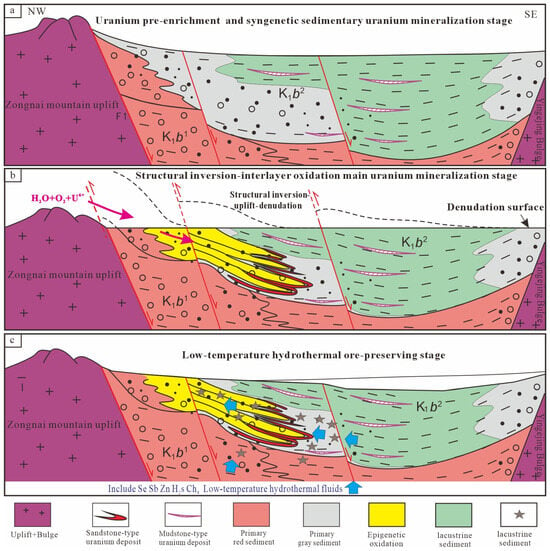
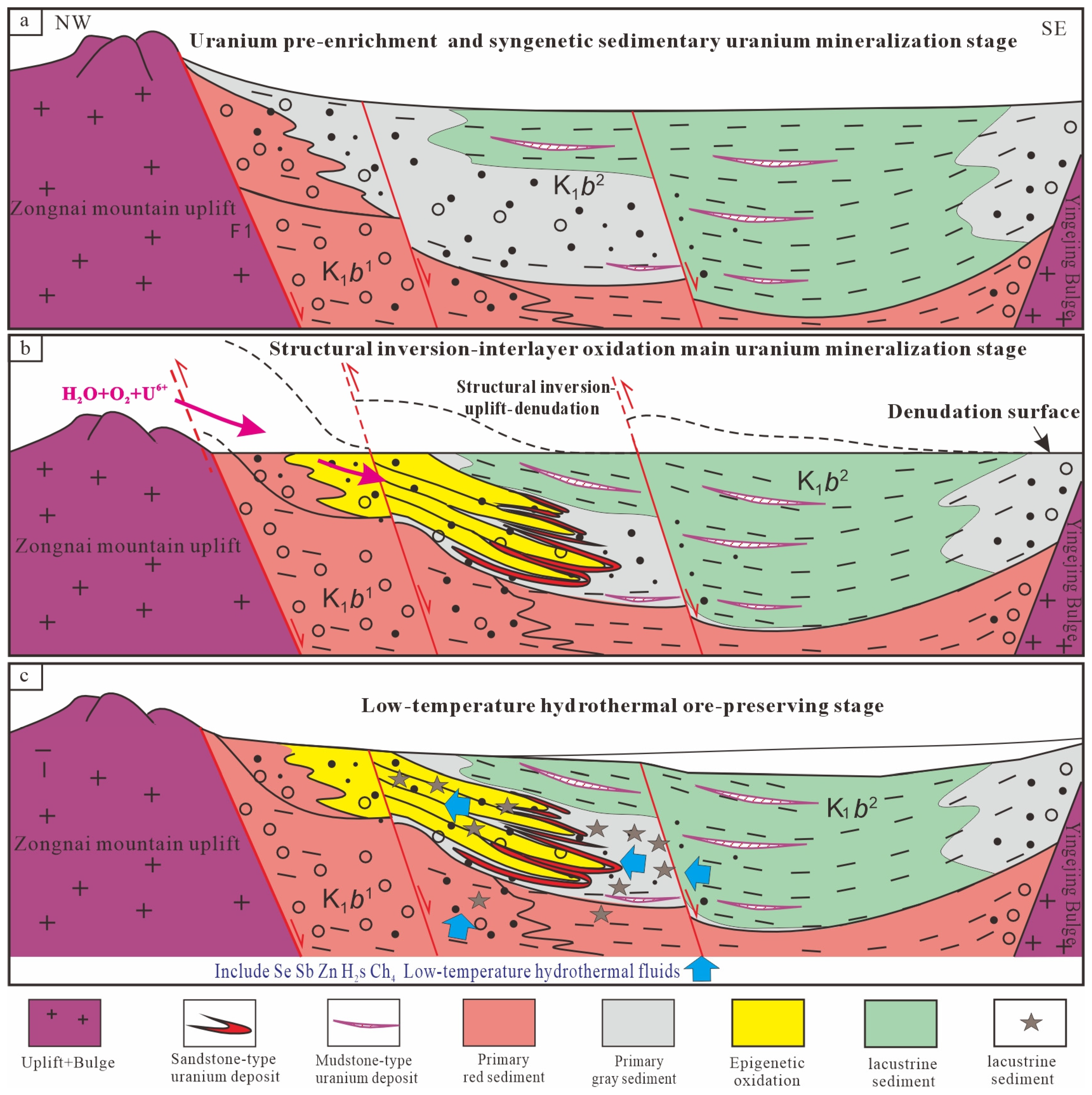
In synthesis, the Tamusu uranium deposit is controlled by the interlayer oxidation zone and a typical interlayer oxidation-type sandstone uranium deposit. Although subsequent hydrothermal overprinting modified the deposit, it did not produce further uranium enrichment. Accordingly, the metallogenic evolution can be divided into three stages: synsedimentary pre-enrichment, interlayer oxidation mineralization, and epigenetic hydrothermal overprinting [35,81] (Figure 11).
Figure 11.
Conceptual three-stage model for uranium mineralization in the Tamusu deposit. (a) Uranium pre-enrichment and syngenetic sedimentary uranium mineralization stage; (b) Structural inversion-interlayer oxidation main uranium mineralization stage; (c) Low-temperature hydrothermal ore-preserving stage.
- (1)
- Syngenetic sedimentary pre-enrichment stage
Previous studies indicate that the clastic detritus of the upper Bayingobi Formation at the deposit is derived chiefly from U-rich granites of the Zongnaishan source terrane to the north. Granites of different ages in this source area contain elevated U: Late Caledonian intrusions average (2.3–3.3) × 10−6, and Variscan intrusions average (3.0–4.5) × 10−6 [40]. These sources supplied U-enriched detritus during basin sedimentation. The fan-delta sand bodies of the upper Bayingobi Formation constitute favorable uranium reservoir space, providing the uranium source foundation for primary enrichment and syndepositional uranium mineralization (Figure 7 and Figure 11a).
Gray sediments formed under different depositional settings in the upper Bayingobi Formation constitute the material foundation for U-enriched strata. During deposition of distributary channels on the fan-delta plain and front, U-rich detritus derived from the source area built the channel sand bodies. The gray channel sandstones contain abundant carbonized plant debris, pyrite, and humic horizons or organic laminae that act as reducing media, exerting adsorptive, complexing, and reductive effects on uranium. This favors pre-enrichment of uranium and the formation of U-enriched strata [3,6,19,43,82,83,84]. Reducing media are more abundant in fan-delta-front distributary channel sands than in plain distributary channel sands, leading to a higher degree of initial uranium enrichment.
- (2)
- Interlayer oxidation stage
Sandstone-type uranium deposits generally undergo two principal stages: a depositional–burial stage of U-bearing successions and an uplift-driven ore-forming stage of the uranium reservoir. From the depositional preconditioning stage to the ore-forming enrichment stage, the system is invariably modified by a major tectonic reorganization event [2]. Tectonic activity exerts a profound, multi-dimensional control on U enrichment and mineralization, with its influence permeating uranium sourcing and fluid migration [3,6,43,82,83,84,85].
Following deposition of the Bayingobi Formation in the Tamusu area, regional uplift led to prolonged subaerial exposure and intense weathering–denudation of the northern source terrane and the upper member of the Bayingobi Formation. Concurrently, the paleoclimate shifted from humid to arid–semiarid, accelerating uranium mobilization in the source area [38,39,86]. Oxygenated, U-bearing waters infiltrated southward along fan-delta sand bodies, establishing multiple subparallel interlayer oxidation zones that propagated from north to south within the upper Bayingobi sandstones (Figure 8, Figure 9 and Figure 11b). During transport, these waters carried externally supplied U from the source area and also leached pre-enriched U from the strata, providing a dual uranium supply that accelerated mineralization. Reducing media—chiefly organic matter and pyrite—enriched during deposition in the upper Bayingobi Formation constructed effective geochemical reduction barriers (redox traps), favoring U precipitation and accumulation (Figure 3e,f, Figure 7 and Figure 10). In addition, ingress of reducing fluids from the basin center and deeper levels further enhanced the reducing capacity, generating high-contrast redox interfaces. With progressive interlayer oxidation, uranium continued to precipitate and concentrate, ultimately culminating in the formation of the super-large Tamusu sandstone-hosted uranium deposit (Figure 11b).
- (3)
- Late hydrothermal overprint and preservation stage
Hydrothermal fluids often promote the dissolution of primary minerals and their subsequent precipitation and enrichment [87,88,89,90]. The abundance of hydrothermal minerals, including selenides, has made the role of hydrothermal activity in uranium mineralization a key topic of debate in the Tamusu deposit [41,45,46]. Shallow seismic interpretation indicates that, although these faults do not directly cut the ore-bearing sand bodies, they extend upward into shallow mudstones of the upper Bayingobi Formation and downward to deep fluid reservoirs, facilitating mixing between deep thermal brines and shallow oxygenated waters [76]. It should be noted that no throughgoing master fault is developed within the deposit area; hydrothermal overprinting is restricted to fault-controlled localities and did not establish a basin-scale convective circulation system [91].
Petrographic observations show no paragenetic association between hydrothermal minerals and uranium minerals: uraninite and coffinite occur mainly within the interlayer oxidation transition zone, whereas hydrothermal minerals predominantly infill unmineralized pores, confirming that hydrothermal fluids did not contribute to uranium enrichment [91]. In terms of timing, U mineralization ages indicate a main ore-forming stage in the late Early Cretaceous (115.5 ± 1.5 Ma to 109.7 ± 1.5 Ma), whereas hydrothermal overprinting is concentrated in the Late Cretaceous–Paleogene (70.9 ± 1.0 Ma to 45.4 ± 0.6 Ma). This pronounced temporal offset further demonstrates that hydrothermal fluids did not participate in the principal mineralization and represent only a late superimposed alteration [41,65]. These fluids mainly precipitated carbonate/fluorite/gypsum cements, altered redox-sensitive minerals, and tightened the pore network, thereby enhancing local sealing and preservation of pre-existing uranium minerals [65].
In summary, the Tamusu uranium deposit underwent interlayer oxidation mineralization followed by superimposed hydrothermal overprinting, with the hydro-thermal fluids not affecting any further uranium enrichment. Late hydrothermal/diagenetic circulation likely post-dated the main interlayer oxidation mineralization and was promoted by regional thermal events and fault reactivation. Where fractures provided pathways, limited local remobilization and reprecipitation may have occurred, but the dominant effects are overprinting and preservation of the established redox architecture (Figure 11c).
6. Conclusions
- The super-large Tamusu sandstone-hosted uranium deposit is hosted chiefly in parasequence sets K1b2-2 and K1b2-3 of the upper Bayingobi Formation. The principal depositional facies are the fan-delta front and plain; braided distributary channel sands on the plain and subaqueous distributary channel sands on the front constitute the main uranium reservoirs.
- The fan-delta depositional system is the first-order ore-controlling factor at Tamusu: it provides the main conduits and storage space for the migration and accumulation of U-bearing fluids and controls the distribution of the interlayer oxidation zone, thereby establishing favorable permeability pathways and redox traps for uranium precipitation.
- The metallogenic evolution can be divided into (i) syndepositional uranium pre-enrichment associated with fan-delta sedimentation, (ii) interlayer oxidation mineralization driven by oxygenated groundwater flow, and (iii) late hydrothermal or diagenetic overprint that mainly modified reservoir properties and enhanced sealing/preservation of the established ore system. Uranium mineralization occurred primarily during stages (i)–(ii).
Author Contributions
Conceptualization, C.L., Z.Z. and Y.J.; methodology, C.L.; validation, Z.L., X.Y.; formal analysis, C.L., Z.Z., Z.L. and X.Y.; data curation, Y.Z.; writing—original draft preparation, C.L., Z.Z. and Q. Wang; writing—review and editing, C.L., Y.J. and Q.W.; visualization, C.J., C.Z. and W.Z.; project administration, C.J., C.Z. and W.Z.; supervision, Y.Z.; funding acquisition, C.L., Z.L. and Q.W. All authors have read and agreed to the published version of the manuscript.
Funding
This research was financially supported by the Uranium Geological Project of China Nuclear Industry Geological Bureau (202201), the National Key Research and Development Program of China (Grant No. 2023YFC2906705), the funding project of the Northeast Geological S&T Innovation Center of China Geological Survey (No. QCJJ2024-08), the Open Fund of the Key Laboratory of Tectonics and Petroleum Resources, Ministry of Education, China University of Geosciences (Wuhan) (No. TPR-2024-04).
Data Availability Statement
Data is contained within the article.
Acknowledgments
We thank Longhui Wang (No. 208 Geological Party, China National Nuclear Corporation, CNNC) for assistance with field geological survey and sample collection, and the Analytical Testing Center of the No. 208 Geological Party (CNNC) for support in sample analysis and testing.
Conflicts of Interest
Zhao Li is an employee of the Research Institute of Exploration and Development, PetroChina Changqing Oilfield Company, Xiaoyi Yuwen is an employee of the Liaoning Nuclear Industry Geology 242 Co., Ltd. The remaining authors declare that the research was conducted in the absence of any commercial or financial relationships that could be construed as a potential conflict of interest.
References
- Dahlkamp, F.J. Uranium Ore Deposits, 1st ed.; Springer: Berlin/Heidelberg, Germany, 1993. [Google Scholar]
- Jiao, Y.Q.; Wu, L.Q.; Rong, H.; Zhang, F.; Yue, L.; Song, H.; Tao, Z.P.; Peng, H.; Sun, Y.H.; Xiang, Y. Sedimentation, diagenesis and uranium mineralization: Innovative discoveries and cognitive challenges in study of sandstone-type uranium deposits in China. Earth Sci. 2022, 47, 3580–3602, (In Chinese with English abstract). [Google Scholar]
- Peng, H.; Jiao, Y.Q.; Rong, H.; Pang, B.; Lv, D.L.; Guo, X.D.; Wang, Q.S.; Yuwen, X.Y. Spatial-temporal coupling of key ore-controlling factors for sandstone-type uranium deposits in Tiefa Area, Songliao Basin. Earth Sci. 2024, 49, 3182–3198, (In Chinese with English abstract). [Google Scholar]
- Bonnetti, C.; Cuney, M.; Bourlange, S.; Deloule, E.; Poujol, M.; Liu, X.D.; Peng, Y.B.; Yang, J.X. Primary uranium sources for sedimentary-hosted uranium deposits in NE China: Insight from basement igneous rocks of the Erlian Basin. Miner. Depos. 2016, 52, 297–315. [Google Scholar] [CrossRef] [Scilit]
- Peng, H.; Jiao, Y.Q.; Dong, F.S.; Guo, X.D. Relationships between uranium occurrence, pyrite and carbonaceous debris in Fuxin Formation in the Songliao Basin: Evidenced by mineralogy and sulfur isotopes. Ore Geol. Rev. 2022, 140, 104580. [Google Scholar] [CrossRef] [Scilit]
- Peng, H.; Jiao, Y.Q.; Fu, X.F.; Wu, L.Q.; Guo, X.D.; Wang, Q.S.; Liu, C. Provenance and uranium source tracing for uranium-bearing series in the south of Songliao Basin: Evidence from zircon U-Pb chronology and lithogeochemistry. J. Geochem. Explor. 2025, 272, 107703. [Google Scholar] [CrossRef] [Scilit]
- Liu, B.; Peng, H.; Peng, L.; Zhang, H.Y.; Guo, X.J.; Zhang, P.F.; Qin, Y.W. Mesozoic-Cenozoic tectonic-paleogeographic evolution of Bayingobi basin: Response to subduction and collision of the Mongol-Okhotsk Ocean plate. J. Geol. Soc. 2024, 181, jgs2023-109. [Google Scholar] [CrossRef] [Scilit]
- Liu, H.J.; Xu, Z.L.; Tang, C.; Jin, R.S.; Duan, M.; Wei, J.L.; Zeng, H.; Zhang, C. Provenance characteristics of uranium-bearing sediments of Upper Saihan Formation and its implications for sandstone-type uranium mineralization in manite depression, Erlian Basin. Earth Sci. 2024, 49, 3589–3609, (In Chinese with English abstract). [Google Scholar]
- Shu, X.C.; Tao, R.; Li, D.L.; Meng, F.W. Using detrital zircon systematics to trace the sediment sources of Jurassic uranium-bearing sandstones in the western Ordos Basin, China: Implications for uranium exploration in a sedimentary basin. Int. Geol. Rev. 2024, 66, 1165–1183. [Google Scholar] [CrossRef] [Scilit]
- Yu, R.A.; Li, T.; Yang, T.X.; Zhao, H.L.; Tu, J.R.; Hu, Y.X.; Tang, Y.X. Provenance and Tectonic Evolution of the Middle and Lower Jurassic Strata Constraints on the Uranium Mineralization in Southwest Margin of Ordos Basin. Earth Sci. 2024, 49, 1793–1809, (In Chinese with English abstract). [Google Scholar]
- Yu, R.A.; Li, T.; Zhu, Q.; Si, Q.H.; Tu, J.R.; Peng, S.L.; Tang, Y.X. Geochemistry and detrital zircon U-Pb chronology of late mesozoic strata in the western Erlian Basin and their indication to provenance and uranium metallization. J. Earth Sci. 2025, 36, 2058–2074. [Google Scholar] [CrossRef] [Scilit]
- Nie, Z.; Gu, S.; Zhou, A.; Guo, C.; Peng, H.; Wang, H.; Li, L.; Wang, Q.; Hao, Y.; Liu, H.; et al. The Role of OM in the Formation of Sandstone-Type Uranium Ore—A Review. Minerals 2025, 15, 1326. [Google Scholar] [CrossRef] [Scilit]
- Zhang, C.L.; Li, Z.; Peng, H.; Wu, Y.; Luo, N.; Pang, K.; Qiu, Z.W.; Yu, X.L.; Quan, H.Q.; Wang, M.; et al. Provenance Tracing of Uranium-Bearing Sandstone of Saihan Formation in Naomugeng Sag, Erlian Basin, China. Minerals 2026, 16, 76. [Google Scholar] [CrossRef] [Scilit]
- Qin, M.K.; Li, Z.Y.; Liu, Z.Y.; Huang, S.H.; Cai, Y.Q.; Liu, Y.; Ye, F.W.; Li, H.Y.; Ge, X.K.; Zhang, J.L.; et al. Significant Progresses and Prospects in the Science and Technology Innovation of Uranium Geology in China since 2000. Uranium Geol. 2024, 40, 189–203, (In Chinese with English abstract). [Google Scholar]
- Duan, J.H.; Liu, T.; Dai, J.W.; Su, H.M.; Li, Y.Q.; Jiang, S.Y. Discovery and Significance of Paleozoic Granite Porphyry in the Haidewula Uranium Deposit, East Kunlun Orogenic Belt, Northwest China. J. Earth Sci. 2025, 36, 2365–2372. [Google Scholar] [CrossRef] [Scilit]
- Guo, C.Y. How to Understand in-situ U-Pb Isotopic Data of Uraninite and Pitchblende? J. Earth Sci. 2025, 36, 1835–1841. [Google Scholar] [CrossRef] [Scilit]
- Bonnetti, C.; Cuney, M.; Michels, R.; Truche, L.; Malartre, F.; Liu, X.D.; Yang, J.X. The multiple roles of sulfate-reducing bacteria and Fe-Ti oxides in the genesis of the Bayinwula roll front-type uranium deposit, Erlian Basin, NE China. Econ. Geol. 2015, 110, 1059–1081. [Google Scholar] [CrossRef] [Scilit]
- Bonnetti, C.; Liu, X.D.; Yan, Z.B.; Cuney, M.; Michels, R.; Malartre, F.; Mercadier, J.; Cai, J.F. Coupled uranium mineralisation and bacterial sulphate reduction for the genesis of the Baxingtu sandstone-hosted U deposit, SW Songliao Basin, NE China. Ore Geol. Rev. 2017, 82, 108–129. [Google Scholar] [CrossRef] [Scilit]
- Cheng, Y.H.; Wang, S.Y.; Jin, R.S.; Li, J.G.; Ao, C.; Teng, X.M. Global miocene tectonics and regional sandstone-style uranium mineralization. Ore Geol. Rev. 2019, 106, 238–250. [Google Scholar] [CrossRef] [Scilit]
- Cheng, Y.H.; Jin, R.S.; Miao, P.S.; Wang, S.Y.; Teng, X.M. Two metallogenic models of sedimentary-hosted uranium deposit: Jingchuan and Tale Types. Earth Sci. 2025, 50, 46–57, (In Chinese with English abstract). [Google Scholar]
- Zhang, F.; Jiao, Y.Q.; Wu, L.Q.; Rong, H.; Wang, J.Y.; Zhang, C.C. Geochemical characteristics of uranium-rich dispersed organic matter and their geological significance for uranium mineralization: A case study from the Ordos Basin. J. Geochem. Explor. 2024, 264, 107528. [Google Scholar] [CrossRef] [Scilit]
- Zhang, Y.Y.; Chen, Y.L.; Li, D.P.; Kang, H.; Fang, M.L.; Xu, Y.L. Tracing Sources of Geochemical Anomalies in a Deeply Buried Volcanic-Related Hydrothermal Uranium Deposit: The Daguanchang Deposit, Northern Hebei Province, North China Craton. J. Earth Sci. 2024, 35, 1186–1195. [Google Scholar] [CrossRef] [Scilit]
- Tang, C.; Xu, Z.; Duan, M.; Meng, L.; Liu, H.; Wei, J.; Zhang, C.; Zhao, L. Genetic Model of the Luhai Sandstone-Type Uranium Deposit in the Erlian Basin, Inner Mongolia. Minerals 2025, 15, 294. [Google Scholar] [CrossRef] [Scilit]
- Tao, Z.P.; Jiao, Y.Q.; Wu, L.Q.; Rong, H.; Zhang, F.; Yue, L. Architecture of a sandstone uranium reservoir and the spatial distribution of its internal carbonaceous debris: A case study of the Zhiluo Formation, eastern Ordos Basin, northern China. J. Asian Earth Sci. 2020, 191, 104219. [Google Scholar] [CrossRef] [Scilit]
- Xiao, J.; Qin, M.K.; Guo, Q.; Yan, Z.L.; Jia, L.C.; Liu, X.; Xing, Z.C. Red-colored uranium target horizon reclassification and its significance in Qianjiadian uranium deposit and surrounding areas. Earth Sci. 2024, 49, 1277–1291. [Google Scholar]
- Adler, H.H. The conceptual uranium ore roll and its significance in uranium exploration. Econ. Geol. 1964, 59, 46–53. [Google Scholar] [CrossRef] [Scilit]
- Rackley, R.I. Environment of Wyoming Tertiary uranium deposits. AAPG Bull. 1972, 56, 755–774. [Google Scholar] [CrossRef] [Scilit]
- Curiale, J.A.; Bloch, S.; Rafalska-Bloch, J.; Harrison, W.E. Petroleum-related origin for uraniferous organic-rich nodules of southwestern Oklahoma. AAPG Bull. 1983, 67, 588–608. [Google Scholar]
- Agarwal, D.K.; Sreenivas, B. An appraisal of uranium deposits of India and their style of deposition with reference to the Paleoproterozoic great oxidation event. Int. Geol. Rev. 2020, 63, 571–584. [Google Scholar] [CrossRef] [Scilit]
- Feng, Z.B.; Nie, F.J.; Jiang, L.; Xia, F.; Cai, J.F.; Zhang, B.C.; Lu, Y.Y.; Zhang, L.L. Roles of multisourced fluids in the formation of sandstone-hosted uranium deposits in the SW Songliao Basin, NE China. J. Earth Sci. 2023, 34, 54–69. [Google Scholar] [CrossRef] [Scilit]
- Feng, Z.B.; Zhang, B.C.; Nie, F.J.; Xia, F.; Ning, J.; Zhang, L.L. Characteristics of rock fissure fillings and their relationship with the accumulation of uranium and associated elements in the Kailu Sag of southern Songliao Basin, Northeast China. Ore Geol. Rev. 2024, 169, 106079. [Google Scholar] [CrossRef] [Scilit]
- Wang, Q.S.; Peng, H.; Liu, C.; Zhang, Z.Y.; Zhou, Y.H.; Guo, X.D.; Ju, N.; Fu, Q.L.; Hao, Y. Constraints of reducing media on uranium mineralization in the uranium-bearing rock systems of the southern Songliao basin. Ore Geol. Rev. 2025, 176, 106406. [Google Scholar] [CrossRef] [Scilit]
- Finch, R.J.; Murakami, T. Systematics and paragenesis of uranium minerals. In Uranium: Mineralogy, Geochemistry and the Environment, Reviews in Mineralogy; Burns, P.C., Finch, R.J., Eds.; Mineralogical Society of America: Washington, DC, USA, 1999; Volume 38, pp. 91–179. [Google Scholar]
- Cuney, M. The extreme diversity of uranium deposits. Miner. Depos. 2009, 44, 3–9. [Google Scholar] [CrossRef] [Scilit]
- Cuney, M.; Mercadier, J.; Bonnetti, C. Classification of sandstone-related uranium deposits. J. Earth Sci. 2022, 33, 236–256. [Google Scholar] [CrossRef] [Scilit]
- Wang, F.G.; Hou, S.R.; Zhang, L.; Men, H.; Wang, J.L. Study on the characteristics of water-rock interaction and its relation to uranium mineralization in Tamusu uranium deposit, Southern Bayin Gobi Basin. Geol. Rev. 2018, 64, 633–646, (In Chinese with English abstract). [Google Scholar]
- Zhang, C.Y.; Nie, F.J.; Jiao, Y.Q.; Deng, W.; Peng, Y.B.; Hou, S.R.; Dai, M.J.; Ye, T.F. Characterization of ore-forming fluids in the Tamusu sandstone-type uranium deposit, Bayingobi Basin, China: Constraints from trace elements, fluid inclusions and C–O–S isotopes. Ore Geol. Rev. 2019, 111, 102999. [Google Scholar] [CrossRef] [Scilit]
- Zhang, C.Y.; Nie, F.J.; Zhang, X.; Yan, Z.B.; Xia, F.; Liu, B.; Wen, Z.Y. New discovery and significance of sandstone type uranium deposit prospecting in the Bayingebi basin. Acta Geol. Sin. 2023, 97, 467–479. [Google Scholar]
- Zhang, C. Episodic sandstone-type uranium mineralization in Asia during the Late Mesozoic-Cenozoic. Sci. China Earth Sci. 2023, 66, 2034–2044. [Google Scholar] [CrossRef] [Scilit]
- Liu, B.; Shi, Z.Q.; Peng, Y.B.; Li, P.; Wang, Q.; Zhang, P.F.; Wang, H.F. Geological characteristics and uranium metallogenic model of Tamusu uranium deposit in Bayin Gobi Basin. Miner. Depos. 2020, 39, 168–183, (In Chinese with English abstract). [Google Scholar]
- Liu, B.; Hao, P.; Zhang, Z.; Guo, X.; Zhang, P.; Shi, Z. Geology, alteration system and uranium mineralization of Tamusu large uranium deposit, China. Ore Geol. Rev. 2023, 158, 105488. [Google Scholar] [CrossRef] [Scilit]
- Liu, B.; Guo, X.; Hao, P.; Qiu, L.; Zhang, P.; Li, P. Geological characteristics, mechanism, and metallogenic model of the Benbatu uranium deposit, Bayingobi basin, North China. Ore Geol. Rev. 2025, 180, 106552. [Google Scholar] [CrossRef] [Scilit]
- Wang, S.Y.; Cheng, Y.H.; Zeng, L.; Miao, P.S.; Jin, R.S.; Zhang, T.F.; Li, C.H.; Zhang, X.W. Thermal imprints of Cenozoic tectonic evolution in the Songliao Basin, NE China: Evidence from apatite fission-track (AFT) of CCSD-SK1 borehole. J. Asian Earth Sci. 2020, 195, 104353. [Google Scholar] [CrossRef] [Scilit]
- Zhang, C.Y.; Xia, F.; Deng, W.; Liu, X.; Zhang, Q.X.; Shi, B.B.; Li, H.X.; Fu, Y.K. The migration pattern of oxidation fluids and its constraints on uranium mineralization in the Tamusu sandstone type uranium deposit of the Bayingobi Basin, China. Sediment. Geol. 2025, 478, 106823. [Google Scholar] [CrossRef] [Scilit]
- Pan, J.Y.; Liu, C.D.; Guo, G.L.; Chen, A.P.; Chen, F.Z.; Yan, Z.B.; Chen, Y.P.; Wu, R.G. The discovery of selenium-bearing minerals in the Tamusu sandstone-type uranium deposits, Inner Mongolia, China and its significance. Acta Mineral. Sin. 2009, 29, 44–48, (In Chinese with English abstract). [Google Scholar]
- Zhang, C.Y.; Nie, F.J.; Hou, S.R.; Deng, W.; Wang, J.L.; Zhang, L. Study on hydrothermal alteration and relation with uranium mineralization of the Tamusu exogenetic uranium deposit, Inner Mongolia, China. Acta Mineral. Sin. 2015, 35, 79–86, (In Chinese with English abstract). [Google Scholar]
- Tong, Q.L.; Qin, M.K.; Ye, F.W. The Early Cretaceous hydrothermal sedimentation and its influence on sandstone-type uranium mineralization in the Xinniwusu Sag, Bayingobi Basin, NW China. Sediment. Geol. 2024, 462, 106588. [Google Scholar] [CrossRef] [Scilit]
- Li, T.J.; Huang, Z.L.; Yin, Y.; Gou, H.G.; Zhang, P. Sedimentology and geochemistry of Cretaceous source rocks from the Tiancao Sag, Yin’e Basin, North China: Implications for the enrichment mechanism of organic matters in small lacustrine rift basins. J. Asian Earth Sci. 2020, 204, 104575. [Google Scholar] [CrossRef] [Scilit]
- Qi, K.; Ren, Z.L.; Chen, Z.P.; Cui, J.P. Characteristics and controlling factors of lacustrine source rocks in the Lower Cretaceous, Suhongtu depression, Yin-E basin, Northern China. Mar. Pet. Geol. 2021, 127, 104943. [Google Scholar] [CrossRef] [Scilit]
- Zhang, K.; Liu, R.; Ding, W.J.; Li, L.; Liu, Z.J. The influence of Early Cretaceous paleoclimate warming event on sedimentary environment evolution and organic matter sources in Yin’e Basin: Evidence from petrology and molecular geochemistry. Int. J. Coal Geol. 2022, 254, 103972. [Google Scholar] [CrossRef] [Scilit]
- Peng, Y.B.; Jiao, Y.Q.; Liu, B.; Chen, A.P.; Hou, S.R.; Wu, L.Q.; Li, P.; Men, H.; Wang, Q.; Sun, Y.H.; et al. Fan Delta Type Sandstone Hosted Uranium Deposit in Bayingobi Basin; China University of Geosciences Press: Wuhan, China, 2023. (In Chinese) [Google Scholar]
- Zhang, L.; Li, J.; Wang, H.; Chen, Z. Comparative Study of Fan Deltas and Braided River Deltas in Half-Graben Faulted Lacustrine Basins in Eastern China. Acta Sedimentol. Sin. 2015, 33, 1067–1078, (In Chinese with English abstract). [Google Scholar]
- McPherson, J.G.; Shanmugam, G.; Moiola, R.J. Fan-deltas and Braid Deltas: Varieties of Coarse-Grained Deltas. GSA Bull. 1987, 99, 331–340. [Google Scholar] [CrossRef] [Scilit]
- Nan, J.H.; Sha, Z.L.; Li, Y.; Wang, Q. Sedimentary Characteristics of Gravity Flow Deposits During the Fault Depression Period in Small Faulted Basins of Wubei Sub-sag in Hailar Basin. J. China Univ. Pet. (Nat. Sci. Ed.) 2025, 49, 56–67, (In Chinese with English abstract). [Google Scholar]
- Nemec, W.; Steel, R.J. What is a fan delta and how do we recognize it? In Fan Deltas: Sedimentology and Tectonic Settings; Nemec, W., Steel, R.J., Eds.; Blackie: Glasgow, UK, 1988; pp. 3–13. [Google Scholar]
- Catuneanu, O. Principles of Sequence Stratigraphy; Elsevier: Amsterdam, The Netherlands, 2006. [Google Scholar]
- Ding, H.S.; Lei, C.C.; Yan, Z.J.; Wang, W.B.; Li, W.X.; Ma, J.; Wang, Z.Y. New discovery of fossils from Lower Cretaceous Bayingebi Formation in the Yagan area of Ejina Banner, Inner Mongolia. Geol. Bull. China 2023, 42, 1571–1580, (In Chinese with English abstract). [Google Scholar]
- Cheng, Y.H.; Jin, R.S.; Cuney, M.; Petrov, V.A.; Miao, P.S. The strata constraint on large scale sandstone-type uranium mineralization in Meso-Cenozoic basins, northern China. Acta Geol. Sin. 2024, 98, 1953–1976, (In Chinese with English abstract). [Google Scholar]
- Huang, G.H.; Liu, P.H.; Jiang, W.J.; Rao, G.H. Geochemical characteristics and geological significance of the upper section of the Lower Cretaceous Bayin Gebi Formation in Bayin Gebi Basin. Sci. Technol. Eng. 2021, 21, 4335–4344. [Google Scholar]
- Yin, S.; Yan, Z.B.; Fu, J.L.; Zhang, W.; Liu, H.; Xia, F.; Wang, Q.F. Polymorphic transformations of titanium oxides contribute to economic uranium mineralization in sandstone. Geology 2024, 52, 481–485. [Google Scholar] [CrossRef] [Scilit]
- Yue, L.; Jiao, Y.Q.; Fayek, M.; Wu, L.Q.; Rong, H.; Xie, H.L. Transformation of Fe-bearing minerals from Dongsheng sandstone-type uranium deposit, Ordos Basin, north-central China: Implications for ore genesis. Am. Mineral. 2022, 107, 1396–1409. [Google Scholar] [CrossRef] [Scilit]
- Zhang, Y.C.; Rong, H.; Jiao, Y.Q.; Cao, M.Q.; Li, Q.C.; Guo, L.L.; Guo, C.Q.; Zhou, M.W. Occurrence State of Fe-Ti Oxides and Its Response to Uranium Mineralization Process in Interlayer Oxidation Zone of Qianjiadian Uranium Deposit. Earth Sci. 2024, 49, 2024–2043, (In Chinese with English abstract). [Google Scholar]
- Zhang, Y.C.; Yuan, Y.; Rong, H.; Xu, Y.; Liu, Z.B.; Wu, X.G.; Guo, L.L.; Ren, J.X.; Liu, H. The Occurrence and Genetic Mechanism of Residual Uranium after CO2+O2 In-Situ Leaching in the Qianjiadian Uranium Deposit, Inner Mongolia. Earth Sci. 2025, 50, 1899–1916, (In Chinese with English abstract). [Google Scholar]
- Rong, H.; Jiao, Y.Q.; Wu, L.Q.; Wan, D.; Cui, Z.J.; Guo, X.J.; Jia, J.M. Origin of the carbonaceous debris and its implication for mineralization within the Qianjiadian uranium deposit, southern Songliao Basin. Ore Geol. Rev. 2019, 107, 336–352. [Google Scholar] [CrossRef] [Scilit]
- Zhang, F.; Jiao, Y.Q.; Wu, L.Q.; Rong, H.; Wang, L.H.; Zhang, Z.C. In-situ analyses of organic matter maturation heterogeneity of uranium-bearing carbonaceous debris within sandstones: A case study from the Ordos Basin in China. Ore Geol. Rev. 2019, 107, 117–129. [Google Scholar] [CrossRef] [Scilit]
- Zhang, F.; Jiao, Y.Q.; Wu, L.Q.; Rong, H. Roles of dispersed organic matters in sandstone-type uranium mineralization: A review of geological and geochemical processes. Ore Geol. Rev. 2021, 139, 104485. [Google Scholar] [CrossRef] [Scilit]
- Zhang, F.; Jiao, Y.Q.; Wu, L.Q.; Rong, H. Relations between pyrite morphologies and uranium mineralization in the Shuanglong region, northern China. Ore Geol. Rev. 2022, 141, 104637. [Google Scholar] [CrossRef] [Scilit]
- Rong, H.; Zhou, J.; Zhou, Y.; Zhang, Y.C.; Liu, M.; Chang, K.Y. Metallogenic constraints of sandstone-hosted uranium deposits in arid red beds: A case study from the northwestern Santanghu Basin. J. Geochem. Explor. 2026, 280, 107923. [Google Scholar]
- Cumberland, S.A.; Douglas, G.; Grice, K.; Moreau, J.W. Uranium mobility in organic matter-rich sediments: A review of geological and geochemical processes. Earth-Sci. Rev. 2016, 159, 160–185. [Google Scholar]
- Zhao, L.; Cai, C.; Jin, R.; Li, J.; Li, H.; Wei, J.; Guo, H.; Zhang, B. Mineralogical and Geochemical Evidence for Biogenic and Petroleum-related Uranium Mineralization in the Qianjiadian Deposit, NE China. Ore Geol. Rev. 2018, 101, 273–292. [Google Scholar] [CrossRef] [Scilit]
- Yue, L.; Jiao, Y.Q.; Wu, L.Q.; Rong, H.; Fayek, M.; Xie, H.L. Evolution and origins of pyrite in sandstone-type uranium deposits, northern Ordos Basin, north-central China, based on micromorphological and compositional analysis. Ore Geol. Rev. 2020, 118, 103334. [Google Scholar]
- Yue, L.; Jiao, Y.Q.; Fayek, M.; Wu, L.Q.; Rong, H. Micromorphologies and sulfur isotopic compositions of pyrite in sandstone-hosted uranium deposits: A review and implications for ore genesis. Ore Geol. Rev. 2021, 139, 104512. [Google Scholar] [CrossRef] [Scilit]
- Yue, L.; Jiao, Y.Q.; Wu, L.Q.; Rong, H. Quantitative characterization on multistage formation of sedimentary pyrite driven by H2S derived from biogenic process in the northeastern Ordos Basin, China. Sediment. Geol. 2024, 473, 106768. [Google Scholar] [CrossRef] [Scilit]
- Hu, X.W.; Yang, X.Y.; Wu, Z.J.; Ren, Y.S.; Miao, P.S. Sedimentological, petrological, and geochemical constraints on the formation of the Beisantai sandstone-type uranium deposit, Junggar Basin, NW China. Ore Geol. Rev. 2022, 141, 104668. [Google Scholar] [CrossRef] [Scilit]
- Liu, Y.; Peng, H.; Luo, N.; Yu, X.; Li, M.; Ji, B. The key controlling factors and mechanisms for the formation of sandstone-type uranium deposits in the central part of the Ulanqab Depression, Erlian Basin. Minerals 2025, 15, 688. [Google Scholar] [CrossRef] [Scilit]
- Wang, F.G.; Zhang, Z.L.; Hou, S.R.; Zhang, L.; Men, H.; Xia, Z.Q.; Wang, J.L. Study of the diagenetic characteristics of uraniferous sandstone and its relationship with uranium mineralization of the Bayin Gobi Formation, Lower Cretaceous Tamusu Deposit. Acta Sedimentol. Sin. 2021, 39, 894–907, (In Chinese with English abstract). [Google Scholar]
- Langmuir, D. Uranium solution-mineral equilibria at low temperatures with applications to sedimentary ore deposits. Geochim. Cosmochim. Acta 1978, 42, 547–569. [Google Scholar]
- Langmuir, D. Aqueous Environmental Geochemistry; Prentice Hall: Upper Saddle River, NJ, USA, 1997. [Google Scholar]
- Grenthe, I.; Fuger, J.; Konings, R.J.M.; Lemire, R.J.; Muller, A.B.; Nguyen-Trung, C.; Wanner, H. Chemical Thermodynamics of Uranium; OECD Nuclear Energy Agency: Paris, France, 1992. [Google Scholar]
- Guillaumont, R.; Fanghänel, T.; Fuger, J.; Grenthe, I.; Neck, V.; Palmer, D.A.; Rand, M.H. Update on the Chemical Thermodynamics of Uranium, Neptunium, Plutonium, Americium and Technetium; OECD Nuclear Energy Agency: Paris, France, 2003. [Google Scholar]
- Walton-Day, K.; Blake, J.M.; Seal, R.R.; Gallegos, T.J.; Dupree, J.A.; Becher, K.D. Geoenvironmental model for roll-type uranium deposits in the Texas Gulf Coast. Minerals 2022, 12, 780. [Google Scholar] [CrossRef] [Scilit]
- Wang, S.Y.; Cheng, Y.H.; Jin, R.S.; Miao, P.S.; Zhang, T.F.; Xu, Z.L.; Ao, C.; Teng, X.M.; Cheng, X.Y. Detrital zircon U-Pb ages of the cretaceous strata in the southern Songliao Basin, NE China: Constraints on basin-and-range evolution. Sediment. Geol. 2022, 433, 106133. [Google Scholar] [CrossRef] [Scilit]
- Cheng, Y.H.; Wang, S.Y.; Zhang, T.F.; Teng, X.M.; Ao, C.; Jin, R.S.; Li, H.L. Regional sandstone-type uranium mineralization rooted in Oligo–Miocene tectonic inversion in the Songliao Basin, NE China. Gondwana Res. 2020, 88, 88–105. [Google Scholar] [CrossRef] [Scilit]
- Cheng, Y.H.; Petrov Vladislav Jin, R.S.; Miao, P.S. Neotectonic controls on large-scale uranium mineralization in the Meso-Cenozioc basins, Northern China. Ore Geol. Rev. 2025, 176, 106393. [Google Scholar] [CrossRef] [Scilit]
- Cuney, M. Evolution of uranium fractionation processes through time: Driving the secular variation of uranium deposit types. Econ. Geol. 2010, 105, 553–569. [Google Scholar] [CrossRef] [Scilit]
- Wu, C.H.; Rodríguez-López, J.P.; Santosh, M. Plateau archives of lithosphere dynamics, cryosphere and paleoclimate: The formation of Cretaceous desert basins in east Asia. Geosci. Front. 2022, 13, 101454. [Google Scholar] [CrossRef] [Scilit]
- Diao, X.; Wu, M.Q.; Gao, Y.X.; Yang, Z.Y.; Teng, Z.E.; Qiu, K.F. Hyper-Enrichment of Lithium, Cesium, and Tantalum in the Yichun Rare Metal Deposit: Understandings and Future Perspectives. J. Earth Sci. 2025, 36, 2807–2811. [Google Scholar] [CrossRef] [Scilit]
- Fu, J.L.; He, X.Q.; Hu, Z.C.; Yin, S.; Ma, J.; Chen, K.Y.; Zhang, W. New Potential Barite Reference Materials for LA-MC-ICP-MS Sulfur Isotope Analysis with Application to Hydrothermal Barite in the Huayangchuan Deposit, Western China. J. Earth Sci. 2025, 36, 1–10. [Google Scholar] [CrossRef] [Scilit]
- Hong, T.; Zhang, Z.; Jiang, Z.L.; Hu, M.X.; Jiao, P.L. Coupled Dissolution-Precipitation Mineralized Process in Bailongshan Li Deposit, West Kunlun (NW China), Evidenced by the Mineralogy of Cassiterite, Columbite-Group Minerals and Elbaite. J. Earth Sci. 2025, 36, 1033–1050. [Google Scholar] [CrossRef] [Scilit]
- Ding, B.; Liu, H.X.; Xu, D.R.; Qiu, L.F.; Zhang, Z.L.; He, F. Uranium metallogenic effect of hydrothermal fluid transformation in sandstone-type uranium deposits in Northern Ordos Basin: Constraints from the study of biotite chloritization process. Earth Sci. 2024, 49, 625–638, (In Chinese with English abstract). [Google Scholar]
- Liu, S.; Zhang, C.Y.; Nie, F.J.; Hou, S.R.; Li, J.B. Relationship of fluid transformation and uranium mineralization in Tamusu area of Bayingobi basin, Inner Mongolia. Uranium Geol. 2017, 33, 199–205, (In Chinese with English abstract). [Google Scholar]

Disclaimer/Publisher’s Note: The statements, opinions and data contained in all publications are solely those of the individual author(s) and contributor(s) and not of MDPI and/or the editor(s). MDPI and/or the editor(s) disclaim responsibility for any injury to people or property resulting from any ideas, methods, instructions or products referred to in the content. |
© 2026 by the authors. Licensee MDPI, Basel, Switzerland. This article is an open access article distributed under the terms and conditions of the Creative Commons Attribution (CC BY) license.