1. Introduction
A series of tungsten, tin, silver, copper, lead, zinc and other mineral deposits have been discovered around the Bozhushan composite granite body in southeastern Yunnan, establishing it as one of China’s most important ore concentration areas. Consequently, both the granite body and the ore district have attracted considerable scholarly attention.
Research involving petrological, isotopic chronology, and geochemical studies indicate that the Bozhushan granite is a composite intrusion formed during the late Yanshanian period, consisting of multiple phases [
1,
2,
3,
4,
5]. Zircon U-Pb dating of its various units yields ages ranging from 81.9 to 91.59 Ma [
2,
5,
6,
7].
Studies by multiple scholars collectively suggest that the composite granite body resulted from the superposition of multiple magmatic events, exhibiting characteristics of S-type granite. The magma was likely derived from Proterozoic metamorphic sedimentary rocks, with fractional crystallization becoming progressively more intense through successive phases of magmatic activity [
1,
2,
3,
4,
5,
6].
Furthermore, magmatic emplacement was closely related to regional tectonic activity. The intrusion’s relatively shallow emplacement depth facilitated the activation, migration, and enrichment of ore-forming materials, providing a crucial hydrothermal source and dynamic setting for the formation of the surrounding mineral deposits [
3,
6].
The Guanfang tungsten deposit, situated in the western part of the Bozhushan composite granite body, is a large-scale, skarn-type deposit and represents one of the typical deposits in this ore concentration area. Scheelite is its primary ore mineral.
Previous research on the Guanfang deposit has focused on its ore-controlling structures, wall-rock alteration, mineralization, ore-forming material sources, and garnet U-Pb chronology. These studies indicate that mineralization is primarily controlled by the intrusive contact zone and the Xiachang Fault, which cuts across both the wall rocks and the granite body [
8]. The main ore-bearing alteration zone is characterized by diopside-tremolitization alteration [
9].
Research suggests the ore-forming hydrothermal fluid of the Guanfang tungsten deposit was predominantly magmatic, with later-stage mixing of meteoric water. The ore-forming elements were primarily derived from the granite, with a secondary contribution from the wall rocks [
8,
9]. Garnet U-Pb dating from the ore-bearing skarn constrains the main metallogenic period to approximately 88 Ma [
10].
Previous studies have primarily focused on the deposit’s ore-controlling structures and ore bodies themselves. However, key aspects of the granites genetically linked to mineralization remain poorly understood and require in-depth investigation.
As one of the most common minerals in granite, unaltered magmatic biotite preserves a wealth of chemical information related to petrogenetic and metallogenic processes, offering a valuable window into deep geological environments. Tang Pan et al. [
11] have systematically reviewed the use of magmatic biotite composition in constraining granite petrogenesis and guiding mineral exploration, establishing the feasibility of this approach. Accordingly, applying magmatic biotite chemistry to characterize granite petrogenetic environments and to support prospecting is both practical and methodologically sound.
This study presents major and trace element compositions of biotite from the Guanfang granite, obtained via EPMA and LA-ICP-MS analysis. These biotite compositions are used to constrain the magma source, physicochemical conditions of crystallization, and the evolution of the Guanfang tungsten deposit’s ore-related granite. Furthermore, we discuss the genetic relationship between granite magmatism and tungsten mineralization. Our findings provide new theoretical constraints to guide future prospecting and research work in the region.
2. Geological Setting
2.1. Regional Geological Setting
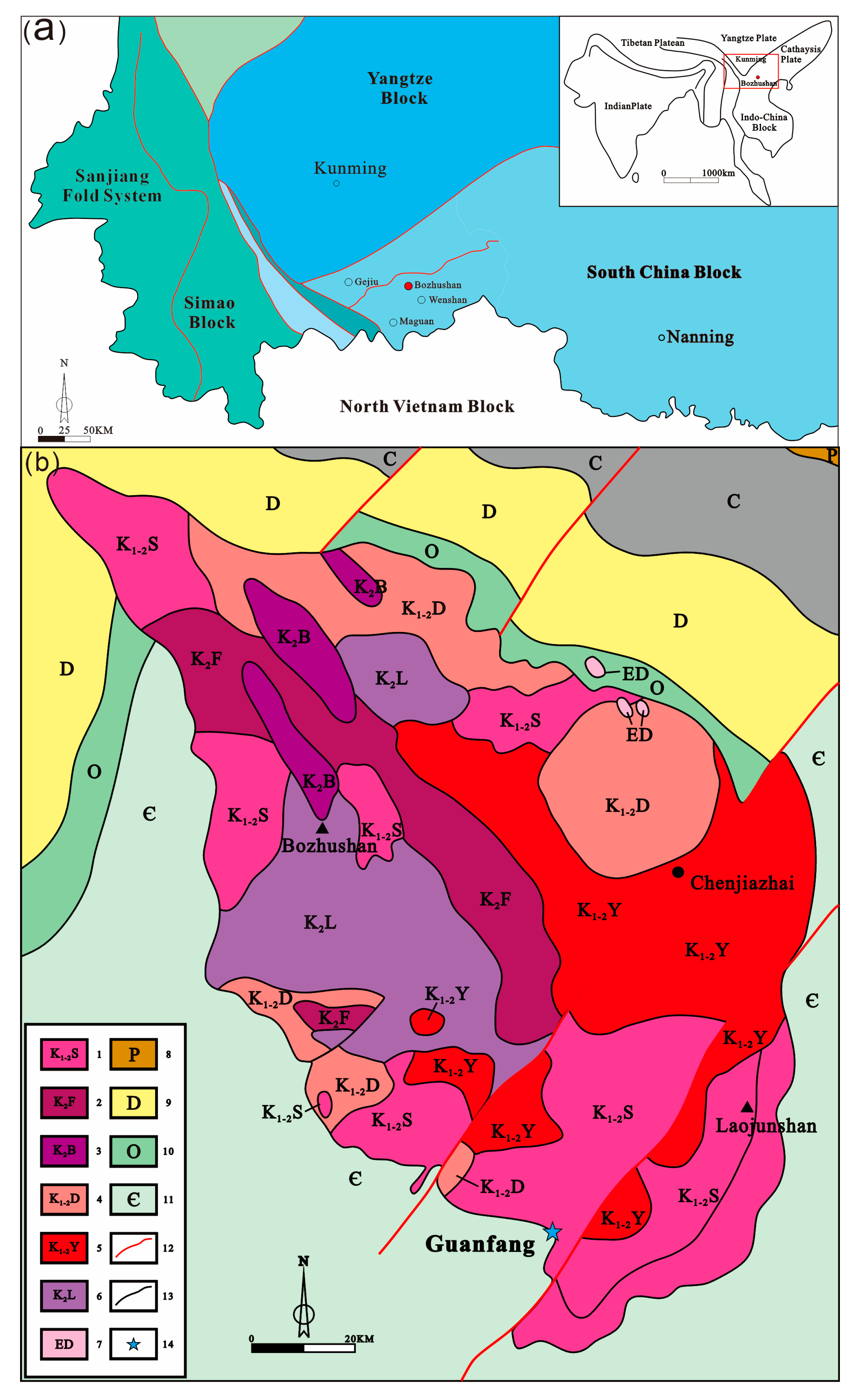
The Guanfang Tungsten Deposit is situated in the southern limb of the Bozhushan Dome, within the Wenshan-Funing fold bundle of the Southeast Yunnan fold belt, South China fold system (
Figure 1a). The exposed strata in the area range from Sinian to Quaternary age and include the Sinian, Cambrian, Ordovician, Devonian, Carboniferous, Permian, Triassic, and Quaternary systems. The oldest exposed unit is the Sinian Pingbian Group, a flysch formation. The Cambrian system conformably overlies the Pingbian Group. Its lower part consists of shallow-marine quartz sandstone interbedded with carbonate rocks, transitioning upward into shallow-marine to littoral carbonate rocks and sandy, silty, and argillaceous rocks that extend to the Ordovician, where halite pseudomorphs are observed. Lower Paleozoic strata exhibit low-grade (epizonal) metamorphism, with widespread slaty cleavage in sandy and argillaceous rocks and local marbleization of carbonates. Upper Paleozoic to Triassic strata comprise littoral argillaceous rocks and siltstones, and shallow marine reef limestones are developed [
1,
12].
The region has experienced relatively intense tectonic activity. Structures within the Bozhushan Dome area are dominated by arcuate features distributed concentrically around the North Vietnam Block, formed by tectonic deformation, and highly developed NE-trending faults. Magmatic rocks in the area are mainly Hercynian basic rocks and Yanshanian granites. The Hercynian basic rock suite is predominantly basalt, exposed in the northeast minor diabase and gabbro intrude Cambrian and Ordovician strata. Yanshanian granitic magmatism was intense, characterized by multi-stage activity and multi-phase evolution. Repeated intrusions formed the composite Bozhushan pluton [
12,
13].
Following the lithodemic unit classification of Zhang Shitao and Chen Guochang [
1], the Bozhushan pluton is divided into the following two sequences: the Chenjiazhai Sequence and the Bozhushan Sequence, and one independent unit—the Dashanjiao Unit. The Chenjiazhai Sequence includes the Suozuodi, Yangyushu and Dashan Units, consisting predominantly of light pink, medium-to-fine grained, porphyroid biotite monzogranite. The Bozhushan Sequence comprises the Leidazhan, Fenshuiling, and Bozhupo Units, with lithologies ranging from fine-grained to medium-grained porphyroid and porphyritic biotite monzogranite. The Dashanjiao Unit is composed of grayish-white, fine-grained, tourmaline-bearing biotite monzogranite (
Figure 1b) [
1].
2.2. Deposit Geological Overview
The exposed strata in the Guanfang Tungsten Deposit mining area are limited, consisting primarily of the Lower Cambrian Chongzhuang Formation (Є
1ch), Middle Cambrian Dayakou Formation (Є
2d), Middle Cambrian Tianpeng Formation, along with Quaternary deposits. The argillaceous, silty, and sandy rocks of the Dayakou and Tianpeng Formations exhibit well-developed slaty cleavage. The carbonate rocks within these formations are strongly skarnized and constitute the principal ore-hosting horizons [
9].
The exposed granite in the mining area belongs predominantly to the Suozuodi Unit of the Chenjiazhai Sequence of the Bozhushan composite pluton. This unit is composed of light pink porphyroid biotite monzogranite, with a medium-to-fine grained texture, and massive structure. The Suozuodi Unit granite is in intrusive contact with the surrounding strata. At its contact with carbonate rocks, hydrothermal metasomatism has produced skarn zones of variable width. The granite-proximal side of these skarns is concentrated primarily of tungsten mineralization within these zones [
8].
3. Materials and Methods
3.1. Sample Materials
All samples were collected from the Guanfang Tungsten Deposit, comprising five granite outcrop samples from the surface mining area and five granite samples from stope tunnels. From these, six fresh, unweathered, and unaltered granite samples were selected for numbering, photographing, and hand specimen identification. Representative samples were then chosen to prepare petrographic thin sections.
A total of six thin sections were prepared as follows: three from surface outcrops (samples gf1, gf2, and gf3), and three from tunnel exposures (samples gf4, gf5, and gf6).
3.2. Methods
3.2.1. Petrographic Characteristics
Petrographic observations were conducted using a SOPTOP CX40P polarizing microscope (Ningbo, China) at the Faculty of Land and Resources Engineering, Kunming University of Science and Technology. Microscopy was employed for petrographic identification and imaging of granite samples. Based on this analysis, biotite grains that were large, inclusion-free, and showed no evidence of weathering or alteration in thin sections were selected for further testing.
3.2.2. Electron Probe Microanalysis (EPMA)
Major element analysis of biotite was performed using a JEOL JXA-8230 electron probe microanalyzer (JEOL, Tokyo, Japan) at the Testing Center of Shandong Bureau, China Metallurgical Geology Bureau. Operating conditions were as follows: an accelerating voltage of 15 kv, a beam current of 20 nA, and an analytical beam spot diameter of 20 μm. The following natural mineral standards (SPI Supplies, West Chester, PA, USA) were used: jadeite (SiO2, Na2O), rutile (TiO2), yttrium aluminum garnet (Al2O3), olivine (FeO, MgO), rhodonite (MnO), diopside (CaO), sanidine (K2O), apatite (P2O5, F), and tugtupite (Cl). Data were corrected using the ZAF method.
For each sample, six representative biotite grains were analyzed. Multiple analysis points were measured per grain, distributed evenly while avoiding cracks and inclusions. Due to limited biotite availability in sample gf3, only four grains were analyzed from that sample.
3.2.3. Laser Ablation Inductively Coupled Plasma Mass Spectrometry (LA-ICP-MS)
Trace element analysis of biotite was conducted at the Testing Center of Shandong Bureau, China Metallurgical Geology Bureau. The analyses employed a GeoLasPro 193 nm ArF excimer ablation system (Coherent, New York, NY, USA), coupled to a Thermo Fisher ICAP Q inductively coupled plasma mass spectrometer (Thermo Scientific, Waltham, MA, USA).
Helium was used as the carrier gas during ablation. The resulting aerosol was mixed with argon (the plasma and makeup gas) via a T-shaped connector before introduction to the ICP. Helium and argon flow rates were optimized for maximum signal intensity using the NIST SRM 610 (a synthetic silicate glass reference material developed by the National Institute of Standards and Technology, Gaithersburg, MD, USA) as the tuning standard [
14].
Laser operating conditions were set to a beam spot diameter of 40 μm, a repetition rate of 6 Hz, and an energy density of ~10–12 J/cm2. The calibration was performed using the NIST SRM 610, NIST SRM 612, BCR-2G, and BIR-1G reference materials. Analyses of CGSG-1G and CGSG-2G were interspersed as unknown quality control monitors.
Data were acquired in time-resolved mode using a peak-hopping routine. Each analysis comprised a 25 s of a gas blank, 60 s sample ablation, and a 25 s washout period. A set of calibration standards (NIST 610 and NIST 612) was analyzed after every 10 unknown points. Raw data were processed offline using the ICPMSDATACAL V9.5 software, with internal standardization based on calcium (Ca). Because some biotite grains were smaller than the laser spot size, three grains with diameters >40 µm were selected from each thin section (gf1–gf6) for analysis.
4. Petrographic Characteristics
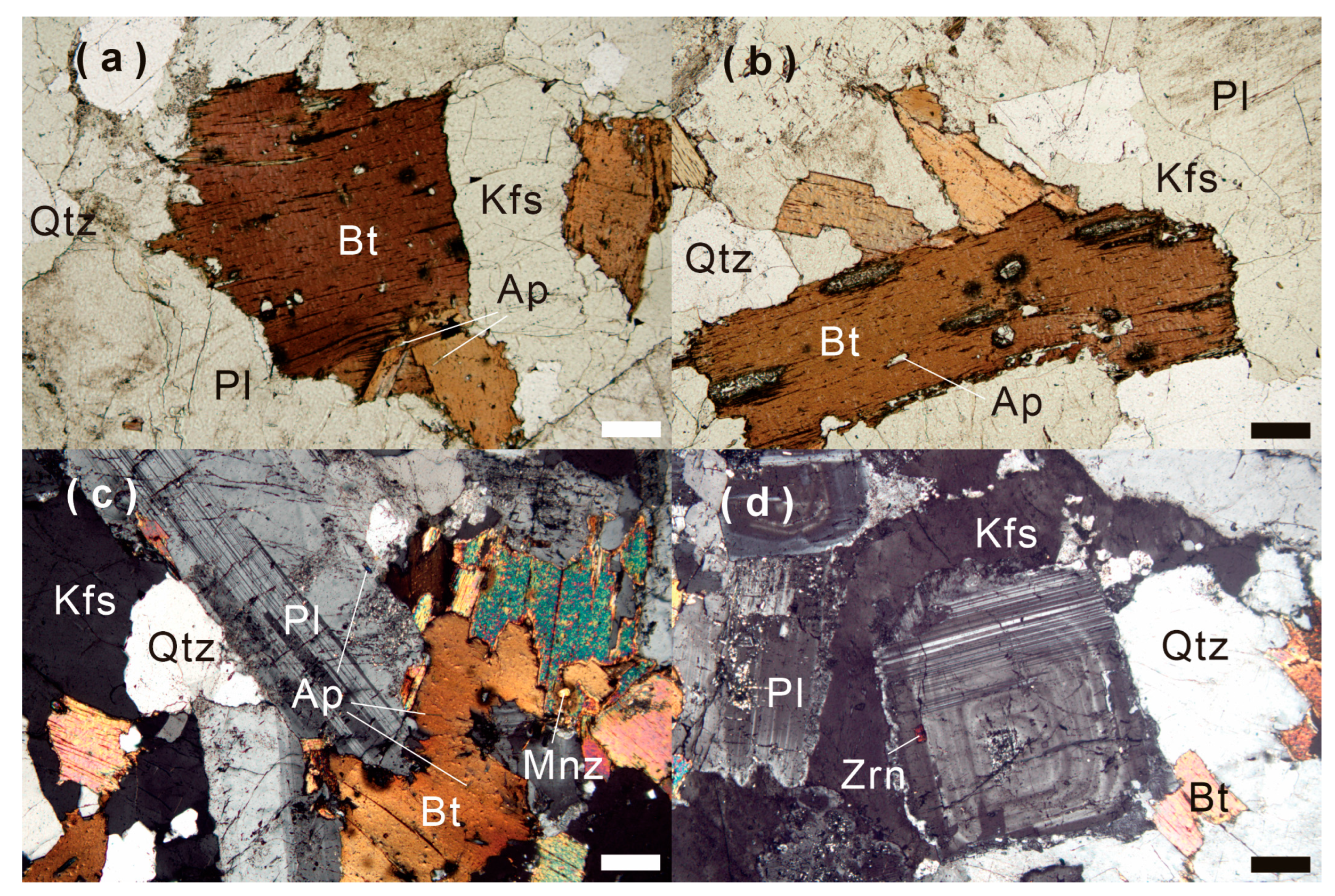
Observation under a polarizing microscope (
Figure 2) reveals that the minerals of the granite from the Guanfang mining area are predominantly quartz, potassium feldspar, plagioclase, and biotite. Accessory minerals include zircon, tourmaline, apatite, magnetite, and monazite. Quartz occurs as irregular anhedral grains. Potassium feldspar forms columnar, tabular, and granular crystals; it commonly exhibits Carlsbad and perthitic twinning. Some crystals contain inclusions of euhedral, tabular plagioclase and granular and columnar zircon. Plagioclase is predominantly euhedral and tabular, displaying well-developed polysynthetic twins. Minor albite occurs as perthitic lamellae within potassium feldspar or forms thin rims around it. Plagioclase crystals contain inclusions of euhedral, granular zircon.
Biotite occurs as euhedral to subhedral flaky aggregates with distinct cleavage, exhibiting brownish-yellow to reddish-brown pleochroism, and locally contains inclusions of apatite. The biotite grains have smooth crystal margins and lack opacitization rims or lepidoblastic textures, characteristics indicating that the biotite in this study is magmatic primary biotite.
5. Compositional Characteristics
5.1. Major Element Compositions of Biotite
The major element compositions of biotite from the Guanfang granite, determined by electron probe microanalysis (EPMA), are provided in
Appendix A (
Table A1). Based on these compositions, the biotite is classified as aluminous biotite. Using the geochemical analysis software GeokitPro (build20250806), cationic contents were calculated on the basis of 22 oxygen atoms; results are presented in
Appendix A (
Table A2).
The combined data from
Table A1 and
Table A2 reveal the following key characteristics of the Guanfang biotite:
(1) Major element composition
The biotite has the following oxide weight percentages (w): SiO2 (34.87%–36.02%), Al2O3 (13.90%–14.97%), TiO2 (3.49%–4.10%), K2O (9.23%–9.86%), Na2O (0.07%–0.36%), FeO* (21.68%–23.39%), and MgO (8.28%–9.17%).
After hydrothermal alteration, biotite exhibits three principal alteration types, resulting in the formation of chlorite, sericite, and re-equilibrated biotite, respectively. Chloritization facilitates the mobilization of elements such as Ti and K into the hydrothermal fluid, whereas sericitization leads to the release of Fe, Mg, and Ti. In contrast, re-equilibrated biotite—formed through the interaction of magmatic biotite with K, Fe, and Mg-rich hydrothermal fluids—is characterized by a pronounced decrease in TiO
2 and a significant increase in CaO content as a result of compositional re-equilibration [
15].
The biotite grains in this study are enriched in Ti, K, Fe, and Mg, but depleted in Na and Ca (Ca was below detection in some analyses). This signature suggests crystallization in a relatively closed system without significant post-magmatic alteration. The dominance of Fe and Mg in octahedral sites further indicates a typical magmatic (primary) biotite origin [
15].
(2) Petrogenetic implications
All analyzed samples are from the margin of the Suozuodi Unit within the Bozhushan pluton. The micas are exclusively ferruginous biotite; no muscovite was observed. The biotite’s high Mg and low Na contents reflect a low degree of magmatic evolution. This is likely related to the geological setting at the pluton margin, characterized by weak thermal insulation, rapid cooling, and insufficient sustained magma supply. Rapid cooling inhibited extensive magmatic differentiation, preventing ferromagnesian minerals from evolving into more alkali-rich or Fe-Mg-poor mica species. Furthermore, strong heat exchange at the pluton-country rock contact likely promoted non-equilibrium crystallization, causing the biotite to retain more primitive magmatic compositions.
(3) Halogen contents and metallogenic significance
The analyzed biotite is compositionally homogeneous and exhibits relatively high F (0.71–0.91 wt%) and low Cl contents. This indicates an F-enriched character for the associated ore-forming fluids. The elevated F content likely enhanced the mobility of volatiles in the magma, promoted the transport and enrichment of metallic elements, and thus provided favorable conditions for subsequent W-Sn mineralization [
16,
17].
5.2. Trace Element Composition of Biotite
The trace element composition of biotite from the Guanfang granite, determined by LA-ICP-MS, is provided in
Appendix B (
Table A3). The results show an extremely low Ca content, which is consistent with a primary magmatic origin for the biotite [
18].
Furthermore, the Sn content in biotite, a primary host for this element, is high (43 to 56 μg/g) and considerably exceeds typical granites values [
18]. This indicates significant Sn metallogenic potential for the Guanfang granite. During subsequent hydrothermal alteration, the breakdown of primary biotite to form muscovite or chlorite can release substantial Sn, potentially leading to tin mineralization in associated alteration zones. Consequently, the Guanfang tungsten deposit is considered to possess clear potential for tin (Sn) mineralization.
6. Discussion
6.1. Genetic Type of Biotite in the Guanfang Granite
Petrographic observations indicate that biotite in the Guanfang granite occurs as euhedral to subhedral tabular or flaky crystals with well-developed cleavage. Crystal edges are distinct and smooth, lacking dark rims or significant embayment. The biotite contains inclusions of accessory minerals such as magnetite, apatite, and zircon. Its optical properties include a reddish-brown color with strong pleochroism (grayish-yellow to brownish-green), biaxial negative character, positive elongation, and parallel extinction. These features are inconsistent with hydrothermal biotite, which is typically fine-grained, scaly, and exhibits weak, pale green pleochroism. Instead, they align with primary magmatic biotite, characterized by high euhedrality, smooth edges, lack of dark rims or embayed edges, and strong reddish-brown, and exhibit strong pleochroism [
11].
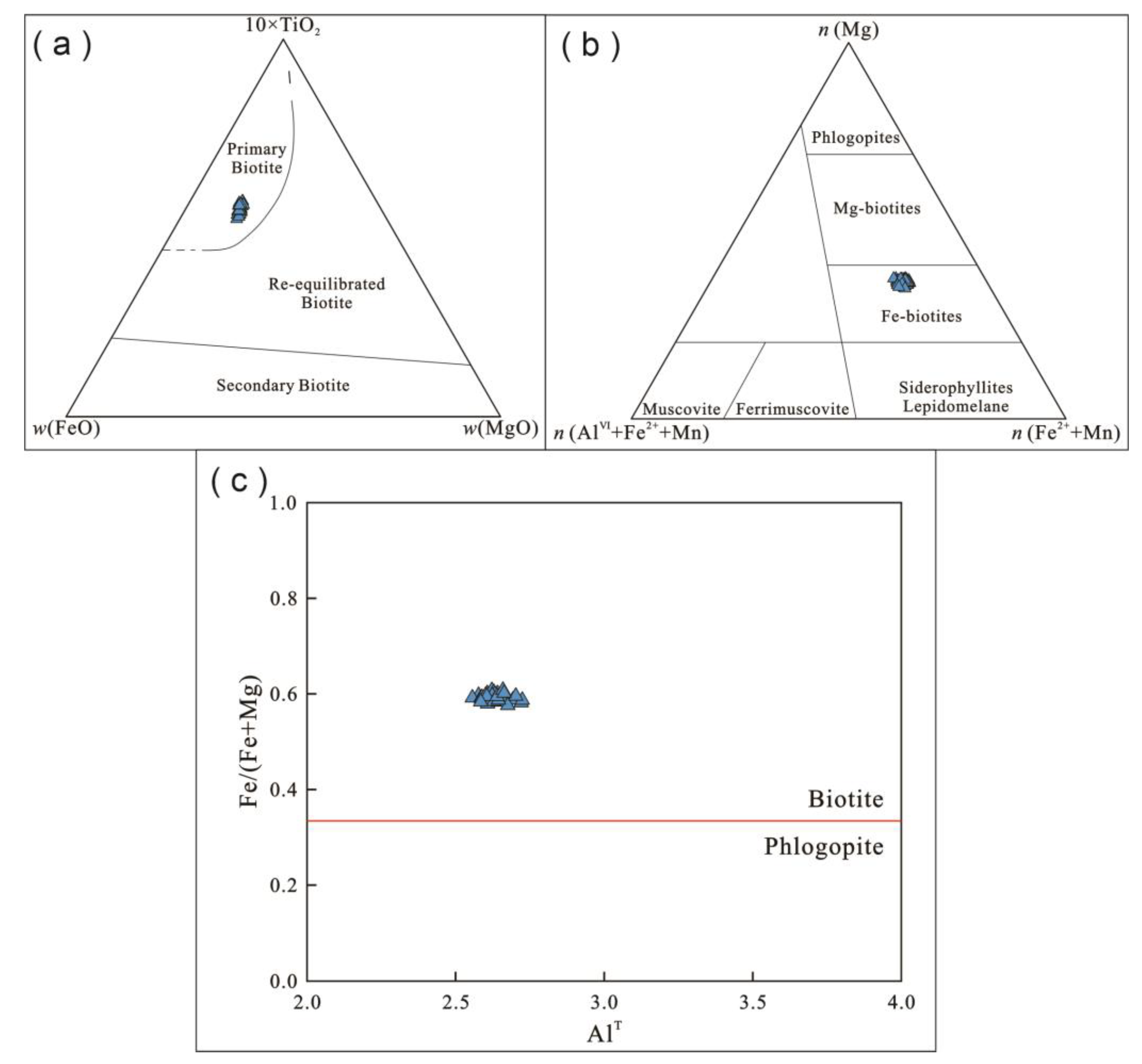
The magmatic origin is further supported by geochemical criteria. On the Foster mica classification diagram [
15] (
Figure 3), all analyzed biotite compositions plot within the field of ferri-biotite, confirming a primary magmatic genesis and indicating crystallization from a reduced, acidic magma without subsequent hydrothermal overprinting.
Furthermore, the calculated
IMg values [Mg/(Mg+Fe
2+)] of the biotite range from 0.42 to 0.45, which falls within the 0.30–0.55 range typical of magmatic biotite as defined by Ma et al. [
19]. The
IFe values [Fe
2+/(Mg+Fe
2+)] are tightly clustered between 0.55 and 0.58, indicating a homogeneous composition unaffected by post-magmatic fluid alteration.
6.2. Physicochemical Conditions of Biotite Crystallization in the Guanfang Granite
The physicochemical conditions such as crystallization temperature, pressure, and oxygen fugacity during the crystallization of primary magmatic biotite are key indicators for constraining the petrogenetic environment and magmatic evolution. As established, the biotite in the Guanfang granite is primary, making it a suitable mineral for reconstructing these parameters.
6.2.1. Crystallization Temperature, Pressure, and Intrusion Depth of Biotite
Previous studies have shown that the crystallization temperature of magma has a significant influence on the Ti content of biotite [
20,
21]. Crystallization temperatures were calculated using the formula:
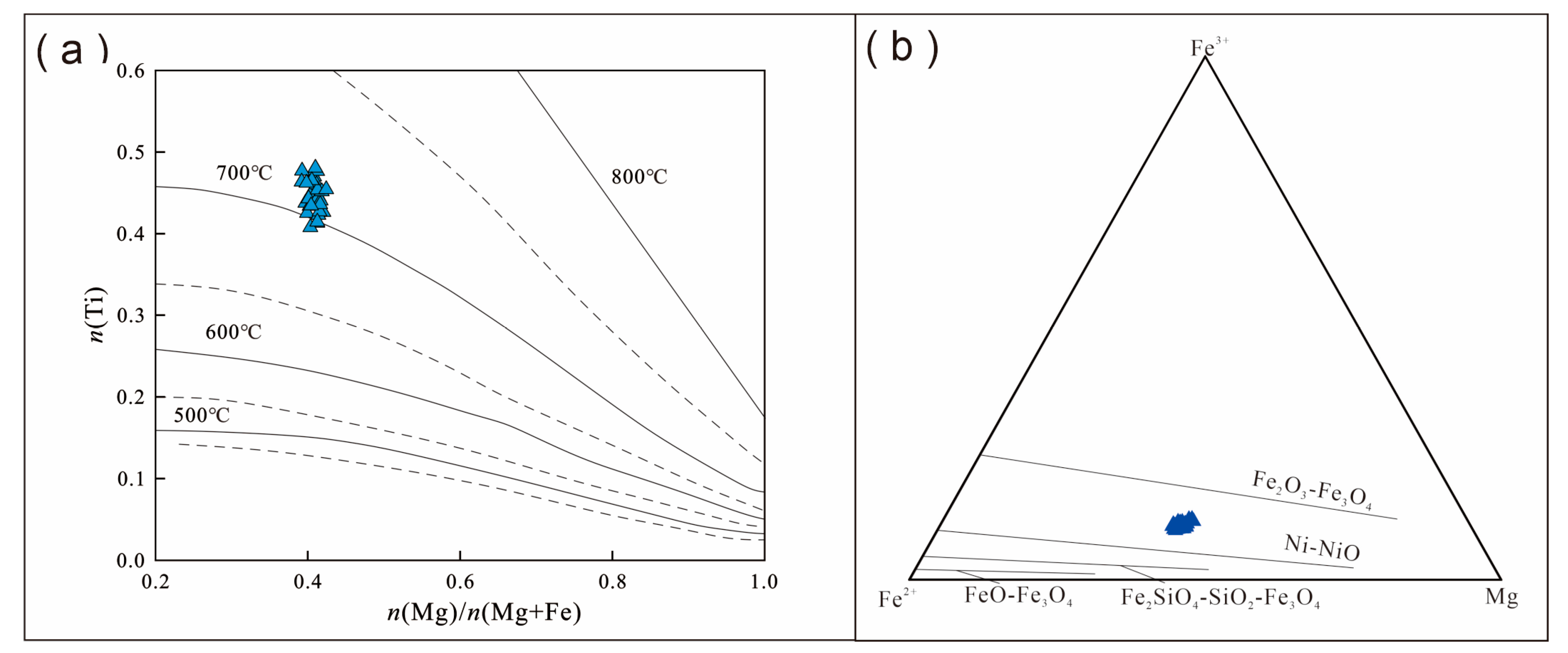
t/°C = {lnn(Ti) − a − c(IMg)3/b}0.333 (where a = −2.359, b = 4.6482 × 10⁻⁹, c = −1.7283) (the meaning of “n” is the number of ions).
The calculated temperatures range from 700 °C to 720 °C. Consistent results were obtained from the
n(Ti)
− n(Mg)/
n(Mg+Fe) diagram (
Figure 4a) [
20], indicating a medium–high temperature crystallization environment.
Pressure during crystallization was estimated from the total Al content (Al
T) of biotite using the barometer of Uchida et al. [
22]:
P (kbar) = 3.03 × n(AlT) − 6.53 (±0.33) (the meaning of “n” is the number of ions).
This yields crystallization pressures of 1.2 to 1.7 kbar.
Assuming an average granite density (ρ) of 2700 kg/m3, the corresponding emplacement depth (h) is calculated as h = P/(ρg), where g = 9.8 m/s2. The resulting depth range of 4.6 to 6.5 km classifies the Guanfang granite as a mesozonal intrusion.
6.2.2. Oxygen Fugacity During Biotite Crystallization
For the equilibrium assemblage of biotite + K-feldspar + magnetite, oxygen fugacity (ƒO
2) can be estimated from the Fe
3+, Fe
2+, and Mg
2+ contents of biotite [
23].
On the corresponding log ƒO
2 vs. temperature diagram (
Figure 4b), all samples plot in a tight cluster between the Ni-NiO (NNO) and magnetite-hematite (MH) buffers, close to the NNO buffer line, indicating relatively high and consistent oxygen fugacity [
24].
6.3. Petrogenesis and Tectonic Setting of the Guanfang Granite
The chemical composition of biotite can reflect key aspects of granite petrogenesis, including source rock characteristics and the magmatic environment. Key discriminant parameters are the oxidation coefficient Fe
3+/(Fe
3++Fe
2+) and magnesium ratio Mg
2+/(Mg
2++Mn+Fe
2+), which are used to distinguish between I-type and S-type granites. I-type granites typically exhibit higher values for both ratios (oxidation coefficient ~0.12–0.25; magnesium ratio ~0.384–0.626), while S-type granites show lower values [
25,
26].
Furthermore, the
IMF values
n(Mg)
/n(Fe
3++Fe
2++Mg+Mn) of biotite can differentiate between “transformation-type” (crustal anatexis) and “syntexis-type” (mantle-derived or hybrid) granites [
26]. An
IMF value < 0.38 indicates a transformation-type origin, while
IMF > 0.38 suggests a syntexis-type. The Guanfang biotite
IMF values range from 0.39 to 0.42, classifying the granite as syntexis-type. This implies a magmatic source involving mantle-derived components or lower crustal melts that subsequently assimilated significant volumes of sialic crustal material during ascent.
6.4. Indicative Significance of Biotite Composition for Mineralization
Biotite composition provides key insights into the metallogenic potential of its host granite, particularly for Sn, W, Cu, Pb, and Zn.
6.4.1. Tin and Tungsten Potential
The crystallization of the Guanfang granite under oxidized conditions (the NNO and MH buffers) and medium–high temperatures (~700 °C) favors the partitioning of Sn into late magmatic fluids [
27]. Furthermore, the biotite exhibits a high iron index (
IFe = 0.49–0.59, avg. 0.53), a characteristic associated with Sn-W-Mo mineralized systems [
26]. This indicates clear potential for tin and tungsten mineralization.
6.4.2. Role of Halogens (F, Cl)
The elevated total halogen contents in the magmatic biotite are critical for W-Sn metallogeny. These halogens lower magma solidus temperature and viscosity, prolonging crystallization and promoting the enrichment of incompatible elements (W, Sn) in the residual melt. They also facilitate the formation of soluble complexes, enabling efficient transport and subsequent deposition of ore metals during hydrothermal activity [
28,
29].
6.4.3. Petrogenetic and Tectonic Constraints
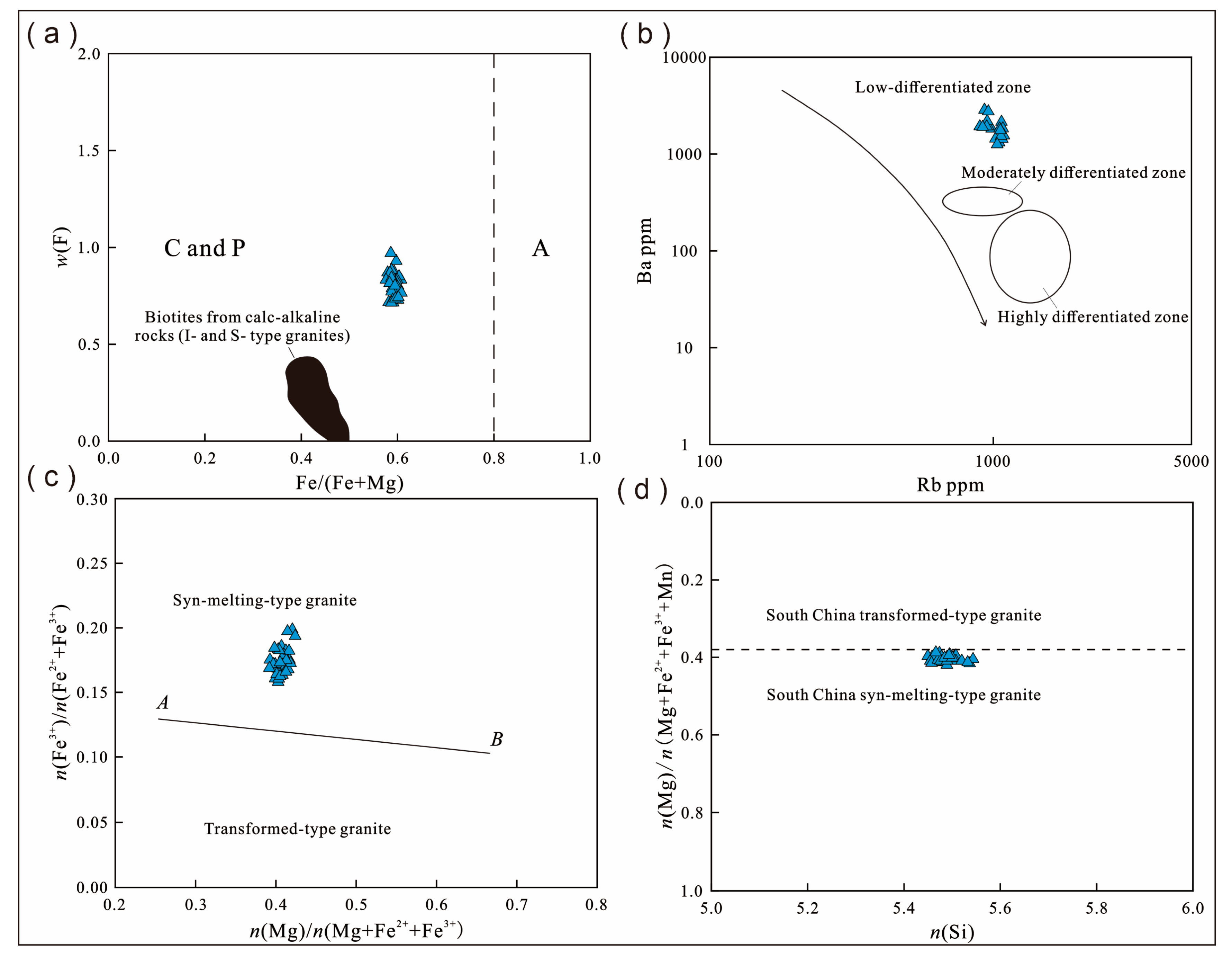
Biotite composition constrains the granite’s origin and tectonic setting. On the Fe/(Fe+Mg) vs. F diagram [
30], data plot in the fields for calc-alkaline and peraluminous granites typical of orogenic settings (
Figure 5a). A low Rb/Ba ratio in biotite indicates a relatively low degree of magmatic differentiation (
Figure 5b) [
28,
31].
6.4.4. Implications for Base Metal (Cu-Pb-Zn) Mineralization
Genetic discriminant diagrams classify the Guanfang granite as “Syn-melting-type” (or syntexis-type) rather than “Transformed-type” (
Figure 5c) [
14]. In South China, Syn-melting-type granites are principally associated with Cu-Pb-Zn-Au-Ag mineralization, whereas W-Sn-Nb-Ta deposits are typically linked to Transformed-type granites [
32]. This association is supported by the biotite data, which plot within the Syn-melting-type field on the corresponding discriminant diagram (
Figure 5d) [
32].
7. Conclusions
(1) Biotites from the Guanfang granite exhibit high euhedrality, with smooth crystal margins and no development of opacitization rims or lepidoblastic textures. Chemically, they are characterized by reduced Na and Ca contents. These features indicate that all analyzed grains are primary, iron-rich biotite, with compositions consistent with a magmatic origin.
(2) Biotite geothermobarometry yields a crystallization temperature range of 700–720 °C, and a pressure range of 1.2–1.7 kbar. This corresponds to an emplacement depth of 4.6–6.5 km, classifying the Guanfang Granite as a mesozonal intrusion.
(3) The biotite composition indicates the host granite is an S-type granite with transitional I-type affinities. Discriminant diagrams further classify it as a South China syn-melting (syntexis) type, genetically related to hybrid magmas.
(4) The biotite crystallized from an oxidative, medium- to high-temperature magma with elevated total halogen (F+Cl), and Sn contents. These features indicate significant potential for W-Sn mineralization. The high TiO2 content further suggests the granite belongs to the high-Ti syn-melting type, which is associated with polymetallic (Cu, Pb, Zn, Au, and Ag) mineralization in South China.
Consequently, future exploration in the Guanfang deposit should target not only tungsten but also tin, while further research is required to assess the prospectivity of other metals, including Cu, Pb, Zn, Au, and Ag.
Author Contributions
Conceptualization, L.C.; methodology, L.C., D.Z., R.Z., B.L. and J.Z.; investigation, X.C., R.Z., S.Z., X.L., J.Z., L.C., B.L. and D.Z.; formal analysis, J.Z. and B.L.; writing—original draft preparation, L.C., X.C. and D.Z.; writing—review and editing, L.C., D.Z., X.C. and S.Z.; visualization, L.C., X.C., B.L., J.Z., R.Z. and X.L.; supervision, S.Z., X.L. and D.Z.; project administration, S.Z. and X.L.; funding acquisition, S.Z., X.L. and D.Z.; resource, X.L. and D.Z. All authors have read and agreed to the published version of the manuscript.
Funding
This research was supported by the New round of mineral exploration operation of Yunnan (grant No. Y202407).; Kunming University of Science and Technology “Double First Class” Science and Technology Special Project: Study on Late Yanshanian Magmatic-Metallogenic System and Metallogenic Regularity of the Bozhushan Area (No. 202202AG050006-2); National Natural Science Fundation of China (grant No. 42320104005).
Data Availability Statement
The original contributions presented in this study are included in the article. Further inquiries can be directed to the corresponding author.
Conflicts of Interest
The authors declare no conflicts of interest.
Appendix A
Appendix A.1. EPMA Analytical Results
Table A1.
EPMA analytical results of biotites from Guanfang granite.
Table A1.
EPMA analytical results of biotites from Guanfang granite.
| Points | wt/% |
|---|
| SiO2 | TiO2 | Al2O3 | FeO | MnO | MgO | CaO | Na2O | K2O | Cr2O3 | P2O5 | SO3 | F | Cl | Total |
|---|
| gf1-1 | 35.139 | 3.785 | 14.292 | 22.321 | 0.347 | 8.434 | 0.019 | 0.168 | 9.629 | 0.017 | Bdl | 0.059 | 0.771 | 0.144 | 94.768 |
| gf1-2 | 35.19 | 3.763 | 14.258 | 22.19 | 0.368 | 8.543 | Bdl | 0.128 | 9.473 | Bdl | Bdl | 0.044 | 0.873 | 0.165 | 94.59 |
| gf1-3 | 35.143 | 3.972 | 14.001 | 22.68 | 0.361 | 8.584 | 0.015 | 0.174 | 9.327 | 0.01 | Bdl | 0.06 | 0.93 | 0.181 | 95.004 |
| gf1-4 | 34.871 | 3.895 | 14.001 | 22.247 | 0.365 | 8.293 | Bdl | 0.21 | 9.498 | Bdl | Bdl | 0.063 | 0.803 | 0.146 | 94.021 |
| gf1-5 | 35.012 | 4.056 | 14.231 | 22.825 | 0.385 | 8.275 | Bdl | 0.201 | 9.423 | 0.025 | Bdl | 0.073 | 0.833 | 0.195 | 95.139 |
| gf1-6 | 35.031 | 3.709 | 14.22 | 22.697 | 0.395 | 8.379 | Bdl | 0.165 | 9.436 | 0.011 | 0.002 | 0.036 | 0.85 | 0.174 | 94.708 |
| gf2-1 | 36.018 | 3.687 | 14.395 | 22.222 | 0.433 | 9.048 | 0.069 | 0.123 | 9.316 | 0.025 | 0.005 | 0.027 | 0.87 | 0.159 | 95.995 |
| gf2-2 | 36.022 | 3.869 | 14.571 | 22.597 | 0.474 | 8.972 | 0.066 | 0.083 | 9.329 | 0.01 | Bdl | 0.064 | 0.848 | 0.163 | 96.674 |
| gf2-3 | 35.144 | 4.008 | 13.92 | 22.782 | 0.383 | 8.818 | 0.011 | 0.255 | 9.382 | 0.016 | 0.008 | 0.048 | 0.853 | 0.166 | 95.398 |
| gf2-4 | 35.153 | 3.704 | 13.909 | 21.994 | 0.393 | 8.537 | 0.05 | 0.358 | 9.232 | 0.035 | 0.009 | 0.091 | 0.715 | 0.199 | 94.033 |
| gf2-5 | 35.584 | 3.859 | 14.215 | 22.929 | 0.448 | 8.843 | 0.007 | 0.134 | 9.401 | 0.019 | Bdl | 0.057 | 0.799 | 0.152 | 96.077 |
| gf2-6 | 35.796 | 3.561 | 14.298 | 22.672 | 0.347 | 8.934 | 0.021 | 0.222 | 9.536 | 0.033 | Bdl | 0.08 | 0.881 | 0.181 | 96.15 |
| gf3-1 | 35.145 | 3.713 | 14.526 | 23.138 | 0.372 | 8.741 | 0.024 | 0.125 | 9.301 | 0.037 | Bdl | 0.072 | 0.758 | 0.139 | 95.741 |
| gf3-2 | 35.402 | 3.64 | 14.432 | 23.103 | 0.357 | 8.604 | 0.024 | 0.161 | 9.409 | 0.093 | Bdl | 0.048 | 0.729 | 0.129 | 95.795 |
| gf3-3 | 35.065 | 3.803 | 14.128 | 22.935 | 0.397 | 8.679 | 0.003 | 0.144 | 9.463 | 0.04 | 0.013 | 0.051 | 0.775 | 0.16 | 95.294 |
| gf3-4 | 35.254 | 3.949 | 14.262 | 22.941 | 0.329 | 9.006 | 0.028 | 0.112 | 9.35 | 0.01 | Bdl | 0.071 | 0.788 | 0.142 | 95.878 |
| gf4-1 | 35.25 | 3.809 | 14.447 | 23.398 | 0.39 | 8.791 | 0.031 | 0.109 | 9.323 | 0.015 | Bdl | 0.031 | 0.833 | 0.154 | 96.195 |
| gf4-2 | 35.46 | 3.807 | 14.273 | 22.735 | 0.349 | 8.948 | 0.016 | 0.096 | 9.523 | 0.002 | Bdl | 0.058 | 0.883 | 0.166 | 95.907 |
| gf4-3 | 35.385 | 3.63 | 14.361 | 22.622 | 0.362 | 8.964 | 0.03 | 0.07 | 9.577 | 0.015 | Bdl | 0.055 | 0.971 | 0.164 | 95.76 |
| gf4-4 | 35.504 | 3.796 | 14.54 | 22.465 | 0.333 | 9.011 | 0.014 | 0.135 | 9.542 | 0.022 | 0.002 | 0.057 | 0.865 | 0.138 | 96.029 |
| gf4-5 | 35.371 | 3.491 | 14.333 | 23.051 | 0.418 | 8.747 | 0.047 | 0.11 | 9.501 | 0.006 | Bdl | 0.075 | 0.829 | 0.176 | 95.766 |
| gf4-6 | 35.815 | 3.714 | 14.591 | 22.984 | 0.342 | 9.166 | 0.019 | 0.1 | 9.599 | 0.02 | Bdl | 0.036 | 0.869 | 0.135 | 96.994 |
| gf5-1 | 34.939 | 3.938 | 14.141 | 22.665 | 0.334 | 8.666 | 0.108 | 0.228 | 9.397 | 0.021 | 0.006 | 0.069 | 0.818 | 0.177 | 95.123 |
| gf5-2 | 35.298 | 4.101 | 14.786 | 22.147 | 0.304 | 8.721 | 0.025 | 0.179 | 9.561 | 0.025 | Bdl | 0.044 | 0.772 | 0.186 | 95.782 |
| gf5-3 | 35.376 | 3.892 | 14.966 | 22.03 | 0.33 | 8.889 | 0.021 | 0.15 | 9.663 | 0.027 | 0.004 | 0.047 | 0.717 | 0.148 | 95.925 |
| gf5-4 | 35.15 | 4.104 | 14.475 | 22.216 | 0.332 | 8.661 | 0.045 | 0.132 | 9.484 | 0.013 | 0.01 | 0.067 | 0.729 | 0.16 | 95.235 |
| gf5-5 | 35.462 | 3.907 | 14.972 | 21.873 | 0.374 | 8.632 | 0.06 | 0.127 | 9.863 | 0.029 | 0.016 | 0.069 | 0.714 | 0.138 | 95.904 |
| gf5-6 | 35.586 | 3.914 | 14.718 | 21.675 | 0.376 | 8.955 | 0.044 | 0.166 | 9.543 | 0.021 | Bdl | 0.072 | 0.833 | 0.159 | 95.675 |
| gf6-1 | 35.632 | 3.576 | 14.562 | 22.717 | 0.349 | 8.95 | 0.03 | 0.095 | 9.689 | 0.005 | Bdl | 0.051 | 0.843 | 0.156 | 96.265 |
| gf6-2 | 35.672 | 3.736 | 14.14 | 22.338 | 0.328 | 8.942 | Bdl | 0.135 | 9.457 | 0.023 | 0.005 | 0.068 | 0.816 | 0.176 | 95.452 |
| gf6-3 | 35.347 | 3.986 | 14.436 | 22.407 | 0.393 | 8.564 | 0.026 | 0.143 | 9.696 | 0.006 | Bdl | 0.065 | 0.803 | 0.138 | 95.641 |
| gf6-4 | 35.535 | 3.73 | 14.816 | 22.46 | 0.332 | 8.554 | 0.013 | 0.141 | 9.432 | 0.015 | 0.018 | 0.049 | 0.736 | 0.131 | 95.622 |
| gf6-5 | 35.038 | 3.95 | 14.463 | 22.906 | 0.414 | 8.283 | 0.048 | 0.134 | 9.487 | 0.02 | Bdl | 0.064 | 0.766 | 0.153 | 95.368 |
| gf6-6 | 35.303 | 3.948 | 14.523 | 22.638 | 0.342 | 8.405 | Bdl | 0.148 | 9.327 | 0.007 | 0.019 | 0.065 | 0.742 | 0.163 | 95.281 |
Appendix A.2. Chemical Composition of Biotites (nB) from Guanfang Granite
Table A2.
Chemical composition of biotites (nB) from Guanfang granite.
Table A2.
Chemical composition of biotites (nB) from Guanfang granite.
| Points | nB (Number of Ions Calculated on the Basis of n (O) = 22) |
|---|
| Si | AlIV | AlVI | Ti | Fe3+ | Fe2+ | Mn | Mg | Ca | Na | K | IMF | IMg | IFe | n(TAl) | t/°C | P/kbar | h/km |
|---|
| gf1-1 | 5.50 | 2.50 | 0.14 | 0.45 | 0.49 | 2.43 | 0.05 | 1.97 | 0.00 | 0.05 | 1.92 | 0.40 | 0.45 | 0.55 | 2.64 | 711.36 | 1.47 | 5.54 |
| gf1-2 | 5.51 | 2.49 | 0.14 | 0.44 | 0.54 | 2.37 | 0.05 | 1.99 | 0.00 | 0.04 | 1.89 | 0.40 | 0.46 | 0.54 | 2.63 | 711.91 | 1.44 | 5.44 |
| gf1-3 | 5.49 | 2.51 | 0.07 | 0.47 | 0.54 | 2.42 | 0.05 | 2.00 | 0.00 | 0.05 | 1.86 | 0.40 | 0.45 | 0.55 | 2.58 | 718.31 | 1.28 | 4.84 |
| gf1-4 | 5.51 | 2.49 | 0.11 | 0.46 | 0.50 | 2.43 | 0.05 | 1.95 | 0.00 | 0.06 | 1.91 | 0.40 | 0.45 | 0.55 | 2.61 | 716.12 | 1.37 | 5.17 |
| gf1-5 | 5.47 | 2.53 | 0.10 | 0.48 | 0.52 | 2.46 | 0.05 | 1.93 | 0.00 | 0.06 | 1.88 | 0.39 | 0.44 | 0.56 | 2.62 | 719.44 | 1.42 | 5.35 |
| gf1-6 | 5.49 | 2.51 | 0.12 | 0.44 | 0.51 | 2.47 | 0.05 | 1.96 | 0.00 | 0.05 | 1.89 | 0.39 | 0.44 | 0.56 | 2.63 | 708.04 | 1.44 | 5.42 |
| gf2-1 | 5.54 | 2.46 | 0.14 | 0.43 | 0.57 | 2.29 | 0.06 | 2.07 | 0.01 | 0.04 | 1.83 | 0.42 | 0.48 | 0.52 | 2.61 | 709.35 | 1.37 | 5.19 |
| gf2-2 | 5.51 | 2.49 | 0.13 | 0.45 | 0.57 | 2.32 | 0.06 | 2.05 | 0.01 | 0.02 | 1.82 | 0.41 | 0.47 | 0.53 | 2.63 | 714.22 | 1.43 | 5.39 |
| gf2-3 | 5.48 | 2.52 | 0.03 | 0.47 | 0.49 | 2.48 | 0.05 | 2.05 | 0.00 | 0.08 | 1.87 | 0.40 | 0.45 | 0.55 | 2.56 | 719.15 | 1.22 | 4.60 |
| gf2-4 | 5.54 | 2.46 | 0.13 | 0.44 | 0.50 | 2.40 | 0.05 | 2.01 | 0.01 | 0.11 | 1.86 | 0.40 | 0.46 | 0.54 | 2.59 | 710.39 | 1.30 | 4.92 |
| gf2-5 | 5.50 | 2.50 | 0.09 | 0.45 | 0.51 | 2.45 | 0.06 | 2.04 | 0.00 | 0.04 | 1.85 | 0.40 | 0.45 | 0.55 | 2.59 | 713.06 | 1.31 | 4.97 |
| gf2-6 | 5.52 | 2.48 | 0.12 | 0.41 | 0.50 | 2.42 | 0.05 | 2.05 | 0.00 | 0.07 | 1.88 | 0.41 | 0.46 | 0.54 | 2.60 | 702.24 | 1.34 | 5.08 |
| gf3-1 | 5.46 | 2.54 | 0.12 | 0.43 | 0.49 | 2.52 | 0.05 | 2.02 | 0.00 | 0.04 | 1.84 | 0.40 | 0.45 | 0.55 | 2.66 | 707.19 | 1.53 | 5.77 |
| gf3-2 | 5.50 | 2.50 | 0.14 | 0.43 | 0.48 | 2.52 | 0.05 | 1.99 | 0.00 | 0.05 | 1.86 | 0.40 | 0.44 | 0.56 | 2.64 | 703.80 | 1.47 | 5.56 |
| gf3-3 | 5.48 | 2.52 | 0.08 | 0.45 | 0.47 | 2.52 | 0.05 | 2.02 | 0.00 | 0.04 | 1.89 | 0.40 | 0.44 | 0.56 | 2.60 | 711.26 | 1.35 | 5.11 |
| gf3-4 | 5.46 | 2.54 | 0.06 | 0.46 | 0.49 | 2.48 | 0.04 | 2.08 | 0.00 | 0.03 | 1.85 | 0.41 | 0.46 | 0.54 | 2.60 | 716.95 | 1.36 | 5.14 |
| gf4-1 | 5.45 | 2.55 | 0.08 | 0.44 | 0.50 | 2.53 | 0.05 | 2.03 | 0.01 | 0.03 | 1.84 | 0.40 | 0.44 | 0.56 | 2.63 | 710.03 | 1.45 | 5.46 |
| gf4-2 | 5.48 | 2.52 | 0.09 | 0.44 | 0.51 | 2.43 | 0.05 | 2.06 | 0.00 | 0.03 | 1.88 | 0.41 | 0.46 | 0.54 | 2.60 | 712.13 | 1.35 | 5.11 |
| gf4-3 | 5.48 | 2.52 | 0.10 | 0.42 | 0.51 | 2.41 | 0.05 | 2.07 | 0.00 | 0.02 | 1.89 | 0.41 | 0.46 | 0.54 | 2.62 | 705.97 | 1.41 | 5.33 |
| gf4-4 | 5.48 | 2.52 | 0.12 | 0.44 | 0.51 | 2.39 | 0.04 | 2.07 | 0.00 | 0.04 | 1.88 | 0.41 | 0.46 | 0.54 | 2.64 | 712.13 | 1.48 | 5.59 |
| gf4-5 | 5.49 | 2.51 | 0.12 | 0.41 | 0.48 | 2.51 | 0.05 | 2.02 | 0.01 | 0.03 | 1.88 | 0.40 | 0.45 | 0.55 | 2.62 | 698.51 | 1.42 | 5.36 |
| gf4-6 | 5.47 | 2.53 | 0.10 | 0.43 | 0.49 | 2.45 | 0.04 | 2.09 | 0.00 | 0.03 | 1.87 | 0.41 | 0.46 | 0.54 | 2.63 | 707.28 | 1.44 | 5.42 |
| gf5-1 | 5.46 | 2.54 | 0.07 | 0.46 | 0.48 | 2.48 | 0.04 | 2.02 | 0.02 | 0.07 | 1.87 | 0.40 | 0.45 | 0.55 | 2.61 | 716.71 | 1.36 | 5.16 |
| gf5-2 | 5.45 | 2.55 | 0.15 | 0.48 | 0.52 | 2.34 | 0.04 | 2.01 | 0.00 | 0.05 | 1.88 | 0.41 | 0.46 | 0.54 | 2.69 | 722.57 | 1.63 | 6.16 |
| gf5-3 | 5.46 | 2.54 | 0.18 | 0.45 | 0.49 | 2.35 | 0.04 | 2.04 | 0.00 | 0.04 | 1.90 | 0.41 | 0.47 | 0.53 | 2.72 | 715.71 | 1.71 | 6.48 |
| gf5-4 | 5.47 | 2.53 | 0.13 | 0.48 | 0.52 | 2.37 | 0.04 | 2.01 | 0.01 | 0.04 | 1.88 | 0.41 | 0.46 | 0.54 | 2.66 | 723.12 | 1.52 | 5.73 |
| gf5-5 | 5.48 | 2.52 | 0.20 | 0.45 | 0.49 | 2.33 | 0.05 | 1.99 | 0.01 | 0.04 | 1.94 | 0.41 | 0.46 | 0.54 | 2.72 | 715.63 | 1.73 | 6.52 |
| gf5-6 | 5.49 | 2.51 | 0.16 | 0.45 | 0.54 | 2.25 | 0.05 | 2.06 | 0.01 | 0.05 | 1.88 | 0.42 | 0.48 | 0.52 | 2.68 | 718.40 | 1.58 | 5.96 |
| gf6-1 | 5.49 | 2.51 | 0.13 | 0.41 | 0.49 | 2.44 | 0.05 | 2.06 | 0.00 | 0.03 | 1.90 | 0.41 | 0.46 | 0.54 | 2.64 | 702.48 | 1.48 | 5.60 |
| gf6-2 | 5.53 | 2.47 | 0.12 | 0.44 | 0.53 | 2.37 | 0.04 | 2.07 | 0.00 | 0.04 | 1.87 | 0.41 | 0.47 | 0.53 | 2.58 | 710.94 | 1.30 | 4.92 |
| gf6-3 | 5.48 | 2.52 | 0.12 | 0.47 | 0.50 | 2.40 | 0.05 | 1.98 | 0.00 | 0.04 | 1.92 | 0.40 | 0.45 | 0.55 | 2.64 | 717.78 | 1.47 | 5.55 |
| gf6-4 | 5.50 | 2.50 | 0.20 | 0.43 | 0.53 | 2.38 | 0.04 | 1.97 | 0.00 | 0.04 | 1.86 | 0.40 | 0.45 | 0.55 | 2.70 | 708.57 | 1.66 | 6.27 |
| gf6-5 | 5.47 | 2.53 | 0.13 | 0.46 | 0.50 | 2.48 | 0.05 | 1.93 | 0.01 | 0.04 | 1.89 | 0.39 | 0.44 | 0.56 | 2.66 | 715.19 | 1.53 | 5.77 |
| gf6-6 | 5.49 | 2.51 | 0.16 | 0.46 | 0.54 | 2.40 | 0.05 | 1.95 | 0.00 | 0.04 | 1.85 | 0.39 | 0.45 | 0.55 | 2.66 | 716.33 | 1.54 | 5.82 |
Appendix B
LA-ICP-MS Analytical Results of Biotites from Guanfang Granite
Table A3.
LA-ICP-MS analytical results of biotites from Guanfang granite.
Table A3.
LA-ICP-MS analytical results of biotites from Guanfang granite.
| µg/g |
|---|
| Points | Li | Na | Mg | Al | K | Ca | Ti | V | Cr | Mn | Fe | Zn | Rb | Zr | Nb | Sn | Sb | Cs | Ba | Hf | Ta | W |
|---|
| gf1-1 | 196.3 | 603.3 | 49,130 | 79,400 | 85,870 | Bdl | 22,150 | 422.2 | 104.4 | 3061 | 141,000 | 411.2 | 1069.0 | 0.470 | 141.4 | 44.94 | 0.063 | 36.61 | 2147 | 0.046 | 6.02 | 1.90 |
| gf1-2 | 186.8 | 622.6 | 49,310 | 78,220 | 84,500 | Bdl | 21,220 | 382.9 | 97.0 | 3088 | 139,500 | 417.1 | 931.0 | 0.374 | 135.8 | 43.41 | 0.040 | 22.34 | 2858 | 0.043 | 5.75 | 1.72 |
| gf1-3 | 191.7 | 628.4 | 50,420 | 77,710 | 85,230 | Bdl | 19,830 | 378.8 | 96.8 | 3088 | 140,700 | 432.7 | 944.0 | 0.608 | 128.0 | 44.07 | Bdl | 22.34 | 2104 | 0.068 | 4.92 | 1.87 |
| gf2-1 | 237.5 | 642.0 | 51,080 | 78,390 | 85,620 | Bdl | 19,710 | 389.0 | 80.9 | 2795 | 138,000 | 395.9 | 986.7 | 0.406 | 154.1 | 44.64 | Bdl | 35.39 | 1826 | 0.068 | 10.00 | 1.71 |
| gf2-2 | 217.3 | 567.1 | 52,630 | 78,350 | 85,920 | Bdl | 18,950 | 378.0 | 112.3 | 2707 | 137,900 | 396.5 | 1080.0 | 0.355 | 152.4 | 45.98 | Bdl | 51.63 | 1839 | 0.047 | 9.88 | 1.68 |
| gf2-3 | 243.9 | 613.9 | 50,890 | 78,900 | 86,390 | Bdl | 20,130 | 414.2 | 112.6 | 2879 | 137,900 | 389.3 | 1052.7 | 0.354 | 155.3 | 45.38 | Bdl | 35.41 | 1839 | 0.053 | 10.96 | 1.78 |
| gf3-1 | 226.8 | 950.0 | 53,000 | 81,500 | 86,600 | 650 | 20,420 | 386.0 | 94.4 | 3060 | 145,400 | 344.0 | 1048.0 | 0.420 | 133.7 | 53.70 | Bdl | 30.80 | 1315 | 0.031 | 5.13 | 1.61 |
| gf3-2 | 244.5 | 860.0 | 51,800 | 83,900 | 84,200 | 400 | 20,760 | 395.0 | 75.0 | 2990 | 137,400 | 367.0 | 952.0 | 0.540 | 135.5 | 56.10 | Bdl | 26.80 | 2190 | 0.078 | 5.42 | 1.80 |
| gf3-3 | 218.6 | 711.0 | 52,400 | 81,100 | 84,700 | 120 | 20,490 | 379.8 | 95.1 | 3037 | 143,000 | 432.8 | 896.0 | 0.321 | 152.0 | 44.00 | 0.050 | 23.19 | 1930 | 0.040 | 8.84 | 1.66 |
| gf4-1 | 227.8 | 676.0 | 52,900 | 81,600 | 85,600 | 127 | 20,630 | 390.1 | 96.2 | 3064 | 145,000 | 440.0 | 1018.0 | 0.456 | 136.4 | 46.50 | Bdl | 35.10 | 1437 | 0.055 | 6.70 | 1.76 |
| gf4-2 | 213.8 | 815.0 | 55,000 | 84,000 | 86,700 | 500 | 21,430 | 395.0 | 105.7 | 3151 | 144,200 | 429.0 | 948.0 | 0.485 | 141.5 | 46.50 | Bdl | 35.60 | 1925 | 0.103 | 7.19 | 1.80 |
| gf4-3 | 223.8 | 683.0 | 54,200 | 82,000 | 85,900 | 128 | 20,520 | 381.4 | 94.5 | 2966 | 146,100 | 437.0 | 960.0 | 0.254 | 153.4 | 46.60 | Bdl | 31.39 | 2758 | 0.047 | 9.93 | 2.13 |
| gf5-1 | 224.9 | 665.0 | 54,400 | 82,100 | 87,600 | 250 | 20,060 | 378.0 | 100.0 | 2859 | 141,500 | 393.0 | 1076.0 | 0.260 | 146.3 | 45.00 | Bdl | 50.80 | 1430 | 0.048 | 9.87 | 1.87 |
| gf5-2 | 239.6 | 692.0 | 54,600 | 84,000 | 87,100 | 240 | 20,190 | 392.3 | 97.9 | 2823 | 141,800 | 407.0 | 1090.0 | 0.179 | 148.4 | 45.80 | Bdl | 53.30 | 1554 | 0.031 | 10.51 | 1.95 |
| gf5-3 | 232.9 | 716.0 | 52,600 | 80,200 | 85,000 | 270 | 20,540 | 388.9 | 100.3 | 2233 | 137,300 | 270.0 | 917.0 | 0.493 | 132.8 | 45.90 | 0.062 | 27.83 | 1902 | 0.056 | 5.93 | 1.73 |
| gf6-1 | 246.9 | 722.0 | 52,900 | 82,300 | 87,500 | 248 | 21,130 | 408.5 | 111.1 | 2088 | 141,000 | 240.7 | 1065.0 | 0.301 | 131.7 | 50.90 | 0.051 | 48.64 | 1536 | 0.075 | 4.82 | 1.72 |
| gf6-2 | 246.3 | 603.0 | 57,600 | 88,500 | 86,100 | 274 | 19,820 | 415.0 | 106.7 | 2911 | 146,600 | 413.7 | 1032.0 | 0.890 | 157.9 | 46.20 | Bdl | 61.20 | 1260 | 0.112 | 10.77 | 1.68 |
| gf6-3 | 212.4 | 617.0 | 51,450 | 80,400 | 85,100 | 87 | 20,540 | 382.8 | 93.3 | 2817 | 139,900 | 406.5 | 1059.0 | 0.344 | 152.6 | 46.20 | Bdl | 50.60 | 1764 | 0.062 | 11.36 | 1.68 |
References
- Zhang, S.T.; Chen, G.C. Geological characteristics and evolutionary patterns of the Bozhushan composite pluton in southeastern Yunnan. Yunnan Geol. 1997, 16, 222–232. [Google Scholar]
- Kaiwen, L.; Jianzhen, G.; Hui, L.; Qian, Z.; Dapeng, W.; Yi, C. Late Yanshanian Magmatism-Related Polymetallic Mineralization in Southeastern Yunnan. Acta Mineral. Sin. 2011, 31, 607–608. [Google Scholar] [CrossRef]
- Hongjing, X.; Qian, Z.; Zhaohui, Z.; Liangwu, F.; Dapeng, W. Petrology and Rare Earth-Trace Element Geochemistry of the Bozhushan Granite in Southeastern Yunnan. Acta Mineral. Sin. 2009, 29, 481–490. [Google Scholar] [CrossRef]
- Jiao, S.-T.; Zhu, X.-Y.; Li, S.-T. Petrological and geochemical characteristics of the ore-forming geological bodies in southeastern Yunnan. Miner. Depos. 2014, 33, 407–408. [Google Scholar] [CrossRef]
- Xu, S.-H.; Ren, T.; Lü, C.-L. Research progress on Cretaceous highly fractionated S-type granites in southeastern Yunnan. Acta Mineral. Sin. 2019, 39, 149–165. [Google Scholar] [CrossRef]
- Cheng, Y.-B.; Mao, J.-W.; Chen, X.-L.; Yao, J.-M.; Zhao, H.-J. LA-ICP-MS zircon U-Pb dating and geological significance of the Bozhushan granite in southeastern Yunnan Province. J. Jilin Univ. (Earth Sci. Ed.) 2010, 40, 869–878. [Google Scholar] [CrossRef]
- Mi, X.; Liu, X.; Zhang, S.; Chen, S.; Meng, G.; Zhang, H.; Cheng, J.; Zhou, J.; Lu, B.; Dao, J.; et al. Petrogenesis and Mineralization Implication of Monzogranites Granites from Bainiuchang in Silver Polymetallic Deposit, Southeast Yunnan: Constraints from Geochronology U-Pb, Geochemistry and Hf Isotope. Geoscience 2025, 39, 1016–1038. [Google Scholar] [CrossRef]
- Zhang, Y.; Zhang, S.; Feng, M.; Liu, X.; Sun, Q.; Zhang, B. Regularity of Wall Rock Alteration and Mineralization in the Tuanshan Ore Section, Guanfang Scheelite Ore Deposit, Wenshan, Yunnan. Geoscience 2011, 25, 740–749. [Google Scholar]
- Zhang, Y.; Zhang, S.; Fan, Y.; Ma, H.; Zhang, L.; Zhang, D. Geology and fluid inclusion study of the Guanfang skarn type W deposit, Wenshan County, Yunnan Province. Acta Petrol. Sin. 2014, 30, 877–888. [Google Scholar]
- Liu, Y.; Kong, Z.; Chen, G.; Shao, F.; Tang, Y.; Sun, B.; Yang, G.; Cai, J. In-situ LA-SF-ICP-MS U-Pb dating of garnet from Guanfang tungsten deposit in southeastern Yunnan Province and its geological significance. Acta Petrol. Sin. 2021, 37, 847–864. [Google Scholar] [CrossRef] [Scilit]
- Tang, P.; Tang, J.-X.; Zheng, W.-B.; Song, J.-L.; Lin, B.; Wang, X.; Yang, C.; Li, Z.-Y. Research progress on mineral chemistry of magmatic and hydrothermal biotites. Miner. Depos. 2017, 36, 935–950. [Google Scholar] [CrossRef]
- Shi, L.; Chen, J.C.; Wu, S.L. Special Geological Report of the Ministry of Geology and Mineral Resources of the People’s Republic of China—IV—Ore Deposits and Minerals—No. 12—Metallogenic Regularity of Tin Ore Belt in Western Yunnan; Ministry of Geology and Mineral Resources of the People’s Republic of China: Beijing, China, 1989.
- Cheng, Y.B. Spatial-Temperal Evolution of the Magmatism and Mineralization in the Gejiu Supergiant Sn Poly Metal Lie Distirct and Insights into Several Key Problems. Ph.D. Thesis, China University of Geosciences Beijing, Beijing, China, 2012. [Google Scholar]
- Günther, D.; Hattendorf, B. Solid sample analysis using laser ablation inductively coupled plasma mass spectrometry. TrAC Trends Anal. Chem. 2005, 24, 255–265. [Google Scholar] [CrossRef] [Scilit]
- Foster, M.D. Interpretation of the Composition of Trioctahedral Micas; US Government Printing Office: Washington, DC, USA, 1960; pp. 1–49.
- Munoz, J.L. F-OH and Cl-OH exchange in micas with applications to hydrothermal ore deposits. Rev. Mineral. Geochem. 1984, 13, 469–493. Available online: https://pubs.geoscienceworld.org/msa/rimg/article/13/1/469/87167/F-OH-and-Cl-OH-exchange-in-micas-with-applications (accessed on 3 March 2017).
- Candela, P.A. Toward a thermodynamic model for the halogens in magmatic systems: An application to melt-vapor-apatite equilibria. Chem. Geol. 1986, 57, 289–301. [Google Scholar] [CrossRef] [Scilit]
- Rudnick, R.L.; Gao, S. Composition of the Continental Crust. In Treatise on Geochemistry, 2nd ed.; Holland, H.D., Turekian, K.K., Eds.; Elsevier: Amsterdam, The Netherlands, 2014; pp. 1–51. [Google Scholar] [CrossRef] [Scilit]
- Ma, C.-Q.; Yang, K.-G.; Tang, Z.-H. Granitoids and Magma Dynamics: Theoretical Methods and Case Studies of Granitoids in Eastern Hubei; China University of Geosciences Press: Wuhan, China, 1994. [Google Scholar]
- Henry, D.J.; Guidotti, C.V.; Thomson, J.A. The Ti-saturation surface for low-to-medium pressure metapelities biotites: Implications for geothermometry and Ti-substitution mechanisms. Am. Mineral. 2005, 90, 316–328. [Google Scholar] [CrossRef] [Scilit]
- Henry, D.J.; Guidotti, C.V. Titanium in biotite from metapelitic rocks: Temperature effects, crystal-chemical controls, and petrologic applications. Am. Mineral. 2002, 87, 375–382. [Google Scholar] [CrossRef] [Scilit]
- Uchida, E.; Endo, S.; Makino, M. Relationship between solidification depth of granitic rocks and formation of hydrothermal ore deposits. Resour. Geol. 2007, 57, 47–56. [Google Scholar] [CrossRef] [Scilit]
- Wones, D.R.; Eugster, H.P. Stability of biotite: Experiment, theory and application. Am. Mineral. 1965, 50, 1228–1272. Available online: https://pubs.geoscienceworld.org/msa/ammin/article/50/9/1228/540155/Stability-of-biotite-experiment-theory-and (accessed on 6 July 2018).
- Linnen, R.L.; Pichavant, M.; Holtz, F. The combined effects of fO2, and melt composition on SnO2, solubility and tin diffusivity in haplogranitic melts. Geochiica Cosmochim. Acta 1996, 60, 4965–4976. [Google Scholar] [CrossRef] [Scilit]
- Xu, K.; Tu, G. Geology and Mineralization of Granitoids; Jiangsu Science and Technology Press: Nanjing, China, 1986. [Google Scholar]
- Zhou, Z.-X. Intrusive rocks mafic mica chemical composition characteristics and its geological significance. Acta Petrol. Sin. 1988, 3, 63–73. [Google Scholar]
- Štemprok, M. Solubility of tin, tungsten and molybdenum oxides in felsic magmas. Miner. Depos. 1990, 25, 205–212. [Google Scholar] [CrossRef] [Scilit]
- Nadia, M.; David, R.L.; Christopher, R.M.M.; Yang, X.Y. Biotite composition as a tool for exploration: An example from Sn-W-Mo-bearing Mount Douglas Granite, New Brunswick, Canada. Lithos 2021, 382–383, 105926. [Google Scholar] [CrossRef] [Scilit]
- Kirsten, L.R.; James, K.M. Magmatic petrogenesis and the evolution of (F:Cl:OH) fluid composition in barren and tungsten skarn-associated plutons using apatite and biotite compositions: Case studies from the northern Canadian Cordillera. Ore Geol. Rev. 2013, 50, 118–142. [Google Scholar] [CrossRef] [Scilit]
- Dahlquist, J.A.; Alasino, P.H.; Eby, G.N.; Galindo, C.; Casquet, C. Fault controlled Carboniferous A-type magmatism in the proto-Andean foreland (Sierras Pampeanas, Argentina): Geochemical constraints and petrogenesis. Lithos 2010, 115, 65–81. [Google Scholar] [CrossRef] [Scilit]
- Villaros, A.; Pichavant, M. Mica-liquid trace elements partitioning and the granite-pegmatite connection: The St-Sylvestre complex (Western French Massif Central). Chem. Geol. 2019, 528, 119265. [Google Scholar] [CrossRef] [Scilit]
- Xu, K.Q.; Hu, S.X.; Sun, M.Z.; Ye, J. On The Two Genetic Series Of Granites In South China and Their Metallogenetic Charateristics. Miner. Depos. 1982, 2, 1–14. [Google Scholar] [CrossRef]
| Disclaimer/Publisher’s Note: The statements, opinions and data contained in all publications are solely those of the individual author(s) and contributor(s) and not of MDPI and/or the editor(s). MDPI and/or the editor(s) disclaim responsibility for any injury to people or property resulting from any ideas, methods, instructions or products referred to in the content. |





 ,
,