A Study of the Trace Element Enrichment Patterns in Sulfides from the Maoping Pb-Zn Deposit, SW China

 , ,
, ,  ,
,
Abstract
1. Introduction
2. Geological Characteristics of the Mining Area and Deposit
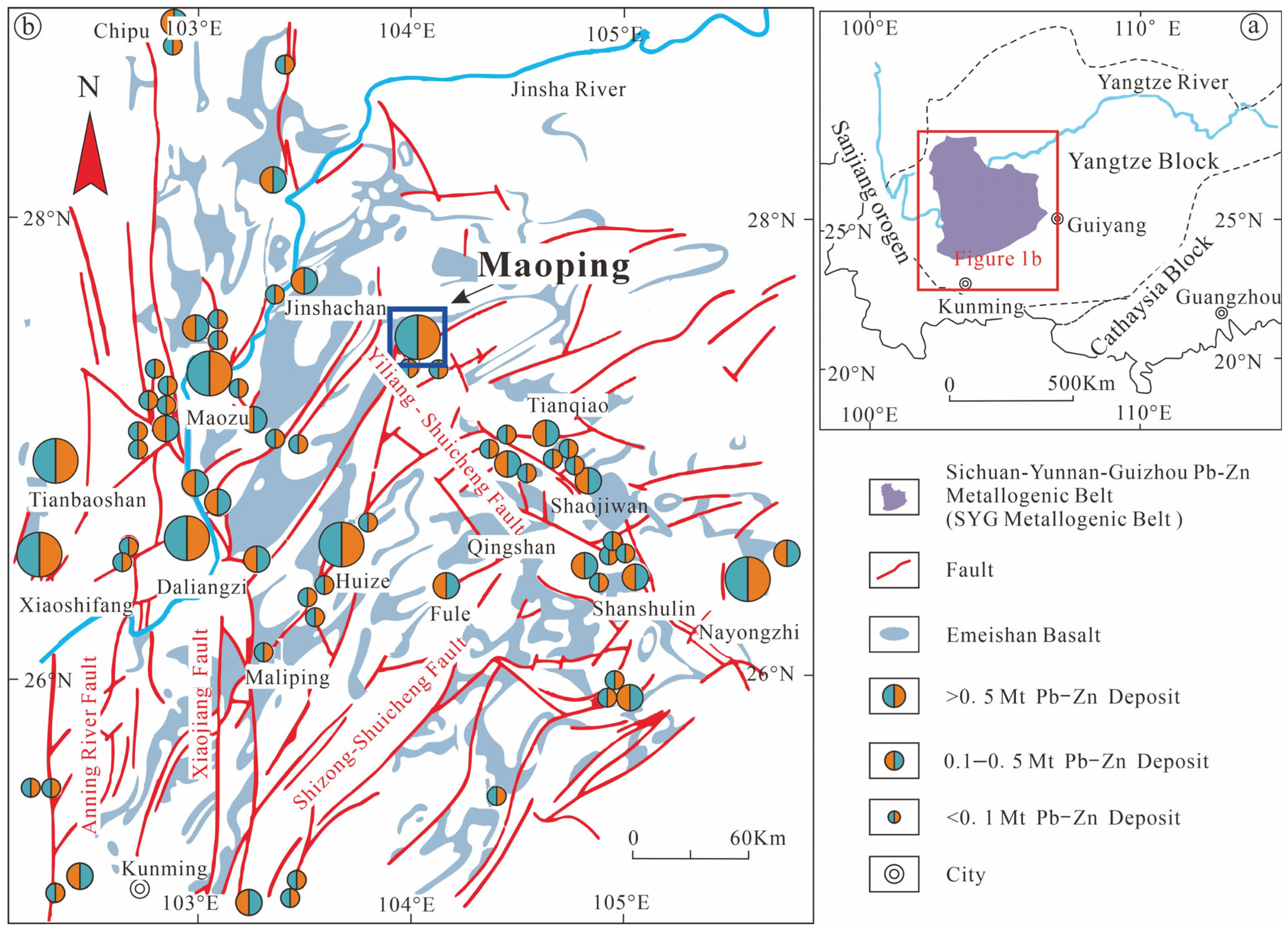
2.1. Regional Geology
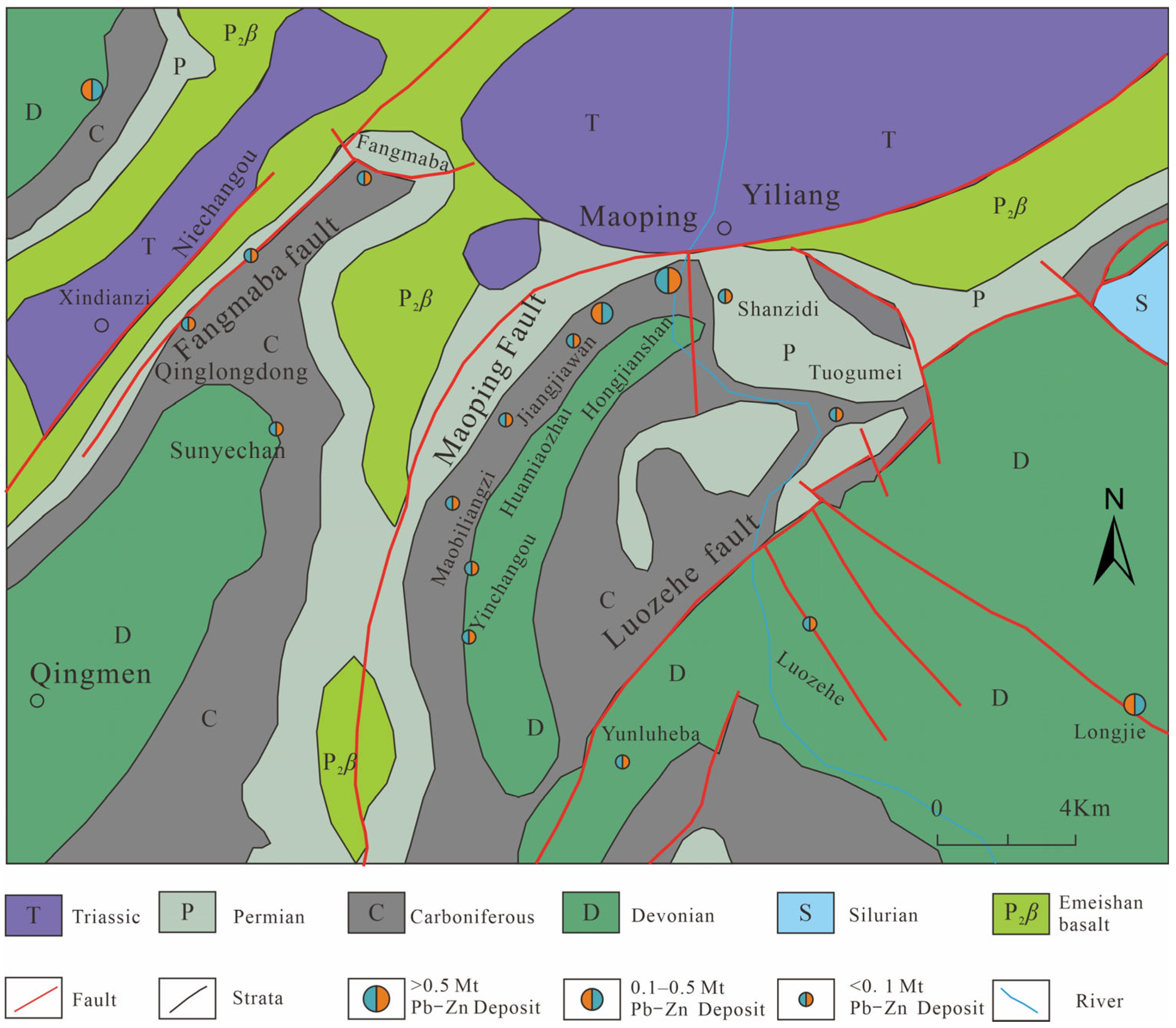
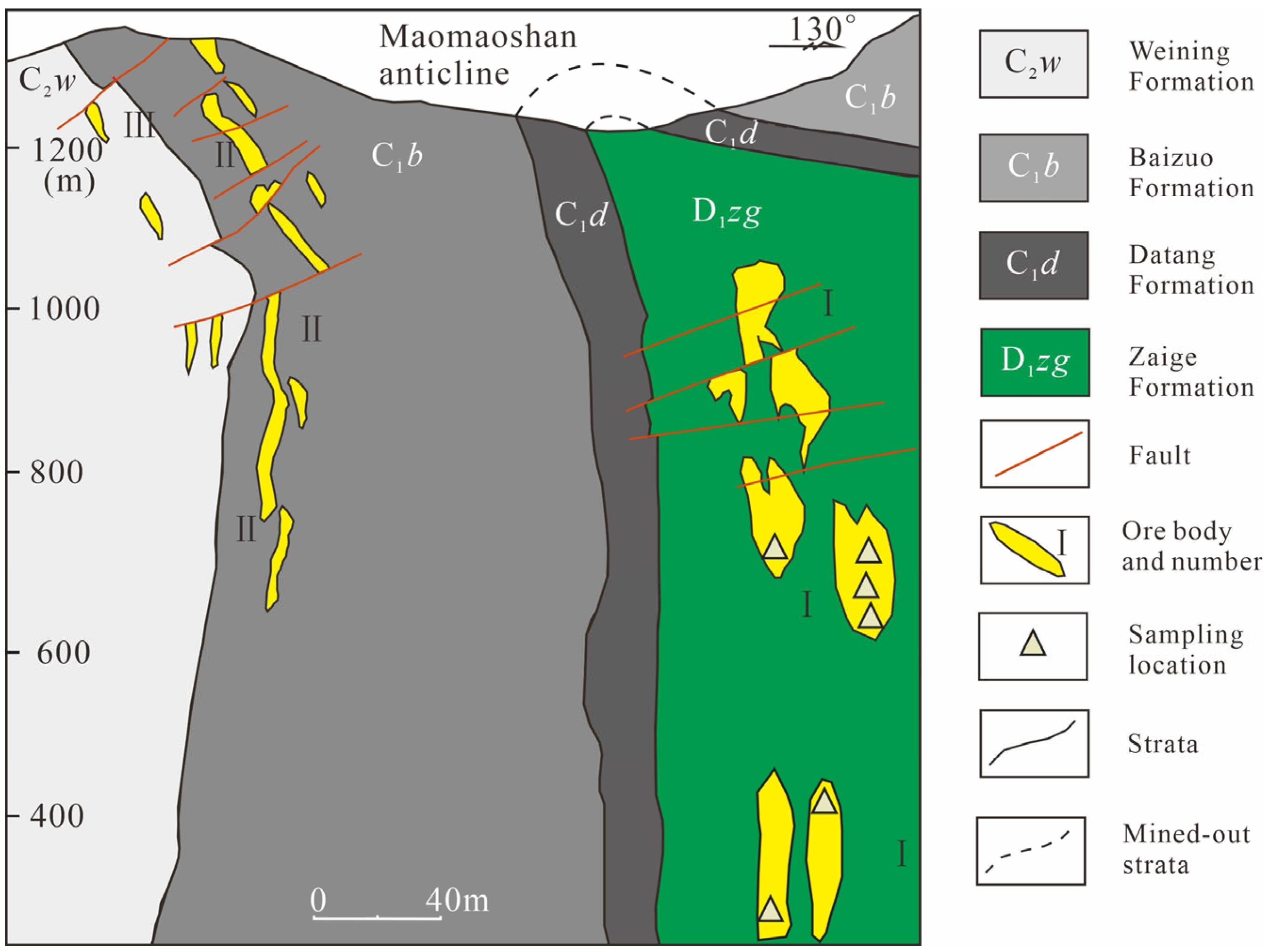
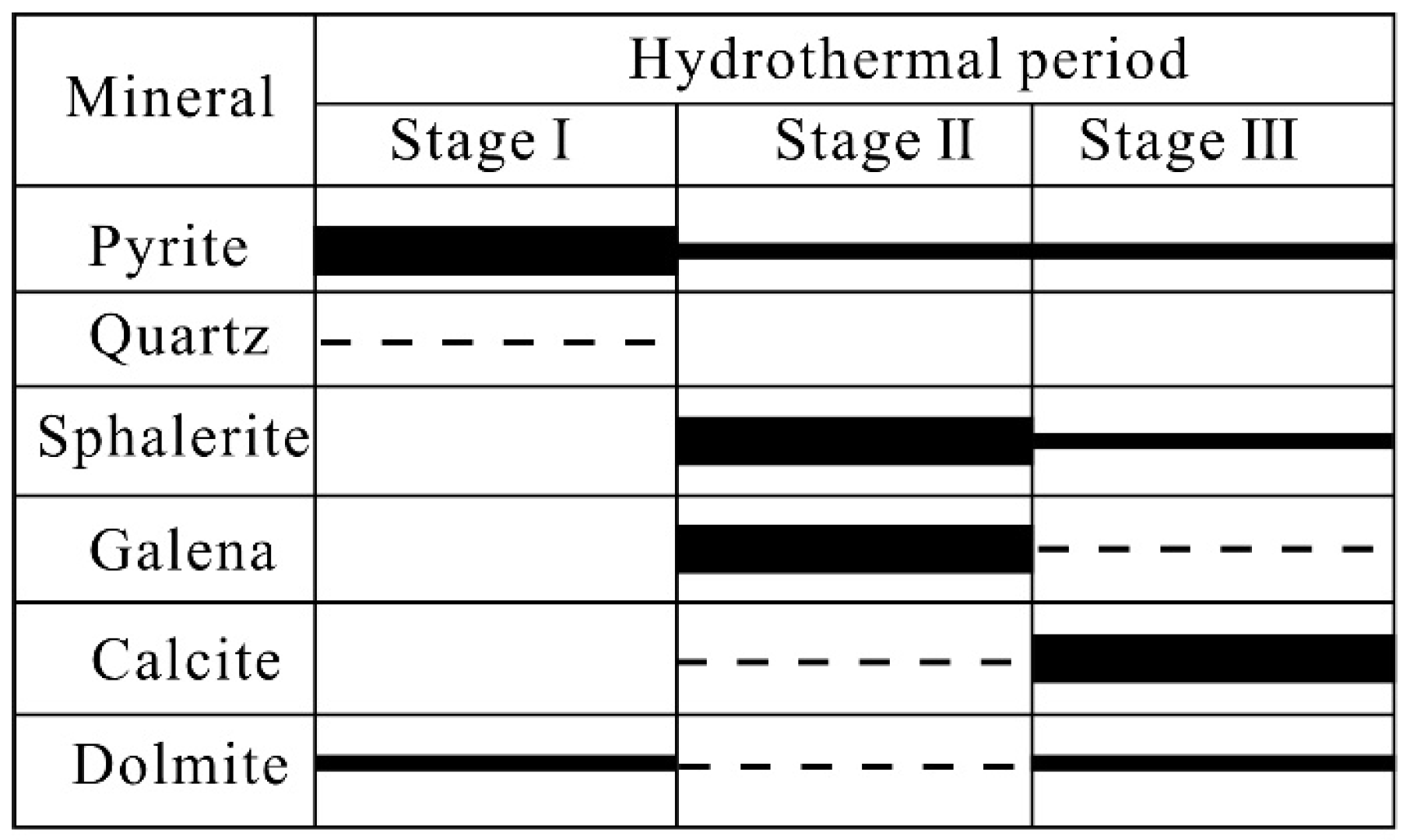
2.2. Geological Characteristics of the Maoping Deposit
3. Sample Sources and Analytical Methods
4. Results
4.1. Major and Trace Element Compositions of Sphalerite and Pyrite
- (1)
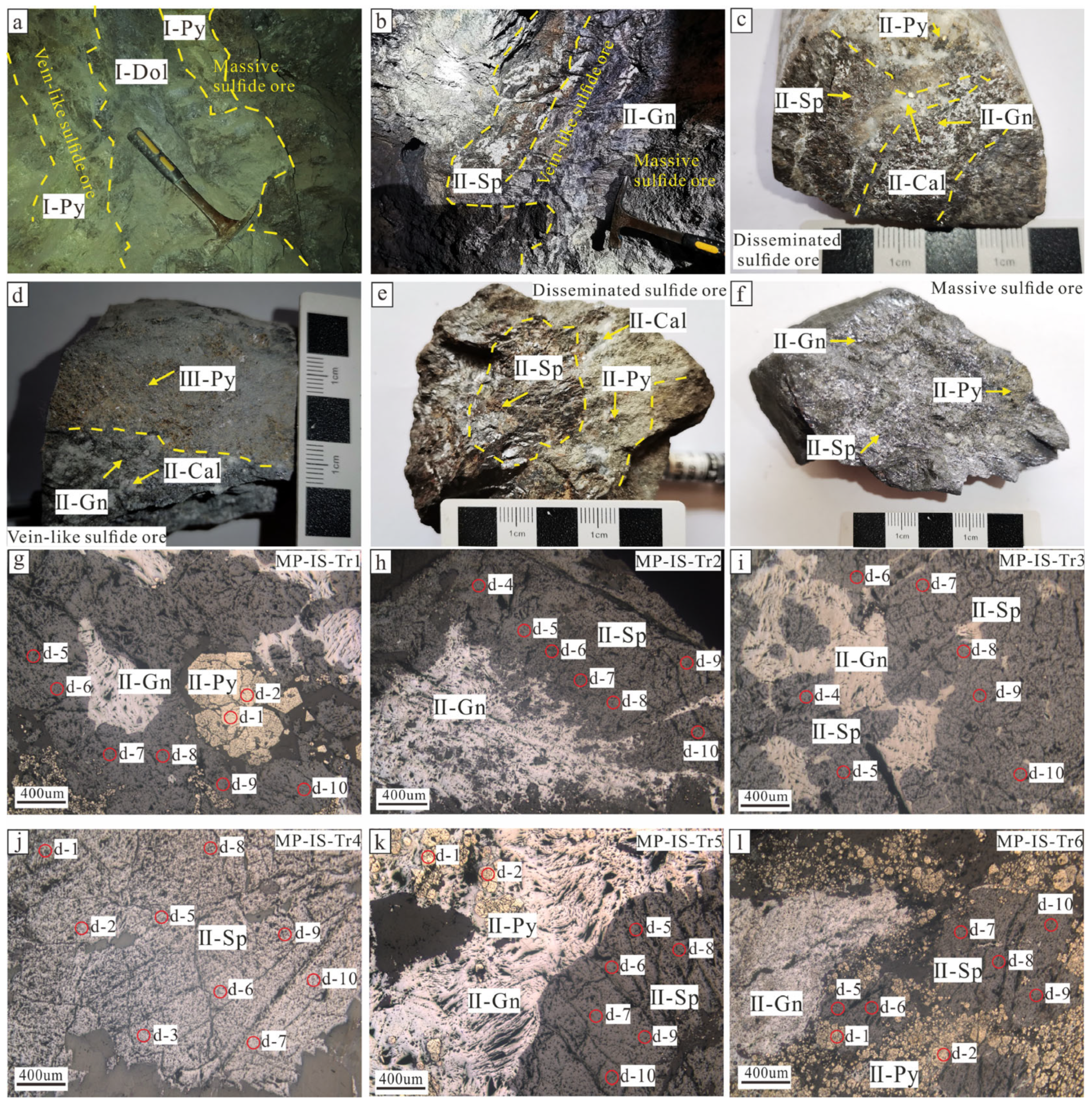
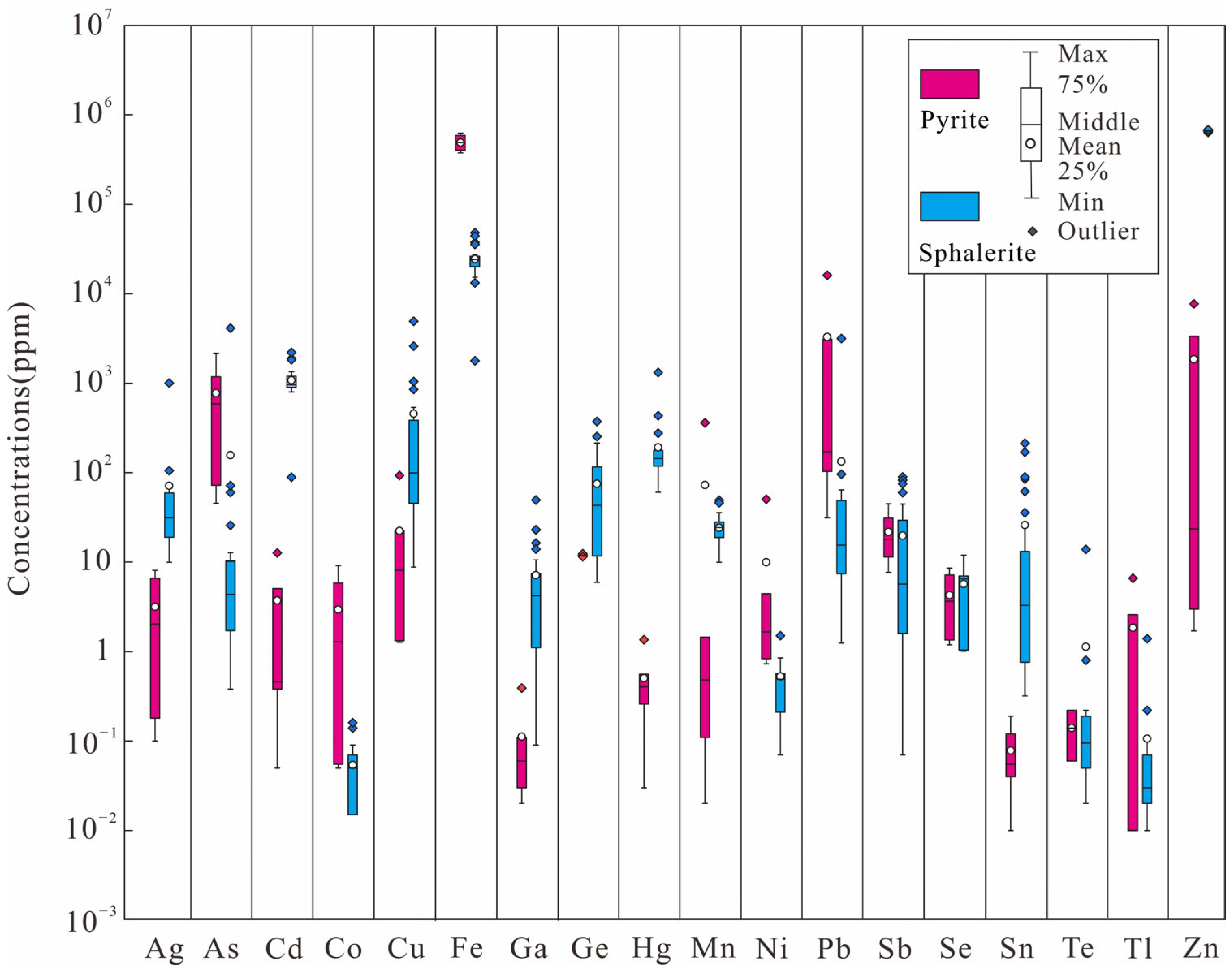
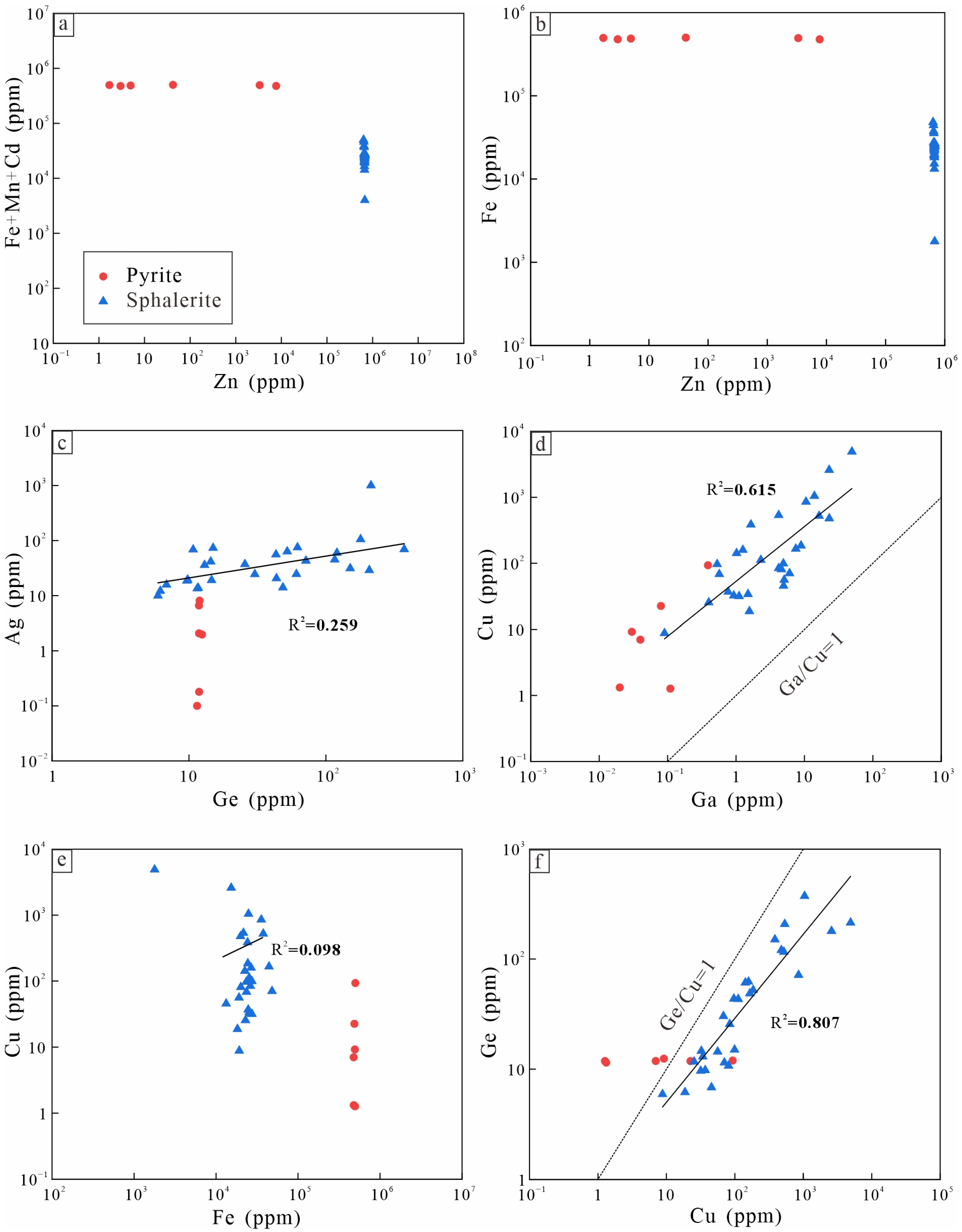
- Sphalerite exhibits relatively moderate iron (Fe) contents (1800 to 48,200 ppm, mean 24,600 ppm, n = 28), though significantly lower than those of the iron-rich sphalerite standards (Fe > 10 wt%).
- (2)
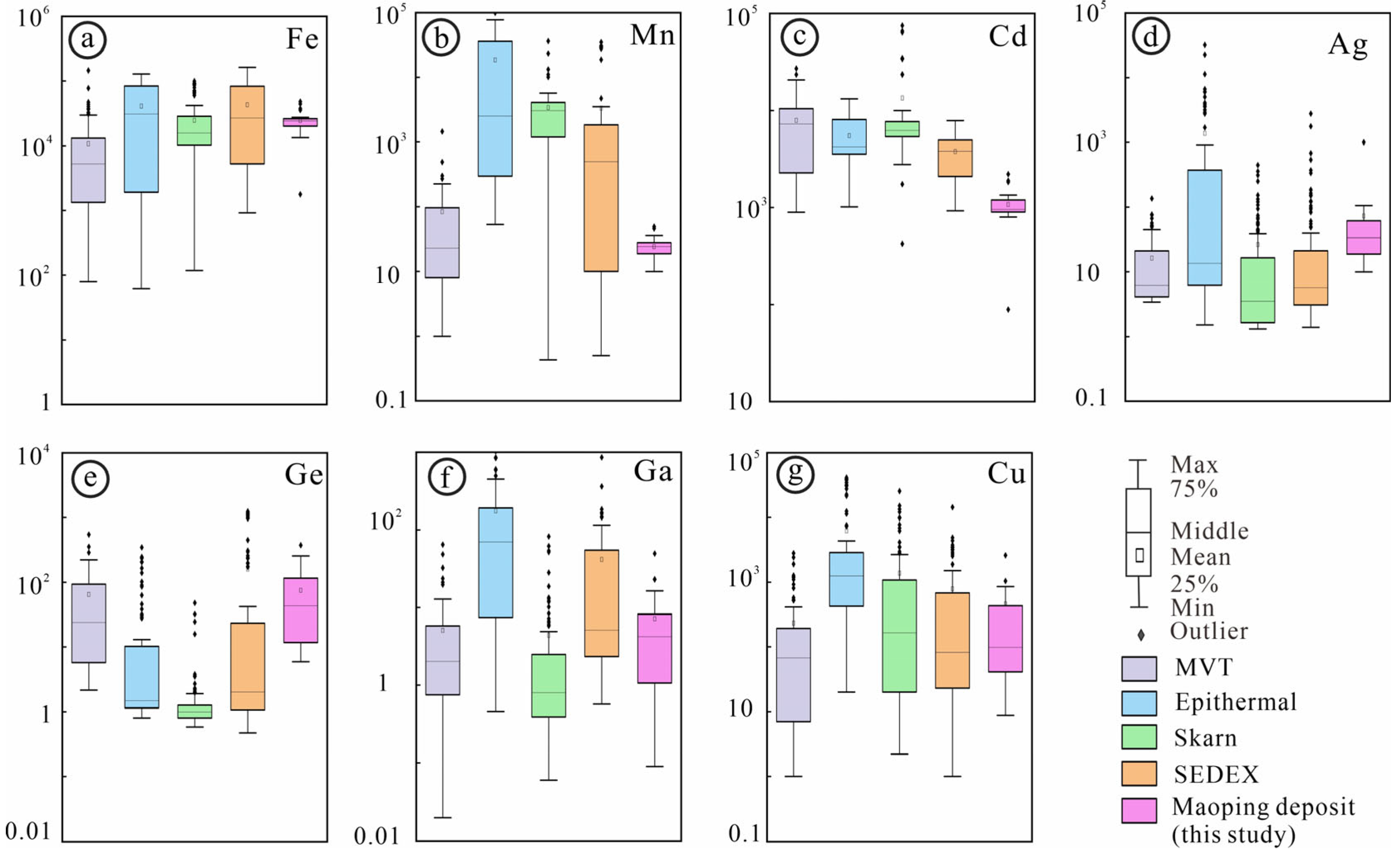
- There are notable enrichments of copper (Cu), cadmium (Cd), germanium (Ge), silver (Ag), gallium (Ga), mercury (Hg), and tin (Sn) in sphalerite. The copper contents in sphalerite exhibit a considerable variability, with values ranging from 8.80 to 4918 ppm (mean 460 ppm, n = 28); in contrast, the pyrite shows lower Cu contents, which range from 1.27 to 98.0 ppm (mean 22.4 ppm, n = 6). Similarly, cadmium is highly enriched in sphalerite (797 to 2202 ppm, mean 1111 ppm, n = 28) compared to pyrite (0.05 to 12.6 ppm, mean 3.71 ppm, n = 5). Germanium is notably enriched in sphalerite (5.94 to 373 ppm, mean 68.8 ppm, n = 28) compared to pyrite (11.5 to 12.5 ppm, mean 11.9 ppm, n = 6). The silver contents in sphalerite (10.0 to 1005 ppm, mean 73.0 ppm, n = 28) are significantly higher than in pyrite (0.1 to 8.1 ppm, mean 3.2 ppm, n = 6). The gallium contents in sphalerite (0.09 to 49.4 ppm, mean 7.17) are higher than pyrite (0.02 to 0.39, mean 0.11). The mercury contents of sphalerite are relatively high, ranging from 60.5 to 433 ppm (mean 151 ppm), which are higher than those of pyrite (0.03 to 1.36, mean 0.50). The tin contents are higher in sphalerite, between 0.32 and 213 ppm (mean 26.7 ppm, n = 28), while the Sn contents in pyrite are extremely low, with a variation range from 0.01 to 0.19 ppm (mean 0.08 ppm, n = 6).
- (3)
- The lead contents in pyrite range from 31.4 to 16,163 ppm, with a mean value of 3289 ppm, and are obviously higher than those of sphalerite (137 to 3167 ppm, mean 137 ppm). The arsenic (As) contents in sphalerite vary widely (0.38 to 4131 ppm, mean 162 ppm, n = 27), whereas pyrite exhibits higher but more variable As levels (45.6 to 2160 ppm, mean 772 ppm, n = 6). The manganese contents (0.02 to 361 ppm, mean 72.6 ppm, n = 5) in pyrite are higher than in sphalerite (9.95 to 49.1 ppm, mean 24.1 ppm, n = 28). The cobalt contents (0.05 to 9.18 ppm, mean 2.95 ppm, n = 4) and Ni contents (0.73 to 50.4, mean 9.95) are slightly enriched in pyrite; both elements are nearly undetectable in sphalerite, with all measurements below 6 ppm.
- (4)
- The antimony (Sb), selenium (Se), tellurium (Te), and thallium (Tl) contents in sphalerite and pyrite are relatively low. The antimony contents in sphalerite show a range of 0.07 to 89.6 ppm (mean 20.2 ppm, n = 28), and the Sb contents in pyrite are ranging from 7.66 to 44.8 ppm (mean 21.7 ppm, n = 6). The selenium, tellurium, and thallium contents in pyrite and sphalerite are relatively low, with some contents below the detection limit.
4.2. LA-ICP-MS Element Mapping
5. Discussion
5.1. Enrichment Patterns of Trace Elements
5.2. Mechanism of Trace Element Occurrence and Geochemical Information of Mineralization
5.3. Ore Genesis Indication of Trace Elements in Sphalerite
6. Conclusions
Author Contributions
Funding
Data Availability Statement
Acknowledgments
Conflicts of Interest
References
- Hu, R.; Fu, S.; Huang, Y.; Zhou, M.F.; Fu, S.; Zhao, C.; Wang, Y.; Bi, X.; Xiao, J. The giant South China Mesozoic low-temperature metallogenic domain: Reviews and a new geodynamic model. J. Asian Earth Sci. 2017, 137, 9–34. [Google Scholar] [CrossRef]
- Wu, T.; He, Y.; He, Z.; Huang, Z.; Ye, L.; Wei, C.; Fan, H.; Hu, Y.; Du, L.; Gun, M. Sulfide S-Zn-Cd isotopes and origin of the Liangyan Zn-Pb deposit in the Sichuan-Yunnan-Guizhou metallogenic province, SW China. J. Asian Earth Sci. 2023, 256, 105804. [Google Scholar] [CrossRef]
- Zhang, H.; Xiao, C.; Wen, H.; Zhu, X.; Ye, L.; Huang, Z.; Zhou, J.; Fan, H. Homogeneous Zn isotopic compositions in the Maozu Zn-Pb ore deposit in Yunnan Province, southwestern China. Ore Geol. Rev. 2019, 109, 1–10. [Google Scholar] [CrossRef]
- Zhou, J.X.; Luo, K.; Wang, X.C.; Wilde, S.A.; Wu, T.; Huang, Z.L.; Cui, Y.L.; Zhao, J.X. Ore genesis of the Fule Pb-Zn deposit and its relationship with the Emeishan Large Igneous Province: Evidence from mineralogy, bulk C-O-S and in situ S-Pb isotopes. Gondwana Res. 2018, 54, 161–179. [Google Scholar] [CrossRef]
- Zhou, J.X.; Xiang, Z.Z.; Zhou, M.F.; Feng, Y.X.; Luo, K.; Huang, Z.L.; Wu, T. The giant Upper Yangtze Pb–Zn province in SW China: Reviews, new advances and a new genetic model. J. Asian Earth Sci. 2018, 154, 280–315. [Google Scholar] [CrossRef]
- Tan, T.; Peng, H.; Qin, E.; Wang, Z.; Mao, X. Study on the Occurrence States and Enrichment Mechanisms of the Dispersed Elements Ga, Ge, and In in the Chipu Pb-Zn Deposit, Sichuan Province, China. Minerals 2025, 15, 341. [Google Scholar] [CrossRef]
- Bernstein, L.R. Germanium geochemistry and mineralogy. Geochim. Cosmochim. Acta 1985, 49, 2409–2422. [Google Scholar] [CrossRef]
- Cook, N.J.; Ciobanu, C.L.; Pring, A.; Skinner, W.; Shimizu, M.; Danyushevsky, L.; Saini-Eidukat, B.; Melcher, F. Trace and minor elements in sphalerite: A LA-ICPMS study. Geochim. Cosmochim. Acta 2009, 73, 4761–4791. [Google Scholar] [CrossRef]
- Ye, L.; Cook, N.J.; Ciobanu, C.L.; Liu, Y.P.; Zhang, Q.; Liu, T.; Gao, W.; Yang, Y.; Danyushevskiy, L. Trace and minor elements in sphalerite from base metal deposits in South China: A LA-ICPMS study. Ore Geol. Rev. 2011, 39, 188–217. [Google Scholar] [CrossRef]
- Frenzel, M.; Mikolajczak, C.; Reuter, M.A.; Gutzmer, J. Quantifying the relative availability of high-tech by-product metals—The cases of gallium, germanium and indium. Resour. Policy 2017, 52, 327–335. [Google Scholar] [CrossRef]
- Wang, L.; Zhang, Y.; Han, R.S.; Li, X.D. LA-ICP-MS analyses of trace elements in zoned sphalerite: A study from the Maoping carbonate-hosted Pb-Zn(-Ge) deposit, southwest China. Ore Geol. Rev. 2023, 157, 105468. [Google Scholar] [CrossRef]
- Li, X.M.; Zhang, Y.X.; Li, Z.K.; Zhao, X.F.; Zuo, R.G.; Xiao, F.; Zheng, Y. Discrimination of Pb-Zn deposit types using sphalerite geochemistry: New insights from machine learning algorithm. Geosci. Front. 2023, 14, 101580. [Google Scholar] [CrossRef]
- Tan, S.C.; Zhou, J.X.; Luo, K.; Xiang, Z.Z.; He, X.H.; Zhang, Y.H. The sources of ore-forming elements of the Maoping large-scale Pb-Zn deposit, Yunnan Province: Constrains from in-situ S and Pb isotopes. Acta Petrol. Sin. 2019, 35, 3461–3476. [Google Scholar]
- Xiang, Z.Z.; Zhou, J.X.; Luo, K. New insights into the multi-layer metallogenesis of carbonated-hosted epigenetic Pb-Zn deposits: A case study of the Maoping Pb-Zn deposit, South China. Ore Geol. Rev. 2020, 122, 103538. [Google Scholar] [CrossRef]
- Wei, C.; Ye, L.; Hu, Y.S.; Huang, Z.L.; Danyushevsky, L.; Wang, H.Y. LA-ICP-MS analyses of trace elements in base metal sulfides from carbonate-hosted Zn-Pb deposits, South China: A case study of the Maoping deposit. Ore Geol. Rev. 2021, 130, 103945. [Google Scholar] [CrossRef]
- Niu, P.P.; Jiang, S.Y.; Muoz, M. Two-stage enrichment of germanium in the giant Maoping MVT Pb-Zn deposit, southwestern China: Constraints from in situ analysis of multicolor sphalerites. Ore Geol. Rev. 2023, 157, 105421. [Google Scholar] [CrossRef]
- Xie, J.R. A Discussion on the Deposits Classify; Science Press: Beijing, China, 1963; pp. 67–123. (In Chinese) [Google Scholar]
- Yang, B.; Jin, C.H.; Zhang, Y.; Ji, P.L.; Guo, Y.; Wang, Z.Z. Ore Deposit Characteristics and Metallogenic Model of the Maoping Pb-Zn Deposit in Wumengshan Mountainous Area, Yunnan Province. Acta Geosci. Sin. 2018, 39, 592–605. [Google Scholar]
- Liu, H.C.; Lin, W.D. Regularity Research of Ag. Zn. Pb Ore Deposits North-East Yunnan Province; Yunnan University Press: Kunming, China, 1999. [Google Scholar]
- He, Y.F.; Wu, T.; Huang, Z.; Ye, L.; Deng, P.; Xiang, Z. Genesis of the Maoping carbonate-hosted Pb–Zn deposit, northeastern Yunnan Province, China: Evidences from geology and C–O–S–Pb isotopes. Acta Geochim. 2020, 39, 782–796. [Google Scholar] [CrossRef]
- He, Y.; Zhou, G.M.; Zhong, H.; Cheng, Y.; Yue, Z.P.; Liu, H.S.; Zhou, J.X. Enrichment characteristics and its geological significance of dispersed elements within sulfide minerals from the VI ore belt in the Maoping Pb-Zn deposit, Yunnan Province, China. Acta Petrol. Sin. 2023, 39, 2985–3001. [Google Scholar] [CrossRef]
- Izbrodin, I.A.; Doroshkevich, A.G.; Starikova, A.E.; Malyutina, A.V.; Moroz, T.N.; Sharygin, I.S. Zr-Th-REE Mineralization Associated with Albite-Aegirine-Bearing Rocks of the Burpala Alkaline Intrusion (North Baikal Region, South Margin of the Siberian Craton). Minerals 2025, 15, 742. [Google Scholar] [CrossRef]
- Belissont, R.; Boiron, M.C.; Luais, B.; Cathelineau, M. LA-ICP-MS analyses of minor and trace elements and bulk Ge isotopes in zoned Ge-rich sphalerites from the Noailhac–Saint-Salvy deposit (France): Insights into incorporation mechanisms and ore deposition processes. Geochim. Cosmochim. Acta 2014, 126, 518–540. [Google Scholar] [CrossRef]
- Liang, X.; Li, B.; Zhang, C.; Qin, H.; Li, G.; Zhang, X. Mineralogical and Geochemical Characteristics of Carbonates and Their Geological Significance to the Fuli Pb-Zn Deposit, Yunnan Province. Minerals 2022, 12, 1317. [Google Scholar] [CrossRef]
- Luo, K.; Zhou, J.X.; Huang, Z.L.; Wang, X.C.; Wilde, S.A.; Zhou, W.; Tian, L.Y. New insights into the origin of early Cambrian carbonate-hosted Pb-Zn deposits in South China: A case study of the Maliping Pb-Zn deposit. Gondwana Res. 2019, 70, 88–103. [Google Scholar] [CrossRef]
- Zhou, J.X.; Huang, Z.L.; Zhou, M.F.; Li, X.B.; Jin, Z.G. Constraints of C–O–S–Pb isotope compositions and Rb–Sr isotopic age on the origin of the Tianqiao carbonate-hosted Pb–Zn deposit, SW China. Ore Geol. Rev. 2013, 53, 77–92. [Google Scholar] [CrossRef]
- Miao, Y.; Li, W.H.; Zhou, J.X.; Luo, K.; Zhou, Y.; Chen, S.M.; Fan, Z.Y.; Pan, J.R. Geology, geochemistry and genesis of the giant Maoping carbonate-hosted Pb-Zn-(Ag-Ge) deposit in northeastern Yunnan Province, SW China. Ore Geol. Rev. 2023, 161, 105648. [Google Scholar] [CrossRef]
- Ren, Z.Y.; Wu, Y.D.; Zhang, L.; Nichols, A.R.L.; Hong, L.B.; Zhang, Y.H.; Zhang, Y.; Liu, J.Q.; Xu, Y.G. Primary magmas and mantle sources of Emeishan basalts constrained from major element, trace element and Pb isotope compositions of olivine-hosted melt inclusions. Geochim. Cosmochim. Acta 2017, 208, 63–85. [Google Scholar] [CrossRef]
- Xu, Y.; Chung, S.L.; Jahn, B.M.; Wu, G. Petrologic and geochemical constraints on the petrogenesis of Permian–Triassic Emeishan flood basalts in southwestern China. Lithos 2001, 58, 145–168. [Google Scholar] [CrossRef]
- Hu, Z.; Zheng, Y.; Guo, L.; Yu, P.; Chen, X.; Wang, C.M.; Long, L.; Wu, Y. The world-class carbonate-hosted Fankou Zn-Pb deposit in China. Part I. Structural analysis: Evolutionary three-order thrusting structures control on the localization of Zn-Pb orebodies. Ore Geol. Rev. 2023, 157, 105463. [Google Scholar] [CrossRef]
- Han, R.S.; Wang, M.Z.; Jin, Z.G.; Li, B.; Wang, Z.Y. Ore-controlling mechanism of NE-trending ore-forming structural system at Zn-Pb polymetallic ore concentration area in northwestern Guizhou. Acta Geol. Sin. 2020, 94, 850–868. [Google Scholar]
- Oyebamiji, A.; Falae, P.; Zafar, T.; Rehman, H.U.; Oguntuase, M. Genesis of the Qilinchang Pb–Zn deposit, southwestern China: Evidence from mineralogy, trace elements systematics and S–Pb isotopic characteristics of sphalerite. Appl. Geochem. 2023, 148, 105545. [Google Scholar] [CrossRef]
- Wang, Q.; Yang, L.; Xu, X.; Santosh, M.; Wang, Y.; Wang, T.; Chen, F.; Wang, R.; Gao, L.; Liu, X.; et al. Multi-stage tectonics and metallogeny associated with Phanerozoic evolution of the South China Block: A holistic perspective from the Youjiang Basin. Earth-Sci. Rev. 2020, 211, 103405. [Google Scholar] [CrossRef]
- Zhang, Z.B.; Li, Z.Y.; Tu, G.C.; Xia, B.; Wei, Z.Q. Geotectonic Evolution Background and Ore-Forming Process of Pb-Zn Deposits in Chuan-Dian-Qian Area of Southwest China. Geotecton. Metallog. 2006, 30, 343–354. [Google Scholar] [CrossRef]
- Shen, Z.W.; Jin, C.H.; Dai, Y.P.; Zhang, Y.; Zhang, H. Mineralization Age of the Maoping Pb-Zn Deposit in the Northeastern Yunnan Province: Evidence from Rb-Sr Isotopic Dating of Sphalerites. Geol. J. China Univ. 2016, 22, 213–218. [Google Scholar] [CrossRef]
- Hu, X.; Chen, Y.; Liu, G.; Yang, H.; Luo, J.; Ren, K. Numerical modeling of formation of the Maoping Pb-Zn deposit within the Sichuan-Yunnan-Guizhou Metallogenic Province, Southwestern China: Implications for the spatial distribution of concealed Pb mineralization and its controlling factors. Ore Geol. Rev. 2022, 140, 104573. [Google Scholar] [CrossRef]
- Xu, S.; Hu, Y.; Cheng, Y.; Zhu, J.; Ping, Y.; Zhang, Q.; Pei, Z. Genetic relationship between the Maoping Pb-Zn deposit and paleo-oil reservoir in the northern Yunnan-Guizhou depression: Evidence from bitumen trace elements and the in-situ sulfur isotope of pyrite associated with bitumen. Front. Earth Sci. 2023, 10, 1109112. [Google Scholar] [CrossRef]
- Wu, J.; Han, R.; Zhang, Y.; Wu, P.; Gong, H.; Wang, L.; Cheng, G.; Li, X.; Yang, Y.; Mi, Y. Porosity–permeability characteristics and mineralization–alteration zones of the Maoping germanium-rich lead–zinc deposit in SW China. Front. Earth Sci. 2024, 12, 1347243. [Google Scholar] [CrossRef]
- Pearce, N.J.G.; Perkins, W.T.; Westgate, J.A.; Gorton, M.P.; Jackson, S.E.; Neal, C.R.; Chenery, S.P. A Compilation of New and Published Major and Trace Element Data for NIST SRM 610 and NIST SRM 612 Glass Reference Materials. Geostand. Geoanalytical. Res. 1997, 21, 115–144. [Google Scholar] [CrossRef]
- Liu, Y.S.; Hu, Z.C.; Gao, S.; Günther, D.; Xu, J.; Gao, C.G.; Chen, H.H. In situ analysis of major and trace elements of anhydrous minerals by LA-ICP-MS without applying an internal standard. Chem. Geol. 2008, 257, 34–43. [Google Scholar] [CrossRef]
- Paton, C.; Hellstrom, J.; Paul, B.; Woodhead, J.; Hergt, J. Iolite: Freeware for the visualisation and processing of mass spectrometric data. J. Anal. At. Spectrom. 2011, 26, 2508–2518. [Google Scholar] [CrossRef]
- Wei, C.; Ye, L.; Huang, Z.; Hu, Y.; Wang, H. In situ trace elements and S isotope systematics for growth zoning in sphalerite from MVT deposits: A case study of Nayongzhi, South China. Mineral. Mag. 2021, 85, 364–378. [Google Scholar] [CrossRef]
- Meng, Y.M.; Zhang, X.; Huang, X.W.; Hu, R.; Bi, X.; Meng, S.; Zhou, L.; Zheng, Y. A review of the Zn-Pb deposits in Sichuan-Yunnan-Guizhou metallogenic region with emphasis on the enrichment mechanism of Ge, Ga, and In. Ore Geol. Rev. 2024, 164, 105853. [Google Scholar] [CrossRef]
- Yang, Q.; Zhang, X.J.; Ulrich, T.; Zhang, J.; Wang, J. Trace element compositions of sulfides from Pb-Zn deposits in the Northeast Yunnan and northwest Guizhou Provinces, SW China: Insights from LA-ICP-MS analyses of sphalerite and pyrite. Ore Geol. Rev. 2022, 141, 104639. [Google Scholar] [CrossRef]
- Keith, M.; Haase, K.M.; Schwarz-Schampera, U.; Klemd, R.; Petersen, S.; Bach, W. Effects of temperature, sulfur, and oxygen fugacity on the composition of sphalerite from submarine hydrothermal vents. Geology 2014, 42, 699–702. [Google Scholar] [CrossRef]
- Frenzel, M.; Hirsch, T.; Gutzmer, J. Gallium, germanium, indium, and other trace and minor elements in sphalerite as a function of deposit type—A meta-analysis. Ore Geol. Rev. 2016, 76, 52–78. [Google Scholar] [CrossRef]
- Zhang, J.K.; Shao, Y.J.; Liu, Z.F.; Chen, K. Sphalerite as a record of metallogenic information using multivariate statistical analysis: Constraints from trace element geochemistry. J. Geochem. Explor. 2022, 232, 106883. [Google Scholar] [CrossRef]
- Wang, C.; Li, Z.K.; Sanislav, I.; Zheng, Y.; Li, X.M.; Zhang, R.Z.; Hu, J.; Zhang, J. Trace element zoning and temperature variation in sphalerite from the giant Nannihu porphyry-skarn-epithermal polymetallic system, central China. Miner. Depos. 2025. [Google Scholar] [CrossRef]
- Zhao, H.; Zhang, Y.; Shao, Y.; Liao, J.; Song, S.; Cao, G.; Tan, R. A New Sphalerite Thermometer Based on Machine Learning with Trace Element Geochemistry. Nat. Resour. Res. 2024, 33, 2609–2626. [Google Scholar] [CrossRef]
- Luo, K.; Cugerone, A.; Fougerouse, D.; Zhou, J.X.; Xian, H.; Yang, Y.; Saxey, D.W.; Motto-Ros, V.; Sun, X.; Rickard, W.D.A.; et al. Rapid crystal growth promotes the precipitation of nanoscale fluid inclusions rich in halogens and metals in colloform sphalerite. Geochim. Cosmochim. Acta 2025, 398, 119–138. [Google Scholar] [CrossRef]
- Frenzel, M.; Voudouris, P.; Cook, N.J.; Ciobanu, C.L.; Gilbert, S.; Wade, B.P. Evolution of a hydrothermal ore-forming system recorded by sulfide mineral chemistry: A case study from the Plaka Pb–Zn–Ag Deposit, Lavrion, Greece. Miner. Depos. 2022, 57, 417–438. [Google Scholar] [CrossRef]
- Han, R.S.; Zou, H.J.; Hu, B.; Hu, Y.Z.; Xue, C.D. Features of fluid inclusions and sources of ore-forming fluid in the Maoping carbonate-hosted Zn-Pb-(Ag-Ge) deposit, Yunnan, China. Acta Petrol. Sin. 2007, 23, 2109–2118. Available online: http://www.ysxb.ac.cn//article/id/aps_200709205 (accessed on 20 January 2026).
- Hu, Y.S.; Ye, L.; Huang, Z.L.; Li, Z.L.; Wei, C.; Leonid, D. Distribution and Existing Forms of Trace Elements from Maliping Pb-Zn Deposit in Northeastern Yunnan, China: A LA-ICPMS Study. Acta Petrol. Sin. 2019, 35, 3477–3495. Available online: http://www.ysxb.ac.cn/article/doi/10.18654/1000-0569/2019.11.14 (accessed on 20 January 2026).
- Han, R.S.; Zhang, Y.; Ye, T.Z.; Chen, Q.; Ren, T.; Guo, Z.L.; Qiu, W.L. An Overview of the Metallogeny and Geological Prospecting Model of Mississippi Valley Type (MVT) Lead and Zinc Deposits. Geotecton. Metallog. 2023, 47, 915–932. [Google Scholar] [CrossRef]
- Zhang, D.X.; Liu, J.B.; Wang, Z.L.; C.Bayless, R.; Hu, Z.; Xie, X.Y.; Chen, S.W. In situ LA-ICP-MS trace elements in sphalerite from the Fankou Pb-Zn deposit, South China: Implications for ore genesis. Ore Geol. Rev. 2024, 164, 105812. [Google Scholar] [CrossRef]
- Han, R.S.; Liu, C.Q.; Huang, Z.L.; Chen, J.; Ma, D.Y.; Lei, L.; Ma, G.S. Geological features and origin of the Huize carbonate-hosted Zn-Pb-(Ag) District, Yunnan, South China. Ore Geol. Rev. 2007, 31, 360–383. [Google Scholar] [CrossRef]
- Zhang, Z.; Yang, J.H.; Hu, R.Z.; Fu, B.; Hu, Q.; Zhou, M.F. Constraints of in-situ elemental compositions and U–Pb ages of cassiterite on the origin of the Cretaceous Gejiu and Dulong tin deposits, SW China: Implications for the linkage of tin belts in SE Asia. Lithos 2024, 488–489, 107832. [Google Scholar] [CrossRef]
- Li, Z.; Lang, X.; Song, W.; Li, H.; Li, C.; Ma, X. LA-ICP-MS analysis of sulfides from the Sinongduo Ag-Pb-Zn deposit, Tibet: Insights into element incorporation mechanisms and ore genesis. Ore Geol. Rev. 2025, 186, 106858. [Google Scholar] [CrossRef]
- Chao, W.; Ye, H.; Tang, X.; Zhang, Z.; Wang, H. Textural, trace element, and sulfur isotope analyses of pyrite from the Yindongpo deposit, East Qinling Orogen: Implications for gold mineralization. Ore Geol. Rev. 2023, 163, 105796. [Google Scholar] [CrossRef]
- Reich, M.; Simon, A.C.; Deditius, A.; Barra, F.; Chryssoulis, S.; Lagas, G.; Tardani, D.; Knipping, J.; Bilenker, L.; Sánchez-Alfaro, P.; et al. Trace element signature of pyrite from the los colorados iron oxide-apatite (ioa) deposit, chile: A missing link between andean ioa and iron oxide copper-gold systems? Econ. Geol. 2016, 111, 743–761. [Google Scholar] [CrossRef]
- Muchez, P.; Heijlen, W.; Banks, D.; Blundell, D.; Boni, M.; Grandia, F. 7: Extensional tectonics and the timing and formation of basin-hosted deposits in Europe. Ore Geol. Rev. 2005, 27, 241–267. [Google Scholar] [CrossRef]
- Leach, D.L.; Sangster, D.F.; Kelley, K.D.; Large, R.R.; Garven, G.; Allen, C.R.; Gutzmer, J.; Walters, S. Sediment-hosted lead-zinc deposits: A global perspective. Econ. Geol. 2005, 100, 561–607. [Google Scholar] [CrossRef]
- Leach, D.L.; Bradley, D.C.; Huston, D.; Pisarevsky, S.A.; Taylor, R.D.; Gardoll, S.J. Sediment-Hosted Lead-Zinc Deposits in Earth History. Econ. Geol. 2010, 105, 593–625. [Google Scholar] [CrossRef]
- Yang, Q.; Liu, W.; Zhang, J.; Wang, J.; Zhang, X. Formation of Pb–Zn deposits in the Sichuan–Yunnan–Guizhou triangle linked to the Youjiang foreland basin: Evidence from Rb–Sr age and in situ sulfur isotope analysis of the Maoping Pb–Zn deposit in northeastern Yunnan Province, southeast China. Ore Geol. Rev. 2019, 107, 780–800. [Google Scholar] [CrossRef]
- Zhang, C.; Wu, Y.; Hou, L.; Mao, J. Geodynamic setting of mineralization of Mississippi Valley-type deposits in world-class Sichuan–Yunnan–Guizhou Zn–Pb triangle, southwest China: Implications from age-dating studies in the past decade and the Sm–Nd age of Jinshachang deposit. J. Asian Earth Sci. 2015, 103, 103–114. [Google Scholar] [CrossRef]
- Li, W.B.; Huang, Z.L.; Chen, J.; Han, R.S.; Zhang, Z.L.; Xu, C. Rb-Sr Dating of Mineral Assemblage from the Huize Giant Zn-Pb Deposit, Yunnan Province. Acta Mineral. Sin. 2004, 24, 5. [Google Scholar] [CrossRef]
- Xu, Y.; Huang, Z.; Zhu, D.; Luo, T. Origin of hydrothermal deposits related to the Emeishan magmatism. Ore Geol. Rev. 2014, 63, 1–8. [Google Scholar] [CrossRef]






| Sample | Point | Ore Type | S | Pb | Fe | Zn | Cu | Ag | Co | Ni | As | Sb |
|---|---|---|---|---|---|---|---|---|---|---|---|---|
| Pyrite | ||||||||||||
| MP-IS-Tr1 | d-1 | Massive | 515,216 | 139 | 476,400 | 7710 | 7.00 | 2.1 | 0.06 | 0.83 | 372 | 31.1 |
| MP-IS-Tr1 | d-2 | 502,077 | 205 | 493,400 | 3350 | 9.22 | 2.0 | b.d. | 1.04 | 801 | 44.8 | |
| MP-IS-Tr5 | d-1 | Disseminated | 502,910 | 103 | 496,600 | 3 | 1.27 | 0.2 | b.d. | 0.73 | 45.6 | 11.4 |
| MP-IS-Tr5 | d-2 | 511,350 | 31.4 | 477,700 | 3 | 1.32 | 0.1 | 0.05 | 2.29 | 72.1 | 7.66 | |
| MP-IS-Tr6 | d-1 | 494,157 | 16,163 | 487,300 | 5 | 22.5 | 6.6 | 2.51 | 4.44 | 2160 | 15.0 | |
| MP-IS-Tr6 | d-2 | 493,573 | 3095 | 500,300 | 40 | 93.1 | 8.1 | 9.18 | 50.4 | 1183 | 20.7 | |
| Minimum value | 493,573 | 31.4 | 476,400 | 2 | 1.27 | 0.1 | b.d. | 0.73 | 45.6 | 7.66 | ||
| Maximum value | 515,216 | 16,163 | 500,300 | 7710 | 93.1 | 8.1 | 9.18 | 50.4 | 2160 | 44.8 | ||
| Mean value | 503,214 | 3289 | 488,600 | 1850 | 22.4 | 3.2 | 2.95 | 9.95 | 772 | 21.7 | ||
| Sphalerite | ||||||||||||
| MP-IS-Tr1 | d-5 | Massive | 311,394 | 17.6 | 37,600 | 648,680 | 522 | 45.0 | b.d. | 0.46 | 8.76 | 12.1 |
| MP-IS-Tr1 | d-6 | 306,633 | 51.0 | 35,600 | 655,260 | 855 | 42.9 | b.d. | 0.07 | 60.2 | 13.0 | |
| MP-IS-Tr1 | d-7 | 315,343 | 19.4 | 48,200 | 634,270 | 70.4 | 13.5 | b.d. | b.d. | 8.48 | 5.67 | |
| MP-IS-Tr1 | d-8 | 306,884 | 4.29 | 44,300 | 646,470 | 166 | 14.0 | 0.05 | b.d. | 0.70 | 6.94 | |
| MP-IS-Tr2 | d-5 | Massive | 313,081 | 43.3 | 24,400 | 660,350 | 185 | 63.2 | 0.14 | b.d. | 5.79 | 89.6 |
| MP-IS-Tr2 | d-6 | 322,057 | 52.0 | 27,400 | 648,770 | 99.2 | 73.2 | 0.04 | b.d. | 4.59 | 82.1 | |
| MP-IS-Tr2 | d-7 | 308,017 | 64.1 | 20,000 | 670,090 | 81.1 | 68.6 | 0.09 | b.d. | 1.44 | 75.1 | |
| MP-IS-Tr3 | d-4 | Vein-like | 312,509 | 13.5 | 26,200 | 659,220 | 84.1 | 37.1 | 0.16 | b.d. | 7.53 | 17.3 |
| MP-IS-Tr3 | d-5 | 315,284 | 96.0 | 15,300 | 664,410 | 2591 | 106 | 0.05 | 0.51 | 71.9 | 44.5 | |
| MP-IS-Tr3 | d-6 | 314750 | 54.3 | 19,900 | 663,270 | 478 | 59.5 | b.d. | b.d. | 3.28 | 41.1 | |
| MP-IS-Tr3 | d-7 | 314,021 | 48.9 | 19,100 | 665,550 | 56.1 | 41.5 | b.d. | 1.51 | 4.45 | 2.71 | |
| MP-IS-Tr4 | d-1 | Vein-like | 302,520 | 15.5 | 27,400 | 668,300 | 31.7 | 18.6 | b.d. | b.d. | 11.0 | 0.99 |
| MP-IS-Tr4 | d-2 | 309,066 | 12.8 | 23,600 | 666,110 | 68.3 | 24.4 | 0.01 | 0.09 | 0.80 | 1.02 | |
| MP-IS-Tr4 | d-3 | 309,825 | 4.94 | 23,400 | 665,500 | 96.8 | 20.6 | 0.01 | 0.49 | 4.24 | 5.69 | |
| MP-IS-Tr4 | d-5 | 311,147 | 19.3 | 21,600 | 665,030 | 536 | 28.9 | 0.05 | b.d. | 12.7 | 29.4 | |
| MP-IS-Tr4 | d-6 | 308,854 | 4.78 | 22,400 | 666,990 | 143 | 24.6 | b.d. | b.d. | 0.86 | 5.77 | |
| MP-IS-Tr4 | d-7 | 312,232 | 1.77 | 25,800 | 660,610 | 32.4 | 19.0 | b.d. | b.d. | 1.88 | 0.63 | |
| MP-IS-Tr4 | d-8 | 310,597 | 12.8 | 24,700 | 663,300 | 36.9 | 19.4 | 0.03 | b.d. | 2.36 | 2.62 | |
| MP-IS-Tr4 | d-9 | 308,691 | 5.25 | 22,900 | 666,650 | 25.4 | 13.8 | 0.06 | 0.57 | 4.14 | 0.26 | |
| MP-IS-Tr4 | d-10 | 312,623 | 7.45 | 24,200 | 660,880 | 385 | 31.3 | 0.08 | b.d. | 0.38 | 19.9 | |
| MP-IS-Tr5 | d-5 | Disseminated | 292,252 | 1.25 | 25,500 | 680,850 | 34.0 | 35.9 | b.d. | b.d. | 0.45 | 0.16 |
| MP-IS-Tr5 | d-6 | 294,004 | 59.1 | 25,400 | 678,880 | 112 | 55.9 | b.d. | 0.21 | 10.5 | 3.61 | |
| MP-IS-Tr5 | d-7 | 290,074 | 11.5 | 26,800 | 681,750 | 159 | 75.0 | b.d. | b.d. | b.d. | 1.60 | |
| MP-IS-Tr5 | d-8 | 288,251 | 4.91 | 24,900 | 683,840 | 1045 | 69.4 | 0.06 | b.d. | 10.0 | 42.4 | |
| MP-IS-Tr6 | d-5 | Disseminated | 306,252 | 3167 | 1800 | 675,220 | 4918 | 1005 | b.d. | b.d. | 4131 | 59.9 |
| MP-IS-Tr6 | d-6 | 316,708 | 19.8 | 13,300 | 668,580 | 45.5 | 15.8 | 0.02 | b.d. | 1.56 | 0.07 | |
| MP-IS-Tr6 | d-7 | 310,663 | 9.85 | 18,300 | 669,920 | 18.7 | 12.1 | b.d. | 0.85 | 3.04 | 0.45 | |
| MP-IS-Tr6 | d-8 | 318,689 | 13.8 | 19,200 | 660,590 | 8.80 | 10.0 | 0.01 | b.d. | 2.74 | 1.62 | |
| Minimum value | 288,251 | 1.25 | 1800 | 634,270 | 8.80 | 10.0 | b.d. | b.d. | b.d. | 0.07 | ||
| Maximum value | 322,057 | 3167 | 48,200 | 683,840 | 4918 | 1005 | 0.16 | 1.51 | 4131 | 89.6 | ||
| Mean value | 308,658 | 137 | 24,600 | 664,260 | 460 | 73.0 | 0.06 | 0.53 | 162 | 20.2 | ||
| Pyrite | ||||||||||||
| MP-IS-Tr1 | d-1 | Massive | 0.11 | 11.9 | 12.6 | 0.01 | 1.19 | b.d. | 0.04 | 0.12 | b.d. | 1.36 |
| MP-IS-Tr1 | d-2 | b.d. | 12.5 | 5.05 | 0.01 | 1.50 | b.d. | 0.03 | 0.05 | b.d. | 0.26 | |
| MP-IS-Tr5 | d-1 | Disseminated | 0.02 | 11.9 | 0.05 | 0.01 | b.d. | b.d. | 0.11 | 0.01 | 0.01 | 0.42 |
| MP-IS-Tr5 | d-2 | 361 | 11.5 | b.d. | b.d. | 5.81 | 0.06 | 0.02 | 0.06 | b.d. | 0.56 | |
| MP-IS-Tr6 | d-1 | 1.45 | 11.8 | 0.38 | 2.58 | b.d. | b.d. | 0.08 | 0.04 | 0.01 | 0.39 | |
| MP-IS-Tr6 | d-2 | 0.48 | 12.0 | 0.46 | 6.60 | 8.56 | 0.22 | 0.39 | 0.19 | 0.01 | 0.03 | |
| Minimum value | b.d. | 11.5 | b.d. | b.d. | b.d. | b.d. | 0.02 | 0.01 | b.d. | 0.03 | ||
| Maximum value | 361 | 12.5 | 12.6 | 6.60 | 8.56 | 0.22 | 0.39 | 0.19 | 0.01 | 1.36 | ||
| Mean value | 72.6 | 11.9 | 3.71 | 1.84 | 4.26 | 0.14 | 0.11 | 0.08 | 0.01 | 0.50 | ||
| Sphalerite | ||||||||||||
| MP-IS-Tr1 | d-5 | Massive | 35.6 | 116 | 1238 | 0.02 | b.d. | b.d. | 16.4 | 170 | b.d. | 60.5 |
| MP-IS-Tr1 | d-6 | 35.5 | 71.5 | 1202 | 0.10 | b.d. | b.d. | 10.6 | 84.9 | b.d. | 66.1 | |
| MP-IS-Tr1 | d-7 | 49.1 | 11.5 | 1885 | 0.01 | b.d. | b.d. | 6.07 | 4.91 | 0.01 | 78.5 | |
| MP-IS-Tr1 | d-8 | 45.9 | 48.6 | 1826 | b.d. | b.d. | 0.16 | 7.49 | 24.8 | b.d. | 81.2 | |
| MP-IS-Tr2 | d-5 | Massive | 10.9 | 52.2 | 1088 | 0.07 | b.d. | 0.05 | 8.93 | 7.77 | b.d. | 160 |
| MP-IS-Tr2 | d-6 | 9.95 | 15.0 | 1104 | 0.11 | b.d. | b.d. | 4.92 | 4.65 | b.d. | 177 | |
| MP-IS-Tr2 | d-7 | 13.5 | 10.7 | 912 | 0.04 | 1.01 | b.d. | 4.63 | 4.37 | b.d. | 144 | |
| MP-IS-Tr3 | d-4 | Vein-like | 20.9 | 25.6 | 1335 | 0.02 | b.d. | b.d. | 4.21 | 8.79 | b.d. | 195 |
| MP-IS-Tr3 | d-5 | 15.8 | 179 | 1198 | 0.11 | b.d. | 0.03 | 23.0 | 213 | b.d. | 277 | |
| MP-IS-Tr3 | d-6 | 14.2 | 120 | 932 | 0.02 | b.d. | b.d. | 23.1 | 89.2 | b.d. | 197 | |
| MP-IS-Tr3 | d-7 | 14.2 | 14.4 | 856 | 0.01 | b.d. | 0.08 | 5.06 | 3.29 | b.d. | 183 | |
| MP-IS-Tr4 | d-1 | Vein-like | 35.2 | 9.66 | 1345 | 0.03 | 6.71 | 0.22 | 1.11 | 0.67 | b.d. | 177 |
| MP-IS-Tr4 | d-2 | 27.1 | 30.3 | 922 | b.d. | b.d. | b.d. | 0.57 | 0.72 | b.d. | 123 | |
| MP-IS-Tr4 | d-3 | 25.8 | 43.5 | 956 | 0.03 | b.d. | b.d. | 0.53 | 0.32 | b.d. | 125 | |
| MP-IS-Tr4 | d-5 | 20.6 | 208 | 920 | 0.22 | b.d. | 0.15 | 4.21 | 1.29 | b.d. | 129 | |
| MP-IS-Tr4 | d-6 | 24.4 | 60.9 | 925 | b.d. | b.d. | 0.04 | 1.02 | 2.92 | b.d. | 124 | |
| MP-IS-Tr4 | d-7 | 27.0 | 14.6 | 1122 | b.d. | b.d. | b.d. | 0.93 | 0.55 | b.d. | 136 | |
| MP-IS-Tr4 | d-8 | 18.8 | 9.79 | 881 | 0.02 | 7.01 | b.d. | 0.77 | 0.76 | b.d. | 123 | |
| MP-IS-Tr4 | d-9 | 29.0 | 11.7 | 998 | 0.02 | 12.0 | 0.06 | 0.40 | 0.38 | b.d. | 150 | |
| MP-IS-Tr4 | d-10 | 23.7 | 150 | 1056 | 0.05 | b.d. | b.d. | 1.65 | 2.68 | b.d. | 144 | |
| MP-IS-Tr5 | d-5 | Disseminated | 24.4 | 13.0 | 868 | 0.01 | b.d. | b.d. | 1.50 | 1.06 | b.d. | 92.4 |
| MP-IS-Tr5 | d-6 | 24.5 | 43.2 | 890 | 0.04 | b.d. | 0.11 | 2.31 | 2.78 | b.d. | 115 | |
| MP-IS-Tr5 | d-7 | 24.3 | 62.1 | 920 | b.d. | b.d. | b.d. | 1.26 | 0.75 | b.d. | 118 | |
| MP-IS-Tr5 | d-8 | 23.1 | 373 | 898 | 0.01 | b.d. | 0.02 | 14.0 | 35.7 | b.d. | 104 | |
| MP-IS-Tr6 | d-5 | Disseminated | 28.0 | 214 | 2202 | 1.39 | b.d. | 0.80 | 49.4 | 61.8 | 0.01 | 433 |
| MP-IS-Tr6 | d-6 | 10.3 | 6.85 | 963 | 0.01 | 1.04 | 0.19 | 4.95 | 13.2 | b.d. | 150 | |
| MP-IS-Tr6 | d-7 | 22.1 | 6.18 | 797 | 0.03 | b.d. | 0.06 | 1.57 | 2.11 | b.d. | 161 | |
| MP-IS-Tr6 | d-8 | 19.7 | 5.94 | 879 | 0.07 | 6.32 | b.d. | 0.09 | 0.42 | 0.01 | 208 | |
| Minimum value | 9.95 | 5.94 | 797 | b.d. | b.d. | b.d. | 0.09 | 0.32 | b.d. | 60.5 | ||
| Maximum value | 49.1 | 373 | 2202 | 1.39 | 12.0 | 0.80 | 49.4 | 213 | 0.01 | 433 | ||
| Mean value | 24.1 | 68.8 | 1111 | 0.11 | 5.67 | 0.15 | 7.17 | 26.6 | 0.01 | 151 | ||
| Characteristics | The SYG-Type Pb-Zn Deposits | Typical MVT Pb-Zn Deposits | Maoping Deposit | Similarities and Differences |
|---|---|---|---|---|
| Pb + Zn grades | Av. 10–35 wt% | Av. < 10 wt% | Av. > 18 wt% | Characteristics similar to the SYG Pb-Zn deposits but higher than MVT |
| Tonnage | Single ore body 0.1–1.5 Mt | Single ore body < 1 Mt | >3 Mt | Similar to the SYG Pb-Zn deposits, single ore body, higher than MVT |
| Tectonic setting | Western Yangtze Block, controlled by NE-trending reverse fault–fold system, typically places within compressional zones of passive margins | Typically located in foreland basins and extensional zones within orogenic belts | Western Yangtze Block, controlled by NE-trending reverse fault–fold system Transition from compression to extension | Similar to the SYG Pb-Zn deposits and different from MVT |
| Relation with magmatic activity | Genetically related to late Permian Emeishan flood basalts | Have no genetic association with magmatic activity | Genetically related to late Permian Emeishan flood basalts | Similar to the SYG Pb-Zn deposits but distinct from MVT |
| Ore-controlled factors | Controlled by thrust fault–fold structures and lithology | Mainly controlled by structures and lithology | Controlled by fault–fold structures and lithology | Mainly similar to the SYG Pb-Zn deposits but distinct from the MVT |
| Ages | 226–196 Ma | From Proterozoic to Cretaceous | About 202 Ma | Ages are within the SYG Pb-Zn deposits, but more clustered than MVT |
| Ore texture and structure | Mainly massive structures with fine-, medium-, and coarse-grained textures | Disseminated, fine-grained, branching, colloidal, and massive structures, as well as colloidal and skeleton coarse-grained textures | Mainly massive structures, with disseminated textures, and replacement and granular structures | More similar to the SYG Pb-Zn deposits, difference with MVT |
| Mineral compositions | Sphalerite, galena, pyrite, and calcite | Sphalerite, galena, pyrite, barite, fluorite, calcite, and dolomite | Sphalerite, galena, pyrite, calcite, and dolomite | Similarities to the SYG Pb-Zn deposits and differences from MVT |
| Fluid inclusions | <20% NaCl equiv.; 180–250 °C | 10%–30% NaCl equiv.; 90–150 °C | 4%–10% NaCl equiv.; 180–218 °C | Included in the SYG Pb-Zn deposits; lower than MVT |
| Associated metals | Ag, Cu, Ge, Cd, and In | Cu, Ge, and Ga | Ag, Cd, Ge, Ga, and Hg | Similarities to the SYG Pb-Zn deposits and quite different from MVT |
| O isotopes | Generated from water/rock interaction between mantle/metamorphic fluids and carbonate rocks | Sourced from carbonate rocks | Interaction between initial fluids and carbonate rocks | Little difference in this feature |
| S isotopes | +18‰–+25‰, sourced from multiple sulfur reservoirs | +10‰–+25‰, sourced from evaporites within sedimentary strata | +18.0‰–+19.4‰, sourced from multiple sulfur reservoirs | Included in the SYG Pb-Zn deposits, more inclined towards multi-source sulfur |
| Pb isotopes | Uniform Pb isotopes, sourced from a mixed reservoir | Complex Pb isotopic ratios and regional zonation | Uniform Pb isotopes | More similar to the SYG Pb-Zn deposits, different from MVT |
| Precipitation of sulfide | Fluid mixing + sulfate reduction | Reduced sulfur, local sulfate reduction, or mixing of metals and reduced sulfur | Fluid mixing + sulfate reduction | More similar to the SYG Pb-Zn deposits, different from MVT |
| References | [4,5] | [61,62,63] | [16,27], this study |
Disclaimer/Publisher’s Note: The statements, opinions and data contained in all publications are solely those of the individual author(s) and contributor(s) and not of MDPI and/or the editor(s). MDPI and/or the editor(s) disclaim responsibility for any injury to people or property resulting from any ideas, methods, instructions or products referred to in the content. |
© 2026 by the authors. Licensee MDPI, Basel, Switzerland. This article is an open access article distributed under the terms and conditions of the Creative Commons Attribution (CC BY) license.
Share and Cite
Lan, K.; Zhou, Y.; Miao, Y.; Li, M.; Wu, L.; Zhou, J.; Luo, K.; Li, S. A Study of the Trace Element Enrichment Patterns in Sulfides from the Maoping Pb-Zn Deposit, SW China. Minerals 2026, 16, 130. https://doi.org/10.3390/min16020130
Lan K, Zhou Y, Miao Y, Li M, Wu L, Zhou J, Luo K, Li S. A Study of the Trace Element Enrichment Patterns in Sulfides from the Maoping Pb-Zn Deposit, SW China. Minerals. 2026; 16(2):130. https://doi.org/10.3390/min16020130
Chicago/Turabian StyleLan, Kaijun, Ye Zhou, Yu Miao, Mingxiao Li, Liang Wu, Jiaxi Zhou, Kai Luo, and Shizhong Li. 2026. "A Study of the Trace Element Enrichment Patterns in Sulfides from the Maoping Pb-Zn Deposit, SW China" Minerals 16, no. 2: 130. https://doi.org/10.3390/min16020130
APA StyleLan, K., Zhou, Y., Miao, Y., Li, M., Wu, L., Zhou, J., Luo, K., & Li, S. (2026). A Study of the Trace Element Enrichment Patterns in Sulfides from the Maoping Pb-Zn Deposit, SW China. Minerals, 16(2), 130. https://doi.org/10.3390/min16020130