


Abstract
This study examines the marble resources of the Mani peninsula, southern Greece, a region that has long been known for its white, gray-black (bigio antico), green (cipollino verde Tenario), and particularly red (rosso antico or lapis Taenarium) and dark (nero antico) marbles. Based on extensive fieldwork, more than 90 quarrying sites were documented, several of which were recorded for the first time. This study provides a systematic characterization of these stones through combined mineralogical, petrographic, and stable isotopic (δ18O, δ13C) analyses of 27 representative samples. The results confirm the presence of calcitic marbles, which vary in color due to hematite in the red varieties, graphite and organic matter in the gray-black and black types, and chlorite in the green marbles. The isotopic results demonstrate a generally high degree of homogeneity, although the red marbles display greater variability, complicating their distinction from analogous stones in Asia Minor, such as those from Iasos and Milas. Quarrying of Mani marbles began in the Bronze Age and reached its peak during Roman times. It continued into the Byzantine period, with renewed exploitation in the 19th and 20th centuries. This study highlights the significant role of Mani in the ancient marble trade and contributes to ongoing debates about the provenance of famous red, white, and black marbles across the Mediterranean. Furthermore, it establishes a strong reference framework, integrating new analytical results with the existing literature, providing an updated mineralogical, petrographic, and isotopic database for provenance studies of marble artifacts.
1. Introduction
Mani, a peninsula in the Peloponnese of Greece, constitutes the southern extension of the Taygetos mountain range and terminates at Cape Tainaron (also known as Cape Matapan), the southernmost point of mainland Greece (Figure 1). The stones of Mani, referred to as Taenarios lithos (Taenarian stone) by Strabo (Geography 8.5.7), were highly esteemed in antiquity, particularly red marble (lapis Taenarium, Pliny, NH 36.43.158) and dark gray to black stone (nigri lapis Taenarius, Pliny, NH 36.29.135).
Figure 1.
Geological map of Mani (modified after [1,2,3,4]), and the seven areas with the ancient quarries of all the stone types, comprising more than 90 locations: (1) Cape Tainaron, Kokkinogia, Mianes, Paliros, and Marmari; (2) Kyparissos, Alika, Xerolakos, Tsikalia, and Mountanistika; (3) Profitis Ilias, Dimaristika, Lagia, Liakos, and Pahianika; (4) Mezapos, Pyrgos Dirou, Charouda, Fourniata, and Tigani; (5) Kotronas, Riganochora, Himara, and Pyrrichos; (6) Skoutari, Ageranos, Paganea peninsula, and (7) Messenian Mani region.
These materials were regarded among the most luxurious and significant decorative stones of the ancient world, extensively used for sculptures and architectural elements from the Late Bronze Age through the Archaic, Classical, Hellenistic, Roman, and Byzantine periods [5,6,7,8,9,10,11]. The white and colored stones of Mani were so famous in antiquity that they were specifically mentioned by several classical authors, including Strabo (Geography 8.5.7), Sextus Propertius (Elegy 3.2.9–10), Albius Tibullus (Elegy 3.3.13–14), Pliny the Elder (Naturalis Historia 36.29.135 and 36.43.158), and Sextus Empiricus (I, 14, 130), between the 1st century BCE and the 2nd century CE.
In the 19th and 20th centuries, the decorative stones of Mani were rediscovered, beginning with the research of Bory de Saint-Vincent in 1829 (published in 1836) [12] and Siegel in 1850. Subsequent descriptions were provided by Philippson [13] and Porter-Winearls [14]. The Bavarian sculptor Christian Siegel (1808–1883), who was the first Professor of Sculpture at the School of Arts in Athens, visited Mani and explored the ancient quarries, although he never published his notes or sketches. This task was later undertaken by his younger collaborators, including Bursian (1855), Henzen (1857), and Grimm (1861) [15,16,17]. During this period, in the 19th century, Greek and British companies began actively quarrying the stones of Mani, exporting them for use in the decoration of European churches and palaces, particularly in Great Britain. Notably, a number of marble samples (No. 71 for Marmor Taenarium and No. 61, 62 for Marmo rosso antico) possibly from Mani were included in the early 19th century collection compiled by the Italian lawyer Faustino Corsi, which featured over 1000 polished decorative stones used by the ancient Greeks and Romans [18]. This collection is now housed in the Oxford University Museum of Natural History.
The red marble of Mani was first used during the Bronze Age by the Minoans at Knossos and later by the Mycenaeans [7,19,20,21]. The demand for this stone, also famous as rosso antico after the 19th century, increased during the Hellenistic period and especially the Roman times for use in decorative architectural elements [7,8]. In addition to red marble, black stone from Mani (nigri lapis Taenarius) was also highly valued throughout the Roman Empire. Other varieties of Mani stone, including white and green types, though less recognized, were also widely exploited in antiquity. Numerous architectural elements and spolia found across the Peloponnese confirm the local use of these stones. However, archeological and epigraphic evidence from several sites in Greece, Italy, and beyond indicate that the decorative stones of Mani were distributed more broadly across the ancient Greek world and Roman Empire [9,22,23,24].
The use of the stones of Mani persisted also in the Byzantine period, but demand was limited mainly to decorative purposes, e.g., porches and floors of churches [25]. The reopening of the quarries in the 19th century led to extensive exports to Britain, where the Mani rosso antico was applied in churches, public and commercial buildings, private residences, and notably, as a gift from the Greek government, for the plinth of the Lord Byron statue in Park Lane, London [8,26].
Over the past 50 years, numerous researchers have studied the ancient quarries of Mani, providing valuable data on their white marble and colored stones, including mineralogical, petrographic, geochemical, and isotopic composition [5,6,7,8,10,11,20,21,22,23,24,27,28,29,30,31,32,33,34,35,36,37,38,39,40,41,42,43,44]. Despite this substantial body of work, these studies remain fragmentary and lack a comprehensive and systematic documentation of all ancient quarry sites in Mani, particularly in light of recent discoveries of red and black marble quarries in other regions, such as Asia Minor and Tunisia [20,45,46,47,48,49,50,51,52].
This study aims to present new insights into both the ancient and modern quarries of Mani, incorporating recent discoveries and newly identified outcrops of red, gray-black, black, white, and green stones. Based on both original fieldwork and the existing literature, this research compiles data from over 90 locations. A particular emphasis is placed on the petrographic and mineralogical analysis of 27 collected stone samples, along with analysis of their stable isotopic ratios (δ18O and δ13C), which are compared to previously published data. This work enhances our understanding of the diverse stone varieties quarried in Mani during antiquity and seeks to contribute to the ongoing discussion about the provenance of raw materials used in the construction of various artifacts across the Peloponnese and beyond, particularly within the ancient Greek world and the Roman Empire, where their origin has remained a subject of debate.
The second objective of this study focuses on the patterns of Mani marble use and its comparison with analogous stones commonly employed in antiquity, particularly the red, gray-black to black, and white varieties. To address this, we conducted a comparative analysis of mineralogical, petrographic, and isotopic data from Mani marbles and other similar stones across the Aegean and Mediterranean. This approach aims to identify distinctive features and possible overlaps of the Mani marbles in relation to other well-known ancient marble sources.
2. Geological Setting
Mani belongs in the External Hellenides and comprises mainly semi-metamorphic carbonate rocks of the autochthonous Plattenkalk Unit, which is tectonically overlain by the allochthonous Phyllite-Quartzite Unit (Figure 1). Both units exhibit HP-LT metamorphism [53,54]. The Plattenkalk Unit consists upwards of Upper Carboniferous–Upper Triassic marbles and schists, Upper Triassic–Lower Jurassic dolomitic marbles, and Lower Jurassic–Eocene crystalline limestones with nodular cherts and marbles. This unit is covered by a thin succession of Eocene–Oligocene meta-flysch on top, slightly metamorphosed. Phyllites, meta-quartzites, meta-conglomerates, and crystalline limestones or marbles are the components of the allochthonous Phyllite-Quartzite Unit, which has an Upper Carboniferous-to-Triassic age [54,55].
Subvertical faults, mainly in the NNW-SSE and rarely in the E-W direction, were mainly formed during the Miocene and have significantly affected the shape of the semicircular-shaped bays and the nearly straight shorelines along the Mani coast. Since the Pleistocene, extensional tectonics with faults in the WNW-ESE direction have resulted in sedimentary sub-basins filled with marls, mudstones, and sandstones. Screes and talus cones, some of which have been incorporated into the more recent coastal sediments, are the main components of the Quaternary deposits [4].
Different types of crystalline limestone and marble with red, gray to gray-black, white, and green colors were extensively quarried in Mani since antiquity. Geologically, the red and the green marbles have an Upper Eocene age and are placed at the top of the Plattenkalk Unit, in the transitional zone of the upper Oligocene meta-flysch, where low-grade metamorphism has converted limestone to marble, demonstrating on occasion considerable foliation. Due to intense tectonism, brittle deformation has affected this formation, especially red marble, which has been fractured and brecciated [56]. The gray-black and the white marbles are situated at the lower layers of the Plattenkalk Unit and have a Mesozoic age. They are formed from low-grade metamorphism of pure limestones (for white marble) and of limestones containing organic matter (for gray and black varieties). Another type of rock that was quarried in Mani during antiquity is black calcitic phyllite, which is part of the Eocene–Oligocene meta-flysch unit, lying above the Plattenkalk Unit [57].
3. Description of the Stone Outcrops and the Ancient Quarries
In this study, approximately 90 ancient and modern quarrying sites and outcrops were documented in Mani, many for the first time, covering all categories of stones, including red, gray to gray-black, white, and green marble, as well as black calcitic phyllite, travertine, and sandstone (Supplementary Table S1). Approximately 80% of these sites are either confirmed as ancient quarries or show strong indications of quarrying activity in antiquity [10,11]. Modern extraction works, dating to the 19th and 20th centuries, but largely abandoned since the 1980s, often overlapped earlier quarries, erasing much of the evidence of ancient operations. It is likely that modern quarrying companies were guided by visible traces of ancient exploitation when selecting locations in Mani.
The seven most significant areas with ancient quarries examined in this research are shown in Figure 1, and include Cape Tainaron, Kokkinogia, Mianes, and Paliros Marmari (area 1); Kyparissos, Alika, Tsikalia, Xerolakos, and Mountanistika (area 2); Profitis Ilias, Dimaristika, Lagia, Liakos, and Pahianika (area 3); Mezapos, Charouda, and Pyrgos Dirou (area 4); Kotronas, Riganochora, Himara, and Pyrrichos (area 5); Skoutari, Paganea, and Ageranos (area 6); and the Messenian Mani region, e.g., Ag. Nikolaos, Trachila, Platsa, and Lagada (area 7).
3.1. Red Marble Quarries (Areas 1, 3, 5, 6, and 7)
The red marble of Mani, sometimes with a purplish or violet hue, is found in layers in the Plattenkalk Unit ranging from 5 to 20 m thick, typically featuring white stripes a few centimeters wide, aligned parallel to the foliation (Figure 2a–d). Occasionally, white or gray veins up to 1 cm thick crosscut the rock. Due to intense tectonic activity, the marble has undergone brittle deformation, resulting in fractured or brecciated structures, which prevents the extraction of large, intact blocks in quarries. The breccia comprises a mosaic of white marble fragments embedded in a red fine-grained cement matrix.
Figure 2.
Photographs from the studied ancient marble quarries in Mani. (a) Ancient quarry of red marble at Profitis Ilias, possibly dating to the Roman period, with a heap of voluminous waste material and debris in front of the pit, area 3 (36°29.919′ N–22°27.812′ E, altitude 550 m). (b) Characteristic traces of rectangular wedge holes used for block detachment at the Profitis Ilias quarry, Dimaristika of Mani, detail of (a). (c) Quarry of purplish-red marble in the Skoutari–Paganea peninsula, Eastern Mani, at the Makria Mounta promontory, area 6 (36°39.360′ N–22°31.985′ E). (d) Riganochora red marble modern quarry between the villages of Skaltsotianika and Riganochora, near the chapel of Agia Kyriaki, NW and above Kotronas, area 5 (36°37.915′ N–22°29.439′ E). (e) Ancient quarry of gray to gray-black marble, 1.2 km NNW of Cape Tainaron, area 1 (36°23.784′ N–22°28.827′ E). (f) Detail of (d), showing extraction of a large block in Cape Tainaro, at a site known as Marmarokopeio or Plakolytes. (g) Ancient quarry of gray to gray-black marble, with clear evidence of a Plattenkalk Unit, Katafygi of Trachila, in Messenian Mani, area 7 (36°48′9.55″ N–22°17′50.71″ E). (h) Black calcitic phyllite quarrying at Kotronas, Skopa peninsula, area 5 (36°36.901′ N–22°29.294′ E). (i) Ancient quarry of black calcitic phyllite at Almyros bay near Kyparissos, area 2. The inset figure shows an unfinished stone block in the ancient quarry (36°27.706′ N–22°26.083′ E). (j) Ancient white marble quarry at Vrysaki–Aspri Plaka, Charouda, adjacent to a modern quarry. Distinct traces of ancient extraction are visible, including shallow vertical trenches (0.12–0.20 m wide) carved for block detachment, area 4 (36°36.087′ N–22°22.667′ E). (k,l) Ancient quarry of white marble and an unfished column at Mezapos, opposite the Tigani peninsula, area 4 (36°33.010′ N–22°23.091′ E). (m) Ancient green marble quarry at Paliros, Tainaron, area 1 (36°25.008′ N–22°29.367′ E). (n,o) Open pit at the green marble quarry in the Mianes–Agriokambi region, with half-worked architectural elements, including columns, left in situ, area 1 (36°24.411′ N–22°28.758′ E).
The outcrops form a continuous zone beginning at Cape Tainaron in the south, encompassing Kokkinogia, Mianes, Paliros, and Marmari (area 1), extending northward along Eastern Laconian Mani through Lagia, Dimaristika, Profitis Ilias, Liakos, Pahianika, and Kokkala (area 3), further to Riganochora and Himara (area 5), and finally to Skoutari, Paganea, and Vathi Avlaki (area 6). This marble also occurs in area 7, near the village of Platsa (Figure 1).
The first documentation of ancient red marble quarries in Mani dates back to 1829, when Bory de Saint-Vincent (1836) [12] reported quarrying activity in the Skoutari–Paganea area (Figure 2c). The most significant ancient extraction sites, however, are located in Profitis Ilias in Dimaristika, Eastern Mani (Figure 2a and Figure 3). Although the other ancient quarries of red marble in Mani are smaller in scale, it is suggested that considerable quantities of stone were also extracted from them in antiquity, particularly during the Roman period.
Figure 3.
Topographic map showing the ancient red marble quarries (A–S) and transportation routes (1–9) in Profitis Elias near Dimaristika village, Eastern Mani (area 3 in Figure 1).
Detailed investigations in the Profitis Ilias–Lagia area identified a cluster of 21 distinct ancient quarrying sites distributed over an area approximately 2000 m in length and 600 m in width (Figure 3). Individual quarries range from 10 to 50 m in length (Figure 2a). In certain locations, exposed vertical rock faces rise up to 15 m above the present ground surface, suggesting that the extracted monoliths and massive slabs were likely intended for sculptures and large architectural elements, such as monolithic columns.
The stones were extracted using the step-quarrying method, working at multiple levels. A channel was cut around each slab, and the blocks were detached from the rock mass by hammering steel wedges into carved hollows at their base. Traces of pickaxes, chisels, and wedge hollows still remain visible in the quarries (Figure 2b).
To shape the blocks for easier transport, quarrymen roughly carved the stones on site, leaving large heaps of waste material and debris in front of the pits (Figure 2a and Figure 3). Evidence of this process includes intact or broken blocks and monolithic columns up to 2 m long, abandoned around the quarry sites and within the debris. The massive stone slabs were transported along a road leading to the ancient port of Ag. Kiprianos, about 2 km east of the quarries (Figure 3). Parts of this road are still preserved today beneath a layer of debris. Square holes approximately 10 cm wide exist along both sides of the road. The safe descent of the blocks down to the ancient port was enhanced by anchor ropes tied around wooden posts, which were placed in these square holes.
3.2. Gray to Gray-Black Marble Quarries (Areas 1, 3 and 7)
The ancient quarries of gray to gray-black marble are located at Cape Tainaron and Marmari (area 1); Lagia (area 3); and Trachila, Lagada, and Ag. Nikolaos in Messenian Mani (area 7). A distinctive characteristic of this marble is the presence of thin white calcite veins, up to 1 cm wide. The quarries at Cape Tainaron likely produced nigri lapis Taenarius, the black stone described by Pliny (NH 36.29.135). These are probably linked with two ancient quarry sites still visible on the west coast, located 1.2 and 2 km NNW of Cape Tainaron [6,10,11]. The larger quarry stretches approximately 300 m in length (Figure 2e,f), while the smaller neighboring quarry is about 30 m long.
Tool marks from pickaxes or wedges have not been identified at these quarries, possibly due to the foliation and natural fractures of the marble, which would have allowed quarrymen to extract rectangular blocks using chisels and crowbars with relative ease (Figure 2g). Located along the coastline, these quarries allowed for straightforward extraction and convenient shipment of blocks by sea. An estimate by Tzeferis [10,11] suggests that around 20,000 m3 of usable marble stone was extracted from these two quarries in antiquity.
3.3. Black Calcitic Phyllite Quarries (Areas 2 and 5)
Another variety of black stone in Mani, darker than the gray-black marble, is calcitic phyllite, quarried in antiquity at Kyparissos and Mountanistika (area 2), as well as at the Skopas Peninsula of Kotronas (area 5) (Figure 2h,i). In Kyparissos, where Pausanias records the location of the ancient city of Tainaros and later of Kainipolis, numerous unfinished stone blocks up to 1.5 m in length remain scattered around the ancient quarry sites (Figure 2i). Because of its deep coloration, this stone is often compared to nero antico, a term used by many modern scholars to describe all black stones of the Roman period, though it was originally associated specifically with the quarries of Mani and especially Cape Tainaron. The comparison and distinction between nero antico and bigio antico are discussed in detail in Section 6.2.2.
3.4. White Marble Quarries (Areas 1 and 4)
Although marbles and crystalline limestones are abundant in Mani, high-quality white (or grayish-white) marble is relatively limited, occurring mainly along the western coast from Pyrgos Dirou and Charouda (Figure 2j) to Mezapos (Figure 2k,l; area 4 in Figure 1), and further south in Marmari and Tainaron (area 1 in Figure 1). The white marble of Mani is mainly medium- to coarse-grained, possessing relatively good physical and mechanical properties, and can be extracted in large blocks suitable for architectural and sculptural uses. Its extraction techniques were similar to those used in the red marble quarries, with quarrymen cutting channels around the slabs and disengaging them from the bedrock by hammering steel wedges [5,6]. Numerous carved stone blocks, such as columns and rectangular slabs measuring 1–3 m in length, remain scattered around these quarries (Figure 2l).
3.5. Green Marble Quarries (Area 1)
Green marble was quarried in southern Mani, near the villages of Mianes and Paliros (Figure 2m–o). In the Mianes–Agriokambi area, south of the semi-abandoned settlement of Mianes, a small ancient quarry site, first documented by Bruno [58], was identified. Further north, in the vicinity of the Paliros–Koureloi settlement, five small ancient quarrying sites were recorded [6,23,34,43]. At both locations, channels can be recognized around the extracted blocks, along with pickaxe marks and wedge holes, while numerous unfinished columns and rectangular blocks remain scattered near the quarries. Parts of the ancient roads used to transport the marble are still preserved; one leading from the Mianes quarries to the port of Agioi Asomatoi (Porto Sternes), and another from Paliros to the bay of Vathi on the eastern coast of southern Mani [11].
4. Sampling and Analytical Methods
A total of 27 samples (Supplementary Figure S1) were collected from both famous and lesser-known unpublished localities representing various types of stones from Mani (Figure 4, Supplementary Table S1). Samples were selected using a targeted approach, focusing specifically on outcrops and quarry faces that lacked prior archaeometric characterization. While the region hosts approximately 90 recognized quarry sites, these 27 samples represent specific lithotypes (red, gray-black, black, white, and green) necessary to fill gaps in the existing Mani database. Mineralogical and petrographic analyses of thin sections (one representative thin section per sample) were performed using an optical polarizing transmitted-light microscope to determine mineralogical composition, including accessory minerals, and to examine the textures of the mineral constituents. Sample powders were analyzed via X-ray diffraction (XRD) to detect the possible presence of dolomite and other minerals in addition to calcite. The XRD analyses were conducted at the School of Geology and Geoenvironment, University of Athens, and at the “LITHOS” Laboratory of the Hellenic Survey of Geology and Mineral Exploration (EAGME), Athens, Greece. The operating conditions for all samples were 35 kV and 25 mA, using Ni-filtered CuK radiation. The 2θ scanning range was 3–63°, with a scanning speed of 1.2°/min.
Figure 4.
Sampling locations of the samples from all the types of studied stones in Mani (for details, see Table 1 and Supplementary Table S1).
Oxygen and carbon isotopic analyses were carried out at Iso-Analytical Laboratories, Cheshire, UK. Following helium flushing, the samples were reacted with phosphoric acid to produce CO2 gas, which was then introduced into a Continuous Flow-Isotope Ratio Mass Spectrometer (CF-IRMS). Within the instrument, oxygen and carbon isotopes were separated in a magnetic field and simultaneously measured using a Faraday cup collector array to detect the isotopomers of CO2. The following reference materials were used during analysis of the samples as quality control: IA-R022 (standard calcium carbonate), IA-R022, NBS-18 (carbonatite), and IA-R066 (chalk). IA-R022 was calibrated against and is traceable to NBS-18 and NBS-19 (limestone). IA-R066 was calibrated against and is traceable to NBS-18 and IAEA-CO-1 (Carrara marble). Samples were analyzed in duplicate. The O- and C-isotope compositions are reported as δ18O‰ and δ13C‰, respectively, and are normalized to the international standard V-PDB (Vienna Pee Dee Belemnite), derived from the Cretaceous Pee Dee Formation, South Carolina. All the data from this study are presented in Table 1.
Table 1.
Isotopic data, maximum grain size (MGS), and mineralogical composition of Mani marbles analyzed in this study. alb: albite; ant: antigorite; ca: calcite; chl: chlorite; dol: dolomite; C: graphite; ht: hematite; K-fs: K-feldspar; OM: organic matter; qz: quartz; wm: white mica.
5. Results
5.1. Mineralogical and Petrographic Characterization
5.1.1. Red Marble
The red stone (rosso antico) of Mani is a fine-grained calcitic marble (or crystalline limestone) with evident foliation. In places, white calcitic stripes up to 10 cm thick or with lenses up to 3 cm in length are common. Dark-colored hematite stylolites formed by pressure solutions are frequently observed macroscopically. Eight samples from seven locations were studied (Figure 4, Table 1, Supplementary Table S1): MAN 1 (Profitis Ilias), MAN 2 (Riganochora), MAN 3 (Vathi Avlaki, Paganea), MAN 4 (Mianes–Agriokambi), MAN 5a and MAN 5b (Liakos–Pahianika), MAN 6 (Kokkinogia), and MAN 22 (Platsa, Messenian Mani).
The mineralogical composition is similar in all samples and consists mainly of calcite, with minor quartz, apatite, albite, and hematite, as well as traces of white mica and chlorite (Figure 5a,b). A similar mineralogical composition was described by Gorgoni et al. [5,45], Capedri et al. [59], and Lazzarini [7,36], who additionally reported the presence of piemontite (a Mn-rich variety of epidote), not identified in this study.
Figure 5.
Photomicrographs of the various types of stones from Mani ((a–c) red marble; (d–f) gray to gray-black marble; (g–i) black calcitic phyllite; (j–l) white marble; (m–o) green marble). (a) Calcite (ca) intercalated with quartz (qz) and albite (alb) (+N, MAN 2). (b) Aggregates of quartz, albite, and fine-grained calcite within coarse-grained calcite along the foliation of the marble from Mianes (+N, MAN 4). (c) Oxides or hydroxides of ferric iron (Fe3+) impregnating calcite crystals (ca) and a stylolite of hematite (ht) (//N, MAN 5a). (d) Calcite (ca) intercalated with quartz grains (qz) (+N, MAN 13). (e) Stylolites of Fe oxides due to pressure solutions and organic matter impregnated within calcite grains (ca) (//N, MAN 8). (f) Rhombic graphitized dolomite crystals (dol) with a cloudy black color due to organic matter (//N, MAN 9a). (g) Calcite and quartz with intense plastic deformation forming elongated crystals parallel to schistosity (+N, MAN 10). (h) Undeformed phyllite with incomplete crystallization of calcite and quartz (+N, MAN 11). (i) Graphite (C) forming stylolites (//N, MAN 24). (j) Elongated calcite crystals (ca) with twinning, parallel to the foliation of the marble (+N, MAN 14). (k) Heteroblastic texture of the marble with different sizes of calcite crystals (ca) (+N, MAN 16). (l) Heteroblastic texture of the white marble, and curved-to-straight shape of the calcite (ca) grain boundaries (//N, MAN 25). (m) Plates of chlorite (chl) and white mica (wm) growing in the interstices of the calcite crystals (ca) parallel to the foliation of the rock (+N, MAN 21). (n) Grains of quartz (qz) and albite (alb) intercalated with calcite (ca) (+N, MAN 20). (o) Chlorite (chl) and white mica (wm) plates of large size in the spaces between calcite crystals (ca) (+N, MAN 20). Abbreviations: alb = albite; C = graphite; ca = calcite; chl = chlorite; dol = dolomite; ht = hematite; qz = quartz; wm = white mica.
Calcite is the dominant mineral, forming euhedral crystals, which are elongated along the foliation, and commonly demonstrate a characteristic twinning. The shape of the grain boundaries is curved to sutured or dentate, while triple-grain junctions of the calcite crystals meeting at about 120° angles indicate the presence of recrystallization phenomena. The texture of the marble is homoblastic, i.e., the calcite crystals have nearly the same size, ranging from 50 to 300 μm, with a maximum grain size (MGS) of 0.3 mm, apart from the stone of Mianes (MAN 4), which has an MGS of 0.6 mm. In addition, the red stone from Platsa (MAN 22) has a heteroblastic texture, indicating that the calcite crystals have a bimodal size distribution. The small crystals range in size from 20 to 100 µm, while the large ones vary between 300 and 800 µm (MGS = 0.8 mm).
Quartz and albite participate in the mineralogical composition in proportions that vary from sample to sample, with a maximum fraction in sample MAN 5a. Their crystals are euhedral and often rounded or elongated along the foliation (Figure 5a,b). Their size reaches 250 μm. Albite is distinguished from quartz under the microscope by its characteristic Carlsbad twinning (Figure 5a). In the red marble from Mianes (MAN 4), quartz and albite form aggregates together with fine-grained calcite 10–30 μm in size. Chlorite and white mica are found in small amounts and often coexist with hematite. The microplates of these minerals are tiny, <20 μm long, and grow along the foliation.
The variation in the amount of hematite affects the intensity of the red color and shade of the stone, which sometimes has a purplish or violet hue. Hematite is found either as small plates, or as impregnations in the calcite crystals (Figure 5c). A concentration of parallel plates of hematite forming stylolites, i.e., very thin opaque layers formed due to pressure dissolution, is often visible (Figure 5c). The thickness of these stylolites varies and reaches up to 30 µm, while in sample MAN 22, it is up to 300 µm. These stylolites grow along the foliation of the marble, sometimes together with chlorite and white mica. This phenomenon is particularly developed in shear zones where the participation of chlorite and white mica is relatively higher, and the calcite crystals are more elongated. In samples MAN 1, MAN 3, MAN 4, MAN 5a, and MAN 6, thin layers of hematite predominate, while in samples MAN 2, MAN 5b, and MAN 22, hematite is mainly located around or between the calcite crystals.
In many cases, the calcite grains appear cloudy, as if they have a reddish “dust”, due to their impregnation in oxides or hydroxides of Fe3+ and Fe2+ (Figure 5c). It is possible that the red color of the marble is mostly attributed to this impregnation rather than to the presence of opaque hematite plates. In addition, the reddish color is attributed to an exceptionally high concentration of manganese oxides [55].
The red marble of Mani commonly displays thin white layers, up to 10 cm thick, aligned with the foliation (MAN 1, MAN 4, MAN 22), as well as white lenses reaching lengths of up to 3 cm, occasionally elongated by shear deformation (MAN 2, MAN 3, MAN 5b, MAN 6). Both the layers and the lenses consist predominantly of calcite, with minor quartz. An exception is the marble from Platsa (MAN 22), where the white layer is not a carbonate rock but silicate. These layers consist of fine-grained quartz, with grain sizes ranging from 5 to 50 μm and rarely up to 250 μm, indicating that in these cases, the marble is in contact with quartzite. The contact between marble and quartzite forms a strongly deformed zone 1 mm thick, with both cataclastic and plastic deformation. This zone contains hematite with chlorite and white mica.
5.1.2. Gray to Gray-Black Marble
The gray to gray-black stone of Mani is a fine-grained calcitic marble with obvious foliation. White calcitic stripes, with lenses >10 cm in length or veinlets up to 2 mm thick, are found in some places. The following samples were studied in this work (Figure 4, Table 1, Supplementary Table S1): MAN 7 and MAN 8 (Tainaron), MAN 9a and MAN 9b (Lagada, Messenian Mani), MAN 13 (Lagia), and MAN 23 (Katafygi-Trachila, Messenian Mani). The mineralogical composition of this marble is similar in all samples, and consists mainly of calcite, with traces of quartz, apatite, white mica, dolomite, graphite, opaque minerals (graphite, pyrite, and Fe oxides or hydroxides), and organic matter (Figure 5d). An analogous mineralogical composition for the gray-black marble of Mani was described by Bruno and Pallante [6], who also mentioned the presence of K-feldspar, which was not identified in the present study. No sedimentary textures or fossils were preserved in these marbles, probably due to the recrystallization processes of low-grade metamorphism.
Calcite is the major mineral in all the samples and forms euhedral crystals, which are often elongated along the foliation. The marble texture is heteroblastic, i.e., the calcite crystals have diverse sizes (Figure 5d). The small grains range from 50 to 250 µm in length, and the large crystals from 350 µm to 1 mm (MGS = 1 mm). An exception is the black marble from Lagia (MAN 13), which has an MGS of 2 mm, and the marble from Trachila (MAN 23), which is characterized by very fine-grained calcite with a size of 5 to 50 µm, associated in places with larger calcite crystals up to 800 µm in length (MGS = 0.8 mm). The large calcite crystals show twinning. Their grain boundary shape is sutured to dentate, and only rarely it is straight or curved. The triple-grain joints of the calcite crystals meet at angles of roughly 120°, demonstrating recrystallization processes. Similar features for the Mani red marble were published by Gorgoni et al. [45] and Bruno and Pallante [6].
In a few cases, Fe oxides or hydroxides are observed around calcite grains or in the form of stylolites (Figure 5e) due to pressure solutions. Dolomite occurs in traces, except for the samples of Lagada (MAN 9a, MAN 9b), where it participates in a fraction of ~1%, and is distinguished by its characteristic rhombic shape (Figure 5f). Quartz grains have a length up to 100 µm (Figure 5b), and the opaque minerals are probably pyrite and/or graphite. Calcite and dolomite commonly have a cloudy or black color (Figure 5e,f) due to the carbonaceous organic matter that has impregnated their mass, and therefore, they are characterized as graphitic calcite or dolomite.
The gray-black marbles of Mani are either characterized by the presence of thin white stripes and lenses grown along the foliation (MAN 7, MAN 9b) or veinlets up to 4 mm thick (MAN 7, MAN 8). The white stripes and lenses consist of extremely fine-grained calcite, with sizes of <50 µm, while the veinlets are composed of coarse-grained calcite, up to 2 mm in length.
5.1.3. Black Calcitic Phyllite
In the group of calcitic phyllite, we included four (4) samples that are not characterized as marbles and have a dark black color and schistosity (Figure 4, Table 1, Supplementary Table S1): MAN 10 (Xerolakos–Kyparissos), MAN 11 (Kotronas, Skopa peninsula), MAN 12 (Mountanistika), and MAN 24 (Almyros–Kyparissos). Previously, this rock had been classified as litharenite [57] and recrystallized limestone or calcarenite [6].
The present study shows that the phyllite is a fine-grained rock, sometimes sheared (Figure 5g), and mineralogically consists of calcite and quartz (Figure 5g–i), with a small presence of chlorite, white mica, albite, and graphite. Organic matter and opaque minerals (Fe-oxides, Fe-hydroxides, and possibly pyrite) were also observed. A similar mineralogical composition was described by Bruno and Pallante [6], who mentioned the presence of biotite and fossils, not identified in the present study.
Calcite and quartz are the main minerals in all samples. They are characterized by intense plastic deformation in shear zones (Figure 5g), and form elongated crystals along the schistosity. The size of the grains varies from 5 to 30 µm, and rarely reaches 100 µm (MGS = 0.1 mm). Thin layers or lenses of calcite and quartz, up to 1 mm long, are also observed parallel to the schistosity. Chlorite and white mica are found as plates up to 100 µm in size. Stylolites of Fe-oxides, hydroxides, and graphite are attributed to pressure solutions (Figure 5i). Graphite is disseminated and forms plates that overgrow calcite crystals. The black color of the rock is attributed to organic matter and graphite.
The evidence for very-low-to-low-grade metamorphism in the phyllite is based on textural features, including its fine-grained nature, elongation of minerals along foliation, and the presence of stylolites indicative of pressure-solution processes, as well as mineralogical observations, with chlorite and white mica, which are characteristic index minerals of very-low-to-low-grade metamorphism.
5.1.4. White Marble
The white marble of Mani is a calcitic marble, with visible foliation in some cases. This study comprises six samples (Figure 4, Table 1, Supplementary Table S1): MAN 14 (Charouda), MAN 15 (Marmari), MAN 16 (Fourniata–Pyrgos Dirou), MAN 17 (Mezapos), MAN 18 (Tainaron), and MAN 25 (Lazo–Pyrgos Dirou). These samples demonstrated a roughly similar mineralogical composition, consisting almost exclusively of calcite (Figure 5j–l). Traces of quartz, albite, dolomite, and graphite were rarely observed in samples MAN 14, MAN 16, MAN 17, and MAN 25. A similar mineralogical composition was also described by previous studies [9,58,59,60].
Calcite is euhedral, and its crystals are often elongated along the foliation (Figure 5j). The texture of the marble is heteroblastic (Figure 5k,l). The small grains have a length of 100 to 300 µm, while the large crystals are 0.5 to 5 mm long. An exception is the marble from Marmari (MAN 15), which is a medium-grained marble, with small crystals between 20 and 150 µm in size, and large crystals from 3 μm to 1.3 mm in size. The MGS is 5 mm in samples MAN 14, MAN 17, and MAN 25 (Charouda, Mezapos, Lazo–Pyrgos Dirou); 3 mm in MAN 18 (Tainaron); 1.7 mm in MAN 16 (Fourniata–Pyrgos Dirou); and 1.3 mm in MAN 15 (Marmari). The coarse calcite grains show twinning and triple junctions at 120°. The shape of the grain boundaries is sutured or dentate to curved, while in sample MAN 25, the boundaries are straight to curved.
Regarding its extractability, this coarse-grained marble also presents favorable conditions with satisfactory reserves, a relatively high extractability rate, and softer terrain, with the only drawback being light tectonics and, in some places, pale yellow stains. It can be quarried in satisfactorily sized blocks, while at the same time maintaining relatively good physical-mechanical properties, allowing its use in architecture and sculpture [11].
5.1.5. Green Marble
The green stone from Mani is distinguished into two types: (a) a fine-grained calcitic marble with visible foliation, homoblastic texture, and MGS of 0.3 mm in Paliros (MAN 19) and Liakos–Pahianika (MAN 21), and (b) a medium-grained calcitic marble that does not exhibit any foliation, has a heteroblastic texture (MGS = 1 mm), and is alternated with white marble stripes in Mianes (MAN 20) (Figure 4, Supplementary Table S1).
The mineralogical composition of the green marble in all cases is approximately similar, and consists mainly of calcite with minor chlorite, white mica, quartz, and albite, as well as traces of diopside and opaque minerals (Figure 5m–o). The diopside, quartz, and albite possibly have a detrital origin. A similar mineralogical composition was described by Lazzarini [7]. A significant amount of antigorite was additionally identified in sample MAN 19, while traces of K-feldspar were identified in MAN 20. The green color of the marble is mainly attributed to chlorite, and for sample MAN 19, to antigorite too, depending on the distribution and size of these minerals, which have a distinct green color.
In the fine-grained green marble (MAN 19, MAN 21), calcite is elongated along the foliation, which is more evident in sample MAN 21 (Figure 5m), and the crystals form triple junctions at 120°. The shape of the calcite grain boundaries is straight or curved. Chlorite and white mica are found in high concentrations, and form plates, <20 μm in length, in the interstices of the calcite grains, parallel to the foliation (Figure 5m). Quartz and albite form euhedral crystals up to 100 μm in length, and are commonly sub-rounded or elongated along the foliation. The opaque minerals form stylolites due to pressure solutions or small elongated grains parallel to the foliation.
The medium-grained green marble of sample MAN 20 has a heteroblastic texture. The small calcite crystals range in size between 50 and 200 µm, while the large ones range from 300 µm to 1 mm (MGS = 1 mm). Quartz and albite have a larger size (up to 0.5 mm) and are more abundant in the marble (Figure 5n) when compared to the fine-grained green marble. Similarly, chlorite, antigorite, and white mica form larger plates with a length of up to 100 µm, and are developed along the foliation of the marble in the interstices of the calcite crystals (Figure 5o).
5.2. Stable Oxygen and Carbon Isotopic Signatures
The isotopic data for all 27 samples collected from both ancient and modern quarries in Mani are presented in Table 1 and in Supplementary Table S1 and are illustrated in Figure 6, alongside relevant published data. The marble types analyzed in this study exhibit relatively homogeneous isotopic compositions, with significant overlap among them, indicating that despite their color, they share a common geological history. For the red, gray-black, white, and green marbles, δ18O values range from −2.73 to 0.81‰ (median = −1.26‰, SD = 0.91, n = 23), while δ13C values range from 1.05 to 3.51‰ (median = 2.27‰, SD = 0.71, n = 23).
Figure 6.
Diagram with the stable isotope (δ18O and δ13C) values for 27 marble and black phyllite samples from Mani, compared with published isotopic data [6,7,32,45,59,61,62]. The corresponding 95% confidence ellipses are also provided. Data from the present study are shown as triangles, while the literature data are shown as circles.
In the isotopic results diagram (Figure 6), the black phyllites are clearly distinguished from the marbles, forming a separate cluster. Despite originating from three different areas, Kyparissos, Mountanistika, and the Skopa Peninsula in Kotronas, the samples display notable isotopic homogeneity, confirming their mutual affinity. Their δ18O values range from −5.37 to −4.53‰ (median = −4.67‰, SD = 0.38, n = 4), while their δ13C values range from 0.22 to 0.69‰ (median = 0.55‰, SD = 0.23, n = 4).
In this study, we also incorporated stable isotope data from 134 additional samples, covering all stone types, from previous works [6,7,32,45,59,61,62], increasing the total dataset to 161 samples. The marble dataset from these earlier studies shows relative homogeneity, both overall and within color categories, and plots within the same 95% isotopic ellipse as our results. For all the red, gray-black, white, and green marbles combined, the δ18O values range from −3.48 to 0.85‰ (median = −1.15‰, SD = 0.72, n = 152) and the δ13C values vary from 0.00 to 4.02‰ (median = 1.94‰, SD = 0.75, n = 152). The calcitic phyllite samples (from Kyparissos, Skopa Peninsula in Kotronas, Mountanistika, and Alika) exhibit δ18O values from −5.70 to −4.22‰ (median = −4.73‰, SD = 0.44, n = 9) and δ13C values from −0.69 to 0.80‰ (median = 0.50‰, SD = 0.46, n = 9).
The isotopic diagram in Figure 6 reveals two main groups, marbles and calcitic phyllite, each reflecting distinct geological conditions. Considering the color as a grouping criterion, the green marble and black phyllite show the highest isotopic homogeneity, followed by the white and black marbles, whereas the red marble exhibits greater variability, partially overlapping with all other marble types. A comprehensive statistical analysis by region was not performed due to inconsistencies in the naming of the quarry sites in Mani by different researchers, which could lead to misleading interpretations.
6. Discussion
6.1. Geological Insights
The marbles of Mani are calcitic, but they may contain minor or trace dolomite. They have been affected by relatively low-grade metamorphism, and therefore, they can also be characterized as crystalline limestones. Sedimentary textures or fossils are not preserved due to the recrystallization processes. The different colors correlate well with the minor or trace minerals. The red color is attributed to hematite, the gray-black and black colors to graphite and organic matter, and the green color to chlorite and/or antigorite. An exception is the white marble, which exhibits a relatively high purity in calcite.
Calogero et al. [63] applied Mössbauer spectroscopy on the rosso antico of Mani and found that its red coloration results from the presence of pure hematite, along with the Fe2+ in carbonates and Fe3+ in silicate minerals. The proportions of these iron forms vary according to the composition of the original sediments and the local oxidizing conditions during metamorphism when the marbles formed. In the case of the Mani marbles, the red hue is chiefly attributed to abundant, well-crystallized hematite, supplemented by Fe2+ in the carbonate fraction and Fe3+ in silicates. All iron derives from the original ferruginous sediments, whose diagenetic and subsequent regional metamorphic transformation controlled the final distribution of the red color in the rosso antico from Mani.
The variation in red hues observed in Mani marble is attributed to differences in hematite crystal purity and grain size, as well as to the presence of other minerals. According to Calogero et al. [63], the occasional purplish or violet hues, sometimes occurring even within the same sample, result from larger hematite crystals and low purity, caused by impurities or the substitution of Fe3+ with other cations. They also note that these color variations may be further influenced by minerals such as chlorite or by cations like Mn2+.
The Mani red marble does not have any mineralogical-petrographic and genetic relation to the red ammonite-bearing limestones (ammonitico rosso or Hallstatt) occurring typically in Epidaurus and Fanari (Troizina) of the Peloponnese, which date to the Upper Triassic or Middle Jurassic, nor to the limestones of Eretria–Ritsona in Euboea (Fior di Pesco) and Chios (Portasanta), also of Upper Triassic age and belonging to the Pelagonian geotectonic zone. It is also unrelated to red radiolarites, siliceous sediments formed from the skeletal remains of planktonic radiolarians, found in the Pindos zone and ranging in age from the Upper Jurassic to the Lower Cretaceous. These rocks were used for crafting flakes and seal stones in prehistory [64,65].
The various shades of the gray to gray-black marble, as well as the black phyllite of Mani, are attributed to disseminated organic matter or to poorly crystallized graphite. Prior to thermal conversion to well-crystallized graphite, which is an indicator for metamorphic conditions, the maturation process of organic matter leads to the formation of layer-oriented polyaromatic components that include graphitic carbon particles [66]. This process takes place in conditions of diagenesis or a low grade of metamorphism, which is the case in Mani.
The black calcitic phyllite exhibits lower oxygen isotope values compared to the marbles (Figure 6). Such depleted δ18O values can result from interactions with isotopically light meteoric water or from alteration by hot hydrothermal fluids [67,68]. In the present case, no evidence of thermal alteration or hydrothermal fluid influence was observed, indicating that the lower δ18O values are attributable to meteoric water interaction. As noted by Hoefs [68], carbonate sediments deposited in shallow marine environments are often affected by meteoric waters during diagenesis, leading to reduced δ18O values, consistent with the isotopic signature of the black phyllites from Mani.
The carbon isotope values of the marbles and calcitic phyllite from Mani fall within a relatively narrow range (δ13C = −0.69 to 4.02‰), consistent with a typical marine sedimentary origin of carbon during carbonate deposition of the protoliths [67]. The slight depletion observed in the phyllites is likely related either to the influence of meteoric water, similar to the case of oxygen isotopes, or to the presence of organic matter, primarily graphite [68]. Because organic matter and graphite are isotopically light, their δ13C values become progressively heavier with an increasing metamorphic grade [69,70,71].
6.2. Applications of Mani Marble and Its Comparison with Analogous Stones Employed in Antiquity
Among the various types of marble found in Mani, red marble (rosso antico) was the most famous and significant, followed by black marble (bigio morato or bigio antico). Unfortunately, there is little evidence regarding the extent of ancient trade involving Mani marbles throughout the Greek world, the Roman Empire, or beyond. The absence of quarry epigraphic inscriptions that might provide insight into the management and operation of these quarries leaves unclear whether the polychrome and white marble quarries of Mani were directly owned by the Roman imperial administration (ratio marmorum) or if they were developed by the local Eleutherolaconian communities under Roman influence. However, the latter scenario seems more plausible [20,30,72,73].
This view is supported by Strabo (Geography, 8.5.7), who stated that “private individuals” (either Laconians or Romans) opened new quarries on Mount Taygetos. What is well documented is that from the 1st century BCE, and especially during the transition from the 1st century BCE to the 1st century CE, Rome developed a significant economic interest in the trade of colored and luxury stones, including the marbles from Mani–Laconia, which were used by the Romans to varying extents [72,74,75].
6.2.1. Red Marble (rosso antico, lapis Taenarium, marmor Taenarium rubrum, or rosso del Tenaro)
The use of red marble has a long and complex history, beginning in the Bronze Age and extending into the Roman and Byzantine periods. Its distinctive color, associated with luxury and prestige, made it one of the most popular stones of antiquity. Yet, despite its fame, the precise provenance of many red marble artifacts remains uncertain, with ongoing debates about whether they originated from the quarries of Mani or of Caria in Asia Minor.
The earliest evidence of red marble exploitation comes from Mani in the southern Peloponnese. During the Bronze Age, it was used at Knossos in Crete, where stone vases and lamps, now in the Archeological Museum of Heraklion, were fashioned from Mani marble [8]. At Mycenae, a fragment of the façade of the Treasury of Atreus provides another early example [7,19,20,21]. Quarrying resumed in the late 4th or early 3rd century BCE, during the Hellenistic period, when the stone was worked into inscriptions, lamps, vases, decorative cornices, mosaics, and small columns. It was also used in sculpture, with many surviving examples preserved in the Archeological Museum of Sparti [8].
With the rise of Rome, the demand for decorative stones expanded dramatically. Red marble from Mani, also known as lapis Taenarium, marmor Taenarium rubrum, rosso antico, or rosso del Tenaro, was exported widely across Italy, central Europe, southern Britain, and the Mediterranean. The Romans valued it for its deep red hue, which resembled the “imperial Tyrian purple”, a color strongly associated with wealth and power. It was mainly used for architectural decorative elements, such as moldings, cornices, mosaics, and opus sectile, was only occasionally used for columns, and was rarely employed for sculpture [61]. By the Imperial period, the rosso antico from Mani had become one of the most luxurious and expensive marbles [7,24].
The quarries of Mani were reopened in the late 19th century, and companies such as Siegel, Marmor Ltd., and the Grecian Marbles, along with smaller local operators, extracted the stone until the 1940s. Unfortunately, these operations destroyed much of the evidence of ancient quarrying. During the 19th and 20th centuries, red marble from Mani became a favored decorative material, especially in Britain, where it adorned both public and private buildings [8].
A rough estimation by Tzeferis [10,11] indicates a total extraction volume of 80–85,000 m3 of red marble in Mani, especially from Profitis Ilias at Dimaristika. However, given that the extractability of the marble deposit does not exceed 45%, the recoverable marble volume is reduced to 37–40,000 m3. Considering only the high-quality layers suitable for production, this estimation further decreases to 19–20,000 m3 of commercially usable marble. Such volumes highlight the economic importance of marble to Mani’s inhabitants throughout antiquity. The extent of marble exploitation depends on factors such as block extractability, the stripping ratio (marble-to-overburden ratio, SR), terrain cooperation, and the geometric and quality attributes of the stone. Additionally, tectonic structures and discontinuities within the deposit significantly influence the final percentage of retrievable reserves [10,11].
Modern scholarship often attributes marble artifacts to Mani without safe evidence. As Gardner [24] observed, the fame of rosso antico owes more to the large number of sculptures believed to be carved from it than to secure archeological or archaeometric documentation. Since the pioneering identification of Mani as the source of rosso antico by Gnoli [65], the original source of ancient red marbles remains uncertain. Lazzarini [20] emphasized that all red crystalline limestones or marbles used in antiquity have traditionally been identified by archeologists as Tainarion marmor, an assumption that is no longer acceptable.
Red marble was also quarried at Doliana (Peloponnese, Greece) and the Greek islands of Rhodes, Euboea (Eretria, red marmor Chalcidicum or fior di pesco), and Chios (Portasanta), but in relatively small quantities [11,76]. Numerous additional red marble sources have since been identified across the eastern Mediterranean, particularly in Caria (Asia Minor), in Iasos, Milas, and Aphrodisias [46,47,77,78,79]. However, Attanasio et al. [61] (2025) doubted that any red marble exists within the so-called City Quarries of Aphrodisias.
The Carian red marbles became important in Roman and Byzantine times [78,79]. They are referred as marmor Iassense or marmor Carium. These terms generally describe varieties with swirling white bands (cipollino rosso) or brecciated textures with white clasts (rosso brecciato) in a red matrix, especially from Iasos. Homogeneous red blocks from Iasos are rare, limiting their use as direct substitutes for rosso antico of Mani.
Recent analytical studies suggest that Carian red marbles were used more widely than previously assumed [61,80]. Isotopic and mineralogical data demonstrate significant overlap between Mani, Iasos, and Milas marbles (Figure 7a), and only Aphrodisias marble is isotopically distinct (see [45]). All contain calcite as the dominant mineral, with minor quartz, apatite, albite, and hematite, as well as traces of white mica and chlorite. Hematite inclusions at Iasos often form small nodules, a potentially distinguishing feature from other red marbles [45,77]. Texturally, all marbles are homoblastic in texture, with their MGS overlapping but slightly distinct: Mani 0.3–0.8 mm, Iasos 0.2–2 mm, and Milas around 1.25 mm [45,61,77,79]. Also, the red marbles from Mani and Iasos are geochemically similar [45,77]. Because of this overlap, provenance studies often require supplementary methods such as EPR or trace element analysis [79]. Even so, differentiating Mani from Carian sources remains challenging. Traditionally, red artifacts with uniform coloration have been attributed to Mani, while Iasian marbles have been recognized only in their specific veined or brecciated forms, which also occur in Mani red marbles.
The red marble from Rhodes closely macroscopically resembles both red marble varieties (Mani and Iasos) and was employed from the Hellenistic to the Roman periods [81]. However, mineralogical and petrographic analyses allow for its discrimination. It is a homoblastic, very fine-grained marble (MGS = 0.2 cm) composed primarily of calcite, with minor dolomite and quartz. Notably, the presence of dolomite, absent in marbles from Mani, Milas, and Iasos, could be a diagnostic criterion for identifying the red marble from Rhodes.
Figure 7.
Diagram showing C-O isotopic data from polychrome stones with corresponding 95% confidence ellipses. (a) Red marble (rosso antico) from Mani [7,45,59], Rhodes island [this study], and Caria in Asia Minor, e.g., Milas [80] and Iasos [7,45,61,80]. (b) Gray to gray-black marble (bigio antico) from Mani [6,7], Rhodes and Lesbos islands [82], and Asia Minor, e.g., Ephesos (ΕΒ 1 and ΕΒ 2), Göktepe [48,82], Iznik [49], and Teos [83]. (c) Black phyllite (nero antico) from Mani [6], Göktepe [84], Djebel Oust, Djebel Azeiza, Ain el Ksir, Thala [50], and Vytina [84]. (d) Green marble (cipollino verde Tenario) from Mani [7], and Karystos [85,86] and Styra [85,86,87] from Euboea.
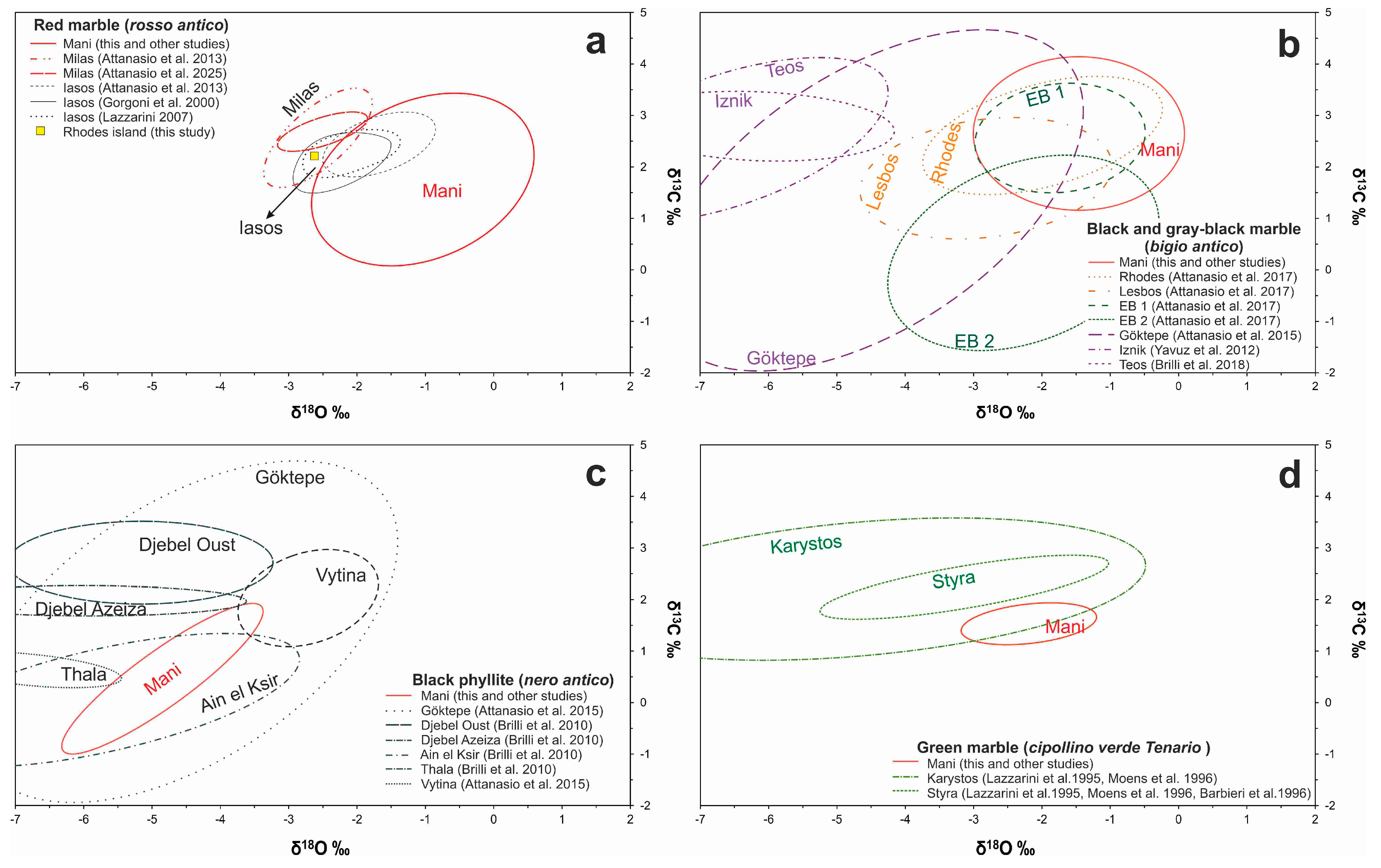
A significant number (over 30) of rosso antico marble artifacts, mainly stone reliefs, mosaics, and inscriptions, as well as several sculptures housed in the Archeological Museum of Sparti (including warehouses) and up to 10 inscriptions from the Epigraphic Museum of Athens, confirm to the local use of Mani red marble within the Laconia and wider Peloponnese region [11]. Moreover, one of the fragments of the facade of the Treasury of Atreus (BM inv. A53) at Mycenae is isotopically connected to the quarries on the peninsula of Paganea, Mani [7].
Also, an Eleutherolaconian stele from the Temple of Artemis Orthia in Sparti (2nd to 1st century BCE), along with a few architectural elements from the Vatican and from Leptis Magna in Libya of uncertain date and several Italian artifacts, provides evidence for its employment within Roman contexts [7,61].
Studies by Attanasio et al. [61,80] suggested that many famous sculptures previously believed to be carved from the rosso antico of Mani were actually made from Carian red marble sourced from Iasos or Milas. A distinctive Roman example of red marble use is the Drunken Satyr (Fauno Rosso, 2nd century CE), found at Hadrian’s Villa near Tivoli. This statue was traditionally believed to have been carved from rosso antico marble sourced from Mani [20]. This attribution has recently been doubted because current isotopic research suggests the marble more likely originates from the red Carian varieties, such as those from Milas or Iasos, or perhaps from a still-unidentified source [7,47,88]. Attanasio et al. [61] analyzed new isotopic data for the Capitoline Faun (values that differ significantly from those previously reported in the literature) and concluded that while any potential origin from Greek quarries can be ruled out, the marble used for the Faun is fully consistent with the variety quarried at Iasos. Carian origin is reinforced by the fact that this splendid statue bears the signatures of Aristeas and Papias, distinguished artists hailing from the city of Aphrodisias in Caria, Asia Minor.
However, the most recent studies did not use the extensive isotopic databases available to date and are limited to their own datasets, which prevents a reliable and accurate determination of the provenance of these red marbles. Notably, Attanasio et al. [61] assigned more diverse plot areas in their isotopic diagram to Milas red marble than Attanasio et al. [80], and more restricted areas to Mani red marble than other studies by Gorgoni et al. [37] and Lazzarini [7], making interpretations uncertain (Figure 7a). As a result, the origin of red marble in Roman times remains unresolved, and distinguishing between Mani and Caria in Asia Minor is still unclear.
The broader implication is that the extensive use of red marble in Roman sculpture cannot be ascribed only to Mani, as Carian quarries also supplied prestigious works, particularly during the Hadrianic period, when red marbles were especially fashionable [61].
According to Gorgoni et al. [45] and Lazzarini [77], distinguishing the uniformly red rosso antico quarried in Mani from that of Iasos is particularly challenging and requires meticulous analysis of archaeometric data. Beyond subtle minero-petrographic variations, the principal geochemical criteria for discrimination involve the distribution and reciprocal binary correlations of iron-group elements [45]. Therefore, as Attanasio et al. [61] have also argued, if the traditional term rosso antico is retained for historical continuity, it should ideally be accompanied by a clear indication of its geographical provenance.
6.2.2. Gray to Gray-Black Marble (nigri lapis Taenarius or bigio antico)
The gray to gray-black marble of Mani belongs to the group of dark ornamental stones extensively used in the Roman Empire, sourced from quarries across the Mediterranean [6,11,18,50,80,82]. The Roman dark marbles were generally grouped into three categories: nero antico, bigio morato, and bigio antico. While these terms primarily describe macroscopic appearance, Attanasio et al. [80] proposed a combined petrographic and macroscopic discrimination model. In this framework, bigio morato and nero antico are very fine-grained (MGS < 0.4–0.5 mm), with bigio morato being dark gray and nero antico having a deep black color with a metallic-like polish. In contrast, bigio antico is medium- to coarse-grained (MGS > 0.4–0.5 mm), exhibiting gray shades and mottling, but it does not reveal the same metallic brilliance of the first two when polished.
Gray to gray-black Mani marble shows a heteroblastic texture and consists primarily of calcite, with minor quartz, apatite, white mica, dolomite, organic matter, and opaque minerals (graphite, pyrite, Fe-hydroxides). Its MGS ranges from 0.8 to 2 mm, and according to the classification of Attanasio et al. [82], it is characterized as bigio antico.
Numerous artifacts, including sculptures, bases, mosaics, and opus sectile from the Archeological Museums of Sparti (Greece) and Rome (Italy), are thought to have been crafted from Mani marble. This observation is mainly connected with the area of the Cape Tainaron promontory based on the Pliny references on Mani marbles and the 19th century treatise on ancient marbles by Faustino Corsi.
Among them is the Hellenistic statue of Isis Fortuna (2nd century BCE), now in the National Archeological Museum of Palestrina. Earlier studies [6,7] identified the material as Mani marble through petrographic and isotopic analyses. However, Attanasio et al. [82] doubted the Hellenistic dating of the statue because black marbles were rarely used in that period. They suggested instead that the statue was possibly constructed in the 1st century CE from Ephesos marble.
Similarly, the Roman Furietti Centaurs (Centauro Vecchio and Centauro Giovane), a pair of gray-black marble (nero antico) sculptures discovered at Hadrian’s Villa near Tivoli, were initially attributed to Mani Tainaron marble [64,89]. This attribution was later questioned following isotope analyses by Bruno and Pallante [6]. With the discovery of the ancient quarries at Göktepe (near Aphrodisias, Caria, Asia Minor) in 2006 and subsequent research, these sculptures have been largely reassigned to Göktepe marble [90]. The bigio antico type of marble extracted from the Tainaron cape seems to be macroscopically incompatible with that of Göktepe. Actually, according to present research, the isotopic data obtained from the statues of the two Furietti Centaurs from Hadrian’s Villa, as well as Zeus and Asclepius from Anzio, all located in the Capitoline Museum, Rome [48,90], differ significantly from those of the Tainaron and Black Kyparissos samples of the present study [10,11]. Attanasio et al. [61] came to an obvious conclusion that the Aphrodisian sculptors exploited the full variety of the nearby existing marbles, thus including not only the fine-grained black (and white) marbles of Göktepe, but also the white coarse-grained marbles from the city quarries of Aphrodisias as well as the red marbles quarried at Iasos and Milas. This has also been analytically shown in the outstanding Aphrodisian marble collection of Valdetorres del Jarama found in Hispania [91]. The collection exclusively features Anatolian marbles, primarily various sculptural types of white and black Goktepe, along with white marble from Aphrodisias itself and Carian Red from Iasos [91].
In addition to Mani, gray to gray-black marbles were quarried in Roman times from several other locations, including Göktepe, Ephesos 1 and 2, Iznik, and Teos in Asia Minor; Djebel Oust, Djebel Azeiza, Ain el Ksir, and Thala in Tunisia; Lesbos and Chios in the Aegean; and Vytina in the Peloponnese [6,49,50,51,52,80,82,83,84,92,93]. Of these, only marbles from Göktepe, Ephesos, Iznik, Teos, Lesbos, and Rhodes are comparable to the bigio antico type based on the criteria by Attanasio et al. [80]. Isotopic data reveal significant overlaps between Mani, Rhodes, and Ephesos 1 marbles, partial overlap with Lesbos, Ephesos 2, and Göktepe, and no overlap with Iznik and Teos (Figure 7b). Lesbos and Rhodes marbles are fossiliferous (with MGS = 2.77 mm and 1.48 mm, respectively), unlike Mani marble, which is non-fossiliferous and finer-grained (MGS = 0.8–2 mm). Iznik and Teos marbles are coarser (MGS = 2.3–4.5 mm and 3–6 mm, respectively), whereas Göktepe marbles are much finer (MGS = 0.05–0.45 mm) [48,49,82,83].
The bigio antico marbles of Ephesos, sourced mainly from the Belevi quarries, display grain sizes of 0.7–1.6 mm (EB 1) and 0.2–1.5 mm (EB 2), overlapping with Mani marble. Mineralogically, EB 1 and EB 2 marbles consist predominantly of calcite, with accessory mica, plagioclase, and quartz [82], closely resembling the Mani stones. Thus, distinguishing between bigio antico from Mani and Ephesos requires additional parameters, such as trace element geochemistry or EPR analysis.
6.2.3. Black Phyllite (nero antico)
The black phyllite of Mani is primarily composed of calcite and quartz, with minor amounts of chlorite, white mica, albite, graphite, organic matter, and opaque minerals (Fe-oxides, Fe-hydroxides, and possibly pyrite). Its mean grain size (MGS) is approximately 0.1 mm. In antiquity, it was employed as a dark decorative stone in the Roman Empire, comparable to the bigio antico gray to gray-black marble [6,11,18,50,80,82].
According to the classification proposed by Attanasio et al. [80], the Mani black phyllite more closely resembles nero antico than bigio morato due to its deep black coloration, metallic-like polish, and fine-grained texture (MGS <0.4–0.5 mm). Although several ancient artifacts have been attributed to this stone, such associations remain unverified through petrographic or geochemical analyses. Suggested examples include a column from ancient Korinthos (Acrocorinthos mosque), two sculptures preserved in the Archeological Museum of Sparti (the “boar” and the “Dionysos and Pan” complex sculpture), two marble inscriptions of the 3rd century CE from Leptis Magna in Libya, and finally the statues of the three Danaids of the house of Augustus on the Palatine, today in the nearby Antiquarium (compatible with the Mountanistika lithotype) [6,7].
Other occurrences of nero antico are documented across the Mediterranean, including Göktepe (Asia Minor), Djebel Oust, Djebel Azeiza, Ain el Ksir, and Thala (Tunisia), as well as Vytina (Peloponnese). Isotopic studies from Attanasio et al. [84], Brilli et al. [50], and the present study reveal that the phyllite of Mani overlaps considerably with Göktepe and Ain el Ksir stones, shows partial overlap with Vytina, and has no overlap with Djebel Oust, Djebel Azeiza, or Thala (Figure 7c). The stones from Djebel Oust, Djebel Azeiza, Ain el Ksir, Thala, and Vytina are fossiliferous, whereas the Mani phyllite is non-fossiliferous. Göktepe nero antico contains mainly calcite with traces of chlorite and opaque minerals [48,82], differentiating it from Mani’s black phyllite, which is characterized by a calcite–quartz assemblage.
6.2.4. White Marble
The use of Mani white marble dates back at least to the Archaic period. Quarries at Charouda were in operation from the early 5th century BCE (Late Archaic–Early Classical period) [23,44], while those at Marmari and Mezapos are thought to have supplied marble for architectural elements of the Temple of Apollo Epicurius at Bassai, in the middle of the 5th century BCE [31,32,94]. The Mezapos quarries remained active into the Roman and Early Byzantine periods, and possibly even later [42].
Moreover, the white marble of Mani has probably been used in a set of sculptures, artifacts, and architectural elements within the Peloponnese region: the hoplite, known as “Leonidas”, which was found next to the Sanctuary of Athena Chalkioikos in the Acropolis of Sparti, now in the Archeological Museum of Sparti; the Apollo Karneios (column crowned with a ram’s head) now in the archeological collection (“warehouse”) of Gytheio; some artifacts/elements from Hagioi Asomatoi (Porto Sternes) and Haghia Triada (Paliros); the cornices in the temple of Zeus at Olympia; and finally in the column fragments and some relief sculptures of the Roman period from the theater at ancient Corinth. Only the latter have been proved by modern provenance investigation [9,32,95,96].
The provenance of the Apollo Epicurius marble, however, continues to be debated, with some scholars attributing it to Mani and others to Paros, based mainly on macroscopic and historical observations [31,33,62,94,97,98,99,100]. The present study confirms that the isotopic data obtained from fragment NM 3415 of the Apollo Epicurius frieze, housed in the Greek National Archeological Museum in Athens (δ18O = −1.91, δ13C = 3.35 [100]), show a strong correlation with the isotopic signature of white marble from the ancient quarry at Charouda, Mani (δ18O = −1.87, δ13C = 3.37; see Table 1, sample MAN 14, and Figure 2j). The coarse-grained texture of the Charouda marble further supports this identification, supporting the possibility that this quarry of Mani supplied the material for the frieze fragment. This observation is also consistent with the macroscopic study of Palagia and Pike [100]. It is worth noting that a substantial portion of the frieze, specifically twenty-three slabs, is currently housed in the British Museum.
Marble remains, including architectural elements, inscriptions, and spolia, are widespread along the western Mani coast and are found in small churches or chapels, indicating that the white marble quarries primarily served local needs and nearby centers such as Sparti and Monemvasia. However, the hypothesis of Cooper [31,32,94] about Apollo Epicurius, together with more recent provenance research for Corinth [9], suggests that marble from Mani was transported to more distant locations, such as Bassai and Corinth, both located over 200 km away from Mani. This hypothesis—further supported by the present research concerning Bassai, along with Herrmann’s [81] attribution to Mani of Ionic capitals reused in Italian churches—points to an even broader distribution of architectural elements roughly worked in the Mani quarries, possibly extending as far as Italy during the Late Roman and Early Byzantine periods [62,95].
Mani white marble has a heteroblastic texture and visible foliation, and is composed almost entirely of calcite, with traces of quartz, albite, dolomite, and graphite. Two types are distinguished based on MGS: a coarse-grained variety (MGS 3–5 mm) from Charouda, Mezapos, Lazo–Pyrgos Dirou, and Tainaron, and a medium-grained variety (MGS = 1.3–1.7 mm) from Fourniata–Pyrgos Dirou and Marmari. These types do not differ in their isotopic signatures. The isotopic values of Mani marbles overlap significantly with those of other appreciated medium- and coarse-grained marbles across the Mediterranean, including Thasos/Alyki, Paros (especially Lychnites and Marathi), Naxos (NX-2, NX-3, NX-H1, NX-H2 types classified by Tambakopoulos [101] and Tambakopoulos and Maniatis [102]), Proconnesus, and Aphrodisias (Figure 8). As a result, distinguishing Mani marble from these sources requires supplementary methods, such as trace element geochemistry or EPR analysis.
Figure 8.
White marble from Mani [32,45,59,62], Thasos/Alyki [59,62,103,104,105], Paros/Lycnitis and Marathi [62,101,104,106], Naxos (NX-2, NX-3, NX-H1, NX-H2) [62,101,107], Proconessus [52,54,104,105,108], and Aphrodisias [59,62,104,109].
6.2.5. Green Marble (cipollino verde Tenario)
The green marble of Mani consists primarily of calcite, along with chlorite, white mica, quartz, and albite, as well as traces of diopside, antigorite, and opaque minerals. Two distinct varieties are identified. A fine-grained type with visible foliation, a homoblastic texture, and an MGS of 0.3 mm, and a medium-grained type lacking foliation, with a heteroblastic texture, MGS of 1 mm, and alternating white marble bands.
This marble was employed in the columns of the Roman theater in Gytheio and the Agia Sofia church in Monemvasia, identifiable macroscopically mainly due to their relative proximity to the quarries, as well as a few sculptures in Italy, as suggested by scholars [7,58]. However, these attributions remain unverified by petrological and isotopic analyses. Because of its color, which closely resembles the famous verde cipollino from Karystos and Styra in southern Euboea, modern scholars have often referred to the Mani stone as cipollino verde Tenario [6,34,58]. Isotopic data of Mani green marble show partial overlap with the data of Karystos verde cipollino, but not with those of Styra (Figure 7d).
Mineralogically, Mani green marble is almost identical to the marbles of Karystos and Styra, which are also composed of calcite with chlorite, white mica, albite, and quartz, as well as minor epidote, titanite, graphite, and opaque minerals [86]. The calcite’s maximum grain size in Karystos marble (MGS = 0.6–1.6 mm) overlaps with that of the medium-grained Mani variety. Consequently, distinguishing Mani green marble from Karystos marble requires additional analytical approaches, such as trace element geochemistry or EPR analysis.
7. Conclusions
This study provides a systematic characterization of the marble and decorative stone resources of the Mani peninsula in the Peloponnese, southern Greece, analyzing representative samples from over ninety quarrying sites through mineralogical, petrographic, and stable isotopic methods. The Mani marbles are predominantly calcitic, with color variations resulting from accessory minerals: hematite in red varieties, graphite and organic matter in gray-black and black types, and chlorite in green marbles. The stable isotope data show generally high homogeneity, though the red marbles exhibit greater variability, overlapping with marbles from Iasos and Milas, which complicates provenance distinction. Archeological evidence indicates quarrying from the Late Bronze Age through the Byzantine period, with exploitation also occurring in the 19th and 20th centuries, highlighting Mani as a significant long-term marble producer, primarily used for rather decorative architectural features (lamps and small vases, carvings, cornices, little columns, opus sectile, spolia, etc.) as well as for a few fine sculptures and statues. Isotopic data from Apollo Epicurius frieze (fragment ΝΜ 3415) show a strong correlation with the isotopic signature of white marble from the ancient quarry in Charouda, Mani.
Supplementary Materials
The following supporting information can be downloaded at https://www.mdpi.com/article/10.3390/min16030294/s1, Figure S1: Macroscopic photographs of the 27 samples analyzed in this study; Table S1: Detailed description of the studied samples from the ancient or modern quarries in the Mani peninsula [5,6,7,8,9,12,13,16,19,20,21,23,30,31,32,33,34,35,36,38,39,42,43,44,45,50,58,62,84,95,96,97,98,99,100,107,110,111,112,113].
Author Contributions
Conceptualization, P.T.; methodology, P.T. and V.M.; software, P.T. and V.M.; validation, P.T. and V.M.; formal analysis, P.T. and V.M.; investigation, P.T. and V.M.; resources, P.T. and V.M.; data curation, P.T. and V.M.; writing—original draft preparation, P.T. and V.M.; writing—review and editing, P.T. and V.M.; visualization, P.T. and V.M.; supervision, P.T.; project administration, P.T.; funding acquisition, P.T. All authors have read and agreed to the published version of the manuscript.
Funding
This research received no external funding.
Data Availability Statement
Data are contained within the article and Supplementary Materials.
Acknowledgments
The authors thank the three anonymous reviewers for their constructive comments and suggestions, which significantly improved the initial manuscript, as well as the Assistant Editor and Academic Editor for their editorial handling.
Conflicts of Interest
The authors declare no conflicts of interest.
References
- Psonis, C.; Latsoudas, C. Geological Map of Greece, Xirokampion Sheet, Scale 1:50,000; Institute of Geology and Mineral Exploration (IGME): Athens, Greece, 1983. [Google Scholar]
- Latsoudas, C. Geological Map of Greece, Mavrovoynion-Areolopis-Yerolimin Sheet, Scale 1:50,000; Institute of Geology and Mineral Exploration (IGME): Athens, Greece, 1983. [Google Scholar]
- Dimadis, E.; Taktikos, S. Geological Map of Greece, Gythion Sheet, Scale 1:50,000; Institute of Geology and Mineral Exploration (IGME): Athens, Greece, 1989. [Google Scholar]
- Sabatakakis, N.; Nikolakopoulos, K.G.; Papatheodorou, G.; Kelasidis, G. A multisource approach for coastal mapping purposes: Limeni bay, Mani and surrounding area, southern Greece. Earth Sci. Inform. 2016, 9, 183–196. [Google Scholar] [CrossRef] [Scilit]
- Gorgoni, C.; Kokkinakis, I.; Lazzarini, L.; Mariothini, M. Geochemical and petrographic characterization of “Rosso Antico” and other white-gray marbles of Mani (Greece). In Proceedings of the 3rd International Conference of the Association for the Study of Marble and Other Stones in Antiquity (ASMOSIA II), Acta Archaeological Lovaniensia Monographiae 4; Waelkens, M., Herz, N., Moens, L., Eds.; Leuven University Press: Leuven, Belgium, 1992; pp. 155–165. [Google Scholar]
- Bruno, M.; Pallante, P. The “Lapis Taenarius” quarries of Cape Tainaron”. In Proceedings of the 6th International Conference of the Association for the Study of Marble and Other Stones in Antiquity (ASMOSIA VI); Lazarini, L., Ed.; Bottega d’Erasmo Aldo Ausilio Editore: Padova, Italy, 2002; pp. 163–176. [Google Scholar]
- Lazzarini, L. Poikiloi Litoi, Versiculores Maculae, I Marmi Colorati Della Grecia Antica. Storia, Uso, Diffusione, Cave, Geologia, Caratterizzazione Scientifica, Archeometria, Deterioramento; F. Serra: Pisa, Italy, 2007. [Google Scholar]
- Warren, P. The Rediscovery of Greek Rosso Antico Marble and its Use in Britain in the Nineteenth and Twentieth Centuries. Annu. Br. Sch. Athens 2012, 107, 341–386. [Google Scholar] [CrossRef] [Scilit]
- Maniatis, Y.; Tambakopoulos, D.; Lazzarini, L.; Sturgeon, M.C. Provenance Investigation of Three Marble Relief Sculptures from Ancient Corinth: New Evidence for the Circulation of the White Marble from Mani. Archaeometry 2021, 63, 685–704. [Google Scholar] [CrossRef] [Scilit]
- Tzeferis, P. Lithos Marmaros, Tainarios. The Marbles of Mani; Self-Published: Athens, Greece, 2021. (In Greek) [Google Scholar]
- Tzeferis, P. The Marbles and Stones of Mani. History, Quarries and Outcrops, Petrographic and Isotopic Characterization, Prospects for the Future; Self-Published: Athens, Greece, 2023. [Google Scholar]
- Bory de Saint-Vincent, J.G.B.M. Expédition Scientifique de Morée; Tome Premier: Paris, France, 1836. [Google Scholar]
- Philippson, A. Der Peloponnes: Versuch Einer Landeskunde Auf Geologischer Grundlage; R. Friedlander & Shon: Berlin, Germany, 1892. [Google Scholar]
- Porter-Winearls, M. What Rome Was Built With. A Description of the Stones Employed in Ancient Times for Its Building and Decoration; Getty Research Institute: London, UK; Oxford, UK, 1907. [Google Scholar]
- Bursian, K. Ueber das Vorgebirge Tainaron. Abh. Bayer. Akad. Wiss. 1855, VII, 773–795. [Google Scholar]
- Henzen, G. Tenaro e i marmi tenarii. Bull. Dell’Istituto Corrisp. Archeol. 1857, I–II, 154–159. [Google Scholar]
- Grimm, H. Ueber die von dem Prof. Herrn Siegel in Griechenland aufgefundenen Marmorbrüche der Rosso antico und Verde antico. Z. Für Allg. Erdkd. 1861, XI, 131–134. [Google Scholar]
- Corsi, F. Catalogo Ragionato D’una Collezione di Pietre di Decorazione Formata e Posseduta in Rome; Da’ Torchj del Salviucci: Roma, Italy, 1825. [Google Scholar]
- Higgins, R.A.; Ellis, S.E.; Hope-Simpson, R.; Higgins, R.A. The Façade of the Treasury of Atreus at Mycenae. Annu. Br. Sch. Athens 1968, 63, 331–336. [Google Scholar] [CrossRef] [Scilit]
- Lazzarini, L. The Rosso Antico and other red marbles used in antiquity: A characterization study. In Marble, Art-Historical and Scientific Perspectives on Ancient Sculptures; True, M., Podany, J., Eds.; Paul Getty Museum at Malibu: Malibu, CA, USA, 1990; pp. 237–252. [Google Scholar]
- Warren, P. Red marble in the Aegean Bronze Age. In Kritis Minoidos. Tradizione e Identità Minoica Tra Produzione Artigianale, Pratiche Cerimoniali e Memoria del Passato; Carinci, F., Cucuzza, N., Militello, P., Palio, O., Eds.; Bottega d’Erasmo Aldo Ausilio Editore: Padova, Italy, 2011; pp. 189–205. [Google Scholar]
- Kokkorou-Alevras, G.; Chatziconstantinou, A.; Efstathopoulos, A.; Zavvou, E.; Themos, N.; Kopanias, K.; Poupaki, E. Ancient quarries in Laconia. In Proceedings of the International Conference “Sparta and Laconia. From Prehistory to Post-Modern”; Cavanagh, W.G., Gallou, C., Georgiadis, M., Eds.; British School at Athens: Athens, Greece, 2009; pp. 169–179. [Google Scholar]
- Tsouli, Μ. Contribution to the study of the ancient marble quarries of the Mani Peninsula, SW Laconia, Peloponnese: The case of the white-gray marble quarry at the site Charouda, near Pyrgos Dirou, and of the cipollino verde antico quarry at the site Paliros-Koureloi, near Cape Tainaron. In Proceedings of the XI Symposium on Mediterranean Archaeology; BAR International Series No. 1900; Aygun, C.O., Ed.; BAR Publishing: Oxford, UK, 2009; pp. 396–403. [Google Scholar]
- Gardner, C.A.M. The Mani Peninsula in Antiquity: An Archaeological, Historical, and Epigraphic Investigation into Regional Identity. Ph.D. Thesis, The University of British Columbia, Vancouver, BC, Canada, 2018. [Google Scholar]
- Kalamara, P.; Roumeliotis, N. Maniate Settlements. Mani Museum Network; Hellenic Ministry of Culture: Athens, Greece, 2004.
- Siddall, R.; Clements, D. The War Memorials at Hyde Park Corner and Green Park. Urban Geol. Lond. 2013, 4, 1–11. [Google Scholar]
- Dworakowska, A. Wydobywanie kamienia w starożytnej Grecji—Technika pracy i jej problemy (Quarrying in ancient Greece—Techniques and problems). Archeologia 1962, XIII, 8–53. (In Polish) [Google Scholar]
- Dworakowska, A. Quarries in Ancient Greece; Polish Academy of Sciences: Warsaw, Poland, 1975. [Google Scholar]
- Moschou, L.; Moschos, P.N. Kionai A’. A topographic and architectural study. Peloponnisiaka 1979, 13, 72–114. [Google Scholar]
- Moschou, L.; Raftopoulou, S.; Chatzitheodorou, T. Lithos red Tainarios. The ancient quarries of Profitis Ilias of Dimaristika in Mani and their vicinity. Archeol. Delt. 1998, 53, 267–287. (In Greek) [Google Scholar]
- Cooper, F. A source of ancient marble in the Southern Peloponnesos. Am. J. Archaeol. 1981, 85, 190–191. [Google Scholar]
- Cooper, F. The quarries of Mount Taygetos in the Peloponnesos, Greece. In Classical Marble: Geochemistry, Technology, Trade; Herz, N., Waelkens, M., Eds.; Kluwer Academic: Dordrecht, The Nenderlands, 1988; pp. 65–76. [Google Scholar]
- Herz, N.; Mose, D.G.; Wenner, D.; Cooper, F. Sr, O, and C Isotopic Studies of Classical Marble Sources and the Bassai Temple in the Peloponnesus. In Proceedings of Abstracts, Symposium on Archaeometry; Linington, R.E., Ed.; Fondazione Lerici Prospezioni Archeologiche: Rome, Italy, 1983; pp. 62–63. [Google Scholar]
- Lazzarini, L. Su un inedito Cipollino verde tenario. In Marmi Antichi, II; Pensabene, P., Ed.; L’Erma Di Bretschneider: Rome, Italy, 1998; pp. 207–212. [Google Scholar]
- Lazzarini, L. Archaeometric aspects of white and coloured marbles used in antiquity: The state of art. Reriodico Mineral. 2004, 73, 113–125. [Google Scholar]
- Lazzarini, L. Three Important Coloured Stones of Ancient Greece: History of Use, Distribution, Quarries, Archaeometry, Deterioration; Laboratorio di Analisi dei Materiali Antichi, Università IUAV di Venezia: Venice, Italy, 2010. [Google Scholar]
- Gorgoni, C.; Lazzarini, L.; Pallante, P.; Turi, B. An updated and detailed mineropetrographic and C-O stable isotopic reference database for the main Mediterranean marbles used in antiquity. In Proceedings of the 3rd International Conference of the Association for the Study of Marble and Other Stones in Antiquity (ASMOSIA V); Herrmann, J.J., Jr., Herz, N., Newman, R., Eds.; Archetype Publications: London, UK, 2002; pp. 115–131. [Google Scholar]
- Chiotis, Ε. Geological aspects of the Laconian marbles and new evidence for quarrying in antiquity. In Archaeometry Issues in Greek Prehistory and Antiquity; Bassiakos, I., Aloupi, E., Fakorellis, G., Eds.; Hellenic Society of Archaeometry Society of Messenian Archaeological Studies: Athens, Greece, 2001; pp. 558–561. (In Greek) [Google Scholar]
- Christien, J. Les Carrières de Laconie: Essai de Synthèse. Dialogues D’histoire Ancienne 2014, 11, 171–191. [Google Scholar] [CrossRef] [Scilit]
- Christien, J. Roads and Quarries in Laconia. In A Companion to Sparta; Powell, A., Ed.; Wiley-Blackwell: Hoboken, NJ, USA, 2017; Volume II, pp. 615–642. [Google Scholar]
- Christien, J.; Della Santa, M. Pausanias et Strabon. La route du Taygète et les carrières de marbre laconien. In Proceedings of the VI International Conference of Peloponnesian Studies; Society for Peloponnesian Studies: Athens, Greece, 2001; pp. 203–216. [Google Scholar]
- Kokkorou-Alevras, G.; Poupaki, E.; Efstathopoulos, A.; Chatziconstantinou, A. Corpus of the Ancient Quarries. Quarries of Greece from the Prehistoric to Medieval Times; University of Athens: Athens, Greece, 2014. [Google Scholar]
- Tsouli, M. Findings of antiquities, Oitylo, D.E. Oitylou. Archeol. Delt. 2010, 65, 558–561. [Google Scholar]
- Tsouli, Μ. New evidence on ancient quarrying activity at the Mani Peninsula, Southwestern Laconia, Greece. In Proceedings of the 6th International Conference of the Association for the Study of Marble and Other Stones in Antiquity (ASMOSIA X); Pensabene, P., Gasparini, E., Eds.; L’Erma’ di Bretschneider: Rome, Italy, 2015; pp. 761–768. [Google Scholar]
- Gorgoni, C.; Lazzarini, L.; Pallante, P. New archaeometric data on Rosso Antico and other red marbles used in antiquity. In Proceedings of the 6th International Conference of the Association for the Study of Marble and Other Stones in Antiquity (ASMOSIA VI); Lazarini, L., Ed.; Bottega d’Erasmo Aldo Ausilio Editore: Padova, Italy, 2002; pp. 199–206. [Google Scholar]
- Andreoli, A.; Berti, F.; Lazzarini, L.; Pierobon, R. New contribution on marmor Iassense. In Proceedings of the 6th International Conference of the Association for the Study of Marble and Other Stones in Antiquity (ASMOSIA VI); Lazarini, L., Ed.; Bottega d’Erasmo Aldo Ausilio Editore: Padova, Italy, 2002; pp. 13–18. [Google Scholar]
- Bruno, M.; Elçi, H.; Yavuz, A.B.; Attanasio, D. Unknown ancient marble quarries of Western Asia Minor. In Proceedings of the 9th International Conference of the Association for the Study of Marble and Other Stones in Antiquity (ASMOSIA IX); Garcia, A.G., Lapuente, P., Rodà, I., Eds.; Institut Català d’Arqueologia Clàssica: Tarragona, Spain, 2012; pp. 562–572. [Google Scholar]
- Attanasio, D.; Bruno, M.; Yavuz, A.B. Quarries in the region of Aphrodisias: The black and white marbles of Göktepe (Muğla). J. Rom. Archaeol. 2009, 22, 312–348. [Google Scholar] [CrossRef] [Scilit]
- Yavuz, A.B.; Bruno, M.; Attanasio, D.A. New source of bigio antico marble: The ancient quarries of Iznik (Turkey). In Proceedings of the 9th International Conference of the Association for the Study of Marble and Other Stones in Antiquity (ASMOSIA IX); Garcia, A.G., Lapuente, P., Rodà, I., Eds.; Institut Català d’Arqueologia Clàssica: Tarragona, Spain, 2012; pp. 255–262. [Google Scholar]
- Brilli, M.; Antonelli, F.; Giustini, F.; Lazzarini, L.; Pensabene, P. Black limestones used in antiquity: The petrographic, isotopic and EPR database for provenance determination. J. Archaeol. Sci. 2010, 37, 994–1005. [Google Scholar] [CrossRef] [Scilit]
- Lazzarini, L.; Agus, M.; Cara, S. The ancient quarries of Neri Antichi (black limestones) from Zeugitania (Tunisia). Marmora 2006, 2, 59–70. [Google Scholar]
- Brilli, M.; Giustini, F.; Kadıoğlu, M. Black limestone used in antiquity: Recognizing the limestone of Teos. Archaeometry 2019, 61, 282–295. [Google Scholar] [CrossRef] [Scilit]
- Doutsos, T.; Koukouvelas, I.; Poulimenos, G.; Kokkalas, S.; Xypolias, P.; Skourlis, K. An exhumation model of the south Peloponnesus, Greece. Int. J. Earth Sci. 2000, 89, 350–365. [Google Scholar] [CrossRef] [Scilit]
- Micheuz, P.; Krenn, K.; Fritz, H.; Kurz, W. Tectonometamorphic evolution of blueschist-facies rocks in the Phyllite-Quartzite Unit of the External Hellenides (Mani, Greece). Austrian J. Earth Sci. 2015, 108, 109–122. [Google Scholar] [CrossRef] [Scilit]
- Xypolias, P.; Lois, A.; Aravadinou, E.; Gerogiannis, N.; Chatzaras, V.; Zulauf, G. Stress changes during exhumation of a high-pressure nappe (Phyllite-Quartzite unit, Greece): Insights from quartz microstructures and recrystallized grain size statistics. J. Struct. Geol. 2023, 167, 104782. [Google Scholar] [CrossRef] [Scilit]
- Alexopoulos, A.; Lekkas, S. The tectonic structure of Tainaro (Mani) Peninsula (Southern Peloponnese, Greece). Neues Jahrb. Fur Geol. Und Palaontol. Monatshefte 1999, 11, 698–704. [Google Scholar] [CrossRef] [Scilit]
- Thiebault, F. Evolution géodynamique des Héllénides externes en Péloponnèse méridional (Grèce). Soc. Geol. Nord. 1982, 6, 1–574. [Google Scholar]
- Bruno, M. Mianes, Cape Tainaron: A new quarry of green cipollino and of red fior di pesco. In Proceedings of the 3rd International Conference of the Association for the Study of Marble and Other Stones in Antiquity (ASMOSIA V); Herrmann, J.J., Jr., Herz, N., Newman, R., Eds.; Archetype Publications: London, UK, 2002; pp. 20–26. [Google Scholar]
- Capedri, S.; Giampiero, V.; Photiades, A. Accessory minerals and δ18O and δ13C marbles from Mediterranean area. J. Cult. Herit. 2004, 5, 27–47. [Google Scholar] [CrossRef] [Scilit]
- Antonelli, F.; Lazzarini, L. An updated petrographic and isotopic reference database for white marbles used in antiquity. Rend. Lincei 2015, 26, 399–413. [Google Scholar] [CrossRef] [Scilit]
- Attanasio, D.; Bruno, M.; Prochaska, W.; Yavuz, A.B. Analysis and discrimination of ancient red marbles including rosso antico from cape Tainaron and Asiatic red varieties from Caria. In Proceedings of the 13th International Conference of the Association for the Study of Marble and Other Stones in Antiquity (ASMOSIA XIII); Prochaska, W., Ladstätter, S., Anevlavi, V., Eds.; Holzhausen: Wien, Austria, 2025; pp. 225–242. [Google Scholar]
- Attanasio, D.; Brilli, M.; Ogle, N. The isotopic signature of Classical marbles; L’ Erma di Bretschneider: Roma, Italy, 2006. [Google Scholar]
- Calogero, S.; Bertelle, M.; Antonelli, F.; Lazzarini, L. A Mössbauer study of some coloured marbles (cipollino mandolato, rosso antico and fior di pesco): Implications on the nature of their colour. J. Cult. Herit. 2000, 1, 429–444. [Google Scholar] [CrossRef] [Scilit]
- Rigas, K. Geological Investigation of Greek Marbles and Their Potential for Utilization. Doctoral Dissertation, University of Athens, Athens, Greece, 1986. (In Greek) [Google Scholar]
- Rigas, K. Geological investigation and evaluation of the red limestones-marbles of Greece: The case of the reddish-purple limestone from Eretria, Euboea. In Proceedings of the 3rd Conference of the Geological Society of Greece; Geological Society of Greece: Athens, Greece, 1988; pp. 217–227. [Google Scholar]
- Buseck, P.R.; Beyssac, O. From organic matter to graphite: Graphitization. Elements 2014, 10, 421–426. [Google Scholar] [CrossRef] [Scilit]
- Nelson, C.S.; Smith, A.M. Stable oxygen and carbon isotope compositional fields for skeletal and diagenetic components in New Zealand Cenozoic non-tropical carbonate sediments and limestones: A synthesis and review. N. Z. J. Geol. Geophys. 1996, 39, 93–107. [Google Scholar] [CrossRef] [Scilit]
- Hoefs, J. Stable Isotope Geochemistry; Springer: Berlin, Germany, 2009. [Google Scholar]
- Hoefs, J.; Frey, M. The isotopic composition of carbonaceous matter in a metamorphic profile from the Swiss Alps. Geochim. Cosmochim. Acta 1976, 40, 945–951. [Google Scholar] [CrossRef] [Scilit]
- Wada, H.; Tomita, T.; Matsuura, K.; Tuchi, K.; Ito, M.; Morikiyo, T. Graphitization of carbonaceous matter during metamorphism with references to carbonate and pelitic rocks of contact and regional metamorphisms, Japan. Contrib. Mineral. Petrol. 1994, 118, 217–228. [Google Scholar] [CrossRef] [Scilit]
- Luque, F.J.; Crespo-Feo, E.; Barrenechea, J.F.; Ortega, L. Carbon isotopes of graphite: Implications on fluid history. Geosci. Front. 2012, 3, 197–207. [Google Scholar] [CrossRef] [Scilit]
- Dodge, H. Building Materials and Techniques in the Eastern Mediterranean from the Hellenistic Period to the 4th century AD. Ph.D. Thesis, University of Newcastle, Newcastle, UK, 1984. [Google Scholar]
- Poupaki, E. Marble and other stone vessels from Sparta. Athens Univ. Rev. Archaeol. 2019, 2, 219–244. [Google Scholar]
- Blake, Μ.Ε. Ancient Roman Construction in Italy from the Prehistoric Period to Augustus; Carnegie Institution: Washington, DC, USA, 1947. [Google Scholar]
- Gnoli, R. Marmora Romana; Edizioni Dell’Elefante: Rome, Italy, 1971. [Google Scholar]
- Gregarek, H. Roman imperial sculpture of colored marbles. In Proceedings of the 3rd International Conference of the Association for the Study of Marble and Other Stones in Antiquity (ASMOSIA V); Herrmann, J.J., Jr., Herz, N., Newman, R., Eds.; Archetype Publications: London, UK, 2002; pp. 206–214. [Google Scholar]
- Lazzarini, L. Ancient Mediterranean polychrome stones. EMU Notes Mineral. 2019, 20, 367–392. [Google Scholar]
- Peirano, D. Use and aesthetics of Iasian marble in presbyteries of the 6th century. Pol. Archaeol. Mediterr. 2023, 1, 105–121. [Google Scholar] [CrossRef] [Scilit]
- Aysal, N.; Erdem, E.; Hanilçi, N.; Güngör, T.; Öngen, S.; Yilmaz, I.; Uzun, F.; Laçin, D.; Yildirim, I.D. Petrography, electron paramagnetic resonance, geochemistry, and Sr-C-O isotope data for provenance studies of the ancient Marmor Iassense in Kıyıkışlacık (Muğla region), Türkiye. Turk. J. Earth Sci. 2025, 34, 176–189. [Google Scholar] [CrossRef] [Scilit]
- Attanasio, D.; Bruno, M.; Prochaska, W.; Yavuz, A.B. The Asiatic marbles of the Hadrian’s Villa at Tivoli. J. Archaeol. Sci. 2013, 40, 4358–4368. [Google Scholar] [CrossRef] [Scilit]
- Herrmann, J. The Ionic Capital in Late Antique Rome; G. Bretschneider: Rome, Italy, 1988. [Google Scholar]
- Attanasio, D.; Bruno, M.; Prochaska, W.; Yavuz, A.B. Ancient ‘black’decorative stones and the Ephesian origin of sculptural Bigio antico. Archaeometry 2017, 59, 794–814. [Google Scholar] [CrossRef] [Scilit]
- Brilli, M.; Lapuente Mercadal, M.P.; Giustini, F.; Plumed, H.R. Petrography and mineralogy of the white marble and black stone of Göktepe (Muğla, Turkey) used in antiquity: New data for provenance determination. J. Archaeol. Sci. Rep. 2018, 19, 625–642. [Google Scholar] [CrossRef] [Scilit]
- Attanasio, D.; Bruno, M.; Prochaska, W.; Yavuz, A.B. A Multi-Method Database of the Black and White Marbles of Göktepe (Aphrodisias), Including Isotopic, EPR, Trace and Petrographic Data. Archaeometry 2015, 57, 217–245. [Google Scholar] [CrossRef] [Scilit]
- Lazzarini, L.; Masi, U.; Tucci, P. Petrographic and geochemical features of the Carystian marble ‘Cipollino verde’, from the ancient quarries of Southern Euboea (Greece). In Proceedings of the 3rd International Conference of the Association for the Study of Marble and Other Stones in Antiquity (ASMOSIA III); Maniatis, Y., Herz, N., Basiakos, Y., Eds.; Archetype: London, UK, 1995; pp. 161–169. [Google Scholar]
- Moens, L.; De Paepe, P.; Vandeputte, K. Oxygen and carbon isotopic data and petrology of cipolino from Styra and Karystos (Euboea, Greece) and their archaeological significance. In Roman Marble Quarries in Southern Euboea and the Associated Road Networks; Vanhove, D., Ed.; Brill Academic Pub: Berlin, Germany, 1996; pp. 45–50. [Google Scholar]
- Barbieri, M.; Masi, U.; Tucci, P.; Vizzini, G.; Borghi, M.; Azzaro, E. Geochemical and petrographic features of the Styra marble (southern Euboea, Greece) and geodynamic implications. In Terranes of Serbia. The Formation of the Geologic Framework of Serbia and the Adjacent Regions; Knezevic, V., Krstic, B., Eds.; University of Belgrade: Belgrade-Brezovica, Serbia, 1996; pp. 161–166. [Google Scholar]
- Ottati, A. The “Centauri Furietti” in bigio morato marble. New fragments from the Atrio Mistilineo at Hadrian’s Villa. In Proceedings of the 12th International Conference of the Association for the Study of Marble and Other Stones in Antiquity (ASMOSIA XII); Yavuz, A.B., Yolaçan, B., Bruno, M., Eds.; Dokuz Eylül University: Izmir, Turkey, 2025; pp. 127–138. [Google Scholar]
- Tykot, R.H.; Herrmann, J.J.; Newman, R. Isotopic analysis of Rosso Antico and bichrome marble objects from the Museum of Fine Arts, Boston. In Proceedings of the 6th International Conference of the Association for the Study of Marble and Other Stones in Antiquity (ASMOSIA VI); Lazarini, L., Ed.; Bottega d’Erasmo Aldo Ausilio Editore: Padova, Italy, 2002; pp. 383–387. [Google Scholar]
- Lapuente, P.; Nogales, T.; Leòn, P.; Royo, H.; Preite Martinez, M. Black sculptural materials from Villa Adriana: Study of provenance. In Proceedings of the 9th International Conference of the Association for the Study of Marble and Other Stones in Antiquity (ASMOSIA IX); Garcia, A.G., Lapuente, P., Rodà, I., Eds.; Institut Català d’Arqueologia Clàssica: Tarragona, Spain, 2012; pp. 376–383. [Google Scholar]
- Lapuente Mercadal, M.P.; Nogales-Basarrate, T. Statuary Qualities of White and black Göktepe identified in the Hispanic Valdetorres de Jarama marble collection. Minerals 2024, 14, 797. [Google Scholar] [CrossRef] [Scilit]
- Fornaseri, M.; Lazzarini, L.; Pensabene, P.; Preite-Martinez, M.; Turi, B. “Lapis Níger” and other black limestones used in antiquity. In Proceedings of the 3rd International Conference of the Association for the Study of Marble and Other Stones in Antiquity (ASMOSIA III); Maniatis, Y., Herz, N., Basiakos, Y., Eds.; Archetype: London, UK, 1995; pp. 235–240. [Google Scholar]
- Lazzarini, L. A First Characterization of a New Bigio Antico Marble from a Hitherto Unknown Ancient Quarry at Aghios Petros (Tripolis-Peloponnesus). In Εxempli Gratia, Sagalassos, M. Waelkens and Interdisciplinary Archaeology; Poblome, J., Ed.; Leuven University Press: Leuven, Belgium, 2013; pp. 141–152. [Google Scholar]
- Cooper, F.A. The Temple of Apollo Bassitas I, The Architecture; American School of Classical Studies at Athens: Athens, Greece, 1996. [Google Scholar]
- Bruno, M.; Pensabene, P.; Conti, L.; Turi, B.; Lazzarini, L. White marble quarries and architectural marbles of cape Tainaron, Greece. In Proceedings of the 3rd International Conference of the Association for the Study of Marble and Other Stones in Antiquity (ASMOSIA V); Herrmann, J.J., Jr., Herz, N., Newman, R., Eds.; Archetype Publications: London, UK, 2002; pp. 36–45. [Google Scholar]
- Le Tallec, Y. Les carrières de roches marbrières de la péninsule du Magne. Géographie et Histoire. Dialogues D’hist. Ancienne Suppl. 2014, 11, 149–170. [Google Scholar] [CrossRef] [Scilit]
- Cooper, F. The Stones of Bassai. In Proceedings of a Meeting Held at the British School at Athens; Jones, R.E., Catling, H.W., Eds.; British School at Athens: London, UK, 1986; pp. 21–33. [Google Scholar]
- Herz, N.; Cooper, F.A.; Wenner, D. The Mani Quarries: Marble Source for the Bassai Temple in the Peloponnesos. Am. J. Archaeol. 1982, 86, 270–271. [Google Scholar]
- Matthews, K.J. The sculptured frieze from the temple of Apollo Epikourios at Bassae. Appendix III. In Sculpture from Arcadia and Laconia; Palagia, O., Coulson, W., Eds.; Oxbow Books: Oxford, UK, 1993; pp. 72–75. [Google Scholar]
- Palagia, O.; Pike, S. The Marble of the Bassai Frieze. In Proceedings of the 8th International Conference of the Association for the Study of Marble and Other Stones in Antiquity (ASMOSIA VIII); Jockey, P., Ed.; Maisonneuve & Larose: Paris, France, 2009; pp. 255–273. [Google Scholar]
- Tambakopoulos, D. Development of a combined methodology using invasive and non-invasive techniques for the investigation of marble provenance in Antiquity. Doctoral Dissertation, National Technical University of Athens, Athens, Greece, 2013. [Google Scholar]
- Tambakopoulos, D.; Maniatis, Y. The Provenance of the Marble Artifacts. In The Marble Finds from Kavos and the Archaeology of Ritual; Renfrew, C., Philaniotou, O., Brodie, N., Boyd, M.J., Gavalas, G., Eds.; McDonald Institute for Archaeological Research: Cambridge, UK, 2018; pp. 355–431. [Google Scholar]
- Herz, N. The oxygen and carbon isotopic database for classical marble. In Classical Marble: Geochemistry, Technology, Trade; Herz, N., Waelkens, M., Eds.; Kluwer Academic: Dordrecht, The Netherlands, 1988; pp. 305–314. [Google Scholar]
- Pentia, M.; Herz, N.; Turi, B. Provenance determination of classical marbles: A statistical test based on 87Sr/86Sr, 18O/16O and 13C/12C isotopic ratios. In Proceedings of the 6th International Conference of the Association for the Study of Marble and Other Stones in Antiquity (ASMOSIA VI); Lazarini, L., Ed.; Bottega d’Erasmo Aldo Ausilio Editore: Padova, Italy, 2002; pp. 219–226. [Google Scholar]
- Prochaska, W.; Attanasio, D. The challenge of a successful discrimination of ancient marbles (part I): A databank for the marbles from Paros, Prokonnesos, Heraklea/Miletos and Thasos. J. Archaeol. Sci. Rep. 2021, 35, 102676. [Google Scholar] [CrossRef] [Scilit]
- Craig, H.; Craig, V. Greek marbles: Determination of provenance by isotopic analysis. Science 1972, 176, 401–403. [Google Scholar] [CrossRef] [Scilit]
- Herz, N. Carbon and oxygen isotopic ratios: A database for classical Greek and Roman marble. Archaeometry 1987, 29, 35–43. [Google Scholar] [CrossRef] [Scilit]
- Asgari, N.; Matthews, K.J. The stable isotope analysis of marble from Proconnesus. In Proceedings of the 3rd International Conference of the Association for the Study of Marble and Other Stones in Antiquity (ASMOSIA III); Maniatis, Y., Herz, N., Basiakos, Y., Eds.; Archetype: London, UK, 1995; pp. 123–129. [Google Scholar]
- Wielgosz-Rondolino, D.; Antonelli, F.; Bojanowski, M.J.; Degryse, P.; Gładki, M.; Göncüoğlu, M.C.; Lazzarini, L.; Long, L.; Mandera, S. Ancient white and grey marbles from Aphrodisias: Multi-method characterization. Archaeometry 2024, 66, 30–56. [Google Scholar] [CrossRef] [Scilit]
- Forster, E.S.; Woodward, A.M. Laconia: II. Topography. Annu. Br. Sch. Athens 1906, 13, 219–267. [Google Scholar] [CrossRef] [Scilit]
- Waterhouse, H.; Hope-Simpson, R. Prehistoric Laconia: Part II. Annu. Br. Sch. Athens 1961, 56, 114–175. [Google Scholar] [CrossRef] [Scilit]
- Russell, B. Gazetteer of Stone Quarries in the Roman World. Data Set/Database. 2013. Available online: https://oxrep.classics.ox.ac.uk/docs/Stone_Quarries_Database.pdf (accessed on 1 February 2026).
- Papageorgakis, J.E. The useful rocks of Greece in marble art. Ann. Géologiques Des Pays Helléniques 1967, 18, 193–270. [Google Scholar]
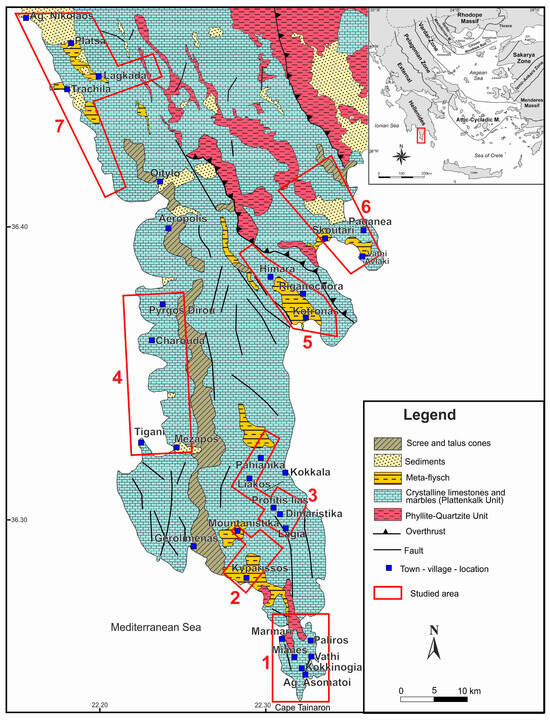
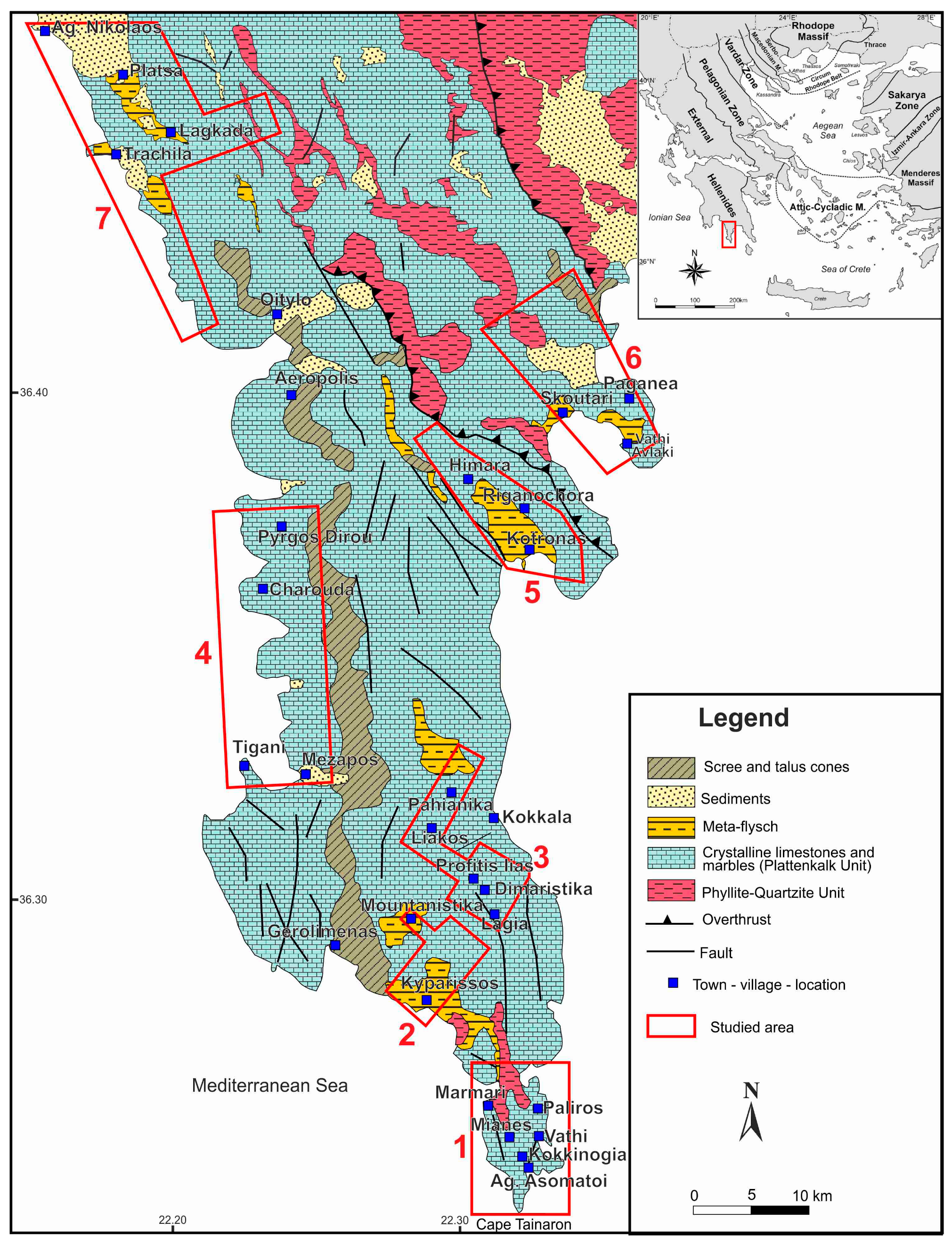
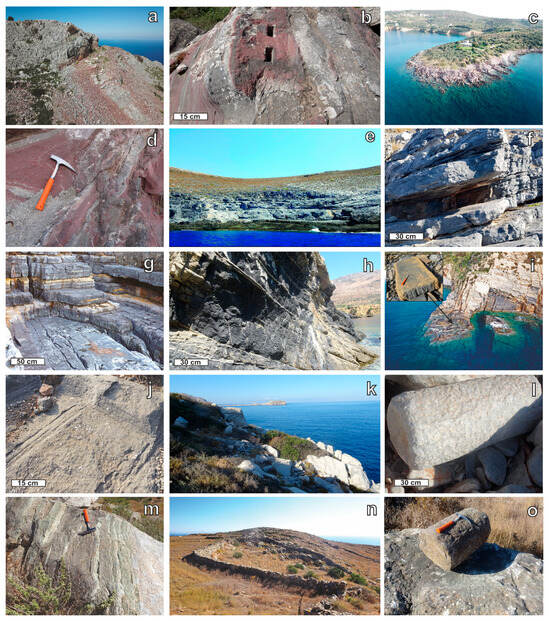
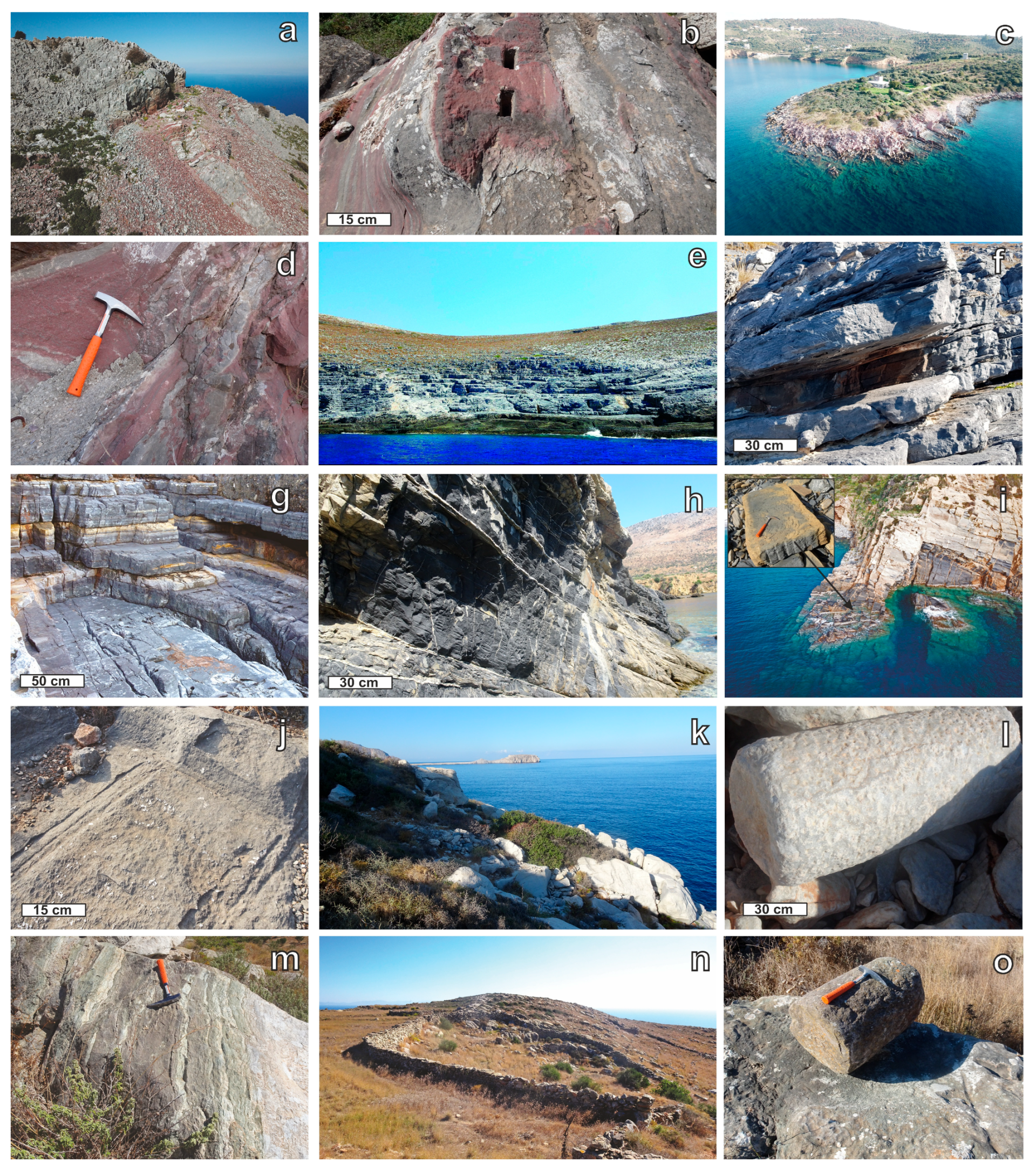
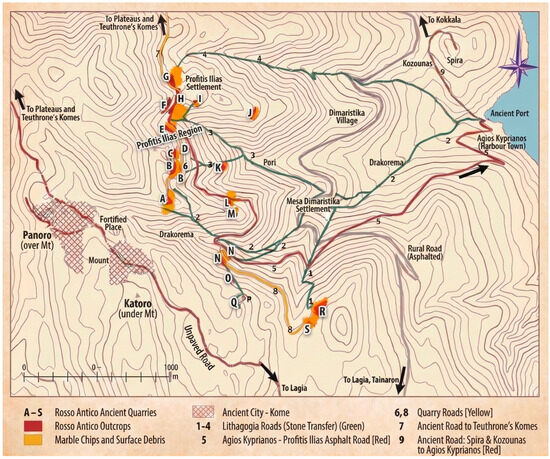
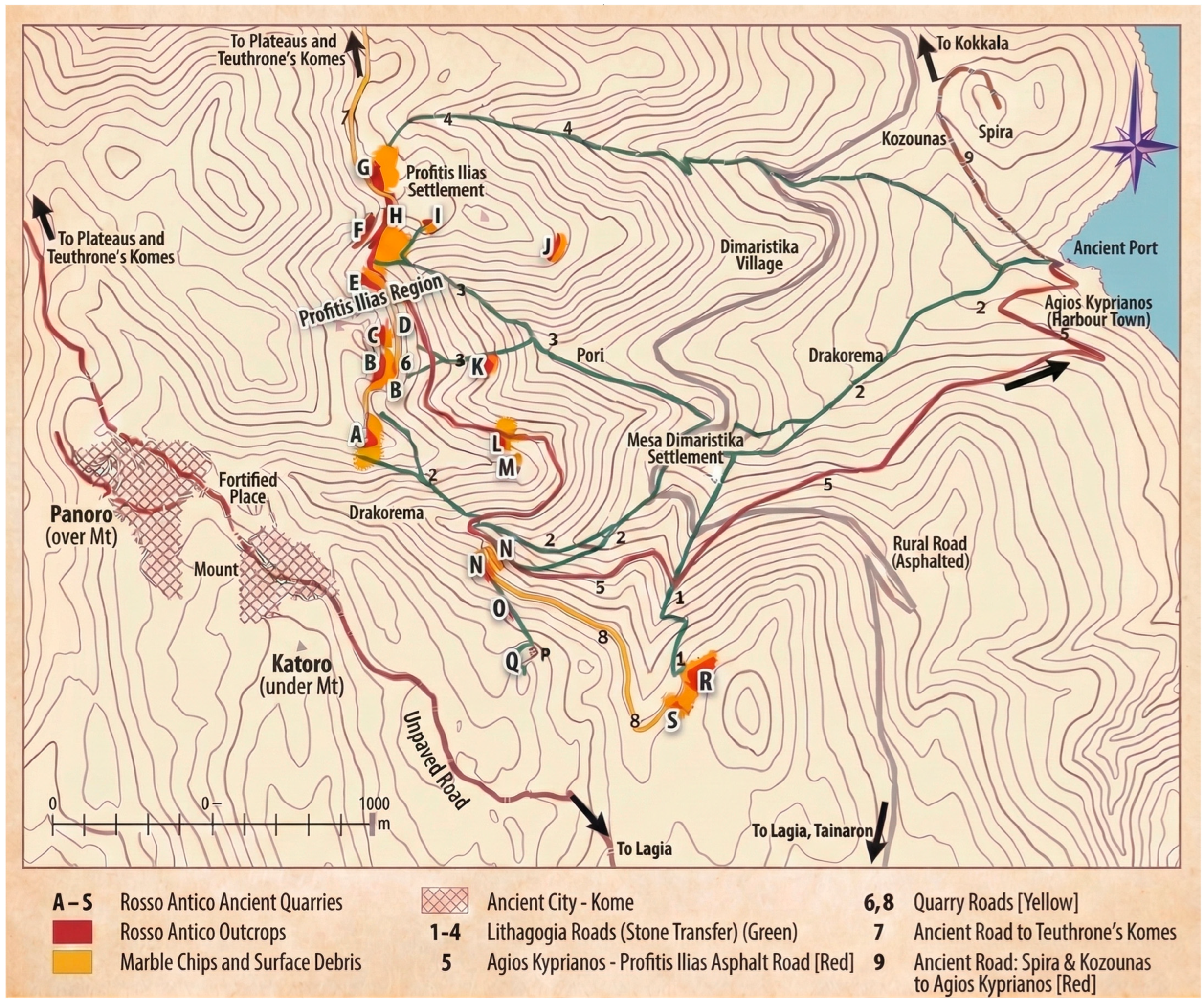
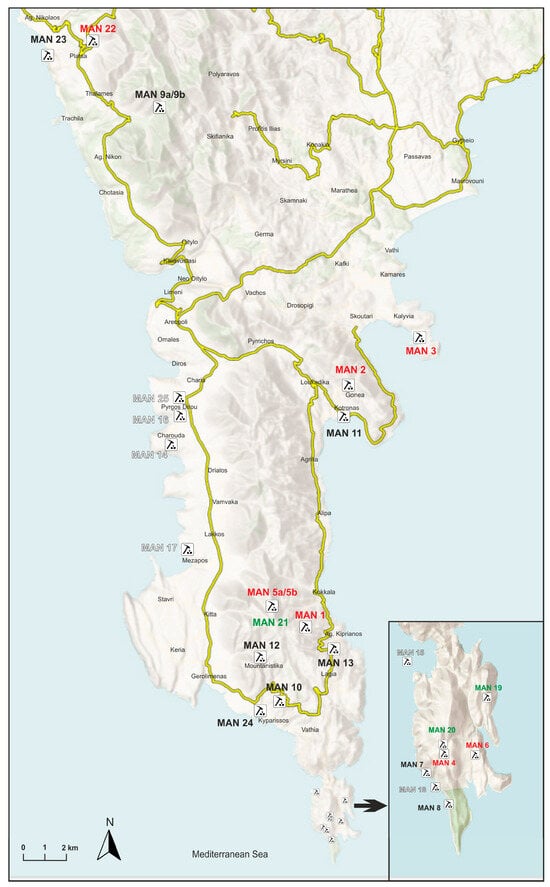
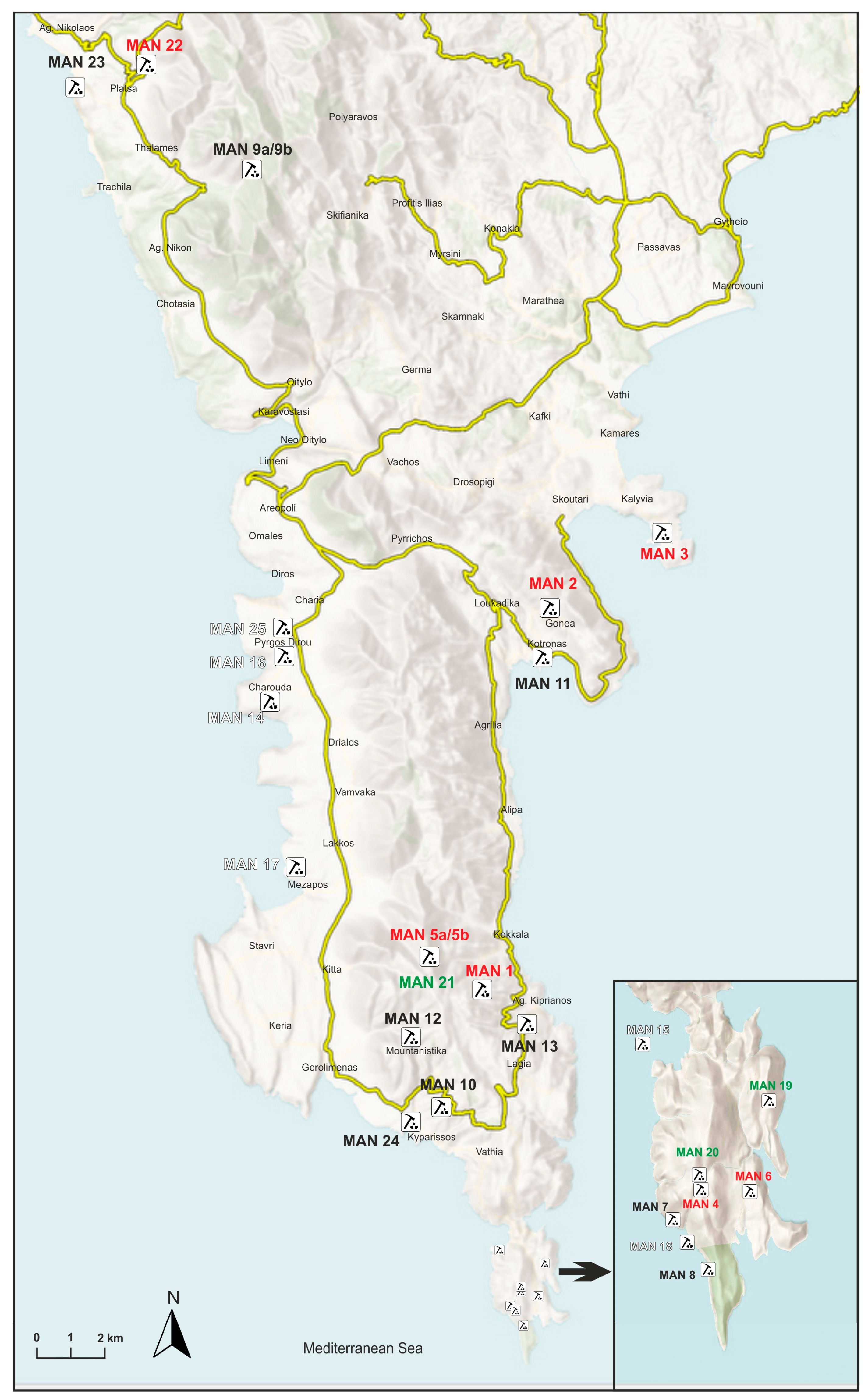
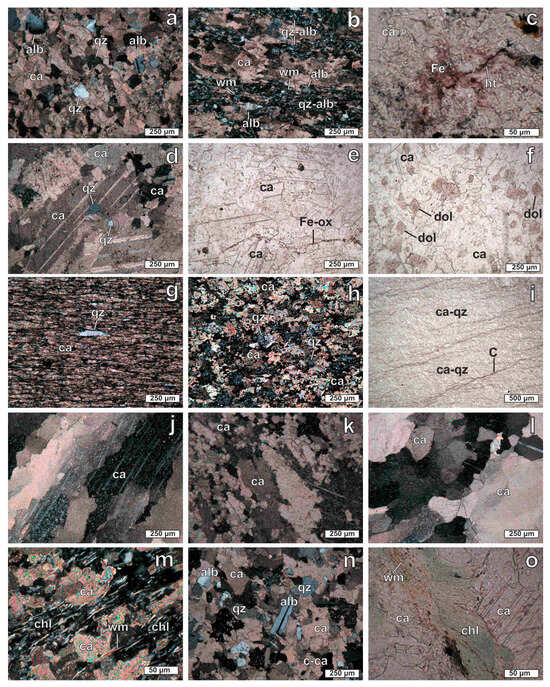
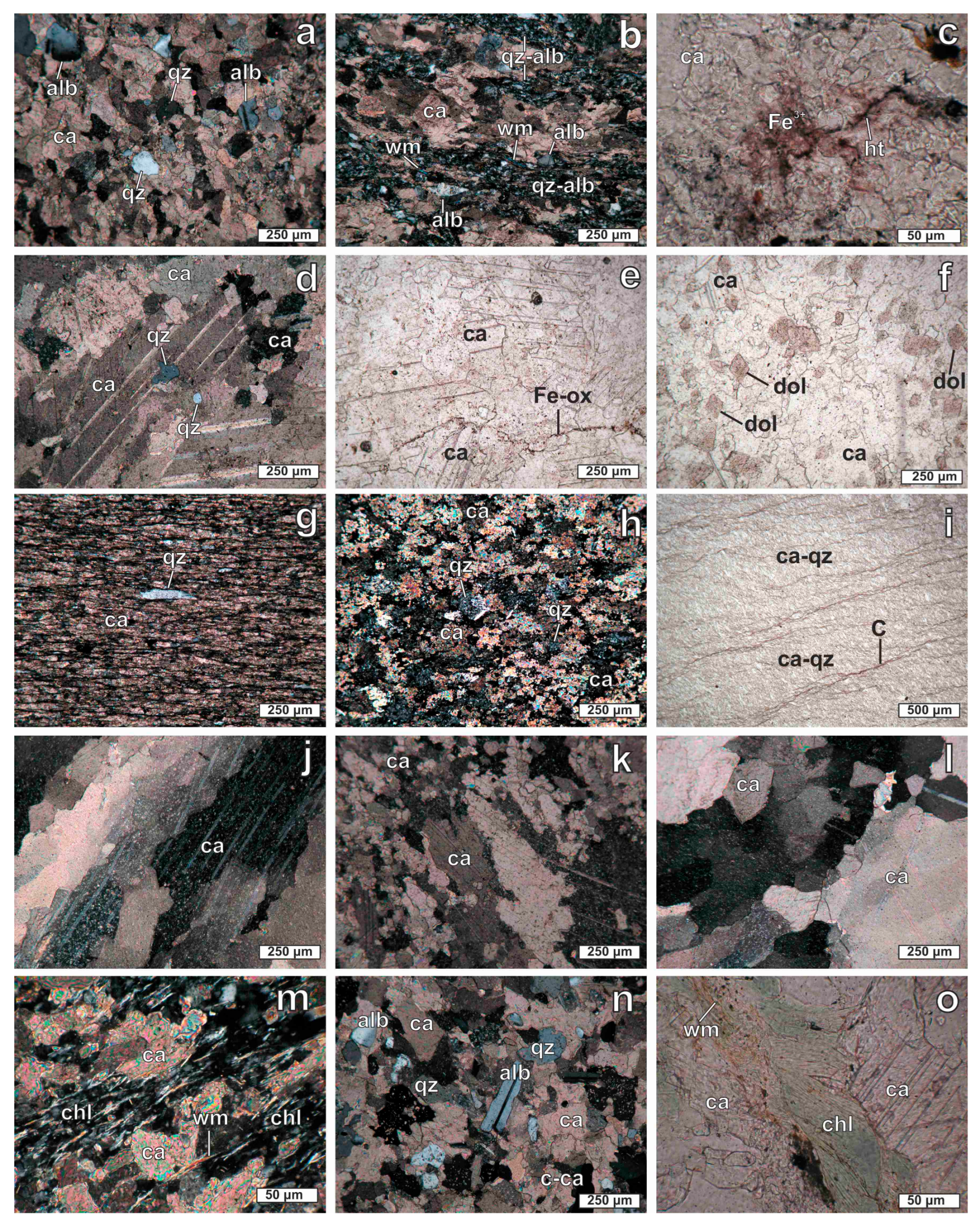
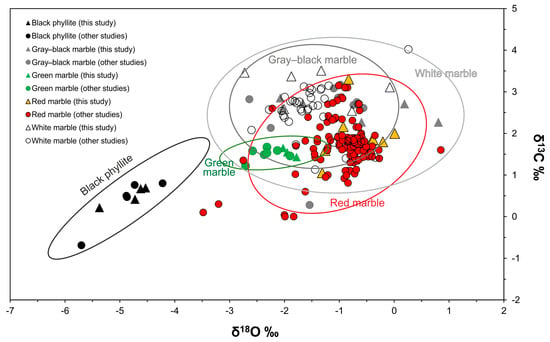
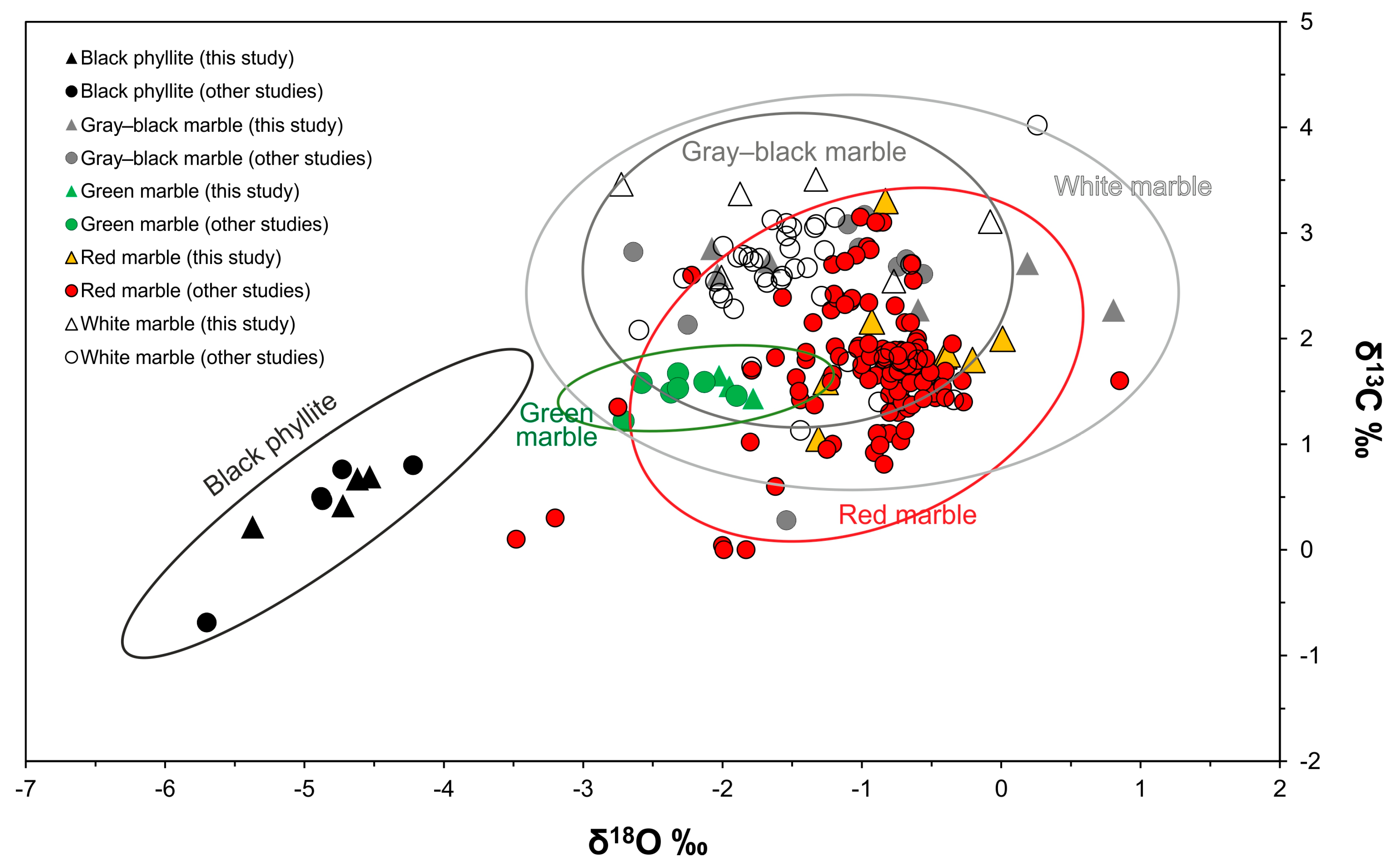
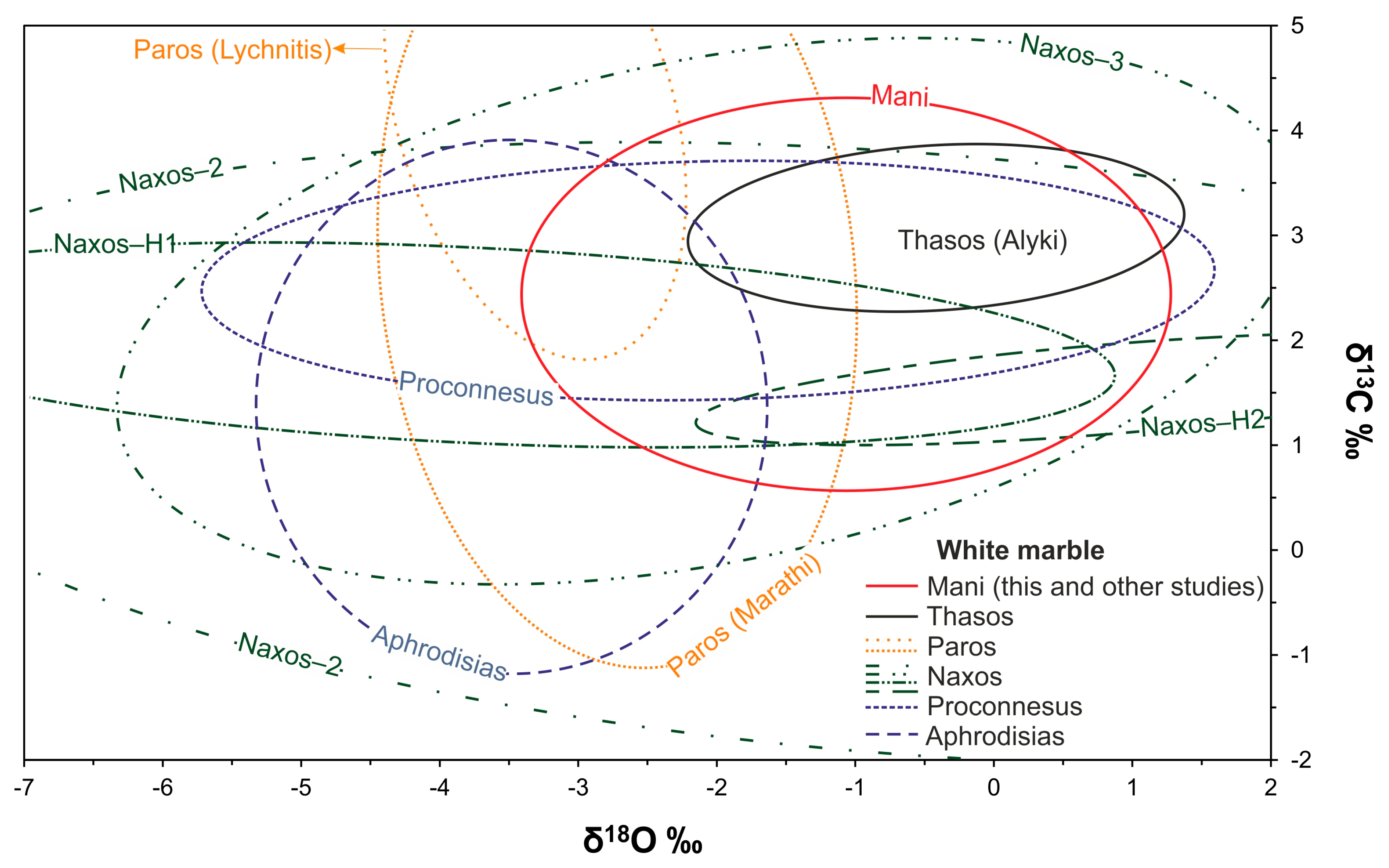

Disclaimer/Publisher’s Note: The statements, opinions and data contained in all publications are solely those of the individual author(s) and contributor(s) and not of MDPI and/or the editor(s). MDPI and/or the editor(s) disclaim responsibility for any injury to people or property resulting from any ideas, methods, instructions or products referred to in the content. |
© 2026 by the authors. Licensee MDPI, Basel, Switzerland. This article is an open access article distributed under the terms and conditions of the Creative Commons Attribution (CC BY) license.