1. Introduction
Phosphorus is a fundamental nutrient and energy carrier in life, and a prime element in the intermediation between living and inanimate parts of the biosphere. The phosphorus cycle thus plays a crucial role in regulating the Earth’s climate and affecting biodiversity [
1,
2,
3,
4]. Phosphate deposits are widely distributed throughout geological time, ranging from the Paleoproterozoic to the Holocene [
1,
5,
6], and have been extensively studied in marine sediments [
5,
7], where interpretations of phosphogenesis have evolved from single factor explanations such as the classic upwelling current theory [
1,
8,
9], biogenesis [
10], chemical genesis [
8,
11] to multi-factorial regulation of phosphorus cycle in earth history, e.g., [
3,
12,
13,
14,
15].
Phosphates-bearing strata are also discovered in lacustrine environments, including the Eocene Green River Formation [
16,
17], the Pliocene Glenns Ferry Formation [
18], the Miocene lacustrine deposits in the Cerdanya Basin [
19], the Neogene clayey diatomite deposits in the Sarantaporo-Elassona Basin [
20], and the Quaternary phosphate sediments in eastern Africa [
21,
22] and Lake Baikal in Russia [
23]. These occurrences indicate that the enrichment of phosphates in lake basins may reflect complex interactions among biological productivity, water column stratification, redox dynamics and early diagenetic mineralization [
16,
17,
18,
19,
20,
21,
22,
23], thereby providing valuable evidence of environmental conditions and changes in continental basins.
In China, phosphate deposits are predominantly associated with marine sediments of the Yangzi platform and the Tarim Basin [
24,
25,
26], whereas phosphate-bearing strata constitute critical records for interpreting paleoenvironmental conditions within lacustrine systems. The Songliao Basin, the largest Cretaceous non-marine basin in East Asia, is characterized by a long-lived lake system and well-preserved stratigraphic continuity [
27]. With the accumulation of research achievements over several decades, an integrated stratigraphical framework has been established [
28,
29,
30], underpinning studies of paleoclimate, paleoenvironment, biotic evolution, and major geological events, e.g., [
31,
32,
33,
34]. Within the lower part of the second member of the Nenjiang Formation, two thin layers of phosphorite with varying thickness and lateral continuity have been identified, yet their depositional origin and paleoenvironmental significance have not been systematically evaluated.
In this study, we mainly investigate the phosphorite layers and associated fossil assemblages from Houjingou and Yuewangcheng sections in the southeastern uplift of Songliao Basin through detailed mineralogical and geochemical analyses. Our aim is to elucidate the mechanisms of phosphorus enrichment and clarify the depositional environment in which the phosphorite formed. The findings provide new insights into phosphorus cycling and paleoenvironmental changes in Late Cretaceous lacustrine systems.
2. Geological Setting
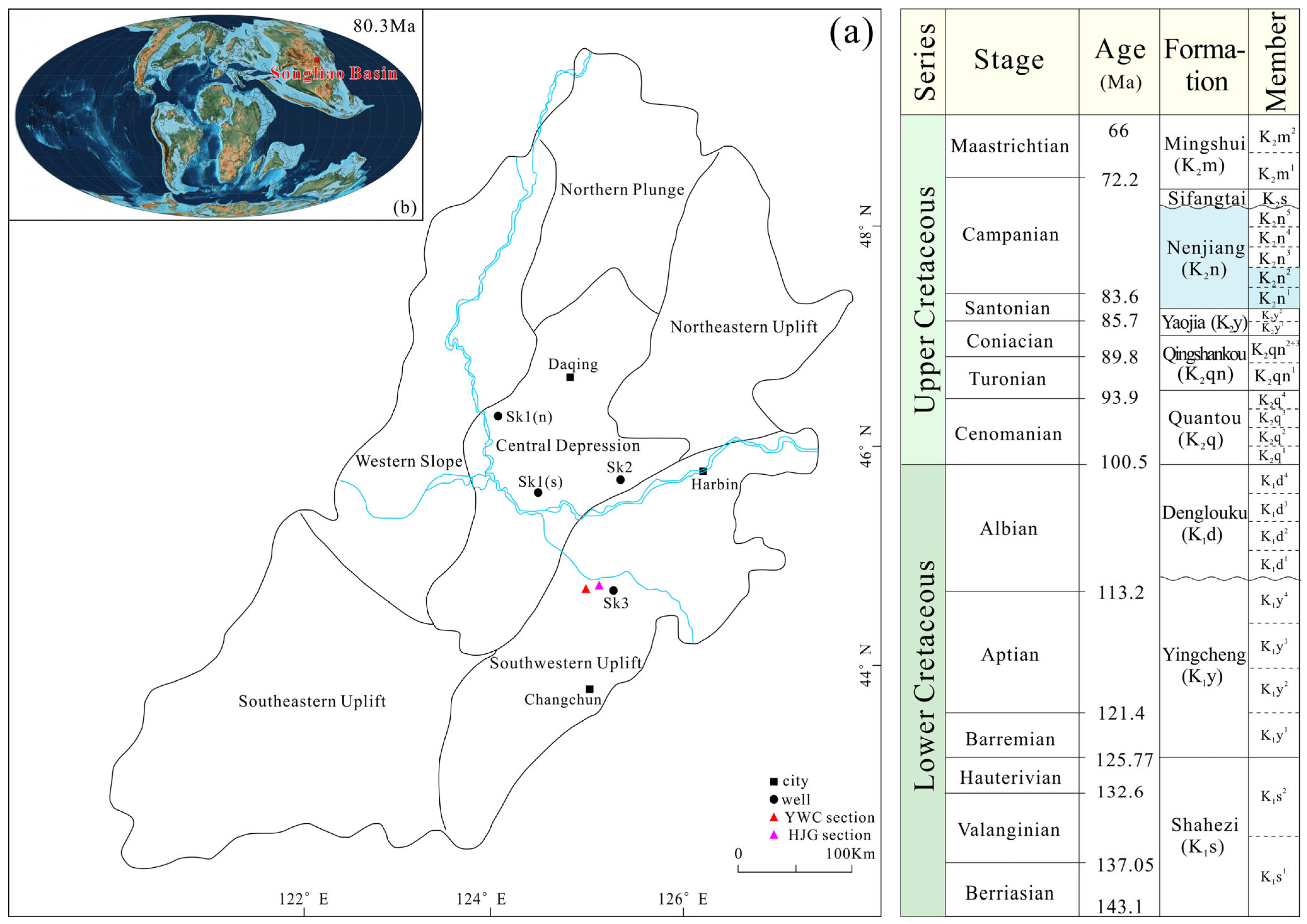
The Songliao Basin, covering approximately 260,000 km
2, is located in northeast China at mid-latitudes in East Asia [
27]. During the Late Cretaceous, it occupied a paleogeographic position along the eastern Asian continental margin, in proximity to the western Pacific marginal realm (
Figure 1b) [
27,
35].
The basin preserves a well-developed Cretaceous stratigraphic succession comprising, from oldest to youngest, the Huoshiling (K
1h), Shahezi (K
1sh), Yingcheng (K
1yc), Denglouku (K
1d), Quantou (K
2q), Qingshankou (K
2qn), Yaojia (K
2y), Nenjiang (K
2n), Sifangtai (K
2s) and Mingshui (K
2m) formations (
Figure 1) [
36]. Structurally, it is subdivided into six first-order units: the north plunge zone, central depression zone, northeast uplift zone, southeast uplift zone, southwest uplift zone and west slope zone. The study area lies within the southeast uplift zone (
Figure 1a).
Members 1 and 2 of the Nenjiang Formation are mainly exposed in the study area and consist of dark mudstone, black shale and oil shale interlayers formed in a deep-lake environment [
37]. A marine incursion occurred in the lower K
2n, leading to a large-scale lake anoxic event [
38,
39,
40], which promoted significant organic matter enrichment and formed the most important source rock segment in the Songliao basin. The age of the Nenjiang formation is constrained to Santonian–Campanian based on new high-resolution magnetostratigraphic results and SIMS U–Pb zircon analyses [
41,
42,
43,
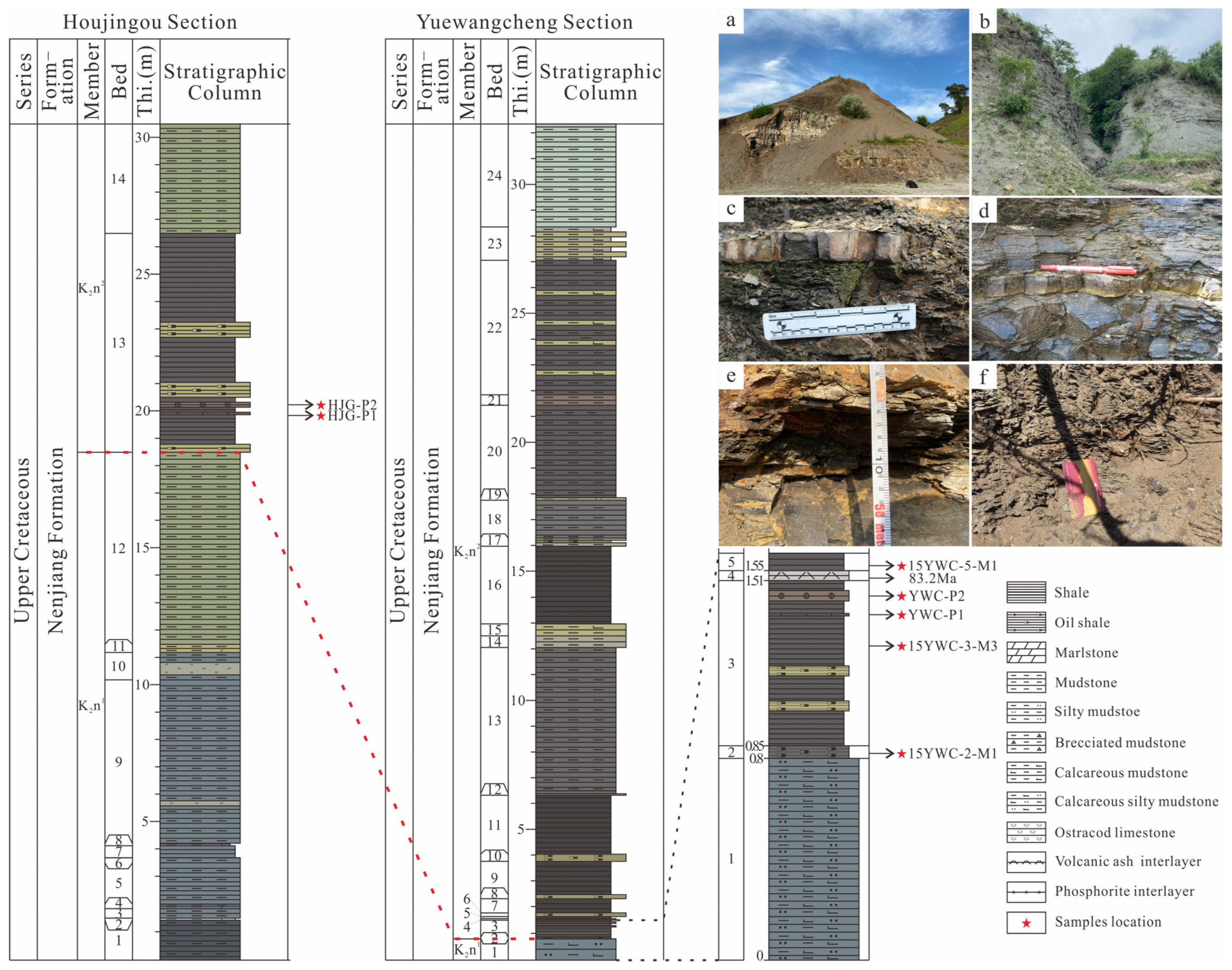
44]. The phosphorite layers investigated in this study are restricted to the lower part of the K
2n
2 and are laterally extensive but thin, with thicknesses of approximately 1 cm or 3–4 cm (
Figure 2).
3. Materials and Methods
Two sections containing phosphorite in the Songliao basin were sampled in this study: the Yuewangcheng section (two samples; YWC-P1, YWC-P2) in Baliyingzi Village, Huangyuquan Town, Nong’an County, Jilin Province (44°52′17.01″ N, 125°30′17.41″ E) (
Figure 2a,c,e) [
45], and the Houjingou section (two samples; HJG-P1, HJG-P2) in Qingshankou village, Nong’an County, Jilin Province (44°52′29.4″ N, 125°30′8″ E) (
Figure 2b,d,f) [
46].
Thirteen thin sections were prepared for petrographic and mineralogical analyses. Rock samples were cleaned, dried, cut and polished to obtain smooth surfaces for microscopic and electron microscopic observations. Petrographic and microstructural analyses were conducted at China University of Geosciences (Beijing) using a Zeiss Axio Scope A1 polarizing microscope and a Zeiss Supra 55 Field Emission Scanning Electron Microscope (FESEM) (Carl Zeiss, Oberkochen, Germany) operated at 20 kV with a working distance of 15 mm. Secondary electron (SE2) and AsB detectors were used for morphological and compositional imaging, respectively. Prior to SEM analysis, the thin sections were coated with an approximately 8 nm thick carbon layer. Chemical compositions were determined using an Oxford X-act energy-dispersive spectrometer (EDS) (Oxford Instruments, Abingdon, UK) attached to the FESEM, with an analytical spot size of approximately 2 μm. Fluorine was measured by EDS together with other elements. Elemental totals were normalized to 100 wt% on an elemental basis; oxide totals were calculated from elemental concentrations without oxygen correction for F substitution.
Four samples (HJG-P1, HJG-P2, YWC-P1, and YWC-P2) were analyzed by whole-rock X-ray diffraction (XRD). The samples were dried and ground to 200 mesh using an agate mortar. Phase identification and semi-quantitative mineral analysis were performed using a Rigaku SmartLab diffractometer (9 kW) (Rigaku, Tokyo, Japan) at China University of Geosciences (Beijing), equipped with a Cu-target X-ray source operating at 45 kV and 200 mA. Diffraction data were collected over a 2θ range of 4–70° with a step size of 0.02° and a scanning rate of 1°/min. Only whole-rock powder samples were analyzed. Clay fractions were not separated, and no ethylene glycol solvation or thermal treatment was applied.
Major element compositions of 11 samples, including phosphorite and black shale, were determined by X-ray fluorescence (XRF) analysis. Samples from the Houjingou section were analyzed by using an ARL ADVANT XP+ spectrometer (Thermo Fisher Scientific, Ecublens, Switzerland) at the laboratory of Orogenic Belts and Crustal Evolution, Peking University, whereas samples from the Yuewangcheng section were analyzed using a wavelength-dispersive XRF spectrometer (Axios-mAX; PANalytical, Almelo, The Netherlands) equipped with an AB104L fusion system at the Analysis and Testing Research Center, Beijing Research Institute of Uranium Geology.
Two sections of phosphorite samples (YWC-P1, YWC-P2, HJG-P1, and HJG-P2) were fragmented and soaked in water or hydrogen peroxide for 12 h for microfossil examination. The residues were washed through a two-layer sieve (1 mm and 0.1 mm), dried, and subsequently examined under a microscope. Representative specimens were then imaged using the Zeiss Supra 55 FESEM (Carl Zeiss, Oberkochen, Germany).
4. Results
4.1. Petrography, Mineralogy, and Chemical Composition of Phosphorite
Two phosphorite beds exhibit sharp contacts with black shale. The phosphorite beds are brownish in the interior and gray at the margins. The beds display a massive (structureless and non-laminated) fabric, with average thicknesses of 1 cm or 3–4 cm (
Figure 2c–f).
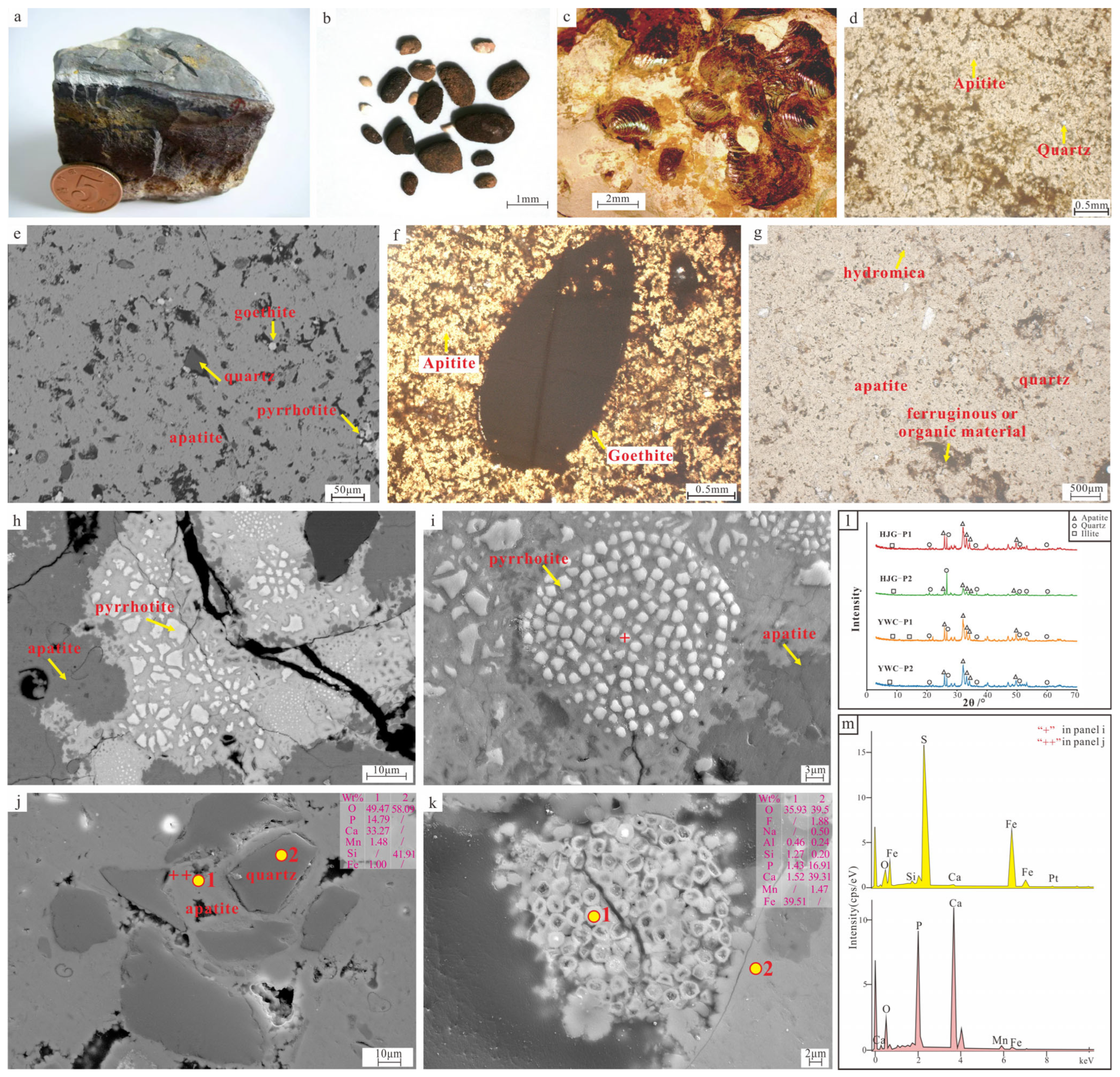
Under plane-polarized light, the phosphorite appears dark brownish to yellow and displays a cryptocrystalline to microcrystalline texture (
Figure 3d,f,g). The rock is matrix-supported, with microcrystalline carbonate-fluorapatite (CFA) forming the dominant matrix that encloses detrital quartz grains, clay minerals and fossil fragments (
Figure 3c–g). Quartz occurs as fine-grained angular to subangular fragments with low roundness. Clay minerals are present as fine platy flakes disseminated within the matrix and were optically identified as hydromica based on morphology and optical properties. Opaque components appear as irregular patches and disseminated grains, interpreted as ferruginous and/or organic-rich material (
Figure 3d–g). Rounded aggregates composed of Fe–S sulfides occur within the phosphorite matrix (
Figure 3i,k), with EDS spectra indicating Fe–S composition, interpreted as pyrrhotite and related Fe–S sulfides.
Whole-rock XRD analyses of phosphorite samples from the Yuewangcheng (YWC-P1, YWC-P2) and Houjingou (HJG-P1, HJG-P2) sections indicate that the dominant phosphate mineral is CFA (
Figure 3l;
Table S2). CFA is characterized by reflections at approximately 25.9° and a typical apatite peak within 31–34° 2θ, with an additional reflection near ~49.5° 2θ. Quartz is present in all samples, as indicated by reflections at approximately 20.8°, 26.6°, 36.5°, 50.1° and 59.9° 2θ. Weak low-angle reflections near ~8.9° and ~17.8° 2θ occur in YWC-P1 and are interpreted as minor clay minerals (possibly illite). The XRD data reported in
Table S2 represent relative peak intensities.
Bulk chemical compositions, recalculated on a F-free basis and normalized to 100 wt%, are presented in
Table S3 for direct comparison with EDS-derived compositions. The bulk chemical compositions show clear enrichment of CaO and P
2O
5 in phosphorite samples (
Table S3). P
2O
5 ranges from 20.45 to 36.43 wt% (mean = 29.55 wt%), while CaO varies from 29.68 to 61.21 wt% (mean = 47.30 wt%). SiO
2 contents are generally low to moderate (2.76–31.44 wt%, mean = 9.11 wt%), with elevated values observed in YWC-P1. Al
2O
3 concentrations range from 0.62 to 8.12 wt% (mean = 2.50 wt%), and total Fe
2O
3 ranges from 1.19 to 7.58 wt% (mean = 3.44 wt%).
Quantitative EDS spot analyses of phosphatic domains (
Table S1) show high Ca and P contents consistent with CFA. Most analyses show P
2O
5 values between 30 and 45 wt%, and CaO contents range from 45 to 58 wt%, consistent with apatite-dominated compositions, with mean values of 35.89 wt% and 48.10 wt%, respectively. Al
2O
3 contents vary widely (0.72–53.09 wt%; mean = 9.53 wt%), reflecting variable incorporation of clay minerals or aluminosilicate phases. SiO
2 ranges from 1.05 to 59.06 wt% (mean = 7.00 wt%), indicating heterogeneous admixture of detrital components. Fluorine is readily detectable in the majority of domains, generally ranging from 1.72 to 4.44 wt%, with an average of 3.06 wt%, consistent with the presence of fluorapatite.
Specifically, while fluorine is detectable by XRF, the measured F content exceeds the expected range for fluorapatite. This is likely due to matrix effects in XRF analysis, particularly in Ca–P-rich phosphorite samples, where fluorine is often overestimated. Therefore, we adopted the F content derived from EDS analysis, as it provides a more accurate measurement, with an average of approximately 3 wt%.
4.2. Comparison of Mineralogy and Chemical Composition Between Phosphate and Black Shale
The bulk major-element compositions of the black shale samples are listed in
Table S3 (15YWC-2-M1, 15YWC-3-M3, 15YWC-5-M1). Compared to the phosphorite samples, the black shale exhibits relatively higher contents of Si, Fe, Al, K and Na oxide, but lower CaO and P
2O
5 contents. The average P
2O
5 content is approximately 0.19 wt%, suggesting that little apatite formed during sedimentation and early diagenesis of the black shale.
4.3. Micropaleontology
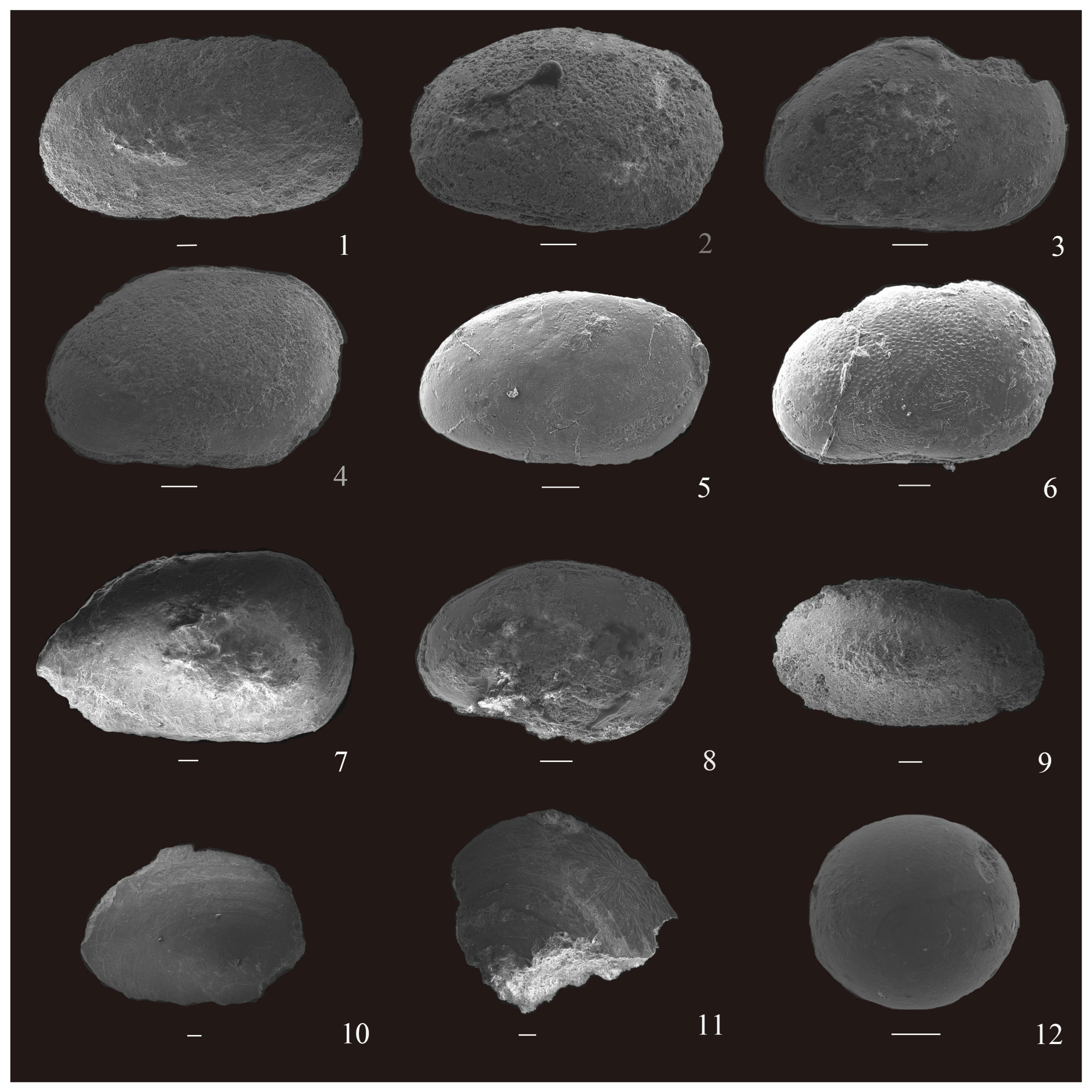
In this study, ostracod fossils were identified in all four phosphorite samples collected from the Yuewangcheng and Houjingou sections, and a total of 9 ostracod specimens were obtained (
Figure 4). Due to poor preservation and extensive erosion, the fossils can only be classified at the genus level, including
Mongolocypris sp.,
Cypridea sp., and
Lycopterocypris sp. Additionally, several conchostracan fossils belonging to the
Estheritilis mituishi fossil assemblage (
Figure 3c,
Figure 4: 10–11) and a few unidentified spherical-like fossils (
Figure 4: 12) were also discovered. All specimens illustrated in this study are housed at the State Key Laboratory of Biogeology and Environmental Geology, China University of Geosciences (Beijing).
5. Discussion
5.1. Depositional Environment
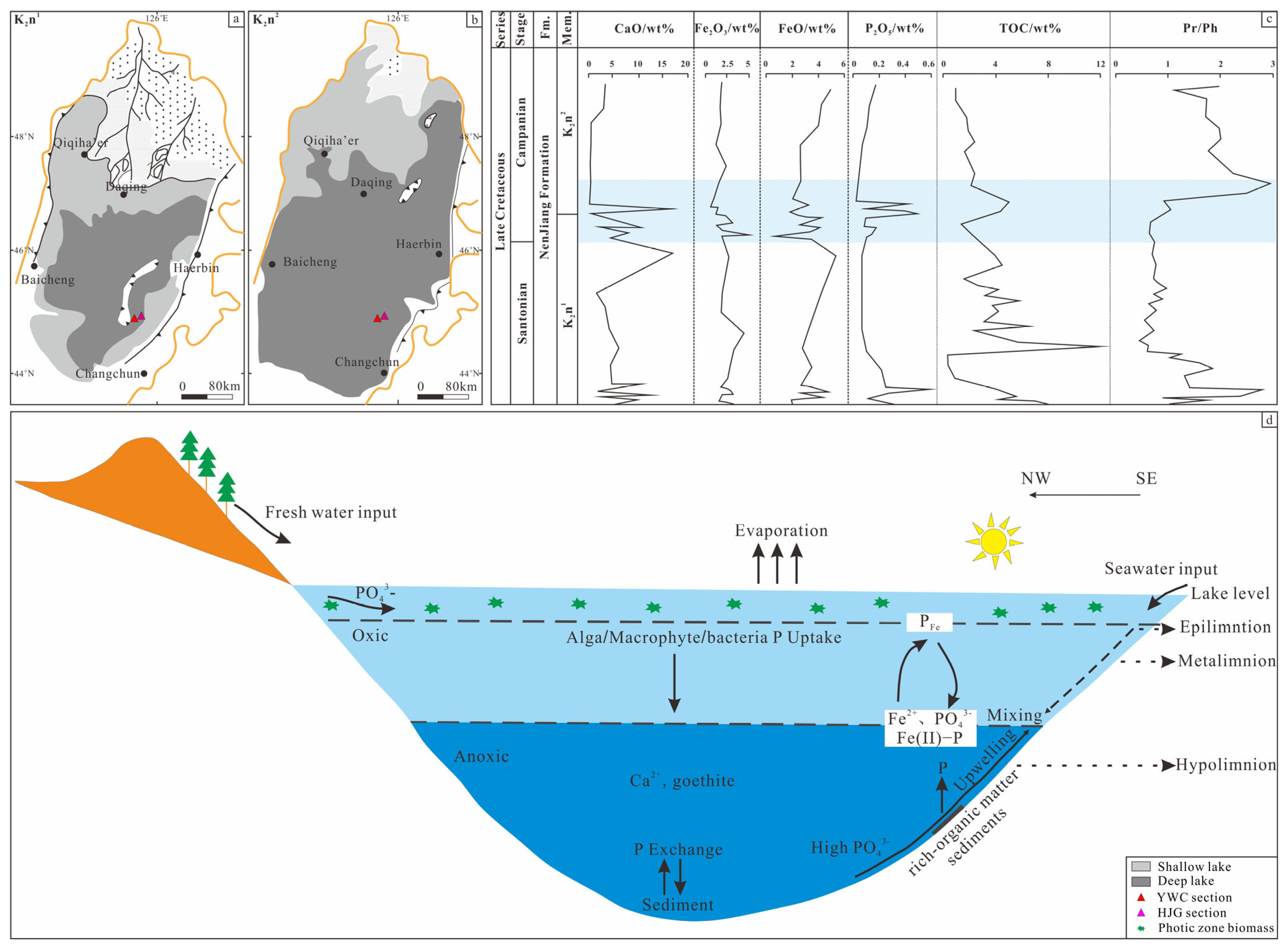
The Songliao Lake was a large, deep-water, eutrophic lake during the deposition of the K
2n
1 to K
2n
2 [
29,
36,
47,
48]. In the late sedimentary stage of K
2n
1, the subsidence rate of the lake slowed down, whereas the sediment supply was sufficient, so that the lake reached a maximum area of 20 × 10
4 km
2, covering almost the entire basin (
Figure 5a) [
36,
49]. During the deposition period of the lower K
2n
2, the lake expanded again and the lake level rose, forming a deep-lake environment and resulting in the stratification of water (
Figure 5b) [
36,
48,
50]. Black mudstone and oil shale were preserved in the whole basin, which became an important indicator of regional stratigraphic correlation [
48]. Phosphorite layers are distributed within the study area. The lake level dropped as the subsidence began to decrease after the middle to upper K
2n
2 interval [
36,
50]. Previous studies have proposed that seawater intrusion promoted the release of nutrients in the lake, based on analysis of marine fossil records and algal biomarkers (
Figure 5c) [
39,
40], leading to the enrichment of organic matter from the K
2n
1 to the lower K
2n
2. Moreover, the discovery of ostracods (e.g.,
Mongolocypris sp.) and spores and pollen in the black shale [
51,
52,
53] suggests that organisms flourished in this period, which is interpreted as a eutrophic stage [
54,
55,
56].
Phosphorus in most lakes is present primarily as inorganic phosphate, organic phosphate, or combined with or absorbed by inorganic and dead particulate organic matter [
57]. During the period of maximum lake incursion, the lake experienced rapid expansion, introducing substantial terrigenous nutrient fluxes, including weathered phosphorus. This phosphorus pool exhibited dual partitioning: one fraction remained as dissolved inorganic phosphorus (DIP) forms within the water column, whereas a significant proportion was assimilated into organic phosphorus (OP) reservoirs through biological uptake by plankton. More than 90% of total phosphorus exists in the form of organic matter in eutrophic lakes [
57]. Consequently, the Songliao lake, which was a eutrophic lake during the upper K
2n
1 to the lower K
2n
2, likely contained a substantial proportion of phosphorus in organic form. Additionally, the phosphate concentration tends to increase with depth [
58]. In such environments, algal blooms, planktonic organisms, and microbial activities facilitate the cycling and accumulation of phosphorus, e.g., [
1,
59,
60,
61,
62,
63,
64]. Surface water shows preferential depletion of dissolved phosphorus due to biological assimilation, whereas the bottom organic matter deposition leads to phosphorus accumulation. In deep-lake and semi-deep-lake environments near the edge of the basin, phosphorus enrichment occurs rapidly through dual mechanisms: (1) fluvial input of terrigenous phosphorus and (2) intensified biogeochemical cycling mediated by biota. Furthermore, anoxic conditions in the bottom waters of the stratified lake likely suppressed phosphorus reactivation. The upward surge of bottom water along the edge, where it agitates near the stratified water interface, prompts phosphorus precipitation in the bottom waters [
65,
66,
67].
5.2. Formation of Phosphate
Phosphorites formed in lacustrine environments are predominantly iron-rich phosphates [
19,
20,
23,
68], which originate from organic processes during diagenesis. The primary minerals in these iron-rich phosphates include vivianite, Fe and Ca-Fe-bearing phosphate minerals, which typically exhibit irregular or spherical morphologies. According to relevant studies, the genesis of phosphates in sedimentary basins is predominantly attributed to biogenic contributions, exemplified by diatom frustules, fecal pellets, fish teeth and bones [
20,
69,
70]. However, in the Songliao Basin, no conclusive evidence has been found to support these biogenic components as primary sources of phosphate. Notably, the phosphorite deposits in this basin exhibit exceptional lateral continuity (
Figure 2) coupled with remarkably low iron contents (
Table S3), contrasting sharply with conventional iron-rich phosphate systems. This may suggest a fundamentally different genetic mechanism governing phosphogenesis in the Songliao Basin compared with ferruginous phosphate depositional systems.
The laterally extensive phosphorite beds exhibit sharp contacts with the host rocks, indicating that phosphogenesis in the Songliao Basin occurred at or near the sediment-water interface during deposition and early diagenesis [
10]. Overall, the phosphorites examined in this study are similar to those reported in the marine environment and the lacustrine Glenns Ferry Formation, where they formed through precipitation of apatite [
1,
18]. Thus, the formation mechanism of the phosphorites in the study area may involve the direct precipitation of CFA. This precipitation could be triggered by a rise in temperature [
71,
72], an increase in pH [
73], elevated calcium concentrations [
74], increased salinity due to evaporation [
17], and adsorption of dissolved orthophosphate onto ferric hydroxide (goethite) Fe (OOH).x H
2O [
75], or the development of oxygenated microzones at the sediment-water interface (
Figure 5d) [
57,
76]. Among these factors, variations in pH likely played a particularly significant role. Previous research has demonstrated that alkaline conditions are favorable for phosphate precipitation [
77,
78,
79].
During the deposition of the lower K
2n
2, lake productivity increased [
80], and the decomposition of organic matter resulted in the release of diffused phosphorus. This process consequently led to elevated phosphorus concentrations in the bottom waters. Compared with the host rocks, the phosphorites exhibit higher CaO contents and a lower proportion of detrital minerals, suggesting that phosphate rocks are products of chemical precipitation rather than clastic deposition. The presence of well-preserved ostracods within the phosphorite beds (
Figure 4) indicates that the bottom waters were likely enriched in Ca
2+ and characterized by pH values greater than 7.0. In contrast, slight dissolution features observed in ostracod shells from the overlying black shale suggest comparatively more acidic bottom water conditions [
81]. Therefore, it is plausible that bottom water conditions may have shifted toward more alkaline values during the transition from black shale deposition to phosphorite formation. Based on this integrated analysis, we propose that hydrochemical fluctuations—particularly elevated pH and enhanced Ca
2+ concentrations—may constitute the predominant precipitation mechanism governing phosphate enrichment in the Songliao basin. Phosphorus may have been adsorbed onto ferric hydroxides and/or precipitated as apatite through interactions with Ca
2+ [
75]. The well-preserved fossils of Ostracods and conchostracans (
Figure 4) suggest rapid burial during sediment deposition [
1]. Given that phosphate is a critical biomineralization component of the Crustacea fossils [
82,
83,
84,
85], it is reasonable to hypothesize that the formation of phosphorite may be closely linked to the preservation of conchostracan shells. In addition, bacteria may have played an important role in the formation of phosphate [
1,
10]. Subsequent diagenesis of organic matter releases phosphate ions, which may have been immobilized through ionic substitution or direct precipitation as authigenic phosphate minerals [
19]. Some Ostracod shells within the phosphorites are phosphatized (
Figure 4), indicating the existence of displacement in early diagenesis.
Figure 5.
(
a) The sedimentary environment of K
2n
1. (
b) The sedimentary environment of K
2n
2. (
c) Map showing the vertical evolution of major elements from K
2n
1 to K
2n
2 in the SK-1s drill cores, TOC = total organic carbon, Pr/Ph = pristane/phytane ratio, (
a–
c) modified from Wang et al. [
86]; (
d) A proposed model of biogeochemical cycle of phosphorus in the Nenjiang Formation of the Songliao Basin.
Figure 5.
(
a) The sedimentary environment of K
2n
1. (
b) The sedimentary environment of K
2n
2. (
c) Map showing the vertical evolution of major elements from K
2n
1 to K
2n
2 in the SK-1s drill cores, TOC = total organic carbon, Pr/Ph = pristane/phytane ratio, (
a–
c) modified from Wang et al. [
86]; (
d) A proposed model of biogeochemical cycle of phosphorus in the Nenjiang Formation of the Songliao Basin.
6. Conclusions
Two thin but laterally continuous phosphorite beds occur in the lower K2n2 of the Songliao Basin, with thicknesses of approximately 1 cm and 3–4 cm, respectively. Bulk-rock compositions show that P2O5 contents in the phosphorite range from 20 to 30 wt%. The dominant phosphate mineral is CFA, with minor associated minerals including quartz, hydromica, goethite and pyrrhotite.
Fossil, sedimentological and geochemical evidence suggest that phosphorite precipitation formed in a deep, anoxic and stratified eutrophic lake. Phosphogenesis likely took place at or near the sediment–water interface during deposition and early diagenesis.
High productivity and microbial decomposition of organic matter likely enhanced phosphorus enrichment in bottom waters, facilitating phosphorite accumulation. Changes in water chemistry, particularly increases in pH and Ca2+ concentrations, may have promoted the precipitation of CFA. Subsequent diagenetic processes might also play an important role on the formation of CFA.
Supplementary Materials
The following supporting information can be downloaded at
https://www.mdpi.com/article/10.3390/min16030292/s1: Table S1: Quantitative EDS analysis results of phosphorite from the Houjingou and Yuewangcheng sections; Table S2: XRD analysis results in 2 theta (°) of samples from the Houjingou and Yuewangcheng Sections; Table S3: Normalized major element results of samples from the Houjingou and Yuewangcheng sections.
Author Contributions
Conceptualization, J.L., K.C. and Z.S.; methodology, J.L.; investigation, J.L., K.C., Z.S. and D.X.; resources, Z.S.; data curation, J.L., K.C. and Z.S.; writing—original draft preparation, J.L., K.C., Z.S., J.Z. and D.X.; writing—review and editing, J.L., K.C., Z.S., J.Z., D.X. and X.W.; supervision, Z.S.; project administration, Z.S.; funding acquisition, Z.S. and D.X. All authors have read and agreed to the published version of the manuscript.
Funding
Financial support is provided by the National Natural Science Foundation of China (Project NO. 42288201) and the Chinese “111” Project (NO. B20011).
Data Availability Statement
Acknowledgments
We sincerely thank Xinyu Meng and Yafeng Ning for their help in the field and laboratory work. We also sincerely thank the editor and anonymous reviewers for their helpful comments and thoughtful suggestions, which greatly enhanced the manuscript’s clarity and overall quality.
Conflicts of Interest
Jing Zhao was employed by the company PetroChina Huabei Oilfield Company. The remaining authors declare that the research was conducted in the absence of any commercial or financial relationships that could be construed as a potential conflict of interest.
References
- Föllmi, K.B. The phosphorus cycle, phosphogenesis, and marine phosphate-rich deposits. Earth Sci. Rev. 1996, 40, 55–124. [Google Scholar] [CrossRef]
- Van Cappellen, P.; Ingall, E.D. Redox Stabilization of the Atmosphere and Oceans by Phosphorus⁃limited Marine Productivity. Science 1996, 271, 493–496. [Google Scholar] [CrossRef] [PubMed]
- Slomp, C.P.; Van Cappellen, P. The global marine phosphorus cycle: Sensitivity to oceanic circulation. Biogeosciences 2007, 4, 155–171. [Google Scholar] [CrossRef]
- Meyer, K.M.; Kump, L.R.; Ridgwell, A. Biogeo-chemical Controls on Photic-Zone Euxinia during the End-Permian Mass Extinction. Geology 2008, 36, 747–750. [Google Scholar] [CrossRef]
- Notholt, A.J.G.; Sheldon, R.P.; Davidson, D.F. Phosphate Deposits of the World; Cambridge University Press: Cambridge, UK, 1989; volume 2, pp. 1–566. [Google Scholar]
- Sisodia, M.S. Impact during the Proterozoic Era Possibly Inundated the Earth with Phosphorus. Int. J. Astrobiol. 2009, 8, 187–191. [Google Scholar] [CrossRef]
- Bjùrlykke, K. Sedimentology and Petroleum Geology; Springer: Berlin/Heidelberg, Germany, 1989; pp. 1–363. [Google Scholar]
- Kazakow, A.V. The phosphorite facies and the genesis of phosphorites. Trans. Sci. Fertil. Insecto Fungic. 1937, 142, 95–113. [Google Scholar]
- Baturin, G.N. Phosphorites on the Sea Floor: Origin, Composition and Distribution; Elsevier Scientific: Amsterdam, The Netherlands; New York, NY, USA; Distributors for the U.S.: New York, NY, USA; Elsevier Science: North York, ON, Canada, 1982; pp. 1–343. [Google Scholar]
- O’Brien, G.W.; Harris, J.R.; Milnes, A.R.; Veeh, H.H. Bacterial origin of east Australian continental margin phosphorites. Nature 1981, 294, 442–444. [Google Scholar] [CrossRef]
- McKelvey, V.E.; Swanson, R.W.; Sheldon, R.P. The Permian Phosphorite Deposits of Western United States; U.S. Geological Survey Open-File Report 53–166; USGS: Reston, VA, USA, 1952; pp. 1–30. [CrossRef]
- Reinhard, C.T.; Planavsky, N.J.; Gill, B.C.; Ozaki, K.; Robbins, L.J.; Lyons, T.W.; Fischer, W.W.; Wang, C.J.; Cole, D.B.; Konhauser, K.O. Evolution of the global phosphorus cycle. Nature 2017, 541, 386–389. [Google Scholar] [CrossRef]
- Lenton, T.M.; Daines, S.J.; Mills, B.J.W. COPSE reloaded: An improved model of biogeochemical cycling over Phanerozoic time. Earth Sci. Rev. 2018, 178, 1–28. [Google Scholar] [CrossRef]
- Jiao, L.X.; Dodd, M.S.; Algeo, T.J.; Li, C. A Five-stage Evolution of Earth’s Phosphorus Cycle. Acta Geol. Sin. E. Ed. 2023, 97, 1306–1317. [Google Scholar] [CrossRef]
- Zhao, M.Y.; Mills, B.J.W.; Poulton, S.W.; Wan, B.; Xiao, K.Q.; Guo, L.C.; Guo, Z.T. Drivers of the global phosphorus cycle over geological time. Nat. Rev. Earth Environ. 2024, 5, 873–889. [Google Scholar] [CrossRef]
- Love, J.D. Uraniferous Phosphatic Lake Beds of Eocene Age in Intermontane Basins of Wyoming and Utah; U.S. Geological Survey Professional Paper; USGS: Reston, VA, USA, 1964; pp. 1–66. [CrossRef]
- Mott, L.V.; Drever, J.I. Origin of Uraniferous Phosphatic Beds in Wilkins Peak Member of Green River Formation, Wyoming. Am. Assoc. Pet. Geol. Bull. 1983, 67, 70–82. [Google Scholar] [CrossRef]
- Swirydczuk, K.; Wilkinson, B.H.; Gerald, R.S. Synssedimentary lacustrine phosphorites from the Pliocene Glenns Ferry Formation of southwestern Idaho. J. Sediment. Res. 1981, 51, 1205–1214. [Google Scholar] [CrossRef]
- De las Heras, X.; Grimalt, J.O.; Albaigés, J.; Juliá, R.; Anadon, P. Origin and diagenesis of the organic matter in Miocene freshwater lacustrine phosphates (Cerdanya Basin, Eastern Pyrenees). Org. Geochem. 1989, 14, 667–677. [Google Scholar] [CrossRef]
- Stamatakis, M.G.; Koukouzas, N.K. The occurrence of phosphate minerals in lacustrine clayey diatomite deposits, Thessaly, Central Greece. Sediment. Geol. 2001, 139, 33–47. [Google Scholar] [CrossRef]
- Muller, G.; Forstner, U. Recent iron ore formation in lake Malawi, Africa. Miner. Depos. 1973, 8, 278–290. [Google Scholar] [CrossRef]
- Tiercelin, J.J. Natural resources in the lacustrine faces of the Cenozoic rift basins of East Africa. In Lacustrine Facies Analysis; Special publication of the international association of sedimentologists; Wiley-Blackwell: Hoboken, NJ, USA, 1991; Volume 13, pp. 3–37. [Google Scholar] [CrossRef]
- Deike, R.G.; Granina, L.; Callender, E.; McGee, J.J. Formation of ferric iron crusts in Quaternary sediments of Lake Baikal, Russia, and implications for paleoclimate. Mar. Geol. 1997, 139, 21–46. [Google Scholar] [CrossRef]
- Huang, J.Y.; Gu, X.W.; Lu, L.Y.; Zhang, X.J. Comparison of Phosphorite Resources between Xinjiang, Kazakhstan and Mongolia. Xinjiang Geol. 2007, 25, 75–76. [Google Scholar]
- She, Z.B.; Strother, P.; McMahon, G.; Nittler, L.R.; Wang, J.; Zhang, J.; Sang, L.; Ma, C.; Papineau, D. Terminal Proterozoic Cyanobacterial Blooms and Phosphogenesis Documented by the Doushantuo Granular Phosphorites I: In Situ Micro⁃Analysis of Textures and Composition. Precambrian Res. 2013, 235, 20–35. [Google Scholar] [CrossRef]
- Fan, H.F.; Wen, H.J.; Zhu, X.K. Marine Redox Conditions in the Early Cambrian Ocean: Insights from the Lower Cambrian Phosphorite Deposits, South China. J. Earth Sci. 2016, 27, 282–296. [Google Scholar] [CrossRef]
- Wang, C.S.; Feng, Z.Q.; Zhang, L.M.; Huang, Y.J.; Cao, K.; Wang, P.J.; Zhao, B. Cretaceous paleogeography and paleoclimate and the setting of SKI borehole sites in Songliao Basin, northeast China. Palaeogeogr. Palaeoclimatol. Palaeoecol. 2013, 385, 17–30. [Google Scholar] [CrossRef]
- Xi, D.P.; Wan, X.Q.; Li, G.B.; Li, G. Cretaceous integrative stratigraphy and timescale of China. Sci. China Earth Sci. 2019, 62, 256–286. [Google Scholar] [CrossRef]
- Wu, H.C.; Li, S.; Wang, C.S.; Chu, R.J.; Wang, P.J.; Gao, Y.; Wan, X.Q.; He, H.Y.; Deng, C.L.; Yang, G.; et al. Integrated chronostratigraphic framework for Cretaceous strata in the Songliao Basin. Earth Sci. Front. 2024, 31, 431–445. [Google Scholar] [CrossRef]
- Xi, D.P.; Wu, H.C.; Li, G.; Gao, Y.; Ning, Y.F.; Xiao, Z.Y.; Zhou, Z.H.; Zheng, Q.Y.; Meng, X.Y.; Shi, Z.Y.; et al. Cretaceous stratigraphy in the Songliao Basin, NE China. Geol. Soc. Lond. Spec. Publ. 2025, 545, 657–683. [Google Scholar] [CrossRef]
- Zhang, L.M.; Wang, C.S.; Wignall, P.B.; Kluge, T.; Wan, X.Q.; Gao, Y. Deccan volcanism caused coupled pCO2 and terrestrial temperature rises, and pre-impact extinctions in northern China. Geology 2018, 46, 271–274. [Google Scholar] [CrossRef]
- Gao, Y.; Ibarra, D.E.; Rugenstein, J.K.C.; Chen, J.Q.; Kukla, T.; Methner, K.; Gao, Y.F.; Huang, H.; Lin, Z.P.; Zhang, L.M.; et al. Terrestrial climate in midlatitude East Asia from the latest Cretaceous to the earliest Paleogene: A multiproxy record from the Songliao Basin in northeastern China. Earth Sci. Rev. 2021, 216, 103572. [Google Scholar] [CrossRef]
- Lin, M.Q.; Li, J.G.; Wu, Y.X.; Tan, T.; Xu, Y.G. Vegetation and climate during the primary formation of the Songliao Basin, NE China. Cretac. Res. 2026, 178, 106217. [Google Scholar] [CrossRef]
- Gao, Y.; Tian, X.; Hu, Y.Y.; Li, X.; Cai, W.J.; Qin, J.M.; Guo, J.Q.; Du, X.J.; Kukla, T.; Ibarra, D.E.; et al. Active El Nino-Southern Oscillation-like interannual variability 120 million years ago. Geology 2026, 54, 3–8. [Google Scholar] [CrossRef]
- Chen, P.J. Cretaceous paleogeography of China. Palaeogeogr. Palaeoclimatol. Palaeoecol. 1987, 59, 49–56. [Google Scholar] [CrossRef]
- Feng, Z.Q.; Jia, C.Z.; Xie, X.N.; Zhang, S.; Feng, Z.H.; Timothy, A.C. Tectonostratigraphic units and stratigraphic sequences of the nonmarine Songliao Basin, Northeast China. Basin Res. 2010, 22, 79–95. [Google Scholar] [CrossRef]
- Gao, Y.F.; Wang, P.J.; Cheng, R.H.; Wang, G.D.; Wan, X.Q.; Wu, H.Y.; Wang, S.X.; Liang, W.L. Centimeter-scale sedimentary sequence description of Upper Cretaceous Nenjiang Formation (Lower members 1&2): Lithostratigraphy, facies and cyclostratigraphy, based on the scientific drilling borehole in the Songliao Basin. Earth Sci. Front. 2011, 18, 195–217. [Google Scholar]
- Huang, Q.H.; Chen, C.R.; Wang, P.Z.; Han, M.X.; Li, X.J.; Wu, D.Q. The late Cretaceous bio-evolution and anoxic events in the ancient lake in the Songliao Basin. Acta Micropalaeontol. Sin. 1998, 15, 417–425. [Google Scholar]
- Hu, J.F.; Peng, P.A.; Liu, M.Y.; Xi, D.P.; Song, J.Z.; Wan, X.Q.; Wang, C.S. Seawater incursion events in a Cretaceous paleo-lake revealed by specific marine biological markers. Sci. Rep. 2015, 5, 9508. [Google Scholar] [CrossRef] [PubMed]
- Xi, D.P.; Cao, W.X.; Huang, Q.H.; Do Carmo, D.A.; Li, S.; Jing, X.; Tu, Y.J.; Jia, J.Z.; Qu, H.Y.; Zhao, J.; et al. Late Cretaceous marine fossils and seawater incursion events in the Songliao Basin, NE China. Cretac. Res. 2016, 62, 172–182. [Google Scholar] [CrossRef]
- He, H.Y.; Deng, C.L.; Wang, P.J.; Pan, Y.X.; Zhu, R.X. Toward age determination of the termination of the Cretaceous Normal Superchron. Geochem. Geophys. Geosystems 2012, 13, Q02002. [Google Scholar] [CrossRef]
- Wang, T.T.; Ramezani, J.; Wang, C.S.; Wu, H.C.; He, H.Y.; Bowring, S.A. High-precision U-Pb geochronologic constraints on the Late Cretaceous terrestrial cyclostratigraphy and geomagnetic polarity from the Songliao Basin, Northeast China. Earth Planet. Sci. Lett. 2016, 446, 37–44. [Google Scholar] [CrossRef]
- Xi, D.P.; He, H.Y.; Yu, Z.Q.; Huang, Q.H.; Hu, J.F.; Xu, Y.K.; Shi, Z.Y.; Qin, Z.H.; Wan, X.Q. New SIMS U-Pb age con straints on the largest lake transgression event in the Songliao Basin, NE China. PLoS ONE 2018, 13, e0199507. [Google Scholar] [CrossRef]
- Yu, Z.Q.; He, H.Y.; Deng, C.L.; Xi, D.P.; Qin, Z.H.; Wan, X.Q.; Wang, C.S.; Zhu, R.X. New geochronological constraints for the Upper Cretaceous Nenjiang Formation in the Songliao Basin, NE China. Cretac. Res. 2019, 102, 160–169. [Google Scholar] [CrossRef]
- Shi, Z.Y.; Xi, D.P.; Qin, Z.H.; Tong, X.N.; Zhu, M.B.; Yu, Z.Q.; Gu, A.Q.; Song, J.Z.; Hu, J.F.; Wang, X.R.; et al. The biostratigraphy of the 2nd Member of the Nenjiang Formation from the Yuewangcheng section of the eastern Songliao Basin and its response to the lake transgression event. Geol. Bull. China 2019, 38, 1095–1104. [Google Scholar]
- Yan, J.J.; Xi, D.P.; Yu, T.; Wan, X.Q. Biostratigraphy and paleoenvironmental change of the lower Nenjiang Formation in the Qingshankou area, Songliao basin. J. Stratigr. 2007, 31, 391–394. [Google Scholar]
- Yang, W.L. Daqing oil field, a giant field with nomarine origin in China. Am. Assoc. Pet. Geol. Bull. 1985, 69, 1101–1111. [Google Scholar]
- Li, Z.Q.; Chen, J.L.; Zou, H.; Wang, C.S.; Meng, Q.A.; Liu, H.L.; Wang, S.Z. Mesozoic-Cenozoic tectonic evolution and dynamics of the Songliao Basin, NE Asia: Implications for the closure of the Paleo-Asian Ocean and Mongol-Okhotsk Ocean and subduction of the Paleo-Pacific Ocean. Earth Sci. Rev. 2021, 218, 103471. [Google Scholar] [CrossRef]
- Chi, Y.L.; Yun, J.B.; Meng, Q.A.; Yin, J.Y.; Meng, G.T. Mantle Framework, Basin Forming Dynamicand Hydrocarbon Migration and Accumulation in the Songliao Basin; Petroleum Industry Press: Beijing, China, 2002; pp. 10–34. [Google Scholar]
- Gao, R.Q.; Zhang, Y.; Cui, T.C. Cretaceous Petroleum Bearing Strata in the Songliao Basin; Petroleum Industry Press: Beijing, China, 1994; pp. 1–333. [Google Scholar]
- Gao, R.Q.; Zhao, C.B.; Qiao, X.Y.; Zheng, Y.L.; Yan, F.Y.; Wan, C.B. Cretaceous Oil Strata Palynology from Songliao Basin; Geological Publishing House: Beijing, China, 1999; pp. 1–373. [Google Scholar]
- Xi, D.P.; Li, S.; Wan, X.Q.; Jing, X.; Huang, Q.H.; Colin, J.P.; Wang, Z.; Si, W.M. Late Cretaceous biostratigraphy and paleoenvironmental reconstruction based on non-marine ostracodes from well SK1 (south), Songliao Basin, northeast China. Hydrobiologia 2012, 688, 113–123. [Google Scholar] [CrossRef]
- Qu, H.Y.; Xi, D.P.; Li, S.; Colin, J.P.; Huang, Q.H.; Wan, X.Q. Late Cretaceous–early Paleocene ostracod biostratigraphy of Scientific Drilling Sk1(N) in the Songliao Basin, northeast China. J. Paleontol. 2014, 88, 786–798. [Google Scholar] [CrossRef]
- Wu, H.C.; Zhang, S.H.; Hinnov, L.A.; Jiang, G.Q.; Yang, T.S.; Li, H.Y.; Wan, X.Q.; Wang, C.S. Cyclostratigraphy and orbital tuning of the terrestrial upper Santonian Lower Danian in Songliao Basin, northeastern China. Earth Planet. Sci. Lett. 2014, 407, 82–95. [Google Scholar] [CrossRef]
- Wu, H.C.; Hinnov, L.A.; Zhang, S.H.; Jiang, G.Q.; Yang, T.S.; Li, H.Y.; Xi, D.P.; Ma, X.J.; Wang, C.S. Continental geological evidence for Solar System chaotic behavior in the Late Cretaceous. Geol. Soc. Am. Bull. 2023, 135, 712–724. [Google Scholar] [CrossRef]
- Qin, Z.; Liu, J.G.; Cui, H.; Konhauser, K.O.; Huang, H.; Xu, D.T.; Gao, Y.; Wu, H.C.; Wang, C.S. Rhenium-platinum group elements reveal seawater incursion induced massive lacustrine organic carbon burial. Geochim. Cosmochim. Acta 2024, 384, 168–177. [Google Scholar] [CrossRef]
- Wetzel, R.G. Limnology; W.B. Saunders Company: London, UK, 1975; pp. 1–743. [Google Scholar]
- Cohen, A.S. Paleolimnology: The History and Evolution of Lake Systems; Oxford University Press: New York, NY, USA, 2003; pp. 81–83. [Google Scholar] [CrossRef]
- Gachter, R.; Meyer, J.S.; Mares, A. Contribution of bacteria to release and fixation of phosphorus in lake sediments. Limnol. Oceanogr. 1988, 33, 1542–1558. [Google Scholar] [CrossRef]
- Nathan, Y.; Bremner, J.M.; Lowenthal, R.E.; Monteiro, P. Role of bacteria in phosphorite genesis. Geomicrobiol. J. 1993, 11, 69–76. [Google Scholar] [CrossRef]
- Schulz, H.N.; Schulz, H.D. Large sulfur bacteria and the formation of phosphorite. Science 2005, 307, 416–418. [Google Scholar] [CrossRef]
- Goldhammer, T.; Brüchert, V.; Ferdelman, T.G.; Zabel, M. Microbial sequestration of phosphorus in anoxic upwelling sediments. Nat. Geosci. 2010, 3, 557–561. [Google Scholar] [CrossRef]
- Boyle, R.A.; Dahl, T.W.; Dale, A.W.; Shields-Zhou, G.A.; Zhu, M.; Brasier, M.D.; Canfield, D.E.; Lenton, T.M. Stabilization of the coupled oxygen and phosphorus cycles by the evolution of bioturbation. Nat. Geosci. 2014, 7, 671–676. [Google Scholar] [CrossRef]
- Tarhan, L.G.; Zhao, M.; Planavsky, N.J. Bioturbation feedbacks on the phosphorus cycle. Earth Planet. Sci. Lett. 2021, 566, 116961. [Google Scholar] [CrossRef]
- Slomp, C.P.; Van der Gaast, S.J.; Van Raaphorst, W. Phosphorus Binding by Poorly Crystalline Iron Oxides in North Sea Sediments. Mar. Chem. 1996, 52, 55–73. [Google Scholar] [CrossRef]
- Algeo, T.J.; Ingall, E. Sedimentary Corg: P Ratios, Paleocean Ventilation, and Phanerozoic Atmospheric pO2. Palaeogeogr. Palaeoclimatol. Palaeoecol. 2007, 256, 130–155. [Google Scholar] [CrossRef]
- Guilbaud, R.; Poulton, S.W.; Thompson, J.; Husband, K.F.; Zhu, M.Y.; Zhou, Y.; Shields, G.A.; Lenton, T.M. Phosphorus⁃limited Conditions in the early Neoproterozoic ocean maintained low levels of atmospheric oxygen. Nat. Geosci. 2020, 13, 296–301. [Google Scholar] [CrossRef]
- Nriagu, J.O.; Dell, C.L. Diagenetic formation of iron phosphates in recent lake sediments. Am. Mineral. J. Earth Planet. Mater. 1974, 59, 934–946. [Google Scholar]
- Porter, K.G.; Robbins, E.J. Zooplankton fecal pellets link fossil fuel and phosphate deposits. Science 1981, 212, 931–933. [Google Scholar] [CrossRef]
- Ogihara, S. Geochemical characteristics of phosphorite and carbonate nodules from the Miocene Funakawa Formation, western margin of the Yokote Basin, northeast Japan. Sediment. Geol. 1999, 125, 255–268. [Google Scholar] [CrossRef]
- Van Cappellen, P.; Berner, R.A. A Mathematical Model for the Early Diagenesis of Phosphorus and Fluorine in Marine Sediments: Apatite Precipitation. Am. J. Sci. 1988, 288, 289–333. [Google Scholar] [CrossRef]
- Zhao, M.Y.; Tarhan, L.; Planavsky, N.; Isson, T. The Influence of Warming on Phosphorus Burial in Continental Margin Sediments. Am. J. Sci. 2023, 323, 6. [Google Scholar] [CrossRef]
- Papadomanolaki, N.M.; Lenstra, W.K.; Wolthers, M.; Slomp, C.P. Enhanced phosphorus recycling during past oceanic anoxia amplified by low rates of apatite authigenesis. Sci. Adv. 2022, 8, eabn2370. [Google Scholar] [CrossRef] [PubMed]
- Zhao, M.Y.; Zhang, S.; Tarhan, L.G.; Reinhard, C.T.; Planavsky, N. The role of calcium in regulating marine phosphorus burial and atmospheric oxygenation. Nat. Commun. 2020, 11, 2232. [Google Scholar] [CrossRef] [PubMed]
- Golterman, H.L. The distribution of phosphate over iron-bound and calcium-bound phosphate in stratified sediments. Hydrobiologia 1997, 364, 75–81. [Google Scholar] [CrossRef]
- Jones, B.F.; Bowser, C.J. The mineralogy and related chemistry of lake sediments. In Lakes: Chemistry, Geology, and Physics; Lerman, A., Ed.; Springer: Berlin/Heidelberg, Germany; New York, NY, USA, 1978; pp. 179–235. [Google Scholar] [CrossRef]
- Allison, P.A. Phosphatized Soft⁃Bodied Squids from the Jurassic Oxford Clay. Lethaia 1988, 21, 403–410. [Google Scholar] [CrossRef]
- Berner, R.A. Calcium carbonate concretions formed by the decomposition of organic matter. Science 1968, 159, 195–197. [Google Scholar] [CrossRef]
- Gulbrandsen, R.A. Physical and chemical factors in the formation of marine apatite. Econ. Geol. 1969, 64, 365–382. [Google Scholar] [CrossRef]
- Xi, D.P. Mid-Cretaceous Largest Lake Transgression and Its Biological and Environmental Responses in Songliao Basin. Master’s Thesis, China University of Geosciences, Beijing, China, 2008. [Google Scholar]
- Ye, D.Q.; Huang, Q.H.; Zhang, Y.; Chen, C.R. Cretaeeous ostracode biostratigraphy in Songliao Basin; Petroleum Industry Press: Beijing, China, 2002; pp. 1–312. [Google Scholar]
- Astrop, T.I. The Evolutionary Dynamics of Sexual Systems in Deep Time: An Integrated Biological and Paleontological Approach. Doctoral Dissertation, The University of Akron, Akron, OH, USA, 2014. Available online: http://rave.ohiolink.edu/etdc/view?acc_num=akron1404706993 (accessed on 5 March 2026).
- Stigall, A.L.; Hartman, J.H. A new spinicaudatan genus (Crustacea: Conchostraca) from the Late Cretaceous of Madagascar. Palaeontology 2008, 51, 1053–1067. [Google Scholar] [CrossRef]
- Vannier, J.; Thiery, A.; Racheboeuf, P.R. Spinicaudatans and ostracods (Crustacea) from the Montceau Lagerstätte (Late Carboniferous, France): Morphology and palaeoenvironmental significance. Palaeontology 2003, 46, 999–1030. [Google Scholar] [CrossRef]
- Hu, L.; Zhao, T.; Pan, Y.H. Spinicaudatans from the Yixian Formation (Lower Cretaceous) and the Daohugou Beds (Jurassic) of Western Liaoning, China. Cretac. Res. 2020, 105, 104073. [Google Scholar] [CrossRef]
- Wang, C.S.; Feng, Z.Q.; Wang, P.J. Initial Report of Continental Scientific Drilling Project of the Cretaceous Songliao Basin (SK1); Science Press: Beijing, China, 2016; pp. 1–1752. [Google Scholar]
| Disclaimer/Publisher’s Note: The statements, opinions and data contained in all publications are solely those of the individual author(s) and contributor(s) and not of MDPI and/or the editor(s). MDPI and/or the editor(s) disclaim responsibility for any injury to people or property resulting from any ideas, methods, instructions or products referred to in the content. |