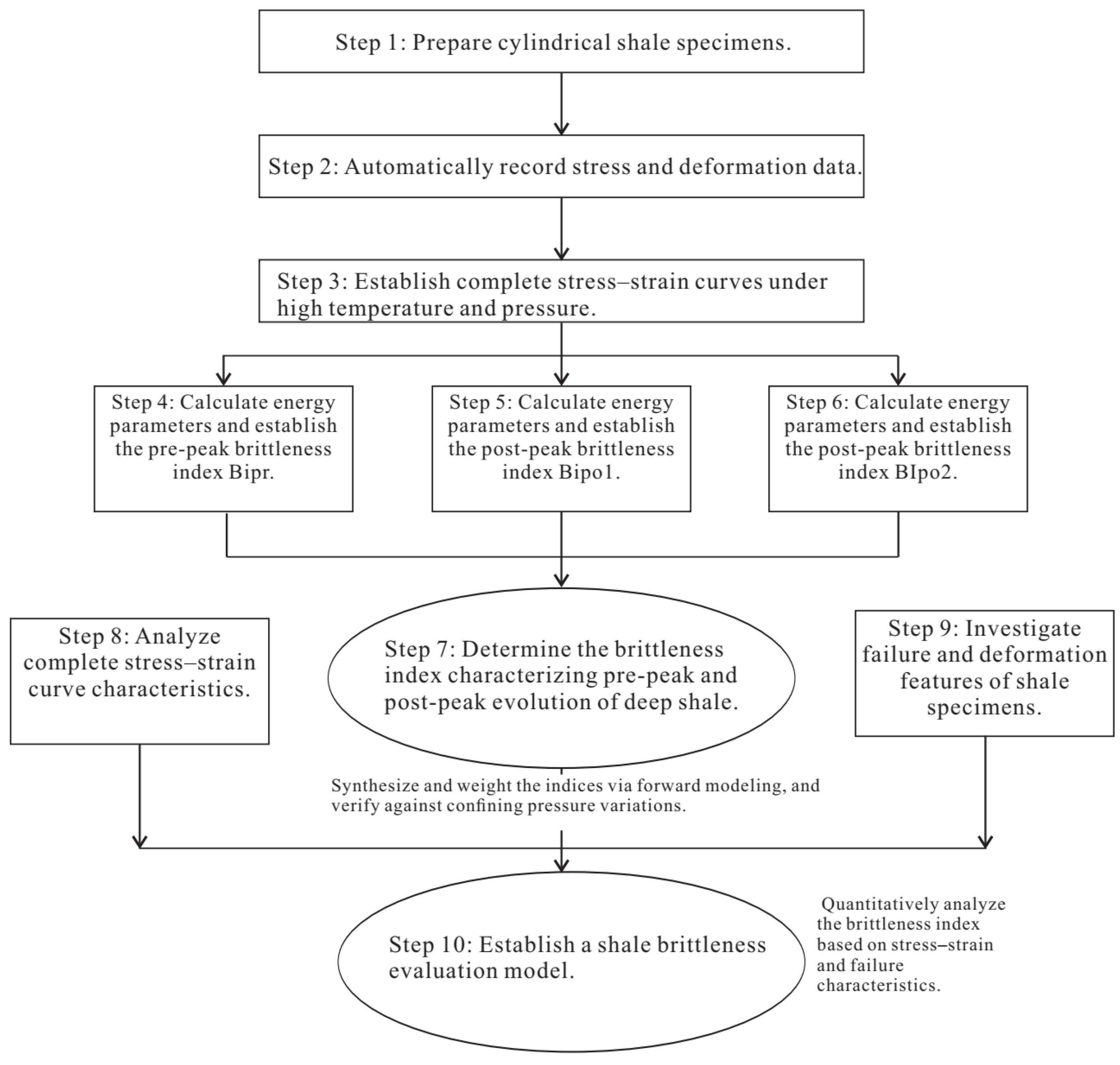
Brittleness Evaluation Method and Brittle–Plastic Transition Law of Deep Shale Based on Energy Evolution

Abstract
1. Introduction
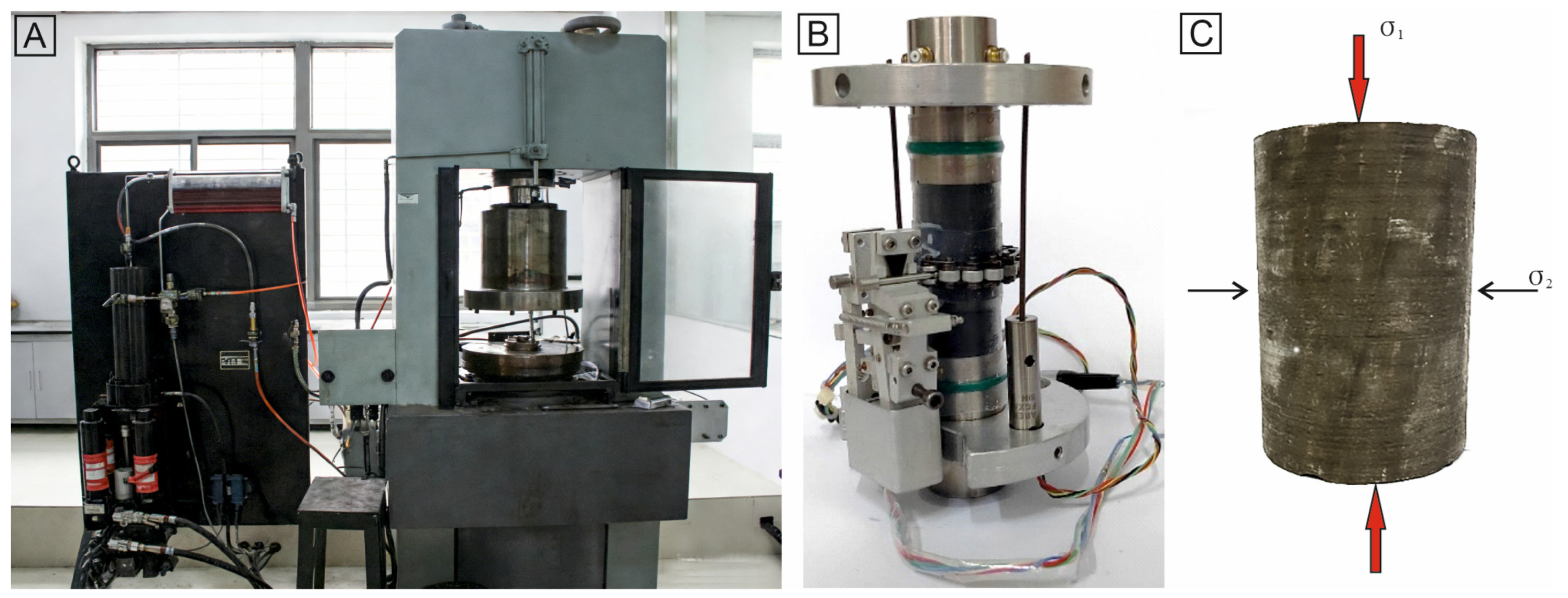
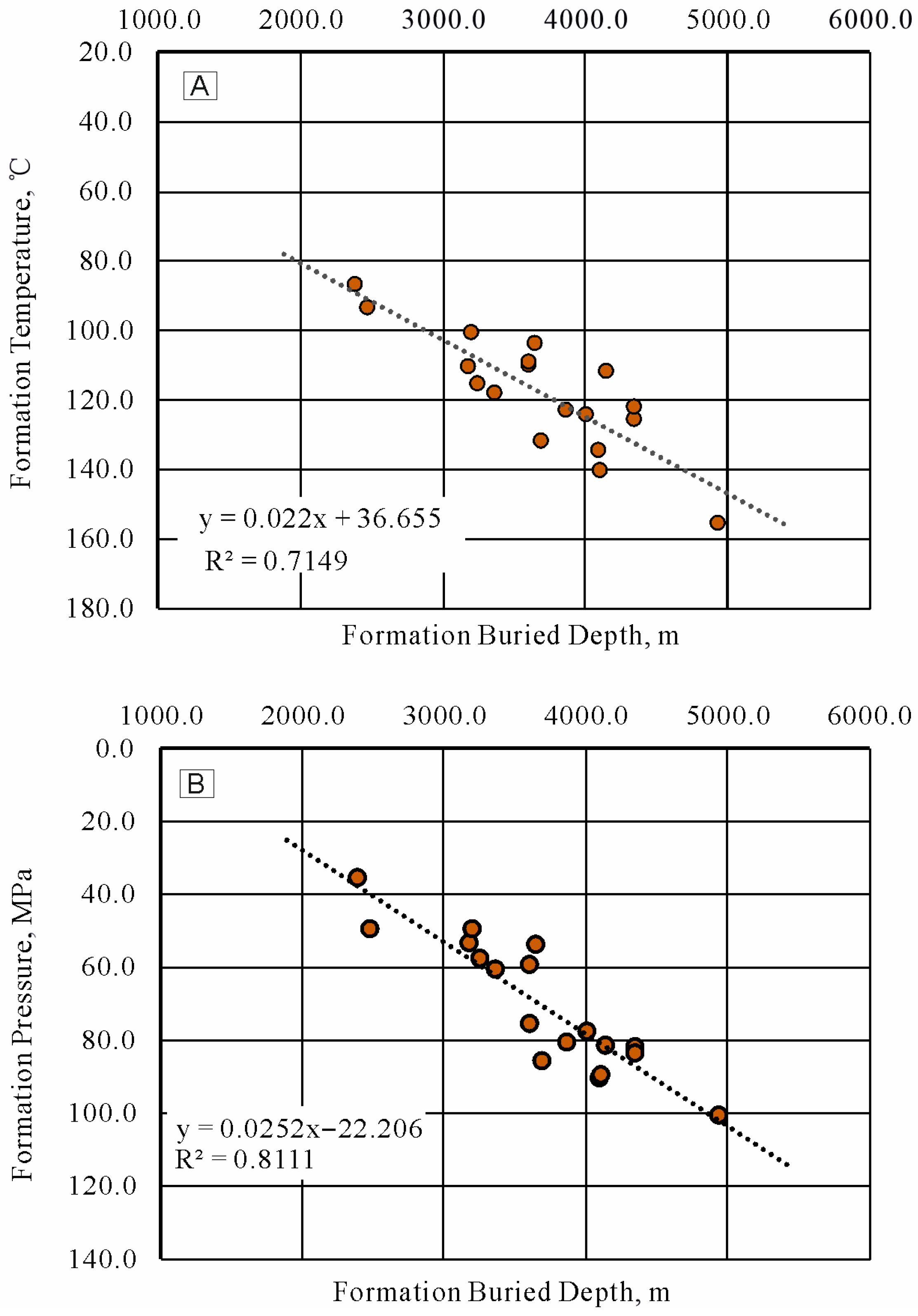
2. Experiment and Process
3. A Brittleness Evaluation Method for Deep Shale Based on Energy Evolution
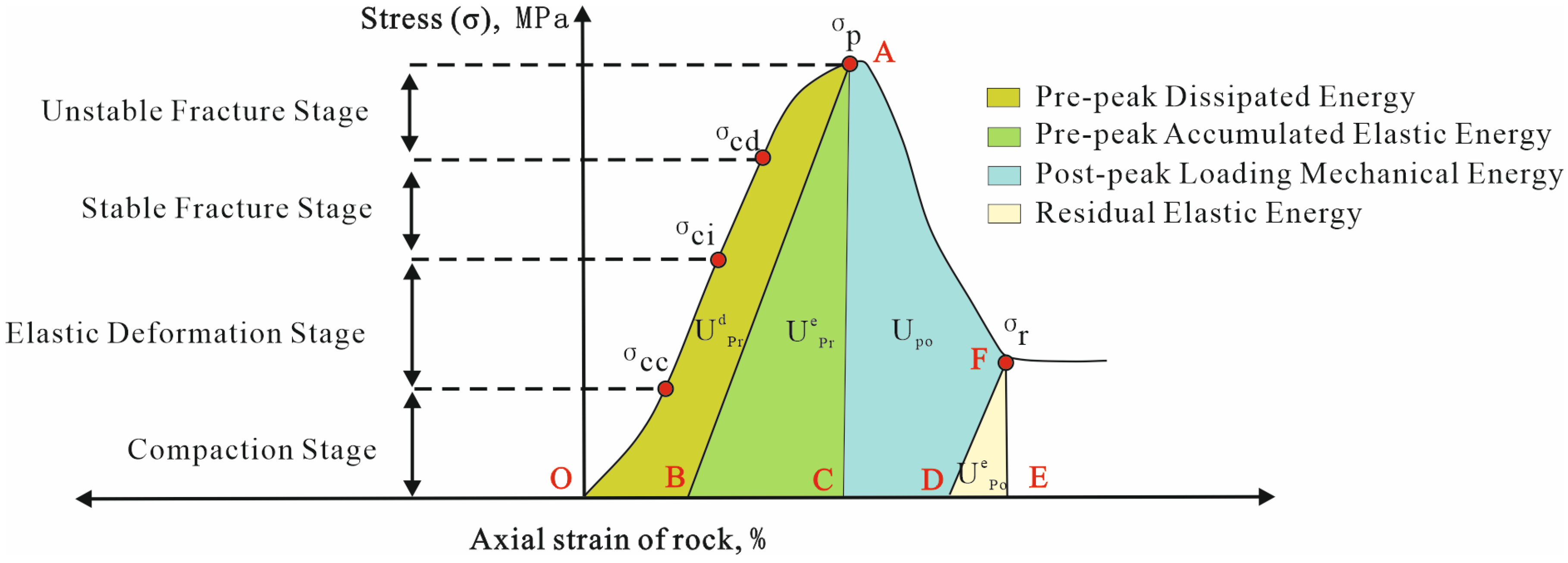
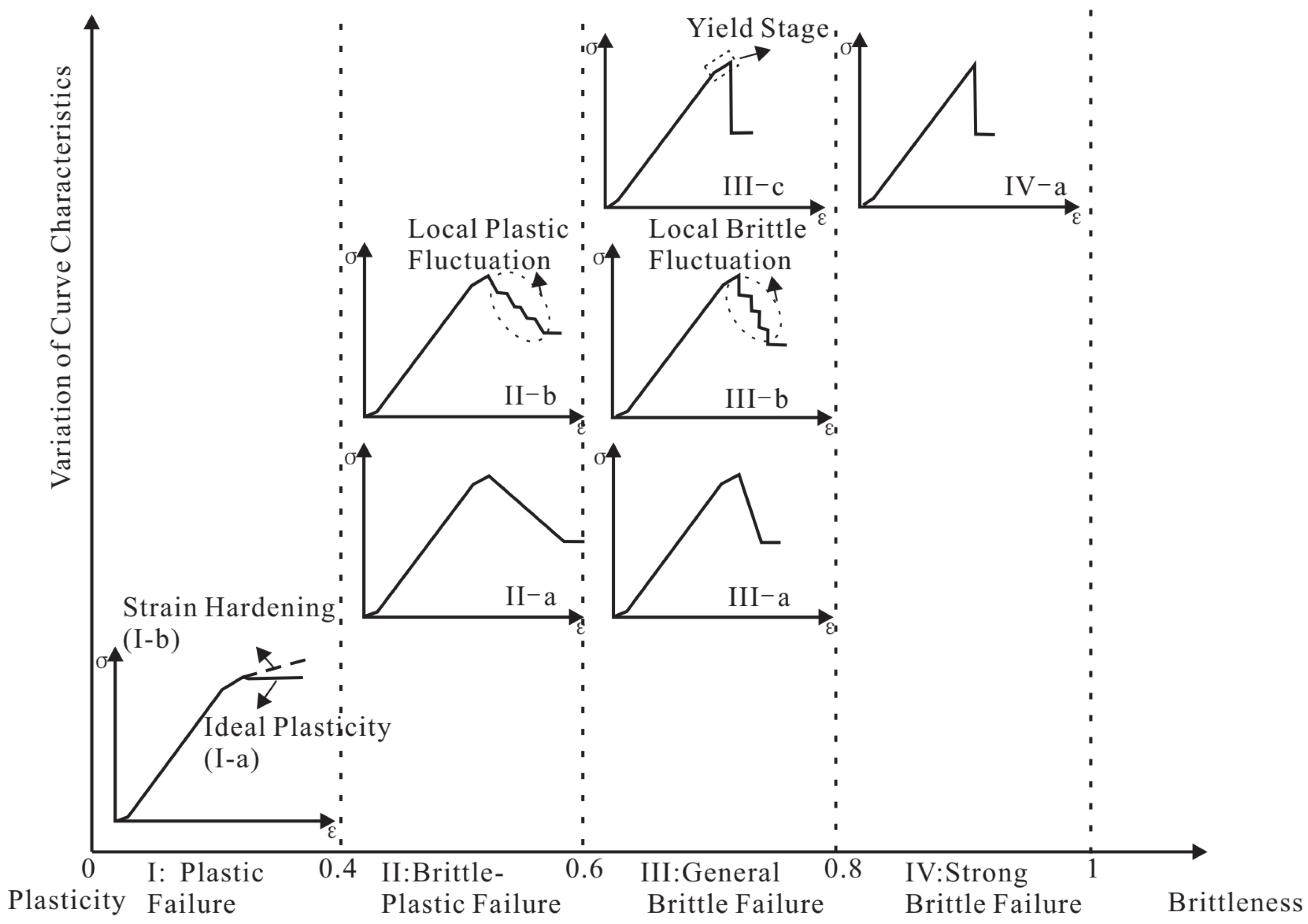
3.1. Division of Failure Stages and Energy Evolution Process in Deep Shale
3.2. To Construct a Brittleness Evaluation Index for Deep Shale
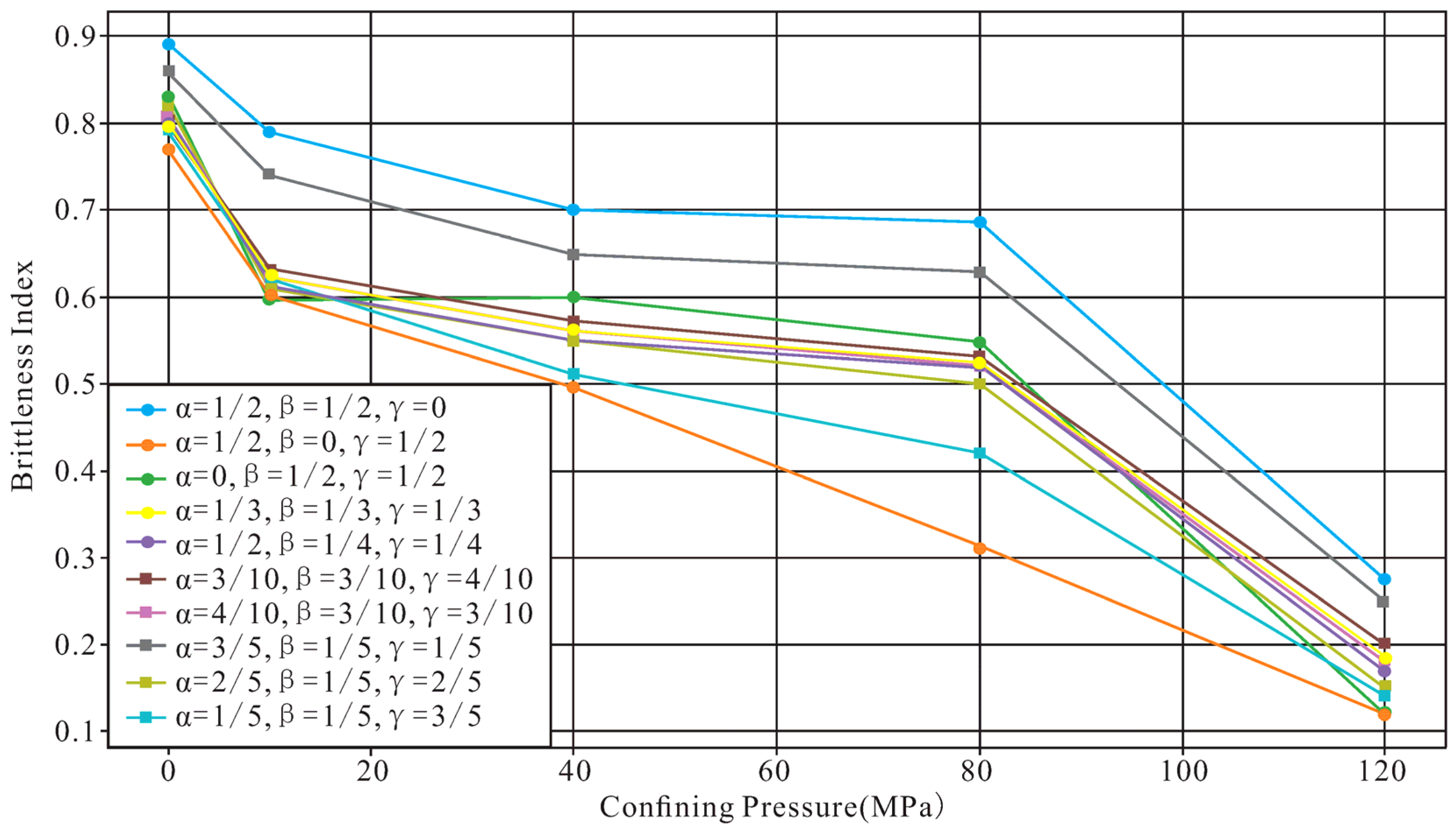
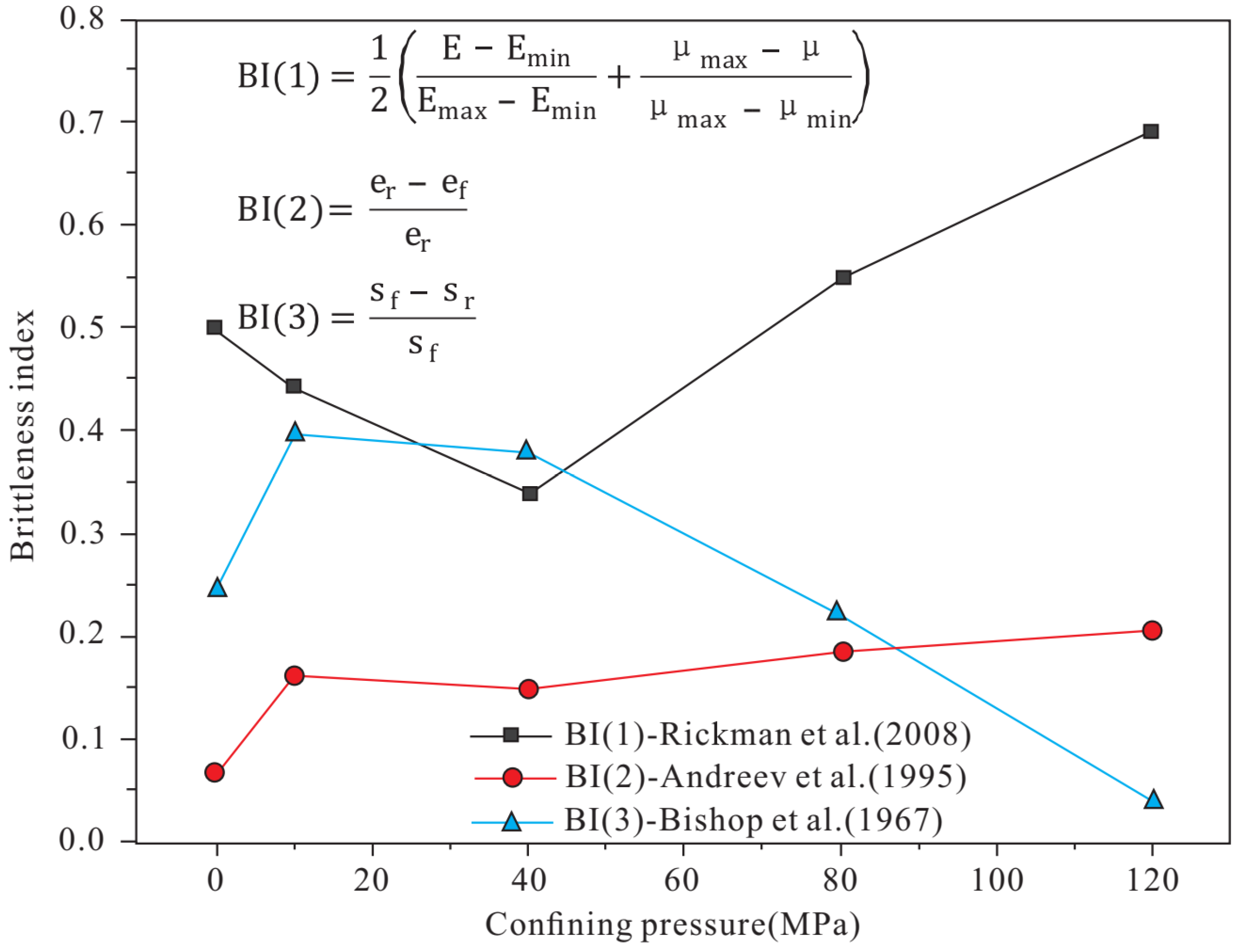
3.3. Verification of Brittleness Evaluation Index
3.4. Establish a Brittleness Evaluation Model for Deep Shale
4. Depth Law on Brittle–Plastic Transition
4.1. Brittle–Plastic Transition Characteristics of Shale Under In Situ and Different Temperature and Pressure Conditions
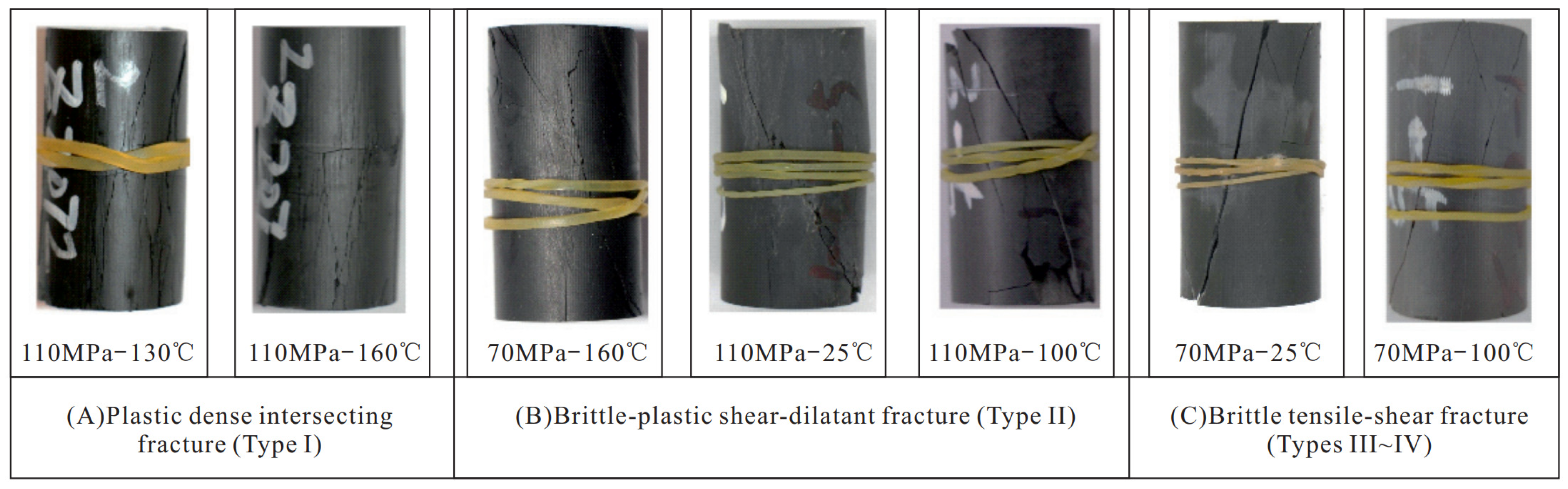
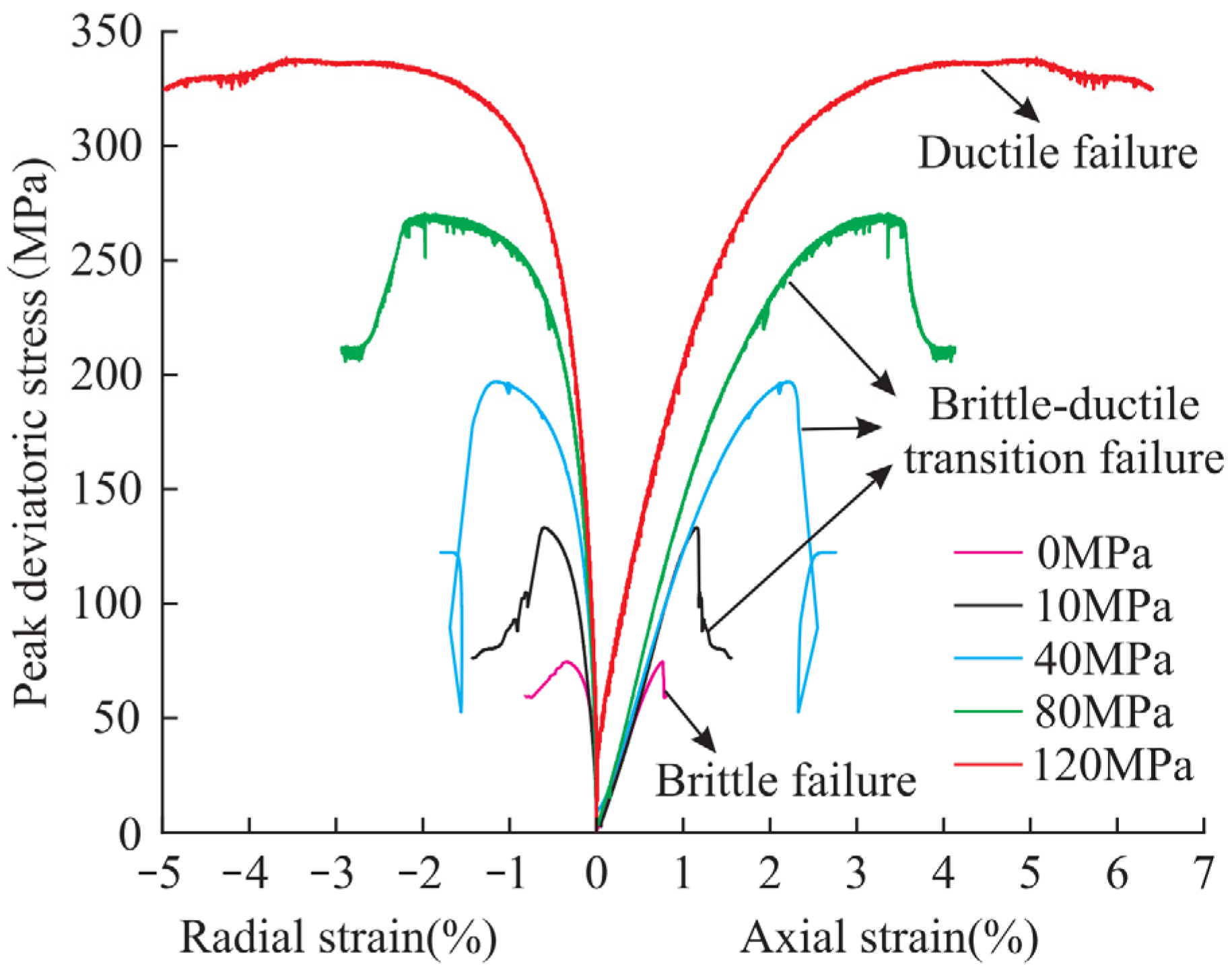
4.1.1. Effects of Confining Pressure on the Brittle–Plastic Deformation Characteristics of Shale
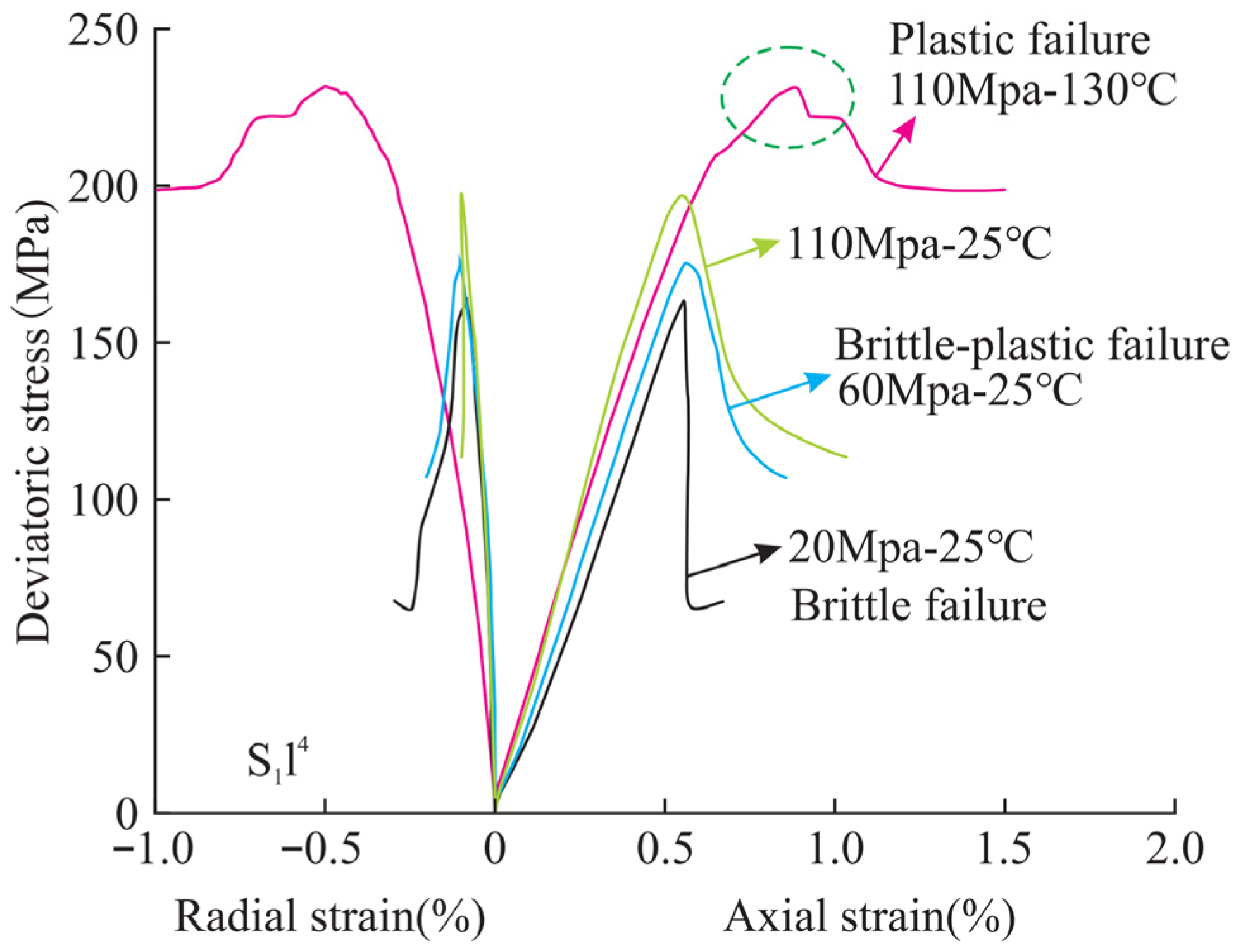
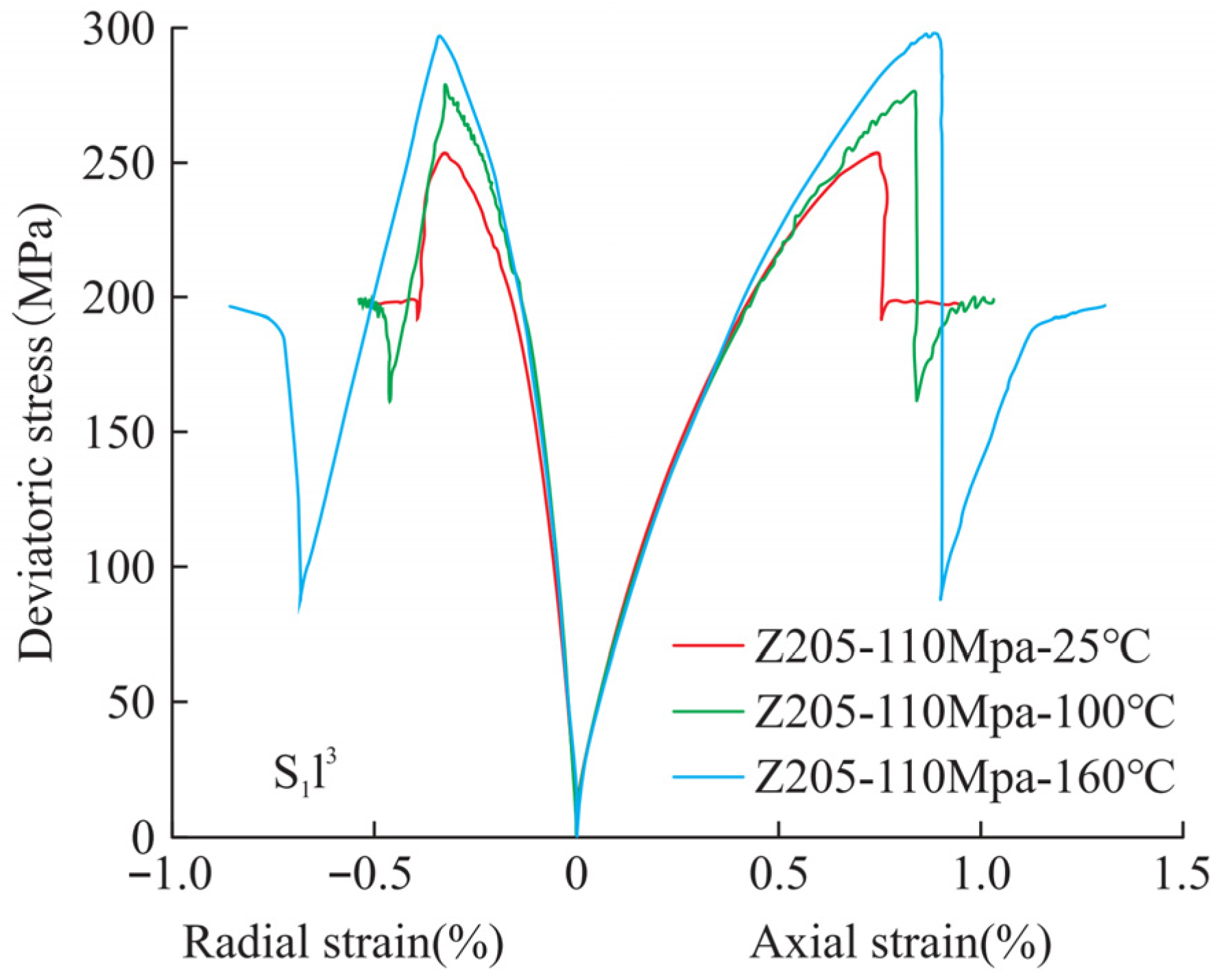
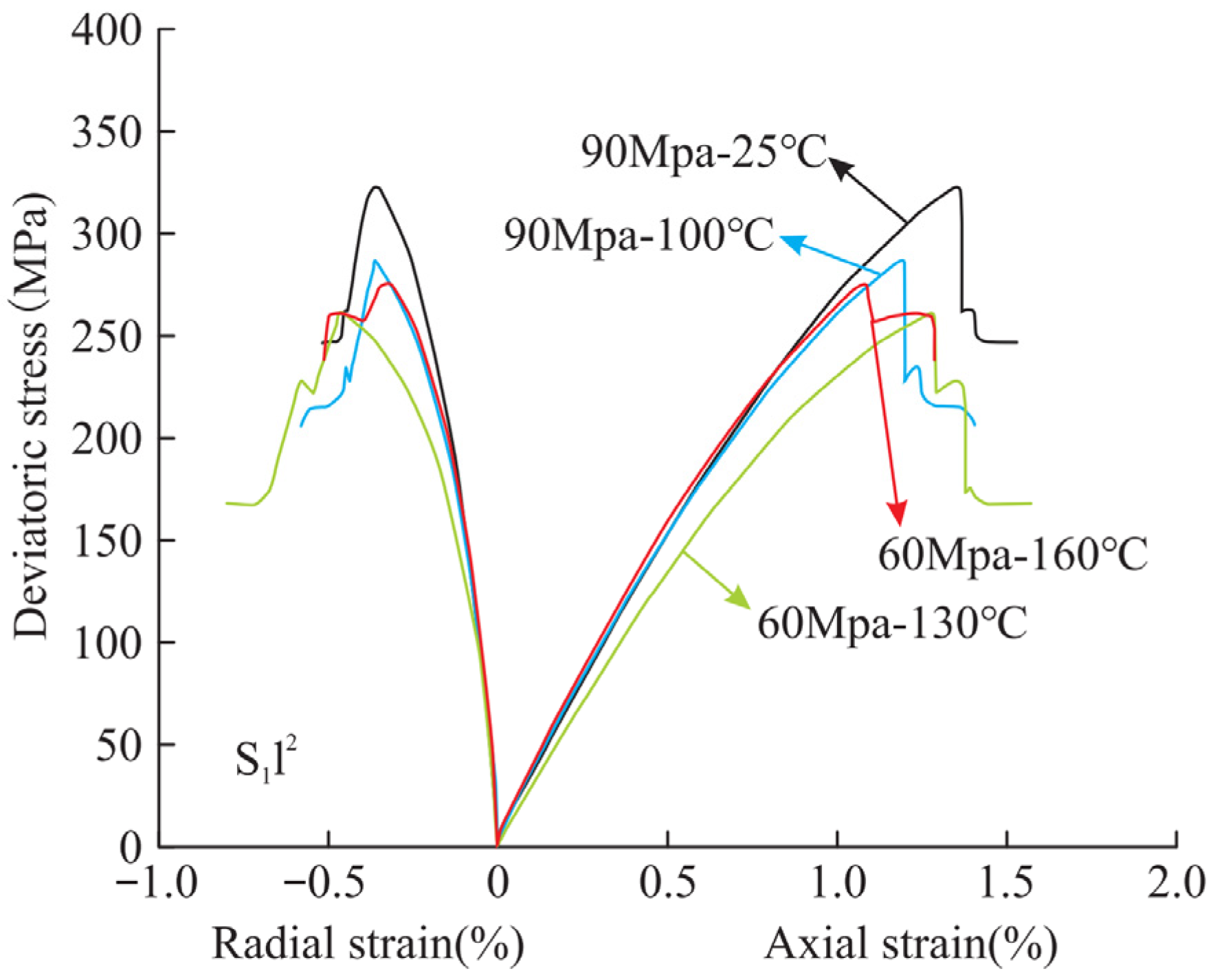
4.1.2. The Influence of Temperature on the Elastic-Plastic Deformation Characteristics of Shale
4.2. Analyzing the Brittle–Plastic Transition Patterns of Various Lithofacies Based on the Shale Brittle–Plastic Evaluation Model
4.2.1. Shale Facies Are Classified Based on Mineral Composition Content
4.2.2. Study on the Laws Governing Brittle–Plastic Transition in Different Shale Facies
5. Conclusions
Author Contributions
Funding
Data Availability Statement
Conflicts of Interest
References
- Tan, T.K.; Kang, W.F. Locked in Stresses, Creep and Dilatancy of Rock and Constitutive Equations. Rock Mech. Rock Eng. 1980, 13, 5–22. [Google Scholar] [CrossRef]
- Paterson, M.S. Experimental Deformation and Faulting in Wombeyan Marble. Geol. Soc. Am. Bull. 1958, 69, 465–476. [Google Scholar] [CrossRef]
- Nygård, R.; Gutierrez, M.; Høeg, K. Brittle–Ductile Transition, Shear Failure and Leakage in Shales and Mudrocks. Mar. Pet. Geol. 2006, 23, 201–222. [Google Scholar] [CrossRef]
- Cheng, G.X.; Jiang, B.; Hou, C.L. Experimental Study on Brittle-to-Ductile Transition Mechanism of Lower Silurian Organic-Rich Shale in South China. Int. J. Rock Mech. Min. Sci. 2023, 170, 105543. [Google Scholar] [CrossRef]
- Petricca, P.; Carminati, E.; Riguzzi, F. Brittle-Ductile Transition Depth versus Convergence Rate in Shallow Crustal Thrust Faults: Considerations on Seismogenic Volume and Impact on Seismicity. Phys. Earth Planet. Inter. 2018, 284, 72–81. [Google Scholar] [CrossRef]
- Chen, J.W.; Li, L.P. Brittle-Ductile Behavior and Caprock Integrity. Energy Procedia 2017, 114, 3132–3139. [Google Scholar] [CrossRef]
- Ren, L.; Jiang, H.; Zhao, J.Z.; Lin, R.; Wang, Z. An Evaluation Method of Rock Brittleness for the Ultra-Deep and High-Temperature Shale Based on Energy Evolution. Chin. J. Undergr. Space Eng. 2023, 19, 148–156. [Google Scholar]
- Sang, F.J.; Cheng, H.L.; Zhang, X.Y.; Yang, G.; Zhao, J.; Fu, C.; Zhang, C. Study on Brittleness Index of Shale Based on Stress-Strain Curve. J. Henan Polytech. Univ. (Nat. Sci.) 2021, 40, 63–70. [Google Scholar] [CrossRef]
- Shu, K.T.; Jia, S.P.; Gao, Y.; Geng, Y.; Ba, J.; Lei, M.; Liu, T.; Xi, Z. An Improved Method to Evaluate Brittleness of Cap Rock Based on Complete Stress-Strain Curve. J. Guangxi Univ. (Nat. Sci. Ed.) 2018, 43, 248–260. [Google Scholar]
- Rickman, R.; Mullen, M.; Peter, E.; Grieser, B.; Kundert, D. A Practical Use of Shale Petrophysics for Stimulation Design Optimization: All Shale Plays Are Not Clones of the Barnett Shale. In Proceedings of the SPE Annual Technical Conference and Exhibition, Denver, CO, USA, 21–24 September 2008; pp. 21–24. [Google Scholar] [CrossRef]
- Bishop, A.W. Progressive Failure—With Special Reference to the Mechanism Causing It. In Proceedings of the Geotechnical Conference, Oslo, Norway, 19–22 September 1967; pp. 142–150. [Google Scholar]
- Hucka, V.; Das, B. Brittleness Determination of Rocks by Different Methods. Int. J. Rock Mech. Min. Sci. Geomech. Abstr. 1974, 11, 389–392. [Google Scholar] [CrossRef]
- Munoz, H.; Taheri, A.; Chanda, E.K. Fracture Energy-Based Brittleness Index Development and Brittleness Quantification by Pre-Peak Strength Parameters in Rock Uniaxial Compression. Rock Mech. Rock Eng. 2016, 49, 4587–4606. [Google Scholar] [CrossRef]
- Hou, Z.K. Research on Hydraulic Fracturing Tests and Mechanism of Crack Extension of Longmaxi Shale. Ph.D. Thesis, Chongqing University, Chongqing, China, 2018. [Google Scholar]
- Tarasov, B.; Potvin, Y. Universal Criteria for Rock Brittleness Estimation under Triaxial Compression. Int. J. Rock Mech. Min. Sci. 2013, 59, 57–69. [Google Scholar] [CrossRef]
- Chen, G.Q.; Wu, J.C.; Jiang, W.Z. An Evaluation Method of Rock Brittleness Based on the Whole Process of Elastic Energy Evolution. Chin. J. Rock Mech. Eng. 2020, 39, 901–911. [Google Scholar] [CrossRef]
- Wen, T. Effects of Rock Mineral Composition on Rock Mechanical Properties. Ph.D. Thesis, Northeast Petroleum University, Daqing, China, 2020. [Google Scholar]
- Wu, T.; Fu, X.F.; Wang, H.X. Brittle-Ductile Deformation Characteristics of Anhydrite-Salt Rock and Quantitative Evaluation of Its Sealing Ability. Geol. Rev. 2016, 62, 127–135. [Google Scholar]
- Goetze, C. High Temperature Rheology of Westerly Granite. J. Geophys. Res. 1971, 76, 1223–1230. [Google Scholar] [CrossRef]
- Yuan, Y.S.; Liu, J.X.; Zhou, Y. Brittle-Ductile Transition Zone of Shale and Its Implications in Shale Gas Exploration. Oil Gas Geol. 2018, 5, 899–906. [Google Scholar] [CrossRef]
- Liu, J.C.; Li, X.; Wu, B.B. True-Triaxial Strength and Failure Characteristics of Sandstone within Brittle-Ductile Domain: An Experimental and Theoretical Study. Eng. Fract. Mech. 2025, 324, 111–135. [Google Scholar] [CrossRef]
- Tao, W.; Tang, H.M.; Wang, Y.K. Brittleness Evaluation Based on the Energy Evolution Throughout the Failure Process of Rocks. J. Pet. Sci. Eng. 2020, 195, 107898. [Google Scholar] [CrossRef]
- Ai, C.; Zhang, J.; Li, Y.W.; Zeng, J.; Yang, X.; Wang, J. Estimation Criteria for Rock Brittleness Based on Energy Analysis during the Rupturing Process. Rock Mech. Rock Eng. 2016, 49, 4681–4698. [Google Scholar] [CrossRef]
- Li, L.C.; Zhai, M.Y.; Zhang, L.Y.; Zhang, Z.L.; Huang, B.; Li, A.S.; Zuo, J.Q.; Zhang, Q.S. Brittleness Evaluation of Glutenite Based on Energy Balance and Damage Evolution. Energies 2019, 12, 3421. [Google Scholar] [CrossRef]
- Mi, X.D.; Zhang, S.; Zhang, X.; Liu, J.; Jin, J.; Cheng, W.; Jiang, W.; Zhang, G.; Chen, Z.; Zoback, M.D. Lithology-Controlled Stress Variations of Longmaxi Shale—Example of an Appraisal Wellbore in the Changning Area. Rock Mech. Bull. 2022, 1, 100002. [Google Scholar] [CrossRef]
- Tan, J.Q.; Shen, B.J.; Wu, H.C.; Wang, Y.H.; Ma, X.Y.; Ma, X.; Liu, W.H. Characteristics of Lamination in Deep Marine Shale and Its Influence on Mechanical Properties: A Case Study on the Wufeng-Longmaxi Formation in Sichuan Basin. Minerals 2024, 14, 1249. [Google Scholar] [CrossRef]
- Ulusay, R. (Ed.) The ISRM Suggested Methods for Rock Characterization, Testing and Monitoring: 2007–2014; Springer: Cham, Switzerland, 2014. [Google Scholar] [CrossRef]
- Qiu, G.Z.; Chang, X.; Li, J.; Guo, Y.T.; Wang, L.; Ma, H.L.; Guo, W.H.; Bi, Z.H. Study on Rock Brittleness Characteristics of Deep Volcanic Reservoir under Different Confining Pressures. J. Pet. Explor. Prod. Technol. 2023, 14, 453–476. [Google Scholar] [CrossRef]
- Zhang, K.; Wang, W.; Cao, Y.J.; Duan, X.L.; Zheng, Z.; Zhu, Q.Z. Experimental Investigations of the Rock Brittleness Evaluation Under Different Loading Conditions. Rock Mech. Rock Eng. 2024, 58, 1473–1502. [Google Scholar] [CrossRef]
- Zhao, G.K.; Guo, Y.T.; Yang, C.H.; Wang, L.; Guo, W.H.; Yang, H.Z.; Wu, X.L.; Liu, H.J. Anisotropic Mechanical Behavior of Ultra-Deep Shale under High In-Situ Stress, a Case Study in the Luzhou Block of the Southern Sichuan Basin, China. Int. J. Rock Mech. Min. Sci. 2023, 170, 105536. [Google Scholar] [CrossRef]
- Guo, Y.; Wang, D.P.; Han, X.Y.; Zhang, K.X.; Shang, X.F.; Zhou, S. Evaluation of Fracturability of Shale Reservoirs in the Longmaxi Formation in Southern Sichuan Basin. Front. Earth Sci. 2022, 10, 993829. [Google Scholar] [CrossRef]
- Andreev, G.E. Brittle Failure of Rock Materials: Test Results and Constitutive Models; A.A. Balkema: Rotterdam, The Netherlands, 1995. [Google Scholar]
- Li, P.Y.; Yu, J.L.; Xie, M.; Lu, D.; Li, G.Q.; Chen, X.; Sun, D.Q.; Deng, Y.H. Lithofacies Identification and Gas-Bearing Potential Evaluation of Shallow Shale Gas in China: A Case Study of the Wufeng-Longmaxi Formations, Northern Guizhou. Minerals 2026, 16, 203. [Google Scholar] [CrossRef]
- Diaz, H.G.; Miller, C.; Lewis, R.; Fuentes, C. Evaluating the Impact of Mineralogy on Reservoir Quality and Completion Quality of Organic Shale Plays. In Proceedings of the AAPG Rocky Mountain Section Meeting, Salt Lake City, UT, USA, 22–24 September 2013. [Google Scholar]
- Zhang, X.; Li, Y.; Wang, H. Experimental Deformation of Shales at Elevated Temperature and Pressure: Pore-Crack System Evolution and Its Effects on Shale Gas Reservoirs. Pet. Sci. 2024, 21, 3754–3773. [Google Scholar] [CrossRef]
- Liu, X.; Li, Y.; Zhang, H. Mechanical Behavior and Constitutive Model of Shale under Real-Time High Temperature and High Stress Conditions. J. Pet. Sci. Eng. 2022, 215, 110689. [Google Scholar] [CrossRef]





| Formula | Formula Meaning or Variable Description | Test Method | Reference |
|---|---|---|---|
| Ratio of brittle mineral content to total mineral content | Mineral composition analysis | R. Rickman et al. [10] | |
| The mean values of elastic modulus and Poisson ratio after normalization | Stress–strain test | R. Rickman et al. [10] | |
| Functional expression regarding the peak intensity τp and the residual strength τr | Stress–strain test | A. W. Bishop [11] | |
| Ratio of recoverable strain εr to the total strain εt | Stress–strain test | V. Hucka and B. Das [12] | |
| Εe for elastic strain, εt total strain | Based on strain parameters (pre-peak + post-peak) | V. Hucka and B. Das [12] | |
| Wue represents elasticity; Wt represents total energy; Wpost represents peak-to-valley energy; Wpeak represents total energy corresponding to peak stress | Based on energy parameters (pre-peak + post-peak) | Munoz et al. [13] | |
| Wpe represents the post-peak releasable elastic energy, while W1 represents the post-peak absorbed energy | Based on energy parameters (post-peak) | Hou Zhenkun et al. [14] | |
| E is the elastic modulus and M is the weakening modulus | Based on modulus parameters (pre-peak + post-peak) | Tarasov et al. [15] | |
| Wepre is the pre-peak elastic energy, Wpre is the pre-peak mechanical energy, Wpe is the post-peak dissipated energy, and Wpd is the post-peak energy required for rock fracture | Based on energy parameters (pre-peak + post-peak) | Chen Guoqing et al. [16] |
Disclaimer/Publisher’s Note: The statements, opinions and data contained in all publications are solely those of the individual author(s) and contributor(s) and not of MDPI and/or the editor(s). MDPI and/or the editor(s) disclaim responsibility for any injury to people or property resulting from any ideas, methods, instructions or products referred to in the content. |
© 2026 by the authors. Licensee MDPI, Basel, Switzerland. This article is an open access article distributed under the terms and conditions of the Creative Commons Attribution (CC BY) license.
Share and Cite
Liu, W.-P.; Liu, C.-L.; Peng, B.; Song, Y.; Huang, Y.-Z.; You, X.-L. Brittleness Evaluation Method and Brittle–Plastic Transition Law of Deep Shale Based on Energy Evolution. Minerals 2026, 16, 291. https://doi.org/10.3390/min16030291
Liu W-P, Liu C-L, Peng B, Song Y, Huang Y-Z, You X-L. Brittleness Evaluation Method and Brittle–Plastic Transition Law of Deep Shale Based on Energy Evolution. Minerals. 2026; 16(3):291. https://doi.org/10.3390/min16030291
Chicago/Turabian StyleLiu, Wen-Ping, Cheng-Lin Liu, Bo Peng, Yi Song, Yong-Zhi Huang, and Xue-Lian You. 2026. "Brittleness Evaluation Method and Brittle–Plastic Transition Law of Deep Shale Based on Energy Evolution" Minerals 16, no. 3: 291. https://doi.org/10.3390/min16030291
APA StyleLiu, W.-P., Liu, C.-L., Peng, B., Song, Y., Huang, Y.-Z., & You, X.-L. (2026). Brittleness Evaluation Method and Brittle–Plastic Transition Law of Deep Shale Based on Energy Evolution. Minerals, 16(3), 291. https://doi.org/10.3390/min16030291