1. Introduction
For many decades, coal has remained a key source of energy in the world, especially in developing countries and resource-rich states. However, the active use of coal is associated not only with greenhouse gas emissions, but also with the release of significant amounts of toxic and radioactive elements into the environment, both at the mining stage and during its combustion at thermal power plants. Coal combustion products, such as ash and slag, can accumulate heavy metals, rare earth elements (REEs), and natural radionuclides, which makes them potentially hazardous to both the environment and human health. Kazakhstan ranks ninth in the world in terms of explored coal reserves. More than 89% of proven coal reserves were found in the central and northern part of the country.
A number of studies indicate that during the combustion process, ash is enriched with elements previously distributed in the coal matrix. Specifically, concentrations of uranium (U), thorium (Th), potassium-40, and lanthanides (Ce, La, Nd, Sm, etc.) in ashes can exceed the levels in the parent fuel by several times [
1,
2,
3]. This is explained by the thermal transformation of the coal structure and changes in the physical state of the elements, which are predominantly accumulated in solid residues.
The study of the elemental composition of coal is not only of geochemical importance, but also has significant environmental implications, as it determines the behavior of elements during combustion and the subsequent disposal of combustion products [
4]. It is known that during organic matrix thermal decomposition, a portion of volatile and toxic elements (Hg, As, Se, Cd, Pb) vaporizes, and another part is concentrated in solid residues (ash and slag), where rare earth elements (Ce, La, Nd, Sm, Yb) and natural radioactive elements (U, Th, K-40) are also accumulated [
5,
6]. As a result, ashes and slag wastes become a potential source of technogenic pollution, and a possible source of processed raw materials for valuable-component extraction. Research [
7] has demonstrated that ash from coal combustion accumulates a wide range of toxic and rare elements, including Cr, Pb, As, Sr, U, Th and rare earth elements (La-Lu). REE concentrations in ash are comparable with low-grade industrial ores, while the toxic elements content requires strict radiation and environmental control during their storage and reuse. The results [
7] correlate with later papers [
6,
8,
9], which confirmed that during coal combustion, heavy metals and rare elements are redistributed and concentrated in flue ash. The most volatile and mobile compounds, such as As, Se, and Hg, can vaporize and lead to the formation of local geochemical anomalies, while elements that are fixed in stable mineral phases (oxides, silicates, phosphates) are characterized by low migration ability and bioavailability. It has been shown that the environmental hazard caused by ashes is determined not only by the concentration of elements, but also by their location: mobile phases pose a risk to soils and waters, while crystalline minerals (e.g., zircon, anatase, rutile, hematite) ensure their geochemical stability [
3]. The totality of these data emphasizes that raw coal should be considered a precursor of technogenic geochemical systems that are capable of concentrating elements with high ecological and technological significance.
Present day studies of coal basins go far beyond assessing fuel and energy potential and are increasingly considered in terms of the geochemical and environmental significance of coals as complex natural systems. Coal is not a homogeneous substance: it is a multiphase geochemical matrix that includes organic and mineral parts, which is capable of accumulating a wide range of toxic, rare, rare earth and radioactive elements. These elements are found in coals in various forms—adsorbed, organically bound, incorporated into crystal lattices of minerals or forming their own mineral phases [
10,
11,
12,
13,
14].
Research on coals’ ultimate composition is of key importance, not only for the purpose of understanding their geochemical origin, but also for assessing their potential hazard during industrial use. During mining and processing, and especially during coal combustion, elements are redistributed and concentrated in combustion products, which can lead to the release of toxic compounds into the atmosphere and hydrosphere. The most ecologically significant elements are As, Se, Hg, Cd, Pb, Cr, Ni and Zn; these are able to participate in biogeochemical cycles, accumulate in bottom sediments and accumulate in organisms [
15,
16].
In recent decades, the role of coals as both a source of energy and a potential raw material for the extraction of valuable and rare elements has been reevaluated [
17]. Research [
6,
18,
19,
20] has shown that the concentrations of some rare earth elements (REE), as well as elements of the critical list—Ga, Ge, V, Mo, U, Th—in some coal strata can reach industrial levels. In ash and slag wastes, their content often exceeds Clarke values by tens of times, which makes such anthropogenic products promising sources of processed mineral raw materials.
Thus, coal and coal processing products are unique natural and technogenic systems with multiple potential impacts. On the one hand, they are sources of potential environmental threat, associated with the migration of toxic and radioactive elements, and on the other hand, they are an important reservoir of rare and strategically important metals that are in demand in modern industry (electronics, catalysis, renewable energy, alloy production). This duality requires an integrated approach that includes geochemical, environmental and resource analyses of the coals.
In global practice, trends associated with the assessment of the deportment and environmental mobility of elements in coal are actively developing. References [
7,
8,
21,
22] have shown that during coal combustion, rare earth and radioactive elements mainly react to form ash, where they are concentrated in stable mineral phases (xenotime, zircon, monazite) with low solubility and bioavailability. This reduces their migration capacity, but at the same time makes such wastes a potential source of industrial REE extraction.
Table 1 summarizes the patterns of element behavior during coal combustion, which have been collected from the literature [
9,
15,
16,
18,
23,
24].
Studies of the geochemical composition of coals and their combustion products are important for assessing the radioecological load of technogenic territories. Coals contain natural radionuclides (NRN)—isotopes of uranium, thorium and potassium (U-238, Th-232, K-40), as well as daughter products (Ra-226, Pb-210), the concentrations of which vary considerably depending on their genesis, degree of coalification and mineralogical composition. According to [
25], the average activity of U and Th in coals of most regions amount to ~20 Bq/kg, but the values may grow by 2–3 times during the formation of coal-bearing strata under conditions of increased uranium or thorium mineralization. Coal combustion results in the concentration of radionuclides in ash and slag, which leads to an increase in their activity by 3–8 times and, in fine flue ash, up to ten times, which determines its potential ecological significance.
Ekibastuz coals are characterized by increased ash content and predominance of the aluminosilicate matrix, which determines the peculiarities of the distribution of natural radionuclides and rare elements. According to [
26], ash of Ekibastuz coals is mainly represented by quartz, kaolinite, muscovite and feldspar minerals, which promotes the accumulation of K-40 and partial retention of Th-232 in its stable silicate phase. At the same time, Ra-226 is primarily bound to the organic matrix and is readily converted to flue ash upon combustion. Given the global interest in rare earth raw materials, as well as the environmental risks associated with the migration of toxic and radioactive elements, research on the elemental composition of coals is an urgent task in the terms of both ecology and resource assessment.
The ash and slag materials that accumulate at TPP landfills are sources of long-term technogenic pollution, since Ra-226 and Pb-210 have long half-lives and are able to migrate into the soil and vegetation cover. In the course of a study focused on an operating coal-steam TPP [
27], it was shown that the concentrations of V, As, Pb and U in flue ash exceeded Clarke values by 4–6 times, and in soils in the zone of influence of ash dumps, by 2–5 times. The absorbed dose rate in the station area (73.4 nGy/h) exceeds the global average background (59 nGy/h), and the annual effective dose for the population is 0.09 mSv/year, which is below the maximum permissible level (1 mSv/year) but indicates the formation of a local radioecological anomaly. The authors evaluated the potential radiation risk for the population living in the zone of coal-steam TPP and ash dumps (town of Temirtau) [
28].
Present day studies [
29] confirm that ash and slag landfills commonly do not create any radiological risks for biota above the screening dose level of 10 µGy/h, but they act as long-term accumulators of Ra-226 and Pb-210, while determining the internal radiation dose for plants (up to 90% of the total dose). The authors emphasize that surface ash layers (0–2 m) are the most informative for ecological assessment, and the concentration ratios (CR) of radionuclide transfer from soil to plants require updates at the regional level, since the use of standard CRs results in the overestimation of risk by 2–4 times. Global NRN values for coals are as follows: ~35 Bq/kg for Ra-226, ~30 Bq/kg for Th-232, and ~400 Bq/kg for K-40 [
30,
31].
Thus, the radioecological risk associated with coal combustion is determined not by the absolute value of U and Th content in the parent fuel, but by their redistribution and concentration in ash and slag products, and by the ability of fine ash to be transported by air. This emphasizes the need for a comprehensive assessment: from the ultimate analysis of coals to the environmental control of ash landfill areas and adjacent zones.
Although a significant number of publications deal with the technological characteristics and combustion processes of Ekibastuz coals, data on the complex elemental composition of coal remains limited. Most previous studies [
28,
32,
33] examined either individual groups of elements without integrating geochemical and radioecological data using a unified approach. Systematic studies based on the combined use of neutron activation analysis and gamma spectrometry for the same coal samples from the Ekibastuz Basin are lacking.
Therefore, this study aims to comprehensively assess the content of toxic elements, rare earth elements, and natural radionuclides in coals from the Bogatyr open-pit mine, analyzing the variability in their concentrations and environmental impacts, including predicting the behavior of elements during coal combustion. This approach allows for a more complete characterization of the geochemical and radioecological properties of Ekibastuz coals and fills the existing gap in research in this region.
Based on the literature data, possible scenarios of element redistribution during coal combustion and their possible accumulation in ash and slag wastes were studied. In order to achieve the research goal, the following tasks were set:
- -
Perform an ultimate analysis of coals, including NRN and REE;
- -
Identify the geochemical associations of the elements;
- -
Assess the potential environmental risks related to toxic elements and radionuclides content in the coals of Bogatyr mine, and study possible scenarios for these elements’ behavior during combustion.
2. Materials and Methods
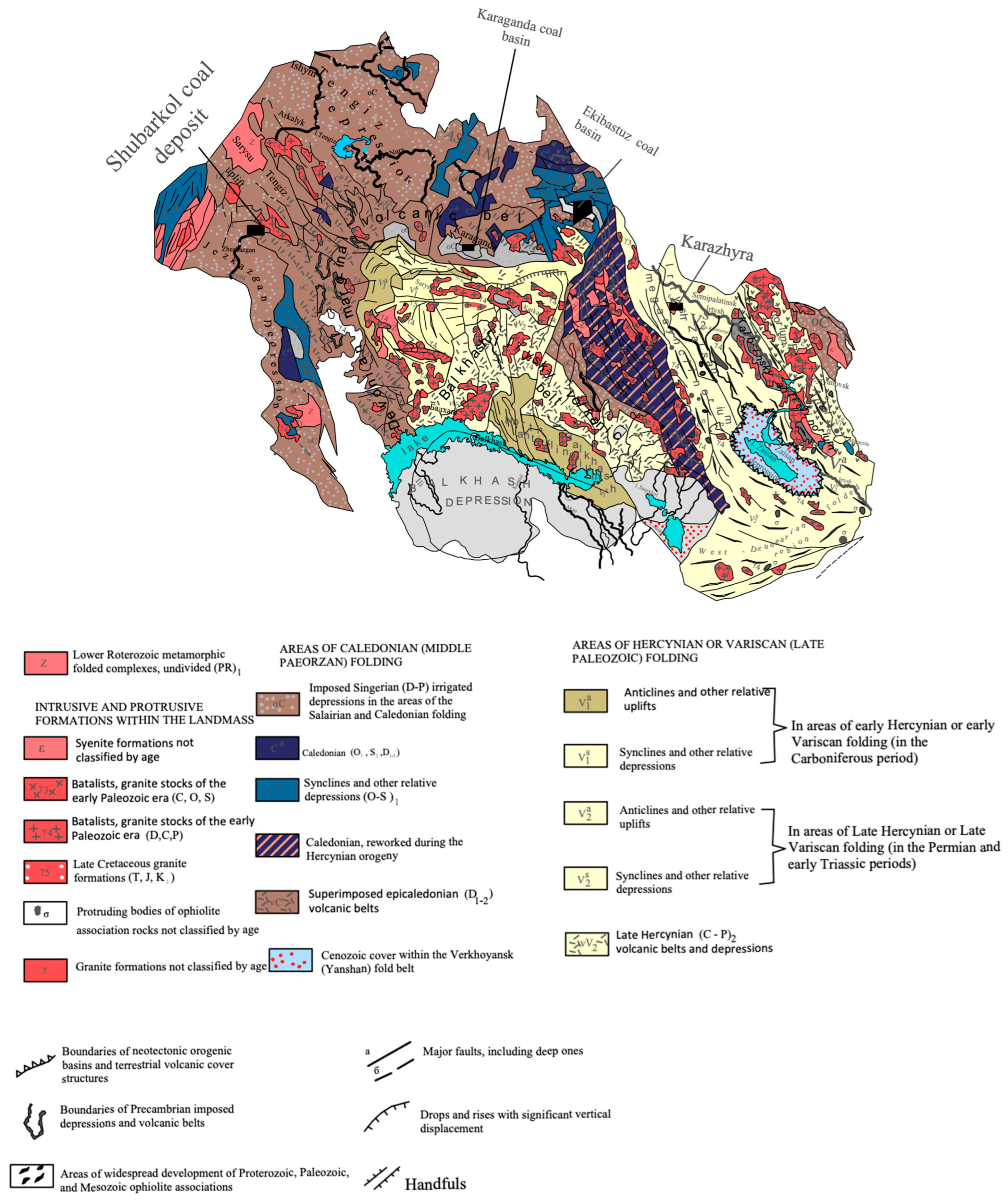
The Ekibastuz coal basin is the largest in the Republic of Kazakhstan and is an asymmetric graben brachysyncline bordered by major faults along its north-eastern and south-western wings. Its length amounts to 12 to 24 km. The 400 to 650 m thick coal-bearing strata includes 9 to 11 seams, among which the upper three seams are of industrial importance. The Bogatyr mine, which has been in operation since 1970, is the largest facility of the basin, with an annual production of about 32 million tons of coal. The commercial reserves amount to about 3 billion tons, which ensures the operation of the field for at least 70 years. Coals are predominantly used in pulverized combustion in thermal power plants. Overburden rocks are represented by the Quaternary loams, sandy loams and Paleogene fine-grained sands, below which the Carboniferous mudstones and sandstones lie, which represent the immediate host rocks of the coal seams. The geologic structure determines the presence of both organically bound and mineral forms of elements in the coals, including siderite, pyrite, clay minerals and heavy accessories (zircon, monazite, xenotime). Ekibastuz coals are known for their ability to accumulate a wide range of impurity elements, including rare earth elements, yttrium, and toxicologically significant elements (As, Se, Pb, Cr, Zn). Some of these can reach concentrations comparable to those of industrial significance. This ensures that the study of the chemical composition of coals in Bogatyr mine has not only geochemical but also ecological significance (
Figure 1) [
20,
34].
The coals are characterized by the stable ultimate composition of the organic mass: C—81%, H—4%, N—1.6%, O—11.6%, S—0.5%–0.8%. According to the process parameters, the coals are high-ash (Ad = 7%–61%), low-moisture (Wr ≈ 10%), and low-sulfur and have low coking efficiency. The combustion value of the Ekibastuz coals varies greatly but, on average, the lower combustion value of as-fired fuel (including moisture) ranges from 9.0 to 18.8 MJ/kg, and for dry ash-free fuel it can reach 25.5–33.5 MJ/kg. This is due to the high moisture content in Ekibastuz coals (17%–40%), but they are low-sulfur, which is an advantage, and their high calorific value makes them popular for power generation. The mineral part is mainly represented by aluminosilicates, which is reflected in the ash composition: SiO
2 (56%–59%), Al
2O
3 (26%–33%), Fe
2O
3 (3%–7%), CaO (1.4%–2.2%), MgO (0.3%–0.8%), TiO
2 (1.4%–1.6%). The ash has a high silica content and significant abrasibility, which is confirmed by the data of heat engineering studies. The ash melting temperatures (1176–1600 °C) indicate its refractory nature. Given the difficult washability of the coals and thin organic matter’s intergrowth with mineral impurities, the Ekibastuz coals are a convenient object for studying the behavior of impurity elements (REE, toxic metals, radionuclides), since their significant share is more likely to be concentrated in the mineral fraction [
20,
34]. The mineralogical composition of Ekibastuz coals according to [
20] is represented by the aluminosilicate matrix (quartz, kaolinite, muscovite), which determines K-40 bonding with silicates and also controls Th-232 retention in its stable phases. The organic portion of coal plays a key role in the sorption of Ra-226.
The present study analyzes 35 coal samples collected at Bogatyr open pit mine (Ekibastuz coal basin). Sampling was carried out across the coal seam within the production horizons, covering various sections of the open pit, allowing for spatial variability in the chemical and radiation composition of the coal. Samples were collected from freshly mined workings, excluding zones of secondary oxidation and man-made contamination. This approach ensures a representative sample of the coal massif is studied and allows for the obtained data to be considered representative of the coals of Bogatyr open pit as a whole.
The NAA method is based on measuring the gamma radiation of the radionuclides produced by nuclear reactions when a sample is activated by a stream of thermal neutrons. The research was performed in accordance with the Measurement Procedure “Determination of Ultimate Composition of Solid Samples by Neutron Activation Analysis” KZ.06.01.00447-2022, dated 29 June 2022 developed and certified by the Institute of Nuclear Physics (MP developed by INP, Almaty, Kazakhstan). The equipment used is as follows: VVR-K nuclear reactor, gamma-spectrometer with a semiconductor detector made of extra-pure grade germanium “Ortec” GEM40P4-83. The spectra were processed using Genie-2000 software. The samples were irradiated at the VVR-K research nuclear reactor in a vertical channel with a thermal neutron flux of 6.6 × 10¹³ n cm−2s−1. The irradiation time amounted to 90 min. After 7 days of irradiation, the induced activity spectra of irradiated samples were recorded to determine the following elements: Na (5), As (0.4), Br (0.3), La (0.1), Sm (0.02), Re (0.03), W (0.6), Au (0.003), and U (0.1). The highest detection limits for the elements in µg/g for the tested batch of coal samples are given in brackets. In 20 days, the induced emission spectra are re-registered to determine the following elements: Ag, Ba, Ce, Ni, Co, Cr, Cs, Eu, Fe, Hf, Hg, Ir, Lu, Nd, Th, Rb, Sb, Sc, Se, Sr, Ta, Tb, Tm, Yb, Zr, Zn. The gamma spectrometer is calibrated by energy and efficiency of gamma radiation registration using model sources of ionizing radiation (MSIR) (Ritwerz JSC, St. Petersburg, Russia). The choice of this method is conditioned by its high sensitivity to rare, rare earth and toxic elements, as well as the absence of an acid decomposition stage, which excludes losses of volatile components (As, Se, Sb). The error in the elements’ determination is 5%–10% for concentrations above 5 mg/kg and up to 15% in the lower range.
The radionuclide composition was determined using the “Activity of Radionuclides in Counting Samples” procedure developed by LSRM JSC and the Aspect NPC CJSC. This procedure is intended for measurements using gamma spectrometers with SpectraLine software. The activity of natural radionuclides was measured by gamma spectrometers with semiconductor detectors made of extra-pure-grade germanium: “CANBERRA” BE 3830; “CANBERRA” BE 3830; “Ortec” GMX-20180-S serial No. 41-N31520B. The gamma spectrometers were energy-calibrated using a set of model sources of ionizing radiation (MSIR) for 241Am, 137Cs, and 60Co. The gamma spectrometers were calibrated by gamma radiation registration efficiency using IAEA volumetric standard radionuclide composition samples RGU-1, RGTh-1, IAEA 375, IAEA 444, OREAS 121. Measurement containers with the samples were placed on the window of the semiconductor detectors. The spectra were recorded within 12 h. The activity of 238U was determined by the intensity of the γ-radiation of its daughter product 234Th (63 keV); the activity of 226Ra was determined by the intensity of the γ-radiation of 186.2 keV, taking into account (by deducting) the interference of the radionuclide 235U (185.7 keV). 228Ra and 232Th were determined by the intensity of the γ-radiation of their daughter product 228Ac (911.2 keV); 228Th was determined as an average by the activities of its daughter products 224Ra, 212Pb, 212Bi, and 208Tl. Gamma spectrometry allows for Ra-226, Th-232 and K-40 to be determined in their natural form without destroying the sample. The method ensures a precision of 5 to 18%.
Neutron activation analysis and gamma spectrometry were performed on the same coal samples. Using an identical set of samples ensured an accurate comparison of the data obtained by different analytical methods. A neutron activation analysis allowed for the concentrations of a wide range of toxic and rare earth elements to be determined while gamma spectrometry was used to quantify naturally occurring radionuclides (Ra
226, Th
232, K
40). This combined approach increases the accuracy of the results and meets the international requirements for the environmental geochemistry of coals [
6,
36].
To assess the accuracy of the obtained analytical data and the degree of variation in element concentrations, mean values, standard deviation (SD) and the coefficient of variation (CV, %) were calculated.
where x
i is the individual values of element concentration,
is the average value, and n is the number of samples.
The coefficient of variation is calculated as follows:
The most common criterion of coal waste radioactivity used to assess the possibility of its utilization is determined by the value of the effective specific activity of radionuclides
were A
Ra, A
Th, and A
K are the activities of radium, thorium and K
40 in Bq/kg [
37,
38].
The assessment of a potential radiation risk for the population living in the zone of coal-steam TPP and ash landfills is based on the calculation of gamma dose rate based on the measured natural activity of the above radionuclides [
37,
39].
The permissible level of exposure of the population is 370 Bq/kg, which creates an annual dose for the population of about 1.5 mSv/year [
37].
The enrichment factor of an element in coal K
s was calculated as the ratio of its content to its Clarke value:
where C
coal is the average concentration of the element in the coal being researched (mg/kg), C
clarke is the Clarke content of the element in coal worldwide. In this paper, “Clarke values for coal” refer to the published average background contents of elements in coal [
23,
24].
3. Results
In the course of this research, 35 coal samples from Bogatyr mine were analyzed and the concentrations of rare earth, toxic, valuable, and natural radioactive elements were determined. The ultimate analysis, performed using the NAA method, allowed for the concentrations of 30 chemical elements to be determined. Their mean concentrations, standard deviations and coefficient of variation (CV) values are presented in
Table 2.
The obtained results suggest that the most pronounced enrichment (K
s) is characteristic of Cr (~5.8) and Zr (~2.1). Increased values relative to the Clarke are noted for Br (~2.0), Hf (~1.8) and Sc (~1.7), while moderate enrichment is shown by Ba and Mo (~1.3), Yb (~1.3), Eu and Tb (~1.2), Zn (~1.1), with Lu (~1.0) and Na (~0.98) at the Clarke level. The greatest variability (CV > 50%) is characteristic of elements with “spikes” in individual samples—primarily Zn and Ba—which reflects local impurities and the mineralogical and textural heterogeneity of coal [
7,
8]. Moderate CV values (20%–50%) for Cr, Na/K, Zr–Hf, and Sc indicate the influence of lithological heterogeneity and variations in the proportion of mineral admixture. Most REEs (La–Lu) exhibit moderate CV, consistent with their relatively stable mineral hosts (clay minerals, phosphates, accessory phases) and lower sensitivity to local anomalies. The low CV of Br reflects a more uniform background and a relatively stable input mechanism.
In References [
6,
18,
23,
24], the authors highlighted some patterns. Cr (K
s = 5.8) is characterized by the most pronounced enrichment. Along with Cr, the studied samples also showed elevated levels of typical indicators of mineral (terrigenous) impurities—Zr (K
s = 2.1), Hf (K
s = 1.8), and Sc (K
s = 1.7), indicating a significant role of the mineral component in the formation of elevated Cr concentrations. Thus, based on the available data, it is most likely that the elevated Cr contents are primarily formed by terrigenous mineral impurities. Lithophylic elements (Zr, Hf) form a stable correlation pair that is typical for zircon. Their joint enrichment (enrichment coefficients K
s > 1) serves as a reliable indicator of terrigenous admixture—the incorporation of siltstone–psammitic material from the weathering zones of continental rocks. The additional confirmation of mineral (terrigenous) control is the elevated Sc content (K
s = 1.7; CV ≈ 36.1%), which usually reflects the contribution of the aluminosilicate (clay) component. Barium and strontium are often concomitant, but the studied coals show elevated Ba with Sr levels close to the Clarke values. This ratio may indicate that the Ba source is associated primarily with individual mineral carriers (possibly barite) or sorption on a clay matrix. The high CV of Ba is additionally consistent with the local contribution of individual mineral interlayer phases. The geochemical specialization of Ba and Zn, and possibly Sb, is consistent with the presence of the nearby Atasu (Ba-Pb-Zn) deposit [
33].
The total rare earth element (REE) content in the studied coals is generally close to the Clarke level; however, the distribution across the REE series is non-uniform. The light lanthanides (LREE) are typically below the Clarke—La (K
s = 0.81), Ce (K
s = 0.89), and Nd (K
s = 0.8)—while some heavy REEs and Eu show slight to moderate excesses: Eu (K
s = 1.23), Tb (K
s = 1.16), and Yb (K
s = 1.3), with Lu at the Clarke level (K
s = 0.99). Moderate values of the variation coefficients for most REEs (typically 25%–40%) indicate the relatively stable mineral control of their content and lower sensitivity to local “spikes” compared to elements associated with sulfide impurities. This type of distribution (moderate HREE slope with reduced LREE) is consistent with the contribution of the terrigenous mineral component and the possible participation of stable accessory REE carriers (phosphates and heavy fraction) [
18,
21].
Uranium and thorium in the studied coals do not exhibit enrichment relative to the Clarke. The moderate variability in U and Th across samples indicates the dependence of their content on the proportion of mineral constituents and the lithological heterogeneity of the coal-bearing strata.
The patterns obtained are important for predicting the elements’ behavior during combustion. During combustion, elements are distributed between the gas phase, fly ash, and solid ash. Detrital lithophile elements (Zr, Hf, REE, Sc, and a significant proportion of Cr), characterized by their low volatility, are predominantly transferred to the solid residue and concentrated in ash and slag. The expected increase in concentration from coal to ash is determined by the ash content and, as a first approximation, can be estimated by mass balance at an ash content of 7.39%–61.2%, which corresponds to approximately 1.6–13.5 times. Elements such as Mo and Zn can be redistributed in favor of fine fly ash and, to some extent, in the gas–aerosol phase. However, a significant proportion is retained in the solid residue, so their environmental significance is manifested both through fine ash dusting and through potential migration during leaching in ash dumps. The most volatile toxic elements (As, Se, Sb) in the studied coals have lower concentrations relative to the Clarke, indicating the relatively low potential contribution of these elements. The final environmental impact is also determined by the combustion conditions, gas cleaning efficiency, and ash and slag waste disposal.
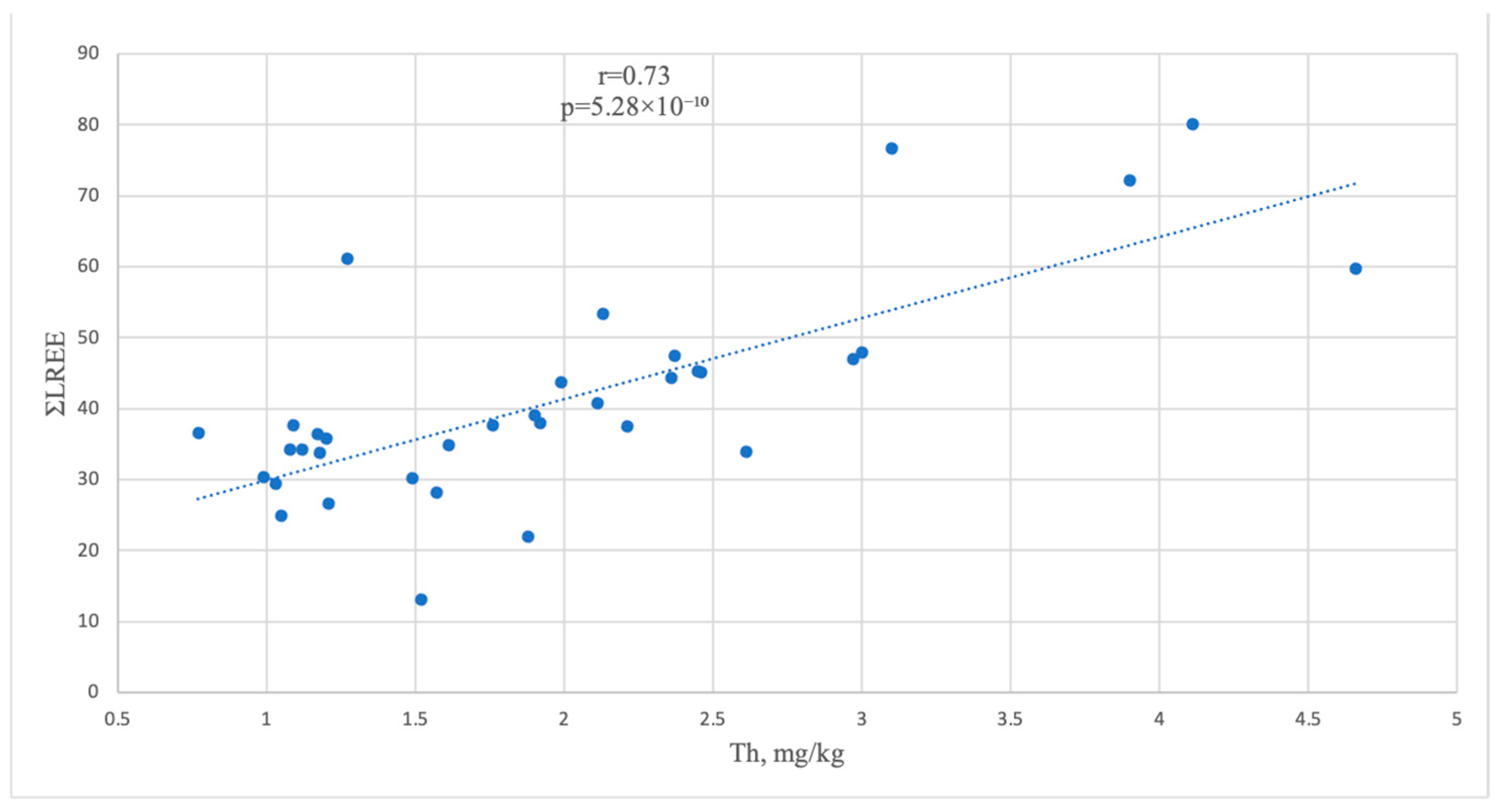
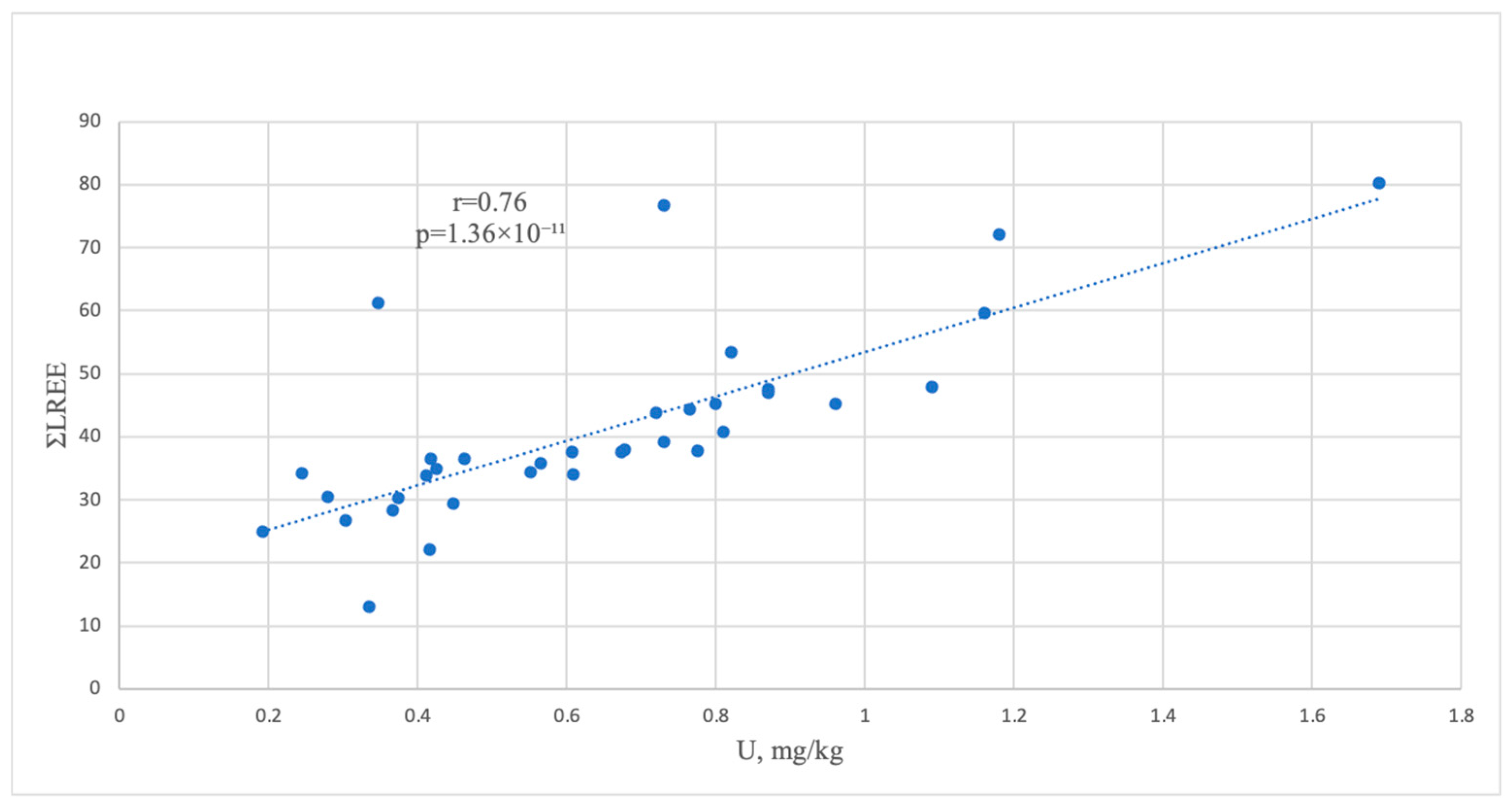
Correlation analysis showed that uranium and thorium concentrations are statistically significantly related to the sum of light REEs (La + Ce + Nd + Sm). The correlation coefficient between U and ΣLREE amounts to r = 0.76 (
p = 1.36 × 10
−11), and between Th and ΣLREE r = 0.73 (
p = 5.28 × 10
−10) (
Figure 2 and
Figure 3), The relationship between U and ΣLREE is consistent with a common geochemical factor and mineral dependence. A probable mechanism may be U retention by the mineral phase (accessory component) and possible sorption on mineral surfaces. The positive relationship between Th and ΣLREE indicates a common mineral control and co-accumulation in the terrigenous mineral fraction (clay matrix and phosphate-accessory LREE carriers). This correlation is consistent with the association of LREE-bearing mineral phases (phosphate minerals) and the contribution of terrigenous admixture. Principal component analysis confirmed the presence of a dominant geochemical factor: the first component (PC1) explains 85.6% of the total variation and has close loads for all variables (0.589 for U, 0.583 for Th, and 0.560 for ΣLREE). These results indicate a joint mechanism of uranium, thorium, and light REE accumulation in coals, mainly related to the mineralogical and geochemical features of the sedimentation environment.
Gamma spectrometry was used to identify the activities of radionuclides
226Ra,
232Th, and
40K, and estimated indicators of radioecological hazard: total activity (Ra + Th), Th/Ra and K/Th ratios, effective activity (Aeff) and absorbed dose rate (D). The values obtained are presented in
Table 3.
According to gamma spectrometric analysis data, the activity of natural radionuclides in the Bogatyr mine coals varies in relatively narrow ranges. The calculated total indices (effective activity, total Ra + Th activity and absorbed dose rate D) also remain at a low level. Dose rate D in the coal does not exceed ≈22 nGy/h. However, previous studies have shown that the absorbed dose rate, as a potential radioecological risk for the population in the area of ash landfills, amounts to 176 nGy/h, which creates an annual radiation dose of 1.6 mSv. These data show that radioactive elements more intensively accumulate in ash, and huge areas of ash landfills at TPPs turn into quasi-technogenic deposits of natural radioactive elements and various microtoxic elements [
28].
During combustion, these radionuclides do not practically transfer to the gas phase: K-40 is partially concentrated in fine ash, Ra-226 is more often registered in slags, and Th-232 remains completely in solid residues and accumulates in the oxidized mineral part of ash. Therefore, radionuclides retain low volatility, while mainly redistributing into ash and slag waste, but their concentrations remain significantly below the standard values and do not represent a significant radiation risk. The obtained coefficients of variation (CV) show that radionuclides are distributed unevenly, which is typical for mines with different ash contents, impurities of clayey and carbonate rocks, and differences in mineral carriers.
The mineralogical and ultimate composition of the Ekibastuz coals is a key factor determining the levels of natural radionuclides. According to [
40,
41], the main carriers of K-40 in brown and hard coals are aluminosilicate compounds—clay minerals, feldspars and finely dispersed aluminosilicate matrices. Therefore, coals with a higher proportion of Al
2O
3-SiO
2 are inevitably characterized by higher K-40 values. Ra-226 is partially fixed by organic matrix and carbonates, which can isomorphically substitute Ca. Th-232 binds almost completely to heavy minerals, such as zircon, monazite, and xenotime. The thorium content in the studied coals is low; it can be related to the low content of heavy minerals. Thus, the aluminosilicate component of the Ekibastuz coal and mineral phases of ash controls the distribution of natural radionuclides: K is a part of the silicates, Ra is partially fixed by organics and carbonates, and Th is partially fixed by heavy minerals.
The mineral part of the Bogatyr mine coals, reflected by the ash content (7.4%–61.2%), plays a key role in the formation of both the ultimate composition and radioactivity of coal. According to [
26], for the Ekibastuz coals, the high ash content is conditioned by the predominance of aluminosilicate minerals (illite, kaolinite, quartz, feldspars), and by the presence of accessory phases—zircon, monazite and xenotime—which are the main carriers of Th, REE, Zr and Hf. This explains the moderate to high concentrations of lithophylic elements (Zr, Hf, Sc) detected by this research, and the narrow range of variation in natural radionuclides (Ra, Th, K).
The ash content could be an indirect indicator of the potential radioactivity of the coals. These results are in agreement with the data of earlier research noting the accumulation of radionuclides in the ash component of the coal [
42,
43,
44]. We proposed innovative approaches to instrumental sampling based on the measurement of the spectrometry of natural gamma radiation of the coals, which allow for the sensitivity of the coals’ ash content determination to be increased under conditions of their variability [
45,
46].
The correlation analysis showed a weak and moderate positive dependence of radionuclide activity on the ash content of the Ekibastuz coals (r = 0.28–0.41). This reflects the mineral nature of the distribution of Ra-226, Th-232 and K-40: the growth of the ash content is accompanied by an increase in the content of aluminosilicates, carbonates and stable rare earth minerals, which are the main carriers of natural radionuclides. The most pronounced relationship is characteristic of K-40 (r ≈ 0.41), which is consistent with its accumulation in the clay–aluminosilicate fraction. For Ra-226 and Th-232, the dependencies are weaker, which is due to their different degrees of fixation by the organic and mineral matrix.
In general, the behavior of elements during combustion is determined by their mineral and organic association: lithophile and radionuclides are concentrated in solid ash and slag products, while volatile elements can form aerosol fractions. This must be taken into account when assessing the environmental risk of combustion at thermal power plants and when considering the possible use of ash as a source of rare earth elements. Despite the low concentrations of natural radionuclides, toxic and rare elements remain environmentally significant. During coal combustion, Cr and Zn can transform into more mobile forms, and Mo is partially volatile and can accumulate in the fine ash fraction, while Ba is less mobile and concentrates in heavy residues.
The calculated Cash values (mg/kg ash) show that during coal combustion, the elements of the refractory lithophile group are concentrated in the ash residue and reflect the mineral (terrigenous) component determining the ash composition. The highest Cash values were obtained for Zr–Hf–Sc (Zr up to ~1042 mg/kg; Hf up to ~31 mg/kg; Sc up to ~72.8 mg/kg) and accompanying ΣLREE–Th–U (ΣLREE up to ~508 mg/kg; Th up to ~23.8 mg/kg; U up to ~9.1 mg/kg), which indicates a dominant mineral (terrigenous) control and allows for the contribution of U sorption fixation in the mineral matrix, consistent with the identified U–ΣLREE and Th–ΣLREE correlations. Locally high Cash values for Zn and Mo (Zn up to ~518 mg/kg; Mo up to ~27.6 mg/kg) are noted, making them priority elements for the environmental control of ash and slag waste, given their potential redistribution into fine fly ash and their potential migratory availability in aquatic environments. Thus, the key potential impact pathways for most of the beneficiated components are fly ash and secondary runoff from the surface of ash dumps.
Natural radionuclides (Ra-226, Th-232, K-40) are also predominantly accumulated in ash, but their levels in the studied coals are low and do not exceed international standards.
Both methodologies show consistency in the following aspect: low levels of U and Th for neutron activation analysis, Th = 1.98 mg/kg, and U = 0.65 mg/kg (which is below the Clarke). Gamma spectrometry also confirmed low activities. The presence of a terrigenous contribution—Zr, Hf, Sc, Cr, determine using the NAA method—and the elevated K-40 observed during the gamma analysis jointly indicate a significant share of the aluminosilicate and zircon fraction. There was no anthropogenic mineralization of the uranium series. Th/Ra ratio ≈ 1 confirms the natural background.