Geochronology and Geochemistry of the Wulanwuzhuer Intermediate–Felsic Intrusion from Qimantag Area, East Kunlun Mountains: Implications for Regional Tectonic Evolution

 ,
, 
Abstract
1. Introduction
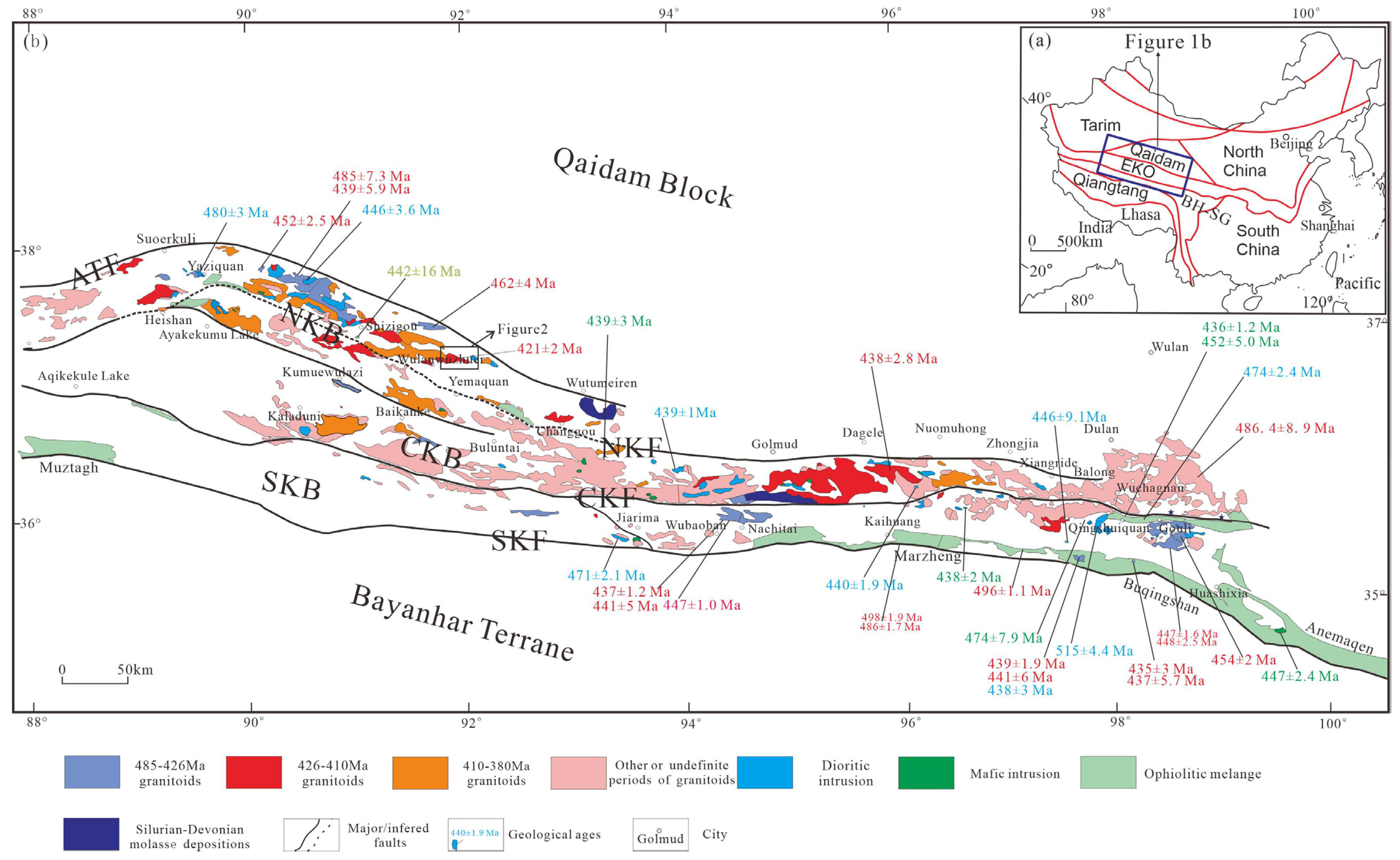
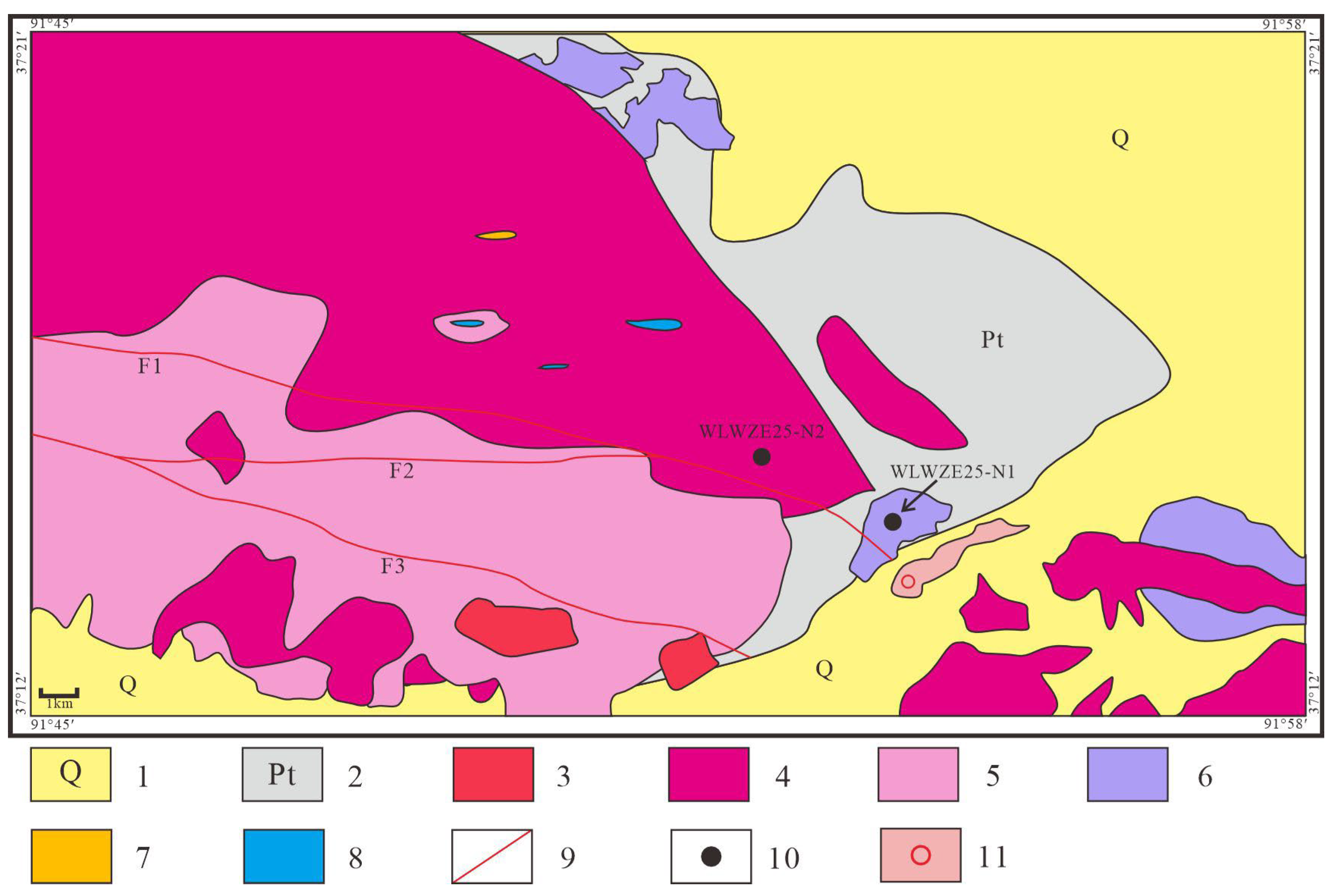
2. Geological Setting and Sample Characteristics

3. Analytical Methods
3.1. Zircon U-Pb Geochronology
3.2. Whole-Rock Geochemistry
4. Results
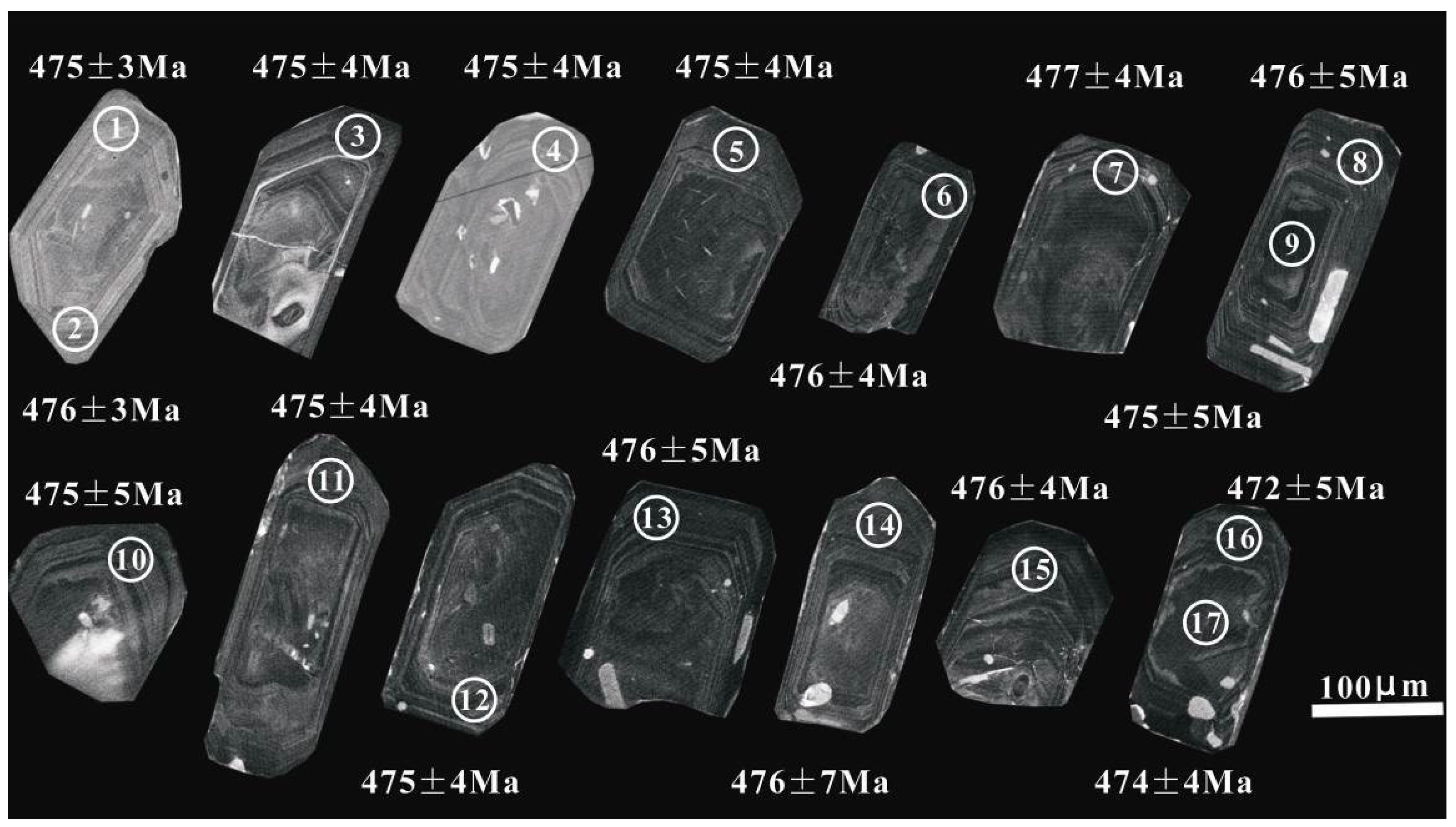
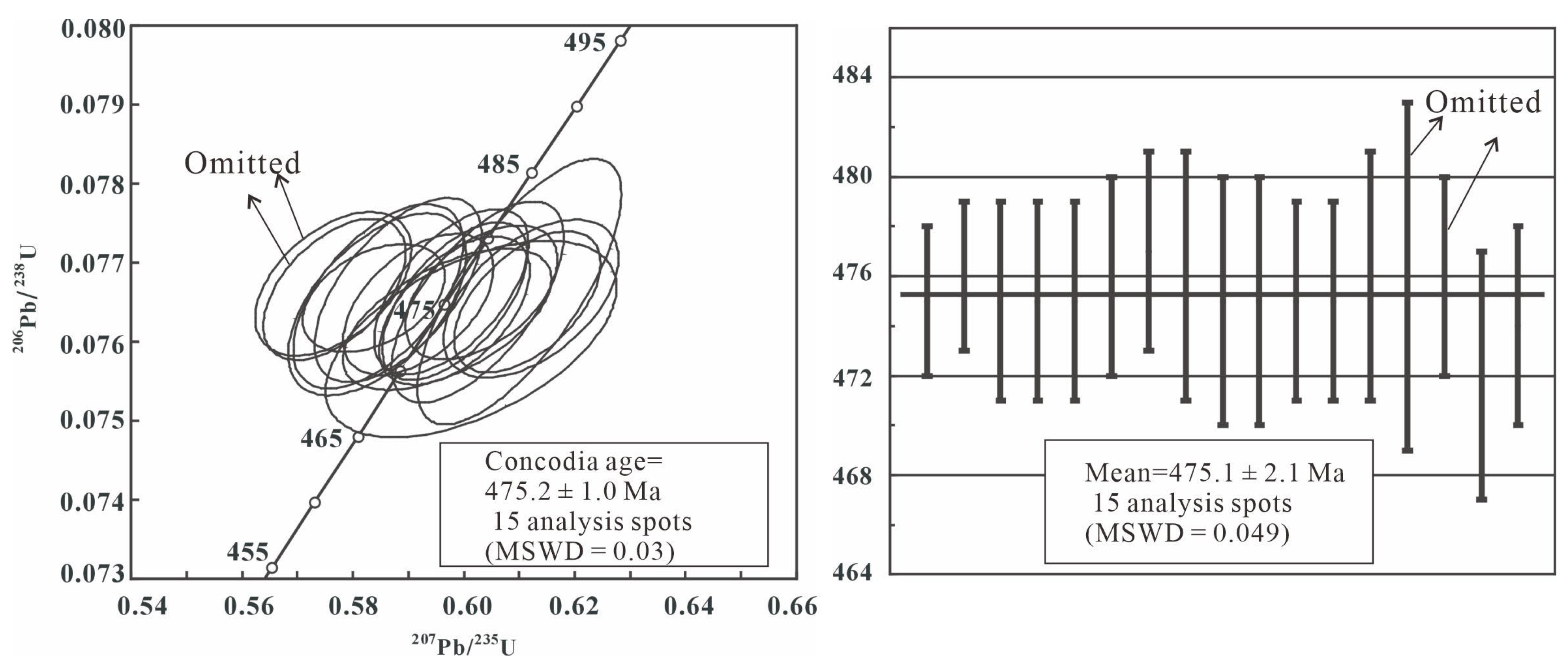
4.1. Zircon U-Pb Geochronology
4.2. Whole-Rock Geochemistry
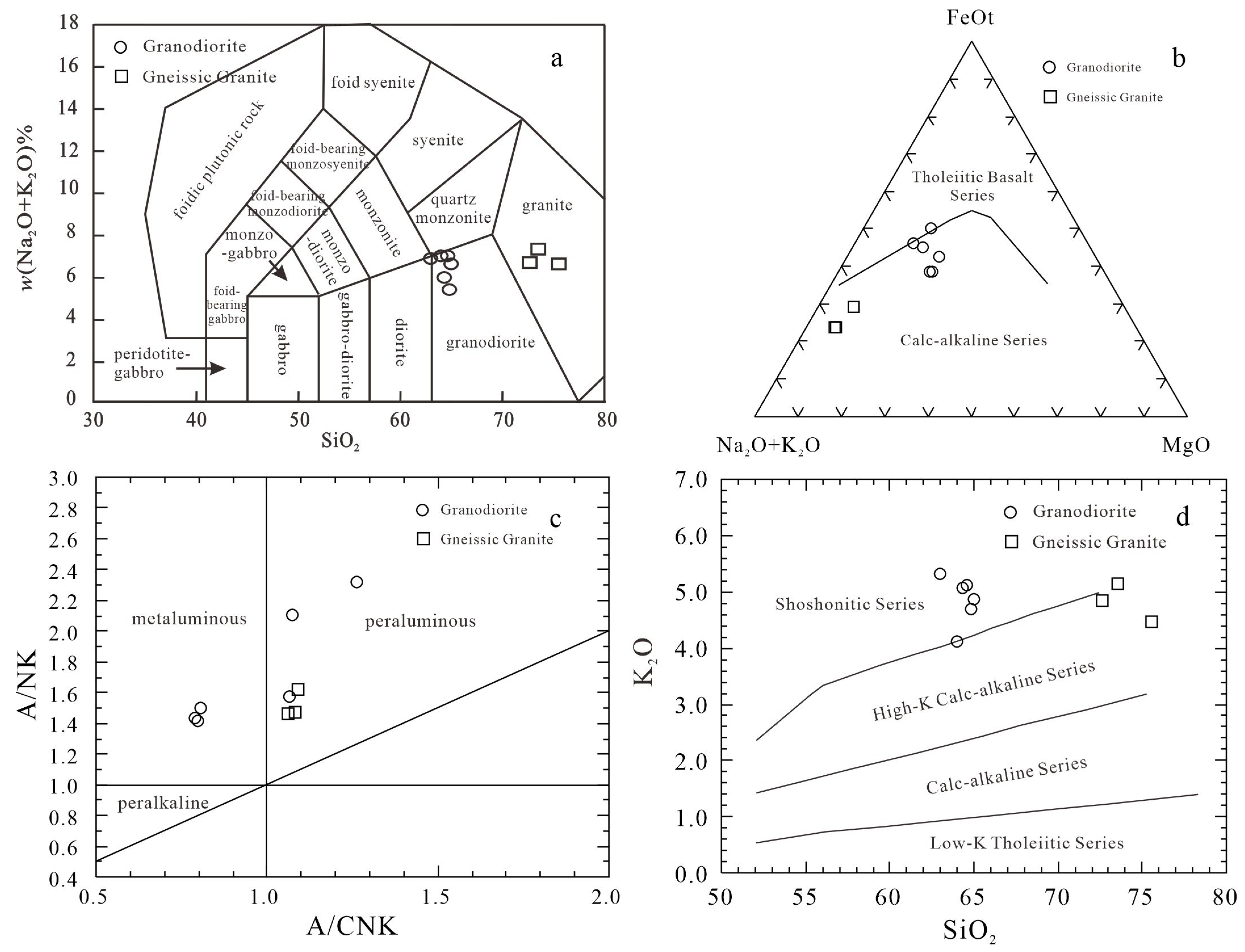
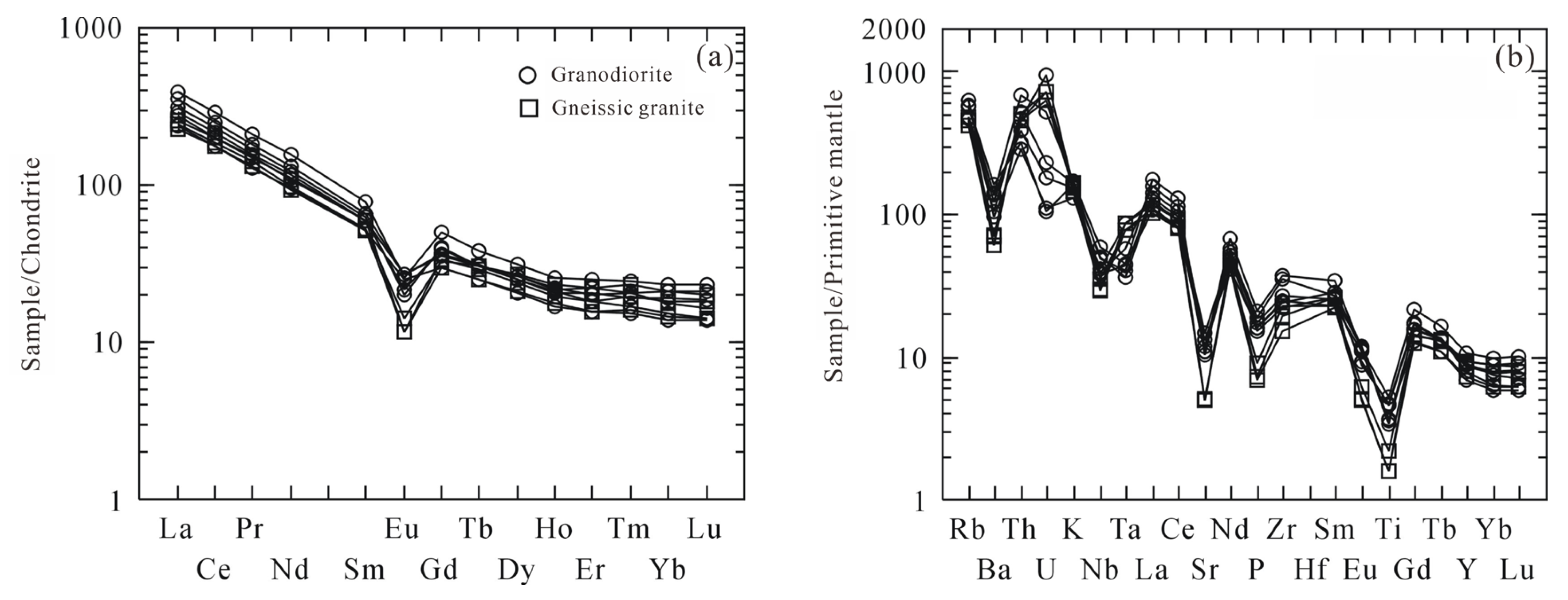
5. Discussion
5.1. Formation Age
5.2. Magma Source
5.3. Tectonic Setting
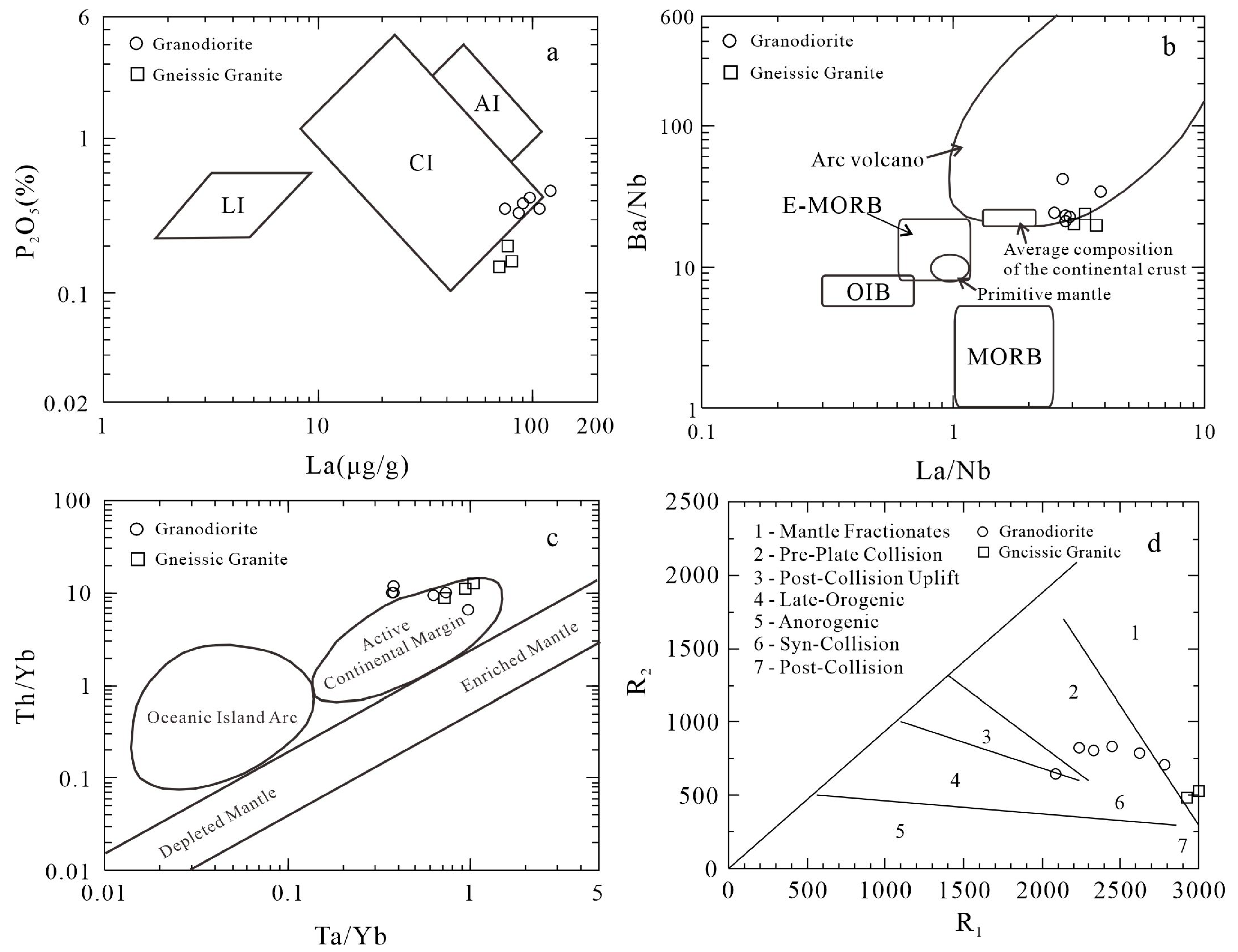
6. Conclusions
- Zircon U-Pb dating of the Wulanwuzhuer gneissic biotite granite yields a weighted mean age of 475.3 ± 2.0 Ma. These results indicate that the intrusion formed during the Caledonian period, rather than the Hercynian period as previously suggested.
- The magmas that formed the Wulanwuzhuer intermediate–felsic intrusion were derived primarily from partial melting of lower crust, which had undergone metasomatism by fluids derived from a subducted oceanic slab.
- This suite of intermediate–felsic intrusive rocks formed in an active continental margin setting during the early Caledonian. This tectonic environment was characterized by the initiation of northward subduction of the Proto-Tethyan oceanic crust beneath the Qaidam block along the vicinity of the present-day Central Kunlun Fault.
Supplementary Materials
Author Contributions
Funding
Data Availability Statement
Acknowledgments
Conflicts of Interest
References
- Xin, W.; Sun, F.Y.; Zhang, Y.T.; Fan, X.Z.; Wang, Y.C.; Li, L. Mafic–intermediate igneous rocks in the East Kunlun Orogenic Belt, northwestern China: Petrogenesis and implications for regional geodynamic evolution during the Triassic. Lithos 2019, 346, 105159. [Google Scholar] [CrossRef]
- Xin, W.; Ding, Z.J.; Meng, Y.K.; Bo, J.W.; Li, L.; Mao, G.Z. Late Triassic granites with mafic microenclaves in the East Kunlun Orogenic Belt, northwestern China: Petrogenesis and implications for continental crust evolution and geodynamic evolution. Can. J. Earth Sci. 2023, 60, 672–691. [Google Scholar] [CrossRef]
- Miao, T.; Zhao, X.; Huizenga, J.M.; Li, X.; Lai, L.; Li, B.; Wei, J. Segmented Paleo-Tethys subduction and its role in driving Triassic magmatism within the Elashan Tectonic–Magmatic Belt, northern Tibetan Plateau. Lithos 2025, 522-523, 108387. [Google Scholar] [CrossRef]
- Dong, Y.; Sun, S.; Santosh, M.; Zhao, J.; Sun, J.; He, D.; Zhang, G. Central China orogenic belt and amalgamation of East Asian continents. Gondwana Res. 2021, 100, 131–194. [Google Scholar] [CrossRef]
- Dong, Y.; Sun, S.; Santosh, M.; Hui, B.; Sun, J.; Zhang, F.; Qi, N. Cross orogenic belts in Central China: Implications for the tectonic and paleogeographic evolution of the East Asian continental collage. Gondwana Res. 2022, 109, 18–88. [Google Scholar] [CrossRef]
- Wu, J.J.; Yang, J.Z.; Zeng, Q.D.; Fan, H.R.; Frimmel, H.E.; Yang, K.F.; Li, X.H.; Liang, G.Z. Two distinct tectono–magmatic episodes and associated gold mineralization in the Wulonggou gold district, East Kunlun Orogenic Belt. Gondwana Res. 2026, 150, 312–334. [Google Scholar] [CrossRef]
- Sun, F.Y.; Chen, G.H.; Chi, X.G.; Li, B.L.; Zhao, J.W. Comprehensive Study on Metallogenic Regularity and Prospecting Direction of the East Kunlun Metallogenic Belt in Qinghai, Xinjiang; Research Report of Geological Survey Project; China Geological Survey: Beijing, China, 2003. [Google Scholar]
- Wang, M.; Pei, X.Z.; Pei, L.; Li, R.B.; Li, Z.C.; Liu, C.J.; Chen, Y.X.; Hu, N.; Qin, L.; Wang, X. Multi-stage tectono–magmatic evolution of the Proto-Tethys Ocean: Constraints from Mid-Paleozoic granitoids in the East Kunlun–North Qaidam orogenic belt. Gondwana Res. 2026, 150, 82–108. [Google Scholar] [CrossRef]
- Wang, X.; Ding, L.; Wang, C.; Zeng, D.; Wang, Z.; Yang, L.; Xie, J. Proterozoic tectonic affinity and evolution of the East Kunlun–Qaidam Block, NW China: Insight from Precambrian metasedimentary rocks and early Neoproterozoic granitoids. Precambrian Res. 2024, 409, 107451. [Google Scholar] [CrossRef]
- Liu, X.; Lü, Z.; Chen, Z.; Song, S.; Guo, Y. Metamorphic evolution and tectonic significance of garnet-bearing amphibolites from the upper valley of the Hatu River, East Kunlun Orogenic Belt. Lithos 2025, 504, 108027. [Google Scholar] [CrossRef]
- Zhang, M.; Tan, S.; Ruan, M.; Li, L.; Yan, Q. Petrogenesis and tectonic implication of the Triassic monzogranite from the central segment of the East Kunlun Orogen, NW China. J. Asian Earth Sci. 2024, 276, 106341. [Google Scholar] [CrossRef]
- Xin, W.; Sun, F.Y.; Li, L.; Yan, J.M.; Zhang, Y.T.; Wang, Y.C.; Yang, Y.J. The Wulonggou metaluminous A2-type granites in the Eastern Kunlun Orogenic Belt, NW China: Rejuvenation of subduction-related felsic crust and implications for post-collision extension. Lithos 2018, 312, 108–127. [Google Scholar] [CrossRef]
- Yan, D.; Zhou, H.; Li, C.; Zhang, X.; Ma, C.; Hou, M.; Xiong, F. Petrogenesis of Late Triassic adakitic plutons in the East Kunlun Orogen, Northern Tibet: Geodynamic implications for the Paleo-Tethyan orogeny and crustal evolution. J. Asian Earth Sci. 2024, 268, 106165. [Google Scholar] [CrossRef]
- Hao, N.N.; Yuan, W.; Zhang, A.; Feng, Y.; Cao, J.; Chen, X.; Mo, X. Evolution process of the Late Silurian–Late Devonian tectonic environment in Qimantagh in the western portion of east Kunlun, China: Evidence from the geochronology and geochemistry of granitoids. J. Earth Syst. Sci. 2015, 124, 171–196. [Google Scholar] [CrossRef]
- Zhong, S.; Li, S.; Feng, C.; Liu, Y.; Santosh, M.; He, S.; Zhou, J. Porphyry copper and skarn fertility of the northern Qinghai–Tibet Plateau collisional granitoids. Earth-Sci. Rev. 2021, 214, 103524. [Google Scholar] [CrossRef]
- Chen, Y.C.; Ding, Z.J.; Bo, J.W.; Han, S.J.; Li, T.T.; Ji, P.; Guo, R.Q. Petrogenesis and age of granitoids associated with the Dongshan Cu polymetallic deposit, East Kunlun Orogenic Belt, NW China: Implications for the Middle to Late Triassic tectonic setting and Cu polymetallic mineralization. Geochemistry 2025, 85, 126240. [Google Scholar] [CrossRef]
- Zhao, Z.X.; Dong, G.C.; Santosh, M.; Zhu, D.C.; Kong, H.L.; Lü, S.J.; Zhong, P.Y. The mafic–ultramafic roots of a magmatic arc from the East Kunlun Orogen, NW China. Gondwana Research 2025, 143, 142–156. [Google Scholar] [CrossRef]
- Shao, F.; Niu, Y.; Kong, J.; Liu, Y.; Wang, G.; Zhang, Y. Petrogenesis and tectonic implications of the Triassic rhyolites in the East Kunlun Orogenic Belt, northern Tibetan Plateau. Geosci. Front. 2021, 12, 101243. [Google Scholar] [CrossRef]
- Li, X.; Huang, X.; Luo, M.; Dong, G.; Mo, X. Petrogenesis and geodynamic implications of the Mid-Triassic lavas from East Kunlun, northern Tibetan Plateau. J. Asian Earth Sci. 2015, 105, 32–47. [Google Scholar] [CrossRef]
- Kong, J.; Niu, Y.; Hu, Y.; Zhang, Y.; Shao, F. Petrogenesis of the Triassic granitoids from the East Kunlun Orogenic Belt, NW China: Implications for continental crust growth from syn-collisional to post-collisional setting. Lithos 2020, 364, 105513. [Google Scholar] [CrossRef]
- Zhou, H.; Zhang, D.; Wei, J.; Wang, D.; Santosh, M.; Shi, W.; Zhao, X. Petrogenesis of Late Triassic mafic enclaves and host granodiorite in the Eastern Kunlun Orogenic Belt, China: Implications for the reworking of juvenile crust by delamination-induced asthenosphere upwelling. Gondwana Res. 2020, 84, 52–70. [Google Scholar] [CrossRef]
- Xia, R.; Wang, C.; Deng, J.; Carranza, E.J.M.; Li, W.; Qing, M. Crustal thickening prior to 220 Ma in the East Kunlun Orogenic Belt: Insights from the Late Triassic granitoids in the Xiao–Nuomuhong pluton. J. Asian Earth Sci. 2014, 93, 193–210. [Google Scholar] [CrossRef]
- Shao, F.; Niu, Y.; Liu, Y.; Chen, S.; Kong, J.; Duan, M. Petrogenesis of Triassic granitoids in the East Kunlun Orogenic Belt, northern Tibetan Plateau and their tectonic implications. Lithos 2017, 282, 33–44. [Google Scholar] [CrossRef]
- Liu, B.; Ma, C.Q.; Huang, J.; Wang, L.X.; Zhao, S.Q.; Yan, R.; Xiong, F.H. Petrogenesis and tectonic implications of Upper Triassic appinite dykes in the East Kunlun orogenic belt, northern Tibetan Plateau. Lithos 2017, 284, 766–778. [Google Scholar] [CrossRef]
- Hu, Y.; Niu, Y.; Li, J.; Ye, L.; Kong, J.; Chen, S.; Zhang, G. Petrogenesis and tectonic significance of the Late Triassic mafic dikes and felsic volcanic rocks in the East Kunlun Orogenic Belt, northern Tibetan Plateau. Lithos 2016, 245, 205–222. [Google Scholar] [CrossRef]
- Qu, H.; Friehauf, K.; Santosh, M.; Pei, R.; Li, D.; Liu, J.; Wang, H. Middle–Late Triassic magmatism in the Hutouya Fe–Cu–Pb–Zn deposit, East Kunlun Orogenic Belt, NW China: Implications for geodynamic setting and polymetallic mineralization. Ore Geol. Rev. 2019, 113, 103088. [Google Scholar] [CrossRef]
- Bai, Y.S.; Chang, G.H.; Tan, S.X.; Wang, J.S. Study on The Features of Caledonian Intrusive Rocks in the Eastern Sector of East Kunlun. Geol. Qinghai 2001, 9, 28–35, (In Chinese with English abstract). [Google Scholar]
- Zhao, Z.M.; Ma, H.D.; Wang, B.Z.; Bai, Y.S.; Li, R.S.; Ji, W.H. The Evidence of Intrusive Rocks about Collision-orogenyduring Early Devonian in Eastern Kunlun Area. Geol. Rev. 2008, 54, 47–56, (In Chinese with English abstract). [Google Scholar]
- Liu, C.D. Granitoid Magma Mixing in Eastern Part of the East Kunlun Orogenic Belt; Geological Publishing House: Beijing, China, 2008; pp. 21–28. (In Chinese) [Google Scholar]
- Qiao, G.B.; Wu, Y.Z. Genetic Types of Granite Controlled the Mineralization in Qimantag Area, Eastern Kunlun. Northwestern Geol. 2010, 43, 134–142, (In Chinese with English abstract). [Google Scholar]
- Tan, S.X.; Guo, T.Z.; Dong, J.S.; Chang, Y.Y.; Ma, W. Geological Characteristics and Significance of the Peraluminous Granite in Late Silurian Epoch in Wulanrvuzhuer Region of Qinghai. J. Qinghai Univ. Nat. Sci. Ed. 2011, 29, 36–43, (In Chinese with English abstract). [Google Scholar]
- Guo, T.Z.; Liu, R.; Chen, F.B.; Bai, X.D.; Li, H.G. LA-MC-ICPMS zircon U-Pb Dating of Wulanwuzhuer Porphyritic Syenite Granite in the Qimantag Mountain of Qinghai and its Geological significance. Geol. Bull. China 2011, 30, 1203–1211, (In Chinese with English abstract). [Google Scholar]
- Cao, S.T.; Liu, X.K.; Ma, Y.S.; Li, J.Y.; Ma, Y.L. Discovery of the Early Silurian intrusive rocks in the Qimantag and its geological significance. Qinghai Sci. Technol. 2011, 5, 26–30. [Google Scholar]
- Hu, J.; Wang, H.; Wang, M. Geochemistry and origin of the Neoproterozoic Dahongliutan banded iron formation (BIF) in the Western Kunlun orogenic belt, Xinjiang (NW China). Ore Geol. Rev. 2017, 89, 836–857. [Google Scholar] [CrossRef]
- Dong, Y.P.; He, D.F.; Sun, S.S.; Liu, X.M.; Zhou, X.H.; Zhang, F.F.; Yang, Z.; Cheng, B.; Zhao, G.C.; Li, J.H. Subduction and accretionary tectonics of the East Kunlun orogen, western segment of the Central China Orogenic System. Earth Sci. Rev. 2018, 186, 231–261. [Google Scholar] [CrossRef]
- Han, Z.H.; Sun, F.Y.; Tian, N.; Gao, H.C.; Li, L.; Zhao, T.F. Zircon U-Pb Geochronology, Geochemistry and Geological lmplicationsof the Early Paleozoic Wulanwuzhuer Granites in the Qimantag, EastKunlun, China. Earth Sci. 2021, 46, 13–30, (In Chinese with English abstract). [Google Scholar]
- Andersen, T. Correction of Common Lead in U-Pb Analyses that do not Report 204Pb. Chem. Geol. 2002, 192, 59–79. [Google Scholar] [CrossRef]
- Ludwig, K.R. Users Manual for Isoplot/Ex, Version 3.00, A Geochronological Toolkit for Microsoft Excel; Special Publication No. 4; Berkeley Geochronology Centre: Berkeley, CA, USA, 2003. [Google Scholar]
- Yuan, H.L.; Gao, S.; Liu, X.M.; Li, H.M.; Günther, D.; Wu, F.Y. Accurate U-Pb Age and Trace Element Determinations of Zircon by Laser Ablation Inductively Coupled Plasma-mass Spectrometry. Geostand. Geoanal. Res. 2004, 28, 357–370. [Google Scholar] [CrossRef]
- Liu, X.M.; Gao, S.; Diwu, C.R.; Yuan, H.L.; Hu, Z.C. Simultaneous in-situ Determination of U-Pb Age and Trace Elements in Zircon. Chin. Sci. Bull. 2007, 52, 228–235, (In Chinese with English abstract). [Google Scholar]
- GB/T 14506.28-93; Methods for Chemical Analysis of Silicate Rocks—Part 28: Determination of Lead. Standards Press of China: Beijing, China, 1993.
- DZ/T 0223-2001; General Rule for Inductively Coupled Plasma Massspectrometry (ICP-MS) Analytical Method. Standards Press of China: Beijing, China, 2002.
- GBW07103; Standard Reference Material for Rock Composition Analysis: Granite. Standards Press of China: Beijing, China, 2015.
- GBW07104; Standard Reference Material for Rock Composition Analysis: Andesite. Standards Press of China: Beijing, China, 2015.
- Irvine, T.H.; Baragar, W.R.A. A Guide to the Chemical Classification of the Common Volcanic rocks. Can. J. Earth Sci. 1971, 8, 523–548. [Google Scholar] [CrossRef]
- Maniar, P.D.; Piccoli, P.M. Tectonic Discrimination of Granitoids. Geol. Soc. Am. Bull. 1989, 101, 635–643. [Google Scholar] [CrossRef]
- Rickwood, P.C. Boundary Lines within Petrologic Diagrams which Use Oxides of Major and Minor Elements. Lithos 1989, 22, 247–263. [Google Scholar] [CrossRef]
- Boynton, W.V. Geochemistry of the Rate Earth Elements: Meteorite studies. In Rare Earth Elements Geochemistry; Henderson, P., Ed.; Elsevier: Amsterdam, The Netherlands, 1984; pp. 63–114. [Google Scholar]
- Lightfoot, P.C.; Hawkesworth, C.J.; Sethna, S.F. Petrogenesis of Rhyolites and Trachytes from the Deccan Trap: Sr, Nd and Pb Isotope and Trace Element Evidence. Contrib. Mineral. Petrol. 1987, 95, 44–54. [Google Scholar] [CrossRef]
- Sun, S.S.; McDonough, W.F. Chemical and Isotopic Systematics of Oceanic Basalts: Implications for Mantle Composition and Processes. Spec. Publ. Geol. Soc. Lond. 1989, 42, 313–345. [Google Scholar] [CrossRef]
- Qinghai Institute of Geological Survey. 1,250,000 Scale Regional Geological Survey Report of the Kulangmiqiti Sheet; Qinghai Institute of Geological Survey: Xining, China, 2003. [Google Scholar]
- Song, T.Z.; Zhao, H.X.; Zhang, W.K.; Bai, X.D.; An, S.W.; Yang, M. The geological features of Shizigou ophiolites in Qimantage Area. Northwestern Geol. 2010, 43, 124–133, (In Chinese with English abstract). [Google Scholar]
- Li, W.; Neubauer, F.; Liu, Y.J.; Genser, J.; Ren, S.M.; Han, G.Q.; Liang, C.Y. Paleozoic evolution of the Qimantagh magmatic arcs, Eastern Kunlun Mountains: Constraints from zircon dating of granitoids and modern river sands. J. Asian Earth Sci. 2013, 77, 183–202. [Google Scholar] [CrossRef]
- Kong, H.L.; Li, J.C.; Li, Y.Z.; Jia, Q.Z.; Yang, B.R. Geochemistry and zircon U–Pb geochronology of the Annage diorite in the eastern section of the East Kunlun, Qinghai Province. Geol. Sci. Technol. Inf. 2014, 33, 11–17, (In Chinese with English abstract). [Google Scholar]
- Zhou, B.; Dong, Y.P.; Zhang, F.F.; Yang, Z.; Sun, S.S.; He, D.F. Geochemistry and zircon U–Pb geochronology of granitoids in the East Kunlun Orogenic Belt, northern Tibetan Plateau: Origin and tectonic implications. J. Asian Earth Sci. 2016, 130, 265–281. [Google Scholar] [CrossRef]
- Liu, Z.Q.; Pei, X.Z.; Li, R.B.; Li, Z.C.; Chen, G.C.; Chen, Y.X.; Gao, J.M.; Liu, C.J.; Wei, F.H.; Wang, X.L.; et al. Early Paleozoic intermediate–acid magmatic activity in the Bairiqiete area along the Buqingshan tectonic mélange belt on the southern margin of the East Kunlun: Constraints from zircon U–Pb dating and geochemistry. Geol. China 2011, 38, 1150–1167, (In Chinese with English abstract). [Google Scholar]
- Qinghai Institute of Geological Survey. 1,250,000 Scale Regional Geological Survey Report of the Bukadaban Feng Sheet; Qinghai Institute of Geological Survey: Xining, China, 2003. [Google Scholar]
- Liu, B.; Ma, C.Q.; Zhang, J.Y.; Xiong, F.H.; Huang, J.; Jiang, H.A. Petrogenesis of Early Devonian intrusive rocks in the east part of Eastern Kunlun Orogen and implication for Early Palaeozoic orogenic proceses. Acta Petrol. Sin. 2012, 28, 1785–1807. [Google Scholar]
- Baker, M.B.; Hirschmann, M.M.; Ghiorso, M.S.; Stolper, E.M. Compositions of near-solidus peridotite melts from experiments and thermodynamic calculations. Nature 1995, 375, 308–311. [Google Scholar] [CrossRef]
- Taylor, S.R.; McLennan, S.M. The geochemical evolution of the continental crust. Rev. Geophys. 1995, 33, 241–265. [Google Scholar] [CrossRef]
- Wedepohl, K.H. The composition of the continental crust. Geochim. Cosmochim. Acta 1995, 59, 1217–1232. [Google Scholar] [CrossRef]
- Xiao, Q.H.; Qiu, R.Z.; Deng, J.F.; Li, T.D.; Mo, X.X.; Hong, D.W.; Lu, X.X.; Wang, T.; Wu, F.Y.; Xie, C.F. Granitoids and Continental Crustal Growth Modes in China. Geol. China 2005, 32, 343–352, (In Chinese with English abstract). [Google Scholar]
- Hong, D.W.; Wang, T.; Tong, Y.; Wang, X.X. Mesozoic Granitoids from North China Block and Qinling-Dabie-Sulu Orogenic Belt and their Deep Dynamic Process. Earth Sci. Front. 2003, 10, 231–256, (In Chinese with English abstract). [Google Scholar]
- Qiu, R.Z.; Deng, J.F.; Zhou, S.; Xiao, Q.H.; Cai, Z.Y.; Liu, C. Study on Sr-Nd Isotopes of Mesozoic-Cenozoic Granites in Qinghai-Tibetan Plateau. Acta Geosci. Sin. 2003, 24, 611–617, (In Chinese with English abstract). [Google Scholar]
- Massonne, H.J. Evidence for low-temperature ultrapotassic siliceous fluids in subduction zone environments from experiments in the system K2O-MgO-Al2O3-SiO2-H2O (KMASH). Lithos 1992, 28, 421–434. [Google Scholar] [CrossRef]
- Morrison, G.W. Characteristics and Tectonic Setting of the Shoshonite Rock Association. Lithos 1980, 13, 91–108. [Google Scholar] [CrossRef]
- Foley, S.F.; Peccerillo, A. Potassic and Ultrapotassic Magmas and their Origin. Lithos 1992, 28, 181–185. [Google Scholar] [CrossRef]
- Müller, D.; Groves, D.I. Potassic Igneous Rocks and Associated Gold-Copper Mineralization; Springer: Berlin/Heidelberg, Germany, 1995; pp. 1–210. [Google Scholar]
- Pan, Y.S. Tectonic Features and Evolution of the Western Kunlun Mountain Region. Sci. Geol. Sin. 1990, 25, 224–232, (In Chinese with English abstract). [Google Scholar]
- Pan, Y.S. Geological Features and Tectonic Evolution of Geotraverse from Yecheng to Shiquanhe in the Tibetan plateau. Acta Geol. Sin. 1994, 68, 295–307, (In Chinese with English abstract). [Google Scholar]
- Şengör, A.M.C.; Okurogullari, A.H. The Role of Accretionary Wedges in the Growth of Continents: Asiatic Examples from Argand to Plate Tectonics. Eclogae Geol. Helv. 1991, 84, 535–597. [Google Scholar]
- Zhang, Y.F.; Pei, X.Z.; Ding, S.P.; Li, R.B.; Feng, J.Y.; Sun, Y.; Li, Z.C.; Chen, Y.X. LA-ICP-MS Zircon U-Pb Age of Quartz Diorite at the Kekesha Area of Dulan County, Eastern Section of the East Kunlun Orogenic Belt, China and its Significance. Geol. Bull. China 2010, 29, 79–85, (In Chinese with English abstract). [Google Scholar]
- Cui, M.H.; Meng, F.C.; Wu, X.K. Early Ordovician Island Arc of Qimantag Mountain, Eastern Kunlun: Evidences from Geochemistry, Sm-Nd Isotope and Geochronology of Intermediate-basic Igneous Rocks. Acta Petrol. Sin. 2011, 27, 3365–3379, (In Chinese with English abstract). [Google Scholar]
- Wang, Y.J.; Shen, Y.C.; Lin, G. Preliminary Research on the Tectonostratigraphy in the Northern Central-Kunlun Orogenic Belt. J. Stratigr. 2000, 24, 55–59, (In Chinese with English abstract). [Google Scholar]
- Li, D.P.; Li, J.; Zhang, H.J.; Li, X.L.; Zhou, X.K.; Du, S.X. The Turbidite of the Silurian Baiganhu Formation in the Qimantag Mountain Eastern Kunlun. Geol. Shaanxi 2003, 21, 39–44, (In Chinese with English abstract). [Google Scholar]
- Chen, J.L.; Li, D.P.; Li, X.L.; Zhou, X.K.; Wang, X.L.; Wang, X.X.; Dai, X.Y.; Du, S.X.; Gao, X.P. The Discovery and Features of the Heishan Ophiolite in the South Margin of Qimantag Mountain, Eastern Kunlun. Geol. Shaanxi 2004, 22, 35–46, (In Chinese with English abstract). [Google Scholar]
- Bailey, J.C. Geochemical Criteria for a Refined Tectonic Discrimination of Orogenic Andesites. Chem. Geol. 1981, 32, 139–154. [Google Scholar] [CrossRef]
- Jahn, B.M.; Wu, F.Y.; Lo, C.H. Crust—Mantle Interaction Induced by Deep Subduction of the Continental Crust: Geochemical and Sr-Nd Isotopic Evidence from Post-collisional Mafic—Ultramafic Intrusions of the Northern Dabie Complex, Central China. Chem. Geol. 1999, 157, 119–146. [Google Scholar] [CrossRef]
- Pearce, J.A. Role of the sub-continental lithosphere in magma genesis at active continental margins. In Continental Basalts and Mantle Xenoliths; Hawkesworth, C.J., Norry, M.J., Eds.; Shiva Publications: Nantwich, UK, 1983; pp. 230–249. [Google Scholar]
- Batchelor, R.A.; Bowden, P. Petrogenetic Interpretation of Granitoid Rock Series Using Multi-cationic Parameters. Chem. Geol. 1985, 48, 43–55. [Google Scholar] [CrossRef]
- Feng, C.Y.; Zhang, D.Q.; Dang, X.Y.; Li, D.X.; She, H.Q. SHRIMP zircon U-Pb dating of quartz albitite from the Tuolugou cobalt (gold) deposit, Golmud, Qinghai, China—Constraints on the age of the Naij Tal Group. Geol. Bull. China 2005, 24, 501–505, (In Chinese with English abstract). [Google Scholar]
- He, D.F.; Dong, Y.P.; Liu, X.M.; Yang, Z.; Sun, S.S.; Cheng, B.; Li, W. Tectono-thermal events in East Kunlun, Northern Tibetan Plateau: Evidence from zircon U-Pb geochronology. Gondwana Res. 2016, 30, 179–190. [Google Scholar] [CrossRef]
- Jiang, C.Y.; Ling, J.L.; Zhou, W.; Du, W.; Wang, Z.X.; Fan, Y.Z.; Song, Y.F.; Song, Z.B. Petrogenesis of the Xiarihamu Ni-bearing layered mafic-ultramafic intrusion, East Kunlun: Implications for its extensional island arc environment. Acta Petrol. Sin. 2015, 31, 1117–1136, (In Chinese with English abstract). [Google Scholar]
- Li, H.K.; Lu, S.N.; Xiang, Z.Q.; Zhou, H.Y.; Guo, H.; Song, B.; Zheng, J.K.; Gu, Y. SHRIMP U-Pb zircon age of the granulite from the Qingshuiquan area, Central Eastern Kunlun Suture Zone. Front. Earth Sci. 2006, 13, 311–321, (In Chinese with English abstract). [Google Scholar]
- Li, R.S.; Ji, W.H.; Yang, Y.C.; Yu, P.S.; Zhao, Z.M.; Chen, S.J.; Meng, Y.; Pan, X.P.; Shi, B.D.; Zhang, W.J.; et al. Kunlun Mountains and Geology of Adjacent Areas; Geological Publishing House: Beijing, China, 2008; pp. 1–400, (In Chinese with English abstract). [Google Scholar]
- Li, X.; Yuan, W.M.; Hao, N.N.; Duan, H.W.; Chen, X.N.; Mo, X.X.; Zhang, A.K. Characteristics and tectonic setting of granite in Wulonggou area, East Kunlun Mountains. Global Geol. 2014, 33, 275–289, (In Chinese with English abstract). [Google Scholar]
- Qi, S.S. Petrotectonic Assemblages and Tectonic Evolution of the East Kunlun Orogenic Belt in Qinghai Province. Doctoral Dissertation, China University of Geosciences, Beijing, China, 2015. (In Chinese with English abstract). [Google Scholar]
- Qi, S.S.; Song, S.G.; Shi, L.C.; Cai, H.J.; Hu, J.C. Discovery and its geological significance of early Paleozoic eclogite in Xiarihamu-Suhaitu area, western part of the East Kunlun. Acta Petrol. Sin. 2014, 30, 3345–3356, (In Chinese with English abstract). [Google Scholar]
- Qi, X.P.; Yang, J.; Fan, X.G.; Cui, J.T.; Cai, Z.F.; Zeng, X.W.; Wei, W.; Qu, X.X.; Zhai, L.M. Age, geochemical characteristics and tectonic significance of Changshishan ophiolite in central East Kunlun tectonic melange belt along the east section of East Kunlun Mountains. Geol. China 2016, 43, 797–816, (In Chinese with English abstract). [Google Scholar]
- Qi, X.P.; Fan, X.G.; Yang, J.; Cui, J.T.; Wang, B.Y.; Fan, Y.Z.; Yang, G.X.; Li, Z.; Chao, W.D. The discovery of Early Paleozoic eclogite in the upper reaches of Langmuri in eastern East Kunlun Mountains and its significance. Geol. Bull. China 2016, 35, 1771–1783. [Google Scholar]
- Ren, J.H.; Liu, Y.Q.; Feng, Q.; Han, W.Z.; Gao, H.; Zhou, D.W. LA-ICP-MS U-Pb zircon dating and geochemical characteristics of diabase-dykes from the Qingshuiquan area, Eastern Kunlun Orogenic Belt. Acta Petrol. Sin. 2009, 25, 1135–1145. [Google Scholar]
- Sang, J.Z.; Pei, X.Z.; Li, R.B.; Liu, C.J.; Chen, Y.X.; Li, Z.C.; Chen, G.C.; Yang, S.; Wang, X.B.; Chen, G.; et al. LA-ICP-MS zircon U-Pb dating and geochemical characteristics of gabbro in Qingshuiquan, east section of East Kunlun, and its tectonic significance. Geol. Bull. China. 2016, 35, 700–710, (In Chinese with English abstract). [Google Scholar]
- Song, Z.B.; Zhang, Y.L.; Jia, Q.Z.; Chen, X.Y.; Jiang, L.; Li, D.S.; He, S.Y.; Li, J.C.; Yang, T.; Quan, S.C.; et al. U-Pb age of Yemaquan deep Variscan granodiorite in Qimantage area, eastern Kunlun and its significance. Geoscience 2014, 28, 1161–1169, (In Chinese with English abstract). [Google Scholar]
- Shaanxi Institute of Geological Survey. Regional Geology of the Ayak Kum Lake Region; Shaanxi Institute of Geological Survey: Shaanxi, China, 2003; pp. 1–266. (In Chinese) [Google Scholar]
- Wang, G.; Sun, F.Y.; Li, B.L.; Li, S.J.; Zhao, J.W.; Cong, Z.C. Petrography, zircon U-Pb geochronology and geochemistry of the mafic-ultramafic intrusion in Xiarihamu Cu-Ni deposit from East Kunlun, with implications for geodynamic setting. Earth Sci. Front. 2014, 88, 318–319. [Google Scholar] [CrossRef]
- Xiong, F.H.; Ma, C.Q.; Jiang, H.A.; Liu, B.; Huang, J. Geochronology and geochemistry of Middle Devonian mafic dykes in the East Kunlun orogenic belt, Northern Tibet Plateau: Implications for the transition from Prototethys to Paleotethys orogeny. Geochemistry 2014, 74, 225–235. [Google Scholar] [CrossRef]
- Xiong, F.H.; Ma, C.Q. Petrological evidence of the deep subduction of the original Tethys oceanic crust in Central East Kunlun. In Proceedings of the Academic Conference on New Progress in Resource Environment and Geoscience Space Information Technology; Science Press: Beijing, China, 2016. [Google Scholar]
- Zhang, J.X.; Meng, F.C.; Wan, Y.S.; Yang, J.S.; Dong, G.A. Early Paleozoic tectono-thermal event of the Jinshuikou Group on the southern margin of Qaidam: Zircon U-Pb SHRIMP age evidence. Geol. Bull. China. 2003, 22, 397–405, (In Chinese with English abstract). [Google Scholar]
- Zhang, J.Y.; Ma, C.Q.; Xiong, F.H.; Liu, B.; Li, J.W.; Pan, Y.M. Early Paleozoic high-Mg diorite-granodiorite in the eastern Kunlun Orogen, western China: Response to continental collision and slab break-off. Lithos 2014, 210–211, 129–146. [Google Scholar] [CrossRef]
- Zhou, C.J.; Hu, D.G.; Barosh, P.J.; Wu, Z.H.; Zhang, Y.Q.; Geng, J.Z.; Hao, S.; Ni, J.Y.; Zhang, Y.L. Zircon U-Pb dating of the rhyolite-dacite porphyry in the Sandaowan of East Kunlun Mountains and its geological significance. J. Geomech. 2010, 16, 28–35, (In Chinese with English abstract). [Google Scholar]
- Zhu, Y.H.; Lin, Q.X.; Jia, C.X.; Wang, G.C. SHRIMP zircon U-Pb age and significance of Early Paleozoic volcanic rocks in East Kunlun orogenic belt, Qinghai Province, China. Sci. China Ser. D-Earth Sci. 2006, 49, 88–96. [Google Scholar] [CrossRef]



| Analysis | Pb | Th | U | 232Th/238U | 207Pb/206Pb | 207Pb/235U | 206Pb/238U | 207Pb/206Pb | 207Pb/235U | 206Pb/238U | 208Pb/232Th | |||||||
|---|---|---|---|---|---|---|---|---|---|---|---|---|---|---|---|---|---|---|
| ppm | ppm | ppm | Ratio | 1σ | Ratio | 1σ | Ratio | 1σ | Age (Ma) | 1σ | Age (Ma) | 1σ | Age (Ma) | 1σ | Age (Ma) | 1σ | ||
| WLWZE25-N1-01 | 221.0 | 933.8 | 2575.2 | 0.36 | 0.05520 | 0.00075 | 0.58377 | 0.00847 | 0.07655 | 0.00045 | 420 | 30 | 467 | 5 | 475 | 3 | 470 | 7 |
| WLWZE25-N1-02 | 209.8 | 830.8 | 2443.5 | 0.34 | 0.05699 | 0.00077 | 0.60317 | 0.00905 | 0.07662 | 0.00056 | 491 | 30 | 479 | 6 | 476 | 3 | 484 | 8 |
| WLWZE25-N1-03 | 317.9 | 1246.1 | 3641.9 | 0.34 | 0.05790 | 0.00090 | 0.61215 | 0.01040 | 0.07654 | 0.00066 | 526 | 33 | 485 | 7 | 475 | 4 | 500 | 10 |
| WLWZE25-N1-04 | 240.1 | 800.5 | 2825.4 | 0.28 | 0.05604 | 0.00080 | 0.59177 | 0.00896 | 0.07647 | 0.00059 | 454 | 30 | 472 | 6 | 475 | 4 | 490 | 9 |
| WLWZE25-N1-05 | 302.3 | 760.9 | 3720.6 | 0.20 | 0.05667 | 0.00078 | 0.59839 | 0.00866 | 0.07651 | 0.00066 | 479 | 26 | 476 | 5 | 475 | 4 | 496 | 10 |
| WLWZE25-N1-06 | 325.2 | 1287.7 | 3887.8 | 0.33 | 0.05441 | 0.00075 | 0.57664 | 0.00848 | 0.07666 | 0.00059 | 388 | 29 | 462 | 5 | 476 | 4 | 464 | 8 |
| WLWZE25-N1-07 | 234.8 | 1055.6 | 2764.2 | 0.38 | 0.05430 | 0.00082 | 0.57646 | 0.00930 | 0.07673 | 0.00060 | 383 | 32 | 462 | 6 | 477 | 4 | 464 | 8 |
| WLWZE25-N1-08 | 259.7 | 1040.1 | 3140.0 | 0.33 | 0.05551 | 0.00085 | 0.58812 | 0.00994 | 0.07665 | 0.00077 | 433 | 31 | 470 | 6 | 476 | 5 | 475 | 10 |
| WLWZE25-N1-09 | 180.6 | 832.6 | 2201.7 | 0.38 | 0.05531 | 0.00093 | 0.58437 | 0.01061 | 0.07647 | 0.00076 | 425 | 35 | 467 | 7 | 475 | 5 | 472 | 10 |
| WLWZE25-N1-10 | 212.8 | 934.4 | 2523.0 | 0.37 | 0.05706 | 0.00087 | 0.60249 | 0.01024 | 0.07650 | 0.00084 | 494 | 29 | 479 | 6 | 475 | 5 | 491 | 9 |
| WLWZE25-N1-11 | 331.3 | 1564.6 | 3867.6 | 0.40 | 0.05788 | 0.00079 | 0.61145 | 0.00871 | 0.07650 | 0.00059 | 525 | 27 | 484 | 5 | 475 | 4 | 486 | 7 |
| WLWZE25-N1-12 | 303.0 | 1345.5 | 3601.0 | 0.37 | 0.05678 | 0.00080 | 0.59834 | 0.00896 | 0.07639 | 0.00062 | 483 | 28 | 476 | 6 | 475 | 4 | 477 | 7 |
| WLWZE25-N1-13 | 339.9 | 1295.3 | 4116.8 | 0.31 | 0.05535 | 0.00087 | 0.58458 | 0.01013 | 0.07657 | 0.00077 | 426 | 32 | 467 | 6 | 476 | 5 | 464 | 8 |
| WLWZE25-N1-14 | 92.2 | 361.4 | 1115.4 | 0.32 | 0.05860 | 0.00166 | 0.61003 | 0.01214 | 0.07663 | 0.00111 | 552 | 30 | 484 | 8 | 476 | 7 | 528 | 27 |
| WLWZE25-N1-15 | 246.8 | 790.4 | 3021.6 | 0.26 | 0.05644 | 0.00078 | 0.59776 | 0.00920 | 0.07663 | 0.00069 | 470 | 28 | 476 | 6 | 476 | 4 | 476 | 8 |
| WLWZE25-N1-16 | 385.3 | 1148.1 | 4619.9 | 0.25 | 0.05736 | 0.00177 | 0.60129 | 0.01734 | 0.07603 | 0.00082 | 505 | 69 | 478 | 11 | 472 | 5 | 472 | 5 |
| WLWZE25-N1-17 | 245.7 | 947.3 | 2890.7 | 0.33 | 0.05676 | 0.00126 | 0.59698 | 0.01242 | 0.07628 | 0.00059 | 482 | 50 | 475 | 8 | 474 | 4 | 474 | 4 |
| Sample No. | WLWZE25- N1-1 | WLWZE25- N1-2 | WLWZE25- N1-3 | WLWZE25- N2-1 | WLWZE25- N2-2 | WLWZE25- N2-3 | WLWZE25- N2-4 | WLWZE25- N2-5 | WLWZE25- N2-6 | Detection Limit |
|---|---|---|---|---|---|---|---|---|---|---|
| SiO2 | 72.30 | 70.75 | 74.29 | 62.49 | 62.18 | 63.28 | 61.44 | 63.88 | 63.44 | |
| TiO2 | 0.35 | 0.48 | 0.35 | 0.81 | 0.74 | 0.78 | 1.15 | 1.00 | 1.04 | |
| Al2O3 | 13.28 | 13.17 | 12.18 | 14.38 | 14.21 | 14.31 | 11.78 | 12.20 | 12.10 | |
| Fe2O3 | 0.17 | 0.57 | 0.25 | 1.76 | 1.70 | 2.37 | 2.32 | 1.49 | 1.48 | |
| FeO | 2.32 | 2.53 | 2.03 | 5.27 | 6.30 | 5.68 | 5.81 | 5.07 | 5.32 | |
| MnO | 0.08 | 0.09 | 0.06 | 0.18 | 0.18 | 0.19 | 0.21 | 0.18 | 0.17 | |
| MgO | 0.68 | 0.86 | 0.67 | 2.46 | 2.34 | 2.45 | 3.96 | 3.61 | 3.66 | |
| CaO | 1.79 | 2.18 | 1.74 | 3.60 | 2.38 | 2.85 | 3.71 | 3.89 | 3.66 | |
| Na2O | 2.16 | 1.83 | 2.18 | 0.91 | 2.84 | 0.73 | 1.56 | 1.79 | 1.88 | |
| K2O | 5.06 | 4.71 | 4.38 | 4.94 | 4.00 | 4.59 | 5.20 | 4.78 | 5.03 | |
| P2O5 | 0.15 | 0.20 | 0.16 | 0.35 | 0.33 | 0.35 | 0.46 | 0.38 | 0.41 | |
| LOI | 1.09 | 2.45 | 1.05 | 1.87 | 1.94 | 1.61 | 2.04 | 1.43 | 1.58 | |
| Total | 99.43 | 99.82 | 99.34 | 99.02 | 99.14 | 99.19 | 99.64 | 99.7 | 99.77 | |
| Mg# | 33 | 34 | 35 | 39 | 35 | 36 | 47 | 50 | 50 | |
| K2O + N2O | 7.22 | 6.54 | 6.56 | 5.85 | 6.84 | 5.32 | 6.76 | 6.57 | 6.91 | |
| K2O/N2O | 2.34 | 2.57 | 2.01 | 5.43 | 1.41 | 6.29 | 3.33 | 2.67 | 2.68 | |
| A/CNK | 1.08 | 1.09 | 1.06 | 1.07 | 1.07 | 1.26 | 0.79 | 0.80 | 0.80 | |
| Sc | 5.40 | 6.42 | 5.66 | 18.8 | 16.6 | 17.6 | 25.9 | 24.6 | 21.9 | 0.04672 |
| V | 29.8 | 39.3 | 29.7 | 117 | 109 | 109 | 149 | 139 | 126 | 0.01462 |
| Cr | 9.00 | 12.4 | 7.60 | 59.8 | 51.7 | 56.7 | 11.7 | 10.3 | 9.90 | 0.12202 |
| Co | 4.75 | 5.43 | 4.26 | 16.8 | 18.4 | 24.6 | 23.9 | 21.5 | 19.8 | 0.007616 |
| Ni | 7.15 | 6.68 | 6.68 | 15.8 | 15.5 | 15.5 | 3.40 | 3.30 | 2.80 | 0.10552 |
| Zn | 466 | 114 | 260 | 193 | 228 | 441 | 79.5 | 58.1 | 59.4 | 0.06516 |
| Rb | 289 | 304 | 266 | 376 | 399 | 361 | 311 | 296 | 304 | 0.005554 |
| Sr | 108 | 107 | 105 | 284 | 235 | 223 | 233 | 310 | 253 | 0.02136 |
| Zr | 171 | 260 | 220 | 279 | 249 | 269 | 421 | 303 | 402 | 0.07272 |
| Nb | 20.9 | 25.1 | 21.7 | 27.3 | 29.7 | 27.9 | 43.0 | 36.1 | 34.9 | 0.00703 |
| Ba | 496 | 507 | 424 | 1140 | 672 | 960 | 996 | 876 | 745 | 0.0595 |
| Ta | 3.19 | 3.21 | 3.58 | 1.82 | 3.61 | 2.36 | 1.87 | 1.48 | 1.69 | 0.0014776 |
| Pb | 85.1 | 51.7 | 66.0 | 46.0 | 26.3 | 28.9 | 34.7 | 23.7 | 25.4 | 0.009766 |
| Th | 39.4 | 39.4 | 43.8 | 27.6 | 24.4 | 33.1 | 59.1 | 39.9 | 45.1 | 0.012916 |
| U | 15.2 | 13.3 | 15.2 | 2.20 | 2.33 | 3.79 | 11.1 | 20.3 | 4.90 | 0.014556 |
| Y | 33.4 | 42.6 | 39.1 | 32.0 | 41.7 | 36.4 | 49.3 | 40.8 | 43.2 | 0.009632 |
| La | 70.2 | 75.9 | 80.1 | 74.5 | 86.2 | 108 | 120 | 90.6 | 97.6 | 0.0008554 |
| Ce | 142 | 148 | 162 | 142 | 162 | 203 | 234 | 175 | 189 | 0.010662 |
| Pr | 16.1 | 17.1 | 18.6 | 15.6 | 18.2 | 22.4 | 25.4 | 19.1 | 20.3 | 0.010398 |
| Nd | 56.4 | 59.2 | 64.0 | 57.0 | 66.3 | 78.3 | 92.7 | 70.3 | 73.4 | 0.016572 |
| Sm | 10.1 | 10.2 | 11.7 | 10.1 | 11.6 | 12.8 | 15.4 | 11.5 | 12.1 | 0.0305 |
| Eu | 0.86 | 1.04 | 0.85 | 1.83 | 1.96 | 2.00 | 1.89 | 1.57 | 1.47 | 0.008552 |
| Gd | 7.62 | 8.41 | 8.65 | 7.78 | 9.24 | 9.48 | 12.9 | 10.2 | 10.4 | 0.012242 |
| Tb | 1.20 | 1.44 | 1.39 | 1.18 | 1.46 | 1.50 | 1.80 | 1.44 | 1.46 | 0.0007878 |
| Dy | 6.78 | 8.68 | 7.75 | 6.68 | 8.54 | 7.99 | 10.0 | 8.10 | 8.40 | 0.011986 |
| Ho | 1.27 | 1.65 | 1.42 | 1.22 | 1.58 | 1.50 | 1.86 | 1.48 | 1.55 | 0.005814 |
| Er | 3.28 | 4.61 | 3.81 | 3.25 | 4.21 | 3.78 | 5.29 | 4.31 | 4.59 | 0.006834 |
| Tm | 0.52 | 0.75 | 0.64 | 0.50 | 0.66 | 0.55 | 0.79 | 0.62 | 0.66 | 0.006254 |
| Yb | 3.05 | 4.40 | 3.82 | 2.89 | 3.70 | 3.18 | 4.89 | 3.96 | 4.39 | 0.17088 |
| Lu | 0.46 | 0.64 | 0.59 | 0.44 | 0.53 | 0.46 | 0.75 | 0.60 | 0.67 | 0.00547 |
| ΣREE | 319 | 342 | 365 | 325 | 376 | 456 | 528 | 399 | 426 | |
| LREE | 295 | 312 | 337 | 301 | 346 | 427 | 490 | 368 | 394 | |
| HREE | 24.2 | 30.6 | 28.1 | 23.9 | 29.9 | 28.4 | 38.3 | 30.8 | 32.1 | |
| LREE/HREE | 12.2 | 10.2 | 12.0 | 12.6 | 11.6 | 15.0 | 12.8 | 12.0 | 12.3 | |
| Rb/Sr | 2.68 | 2.84 | 2.53 | 1.32 | 1.70 | 1.62 | 1.33 | 0.95 | 1.20 | |
| Nb/Ta | 6.55 | 7.82 | 6.06 | 15.0 | 8.23 | 11.8 | 23.0 | 24.4 | 20.7 | |
| (La/Yb)N | 16.5 | 12.4 | 15.1 | 18.5 | 16.7 | 24.4 | 17.7 | 16.4 | 16.0 | |
| δEu | 0.29 | 0.33 | 0.25 | 0.61 | 0.56 | 0.53 | 0.40 | 0.43 | 0.39 |
Disclaimer/Publisher’s Note: The statements, opinions and data contained in all publications are solely those of the individual author(s) and contributor(s) and not of MDPI and/or the editor(s). MDPI and/or the editor(s) disclaim responsibility for any injury to people or property resulting from any ideas, methods, instructions or products referred to in the content. |
© 2026 by the authors. Licensee MDPI, Basel, Switzerland. This article is an open access article distributed under the terms and conditions of the Creative Commons Attribution (CC BY) license.
Share and Cite
An, M.; Zhang, J.; Xu, Q.; Yang, Y.; Dong, Z.; Mao, G. Geochronology and Geochemistry of the Wulanwuzhuer Intermediate–Felsic Intrusion from Qimantag Area, East Kunlun Mountains: Implications for Regional Tectonic Evolution. Minerals 2026, 16, 272. https://doi.org/10.3390/min16030272
An M, Zhang J, Xu Q, Yang Y, Dong Z, Mao G. Geochronology and Geochemistry of the Wulanwuzhuer Intermediate–Felsic Intrusion from Qimantag Area, East Kunlun Mountains: Implications for Regional Tectonic Evolution. Minerals. 2026; 16(3):272. https://doi.org/10.3390/min16030272
Chicago/Turabian StyleAn, Maoguo, Junjin Zhang, Qinglin Xu, Yanqian Yang, Ziyi Dong, and Guangzhou Mao. 2026. "Geochronology and Geochemistry of the Wulanwuzhuer Intermediate–Felsic Intrusion from Qimantag Area, East Kunlun Mountains: Implications for Regional Tectonic Evolution" Minerals 16, no. 3: 272. https://doi.org/10.3390/min16030272
APA StyleAn, M., Zhang, J., Xu, Q., Yang, Y., Dong, Z., & Mao, G. (2026). Geochronology and Geochemistry of the Wulanwuzhuer Intermediate–Felsic Intrusion from Qimantag Area, East Kunlun Mountains: Implications for Regional Tectonic Evolution. Minerals, 16(3), 272. https://doi.org/10.3390/min16030272