Article

Geochemical and Radiological Assessment of a Region with Phosphate Deposits, Democratic Republic of the Congo


1
Department of Exploration and Production, Faculty of Oil, Gas and Renewable Energies, University of Kinshasa, Kinshasa XI, Democratic Republic of the Congo
2
Department of Geosciences, Faculty of Sciences, University of Kinshasa, P.O. Box 190, Kinshasa XI, Democratic Republic of the Congo
3
Laboratório de Protecção e Segurança Radiológica, Instituto Superior Técnico/Campus Tecnológico Nuclear, Universidade de Lisboa, 2695-066 Loures, Portugal
4
Department of Chemistry, Faculty of Science, University of Kinshasa, P.O. Box 190, Kinshasa XI, Democratic Republic of the Congo
5
Department F.-A, Forel for Environmental and Aquatic Sciences, and Institute for Environmental Sciences, Faculty of Science, University of Geneva, 1211 Geneva 4, Switzerland
*
Author to whom correspondence should be addressed.
Minerals 2026, 16(4), 359; https://doi.org/10.3390/min16040359
Submission received: 1 February 2026 / Revised: 23 March 2026 / Accepted: 26 March 2026 / Published: 28 March 2026

Abstract

Four areas in the Kongo Central Province, western Democratic Republic of the Congo, with unexploited phosphate deposits were investigated to assess the composition of phosphatic materials and to evaluate pollution hazards, including radiological hazards arising from naturally occurring radionuclides. In those areas, phosphate rocks were sampled and analyzed for P2O5 content (by ED-XRF), and for the naturally occurring radionuclides 238U, 226Ra, 232Th, 40K (by gamma-ray spectrometry). Phosphate rocks displayed P2O5 content ranging from 1.06 to 24.42% (dry weight) and exceptionally high 238U and 226Ra activity concentrations (up to 3069 and 2273 Bq kg−1, respectively), significantly exceeding global averages in soils. Radiological hazard indices, including the radium equivalent (RaEq), annual effective dose and lifetime cancer risk, confirmed potential health risks associated with phosphate-rich rocks. With the upcoming development of phosphate deposits in DRC, such phosphate materials might become future sources of both geochemical contamination and radiological exposure, emphasizing the need for suitable radiation monitoring and waste management plans prior to and during mineral resource exploitation.

1. Introduction

Phosphate rock is a strategic natural resource used worldwide for the production of phosphate fertilizers and thus an essential component of agriculture systems [1,2]. Geochemical studies conducted on phosphate deposits worldwide have shown that phosphate rocks generally contain a wide spectrum of major and trace elements, including trace metals, metalloids, rare earth elements (REEs), and naturally occurring radioactive elements [1,3,4]. Phosphatic layers, organic-rich shales, and carbonate rocks commonly associated with petroleum basins act as geochemical traps favoring the accumulation of metals, REEs, and naturally occurring radioactive materials (NORM). These elements are mainly hosted in apatite, the dominant mineral phase of phosphate rock, whose flexible crystal structure allows extensive ionic substitutions and incorporation of metallic elements into the relatively stable mineral matrices [5,6]. As a result, elevated concentrations of toxic metals such as Cd, Cr, As, and Pb, as well as radionuclides such as 238U and 226Ra, are commonly reported in phosphate-bearing rocks [2,3]. Phosphate rock mining, and especially rock processing, generates large quantities of liquid and solid wastes, such as phosphogypsum, and may release potentially hazardous inorganic contaminants into the environment [2,7,8,9,10].
Trace metals and radionuclides occur in the Earth’s crust, but their concentrations vary according to geological settings and geochemical background. Their distribution in soils is controlled by natural processes such as mineral weathering, erosion, and sediment transport, as well as by anthropogenic activities including mining, industrial processing, fertilizer application, and waste disposal [11]. In phosphate-bearing areas, these processes may lead to the enrichment of environmental matrices in trace metals and radionuclides well above natural background levels.
The exploitation of co-occurring phosphate-bearing rocks and petroleum deposits in sedimentary basins may further enhance the enrichment and redistribution of trace elements and radionuclides in the surface environment. The combined influence of phosphate rocks and petroleum exploitation activities thus represents a complex source of environmental contamination, whose intensity depends on the geological variability and extent of anthropogenic disturbance [12].
In the Democratic Republic of the Congo (DR Congo, DRC), particularly within the Lemba petroleum sub-basin in the Kongo Central Province, several phosphate ore deposits were identified but have not been exploited yet. Data on the geochemical characteristics of soils, sediments, and phosphate rocks in this region are scarce, and radioactivity data have been totally missing.
This study aimed to provide an initial assessment of the concentrations of naturally occurring radionuclides in the sedimentary phosphate rocks in the Lemba petroleum sub-basin. Furthermore, this study aimed at identifying the needs for environmental and human protection measures, particularly for the development of phosphate resources.

2. Materials and Methods

2.1. Description of the Study Areas

In view of the presence of significant phosphate ore deposits and ongoing anthropogenic activities, notably oil exploration, four unexploited phosphate-bearing areas were selected for investigation. These areas included Fundu-Nzobe, Ngundji, Mvuangu, and Kanzi, all located in the western part of the Democratic Republic of the Congo, in the Lemba petroleum sub-basin.
The Fundu-Nzobe phosphate deposit is situated approximately 70 km southwest of Tshela Territory, near the Cabinda border, between latitude 4°56′ S and longitude 15°30′ E. The deposit extends for about 2 km2 and hosts an estimated reserve of 70 million tonnes of phosphate ore, with P2O5 content ranging from 14 to 20% in weight. The Ngundji phosphate deposit lies about 5 km north of Fundu-Nzobe and extends into the Angolan enclave of Cabinda, between coordinates 7°12′S and 19°30′E. This deposit occupies an area of 0.5 km2 and it is characterized by a high P2O5 content of approximately 31%, and its total reserve has not been quantified yet. The Mvuangu phosphate deposit is located around 25 km southwest of Lukula, more precisely in the Kakongo area along the Lukula–Mavuma–Forbola–Muanda road, between 5°32′ S and 12°43′ E. This deposit, whose reserves are not estimated yet, spreads over an area of 100 km2, and its P2O5 content varies between 15 and 20%. Finally, the Kanzi phosphate ore deposit is located approximately 45 km west of Boma, along the Boma–Muanda road in the Muanda Territory, between 5°49′ S and 12°46′ E. This deposit extends over an area of 12 km2 and contains an estimated reserve of 150 million tonnes of P2O5, with an average P2O5 content of about 17%.
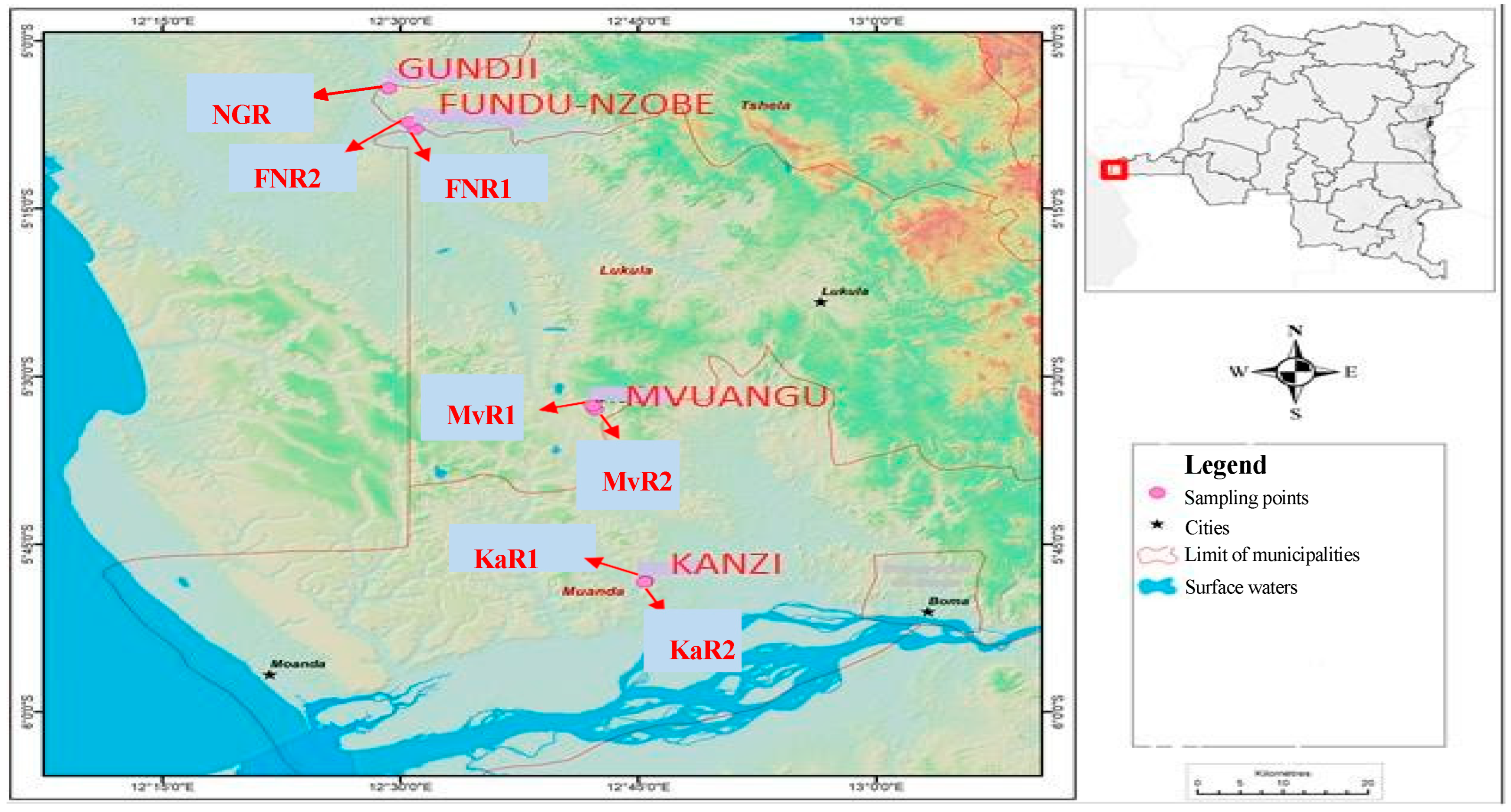
The Lemba petroleum sub-basin, where the investigated areas are located, is densely populated and, beyond oil exploration, the human activities include agriculture and machine repair workshops, among others (Table 1). The region is crossed by several rivers and streams in which the residues from human activities and products from phosphate rock erosion may accumulate (Figure 1).
Nine research permits, covering a total of 3016 mining squares, were recently issued for phosphate ore exploration in the region and the exploration activities are ongoing in the four phosphate ore deposit areas described above [13,14,15]. These exploration activities, and later on the production of phosphates, are likely to increase the spread of phosphate-derived materials in agricultural fields and their accumulation in water courses.

2.2. Sampling Procedure

The collection of phosphate rock samples was conducted in January 2023 at the four selected phosphate areas (Figure 1).
At the Fundu-Nzobe area two phosphate rock samples were collected and labeled FNR1–FNR2. At Ngundji area one phosphate rock sample (NGR) was collected, while at Mvuangu area two phosphate rock samples (MvR1–MvR2) were collected, and the same was done at the Kanzi area (KaR1–KaR2). Detailed descriptions of the sampling locations and their geographical coordinates are provided in Table 1.
All samples were collected using plastic shovels to avoid metal contamination and stored in polyethylene bags. The samples were then transported to the Central Laboratory of the Regional Centre for Nuclear Studies of Kinshasa, DR Congo. Determination of radionuclide activity concentrations was carried out at the Instituto Superior Técnico/Campus Tecnológico e Nuclear, at Bobadela, Portugal.

2.3. Determination of P2O5 Concentrations

The P2O5 content of the phosphate rock samples was determined by energy-dispersive X-ray fluorescence (ED-XRF) spectrometry using a XEPOS III spectrometer (SPECTRO Analytical Instruments, Kleve, Germany). Prior to analysis, the samples were ground and sieved to <63 µm, then prepared as pressed pellets by homogenizing 5 g of sample with 1 g of binder (Fluxana, Bedburg-Hau, Germany) and compacting the mixture using a hydraulic press. Measurements were performed following the FP-Pellets and TQ-Pellets Fast analytical modes of the XEPOS III system. The analytical principle is based on the detection of characteristic fluorescent X-rays emitted by phosphorus under X-ray irradiation, with intensities proportional to its concentration. The P2O5 concentration was calculated from normalized spectral intensities, including corrections for coherent and incoherent scattering effects. Analytical results were reported with a 95% confidence interval based on Student’s t distribution. The external calibration of the instrument was carried using certified reference materials (ISE 870, ISE 890, ISE 919, ISE 961, and SOIL-7) supplied by the WEPAL-QUASIMEME program (Wageningen University & Research, Wageningen, The Netherlands).

2.4. Determination of Radionuclide Activity Concentrations

Prior to gamma-ray spectrometric analysis, the phosphate rock samples underwent a pre-treatment procedure designed to ensure sample homogeneity and the reliability of radiometric measurements. The raw samples were first oven-dried at 105 °C to constant weight in order to remove residual moisture. They were then mechanically crushed and ground, followed by sieving to obtain a fraction with particle size smaller than 2 mm. This step reduces the mineralogical heterogeneity of the material, minimizes gamma-ray self-absorption effects, and improves measurement reproducibility [16].
Aliquots of the <2 mm fraction from phosphate rock samples were tightly packed into cylindrical PFE containers, ensuring the absence of headspace. The containers were hermetically sealed using paraffin wax and cellophane tape and stored for approximately four weeks. This storage period was necessary to allow for the establishment of secular radioactive equilibrium between 226Ra, its gaseous progeny 222Rn, and the short-lived radon decay products 214Pb and 214Bi prior to the gamma-ray analysis.
Gamma-ray spectrometry was employed to quantify the activity concentrations of naturally occurring radionuclides, including 238U, 226Ra, 210Pb, and 40K. Long counting times, extending over several days, were applied to improve counting statistics and detection limits. The activity of 238U was inferred through the gamma emissions of its daughter 234Th at energies of 63.29 keV and 92.59 keV, in secular radioactive equilibrium. The determination of 226Ra relied on the characteristic gamma lines of 214Pb at 295.2 keV and 351.9 keV, in secular radioactive equilibrium. The activity of 40K was evaluated using its prominent photopeak at 1460.82 keV, while 232Th in radioactive equilibrium with 228Ac was determined using the 238Ac photopeaks at 911.2 keV and 35.8 keV.
Measurements were carried out using a high-purity germanium (HPGe) well-type detector (Model GWL-120230, Ortec, AMETEK GmbH, Meersbusch, Germany), featuring an active volume of 136 cm3 and equipped with an aluminum entrance window. To minimize background radiation, the detector was housed within a multilayer shielding system consisting of 10 cm thick lead lined internally with copper and PVC. Data acquisition and spectral processing were performed using standard nuclear electronics coupled with Gamma Vision software (version 6, Ortec).
The detector efficiency calibration was conducted using certified multi-gamma reference materials (DL-1a Uranium–Thorium ore standard, CANMET, CCRMP, Ottawa, ON, Canada), covering an energy range from 46.5 to 1460 keV and measured under geometrical conditions closely matching those of the samples. Corrections for sample geometry, density, and chemical composition were applied using Monte Carlo-based efficiency transfer calculations implemented in the Gespecor 4.1 software package (CID Media, Freigericht, Germany) [16]. Furthermore, additional checks of analytical precision and accuracy are carried out through participation in analytical intercomparison exercises organized by the International Atomic Energy Agency.

2.5. Assessment of Radiological Hazards and Potential Health Impacts

To evaluate the potential radiological hazards to the population arising from exposure to naturally occurring radionuclides present in soils and sediments, several radiological hazard indices were determined. These indices are commonly applied in environmental radioactivity studies to quantify external and internal exposure pathways [16,17,18].
a.
Radium Equivalent Activity (RaEq)
The radium equivalent activity (RaEq) is a widely used radiological index that provides a single numerical value representing the combined gamma radiation contribution from the primordial radionuclides 238U, 232Th, and 40K present in environmental samples. This index allows for a direct comparison of materials containing different proportions of these radionuclides in terms of their potential radiological impact.
The RaEq was calculated using the following equation:
RaEq (Bq kg−1) = AU + 1.43 ATh + 0.077 AK
where AU, ATh, and AK denote the activity concentrations (Bq kg−1) of 238U, 232Th, and 40K, respectively, in soils and sediments. The weighting factors reflect the fact that activity concentrations of 370 Bq kg−1 for 238U, 259 Bq kg−1 for 232Th, and 4810 Bq kg−1 for 40K generate equivalent gamma dose rates. The recommended global reference value for RaEq is 370 Bq kg−1 [19].
b.
Outdoor Gamma Absorbed Dose Rate (ODRA)
The absorbed dose rate is a fundamental quantity for evaluating the biological and health effects associated with exposure to ionizing radiation. The outdoor gamma absorbed dose rate (ODRA) at a height of 1 m above ground level, arising from gamma emissions of 238U, 232Th, and 40K uniformly distributed in soil, was estimated following UNSCEAR guidelines.
Conversion coefficients of 0.462 nGy h−1 per Bq kg−1 for 238U, 0.604 nGy h−1 per Bq kg−1 for 232Th, and 0.042 nGy h−1 per Bq kg−1 for 40K were applied. Accordingly, ODRA was calculated as
ODRA (nGy h−1) = 0.462 AU + 0.604 ATh + 0.042 AK
where AU, ATh, and AK are the activity concentrations (Bq kg−1) of 238U, 232Th, and 40K, respectively. The worldwide average outdoor gamma dose rate from terrestrial sources is estimated at 59 nGy h−1 [19].
c.
Annual Effective Dose Equivalent (AEDE)
The annual effective dose equivalent (AEDE) represents the radiation dose received by an individual over one year due to exposure to outdoor gamma radiation. AEDE was derived from ODRA using a dose conversion factor (DCF) of 0.7 Sv Gy−1, which converts the ODRA in air into effective dose in humans, assuming an outdoor occupancy factor (OF) of 0.2 and an annual total exposure duration of 8760 h.
The AEDE was calculated as follows:
AEDE (mSv y−1) = ODRA (nGy h−1) × 0.7 × 0.2 × 8760 × 10−6
The global average value of AEDE from exposure to natural outdoor radiation is approximately 0.07mSv y−1 [19].
d.
Excess Lifetime Cancer Risk (ELCR)
The excess lifetime cancer risk (ELCR) provides an estimate of the probability of developing cancer over a lifetime due to prolonged exposure to natural radiation sources. ELCR was evaluated using the following equation:
ELCR = AEDE × DL × RF
where DL is the average human lifespan, assumed to be 70 years, and RF is the fatal cancer risk factor per unit effective dose. For members of the public, the International Commission on Radiological Protection (ICRP) recommends an RF value of 0.05 Sv−1 for stochastic effects. The typical worldwide reference value for ELCR is 2.9 × 10⁻⁴ [19].
e.
Radiological Hazard Indices
To assess both external and internal radiation hazards associated with earth crust materials containing 238U, 232Th, and 40K—particularly when such materials are used for construction purposes—two dimensionless indices were introduced by Beretka and Mathew [20]. These indices aim to ensure that the annual effective dose does not exceed the recommended limit of 1 mSv y−1 for the members of general public.
The external hazard index (Hex) is expressed as
Hex = (AU/370) + (ATh/259) + (AK/4810)
where AU, ATh, and AK are the activity concentrations (Bq kg−1) of 238U, 232Th, and 40K, respectively. Values of Hex less than or equal to unity indicate an acceptable level of external radiation hazard.
The internal hazard index (Hin) accounts for internal exposure due to inhalation of radon and its short-lived progeny, which are primarily associated with the presence of 226Ra. Hin was calculated using the equation
Hin = (ARa/185) + (ATh/259) + (AK/4810)
where ARa, ATh, and AK are the activity concentrations (Bq kg−1) of 226Ra, 232Th, and 40K, respectively. For radiation hazards to be considered negligible, the value of Hin should not exceed unity.

2.6. Data Analysis

Statistical analysis, including Spearman correlation, was conducted using XLSTAT version 2021.1 (Addinsoft, New York, NY, USA; https://www.xlstat.com, accessed on 23 June 2025).

3. Results and Discussion

3.1. Phosphorus and Radionuclide Concentrations in Phosphate Rocks

The phosphorus pentoxide (P2O5) content and activity concentrations of naturally occurring radionuclides (238U, 226Ra, 232Th, and 40K) in phosphate rock samples are summarized in Table 2. P2O5 concentrations varied considerably, ranging from 1.06% in MvR1, indicative of phosphate-poor rock, to 24.42% in MvR2, reflecting highly phosphate-rich material, while moderate levels were observed in the remaining samples (10.32%–18.31%).
The activity concentrations of 238U and 226Ra in phosphate rocks showed pronounced variability. Samples FNR1, FNR2, KaR2, MvR2, and NGR exhibited significantly elevated uranium and radium levels, reaching up to 3069 Bq kg−1 for 238U in MvR2, far exceeding the worldwide soil averages of 35 Bq kg−1 for both 238U and 226Ra [19]. Thorium concentrations were comparatively low (<56 Bq kg−1) in most samples, whereas 40K was generally below detection limits. In contrast, KaR1 and MvR1 displayed relatively low radionuclide concentrations, close to the global averages.

3.2. Assessment of Radiological Hazards for the Studied Areas

The radiological hazard indices corroborated the potential hazards to human health in the situation of chronic exposure to these materials. The radium equivalent activity (RaEq) spanned from 64.1 Bq kg−1 in KaR1 to 3084.4 Bq kg−1 in MvR2, well above the recommended safety limit of 370 Bq kg−1. Outdoor gamma dose rates (ODRA) ranged from 29.3 to 1425 nGy h−1, and the annual effective dose equivalent (AEDE) varied between 0.04 and 1.75 mSv yr−1. Similarly, excess lifetime cancer risk (ELCR) and hazard indices (Hex and Hin) exceeded global averages in the samples with high uranium and radium content (Table 2).
The Spearman correlation analysis (Table 3) revealed significant positive correlations between P2O5 content and uranium (R2 = 0.750), radium (R2 = 0.750), RaEq (R2 = 0.643), ODRA (R2 = 0.643), AEDE (R2 = 0.643), ELTCR (R2 = 0.643), and Hin (R2 = 0.750). These results indicated that phosphate enrichment in uranium and radium activities was associated with radiological hazard levels. In contrast, correlations between P2O5 and 232Th (R2 = –0.107) or 40K (R2 = –0.750) were weak or negative, suggesting limited contribution of these radionuclides to the global radiation exposure [21].
Overall, highly phosphate-rich rocks (MvR2, NGR) exhibited the highest radionuclide activities and may pose radiological hazards, indicating potential health risks during extraction, handling, or agricultural application. These findings underscore the necessity for careful radiological assessment and management of phosphate rock exploitation, particularly those enriched in uranium and radium, to mitigate human exposure to gamma radiation and radon [22].

3.3. Comparative Evaluation of Radioactivity in DR Congo Phosphates with Radioactivity in Other Mineral Deposits

The activity concentrations of naturally occurring radionuclides in unexploited phosphate rock from the Democratic Republic of Congo (DR Congo) were particularly high for 238U and 226Ra concentrations, reaching 3069 ± 380 Bq kg−1 and 2273 ± 245 Bq kg−1, respectively, while 232Th and 40K levels were comparatively lower, with 56 ± 20 Bq kg−1 and 612 ± 109 Bq kg−1, respectively.
The 238U content of these phosphate rocks, 3069 ± 380 Bq kg−1, corresponds to an activity concentration of natural uranium (238U+235U+234U) of about 6300 Bq kg−1, or 0.05% uranium content.
All raw materials contain traces of naturally occurring radionuclides, and the concentrations in phosphate rocks can be compared with values for radionuclide concentrations reported from other mining regions of the country. When compared to other Congolese mining sites, the uranium and radium levels in unexploited phosphate rocks were nearly similar to those reported for materials from gold mining sites at 3127 ± 98 Bq kg−1 for 238U and 2710 ± 89 Bq kg−1 for 226Ra [16], but they were substantially higher than those in materials from copper mining areas, at 154–378 Bq kg−1 for 238U and 172–202 Bq kg−1 for 226Ra [23].
Compared with international phosphate deposits, the 238U and 226Ra content in DR Congo phosphate rock exceeded the values reported for phosphate from Morocco, Egypt, Brazil, and Florida (USA) and ranked high and nearly comparable to values in phosphates from South Carolina (USA) (Table 4).
These comparisons indicate that unexploited phosphate rocks in the DR Congo are notably enriched in uranium and radium, representing a potential source for high radiation exposures. This makes such phosphate rock material inadequate for use in house construction. Furthermore, such high radionuclide content of phosphate rock underscores the importance of implementing adequate radiological safety measures during phosphate ore extraction and processing and potential agricultural use of phosphate materials, in order to mitigate human and environmental exposure hazards.
Interestingly, it indicates also the potential in DR Congo for a combined exploitation of phosphate ore deposits for the production of both P2O5 for the phosphate fertilizer industry and uranium for the nuclear industry.

4. Conclusions

This study represents a geochemical and radiological assessment of yet unexploited phosphate rocks from four phosphate-bearing areas (Mvuangu, Kanzi, Fundu-Nzobe, and Ngundji) in the Kongo Central Province of the Democratic Republic of the Congo.
Analysis of radionuclides in phosphate rock samples revealed the presence of very high activity concentrations of 238U (up to 3069 Bq kg−1) and 226Ra (up to 2273 Bq kg−1), strongly correlated with the P2O5 content (R2 ≈ 0.75). The corresponding radiological indices largely exceeded recommended limits, with RaEq reaching 3084 Bq kg−1 (recommended limit: 370 Bq kg−1) and annual effective doses to population members reaching up to 1.75 mSv yr−1 in the same areas.
These values indicate, on the one hand, that potential health hazards for workers and population members may arise during phosphate ore mining and, processing and agricultural use of phosphate-derived materials. Furthermore, the upcoming phosphate rock exploitation, and also oil production in this region, may enhance environmental contamination and bring about higher pollution and radiological hazards. On the other hand, the occurrence of uranium in phosphate deposits at up to 0.05% may allow the co-exploitation of phosphate (P2O5) and uranium.
Overall, this study underscored the necessity of systematic environmental monitoring, including radioactivity surveys, and the implementation of appropriate regulatory and mitigation measures prior to oil and phosphate exploitation in the region.

Author Contributions

Conceptualization: E.K.A., F.P.C., J.P., B.O.D. and R.K.K.; sampling: B.O.D.; sample preparation, formal analysis, and data validation: B.O.D., E.K.A., and F.P.C.; methodology and data interpretation: B.O.D., E.K.A. and F.P.C.; writing—original draft: E.K.A.; writing—review and editing: E.K.A., J.P. and F.P.C. All authors have read and agreed to the published version of the manuscript.

Funding

This research received no external funding.

Data Availability Statement

All data generated or analysed during this study are included in this published article.

Acknowledgments

Authors are thankful to Mario Capucho Reis and Marta Santos (IST/CTN) for their kind assistance with the analyses of radionuclides by gamma spectrometry.

Conflicts of Interest

The authors declare no conflict of interest.

References

  1. Carvalho, F.P. Mining industry and sustainable development: Time for change. Food Energy Secur. 2017, 6, 61–77. [Google Scholar] [CrossRef]
  2. Fayiga, A.O.; Nwoke, O.C. Phosphate rock: Origin, importance, environmental impacts, and future roles. Environ. Rev. 2016, 24, 403–415. [Google Scholar] [CrossRef]
  3. Noli, F.; Sidirelli, M.; Tsamos, P. Dispersion of radionuclides and heavy metals from phosphogypsum stacks in soil and plants at Northwestern Greece. J. Radioanal. Nucl. Chem. 2023, 332, 4213–4221. [Google Scholar] [CrossRef]
  4. Xie, G.; Guan, Q.; Zhou, F.; Yu, W.; Yin, Z.; Tang, H.; Zhang, Z.; Chi, R.A. Critical Review of the Enhanced Recovery of Rare Earth Elements from Phosphogypsum. Molecules 2023, 28, 6284. [Google Scholar] [CrossRef]
  5. Anufrieva, A.V.; Andrienko, O.S.; Buynovskiy, A.S.; Makaseev, Y.N.; Mazov, I.N.; Nefedov, R.A.; Sachkov, V.I.; Stepanova, O.B.; Valkov, A.V. Rare earth elements materials production from apatite ores. Mater. Sci. Eng. 2016, 112, 012002. [Google Scholar] [CrossRef]
  6. Thomson, B.M.; Smith, C.L.; Busch, R.D.; Siegel, M.D.; Baldwin, C. Removal of Metals and Radionuclides Using Apatite and Other Natural Sorbents. J. Environ. Eng. 2003, 129, 492–499. [Google Scholar] [CrossRef]
  7. Boumaza, B.; Chekushina, T.V.; Kechiched, R.; Benabdeslam, N.; Brahmi, L.; Kucher, D.E.; Rebouh, N.Y. Environmental Geochemistry of Potentially Toxic Metals in Phosphate Rocks, Products, and Their Wastes in the Algerian Phosphate Mining Area (Tébessa, NE Algeria). Minerals 2023, 13, 853. [Google Scholar] [CrossRef]
  8. Carvalho, F.P. 210Pb and 210Po in sediments and suspended matter in the Tagus estuary, Portugal. Local enhancement of natural levels by wastes from phosphate ore processing industry. Sci. Total Environ. 1995, 159, 201–214. [Google Scholar] [CrossRef]
  9. Mdachi, D.D.; Rugaika, A.M.; Machunda, R.L. The Assessment of Heavy Metals and Natural Radioactivity in the Phosphate Tailings at Minjingu Mines in Tanzania. J. Ecol. Eng. 2024, 25, 269–277. [Google Scholar] [CrossRef]
  10. Wu, S.; Wang, L.; Zhao, L.; Zhang, P.; El-Shall, H.; Moudgil, B.; Huang, X.; Zhang, L. Recovery of rare earth elements from phosphate rock by hydrometallurgical processes—A critical review. Chem. Eng. J. 2018, 335, 774–800. [Google Scholar] [CrossRef]
  11. Sabiha-Javied; Mehmood, T.; Chaudhry, M.M.; Tufail, M.; Irfan, N. Heavy metal pollution from phosphate rock used for the production of fertilizer in Pakistan. Microchem. J. 2009, 91, 94–99. [Google Scholar] [CrossRef]
  12. Ryszko, U.; Rusek, P.; Kołodynska, D. Quality of Phosphate Rocks from Various Deposits Used in Wet Phosphoric Acid and P-Fertilizer Production. Materials 2023, 16, 793. [Google Scholar] [CrossRef] [PubMed]
  13. Congo Mines. Monographie sur les Possibilités de Mise en Valeur des Ressources du Sous-Sol Classées «Ressources Minières» dans la Province du Kongo Central. 2016. Available online: https://wpstorage7ceb827ed5.blob.core.windows.net/wpblob7ceb827ed5/formidable/17/MONOGRAPHIE_RESSOURCES_MINIERES.pdf (accessed on 7 January 2023).
  14. Wetshondo, D.O.; Lokata, P.E.; Mbundi, S.D.; Deko, B.O.; Safari, B.K.; Ondontshia, J.N.; Bukasa, L.M.; Kabesa, J.K. Contribution to the characterization of carbonate rocks of the Nganzi Oil Exploration block (Onshore of the DR Congo Coastal Basin). J. Yangtze Gas Oil 2022, 7, 149–165. [Google Scholar] [CrossRef]
  15. Ndumba, D.R.; Ngumba, V.N.; Ngimbi, J.N.; Nusianga, S.S.; Mboyo, J.B.; Lakubu, P.E.; Ndumba, D.L.; Nguya, J.M. Etudes pétrographique comparatives des roches phosphatées des gisements de Kanzi et de Mvuangu au Kongo Central, RD Congo. Rev. Cong. Sci. Technol. 2023, 2, 197–203. [Google Scholar] [CrossRef]
  16. Atibu, E.K.; Arpagaus, P.; Mulaji, C.K.; Mpiana, P.T.; Poté, J.; Loizeau, J.-L.; Carvalho, F.P. High Environmental Radioactivity in Artisanal and Small-Scale Gold Mining in Eastern Democratic Republic of the Congo. Minerals 2022, 12, 1278. [Google Scholar] [CrossRef]
  17. Belyaeva, O.; Pyuskyulyan, K.; Movsisyan, N.; Saghatelyan, A.; Carvalho, F.P. Natural radioactivity in urban soils of mining centers in Armenia: Dose rate and risk assessment. Chemosphere 2019, 225, 859–870. [Google Scholar] [CrossRef]
  18. Choudhury, T.R.; Zesha, J.H.; Mia, M.Y.; Ferdous, J.; Islam, A.R.M.T. Radiological risks and spatial distribution of natural radionuclides in riverbed sediments along the Pashur River, Bangladesh. J. Radiat. Res. Appl. Sci. 2025, 18, 101973. [Google Scholar] [CrossRef]
  19. UNSCEAR. Sources and Effects of Ionizing Radiation. United Nations Scientific Committee on the Effects of Atomic Radiation, UNSCEAR 2000 Report to the General Assembly, with Scientific Annexes; United Nations: New York, NY, USA, 2000.
  20. Beretka, J.; Mathew, P.J. Natural Radioactivity of Australian Building Materials, Industrial Wastes and By-products. Health Physics 1985, 48, 87–95. [Google Scholar] [CrossRef]
  21. Mwalongo, D.A.; Haneklaus, N.H.; Lisuma, J.B.; Mpumi, N.; Amasi, A.I.; Mwimanzi, J.M.; Chuma, F.M.; Kivevele, T.T.; Mtei, K.M. Uranium Dissemination with Phosphate Fertilizers Globally: A Systematic Review with Focus on East Africa. Sustainability 2024, 16, 1496. [Google Scholar] [CrossRef]
  22. IAEA. Radiation Protection and Management of NORM Residues in the Phosphate Industry. Safety Report Series N°78; International Atomic Energy Agency: Vienna, Austria, 2023. [Google Scholar]
  23. Atibu, E.K.; Oliveira, J.M.; Malta, M.; Santos, M.; Mulaji, C.K.; Mpiana, P.T.; Carvalho, F.P. Assessment of natural radioactivity in the copper belt region, Kolwezi Province, of the Democratic Republic of the Congo. J. Geosc. Environ. Prot. 2021, 9, 1–20. [Google Scholar] [CrossRef]
  24. Mrabet, T.; Kotti, M.M. Radioactivity in the phosphate field: Actions undertaken by IMPHOS. In Naturally Occurring Radioactive Material (NORM V), Proceedings of an International Symposium, Seville, Spain, 19–22 March 2007; International Atomic Energy Agency: Vienna, Austria, 2008; pp. 259–267. [Google Scholar]
  25. Ndao, A.S.; Carvalho, F.P.; Oliveira, J.M.; Malta, M.; Faye, N.A.B. Radionuclides and Preliminary Radiological Assessment in the Phosphate Industry of Senegal. In Proceedings of the Eighth International Symposium on Naturally Occurring Radioactive Material—NORM VIII, Rio de Janeiro, Brazil, 18–21 October 2016; pp. 240–243. [Google Scholar]
  26. Uosif, M.A.M.; El-Taher, A. Radiological assessment of Abu-Tartur phosphate, Western desert Egypt. Radiat. Prot. Dosim. 2008, 130, 228–235. [Google Scholar] [CrossRef]
  27. Tomazini da Conceição, F.; Bonotto, D.M. Radionuclides, heavy metals and fluorine incidence at Tapira phosphate rocks, Brazil, and their industrial (by) products. Environ. Pollut. 2006, 139, 232–243. [Google Scholar] [CrossRef] [PubMed]
Figure 1. Map of the study areas in DR Congo and sampling points (red circles).
Minerals 16 00359 g001
Table 1. Sampling areas, GPS coordinates of sampling sites, and description of human activities carried out at the sampling stations.
AreaSample NameGeographical
Coordinates
Human ActivityObservations
MVUANGUMvR105°32′59″
012°42′17″
Agriculture: cassava, groundnut, maizePhosphate rock sample collected 2 m from a small river and on an agricultural site.
MvR205°32′37″
012°42′8″
Agriculture: cassava, groundnut, maizePhosphate rock sample collected 10 m from a small river and on an agricultural site.
KANZIKaR105°48′19″
012°45′29″
Water wellPhosphate rock sample collected 10 m from a water well
KaR205°48′25″
O12°45′24″
Water wellPhosphate rock sample collected 2 m from a water well
FUNDU-NZOBEFNR105°07′57″
O12°30′59″
Agricultural activityPhosphate rock sample collected 5 m from the Lukula river.
FNR205°07′17″
012°30′33″
Agricultural activityPhosphate rock sample collected 10 m from the Lukula river.
NGUNDJINGR05°04′15″
012°29′16″
Agricultural activityPhosphate rock sample collected next to a water source and 10 m from an agricultural site.
Table 2. Analytical and radiological assessment results for the phosphate rock materials: P2O5 concentration (% dry weight); activity concentrations of naturally occurring radionuclides in phosphate rock samples (Bq kg−1 ± 2 σ dry weight); radium equivalent activity index (RaEq); outdoor gamma absorbed dose rate (ODRA); annual effective dose equivalent (AEDE); excess lifetime cancer risk (ELCR); hazard indices (Hex and Hin).
SamplesP2O5 (%)238U226Ra232Th40KRaEqODRAAEDEELCRHexHin
FNR117.481649 ± 2431519 ± 19756 ± 20113 ± 6117388000.983.44.78.5
FNR210.321357 ± 2251197 ± 17634 ± 19Nd (<105)14106500.82.83.86.6
KaR117.4956.8 ± 6.552.5 ± 3.94.9 ± 1.7Nd (<6.7)64.129.30.040.10.20.3
KaR216.511351 ± 1851163 ± 13753 ± 22Nd (<87)14306580.812.83.96.5
MvR11.06Nd (<37)14.4 ± 7.7Nd (<15)612 ± 10976.338.80.050.20.20.2
MvR224.423069 ± 3802273 ± 245Nd (<17)Nd (<85)308414251.756.18.312.3
NGR18.312203 ± 2772062 ± 222Nd (<16)Nd (<83)221810241.264.4611.2
World average in soils [19]-353530400370590.070.00029≤1≤1
Numbers in bold indicate values above the worldwide average. Nd = not detected (<x) = (<minimum detectable activity). In the case of values < minimum detectable activity concentration, the activity concentration half of MDA was used.
Table 3. Spearman rank-order correlation coefficients between radiological variables and risk parameters in phosphate rock samples.
Variables40K226Ra232Th238URaEqODRAAEDEELCRHexHin
P2O5−0.7500.750−0.1070.7500.6430.6430.6430.6430.6430.750
40K −0.2860.429−0.286−0.107−0.107−0.107−0.107−0.107−0.286
226Ra 0.3931.0000.9290.9290.9290.9290.9291.000
232Th 0.3930.4640.4640.4640.4640.4640.393
238U 0.9290.9290.9290.9290.9291.000
RaEq 1.0001.0001.0001.0000.929
ODRA 1.0001.0001.0000.929
AEDE 1.0001.0000.929
ELCR 1.0000.929
Hex 0.929
Statistically significant coefficients (p < 0.05) are shown in bold.
Table 4. Comparison of the average activity concentrations (Bq kg−1 dry weight) of 238U, 232Th, 226Ra, and 40K from this study with concentrations in phosphate rock reported from other regions.
Location238U232Th226Ra40KReferences
Congo (DRC)3069 ± 38056 ± 202273 ± 245612 ± 109This study
Morocco1700301700-[24]
Senegal1889 ± 22214 ± 11230 ± 50<22[25]
Egypt-154.9 + 7.8302.4 + 15.2368.4 + 18.4[26]
Brazil131333443041303[27]
Florida (USA)1500161600-[24]
South Carolina (USA)4800784800-[24]
China15025150-[24]
Disclaimer/Publisher’s Note: The statements, opinions and data contained in all publications are solely those of the individual author(s) and contributor(s) and not of MDPI and/or the editor(s). MDPI and/or the editor(s) disclaim responsibility for any injury to people or property resulting from any ideas, methods, instructions or products referred to in the content.