Mineral Prospectivity Mapping Based on Remote Sensing and Machine Learning in the Hatu Area, China
Abstract
1. Introduction
- (i)
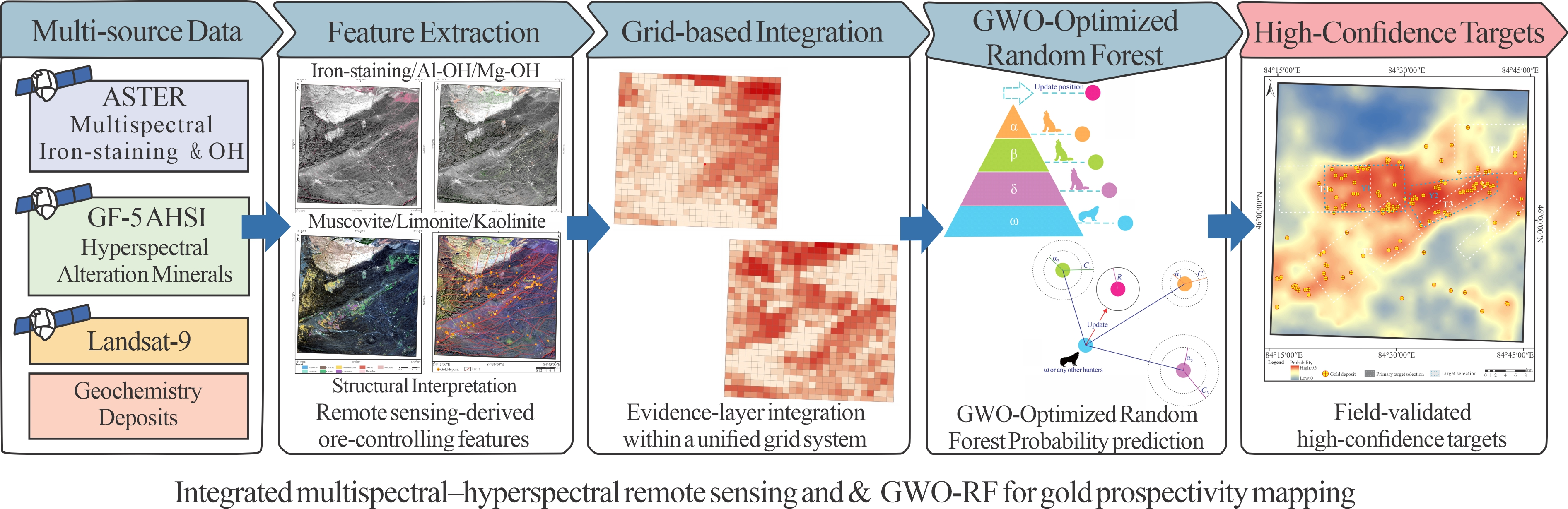
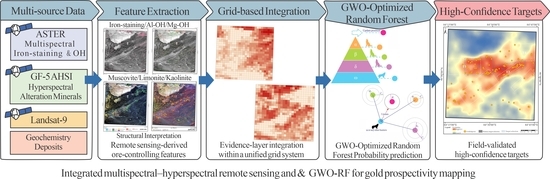
- Integrating ASTER, GF-5, and Landsat-9 data to extract iron-staining anomalies, hydroxyl anomalies, and hyperspectral alteration mineral assemblages, and combining these with geological, geochemical, and deposit (occurrence) information;
- (ii)
- Building an RF model based on fishnet grid and using the GWO algorithm to tune hyperparameters, thereby achieving quantitative integration of multi-source evidence layers;
- (iii)
- Comparing qualitative results from multi-source overlay with quantitative results from machine-learning-based probability models, progressing from broad perspective areas to specific exploration targets and verifying prediction accuracy through field reconnaissance.
2. Regional Geological Background
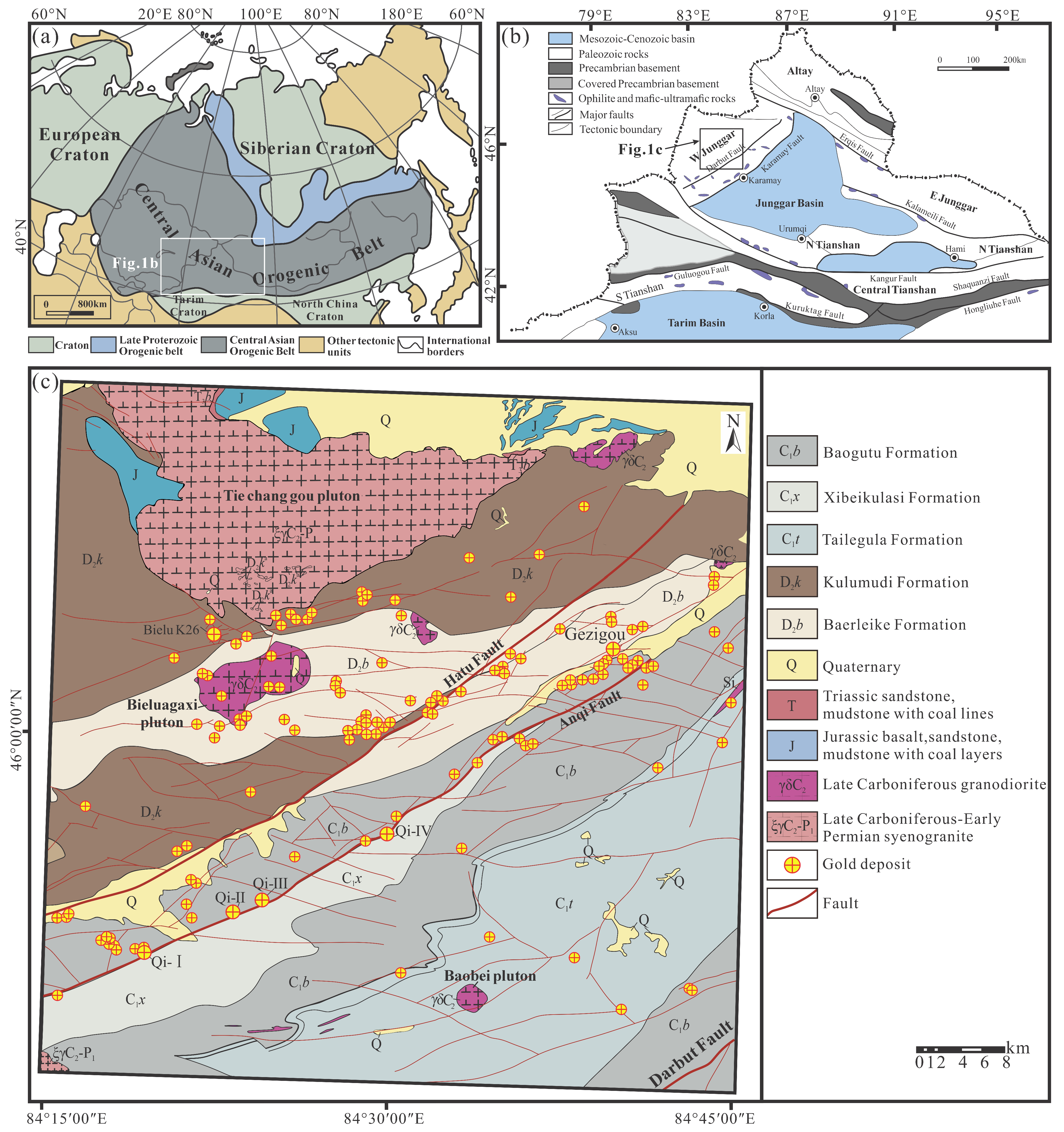
- Tuffaceous siltstone and tuff of the Baogutu Formation (C1b);
- Tuffaceous sandstone and tuffaceous siltstone of the Xibeikulasi Formation (C1x);
- Welded tuff, andesite, and rhyolite of the Tailegula Formation (C1t);
- Shallow-marine intermediate tuff and tuffaceous sandstone of the Kelumudi Formation (D2k);
- Argillaceous siltstone and siltstone of the Baerleike Formation (D2b).

3. Data and Methods
3.1. Data Sources
3.2. Data Preprocessing
3.3. Main Research Methods
3.3.1. Principal Component Analysis
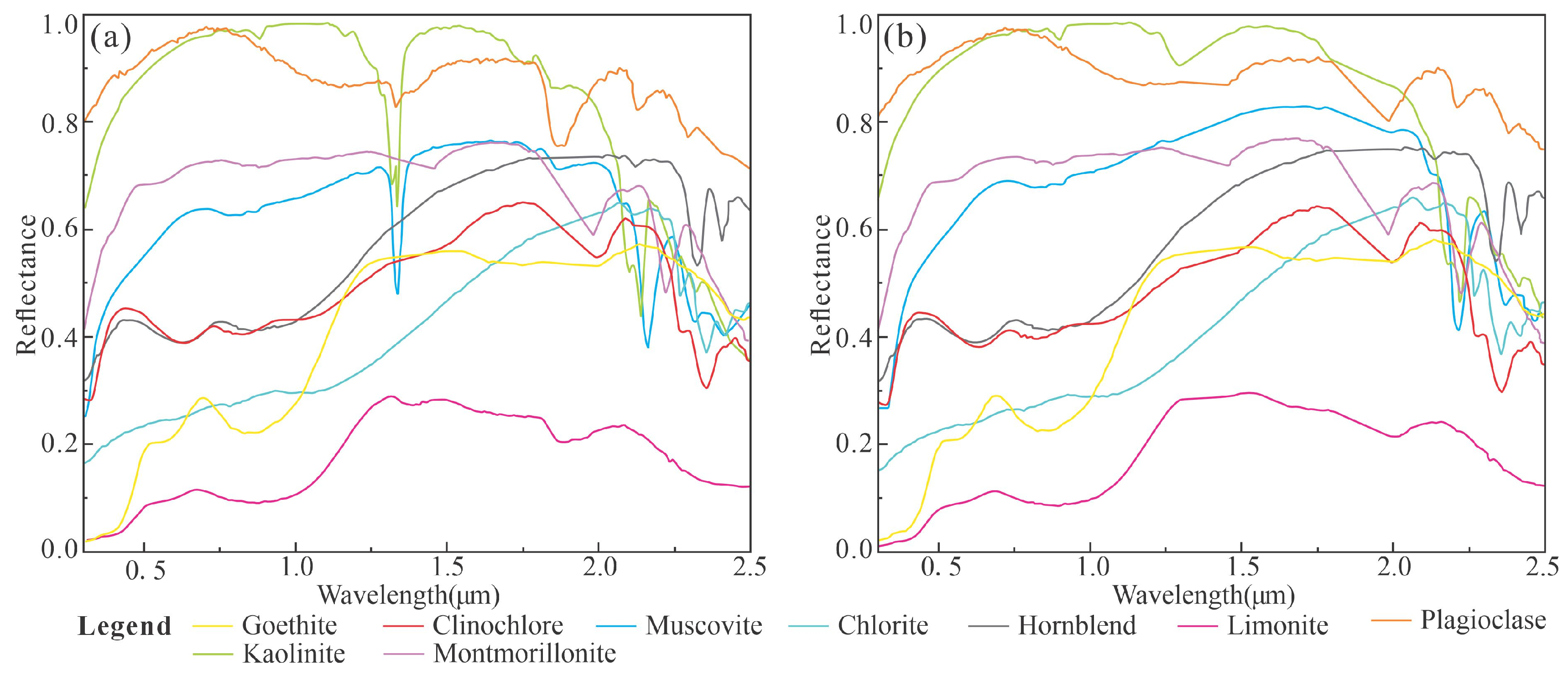
3.3.2. Spectral Hourglass Method
- -
- Applying the Minimum Noise Fraction (MNF) transformation for dimensionality reduction to suppress noise and retain principal feature components;
- -
- Employing the Pixel Purity Index (PPI) and n-Dimensional Visualization (n-D) methods to identify potential endmembers;
- -
3.3.3. Optimum Index Factor (OIF)
3.3.4. Random Forest (RF)
3.3.5. Grey Wolf Optimizer (GWO)
4. Remote Sensing Mapping Results and Prospective Zone Delineation
4.1. Geological Structural Interpretation
4.2. PCA Results Based on ASTER Data
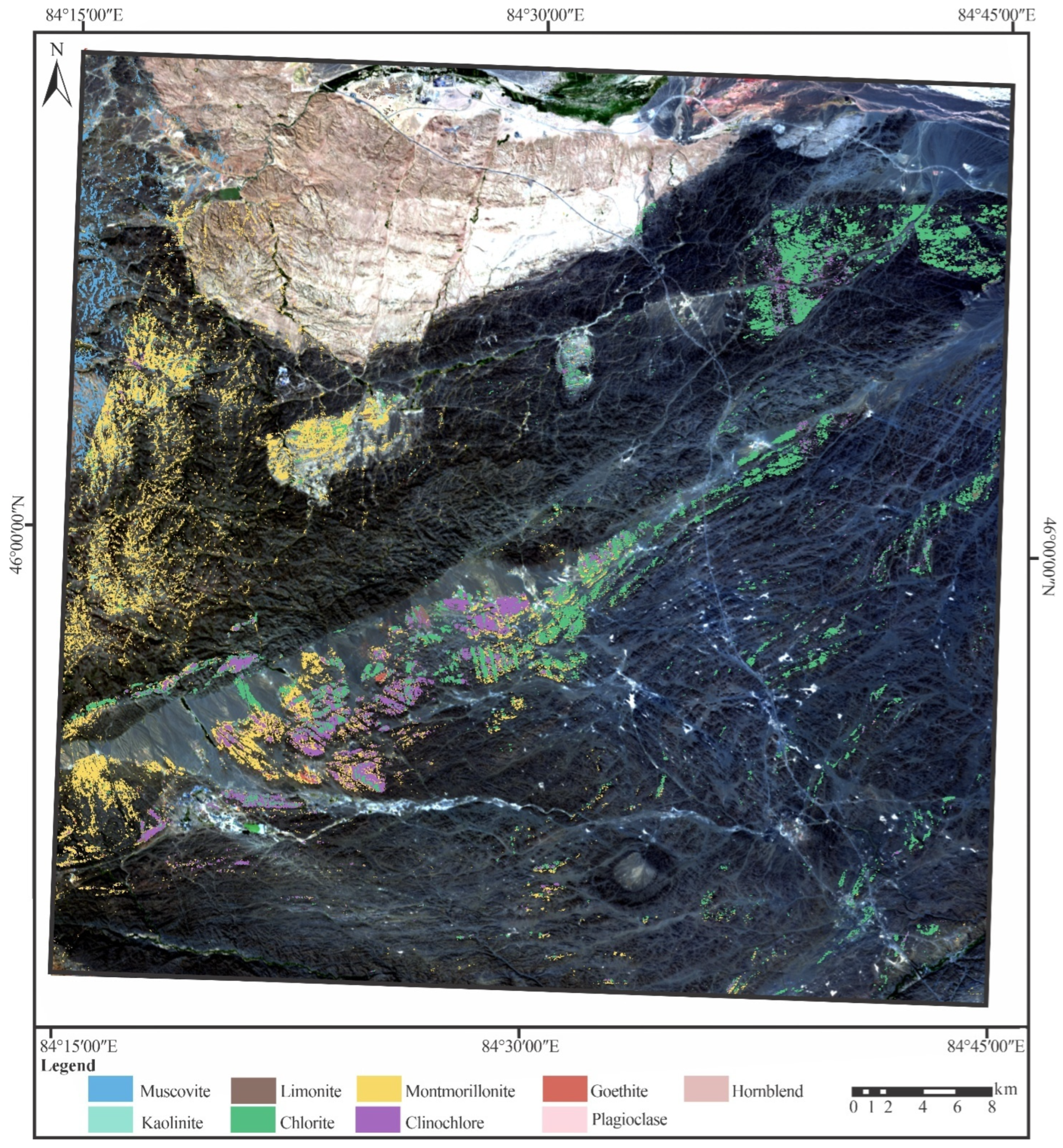
4.3. Spectral Hourglass Method Analysis Results Based on GF-5 Data
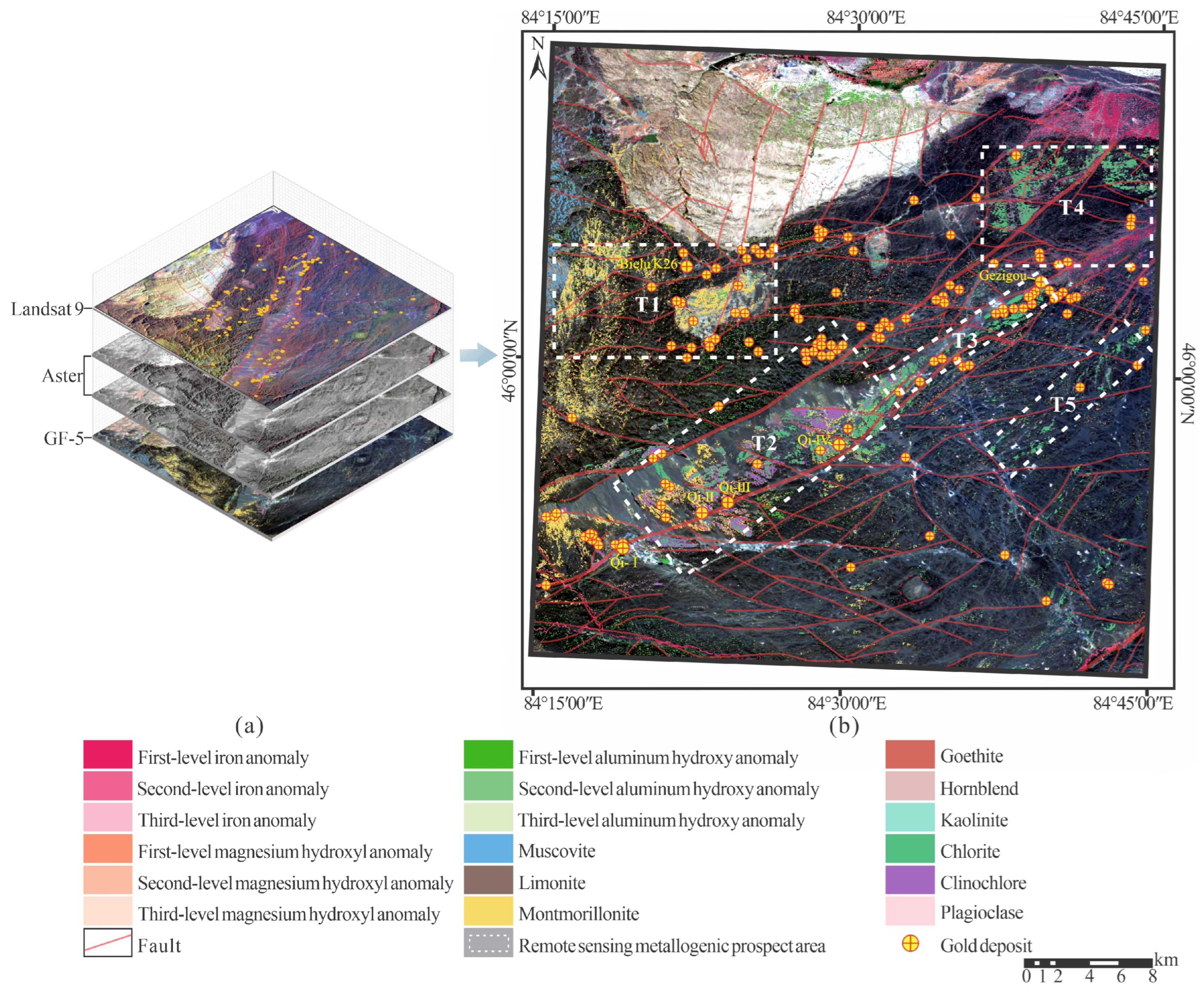
4.4. Multi-Source Remote Sensing Information Integration for Prediction
5. Establishment and Optimization of the Prospecting Model
5.1. Evidence Layer Integration
- (1)
- The number of positive and negative samples should be approximately balanced;
- (2)
- The spatial distance between positive and negative samples should not be excessively close;
- (3)
- Negative samples should be randomly and evenly distributed across the study area as much as possible [94].
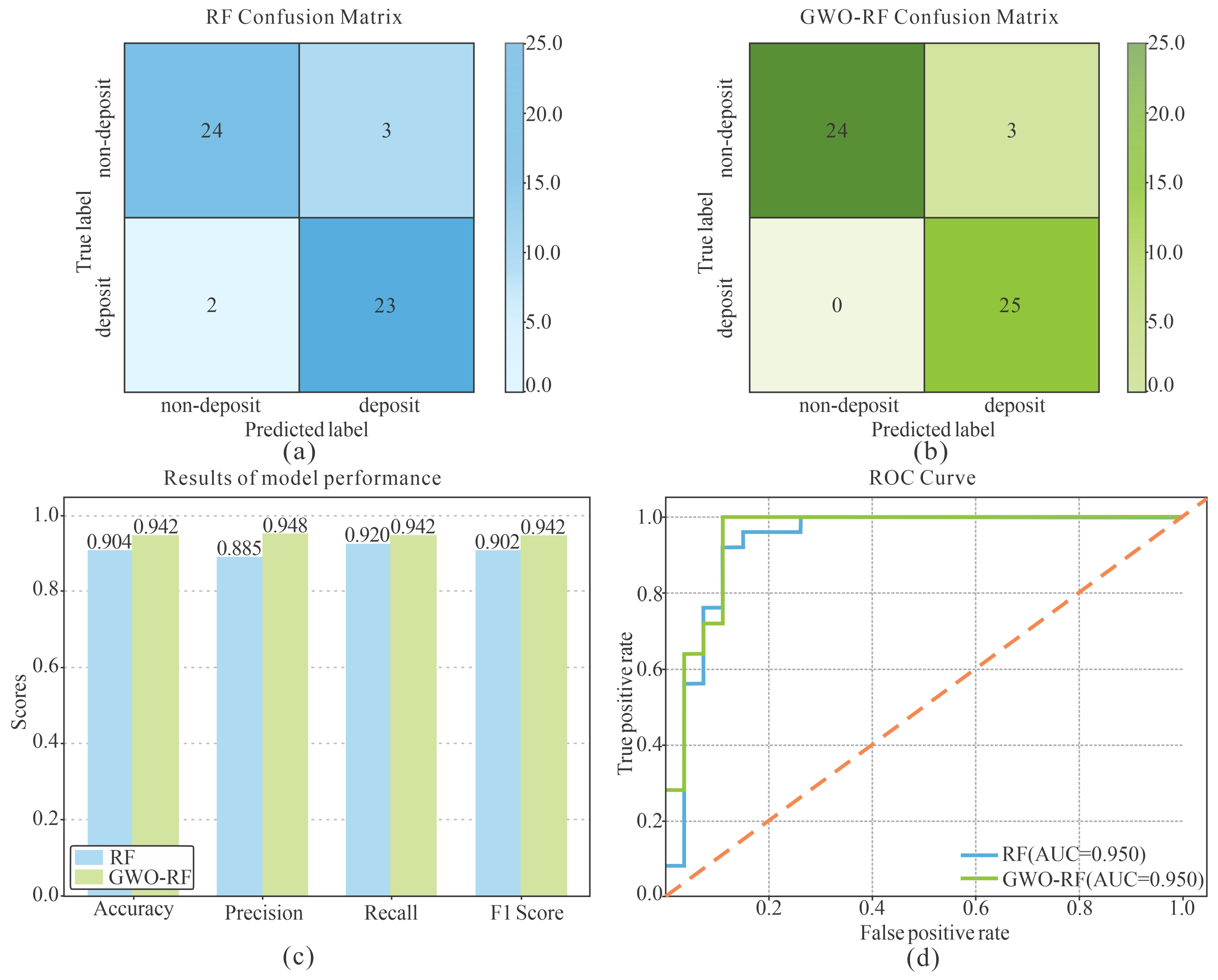
5.2. Mineral Prospectivity Modeling and Accuracy Assessment
5.3. Grey Wolf Optimizer and Model Optimization Results
6. Discussion
6.1. Evaluation of Prediction Results
Comprehensive Analysis of Target Areas
6.2. Field Verification
7. Conclusions
- (1)
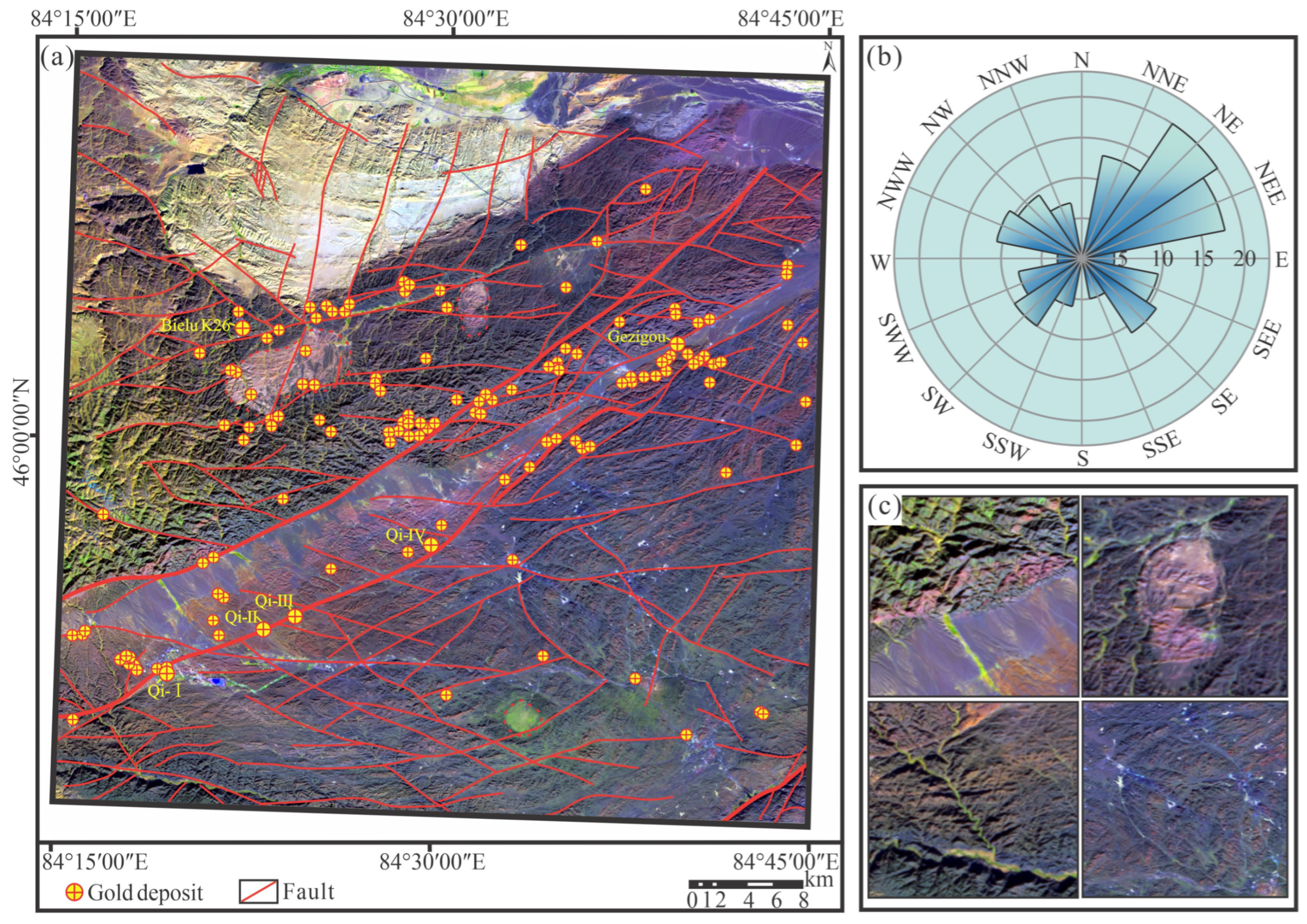
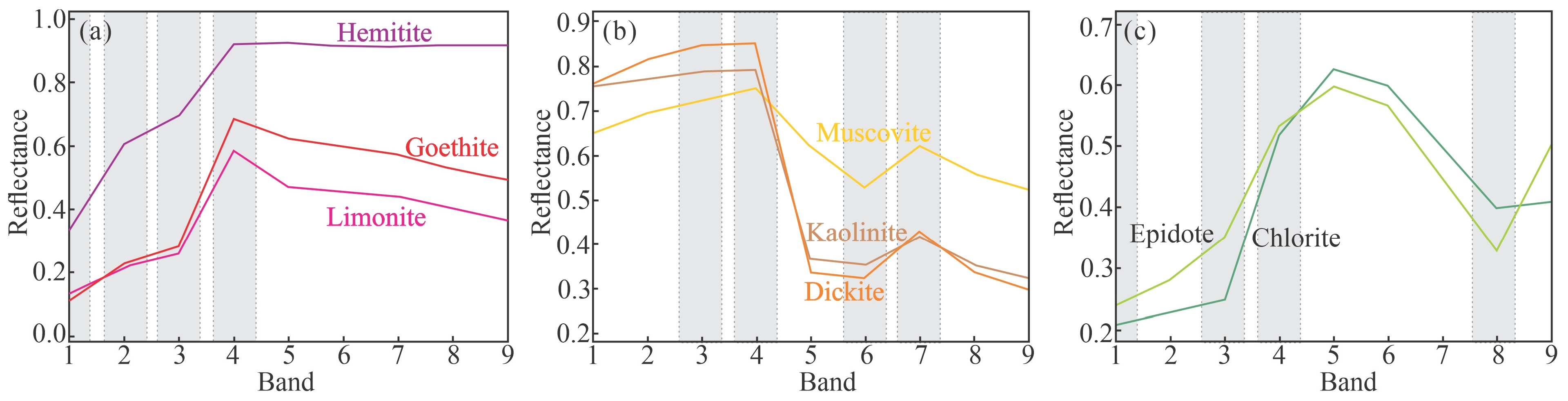
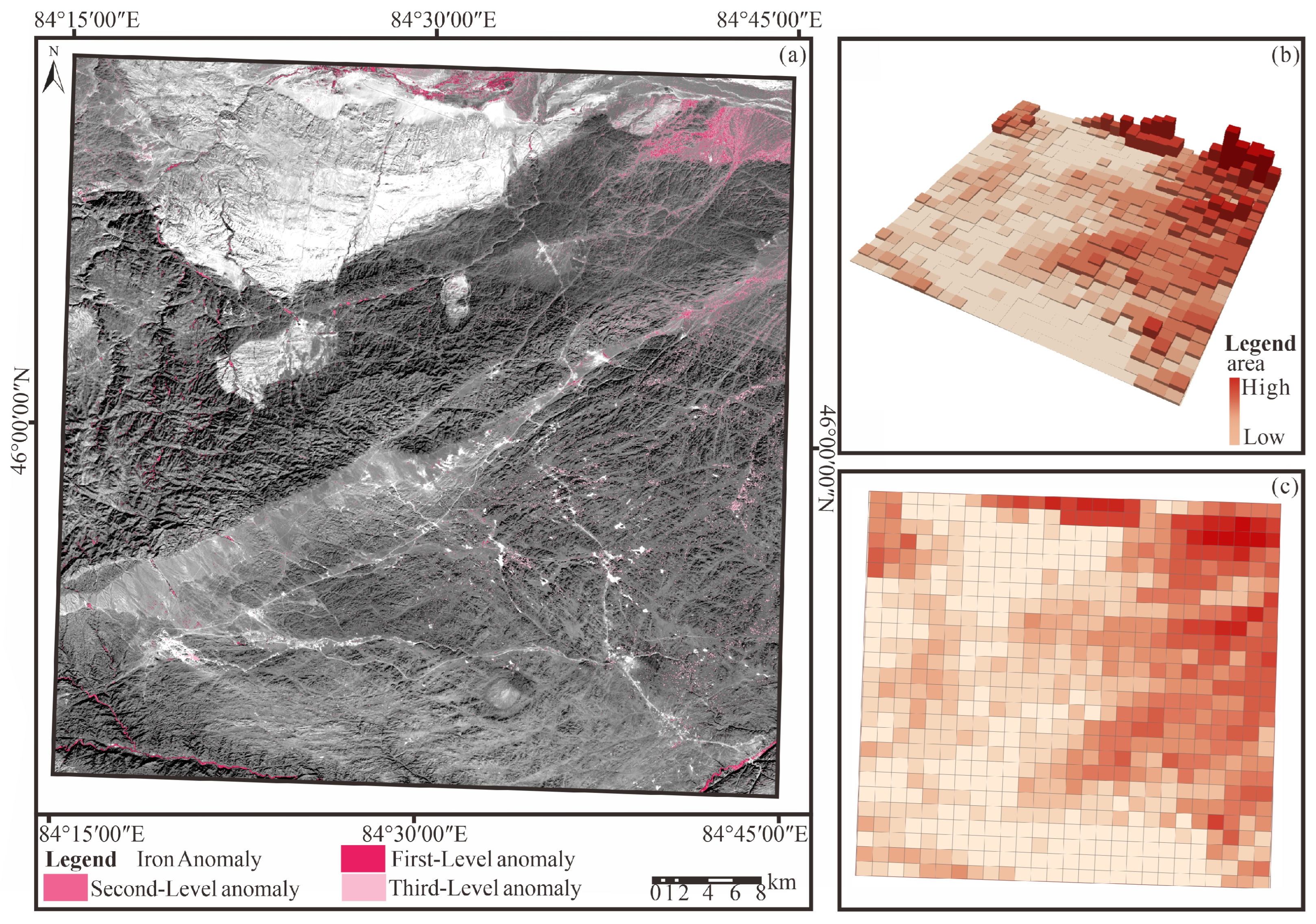
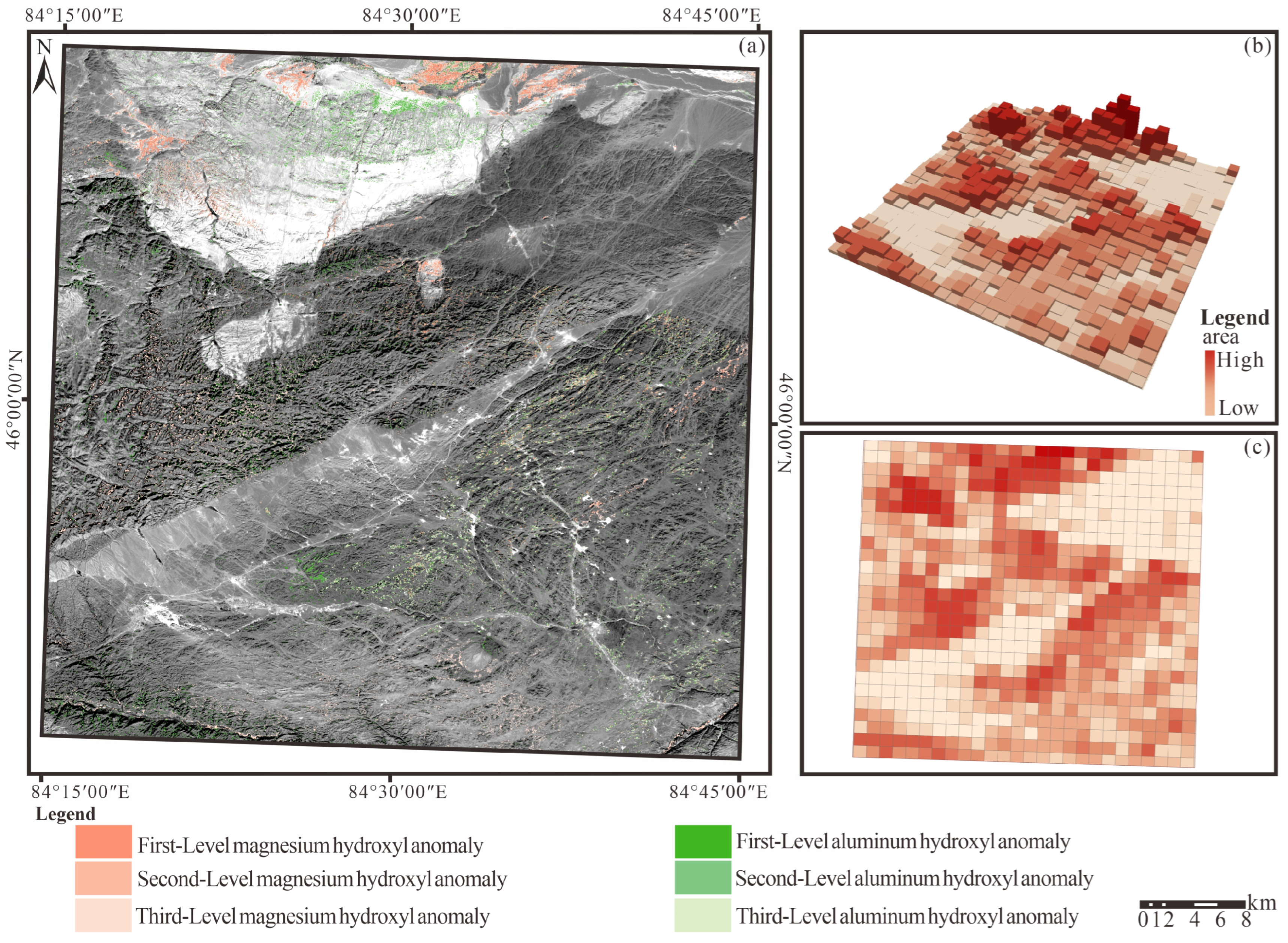
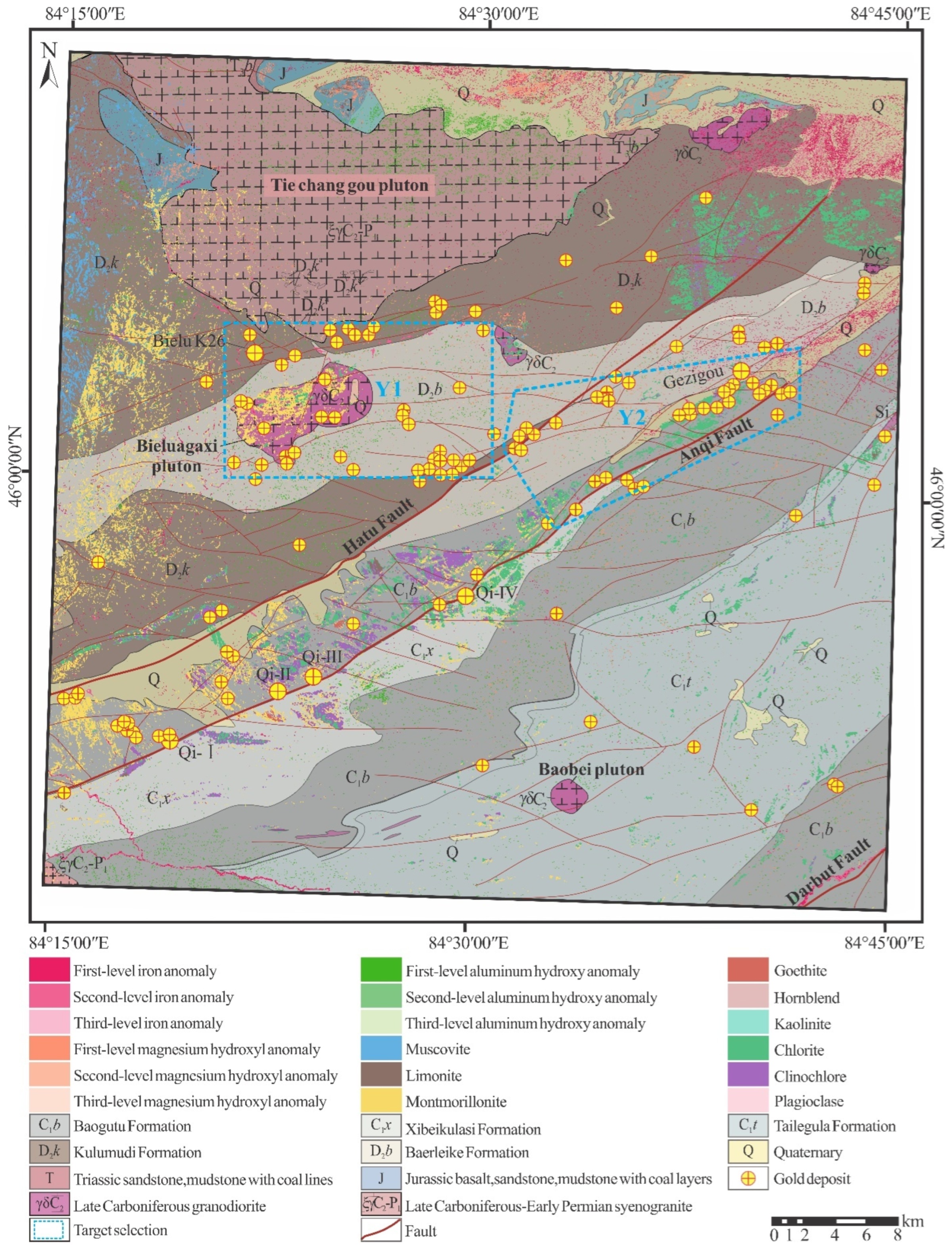
- This study comprehensively applied multi-source remote sensing data from ASTER, Landsat-9, and GF-5. The results show that iron-staining, hydroxyl anomalies, and alteration minerals, such as muscovitization, chloritization, and montmorillonitization in the Hatu area, are highly concentrated near granitic plutons and fault intersection zones. By integrating this multi-source remote sensing information, an exploration model was established, leading to the preliminary delineation of five prospective areas.
- (2)
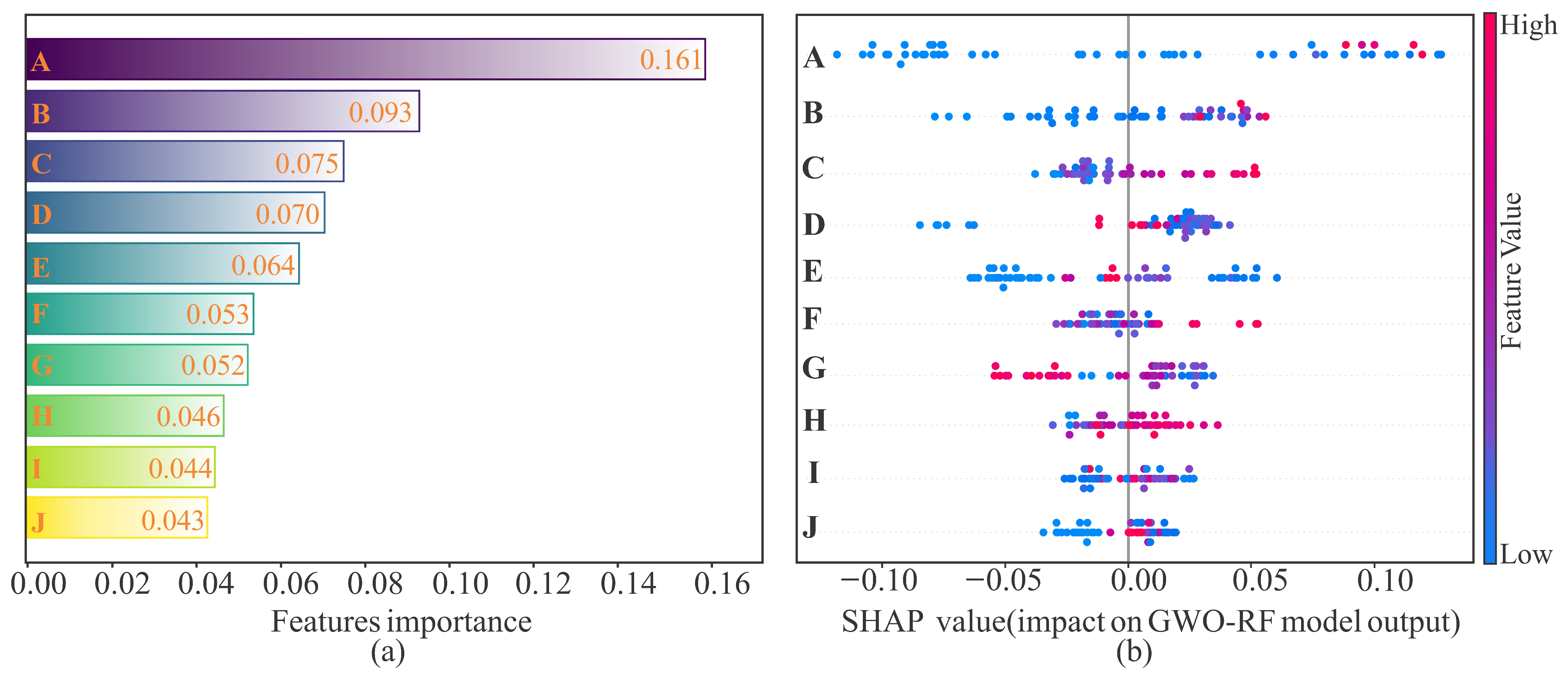
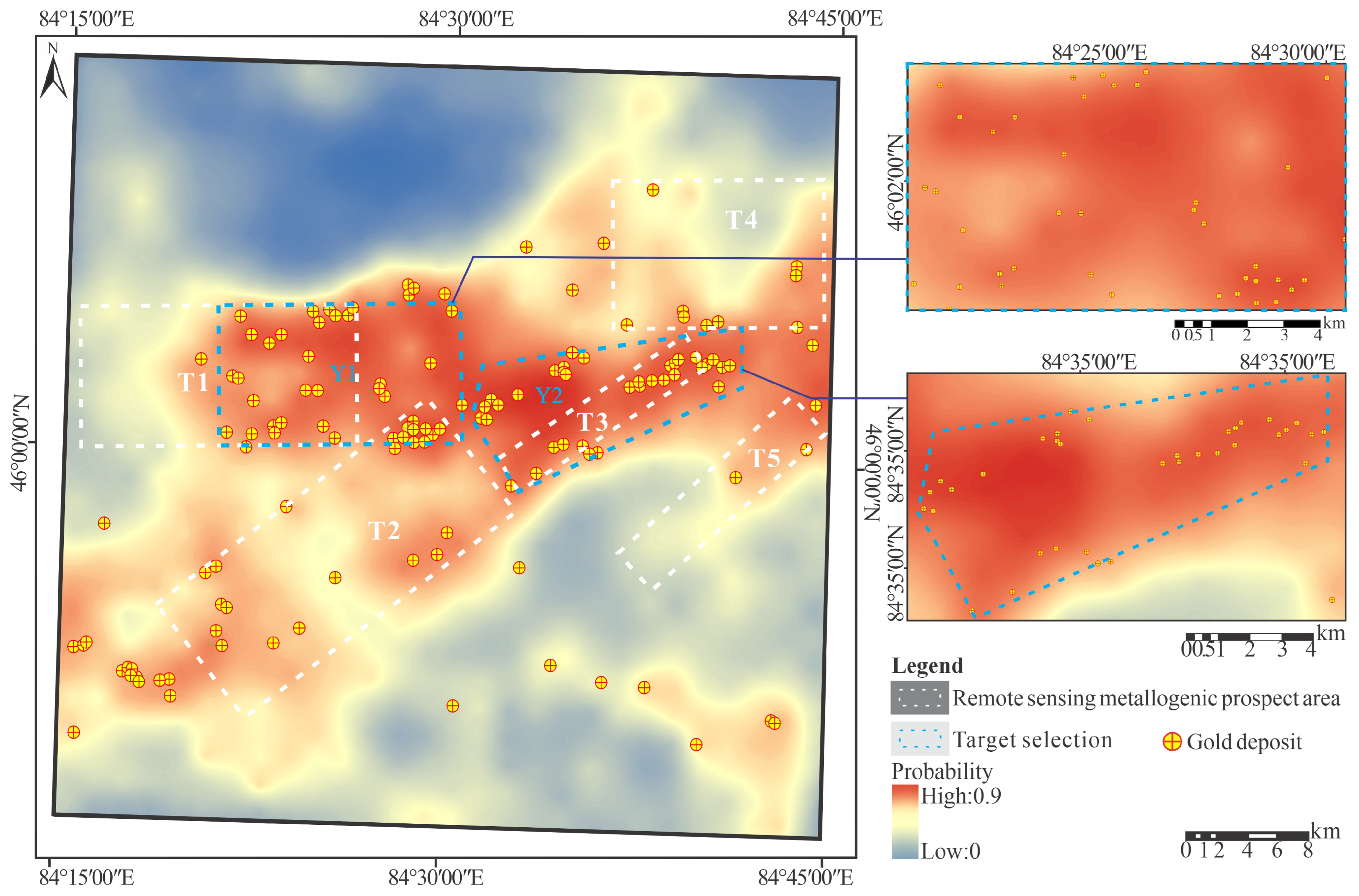
- The RF model optimized with GWO was applied for quantitative integration of multi-source evidence layers. The machine learning results showed strong overall consistency with the remote sensing overlay predictions while significantly refining the potential mineralization zones through probability distribution constraints. Using a probability threshold of >0.8, two high-confidence exploration targets (Y1 and Y2) were ultimately selected.
- (3)
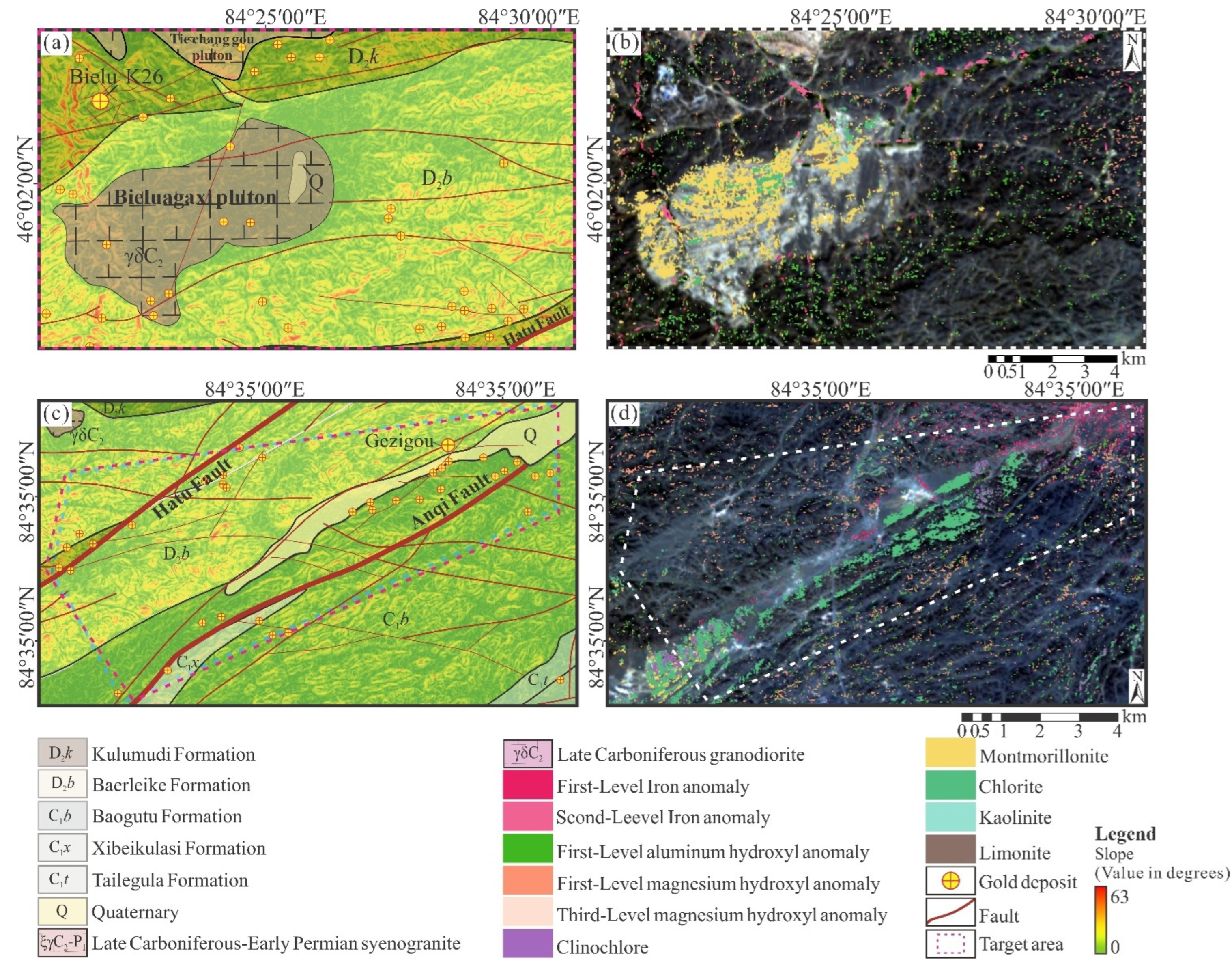
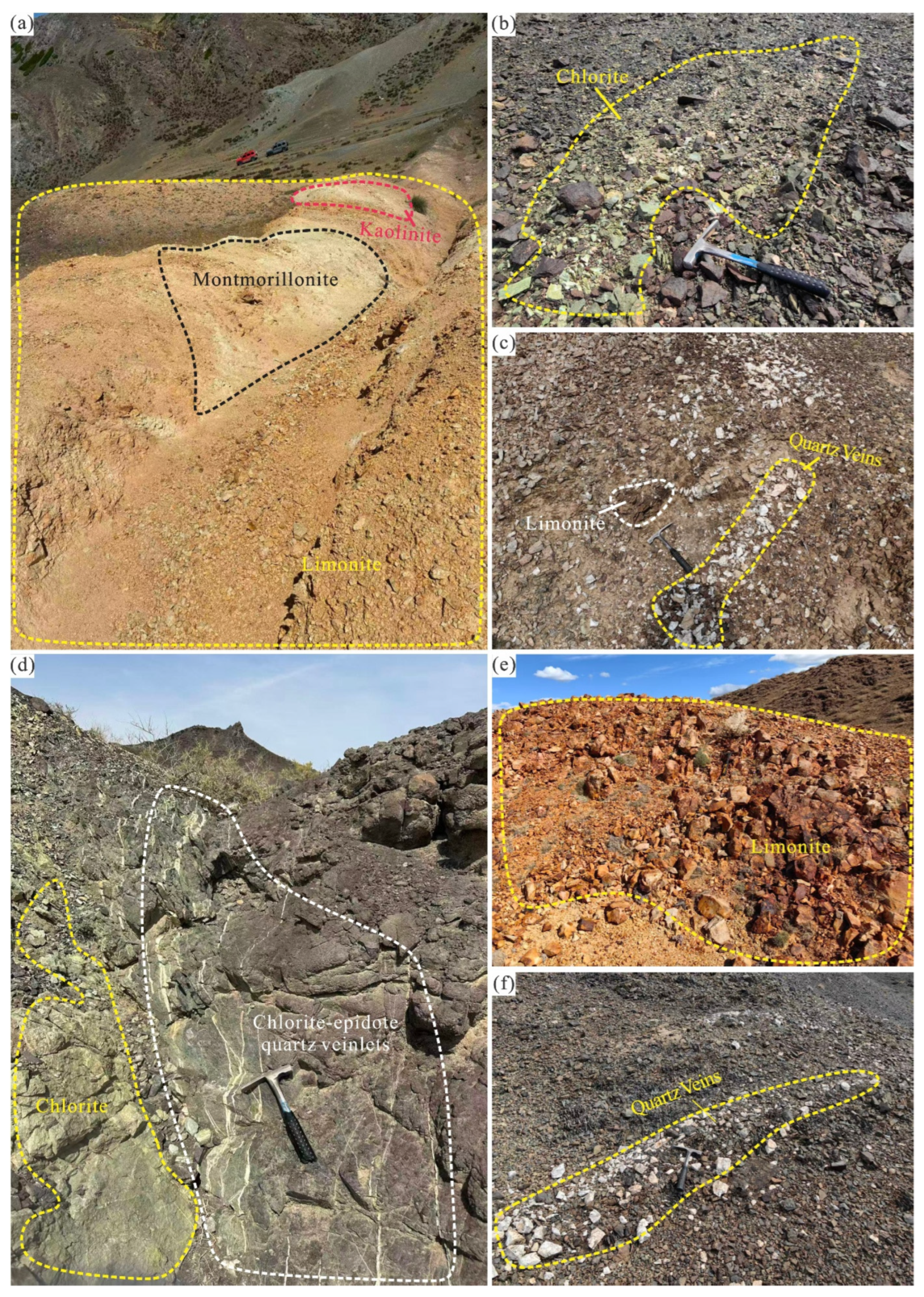
- The Y1 target area reflects mineralization dominated by magmatic hydrothermal processes, with granitic plutons serving as favorable geological units. It is primarily characterized by areal montmorillonitization and chloritization that are enriched along favorable fault structures. In contrast, the Y2 target area demonstrates mineralization controlled by structural hydrothermal activity concentrated along the Anqi Fault zone and its secondary faults, mainly showing linear chloritization and iron-staining anomalies enriched at intersections of NE-, NW-, and NE-trending structures. Field investigations have verified the rationality of delineating the Y1 and Y2 target areas, further confirming the scientific validity and reliability of the prediction methodology that integrates multi-source geological, remote sensing, and geochemical information through machine learning.
Author Contributions
Funding
Data Availability Statement
Conflicts of Interest
References
- Şengör, A.M.C.; Natal’in, B.A.; Burtman, V.S. Evolution of the Altaid tectonic collage and Palaeozoic crustal growth in Eurasia. Nature 1993, 364, 299–307. [Google Scholar] [CrossRef]
- Sengör, A.M.C.; Natal’in, B.A. Turkic-type orogeny and its role in the making of the continental crust. Annu. Rev. Earth Planet. Sci. 1996, 24, 263–337. [Google Scholar] [CrossRef]
- Xiao, W.; Sun, M.; Santosh, M. Continental reconstruction and metallogeny of the Circum-Junggar areas and termination of the southern Central Asian Orogenic Belt. Geosci. Front. 2015, 6, 137–140. [Google Scholar] [CrossRef]
- Li, S.; Wang, T.; Xiao, W.; Hou, Q. Tectono-magmatic evolution from accretion to collision in the southern margin of the Central Asian Orogenic Belt. Acta Petrol. Sin. 2023, 39, 1261–1275. [Google Scholar] [CrossRef]
- Windley, B.F.; Alexeiev, D.; Xiao, W.; Kröner, A.; Badarch, G. Tectonic Models for Accretion of the Central Asian Orogenic Belt. J. Geol. Soc. 2007, 164, 31–47. [Google Scholar] [CrossRef]
- Xiao, W.; Song, D.; Windley, B.F.; Li, J.; Han, C.; Wan, B.; Zhang, J.; Ao, S.; Zhang, Z. Research progresses of the accretionary processes and metallogenesis of the Central Asian Orogenic Belt. Sci. China Earth Sci. 2019, 49, 1512–1545. [Google Scholar]
- Xiao, W.; Han, C.; Yuan, C.; Chen, H.; Sun, M.; Lin, S.; Li, Z.; Mao, Q.; Zhang, J.; Sun, S.; et al. Unique Carboniferous-Permian tectonic-metallogenic framework of northern Xinjiang (NW China):Constraints for the tectonics of the southern Paleoasian Domain. Acta Petrol. Sin. 2006, 22, 1062–1076. [Google Scholar]
- Feng, L.; Yu, M.; Yang, B.; Zhang, D. Geologic features, ore-controlling factors and ore-prospecting indicators of the Bieluagaxi gold deposit, Tuoli County, Xinjiang. Gold 2017, 38, 15–18, 26. [Google Scholar]
- An, F.; Zhu, Y. Studies on geology and geochemistry of alteration-type ore in Hatu gold deposit (Western Junggar), Xinjiang, NW China. Miner. Depos. 2012, 31, 723–724. [Google Scholar] [CrossRef]
- Yalcin, M.; Kilic Gul, F.; Yildiz, A.; Polat, N.; Basaran, C. The mapping of hydrothermal alteration related to the geothermal activities with remote sensing at Akarcay Basin (Afyonkarahisar), using ASTER data. Arab. J. Geosci. 2020, 13, 1166. [Google Scholar] [CrossRef]
- Bolouki, S.M.; Ramazi, H.R.; Maghsoudi, A.; Beiranvand Pour, A.; Sohrabi, G. A remote sensing-based application of Bayesian networks for epithermal gold potential mapping in Ahar-Arasbaran area, NW Iran. Remote Sens. 2019, 12, 105. [Google Scholar] [CrossRef]
- Liu, L.; Xiao, X.; Qin, Y.; Wang, J.; Xu, X.; Hu, Y.; Qiao, Z. Mapping cropping intensity in China using time series Landsat and Sentinel-2 images and Google Earth Engine. Remote Sens. Environ. 2020, 239, 111624. [Google Scholar] [CrossRef]
- Zhang, G.; Zhao, Z.; Zhang, X.; Wu, X.; Zheng, Y.; Feng, L.; Huang, Z. Comprehensive multi-source remote sensing data integration for enhanced mineralization alteration extraction and geological structure interpretation in the Lala region of Sichuan Province. Ore Geol. Rev. 2024, 168, 106032. [Google Scholar] [CrossRef]
- Wang, L.; Li, Z. A review of remote sensing alteration information extraction techniques. Geol. Resour. 2023, 32, 462–470. [Google Scholar] [CrossRef]
- Rowan, L.C.; Mars, J.C. Lithologic mapping in the Mountain Pass, California area using Advanced Spaceborne Thermal Emission and Reflection Radiometer (ASTER) data. Remote Sens. Environ. 2003, 84, 350–366. [Google Scholar] [CrossRef]
- Pour, A.B.; Hashim, M. The application of ASTER remote sensing data to porphyry copper and epithermal gold deposits. Ore Geol. Rev. 2012, 44, 1–9. [Google Scholar] [CrossRef]
- Mahdevar, M.R.; Ketabi, P.; Saadatkhah, N.; Rahnamarad, J.; Mohammadi, S.S. Application of ASTER SWIR data on detection of alteration zone in the Sheikhabad area, eastern Iran. Arab. J. Geosci. 2015, 8, 5909–5919. [Google Scholar] [CrossRef]
- Deb, M.; Sarkar, S.C. Minerals and Allied Natural Resources and Their Sustainable Development; Springer Geology; Springer: Singapore, 2017; ISBN 978-981-10-4563-9. [Google Scholar]
- Tangestani, M.H.; Moore, F. Comparison of three principal component analysis techniques to porphyry copper alteration mapping: A case study, Meiduk area, Kerman, Iran. Can. J. Remote Sens. 2001, 27, 176–182. [Google Scholar] [CrossRef]
- Pour, A.B.; Hashim, M. Identifying areas of high economic-potential copper mineralization using ASTER data in the Urumieh–Dokhtar volcanic belt, Iran. Adv. Space Res. 2012, 49, 753–769. [Google Scholar] [CrossRef]
- Wu, M.; Zhou, K.; Wang, Q.; Wang, J. Mapping hydrothermal zoning pattern of porphyry Cu deposit using absorption feature parameters calculated from ASTER data. Remote Sens. 2019, 11, 1729. [Google Scholar] [CrossRef]
- Serikbayeva, E.; Togizov, K.; Talgarbayeva, D.; Orynbassarova, E.; Sydyk, N.; Bermukhanova, A. Application of multispectral data in detecting porphyry copper deposits: The case of Aidarly deposit, eastern Kazakhstan. Minerals 2025, 15, 938. [Google Scholar] [CrossRef]
- Crósta, A.P.; De Souza Filho, C.R.; Azevedo, F.; Brodie, C. Targeting key alteration minerals in epithermal deposits in Patagonia, Argentina, using ASTER imagery and principal component analysis. Int. J. Remote Sens. 2003, 24, 4233–4240. [Google Scholar] [CrossRef]
- Beiranvand Pour, A.; Hashim, M. ASTER, ALI and Hyperion sensors data for lithological mapping and ore minerals exploration. SpringerPlus 2014, 3, 130. [Google Scholar] [CrossRef] [PubMed]
- Testa, F.; Villanueva, C.; Cooke, D.; Zhang, L. Lithological and hydrothermal alteration mapping of epithermal, porphyry and tourmaline breccia districts in the Argentine Andes using ASTER imagery. Remote Sens. 2018, 10, 203. [Google Scholar] [CrossRef]
- Gabr, S.S.; Hassan, S.M.; Sadek, M.F. Prospecting for new gold-bearing alteration zones at El-Hoteib area, South Eastern Desert, Egypt, using remote sensing data analysis. Ore Geol. Rev. 2015, 71, 1–13. [Google Scholar] [CrossRef]
- Hassan, S.M.; Ramadan, T.M. Mapping of the Late Neoproterozoic basement rocks and detection of the gold-bearing alteration zones at Abu Marawat–Semna area, Eastern Desert, Egypt using remote sensing data. Arab. J. Geosci. 2015, 8, 4641–4656. [Google Scholar] [CrossRef]
- Liu, L.; Li, Y.; Zhou, J.; Han, L.; Xu, X. Gold–copper deposits in Wushitala, southern Tianshan, northwest China: Application of ASTER data for mineral exploration. Geol. J. 2018, 53, 362–371. [Google Scholar] [CrossRef]
- Lin, J.; Yan, B.; Dong, X.; Yang, S.; Yang, R.; Cui, J.; Guo, D.; Wang, R. Evaluating of Tiangong-1 imaging spectrometer data oriented to geological applications. J. Remote Sens. 2014, 18, 74–83. [Google Scholar] [CrossRef]
- Dong, X.; Gan, F.; Li, N.; Yan, B.; Zhang, L.; Zhao, J.; Yu, J.; Liu, R.; Ma, Y. Fine mineral identification of GF-5 hyperspectral image. J. Remote Sens. 2020, 24, 454–464. [Google Scholar] [CrossRef]
- Hajaj, S.; El Harti, A.; Pour, A.B.; Jellouli, A.; Adiri, Z.; Hashim, M. A review on hyperspectral imagery application for lithological mapping and mineral prospecting: Machine learning techniques and future prospects. Remote Sens. Appl. Soc. Environ. 2024, 35, 101218. [Google Scholar] [CrossRef]
- Narayanan, S.A.; Pramanik, S. Synergetic usage of hyperspectral remote sensing and machine learning in detection and mapping of iron ore deposit hotspots: A case study from northern Odisha, India. J. Indian Soc. Remote Sens. 2025, 53, 3105–3113. [Google Scholar] [CrossRef]
- Qin, Y.; Zhang, X.; Zhao, Z.; Li, Z.; Yang, C.; Huang, Q. Coupling relationship analysis of gold content using Gaofen-5 (GF-5) satellite hyperspectral remote sensing data: A potential method in Chahuazhai gold mining area, Qiubei County, SW China. Remote Sens. 2021, 14, 109. [Google Scholar] [CrossRef]
- Arne, D.C.; House, E.; Pontual, S.; Huntington, J. Hyperspectral interpretation of selected drill cores from orogenic gold deposits in Central Victoria, Australia. Aust. J. Earth Sci. 2016, 63, 1003–1025. [Google Scholar] [CrossRef]
- Wang, R.; Cudahy, T.; Laukamp, C.; Walshe, J.L.; Bath, A.; Mei, Y.; Young, C.; Roache, T.J.; Jenkins, A.; Roberts, M.; et al. White mica as a hyperspectral tool in exploration for the Sunrise Dam and Kanowna Belle gold deposits, Western Australia. Econ. Geol. 2017, 112, 1153–1176. [Google Scholar] [CrossRef]
- Bierwirth, P.; Blewett, R.; Huston, D. Finding new mineral prospects with HYMAP: Early results from a hyperspectral remote-sensing case study in the West Pilbara. AGSO Res. Newsl. 1999, 31, 1–32. [Google Scholar]
- Chen, Q.; Zhao, Z.; Zhou, J.; Zhu, R.; Xia, J.; Sun, T.; Zhao, X.; Chao, J. ASTER and GF-5 satellite data for mapping hydrothermal alteration minerals in the Longtoushan Pb-Zn deposit, SW China. Remote Sens. 2022, 14, 1253. [Google Scholar] [CrossRef]
- Li, Z.; Chen, S.; Liu, D.; Liu, K.; Liu, L.; Wang, M.; Li, Z.; Fu, L.; Zhou, Z. Progress of remote sensing geological prospecting domestic and abroad in recent years. Northwest. Geol. 2025, 58, 183–195. [Google Scholar] [CrossRef]
- Rajesh, H.M. Application of remote sensing and GIS in mineral resource mapping—An overview. J. Mineral. Petrol. Sci. 2004, 99, 83–103. [Google Scholar] [CrossRef]
- Gardiner, N.J.; Sykes, J.P.; Trench, A.; Robb, L.J. Tin mining in Myanmar: Production and potential. Resour. Policy 2015, 46, 219–233. [Google Scholar] [CrossRef]
- Wen, S.; Wang, Y.; Chen, X.; Tian, J.; Wang, C.; Feng, Y.; Ning, Y. A metric-learning enhanced variational autoencoder for unsupervised detection of geochemical anomalies in the Hatu gold belt, Xinjiang, China. Ore Geol. Rev. 2025, 187, 107017. [Google Scholar] [CrossRef]
- Han, W.; Zhang, X.; Wang, Y.; Wang, L.; Huang, X.; Li, J.; Wang, S.; Chen, W.; Li, X.; Feng, R.; et al. A survey of machine learning and deep learning in remote sensing of geological environment: Challenges, advances, and opportunities. ISPRS J. Photogramm. Remote Sens. 2023, 202, 87–113. [Google Scholar] [CrossRef]
- Abedi, M.; Norouzi, G.-H.; Bahroudi, A. Support vector machine for multi-classification of mineral prospectivity areas. Comput. Geosci. 2012, 46, 272–283. [Google Scholar] [CrossRef]
- Bahrami, Y.; Hassani, H.; Maghsoudi, A. Precise lithological mapping using HHO-optimized deep ResNet-18 and GoogleNet CNN models. Nat. Resour. Res. 2025, 34, 2467–2507. [Google Scholar] [CrossRef]
- Cracknell, M.J.; Reading, A.M. Geological mapping using remote sensing data: A comparison of five machine learning algorithms, their response to variations in the spatial distribution of training data and the use of explicit spatial information. Comput. Geosci. 2014, 63, 22–33. [Google Scholar] [CrossRef]
- Daoud, A.M.A.; Shebl, A.; Nafi, M.; Elrasheed, A.A.; Csámer, Á.; Rózsa, P. Machine learning-based lithological mapping and mineral prospecting using hyperspectral and multispectral remote sensing in Wadi Halfa, North Sudan. J. Afr. Earth Sci. 2025, 232, 105816. [Google Scholar] [CrossRef]
- Ghoneim, S.M.; Hamimi, Z.; Abdelrahman, K.; Khalifa, M.A.; Shabban, M.; Abdelmaksoud, A.S. Machine learning and remote sensing-based lithological mapping of the Duwi shear-belt area, Central Eastern Desert, Egypt. Sci. Rep. 2024, 14, 17010. [Google Scholar] [CrossRef]
- Alimi, S.A.; Carranza, E.J.M. Predictive modeling of orogenic gold prospectivity in the Wawa area, Western Nigeria, using three most commonly-used machine learning algorithms. J. Afr. Earth Sci. 2025, 231, 105791. [Google Scholar] [CrossRef]
- Carranza, E.J.M.; Laborte, A.G. Data-driven predictive mapping of gold prospectivity, Baguio District, Philippines: Application of Random Forests algorithm. Ore Geol. Rev. 2015, 71, 777–787. [Google Scholar] [CrossRef]
- Adib, A.; Pourgholam, M.M.; Afzal, P. The application of Python-GIS-fractal-wavelet add-on to highlight the promising areas of iron-apatite in association with REE,s, in the metallogenic zone of Tarom, NW Iran. Sci. Q. J. Geosci. 2025, e236317. [Google Scholar] [CrossRef]
- Pourgholam, M.M.; Adib, A.; Afzal, P.; Rahbar, K.; Gholinejad, M. Deep learning and fractal-wavelet techniques for magnetite–apatite exploration in Tarom, Iran. Sci. Rep. 2025, 15, 31907. [Google Scholar] [CrossRef] [PubMed]
- Mirjalili, S.; Mirjalili, S.M.; Lewis, A. Grey wolf optimizer. Adv. Eng. Softw. 2014, 69, 46–61. [Google Scholar] [CrossRef]
- Coleman, R.G. Continental growth of northwest China. Tectonics 1989, 8, 621–635. [Google Scholar] [CrossRef]
- Jahn, B.; Windley, B.; Natal’in, B.; Dobretsov, N. Phanerozoic continental growth in Central Asia. J. Asian Earth Sci. 2004, 23, 599–603. [Google Scholar] [CrossRef]
- Geng, H.; Sun, M.; Yuan, C.; Xiao, W.; Xian, W.; Zhao, G.; Zhang, L.; Wong, K.; Wu, F. Geochemical, Sr–Nd and zircon U–Pb–Hf isotopic studies of Late Carboniferous magmatism in the West Junggar, Xinjiang: Implications for ridge subduction? Chem. Geol. 2009, 266, 364–389. [Google Scholar] [CrossRef]
- Yang, G.; Li, Y.; Zhu, Z.; Li, H.; Tong, L.; Zeng, R. Seamount subduction and accretion in West Junggar, NW China: A review. Geosyst. Geoenviron. 2024, 3, 100074. [Google Scholar] [CrossRef]
- Wang, L.; Guo, J.; Zhang, B.; Sun, Y.; Zhang, C. Magmamixing in the Karamaili granite belt of East Junggar—Evidence from A2-type granite and their MMEs. Xinjiang Geol. 2025, 43, 1–17. [Google Scholar]
- Mao, J.; Pirajno, F.; Lehmann, B.; Luo, M.; Berzina, A. Distribution of porphyry deposits in the Eurasian continent and their corresponding tectonic settings. J. Asian Earth Sci. 2014, 79, 576–584. [Google Scholar] [CrossRef]
- Shen, P.; Pan, H.; Hattori, K.; Cooke, D.R.; Seitmuratova, E. Large Paleozoic and Mesozoic porphyry deposits in the Central Asian Orogenic Belt: Geodynamic settings, magmatic sources, and genetic models. Gondwana Res. 2018, 58, 161–194. [Google Scholar] [CrossRef]
- Zhu, Y.; An, F.; Feng, W.; Zhang, H. Geological evolution and huge ore-forming belts in the core part of the Central Asian metallogenic region. J. Earth Sci. 2016, 27, 491–506. [Google Scholar] [CrossRef]
- Ding, J.; Han, S.; Huang, B.; Wu, Y.; Zhang, B.; Xiao, F.; Wang, Y. The orogenic gold deposits in Western Junggar, NW China: Geochronological framework, spatial distribution and tectonic implication. Geol. Rev. 2019, 65, 1439–1461. [Google Scholar] [CrossRef]
- Yang, F.; Geng, X.; Wang, R.; Zhang, Z.; Guo, X. A synthesis of mineralization styles and geodynamic settings of the Paleozoic and Mesozoic metallic ore deposits in the Altay Mountains, NW China. J. Asian Earth Sci. 2018, 159, 233–258. [Google Scholar] [CrossRef]
- Chen, X.; Yang, N.; Ye, B.; Wang, Z.; Chen, Z. Tectonic system and its control on metallogenesis in Western Junggar as part of the Central Asia multi-core metallogenic system. Geotecton. Metallogen. 2011, 35, 325–338. [Google Scholar] [CrossRef]
- Jin, C.; Zhang, X. A geochronology and genesis of the Western Junggar granitoids, Xinjiang, China. Sci. Geol. Sin. 1993, 28, 28–36. [Google Scholar]
- Wang, L.; Zhu, H. Ore-forming fluid of the Hatu gold deposit on the western margin of the Junggar basin, Xinjiang. Geol. China 2006, 33, 666–671. [Google Scholar]
- Shen, P.; Shen, Y.C.; Pan, C.Z.; Pan, H.D.; Dai, H.W.; Meng, L. Zircon age and metallogenic characteristics of the Hatu–Baogutu Au–Cu metallogenic concentric region in Xinjiang. Acta Petrol. Sin. 2010, 26, 2875–2893. [Google Scholar]
- Zhang, F.J. Discussion on ore-bearing structures and vein geology of the Hatu gold deposit, Xinjiang. Xinjiang Nonferr. Met. 2003, 3, 5–6. [Google Scholar]
- Wang, L.; Wang, J.; Wang, Y.; Zhu, H.; Qu, L. REE geochemistry of ore-forming fluids of gold deposits in Junggar area, Xinjiang. Acta Petrol. Sin. 2004, 20, 977–987. [Google Scholar]
- Li, H.; Chen, F.; Cai, H. Study on Rb-Sr isotopic ages of gold deposits in West Junggar area, Xinjiang. Acta Geol. Sin. 2000, 74, 181–192. [Google Scholar]
- Xiao, W.; Han, C.; Yuan, C.; Sun, M.; Lin, S.; Chen, H.; Li, Z.; Li, J.; Sun, S. Middle Cambrian to Permian subduction-related accretionary orogenesis of northern Xinjiang, NW China: Implications for the tectonic evolution of Central Asia. J. Asian Earth Sci. 2008, 32, 102–117. [Google Scholar] [CrossRef]
- Chen, Y.J.; Pirajno, F.; Wu, G.; Qi, J.P.; Xiong, X.L. Epithermal deposits in North Xinjiang, NW China. Int. J. Earth Sci. 2012, 101, 889–917. [Google Scholar] [CrossRef]
- Fujisada, H. Design and performance of ASTER instrument. In Proceedings of the Advanced and Next-Generation Satellites; SPIE: Bellingham, WA, USA, 1995; Volume 2583, pp. 16–25. [Google Scholar] [CrossRef]
- Abrams, M. The advanced spaceborne thermal emission and reflection radiometer (ASTER): Data products for the high spatial resolution imager on NASA’s Terra platform. Int. J. Remote Sens. 2000, 21, 847–859. [Google Scholar] [CrossRef]
- Liu, Y.-N.; Sun, D.-X.; Hu, X.-N.; Ye, X.; Li, Y.-D.; Liu, S.-F.; Cao, K.-Q.; Chai, M.-Y.; Zhou, W.-Y.-N.; Zhang, J.; et al. The advanced hyperspectral imager: Aboard China’s Gaofen-5 satellite. IEEE Geosci. Remote Sens. Mag. 2019, 7, 23–32. [Google Scholar] [CrossRef]
- Loughlin, W. Principal component analysis for alteration mapping. Photogramm. Eng. Remote Sens. 1991, 57, 1163–1169. [Google Scholar] [CrossRef]
- Boardman, J.W.; Kruse, F.A.; Green, R.O. Mapping target signatures via partial unmixing of AVIRIS data. In Proceedings of the Summaries Proceedings of the Fifth JPL Airborne Earth Science Workshop, Pasadena, CA, USA, 23–26 January 1995; pp. 95–101. [Google Scholar]
- Kruse, F.A.; Lefkoff, A.B.; Boardman, J.W.; Heidebrecht, K.B.; Shapiro, A.T.; Barloon, P.J.; Goetz, A.F.H. The spectral image processing system (SIPS)—Interactive visualization and analysis of imaging spectrometer data. Remote Sens. Environ. 1993, 44, 145–163. [Google Scholar] [CrossRef]
- Kruse, F.A. Identification and mapping of minerals in drill core using hyperspectral image analysis of infrared reflectance spectra. Int. J. Remote Sens. 1996, 17, 1623–1632. [Google Scholar] [CrossRef]
- Lixin, G.; Weixin, X.; Jihong, P. Segmented minimum noise fraction transformation for efficient feature extraction of hyperspectral images. Pattern Recognit. 2015, 48, 3216–3226. [Google Scholar] [CrossRef]
- He, L.; He, Z.; Chen, X.; Li, L.; Wu, W.; Kang, G.; Gong, J. Metallogenic prediction based on multi-source remote sensing and machine learning: A case of lithium ore in Jiajika, China. Ore Geol. Rev. 2025, 185, 106813. [Google Scholar] [CrossRef]
- Hegab, M.A.E.-R.; Mousa, S.E.; Salem, S.M.; Farag, K.; GabAllah, H. Gold-related alteration zones detection at the Um Balad area, Egyptian Eastern Desert, using remote sensing, geophysical, and GIS data analysis. J. Afr. Earth Sci. 2022, 196, 104715. [Google Scholar] [CrossRef]
- Breiman, L. Bagging predictors. Mach. Learn. 1996, 24, 123–140. [Google Scholar] [CrossRef]
- Meng, F.; Li, X.; Chen, Y.; Ye, R.; Yuan, F. Three-dimensional mineral prospectivity modeling for delineation of deep-seated skarn-type mineralization in Xuancheng–Magushan area, China. Minerals 2022, 12, 1174. [Google Scholar] [CrossRef]
- Liu, Y.; As’arry, A.; Hassan, M.K.; Hairuddin, A.A.; Mohamad, H. Review of the grey wolf optimization algorithm: Variants and applications. Neural Comput. Appl. 2024, 36, 2713–2735. [Google Scholar] [CrossRef]
- Tang, C.; Huang, C.; Chen, Y.; Heidari, A.A.; Wang, S.; Chen, H.; Zhang, Y. Multi-strategy grey wolf optimizer for engineering problems and sewage treatment prediction. Adv. Intell. Syst. 2024, 6, 2300406. [Google Scholar] [CrossRef]
- Liu, Z.; Zhang, Z.; Zhang, Q.; Zhao, L. Prediction of landfill gases concentration based on grey wolf optimization–support vector regression during landfill excavation process. Waste Manag. 2025, 198, 128–136. [Google Scholar] [CrossRef] [PubMed]
- Zhao, Z.; Zhang, G.; Chen, Q.; Cai, D.; Meng, F.; Long, X.; Zhang, T.; Wang, Y.; Xu, T.; Yang, H.; et al. Gold exploration using multi-source remote sensing data in the northern part of the Wa State, Myanmar. Ore Geol. Rev. 2025, 183, 106703. [Google Scholar] [CrossRef]
- Guo, N.; Chen, J.; Tang, J.; Guo, K. A study of the metallogenic prognosis for the periphery of Jiama copper-polymetal-lic ore, Tibet based on the RS method. Earth Sci. Front. 2010, 17, 280–289. [Google Scholar]
- Ye, B.; Tian, S.; Cheng, Q.; Ge, Y. Application of lithological mapping based on advanced hyperspectral imager (AHSI) imagery onboard Gaofen-5 (GF-5) satellite. Remote Sens. 2020, 12, 3990. [Google Scholar] [CrossRef]
- Borsoi, R.A.; Imbiriba, T.; Bermudez, J.C.M.; Richard, C.; Chanussot, J.; Drumetz, L.; Tourneret, J.-Y.; Zare, A.; Jutten, C. Spectral variability in hyperspectral data unmixing: A comprehensive review. IEEE Geosci. Remote Sens. Mag. 2021, 9, 223–270. [Google Scholar] [CrossRef]
- Wang, A.; Wang, A.; Li, L. Mapping mineralogical alteration using MNF transform and mineral in vegetated areas. Geol. Explor. 2011, 47, 710–718. [Google Scholar]
- Jin, W.; Xiao, K. Comparison of endmember extraction methods from hyperspectral image. Sci. Technol. Vis. 2012, 17, 64–66. [Google Scholar]
- Han, S.; Zhou, Z.; Deng, X.; Wu, Y.; Chen, X.; Aibai, A.; Wang, Y.; Jia, X.; Chen, Y. Genesis and fluid evolution of the Hatu orogenic gold deposit in the West Junggar, Western China. Ore Geol. Rev. 2024, 173, 106238. [Google Scholar] [CrossRef]
- Carranza, E.J.M. Geochemical Anomaly and Mineral Prospectivity Mapping in GIS; Elsevier: Amsterdam, The Netherlands, 2008; ISBN 978-0-444-51325-0. [Google Scholar]
- Nykänen, V.; Lahti, I.; Niiranen, T.; Korhonen, K. Receiver operating characteristics (ROC) as validation tool for prospectivity models—A magmatic Ni–Cu case study from the Central Lapland Greenstone Belt, Northern Finland. Ore Geol. Rev. 2015, 71, 853–860. [Google Scholar] [CrossRef]
- Obuchowski, N.A. Receiver operating characteristic curves and their use in radiology. Radiology 2003, 229, 3–8. [Google Scholar] [CrossRef]
- Jaskowiak, P.A.; Costa, I.G.; Campello, R.J.G.B. The area under the ROC curve as a measure of clustering quality. arXiv 2021, arXiv:2009.02400. Available online: https://arxiv.org/abs/2009.02400v2 (accessed on 27 November 2025). [CrossRef]
- Nur, A.S.; Kim, Y.J.; Nam, B.H.; Park, K. Sinkhole susceptibility mapping in Greene County, Missouri through machine learning algorithms. Geod. AI 2025, 5, 100035. [Google Scholar] [CrossRef]
- Das, P.K.; Sahu, R.L.; Swain, P.C. Comparative machine learning for flood susceptibility in Subarnarekha Basin, Odisha. J. Atmos. Sol.-Terr. Phys. 2025, 274, 106578. [Google Scholar] [CrossRef]
- Mostafaei, K.; Yousefi, M.; Kreuzer, O.; Kianpour, M.N. Simulation-based mineral prospectivity modeling and Gray Wolf optimization algorithm for delimiting exploration targets. Ore Geol. Rev. 2025, 177, 106458. [Google Scholar] [CrossRef]
- Subramanian, S.; Bhojane, N.; Madhnani, H.; Pant, S.; Kumar, A.; Kotecha, K. A comprehensive review of nature-inspired optimization techniques and their varied applications. In Nature-Inspired Optimization Algorithms for Cyber-Physical Systems; IGI Global Scientific Publishing: Hershey, PA, USA, 2025; pp. 105–174. ISBN 9798369368343. [Google Scholar]
- Zhang, M.; Wang, X.; Chen, C.; Ding, J.; Zhou, X.; Qu, J. Interpretable ore classification using SHAP-enhanced LightGBM: A case study from the Qiaomaishan deposit, China. Appl. Comput. Geosci. 2025, 28, 100295. [Google Scholar] [CrossRef]
- Lundberg, S.M.; Lee, S.-I. A unified approach to interpreting model predictions. In Proceedings of the 31st International Conference on Neural Information Processing Systems, Long Beach, CA, USA, 4–9 December 2017; Curran Associates Inc.: Red Hook, NY, USA, 2017; pp. 4768–4777. [Google Scholar]
- Liu, Y.; Zhou, K.; Zhang, N.; Wang, J. Maximum entropy modeling for orogenic gold prospectivity mapping in the Tangbale–Hatu Belt, Western Junggar, China. Ore Geol. Rev. 2018, 100, 133–147. [Google Scholar] [CrossRef]
- Dill, H.G.; Buzatu, A.; Balaban, S.-I.; Rüsenberg, K.A. A mineralogical–geomorphological terrain analysis of hotspot volcanic islands—The missing link between carbonatite- and pegmatite Nb–F–Zr–Li–Be-bearing REE deposits and new tools for their exploration (Canary Islands Archipelago, Spain). Ore Geol. Rev. 2023, 163, 105702. [Google Scholar] [CrossRef]
- Dill, H.G.; Buzatu, A.; Balaban, S.-I.; Kleyer, C. Compositional and numerical geomorphology along a basement–foreland transition, SE Germany, with special reference to landscape-forming indices and parameters in genetic and applied terrain analyses. Geosciences 2025, 15, 37. [Google Scholar] [CrossRef]







| Band Number | Wavelength Position/nm | Reason for Exclusion | Spectral Range | Number of Excluded Bands |
|---|---|---|---|---|
| Band1~band2 | 390~394 | low signal-to-noise ratio | VNIR | 2 |
| Band191~band207 | 1342~1477 | Water vapor absorption band, no data | SWIR | 43 |
| Band247~band261 | 1813~1931 | bad track/dead band | ||
| Band261~band266 | 1805~1973 | Water vapor absorption band, no data | ||
| Band325~band330 | 2471~2513 | low signal-to-noise ratio |
| Eigenvectors | Band 1 | Band 2 | Band 3 | Band 4 |
|---|---|---|---|---|
| PC1 | 0.34959 | 0.430536 | 0.529391 | 0.642005 |
| PC2 | 0.5327 | 0.492822 | 0.076608 | −0.683732 |
| PC3 | 0.301063 | 0.281731 | −0.843976 | 0.343064 |
| PC4 | 0.709492 | −0.701707 | 0.039762 | 0.051447 |
| Eigenvectors | Band 3 | Band 4 | Band 6 | Band 7 |
|---|---|---|---|---|
| PC1 | −0.407229 | −0.573331 | −0.492264 | −0.512964 |
| PC2 | −0.899892 | 0.120127 | 0.272808 | 0.318338 |
| PC3 | −0.153123 | 0.767357 | −0.133227 | −0.60825 |
| PC4 | −0.030196 | 0.260816 | −0.815784 | 0.515326 |
| Eigenvectors | Band 1 | Band 3 | Band 4 | Band 8 |
|---|---|---|---|---|
| PC1 | 0.276339 | 0.479883 | 0.642564 | 0.529585 |
| PC2 | 0.624727 | 0.567997 | −0.434822 | −0.31309 |
| PC3 | 0.606791 | −0.576741 | −0.23665 | 0.493124 |
| PC4 | −0.406396 | 0.338321 | −0.58484 | 0.615096 |
| Data Source | No. | Evidence Layer | Eigenvalue |
|---|---|---|---|
| GF-5 | 1 | Muscovite | Proportion of anomalous area within the fishnet |
| 2 | Limonite | ||
| 3 | Montmorillonite | ||
| 4 | Goethite | ||
| 5 | Hornblende | ||
| 6 | Kaolinite | ||
| 7 | Chlorite | ||
| 8 | Clinochlore | ||
| 9 | Plagioclase | ||
| ASTER | 10 | Iron staining | Proportion of anomalous area within the fishnet |
| 11 | Al-OH | ||
| 12 | Mg-OH | ||
| Landsat-9 and geological data | 13 | Structures | Proportion of structural length within the fishnet |
| 14 | Structural intersections | Density of structural intersections | |
| Geochemistry | 15 | Au, Pb, Ag, Zn, As, Bi, Mo, Sb, Sn | Anomaly mean values within the fishnet |
| ACC | Precision | Recall | F1 | AUC | |
|---|---|---|---|---|---|
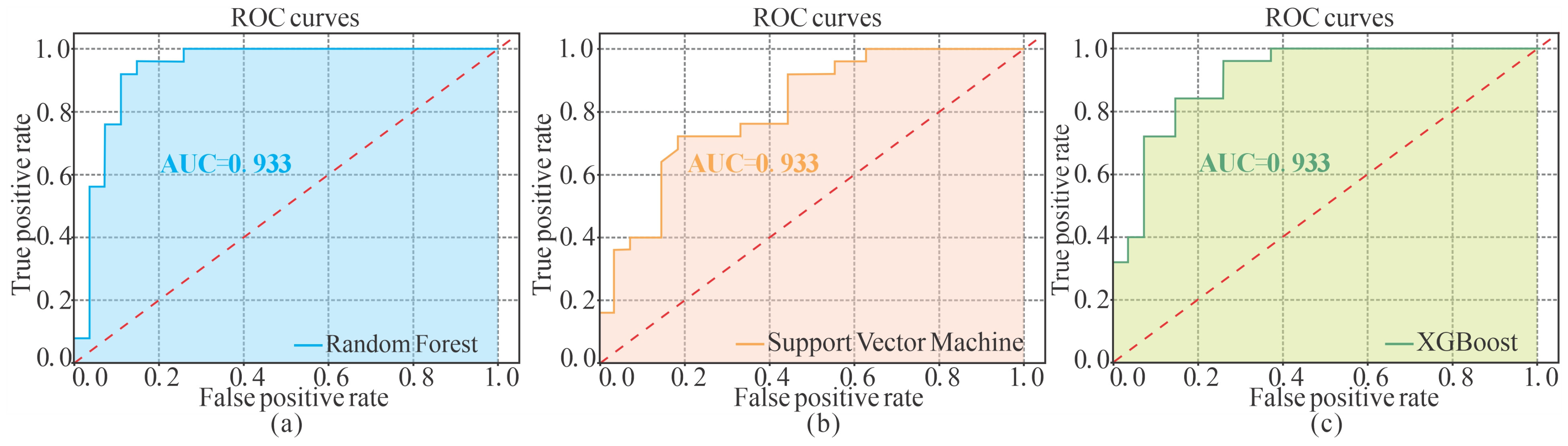
| Random Forest | 0.904 | 0.885 | 0.920 | 0.902 | 0.933 |
| Support Vector Machine | 0.692 | 0.698 | 0.698 | 0.688 | 0.808 |
| XG-Boost | 0.827 | 0.827 | 0.827 | 0.827 | 0.910 |
Disclaimer/Publisher’s Note: The statements, opinions and data contained in all publications are solely those of the individual author(s) and contributor(s) and not of MDPI and/or the editor(s). MDPI and/or the editor(s) disclaim responsibility for any injury to people or property resulting from any ideas, methods, instructions or products referred to in the content. |
© 2026 by the authors. Licensee MDPI, Basel, Switzerland. This article is an open access article distributed under the terms and conditions of the Creative Commons Attribution (CC BY) license.
Share and Cite
Zhang, C.; Huang, S.; Zhang, B.; Shen, Y.; Yalikun, Y.; Wang, J.; Shang, Y. Mineral Prospectivity Mapping Based on Remote Sensing and Machine Learning in the Hatu Area, China. Minerals 2026, 16, 144. https://doi.org/10.3390/min16020144
Zhang C, Huang S, Zhang B, Shen Y, Yalikun Y, Wang J, Shang Y. Mineral Prospectivity Mapping Based on Remote Sensing and Machine Learning in the Hatu Area, China. Minerals. 2026; 16(2):144. https://doi.org/10.3390/min16020144
Chicago/Turabian StyleZhang, Chunya, Shuanglong Huang, Bowen Zhang, Yueqi Shen, Yaxiaer Yalikun, Junnian Wang, and Yanzi Shang. 2026. "Mineral Prospectivity Mapping Based on Remote Sensing and Machine Learning in the Hatu Area, China" Minerals 16, no. 2: 144. https://doi.org/10.3390/min16020144
APA StyleZhang, C., Huang, S., Zhang, B., Shen, Y., Yalikun, Y., Wang, J., & Shang, Y. (2026). Mineral Prospectivity Mapping Based on Remote Sensing and Machine Learning in the Hatu Area, China. Minerals, 16(2), 144. https://doi.org/10.3390/min16020144