1. Introduction
Comminution processes are essential for liberating valuable minerals from ore but face critical challenges due to high energy demand and inherent inefficiencies, with 95% of input energy lost as heat rather than effectively used in mineral breakage [
1,
2,
3]. The global mining industry has experienced increasing energy consumption driven by declining ore grades, requiring larger ore volumes to maintain production levels. Comminution circuits represent the largest single energy consumer in hard-rock mining operations [
4], and minor technological improvements can yield significant savings in energy consumption and GHG emissions [
5]. In Chile, the world’s largest copper producer, electricity consumption in mining is projected to grow 39.5% from 23.5 TWh (2022) to 32.8 TWh (2033) [
6], while comminution operations account for up to 45% of total OPEX in mineral processing plants [
7], underscoring the urgent need for more energy-efficient strategies.
From a mechanistic perspective, improving energy efficiency in comminution requires a deeper understanding of how mineralogical variability and microstructural characteristics influence particle breakage. Although the role of mineralogical variability and microstructures for breakage modeling has been studied, it remains unclear whether this information can be used to predict breakage behavior at the comminution scale. For instance, Little et al. [
8] demonstrated using QEMSCAN analysis that particles subjected to different breakage mechanisms (impact vs. attrition) exhibited distinct phase boundary fracture patterns, with preferential fracture along grain boundaries leading to enhanced liberation at coarser sizes, yet the authors noted that translating these micro-scale fracture observations into predictive models for industrial mill performance remains challenging. Nowadays, there is a growing interest in exploring the role of mineralogical variability and microstructural features at millimetric scales. Indeed, from a geometallurgical perspective, linking ore texture, mineral associations, and microstructural controls to comminution response may provide a framework for more reliably predicting energy requirements and liberation behavior. This integration is central to geometallurgy, where mineralogical information is explicitly incorporated into processing workflows to optimize not only milling efficiency but also downstream recovery, thereby bridging the gap between geology and metallurgy [
9].
Studies suggest that the intrinsic mechanical properties of ore—such as hardness, brittleness and toughness—play a fundamental role in fracture behavior during size reduction [
10,
11]. These properties are intrinsic to the material and less influenced by machine operating conditions [
2]. The influence of mineral texture, grain boundaries, and phase distribution has been identified as a determining factor in how particles respond to impact forces [
12]. Understanding these interactions at the micrometer and millimeter scales could provide valuable insights for designing more efficient and selective comminution circuits [
13].
It is important to make a key distinction regarding the nature of these challenges. The fundamental limitation does not lie in measuring or understanding particle fracture at the laboratory scale, as experimental approaches such as SILC testing combined with automated mineralogical characterization provide direct physical measurements with mechanical information. The difficulty lies rather in translating that detailed mineralogical and textural information into scalable descriptors that are statistically representative of fracture behavior. Conventional bulk crushing tests typically yield single-point or averaged parameters, which obscure the inherent variability of heterogeneous mineral populations.
Despite this knowledge and the availability of detailed particle-scale measurements, translating mineralogical and textural information into quantitative, statistically representative, and predictive metrics for fracture behavior remains a significant challenge. This study addresses these gaps by developing a data-driven framework that integrates high-resolution mineralogical characterization with a physics-based statistical and machine learning approach to model the full distribution of the mass-specific fracture energy () during a single-impact breakage.
To this end, a quantitative description of simulated particles is considered, which compiles textural and mineralogical features from QEMSCAN images [
10]. Particle breakage response is characterized using direct physical measurements obtained from a Short Impact Load Cell (SILC), and the resulting fracture energies are represented through a log-normal statistical distribution, consistent with established descriptions of fracture behavior in heterogeneous brittle materials [
14]. To link mineralogical heterogeneity with statistically defined fracture behavior, a two-stage modeling strategy is adopted. In the first stage, particles are grouped according to their textural and mineralogical characteristics using an unsupervised clustering approach, resulting in interpretable textural categories. In the second stage, supervised machine learning models are used to relate these clusters to the parameters of the
distribution at the scale of a complete QEMSCAN image. This hybrid framework brings together physical measurement, statistical representation, and data-driven pattern recognition, enabling the prediction of statistically representative fracture energy distributions from drill core-scale mineralogical characterization.
The following sections of the article are structured as follows.
Section 2 delves into the ways in which relevant variables have been modeled in comminution processes.
Section 3 presents the databases used in this article. The proposed methodology, both at the conceptual level and in terms of the steps involved, is detailed in
Section 4.
Section 5 presents the results of applying the methodology presented. Finally,
Section 6 discusses the results obtained, and
Section 7 presents the conclusions of this work, leaving space for future lines of research.
2. Background of Comminution Modeling Using Primary Fractures Properties
Traditional approaches to modeling comminution have relied on empirical parameters derived from standardized tests, such as the Bond Work Index and the Drop Weight Test (DWT). While these methods have proven valuable for process design and optimization, and correlate with bulk mechanical properties such as ore hardness, they represent aggregate responses that do not explicitly account for the influence of individual mineralogical features [
10,
15]. Features such as mineral grain size distribution, textural heterogeneity, liberation characteristics, and spatial relationships between hard and soft phases are not directly incorporated into these empirical indices, limiting their ability to predict breakage behavior variations within lithological units or across different ore textures. The Bond Work Index, for instance, provides a single empirical parameter that aggregates the energy requirements for size reduction but does not account for variations in mineralogy, texture, or particle-scale heterogeneity [
16]. Similarly, the DWT characterizes ore breakage behavior through standardized impact testing, yet the derived parameters remain disconnected from the underlying microstructural controls that govern fracture initiation and propagation [
1].
These limitations become particularly evident when processing complex or variable ore bodies, where bulk characterization methods fail to capture the heterogeneity inherent in natural systems. Consequently, there is growing interest in developing predictive models that incorporate intrinsic ore characteristics–such as mineralogy, texture, and microstructure–to understand better and predict breakage behavior. Such models have the potential to enhance geometallurgical frameworks by enabling more accurate forecasting of ore performance across varying geological domains.
Advances in 2D automated mineralogy, particularly through techniques such as QEMSCAN (Quantitative Evaluation of Minerals by Scanning Electron Microscopy), have enabled high-resolution characterization of mineral phases, grain boundaries, and textural relationships at scales relevant to particle breakage [
17]. These developments have opened opportunities for linking microstructural features directly to mechanical response, yet significant methodological gaps remain. Most existing studies have focused on qualitative correlations between texture and breakage behavior, without establishing robust quantitative frameworks suitable for predictive modeling in industrial contexts [
18].
Moreover, machine learning techniques have emerged as powerful tools for identifying complex, non-linear relationships between ore properties and processing performance [
19]. Furthermore, the application of these methods to comminution modeling has been limited by challenges in feature extraction, data integration, and the interpretability of model outputs. Specifically, there is a need for systematic approaches that can transform high-dimensional mineralogical image data into compact, interpretable feature representations suitable for predictive modeling while preserving the essential characteristics that govern mechanical behavior [
20].
2.1. Mass-Specific Fracture Energy and Primary Fracture Properties
The mass-specific fracture energy (
) represents the energy required to achieve body breakage. This parameter provides a standardized measure of energy consumption that is largely independent of equipment size and type, making it particularly valuable for comparing ore breakage characteristics under controlled laboratory conditions [
14,
21]. In comminution research,
has been employed to link micro-mechanical properties of rocks—such as strength, texture, and mineral associations–to macroscopic grinding performance.
When mass-specific fracture energy is applied to ore particles, the material fractures into a particle size distribution (PSD) that represents the minimum number of fragments achievable under the given energy conditions. Both the mass-specific fracture energy and the resulting particle size distribution have been defined as the primary fracture properties of the material [
14,
21]. These properties have been measured experimentally using SILC testing [
22], which enables controlled characterization of ore breakage behavior at the particle scale.
2.2. Modeling Based on Primary Fracture Properties
Recent modeling approaches in comminution have focused on simulating breakage using
, to predict material behavior in a single-impact breakage process such as DWT. Saeidi [
23] introduced a multi-stage breakage model consisting of a selection (
S), breakage (
b), and classification (
C) functions, each one evolving over discrete breakage cycles. This simulation accounts for particle size transitions among different size classes starting from an initial particle size distribution. The model further incorporates the progressive depletion of available energy with each simulation cycle, providing a representation of material fragmentation dynamics in single-impact event.
A modification of Saeidi’s model was proposed by Bart [
24], which incorporated energy depletion as a function of particle size and introduced a validation protocol for predicting the Axb parameters obtained from Drop Weight Test (DWT) data. These modeling frameworks enhance the prediction of particle size distributions and energy consumption during grinding, thereby supporting the design and optimization of comminution circuits. In the short term, these models allow for feed-forward prediction of comminution performance based on ore characteristics, enabling proactive circuit adjustments and supporting geometallurgical block models for mine planning.
Despite the advances made by existing fracture and comminution models, there remains considerable scope for the development of more robust and generalizable formulations. In particular, most studies characterize fracture energy using a single representative value (e.g., the mean or median) to describe the aggregate behavior of particle populations. However, this approach does not capture the full distribution of mass-specific fracture energy among individual particles, which arises from inherent variability in microstructure, mineralogy, and textural characteristics. As a result, this limited characterization constrains the ability of existing models to capture the natural variability in breakage behavior and to provide reliable predictions across different mineral types and operating conditions.
3. Databases
This study integrates two complementary datasets to establish quantitative relationships between mineralogical characteristics and primary breakage behavior. These databases were previously developed by Lois-Morales et al. [
10,
12]. Nine ore types were analyzed, corresponding to distinct lithologies: BA (basalt sample from Australia), K2/K4 (porphyry copper samples from USA), SA (polymetallic sample from Mexico), and T1–T8 (porphyry copper samples from Chile).
The first dataset comprises mechanical testing results obtained from SILC experiments, which provide direct measurements of mass-specific fracture energy () across multiple particle sizes and rock textures. These tests were performed in cylindrical particles ranging between 3 and 30 mm with the aim of isolating the variability of from particle shape effects, enabling a more robust evaluation of its relationship with textural and mineralogical characteristics.
The second dataset consists of high-resolution QEMSCAN mineralogical images that capture the compositional and textural characteristics of the ore samples. For each texture, five to six thin sections (3.5 × 4 cm) were imaged with a resolution of
μm/px. These slides were randomly segmented into smaller sections that represented the size of the cylindrical particles tested on the SILC [
12].
3.1. Primary Breakage Characterization: SILC Test Database
SILC tests were conducted on cylindrical particles to assess the primary breakage behavior under controlled single-impact loading conditions. These experiments measure energy absorption, stiffness, and deformation during impact, allowing the calculation of the mass-specific fracture energy (), a key parameter for describing particle response during comminution.
The mass-specific fracture energy (
) represents the amount of energy required to break a unit mass of material. In a SILC experiment, this energy is calculated as the area under the force–deformation curve recorded with strain gauges. This value is subsequently corrected using Hertzian contact theory to account for energy transfer between the impactor, the particle, and the supporting bar. This variable,
, is an important measurement for evaluating the efficiency of comminution processes, as it establish the energy required to create a new surface during impact breakage [
21].
A total of 3174 cylindrical particles were tested across six size classes (
Table 1). Each impact test recorded the complete force–deformation response during impact loading, enabling calculation of the mass-specific fracture energy (
) after correction using Hertzian contact theory. The experimental dataset spans nine distinct rock textures, with each texture–size combination tested on multiple replicates to characterize the inherent variability in breakage behavior. As reported by Lois-Morales et al. [
10], characterization of the coarsest size classes was constrained by sample availability, introducing a degree of bias in the dataset.
3.2. QEMSCAN Image-Based Data
QEMSCAN is a high-resolution mineral mapping technique that combines backscattered electron (BSE) imaging with energy-dispersive X-ray spectroscopy (EDS) to identify and classify mineral phases [
17]. BSE identifies particle boundaries, while EDS spectra are compared against a known mineral database. The resolution of this technique can reach up to 1
. This particular study uses image datasets of intact rocks developed by Lois-Morales [
12,
25,
26], with a resolution of
.
The QEMSCAN dataset comprises 45 images in total, distributed across nine different texture types with five images per texture. Each texture type includes simulated particles generated in the same size ranges as those tested mechanically in the SILC experiments. This approach ensures consistency between mineralogical characterization and mechanical testing, enabling direct correlations between textural attributes and mass-specific fracture energy. A detailed description of the image acquisition methodology and particle simulation protocol is provided by [
12].
4. Modeling Methodology
This work presents a methodology that combines automated mineralogy with physics-based statistical and machine learning techniques to predict mass-specific fracture energy distributions from mineralogical texture. The approach enables prediction of breakage behavior from ore characterization data, reducing the need for extensive mechanical testing while capturing the inherent variability in particle-scale fracture response. To this end, the proposal envisages a two-stage model that relates the predictor variables (mineralogy and texture at the simulated particle level) and the target variables of fracture energy (parameters of the distribution).
The approach differs from traditional characterization methods in several key aspects. First, it establishes relationships between quantitative microstructural features and mass-specific fracture energy distributions rather than relying on empirical bulk parameters. Second, it provides predictive distributions that capture the inherent variability in breakage behavior. Third, the methodology is scalable and automatable, reducing reliance on subjective geological interpretation while maintaining physical interpretability through the selection of mechanically meaningful descriptors.
This methodology is conceptually related to the Bag of Words (BoW) framework, or Bag of Visual Words (BoVW) when applied to image data [
27,
28]. The BoW framework has been successfully utilized across diverse domains including document classification, image processing, and numerical data analysis [
29,
30]. Its core principle is to represent an object–whether an image, a text document, or numerical data–as a histogram of discrete features, similar to how a document is represented by the frequency of its words. In visual applications, BoW extracts descriptors from specific regions of an image and clusters them into a “visual vocabulary”. Each image is then represented as a frequency vector of these visual words [
30].
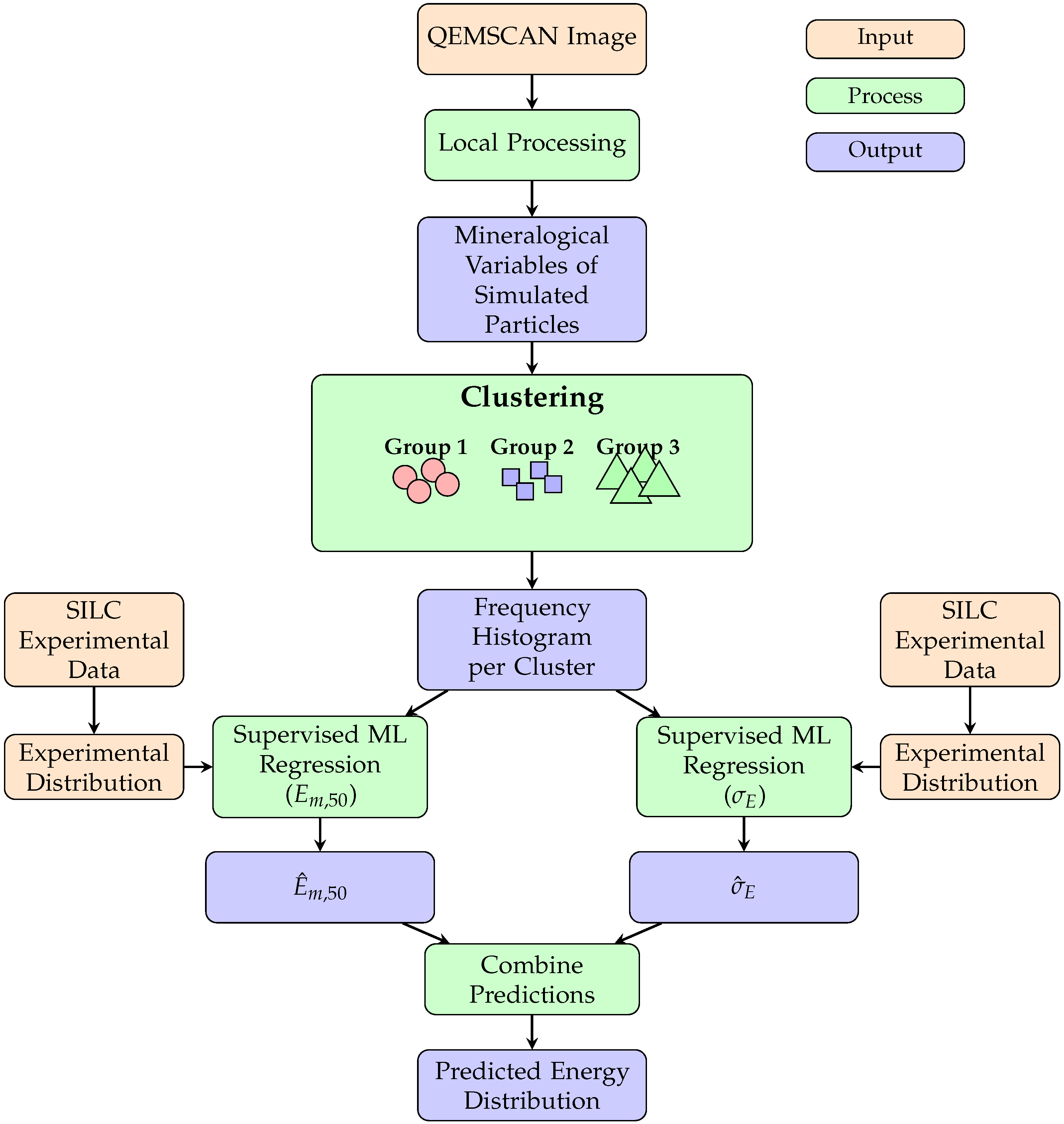
Each of the stages/processes, as well as the variables used in the proposed methodology, are shown in
Figure 1. Details of each stage process involved are provided below, as well as how to validate this methodology.
4.1. Local Processing
The datasets derived from QEMSCAN image analysis were organized into distinct particle populations that were segmented from the thin section images using a sliding-window algorithm as described in Lois-Morales et al. [
10]. Each cropped particle represented a squared window of the QEMSCAN image corresponding to the particle size tested in the SILC, where each particle presents different textural and mineralogical information (Lois-Morales et al. [
10]).
The mineralogy and texture contained within each simulated particle were summarized into eight indicators based on the physical properties of the constituent minerals and their spatial relationships. The work presented by [
10,
12] explored the relevance of mineralogical and textural features in combination with some physical properties, such as the strength and stiffness of individual minerals, over the physical properties of the particles. The current work focuses on applying machine learning tools to extrapolate the relationship found between particle strength and particle characteristics towards the description of the mass-specific fracture energy of the particle’s population. The features utilized in the previous work are:
Weighted Stiffness (k):
A composite measure of rock stiffness calculated as
where
is the area proportion of mineral
i and
is its individual stiffness. Higher values indicate stronger materials as stiffer minerals increase overall particle strength [
31].
Border Index (BI): Quantifies grain boundary irregularity by comparing the actual grain boundary length to the perimeter of an enclosing rectangle. Complex grain boundaries may increase strength by forcing fractures to travel longer paths [
32,
33].
Aspect Ratio (Ar): The ratio between each grain’s shortest and longest axis, representing grain elongation. Elongated grains oriented parallel to loading direction can increase rock strength, though grain orientation effects introduce variability in the data [
34,
35].
Contrast Index (CI): Measures the physical property difference between adjacent mineral pairs:
Values >0.7 indicate high contrast, and values <0.3 low contrast. Higher contrasts between adjacent minerals typically decrease particle strength by facilitating fracture propagation [
34,
36].
Maximum Grain Size (GS): The largest grain dimension observed in each particle section. Smaller grain sizes generally contribute to rock strengthening, while coarse grains provide longer fracture propagation paths, reducing strength [
37,
38].
Percentage of Voids (PV): The fraction of empty space calculated from MLA classified images. Increased porosity contributes to decreased particle strength by providing failure initiation sites [
31,
39].
Fractal Packing Index (FPI): Quantifies grain size heterogeneity within particles:
where
is the inflection point in a log–log plot of grain size versus cumulative area. Values near 1 indicate similar volumes of coarse and fine grains, while FPI > 1 suggests coarse grain dominance and FPI < 1 indicates fine grain dominance. Greater grain size heterogeneity increases strength variability [
40].
Nominal Particle Size: Assigned via suffixes: 2.66 mm, 4.25 mm, 7.75 mm, 10.32 mm, 14 mm, and 28 mm.
Machine learning algorithms often assume that input variables follow a Gaussian (normal) distribution, which facilitates parameter estimation and model training; therefore, once the features were calculated for each population of simulated particles, it was necessary to ensure the normality of the distributions through a comprehensive distributional analysis using normality tests. If some of the features exhibited asymmetry, a Box–Cox logarithmic transformation [
41] was employed to achieve approximate normality, thereby ensuring optimal performance in linear discriminant analysis and other parametric machine learning.
4.2. Unsupervised Image Representation
Once the particle population has been described using the features defined above, the next stage of the proposed methodology applies an unsupervised clustering approach to transform the local features into a compact and consistent feature representation. This stage reduces dimensionality while preserving the essential statistical characteristics of the input data. The unsupervised nature of this transformation enables the model to identify underlying patterns and relationships in the mineralogical data without prior assumptions about energy consumption.
Let be the input matrix describing a sample image, that contains M simulated particles and eight mineralogical and textural descriptors, where represents the value of the variable j (with ) for simulated particle s (with ). The clustering transformation proceeds as follows:
- 1.
Standardization: Each variable is standardized [
42], according to the statistics obtained with all the simulated particles from the images used in the training process:
where
and
are the mean and standard deviation of variable
j, respectively.
- 2.
Clustering: Apply k-means clustering [
43] to identify
K representative patterns by finding the optimal set of cluster centroids
(with
), that minimize the within-cluster sum of squares for all simulated particles used in the training process:
where
is the total number of simulated particles used in the training,
is the standardized feature vector for simulated particle
s and
represents the centroid of cluster
k.
- 3.
Principal component analysis (PCA): To assess the effectiveness of dimensionality reduction and visualize the cluster structure within the transformed feature space with the clustering tool, principal component analysis (PCA) was subsequently employed as both an exploratory and confirmatory analytical tool. PCA [
44] provides orthogonal linear transformations that maximize variance preservation while reducing dimensionality, enabling visualization of high-dimensional clustering results in interpretable low dimensions (e.g., two-dimensional projections).
- 4.
Histogram Generation: For each sample
i, described with
simulated particles, the normalized frequency distribution over the clusters is calculated:
thus fulfilling the condition that
for each sample
i.
4.3. Supervised Machine Learning Regression Models
The next stage utilizes supervised machine learning algorithms to establish relationships between the extracted histogram features and energy distribution parameters. This stage employs two parallel models to capture different aspects of the mass-specific fracture energy distribution:
Model 1—Central Tendency Estimation:
Model 2—Dispersion Estimation:
where is the median mass-specific fracture energy consumption, is the standard deviation of the energy, and are the estimation functions, and are the model parameters, and and represent estimation errors.
For both models, different supervised learning techniques will be evaluated with the aim of obtaining the best characterization of each response variable considered. In turn, the hyperparameter optimization (tuning) in each of these models is performed by minimizing prediction error considering the mean squared error (MSE) in Leave-One-Out (LOO) cross-validation [
45]. This model selection approach is particularly appropriate for datasets with limited sample sizes, as it maximizes the use of available data for both training and testing while providing unbiased estimates of model performance.
4.4. Prediction of the Mass-Specific Fracture Energy Distribution
The final energy distribution parameters are estimated as
The complete energy distribution for sample
i is predicted assuming a log-normal distribution, which is commonly used to model particle fracture energy data [
14]:
This formulation provides a complete characterization of the mass-specific fracture energy for each population for process simulation applications, such as the multi-stage breakage model [
23].
4.5. Statistical Validation Framework
The validation methodology employed two complementary non-parametric statistical tests: the Kolmogorov–Smirnov (KS) test [
46,
47] and the Cramér–von Mises (CvM) test [
48,
49]. These tests were specifically selected for their ability to assess distributional similarity without making assumptions about the underlying parametric form of the data [
50].
The KS test evaluates the maximum absolute difference between two cumulative distribution functions, providing a supremum-based measure of distributional divergence:
where
is the empirical distribution function and
is the theoretical distribution function.
In contrast, the CvM test employs a quadratic criterion that weights deviations across the entire distribution range:
This makes the CvM test particularly sensitive to differences in the distribution tails, where energy extremes are most critical for comminution applications. This validation framework ensures that the reconstructed mass-specific fracture energy distributions accurately represent the underlying physical processes that govern energy consumption in impact breakage.
For this final validation process, the prediction of the distribution of
for each QEMSCAN image is performed blindly. Thus, each image to be predicted is left out, and the LOO cross-validation process is performed on the remaining
images to adjust the hyperparameters (
Section 4.3). Then, using the best model obtained from these
images, the prediction of the image that was left out is performed, thus obtaining the predicted distribution
(
Section 4.4). Finally, with the aforementioned tests (KS and CvM), comparisons are made between the predicted distribution and the actual distribution, considering that the image to be predicted does not participate in either the training process or the selection/tuning of the model.
5. Results
This section shows the results of applying the modeling methodology formulated in
Section 4, using the data described in
Section 3. Each of the stages/processes and the results obtained in them are detailed.
5.1. Characterization of Experimental Data
The sliding-window algorithm applied to QEMSCAN images generated simulated particles across six nominal size classes (2.66, 4.25, 7.75, 10.32, 14, and 28 mm), yielding a total dataset of 4527 simulated particles distributed in nine different ore types [
12]. Each combination of size and texture corresponds to a population of particles that is individually studied. This approach enabled systematic evaluation of how mineralogical and textural characteristics vary with particle size, providing insights for linking image-derived descriptors to mechanical breakage behavior.
5.1.1. Feature Extraction
To characterize the mineralogical and textural features from QEMSCAN images, an unsupervised clustering approach was implemented over the data extracted from the simulated particles. This computational framework transforms complex mineralogical image data into quantifiable descriptors by treating each image region as a discrete collection of textural and compositional features as described in Lois-Morales et al. [
10]. The eight image-derived descriptors detailed in the methodology section were analyzed through statistical examination. Four descriptors (Weighted Stiffness, Border Index, Aspect Ratio, and Contrast Index) exhibited Gaussian distributions with acceptable skewness and kurtosis parameters, making them suitable for direct parametric analysis. However, three descriptors (Maximum Grain Size, Porosity, and Fractal Packing Index) demonstrated pronounced log-normal behavior, characterized by positive skewness and heavy-tailed distributions typical of geological phenomena. Therefore, the Box–Cox logarithmic transformation was applied to these distributions.
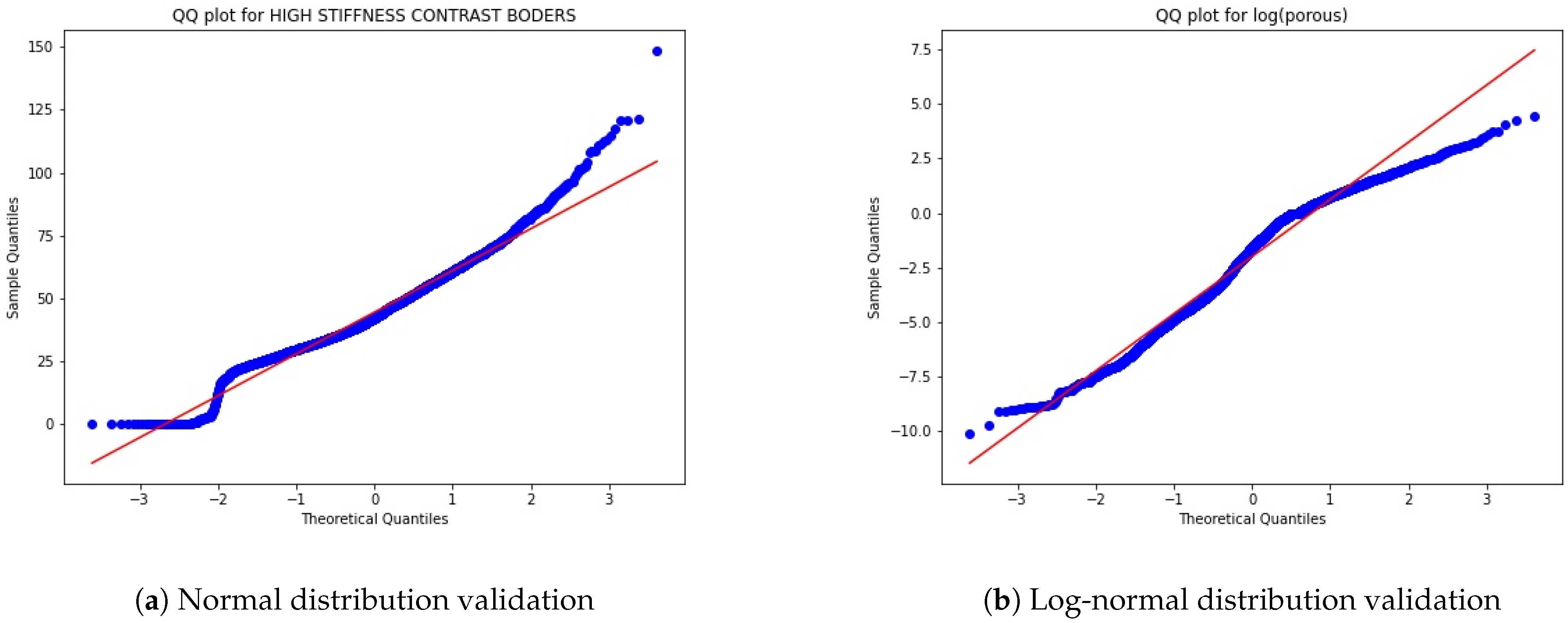
Figure 2 demonstrates the effectiveness of these transformations through quantile-quantile plots, confirming successful normality achievement for both originally Gaussian descriptors and log-transformed features for some input variables described in Lois-Morales et al. [
10].
5.1.2. SILC Mechanical Test Data Characterization
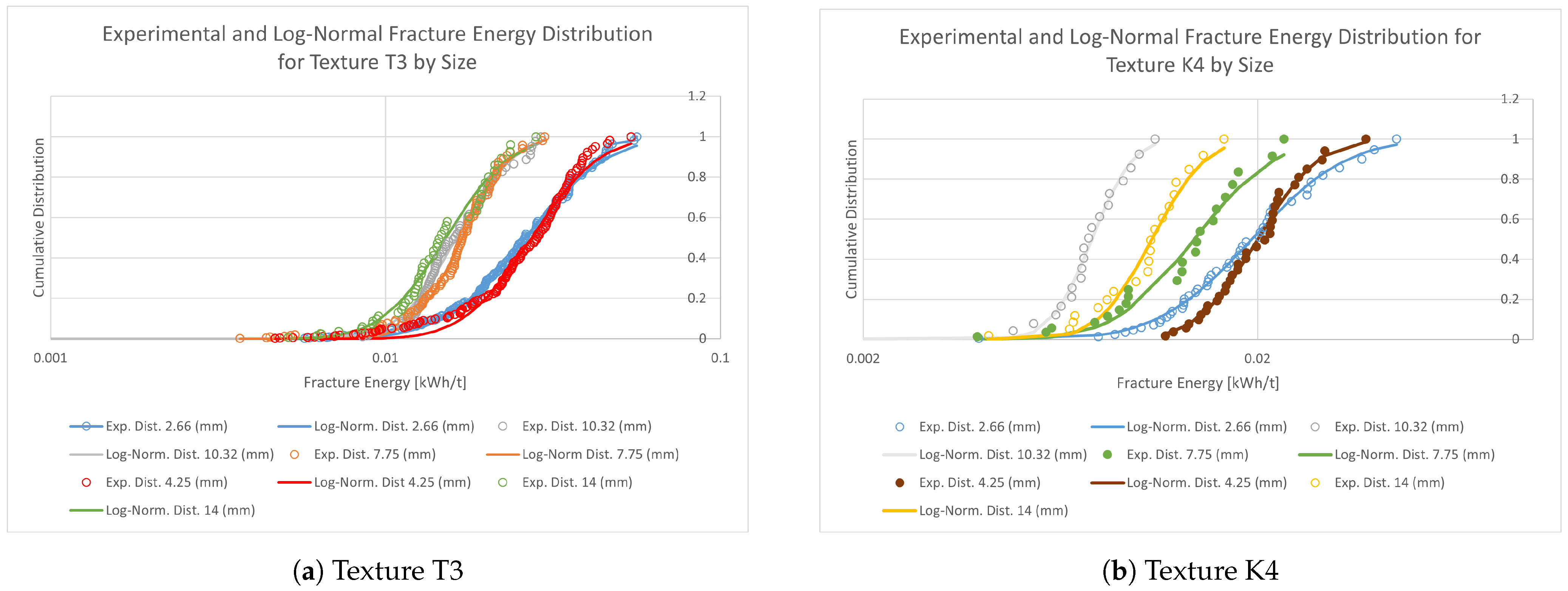
Figure 3 presents representative cumulative distributions of mass-specific fracture energy for two textures (T3 and K4), illustrating the characteristic variability in energy consumption within individual texture–size populations. This distributional behavior motivated the dual-model approach employed in this study, where both central tendency (median) and dispersion (standard deviation) are predicted independently to reconstruct complete mass-specific fracture energy distributions.
Complementing the analysis of the SILC database,
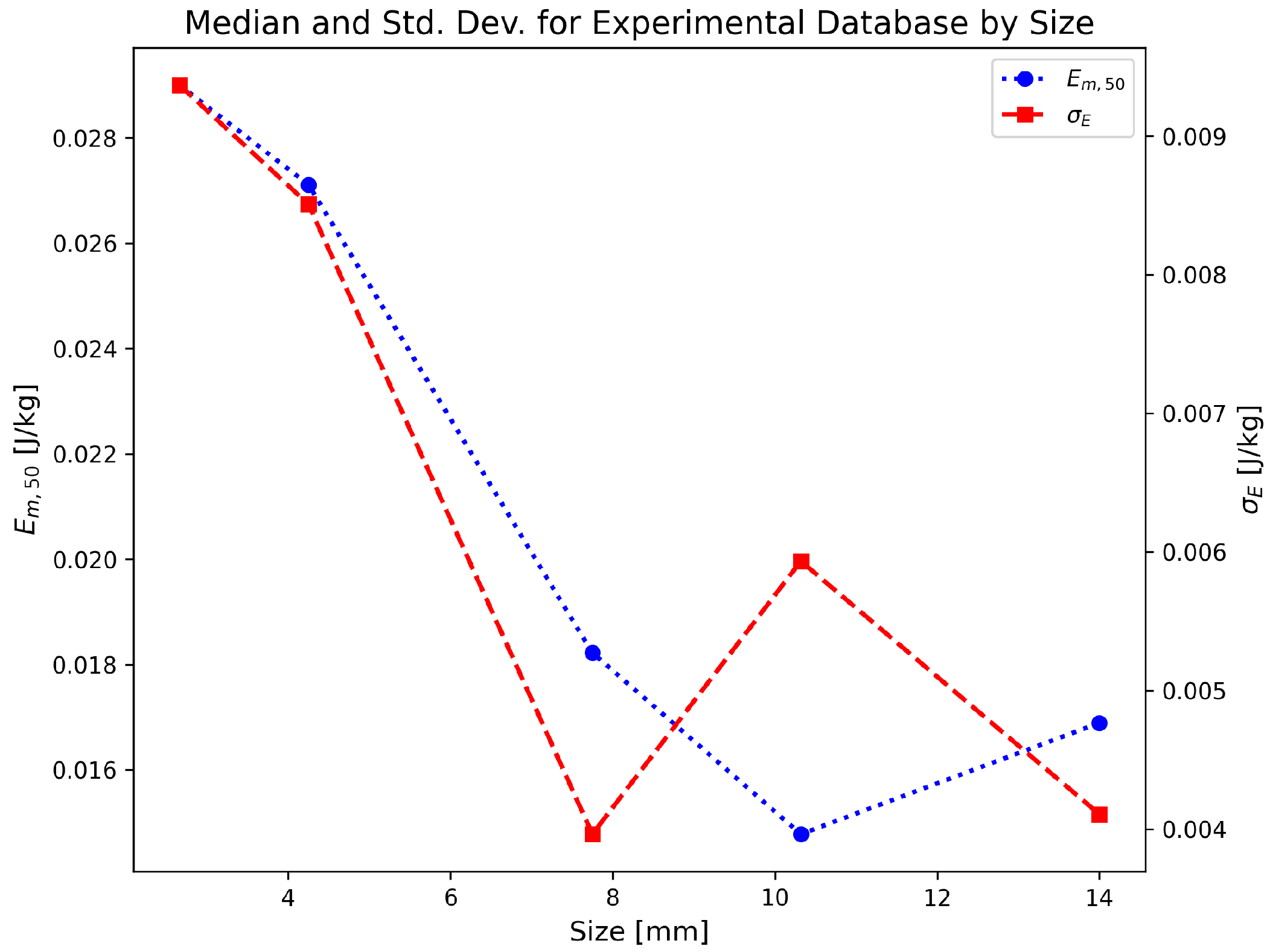
Figure 4 presents
and
for all textures as a function of particle size. It can be observed that, as particle size increases, both analyzed variables generally tend to decrease.
5.1.3. Processing of SILC Data: Parameter Fitting
The median value of the mass-specific fracture energy of each population (
) was fitted using the Tavares et al. [
14] equation, which was fit to experimental data by texture. This equation establishes the relationship between particle size and median fracture energy, providing texture-specific parameters that characterize size-dependent breakage behavior.
Table 2 presents the fitted parameters for each texture, including the asymptotic energy (
), the size exponent (
), and the characteristic size (
).
The fitted
[
51] values demonstrate variable equation performance across textures, with some textures (SA, T1) showing excellent agreement (
) while others (K2) exhibit a not quite right fit. This variability reflects the complex interplay between mineralogical composition, textural characteristics, and mechanical behavior that the current study aims to explore through machine learning approaches.
5.2. Clustering of Mineralogical and Textural Variables
Following the distribution normalization, unsupervised k-means clustering was applied to transform the particle features or image descriptors to identify latent mineralogical patterns within the multidimensional feature space. This subsection shows the results obtained from the clustering and their relationship with the descriptive features calculated, which are obtained from the simulated particles simulated of the previous stage. This type of analysis is useful for understanding how the input information (mineralogy and texture) is encoded, which will be used to feed subsequent supervised learning models.
Determining the optimal number of clusters is a fundamental challenge in unsupervised learning, requiring a careful balance between model complexity and interpretability. Through comprehensive evaluation using multiple internal validation metrics including within-cluster sum of squares (WCSS) [
52], silhouette coefficient analysis [
53], and Calinski–Harabasz index [
54], the optimal number of clusters was determined to be six. This clustering configuration maximizes intra-cluster homogeneity while maintaining sufficient inter-cluster separation, enabling the identification of distinct mineralogical assemblages that exhibit coherent textural and compositional characteristics representative of different geological characteristics of the material. The clustering approach employed represents a sophisticated pattern recognition methodology that enables the discovery of hidden structures within high-dimensional mineralogical data. Each cluster of particles represents a distinct mineralogical “archetype” characterized by specific combinations of textural features, grain size distributions, and compositional heterogeneity. This unsupervised segmentation provides valuable insights into the inherent structure of the dataset, revealing that ores from different origins may produce particles with similar archetypes.
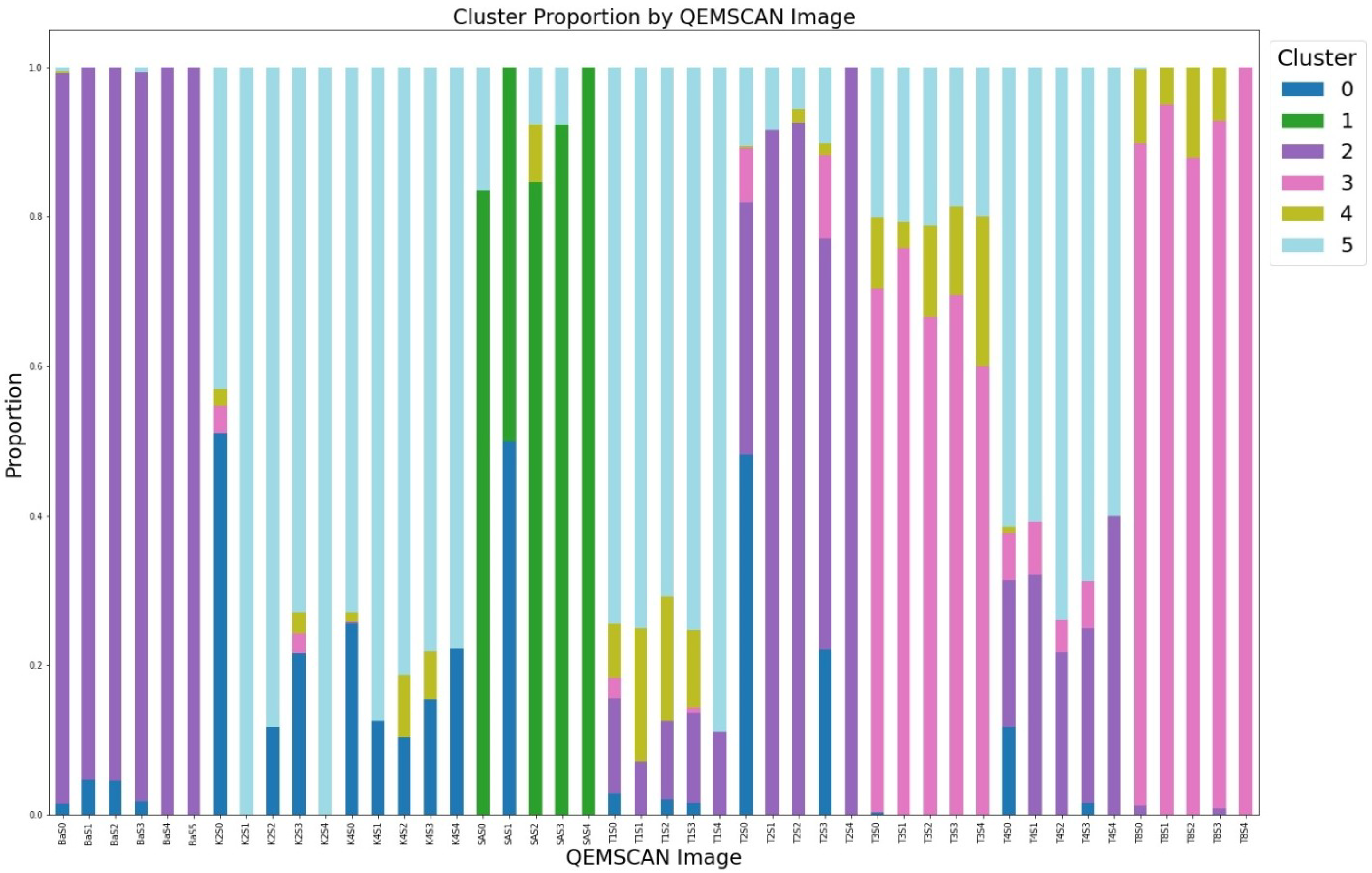
The transformation of complex mineralogical image data into discrete cluster proportions represents the final preprocessing step before machine learning model application. The resulting cluster proportion histograms, shown in
Figure 5, serve as robust, interpretable input features that capture the essential mineralogical characteristics while remaining insensitive to spatial variations and imaging artifacts that could compromise model performance. Each bar represents the relative frequency of the six identified mineralogical patterns within individual samples, providing quantitative characterization of textural heterogeneity and serving as standardized input features for subsequent energy prediction modeling. The histogram format enables direct comparison between samples while maintaining interpretability of underlying mineralogical composition variations.
Analysis of the cluster distribution patterns reveals distinct mineralogical groupings that characterize different sample populations. Clusters 2 (purple) and 5 (cyan) demonstrate dominant presence across the majority of samples, suggesting these represent the most prevalent textural archetypes in the dataset. Cluster 2 shows particular dominance in samples BS1–BS4 and TS1–TS4, indicating consistent textural archetypes within these sample groups. Clusters 1 (green) and 4 (yellow) exhibit strong selectivity, appearing predominantly in specific subsets of samples (K2, K4 and T series), which suggests these clusters capture unique textural archetypes associated with these particular ore types. Clusters 0 (blue) and 3 (pink) show intermediate occurrence patterns, with Cluster 0 appearing primarily in samples that exhibit mixed characteristics between the Ba and K2 series, and Cluster 3 becoming increasingly dominant in the T series. Regarding particle size variations, the cluster distribution shows relatively consistent patterns across different size fractions within each ore type, with cluster proportions varying less than 15% between adjacent size classes. However, Cluster 0 shows a slight tendency to increase in coarser fractions (>8 mm), while Cluster 3 exhibits higher prevalence in finer fractions (<5 mm), suggesting some size-dependent textural selectivity in the clustering. This heterogeneous distribution pattern demonstrates the algorithm’s capability to identify and quantify subtle variations in mineralogical texture that may not be apparent through conventional visual inspection of the ore types. This method underlies the hypothesis that, when the mineralogy and texture of individual particles of ore are analyzed, common features may emerge. Indeed, this method reduced the dimensionality of the problem, which was first considered as nine ore types across five different particle sizes, to six clusters used for prediction.
Table 3 presents the mean values of input variables for each cluster. The six identified clusters represent distinct textural end-members: Cluster 1 (1.9%) exhibits homogeneous textures with negligible stiffness contrast (−0.022) and coarse, elongated grains (
= 0.659 mm, L/W = 0.539), characteristic of monomineralic assemblages; Cluster 4 (4.5%) shows exceptionally low porosity (0.163, one-sixth of other clusters), indicating dense, silicified zones; Cluster 0 (10.8%) displays highly regular grain packing (FPI = −11.296) with fine grains and abundant phase boundaries. The dominant Clusters 2 and 5 (combined 59%) capture typical textural variability, distinguished by high grain elongation (Cluster 2: L/W = 0.624,
= 0.854 mm) and fractal complexity (Cluster 5: FPI = 1.865), respectively.
Principal Component Analysis and Cluster Visualization
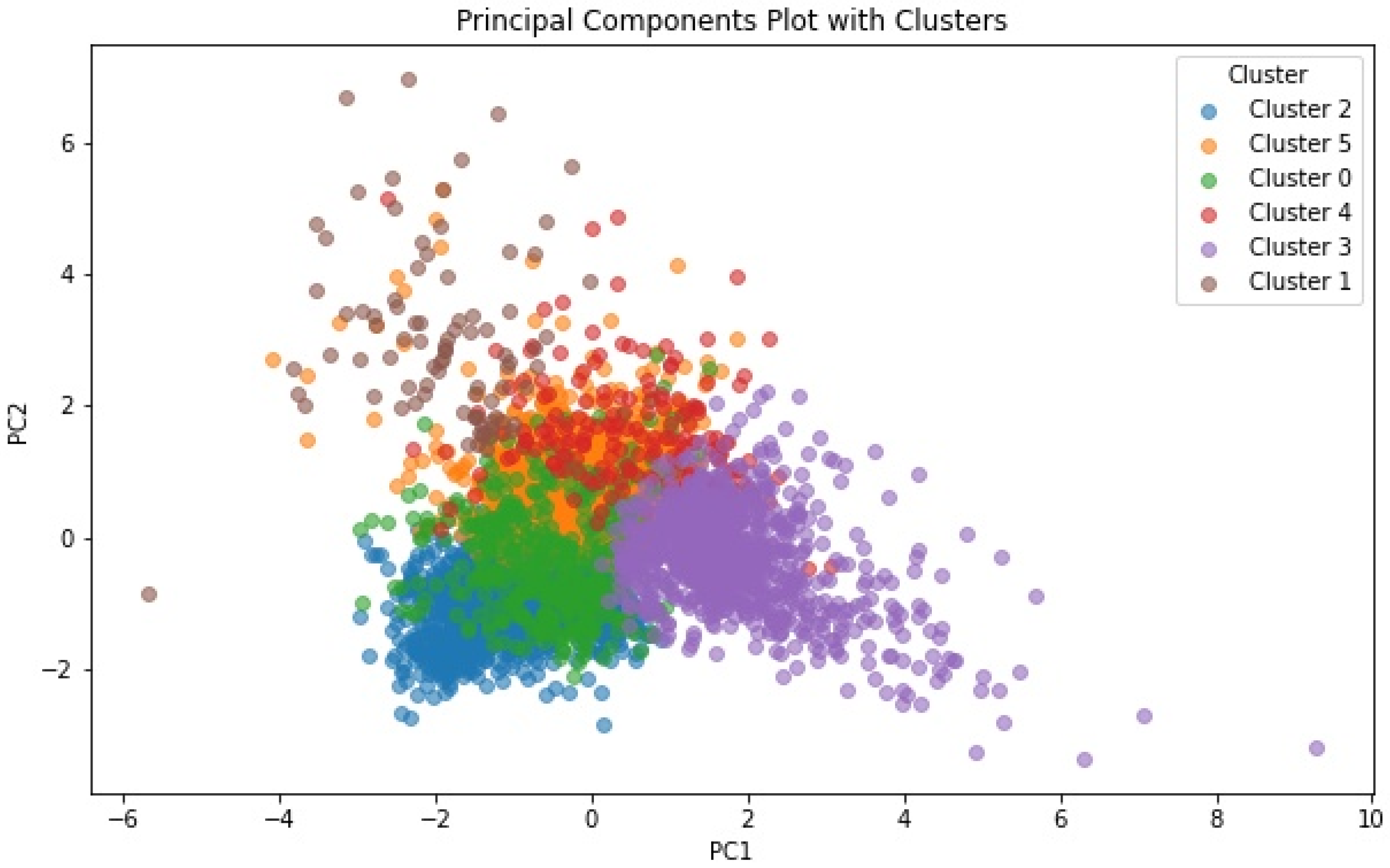
The PCA analysis of the data and the eigenvalue decomposition reveal that the first two principal components collectively account for 43% of the total variance in the dataset, indicating substantial information retention despite the substantial dimensionality reduction from eight original features to two principal components.
This moderate variance retention reflects the textural complexity observed across different sample groups. Samples from the Ba and T8 ore types exhibit relatively homogeneous textural characteristics, showing minimal variability in cluster proportions with strong dominance of single clusters (primarily Clusters 2 and 5), suggesting simpler, more uniform mineralogical patterns that are well-captured by the principal components. In contrast, samples from the T1, K4, and SA ore types exhibit significantly greater textural complexity, with highly variable cluster proportions and mixed contributions from multiple clusters. These samples exhibit heterogeneous mineralogical assemblages that require more dimensions to be fully characterized. The gradual decay of explained variance across successive components, as shown in
Table 4, indicates that no single textural characteristic dominates the dataset. Instead, the seven mineralogical descriptors contribute distributed information across multiple dimensions, with the T1, K4, and SA ore types showing the most complex textural signatures due to their diverse cluster compositions.
This observation supports the idea that when some ore types are transformed into particles, they may yield different classes of particles or ‘archetypes’, while others may create more homogeneous particle populations. This distributed variance structure (
Table 4) confirms that the cluster-based feature representation successfully captures a spectrum of mineralogical and textural variations present in the dataset, from simple single-cluster dominance to complex multi-cluster assemblages.
A visualization of the clustering is performed in low dimensionality (
Figure 6), using the PCA technique and showing only the first two most explanatory components obtained. Clusters that appear close to each other in this space represent samples with texturally similar mineral configurations, whereas separated clusters correspond to samples with fundamentally different textural organizations. Specifically, Cluster 2 and Cluster 5, which represent the most prevalent mineralogical textures in the dataset, show overlapping distributions in the PCA space, indicating their textural similarity despite being identified as distinct patterns. In contrast, Cluster 1 and Cluster 4 occupy separated regions in the principal component projection, reflecting their distinct textural characteristics that are predominantly found in the K4 and SA sample series. Cluster 0 shows intermediate positioning, bridging between the dominant Clusters 2 and 5 and the more specialized Clusters 1 and 4, which aligns with its transitional occurrence pattern across different sample groups. Cluster 3 exhibits its own distinct region in the PCA space, corresponding to its selective appearance in specific sample subsets.
5.3. Modeling Mass-Specific Fracture Energy Distributions
At this stage, the explanatory variables—defined as the histogram proportions of particles associated with each group identified in the clustering stage—are related to the response variables. The latter correspond to the parameters that describe the experimental curves obtained from the SILC mechanical test data. Assuming a log-normal representation of the fracture energy distribution, the median mass-specific fracture energy () and the corresponding standard deviation () are estimated.
In this study, supervised machine learning models were used to estimate and . First, we consider the case corresponding to the final model selection and performance evaluation using the complete available dataset, based on LOO cross-validation. This analysis aims to represent the operational scenario in which a new, previously unseen case will be predicted after the models have been trained and tuned using all currently available data.
A systematic comparison of several machine learning algorithms was performed using the score as the performance metric. The methods evaluated included linear regression, support vector machines, random forests, gradient boosting machines, neural networks, and decision tree-based models. All candidate models were evaluated using the same set of cluster-derived features and an identical model selection framework to ensure a fair comparison. Hyperparameters were optimized using a Bayesian search with 100 iterations, allowing efficient exploration of the parameter space.
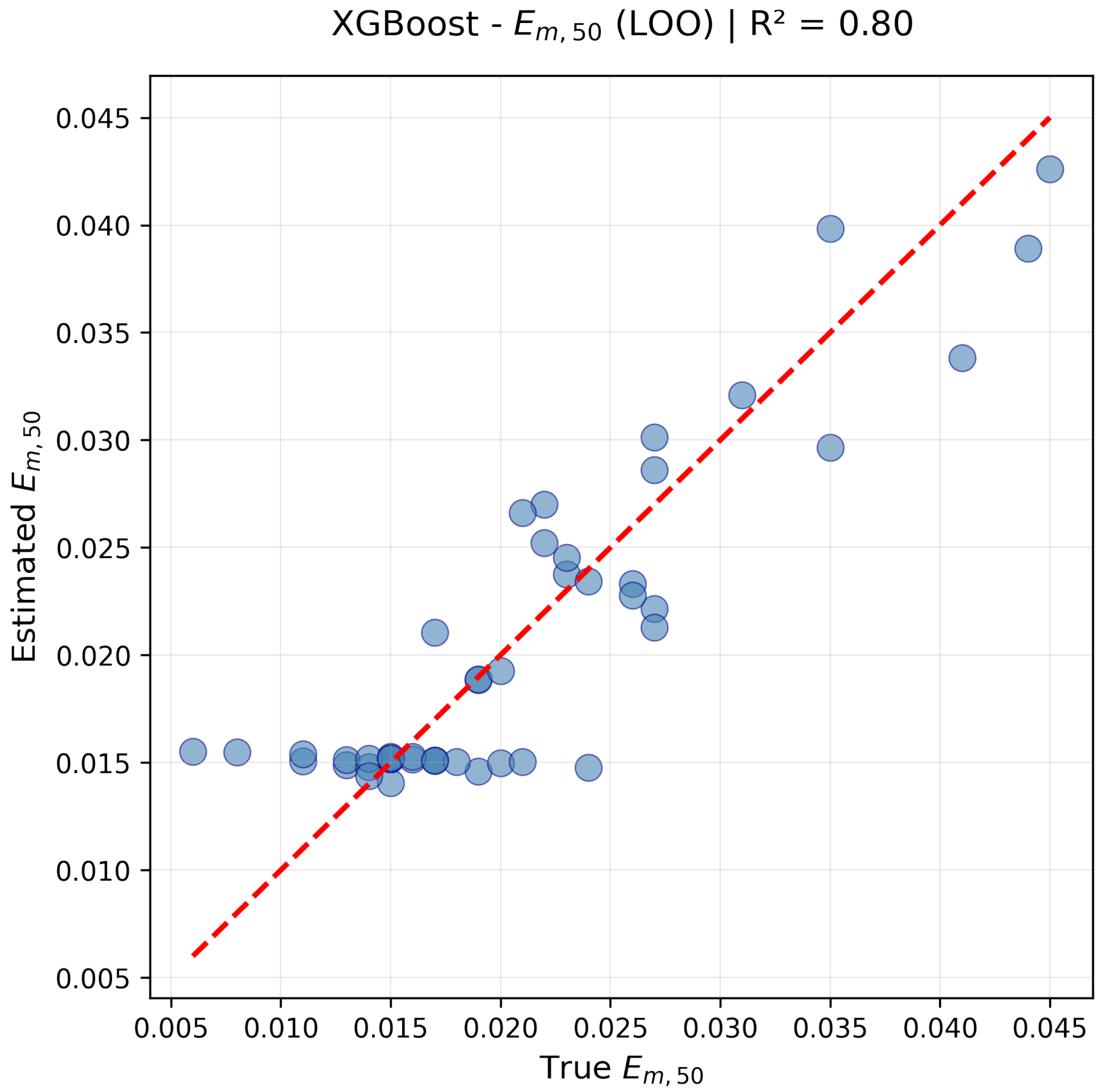
Based on this comparative analysis,
XGBoost (Extreme Gradient Boosting) [
55] was selected to estimate
. The final model uses cluster proportions as input features, including polynomial interaction terms up to the fourth degree, with feature normalization applied prior to training. Model performance was evaluated using LOO cross-validation, achieving an
and an average error of 17%.
Figure 7 shows a comparison between LOO-based estimates and actual values (adjusted with the experimental data) of
.
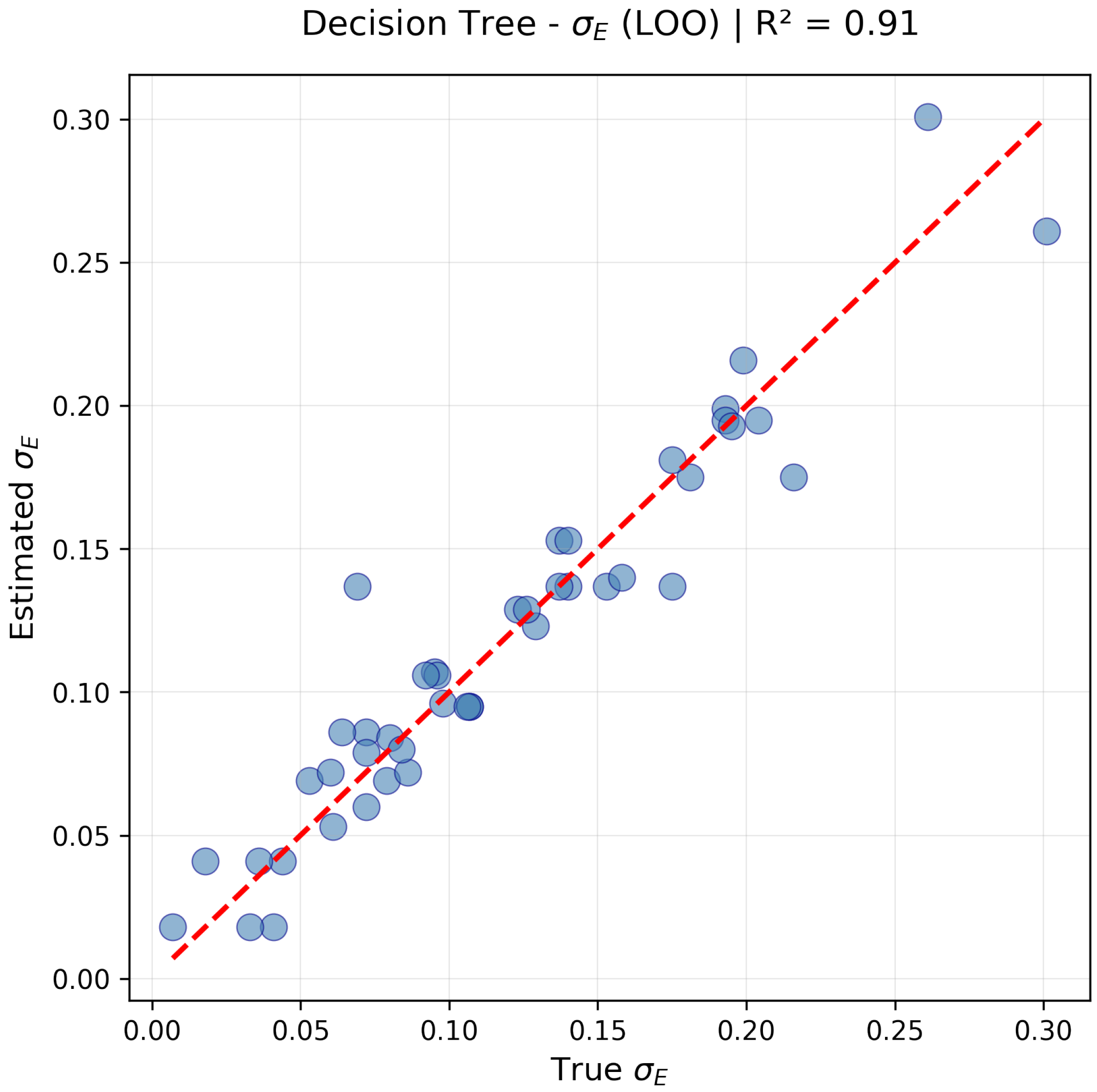
A similar modeling strategy was applied to estimate the standard deviation of mass-specific fracture energy (
). In this case, a decision tree regressor [
56] provided the best performance among the algorithms evaluated. Polynomial interaction terms up to fourth degree were generated and standardized to improve the model’s ability to capture nonlinear effects. The selected model was trained and evaluated using LOO cross-validation, achieving an
, indicating a high ability to explain the variability observed in the data. The relationship between estimated and actual values of
is presented in
Figure 8.
It is important to note that this analysis does not constitute a strict out-of-sample prediction experiment. Instead, it reflects the best-performing model configurations obtained when using all available data for model selection and fitting. A fully predictive evaluation, in which each data point is completely excluded from both training and model selection, using a nested (double) LOO strategy, is presented separately in the following subsection.
5.4. Validation of Integrated Model for Mass-Specific Fracture Energy Distribution
To evaluate the consistency between predicted and real cumulative distributions of the mass-specific fracture energy, a comprehensive validation framework was implemented using rigorous statistical testing methodologies. This validation approach assesses whether the dual-model of parameter estimation can accurately reconstruct the complete behavior of the distributions. To ensure a fully predictive and unbiased evaluation, a nested Leave-One-Out (LOO) cross-validation scheme was adopted, in which each observation is sequentially excluded as a blind test case, while the remaining samples are used to perform internal LOO cross-validation for model selection and parameter tuning.
The model construction process begins with reconstructing the log-normal cumulative distribution functions (CDFs) from the independently estimation of the parameters
and
. For each texture–size population of particles in the validation dataset, the estimated median energy
serves as the location parameter, while the estimated standard deviation
defines the scale parameter of the log-normal distribution. This parametric reconstruction approach assumes that fracture energy follows log-normal statistics, consistent with the fractal nature of fracture processes observed in mineral comminution [
14].
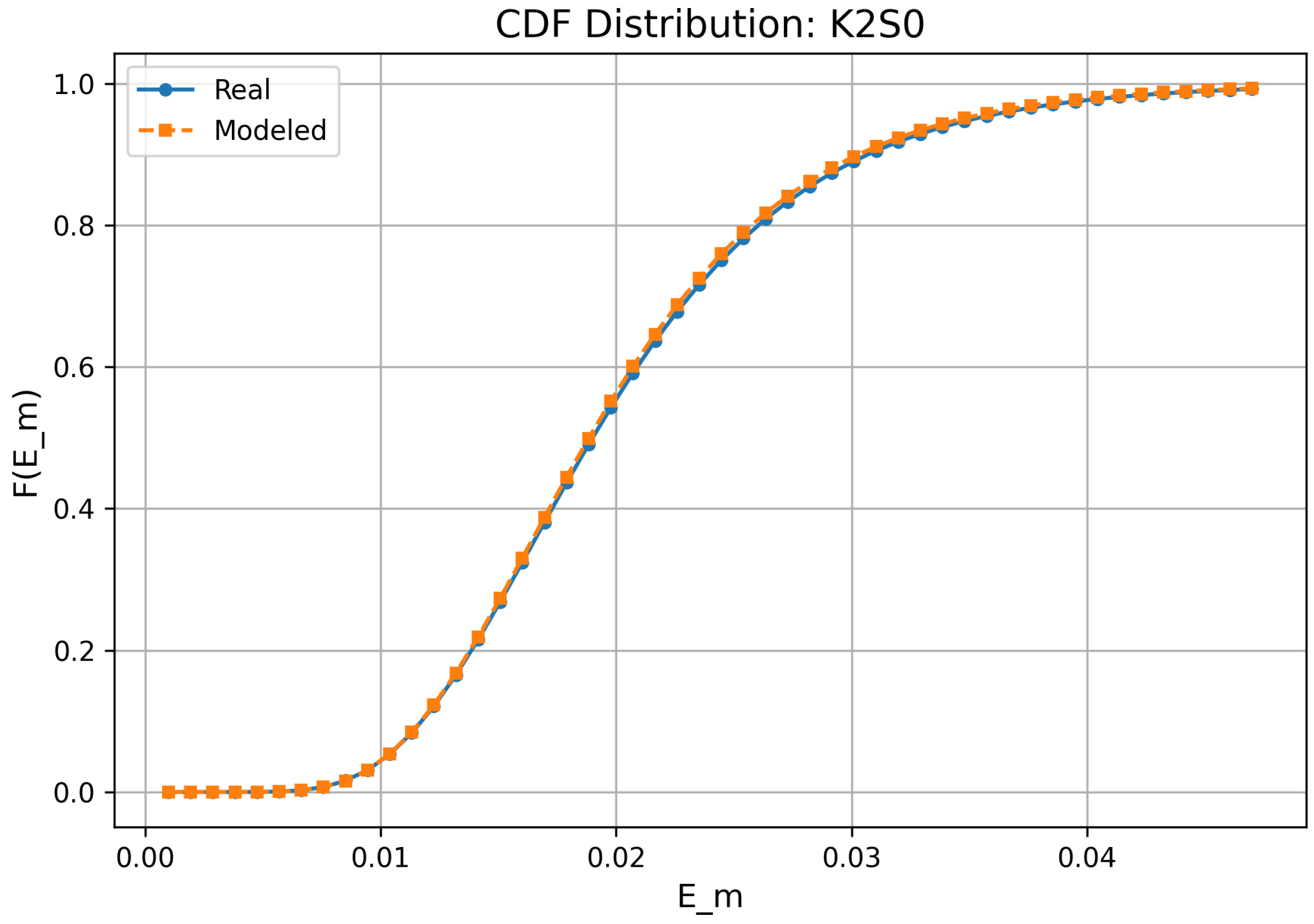
For each texture–size particle population, both Kolmogorov–Smirnov (KS) and Cramér–von Mises (CvM) tests were applied to assess the null hypothesis that the predicted and experimental distributions are statistically indistinguishable at the
significance level.
Figure 9 demonstrates this validation approach through a representative comparison between real and predicted distributions for a specific sample, illustrating in this case the close correspondence between experimental observations and model predictions across the entire energy range.
The experimental CDF (circles, solid line) derived from SILC measurements shows excellent agreement with the theoretical log-normal distribution (squares, dashed line) reconstructed from estimated and parameters, demonstrating the effectiveness of the dual-model approach in capturing complete distributional behavior.
The comprehensive validation results across the entire dataset demonstrate exceptional model performance in reproducing experimental energy distributions. The KS test identified 86.96% of the texture–size combinations as statistically similar (), indicating that the vast majority of predicted distributions cannot be distinguished from experimental measurements using this sensitive distributional comparison method. Similarly, the CvM test classified 84.78% of cases as statistically similar, providing independent confirmation of model accuracy through an alternative statistical framework that emphasizes different aspects of distributional agreement.
These validation statistics represent a high success rates for modeling in geological applications, where natural variability and measurement uncertainties typically introduce substantial noise into experimental datasets. The slight difference between KS and CvM success rates reflects the distinct sensitivities of these tests, with the CvM test’s quadratic weighting making it somewhat more stringent in detecting subtle distributional differences, particularly in the tails, where energy extremes occur.
The experimental results demonstrate that mineralogical descriptors derived from automated SEM-EDS imaging can effectively estimate both parameters: median and standard deviation for the mass-specific fracture energy across different particle sizes and textures. The next section examines the implications of these findings, discussing the strengths and limitations of the unsupervised clustering approach, the predictive performance of the machine learning models, and the broader significance of this modeling framework for geometallurgical applications.
6. Discussion
This study demonstrates that microstructural descriptors derived from automated SEM-EDS, as defined by Lois-Morales et al. [
12], effectively characterize both the median mass-specific fracture energy (
) and its dispersion (
) under impact breakage conditions. The combined use of XGBoost (
) for (
) and a decision tree regressor (
) for (
) enables reconstruction of the full
distribution, which shows good agreement with experimental data according to KS and CvM tests. These results support the hypothesis that mineralogical texture at the millimeter scale exerts a significant control on primary breakage response [
2,
10].
As shown in
Table 1, the number of tested cylindrical particles decreases markedly with increasing particle size, particularly above 10.32 mm, reducing the statistical robustness of experimental estimates at coarser fractions. This effect is reflected in the non-monotonic evolution of both
and
with size (
Figure 4), where limited sample populations increase uncertainty and amplify the influence of individual measurements. Consequently, anomalous trends observed at larger sizes should be interpreted with caution, as they may arise from sampling effects rather than intrinsic material behavior.
Figure 10 presents a simplified diagram of the general methodology, illustrating the main stages linking mineralogical and textural features at the particle scale with the target variables (
and
). The relationship between input characteristics and predicted results is not direct, but occurs through the clustering stage, which provides a compact and informative representation of the complex variability. This intermediate representation allows supervised machine learning models to capture relevant patterns while reducing dimensionality and mitigating noise. Consequently, the diagram highlights both the conceptual pathway from particle characterization to predictive parameters and the methodological consideration that model performance depends on the effectiveness of the clustering stage. These aspects should be considered when interpreting predictions and their applicability to different materials or particle populations.
The six-cluster solution successfully groups samples with similar textural attributes and comparable breakage characteristics (
Figure 5). Samples such as K2 and K4 exhibit high energy requirements despite different geological origins, while Ba and T8 show homogeneous textural signatures dominated by single clusters (Clusters 2 and 5, respectively). In contrast, samples such as T1, K4, and SA display greater textural complexity, with mixed cluster contributions requiring higher-dimensional representations for accurate characterization. This complexity is reflected in descriptor variability (
Table 3), including heterogeneous weighted stiffness values (ranging from 4.31 in Cluster 3 to 4.52 in Cluster 1) and broad ranges of border index (0.31 in Cluster 3 to 0.73 in Clusters 2 and 5) and FPI (ranging from −11.30 in Cluster 0 to 1.87 in Cluster 5), indicating diverse grain boundary configurations and mineral phase associations. Conversely, samples dominated by a single cluster (e.g., Ba dominated by Cluster 2, T8 by Cluster 5) maintain consistent descriptor values, reflecting more uniform mechanical behavior.
The overlap observed between clusters in principal component space (
Figure 6) indicates that ore textures form a continuum rather than discrete categories, and that particles coming from different ore types may share similar mineralogical and textural characteristics, reinforcing the idea of “archetypes”. Although this overlap is pronounced in two-dimensional projections, it is substantially reduced in the full eight-dimensional descriptor space used by the machine learning models, explaining their strong predictive performance. This framework is particularly effective for transitional samples (e.g., T1 and T4), where multi-cluster compositions lead to weighted predictions that combine multiple textural archetypes. As a result, predicted energy distributions naturally broaden in response to mechanical heterogeneity, propagating textural uncertainty into the modeled
distributions in a manner consistent with experimental observations.
Based on the best model considered in each case, the type of relationships established between the explanatory variables and the predicted variable can be considered. Thus, for the estimation of
(XGBoost model with
), it indicates that median fracture energy depends on complex, nonlinear interactions between textural and mineralogical characteristics used. Meanwhile, the model used for
(decision tree with
) suggests that energy variability follows threshold-based patterns, likely governed by the presence or absence of specific mineral clusters introducing breakage heterogeneity. Although the
and
models have a high
, indicating that they capture an important part of the problem structure, analysis of the model’s performance reveals limitations that point to opportunities for improvement. While the characterization of
is adequate throughout the analyzed domain (
Figure 8), the estimates of
exhibit a floor effect near 0.015 J/kg and a tendency to underestimate higher energy values (
Figure 7), likely reflecting both model calibration constraints and limited explanatory power in these regimes.
The differences observed in the performance of the supervised machine learning algorithms evaluated further highlight the influence of dataset size, feature structure, and model characteristics on predictive power. Although several nonlinear models were tested, their effectiveness was greatly constrained by the limited number of samples available relative to the complexity of the mineralogical and textural feature space. More flexible models (such as neural networks and deep learning techniques [
57]) typically require larger datasets to achieve robust generalization, while approaches with built-in mechanisms to handle nonlinear interactions and threshold effects proved to be more stable in this context. Consequently, under the experimental conditions considered, the superior performance of tree-based models suggests that they provide a better balance between model complexity and data availability for the characterization of mass-specific fracture energy from local descriptors derived from QEMSCAN images.
An important aspect of the proposed methodology is that particle-scale characterization is encoded through descriptive local variables (
Section 4.1). While these descriptors do not fully capture specific local contexts such as explicit phase-to-phase contacts, they provide a robust basis for modeling fracture energy distributions. This approach aligns with multi-stage breakage models that require particle-level fracture characterization [
23,
24], enabling parameterization of selection and breakage functions without exhaustive laboratory testing across all ore variants. By linking textural information to energy distributions, the methodology adds value to geological characterization and supports assessment of comminution potential.
Implications of the Model and Future Work
Traditional comminution characterization methods, such as the Bond Work Index and Drop Weight Test, rely on bulk properties that obscure ore heterogeneity [
58,
59]. The methodology presented here addresses this limitation by integrating high-resolution mineralogical data with predictive modeling, aligning with advances in predictive geometallurgy and advanced mineralogy [
60,
61]. The ability to estimate both parameters
and
, and therefore predict the complete distribution of
, supports risk-based decision-making frameworks, particularly for selective breakage strategies aimed at enhancing liberation while reducing energy consumption [
62,
63].
From a deployment perspective, the approach offers advantages in automation and standardization, reducing dependence on subjective geological interpretation while generating quantitative inputs suitable for digital twins and machine learning–based process control systems [
19,
20]. Although limitations remain in capturing three-dimensional textural features, the demonstrated capability to predict fracture energy distributions from mineralogical data advances understanding of breakage mechanisms and supports the development of more adaptive mineral processing systems.
Future work should focus on identifying minimum characterization requirements while integrating spatially aware descriptors, such as graph-based or convolutional approaches, that better capture connectivity patterns influencing fracture propagation. Beyond methodological development, this capability offers clear implications for adding value to geological characterization by supporting prediction of ore comminution potential. While the present work has focused on small-scale samples, extension to larger-scale characterization tools–such as drill-core scanning or belt-sensing technologies–would enable application in operations processing variable ore feeds, supporting proactive mill adjustments and more accurate production forecasting. From a modeling perspective, future research should also explore strategies for joint modeling of and or direct predictions of the fracture energy distribution, incorporate additional predictive variables, and address data scarcity in high-energy regimes to improve learning of extreme breakage behavior. Although the distributional nature of the outputs may limit direct real-time operational use, these predictions remain highly valuable for geometallurgical planning, ore blending strategies, and medium-term process optimization.
7. Conclusions
This research demonstrates that quantitative mineralogical descriptors derived from QEMSCAN imagery can predict the mass-specific fracture energy distribution with substantial accuracy, achieving values of 0.80 for the median () and 0.91 for the standard deviation (). The dual-model framework, combining XGBoost and decision tree algorithms, effectively captures both central tendency and dispersion of fracture energy, with 86.96% using KS test or 84.78% using CvM test of predicted distributions being statistically indistinguishable from experimental measurements.
The proposed methodology systematically transforms complex mineralogical image data into quantitative feature vectors suitable for machine learning applications. By representing particle populations from nine different ore types through six cluster proportions, the approach achieves computational efficiency while preserving key microstructural attributes governing mechanical behavior. These clusters represent textural archetypes that transcend traditional ore-type classifications, enabling consistent characterization of particles exhibiting similar mineral phase distributions, grain boundary configurations, and stiffness characteristics.
Dataset limitations, particularly the underrepresentation of larger particle sizes, constrain model generalizability and highlight the need for more balanced data acquisition across relevant size ranges. This limitation is especially relevant given the known influence of particle size on dominant fracture mechanisms in comminution processes.
From a geometallurgical perspective, this work provides a data-driven alternative to traditional bulk characterization methods such as Bond Work Index and Drop Weight Test protocols by predicting fracture energy distributions rather than single-point metrics. The methodology offers advantages in standardization and automation while reducing reliance on subjective geological interpretation, supporting its potential integration into geometallurgical campaigns and predictive process modeling frameworks.
Overall, this study advances the linkage between quantitative mineralogical imaging and comminution behavior, contributing to the development of more energy-efficient and sustainable mineral processing strategies. By combining physically interpretable descriptors with machine learning models capable of capturing complex nonlinear relationships, the proposed framework bridges phenomenological understanding and data-driven prediction, strengthening the role of mineralogical information in comminution modeling.