Article

The Influence of a Flotation Solution’s Surface Tension on Pyrochlore Flotation

by
Rafael Vaz Dias
*,
José Tadeu Gouvêa Junior
and
Laurindo de Salles Leal Filho
Department of Mining and Petroleum Engineering, University of São Paulo, São Paulo 05508-220, Brazil
*
Author to whom correspondence should be addressed.
Minerals 2026, 16(2), 135; https://doi.org/10.3390/min16020135
Submission received: 28 December 2025 / Revised: 16 January 2026 / Accepted: 23 January 2026 / Published: 27 January 2026

Abstract

The low recovery (∼50%) in industrial pyrochlore flotation highlights the need for optimization. This study evaluates the influence of surface tension ( γ ) of flotation solutions on pyrochlore/gangue separation of samples from Boa Vista mine (Brazil) using gamma flotation. Surface tension was adjusted using ethanol–water mixtures of reagent-conditioned samples in gamma flotation tests at pH 5.5, with recoveries measured via XRF analysis and separation efficiency calculated using Schulz’s criterion. After reagent conditioning at pH 5.5, the critical surface tension needed for flotability ( γ c ) was determined to be 27 mN/m for pyrochlore and gangue minerals. Recoveries increased steeply from 0% at γ = 27 mN/m to plateaus at γ > 39 mN/m. The maximum Nb2O5 recovered (99%) occurred at γ = 48.9 mN/m. Schulz’s separation efficiency peaked at γ = 48.9 mN/m for pyrochlore/carbonates (68%) and at γ = 39 mN/m for pyrochlore/silicates+oxides. Results suggest operating industrial direct flotation at lower γ values (39 mN/m) than the current method (61 mN/m) for improved selectivity, bridging theory and practice in niobium processing.

1. Introduction

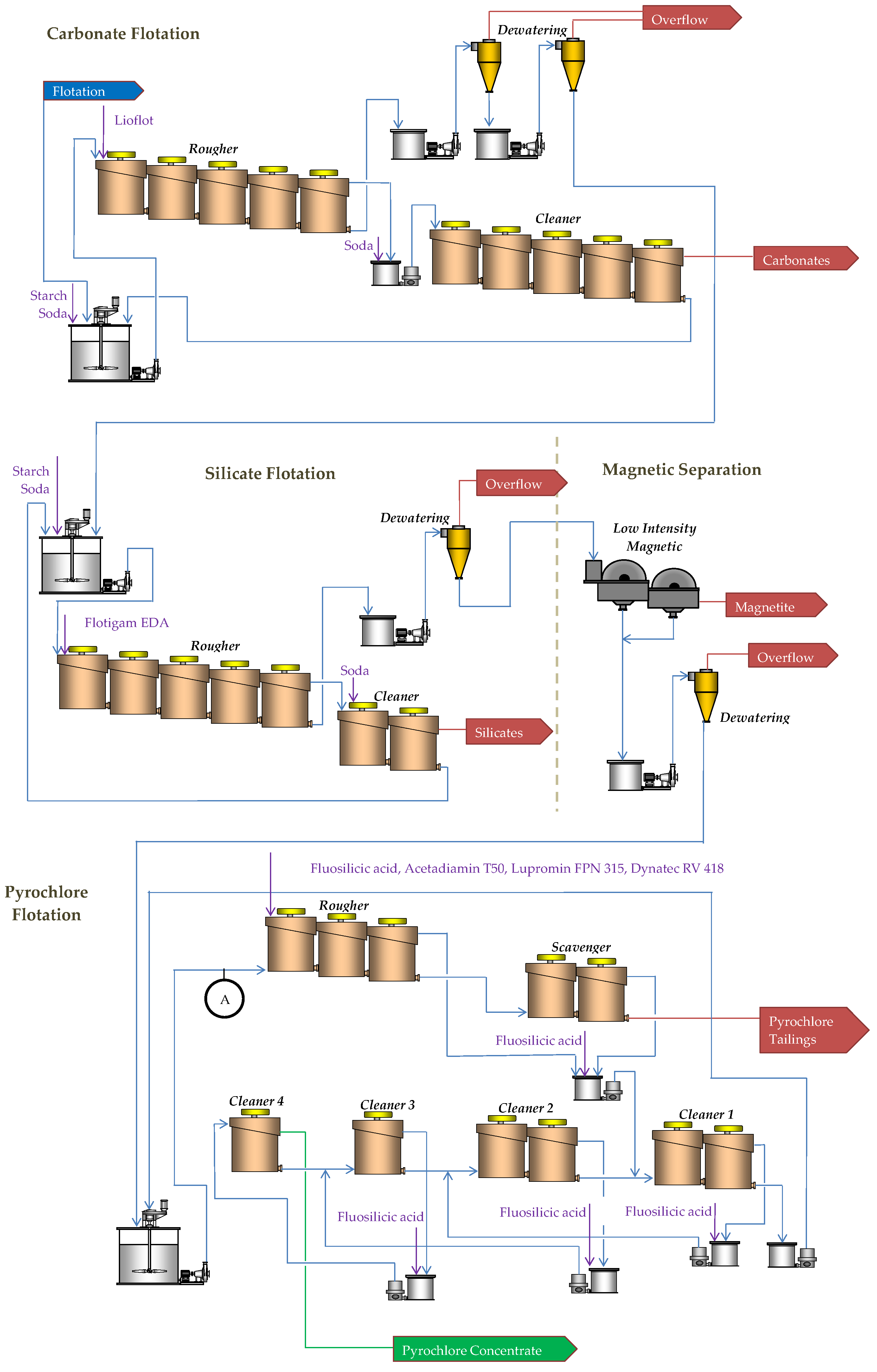
Niobium is a key component not only in steel alloys but also in many advanced technologies, such as superconducting materials, as well as optical and electronic devices [1,2,3]. The most important primary source of niobium is pyrochlore, an oxide mineral whose industrial concentration processes, particularly froth flotation at the Boa Vista mine (Catalão-GO, Brazil) and similar carbonatite-hosted deposits, struggle to achieve an overall recovery rate greater than 50% [1,4,5]. Such a poor performance underscores the need for focused research on optimizing current industrial processes [6]. Increasing the pyrochlore concentration via froth flotation at the Boa Vista mine (Catalão-GO, Brazil) involves three sequential circuits, as depicted in Figure 1 [7]. Consequently, the reverse anionic flotation of carbonates and the reverse cationic flotation of silicates are designed to depress unwanted gangue minerals in the intermediate concentrate (sunk product) that feeds the direct cationic flotation of pyrochlore, whose floated product constitutes the final pyrochlore concentrate [7]. Throughout the flotation process, the combination of rougher plus cleaner/scavenger stages produces a high circulating load that may contain a cumulative residual concentration of long-chain surfactants (fatty acids, fatty amines, and ethoxylated non-ionic surfactants) in the flotation slurry (Table 1). This possibility raises the hypothesis that the surface tension of the flotation solution in the rougher stage of cationic direct flotation could approach the critical surface tension needed for wettability ( γ c ) of the target mineral, a process condition that could potentially jeopardize flotation performance [8]. In contrast to prior research paths centered on reagent adsorption mechanisms [6,9,10], this study uniquely evaluates the post-conditioning influence of a flotation solution’s surface tension ( γ ) on attachment thermodynamics, thereby identifying practical γ optima for industrial selectivity. Therefore, this paper evaluates the influence of the surface tension of the flotation solution on pyrochlore recovery, aiming to improve the selectivity of the separation of pyrochlore/gangue via froth flotation.
Froth flotation of pyrochlore has been extensively investigated, with a particular emphasis on reagent chemistry, surface modification, and depression strategies to improve selectivity against carbonate and silicate gangue minerals [2,6,11,12]. Several studies have shown that pyrochlore flotation efficiency is strongly governed by surface chemical conditions, including pH, collector adsorption, and the presence of residual surfactants [1,4,6,7,8]. From a physicochemical standpoint, mineral wettability and bubble–particle attachment are controlled by interfacial free energies and contact angle behavior, which have been widely discussed in classical flotation theory [9,13,14].
The concept of critical surface tension for wettability, originally introduced by Zisman [15,16], has been successfully applied to mineral systems to interpret flotation behavior under controlled surface tension conditions. Experimental approaches such as GF have demonstrated that flotation recovery sharply decreases when the surface tension of the flotation solution approaches the critical surface tension of the mineral [17,18,19]. Martins et al. [8], for instance, showed that controlling the surface tension of the flotation solution significantly affects the selectivity of apatite flotation, highlighting the practical relevance of this parameter. Despite these advances, the influence of the flotation solution’s surface tension on pyrochlore flotation, particularly under reagent conditions representative of industrial circuits, remains poorly quantified [5].
In this context, the present study aims to systematically evaluate the influence of a flotation solution’s surface tension on the separation of pyrochlore from gangue minerals using GF experiments conducted under reagent conditions representative of the Boa Vista industrial circuit. The novelty of this work lies in (i) the experimental determination of the critical surface tension of the floatability of pyrochlore after industrial reagent conditioning; (ii) the simultaneous assessment of pyrochlore, carbonate, silicate, and oxide flotation responses as a function of surface tension; and (iii) a direct comparison between GF results and conventional flotation conditions. By linking fundamental wettability concepts with industrial-scale observations, this study provides practical guidance for optimizing pyrochlore flotation selectivity through surface tension control.
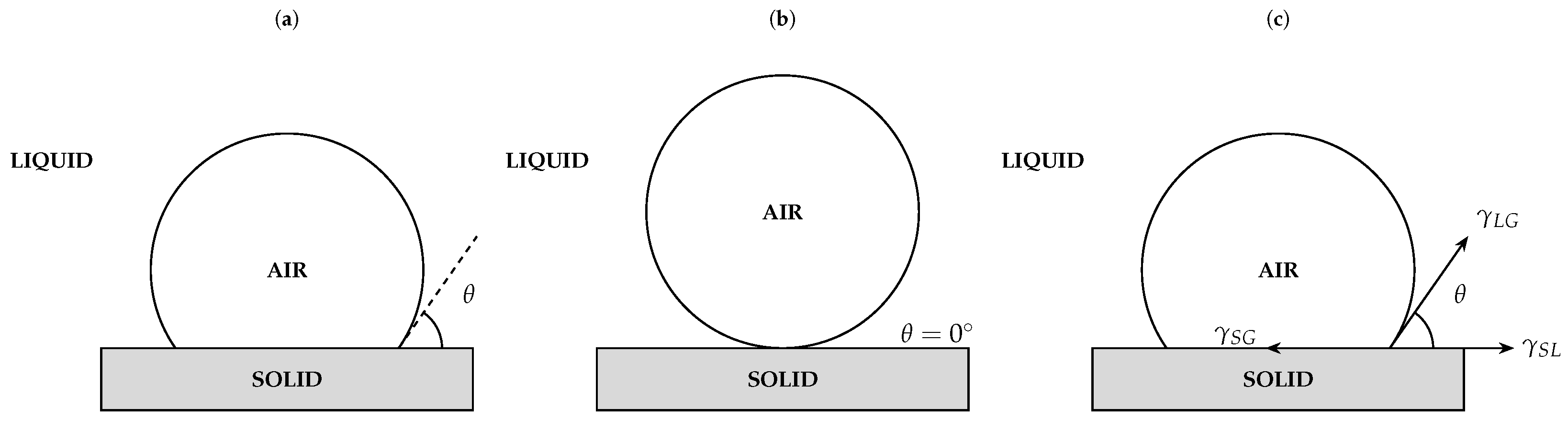
As illustrated in Figure 2a, when a flat mineral surface is in contact with an air bubble plus an aqueous solution, the angle between the mineral surface and the gaseous phase, depicted across the liquid phase, is named the contact angle ( θ ). This way, the magnitude of θ is a direct indication of the extent to which water wets the mineral surface [9,13]: the higher the value of θ , the lower the wettability of the mineral surface by water (increasing hydrophobic characteristics). Conversely, complete wettability of a target solid by a reference liquid (as a flotation solution) happens when the contact angle ( θ ) is approximately zero (Figure 2b). Since this particular condition (0°) does not favor particle/bubble attachment, it inhibits mineral flotation [14]. On the other hand, because the condition θ > 0° (Figure 2a) greatly favors particle/bubble attachment, it increases the probability of true flotation, which comprises particle/bubble collision and adhesion, followed by the transportation of particle/bubble aggregates from a solution to the froth phase [14]. According to Young’s equation (Equation (1)), as the system reaches equilibrium (Figure 2c), the value of θ depends on the magnitude of three interfacial free energies ( γ ) that control solid wettability, namely solid/gas ( γ s g ), solid/liquid ( γ s l ), and liquid/gas ( γ l g ), in which the latter is the surface tension of the liquid. In addition, while γ s g and γ s l are not easily determined, it is feasible to measure the magnitude of γ l g by either direct or indirect methods [9,20].
cos θ = γ s g γ s l γ l g
where θ is the contact angle, γ s g is the solid/gas interfacial free energy (J/m2), γ s l is the solid/liquid interfacial free energy (J/m2), and γ l g is the liquid/gas interfacial free energy (J/m2) or surface tension of the liquid (N/m).
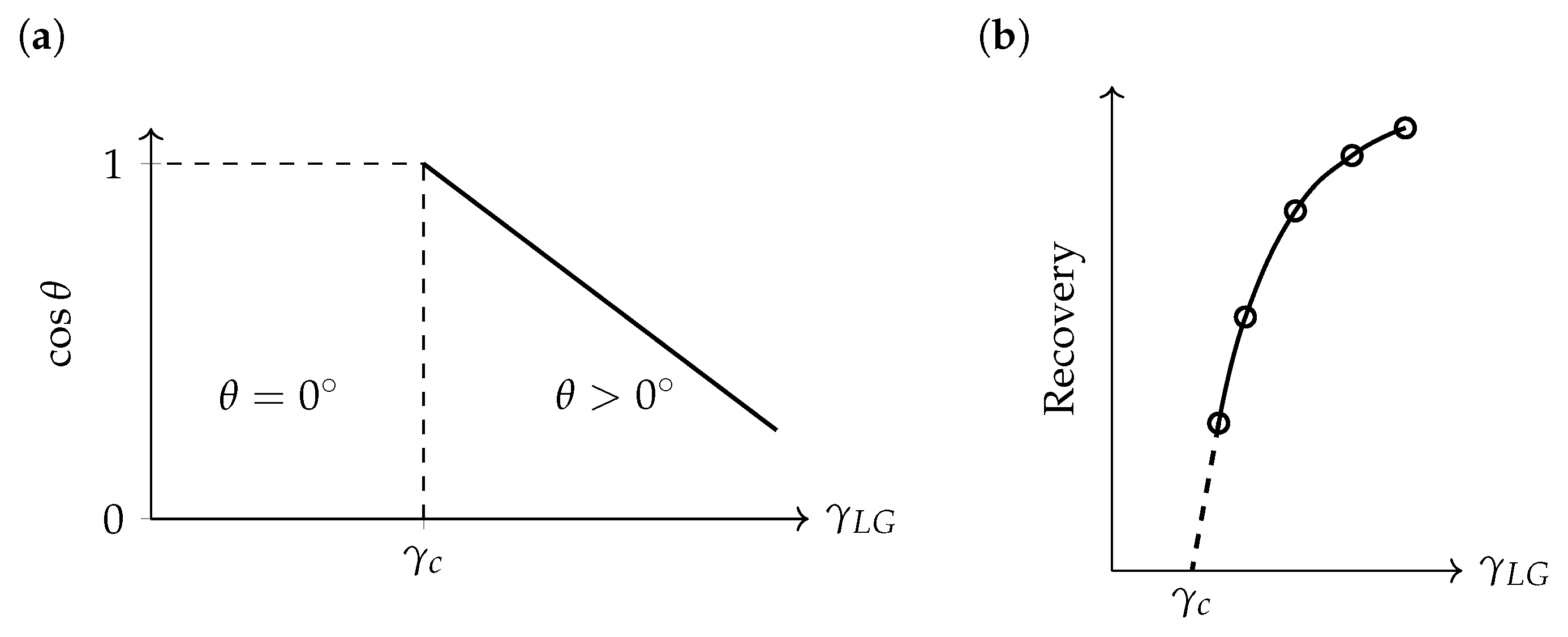
For a given solid in contact with a liquid, based on the existing linear relationship (Figure 3) between the cosine of θ and the surface tension of the liquid ( γ l g ), Zisman [15] proposed the concept of the critical surface tension needed for the wettability ( γ c ) of the solid, which is defined as the specific value of the liquid’s surface tension at which cos θ = 1 , corresponding to θ = 0 . According to Equation (2), this critical point corresponds to a limiting situation where the spreading coefficient (S) of the liquid onto the solid surface reaches zero, indicating complete wettability of the solid by the liquid [16]. These fundamental concepts can be applied to real flotation processes by considering the flotation solution as the wetting liquid, whereas the solid is either a naturally hydrophobic species [17,18,19] or a hydrophilic mineral (apatite, pyrochlore) whose surface has undergone previous adsorption of flotation reagents [8,21]. While contact angle measurements provide indirect access to interfacial energetics, particle–bubble attachment during flotation depends on the combined balance of interfacial free energies rather than on θ alone, particularly near γ c .
S = γ l g ( cos θ 1 )
where S = spreading coefficient [N/m], θ = contact angle [degree, dimensionless], and γ l g = surface tension of a liquid or solution [mN/m].
To experimentally determine γ c , a widely used approach involves measuring the contact angle through controlled variations in the surface tension of the wetting liquid. One of the most effective procedures for this experimental technique involves the use of short-chain alcohol/water mixtures, allowing for precise adjustments of surface tension. The results are plotted on graphs of cos θ versus γ l g , as shown in Figure 3a, providing a straightforward visualization of how wettability changes with surface tension [15,16]. In addition, an indirect method of assessing the γ c of minerals is via laboratory flotation tests to identify the so-called critical surface tension needed for floatability by plotting flotation recovery versus γ l g (Figure 3b) [17,18]. Known as “gamma flotation”, it is based on controlling the surface tension ( γ ) of the flotation solution in such a way that the critical surface tension ( γ c ) of the target mineral satisfies the condition γ l g > γ c , allowing it to float. Control of γ is achieved using mixtures of short-chain alcohols, such as methanol ( γ = 22.7 mN/m at 20 °C) or ethanol ( γ = 22.1 mN/m at 20 °C), and water ( γ = 72.8 mN/m at 20 °C) in varying proportions [17,18]. As depicted in Figure 3b, the magnitude of γ c is determined by extrapolating the recovery curve versus γ l g to the point where flotation recovery declines sharply or reaches a minimum threshold [8,17,18,21].

2. Materials and Methods

2.1. Niobium Ore

The mineral slurry that feeds direct pyrochlore flotation in the Boa Vista industrial plant was sampled at Point A (marked in Figure 1) just before the addition and conditioning of the reagents. The slurry was dewatered by sedimentation in barrels, and the settled mass was dried in an oven at 45 °C. After drying, the whole mass was homogenized in a Chevron pile from where 730 g unit samples were collected for further GF experiments. The chemical composition and particle size distribution of the GF feed were determined by X-ray fluorescence and wet sieving, respectively. The results are shown in Table 2. In addition, the semi-quantitative mineralogical composition was determined using the XRD/Rietveld method, producing the results shown in Table 3. The specific gravity of the GF feed (2990 kg/m3) was determined by gas pycnometry (Quantachrome Ultrapyc, Quantachrome Instruments, Boynton Beach, FL, USA), aiming to calculate the volume occupied by the solids in the flotation cell (1.5 L) to mimic the solid concentration adopted in the industrial circuit (43% w/w or 20% v/v). As shown in Table 3, the primary gangue minerals present in the feed of GF experiments are carbonates (53%), followed by silicates (44%) and oxides (3%).

2.2. Reagents

Commercial purity reagents (Hexafluorosilicic acid/CMOC, Acetadiamin T50/Kao Chemicals, Lupromin® FPN 315/BASF, and RV® 418/Dynatec) adopted in the direct flotation of pyrochlore of the Boa Vista industrial circuit (Table 1), as well as distilled water (resistivity = 2 MΩ·cm), were used in GF experiments. Analytical-grade ethyl alcohol (supplied by CAAL, Brazil) and milliQ® water (resistivity = 18 MΩ·cm) were mixed to prepare solutions with the desired values of surface tension (Table 4), measured using a method described in Section 2.4.
Ethanol was chosen over methanol due to its enhanced laboratory safety profile and lower toxicity. This assumption of no significant influence on collector adsorption is justified by the low reactivity of short-chain n-alcohols like ethanol, which do not chemically react with mineral surfaces or interfere with collector adsorption at the concentrations used in GF diagnostics [17,18,19]. Ethanol effectively controls γ LV while preserving the mineral’s intrinsic surface properties after collector conditioning, as consistently applied in established wettability and GF practices where short-chain alcohols are routinely used as inert probe liquids [9,15,16]. Although minor physisorption of alcohol molecules may occur at higher concentrations (up to 50%), this effect is considered negligible in prior studies and is further minimized in the present work by the thorough washing step that removes excess collector before introducing the ethanol–water solutions [22,23]. These precautions mitigate potential alterations in hydrogen-bonding networks, micellization behavior, or amine protonation equilibria, ensuring that observed changes in flotation recovery are attributable solely to variations in the solution’s surface tension.

2.3. Gamma Flotation Experiments

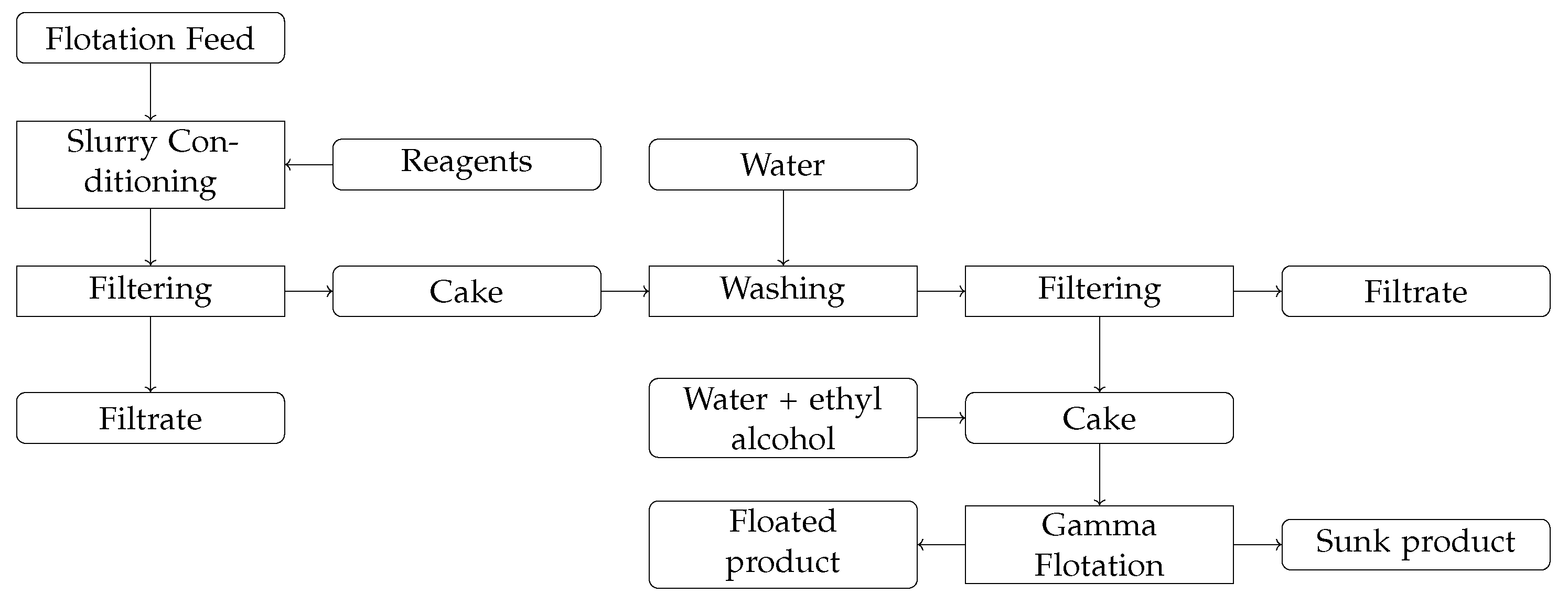
GF experiments were carried out according to the scheme shown in Figure 4. In this way, 730 g of the flotation feed (Section 2.1) was mixed with 965 mL of distilled water to prepare a slurry containing 43% solids (w/w). The slurry was conditioned at pH 5.5 with flotation reagents (Table 5), whose order of addition and optimum dose plus conditioning time were previously determined by a research project funded by the University of São Paulo, the Brazilian Government (Embrapii), and the mining company CMOC [7]. After conditioning of the reagents, the slurry was submitted to vacuum filtering, and the cake obtained was gently washed with 1600 mL of distilled water for 5 min, followed by vacuum filtering, to remove excess reagents without significant desorption of adsorbed collectors. The cake was transferred to a laboratory Denver flotation cell (1500 mL stainless steel vessel) and mixed with water plus ethyl alcohol solutions (Table 4) to prepare a slurry that fed the GF experiments. The experiments were carried out in duplicate (temperature = 22 °C, impeller rotational speed = 1100 min−1, and gas flow rate = 1.5 L/min) until exhaustion of the mineralized froth. The results represent the averages of duplicate tests, with standard deviations (SDs) typically <3% for recoveries based on replicate data. Experimental variability was assessed from duplicate tests and is reported as standard deviation values in Table 6, while the estimation of the critical surface tension ( γ c ) was performed by graphical extrapolation.
The floated and sunk products were dried and weighed, and a sample was sent for chemical analysis by XRF. The masses of the sunk and floated products, coupled with their grades (Nb2O5, CaO, TiO2, and SiO2), were used to assess the recovery of both Nb2O5 (representing pyrochlore) and the other analytes associated with gangue minerals (CaO, TiO2, and SiO2). The recoveries of Nb2O5, CaO, TiO2, and SiO2 versus γ were plotted on typical graphs, as shown in Figure 3b. The selectivity of the separation pyrochlore/gangue was assessed by the separation efficiency (E) maintained by Schulz [24], which was determined according to Equation (3). Furthermore, conventional flotation tests ( γ = 48.9 mN/m) were performed to compare the results obtained by the GF experiments. Those conventional tests were carried out under the experimental conditions shown in Table 5. The only difference from the GF tests was that the conventional tests did not include the filtering step; flotation occurred immediately after conditioning without filtering.
E = RNb2O5Rgangue
where RNb2O5 = recovery of Nb2O5, representing pyrochlore, and R gangue = recovery of analytes (CaO, SiO2, and TiO2) that represent the gangue species, namely carbonates, silicates, and oxides, respectively, with dimensionless S (expressed as %).

2.4. Measurement of Surface Tension of Solutions

Slurry samples were collected in the Boa Vista industrial plant (Figure 1) in the rougher stage of carbonate reverse flotation, silicate reverse flotation, and direct pyrochlore flotation before and after determining the reagent’s dosage to evaluate the magnitude of the surface tension of the flotation solutions ( γ ). After sampling, the slurry was filtered in the plant’s facilities, and the filtrates (aqueous solutions) were transported by car for 700 km (at 10 °C for 10 h) from the mine site (Catalão-GO) to a laboratory in the University of São Paulo (São Paulo-SP). After heating the solutions to 22 °C, their γ values were measured in triplicate using a K100 tensiometer (KRÜSS GmbH, Hamburg, Germany) using the Wilhelmy plate method. The measurements were carried out over 3500 s, with a detection limit of 0.01 mN/m, after a stabilization time of 30 s. Additionally, ethyl alcohol solutions plus milliQ® water mixed in several proportions (Table 5) were submitted to the same equipment/procedure to assess the magnitude of their surface tension.

3. Results and Discussion

3.1. Characterization of the Flotation Solutions

In the Boa Vista industrial plant (Figure 1), the concentration of pyrochlore via froth flotation is determined using three sequential circuits: anionic reverse flotation of carbonates, cationic reverse flotation of silicates, and, finally, cationic direct flotation of pyrochlore. It is informative to note that only the latter is focused on by this paper regarding the critical surface tension. Before adding the reagent, the surface tension ( γ ) of the flotation feeds shows a slight progressive reduction downstream, from 71.79 mN/m in the carbonate flotation feed to 68.55 mN/m in the silicate feed and 67.35 mN/m in the niobium (pyrochlore) feed (Table 7), measured at 22.0 ± 1.0 °C. This modest decrease may indicate a minor carryover of residual surfactants from upstream circuits, although it remains close to that of pure water (∼72 mN/m).
However, after reagent conditioning, reverse flotation of either carbonates or silicates is carried out at pH ∼10, whereas surface tension lies in the range of 61 mN/m to 66 mN/m (Table 8). Furthermore, since flotation is performed in the three sequential steps shown in Figure 1, flotation water becomes increasingly more contaminated with calcium and magnesium. Thus, although direct pyrochlore flotation is performed after carbonate and silicate reverse flotation, it is currently carried out on an industrial scale with high values of γ (61 mN/m).
It is also important to note that direct pyrochlore flotation carried out in laboratory batch experiments conducted under the same reagent conditions used in the industrial circuit (Table 5) showed a value of γ = 48.9 mN/m for the surface tension of the flotation solution, which is significantly lower than 61.2 mN/m and represents a stage of the industrial circuit. Ca2+ and Mg2+ in process water, plus leftover frothers, can change interfacial tension ( γ l g ) and how bubbles attach to particles. These ions may stick to minerals, lowering γ l g and boosting froth stability, but they can also activate gangue, reducing selectivity [10,25]. Residual frothers add to this by dropping γ l g more, possibly causing recovery issues near critical levels. The cause of this great difference in magnitude of γ (48.9 mN/m versus 61.2 mN/m) may reside in the fact that the industrial stage receives the circulating load of the existing cleaner stages, provoking effective dilution of active flotation surfactants (due to water addition, pH variations in cleaners, and potential degradation) and increasing the surface tension of the flotation solution. The surfactants’ dilution verified at an industrial scale certainly does not occur in conventional laboratory experiments, as the latter are not locked-cycle experiments.

3.2. Gamma Flotation Results

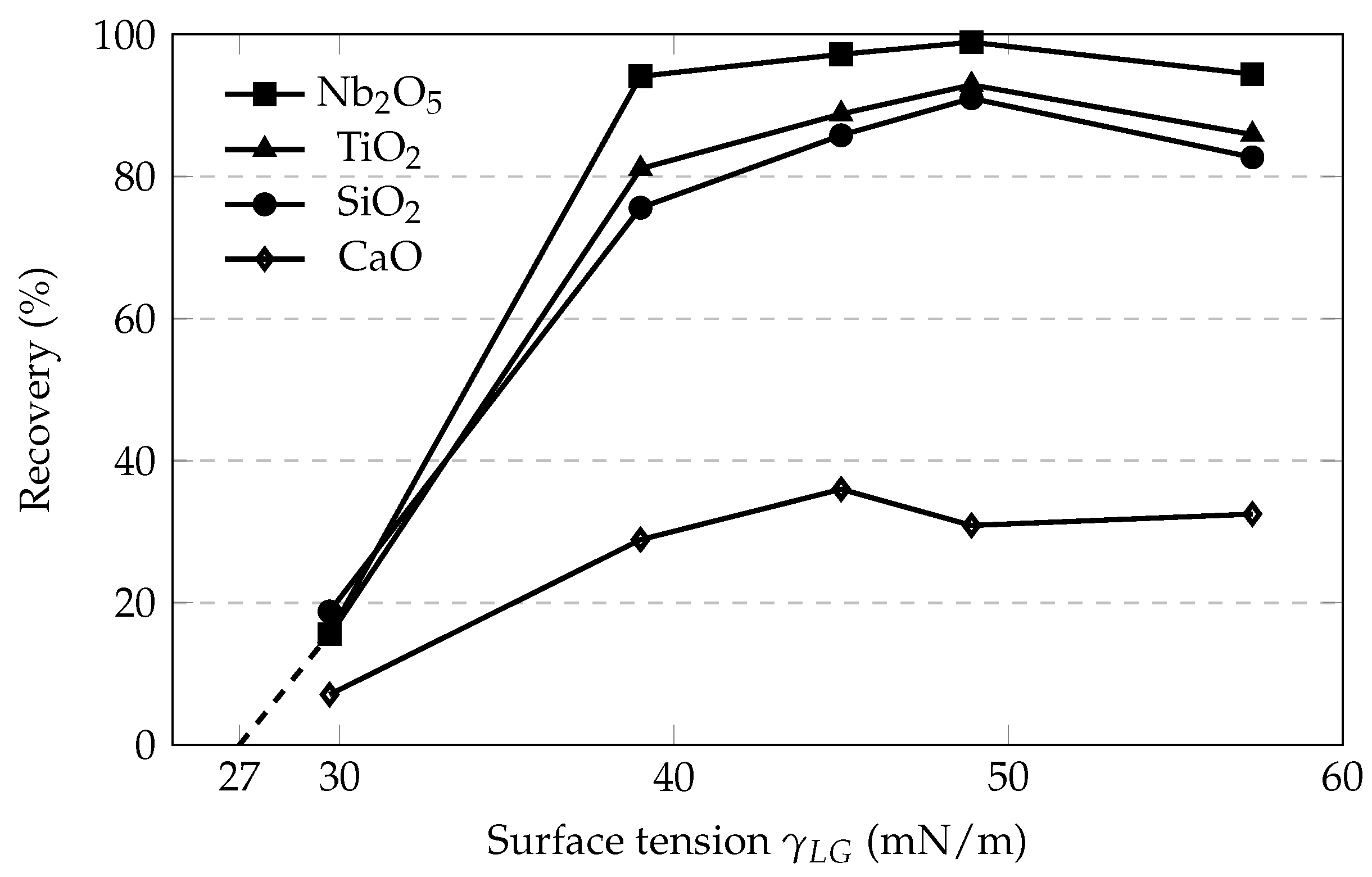
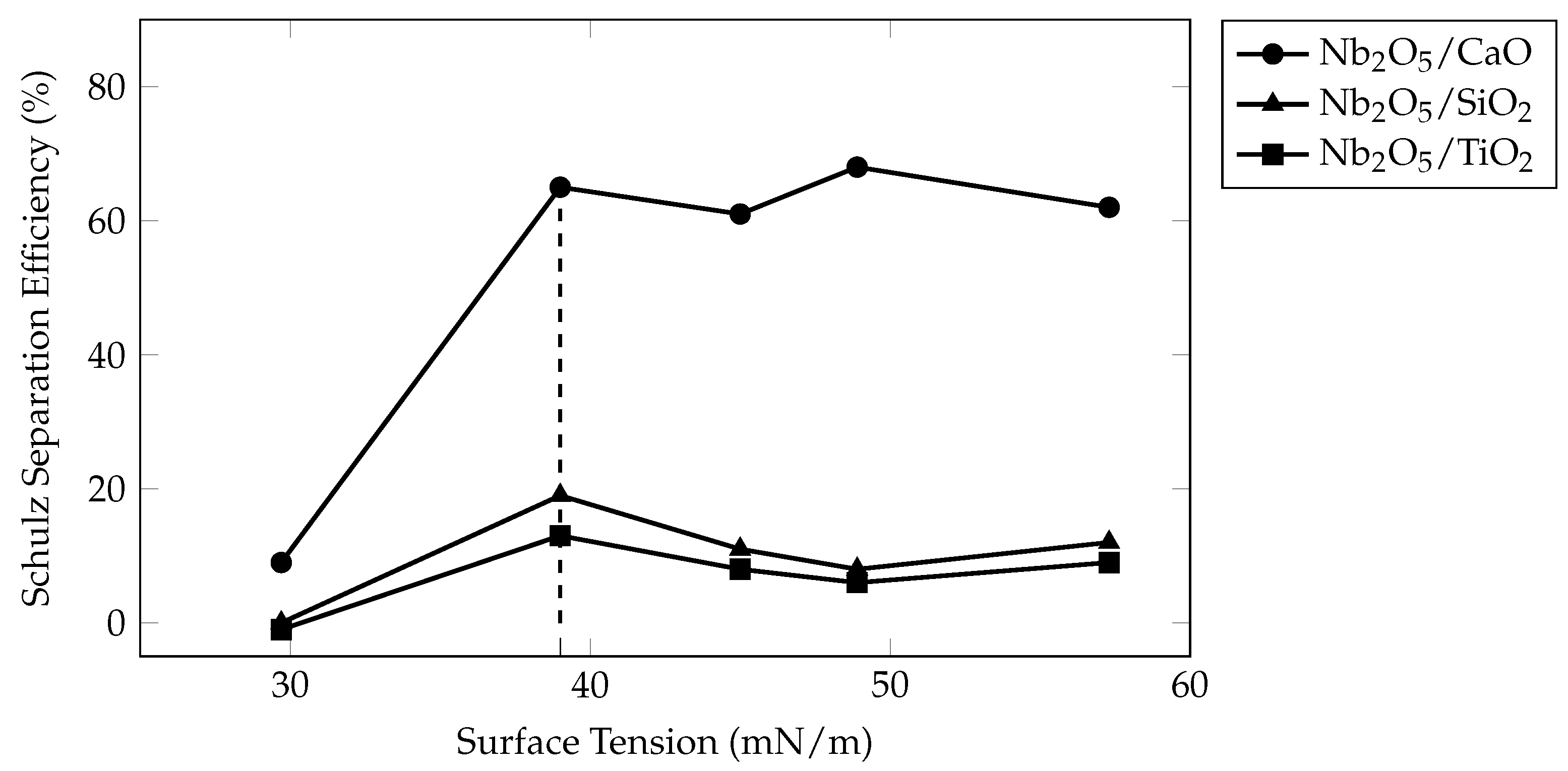
The recovery rates of niobium pentoxide (Nb2O5), silicon dioxide (SiO2), titanium dioxide (TiO2), and calcium oxide (CaO) versus γ are shown in Figure 5 and Table 6. Because the ore mass that fed the GF was previously conditioned with conventional reagents used in the industrial plant (Table 5), the results can indicate the selectivity provided by the reagent system and adopted by the industrial process. For this purpose, Schulz’s efficiency of the separation between pyrochlore/silicates (Nb/Si), pyrochlore/carbonates (Nb/Ca), and pyrochlore/Ti oxides (Nb/Ti) was calculated and plotted against γ , as shown in Figure 6 and Table 9.
Regarding Figure 5, the recovery (R) versus γ curves for the analytes (Nb2O5, SiO2, and TiO2) representing either oxide (pyrochlore or Ti-bearing species) or silicate (quartz and mica) minerals were extrapolated to R = 0, allowing the determination of the same critical surface tension needed for floatability ( γ c = 27 mN/m) after conditioning with flotation reagents (types and dosage displayed in Table 5). By benchmarking this result with phosphate flotation [8], apatite shows γ c = 34 mN/m after conditioning with starch (75 g/t) and sodium alkylsarcosinate (100 g/t) at pH 10.6. Furthermore, by extrapolating the recovery of CaO to R = 0, the graphically determined value of γ c tends to 27 mN/m, indicating that carbonates (represented by CaO) show a value of γ c very close to that exhibited by oxides (represented by TiO2) and silicates (represented by SiO2). The determined γ c of 27 mN/m holds significant thermodynamic importance, as it marks the critical threshold where the spreading coefficient S = γ l g ( cos θ 1 ) approaches zero, corresponding to complete wetting of the mineral surface ( θ 0 ) and inhibition of bubble–particle attachment [15,16]. Below this value, the free energy change ( Δ G ) for attachment becomes insufficiently negative, rendering flotation unfavorable due to dominant solid–liquid interactions ( γ s l < γ s g γ l g cos θ , per Young’s equation, Equation (1)). For pyrochlore and gangue minerals post-amine adsorption, this low γ c value indicates not only effective surface modification by the collector but also sensitivity to the solution’s surface tension; operating near or below 27 mN/m could explain industrial recovery losses by promoting wetting over attachment. This distinction between critical wetting (complete liquid spreading) and the attachment threshold (stable bubble adhesion for θ > 0 ) underscores the need for γ l g control to optimize selectivity.
This plateau at γ > 39 mN/m reflects the thermodynamic saturation of bubble–particle attachment, as illustrated by the interfacial free energy balance in Figure 2c. According to Young’s equation (Equation (1)), once γ l g (liquid–gas surface tension) exceeds γ c (27 mN/m), the contact angle θ shifts from 0 (complete wetting, no attachment; Figure 2b) to θ > 0 (partial wetting, favoring attachment; Figure 2a). At this threshold, the vector equilibrium favors a stable three-phase contact line, with γ l g counterbalancing γ s l to allow hydrophobic particle adhesion to bubbles. The steep rise in recovery just above γ c (from 0% to near-plateau) occurs because small increases in γ l g cause rapid decreases in cos θ (increasing θ ), making the free energy of attachment more sharply negative. Mathematically, near γ c , where cos θ 1 , the spreading coefficient S (Equation (2)) transitions from zero (no spreading, complete wetting) to negative values, inhibiting liquid spreading and enabling attachment. This non-linear sensitivity explains the “fast drop” to zero recovery below γ c : as γ l g approaches γ c from above, θ 0 , and Δ G 0 , collapsing the attachment probability. Beyond ∼39 mN/m, further γ l g increases yield diminishing returns, as θ stabilizes at hydrophobic values, and recovery is limited by kinetic factors like collision efficiency rather than interfacial energetics [14]. This behavior aligns with Zisman’s linear cos θ vs. γ l g plots (Figure 3a), which were extrapolated to γ c , and underscores why operating near but above γ c optimizes selectivity without over-recovery of gangue.
Therefore, the recovery of pyrochlore, as well as gangue minerals, is null, as the surface tension of the flotation solution is 27 mN/m. Although γ c represents a thermodynamic threshold for complete wetting conditions, real flotation systems exhibit a transition zone around this value due to surface heterogeneity, collector distribution, and kinetic effects. Considering the rationale displayed in Figure 3, for either pyrochlore or gangue minerals, their recoveries become null because their respective mineral surfaces become fully wetted by the flotation solution, leading to θ = 0 ( cos θ = 1 ). On the other hand, as the surface tension of the flotation solution increases from γ c (27 mN/m) to γ = 39 mN/m, the recoveries (Rs) of the analytes (Nb2O5, TiO2, SiO2, and CaO) increase steeply from 0% to 94% for Nb2O5 versus 81% for TiO2, 76% for SiO2, and 29% for CaO. Those recoveries can represent pyrochlore, Ti minerals (ilmenite, anatase, and rutile), Si-bearing minerals (quartz, feldspar, and mica), and Ca-bearing minerals (carbonates), respectively. In addition, as γ > 39 mN/m, the recoveries of all analytes reach a plateau of high recovery: 94%–99% for Nb2O5, 83%–91% for SiO2, 83%–96% for TiO2, and 31%–36% for CaO. It is important to note that flotation conducted only with water and flotation reagents ( γ = 48.9 mN/m) showed the highest recoveries of Nb2O5 (99%), TiO2 (93%), and SiO2 (91%), accompanied by a significant lower recovery of CaO (31%).
The higher optimum γ for carbonates (48.9 mN/m) reflects their strong depression at pH 5.5, where fluorosilicic acid promotes dissolution and prevents amine adsorption, thereby requiring elevated tension for maximal pyrochlore recovery while keeping carbonates non-floatable [7]. Conversely, silicates and Ti-oxides (39.7 mN/m) have lower hydrophobicity post-conditioning, allowing peak efficiency at reduced γ , where gangue detachment is optimized [9]. To better understand the influence of γ on the selectivity of the flotation process, Schulz’s separation efficiency (E) for pyrochlore/silicates (Nb/Si), pyrochlore/carbonates (Nb/Ca), and pyrochlore/oxides (Nb/Ti) was calculated and plotted against γ (Figure 6 and Table 9). In this context, the surface tension of the flotation solution acts as a mediating parameter that regulates collector adsorption efficiency and interfacial stability, rather than as an isolated controlling variable. Consequently, the most selective separation of pyrochlore/carbonates occurs at γ = 48.9 mN/m (E = 68%), while the maximum separation efficiency for pyrochlore/silicates and pyrochlore/Ti oxides occurs at γ = 39 mN/m. This trend indicates that the best value of γ to achieve the most selective pyrochlore/silicate+oxide separation (39 mN/m) differs greatly from the value of γ (48.9 mN/m) that promotes the best pyrochlore/carbonate separation. This divergence might arise from distinct depression mechanisms: Carbonates are strongly depressed by fluorosilicic acid, weakening amine adsorption and requiring higher γ values for selectivity [7,10]. Silicates/oxides face weaker depression, enabling stronger amine physisorption and optimal separation at lower γ values [9,25]. A feasible solution for the tradeoff is to feed direct pyrochlore flotation with fewer carbonates (by improving the existing carbonate’s reverse flotation ability) and perform direct pyrochlore flotation at γ = 39 mN/m to increase the selectivity of the separation of pyrochlore/silicates and pyrochlore/oxides.
To achieve the recommended γ of 39 mN/m in the industrial circuit, a specific optimization step is to adjust reagent proportions by maintaining the Acetadiamine T50 dosage while increasing Lupromin FPN 315 to fine-tune surface activity and lower γ values, along with a concurrent increase in the RV-418 antifoam to manage enhanced foaming from higher Lupromin levels. For an enhanced reduction in surface tension, switching to a Lupromin variant with lower ethoxylation can be considered, as this might increase lipophilicity and surface activity, thus more effectively dropping γ while still requiring RV-418 adjustment for foam control [7,10]. This approach is feasible within existing infrastructure at the Boa Vista mine, addressing challenges like froth stability and throughput through targeted reagent adjustments.
Furthermore, industrial applications of surface tension monitoring, such as online tensiometers for real-time flotation control, have demonstrated practical optimization of γ to enhance selectivity and recovery [21]. This bridges theoretical GF and operational practice, enabling adjustments in reagent dosages based on dynamic surface tension measurements.

4. Conclusions

This research is an attempt to bridge theoretical predictions and practical applications, providing insight into the challenging separation of pyrochlore and gangue minerals via froth flotation. In this way, it investigates the influence of the surface tension of the flotation solution ( γ ) on the recovery of Nb2O5 (representing pyrochlore), SiO2 (representing silicate gangue minerals), and TiO2 (representing oxide gangue minerals) after conditioning at pH 5.5 with flotation reagents used in the industrial circuit. The results of the GF experiments allowed the identification of the critical surface tension needed for floatability of pyrochlore in this system: γ c = 27 mN/m. Furthermore, by increasing γ from 27 mN/m to 39 mN/m, the recovery (R) of all analytes increases rapidly from R = 0% to R = 94% for Nb2O5, to R = 81% for TiO2, to R = 76% for SiO2, and to R = 29% for CaO. The latter indicates that carbonates (represented by CaO) are the gangue minerals that show the least tendency to float during the direct cationic flotation of pyrochlore. In contrast, oxides (represented by TiO2) are the gangue minerals that tend to float the most, together with pyrochlore, perhaps indicating that a more selective reagent system is required. Furthermore, since γ > 39 mN/m, the recovery of all analytes is on a plateau of high recoveries, where the maximum recovery of all analytes was achieved at γ = 48.9 mN/m (test conducted with water and flotation reagents, not ethanol+water mixtures).
By using Schulz’s separation efficiency (E) to assess the selectivity of pyrochlore/gangue separation, it was possible to verify that the maximum E for pyrochlore/carbonates was achieved at γ = 48.9 mN/m, whereas the maximum E for either pyrochlore/silicates or pyrochlore/oxides is achieved at γ = 39 mN/m. Because the separation of pyrochlore/silicates+oxides is more critical than the separation of pyrochlore/carbonates, the direct cationic flotation of pyrochlore could be carried out on an industrial scale with γ values much lower ( γ = 39 mN/m) than the actual values that characterize the industrial circuit (61 mN/m). Thermodynamically, the γ c value of 27 mN/m delineates the wetting–attachment boundary, where below this value, unfavorable Δ G is no longer favorable, potentially contributing to the ∼50% industrial recovery ceiling. These findings bridge GF theory and practice, suggesting surface tension management as a key lever for enhancing pyrochlore–gangue separation efficiency.

Author Contributions

Conceptualization and methodology, R.V.D., J.T.G.J. and L.d.S.L.F.; validation, formal analysis, and investigation, R.V.D.; data curation and writing—original draft preparation, R.V.D.; writing—review and editing, R.V.D., J.T.G.J. and L.d.S.L.F.; visualization and supervision, L.d.S.L.F.; project administration and funding acquisition, R.V.D., J.T.G.J. and L.d.S.L.F. All authors have read and agreed to the published version of the manuscript.

Funding

This research was funded by the University of Sao Paulo, the Brazilian Government (Embrapii), and the mining company CMOC under grant numbers 600211-600212.

Data Availability Statement

Data are contained within the article.

Acknowledgments

The authors gratefully acknowledge the financial support of CMOC and Embrapii, as well as CMOC’s provision of the samples and reagents used in this work.

Conflicts of Interest

The authors declare no conflicts of interest.

References

  1. Tian, C.; Zou, W.; Liu, F.; Lu, Y.; Zhang, Z.; Li, Z. A comprehensive review on recent progress in beneficiation of Nb-bearing minerals/Nb ores. Miner. Eng. 2024, 212, 108710. [Google Scholar] [CrossRef]
  2. Gibson, C.E.; Aghamirian, M.; Kelebek, S. Pyrochlore flotation from silicate gangue minerals: Amine adsorption mechanisms and the effect of modifying reagents. Miner. Eng. 2021, 171, 107100. [Google Scholar] [CrossRef]
  3. Blengini, G.A.; Latunussa, C.; Eynard, U.; Torres de Matos, C.; Wittmer, D.; Georgitzikis, K.; Pavel, C.; Carrara, S.; Mancini, L.; Unguru, M.; et al. Study on the EU’s List of Critical Raw Materials (2020) Final Report; Technical Report; European Commission: Luxembourg, 2020. [Google Scholar]
  4. Amoah, S.T.; Zhang, L.; Adhikari, K.; Li, H.; Cao, J. Process Applications and Challenges in Mineral Beneficiation and Recovery of Niobium from Ore Deposits—A Review. Miner. Process. Extr. Metall. Rev. 2021, 42, 833–864. [Google Scholar] [CrossRef]
  5. Hassas, M.; Deblonde, G.; Chagnes, A. Niobium and tantalum recovery from the primary source and from tin slag, an industrial challenge: A review. Can. J. Chem. Eng. 2023, 101, 1743–1761. [Google Scholar] [CrossRef]
  6. Gibson, C.E.; Kelebek, S.; Aghamirian, M. Niobium oxide mineral flotation: A review of relevant literature and the current state of industrial operations. Int. J. Miner. Process. 2015, 137, 82–97. [Google Scholar] [CrossRef]
  7. Gouvea Junior, J.T.; Morais, V.J.; Leal Filho, L.S. Decrease of Pyrochlore Loss to the Tailings Pond by Improving Current Flotation Process—Final Report; Technical Report, Grant 600212, agreement; CMOC/Embrapii/USP: São Paulo, Brazil, 2025. [Google Scholar]
  8. Martins, M.; Leal Filho, L.S.; Parekh, B.K. Surface tension of flotation solution and its influence on the selectivity of the separation between apatite and gangue minerals. Min. Metall. Explor. 2009, 26, 79–84. [Google Scholar] [CrossRef]
  9. Leja, J. Surface Chemistry of Froth Flotation; Plenum Press: New York, NY, USA, 1982; p. 758. [Google Scholar]
  10. Rao, S.R.; Leja, J. Surface Chemistry of Froth Flotation: Volume 1—Fundamentals; Volume 2—Reagents and Mechanisms, 2nd ed.; Springer: Boston, MA, USA, 2004. [Google Scholar]
  11. Liu, S.; Zhang, W.; Ni, J.; Yang, Y.; Yao, R.; Feng, W. Simultaneous Recovery of Niobium and Sulfur from Carbonate Niobite Ore with Flotation. Minerals 2022, 12, 432. [Google Scholar] [CrossRef]
  12. Zhang, J.; Niu, F.; Deng, X.; Feng, J.; Li, Q.; Guo, W.; Wang, J.; Li, Y. The Distribution Regularity and Flotation Study of Niobium-Bearing Minerals in Baiyun Obo. Minerals 2023, 13, 387. [Google Scholar] [CrossRef]
  13. Chau, T.T.; Bruckard, W.J.; Koh, P.T.L.; Nguyen, A.V. A review of factors that affect contact angle and implications for flotation practice. Adv. Colloid Interface Sci. 2009, 150, 106–115. [Google Scholar] [CrossRef] [PubMed]
  14. Ralston, J.; Fornasiero, D.; Hayes, R. Bubble-particle attachment and detachment in flotation. Int. J. Miner. Process. 1999, 56, 133–164. [Google Scholar] [CrossRef]
  15. Zisman, W.A. Relation of the equilibrium contact angle to liquid and solid constitution. In Contact Angle, Wettability and Adhesion; Fowkes, F.M., Ed.; American Chemical Society: Washington, DC, USA, 1964; pp. 1–51. [Google Scholar] [CrossRef]
  16. Shafrin, E.G.; Zisman, W.A. Critical surface tension for spreading on a liquid substrate. J. Phys. Chem. 1967, 71, 1309–1316. [Google Scholar] [CrossRef]
  17. Kelebek, S.; Smith, G.W.; Finch, J.A.; Yörük, S. Critical surface tension of wetting and flotation separation of hydrophobic solids. Sep. Sci. Technol. 1987, 22, 1527–1546. [Google Scholar] [CrossRef]
  18. Özcan, O. Classification of minerals according to their critical surface tension of wetting values. Int. J. Miner. Process. 1992, 34, 191–204. [Google Scholar] [CrossRef]
  19. Kirjavainen, V.; Lehto, H.; Heiskanen, K. Study on the flotation behaviour of low energy materials at low surface tensions. Miner. Eng. 2003, 16, 1193–1196. [Google Scholar] [CrossRef]
  20. Pugh, R.J. Dynamic surface tension measurement in mineral flotation and de-inking flotation systems and the development of the on line dynamic surface tension detector (DSTD). Miner. Eng. 2001, 14, 1019–1031. [Google Scholar] [CrossRef]
  21. Kramer, A.; Gaulocher, S.; Martins, M.; Leal Filho, L.S. Surface tension measurement for optimization of flotation control. Procedia Eng. 2012, 46, 111–118. [Google Scholar] [CrossRef]
  22. Salama, I.E.; Slavchov, R.I.; Marei, N.N.; Canselier, J.P.; Kizling, J.; Kronberg, B. Chemisorption and physisorption of alcohols on iron(III) oxide-terminated surfaces from nonpolar solvents. J. Colloid Interface Sci. 2025, 685, 15–28. [Google Scholar] [CrossRef] [PubMed]
  23. Sand, K.K.; Stipp, S.L.S.; Hassenkam, T.; Yang, M.; Makovicky, E. Ethanol adsorption on the {104} calcite surface: Preliminary observations with atomic force microscopy. Mineral. Mag. 2008, 72, 353–356. [Google Scholar] [CrossRef]
  24. Schulz, N.F. Separation efficiency. Trans. Am. Inst. Min. Metall. Pet. Eng. 1970, 247, 81–87. [Google Scholar]
  25. Somasundaran, P.; Wang, D. Solution Chemistry: Minerals and Reagents, 1st ed.; Developments in Mineral Processing; Elsevier: Amsterdam, The Netherlands, 2006; Volume 17. [Google Scholar]
Figure 1. Illustration of the flotation flowsheet adopted to concentrate pyrochlore from the Boa Vista mine, Catalão-GO. Arrows indicate process flows: blue arrows represent incoming flotation feed, red arrows denote tailings, overflows, or separated byproducts, while the green arrow points to the final pyrochlore concentrate. Point A represents the sampling point for GF.
Minerals 16 00135 g001
Figure 2. Illustration of contact angle behavior and interfacial free energies: (a) partial wettability of a solid surface by the flotation solution, characterized by a finite contact angle ( θ > 0 ) that favors particle–bubble attachment; (b) complete wettability of the solid by the flotation solution ( θ = 0 ), a condition that inhibits flotation; (c) equilibrium configuration showing the balance of interfacial free energies between solid/gas ( γ S G ), solid/liquid ( γ S L ), and liquid/gas ( γ L G ) (adapted from [9]).
Minerals 16 00135 g002
Figure 3. Graphs used to determine the critical surface tension needed for wettability of minerals: (a) cos θ versus γ L G (Zisman plot; solid line indicates the linear relationship, dashed line shows the horizontal line at cos θ = 0 and vertical line marking γ c ); (b) flotation recovery versus γ L G (open circles represent experimental data points, solid line indicates the fitted sigmoid curve, dashed vertical line marks the critical surface tension γ c ). Adapted from [18].
Minerals 16 00135 g003
Figure 4. Illustration of experimental procedures of GF experiments.
Minerals 16 00135 g004
Figure 5. Influence of the flotation solution’s surface tension ( γ ) on the recovery of Nb2O5, TiO2, SiO2, and CaO at 22 °C. Symbols represent GF tests (four points using ethanol–water mixtures for γ adjustment) and a conventional flotation test (additional point at γ = 48.9 mN/m, without ethanol). Dashed lines indicate graphical extrapolations of the recovery trends, which were used to estimate the critical surface tension needed for flotability ( γ c 27 mN/m).
Minerals 16 00135 g005
Figure 6. Influence of the flotation solution’s surface tension ( γ ) on Schulz’s separation efficiency between Nb2O5/CaO, Nb2O5/SiO2, and Nb2O5/TiO2. Symbols represent data from GF tests (using ethanol–water mixtures) with an additional point from a conventional flotation test (at γ = 48.9 mN/m, without ethanol) as a benchmark to industrial-like conditions. The dashed vertical line highlights the surface tension at which maximum separation efficiency is achieved for the Nb2O5/CaO system.
Minerals 16 00135 g006
Table 1. Reagents, dosage, and pH used in the current pyrochlore beneficiation process [7].
DutyReagentTrade Name/SupplierDosage (g/t)Functionality
Reverse flotation
of carbonates
(pH 10)
Stargill® 6191Cargill800Polysaccharide (starch) depressant for pyrochlore
Lioflot® 508Miracema100Fatty acid collector for carbonates
Reverse flotation
of silicates
(pH 10)
Stargill® 6191Cargill900Polysaccharide (starch) depressant for pyrochlore
Flotigam® EDAClariant400Ether amine collector for silicates
Direct flotation
of pyrochlore
(2.5 < pH < 5.5 *)
Hexafluorosilicic acidCMOC2000Activator for pyrochlore and pH modifier
RV-418Dynatec30Hydrocarbon froth control agent
Acetadiamine T50Kao Chemicals900Tallow diamine collector for pyrochlore
Lupromin® FPN 315BASF900Ethoxylated fatty acid ancillary collector for pyrochlore
* pH 5.5 at the rougher stage, gradually decreasing along four cleaner stages until pH 2.5 is reached (cleaner 4).
Table 2. Chemical composition and particle size distribution of the GF feed.
SizeMass %CaOFe2O3MgONb2O5SiO2
+105 μm32.920.317.577.170.2828.17
−105 +37 μm39.718.3510.557.602.1624.99
−37 μm27.410.2512.387.323.1132.02
Total100.016.7710.077.381.8027.96
Table 3. Semi-quantitative mineralogical composition of the GF feed.
MineralContent (%)
Biotite30
Dolomite28
Calcite25
Orthoclase14
Rutile2
Anatase1
Quartz<1
Amphibole<1
Pyrochlore<1
Table 4. Surface tension of ethanol/water solutions at 22 °C.
Solution% Water% Ethyl AlcoholSurface Tension (mN/m)
194657.3
2841645.0
3752539.0
4505029.7
Table 5. Experimental conditions used for reagent conditioning prior to GF tests.
ReagentsDosage (g/t)Conc. (mg/L)Time (s)
Mixture of 1:1 (w/w) of Acetadiamin® T50 + Lupromin® FPN 3151780134730
RV 418335030
Fluosilicic acid (pH 5.5)1980150230
Table 6. Recovery of Nb2O5, SiO2, TiO2, and CaO as a function of the surface tension of the flotation solution. Values are averages of duplicate tests (SD < 3%).
γ LG (mN/m) R SiO 2 (%) R TiO 2 (%) R Nb2O5 (%) R CaO (%)
29.7 *18.8 ± 5.615.4 ± 5.015.6 ± 5.67.1 ± 2.0
39.0 *75.6 ± 1.681.1 ± 1.894.1 ± 1.528.9 ± 0.3
45.0 *85.8 ± 3.088.8 ± 2.997.2 ± 0.736.0 ± 5.2
48.9 **91.0 ± 4.292.9 ± 2.598.9 ± 0.430.9 ± 3.9
57.3 *82.7 ± 0.885.9 ± 1.394.4 ± 0.132.5 ± 1.0
* GF; ** Conventional flotation.
Table 7. Surface tension of flotation feeds (before reagent addition) in the industrial plant.
IdentificationSurface Tension (mN/m) at 22 °CStd. Dev.
Carbonate flotation feed71.790.26
Silicate flotation feed68.550.51
Niobium flotation feed67.350.88
Table 8. Characterization of the flotation solution at the rougher stage in the industrial plant and laboratory.
Sampling PointSurface Tension (mN/m)Ca2+ (mg/L)Mg2+ (mg/L)
Reverse carbonate flotation *61.5 ± 0.55.066.59
Reverse silicate flotation *66.0 ± 0.18.1716.80
Direct pyrochlore flotation *61.2 ± 0.117.5016.30
Direct pyrochlore flotation **48.9Distilled water
Surface tension measured at 22 °C. (*) Industrial scale (**) Laboratory.
Table 9. Schulz’s separation efficiency as a function of the surface tension of the flotation solution.
γ LG (mN/m)ENb2O5/SiO2 (%)ENb2O5/CaO (%)ENb2O5/TiO2 (%)
29.7 *−390
39.0 *196513
45.0 *11618
48.9 **8686
57.3 *12629
*: GF; **: conventional flotation.
Disclaimer/Publisher’s Note: The statements, opinions and data contained in all publications are solely those of the individual author(s) and contributor(s) and not of MDPI and/or the editor(s). MDPI and/or the editor(s) disclaim responsibility for any injury to people or property resulting from any ideas, methods, instructions or products referred to in the content.