Article

Garnet-Free Mineral Assemblage at Eclogite-Facies Conditions in the Riffelberg–Garten Unit, Italian Western Alps


1
Dipartimento di Scienze della Terra e dell’Ambiente, Università di Pavia, 27100 Pavia, Italy
2
Dipartimento di Scienze Biologiche, Geologiche e Ambientali, Università di Bologna, 40126 Bologna, Italy
3
Dipartimento di Scienze della Terra “A. Desio”, Università degli Studi di Milano, 20133 Milan, Italy
*
Author to whom correspondence should be addressed.
Minerals 2026, 16(1), 79; https://doi.org/10.3390/min16010079
Submission received: 2 December 2025 / Revised: 30 December 2025 / Accepted: 11 January 2026 / Published: 14 January 2026

Abstract

The peculiar high-pressure mineral assemblage omphacite, epidote, quartz, calcite, titanite, and opaque minerals, ±phengite, has been observed in the Riffelberg–Garten Unit (RGU), a heterogeneous metasedimentary rock assemblage of the Zermatt–Saas Zone. Microstructural analysis, mineral chemistry, and petrologic modelling allowed to refine the syn-D2 P-T peak conditions for the Alpine tectono-metamorphic evolution. In the upper Valtournenche, S2 foliation is the dominant fabric at the regional scale of the Zermatt–Saas Zone. Petrologic modelling of the syn-D2 mineral assemblage indicates climax conditions of P = 1.85–2.0 GPa and T = 500–525 °C. These estimates are in good agreement with those inferred in the RGU metasedimentary matrix and enclosed eclogite and metagabbro elements. During exhumation, RGU rocks re-equilibrated texturally and mineralogically under blueschist–/epidote–amphibolite (P = 0.4–1.3 GPa and T = 350–500 °C during D3) and greenschist (P ≤ 0.25 GPa and T ≤ 400 °C during) facies conditions. This study highlights the potential of petrologic modelling for constraining the environmental conditions of metamorphism even in anomalous mineral assemblages where conventional thermobarometry is not applicable.

1. Introduction

Chaotic rock units within subduction complexes and orogenic belts show a great compositional variety (e.g., [1,2]) that makes them a very effective tool for the quantitative determination of the environmental conditions under which their tectono-metamorphic evolutions developed. Indeed, a great number of sedimentary and tectonic processes which forge chaotic complexes are active at different structural levels, from the hydrosphere–/atmosphere–lithosphere interface to mantle depths, where they are deformed and transposed during subduction/collision (e.g., [2,3,4,5,6,7,8,9,10,11,12,13,14,15,16,17]). Moreover, within subduction complexes, chaotic complexes also record the exhumation-related syn-metamorphic deformation. The variety of processes involved is responsible for a great lithological heterogeneity of these rock complexes, making them excellent tracers of the metamorphic evolution associated with polyphasic tectonic history. Furthermore, polygenetic mélanges in particular offer the possibility of identifying the moment at which different elements coupled during their polyphasic evolution.
In the axial zone of the Alpine belt, the Zermatt–Saas Zone (ZSZ) comprises metamorphosed and polydeformed chaotic deposits, interpreted as polygenetic or tectonic mélanges (e.g., [1,18,19,20]) and characterized by such a wide lithological heterogeneity.
Elements and blocks showing the classical eclogite-facies assemblages allowed to determine the peak conditions in different chaotic units (metaophicarbonates, mélanges of metasedimentary, and mafic/ultramafic blocks) of the ZSZ (e.g., [18,19,21]) at the transition between epidote- and amphibole-eclogite facies conditions (T = 500–630 °C and P = 1.8–2.5 GPa). Some of the various detected climax mineralogical assemblages have been interpreted as developed on rocks resulting from syn-convergence metasomatism (e.g., [19]). A metasomatic origin is consistent with the protolith composition that is suitable to develop the epidote, omphacite, quartz, opaque minerals, ±calcite, and ±phengite assemblage under eclogite-facies conditions. This eclogitic metamorphism took place during the generation of the dominant S2 foliation in the Riffelberg–Garten Unit (RGU), which is the polydeformed chaotic complex from the upper Valtournenche [18].
The aim of this contribution is to explore the deformation–metamorphism relationships and the chemical variations in mineral phases, marking superposed fabrics, to constrain P-T conditions of the syn-D2 mineral assemblage in the Ca-silicate-rich bulk composition, by means of petrologic modelling. These quantitative results will be compared with those deduced for the eclogitic assemblages already estimated for the RGU [18] to test if the tectono-metamorphic history is common for most of the subduction, collision, and exhumation evolution.

2. Geological Outline

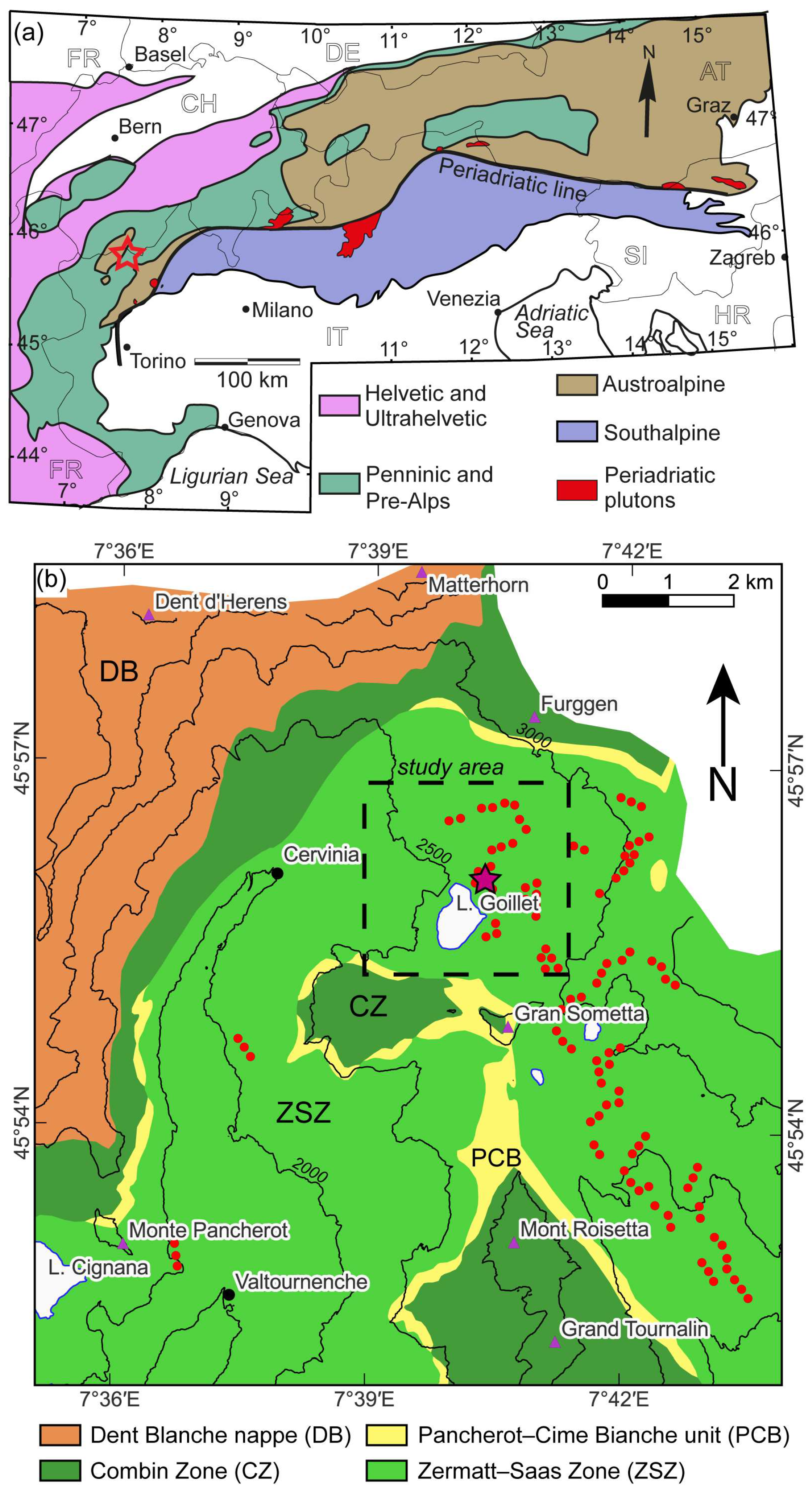
The Riffelberg–Garten Unit (RGU) crops out in the upper Valtournenche in the core of the ZSZ, within the subduction complex of the Western Alps. The ZSZ derived from the Jurassic Piedmont–Ligurian Ocean and belongs to the Penninic domain (Figure 1a). The ZSZ meta-ophiolites consist of serpentinite, metabasite, and metasedimentary rocks [20,22,23,24,25,26]. In the upper Valtournenche (NW Italy), the ZSZ tectonically underlies the Combin Zone (CZ), mainly composed of metabasites and calcschists (Figure 1b), and tectonically overlies the Penninic Monte Rosa continental nappe. This tectonic sandwich is in turn overlain by the continental rocks of the Austroalpine domain, representing portions of the subducted and exhumed continental upper-plate margin. Alpine metamorphic climax conditions of the ZSZ range from high-pressure to ultrahigh-pressure conditions, whereas greenschist–facies metamorphism is dominant in the CZ [21,27,28,29,30,31,32,33,34,35,36,37,38]. ZSZ metamorphic ages span from c.a. 70 to 38 Ma [39,40,41,42,43,44]. The poly-phase deformation history of ZSZ inferred at Valtournenche comprises four groups of ductile structures, consisting of superposed foliations associated with fold systems [18,35,45].
The RGU is the chaotic rock unit of the ZSZ in Valtournenche and is well exposed around Lake Goillet (Figure 1b). This rock assemblage has also been recognized in the Swiss portion of the ZSZ [22,46], as well as in the Ayas valley and near Verres [47,48]. The RGU consists of metasediments with a carbonatic to quartzitic matrix, in which metabasite and minor ultramafite elements (clasts, blocks, lenses, layers, and boudins of different shapes and sizes) are included (e.g., [22,28]). Rounded to angular elements, of centimetric to metric size, are scattered within the metasedimentary matrix (see [18] for details). The primary origin of this rock assemblage is highly debated but there is a general agreement to classify the RGU as a polygenetic mélange due to its multistage tectono-metamorphic evolution [1,18,22,28,48,49,50,51,52,53,54].
Figure 1. (a) Tectonic sketch map of the Alps with location of the study area (red star). The thin black lines are national borders; abbreviations are from the International Organization for Standardization. (b) Geological sketch map of the upper Valtournenche and Ayas valleys showing the Riffelberg–Garten Unit exposures (red dots) redrawn after [48]. Thin solid black lines are 500 m spaced contour lines; ZSZ, Zermatt–Saas Zone (light green); CZ, Combin Zone (dark green); PCB, Pancherot–Cime Bianche unit (yellow); and DB, Dent Blanche nappe (light brown); dashed square locates the study area; purple star locates the studied Ca-silicate-rich RGU rocks.
Minerals 16 00079 g001
After a detailed structural and petrographic analysis, seven rock types have been distinguished in the RGU based on the composition and texture of their matrix and the type and abundance of hosted elements. General characteristics are a foliated matrix enclosing variably shaped mafic and ultramafic elements, both dominated by eclogite-facies assemblages (epidote–omphacite–phengite–garnet–chloritoid for matrix; omphacite–glaucophane–garnet–phengite–epidote–rutile for mafic elements; and serpentine, chlorite, opaque minerals ± talc ± carbonates ± pyroxene for ultramafic elements). Meso- and micro-structures and superposed mineral assemblages of different RGU types have been described in detail by [18]. Thermobarometric estimates to infer the P-T climax conditions, characterizing D2 fabrics, have been determined for gabbro and eclogite elements, at 500 ± 60 °C and 2.2 ± 0.4 GPa, and for quartz–mica-rich layers of Type 3 matrix (consisting of carbonatic and quartzitic schistose layers, with minor marble levels), at 515 ± 50 °C and 2.1 ± 0.2 GPa. Among the seven rock types, hereafter we will focus on a characteristic one, rich in Ca-silicates (Type 7 in [18]). These rocks are interpreted as resulting from local metasomatism due to Ca-rich fluids or as derived from ophiolitic debris mixed with carbonatic sediments, therefore representing the relic of a probable primary sedimentary mélange [18].

Ca-Silicate-Rich Rocks in the RGU

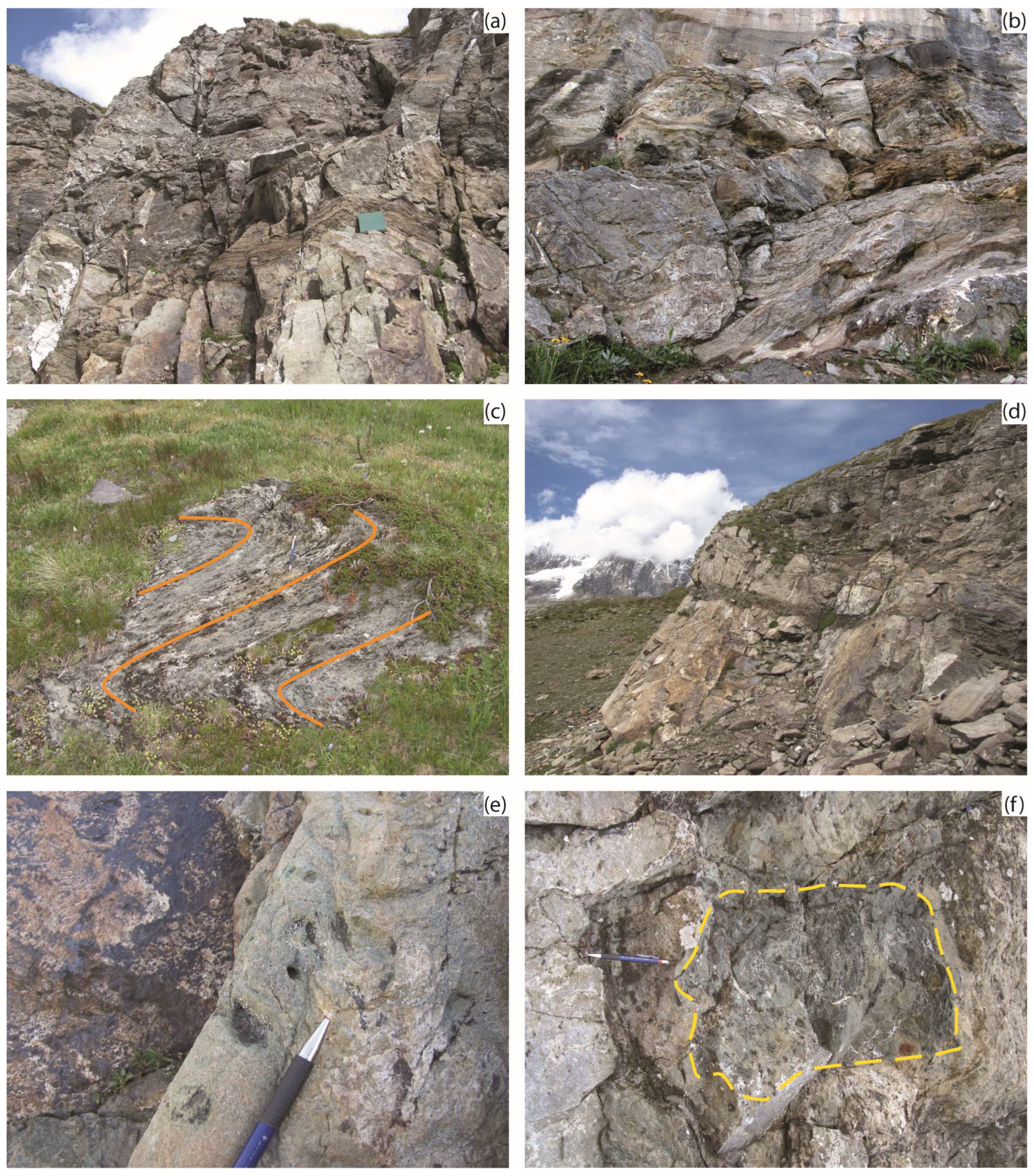
RGU Ca-silicate-rich rocks occur in contact with serpentinite to the NE of Lake Goillet (Figure 1b). They consist of metre-thick carbonate-rich and carbonate-poor layers (Figure 2) in which millimetre- to centimetre-sized clasts occur. Rock matrix has a variable amount of carbonate (10%–40%) and quartz (5%–10%), is rich in epidote (30%–40%), omphacite (5%–20%), with minor Ca-amphibole (5%–15%) and plagioclase (5%–10%). Mafic clasts are millimetre- to centimetre-sized (rarely decimetre-sized) and foliated to granoblastic, with a density up to ten per square metre.
These rocks are polydeformed and D2 structures are the most penetrative. In the less deformed domains (centimetre-sized), pre-S2 foliations, generally transposed and isoclinally folded, are rarely preserved. D2 consists of the S2 foliation, the most prominent at the regional scale, and of D2 isoclinal folds. Boundaries between ZSZ rocks and different RGU rock types are transposed parallel to S2, suggesting that the finite lithostratigraphic architecture has mainly been shaped during D2. D3 structures consist of tight folds with up to metric wavelengths, rarely associated with a differentiated S3 foliation. D4 structures occur as open and upright folds, locally associated with extrados radial fractures, in places filled by quartz, calcite, albite-rich plagioclase, amphibole, and chlorite [18].

3. Methods

3.1. Field Methods and Rationale

In the upper Valtournenche, an outline on the sequence of superposed structures that affected the RGU and surrounding rocks has been made available by [18]. The reconstructed polyphase deformation history, based on detailed structural mapping, has been synthesized on various form surface maps, displaying the complex grid of superposed folds and foliations. The deduced relative chronology of superposed fabric elements was validated after a comparison with the sequence of superposed structures inferred at the regional scale [35]. Therefore, the microstructural analysis has been performed on samples collected where the timing of superimposed fabrics has a regional scale significance.

3.2. Analytical Methods

The primary interest has been to determine the relationships between mineral growth and successive fabric development that have been investigated in polished thin sections under the optical microscope (Zeiss AxioSkope, ZEISS, Oberkochen, Germany) and with the support of BSE images under the electron microprobe (JEOL JXA-8200 Super Probe, JEOL Ltd., Tokyo, Japan). Once the sequence of assemblages associated with subsequent fabrics has been established, the micro-sites to investigate the mineral compositional variations have been chosen, also taking into account the deformation mechanisms acting during the single deformation stages (e.g., [55] and refs. therein). Mineral compositions were analyzed with the Electron Probe Micro-Analyzer (EPMA) JEOL JXA-8200 Super Probe (JEOL Ltd., Tokyo, Japan) operating at the Department of Earth Sciences “Ardito Desio” (Università degli Studi di Milano—Italy). The mineral compositions were acquired using an automated WDS microprobe system. A 15 keV accelerating voltage and a beam current of 15 nA were used. The beam was 1 μm in diameter. Major elements were analyzed using natural silicates as standards and matrix corrections were calculated using the ZAF procedure.

3.3. Thermodynamic Modelling

To constrain the P-T conditions at which the peculiar Ca-silicate-rich rocks equilibrated, a pseudosection was calculated for the syn-D2 assemblage, and classic geothermobarometry was applied to constrain syn-D3 and syn-D4 conditions. The pseudosection was calculated using the programme GeoPS v3.3.2 [56], and solution models for the different minerals are from: [57] for garnet, white mica, and orthopyroxene; [58] for spinel; [59] for chlorite, clinopyroxene, carbonates, and epidote; [60] for ilmenite; [61] for plagioclase; and [62] for carbonates. Fluid was modelled using the CORK equation of state [63], assuming a H2O/CO2 ratio of 1.25 in order to stabilize a minimum amount of carbonates in the assemblage, as discussed further below. Thermodynamic dataset is DS62 [59] in the NCKFMASHTO-CO2 system.

4. Results

4.1. Microstructure

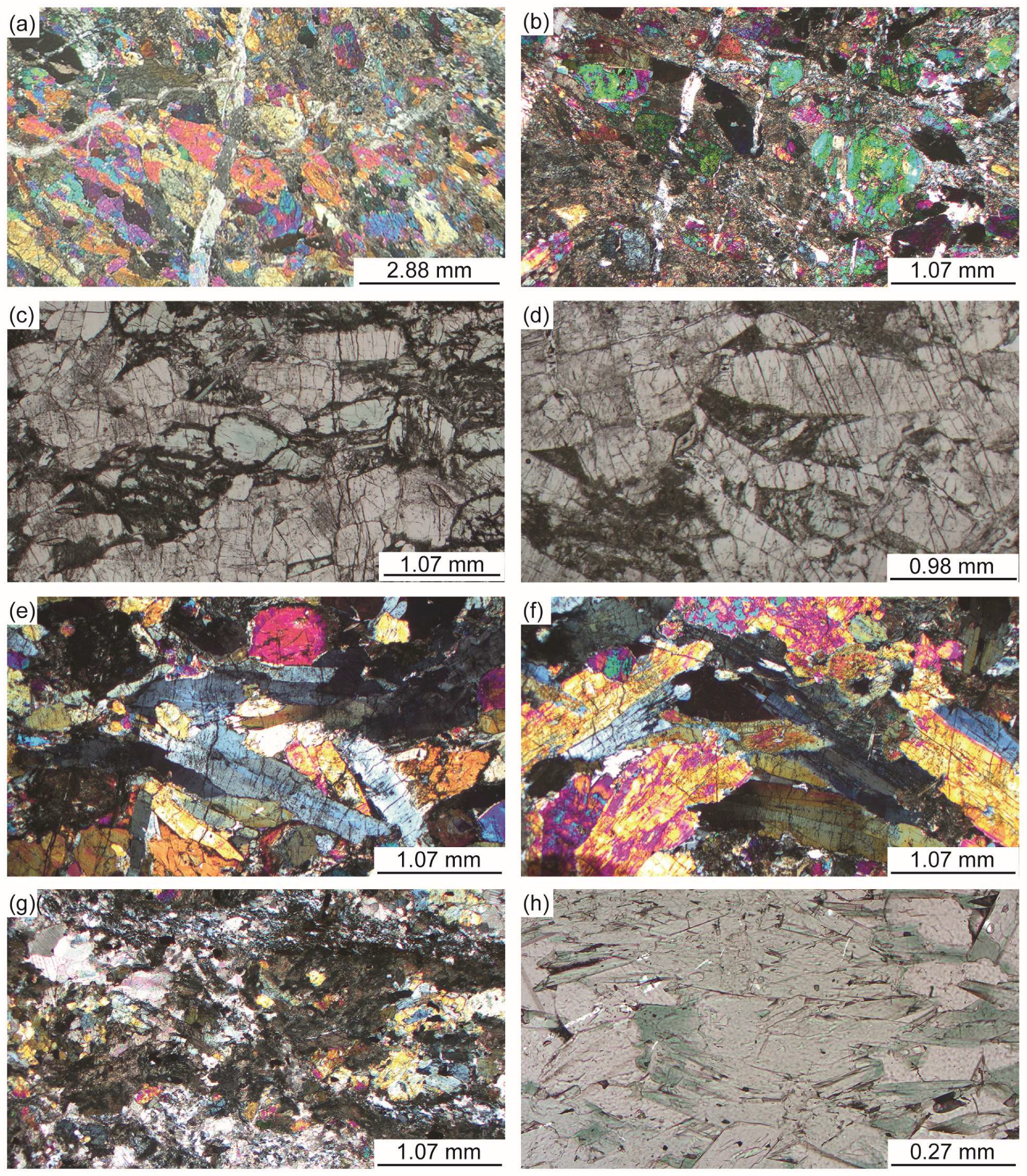
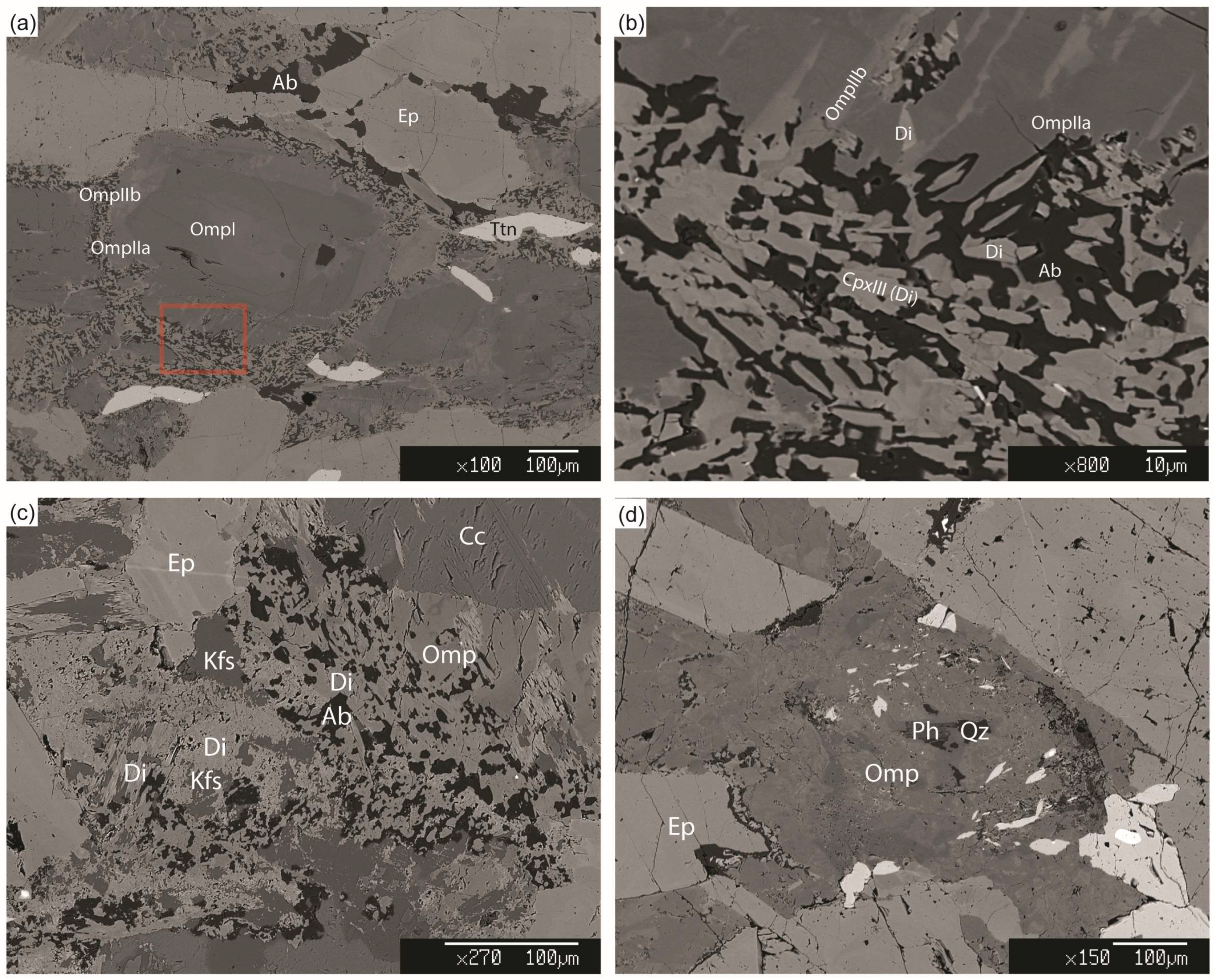
The microscale analysis (Figure 3), performed on carbonate-poor layers, reveals that the dominant foliation S2 is parallel to a compositional layering with Ep-Omp-rich alternating with Cal-rich levels, with the latter containing variable amounts of Qz and Amp. S2 foliation is marked by Ep and Omp shape-preferred orientation (SPO) and, where differentiated, in the microlithons Cal and Qz mainly occur (Figure 3a,b and Figure 4a). Rare Omp and Ep crystals lie at a high angle with S2, which wraps them. Omp grains locally enclose phengitic white mica, Ep, Qz and opaque minerals (Figure 4d). Omp displays complex compositional zoning evident in BSE images where, in porphyroblasts with SPO parallel to S2, dark grey nuclei (OmpI) are surrounded by intermediate grey zones (OmpIIa), which in turn are bordered by thin light grey coronas (OmpIIb). Where Omp granules are recrystallized, subgranules and new granules form and display an intermediate grey core and a light grey rim (e.g., Figure 4a,d). In place, the intermediate grey rims surrounding OmpI porphyroblasts are crossed by light grey Cpx (OmpIIb) veins (e.g., Figure 4a,b). Locally, elongated allotriomorphic oligoclase crystals occur, together with OmpIIb, at the margins between Omp and Ep grains underlying S2.
Rare opaque minerals are scattered as interstitial crystals or are enclosed in Ep prismatic grains. Omp is variably replaced by a fine-grained symplectitic aggregate of Cpx (CpxIII), albitic Pl, and Amp. In the domains where D3 microfolding is well-developed, the Omp replacement is more pervasive, originating symplectitic elongated domains, aligned with S2. This textural sequence demonstrates that the D2 fabric evolves in the stability field of sodium pyroxene, whereas its decomposition products develop subsequently, during D3. Ttn euhedral grains show SPO parallel to or at a high angle with S2. Amp is more abundant in carbonate-rich layers and is zoned with light green–blue cores and intense green rims. Here, light-coloured Amp cores include Ep, Cpx, and opaque minerals. A network of veins intersecting at various angles crosscuts S2; they are filled by Ep, Qz, Ab, and Amp. Sporadically, localized micro-shear bands intersect S2 at a low angle and are characterized by small-sized Qz, Fs, Ep, and opaque minerals. The D3 gentle crenulation is accompanied by Ep recrystallization and Omp replacement by fine-grained Ab-rich Pl and Di symplectites, with minor Ep, Amp, and rare Kfs. In the D3 low-strain domains, Omp replacement is generally confined to the grain margins as coronas. D4 gentle undulation is associated with veining at a low angle with the microfold axial plane. The veins contain Ab-rich Pl, carbonates, Chl, ±Amp, and Fe-rich Ep.
In summary, superposed fabrics and mineral assemblages are associated as follows:
  • Pre-D2 relics: Omp, Ep;
  • D2: Cal, Ep, Omp, Qz, Ttn, ±Ph, ±opaque minerals;
  • D3: Fe-rich Ep, Cpx, Ab-rich Pl, Ttn, Amp, ±Kfs;
  • D4: Ab, Cal, Chl, Act, Fe-rich Ep.
Consistent with what has already been described for the other RGU rocks in Valtournenche, this sequence of assemblages indicates that the deformation history was accomplished during the exhumation of this chaotic complex from high-pressure syn-D2 conditions (as suggested by the textural equilibrium of omphacite and quartz in absence of plagioclase) to shallower structural levels, passing through re-equilibrations in blueschist–/epidote–amphibolite– and greenschist–facies conditions during D3 and D4, respectively.

4.2. Mineral Chemistry

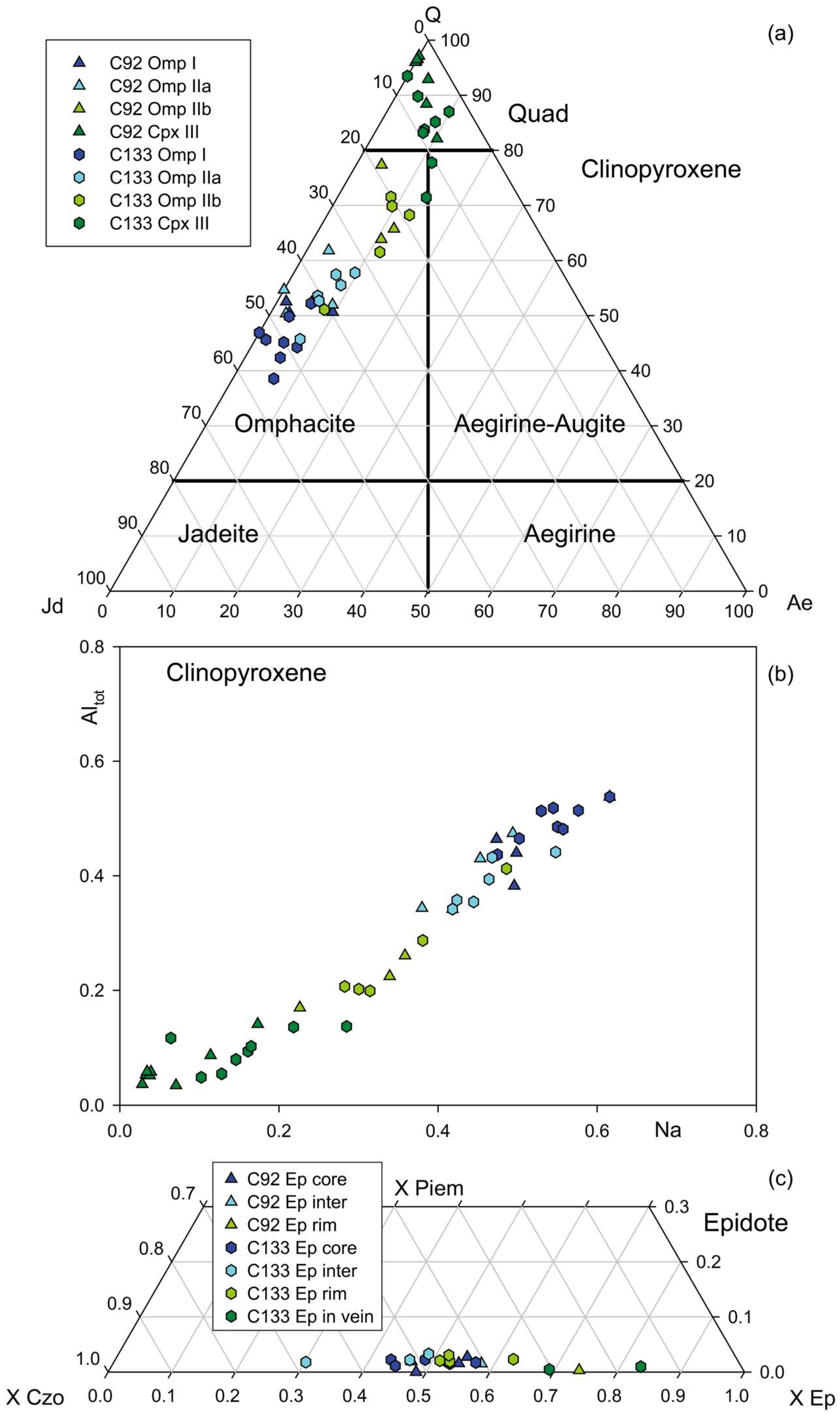
Hereafter, the mineral compositions determined with the EPMA-WDS system will be illustrated. A synthesis of the representative compositions for different mineral phases is reported in the Supplementary Materials. Diagrams illustrating the compositional variations in clinopyroxene and epidote, depending on the different textural sites as deduced from the microstructural analysis, are shown in Figure 5.
Clinopyroxene stoichiometric formula was calculated on the basis of six oxygen atoms [64]. As already pointed out, clinopyroxene marks superposed fabrics, re-equilibrating during successive stages of fabric development (see Section 4.1). Compositional changes are remarkable, with a decrease in jadeite and increase in diopside content from OmpI to CpxIII (Figure 5a,b). AlVI and Na decrease continuously from OmpI to CpxIII (OmpI–AlVI = 0.47 ± 0.05, Na = 0.53 ± 0.04 a.p.f.u.; OmpIIa–AlVI = 0.39 ± 0.04, Na = 0.46 ± 0.04 a.p.f.u.; OmpIIb–AlVI = 0.24 ± 0.07, Na = 0.34 ± 0.08 a.p.f.u.; and CpxIII–AlVI = 0.07 ± 0.03, Na = 0.11 ± 0.08 a.p.f.u.), whereas Mg increases from OmpI to CpxIII (OmpI—0.35 ± 0.04 a.p.f.u.; OmpIIa—0.41 ± 0.06 a.p.f.u.; OmpIIb—0.53 ± 0.07 a.p.f.u.; and CpxIII—0.67 ± 0.05 a.p.f.u.).
Epidote stoichiometric formula was calculated based on 12.5 oxygen atoms. From core to rim, the content in pistacite increases (Figure 5c). AlVI is similar in the core and intermediate portions (2.48 ± 0.05 and 2.52 ± 0.11 a.p.f.u., respectively) and decreases to 2.40 ± 0.09 a.p.f.u. in the rim. On the contrary, Fe3+ is 0.51 ± 0.05 a.p.f.u. in the core, 0.46 ± 0.12 a.p.f.u. in the intermediate portion, and increases to 0.59 ± 0.09 a.p.f.u. in the rim. In the late veins, epidote shows a content of AlVI and Fe3+ of 2.23 ± 0.10 and 0.76 ± 0.10 a.p.f.u., respectively. Thus, this last epidote is the richest in pistacite. Epidote also shows little content in piemontite, evidenced by 0.02 ± 0.01 a.p.f.u. of Mn, which decreases to 0.01 ± 0.00 a.p.f.u. in the epidote from the late veins.
The rare white mica, formula based on twenty-two oxygen atoms, reveals a phengitic composition with 3.46 ± 0.05 a.p.f.u. of Si, 0.14 ± 0.05 a.p.f.u. of Fe2+, and 0.32 ± 0.06 a.p.f.u. of Mg.
Titanite, formula based on twenty oxygen atoms, displays little compositional variation as follows: 0.30 ± 0.04 a.p.f.u. of Al, 0.03 ± 0.01 a.p.f.u. of Fe2+, and 3.64 ± 0.05 a.p.f.u. of Ti.
Few carbonate grains elongated in S2 have been analyzed, revealing a calcite composition with small traces of Fe, Mn, and Cr.
Amphibole stoichiometric formula was calculated according to [66]. Amphibole postdates D2 fabrics, developing locally during the retrograde re-equilibration, and shows a quite variable composition. In symplectites, amphibole is either pargasite, edenite, or Mg-hornblende, whereas in albite veins amphibole is pargasite or Mg-hastingsite. The latest amphibole is rare actinolite and replaces omphacite together with chlorite. Amphibole from symplectites and albite veins shows a comparable amount of AlVI (0.51 ± 0.15 and 0.57 ± 0.00 a.p.f.u., respectively) and CaB (1.66 ± 0.09 and 1.68 ± 0.00 a.p.f.u., respectively). Mg and NaA are correspondingly higher and lower in amphibole from symplectites (3.00 ± 0.28 and 0.67 ± 0.24 a.p.f.u., respectively) than in amphibole from albite veins (2.75 ± 0.16 and 0.93 ± 0.03 a.p.f.u., respectively).
During the retrograde re-equilibration, chlorite and feldspar also developed. The rare chlorite shows XFe of 0.32 ± 0.06. Feldspars consist of albite (Ab = 0.96 ± 0.05), minor oligoclase (Ab = 0.81), and rare K-feldspar (Or = 0.97 ± 0.01).

4.3. Physical Conditions of Metamorphism

In order to constrain the P-T conditions at which the rocks equilibrated, a pseudosection was calculated for sample C133 considering the D2 assemblage, and additional geothermobarometry was applied to constrain D3 and D4.

4.3.1. Thermodynamic Modelling Strategy

Considering the extreme heterogeneity of the rocks at all scales, from the thin section to the field, alternating epidote+clinopyroxene-rich, carbonates-poor layers with carbonates-rich bands, and the mineral zoning, a representative bulk composition has been calculated for sample C133 (no whole rock analyses are available). This sample contains a very low amount of carbonates and quartz and is thus almost a clinopyroxene–epidote–titanite rock. These are the minerals dominant in the syn-D2 assemblage, of which we aim to determine the P-T conditions. The bulk composition used for petrologic modelling is retrieved upon the modal amount of mineral phases, qualitatively estimated at the optical microscope and with BSE images, and on the major element compositions of such minerals. This approach is suited to determine a bulk composition of a possible reaction volume for which we predict phases stable at equilibrium, even though the rock itself preserves different assemblages and is very heterogeneous. We chose a sample with a minimal amount of carbonates in order to have a simplified system. To ensure that this simplification is not too relevant, we have calculated some TX pseudosections at 1.8 and 2.0 GPa to check that the observed assemblage is predicted for different bulk compositions calculated varying the modal proportions of clinopyroxene and epidote, with a ratio of Cpx to Ep from 80:20 to 20:80. This has also been useful to check if the model is still able to account for the observed assemblages in other samples when CaO and SiO2 contents are raised to account for higher carbonates abundance and the presence of quartz. The composition corresponding to the proportion Cpx = 44%, Ep = 55%, and Wm = 1% is the one chosen here and corresponds to the one observed in sample C133 (including less than 1% quartz, titanite, and carbonate). It is as follows: Na2O 3.42, CaO 18.11, K2O 0.11, FeO 7.52, MgO 3.05, Al2O3 20.23, SiO2 47.02, and TiO2 0.23, expressed in moles.
MnO has not been considered, as the mineral models available to date would stabilize garnet as the only container of Mn. No garnet was observed in the studied rocks, where conversely epidote stores most of the Mn. Since no Mn-bearing epidote model is available to date, we decided to exclude MnO from modelling to avoid misleading results. The presence of Mn in minerals would generally shift the stability fields of assemblages towards lower temperatures and would likely stabilize garnet if epidote is not present; unfortunately, we cannot quantify such shifts for the studied sample.
Once the composition to be modelled was determined, some considerations about oxidation state (O) and quantity and composition of fluid (expressed as H2O/CO2 ratio) were undertaken. The Fe2O3 calculated in epidote and a preliminary TX pseudosection at 1.8 and 2.0 GPa exploring the effect of O on parageneses suggested the use of an O value of 1.
Finally, varying the quantity of fluid and its composition during the modelling of some TX pseudosections, again at 1.8 and 2.0 GPa, allowed to determine a range of fluid content and compositions as H2O/CO2 ratio (spanning from 0.98 to 1.3), which allows for obtaining the observed assemblage, thus defining the composition representing sample C133 and finally corresponding to H2O/CO2 =1.25.
The final bulk composition used for modelling was Na2O 3.29, CaO 19.63, K2O 0.07, FeO 6.25, MgO 0.05, Al2O3 11.85, SiO2 46.75, H2O 6.08, TiO2 0.17, O 1, and CO2 4.86, expressed in moles.

4.3.2. Thermodynamic Modelling Results

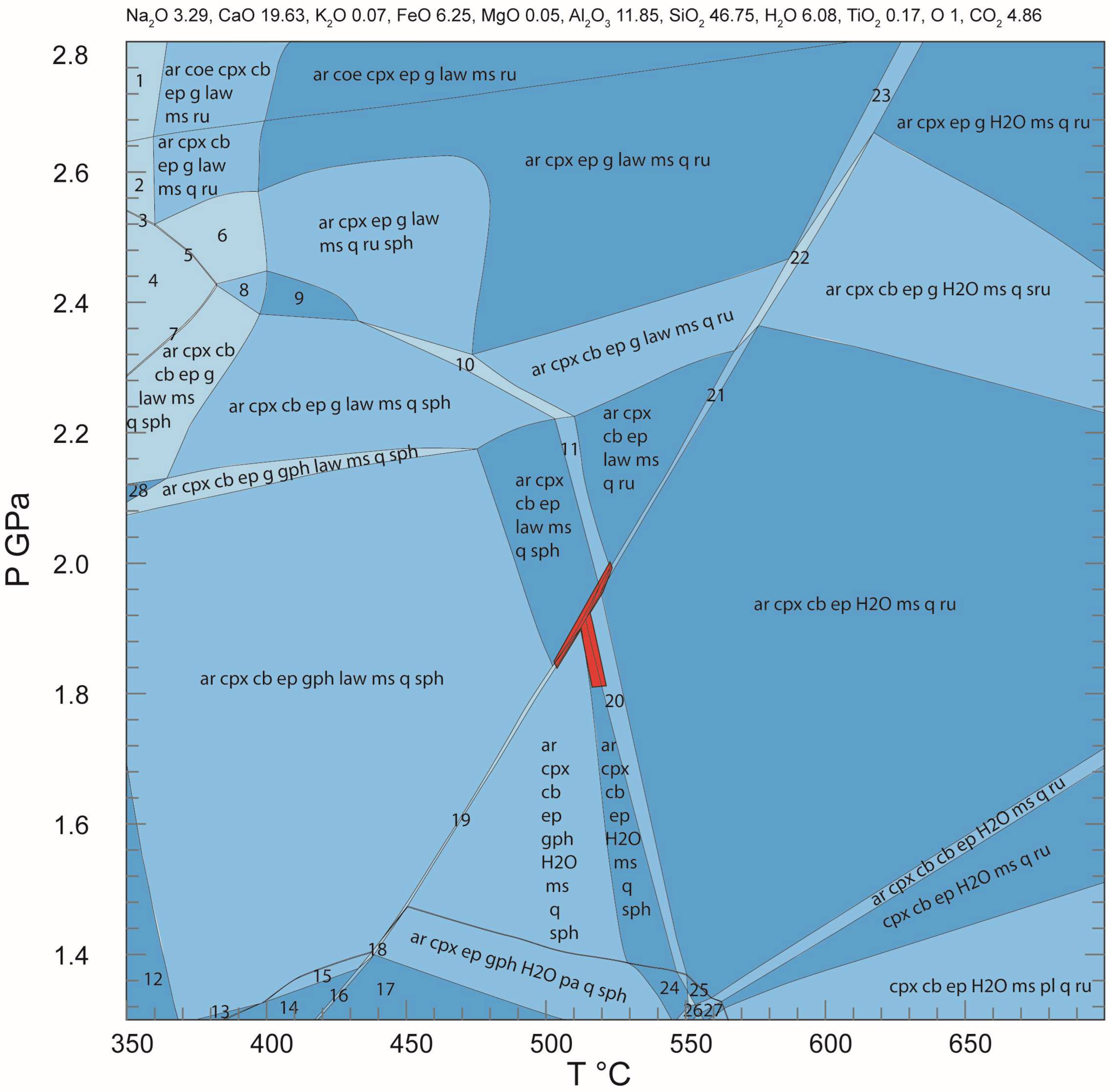
The pseudosection (Figure 6) is characterized by several fields with Cpx + Ep + Ttn that are bound by lawsonite at higher pressures, rutile at higher temperatures, and plagio-clase and paragonite at lower pressures. The area in which the observed Cpx + Ep + Ttn + Wm + carbonates assemblage is stable spans between 1.5 and 2.0 GPa and 500 to 550 °C. Na isopleths in Cpx and isopleths of the modal composition, considering <3% of the mineral phases in the neighbouring fields (i.e., Law and Ru), constrain the D2 assemblage at P = 1.85–2.0 GPa and T = 500–525 °C. Such stability field is evidenced by the area in red in Figure 6. Isopleths and modal lines are very close to the boundaries and hence have not been plotted. The obtained pressures can be considered as minimum pressures, as the law-sonite boundary shifts with fluid composition—for instance, if NH4 is added, temperatures recede by almost 50 °C and the assemblage stabilizes at higher pressures (e.g., [67]).
The physical conditions under which the syn-D3 re-equilibration developed have been inferred by amphibole and plagioclase thermobarometry. The amphibole–plagioclase geothermobarometer [68] returns P = 0.7 ± 0.2 GPa and T = 480 ± 19 °C. A wider pressure interval is obtained by the amphibole–plagioclase barometer of [69], which for the derived T provides P = 0.8 ± 0.4 GPa. A compatible, but slightly lower, temperature range of 408 ± 53 °C results from amphibole–plagioclase thermometry [70]. Syn-D3 metamorphic retrogression was therefore developed in a pressure interval between 0.4 and 1.2 GPa and a temperature interval between 350 and 500 °C.
The P-T interval for the D4 mineral assemblage has been inferred by chlorite thermometry [71] and by amphibole–plagioclase thermobarometry [68], providing as results T = 324 ± 80 °C, T = ≤ 400 °C, and P = ≤ 0.25 GPa, respectively.

5. Discussion and Conclusions

In recent years, thanks to the possibility offered by the equilibrium thermodynamic modelling approach, rocks preserving peculiar mineral assemblages have been studied by geologists in order to obtain P-T estimates on re-equilibration conditions and on other processes [35,72,73]. In this paper, we discuss some peculiar rocks from a mélange re-equilibrated at HP conditions that are mainly composed of omphacite + epidote, plus variable amounts of carbonate minerals and quartz, and minor white mica (phengitic in composition), with chlorite and plagioclase growing after the HP paragenesis. These rocks are within a mélange where elements of metabasites (now eclogites) and carbonate-rich matrix preserve HP assemblages [18]. Such peculiar rocks may represent the result of metasomatism between ultramafites and metacarbonates, as suggested by their field relationships; indeed, they always crop out in contact with serpentinites. In addition, they are deformed, coherently with the enclosing matrix and the surrounding serpentinites, starting at least from the D2 stage, as evidenced by the development of the S2 foliation also within these Ca-silicate-rich rocks. In addition, the inferred syn-D2 P-T conditions are coherent with those deduced by [18] for contemporaneous assemblages in other RGU rocks, indicating that probable mass-transfer processes pre-dated D2 deformation.

5.1. Petrologic Implications

The pseudosection calculated demonstrates that the syn-D2 assemblage within such epidote–omphacite rocks is stable in a P-T window of P = 1.85–2.0 GPa and T = 500–525 °C, in good agreement with what was already determined in neighbouring rocks of the same unit (RGU). In the case of these rocks, many factors may have played a role in the formations and preservation of such assemblages.
First, the peculiar composition allows the development of omphacite and epidote, instead of garnet, which lacks in the rocks. In the modelling, garnet would be predicted to be stable if MnO is considered, simply because Mn is not included in the solid solution models for epidote available in the thermodynamic database. In these rocks, Mn is indeed all contained in epidote (Figure 5c and the Supplementary Materials). The predicted P-T stability field containing the observed assemblage is bound towards higher temperatures by rutile, which is absent in these rocks, whereas only titanite occurs as a Ti-bearing phase. In any case, the neighbouring field containing rutile and titanite had a predicted modal amount of rutile <3% and can therefore represent in part our assemblage, provided that modal amounts of minerals that are <3 % can simply not be observed. Towards lower pressures, the field containing our assemblage is bound by plagioclase, which is observed only in D3- and D4-related assemblages. Furthermore, the predicted composition of Omp shows decreasing Na content towards lower pressures, and the pyroxene in the symplectites is actually diopside. On the other hand, even though Na content predicted in Omp increases towards high pressures, a content similar to that of OmpI is never predicted because the solid solution model used for Cpx in this assemblage was calibrated for different systems [59]. In the pseudosection, the field containing the observed assemblage is bound towards lower temperatures by a narrow field with lawsonite (and H2O). No lawsonite has been detected in the rocks, but small modal amounts are predicted near this field, usually <10 %. Finally, the law–out reaction has different positions in the P-T field depending on the quantity and composition of the fluids. In particular, a change in the H2O/CO2 ratio implies a slight shift in temperature, within 20°C. On the other hand, small quantities of NH4, which has been observed in HP metapelites from the Zermatt–Sass Zone [67], can shift the law–out curve toward lower T, up to −50 °C, and enlarge the stability of the observed assemblage up to 2.4 GPa in the same temperature range. The composition of the fluid phase during syn-D2 P-T conditions is constrained based on the matching of the modelled and observed parageneses.
As the Na content of OmpI, wrapped by recrystallized OmpIIa marking S2, is higher than that of OmpII, we consider the syn-D2 assemblage as retrograde, as already demonstrated in serpentinites from the nearby locality of Créton [45].
Finally, the absence of garnet in the assemblage may be related to several concomitant factors, such as (a) the peculiar bulk composition; (b) the fact that epidote was stable all along the P-T evolution and is the Mn-bearing phase of the assemblage; and (c) the abundance of Fe3+ and the overall oxidation state, together with the composition of the fluid, which was probably very rich in CO2.
This contribution focuses on the peculiar omphacite–epidote-rich, carbonates-poor garnet-free rocks (Ca-silicate rich rocks) that are part of a broader ensemble of rocks characterized by variable carbonates amounts and that are found in the RGU. These rocks have peculiar compositions as they probably represent metasomatic rims that formed at some point during the P-T evolution and before D2 (as shown by field evidence). The rocks recrystallised at syn-D2 conditions, in the presence of fluids, with possibly ongoing carbonation and decarbonation reactions, which are difficult to reconstruct as there are no textures that could help reconstructing such reactions in the studied sample, and the only pre-D2 relics are OmpI and EpI. In other similar situations within the Zermatt–Saas zone, diagnostic microstructures evidenced such processes [21]. In absence of such significant fabric features in the rocks explored here, further analyses of other samples are needed to try to determine the complex fluid-involving reactions in the RGU rocks.

5.2. Tectono-Metamorphic Evolution

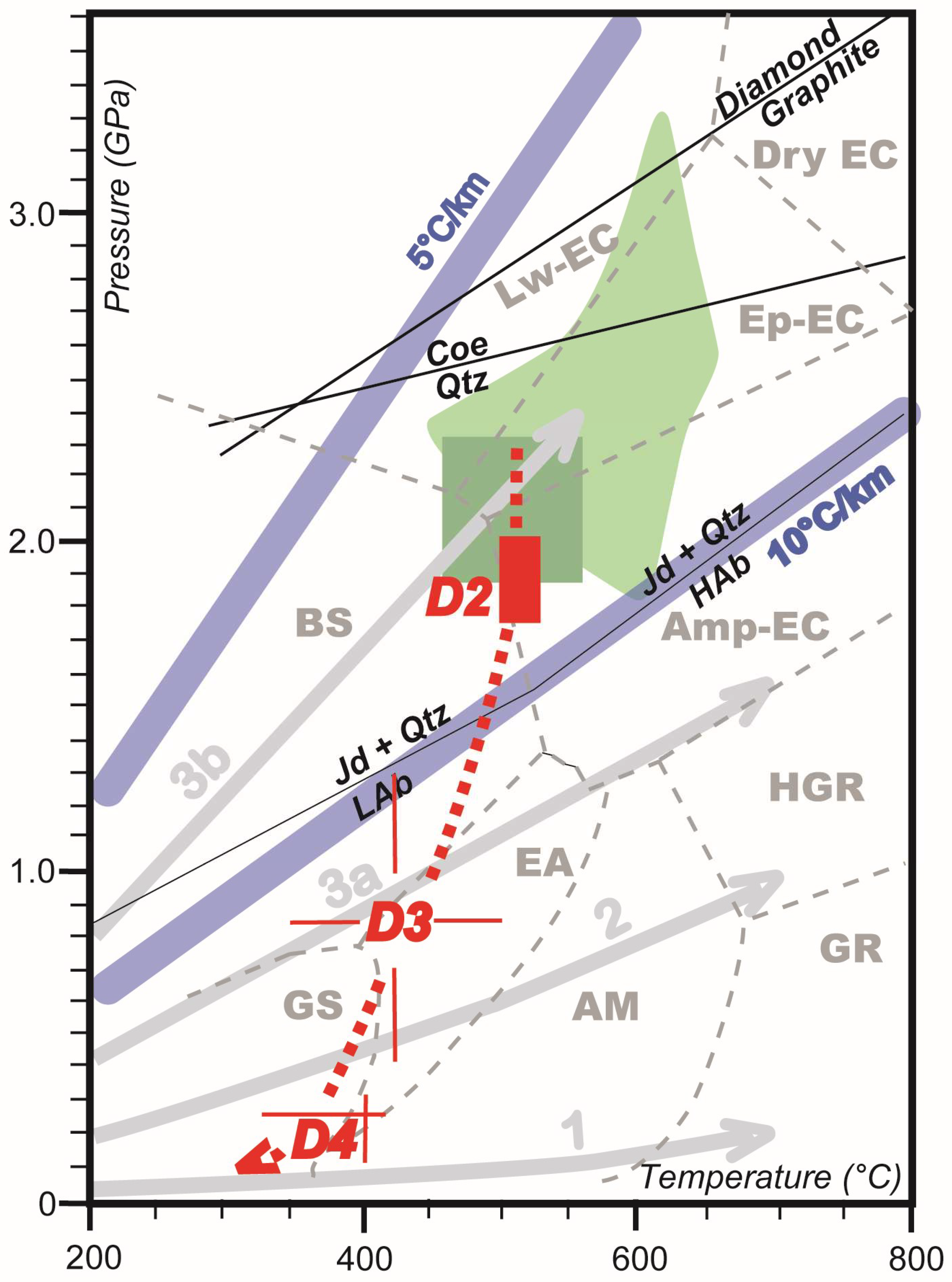
Integrating multiscale structural analysis with petrological modelling in the study of the complex rock assemblage constituting the Ca-silicate-rich rocks of the compositionally extremely heterogeneous RGU metasediments provided valuable information on the P-T environment of deformation. These constraints could be extracted even from a chemical system that is poorly suitable for petrologic modelling and P-T estimates, such as the one represented by Ca-silicate-rich rocks. Consistent with all other RGU types, these rocks recorded four groups of superposed syn-metamorphic fabrics marked by different mineral assemblages, diagnostic of contrasting thermobaric environments. Omphacite and quartz marking D2 fabric, without plagioclase, suggest that S2 foliation developed under high-pressure conditions (Figure 7). On the contrary, mineral assemblages underlying D3 and D4 fabrics suggest that they developed during lower pressure and temperature re-equilibrations, under blueschist–/epidote–amphibolite– and greenschist–facies conditions, respectively (Figure 7). The petrological modelling developed on the well-preserved syn-D2 paragenesis indicated conditions of P 1.85–2.0 GPa and T = 500–525 °C, for a mineral assemblage which, although garnet-free, results in stability under HP blueschist– to amphibole–eclogite-facies conditions. The good agreement of the estimated syn-D2 P-T conditions with those obtained in the other RGU rocks [18] indicates that the Ca-silicate-rich rocks shared a common tectono-metamorphic history together with their country rocks at least since D2. In the surrounding ZSZ rocks, the dominant metamorphic imprint under eclogite-facies conditions has been dated between the late Cretaceous and the Eocene [40], suggesting that during this time interval syn-D2 HP assemblages developed in the RGU Ca-silicate-rich rocks.
The P-T syn-D2 conditions suggest a geodynamic scenario of active subduction in which RGU rocks were buried to a depth greater than 60 km. The inferred T/depth ratio (Figure 7) corresponds to 7 °C km−1, which is characteristic of cold subduction zones (e.g. [76]). Such metamorphic conditions are in good agreement with those inferred from other RGU rocks [18] (Figure 7) and with the thermal state affecting other mafic and ultramafic rocks outcropping in the surroundings of Valtournenche [31,34,35,38,40,42,43,44,45,74].
D3 and D4 are supported by mineral assemblages indicating P = 0.4–1.2 GPa and T = 350–500 °C, and P ≤ 0.25 GPa and T ≤ 400 °C, respectively. These estimates suggest that D3 and D4 developed during RGU exhumation, with a T/depth ratio evolving towards the thermal state of normal plate interiors (D3 in Figure 7) and exceeding it (D4 in Figure 7). Such a thermal evolution is compatible with the onset and evolution of the continental collision.

Supplementary Materials

The following supporting information can be downloaded at https://www.mdpi.com/article/10.3390/min16010079/s1. Summary of the mineral chemical compositions for selected mineral phases analyzed at the EMPA in this study.

Author Contributions

G.R.: formal analysis (equal), investigation (equal), validation (equal), visualization (equal), writing—original draft (equal), writing—review and editing (equal), and modelling; T.G.: data curation (equal), formal analysis (equal), investigation (equal), validation (equal), visualization (equal), and writing—review and editing (equal); M.I.S.: conceptualization (equal), formal analysis (equal), funding acquisition (lead), investigation (equal), methodology (equal), project administration (lead), supervision (equal), validation (equal), writing—original draft (equal), and writing—review and editing (equal); D.Z.: conceptualization (equal), data curation (equal), formal analysis (equal), investigation (equal), methodology (equal), supervision (equal), validation (equal), visualization (equal), writing—original draft (equal), and writing—review and editing (equal). All authors have read and agreed to the published version of the manuscript.

Funding

This work was supported by a grant from the PRIN 2020 (Progetti di Rilevante Interesse Nazionale) fund by the Ministry of University and Research of the Italian Government to M.I. Spalla (code PRIN202022MSPAL_01; “POligEnetic Mélanges: anatomy, significance and societal impact”).

Data Availability Statement

All data produced during this study are available on request from the authors.

Acknowledgments

Guido Gosso is thanked for having shared with T.G. and M.I.S. part of the fieldwork, substantially contributing to the understanding of these structurally complex metasediments. Jean Gadin (Compagnia Valdostana delle Acque) facilitated the use of the Goillet dam house during fieldwork. Curzio Malinverno and Fabio Marchesini prepared the thin sections and Andrea Risplendente (EMPA Facility of the Unitech Cospect at UNIMI) assisted with acquisition of the data. We thank the three anonymous reviewers for their constructive comments which helped us improve our manuscript.

Conflicts of Interest

The authors declare that they have no known competing financial interests or personal relationships that could have appeared to influence the work reported in this paper.

Abbreviations

Abbreviations for mineral names used in this study are from [77]. a.p.f.u. = atoms per formula unit.

References

  1. Festa, A.; Meneghini, F.; Balestro, G.; Pandolfi, L.; Tartarotti, P.; Dilek, Y.; Marroni, M. Comparative Analysis of the Sedimentary Cover Units of the Jurassic Western Tethys Ophiolites in the Northern Apennines and Western Alps (Italy): Processes of the Formation of Mass-Transport and Chaotic Deposits during Seafloor Spreading and Subduction Zone Tectonics. J. Geol. 2021, 129, 533–561. [Google Scholar] [CrossRef]
  2. Festa, A.; Barbero, E.; Remitti, F.; Ogata, K.; Pini, G.A. Mélanges and Chaotic Rock Units: Implications for Exhumed Subduction Complexes and Orogenic Belts. Geosyst. Geoenviron. 2022, 1, 100030. [Google Scholar] [CrossRef]
  3. Cowan, D.S. Origin of Blueschist-Bearing Chaotic Rocks in the Franciscan Complex, San Simeon, California. Geol. Soc. Am. Bull. 1978, 89, 1415. [Google Scholar] [CrossRef]
  4. Wakabayashi, J. Anatomy of a Subduction Complex: Architecture of the Franciscan Complex, California, at Multiple Length and Time Scales. Int. Geol. Rev. 2015, 57, 669–746. [Google Scholar] [CrossRef]
  5. Ernst, W.G. Franciscan Mélanges: Coherent Blocks in a Low-Density, Ductile Matrix. Int. Geol. Rev. 2016, 58, 626–642. [Google Scholar] [CrossRef]
  6. Festa, A.; Pini, G.A.; Ogata, K.; Dilek, Y. Diagnostic Features and Field-Criteria in Recognition of Tectonic, Sedimentary and Diapiric Mélanges in Orogenic Belts and Exhumed Subduction-Accretion Complexes. Gondwana Res. 2019, 74, 7–30. [Google Scholar] [CrossRef]
  7. Guerini, S.S.G.; Tartarotti, P. The Effect of Tectonic Boudinage and Folding in a Subducted Mélange of the Alpine Orogenic Belt (Zermatt–Saas Zone, Italian Western Alps). J. Geol. Soc. 2024, 181, 1–15. [Google Scholar] [CrossRef]
  8. Roda, M.; Filippi, M.; Assanelli, M.; Farina, F. Structural and Metamorphic Evolution of Val d’Ala Eclogites (Western Alps—Lower Piemonte Zone). Lithos 2025, 502–503, 108005. [Google Scholar] [CrossRef]
  9. Sanità, E.; Di Rosa, M.; Della Porta, G.; Catanzariti, R.; Pandolfi, L.; Marroni, M. Trench Sediment Heterogeneity Controls Accretion Mechanisms in Subduction Zone. Sci. Rep. 2025, 15, 34793. [Google Scholar] [CrossRef] [PubMed]
  10. Raymond, L.A. Classification of Melanges. In Melanges: Their Nature, Origin, and Significance; Geological Society of America: Boulder, CO, USA, 1984; pp. 7–20. [Google Scholar]
  11. Cloos, M.; Shreve, R.L. Subduction-Channel Model of Prism Accretion, Melange Formation, Sediment Subduction, and Subduction Erosion at Convergent Plate Margins: 1. Background and Description. Pure Appl. Geophys. 1988, 128, 455–500. [Google Scholar] [CrossRef]
  12. Cloos, M.; Shreve, R.L. Subduction-Channel Model of Prism Accretion, Melange Formation, Sediment Subduction, and Subduction Erosion at Convergent Plate Margins: 2. Implications and Discussion. Pure Appl. Geophys. 1988, 128, 501–545. [Google Scholar] [CrossRef]
  13. Raymond, L.A. What Is Franciscan?: Revisited. Int. Geol. Rev. 2018, 60, 1968–2030. [Google Scholar] [CrossRef]
  14. Festa, A.; Pini, G.A.; Dilek, Y.; Codegone, G. Mélanges and Mélange-Forming Processes: A Historical Overview and New Concepts. Int. Geol. Rev. 2010, 52, 1040–1105. [Google Scholar] [CrossRef]
  15. Dilek, Y.; Festa, A.; Ogawa, Y.; Pini, G.A. Chaos and Geodynamics: Mélanges, Mélange-Forming Processes and Their Significance in the Geological Record. Tectonophysics 2012, 568–569, 1–6. [Google Scholar] [CrossRef]
  16. Hajná, J.; Žák, J.; Kachlík, V.; Dörr, W.; Gerdes, A. Neoproterozoic to Early Cambrian Franciscan-Type Mélanges in the Teplá–Barrandian Unit, Bohemian Massif: Evidence of Modern-Style Accretionary Processes along the Cadomian Active Margin of Gondwana? Precambr. Res. 2013, 224, 653–670. [Google Scholar] [CrossRef]
  17. Balestro, G.; Festa, A.; Tartarotti, P. Tectonic Significance of Different Block-in-Matrix Structures in Exhumed Convergent Plate Margins: Examples from Oceanic and Continental HP Rocks in Inner Western Alps (Northwest Italy). Int. Geol. Rev. 2015, 57, 581–605. [Google Scholar] [CrossRef]
  18. Gusmeo, T.; Rebay, G.; Spalla, M.I.; Zanoni, D. Origin and Tectono-Metamorphic History of the Riffelberg-Garten Meta-Sedimentary Ophiolitic Unit, Western Alps. J. Geol. Soc. 2025, 182, 1–17. [Google Scholar] [CrossRef]
  19. Rotondo, F.C.; Tartarotti, P.; Guerini, S.; Della Porta, G.; Campomenosi, N. Metasomatic Horizon Sealing Serpentinite-Metasediments Pair in the Zermatt-Saas Metaophiolite (Northwestern Alps): Record of a Channel for Focussed Fluid Flow during Subduction. Ofioliti 2021, 46, 1–25. [Google Scholar] [CrossRef]
  20. Tartarotti, P.; Martin, S.; Festa, A.; Balestro, G. Metasediments Covering Ophiolites in the HP Internal Belt of the Western Alps: Review of Tectono-stratigraphic Successions and Constraints for the Alpine Evolution. Minerals 2021, 11, 411. [Google Scholar] [CrossRef]
  21. Scambelluri, M.; Cannaò, E.; Guerini, S.; Bebout, G.E.; Epstein, G.S.; Rotondo, F.; Campomenosi, N.; Tartarotti, P. Carbon Mobility and Exchange in a Plate-Interface Subduction Mélange: A Case Study of Meta-Ophiolitic Rocks in Champorcher Valley, Italian Alps. Lithos 2022, 428–429, 106813. [Google Scholar] [CrossRef]
  22. Bearth, P. Die Ophiolite Der Zone von Zermatt-Sass Fee. Beiträge Geol. Kt. Schweitz 1967, 132, 1–130. [Google Scholar]
  23. Martin, S.; Tartarotti, P.; Dal Piaz, G.V. The Mesozoic Ophiolites of the Alps. Boll. Di Geofis. Teor. Ed Appl. 1994, 36, 175–219. [Google Scholar]
  24. Balestro, G.; Festa, A.; Dilek, Y. Structural Architecture of the Western Alpine Ophiolites, and the Jurassic Seafloor Spreading Tectonics of the Alpine Tethys. J. Geol. Soc. 2019, 176, 913–930. [Google Scholar] [CrossRef]
  25. Wassmann, S.; Stöckhert, B.; Trepmann, C.A. Dissolution Precipitation Creep versus Crystalline Plasticity in High-Pressure Metamorphic Serpentinites. Geol. Soc. Lond. Spec. Publ. 2011, 360, 129–149. [Google Scholar] [CrossRef]
  26. Dale, C.W.; Burton, K.W.; Pearson, D.G.; Gannoun, A.; Alard, O.; Argles, T.W.; Parkinson, I.J. Highly Siderophile Element Behaviour Accompanying Subduction of Oceanic Crust: Whole Rock and Mineral-Scale Insights from a High-Pressure Terrain. Geochim. Cosmochim. Acta 2009, 73, 1394–1416. [Google Scholar] [CrossRef]
  27. Dal Piaz, G. V Le Métamorphisme de Haute Pression et Basse Température Dans l’évolution Structurale Du Bassin Ophiolitique Alpino-Apenninique. Schweiz. Mineral. Petrogr. Mitteilungen 1974, 54, 399–424. [Google Scholar]
  28. Ernst, W.G.; Dal Piaz, G. V Mineral Parageneses of Eclogitic Rocks and Related Mafic Schists of the Piemonte Ophiolite Nappe, Breuil-St Jacques Area, Italian Western Alps. Am. Mineral. 1978, 63, 621–640. [Google Scholar]
  29. Reinecke, T. Prograde High- to Ultrahigh-Pressure Metamorphism and Exhumation of Oceanic Sediments at Lago Di Cignana, Zermatt-Saas Zone, Western Alps. Lithos 1998, 42, 147–189. [Google Scholar] [CrossRef]
  30. Cartwright, I.; Barnicoat, A.C. Petrology, Geochronology, and Tectonics of Shear Zones in the Zermatt—Saas and Combin Zones of the Western Alps. J. Metamorph. Geol. 2002, 20, 263–281. [Google Scholar] [CrossRef]
  31. Angiboust, S.; Agard, P.; Jolivet, L.; Beyssac, O. The Zermatt-Saas Ophiolite: The Largest (60-km Wide) and Deepest (c. 70–80 Km) Continuous Slice of Oceanic Lithosphere Detached from a Subduction Zone? Terra Nova 2009, 21, 171–180. [Google Scholar] [CrossRef]
  32. Groppo, C.; Beltrando, M.; Compagnoni, R. The P–T Path of the Ultra-High Pressure Lago Di Cignana and Adjoining High-Pressure Meta-Ophiolitic Units: Insights into the Evolution of the Subducting Tethyan Slab. J. Metamorph. Geol. 2009, 27, 207–231. [Google Scholar] [CrossRef]
  33. Frezzotti, M.L.; Selverstone, J.; Sharp, Z.D.; Compagnoni, R. Carbonate Dissolution during Subduction Revealed by Diamond-Bearing Rocks from the Alps. Nat. Geosci. 2011, 4, 703–706. [Google Scholar] [CrossRef]
  34. Rebay, G.; Spalla, M.I.; Zanoni, D. Interaction of Deformation and Metamorphism during Subduction and Exhumation of Hydrated Oceanic Mantle: Insights from the Western Alps. J. Metamorph. Geol. 2012, 30, 687–702. [Google Scholar] [CrossRef]
  35. Zanoni, D.; Rebay, G.; Bernardoni, J.; Spalla, M.I. Using Multiscale Structural Analysis to Infer High-/Ultrahigh-Pressure Assemblages in Subducted Rodingites of the Zermatt-Saas Zone at Valtournanche, Italy. J. Virtual Explor. 2012, 41, 2–30. [Google Scholar] [CrossRef]
  36. Gasco, I.; Gattiglio, M.; Borghi, A. Review of Metamorphic and Kinematic Data from Internal Crystalline Massifs (Western Alps): PTt Paths and Exhumation History. J. Geodyn. 2013, 63, 1–19. [Google Scholar] [CrossRef]
  37. Gilio, M.; Scambelluri, M.; Agostini, S.; Godard, M.; Peters, D.; Pettke, T. Petrology and Geochemistry of Serpentinites Associated with the Ultra-High Pressure Lago Di Cignana Unit (Italian Western Alps). J. Petrol. 2019, 60, 1229–1262. [Google Scholar] [CrossRef]
  38. Luoni, P.; Rebay, G.; Roda, M.; Zanoni, D.; Spalla, M.I. Tectono-Metamorphic Evolution of UHP Zermatt-Saas Serpentinites: A Tool for Vertical Palaeogeographic Restoration. Int. Geol. Rev. 2021, 63, 1236–1261. [Google Scholar] [CrossRef]
  39. Rubatto, D.; Gebauer, D.; Fanning, M. Jurassic Formation and Eocene Subduction of the Zermatt-Saas-Fee Ophiolites: Implications for the Geodynamic Evolution of the Central and Western Alps. Contrib. Mineral. Petrol. 1998, 132, 269–287. [Google Scholar] [CrossRef]
  40. Rebay, G.; Zanoni, D.; Langone, A.; Luoni, P.; Tiepolo, M.; Spalla, M.I. Dating of Ultramafic Rocks from the Western Alps Ophiolites Discloses Late Cretaceous Subduction Ages in the Zermatt-Saas Zone. Geol. Mag. 2018, 155, 298–315. [Google Scholar] [CrossRef]
  41. Assanelli, M.; Luoni, P.; Rebay, G.; Roda, M.; Spalla, M.I. Tectono-Metamorphic Evolution of Serpentinites from Lanzo Valleys Subduction Complex (Piemonte—Sesia-Lanzo Zone Boundary, Western Italian Alps). Minerals 2020, 10, 985. [Google Scholar] [CrossRef]
  42. Skora, S.; Mahlen, N.J.; Johnson, C.M.; Baumgartner, L.P.; Lapen, T.J.; Beard, B.L.; Szilvagyi, E.T. Evidence for Protracted Prograde Metamorphism Followed by Rapid Exhumation of the Zermatt-Saas Fee Ophiolite. J. Metamorph. Geol. 2015, 33, 711–734. [Google Scholar] [CrossRef]
  43. Skora, S.; Lapen, T.J.; Baumgartner, L.P.; Johnson, C.M.; Hellebrand, E.; Mahlen, N.J. The Duration of Prograde Garnet Crystallization in the UHP Eclogites at Lago Di Cignana, Italy. Earth Planet. Sci. Lett. 2009, 287, 402–411. [Google Scholar] [CrossRef]
  44. Weber, S.; Sandmann, S.; Miladinova, I.; Fonseca, R.O.C.; Froitzheim, N.; Münker, C.; Bucher, K. Dating the Initiation of Piemonte-Liguria Ocean Subduction: Lu–Hf Garnet Chronometry of Eclogites from the Theodul Glacier Unit (Zermatt-Saas Zone, Switzerland). Swiss J. Geosci. 2015, 108, 183–199. [Google Scholar] [CrossRef]
  45. Luoni, P.; Zanoni, D.; Rebay, G.; Spalla, M.I. Deformation History of Ultra High-Pressure Ophiolitic Serpentinites in the Zermatt-Saas Zone, Créton, Upper Valtournanche (Aosta Valley, Western Alps). Ofioliti 2019, 44, 111–123. [Google Scholar] [CrossRef]
  46. Bearth, P. Eläuterungen Zu Blatt 535 Zermatt. In Geologischer Atlas der Schweiz 1:25000; Bundesamt für Landestopografie swisstopo: Wabern, Switzerland, 1953; Volume 29. [Google Scholar]
  47. Dal Piaz, G.V.; Bistacchi, A.; Gianotti, F.; Monopoli, B.; Passeri, L.; Schiavo, A. Note Illustrative Del Foglio 070 Monte Cervino Della Carta Geologica d’Italia Alla Scala 1:50.000. Mem. Descr. Cart. Geol. Ital. 2016, 101, 5–258. [Google Scholar]
  48. Dal Piaz, G.V.; Ernst, W.G. Areal Geology and Petrology of Eclogites and Associated Metabasites of the Piemonte Ophiolite Nappe, Breuil-St. Jacques Area, Italian Western Alps. Tectonophysics 1978, 51, 99–126. [Google Scholar] [CrossRef]
  49. Dal Piaz, G.V. From the European Continental Margin to the Mesozoic Tethyan Ocean: A Geological Map of the Upper Ayas Valley (Western Alps). In Mapping Geology in Italy; Dal Piaz, G.V., Pasquarè, G., Venturini, C., Eds.; APAT—Dipartimento Difesa del Suolo—Servizio Geologico d’Italia: Firenze, Italy, 2004; pp. 265–272. [Google Scholar]
  50. Bearth, P. Chloritoid und Paragonit aus der Ophiolith Zone von Zermatt-Saas Fee. Schweiz. Mineral. Petrogr. Mitteilungen 1963, 43, 269–286. [Google Scholar]
  51. Dal Piaz, G.V. La Formazione Mesozoica Dei Calcescisti Con Pietre Verdi Fra La Valsesia e La Valtournanche Ed i Suoi Rapporti Strutturali Con Il Ricoprimento Del Monte Rosa Nell’alta Val d’Ayas. Boll. Della Soc. Geol. Ital. 1965, 84, 67–104. [Google Scholar]
  52. Bearth, P. Zur Gliederung Der Bundnerschiefer in Der Region von Zermatt. Eclogae Geol. Helv. 1974, 69, 149–161. [Google Scholar]
  53. Dal Piaz, G.V.; Di Battistini, G.; Kienast, J.M.; Venturelli, G. Manganiferous Quartzitic Schists of the Piemonte Ophiolite Nappe in the Valsesia-Valtournanche Area (Italian Western Alps). Mem. Di Sci. Geol. 1979, 32, 24. [Google Scholar]
  54. Dal Piaz, G.V.; Di Battistini, G.; Gosso, G.; Venturelli, G. Micascisti Granatiferi a Relitti Di Onfacite e Quarziti a Glaucofane e Granato Nell’unità Di Zermatt-Saas Della Falda Ofiolitica Piemontese Tra St. Jacques Ed Il Breuil. Rend. Soc. Ital. Di Mineral. E Petrol. 1979, 35, 815–830. [Google Scholar]
  55. Spalla, M.I.; Zucali, M. Deformation vs. Metamorphic Re-Equilibration Heterogeneities in Polymetamorphic Rocks: A Key to Infer Quality P-T-d-t Path. Period. Di Mineral. 2004, 73, 249–257. [Google Scholar]
  56. Xiang, H.; Connolly, J.A.D. GeoPS: An Interactive Visual Computing Tool for Thermodynamic Modelling of Phase Equilibria. J. Metamorph. Geol. 2022, 40, 243–255. [Google Scholar] [CrossRef]
  57. White, R.W.; Powell, R.; Holland, T.J.B.; Johnson, T.E.; Green, E.C.R. New Mineral Activity–Composition Relations for Thermodynamic Calculations in Metapelitic Systems. J. Metamorph. Geol. 2014, 32, 261–286. [Google Scholar] [CrossRef]
  58. White, R.W.; Powell, R.; Clarke, G.L. The Interpretation of Reaction Textures in Fe-rich Metapelitic Granulites of the Musgrave Block, Central Australia: Constraints from Mineral Equilibria Calculations in the System K2O–FeO–MgO–Al2O3–SiO2–H2O–TiO2–Fe2O3. J. Metamorph. Geol. 2002, 20, 41–55. [Google Scholar] [CrossRef]
  59. Holland, T.J.B.; Powell, R. An Improved and Extended Internally Consistent Thermodynamic Dataset for Phases of Petrological Interest, Involving a New Equation of State for Solids. J. Metamorph. Geol. 2011, 29, 333–383. [Google Scholar] [CrossRef]
  60. White, R.W.; Powell, R.; Holland, T.J.B. Calculation of Partial Melting Equilibria in the System Na2O–CaO–K2O–FeO–MgO–Al2O3–SiO2–H2O (NCKFMASH). J. Metamorph. Geol. 2001, 19, 139–153. [Google Scholar] [CrossRef]
  61. Holland, T.J.B.; Green, E.C.R.; Powell, R. Melting of Peridotites through to Granites: A Simple Thermodynamic Model in the System KNCFMASHTOCr. J. Petrol. 2018, 59, 881–900. [Google Scholar] [CrossRef]
  62. Holland, T.; Powell, R. Activity-Composition Relations for Phases in Petrological Calculations: An Asymmetric Multicomponent Formulation. Contrib. Mineral. Petrol. 2003, 145, 492–501. [Google Scholar] [CrossRef]
  63. Holland, T.; Powell, R. A Compensated-Redlich-Kwong (CORK) Equation for Volumes and Fugacities of CO2 and H2O in the Range 1 Bar to 50 Kbar and 100–1600 °C. Contrib. Mineral. Petrol. 1991, 109, 265–273. [Google Scholar] [CrossRef]
  64. Morimoto, N. Nomenclature of Pyroxenes. Mineral. Mag. 1988, 52, 535–550. [Google Scholar] [CrossRef]
  65. Franz, G.; Liebscher, A. Physical and Chemical Properties of the Epidote Minerals—An Introduction-. Rev. Mineral. Geochem. 2004, 56, 1–82. [Google Scholar] [CrossRef]
  66. Locock, A.J. An Excel Spreadsheet to Classify Chemical Analyses of Amphiboles Following the IMA 2012 Recommendations. Comput. Geosci. 2014, 62, 1–11. [Google Scholar] [CrossRef]
  67. Guo, Z.; Du, J.; Zhang, L.; Liang, J.; Zhang, Z.; Tao, R.; Cao, Y.; Bucher, K.; Gong, T. CH4 Inclusions in High-Pressure Metapelite: Revealing the Link Between Fluid Behavior and Redox Mechanisms for Subducting Sedimentary Carbon. J. Geophys. Res. Solid Earth 2024, 129, 1–20. [Google Scholar] [CrossRef]
  68. Plyusnina, L.P. Geothermometry and Geobarometry of Plagiocalse-Hornblende Bearing Assembalges. Contrib. Mineral. Petrol. 1982, 80, 140–146. [Google Scholar] [CrossRef]
  69. Fershtater, G.B. Empirical Hornblende-Plagioclase Geobarometer. Geokhimiya 1990, 3, 328–335. [Google Scholar]
  70. Spear, F.S. Na-Si-Ca-Al Exchange Equilibrium between Plagioclase and Amphibole. An Empirical Model. Contrib. Mineral. Petrol. 1980, 72, 33–41. [Google Scholar] [CrossRef]
  71. Bourdelle, F.; Parra, T.; Chopin, C.; Beyssac, O. A New Chlorite Geothermometer for Diagenetic to Low-Grade Metamorphic Conditions. Contrib. Mineral. Petrol. 2013, 165, 723–735. [Google Scholar] [CrossRef]
  72. Laborda-López, C.; López-Sánchez-Vizcaíno, V.; Marchesi, C.; Gómez-Pugnaire, M.T.; Garrido, C.J.; Jabaloy-Sánchez, A.; Padrón-Navarta, J.A.; Hidas, K. High- P Metamorphism of Rodingites during Serpentinite Dehydration (Cerro Del Almirez, Southern Spain): Implications for the Redox State in Subduction Zones. J. Metamorph. Geol. 2018, 36, 1141–1173. [Google Scholar] [CrossRef]
  73. Rebay, G.; Powell, R. Eclogite-Facies Sea-Floor Hydrothermally-Altered Rocks: Calculated Phase Equilibria for an Example from the Western Alps at Servette. Ofioliti 2012, 37, 55–63. [Google Scholar]
  74. Reinecke, T. Very High Pressure Metamorphism and Uplift of Coesite-Bearing Metasediments from the Zermatt-Saas Zone, Western Alps. Eur. J. Mineral. 1991, 10, 7–17. [Google Scholar] [CrossRef]
  75. Ernst, W.G.; Liou, J.G. High- and Ultrahigh-Pressure Metamorphism: Past Results and Future Prospects. Am. Mineral. 2008, 93, 1771–1786. [Google Scholar] [CrossRef]
  76. Cloos, M. Lithosferic Buoyancy and Collisional Orogenesis: Subduction of Oceanic Plateaus, Continental Margins, Island Arcs, Spreading Ridges and Seamounts. Geol. Soc. Am. Bull. 1993, 105, 715–737. [Google Scholar] [CrossRef]
  77. Whitney, D.L.; Evans, B.W. Abbreviations for Names of Rock-Forming Minerals. Am. Mineral. 2010, 95, 185–187. [Google Scholar] [CrossRef]
Figure 2. Field photographs of representative Ca-silicate-rich rocks from RGU. (a) Alternating carbonate-rich and carbonate-poor Ca-silicate layers; (b) decimetre-sized mafic enclaves enveloped by S2 foliation; (c) folded S2 foliation (marked by orange lines); (d) alternating carbonate-rich and carbonate-poor Ca-silicate layers; (e) centimetre-sized mafic enclaves in carbonate-poor layer; (f) decimetre-sized mafic enclave (contoured by the yellow dashed line).
Minerals 16 00079 g002
Figure 3. Representative microstructures within mafic Ca-silicate-rich rocks from RGU. (a) S2 foliation marked by epidote SPO. Elongated symplectitic domains totally replace omphacite aligned with S2. Calcite-rich veins intersect S2 with a high angle; crossed polars. (b) Close-up image of an originally omphacite-rich layer, in which omphacite is extensively replaced and epidote is well-preserved; crossed polars. (c) S2 foliation marked by coarse-grained omphacite and epidote SPO. Light green omphacite grains are variably replaced by a fine-grained symplectite, unsolvable at the optical microscope (see BSE images of Figure 4); plane-polarized light. (d) Prismatic coarse-grained epidote shows SPO parallel to S2. The interstitial light green omphacite is variably replaced by fine-grained symplectite and by small-sized subgrains and new grains, indicating that omphacite dynamically recrystallized during D2; plane-polarized light. (e) Epidote grains lying at a high angle with S2, which is in turn underlined by epidote SPO; crossed polars. (f) SPO of epidote grains marking an open D3 fold bending S2; crossed polars. (g) Millimetre-thick shear band at a very low angle with S2 and comprising a fine-grained aggregate of non-equidimensional grains of quartz, feldspar, epidote, and opaque minerals; crossed polars. (h) Amphibole-rich layer in a carbonatic level with colourless edenitic core rimmed by actinolitic dark green rims; plane-polarized light.
Minerals 16 00079 g003
Figure 4. Backscattered electron (BSE) images of the Ca-silicate-rich rocks from RGU. (a) Omphacite (Omp) and epidote (Ep) crystals marking S2 are variably zoned. The lighter grey rim of omphacite is intersected by bright grey veins, at a high angle with the foliation. The development of fine-grained diopside (Di)–albite (Ab)-rich symplectites postdates S2. The red rectangle locates the image in (b). (b) Close-up image of the Di–Ab-rich symplectites, also showing the compositional variation among clinopyroxene in porphyroblast rims, intersecting veins, and fine grains in symplectite. (c) Example of the heterogeneous grain size, element shape, and composition of the symplectitic aggregates bordering omphacite (Omp) and epidote (Ep) that mark the D2 fabric, depending on the microsite in which they develop. Together with diopside (Di) and albite (Ab), minor amphibole, rare epidote, and K-feldspar (Kfs) constitute the micro-aggregate. (d) Recrystallization of omphacite (Omp) during D2 is responsible for the formation of subgrains and new grains, well-evidenced by the clinopyroxene compositional zoning. The poorly deformed omphacite core (dark grey) preserves phengite-rich white mica (Ph).
Minerals 16 00079 g004
Figure 5. (a) Ternary diagram for clinopyroxene compositions [64]; (b) Al versus Na in clinopyroxene; and (c) ternary diagram for epidote composition [65].
Minerals 16 00079 g005
Figure 6. P-T pseudosection calculated for sample C133, at syn-D2 conditions (see text for description) in the NCKFMASHCO2TO space. The area bordered in red underlines the calculated stability field for syn-D2 conditions. Fields are shaded according to variance, from lighter (lowest variance) to darker (highest variance). The numbers correspond to the following parageneses: 1. ar coe cpx cb ep g law mag ms ru; 2. ar q cpx cb ep g law mag ms ru; 3. ar cpx cb ep g law mag ms q ru sph; 4. ar cpx cb ep g law mag ms q ru; 5. ar cpx cb ep g law mag ms q sph; 6. ar cpx cb ep g law ms q ru sph; 7. ar cpx ep g law mag ms q ru; 8. ar cpx cb ep g law ms q sph; 9. ar cpx ep g law ms sph: 10. ar cpx cb ep g law ms q ru sph; 11. ar cpx cb ep law ms q ru sph; 12. ar cpx cb cb ep gph law ms q sph; 13. ar cpx ep gph law ms q sph; 14. ar cpx ep gph law pa q sph; 15.ar cpx cb ep gph law pa q sph; 16 ar cpx cb ep gph law pl q sph H2O; 17. ar cpx cb ep gph pa q sph; 18. ar cpx cb ep gph law pa q sph H2O; 19. ar cpx cb ep gph law ms q sph H2O; 20. ar cpx cb ep H2O ms q ru sph; 21. ar cpx cb ep law ms q ru H2O; 22. ar cpx cb ep g law ms q ru H2O; 23. ar cpx ep g law ms q ru H2O; 24. ar cpx cb ep H2O pa q sph; 25. ar cpx cb ep H2O pa q ru; 26. ar cpx cb ep H2O pa q pl; 27. cpx cb ep H2O pa q ru. Mineral abbreviations are as follows: ar—aragonite; coe—coesite; cpx—clinopyroxene (omphacite or diopside); cb—carbonates (ankerite and/or dolomite); ep—epidote; g—garnet; law—lawsonite; ms—muscovite; pa—paragonite; pl—plagioclase; ru—rutile; mag—magnetite; sph—sphene; gph—graphite; q—quartz.
Minerals 16 00079 g006
Figure 7. P-T-dt evolution (in red) inferred for the Ca-silicate-rich rocks from RGU. The light green area delimits the PT field in which climax conditions, inferred in adjacent portions of ZSZ, fall [31,34,35,38,40,42,43,44,45,74]. The dark green box indicates the estimated syn-D2 P-T conditions inferred from mafic elements (gabbro and eclogite) within the RGU and for quartz–mica-rich layers of the RGU matrix [18]. Metamorphic facies are redrawn after the following [75]: Lw–EC= lawsonite–eclogite facies; dry EC= dry eclogite facies; Ep–EC= epidote–eclogite facies; Amp–EC= amphibole–eclogite facies; GS= greenschist facies; EA= epidote–amphibolite facies; BS= blueschist facies; AM= amphibolite facies; HGR= high-pressure granulite facies; GR= granulite facies. T/P ratios characterizing spreading ridge or volcanic arc (1), normal plate interior (2), warm subduction zones (3a), and cold subduction zones (3b) are reported as grey arrows [76].
Minerals 16 00079 g007
Disclaimer/Publisher’s Note: The statements, opinions and data contained in all publications are solely those of the individual author(s) and contributor(s) and not of MDPI and/or the editor(s). MDPI and/or the editor(s) disclaim responsibility for any injury to people or property resulting from any ideas, methods, instructions or products referred to in the content.