Article

Halloysite-Catalyzed Graphitization of Anthracite Under High-Temperature Treatment

1
School of Chemical and Environmental Engineering, China University of Mining and Technology (Beijing), Beijing 100083, China
2
School of Geoscience and Surveying Engineering, China University of Mining and Technology (Beijing), Beijing 100083, China
3
China Energy Shendong Coal Group Co., Ltd., Ordos 017209, China
*
Author to whom correspondence should be addressed.
Minerals 2026, 16(1), 80; https://doi.org/10.3390/min16010080
Submission received: 17 December 2025 / Revised: 7 January 2026 / Accepted: 13 January 2026 / Published: 15 January 2026
(This article belongs to the Special Issue Graphite Minerals and Graphene, 2nd Edition)

Abstract

With the rapid depletion of natural graphite, the synthesis of artificial graphite from high-carbon precursors has garnered growing interest. However, conventional artificial graphitization typically requires extremely high temperatures. This study demonstrates that natural halloysite mineral can serve as an effective catalyst to lower the graphitization temperature threshold of anthracite. The results show that halloysite exerts a pronounced catalytic effect within the temperature range of 1400–2300 °C. The enhancement in graphitization is primarily attributed to the formation and subsequent decomposition of intermediate phases between halloysite and the carbon matrix. From 1400 to 1700 °C, the interlayer spacing decreases significantly with halloysite as a catalyst due to the nucleation of highly ordered “multilayer graphene” structures surrounding intermediates. However, these graphene layers exhibit a confined and curved morphology that spatially restricts crystallite growth, resulting in relatively small in-plane (La) and stacking (Lc) crystallite dimensions. Moreover, multilayer graphene originating from intermediate crystal corners tends to generate numerous dislocation defects. From 1700 to 2300 °C, significant increases in both La and Lc are observed, accompanied by a marked improvement in structural order. This evolution is driven by the progressive inward decomposition of intermediate phases, which causes the “circular-shaped” graphene domains to collapse at the dislocation defects and subsequent straightening of the curved graphene layers. These findings provide new microstructural insights into mineral-catalyzed graphitization mechanisms in anthracite and present a promising pathway toward energy-efficient production of synthetic graphite.

1. Introduction

Natural graphite, owing to its unique sp2 hybridized layered structure, exhibits exceptional electrical conductivity, mechanical strength, and corrosion resistance, making it indispensable in various applications, such as lithium-ion battery anodes, conductive composites, nuclear reactors, etc. [1,2,3,4]. However, natural graphite reserves are rapidly depleted due to the rapid development of various industries, particularly the electric vehicle market. Consequently, the synthesis of graphite from alternative carbon sources has become a critical technological need and a major research hotspot.
Coal has long been used primarily as a combustion fuel, but this comes with a substantial carbon footprint. Recently, exploring coal as a functional material rather than an energy source has emerged as a key research area. In this context, the high-rank anthracite, with its high carbon content and relatively ordered structure, is an ideal carbon precursor for synthetic graphite production. As early as 1951, Franklin [5] observed that anthracite behaves like hard carbon when treated below 2000 °C, but exhibits a preferred orientation to form a graphitizable carbon above 2500 °C. Oberlin and Terriere [6] found that in soft carbons, known as graphitizing carbons, the flattening of pores promotes alignment of carbon layers, thereby facilitating graphitization. Nyathi et al. [7] further demonstrated that high-rank anthracite can transform into a well-defined graphite structure, with significant structural evolution occurring between 2000 and 2300 °C, followed by a plateau up to 2700 °C. Despite these advances, the extremely high temperatures required for synthetic graphitization result in enormous energy consumption, which has been the toughest issue for use in a wide range of applications.
Catalytic graphitization offers an effective strategy to lower the required processing temperature [8]. The addition of transition metals (e.g., Fe, Co, Ni) has been demonstrated to facilitate the graphite formation under moderate conditions (<1000 °C) [9,10,11,12,13,14,15]. However, residual metal impurities are difficult to remove and may compromise the performance of the final product in sensitive applications. In response, increasing attention has turned to clay minerals as catalysts [16,17,18,19,20,21]. It has been established that the catalytic effect of silicon-aluminum-containing minerals arises from the dissolution of disordered carbon and subsequently precipitation of ordered carbon at the interface during the formation and decomposition process of their corresponding carbides. González et al. [16] indicated that the illite mineral acts as a catalyst that promotes crystallite growth along the basal plane, with catalytic efficiency dependent on the amount, composition, and spatial distribution of the mineral. Pappano et al. [22] investigated the catalytic effect of natural minerals for coal samples and found that the graphitic carbon formed around silicon carbide derived from quartz, while disordered carbon remained in regions where no reaction with silicon occurred. Furthermore, some synthetic silicon carbide has been directly used as a catalyst and demonstrated to promote graphitization of disordered carbon materials as a template. Gubernat et al. [23] introduced silicon carbide into coal tar pitch and found that SiC suppresses structural reorganization below 1000 °C but enhances carbon crystallite growth above 2000 °C. Similarly, G.R. Yazdi et al. [24] confirmed that both cubic and hexagonal SiC can serve as substrates for epitaxial graphene growth. Halloysite is a naturally abundant 1:1 layered aluminosilicate clay mineral, characterized by a unique tubular nanostructure [25,26]. Its crystal lattice consists of Si–O tetrahedra and Al–O octahedra, endowing it with high surface reactivity that facilitates carbide formation during high-temperature treatment [27]. Moreover, due to its nanoscale morphology and large specific surface area, halloysite can provide a higher contact area with the carbon matrix and create a confined nanoreactor that promotes localized carbon rearrangement. It has been employed as a carbon-supporting substrate during thermal treatment at 800–1000 °C, and the resulting composites have been used as electrode materials in supercapacitors and batteries [28,29]. These studies highlight its strong potential not only for a high physical contact area but also for a well-interfacial affinity with carbonaceous materials. Thus, the halloysite suggests a significant potential for catalyzing the graphitization of coal. To the best of our knowledge, halloysite has not been explored for this purpose before.
In this study, we investigate the use of anthracite as a feedstock for synthesizing coal-based graphite, with the 30% additional halloysite as a catalyst. A series of anthracite–halloysite mixtures was heated at different temperatures (1000, 1400, 1700, 2000, 2300, and 2600 °C, respectively), and characterized using X-ray diffraction (XRD), Raman spectroscopy, scanning electron microscopy (SEM), and transmission electron microscopy (TEM). The aim is to elucidate the formation and decomposition process of intermediate phases derived from halloysite during high-temperature treatment, and to clarify how these processes promote the development of graphitic order. This study holds significant value for precisely understanding the mechanism of the mineral catalyst process and supports the development of energy-efficient routes to synthetic graphite.

2. Materials and Methods

2.1. Materials and Preparation

The anthracite used in this study was collected from the Jinzhushan coal Mine in the Hanpoao Mining area, Xinhua County, Hunan Province, China. The proximate and ultimate analyses are provided in Table S1. To minimize the influence of inherent mineral impurities on the graphitization behavior, the raw coal was demineralized prior to thermal treatment. Specifically, 50 g of coal sample, pre-ground to a particle size below 100 mesh, was treated with a mixed acid solution containing HCl (37 wt%) and HF (40 wt%) at 60 °C for 4 h to eliminate the mineral impurities. The resulting sample was then repeatedly washed with deionized water and centrifuged until a pH of 7 was obtained. Afterward, the sample was dried in an oven at 80 °C for 24 h. The demineralized anthracite, designated JZSDE, exhibits a typical anthracite structure with a broad (002) X-ray diffraction peak (Figure S1a), and residual ash content after treatment is negligible.
The raw halloysite was obtained from Guangzhou Jina New Material Technology Co., Ltd., Guangzhou, China. XRD analysis reveals distinct diffraction peaks at 12.04°, 19.94°, 25.56°, and 34.96°, corresponding to the (001), (100), (002), and (110) lattice planes, respectively (Figure S1b). The absence of extraneous peaks confirms high phase purity, and the sharpness of the reflections indicates a well-crystallized structure.
For the catalytic graphitization experiments, the JZSDE was divided into several portions, each of which was thoroughly mixed with 30 wt% halloysite by ball milling. Furthermore, the mixtures were placed in a graphite crucible and heated in a tube furnace under a flowing argon atmosphere. The temperature was ramped at a rate of 10 °C/min to target temperatures of 1000, 1400, 1700, 2000, 2300, and 2600 °C, respectively, followed by a 3 h isothermal hold. The resulting samples were designated as JZSDE-H-T, where “H” denotes the addition of halloysite and “T” represents the final heat-treatment temperature. For comparison, pure JZSDE (without any mineral additive) was also subjected to the same thermal treatment protocol and designated as JZSDE-T.

2.2. Characterization

X-ray diffraction (XRD). XRD analysis was performed using a Rigaku D/max-2500PC diffractometer (Rigaku Corporation, Tokyo, Japan) equipped with CuKα radiation (λ = 0.154056 nm) operated at 40 kV and 100 mA. The scan was conducted in continuous mode from 2.5° to 80° (2θ) at a rate of 2°/min. The parameters of in-plane crystallite size (La), stacking height (Lc), number of stacked graphene layers (N), and degree of graphitization (DOG) of samples were calculated using the Scherrer equation [30,31].
La = 1.84λ/[β100cosθ100]
Lc = 0.89λ/[β002cosθ002]
N = Lc/d002
DOG = (0.3440 − d002)/(0.3440 − 0.3354) × 100%
where λ is the X-ray wavelength (0.154056 nm), β100 and β002 are the full width at half maximum (FWHM) (100) and FWHM (002) peaks, respectively, and θ100 and θ002 are the corresponding Bragg angles of each peak.
Raman spectroscopy. Raman spectroscopy was performed using Renishaw InVia Raman spectrometer (Renishaw plc, Gloucestershire, UK) equipped with a Leica microscope and a 50 × objective lens. To avoid thermal degradation of the sample surface, the laser power incident on the sample was kept below 5 mW. A 532 nm excitation laser was focused onto the sample surface, and backscattered Raman signals were collected using a 600 lines/mm diffraction grating. Spectra were recorded over the wavenumber range of 800–3400 cm−1, encompassing both first- and second-order Raman features characteristic of carbonaceous materials. Peak deconvolution was performed using OriginLab software (OriginPro 2021). All spectral bands were fitted with Lorentzian line shapes. During iterative fitting, both peak positions and full widths at half maximum (FWHM) were allowed to shift. The fitting process was refined until a coefficient of determination (R2) greater than 0.98 was achieved. To ensure measurement accuracy in samples, particularly in samples with varying degrees of amorphous carbon, each sample was scanned three times.
Scanning electron microscopy (SEM). The morphologies of the various synthetic coal-based graphite samples were examined using a Philips XL30 SEM (Philips, Eindhoven, The Netherlands, formerly Phillips 505) operated at an accelerating voltage of 25 kV.
Transmission electron microscopy (TEM). High-resolution lattice fringe imaging was performed on a JEOL JEM-F200 transmission electron microscope (JEOL Ltd., Tokyo, Japan) operating at 200 kV. Prior to analysis, the synthetic coal-based graphite samples were ultrasonically dispersed in ethanol for 5 min to achieve a homogeneous suspension. A drop of this suspension was then deposited onto a copper TEM grid with a carbon support film and allowed to dry at room temperature before insertion into the microscope.

3. Results

3.1. X-Ray Diffraction

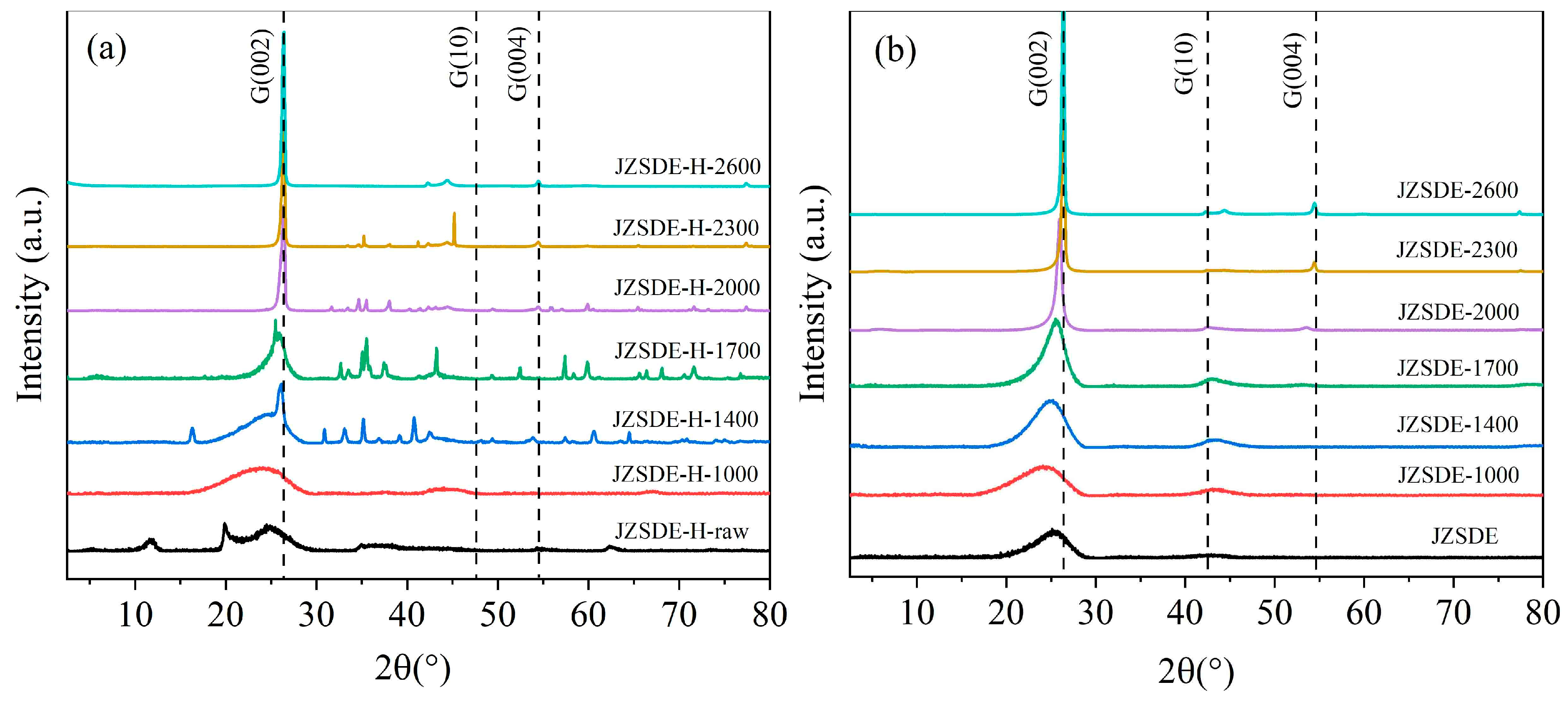
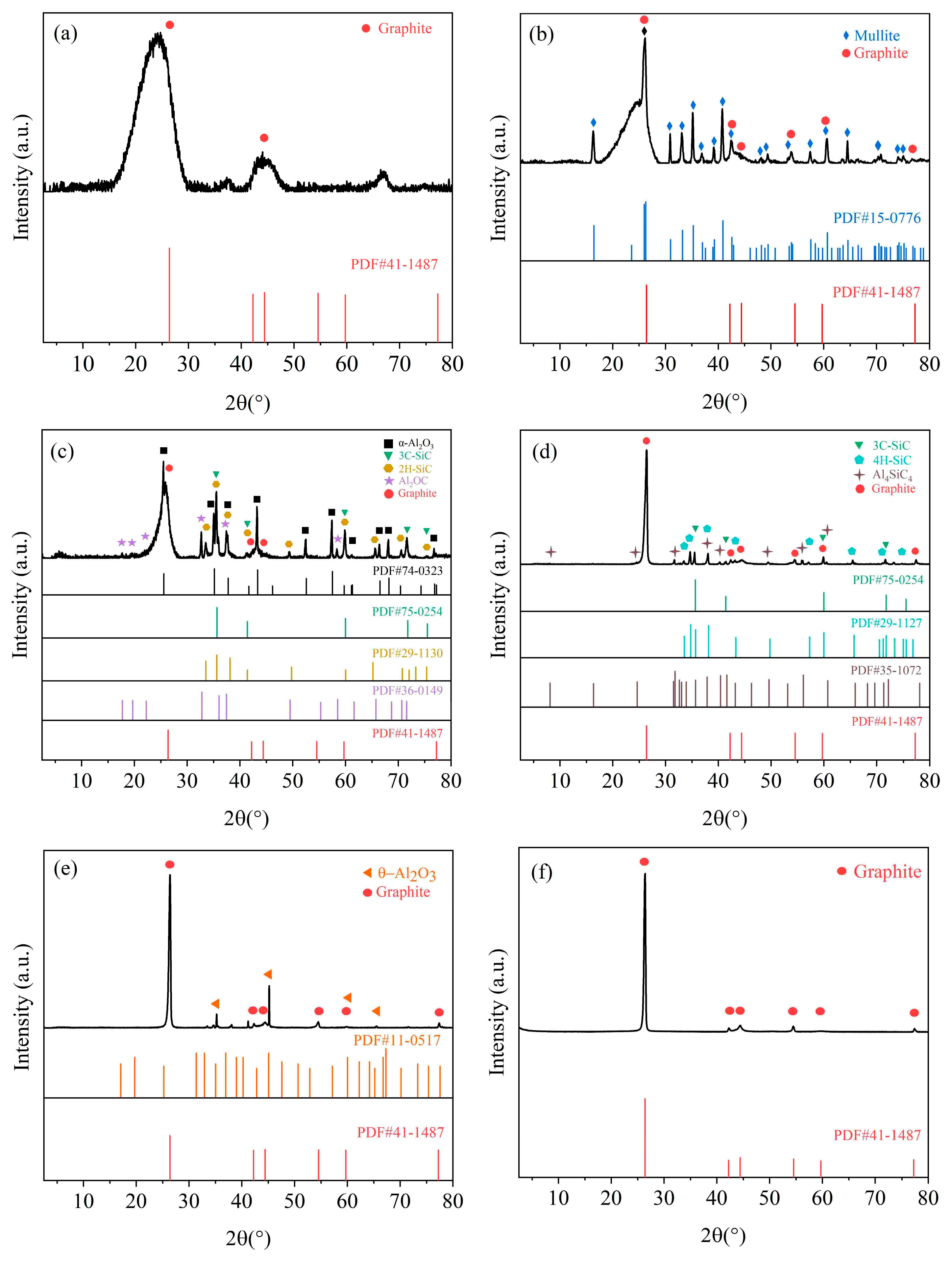
Figure 1 presents the XRD patterns of JZSDE-H and JZSDE samples treated at various temperatures, with detailed identification of multiple carbide and oxide phases evident in Figure 2. After heating to 1000 °C, the inherent peaks of halloysite vanish, leaving only a broad peak around 20–30° (2θ) (Figure 2a). It indicates that the crystal structure of halloysite has largely been destroyed due to dehydroxylation, resulting in the formation of amorphous meta-halloysite structure. At this stage, the peak of the disordered carbon matrix overlaps with meta-halloysite, making it hard to deconvolute individual contributions. Between 1000 and 1700 °C, new crystalline phases begin to emerge. Mullite is detected in the JZSDE-H-1400 sample (Figure 2b). By 1700 °C, multiple carbide and oxide phases appear, including 3C-SiC, 2H-SiC, Al2OC, and α-Al2O3, confirming active reactions between carbon, silica, and alumina derived from mullite decomposition (Figure 2c). From 1700 to 2000 °C, the intensity of 3C-SiC gradually diminishes, while that of 4H-SiC increases significantly, accompanied by the complete disappearance of 2H-SiC. This trend reflects the thermally driven transition toward more stable SiC polytypes under higher heating temperatures. Moreover, the α-Al2O3 and Al2OC vanish, and a new Al4SiC4 is formed (Figure 2d). Finally, for 2300 and 2600 °C heated samples, nearly all intermediate phases have disappeared, with sharp graphite (002) and (004) reflections remaining. The only exception is a possible trace of θ-Al2O3 detected in the 2300 °C sample (Figure 2e,f).
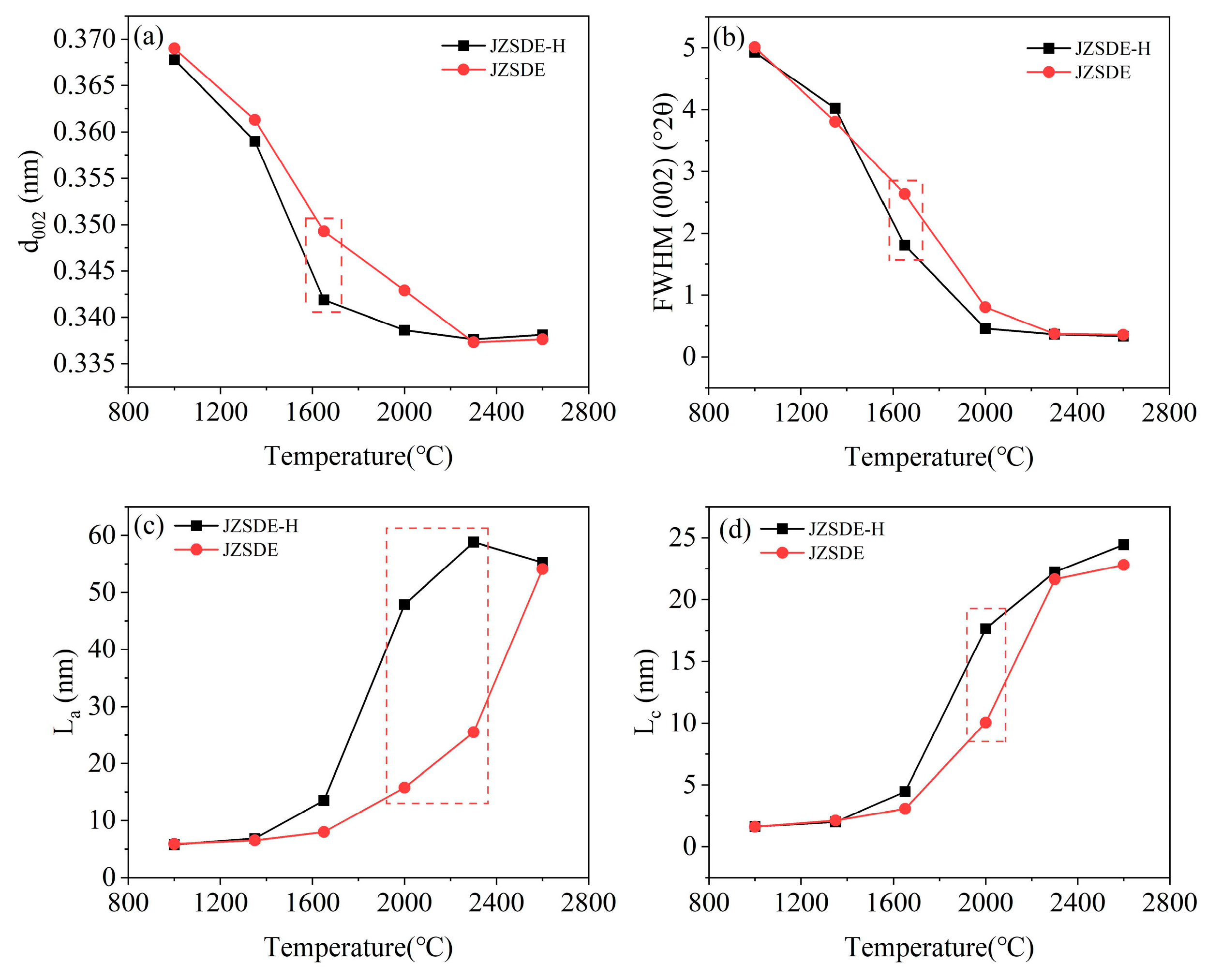
Regarding the structural evolution of carbon structure, the (002) diffraction peak of JZSDE and JZSDE-H samples progressively narrows with increasing heating temperature (Figure 1), indicating a gradual transformation from the disordered sp2-sp3 hybridized carbon structure toward a more ordered sp2 graphitic structure. The corresponding crystalline parameters are summarized in Table 1. At each temperature, JZSDE-H samples exhibit a smaller interlayer spacing (d002) and narrower FWHM (002) compared to JZSDE, reflecting the catalytic graphitization effect promoted by added halloysite. Notably, the most pronounced enhancement in the degree of graphitization occurs at 1700 °C, which corresponds to the significant formation of various intermediate phases. However, the catalytic efficacy gradually diminishes at higher temperatures, as evidenced by the reduced differences in d002 and FWHM (002) between JZSDE-H and JZSDE in the range of 2000–2600 °C (Figure 3a,b).
Figure 3c,d further presents that the JZSDE-H samples display higher crystallite size (La, Lc) values than JZSDE across all temperatures, indicating that the halloysite-catalyst effect facilitates the lateral growth and vertical stacking of graphitic layers. It is worth noting that the most pronounced increase in La and Lc occurs in samples treated between 2000 °C and 2600 °C, which correlates with the thermal decomposition of intermediates.

3.2. Raman Spectroscopy

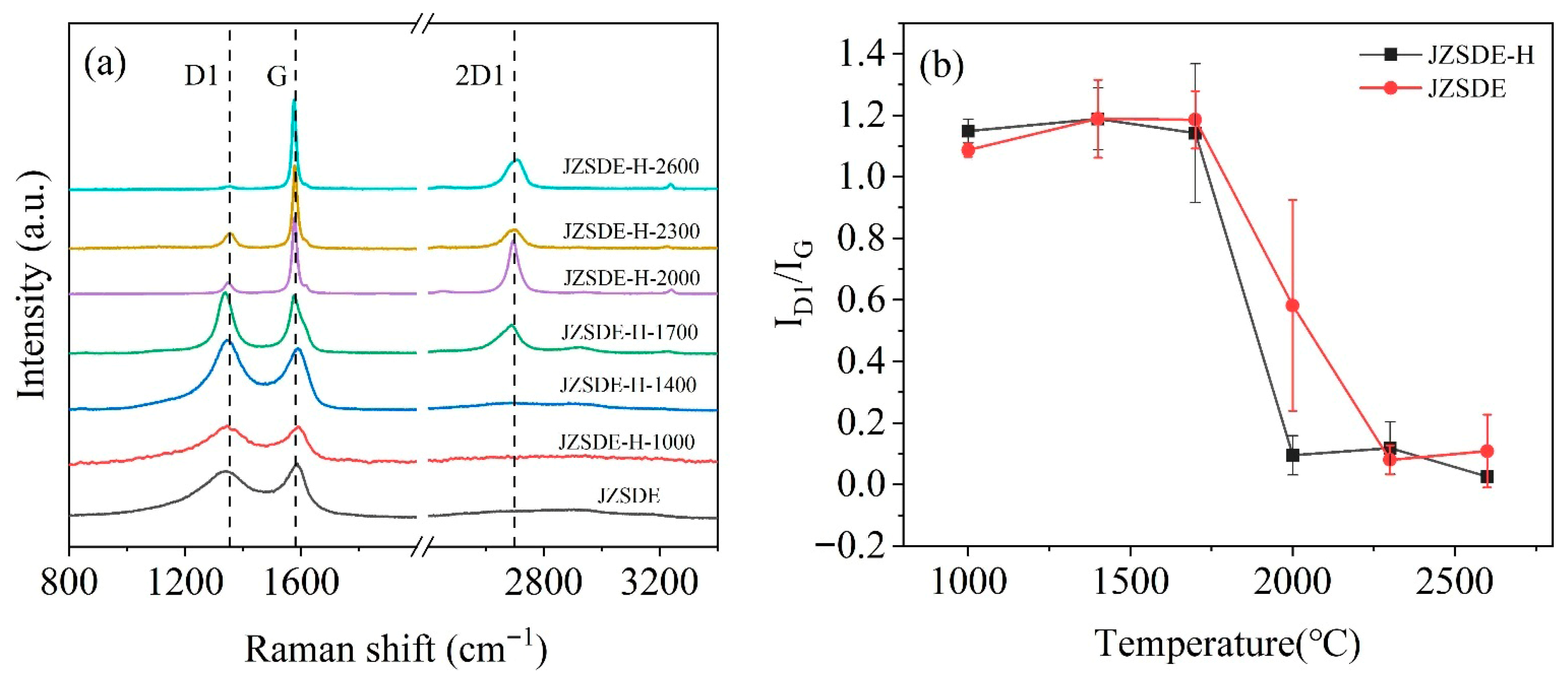
The Raman spectrum of graphitic carbon typically exhibits several key features. The G band located at 1580 cm−1 originates from the E2g in-plane vibration mode of sp2 hybridized carbon atoms and reflects the presence of ordered graphitic domains. D1 band at 1350 cm−1 is associated with disordered carbon structures and originates from double-resonance Raman scattering near the K point of the Brillouin zone. D3 band, located at 1500 cm−1, is attributed to amorphous carbon species, either within or outside the aromatic ring plane, often resulting from organic branched chains or oxygen-containing functional groups [32]. D4 (1200 cm−1) band is linked to aliphatic chains or polyene-like structures involving C–C and C=C stretching vibrations, commonly observed in poorly organized carbon materials [33,34]. D2 (1620 cm−1) band appears as a shoulder on the high-wavenumber side of the G band and is ascribed to in-plane structural disorder within graphitic layers [35,36]. As for overtones of the D and G bands in 2400–3400 cm−1. The 2D1 (2700 cm−1) band serves as an indicator of graphitic crystallinity and layer stacking order. The D + G (2950 cm−1) band results from a combination mode involving the D1 and G bands. In addition, the 2D2 (3240 cm−1) band corresponds to the overtone of the D2 band [34]. A weak feature near 2450 cm−1 has been tentatively assigned to microcrystalline graphite [37,38], although its exact origin remains debated in the literature [38,39]. The Raman spectroscopy patterns and parameters of the JZSDE-H samples are summarized in Figure 4 and Tables S2 and S3, while the representative peak deconvolution results of the series of samples are shown in Figure S2. The JZSDE-H-raw exhibits broad D1 and G peaks, with distinct D3 and D4 peaks (Figure S2a), indicating a typical disordered carbon structure.
In the first-order region (800–2000 cm−1), the G band of JZSDE-H samples gradually becomes more intense and narrower with increasing heating temperature. Conversely, the D1 band intensity gradually decreases, indicating a reduction in structural defects. This trend signifies a continuous structural ordering process during thermal treatment, which is consistent with the XRD results. Notably, the D3 and D4 bands, which are associated with amorphous carbon, aliphatic chains, polyene-like structures, and oxygen-containing functional groups [32,34], largely disappear by 1700 °C, suggesting the volatilization of thermally unstable components.
In the second-order region (2400 to 3300 cm−1), the D+G band at 2950 cm−1, which always reflects the disordered structure, gradually weakens with rising temperature and vanishes completely in the JZSDE-H-2000 sample. Furthermore, the 2D1 band of the JZSDE-H-2300 and JZSDE-H-2600 samples can split into two well-resolved sub-peaks (denoted as 2DA and 2DB), indicating the formation of a well-crystallized graphitic structure [37].
The evolution of the defect degree is quantified by the intensity ratio of ID1/IG, summarized in Tables S2 and S3 and Figure 4b for various graphitized samples. For both JZSDE-H and JZSDE samples, a plateau trend of ID1/IG is observed from 1000 to 1700 °C heated samples, followed by a pronounced decrease for those treated between 1700 and 2600 °C, indicating the defects are rapidly removed above 1700 °C. Notably, the ID1/IG ratio for JZSDE-H-2000 drops sharply to 0.05, compared to 0.58 for JZSDE-2000, demonstrating that halloysite acts as an effective catalyst for defect reduction at 2000 °C.

3.3. SEM

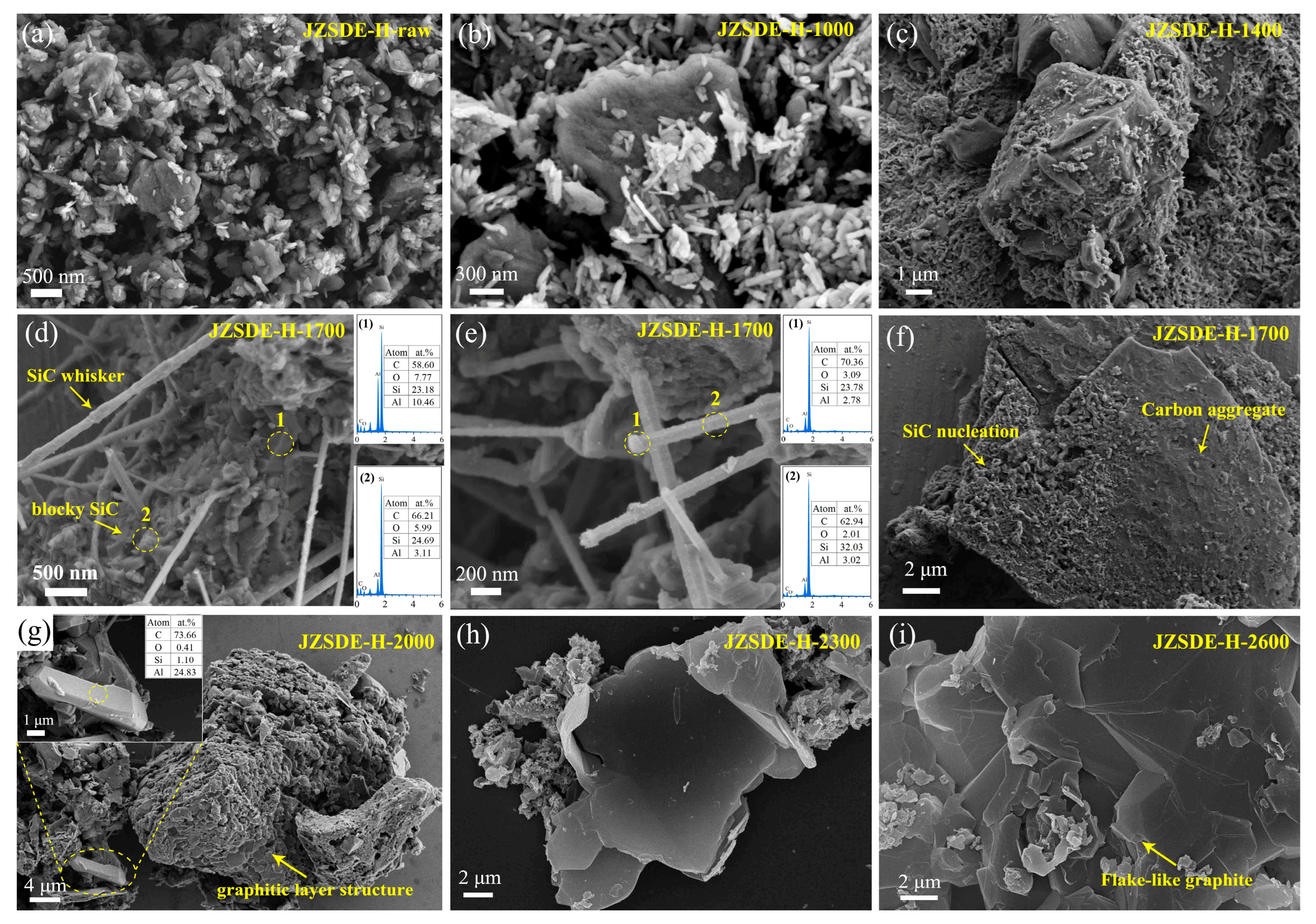
The structural evolution of carbon structure and morphologies of intermediates during the heating treatment are shown by SEM (Figure 5).
The raw anthracite exhibits an aggregated granular structure intermixed with tubular halloysite (Figure 5a). After ball-milling, the mixture achieves a homogeneous dispersion with intimate contact between the two components. Upon heating to 1000 °C, the crystalline structure of halloysite collapses, showing a meta-halloysite phase, characterized by a shortened and molten tubular morphology (Figure 5b). At 1400 °C, further melting occurs, and the material begins to transform into mullite-like aluminosilicate phases (Figure 5c).
In the sample heated to 1700 °C (Figure 5d–f), various intermediate phases emerge. Figure 5d,e reveals SiC whiskers with variable lengths and diameters. Some whiskers display a segmented morphology, suggesting the presence of stacking faults formed during SiC growth. Energy-Dispersive X-ray Spectroscopy (EDS) point analysis (Figure 5e) confirms that these whiskers are primarily composed of Si and C, consistent with 3C-SiC structure, though trace amounts of Al and O are detected. The elemental compositions at the whisker tip and body are nearly identical (points 1 and 2 in Figure 5e), supporting a vapor–solid (VS) growth mechanism rather than vapor–liquid–solid (VLS), which typically exhibits catalyst enrichment at the tip [40,41,42]. Meanwhile, in contrast to the whisker structure, irregularly blocky SiC particles are also present (Figure 5d). Additionally, Figure 5f and its corresponding EDS map (Figure S3a) capture a sharp morphological boundary: on the right side, unreacted carbon aggregate persists, while on the left, carbon aggregate is partially consumed and serves as a substrate for the in situ nucleation and growth of SiC. This localized reaction suggests a solid–solid (SS) growth route, resulting from direct contact between anthracite and halloysite particles. Otherwise, the reaction would be expected to proceed uniformly across the entire anthracite surface if the reaction proceeded via a VS pathway. Furthermore, Figure 5d and its corresponding EDS map (Figure S3b) show that Al-containing phases (Al2OC and Al2O3) are also observed at 1700 °C (point 1 in Figure 5d), and phase separation with SiC (point 2 in Figure 5d). It indicates that the original halloysite undergoes decomposition with increasing heating temperature, followed by a recondensation of Si, C, Al, and O species.
As for the 2000 °C heated sample (Figure 5g), 3C-SiC whisker is barely found. Instead, hexagonal or rhombohedral (2H or 4H) SiC polytypes dominate, appearing as well-faceted prismatic grains composed almost exclusively of Si and C. Concurrently, a distinct graphitic layer structure begins to form under 2000 °C (Figure 5g). With further temperature increase, the flake-like graphite with large crystallite size is observed (Figure 5h,i), consistent with the sharp rise in the in-plane crystallite size (La) observed in XRD analysis between 2000 and 2600 °C (Figure 3c).

3.4. TEM

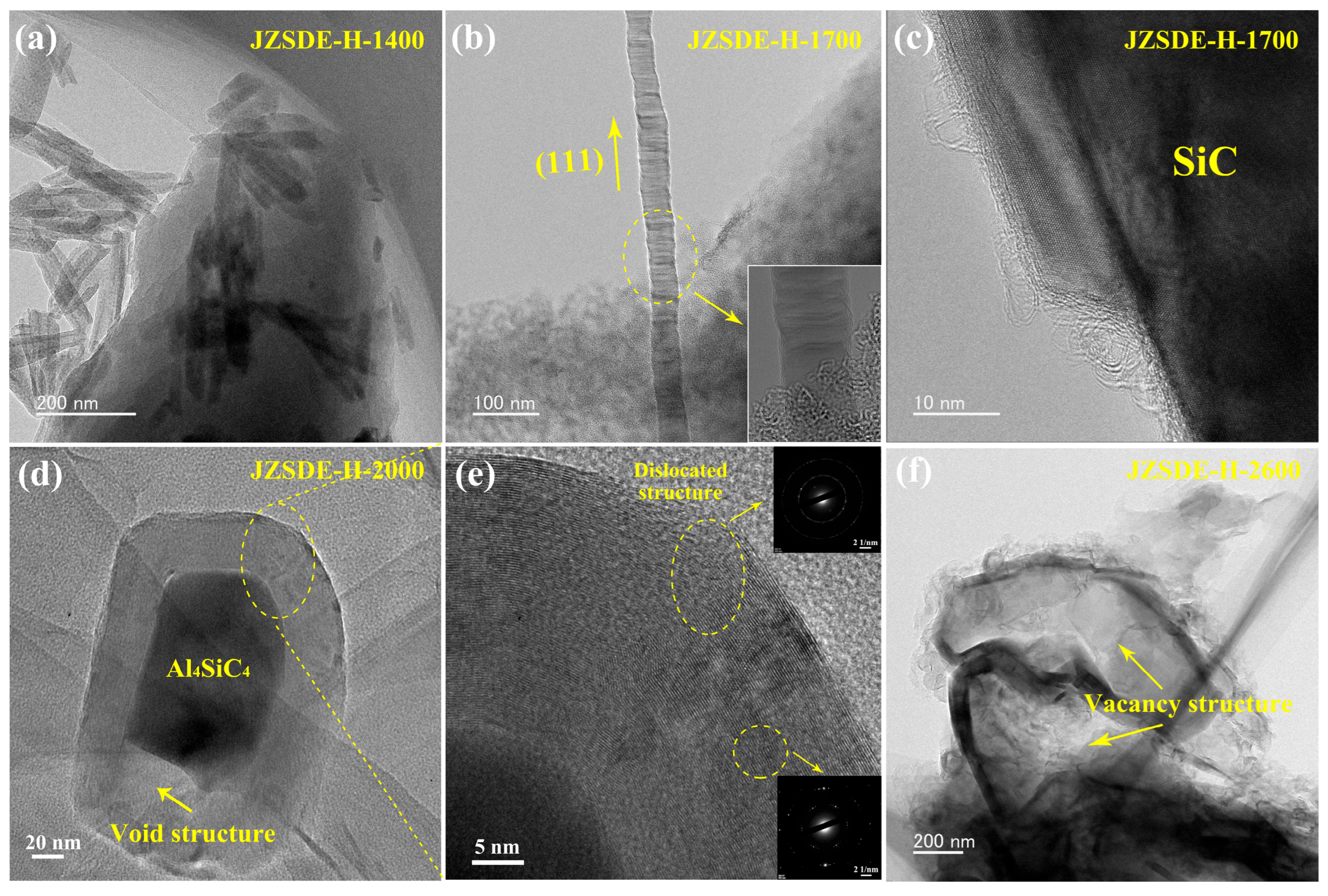
Various intermediate phases can be observed in the TEM images (Figure 6), with corresponding elemental distribution revealed by EDS maps (Figure S4). Figure 6a shows the JZSDE-H-1400 sample, in which a molten-like mullite structure is dispersed within the disordered carbon matrix. In the JZSDE-H-1700 sample, both whisker-shaped and blocky SiC exist. Specifically, Figure 6b shows a SiC whisker with dislocations and stack defects, which commonly originate from thermal stress during the crystal growth [43,44]. These stacking faults promoted (111) facets due to the lower surface energy than (211) or (110) facets on the lateral surfaces [45]. In addition to the Si and C as the dominant elements, a minor doped O and Al can also be detected (Figure S3a), which may also induce the defect structure of SiC. Figure 6c presents a blocky SiC particle. It is worth noting that both whisker and block morphologies are encapsulated by curved few-layer graphitic shells, suggesting an initially catalytic role of the SiC in promoting local graphitic ordering.
At 2000 °C, a blocky Al4SiC4 phase is observed (Figure 6d), surrounded by a well-defined multilayer graphene structure. This well-ordered graphite proves a significant contribution to the reduced d002 value observed in the XRD patterns (Figure 3a,b). However, this “circular-shaped” multi-layer graphene exhibits dislocated coalescence at the corners of the Al4SiC4. The selected-area electron diffraction (SAED) patterns (inset in Figure 6e) clearly differentiate between the parallel graphene regions and the dislocated zones. Additionally, a void is visible at the bottom of the Al4SiC4 particle (Figure 6d), possibly resulting from its partial thermal decomposition. In the JZSDE-H-2600 sample, polygonized or semi-polygonized graphitic structures with internal vacancies are widely observed (Figure 6f). These features may arise either from the complete decomposition of various intermediate phase particles at high temperature or from graphitic layer growth around pre-existing pores of coal.
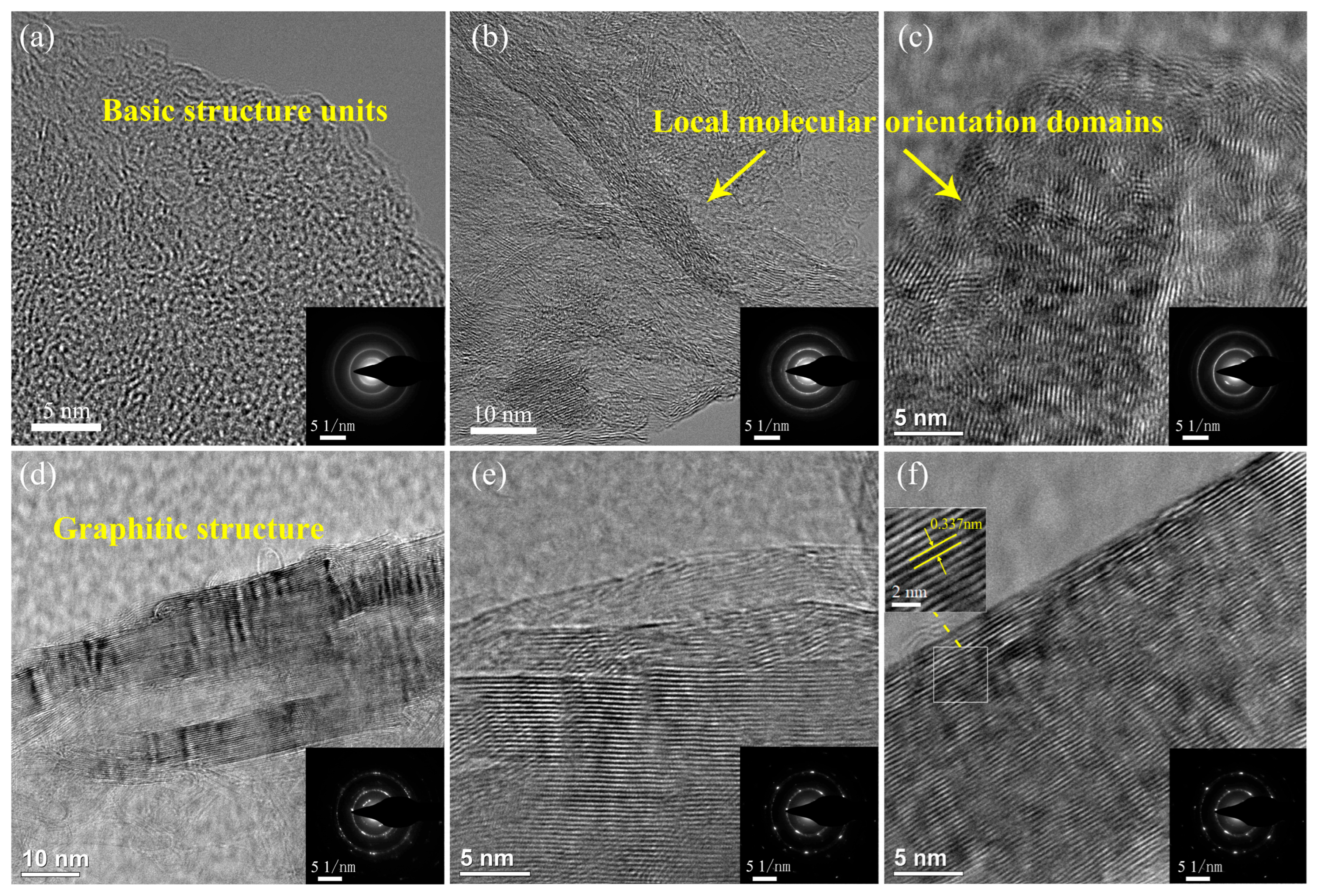
Furthermore, Figure 7a–f displays the evolution of lattice fringes in the carbon structure of JZSDE-H samples. The initially disordered basic structure units in raw anthracite gradually transform into local molecular orientation domains’ structure up to 1700 °C (Figure 7a–c). Afterward, at 2000 °C, a graphitic structure with preferred orientation begins to emerge (Figure 7d), and further heating up to 2600 °C promotes progressive growth of graphitic crystallites (La, Lc) (Figure 7e,f). The lattice spacing (0.337 nm) is determined via FFT analysis (Figure 7f), indicating a well-developed graphitic structure. The corresponding SAED patterns shown in the bottom become more distinct with higher temperature-heated samples, which confirms the transformation from a sp2-sp3 disordered carbon structure to a highly ordered sp2 graphite structure.

4. Discussion

4.1. The Phase Transformation of Halloysite with Increasing Heating Temperature

During the high-temperature treatment, halloysite undergoes a series of complex phase transformations, giving rise to various intermediate phases such as SiC, Al2OC, Al2O3, and Al4SiC4. The overall formation and decomposition process is illustrated below:
From raw sample up to 1400 °C, halloysite first dehydrates and transforms into meta-halloysite at 1000 °C, followed by conversion to mullite at 1400 °C. During this stage, no significant reaction occurs between the aluminosilicate phases and the carbon matrix.
At 1700 °C, the heated sample, 3C-SiC, becomes the dominant crystalline phase, exhibiting both whisker-like and blocky morphologies. These distinct morphologies arise from differences in local gas conditions, the ratio of C/Si, and the interfacial contact area [46,47]. The formation mechanism of SiC can proceed via either solid–solid (SS) or vapor–solid (VS) routes, as illustrated in Equations (5)–(9) [48,49,50]: For the SS route: Like observed in the SEM image Figure 5f, the Al4SiO9 (mullite-related phase) react directly with solid C to for SiC (s), accompanied by the generation of Al2O3 and CO (g) (Equation (5)). Meanwhile, the nucleation can also be formed from the VS route: Gaseous SiO, produced from the carbothermal reduction reaction (Equation (6)), reacts with solid carbon to nucleate SiC through solid–gas interaction (Equation (7)) [48]. Subsequently, SiC whiskers grow predominantly via a gas–gas reaction pathway rather than the VS mechanism (Equations (7)–(9)) [49,50]. Specifically, SiO (g) and CO (g) react to form SiC (s) and CO2 (g) via Equation (8), and generated CO2 is rapidly consumed by surrounding carbon particles to regenerate CO via Equation (9). This continuous regeneration of CO can promote Equation (8) forward while suppressing Equation (7), thereby facilitating the growth of longer, one-dimensional SiC whiskers [48]. Furthermore, with increasing heating temperature to 2000 °C, the whisker and blocky 3C-SiC structure gradually transform to higher thermal stable 2H-SiC/4H-SiC with hexagonal or rhombohedral structure.
Al4SiO9 + 5C → SiC + 2Al2O3 + 4CO (g)
Al4SiO9 + 3C → SiO (g) + 2Al2O3 + 2CO (g)
SiO (g) + 2C → SiC + CO (g)
SiO (g) + 3CO (g) → SiC + 2CO2 (g)
CO2 (g) + C → 2CO (g)
In addition to SiC, aluminum-containing intermediates, including Al2O3, Al2OC (formed at 1700 °C), and Al4SiC4 (formed at 2000 °C), are also detected. The possible formulation is shown in Equations (10)–(12):
Al2O3 + 3C → Al2OC + 2CO (g)
2Al2OC + SiC + 3C → Al4SiC4 + 2CO (g)
2Al2OC + SiC + 2C → Al4SiC4 + CO2 (g)
It should be noted that Al2OC is generally considered metastable and tends to transform into Al4O4C under high-temperature conditions [51]. However, Al4O4C was not detected in our XRD patterns, possibly due to the specific Si/Al/C stoichiometry in the system or the large temperature interval (1700–2000 °C) used in this study. Future work should include finer temperature steps to capture transient phases more accurately.

4.2. The Catalytic Effect of Mineral Matter Under Different Temperatures

Based on the crystallinity parameters of XRD and Raman between JZSDE and JZSDE-H samples at various temperatures, as well as the phase transformation of halloysite, the halloysite-promoted graphitization process is divided into three distinct stages: the formation of intermediate phases stage (1400–1700 °C), the intermediate phases transformation and decomposition stage (1700–2300 °C), and post-promotion stable growth stage (2300–2600 °C). The detailed discussion is illustrated below:
Stage 1 (1400–1700 °C): The XRD results (Figure 1 and Figure 2) confirm the formation of various intermediates (e.g., 3C-SiC, 2H-SiC, Al2O3, Al2OC) in JZSDE-H samples. Concurrently, the d002 and FWHM (002) of JZSDE-H samples decrease significantly compared to JZSDE. TEM image (Figure 6b–d) above reveals multilayer graphite structures epitaxially grown around intermediate phase particles, while the rest of the area remains largely disordered. Therefore, this localized graphitization suggests that interfaces of intermediates act as nucleation templates for graphitic layer formation. Nevertheless, the enhancement of crystallite size (La, Lc) for JZSDE-H compared to JZSDE is relatively minor (Figure 3c,d), likely due to spatial confinement imposed by the surrounding intermediate particles. Consistently, the ID1/IG also shows a minor change in this range, which may be attributed to the amount of dislocation defects at the coalescence boundaries of “circled” multilayer graphene domains (Figure 6d,e).
Stage 2 (1700–2300 °C): During this stage, intermediate phases first transform into thermally stable phases (3C-SiC to 2H/4H-SiC; Al2OC to Al4SiC4) from 1700 to 2000 °C, followed by progressive structural decomposition up to 2300 °C. A pronounced enhancement in La is observed for JZSDE-H during the 2000 to 2300 °C period compared to JZSDE, indicating that the decomposition process of intermediates would significantly facilitate the crystalline size growth. As shown in Figure 6d–f, the decomposition of the intermediate core removes the stress support for the surrounding “circular” multilayer graphene shells. This loss of structural anchoring induces the rupture at the weak points (such as dislocation and defect points) under high temperature conditions, allowing the straightening of curved graphene layers. This process facilitates the lateral expansion of graphitic domains, ultimately leading to a larger La value. Furthermore, the ID1/IG also drops sharply from 2000 to 2300 °C, which is also attributed to the significant reduction in dislocations and defects during the intermediate decomposition process.
Stage 3 (2300–2600 °C): Above 2300 °C, most intermediates have evaporated. The remaining polygonized or semi-polygonized graphitic structures continue to rupture and become parallel graphite structures (Figure 6f), and the exposed reactive carbon edge sites can promote further coalescence.

5. Conclusions

In this study, the mechanism of halloysite-promoted anthracite graphitization was systematically investigated via heat-treating demineralized anthracite blended with 30% halloysite at various temperatures. The results show that halloysite significantly facilitates anthracite graphitization via the formation and decomposition process of intermediate phases, as evidenced by enhanced crystallinity parameters from XRD and Raman spectroscopy.
Notably, 1700 °C is identified as a critical temperature point. The formation of intermediate phases predominantly occurs between 1000 and 1700 °C, during which ordered multilayer graphene structures develop around these intermediate particles, indicating a significant decrease in d002 and FWHM (002) of XRD. This observation indicates that intermediate interfaces act as effective nucleation templates for graphitic layer formation. However, the resulting “circular” or closed-shell multilayer graphene exhibits limited crystallite dimensions due to spatial confinement and contains a high density of coalescence-related dislocation defects. Furthermore, between 1700 and 2300 °C, decomposition and volatilization of intermediates occur. The loss of structural support triggers the collapse of the circular graphene shells at weak points (such as dislocation points), leading to the straightening of curved graphene layers and exposing reactive carbon edge sites that promote further coalescence. This structural relaxation facilitates significant increases in both lateral (La) and vertical (Lc) crystallite sizes, accompanied by a marked reduction in dislocation defects. Additionally, when the heating temperature exceeds 2300 °C, the rate of graphitization improvement slows significantly for both pure and halloysite-mixed samples, and their structural parameters tend to similar values.

Supplementary Materials

The following supporting information can be downloaded at: https://www.mdpi.com/article/10.3390/min16010080/s1, Figure S1. The XRD patterns of (a) demineralized anthracite and (b) halloysite. Figure S2. The representative peak deconvolution results of the series of JZSDE-H samples at different temperatures. (a) JZSDE-H-raw; (b) JZSDE-H-1000; (c) JZSDE-H-1400; (d) JZSDE-H-1700; (e) JZSDE-H-2000; (f) JZSDE-H-2300; (g) JZSDE-H-2600. Figure S3. EDS elemental maps corresponding to (a) Figure 5d and (b) Figure 5f. Figure S4. EDS elemental maps of the JZSDE-H samples, where (a), (b), and (c) correspond to patterns (b), (c), and (d) in Figure 6, respectively. Table S1 The proximate and ultimate analyses of JZS raw anthracite [52]. Table S2 Raman spectroscopy data of different JZSDE-H samples. Table S3 Raman spectroscopy data of different JZSDE samples.

Author Contributions

Conceptualization, H.Z.; methodology, Q.W.; software, H.Z.; validation, H.Z.; formal analysis, H.C.; resources, Q.L.; data curation, K.L.; writing—original draft preparation, H.Z.; writing—review and editing, H.Z.; supervision, Q.L.; project administration, Q.L.; funding acquisition, Q.L. All authors have read and agreed to the published version of the manuscript.

Funding

This research was supported by the National Natural Science Foundation of China (Grant No.: 42472229).

Data Availability Statement

The original contributions presented in this study are included in the article/Supplementary Material. Further inquiries can be directed to the corresponding author.

Acknowledgments

The authors gratefully acknowledge the Jinzhushan Mine for providing the samples. We sincerely thank Hunan Xirui Automation Equipment Co., Ltd. for supplying the high-temperature experimental equipment.

Conflicts of Interest

Author Qifan Wu was employed by the company China Energy Shendong Coal Group Co., Ltd. The remaining authors declare that the research was conducted in the absence of any commercial or financial relationships that could be construed as a potential conflict of interest.

Abbreviations

The following abbreviations are used in this manuscript:
SAEDselected-area electron diffraction
DOGdegree of graphitization
FWHMfull width at half maximum
EDSEnergy-Dispersive X-ray Spectroscopy

References

  1. Buiel, E.; Dahn, J. Li-insertion in hard carbon anode materials for Li-ion batteries. Electrochim. Acta 1999, 45, 121–130. [Google Scholar] [CrossRef]
  2. Zhang, L.; She, D.; Shi, L. Influence of graphitization degree of nuclear graphite on HTGR reactor physics calculation. Ann. Nucl. Energy 2020, 143, 107458. [Google Scholar] [CrossRef]
  3. Wu, H.; Gakhar, R.; Chen, A.; Lam, S.; Marshall, C.P.; Scarlat, R.O. Comparative analysis of microstructure and reactive sites for nuclear graphite IG-110 and graphite matrix A3. J. Nucl. Mater. 2020, 528, 151802. [Google Scholar] [CrossRef]
  4. Wang, H.; Zhang, H.; Chen, G. Preparation of unsaturated polyester/graphite nanosheet conducting composite under electric field. Compos. Part A Appl. Sci. Manuf. 2007, 38, 2116–2120. [Google Scholar] [CrossRef]
  5. Franklin, R.E. Crystallite growth in graphitizing and non-graphitizing carbons. Proc. R. Soc. Lond. Ser. A. Math. Phys. Sci. 1951, 209, 196–218. [Google Scholar] [CrossRef]
  6. Oberlin, A.; Terriere, G. Graphitization studies of anthracites by high resolution electron microscopy. Carbon 1975, 13, 367–376. [Google Scholar] [CrossRef]
  7. Nyathi, M.S.; Clifford, C.B.; Schobert, H.H. Characterization of graphitic materials prepared from different rank Pennsylvania anthracites. Fuel 2013, 114, 244–250. [Google Scholar] [CrossRef]
  8. Ōya, A.; Marsh, H. Phenomena of catalytic graphitization. J. Mater. Sci. 1982, 17, 309–322. [Google Scholar] [CrossRef]
  9. Sevilla, M.; Fuertes, A. Graphitic carbon nanostructures from cellulose. Chem. Phys. Lett. 2010, 490, 63–68. [Google Scholar] [CrossRef]
  10. Lu, A.-H.; Li, W.-C.; Salabas, E.-L.; Spliethoff, B.; Schüth, F. Low temperature catalytic pyrolysis for the synthesis of high surface area, nanostructured graphitic carbon. Chem. Mater. 2006, 18, 2086–2094. [Google Scholar] [CrossRef]
  11. Zhai, D.; Du, H.; Li, B.; Zhu, Y.; Kang, F. Porous graphitic carbons prepared by combining chemical activation with catalytic graphitization. Carbon 2011, 49, 725–729. [Google Scholar] [CrossRef]
  12. Maldonado-Hódar, F.; Moreno-Castilla, C.; Rivera-Utrilla, J.; Hanzawa, Y.; Yamada, Y. Catalytic graphitization of carbon aerogels by transition metals. Langmuir 2000, 16, 4367–4373. [Google Scholar] [CrossRef]
  13. Wang, F.; Wang, Y.; Guan, Z.; Wei, J.; He, S.; Zhong, Z.; Chen, H.; Feng, P. Molten salt Mg2+/Mg bifunctional system for enhancing graphitization of low-temperature biomass-derived carbon. Ionics 2025, 31, 4421–4430. [Google Scholar] [CrossRef]
  14. Wang, J.; Sun, Z.; Dong, K.; Wu, S.; Yang, C.; Xiong, M.; Li, Z.; Chen, J.; Liu, Y.; Li, H. Synthesis of porous graphitic carbon electrode materials based on Fe-Ni dual transition metal elements for high-performance supercapacitors. J. Power Sources 2025, 640, 236684. [Google Scholar] [CrossRef]
  15. Xia, S.; Yang, H.; Lu, W.; Cai, N.; Xiao, H.; Chen, X.; Chen, Y.; Wang, X.; Wang, S.; Wu, P. Fe–Co based synergistic catalytic graphitization of biomass: Influence of the catalyst type and the pyrolytic temperature. Energy 2022, 239, 122262. [Google Scholar] [CrossRef]
  16. González, D.; Montes-Morán, M.A.; Garcia, A.B. Influence of inherent coal mineral matter on the structural characteristics of graphite materials prepared from anthracites. Energy Fuels 2005, 19, 263–269. [Google Scholar] [CrossRef]
  17. Pappano, P.J. A Mechanism of Pennsylvania Anthracite Graphitization Involving Carbide Formation and Decomposition; The Pennsylvania State University: State College, PA, USA, 2003. [Google Scholar]
  18. Marsh, H.; Warburton, A. Catalysis of graphitisation. J. Appl. Chem. 1970, 20, 133–142. [Google Scholar] [CrossRef]
  19. Luo, P.; Tang, Y.; Li, R.; Ju, M. Effects of Minerals Type and Content on the Synthetic Graphitization of Coal: Insights from the Mixture of Minerals and Anthracite with Varied Rank. Minerals 2023, 13, 1024. [Google Scholar] [CrossRef]
  20. Wang, L.; Du, C.; Li, Z.; Han, Y.; Feng, N.; Yang, J. Catalytic graphitization of coke and electrochemical performances of coke-based graphite. J. Alloys Compd. 2023, 960, 170949. [Google Scholar] [CrossRef]
  21. Rodrigues, S.; Suárez-Ruiz, I.; Marques, M.; Flores, D. Catalytic role of mineral matter in structural transformation of anthracites during high temperature treatment. Int. J. Coal Geol. 2012, 93, 49–55. [Google Scholar] [CrossRef]
  22. Pappano, P.J.; Schobert, H.H. Effect of natural mineral inclusions on the graphitizability of a Pennsylvania anthracite. Energy Fuels 2009, 23, 422–428. [Google Scholar] [CrossRef]
  23. Gubernat, M.; Lis, T.; Tomala, J.; Kawala, J.; Fraczek-Szczypta, A.; Blazewicz, S. Study of the carbonization and graphitization of coal tar pitch modified with SiC nanoparticles. J. Nanomater. 2017, 2017, 6578928. [Google Scholar] [CrossRef]
  24. Yazdi, G.R.; Vasiliauskas, R.; Iakimov, T.; Zakharov, A.; Syväjärvi, M.; Yakimova, R. Growth of large area monolayer graphene on 3C-SiC and a comparison with other SiC polytypes. Carbon 2013, 57, 477–484. [Google Scholar] [CrossRef]
  25. Biddeci, G.; Spinelli, G.; Colomba, P.; Di Blasi, F. Nanomaterials: A review about halloysite nanotubes, properties, and application in the biological field. Int. J. Mol. Sci. 2022, 23, 11518. [Google Scholar] [CrossRef] [PubMed]
  26. Ouyang, J.; Mu, D.; Zhang, Y.; Yang, H. Mineralogy and physico-chemical data of two newly discovered halloysite in China and their contrasts with some typical minerals. Minerals 2018, 8, 108. [Google Scholar] [CrossRef]
  27. Massaro, M.; Lazzara, G.; Noto, R.; Riela, S. Halloysite nanotubes: A green resource for materials and life sciences. Rend. Lincei. Sci. Fis. E Nat. 2020, 31, 213–221. [Google Scholar] [CrossRef]
  28. Zuo, P.; Du, J.; Yu, Y.; Chen, A. N-doped mesoporous thin carbon tubes obtained by exhaust directional deposition for supercapacitor. Chem. Eng. Sci. 2021, 240, 116651. [Google Scholar] [CrossRef]
  29. Chen, F.; Ma, L.; Li, B.; Jiang, P.; Song, Z.; Huang, L. Natural Halloysite-Templated Synthesis of Highly Graphitic Boron-Doped Hollow Carbon Nanocapsule Webs. Nanomaterials 2022, 12, 2352. [Google Scholar] [CrossRef] [PubMed]
  30. Seehra, M.S.; Pavlovic, A.S. X-Ray diffraction, thermal expansion, electrical conductivity, and optical microscopy studies of coal-based graphites. Carbon 1993, 31, 557–564. [Google Scholar] [CrossRef]
  31. Suárez-Ruiz, I.; García, A.B. Optical parameters as a tool to study the microstructural evolution of carbonized anthracites during high-temperature treatment. Energy Fuels 2007, 21, 2935–2941. [Google Scholar] [CrossRef]
  32. Jawhari, T.; Roid, A.; Casado, J. Raman spectroscopic characterization of some commercially available carbon black materials. Carbon 1995, 33, 1561–1565. [Google Scholar] [CrossRef]
  33. Green, P.D.; Johnson, C.A.; Thomas, K.M. Applications of laser Raman microprobe spectroscopy to the characterization of coals and cokes. Fuel 1983, 62, 1013–1023. [Google Scholar] [CrossRef]
  34. Sadezky, A.; Muckenhuber, H.; Grothe, H.; Niessner, R.; Pöschl, U. Raman microspectroscopy of soot and related carbonaceous materials: Spectral analysis and structural information. Carbon 2005, 43, 1731–1742. [Google Scholar] [CrossRef]
  35. Al-Jishi, R.; Dresselhaus, G. Lattice-dynamical model for graphite. Phys. Rev. B 1982, 26, 4514. [Google Scholar] [CrossRef]
  36. Cuesta, A.; Dhamelincourt, P.; Laureyns, J.; Martínez-Alonso, A.; Tascón, J.D. Raman microprobe studies on carbon materials. Carbon 1994, 32, 1523–1532. [Google Scholar] [CrossRef]
  37. Li, K.; Rimmer, S.M.; Liu, Q.; Zhang, Y. Micro-Raman spectroscopy of microscopically distinguishable components of naturally graphitized coals from central Hunan Province, China. Energy Fuels 2019, 33, 1037–1048. [Google Scholar] [CrossRef]
  38. Pawlyta, M.; Rouzaud, J.-N.; Duber, S. Raman microspectroscopy characterization of carbon blacks: Spectral analysis and structural information. Carbon 2015, 84, 479–490. [Google Scholar] [CrossRef]
  39. Couzi, M.; Bruneel, J.-L.; Talaga, D.; Bokobza, L. A multi wavelength Raman scattering study of defective graphitic carbon materials: The first order Raman spectra revisited. Carbon 2016, 107, 388–394. [Google Scholar] [CrossRef]
  40. Choi, H.-J.; Lee, J.-G. Stacking faults in silicon carbide whiskers. Ceram. Int. 2000, 26, 7–12. [Google Scholar] [CrossRef]
  41. Zhang, Y.; Wang, N.; He, R.; Chen, X.; Zhu, J. Synthesis of SiC nanorods using floating catalyst. Solid State Commun. 2001, 118, 595–598. [Google Scholar] [CrossRef]
  42. Deng, S.; Wu, Z.; Zhou, J.; Xu, N.; Chen, J.; Chen, J. Synthesis of silicon carbide nanowires in a catalyst-assisted process. Chem. Phys. Lett. 2002, 356, 511–514. [Google Scholar] [CrossRef]
  43. Li, H.; Li, Z.; Meng, A.; Li, K.; Zhang, X.; Xu, Y. SiC nanowire networks. J. Alloys Compd. 2003, 352, 279–282. [Google Scholar] [CrossRef]
  44. Kang, B.-C.; Lee, S.-B.; Boo, J.-H. Growth of β-SiC nanowires on Si (100) substrates by MOCVD using nickel as a catalyst. Thin Solid Film. 2004, 464, 215–219. [Google Scholar] [CrossRef]
  45. Wang, L.; Wada, H.; Allard, L. Synthesis and characterization of SiC whiskers. J. Mater. Res. 1992, 7, 148–163. [Google Scholar] [CrossRef]
  46. Silva, P.; Figueiredo, J. Production of SiC and Si3N4 whiskers in C+ SiO2 solid mixtures. Mater. Chem. Phys. 2001, 72, 326–331. [Google Scholar]
  47. Seo, W.S.; Koumoto, K. Stacking faults in β-SiC formed during carbothermal reduction of SiO2. J. Am. Ceram. Soc. 1996, 79, 1777–1782. [Google Scholar] [CrossRef]
  48. Choi, H.-J.; Lee, J.-G. Continuous synthesis of silicon carbide whiskers. J. Mater. Sci. 1995, 30, 1982–1986. [Google Scholar] [CrossRef]
  49. Li, X.; Liu, L.; Zhang, Y.; Shen, S.D.; Ge, S.; Ling, L.C. Synthesis of nanometre silicon carbide whiskers from binary carbonaceous silica aerogels. Carbon 2001, 39, 159–165. [Google Scholar] [CrossRef]
  50. Meng, G.; Cui, Z.; Zhang, L.; Phillipp, F. Growth and characterization of nanostructured β-SiC via carbothermal reduction of SiO2 xerogels containing carbon nanoparticles. J. Cryst. Growth 2000, 209, 801–806. [Google Scholar] [CrossRef]
  51. Xing, X.; Li, B.; Chen, J.; Hou, X. Formation mechanism of large size plate-like Al4SiC4 grains by a carbothermal reduction method. CrystEngComm 2018, 20, 1399–1404. [Google Scholar] [CrossRef]
  52. Cao, H.; Li, K.; Zhang, H.; Liu, Q. Investigation on the mineral catalytic graphitization of anthracite during series high temperature treatment. Minerals 2023, 13, 749. [Google Scholar] [CrossRef]
Figure 1. The XRD patterns of (a) JZSDE-H and (b) JZSDE samples at various heating temperatures.
Minerals 16 00080 g001
Figure 2. Intermediate phases in JZSDE-H samples identified by XRD at different heating temperatures. (a) 1000 °C; (b) 1400 °C; (c) 1700 °C; (d) 2000 °C; (e) 2300 °C; (f) 2600 °C.
Minerals 16 00080 g002
Figure 3. XRD structural parameters for the JZSDE-H and JZSDE samples at different heating temperatures. (a) d002; (b) FWHM (002); (c) microcrystalline size parameter La; (d) microcrystalline size parameter Lc.
Minerals 16 00080 g003
Figure 4. (a) The Raman spectroscopy patterns of JZSDE-H samples under different heating temperatures. (b) The variation in the ID1/IG ratio of JZSDE-H and JZSDE samples under different heating temperatures.
Minerals 16 00080 g004
Figure 5. SEM images of the intermediate phases and the evolving graphitic carbon structure in JZSDE-H at different heating temperatures. (a) JZSDE-H-raw; (b) JZSDE-H-1000; (c) JZSDE-H-1400; (df) JZSDE-H-1700; (g) JZSDE-H-2000; (h) JZSDE-H-2300; (i) JZSDE-H-2600. The numbers 1 and 2 in (d,e) indicate the locations of the Energy-Dispersive X-ray Spectroscopy (EDS) analysis points.
Minerals 16 00080 g005
Figure 6. TEM images of intermediates of JZSDE-H samples. (a) JZSDE-H-1400; (b) SiC Whisker structure of JZSDE-H-1700; (c) SiC blocky structure of JZSDE-H-1700; (d) Al4SiC4 particle surrounded by multi-layer graphene structure of JZSDE-H-2000; (e) inset image of the area marked in (d); (f) polygonized structure with an internal vacancy of JZSDE-H-2600.
Minerals 16 00080 g006
Figure 7. The evolution of the carbon structure of JZSDE-H samples at different heating temperatures. (a) JZSDE-H-raw; (b) JZSDE-H-1000; (c) JZSDE-H-1700; (d) JZSDE-H-2000; (e) JZSDE-H-2300; (f) JZSDE-H-2600.
Minerals 16 00080 g007
Table 1. XRD Parameters of different degrees of graphitized samples.
Sampled002 (nm)FWHM (002)/° *La (nm)Lc (nm)<N>DOG (%)
JZSDE-H-raw0.35963.965.082.035.65-
JZSDE-H-10000.36784.935.761.634.43-
JZSDE-H-14000.35904.026.832.005.57-
JZSDE-H-17000.34191.8113.544.4613.050.24
JZSDE-H-20000.33860.4647.8517.6652.150.63
JZSDE-H-23000.33760.3658.8322.2365.840.74
JZSDE-H-26000.33810.3355.2724.4572.310.69
JZSDE0.35463.395.122.376.69-
JZSDE-10000.36905.015.891.604.34-
JZSDE-14000.36003.806.522.125.86-
JZSDE-17000.34932.637.973.068.76-
JZSDE-20000.34290.8015.7610.0529.320.13
JZSDE-23000.33730.3725.5021.6364.140.78
JZSDE-26000.33760.3554.0822.7967.520.74
* FWHM: full width at half maximum; DOG: degree of graphitization.
Disclaimer/Publisher’s Note: The statements, opinions and data contained in all publications are solely those of the individual author(s) and contributor(s) and not of MDPI and/or the editor(s). MDPI and/or the editor(s) disclaim responsibility for any injury to people or property resulting from any ideas, methods, instructions or products referred to in the content.