Article

Diagenetic Characteristics and Evolution of Low-Permeability Clastic Reservoirs in the Mesozoic of the Tanhai Zone, Jiyang Depression
1
School of Geosciences, China University of Petroleum (East China), Qingdao 266580, China
2
State Key Laboratory of Deep Oil and Gas, China University of Petroleum (East China), Qingdao 266580, China
3
Offshore Production Plant, Shengli Oilfield of Sinopec, Dongying 257237, China
*
Author to whom correspondence should be addressed.
Minerals 2026, 16(1), 106; https://doi.org/10.3390/min16010106
Submission received: 2 December 2025 / Revised: 15 January 2026 / Accepted: 19 January 2026 / Published: 21 January 2026
(This article belongs to the Special Issue Natural and Induced Diagenesis in Clastic Rock)

Abstract

In multi-phase tectonic activity areas, complex stratigraphic uplift-subsidence cycles lead to multi-phase, superimposed diagenesis. This obscures the mechanisms of reservoir property evolution and makes predicting diagenetic sweet spots difficult. This study investigates the low-permeability clastic reservoirs in the Mesozoic of the Tanhai area, Jiyang Depression. Integrating thin-section petrography, scanning electron microscopy (SEM), X-ray diffraction (XRD), high-pressure mercury injection, and burial history analysis, it reveals multi-phase diagenetic characteristics from a tectonic perspective and quantifies pore structure modification mechanisms. Results show the reservoirs underwent strong compaction and multi-phase carbonate-dominated cementation. Dissolution is further distinguished into meteoric water, organic acid, and volcanic material-related alkaline dissolution. Pore-throat evolution indicates that compaction and cementation shift pores towards micropores (<0.1 µm), while meteoric and alkaline dissolution enlarge mesopores (0.1–10 µm) crucial for permeability. Reservoir diagenesis is divided into five tectonic—diagenetic stages. A quantitative model identifies two diagenetic sweet spot types: (1) zones near unconformities intensely leached by meteoric water, and (2) relatively shallow intervals affected by alkaline dissolution related to volcanic rocks under deep burial. This study establishes a tectonic—diagenetic—pore structure framework. It provides a basis for predicting reservoir sweet spots in analogous multi-phase tectonic settings.

1. Introduction

The diagenesis of clastic rocks controls the critical process of their transformation from loose sediment into hydrocarbon reservoirs. The core of this process is the balance between porosity generation and destruction [1,2,3,4,5,6]. For low-permeability to tight sandstone reservoirs, intense compaction and cementation greatly reduce primary porosity. This makes the development of secondary dissolution porosity key to determining reservoir effectiveness [7,8,9]. After decades of research, classic diagenetic models have been established. Mechanical compaction and chemical pressure dissolution are the main porosity-reducing mechanisms in the early stages [7,10,11,12]. The growth of quartz overgrowth is controlled by temperature, pore water chemistry, and clay mineral coatings [13,14,15,16]. The timing and composition of carbonate cementation are controlled by changes in organic matter maturity, fluid migration, and geochemical conditions [17,18,19]. The dissolution of aluminosilicate minerals like feldspar is usually related to the influx of organic acids or meteoric freshwater. This is a primary source of secondary porosity [20,21,22]. The transformation of clay minerals (e.g., smectite to illite) continuously modifies pore structure and affects fluid flow [13,23]. Foundational work, such as Houseknecht’s quantitative separation of compaction and cementation, and Worden & Morad’s summary of diagenetic mineral sequences, provides the theoretical basis for reservoir quality prediction [7,23].
However, in basins experiencing multi-phase tectonic activity (e.g., multiple uplifts, erosion, and reburial), the diagenetic system becomes exceptionally complex. The cyclicity of tectonic movements not only interrupts the continuous burial-heating process but also frequently alters the formation pressure system, fluid flow pathways, and geochemical environment (e.g., periodic meteoric water influx) [24,25,26]. This leads to a series of superimposed, even contradictory, diagenetic events. It renders traditional diagenetic models based on a single burial history less applicable in such basins. Although previous studies have described local diagenetic features in multi-phase tectonic basins [25,27,28], comprehensive research that systematically combines tectonic stage division with statistical characterization of diagenetic responses and quantitative analysis of reservoir pore structure (e.g., the evolution of pore-throat size distribution crucial for fluid flow) remains insufficient. There is a lack of quantitative elucidation of how pore structure transforms across different tectonic stages. This knowledge gap directly constrains our ability to accurately predict reservoir “diagenetic sweet spots” in multi-phase tectonic activity areas.
The Mesozoic reservoirs in the Tanhai area of the Jiyang Depression are an ideal case for studying this scientific problem. This area has experienced multiple tectonic movements, including the Indosinian, Yanshanian, and Himalayan orogenies. These led to multiple regional uplifts and erosion events, forming a complex tectonic-stratigraphic framework [29,30,31,32,33]. Although previous studies have conducted preliminary research on the regional tectonic framework [34,35,36], stratigraphic sedimentary characteristics [37], and basic diagenetic phenomena in this area [38,39,40,41,42], most of these studies (1) failed to causally link specific diagenetic products with clear tectonic-fluid activity stages; (2) provided insufficient quantitative characterization of pore structure evolution across different tectonic stages; (3) also failed to fully consider special diagenetic effects caused by volcanic rocks (e.g., alkaline dissolution).
To address these gaps, this study aims to achieve the following specific objectives through petrological, mineralogical, and pore structure analysis: (1) Establish clear genetic links between complex diagenetic products and multi-phase tectonic-fluid activity stages. (2) Reveal the dynamic patterns of pore structure evolution with tectonic stages using quantitative models. (3) Elucidate the mechanisms of special diagenetic effects related to volcanic rocks (e.g., alkaline dissolution) and their impact on reservoir quality. (4) Construct an integrated quantitative tectonic-diagenetic-pore structure ternary evolution model. (5) Propose testable criteria for identifying diagenetic sweet spots to guide hydrocarbon exploration in similar geological settings.

2. Geological Background

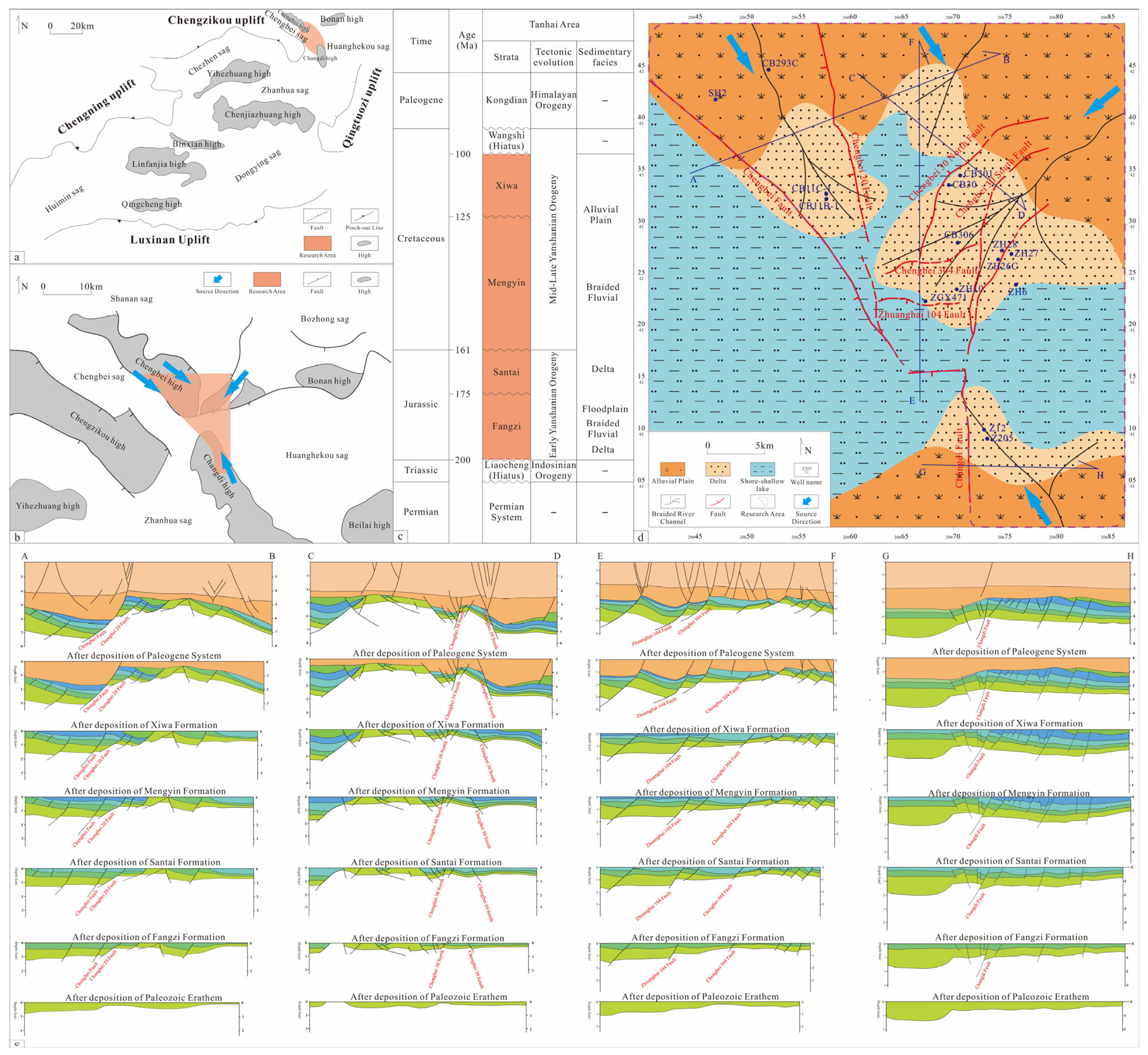
The Jiyang Depression is located in the southern part of the Bohai Bay Basin. It is a Meso-Cenozoic rift basin developed on a pre-Mesozoic basement [36,43,44,45,46]. The Tanhai area (study area) is situated between the Chengbei and Changdi uplifts in the northeastern part of the depression (Figure 1a,b). The tectonic evolution of this area was controlled by the Indosinian, Yanshanian, and Himalayan movements, along with intense activity along the Tan-Lu Fault Zone. This resulted in multi-phase faulting, uplift, and erosion events [34,37,38]. A direct consequence is the development of multiple regional unconformities within and at the top/bottom of the Mesozoic strata (Figure 1c). These unconformities are key channels for later meteoric water infiltration and deep fluid vertical migration. They decisively influence the nature and activity range of diagenetic fluids [47,48,49,50,51,52,53].
The Mesozoic strata from bottom to top include the Fangzi Formation (J1-2f), Santai Formation (J3s), Mengyin Formation (K1m), and Xiwa Formation (K1x). The Indosinian movement caused erosion of the underlying strata. The Yanshanian movement was the main tectonic period. Its early and middle-late phases correspond to Jurassic and Cretaceous sedimentation, respectively (Figure 1c) [37,38,54]. Volcanic rock (andesite) interbeds or andesitic lithic fragments are widely developed in the Cretaceous Mengyin and Xiwa Formations (encountered in about 30% of wells). These volcanic materials are rich in unstable aluminosilicate minerals (volcanic glass). They provide a rich material basis for organic acid dissolution during burial and meteoric water dissolution during uplift. They may also significantly alter the geochemical properties of pore fluids [55,56,57,58,59]. Subsequent Himalayan movement triggered further uplift and erosion [34].
This multi-cycle tectonic history shaped a unique burial-thermal history trajectory. Based on published burial history models [54] and seismic interpretation and balanced section restoration of four key profiles (AB, CD, EF, GH in Figure 1d) in this study, the Mesozoic burial history can be divided into five stages closely related to diagenesis: Shallow Burial (Stage I), Uplift (Stage II), Secondary Shallow Burial (Stage III), Secondary Uplift (Stage IV), and Deep Burial (Stage V). Figure 1e clearly reveals significant differences in fault activity across stages. For example, the Chengbei Fault was intensely active during the Paleogene (throw up to 1000 m), while its activity was weak during the Mesozoic (throw only about 100 m). This periodicity and intensity difference in fault activity not only controlled the magnitude of local uplift/subsidence but also influenced the evolution of formation pressure, heat flow distribution, and potential stratigraphic pathways for fluid activity [25,26,27,28,60]. This provides a tectonic framework for differential diagenetic evolution in different structural positions (e.g., fault hanging wall vs. footwall). Based on this framework, this study systematically selected typical core samples from key structural positions such as fault hanging/footwalls and areas near unconformities for analysis for each tectonic stage.
Lithologically, the Mesozoic strata are dominated by gray to reddish-brown lithic arkose and sandy conglomerates. The compositional maturity index (Quartz/(Feldspar + Lithics)) averages 0.46, classifying them as low-maturity sandstones. They were deposited in braided river-delta to shallow lake environments [37]. The provenance was mainly from northern and southern uplift areas (Figure 1d). This petrological characteristic, rich in unstable components like feldspar and volcanic lithics, forms the material basis for later intense chemical diagenetic alteration (dissolution and cementation). The moderately sorted grain structure (Trask sorting coefficient SO = 1.55) determines its sensitivity to mechanical compaction.

3. Materials and Methods

3.1. Sample Collection

This study collected 90 core samples from the Mesozoic sections of 13 wells in the Tanhai area. The depth range is 2100–4500 m, covering the Fangzi, Santai, Mengyin, and Xiwa Formations. Sample selection aimed to cover different lithologies (fine sandstone, medium sandstone, coarse sandstone, sandy conglomerate). Based on the interpreted structural evolution profiles in Figure 1e, typical cored intervals were selected from key structural positions (e.g., fault hanging/footwalls, near unconformities) for each of the five tectonic-diagenetic stages. This ensures the samples represent the dominant diagenetic environment of each stage (specific selection criteria and intervals are shown in Section 4.2).

3.2. Analytical Methods

3.2.1. Petrology and Mineral Microscopy Analysis

This includes thin-section analysis and scanning electron microscopy (SEM) with energy dispersive spectroscopy (EDS). For thin-section analysis, all samples were first prepared into standardized thin sections (30 µm thick) impregnated with blue epoxy resin. A Zeiss Axioimager A2 POL polarizing microscope (Carl Zeiss AG, Oberkochen, Germany) was used for observation. At least 400 point counts were performed on each thin section to determine detrital grain composition and types [61]. The type, content, and occurrence of authigenic minerals (cements) were semi-quantitatively analyzed using image analysis software (Image-Pro Plus 7.0). For SEM-EDS analysis, representative samples were selected, coated with carbon, and examined using a TESCAN VEGA GMS scanning electron microscope (TESCAN ORSAY HOLDING, a.s., Brno-Kohoutovice, Czech Republic) for micron-nanoscale morphology observation. Operating conditions were as follows: accelerating voltage 15 kV, beam current 1 nA, working distance 10 mm. A GENESIS-EDX spectrometer (AMETEK Inc., Berwyn, PA, USA) was used for qualitative and semi-quantitative micro-area elemental analysis to identify fine authigenic minerals.

3.2.2. Mineral Composition and Grain Size Analysis

Whole-rock and clay mineral analyses were performed on a Panalytical Empyrean X-ray diffractometer (PANalytical, Almelo, The Netherlands). Testing conditions were as follows: Cu-Kα radiation (λ = 1.5406 Å), voltage 45 kV, current 40 mA, scan range 2θ = 2–70° (whole rock), and 2–30° (clay minerals). Clay mineral samples were successively treated by natural air-drying, ethylene glycol saturation, and heating at 550 °C to distinguish smectite, kaolinite, chlorite, etc. Mineral content was calculated using the Reference Intensity Ratio (RIR) method. Using thin-section photomicrographs, the short-axis diameter of at least 300 grains was measured via Image-Pro Plus software (v6.0) to calculate the Trask sorting coefficient (So) and median grain size for each sample.

3.2.3. Reservoir Property and Pore Structure Characterization

Helium porosity (Φ) and pulse-decay permeability (K) were measured on 2.5 cm diameter core plugs using an UltraPore 300 porosimeter (Quantachrome Instruments, Boynton Beach, FL, USA) and a PDP-200 permeameter (Temco, Inc., Oklahoma City, OK, USA), respectively, following industry standards. Estimated measurement uncertainties are ±0.5% and ±5%, respectively a Micromeritics AutoPore IV 9500 (Micromeritics Instrument Corporation, Norcross, GA, USA) fully automated mercury injection porosimeter was used. Experiments were conducted at constant temperature (20 °C), with pressure ranging from 0.1 psi to 33,000 psi, corresponding to throat diameters from approximately 1000 µm to 0.005 µm. Data were used to calculate throat size distribution, displacement pressure (Pd), and median throat radius (R50).

3.2.4. Diagenetic Stage and Sequence Analysis

Diagenetic stages were determined using multiple indicators. First, thermal maturity stages were determined based on petrological indicators (e.g., grain contacts, authigenic mineral assemblages, pore types) and clay mineralogical indicators (percentage of smectite layers in illite/smectite (I/S) mixed-layer), following the industry standard “SY/T 5477-2003” and international schemes [25,26,27,28,60,62]. Second, these observations were combined with regional published burial-thermal history models. Their provided paleotemperature framework supplied absolute time and temperature constraints for diagenetic events. Finally, the diagenetic sequence was established primarily based on structural relationships such as cross-cutting, inclusion, coexistence, and dissolution/replacement between mineral grains and cements observed in thin-section and SEM images to determine the relative chronological order of different diagenetic events [63,64].

3.2.5. Quantitative Porosity Evolution Calculation Model

A back-stripping model based on mass balance principles was established to quantitatively reconstruct porosity evolution history.
(1)
Original porosity (Φ0) calculation: Based on the average sorting coefficient (SO = 1.55) from image grain size analysis, the empirical formula by Beard and Weyl (1973) [65], Φ0 = 20.91 + 22.90/SO, was used to calculate the original porosity as 35.7%.
(2)
Compaction factor (C) calibration: Sample groups from Stage V, dominated by continuous burial, were selected. Their current primary porosity can be obtained by subtracting the thin-section-statistical secondary dissolution porosity from the total porosity. Since existing cements often form within primary pores (Φp), the remaining porosity after compaction (Φ1) was calculated using formula 1 based on cement content (Co). Combined with the porosity-depth exponential formula [66,67,68] (Formula (2)), the compaction factor (C) for the Mesozoic was determined (H is burial depth, set at 5 km based on Mesozoic burial history).
Φ1 = Co + Φp
Φ 1 = Φ 0 e ( C H )
(3)
Stage-wise porosity calculation: For each tectonic stage, the compaction porosity loss (ΔΦcomp) was calculated using the difference in Φ1. Compaction loss during uplift stages was recorded as 0%. Cementation porosity loss (ΔΦcem) was taken as the net increase in cement volume for that stage (Cj). The dissolved volume of carbonate cement (Cdis) and the volume of carbonate cement in each stage were statistically analyzed. The volume from the previous stage was used as the initial carbonate cement volume for the current stage (Cl). Since carbonate cements account for over 70% of total cements, with other cements being minor, carbonate cement data were used to represent all cements here. The net cement increment for the stage (Cj) was calculated using Cj = Cdis + Cl − Cp (where Cp is the carbonate cement volume in the current stage). Dissolution porosity gain (ΔΦdiss) was taken as the average thin-section dissolution porosity of samples from that stage. Finally, the porosity at the end of the stage (Φend) was calculated using Φend = Φ0 − ΔΦcomp − ΔΦcem + ΔΦdiss.
The advantage of this model is the transformation of qualitative diagenetic descriptions into quantitative porosity gains and losses. Its main uncertainties stem from the original porosity calculation, the homogeneity assumption of the compaction model, and the representativeness of 2D thin-section statistics for 3D pore volume. Consequently, the model necessarily employs simplified assumptions (e.g., an empirical porosity formula, 2D-to-3D representation, and negligible compaction during uplift), which affect the absolute porosity values calculated for each stage. However, these simplifications do not obscure the dominant cyclic trends of porosity destruction and enhancement across tectonic stages, which are the focus of the interpretation. These aspects are further addressed in the Section 5.

4. Results

4.1. Petrological Composition and Basic Reservoir Properties

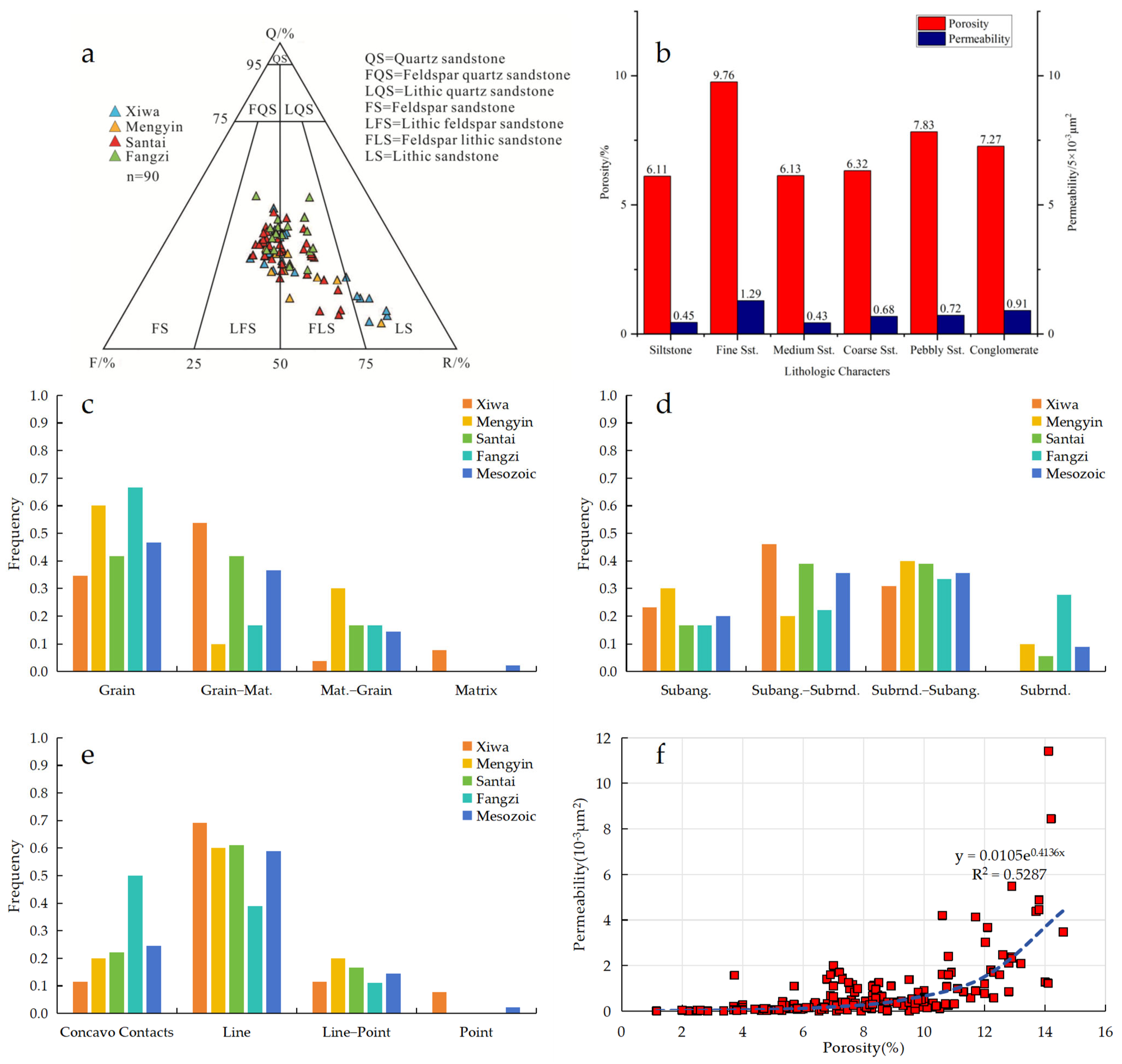
Whole-rock and microscopic petrological analysis of 90 thin sections shows that the Mesozoic clastic rocks in the Tanhai area include sandstones and sandy conglomerates. According to the Folk (1974) classification scheme [69], sandstones are mainly lithic arkose (51%) (Figure 2a). Statistical results (Table 1) show large variations in detrital composition and richness in unstable components: average quartz content 26.54% (range: 8%–44%), average feldspar 26.96% (12%–36%), average lithics 33.3% (15%–70%). Lithics mainly include felsic lithic fragments (Figure 3a) and andesitic lithic fragments (Figure 3b). Sandstones are typically grain-supported (47%), with subrounded-subangular grains (36%), line contacts (59%), and moderate sorting (Trask sorting coefficient SO = 1.55).
Property tests show overall poor reservoir quality (Figure 2b,f). Porosity (Φ) ranges from 1.56% to 14.59%, averaging 7.16%. Permeability (K) ranges from 0.002 to 11.41 × 10⁻³ µm2, averaging 0.72 × 10⁻³ µm2. It shows a strong positive correlation with porosity (K = 0.0105× 100.4136Φ, R2 = 0.53) (Figure 2f). According to industry standards [70] (Φ < 15%, K < 10 × 10−3 µm2), the samples fall into the “low porosity and low permeability” category (Figure 2f). Among different lithologies, fine sandstone reservoirs have the best properties (average Φ = 9.76%, K = 1.29 × 10⁻³ µm2), while medium sandstone and siltstone have the worst (Figure 2b).

4.2. Selection of Typical Cored Intervals

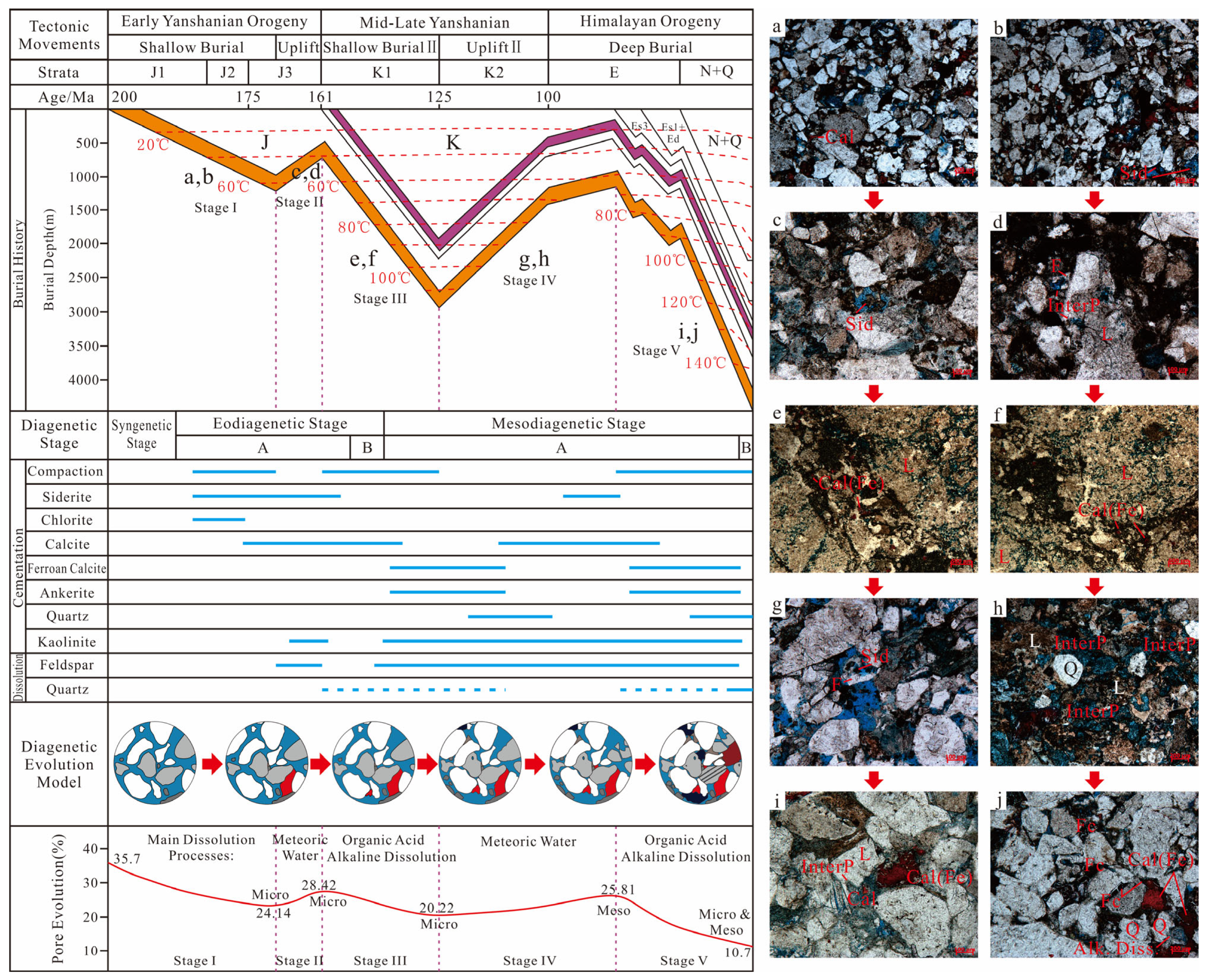
Based on the above analysis, the Mesozoic in the Tanhai area was mainly influenced by the Yanshanian and Himalayan movements. Combined with the Mesozoic burial history diagram of the study area (Figure 4 modified from [54]), the Mesozoic experienced two main uplifts during the early and middle-late Yanshanian. The structural evolution history of the reservoirs includes five stages: shallow burial, uplift, secondary shallow burial, secondary uplift, and deep burial.
Typical cored intervals were selected for different tectonic stages. On the EF profile (Figure 1e), the footwall of the Zhuanghai 104 Fault subsided significantly after Fangzi Formation deposition, with a throw of 600 m. No large-scale tectonic movement occurred in the Fangzi Formation thereafter (throw 200 m). Therefore, the Fangzi Formation cored interval in well ZGX471, located in its footwall, was selected as the typical cored interval for the shallow burial period. On the AB profile, the throw of the Chengbei Fault in the Mesozoic is small (100 m). It became intensely active during the Paleogene, with a significant increase in throw (1000 m). The Mengyin and Xiwa Formations in its hanging wall experienced only one main uplift. The Mengyin Formation cored intervals in wells CB11B-1 and CB11C-1, located in its hanging wall and close to the unconformity (distance < 100 m), were selected as typical cored intervals for the secondary uplift period. Similarly, the Fangzi Formation cored interval in well CB30, located in the hanging wall of the Chengbei 30 North Fault (Figure 1e shows Paleogene throw of 600 m, Mesozoic throw only 100 m), which is also near the Mesozoic-Cenozoic unconformity and experienced significant uplift and erosion, can also serve as a typical cored interval for the secondary uplift period. Likewise, typical cored intervals were selected for corresponding stages where tectonic activity was significant (large throw) and other stages were not (throw difference ≥ 400 m) (Table 2).

4.3. Diagenetic Characteristics

4.3.1. Compaction

Grain contact relationships are dominated by concavo-convex contacts (24%) and line contacts (59%). Point-line contacts account for about 14% (Figure 2e and Figure 3c). Bending deformation of ductile components (e.g., micas) is common (Figure 3d). Fracturing of quartz and feldspar grains occurs in samples with burial depths greater than 2700 m (Figure 3e). Image analysis of 90 representative samples from the five stages shows that the proportion of line + concavo-convex contacts systematically increases with equivalent burial depth, from ~50% in Stage I to >85% in Stage V (Table 3). This confirms the continuity and staged nature of compaction. Notably, samples with continuous chlorite rims (thickness > 5 µm) show a higher proportion of line-point contacts (up to 60%) (Figure 3f). This indicates that chlorite rims play an important inhibitory role against compaction.

4.3.2. Cementation

Statistical analysis of cement content in 90 samples shows that carbonate cement constitutes over 70% of the total cement volume. Its volume fraction ranges from 1% to 26% (average 6.8%). At least three main phases of carbonate cementation can be distinguished through petrology, staining, and paragenetic relationships (Figure 3g,h):
Early Carbonate Cement: Mainly non-ferroan to low-ferroan calcite and siderite. Calcite fills primary intergranular pores in poikilotopic or microcrystalline form, staining bright red (Figure 3h and Figure 4a). Siderite occurs as microspherulitic particles scattered in distribution (Figure 4b,c,g). This phase is common in samples from Stages I, II, and IV and often shows dissolved edges.
Mid-Carbonate Cement: Mainly Fe-calcite, staining dark red, filling intergranular pores with a spotty distribution. It mainly appears in samples from Stages III and V (Figure 3h and Figure 4e,f,i,j) and shows replacement contacts with the first-phase cement.
Late Carbonate Cement: Mainly ferroan calcite (stains blue-purple) and ferroan dolomite (stains dark blue), occurring as coarse-crystalline, blocky fillings in residual intergranular and intragranular pores (Figure 3g,i and Figure 4j). It mainly appears in samples from Stages III and V and often replaces mid-carbonate.
Silica cement is generally weak (<3%), mainly manifesting as quartz overgrowths (Figure 3a) and authigenic quartz (Figure 3j) [13,71]. In some quartz-rich samples, its content can reach 5%. Clay mineral cements were identified via SEM and XRD. Kaolinite occurs as vermicular or booklet aggregates filling pores, often associated with dissolved feldspar (Figure 3k). Illite/smectite mixed-layer and illite occur as honeycomb-like and platy crystals filling pores (Figure 3l,m). Chlorite mainly forms radial crystal rims coating grains (thickness > 5 µm) (Figure 3f). XRD analysis shows that clay minerals are dominated by kaolinite (61%–78%). The smectite layer proportion in I/S mixed-layer is about 20%, indicating thermal evolution has entered the mesodiagenetic stage.

4.3.3. Dissolution

Dissolution is the main mechanism for forming secondary porosity. It can be divided into two types based on fluid and dissolved mineral types:
Acidic Dissolution: The main targets are feldspar and volcanic lithic fragments. It produces intergranular dissolution pores (Figure 4d,h,i), intragranular dissolution pores (Figure 3n), and moldic pores (Figure 3o). It is always associated with the precipitation of authigenic kaolinite (Figure 3k). Dissolution of carbonate cement is also common (Figure 4i).
Alkaline Dissolution: Manifests as embayed or jagged dissolution of detrital quartz grains and quartz overgrowths (Figure 3b and Figure 4j). This phenomenon is spatially closely associated with volcanic rock layers (andesite) or large volcanic lithic fragments. In these areas, cements filling the pores are often ferroan calcite (Figure 3p), which is stable under alkaline-reducing conditions. The association of “volcanic rock layer/lithic + quartz dissolution + ferroan carbonate cement” is key to identifying alkaline dissolution related to volcanic rocks.

4.3.4. Replacement

Replacement involves ion exchange within crystal structures [72,73,74]. Thin-section observations reveal that the main replacement in the Mesozoic reservoirs is the replacement of earlier carbonate minerals by later ones. Examples include ferroan calcite replacing Fe-calcite (Figure 3g), and Fe-calcite replacing calcite (Figure 3h). Replacement helps determine the chronological order of mineral formation. Since ferroan calcite formation requires alkaline-reducing conditions [75,76], replacement can indicate the presence of alkaline fluids.

4.4. Diagenetic Sequence and Stages

Based on cross-cutting relationships between minerals observed in thin sections, the chronological order of diagenetic events was established (Figure 4). Key observational evidence includes the following: (1) Calcite cement (Figure 4a) and siderite cement (Figure 4b,c,g), representing early carbonate cement, appear in Stages 1, 2, and 4. The edges of calcite and siderite are embayed, indicating that early carbonate cementation was common during shallow burial and is susceptible to acidic dissolution. (2) In Figure 3o, Fe-calcite representing mid-carbonate cement has a regular edge distinct from authigenic quartz. This Fe-calcite is embedded within quartz overgrowths, indicating that the main growth period of this quartz overgrowth ended before this Fe-calcite cementation. (3) In Figure 3a, ferroan calcite representing late carbonate cement has irregular edges, indicating it underwent acidic dissolution. This ferroan calcite is enveloped by quartz overgrowths, and its irregular shape is constrained by the growth boundaries of the overgrowths. This indicates that this quartz overgrowth occurred after ferroan calcite cementation and subsequent dissolution, enveloping and modifying it. (4) Ferroan calcite develops at the edges of Fe-calcite, replacing it, and also within feldspar dissolution pores (Figure 3g,i). This indicates late carbonate formation postdates mid-calcite and feldspar dissolution.
Combining this with the burial history, the derived diagenetic sequence is: Mechanical Compaction I (Stage I) → Carbonate Cementation I/Chlorite Rim Formation (Stage I) → Feldspar (Acidic) Dissolution & Kaolinite Precipitation I (Stage II) → Carbonate Cementation II (Stage II–III) → Feldspar (Acidic) Dissolution & Kaolinite Precipitation II (Stage III–IV) → Quartz Cementation I (Stage IV) → Carbonate Cementation III (Stage IV–V) → Quartz Cementation II (Stage V) → Alkaline Dissolution (Stage V) (Figure 4. In the figure, the blue dashed line for quartz dissolution indicates dissolution related to volcanic rock; calcite includes calcite and Fe-calcite. Additionally, based on the common occurrence of chlorite rims coating detrital grains and their inhibitory effect on later diagenesis, it is inferred that chlorite rim formation occurred in the eodiagenetic stage).
The burial depth of Mesozoic samples ranges from 2100 to 4500 m. XRD analysis (Table 4) shows that the clay mineral assemblage is dominated by kaolinite (content 61%–78%), with low illite content (9%–17%) and little chlorite (mostly ≤5%). The smectite layer proportion in I/S mixed-layer is stable at about 20%. According to the “Classification of Diagenetic Stages of Clastic Rocks (SY/T 5477-2003)” and international schemes [25,26,27,28,60,62], this proportion indicates that smectite has transformed to the end of the disordered mixed-layer (R0) stage, corresponding to a paleotemperature range of 70–90 °C [23]. Combined with regional burial history data cited in this study, the paleotemperatures experienced in this depth range (~80 °C at 2000 m to ~140 °C at 4000 m) are consistent with the clay mineral temperature indicator. Simultaneously, thin-section observations show that grain contacts are mainly line contacts (59%). The proportion of concavo-convex contacts increases at greater depths (>4000 m). Integrating the clay mineral transformation temperature, grain contact relationships, and the presence of authigenic minerals like ferroan calcite and ferroan dolomite (Figure 3g,i), it is determined that the reservoirs in the study area have mainly entered mesodiagenetic stage A. In intervals deeper than 4000 m with paleotemperatures above 140 °C, grain contacts are tighter and quartz dissolution increases significantly (Figure 4j), marking a change in the diagenetic environment, possibly entering mesodiagenetic stage B.

4.5. Evolution of Pore-Throat System

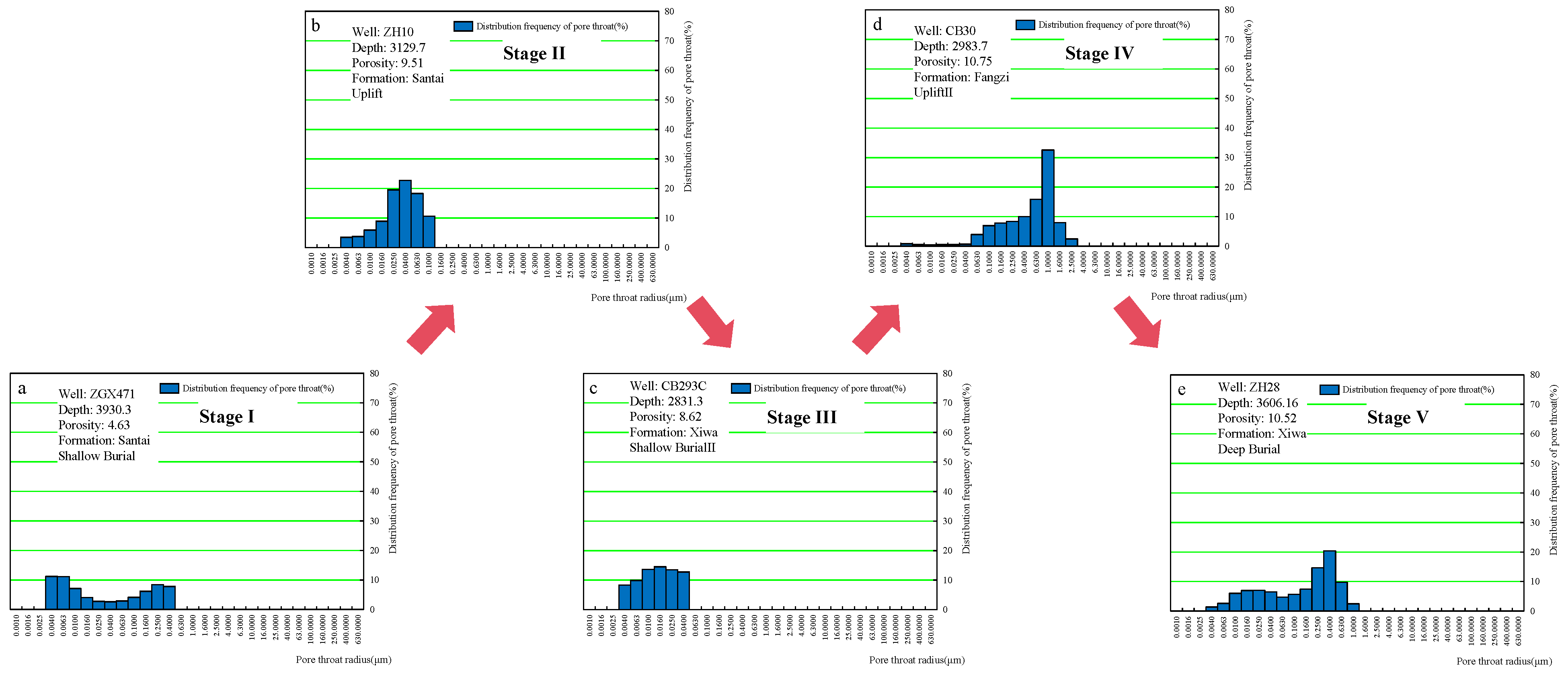
High-pressure mercury injection data reveal systematic differences in pore-throat structure across different tectonic stages (Figure 5, Table 3).
Stages I & III (Burial Stages): Pore-throat distribution shows a pronounced unimodal micropore characteristic, with the main peak at <0.1 µm and small median radii (<0.02 µm). This visually reflects the strong destruction and densification of the pore system by compaction and cementation.
Stages II & IV (Uplift Stages): Pore-throat distribution expands towards larger throats. Stage IV is particularly evident, showing a significant mesopore-throat peak (0.1–10 µm), with a median radius up to 0.838 µm. This aligns well with the peak in thin-section-derived dissolution porosity (8.5% in Stage IV) and the corresponding peaks in measured porosity and permeability (10.25%, 1.22 × 10⁻³ μm2 in Stage IV). This quantitatively confirms the decisive role of meteoric water leaching in improving reservoir porosity and flow capacity.
Stage V (Deep Burial Stage): Shows a bimodal distribution, with both micropore (<0.1 µm) and mesopore (0.1–10 µm [77]) peaks. This reflects the competition and coexistence of destructive (compaction, cementation) and constructive (organic acid/alkaline dissolution) processes in this stage.

5. Discussion

5.1. Control of Multi-Phase Tectonic Activity on Diagenetic Pathways and Pore Structure

The diagenetic evolution of Mesozoic reservoirs in the Tanhai area is not a simple function of burial depth. It is a complex process controlled by multi-phase tectonic activity. The five-stage tectonic-diagenetic model proposed in this paper (Figure 4) is supported by multiple lines of evidence.
First, the temporal framework of the model is directly derived from petrological observations. The cross-cutting relationships in thin sections (Section 4.4) provide the relative timing evidence that establishes the basic sequence of diagenetic events.
Second, the stage division of the model is systematically supported by temperature, depth, and pore structure evolution. Quantitative data show diagnostic shifts with tectonic stage: uplift stages (II, IV) exhibit higher porosity (e.g., 10.25% in Stage IV) and mesopore-throat development (median radius up to 0.838 µm), directly linking porosity enhancement to meteoric water leaching. In contrast, burial stages (I, III, V) are marked by porosity reduction, with Stage V showing the strongest carbonate cementation (13.64%) and a unique bimodal pore-throat structure (Figure 5), signaling a change in deep fluid chemistry.
Third, the model is fully compatible with regional tectonic-burial history, achieving absolute time calibration. The constructive diagenetic stages (II, IV) coincide with regional uplift periods (>25 Ma exposure for Stage IV), while the destructive cementation peak (Stage V) corresponds to rapid deep burial. Paleotemperature from clay minerals (I/S ≈20%, ~70–90 °C) further anchors diagenesis within this thermal framework.
Notably, a key comparison deepens the above understanding: Although Stage III also has volcanic material and suitable temperatures (~120 °C), its pore system is still dominated by micropores (Figure 5c). This indicates that under a rapid burial background, intense compaction and cementation processes dominated the final pore system structure, completely suppressing the constructive effect of contemporaneous dissolution. In contrast, the long-term uplift background (>25 Ma) of Stage IV promoted fluid alkalinization and quartz dissolution as described in Section 5.2, thus efficiently constructing a mesopore system. This contrast highlights that tectonic background is a prerequisite for determining whether deep dissolution mechanisms (alkaline dissolution) can effectively improve reservoirs.
Finally, the model further reveals that the macroscopic reservoir heterogeneity controlled by tectonic evolution is ultimately regulated at the microscopic scale by the differential distribution of early diagenetic products (e.g., chlorite rims). Microscopic observations (Figure 3f) show that some samples have continuous chlorite rims. These products formed during the syndepositional-shallow burial stage. According to classic studies, they can inhibit quartz cementation and enhance compaction resistance [23]. This is consistent with the observed higher line-point contact proportion and lower silica cement content in this study. Therefore, these early diagenetic products can act as intrinsic preset conditions that influence reservoir micro-heterogeneity and “sweet spot” distribution within the broader tectonic cycle.
In summary, this tectonic-diagenetic model integrates evidence across all scales, from microscopic sequences and temperature responses to absolute timing and macroscopic background. This study illustrates that predicting reservoir quality in multi-phase tectonic areas benefits from a “tectonic stage-diagenetic response-pore structure” ternary coupling analytical framework, which provides a more comprehensive approach than relying solely on burial curves.

5.2. Petrographic Evidence and Interpreted Mechanism for Alkaline Dissolution

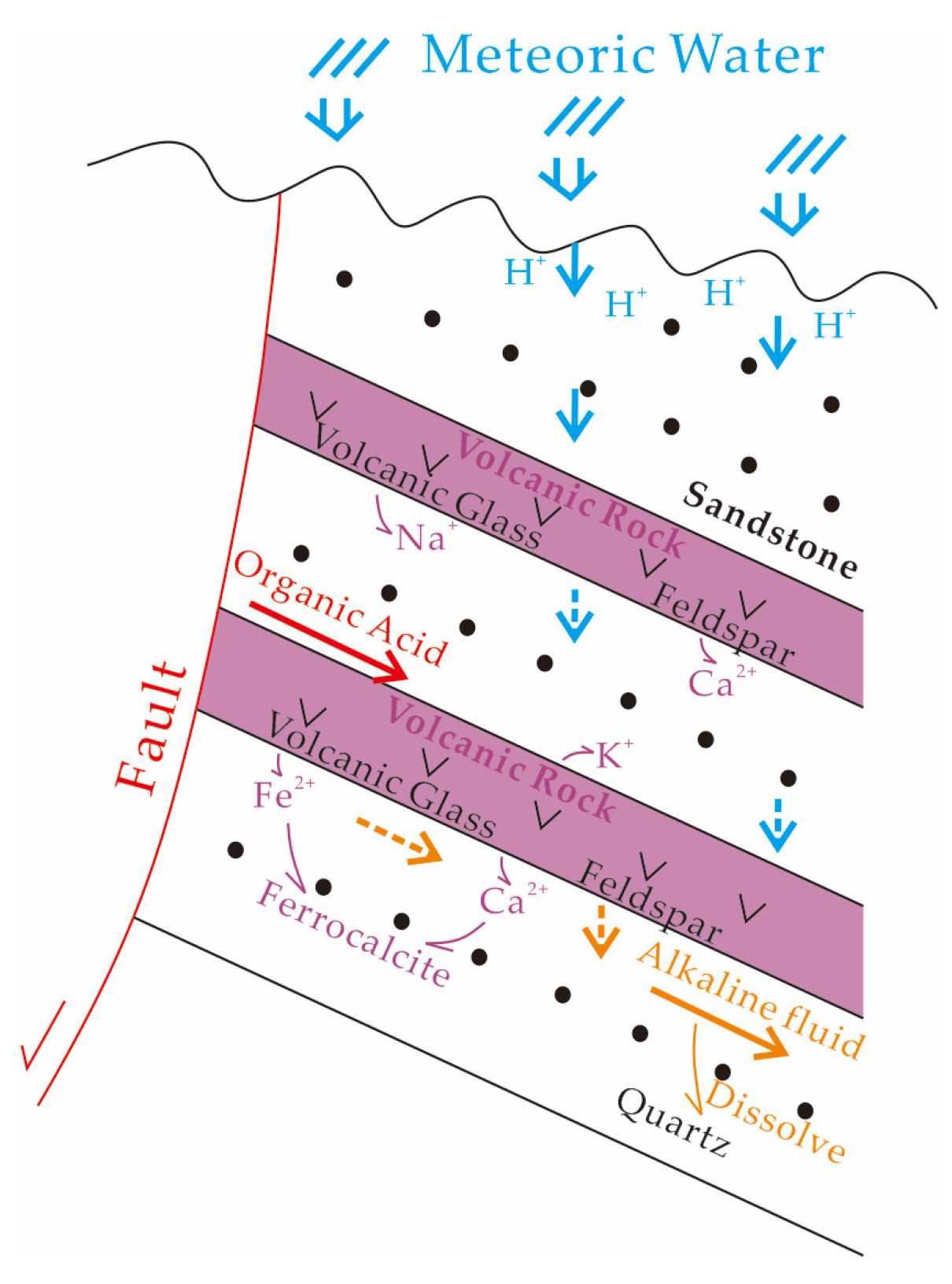
In typical sandstone diagenesis, quartz is considered stable under most subsurface conditions. Its dissolution requires high pH (>9) alkaline fluids [8]. This study directly observed embayed dissolution of quartz adjacent to andesitic lithic fragments in thin sections and SEM (Figure 3b). This is key petrological evidence for the presence of alkaline fluids. Based on the observed spatial and mineralogical associations, we interpret a possible formation process (Figure 6): (1) Acidic initiation: Organic acids or meteoric water first dissolve unstable components (volcanic glass, feldspar) in volcanic rocks (e.g., andesite). (2) Fluid alkalinization: The acidic dissolution process of volcanic rocks and their lithic fragments releases large amounts of ions such as Na+, K+, Ca2+, Fe2+. The hydrolysis and accumulation of these ions significantly increase fluid pH, turning it alkaline [55,56,57,58,59]. (3) Quartz dissolution and mineral precipitation: The alkaline fluid becomes undersaturated with respect to silica, leading to quartz dissolution. Simultaneously, Ca2+ and Fe2+, already enriched in the solution from the prior acidic dissolution, combine with carbonate under reducing conditions, jointly promoting the precipitation of ferroan calcite (Figure 3i,p). The precipitation of ferroan calcite is consistent with an alkaline-reducing fluid environment, supporting the interpretation of alkaline conditions [55,56].
This finding has significant exploration implications. Under deep burial conditions (e.g., Stage V), conventional acidic dissolution may weaken. In contrast, alkaline dissolution associated with volcanic rocks provides a non-traditional mechanism for forming secondary porosity. It can still locally develop reservoirs with relatively good properties within deeply buried, generally highly cemented sequences.
It should be noted that the identification of alkaline fluids in this study is primarily based on petrographic evidence (spatial association and mineral assemblages). Although direct geochemical constraints (e.g., from fluid inclusions or isotopes) are lacking, the observed coherent evidence chain—comprising the presence of volcanic rock/lithics, associated quartz dissolution, and concomitant ferroan calcite precipitation—provides a strong petrographic basis for inferring this alkaline diagenetic process and its constructive impact on reservoir quality.

5.3. Quantitative Reconstruction of Porosity Evolution and Prediction of Diagenetic Sweet Spots

To quantitatively evaluate the modification of porosity by multi-phase diagenetic processes, we employed a back-stripping analysis method based on mass balance principles. The aim is to reveal the relative importance and evolution of constructive (dissolution) versus destructive (compaction, cementation) processes in different tectonic stages.

5.3.1. Method and Data Summary

Original porosity was calculated as 35.7% based on the sorting coefficient (SO = 1.55). Other core data include the measured average porosity, cement volume content, and thin-section statistical dissolution porosity for each stage (Table 3). The compaction factor for the study area (C = 0.18 km−1), compaction porosity loss, cementation porosity loss (net cement increment), and dissolution porosity gain (average dissolution porosity) for each stage were calculated. Porosity for each tectonic stage was calculated quantitatively (Table 5).

5.3.2. Quantitative Evolution Process and Sweet Spot Identification

The quantitative porosity model reveals two complete porosity “destruction-construction” cycles aligned with tectonic stages (Table 5, Figure 4). Each cycle involves intense porosity loss during burial (e.g., loss of ~9.7% in Stage III) followed by significant recovery during subsequent uplift, primarily driven by meteoric water dissolution (gain of up to 8.50% in Stage IV). The second cycle culminates in the highest modeled porosity of 25.81% at the end of Stage IV. The final deep burial stage (V) is net destructive due to very strong cementation, yet the concurrent significant dissolution porosity gain (6.75%) and the distinctive bimodal pore-throat structure indicate local constructive processes were active.
Based on the above evolutionary patterns and pore-throat structure characteristics (Figure 5), we define “diagenetic sweet spots” as reservoir intervals where the local net effect of constructive processes like dissolution significantly exceeds the contemporaneous destructive effects of compaction and cementation. They possess: (1) Preserved porosity greater than 8%; (2) A pore-throat system rich in mesopores (0.1–10 µm), where mesopores dominate the contribution to permeability. According to this definition, two genetically different sweet spot types are identified.
Type I (Uplift Leaching Type): Formed in Stage IV. Characterized by high porosity (>10%) and mesopore-throat dominance (unimodal). The main controlling factor is long-term meteoric water leaching.
Type II (Deep Alkaline Dissolution type): Formed locally in Stage V. Characterized by moderate porosity (8%–10%) and a significant mesopore component within a bimodal pore-throat system. The main controlling factor is alkaline dissolution related to volcanic rocks. It also requires relatively shallow burial (<4000 m) to avoid extreme compaction.

5.3.3. Validation of the Sweet Spot Model

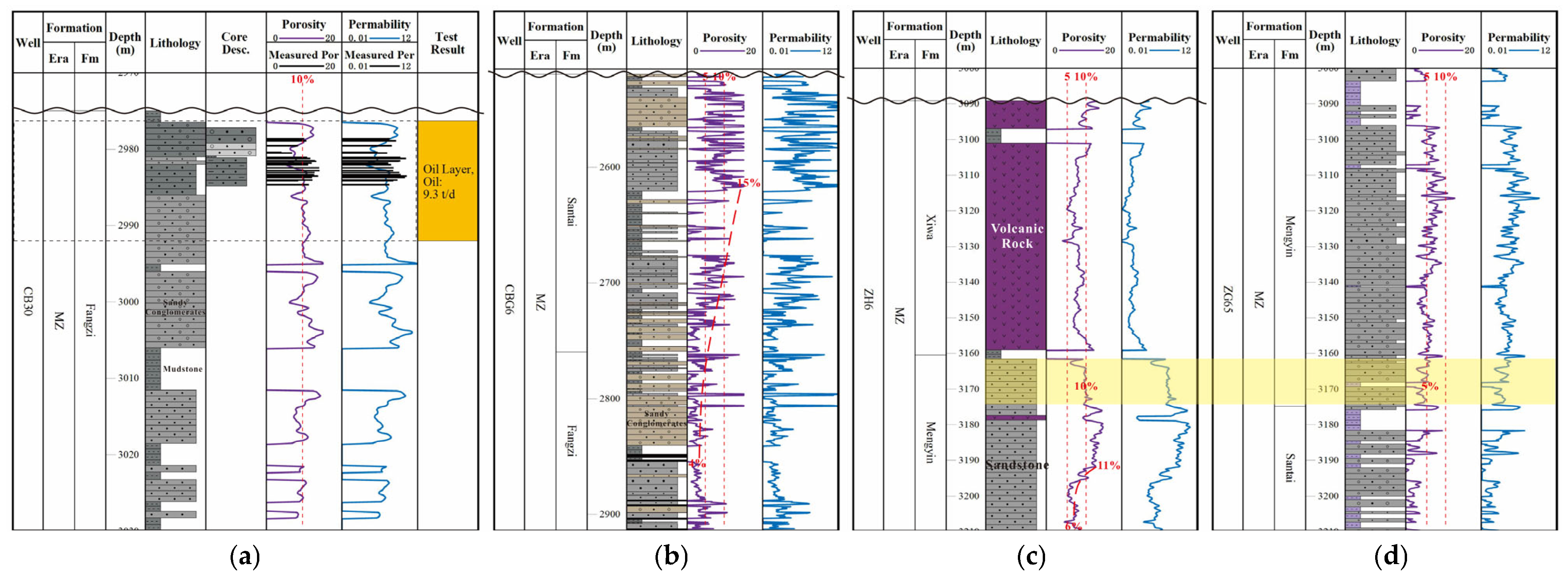
Well logging and production test data strongly support the above classification (Figure 7). Wells CB30 and CBG6, located near the unconformity, have porosity >10% and mesopore-throat dominance (Figure 5d), conforming to Type I diagenetic sweet spots. These locations have stable commercial oil flow (CB30 well: 9.3 t/d). The Xiwa Formation interval near volcanic rock in well ZH6 has a porosity up to 10% and a bimodal pore-throat system. With increasing vertical and lateral distance (laterally compared to the same interval in neighboring well ZG65), porosity rapidly drops below 5%. This empirically confirms the existence of Type II sweet spots and their vertical and lateral limitations controlled by volcanic rocks.

5.3.4. Uncertainties and Limitations of the Porosity Model

The quantitative back-stripping model in this study clearly reveals the “destruction-construction” cyclic pattern of porosity evolution. It successfully associates sweet spots with specific tectonic-diagenetic stages. There is a discrepancy of about 2.6% between the calculated porosity (10.7%) and the measured value (8.1%) for Stage V. This primarily stems from uncertainties arising from several key simplifications. Among them, the treatment of the compaction model has a significant impact. The model sets compaction loss to zero during uplift stages (II and IV), based on the classic simplification of overburden pressure release. However, actual uplift processes may still involve weak compaction due to differential stress or slow pressure dissolution [78]. Neglecting this process overestimates porosity preservation during uplift and results in a higher initial porosity for subsequent burial stages (III and V), leading to a cumulative positive bias in the final result. Therefore, the quantitative porosity values in Table 5 should be viewed as illustrative of relative trends between stages rather than absolute historical porosities. Nevertheless, such uncertainties affect the precise numerical values but do not invalidate the cyclical trend of evolution, nor do they affect the core geological understanding that “meteoric water leaching” and “alkaline dissolution” are the main controlling mechanisms for the two sweet spot types. Future research can refine this quantitative framework by establishing differentiated compaction models.

5.4. Implications for Exploration in Multi-Phase Tectonic Basins

This study establishes a unified “tectonic stage-diagenetic response-pore structure” analytical framework. For exploration in multi-phase tectonic basins, the following three-step approach can be adopted: (1) Precisely reconstruct the burial-uplift history to identify major unconformities and adjacent intervals (seeking Type I sweet spots). (2) Identify special lithological bodies, such as volcanic rock layers, and evaluate their potential for triggering alkaline dissolution (seeking Type II sweet spots). (3) Enhance pore-throat structure analysis, using data like mercury injection to distinguish diagenetic sweet spots dominated by mesopores. Combining tectonic analysis with diagenetic-pore studies is key to improving prediction accuracy for such complex reservoirs.

6. Conclusions

(1)
Tectonic cycles are the main controlling factor of diagenetic evolution. The Mesozoic reservoirs in the Tanhai area of the Jiyang Depression experienced a five-stage tectonic-diagenetic evolution. Quantitative analysis indicates that meteoric water leaching during the secondary uplift stage (Stage IV) was the key constructive event associated with high-porosity, mesopore-throat developed, high-quality reservoirs. The deep burial stage (Stage V) is characterized by intense multi-phase carbonate cementation as the primary destructive feature.
(2)
Diagenetic processes differentially modify pore structure. Compaction and cementation primarily drive the transformation of pores into micropores (<0.1 µm). Meteoric water dissolution and alkaline dissolution related to volcanic rocks are the main mechanisms for forming mesopores (0.1–10 µm), which are crucial for fluid flow. Organic acid dissolution mainly contributes to micropores.
(3)
Two types of diagenetic sweet spots were identified and quantitatively characterized. (I) Uplift Leaching Type Sweet Spots: Distributed below major unconformities, characterized by intense meteoric water dissolution and high porosity/permeability. (II) Deep Alkaline Dissolution Type Sweet Spots: Distributed in relatively shallow intervals within a deep burial background that are influenced by volcanic rocks. Alkaline dissolution is the main cause of their porosity improvement. This expands the exploration thinking for effective deep reservoirs.
(4)
A reservoir quality analysis framework integrating tectonic stage, diagenetic response, and pore structure is established for the Tanhai Zone. This study demonstrates that in such complex settings, reservoir quality prediction benefits from this integrated approach. This approach links macroscopic tectonic history with microscopic diagenetic-pore evolution, thereby providing guidance for sweet spot prediction.

Author Contributions

Conceptualization, D.H. and S.Y.; methodology, D.H.; validation, D.H.; formal analysis, D.H.; investigation, D.H., S.M., and Y.Z.; data curation, D.H., Q.W., and Y.W.; writing—original draft preparation, D.H.; writing—review and editing, D.H. and S.Y.; visualization, D.H.; supervision, S.Y.; project administration, S.Y.; funding acquisition, S.Y. All authors have read and agreed to the published version of the manuscript.

Funding

This research was funded by the China National Science and Technology Major Project (Grant Number: 2017ZX05009001).

Data Availability Statement

Data are contained within the article.

Acknowledgments

The authors appreciate Shengli Oilfield Company for providing the core samples, dataset, and permission for publication. The authors would like to thank the editors and reviewers for their help with this research.

Conflicts of Interest

Authors Qunhu Wu and Yanjia Wu were employed by the company SINOPEC. The remaining authors declare that the research was conducted in the absence of any commercial or financial relationships that could be construed as a potential conflict of interest. The SINOPEC had no role in the design of the study; in the collection, analyses, or interpretation of data; in the writing of the manuscript, or in the decision to publish the results.

References

  1. Zhu, X.; Qu, X.; Zhang, H.; Wang, W.; Miao, C.; Zhang, Y.; Wu, W. Characteristics and main controlling factors of the Sangonghe tight sandstone reservoirs in the Shengbei Sub-sag of the Turpan-Hami basin, China. Mar. Pet. Geol. 2025, 171, 107181. [Google Scholar] [CrossRef]
  2. Huo, H.-L.; Liu, C.-L.; Huang, D.-W.; Tian, A.-Q.; Awan, R.S.; Gao, H.-Y.; Liu, C.-X.; Chen, X.-Y.; Tian, Z.-Y.; Yang, T.-Z.; et al. Diagenesis and burial history controls on Oligocene Huagang sandstones, southern Xihu Sag (East China Sea Basin): Implications for the formation of effective reservoirs. Mar. Pet. Geol. 2025, 182, 107592. [Google Scholar] [CrossRef]
  3. Qian, W.; Sun, Q.; Jones, S.J.; Yin, T.; Zhang, C.; Xu, G.; Hou, G.; Zhang, B. Diagenesis and controlling factors of Oligocene Huagang Formation tight sandstone reservoir in the south of Xihu sag, the East China Sea Shelf Basin. J. Pet. Sci. Eng. 2022, 215, 110579. [Google Scholar] [CrossRef]
  4. Liu, C.; Rong, H.; Chen, S.; Tang, Y.; Deng, Y. Diagenesis and reservoir property variations of tight sandstone with burial depths ranging from shallow to ultra-deep in the Kuqa Depression, Tarim Basin, China. Nat. Gas Ind. B 2024, 11, 121–139. [Google Scholar] [CrossRef]
  5. Wu, D.; Li, H.; Jiang, L.; Hu, S.; Wang, Y.; Zhang, Y.; Liu, Y. Diagenesis and reservoir quality in tight gas bearing sandstones of a tidally influenced fan delta deposit: The Oligocene Zhuhai Formation, western Pearl River Mouth Basin, South China Sea. Mar. Pet. Geol. 2019, 107, 278–300. [Google Scholar] [CrossRef]
  6. Liu, M.; Xiong, C. Diagenesis and reservoir quality of deep-lacustrine sandy-debris-flow tight sandstones in Upper Triassic Yanchang Formation, Ordos Basin, China: Implications for reservoir heterogeneity and hydrocarbon accumulation. J. Pet. Sci. Eng. 2021, 202, 108548. [Google Scholar] [CrossRef]
  7. Houseknecht, D.W. Assessing the relative importance of compaction processes and cementation to reduction of porosity in sandstones. AAPG Bull. 1987, 71, 633–642. [Google Scholar] [CrossRef]
  8. Giles, M.R.; Marshall, J.D. Constraints on the development of secondary porosity in the subsurface: Re-evaluation of processes. Mar. Pet. Geol. 1986, 3, 243–255. [Google Scholar] [CrossRef]
  9. Schmidt, V.; Mcdonald, D.A. The Role of Secondary Porosity in the Course of Sandstone Diagenesis; SEPM (Society for Sedimentary Geology): Claremore, OK, USA, 1979. [Google Scholar]
  10. Zhang, Q.; Wu, X.-S.; Radwan, A.E.; Wang, B.-H.; Wang, K.; Tian, H.-Y.; Yin, S. Diagenesis of continental tight sandstone and its control on reservoir quality: A case study of the Quan 3 member of the cretaceous Quantou Formation, Fuxin uplift, Songliao Basin. Mar. Pet. Geol. 2022, 145, 105883. [Google Scholar] [CrossRef]
  11. Si, S.; He, J.; Zhao, Y.; Er, C.; Bai, Y.; Wu, W. Diagenesis of tight sandstone and its influence on reservoir properties: A case study of Fuyu reservoirs in Songliao Basin, China. Unconv. Resour. 2023, 3, 84–92. [Google Scholar] [CrossRef]
  12. Xi, K.; Cao, Y.; Liu, K.; Wu, S.; Yuan, G.; Zhu, R.; Kashif, M.; Zhao, Y. Diagenesis of tight sandstone reservoirs in the Upper Triassic Yanchang Formation, southwestern Ordos Basin, China. Mar. Pet. Geol. 2019, 99, 548–562. [Google Scholar] [CrossRef]
  13. Bjorlykke, K.; Aagaard, P.; Egeberg, P.K.; Simmons, S.P. Geochemical constraints from formation water analyses from the North Sea and the Gulf Coast Basins on quartz, feldspar and illite precipitation in reservoir rocks. Geol. Soc. Lond. Spec. Publ. 1995, 86, 33–50. [Google Scholar] [CrossRef]
  14. Mcbride, E.F. Quartz cement in sandstones: A review. Earth-Sci. Rev. 1989, 26, 69–112. [Google Scholar] [CrossRef]
  15. Li, P.; Hu, Z.; Liu, Z.; Xu, S.; Liu, Z.; Wang, A.; Liu, J.; Jin, W.; Huang, Y. Differential controlling on the deep tight sandstone reservoirs: Insight from the second member of lower Triassic Xujiahe Formation in Xinchang area, western Sichuan basin, China. J. Nat. Gas Geosci. 2024, 9, 387–399. [Google Scholar] [CrossRef]
  16. Wang, W.; Lin, C.; Zhang, X. Evaluation of sweet spots for a tight sandstone reservoir: A quantitative study of diagenesis in the fourth member of the Oligocene Huagang Formation, Xihu Depression, East China Sea Shelf Basin. Mar. Pet. Geol. 2024, 163, 106799. [Google Scholar] [CrossRef]
  17. Ehrenberg, S.N.; Nadeau, P.H. Sandstone vs. carbonate petroleum reservoirs: A global perspective on porosity-depth and porosity-permeability relationships. AAPG Bull. 2005, 89, 435–445. [Google Scholar] [CrossRef]
  18. Liu, L.; Li, Y.; Dong, H.; Sun, Z. Diagenesis and reservoir quality of Paleocene tight sandstones, Lishui Sag, East China Sea Shelf Basin. J. Pet. Sci. Eng. 2020, 195, 107615. [Google Scholar] [CrossRef]
  19. Xi, K.; Cao, Y.; Jahren, J.; Zhu, R.; Bjørlykke, K.; Haile, B.G.; Zheng, L.; Hellevang, H. Diagenesis and reservoir quality of the Lower Cretaceous Quantou Formation tight sandstones in the southern Songliao Basin, China. Sediment. Geol. 2015, 330, 90–107. [Google Scholar] [CrossRef]
  20. Surdam, R.C.; Crossey, L.J.; Hagen, E.S.; Heasler, H. Organic-inorganic interactions and Sandstone diagenesis. AAPG Bull. 1989, 73, 1–23. [Google Scholar] [CrossRef]
  21. Chen, X.; Ji, Y.; Yang, K. Impacts of sedimentary characteristics and diagenesis on reservoir quality of the 4th member of the Upper Triassic Xujiahe formation in the western Sichuan basin, southwest China. Mar. Pet. Geol. 2024, 167, 106981. [Google Scholar] [CrossRef]
  22. Qin, S.; Wang, R.; Shi, W.; Geng, F.; Luo, F.; Li, G.; Li, J.; Zhang, X.; Ostadhassan, M. Integrated controls of tectonics, diagenesis and sedimentation on sandstone densification in the Cretaceous paleo-uplift settings, north Tarim Basin. Geoenergy Sci. Eng. 2024, 233, 212561. [Google Scholar] [CrossRef]
  23. Worden, R.H.; Morad, S. Clay Minerals in Sandstones: Controls on Formation, Distribution and Evolution; Wiley-Blackwell: Hoboken, NJ, USA, 1999. [Google Scholar]
  24. Bjørlykke, K. Relationships between depositional environments, burial history and rock properties. Some principal aspects of diagenetic process in sedimentary basins. Sediment. Geol. 2014, 301, 1–14. [Google Scholar] [CrossRef]
  25. Jin, Z.; Xie, J.; Cao, Z.; Qiu, Y.; Zheng, C.; Lin, L. Tight sandstone diageneses, evolution, and controls on high-graded reservoirs in slope zones of foreland basins: A case study of the fourth Member of Xujiahe Formation, Tianfu gas field, Sichuan Basin. China Geol. 2025, 8, 325–337. [Google Scholar]
  26. Bello, A.M.; Usman, M.B.; Amao, A.O.; Al-Ramadan, K.; Al-Hashem, M.; Kachalla, A.; Abubakar, U.; Salisu, A.M.; Mukkafa, S.; Kwami, I.A.; et al. Diagenesis and reservoir quality evolution of estuarine sandstones: Insights from the Cenomanian-Turonian Yolde Formation, northern Benue Trough, NE Nigeria. Mar. Pet. Geol. 2024, 169, 107073. [Google Scholar] [CrossRef]
  27. Rodrigues, R.D.S.; Alves Da Silva, F.C.; Córdoba, V.C. Evolution of deformation bands, insights from structural diagenesis. J. Struct. Geol. 2021, 143, 104257. [Google Scholar] [CrossRef]
  28. Bello, A.M.; Usman, M.B.; Amao, A.O.; Salisu, A.M.; Al-Ramadan, K.; Abubakar, U.; Mukkafa, S.; Kwami, I.A.; Chiroma, L.U.; Al-Hashem, M.; et al. Linking provenance and diagenesis to reservoir quality evolution of sandstones: The Paleocene-Eocene Kerri-Kerri Formation, northeastern Nigeria. Mar. Pet. Geol. 2025, 172, 107227. [Google Scholar] [CrossRef]
  29. Yuan, H.; Dai, K.; Zhang, C.; Liu, L.; Jing, T.; Li, J.; Zhao, W.; Chen, F. Cenozoic sedimentary archives of a strike-slip fault zone in the Tanhai Region, Bohai Bay Basin, Northeastern China. J. Struct. Geol. 2024, 186, 105203. [Google Scholar] [CrossRef]
  30. Li, W.; Yue, D.-L.; Du, Y.-S.; Li, J.; Zhang, C.; Gong, Z.-Q.; Zhang, X.-T.; Shu, Q.-L.; Gao, J. Controls of accommodation to sediment-supply ratio on sedimentary architecture of continental fluvial successions. Pet. Sci. 2023, 20, 1961–1977. [Google Scholar] [CrossRef]
  31. Li, H.; Niu, C.; Xu, P.; Liu, Q.; Zhang, X.; Cui, H. Discovery of Bozhong 13-2 Archean large monoblock volatile buried hill oilfield and its oil and gas exploration significance. Nat. Gas Ind. B 2021, 8, 376–383. [Google Scholar] [CrossRef]
  32. Song, M.; Wang, Y.; Li, Y. Division of “layer exploration unit” and high-efficiency exploration in mature exploration area. Pet. Explor. Dev. 2018, 45, 544–552. [Google Scholar] [CrossRef]
  33. Xu, C.; Yang, H.; Wang, F.; Peng, J. Formation conditions of deep to ultra-deep large composite buried-hill hydrocarbon reservoirs in offshore Bohai Bay Basin, China. Pet. Explor. Dev. 2024, 51, 1421–1434. [Google Scholar] [CrossRef]
  34. Liu, H.; Zhao, D.; Jiang, Y.; Zhuang, M.; Liu, Y. Hydrocarbon accumulation model for Neogene traps in the Chengdao area, Bohai Bay Basin, China. Mar. Pet. Geol. 2016, 77, 731–745. [Google Scholar] [CrossRef]
  35. Li, W.; Yue, D.; Colombera, L.; Du, Y.; Zhang, S.; Liu, R.; Wang, W. Quantitative prediction of fluvial sandbodies by combining seismic attributes of neighboring zones. J. Pet. Sci. Eng. 2021, 196, 107749. [Google Scholar] [CrossRef]
  36. Shu, N.; Su, C.; Shi, X.; Li, Z.; Zhang, X.; Chen, X.; Zhu, J.; Song, L. Seismic description and fluid identification of thin reservoirs in Shengli Chengdao extra-shallow sea oilfield. Pet. Explor. Dev. 2021, 48, 889–899. [Google Scholar] [CrossRef]
  37. Hou, X. The Development Characteristics of Structures Inversion in Jiyang Depression and Its Relationship with the Evolution of Superimposed Basin. Ph.D. Thesis, China University of Petroleum, Dongying, China, 2010. [Google Scholar]
  38. Gao, X. Characteristics and comprehensive evaluation of Mesozoic clastic rocks in Qiaodao area. Nat. Gas Geosci. 2011, 22, 391–398. [Google Scholar]
  39. Zhao, B.; Yang, X.; Xu, Y. Characteristics and reservoir control of Cenozoic tectonic evolution of Nanpu Sag, Bohai Bay Basin. Lithol. Reserv. 2025, 37, 59–69. [Google Scholar]
  40. Feng, S.; Ji, H.; Chen, L. Diagenetic evolutions and controlling factors on sandstone reservoir in superimposed basin, Hexi Corridor: Insights from the Jurassic Xinhe Formation of Yabrai Basin. J. Palaeogeogr. 2025, 27, 731–745. [Google Scholar]
  41. Wei, J.; Zhang, L.; Wang, H.; Cao, Q.; Jing, X.; Yang, Y.; Zhang, Y.; Liu, G.; Li, H. Geological Characteristics and Their Coupling Relationship between Structural Evolution and Reservoir Formation of Paleozoic Oil Reservoirs in the Southern Section of the Western Edge of the Ordos Basin. Eart. Scie 2025, 50, 1933. [Google Scholar] [CrossRef]
  42. Cai, L. Research progress on the development characteristics and growth mechanism of clay minerals in tight sandstone reservoirs. Acta Sedimentol. Sin. 2023, 41, 1859–1889. [Google Scholar]
  43. Luqing, J.; Xilai, Z.; Chun, L.; Feng, Y.; Junjie, Z. The Disposition and Management Strategy of Decommissioning Offshore Oil Platform in Chengdao, China. Energy Procedia 2011, 5, 525–528. [Google Scholar] [CrossRef]
  44. Wang, Q.; Ren, Y.; Cao, R.; Xu, G.; Lv, X. The liquefaction pressure characteristics of silty soil in the Chengdao area: Numerical simulations. Ocean Eng. 2023, 281, 114958. [Google Scholar] [CrossRef]
  45. Li, W.; Yue, D.; Wu, S.; Shu, Q.; Wang, W.; Long, T.; Zhang, B. Thickness prediction for high-resolution stratigraphic interpretation by fusing seismic attributes of target and neighboring zones with an SVR algorithm. Mar. Pet. Geol. 2020, 113, 104153. [Google Scholar] [CrossRef]
  46. Wang, Y.; Jiao, S.; Chen, H.; Cao, R.; Lv, X. Three-dimensional simulation of wave-induced seabed liquefaction in the Chengdao area. Ocean Eng. 2025, 335, 121648. [Google Scholar] [CrossRef]
  47. Wang, Z.; Luo, X.; Lei, Y.; Zhang, L.; Shi, H.; Lu, J.; Cheng, M.; Liu, N.; Wang, X.; He, Y.; et al. Impact of detrital composition and diagenesis on the heterogeneity and quality of low-permeability to tight sandstone reservoirs: An example of the Upper Triassic Yanchang Formation in Southeastern Ordos Basin. J. Pet. Sci. Eng. 2020, 195, 107596. [Google Scholar] [CrossRef]
  48. Wang, G.; Chang, X.; Yin, W.; Li, Y.; Song, T. Impact of diagenesis on reservoir quality and heterogeneity of the Upper Triassic Chang 8 tight oil sandstones in the Zhenjing area, Ordos Basin, China. Mar. Pet. Geol. 2017, 83, 84–96. [Google Scholar] [CrossRef]
  49. Lai, J.; Wang, G.; Ran, Y.; Zhou, Z.; Cui, Y. Impact of diagenesis on the reservoir quality of tight oil sandstones: The case of Upper Triassic Yanchang Formation Chang 7 oil layers in Ordos Basin, China. J. Pet. Sci. Eng. 2016, 145, 54–65. [Google Scholar] [CrossRef]
  50. Ortiz-Orduz, A.; Ríos-Reyes, C.A.; Vargas-Escudero, M.A.; García-González, M. Impact of diagenesis on the reservoir rock quality of the Cachiri Group tight sandstones in Cesar sub basin (Colombia): A case of study from ANH-CR-MONTECARLO 1X well. J. Nat. Gas Sci. Eng. 2021, 95, 104138. [Google Scholar] [CrossRef]
  51. Lu, H.; Yue, D.; Jones, S.J.; Li, S.; Wang, W.; Bai, B.; Hou, X.; Li, Z.; Wu, S.; Li, Q. Lithofacies assemblage and effects on diagenesis in lacustrine tight sandstone reservoirs: Samples from Upper Triassic Yanchang Formation, Ordos Basin, China. Mar. Pet. Geol. 2024, 167, 107001. [Google Scholar] [CrossRef]
  52. Lai, J.; Wang, G.; Ran, Y.; Zhou, Z. Predictive distribution of high-quality reservoirs of tight gas sandstones by linking diagenesis to depositional facies: Evidence from Xu-2 sandstones in the Penglai area of the central Sichuan basin, China. J. Nat. Gas Sci. Eng. 2015, 23, 97–111. [Google Scholar] [CrossRef]
  53. Sobdjou-Kemteu, C.; Tchouatcha, M.S.; Galal, W.F.; Fadil-Djenabou, S.; Abubakar, U.; Togozo, F.T.; Ndjeng, E. Provenance, diagenesis, and paleoclimate of Albian-Lower Turonian deposits in the Douala sub-basin, Cameroon: Sedimentological, mineralogical, and petrographical approaches. Solid Earth Sci. 2025, 10, 100259. [Google Scholar] [CrossRef]
  54. Wang, K. Reservoir Characteristics and Development Model of the Mesozoic Clastic Reservoirs in Jiyang Depression. Master’s Thesis, China University of Petroleum, Qingdao, China, 2020. [Google Scholar]
  55. Zhu, S.; Zhu, X.; Liu, X.; Wu, D.; Zhao, D. Authigenic minerals and diagenetic evolution in altered volcanic materials and their impacts on hydrocarbon reservoirs: Evidence from the lower Permian in the northwestern margin of Junggar Basin, China. Arab. J. Geosci. 2016, 9, 97. [Google Scholar] [CrossRef]
  56. Feng, M.; Liu, T.; Lin, T.; Liu, X.; Li, N.; Xi, A. Fracture Fillings and Implication of Fluid Activities in Volcanic Rocks: Dixi Area in Kelameili Gas Field, Junggar Basin, Northwestern China. Minerals 2019, 9, 154. [Google Scholar] [CrossRef]
  57. Suliman, T.A.; Hong, H.; Hassan, M.A.; Yong, L.; Liu, C.; Yunusa, A.; Salim, A.; Algeo, T.J. Constraints of groundwater and hydrothermal activity on formation of zeolites in alkaline basalts (Gedaref, eastern Sudan). Ore Geol. Rev. 2025, 185, 106784. [Google Scholar] [CrossRef]
  58. Qu, X.; Li, Z.; Zang, C.; Wen, J.; Zhu, X.; Chen, T. Characteristics and sequence of the dissolution of different types of volcanic rocks by organic acids during the middle diagenetic stage. Bull. Mineral. Petrol. Geochem. 2025, 44, 1–11. [Google Scholar] [CrossRef]
  59. Lei, T.; Shi, X.; Kong, Y.; Zhang, S.; Fang, L.; Shi, J. Effect of Dissolution on Forming High-Quality Reservoir in Alkaline Volcanic Rocks—An example from Carboniferous volcanic rocks in Luxi area in Junggar basin. Xinjiang Pet. Geol. 2008, 29, 306–308. [Google Scholar]
  60. Ma, C.; Fang, X.; Wu, Y.; Zhao, L.; Lei, L.; Yuan, W.; Sun, J. Target-based sedimentary diagenesis simulation and three-dimensional diagenesis evolution modeling. Mar. Pet. Geol. 2024, 160, 106597. [Google Scholar] [CrossRef]
  61. Carver, R.E. Procedures in Sedimentary Petrology; Wiley-Interscience: New York, NY, USA, 1971. [Google Scholar]
  62. SY/T 5477-2003; Classification of Diagenetic Stages in Clastic Rocks. Petroleum Industry Press: Beijing, China, 2003.
  63. Dickinson, W.R.; Suczek, C.A. Plate tectonics and sandstone composition. Am. Assoc. Pet. Geol. Bull. 1979, 63, 2164–2182. [Google Scholar] [CrossRef]
  64. Dickinson, W.R. Interpreting provenance relations from detrital modes of sandstones. In Provenance of Arenites; Springer: Dordrecht, The Netherlands, 1984; pp. 333–361. [Google Scholar]
  65. Beard, D.C.; Weyl, P.K. Influence of Texture on Porosity and Permeability of Unconsolidated Sand. Bulletin 1973, 57, 349–369. [Google Scholar] [CrossRef]
  66. Athy, L.F. Density, porosity, and compaction of sedimentary rocks. AAPG Bull. 1930, 14, 1–24. [Google Scholar] [CrossRef]
  67. Magara, K. Water expulsion from clastic sediments during compaction—Directions and volumes. AAPG Bull. 1976, 60, 543–553. [Google Scholar]
  68. Lander, R.H.; Walderhaug, O. Predicting porosity through simulating sandstone compaction and quartz cementation. AAPG Bull. 1999, 83, 433–449. [Google Scholar] [CrossRef]
  69. Folk, R.L. Petrology of Sedimentary Rocks; Hemphill Publishing: Austin, TX, USA, 1974. [Google Scholar]
  70. SY/T 6285-2011; Evaluating Methods of Oil and Gas Reservoirs. Petroleum Industry Press: Beijing, China, 2011.
  71. Taylor, M. Diagenetic alterations in a silt- and clay-rich mudstone succession: An example from the Upper Cretaceous Mancos Shale of Utah, USA. Clay Miner. 2014, 49, 213–227. [Google Scholar] [CrossRef]
  72. Rashid, F.; Hussein, D.; Glover, P.W.J.; Lorinczi, P.; Lawrence, J.A. Quantitative diagenesis: Methods for studying the evolution of the physical properties of tight carbonate reservoir rocks. Mar. Pet. Geol. 2022, 139, 105603. [Google Scholar] [CrossRef]
  73. Li, Y.; Chang, X.; Yin, W.; Sun, T.; Song, T. Quantitative impact of diagenesis on reservoir quality of the Triassic Chang 6 tight oil sandstones, Zhenjing area, Ordos Basin, China. Mar. Pet. Geol. 2017, 86, 1014–1028. [Google Scholar] [CrossRef]
  74. Er, C.; Zhao, J.; Li, Y.; Si, S.; Bai, Y.; Wu, W.; Han, Q. Relationship between tight reservoir diagenesis and hydrocarbon accumulation: An example from the early Cretaceous Fuyu reservoir in the Daqing oil field, Songliao Basin, China. J. Pet. Sci. Eng. 2022, 208, 109422. [Google Scholar] [CrossRef]
  75. Lai, J.; Wang, G.; Wang, S.; Cao, J.; Li, M.; Pang, X.; Zhou, Z.; Fan, X.; Dai, Q.; Yang, L.; et al. Review of diagenetic facies in tight sandstones: Diagenesis, diagenetic minerals, and prediction via well logs. Earth-Sci. Rev. 2018, 185, 234–258. [Google Scholar] [CrossRef]
  76. Wang, W.; Lin, C.; Zhang, X. The joint controls of tectonism, sedimentation and diagenesis on reservoir quality in the East China Sea Basin. Mar. Pet. Geol. 2024, 165, 106890. [Google Scholar] [CrossRef]
  77. Yang, M.; Jiang, L.; Guo, S. Research on Microscopic Characteristics and Classification of Pore Structure for Sandstone Reservoir. In Proceedings of the International Field Exploration and Development Conference 2019, Xi’an, China, 16–18 October 2019; Springer Series in Geomechanics and Geoengineering. Springer: Singapore, 2020; pp. 2165–2174. [Google Scholar] [CrossRef]
  78. Morad, S.; Ketzer, J.M.; Ros, L.R.D. Spatial and temporal distribution of diagenetic alterations in siliciclastic rocks: Implications for mass transfer in sedimentary basins. Sedimentology 2000, 47, 95–120. [Google Scholar] [CrossRef]
Figure 1. Geological setting of the study area. (a) Regional tectonic location of the Jiyang Depression (modified from [36,43,44,45,46]); (b) Regional tectonic location of the Tanhai area, showing major tectonic units and indicating sediment provenance (modified from [34,37,38]); (c) Comprehensive stratigraphic column, showing formations, tectonic movements, and unconformities (modified from [34]); (d) Original sedimentary facies of the Mesozoic in the Tanhai area, showing major faults and well locations, indicating sediment provenance (modified from [37]); (e) Structural evolution profile interpreted from seismic data in the study area (location in (d)), showing differences in fault activity across stages.
Minerals 16 00106 g001
Figure 2. Basic characteristics of Mesozoic reservoirs. (a). Sandstone classification triangle diagram (after Folk, 1974 [69]); (b). Porosity-permeability lithology histogram; (c). Statistics of grain support types in the Mesozoic; (d). Statistics of grain roundness in the Mesozoic; (e). Statistics of grain contact types in the Mesozoic; (f). Porosity-permeability relationship for the Mesozoic.
Minerals 16 00106 g002
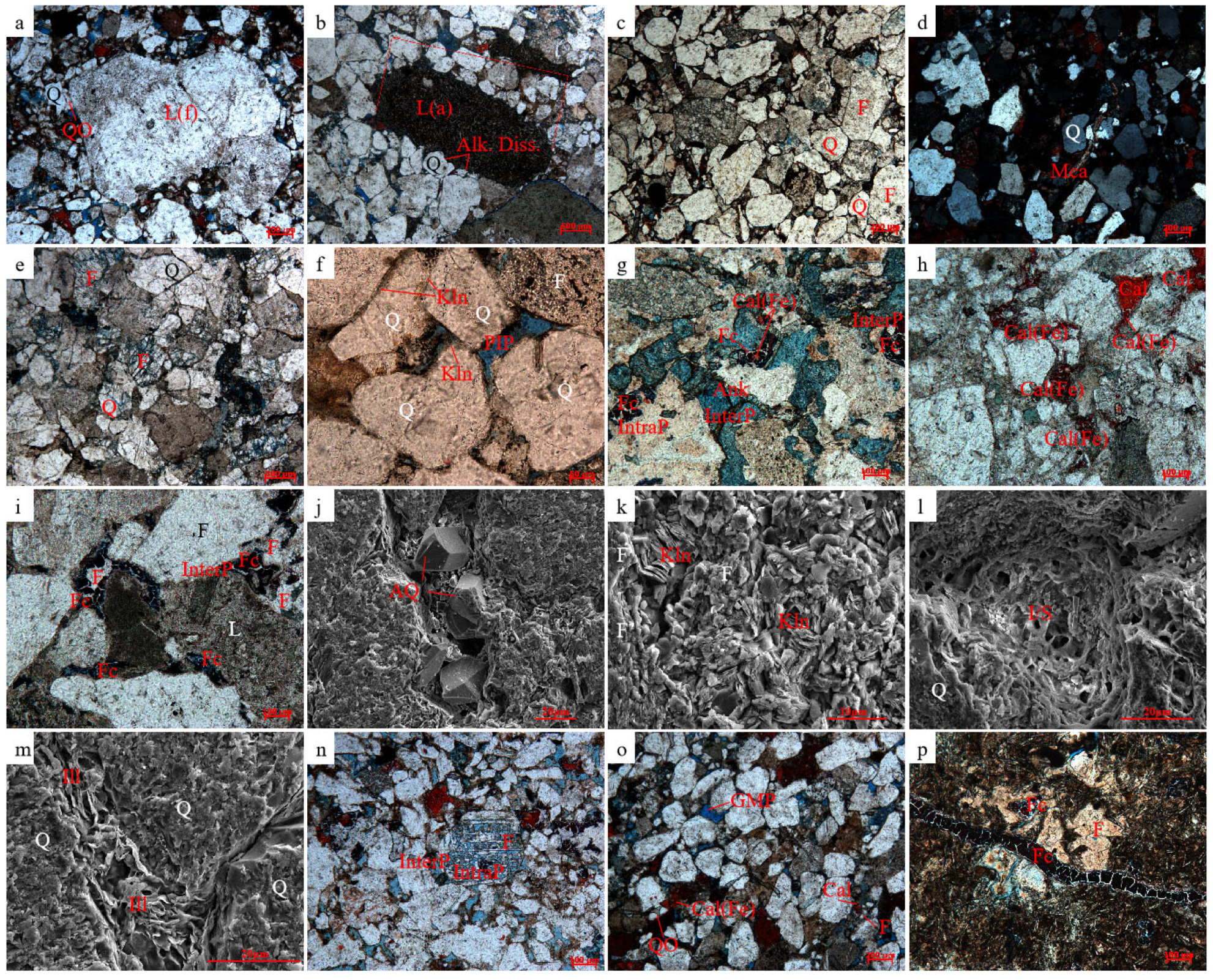
Figure 3. Comprehensive Diagenetic characteristics of low-permeability clastic reservoirs in the Mesozoic of the Tanhai area, Jiyang Depression. (a). Development of felsic lithic fragments. Ferroan calcite is enveloped by quartz overgrowth. Well ZGX471, 3801.45 m, blue epoxy impregnated thin section, plane-polarized light 50×; (b). Quartz near a large andesitic lithic fragment shows embayed dissolution edges. Well ZH26C, 3986.8 m, blue epoxy impregnated thin section, plane-polarized light 20×; (c). Grains show line contacts. Well ZGX471, 3931.65 m, blue epoxy impregnated thin section, plane-polarized light 50×; (d). Mica shows bending deformation. Well ZGX471, 3931.65 m, blue epoxy impregnated thin section, cross-polarized light 50×; (e). Feldspar and quartz are fractured due to compaction, forming compaction cracks. Well CB306, 3319.8 m, blue epoxy impregnated thin section, plane-polarized light 20×; (f). Chlorite rims coat quartz grains. Grains show line-to-point contacts. Pores are primary intergranular pores. Well CB30, 2983.7 m, blue epoxy impregnated thin section, plane-polarized light 200×; (g). Fe-calcite, ferroan calcite, and ferroan dolomite cement fill intergranular and intragranular pores. Ferroan calcite replaces Fe-calcite. Well CB11C-1, 2255.9 m, blue epoxy impregnated thin section, plane-polarized light 100×; (h). Calcite and Fe-calcite fill primary intergranular pores in poikilotopic texture. Fe-calcite replaces calcite. Well Z205, 2702.1 m, blue epoxy impregnated thin section, plane-polarized light 100×; (i) Ferroan calcite cements feldspar dissolution pores. Well SH2, 2228.25 m, blue epoxy impregnated thin section, plane-polarized light 100×; (j). Euhedral authigenic quartz. Well ZH28, 3605.25 m, SEM, 2.36 k×; (k). Booklet-like kaolinite formed from feldspar dissolution. Well ZH28, 3605.25 m, SEM, 7.02 k×; (l). Honeycomb-like illite-smectite mixed-layer clay developed between grains. Well ZH28, 3605.25 m, SEM, 4.28 k×; (m). Platy illite fills spaces between quartz grains. Well CB301, 3294.2 m, SEM, 5.44 k×; (n). Feldspar dissolution forming intragranular and intergranular dissolution pores. Well ZGX471, 3801.1 m, blue epoxy impregnated thin section, plane-polarized light 100×; (o). Fe-calcite is embedded within quartz overgrowths. It has regular edges distinct from authigenic quartz. Local development of grain moldic pores. Well CB30, 2983.7 m, blue epoxy impregnated thin section, plane-polarized light 50×; (p). Ferroan calcite developed within andesite showing hyalopilitic texture. Well CB12, 2535.1 m, blue epoxy impregnated thin section, plane-polarized light 100×. Abbreviations: Q—Quartz, F—Feldspar, L—Lithic Fragment, Mca—Mica, Cal—Calcite, Cal(Fe)—Fe-calcite, Fc—Ferroan calcite, Ank—Ankerite, AQ—Authigenic Quartz, Kln—Kaolinite, I/S—Illite-Smectite, Ill—Illite, Chl—Chlorite, L(a)—Andesite Lithic, InterP—Intergranular Dissolution porosity, IntraP—Intragranular Dissolution Porosity, GMP—Grain Moldic Porosity, Alk. Diss.—Alkaline Dissolution, L(f)—Felsic Lithic Fragment, PIP—Primary Intergranular Porosity, QO—Quartz Overgrowth.
Minerals 16 00106 g003
Figure 4. Mesozoic clastic rock diagenetic evolution process (burial history modified from [54]); (a). Shallow burial stage (Stage I). Bright red calcite fills primary intergranular pores in poikilotopic texture; 50×, ZGX471, 3801.45 m, footwall of Zhuanghai 104 Fault, Fangzi Formation; (b). Shallow burial stage (Stage I). Microspherulitic siderite cementation; 50×, ZGX471, 3801.7 m, footwall of Zhuanghai 104 Fault, Fangzi Formation; (c). Uplift stage (Stage II). Microspherulitic siderite cementation. 100×, ZH10, 3129.7 m, hanging wall of Zhuanghai 104 Fault, Santai Formation; (d). Uplift stage (Stage II). Meteoric water dissolution of feldspar and lithic fragments forms intergranular dissolution pores. 100×, ZH10, 3129.7 m, hanging wall of Zhuanghai 104 Fault, Santai Formation; (e,f). Secondary shallow burial stage (Stage III). Dark red, spotty Fe-calcite fills intergranular pores. 20×, CB293C, 2831.3 m, footwall of Chengbei 20 Fault, Xiwa Formation; (g). Secondary uplift stage (Stage IV). Microspherulitic siderite cementation after feldspar dissolution. 100×, CB11B-1, 2362.5 m, hanging wall of Chengbei Fault, Mengyin Formation; (h). Secondary uplift stage (Stage IV). Meteoric water leaching and dissolution forming intergranular dissolution pores; 50×, CB11C-1, 2255.9 m, hanging wall of Chengbei Fault, Mengyin Formation; (i). Deep burial stage (Stage V). Dissolution of feldspar and calcite. Fe-calcite fills intergranular pores. 100×, ZH26C, 3984.2 m, footwall of Chengbei 30 South Fault, Xiwa Formation; (j). Deep burial stage (Stage V). Fe-calcite and ferroan calcite cementation. Local occurrence of quartz dissolution (alkaline dissolution); 50×, ZH27, 4006.06 m, footwall of Chengbei 30 South Fault, Xiwa Formation. Abbreviations: Q—Quartz, F—Feldspar, L—Lithic fragment, Cal—Calcite, Cal(Fe)—Fe-calcite, Fc—Ferroan calcite, Sid—Siderite, InterP—Intergranular dissolution porosity, Alk. Diss.—Alkaline Dissolution.
Minerals 16 00106 g004
Figure 5. Pore-throat Type of Mesozoic clastic rocks in different tectonic stages. (a) Pore-throat structure in Shallow burial stage (Stage I), Typical Cored Interval: ZGX471, 3930.3 m. (b) Pore-throat structure in Uplift stage (Stage II), Typical Cored Interval: ZH10, 3129.7 m. (c) Pore-throat structure in Secondary shallow burial stage (Stage III), Typical Cored Interval: CB293C, 2831.3 m. (d) Pore-throat structure in Secondary uplift stage (Stage IV), Typical Cored Interval: CB30, 2983.7 m. (e) Pore-throat structure in Deep burial stage (Stage V), Typical Cored Interval: ZH28, 3606.16 m.
Minerals 16 00106 g005
Figure 6. Schematic diagram of alkaline dissolution mechanism.
Minerals 16 00106 g006
Figure 7. Validation of Mesozoic diagenetic sweet spot zones. (a). Well CB30; (b). Well CBG6; (c). Well ZH6; (d). Well ZG65.
Minerals 16 00106 g007
Table 1. Statistical table of Mesozoic clastic rock composition.
StratumQuartz/%Feldspar/%Rock Debris/%Sample Number
AverageRangeAverageRangeAverageRange
Mesozoic26.548–4426.9612–3633.315–7090
Xiwa23.198–4025.0412–3235.6519–6926
Mengyin22.18–2929.116–3638.426–7010
Santai26.7810–3827.8621–3631.5321–5536
Fangzi33.3923–4426.7215–3530.6115–4018
Table 2. Statistics of typical cored intervals from different tectonic stages.
Tectonic StageTypical Coring Intervals
Representative WellsStratumKey Tectonic Rationale (Location, Throw Difference)
I. Shallow BurialZGX471FangziLocated in fault footwall with early burial, later fault activity was minimal. (footwall of Zhuanghai 104 Fault, 400 m)
II. UpliftZH10SantaiLocated in fault hanging wall, experienced early Yanshanian uplift, later fault activity was minimal. (hanging wall of Zhuanghai 104 Fault, 400 m)
III. Secondary Shallow BurialCB293CXiwaUnderwent rapid Cretaceous burial post-first uplift. (footwall of Chengbei 20 Fault, 900 m)
IV. Secondary UpliftCB11B-1, CB11C-1MengyinAdjacent to Mesozoic-Cenozoic unconformity, underwent major mid-late Yanshanian/Himalayan uplift and erosion. (hanging wall of Chengbei Fault, 900 m and hanging wall of Chengbei 30 North Fault, 400 m)
CB30Fangzi
V. Deep BurialZH26C, ZH28XiwaIn a later fault footwall. (footwall of Chengbei 30 South Fault, 600 m)
Key Tectonic Rationale is based on Figure 1e & Burial History.
Table 3. Quantitative Summary of Diagenetic and Pore-Throat Characteristics by Stage.
Tectonic-Diagenetic StageAvg. Porosity (%)Avg. Permeability (10−3 µm2)Avg. Line + Concavo Contacts (%)Avg. Carbonate Cement Vol.%Avg. Dissolution Porosity (%)Dominant Pore-Throat Type (MICP)Median Radius Rd (µm)
I. Shallow Burial6.650.3449.55.831.61Micropores (<0.1 µm)0.009
II. Uplift9.320.652.23.54.75Micropores, minor Mesopores0.042
III. Sec. Shallow Burial7.780.0576.54.254.38Micropores (<0.1 µm)0.012
IV. Secondary Uplift10.251.2271.43.068.5Mesopores (0.1–10 µm)0.838
V. Deep Burial8.10.1985.713.646.75Bimodal (Micro & Meso)0.216
Dissolution porosity is estimated from the areal percentage of visible secondary pores in thin sections.
Table 4. Relative clay mineral content analysis of Mesozoic strata in well CB11B-1.
Well NameDepth (m)Illite (%)Kaolinite (%)Chlorite (%)I/S Layer Ratio(%)
CB11B-12350.6978320
2358.81361-20
2363.71371520
23651770320
2368.21761320
2351.21367520
2351.81473520
2352.81662620
2354.61662420
2354.91567420
2356.61172520
Table 5. Quantitative calculation results of Mesozoic porosity.
StagePorosity After Compaction (%)Porosity Loss by Compaction (%)Dissolved Cement Volume (%)Net Cement Increment (%)Porosity Gain by Dissolution (%)Quantitatively Calculated Porosity (%)
Stage I29.156.550.56.631.6124.14
Stage II29.1502.50.474.7528.42
Stage III19.429.731.92.854.3820.22
Stage IV19.4203.22.918.525.81
Stage V12.946.484.415.386.7510.7
Disclaimer/Publisher’s Note: The statements, opinions and data contained in all publications are solely those of the individual author(s) and contributor(s) and not of MDPI and/or the editor(s). MDPI and/or the editor(s) disclaim responsibility for any injury to people or property resulting from any ideas, methods, instructions or products referred to in the content.