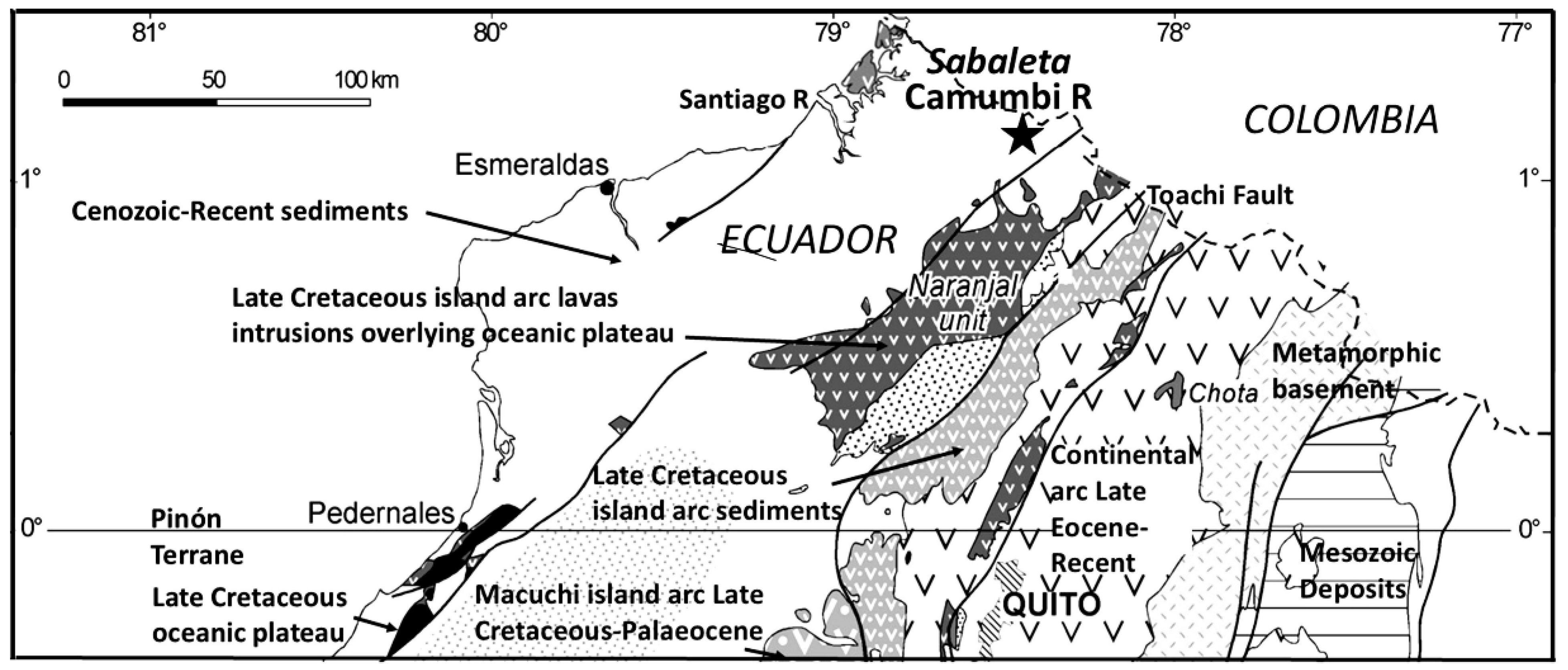
3.1.1. Sample A2 Area 7
- (a)
Host alloy and ferrobasalt silicate glass (SiO2 47.43 wt. %)
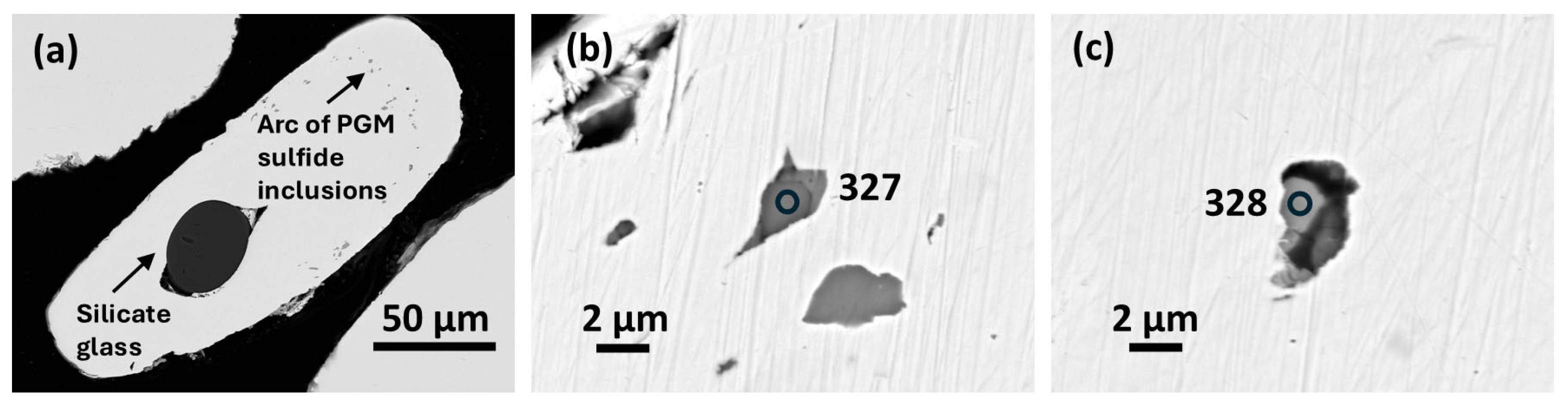
The host nugget is rounded (
Figure 2a) but distinctly deformed (flattened) and measures ~987 µm in length and ~370 µm in width. The prominent, rounded silicate glass inclusion (~191 µm long and ~146 µm across) is also slightly flattened, with adjacent, small, elongated, triangular, and somewhat irregular strain shadows, possibly parallel to a foliation direction.
Analysis 277 (Barron et al. [
1]; their Tables 1A and 1B); indicate host native platinum (Pt
2.95Rh
0.09Pd
0.06 Ir
0.01Os
0.01)
3.12(Fe
0.80Cu
0.07Ni
0.01)
0.88, with the following minor elements in decreasing order of abundance: Rh, Cu, Pd, Ir, Os, and Ni.
A distinct “corona” is defined by an arc of small (~1–5 µm) inclusions with Cu-PGE sulfide parageneses located near the nugget margin and distant from their host basaltic glass inclusion (
Figure 2a). These inclusions have irregular shapes and show elongate, narrow strain shadows in
Figure 2b.
Analysis 176 (Barron et al. [
1]; Table 2E) indicates that coexisting (host) silicate glass in this inclusion is ferrobasalt with SiO
2 47.43, FeO 17.62, and MgO 6.13 (wt. %) and minor H
2O at ~0.31. This glass is the least siliceous of the present samples.
- (b)
PGM sulfide paragenesis
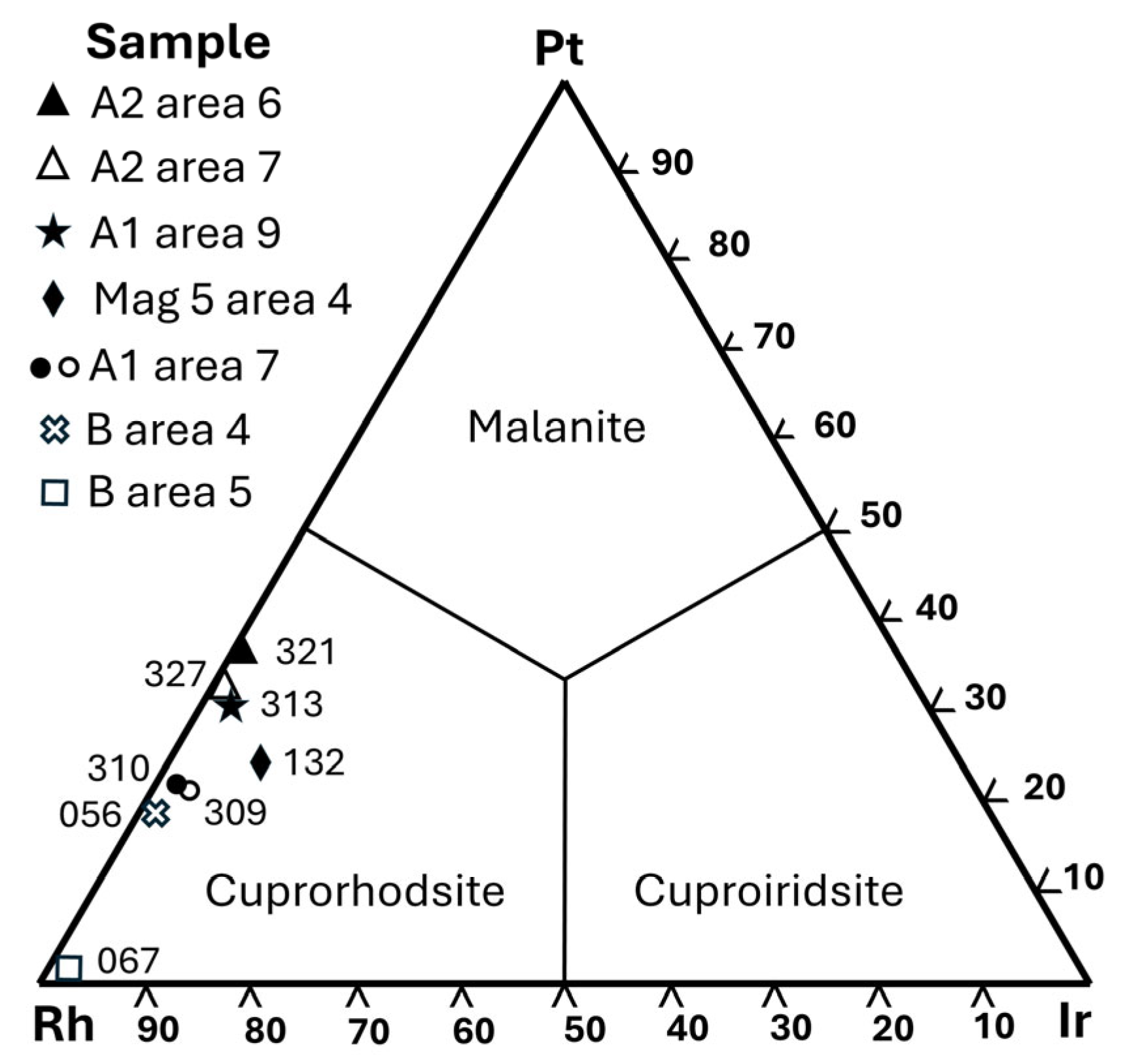
Cuprorhodsite–(
malanite) (
Figure 2b) is a small (~2.5 µm) subhedral crystal set in a strain-shadow microstructure.
Analysis 327 (
Table 1) indicates (Cu
0.85Fe
0.12Ni
0.03)
1.00(Rh
1.26Pt
0.62Pd
0.05Ru
0.05Ir
0.03Os
0.01)
1.96S
3.96. The strain-shadow mineral is too small for accurate analysis.
Vysotskite occurs as a subhedral crystal in a separate inclusion (
Figure 2c).
Analysis (328) (
Table 1) indicates the following Pd-rich vysotskite formula: (Pd
0.64Pt
0.20Cu
0.04Fe
0.04Ni
0.03)
0.91S
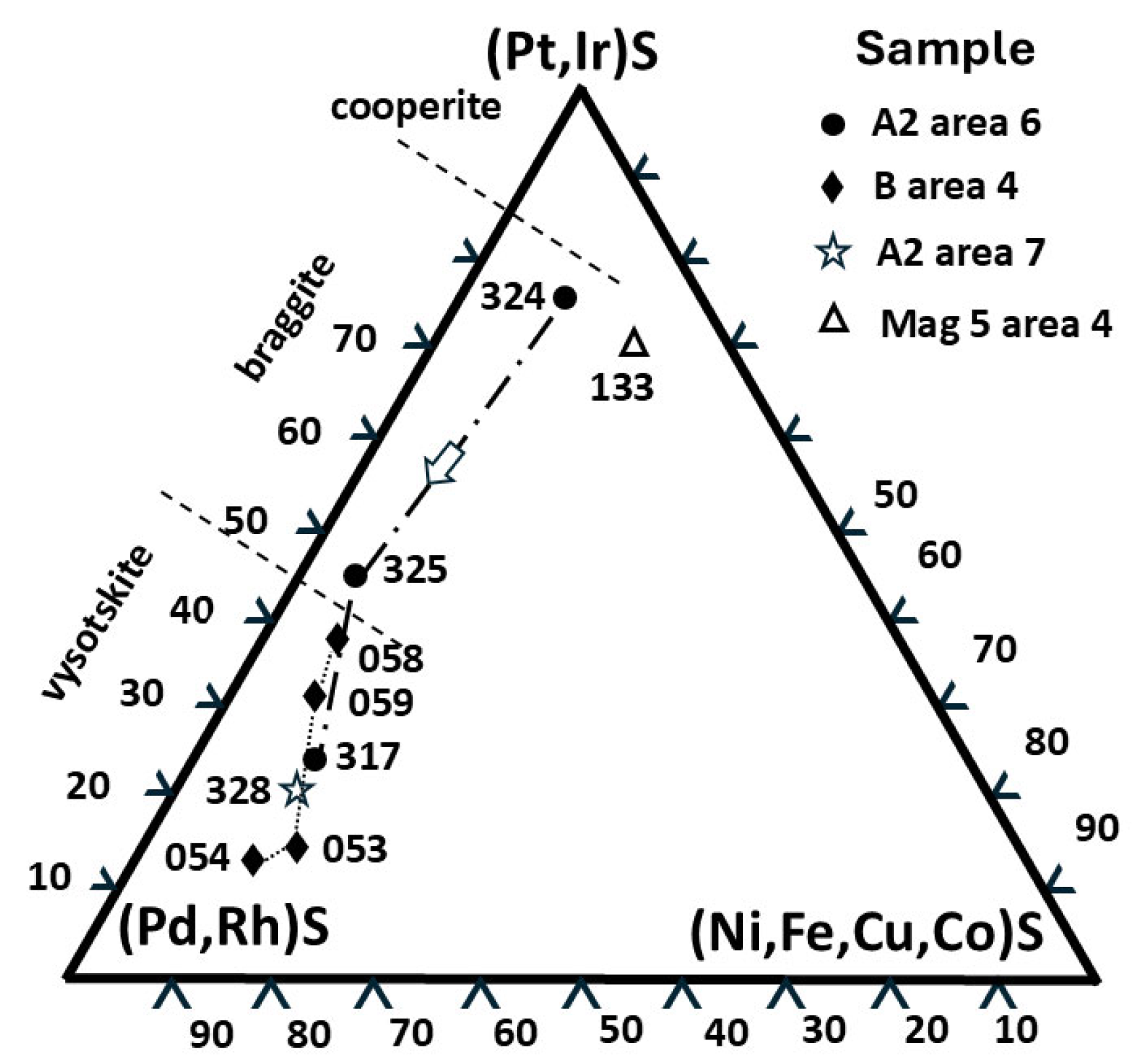
1.04 (cf. Cabri and McDonald [
19]; Figure 1 in their study). The fibrous, irregular matrix fraction is too small for analysis.
Table 1.
Analyses sample A2 area 7.
Table 1.
Analyses sample A2 area 7.
| wt. % | Mineral | S | Fe | Ni | Cu | Ru | Rh | Pd | Os | Ir | Pt | Total |
|---|
| 1 (277) | Pt | | 6.95 | 0.05 | 0.68 | | 1.50 | 1.01 | 0.17 | 0.23 | 89.38 | 99.96 |
| 3 (327) * | Crh | 27.02 | 1.49 | 0.43 | 11.49 | 1.01 | 27.70 | 1.22 | 0.30 | 1.12 | 25.91 | 97.74 |
| 4 (328) | Vys | 22.40 | 1.31 | 1.30 | 1.62 | 0.07 | 0.93 | 45.27 | | | 26.26 | 99.17 |
| at. % | Mineral | S | Fe | Ni | Cu | Ru | Rh | Pd | Os | Ir | Pt | |
| 1 (277) | Pt | | 20.05 | 0.13 | 1.74 | | 2.35 | 1.53 | 0.14 | 0.19 | 73.87 | 100.00 |
| 3 (327) ** | Crh | 56.58 | 1.79 | 0.49 | 12.14 | 0.67 | 18.08 | 0.77 | 0.11 | 0.39 | 8.92 | 100.00 |
| 4 (328) | Vys | 52.16 | 1.75 | 1.65 | 1.91 | 0.05 | 0.67 | 31.76 | | | 10.05 | 100.00 |
| apfu | Mineral | S | Fe | Ni | Cu | Ru | Rh | Pd | Os | Ir | Pt | Me |
| 1 (277) | Pt | | 0.80 | 0.01 | 0.07 | | 0.09 | 0.06 | | 0.01 | 2.95 | 3.99 |
| 3 (327) *** | Crh | 3.96 | 0.12 | 0.03 | 0.85 | 0.05 | 1.26 | 0.05 | 0.01 | 0.03 | 0.62 | 3.02 |
| 4 (328) | Vys | 1.04 | 0.04 | 0.03 | | | | 0.64 | | | 0.20 | 0.91 |
3.1.2. Sample A2 Area 6
- (a)
Host alloy and ferrobasalt silicate glass (SiO2 47.83 wt. %).
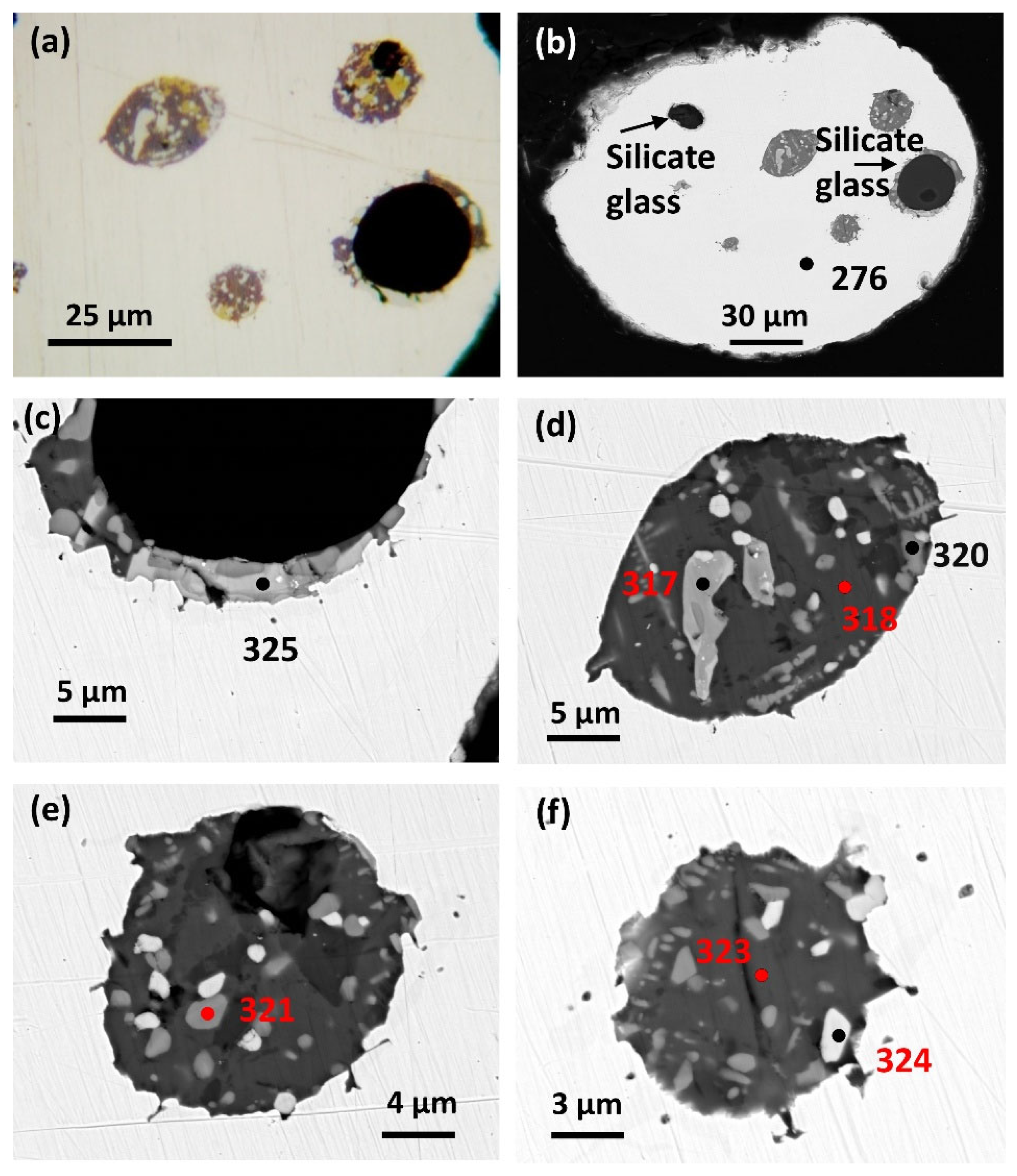
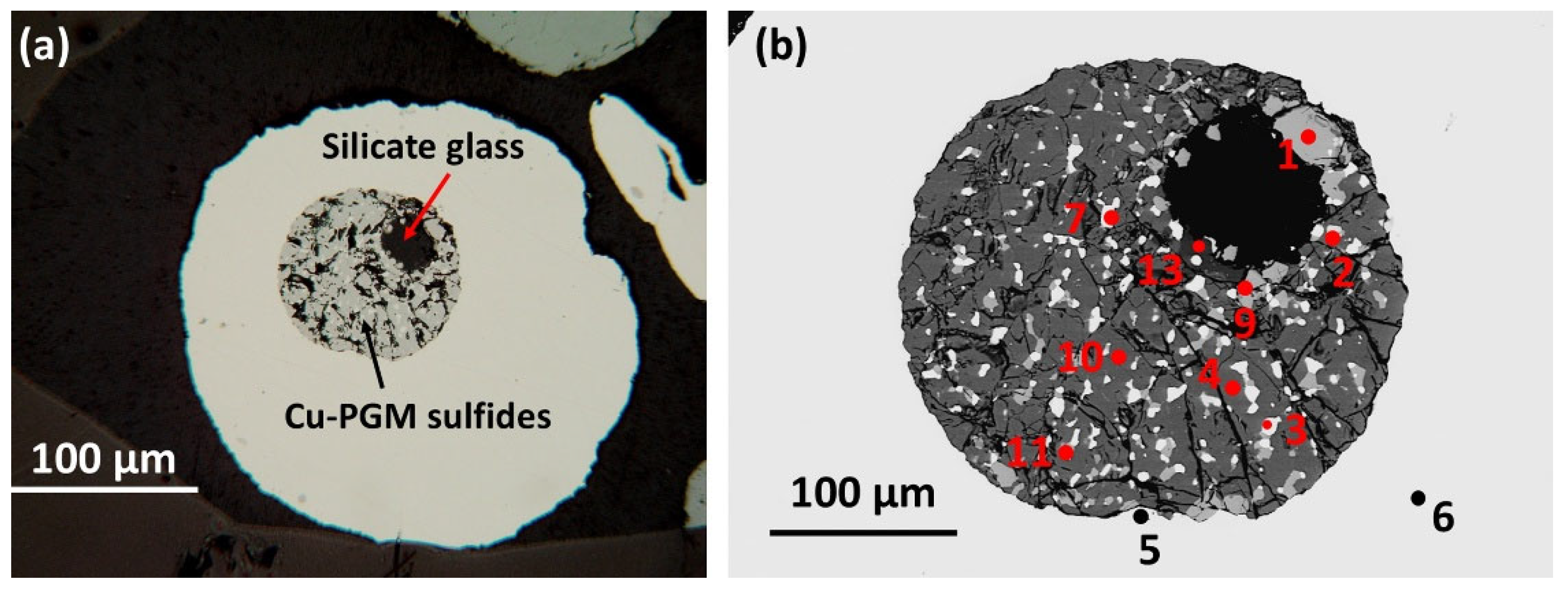
This host Pt-Fe nugget (~0.7 mm diameter) is rounded with a partly broken margin (
Figure 3a,b).
Analysis 276 (Barron et al. [
1]: their Tables 1A and 1B) indicates isoferroplatinum (Pt
2.95Rh
0.08Pd
0.05 Ir
0.01)
3.09(Fe
0.74Cu
0.17)
0.91 with minor Cu, Rh, and Pd.
Seven inclusions are present, four of which are considered here (
Figure 3a,b). The largest is a rounded silicate glass inclusion (~28 µm diameter) with a small vesicle (possible gas cavity) about 7 µm across, located near the margin. The silicate glass has a narrow but irregular partial rim of exsolved PGM with Cu-sulfides, the boundary of which against the host nugget is exceptional. It shows well-preserved quench textures of cuspate crests and related small “droplets” within the host Pt-Fe alloy. A similar, very narrow rim of exsolved Cu-PGM occurs around a smaller silicate glass inclusion not considered here. Three smaller, rounded inclusions are Cu-PGM parageneses, like that of the exsolved PGM sulfide rim of the largest silicate glass inclusion (above). They show similar, well-preserved, irregular boundaries against the host nugget.
Analysis 172 of the silicate glass (Barron et al. [
1] their Table 2E) indicates ferrobasalt with SiO
2 47.83, FeO 15.68, MgO 5.52, and minor H
2O at~1.17 (wt. %).
- (b)
PGM and Cu-sulfide paragenesis
Sulfide parageneses and their textural features are similar in each of the five melt inclusions (
Figure 3). Small subhedral crystals are braggite and cuprorhodsite, while zoned braggite occurs as subhedral to anhedral patches (up to 13 µm long). Bornite contains up to ~20% of PGE monosulfide as exsolved crystallites (see below). Some of the latter are subhedral (up to ~3.0 µm grain size), and many are skeletal, branching, and crystallographically controlled (reaching ~5 µm long). Bornite also hosts subordinate irregular patches of chalcopyrite (yellow,
Figure 3a).
Braggite occurs as subhedral white crystals (
Figure 3f).
Analysis 8 (324),
Table 2, shows Pt at 35.21 and
Pd 5.56 with 4.17 at. % minor elements (Cu, Fe, Rh, Ni, and Os) and slightly high S. A second braggite analysis, analysis 9 (325) (
Table 2,
Figure 3c), shows Pt 19.64,
Pd 19.55 (at. %), and minor PGE 6.19 (at. %) (cf. Figure 1, Cabri and McDonald [
19]). This analysis is for an anhedral interstitial grain with marginal zoning. It occurs within the narrow rim of PGM sulfide parageneses adjacent to the largest silicate glass inclusion (
Figure 3c).
Table 2.
WDS analyses. Sample A2 area 6.
Table 2.
WDS analyses. Sample A2 area 6.
| # wt. % | Mineral | S | Se | Fe | Ni | Co | Cu | Ru | Rh | Pd | Os | Ir | Pt | Total |
|---|
| 1 (276) | Ifp | | | 6.37 | | | 1.69 | | 1.27 | 0.83 | | 0.22 | 88.62 | 99.00 |
| (320) | Ms | 27.15 | 0.16 | 4.85 | 0.02 | 0.16 | 27.53 | 0.08 | 15.74 | | | 1.13 | 19.92 | 96.73 |
| 4 (321) | Crh | 28.98 | 0.16 | 2.41 | 0.15 | 0.22 | 13.71 | 0.13 | 25.18 | | 0.09 | 0.90 | 27.75 | 99.69 |
| 8 (324) | Bg | 18.72 | | 0.71 | 0.06 | | 1.61 | | 0.46 | 6.27 | 0.11 | | 72.84 | 100.79 |
| 9 (325) | Bg | 21.41 | 0.34 | 0.50 | 0.98 | | 1.45 | | 2.69 | 25.61 | | 0.34 | 47.16 | 100.47 |
| # at. % | Mineral | S | Se | Fe | Ni | Co | Cu | Ru | Rh | Pd | Os | Ir | Pt | Total |
| 1 (276) | Ifp | | | 18.51 | | | 4.31 | | 2.00 | 1.27 | | 0.19 | 73.73 | 100.00 |
| (320) | Ms | 51.83 | 0.13 | 5.31 | 0.02 | 0.16 | 26.53 | 0.05 | 9.36 | | | 0.36 | 6.25 | 100.00 |
| 4 (321) | Crh | 57.77 | 0.13 | 2.76 | 0.17 | 0.24 | 13.79 | 0.09 | 15.64 | | 0.03 | 0.30 | 9.09 | 100.00 |
| 8 (324) | Bg | 55.06 | | 1.20 | 0.09 | | 2.40 | | 0.42 | 5.56 | 0.06 | | 35.21 | 100.00 |
| 9 (325) | Bg | 54.26 | 0.35 | 0.73 | 1.35 | | 1.85 | | 2.12 | 19.55 | | 0.14 | 19.64 | 100.00 |
| # apfu | Mineral | S | Se | Fe | Ni | Co | Cu | Ru | Rh | Pd | Os | Ir | Pt | Me |
| 1 (276) | Ifp | | | 0.74 | | | 0.17 | | 0.08 | 0.05 | | 0.01 | 2.95 | 4.00 |
| (320) | Ms | 1.00 | | 0.10 | | | 0.51 | | 0.18 | | | 0.01 | 0.12 | 0.92 |
| 4 (321) | Crh | 3.99 | 0.01 | 0.19 | 0.01 | 0.02 | 0.95 | 0.01 | 1.08 | | | 0.02 | 0.63 | 2.91 |
| 8 (324) | Bg | 1.00 | | 0.02 | | | 0.04 | | 0.01 | 0.10 | | | 0.64 | 0.81 |
| 9 (325) | Bg | 0.99 | 0.01 | 0.01 | 0.03 | | 0.03 | | 0.04 | 0.36 | | | 0.36 | 0.83 |
A third, semiquantitative [
20] analysis (317) is for an irregular, narrow (~3 µm across) zoned grain (
Figure 3d), indicating that
Pd reaches 30.76, and Pt is 11.41 at. % (+ ~6.50 at. % PGE minor elements, and Se is also present). The formula for this composition (Fe
0.02Ni
0.05Cu
0.05Pd
0.59Pt
0.22S
1.00) defines vysotskite (cf. Cabri and McDonald [
19], Figure 1).
Cuprorhodsite–(
malanite) occurs as mid-grey subhedral crystals (
Figure 3e) set in bornite.
Analysis 4 (321),
Table 2, gives the formula Cu
0.95(Rh
1.08Pt
0.63Fe
0.19Ir
0.02Co
0.02Ni
0.01Ru
0.01)
1.95(S
3.99Se
0.01)
4.00, with Rh at 15.64 at. % and Pt(+Ir) at 9.39.
Bornite and
chalcopyrite are confirmed as anhedral interstitial minerals. Semiquantitative [
20] analyses 318 and 323 (
Figure 3d,f) confirm bornite. Analysis 322 (
Figure 3e) confirms chalcopyrite. The respective formulae are Cu
4.69Fe
0.90S
3.99Se
0.01 for bornite and Cu
1.00Fe
0.90S
2.00 for chalcopyrite.
A
monosulfide mineral occurs as irregular and skeletal-shaped exsolutions set in host bornite [
Figure 3c,e]. WDS
analysis (320) (
Table 2) of the latter [a small (<3 µm) grain] gives a slightly low total; thus, it is semiquantitative (cf. Nesterenko et al. [
20]). However, a distinctive formula indicates a Cu-rich, Ni-poor PGE monosulfide mineral (Cu
0.55Fe
0.11)
∑0.66(Rh
0.19Pt
0.13Ir
0.01)
∑0.33S
1.00 with dominant Cu(+Fe); subordinate PGE; and minor detectable Co, Ru, and Ni (cf. Tolstykh & Krivenko [
21]).
3.1.3. Sample Mag 5 Area 4
- (a)
Host alloy and basaltic andesite silicate glass (SiO2 52.30 wt. %)
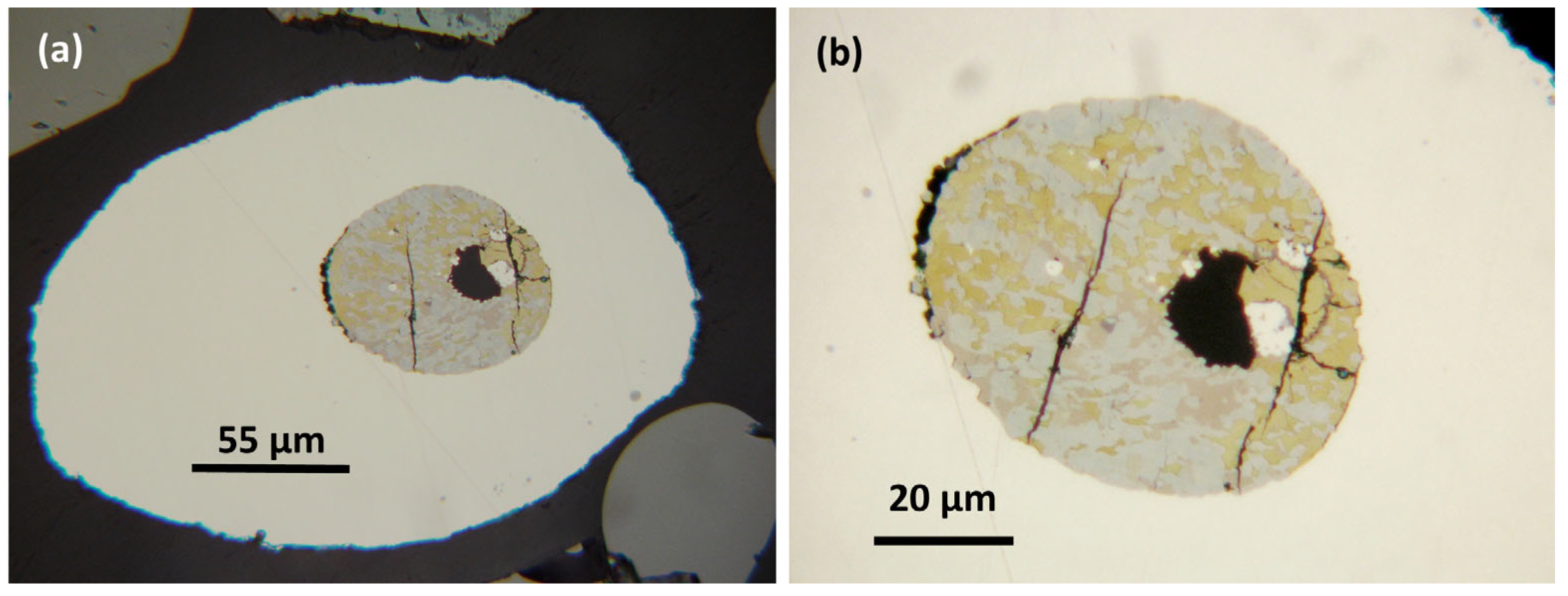
The
host nugget for this sample is oval-shaped (~0.22 mm long dimension) and hosts a composite rounded inclusion (~0.09 mm diameter) located near one margin (
Figure 4a).
Analysis 129 (Tables 1A and 1B of Barron et al. [
1]) indicates isoferroplatinum (Pt
2.89Ir
0.06Pd
0.02Os
0.01)
2.98(Fe
0.88Cu
0.06Rh
0.08)
1.02 with minor Rh, Cu, Pd, Os, and S. The inclusion comprises a remarkable PGM paragenesis coexisting with a small, rounded to partly irregular “pool” of exsolved silicate glass partly infilled with late Pt-Fe alloys and subhedral chalcopyrite (
Figure 4a,b).
The small “pool” of host silicate glass shows a minutely scalloped boundary with the variably thick rim of exsolved PGM. The boundary of the latter against the host nugget is partly rounded and partly finely scalloped. A small void along part of the curved margin of the inclusion suggests minor compressional deformation (possibly in the alluvial pile) accompanied by distinct parallel brittle fractures in the PGM paragenesis.
Analyses of the silicate glass inclusion indicate tholeiitic
basaltic andesite with SiO
2 52.30, FeO 12.96, and H
2O at ~0.45 wt. % (average of analyses Sp24 and Sp25, Barron et al. [
1] their Table 2C). Silicate glass accounts for ~5.7% of the total composite inclusion.
- (b)
PGM sulfide paragenesis
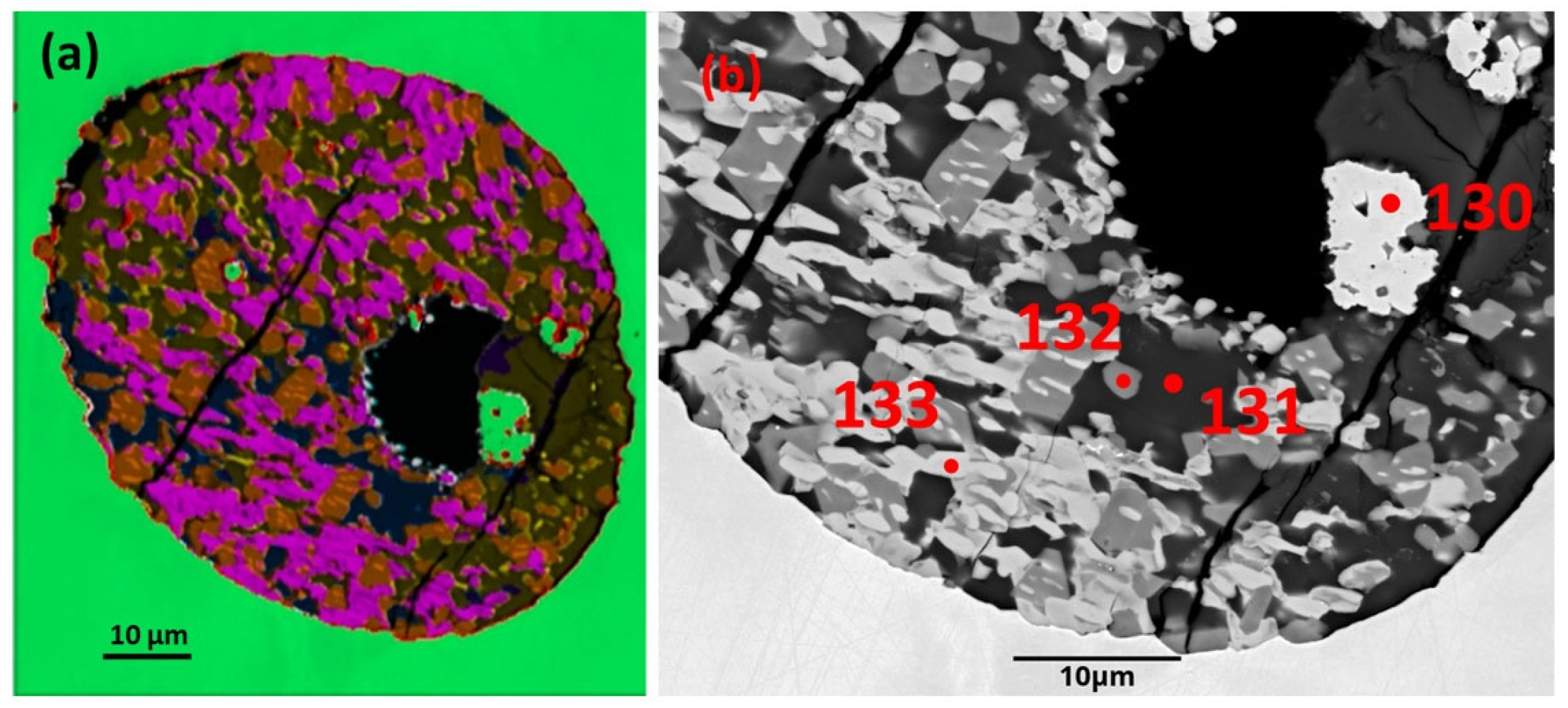
Phase mapping, based on EDS analysis of this inclusion (
Figure 5a), gives an approximate fraction % based on relative pixel counts for each phase. There are five significant minerals detected, and their approximate fraction % (minus 5.7% silicate glass) is as follows: Green shows the Pt-Fe alloy 3.18; PtSRhFe (composite cuprorhodsite + alloy = monosulfide) 24.92; PtSPd (braggite) 30.22; SCuFePt (chalcopyrite) 33.40; and FeS (pyrrhotite) 8.27. A minor mineral (analysis FeSCu) is also detected.
An approximate calculated bulk chemistry (Fe > Cu > Pt >>> Pd > Rh >> Ir > Ni > Co > Os at. %) based on EDS
element mapping of the PGM paragenesis is shown in
Table 3.
A composite
monosulfide mineral, PtSRhFe identified by phase mapping (
Table 4), is shown in tan with orange exsolutions (
Figure 5a). It comprises small (from ~2 µm up to ~8 µm long and ~3–4 µm across) subprismatic to equant crystals that are evenly disseminated throughout. This mineral accounts for ~23.5% of the inclusion area in the plane of the present section (see above). In some domains, the crystals are sub-parallel, but elsewhere, they are unoriented. Thin exsolved lenses are subparallel and crystallographically controlled in many larger crystals, but some smaller crystals (minus alloy lenses) are homogeneous in the present section (
Figure 5a,b).
Figure 5.
Sample Mag 5 area 4. BSE images. Analysis points listed in
Table 5. (
a) EDS phase-mapped false colors of host isoferroplatinum (green); native platinum (green); silicate glass (black); and Cu-PGM paragenesis: braggite (pink), chalcopyrite (dark brown), pyrrhotite (dark blue), cuprorhodsite (tan with orange exsolutions), and minor isocubanite (FeSCu, dark purple). (
b) Part of inclusion showing WDS analysis points: Isoferroplatinum, analysis 130; pyrrhotite, 131; cuprorhodsite without exsolutions, 132; braggite, 133; and chalcopyrite, 134. Silicate glass (black) [
1].
Figure 5.
Sample Mag 5 area 4. BSE images. Analysis points listed in
Table 5. (
a) EDS phase-mapped false colors of host isoferroplatinum (green); native platinum (green); silicate glass (black); and Cu-PGM paragenesis: braggite (pink), chalcopyrite (dark brown), pyrrhotite (dark blue), cuprorhodsite (tan with orange exsolutions), and minor isocubanite (FeSCu, dark purple). (
b) Part of inclusion showing WDS analysis points: Isoferroplatinum, analysis 130; pyrrhotite, 131; cuprorhodsite without exsolutions, 132; braggite, 133; and chalcopyrite, 134. Silicate glass (black) [
1].
The
lenses in the PtSRhFe host mineral, as shown in the EDS phase map analysis (
Figure 5a), are too fine-grained for accurate EMPA. However, as a composite PGM, both lenses and their host mineral are analyzed together (analysis 3PtSRhFe,
Table 4, normalized minus minor O). This composite mineral analysis, including the host mineral and narrow lenses, results in a Me (metal)-deficient formula indicating the monosulfide mineral (Fe
0.23Pt
0.21Cu
0.16Rh
0.15Pd
0.04Ir
0.02Os
0.01Co
0.01)
0.83S
1.00. However, WDS analysis 3 (132) (
Table 4 and
Table 5;
Figure 5b) of the host mineral lacking exsolutions shows
Fe-, Pt-, and Pd-poor cuprorhodsite–(malanite) with formula (Cu
0.79Fe
2+0.19Co
0.02)
1.00(Rh
1.14Pt
0.40Fe
3+0.25Ir
0.15Os
0.04)
1.98S
4.02. This suggests that a composite monosulfide precursor mineral has exsolved Fe-Pt-(Pd) alloy lenses in
Fe-, Pt-, and Pd-poor cuprorhodsite.
A calculated approximate composition for the exsolved alloy lenses is ~Fe 46.48, Pt 41.07, and Pd 12.44 at. % (
Table 4), indicating Pd-bearing
tetraferroplatinum near PtFe (cf. Cabri et al.; Jung et al. [
22,
23]).
Table 4.
Analyses of sample Mag 5 area 4. Composite monosulfide mineral and cuprorhodsite-lacking alloy. Calculation of exsolved tetraferroplatinum exsolutions.
Table 4.
Analyses of sample Mag 5 area 4. Composite monosulfide mineral and cuprorhodsite-lacking alloy. Calculation of exsolved tetraferroplatinum exsolutions.
| 3PtSRhFe Δ | S | Se | Fe | Co | Ni | Cu | Ru | Rh | Pd | Os | Ir | Pt | Total |
|---|
| wt. % Ms | 26.85 | | 10.90 | 0.24 | 0.15 | 8.27 | | 12.60 | 2.86 | 0.84 | 3.13 | 34.18 | 100.00 |
| at. % ~Ms | 55.30 | | 12.89 | 0.26 | 0.17 | 8.59 | | 8.09 | 1.77 | 0.29 | 1.07 | 11.57 | 100.00 |
| apfu ~Ms | 1.00 | | 0.23 | 0.01 | | 0.16 | | 0.15 | 0.04 | 0.01 | 0.02 | 0.21 | 0.83 |
| 3(132) ^ | S | Se | Fe | Co | | Cu | Ru | Rh | Pd | Os | Ir | Pt | Total |
| wt. % Crh | 29.19 | 0.03 | 5.58 | 0.29 | | 11.39 | 0.24 | 26.48 | | 1.84 | 6.73 | 17.78 | 99.55 |
| at. % Crh | 57.25 | 0.02 | 6.28 | 0.31 | | 11.27 | 0.15 | 16.18 | | 0.61 | 2.20 | 5.73 | 100.00 |
| apfu Crh | 4.02 | | 0.44 | 0.02 | | 0.79 | 0.01 | 1.14 | | 0.04 | 0.15 | 0.40 | Me 2.99 |
| Alloy * | | | 6.61 | | | | | | 1.77 | | | 5.84 | 14.22 |
| ~Tfpt at. % | | | 46.48 | | | | | | 12.44 | | | 41.07 | 100.00 |
Pt-Fe alloy, green (
Figure 5a), accounts for only ~3.0% of the inclusion area and occurs as anhedral patches with variable grain size (up to ~5 µm across).
Analysis 1 (130) (
Table 5 and
Figure 5b) shows that this alloy is also isoferroplatinum, distinct from the host isoferroplatinum, with unusually high concentrations of minor elements (8.35 at. %): Cu (2.91 at. %), Pd (2.65 at. %), Au (1.82 at. %), Rh, Ag, and Os (in order of abundance).
Table 5.
WDS analyses of sample Mag 5 area 4.
Table 5.
WDS analyses of sample Mag 5 area 4.
| # wt. % | Mineral | S | Fe | Co | Ni | Cu | Rh | Pd | Ag | Os | Ir | Pt | Total |
|---|
| (129) | Ifp | 0.05 | 7.82 | | | 0.37 | 0.69 | 0.31 | | 0.28 | 0.45 | 90.21 | 100.17 |
| 1 (130) * | Ifp | 0.07 | 10.27 | | | 1.26 | 0.46 | 1.92 | 0.16 | 0.12 | | 85.53 | 102.31 |
| 2 (131) † | Po | 37.78 | 58.52 | 0.04 | 0.07 | 0.22 | 0.21 | 0.10 | | | | 0.71 | 97.70 |
| 3 (132) †† | Crh | 29.19 | 5.58 | 0.29 | | 11.39 | 26.48 | | | 1.84 | 6.73 | 17.78 | 99.55 |
| 4 (133) | Br | 17.79 | 2.17 | 0.02 | 0.11 | 3.01 | 0.90 | 4.50 | | 0.19 | 0.22 | 69.80 | 98.69 |
| 8FeSCu ^ | Icb | 34.56 | 40.42 | 0.57 | 1.05 | 22.34 | | | | | | 1.05 | 100.00 |
| Note: * Te: 0.06; Au: 2.45. † Ca: 0.04; †† Se: 0.03; Ru: 0.24. |
| # at. % | Mineral | S | Fe | Co | Ni | Cu | Rh | Pd | Ag | Os | Ir | Pt | Total |
| (129) | Ifp host | 0.23 | 22.47 | | | 0.94 | 1.08 | 0.46 | | 0.24 | 0.37 | 74.21 | 100.00 |
| 1 (130) * | Ifp | 0.34 | 26.96 | | | 2.91 | 0.66 | 2.65 | 0.22 | 0.09 | | 64.27 | 100.00 |
| 2(131) † | Po | 52.62 | 46.80 | 0.03 | 0.05 | 0.15 | 0.09 | 0.04 | | | | 0.16 | 100.00 |
| 3 (132) †† | Crh | 57.25 | 6.28 | 0.31 | | 11.27 | 16.18 | | | 0.61 | 2.20 | 5.73 | 100.00 |
| 4 (133) | Br | 52.63 | 3.68 | 0.03 | 0.18 | 4.49 | 0.83 | 4.01 | | 0.09 | 0.11 | 33.95 | 100.00 |
| 8 FeSCu ^ | Icb | 49.30 | 33.09 | 0.44 | 0.82 | 16.08 | | | | | | 0.25 | 100.00 |
| Note: * Te: 0.07; Au: 1.82. † Ca: 0.04. †† Se: 0.02; Ru: 0.15. |
| # apfu | Mineral | S | Fe | Co | Ni | Cu | Rh | Pd | Ag | Os | Ir | Pt | Me |
| (129) | Ifp | 0.01 | 0.90 | | | 0.04 | 0.04 | 0.02 | | 0.01 | 0.01 | 2.97 | 4.00 |
| 1(130) * | Ifp | 0.01 | 1.08 | | | 0.12 | 0.03 | 0.11 | 0.01 | | | 2.57 | 3.99 |
| 2(131) † | Po | 1.00 | 0.89 | | | | | | | | | | 0.90 |
| 3(132) | Crh | 4.00 | 0.44 | 0.02 | | 0.79 | 1.13 | | | 0.04 | 0.15 | 0.40 | 2.97 |
| 4(133) | Br | 1.00 | 0.07 | | | 0.09 | 0.02 | 0.08 | | | | 0.65 | 0.91 |
| 8 FeSCu ^ | Icb | 2.97 | 2.00 | | 0.06 | 0.97 | | | | | | | 3.03 |
| Note: * Au: 0.07; † (Co 0.001 + Ni 0.001 + Cu 0.003 + Rh 0.002 + Pd 0.001 + Pt 0.003 = 0.01). |
Braggite, shown in pink in
Figure 5a, accounts for ~28.5% of the inclusion area and forms elongate (possibly deformed) anhedral patches enclosing subhedral prisms of the composite monosulfide mineral with alloy exsolutions (above).
Analysis 4 (133) (
Figure 5b,
Table 5) shows that this mineral, with Pt 69.80 wt.% and Pd 4.50 wt. %, contains significant (6.62 at. %) minor elements (Cu, Rh, Ni, Ir, Os, Co, and Ir).
Chalcopyrite, shown in yellow in
Figure 5a, accounts for ~31.5% of the inclusion area. It is a prominent anhedral, interstitial mineral in three quadrants of the thick rim of PGM sulfides and forms an unevenly distributed mineral throughout the fourth quadrant, where it is intergrown with pyrrhotite (below). A semiquantitative analysis 5 (134) (
Figure 5b) confirms chalcopyrite Cu
0.50Fe
0.50S
1.02 with minor detectable <0.02 at. % elements Se, Pt, Zn, and Ca.
Pyrrhotite, shown in blue in
Figure 5a, accounts for ~7.8% of the inclusion area. It is also anhedral and interstitial and intergrown with minor patchy chalcopyrite.
Analysis 2 (131) (
Table 5) shows that seven minor elements are detected: Pt at 0.71 wt. % and <0.22 wt. %, each of Cu, Rh, Ni, Ca, Pd, and Co (in decreasing order of abundance).
Isocubanite, identified by phase mapping (
Figure 5a), accounts for only ~1.1% of the inclusion area. It occurs as irregular, narrow interstitial patches up to ~5.8 µm long but is < 3 µm across, so the crystals are too narrow for accurate EPMA. An EDS analysis (8FeSCu
Table 5) indicates isocubanite (Fe
0.66Cu
0.32Ni
0.02)
1.00S
0.98, which was first defined by Caye et al. [
24].
3.1.4. Sample A1 Area 9
- (a)
Host alloy and basaltic andesite silicate glass (SiO2 52.75 wt. %)
The
host nugget for this sample is ~0.29 mm across. It is rounded but is partly chipped and broken (
Figure 6a).
Analysis (267) (Barron et al. [
1], their Tables 1A and 1B) indicates isoferroplatinum (Pt
2.89Ir
0.04Pd
0.02Rh
0.02Os
0.01Ru
0.01)
2.99(Fe
0.88Cu
0.06Rh
0.06)
1.00 with minor Rh, Cu, Ir, Pd, Os, and Ru.
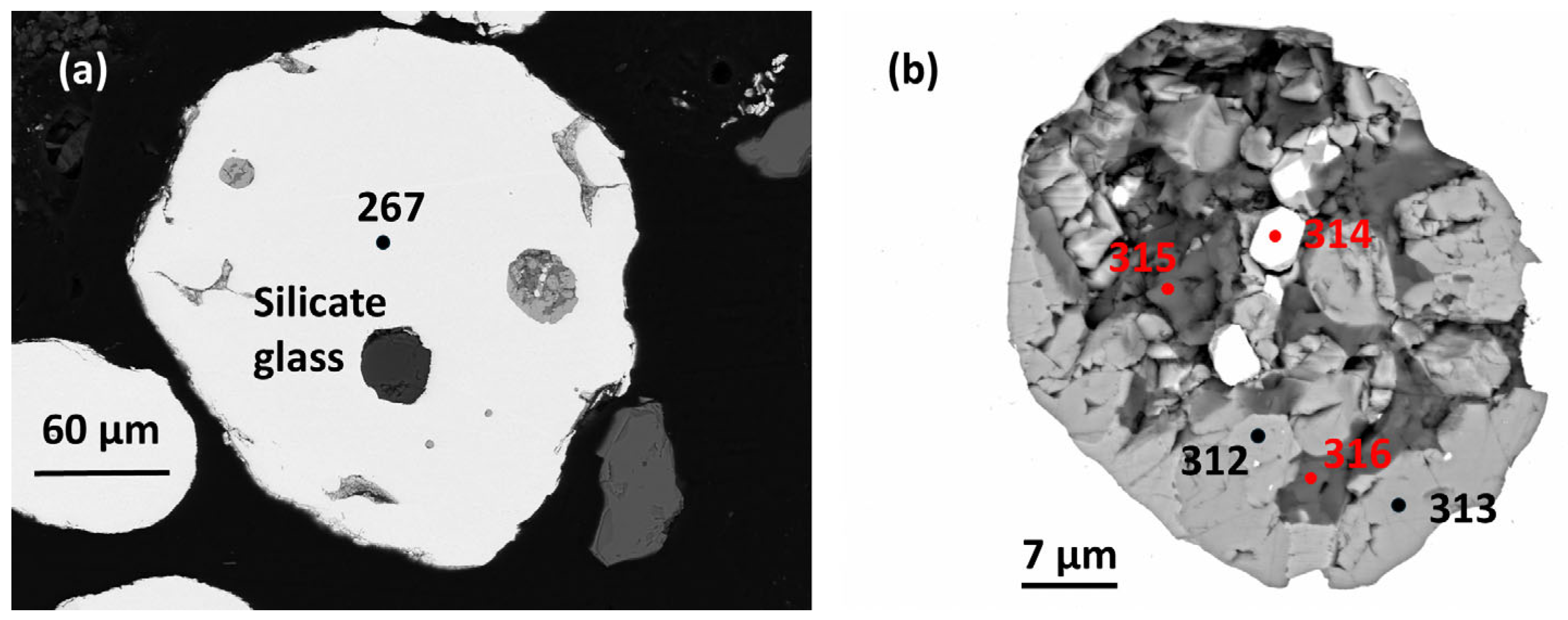
Three inclusions are present (
Figure 6a). The first inclusion is slightly fractured, homogeneous silicate glass (~42.9 µm across) lacking coexisting exsolved PGMs. Two separate inclusions (~75–90 µm across and ~20 µm across) have subrounded shapes with somewhat irregular margins and comprise melt inclusions with similar Cu-PGM sulfide parageneses. Three separate Cu-PGM sulfide “droplet”-shaped inclusions are minute (<4 µm across).
Analysis 154 of the largest of two silicate glass inclusions indicates alkali-enriched basaltic andesite with SiO
2 52.75, FeO 10.54, and H
2O ~1.71 (wt. %) (Barron et al. [
1]; Table 2E and Figure 6).
- (b)
Cu-PGM sulfide paragenesis
The texture of the largest PGM-bearing sulfide inclusion shows that subhedral crystals (up to ~10 µm) are set in anhedral interstitial minerals (
Figure 6b).
The
Pt-Fe alloy forms irregularly disseminated, sparse, and small (up to ~6 µm) subhedral crystals, but this mineral is absent in the smaller inclusion in the plane of the present section.
Analysis 4 (314) (
Table 6) indicates isoferroplatinum (Pt
2.75Pd
0.08Rh
0.05Os
0.01Cu
0.12Ni
0.01)
3.02Fe
0.99, with significantly high minor Pd, Cu, Fe, and Ni and low concentrations of Rh and detectable S. This is distinct from the host alloy in analysis 1 (267).
Table 6.
WDS analyses of sample A1 area 9.
Table 6.
WDS analyses of sample A1 area 9.
| # wt. % | Mineral | S | Se | Fe | Co | Ni | Cu | Ru | Rh | Pd | Os | Ir | Pt | Total |
|---|
| 1 (267) | Ifp host | | | 7.67 | | 0.04 | 0.62 | | 1.29 | 0.29 | 0.28 | 1.72 | 88.54 | 100.45 |
| 2 (312) * | Vs | 13.24 | 0.11 | 0.36 | | 0.12 | 11.39 | | 0.10 | 74.19 | | | 0.29 | 99.85 |
| 3 (313) | Crh | 30.39 | | 3.28 | 0.03 | 0.79 | 10.50 | 0.25 | 28.82 | | 0.37 | 2.64 | 25.18 | 102.25 |
| 4 (314) | Ifp incl | 0.06 | | 9.07 | | 0.13 | 1.25 | | 0.78 | 1.37 | | | 88.32 | 100.98 |
| 5 (315) † | Cpy | 35.67 | | 27.21 | | 0.16 | 31.61 | | 0.39 | 0.23 | | 0.10 | 0.62 | 96.03 |
| 6 (316) ^ | Pn | 31.64 | | 30.16 | 0.46 | 19.14 | 3.80 | | 2.91 | 8.06 | | 0.08 | 0.26 | 96.55 |
| # at. % | Mineral | S | Se | Fe | Co | Ni | Cu | Ru | Rh | Pd | Os | Ir | Pt | Total |
| 1(267) | Ifp host | | | 21.90 | | 0.11 | 1.56 | | 1.99 | 0.44 | 0.23 | 1.43 | 72.34 | 100.00 |
| 2 (312) ** | Vs | 31.71 | 0.10 | 0.50 | | 0.15 | 13.76 | | 0.08 | 53.55 | | | 0.11 | 100.00 |
| 3 (313) | Crh | 58.76 | | 3.64 | 0.03 | 0.83 | 10.24 | 0.15 | 17.36 | | 0.12 | 0.85 | 8.00 | 100.00 |
| 4 (314) | Ifp incl | 0.28 | | 24.64 | | 0.34 | 2.98 | | 1.16 | 1.95 | | | 68.66 | 100.00 |
| 5 (315) †† | Cpy | 52.73 | | 23.09 | | 0.13 | 23.57 | | 0.18 | 0.10 | | 0.02 | 0.15 | 100.00 |
| 6 (316) ^^ | Pn | 48.69 | | 26.62 | 0.39 | 16.09 | 2.95 | | 1.40 | 3.74 | | 0.02 | 0.07 | 100.00 |
| # apfu | Mineral | S | Se | Fe | Co | Ni | Cu | Ru | Rh | Pd | Os | Ir | Pt | Me |
| 1 (267) | Ifp host | | | 0.88 | | | 0.06 | | 0.08 | 0.02 | 0.01 | 0.06 | 2.89 | 4.00 |
| 2 (312) *** | Vs | 6.97 | 0.02 | 0.11 | | 0.03 | 3.03 | | 0.02 | 11.99 | | | 0.02 | 15.20 |
| 3 (313) | Crh | 4.00 | | 0.25 | | 0.06 | 0.73 | 0.01 | 1.24 | | 0.01 | 0.06 | 0.54 | 2.93 |
| 4 (314) | Ifp incl | | | 0.99 | | 0.01 | 0.12 | | 0.05 | 0.08 | 0.01 | | 2.75 | 4.01 |
| 5 (315) †† | Cpy | 2.00 | | 0.88 | | | 0.89 | | 0.01 | | | | 0.01 | 1.79 |
| 6 (316) ^^ | Pn | 8.00 | | 4.37 | 0.06 | 2.64 | 0.48 | | 0.23 | 0.61 | | | 0.01 | 8.42 |
Cupororhodsite–(malanite) also forms subhedral crystals (some reaching >7 µm grain size) and accounts for ~40% of the inclusion area (
Figure 6b).
Analysis 3 (313) (
Table 6) gives the formula (Cu
0.69Fe
0.25Ni
0.06)
1.00(Rh
1.18Pt
0.54Ir
0.06Os
0.01Ru
0.01)
1.80S
4.00. This analysis is distinctly Me-deficient and contains an unusually high number (9) of detectable metal elements.
Vasilite (~20% of the inclusion area) forms anhedral to subhedral crystals (up to ~6 µm) interstitial to the cupororhodsite–(malanite) above (
Figure 6b).
Analysis 2 (312) (
Table 6) gives a slightly Me-deficient formula: (Pd
11.77Cu
3.03Fe
0.11Ni
0.03Pt
0.02Rh
0.02)
14.99(S
6.97Se
0.02Te
0.01)
6.99.
Chalcopyrite is anhedral forming irregular interstitial patches (up to ~7 µm across). It accounts for ~20% of the relevant section area (
Figure 6b).
Analysis 5 (315) (
Table 6) indicates 0.45 at. % PGE (Rh, Pt, Pd, and Ir), and the calculated formula (Cu
0.89Fe
0.88Zn
0.02Pt
0.01Rh
0.01)
1.81S
2.00 suggests that it is Me-deficient.
Pentlandite forms sparse anhedral patches intergrown with interstitial chalcopyrite (
Figure 6b).
Analysis 6 (316) indicates the formula (Fe
4.37Ni
2.64Pd
0.61Cu
0.48Rh
0.23Co
0.06Zn
0.02Pt
0.01)
8.42S
8.00 [(Me)
9-xS
8, x = 0.58]. It incorporates significant minor elements, particularly Pd, Cu, and Rh.
3.1.5. Sample B Area 5
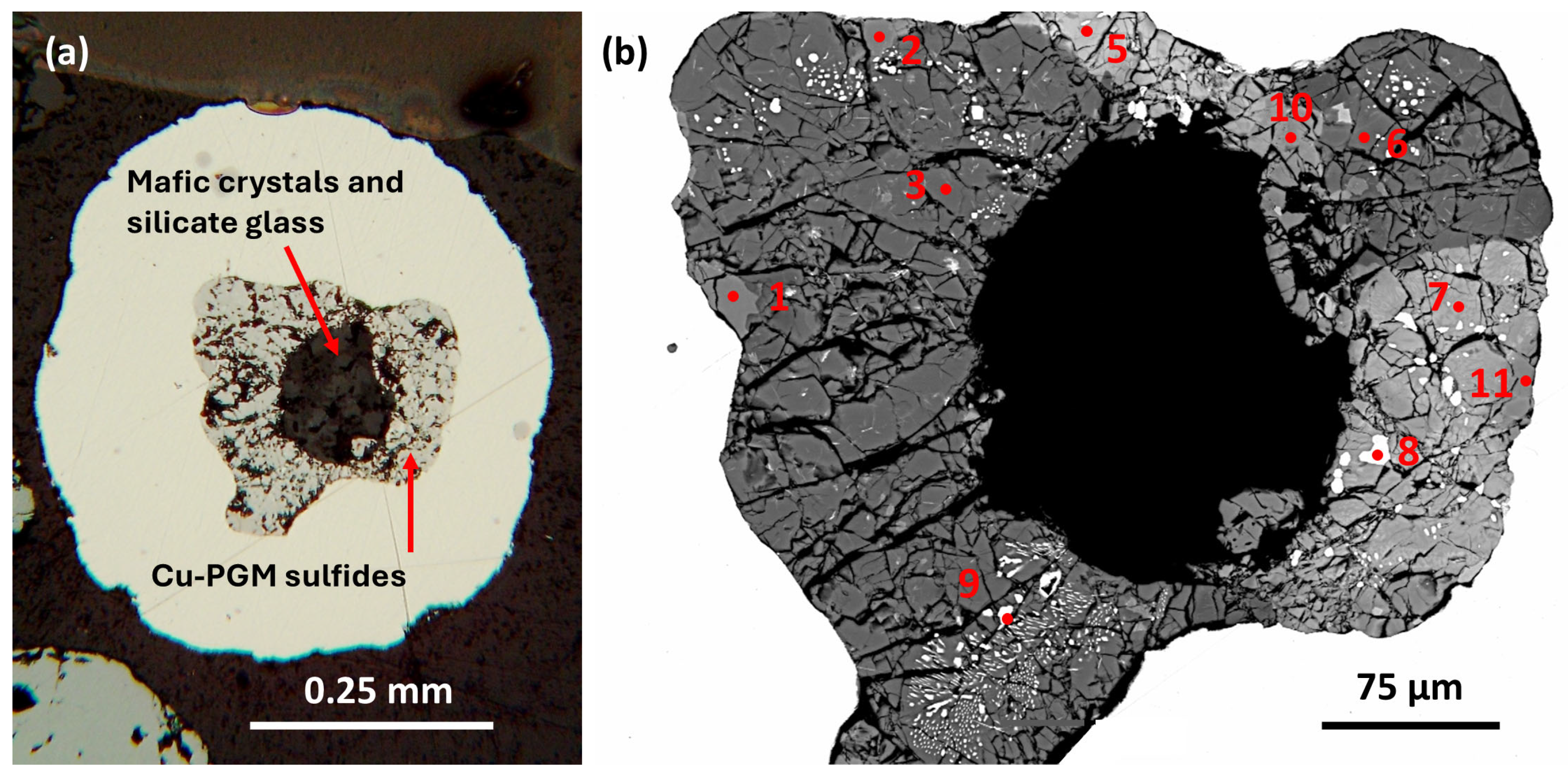
- (a)
Host alloy and andesite silicate glass (SiO2 59.89 wt. %)
The rounded
host nugget for this sample reaches ~0.4 mm across. It is isoferroplatinum (Pt
2.88Pd
0.01Rh
0.08Os
0.01Ir
0.02)
3.00(Fe
0.95Cu
0.05S
0.01)
1.01, with minor Rh, Cu, Pd, Ir, Os, and Ni, as shown in analysis 061 (Barron et al. [
1]; their Tables 1A and 1B). A prominent round composite inclusion measuring ~175 µm (~0.18 mm) across is not centrally located in the host nugget. It comprises a dominant rim of PGM enclosing a small rounded “pool” (~ 50 µm across) of quenched silicate glass located near one margin of the PGM paragenesis (
Figure 7a,b).
Analyses of the silicate glass in this composite inclusion indicate
andesite with SiO
2 59.89, FeO 3.25, and H
2O ~1.06 (wt. %) (average of analyses Sp38, Sp39, and Sp40 (Barron et al. [
1], Table 2D)).
- (b)
PGM sulfide paragenesis
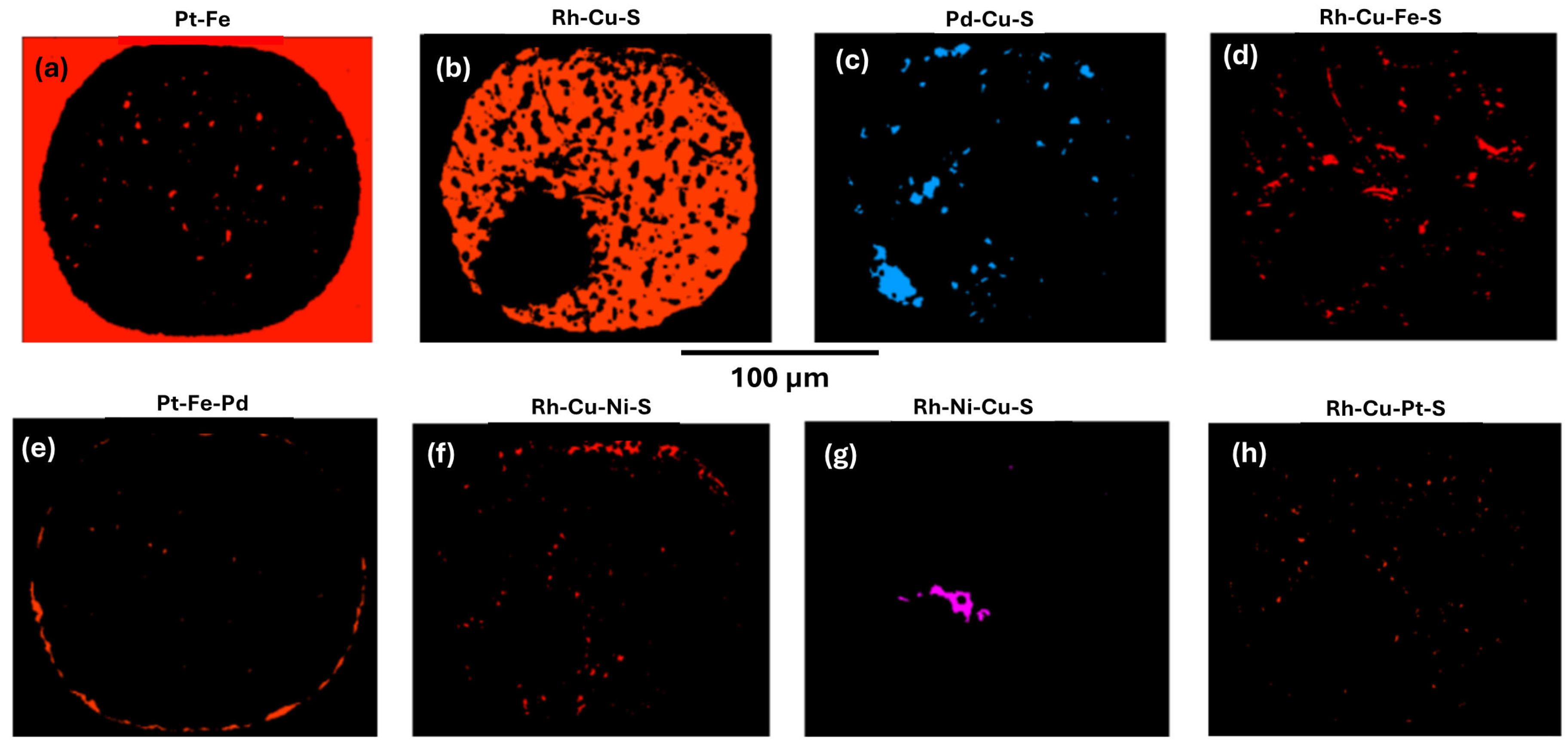
Phase mapping of the inclusion using EDS analyses and relative pixel counts for each phase indicates that silicate glass is 6.72 in fraction %. Eight minerals are identified in the PGM paragenesis (
Figure 8), and the normalized fraction % for each is as follows (fraction % is calculated minus unassigned pixels): Pt-Fe alloy: 4.98; Rh-Cu-S cuprorhodsite: 80.25; Pd-Cu-S vasilite: 4.98; Rh-Cu-Fe-S thiospinel: 3.98; Pt-Fe-Pd alloy: 2.59; Rh-Cu-Ni-S thiospinel: 2.00; Rh-Ni-Cu-S thiospinel: 1.00; Pd-Te keithconnite: 0.20; hematite: 0.20.
An approximate calculated bulk chemistry based on the EDS
element mapping of the PGM paragenesis is given in
Table 7. The order of major elements present is as follows: Rh >> Cu > Fe >> Pd > Ni.
Cuprorhodsite (
Figure 7 and Rh-Cu-S in
Figure 8b) is the dominant mineral (80.25 fraction %) in this inclusion. It forms a spongy framework of skeletal to subhedral and elongate prisms, showing partial radial structure oriented away from the silicate “pool”. Some curved narrow cuprorhodsite crystals are intergrown with ~20 fraction % of all other finer-grained patchy minerals.
Analysis 4-2 (067) (
Table 8) indicates (Cu
0.52Fe
0.42Ni
0.02)
0.96(Rh
1.94Ir
0.02Pt
0.03)
1.99(S
4.02Se
0.01)
4.03, and phase-mapped analysis 3 (22), as shown in
Table 9, also indicates cuprorhodsite (Cu
0.56Fe
0.44)
1.02(Rh
1.91Ni
0.03Fe
0.02)
1.96(S
3.99Se
0.01).
Table 8.
WDS analyses. Sample B Area 5.
Table 8.
WDS analyses. Sample B Area 5.
| # wt. % | Mineral | S | Fe | Ni | Cu | Se | Rh | Pd | Te | Os | Ir | Pt | Total |
|---|
| 6 (061) | Ifp Host ◊ | 0.04 | 8.31 | 0.03 | 0.50 | | 1.22 | 0.17 | | 0.18 | 0.64 | 88.29 | 99.40 |
| 1 (063) | PdCu Vs | 13.53 | 0.12 | 0.04 | 13.60 | 0.09 | 0.06 | 72.56 | | | | 0.52 | 100.53 |
| 2 (064) | PdTe Kei * | 0.12 | 0.21 | 0.04 | 0.43 | | 0.09 | 70.97 | 29.31 | 0.11 | | | 102.26 |
| 4-2 (067) | Crh □ | 33.07 | 5.96 | 0.26 | 8.54 | 0.19 | 51.12 | | | | 1.17 | 1.68 | 102.01 |
| 5-2 (069) | Ifp Rim † | 0.04 | 9.75 | 0.27 | 1.36 | | 0.65 | 11.24 | | 0.13 | | 75.94 | 99.54 |
| 7 (070) | PtFe Incl. | 0.08 | 9.17 | 0.10 | 1.27 | | 2.87 | 2.57 | | 0.14 | | 84.68 | 100.88 |
| 9 (071) | PdCu Vs | 13.66 | 0.22 | 0.35 | 13.53 | 0.21 | | 73.33 | 0.10 | | | 0.45 | 101.84 |
| 13 ^ | Ms ^ | 27.05 | 12.40 | 11.00 | 5.74 | | 20.60 | | | 0.12 | 7.89 | 12.79 | 101.07 |
| Note: ◊ Co: 0.02. * Sn: 0.11; Sb: 0.06; Pb: 0.45; Bi: 0.87; Ag: 0.10. □ Co: 0.02. † Au: 0.16. ^ As: 0.1; Ru: 0.07. |
| # at. % | Mineral | S | Fe | Ni | Cu | Se | Rh | Pd | Te | Os | Ir | Pt | Total |
| 6 (061) | Ifp host ◊ | 0.18 | 23.65 | 0.07 | 1.24 | | 1.89 | 0.26 | | 0.15 | 0.53 | 71.96 | 100.00 |
| 1 (063) | PdCu Vs | 31.83 | 0.17 | 0.06 | 16.15 | 0.09 | 0.04 | 51.46 | | | | 0.20 | 100.00 |
| 2 (064) | PdTe Kei ** | 0.42 | 0.40 | 0.08 | 0.73 | | 0.10 | 72.35 | 24.91 | 0.06 | | | 100.00 |
| 4-2 (067) | Crh □ | 57.55 | 5.94 | 0.26 | 7.51 | 0.14 | 27.67 | | | | 0.33 | 0.59 | 100.00 |
| 5-2 (069) | Ifp Rim †† | 0.19 | 24.78 | 0.66 | 3.03 | | 0.90 | 14.99 | | 0.10 | | 55.23 | 100.00 |
| 7 (070) | Ifp Incl | 0.39 | 24.31 | 0.24 | 2.97 | | 4.13 | 3.57 | | 0.11 | | 64.28 | 100.00 |
| 9 (071) | PdCu Vs | 31.71 | 0.29 | 0.44 | 15.84 | 0.20 | | 51.29 | 0.06 | | | 0.17 | 100.00 |
| 13 | Ms ^ | 51.05 | 13.43 | 11.34 | 5.46 | | 12.11 | | | 0.04 | 2.48 | 3.97 | 100.00 |
| Note: ◊ Co: 0.06. ** Sn: 0.10; Sb: 0.06; Pb: 0.23; Bi: 0.45; Ag: 0.11. □ Co: 0.02. †† Au: 0.12. ^ As: 0.08; Ru: 0.04. |
| # apfu | Mineral | S | Fe | Ni | Cu | Se | Rh | Pd | Te | Os | Ir | Pt | ∑Me |
| 6 (061) | Ifp host | 0.01 | 0.95 | | 0.05 | | 0.08 | 0.01 | | 0.01 | 0.02 | 2.88 | 4.01 |
| 1 (063) | PdCu ~Vs | 7.47 | 0.04 | 0.01 | 3.79 | 0.02 | 0.01 | 12.09 | | | | 0.05 | 15.99 |
| 2 (064) | PdTe Kei *** | 0.11 | | 0.02 | 0.20 | | 0.03 | 19.60 | 6.75 | 0.02 | | | 19.93 |
| 4-2 (067) | Crh | 4.02 | 0.42 | 0.02 | 0.52 | 0.01 | 1.94 | | | | 0.02 | 0.03 | 2.98 |
| 5-2 (069) | Ifp Rim ††† | | 1.00 | 0.03 | 0.12 | | 0.04 | 0.60 | | | | 2.21 | 4.00 |
| 7 (070) | Ifp Incl | | 0.98 | | 0.12 | | 0.16 | 0.16 | | | | 2.56 | 3.98 |
| 9 (071) | PdCu ~Vs | 7.44 | 0.07 | 0.10 | 3.72 | 0.05 | | 12.03 | 0.01 | | | 0.04 | 16.01 |
| 13 | Ms | 1.00 | 0.26 | 0.22 | 0.11 | | 0.23 | | | | 0.05 | 0.08 | 0.95 |
| Note: *** Pb: 0.06; Sn: 0.03; Sb: 0.02; Bi: 0.12; Ag: 0.03. ††† Au: 0.01. Ifp = Isoferroplatinum; Crh = cuprorhodsite; Kei = keithconnite; Vs = vasilite; Ms = monosulfide mineral. Italics, semiquantitative analysis, small grain size, cf. Nesterenko [20]. |
Table 9.
Sample B Area 5. PGM analyses (EDS based on pixel counts).
Table 9.
Sample B Area 5. PGM analyses (EDS based on pixel counts).
| # wt. % | Mineral | Elements | S | Fe | Ni | Cu | Rh | Pd | Pt | O | Total |
|---|
| 3 (22) | Crh ^ | Rh-Cu-S | 33.17 | 6.53 | 0.41 | 9.19 | 50.49 | | | | 100 |
| 6 (25) | PtFePdCu | Pt-Fe-Pd | | 10.27 | | 1.56 | | 10.91 | 77.25 | | 100 |
| 7 (26) | Crh-Pld | Rh-Cu-Ni-S | 33.48 | 1.83 | 4.68 | 9.96 | 50.05 | | | | 100 |
| 10 (29) | Crh-Pld | Rh-Ni-Cu-S | 35.13 | 4.68 | 13.32 | 7.57 | 39.30 | | | | 100 |
| 11 (30) | Ms | Rh-Cu-Pt-S | 25.00 | 6.86 | 0.75 | 6.49 | 34.06 | | 26.83 | | 100 |
| 14 (33) | * Crh-(Fe) | Rh-Cu-Fe-S | 32.81 | 7.95 | 0.81 | 11.94 | 46.48 | | | | 100 |
| 16 (35) | + Hem | Fe-O | 0.61 | 68.07 | 0.88 | | | | | 29.56 | 100 |
| # | at. % | | S | Fe | Ni | Cu | Rh | Pd | Pt | O | Me |
| 3 (22) | Crh ^^ | Rh-Cu-S | 57.02 | 6.51 | 0.39 | 8.05 | 27.31 | | | | 42.41 |
| 6 (25) | PtFePdCu | Pt-Fe-Pd | | 26.01 | | 3.48 | | 14.51 | 56.00 | | 100 |
| 7 (26) | Crh-(Pld) | Rh-Cu-Ni-S | 58.02 | 1.82 | 4.43 | 8.71 | 27.02 | | | | 41.98 |
| 10 (29) | Crh-(Pld) | Rh-Ni-Cu-S | 57.44 | 4.40 | 11.90 | 6.25 | 20.02 | | | | 42.57 |
| 11 (30) | Ms | Rh-Cu-Pt-S | 52.47 | 8.27 | 0.86 | 6.87 | 22.27 | | 9.25 | | 47.52 |
| 14 (33) | * Crh-(Fe) | Rh-Cu-Fe-S | 56.24 | 7.83 | 0.76 | 10.33 | 24.83 | | | | 43.75 |
| 16 (35) | ++ Hem | Fe-O | 0.61 | 38.91 | 0.48 | | | | | 58.98 | 98.37 |
Three additional Rh-thiospinel minerals (notably Pt-deficient) are identified by chemical differences in element abundances in phase maps (using pixel counts):
- (1)
Rh-Cu-Fe-S thiospinel [red in
Figure 8d, analysis 14 (33),
Table 9] fills some sub-parallel and curved grain boundaries and marks the silicate/PGM boundary. It has an Fe-enriched composition (Cu
0.73Fe
0.27Ni
0.05)
1.05(Rh
1.76Fe
0.29)
2.05S
3.99. In this analysis, after Rh (24.83 at. %), Cu and Fe have the highest concentrations (Cu 10.33 and Fe 7.83 at. %), while Ni (0.76 at. %) is a minor metal element. Thus, this minor thiospinel is
ferrorhodsite (cf. Cabri et al. [
19]). In
Figure 8d, this mineral is fine-grained with a patchy distribution and defines some sub-parallel curving brittle fractures.
- (2)
Rh-Cu-Ni-S thiospinel is red in
Figure 8f, and
analysis 7 (26), as shown in
Table 9, indicates that it is
cuprorhodsite–(polydymite): (Cu
0.60Ni
0.17Fe
0.13)
0.90(Rh
1.86Ni
0.14)
2.00S
4.00. This mineral occurs along part of the rounded inclusion boundary with the host Pt-Fe alloy. It also forms small blebs and partly defines minor fractures along the silicate glass boundary with the PGM sulfide fraction.
- (3)
Rh-Ni-Cu-S thiospinel is a well-defined small anhedral pink mineral in
Figure 8g. It forms an irregular aggregate (~23 µm long) in the PGM paragenesis adjacent to the rounded silicate glass fraction.
Analysis 10 (29), as shown in
Table 9, indicates
polydymite–(cuprorhodsite) (Cu
0.44Fe
0.30Ni
2+0.26)
1.00(Rh
1.40Ni
3+0.56)
1.96S
4.00, with significantly higher concentrations of Ni than (2) above.
Vasilite [Pd-Cu-S
Figure 8c] also occurs as fine-grained patches but has an uneven distribution.
Analysis 1 (063) (
Table 8) indicates (Pd
12.09Cu
3.80Pt
0.05Fe
0.04Ni
0.01Rh
0.01)
16.00(S
7.48Se
0.02)
7.50.
The minor
monosulfide mineral (red specks in Rh-Cu-Pt-S
Figure 8h) occurs as small grains crystallized along mineral boundaries and fractures.
Analysis 11 (30), as shown in
Table 9, indicates (Rh
0.42Pt
0.18Fe
0.16Cu
0.13Ni
0.02)
0.91S
1.00. The latter is Me-deficient.
Keithconnite and
hematite each account for only 0.2 fraction % of the PGM paragenesis. Keithconnite forms minor, very small anhedral patches similar to vasilite.
Analysis 2 (064) (
Table 8) indicates keithconnite with formula (Pd
19.44Cu
0.20Fe
0.11Pb
0.06Rh
0.03Ag
0.03Os
0.02Ni
0.02)
19.94(Te
6.72S
0.11Bi
0.12Sb
0.02)
6.97. This has a remarkably high Me:S = 2.86. Hematite occurs as wispy grains marking the boundary between the silicate and PGM fractions.
Analysis 16 (35), as shown in
Table 9, indicates (Fe
1.95Ni
0.02Al
0.02Si
0.03)
2.02O
3.00S
0.03. The minor
Pt-Fe alloy is approximately evenly distributed as fine-grained (<~5 µm across) anhedral patches (white in
Figure 7a,b and red Pt-Fe in
Figure 8a).
Analysis 7 (070)
Table 8 indicates isoferroplatinum (Pt
2.56Pd
0.16Rh
0.16)
2.98(Fe
0.96Cu
0.12)
1.08 with significant Pd 3.57, Rh 4.13, and Cu 2.97 (at. %) and detectable Ni. A second minor
Pt-Fe-Pd alloy (also red in
Figure 8e) forms a wispy discontinuous boundary with the host nugget.
Analysis 6 (25) (
Table 9) indicates Pd (and Cu)-enriched isoferroplatinum [(Pt
2.24Pd
0.58Cu
0.14)
2.96Fe
1.04]
4.00.
3.1.6. Sample B Area 4
- (a)
Host alloy and porphyritic dacitic/rhyolitic groundmass silicate glass (SiO2 70.67 wt. %)
The
host nugget for this sample is round (~0.48 mm diameter) but slightly irregular (
Figure 9).
Analysis 051 (Tables 1A and 1B of Barron et al. [
1]) indicates isoferroplatinum (Pt
2.90Pd
0.04Ir
0.02Os
0.01)
3.05(Fe
0.88Rh
0.08Cu
0.05Ni
0.01S
0.01)
1.03 with FeO 22.09 (at. %) and minor Rh, Cu, Pd, and Ir. It hosts a remarkable composite inclusion up to ~120 µm across, with an unusual irregular distinctly wavy outline (
Figure 9). The inclusion is located almost centrally in the host nugget. The central silicate fraction (~65 µm across) is rounded, except for an inward bulge. This fraction is micro-porphyritic with subhedral amphibole and diopsidic clinopyroxene micro-phenocrysts set in chilled silicate glass of the
dacite/rhyolite composition [
1].
Analyses of the groundmass silicate glass indicate
dacite–rhyolite with SiO
2 70.67, very low FeO 0.24, and H
2O ~2.17 (wt. %) (average of analyses (004) and (005); Table 3 of Barron et al. [
1]).
- (b)
PGM sulfide paragenesis
The
PGM paragenesis forms a “rim” of variable thickness (about ~5 µm up to ~50 µm) around the almost centrally located silicate “pool”, as shown in
Figure 9a,b. This assemblage comprises an irregularly intergrown aggregate of anhedral grains measuring > 60 µm across.
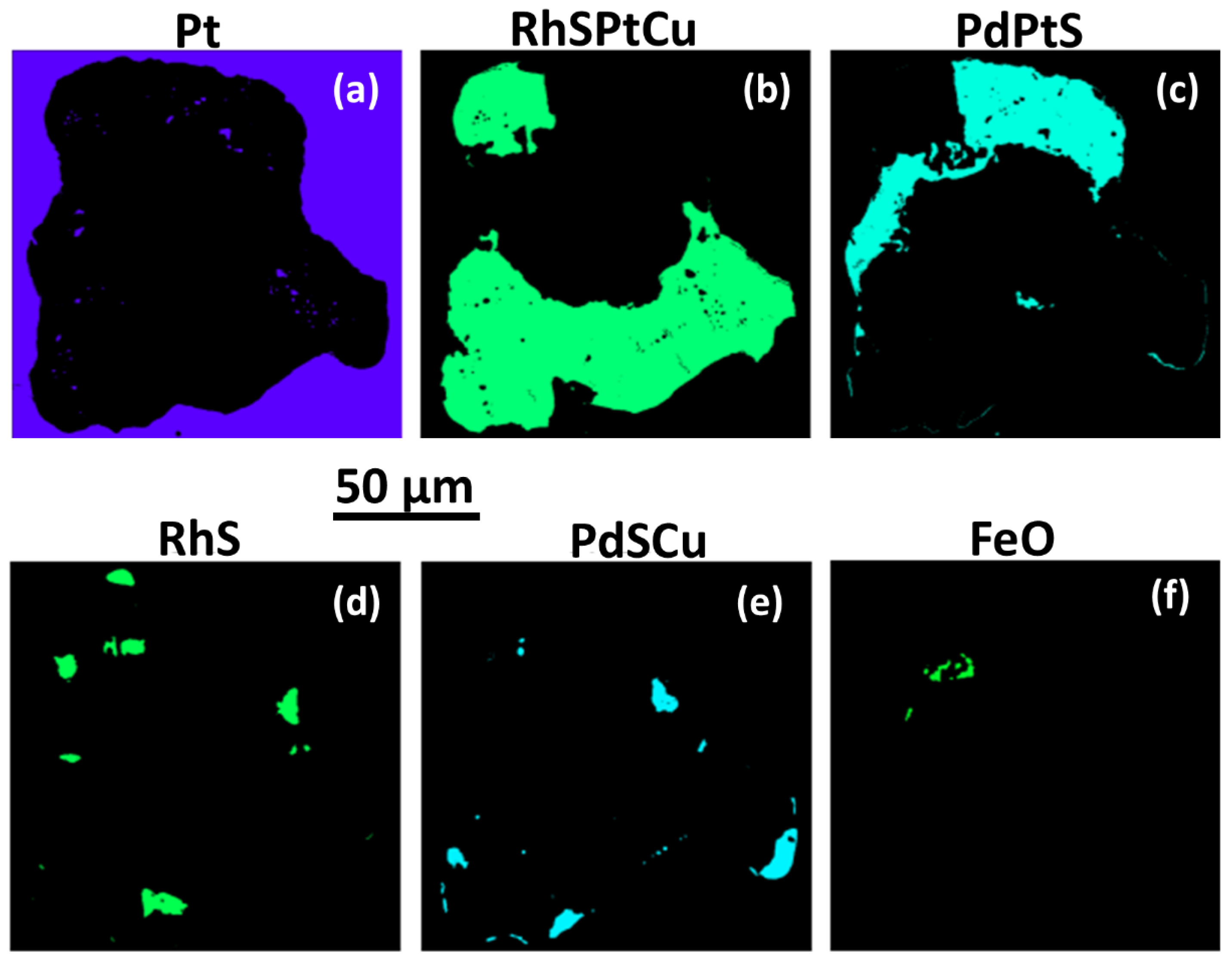
Phase mapping (
Figure 10) gives an approximate fraction % for each mineral present (based on relative pixel counts using EDS analysis and BSE imaging minus unassigned pixels). The PGM fraction accounts for 77.8 fraction % of the inclusion, while the exsolved silicate fraction is 22.2 fraction % of the inclusion area. An approximate
normalized modal mineralogy for the PGM fraction is as follows (fraction %): (a) Pt-Fe alloy: ~1.5; (b) cuprorhodsite: 65.3; (c) braggite (and subordinate Ni-vysotskite): 25.6; (d) bowieite: 3.6; (e) vasilite: 3.6; UM (unnamed mineral): 0.42. PdTeSRh is a sulfide-telluride analog of palladoarsenide (Pd
2As).
An approximate calculated bulk chemistry (
Table 10) is based on the EDS
element mapping of the PGM paragenesis.
Table 10.
Sample B area 4. Calculated bulk chemistry PGM (minus silicates).
Table 10.
Sample B area 4. Calculated bulk chemistry PGM (minus silicates).
| S | Fe | Ni | Cu | Rh | Pd | Os | Ir | Pt | Te | As | Total, wt. % |
|---|
| 18.10 | 7.04 | 1.90 | 3.48 | 12.20 | 37.50 | 0.07 | 0.72 | 14.42 | 4.54 | 0.04 | 100.00 |
| | | | | | | | | | | | Total, at. % |
| 41.42 | 9.25 | 2.37 | 4.02 | 8.70 | 25.86 | 0.03 | 0.27 | 5.42 | 2.61 | 0.04 | 100.00 |
The
Pt-Fe alloy forms small clusters of purple grains (Pt,
Figure 10a) in the PGM sulfide paragenesis fraction. The Pt-Fe alloy set in cuprorhodsite (
Figure 9b) is Rh-enriched isoferroplatinum (Pt
2.94Rh
0.06)
3.00(Fe
0.85Rh
0.16)
1.01 (EDS analysis 9Ifp,
Table 11). In contrast, the Pt-Fe alloy set in vysotskite is Pd-rich isoferroplatinum (Pt
2.52Pd
0.38Rh
0.03Ru
0.01)
2.94 (Fe
0.97Cu
0.06Ni
0.04)
1.07 (
analysis 8 (060),
Table 11,
Figure 9b).
Cuprorhodsite (Rh-Cu-Fe-S, green in
Figure 10b) is the dominant mineral in this inclusion and occurs as two anhedral domains; the largest is ~0.15 mm across.
Analysis 3 (056) (
Table 11) indicates cuprorhodsite–(malanite) (Cu
0.72Fe
0.18Ni
0.05Co
0.01)
0.96(Rh
1.53Ir
0.07Pt
0.35)
1.92S
4.00 (Me-deficient).
Vysotskite (1) (Vys, turquoise in
Figure 10c) occurs as irregular large patches that are pale grey in
Figure 9b.
Analysis 5 (058), as shown in
Table 11, gives Pd 24.15 and Pt 18.58 with 3.36 (at. %) minor elements (Cu, Fe, Rh, Ni, and Os). It has slightly high S. Analysis 5 (059) is similar. Minor
vysotskite (2) is slightly darker grey in
Figure 10. Analyses 10 (053) and 11 (054), as shown in
Table 11, are more Pd- and Ni-enriched with lower Pt.
Table 11.
WDS analyses sample B area 4.
Table 11.
WDS analyses sample B area 4.
| # wt. % | Mineral | S | Se | Fe | Ni | Cu | Rh | Pd | Ag | Os | Ir | Pt | Total |
|---|
| (051) □ | Ifp host | 0.04 | | 7.72 | 0.05 | 0.47 | 1.32 | 0.65 | | 0.22 | 0.62 | 88.55 | 99.77 |
| 1 (052) † | Vs | 13.45 | 0.14 | 0.06 | 0.03 | 12.70 | 0.08 | 74.29 | 0.17 | | | 0.31 | 101.39 |
| 2 (055) | Vs | 13.49 | 0.06 | 0.13 | 0.04 | 12.67 | | 74.26 | 0.08 | | | 0.51 | 101.23 |
| 3 (056) * | Crh | 31.22 | | 2.38 | 0.75 | 10.83 | 37.47 | 0.06 | | 0.15 | 3.08 | 16.15 | 102.17 |
| 5 (058) | Vys (1) | 21.34 | | 0.10 | 2.10 | 0.12 | 0.23 | 31.91 | | | | 44.82 | 100.61 |
| 7 (059) | Vys (1) | 22.54 | | 0.05 | 3.10 | | 0.15 | 38.51 | 0.07 | | | 36.78 | 101.20 |
| 8 (060) ◊ | Ifp | 0.07 | | 9.14 | 0.35 | 0.62 | 0.43 | 6.77 | | 0.10 | | 83.25 | 100.83 |
| 10 (053) ^ | Vys (2) | 23.96 | 0.32 | 0.11 | 4.17 | 0.09 | 0.07 | 52.77 | | | | 19.54 | 101.07 |
| 11 (054) | Vys (2) | 23.92 | 0.27 | 0.08 | 4.14 | | 0.08 | 55.25 | | | | 17.40 | 101.13 |
| Note: □ Pb: 0.14. † Te: 0.06; Bi: 0.09. * Co: 0.08. ◊ Ru: 0.10. ^ Te: 0.05. |
| # at. % | Mineral | S | Se | Fe | Ni | Cu | Rh | Pd | Ag | Os | Ir | Pt | Total |
| (051) □ | Ifp host | 0.21 | | 22.09 | 0.15 | 1.18 | 2.05 | 0.98 | | 0.19 | 0.51 | 72.56 | 100.00 |
| 1 (052) †† | Vs | 31.65 | 0.14 | 0.08 | 0.04 | 15.07 | 0.06 | 52.66 | 0.12 | | | 0.12 | 100.00 |
| 2 (055) | Vs | 31.75 | 0.06 | 0.17 | 0.05 | 15.04 | | 52.67 | 0.05 | | | 0.20 | 100.00 |
| 3 (056) ** | Crh | 58.47 | | 2.56 | 0.77 | 10.23 | 21.87 | 0.04 | | 0.05 | 0.96 | 4.97 | 100.00 |
| 5 (058) | Vys (1) | 53.81 | | 0.14 | 2.89 | 0.15 | 0.18 | 24.15 | | | | 18.58 | 100.00 |
| 7 (059) | Vys (1) | 53.69 | | 0.07 | 4.04 | | 0.11 | 27.65 | 0.05 | | | 14.40 | 100.00 |
| 8 (060) ◊ | Ifp | 0.32 | | 24.15 | 0.88 | 1.45 | 0.62 | 9.38 | | 0.08 | | 62.98 | 100.00 |
| 10 (053) ^^ | Vys (2) | 52.52 | 0.28 | 0.14 | 4.99 | 0.10 | 0.05 | 34.86 | | | | 7.04 | 100.00 |
| 11 (054) | Vys (2) | 52.15 | 0.24 | 0.10 | 4.93 | | 0.05 | 36.30 | | | | 6.23 | 100.00 |
| Note: □ Pb: 0.11. †† Te: 0.04; Bi: 0.03. ** Co: 0.08. ◊ Ru: 0.14. ^^ Te: 0.03. |
| # apfu | Mineral | S | Se | Fe | Ni | Cu | Rh | Pd | Ag | Os | Ir | Pt | Me |
| (051) | Ifp host | 0.01 | | 0.88 | 0.01 | 0.05 | 0.08 | 0.04 | | 0.01 | 0.02 | 2.90 | 4.00 |
| 1 (052) ††† | Vs | 6.97 | 0.03 | 0.02 | 0.01 | 3.32 | 0.01 | 11.60 | 0.03 | | | 0.03 | 15.03 |
| 2 (055) | Vs | 6.99 | 0.01 | 0.04 | 0.01 | 3.31 | | 11.60 | 0.01 | | | 0.05 | 15.02 |
| 3 (056) *** | Crh | 4.00 | | 0.18 | 0.05 | 0.70 | 1.50 | | | | 0.07 | 0.34 | 2.85 |
| 5 (058) | Vys (1) | 1.00 | | | 0.06 | | | 0.40 | | | | 0.31 | 0.77 |
| 7 (059) | Vys (1) | 1.00 | | | 0.08 | | | 0.52 | | | | 0.27 | 0.87 |
| 8 (060) ◊ | Ifp | | | 0.97 | 0.04 | 0.06 | 0.03 | 0.38 | | | | 2.52 | 4.02 |
| 10 (053) | Vys (2) | 0.99 | 0.01 | | 0.09 | | | 0.66 | | | | 0.13 | 0.90 |
| 11 (054) | Vys (2) | 1.00 | | | 0.09 | | | 0.67 | | | | 0.12 | 0.88 |
| Note: ††† Te: 0.01. *** Co: 0.01. ◊ Ru: 0.01. Crh = Cuprorhodsite; Ifp = isoferroplatinum; Vs = vasilite Vys = vysotskite. |
Bowieite (RhS, green in
Figure 10d) occurs as irregular small patches at the margins of cuprorhodsite.
EDS analysis 5RhS (
Table 12) gives the following empirical formula: (Rh
1.73Pd
0.13Ir
0.05Pt
0.04Os
0.01Cu
0.05Ni
0.02Fe
0.02)
2.05S
3.00.
Table 12.
Sample B (Area 4). EDS analyses, additional PGM identified by phase map analysis.
Table 12.
Sample B (Area 4). EDS analyses, additional PGM identified by phase map analysis.
| wt. % | S | Fe | Ni | Cu | Rh | Pd | Te | As | Os | Ir | Pt | O | Total |
|---|
| 5 Bow ^ | 30.81 | 0.29 | 0.33 | 0.95 | 56.85 | 4.39 | | | 0.65 | 3.26 | 2.46 | | 100.00 |
| 9 Ifp | | 7.37 | | | 3.45 | | | | | | 89.18 | | 100.00 |
| 17 Hem | 3.23 | 54.80 | 1.38 | | | 9.26 | | | | | 3.45 | 26.81 | 100.00 |
| 18 UM ^ | 5.98 | | 1.33 | 0.54 | | 63.64 | 20.82 | 0.32 | | | 7.38 | | 100.00 |
| at. % | S | Fe | Ni | Cu | Rh | Pd | Te | As | Os | Ir | Pt | O | Total |
| 5 RhS ^ | 59.56 | 0.31 | 0.34 | 0.92 | 34.28 | 2.56 | | | 0.21 | 1.07 | 0.78 | | 100.00 |
| 9 Ifp | | 21.20 | | | 5.38 | | | | | | 73.42 | | 100.00 |
| 17 Hem | 3.47 | 33.80 | 0.81 | | | 2.99 | 0.18 | | | | 0.61 | 57.68 | 100.00 |
| 18 UM ^ | 18.25 | | 2.21 | 0.82 | | 58.58 | 15.97 | 0.42 | | | 3.70 | | 100.00 |
Vasilite (PdSCu in
Figure 10e) forms sparse anhedral patches along the margins of the irregular inclusion. The average of three analyses [1 (052), 2 (055), and 9 (053);
Table 11] produces similar formulae.
Analysis 2 (055) gives (Pd
11.60Cu
3.31Pt
0.05 Ag
0.01Fe
0.04Ni
0.01)
15.02(S
6.99Se
0.01)
7.00. This is slightly Me-deficient, and Me:S = ~2.15.
Hematite (FeO in
Figure 10f) occurs as a small (10 µm) cluster of anhedral grains as inclusions in vysotskite (2).
EDS analysis of 17FeO (
Table 12) shows ~Fe
2O
3. An UM
(unnamed mineral) (PdTe) occurs as eight very small (up to ~3 µm) grains located mainly along the boundary of the PGM sulfide fraction with the silicate fraction.
EDS analysis of 18PdTe (
Table 12) indicates (Pd
1.79Pt
0.11Ni
0.07Cu
0.03)
2.00(S
0.56Te
0.48As
0.01)
1.05. It is a Pd-dominant sulfide-telluride analog of palladoarsenide (Pd
2As) and possibly naldrettite (Pd
2Sb).
The PGM paragenesis in this inclusion is dominated by cuprorhodsite, with significant intergrown irregular patches of vysotskite (1) and subordinate vysotskite (>Ni) (2), minor bowieite, and minor vasilite. The Pt-Fe alloy is unevenly distributed as fine-grained (<~5 µm across), anhedral (exsolved) patches in both cuprorhodsite and vysotskite (1), but it is lacking in vysotskite (2) (
Figure 9b and
Figure 10a). “Sprays” of Pt-Fe alloy inclusions define exsolutions in cuprorhodsite in
Figure 9b. The Pt-Fe-Pd alloy also forms a wispy discontinuous boundary with the host nugget. Vasilite occurs as similar fine-grained patches but has an uneven distribution.
3.1.7. Sample A1 Area 7
- (a)
Host alloy and porphyritic rhyolitic groundmass silicate glass (SiO2 70.31 wt. %)
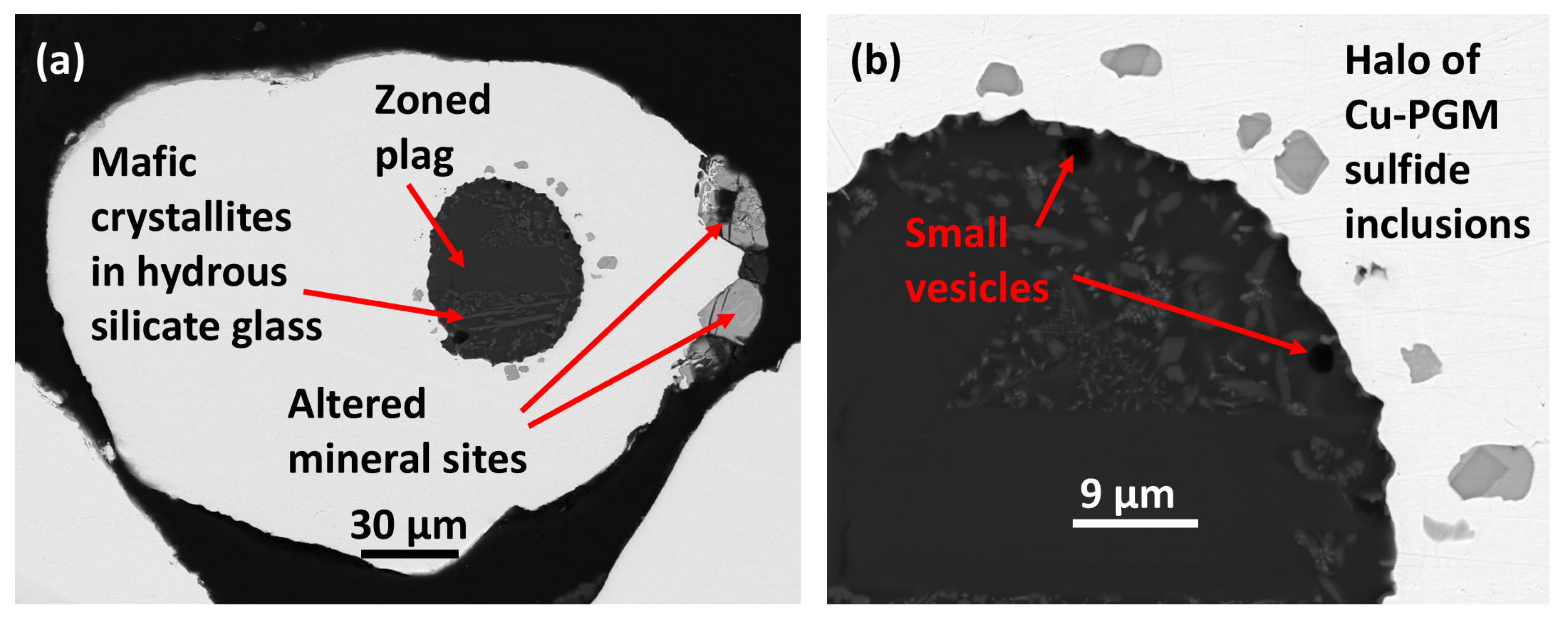
The small (~0.26 mm across)
host nugget is partly rounded with some subhedral-shaped indents filled with alteration products, suggesting previous coexisting crystal sites (
Figure 11a).
Analysis 1 (264) (Tables 1A and 1B of Barron et al. [
1]) indicates Pd- and Rh-enriched
native platinum (Pt
2.83Pd
0.12Rh
0.12Ir
0.10Os
0.02Ru
0.01Fe
0.68 Cu
0.13)
4.01.
An exceptional oval-shaped
silicate inclusion (about 65 µm across) with a finely scalloped margin is located towards one side of the host alloy. Plagioclase prisms, skeletal mafic (possibly amphibole) microlites, and minor wispy oxides are set in chilled silicate glass with SiO
2 at 70.31 and significant H
2O at ~4.23 wt. % (Barron et al. [
1], analyses 145 and 147, Table 4). Significant quench textures are small, gas/volatile vesicles at the silicate droplet margin, near the point of ejection into the host alloy. A prismatic plagioclase phenocryst is normally compositionally zoned, with a calcic core of bytownite suggesting a picrobasaltic or picritic primitive parent melt and sustained fractionation [
1].
- (b)
PGM sulfide paragenesis
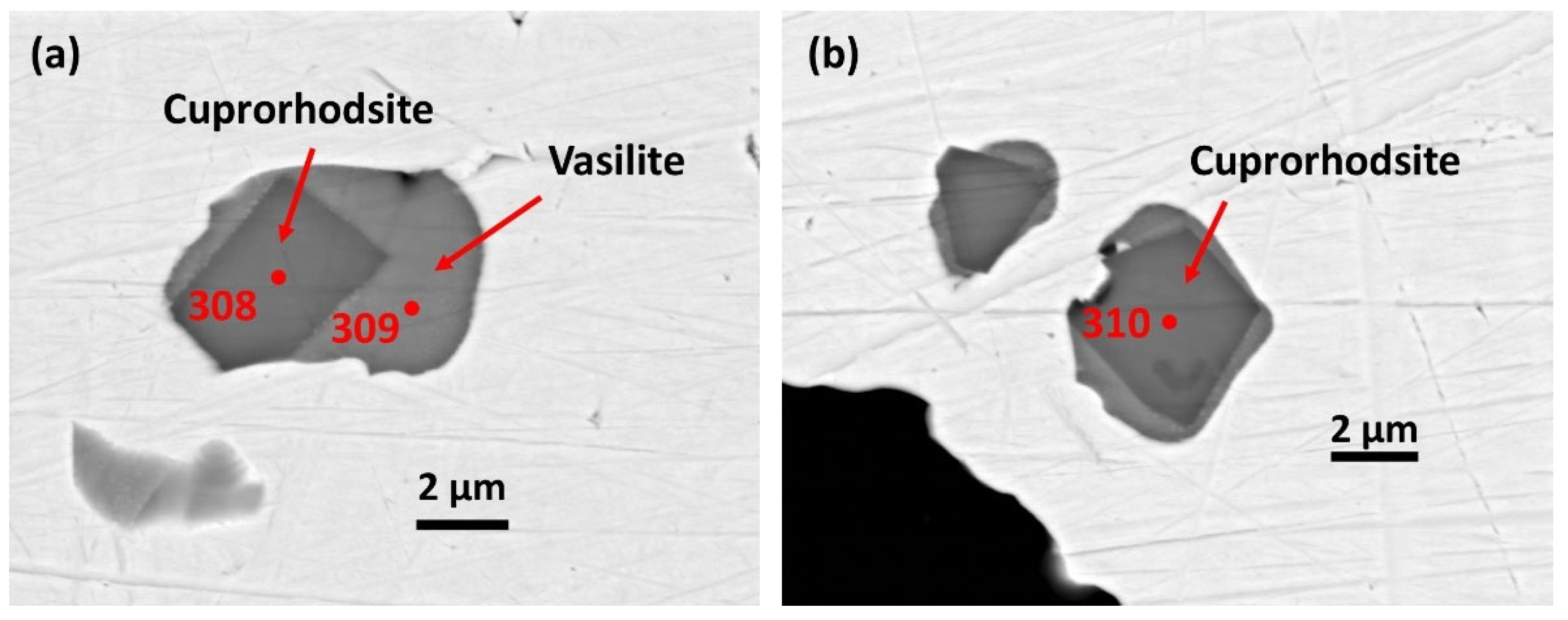
The PGM sulfide paragenesis comprises 18 small inclusions (mainly <7 µm across) forming a “halo” within the host Pt-Fe alloy adjacent to the silicate inclusion: up to ~14 µm from the scalloped silicate inclusion margin,
Figure 11b. They are not in contact with the silicate fraction (
Figure 11a). Each PGM paragenesis is simple, comprising a euhedral crystal of cuprorhodsite set in vasilite (
Figure 12a,b).
Cuprorhodsite crystals reach ~4.5 µm long and ~2.7 µm across.
Analysis 2 (308) of Rh-Pt-Cu-S (
Table 13) gives the formula (Cu
0.80Fe
0.08Ni
0.03)
0.91(Rh
1.42Pt
0.39Ir
0.09Ru
0.01Os
0.01)
1.92S
4.00 (Me-deficient, Me:S = 0.71), indicating cuprorhodsite–(malanite) with minor Fe and Ni.
Analysis 4 (310) in a separate inclusion gives a similar formula: (Cu
0.80Fe
0.08Ni
0.03)
0.91(Rh
1.40Pt
0.39Ir
0.08Ru
0.01Os
0.01)
1.89S
4.00 (also Me-deficient Me:S = 0.70).
Vasilite is anhedral and forms a matrix for the cuprorhodsite crystals in each inclusion above.
Analysis 3 (309) of Pd-Cu-S (
Table 13) indicates (Pd
11.25Rh
0.13Pt
0.12Ag
0.05Cu
3.82Fe
0.05Ni
0.01)
15.42(S
6.96As
0.03Se
0.01)
7.00 (Me:S = 2.20), with significant Rh and Pt. Additional ligands are detectable As and Se.
Table 13.
WDS analyses. Sample A1 area 7.
Table 13.
WDS analyses. Sample A1 area 7.
| # wt. % | Mineral | S | As | Se | Fe | Ni | Cu | Ru | Rh | Pd | Os | Ir | Pt | Total |
|---|
| 1 (264) | Pt-Fe | | | | 5.99 | | 1.26 | 0.13 | 1.88 | 2.02 | 0.51 | 3.12 | 86.67 | 101.58 |
| 2 (308) † | Crh | 30.13 | | | 1.09 | 0.34 | 11.97 | 0.25 | 34.29 | | 0.27 | 4.15 | 17.59 | 100.20 |
| 3 (309) †† | Vs | 12.88 | 0.13 | 0.07 | 0.16 | 0.02 | 14.01 | | 0.74 | 69.13 | | | 1.32 | 98.79 |
| 4 (310) * | Crh | 30.58 | | 0.04 | 1.00 | 0.36 | 12.10 | 0.24 | 34.28 | | 0.26 | 3.90 | 18.23 | 101.02 |
| Note: † Co: 0.03. †† Te: 0.05; Ag: 0.29. * Co: 0.04. |
| at. % | Mineral | S | As | Se | Fe | Ni | Cu | Ru | Rh | Pd | Os | Ir | Pt | Total |
| 1 (264) | Pt-Fe | | | | 17.06 | | 3.14 | 0.21 | 2.91 | 3.02 | 0.42 | 2.59 | 70.66 | 100.00 |
| 2 (308) † | Crh | 58.62 | | | 1.22 | 0.36 | 11.74 | 0.15 | 20.79 | | 0.19 | 1.35 | 5.65 | 100.00 |
| 3 (309) †† | Vs | 31.03 | 0.13 | 0.06 | 0.22 | 0.03 | 17.03 | | 0.56 | 50.18 | | | 0.52 | 100.00 |
| 4 (310) * | Crh | 58.88 | | 0.03 | 1.10 | 0.37 | 11.75 | 0.14 | 20.56 | | 0.08 | 1.25 | 5.77 | 100.00 |
| Note: † Co: 0.03. †† Te: 0.03; Ag: 0.21. * Co: 0.04. |
| apfu | Mineral | S | As | Se | Fe | Ni | Cu | Ru | Rh | Pd | Os | Ir | Pt | Me |
| 1 (264) | Pt-Fe | | | | 0.68 | | 0.13 | 0.01 | 0.12 | 0.12 | 0.02 | 0.10 | 2.83 | 4.01 |
| 2 (308) † | Crh | 4.00 | | | 0.08 | 0.02 | 0.80 | 0.01 | 1.42 | | 0.01 | 0.09 | 0.39 | 6.82 |
| 3 (309) †† | Vs | 6.96 | 0.03 | 0.01 | 0.05 | 0.01 | 3.82 | | 0.13 | 11.25 | | | 0.12 | 22.42 |
| 4 (310) * | Crh | 4.00 | | | 0.07 | 0.03 | 0.80 | 0.01 | 1.40 | | 0.01 | 0.09 | 0.39 | 6.80 |
| Note: † Co: 0.03. †† Te: 0.03. * Co: 0.04; Ag: 0.05. Crh = Cuprorhodsite–(malanite). Vs = Vasilite. (Mla) = Malanite. |
We calculate the approximate inclusion bulk chemistry (
Table 14) for the Cu-PGM sulfide fraction in the present sample using the simple ore mineralogy of cuprorhodsite and almost equally abundant vasilite (
Figure 12a). The order of major elements present is as follows: Rh >> Cu > Fe >> Pd > Ni.
Table 14.
Sample A1 (area 7). Calculated bulk chemistry (assuming equal Crh and Vs).
Table 14.
Sample A1 (area 7). Calculated bulk chemistry (assuming equal Crh and Vs).
| S | Fe | Ni | Cu | Rh | Pd | Os | Ir | Pt | Total, wt. % |
|---|
| 20.01 | 0.54 | 0.15 | 13.34 | 14.34 | 41.91 | 0.11 | 1.68 | 7.92 | 100.00 |
| | | | | | | | | | Total, at. % |
| 43.67 | 0.67 | 0.18 | 14.69 | 9.75 | 27.55 | 0.04 | 0.61 | 2.84 | 100.00 |